
QUICK REFERENCE CHART For Determining Key Immigration Consequences Of Selected California Offenses 1
|
|
|
- Fay Martin
- 9 years ago
- Views:
Transcription
1 Immigrant Legal Resource Center QUICK REFERENCE CHART For Determining Key Immigration Consequences Of Selected California Offenses 1 January 2016 For suggestions or questions about the Chart, write [email protected] and see endnote 1. DEFINITION OF TERMS USC, LPR, Undocumented. In these materials, a United States citizen is referred to as a USC, a lawful permanent resident ( green card holder) is referred to as an LPR, and a person with no current lawful immigration status is referred to as an undocumented person. For more information on these and other forms of immigration status, see Note: Overview and Note: Relief Toolkit. Aggravated Felony (AF). This conviction generally brings the worst immigration consequences. The AF definition at 8 USC 1101(a)(43) includes twenty-one provisions that describe hundreds of offenses, including some misdemeanors. Some but not all offenses require a sentence imposed of a year or more in order to be an AF. Aggravated felons are deportable and ineligible to apply for most forms of discretionary relief from deportation, including asylum, voluntary departure, and cancellation of removal, and are subject to mandatory detention without bond. A conviction for illegal reentry after removal carries a higher federal prison term based on a prior AF conviction, per 8 USC 1326(a), (b)(2). See Note: Aggravated Felony and individual offenses in the chart. Crime of Violence (COV). A conviction of a COV has two potential immigration penalties. If committed against a person protected under the state s domestic violence laws, a COV is a deportable Crime of Domestic Violence. See paragraph below on the domestic violence deportation ground, 8 USC 1227(a)(2)(E). If a sentence of a year or more is imposed, a COV is an aggravated felony, regardless of the type of victim. 8 USC 1101(a)(43)(F). COV is defined at 18 USC 16. Recent Supreme Court precedent has changed the legal landscape for that definition, so that some felonies that used to be COVs no longer are. See individual offenses, and see discussion at endnote 2, here. 2 Crime Involving Moral Turpitude (CIMT). Whether an offense involves moral turpitude is defined according to federal immigration case law, not state cases. CIMT is notoriously vaguely defined and subject to much litigation. It includes crimes with elements of intent to defraud, intent to cause great bodily injury, and theft with intent to deprive permanently. In also includes some offenses involving lewdness, recklessness, or malice. See individual offenses. A noncitizen is deportable who (a) is convicted of at least two CIMT s that did not arise out of the same incident, at any time after being admitted to the U.S., or (b) is convicted of one CIMT, committed within five years of admission to the U.S. (or if there was no admission, within five years of adjustment to LPR status), if the offense carries a potential sentence of at least one year. 8 USC 1227(a)(2)(A). Because Cal PC 18.5 (effective Jan. 1, 2015) provides that the maximum possible sentence for a misdemeanor is 364 days, any plea to a single misdemeanor CIMT entered after January 1, 2015 should not trigger the deportation ground. When reducing a single CIMT felony to a misdemeanor after January 1, 2015 for a noncitizen defendant, ask the judge to sign an order noting that the misdemeanor has potential 364 days; see paragraph on P.C below.

2 A noncitizen is inadmissible if convicted of one CIMT, unless an exception applies. To qualify for the petty offense exception, the person must have committed only one CIMT, which carries a potential sentence of not more than a year, and a sentence of not more than six months must have been imposed. To qualify for the youthful offender exception, the person must have committed only one CIMT, while under age 18, and the conviction (in adult criminal court) or release from imprisonment occurred at least five years ago. 8 USC 1182(a)(2)(A)(ii). For more information on CIMTs see n. 3, here. 3 Controlled Substance Offense (CS). A noncitizen is deportable and inadmissible if convicted of an offense relating to a federally defined controlled substance. There is an exception to the deportation ground, and a possible waiver of inadmissibility, if the conviction/s relate to a single incident involving simple possession, use, or possession of paraphernalia relating to 30 grams or less of marijuana or hashish. See discussion at H&S C 11377, and see 8 USC 1227(a)(2)(B)(i) (deportability), 8 USC 1182(a)(2)(A)(i)(II) (inadmissibility), (h) (waiver). Controlled substance is defined according to federal law, and some offenses such as include substances not on the federal list. Due to this disparity, if the specific California substance is not identified on the record, the defendant may have an immigration defense. See Advice for A drug trafficking aggravated felony, defined at 8 USC 1101(a)(43)(B), includes trafficking offenses such as sale or possession for sale, as well as state offenses that may not involve trafficking but that are analogues to federal drug felonies. However, in immigration proceedings in the Ninth Circuit only, offering to commit these offenses is not an aggravated felony. See Advice to Even if there is no conviction, a noncitizen is inadmissible if ICE has reason to believe he or she has trafficked (8 USC 1182(a)(C)), and can be deportable and inadmissible for being a drug addict or abuser (8 USC 1182(a)(1), 1227(a)(2)(B)(ii). See Note: Controlled Substances and individual offenses. Conviction of a Crime of Domestic Violence, of Child Abuse, Neglect or Abandonment, or of Stalking; Civil or Criminal Court Finding of Violation of a DV Stay-Away Order or Similar Order. These all trigger deportability under the domestic violence ground at 8 USC 1227(a)(2)(E). The conviction, or the conduct that violated the protective order, must have occurred after admission and after Sept. 30, A crime of domestic violence is a crime of violence (see above) against a person protected from the defendant s acts under state domestic violence laws. A court finding of a violation of a portion of a DV protective order that is meant to protect against threats or repeated harassment causes deportability; this includes even the most minimal violation of a stay-away order. See Note: Domestic Violence and individual offenses. Firearms Offenses. A noncitizen is deportable under 8 USC 1227(a)(2)(C) who at any time after admission is convicted of an offense relating to a firearm. Also, convictions for sale of firearms, or certain offenses such as being a felon in possession, are aggravated felonies. 8 USC 1101(a)(43)(C). However, no California offense that uses the definition of firearm at PC 16520(a) carries these consequences, because the California and federal definitions of firearm are different. See Advice for PC Crimes against a Minor that Block Family Visa Petitions. An LPR or USC who is convicted of certain crimes against a minor can be barred from getting lawful status for an immigrant spouse or child (from filing a family visa petition. ) The crimes include kidnapping, false imprisonment, offenses involving sexual conduct, or child pornography. See Note: Adam Walsh Act and 8 USC 1154(a)(1)(A)(viii). Minimum Conduct/ Divisible Statutes/ Record of Conviction. One of the most important defense strategies comes from understanding how federal law will analyze a conviction for immigration purposes. This is referred to as the categorical approach, and it applies to almost all removal grounds. The following is a summary. For citations and more information see endnote 4, here. 4 Minimum Conduct. For most removal grounds, a conviction triggers the ground only if the minimum conduct ever prosecuted under the statute (a/k/a the least act criminalized by the statute) would do so, without regard to what the individual defendant did or pled guilty to. This is a defendant-friendly rule meant to ensure fairness and judicial efficiency in immigration proceedings. 2

3 However, rather than rely on this rule and not create a good individual record, the best practice for a noncitizen defendant is to plead to the specific safe minimum conduct rather than, e.g., to the facts in the charge or the statutory language, where that is possible. This is because immigration authorities might misapply the law, and wrongly look to the person s own conviction record to evaluate the offense. (Many immigrants are unrepresented in removal proceedings and have no one to object to this.) This chart sets out good suggested minimum conduct for most offenses. Example: The minimum conduct required to be guilty of Penal Code 243(e) is an offensive touching against the victim. That is not a crime of violence, a crime of domestic violence, or a crime involving moral turpitude for immigration purposes. Therefore, no conviction of 243(e) has these consequences, for purposes of deportability, inadmissibility, or eligibility for relief. This is true even if the defendant pled guilty to more violent conduct. Still, because of the risk that an immigration judge might not apply the minimum conduct rule correctly, best practice is to plead to an offensive touching when that is possible. Divisible Statutes. There is an important variation on the minimum conduct rule. Some criminal statutes are divisible in that they set out distinct multiple offenses, at least one of which triggers a removal ground. If a statute is divisible, an immigration judge is permitted to review certain documents from the individual s record of conviction, to see of which offense the person was convicted. Then the judge will apply the minimum conduct rule to that offense. When is a statute divisible? In the Ninth Circuit, it is divisible only if (1) it is phrased in the alternative (using or ); (2) at least one, but not all, of the alternatives triggers the removal ground; and (3) a jury always must decide unanimously between the alternatives in order to find guilt (this is the definition of an element). For many statutes, the jury unanimity requirement is the key to determining divisibility. Example: California Vehicle Code prohibits taking a vehicle with intent to deprive the owner permanently or temporarily. Intent to deprive permanently is a crime involving moral turpitude (CIMT), but temporary intent is not. Is divisible as a CIMT? The Ninth Circuit found that it is not. Section meets the first two requirements for a divisible statute: it sets out statutory alternatives, at least one but not all of which would trigger the removal ground. But it fails the third requirement, because a jury is not required to decide unanimously between temporary and permanent intent in order to find guilt under Because the statute is not divisible, the minimum conduct test applies. The minimum conduct includes a temporary taking (which is not a CIMT), no conviction of ever is a CIMT for any immigration purpose. This is true even if the person pled guilty to, or was convicted by jury of, a permanent taking. See Almanza-Arenas v. Lynch, --F.3d-- (9 th Cir. Dec. 28, 2015) (en banc). Despite this good rule, the best practice is to make a specific plea to the good conduct, e.g. to a temporary taking under 10851, where that is possible. This is because there is a split among Circuit Courts of Appeals as to whether the jury unanimity rule is required. The Supreme Court may address this issue and conceivably could rule against it. Or, the defendant could end up in removal proceedings in another Circuit that does not apply that rule. A specific plea will protect against these contingencies. See further discussion at n. 4. All courts agree that a single word, or a phrase that does not contain or, is not divisible even if it covers a wide range of conduct. For example, the Supreme Court held that the word entry in Penal Code 459 is not divisible between lawful and unlawful entry, so that all 459 convictions must be considered to involve a lawful entry. But if a term has its own statutory definition that does list alternatives separated by or, it might be divisible. For example, the Ninth Circuit held that the term controlled substance in H&S C is divisible, because it is defined by a list of substances in state drug schedules. See n. 4. Record of Conviction; Inconclusive Record. If a statute is truly divisible, an immigration judge may review a limited set of documents, called the reviewable record of conviction (ROC), to try to discern of 3

4 which offense the person was convicted. These are the documents defenders will use to create a good record. In a conviction by plea, assume that the ROC includes the charge pled to, as amended (not dropped charges); the plea colloquy transcript and, if any, plea agreement; the judgment; and any factual basis for the plea agreed to by the defendant. Watch out for written notations on forms, and information on the Abstract of Judgment that refers to a count, because sometimes these are used. The ROC does not include the police report, pre-sentence report, or preliminary hearing transcript unless the defendant stipulates that the document contains a factual basis. To avoid stipulating to any factual basis, see People v. Palmer (2013) 58 Cal.4th 110. If you must stipulate, choose documents that you have identified or created that do not include damaging information, for example a written plea agreement or sanitized complaint. See People v. Holmes (2004) 32 Cal.4th 432. What if the ROC is inconclusive, for example all of the above documents show only that the conviction was for intent to deprive temporarily or permanently? Sometimes an inconclusive record can save the day. The benefit of this depends on the immigration context. If the issue is whether a permanent resident is deportable, then an inconclusive record is enough. ICE has the burden of proving deportability, and they can t do it. (Still, best practice is a specific plea to the good offense where possible.) If instead the person needs to be eligible to apply for lawful status or relief from removal, then under current law an inconclusive record is not enough, because the immigrant must produce a record showing a plea to the good alternative. Thus for undocumented persons, permanent residents who already are deportable for a prior conviction, and many others, a specific plea is required. Sentence Imposed ( Term of Imprisonment ). In some but not all cases, sentence imposed is crucial for immigration consequences. Certain offenses become an aggravated felony only if a sentence of a year or more is imposed. Also, a first misdemeanor conviction of a crime involving moral turpitude can come within the petty offense exception to the inadmissibility ground only if a sentence of six months or less is imposed. See AF, CIMT, above. For immigration purposes, an imposed sentence includes any sentence to custody, even if execution is suspended. If imposition of sentence is suspended, it includes any period of custody ordered as a condition of probation. If additional custody is added to the original count due to a probation violation, it includes that time. But the sentence must be imposed as a result of a conviction. It does not include pre-hearing custody if the defendant waives credit for time served, and it does not include custody ordered in delinquency proceedings. See 8 USC 1101(a)(48(B) and Note: Sentence. A slightly different definition of sentence, which excludes suspended sentences, applies for purposes of the significant misdemeanor classification in DACA, DAPA, and enforcement priorities. See Advice for P.C Under P.C. 18.5, Misdemeanor has Maximum 364-Day Exposure. As of January 1, 2015, a California misdemeanor that previously was punishable by up to one year of custody instead is punishable by up to 364 days. When changing a felony to a misdemeanor per P.C. 17(b)(3) or , depending on the defendant s case it may be very important to have P.C or 364 days maximum exposure noted on the order. See resources at note 5, here. 5 GIVE KEY PAPERS TO THE DEFENDANT. Many immigrants will have no representation in their removal proceeding. If a plea agreement will help your client in removal proceedings, give the person a copy of it and/or mail it to the person s family or attorney, if any. If the defendant is in custody, speak with custody officers and inform them this document should not be taken from the client. If the plea is safe based on a particular legal argument, give the defendant (or the attorney if any) a written summary of the argument, from these footnotes or the summaries at the end of the Notes (short articles) on the applicable offense. 4

5 ACKNOWLEDGMENTS. We want to thank the many experts who volunteered their time to draft and review sections of the chart, and who are listed at n. 1. Their very generous contributions of time were crucial to ILRC creating the 2016 update. In addition, we are very grateful that beginning in 2002, at various times work on the California Chart has been funded in whole or in part by the Ford Foundation, the Open Society Institute, and the former JEHT Foundation. The Chart is now an unfunded ILRC project, and we seek donations toward its support. To donate, go to and indicate chart (and any other comments) in the last page comments area. DISCLAIMER. This chart does not constitute legal advice and is not a substitute for individual case consultation and research. Note that the law governing the immigration consequences of crimes can be complex and volatile. Some of the below analyses are supported by on-point precedent (often cited in endnotes), while in other cases they represents the opinion of experts as to what is most likely to be held. Further, the law is fast changing. An immigration case resolution that is the best option today might change for the worse (or become even better) in the future. Do research or consult experts for key updates in the law occurring after January 1, 2016, and advise defendants about these risks. The best protection for defendants is to see a qualified immigration expert as soon as they can, so that they can apply for lawful immigration status or naturalization to U.S. citizenship as soon as it is safe to do so. Immigration advocates should note that the chart is written conservatively, to warn criminal defense counsel away from offenses that might be or become dangerous and toward those that are safer. Just because the chart identifies an offense as having a consequence, do not assume that it actually does. Often there are strong immigration defenses or good precedent; in some cases these are outlined in endnotes. The chart should be considered a starting, not an ending, point for investigating immigration defenses. CODE SECTION OFFENSE AF CIMT OTHER GROUNDS ADVICE AND COMMENTS Business & Prof C 4324 (a) Forge prescription for any drug (b) Possess any drug obtained by forged prescription AF Forgery: Assume (a) is AF if 1 yr or more is imposed on a single count; see Note: Sentence. Defenses may exist for (b) 6 but still best to avoid 1 yr. AF CS: Should not be AF, but see Advice. Might be divisible. Forgery is CIMT but (b) possessing the drug might not be. Generally unlawful possession of a CS is not a CIMT. No. Because drug includes non-controlled substances (CS), and is not a divisible term (see n. 4), this should not be a deportable or inadmissible CS offense. See Advice. Good alternative to H&S C 11173, 11368, as a non-cs offense and non-af, at least with less than 1 yr imposed on a single count. Not a drug trafficking AF as analogue to 21 USC 843(a)(3) or a CS offense because the minimum conduct includes a non-cs, and drug is not a divisible term. See Advice to re requirement of federally-listed CS, and see n. 4 re divisible statutes. But where possible, best practice is to sanitize ROC of mention of specific CS. See 11379, and see other strategies for drug charges in Note: Drugs. Business & Prof C 7028(a)(1) Contractor without a license, first offense Not AF Shd not be CIMT; No regulatory offense Business & Prof C 25658(a) Selling, giving liquor to a person under age 21 Not AF. Shd not be CIMT. 7 Not child abuse because not abuse and V under 18 is not an element. See Great alternative to providing CS to a minor, if this is obtainable. Not child abuse, which applies to V s under 18, not 21. Statute is not divisible as to age of V. 5

6 Advice. But to prevent even a wrongful charge, best practice is to keep CS, V under 18, out of ROC. Business & Prof C Possession purchase, or use of liquor by a minor Not AF. Not CIMT No, but see Advice re inadmissible for alcoholism Multiple convictions might be evidence of alcoholism, which is an inadmissibility grnd and a bar to "good moral character." Health & Safety C 11173(a), (b), (c) Obtain CS by fraud AF CS. Assume AF if federal CS is ID d; see Advice AF Forgery: Shd not be AF as forgery unless false document is used and 1 yr imposed on a single count. Yes CIMT, except that (d), affixing a false label, might not be. Yes, deportable CS if federal CS is ID d on ROC. See Advice. AF. Avoid as likely AF as analogue to 21 USC 843(a)(3) (obtain CS by deceit), altho imm counsel may identify defense arguments. The unspecified, or non-federal, CS defenses should protect; see Better option is B&P C Or, possession plus other distinct offense such as false personation, PC 32, forgery, fraud. H&S C 11350(a), (b) Possess controlled substance See Not CIMT. See See defenses at Advice for H&S C Possession for sale Yes AF, but see Yes CIMT, like any trafficking offense. See and see Advice Bad immigration plea. Pleading down to or up to (or if possible 11377, 11379) is better. See other defense options, including unspecified or non-federal CS defenses, at Advice at H&S C Possession for sale of cocaine base Yes AF Yes CIMT Deportable, inadmissible for CS conviction Bad plea is worse than in that there is no unspecified CS defense. Careful plea to 11352, or if possible 11379, is better. See Advice. H&S C 11352(a) -Sell, give away, transport for sale (1/1/14) or personal use (pre- 1/1/14) Divisible as AF. See Divisible as CIMT. See See See Advice for The only difference between and is that is the better plea for purposes of the unspecified CS and non-federal CS defenses. -Offer to do the above H&S C 11357(a) Concentrated Cannabis, Possession Not AF (unless a prior possession is pled and proved) Not CIMT Yes deportable and inadmissible CS offense, except see Advice re first offense where ROC shows a small amount. Advice Even a minor drug conviction is extremely harmful. If the person has no drug priors, fight hard for a disposition that is not a CS offense, such as PC 32 or other non-drug crime. See Advice at 11357(b) and

7 H&S C 11357(b) Marijuana, Possession of 28.5 grams or less (Misdemean or/infraction) DEJ is not the best option because generally it is a conviction for immigration purposes, but see Advice below re new PC Small amount of hashish as a first drug offense gets the same benefits as possession of 30 grams or less of marijuana: it is not a deportable offense, and some persons can apply for a waiver of inadmissibility. See 11357(b). 30 gms or less of hashish should not be a deportable offense, but best practice is for the ROC to show an amount of hash equivalent to 30 gm of marijuana or less i.e., just a few grams. This is likely required for the person to receive a waiver of inadmissibility under 212(h), and may smooth the way for the person to get all the deportation benefit as well. 8 Try to put the amount in the plea; a vague ROC is not helpful if the govt can obtain evidence that it was more than the 30 (or a few) grams. 2. New PC treatment for completed DEJ, as of 1/1/16 (withdraw plea after any successfullycompleted DEJ, from 1/1/97 into the future) will make a successfully-completed DEJ no longer a conviction for imm purposes. While DEJ is not recommended, may make it the best of bad choices: if D can make it through the DEJ period without being removed, once DEJ is completed the conviction can be eliminated for all imm purposes. See discussion of strategies at Advice to 11377, and see Advisory at 3. Pre-7/15/11 Plea: Conviction might be removed simply by , Prop 36, or DEJ dismissal of charges; see Advice at Not AF (unless a prior possession is pled and proved) Not CIMT Deportable/Inadmissible. 30 gm benefits. One or more convictions arising from the same incident that involved possession of 30 gm or less marijuana, with no drug priors, gets imm benefits: -- Automatically not a deportable CS conviction, per 8 USC 1227(a)(2)(B)(i), or bar to establishing good moral character. -- Is inadmissible CS conviction (assuming an infraction is a conviction ; see Advice) but D might be eligible to apply for discretionary waiver of inadmissibility, 8 USC 1182(h). However this waiver can be hard to get and not all D s are eligible (D must be applying to become an LPR under certain applications, or already be an LPR). For info on the 212(h) waiver and eligibility, see Note: Relief. Advice 1. Try for a non-drug plea! If D has no drug priors and a minor charge relating to mj, try very hard to plead to a non-cs offense. While 30 gm mj has key advantages, they may not be enough to save the person. This is especially critical for non-lprs. See and see Note: Drugs Grams or less mj, if a first drug conviction, has imm benefits; see above. While 11357(b) by definition is less than 30 grams, for 11357(c) an amount of 30 grams or less, and for (a) an amount of a few grams (or if that s not possible, of 30 grams or less) should be specified on the record, if possible stated at the plea New PC treatment for prior DEJ, as of 1/1/16. This can cure a prior conviction, and makes a new plea to DEJ less disadvantageous (but D may be at risk for removal during the DEJ period) See Advice for 11357(a). 3. Pre-7/15/11 Plea: See Advice; dismissal of charges per , DEJ, or Prop 36 may suffice to remove a first conviction, if there was no probation violation and no prior pretrial diversion 4. Infraction = conviction? See argument that a Cal. infraction is not a conviction for imm purposes. 10 If it is not a conviction, 11357(b) will have no immigration effect. H&S C 11357(c) Marijuana, possession of more than 28.5 grams Not AF (unless a prior possession is pled or proved.) Not CIMT Deportable and inadmissible with no 212(h) waiver, unless the ROC shows 30 gms or less, and the person can benefit from the 30 gram provisions. See Advice and see 11357(b).. Proving 30 grams or less: See 11357(b) for 30 gm benefits and requirements. Plead specifically to 29 or 30 grams (or less) to qualify. This must be on the record. 11 If plea was not or cannot be done, ID other evidence showing 30 gms or less (or at least avoid admitting a larger amount). Pre-7/15/11 Plea: See Advice 7

8 Get a non-drug plea! See 11357(b). DEJ is not recommended, but is better than before. See 11357(a). H&S C Marijuana, Cultivate Yes, AF. This is a bad plea; see Advice for other options. Consider DEJ if mj was for personal use but see Advice. CIMT if ROC shows, or IJ finds evidence of, intent to sell. If intent is for personal use, shd not be CIMT. Yes, deportable and inadmissible for CS conviction. With or without a conviction, warn D she may be inadmissible for reason to believe trafficking if there is good evidence of intent to sell. To avoid AF: Plead down to simple possession; or up to 11360, per the advice. Or plead to 11377, with a nonspecified, or nonfederal, CS. Best option is a nondrug offense, including PC 32 w/ less than 1 yr imposed. If this would be 30 gms or less mj, try hard to get DEJ option: If cultivation was for personal use it is eligible for DEJ. Once DEJ is complete, one can eliminate conviction with ; the problem is that during the DEJ period person is at risk of being identified and removed. See Note: Drugs. H&S C Possession for sale marijuana Yes, AF. See Advice. Yes CIMT. See Plead down or up per or instructions. See and Note: Drugs. H&S C Marijuana (a) sell, transport, give away, offer to; (b) same for 28.5 gms or less Yes AF: Sale is an AF; Offer to sell is AF if outside Ninth Circuit; Post 1/1/16 transportation is an AF because it is defined as transportation for sale Not AF: -Pre-1/1/16 transportation, b/c minimum conduct is for personal use. State on record that transport is pre-1/1/16, personal use, version of the statute. -Offer to commit any offense. This avoids an AF only in imm proceedings in the Ninth Circuit; see Give away; see Advice CIMT. Sale is a CIMT as CS trafficking; offer to give away (or if that s not possible, giving away) might be CIMT; pre-1/1/16 transport for personal use is not a CIMT, but post-1/1/16 transport is because it involves intent to sell. Deportable & inadmissible CS. Yes, all offenses. To avoid this, see unspecified or non-federal substance defenses or plead to a non-drug offense. Advice Trafficking (including offer to sell) versus non-trafficking. Any drug trafficking conviction is a particularly serious crime, bad for asylees, refugees. See Note: Relief. It also makes D inadmissible by giving gov t reason to believe D is trafficking. See Note: Drugs. Give away, pre-1/1/16 transportation, or offer to commit these offenses, is better. Giving away small amount of mj (30 gms or less) has two advantages: 1. It is not an AF. While (b) is best, (a) also qualifies because the minimum conduct involves 29 or 30 gms. Moncrieffe v. Holder, 133 S.Ct (2103). Still, best practice for (a) is plea to 29 gms. 2. A conviction from before 7/15/11 to giving away a small amount of mj might be eliminated for imm purposes by DEJ, Prop 36, or H&S C Possession of drug paraphernalia Not AF. Not CIMT (Sale of drug paraphernali a may be AF, however.) Potential deportable and inadmissible CS conviction. The unspecified, or specific non-federal, defense may be 1. Plead to use with marijuana. If no drug priors, and ROC shows paraphernalia was for use with 30 gms or less of mj, conviction gets the advantages of possession of 30 grams of mj. 13 See H&S 8

9 available for 11364, but is best choice for this defense; see Also, see Advice re use with marijuana (b). But plea to 11357(b) itself is more direct and hence safer. 2. New PC treatment for prior DEJ, as of 1/1/16 (withdraw plea after any successfullycompleted DEJ from 1/1/97 on) will make an already-completed DEJ no longer a conviction for imm purposes. But D may be vulnerable to removal during the DEJ period (and perhaps could fail DEJ), so this is not recommended if there are other options. See more info at Advice, and PC Advisory at 3. If plea is from before 7/15/2011, it might be eliminated for imm purposes by or dismissal under DEJ, Prop 36. See and Note: Drugs. H&S C Aid/Abet use of CS (Presence where CS is used) Not AF Not CIMT Try hard for a nondrug plea. Or to possibly avoid a deportable and inadmissible CS offense, plead to an unspecified, or nonfederal, CS but is best for this defense. See and Advice. For prior pleas (or if DEJ is the only option): 1. New PC as of 1/1/16 can eliminate imm effect of prior DEJ; see Advice for Plea from before 7/15/11, with no drug priors, might be easily eliminated; see Plea to presence where 30 gms or less of mj used might get certain benefits; put marijuana on ROC. See 11357(b) H&S C 11366, Open, maintain, manage place where drugs are sold, distributed, used Held AF as a federal analogue. 14 Bad plea. A careful plea to is better Yes CIMT, except manage place where drugs are used might not be Deportable and inadmissible for CS conviction; see Advice Avoid this plea. See H&S 11377, 11379, public nuisance offenses. This potentially does not have CS consequences if the ROC does not ID a specific CS, but are better for that plea. See Advice to H&S C Forged prescription to obtain narcotic drug Assume AF but see advice re possession. Consider B&P If this can t be avoided, consider DEJ; see Advice. Assume CIMT, except maybe not if possess only. See DEJ/ option, which should eliminate conviction for all purposes. Yes deportable and inadmissible CS offense. AF. Obtain or acquire CS by fraud is an AF as analogue to 21 USC 843(a)(3). To extent possessing a drug acquired by fraud is punishable here and outside 843(a)(3), that may not be AF. But best plea is to B&P C 4342, or simple possession plus other offense such as false personation, PC 32, forgery, fraud, etc. DEJ option. New PC , as of 1/1/16 can eliminate imm effect of prior DEJ; see Advice for 9

10 Eligible for DEJ if drugs obtained by fictitious prescription and for use only by defendant. H&S C Possess a controlled substance Note: Charges: Follow instructions for Note that is recommended if you use unspecified or non-federal substance defenses. Otherwise offenses are the same for imm purposes. Not AF. Possession is not an AF unless prior drug offense is pled or proved for a recidivist enhancement, or the possession is of flunitrazepam. Not a CIMT Deportable and inadmissible CS conviction. Yes. Consider these defense strategies: 1. Avoid a first drug conviction! If this is D s first CS offense, try very hard to plead to a non-cs offense or other disposition. Consider: PC 32, 459(b), 136.1(b), trespass, or any other less harmful offense, based on D s individual circumstances. Individual analysis is needed, but in many cases a theft or violent offense is less dangerous than a drug offense. Get expert advice if needed to analyze options. As a first-time minor offender there may be room to bargain, and a first drug conviction is often life-destroying to an immigrant. See Box Making the Case at Note: Controlled Substances. 2. Avoid a conviction. Pretrial diversion (PC 1001, or an informal agreement to fulfill conditions before plea hearing in exchange for a better plea) and delinquency disposition are not convictions. DEJ is a conviction, but it now has some advantages due to new PC ; see # 4 below. 3. Unspecified CS, and non-federal CS, defenses. To be a deportable or inadmissible CS conviction or a CS agg felony, a state conviction must involve a substance listed in federal drug schedules. Cal drug schedules include some non-federally listed substances. The disparity gives rise to these defenses. For this defense plead to rather than or if possible. a. Unspecified CS defense. If the entire ROC refers only to a controlled substance as opposed to, e.g., meth, is not a CS offense for purposes of deportability. 15 Thus this disposition will not cause an LPR to become deportable. However, under current law the conviction is a CS offense as a bar to relief or admission. 16 Thus it will cause an undocumented person, or an already-deportable LPR, to have a drug conviction for purposes of eligibility for relief. The charge, plea colloquy, plea agreement, judgment, factual basis must be clear; watch out for clerk-written notations on forms that refer to the charge, including abstract. See Note: Drug Offenses. b. Non-federal CS defense. While this may be quite difficult to get, it protects against deportability and bars to relief. Specific plea involving substances such as chorioinic gonadotropin or khat will prevent from being a deportable or inadmissible CS conviction, or a CS aggravated felony, because these is not on the federal CS list. 17 These pleas should remain safe even if substances are later added to the federal list, because the lists are compared as of the date of the conviction. 18 c. Trafficking. These defenses likely won t prevent a trafficking conviction (e.g , ) from being a particularly serious crime, which is dangerous for asylees and refugees, or from being a CIMT. It may not prevent the person from being inadmissible because DHS has reason to believe he or she engaged in trafficking, because while that requires a federally-defined CS, it is a fact-based inquiry not limited to the ROC. Offer to give away or furnish is a better plea than sale for this purpose, but all are dangerous. See Advice to New PC treatment for DEJ, as of 1/1/16 (withdraw plea after any successfully-completed DEJ from 1/1/97 and after) Here is a summary of the law. See a Advisory for defenders, sample moving papers, and other resources at Because immigration law uses a different definition of conviction than California, DEJ generally is a conviction for imm purposes even after dismissal of charges under PC New creates a simple procedure to eliminate a successfully-completed DEJ as an immigration conviction. 19 See materials listed above for aids in obtaining this relief for persons who already have completed DEJ. The application can be granted without a hearing, based solely on the court s own record that it dismissed D s charges under PC (or if that record no longer exists, based on other evidence set out at (b)). 10

11 H&S C Possess CS for sale H&S C 11379(a) -Sell -Give away -Transport for sale (1/1/14 statute) -Transport for personal use (pre- For new charges, DEJ is not a recommended plea, but it may be the best of bad alternatives. It is true that DEJ granted after 1/1/16 will continue to be amenable to upon completion, and once is granted it will not be a conviction. But D may be vulnerable to removal during the minimum 18-month DEJ period, if ICE locates him and puts him in proceedings during that time. Imm counsel have strong arguments that removal proceedings should be continued to allow for completion of DEJ (see DEJ Advisory, cited above), but immigrants often are unrepresented. For this reason, as well as the possibility that D will not succeed in completing the program, a non-drug plea is best. DEJ is far preferable to a regular CS conviction, however. If DEJ is taken, request 18 rather than 36 months (unless that is not appropriate for D). Advise D to retain imm counsel to be ready in case he is placed in removal proceedings during the DEJ period. Advise D that it is critical to complete the DEJ program, stay out of further trouble with the law, refrain from leaving the U.S., and avoid immigration authorities until is granted. There are two strategies that will prevent an immigrant D from being vulnerable during the DEJ period. First, an LPR or refugee who is not otherwise deportable and who pleads to an unspecified CS is not deportable for a CS conviction, and so is not vulnerable during the DEJ period. Under current law, this strategy will not protect an immigrant who must apply for relief, however. See Part 3, above. Second, DEJ is not a conviction if the only penalty is an unconditionally suspended fine; see next section. See further discussion of these issues at materials in the Advisory cited above. If there are problems in your area with implementation of new , contact [email protected]. 5. DEJ with unconditionally suspended fine is not a conviction for imm purposes, per Ninth Circuit. 20 If the court declines to unconditionally suspend the fine, see if the court might agree to delay making an order regarding the fine until later in the DEJ period. This may be difficult to obtain, but if obtained it could protect D until the fine is imposed. See also Part 4, above. 6. If conviction relating to federally-defined CS can t be avoided, note that a few types of imm status and relief from removal are not automatically barred by a possessory (as opposed to trafficking) conviction, for example asylum, T and U visa, and in some cases LPR cancellation. See Note: Relief Toolkit for more information. D should seek imm counsel. AF: Yes AF, unless unspecified or non-federal CS defense applies; see This is a very bad plea for immigrants. To avoid AF plead to a non-drug offense if possible (see Advice); plead down to 11377; or advise D about pleading up to offer to give away (or if necessary, offer to sell), which is not an AF in imm proceedings arising within the Ninth Circuit. 21 Pleading up is counter-intuitive but may be necessary for immigrant D s, if the person prioritizes remaining in the U.S. It can be IAC to fail to advise and consider the 11352/11379 option in an 11351/11378 charge for a noncitizen D. 22 CIMT: Yes as trafficking, regardless of unspecified or non-federal CS. Deportable and inadmissible CS conviction: Yes, unless this is prevented by the unspecified or nonfederal CS defense. But it is far better for immigration purposes to use that defense with offering to, than Inadmissible for reason to believe. The non-specific, or specific non-federal, CS defense may prevent this from being an AF or deportable or inadmissible CS conviction, but ICE still may collect evidence on the substance for the fact-based ground of inadmissibility based on reason to believe trafficking. See discussion at Particularly serious crime (PSC): Trafficking is a PSC, very bad for asylees and refugees. See and see Note: Relief Toolkit. Divisible as AF: Yes AF: Sell, give away, and after 1/1/14, transport for sale are AFs. This is not true if the unspecified CS or specific non-federal CS defense applies; see Advice. Not AF: Pre-1/1/14 transport is not an AF; offer to transport is best option. Offer to commit any 11352/11379 offense is not AF, but only in imm proceedings arising in the Ninth Circuit. (Offer to give away is better than offer to sell; See Advice.) Unspecified, or non-federal, CS defense prevents an AF CIMT: Sale and 1/1/14 transportation are CIMTs b/c they involve trafficking. So is offer to commit these, and distribution might be. Pre-1/1/14 transportation is not a CIMT, because it is for personal use. Unspecified CS and specific non-federal CS defenses do not prevent CIMT. Deportable and inadmissible CS conviction: Yes, all of these offenses, including transportation, are deportable and inadmissible CS convictions unless the unspecified or non-federal substance defense 11

12 1/1/14 statute) -Offer to do any of above See Note: Drugs applies. See Advice Advice 1. Non-specific CS, and specific non-federal CS, Defenses. Because Cal drug schedules contain some substances that don t appear on federal drug schedules, a plea to an unspecified controlled substance, or to a specific substance not on the federal list, can prevent from being a deportable or inadmissible CS conviction, or a CS agg felony. See discussion at Note that these defenses do not necessarily prevent a trafficking conviction from being a CIMT or particularly serious crime, or inadmissible for reason to believe trafficking, because these penalties don t require a federally listed substance and/or can involve evidence from outside the ROC; see below. 2. Inadmissible for reason to believe trafficking. Sale, post-1/1/14 transport, and offer to do these provide ICE with reason to believe D was trafficking, which is a very bad inadmissibility ground. These are very bad pleas for an undocumented, asylee, refugee, or other non-lpr defendant. Offer to give away is somewhat better than offer to sell; see below. While the non-specific or non-federal CS defenses prevent the plea itself from establishing inadmissibility based on reason to believe, ICE may be able to obtain evidence elsewhere to prove that a federally-listed CS was involved, for purposes of this fact-based ground. 3. PSC for refugees, asylees. Conviction for commercial trafficking (sale, post 1/1/14 transport, or offer to do these) is a particularly serious crime (PSC). Asylees and refugees can lose their status and be removed based on this conviction, except in the rare case where there are extraordinary equities and these factors: amount was very small, defendant was peripheral to scheme, and no minors involved. Offer to give away is better than offer to sell for this purpose. Non-specific federal, and unspecified, CS defenses don t work here. See Note: Relief. H&S C Sale, give, Divisible: transport, offer -Transport is not to, PCP an AF under pre-1/1/16 statute; thereafter it is; see Advice - Offer to give, sell, etc. is not an AF, in Ninth Circuit only -Sell, give, is an AF Sale is a CIMT as CS trafficking; offer to give away (or if that s not possible, giving away) might be CIMT; transport for personal use under pre- 1/1/16 is not a CIMT. Yes, deportable and inadmissible CS Plead to rather than in order to use defense related to an unspecified or nonfederal CS. See 11377, Transportation. Minimum conduct for transportation under includes for personal use, for offenses committed until 1/1/16. This is not an AF. As of 1/1/16 the transportation is for sale and is an AF. (Compare to 11357, 11379, which changed to transport for sale as of 1/1/14.) See re transportation. H&S C 11390, Cultivate (11390) or Transport, sell, give away, or offer to do this (11391) Certain spores that produce mushrooms See Advice. Arguably not an AF because not a federal CS (see Advice). But offer to give away is best plea. Sale or possibly giving away may be CIMT. Transport or cultivate for personal use (assuming statute reaches that) should not be CIMT. CS conviction: Appears not to be involve a federally defined CS. If that is so, it is neither a deportable nor inadmissible CS conviction. See Advice. CS offense: Involves any spores or mycelium capable of producing mushrooms or other material which contain e.g., psilocybin. While psilocybin is a federal CS, it appears that spores or mycelium are not on the federal list (or on almost any other state list). If that is so, this is not an AF or a deportable or inadmissible CS conviction. Trafficking offense. To avoid a particularly serious crime, bad for refugees and asylees, do not plead to offense relating to sale. Offer to give away is best option. See Note: Relief. H&S C Under the influence of a controlled substance Not AF, even with a drug prior. See generally Not CIMT Deportable, inadmissible as CS, except see Try hard to plead to a non-drug offense, or consider these defenses. 12

13 (CS) Note: Drugs defenses in Advice. H&S 11550(e) shd not be charged as a deportable firearms offense due to the antique firearms rule; see PC 29800(a). But see note at PC re DACA, DAPA, enforcement priorities. New PC treatment for completed DEJ, as of 1/1/16. See Unspecified or non-federal CS defense: Seek 11377, which is the better plea for this defense. Marijuana/hashish: There are some imm benefits for a first drug offense that is under the influence of marijuana or hashish. See 11357(b). Specify mj or hashish on the record. A plea from before 7/15/2011 will NOT be eliminated for imm purposes by rehabilitative relief. Here, does not get the same benefit as possession or possession of paraphernalia. 24 H&S C Disposal of hazardous waste Not AF Shd not be CIMT Not CS, can include variety of hazardous waste Possible substitute plea for drug production lab or other offense P.C. 31 Aid and abet Yes AF if underlying offense is. Yes CIMT if underlying offense is Yes if underlying offense is No immigration benefit beyond principal offense. But see PC 32. P.C. 32 Accessory after the fact Assume yes AF if 1 yr imposed on any one count, as obstruction of justice. 25 Not a CIMT per Ninth Cir, but see Advice. No. It does not take on character of principal offense, so avoids being a CS, domestic violence, child abuse, etc. offense. Excellent plea to avoid e.g. conviction relating to CS, violence, DV, firearms, child abuse, etc. CIMT: Ninth Circuit decision that no PC 32 conviction is a CIMT controls. 26 Still, where possible best practice is to leave ROC vague as to principals offense, or plead to accessory to a specific non-cimt. P.C. 69 Resisting an executive officer Neither misd nor felony is COV because minimum conduct is offensive touching, 27 but see Advice Not CIMT: minimum conduct is offensive touching; See Advice. No. As always, best practice is to cleanse ROC of actual violence. This shd not be held an AF as obstruction of justice, because it lacks specific intent and can involve a variety of officials and duties. 28 P.C. 92 Bribery of judge, juror, umpire, referee Avoid 1yr on a single count, but see Advice Yes CIMT. No. Specific plea to bribery of an umpire or referee shd not be an AF even with 1 year. 29 P.C. 118 Perjury Assume yes AF if 1-yr on any one count. Yes CIMT No. Avoid AF by avoiding 1 yr imposed; see Note: Sentence. P.C. 135 Destroy or conceal evidence Not AF as obstruction of justice because no 1-yr sentence Maybe not, see Advice No. Like PC 32, should not take on the character of underlying offense so a good substitute for drug, DV, child For CIMT, while there is no case it is likely treated the same as PC 32, which Ninth Cir held is never a CIMT. But if avoiding CIMT is priority, PC 32 may be is safer. 13

14 abuse, etc. P.C (b)(1) Nonviolently try to persuade a witness not to file police report, complaint Avoid 1 yr on any count because it may be held an AF as obstruction of justice, altho imm attys can argue against. 30 Not COV. Conservatively assume it is a CIMT, but there is strong argument, altho no precedent, that it is not. 31 Not deportable DV crime because not a COV Possible deportable crime of child abuse if minor V. Can be a good substitute plea for drug, DV, or other charge because it does not take on character of offense. Felony is a strike w/ high exposure; can substitute for more serious charges. See also PC 32, 236, 243(e). P.C. 140 Threaten to use force against, or to take or destroy property of, a witness who provided info to authorities To avoid AF as COV, avoid 1 yr or more on a single count or plead to threat to take property. If that is not possible, see Advice. Shd not be held a CIMT, 32 but there is no published decision. See Advice. Deportable DV crime if the threat or use of force against person is held COV and there is a showing of DV-type victim. Assume deportable child abuse if ROC shows minor V AF. Threatening to take property is not a COV. To the extent force threatened or used can include an offensive touching, that is not a COV. Imm counsel can argue generally that minimum conduct is not a COV. 33 Further 140 is not divisible between threat to take property or other threat under current Ninth Cir law. See n. 4 But because no precedent on this, or CIMT, it is safer to plead to 236, 243(e), 136.1(b)(1), or other established offense. P.C. 148 (a)-(d) Resisting officer in discharge of duty (a) is not a COV (and maximum 364 days). Felony (b)-(d) shd not be COV, but as always try to avoid 1-yr on any single count. See Advice. (a) is not CIMT, (b)-(c) shd not be but no precedent; plead to reasonably should have known," as negligence is not a CIMT Assume conservatively that (d) and perhaps (c) are deportable firearms offenses (antique exception might not apply to police). AF: Misdemeanor (b) or (d) should not be a COV under 18 USC 16(a), as it can be accomplished by picking up a firearm the officer dropped. 34 The same may be true of felony (b) or (d). As always, best practice is plea to specific non-violent conduct. This shd not be held an AF as obstruction of justice, because it lacks specific intent 35 and V includes, e.g., medical personnel. P.C Knowing false report of crime Not potential AF as obstruction because 6- month max Conservative ly assume a CIMT, but see Advice No. To more securely avoid a CIMT, consider PC 69, 148, public nuisance, or other P.C False ID to peace officer Not AF Not CIMT because no intent to get benefit. 36 No. P.C. 166 (a)(1) (4) (Note: 166 (b)-(c) is a bad plea) Contempt of court, including violation of any court order Not AF. Some 166(a) offenses might be an AF as obstruction of justice if 1 yr or more was imposed, but 166(a) is a misdemeanor. Shd not be CIMT. (a)(1)-(3) has no intent. (4) shd not be held CIMT based on minimum conduct, (a)(1)-(3) do not trigger other removal grounds. If ROC to (a)(4) conviction shows violation was of a DV stay-away order, or of any section of a DV PC 166(a) is a good alternative to to avoid DV deport ground based on violation of certain portions of a DV protective order. Best option is plea to (a)(1)-(3). For (a)(4), best practice is to not let ROC show any violation of DV stay-away order. Keep ROC vague regarding the order 14

15 which is to violate any court order, but no case on point. order that protects against threats or repeat harassment, (a)(4) might be charged as a deportable violation of a portion of a DV order intended to prevent threats or violence, per 8 USC 1227(a)(2)(E)(ii). See Advice. violated, or plead to violation related to custody, failure to attend counseling, etc. Further, the categorical approach applies to this deport ground. 37 Imm counsel may argue that because a violation of a DV order is not an element of 166(a)(4), no conviction may cause deportability under this ground. See further discussion in Note: Violence, Child Abuse. P.C. 182 Conspiracy Yes AF if principal offense is AF. See Advice if loss to victim/s exceeds $10k. CIMT if principal offense is CIMT Conspiracy takes on character of principal offense, e.g. CS, firearm. Exception might be child abuse, stalk. See Advice Imm counsel may argue that based on the language of the DV deport ground, it does not include conspiracy to commit child abuse or stalking. 38 Regarding a deportable crime of DV, the definition of COV at 18 USC 16(a) includes attempt but not conspiracy. There is no precedent. Conspiracy and attempt are bad pleas where offense could be an AF as fraud/deceit where loss exceeds $10k. Plead to theft or see other strategies at PC 484. P.C (a) Participates in gang, promotes felonious conduct Not AF While this shd not be a CIMT, it has some danger based either on the underlying conduct, or imm judge s anti-gang stance. But see (b), (d) below. See Advice re possible security grounds. Otherwise this is not a per se basis for deportability or inadmissibility, altho Congress might add it in the future. Although it is not a per se removal ground, this conviction can be very damaging to a noncitizen. Wherever possible, plead to the substantive offense, or take extra time in some other manner, rather than pleading to provisions. Gang membership sometimes is used to find inadmissibility under the security and related grounds, which are not waivable. 39 It serves as a bar to DACA and DAPA, and a major enforcement priority. See PC Gang enhancement or conviction is a common basis to deny release on bond from imm detention, or application for discretionary relief. P.C (b), (d) Gang benefit enhancement Assume will be charged as AF if underlying conduct is AF (e.g., a COV with 1 yr imposed) Does not change a non-cimt into a CIMT under current law; see Advice. See (a). See Advice for (a) regarding risks to immigrants in general. CIMT: Ninth Circuit held that this enhancement does not change a non-cimt (possess weapon) into a CIMT. It declined to follow BIA precedent finding that (d) does makes PC 594 into a 15

16 CIMT. 40 P.C. 187 Murder (first or second degree) Yes AF Yes CIMT May be deportable crime of DV or child abuse. But see also 203. See manslaughter. P.C. 192(a) Manslaughter, Voluntary Not AF as COV. 41 Best practice is specific plea to recklessness. Assume this is CIMT. To avoid CIMT see PC 192(b). Because it is not a COV, not crime of DV Keep minor V s age out of ROC. See PC 203 re crime of child abuse. P.C. 192(b), (c)(1), (2) Manslaughter, Involuntary or vehicular See 192(a). Best practice is specific plea to negligence. Should not be CIMT; best practice is specific plea to negligence, not conscious disregard. 42 Keep minor V s age Not an automatic COV per out of ROC. See PC minimum conduct because can 203 re crime of child be committed by recklessness. 43 abuse. P.C. 203 Mayhem Yes AF as COV if 1-yr or more sentence imposed. To avoid an AF as a COV, avoid 1-yr sentence on any single count. See Note: Sentence. Yes CIMT Deportable crime of DV if sufficient evidence that V protected under state DV laws. (Rules on allowable evidence may change.) See Advice for further information. Deportable crime of child abuse if ROC shows a victim under 18. Altho there is a very strong argument that no age-neutral offense is child abuse, 44 counsel shd keep minor V s age out of the record. To try to avoid COV and deportable crime of DV, see PC 69, 136.1(b), 236, 243(a), (d), (e), misd Some of these offenses might be able to take a sentence of a year or more. See Note: Violence, Child Abuse for more on violent crimes. To avoid deportable crime of DV where there is or may be a COV: don t let ROC show the domestic relationship. Best is to plead to specific non-dv-type victim (e.g., new boyfriend, neighbor, police officer); less secure is to keep the ROC clear of a victim who would be protected under state DV laws. P.C. 207 Kidnapping Under current Ninth Cir rule, at least some sections are not a COV, and thus not AF even with 1 yr imposed on a single count. If 1 yr can t be avoided, 207(a) is an option. But because the Ninth Cir en Ninth Cir held minimum conduct is not a CIMT because can be committed with good intentions. 45 See Advice If 207(a) is not a COV (see Advice), then it cannot be a DV offense. See PC 203 re child abuse. If V is under 18, this may block a USC or LPR s ability to get lawful status for immigrant family members in the future. See COV: Earlier, felony 207(a) was held a COV under 18 USC 16(b) and the ordinary case test, but not under 18 USC 16(a). 46 Then the Supreme Court eliminated the ordinary case test, and the Ninth Cir held 16(b) is void. See n. 2. So, 207(a) shd not be held a COV. It is a better choice to avoid a COV than, e.g., PC 245 or 422. However, because the ruling on COV or CIMT could change, or 16

17 banc could change this ruling, best practice is to avoid 1 yr on any one count. See Advice. discussion of Adam Walsh Act at Advice, PC 288(a). imm judge might misapply the law, where possible avoid 365. Consider PC 236/237. See Advice for PC 203. P.C. 211 Robbery by means of force or fear Assume AF as theft if 1 yr imposed on a single count. See Advice. Ninth Cir held 211 is not AF as COV. Yes CIMT See PC 203 re deportable crime of child abuse. Not DV, but see Advice. Because the Ninth Cir held that PC 211 is not a COV, it is not a potential DV offense -- unless that case is reversed. P.C. 220 Assault, with intent to commit rape, mayhem, etc. Yes AF as COV if 1-yr or more on any one count See Advice re intent to rape Yes CIMT See PC 203 re deportable crime of domestic violence or child abuse See Advice for PC 203 Note that assault to commit rape may be treated as attempted rape, which is an AF regardless of sentence. P.C. 236, 237(a) False imprisonment (Felony) By violence, menace, fraud, or deceit Either divisible or not a COV. To most surely avoid an AF COV, either avoid 1 yr on any single count, or plead to deceit or fraud. 47 But see Advice. Either divisible or never a CIMT. To most surely avoid a CIMT plead to menace, which Ninth Cir held is not a CIMT 48 But see Advice. If held a COV, and V has domestic relationship, crime of DV, but see Advice. Keep minor V s age out or ROC to prevent crime of child abuse, but see also PC 203. If V is a minor, see discussion of Adam Walsh Act at Advice for PC 288(a). Felony 236 is a good alternative to violent offenses. But if possible, misd 236 is best, with clear precedent unlikely to be changed. Further defense arguments: 237(a) shd not be held divisible between deceit, menace, etc., under Calif and Ninth Cir law. 49 Thus it shd be evaluated by the minimum conduct required to violate any of the four categories. See n. 4. In that case, no conviction shd be a COV, because minimum conduct to commit fraud and deceit are not COVs -- plus, arguably menace and violence as defined for 237 also are not COVs. 50 Similarly no conviction should be a CIMT, because minimum conduct to commit menace is not --plus, arguably deceit and violence also are not. 51 For that reason, in evaluating a prior felony 236, do not assume that it is a COV or CIMT regardless of the ROC. 17

18 P.C. 236, 237(a) False imprisonment (misd) Very good plea. Not an AF as a COV (also, maximum exposure is 364 days) Not a CIMT 52 Not a COV, and therefore not a domestic violence offense Keep minor V s age out or ROC to prevent crime of child abuse, but see also PC 203. This is a good substitute plea to avoid crime of violence in DV cases If V is a minor, this may block a citizen or LPR s ability to immigrate family members in the future. See discussion of Adam Walsh Act at Advice for PC 288(a). P.C. 241(a) Assault Not an AF: Not a COV, and no 1- year sentence Not CIMT 53 but see Advice See 243(a) Good immigration plea. (Altho due to extensive case law on battery, battery might be better because imm authorities are more familiar with it.) See 243 and Note: Violence, Child Abuse. P.C. 243(a) Battery, Simple Not an AF: Not a COV, and no 1-year sentence Not CIMT, but see Advice regarding ROC Not a COV and therefore not a DV offense, but see Advice. Keep minor V s age out or ROC to prevent crime of child abuse, but see also PC 203 Good immigration plea. Because minimum conduct for 241(a), 243(a) is offensive touching and the statutes are not divisible, no conviction is a COV or CIMT for any purpose. 54 In case imm authorities wrongly consult the ROC instead of using the minimum conduct test, best practice is to keep violence out of ROC or plead to offensive touching, where that is possible. But this is not legally necessary to prevent a COV or CIMT. See Note: Violence, Child Abuse. P.C. 243(b), (c) Battery on a peace officer, fireman etc. To avoid AF as COV avoid 1 yr or more on any single count of 243(c). See Advice and see Note: Sentence. 243(b) shd not be a COV. b) does not involve injury, not a CIMT. (c) should not be held a CIMT, 55 but might wrongly be charged; See Advice. No. Not DV because these victims not protected under DV laws. Ninth Cir held that 243(c), battery causing injury, meets a federal sentencing standard that is identical to 18 USC 16(a) (a decision that arguably is in error). 56 P.C. 243(d) Battery with serious bodily injury Conservatively assume a COV (see Advice) and try hard to avoid 1 yr on any single count. See Note: Sentence. Generally, see Note: Violence, Child Abuse Shd not be held CIMT b/c minimum conduct does not involve intent to harm. 57 If possible, best practice is plea to minimal touching causing injury. If held a COV, it is a DV offense if V is protected under state DV laws. Better is 32, 136.1(b), 236, 243(e). See PC 203. Keep minor V s age out of ROC to prevent crime of child abuse; but see PC 203 COV: Minimum conduct for 243(d) is an offensive touching, neither intended nor likely to cause injury, so 243(d) should be held not to be a COV. 58 The risk is that in arguably erroneous case, Ninth Cir found a similar statute to be COV; see 243(c)(1). Imm attorneys should fight this, but defenders must act conservatively and assume it will be treated as COV. 18

19 P.C. 243(e)(1) P.C (a) and (e) Battery against spouse Not a COV, but see Advice re ROC. Sexual battery Felony was held to be COV, 60 and best practice is to avoid 1 yr if possible. But in Dimaya Ninth Cir held that 18 USC 16(b) is void. See n. 2. If that decision survives, no felony 243.4(a) is a COV in the Ninth Cir. Misdemeanor is not a COV, 61 but see Advice re ROC. Not a CIMT, but see Advice re ROC Yes CIMT 62 Not a deportable crime of DV because not a COV. Also see Advice. Keep minor V s age out or ROC to prevent crime of child abuse, but see also PC 203. Generally, see Note: Violence, Child Abuse If this is held a COV, then deportable DV offense if V had protected relationship. If ROC shows V under age 18, might be charged as deportable crime of child abuse. See comments at PC 203 Excellent immigration plea because minimum conduct is an offensive touching, it is never a COV or CIMT. 59 See also 236. Because this is not a COV, D can accept stay-away order or similar probation conditions without 243(e) becoming a deportable DV offense. But if in the future a court finds D violates any DV stay-away order, this will make D deportable; see In case imm authorities wrongly consult the ROC instead of using the minimum conduct test, best practice is to keep violence out of ROC or plead to offensive touching, where that is possible. But this is not legally necessary to prevent a COV or CIMT. See Note: Violence, Child Abuse. DACA/DAPA: This has been treated as a significant misd for DACA. While recent FAQ s indicate this ought to change, it still may be dangerous. See PC See Note: Sex Offenses. Good substitute plea to avoid the AFs sexual abuse of a minor or rape, or perhaps deportable child abuse. See also PC 136.1(b)(1), 236, 243(d), (e), Misd is not COV b/c minimum conduct does not require force or threat, but as always try to keep actual violence out of the record. Misd is a significant misdemeanor for DACA, DAPA, and enforcement priorities; see Advice at PC If V is a minor, see discussion of Adam Walsh Act at Advice for PC 288(a). P.C. 245(a)(1)- (4) (Jan 1, 2012) Assault with a deadly weapon (firearm or other) or with force likely to cause great bodily injury Yes AF as COV if 1-yr or more on any one count. 63 Conservative ly assume it is CIMT, although precedent was reversed and the issue is pending. 64 DV offense if V protected under state DV laws; see PC 203. Keep minor V s age out or ROC to prevent crime of child abuse, but see also PC 203 See Advice re (a)(2) and Firearms Ground. Assume (a)(3) is a 19 Firearms deportation ground. Because PC 245(a)(2) uses the definition of firearm at PC 16520(a) (formerly 12001(b)), no conviction is a deportable firearms offense; see Advice to PC 246. Or, to avoid the possibility of a mistaken charge under firearms ground, keep ROC clear of evidence that offense was 245(a)(2), (3). Misd is a significant

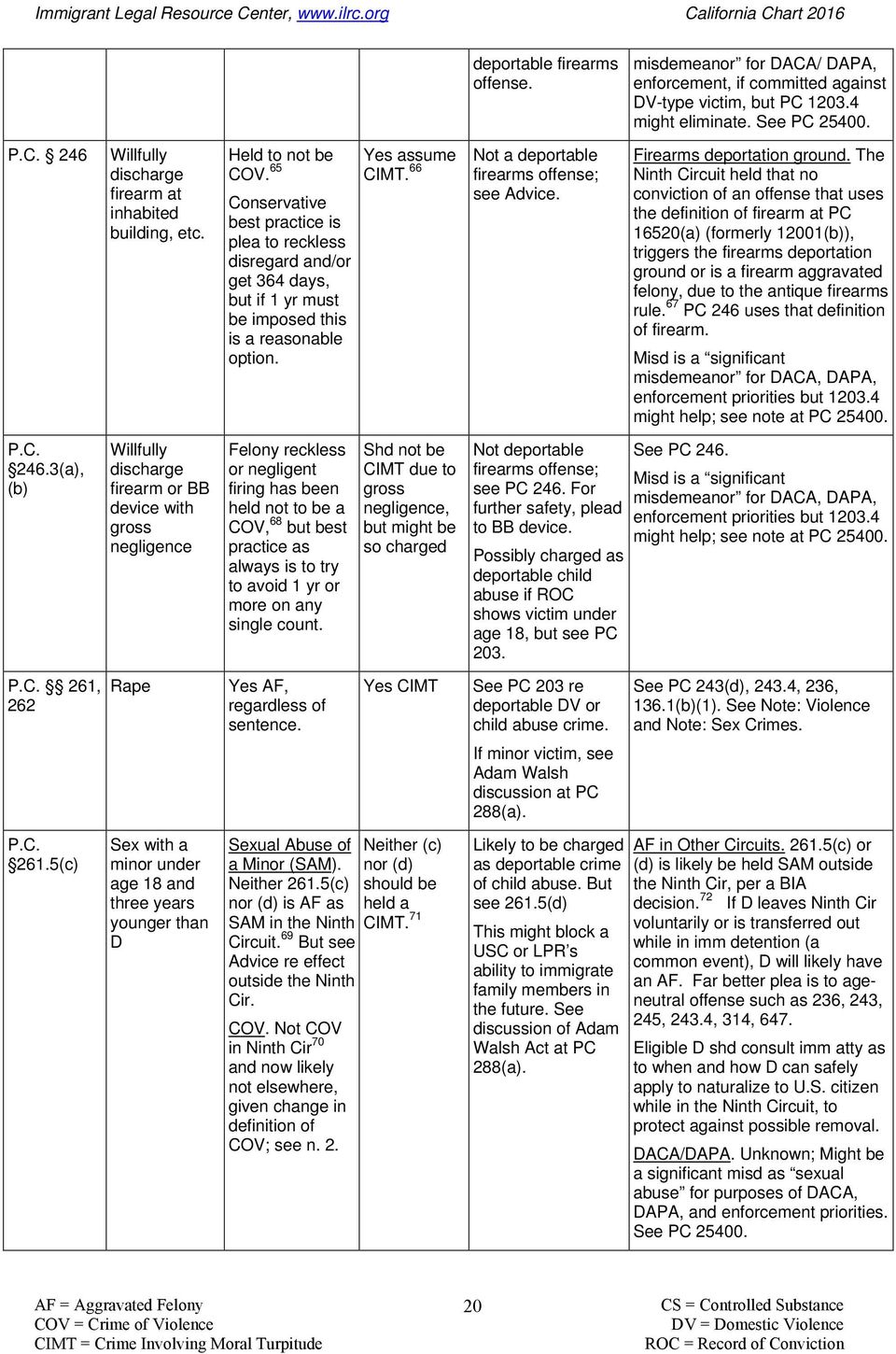
20 deportable firearms offense. misdemeanor for DACA/ DAPA, enforcement, if committed against DV-type victim, but PC might eliminate. See PC P.C. 246 Willfully discharge firearm at inhabited building, etc. Held to not be COV. 65 Conservative best practice is plea to reckless disregard and/or get 364 days, but if 1 yr must be imposed this is a reasonable option. Yes assume CIMT. 66 Not a deportable firearms offense; see Advice. Firearms deportation ground. The Ninth Circuit held that no conviction of an offense that uses the definition of firearm at PC 16520(a) (formerly 12001(b)), triggers the firearms deportation ground or is a firearm aggravated felony, due to the antique firearms rule. 67 PC 246 uses that definition of firearm. Misd is a significant misdemeanor for DACA, DAPA, enforcement priorities but might help; see note at PC P.C (a), (b) Willfully discharge firearm or BB device with gross negligence Felony reckless or negligent firing has been held not to be a COV, 68 but best practice as always is to try to avoid 1 yr or more on any single count. Shd not be CIMT due to gross negligence, but might be so charged Not deportable firearms offense; see PC 246. For further safety, plead to BB device. Possibly charged as deportable child abuse if ROC shows victim under age 18, but see PC 203. See PC 246. Misd is a significant misdemeanor for DACA, DAPA, enforcement priorities but might help; see note at PC P.C. 261, 262 Rape Yes AF, regardless of sentence. Yes CIMT See PC 203 re deportable DV or child abuse crime. If minor victim, see Adam Walsh discussion at PC 288(a). See PC 243(d), 243.4, 236, 136.1(b)(1). See Note: Violence and Note: Sex Crimes. P.C (c) Sex with a minor under age 18 and three years younger than D Sexual Abuse of a Minor (SAM). Neither 261.5(c) nor (d) is AF as SAM in the Ninth Circuit. 69 But see Advice re effect outside the Ninth Cir. COV. Not COV in Ninth Cir 70 and now likely not elsewhere, given change in definition of COV; see n. 2. Neither (c) nor (d) should be held a CIMT. 71 Likely to be charged as deportable crime of child abuse. But see 261.5(d) This might block a USC or LPR s ability to immigrate family members in the future. See discussion of Adam Walsh Act at PC 288(a). AF in Other Circuits (c) or (d) is likely be held SAM outside the Ninth Cir, per a BIA decision. 72 If D leaves Ninth Cir voluntarily or is transferred out while in imm detention (a common event), D will likely have an AF. Far better plea is to ageneutral offense such as 236, 243, 245, 243.4, 314, 647. Eligible D shd consult imm atty as to when and how D can safely apply to naturalize to U.S. citizen while in the Ninth Circuit, to protect against possible removal. DACA/DAPA. Unknown; Might be a significant misd as sexual abuse for purposes of DACA, DAPA, and enforcement priorities. See PC
21 P.C (d) Sex where minor under age 16, D at least age 21 See 261.5(c) See 261.5(c) Assume deportable crime of child abuse, 73 despite the fact that Ninth Circuit held elsewhere that the minimum conduct is not inherently harmful. See Adam Walsh Act discussion at Advice to PC 288(a). See 261.5(c). If D will be removed and might return illegally: A prior felony statutory rape conviction is a severe sentence enhancement to illegal re-entry. Under current law felony 261.5(d) will be held felony statutory rape. 74 Misd 261.5(d), or felony or misd 261.5(c), may be safer for this purpose. Re DACA/DAPA, see 261.5(c) P.C. 266 Pimping and pandering To prevent AF, see Advice Yes CIMT Deportable child abuse if ROC shows prostitute under age 18. If minor involved, see Adam Walsh Act discussion at Advice to PC 288(a). AF: To prevent AF, plead to activity with persons age 18 or over, and to offering lewd conduct, not intercourse, for a fee. 75 P.C. 270 Failure to provide for child Not AF. Shd not be held CIMT: no element of harm, destitution Shd not be deportable child abuse, for same reason, but no case on point. See Advice While the minimum conduct does not appear to be CIMT or child abuse, where possible also include in ROC that child was not at risk of being harmed or deprived. P.C Failure to get child to school Not AF. Shd not be held CIMT because no bad intent; failure to reasonably encourage truant to go to school Shd not be crime of child abuse, but no guarantees. While an age-neutral offense is preferable, there is a good argument that this is not child abuse, neglect, and abandonment as defined by Board of Immigration Appeals. P.C. 272 Contribute to the delinquency of a minor Not AF, altho as always try to keep ROC free of lewd act Shd not be CIMT: minimum conduct does not require intent to do harm Shd not be deportable child abuse, but possibly would be so charged. See Advice. If sexual conduct involved, might trigger Adam Walsh Act; see Advice to PC 288(a). Because PC 272 requires only a possible risk of mild harm it shd not be child abuse, 76 but there are no guarantees. While this is a good alternative to more harmful offenses involving a minor, best practice is to get an age-neutral offense. See discussion at Advice 273a(b). P.C. 273a(a), (b) Child injury, endangerment Shd never be AF as a COV under current Ninth Circuit law, but best practice is to plead specifically to negligently permitting endangerment rather than intentional conduct, if a sentence of a year will be imposed. Minimum conduct to commit 273a, criminal negligence, is not a COV. 77 Because 273a shd not be held a divisible statute under Ninth Cir law, 78 all 273a convictions shd be evaluated according to the minimum conduct, and no 273a conviction held a COV for any purpose, regardless of the specific plea. But a specific negligence plea provides D with protection against the risk that the definition of a divisible statute might change, or D might be put in removal proceedings outside the Ninth Circuit. See n. 4 This offense cannot constitute the AF sexual abuse of a minor, because sexual conduct is not an 21
22 element of the offense. But to avoid a possible mistaken AF charge, best practice is to prevent ROC from specifying sexual conduct. See also Adam Walsh Act, below. Shd not be CIMT in Ninth Circuit, but best practice is to plead specifically to negligently permitting endangerment rather than intentional conduct. The minimum conduct to commit 273a, negligent child endangerment, is not a CIMT, 79 and all 273a convictions are evaluated based on the minimum conduct. See AF discussion. But a specific negligence plea protects D against the risk that the definition of a divisible statute might change, or D might be put in removal proceedings outside the Ninth Cir. See n. 4 Deportable child abuse. Assume that 273a(a) is deportable crime of child abuse. Altho 273a(b) reaches very mild conduct, and Ninth Circuit at one point held it is not child abuse, assume conservatively that it will be charged as child abuse. It is difficult to predict this because there is not yet a specific definition of child abuse for immigration purposes. 80 When plea-bargaining, emphasize to prosecution that even misd 273a(b) for minor conduct may well cause the child to permanently lose his or her LPR parent. 81 Instead, seek a plea to an alternate offense that includes the required criminal punishment and probation conditions, but that will not make the person deportable. This can include any age-neutral offense such as PC 32, 243, 245, 136.1(b), reckless driving, trespass, etc. If the charges arose from traffic situation (lack of seatbelts, child unattended in car, DUI, etc.), seek a traffic offense. As long as minor victim is not listed in the ROC, defendant can accept parenting counseling, stay-away order, etc. as probation condition. Consider whether PC 1001 misdemeanor pretrial diversion may be available, as this is not a conviction for immigration purposes. Consider an informal pretrial diversion, where plea hearing is put off while defendant completes certain requirements such as counseling or AA in advance, in exchange for an alternate plea. Note: Imm atty s have a strong argument, but no decision yet, that an age-neutral offense is never a deportable child abuse offense, even if the ROC contains statements that the victim was as minor. 82 Thus if defendant has a prior conviction of an age-neutral offense where the ROC shows a minor V, the person might not already be deportable for child abuse. Note: Because child abuse is a ground of deportation but not of inadmissibility, an undocumented person might be able to plead to 273a, as long as she will not apply for non-lpr cancellation. Get help to analyze the case. Adam Walsh Act. If ROC shows sexual conduct was involved, this might block a USC or LPR s ability to immigrate family members in the future. See discussion of Adam Walsh Act at Advice to PC 288(a). P.C. 273d Child, Corporal Punishment Yes assume AF as COV if 1-yr sentence imposed. See Note: Sentence. Yes CIMT Deportable under child abuse. See Advice If sexual conduct involved, might trigger Adam Walsh Act; see Advice to 288(a). To avoid child abuse, get ageneutral plea with no minor age in the ROC: See 32, 243, 245, 136.1(b)(1), etc. (with less than 1 yr as needed) P.C Spousal Injury Yes, AF as a COV if 1-yr or more imposed on a single count. See Note: Sentence. Generally, see Note: Violence, Child Abuse. Ninth Circuit held not CIMT if V is former cohabitant, 83 but see better pleas for this at Advice. Yes, deportable crime of DV (even if V is former cohabitant). If ROC shows V is a minor, deportable crime of child abuse as well, but see PC 203. See Note: Domestic Violence. To avoid COV and DV, see PC 243(e); 236; 136.1(b)(1); and others. D can accept batterer's program, stay-away order, and other probation conditions on these. CIMT. While Ninth Cir held that former cohabitant V is not CIMT, this could change. 84 More secure pleas to avoid a CIMT are, e.g., 236, 243(d), (e), 460, perhaps 136.1(b). But for past convictions, do not assume that a prior automatically is a CIMT even if plea was not to former co- 22
23 habitant. Under current rule, shd not be held divisible between victim types (e.g., spouse v. former cohabitant), and therefore all convictions should be evaluated as if the V was a former co-habitant. 85 Misd is a significant misdemeanor for DACA, DAPA, & enforcement priorities, but might erase it; see note at PC P.C Violation of protective order Not AF, and maximum sentence is 364 days. Shd not be held CIMT because minimum conduct is not. Yes, deportable as a violation of a DV protection order, if pursuant to Cal Fam C 6320, 6389 or similar. 86 See Advice. DV: Automatic deportable DV, if pursuant FC 6320, In all cases, any finding of even a minor violation of a DV stay-away order triggers deportability. See Note: Violence, Child Abuse. Instead, plead to a new offense that is not deportable DV (e.g., 243(a), (e), 653m), or see PC 166. P.C. 281 Bigamy Not AF Shd not be CIMT, but see Advice No Shd not be a CIMT despite the availability of a defense of lack of guilty knowledge, 87 but counsel should conservatively assume it could be charged as one, and seek another offense if avoiding CIMT is crucial. P.C. 286(b), 288a(b), 289(h), (i) Sexual conduct with a minor See 261.5(c), (d) See 261.5(c), (d) See 261.5(c), (d) See 261.5(c), (d) P.C. 288(a) Lewd act with minor under 14 Yes AF as sexual abuse of a minor, regardless of sentence 88 Yes, assume CIMT, although possible defense argument. 89 Deportable for crime of child abuse. To avoid, plead to age-neutral offense; see Advice. This is a very bad plea. See ageneutral offenses like PC 32, 136.1(b), 236, 243, 243.4, 245, 314, 647. Less good options, because they may be safe only in the Ninth Circuit, are offenses such as 288(c), 647.6, 261.5, 288a. Might not be particularly serious crime for asylum/withholding if D demonstrated honest belief V was older. 90 Likely bar to DACA, DAPA, and enforcement priority; see note at PC Adam Walsh Act. If V is a minor, conviction for kidnapping, false imprisonment, or almost any sexual conduct is a specified offense against a minor and can bar a USC or LPR from obtaining lawful immigration status for an immigrant spouse or child. 91 See Note: Adam Walsh Act. 23
24 P.C. 288(c) Lewd act with minor age and 10 yrs younger than D SAM. Not AF as sexual abuse of a minor (SAM) in Ninth Circuit, 92 altho plead to age 15 if possible. See Advice. COV. The Ninth Cir held felony is COV under 18 USC 16(b), 93 but this is overruled by Dimaya (see n. 2). Still, best practice is to avoid 1-yr and/or plead/reduce to a misdemeanor if possible. Conservative ly assume CIMT, altho strong arguments against this. See CIMT discussion at PC It will be charged as deportable crime of child abuse. See discussion of Adam Walsh Act at Advice for PC 288(a). See Note: Sex Offenses. AF. Avoids SAM in Ninth Cir imm proceedings: Good alternative to more explicit sexual charge. 288 includes "innocuous" touching, "innocently and warmly received"; child need not be aware of lewd intent. 94 But warn D this could be held AF as SAM if D is taken outside Ninth Cir. Try instead for age-neutral offense, PC 32, 236, 243, 243.4, 136.1(b), 314, 647, etc. where ROC sanitized of V s age. See Note: Sex Offenses Misd might be a significant misdemeanor for DACA, DAPA, & enforcement priorities, but may help; see note at PC P.C. 290 Failure to register as a sex offender Not AF Altho it shd not be CIMT, assume it could be charged as such; see Advice Can be charged with fed offense, 18 USC 2250, based on state conviction for failing to register; the fed conviction is a basis for removal. 95 CIMT: Fed courts indicate not a CIMT because can be committed by negligence, but BIA held is CIMT. Ninth Cir returned case to BIA to reconsider issue; case is still pending. 96 P.C (a) Child Pornography Ninth Cir held not an AF as child pornography. See Advice. Yes CIMT. 97 No. But this may block USC or LPR s ability to immigrate family members in the future. See discussion of Adam Walsh Act at Advice to PC 288(a). Plea to generic porn is not an AF. 98 Ninth Cir found (a) is never an AF as child pornography because it is broader than federal definition and not divisible. But best practice is to plead specifically to pornography that depicts non-explicit conduct or to any lewd or lascivious sexual act as defined in Section 288, under 311.4(d). 99 Imm counsel also may argue is not an AF because of lack of federal element. 100 P.C Distribute, exhibit, obscene materials to a known minor, or without reasonable care to ascertain person s true age Not AF Should not be CIMT: no element of intent to arouse 101 and further can be based on negligent failure to ascertain age. Shd not be charged as crime of child abuse; see Advice. Possible this will trigger Adam Walsh Act; see Advice to PC 288(a). Shd not be child abuse, as minimum conduct does not prove harm and includes failing to properly shield parts of magazines in store or vending machine
25 P.C. 314(1) Indecent exposure Not AF even if minor s age in ROC, 103 but as always keep minor age out if possible. Law is unclear; best to conservativel y assume a CIMT. 104 Don t let ROC refer to minor witness, to avoid possible charge of deportable crime of child abuse Good alternative to sexual abuse of a minor AF charges such as 288(a), or deportable crime of child abuse. To avoid CIMT, see disturb peace, trespass, loiter If V under 18, this might trigger Adam Walsh provisions; see Advice to PC 288(a). P.C. 315 Keeping or living in a place of prostitution or lewdness Not AF of owning or controlling a prostitution business, 105 because offense punishes prostitutes not managers 106 ; can involve mere lewdness; and can involve mere residience. See Advice. Might avoid CIMT, and thus an alternative to 647(f). Mere residence is not CIMT. 107 While 315 is not divisible under Ninth Cir rule, best practice is specific plea to residing. To prevent deportable child abuse keep ROC free of minor age, but see PC 203. See Advice for prostitution inadmissibility. This conviction shd not trigger it, but any involvement with minor prostitute brings in Adam Walsh Act; see Advice to 288(a). Inadmissible for prostitution if engaged in or received proceeds from prostitution, defined as intercourse (not merely a lewd act) for a fee. No conviction is required. Conviction under an overbroad statute like this alone does not prove inadmissible for prostitution. 108 P.C. 368(b), (c) Elder abuse: Injure, Endanger Possible AF as COV if 1 yr is imposed; see Advice for instructions. Not CIMT, or divisible: a negligent act/omission is not a CIMT. Not deportable DV offense, unless elder is protected by DV laws and offense is a COV. In case 368(b), (c) is divisible, best practice is to plead specifically to negligent endangerment in order to avoid COV or CIMT.. See PC 273a. P.C. 368(d) Elder abuse: Theft, Fraud, Forgery Yes AF danger: see Advice. Generally see Advice to PC 484 Yes CIMT No To avoid AF: Plead to fraud, embezzlement, identity theft where loss to victim does not exceed $10,000; can take a sentence of over a year. Plead to straight theft (taking by stealth) where loss to victim exceeds $10,000, but avoiding 1 yr on any one count. (Forgery plea should not take either 1 yr or $10,000 loss.). See Advice to PC P.C. 381, 381b Possess, use toluene ( 381), nitrous oxide ( 381b) Not AF Not CIMT Appear to not be CS offenses because they do not appear on federal schedules Possible drug charge alternative; six-month misdemeanor. Eligible for DEJ; see P.C. 403 Disturb public assembly Not AF. Not CIMT; see Advice No. This does not have CIMT elements, but keep ROC free of very bad conduct or violence. P.C. 415 P.C. 416 Disturbing the peace Failure to disperse Not AF. Not CIMT No. Not AF Not CIMT No. 25
26 P.C. 417(a) (1) Nonfirearm (2) Firearm (1) Exhibit deadly weapon (nonfirearm) in a rude, angry or threatening manner; or unlawfully use in fight (2) Exhibit firearm, same (2) should not be COV AF, but it carries a maximum 364 day sentence in any event. See Advice. Should not be a CIMT (a)(2) is not a deportable firearms offense under the antique firearms rule. 110 See PC 29800(a). Also the statute does not appear divisible between (1) and (2). Still, best practice is plea to 417(a)(1), or to 417(a) with a vague ROC. See Advice if V has domestic relationship. To ensure not a crime of child abuse, keep record free of minor victim. While no conviction should be held a COV or CIMT, best practice is a plea to rude rather than threatening conduct.. Misd firearms offense is a significant misdemeanor for DACA, DAPA, enforcement priorities; see Advice at PC P.C , Exhibit firearm threatening manner so V reasonably cd fear, or to evade arrest Yes AF as COV if 1-yr sentence imposed. 111 To avoid 1-yr sentence, see Note: Sentence Assume CIMT See PC 417(a)(2) Misd firearms offense is a significant misd for DACA/DAPA, enforcement priorities; see Advice at PC See PC 417, 240, for better plea. P.C Exhibit imitation firearm in threatening manner; V reasonably could fear COV, but not AF because maximum less than one year Assume CIMT Appears not to meet federal definition of a firearm; if that is correct, not a deportable firearms offense DV offense if showing that V is DV-type V. Imitation firearm is defined in PC P.C Unlawful laser activity Not a COV Not categorically a CIMT 112 ; see Advice No CIMT: To more surely avoid a CIMT, plead to use of a laser pointer. P.C. 422 Criminal threats (formerly terrorist threats) Yes AF as COV if 1-yr sentence imposed. 113 See Note: Sentence. See Advice. Yes CIMT 114 Deportable crime of child abuse if ROC shows minor victim. Deportable DV crime if DV-type victim. See also PC 203 To avoid COV and a deportable crime of DV, see PC 136.1(b), and misd PC 69, 236, 243(a), (d), (e), 243.4(a), (e). Some of these can take a sentence of a year. See Note: Violence, Child Abuse for more on violent crimes. P.C. 451, 452 Arson by malice (451); Unlawful burning by reckless Assume yes AF as federal analogue, regardless of sentence; but see Advice re Assume CIMT No. To avoid AF see -- Felonies such as 594, 460(b) (which may take 1 yr or more without being an AF), perhaps coupled with PC 13001, or 26
27 disregard of known risk (452) pending S.Ct. case. Assume 451 is AF as COV if 1 yr imposed on a single count, but see Advice re 451(d). 452 should not be COV (d) is AF if burn own property with intent to defraud and loss exceeds $10k; this offense is not a COV and so cd take 1 yr or more -- PC 453, not secure but better than 451, 452. Dangerous plea. Still, 451/452 might avoid AF: AF as analogue: Supreme Court will consider whether a state offense must contain a federal jurisdictional element in order to be an AF as a federal arson analogue. 116 Until Court decides, defenders must assume conservatively that 451/452 is an AF. (Imm counsel can investigate argument that 452 recklessness is not equivalent to federal malice. 117 ) AF as COV if 1 yr imposed reckless conduct is not a COV. -451(d) includes burning one s own personal property if certain conditions present including intent to defraud; and by its terms shd include burning one s own real property even without these conditions. These are not COVs because not against the property of others. 118 But still may be AFs as federal analogues. P.C. 453 Possess flammable material with intent to burn Specific plea to flammable material, with less than 1 yr, may avoid AF; see Advice. Yes CIMT No AF: Good alternative to 451, 452, assuming possession or disposal of flammable materials is not analogous to a relevant federal offense. 119 To avoid AF as COV, avoid 1 yr on any one count See Note: Sentence. P.C. 459, 460(a) Burglary, Residential Held not a COV and thus it can take a 1-yr or more sentence. But but because law cd change, best practice is to avoid 1 yr if possible. See Advice and see Note: Sentence Not a CIMT under current case law regardless of intended offense 120 but see Advice.. No COV: In Dimaya v. Lynch the Ninth Cir held that PC 460(a) is not a COV under 18 USC 16(b), because 16(b) is void for vagueness based on the Supreme Court s decision in Johnson. 121 Thus if 1 year or more must be imposed on a single count of an offense, 460(a) is a reasonable choice. But because Dimaya could go en banc, best practice is to avoid 1 yr where possible. 460(a) should not be an AF under any other category; see plea instructions at 460(b). CIMT: While this is not a CIMT under current law, because CIMT law is volatile the best practice is to create a vague ROC re intended offense, or better plead to intent to commit a specific non- CIMT, e.g., PC 496, Veh C
28 with temporary intent, or other. P.C. 459, 460(b) Burglary, commercial Never an AF under current Never a CIMT in imm law 122 but best prcdgs under practice as always is try to avoid 1 yr on current law within Ninth Cir, 123 but any single count. see Advice. No. CIMT. Because CIMT law is volatile, best practice is plea to intent to commit a specific non- CIMT, or create a vague ROC as to intended offense, where that is possible. DACA/Enforcement. Misd burglary is a significant misdemeanor and thus enforcement priority and bar to DACA/DAPA, but PC may work; see PC Prop 47: If offense was entering open business with intent to steal $950 or less, see and Advisory Prop 47 & Immigrants. P.C Shoplifting Not AF (6 month max) Not CIMT per current Ninth Cir law; see Advice. No. CIMT: Ninth Cir held that a lawful entry with intent to commit theft is not a CIMT, so should not be. 124 But plea shd involve property intended to be taken of $950 or less, not property taken. P.C. 466 Possess burglary tools, intend to enter Not AF (lacks the elements, and 6 month max misd). Shd not be CIMT. See Advice No. CIMT: Intent to break and enter alone is not a CIMT. P.C. 470 Forgery Assume yes AF as forgery or counterfeiting 125 if 1 yr or more on a single count; see Advice. Yes AF as fraud if loss to victim/s exceeds $10,000; see Advice. Yes CIMT. See 529(3) to try to avoid CIMT. 28 No. AF: To avoid AF, defendant shd avoid both 1 yr imposed on any single count and a loss exceeding $10,000. Forgery, counterfeiting is AF if 1 yr is imposed. If 1 yr can t be avoided, see 529(3), 475(c), or any offense involving fraud or deceit (not theft) not involving a false instrument. For past convictions, imm counsel may investigate arguments that PC 470 is broader than generic forgery or counterfeiting. Fraud or deceit is an AF if loss to victim/s exceeds $10k. To avoid this, plead to specific theft offense as discussed at PC 484. If that is not possible, plead to one count with specified loss to victim/s that is under $10k, and if restitution of more than $10k must be ordered, include a Harvey waiver and a statement that restitution is based on uncharged conduct or dropped counts. While there is no case on point, this follows Supreme Court statements to avoid AF. 126 Prop 47: Possible for felony if
29 $950 or less. See Advisory Prop 47 & Immigrants. P.C Falsification of medical records Not AF. CIMT because it involves fraud No. P.C. 475(c) Possess real or fictitious check, etc. with intent to defraud Can avoid AF as forgery; see Advice. Yes AF as fraud if loss exceeds $10k; see Advice for PC 484. CIMT because fraud No. AF as Forgery. Ninth Cir held 475(c) is broader than forgery because it includes use of real document. 127 In case 475(c) ever is held divisible between real or fictitious docs (see n. 4), if 1 yr is imposed on a single count, avoid AF by pleading to use of real document with intent to defraud. P.C. 476(a) Bad check with intent to defraud Yes AF if loss to the victim/s exceeds $10,000; see Advice. Yes AF as forgery if 1 yr imposed. 128 Yes CIMT. See 529(3) to try to avoid CIMT. No To avoid an AF, consider Advice for 470 Prop 47: Possible for felony if aggregate totals $950 or less. See Advisory Prop 47 & Immigrants. P.C. 484 et seq., 487, 666 Theft (petty or grand) AF. This is not an AF in the Ninth Circuit, but because of future uncertainties the best practice is to see Advice if either of the following will happen: (a) 1 yr will be imposed on a single count, or (b) the loss to the victim/s exceeded $10,000. CIMT. Yes assume CIMT. To avoid this consider PC 460, 496, or 459.5, or VC Other grounds: No. Advice: To most securely avoid an AF in all circumstances, do the following: 1. If 1 yr will be imposed, plead to a specific fraud offense in PC 484. If the loss to the victim/s exceeds $10k, plead to a specific theft offense in PC 484. Why? Fraud (taking by deceit) is an AF if loss to the victim/s exceeds $10k, but not if 1 yr is imposed. 8 USC 1101(a) (43)(M). Thus embezzlement or other 484 deceit offense with a year imposed is not an AF, as long as there is no $10k loss. Theft (taking by stealth) is an AF if 1 yr or more is imposed on a single count, but not if loss to victim/s exceeds $10k. Thus stealing or other 484 theft can take a loss exceeding $10k, as long as sentence is less than 1 yr. See federal court and BIA cases Note that in immigration proceedings in the Ninth Circuit now, the above specific plea strategy is not needed. The Ninth Circuit held that no conviction of 484, 487, 666 is an AF as theft even with a 1-year sentence, because 484 is not divisible between theft and fraud. 130 Still, best practice is to make the specific plea described above where possible, because D might end up in removal proceedings outside the Ninth Circuit where a different rule on divisible statutes might apply, and/or the Supreme Court conceivably could change the rule. A specific plea should protect the defendant in these situations. See n If a specific plea is not possible, create a sanitized ROC that is inconclusive as to whether theft or fraud was involved. This shd prevent an AF for purposes of deportability, although outside the Ninth Circuit it may not prevent it for purposes of admission or eligibility for relief. See n Do not permit 1-yr to be imposed and loss to exceed $10k on the same count, or the offense might be an AF even under current law. Where both factors are present, get expert help to craft a plea. P.C Petty theft (misd or infraction) Not AF. Assume CIMT, but see Advice No. CIMT. Arguably a Calif infraction is not a conviction for imm purposes. 131 In that case a infraction would not be a CIMT conviction. However, there is no ruling on this and defenders 29
30 should assume even an infraction is a conviction. To avoid a CIMT, see PC 496, VC 10851, P.C. 496, 496a, 496d Receiving stolen property, or receiving stolen vehicle Assume yes, AF if 1 yr or more is imposed on any single count. See Advice. If 1 yr is inevitable, try to plead to a fraud offense instead; see Advice for PC 484. (Imm counsel may argue that because 496 can involve fraud rather than theft, it is not necessarily an AF if 1 yr is imposed. 132 ) Never shd be held CIMT, but best practice is a specific plea to receiving stolen property with intent to deprive temporarily. See Advice. No. Avoid 1 yr. for a discussion of how to avoid a sentence of a yr or more for imm purposes, see Note: Sentence. CIMT: Ninth Cir held that 496 includes intent to temporarily deprive the owner, and this is not a CIMT. Best practice is to plead specifically to temporary intent. But if that cannot be done (or was not done in a prior conviction that you are analyzing), 496 still shd not be held a CIMT because it is not divisible between a temporary or permanent taking, under any applicable standard. 133 Prop 47: Possible if $950 or less. See Advisory Prop 47 & Immigrants. P.C. 499, 499b Joyriding; Joyriding with Priors Yes AF as theft if 1 yr-sentence imposed on any single count. See Note: Sentence. Not CIMT (because intent to temporarily deprive) No. If 1 yr will be imposed on a single count, consider PC 484 designating a fraud offense. P.C Impersonate by electronic means, to harm, intimidate, defraud AF as fraud if loss exceeds $10k. See Note: Burglary, Theft Fraud. Despite threatening, shd not be held a COV. 134 Defraud is a CIMT but harm should not be. See Advice. If ROC shows minor V, possibly charged as child abuse. Substitute this charge for ID theft or similar offense, in a sympathetic case? CIMT: Best practice is plea to harm (if possible, a specific mild harm). Offense can be committed by, e.g., impersonating a blogger, or sending an purporting to be from another, to their embarrassment. 135 But even if the plea was to fraud, shd not be a CIMT for any imm purpose because it is not divisible between fraud and harm under the Ninth Cir rule, because a jury is not required to decide unanimously between those alternatives. See n. 4. P.C. 529(3) False personation If the offense resulted in loss exceeding $10,000, see Advice for 460 and see Note: Burglary, Fraud -Otherwise, not an AF. If 1 yr Not a CIMT; good alternative to a fraud offense See Advice. No. CIMT. Because the minimum conduct to commit the offense does not include intent to gain a benefit or cause liability, not a CIMT. 136 But to avoid problems, do not let ROC reflect such intent. 1 yr sentence: The offense does not have forgery or counterfeiting as elements, but to avoid possible 30
31 sentence, see Advice wrong charges, do not plead to such conduct if 1 yr sentence P.C (c) Possess document purporting to be gov t issued ID or drivers license Not AF Should not be a CIMT; no intent to defraud No. Good alternative to more serious identity theft charge. P.C (a) Obtain any personal identifying information and use for any unlawful purpose, including to obtain credit, goods, services, or medical information Possible AF as a crime of deceit, if loss to victim/s exceeds $10,000. To prevent that consider plea to theft such as PC 484 and see Advice for 470. See Advice if 1 yr or more will be imposed on a single count. CIMT: No No. conviction shd be held a CIMT in the Ninth Cir, but see Advice re best practice for ROC.. AF. Conviction of theft (as well as forgery, counterfeiting) is an AF if 1 yr or more is imposed. Section cannot properly be held an AF under any of these categories, regardless of underlying conduct. 137 But to avoid a possible wrongful AF charge, where possible keep sentence under 1 yr for each count and/or keep conduct involving obtaining goods (or forgery, counterfeiting) out of the ROC. If D must take 1 yr or more, however, is a reasonable choice. CIMT. The minimum conduct to commit 530.5(a) is not a CIMT because it involves using the info for any unlawful purpose with no requirement of harm or loss to V, or intent to de fraud; it includes, e.g., working under another person s name. 138 Under Ninth Cir law is not divisible, and no conviction will be a CIMT. But in case the Supreme Court holds otherwise, or D is put in removal proceedings outside the Ninth Cir, best practice is to avoid a plea to obtaining credit or goods, and if possible plead to specific conduct that does not involve loss, harm, or fraud. P.C. 532a(1) False financial statements Yes AF if fraud of more than $10k. See PC 470. See Advice if 1 yr or more will be imposed Yes CIMT because fraudulent intent. See 529(3) No. Forgery, counterfeit with 1 yr is an AF. While minimum conduct to commit 532a does not involve these offenses, best practice is to not plead to such conduct if 1 yr will be imposed on a single count, to prevent possible wrongful charge. P.C. 550(a) Insurance fraud See 532a(1) See 532a(1) No. See 532a(1) P.C. 591 Tampering with or obstructing phone lines, Not AF because not COV. 139 See Advice. Should not be CIMT, but try to plead to specific mild conduct, Not deportable DV offense (but keep ROC clear of any violence, threats). 31 May be good alternative to avoid deportable stalking or DV offense. While it always is best to get 364 days or less, this is not a COV
32 malicious obstruct with intent to annoy. 140 As always, keep ROC clear of V under age 18. and therefore good substitute plea to take 1 yr or more. P.C Tamper w/ cell phone to prevent contact w/ law enforcement Not AF: Not COV and has 6 month maximum sentence Unclear, conservativel y assume CIMT but imm counsel may argue against. 141 Not deportable DV offense b/c not COV, but to be safe keep ROC clear of violence or threats. Keep ROC clear of minor age of V. Good DV alternative because not COV, not stalking CIMT: Consider 591, 594, resisting arrest, to avoid possible CIMT. P.C. 594 Vandalism, Malicious Mischief (b)(1) at least $400 damage (b)(2) less than $400 damage None should be COV, but (a)(1) is safest. 142 Best practice is avoid violence on ROC. Where possible get 364 days, but see Advice. Not a CIMT, or conceivably divisible, but see Advice. No. Even if it is a COV, a deportable crime of DV requires violence toward person, not property. Re DV. Good DV alternative because not COV to person. Re CIMT. Ninth Cir held similar statute punishing damage over $250 (in 1995 dollars) is not CIMT. 143 Under that standard, 594(b)(2) is not CIMT, and (b)(1) also shd not be b/c minimum conduct is $400. But BIA may view issue as unresolved and if it publishes a contrary opinion, Ninth Cir may defer. Best practice where possible is to act conservatively: plead to (b)(2), even if greater amount in restitution, paid before plea, or separate civil agreement. Plead to intent to annoy. Outside Ninth Cir, 594 risks being CIMT with gang enhancement. 144 Re burglary: Felony vandalism is good intended offense because it is not a CIMT. 145 TRUST Act: Unlike many felonies, one or apparently two felony vandalisms do not destroy TRUST Act protection. See Note: Sentence P.C. 602 Trespass (6 months) Not AF (for one thing, 6 month max sentence) Shd not be CIMT See Advice. See PC (l)(4) (discharging firearm) is not deportable firearm offense due to antique firearms exception (see PC 417), but still best to avoid. See PC 602.5, below. Some malicious destruction of prop offenses might be CIMT; see cases in Advice to PC 594. Misd involving firearms is a significant misdemeanor and thus an enforcement priority and bar to DACA and DAPA, but may work. P.C Trespass, residence Not AF. Not CIMT. No. P.C Stalking No conviction is an AF as COV under current Ninth Cir law. But best practice Assume CIMT, and look to 236, 240, 243, 136.1(b)(1) Yes always deportable under DV ground as "stalking," regardless of 32 If DV-type victim, misd is significant misdemeanor for DACA, DAPA, enforcement priorities; see note at PC Deportable offense. Again, 646.9
33 is to avoid 1 yr on any one count, and/or to get a misd. If that is not possible, see Advice. sentence imposed or type of victim. See pleas suggested in CIMT column. always is a deportable stalking offense and probable CIMT. The below relates only to avoiding an AF as a COV. COV: There are multiple bases to find that neither felony nor misd is a COV in the Ninth Cir. 146 But because the law may change, or D may be placed in removal proceedings outside the Ninth Cir, best practice is to avoid 1 yr (or at least plead to harassing). Outside the Ninth Cir, BIA held that felony always is a COV under 18 USC 16(b). For that reason, try to obtain less than 1 yr on any count or reduce to a misd. Imm counsel have arguments against this holding, but D will be at some risk. 147 P.C. 647(a) Disorderly: lewd or dissolute conduct in public Not AF even if ROC shows minor involved 148 (but still, don't let ROC show this) Yes held CIMT, altho imm counsel can argue against this. See Advice. To avoid possible deportable child abuse charge, don t let ROC show minor involved. See PC 203. AF: Good alternative to sexual conduct near/with minor CIMT Older BIA decisions finding CIMT were based on anti-gay bias and imm atty s will argue they shd be discredited, 149 but until there is precedent this presents a risk. Instead see 647(c), (e), (h). P.C. 647(b) Disorderly: Prostitution Not AF. Yes always CIMT, whether prostitute or customer, lewd act or intercourse. 150 To avoid, see 647(a), (h) or residing under 315. Inadmissible for prostitution if sufficient evidence the person engaged in the business of offering intercourse, not lewd conduct, for a fee. Best practice is plead to offering specific lewd act for a fee. See Advice. Inadmissibility for engaging in prostitution can be proved by conduct and does not require a conviction, but a plea to offering a lewd act that is not intercourse may provide some protection. Ultimately whether the person engages in prostitution (multiple occasions is a fact-based issue. See Note: Sex Offenses. Johns are not inadmissible under prostitution ground. P.C. 647(c), (e), (h) Disorderly: Begging, loitering Not AF. Not CIMT. No. Good alternate plea. Do not include extraneous admissions re, e.g., minors, prostitution, further intended crime, firearms, etc. P.C. 647(f) Disorderly: Under the influence of drug, CS, alcohol, Not AF. Not CIMT. This shd not be a CS offense, but best plea is to alcohol or drug. See Advice 647(f) shd not be held divisible between alcohol, drug, and CS under current Ninth Cir law. 151 But in case that changes, best practice is plea to alcohol or drug. P.C. 647(i) Disorderly: "Peeping Tom" Not AF Shd not be CIMT, but no ruling yet. See Advice Might be charged as child abuse if ROC shows that V is minor; keep ROC clear and see PC 203. CIMT: Shd not be CIMT because offense is completed by peeking, with no intent to commit further crime, no lewd intent
34 P.C (a) P.C. 653f(a), (c) Annoy, molest child Solicitation to commit variety of offenses Not AF as sexual abuse of a minor (SAM) in Ninth Cir, 153 but might be SAM elsewhere. See Advice for PC 261.5(c). See Advice, and See Note: Sex Offenses 653f(a) and (c) are AF as COV's if one-year sentence is imposed Not CIMT in Ninth Cir. 154 Soliciting violence is a CIMT. Assume this will be charged as deportable crime of child abuse. While imm counsel can argue against this based on lack of potential harm, no precedent addresses the issue. To avoid this, try to plead to an ageneutral offense. See Advice. 653f(a) and (c) are COV's, and therefore DV if DVtype victim. For all purposes, best practice is to ID non-explicitly sexual, nonharmful conduct in the ROC, or keep ROC vague, in case authorities fail to apply the minimum conduct test and instead look to ROC. AF and deportable Child Abuse: The sure way to avoid SAM (outside the Ninth Circuit) and child abuse is a plea to ageneutral offense like 243, 236, 314, 647 etc. with ROC clear of minor victim. Possible that a misd would be a significant misdemeanor for DACA, DAPA, enforcement priorities as sex abuse; see note at PC f(a) and (c) are COV. 155 P.C. 653f(d) Solicitation to commit drug offense such as 11352, 11379, Solicitation to commit a drug offense is not a drug trafficking AF, in cases arising within the Ninth Circuit only. Solicitation will take on the CIMT quality of the offense solicited, at most. See Advice regarding possible defenses against an inadmissible and deportable CS conviction. Deportable/ Inadmissible CS conviction. Two possible defenses. First, a plea to soliciting can use the unspecified or non-federal CS defenses. See There is an argument that is not a CS offense. If that is true, soliciting it is not a CS offense. See Second, imm counsel can argue that this is not a deportable CS offense because it is generic solicitation, but no guarantee. 156 Trafficking penalties. Any offense that involves trafficking (commercial element) is a particularly serious crime, bad for asylees and refugees and can make D inadmissible by giving gov t reason to believe D is involved in trafficking. See P.C. 653k (repealed) Possession of illegal knife Not AF Not CIMT Not deportable offense Good plea P.C. 653m(a), (b) Electronic contact with (a) obscenity or threats of injury with intent to annoy; or (b) repeated annoying or Not AF. (While (a) using threats of injury might be charged as COV, it has 6 month max sentence.) (a) shd not be CIMT b/c minimum conduct is not CIMT. 157 For (b), to avoid possible CIMT charge Deportable child abuse: To avoid possible charge, do not let ROC show victim was a minor. See Advice for how to avoid other DV deportation 34 Good plea in a DV context. Deportable DV crime: If DV-type victim, plead under (a) to obscene call with intent to annoy, or (b) two phone calls intent to annoy. State on the record that calls did not involve any threat of injury. Or if possible plead to property or nonprotected victim, e.g. repeat
35 harassing calls. plead to making two calls/contacts with intent to annoy. grounds. For more info in general, see Note: Violence, Child Abuse. calls to the new boyfriend, (no threats, intent to annoy). Deportable violation of DV protective order. Do not admit to violating a stay-away order in this or any other manner; or see 166. Try to plead to new 653m offense rather than vio of an order. Deportable stalking: Stalking requires a threat, altho does not require a DV relationship. Plead to conduct described above. See also PC 591 P.C. 664 Attempt AF if attempted crime is an AF. See Advice if offense involves fraud with potential $10k loss. CIMT if attempted crime is CIMT, but see Advice Carries consequences of the attempted offense AF. Attempt and conspiracy are bad pleas where fraud or deceit results in loss to victim/s exceeding $10k. 158 Instead plead to straight theft w/ less than 1 yr; see PC 484 and see instructions at Note: Burglary, Theft, Fraud. P.C. 666 Petty theft with a prior Careful pleading can avoid AF even with 1 yr sentence. See PC 484 for instructions. See Advice re Prop 47 Yes CIMT. With a CIMT prior, this makes a dangerous two CIMTs. To avoid a CIMT, consider plea to PC 460(b) or 496. See Note: Burglary, Theft, Fraud. Prop 47: People can reduce prior 666 to misdemeanors until November For current charges, PC 666 only applies to persons who have serious priors (superstrike, sex registry); even for them, it remains a wobbler. See Advisory Prop 47 & Immigrants. See Note: CIMT. P.C. 1320(a) Failure to appear for misdemeanor Not AF as obstruction because that requires 1 year sentence imposed Unclear; Might be charged as CIMT. 159 No P.C. 1320(b), Failure to appear for a felony Dangerous plea. Might be AF regardless of sentence imposed; see Advice Always is AF if 1 year or more imposed, as obstruction of justice. 160 See 1320(a) No. AF regardless of sentence: Failure to Appear. Certain convictions for failure to appear are AFs, even without a one-year sentence. This includes FTA to answer a felony charge punishable by at least 2 years, or to serve a sentence if the offense is punishable by at least 5 years. 161 D should bargain to plead to some other substantive offense. P.C Bring CS or paraphernalia into jail Xx KB check Because this could be for personal use, arguably not Deportable and inadmissible CS, if federal CS is involved; see CS Conviction. Better plea to avoid this is PC Here the unspecified and nonfederal CS defenses should 35
36 a CIMT. Advice. protect a conviction. See Imm counsel might argue that paraphernalia is overbroad and not divisible, because it is not tethered to definition of CS in Division 10, based on wording of P.C Possess an instrument, container, etc. to use drugs or alcohol in prison, jail without permission Not AF Not CIMT Should not be held a deportable or inadmissible CS offense; see Advice CS conviction. The term drugs is not divisible, so the minimum conduct test applies. That conduct includes possessing container etc. for a drug that is not a CS, as well as a nonfederally listed CS. Best plea is container etc. for alcohol, but one for drugs also should not be deportable or inadmissible offense. Former P.C (Repealed 1/1/12) Possession manufacture, sale of prohibited weapons; carrying concealed dagger Not an AF as trafficking in firearms, under the antique firearm rule. Weapon possession is not CIMT. 162 Sale is unclear as CIMT; might not be if mere failure to comply with licensing requirements. 163 Not a deportable firearm offense under antique firearms rule. 164 See further discussion of antique firearms defense at PC Misd is a significant misdemeanor for DACA, DAPA, enforcement priorities; see note at PC Former P.C (a) (Repealed1/ 1/ 12) See also current P.C , Drug addict, misdemeanant or felon possesses or owns firearm, ammunition Felon, addict in possession is not an AF due to the antique firearms rule. 165 See further discussion at PC Probably not CIMT. Owning a weapon is not. Not deportable under the firearms ground due to antique firearms rule; see PC 12020, P.C (a), (b), (c) Sentence enhancement for, during attempt or commission of a felony: Armed with firearm [(a)(1), (c)]; Use of deadly weapon [(b)]; Armed with assault weapon, etc. [(a)(2)] (a)(1), (c) should not be held a COV unless underlying felony is, but no precedent. 166 Assume that (b), using a firearm, is a COV. (a)(2) may be an AF as an analogue to 18 USC 922(o) Use of weapon likely to be held CIMT; carry weapon might not be. (a)(1), (c) are not deportable under the firearms ground due to antique firearms rule. 167 Avoid AF: To avoid a possible AF as a COV, try to plead to simply possessing a weapon (including most firearms) which can take more than a year without being a COV; if needed plead to an additional offense involving actual violence with less than a year s sentence. See Note: Sentence. 36
37 P.C Enhancement for inflicting GBI during commission of a felony Not COV per se. See Advice. Not CIMT per se. See Advice No. The only intent required is intent to commit the underlying felony, or at most negligence. 168 Thus it should not turn a non-cov such as a DUI into a COV. Former P.C (a) (a)1 Repealed 1/1/12. See also current 25400, Carrying firearm (concealed or loaded in public place) Not AF. Not CIMT. Not deportable under the firearms ground due to antique firearms rule; see PC 29800, and 25400, Misd involving firearms is a significant misdemeanor and thus an enforcement priority and bar to DACA and DAPA; see note at PC P.C Negligently risking fire Not AF Not CIMT because negligence Good alternative to arson, if possible. P.C Possession of weapon with intent to assault P.C , 21310, 22210, 21710, 22620(a) etc. P.C (a) Possession of weapon other than firearm; see Advice Carrying concealed firearm Not AF because (a) 6 month max sentence, plus (b) minimum conduct involves offensive touching Not COV 169 or AF. Can take more than 1 yr sentence. See Advice Not an AF, but as always try to avoid 1 yr on any one count. Should not be CIMT because minimum conduct is intended offensive touching with no use of weapon. See also Advice. Not CIMT 170 Not CIMT. Shd not be a deportable firearms offense, but best practice is a plea to a non-firearm or to leave ROC blank; see Advice. To avoid deportable crime of child abuse, keep minor age of V out of ROC. Not COV, but best practice is to ID a V not protected under DV laws. No. (Stun gun not meet definition of firearm) 171 Not deportable firearms offense under antique firearms rule 172 ; see advice for PC Good alternative plea; may have no consequences. CIMT: To provide extra security, plead to intent to commit offensive touching, and possession of weapon but not intent to use or threat. Firearms ground: Not a deportable firearms offense due to antique firearms rule; see Also statute shd be held not divisible. Assume an ROC ID ing a firearm will be a significant misdemeanor firearms offense for DACA/DAPA and enforcement. Keep ROC clean of firearm, and see note at PC Good alternate plea to avoid CIMT, COV if need sentence of 1 yr or more. Possession of blowgun, dirk, dagger, knuckles, blackjack, stun gun. Note on DACA/DAPA, Enforcement Priorities. Some misd s are significant misdemeanors and thus an enforcement priority and a bar to DACA and DAPA. 173 These include a misd relating to firearms, burglary, DV, sexual abuse, drug trafficking, and DUI, as well as any misd with a sentence imposed (not including 37
38 suspended) of over 90 (DACA) or 89 (DAPA, enforcement) days. Conservatively assume that the antique firearms exception will not prevent this, and that a crime of DV will be very broadly defined altho there may be movement on the latter. Three misd convictions of any kind, arising from three separate incidents, have the same effect. Expungement under PC might eliminate the conviction/s for these purposes. A single felony conviction also is a bar to DACA and DAPA, and an enforcement priority. Reduction to a felony per PC 17 or Prop 47 will eliminate this bar. In all cases, even if a conviction is not a bar, it can be a negative discretionary factor. See materials on DACA/DAPA and on enforcement priorities, cited in above endnote. P.C Openly carrying unloaded handgun in public place Not an AF, but as always try to avoid 1 yr on any one count Not CIMT Assume it is deportable firearms offense because, like the federal definition, this excludes antiques, but there may be arguments. 174 Bad plea if avoiding deportation ground is the goal. Use almost any other firearms offense. Misd is a significant misdemeanor for DACA, DAPA, enforcement priorities; see Advice at PC P.C Sell, supply, deliver, give possession of firearm to persons whom seller (a) knows or (b) has cause to believe is a prohibited person Sale is not AF as firearms trafficking due to antique firearms rule. Try to give added protection with plea to deliver or give, which lacks commercial element. Unclear; might be CIMT. See Advice Not deportable under firearms ground due to antique firearms rule. See advice for PC CIMT: Some courts have stated that unlicensed sale, as opposed to, e.g., gun-running for gangs, is a regulatory offense and not a CIMT does not require bad intent or even commercial gain, but does include prohibited person (b) (having cause to believe buyer is a prohibited person) may be better than 27500(a) (knowing this). Misd is a significant misdemeanor and thus an enforcement priority and bar to DACA and DAPA, but may work. See PC P.C Felon, addict, etc. possesses or owns a firearm See summary of Not AF due to antique firearms rule; see below and see also 29805, 29815(a), Shd not be CIMT but no guarantee. Possession of even a dangerous firearm is not a CIMT, so arguably possession by a particular person of a regular firearm is not, as this is a regulatory offense. Not deportable firearms offense due to antique firearms rule. Antique Firearms Rule: A noncitizen who is convicted of a firearms offense (selling, carrying, using, possessing, etc.) is deportable. In addition, the definition of aggravated felony (AF) includes state offenses that are analogous to certain federal firearms offenses, (including felon in possession of a firearm), as well as trafficking in firearms. However, the state definition of firearm must match the federal. The applicable federal definition specifically excludes antique firearms, while Cal PC 16520(a) (formerly 12001(b)) does not exclude them, and has been used to prosecute antiques. The Ninth Circuit 38
39 the antique firearms defense held that no conviction of an offense that uses the definition at PC 16520(a)/12001(b) is a deportable firearms offense or a firearms AF. This is true even if the firearm involved in the particular case was not an antique. 176 Because PC uses the PC 16520(a) definition, it is neither an AF nor a deportable firearms offense. Note, however, that 16520(d) lists offenses that do not include unloaded antique firearms so the antique firearms rule might not apply to these offenses, and 16520(f) offenses explicitly use the federal firearms definition, and would fall outside the antique firearms rule. Uncertainty: Like many crim/imm defenses, Congress could eliminate this defense by changing the federal statute, and conceivably apply the change retroactively to past convictions. Where a good option exists, it is best to avoid firearms convictions even though the law is favorable now. But as long as the statute is not changed, this defense is approved by the Supreme Court and unlikely to change. As always, D s best defense against a future change is to naturalize to U.S. citizenship, after obtaining expert advice from a crim/imm specialist that it is safe to apply. Further AF protection: In case the antique firearms rule ever is lost, another option is to give D possible further protection from an AF by pleading to being a felon who owns rather than possesses a firearm. 177 In addition, do not identify a specific firearm in ROC. P.C (formerly P.C (c)) Possess, own, etc. of firearm after conviction of certain misdemeanors Not AF Possession by misdemeanant not AF Shd not be CIMT. Owning might be better than possessing Not deportable firearms offense; see PC advice See advice for Misd is a significant misdemeanor ; see advice P.C Possession or ownership of ammunition by persons described in Divisible as AF; see Advice. To avoid AF, plead to See No. Firearms deport ground does not include ammunition 178 (but this is an AF). Being an addict can cause deportability, inadmissibility. See Note: Drugs To surely avoid AF and deportable offense, see If plea is to 30305: AF includes possession of ammunition by a felon, addict, etc. To avoid an AF, plead to misdemeanant in possession; or possibly to owning but not possessing ammo, even if a felon or drug addict. See additional instructions and endnotes at PC 29800, above. P.C Possess, give, lend, keep for sale shortbarreled shotgun or rifle Sale is an AF as trafficking. Felony possession shd not be held a COV but as always try to avoid 1 yr. See Advice Possession is not a CIMT. 179 From that it should follow that lending or giving it is not, but there is no precedent on those, or on the more dangerous offense of sale. Assume conservatively that this is deportable firearms offense unless ROC shows antique (see PC 29800), but research may show this comes within automatic antique exception. 180 While older decisions held felony possession of these weapons is a COV under 18 USC 16(b), these were criticized 181 and current Ninth Circuit and Supreme Court COV cases make such a holding unlikely. See n. 2. Misd is a significant misdemeanor and thus an enforcement priority and bar to DACA and DAPA, but may eliminate it. See PC P.C , Possession of silencer; possession or sale of machinegun See See Yes, deportable firearms offense See
40 Veh. C. 20 False statement to DMV Not AF Shd not be CIMT. See Advice No. CIMT. To avoid CIMT plead to specific false fact (if possible, one that is not material), not to gain a benefit. Veh. C. 31 False info to officer Not AF See VC 20 No. See VC 20 Veh. C Flight from peace officer Not AF as COV; see Probably not CIMT 182 No. Veh. C Flight from peace officer with wanton disregard for safety Is not AF as COV, 183 but as always try to avoid 1 yr on any single count or see Advice. Unclear on CIMT; see Advice. No. CIMT. If it is critical for the person to avoid a CIMT, seek another plea. If that s not possible, plead to 3 traffic violations or damage to property, per (b), rather than wanton disregard. 184 Veh. C Display improper reg w/ intent to avoid vehicle registration No. No. No. DAPA/DACA/Enforcement: This might be a minor traffic offense and not count for purposes of the threemisdemeanor bar. Veh. C Operate Chop Shop; Traffic in vehicles with altered VINs, To surely avoid AF, avoid 1 yr on any single count. But if 1 yr is imposed, see Advice for imm defense arguments. If fraud or deceit was involved, plead to a loss of $10k or less, even if restitution is greater; see Advice Yes CIMT No. AF Defenses: If 1 yr can t be avoided, imm counsel may identify arguments that is not an AF even with that sentence, 185 but criminal defenders should conservatively assume this is an AF and seek another plea. Even if the ROC shows loss exceeding $10k, arguably this is not an AF as fraud because it can involve theft. 186 But by far the best practice is plea to a loss of $10k or less. See Note: Theft, Fraud Veh. C Vehicle taking, temporary or permanent To avoid AF as theft, avoid 1 yr on any single count. 187 Consider PC 484 and see Note: Sentence. Ninth Cir held never is a CIMT, 188 but see Advice. No. Good plea to avoid a CIMT. While no conviction is a CIMT under current Ninth Cir law, best practice is to plead specifically to intent to temporarily deprive, which is not a CIMT, rather than to the statutory language. This will protect D in case the Supreme Court changes the current rule for defining a divisible statute, or D is placed in immigration proceedings outside the Ninth Cir. See n. 4. Veh. C Tampering with a vehicle Not AF; and misdemeanor This should not be held a CIMT because involves minor No. 40
41 interference, with no intent to deprive the owner. 189 Veh. C Malicious mischief to a vehicle Not AF; and misdemeanor Shd not be CIMT. Best plea is intent to annoy. See Advice No. CIMT: To avoid possible (wrongful) charge as CIMT, plead to intent to manipulate lever or other minor offense. 190 Veh. C Driving without license Not AF. Not CIMT. No. DAPA/DACA/Enforcement: This should be a minor traffic offense and not part of the three-misdemeanor bar. Veh. C Driving on suspended license with knowledge Not AF Not CIMT - but see Advice if DUI involved and warn client it is conceivable that a CIMT would be (wrongly) charged. No DAPA/DACA/Enforcement: Generally this is a minor traffic offense and not a misdemeanor, but multiple convictions may be a basis for denial. CMT: Neither DUI nor driving on a suspended license separately is a CIMT, but a single offense that contains both of those elements has been held a CIMT. 191 No single CA offense combines DUI and driving on a suspended license, and the gov t is not permitted to combine two offenses to try to make a CIMT. 192 However to avoid any confusion, where possible do not plead to both DUI and driving on suspended license at same time, or if one must, keep the factual basis for both offenses separate. 193 Veh. C Leaving child in vehicle No. No. Possible risk: Might be charged as deportable crime of child abuse, if an infraction is a conviction. See Advice Child abuse: Arguably an infraction is not a conviction for imm purposes. 194 Even if it is, leaving child in a vehicle shd not constitute deportable child abuse under BIA decisions. But because child abuse deportation ground is so very widely charged, seek a different disposition for example, put off hearing until persons completes conditions such as parenting classes, then plead to something else or drop charge. Persuade DA this minor plea is not worth risking the potential destruction of the family. 41
42 Veh. C , 20003, 2004 Veh. C (a) Hit and run (felony) Hit and run (misd) Not AF 20001(a)-(b) is not a CIMT, or it is divisible. 195 See Advice. Assume the enhancement under 20001(c) is CIMT. No. To avoid CIMT, plead to failure to provide registration information. Try not to plead to failure to stop. Or plead to the language of the statute to prevent the offense from being a CIMT for deportability purposes. Not AF. See No. See Veh. C Veh. C Reckless driving Not AF. (Recklessness is not a COV) Shd not be CIMT. 198 See Advice. No CIMT: While the statute should not be held best practice is to plead to recklessness re the safety of property. 199 Veh. C Reckless driving & use of alcohol or drugs Wet reckless Not AF. Not CIMT; see Not CS offense, because the offense is not divisible as to the substance; see n. 4. But best practice is plea to alcohol or non-cs, e.g. sleeping or allergy pills. Generally a wet reckless is not treated as harshly as DUI, which is treated as a severe negative factor in many discretionary decisions. See PC DACA/DAPA: Generally this has not been treated as a DUI significant misdemeanor, and hence a bar to DACA, but D should obtain an expungement before applying if possible. Veh. C , Reckless driving injury Not AF Might be CIMT. See Advice. No CIMT: See endnote. Note voluntary intoxication is not a defense against a CIMT finding. Veh. C (a), (b) Throw substance at vehicle (a) not AF (b) assume is AF as COV if 1-yr on any single count because intent to cause GBI (a) is not CIMT; see Advice (b) is CIMT because intent to cause GBI (b) might be deportable DV offense if person in vehicle is protected under state DV laws. CIMT: Best plea to (a) is throwing something at a car parked on a street or similar mild conduct (in case IJ wrongly looks at the record of conviction rather than minimum conduct) Veh. C (a), (b) (a) Throw substance at parked or moving vehicle (b) Throw dangerous items at same with intent to cause great bodily injury (a) is not a COV, and the max penalty is 6 months; Assume (b) is a COV; to avoid an AF, avoid 1-yr imposed on any single count, (a) shd not be CIMT 200 (b) is CIMT b/c requires intent to do GBI (b) could be DV offense if V has domestic relationship. Keep minor V s age out of ROC, but see also PC 203. CIMT: Best plea to (a) is throwing something at a car parked on a street or similar mild conduct, in case IJ (wrongly) looks at record instead of minimum conduct. Veh. C (a) Driving under the influence of alcohol Not AF (In the future Congress might make a third DUI with 1-yr imposed an AF. Where Not CIMT, including multiple offenses. 201 Conviction is itself is not an inadmissibility ground, but see Advice. Otherwise, while See as alternative plea. Inadmissibility. A recent DUI arrest or conviction, or multiple past arrests or convictions, can trigger 42
43 possible, avoid 1 yr on a single DUI count in that situation. See Note: Sentence.) not a specific removal ground, DUI convictions often are a basis for denying release on bond from imm detention, and denying discretionary applications for relief. U.S. consulates might revoke a non-immigrant visa (e.g., student visa) in response to DUI arrest or conviction. evaluation for being inadmissible due to alcoholism. 202 People with multiple DUI priors might have become inadmissible by amassing a lifetime 5 yrs aggregate sentence imposed (including suspended sentence) for two or more convictions of any type of offense. 203 DACA. A DUI is a bar to DACA and DAPA, an enforcement priority, and a likely bar to prosecutorial discretion, but PC may work; see PC See also regarding a particularly serious crime, affecting asylum applicants, asylees and refugees. Veh. C (e), (f) Driving under the influence of a drug, or of a drug and alcohol See 23152(a) See 23152(a) Shd never be a CS offense, 204 but best practice is to avoid ID ing a CS in the ROC See 23152(a). Veh. C DUI causing bodily injury See VC 23152(a) See VC 23152(a) See VC 23152(a) See VC 23152(a) DUI with injury is likely to be treated as a particularly serious crime, which is bad for refugees, asylees, and applicants for asylum. 205 (DUI without injury should not be, but no guarantee.) Veh. C DUI enhancement for minor in car See VC See VC Likely charged as deportable crime of child abuse See VC W & I 10980(c) Welfare fraud Yes AF if loss to gov't exceeds $10,000. See Note: Burglary, Theft, Fraud and see Advice. Yes CIMT. No. AF: If possible, plead to offense that does not involve deceit along with this offense (see, e.g., PC 484), and put loss on the second offense. Or plead to one count (e.g., one month) with loss less than $10k, and make separate civil agreement to repay more. This offense is not theft and therefore OK to take 1 yr sentence, unless offense constituted perjury or counterfeit. To avoid CIMT, see possible PC 529(3). ENDNOTES 43
44 1 This annotated chart is written by Katherine Brady of the Immigrant Legal Resource Center ( and a team of committed experts. Many thanks to Su Yon Yi for her extensive work, as well as ILRC attorneys Ann Block, Angie Junck, Alison Kamhi, Erin Quinn, and Grisel Ruiz. Many thanks to colleagues Ann Benson, Rose Cahn, Beth Chance, Holly Cooper, Dan DeGriselles, Raha Jorjani, Dan Kesselbrenner, Kara Hartzler, Chris Gauger, Graciela Martinez, Michael Mehr, Jonathan Moore, Ali Saidi, Jayshri Srikantiah, Norton Tooby, Francisco Ugarte, and Sejal Zota for their invaluable work and support. Finally, many thanks to Tim Sheehan of ILRC for his dedicated work on several versions of the California Chart, including this one. For a more comprehensive discussion, immigration and criminal defenders should see Brady, Tooby, Mehr and Junck, Defending Immigrants in the Ninth Circuit ( 2013) and see Tooby, Brady, California Criminal Defense of Immigrants (CEB 2015). See also the California Notes that accompany this chart, which together make up a free on-line resource for criminal defenders representing noncitizens; go to Copyright ILRC Immigration advocates and criminal defenders have permission to use and distribute this chart, for defense purposes only. They have permission to use the chart in trainings; if you do, please send name of training, date, number expected, host agency to [email protected]. This chart does not constitute legal advice and is not a substitute for individual case consultation and research. Note that this area of law is highly complex and fast changing. This chart addresses only selected California offenses; the fact that the chart does not analyze an offense does not mean that the offense has no adverse immigration consequences. 2 See text in Introduction regarding the immigration effect of a conviction of a crime of violence. For immigration purposes, a crime of violence is defined at 18 USC 16. An offense is a COV if it meets the definition at 18 USC 16(a), which is an offense that has as an element the use, attempted use, or threatened use of physical force [which means violent, intentional, aggressive force] against the person or property of another. Recent Supreme Court precedent has changed the legal landscape for the second part of the definition, 18 USC 16(b), which applies only to felonies. See Johnson v. United States, 135 S.Ct (2015), partially overruling James v. U.S., 550 U.S. 192 (2007) and other ordinary case test decisions. The following summarizes the potential impact of Johnson as well as a Ninth Circuit case, Dimaya v. Lynch 803 F.3d 1110 (9 th Cir. 2015). Section 16(b) defines a COV as a felony that, by its nature, involves a substantial risk that physical force against the person or property of another may be used in the course of committing the offense. Some courts have used the ordinary case test to make this determination, wherein a court would hypothesize whether a typical violation of a criminal statute meets the definition. For example, the Ninth Circuit held that even in California, where residential burglary can involve a lawful entry with intent to commit fraud, under the ordinary case test it still presents the inherent risk of violence. However, in the 2015 Johnson decision the Supreme Court held that a separate, similarly worded federal definition of crime of violence is void for vagueness, and that the ordinary case test may no longer be used. Based on Johnson, a Ninth Circuit panel held that 18 USC 16(b) also is void for vagueness. See Dimaya v. Lynch, 803 F.3d 1110 (9 th Cir. 2015), holding that California residential burglary is not a crime of violence. Because the Ninth Circuit might take up this issue en banc, however, defense counsel should not yet rely on it. But even if 16(b) were to remain, courts must use the minimum conduct test of the categorical approach, described in n. 4, and not the ordinary case test, to see if an offense comes within it. See Johnson, at *13,14. Thus a felony offense should be held a COV under 16(b) only if the minimum conduct ever prosecuted under the statute by its nature, involves a substantial risk that the offender will use violent force in the course of committing the offense. By reversing James, Johnson abrogates Board of Immigration Appeals decisions that, relying upon James, formally adopted the ordinary case test. See Matter of Francisco-Alonzo, 26 I&N Dec. 594 (BIA 2015) (under the ordinary case test, a Florida 44
45 statute similar to Cal PC 243(d) is a crime of violence under 18 USC 16(b) because, even though it can be committed by an offensive touching, in the ordinary case it would be committed by violent force). Thus on the one hand, until the Ninth Circuit en banc rules on the effect of Johnson on 18 USC 16(b), defenders should act conservatively where possible and try to avoid a one-year sentence. On the other hand, the real likelihood that offenses like Cal PC 460(a) will not be a COV may make this them the best choice among risky options, if a 1-year sentence cannot be avoided. For further discussion of Johnson and it potential impact on selected California offenses, see ILRC Advisory by Kathy Brady at For a thorough discussion of Johnson and national impact, see July 6, 2015 NIPNLG Practice Advisory by Sejal Zota at Both articles were written before Dimaya was decided. 3 See text in Introduction discussing when a CIMT causes deportability and inadmissibility. Note that a variety of rules govern when one or more CIMTs have other effects, e.g. act as a bar to different types of relief, or trigger mandatory detention. See All Those Rules About Crimes Involving Moral Turpitude at While there was controversy in the past, now it is settled that whether an offense is a CIMT is determined using the full categorical approach, described in n. 4. See Olivas-Motta v. Holder, 716 F3d 1199 (9th Cir 2013), and Matter of Silva-Trevino, 26 I&N Dec. 550 (AG 2015) reversing Matter of Silva-Trevino, 24 I&N Dec 687 (AG 2008). Often it is difficult to predict what conduct will be held to involve moral turpitude. Moreover, the Ninth Circuit held that it will defer to a reasonable, on-point, published opinion by the Board of Immigration Appeals that defines certain conduct as involving moral turpitude. Marmolejo-Campos v. Holder, 558 F.3d 903 (9th Cir. 2009) (en banc). This makes the law volatile. If the Ninth Circuit holds that certain conduct is not a CIMT, the danger remains that the Board later will publish an opinion finding that the conduct is a CIMT, and the Ninth Circuit subsequently may decide to defer and withdraw its opinion. Warn defendants that CIMT determinations are always risky, and see books such as Brady et al, Defending Immigrants in the Ninth Circuit ( Tooby, Crimes Involving Moral Turpitude ( and Tooby and Brady, California Criminal Defense of Immigrants ( 4 In most cases, whether a conviction is of an aggravated felony, crime involving moral turpitude, or other removal ground is determined under the federal categorical approach. The same approach applies to determining whether a prior conviction serves as a sentence enhancement in federal criminal proceedings. For a hands-on summary of this approach, see Brady, How to Use the Categorical Approach Now at For more in-depth analyses of individual cases, go to and and search for Advisories on Moncrieffe, Descamps, Rendon, Castrejon, Mellouli, and Johnson. The text of the Introduction provided a brief summary of the approach; the following summary provides some more detail as well as citations to cases. Minimum prosecuted conduct. The first step in the categorical approach is to determine the federal generic definition of the criminal law term that appears in the removal ground, e.g. the definition of the aggravated felony burglary, or of a crime involving moral turpitude. For example, the definition of generic burglary is an unlicensed entry or remaining in a building with intent to commit a crime. The generic definitions, where they have been established, are incorporated into the advice for offenses. Under the categorical approach, a conviction will trigger a ground of removal only if the minimum conduct to commit the offense necessarily meets all of the elements of the generic definition. See Moncrieffe Holder, 133 S. Ct. 1678, 1684 (2013) (because the minimum conduct required for guilt did not meet the definition of a drug trafficking aggravated felony, the conviction was not an aggravated felony for purposes of deportability or eligibility for relief). 45
46 The immigrant will have to show that this minimum conduct has a reasonable probability of actually being prosecuted under the statute. They will do this by producing case examples, including a single unpublished opinion or the immigrant s own case; perhaps by affidavits of criminal law practitioners stating that they have seen this conduct prosecuted; or if the statute itself specifically describes the elements of the minimum conduct. See, e.g., Moncrieffe, supra. In applying the minimum conduct test, the immigration judge may not refer to information from the individual s record of conviction, but may only compare the generic definition of the criminal law term in the removal ground, with the minimum prosecuted conduct that violates the state criminal law. Note, however, that some immigration judges might not correctly apply this test. Therefore, the conservative, best practice is to create a specific, positive record (e.g., by pleading specifically to the qualifying minimum conduct) or at least a neutral record that is sanitized of adverse facts. Divisible statute. In some cases a criminal statute that sets out multiple distinct offenses is considered to be divisible. In that case an immigration judge can refer to the person s record of conviction, solely to determine which of the listed offenses the person was convicted of. Then the judge will evaluate that offense using the minimum conduct test. See Descamps v. United States, 133 S.Ct. 2276, 2284 (2013). When is a statute divisible? The Supreme Court discussed the definition in Descamps, but Circuit Courts of Appeals disagree as to what the Supreme Court meant. At this writing, the Sixth, Eighth, and Tenth Circuits have held that as long as a criminal statute sets out multiple conduct phrased in the alternative (i.e., using or ), and at least one, but not all, of these alternatives trigger the removal ground, the statute is divisible, and the court may consult the individual s record of conviction. U.S. v. Ozier (6 th Cir. August 5, 2015), U.S. v. Mathis, 786 F.3d 1068 (8th Cir. 2015), U.S. v. Trent, 767 F.3d 1046, 1055 (10 th Cir. 2014). In contrast, the Third, Fourth, Ninth, and Eleventh Circuit Courts of Appeals have either described or applied a definition of divisibility under Descamps that has an additional requirement: there must be clear legal authority that a jury is required to choose unanimously between the statutory alternatives in order to find the defendant guilty, in every case. See, e.g., U.S. v. Abbott, 748 F.3d 154, 159 (3d Cir. 2014), Omargharib v. Holder, 775 F.3d 192 (4th Cir. 2014), Almanza-Arenas v. Holder, --F.3d-- (9th Cir. Dec. 28, 2015) (en banc), U.S. v. Estrella, 758 F.3d 1239, (11th Cir. 2014). The Board of Appeals initially held that it would apply this jury unanimity requirement, absent controlling authority to the contrary, but the Attorney General has stayed that opinion pending her own decision on the issue. See Matter of Chairez and Sama, 26 I&N Dec. 686 (A.G. 2015), staying Matter of Chairez-Castrejon, 26 I&N Dec. 349 (BIA 2014) ( Chairez-Castrejon I ), 26 I&N Dec. 478 (BIA 2015) ( Chairez-Castrejon II ). In Almanza-Arenas the Ninth Circuit en banc upheld the jury unanimity requirement, as set out in prior panel decisions such as Rendon v. Holder, 764 F.3d 1077 (9th Cir. 2014), Lopez-Valencia v. Lynch, 798 F.3d 863 (9th Cir. 2015), and Chavez-Solis v. Lynch, 803 F.3d 1004 (9th Cir. 2015). While the Ninth Circuit has resolved the issue, there still is some uncertainty, and therefore some risk in relying on the jury unanimity rule. The Supreme Court will have to clarify this issue in the future, and possibly it would find that a statute can be divisible without the jury unanimity requirement. More immediately, the defendant might end up in removal proceedings outside the Ninth Circuit, in a jurisdiction that does not have the jury unanimity requirement. Or, immigration judges within the Ninth Circuit may misapply the governing law. For all of these reasons, best practice is for defenders to treat any statute that sets out alternative phrases (i.e., that uses or ) as if it is divisible, and try to plead specifically to the immigration-neutral alternative. That will protect the defendant in these contingencies. Effect on past precedent. The decisions in Descamps and Moncrieffe, and in Almanza-Arenas in the Ninth Circuit, overturn some past precedent in favor of the immigrant. Because criminal defense counsel must act conservatively, best practice is not to rely upon adverse precedent being overturned and to try to obtain a disposition that does not rely upon it. But if that is not possible, counsel can alert the defendant that immigration counsel could present strong arguments. 46
47 The cases can be divided into two groups. First, some precedent held that a criminal statute that was not phrased in the alternative was divisible, i.e. that a single word or phrase that did not contain an or was divisible. It is well established now that such offenses are not divisible, and under Moncrieffe and Descamps the offense as a whole must be evaluated based solely on the minimum conduct. For example, in Cal PC 460, entry is not divisible between unlawful and lawful entry; that was the holding in Descamps. The same is true for offenses like 243(e), which no longer can be held divisible as COVs based on the level of violent conduct reflected in the individual s record. See, e.g., discussion in U.S. v. Flores-Cordero, 723 F.3d 1085 (9th Cir. 2013) (after Descamps, supra, the resisting arrest statute is no longer divisible because it is not phrased in the alternative: if the minimum conduct is not a crime of violence, no conviction of the offense is a crime of violence); Matter of Chairez-Castrejon, supra (same). Again, however, because immigration authorities might not correctly apply the rule, where possible it is best either to make a vague plea or plead to specific immigration-neutral conduct. Second, the jury unanimity rule overturns past precedent that held that certain statutes are divisible just because they are phrased in the disjunctive (using or ). In the Ninth Circuit, a statute is not divisible unless an additional requirement is met: a jury must decide unanimously between the statutory alternatives in every case. See Almanza-Arenas, supra. Burden of proof and record of conviction. What happens if a conviction is under a divisible statute, but the record of conviction is inconclusive as to which offense the person was convicted of? In that case, immigration authorities cannot prove the conviction causes deportability. However the law is not good as to what happens if the issue is eligibility for relief. The Ninth Circuit en banc had held that when a conviction under a divisible statute is a potential bar to relief, the immigrant must produce a record of conviction showing that the conviction was for an offense that is not a bar. Young v. Holder, 697 F.3d 976 (9th Cir. 2012) (en banc). Advocates will continue to try to bring this issue before the Ninth Circuit en banc, since the court did not reach it in the Almanza-Arenas decision. Remember that if a conviction is not of a divisible statute, there is no switching of the burden of proof. The exact same minimum conduct test applies for purposes of deportability, admissibility, and eligibility for relief. That makes sense, because under the minimum conduct test the individual s record is irrelevant. See, e.g., Moncrieffe, supra, holding that because the minimum prosecuted conduct required for guilt was not an aggravated felony, the immigrant was not barred from applying for LPR cancellation. Again, for more information and examples on all of these topics, see Brady, How to Use the Categorical Approach Now at 5 For a discussion of how this order helps immigrants (and how Prop 47 and PC 17(b) and 18.5 also do) see For sample forms and an explanation of how to obtain a PC 18.5 order when reducing a felony to a misdemeanor, see 6 An offense relating to forgery is an aggravated felony if a sentence of a year or more is imposed. 8 USC 1101(a)(43)(R). Immigration counsel can investigate defenses to (b), possession of a drug obtained by a forged prescription, based on the fact that the Ninth Circuit has held that the relating to language cannot be over-extended and that forgery requires possession of a forged instrument. Vizcarra-Ayala v. Mukasey, 514 F.3d 870, 8767 (9th Cir 2008). Section (b) requires only possession of the drug obtained with a forged instrument, and not possession of the instrument itself. On its face it does not require that the defendant knew that the drug had been obtained by forgery. 7 This is a regulatory offense, and many state laws include exceptions permitting persons under age 21 to buy or use alcohol, for example with parents permission or at a college event. Violations of liquor laws do not involve moral turpitude, and we do not believe [convictions for selling liquor to a minor] would be deportable offenses. Matter of P, 2 I&N Dec. 117, (BIA 1944) (dictum). In Matter of V. T., 2 I&N Dec. 213, (1944), the BIA, in viewing the California offense of contributing to the delinquency of a minor, listed various California convictions under that law which would not involve moral turpitude, including a conviction for selling or serving intoxicating liquor to a minor. 47
48 8 A person who has one or more drug convictions relating to a single incident involving possession of 30 grams or less of marijuana is not deportable under the controlled substance ground, and is inadmissible but may be eligible for a 212(h) waiver of inadmissibility, 8 USC 1182(h). 21 USC 802(16) defines the term marijuana to include all parts of the Cannabis plant, including concentrated cannabis (hashish). Thus under the plain language of the statute, the benefits exception for possessing 30 grams or less of marijuana applies to 30 grams or less of hashish. Immigration authorities (as the former INS) acknowledged this in the deportation context. However, they recommended that absent unusual circumstances, a discretionary waiver of inadmissibility under INA 212(h) [8 USC 1182(h)] should not be granted unless the amount of concentrated cannabis was equivalent to 30 grams of marijuana, i.e. was a lesser amount of hashish. So long as the facts of a case satisfy the other requirements of section 212(h), you may properly interpret section 212(h) as giving you the authority to grant a waiver to an alien whose conviction was for the simple possession of 30 grams or less of any cannabis product that is within the definition found in 21 USC 802(16). Absent some unusual circumstances, however, we recommend that you limit your discretion in section 212(h) cases so that a section 212(h) waiver will be denied in most cases in which the alien possessed an amount of marijuana, other than leaves, that is the equivalent of more than 30 grams of marijuana leaves under the Federal Sentencing Guidelines, 18 USC App. 4. See INS General Counsel Legal Opinion 96-3 (April 23, 1996), withdrawing previous INS General Counsel Legal Opinion (August 9, 1992). The immigrant must prove the amount, so counsel should be sure to put the amount on the record, for example written on the plea form and in the plea colloquy. 9 The BIA held that the record of conviction or other conclusive evidence must specify the amount of marijuana where the issue is whether it comes within the exception for possession of 30 grams or less. See, e.g., Matter of Hernandez-Rodriguez, 26 I&N Dec. 408 (BIA 2014). However, this should not apply to whether the substance was marijuana versus another drug. See Mellouli v. Lynch, 135 S. Ct (the Supreme Court held that a conviction for possession of paraphernalia is not a deportable drug offense unless there is proof that the substance is on the federal list), and see Medina v. Ashcroft, 393 F.3d 1063 (9th Cir. 2005) (immigrant is not deportable because ICE failed to prove that Nevada conviction for under the influence did not involve marijuana). However, DHS might contest this, and by far the best practice is to identify marijuana. 10 See Yi, Arguing that a California Infraction is not a Conviction at 11 The BIA held that this inquiry is not controlled by the regular categorical approach, which focuses on the minimum conduct to violate the offense, but by a more fact-based circumstance specific analysis where any reliable and probative evidence may be considered. Arguably a statement in the plea agreement that the amount was, e.g., 29 grams overcomes other factual evidence. See, e.g., Chang v. INS, 307 F.3d 1185 (9th Cir. 2002) (plea to loss to victim not exceeding $10,000 is controlling). The gov t must prove deportability by showing the amount in the case was over 30 grams, while the immigrant must prove eligibility for a 212(h) waiver by showing the amount was 30 grams or less. Matter of Hernandez-Rodriguez, 26 I&N Dec. 408 (BIA 2014). Try hard to plead to 29 grams or less of marijuana. 12 See discussion of giving away small amount of marijuana at Practice Advisory: Lujan and Nunez at 13 Matter of Martinez-Espinoza, 25 I&N Dec. 118 (BIA 2009). 14 This was held an AF as a federal analogue to 21 USC 1856 in Salviejo-Fernandez v. Gonzales, 455 F.3d 1063 (9th Cir. 2006). That case acknowledged that a federal controlled substance must be involved, but did not discuss whether the state conviction involved a federal substance. This is a requirement now. See discussion in Mellouli v. Lynch, 135 S. Ct (2015). 15 For H&S C , see, e.g., U.S. v. De La Torre-Jimenez, 771 F.3d 1163 (9th Cir. 2014); U.S. v. Leal-Vega, 680 F.3d 1160 (9th Cir. 2012); Esquivel-Garcia v. Holder, 593 F.3d 1025 (9th Cir. 2010). For H&S C , see, e.g. Coronado v. Holder, 759 F.3d 977 (9th Cir. 2014); Ruiz-Vidal v. Gonzales, 473 F.3d 1072 (9th Cir. 2007). 48
49 16 The current rule in the Ninth Circuit is that where a statute is divisible, an applicant for relief must present a ROC that shows that he or she was not convicted of an offense within the statute that would bar eligibility for the relief. Young v. Holder, 697 F.3d 976 (9th Cir. 2012) (en banc). An ROC that shows a controlled substance does not meet the applicant s burden; the person needs a plea to a specific, nonfederally listed substance. Advocates are trying to bring the burden of proof issue to the Ninth Circuit en banc. 17 See, e.g., Coronado v. Holder, 759 F 3d 977, n. 1 (9th Cir 2014). 18 See, e.g., Mellouli v. Lynch, 135 S. Ct. 1980, 1982 (U.S. 2015) ( At the time of Mellouli s conviction, Kansas schedules included at least nine substances not on the federal lists. ). 19 Section (effective Jan. 1, 2016) provides that a person who successfully completed DEJ may withdraw the guilty plea, due to the fact that the promise in PC that DEJ cannot be used to deny any benefit constitutes misinformation about the actual consequences of making a plea in the case of some defendants, including all noncitizen defendants, because the disposition of the case may cause adverse consequences, including adverse immigration consequences.. Accordingly, the Legislature finds and declares that based on this misinformation and the potential harm, the defendant s prior plea is invalid. PC (a). This withdrawal of plea eliminates the conviction for immigration purposes because it is based on legal error (the statutory misinformation), and not rehabilitative or humanitarian reasons. See, e.g., Matter of Pickering, 23 I&N Dec. 621, 624 (BIA 2003) (vacation of judgment for cause, but not for rehabilitative or humanitarian purposes, is given effect). The state s determination of legal error is entitled to full faith and credit. Matter of Rodriguez-Ruiz, 22 I&N Dec (BIA 2000). Note, however, that because the law is new, there is not yet an official ruling on its acceptance by authorities. Noncitizens who can wait to submit an affirmative immigration application may decide to wait for a ruling; noncitizens already in removal proceedings cannot wait and will be moving forward. 20 Retuta v. Holder, 594 F.3d 1181 (9th Cir. 2010). 21 See, e.g., United States v. Rivera-Sanchez, 247 F.3d 905 (9th Cir. 2001) (en banc). 22 See discussion in People v. Bautista, (2004) 115 Cal.App.4 th 229, 8 Cal.Rptr. 3d 862), In re Bautista, H (Ct. App. 6 th Dist. September 22, 2005) (if defendant is a noncitizen, failure to advise and consider pleading up from to is ineffective assistance of counsel). 23 Here is the reason that for immigration purposes it is far better to use the unspecified CS defense as part of an offering to give away or even offering to sell plea to 11379, rather than a possession for sale plea to First, if the unspecified substance defense ceases to work, the person will be left with an aggravated felony if convicted of conviction, but not if convicted of offering under and proceedings are held in the Ninth Circuit. The unspecified substance defense could cease to work, for example, if the permanent resident became deportable for some other crime and had to apply for relief from removal such as LPR cancellation. (Recall that under current Ninth Circuit law, the unspecified defense only works when the issue is whether or not the LPR is deportable.) The conviction would bar the person, but the conviction would not. Second, if the person also manages to plead to offering to give away rather than offering to sell, she at least avoids an outright sales conviction. This avoids giving the government automatic proof that she trafficked, which can have its own immigration penalties. The gov t might or might not obtain independent proof of the commercial element. See further discussion at Note: Drugs. 24 See Nunez-Reyes v Holder, 646 F.3d 684 (9th Cir. 2011) (en banc). 25 Matter of Valenzuela Gallardo, 25 I&N Dec. 838 (BIA 2012). Conviction of obstruction of justice is an aggravated felony if a sentence of a year or more is imposed. 8 USC 1101(a)(43)(S). 26 The Ninth Circuit held that Cal PC 32, accessory after the fact, is categorically not (never is) a CIMT because it lacks the required element of depravity. Navarro-Lopez v. Gonzales, 503 F.3d 1063 (9th Cir. 2007)(en banc). A subsequent Ninth Circuit case overruled Navarro-Lopez on the grounds that it had 49
50 misapplied the categorical approach. U.S. v. Aguila-Montes de Oca, 655 F.3d 915 (9th Cir. 2011) (en banc). However the U.S. Supreme Court overruled that rule in that case, and upheld the interpretation of the categorical approach that Navarro-Lopez employed. Descamps v. United States, 133 S.Ct (2013). Therefore, Navarro-Lopez governs in the Ninth Circuit. In a case arising outside of the Ninth Circuit, the Board of Immigration Appeals held that accessory after the fact is divisible: it is a CIMT only if the principal s offense is one. Matter of Rivens, 25 I&N Dec. 623 (BIA 2011) (regarding federal accessory, 18 USC 3). This is not controlling on cases arising within the Ninth Circuit, for several reasons. First, in Rivens the BIA acknowledged that Navarro-Lopez held that PC 32 never is a CIMT, and it specifically did not rule on how it would treat cases within the Ninth Circuit. Id. at 629. Absent a BIA ruling, Navarro-Lopez is binding precedent for immigration judges. Second, in any event the Ninth Circuit would have to decide whether or not it will defer to the BIA and withdraw its own decision under Brand X, and it has not done so. Third, regardless of past decisions, under the Ninth Circuit rule in Almanza-Arenas v. Lynch, supra, 32 is not divisible as to the principal s felony, because a jury is not required to agree unanimously in every case as to which felony the principal committed. See n. 4 and see CALCRIM 440 (jury must agree principal committed a felony ). Therefore it must be evaluated under the minimum conduct rule. Finally, even without the jury unanimity rule, felony arguably is not divisible because it is a single term, with no statutory definition phrased in the alternative. (Felony is defined only at PC 17(a).) Therefore an immigration judge cannot consider the principal s offense in analyzing PC 32, but must evaluate the statute based on the minimum conduct. See n. 4 for more information regarding divisible statutes. 27 See Flores-Lopez v. Holder, 685 F.3d 857 (9th Cir. 2012) (minimum conduct for PC 69 is offensive touching, so felony is not categorically a COV); U.S. v. Flores-Cordero, 723 F.3d 1085 (9th Cir. 2013) (after Descamps, supra, if minimum conduct of felony resisting arrest under Arizona law is not a COV, no conviction is a COV). See n.4, Effect on past precedent, and n. 2 on crimes of violence. 28 Regarding specific intent, see, e.g., Matter of Valenzuela Gallardo, 25 I&N 838, (BIA 2012). Regarding definition of executive officer as an officer in the executive branch, which may or may not include law enforcement personnel, see e.g. People v. Mathews, 124 Cal. App. 2d 67 (Cal. App. 1954). 29 Commercial bribery, bribery of a witness, and obstruction of justice are aggravated felonies if a year is imposed, but bribery of a referee or umpire are not. See 8 USC 1101(a)(43)(R), (S). 30 PC 32 was held to be obstruction of justice because it includes a specific intent to prevent apprehension or punishment, while misprision of felony was held not to be obstruction because it has no such specific intent. See discussion in, e.g., Matter of Valenzuela Gallardo, 25 I&N Dec. 838 (BIA 2012). Arguably 136.1(b) is more like misprision, and has no requirement of knowing or malicious conduct (see Upsher, next endnote), or requirement of specific intent for the perpetrator to avoid justice. 31 While 136.1(a) and (c) requires knowing and malicious action with specific intent, (b) does not. See, e.g., People v. Upsher, 115 Cal.App.4 th 1311, 1320 (Cal. App. 4 th Dist. 2007). Even for 136.1(a), the minimum conduct to commit the offense does not shock the conscience enough to amount to moral turpitude. See, e.g., People v. Wahidi, 222 Cal App 4th 802 (Cal.App. 2 Dist. 2013) (finding that asking a witness to settle the matter outside of court using the Muslim custom of resolving the issue by discussing the incident between the families constituted witness dissuasion under P.C (a)(2)). 32 Section 140 does not contain factors that make a threat a CIMT. It does not require attendant physical harm or violation of a trusted relationship. The conduct threatened does not necessarily involve moral turpitude (as would a threat to cause serious bodily harm or death), and there is no requirement that the victim believe the threat is imminent. See, e.g., Latter-Singh v. Holder, 668 F.3d 1156, (9th Cir. 2012) (discussing these factors that support holding that Penal Code 422 is a CIMT). There is no intent to prevent the person from providing information to authorities, and even if there were, the Ninth Circuit held that an offense such as PC 32, accessory after the fact, is not a CIMT. See also next note. 33 This is a general intent crime with no requirement that the defendant intended to cause the victim fear or to affect the victim s conduct, and no requirement that the victim was aware of the threat. CALCRIM 50
51 2524. The phrase force or violence is the same phrase used in simple battery statutes, which includes offensive touching that causes no pain. 34 See People v. Matthew, 70 Cal.App.4th 164, (Ct App 4th Dist. 1999) (noting that removal of weapon from officer could include picking up the weapon after it has been dropped, which does not require violent force). 35 Regarding specific intent, see, e.g., Matter of Valenzuela Gallardo, 25 I&N 838, (BIA 2012). See also discussion of PC Blanco v. Mukasey, 518 F.3d 714 (9th Cir. 2008). Because the offense lacks specific intent to evade arrest or prosecution, it appears unlikely the BIA would assert that it is a CIMT. 37 Courts must use the categorical approach to determine whether a conviction causes deportability under 8 USC 1227(a)(2)(E)(ii), based on a judicial finding of a violation of certain portions of a DV court order. See, e.g., Szalai v. Holder, 572 F.3d 975, 980 (9 th Cir. 2009), Matter of Strydom, 25 I&N Dec. 507, 511 (BIA 2011) USC 1227(a)(2)(E)(i) does not include the phrase or conspiracy or attempt to commit the offense. Compare to controlled substance, firearms, and other inadmissibility and deportability grounds, which do contain that language. 39 A person is inadmissible if the govt knows, or has reasonable ground to believe, seeks to enter the United States to engage solely, principally, or incidentally in any unlawful activity 8 USC 1182 (a)(3) (A)(ii). 40 Hernandez-Gonzalez v. Holder, 778 F.3d 793 (9th Cir. 2015) (9th Cir. 2015) (possession of billy club with PC (b) is not a CIMT), declining to follow in this circuit Matter of E.E. Hernandez, 26 I&N Dec. 397 (BIA 2015) (vandalism with enhancement, Cal PC 594(a), (d), is a CIMT). 41 Quijada-Aguilar v. Lynch, 799 F.3d 1303 (9th Cir. 2015) held that PC 192(a) is not a COV because it can be committed by recklessness. See also below endnote. 42 Involuntary manslaughter under 192(b) and (c)(1), (2) is not a CIMT because the underlying conduct that leads to death could result from the commission of misdemeanor offense or other lawful conduct that poses high risk of death or great bodily injury, which would not necessarily be reprehensible conduct under Silva-Trevino. It can be committed with criminal negligence ( without due caution and circumspection ) or less, and not with "the conscious disregard of a substantial and unjustifiable risk." See CALCRIM 580 and see e.g., Matter of Franklin, 20 I&N Dec. 867, (BIA 1994). California criminal negligence is similar to the statute at issue in Matter of Perez-Contreras, 20 I&N Dec. 615 (BIA 1992) that was found not to be a CIMT, in that it only requires an objective disregard by a showing that a reasonable person would have been aware of the risk. 43 Fernandez-Ruiz v. Gonzales, 466 F.3d 1121 (9th Cir. 2006)(en banc) (recklessness is not sufficient to find a crime of violence). In Quijada-Aguilar v. Lynch, 799 F.3d 1303 (9th Cir. 2015) the Court found that voluntary manslaughter under PC 192(a) is not an AF COV, because it includes the reckless use of force, and reaffirmed US v. Gomez-Leon, 545 F.3d 777, 787 (9th Cir. 2008); and Fernandez-Ruiz v. Gonzales, 466 F.3d 1121, 1132 (9th Cir. 2006) (en banc) that in order to constitute a crime of violence under 18 USC 16, the underlying offense must require proof of an intentional use of force or a substantial risk that force will be intentionally used during its commission Quijada at 306, citing Gomez- Leon at 787 (emphasis in original). 44 The Board of Immigration Appeals held that the categorical approach applies in determining whether a conviction is a deportable crime of child abuse, neglect, or abandonment. Matter of Velazquez-Herrera, 24 I&N Dec. 503, 516 (BIA 2008). Under recent Supreme Court precedent it appears that no conviction under an age-neutral statute can a crime of child abuse, because the minimum conduct to violate an ageneutral statute includes an adult victim. The offense is not divisible under the Descamps standard, because an age-neutral statute does not set out conduct in the disjunctive, some of which involves child abuse and some of which does not. See discussion at n. 4. Until the Ninth Circuit or Board makes this holding, 51
52 however, criminal defense counsel should act conservatively and make every attempt to keep the minor age of a victim out of the record of conviction of an age-neutral offense. 45 See Castrijon-Garcia v. Holder, 704 F.3d 1205 (9th Cir. 2013) (holding that a conviction for kidnapping under P.C. 207 is not categorically a crime involving moral turpitude because it could be committed with good or innocent intent where the defendant uses verbal orders to move a person, who obeys for fear of harm or injury if he doesn t comply). A risk is that if the BIA publishes an opinion to the contrary in the future, the Ninth Circuit may defer to the BIA and withdraw from this opinion. See n If the Ninth Circuit s decision in Dimaya that 18 USC 16(b) is void is not overruled by an en banc panel (see n. 2), then PC 207 should not be held a COV. The Ninth Circuit held that PC 207(a) (kidnapping by force or fear) is a COV under 18 USC 16(b), but is not a COV under 18 USC 16(a), which is the only remaining definition of a COV. The court found that 207(a) lacks the element of use of violent force and thus is not a COV under 18 US 16(a), because 207(a) can be committed by "any means of instilling fear," including means other than force. Delgado Hernandez v. Holder, 697 F.3d 1125, 1127 (9th Cir. 2012). The court noted that a kidnapping that involves an unresisting child or infant also does not meet the COV definition at 18 USC 16(a), because pursuant to PC 207(e), force includes simply the amount of physical force required to carry a willing child. Id. at It cited precedent holding that kidnapping by fraud under 207(d) also does not meet the 16(a) definition. See United States v. Lonczak, 993 F.2d 180, 183 (9th Cir. 1993), considering a federal standard identical to 18 USC 16(a), cited at Delgado-Hernandez v. Holder, 697 F.3d at If Ninth Circuit en banc overturns Dimaya, so that 18 USC 16(b) is held valid, 207 still likely will not be a COV. The minimum conduct, rather than the ordinary case, standard likely will be applied to evaluate whether an offense comes within 16(b). See n. 2. In Delgado-Hernandez the court relied on the ordinary case standard to find that PC 207(a), (e) are crimes of violence under 16(b). 47 False imprisonment by fraud or deceit should not be held a crime of violence under 18 USC 16. See, e.g., U.S. v. Lonczak, 993 F.2d 180, 183 (9th Cir. 1993), finding that kidnapping by fraud is not a crime of violence under a federal standard identical to 18 USC 16(a). See also discussion of change in analysis of kidnapping (of which false imprisonment is a lesser included offense) in above endnotes on PC 207, and at n. 2 above. In addition, see discussion below of argument that false imprisonment by menace or violence also is not a COV, and further that 237 is not a divisible statute. 48 In Turijan v. Holder, 744 F.3d 617, (9th Cir. 2014) the court found that a conviction for felony false imprisonment committed by menace is not a crime involving moral turpitude, because it encompasses conduct such as hiding in another s apartment from the police where the defendants did not use weapons, did not make threats, did not touch the victims, and expressly stated they would not harm them. (In addition, see discussion below of argument that false imprisonment by violence or deceit also is not a CIMT, and that 237 is not a divisible statute.) 49 Section 237(a) makes false imprisonment effected by violence, menace, fraud, or deceit a felony rather than a misdemeanor. Section 237 is not divisible between these alternatives under Ninth Circuit law, because there is no legal authority that in every case a jury must unanimously agree upon which of these was used. See CALCRIM 1240 and see n. 4, above. The California Supreme Court held there is no basis for severing false imprisonment by violence or menace from the offense of felony false imprisonment. The Legislature has not drawn any relevant distinctions between violence, menace, fraud, or deceit. People v. Henderson, 19 Cal. 3d 86, 95 (Cal. 1977) ( 237 is not an inherently dangerous felony capable of supporting a felony-murder instruction), partially reversed on other grounds by People v. Flood (1998) 18 Cal 4th 470. In Turijan v. Holder, 744 F.3d 617, n. 7 (9th Cir. 2014), the court suggested in dicta that the statute was divisible, but it did not cite any authority or go through a divisibility analysis according to Supreme Court or Ninth Circuit precedent. 50 False imprisonment by menace arguably is not a COV because it does not require threat or use of violent force. See discussion of Turijan v. Holder, supra, in endnotes above. 52
53 False imprisonment by violence does not require actual violence, pain, or injury, but only that the force used is greater than that reasonably necessary to effect the restraint. People v. Castro, 138 Cal. App. 4th 137, 140 (Cal. App. 2d Dist. 2006). In Castro the court found that evidence that the defendant took the victim by the arm and pulled her a few steps toward his car, as opposed to simply holding her still, before she ran away was sufficient to support a conviction for false imprisonment by violence. In the present case, appellant grabbed the victim and turned her around. If that is all that had happened, we would agree with appellant that his conduct amounted only to misdemeanor false imprisonment. But appellant pulled her toward his car, an act more than what was required to stop her and keep her where she was located. Id. at Regarding deceit, while intent to defraud always is a CIMT, intent to deceive is not necessarily a CIMT. Regarding violence, the level of violence required, e.g., to pull someone a few feet by the arm (see discussion of Castro in above endnote) is similar to that required for a simple battery. Simple battery has been held not to rise to the level of a CIMT, even when the defendant and victim shared a position of trust such as being married. See, e.g., Matter of Sanudo, 23 I&N Dec. 968 (BIA 2006) 52 Saavedra-Figueroa v. Holder, 625 F.3d 621 (9th Cir. 2010). 53 See, e.g., Matter of Perez-Contreras, 20 I&N Dec. 615 (BIA 1992); Matter of Short, 20 I&N Dec. 136, 139 (BIA 1989). 54 The minimum conduct to commit assault under PC 240 and battery under PC 242 is an offensive touching, which is not a crime of violence or crime involving moral turpitude. See, e.g., Matter of Sanudo, 23 I&N Dec. 968 (BIA 2006); Ortega-Mendez v. Gonzales, 450 F.3d 1010, 1016 (9th Cir. 2006). These sections must be evaluated solely based on the minimum prosecuted conduct, because they are not divisible. Prior precedent holding such statutes to be divisible has been overturned by the Supreme Court. See, e.g., discussion in U.S. v. Flores-Cordero, 723 F.3d 1085 (9th Cir. 2013) (after Descamps, supra, the resisting arrest statute is no longer divisible because it is not phrased in the alternative: if minimum conduct is not a crime of violence, no conviction of the offense is a crime of violence); Moncrieffe v. Holder, 133 S. Ct. 1678, 1684 (2013), and discussion at n. 4 Effect on prior precedent. (The phrase force or violence is a term of art that does not set out alternative types of conduct. See, e.g., Ortega- Mendez, supra.) 55 A CIMT occurs if there is intent to cause great bodily harm. Section 243(c) is a general intent crime that can be caused by a harmful or offensive touching and does not require intent to harm, cause injury, or break the law. See CALCRIM 945. California battery with injury offenses focus on the resulting injury, even if the defendant caused it negligently. See, e.g., People v. Hayes, 142 Cal. App. 4th 175, 180 (Cal. App. 2d Dist. 2006) (defendant who kicked over large ashtray which hit officer is guilty of 243(c)(2) even if he believed it would not hit the officer). For that reason, similar offenses such as PC 243(d) have been held not to involve moral turpitude. See further discussion at PC 243(d). 56 Considering a federal sentencing provision that is identical to 8 USC 16(a), the Ninth Circuit held that that because PC 243(c)(2), battery with injury on a police officer, involves a battery that results in an injury requiring medical attention, it must require force sufficient to be a crime of violence. U.S. v. Colon-Arreola, 753 F.3d 841, 845 (9th Cir. 2014). However, the court did not acknowledge or discuss the fact that the minimum conduct to commit the offense is a mere harmful or offensive touching that causes injury, even if injury was neither likely nor intended to occur. CALCRIM 945. Colon-Arreola relied on U.S. v. Laurico-Yeno, 590 F.3d 818 (9th Cir. Cal. 2010), which held that is a COV because it requires the direct application of force sufficient to cause injury. Id. at 845. However, Laurico-Yeno specifically noted that PC does not penalize minimal, non-violent touchings. Id. at 822. Colon- Arreola did not consider the California cases that establish that 243(d) (which has same force requirement as 243(c)(2)) does penalize mere offensive touching. See 243(d). 57 Immigration authorities may only consider minimum conduct required for guilt, not facts of the actual case, to determine moral turpitude. See n. 3, 4, above. Although 243(d) is a battery resulting in serious injury, it can be committed by a touching that was neither intended nor likely to cause such an injury. 53
54 CALCRIM 925 provides that 243(d) requires a touching only in a harmful or offensive manner. It is not required that he or she intend to break the law, hurt someone else, or gain any advantage. The statute s purpose is to punish based on the injury caused, not the level of force; it punishes even nonviolent force that for some reason results in injury. For this reason it was held not to be a CIMT for state purposes. People v. Mansfield, 200 Cal. App. 3d 82, 88 (Cal. App. 5th Dist. 1988) (not a CIMT because the least adjudicated elements of battery resulting in serious bodily injury do not necessarily involve force likely to cause serious injury (emphasis in original)). See also People v. Hopkins, 78 Cal. App. 3d 316, (Cal. App. 2d Dist. 1978) and discussion in next note. The BIA recognized that 243(d) is not a CIMT. See Matter of Muceros, A (BIA 2000) Indexed Decision ( Indexed means not a precedent decision, but one intended to provide guidance to government) holding that the minimum conduct to commit P.C. 243(d) is touching without intent to harm and therefore it is not a CIMT. Muceros was cited in Uppal v. Holder, 605 F.3d 712 (9th Cir. 2010), holding that a similar Canadian statute does not involve moral turpitude. 58 Section 243(d) includes any level of force, including an offensive touching that is neither intended nor likely to cause an injury. See CALCRIM 925, which requires for 243(d) that the defendant willfully [and unlawfully] touched [the victim] in a harmful or offensive manner Someone commits an act willfully when he or she does it willingly or on purpose. Making contact with another person, including through his or her clothing, is enough to commit a battery. California courts noted that the Legislature enacted 243(d) specifically to provide felony punishment for a battery that causes harm no matter what means or force was used. It was intended to fill a gap in the law of assault and battery by providing punishment for an injury caused by other than violent force. People v. Hopkins, 78 Cal. App. 3d 316, (Cal. App. 2d Dist. 1978). Section 243(d) has been used to prosecute conduct not involving violent force. See, e.g., People v. Hayes, 142 Cal. App. 4th 175 (Cal. App. 2d Dist. 2006) (defendant kicked a large ashtray, which fell over and hit an officer s leg causing a cut and bruising); People v. Finta, 2012 Cal. App. Unpub. LEXIS 7488 (Cal. App. 1st Dist. Oct. 17, 2012) (defendant shoved a man on his bicycle when he thought that the cyclist had stolen his personal property; cyclist fell and was injured); People v. Myers, (1998) 61 Cal. App. 4th 328 (victim yelled and poked at defendant and defendant pushed victim away defensively; victim slipped and fell on wet pavement and was injured). See further discussion of 243(d) at ILRC Practice Advisory on Johnson at 59 Multiple cases have found that PC 243, 243(e) can be committed by an offensive touching, which is neither a COV nor a CIMT. See, e.g., Matter of Sanudo, 23 I&N Dec. 968 (BIA 2006) (PC 243(e)). While earlier cases found that 243(e) was divisible depending upon the level of violence shown in the record of conviction (ibid.), in fact the statute is not divisible under the standard set out in Descamps, and must be evaluated solely based on the minimum conduct ever prosecuted. See, e.g., discussion in U.S. v. Flores-Cordero, 723 F.3d 1085 (9th Cir. 2013) (after Descamps, supra, the resisting arrest statute is no longer divisible because it is not phrased in the alternative; if the minimum conduct is not a crime of violence, no conviction of the offense is a crime of violence). Therefore, no conviction of 243(e) is a COV or CIMT, for purposes of deportability, inadmissibility, or eligibility for relief. See n Lisbey v. Gonzales, 420 F.3d 930, (9th Cir. 2005). 61 U.S. v. Espinoza-Morales, 621 F.3d 1141 (9th Cir. 2010); U.S. v. Lopez-Montanez, 421 F.3d 926 (9th Cir. 2005). 62 Gonzalez Cervantes v. Holder, 709 F.3d 1265 (9th Cir. 2013). In his dissent, Judge Tashima noted that 243.4(e) has been expanded to include cases in which the intent was to insult, and should be held to reach non-turpitudinous conduct, citing In re Shannon T., 50 Cal. Rptr. 3d 564 (Ct. App. 2006), In re Carlos C., 2012 WL (Cal. Ct. App. 2012). 63 See, e.g., United States v. Jimenez-Arzate, 781 F.3d 1062 (9th Cir. 2015). 54
55 64 The Ninth Circuit en banc reversed past precedent and remanded to the BIA to decide in the first instance whether 245(a)(1) is a crime involving moral turpitude, in light of changes in state and federal law. Ceron v. Holder, 747 F.3d 773 (9th Cir 2014) (en banc). It overruled Carr v. INS, 86 F.3d 949, 951 (9th Cir. 1996) cited in Navarro-Lopez v. Gonzales, 503 F.3d 1063, 1073 (9th Cir. 2007) (en banc) (noting that PC 245(a)(2) is not a crime involving moral turpitude) and Gonzales v. Barber, 207 F.2d 398, 400 (9th Cir. 1953) (holding that P.C. 245 was per se a CIMT). The court also declined to give deference to the BIA s decision in Matter of G-R-, 2 I&N Dec. 733 (BIA 1946, AG 1947) (holding that P.C. 245 is a CIMT) because the intervening changes in the law since In re G-R- over sixty years ago undermine its holding. Section 245(a) is a general intent crime that requires no intent to harm and reaches conduct committed while intoxicated or otherwise incapacitated. See, e.g., People v. Rocha, 3 Cal.3d 893, (Cal. 1971). 65 Covarrubias-Teposte v. Holder, 632 F.3d 1049, (9th Cir. 2011), finding that because P.C. 246 is committed by recklessness it is not a crime of violence. The opinion of Judge Gould (with Judges O Scannlain and Ikuta) reaffirmed that this offense is not a crime of violence, but also criticized the precedent that precludes all reckless offenses from being a COV. See also United States v. Coronado, 603 F.3d 706 (9th Cir. 2010) finding that P.C is not a COV. See also n. 2, above, regarding the definition of a felony crime of violence and Johnson v. United States and Dimaya v. Lynch, supra. 66 See Matter of Muceros, (BIA 2000), Indexed Decision, supra. 67 Conviction of an offense involving a firearm as defined under federal law can trigger deportability under the firearms ground. 8 USC 1227(a)(2)(C). If the federal definition of firearm is met, some state firearms offenses are aggravated felonies, including trafficking in firearms, and some state analogues to federal firearm offenses, such as being a felon in possession, also are. 8 USC 1101(a)(43)(C). However, the federal definition of firearm specifically excludes an antique firearm, defined as a firearm made in 1898 or earlier plus certain replicas. 18 USC 921(a)(3), (16). Under the minimum conduct test, conviction of a California firearms offense does not come within the firearms deportation ground, and is not a firearms aggravated felony, if antique firearms ever have been prosecuted under that statute even if a non-antique firearm was used in the defendant s own case. U.S. v. Aguilera-Rios, 769 F.3d 626 (9th Cir. 2014). Significantly, the Aguilera-Rios rule applies to any conviction under any California statute that uses the definition of firearm at 16520(a), formerly (b). Medina-Lara v. Holder, 771 F.3d 1106, 1116 (9th Cir. 2014) ( We hold that Aguilera-Rios applies to any California statute based on the definition of firearm formerly appearing at 12001(b). Note that in 2012, the definition of firearms at 12001(b) was moved to 16520(a), with no change in meaning. 68 U.S. v. Coronado, 603 F.3d 706 (9th Cir. 2010) finding that P.C is not a COV. A felony is a COV under 18 USC 16(b) if it is an offense that by its nature carries a substantial risk that the perpetrator will use violent force against the victim. It is not permissible to speculate that the victim will become angry, attack the perpetrator, and the perpetrator will respond with violent force. See also, e.g. Covarrubias-Teposte v. Holder, 632 F.3d 1049, (9th Cir. 2011), (where reckless firing into an inhabited house may not be held a crime of violence under 16(b) because of a possible fight in response to the act, because there must be a limit to the speculation about what intentional acts could hypothetically occur in response to the crime of conviction. ) Further the Supreme Court has held a statute very similar to 18 USC 16(b) to be invalid, and in a panel decision, the Ninth Circuit held that 18 USC 16(b) also is invalid. See n. 2, above. Still, when possible counsel should try to obtain 364 days or less on any single count. 69 See discussion in Note: Sex Offenses ( The Ninth Circuit held that consensual sex will constitute sexual abuse of a minor ( SAM ) if it comes within either of the following two definitions: (1) knowingly engaging in sexual conduct with a minor under age 16 and at least four years younger than the defendant, as under 21 USC 2243; or (2) sexual conduct or lewd intent that is inherently harmful to the victim due to the victim s young age, such as lewd act with a child under age 14, P.C. 288(a). For an offense to amount to SAM, the minimum conduct to commit the offense must meet one 55
56 of these two definitions. Regarding the first definition, the minimum conduct to commit 261.5(c) does not meet the age requirements of 21 USC Estrada-Espinoza v. Mukasey, 546 F.3d 1147 (9th Cir. 2008) (en banc). Section 261.5(d) meets the age requirements, but it does not meet the definition because it lacks the element of knowingly engaging in sex. Pelayo-Garcia v. Holder, 589 F.3d 1010 (9th Cir. 2009). Regarding the second definition, the Ninth Circuit found that a 15-year-old is not so young that consensual sex is inherently abusive. Pelayo-Garcia, supra (PC 261.5(d) is not sexual abuse of a minor under either test). Despite that, a plea runs some risk: the Supreme Court might establish a different definition of sexual abuse of a minor, an immigration judge might not correctly apply the Ninth Circuit rule, or the defendant could physically leave the Ninth Circuit (voluntarily or in immigration detention) and come into removal proceedings in a Circuit that follows the BIA s holding that PC 261.5(c) is SAM, Matter of Esquivel- Quintana, 26 I&N Dec. 469 (BIA 2015). 70 The Ninth Circuit held that consensual sex with a person age 14 or 15 is not a crime of violence (COV). See U.S. v. Christensen, 558 F.3d 1092 (9th Cir. 2009) (the offense is not likely to involve aggressive, purposeful violent behavior, under a similar COV definition); see also Valencia-Alvarez v. Gonzales, 439 F.3d 1046 (9th Cir. 2006) (sex with a 17-year-old is not a crime of violence under 18 USC 16(b)). See also discussion of the continuing validity of 18 USC 16(b) at n. 2, above. But there is a very significant risk that outside the Ninth Circuit the offense will be an aggravated felony as sexual abuse of a minor, as well as a deportable crime of child abuse -- even without the one-year sentence. See preceding endnotes. 71 The Attorney General held that consensual sex is a crime involving moral turpitude (CIMT) only if the person knew or should have known that the other party was under-age. Matter of Guevara-Alfaro, 25 I&N Dec. 417 (BIA 2011) (261.5(d) is not a CIMT if person reasonably believed the minor was not under age 16), following Matter of Silva-Trevino, 24 I&N Dec. 687 (AG 2008). Since that time courts have affirmed that the categorical approach applies to moral turpitude determinations. See n. 3, above. Under the categorical approach, since has no element pertaining to knowledge that the other party was under-age, therefore no conviction should be held a CIMT under this test. In addition, the Ninth Circuit used a different CIMT definition, focused on harm to the other party rather than knowledge of age, and it found specifically that the minimum conduct to commit 261.5(d) is not necessarily a CIMT because it is not necessarily harmful to a 15-year-old. Quintero-Salazar v. Keisler, 506 F.3d 688 (9th Cir. 2007). 72 Matter of Esquivel-Quintana, 26 I&N Dec. 469 (BIA 2015) held that PC 261.5(c) is sexual abuse of a minor, using the following definition: a statutory rape offense that may include a 16- or 17-year-old victim is categorically "sexual abuse of a minor" if the statute requires a meaningful age differential between the victim and the perpetrator, in this case three years. The BIA will apply this rule absent a contradictory rule by the federal jurisdiction in which the case arose. This rule does not apply in the Ninth Circuit; see endnotes above. 73 The Ninth Circuit held that Wash Rev Code 9A , sexual contact with a person age 14 or 15 by someone at least 48 months older, is a crime of child abuse. The court concluded without discussion that the behavior was harmful to the minor. Jimenez-Juarez v. Holder, 635 F.3d 1169 (9th Cir. 2011). 74 In a federal prosecution for illegal re-entry after removal, a prior felony conviction for statutory rape will result in a 16-level increase in sentence. 8 USC 1326(b)(1), USSG 2L1.2(b)(1)(C). The Ninth Circuit held that the definition of statutory rape is engaging in sexual conduct with a minor under age 16 and at least four years younger than the defendant, which unlike the definition of sexual abuse of a minor under 21 USC 2243, does not require knowingly engaging in such conduct. U.S. v. Gomez, 757 F.3d 885 (9th Cir. 2014) withdrawing and superseding 732 F.3d 971 (9th Cir. 2013) (citing line of cased developing definition of statutory rape ). Under this definition, PC 261.5(d), which prohibits sexual conduct with a minor under age 16 by a person who is at least 21 years old, will remain statutory rape for sentence enhancement purposes. See also U.S. v. Gomez-Mendez, 486 F.3d 599, 603 (9th Cir. 2007), holding 261.5(d) is categorically statutory rape. See Note: Sex Offenses. 56
57 75 For immigration purposes, prostitution is defined as engaging in promiscuous sexual intercourse for hire, not lewd conduct for hire. 22 C.F.R (b). Courts have applied this requirement of intercourse rather than lewd conduct to the aggravated felony, 8 USC 1101(a)(43)(K)(i). See, e.g., Depasquale v. Gonzales, 196 Fed.Appx. 580, 582 (9th Cir. 2006) (unpublished) (prostitution under Hawaiian law); Prus v. Holder, 660 F.3d 144, (2d Cir. 2011) (New York offense); see also Familia Rosario v. Holder, 655 F.3d 739, (7 th Cir. 2011) (government, IJ and BIA agree that importation of persons for purposes of prostitution is an aggravated felony under 8 USC 1101(a)(43)(K)(i), while importation for other immoral purposes is not). California law defines prostitution as engaging in sexual intercourse or any lewd acts with another person for money or other consideration. Lewd acts includes touching of genitals, buttocks or female breast with the intent to sexually arouse or gratify. See CALCRIM In Matter of Soram, 25 I&N Dec. 378 (BIA 2010) the BIA did not provide a definition of child abuse, but it stated that a Colorado child endangerment statute is a crime of child abuse because the defendant must have recklessly, unreasonably, and without justifiable excuse placed a child where there was a reasonable probability that the child will be injured, meaning a threat to the child s life or health, even if the child was not actually harmed. PC 272 has been used to, e.g., prosecute sale of liquor to a minor without requiring ID. People v. Laisne, 163 Cal. App. 2d 554 (Cal. App. 3d Dist. 1958). 77 Criminally negligent child abuse is not a crime of violence under 18 USC 16, even where it results in the child s death, because it does not involve intentional conduct. See, e.g., Matter of Sweetser, 22 I&N Dec. 709 (BIA 1999)(en banc) (negligence resulted in death by drowning of baby). See also n. 2 regarding developments in the definition of COV at 18 USC 16(b). 78 The Ninth Circuit held that a statute is divisible only if a jury is required to decide unanimously between distinct statutory alternatives in every case, in order to find guilt. See n. 4, above. Jury instructions for PC 273a, CALCRIM 821, 823, do not require jury unanimity regarding whether the defendant committed intentional versus negligent conduct. 79 Moral turpitude requires reprehensible conduct with a minimum of reckless intent, or moral depravity. Section 273a(a) can be violated by wholly passive conduct, or good faith but unreasonable belief that the conduct is in the child s best interest: the statute does not necessarily imply a general readiness to do evil or any moral depravity. People v. Sanders (1992) 10 Cal.App. 4 th 1268, (as a state CIMT case finding that 273a is not a CIMT, not controlling but informative). See also, e.g., People v. Pointer (1984) 151 Cal.App.3d 1128, (macrobiotic diet resulting in severe malnutrition); and Walker v. Superior Court (1988) 47 Cal.3d 112, People v. Rippenberger (1991) 231 Cal.App.3d 1667 (273a includes failure to seek care for sincere religious reasons). See also n. 2 regarding 18 USC 16(b). 80 In Fregozo v. Holder, 576 F.3d 1030, (9th Cir. 2009) the Ninth Circuit held that the BIA may define child abuse, and that 273a(b) does not meet the BIA s definition because it requires only the threat of harm, not actual harm. In Matter of Soram, 25 I&N Dec. 378 (BIA 2010) the BIA stated that the court had misunderstood the BIA s definition, and that threat of harm can be sufficient for child abuse. However, while Soram held that the Colorado statute at issue was child abuse, it did not provide a definition of the term that would be sufficient to tell if the less-serious 273a(b) presents a serious enough risk to be a crime of child abuse. The BIA stated that it will decide this issue on a statute-bystatute basis. 81 If the offense is found to be a deportable crime of child abuse, it will make an LPR or refugee parent deportable. A discretionary waiver may or may not be available depending on individual circumstances. It will bar an undocumented parent from applying for non-lpr cancellation to stay to care for the child, even if it is proved that the parent s deportation will cause the child to suffer exceptional and extremely unusual hardship. See 8 USC 1229b(b)(1) and Relief Toolkit, Cancellation for Non-Permanent Residents at 82 The BIA in Velazquez-Herrera, supra, stated that crime of child abuse is a generic offense subject to the categorical approach. Under that approach, the minimum conduct to commit an age-neutral offense 57
58 can involve an adult victim, and thus is not necessarily child abuse. See n. 4 and discussion of this argument in How to Use the Categorical Approach Now at 83 Morales-Garcia v. Holder, 567 F.3d 1058 (9th Cir. 2009). 84 The Ninth Circuit states that it will defer to a reasonable precedent BIA decision as to what conduct constitutes a CIMT, including withdrawing its own prior precedent. Marmolejo-Campos v. Holder, 558 F.3d 903 (9th Cir. 2009) (en banc). It is possible that in the future BIA might publish a decision finding that is a CIMT even if the victim is an ex-cohabitant, and that the Ninth Circuit might defer. Also a California Court of Appeals held that always is a CIMT for state purposes despite Morales- Garcia. See People v. Burton, Cal. App. 4th Dist. Dec. 18, In the Ninth Circuit, a statute is not divisible unless in every case a jury must unanimously agree as to which statutory alternative the defendant committed, in order to find the defendant guilty. CALCRIM 840 does not require unanimity as to the type of relationship with the victim. However, it is possible that the Supreme Court could change this rule, or D could be put in proceedings outside the Ninth Circuit, so it is best not to rely on this. See n. 4, above. 86 A conviction under P.C for violating a protective order issued pursuant to Calif. Family Code 6320 and 6389 automatically causes deportability as a violation of a DV protective order. See, e.g., Alanis-Alvarado v. Holder, 558 F.3d 833, 835, (9th Cir. 2009) amending with same result, 541 F.3d 966 (9th Cir. 2008). However, a conviction under P.C for violating a protective order issued under Cal. Civ. Proc. Code 527.6(c) (temporary restraining order against any person) should not be deportable as a violation of a DV protective order. Id. at As written, PC 281 does not require the prosecution to prove any guilty knowledge or bad intent on the part of the defendant; it is a strict liability offense. Case law has added as an affirmative defense the defendant s reasonable belief that the first marriage had ended. People v. Vogel (1956) 46 Cal.2d 798, Forbes v. Brownelle, 149 F.Supp. 848 (D.D.C. 1957). However, the existence of an affirmative defense should not be held to add the element of guilty knowledge to the statute under the categorical approach, so no conviction for 281 should be held a CIMT. 88 See, e.g., U.S. v. Baron-Medina, 187 F.3d 1144 (9th Cir. Cal. 1999). 89 Currently the Board of Immigration Appeals test for whether sexual conduct with a minor is a CIMT is whether the defendant knew or reasonably should have known that the other party was under-age. See endnotes to PC Under the categorical approach, this would require the minimum conduct for the offense to be that the defendant knew this. Section 288(a) has no element regarding knowledge of age. However, it is likely that immigration judges will want to hold that the age must have been reasonably apparent, or that the conduct is inherently depraved due to the age of the other party despite the fact that 288(a) prohibits mild, innocuous seeming conduct, and that in fact some 13-year-olds may look older. (See, e.g., Blandino-Medina v. Holder, 712 F.3d 1338 (9th Cir. 2013), where immigration judge noted person convicted of 288(a) honestly believed other party s statement that she was 19.) The Ninth Circuit has stated that the CIMT test should be based on harm to the victim rather than belief about age. See endnotes to PC Under that test, 288(a) could be held to involve moral turpitude, because the court has held that it is inherently abusive. U.S. v. Baron-Medina, 187 F.3d 1144 (9th Cir. Cal. 1999). 90 Blandino-Medina v. Holder, 712 F.3d 1338 (9th Cir. 2013) ( 288(a) is not PSC where there is a honest belief that the victim was older). 91 Under the Adam Walsh Act, the government will deny a petition filed by a USC or LPR to help that person s immigrant spouse or child to get a green card, if the USC or LPR has been convicted of a specified crime against a minor. The law provides an exception only if the DHS adjudicator makes a discretionary decision, not subject to review, that the USC or LPR petitioner does not pose a risk to the petitioned relative despite the conviction. A specified crime against a minor includes kidnapping, false imprisonment, and almost any offense involving sex and a minor. See bar to approval of family visa at 8 USC 1143(a)(1)(A)(viii) and definition of specified crime against a minor at 42 USC 16911(7). 58
59 92 United States v. Castro, 607 F.3d 566 (9th Cir. 2010) ( 288(c) is not SAM because it is not necessarily physically or psychologically abusive). While Castro stated that a court could look to the record of conviction to evaluate this behavior, the U.S. Supreme Court since then has clarified that the standard is the minimum conduct to commit the offense. See n. 4, supra. See also U.S. v. Martinez, 786 F.3d 1227, 1229 (9th Cir. 2015) (Wash. Rev. Code 9A is not categorically sexual abuse of a minor). 93 In a controversial opinion, a panel held that felony 288(c) is a COV under 18 USC 16(b) because the ordinary case presents a risk that violence would be used against the victim in the commission of the offense. Rodriguez-Castellon v. Holder, 733 F.3d 847 (9th Cir. 2013). But since then the Supreme Court held that the ordinary case test may not be used, and the Ninth Circuit held that 18 USC 16(b) is void for vagueness, so that ruling is overturned. See n. 2, above. 94 See U.S. v. Baron-Medina, 187 F.3d 1144, 1147 (9th Cir. Cal. 1999) (examples of innocent-appearing behavior that is abusive solely because victim is under age 14, in the case of PC 288(a)). 95 See 8 USC 1227(a)(2)(A)(v) and Note: Adam Walsh Act. See also Defending Immigrants in the Ninth Circuit, Chapter 6, 6.22 ( 96 Pannu v. Holder, 639 F.3d 1225 (9th Cir. 2011) remanded case to the BIA to re-consider its holding in Matter of Tobar-Lobo, 24 I&N Dec. (BIA 2007), which is in tension with the requirement that an intent of at least recklessness is required for a CIMT. 97 Matter of Olquin-Rufino, 23 I&N Dec. 896 (BIA 2006). 98 Because this offense has no element relating to a visual depiction of a child engaging in sexually explicit conduct, the conviction would not be an aggravated felony even if superfluous facts did appear in the record (although counsel should not permit that). This was the holding in Aguilar-Turcios v. Holder, 740 F.3d 1294 (9th Cir. 2014). 99 In Chavez-Solis v. Lynch, 803 F.3d 1004 (9th Cir. 2015) the Ninth Circuit found that is broader than the federal definition of child pornography, because the California offense includes depiction of sexual conduct that includes any conduct defined in PC 288. See PC 311.4(d), defining sexual conduct. The court noted that 288 involves a wide range of conduct not limited to explicitly sexual conduct. Chavez-Solis further found that 311.4(d) is not divisible between conduct in PC 288 and the other listed conduct, because a jury is not required to unanimously decide between these alternatives, and therefore no conviction under is child pornography in the Ninth Circuit. However, because the Supreme Court might someday rule against the jury unanimity rule, the best practice is to plead specifically to non-explicit conduct and/or to conduct as defined in PC 288. See n. 4, above. Note that the BIA held that PC is an AF as child pornography (Matter of R-A-M-, 25 I&N Dec. 657 (BIA 2012)), but the Ninth Circuit opinion controls. 100 An independent argument is that PC does not meet the federal definition of child pornography because it lacks the federal jurisdictional element. The child pornography AF is defined at 8 USC 1101(a)(43)(I), which references federal statutes, 18 USC 2251, 2251A, and See discussion of federal elements in Aguilar-Turcios v. Holder, supra. See also Third Circuit case, Bautista v. AG of the United States, 744 F.3d 54 (3d Cir. 2014), where the court found that where 8 USC 1101(a)(43) states that an offense that is described in a federal statute is an aggravated felony, the offense must contain all of the elements of the federal crime, including the federal jurisdictional element. The section making child pornography an aggravated felony, 8 USC 1101(a)(43)(I), contains the described in language. The Supreme Court may address the federal element issue in See, e.g., People v. Nakai, 183 Cal. App. 4th 499, 512 (Cal. App. 4th Dist. 2010). 102 See, e.g., discussion in Berry v. City of Santa Barbara, 40 Cal. App. 4th 1075, (Cal. App. 2d Dist. 1995) 103 See discussion in Sanchez-Avalos v. Holder, 693 F.3d 1011 (9th Cir. 2012) and see Note: Sex Offenses. 59
60 104 In Ocegueda-Nunez v. Holder, 594 F.3d 1124 (9th Cir. 2010) the court held that because 314(1) can be used to prosecute exotic dance performances that the audience wishes to see, it is not necessarily a CIMT. In Matter of Cortes Medina, 26 I&N Dec. 79 (BIA 2013), the BIA countered that 314 no longer can be used to prosecute such performances and therefore it is a CIMT. 105 See 8 USC 1101(a)(43)(K)(i). 106 See People v. Pangelina, 117 Cal. App. 3d 414 (Cal. App. 1st Dist. 1981). 107 In Matter of P--, 3 I&N Dec. 20 (BIA 1947), the BIA held that a conviction under PC 315 for keeping a house of ill fame is a CIMT. However, it did not consider that 315 covers simply renting living space in a house of ill fame, which arguably is not a CIMT. See Cartwright v. Board of Chiropractic Examiners, 16 Cal. 3d 762, 768 (Cal. 1976) ( Thus, conviction of violating section 315 does not necessarily require proof of personal or entrepreneurial participation in illicit sexual activities. Instead the conviction can be based on circumstances of personal residence wholly unrelated to chiropractic practice and only peripherally related to prostitution. Such a conviction would not demonstrate professional unfitness on account of baseness, vileness or depravity. ) 108 The State Department defines prostitution for the inadmissibility ground as engaging in promiscuous sexual intercourse for hire. 22 C.F.R (b), discussing 8 USC 1182(a)(2)(D)(i). Courts have adopted that definition for the inadmissibility ground (see Kepilino v. Gonzales, 454 F.3d 1057 (9th Cir. 2006)), and also applied it to the aggravated felonies that involve prostitution, e.g. 8 USC 1101(a)(43)(K)(i). See, e.g., Depasquale v. Gonzales, 196 Fed.Appx. 580, 582 (9th Cir. 2006) (unpublished) (prostitution under Hawaiian law divisible because includes lewd acts); Prus v. Holder, 660 F.3d 144, (2d Cir. 2011) (same for New York offense of promoting prostitution in the third degree); see also Familia Rosario v. Holder, 655 F.3d 739, (government, IJ and BIA agreeing that under 8 USC 1328 importation of persons for the purposes of prostitution is an aggravated felony while importation for other immoral purposes is not under 8 USC 1101(a)(43)(K)(i)). California law broadly defines prostitution as engaging in sexual intercourse or any lewd acts with another person for money or other consideration. Lewd acts includes touching of genitals, buttocks or female breast with the intent to sexually arouse or gratify. CALCRIM Matter of G.R., 2 I&N Dec. 733, (1946), citing People v. Sylva, 143 Cal. 62 (1904), comparing assault with a deadly weapon, which the BIA in this case stated requires specific intent to injure, resulting in the BIA finding that offense a crime of moral turpitude, to brandishing a weapon, which is a general intent crime, and the BIA implied, not therefore a crime of moral turpitude.. Section 417(a)(2) does not distinguish between loaded or unloaded firearm, and the BIA stated that [p]ointing an unloaded gun at another, accompanied by a threat to discharge it without any attempt to use it, except by shooting, does not constitute an assault. There is in such case no present ability to commit a violent injury on the person. 110 Section 417 is not a deportable firearms offense because it uses the definition of firearms at PC 16520(a). See CALCRIM and see Medina-Lara v. Holder, 771 F.3d 1106, 1116 (9th Cir. 2014), U.S. v. Aguilera-Rios, 769 F.3d 626 (9th Cir. 2014). 111 Bolanos v. Holder, 734 F.3d 875 (9th Cir. 2013) (PC is a COV under 18 USC 16(a)), distinguishing Covarrubias Teposte v. Holder, 632 F.3d 1049 (9th Cir.2011); Reyes-Alcaraz v. Ashcroft, 363 F.3d 937, 941 (9th Cir. 2004) (PC is a crime of violence). 112 Coquico v. Lynch, 789 F.3d 1049, 1050 (9th Cir. 2015) (misdemeanor unlawful laser activity under PC is not a categorical crime involving moral turpitude because it can be violated by conduct that resembles non-turpitudinous simple assault and has little similarity to turpitudinous terrorizing threat. 113 Rosales-Rosales v. Ashcroft, 347 F.3d 714 (9th Cir. 2003) 114 Latter-Singh v. Holder, 668 F.3d 1156 (9th Cir. 2012). 60
61 115 The Ninth Circuit held that 18 USC 16(b) is unconstitutional in Dimaya v. Lynch, supra. See n. 2, above. Section 452 should not be considered a crime of violence under 16(a) because it does not require the intentional or attempted use of force; it requires only recklessness. 116 Under 8 USC 1101(a)(43)(E), an offense described in certain federal statutes is an AF. One of the federal statutes is 18 USC 844(i), malicious destruction of property by fire, affecting interstate or foreign commerce. Except for lacking the federal jurisdictional element, conduct under PC 451, 452 appears to be described in 844(i). The Supreme Court will decide whether a state offense must have a federal jurisdictional element in order to be described in 844(i). See Torres v. Lynch, 135 S.Ct (2015) granting cert. on Torres v. Holder, 764 F.3d 152 (2d Cir. 2014). Defenders must assume conservatively that Mr. Torres will lose, so that PC 451, 452 will be AFs, but immigration counsel may ask for removal cases to be continued to await the outcome in Torres. 117 Although 18 USC 844(i) requires malice and Penal Code 452 requires recklessness, ICE will argue that they are a categorical match. At least some federal courts define malice in the context of 844(i) to include willful disregard of the likelihood that damage or injury would result. U.S. v. Gullett, 75 F.3d 941, 947 (4th Cir. 1996). Cal. Penal Code 450(f) defines reckless for purposes of 452 as follows: " Recklessly means a person is aware of and consciously disregards a substantial and unjustifiable risk that his or her act will set fire to, burn, or cause to burn a structure, forest land, or property. The risk shall be of such nature and degree that disregard thereof constitutes a gross deviation from the standard of conduct that a reasonable person would observe in the situation. A person who creates such a risk but is unaware thereof solely by reason of voluntary intoxication also acts recklessly with respect thereto. Immigration counsel can investigate whether the two state definition is broader, based on the inclusion of inebriated behavior or some other factor. 118 A COV as defined at 18 USC 16 requires violence against personal property of another, not oneself. Thanks to Ben Winograd of Immigrant and refugee Appellate Center for the argument that 451 includes burning one s real property without condition, which gives rise to an argument that no conviction under 451(d) is an AF as a COV. 119 See 8 USC 1101(a)(43)(E)(i), listing federal offenses related to explosive devices. 120 Under current law residential burglary can be a CIMT under either of two definitions. Section 460(a) should be held not to come within either definition. First, cases have held that a burglary (breaking and entry) is a CIMT if the intended offense is one -- for example if the entry is with intent to commit a CIMT such as theft. See, e.g., Matter of M, 9 I&N Dec. 132 (BIA 1960). But in a case involving commercial burglary, 460(b), the Ninth Circuit held that because 460(b) can be committed by a lawful entry of a commercial building with bad intent, it is not a CIMT. Hernandez-Cruz v. Holder, 651 F.3d 1094, (9th Cir. 2011). The same result should apply to residential burglary. An independent argument is that the Ninth Circuit held that PC 459 is not divisible for purposes of the intended offense, and therefore the minimum conduct test applies to the intended offense. Rendon v. Holder, 764 F.3d 1077 (9th Cir. 2014) ( 459 is not an AF as attempted theft because it is not divisible as to intended offense). See n. 4. The minimum conduct to commit 460(a) includes intent to commit a non-cimt, for example receipt of stolen property. Second, the BIA held that burglary pursuant to an unlawful entry into a dwelling is a CIMT. Matter of Louissaint, 24 I&N Dec. 754 (BIA 2009). No conviction for Pen C 459 meets this definition, because the minimum conduct is a lawful entry and the statute is not divisible as to type of entry. Descamps v. U.S., 133 S.Ct (2013). The threat to this is that someday the BIA could decide to hold that residential burglary even with a lawful entry is a CIMT regardless of intended offense, and the Ninth Circuit could choose to defer. 121 Please see n. 2, above, concerning Johnson v. United States and Dimaya v. Lynch, supra. Residential burglary is not a COV under 18 USC 16(a) because it does not have use or threat of violent force as an element. But until recently the Ninth Circuit repeatedly held that California residential 61
62 burglary is a COV under 18 USC 16(b), despite the fact that it can be committed with lawful entry. See, e.g., Lopez-Cardona v. Holder, 662 F.3d 1110 (9th Cir. 2011); Kwong v. Holder, 671 F.3d 872 (9th Cir. 2011). After the Supreme Court decided Johnson, however, the Ninth Circuit held that the definition of COV at 18 USC 16(b) is void for vagueness, and that PC 460(a) therefore is not a COV. Dimaya v. Lynch, 803 F.3d 1110 (9 th Cir. 2015). It is possible that the Ninth Circuit en banc would overturn Dimaya and hold that 18 USC 16(b) is valid. But even in that case, it is highly unlikely that the court would continue to apply the ordinary case test rather than the usual minimum conduct test, because in Johnson the Supreme Court disapproved use of the ordinary case test, reversed its own precedent that had established it, and reaffirmed use of the minimum conduct test (i.e., the regular categorical approach). See n. 2. If the minimum conduct test is employed, 460(a) should not be held a COV under 18 USC 16(b) because the minimum conduct does not carry the inherent risk that violent force will be used in committing the offense. Section 460(a) has been used to prosecute lawful entries into a home to commit fraud offenses. See, e.g., People v. Nguyen, 40 Cal. App. 4th 28 (Cal. Ct. App. 1995) (entering a dwelling under invitation in response to advertisements intending to purchase items with bad check); People v. Salemme, 2 Cal. App. 4th 775, 778 (Cal. Ct. App. 1992) (upholding burglary conviction for entering dwelling with intent to sell fraudulent securities even though the act may have posed no physical danger to the victim who had invited defendant in to purchase securities from him ); People v. Schneider, No. H032628, 2009 WL (Cal. Ct. App. May 28, 2009) (entering victims homes as invitee and committing real estate fraud); People v. Balestreri, No. H030622, 2007 WL (Cal. Ct. App. Dec. 18, 2007) (attending an open house with the intent to obtain cash from the real estate agent under false pretenses). Thanks to Sejal Zota for these examples. 122 A burglary with a one-year sentence imposed potentially could be an AF under any of three categories: burglary, attempted theft, or a crime of violence. Section 460(b) does not come within any of them. Burglary. Because the minimum conduct to commit 459 includes a lawful entry, whereas the federal generic definition of burglary requires an unlawful entry, no conviction of 459 amounts to burglary for any purpose, regardless of information in the record of conviction. Descamps v. U.S., 133 S.Ct (2013). Attempted theft. Section 459 is never attempted theft, under two independent theories. First, the Ninth Circuit found that burglary cannot be an attempted theft because it is not divisible as to the intended offense, because a jury is not required to decide unanimously as to the identity of the intended offense. Therefore the minimum conduct test applies, and the minimum conduct to commit burglary includes intent to commit a non-theft offense. Rendon v. Holder, 764 F.3d 1077 (9th Cir. 2014). The Ninth Circuit en banc upheld the Rendon approach in Almanza-Arenas. See n. 4. There still is the risk that the Supreme Court will rule against the jury unanimity rule someday so that 459 would be divisible, or that the defendant will leave the Ninth Circuit (voluntarily or in immigration custody) and be placed in removal proceedings in a jurisdiction that does not use that test. But even in that case, 460(b) should not be held an attempted theft because it is not an attempt. Attempt requires intent plus a substantial step toward committing the offense. In a persuasive discussion, the Ninth Circuit held that the minimum conduct for 460(b) -- a lawful entry into a commercial building with intent to commit larceny or any felony -- does not constitute the required substantial step. See Hernandez- Cruz v. Holder, 651 F.3d 1094, (9th Cir. 2011). The court did opine in dicta that a plea to the statutory alternative of entry into a locked container or vehicle (see PC 459) may constitute a substantial step. Note, however, that the court assumed this offense would involve a break-in rather than a permissive entry (with a key). Because the minimum conduct includes a permissive entry into a locked car, this also should not be an attempt. See, e.g., Sareang Ye v. INS, 214 F.3d 1128, 1134 (9th Cir. Cal. 2000) ( Moreover, because section 459 does not require an unprivileged or unlawful entry into the vehicle, see Parker, 5 F.3d at 1325, a person can commit vehicle burglary by borrowing the keys of 62
63 another person's car and then stealing the car radio once inside. ) Still, where possible plead to something other than a locked vehicle. Violence. Regarding a crime of violence, while in the past residential burglary was held to constitute a crime of violence, commercial burglary has not been so held. The minimum conduct involves lawful entry into a commercial building with intent to commit a crime. Even if the intended offense involved violence, that does not meet the definition at 18 USC The Ninth Circuit held that because 460(b) can be committed merely by a lawful entry into a commercial building with bad intent, it is never a CIMT, even if the intended offense is a CIMT. Hernandez-Cruz v. Holder, 651 F.3d 1094, (9th Cir. 2011) (burglary in California does not require an individual to attempt to commit a predicate offense). The only threat to this ruling would be if the BIA were to publish a decision disagreeing with Hernandez-Cruz, and then the Ninth Circuit were to decide to defer to that decision. See n. 3 regarding moral turpitude and deference. Note that in cases involving burglary with unlawful entry, the BIA has held that if the intended offense is a CIMT, the burglary also is one. See, e.g., Matter of M, 9 I&N Dec. 132 (BIA 1960). Even if this test were applied, 459 is not be a categorical CIMT because it can be committed with intent to commit larceny or any felony, and any felony includes non-cimt offenses. Further, the Ninth Circuit held that PC 459 is not divisible for purposes of the intended offense, and therefore the minimum conduct test applies to the intended offense. Rendon v. Holder, 764 F.3d 1077 (9 th Cir. 2014) ( 459 is not an AF as attempted theft because it is not divisible as to intended offense). The minimum conduct to commit 460(b) includes intent to commit offenses that are not CIMTs, for example receipt of stolen property or false imprisonment, so no conviction of 460(b) is a CIMT. See discussion of divisible statutes at n. 4. Because there may be confusion on this point in immigration court, and because of the possibility that the law would change someday, the best practice where possible is to plead to entry with intent to commit a specific non-cimt. But under current law, it is clear that in immigration proceedings arising within the Ninth Circuit, no conviction of PC 459/460(b) is a CIMT. 124 See discussion of Hernandez-Cruz v. Holder, 651 F.3d 1094, 1104 (9th Cir. 2011), above. It held that PC 460(b) is not a CIMT even if the intended offense is larceny, because burglary includes a lawful entry into a commercial building with bad intent. Shoplifting has the same elements. 125 Conviction for forgery or for counterfeiting is an aggravated felony if a sentence of a year or more is imposed on any single count. See 8 USC 1101(a)(43)(R), INA 101(a)(43)(R) and see Note: Aggravated Felonies. Immigration counsel can investigate whether 470 might be overbroad compared to the generic definition. 126 The Supreme Court held that the amount of loss is a circumstance specific factor that does not come within the categorical approach, and that evidence from outside the reviewable record of conviction may be used to prove the amount. However, the loss amount must be tethered to the offense of conviction, and cannot be based on acquitted or dismissed counts or general conduct. Nijhawan v. Holder, 557 U.S. 29, 42 (2009). 127 Vizcarra-Ayala v. Mukasey, 514 F.3d 870, 8767 (9th Cir 2008). 128 Morales-Alegría v. Gonzales, 449 F.3d 1051, 1056 (9th Cir. 2006). 129 See discussion in Matter of Garcia-Madruga, 24 I&N Dec. 436, 440 (BIA 2008), citing Soliman v. Gonzales, 419 F.3d 276, (4th Cir. 2005). The Ninth Circuit recognizes this distinction. See Carlos-Blaza v. Holder, 611 F.3d 583 (9th Cir. 2010); Carrillo-Jaime v. Holder, 572 F.3d 747, 752 (9th Cir. 2009), and regarding PC 484, U.S. v. Rivera, 658 F.3d 1073, 1077 (9th Cir. 2011) (noting that PC 484(a) and 666 is not categorically a theft aggravated felony because it covers offenses that do not come within generic theft, such as theft of labor, false credit reporting, and theft by false pretenses) and Garcia v. Lynch, 786 F.3d 789, (9th Cir. 2015) (if specific theory of theft under PC 484, 487 is not identified, a sentence of one year or more does not make the offense an aggravated felony; court did not reach the issue of whether the statute is divisible between different theories of theft). 63
64 130 See Lopez-Valencia v. Lynch, 798 F.3d 863 (9th Cir. 2015) (PC 484 is not divisible between theft and fraud offenses, because a jury is not required to decide unanimously between them; therefore minimum conduct to commit offense is not AF as theft). The Ninth Circuit en banc upheld the jury unanimity rule in Almanza-Arenas v. Holder, supra. But because the Supreme Court may rule, or the defendant may be transferred outside of the Ninth Circuit, a specific plea is safest. See n. 4, above. 131 See Advisory on infractions at Receipt of stolen property can be accomplished by fraud rather than theft, which may support an argument that it does not meet the generic AF definition of a theft offense (including receipt of stolen property) at 8 USC 1101(a)(43)(G). See discussion at PC 484, including Lopez-Valencia v. Lynch, 798 F.3d 863 (9th Cir. 2015) (because 484 can involve theft or fraud, it is not an aggravated felony based on a sentence imposed of one year). But see cases, where this argument was not raised, holding that 496 is an AF with one year or more imposed, such as Matter of Cardiel-Guerrero, 25 I&N Dec. 12 (BIA 2009), Verduga-Gonzalez v. Holder, 581 F.3d 1059 (9th Cir. 2009), Alvarez-Reynaga v. Holder, 596 F.3d 534 (9th Cir. 2010). Immigration counsel can argue that the Supreme Court abrogated these rulings with its explanation of the categorical approach in Descamps v. United States, supra, as did the Ninth Circuit en banc in Almanza-Arenas, supra. See n The Ninth Circuit held that the minimum conduct to commit 496 or 496a involves intent to temporarily deprive the owner, which is not a CIMT. Castillo-Cruz v. Holder, 581 F.3d 1154 (9th Cir. 2009) (PC 496(a)); Alvarez-Reynaga v. Holder, 596 F.3d 534 (9th Cir. 2010) (PC 496d(a)). While those cases held that the statutes were divisible between temporary and permanent taking, the Supreme Court has clarified that the statutes are not divisible, so that the minimum conduct is the sole basis for evaluating the statute. Under the categorical approach, an offense must be evaluated solely according to the minimum conduct required for guilt, which here is a temporary taking. The only exception is if the statute is truly divisible. A statute is not considered divisible unless, at a minimum, it is phrased in the alternative. To meet this requirement, PC 496 would have to prohibit intent to deprive temporarily or permanently. Because 496 is not phrased in the alternative, it is not divisible and the minimum conduct test applies. Because that conduct is a taking with temporary intent, no conviction can be held a CIMT. However, to make sure there are no misunderstandings, best practice is to plead specifically to intent to temporarily deprive the owner. Those interested in the federal categorical approach may note the difference between PC 496 and Veh C All authorities should agree that PC 496 is not divisible between temporary and permanent intent, because the statute does not meet the threshold requirement of being phrased in the alternative. In contrast, there is a Circuit split as to whether a statute like Veh C which is phrased in the alternative, to prohibit a taking with temporary or permanent intent is divisible. Some Circuit Courts of Appeal say that the phrasing in the alternative is sufficient to make a statute divisible, while the Ninth Circuit and other courts say that in addition to that, a jury must be required to decide unanimously between the statutory alternatives in every case. See n. 4. But PC 496 is not affected by that split. 134 The minimum conduct to threaten in this instance is not necessarily threat by force. 135 See discussion In re Rolando S., 197 Cal. App. 4th 936 (Cal. App. 5th Dist. 2011). 136 See People v. Rathert (2000) 24 Cal.4th 200, 206 (PC 529(3) does not require specific intent to gain a benefit, noting that the Legislature sought to deter and to punish all acts by an impersonator that might result in a liability or a benefit, whether or not such a consequence was intended or even foreseen... The impersonator's act, moreover, is criminal provided it might result in any such consequence; no higher degree of probability is required. ). See also Paulo v. Holder, 669 F.3d 911 (9th Cir. 2011) (stating that PC 529(3) for false personation is not a crime involving moral turpitude). 64
65 137 If a sentence of a year or more is imposed, theft is an AF under 8 USC 1101(a)(43)(G), and forgery and counterfeiting are AFs under 1101(a)(43)(R). Under the categorical approach, lacks elements required for the generic definition of these offenses and thus cannot be an AF under any of these categories. See n. 4. Theft requires a taking by stealth, without consent. See discussion at PC 484. Forgery and counterfeiting require, at a minimum, use of a written instrument. 138 Section 530.5(a) criminalizes the willful use of another s personal identifying information, regardless of whether the user intends to defraud and regardless of whether any actual harm is caused. See People v. Hagedorn (2005) 127 Cal.App.4th 734, 818 (upheld conviction for working under another s name, and using the identifying information to cash the paycheck); People v. Johnson, (2012) 209 Cal.App.4th 800, 818); accord, CALCRIM No. 2040)(To prove that the defendant is guilty of this crime, the People must prove that: 1. The defendant willfully obtained someone else's personal identifying information; 2. The defendant willfully used that information for an unlawful purpose; AND 3. The defendant used the information without the consent of the person whose identifying information (he/she) was using). See also Tijani v. Holder, 628 F.3d 1071, 1078 (9th Cir. 2010), distinguishing 530.5(a), which does not have an element of fraud, from 532(a)(1), which it found to have such an element. 139 Minimum conduct includes removing a battery from a cellphone, moving two levers in a payphone, cutting wire. See next endnote. 140 For purposes of 591 malice is defined as follows:...someone acts maliciously when he or she intentionally does a wrongful act or when he or she acts with the unlawful intent to annoy or injure someone else. CALCRIM The requirement of malice functions to ensure that the proscribed conduct was a deliberate and intentional act, as distinguished from an accidental or unintentional one. People v. Rodarte, 223 Cal.App.4th 1158 at 1170 citing People v. Atkins (2001) 25 Cal.4th 76. Section 591 is not a specific intent crime; it requires the general intent to do the proscribed act. See Kreiling v. Field, 431 F.2d 502, (9th Cir. 1970) (upholding a 591 conviction where a former telephone repairman moved two levers on the inside of a payphone so that he could make a free call, which then made it impossible for others to use). The disabling need not be permanent. See People v. Tafoya, 92 Cal. App. 4th 220 (Cal. App. 4th Dist. 2001) (conviction for removing battery from ex-wife s phone when she tried to call her mother during an argument; ex-wife called from a landline instead). 141 No substantive cases define the offense. Immigration counsel may argue that this is analogous to PC 32 for purposes of CIMT determination in the Ninth Circuit. It requires no violence or evil motive. 142 See U.S. v. Landeros-Gonzales, 262 F.3d 424 (5th Cir 2001) (graffiti not COV); In re Nicholas Y., 85 Cal.App.4th 941 (Ct.App. 2 Dist. 2000) (writing on a glass window with a marker that could easily be erased constituted defacing under the statute). 143 See, e.g., Rodriguez-Herrera v. INS, 52 F.3d 238 (9th Cir. 1995) (malicious mischief, where malice involves wish or design to vex, annoy, or injure another person, was not a CIMT under Wash. Rev. Stat. 9A , which at the time required damage of at least $250 (now requires damage of $750)) and U.S. v. Landeros-Gonzales, 262 F.3d 424 (5th Cir 2001) (graffiti not COV). See also People v. Kahanic (1987, Cal App 5th Dist) 196 Cal App 3d 461 (conviction upheld when damage was to property jointly owned by defendant and victim). 144 The BIA held that PC 594 with (d) enhancement is a CIMT. Matter of E.E. Hernandez, 26 I&N Dec. 397 (BIA 2015). But the Ninth Cir disapproved and declined to apply that case, holding that the gang enhancement does not transform a non-cimt into a CIMT. Hernandez-Gonzalez v. Holder, 778 F.3d 793 (9th Cir. 2015) (possession of billy club with PC (b) is not a CIMT). 145 Felony vandalism can be the intended burglary offense. People v. Farley (2009, Cal) 46 Cal 4th 1053, 96 Cal Rptr 3d 191, 210 P 3d Reasons that felony is not a COV in the Ninth Circuit include the following. First, only felony stalking is a COV, and only under the definition at 18 USC 16(b), not 16(a). In Dimaya v. Lynch, the Ninth Cir held that 16(b) is invalid; see n. 2. If that decision holds, stalking is not a COV in the Ninth 65
66 Circuit. Second, even if Dimaya is overturned so that 18 USC 16(b) has effect, the Ninth Cir held that the felony harassing is not a COV under 16(b) (the court did not rule on following ). Malta- Espinoza v. Gonzales, 478 F.3d 1080 (9th Cir For that reason, try to plead to harassing rather than following. But third, in the Ninth Circuit should not be held divisible between following and harassing, because a jury is not required to unanimously decide between them. See CALCRIM So every conviction should be evaluated as if it were for harassing, regardless of the record. But see n. 4 regarding possible changes in that rule. The risk is that if D is placed in a removal proceedings outside the Ninth Circuit, in a jurisdiction where 18 USC 16(b) has not been held invalid, it might be held a COV. (However, in the past it has been so held based on the ordinary case test, which now is discredited. See next endnote). Because of that risk, and because it always is best practice, try to avoid a sentence of a year or more on a single count. See Note: Sentence. 147 Matter of U. Singh, 25 I&N Dec. 670 (BIA 2012) held that in cases arising outside the Ninth Circuit, felony is categorically a COV under 18 USC 16(b) because in the ordinary case there is a risk that violent force will be used to carry out the offense. The defenses available to defendant are (a) the Supreme Court outlawed use of the ordinary case decision in Johnson, and courts likely will not continue to use it for 18 USC 16(b), and (b) other Circuit Courts of Appeals may find that 18 USC 16(b) is entirely void for vagueness based on Johnson, as the Ninth Circuit did in Dimaya, supra. At least within the Ninth Circuit, the BIA noted that stalking is not a COV under the definition at 18 USC 16(a) because it does not contain threat of force as an element. Matter of Malta-Espinoza, 23 I&N Dec. 656, 658 n. 1 (BIA 2004). 148 An age-neutral offense never is the aggravated felony sexual abuse of a minor. See, e.g., discussion in Sanchez-Avalos v. Holder, 693 F.3d 1011 (9th Cir. 2012), and see Note: Sex Offenses. 149 However, Nunez-Garcia, 262 F. Supp. 2d 1073 (CD Cal 2003) re-affirmed these cases without comment; see cites in that opinion. 150 Rohit v. Holder, 670 F.3d 1085 (9th Cir. 2012). 151 See discussion of divisible statutes at n. 4, above. See CALCRIM 2966, which does not require a jury to decide unanimously between alcohol, drugs, or controlled substances. 152 In re Joshua M., 91 Cal. App. 4th 743 (Cal. App. 4th Dist. 2001). 153 In the Ninth Circuit, the minimum conduct to commit PC has been held not to be SAM and thus no conviction under can be SAM. See U.S. v. Pallares-Galan, 359 F.3d 1088, 1101 (9th Cir. 2004) (noting that mild conduct held to violate that is not SAM includes urinating in public, offering minor females a ride home, driving in the opposite direction; repeatedly driving past a young girl, looking at her, and making hand and facial gestures at her (in that case, "although the conduct was not particularly lewd," the "behavior would place a normal person in a state of being unhesitatingly irritated, if not also fearful") and unsuccessfully soliciting a sex act). See also behavior cited in Nicanor-Romero, next endnote. 154 P.C should not be held a CIMT under either of two possible CIMT tests. See N. 10 Sex Offenses. The Ninth Circuit held that is not a CIMT because the minimum conduct, which involves non-explicit, annoying behavior, does not necessarily harm to the victim. See Nicanor-Romero v. Mukasey, 523 F.3d 992, (9th Cir. 2008), partially overruled by Marmolejo-Campos v. Holder, 558 F.3d 903, 911 (9th Cir. 2009) (to the extent it and other decisions suggest that the BIA is not owed Chevron deference in moral turpitude cases). Nicanor-Romero found that the terms annoy and molest are synonymous, see People v. Kongs, 30 Cal. App. 4th 1741, 1749 (1994), and the statue is not divisible between them. The court gave examples of the kind of mild behavior that has been prosecuted using but that does not involve moral turpitude, including brief touching of a child s shoulder, photographing children in public with no focus on sexual parts of the body so long as the manner of photographing is objectively annoying ; hand and facial gestures or words alone; words need not be 66
67 lewd or obscene so long as they, or the manner in which they are spoken, are objectively irritating to someone under the age of eighteen; it is not necessary that the acts or conduct actually disturb or irritate the child. Nicanor-Romero, supra at In cases involving sexual intercourse with a minor, the BIA held that the D commits a CIMT if D knew or should have know the victim was under 16 (or perhaps 18) years old. Matter of Guevara-Alfaro, 25 I&N Dec. 417 (BIA 2011). The BIA has not published a decision regarding the non-explicit conduct sufficient for 647.6, which would be required for Chevron deference. In addition, while there is an affirmative defense to prosecution under if the defendant can prove a reasonably mistaken belief that the victim was age 18, the existence of an affirmative defense is different from having as an element that the person did know the victim s age. 155 Prakash v. Holder, 579 F.3d 1033 (9th Cir. 2009). 156 See Mielewczyk v. Holder, 575 F.3d 992, 998 (9th Cir. 2009), stating in discussion that because 653f is a generic solicitation statute that pertains to different types of offenses, as opposed to a statute passed primarily to restrict controlled substances, it is not an offense relating to a controlled substance. But see Arriola-Carrillo v. Holder, (9th Cir. 2015) WL (unpublished), finding that 653(f) is CS conviction. It also found that Lujan/Nunez does not apply to 653f because not a lesser included offense of possession. For information on Lujan/Nunez, see H&S in chart. 157 Subsection (a) of PC 653m should not be a CIMT because the minimum conduct to commit the offense is an intent to annoy, and may be committed by using obscene language, which has been defined as offensive to one s feelings, or to prevailing notions of modesty or decency; lewd. People v. Hernandez, 231 Cal.App.3d 1376 (Ct App 2 Dist. 1991). The statute should not be divisible as a CIMT because even if the offense involved a threat of injury, the mens rea required is an intent to annoy. Id. at One defense to fraud/deceit with a loss exceeding $10,000 is to plead to a single count where loss was less than $10k, and at sentencing agree to restitution order of more than $10k with a Harvey waiver. To make it crystal clear to immigration judges, if possible state that the additional payment is due to dropped charges and uncharged conduct. Avoid a plea to attempt or conspiracy, which may give DHS more opening to include the whole amount. 159 See, e.g., People v. McCaughey, 261 Cal. App. 2d 131, 136 (Cal. App. 2d Dist. 1968), construing definition of willfully in this context. 160 Renteria-Morales v. Mukasey, 551 F.3d 1076 (9th Cir. 2008). 161 See 8 USC 1101(a)(43)(Q), (T) and Renteria-Morales, supra regarding the aggravated felony, failure to appear. 162 Possession of sawed-off shotgun has been held not to be a CIMT. See, e.g., Matter of Hernandez- Casillas, 20 I&N Dec. 262, 278 (BIA 1990); Matter of Granados, 16 I&N Dec. 726 (BIA 1979). 163 See, e.g. Ali v. Mukasey, 521 F.3d 737, 740 (7 th Cir. 2008) (unlicensed trafficking of firearms should not be CIMT if mere failure to comply with licensing or documentation requirements); cited with approval in Efagene v. Holder, 642 F.3d 918, 923 (10th Cir. 2011). 164 Conviction of a state firearms offense does not come within the firearms deportation ground, and is not a firearms aggravated felony, if antique firearms ever have been prosecuted under the statute. This includes any offense that defines firearm according to former PC 12001(b). U.S. v. Aguilera-Rios, 769 F.3d 626 (9th Cir. 2014). Medina-Lara v. Holder, 771 F.3d 1106, 1116 (9th Cir. 2014). Former PC used that definition of firearms. 165 Conviction under does not come within the firearms deportation ground because the statute reaches and has been used to prosecute antique firearms. U.S. v. Aguilera-Rios, supra. 166 For example, in Medina-Lara, supra, Mr. Medina-Lara was convicted of H&S C 11351, possession with intent to sell, with an enhancement for carrying a gun during the felony, under PC 12022(c). The 67
68 offense was held not to be a drug trafficking aggravated felony for deportation purposes because the record did not prove a federally-defined controlled substance. The Ninth Circuit did not discuss whether the offense was a crime of violence, because apparently the government never charged this. But arguably since possession for sale is not a crime of violence, doing so while carrying but not using a weapon is not. 167 Medina-Lara v. Holder, 771 F.3d 1106, 1116 (9th Cir. 2014) (possession with intent to sell a controlled substance, with an enhancement under PC 12022(c), is not a deportable firearms offense). 168 See, e.g., discussion at People v. Poroj, 190 Cal. App. 4th 165, 166 (Cal. App. 4th Dist. 2010) (holding no mens rea requirement, distinguishing other cases holding general intent requirement). See also U.S. v. Ramos-Perez, 572 Fed.Appx. 465 (9 th Cir. 2013)(unpublished), distinguishing prior version of requiring specific intent with current version, which does not. 169 United States v. Medina-Anicacio, 325 F.3d 638 (5 th Cir. 2003). 170 Possessing a sawed-off shotgun is not a CIMT. Matter of Hernandez-Casillas, 20 I&N Dec. 262, 278 (BIA 1990); possession of concealed non-firearms weapons offenses are general intent crimes. People v. Rubalcava, 23 Cal.4th 3221, 96 Cal. Rptr. 2d 735 (2000) (interpreting former Calif. P.C , which encompassed a variety of weapons and now is renumbered into separate offenses). 171 A stun gun does not meet the definition of firearm, which requires it to be explosive powered. A stun gun is defined as a weapon with an electrical charge. P.C This is not a deportable firearms offense because it uses the definition of firearms at PC See CALCRIM 2520 and see Medina-Lara v. Holder, 771 F.3d 1106, 1116 (9th Cir. 2014), U.S. v. Aguilera- Rios, 769 F.3d 626 (9th Cir. 2014). 173 For more on DACA and DAPA bars, and on enforcement priorities, see relevant articles at and additional information at and For more on DACA and DAPA eligibility and crimes see those sections in Relief Toolkit at PC specifically excludes unloaded antique firearms. See P.C (d)(5). Thus, the definition of unloaded firearm may be a categorical match with the federal definition of firearms in 18 USC 921(a). Defenders or immigration counsel can investigate whether the definition of antique firearm in this statute does not entirely match the federal definition (for example, the federal definition includes replicas), and if it does not, they can investigate whether there ever has been a prosecution of an unloaded antique replica. 175 See, e.g. Ali v. Mukasey, 521 F.3d 737, 740 (7 th Cir. 2008) (unlicensed trafficking of firearms should not be CIMT if mere failure to comply with licensing or documentation requirements); cited with approval in Efagene v. Holder, 642 F.3d 918, 923 (10th Cir. 2011). 176 Conviction of an offense involving a federally defined firearm can trigger deportability under 8 USC 1227(a)(2)(C). Some state firearms offenses are aggravated felonies, including trafficking in firearms and analogues to federal firearm offenses such as being a felon in possession, as long as the offense involves a federally-defined firearm. 8 USC 1101(a)(43)(C). The federal definition of firearm specifically excludes an antique firearm, defined as a firearm made in 1898 or earlier, plus certain replicas. 18 USC 921(a)(3), (16). Under the minimum conduct test, conviction of a California firearms offense does not come within the firearms deportation ground, and is not a firearms aggravated felony, if antique firearms ever have been prosecuted under that statute even if the defendant used a non-antique firearm. U.S. v. Aguilera-Rios, 769 F.3d 626 (9th Cir. 2014). Further, this rule applies to any conviction under any California statute that uses the definition of firearm at PC 16520(a), formerly 12001(b). Medina-Lara v. Holder, 771 F.3d 1106, 1116 (9th Cir. 2014) ( We hold that Aguilera-Rios applies to any California statute based on the definition of firearm formerly appearing at 12001(b). ) Since 2012, the definition of firearms at 12001(b) was moved to 16520(a), with no change in meaning. 177 See U.S. v. Pargas-Gonzalez, 2012 WL , No. 11CR03120 (S.D. Cal. Feb. 9, 2012) (concluding that former Cal P.C (a) is not categorically an aggravated felony as an analog to 18 USC 68
69 922(g)(1) (felon in possession) because is broader in that it covers mere ownership of guns by felons), citing Pargas-Gonzalez cites U.S. v. Casterline, 103 F.3d 76, 78 (9th Cir. 1996) in which the court reversed conviction under 922(g)(1) where defendant owned a firearm but was not in possession at the alleged time. Like the former 12021(a), the current prohibits owning a firearm. 178 The deportation ground at 8 USC 1227(a)(2)(C) includes possession, carrying, selling etc. firearms or destructive devices as defined at 18 USC 921(c), (d). Those sections do not include ammunition in the definition. In contrast, some offenses are aggravated felonies because they are analogous to certain federal felonies, some of which do include ammunition. That is why being a felon in possession of ammunition is an aggravated felony, although it would not be a deportable firearms offense. 179 Matter of Hernandez-Casillas, 20 I&N Dec. 262, 278 (BIA 1990) and see Matter of Granados, 16 I&N Dec. 726, (BIA 1979) (holding that possession of sawed-off shotgun is not a crime involving moral turpitude), abrogated on other grounds by Matter of Wadud, 19 I.&N. Dec. 182, 185 (BIA 1984). 180 See, e.g., People v. Servin, No. E047394, 2010 WL , at *1 (Cal. Ct. App. Apr. 22, 2010) (affirming conviction under former Penal Code for family heirloom replica single-shot muzzleloading rifle incapable of using modern ammunition). See definitions under PC and for rifles and for shotguns. 181 While this was sometimes held a COV in the past, it cannot be under current law. Some cases found that felony possession of a sawed-off shotgun is a crime of violence under 18 USC 16(b) because in the ordinary case this kind of weapon could only be intended for use in a violent crime, even if years later. See, e.g., U.S. v. Dunn, 946 F.2d 615, 621 (9th Cir. Cal. 1991) (possession of a sawed-off shotgun comes within 18 USC 16(b)). Arguably the U.S. Supreme Court overturned these cases when it held in Leocal v. Ashcroft, 543 U.S. 1 (2004) that the violence must occur in the course of committing the offense. See discussion and holding in U.S. v. Reyes, 907 F. Supp. 2d 1068 (N.D. Cal. 2012) (opining that Leocal has overturned Dunn); see also Covarrubias-Teposte v. Holder, 632 F.3d 1049, (9th Cir. 2011). Furthermore, in Johnson v. United States the Supreme Court found that this offense does not come within a similar definition of crime of violence, and it eliminated the ordinary case test and found that definition of crime of violence to be void for vagueness. Based on Johnson, a Ninth Circuit panel held that 18 USC 16(b) similarly is void, in Dimaya v. Lynch. See discussion at n. 2, above. 182 A conviction under VC probably is not a CIMT because it lacks as an element an aggravating factor such as driving in wanton or willful disregard for lives or property. This distinguishes it from cases such as Matter of Ruiz-Lopez, 25 I&N Dec. 551 (BIA 2011), where the BIA found that the offense of driving a vehicle in wanton or willful disregard for the safety of lives or property while eluding a police officer under Wash. Rev. Code was a CIMT. 183 Penuliar v. Mukasey, 528 F.3d 603 (9th Cir 2008). Further, recklessness is not sufficient for COV. Fernandez-Ruiz v. Gonzales, 466 F.3d 1121, (9th Cir. 2006) (en banc). A prior decision held that is a COV because of the high degree of recklessness, but it relied on a case that was specifically overturned by Fernandez-Ruiz. See United States v. Campos-Fuerte, 357 F.3d 956, 960 (9th Cir. Cal. 2004), relying on U.S. v. Ceron-Sanchez, 222 F.3d 1169, 1171 (9th Cir. 2000), overturned by Fernandez- Ruiz, supra. Finally, in Dimaya v. Lynch (Oct. 2015) the Ninth Circuit held that 18 USC 16(b) is void for vagueness; see n. 2, above. But even if Demaya were to be reversed, it is not a crime of violence under the above precedent. 184 Generally, reckless driving in wanton disregard to harm to person or property, in flight from police, is a CIMT. See Matter of Ruiz-Lopez, 25 I&N Dec. 551 (BIA 2011). The issue is whether wanton disregard demonstrated only by three traffic violations, per VC (b), is a CIMT. There are arguments against this but no published precedent. See also unpublished decision finding that VC is categorically a CIMT, Medina-Nunez v. Lynch, 2015 WL (9th Cir. June 8, 2015). 185 Trafficking in vehicles with altered vehicle identification numbers (VIN) is an aggravated felony if a sentence of a year or more is imposed. 8 USC 1101(a)(43)(R). Although counsel should make every 69
70 effort to avoid a one-year sentence (see discussion of receipt of stolen property, below), arguably never is an AF under the VIN category because the statute is overbroad. It includes intent to alter, counterfeit, deface, destroy, disguise, falsify, forge, obliterate, or remove the identity, including an identification number, of the vehicle or part, in order to misrepresent its identity or prevent its identification. CALCRIM 1752 (emphasis added). The minimum conduct could include something other altering the VIN. Further, if the Ninth Circuit retains the jury unanimity rule for a divisible statute (see n. 4, above), the statute is not divisible, and no conviction is an AF. A theft offense (including receipt of stolen property is an aggravated felony if a sentence of a year or more is imposed. 8 USC 1101(a)(43)(F). Section is not necessary a theft offense, because it can be committed by fraud. Carrillo-Jaime v. Holder, 572 F.3d 747 (9th Cir. 2009). The more difficult question is whether it is an aggravated felony as receipt of stolen property. There is split authority in California on whether VC necessarily includes all of the elements of receipt of stolen property. See CALCRIM 1752 and compare, e.g., People v. King, 81 Cal.App.4th 472 (Cal. App. 2000) (finding that "all of the elements of receiving stolen property are necessarily included in running a chop shop ) with People v. Strohman, 84 Cal.App.4th 1313 (Cal. App. 2000) ( [C]hop shop violations may be predicated on possession of property obtained by theft, fraud, or conspiracy to defraud, but that property obtained by fraud 'would not fall under the definition of receiving stolen property,' which 'applies only to property stolen or obtained by theft or extortion. ). Immigration counsel may identify further arguments, but criminal defense counsel should assume conservatively that is an aggravated felony as receipt of stolen property, if a year or more is imposed. 186 A crime of fraud or deceit is an aggravated felony if the loss to the victim/s exceeded $10, USC 1101(a)(43)(M)(ii). Section can involve a vehicle taken by either fraud or theft. Because the statute appears not to be divisible (because there is no requirement that a jury decide whether theft or fraud was the conduct; see n. 4), it should be judged according to the minimum conduct, which need not include fraud. Still, make every effort to avoid the $10k loss. See PC 484 and see instructions at Note: Theft, Fraud. 187 Taking property even with intent to deprive temporarily is an aggravated felony as theft if a sentence of a year or more is imposed. 8 USC 1101(a)(43)(G). Earlier advice on was to avoid an aggravated felony by pleading to accessory after the fact, which is included in See, e.g., US v. Vidal, 504 F.3d 1072 (9th Cir. 2007) (en banc). However the BIA has held that accessory after the fact is an AF with a year s sentence imposed, as obstruction of justice. See discussion at PC 32. A fraud offense can take a penalty of one year without becoming an AF; see discussion at PC Taking with intent to temporarily deprive under is not a CIMT. See, Castillo-Cruz v. Holder, 581 F.3d 1154, (9th Cir. 2009), Matter of Jurado-Delgado, 24 I&N Dec. 29, 33 (BIA 2006). Those cases implied that is divisible between a temporary or permanent taking. Subsequently the Ninth Circuit en banc held that according to the Supreme Court s standard, is not a divisible statute, because a jury is not required to unanimously decide between temporary and permanent intent in order to find guilt, in every case. Therefore the minimum conduct standard applies, and no conviction is a CIMT for any immigration purpose. See Almanza-Arenas v. Lynch, --F.3d-- (9th Cir. Dec. 28, 2015) (en banc), discussed at n. 4, above. 189 An accepted definition of tamper is to interfere with. People v. Anderson (1975) 15 Cal.3d 806. Opening a door of an unlocked vehicle without the owner s consent is tampering. People v. Mooney (1983) 145 Cal.App. 3d 502. This is a lesser-included offense of Veh C and requires no intent to deprive the owner. 190 Vehicle Code never should not be a CIMT because the minimum conduct to commit the offense could be non-cimt conduct, such as merely moving levers, or climbing onto or into vehicle, and the specific intent can be to commit a crime not involving moral turpitude. See and Marmolejo- Campos v. Holder, 558 F.3d 903 (9th Cir. 2009) (en banc). 191 Marmolejo-Campos v. Holder, 558 F.3d 903 (9th Cir. 2009) (en banc). 70
71 192 See, e.g., Matter of Short, 20 I&N Dec.136, 139 (BIA 1989) ( Moral turpitude cannot be viewed to arise from some undefined synergism by which two offenses are combined to create a crime involving moral turpitude, where each crime individually does not involve moral turpitude. ) 193 The Ninth Circuit has held that the factual basis for one offense cannot be used to characterize a separate and distinct offense. See Aguilar-Turcios v. Holder, 691 F.3d 1025 (9th Cir. 2012), substituted for 582 F.3d 1093 (9th Cir. 2009). 194 See Yi, Arguing that a California Infraction is not a Conviction at See Cerezo v. Mukasey, 512 F.3d 1163 (9th Cir. 2008) (finding that VC 20001(a) is not categorically a crime involving moral turpitude). Assume this is divisible, because a jury must unanimously decide which duty defendant failed to perform. CALCRIM 2140, 2141, 2150, See, e.g., Serrano-Castillo v. Mukasey, 263 Fed.Appx. 625 (9th Cir. 2008) ( Put simply, the rationale for our holding in Cerezo applies with equal force to Violations of Cal. Vehicle Code do not categorically involve moral turpitude ); [Redacted] AAO decision, 2010 WL (Mar. 5, 2010) ( The AAO finds that the Ninth Circuit s determination that Cal. Vehicle Code 20001(a) is not categorically a crime involving moral turpitude applies with equal weight to a violation of Cal. Vehicle Code 20002(a). ). 197 In finding that VC 20002(a)(2) was not a CIMT, the Ninth Circuit reasoned, in an unpublished case, that VC 20002(a)(2) could be violated by a person who, after hitting a parked car, leaves his name and address in a conspicuous place on the parked vehicle but fails to report the incident to the local police department. Serrano-Castillo v. Mukasey, 263 Fed.Appx. 625 (9th Cir. 2008). Pleading to conduct such as this would avoid a CIMT. 198 Recklessness that might damage property or harm persons generally is not held a CIMT. For example, the Foreign Affairs Manual, which guides issuance of immigrant visas, states that reckless driving is not a crime involving moral turpitude. See 9 FAM 40.21(a) N Section involves the conscious disregard of a substantial and unjustifiable risk," which is sufficient scienter for moral turpitude, if the conduct is sufficiently reprehensible. Moral turpitude has been found to inhere in this level of recklessness when it causes, or creates the imminent risk of causing, death or very serious bodily injury. See e.g., Matter of Franklin, 20 I&N Dec. 867, (BIA 1994) (conscious disregard resulting in manslaughter), Matter of Leal, 26 I&N Dec. 20, (BIA 2012) (conscious disregard causing a substantial risk of imminent death ). It was held to in driving with reckless disregard during flight from the police. See Matter of Ruiz-Lopez, 25 I&N Dec. 551 (BIA 2011)). But this level of recklessness has been held insufficient when less serious bodily injury was involved (see Matter of Fualaau, 21 I&N Dec. 475 (BIA 1996) (assault causing bodily injury by conscious disregard is not a CIMT). Section requires only a disregard for the safety of people or property. A different offense, Veh C 23104(b), involves serious bodily injury to a person; counsel should assume it is a CIMT. 200 Subsection (a) does not have bad intent and can reach minor conduct. Accordingly, as we interpret the law, it merely bars the throwing of any substance at a vehicle while it is moving along or is parked on a highway or a street, which could distract the driver, or result in his injury or in an injury to any occupant, or do some mischief to the vehicle itself. Findley v. Justice Court, 62 Cal. App. 3d 566, 572 (Cal. App. 5th Dist. 1976). 201 Matter of Torres-Varela, 23 I&N Dec. 78 (BIA 2001). 202 Having a physical or mental disorder (including alcoholism) that poses a current risk to self or others is a basis for inadmissibility under the health grounds. 8 USC 1182(a)(1)(A)(iii) USC 1182(a)(2), INA 212(a)(2). 204 An conviction comes within the controlled substance ground of inadmissibility or deportability only if, under the categorical approach, it involves a federally-identified CS. See Mellouli v. Lynch, 135 S. Ct. 71
72 1980, and discussion at H&S C This offense does not meet that test because the minimum conduct may involve a drug that is not a CS (e.g., over the counter sleeping pills), and the term drugs is not divisible so that immigration authorities may not consult the ROC. See n. 4 regarding divisible statutes. However, because authorities do not always correctly apply the categorical approach, the best practice is to avoid naming a federally-defined CS in the ROC. 205 See Avendano-Hernandez v. Lynch, 800 F.3d 1072 (9th Cir. 2015) (BIA can properly find that Veh Code 23153(b) is a particularly serious crime). 72
Immigration Consequences of Domestic Violence & Related Offenses. Presented by NACDL & the DEFENDING IMMIGRANTS PARTNERSHIP FEBRUARY 1, 2012
 Immigration Consequences of Domestic Violence & Related Offenses Presented by NACDL & the DEFENDING IMMIGRANTS PARTNERSHIP FEBRUARY 1, 2012 Presenters Dan Kesselbrenner, National Immigration Project of
PRACTICE ADVISORY 1 October 2015
 PRACTICE ADVISORY 1 October 2015 NEW CALIFORNIA DRUG PROVISION HELPS IMMIGRANTS: PLEA WITHDRAWAL AFTER DEFERRED ENTRY OF JUDGMENT (DEJ) By Kathy Brady, and Michael K. Mehr, Law Office of Michael K. Mehr
QUICK REFERENCE CHART For Determining Key Immigration Consequences Of Selected California Offenses 1
 Immigrant Legal Resource Center QUICK REFERENCE CHART For Determining Key Immigration Consequences Of Selected California Offenses 1 January 2013 CALIF. CODE SECTION OFFENSE AGGRAVATED FELONY CRIMES INVOLVING
Introduction -- Immigration Consequences of Drug Offenses. -- Drug offenses have some of the most serious and unforgiving immigration consequences.
 Immigration Consequences of Drug Offenses: Handout Introduction -- Immigration Consequences of Drug Offenses Presenters: -- Drug offenses have some of the most serious and unforgiving immigration consequences.
IMMIGRATION CONSEQUENCES OF SELECTED FLORIDA OFFENSES: A QUICK REFERENCE CHART 1
 IMMIGRATION CONSEQUENCES OF SELECTED FLORIDA OFFENSES: A QUICK REFERENCE CHART 1 Disclaimer: Immigration consequences of crimes are a complex, unpredictable, and constantly changing area of law in which
Common Criminal Grounds of Removal:
 Common Criminal Grounds of Removal: These grounds are enumerated in Immigration & Nationality Act (INA) 212(a)(2), 8 USC 1182(a)(2) (inadmissibility) and INA 237(a)(2), 8 USC 1227(a)(2) (deportability):
APPENDIX A Quick Reference Chart for Determining Key Immigration Consequences of Common New York Offenses
 APPENDIX A Quick Reference Chart for Determining Key Immigration Consequences of Common New York s For information on the applicability of these consequences to a specific noncitizen, see Chapter 3. For
N.7 Crimes Involving Moral Turpitude
 (For more information, see Defending Immigrants in the Ninth Circuit, Chapter 4, including Appendix 4-A, Annotations and Chart of Crimes Involving Moral Turpitude under California Law) Overview Box A.
Mary Kramer, Law Offices of Mary Kramer, Miami, FL
 How a Criminal Conviction Will Impact Your Client s Future Immigration Status Mary Kramer, Law Offices of Mary Kramer, Miami, FL Mary Kramer, Attorney at Law Miami, Florida **author, The Immigration Consequences
N.8 Controlled Substances
 (For more information, see Defending Immigrants in the Ninth Circuit, Chapter 3, www.ilrc.org/criminal.php) Table of Contents I. Penalties for Drug Offenses: Deportable, Inadmissible, Aggravated Felony,
Immigration Consequences of Criminal Conduct for the Appellate Attorney. CPCS Immigration Impact Unit 2012
 Immigration Consequences of Criminal Conduct for the Appellate Attorney CPCS Immigration Impact Unit 2012 Topics of Discussion Types of Immigration Status Immigration Terms of Art Immigration Consequences
Immigration Consequences of Drug Offenses: Overview and Strategies
 Padilla in Practice Series Immigration Consequences of Drug Offenses: Overview and Strategies January 31, 2012 National Association of Criminal Defense Lawyers and the Defending Immigrants Partnership
IMMIGRATION CONSEQUENCES OF CRIMINAL CONVICTION
 NATIONAL LAWYERS GUILD Massachusetts Chapter, Inc. 14 Beacon St., Suite 407, Boston, MA 02108 tel. 617-227-7335 * fax: 617-227-5495 * [email protected] * www.nlgmass.org May, 2002 IMMIGRATION CONSEQUENCES
OTHER GROUNDS OF DEPORTABILITY OR INADMISSIBILITY? 1
 Manufacture, sell, give, distribute or possess w/intent to manufacture, sell, give, distribute subst. or imitation 248 Yes Yes 2 (See also FN10) Yes, a crime related 3 Keep reference to particular (s)
How To Know If You Will Be Deported From The United States
 Immigration Consequences of DUI Convictions in Illinois Summer of 2009 SIU School Of Law 166N Lesar Law Building Carbondale, IL 62901 [email protected] (618) 453-3217 Written by Erin Piscitelli Updated
Quick Reference Chart for Determining. Immigration Consequences of Common New York Offenses (Updated Jan. 2016) Quick Reference Chart for Determining
 Quick Reference Chart for Determining A P P E N D I X Immigration Consequences of Common New York s (Updated Jan. 2016) Quick Reference Chart for Determining Immigration Consequences This chart is intended
N.5 Immigration Holds and Immigration Detention; When to Obtain Release from Criminal Incarceration, and When Not To
 and Immigration Detention; When to Obtain Release from Criminal Incarceration, and When Not To By Michael K. Mehr and Katherine Brady For more information about immigration holds/detainers, and state enforcement
Criminals and Immigration. The Effects of Convictions on Immigration Status
 Criminals and Immigration The Effects of Convictions on Immigration Status INITIAL CONSULTATION Determine immigration status of client. Determine immigration status of immediate family members, including
Representing Immigrant Defendants After Padilla v. Kentucky
 Representing Immigrant Defendants After Padilla v. Kentucky Training Agenda Padilla v. Kentucky (130 S. Ct. 1473) How to integrate immigration consequences into your practice Basic introduction to immigration
Collateral Consequences of Conviction:
 Collateral Consequences of Conviction: A Reminder of Some Possible Civil Penalties Judge Harold Baer, Jr. Rev. 11/1/11 THIS IS NOT A COMPLETE LIST CONSIDER ALL POTENTIAL PENALTIES. You are required to
QUICK REFERENCE CHART FOR DETERMINING IMMIGRATION CONSEQUENCES OF SELECTED CALIFORNIA OFFENSES Feb-10
 QUICK REFERENCE CHART FOR DETERMINING IMMIGRATION CONSEQUENCES OF SELECTED S Feb-10 Business & Professions 4324 Forgery of prescription, possession of any drugs May be divisible as CS or forgery AF; see
Aggravated Felony (AF) deportability, see Appendix G, 1 (for AF practice aids and sample caselaw determinations, see also
 Quick Reference Chart for Determining Immigration Consequences of Common New York Offenses APPENDIX A For information on the applicability of these consequences to a specific category of immigrants, see
Good Moral Character and Criminal Issues in Naturalization
 Good Moral Character and Criminal Issues in Naturalization C. Lynn Calder (DL), Raleigh, NC Gus M. Shihab, Columbus, OH JoJo Annobil, New York, NY Imperfect Naturalization: Analyzing the Risks of Naturalizing
OVERVIEW OF IMMIGRATION LAW RELATING TO CRIMINAL OFFENSES
 OVERVIEW OF IMMIGRATION LAW RELATING TO CRIMINAL OFFENSES Presented by the Houston Office of Chief Counsel Immigration and Customs Enforcement Department of Homeland Security I. The Law The Immigration
State v. XXXXXX XXXXX County Case No. XX-CF-XXXX
 Via Standard & Electronic Mail Defense Attorney Re: State v. XXXXXX XXXXX County Case No. XX-CF-XXXX Dear Defense Attorney: I have been retained by Defendant to analyze the immigration consequences of
N.9: Violence, Domestic Violence, and Child Abuse
 N.9: Violence, Domestic Violence, and Child Abuse (For more information, see Defending Immigrants in the Ninth Circuit, 6.15) I. Overview, Categorical Approach II. Conviction of a Crime of Domestic Violence,
Quick Reference Chart for Determining. Immigration Consequences of Common New York Offenses
 Quick Reference Chart for Determining Immigration Consequences of Common New York s Quick Reference Chart for Determining Immigration Consequences of Common New York s A P P E N D I X A For information
QUICK REFERENCE CHART AND ANNOTATIONS FOR DETERMINING IMMIGRATION CONSEQUENCES OF SELECTED ARIZONA OFFENSES
 QUICK REFERENCE CHART AND ANNOTATIONS FOR DETERMINING IMMIGRATION CONSEQUENCES OF SELECTED ARIZONA OFFENSES Immigrant Legal Resource Center Florence Immigrant and Refugee Rights Project Maricopa County
N.13 Burglary, Theft and Fraud
 A. Burglary N.13 Burglary, Theft and Fraud (For more information, see Defending Immigrants in the Ninth Circuit, Chapter 9, 9.10, 9.13 and 9.35, www.ilrc.org/criminal.php) With careful attention to creating
N.8 Controlled Substances
 N.8 Controlled Substances (For more information, see Defending Immigrants in the Ninth Circuit, Chapter 3, www.ilrc.org/criminal.php) A. Overview of Penalties for Drug Offenses B. Key Defense Strategies:
H&S Code Section 11352 Article Defined
 H&S Code Section 11352 Article Defined California Health and Safety Code section 11352 states, in pertinent part: Except as otherwise provided in this division, every person who transports, imports into
QUICK REFERENCE CHART FOR DETERMINING SELECTED IMMIGRATION CONSEQUENCES OF SELECTED CALIFORNIA OFFENSES
 www.ilrc.org/criminal.html QUICK REFERENCE CHART FOR DETERMINING SELECTED IMMIGRATION CONSEQUENCES OF SELECTED CALIFORNIA OFFENSES Katherine Brady Immigrant Legal Resource Center National Defending Immigrants
QUICK REFERENCE CHART AND ANNOTATIONS
 QUICK REFERENCE CHART AND ANNOTATIONS FOR DETERMINING IMMIGRATION CONSEQUENCES OF SELECTED ARIZONA OFFENSES Immigrant Legal Resource Center Florence Immigrant and Refugee Rights Project Maricopa County
Certain criminal convictions can cause
 Immigration Consequences of State Criminal Convictions Elizabeth L. Young Assistant Professor Certain criminal convictions can cause a foreign national to be deemed deportable from the United States. 1
Considerations When Representing Foreign Nationals in Criminal Proceedings
 Considerations When Representing Foreign Nationals in Criminal Proceedings by Jeffrey Y. Bennett (www.jybennettlaw.com) Padilla v. Kentucky, 130 S. Ct. 1473 (2010), is a case in which the US Supreme Court
IMMIGRANTS & PLEAS IN PROBLEM-SOLVING COURTS: A GUIDE FOR NONCITIZEN DEFENDANTS & THEIR ADVOCATES
 IMMIGRANTS & PLEAS IN PROBLEM-SOLVING COURTS: A GUIDE FOR NONCITIZEN DEFENDANTS & THEIR ADVOCATES Prepared by the New York State Defenders Association Immigrant Defense Project Last Updated August 2007
Immigration Consequences of Criminal Conduct
 Immigration Consequences of Criminal Conduct AGENCIES AND DEPARTMENTS DHS: U.S. Citizenship and Immigration Services (USCIS) Administering immigration benefits and services is primary focus Services include
N.9: Violence, Domestic Violence, and Child Abuse
 N.9: Violence, Domestic Violence, and Child Abuse (For more information, see Defending Immigrants in the Ninth Circuit, 6.15) I. Conviction of a Crime of Domestic Violence, and a Crime of Violence II.
Introduction to Analyzing Immigration Consequences of Crimes PRESENTERS IMMIGRATION LAW AND THE IMPACT OF CRIMES
 Introduction to Analyzing Immigration Consequences of Crimes Dallas, TX March 25, 2014 PRESENTERS Sarah Bronstein Oakland, CA [email protected] Susan Schreiber Chicago, IL [email protected]
N.11 Burglary, Theft and Fraud
 N.11 Burglary, Theft and Fraud (For more information, see Defending Immigrants in the Ninth Circuit, Chapter 9, 9.10, 9.13 and 9.35, www.ilrc.org/crimes) Table of Contents I. Overview II. Burglary: How
Practice Advisory for Criminal Defenders: New Deferred Action for Parental Accountability (DAPA) Immigration Program Announced by President Obama
 Practice Advisory for Criminal Defenders: New Deferred Action for Parental Accountability (DAPA) Immigration Program Announced by President Obama What Is Deferred Action for Parental Accountability (DAPA)?
A GUIDE* FOR NEW YORK STATE CRIMINAL DEFENSE ATTORNEYS: HOW MELLOULI V. LYNCH IMPACTS CONTROLLED SUBSTANCE 1 CASES FOR YOUR IMMIGRANT 2 CLIENTS
 A GUIDE* FOR NEW YORK STATE CRIMINAL DEFENSE ATTORNEYS: HOW MELLOULI V. LYNCH IMPACTS CONTROLLED SUBSTANCE 1 CASES FOR YOUR IMMIGRANT 2 CLIENTS Introduction On June 1, 2015, the United States Supreme Court
Understanding the Criminal Bars to the Deferred Action Policy for Childhood Arrivals
 Understanding the Criminal Bars to the Deferred Action Policy for Childhood Arrivals 1. What are the criminal bars for deferred action? In addition to a number of other requirements, to qualify for deferred
CHALLENGING CRIMINAL HISTORY CALCULATIONS
 CHALLENGING CRIMINAL HISTORY CALCULATIONS I. Challenging Predicates for Career Offender! The Basic Rule for Career Offender 4B1.1 A defendant is a career offender if: 1. The defendant is at least 18 years
HOW TO OBTAIN AND POST AN IMMIGRATION BOND: A Guide for Non-Citizens in Detention
 HOW TO OBTAIN AND POST AN IMMIGRATION BOND: A Guide for Non-Citizens in Detention January 2011 1 AM I ELIGIBLE FOR A BOND? Figuring out whether or not you are eligible for a bond is a very complicated
QUICK REFERENCE CHART AND ANNOTATIONS FOR DETERMINING IMMIGRATION CONSEQUENCES OF SELECTED ARIZONA OFFENSES
 QUICK REFERENCE CHART AND ANNOTATIONS FOR DETERMINING IMMIGRATION CONSEQUENCES OF SELECTED ARIZONA OFFENSES Immigrant Legal Resource Center Florence Immigrant and Refugee Rights Project Maricopa County
MARYLAND OFFICE OF THE PUBLIC DEFENDER IMMIGRATION PROGRAM
 MARYLAND OFFICE OF THE PUBLIC DEFENDER IMMIGRATION PROGRAM EXPANDED ADVISORY 4.0 RULES FOR DACA/ DAPA AND IMPACT OF COMMON MARYLAND CONVICTIONS i Rules for DHS program of Deferred Action for Childhood
Using Proposition 47 to Reduce Convictions and Restore Rights (January 2015)
 Using Proposition 47 to Reduce Convictions and Restore Rights (January 2015) A note on reproduction: You are welcome to copy and distribute this material, but please do not charge for the copies. A note
IMMIGRATION DETENTION AND REMOVAL: A Guide for Detainees and Their Families
 IMMIGRATION DETENTION AND REMOVAL: A Guide for Detainees and Their Families By Bryan Lonegan & the Immigration Law Unit of the Legal Aid Society October, 2004 Table of Contents Introduction...1 Detention...2
ARTICLE 36: KANE COUNTY DRUG REHABILITATION COURT RULES AND PROCEDURES
 ARTICLE 36: KANE COUNTY DRUG REHABILITATION COURT RULES AND PROCEDURES (a) Mission: The Illinois General Assembly has recognized that there is a critical need for a criminal justice program that will reduce
Crimmigration: Red Flags for Criminal Defense Attorneys Representing Non U.S. Citizens
 Crimmigration: Red Flags For Criminal Defense Attorneys representing Non U.S. Citizens Crimmigration: Red Flags for Criminal Defense Attorneys Representing Non U.S. Citizens JoJo Annobil Legal Aid Society
WHAT EVERY CRIMINAL DEFENSE ATTORNEY SHOULD KNOW WHEN REPRESENTING FOREIGN NATIONALS. -James Chesser Chesser & Associates, P.C.
 WHAT EVERY CRIMINAL DEFENSE ATTORNEY SHOULD KNOW WHEN REPRESENTING FOREIGN NATIONALS -James Chesser Chesser & Associates, P.C. January 2005 For all practical purposes, Immigration Judges can no longer
IN THE MUNICIPAL COURT OF THE CITY OF SEATTLE
 IN THE MUNICIPAL COURT OF THE CITY OF SEATTLE THE CITY OF SEATTLE, PLAINTIFF vs, DEFENDANT Statement of Defendant on Plea of Guilty Case # 1. My true name is. 2. My age is. Date of Birth. 3. I went through
HOW TO APPLY FOR VOLUNTARY DEPARTURE
 HOW TO APPLY FOR VOLUNTARY DEPARTURE WARNING: This booklet provides general information about immigration law and does not cover individual cases. Immigration law changes often, and you should try to consult
Practice Advisory on Representing Noncitizens Charged With Drug Trafficking Crimes October 2013
 Washington Defender Association s Immigration Project 110 Prefontaine Place S., Suite 610, Seattle, Washington 98104 www.defensenet.org/immigration-project Ann Benson, Directing Attorney [email protected]
Glossary of Court-related Terms
 Glossary of Court-related Terms Acquittal Adjudication Appeal Arraignment Arrest Bail Bailiff Beyond a reasonable doubt Burden of proof Capital offense Certification Charge Circumstantial evidence Citation
IMMIGRATION DETENTION AND REMOVAL: A Guide for Detainees and Their Families
 IMMIGRATION DETENTION AND REMOVAL: A Guide for Detainees and Their Families By Bryan Lonegan & the Immigration Law Unit of the Legal Aid Society (Revised June 2007) ACKNOWLEDGEMNTS The following people
PADILLA V. KENTUCKY: WHAT IT MEANS FOR CRIMINAL DEFENSE LAWYERS
 PADILLA V. KENTUCKY: WHAT IT MEANS FOR CRIMINAL DEFENSE LAWYERS Immigration law can be complex, and it is a legal specialty of its own. Some members of the bar who represent clients facing criminal charges,
BRYCE A. FETTER ORLANDO JUVENILE CHARGES ATTORNEY
 BRYCE A. FETTER ORLANDO JUVENILE CHARGES ATTORNEY People make mistakes, especially young people. Juvenile lawyer Bryce Fetter believes children should get a second chance through rehabilitation rather
DOMESTIC VIOLENCE PENALTIES UNDER COLORADO LAW Fact/Discussion Sheet
 DOMESTIC VIOLENCE PENALTIES UNDER COLORADO LAW Fact/Discussion Sheet If you are convicted of a domestic violence charge, the penalties can be onerous. The following penalties assume a misdemeanor conviction.
Drug-Free Workplace. Policy Statement. Reason for the Policy. Policy V. 7.2.1
 Policy V. 7.2.1 Responsible Official: Vice President for Human Resources, Diversity, and Multicultural Affairs Effective Date: October 26, 2009 Drug-Free Workplace Policy Statement The University of Vermont
UNITED STATES DISTRICT COURT MIDDLE DISTRICT OF FLORIDA TAMPA DIVISION. v. CASE NO. 8:15-CR-244-T-23AEP PLEA AGREEMENT
 Case 8:15-cr-00244-SDM-AEP Document 3 Filed 07/08/15 Page 1 of 15 PageID 6 UNITED STATES DISTRICT COURT MIDDLE DISTRICT OF FLORIDA TAMPA DIVISION UNITED STATES OF AMERICA v. CASE NO. 8:15-CR-244-T-23AEP
KANE COUNTY DRUG REHABILITATION COURT COURT RULES AND PROCEDURES
 KANE COUNTY DRUG REHABILITATION COURT COURT RULES AND PROCEDURES I. MISSION The Illinois General Assembly has recognized that there is a critical need for a criminal justice program that will reduce the
Matter of Jennifer Adassa DAVEY, Respondent
 Matter of Jennifer Adassa DAVEY, Respondent Decided October 23, 2012 U.S. Department of Justice Executive Office for Immigration Review Board of Immigration Appeals (1) For purposes of section 237(a)(2)(B)(i)
UNITED STATES COURT OF APPEALS FOR THE NINTH CIRCUIT
 FOR PUBLICATION UNITED STATES COURT OF APPEALS FOR THE NINTH CIRCUIT UNITED STATES OF AMERICA, Plaintiff-Appellee, No. 01-10301 v. D.C. No. CR-00-1506-TUC- MANUEL HERNANDEZ-CASTELLANOS, aka Manuel Francisco
AN ACT. The goals of the alcohol and drug treatment divisions created under this Chapter include the following:
 ENROLLED Regular Session, 1997 HOUSE BILL NO. 2412 BY REPRESENTATIVE JACK SMITH AN ACT To enact Chapter 33 of Title 13 of the Louisiana Revised Statutes of 1950, comprised of R.S. 13:5301 through 5304,
Colorado Legislative Council Staff
 Colorado Legislative Council Staff Room 029 State Capitol, Denver, CO 80203-1784 (303) 866-3521 FAX: 866-3855 TDD: 866-3472 MEMORANDUM October 9, 2012 TO: Interested Persons FROM: Hillary Smith, Research
Chapter 153. Violations and Fines 2013 EDITION. Related Laws Page 571 (2013 Edition)
 Chapter 153 2013 EDITION Violations and Fines VIOLATIONS (Generally) 153.005 Definitions 153.008 Violations described 153.012 Violation categories 153.015 Unclassified and specific fine violations 153.018
Matter of Julio Cesar AHORTALEJO-GUZMAN, Respondent
 Matter of Julio Cesar AHORTALEJO-GUZMAN, Respondent Decided April 19, 2011 U.S. Department of Justice Executive Office for Immigration Review Board of Immigration Appeals Evidence outside of an alien s
System Overview ~~~~~ Presented by: Darcie McElwee
 System Overview ~~~~~ Presented by: Darcie McElwee SYSTEM OVERVIEW OBJECTIVES Upon conclusion of this module the participant will be able to: Describe the overall structure, case flow process, and roles
Learn, Share, Fight Back:
 Learn, Share, Fight Back: The Short Immigration Guide to How Arrests & Convictions Separate Families Many of us know family members and friends who have been detained and deported because of arrests and
= Update on INA 212(h) Defense Strategies:
 = Update on INA 212(h) Defense Strategies: Many Permanent Residents Are Not Subject to the 212(h) Permanent Resident Bar; The Eleventh Circuit Reaffirms 212(h) as a Direct Waiver of Deportability; Additional
www.thompsonlawoffices.org 1
 SENTENCING IN PA COURTS: Top Ten Immigration Law Considerations For The PA Criminal Defense Attorney & Sentence Dependent Immigration Consequences PBI: Sentencing in PA Courts June 22/29 2015 THOMPSON
Adult Plea Negotiation Guidelines
 From the office of the Rice County Attorney: Adult Plea Negotiation Guidelines Revision June, 2004 1. These guidelines apply to any adult felony defendant case prosecuted by this office, which is not disposed
TITLE 79 - LAW ENFORCEMENT - POLICE STANDARDS ADVISORY COUNCIL CHAPTER 8 - TRAINING ACADEMY ADMISSION QUALIFICATIONS AND PROCEDURES
 - LAW ENFORCEMENT - POLICE STANDARDS ADVISORY COUNCIL - TRAINING ACADEMY ADMISSION QUALIFICATIONS AND PROCEDURES 001 Purpose - To establish admission qualifications and procedures for applicants who want
UNDERSTANDING THE CRIMINAL JUSTICE SYSTEM Anne Benson
 UNDERSTANDING THE CRIMINAL JUSTICE SYSTEM Anne Benson What is the Criminal Justice System? The criminal justice system is the system we have in the United States for addressing situations where it is believed
Overview. Chapter 1: 1.1 Purpose of Manual 2
 Chapter 1: Overview 1.1 Purpose of Manual 2 1.2 Role of Defense Counsel 2 A. Practice Standards and Cases Recognize Defense Counsel s Role B. More Noncitizen Clients May Face Adverse Immigration Consequences
KENTUCKY VICTIMS RIGHTS LAWS1
 CONSTITUTION STATUTES KENTUCKY VICTIMS RIGHTS LAWS1 Kentucky does not have a victims' rights amendment to its constitution. Title XXXVIII, Witnesses, Evidence, Notaries, Commissioners of Foreign Deeds,
Criminal Justice System Commonly Used Terms & Definitions
 Criminal Justice System Commonly Used Terms & Definitions A B C D E F G H I J K L M N O P Q R S T U V W X Y Z Accused: Acquittal: Adjudication: Admissible Evidence: Affidavit: Alford Doctrine: Appeal:
Immigration Consequences of Criminal Convictions Rehan Alimohammad, Partner Alimohammad & Zafar, PLLC 281-340-2074 rehan@aandzlegal.
 Immigration Consequences of Criminal Convictions Rehan Alimohammad, Partner 281-340-2074 [email protected] Immigration Law Corporate Law Tax Law Estate Planning Family Law Litigation Speaker Our Team
A Federal Criminal Case Timeline
 A Federal Criminal Case Timeline The following timeline is a very broad overview of the progress of a federal felony case. Many variables can change the speed or course of the case, including settlement
SUBSTANCE ABUSE POLICY
 SUBSTANCE ABUSE POLICY It is the policy of The Rockefeller University to make every effort to ensure a drug-free workplace in order to protect the health, safety, and welfare of its employees, its students,
Restoration of Civil Rights. Helping People regain their Civil Liberties
 Restoration of Civil Rights Helping People regain their Civil Liberties Consequences of a Felony Food Stamps and social security benefits: People convicted of a felony for possession or sell of controlled
District School Board of Collier County. Criminal Background Screening, Guidelines & Procedures
 District School Board of Collier County Criminal Background Screening, Guidelines & Procedures I. INTRODUCTION The purpose of this document is to provide appropriate guidelines and procedures for determining
CRIMINAL JUSTICE GLOSSARY
 CRIMINAL JUSTICE GLOSSARY ACQUITTAL: a judgment of a court, based either on the verdict of a jury or a judicial officer, that the defendant is not guilty of the offense(s) for which he or she was tried.
BASIC CRIMINAL LAW. Joe Bodiford. Overview of a criminal case Presented by: Board Certified Criminal Trial Lawyer
 BASIC CRIMINAL LAW Overview of a criminal case Presented by: Joe Bodiford Board Certified Criminal Trial Lawyer www.floridacriminaldefense.com www.blawgger.com THE FLORIDA CRIMINAL PROCESS Source: http://www.fsu.edu/~crimdo/cj-flowchart.html
Analysis of S.744 Provisions Impacting Immigrants Accused or Convicted of Crimes Glossary: RPI: Lawful Permanent Resident (LPR):
 Analysis of S.744 Provisions Impacting Immigrants Accused or Convicted of Crimes *Updated as of 6/19/13 (includes adopted amendments from Senate Judiciary Committee)* Glossary: RPI: Registered Provisional
The Court Process. Understanding the criminal justice process
 Understanding the criminal justice process Introduction Missouri law establishes certain guarantees to crime victims, including participation in the criminal justice system. Victims can empower themselves
A BRIEF GUIDE TO REPRESENTING NON-CITIZEN CRIMINAL DEFENDANTS IN CONNECTICUT (Revised May 2014)
 A BRIEF GUIDE TO REPRESENTING NON-CITIZEN CRIMINAL DEFENDANTS IN CONNEICUT (Revised May 2014) Prepared by Jorge L. Barón; 2014 Revisions by Ruth Swift and Grace Kao 1 Disclaimer: This brief guide is intended
Overview of Federal Criminal Cases
 Overview of Federal Criminal Cases Fiscal Year 2012 Glenn R. Schmitt Jennifer Dukes Office of Research and Data The United States Sentencing Commission 1 received information on 84,360 federal criminal
DELAWARE COUNTY TREATMENT COURT APPLICATION
 DELAWARE COUNTY TREATMENT COURT APPLICATION Please read each question carefully before answering. Failure to complete this form accurately will delay the processing of your application. False or misleading
Senate Bill No. 86 Committee on Transportation and Homeland Security
 Senate Bill No. 86 Committee on Transportation and Homeland Security CHAPTER... AN ACT relating to offenses; providing that counseling and evaluations required for certain offenses may be conducted in
CRIMINAL LAW AND VICTIMS RIGHTS
 Chapter Five CRIMINAL LAW AND VICTIMS RIGHTS In a criminal case, a prosecuting attorney (working for the city, state, or federal government) decides if charges should be brought against the perpetrator.
Consequences of Convictions for Sex Crimes
 Consequences of Convictions for Sex Crimes Sex Offender Registration Act, Sex Offender Commitment Act, Lifetime Supervision for Sex Offenders SORA 29 Chapter 40 1 Sex Offender Registration Act (SORA):
N.17 Immigration Relief Toolkit For Criminal Defenders
 Immigrant Legal Resource Center N.17 Immigration For Criminal Defenders How to quickly spot possible immigration relief for noncitizen defendants Immigrant Legal Resource Center www.ilrc.org Immigrant
Decades of Successful Sex Crimes Defense Contact the Innocence Legal Team Now
 Criminal Court Felonies The U.S. has the highest rate of felony conviction and imprisonment of any industrialized nation. A felony crime is more serious than a misdemeanor, but the same offense can be