
Quick Reference Chart for Determining. Immigration Consequences of Common New York Offenses
|
|
|
- Jerome Gray
- 10 years ago
- Views:
Transcription
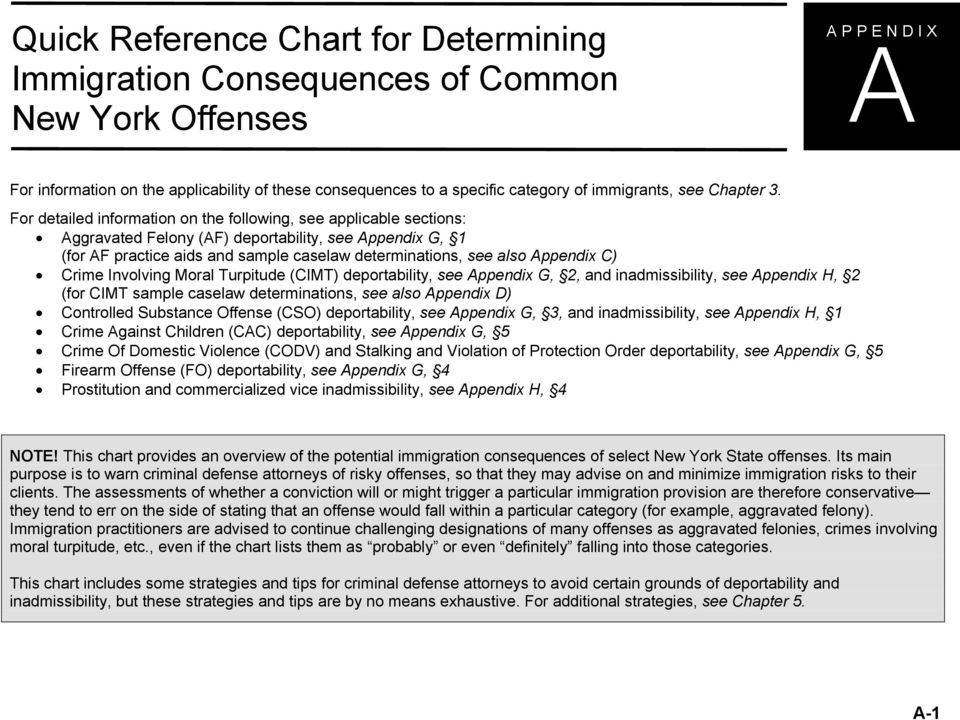
1 Quick Reference Chart for Determining Immigration Consequences of Common New York s Quick Reference Chart for Determining Immigration Consequences of Common New York s A P P E N D I X A For information on the applicability of these consequences to a specific category of immigrants, see Chapter 3. For detailed information on the following, see applicable sections: Felony (AF) deportability, see Appendix G, 1 (for AF practice aids and sample caselaw determinations, see also Appendix C) (CIMT) deportability, see Appendix G, 2, and inadmissibility, see Appendix H, 2 (for CIMT sample caselaw determinations, see also Appendix D) Controlled Substance (CSO) deportability, see Appendix G, 3, and inadmissibility, see Appendix H, 1 Crime Against Children (CAC) deportability, see Appendix G, 5 Crime Of Domestic Violence (CODV) and Stalking and Violation of Protection Order deportability, see Appendix G, 5 Firearm (FO) deportability, see Appendix G, 4 and commercialized vice inadmissibility, see Appendix H, 4 NOTE! This chart provides an overview of the potential immigration consequences of select New York State offenses. Its main purpose is to warn criminal defense attorneys of risky offenses, so that they may advise on and minimize immigration risks to their clients. The assessments of whether a will or might trigger a particular immigration provision are therefore conservative they tend to err on the side of stating that an offense would fall within a particular category (for example, aggravated felony). Immigration practitioners are advised to continue challenging designations of many offenses as aggravated felonies, crimes involving moral turpitude, etc., even if the chart lists them as probably or even definitely falling into those categories. This chart includes some strategies and tips for criminal defense attorneys to avoid certain grounds of deportability and inadmissibility, but these strategies and tips are by no means exhaustive. For additional strategies, see Chapter 5. A-1
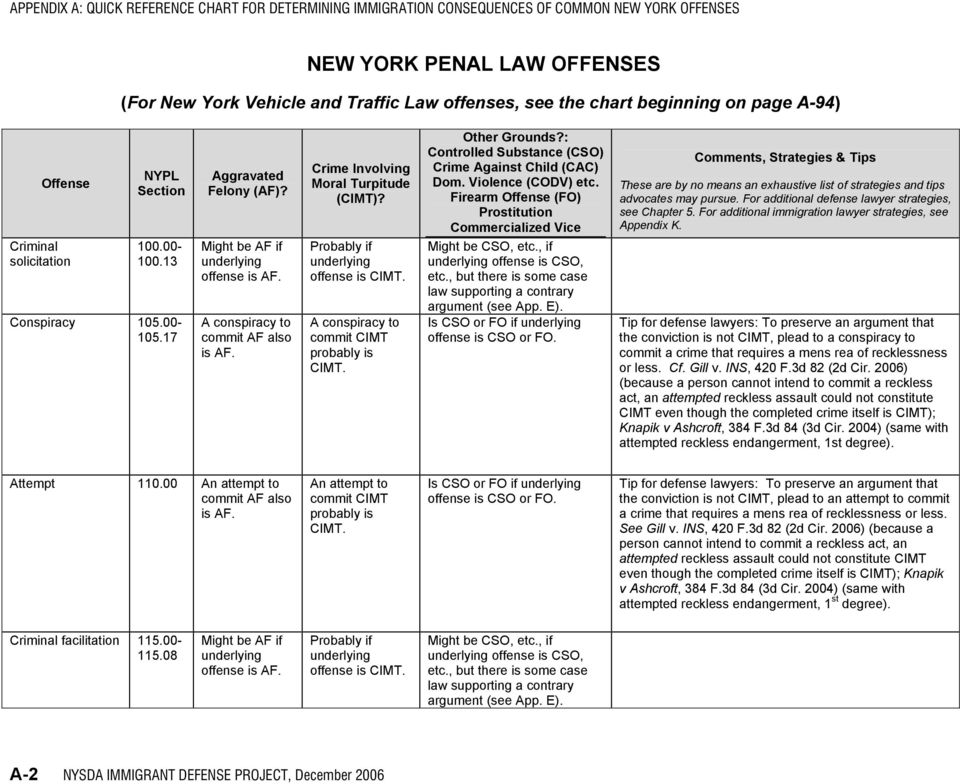
2 NEW YORK PENAL LAW OFFENSES (For New York Vehicle and Traffic Law offenses, see the chart beginning on page A-94) Criminal solicitation Conspiracy Might be AF if underlying offense is AF. A conspiracy to commit AF also is AF. Probably if underlying offense is CIMT. A conspiracy to commit CIMT probably is CIMT. Firearm (FO) Might be CSO, etc., if underlying offense is CSO, etc., but there is some case law supporting a contrary argument (see App. E). Is CSO or FO if underlying offense is CSO or FO. To preserve an argument that the is not CIMT, plead to a conspiracy to commit a crime that requires a mens rea of recklessness or less. Cf. Gill v. INS, 420 F.3d 82 (2d Cir. 2006) (because a person cannot intend to commit a reckless act, an attempted reckless assault could not constitute CIMT even though the completed crime itself is CIMT); Knapik v Ashcroft, 384 F.3d 84 (3d Cir. 2004) (same with attempted reckless endangerment, 1st ). Attempt An attempt to commit AF also is AF. An attempt to commit CIMT probably is CIMT. Is CSO or FO if underlying offense is CSO or FO. To preserve an argument that the is not CIMT, plead to an attempt to commit a crime that requires a mens rea of recklessness or less. See Gill v. INS, 420 F.3d 82 (2d Cir. 2006) (because a person cannot intend to commit a reckless act, an attempted reckless assault could not constitute CIMT even though the completed crime itself is CIMT); Knapik v Ashcroft, 384 F.3d 84 (3d Cir. 2004) (same with attempted reckless endangerment, 1 st ). Criminal facilitation Might be AF if underlying offense is AF. Probably if underlying offense is CIMT. Might be CSO, etc., if underlying offense is CSO, etc., but there is some case law supporting a contrary argument (see App. E). A-2 NYSDA IMMIGRANT DEFENSE PROJECT, December 2006
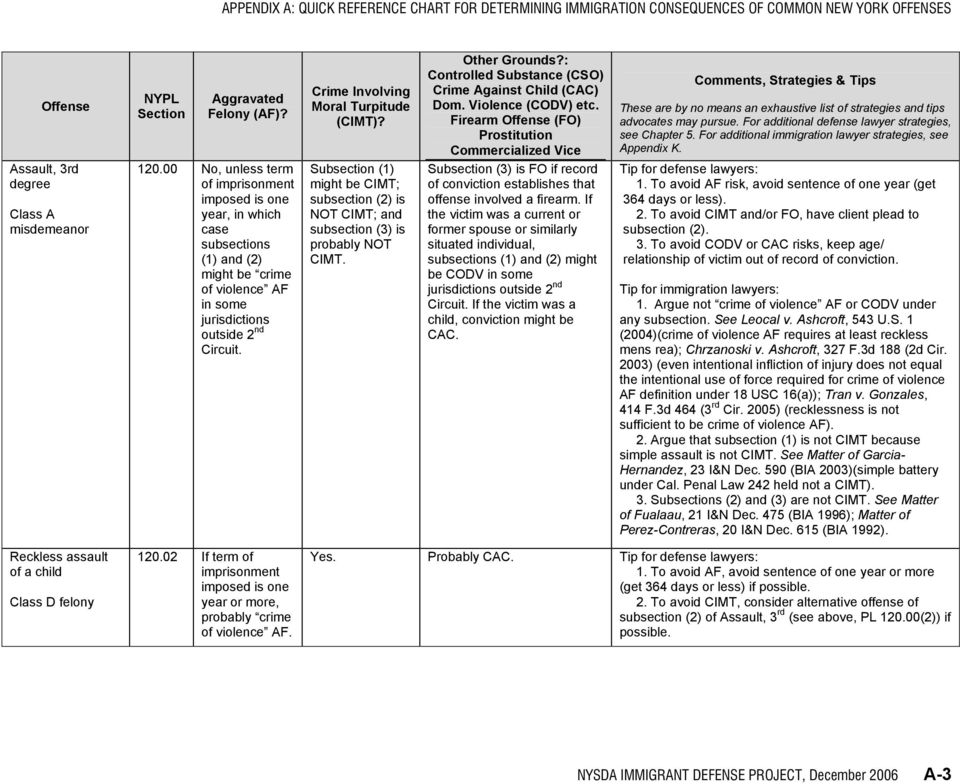
3 Firearm (FO) Subsection (3) is FO if record of establishes that offense involved a firearm. If the victim was a current or former spouse or similarly situated individual, subsections (1) and (2) might be CODV in some jurisdictions outside 2 nd Circuit. If the victim was a child, might be CAC. Assault, 3rd Class A No, unless term of year, in which case subsections (1) and (2) might be crime of violence AF in some jurisdictions outside 2 nd Circuit. Subsection (1) might be CIMT; subsection (2) is NOT CIMT; and subsection (3) is probably NOT CIMT. 1. To avoid AF risk, avoid sentence of one year (get 364 days or less). 2. To avoid CIMT and/or FO, have client plead to subsection (2). 3. To avoid CODV or CAC risks, keep age/ relationship of victim out of record of. Tip for immigration lawyers: 1. Argue not crime of violence AF or CODV under any subsection. See Leocal v. Ashcroft, 543 U.S. 1 (2004)(crime of violence AF requires at least reckless mens rea); Chrzanoski v. Ashcroft, 327 F.3d 188 (2d Cir. 2003) (even intentional infliction of injury does not equal the intentional use of force required for crime of violence AF definition under 18 USC 16(a)); Tran v. Gonzales, 414 F.3d 464 (3 rd Cir. 2005) (recklessness is not sufficient to be crime of violence AF). 2. Argue that subsection (1) is not CIMT because simple assault is not CIMT. See Matter of Garcia- Hernandez, 23 I&N Dec. 590 (BIA 2003)(simple battery under Cal. Penal Law 242 held not a CIMT). 3. Subsections (2) and (3) are not CIMT. See Matter of Fualaau, 21 I&N Dec. 475 (BIA 1996); Matter of Perez-Contreras, 20 I&N Dec. 615 (BIA 1992). Reckless assault of a child Class D felony If term of probably crime of violence AF. Yes. Probably CAC. 1. To avoid AF, avoid sentence of one year or more (get 364 days or less) if possible. 2. To avoid CIMT, consider alternative offense of subsection (2) of Assault, 3 rd (see above, PL (2)) if possible. NYSDA IMMIGRANT DEFENSE PROJECT, December 2006 A-3
4 Firearm (FO) Subsections (2) and (4) are FO if record of establishes that offense involved a firearm. If the victim was a current or former spouse or similarly situated individual, subsections (2), (3) and (7) might be CODV. If the victim was a child, might be CAC. Assault, 2nd Class D felony If term of subsections (2), (3) and (7) probably are crime of violence AF and any other subsection might be crime of violence AF. Subsections (1), (2), (4), (8) and (9) probably are CIMT and any other subsection might be CIMT. 1. To avoid AF, avoid sentence of one year or more (get 364 days or less) if possible. 2. To decrease CIMT risk, consider alternative offense of an attempt (PL ) to commit subsection (4) of PL See Gill v. INS, 420 F.3d 82 (2d Cir. 2006) (because a person cannot intend to commit a reckless act, an attempted reckless assault could not constitute CIMT even though the completed crime itself is CIMT); Knapik v Ashcroft, 384 F.3d 84 (3d Cir. 2004) (same with attempted reckless endangerment, 1st ). 3. To avoid CODV or CAC risks, keep age/ relationship of victim out of record of. Assault on a peace officer, police officer, etc. Class C felony If term of probably is crime of violence AF. Probably. Tip for immigration lawyers: 1. Argue not crime of violence AF or CODV under various subsections. See Leocal v. Ashcroft, 543 U.S. 1 (2004)(crime of violence AF requires at least reckless mens rea); Chrzanoski v. Ashcroft, 327 F.3d 188 (2d Cir. 2003) (even intentional infliction of injury does not equal the intentional use of force required for crime of violence AF definition under 18 USC 16(a)); Jobson v. Ashcroft, 326 F.3d 367 (2 nd Cir. 2003)(NY reckless manslaughter is not CIMT); Tran v. Gonzales, 414 F.3d 464 (3 rd Cir. 2005) (recklessness is not sufficient to be crime of violence AF). A-4 NYSDA IMMIGRANT DEFENSE PROJECT, December 2006

5 Assault, 1st Class B felony assault upon a police officer or peace officer Class B felony If term of subsections (1) and (2) probably are crime of violence AF and subsections (3) and (4) might be crime of violence AF If term of probably is crime of violence AF. Subsections (1), (2) and (3) probably are CIMT and subsection (4) might be CIMT. Probably. Firearm (FO) Subsection (1) is FO if record of establishes that offense involved a firearm. If the victim was a current or former spouse or similarly situated individual, might also be CODV. If the victim was a child, might be CAC. FO if record of establishes that offense involved a firearm. NYSDA IMMIGRANT DEFENSE PROJECT, December 2006 A-5

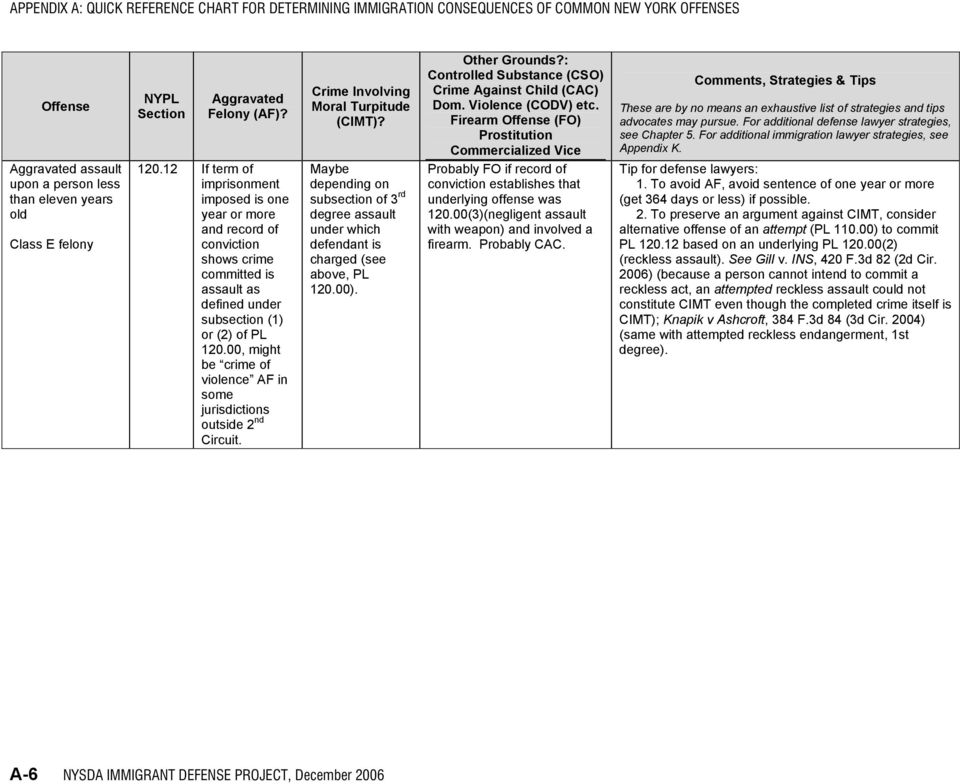
6 Firearm (FO) Probably FO if record of establishes that underlying offense was (3)(negligent assault with weapon) and involved a firearm. Probably CAC. 1. To avoid AF, avoid sentence of one year or more (get 364 days or less) if possible. 2. To preserve an argument against CIMT, consider alternative offense of an attempt (PL ) to commit PL based on an underlying PL (2) (reckless assault). See Gill v. INS, 420 F.3d 82 (2d Cir. 2006) (because a person cannot intend to commit a reckless act, an attempted reckless assault could not constitute CIMT even though the completed crime itself is CIMT); Knapik v Ashcroft, 384 F.3d 84 (3d Cir. 2004) (same with attempted reckless endangerment, 1st ). assault upon a person less than eleven years old Class E felony If term of year or more and record of shows crime committed is assault as defined under subsection (1) or (2) of PL , might be crime of violence AF in some jurisdictions outside 2 nd Circuit. Maybe depending on subsection of 3 rd assault under which defendant is charged (see above, PL ). A-6 NYSDA IMMIGRANT DEFENSE PROJECT, December 2006
7 Firearm (FO) FO if record of shows that the crime committed is menacing as defined under subsection (1) of PL and that the offense involved a firearm. If the victim was a current or former spouse or similarly situated individual, might also be CODV. Might also trigger deportability under CODV clause regarding crime of stalking. If the victim was a child, might be CAC. 1. To avoid AF, avoid sentence of one year or more (get 364 days or less) if possible. 2. To minimize CODV or CAC risks, keep age/ relationship of victim out of record of. Menacing, 1st Class E felony If term of year or more and record of (ROC) shows crime comes under subsection (1) of PL , probably is crime of violence AF. If ROC shows crime comes under subsection (2) of PL , might be crime of violence AF. If term of might be crime of violence AF even if crime comes under subsection (3) of PL in some jurisdictions outside 2 nd Circuit. Probably. NYSDA IMMIGRANT DEFENSE PROJECT, December 2006 A-7

8 Menacing, 2nd Class A Menacing, 3rd Class B No, unless term of year, in which case subsection (1) probably is crime of violence AF, subsection (2) might be crime of violence AF, and subsection (3) might be crime of violence AF in some jurisdictions outside 2 nd Circuit. Probably. Firearm (FO) Subsection (1) is FO if record of establishes that offense involved a firearm. If the victim was a current or former spouse or similarly situated individual, might also be CODV. A might also trigger deportability under CODV clause regarding crime of stalking, and subsection (3) might trigger deportability under CODV clause regarding violators of protection orders. If the victim was a child, might be CAC No. Maybe. If the victim was a current or former spouse or similarly situated individual, might be CODV in some jurisdictions outside 2 nd Circuit. Might also trigger deportability under CODV clause regarding crime of stalking. If the victim was a child, might be CAC. 1. To avoid AF, avoid sentence of one year or more (get 364 days or less) if possible. 2. To minimize CODV or CAC risks, keep age/ relationship of victim out of record of. 1. To minimize CODV or CAC risks, keep age/ relationship of victim out of record of. A-8 NYSDA IMMIGRANT DEFENSE PROJECT, December 2006
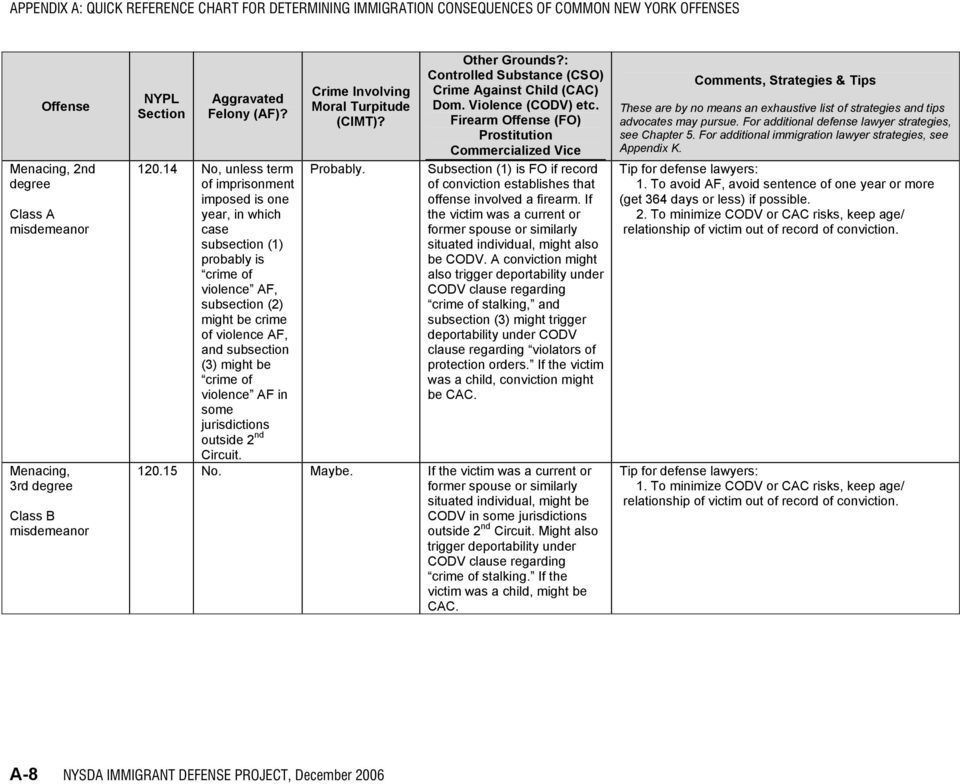
9 Firearm (FO) If the victim was a current or former spouse or similarly situated, might be CODV in some jurisdictions outside 2 nd Circuit. If the victim was a child, might be CAC. Reckless endangerment, 2nd Class A No, unless term of year, in which case might be crime of violence AF in some jurisdictions outside 2 nd Circuit. Maybe. 1. To avoid AF, avoid sentence of one year (get 364 days or less). 2. To preserve an argument against CIMT, plead to an attempt (PL ) to commit PL See Gill v. INS, 420 F.3d 82 (2d Cir. 2006) (because a person cannot intend to commit a reckless act, an attempted reckless assault could not constitute CIMT even though the completed crime itself is CIMT); Knapik v Ashcroft, 384 F.3d 84 (3d Cir. 2004) (same with attempted reckless endangerment, first ). 3. To minimize CODV or CAC risks, keep age/ relationship of victim out of record of. Tip for immigration lawyers: 1. Argue not crime of violence AF or CODV. See Leocal v. Ashcroft, 543 U.S. 1 (2004)(crime of violence AF requires at least reckless mens rea); Chrzanoski v. Ashcroft, 327 F.3d 188 (2d Cir. 2003) (even intentional infliction of injury does not equal the intentional use of force required for crime of violence AF definition under 18 USC 16(a)); Tran v. Gonzales, 414 F.3d 464 (3 rd Cir. 2005) (recklessness is not sufficient to be crime of violence AF). NYSDA IMMIGRANT DEFENSE PROJECT, December 2006 A-9
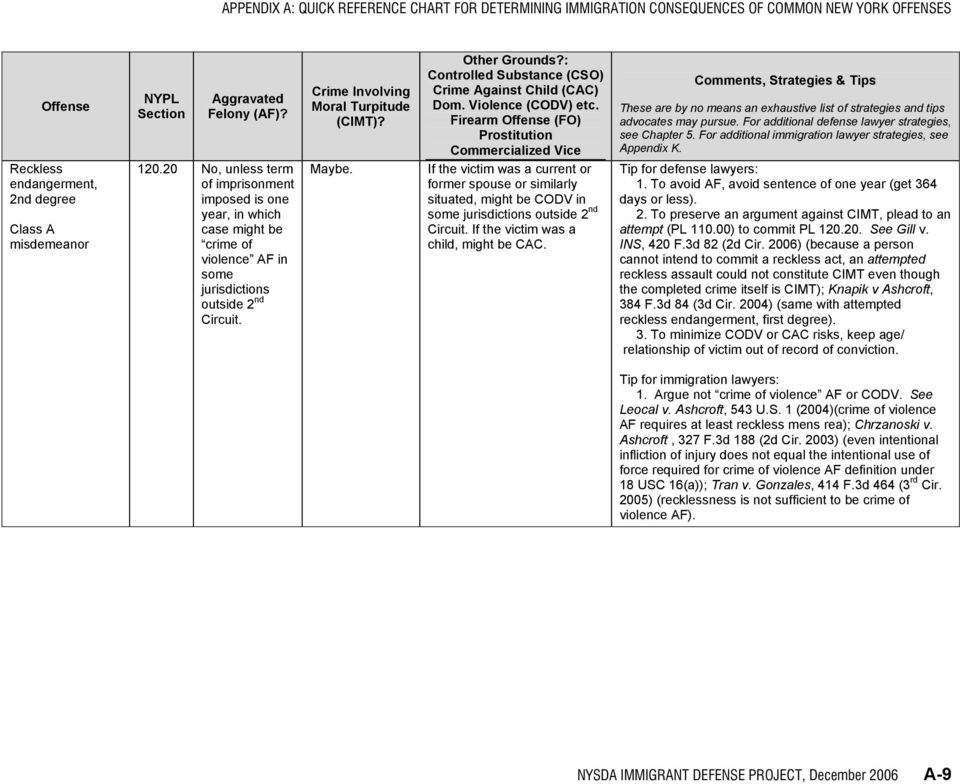
10 Firearm (FO) If the victim was a current or former spouse or similarly situated individual, might be CODV. If the victim was a child, might be CAC. Reckless endangerment, 1st Class D felony If term of might be crime of violence AF. Probably. 1. To avoid AF, avoid sentence of one year or more (get 364 days or less) if possible. 2. To preserve an argument against CIMT, plead to an attempt (PL ) to commit PL See Gill v. INS, 420 F.3d 82 (2d Cir. 2006) (because a person cannot intend to commit a reckless act, an attempted reckless assault could not constitute CIMT even though the completed crime itself is CIMT); Knapik v Ashcroft, 384 F.3d 84 (3d Cir. 2004) (same with attempted reckless endangerment, first ). 3. To minimize CODV or CAC risks, keep age/ relationship of victim out of record of. Tip for immigration lawyers: 1. Argue not crime of violence AF or CODV. See Leocal v. Ashcroft, 543 U.S. 1 (2004)(crime of violence AF requires at least reckless mens rea); Chrzanoski v. Ashcroft, 327 F.3d 188 (2d Cir. 2003) (even intentional infliction of injury does not equal the intentional use of force required for crime of violence AF definition under 18 USC 16(a)); Jobson v. Ashcroft, 326 F.3d 367 (2 nd Cir. 2003)(NY reckless manslaughter is not CIMT); Tran v. Gonzales, 414 F.3d 464 (3 rd Cir. 2005) (recklessness is not sufficient to be crime of violence AF). Stalking, 4th Class B No. Probably. Probably triggers deportability as a crime of stalking. If the victim was a current or former spouse or similarly situated individual, might also be CODV in some jurisdictions outside 2 nd Circuit. If the victim was a child, might be CAC. 1. To avoid crime of stalking, CODV or CAC risks, consider alternative offenses such as Disorderly Conduct or Trespass (see below, PL & ). A-10 NYSDA IMMIGRANT DEFENSE PROJECT, December 2006

11 Firearm (FO) Probably triggers deportability as a crime of stalking. If the victim was a current or former spouse or similarly situated individual, might also be CODV. If the victim was a child, might be CAC. 1. To avoid AF, avoid sentence of one year or more (get 364 days or less). 2. To avoid CIMT, consider alternative offenses such as Disorderly Conduct or Trespass (see below, PL & ); if that is not possible and if client has no prior CIMTs, consider alternative offense of attempt (PL ) to commit , which as a B will not trigger deportability as 1 CIMT within 5 years of admission. 3. To avoid crime of stalking, CODV or CAC risks, consider alternative offenses such as Disorderly Conduct or Trespass (see below, PL & ). Stalking, 3rd Class A No, unless term of year, in which case subsection (3) might be crime of violence AF if the record of (ROC) shows fear of commission of a sex offense, kidnapping, unlawful or death (as opposed to physical injury or serious physical injury), and subsections (1), (2) and (4) might also be crime of violence AF in some jurisdictions outside 2 nd Circuit if ROC shows crime committed comes under subsection (1) of PL Probably. NYSDA IMMIGRANT DEFENSE PROJECT, December 2006 A-11
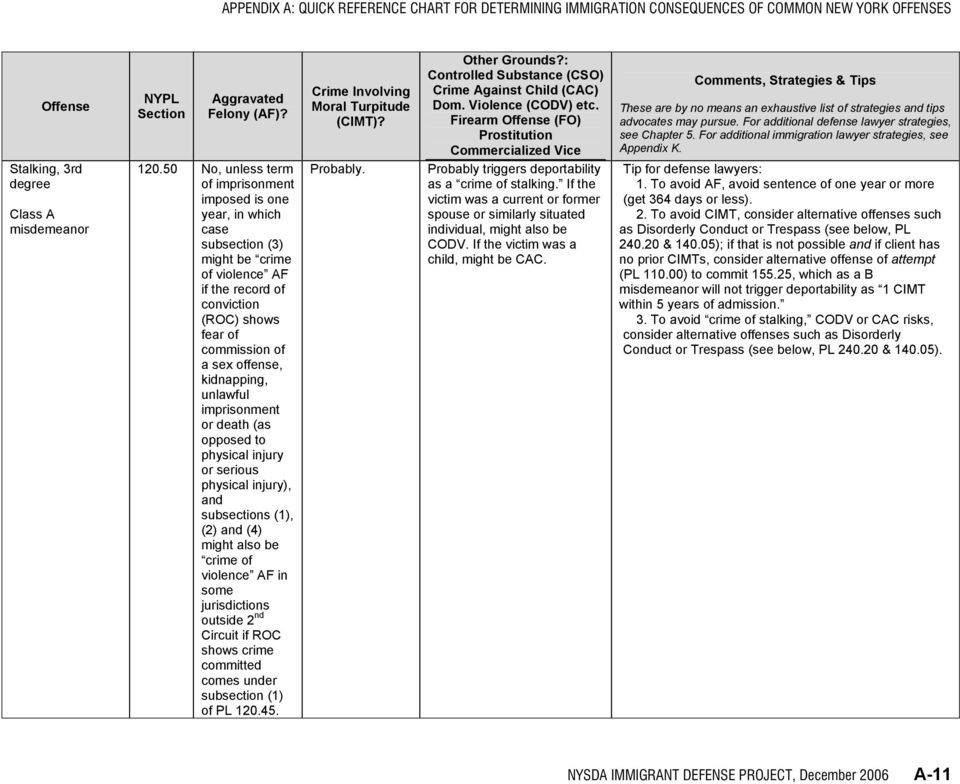
12 Firearm (FO) Subsection (1) is FO if record of establishes that offense involved a firearm. Any subsection probably triggers deportability as a crime of stalking. If the victim was a current or former spouse or similarly situated individual, might also be CODV. If the victim was a child, might be CAC. 1. To avoid AF, avoid sentence of one year or more (get 364 days or less) if possible. 2. If a weapon (but not a gun) was involved, to avoid CODV or CAC risks, consider subsection (1). Stalking, 2nd Class E felony If term of subsection (1) probably is crime of violence AF, particularly if record of shows threatened use of any of the enumerated weapons (as opposed to mere display) and any other subsection might be crime of violence AF. Probably. A-12 NYSDA IMMIGRANT DEFENSE PROJECT, December 2006
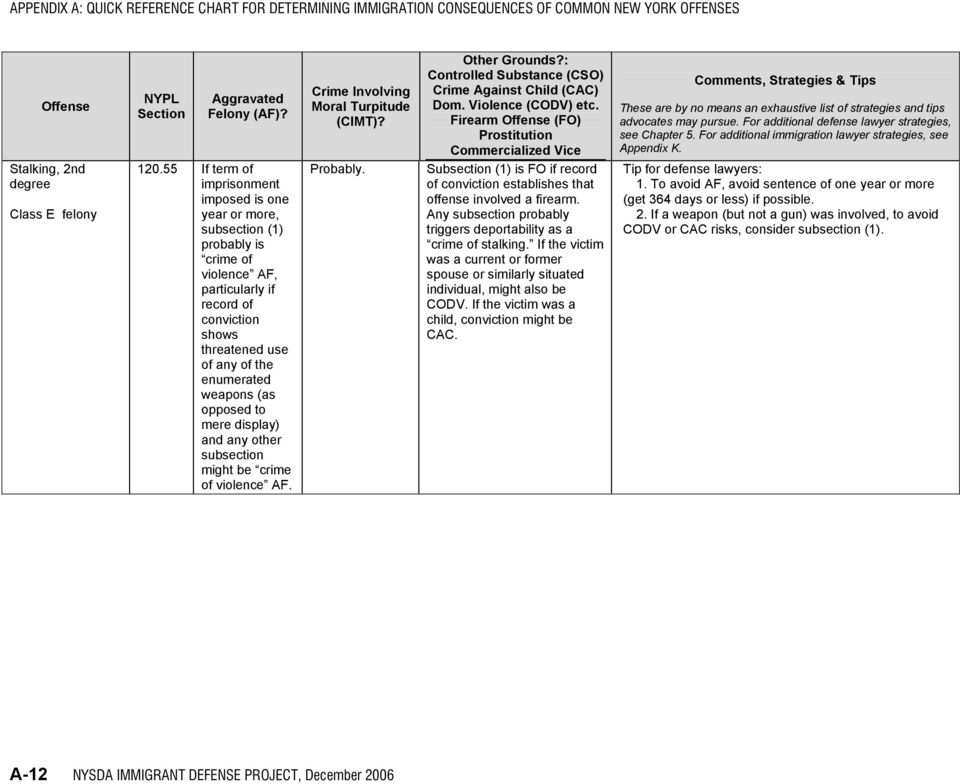
13 Stalking, 1st Class D felony Criminally negligent homicide If term of probably is crime of violence AF if record of shows crime committed comes under subsection (1) of PL ; otherwise, might be crime of violence AF. Subsection (2) might also be rape, or sexual abuse of a minor AF. Probably No. Probably NOT. Firearm (FO) Would probably trigger deportability as a crime of stalking or, if the victim was a current or former spouse or similarly situated individual, a CODV. If the victim was a child, might be CAC. 1. To avoid crime of violence AF, avoid sentence of one year or more (get 364 days or less) if possible. 2. To avoid rape, or sexual abuse of a minor AF risk, avoid subsection (2) if possible. Class E felony criminally negligent homicide No. Probably NOT. Class C felony Vehicular manslaughter, 2nd Probably NOT. Probably NOT. Class D felony NYSDA IMMIGRANT DEFENSE PROJECT, December 2006 A-13

14 Vehicular manslaughter, 1st Class C felony Firearm (FO) Probably NOT. Maybe. 1. To decrease CIMT risk, consider alternative offenses of Criminally Negligent Homicide or Vehicular Manslaughter, 2 nd (see above, PL & ). Manslaughter, 2nd Class C felony NOT AF in 2 nd Circuit, but if term of might be crime of violence AF in some jurisdictions outside 2 nd Circuit. Subsection (1) is CIMT; subsections (2) and (3) might be CIMT. If the victim was a current or former spouse or similarly situated individual, might be CODV in some jurisdictions outside 2 nd Circuit. If the victim was a child, might be CAC. 1. To avoid AF and CIMT, consider alternative offense of criminally negligent homicide (PL ) if possible. 2. If Tip 1 is not possible and incident involved a car, to avoid AF risk consider alternative offenses such as Vehicular Manslaughter, 2 nd or 1 st (see above, PL & ) or Leaving the Scene of an Incident Without Reporting (see below, VTL 600(2)). 3. To preserve an argument against CIMT, plead to an attempt (PL ) to commit See Gill v. INS, 420 F.3d 82 (2d Cir. 2006) (because a person cannot intend to commit a reckless act, an attempted reckless assault could not constitute CIMT even though the completed crime itself is CIMT); Knapik v Ashcroft, 384 F.3d 84 (3d Cir. 2004) (same with attempted reckless endangerment, first ). 4. To minimize CODV or CAC risks, keep age/ relationship of victim out of record of. Tip for immigration lawyers: 1. Argue not crime of violence AF or CODV. See Leocal v. Ashcroft, 543 U.S. 1 (2004)(crime of violence AF requires at least reckless mens rea); Chrzanoski v. Ashcroft, 327 F.3d 188 (2d Cir. 2003) (even intentional infliction of injury does not equal the intentional use of force required for crime of violence AF definition under 18 USC 16(a)); Jobson v. Ashcroft, 326 F.3d 367 (2 nd Cir. 2003)(NY reckless manslaughter is not CIMT); Tran v. Gonzales, 414 F.3d 464 (3 rd Cir. 2005) (recklessness is not sufficient to be crime of violence AF). A-14 NYSDA IMMIGRANT DEFENSE PROJECT, December 2006

15 Firearm (FO) If the victim was a current or former spouse or similarly situated individual, might be CODV. If the victim was a child, might be CAC. Manslaughter, 1st Class B felony If term of subsections (1) and (2) are crime of violence AF in the2 nd Circuit, and subsections (3) and (4) might be crime of violence AF. Subsections (1), (2) and (4) are CIMT; subsection (3) might be CIMT. 1. To avoid AF and CIMT, consider alternative offense of criminally negligent homicide (see above, PL ) if possible. 2. If Tip 1 is not possible and incident involved a car, to avoid AF consider alternative offenses such as Vehicular Manslaughter, 2 nd or 1 st (see above, PL & ) or Leaving the Scene of an Incident Without Reporting (see below, VTL 600(2)). 3. If Tips 1 and 2 are not possible, to decrease AF risk consider alternative offense of Manslaughter, 2 nd (see above, PL ). 4. To preserve an argument against CIMT, plead to an attempt (PL ) to commit (4) if possible. See Gill v. INS, 420 F.3d 82 (2d Cir. 2006) (because a person cannot intend to commit a reckless act, an attempted reckless assault could not constitute CIMT even though the completed crime itself is CIMT); Knapik v Ashcroft, 384 F.3d 84 (3d Cir. 2004) (same with attempted reckless endangerment, 1st ). 5. To minimize CODV or CAC risks, keep age/ relationship of victim out of record of. Tip for immigration lawyers: 1. Argue subsection (4) is not crime of violence AF or CODV. See Leocal v. Ashcroft, 543 U.S. 1 (2004)(crime of violence AF requires at least reckless mens rea); Chrzanoski v. Ashcroft, 327 F.3d 188 (2d Cir. 2003) (even intentional infliction of injury does not equal the intentional use of force required for crime of violence AF definition under 18 USC 16(a)); Jobson v. Ashcroft, 326 F.3d 367 (2 nd Cir. 2003)(NY reckless manslaughter is not CIMT); Tran v. Gonzales, 414 F.3d 464 (3 rd Cir. 2005) (recklessness is not sufficient to be crime of violence AF). NYSDA IMMIGRANT DEFENSE PROJECT, December 2006 A-15
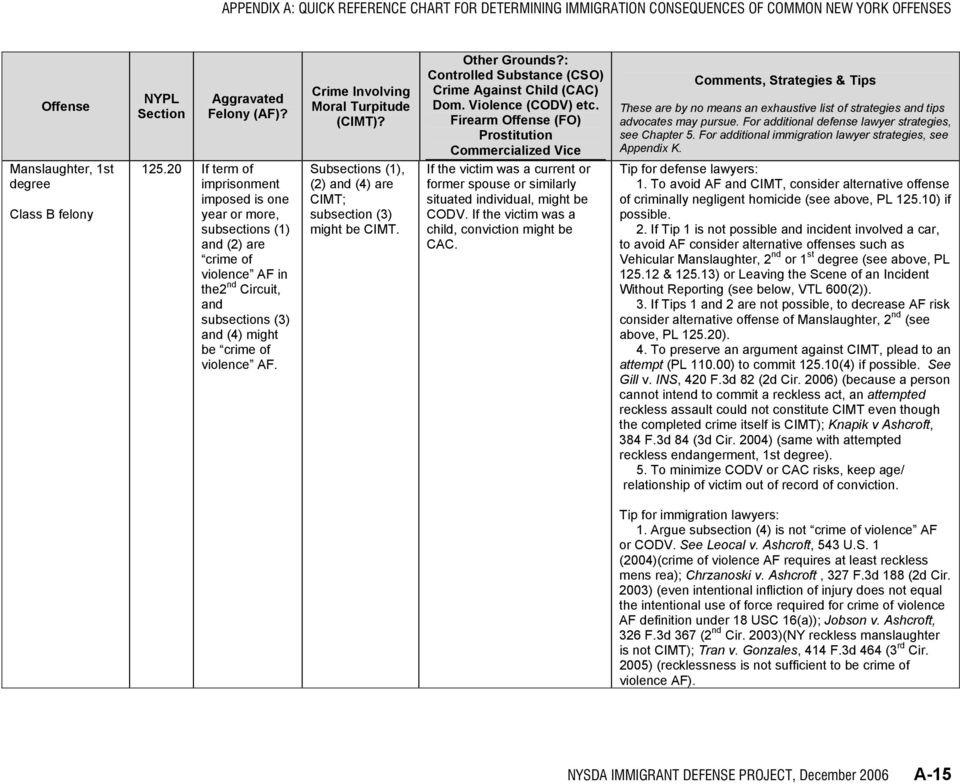
16 manslaughter, 2 nd Class C felony manslaughter, 1 st Class B felony Murder, 2nd Class A-I felony Murder, 1st Class A-I felony If term of might be crime of violence AF If term of is crime of violence AF Firearm (FO) Yes. Tip for immigration lawyers: 1. Argue not crime of violence AF. See Leocal v. Ashcroft, 543 U.S. 1 (2004)(crime of violence AF requires at least reckless mens rea); Chrzanoski v. Ashcroft, 327 F.3d 188 (2d Cir. 2003) (even intentional infliction of injury does not equal the intentional use of force required for crime of violence AF definition under 18 USC 16(a)); Jobson v. Ashcroft, 326 F.3d 367 (2 nd Cir. 2003)(NY reckless manslaughter is not CIMT); Tran v. Gonzales, 414 F.3d 464 (3 rd Cir. 2005) (recklessness is not sufficient to be crime of violence AF). Yes Yes. Yes. If the victim was a current or former spouse or similarly situated individual, might be CODV. If the victim was a child, might be CAC Yes. Yes. If the victim was a current or former spouse or similarly situated individual, might be CODV. If the victim was a child, might be CAC. 1. To avoid AF, consider alternative offense of Criminally Negligent Homicide (see above, PL ) if possible, or failing that, Manslaughter, 2 nd (see above, PL ) if possible. 2. To preserve an argument against CIMT, plead to an attempt (PL ) to commit (2) or (4). See Gill v. INS, 420 F.3d 82 (2d Cir. 2006) (because a person cannot intend to commit a reckless act, an attempted reckless assault could not constitute CIMT even though the completed crime itself is CIMT); Knapik v Ashcroft, 384 F.3d 84 (3d Cir. 2004) (same with attempted reckless endangerment, 1st ).] A-16 NYSDA IMMIGRANT DEFENSE PROJECT, December 2006
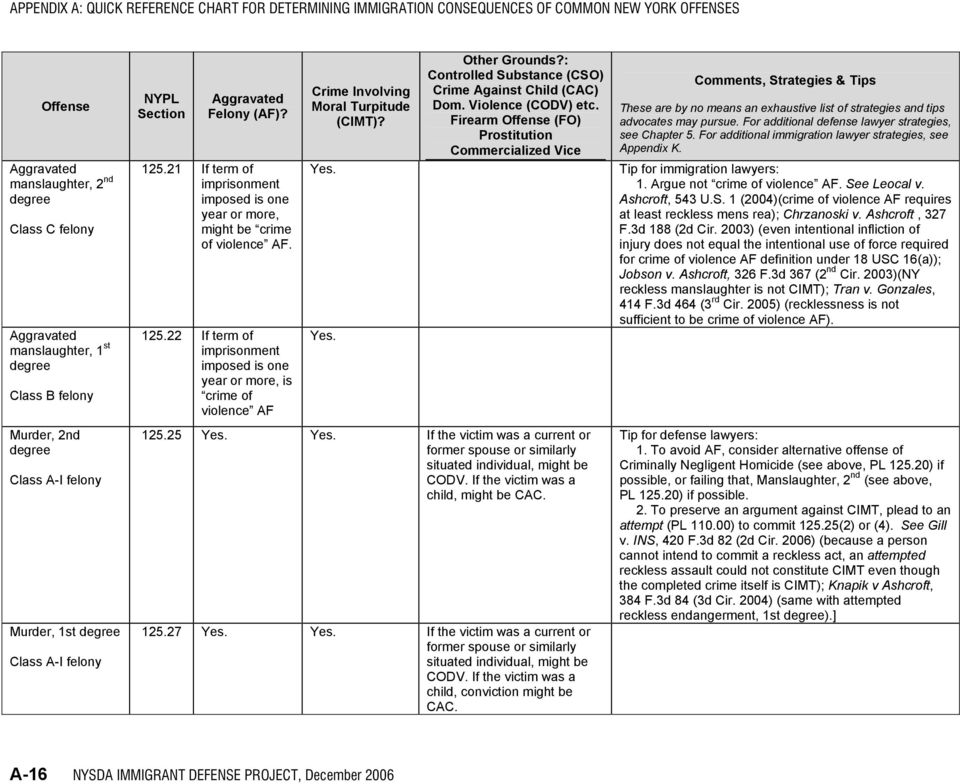
17 Firearm (FO) If the victim was a current or former spouse or similarly situated individual, might be CODV. If the record of shows that the victim was a child, might also be CAC. Sexual misconduct Class A Subsections (1) and (2) might be rape, or sexual abuse of a minor AF. If term of year, might also be crime of violence AF. Yes. 1. If victim is minor, to decrease risk of sexual abuse of a minor AF, if at all possible consider alternative offense that does not have sexual conduct as an element of the crime, such as Endangering the Welfare of a Child or Unlawful Imprisonment, 2 nd (see below, PL and ). If that s not possible, plead to alternative offense that does not have the minor age of the victim as an element of the crime or as a definition of without consent ), such as Forcible Touching (PL )(see below, ). In any event, try to keep out of the record of any admission or other evidence that the victim was a minor. 2. Regardless of victim s age, to avoid crime of violence AF risk, avoid sentence of one year (get 364 days or less). 3. To minimize CODV or CAC risks, keep age/ relationship of victim out of record of. 1. Regardless of victim s age, to avoid rape AF risk, avoid this offense altogether. If that s not possible, to avoid crime of violence AF risk, avoid sentence of one year or more (get 364 days or less). 2. If victim is minor, to decrease sexual abuse of a minor AF risk, if at all possible avoid subsection (2) and consider alternative offenses that do not have sexual conduct as an element of the crime, such as Endangering the Welfare of a Child (see below, PL or Unlawful Imprisonment, 2 nd or 1 st (see below, PL & ). If that s not possible, plead to alternative offense that does not have the minor age of the victim as an element of the crime or as a definition of without consent ), such as Forcible Touching (see below PL ). In any event, try to keep out of the record of any admission or other evidence that the victim was a minor. 3. To minimize CODV or CAC risks, keep age/ relationship of victim out of record of. Rape, 3rd Class E felony Subsection (2) probably is sexual abuse of a minor AF, particularly if the record of shows that the victim is under the age of 16. Subsections (1) and (3) might be rape AF. Any subsection might be crime of violence AF if term of year or more. Yes. If the victim was a current or former spouse or similarly situated individual, probably is CODV. If the record of shows that the victim was a child, might also be CAC, particularly if subsection (2). NYSDA IMMIGRANT DEFENSE PROJECT, December 2006 A-17
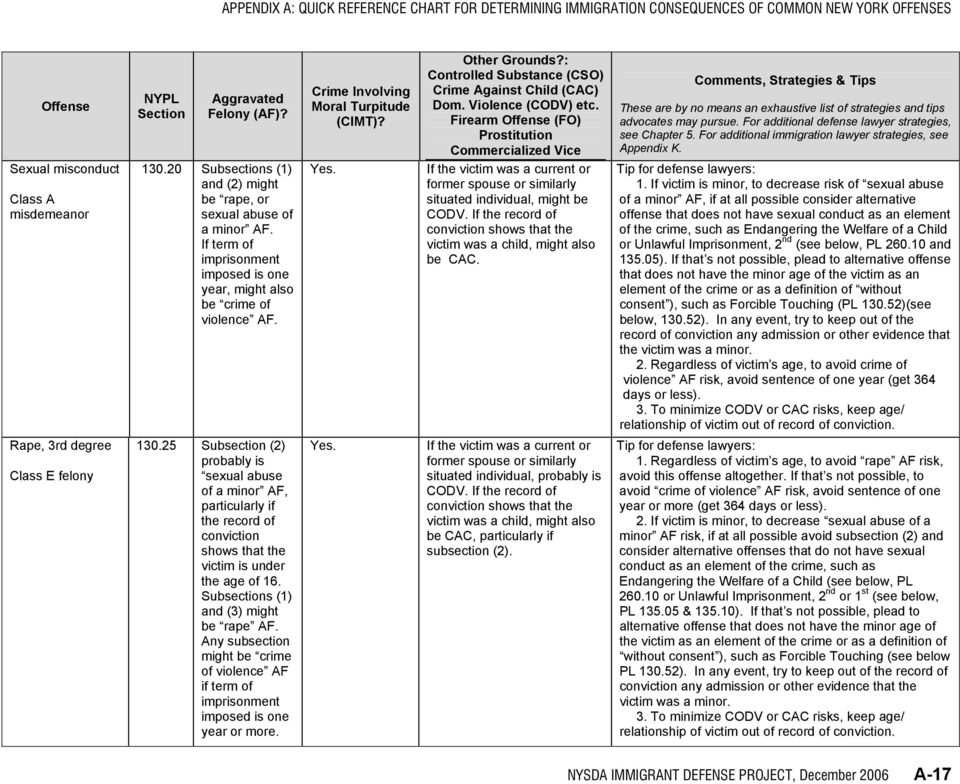
18 Firearm (FO) If the victim was a current or former spouse or similarly situated individual, probably is CODV. If the record of shows that the victim was a child, might also be CAC. Rape, 2nd Class D felony Subsection (1) probably is sexual abuse of a minor AF and subsection (2) might be rape, or sexual abuse of a minor AF. Either subsection might also be crime of violence AF if term of year or more. Yes. 1. Regardless of victim s age, to avoid rape AF risk, avoid this offense altogether. If that s not possible, to avoid crime of violence AF risk, avoid sentence of one year or more (get 364 days or less) if possible. 2. If victim is minor, to decrease risk of sexual abuse of a minor AF, if at all possible avoid subsection (1) and consider alternative offenses that do not have sexual conduct as an element of the crime, such as Endangering the Welfare of a Child (see below, PL ) or Unlawful Imprisonment, 2 nd or 1 st (see below, PL & ). If that s not possible, plead to alternative offense that does not have the minor age of the victim as an element of the crime or as a definition of without consent ), such as Forcible Touching (see below, PL ) or even Burglary in the 3 rd Degree (see below, PL ). In any event, try to keep out of the record of any admission or other evidence that the victim was a minor. 3. To minimize CODV or CAC risks, keep age/ relationship of victim out of record of. Rape, 1 st Class B felony Yes, rape, or sexual abuse of a minor AF. Yes. If the victim was a current or former spouse or similarly situated individual, probably is CODV. If the record of shows that the victim was a child, might also be CAC, particularly if subsection (3). A-18 NYSDA IMMIGRANT DEFENSE PROJECT, December 2006
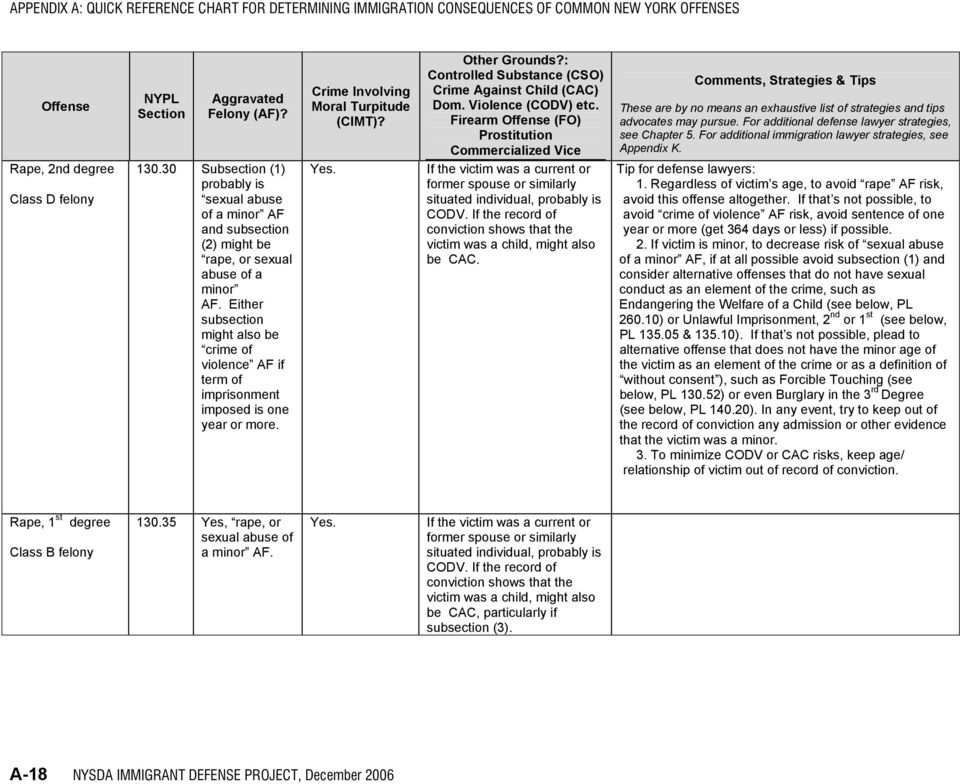
19 Firearm (FO) If the victim was a current or former spouse or similarly situated individual, probably is CODV. If the record of shows that the victim was a child, might also be CAC, particularly if subsection (2). 1. Regardless of victim s age, to avoid rape AF risk, avoid this offense altogether and consider alternative offenses such as Forcible Touching (see below, PL ). If that s not possible, to avoid crime of violence AF risk, avoid sentence of one year or more (get 364 days or less) if possible. 2. If victim is minor, to decrease sexual abuse of a minor AF risk, if at all possible avoid subsection (2) and consider alternative offenses that do not have sexual conduct as an element of the crime, such as Endangering the Welfare of a Child (see below, PL ) or Unlawful Imprisonment, 2 nd or 1 st (see below, PL & ). If that s not possible, consider alternative offense that does not have the minor age of the victim as an element of the crime or as a definition of without consent ), such as Forcible Touching (see below, PL ). In any event, try to keep out of the record of any admission or other evidence that the victim was a minor. 3. To minimize CODV or CAC risks, keep age/ relationship of victim out of record of. Criminal Sexual Act, 3rd Class E felony Subsection (2) probably is sexual abuse of a minor AF, particularly if the record of shows that the victim is under the age of 16. Subsections (1) and (3) might be rape AF. Any subsection might also be crime of violence AF if term of year or more. Yes. NYSDA IMMIGRANT DEFENSE PROJECT, December 2006 A-19
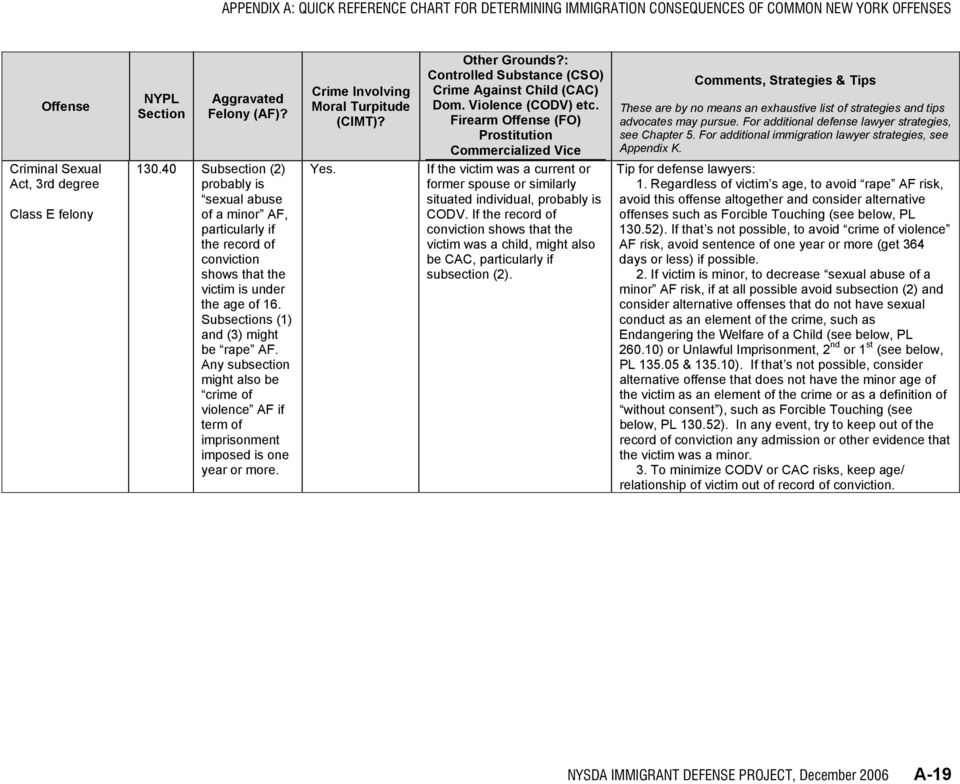
20 Firearm (FO) If the victim was a current or former spouse or similarly situated individual, probably is CODV. If the record of shows that the victim was a child, might also be CAC. Criminal Sexual Act, 2nd Class D felony Subsection (1) probably is sexual abuse of a minor AF and subsection (2) might be rape, or sexual abuse of a minor AF. Either subsection might also be crime of violence AF if term of year or more. Yes. 1. Regardless of victim s age, to avoid rape AF risk, avoid this offense altogether consider alternative offenses such as Forcible Touching (see below, PL ) if possible. If that s not possible, to avoid crime of violence AF risk, avoid sentence of one year or more (get 364 days or less) if possible. 2. If victim is minor, to decrease sexual abuse of a minor AF risk, if at all possible avoid subsection (1) and consider alternative offenses that do not have sexual conduct as an element of the crime, such as Endangering the Welfare of a Child (see below, PL ) or Unlawful Imprisonment, 2 nd or 1 st (see below, PL & ). If that s not possible, consider alternative offense that does not have the minor age of the victim as an element of the crime or as a definition of without consent ), such as Forcible Touching (see below, PL ) or even Burglary, 3 rd (see below, PL ). In any event, try to keep out of record of admission/ evidence that victim was a minor. 3. To minimize CODV or CAC risks, keep age/ relationship of victim out of record of. Criminal Sexual Act, 1st Class B felony Subsections (3) & (4) are sexual abuse of a minor AF and subsections (1) & (2) probably are rape AF. Any subsection probably also is crime of violence AF if term of of at least one year is imposed. Yes. If the victim was a current or former spouse or similarly situated individual, probably is CODV. If the record of shows that the victim was a child, might also be CAC, particularly if subsection (3). A-20 NYSDA IMMIGRANT DEFENSE PROJECT, December 2006
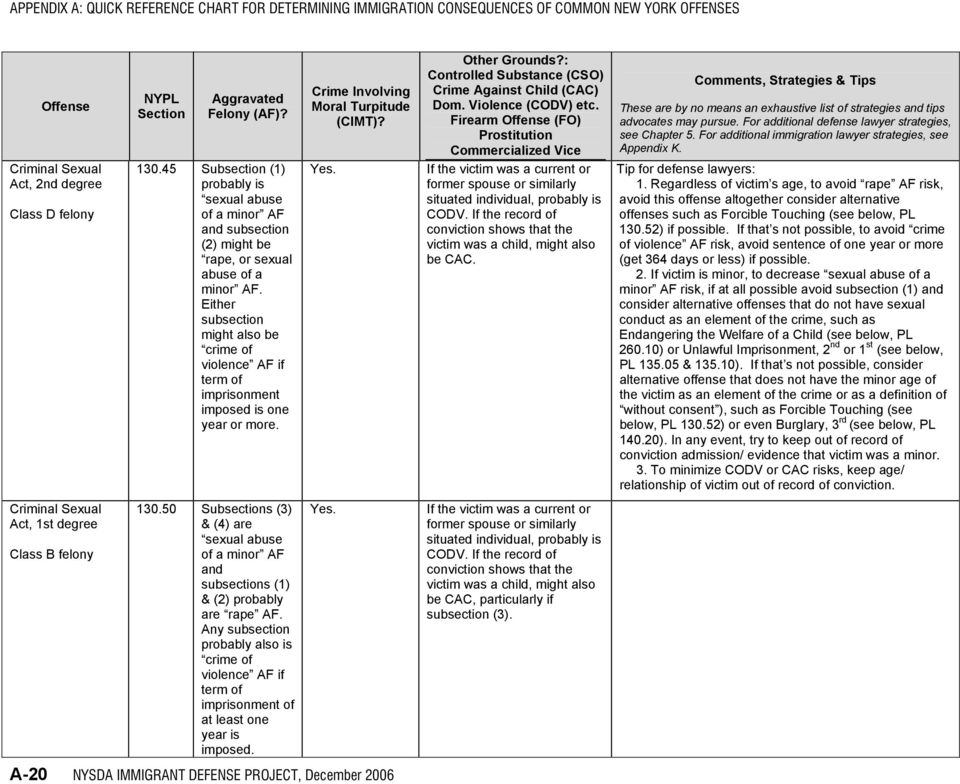
21 Firearm (FO) If the victim was a current or former spouse or similarly situated individual, might be CODV. If the record of shows that the victim was a child, might also be CAC. Forcible touching Class A If record of shows that victim was a minor, particularly under age 16, might be sexual abuse of a minor AF. If term of year, might also be crime of violence AF. Yes. 1. Regardless of victim s age, to avoid crime of violence AF risk, avoid sentence of one year (get 364 days or less). 2. If victim is minor, to minimize sex abuse of minor AF risk, consider alternative offenses that do not have sexual conduct as an element of the crime, such as Endangering the Welfare of a Child (see below, PL ) or Unlawful Imprisonment, 2 nd or 1 st (see below, PL & ). In any event, try to keep out of the record of any admission or other evidence that the victim was a minor. Tip for immigration lawyers: 1. Argue that is categorically NOT sex abuse of minor AF, even if the victim in fact was minor, because the minority of the victim is not an element of the crime. IJ may not look to the underlying record of to hold to the contrary. See, e.g., Singh v. Ashcroft, 383 F.3d 144 (3 rd Cir. 2004). Sexual abuse, 3rd Class B If the record of shows that the victim was a minor, particularly if under age 16, probably is sexual abuse of a minor AF. Yes. If the record of shows that the victim was a child, probably is CAC. 1. If victim is minor, to minimize sex abuse of minor AF risk, consider alternative offenses that do not have sexual conduct as an element of the crime, such as Endangering the Welfare of a Child (see below, PL ) or Unlawful Imprisonment, 2 nd (see below, PL ). In any event, try to keep out of the record of any admission or other evidence that the victim was a minor. NYSDA IMMIGRANT DEFENSE PROJECT, December 2006 A-21
22 Firearm (FO) If the record of shows that the victim was a child, probably is CAC, particularly if subsection (2). Sexual abuse, 2nd Class A Subsection (2) probably is sexual abuse of a minor AF, AND, if term of year, either subsection might be crime of violence. Yes. 1. Regardless of victim s age, to avoid crime of violence AF, avoid sentence of one year (get 364 days or less). 2. If victim is minor, to decrease sexual abuse of a minor AF risk, if at all possible avoid subsection (2) and consider alternative offenses that do not have sexual conduct as an element of the crime, such as Endangering the Welfare of a Child (PL )(see below, ) or Unlawful Imprisonment in the 2d Degree (PL )(see below, ). If that s not possible, consider alternative offense that does not have the minor age of the victim as an element of the crime or as a definition of without consent ), such as Forcible Touching (PL )(see below, ). 3. To minimize CODV or CAC risks, keep age/ relationship of victim out of record of. Sexual abuse, 1st Class D felony Subsection (3) is sexual abuse of a minor AF. Any subsection might also be crime of violence AF if term of year or more. Yes. If the victim was a current or former spouse or similarly situated individual, might be CODV. If the record of shows that the victim was a child, probably is CAC, particularly if subsection (3). 1. Regardless of victim s age, to avoid crime of violence AF risk, avoid sentence of one year or more (get 364 days or less) if possible. 2. If victim is minor, to minimize sex abuse of minor AF risk, if at all possible avoid subsection (3) and consider alternative offenses that do not have sexual conduct as an element of the crime, such as Endangering the Welfare of a Child (see below, PL ) or Unlawful Imprisonment, 2 nd or 1 st (see below, PL & ). If that s not possible, consider alternative offense that does not have the minor age of the victim as an element of the crime or as a definition of without consent ), such as Forcible Touching (see below, PL ) or even Burglary, 3 rd (see below, PL ). In any event, try to keep out of the record of any admission or other evidence that victim was a minor. 3. To minimize CODV or CAC risks, keep age/ relationship of victim out of record of. A-22 NYSDA IMMIGRANT DEFENSE PROJECT, December 2006
23 Firearm (FO) If the victim was a current or former spouse or similarly situated individual, might be CODV. If the record of shows that the victim was a child, probably is CAC. sexual abuse, 4th Class E felony a If the record of shows that the victim was a minor, might be sexual abuse of a minor AF. In other cases, might be rape AF. If term of might also be crime of violence AF. Yes. 1. Regardless of victim s age, to avoid crime of violence AF risk, avoid sentence of one year or more (get 364 days or less) if possible. 2. If victim is minor, to minimize sex abuse of minor AF risk, consider alternative offenses that do not have sexual conduct as an element of the crime, such as Endangering the Welfare of a Child (see below, PL ) or Unlawful Imprisonment, 2 nd or 1 st (see below, PL & ). In any event, try to keep out of the record of any admission or other evidence that victim was a minor. 3. To minimize CODV or CAC risks, keep age/ relationship of victim out of record of. Tip for immigration lawyers: 1. Argue that is categorically NOT sex abuse of minor AF, even if the victim in fact was minor, because the minority of the victim is not an element of the crime. IJ may not look to the underlying record of to hold to the contrary. See, e.g., Singh v. Ashcroft, 383 F.3d 144 (3 rd Cir. 2004). NYSDA IMMIGRANT DEFENSE PROJECT, December 2006 A-23
24 Firearm (FO) If the victim was a current or former spouse or similarly situated individual, might be CODV. If the record of shows that the victim was a child, probably is CAC, particularly if subsection (1)(c). sexual abuse, 3rd Class D felony Subsection 1(c) is sexual abuse of a minor AF. If the record of shows that the victim was a minor, any other subsection might be sexual abuse of a minor AF. Any subsection might also be rape AF, AND if term of might also be crime of violence AF. Yes. 1. Regardless of victim s age, to avoid crime of violence AF risk, avoid sentence of one year or more (get 364 days or less) if possible. 2. If victim is minor, to minimize sex abuse of minor AF risk, avoid subsection (1)(c) and consider alternative offenses that do not have sexual conduct as an element of the crime, such as Endangering the Welfare of a Child (see below, PL ) or Unlawful Imprisonment, 2 nd or 1 st (see below, PL & ), or Burglary, 3 rd (see below, PL ). In any event, try to keep out of the record of any admission or other evidence that the victim was a minor. 3. To minimize CODV or CAC risks, keep age/ relationship of victim out of record of. Tip for immigration lawyers: 1. Argue that is categorically NOT sex abuse of minor AF, even if the victim in fact was minor, because the minority of the victim is not an element of the crime. IJ may not look to the underlying record of to hold to the contrary. See, e.g., Singh v. Ashcroft, 383 F.3d 144 (3 rd Cir. 2004). A-24 NYSDA IMMIGRANT DEFENSE PROJECT, December 2006
25 Firearm (FO) If the victim was a current or former spouse or similarly situated individual, might be CODV. If the record of shows that the victim was a child, probably is CAC, particularly if subsection (1)(c). sexual abuse, 2nd Class C felony Subsection 1(c) is sexual abuse of a minor AF. If the record of shows that the victim was a minor, any other subsection might be sexual abuse of a minor AF. Any subsection might also be rape AF, AND if term of might also be crime of violence AF. Yes. NYSDA IMMIGRANT DEFENSE PROJECT, December 2006 A-25
26 Firearm (FO) If the victim was a current or former spouse or similarly situated individual, might be CODV. If the record of shows that the victim was a child, might also be CAC, particularly if subsection (1)(c). sexual abuse, 1st Class B felony Subsection 1(c) is sexual abuse of a minor AF, If the record of shows that the victim was a minor, any other subsection might be sexual abuse of a minor AF. Any subsection might also be rape AF, AND if term of might also be crime of violence AF. Yes. A-26 NYSDA IMMIGRANT DEFENSE PROJECT, December 2006
27 Firearm (FO) If the victim was a current or former spouse or similarly situated individual, might be CODV. If the record of shows that the victim was a child, might also be CAC. Unlawful, 2 nd Class A If term of year, might be crime of violence AF. Maybe. 1. To avoid crime of violence AF, avoid sentence of one year (get 364 days or less). If maximum one-year sentence cannot be avoided but the victim is less than 16 years old, try to establish in plea colloquy that the unlawful restraint was effected through victim s acquiescence to fall within the definition of restraint at PL (1)(b)[as opposed to (1)(a)], or keep the record ambiguous as to which definition of restraint was applied. 2. To minimize CODV or CAC risks, keep age/ relationship of victim out of record of. Tip for immigration lawyers: 1. Argue not crime of violence AF if government fails to prove that restraint was effected on a competent adult. See Dickson v. Ashcroft, 346 F.3d 44 (2 nd Cir. 2003). 1. To avoid crime of violence AF, avoid sentence of one year or more (get 364 days or less) if possible. If one- year sentence cannot be avoided but the victim is less than 16 years old, try to establish in plea colloquy that the unlawful restraint was effected through victim s acquiescence to fall within the definition of restraint at PL (1)(b)[as opposed to (1)(a)], or keep the record ambiguous as to which definition of restraint was applied. 3. To minimize CODV or CAC risks, keep age/ relationship of victim out of record of. Unlawful, 1 st Class E felony If term of year, might be crime of violence AF. Maybe. If the victim was a current or former spouse or similarly situated individual, might be CODV. If the record of shows that the victim was a child, might also be CAC. Tip for immigration lawyers: 1. Argue not crime of violence AF if government fails to prove that restraint was effected on a competent adult. See Dickson v. Ashcroft, 346 F.3d 44 (2 nd Cir. 2003). NYSDA IMMIGRANT DEFENSE PROJECT, December 2006 A-27
28 Firearm (FO) If the victim was a current or former spouse or similarly situated individual, might be CODV. If the record of shows that the victim was a child, might also be CAC. Kidnapping, 2bd Degree Class B felony Trespass If term of year, probably is crime of violence AF No. No. Probably. Violation Criminal trespass, 3rd No. No. Class B Criminal trespass, 2nd No. No. Class A Criminal trespass, 1st Class D felony If term of probably is crime of violence AF. Maybe. Subsections (2) and (3) are FO and, if record of establishes that offense involved a firearm, subsection (1) also is FO. 1. To avoid crime of violence AF, avoid sentence of one year or more (get 364 days or less) if possible. 2. To minimize FO risk, avoid this offense altogether and consider alternative offenses that do not have firearms as an element of the crime, such as Burglary, 3 rd (see below, PL ). If that s not possible, avoid subsections (2) and (3) [subsection (1) might be better] and try to keep out of record of that the weapon was a firearm. A-28 NYSDA IMMIGRANT DEFENSE PROJECT, December 2006
29 Burglary, 3rd Class D felony If term of probably is burglary AF, and might be crime of violence AF. Yes if record of establishes that crime intended to be committed was CIMT. Firearm (FO) 1. To avoid burglary or crime of violence AF, avoid sentence of one year or more (get 364 days or less) if possible. 2. If burgled building is a car and sentence of one year or more cannot be avoided, minimize risk of burglary AF by establishing fact of car (as opposed to house). 3. To minimize CIMT risk, consider alternative offense of Criminal Trespass, 2 nd (see above, PL ), even if sentence imposed for that offense is the maximum one year. If that is not possible, leave record of vague as to what was the underlying crime intended, or specify in that record an underlying offense that is NOT a CIMT. 1. To avoid burglary or crime of violence AF, avoid this offense altogether and consider alternative offense of Burglary, 3 rd with a sentence of 364 days or less, if possible (see above, PL ). 2. To minimize FO risk, avoid this offense altogether and consider alternative offenses that do not have firearms as an element of the crime, such as Burglary, 3 rd (see above, PL ). If that s not possible, avoid subsection (1)(d) and try to keep out of record of that the weapon was a firearm. 3. To minimize CIMT risk, leave record of vague as to what was the underlying crime intended, or specify in that record an underlying offense that is NOT a CIMT. Burglary, 2nd Class C felony If term of subsection (1) probably is burglary or crime of violence AF, and subsection (2) is burglary or crime of violence AF. Yes if record of establishes that crime intended to be committed was CIMT. Subsection (1)(d) probably is FO and, if record of establishes that offense involved a firearm, subsections (1)(a) and (1)(c) probably also are FO. NYSDA IMMIGRANT DEFENSE PROJECT, December 2006 A-29
30 Firearm (FO) Subsection (4) is FO and, if record of establishes that offense involved a firearm, subsections (1) and (3) probably also are FO. Burglary, 1st Class B felony If term of is burglary or crime of violence AF. Yes if record of establishes that crime intended to be committed was CIMT. 1. To avoid burglary or crime of violence AF, avoid this offense altogether and consider alternative offense of Burglary, 3 rd with a sentence of 364 days or less, if possible (see above, PL ). 2. To minimize FO risk, avoid this offense altogether and consider alternative offenses that do not have firearms as an element of the crime, such as Burglary, 3 rd (see above, PL ). If that s not possible, avoid subsection (4) and try to keep out of record of that the weapon was a firearm. 3. To minimize CIMT risk, leave record of vague as to what was the underlying crime intended, or specify in that record an underlying offense that is NOT a CIMT. Possession of burglar s tools Class A No, unless term of year, in which case might be attempted burglary or theft AF. Maybe if record of establishes that the offense intended to be committed was CIMT. 1. To avoid attempted burglary or theft AF, avoid sentence of one year or more (get 364 days or less). 2. To minimize CIMT risk, consider alternative offense of Criminal Trespass, 2 nd, if possible (see below, PL ). If that is not possible, leave record of vague as to what was the underlying crime intended, or specify in that record an underlying offense that is NOT a CIMT. Tip for immigration lawyers: 1. Argue not CIMT if government fails to show that underlying crime intended with the burglary tools is not CIMT. See Guarino v. Uhl, 107 F.2d 399 (2 nd Cir. 1939); Matter of S, 6 I&N Dec. 769 (BIA 1955). A-30 NYSDA IMMIGRANT DEFENSE PROJECT, December 2006
31 Criminal mischief, 4th Class A Criminal mischief, 3rd Class E felony Criminal mischief, 2nd Class D felony Criminal mischief, 1st Class B felony No (particularly if record of shows subsection (3)), unless term of year, in which case might be crime of violence AF in some jurisdictions outside 2 nd Circuit If term of might be crime of violence AF If term of might be crime of violence AF If term of probably is crime of violence AF. Subsections (1) and (2) might be CIMT. Subsection (3) probably is NOT CIMT. Firearm (FO) 1. To avoid crime of violence AF, avoid sentence of one year (get 364 days or less). 2. To minimize CIMT risk, avoid subsections (1) and (2) and consider alternative offenses that are likely NOT to be CIMT, such as Reckless Endangerment of Property (see below, PL ). Probably. 1. To avoid crime of violence AF, avoid sentence of one year or more (get 364 days or less) if possible. Probably. 1. To avoid crime of violence AF, avoid sentence of one year or more (get 364 days or less) if possible. Probably. FO (or destructive device offense) if record of establishes that offense involved destructive device (as defined in 18 U.S.C. 921(a)). 1. To avoid crime of violence AF, avoid this offense altogether and consider alternative offense of Criminal Mischief, 3 rd or 4 th, with a sentence of 364 days or less, if possible (see above, PL &145.00). 2. To minimize FO risk, avoid this offense altogether and consider alternative offense of Criminal Mischief, 3 rd or 4 th, with a sentence of 364 days or less, if possible (see above, PL &145.00). NYSDA IMMIGRANT DEFENSE PROJECT, December 2006 A-31
32 Reckless endangerment of property Class B Making graffiti Class A Possession of graffiti instrument Firearm (FO) No. Probably NOT. See Matter of M, 3 I&N Dec. 272 (BIA 1948)(found that property damage offense was CIMT because was not one where the act was merely accompanied by negligence or carelessness, but one which was perpetrated maliciously and wantonly ); Matter of M, 2 I&N Dec. 686 (BIA 1946)(reckless endangerment of property not a CIMT) No, unless term of year, in which case might be crime of violence AF in some jurisdictions outside 2 nd Circuit No. Probably NOT. Probably NOT. 1. To avoid crime of violence AF, avoid sentence imposed of one year (get 364 days or less). Class B Arson, 5th Class A No, unless term of year, in which case probably is crime of violence AF. Maybe. FO (or destructive device offense) if record of establishes that offense involved destructive device (as defined in 18 U.S.C. 921(a)). 1. To avoid crime of violence AF, avoid sentence imposed of one year (get 364 days or less). A-32 NYSDA IMMIGRANT DEFENSE PROJECT, December 2006
33 Firearm (FO) FO (or destructive device offense) if record of establishes that offense involved destructive device (as defined in 18 U.S.C. 921(a)). Arson, 4th Class E felony If term of probably is crime of violence AF. Maybe. 1. To avoid crime of violence AF, avoid sentence imposed of one year or more (get 364 days or less) if possible. 2. To minimize CIMT risk, consider alternative offense of Criminal Mischief, 4 th, subsection (3) (see above, PL (3)), with a sentence of 364 days or less, if possible, OR consider pleading to an attempt (PL ) to commit Arson, 4 th (see above, PL ). See Gill v. INS, 420 F.3d 82 (2d Cir. 2006) (because a person cannot intend to commit a reckless act, an attempted reckless assault could not constitute CIMT even though the completed crime itself is CIMT); Knapik v Ashcroft, 384 F.3d 84 (3d Cir. 2004) (same with attempted reckless endangerment, 1st ). 3. To minimize FO risk, avoid this offense altogether if destructive device was used, and consider alternative offenses such as Criminal Mischief, 4 th Degree, subsection (3), or Arson, 5 th Degree (see above, PL (3) or ), in each case with a sentence of 364 days or less, if possible. Arson, 3rd Class C felony If term of probably is crime of violence AF. Yes. FO (or destructive device offense) if record of establishes that offense involved destructive device (as defined in 18 U.S.C. 921(a)). Arson, 2nd Class B felony If term of probably is crime of violence AF. Yes. FO (or destructive device offense) if record of establishes that offense involved destructive device (as defined in 18 U.S.C. 921(a)). NYSDA IMMIGRANT DEFENSE PROJECT, December 2006 A-33
34 Firearm (FO) FO (or destructive device offense) if record of establishes that offense involved destructive device (as defined in 18 U.S.C. 921(a)). Arson, 1st Class A-I felony If term of probably is crime of violence AF. Yes. Petit larceny Class A Grand larceny, 4th Class E felony No, unless term of year, in which case probably is theft AF If term of probably is theft AF. Subsection (11), if the record of shows the property involved to benhydrous ammonia, probably is drug trafficking AF regardless of sentence. Yes. 1. To avoid AF, avoid sentence imposed of one year (get 364 days or less). 2. To avoid CIMT, consider alternative offenses such as Disorderly Conduct (see below, PL ), Trespass (see above, PL ) or Jostling (see below, PL ). If that is not possible and if client has no prior CIMT, consider alternative offense of attempt (PL ) to commit , which as a B will not trigger deportability as 1 CIMT within 5 years of admission. Yes. Subsection (7) probably is FO. Subsection (11) probably is CSO. 1. To avoid theft AF, avoid sentence imposed of one year or more (get 364 days or less). 2. To avoid FO risk, avoid subsection (7). 3. To avoid drug trafficking AF or CSO risk, avoid subsection (11). 4. If the allegation is car theft, to avoid CIMT risk consider alternative offense of Unauthorized Use of a Vehicle, 3 rd or 2 nd (see below, PL & ). A-34 NYSDA IMMIGRANT DEFENSE PROJECT, December 2006
35 Grand larceny, 3rd Class D felony Grand larceny, 2nd Class C felony If term of probably is theft AF. If record of establishes that value of property exceeds $10,000, might be fraud or deceit AF regardless of sentence If term of probably is theft AF and subsection (2) might also be crime of violence AF. If record of establishes that value of property exceeds $10,000, might be fraud or Firearm (FO) Yes. 1. To avoid theft AF, avoid sentence imposed of one year or more (get 364 days or less) if possible. 2. If alleged loss exceeds $10,000, to decrease fraud or deceit AF risk, consider alternative offenses such as Criminal Possession of Stolen Property, 4 th or 3 rd (see below, PL & ) or Grand Larceny, 4 th (see above, PL ). If pleading to cannot be avoided, affirmatively establish in plea colloquy that loss to victim was no more than $10, If the allegation is car theft, to avoid CIMT risk, consider alternative offense of Unauthorized Use of a Vehicle, 3 rd or 2 nd (see below, PL & ). Yes. Tip for immigration lawyers: 1. If government alleges fraud or deceit AF, argue not AF (1) because fraud or deceit is not a necessary element of the offense; (2) in any event government has failed to prove that loss to victim exceeds $10,000 (e.g., if plea colloquy admits to loss amount of no more than $10,000). NYSDA IMMIGRANT DEFENSE PROJECT, December 2006 A-35
36 Grand larceny, 1st Class B felony Robbery, 3rd Class D felony Robbery, 2nd Class C felony Robbery, 1st Class B felony deceit AF regardless of sentence If term of probably is theft AF. Might also be fraud or deceit AF regardless of sentence If term of is crime of violence and theft AF If term of is crime of violence and theft AF If term of is crime of violence and theft AF. Yes. Firearm (FO) Yes. 1. To avoid AF, avoid sentence imposed of one year or more (get 364 days or less) if possible. Yes. Subsection 2(b) probably is FO if record of establishes that offense involved a firearm. Yes. Subsections (2), (3) and (4) are FO if record of establishes that offense involved a firearm. 1. To avoid AF, avoid this offense altogether and consider alternative plea to Robbery, 3 rd with a sentence of 364 days or less (see above, PL ) if possible. A-36 NYSDA IMMIGRANT DEFENSE PROJECT, December 2006
37 Unauthorized use of vehicle, 3rd Class A Unauthorized use of vehicle, 2nd Class E felony Unauthorized use of vehicle, 1st Class D felony Theft of services Violation Class A Class E felony Jostling No, unless term of year, in which case might be theft AF If term of might be theft AF If term of might be theft AF If term of might be theft AF. Firearm (FO) Probably NOT. 1. To avoid theft AF, avoid sentence imposed of one year (get 364 days or less). Probably NOT. 1. To avoid AF, avoid sentence imposed of one year or more (get 364 days or less) if possible. Maybe, particularly if record establishes intent to use vehicle in the commission of a CIMT No. Probably NOT. 1. To avoid AF, avoid sentence imposed of one year or more (get 364 days or less) if possible. 2. To decrease CIMT risk, avoid this offense altogether and consider alternative offense of Unauthorized Use of Vehicle, 2 nd with a sentence of 364 days or less (see above, PL ) if possible. If pleading to cannot be avoided, leave record of vague as to what was the underlying crime intended, or specify in that record an underlying offense that is NOT a CIMT. Probably. 1. To avoid AF, avoid sentence imposed of one year (get 364 days or less) if possible. 2. To avoid CIMT, consider alternative offenses such as Disorderly Conduct (see below, PL ) or Trespass (see above, PL ). If that is not possible and if client has no prior CIMTs, consider alternative offense of attempt (PL ) to commit PL , which as a B will not trigger deportability as 1 CIMT within 5 years of admission. Class A NYSDA IMMIGRANT DEFENSE PROJECT, December 2006 A-37
38 Criminal possession of stolen property, 5th Class A No, unless term of year, in which case probably is theft AF. Probably (but note presumption, not actual finding, that person possessed property with intent to benefit himself or another). Firearm (FO) 1. To avoid AF, avoid sentence imposed of one year (get 364 days or less). 2. To avoid CIMT risk, consider alternative offenses such as Disorderly Conduct (see below, PL ), Trespass (see above, PL ) or Jostling (see below, PL ); if the allegation is car theft, also consider alternative offense of Unauthorized Use of a Vehicle, 3 rd (see above, PL & ). If the strategies in the preceding sentence are not possible and if client has no prior CIMTs, consider alternative offense of attempt (PL ) to commit PL , which as a B will not trigger deportability as 1 CIMT within 5 years of admission. 1. To avoid theft AF, avoid sentence imposed of one year or more (get 364 days or less) if possible. 2. To avoid drug trafficking AF or CSO risk, avoid subsection (7). 3. To avoid CIMT risk, consider alternative offenses such as Jostling (see above, PL ); if the allegation is car theft, also consider alternative offense of Unauthorized Use of a Vehicle, 3 rd or 2 nd (see below, PL & ). Criminal possession of stolen property, 4th Class E felony If term of probably is theft AF. Subsection (7), if the record of shows the property involved to benhydrous ammonia, probably is drug trafficking AF regardless of sentence. Probably (but note presumption, not actual finding, that person possessed property with intent to benefit himself or another). Subsection (7) probably is CSO. A-38 NYSDA IMMIGRANT DEFENSE PROJECT, December 2006
39 Criminal possession of stolen property, 3rd Class D felony Criminal possession of stolen property, 2nd Class C felony Criminal possession of stolen property, 1st Class B felony Trademark counterfeiting, 3 rd Class A If term of probably is theft AF If term of probably is theft AF If term of probably is theft AF If term of year, might be counterfeiting AF. Probably (but note presumption, not actual finding, that person possessed property with intent to benefit himself or another). Probably (but note presumption, not actual finding, that person possessed property with intent to benefit himself or another). Firearm (FO) 1. To avoid theft AF, avoid sentence imposed of one year or more (get 364 days or less) if possible. 2. If the allegation is car theft, to avoid CIMT risk consider alternative offense of Unauthorized Use of a Vehicle, 3 rd or 2 nd (see above, PL & ). Probably (but note presumption, not actual finding, that person possessed property with intent to benefit himself or another). Probably. 1. To avoid AF, avoid sentence imposed of one year (get 364 days or less). 2. To avoid CIMT, consider alternative offense such as Disorderly Conduct (see below, PL ). If that is not possible and if client has no prior CIMT, consider alternative offense of attempt (PL ) to commit PL , which as a B will not trigger NYSDA IMMIGRANT DEFENSE PROJECT, December 2006 A-39
40 Trademark counterfeiting, 2 nd Class E felony If term of might be counterfeiting AF. If the loss to the victim(s) exceeds $10,000, might also be fraud AF especially if record of shows element of intent to defraud or deceive (as opposed to evade a lawful restriction). Firearm (FO) deportability as 1 CIMT within 5 years of admission. Probably. 1. To avoid counterfeiting AF, avoid sentence imposed of one year or more (get 364 days or less) if possible. 2. To decrease fraud AF risk, keep out of record of any reference to a loss amount greater than $10,000, or specify in the plea colloquy that the loss amount did not exceed $10,000; and/or specify in plea colloquy that offense was committed with intent to evade a lawful restriction on sale/resale (as opposed to with intent to deceive or defraud). See Valansi v. Ashcroft, 278 F.3d 203 (3d Cir. 2002). A-40 NYSDA IMMIGRANT DEFENSE PROJECT, December 2006
41 Trademark counterfeiting, 1 st Class C felony If term of might be counterfeiting AF. If the loss to the victim(s) exceeds $10,000, might also be fraud AF especially if record of shows element of intent to defraud or deceive (as opposed to evade a lawful restriction). Firearm (FO) Probably. 1. To avoid counterfeiting AF, consider alternative offense of Trademark Counterfeiting, 3 rd or 2 nd and get sentence of 364 days or less (see above, PL & ) if possible. 2. To decrease risk of fraud AF, specify in the plea colloquy if possible that the loss amount did not exceed $10,000 (regardless of retail value); and/or specify in plea colloquy that offense was committed with intent to evade a lawful restriction on sale/resale (as opposed to with intent to deceive or defraud). See Valansi v. Ashcroft, 278 F.3d 203 (3d Cir. 2002). NYSDA IMMIGRANT DEFENSE PROJECT, December 2006 A-41
42 Forgery, 3rd Class A If term of year, probably is forgery AF. If the loss to the victim(s) exceeds $10,000, might also be fraud AF especially if record of shows element of intent to defraud or deceive (as opposed to injure). Firearm (FO) Yes. 1. To avoid forgery AF, avoid sentence imposed of one year (get 364 days or less). 2. To decrease risk of fraud AF, specify in the plea colloquy that the loss amount did not exceed $10,000; and/or specify in plea colloquy that offense was committed with intent to injure (as opposed to with intent to deceive or defraud). See Valansi v. Ashcroft, 278 F.3d 203 (3d Cir. 2002). 3. To decrease CIMT risk, consider alternative offenses such as Disorderly Conduct (see below, PL ) or Trespass (see above, PL, ). If these are not possible, consider alternative offenses that may preserve the potential argument that the is not a CIMT, such as Offering a False Instrument for Filing, 2 nd (see below, PL ) or Making a Punishable False Written Statement (see below, PL ). If these are not possible and if client has no prior CIMTs, consider alternative offense of attempt (PL ) to commit PL , which as a B will not trigger deportability as 1 CIMT within 5 years of admission. A-42 NYSDA IMMIGRANT DEFENSE PROJECT, December 2006
43 Forgery, 2nd Class D felony Forgery, 1st Class C felony If term of probably is forgery AF. If the loss to the victim(s) exceeds $10,000, might also be fraud AF especially if record of shows element of intent to defraud or deceive (as opposed to injure) If term of probably is forgery AF. If the loss to the victim(s) exceeds $10,000, might also be fraud AF especially if record of shows element of intent to defraud or deceive (as opposed to Firearm (FO) Yes. 1. To avoid forgery AF, avoid sentence imposed of one year or more (get 364 days or less) if possible. 2. To decrease fraud AF risk, specify in the plea colloquy that the loss amount did not exceed $10,000; and/or specify in plea colloquy that offense was committed with intent to injure (as opposed to with intent to deceive or defraud). See Valansi v. Ashcroft, 278 F.3d 203 (3d Cir. 2002). 3. To decrease CIMT risk, consider alternative offenses such as Disorderly Conduct (see below, PL ) or Trespass (see above, PL, ). If these are not possible, consider alternative offenses that may preserve the potential argument that the is not a CIMT, such as Offering a False Instrument for Filing, 2 nd (see below, PL ) or Making a Punishable False Written Statement (see below, PL ). Yes. NYSDA IMMIGRANT DEFENSE PROJECT, December 2006 A-43
44 injure) Firearm (FO) Criminal possession of a forged instrument, 3rd Class A If term of year, might be forgery AF. If the loss to the victim(s) exceeds $10,000, might also be fraud AF especially if record of shows element of intent to defraud or deceive (as opposed to injure). Yes. 1. To avoid forgery AF, avoid sentence imposed of one year (get 364 days or less). 2. To decrease fraud AF risk, specify in the plea colloquy that the loss amount did not exceed $10,000; and/or specify in plea colloquy that offense was committed with intent to injure (as opposed to with intent to deceive or defraud). See Valansi v. Ashcroft, 278 F.3d 203 (3d Cir. 2002). 3. To decrease CIMT risk, consider alternative offenses such as Disorderly Conduct (see below, PL ) or Trespass (see above, PL, ). If these are not possible, consider alternative offenses that may preserve the potential argument that the is not a CIMT, such as Offering a False Instrument for Filing, 2 nd Degree (see below, PL ) or Making a Punishable False Written Statement (see below, PL ); if these are not possible and if client has no prior CIMTs, consider alternative offense of attempt (PL ) to commit , which as a B will not trigger deportability as 1 CIMT within 5 years of admission. Tip for immigration lawyers: 1. If government alleges fraud or deceit AF, argue not AF (1) because fraud or deceit is not a necessary element of the offense; (2) in any event government has failed to prove that loss to victim exceeds $10,000 (e.g., if plea colloquy admits to loss amount of no more than $10,000). A-44 NYSDA IMMIGRANT DEFENSE PROJECT, December 2006
45 Criminal possession of a forged instrument, 2nd Class D felony If term of might be forgery AF. If the loss to the victim(s) exceeds $10,000, might also be fraud AF especially if record of shows element of intent to defraud or deceive (as opposed to injure). Firearm (FO) Yes. 1. To avoid forgery AF, avoid sentence imposed of one year or more (get 364 days or less) if possible. 2. To decrease fraud AF risk, specify in the plea colloquy that the loss amount did not exceed $10,000; and/or specify in plea colloquy that offense was committed with intent to injure (as opposed to with intent to deceive or defraud). See Valansi v. Ashcroft, 278 F.3d 203 (3d Cir. 2002). 3. To preserve the potential argument that the might not be a CIMT, consider alternative offenses such as Offering a False Instrument for Filing, 2 nd (see below, PL ) or Making a Punishable False Written Statement (see below, PL ). Tip for immigration lawyers: 1. If government alleges fraud or deceit AF, argue not AF (1) because fraud or deceit is not a necessary element of the offense; (2) in any event government has failed to prove that loss to victim exceeds $10,000 (e.g., if plea colloquy admits to loss amount of no more than $10,000). NYSDA IMMIGRANT DEFENSE PROJECT, December 2006 A-45
46 Criminal possession of a forged instrument, 1st Class C felony Tampering with public records, 2 nd Class A Tampering with public records, 1 st Class E felony Firearm (FO) If term of might be forgery AF. If the loss to the victim(s) exceeds $10,000, might also be fraud AF, especially if record of shows element of intent to defraud or deceive (as opposed to injure). Yes Probably NOT. Maybe. 1. To avoid CIMT risk, consider alternative offenses such as Disorderly Conduct (see below, PL ) or Trespass (see above, PL ). If these are not possible and if client has no prior CIMT, consider alternative offense of attempt (PL ) to commit PL , which as a B will not trigger deportability as 1 CIMT within 5 years of admission If the loss to the victim(s) exceeds $10,000, might be fraud AF. Yes. 1. To decrease fraud AF risk, specify in the plea colloquy that the loss amount did not exceed $10, To preserve the potential argument that the might not be a CIMT, consider alternative offenses such as Offering a False Instrument for Filing, 2 nd (see below, PL ) or Making a Punishable False Written Statement (see below, PL ). A-46 NYSDA IMMIGRANT DEFENSE PROJECT, December 2006
47 Offering a false instrument for filing, 2 nd Class A Offering a false instrument for filing, 1 st Class E felony Firearm (FO) Probably NOT. Maybe. 1. To avoid CIMT risk, consider alternative offenses such as Disorderly Conduct (see below, PL ) or Trespass (see above, PL ). If these are not possible and if client has no prior CIMT, consider alternative offense of attempt (PL ) to commit PL , which as a B will not trigger deportability as 1 CIMT within 5 years of admission If the loss to the victim(s) exceeds $10,000, might be fraud AF. Yes. 1. To decrease fraud AF risk, specify in the plea colloquy that the loss amount did not exceed $10, To preserve the potential argument that the might not be a CIMT, consider alternative offenses such as Offering a False Instrument for Filing, 2 nd (see above, PL ) or Making a Punishable False Written Statement (see below, PL ). Issuing a bad check No. Probably NOT. Class B NYSDA IMMIGRANT DEFENSE PROJECT, December 2006 A-47
48 Criminal impersonation, 2nd Class A If the loss to the victim(s) exceeds $10,000, might be fraud or deceit AF especially if record of shows element of intent to defraud (as opposed to intent to obtain a benefit or to injure) Firearm (FO) Probably. 1. To decrease fraud AF risk, specify in the plea colloquy that the loss amount did not exceed $10,000; and/or specify in plea colloquy that offense was committed with intent to obtain a benefit or to injure (as opposed to with intent to defraud). See Valansi v. Ashcroft, 278 F.3d 203 (3d Cir. 2002). 2. To decrease CIMT risk, consider alternative offenses such as Disorderly Conduct (see below, PL ), Trespass (see above, PL, ). If these are not possible, consider alternative offenses that may preserve the potential argument that the is not a CIMT, such as Offering a False Instrument for Filing, 2 nd (see below, PL ) or Making a Punishable False Written Statement (see below, PL ). If these are not possible and if client has no prior CIMT, consider alternative offense of attempt (PL ) to commit PL , which as a B will not trigger deportability as 1 CIMT within 5 years of admission. Criminal impersonation, 1st Class E felony Resisting arrest If the loss to the victim(s) exceeds $10,000, might be fraud or deceit AF No. No. Tip for immigration lawyers: 1. If government alleges fraud or deceit AF, argue not AF (1) because fraud or deceit is not a necessary element of the offense; (2) in any event government has failed to prove that loss to victim exceeds $10,000 (e.g., if plea colloquy admits to loss amount of no more than $10,000). Probably. 1. To decrease fraud AF risk, specify in the plea colloquy that the loss amount did not exceed $10,000. Class A A-48 NYSDA IMMIGRANT DEFENSE PROJECT, December 2006
49 Hindering prosecution, 3rd Class A Hindering prosecution, 2nd Class E felony Hindering prosecution, 1st Class D felony Perjury, 3 rd Class A No, unless term of year, in which case might be obstruction of justice AF If term of probably is obstruction of justice AF If term of probably is obstruction of justice AF NO, unless term of year, in which case might be perjury AF. Maybe. Maybe. Maybe. Firearm (FO) Probably is NOT CSO, etc., even if underlying offense was CSO, etc. (See Appendix E). Probably is NOT CSO, etc., even if underlying offense was CSO, etc. (See Appendix E). Probably is NOT CSO, etc., even if underlying offense was CSO, etc. (See Appendix E). 1. To avoid obstruction of justice AF, avoid sentence imposed of one year (get 364 days or less). 1. To avoid obstruction of justice AF, avoid sentence imposed of one year or more (get 364 days or less) if possible. 1. To avoid obstruction of justice AF, avoid sentence imposed of one year or more (get 364 days or less) if possible. Maybe. 1. To avoid perjury AF, avoid sentence imposed of one year (get 364 days or less). 2. To decrease CIMT risk, consider alternative offenses such as Disorderly Conduct (see below, PL ) or Trespass (see above, PL ); if these are not possible and if client has no prior CIMT, consider alternative offense of attempt (PL ) to commit PL , which as a B will not trigger deportability as 1 CIMT within 5 years of admission. Tip for immigration lawyers: 1. Argue NOT CIMT because materiality is not a required element for. See, e.g., Matter of R, 2 I&N Dec. 819 (BIA 1947), Matter of H, 1 I&N Dec. 669 (BIA 1943). NYSDA IMMIGRANT DEFENSE PROJECT, December 2006 A-49
50 Perjury, 2 nd Class E felony If term of might be perjury AF. Firearm (FO) Yes. 1. To avoid perjury AF, avoid sentence imposed of one year (get 364 days or less) if possible. 2. To decrease CIMT risk, consider alternative offenses such as Disorderly Conduct (see below, PL ), Trespass (see above, PL ) or Perjury 3 rd (see above, PL ). Perjury, 1 st Class D felony Making a punishable false written statement Class A Criminal contempt, 2nd Class A Bail jumping, 3rd Class A If term of might be perjury AF. Yes 1. To avoid perjury AF, avoid sentence imposed of one year (get 364 days or less) if possible Probably NOT. Maybe. 1. To avoid CIMT risk, consider alternative offenses such as Disorderly Conduct (see below, PL ) or Trespass (see above, PL ). If these are not possible and if client has no prior CIMT, consider alternative offense of attempt (PL ) to commit PL , which as a B will not trigger deportability as 1 CIMT within 5 years of admission No, unless term of year, in which case might be obstruction of justice AF Might be bail jumping AF if record of Maybe. No. If involves violation of a protection order, might trigger deportability under CODV clause regarding violators of protection orders. 1. To avoid AF, avoid sentence imposed of one year (get 364 days or less). 2. If allegation involves violation of protection order, to avoid deportability as a violator of protection order, avoid subsection (6) and consider alternative offenses such as Disorderly Conduct (see below, PL ), Criminal Nuisance (see below, PL ) or Criminal Trespass (see above, PL ); 3. To decrease CIMT risk deportability, consider alternative offenses such as Disorderly Conduct (see below, PL ), Resisting Arrest (see above, PL ) or Criminal Trespass (see above, PL ). A-50 NYSDA IMMIGRANT DEFENSE PROJECT, December 2006
51 Bail jumping, 2nd establishes that defendant failed to appear in connection with any felony charge, OR that defendant failed to appear for service of a sentence if the underlying offense is punishable by for a term of 5 years or more Is bail jumping AF. No. Firearm (FO) Class E felony Bail jumping, 2nd Is bail jumping AF. No. Class D felony Failing to respond to an appearance ticket Probably NOT. No. Violation NYSDA IMMIGRANT DEFENSE PROJECT, December 2006 A-51
52 Firearm (FO) If involves violation of a protection order, might trigger deportability under CODV clause regarding violators of protection orders. Subsection (b)(i) is FO if record of establishes that offense involved a firearm. 1. To avoid obstruction of justice or crime of violence AF, avoid sentence imposed of one year ore more (get 364 days or less) if possible. 2. If firearm use is alleged, to minimize FO risk avoid subsection (b)(i) and consider alternative offenses that do not have firearms as an element of the crime, such as subsections (1) or (2) of Attempted Assault, 3 rd Degree (see above, PL 110/120.00(1) or (2)). If pleading to subsection (b)(i) cannot be avoided, try to keep out of record of that the weapon was a firearm. 3. If allegation involves violation of protection order, to avoid deportability as a violator of protection order, avoid subsections (b), (c) and (d) and consider alternative offenses such as Disorderly Conduct (see below, PL ), Criminal Nuisance (see below, PL ), Criminal Trespass (see above, PL ) or subsections (1) or (2) of Attempted Assault, 3 rd Degree (see above, PL 110/120.00(1) or (2)). Criminal contempt, 1st Class E felony If term of might be obstruction of justice AF. If term of year, subsections b(i), b(ii), (b)(v) and (b)(vi) probably are crime of violence AF, and subsections (b)(iii), (b)(iv), (c), and (d) might be crime of violence AF. Maybe. A-52 NYSDA IMMIGRANT DEFENSE PROJECT, December 2006
53 CPCS, 7 th Class A CPCS, 5th Class D felony NO if this is a first drug offense, unless record of (ROC) shows possession of more than 5 grams of crack or any amount of flunitrazepam, in which case probably is drug trafficking AF. If this is a subsequent drug offense, ROC establishes a controlled substance as defined in 21 USC 802 and the government establishes a prior drug, might be drug trafficking AF (see App. G, 1.b) Conviction under intent to sell subsection (1) probably is drug trafficking AF if Probably NOT. Subsection (1) requiring intent to sell might be CIMT. Subsections (2) through (8) Firearm (FO) Is CSO if record of establishes a controlled substance as defined in 21 USC 802. Is CSO if record of establishes a controlled substance as defined in 21 USC To avoid risk of CSO, if possible consider alternative offenses such as Disorderly Conduct (see below, PL ), Criminal Nuisance (see below, PL ), or Hindering Prosecution, 3 rd Degree (see above, PL ); or possibly to decrease risk of CSO consider alternative offenses such as Criminally Possessing a Hypodermic Instrument (see below, PL ), Criminal Solicitation (see above, PL ) or Criminal Facilitation (see above, PL ). 2. If pleading to this offense cannot be avoided, if possible, keep out of record of identification of the controlled substance involved. Tip for immigration lawyers: 1. Argue NOT drug trafficking AF based on arguments that remain available after the Supreme Court s decision in Lopez v. Gonzales (see App. G, 1.b). 2. Argue NOT CSO if government failed to prove that the controlled substance involved is one defined in 21 USC To avoid risk of drug trafficking AF or CSO, if possible negotiate diversion without a guilty plea. 2. To decrease risk of drug trafficking AF, avoid subsection (1) in particular. 3. To avoid risk of CSO, if possible consider NYSDA IMMIGRANT DEFENSE PROJECT, December 2006 A-53
54 record of (ROC) establishes a controlled substance as defined in 21 USC 802. If this is a first drug offense, any other subsection is NOT a drug trafficking AF, unless ROC shows possession of more than 5 grams of crack or any amount of flunitrazepam, in which case probably is drug trafficking AF. If this is a subsequent drug offense, ROC establishes a controlled substance as defined in 21 USC 802 and the government establishes a prior drug, any probably are NOT CIMT. Firearm (FO) alternative offenses such as Hindering Prosecution (see above, PL ); or possibly to decrease risk of CSO consider alternative offenses such as Criminally Possessing a Hypodermic Instrument (see below, PL ), Criminal Solicitation (see above, PL ) or Criminal Facilitation (see above, PL ). 4. If pleading to this offense cannot be avoided, if possible avoid subsection (1) and keep out of record of identification of the controlled substance involved. Tip for immigration lawyers: 1. Argue NOT drug trafficking AF based on arguments that remain available after the Supreme Court s decision in Lopez v. Gonzales (see App. G, 1.b). 2. Argue NOT CSO if government failed to prove that the controlled substance involved is one defined in 21 USC 802. A-54 NYSDA IMMIGRANT DEFENSE PROJECT, December 2006
55 such other subsection might be drug trafficking AF (see App. G, 1.b). Firearm (FO) CPCS, 4th Class C felony Conviction under intent to sell subsection (13) probably is drug trafficking AF. If this is a first drug offense, any other subsection is NOT a drug trafficking AF, unless ROC shows possession of more than 5 grams of crack or any amount of flunitrazepam, in which case probably is drug trafficking AF. If this is a subsequent drug offense, ROC establishes a controlled substance as defined in 21 Subsection (13) requiring intent to sell might be CIMT. All other subsections probably are NOT CIMT because they do not require intent to sell. Is CSO if record of establishes a controlled substance as defined in 21 USC To avoid risk of drug trafficking AF or CSO, if possible negotiate diversion without a guilty plea. 2. To decrease risk of drug trafficking AF, avoid subsection (13) in particular. 3. To avoid risk of CSO, if possible consider alternative offenses such as Hindering Prosecution (see above, PL ); or possibly to decrease risk of CSO consider alternative offenses such as Criminal Solicitation (see above, PL ) or Criminal Facilitation (see above, PL ). 4. If pleading to this offense cannot be avoided, if possible avoid subsection (13) and keep out of record of identification of the controlled substance involved. Tip for immigration lawyers: 1. Argue NOT drug trafficking AF based on arguments that remain available after the Supreme Court s decision in Lopez v. Gonzales (see App. G, 1.b). 2. Argue NOT CSO if government failed to prove that the controlled substance involved is one defined in 21 USC 802. NYSDA IMMIGRANT DEFENSE PROJECT, December 2006 A-55
56 USC 802 and the government establishes a prior drug, any such other subsection might be drug trafficking AF (see App. G, 1.b). Firearm (FO) CPCS, 3rd Class B felony Conviction under intent to sell subsections (1) through (7) probably is drug Subsections (1) through (7) requiring intent to sell might be CIMT. Subsections (8) through (13) A-56 NYSDA IMMIGRANT DEFENSE PROJECT, December 2006 Is CSO if record of establishes a controlled substance as defined in 21 USC To avoid risk of drug trafficking AF or CSO, if possible negotiate diversion without a guilty plea. 2. To decrease risk of drug trafficking AF, avoid subsections (1) through (7) in particular. 3. To avoid risk of CSO, if possible consider alternative offenses such as Hindering Prosecution (see
57 trafficking AF if record of (ROC) establishes a controlled substance as defined in 21 USC 802. If this is a first drug offense, any other subsection is NOT a drug trafficking AF, unless ROC shows possession of more than 5 grams of crack or any amount of flunitrazepam, in which case probably is drug trafficking AF. If this is a subsequent drug offense, ROC establishes a controlled substance as defined in 21 USC 802 and the government establishes a prior drug probably are NOT CIMT because they do not require intent to sell. Firearm (FO) above, PL ); or possibly to decrease risk of CSO consider alternative offenses such as Criminal Solicitation (see above, PL ) or Criminal Facilitation (see above, PL ). 4. If pleading to this offense cannot be avoided, if possible avoid subsections (1) through (7) and keep out of record of identification of the controlled substance involved. Tip for immigration lawyers: 1. Argue NOT drug trafficking AF based on arguments that remain available after the Supreme Court s decision in Lopez v. Gonzales (see App. G, 1.b). 2. Argue NOT CSO if government failed to prove that the controlled substance involved is one defined in 21 USC 802. NYSDA IMMIGRANT DEFENSE PROJECT, December 2006 A-57
58 , any such other subsection might be drug trafficking AF (see App. G, 1.b). Firearm (FO) A-58 NYSDA IMMIGRANT DEFENSE PROJECT, December 2006
59 Firearm (FO) Is CSO if record of establishes a controlled substance as defined in 21 USC 802. CPCS, 2nd Class A-II felony If this is a first drug offense, it is NOT a drug trafficking AF, unless record of (ROC) establishes possession of more than 5 grams of crack or of any amount of flunitrazepam, in which case probably is drug trafficking AF. If this is a subsequent drug offense, ROC establishes a controlled substance as defined in 21 USC 802 and the government establishes a prior drug, might be drug trafficking AF (see App. G, 1.b). Probably NOT. 1. To avoid risk of drug trafficking AF or CSO, if possible negotiate diversion without a guilty plea. 2. To avoid risk of CSO, if possible consider alternative offenses such as Hindering Prosecution (see above, PL ); or possibly to decrease risk of CSO consider alternative offenses such as Criminal Solicitation (see above, PL ) or Criminal Facilitation (see above, PL ). 3. If pleading to this offense cannot be avoided, if possible keep out of record of identification of the controlled substance involved. Tip for immigration lawyers: 1. Argue NOT drug trafficking AF based on arguments that remain available after the Supreme Court s decision in Lopez v. Gonzales (see App. G, 1.b). 2. Argue NOT CSO if government failed to prove that the controlled substance involved is one defined in 21 USC 802. NYSDA IMMIGRANT DEFENSE PROJECT, December 2006 A-59
60 Firearm (FO) Would be CSO if record of establishes a controlled substance as defined in 21 USC 802. CPCS, 1st Class A-I felony If this is a first drug offense, it is NOT a drug trafficking AF, unless record of (ROC) establishes possession of more than 5 grams of crack or of any amount of flunitrazepam, in which case probably is drug trafficking AF. If this is a subsequent drug offense, ROC establishes a controlled substance as defined in 21 USC 802 and the government establishes a prior drug, might be drug trafficking AF (see App. G, 1.b). Probably NOT. 1. To avoid risk of drug trafficking AF or CSO, if possible negotiate diversion without a guilty plea. 2. To avoid risk of CSO, if possible consider alternative offenses such as Hindering Prosecution (see above, PL ); or possibly to decrease risk of CSO consider alternative offenses such as Criminal Solicitation (see above, PL ) or Criminal Facilitation (see above, PL ). 3. If pleading to this offense cannot be avoided, if possible keep out of record of identification of the controlled substance involved. Tip for immigration lawyers: 1. Argue NOT drug trafficking AF based on arguments that remain available after the Supreme Court s decision in Lopez v. Gonzales (see App. G, 1.b). 2. Argue NOT CSO if government failed to prove that the controlled substance involved is one defined in 21 USC 802. A-60 NYSDA IMMIGRANT DEFENSE PROJECT, December 2006
61 Use of a Child to Commit a Controlled Substance E Felony Probably is drug trafficking AF if record of establishes a controlled substance as defined in 21 USC 802. Probably. Firearm (FO) Is CSO if record of establishes a controlled substance as defined in 21 USC 802. Might be CAC. 1. To avoid risk of drug trafficking AF and CSO, if possible negotiate diversion without a guilty plea. 2. To decrease risk of drug trafficking AF and CIMT, if at all possible avoid this drug offense altogether and consider alternative offense of CPCS, 7 th, or subsections (2) (8) of CPCS, 5 th (see above, PL & ) or offenses described in Tip 3 below. 3. To avoid risk of CSO, if possible consider alternative offenses such as Hindering Prosecution (see above, PL ); or possibly to decrease risk of CSO consider alternative offenses such as Criminally Possessing a Hypodermic Instrument (see below, PL ), Criminal Solicitation (see above, PL ) or Criminal Facilitation (see above, PL ). 4. If pleading to this offense cannot be avoided, if possible keep out of record of identification of the controlled substance involved. CSCS, 5th Class D felony Is drug trafficking AF if record of establishes a controlled substance as defined in 21 USC 802. Probably. Is CSO if record of establishes a controlled substance as defined in 21 USC 802. Tip for immigration lawyers: 1. Argue NOT CSO or AF if government failed to prove that the controlled substance involved is one defined in 21 USC To avoid risk of drug trafficking AF and CSO, if possible negotiate diversion without a guilty plea. 2. To decrease risk of drug trafficking AF and CIMT, if at all possible avoid this drug offense altogether and consider alternative offense of CPCS, 7 th, or subsections (2) (8) of CPCS, 5 th (see above, PL & ) or offenses described in Tip 3 below. 3. To avoid risk of CSO, if possible consider alternative offenses such as Hindering Prosecution (see above, PL ); or possibly to decrease risk of CSO consider alternative offenses such as Criminally Possessing a Hypodermic Instrument (see below, PL ), Criminal Solicitation (see above, PL ) or Criminal Facilitation (see above, PL NYSDA IMMIGRANT DEFENSE PROJECT, December 2006 A-61
62 Firearm (FO) ). 4. If pleading to this offense cannot be avoided, if possible keep out of record of identification of the controlled substance involved. Tip for immigration lawyers: 1. Argue NOT CSO or AF if government failed to prove that the controlled substance involved is one defined in 21 USC 802 CSCS, 4th Class C felony Is drug trafficking AF if record of establishes a controlled substance as defined in 21 USC 802. Probably. Is CSO if record of establishes a controlled substance as defined in 21 USC To avoid risk of drug trafficking AF or CSO, if possible negotiate diversion without a guilty plea. 2. To decrease risk of drug trafficking AF, if at all possible avoid this drug offense altogether and consider alternative offenses described in Tip 3 below. 3. To avoid risk of CSO, if possible consider alternative offenses such as Hindering Prosecution (see above, PL ); or possibly to decrease risk of CSO consider alternative offenses such as Criminal Solicitation (see above, PL ) or Criminal Facilitation (see above, PL ). 4. If pleading to a felony controlled substance offense cannot be avoided, to preserve possible argument against AF or CIMT, if at all possible plead instead to subsection (2) through (8) of CPCS, 5 th (see above, PL ) or to subsections (1) through (12) or (14) to (15) of CPCS 4 th (see above, PL ). 5. If pleading to this offense cannot be avoided, if possible keep out of record of identification of the controlled substance involved. Tip for immigration lawyers: 1. Argue NOT CSO or AF if government failed to prove that the controlled substance involved is one defined in 21 USC 802 A-62 NYSDA IMMIGRANT DEFENSE PROJECT, December 2006
63 Firearm (FO) Is CSO if record of establishes a controlled substance as defined in 21 USC 802. CSCS, 3rd Class B felony Is drug trafficking AF if record of establishes a controlled substance as defined in 21 USC 802. Probably. 1. To avoid risk of drug trafficking AF or CSO, if possible negotiate diversion without a guilty plea. 2. To decrease risk of drug trafficking AF, if at all possible avoid this drug offense altogether and consider alternative offenses described in Tip 3 below. 3. To avoid risk of CSO, if possible consider alternative offenses such as Hindering Prosecution (see above, PL ); or possibly to decrease risk of CSO consider alternative offenses such as Criminal Solicitation (see above, PL ) or Criminal Facilitation (see above, PL ). 4. If pleading to a felony controlled substance offense cannot be avoided, to preserve possible argument against AF or CIMT, if at all possible plead instead to subsection (2) through (8) of CPCS, 5 th (see above, PL ), to subsections (1) through (12) or (14) to (15) of CPCS 4 th (see above, PL ), or to subsections (8) through (13) of CPCS, 3 rd (see above, PL ). 5. If pleading to this offense cannot be avoided, if possible keep out of record of identification of the controlled substance involved. Tip for immigration lawyers: 1. Argue NOT CSO or AF if government failed to prove that the controlled substance involved is one defined in 21 USC 802 NYSDA IMMIGRANT DEFENSE PROJECT, December 2006 A-63
64 Firearm (FO) Is CSO if record of establishes a controlled substance as defined in 21 USC 802. CSCS, 2nd Class A-II felony Is drug trafficking AF if record of establishes a controlled substance as defined in 21 USC 802. Probably. 1. To avoid risk of drug trafficking AF or CSO, if possible negotiate diversion without a guilty plea. 2. To decrease risk of drug trafficking AF, if at all possible avoid this drug offense altogether and consider alternative offenses described in Tip 3 below. 3. To avoid risk of CSO, if possible consider alternative offenses such as Hindering Prosecution (see above, PL ); or possibly to decrease risk of CSO consider alternative offenses such as Criminal Solicitation (see above, PL ) or Criminal Facilitation (see above, PL ). 4. If pleading to a felony controlled substance offense cannot be avoided, to preserve possible argument against AF or CIMT, if at all possible plead instead to subsection (2) through (8) of CPCS, 5 th (see above, PL ), to subsections (1) through (12) or (14) to (15) of CPCS 4 th (see above, PL ), to subsections (8) through (13) of CPCS, 3 rd (see above, PL ), or to any subsection of CPCS, 2 nd (see above, PL ). 5. If pleading to this offense cannot be avoided, if possible keep out of record of identification of the controlled substance involved. Tip for immigration lawyers: 1. Argue NOT CSO or AF if government failed to prove that the controlled substance involved is one defined in 21 USC 802 A-64 NYSDA IMMIGRANT DEFENSE PROJECT, December 2006
65 Firearm (FO) Is CSO if record of establishes a controlled substance as defined in 21 USC 802. CSCS, 1st Class A-I felony Is drug trafficking AF if record of establishes a controlled substance as defined in 21 USC 802. Probably. 1. To avoid risk of drug trafficking AF or CSO, if possible negotiate diversion without a guilty plea. 2. To decrease risk of drug trafficking AF, if at all possible avoid this drug offense altogether and consider alternative offenses described in Tip 3 below. 3. To avoid risk of CSO, if possible consider alternative offenses such as Hindering Prosecution (see above, PL ); or possibly to decrease risk of CSO consider alternative offenses such as Criminal Solicitation (see above, PL ) or Criminal Facilitation (see above, PL ). 4. If pleading to a felony controlled substance offense cannot be avoided, to preserve possible argument against AF or CIMT, if at all possible plead instead to subsection (2) through (8) of CPCS, 5 th (see above, PL ), to subsections (1) through (12) or (14) to (15) of CPCS 4 th (see above, PL ), to subsections (8) through (13) of CPCS, 3 rd (see above, PL ), to any subsection of CPCS, 2 nd or 1 st (see above, PL & ). 5. If pleading to this offense cannot be avoided, if possible keep out of record of identification of the controlled substance involved. Tip for immigration lawyers: 1. Argue NOT CSO or AF if government failed to prove that the controlled substance involved is one defined in 21 USC 802 NYSDA IMMIGRANT DEFENSE PROJECT, December 2006 A-65
66 Firearm (FO) Is CSO if record of establishes a controlled substance as defined in 21 USC 802. CSCS in or near school grounds Class B felony Is drug trafficking AF if record of establishes a controlled substance as defined in 21 USC 802. Probably. 1. To avoid risk of drug trafficking AF or CSO, if possible negotiate diversion without a guilty plea. 2. To decrease risk of drug trafficking AF, if at all possible avoid this drug offense altogether and consider alternative offenses described in Tip 3 below. 3. To avoid risk of CSO, if possible consider alternative offenses such as Hindering Prosecution (see above, PL ); or possibly to decrease risk of CSO consider alternative offenses such as Criminal Solicitation (see above, PL ) or Criminal Facilitation (see above, PL ). 4. If pleading to a felony controlled substance offense cannot be avoided, to preserve possible argument against AF or CIMT, if at all possible plead instead to subsection (2) through (8) of CPCS, 5 th (see above, PL ). 5. If pleading to this offense cannot be avoided, if possible keep out of record of identification of the controlled substance involved. Criminally possessing a hypodermic instrument Class A No. Probably NOT. Might NOT be CSO. Tip for immigration lawyers: 1. Argue NOT CSO or AF if government failed to prove that the controlled substance involved is one defined in 21 USC 802 A-66 NYSDA IMMIGRANT DEFENSE PROJECT, December 2006
67 Firearm (FO) Is CSO if record of establishes a controlled substance as defined in 21 USC 802. Criminal injection of a narcotic drug Class E felony If this is a first offense, it is probably NOT a drug trafficking AF, unless record of (ROC) establishes possession of more than 5 grams of crack or of any amount of flunitrazepam, in which case probably is drug trafficking AF. If this is a subsequent offense, ROC establishes a controlled substance as defined in 21 USC 802 and the government establishes a prior drug, might be drug trafficking AF (see App. G, 1.b). Maybe. 1. To avoid risk of drug trafficking AF or CSO, if possible negotiate diversion without a guilty plea. 2. To avoid risk of CSO, if possible consider alternative offenses such as Hindering Prosecution (see above, PL ); or possibly to decrease risk of CSO consider alternative offenses such as Criminally Possessing a Hypodermic Instrument (see below, PL ), Criminal Solicitation (see above, PL ) or Criminal Facilitation (see above, PL ). 3. If pleading to this offense cannot be avoided, if possible keep out of record of identification of the controlled substance involved. Tip for immigration lawyers: 1. Argue NOT drug trafficking AF based on arguments that remain available after the Supreme Court s decision in Lopez v. Gonzales (see App. G, 1.b). 2. Argue NOT CSO if government failed to prove that the controlled substance involved is one defined in 21 USC 802. NYSDA IMMIGRANT DEFENSE PROJECT, December 2006 A-67
68 Criminally using drug paraphernalia, 2nd Class A Criminally using drug paraphernalia, 1st Class D felony Might be drug trafficking AF Probably is drug trafficking AF. Firearm (FO) Maybe. Probably is CSO. 1. To avoid risk of CSO, if possible consider alternative offenses such as Disorderly Conduct (see below, PL ), Criminal Nuisance (see below, PL ), or Hindering Prosecution, 3 rd Degree (see above, PL ); or possibly to decrease risk of CSO consider alternative offenses such as Criminally Possessing a Hypodermic Instrument (see above, PL ), Criminal Solicitation (see above, PL ) or Criminal Facilitation (see above, PL ). 2. If none of the strategies in Tip 1 above is possible, to decrease risk of drug trafficking AF consider alternative offense of CPCS, 7 th (see above, PL ). Tip for immigration lawyers: 1. Argue NOT drug trafficking AF based on arguments that remain available after the Supreme Court s decision in Lopez v. Gonzales (see App. G, 1.b). Maybe. Probably is CSO. 1. To avoid risk of drug trafficking AF and CIMT, if possible negotiate diversion without a guilty plea. 2. To decrease risk of drug trafficking AF, if at all possible, avoid this felony drug offense altogether and consider alternative offense of CPCS, 7 th, or subsections (2) (8) of CPCS, 5 th (see above, PL & ) or offenses described in Tip 3 below. 3. To avoid risk of CSO, if possible consider alternative offenses such as Hindering Prosecution (see above, PL ); or possibly to decrease risk of CSO consider alternative offenses such as Criminally Possessing a Hypodermic Instrument (see below, PL ), Criminal Solicitation (see above, PL ) or Criminal Facilitation (see above, PL ). Tip for immigration lawyers: A-68 NYSDA IMMIGRANT DEFENSE PROJECT, December 2006
69 Firearm (FO) 1. Argue NOT drug trafficking AF based on arguments that remain available after the Supreme Court s decision in Lopez v. Gonzales (see App. G, 1.b). Criminal possession of precursors of CS Class E felony Criminal possession of methamphetamine manufacturing material, 2 nd Class A Probably is drug trafficking AF Might be drug trafficking AF. Maybe. Probably is CSO. 1. To avoid risk of drug trafficking AF or CSO, if possible negotiate diversion without a guilty plea. 2. To decrease risk of drug trafficking AF, if at all possible, avoid this drug offense altogether and consider alternative offense of CPCS, 7 th, or subsections (2) (8) of CPCS, 5 th, or subsections (2) (8) of CPCS, 5 th (see above, PL & ) or offenses described in Tip 3 below. 3. To avoid risk of CSO, if possible consider alternative offenses such as Hindering Prosecution (see above, PL ); or possibly to decrease risk of CSO consider alternative offenses such as Criminally Possessing a Hypodermic Instrument (see below, PL ), Criminal Solicitation (see above, PL ) or Criminal Facilitation (see above, PL ). Tip for immigration lawyers: 1. Argue NOT drug trafficking AF based on arguments that remain available after the Supreme Court s decision in Lopez v. Gonzales (see App. G, 1.b). Maybe. Probably is CSO. 1. To avoid CSO or AF risks, if possible consider alternative offenses such as Disorderly Conduct (see below, PL ), Criminal Nuisance (see below, PL ), or Hindering Prosecution, 3 rd Degree (see above, PL ) NYSDA IMMIGRANT DEFENSE PROJECT, December 2006 A-69
70 Firearm (FO) Criminal possession of methamphetamine manufacturing material, 1 st Class E felony Criminal possession of precursors of methamphetamine, 1 st Class E felony Unlawful manufacture of methamphetamine, 3 rd Class D felony Probably is drug trafficking AF Probably is drug trafficking AF Is drug trafficking AF. Maybe Probably is CSO. 1. To avoid CSO or AF risks, if possible consider alternative offenses such as Criminal Nuisance (see below, PL ), or Hindering Prosecution, 3 rd Degree (see above, PL ). 2. If Tip 1 is not possible, to avoid CSO or AF risks, if possible negotiate diversion without a guilty plea. 3. If Tips 1 and 2 are not possible, to decrease risk of drug trafficking AF, avoid this drug offense altogether and consider alternative offense of CPCS, 7 th (see above, PL ) if possible. Maybe. Probably is CSO. 1. To avoid CSO or AF risks, if possible consider alternative offenses such as Criminal Nuisance (see below, PL ), or Hindering Prosecution, 3 rd Degree (see above, PL ). 2. If Tip 1 is not possible, to avoid CSO or AF risks, if possible negotiate diversion without a guilty plea. 3. If Tips 1 and 2 are not possible, to decrease risk of drug trafficking AF, avoid this drug offense altogether and consider alternative offense of CPCS, 7 th (see above, PL ) if possible. Maybe. Is CSO. 1. To avoid CSO or AF risks, if possible negotiate diversion without a guilty plea. 2. If Tip 1 is not possible, to decrease risk of drug trafficking AF, avoid this felony drug offense altogether and consider alternative offense of CPCS, 7 th, or subsections (2) (8) of CPCS, 5 th (see above, PL & ) if possible. A-70 NYSDA IMMIGRANT DEFENSE PROJECT, December 2006
71 Firearm (FO) Unlawful manufacture of methamphetamine, 2 nd Is drug trafficking AF. Maybe. Is CSO. Class C felony Unlawful manufacture of methamphetamine, 1 st Is drug trafficking AF. Maybe. Is CSO. Class B felony Unlawful disposal of methamphetamine laboratory material Probably NOT Is CSO. Class E felony Unlawful possession of marihuana Violation NO if this is a first drug offense. If this is a subsequent drug offense and the government establishes a prior drug, might be drug trafficking AF (see App. G, 1.b). Probably NOT. Is CSO for inadmissibility purposes; however, for deportability purposes, is CSO only if record of establishes possession of more than 30 grams of marihuana, or if more than one offense involving possession of 30 grams or less of marihuana. 1. To avoid risk of CSO altogether, if possible consider obtaining an adjournment in contemplation of dismissal (ACD) or an alternative offense such as Disorderly Conduct (see below, PL ) or Trespass (See above, PL ). 2. If pleading to this offense cannot be avoided, establish in plea colloquy that amount of marijuana involved is less than 30 grams. Tip for immigration lawyers: 1. Argue NOT drug trafficking AF based on arguments that remain available after the Supreme Court s decision in Lopez v. Gonzales (see App. G, 1.b). NYSDA IMMIGRANT DEFENSE PROJECT, December 2006 A-71
72 Criminal possession of marihuana (CPM), 5th Class B NO if this is a first drug offense. If this is a subsequent drug offense and the government establishes a prior drug, might be drug trafficking AF (see App. G, 1.b). Probably NOT. Firearm (FO) Is CSO for inadmissibility purposes; however, for deportability purposes, is CSO only if record of establishes possession of more than 30 grams of marihuana, or if more than one offense involving possession of 30 grams or less of marihuana. 1. To avoid risk of CSO altogether, if possible consider obtaining an adjournment in contemplation of dismissal (ACD) or an alternative offense such as Disorderly Conduct (see below, PL ), Trespass (See above, PL ), or Criminal Nuisance (see below, PL ). 2. If pleading to a marijuana offense cannot be avoided, to decrease risk of CSO deportability consider alternative plea to UPM (see above, PL ) and establish in plea colloquy that amount of marijuana involved is less than 30 grams. 3. If pleading to this offense cannot be avoided, to decrease risk of CSO deportability establish in plea colloquy that amount of marijuana involved is less than 30 grams. CPM, 4th Class A NO if this is a first drug offense. If this is a subsequent drug offense and the government establishes a prior drug, might be drug trafficking AF (see App. G, 1.b). Tip for immigration lawyers: 1. Argue NOT drug trafficking AF based on arguments that remain available after the Supreme Court s decision in Lopez v. Gonzales (see App. G, 1.b). Probably NOT. Is CSO. 1. To avoid risk of CSO altogether, if possible consider obtaining an adjournment in contemplation of dismissal (ACD) or an alternative offense such as Disorderly Conduct (see below, PL ), Trespass (See above, PL ), or Criminal Nuisance (see below, PL ). 2. If pleading to a marijuana offense cannot be avoided, to decrease risk of CSO deportability consider alternative plea to UPM or to CPM, 5 th (see above, PL & ), and in either case establish in plea colloquy that amount of marijuana involved is less than 30 grams. Tip for immigration lawyers: 1. Argue NOT drug trafficking AF based on arguments that remain available after the Supreme A-72 NYSDA IMMIGRANT DEFENSE PROJECT, December 2006
73 Firearm (FO) Court s decision in Lopez v. Gonzales (see App. G, 1.b). CPM, 3rd Class E felony NO if this is a first drug offense. If this is a subsequent drug offense and the government establishes a prior drug, might be drug trafficking AF (see App. G, 1.b). Probably NOT. Is CSO. 1. To avoid risk of drug trafficking AF or CSO, if possible negotiate diversion without a guilty plea. 2. To decrease risk of drug trafficking AF or CSO, avoid this drug offense altogether and consider alternative offense such as Hindering Prosecution (see above, PL ); Criminal Solicitation (see above, PL ) or Criminal Facilitation (see above, PL ). Tip for immigration lawyers: 1. Argue NOT drug trafficking AF based on arguments that remain available after the Supreme Court s decision in Lopez v. Gonzales (see App. G, 1.b). NYSDA IMMIGRANT DEFENSE PROJECT, December 2006 A-73
74 CPM, 2nd Class D felony CPM, 1st Class C felony NO if this is a first drug offense. If this is a subsequent drug offense and the government establishes a prior drug, might be drug trafficking AF (see App. G, 1.b) NO if this is a first drug offense. If this is a subsequent drug offense and the government establishes a prior drug, might be drug trafficking AF (see App. G, 1.b). Firearm (FO) Probably NOT. IS CSO. 1. To avoid risk of drug trafficking AF or CSO, if possible negotiate diversion without a guilty plea. 2. To decrease risk of drug trafficking AF or CSO, avoid this drug offense altogether and consider alternative offenses such as Hindering Prosecution (see above, PL ); Criminal Solicitation (see above, PL ) or Criminal Facilitation (see above, PL ). Tip for immigration lawyers: 1. Argue NOT drug trafficking AF based on arguments that remain available after the Supreme Court s decision in Lopez v. Gonzales (see App. G, 1.b). Probably NOT. Is CSO. 1. To avoid risk of drug trafficking AF or CSO, if possible negotiate diversion without a guilty plea. 2. To decrease risk of drug trafficking AF, avoid this drug offense altogether and consider alternative offenses such as Hindering Prosecution (see above, PL ); Criminal Solicitation (see above, PL ) or Criminal Facilitation (see above, PL ). Tip for immigration lawyers: 1. Argue NOT drug trafficking AF based on arguments that remain available after the Supreme Court s decision in Lopez v. Gonzales (see App. G, 1.b). A-74 NYSDA IMMIGRANT DEFENSE PROJECT, December 2006
75 CSM, 5th Class B CSM, 4th Class A Probably NOT if this is a first drug offense. If this is a subsequent drug offense and the government establishes a prior drug, might be "drug trafficking" AF (see App. G, 1.b) If record of (ROC) establishes transfer for remuneration, probably is drug trafficking crime AF. If this is a first drug offense and ROC does not establish transfer for remuneration, probably is NOT a drug trafficking crime AF. If Firearm (FO) Maybe. Is CSO. 1. To avoid risk of CSO altogether, if possible consider obtaining an adjournment in contemplation of dismissal (ACD) or an alternative offense such as Disorderly Conduct (see below, PL ), Trespass (see above, PL ), or Criminal Nuisance (see below, PL ). 2. If pleading to a marijuana offense cannot be avoided, to decrease risk of CSO deportability consider alternative offense of UPM or to CPM, 5 th (see above, PL & ), and in either case establish in plea colloquy that amount of marijuana involved is less than 30 grams. Tip for immigration lawyers: 1. Argue NOT drug trafficking AF based on arguments that remain available after the Supreme Court s decision in Lopez v. Gonzales (see App. G, 1.b). See also Steele v. Blackman, 36 F.3d 130 (3d Cir. 2001). Probably. Is CSO. 1. To avoid risk of CSO altogether, if possible consider obtaining an adjournment in contemplation of dismissal (ACD) or an alternative offense such as Disorderly Conduct (see below, PL ), Trespass (See above, PL ), or Criminal Nuisance (see below, PL ). 2. If pleading to a marijuana offense cannot be avoided, to decrease risk of CSO deportability consider alternative offense of UPM or to CPM, 5 th (see above, PL & ), and in either case establish in plea colloquy that amount of marijuana involved is less than 30 grams. 3. If Tips 1 and 2 are not possible, to decrease risk of drug trafficking AF consider alternative offense of CPM, 5 th or 4 th s (see above, PL & ), or CSM, 5 th (see above, PL ). 4. If pleading to this offense cannot be avoided, leave out of record of any evidence that the transfer NYSDA IMMIGRANT DEFENSE PROJECT, December 2006 A-75
76 this is a subsequent drug offense and the government establishes a prior drug, might be drug trafficking AF even if ROC does not establish transfer for remuneration (see App. G, 1.b). Firearm (FO) of marijuana was effected for remuneration. Tip for immigration lawyers: 1. Argue NOT drug trafficking AF based on arguments that remain available after the Supreme Court s decision in Lopez v. Gonzales (see App. G, 1.b). See also Steele v. Blackman, 36 F.3d 130 (3d Cir. 2001). CSM, 3rd Class E felony Probably is drug trafficking AF. Probably. IS CSO. 1. To avoid risk of CSO altogether, if possible consider alternative offenses such as Criminal Nuisance (see below, PL ). 2. If pleading to a marijuana offense cannot be avoided, to decrease risk of CSO deportability consider alternative offense of CPM, 5 th (see above, PL ), and in either case establish in plea colloquy that amount of marijuana involved is less than 30 grams. 3. If Tips 1 and 2 are not possible, to decrease risk of drug trafficking AF avoid this offense altogether and consider alternative offense of CSM, 5 th (see above, PL ). 4. If Tip 3 is not possible, to decrease risk of drug trafficking AF avoid this offense altogether and consider alternative offense of CPM, 4 th (see above, PL ), or CSM, 4 th (see above, PL ) and leave out of record of any evidence that the transfer of marijuana was effected for remuneration. 5. If pleading to a felony marijuana offense cannot be avoided, to preserve possible argument against AF or A-76 NYSDA IMMIGRANT DEFENSE PROJECT, December 2006
77 Firearm (FO) CIMT, plead instead to CPM, 3 rd (see above, PL ). CSM, 2nd Class D felony Probably is drug trafficking AF. Probably. Is CSO. Might be CAC. 1. To decrease risk of CSO if possible consider alternative offenses such as Criminal Solicitation (see above, PL ) or Criminal Facilitation (see above, PL ). 2. To decrease risk of drug trafficking AF avoid this offense altogether and consider alternative offense of CPM, 4 th (see above, PL ), or CSM, 4 th (see above, PL ) and leave out of record of any evidence that the transfer of marijuana was effected for remuneration. 3. If pleading to a felony marijuana offense cannot be avoided, to preserve possible argument against AF or CIMT, plead instead to CPM, 3 rd or 2 nd s (see above, PL & ). NYSDA IMMIGRANT DEFENSE PROJECT, December 2006 A-77
78 CSM, 1st Class C felony Probably is drug trafficking AF. Firearm (FO) Probably. CSO. 1. To decrease risk of CSO if possible consider alternative offenses such as Criminal Solicitation (see above, PL ) or Criminal Facilitation (see above, PL ). 2. To decrease risk of drug trafficking AF avoid this offense altogether and, if at all possible, consider alternative offense of CSM, 4 th (see above, PL ) and leave out of record of any evidence that the transfer of marijuana was effected for remuneration. 3. If pleading to a felony marijuana offense cannot be avoided, to preserve possible argument against AF or CIMT, plead instead to CPM, 3 rd, 2 nd or 1 st s (see above, PL , & ). Promoting gambling, 2nd Class A Might be gambling AF if record of shows that offense is one described in 18 U.S.C No. Might be commercialized vice inadmissibility. Tips for defense lawyers: 1. If pleading to gambling offense cannot be avoided, to avoid AF risk, keep record clear of facts satisfying elements of 18 U.S.C If pleading to gambling offense cannot be avoided, to avoid AF risk, plead to attempt (B misd.). 3. This offense might trigger a bar to the good moral character (GMC) requirement for citizenship, as there is a GMC bar for one whose income is derived principally from illegal gambling activities. Also, a second or subsequent Art. 225 offense would probably trigger the separate GMC bar for persons convicted of two or more gambling offenses if both offenses were committed during the relevant GMC period. To avoid GMC and A-78 NYSDA IMMIGRANT DEFENSE PROJECT, December 2006
79 Firearm (FO) admissibility bars, (a) make a record that client s income not principally derived from gambling and that client did not come to U.S. for purpose of engaging in commercialized vice; and (b) keep record clear of information on whether client profit[ed] from or advanc[ed] activity. Promoting gambling, 1st Class E felony Might be gambling AF if record of shows that offense is one described in 18 U.S.C Probably NOT. Might be commercialized vice inadmissibility. Tips for immigration lawyers: 1. Argue that offense is not described in 18 USC 1955 and is therefore not AF because NY statute lacks substantive, non-jurisdictional elements contained in federal statute 2. Where record of does not specify whether offense involved profit or advanc[ing], argue that offense is not gambling offense for purposes of GMC and does not show income derived from gambling because it punishes merely advanc[ing] gambling activity (see PL (4)). Tips for defense lawyers: 1. If pleading to gambling offense cannot be avoided, to avoid any risk of AF, keep record clear of facts satisfying elements of 18 U.S.C If pleading to gambling offense cannot be avoided, to avoid risk of AF plead to attempted (B misd.). 3. This offense might trigger a bar to the good moral character (GMC) requirement for citizenship, as there is a GMC bar for one whose income is derived principally from illegal gambling activities. Also, a second or subsequent Art. 225 offense would probably trigger the separate GMC bar for persons convicted of two or more gambling offenses if both offenses were committed during the relevant GMC period. To avoid GMC and admissibility bars, make a record that client s income not principally derived from gambling and that client did not come to U.S. for purpose of engaging in commercialized vice. Tips for immigration lawyers: 1. Argue that offense is not described in 18 USC NYSDA IMMIGRANT DEFENSE PROJECT, December 2006 A-79
80 Firearm (FO) 1955 and is therefore not AF because NY statute lacks non-jurisdictional elements contained in federal statute 2. Argue that offense is not GMC bar under income derived provision b/c it does not require profit for. Possession of gambling records, 2nd Class A Might be gambling AF if record of shows that offense is one described in 18 U.S.C Probably NOT. Might be commercialized vice inadmissibility. Tips for defense lawyers: 1. If pleading to gambling offense cannot be avoided, to avoid any risk of AF, keep record clear of facts satisfying elements of 18 U.S.C If pleading to gambling offense cannot be avoided, to avoid risk of AF, plead to attempt (B misd.). 3. This offense might trigger a bar to the good moral character (GMC) requirement for citizenship, as there is a GMC bar for one whose income is derived principally from illegal gambling activities. Also, a second or subsequent Art. 225 offense would probably trigger the separate GMC bar for persons convicted of two or more gambling offenses if both offenses were committed during the relevant GMC period. To avoid GMC and admissibility bars, make a record that client s income not principally derived from gambling and that client did not come to U.S. for purpose of engaging in commercialized vice. Tips for immigration lawyers: 1. Argue that offense is not described in 18 USC 1955 and is therefore not AF because NY statute lacks substantive, non-jurisdictional elements contained in federal statute 2. Argue that offense is not GMC bar under income derived provision b/c it does not require profit for A-80 NYSDA IMMIGRANT DEFENSE PROJECT, December 2006
81 Possession of gambling records, 1st Class E felony Might be gambling AF if record of shows that offense is one described in 18 U.S.C No. Firearm (FO) Might be commercialized vice inadmissibility. Tips for defense lawyers: 1. If pleading to gambling offense cannot be avoided, to avoid any risk of AF, keep record clear of facts satisfying elements of 18 U.S.C. 1955(b). 2. If pleading to gambling offense cannot be avoided, to avoid risk of AF, plead to attempt (B misd.). 3. This offense might trigger a bar to the good moral character (GMC) requirement for citizenship, as there is a GMC bar for one whose income is derived principally from illegal gambling activities. Also, a second or subsequent Art. 225 offense would probably trigger the separate GMC bar for persons convicted of two or more gambling offenses if both offenses were committed during the relevant GMC period. To avoid GMC and admissibility bars, make a record that client s income not principally derived from gambling and that client did not come to U.S. for purpose of engaging in commercialized vice. Class B No. Yes. Probably is prostitution inadmissibility. Tips for immigration lawyers: 1. Argue that offense is not described in 18 USC 1955 and is therefore not AF because NY statute lacks substantive, non-jurisdictional elements contained in federal statute 2. Argue that offense is not GMC bar under income derived provision b/c it does not require profit for. 1. To avoid prostitution inadmissibility risk (and, if client has prior CIMT, to avoid CIMT deportability or inadmissibility), if possible consider obtaining an adjournment in contemplation of dismissal (ACD) or an alternative offense such as Disorderly Conduct (see below, PL ) or Trespass (see above, PL ). 2. If Tip 1 is not possible, to avoid prostitution inadmissibility risk, consider alternative offense such as Criminal Nuisance (see below, PL ). Tip for immigration lawyer: NYSDA IMMIGRANT DEFENSE PROJECT, December 2006 A-81
82 Patronizing a prostitute, 4th Class B Probably NOT, but if record of establishes that prostitute was a minor might be sexual abuse of a minor AF. Probably. Firearm (FO) If prostitute is minor, might be CAC. 1. The BIA has held that to engage in prostitution, one must have engaged in a regular pattern of behavior or conduct. See Matter of T, 6 I&N Dec.474 (BIA 1955) (holding that the noncitizen who was twice convicted for committing acts of prostitution was not excludable); Matter of R, 2 I&N Dec. 50 (BIA 1944) (single act for gain under circumstances showing prostitution). 1. To avoid CIMT deportability or inadmissibility risk if client has prior or future CIMT, consider obtaining an adjournment in contemplation of dismissal (ACD) or an alternative offense such as Disorderly Conduct (see below, PL ) or Trespass (See above, PL ) if possible; 2..If Tip 1 above is not possible and prostitute might be minor, to decrease sex abuse of minor AF risk consider alternative offense such as Criminal Nuisance (see below, PL ) and keep out of record of reference to the age of victim. 3. If pleading to this offense cannot be avoided and prostitute might be minor, to decrease risk of sex abuse of minor AF and CAC, try to keep out of record of reference to the age of the prostitute. Tip for immigration lawyers: 1. Argue that is categorically NOT sex abuse of minor AF, even if the victim in fact was minor, because the minority of the victim is not an element of the crime. IJ may not look to the underlying record of to hold to the contrary. See, e.g., Singh v. Ashcroft, 383 F.3d 144 (3 rd Cir. 2004). A-82 NYSDA IMMIGRANT DEFENSE PROJECT, December 2006
83 Patronizing a prostitute, 3rd Class A Patronizing a prostitute, 2nd Class E felony Patronizing a prostitute, 1st Class D felony Might be sexual abuse of a minor AF Might be sexual abuse of a minor AF Might be sexual abuse of a minor AF. Firearm (FO) Probably. Might be CAC. 1. To avoid sexual abuse of a minor AF or CIMT risks, consider obtaining an adjournment in contemplation of dismissal (ACD) or an alternative offense such as Disorderly Conduct (see below, PL ) or Trespass (See above, PL ) if possible. 2..If Tip 1 above is not possible and prostitute might be minor, to decrease sex abuse of minor AF risk consider alternative offense such as Criminal Nuisance (see below, PL ), or Patronizing a Prostitute, 4 th (see above, ), and in either case keep out of record of reference to the age of victim. Probably. Might be CAC. 1. To avoid risk of sexual abuse of a minor AF or CIMT, if possible consider an alternative offense such as Disorderly Conduct (see below, PL ) or Trespass (See above, PL ). 2. If Tip 1 above is not possible and prostitute might be minor, to decrease risk of sex abuse of minor AF and CAC consider alternative offense such as Criminal Nuisance (see below, PL ), or Patronizing a Prostitute, 4th (see above, ), and in either case keep out of record of reference to the age of victim. Probably. Might be CAC. NYSDA IMMIGRANT DEFENSE PROJECT, December 2006 A-83
84 Promoting prostitution, 4th Class A Promoting prostitution, 3rd Class D felony Might be prostitution business AF. If record of establishes that prostitution promoted was of a minor, might also be sexual abuse of a minor AF Probably is prostitution business AF. If record of establishes that prostitution promoted was of a minor, might also be sexual abuse of a minor AF. Probably. Probably. Firearm (FO) Might be prostitution inadmissibility. If prostitute is minor, might be CAC. Might be prostitution inadmissibility. If prostitute is minor, might be CAC. 1. To avoid prostitution business AF or prostitution inadmissibility risks, consider obtaining an adjournment in contemplation of dismissal (ACD) or an alternative offense such as Disorderly Conduct (see below, PL ), Trespass (see above, PL ) or Criminal Nuisance (see below, PL ) if possible. 2. If Tip 1 above is not possible, to decrease prostitution business AF risk, consider alternative offense of Permitting (see below, PL ) or Patronizing a Prostitute, 4 th (see above, PL and accessory liability under PL 20.00)) and, if prostitute might be minor, leave out of record of reference to the age of the prostitute. 3. If pleading to this offense cannot be avoided, keep out of record of reference to the age of the prostitute. 1. To avoid prostitution business AF or prostitution inadmissibility risks, consider alternative offense such as Disorderly Conduct (see below, PL ), Trespass (see above, PL ) or Criminal Nuisance (see below, PL ) if possible. 2. If Tip 1 above is not possible, to decrease prostitution business AF risk, consider alternative offense of Permitting (see below, PL ) or Patronizing a Prostitute, 4 th (see above, PL and accessory liability under PL 20.00)) and, if prostitute might be minor, leave out of record of reference to the age of the prostitute. A-84 NYSDA IMMIGRANT DEFENSE PROJECT, December 2006
85 Promoting prostitution, 2nd Class C felony Promoting prostitution, 1st Class B felony Permitting prostitution Class B Probably is prostitution business AF. If record of establishes that prostitution promoted was of a minor, might also be sexual abuse of a minor AF. If term of subsection (1) might also be crime of violence AF, particularly if record of shows compulsion by force (as opposed to intimidation) Probably is prostitution business AF. Might also be sexual abuse of a minor AF. Probably. Probably. Firearm (FO) Might be prostitution inadmissibility. If prostitute is minor, might be CAC. Might be prostitution inadmissibility Probably NOT. Maybe. Might be prostitution inadmissibility. 1. To avoid prostitution inadmissibility and CIMT risk, consider obtaining an adjournment in contemplation of dismissal (ACD) or an alternative offense such as Disorderly Conduct (see below, PL ) or Trespass NYSDA IMMIGRANT DEFENSE PROJECT, December 2006 A-85
86 Disorderly conduct No. No. Firearm (FO) (see above, PL ) if possible. Violation Harassment, 1st Class B Harassment, 2nd Violation harassment, 2nd Class A harassment, 1st Class E felony No. Maybe. If the victim was a current or former spouse or similarly situated individual, might be CODV in some jurisdictions outside 2 nd Circuit. Might also trigger deportability under CODV clause regarding crime of stalking No. Maybe. If the victim was a current or former spouse or similarly situated individual, subsection (1) might be CODV. Subsections (2) and (3) might trigger deportability under CODV clause regarding No, unless term of year, in which case subsections (3) and (4) might be crime of violence AF If term of might be crime of violence AF. Maybe. Probably. A-86 NYSDA IMMIGRANT DEFENSE PROJECT, December 2006 crime of stalking. If the victim was a current or former spouse or similarly situated individual, subsections (3) or (4) might be CODV. A might trigger deportability under CODV clause regarding crime of stalking. If the victim was a current or former spouse or similarly situated individual, might be CODV. A might also trigger deportability under CODV clause regarding crime of stalking. 1. To avoid CIMT risk, consider obtaining an adjournment in contemplation of dismissal (ACD) or an alternative offense such as Disorderly Conduct or Trespass (see above, PL & ). 2. To minimize CODV risk, keep age/ relationship of victim out of record of. 1. To avoid CIMT risk, consider obtaining an adjournment in contemplation of dismissal (ACD) or an alternative offense such as Disorderly Conduct or Trespass (see above, PL & ). 2. To minimize CODV risk, keep age/ relationship of victim out of record of. 1. To avoid crime of violence AF, avoid sentence of one year (get 364 days or less). 2. To avoid CIMT risk or CODV, consider obtaining an adjournment in contemplation of dismissal (ACD) or an alternative offense such as Disorderly Conduct or Trespass (see above, PL & ). 1. To avoid crime of violence AF, avoid sentence of one year or more (get 364 days or less) if possible. 2. To avoid CIMT risk or CODV, if possible consider alternative offense such as Disorderly Conduct or Trespass (see above, PL & ). 3. If Tip 2 is not possible, consider alternative offense of Harassment, 1 st or 2 nd (see above, PL &
87 Loitering Violation Loitering, 1st Class B Loitering for the purpose of engaging in a prostitution offense Violation Class B Class A No. Convictions under subsections (2) and (3) might be CIMT. Firearm (FO) No. Might be CIMT. Might be CSO if record of establishes a controlled substance as defined in 21 USC No. Maybe. Might trigger prostitution inadmissibility ) and, if that also is not possible, Harassment, 2 nd (see above, PL ). 1. To avoid CIMT risk, avoid subsections (2) and (3). 1. To avoid CSO or CIMT risks, consider obtaining an adjournment in contemplation of dismissal (ACD) or alternative offenses such as Disorderly Conduct, Trespass or Loitering (see above, PL , & ). 2. If pleading to this offense cannot be avoided, if possible, keep out of record of identification of the controlled substance involved. 1. To avoid risk of prostitution inadmissibility (and, if client has prior CIMT, to avoid CIMT deportability or inadmissibility), if possible consider obtaining an adjournment in contemplation of dismissal (ACD) or an alternative offense such as Disorderly Conduct, Trespass or Loitering (see above, PL , & ). Tip for immigration lawyer: 1. Argue that just one or a few loitering s cannot trigger prostitution inadmissibility. The BIA has held that to engage in prostitution, one must have engaged in a regular pattern of behavior or conduct. See Matter of T, 6 I&N Dec.474 (BIA 1955) (holding that the noncitizen who was twice convicted for committing acts of prostitution was not excludable); Matter of R, 2 I&N Dec. 50 (BIA 1944) (single act for gain under circumstances showing prostitution). NYSDA IMMIGRANT DEFENSE PROJECT, December 2006 A-87
88 Appearance in public under influence of drug other than alcohol Violation Criminal nuisance, 2nd Class B Firearm (FO) No. Probably NOT. Might be CSO if record of establishes a controlled substance as defined in 21 USC To avoid CSO risk, consider obtaining an adjournment in contemplation of dismissal (ACD) or alternative offenses such as Disorderly Conduct, Trespass or Loitering (see above, PL , & ). 2. If pleading to this offense cannot be avoided, if possible, keep out of record of identification of the controlled substance involved No. Maybe. 1. To avoid CIMT risk, if possible consider obtaining an adjournment in contemplation of dismissal (ACD) or alternative offenses such as Disorderly Conduct, Trespass or Loitering (see above, PL , & ). Criminal nuisance, 1st Class E felony Endangering the welfare of a child Class A Might be drug trafficking AF. Maybe Probably NOT. Subsection (1) probably is CIMT. Subsection (2) might be CIMT. Might be CSO if record of establishes a controlled substance as defined in 21 USC 802. Might be CAC. 1. To avoid drug trafficking AF or CSO risks, if possible consider alternative offenses such as Disorderly Conduct (see above, PL ), Criminal Trespass (see above, PL ), Loitering (see above, PL ), or Criminal Nuisance, 2 nd (see above, PL ). 2. If pleading to this offense cannot be avoided, if possible, keep out of record of identification of the controlled substance involved. A-88 NYSDA IMMIGRANT DEFENSE PROJECT, December 2006
89 Firearm (FO) Subsections (1) through (6) are FO if record of establishes that offense involved a firearm or destructive device (as defined in 18 USC 921(a). Subsections (7) and (8) are NOT FO. Criminal possession of a weapon, 4th Class A Probably NOT unless record of establishes subsection (4) or an offense akin to one described in 18 U.S.C. 922(g) (1), (2), (3), (4), or (5), (j), (n), (o), (p), or (r), 18 U.S.C. 924 (b) or (h), or 26 U.S.C. 5861, in which case might be firearm offense AF. Subsection (2) and (8) probably are CIMT. All other subsections probably are NOT CIMT. 1. To avoid FO and CIMT, consider alternative offense such as Criminal Trespass (see above, PL ) or subsection (7) of , if possible. 2. If Tip 1 is not possible, to avoid FO consider subsection (8) or alternative offenses that do not require as an element the use or possession of a firearm, or, if client pleads to subsection (1) or (2) instead, keep out of record of that weapon was a firearm. 3. To avoid CIMT, avoid subsections (2) and (8), Tip for immigration lawyers: 1. Argue even subsection (4) categorically is NOT firearm offense AF. See U.S. v. Sandoval-Barajas, 206 F.3d 853 (9th Cir. 2000) ( under state statute that applies to all non-citizens is not an offense described in the enumerated federal statute, which applies only to those illegally in the U.S.). 2. Argue NOT FO if government fails to prove that client was convicted under one of subsections (1) through (6); if government proves under subsections (1) or (2), argue NOT FO if government fails to prove that record of established that weapon used was a firearm. NYSDA IMMIGRANT DEFENSE PROJECT, December 2006 A-89
90 Firearm (FO) FO if record of establishes firearm or destructive device (as defined in 18 USC 921(a)). 1. To avoid crime of violence AF, avoid sentence of one year or more (get 364 days or less) if possible. 2. To avoid FO, consider alternative offenses that do not require as an element the use or possession of a firearm. 3. To avoid CIMT, keep out of record of reference to subsection (1) (when referencing CPW, 4th, subsection (2)). Criminal possession of a weapon, 3rd Class D felony If term of might be crime of violence AF. If record of establishes an offense akin to one described in 18 U.S.C. 922(g) (1), (2), (3), (4), or (5), (j), (n), (o), (p), or (r), 18 U.S.C. 924 (b) or (h), or 26 U.S.C. 5861, might also be firearm offense AF. Probably if convicted under subsection (1) (when referencing CPW, 4th, subsection (2)). A-90 NYSDA IMMIGRANT DEFENSE PROJECT, December 2006
91 Criminal possession of a weapon, 2nd Class C felony If term of probably is crime of violence AF. If record of establishes an offense akin to one described in 18 U.S.C. 922(g) (1), (2), (3), (4), or (5), (j), (n), (o), (p), or (r), 18 U.S.C. 924 (b) or (h), or 26 U.S.C. 5861, might also be firearm offense AF. Firearm (FO) Probably. FO. 1. To avoid crime of violence AF risk, avoid this offense altogether, consider CPW, 4 th or 3 rd (see above, PL & ), and get sentence of 364 days or less. 2. To avoid FO, consider alternative offenses that do not require as an element the use or possession of a firearm. NYSDA IMMIGRANT DEFENSE PROJECT, December 2006 A-91
92 Firearm (FO) FO if record of establishes firearm or destructive device (as defined in 18 USC 921(a)). Criminal possession of a dangerous weapon, 1st Class B felony If term of probably is crime of violence AF. If record of establishes an offense akin to one described in 18 U.S.C. 922(g) (1), (2), (3), (4), or (5), (j), (n), (o), (p), or (r), 18 U.S.C. 924 (b) or (h), or 26 U.S.C. 5861, might be firearm offense AF. Probably. A-92 NYSDA IMMIGRANT DEFENSE PROJECT, December 2006
93 Firearm (FO) FO if record of establishes firearm or destructive device (as defined in 18 USC 921(a)). Criminal Sale of a Firearm, 3 rd Class D felony Probably firearm trafficking AF, especially if record of established sale or intent to sell for remuneration (as opposed to giving or disposing without remuneration). If term of might also be crime of violence AF. If record of establishes an offense akin to one described in 18 U.S.C. 922(g) (1), (2), (3), (4), or (5), (j), (n), (o), (p), or (r), 18 U.S.C. 924 (b) or (h), or 26 U.S.C. 5861, might also be firearm offense AF. Maybe. 1. To avoid firearm trafficking AF or FO risk, avoid this offense altogether and consider alternative offenses that do not require as an element the use or possession of a firearm. 2. If Tip 1 is not possible,.to avoid firearm trafficking AF risk, consider CPW, 4 th or 3 rd (see above, PL & ), and get sentence of 364 days or less. 3. If pleading to this offense cannot be avoided, to preserve argument that it is not a firearm trafficking AF, plead to subsection (1) and keep out of record of reference to sale for remuneration (it may be better to establish giving or disposing without remuneration). 4. To avoid FO, consider alternative offenses that do not require as an element the use or possession of a firearm. Tip for immigration lawyers: 1. Argue NOT firearm trafficking AF if government fails to prove that client was convicted of transfer of firearm for remuneration. See Kuhali v. Reno, 266 F.3d 93 (2d Cir. 2001). NYSDA IMMIGRANT DEFENSE PROJECT, December 2006 A-93
94 NEW YORK VEHICLE AND TRAFFIC LAW OFFENSES unlicensed operation of a vehicle, 3rd NYVTL 511(1) No. Probably NOT. Crime Against Children (CAC) Domestic Violence, etc. (CODV) Firearm (FO) These are by no means an exhaustive list of strategies and tips advocates may pursue. For additional defense lawyer strategies, see Chapter 5. For additional immigration lawyer strategies, see Misdemeanor unlicensed operation of a vehicle, 2nd 511(2) No. Maybe. Misdemeanor unlicensed operation of a vehicle, 1st Class E felony Facilitating aggravated unlicensed operation of a vehicle, 3rd 511(3) No. Subsection (a)(i) probably is CIMT. 511a-(1) No. Probably NOT. Might be CSO if record of establishes a controlled substance as defined in 21 U.S.C To avoid CSO risk, consider alternative offenses that do not have drugs as an element of the offense. 2. If pleading to this offense cannot be avoided, if possible keep out of record of identification of the controlled substance involved. If both alcohol and drugs were alleged, establish in plea colloquy that only alcohol (and not drugs) was involved. Traffic infraction A-94 NYSDA IMMIGRANT DEFENSE PROJECT, December 2006
95 Facilitating aggravated unlicensed operation of a vehicle, 2nd NYVTL 511a-(3) No. Probably NOT. Crime Against Children (CAC) Domestic Violence, etc. (CODV) Firearm (FO) These are by no means an exhaustive list of strategies and tips advocates may pursue. For additional defense lawyer strategies, see Chapter 5. For additional immigration lawyer strategies, see Misdemeanor Facilitating aggravated unlicensed operation of a vehicle, 1st 511a-(4) No. Probably NOT. Class E Felony Operation while registration or privilege is suspended or revoked. 512 No. Probably NOT. Misdemeanor Leaving scene of an incident without reporting 600 Probably NOT. Probably NOT Class A and B Class E and D felony NYSDA IMMIGRANT DEFENSE PROJECT, December 2006 A-95
96 Driving while ability impaired NYVTL 1192(1) No. Probably NOT. Crime Against Children (CAC) Domestic Violence, etc. (CODV) Firearm (FO) These are by no means an exhaustive list of strategies and tips advocates may pursue. For additional defense lawyer strategies, see Chapter 5. For additional immigration lawyer strategies, see Traffic infraction Misdemeanor Driving while intoxicated; per se 1192(2) No. Probably NOT Misdemeanor Class E felony Driving while intoxicated 1192(3) No. Probably NOT. Misdemeanor Class E felony Driving while ability impaired by drugs Misdemeanor Class E felony 1192(4) No. Probably NOT. Might be CSO if record of establishes a controlled substance as defined in 21 U.S.C To avoid CSO risk, consider alternative offenses that do not have drugs as an element of the offense. 2. If pleading to this offense cannot be avoided, if possible keep out of record of identification of the controlled substance involved. Tip for immigration lawyers: 1. Argue NOT CSO if government failed to prove that the controlled substance involved is one defined in 21 USC 802. A-96 NYSDA IMMIGRANT DEFENSE PROJECT, December 2006
97 Driving while ability impaired by the combined influence of drugs and alcohol NYVTL 1192 (4- a) Crime Against Children (CAC) Domestic Violence, etc. (CODV) Firearm (FO) No. Probably NOT Might be CSO if record of establishes a controlled substance as defined in 21 U.S.C These are by no means an exhaustive list of strategies and tips advocates may pursue. For additional defense lawyer strategies, see Chapter 5. For additional immigration lawyer strategies, see 1. To avoid CSO risk, consider alternative offenses that do not have drugs as an element of the offense. 2. If pleading to this offense cannot be avoided, if possible keep out of record of identification of the controlled substance involved. Class A and B driving while intoxicated Class A and B Reckless driving Misdemeanor 1192-a No. Probably NOT 1212 No. Probably NOT. Tip for immigration lawyers: 1. Argue NOT CSO if government failed to prove that the controlled substance involved is one defined in 21 USC 802. NYSDA IMMIGRANT DEFENSE PROJECT, December 2006 A-97
98 A-98 NYSDA IMMIGRANT DEFENSE PROJECT, December 2006
Aggravated Felony (AF) deportability, see Appendix G, 1 (for AF practice aids and sample caselaw determinations, see also
 Quick Reference Chart for Determining Immigration Consequences of Common New York Offenses APPENDIX A For information on the applicability of these consequences to a specific category of immigrants, see
APPENDIX A Quick Reference Chart for Determining Key Immigration Consequences of Common New York Offenses
 APPENDIX A Quick Reference Chart for Determining Key Immigration Consequences of Common New York s For information on the applicability of these consequences to a specific noncitizen, see Chapter 3. For
Quick Reference Chart for Determining. Immigration Consequences of Common New York Offenses (Updated Jan. 2016) Quick Reference Chart for Determining
 Quick Reference Chart for Determining A P P E N D I X Immigration Consequences of Common New York s (Updated Jan. 2016) Quick Reference Chart for Determining Immigration Consequences This chart is intended
IMMIGRATION CONSEQUENCES OF SELECTED FLORIDA OFFENSES: A QUICK REFERENCE CHART 1
 IMMIGRATION CONSEQUENCES OF SELECTED FLORIDA OFFENSES: A QUICK REFERENCE CHART 1 Disclaimer: Immigration consequences of crimes are a complex, unpredictable, and constantly changing area of law in which
Immigration Consequences of Domestic Violence & Related Offenses. Presented by NACDL & the DEFENDING IMMIGRANTS PARTNERSHIP FEBRUARY 1, 2012
 Immigration Consequences of Domestic Violence & Related Offenses Presented by NACDL & the DEFENDING IMMIGRANTS PARTNERSHIP FEBRUARY 1, 2012 Presenters Dan Kesselbrenner, National Immigration Project of
Certain criminal convictions can cause
 Immigration Consequences of State Criminal Convictions Elizabeth L. Young Assistant Professor Certain criminal convictions can cause a foreign national to be deemed deportable from the United States. 1
Common Criminal Grounds of Removal:
 Common Criminal Grounds of Removal: These grounds are enumerated in Immigration & Nationality Act (INA) 212(a)(2), 8 USC 1182(a)(2) (inadmissibility) and INA 237(a)(2), 8 USC 1227(a)(2) (deportability):
Criminals and Immigration. The Effects of Convictions on Immigration Status
 Criminals and Immigration The Effects of Convictions on Immigration Status INITIAL CONSULTATION Determine immigration status of client. Determine immigration status of immediate family members, including
Quick Reference Chart For Determining The Immigration Consequences of Selected New Jersey Criminal Offenses 1
 Quick Reference Chart For Determining The Immigration Consequences of Selected Criminal s 1 08/05 Abbreviations: Degree of Intent Degree of Harm Oer Abbreviations K=knowing(ly) BI=bodily injury CDS=controlled
Immigration Consequences of Criminal Conduct for the Appellate Attorney. CPCS Immigration Impact Unit 2012
 Immigration Consequences of Criminal Conduct for the Appellate Attorney CPCS Immigration Impact Unit 2012 Topics of Discussion Types of Immigration Status Immigration Terms of Art Immigration Consequences
CHALLENGING CRIMINAL HISTORY CALCULATIONS
 CHALLENGING CRIMINAL HISTORY CALCULATIONS I. Challenging Predicates for Career Offender! The Basic Rule for Career Offender 4B1.1 A defendant is a career offender if: 1. The defendant is at least 18 years
A&B UPON A POLICE OFFICER OR OTHER LAW OFFICER A&B WITH A DANGEROUS WEAPON
 Department of Mental Health and Substance Abuse Services Oklahoma Forensic Center (OFC) Persons Court-Ordered As Treat to Competent List of Pending Charges (Summarized From Available Court Records) PRISONER
Chapter SECTION OPENER / CLOSER: INSERT BOOK COVER ART. Section 3.1 What Is a Crime?
 Chapter 3 SECTION OPENER / CLOSER: INSERT BOOK COVER ART Section 3.1 Chapter 3 What Criminal Is a Crime? Law Section 3.1 Section 3.2 Particular Crimes Why It s Important Learning the essence of criminal
OTHER GROUNDS OF DEPORTABILITY OR INADMISSIBILITY? 1
 Manufacture, sell, give, distribute or possess w/intent to manufacture, sell, give, distribute subst. or imitation 248 Yes Yes 2 (See also FN10) Yes, a crime related 3 Keep reference to particular (s)
ABBREVIATED CHART FOR CRIMINAL DEFENSE PRACTITIONERS OF THE IMMIGRATION CONSEQUENCES OF CRIMINAL CONVICTIONS UNDER MARYLAND STATE LAW 1
 ABBREVIATED CHART OR CRIINAL DEENSE PRACTITIONERS O THE IIGRATION CONSEQUENCES O CRIINAL CONVICTIONS UNDER ARYLAND STATE LAW 1 11/14/06 Revision PLEASE NOTE: This chart is provided as a tool for attorneys
QUICK REFERENCE GUIDE TO THE BASIC IMMIGRATION CONSEQUENCES OF SELECT FLORIDA CRIMES
 QUICK REFERENCE GUIDE TO THE BASIC IMMIGRATION CONSEQUENCES OF SELECT FLORIDA CRIMES DATED : OCTOBER 2, 2003 IMPORTANT ADVISAL: The following analysis of the basic immigration consequences of Florida crimes
N.9: Violence, Domestic Violence, and Child Abuse
 N.9: Violence, Domestic Violence, and Child Abuse (For more information, see Defending Immigrants in the Ninth Circuit, 6.15) I. Overview, Categorical Approach II. Conviction of a Crime of Domestic Violence,
PRACTICE ADVISORY: APPENDIX RECENT DEVELOPMENTS IN THE CATEGORICAL APPROACH. January 31, 2011
 PRACTICE ADVISORY: RECENT DEVELOPMENTS IN THE CATEGORICAL APPROACH Tips For Criminal Defense Lawyers Representing Immigrant Clients APPENDIX L January 31, 2011 Isaac Wheeler, Immigrant Defense Project
CRIMINAL LAW FINAL EXAM STUDY GUIDE
 CRIMINAL LAW FINAL EXAM STUDY GUIDE Instructor: Dr. Michael Reichard CHAPTER 9 Incitement to Riot Rioting Affray Misdemeanor Public Fighting Disorderly Conduct Misdemeanor Disrupting/Endangering Behavior
CRIMINAL LAW STUDY GUIDE
 CRIMINAL LAW STUDY GUIDE Instructor: Dr. Michael Reichard CHAPTER 8 Jurisdiction: Power of a court to decide a case Subject Matter Jurisdiction: The authority of a court to hear a type of case Original
Perry Housing Partnership Transitional Housing Program APPLICATION FOR ADMISSION
 Perry Housing Partnership Transitional Housing Program APPLICATION FOR ADMISSION DATE OF APPLICATION DATE OF INTERVIEW NAME DATE OF BIRTH SS# SPOUSE NAME DATE OF BIRTH SS# CHILDREN: NAME DATE OF BIRTH
IMMIGRATION CONSEQUENCES OF CRIMINAL CONVICTION
 NATIONAL LAWYERS GUILD Massachusetts Chapter, Inc. 14 Beacon St., Suite 407, Boston, MA 02108 tel. 617-227-7335 * fax: 617-227-5495 * [email protected] * www.nlgmass.org May, 2002 IMMIGRATION CONSEQUENCES
Crime Statistics. The Clery Act requires colleges and universities to publicly publish three years of campus crime statistics.
 Crime Statistics The Clery Act requires colleges and universities to publicly publish three years of campus crime statistics. Daytona State College crime statistics have been disclosed in compliance with
CRIMINAL DEFENDANTS. PENNSYLVANIA Last Revised 7/2010
 GUIDE TO REPRESENTING NONCITIZEN A BRIEF GUIDE TO REPRESENTING NONCITIZEN CRIMINAL DEFENDANTS CRIMINAL DEFENDANTS IN IN PENNSYLVANIA PENNSYLVANIA Last Revised 7/2010 Introduction:... 2 Dispelling some
DELAWARE COUNTY TREATMENT COURT APPLICATION
 DELAWARE COUNTY TREATMENT COURT APPLICATION Please read each question carefully before answering. Failure to complete this form accurately will delay the processing of your application. False or misleading
OVERVIEW OF IMMIGRATION LAW RELATING TO CRIMINAL OFFENSES
 OVERVIEW OF IMMIGRATION LAW RELATING TO CRIMINAL OFFENSES Presented by the Houston Office of Chief Counsel Immigration and Customs Enforcement Department of Homeland Security I. The Law The Immigration
QUICK REFERENCE CHART AND ANNOTATIONS FOR DETERMINING IMMIGRATION CONSEQUENCES OF SELECTED ARIZONA OFFENSES
 QUICK REFERENCE CHART AND ANNOTATIONS FOR DETERMINING IMMIGRATION CONSEQUENCES OF SELECTED ARIZONA OFFENSES Immigrant Legal Resource Center Florence Immigrant and Refugee Rights Project Maricopa County
State v. XXXXXX XXXXX County Case No. XX-CF-XXXX
 Via Standard & Electronic Mail Defense Attorney Re: State v. XXXXXX XXXXX County Case No. XX-CF-XXXX Dear Defense Attorney: I have been retained by Defendant to analyze the immigration consequences of
How To Know If You Will Be Deported From The United States
 Immigration Consequences of DUI Convictions in Illinois Summer of 2009 SIU School Of Law 166N Lesar Law Building Carbondale, IL 62901 [email protected] (618) 453-3217 Written by Erin Piscitelli Updated
OFFENCE CLASS I-V, SEX OFFENDER REGISTRATION & DNA PROFILE CODES. 750.83 100 Assault with intent to murder.
 JJ3 300 1 of 10 EXHIBIT I: CLASS I OFFENSE Class I Offense - Any one of the following crimes committed by a youth who is 14 through 16 years of age and adjudicated or convicted by circuit court or the
QUICK REFERENCE CHART FOR DETERMINING SELECTED IMMIGRATION CONSEQUENCES OF SELECTED CALIFORNIA OFFENSES
 www.ilrc.org/criminal.html QUICK REFERENCE CHART FOR DETERMINING SELECTED IMMIGRATION CONSEQUENCES OF SELECTED CALIFORNIA OFFENSES Katherine Brady Immigrant Legal Resource Center National Defending Immigrants
Collateral Consequences of Conviction:
 Collateral Consequences of Conviction: A Reminder of Some Possible Civil Penalties Judge Harold Baer, Jr. Rev. 11/1/11 THIS IS NOT A COMPLETE LIST CONSIDER ALL POTENTIAL PENALTIES. You are required to
Crime Statistics. Criminal Offenses, Dalton State College: Main Campus- 650 College Drive Dalton, GA 30720
 Crime Statistics Criminal Offenses, Dalton State College: Main Campus- 65 College Drive Dalton, GA 372 Type of Offense On-Campus Residential Housing Non-campus Public Property Criminal Homicide Murder/Non-negligent
Colorado Legislative Council Staff
 Colorado Legislative Council Staff Room 029 State Capitol, Denver, CO 80203-1784 (303) 866-3521 FAX: 866-3855 TDD: 866-3472 MEMORANDUM October 9, 2012 TO: Interested Persons FROM: Hillary Smith, Research
QUICK REFERENCE CHART AND ANNOTATIONS
 QUICK REFERENCE CHART AND ANNOTATIONS FOR DETERMINING IMMIGRATION CONSEQUENCES OF SELECTED ARIZONA OFFENSES Immigrant Legal Resource Center Florence Immigrant and Refugee Rights Project Maricopa County
Quick Reference Chart For Determining The Immigration Consequences of Selected New Jersey Criminal Offenses 1
 Quick Reference Chart For Determining The Immigration Consequences of Selected Criminal s 1 01/07/04 Abbreviations and Notes: Degree of Intent Degree of Harm Other Abbreviations K=knowing(ly) BI=bodily
Immigration Consequences of Criminal Convictions Rehan Alimohammad, Partner Alimohammad & Zafar, PLLC 281-340-2074 rehan@aandzlegal.
 Immigration Consequences of Criminal Convictions Rehan Alimohammad, Partner 281-340-2074 [email protected] Immigration Law Corporate Law Tax Law Estate Planning Family Law Litigation Speaker Our Team
APPLICATION FOR ADMISSION BACCALAUREATE PROGRAM IN NURSING Generic and RN-to-BSN Completion Programs PRINT CLEARLY
 Please indicate the program for which you are applying Generic RN-to-BSN UNIVERSITY OF ARKANSAS AT PINE BLUFF DEPARTMENT OF NURSING APPLICATION FOR ADMISSION BACCALAUREATE PROGRAM IN NURSING Generic and
FINAL BILL REPORT HB 1544
 FINAL BILL REPORT HB 1544 C 352 L 99 Synopsis as Enacted Brief Description: Making corrections to sentencing laws. Sponsors: Representatives O Brien, Ballasiotes, Kastama, Cairnes and Keiser; by request
Mary Kramer, Law Offices of Mary Kramer, Miami, FL
 How a Criminal Conviction Will Impact Your Client s Future Immigration Status Mary Kramer, Law Offices of Mary Kramer, Miami, FL Mary Kramer, Attorney at Law Miami, Florida **author, The Immigration Consequences
N.7 Crimes Involving Moral Turpitude
 (For more information, see Defending Immigrants in the Ninth Circuit, Chapter 4, including Appendix 4-A, Annotations and Chart of Crimes Involving Moral Turpitude under California Law) Overview Box A.
Matter of Julio Cesar AHORTALEJO-GUZMAN, Respondent
 Matter of Julio Cesar AHORTALEJO-GUZMAN, Respondent Decided April 19, 2011 U.S. Department of Justice Executive Office for Immigration Review Board of Immigration Appeals Evidence outside of an alien s
Campus Safety and Security Survey 2015
 Campus Safety and Security Survey 2015 Criminal Offenses On campus Total occurrences On campus Criminal offense 2012 a. Murder/Non negligent manslaughter 0 0 0 c. Sex offenses Forcible 3 2 2 f. Aggravated
QUICK REFERENCE CHART AND ANNOTATIONS FOR DETERMINING IMMIGRATION CONSEQUENCES OF SELECTED ARIZONA OFFENSES
 QUICK REFERENCE CHART AND ANNOTATIONS FOR DETERMINING IMMIGRATION CONSEQUENCES OF SELECTED ARIZONA OFFENSES Immigrant Legal Resource Center Florence Immigrant and Refugee Rights Project Maricopa County
N.13 Burglary, Theft and Fraud
 A. Burglary N.13 Burglary, Theft and Fraud (For more information, see Defending Immigrants in the Ninth Circuit, Chapter 9, 9.10, 9.13 and 9.35, www.ilrc.org/criminal.php) With careful attention to creating
Moravian College Department of Campus Safety & Police Campus Security Authority Reporting Form. Date of report: Name of campus security authority:
 Date of report: Name of campus security authority: Date that incident occurred (mm/dd/yyyy): If multiple incidents were reported or if the date the incident occurred is unknown, please note below: Reporting
Criminal Law. Month Content Skills August. Define the term jurisprudence. Introduction to law. What is law? Explain several reasons for having laws.
 Criminal Law Month Content Skills August Introduction to law Define the term jurisprudence. What is law? Explain several reasons for having laws. Discuss the relationship between laws and values. Give
DISQUALIFICATIONS. What is a disqualification?
 DISQUALIFICATIONS As part of licensing you for childcare, our agency must conduct background study on you and anyone age 13 or older, living in your home or working with the children in care. We will give
Introduction -- Immigration Consequences of Drug Offenses. -- Drug offenses have some of the most serious and unforgiving immigration consequences.
 Immigration Consequences of Drug Offenses: Handout Introduction -- Immigration Consequences of Drug Offenses Presenters: -- Drug offenses have some of the most serious and unforgiving immigration consequences.
APPENDIX C Aggravated Felony Practice Aids. APPENDIX C-1 Aggravated Felony Categories Listed in Statutory Order
 APPENDIX C Aggravated Felony Practice Aids The Immigration and Nationality Act (INA) includes a definition of aggravated felony for immigration purposes in INA 101(a)(43), 8 U.S.C. 1101(a)(43), contained
CRIMINAL RECORD AND ABUSE HISTORY VERIFICATION
 WHEN AND HOW TO FILE CRIMINAL RECORD AND ABUSE HISTORY VERIFICATION When did this form go into effect? September 2013 Who must file this form? Anyone who files a "Complaint for Custody" or a "Petition
Tennessee Council of Juvenile and Family Court Judges Quarterly Summary Report Based on Number of Reported Cases January - March 2016
 General characteristics of these cases follow: Referral Reasons Before Amended Charges: Each case may include up to 5 referral reasons therefore the number of total referral reasons, referral sources,
Tennessee Council of Juvenile and Family Court Judges Quarterly Summary Report Based on Number of Reported Cases January - March 2016
 General characteristics of these cases follow: Referral Reasons Before Amended Charges: Each case may include up to 5 referral reasons therefore the number of total referral reasons, referral sources,
MARYLAND OFFICE OF THE PUBLIC DEFENDER IMMIGRATION PROGRAM
 MARYLAND OFFICE OF THE PUBLIC DEFENDER IMMIGRATION PROGRAM EXPANDED ADVISORY 4.0 RULES FOR DACA/ DAPA AND IMPACT OF COMMON MARYLAND CONVICTIONS i Rules for DHS program of Deferred Action for Childhood
Cite as 25 I&N Dec. 670 (BIA 2012) Interim Decision #3738 II. ANALYSIS
 Matter of U. SINGH, Respondent Decided January 19, 2012 U.S. Department of Justice Executive Office for Immigration Review Board of Immigration Appeals (1) A decision by a Federal court of appeals reversing
SENTENCING BENCHMARKS
 SENTENCING BENCHMARKS Breaking and Entering Dwelling without Consent of Owner/Tenant [G.L. 1956 11-8-2 - Statute indicates 2 to 10 years for first conviction] 1) Close relationship to victim or up to 1
QUICK REFERENCE CHART For Determining Key Immigration Consequences Of Selected California Offenses 1
 Immigrant Legal Resource Center QUICK REFERENCE CHART For Determining Key Immigration Consequences Of Selected California Offenses 1 January 2013 CALIF. CODE SECTION OFFENSE AGGRAVATED FELONY CRIMES INVOLVING
System Overview ~~~~~ Presented by: Darcie McElwee
 System Overview ~~~~~ Presented by: Darcie McElwee SYSTEM OVERVIEW OBJECTIVES Upon conclusion of this module the participant will be able to: Describe the overall structure, case flow process, and roles
Select Florida Mandatory Minimum Laws
 Select Florida Laws IMPORTANT NOTE: This is not necessarily a complete list. Laws frequently change, and these sentences may no longer be accurate or up to date. Talk with a lawyer in your state if you
2015 Campus Safety and Security Survey. Screening Questions. Institution: Main Campus (392354001) User ID: C3923541
 2015 Campus Safety and Security Survey Institution: Main Campus (392354001) Screening Questions Please answer these questions carefully. The answers you provide will determine which screens you will be
DISTRIBUTION A B APPROVING AUTHORITY
 SUPERSEDES Manual Item 9208.15 STATE OF NEW YORK DEPARTMENT OF CORRECTIONS AND COMMUNITY SUPERVISION DIRECTIVE REFERENCES (Include but are not limited to) NYS Correction Law 205, Correction Law Art. 6-C,
Crimmigration: Red Flags for Criminal Defense Attorneys Representing Non U.S. Citizens
 Crimmigration: Red Flags For Criminal Defense Attorneys representing Non U.S. Citizens Crimmigration: Red Flags for Criminal Defense Attorneys Representing Non U.S. Citizens JoJo Annobil Legal Aid Society
N.9: Violence, Domestic Violence, and Child Abuse
 N.9: Violence, Domestic Violence, and Child Abuse (For more information, see Defending Immigrants in the Ninth Circuit, 6.15) I. Conviction of a Crime of Domestic Violence, and a Crime of Violence II.
ITT Technical Institute, Orlando, Florida Safety and Security Policies with Crime Statistics Report CRIME STATISTICS
 ITT Technical Institute, Orlando, Florida Safety and Security Policies with Crime Statistics Report CRIME STATISTICS In each of the specified calendar years, the following number of crimes were reported
Juvenile Offenders Crime Victims Rights Law Enforcement Responsibilities
 Juvenile Offenders Crime Victims Rights Law Enforcement Responsibilities Crime Victims Rights when involving a Juvenile Offender are the same as if the offender were an adult in cases of -- felony grade
UNITED STATES COURT OF APPEALS FOR THE NINTH CIRCUIT
 FOR PUBLICATION UNITED STATES COURT OF APPEALS FOR THE NINTH CIRCUIT UNITED STATES OF AMERICA, Plaintiff-Appellee, No. 01-10301 v. D.C. No. CR-00-1506-TUC- MANUEL HERNANDEZ-CASTELLANOS, aka Manuel Francisco
PROHIBITIVE OFFENSE PROCEDURE FOR SCHOOL OF HEALTHCARE SCIENCE PROGRAMS AT LEHIGH CARBON COMMUNITY COLLEGE
 PROHIBITIVE OFFENSE PROCEDURE FOR SCHOOL OF HEALTHCARE SCIENCE PROGRAMS AT LEHIGH CARBON COMMUNITY COLLEGE I. Purpose Outline the steps to be taken in all cases of criminal findings. It is LCCC s position,
Council on Postsecondary Education Crime Reporting Guidelines Annual Minger Report KRS 164.9485
 Council on Postsecondary Education Crime Reporting Guidelines Annual Minger Report KRS 164.9485 Grouped by Michael Minger Act Crime Categories under KRS 164.948(3) Note: All FBI UCR definitions were quoted
PROHIBITIVE OFFENSE PROCEDURE FOR ADN AND PN NURSING PROGRAMS AT LEHIGH CARBON COMMUNITY COLLEGE
 PROHIBITIVE OFFENSE PROCEDURE FOR ADN AND PN NURSING PROGRAMS AT LEHIGH CARBON COMMUNITY COLLEGE I. Purpose Outline the steps to be taken in all cases of criminal findings. In order to protect the safety
HIRE A SPECIALIST ALWAYS FIGHTING FOR THE ACCUSED
 HIRE A SPECIALIST I am an experienced Board Certified criminal lawyer in Pasco Florida. Less than one percent of attorneys in Florida are Board Certified. Only Board Certified criminal lawyers are permitted
BACKGROUND INFORMATION & FAQ. DOC will not honor ICE detainer requests unless: NYPD will generally follow this same rule with one exception:
 New York City New Detainer Discretion Law Chart and Practice Advisory This chart and practice advisory are intended to aid criminal defense attorneys in NYC to understand the City s new detainer discretion
How To Get Bail In Orange County
 2007 UNIFORM BAIL SCHEDULE (Felony and Misdemeanor) SUPERIOR COURT OF CALIFORNIA COUNTY OF ORANGE ORANGE COUNTY UNIFORM BAIL SCHEDULE TABLE OF CONTENTS Felony Bail Schedule...1 Application...1 Persons
HUMAN TRAFFICKING LAWS OF NEW YORK, 2007 CHAPTER 74. EXPLANATION--Matter in italics is new; matter in brackets [ ] is old law to be omitted.
![HUMAN TRAFFICKING LAWS OF NEW YORK, 2007 CHAPTER 74. EXPLANATION--Matter in italics is new; matter in brackets [ ] is old law to be omitted.](/thumbs/24/3787098.jpg "HUMAN TRAFFICKING LAWS OF NEW YORK, 2007 CHAPTER 74. EXPLANATION--Matter in italics is new; matter in brackets [ ] is old law to be omitted.") HUMAN TRAFFICKING LAWS OF NEW YORK, 2007 CHAPTER 74 EXPLANATION--Matter in italics is new; matter in brackets [ ] is old law to be omitted. AN ACT to amend the penal law, the criminal procedure law, the
HUMAN TRAFFICKING LAWS OF NEW YORK, 2007 CHAPTER 74 EXPLANATION--Matter in italics is new; matter in brackets [ ] is old law to be omitted. AN ACT to amend the penal law, the criminal procedure law, the
PADILLA V. KENTUCKY: WHAT IT MEANS FOR CRIMINAL DEFENSE LAWYERS
 PADILLA V. KENTUCKY: WHAT IT MEANS FOR CRIMINAL DEFENSE LAWYERS Immigration law can be complex, and it is a legal specialty of its own. Some members of the bar who represent clients facing criminal charges,
Sealing Your Juvenile Records
 Sealing Your Juvenile Records What are my Juvenile Records? The documents and Court Orders in your juvenile court file which relate to your case. Some juvenile records might also be kept by the Probation
U. S. Citizenship and Immigration Services
 U.S. Department of Homeland Security U.S. Citizenship and Immigration Services Oj$ce ofadministrative Appeals MS 2090 washington, DC 20529-2090 U. S. Citizenship and Immigration Services Office: BALTIMORE,
2014 Campus Safety and Security Survey. Screening Questions. Institution: Main Campus (161581001) User ID: C1615811
 2014 Campus Safety and Security Survey Institution: Main Campus (161581001) Screening Questions Please answer these questions carefully. The answers you provide will determine which screens you will be
QUICK REFERENCE CHART FOR DETERMINING IMMIGRATION CONSEQUENCES OF SELECTED CALIFORNIA OFFENSES Feb-10
 QUICK REFERENCE CHART FOR DETERMINING IMMIGRATION CONSEQUENCES OF SELECTED S Feb-10 Business & Professions 4324 Forgery of prescription, possession of any drugs May be divisible as CS or forgery AF; see
Prohibitive Offense Procedure for Health Career Programs
 Prohibitive Offense Procedure for Health Career Programs I. Purpose Outline the steps to be taken in all cases of criminal findings. It is HACC s position, in order to protect the safety of the client
Tennessee Statutes Pertaining to Domestic Violence, Sexual Assault and Stalking
 Tennessee Statutes Pertaining to Domestic Violence, Sexual Assault and Stalking Domestic Violence TCA 39-13-111 defines Domestic Assault. A person commits domestic assault who commits an assault as defined
Riverside Community College District Policy No. 3515 General Institution
 Riverside Community College District Policy No. 3515 General Institution BP 3515 REPORTING OF CRIMES Reference: Education Code Section 67380 34 Code of Federal Regulations Section 668.46(b)(7) The Chancellor
2014 Campus Safety and Security Survey. Screening Questions. Institution: Hebrew College (166045001) User ID: C1660451
 2014 Campus Safety and Security Survey Institution: Hebrew College (166045001) Screening Questions Please answer these questions carefully. The answers you provide will determine which screens you will
ARTICLE 36: KANE COUNTY DRUG REHABILITATION COURT RULES AND PROCEDURES
 ARTICLE 36: KANE COUNTY DRUG REHABILITATION COURT RULES AND PROCEDURES (a) Mission: The Illinois General Assembly has recognized that there is a critical need for a criminal justice program that will reduce
Understanding the Criminal Bars to the Deferred Action Policy for Childhood Arrivals
 Understanding the Criminal Bars to the Deferred Action Policy for Childhood Arrivals 1. What are the criminal bars for deferred action? In addition to a number of other requirements, to qualify for deferred
SECTION 8 GARDA SÍOCHÁNA ACT 2005. General Direction No. 2
 SECTION 8 GARDA SÍOCHÁNA ACT 2005 General Direction No. 2 The Director of Public Prosecutions, pursuant to the powers conferred on him by section 8 (4) of the Garda Síochána Act 2005, hereby gives the
Campus security Report
 Campus security Report Updated as of January 2014 The school s campus security report; CRIME STATISTICS In accordance with the Jeanne Cleary Disclosure of Campus Security Policy and Campus Crime Statistics
Crime in Missouri 2012
 Crime in Missouri MISSOURI STATE HIGHWAY PATROL RESEARCH AND DEVELOPEMENT DIVISION STATISTICAL ANALYSIS CENTER FOREWORD This publication is produced by the Missouri State Highway Patrol, Statistical Analysis
District School Board of Collier County. Criminal Background Screening, Guidelines & Procedures
 District School Board of Collier County Criminal Background Screening, Guidelines & Procedures I. INTRODUCTION The purpose of this document is to provide appropriate guidelines and procedures for determining
2015 Campus Safety and Security Survey. Screening Questions
 2015 Campus Safety and Security Survey Institution: La Sierra University-Ontario Campus of Criminal Justice (117627003) Screening Questions Please answer these questions carefully. The answers you provide
DEPARTMENT OF HEALTH NURSING CARE QUALITY ASSURANCE COMMISSION PROCEDURE
 DEPARTMENT OF HEALTH NURSING CARE QUALITY ASSURANCE COMMISSION PROCEDURE Title: Decision Making Criteria for License Applications Number: A21.05 Reference: RCW 18.130.050 (13) Contact: Mary Dale, Discipline
ASSOCIATE DEGREE REGISTERED NURSING PROGRAM
 ASSOCIATE DEGREE REGISTERED NURSING PROGRAM Online LPN/Paramedic to RN Option LPN/Paramedic to RN Option Generic Option The program is designed to prepare graduates with the knowledge and skills required
Victims of Crime Act
 Victims of Crime Act PURPOSE Recognizing the state's concern for victims of crime, it is the purpose of the Victims of Crime Act [31-26-1 NMSA 1978] to assure that: A. the full impact of a crime is brought
APPENDIX - HINTS. Form 1. Begin Coding Cases - Coder Information (Field (Form) Title) Begin Entering Data (Table (Excel) Title)
 APPENDIX - HINTS Form 1 Begin Coding Cases - Coder Information (Field (Form) Title) Begin Entering Data (Table (Excel) Title) There are no hints on this form. Form 2 Identification Variables (Field (Form)