
Students will participate in a cold-write of an opinion.
|
|
|
- Malcolm Golden
- 9 years ago
- Views:
Transcription
1 : Instructional Strategies: DAY 1 Students will participate in a cold-write of an opinion. Advanced Graphic Organizers, Instructional Conversations facilitated by purposeful use of Participation and Discussion Writing Paper, MELD Diagnostic Screener, i-pads, if students are accustomed to using them for writing Whole Group: Opinion On Demand Writing Assessment Gather students together on the rug or near the front of the room. The teacher will say to students, today you are going to write about something that is your favorite. The teacher will say to students, I want you to think about the following choices that I am going to give you and I want you to choose one and write about why it is your favorite. Writing Prompt: Write about your favorite color, flavor of ice cream, weather, or animal. Tell why and give at least two reasons. The teacher will then have students think-pair-share to discuss their favorite thing and reasons why with their partner. Directions to students: Name your favorite thing, give reasons to explain why it is your favorite and write an ending that restates your opinion. The teacher will ask a few students to repeat the directions to check for understanding. Independent Work: The students will return to their seats and receive their writing materials. The teacher will then reread the prompt and the directions and set the students to task. Small Group: Grammar Pre-Assessment MELD Diagnostic Tool: If you haven t already done so, administer the MELD Diagnostic Tool to students one student at a time in order to pre-assess the Language Rules that will need to be targeted during Grammar Mini-Lessons. 1

2 Formative Assessment Differentiation: Intervention/Enrichment Teachers will use students writing to assess their needs, using this information to guide their instruction throughout this unit of study. Teachers will use the results of the Pre-Assessment to determine the types of differentiation that will be needed. : Instructional Strategies: DAY 2 The students will understand that an opinion is the way you think or feel about something. The students will develop an understanding of what an opinion-writing piece is supposed to look like. Advanced Graphic Organizer, Instructional Conversations facilitated by purposeful use of Participation and Discussion, Academic Vocabulary Development Graphic Organizer and Sentence Starter Poster (in Supplemental packet), Writing Paper, i-pads, if students are accustomed to using them for writing Whole Group: Gather students together on the rug or near the front of the room. State that opinions are beliefs that people have about things and that opinions must also state reasons why people believe those things. Model Vocabulary of Opinion (See Sentence Starter handout) Introduce opinion writing by activating students thinking about a topic. What is your favorite thing to do at recess? The teacher will conduct a Whip Around so that each student can 2

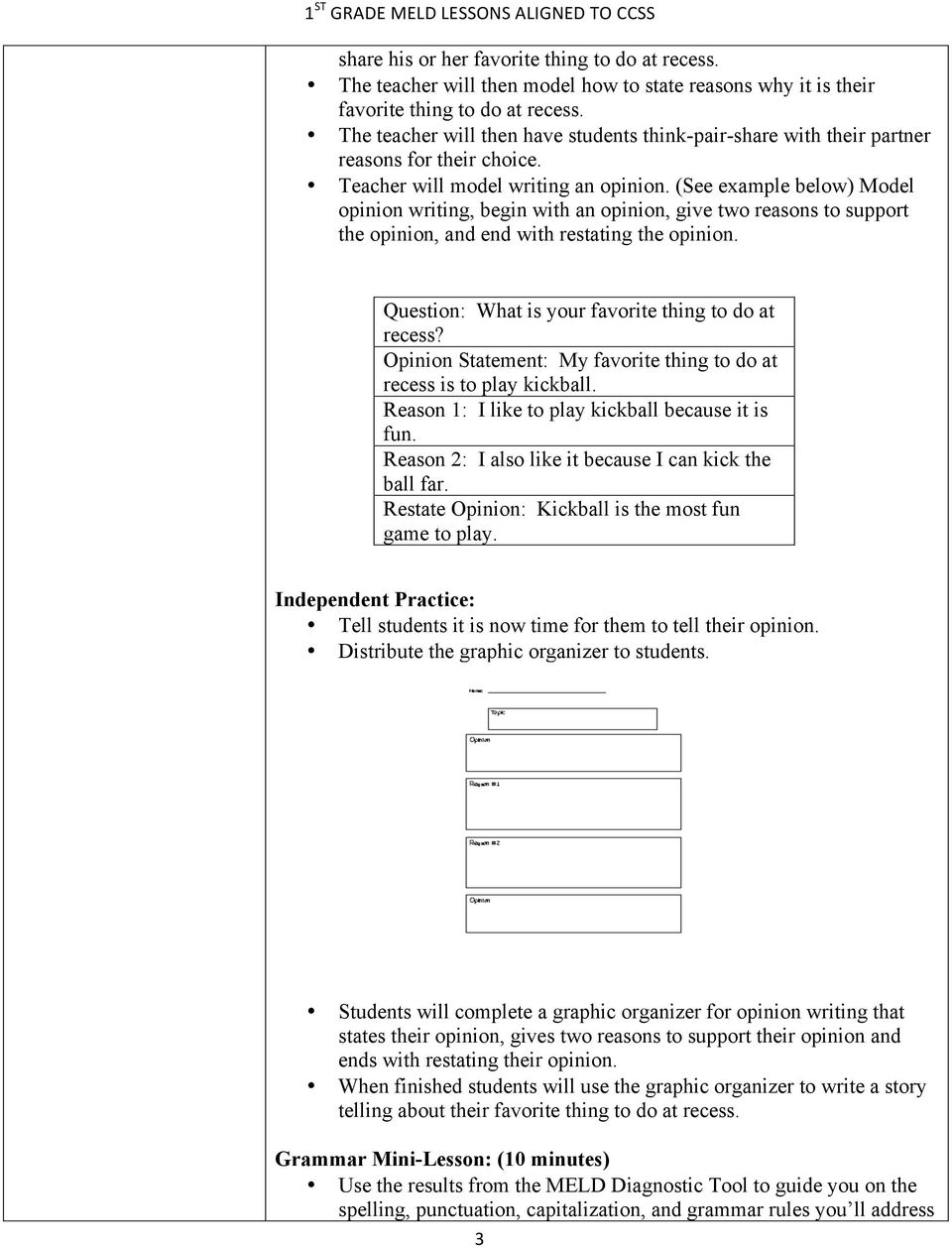
3 share his or her favorite thing to do at recess. The teacher will then model how to state reasons why it is their favorite thing to do at recess. The teacher will then have students think-pair-share with their partner reasons for their choice. Teacher will model writing an opinion. (See example below) Model opinion writing, begin with an opinion, give two reasons to support the opinion, and end with restating the opinion. Question: What is your favorite thing to do at recess? Opinion Statement: My favorite thing to do at recess is to play kickball. Reason 1: I like to play kickball because it is fun. Reason 2: I also like it because I can kick the ball far. Restate Opinion: Kickball is the most fun game to play. Independent Practice: Tell students it is now time for them to tell their opinion. Distribute the graphic organizer to students. Students will complete a graphic organizer for opinion writing that states their opinion, gives two reasons to support their opinion and ends with restating their opinion. When finished students will use the graphic organizer to write a story telling about their favorite thing to do at recess. Grammar Mini-Lesson: (10 minutes) Use the results from the MELD Diagnostic Tool to guide you on the spelling, punctuation, capitalization, and grammar rules you ll address 3
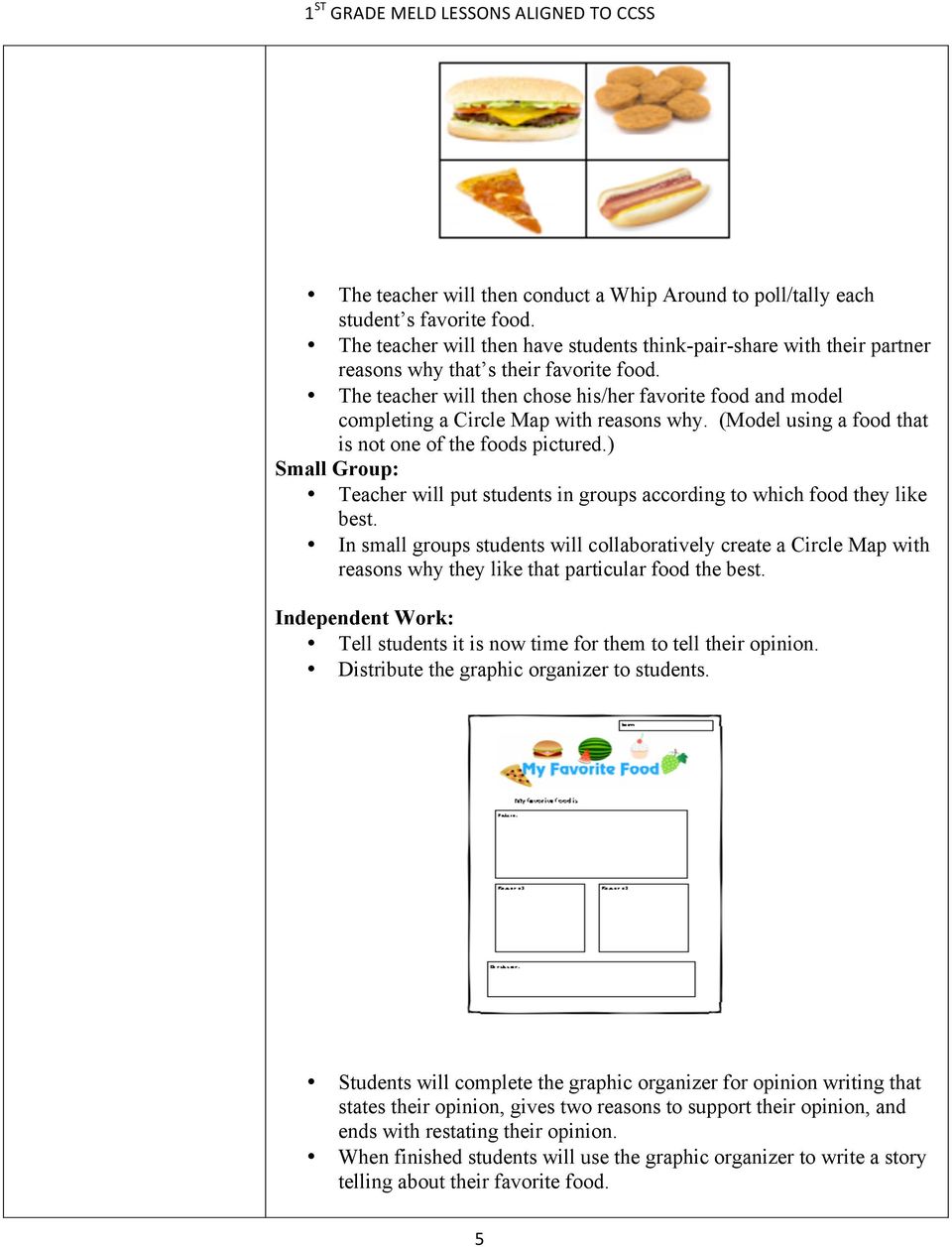
4 during your grammar mini-s. You can use the California Treasures Writing and Grammar Intervention Guide s Section on Linguistic Differences to find the s that can be used to help SELs understand how to compare and contrast the way a particular grammar rule is used in Home Language and School Language. Formative Assessment: Differentiation: Intervention/Enrichment The wrap-up. Sentence stems can be used to model the Opinion and Reason components: My favorite thing to do at recess is. I like playing because it is. CCSS Domain CCSS Standard : Instructional Strategies DAY 3 Students understand its ok to have their own opinion. Student will understand that they can support their ideas, but must respect the opinions of others. Advanced Graphic Organizer, Instructional Conversations facilitated by purposeful use of Participation and Discussion, Academic Vocabulary Development Picture of foods (in supplemental packet), Circle Map, Writing Paper, i-pads, if students are accustomed to using them for writing Whole Group: The teacher will say, Do you remember when we studied about opinion writing yesterday? I m going to Pick-A-Stick and we will see how much we can remember. The teacher will then take out the opinion writing that he/she modeled yesterday and go over each section and review the purpose. Teacher will remind students that everyone has an opinion about things that matter to them and that our opinions can be different from others. Teacher will then show students pictures of food to generate their opinions. 4

5 The teacher will then conduct a Whip Around to poll/tally each student s favorite food. The teacher will then have students think-pair-share with their partner reasons why that s their favorite food. The teacher will then chose his/her favorite food and model completing a Circle Map with reasons why. (Model using a food that is not one of the foods pictured.) Small Group: Teacher will put students in groups according to which food they like best. In small groups students will collaboratively create a Circle Map with reasons why they like that particular food the best. Independent Work: Tell students it is now time for them to tell their opinion. Distribute the graphic organizer to students. Students will complete the graphic organizer for opinion writing that states their opinion, gives two reasons to support their opinion, and ends with restating their opinion. When finished students will use the graphic organizer to write a story telling about their favorite food. 5
6 Grammar Mini-Lesson: Use the results from the MELD Diagnostic Tool to guide you on the spelling, punctuation, capitalization, and grammar rules you ll address during your grammar mini-s. You can use the California Treasures Writing and Grammar Intervention Guide s Section on Linguistic Differences to find the s that can be used to help SELs understand how to compare and contrast the way a particular grammar rule is used in Home Language and School Language. Formative Assessment: Differentiation: Intervention/Enrichment Students writing. Use these sentences to determine the topic for tomorrow s Grammar mini-. Sentence stems can be used to model the Opinion and Reason components: My favorite food is. I like it because. CCSS Domain CCSS Standard : Instructional Strategies: DAY 4 Students will conduct a close read of a piece of opinion writing. Students will annotate the text in order to understand the opinion being presented by the author. Advanced Graphic Organizer, Instructional Conversations facilitated by purposeful use of Participation and Discussion, Academic Vocabulary Development The Beach handout and The Park handout (in supplemental packet), 2 Circle Maps, paper Whole Group: Introduce the concept of Close Read to students in a way that you think they will understand. The teacher will explain to students that they are going to have to decide which place they enjoy more, the beach or the park and to help them decide they will read a story about each place. Provide each student with a copy of the text passage The Beach and a sheet of paper for drawing/writing. 6

7 Read the story aloud to the students inviting them to follow along as you read. The teacher reads the passage The Beach aloud to students. Pose text-based comprehension questions to students. The teacher will have students think-pair-share their responses to the text-based questions. Teach students how to annotate by drawing pictures, underling words, or writing words. The teacher will then complete a Circle Map about The Beach having students give the reasons from the passage why the beach is fun. Provide each student with a copy of the second passage The Park and a sheet of paper for drawing/writing. The teacher reads the passage The Park aloud to the students inviting them to follow along as you read. Pose text-based comprehension questions to students. The teacher will have students think-pair-share their responses to the text-based questions. Teacher will have students annotate by drawing pictures, underling words, or writing words. The teacher will then complete a Circle Map about The Park having students give the reasons from the passage why the park is fun. Remind students that that they are going to have to decide which place they enjoy more because they will write about the place they choose tomorrow. 7

8 Grammar Mini-Lesson: Use the writing samples collected at the close of yesterday s to lift some sentences that can be used for a proofreading mini-. Do not use examples of Home Language during a proofreading, those are to be used during a revision. Formative Assessment The wrap-up. CCSS Domain CCSS Standard : Instructional Strategies DAY 5 Students will conduct a close read of a piece of opinion writing. Students will write an opinion piece. Advanced Graphic Organizer, Instructional Conversations facilitated by purposeful use of Participation and Discussion, Academic Vocabulary Development The Beach handout, The Park handout, Circle Maps from Day 4, Opinion Graphic Organizer (in supplemental packet), Writing Paper,, i-pads, if students are accustomed to using them for writing Whole Group: Return the passages and student drawings/writing from Day 4. The teacher will tell students Today you are going to write an opinion piece that answers this question: In your opinion, which place do you enjoy more, the beach or the park? Reread each passage aloud to the students inviting them to follow along as you read. The teacher will then have students think-pair-share with their partner reasons why they enjoy the place they chose. Independent Practice: The teacher will tell students It is time for you to tell your opinion by 8

9 writing a story about which place you enjoy more the beach or the park? The teacher will tell students to make sure to pick either the beach or the park and to explain why you like this place the best. The teacher will tell students that they may look back at the story for ideas. The teacher will also tell students that they may draw a picture to show why this is the best place. The teacher will remind students that a good opinion piece will introduce the topic they are writing about, give their opinion, give reasons and explanations, and end with a concluding statement that restates their opinion in a different way. Students will complete the graphic organizer for the place they like best. Formative Assessment Students will then use the graphic organizer to write a story telling about the place they enjoy the most. Teachers will use students writing to assess their needs. Differentiation: Intervention/Enrichment Sentence stems may be used to model the Opinion, Reason, and Closure components. 9

K-1 Common Core Writing Santa Fe Public Schools Presented by: Sheryl White
 K-1 Common Core Writing Santa Fe Public Schools Presented by: Sheryl White Session Objectives Review expectations in Common Core Writing Gain ideas for teaching opinion writing Collaborate and articulate
Language Arts Core, First Grade, Standard 8 Writing-Students write daily to communicate effectively for a variety of purposes and audiences.
 Genre Unit Reading and Writing Fables by Amy Kinney Language Arts Core, First Grade, Standard 7 Comprehension-Students understand, interpret, and analyze narrative and informational grade level text. Objective
Components of a Reading Workshop Mini-Lesson
 Components of a Reading Workshop Mini-Lesson Mini-Lesson: The Connection How will you begin the Reading Workshop mini-lesson with a connection in which you tell students what you ll be teaching them &
Grade 3: Module 1: Unit 1: Lesson 8 Paragraph Writing Instruction
 Grade 3: Module 1: Unit 1: Lesson 8 This work is licensed under a Creative Commons Attribution-NonCommercial-ShareAlike 3.0 Unported License. Exempt third-party content is indicated by the footer: (name
5th Grade MELD Lessons Aligned to CCSS 10 Days Start Smart
 5th Grade MELD Lessons Aligned to CCSS 10 Days Start Smart Overview Overview Collaboration across the curriculum is a required skill! On their way to becoming college prepared and career ready, students
xxx Lesson 11 1. Comprehend the writing process 2. Respond positively to the writing process
 xxx Lesson 11 The Writing Process Overview: This lesson will focus on the writing process and how it relates to communication. Learners will be taught what the writing process is, its parts, and how they
3 days Lifting the Qualities of Effective Fiction Writing. 3 4 days Stretching Out the Problem and Imagining Creative Solutions to Stories
 Grade 1, Unit 3 Realistic Fiction Adapted from Realistic Fiction (Unit 3) in A Curricular Plan for the Writing Workshop, Grade 1 by Calkins Section of the Unit of Study Minilesson Focus Points Time (approximate)
Genre Mini Unit. Writing Informational Nonfiction By Joyce Dunning
 Genre Mini Unit Writing Informational Nonfiction By Joyce Dunning Grade Level: 2 nd Grade State Core Standards: Standard 2, Objective 1: Demonstrate an understanding that print carries the message. Standard
Lesson 1.1 P.WRITE, Gr. 2 & 3, 08-09. PWRITE: POW + TREE: LESSON # 1 Part 1
 PWRITE: POW + TREE: LESSON # 1 Part 1 Purpose: Develop Background Knowledge, Discuss It Objectives: Introduction to POW, writing to persuade, and TREE; identification of TREE parts in essay example Materials:
Mainstream English Language Development (MELD) Unit: 1 Week: 2 Selection: Mr. Putter and Tabby Pour the Tea
 The purpose of MELD is reviewed. Students Think-Pair-Share in order to discuss the purposes of MELD. After students talk with their partner, Roll Em is used to share out with the whole group. (DP, PP,
2 Mathematics Curriculum
 New York State Common Core 2 Mathematics Curriculum GRADE GRADE 2 MODULE 3 Topic G: Use Place Value Understanding to Find 1, 10, and 100 More or Less than a Number 2.NBT.2, 2.NBT.8, 2.OA.1 Focus Standard:
Welcome to Our School!
 Teacher p.1 Teacher p.2 For this task, students are put in the role of creating a product (booklet, pamphlet or poster) that could be shared with new students to help them understand what makes their school
Lesson 2 Social Skill: Active Listening
 Lesson 2 Summary and Rationale Listening is a social skill required for almost all interactions. It is also prerequisite to participating in a group process such as the Thinking for a Change Program. It
Barter vs. Money. Grade One. Overview. Prerequisite Skills. Lesson Objectives. Materials List
 Grade One Barter vs. Money Overview Students share the book Sheep in a Shop, by Nancy Shaw, to learn about choice, making decisions, trade, and the barter system. They complete worksheets on comparing
Monitoring for Meaning
 Monitoring for Meaning Grades 3-5 eeee Wwh Monitoring comprehension is above all engagement. When readers monitor their thinking, they have an inner conversation with the text. They listen to the voice
Grade 6: Module 1: Unit 2: Lesson 19 Peer Critique and Pronoun Mini-Lesson: Revising Draft Literary Analysis
 Grade 6: Module 1: Unit 2: Lesson 19 Revising Draft Literary Analysis This work is licensed under a Creative Commons Attribution-NonCommercial-ShareAlike 3.0 Unported License. Exempt third-party content
Content Strategies by Domain
 Content Strategies by Domain In order to be proficient in a language, students need to develop proficiency in four domains: listening, speaking, reading and writing. Intentional practice each day in content
27 Before, During, and After Reading Activities with Graphic Organizers to be used with nonfiction passages for students in Grades 2 5!
 1 27 Before, During, and After Reading Activities with Graphic Organizers to be used with nonfiction passages for students in Grades 2 5! - These activities and graphic organizers can be: - used by teachers
Local Government and Leaders Grade Three
 Ohio Standards Connection: Government Benchmark A Identify the responsibilities of the branches of the U.S. government and explain why they are necessary. Indicator 2 Explain the structure of local governments
MStM Reading/Language Arts Curriculum Lesson Plan Template
 Grade Level: 6 th grade Standard 1: Students will use multiple strategies to read a variety of texts. Grade Level Objective: 1. A.6.1: compare/contrast the differences in fiction and non-fiction text.
An Overview of Conferring
 An Overview of Conferring You may have several important questions about writing conferences: ª What are the goals of a writing conference? ª When should I confer with students about their writing? ª What
C.L.U.B.S = COMPREHENDING LITERATURE USING BOOK SETS
 C.L.U.B.S = COMPREHENDING LITERATURE USING BOOK SETS Grade Level: 3 rd Grade Written by: Shannon Millican, Platte River Academy, Highlands Ranch, Colorado Length of Unit: Ten lessons (approximately two
REACHING YOUR GOALS. Session 4. Objectives. Time. Materials. Preparation. Procedure. wait4sex
 Session 4 REACHING YOUR GOALS Objectives At the completion of this session, youth will: 1. Define what is meant by short and long term goals, 2. Identify and describe personal goals to the group, and 3.
Julius the Baby of the World - Day 1 Maggie Lumbreras - First Grade Sept. 30, 2008
 Purpose: Students will learn the term infer and will use picture clues and text to help them infer characters, thoughts and feelings throughout the story using the turn and talk strategy. Charts/environmental
Refining Informational Writing: Grade 5 Writing Unit 3
 Unit Title: Refining Informational Writing Concepts: 1. Writers read mentor texts to study informational writing. 2. Writers generate ideas and experiment with notebook entries. 3. Writers learn strategies
Grade 3: Module 1: Unit 3: Lesson 8 Group Discussion: Accessing Books around the World
 Grade 3: Module 1: Unit 3: Lesson 8 Group Discussion: Accessing Books around the World This work is licensed under a Creative Commons Attribution-NonCommercial-ShareAlike 3.0 Unported License. Exempt third-party
Step 1: Come Together
 THE STORY FOR LITTLE ONES: Preschool LESSON GUIDE: Lesson 2 5 ABRAHAM FOLLOWS GOD Bible Basis: Genesis 12:1 9, 17; 21:1 7 Bible Verse: Abram believed the Lord. The Lord accepted Abram because he believed.
BEFORE-DURING-AFTER (BDA)
 Curriculum & Instruction Resources Content Reading & Writing Resources: A teacher resource page providing strategies to improve reading comprehension in all content areas BEFORE-DURING-AFTER (BDA) Reading
Founding Principle: Separation of Powers
 Founding Principle: Separation of Powers Day I Warm-up [15 minutes] A. Distribute Handout A: Attitude Inventory and do a think-pair-share. If students wish to change their answers after discussing with
planning support & sample lesson
 planning support & sample lesson Fluent Guided Reading Lessons (Levels N Z) Comprehension is the ultimate goal of every guided reading lesson, but it plays an especially important role with fluent readers.
Determining Importance
 Determining Importance How do you The modern world is inundated by Facts. Television, the Internet-more information than your grandparents every imagined-is at your fingertips with the click of a button.
Transportation: Week 2 of 2
 The Minnesota Literacy Council created this curriculum with funding from the MN Department of Education. We invite you to adapt it for your own classrooms. Beginning Level (CASAS reading scores of 181-200)
God is Eternal Lesson 1
 Preschool Curriculum (4K / 5K) August 15 th & 16 th, 2009 God is Eternal Lesson 1 Divine Attribute: Heart Response: God is Eternal Be Amazed Memory Verse: Jesus Christ is the same yesterday, today and
Allison Gallahan s Early Childhood Lesson Plan
 Allison Gallahan s Early Childhood Lesson Plan Lesson: Big Book: Reading Maps Length: 20-30 minutes Age or Grade Level Intended: 2 nd Grade Academic Standard(s): Social Studies 2.3.2: The World in Spatial
Production: Specialization and Division of Labor Grade Three
 Ohio Standards Connection: Economics Benchmark B Explain why entrepreneurship, capital goods, technology, specialization and the division of labor are important in the production of goods and services.
(Literature Circle Packet)
 '. (Literature Circle Packet) My name: Book Title: Author: People in my group: I. 2. 3. 4. 5. 6. Draw a picture of the book's cover below. Super Teacher Worksheets - www.superteacherworksheets.com wl"tte,
A Writer s Workshop: Working in the Middle from Jennifer Alex, NNWP Consultant
 Structure of a Workshop: A Writer s Workshop: Working in the Middle from Jennifer Alex, NNWP Consultant For the last four years, writing and reading workshops have been the foundation of my classroom practice.
Check My Writing Kindergarten
 Ohio Standards Connection Writing Processes Benchmark F Apply tools to judge the quality of writing. Benchmark D Use revision strategies and resources to improve ideas and content, organization, word choice
Lesson Plan #2. Performance Objective(s): Given a worksheet of 12 sentences, the 2 nd grade students will identify the action verb 9 out of 12 times.
 Lesson Plan #2 Lesson: Action Verb Lesson with Book, Game, and Video Length: 45 minutes Age or Grade Level Intended: 2 nd Grade Source: Taken from www.lessonsnips.com and Emily Gallmeyer Academic Standard(s):
Homework Activities for Kindergarten
 Homework Activities for Kindergarten Listed below are several learning activities for your child to complete at home to reinforce skills being taught in school. The sight words are on the last page. Reading
Nami s Gifts. Lesson Plan. About the Book Text Type: Fiction/Realistic Page Count: 16 Word Count: 220. About the Lesson Targeted Reading Strategy
 Lesson Plan About the Book Text Type: Fiction/Realistic Page Count: 16 Word Count: 220 Book Summary Nami has a problem: She must make the perfect gift for each person in her family. It is her family tradition.
Intro Lesson (Ages 8-14)
 Lesson: General: Age: Time: Objectives: Structures: Target Vocab: 8-14 years 40 mins - 1 hour Greetings, Asking & answering personal questions, using modal verbs for rules, Identifying different classroom
Grade 4: Module 1B: Unit 3: Lesson 11 Writing the Essay: Body Paragraph
 Grade 4: Module 1B: Unit 3: Lesson 11 This work is licensed under a Creative Commons Attribution-NonCommercial-ShareAlike 3.0 Unported License. Exempt third-party content is indicated by the footer: (name
Koko's Kitten/Dr. Francine Patterson/Created by Long Beach District
 Unit 5/Week 4 Title: Koko s Kitten Suggested Time: 5 days (45 minutes per day) Common Core ELA Standards: RI.4.1, RI.4.2, RI.4.3, RI.4.4; RF.4.4; W.4.2, W.4.4, W.4.7, W.4.9; SL.4.1; L.4.1, L.4.2, L.4.4
Narrative Literature Response Letters Grade Three
 Ohio Standards Connection Writing Applications Benchmark A Write narrative accounts that develop character, setting and plot. Indicator: 1 Write stories that sequence events and include descriptive details
Grade 2 Life Science Unit (2.L.2)
 Grade 2 Life Science Unit (2.L.2) Decision 1: What will students learn in this unit? Standards Addressed: 1. Science 2.L.2 Remember that organisms differ from or are similar to their parents based on the
Persuasive Writing Persuasive Paragraph
 183 Persuasive Writing Persuasive Paragraph How would you complete the next sentence? The best event at school is... Would you say hat day, grandparents day, the school carnival? A special event can make
Using Interest Inventories with Struggling and Unmotivated Readers. By Arleen P. Mariotti
 Using Interest Inventories with Struggling and Unmotivated Readers By Arleen P. Mariotti Many struggling readers do not like to read because classroom reading material is too difficult, they don t want
Students will be able to apply their writing skills to the format of letter writing.
 Letter Writing Lesson Plan 3 rd Grade at Candlebrook Elementary Lauren Neudorfer Desired Results for the Unit Established Goals: Students will be able to write effective letters appropriate for a variety
Story Elements for Kindergarten
 Trinity University Digital Commons @ Trinity Understanding by Design: Complete Collection Understanding by Design Summer 2015 Story Elements for Kindergarten Renee D. Faulk Trinity University, [email protected]
Scaffolding Academic Language for English Learners: What, Why, How?
 Scaffolding Academic Language for English Learners: What, Why, How? Presenters: Mary Lou McCloskey ([email protected]) Lydia Stack ([email protected]) Janet Orr ([email protected]) Gabriela Kleckova
Introduction To The Writing Process Animate And Publish Your Stories With The Zimmer Twins.
 The Introduction To The Writing Process Animate And Publish Your Stories With The Zimmer Twins. Grades: 4-6 Subjects: English, English As A Second Language Overview of Lesson Plan: Help students develop
First Grade Animal Research Project
 First Grade Animal Research Project Dear Parents: As you probably know, our first graders have been learning all about animals. We have spent the last couple of weeks learning to group different animals
Writing Poetry with Second Graders By Shelly Prettyman
 Day 1 Mini-Lesson: What is Poetry (review)? Time: 30-45 min Writing Poetry with Second Graders By Shelly Prettyman Standard 7--Comprehension Students understand, interpret, and analyze grade level poetry.
Using sentence fragments
 Lesson 8 Descriptive Essays Description is not a distinct mode of writing, like expository, narrative, and persuasive, but the ability to write descriptively is essential to a host of writing genres. Many
4 Square Writing Method. Developed by Judith Gould Madalyn Jira Taylors Elementary
 4 Square Writing Method Developed by Judith Gould Madalyn Jira Taylors Elementary When we teach Math Give students formulas Science Give students a scientific method Reading Give students decoding skills
Unit Map 2011-2012 Columbia University Teachers College Collaboration / Writing* / Kindergarten (Elementary School)
 Unit Map 2011-2012 Columbia University Teachers College Collaboration / Writing* / Kindergarten (Elementary School) June 21, 2011, 9:13AM Unit 01 Launching The Writing Workshop (Week 1, 4 Weeks) Unit Rationale
Expressive Objective: Realize the importance of using polite expressions in showing respect when communicating with others
 QUARTER 4 - WEEK 1 Theme: My School and Friends TARGET SKILLS : At the end of the lesson the students should be able to: Expressive Objective: Realize the importance of using polite expressions in showing
Social Studies Fair: February 23, 2012 @ 6:30 P.M.
 Student Name: Teacher: Project #: Harbins Elementary School Social Studies FAIR Project Directions 1 4 th & 5 th Grade Project Begins: January 6, 2012 Project Due: February 16, 2012 Social Studies Fair:
Grade 2 Informative Writing Lessons
 Grade2InformativeWritingLessons AuthoredbyCLRFellows:ReginaMylesandThuongHa 2nd Grade MELD Lessons Aligned to CCSS Informational Writing Overview This series of MELD lessons are set up as a buffet of ideas.
How To Proofread
 GRADE 8 English Language Arts Proofreading: Lesson 6 Read aloud to the students the material that is printed in boldface type inside the boxes. Information in regular type inside the boxes and all information
Grade 4: Module 3B: Unit 3: Lesson 2 Reading Opinion Pieces, Part II: How Authors Support Their Opinions with Reasons and Evidence
 Grade 4: Module 3B: Unit 3: Lesson 2 How Authors Support Their Opinions with Reasons and Evidence This work is licensed under a Creative Commons Attribution-NonCommercial-ShareAlike 3.0 Unported License.
2. The student will be able to explain why and how people immigrated to the United States.
 Title The Experience of Ellis Island Key Words Ellis Island, Citizenship, Immigration Grade Level First Time Allotted 45 minute lesson Lesson Overview Students will learn about what immigration is and
Literature Discussion Strategies
 1 Kathy G. Short From Creating Classrooms for Authors and Inquirers, Kathy G. Short and Jerome Harste, Heinemann, 1996. FREE WRITES (Connection) After reading the book, set a timer for anywhere from 5-15minutes.
Junior Cookie CEO Badge Activity Plan 1
 Junior Cookie CEO Badge Activity Plan 1 Badge Purpose: When girls have earned this badge, they ll know more about how to run all parts of their cookie business. Program Essentials Link: Financial Literacy
What are related careers (career clusters), and how can they expand my career choices?
 Career Clusters 5 CAREERS The BIG Idea What are related careers (career clusters), and how can they expand my career choices? AGENDA Approx. 45 minutes I. Warm Up: Buried Treasures (10 minutes) II. Career
EMPOWERING TEACHERS TEACHER EXPLAINS TASK TEACHER MODELS TASK
 Benchmarks: Second Grade Comprehension: Identify and Discuss the Author s Purpose Preparation/Materials: Preparation/Materials: large graph, large copy of each story, highlighter, pictures of a U.S. map,
Science Grade 05 Unit 04 Exemplar Lesson 01: Types of Energy
 Grade 05 Unit 04 Exemplar Lesson 01: Types of Energy This lesson is one approach to teaching the State Standards associated with this unit. Districts are encouraged to customize this lesson by supplementing
Explain Yourself: An Expository Writing Unit for High School
 Trinity University Digital Commons @ Trinity Understanding by Design: Complete Collection Understanding by Design 2013 Explain Yourself: An Expository Writing Unit for High School Adele Barnett Trinity
Research-Based Lesson Planning and Delivery Guide
 Research-Based Lesson Planning and Delivery Guide Mini-Lesson Planning for Inferences Benchmark(s)/Standard(s): What is the next benchmark(s) on my course curriculum guide or FCIM calendar? LA.3.1.7.3;
Literacy. Work Stations. Source: Diller, D.(2003) Literacy Work Stations, Making Centers Work
 Literacy Work Stations Source: Diller, D.(2003) Literacy Work Stations, Making Centers Work Kyrene Reading Instruction Focus: Improve student achievement through implementation of curriculum and adopted
Understand numbers, ways of representing numbers, relationships among numbers, and number systems
 Equivalent Fractions and Comparing Fractions: Are You My Equal? Brief Overview: This four day lesson plan will explore the mathematical concept of identifying equivalent fractions and using this knowledge
Elicit Me too and Me neither by asking students if they have a sister or brother (or dog, cat ) and then responding appropriately.
 All about me. Topic: Personal interests, likes and dislikes Aims: To help students focus on fluency when speaking To develop students communication skills To develop students listening skills Level: Pre-intermediate
Fun Learning Activities for Mentors and Tutors
 Fun Learning Activities for Mentors and Tutors Mentors can best support children s academic development by having fun learning activities prepared to engage in if the child needs a change in academic/tutoring
Why Can t We All Just Get Along?
 Why Can t We All Just Get Along? Why Can t We All Just Get Along? Key Faith Foundation: God s Plan for Handling Family Conflict Key Scriptures: Genesis 4:1-12; Psalm 133; Colossians 3:12-15 Bible basis
Grade 3: Module 2B: Unit 3: Lesson 8 Revising: Using Simple and Compound Sentences in Writing
 Grade 3: Module 2B: Unit 3: Lesson 8 Using Simple and Compound Sentences in Writing This work is licensed under a Creative Commons Attribution-NonCommercial-ShareAlike 3.0 Unported License. Exempt third-party
Grade 4: Module 2A: Unit 1: Lesson 5 Mid-Unit 1 Assessment: Inferring with Pictures and Text
 Grade 4: Module 2A: Unit 1: Lesson 5 Mid-Unit 1 Assessment: Inferring with Pictures and Text This work is licensed under a Creative Commons Attribution-NonCommercial-ShareAlike 3.0 Unported License. Exempt
Grade 5: Module 1: Unit 2: Lesson 10 Characters Charging Over Time (Chapter 10: Las Papas/Potatoes )
 Grade 5: Module 1: Unit 2: Lesson 10 Characters Charging Over Time This work is licensed under a Creative Commons Attribution-NonCommercial-ShareAlike 3.0 Unported License. Exempt third-party content is
Introduction to Sexual Health Education Classes
 Title: Theme: Getting Started Introduction to Sexual Health Education Classes Time: Materials: 70 minutes Find Someone Who - Handout Anatomy Review - Teacher Guide Using The Question Box - Teacher Guide
Week 4 Lesson Plan. Pre-K. Our Neighborhood. Macmillan /McGraw-Hill. Extend. the Unit
 Lesson Plan Extend Unit the Unit Pre-K Our Neighborhood Alphabet Time.....................2-3 Book Time.........................-5 Retelling Puppets..................6-7 Content Area......................8-9
What behaviors are required for success in the workplace and how can we practice these behaviors in the classroom? MATERIALS
 2 INTRODUCTION Teambuilding The BIG Idea What behaviors are required for success in the workplace and how can we practice these behaviors in the classroom? AGENDA Approx. 45 minutes I. Warm Up: Procedure
Differentiated Instruction Strategies
 Miss Taylor Brooke Stancil s Differentiated Instruction Strategies Choral Response: Choral response is a very simple technique in which the teacher asks questions to the class as a whole and the students
Authority versus Power by Melissa McDermott
 Authority versus Power by Melissa McDermott Lesson Description: This formative lesson focuses on developing an understanding of the concept of authority. Students will identify and role play scenarios
"Why is it important for ELL students to be active in listening, speaking, reading and writing on a daily basis?"
 "Why is it important for ELL students to be active in listening, speaking, reading and writing on a daily basis?" Monica Gonzalez Bilingual/ESL Specialist [email protected] "Tell me and I
DEMQOL and DEMQOL-Proxy - Interviewer Manual Instructions for administration:
 DEMQOL and DEMQOL-Proxy - Interviewer Manual Instructions for administration: You will need a copy of the DEMQOL questionnaire for each interviewee and a separate card with the response scales printed
7 th Grade STAAR Writing Camp
 7 th Grade STAAR Writing Camp The objective for this writing camp is for students to determine whether the prompt is a narrative or expository prompt. Students will analyze and compose essays based on
Fifth Grade English Language Arts Learning Goals for 3 rd 9- Weeks
 Skills students should demonstrate by the end of the 2 nd 9- weeks of school: Unit 4A- Making Connections Across Literary Genres Learning Goal: Student will understand that authors use point of view to
ONLINE SAFETY TEACHER S GUIDE:
 TEACHER S GUIDE: ONLINE SAFETY LEARNING OBJECTIVES Students will learn how to use the Internet safely and effectively. Students will understand that people online are not always who they say they are.
Personal Timelines Grade Two
 Ohio Standards Connection Data Analysis and Probability Benchmark C Represent data using objects, picture graphs and bar graphs. Indicators 3. Read and construct simple timelines to sequence events. 5.
Grade 3 Theme 1. Writing Title: Personal Narrative
 Grade 3 Theme 1 Writing Title: Personal Narrative Performance Standard W1.1 The student writes about a topic. GLES: [3] 1.1.2 Writing a paragraph on a single topic with two or more supporting details.
www.newsflashenglish.com
 www.newsflashenglish.com The 4 page 60 minute ESL British English lesson 10/03/13 There are many fine universities in the world today to study at. Each has its own history and reputation. In this lesson
4th Grade Genre Unit: Legends
 4th Grade Genre Unit: Legends Michigan Legends Melissa Gucker TE 802 Fall 2006 Lesson #1/Day #1 Lesson Topic: The Legend of the Loon : 1 st Characteristic of Legends: Heroes/Heroines. Goals: R.NT.04.02:
Character Traits. Teacher Talk
 Character Traits Teacher Talk What: (What are character traits, emotions and motives?): Characters are the people or animals in a story. When looking at characters, notice details about how they look,
Grade 3 Informational Mini-Assessment Cactus Jam
 Grade 3 Informational Mini-Assessment Cactus Jam This grade 3 mini-assessment is based on a text about making jam from cactus fruit. This text is considered worthy of students time to read and also meets
ARTICULATION INTERVENTION AT HOME FOR TH
 ARTICULATION INTERVENTION AT HOME FOR TH THIS PACKET INCLUDES THE FOLLOWING: 1. LETTER OF EXPLANATION FOR PARENTS 2. PLACEMENT OF ARTICULATORS HANDOUT 3. VISUAL REMINDERS HANDOUT 4. HOME PRACTICE ACTIVITIES
Grade 3: Module 1: Unit 1: Lesson 11 End of Unit 1 Assessment: Close Reading and Powerful Note-taking on My Own
 Grade 3: Module 1: Unit 1: Lesson 11 Close Reading and Powerful Note-taking on My Own This work is licensed under a Creative Commons Attribution-NonCommercial-ShareAlike 3.0 Unported License. Exempt third-party
Instructional/Learning Activity Task Template:
 One Stop Shop For Educators The following instructional plan is part of a GaDOE collection of Unit Frameworks, Performance Tasks, examples of Student Work, and Teacher Commentary. Many more GaDOE approved
Giving Second Graders the Write Skills Grade Level:
 Giving Second Graders the Write Skills Grade Level: Written by: Length of Unit: 2 nd Grade Tracy de Nieves, Cheyenne Mountain Charter Academy, Colorado Springs, CO Ten one hour lessons or (suggested) 20
FEDERAL RESERVE BANKS OF ST. LOUIS AND PHILADELPHIA
 FEDERAL RESERVE BANKS OF ST. LOUIS AND PHILADELPHIA ECONOMIC EDUCATION By Mercer Mayer / ISBN: 978-0-06-083557-6 Lesson Author Amanda Hughey, University of Delaware Standards and Benchmarks (see page 19)
October 16, 2013. Journal: What do you remember about Romeo and Juliet and the prologue from last quarter?
 October 16, 2013 1. Bring any props or costumes and review your script. Presentations of the scene will be tomorrow/friday!! 2. Analyze how complex characters develop over the course of a text, interact