
Master s Program Handbook
|
|
|
- Giles Nicholson
- 9 years ago
- Views:
Transcription
1 Master s Program Handbook Electrical and Computer Engineering

2 MASTER S PROGRAM HANDBOOK Table of Contents Page 1 INTRODUCTION MASTER S DEGREES DEGREE REQUIREMENTS Course and Credit-Hour Requirements... 3 Total and ECE Graduate-Level Credit Hours...2 Undergraduate Credit Hours...3 Core Course Requirement...3 Math Requirement...3 Research Credit Requirement...3 Summary of Course and Credit Hour Requirements Other Requirements... 5 Graduate Seminar Requirement...4 Responsible Conduct of Research.4 Residency Requirement...4 English Requirement MINIMUM ACADEMIC STANDARDS MASTER S ADVISORY COMMITTEE MASTER S PLAN OF STUDY Preparing Your Plan of Study Changing Your Plan of Study Undergraduate, Transfer, and Excess Course Credits... 9 Undergraduate Credits...8 Transfer Credits...8 Excess Course Credits...8 Special Approval Requirements REGISTRATION First Semester Registration Subsequent Semester Registrations Academic Loads Dropping and Adding Courses MASTER S THESIS AND FINAL EXAMINATION CONTINUATION FOR THE PH.D. DEGREE PETITIONS TO THE GRADUATE COMMITTEE Appendix A: Mathematics Requirement...12 Appendix B: English Requirement...13 Appendix C: Filling Out The Master's Plan Of Study...14 Appendix D: Thesis Preparation and Processing...16 Appendix E: Master's Final Examination Information...17 (1)

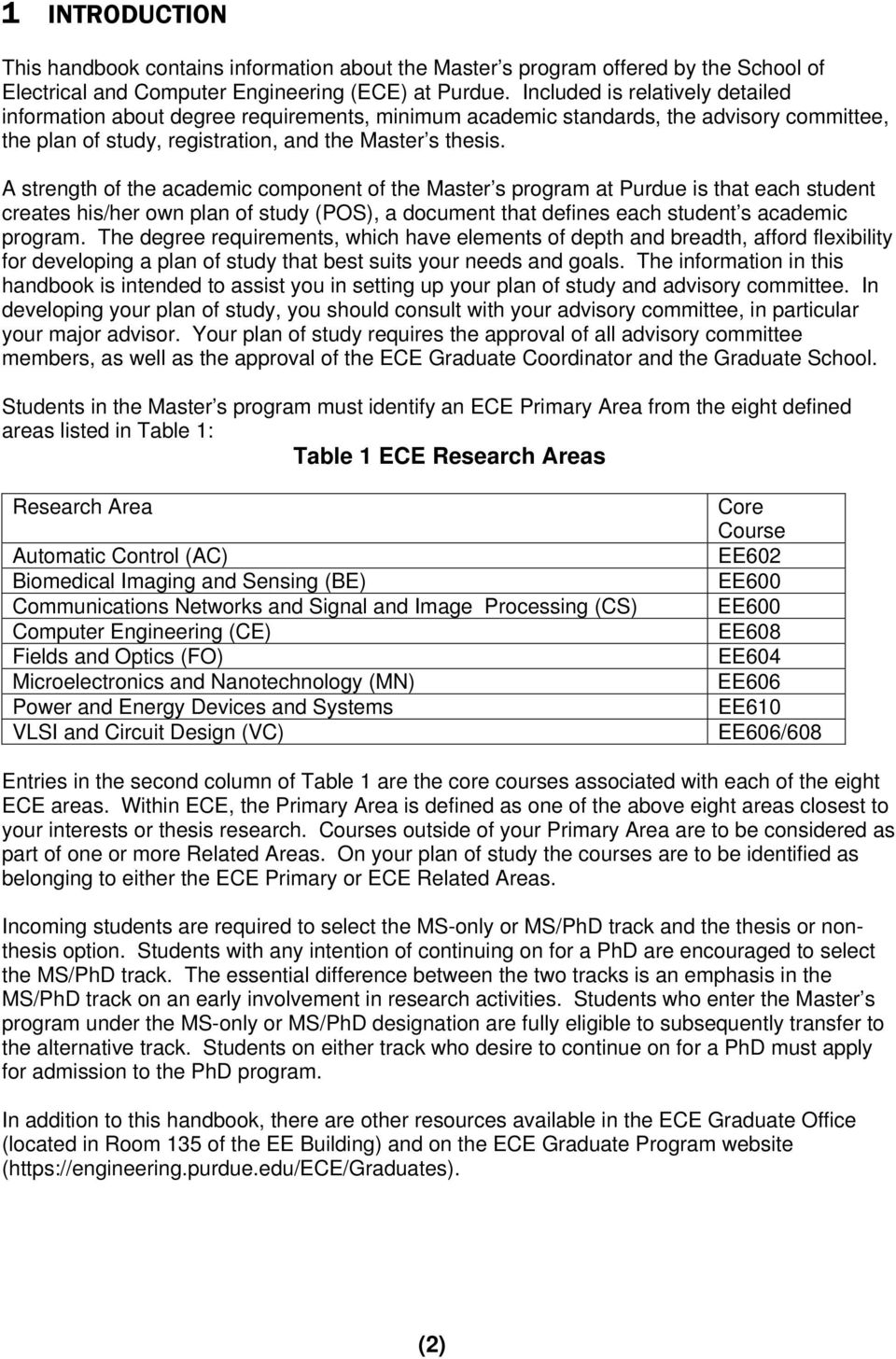
3 1 INTRODUCTION This handbook contains information about the Master s program offered by the School of Electrical and Computer Engineering (ECE) at Purdue. Included is relatively detailed information about degree requirements, minimum academic standards, the advisory committee, the plan of study, registration, and the Master s thesis. A strength of the academic component of the Master s program at Purdue is that each student creates his/her own plan of study (POS), a document that defines each student s academic program. The degree requirements, which have elements of depth and breadth, afford flexibility for developing a plan of study that best suits your needs and goals. The information in this handbook is intended to assist you in setting up your plan of study and advisory committee. In developing your plan of study, you should consult with your advisory committee, in particular your major advisor. Your plan of study requires the approval of all advisory committee members, as well as the approval of the ECE Graduate Coordinator and the Graduate School. Students in the Master s program must identify an ECE Primary Area from the eight defined areas listed in Table 1: Table 1 ECE Research Areas Research Area Automatic Control (AC) Biomedical Imaging and Sensing (BE) Communications Networks and Signal and Image Processing (CS) Computer Engineering (CE) Fields and Optics (FO) Microelectronics and Nanotechnology (MN) Power and Energy Devices and Systems VLSI and Circuit Design (VC) Core Course EE602 EE600 EE600 EE608 EE604 EE606 EE610 EE606/608 Entries in the second column of Table 1 are the core courses associated with each of the eight ECE areas. Within ECE, the Primary Area is defined as one of the above eight areas closest to your interests or thesis research. Courses outside of your Primary Area are to be considered as part of one or more Related Areas. On your plan of study the courses are to be identified as belonging to either the ECE Primary or ECE Related Areas. Incoming students are required to select the MS-only or MS/PhD track and the thesis or nonthesis option. Students with any intention of continuing on for a PhD are encouraged to select the MS/PhD track. The essential difference between the two tracks is an emphasis in the MS/PhD track on an early involvement in research activities. Students who enter the Master s program under the MS-only or MS/PhD designation are fully eligible to subsequently transfer to the alternative track. Students on either track who desire to continue on for a PhD must apply for admission to the PhD program. In addition to this handbook, there are other resources available in the ECE Graduate Office (located in Room 135 of the EE Building) and on the ECE Graduate Program website ( (2)
4 2 MASTER S DEGREES The School of Electrical and Computer Engineering offers a Master of Science in Electrical and Computer Engineering (MSECE) degree. The MSECE degree is awarded to students who satisfy the requirements of the ECE Master s program. Students whose undergraduate degrees are in a field of science or engineering other than Electrical and Computer Engineering may pursue graduate degrees in Electrical and Computer Engineering, but they are responsible for acquiring the undergraduate material that forms the prerequisites for the specific graduate courses in their plans of study. 3 DEGREE REQUIREMENTS 3.1 Course and Credit-Hour Requirements Total and ECE Graduate-Level Credit Hours All students must complete a total of 30 credit hours selected by the student and approved by the advisory committee. At least 15 of the credit hours must be graduate-level ECE credit hours. (3)

5 Undergraduate Credit Hours Students in special situations, such as those changing or needing to get into a new discipline for their research who if they have to take a graduate level course in the new discipline would have great difficulty may be allowed to include one or two undergraduate courses in their plans of study. Students wanting or needing to refresh their knowledge of a subject which they have taken in their undergraduate studies should take the undergraduate course, but not include it on their plans of study to satisfy the degree requirements. With proper prior permission, a maximum of 6 credit hours of two advanced-level (300- or 400- level) undergraduate courses taken in the first calendar year of a student s program are allowed on the plan of study. Students must request permission to include undergraduate courses on their Master s POS. They are required to provide a short written academic justification for the inclusion of the undergraduate courses. Undergraduate courses on the POS must be specifically approved by the student s advisory committee and the ECE Graduate Coordinator. Credit for undergraduate courses may not be transferred from another institution. The Graduate School requires that the course(s) be taken while the student is enrolled in the Graduate Program, and that the student must earn a grade of B or better in these courses to fulfill graduation requirements. The computation of a student s GPA will include the grades earned in these undergraduate level courses. Core Course Requirement The area core courses cover introductory material essential to the respective ECE research area. Students must successfully complete a minimum of two core courses to ensure at least a limited breadth of knowledge within the program. Regional campus courses or transfer courses may not be used toward the core course requirement. Math Requirement A minimum of 6 approved math credit hours is required when electing the non-thesis option and three approved math credit hours when electing the thesis option. The approved mathematics, statistics, computer science, and physics courses meeting the math requirement are given in Appendix A. Research Credit Requirement Research credit hours are not required for students on the MS-only track and pursuing the nonthesis option. However, a maximum of 3 credit hours of ECE 696 (Advanced Projects) and/or ECE 697 (Directed Reading) are allowed on their POS. Students on the MS/PhD track pursuing the non-thesis option are required to register for at least one credit hour of research credit, either ECE 692 (Introduction to Graduate Research), ECE 696 (Advanced Projects) or ECE 697 (Directed Reading), during their first three sessions of enrollment, completing a total of at least 6 credit hours during their program. A maximum of 6 ECE 692, ECE 696 and/or ECE 697 credit hours is allowed on their POS, but only 3 of the credit hours can be counted toward the graduate-level ECE 15 credit-hour requirement. Students pursuing the thesis option, whether on the MS-only or MS/PhD track, are required to register for ECE 698 research (thesis) credit. Up to 12 hours of ECE 698 are allowed on the POS. Students should check with their Major Professor to determine the number of ECE 698 hours appropriate for their program. ECE 698 hours qualify as ECE graduate-level credit hours and may be used to satisfy the ECE graduate-level 15 credit-hour requirement. ECE 696 and ECE 697 credit hours are not allowed on the POS of students pursuing the thesis option. (4)

6 Summary of Course and Credit-Hour Requirements Table 2 summarizes the preceding course and credit-hour requirements. Table 2: Summary of Course and Credit-Hour Requirements Required Core Courses Required Math Courses Allowed 696/697 Credit Hours Allowed Undergrad Credit Hours Total Required Graduate-Level ECE Credit Hours Required Cr. Hrs. on Plan of Study MS Only MS/PhD Track Non-Thesis Thesis PhD Prep Non-Thesis Thesis hrs 0 6 hrs 0 6 hrs 6 hrs 6 hrs 6 hrs 15 hrs Can Include 3 hrs 696/ hrs 15 hrs Includes hrs Min of 18 hrs non-thesis 15 hrs Includes 3 hrs 696/ hrs Includes 6 hrs 692/696/ hrs Includes hrs Min of 18 hrs non-thesis 3.2 Other Requirements Graduate Seminar Requirement All ECE graduate students must satisfactorily complete one semester of the ECE Seminar, ECE 694. This course carries no credit but a grade of Satisfactory or Unsatisfactory is assigned at the end of the semester. ECE 694 should not be listed on the plan of study. Also, it is strongly recommended that students take EE 694 during their first semester. Responsible Conduct of Research Course Requirement All ECE graduate students must satisfactorily complete the Responsible Conduct of Research course. This is an online course offered through Collaborative Institutional Training Initiative (CITI). The course should be completed during the first year of graduate studies. When the course has been completed the student should submit a copy of the certificates of completion to the ECE Graduate Office. The link to the course is: Residency Requirement The residency requirement for a master s degree is 30 hours of academic credit. Academic credit includes all course credit hours that appear on the plan of study, other graduate course credit hours with grades of C or better that appear on the Purdue transcript, and research hours with grades of S that appear on the Purdue transcript. At least one-half of the total credit hours used to satisfy degree requirements must be earned in residence on the Purdue campus where the degree is to be granted. Course credits obtained via televised instruction are considered to have been obtained in residence on the campus from which the course was broadcast. (5)

7 English Requirement All ECE graduate students must demonstrate acceptable proficiency in written English before admission. Methods that may be used to fulfill the English requirement are detailed in Appendix B. 4 MINIMUM ACADEMIC STANDARDS As a Master s student in ECE, you are expected, throughout your academic program, to achieve the following standards: Maintain a cumulative POS grade point average of at least 3.00 out of 4.00 over the courses on your plan of study, with no grade less than C; Earn grades of Satisfactory in thesis research credit hours; Satisfactorily complete the EE 694 seminar and the written English proficiency requirement within the first two semesters of your academic program; Make continuous and significant progress each semester toward completion of your degree requirements; and Complete all degree requirements and graduate within three years after entering the ECE graduate program (five years for distance learning students). You will be placed on academic probation if you complete any semester or summer session with a deficiency in any of the above standards. Should you remain on academic probation at the end of the succeeding semester or summer session, and at the discretion of the Graduate Coordinator, you may be prohibited from registering for further graduate study. Students concerned about their academic progress should schedule an appointment with the ECE Graduate Coordinator. As noted above, the cumulative POS grade point average is calculated using the courses on your plan of study. However, transfer courses and graduate-level courses taken while an undergraduate student are not included in the computation. In the case of a deficiency in the cumulative POS grade point average, courses may be repeated. If a course is repeated, only the most recent grade received will be used in computing the index. University requirements state that no grade of D or F is allowed in a course on the plan of study. Any plan of study course in which a grade of D or F is received must be repeated and completed successfully; it cannot be dropped from the plan of study. 5 MASTER S ADVISORY COMMITTEE Your Master s Advisory Committee shall consist of a minimum of three faculty members. The duties of this committee are to assist you in the preparation of the plan of study, advise you on research related to the Master s thesis, and conduct examinations on the Master s thesis. You must select a Major Professor who will serve as the Chair of the advisory committee. The Major Professor/student relationship must be a mutually acceptable one. With the advice and approval of your Major Professor, you will select the remaining members of your advisory committee. (6)

8 For the following rules and guidelines on the composition and make-up of your advisory committee, tenure-track, courtesy, and research professors with regular graduate certification by West Lafayette ECE are to be regarded as members of the West Lafayette ECE faculty: The Major Professor must be a member of the West Lafayette ECE faculty and should be a member of the Primary Area that you have declared. If you have selected the thesis option and two advisors guide your research jointly, it may be advisable to have two co-chairs on your advisory committee rather than a single chair. At least one of these co-chairs must be a member of the West Lafayette ECE faculty and should be a member of the Primary Area that you have declared. At least one member of the advisory committee must be from your Primary Area, and another member should be from your ECE Related Area. A majority of your advisory committee must be composed of tenure-track professors with 50% or more appointment on the ECE faculty at the West Lafayette campus. A special member, defined as a person without graduate faculty certification, may be added as the fourth member of the committee. An up-to-date list of faculty members with regular graduate faculty certification and their faculty identifiers is included in the online plan of study program. Faculty members at Purdue, including regional campuses, would have regular graduate faculty certification. Faculty members from other universities, researchers from industry, and non-faculty research staff from Purdue have to be approved for special certification by the Graduate School for them to be members of the advisory committee. You may initiate a request for special certification in the ECE Graduate Office. A current and complete vita for the special member has to be submitted along with your request. The advisory committee, as agreed upon by you and your Major Professor, shall be presented to the ECE Graduate Coordinator and the Dean of the Graduate School for approval and formal appointment. The Dean may appoint additional members if it seems advisable. The advisory committee is established when the plan of study is approved. Changes to the advisory committee can be made online as a revision to your plan of study. 6 MASTER S PLAN OF STUDY All Master s students must file a plan of study (POS) before the end of their first semester. This helps to ensure a logical curriculum early in the program, sets a clear pathway toward completion of the student s degree, and helps the school plan and monitor the overall ECE graduate program. For this reason, registration for subsequent semesters is not permitted until the plan of study has been filed. If necessary, changes can be made to the plan of study at a later date, subject to the restrictions cited in Subsection 6.2. The plan must be appropriate to meet the needs of the student s chosen field as determined by the advisory committee, and must be approved by the ECE Graduate Coordinator and the Graduate School. 6.1 Preparing Your Plan of Study Suggested steps in preparing your plan of study are as follows: a) Review the Master s coursework requirements in this handbook; (Also see Subsection 6.3 if undergraduate, transfer, or excess course credit is to be included on the plan of study.) (7)

9 Course information that is available online to determine which courses are of most interest to you and will enable you to meet your degree requirements; ECE Course Advanced Planning List and the University Schedule of Classes to determine the semester(s) in which the chosen courses will be offered; Graduate Areas and Faculty Interests supplement to learn the specific interest areas of faculty members and to determine suitable candidates for your Major Professor, the person who will chair your advisory committee. b) Consult with at least three ECE faculty members, representing at least two of the eight ECE graduate areas, to develop a plan of study. Use these meetings to help you confirm or decide on choices such as the MS-Only or MS/PhD track, the thesis or nonthesis option, which courses to take, and who to select as a Major Professor. c) Employ the online Electronic Plan of Study program (accessed through mypurdue) to compose a draft of your plan of study. Hardcopy instructions for using the online program are available from the ECE Graduate Office. Additional helpful information for filling out the plan of study can be found in Appendix C. Ensure that you have included courses that satisfy all requirements. You should print out a copy of your draft for use in discussions with members of your advisory committee. d) Secure the agreement of an ECE faculty member to serve as your Major Professor. Confer with him/her to obtain advice on your course selections, the make-up of your advisory committee, and ultimately his/her informal approval of the plan of study. e) Secure the agreement of two additional faculty members to serve on your graduate advisory committee and their informal approval of the plan of study. The choice of these two faculty members to serve on your Master s advisory committee must be approved by your Major Professor. (See Section 5, Master s Advisory Committee, for additional details). f) Returning to the online Plan of Study program, enter all changes that resulted from your discussions with members of your advisory committee. Submit your final plan electronically. Your plan of study will be automatically routed to the ECE Graduate Office for initial screening before being sent to your advisory committee, the ECE Graduate Coordinator, and the Graduate School for their approvals. If your plan fails to gain any of the required approvals, the reason for the rejection will be explained in an e- mail message. You can then make any required changes and submit the revised plan for approval. You may check on the status of the approval process at any stage. You will be sent an message when approval has been obtained from the Graduate School. The required approvals usually take several weeks. 6.2 Changing Your Plan of Study It is recognized that as a student s program progresses there may arise conditions that make it desirable to change the plan of study. Indeed, such changes, when based upon sound academic reasons, are encouraged. However, some regulations have been found necessary in order to prevent this privilege from being abused. Specifically: A course may not be removed from the plan of study once a grade of D or lower has been received in a course. (8)

10 The deadline for submitting a request to the ECE Graduate Office to remove a course in which you are currently enrolled from your plan of study is the end of the ninth week of the semester, or the end of four and a half weeks in a summer session. Use the Electronic Plan of Study program to submit a request to change your plan of study. Since any change in the courses or advisory committee membership on your current plan of study will require the approval of your advisory committee and the ECE Graduate Coordinator, you should first discuss the desired changes with your advisory committee and provide a reason for each change. If the ECE requirements for the Master s degree program are modified, there is no need for students to revise their previously approved plans of study to conform to the new rules. All approved plans of study remain valid. Students have the option to change their plan of study to conform to the new rules, but are not required to do so. 6.3 Undergraduate, Transfer, and Excess Course Credits Undergraduate Credits As noted in Subsection 3.1, a maximum of 6 credit hours of advanced-level (300- or 400-level) undergraduate courses taken in the first calendar year of student s program are allowed on the plan of study. Refer to Subsection 3.1 for other restrictions applying to such credit. Transfer Credits A maximum of six graduate-level credit hours earned at regional campuses of Purdue University or at an ABET-accredited university may be applied toward the Master s degree and entered on the Master s plan of study. However, regional campus courses or transfer courses may not be used to satisfy the core course requirement. All courses transferred must be graduate-level courses, must not have been used to meet the requirements for another degree, and must have been completed with a grade of B or better. Grades from transfer courses are not included in computing the grade point average. Excess Course Credits Up to twelve credit hours of graduate-level courses taken at the West Lafayette campus of Purdue before a student was admitted to the ECE Master s program may be applied toward the Master s degree and entered on the Master s plan of study. Allowed courses include those taken: a) as excess undergraduate-degree credit; b) in non-degree status; c) while seeking a degree in another Purdue department or school, if you subsequently request to transfer to ECE; d) while seeking a degree in another Purdue department or school, if you subsequently request dual-degree status in ECE. For dual-degree students seeking a PhD in another Purdue department or school and a Master s degree in ECE, the ECE Master s degree plan of study may not contain any courses offered by or dual-listed with the student s other department or school. Special Approval Requirements Without exception, all undergraduate, transfer, and excess course credits used on the Master s plan of study must be specially approved by your advisory committee and by the ECE Graduate Coordinator. The steps to follow in requesting approval to include such credits on the Master s plan of study are: a) Add the course to your plan of study. b) Provide the Graduate office with a short written academic justification for including a 300- or 400-level course on the plan of study. (9)

11 c) If a transfer course or a non-ece course taken at Purdue, show a copy of the catalog description of the course to your advisory committee members and bring the catalog description to the ECE Graduate Office. d) If you are transferring a course from another university, the ECE Graduate Office will also require an original transcript showing the grade earned and a statement from an official at the university where the course was taken certifying that the course was not used to fulfill requirements for any other degree. 7 REGISTRATION 7.1 First Semester Registration After consulting with three or more faculty members, prepare a tentative list of classes for the first semester, then report to the ECE Graduate Office, Room EE 135. Make sure to check the official Schedule of Classes for the coming semester to verify that your selected courses are being offered and that their meeting times do not conflict. Also note that: There is compulsory registration of research credit hours for those on the MS/PhD track; If justifiable, 6 hours of undergraduate credit taken in the first calendar year are allowed on the plan of study; Graduation requirements include the satisfactory completion of one semester of ECE 694, the Electrical and Computer Engineering Graduate Seminar, and demonstration of proficiency in written English. It is strongly recommended that you complete these during your first or second semester. The ECE Graduate Office staff will review and approve your course registration. You will add courses through MyPurdue. Variable credit courses will be entered by the Graduate Office staff. You will receive a fee statement from the Bursar through mypurdue. Payment of this fee statement completes the registration process. Your registration will be cancelled if payment is not made by the deadline determined by the Registrar s office. This deadline is posted in several locations, including the bulletin board outside the ECE Graduate Office. 7.2 Subsequent Semester Registrations We encourage you to select your courses and to register as early as possible, since school decisions to cancel low-enrollment courses may affect your course options. Advanced registration for the Fall semester and Summer session begins around March 15 and ends respectively on the second Monday of Fall classes and the Friday before summer session begins. Registration for the Spring semester begins around October 15 and ends on the second Monday of Spring classes. Look for the announcement of specific registration dates as the cited dates approach. All current ECE graduate students must register and pay their tuition and fees during the registration period. Note that late registration incurs a substantial penalty fee. If this is your final semester, include the CRN for Candidate registration on Form 23. If you are not certain that you will finish your degree requirements, you are still advised to register as a candidate. If you are not on the candidates list, you will not graduate, even if you have completed all requirements. After you have registered, check MyPurdue to verify that your registration is correct. Report any errors to the ECE Graduate Office. Check with the ECE Graduate Office when registering for Exam Only or Degree Only to make certain that you qualify and have met all necessary requirements. Students pursuing the thesis option must have been registered for at least one credit hour of research in the previous semester. The deadline for Exam Only or Degree Only registration is one week before classes begin. (10)

12 7.3 Academic Loads To qualify for full-time student status in a Fall or Spring semester, you must satisfy one of the following criteria: Be registered for a minimum of 8 credit hours; Hold a research or teaching assistantship (1/4 time or greater) and be registered for at least 6 credit hours. All international students must be full-time in order to maintain their visa status.. ECE Teaching Assistants may register for a maximum of 9 credit hours of non-thesis coursework. As previously noted, the residency requirement for the Master s degree is 30 academic credit hours. Students are encouraged to register for the maximum allowable number of credit hours of courses and/or research each session to satisfy this requirement. Your Major Professor will help you to determine the proper number of research credit hours. 7.4 Dropping and Adding Courses To drop or add a course, use mypurdue. Changes in variable credit courses will require the Graduate Office to enter the changes. Subsequently, be sure to confirm that a dropped or added course has been officially recorded by checking mypurdue. Courses dropped during the first two weeks of classes will not appear on your permanent record. Courses dropped during weeks 3 and 4 will be recorded as a W grade on your permanent record. Courses dropped during weeks 5 through 9 require the signature of both the instructor and the ECE Graduate Coordinator, the instructor must assign a grade of W, WF, or WN. The end of this period is the final deadline for withdrawing from a class. A W simply records the fact that the student withdrew after the second week of the semester. A WF records that the student was failing a graded course. WF grades are not included in computing the GPA. A WN records failing status in a course being taken Pass/No Pass. W, WF, and WN grades are recorded on your permanent record. Courses added during weeks 2 through 4 require the approval and signature of the instructor and personnel in the ECE Graduate Office. Courses may be added during weeks 5 through 9, but only under extraordinary circumstances. Courses added after the 4th week require the approval and signature of the instructor and the ECE Graduate Coordinator, the head of the department where the course is offered for non-ece courses. 8 MASTER S THESIS AND FINAL EXAMINATION For those pursuing the thesis option, a thesis must be prepared according to a preset format and processed (revised, signatures obtained, distributed) following specified procedures. Likewise, the student must present and defend his/her work in a Final Examination. Information relative to the preparation and processing of the thesis is contained in Appendix D. Appendix E outlines the steps involved in scheduling the Final examination. (11)

13 9 CONTINUATION FOR THE PH.D. DEGREE In order to continue graduate work toward the PhD degree after completion of the Master s degree, a student must be admitted to the PhD program. Admission is based on evaluation of the student s potential for success at the PhD level. The GPA of a typical successful applicant is 3.6 or higher. At a minimum, the student must have a GPA of 3.3 and a positive recommendation from his/her advisory committee. Application forms for admission to the PhD program are available in the ECE Graduate Office, and should be filed at the beginning of the final semester of the student s Master s program. 10 PETITIONS TO THE GRADUATE COMMITTEE All graduate students have the right to petition for exceptions to any existing rules if they feel that the circumstances are sufficiently unusual to warrant special consideration. The first step is to request an appointment with the ECE Associate Head for Education to see if a resolution can be found at that level. If not, the student may file a petition with the ECE Graduate Committee. The petition is to be delivered in writing to the Chair of the Graduate Committee and is to contain the approval (or disapproval) of each member of the student s advisory committee. (12)

14 Appendix A: MATHEMATICS REQUIREMENT The following list of courses have been approved for meeting the mathematics requirement. Mathematics Courses Courses numbered MA 511 and above are acceptable with the exceptions listed below: 1. MA 519 (Stat 519) is not acceptable. 2. Only the AC and CS areas accept MA Only the BE and ES areas accept MA The CS area does not allow MA Math Teacher related courses are not acceptable. Computer Science Courses CS 514 Numerical Analysis CS 515 Numerical Analysis of Linear Systems CS 520 Computational Methods in Analysis CS 614 Numerical Solution of Ordinary Differential Equations CS 615 Numerical Solution of Partial Differential Equations Statistics Courses Stat 528 Introduction to Mathematical Statistics Stat 529 Applied Decision Theory and Bayesian Statistics Stat 532 (MA 532) Elements of Stochastic Processes Stat 538 (MA 538) Probability Theory I Stat 539 (MA 539) Probability Theory II Stat 553 Theory of Linear Models and Experimental Designs Stat 554 Multivariate Test Statistics Stat 555 Non-Parametric Statistics Stat 576 Introduction to Statistical Decision Theory Stat 638 (MA 638) Stochastic Processes I Stat 639 (MA 639) Stochastic Processes II Stat 657 Theory of Tests, Estimation and Decisions I Stat 658 Theory of Tests, Estimation and Decisions II Stat 667 Measure-Theoretic Statistics: Decision Theoretic and Classical Stat 668 Asymptotic Distribution Theory Physics Courses Phys 600 Methods of Theoretical Physics I Phys 601 Methods of Theoretical Physics II Please Note: Faculty-initiated requests for changes or exceptions to the above will be considered by the Graduate Committee after approval by the appropriate area. Student-initiated requests must follow the same procedure, with the additional first step of approval by the student s Major Professor. (13)

15 Appendix B: ENGLISH REQUIREMENT Any one of the following methods may be used to fulfill the English requirement: Score a four or higher on the GRE Writing Assessment. Score 22 or higher on the Writing section of the Internet Based TOEFL Pass ECE 695 Written Communication for ECE Graduate Students, or English 621 offered at Purdue University with a grade of Satisfactory ( S ). Successfully completed a one-semester-long composition course equivalent to ECE 695 Written Communication for ECE Graduate Students, English 621 or English 106 or 108 from an English-medium university with a grade of B or better. The ECE Graduate Coordinator may require you to provide a course description or additional information about the course. (14)

16 Appendix C: FILLING OUT THE MASTER S PLAN OF STUDY The information provided below may be helpful when filling out your plan of study form. a) The space for indicating the Research Area may be filled in with a word or words descriptive of the thesis topic, e.g. Design of Robot Controllers. This is optional, and you may choose to leave it blank. b) The space for indicating the Area of Specialization is reserved for programs such as Computational Science and Engineering (AOS code 061), Manufacturing Engineering (AOS code 401), or Biomedical Engineering (AOS code 402). If you have not applied and been admitted to one of these program, please leave this field blank. c) Indicate each of the courses on your plan of study as Primary Area or Related Area courses. The Primary Area must be one of the eight areas of the ECE graduate program listed in Table 1 found in Section 1. d) All Master s degrees require a specified number of hours of acceptable mathematics courses (6 for non-thesis option; 3 for thesis option). Indicate these as Related Area Courses on your plan of study. For a list of approved courses, refer to Appendix A. e) The seven possible Master s degree/option combinations and their code numbers are: Degree Title Master of Science Master of Science Master of Science in Electrical and Computer Engineering Master of Science in Electrical and Computer Engineering Master of Science in Engineering Master of Science in Engineering Option Non-Thesis Thesis Non-Thesis Thesis Non-Thesis Thesis f) Mini-courses such as ECE 640 and ECE 650 must be listed as three separate courses with three separate titles. g) Be sure that course titles on the Plan of Study match those on your transcripts, especially on experimental courses (ECE 595 and ECE 695), Advanced ECE Projects (ECE 696), and Directed Reading in ECE (ECE 697). h) Courses transferred from other schools should be listed on the plan of study with the same title and number as on the transcript from the school at which they were taken. Do not use the equivalent number from a Purdue course. i) Courses that are offered by more than one department must appear with the number and title under which they were taken. j) You will use a drop-down box to indicate, for each course, the registration type--regular, transfer, non-degree registration, or undergraduate excess. Undergraduate courses taken during the first year of a student s Master s program and courses taken while enrolled in another graduate program at Purdue before entering the ECE Graduate Program are considered regular registration. Transfer, non-degree, and excess undergraduate-degree courses should obviously be identified using the corresponding registration type. (These latter type of courses are described under Excess Course Credits in Subsection 6.3.) (15)

17 k) Do not mark that a B or better is required for any course on your plan of study. This is not a requirement for you for any course. l) Pass/No pass grades are not permitted for courses on the plan of study. m) Thesis research, ECE 698, and the ECE seminar, ECE 694, should not be included on the plan of study. n) Courses used to fulfill the departmental English requirement should not be included on the plan of study. o) The plan of study program will query you for the area of each of the members of your Advisory Committee ( Advisor in Area Of ). Even though the program tells you this is optional, ECE requires that you fill this in and abbreviate (e.g. AC, CE, etc.). You will find a listing of the ECE faculty, including the primary research area or areas for each, on the ECE Graduate Program web page, (16)

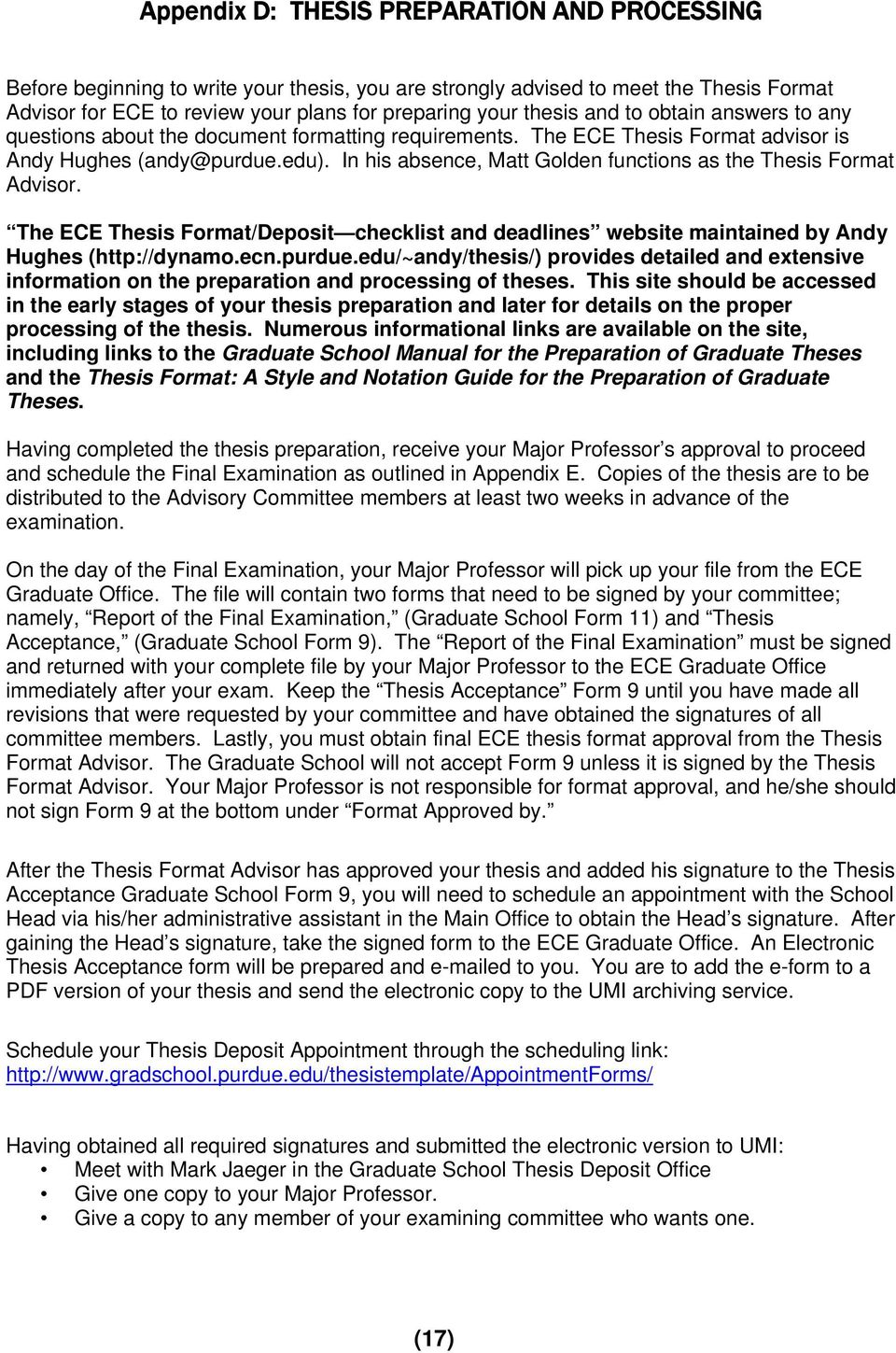
18 Appendix D: THESIS PREPARATION AND PROCESSING Before beginning to write your thesis, you are strongly advised to meet the Thesis Format Advisor for ECE to review your plans for preparing your thesis and to obtain answers to any questions about the document formatting requirements. The ECE Thesis Format advisor is Andy Hughes In his absence, Matt Golden functions as the Thesis Format Advisor. The ECE Thesis Format/Deposit checklist and deadlines website maintained by Andy Hughes ( provides detailed and extensive information on the preparation and processing of theses. This site should be accessed in the early stages of your thesis preparation and later for details on the proper processing of the thesis. Numerous informational links are available on the site, including links to the Graduate School Manual for the Preparation of Graduate Theses and the Thesis Format: A Style and Notation Guide for the Preparation of Graduate Theses. Having completed the thesis preparation, receive your Major Professor s approval to proceed and schedule the Final Examination as outlined in Appendix E. Copies of the thesis are to be distributed to the Advisory Committee members at least two weeks in advance of the examination. On the day of the Final Examination, your Major Professor will pick up your file from the ECE Graduate Office. The file will contain two forms that need to be signed by your committee; namely, Report of the Final Examination, (Graduate School Form 11) and Thesis Acceptance, (Graduate School Form 9). The Report of the Final Examination must be signed and returned with your complete file by your Major Professor to the ECE Graduate Office immediately after your exam. Keep the Thesis Acceptance Form 9 until you have made all revisions that were requested by your committee and have obtained the signatures of all committee members. Lastly, you must obtain final ECE thesis format approval from the Thesis Format Advisor. The Graduate School will not accept Form 9 unless it is signed by the Thesis Format Advisor. Your Major Professor is not responsible for format approval, and he/she should not sign Form 9 at the bottom under Format Approved by. After the Thesis Format Advisor has approved your thesis and added his signature to the Thesis Acceptance Graduate School Form 9, you will need to schedule an appointment with the School Head via his/her administrative assistant in the Main Office to obtain the Head s signature. After gaining the Head s signature, take the signed form to the ECE Graduate Office. An Electronic Thesis Acceptance form will be prepared and ed to you. You are to add the e-form to a PDF version of your thesis and send the electronic copy to the UMI archiving service. Schedule your Thesis Deposit Appointment through the scheduling link: Having obtained all required signatures and submitted the electronic version to UMI: Meet with Mark Jaeger in the Graduate School Thesis Deposit Office Give one copy to your Major Professor. Give a copy to any member of your examining committee who wants one. (17)
19 Appendix E: MASTER S FINAL EXAMINATION INFORMATION The Final Examination is given after the thesis and all other requirements have been completed. The Final Exam covers primarily the thesis and related topics. The Final Examination Committee is typically just the student s Advisory Committee. However, the Dean of the Graduate School reserves the right to appoint additional Committee members. Schedule your Final Examination with your Major Professor, your advisory committee, and the ECE Graduate Office at least 3 weeks prior to the proposed date of the exam. The Final Examination must be completed before the semester deadline (approximately one week before the last day of classes) as indicated by the Graduate School, but we strongly recommend you do not wait until this late date. Check the Graduate School website or in the ECE Graduate Office for the specific deadline. Those students who are registered for Exam Only must complete their Final Examination by the eighth week of classes (fourth week of a summer session). Obtain preliminary thesis format approval from the Thesis Format Advisor prior to scheduling the Final Examination. The ECE Thesis Format Advisor is Andy Hughes ([email protected]). In his absence, Matt Golden ([email protected]) becomes the Thesis Format Advisor. To reserve a room for your thesis defense: Go to Select the room you wish to schedule and check the availability of that room; After confirming the availability of the room, select "Request Reservation;" Click on Michelle Wagner under the list of managers--you will then be able to submit the request online; Should the system not allow you to make a request, send the request by to [email protected]. On the day of the exam, if the room is locked, see an area secretary for a key. If the area secretary is not available, see the ECE Graduate Office. A request to schedule the Final Examination is in three parts: An electronic request should be submitted through mypurdue, under the academic tab and the Plan of Study Generator, three weeks prior to the exam date. This request requires approvals from the Graduate Office and the chair of your advisory committee. The second step is to send an abstract (no more than 250 words) of the thesis research clearly defining the problem and its significance to the ECE Graduate Office ([email protected]). The third step is to submit the Preliminary/Final Exam Check Sheet attached to this document to the ECE Graduate Office. After receiving your scheduling request, the ECE Graduate Office will seek approval from the Graduate School for your Advisory Committee to conduct the Final Examination. Please be aware that late requests to schedule your Final Examination do not allow sufficient time to process your request and adequately publicize your examination date. Any requests to schedule a Final Examination less than three weeks in advance must be approved by the ECE Graduate Coordinator, and will be approved only in exceptional circumstances. On the day of the Final Exam, your Major Professor will pick up your file from the ECE Graduate Office. The file will contain two forms that need to be signed by your committee; namely, Report of the Final Examination, (Graduate School Form 11) and Thesis Acceptance, (Graduate School Form 9). The Report of the Final Examination must be signed and returned (18)

20 with your complete file by your Major Professor to the ECE Graduate Office immediately after your exam. If you are to receive the degree during the session in which the examination is taken, the report must be received in the Graduate School by the posted deadline. If the examination is unsatisfactory, at least one semester or summer session must elapse before the Final Examination is repeated. The time and location of the Final Examination will be posted to the entire ECE faculty, and posted on the ECE Graduate Office bulletin board in the EE Building. University regulations permit visitors to attend the Final Examination. Such visitors are permitted to ask questions of the candidate, after having been recognized by the Major Professor, but they may not be present while the Final Examination Committee deliberates on its decision. (19)

THE UNIVERSITY OF NEW MEXICO DEPARTMENT OF CIVIL ENGINEERING
 THE UNIVERSITY OF NEW MEXICO DEPARTMENT OF CIVIL ENGINEERING MANUAL FOR GRADUATE STUDIES 2015-2016 TABLE OF CONTENTS 1. INTRODUCTION... 4 2. ADMISSION... 5 2.1. Entrance Requirements GPA and test scores...
IOWA STATE UNIVERSITY SUPPLEMENTARY RULES FOR GRADUATE STUDENTS IN ELECTRICAL ENGINEERING OR COMPUTER ENGINEERING
 IOWA STATE UNIVERSITY SUPPLEMENTARY RULES FOR GRADUATE STUDENTS IN ELECTRICAL ENGINEERING OR COMPUTER ENGINEERING (In addition to the rules of the Graduate College) This document together with the Graduate
DEPARTMENT OF GEOGRAPHY AND GRADUATE SCHOOL POLICIES AND PROCEDURES AFFECTING GRADUATE STUDENTS. MA/MS Degree
 DEPARTMENT OF GEOGRAPHY AND GRADUATE SCHOOL POLICIES AND PROCEDURES AFFECTING GRADUATE STUDENTS MA/MS Degree July 2008 University of Georgia Athens, GA 30602-2502 (This document is also available at the
COMPUTER SCIENCE & COMPUTER ENGINEERING GRADUATE STUDENT HANDBOOK Fall 2015
 COMPUTER SCIENCE & COMPUTER ENGINEERING GRADUATE STUDENT HANDBOOK Fall 2015 University of Arkansas JBHT 504 Fayetteville, Arkansas 72701 www.csce.uark.edu telephone 479-575-6197 fax 479-575-5339 Graduate
Graduate Program Handbook Policies and Procedures 2015-2016. School of Electrical Engineering and Computer Science
 Graduate Program Handbook Policies and Procedures 2015-2016 School of Electrical Engineering and Computer Science 1 Chapter 1: EECS Graduate Programs Table of Contents 1.1 Admission... 4 1.1.1 Specific
Master of Science in Chemical Engineering
 Texas A&M University 1 Master of Science in Chemical Engineering The Master of Science (MS) curriculum is designed to develop new understanding through research and creativity. Students have the option
How To Get A Phd In Engineering
 Department of Electrical and Computer Engineering Boise State University DOCTORAL PROGRAM ACADEMIC POLICIES AND PROCEDURES 1 I. Ph.D. Program Areas of Study The Department of Electrical and Computer Engineering
octor of Philosophy Degree in Statistics
 D octor of Philosophy Degree in Statistics The Doctor of Philosophy (PhD) program in Statistics is designed to prepare you to work on the frontiers of the discipline of Statistics, whether your career
Graduate Procedures Manual
 School of Mechanical Engineering Graduate Procedures Manual August 2014 Located on-line at: https://engineering.purdue.edu/me/academics/graduate/currgrad.html Contents 1. INTRODUCTION... 1 2. DEGREE PROGRAMS
The Department of Electrical and Computer Engineering offers three masters options:
 IOWA STATE UNIVERSITY SUPPLEMENTARY RULES FOR GRADUATE STUDENTS IN ELECTRICAL ENGINEERING OR COMPUTER ENGINEERING (In addition to the rules of the Graduate College) This document together with the Graduate
ADMISSION REQUIREMENTS PROGRAM REQUIREMENTS. Of interest to PH.D. IN COMPUTER SCIENCE PROGRAM DEGREE PROGRAMS APPLICATIONS REGISTRATION
 PH.D. IN COMPUTER SCIENCE PROGRAM ADMISSION REQUIREMENTS PROGRAM REQUIREMENTS ADMISSION REQUIREMENTS FOR THE PH.D. IN COMPUTER SCIENCE A student can be admitted into one of the following graduate degree
DEPARTMENT of INDUSTRIAL and SYSTEMS ENGINEERING College of Engineering GRADUATE HANDBOOK
 THE UNIVERSITY of TENNESSEE DEPARTMENT of INDUSTRIAL and SYSTEMS ENGINEERING College of Engineering GRADUATE HANDBOOK M.S. and Ph.D. in Industrial Engineering M.S. and Ph.D. in Engineering Management M.S.
Mathematics and Statistics
 Mississippi State University 1 Mathematics and Statistics Department Head: Dr. Mohsen Razzaghi Graduate Coordinator: Dr. Corlis Johnson 410 Allen Hall Drawer MA Mississippi State, MS 39762 Telephone: 662-325-3414
Department of Electrical and Computer Engineering. The University of Texas. San Antonio DOCTORAL PROGRAM ACADEMIC POLICIES AND PROCEDURES.
 Department of Electrical and Computer Engineering The University of Texas San Antonio DOCTORAL PROGRAM ACADEMIC POLICIES AND PROCEDURES August 2012 (Date of approval: Aug. 24, 2011) 1 I. Ph.D. Program
Electrical and Electronics Engineering Department Graduate Handbook
 Electrical and Electronics Engineering Department Graduate Handbook Published on: January 18, 2012 Latest version is in effect until a new revised document is published 1. Introduction The purpose of this
Mechanical Engineering Program. Policies and Procedures
 Mechanical Engineering Program Policies and Procedures For M.S. and Ph.D. Degrees in Mechanical Engineering At the University of California, Merced Submitted by: Ashlie Martini Chair of the Mechanical
ELECTRICAL ENGINEERING GRADUATE STUDENT HANDBOOK
 ELECTRICAL ENGINEERING GRADUATE STUDENT HANDBOOK Master of Science Doctor of Philosophy Department of Electrical and Computer Engineering College of Engineering North Carolina A&T State University McNair
Environmental and Water Resources Engineering Program
 Environmental and Water Resources Engineering Program Requirements for Master of Science Degrees in Civil Engineering, Environmental Engineering, and Environmental Sciences and Engineering February 2015
Drexel University College of Medicine MOLECULAR & CELLULAR BIOLOGY & GENETICS GRADUATE PROGRAM POLICIES AND PROCEDURES
 Drexel University College of Medicine MOLECULAR & CELLULAR BIOLOGY & GENETICS GRADUATE PROGRAM POLICIES AND PROCEDURES Michael J. Bouchard, Ph.D. Associate Professor Dept. of Biochemistry and Molecular
Graduate Student Handbook
 Graduate Student Handbook Department of Chemistry and Biochemistry Auburn University Revised Apr. 2008 I. INTRODUCTION General regulations for graduate students at Auburn University are covered in the
GENERAL PROCEDURES AND GUIDELINES
 Graduate Program Electrical and Computer Engineering Wallace H. Coulter School of Engineering GENERAL PROCEDURES AND GUIDELINES Revised: August 18, 2010 Table of Contents I. INTRODUCTION.. 1 II. ADMINISTRATIVE
Academic Policies and Procedures
 Academic Policies and Procedures Academic policies can be changed at any time by the University of North Texas Health Science Center School of Public Health (UNTHSC-SPH). Students should review the Student
Graduate Program Handbook Policies and Procedures 2014-2015. School of Electrical Engineering and Computer Science
 Graduate Program Handbook Policies and Procedures 2014-2015 School of Electrical Engineering and Computer Science 1 Chapter 1: EECS Graduate Programs Table of Contents 1.1 Admission... 4 1.1.1 Specific
How To Get A Phd In Civil Engineering
 School of Civil Engineering Graduate Program Handbook Updated October, 2013 1 TABLE OF CONTENTS INTRODUCTION... 4 Degree Titles.... 4 SPECIALITY GROUPS... 4 COUNSELING... 5 GENERAL ACADEMIC REQUIREMENTS
The University of Iowa. Department of Electrical and Computer Engineering GRADUATE MANUAL
 The University of Iowa Summer 2015 Department of Electrical and Computer Engineering GRADUATE MANUAL The primary emphasis of graduate education in Electrical and Computer Engineering is to allow the student
GRADUATE HANDBOOK UNIVERSITY OF COLORADO DENVER DEPARTMENT OF MATHEMATICAL & STATISTICAL SCIENCES
 1 of 15 GRADUATE HANDBOOK UNIVERSITY OF COLORADO DENVER DEPARTMENT OF MATHEMATICAL & STATISTICAL SCIENCES Last Revision: February 12, 2014 Revised: March 3, 1999, April 30, 2000, October 15, 2004, August
DOCTORAL DEGREE PROGRAM
 DOCTORAL DEGREE PROGRAM Introduction The Department of Curriculum and Instruction offers the Doctor of Philosophy in Education degree with a Concentration in Curriculum and Instruction. This program is
DEPARTMENT of INDUSTRIAL and SYSTEMS ENGINEERING College of Engineering GRADUATE HANDBOOK
 THE UNIVERSITY of TENNESSEE DEPARTMENT of INDUSTRIAL and SYSTEMS ENGINEERING College of Engineering GRADUATE HANDBOOK M.S. and Ph.D. in Industrial Engineering and Concentration on Engineering Management
Bioengineering Ph.D. Student Handbook For Entrance in 2015 Fall or Later
 Bioengineering Ph.D. Student Handbook For Entrance in 2015 Fall or Later 1. Introduction The process of receiving a Ph.D. in Bioengineering from the University of Missouri can be divided into several distinct
Graduate Student Handbook Supplement Department of Computer Science Tufts University Fall 2015
 Graduate Student Handbook Supplement Department of Computer Science Tufts University Fall 2015 Details Last Updated: July 13, 2015. If you need any further clarifications please contact the Director of
ACADEMIC REGULATIONS FOR MASTER'S DEGREE PROGRAMS
 Additional Requirements 1. At least six hours of electives must be completed to present a minimum total of 120 semester hours. 2. A cumulative grade point average of 2.0, including a minimum of 2.0 in
Undergraduate Programs. Graduate Programs 244 ANDREWS UNIVERSITY
 244 ANDREWS UNIVERSITY God calls students to live by principles of good health as stewards of His gift of life. God calls students to develop and maintain supportive personal and professional relationships
1. Development of a Plan of Study approved by the appropriate faculty or program adviser;
 Oakland University Graduate Council PhD Minimum Program Requirements The Doctor of Philosophy (Ph.D.) degree is awarded by Oakland University on the basis of evidence that the candidate has achieved a
Graduate Programs Manual Shawnee State University
 Graduate Programs Manual Shawnee State University INTRODUCTION The following is a guide to graduate programs at Shawnee State University (SSU). SSU retains the right to change its course offerings, academic
Lebanese American University
 Lebanese American University School of Arts and Sciences Graduate Student Guide October 2, 2015 1. Preamble This guide highlights major issues and questions that students may face during their graduate
GRADUATE STUDENT HANDBOOK
 GRADUATE STUDENT HANDBOOK Department of Mechanical Engineering The University of South Carolina May 2016 1 MECHANICAL ENGINEERING GRADUATE STUDENT HANDBOOK TABLE OF CONTENTS Page PART I. GENERAL INFORMATION
COLLEGE OF WILLIAM AND MARY ANTHROPOLOGY GRADUATE PROGRAM PROCEDURES
 1 COLLEGE OF WILLIAM AND MARY ANTHROPOLOGY GRADUATE PROGRAM PROCEDURES TABLE OF CONTENTS PROGRAM OVERVIEW 2 ADMINISTRATIVE STRUCTURE. 2 ADMISSION TO THE PROGRAM 3 Page MASTER OF ARTS 1. Introduction. 4
THE UNIVERSITY OF TEXAS AT EL PASO GRADUATE SCHOOL. Advisor s Handbook
 THE UNIVERSITY OF TEXAS AT EL PASO GRADUATE SCHOOL Advisor s Handbook Table of Contents General Degree Requirements.......3 Enrollment Verification....3 Registration 4 Academic Standing......5 Graduation..5
DEPARTMENT OF BIOLOGICAL SCIENCES GRADUATE POLICIES & PROCEDURES MANUAL
 DEPARTMENT OF BIOLOGICAL SCIENCES GRADUATE POLICIES & PROCEDURES MANUAL This graduate manual is intended for the informational use of graduate students in the Department of Biological Sciences only. Its
MMAE Guide to Graduate Studies. Illinois Institute of Technology
 MMAE Guide to Graduate Studies Illinois Institute of Technology August 17, 2015 Contents 1 Introduction 3 1.1 MMAE Graduate Programs..................... 4 1.2 General Operating Procedures...................
CULTURAL STUDIES GRADUATE GROUP DEGREE REQUIREMENTS Revisions: June 2006, February 2009 Approved by Graduate Council: May 20, 2009
 CULTURAL STUDIES GRADUATE GROUP DEGREE REQUIREMENTS Revisions: June 2006, February 2009 Approved by Graduate Council: May 20, 2009 M.A. PROGRAM 1) Admissions Requirements There are no admissions to the
DEGREE REQUIREMENTS & ACADEMIC GUIDELINES
 Sam Houston State University 1 DEGREE REQUIREMENTS & ACADEMIC GUIDELINES Graduate Degree Requirements (p. 1) Academic Expectations and Guidelines (p. 3) Graduate programs are typically regarded as either
Electrical & Computer Engineering Graduate Handbook
 Electrical & Computer Engineering Graduate Handbook July 2012 I. Message from the Chairman On behalf of the Electrical and Computer Engineering (ECE) faculty and staff, I would like to welcome you to our
How To Get A Degree From Fiu
 FLORIDA INTERNATIONAL UNIVERSITY DEPARTMENT OF BIOLOGICAL SCIENCES This graduate manual is intended for the informational use of graduate students in the Department of Biological Sciences only. Its purpose
Division of Electrical & Computer Engineering
 School of Electrical Engineering & Computer Science Division of Electrical & Computer Engineering GRADUATE HANDBOOK Effective Spring 2015 This handbook gathers into one place most of the academic regulations
Guidelines For Graduate Studies In Biology The Master of Science in Biology
 Guidelines For Graduate Studies In Biology The Master of Science in Biology Department of Biology Virginia Commonwealth University 1000 W. Cary St. Richmond, VA 23284-2012 Telephone: (804) 828-1562 Fax:
Computer Science Graduate Degree Requirements
 Computer Science Graduate Degree Requirements Duke University Department of Computer Science 1 Introduction 2 General Requirements This document defines the requirements set forth by the Department of
KU School of Education Graduate Student Handbook
 KU School of Education Graduate Student Handbook 2011-2012 Graduate Student Responsibility All graduate students are responsible for informing themselves of requirements of the Graduate School as stated
Computer and Systems Engineering (CSE) Master of Science Programs
 Computer and Systems Engineering (CSE) Master of Science Programs The Computer and Systems Engineering (CSE) degree offered by the University of Houston (UH) is a graduate level interdisciplinary program
Tulane University. Graduate Program in. Student Handbook
 Tulane University Graduate Program in Student Handbook Contents Earth and Environmental Sciences Graduate Program Procedures for Graduate Study 3 Admission Requirements 3 Financial Support 3 Categories
PH.D. PROGRAM. 1) Admissions Requirements
 PH.D. PROGRAM 1) Admissions Requirements Admission to graduate standing in the Biomedical Engineering Graduate Group (BMEGG) requires a Bachelor s degree in a discipline relevant to biomedical engineering
Computer Science Graduate Degree Requirements
 Computer Science Graduate Degree Requirements Duke University Department of Computer Science 1 Introduction This document defines the requirements set forth by the Department of Computer Science for a
Page Overview... 2 Admission Requirements... 2 Additional Requirements... 3 Sample Timeline... 4 Sample Research Proposal... 5
 Contents Page Overview............................. 2 Admission Requirements................. 2 Additional Requirements................. 3 Sample Timeline....................... 4 Sample Research Proposal................
Graduate Student Handbook of the Mathematics Department
 Graduate Student Handbook of the Mathematics Department Department of Mathematics North Dakota State University October 7, 2015 1 1 General Information The Department of Mathematics offers graduate study
MECHANICAL ENGINEERING DEPARTMENT S. Ph.D. Degree - REQUIREMENTS AND PROCEDURES -
 MECHANICAL ENGINEERING DEPARTMENT S Ph.D. Degree - REQUIREMENTS AND PROCEDURES - INTERDISCIPLINARY DOCTORAL PROCEDURES COLLEGE OF ENGINEERING TABLE OF CONTENTS College of Engineering s Graduate Degrees
STATE UNIVERSITY OF NEW YORK AT ALBANY Department of Economics
 STATE UNIVERSITY OF NEW YORK AT ALBANY Department of Economics Doctor of Philosophy Program Guidelines: May 2013 I. Admission Each application is evaluated on its individual merits by the Economics Department.
Department of Geography
 Texas State University-San Marcos Department of Geography Master of Applied Geography and Master of Science Policies and Procedures Handbook May 2012 Table of Contents I. Purpose, Objectives, and Administration
University of Delaware. Program Policy Document
 University of Delaware Ph.D. in Economic Education A Joint Program of the Department of Economics and the School of Education Program Policy Document Fall 2009 GRADUATE PROGRAM POLICY STATEMENT FOR PH.D
History Graduate Program Handbook
 History Graduate Program Handbook Introduction: Welcome to the history department at the University of Miami. We pride ourselves on providing a close individualized training for the next generation of
Department of Biomedical Engineering. Graduate Handbook
 Department of Biomedical Engineering Graduate Handbook BME Graduate Handbook - Page 1 October 17, 2012 TABLE OF CONTENTS 1. INTRODUCTION... 3 2. GRADUATE STUDIES AND DEGREES... 3 2.1 MASTER OF SCIENCE
How To Get A Computer Science Degree At Mississippi State
 Mississippi State University 1 Computer Science and Engineering Department Head: Dr. Donna Reese Graduate Coordinator: Dr. T.J. Jankun-Kelly 300 Butler Hall Box 9637 Mississippi State, MS 39762-9637 Telephone:
The Ph.D. program in Computer and Information Sciences
 The Ph.D. program in Computer and Information Sciences The Ph.D. program in Computer and Information Sciences offers an opportunity for exceptional students to pursue research in the computer and information
Florida Gulf Coast University General Graduate Academic Policies
 I. Graduate Admission Policies Florida Gulf Coast University General Graduate Academic Policies A. Graduate Admission Requirements Applicants to graduate degree programs or post-baccalaureate professional
BİLKENT UNIVERSITY. Department of Industrial Engineering Graduate Handbook 2013-2014
 BİLKENT UNIVERSITY Department of Industrial Engineering Graduate Handbook 2013-2014 Table of Contents Introduction 3 Objective 3 Application and Admission to the Degree Programs 4 Degree Requirements 5
Doctor of Philosophy in Systems Engineering
 Doctor of Philosophy in Systems Engineering Coordinator Michael P. Polis Program description The Doctor of Philosophy in systems engineering degree program is designed for students who plan careers in
DEPARTMENT OF POLITICAL SCIENCE MICHIGAN STATE UNIVERSITY
 DEPARTMENT OF POLITICAL SCIENCE MICHIGAN STATE UNIVERSITY PH.D. HANDBOOK Last Updated, September 2010 1 INTRODUCTION One of the main missions of the Department of Political Science at MSU is the education
CSR Graduate Student Handbook
 CSR Graduate Student Handbook PURDUE UNIVERSITY Consumer Science 765.494.8292/voice 765.494.0869/ fax Fall 2015 ii TABLE OF CONTENTS THE GRADUATE STUDY IN CONSUMER SCIENCE... Consumer Behavior... Family
Students select at time of application the option to which they would like to be admitted.
 German Graduate Program Ph.D. and MA Degree Requirements Revised: Sept 2008; Jan 2009; March 2014 Graduate Council Approved: Feb 18, 2009; Aug 14, 2014 Master s Degree Requirements 1) Admissions requirements
DOCTORAL DEGREES ADMISSION REQUIREMENTS
 DOCTORAL DEGREES Ball State University offers programs leading to the doctor of philosophy degree (PhD), the doctor of education degree (EdD), the doctor of arts degree (DA), and the doctor of audiology
Mathematics Department Graduate Pamphlet 2011-2012
 Mathematics Department Graduate Pamphlet 2011-2012 DEPARTMENT of MATHEMATICS OREGON STATE UNIVERSITY CORVALLIS OR 97331-4605 Updated September 2011 INTRODUCTION THE GRADUATE COMMITTEE DEPARTMENTAL AND
Purdue University Department of Communication. Graduate Student Manual 2009-2010
 Purdue University Department of Communication Graduate Student Manual 2009-2010 Updated May 2010 1 Table of Contents I. Introduction... 1 II. Admission... 4 III. Major Professor and Committees... 5 IV.
Environmental and Water Resources Engineering Program
 Environmental and Water Resources Engineering Program Requirements for the Doctor of Philosophy Degree in Civil Engineering, Environmental and Water Resources Engineering Emphasis July, 2011 This document
DOCTORAL HANDBOOK IN MUSIC EDUCATION
 DOCTORAL HANDBOOK IN MUSIC EDUCATION Admission Standards To be admitted to the doctoral program in music education, an applicant must have a master s degree in music education or a total of 30 credits
Department of Chemical and Environmental Engineering
 Department of Chemical and Environmental Engineering CHEMICAL AND ENVIRONMENTAL ENGINEERING GRADUATE STUDENT HANDBOOK 2015-2016 Revised 4/28/16 TABLE OF CONTENTS 1. Introduction.........2 2. General Program
Department of Art Education and Art History
 COLLEGE OF VISUAL ARTS AND DESIGN Department of Art Education and Art History Revised 4/16 1 STATEMENT OF AIMS In its graduate programs, the College of Visual Arts and Design (CVAD) at the University of
Graduate Studies in Physics
 Graduate Studies in Physics Application Requirements and Procedures Application for Admission to Graduate Standing 1. Complete the on-line UNR Graduate School application for admission. Information and
www.usc.edu/dept/ise Ph.D. Handbook 2013-2014
 www.usc.edu/dept/ise Ph.D. Handbook 2013-2014 DISCLAIMER This handbook is produced by the Daniel J. Epstein Department of Industrial and Systems Engineering as an unofficial guide to graduate studies in
Graduate Handbook. Master of Science in Criminal Justice Degree Requirements: Policies and Procedures. Department of Criminal Justice
 Department of Criminal Justice Graduate Handbook Master of Science in Criminal Justice Degree Requirements: Policies and Procedures Department of Criminal Justice Wayne State University 3293 Faculty/Administration
Phone: (480) 965-3590 or (480) 965-1729. E-mail: [email protected]. Internet: http://engineering.asu.edu/ecee
 The Blue Graduate Student Guide School of Electrical, Computer, and Energy Engineering Electrical Engineering Program Ira A. Fulton Schools of Engineering Arizona State University Phone: (480) 965-3590
DEPARTMENT OF MATHEMATICS AND STATISTICS GRADUATE STUDENT HANDBOOK. April 2015
 DEPARTMENT OF MATHEMATICS AND STATISTICS GRADUATE STUDENT HANDBOOK April 2015 Postal address: Department of Mathematics and Statistics, Washington State University, Pullman, WA 99164-3113 Voice: 509-335-8645
Entomology Graduate Degree Program Requirements
 Entomology Graduate Degree Program Requirements This document serves as a basic guide for entomology graduate students regarding policies and guidelines. All Entomology graduate students must meet two
The current (2015-2016) Marketing Ph.D. Committee consists of Greg M. Allenby (Committee Chair), Xiaoyan Deng, Nino Hardt, and Rebecca Walker Reczek.
 Marketing Ph.D. Program Handbook 1. Marketing Ph.D. Program Structure and Committees Graduate Faculty and the Marketing Ph.D. As a doctoral student, you are enrolled in the Graduate School of the Ohio
General University Academic Information
 General University Academic Information 43 General University Academic Information Academic Rules and Regulations The general policies, procedures and minimum requirements for advanced degrees are stated
DEPARTMENT OF CHEMISTRY AND BIOCHEMISTRY UNIVERSITY OF COLORADO, BOULDER, COLORADO Departmental Rules for Advanced Degrees 1 Revised : March, 2009
 DEPARTMENT OF CHEMISTRY AND BIOCHEMISTRY UNIVERSITY OF COLORADO, BOULDER, COLORADO Departmental Rules for Advanced Degrees 1 Revised : March, 2009 ===========================================================
RULES, REGULATIONS AND FORMS PERTAINING TO GRADUATE PROGRAMS IN PSYCHOLOGY DEPARTMENT OF PSYCHOLOGY UNIVERSITY OF NEW ORLEANS 2015-2016
 RULES, REGULATIONS AND FORMS PERTAINING TO GRADUATE PROGRAMS IN PSYCHOLOGY DEPARTMENT OF PSYCHOLOGY UNIVERSITY OF NEW ORLEANS 2015-2016 Revised, August 2008 1 TABLE OF CONTENTS I. Admission 4 A. Criteria
ADMISSION REQUIREMENTS BY PROGRAM
 ADMISSION REQUIREMENTS BY PROGRAM MASTER OF ARTS IN COUNSELING Candidates for admission to the Master of Arts in Counseling program must meet the following criteria: 1. Have earned an undergraduate degree
I. Master s Degree Requirements: A. Completion of appropriate course work as defined by the student s area (Behavioral Neuroscience, Clinical, or
 I. Master s Degree Requirements: A. Completion of appropriate course work as defined by the student s area (Behavioral Neuroscience, Clinical, or Cognitive). Students are to fill out the area course check-list
Mechanical Engineering Graduate Program
 Student Handbook Mechanical Engineering Graduate Program Page 2 University of Michigan - Dearborn Table of Contents Program Overview 4 Degree Requirements 4 Grading System 5 Drops and Unofficial Drops
GRADUATE PROGRAM IN BIOTECHNOLOGY
 GRADUATE PROGRAM IN BIOTECHNOLOGY I. Governance 2 II. Admission....... 3 III. Counseling...... 3 IV. Course of Study...... 3 V. Student Seminars... 4 VI. Teaching... 4 VII. Research...... 4 VIII. Qualifying