
Proportional hydraulics
|
|
|
- Joshua Norton
- 9 years ago
- Views:
Transcription
1 Learning System for utomation and Communications Proportional hydraulics Textbook v q q B p p B B p p B P T p P p T q P

2 Order No.: Description: PROP.-H. LEHRB. Designation: D.LB-TP701-GB Edition: 09/95 Layout: S. Durz Graphics: D. Schwarzenberger uthor: D. Scholz Copyright by Festo Didactic KG, D Esslingen, 1996 ll rights reserved, including translation rights. No part of this publication may be reproduced or transmitted in any form or by any means, electronic, mechnical, photocopying, or otherwise, without the prior written permission of Festo Didactic KG.

3 B-1 Basics Chapter 1 Introduction to proportional hydraulics B Hydraulic feed drive with manual control B Hydraulic feed drive with electrical control and switching valves B Hydraulic feed unit with electrical control and proportional valves B Signal flow and components of proportional hydraulics B dvantages of proportional hydraulics B-12 Table of contents Chapter 2 Proportional valves: Design and mode of operation B Design and mode of operation of a proportional solenoid B Design and mode of operation of proportional pressure valves B Design and mode of operation of proportional flow restrictors and directional control valves B Design and mode of operation of proportional flow control valves B Proportional valve designs: Overview B-30 Chapter 3 Proportional valves: Characteristic curves and parameters B Characteristic curve representation B Hysteresis, inversion range and response threshold B Characteristic curves of pressure valves B Characteristic curves of flow restrictors and directional control valves B Parameters of valve dynamics B pplication limits of proportional valves B-46 Chapter 4 mplifier and setpoint value specification B Design and mode of operation of an amplifier B Setting an amplifier B Setpoint value specification B-59

4 B-2 Basics Chapter 5 Switching examples using proportional valves B Speed control B Leakage prevention B Positioning B Energy saving measures B-73 Chapter 6 Calculation of motion sequence for a hydraulic cylinder drive B Flow calculation for proportional directional control valves B Velocity calculation for an equal area cylinder drive disregarding load and frictional forces B Velocity calculation for an unequal area cylinder drive disregarding load and frictional forces B Velocity calculation for an equal area cylinder drive taking into account load and frictional forces B Velocity calculation for an unequal cylinder drive taking into account load and frictional forces B Effect of maximum piston force on the acceleration and delay process B Effect of natural frequency on the acceleration and delay process B Calculation of motion duration B-119

5 B-3 Chapter 1 Chapter 1 Introduction to proportional hydraulics

6 B-4 Chapter 1

7 B-5 Chapter 1 Hydraulic drives, thanks to their high power intensity, are low in weight and require a minimum of mounting space. They facilitate fast and accurate control of very high energies and forces. The hydraulic cylinder represents a cost-effective and simply constructed linear drive. The combination of these advantages opens up a wide range of applications for hydraulics in mechanical engineering, vehicle construction and aviation. The increase in automation makes it ever more necessary for pressure, flow rate and flow direction in hydraulic systems to be controlled by means of an electrical control system. The obvious choice for this are hydraulic proportional valves as an interface between controller and hydraulic system. In order to clearly show the advantages of proportional hydraulics, three hydraulic circuits are to be compared using the example of a feed drive for a lathe (Fig. 1.1): a circuit using manually actuated valves (Fig. 1.2), a circuit using electrically actuated valves (Fig. 1.3), a circuit using proportional valves (Fig. 1.4). Fig. 1.1 Hydraulic feed drive of a lathe

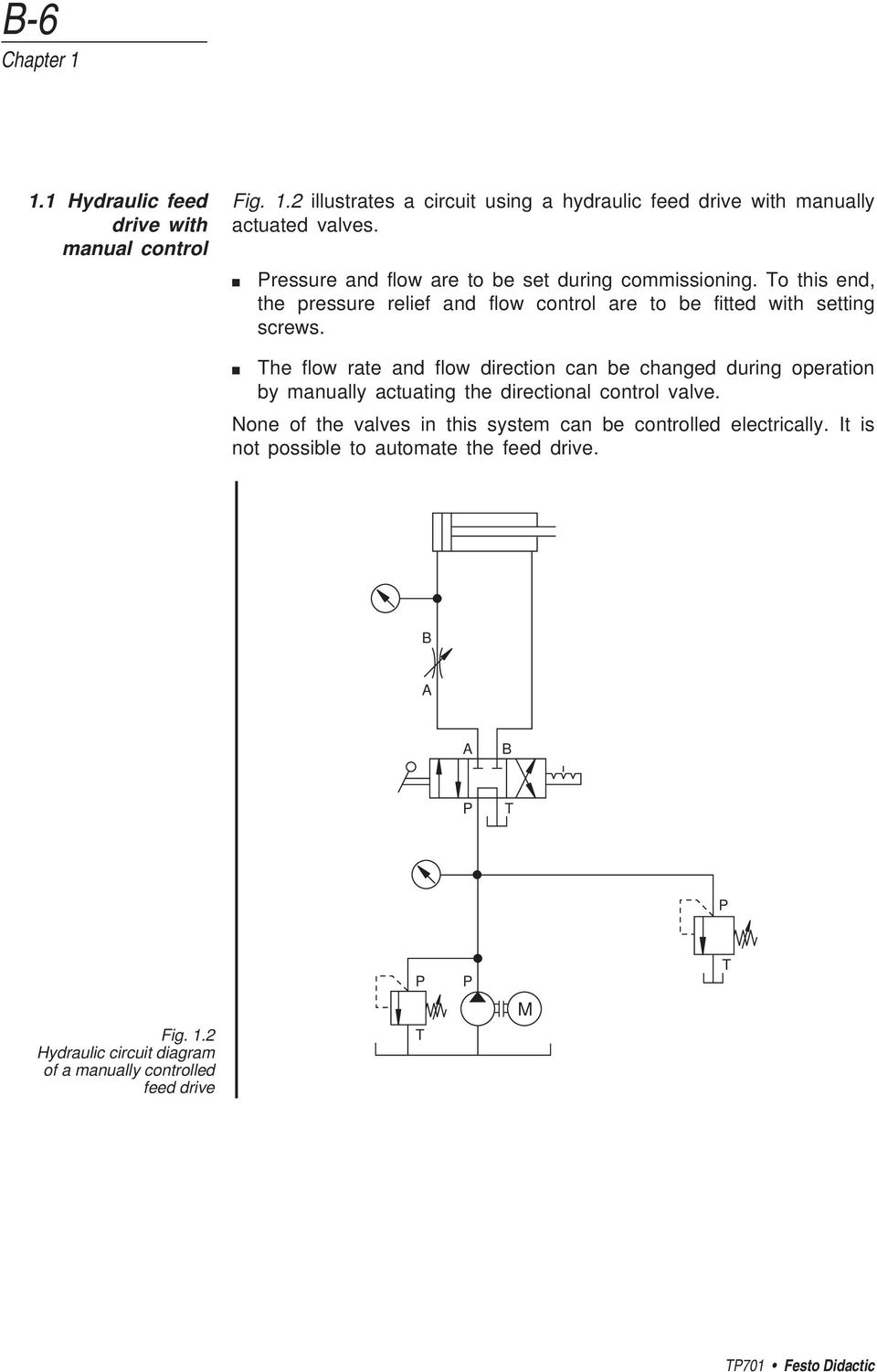
8 B-6 Chapter Hydraulic feed drive with manual control Fig. 1.2 illustrates a circuit using a hydraulic feed drive with manually actuated valves. Pressure and flow are to be set during commissioning. To this end, the pressure relief and flow control are to be fitted with setting screws. The flow rate and flow direction can be changed during operation by manually actuating the directional control valve. None of the valves in this system can be controlled electrically. It is not possible to automate the feed drive. B B P T P Fig. 1.2 Hydraulic circuit diagram of a manually controlled feed drive P T P M T
9 B-7 Chapter 1 In the case of electro-hydraulic systems, the directional control valves are controlled electrically. Fig 1.3 shows the circuit diagram of a feed drive using an electrically actuated directional control valve. The operation of the lathe can be automated by means of actuating the directional control valve via an electrical control system. Pressure and flow cannot be influenced during operation by the electrical control system. If a change is required, production on the lathe has to be stopped. Only then can the flow control and pressure relief valve be reset manually. 1.2 Hydraulic feed drive using an electrical control system and switching valves B B Y1 P T Y2 P P P T M T Fig. 1.3 Hydraulic circuit diagram of an electrically controlled feed drive

10 B-8 Chapter 1 automation of pressure and flow control is only possible to a limited extent with electro-hydraulic control systems using switching valves. Examples are the connection of an additional flow control by means of actuating a directional control valve, the control of flow and pressure valves with cams. 1.3 Hydraulic feed drive using an electrical control system and proportional valves In fig. 1.4, the hydraulic circuit diagram of a feed drive is shown incorporating proportional valves. The proportional directional control valve is actuated by means of an electrical control signal. The control signal influences the flow rate and flow direction. The rate of movement of the drive can be infinitely adjusted by means of changing the flow rate. second control signal acts on the proportional pressure relief valve. The pressure can be continually adjusted by means of this control signal. The proportional directional control valve in fig. 1.4 assumes the function of the flow control and the directional control valve in fig 1.3. The use of proportional technology saves one valve. The proportional valves are controlled by means of an electrical control system via an electrical signal, whereby it is possible, during operation, to lower the pressure during reduced load phases (e.g. stoppage of slide) via the proportional pressure relief valve and to save energy, to gently start-up and decelerate the slide via the proportional directional control valve. ll valve adjustments are effected automatically, i.e. without human intervention.

11 B-9 Chapter 1 B B Y1 P T Y2 P Y3 P P T M T Fig. 1.4 Hydraulic circuit diagram of a feed drive using proportional valves

12 B-10 Chapter Signal flow and components in proportional hydraulics Fig. 1.5 clearly shows the signal flow in proportional hydraulics. n electrical voltage (typically between -10 V and + 10 V) acting upon an electrical amplifier. The amplifier converts the voltage (input signal) into a current (output signal). The current acts upon the proportional solenoid. The proportional solenoid actuates the valve. The valve controls the energy flow to the hydraulic drive. The drive converts the energy into kinetic energy. The electrical voltage can be infinitely adjusted and the speed and force (i.e. speed and torque) can be infinitely adjusted on the drive accordingly. SPS FESTO FESTO FESTO Controller Electrical amplifier Proportional solenoid Proportional valve Drive Proportional technology components Fig. 1.5: Signal flow in proportional hydraulics

13 B-11 Chapter 1 Fig. 1.6 illustrates a 4/3-way proportional valve with the appropriate electrical amplifier. Fig /3-way proportional valve with electrical amplifier (Vickers)

14 B-12 Chapter dvantages of proportional hydraulics Comparison of switching valves and proportional valves The advantages of proportional valves in comparison with switching valves has already been explained in sections 1.2 to 1.4 and are summarised in table 1.1. djustability of valves - infinitely adjustable flow and pressure via electrical input signal - automatic adjustment of flow and pressure during operation of system Table 1.1 dvantages of electrically actuated proportional valves compared with switching valves Effect on the drives automatable, infinite and accurate adjustment of - Force or torque - cceleration - Velocity or speed - Position or rotary angle Effect on energy consumption - Energy consumption can be reduced thanks to demand-oriented control of pressure and flow. Circuit simplification - proportional valve can replace several valves, e.g. a directional control valve and a flow control valve

15 B-13 Chapter 1 Comparison of proportional and servohydraulics The same functions can be performed with servo valves as those with proportional valves. Thanks to the increased accuracy and speed, servotechnology even has certain advantages. Compared with these, the advantages of proportional hydraulics are the low cost of the system and maintenance requirements: The valve design is simpler and more cost-effective. The overlap of the control slide and powerful proportional solenoids for the valve actuation increase operational reliability. The need for filtration of the pressure fluid is reduced and the maintenance intervals are longer. Servohydraulic drives frequently operate within a closed loop circuit. Drives equipped with proportional valves are usually operated in the form of a contol sequence, thereby obviating the need for measuring systems and controller with proportional hydraulics. This correspondingly simplifies system design. Proportional technology combines the continuous electrical variability and the sturdy, low cost construction of the valves. Proportional valves bridge the gap between switching valves and servo valves.

16 B-14 Chapter 1

17 B-15 Chapter 2 Chapter 2 Proportional valves: Design and mode of operation

18 B-16 Chapter 2

19 B-17 Chapter 2 Depending on the design of the valve, either one or two proportional solenoids are used for the actuation of an electrically variable proportional valve. Solenoid design The proportional solenoid (fig. 2.1) is derived from the switching solenoid, as used in electro-hydraulics for the actuation of directional control valves. The electrical current passes through the coil of the electro-solenoid and creates a magnetic field. The magnetic field develops a force directed towards the right on to the rotatable armature. This force can be used to actuate a valve. Similar to the switching solenoid, the armature, barrel magnet and housing of the proportional solenoid are made of easily magnetisable, soft magnetic material. Compared with the switching solenoid, the proportional solenoid has a differently formed control cone, which consists of non-magnetisable material and influences the pattern of the magnetic field lines. 2.1 Design and mode of operation of a proportional solenoid Mode of operation of a proportional solenoid With the correct design of soft magnetic parts and control cone, the following approximate characteristics (fig. 2) are obtained: The force increases in proportion to the current, i.e. a doubling of the current results in twice the force on the armature. The force does not depend on the position of the armature within the operational zone of the proportional solenoid.

20 B-18 Chapter 2 Electrical connection Venting screw Compensating spring Plain bearing Housing Barrel magnet rmature Non-magnetisable inner ring Control cone Exciting coil Core magnet Guide rod (stem) Stop/Guide disc Force F Current I I 0 0,75 I 0 0,50 I 0 0,25 I 0 Fig. 2.1 Design and characteristics of a proportional solenoid Operational range (typically: approx 2mm) rmature position x

21 B-19 Chapter 2 In a proportional valve, the proportional solenoid acts against a spring, which creates the reset force (fig. 2.2). The spring characteristic has been entered in the two characteristic fields of the proportional solenoid. The further the armature moves to the right, the greater the spring force. With a small current, the force on the armature is reduced and accordingly, the spring is almost released. (fig. 2.2a). The force applied on the armature increases, if the electrical current is increased. The armature moves to the right and compresses the spring (fig. 2.2b). a) b) s = min. s = max. c) d) Force F Force F I 0 I 0 0,75 I 0 0,75 I 0 0,50 I 0 0,50 I 0 0,25 I 0 0,25 I 0 rmature position x rmature position x Fig. 2.2 Behaviour of a proportional solenoid with different electrical currents
22 B-20 Chapter 2 ctuation of pressure, flow control and directional control valves In pressure valves, the spring is fitted between the proportional solenoid and the control cone (fig 2.3a). With a reduced electrical current, the spring is only slightly pretensioned and the valve readily opens with a low pressure. The higher the electrical current set through the proportional solenoid, the greater the force applied on the armature. This moves to the right and the pretensioning of the spring is increased. The pressure, at which the valve opens, increases in proportion to the pretension force, i.e. in proportion to the armature position and the electrical current. In flow control and directional control valves, the control spool is fitted between the proportional solenoid and the spring (fig. 2.3b). In the case of reduced electrical current, the spring is only slightly compressed. The spool is fully to the left and the valve is closed. With increasing current through the proportional solenoid, the spool is pushed to the right and the valve opening and flow rate increase. a) b) Fig. 2.3 ctuation of a pressure and a restrictor valve
23 B-21 Chapter 2 Positional control of the armature Magnetising effects, friction and flow forces impair the performance of the proportional valve. This leads to the position of the armature not being exactly proportional to the electrical current. considerable improvement in accuracy may be obtained by means of closed-loop control of the armature position (fig. 2.4). The position of the armature is measured by means of an inductive measuring system. The measuring signal x is compared with input signal y. The difference between input signal y and measuring signal x is amplified. n electrical current I is generated, which acts on the proportional solenoid. The proportional solenoid creates a force, which changes the position of the armature in such a way that the difference between input signal y and measuring signal x is reduced. The proportional solenoid and the positional transducer form a unit, which is flanged onto the valve. Displacement encoder x U I y Setpoint value y-x Comparator I mplifier Fig. 2.4 Design of a position-controlled proportional solenoid
24 B-22 Chapter Design and mode of operation of proportional pressure valves With a proportional pressure valve, the pressure in a hydraulic system can be adjusted via an electrical signal. Pressure relief valve Fig. 2.5 illustrates a pilot actuated pressure relief valve consisting of a preliminary stage with a poppet valve and a main stage with a control spool. The pressure at port P acts on the pilot control cone via the hole in the control spool. The proportional solenoid exerts the electrically adjustable counterforce. The preliminary stage remains closed, if the force of the proportional solenoid is greater than the force produced by the pressure at port P. The spring holds the control spool of the main stage in the lower position; flow is zero. If the force exerted by the pressure exceeds the sealing force of the pilot control cone, then this opens. reduced flow rate takes place to the tank return from port P via port Y. The flow causes a pressure drop via the flow control within the control spool, whereby the pressure on the upper side of the control spool becomes less than the pressure on the lower side. The differential pressure causes a resulting force. The control spool travels upwards until the reset spring compensates this force. The control edge of the main stage opens so that port P and T are connected. The pressure fluid drains to the tank via port T.
25 B-23 Chapter 2 Y T P P T Y Fig. 2.5 Pilot actuated proportional pressure relief valve
26 B-24 Chapter 2 Pressure control valve Fig. 2.6 iillustrates a pilot actuated 2-way pressure control valve. The pilot stage is effected in the form of a poppet valve and the main stage as a control spool. The pressure at consuming port acts on the pilot control cone via the hole in the control spool. The counter force is set via the proportional solenoid. If the pressure at port is below the preset value, the pilot control remains closed. The pressure on both sides of the control spool is identical. The spring presses the control spool downwards and the control edge of the main stage is open. The pressure fluid is able to pass unrestricted from port P to port. If pressure at port exceeds the preset value, the pilot stage opens so that a reduced flow passes to port Y. The pressure drops via the flow control in the control spool. The force on the upper side of the control spool drops and the control spool moves upwards. The cross section of the opening is reduced. s a result of this, the flow resistance of the control edge between port P and port increases. Pressure a port drops. Y P P Y Fig. 2.6 Pilot actuated proportional pressure control valve
27 B-25 Chapter 2 Proportional flow control valve In the case of a proportional flow control valve in a hydraulic system, the throttle cross section is electrically adjusted in order to change the flow rate. proportional flow control valve is similarly constructed to a switching 2/2-way valve or a switching 4/2-way valve. With a directly actuated proportional flow control valve (fig. 2.7), the proportional solenoid acts directly on the control spool. 2.3 Design and mode of operation of proportional flow control and directional control valves With reduced current through the proportional solenoid, both control edges are closed. The higher the electrical current through the proportional solenoid, the greater the force on the spool. The spool moves to the right and opens the control edges. The current through the solenoid and the deflection of the spool are proportional. B P T B P T Fig. 2.7 Directly actuated proportional restrictor valve without position control
28 B-26 Chapter 2 Directly actuated proportional directional control valve proportional directional control valve ressembles a switching 4/3-way valve in design and combines two functions: Electrically adjustable flow control (same as a proportional flow control valve), Connection of each consuming port either with P or with T (same as a switching 4/3-way valve). Fig 2.8 illustrates a directly actuated proportional directional control valve. If the electrical signal equals zero, then both solenoids are de-energised. The spool is centred via the springs. ll control edges are closed. If the valve is actuated via a negative voltage, the current flows through the righthand solenoid. The spool travels to the left. Ports P and B as well as and T are connected together. The current through the solenoid and the deflection of the spool are proportional. With a positive voltage, the current flows through the lefthand solenoid. The spool moves to the right. Ports P and as well as B and T are connected together. In this operational status too, the electrical current and the deflection of the spool are proportional to one another. In the event of power failure, the spool moves to the mid-position so that all control edges are closed. (fail-safe position). B P T Fig. 2.8 Directly actuated proportional directional control valve without position control T B P
29 B-27 Chapter 2 Pilot actuated proportional directional control valve Fig. 2.9 shows a pilot actuated proportional directional control valve. 4/3-way proportional valve is used for pilot control. This valve is used to vary the pressure on the front surfaces of the control spool, whereby the control spool of the main stage is deflected and the control edges opened. Both stages in the valve shown here are position controlled in order to obtain greater accuracy. In the event of power or hydraulic energy failure, the control spool of the main stage moves to the mid-position and all control edges are closed (fail-safe position). U S X Y C 1 B U S P T C 2 C 1 T P B X C 2 Y Fig. 2.9 Pilot actuated proportional directional control valve Two 3-way pressure regulators may be used for pilot control instead of a 4/3-way valve. Each pressure valve controls the pressure on one front surface of the main stage control spool.
30 B-28 Chapter 2 dvantages and disadvantages of pilot actuated proportional valves The force for the actuation of the main stage is generated hydraulically in the pilot actuated valve. Only the minimal actuating force for the initial stage has to be generated by the proportional solenoid. The advantage of this is that a high level of hydraulic power can be controlled with a small proportional solenoid and a minimum of electrical current. The disadvantage is the additional oil and power consumption of the pilot control. Proportional directional control valves up to nominal width 10 are primarily designed for direction actuation. In the case of valves with greater nominal width, the preferred design is pilot control. Valves with very large nominal width for exceptional flow rates may have three or four stages. 2.4 Design and mode of operation of proportional flow control valves With proportional flow control and directional control valves, the flow rate depends on two influencing factors: the opening of the control edge specified via the control signal, the pressure drop via the valve. To ensure that the flow is only affected by the control signal, the pressure drop via the control edge must be maintained constant. This is achieved by means of an additional pressure balance and can be realised in a variety of ways: Pressure balance and control edge are combined in one flow control valve. The two components are combined by means of connection technology. Fig shows a section through a 3-way proportional flow control valve. The proportional solenoid acts on the lefthand spool. The higher the electrical current through the proportional solenoid is set, the more control edge -T opens and the greater the flow rate. The righthand spool is designed as a pressure balance. The pressure at port acts on the lefthand side of the spool and the spring force and the pressure at port T on the righthand side.
31 B-29 Chapter 2 If the flow rate through the valve is too great, the pressure drop on the control edge rises, i.e. the differential pressure -T. The control spool of the pressure balance moves to the right and reduces the flow rate at control edge T-B. This results in the desired reduction of flow between and B. If the flow rate is too low, the pressure drop at the control edge falls and the control spool of the pressure balance moves to the left. The flow rate at control edge T-B rises and the flow increases. In this way, flow -B is independent of pressure fluctuations at both ports. If port P is closed, the valve operates as a 2-way flow control valve. If port P is connected to the tank, the valve operates as a 3-way flow control valve. B U S P T P B T Fig Proportional flow control valve
32 B-30 Chapter Proportional valve designs: overview Proportional valves differ with regard to the type of valve, the control and the design of the proportional solenoid (table 2.1). Each combination from table 2.1 results in one valve design, e.g. a directly actuated 2/2-way proportional flow control valve without positional control, a pilot actuated 4/3-way proportional valve with positional control, a directly actuated 2-way proportional flow control valve with positional control. Valve types - Pressure valves Pressure relief valve 2-way pressure regulator 3-way pressure regulator - Restrictor valves - Directional control valves 4/2-way restrictor 2/2-way restrictor valve 4/3-way valve 3/3-way valve Table 2.1 Criteria for proportional valves Control type Proportional solenoid - Flow control valves 2-way flow control valve 3-way flow control valve - directly actuated - pilot actuated - without position control - position controlled
33 B-31 Chapter 3 Chapter 3 Proportional valves: Characteristic curves and parameters
34 B-32 Chapter 3
35 B-33 Chapter 3 Table 3.1 provides an overview of proportional valves and variables in a hydraulic system controlled by means of proportional valves. 3.1 Characteristic curve representation Valve types Input variable Output variable Pressure valve electr. current Pressure Restrictor valve Directional control valve Flow control valve electr. current electr. current electr. current Valve opening, Flow (pressure-dependent) Valve opening Flow direction Flow (pressure dependent) Flow (pressure independent) Table 3.1 Proportional valves: Input and output variables The correlation between the input signal (electrical current) and the output signal (pressure, opening, flow direction or flow rate) can be represented in graphic form, whereby the signals are entered in a diagram: the input signal in X-direction, the output signal in Y-direction. In the case of proportional behaviour, the characteristic curve is linear (fig. 3.1). The characteristic curves of ordinary valves deviate from this behaviour. Input variable Current I Proportionalpressure relief valve P T Y Output variable Pressure p Output variable Pressure p Input variable Current I Fig. 3.1 Characteristic of a proportional pressure relief valve
36 B-34 Chapter Hysteresis, inversion range and response threshold Deviations from ideal behaviour occur as a result of spool friction and the magnetising effects, such as: the response threshold, the inversion range, the hysteresis. Response threshold If the electrical current through the proportional solenoid is increased, the armature of the proportional solenoid moves. s soon as the current ceases to change (fig. 3.2a), the armature remains stationary. The current must then be increased by a minimum amount, before the armature moves again. The required minimum variation is known as the response threshold or response sensitivity, which also occurs if the current is reduced and the armature moves in the other direction. Inversion range If the input signal is first changed in the positive and then in the negative direction, this results in two separate branch characteristics, see diagram (fig. 3.2b). The distance of the two branches is known as the inversion range. The same inversion range results, if the current is first of all changed in the negative and then in the positive direction. Hysteresis If the current is changed to and fro across the entire correcting range, this results in the maximum distance between the branch characteristics. The largest distance between the two branches is known as hysteresis (fig. 3.2c). The values of the response threshold, inversion range and hysteresis are reduced by means of positional control. Typical values for these three variables are around 3 to 6% of the correcting range for unregulated valves 0.2 to1% of the correcting range for position controlled valves Sample calculation for a flow control valve without positional control: Hysteresis: 5% of correcting range, Correcting range: V Distance of branch characteristics = (10 V - 0 V) 5% = 0.5 V
37 B-35 Chapter 3 a) Response threshold Output signal Input signal b) Inversion range Output signal U Input signal c) Hysteresis Output signal H Input signal Fig. 3.2 Response threshold, inversion range and hysteresis
38 B-36 Chapter Characteristic curves of pressure valves The behaviour of the pressure valves is described by the pressure/ signal function. The following are plotted: the electrical current in X-direction the pressure at the output of the valve in Y-direction. 50 bar 30 p Fig. 3.3 Pressure/signal function of a pilot actuated pressure relief valve m 400 I 3.4 Characteristic curves of flow control and directional control valves With flow control and directional control valves the deflection of the spool is proportional to the electrical current through the solenoid (fig. 2.7). Flow/signal function measuring circuit to determine the flow/signal function is shown in fig When recording measurements, the pressure drop above the valve is maintained constant. The following are plotted the current actuating the proportional solenoid in X-direction, the flow through the valve in Y-direction.
39 B-37 Chapter 3 The flow rises not only with an increase in current through the solenoid, but also with an increase in pressure drop above the valve. This is why the differential pressure at which the measurement has been conducted is specified in the data sheets. Typical is a pressure drop of 5 bar, 8 bar or 35 bar per control edge. p 2 p p 1 q Fig. 3.4 Measurement of flow/ signal function dditional variables influencing the flow/signal function are the overlap, the shape of the control edges.
40 B-38 Chapter 3 Overlap The overlap of the control edges influences the flow/signal function. Fig. 3.5 clarifies the correlation between overlap and flow/signal function using the examples of a proportional directional control valve: In the case of positive overlap, a reduced electrical current causes a deflection of the control spool, but the flow rate remains zero. This results in a dead zone in the flow/signal function. In the case of zero overlap, the flow/signal function in the low-level signal range is linear. In the case of negative overlap, the flow/signal function in the small valve opening range results in a greater shape. q q L x x > 0 q B q q L x x = 0 q B q q L x x Fig. 3.5 Overlap and Flow/signal function <0 q B
41 B-39 Chapter 3 In practice, proportional valves generally have a positive overlap. This is useful for the following reasons: The leakage in the valve is considerably less in the case of a spool mid-position than with a zero or negative overlap. In the event of power failure, the control spool is moved into midposition by the spring force (fail-safe position). Only with positive overlap does the valve meet the requirement of closing the consuming ports in this position. The requirements for the finishing accuracy of a control spools and housing are less stringent than that for zero overlap. Control edge dimensions The control edges of the valve spool can be of different form. The following vary (fig. 3.6): shapes of control edges, the number of openings on the periphery, the spool body (solid or drilled sleeve). The drilled sleeve is the easiest and most cost effective to produce. Fig. 3.6 Spool with different control edge patterns
42 B-40 Chapter 3 Very frequently used is the triangular shaped control edge. Its advantages can be clarified on a manually operated directional control valve: With a closed valve, leakage is minimal due to the overlap and the triangular shaped openings. Within the range of small openings, lever movements merely produce slight flow variations. Flow rate in this range can be controlled with a very high degree of sensitivity. Within the range of large openings, large flow variations are achieved with small lever deflections. If the lever is moved up to the stop, a large valve opening is obtained; consequently a connected hydraulic drive reaches a high velocity. Similar to the hand lever, a proportional solenoid also permits continuous valve adjustment. ll the advantages of the triangular type control edges therefore also apply for the electrically actuated proportional valve. B Precision controllability B Volumetric flow rate q Piston deflection B Manual lever path Fig. 3.7 Manually operated valve with triangular control edge T B P Piston overlap
43 B-41 Chapter 3 Fig. 3.8 illustrates the flow/signal function for two different types of control edge: With reduced electrical current, both control edges remain closed due to the positive overlap. The rectangular control edge causes a practically linear pattern of the characteristic curve. The triangular control edge results in a parabolic flow/signal function. 8 l/min 4 q I 300 m l/min 4 q I 300 m 700 Fig. 3.8 Flow/signal functions for two different spool patterns
44 B-42 Chapter Parameters of valve dynamics Many applications require proportional valves, which are not only able to follow the changes of the electrical input accurately, but also very quickly. The speed of reaction of a proportional valve can be specified by means of two characteristic values: 1. Manipulating time: designates the time required by the valve to react to a change in the correcting variable. Fast valves have a small manipulating time. 2. Critical frequency: indicates how many signal changes per second the valve is able to follow. Fast valves demonstrate a high critical frequency. Manipulating time The manipulating time of a proportional valve is determined as follows: The control signal is changed by means of a step change. The time required by the valve to reach the new output variable is measured. The manipulating time increases with large signal changes (fig. 3.9). Moreover, a large number of valves have a different manipulating time for positive and negative control signal changes. The manipulating times of proportional valves are between approx. 10 ms (fast valve, small control signal change) and approx. 100 ms (slow valve, large control signal change).
45 B-43 Chapter % 60 Stroke x ms 30 Time t Fig. 3.9 Manipulating time for different control signal jumps (Proportional directional control valve) Frequency response measurement In order to be able to specify the critical frequency of a valve, it is first necessary to measure the frequency response. To measure the frequency response, the valve is actuated via a sinusoidal control signal. The correcting variable and the spool position are represented graphically by means of an oscilloscope. The valve spool oscillates with the same frequency as the control signal (fig. 3.10). If the actuating frequency is increased whilst the activating amplitude remains the same, then the frequency with which the spool oscillates also increases. With very high frequencies, the spool is no longer able to follow the control signal changes. The amplitude 2 in fig. 3.10e is clearly smaller than the amplitude 1 in fig. 3.10d.
46 B-44 Chapter 3 a) Measuring circuit Function generator Oscilloscope Y y xs Low frequency Critical frequency b) c) Fig. 3.10: Measurement of frequency response with a proportional directional control valve Spool position Control signal y y Time t d) e) xs xs 1 2 Time t Time t Time t The frequency response of a valve consists of two diagrams: the amplitude response, the phase response.
47 B-45 Chapter 3 mplitude response The ratio of the amplitude at measured frequencies to the amplitude at very low frequencies is specified in db and plotted in logarithmic scale. n amplitude ratio of -20 db means that the amplitude has dropped to a tenth of the amplitude at low frequency. If the amplitude for all measured values is plotted against the measured frequency, this produces the amplitude response (fig. 3.11). Phase response The delay of the output signal with regard to the input signal is specified in degrees. 360 degree phase displacement means that the output signal lags behind the input signal by an entire cycle. If all the phase values are plotted against the measuring frequency, this results in the phase response (fig. 3.11). Frequency response and control signal amplitude With a 10% correcting variable amplitude (= 1 volt), the control spool only needs to cover a small distance. Consequently, the control spool is also able to follow signal changes with a high frequency. mplitude and phase response only inflect with a high frequency from the horizontal (fig. 3.11). With a 90% correcting variable amplitude ( = 9 Volt), the required distance is nine times as great. ccordingly, it is more difficult for the control spool to follow the control signal changes. mplitudes and phase response already inflect at a low frequency from the horizontal (fig. 3.11). Critical frequency The critical frequency is read from the amplitude response. It is the frequency, at which the amplitude response has dropped to 70.7% or -3 db. The frequency response (fig. 3.11) results in a critical frequency of approx.. 65 Hertz at 10% of the maximum possible control signal amplitude. For 90% control signal amplitude the critical frequency is at approx. 23 Hertz. The critical frequencies of proportional valves are between approx. 5 Hertz (slow valve, large control signal amplitude) and approx. 100 Hertz (fast valve, small control signal amplitude).
48 B-46 Chapter 3 mplitude ratio / 0 +2 db ± 90% ± 25% ± 10% 100 Hz 200 Frequency f -90 ± 90% Phase shift ϕ ± 25% ± 10% Fig Frequency response of a proportional directional control valve Frequency f Hz pplication limits of proportional valves The application limits of a proportional valve are determined by the pressure strength of the valve housing, the maximum permissible flow force applied to the valve spool. If the flow force becomes to great, the force of the proportional solenoid is not sufficient to hold the valve spool in the required position. s a result of this, the valve assumes an undefined status. The application limits are specified by the manufacturer either in the form of numerical values for pressure and flow rate or in the form of a diagram.
49 B-47 Chapter 4 Chapter 4 mplifier and setpoint value specification
50 B-48 Chapter 4
51 B-49 Chapter 4 The control signal for a proportional valve is generated via an electronic circuit. Fig. 4.1 illustrates the signal flow between the control and proportional solenoid. Differentiation can be made between two functions: Setpoint value specification: The correcting variable (= setpoint value) is generated electronically. The control signal is output in the form of an electrical voltage. Since only a minimal current flows, the proportional solenoid cannot be directly actuated. mplifier: The electrical amplifier converts the electrical voltage in the form of an input signal into a electrical current in the form of an output signal. It provides the electrical power required for the valve actuation. Setpoint value specification Voltage V mplifier Current I Proportional solenoid Fig. 4.1 Signal flow between controller and proportional solenoid (schematic)
52 B-50 Chapter 4 Modules The setpoint value specification and amplifier can be grouped into electronic modules (electronic cards) in various forms. Three examples are illustrated in fig control system, which can only process binary signals is used (e.g. simple PLCs). Setpoint value specification and amplifier constitute separate modules (fig. 4.2a). PLC with analogue outputs is used. The correcting variable is directly generated, including special functions such as ramp generation and quadrant recognition. No separate electronics are required for the setpoint value specification (fig. 4.2b). Mixed forms are frequently used. If the control is only able to specify constant voltage values, additional functions such as ramp generation are integrated in the amplifier module (fig. 4.2c). a) Controller Binary signals Setpoint value specification Voltage V mplifier Current I Proportional solenoid b) Controller Voltage V mplifier Current I Proportional solenoid c) Controller Voltage V Setpoint value processing mplifier Current I Proportional solenoid Fig. 4.2 Electronic modules for signal flow between controller and proportional solenoid
53 B-51 Chapter 4 With amplifiers for proportional valves, differentiation is made between to designs: The valve amplifier is built into the valve (integrated electronics) The valve amplifier is designed in the form of separate module or card (fig. 1.6). 4.1 Design and mode of operation of an amplifier mplifier functions Fig. 4.3a illustrates the three major functions of a proportional valve amplifier: Correcting element: The purpose of this is to compensate the dead zone of the valve (see chapter. 4.2). Pulse width modulator: This is used to convert the signal (= modulation). End stage: This provides the required electrical capacity. For valves with position controlled proportional solenoids, the sensor evaluation and the electronic closed-loop control are integrated in the amplifier (fig. 4.3b). The following additional functions are required: Voltage source: This generates the supply voltage of the inductive measuring system. Demodulator: The demodulator converts the voltage supplied by measuring system. Closed-loop controller: In the closed-loop controller, a comparison is made between the prepared correcting variables and the position of the armature. The input signal for the pulse width modulation is generated according to the result.
54 B-52 Chapter 4 a) without positional control of the armature Setpoint value V Correction V Pulse width modulation V End stage Current I b) with positional control of the armature Setpoint value V Correction Closed-loop controller Pulse width modulation V V V End stage Current I rmature position V Demodulator Voltage supply for displacement encoder Voltage supply V Fig. 4.3 Block diagrams for one-channel amplifier One and two-channel amplifier one-channel amplifier is adequate for valves with one proportional solenoid. Directional control valves actuated via two solenoids, require a two-channel amplifier. Depending on the control signal status, current is applied either to the lefthand or to the righthand solenoid only.
55 B-53 Chapter 4 Correction Sign recognition V Pulse width modulation V End stages Current I Setpoint value V V V V Current I Fig. 4.4 Two-channel amplifier (without positional control of armature) Pulse width modulation Fig 4.5 illustrates the principle of pulse width modulation. The electrical voltage is converted into pulses. pproximately ten thousand pulses per second are generated. When the end stage has been executed, the pulse-shaped signal acts on the proportional solenoid. Since the proportional solenoid coil inductivity is high, the current cannot change as rapidly as the electrical voltage. The current fluctuates only slightly by a mean value. small electrical voltage as an input signal creates small pulses. The average current of the solenoid coil is small. The greater the electrical voltage, the wider the pulse. The average current through the solenoid coil increases. The average current through the solenoid and the input voltage of the amplifier are proportional to one another.
56 B-54 Chapter 4 Dither effect The slight pulsating of the current as a result of the pulse width modulation causes the armature and valve spool to perform small oscillations at a high frequency. No static friction occurs. The response threshold, inversion range and hysteresis of the valve are clearly reduced. The reduction in friction and hysteresis as a result of a high frequency signal is known as dither effect. Certain amplifiers permit the user to create an additional dither signal irrespective of pulse width modulation. Heating of amplifier s a result of pulse width modulation, three switching stages occur in end stage transistors: Lower signal value: The transistor is inhibited. The power loss in the transistor is zero, since no current flows. Upper signal value: The transistor is conductive. The transistor resistance in this status is very small and only a very slight power loss occurs. Signal edges: The transistor switches over. Since the switch-over is very fast, power loss is very slight. Overall, the power loss is considerably less than with an amplifier without pulse width modulation. The electronic components become less heated and the construction of the amplifier is more compact.
57 B-55 Chapter 4 Solenoid voltage V 24 V T = Duty cycle 0 Time t I eff = Effective magnetising current Solenoid voltage V 24 V T I eff 0 Time t Solenoid voltage V 24 V T I eff 0 Time t Fig. 4.5 Pulse width modulation
58 B-56 Chapter Setting an amplifier Dead zone compensation Fig. 4.6a illustrates the flow/signal characteristic for a valve with positive overlap. s a result of the overlap, the valves has a marked dead zone. If you combine a valve and an amplifier with linear characteristic,, the dead zone is maintained (fig. 4.6b). If an amplifier is used with a linear characteristic as in fig. 4.6c, the dead zone can be compensated against this. a) B Flow rate q P Y1 P T Y2 - + Current I Solenoid 2 actuated Solenoid 1 actuated Flow rate q P B B b) mplifier Valve mplifier and valve V I I q q V q q V I V c) mplifier Valve mplifier and valve Fig. 4.6 Compensating dead zone with a proportional directional control valve V I V I q I q V q V q
59 B-57 Chapter 4 Setting the amplifier characteristic The valve amplifier characteristic can be set, whereby it is possible to use the same amplifier type for different valve types, compensate manufacturing tolerances within a valve series, replace only the valve or only the amplifier in the event of a fault. The amplifier characteristic exhibits the same characteristics for valves by different manufacturers. However, the characteristic values are in some cases designated differently by various manufacturers and, accordingly, the setting instructions also vary. Fig. 4.7 represents an amplifier characteristic for a two-channel amplifier. Solenoid 1 only is supplied with current for a positive control signal, and solenoid 2 only for a negative control signal. Three variables are set: Maximum current The maximum current can be adjusted in order to adapt the amplifier to proportional solenoids with different maximum current. With certain amplifiers, an amplification factor is set instead of the maximum current, which specifies the slope of the amplifier characteristic. Jump current The jump current can be adjusted in order to compensate different overlaps. With various manufacturers, the jump current is set via a signal characteriser. Basic current Due to manufacturing tolerances, the valve spool may not be exactly in the mid-position when both solenoids are de-energised. This error can be compensated by means of applying a basic current to one of the two proportional solenoids. The level of the basic current can be set. The term offset setting is often used to describe this compensating measure.
60 B-58 Chapter 4 Current I 1 Maximum current 1 Jump current Basic current l 0 V min Jump current V max Correcting variable V Maximum current 2 Fig. 4.7 Setting options with a two channel valve amplifier Current I 2
61 B-59 Chapter 4 n electrical voltage is required as a control signal (= setpoint value) for a proportional valve. The voltage can generally be varied within the following ranges: between 0 V and 10 V for pressure and restrictor valves, between -10 V and 10 V for directional control valves. 4.3 Setpoint value specification The correcting variable y can be generated in different ways. Two examples are shown in (fig. 4.8). The potentiometer slide is moved by means of a hand lever. The correcting variable is tapped via the slide; this facilitates the remote adjustment of valves (fig. 4.8a). PLC is used for the changeover between two setpoint values set by means of potentiometers (fig. 4.8b). a) 10V 0V y b) 24V 10V PLC 0V K K Setpoint value card y Fig. 4.8 Examples for setpoint value specification a) Hand lever b) Reversal via a PLC
62 B-60 Chapter 4 voidance of pressure peaks and vibrations Vibrations and pressure points are caused as a result of reversing a directional control valve. Fig 4.9 compares three reversing variants. switching directional control valve only has the settings valve open and valve closed". change in the control signals leads to sudden pressure changes resulting in jerky acceleration and vibrations of the drive (fig. 4.9a). With a proportional valve, it is possible to set different valve openings and speeds. With this circuit too, sudden changes in the control signal causes jerky acceleration and vibrations (fig. 4.9b). To achieve a smooth, regular motion sequence, the correcting variable of the proportional valve is changed to a ramp form (fig. 4.9c).
63 B-61 Chapter 4 a) v m Y1 t B Y2 Y1 P T Y2 v t t b) v m y t B Y1 P T Y2 v t c) v m y t B Y1 P T Y2 v t Fig. 4.9 Setpoint value specification and velocity of a cylinder drive
64 B-62 Chapter 4 Different ramp slopes are frequently required for the retracting and advancing of a cylinder. Moreover, many applications also require different ramp slopes for the acceleration and deceleration of loads. For such applications, ramp shapers are used, which automatically recognise the operational status and changeover between different ramps. Fig illustrates an application for various ramp slopes: a cylinder with unequal piston areas moving a load in the vertical direction. Y1 P B T Y2 m Phase 1 Phase 2 y α 1 α 2 α 3 α 4 t Fig Ramp shaper with different ramp slopes Phase 1 Phase 2 Ramp shapers can be realised in different ways: built into the valve amplifier, with separate electronics connected between the controller and the valve amplifier, by means of programming a PLC with analogue outputs.
65 B-63 Chapter 5 Chapter 5 Switching examples with proportional valves
66 B-64 Chapter 5
67 B-65 Chapter 5 Flow characteristics of proportional restrictors and directional control valves The flow rate across the control edge of a proportional valve depends on the pressure drop. The following correlation applies between pressure drop and flow rate if the valve opening remains the same: q ~ p 5.1 Speed control This means: If the pressure drop across the valve is doubled, the flow range increases by factor 2, i.e. to 141.4%. Load-dependent speed control with proportional directional control valves In the case of a hydraulic cylinder drive, the pressure drop across the proportional directional control valve falls, if the drive has to operate against force. Because of the pressure-dependency of the flow, the traversing speed also drops. This is to be explained by means of an example. Let us consider the upwards movement of a hydraulic cylinder drive for two load cases: without load (fig. 5.1a), with load (fig. 5.1b). The correcting variable is 4 V in both cases, i.e.: The valve opening is identical. Without load, the pressure drop across each control edge of the proportonal directional control valve is 40 bar. The piston of the drive moves upwards with speed v = 0.2 m/s (fig. 5.1a).
68 B-66 Chapter 5 If the cylinder has to lift a load, the pressure increases in the lower chamber, whilst the pressure in the upper chamber drops. Both these effects cause the pressure drop across the valve control edges to reduce, i.e. to 0 bar per control edge in the example shown. The flow rate is calculated as follows: qwith load pwith load 1 1 = = = qwithout load pwithout load 4 2 Speed and flow are proportional to one another. Consequently, the speed in the loaded state is calculated as follows: q~ v vwith load qwith load 1 = = vwithout load qwithout load 2 1 vwith load = vwithout load = 01. m/ s 2 The speed is therefore considerably less than that without load despite identical valve opening.
69 B-67 Chapter 5 a) v p = 40 bar B y 4V p = 50 bar v 0.2 m/s t t B p = 40 bar Y1 P T Y2 p = 40 bar p = 90 bar 0 b) v m p = 10 bar B y 4V p = 80 bar v t 0.1 m/s t B p = 10 bar Y1 P T Y2 p = 10 bar p = 90 bar 0 Fig. 5.1 Velocity of a valve actuated cylinder drive for two types of load a) without load b) with load
70 B-68 Chapter 5 Load-independent speed control with proportional directional control valve and pressure balance n additional pressure balance causes the pressure drop across the proportional directional control valve to remain constant irrespective of load. Flow and speed become load independent. Fig 5.2 represents a circuit with feed pressure balance. The shuttle valve ensures that the higher of the two chamber pressures is always supplied to the pressure balance. B Y1 P T Y2 Fig. 5.2 Valve actuated cylinder drive with supply pressure balance
71 B-69 Chapter 5 Differential circuit With machine tools, two tasks are frequently required from hydraulic drives: fast feed speed for rapid traverse, high force and accurate, constant speed during working step. Both requirements can be met by using the circuit shown in fig Extending the piston in rapid traverse causes the restrictor valve to open. The pressure fluid flows from the piston annular side through both valves to the piston side; the piston reaches a high speed. Extending the piston during the working step causes the restrictor valve to close. The pressure on the annular surface drops and the drive is able to exert a high force. Since the restrictor valve is in the form of a proportional valve, it is possible to changeover smoothly between rapid traverse and a working step. The restrictor valve remains closed during the return stroke. Special 4/3-way proportional valves combining the functions of both valves are also used for differential circuits. B Y1 P T Y2 Y3 P Fig 5.3 Differential circuit
72 B-70 Chapter 5 Counter pressure When decelerating loads, the pressure in the relieved cylinder chamber may drop below the ambient pressure. ir bubbles may be created in the oil as a result of the low pressure and the hydraulic system may be damaged due to cavitation. The remedy for this is counter pressure via a pressure relief valve. This measure results in a higher pressure in both chambers and cavitation is eliminated. The pressure relief valve is additionally pressurised with the pressure from the other cylinder chamber. This measure causes the opening of the pressure relief valve when the load is accelerated, thereby preventing the counter pressure having any detrimental in this operational status. m B Fig. 5.4 Counter pressure with pressure relief valve Y1 P T Y2
73 B-71 Chapter 5 Proportional restrictors and proportional directional control valves are available in the form of spool valves. With spool valves, a slight leakage occurs in the mid-position, which leads to slow cylinder creedp with a loaded drive. It is absolutely essential to prevent this gradual creep in many applications, e.g. lifts. 5.2 Leakage prevention In the case of an application, where the load must be maintained free of leakage, the proportional valve is combined with a poppet valve. Fig. 5.5 illustrates a circuit with proportional directional control valve and a piloted, (delockable) non-return valve. m X B B Y1 P T Y2 Fig. 5.5 Retention of a load using a piloted non-return valve Positioning drives are always used in those applications where loads have to be moved fast and accurately to a specific location. lift is a typical example of an application for a hydraulic positioning drive. Cost-effective hydraulic positioning drives may be realised using proportional directional control valves and proximity sensors. Fig. 5.6a shows a circuit using a proximity sensor. Initially, the drive moves at a high speed owing to the large valve opening. fter passing the sensor, the valve opening is reduced (ramp-shaper) and the drive decelerated. If the load is increased, this may lead to a distinct extension of the deceleration path and overtravelling of the destination position (fig. 5.6a) 5.3 Positioning
74 B-72 Chapter 5 Rapid traverse/creep speed circuit high positioning accuracy is obtained by means of a rapid traverse/creep speed circuit. fter passing the first proximity sensor, the valve opening is reduced (ramp shaper) to a very small value. fter passing the second proximity sensor, the valve is closed without ramp. Due to the reduced output speed for the second deceleration process, the position deviations for different loads are very slight (fig. 5.6b). m B Y1 P T Y2 a) Velocity v small load large load x Position x b) Velocity v small load large load x 1 x 2 Position x Fig. 5.6 Positioning with rapid traverse/creep speed circuit Rapid traverse Creep speed
75 B-73 Chapter 5 Hydraulic drives are mainly used in applications, where large loads are moved and high forces generated. The power consumption and costs of a system are correspondingly high, which leaves room for a considerable potential saving in energy and cost. Initially any measures to save energy by means of circuit technology represent an increase in the construction costs of a hydraulic system. However, by reducing power consumption, the additional costs usually can be very quickly recouped after a very short period of operation. When movements are controlled by means of proportional valves, pressure drops via the control edges of the proportional valve. This leads to loss of energy and heating of the pressure medium. dditional losses of energy may occur because the pump creates a higher flow rate than that required for the movement of the drive. The superfluous flow is vented to the tank via the pressure relief valve without performing a useful task. Figs. 5.7 to 5.10 illustrate different circuit variants for a cylinder drive controlled by means of a proportional directional control valve. The following are represented for each circuit variant: the circuit diagram, the drive speed as a function of time (identical for all circuits, since the motion sequence of the drive is the same), the absorbed power of the pump as a function of time. 5.4 Energy saving measures
76 B-74 Chapter 5 Fixed displacement pump, mid-position of directional control valve: closed Fig. 5.7 illustrates a circuit, where the fixed displacement pump and the proportional directional control valve with mid-position closed are combined. The pump must be designed for the maximum required flow rate, continually supply this flow rate and deliver against the system pressure. Consequently, the resulting power consumption is correspondingly high. v B Y1 P T Y2 t Fig. 5.7 Power consumption of a fixed displacement pump (mid-position of directional control valve: closed) M P t Fixed displacement pump, mid-position of directional control valve: Tank by-pass reduction in power consumption may be obtained by means of using a proportional valve with tank by-pass (fig. 5.8). Whilst the drive is stationary, the pump nevertheless supplies the full flow rate, but only needs to build up a reduced pressure, thus reducing the absorbed power during these phases accordingly. In the main, this leads to a lesser power consumption than that of the circuit shown in fig v B Y1 P T Y2 t Fig. 5.8 Power consumption of a fixed displacement pump (mid-position of directional control valve: Tank by-pass) M P t
77 B-75 Chapter 5 Fixed displacement pump with reservoir In many cases, the use of a valve with tank by-pass it not possible, since the pressure in the cylinder drops as a result of this. In such a case, a reservoir may be used (fig. 5.9). If the drive does not move at all or only slowly, then the pump loads the reservoir. In the rapid movement phases, part of the flow is supplied by the reservoir, whereby a smaller pump with a reduced delivery rate can be used. This leads to a reduction in absorbed power and power consumption. v B Y1 P T Y2 t P t M Fig. 5.9 Power consumption of a fixed displacement pump with additional reservoir (mid-position of directional control valve: closed)
78 B-76 Chapter 5 Variable displacement pump The variable displacement pump is driven at a constant speed. The input volume (= delivered oil volume per pump revolution) is adjustable, whereby the flow rate delivered by the pump is also changed. The variable displacement pump is adjusted with two cylinders: The control cylinder with the larger piston area adjusts the pump in relation to higher flow rates. The control cylinder with the smaller piston area adjusts the pump in relation to smaller flow rates. Pump regulation (circuit fig. 5.10) operates as follows: If the opening of the proportional directional control valve increases, the pressure at the pump output decreases. The switching valve of the pump regulator opens. The pump is driven by the control cylinder with the larger piston area and creates the required increased flow rate. If the opening of the directional control valve is reduced, the pressure rises at the pump output. Consequently, the 3/2-way valve switches. The control cylinder with the large piston area is connected with the tank. The pump reverts to the smaller control cylinder, resulting in a reduction in the flow rate. The absorbed power of the pump drops. With a closed valve, the flow rate and therefore the absorbed power of the pump is reduced down to zero. The absorbed power of the pump reverts to a very small value, which is required to overcome the frictional torque.
79 B-77 Chapter 5 v B t Y1 P T Y2 P t Fig Power consumption of a variable displacement pump (mid-position of directional control valve: closed) The pressure relief valve is used merely for protection. The response pressure of this valve must be set higher than the working pressure of the pump. So long as the variable displacement pump operates fault-free, the valve remains closed. If there is a sudden change in the valve opening, the pump cannot react sufficiently quickly. In this operating status a pressure reservoir is used as a buffer in order to prevent strong fluctuations in the supply pressure. Compared with the circuit shown in fig. 5.9 a low pressure reservoir is adequate. Comparison of power consumption between a fixed and a variable displacement pump In contrast with the fixed displacement pump, the variable capacity pump only generates the flow rate actually required by the drive. Power losses are therefore minimised. The circuit using the variable displacement pump therefore displays the lowest power consumption.
80 B-78 Chapter 5
81 B-79 Chapter 6 Chapter 6 Calculation of motion characteristics of hydraulic cylinder drives
82 B-80 Chapter 6
83 B-81 Chapter 6 Hydraulic drives are able to generate high forces and move large loads. With the help of proportional valves, it is possible to control movements fast and accurately. Depending on the application, either a linear cylinder, a rotary cylinder or a rotary motor are used. Linear cylinders are most frequently used. The following designs are therefore confined to this type of drive. Drive systems with two cylinder types are taken into account: 1. Equal area, double-acting cylinder with through piston rod (fig. 6.1a): Maximum force and maximum speed are identical for both directions of motion. 2. Unequal area, double-acting cylinder with single-ended piston rod (fig. 6.1b): Maximum force and maximum speed vary for both motion directions. The cylinder with single-ended piston rod is more cost effective and requires considerable less mounting space. It is therefore more often used in practice. a) b) B B Y1 Y2 Y1 Y2 Fig. 6.1 P T P T Double-acting hydraulic drive systems a) with equal area cylinder (double-ended piston rod) b) with unequal area cylinder (single-ended piston rod)
84 B-82 Chapter 6 The performance data and the motion characteristics of a hydraulic cylinder drive can be roughly calculated. These calculations permit the following: to determine the duration of a motion sequence, to establish the correcting variable pattern, to select the required pump, the required proportional valve and the required cylinder. Phases of a motion sequence simple motion sequence of a hydraulic drive consists of several phases (fig. 6.2): If the start and destination point of the motion are close together, the motion sequence comprises two phases: the acceleration phase (duration t B, distance travelled x B ) and the delay phase (duration t V, distance travelled x V ). If the start point and the destination point of the motion are sufficiently displaced, the motion sequence comprises three phases: the acceleration phase (duration t B, distance travelled x B ), the phase with constant maximum speed (duration t K, distance travelled x K ) and the delay phase (duration t V, distance travelled x V ). The duration of the overall motion is t G. The piston rod of the drive travels the distance x G.
85 B-83 Chapter 6 a) Velocity v Distance x Time t x V x G x B t B t V Time t b) t G Velocity v Distance x Time t x V x G x B x K t B t K t V Time t Fig. 6.2 t G Phases of a motion sequence
86 B-84 Chapter 6 Influencing factors on the duration of a motion sequence In order for a motion sequence to be executed as fast as possible, the hydraulic drive system must achieve high acceleration, high delay and a high maximum velocity. Delay and maximum velocity are influenced by: the hydraulic system with pump, pressure relief valve, proportional directional control valve and cylinder, the load (forces and masses), the distance of start and destination point. Table. 6.1 provides a detailed breakdown of the influencing factors. Hydraulic installation Cylinder - Equal / unequal area -Stroke - Piston- / nnular area - Friction of seals Table 6.1 Factors influencing the duration of a motion sequence Proportional directional control valve Energy supply using pump and pressure relief valve Load Mass load Load forces Distance of start and destination point - Nominal flow - Flow/signal function - System pressure - Volumetric flow rate of pump -Mass - Motion direction (horizontal/vertical, inclined, upward / downward) - Pulling / pushing load - Friction in bearings, Guides -small/large
87 B-85 Chapter 6 Marginal conditions for calculation Two assumptions have been made in order to simplify calculations: 4/3-way proportional valve with four equal control edges and a linear flow/signal function is used. Prerequisite is a constant pressure system, i.e. the pump must be designed in such a way that it can still deliver the required flow rate even at maximum drive velocity. With all calculations, the pressure is taken as standard pressure, i.e. the tank pressure is zero. Nominal flow rate of a proportional directional control valve The velocity, which can be attained by means of a hydraulic cylinder drive, depends on the nominal flow rate of the proportional directional control valve. In the data sheet of a proportional directional control valve, the flow rate q N is specified with full valve opening and a pressure drop of p N per control edge. 6.1 Flow rate calculation for proportional directional control valves Flow rate of a proportional directional control valve combined with a hydraulic drive The operating conditions for the valve in a hydraulic drive system differ from the marginal conditions for measurement and the values for pressure and flow vary accordingly. The flow range under the changed conditions is calculated according to table 6.2. The pressure drop across the control edge of the valve enters into the flow formula as a root value. With linear flow/signal function, the effect of the correcting variable is proportional to the valve opening and flow.
88 B-86 Chapter 6 Valve parameters Operating conditions inside the hydraulic circuit - Nominal flow rate of proportional valve: q N - Nominal pressure drop via a control edge of the proportional valve: p N - maximum correcting variable of valve: y max - actual pressure drop via a control edge of the proportional valve: p - actual correcting variable: y Table 6.2 Flow rate calculation Calculation for flow rate y q = qn y max p p N Example 1 Flow calculation The data for a 4/3-way proportional valve is as follows: Nominal flow: q N = 20 l/min, measured with a pressure drop of p N = 5 bar. The nominal flow rate is equal for all four control edges. maximum control signal: y max =10V linear flow/signal function proportional valve is used in a hydraulic drive system. The following values were measured during the advancing of the piston rod: Control signal: y = 4 V. Pressure drop across the inlet control edge: p = 125 bar. Required the flow rate q given conditions via the inlet control edge of the valve under the q Flow rate calculation y = qn y max p p l 4V 125 bar = 20 min 10V 5 bar l l = 20 0, 4 5 = 40 min min N
89 B-87 Chapter 6 Chamber pressures and pressure drop across the control edges cylinder drive with equal areas is being considered, which is not connected to a load (fig. 6.3). Friction and leakage are disregarded. The valve opening is constant and the piston rod moves at a constant speed. Half the supply pressure builds up in both chambers. The differential pressure p across the inlet control edge is identical to the differential pressure p B across the outlet control edge. The value of both differential pressures is p 0 / Velocity calculation for a cylinder drive with equal areas disregarding load and frictional forces. v p p= p 0 q p = = p0 p B q P p0 p p = p B = 2 P T B q B p= Fig. 6.3 Chamber pressures and differential pressures across the control edges with an equal area cylinder drive (disregarding load and frictional forces)
90 B-88 Chapter 6 Velocity calculation The calculation formulae for velocity are listed in table 6.3. The effective piston annular area is the result of the difference between the piston area and the piston rod area. The flow rate via a valve control edge is calculated as shown in table 6.2. To calculate the velocity, the flow rate across a valve control edge is divided by the piston annular area. Sizing the pump The pump must be able to deliver the flow rate flowing across the inlet control edge with the maximum valve opening. Parameters of the hydraulic drive system Energy supply Supply pressure: p 0 Valve see table 6.2 Cylinder Calculation formulae nnular area Flow rate via a control edge Piston diameter: D K Rod diameter: D S π 2 2 R = ( DK DS) 4 y q = qb = qn y max p0 2 p N Table 6.3 Velocity calculation for an equal area cylinder drive disregarding load and frictional forces Velocity Volumetric flow rate of pump v = q R ymax qp = qmax = qn y max p0 p0 = qn 2 p 2 p N N
91 B-89 Chapter 6 Velocity calculation for an equal area cylinder drive disregarding load and frictional forces hydraulic drive system consists of the following components: Example 2 a proportional directional control valve with identical data to example 1, an equal area cylinder piston diameter: D K = 100 mm, piston rod diameter: D S = 70.7 mm, a constant pump, a pressure relief valve set system pressure: p 0 = 250 bar. Required the maximum velocity of the drive (correcting variable y max =10V) the velocity of the drive for a correcting variable y = 2 V theflowrateq P, to be delivered by the pump Calculation of piston annular area π R = ( mm = mm = cm ) Calculation of maximum velocity Flow via a control edge with maximum correcting variable q max = q N p0 2 p N l 250 bar = 20 min 2 5bar l = 100 min Maximum velocity q 100 l 3 dm v max min 100 max = = = 2 2 R cm 60 s dm dm cm = 424. = 424. s s
92 B-90 Chapter 6 Velocity calculation with a correcting variable of 2 V Flow via a control edge with a correcting variable of 2 V: q y p0 l 2 V 250 bar l = qn = 20 = 20 ymax 2 p min 10 V 2 5bar min N Velocity with a correcting variable of 2 V q 20 l 3 dm v = = min 20 = 2 2 R cm 60 s dm = 848. cm s Calculation of the required pump flow q P l = qmax = 100 min
93 B-91 Chapter 6 rea ratio of an unequal area cylinder drive With an unequal area cylinder drive, the pressure in one chamber acts on the piston area and in the other chamber on the piston annular area. The ratio of piston area to piston annular area is known as the area ratio α (table 6.4). With a unequal area cylinder, the area ratio α is greater than Velocity calculation for an unequal area cylinder drive disregarding load and frictional forces a) v p = p α 3 q q B p B = p 0 α 1+ α 3 α 3 B α p = p 0 1+ α 3 P T p B = p 0 1+ α 3 p = p 0 p = 0 q P b) v p = p 0 α 2 1+ α 3 q q B p B = p 0 3 α 1+ α 3 p = p 0 p = p 0 α 2 1+ α 3 q P P B T p B = p α 3 p = 0 Fig. 6.4 Chamber pressures and differential pressures across the control edges using an unequal area cylinder drive (disregarding load and frictional forces) a) dvancing of piston rod b) Returning of piston rod
94 B-92 Chapter 6 dvance sequence: Chamber pressures and pressure drop across the valve control edges The pressure in the cylinder chambers and the differential pressures across the control edges are determined by the force equilibrium at the piston and the root value flow characteristics. dvancing of the piston rod results in the following correlations (fig. 6.4a): Force equilibrium at the piston: Since there is no load, the forces on both sides of the piston are identical. The pressure on the piston annular area is greater by factor α than the pressure on the piston area. Flow characteristics: The piston area is greater by the factor α than the piston annular area. ccordingly, the flow via the inlet control edge is x times greater than that via the outlet control edge. Since the flow only increases with the pressure drop in root value, the pressure drop p across the inlet control edge is greater by the factor α 2 than the pressure drop p B across the outlet control edge. The pressures and differential pressures listed in fig. 6.4a can be calculated from the conditions for force equilibrium and flow. Retract sequence: Chamber pressures and pressure drop across the valve control edges During retracting, the flow via the inlet control edge is reduced by the factor α than the flow via the outlet control edge. The pressures and differential pressures entered in fig. 6.4b obtained by taking into account the force equilibrium at the piston and the flow ratio.
95 B-93 Chapter 6 Velocity calculation The formulae for the calculation of velocity for the advancing and retracting of the piston rod are listed in table 6.4. The velocity for advancing the piston is determined in two steps. Flow calculation for the inlet control edge: The pressure drop across the inlet control edge p in fig. 6.4a is entered in the flow formula (table 6.2). Velocity calculation: The flow rate via the inlet control edge is divided by the piston area. The process of calculating the return velocity is also carried out in two steps. In order to calculate the flow via the inlet control edge, the pressure drop p B according to fig 6.4b is applied in the flow ratio according to table 6.2. The velocity is calculated by dividing the flow value by the piston annular area. Sizing the pump During the advancing of the piston rod the flow rate via the inlet control edge is greater by factor α 1,5 than during returning (table 6.4). The maximum flow rate during advancing must therefore be used as a basis for the sizing of the pump. This occurs with the maximum valve opening.
96 B-94 Chapter 6 Parameters of the hydraulic drive system see table 6.3 Cylinder calculation formulae Piston area rea ratio K π = 4 D 2 K K α= = D R 2 DK D 2 2 K S Calculation formulae for advancing of piston rod Flow rate via inlet control edge q y p y p 0 α = qn = qn 3 ymax p ymax p ( 1+ α ) N N 3 dvance velocity of piston rod q qn y p0 α v = = = 3 ymax p ( 1+ α ) K K N 3 Calculation formulae for returning of piston rod Flow rate via inlet control edge q B y pb y p0 = qn = qn 3 ymax pn ymax p ( 1+ α ) N Return velocity of piston rod qb v = = R q B α K qn y p0 α = 3 K ymax pn ( 1+ α ) 2 Calculation formulae for volumetric flow rate of pump Table 6.4 Velocity calculation for an unequal area cylinder drive disregarding load and frictional forces ymax p0 α qp = qmax = qn 3 ymax p ( 1+ α ) = q N p0 α p 1+ α N 3 3 N 3
97 B-95 Chapter 6 Comparison of return and advance velocity for a cylinder drive using a 4/3-way proportional valve If the pump is correctly sized, it delivers under any conditions at least the maximum flow rate q max able to flow via the inlet control edge of the proportional directional control valve with the supply pressure p max. Under this condition, pressure p 0 always applies at port P of the proportional directional control valve. The drive with proportional control valve may be regarded as a constant pressure system (table 6.5). With a constant pressure system, the valve opening is the critical factor for velocity, and the advance velocity of an unloaded, unequal area cylinder drive is greater by the factor than its return velocity (table 6.4). Comparison of return and advance velocity for a cylinder drive using a 4/3-way switching valve If a hydraulic cylinder drive is controlled by a switching 4/3-way valve, then the velocity is limited by the volumetric flow rate of the pump. constant flow system is used (table 6.5). With a constant flow system, the return velocity of an unequal area cylinder drive is greater by factor α than the advance velocity.
98 B-96 Chapter 6 Table 6.5 Comparison of a constant pressure system and a constant flow system Constant pressure system Constant flow system Valve type 4/3-way proportional valve 4/3-way switching valve Constant Variable Volumetric flow rate via the pressure relief valve Velocity of an unequal area cylinder Pressure at port P of the 4/3-way proportional valve (corresponds to supply pressure p 0) Flow rate q via inlet control edge (depends on load and correcting variable) In almost all points of operation q is less than q P. The remaining volumetric flow rate exhausts via the pressure relief valve. dvance velocity greater than return velocity Volumetric flow rate q via the inlet opening of the valve (corresponds to volumetric flow rate q P of pump) Pressure at port P of directional control valve (depends on load) With constant motion velocity Return velocity greater than advance velocity Example 3 Velocity calculation for an unequal area cylinder drive disregarding load and frictional forces The data for the pressure supply and the proportional directional control valve is the same as that in example 2. The piston and piston rod diameter are also identical. Required the maximum advance velocity of the piston rod (control variable: y = 10 V) the maximum return velocity of the piston rod (control variable: y = -10 V) the required volumetric flow rate of the pump q P
99 B-97 Chapter 6 Calculation of the cylinder Piston area π 2 π K = DK = 100 mm = 7854 mm = dm 4 4 rea ratio K 7854 mm α= = = mm R 2 Calculation of the maximum advance velocity Flow rate via the inlet control edge q y p0 α = qn y p 1+ α max N 3 3 l 10 V 250 bar 8 l = 20 = min 10 V 5 bar 9 min maximum advance velocity 3 q dm v = = 3 K 60 s dm dm = 28. = 028. s m s Calculation of the maximum return velocity Flow rate via the inlet control edge y p qb = qn 0 1 y p 3 1+ α max l 250 bar l = 20 = min 5bar 9 min N maximum return velocity 3 q q v B B α 47. 1dm 2 = = = R 2 K 60 s dm dm = 2 = 02. s m s Calculation of the required volumetric flow rate of the pump 3 p l qp = q = qn 0 α max = p 3 N 1+ α min
100 B-98 Chapter Velocity calculation for an equal area cylinder drive taking into account load and frictional forces Maximum force of the drive piston The maximum force F max acts on the piston, if supply pressure prevails in one chamber of the hydraulic cylinder and in the other, tank pressure. The maximum force for an equal area cylinder drive is calculated as a product of supply pressure and piston annular area (table 6.6). Piston force with constant motion velocity With constant motion velocity, the actual piston force F is made up of the load force F L and the frictional force F R, whereby the following sign definitions are to be observed: load force acting against the motion is described as a pushing load and is to be used with a positive sign. load force acting in the direction of the motion, i.e. supporting the motion sequence, is described as a pulling load and is to be used with a negative sign. The frictional force always acts against the motion and must therefore always be used with a positive sign. In order for the piston to always move in the desired direction, the piston force F must always be less than the maximum piston force F max.
101 B-99 Chapter 6 Load pressure, chamber pressure and differential pressure across the control edges The load pressure p L indicates which differential pressure is to prevail between the two cylinder chambers in order to generate force F. This is calculated for the equal area cylinder drive by dividing the piston force F by the piston annular area R. By taking into account the load pressure, the pressure and differential pressures shown in fig. 6.5 occur. v F = F R + FL p p + p = 2 0 L q q B p B = p - p 0 L 2 p = p - p 0 L 2 P B T p B = p - p 0 L 2 p = p 0 p = 0 q Fig. 6.5 P Chamber pressures and differential pressures across the control edges F with an equal area cylinder p L = drive R (with load and frictional force)
102 B-100 Chapter 6 Parameters of the hydraulic drive system Parameters of load see table 6.3 Load force Frictional force F L F R Calculation formulae for forces and load pressure Maximum piston force ctual piston force Fmax = R p0 F = F + F L R Load pressure p L = F R Calculation formulae for velocity, direct for loaded drive Flow rate across a control edge Velocity with load v y q = qb = qn y L q = R max p0 p 2 p L N Calculation formulae for velocity, from unloaded drive Velocity without load v calculated according to table 6.3 Table 6.6 Velocity calculation for an equal area cylinder (with load and frictional force) Velocity v L = v Calculation formulae for volumetric flow rate of pump p 0 p p q = q = q 0 P max N L = v p0 p 2 p F F L N max F max
103 B-101 Chapter 6 Calculation of motion velocity The motion velocity is calculated in two steps (table 6.6): Flow rate calculation: Flow rates q and q B are identical. These are determined by including the differential pressure p or p B (fig. 6.5) in the flow ratio (table 6.2). Velocity calculation Theflowrateq is divided by the piston annular area R. If the motion velocity of the unloaded drive has already been established, then it is expedient to determine the velocity v L under load influence from the premise of the velocity of the unloaded drive (table 6.6). Pump sizing Since the required volumetric flow rate q increases with the increasing motion velocity of the drive, the pump sizing is according to the motion direction with the higher velocity. With a pulling load, the load acts in the direction of motion and the load force F L is negative. Under this marginal condition, the velocity of the piston and the required volumetric flow rate q P of the pump can become higher than in the load-free state. B Y1 P T Y2 m F L Fig. 6.6 Equal area cylinder drive with mass load and friction
104 B-102 Chapter 6 Example 4 Velocity calculation for an equal area cylinder taking into account frictional and load force cylinder drive is mounted vertically and has to lift and lower a load (fig. 6.6). The load force is F L =20kN. The frictional force for both motion directions is F R = 5 kn. The remainder of the technical data corresponds to example 2. Required the maximum velocity for the upward movement of the drive (correcting variable: y = 10 V) the maximum velocity for the downward movement of the drive (correcting variable: y = -10 V) the required volumetric flow rate of the pump q P Maximum velocity without load (from example 2): 3 q dm v 100 = = 2 R 60 s dm dm = = s m s Calculation of maximum piston force 2 2 kp Fmax = R p0 = cm 250 bar = cm cm = 9825 kp = kn Calculation of maximum velocity (upward movement, pushing load) actual piston force F = F + F = 5kN+ 20kN= 25kN R L Velocity with maximum valve opening v L = v F F max max F m = s kn 25 kn kn = m s
105 B-103 Chapter 6 Calculation of maximum velocity (downward movement, pulling load) ctual piston force F = F + F = 5kN 20kN= 15kN R L Speed with maximum valve opening v L = v F F m = s max F max kn + 15 kn kn = m s Calculation of the required volumetric flow rate of the pump With a downward movement the velocity v and the volumetric flow rate q via the inlet control edge are greater than that with the upward movement. The pump must therefore be sized for the downward movement. 3 dm 2 dm l qp = qmax = vmax R = dm = 179. = s s min Effect of the load force on the motion velocity The example illustrates the effect of the load force on the motion velocity of a hydraulic cylinder drive: With an upward movement the drive has to surmount a force, which acts against the motion direction. The velocity is less with identical valve opening than in the unloaded case. With the downward movement, the load acts in the motion direction. The velocity is higher with identical valve opening than in the unloaded case.
106 B-104 Chapter Velocity calculation for an unequal area cylinder taking into account frictional and load forces Maximum force on the drive piston The maximum piston force F max is calculated acccording to table 6.7. The force for the advance sequence is greater by factor α than for the return sequence. Piston force at constant motion velocity The same correlations apply as those for the equal area cylinder drive (section 6.4). Load pressure, chamber pressures and differential pressures across the control edges The calculation formulae for the load pressure p L for the return and advance sequence are different (table 6.7). n identical load during the return sequence causes a higher load pressure p L by factor α. The chamber pressures p and p B as well as the differential pressures p and p B across the control edges are shown in fig. 6.7a (advance sequence) and in fig. 6.7b (return sequence).
107 B-105 Chapter 6 a) v F=F R +FL p q q B 3 p 0 + pl α α (p 0 - p L) = p 3 B = 3 1+ α 1+ α B 3 α (p 0 - p L) α(p 0 - p L) p = p 3 B = 3 1+ α 1+ α P T p=p 0 p=0 q P p L = F K b) v F=F R +FL p q q B 2 α (p - p ) = p 3 B = 1+ α 2 α (p 0 - p L) p = 3 1+ α 0 L α 3 p + p 0 L 1+ α B p - p p B = 1+ α 3 P T 3 0 L p=p 0 p L q P = F R p=0 Fig. 6.7 Chamber pressures and differential pressures across control edges with an unequal area cylinder drive (with load and frictional force)
108 B-106 Chapter 6 Calculation of return and advance velocity The return and advance velocity are calculated in accordance with the same principle as that for the equal area cylinder (section 6.4). Effect of load forces During the return sequence, the maximum piston force F max is less than during the advance sequence. load force acting against the motion direction, leads to a higher load pressure p L, whereby the velocity influenced by the pushing load is reduced during the return sequence. Sizing of the pump The decisive factor for pump sizing is the maximum volumetric flow rate q max via the inlet control edge, which occurs during valve opening. In order to determine the required volumetric flow rate of the pump, both motion directions need to be examined: In the case of most drive systems, the maximum volumetric flow rate via the inlet control edge is greater during advancing. The pump is therefore sized for the advance sequence. If a pushing load acts during advancing as opposed to a pulling load during returning, the volumetric flow rate via the inlet control edge may be greater during returning than during advancing. In this case, the pump is to be sized for the return sequence.
109 B-107 Chapter 6 a) Parameters of hydraulic drive system see table 6.3 b) Load parameters see table 6.5 c) dvancing of piston rod Calculation formulae for cylinder Maximum piston force ctual piston force Fmax = K p0 F = F + F R L Load pressure p L = F K Calculation of advance velocity Flow rate via inlet control edge Velocity with load v q L y = qn y q = K max p 0 p p N L 3 α 1+ α 3 Calculation of advance velocity, if advance velocity without load known dvance velocity without load v seetable6.3 dvance velocity with load v L = v p 0 p p 0 L = v F F max F max d) Returning of piston rod Calculation formulae for cylinder Maximum piston force ctual piston force Load pressure Calculation of return velocity Fmax = R p0 F = F + F p L R L F F α = = R K Flow rate via inlet control edge Velocity with load q v B L y = qn y max qb qb α = = R K p 0 p p N L 1 1+ α 3 Table 6.7 Velocity calculation for an unequal area cylinder drive (with load and frictional force)
110 B-108 Chapter 6 Continuation of table 6.7 Velocity calculation for an unequal area cylinder drive (with load and frictional force) Calculation of return velocity, if return velocity without load known Return velocity without load Return velocity with load v seetable6.3 e) Calculation formulae for volumetric flow rate of pump v q L P = = v q max p 0 p p 0 L = v F F max F max
111 B-109 Chapter 6 B Y1 P T Y2 m F L Fig. 6.8 Unequal area cylinder drive with mass load and frictional force Velocity calculation for an unequal area cylinder taking into account frictional and load force n unequal area cylinder drive has been mounted vertically and is to lift and lower a load (fig. 6.8). ll other data correspond to that for the drive system in example 4. Example 5 Required the maximum velocity for the upward movement of the drive (correcting variable y = 10 V) the maximum velocity for the downward movement of the drive (correcting variable y = -10 V) the required volumetric flow rate of the pump
112 B-110 Chapter 6 Calculation of maximum velocity for the upwards movement: The piston rod returns during the upward movement. Maximum velocity of the return movement without load (from example 3) 3 q dm v B = = = R 60 s dm m s maximum piston force (return movement) 2 Fmax = R p0 = dm 250 bar = kn actual piston force F = F + F = 5kN+ 20kN= 25kN R L Speed for maximum valve opening (return movement) v L = v F F max max F m = 02. s kn 25 kn = kN m s Calculation of maximum velocity for the downward movement: The piston rod advances during the downward movement. Maximum velocity of the advance movement without load (from example 3) 3 q dm v = = = K 60 s dm m s maximum piston force (advance movement) 2 Fmax = K p0 = dm 250 bar = kn actual piston force F = F F = 5kN 20kN= 15kN R L Velocity during maximum valve opening (advance movement) v L = v F F max max F m = 028. s kn + 15 kn = kn m s
113 B-111 Chapter 6 Calculation of the required volumetric flow rate of the pump: maximum volumetric flow rate via the inlet control edge during advancing m dm l q = vl K = dm = 23. = 137 s s min maximum volumetric flow rate via the inlet control edge during returning m dm l qb = vl R = dm = = s s min required volumetric flow rate of the pump l qp = qmax = q = 137 min Velocity and control variable pattern during the acceleration phase To make a rough calculation, a constant acceleration rate is assumed. This produces a constant, increasing velocity during the acceleration phase (fig. 6.2). The valve opening is increased in ramp form during the acceleration phase. 6.6 Effect of the maximum piston force on the acceleration and delay process Forces during the acceleration phase During the acceleration phase, the piston force F is made up of the frictional force F R, load force F L and acceleration force F B. The maximum acceleration force and the maximum acceleration a max occur with maximum piston force F max. The maximum piston force F max is achieved, if the supply pressure p 0, prevails in one cylinder chamber and the tank pressure in the other chamber. The formulae for the force during acceleration are summarised in table 6.8a.
114 B-112 Chapter 6 Duration of acceleration process and distance travelled In order to achieve a fast motion sequence, the acceleration needs to be as great as possible. The maximum achievable acceleration a max is calculated as a quotient of the maximum acceleration force F Bmax and moving mass m (table 6.8b). The total moved mass m is determined by adding the load mass and the mass of the hydraulic drive. The duration of the acceleration process t B and the distance travelled x B is calculated according to table. 6.8b. Velocity variable and correcting variable pattern of the delay phase Since the prerequisite for the delay phase is a constant delay, this results in a constant, reducing velocity (fig. 6.2). The valve opening is reduced in ramp form until the valve is closed. Effective direction of forces during delaying During the delay process, the resulting force F exerted by the piston on the load is in the opposite direction to the motion direction. It therefore becomes positive, if it acts against the motion direction. The frictional force F R and a positive load force F L support the delay process (table 6.8c) and reduce the piston force F required for delay. Cavitation and pressure surge In order to decelerate (= delay) a cylinder drive, the proportional directional control valve needs to be closed. Two effects occur, if the valve opening is reduced to quickly: In the chamber, in which the pressure fluid is compressed by the moving load, the pressure increases suddenly above the supply pressure. The cylinders, connectors and pipes may burst as a result of the pressure surge. In the other chambers, the pressure drop below the tank pressure and cavitation occurs.
115 B-113 Chapter 6 Critical piston force values during delaying In order to prevent cavitation and an excessive pressure surge during the deceleration of an equal area cylinder, the valve must be closed slowly enough in order for the piston force F to remain under a critical value F max. The permissible piston forces during delaying are listed in table 6.8c. With an equal area cylinder drive, the maximum force F max calculated for acceleration must not be exceeded. If the returning piston rod of an unequal area cylinder is decelerated, then the risk of cavitation is minimal, since comparatively little oil flows through the inlet control edge. It is advisable to decelerate the drive in such a way that the pressure on the piston area does not rise above the supply pressure. The maximum piston force is calculated under these condition according to table 6.8c. Particularly critical is the braking of an advancing unequal area drive, since in this case cavitation readily occurs with a comparatively reduced piston force F max. Duration of the delay process and distanced travelled The drive reaches the maximum delay a max, when the maximum piston force F max acts against the motion direction (table 6.8c). The maximum delay a max, the duration t V of the delay process and the distance travelled x V are calculated according to table 6.8d.
116 B-114 Chapter 6 a) Calculation formulae for the forces during the acceleration phase Piston force during the acceleration phase Maximum piston force of equal area cylinder Maximum piston force of unequal area cylinder during advancing Maximum piston force of unequal area cylinder during returning b) Calculation formulae for duration of the acceleration phase and the distance travelled Permissible maximum acceleration Duration of acceleration phase Distance travelled during the acceleration phase c) Calculation formulae for forces during delay phase Piston force during delay phase F = FB + FR + FL Fmax = R p0 Fmax = K p0 Fmax = R p0 a t max B = F max Fmax F F = = m m v a 1 xb = tb v 2 B R L F = FV FR FL Maximum piston force of equal area cylinder Fmax = R p0 Maximum piston force of unequal area cylinder during advancing F max = K p 3 α 0 Maximum piston force of unequal area cylinder during returning α Fmax = K p0 3 2 α α d) Calculation formulae for duration of delay phase and distance travelled Table 6.8 Effect of maximum piston force on the acceleration and delay process Permissible maximum delay Duration of delay phase Distance travelled during delay phase a t max V = F F F F max max + + = = m m v a 1 xv = tv v 2 V R L
117 B-115 Chapter 6 Hydraulic cylinder drive as spring/mass oscillator The piston of a double-acting hydraulic cylinder is clamped between two liquid columns. Since the fluid is compressible, the columns form springs with spring stiffnesses c 1 and c 2 (fig. 6.9). The spring stiffnesses of the two columns are cumulative. With an equal area cylinder drive, the sum of the two spring stiffnesses is lowest when the piston is in mid-position. The system consisting of oil springs, piston, piston rod and mass load may be regarded as a spring/mass oscillator. If a hydraulic cylinder drive with closed valve is excited by a force, diminishing oscillations occur (fig. 6.9). 6.7 Effect of natural angular frequency on the acceleration and delay process m c1 m c2 Distance x Time t T 2π ω 0 Fig. 6.9 Hydraulic cylinder drive as spring/mass oscillator
118 B-116 Chapter 6 Calculation of natural angular frequency The spring stiffness c of an equal area hydraulic cylinder drive in mid-position is calculated from the compression modulus E of the hydraulic fluid as well as the stroke H and the annular area R (table 6.7). Inclusion of the moving mass m in the formula of the spring/mass oscillators leads to the natural angular frequency ω 0 of the hydraulic drive. With a drive system, it is not just the fluid volume which is compressed into the cylinder chamber, but in addition the fluid volumes in the pipes between the valve and the drive. s a result of the effect of the pipes, the compressed fluid volume rises and the spring stiffness c drops. With this natural angular frequency ω 0 is also reduced. This can be taken into account when calculating the natural angular frequency by means of an overall correction factor of 0.85 to 0.9. With an unequal area cylinder drive, the minimum of the natural angular frequency is outside the piston mid-position. The calculation formula for the minimum natural angular frequency is listed in table 6.9 and includes the correction factor. Calculation of minimum acceleration and delay time In order to prevent oscillations, the acceleration time t B and the delay time t V of a hydraulic cylinder drive selected must not be too short. The permissible minimum acceleration and delay times depend on the natural angular frequency. The higher the natural angular frequency, the faster the acceleration and delay of the drive permitted (table 6.9). Distances x B and x V travelled by the drive during the two phases, can be calculated from the acceleration and delay time. Correcting variable y t B t V Time t Fig Minimum ramp time, governed by natural angular frequency t B > t V > ω 0 ω 0
119 B-117 Chapter 6 Parameters of hydraulic drive system see table 6.3 Compression modulus of pressure fluid E Cylinder stroke H Calculation formulae for natural angular frequency of equal area cylinder drive Minimum spring stiffness of the two fluid columns Minimum natural angular frequency Minimum natural angular frequency with dead volume Calculation formulae for natural angular frequency of unequal area cylinder drive Minimum natural angular frequency with dead volume Calculation formulae for motion sequence Minimum acceleration and delay time Minimum acceleration and delay distance 2 E E E c = c + c = = H H H c 4 E ω 0 = = m H m ω E..... R H m ω0= t Bmin = tvmin = 18 ω0 R R R R 4 E K 1+ H m 2 α α v xbmin = xvmin = v tbmin = v tvmin = 2 2 ω 0 Table 6.9 Calculation of natural angular frequency and its effect on the acceleration and delay phase
120 B-118 Chapter 6 Example 6 Calculation of natural angular frequency and minimum permissible acceleration and delay time for an unequal area cylinder n unequal area hydraulic cylinder drive is to lift and lower a mass. The data corresponds to the drive system in example 6 (fig. 6.8). The stroke H of the cylinder is 1m, the compression modulus E is N/m 2. Required Minimum natural angular frequency of the drive system Minimum permissible acceleration and delay time Calculation of minimum natural angular frequency Minimum natural angular frequency ω0 = 09. = E K 1+ α H m 2 α N m m 1+ 2 = m 2000 kg 2 2 s Calculation of the minimum acceleration and delay time Minimum acceleration and delay time 18 tbmin = tvmin = = s ω 0
121 B-119 Chapter 6 Calculation steps The duration of the motion sequence is calculated via the following steps: Establishing the maximum velocity, Calculation of duration of the acceleration and delay phase, Decision as to whether the motion sequence consists of two or three phases, Calculation of overall duration of motion. 6.8 Calculation of motion duration Calculation of maximum velocity The maximum velocity depends on the maximum valve opening, the piston or annular area, the supply pressure and the load. The calculation formulae are given and explained in section 6.4 and 6.5. Duration of the acceleration and delay phase During the acceleration and delay phase, the valve is opened or closed in ramp form. The permissible acceleration and delay is determined by two influencing variables: The permissible piston forces calculated in section 6.6 must not be exceeded. The ramps during acceleration and deceleration must be selected in such a way that the drive is not excited into oscillations (section 6.7). The duration of the acceleration phase t B and the duration of the delay phase t V are determined in such a way as to fulfil both conditions. This is followed by the calculated of distances x B and x V, which have been covered during the acceleration and delay phase.
122 B-120 Chapter 6 Motion sequence with three phases If the sum of the two distances x B and x V is less than the overall distance, the motion sequence has three phases (fig. 6.2). The drive completes the remaining distance x K at maximum velocity. The entire motion sequence requires a time duration t G,, which is calculated by adding together t B,t K and t V. Motion sequence with two phases If the sum of the calculated distances x B and x V equals the overall distance x G, the motion sequence consists of two phases and the calculation is complete. If the sum of the two calculated disances x B and x V is greater than the overall distance x G, the maximum velocity possible on the drive side will not be reached during the motion. In this case, the motion sequences comprise two phases and the distances x B and x V must be determined afresh. To do this, the maximum permissible piston forces and the limits specified by the natural angular frequency must be taken into account. The duration of the acceleration and delay process is then calculated from the distances x B and x V and by adding the entire motion duration t G. Example 7 Calculation of duration of a motion sequence with unequal area cylinders. n unequal area cylinder drive is to lift and lower a mass. The technical data corresponds to that in example 6. Required the minimum overall duration t G of the motion, if the load is lower by x G =0.5m. Establishing the motion type The motion in question is an advance movement of an unequal area cylinder.
123 B-121 Chapter 6 Calculation of maximum speed for downward movement according to example 5. F F vl = v max Fmax = 029. m s cceleration phase maximum piston force 2 Fmax = K p0 = dm 250 bar = kn maximum acceleration force FB = Fmax FR FL = kn 5 kn + 20 kn = kn minimum duration of acceleration phase (restriction through force) m v v m kg t L L 029. s 2000 Bmin1 = = = = 27. ms a FB kn minimum duration of acceleration phase (restriction through natural angular frequency, according to example 6) 18 tbmin2 = =158 ms ω 0 minimum duration of acceleration phase t = t = t = ms B Bmax Bmin2 158 Distance covered during the acceleration phase 1 1 m xb = vl tb = 029 s = cm s..
124 B-122 Chapter 6 Delay phase maximum piston force p kn F K. max= = = kn 3 α 8 maximum delay force FV = Fmax + FR + FL = 245. kn + 5kN 20kN = 95. kn minimum duration of delay phase (restriction through force) m v v m kg t L L s 2000 Vmin1 = = = = 61ms a FV 95. kn minimum duration of delay phase (restriction through natural angular frequency) t Vmin2 18 = =158 ms ω 0 minimum duration of delay phase t = t = t = ms V Vmax Vmin2 158 Distance covered during the delay phase 1 1 m xv = vl tv = 0 s = cm s..
125 B-123 Chapter 6 Conclusion The distance covered during the acceleration and delay phase is smaller overall than the overall distance x G. Conclusion: The motion sequence consists of three phases. Maximum velocity phase Distance with constant travel xk = xg xb xv = 0. 5 m m m= m Duration of constant travel x t K m K = = = 156. s v m L 029. s Overall duration of motion tg = tb + tv + tk = s s s = 187. s
126 B-124 Chapter 6
Unit 24: Applications of Pneumatics and Hydraulics
 Unit 24: Applications of Pneumatics and Hydraulics Unit code: J/601/1496 QCF level: 4 Credit value: 15 OUTCOME 2 TUTORIAL 4 DIRECTIONAL CONTROL VALVES The material needed for outcome 2 is very extensive
Chapter 11 SERVO VALVES. Fluid Power Circuits and Controls, John S.Cundiff, 2001
 Chapter 11 SERVO VALVES Fluid Power Circuits and Controls, John S.Cundiff, 2001 Servo valves were developed to facilitate the adjustment of fluid flow based on the changes in the load motion. 1 Typical
Unit 24: Applications of Pneumatics and Hydraulics
 Unit 24: Applications of Pneumatics and Hydraulics Unit code: J/601/1496 QCF level: 4 Credit value: 15 OUTCOME 2 TUTORIAL 2 HYDRAULIC AND PNEUMATIC CYLINDERS The material needed for outcome 2 is very extensive
Example. Fluid Power. Circuits
 Example Fluid Power Circuits To Enhance Symbol Reading Skills To Work On Circuit Reading Skills With Answers HI LO Pump Circuit 18 A1 B1 17 16 15 13 Set 14 2,000 PSI PG2 Set 500 PSI 12 11 7 8 10 PG1 9
Pressure Relief and Regulating Valves
 Pressure Relief and Regulating Valves With blocked center directional valves and variable displacement pumps, or open center directional valves and fixed displacement pumps where fast response, low leakage
Proportional and Servo Valve Technology
 The ability to achieve automated stepless control of pressure and flow rate in fluid power systems has undergone major development in the past twenty-five years. Electrohydraulic servo valves were invented
D634-P Series Direct Drive Proportional Valve with Integrated 24 V Electronics ISO 4401 Size 05
 D634-P Series Direct Drive Proportional Valve with Integrated 24 V Electronics ISO 4401 Size 05 GENERAL SECTION PAGE MOOG SERVO- AND PROPORTIONAL CONTROL VALVES General 2 enefits and Functionality 3 General
1115 4G SERIES GOVERNOR. 4-20 ma ANALOGUE DIGITAL SPEED SETTING
 1115 4G SERIES GOVERNOR with 4-20 ma ANALOGUE & DIGITAL SPEED SETTING PO Box 28, 9300AA Roden, The Netherlands Tel: +31 505019888 Fax: +31 505013618 E-mail: [email protected] 1115 4G
COUNTERBALANCE VALVES
 COUNTERBALANCE VALVES Introduction They are modulating valves which allow free flow into the actuator and then block the reverse flow until they feel a pilot pressure inversely proportional to the load
APPLIED PNEUMATICS AND HYDRAULICS H TUTORIAL HYDRAULIC AND PNEUMATIC CYLINDERS. This work covers part of outcome 2 of the standard Edexcel module.
 APPLIED PNEUMATICS AND HYDRAULICS H TUTORIAL HYDRAULIC AND PNEUMATIC CYLINDERS This work covers part of outcome 2 of the standard Edexcel module. The material needed for outcome 2 is very extensive so
PART 2 FORKLIFT HYDRAULIC SYSTEM
 PART 2 FORKLIFT HYDRAULIC SYSTEM Chapter 1 Description and Operation Component Locations & Circuit Layouts 1 Hydraulic Pump 11 Control Valve 14 Valve Section Oil Flows 15 Anti-Cavitation Valve 22 Velocity
Unit 24: Applications of Pneumatics and Hydraulics
 Unit 24: Applications of Pneumatics and Hydraulics Unit code: J/601/1496 QCF level: 4 Credit value: 15 OUTCOME 2 TUTORIAL 3 HYDRAULIC AND PNEUMATIC MOTORS The material needed for outcome 2 is very extensive
Extremely compact in size to allow direct flange-mounting on vehicle engine or gearbox PTOs.
 TXV - Presentation pumps with Load Sensing control variable displacement piston pumps ADVANTAGES pumps are variable displacement with pressure-flow control called Load Sensing. They self-regulate to give
Material taken from Fluid Power Circuits and Controls, John S. Cundiff, 2001
 Pressure Control Chapter 3 Material taken from Fluid Power Circuits and Controls, John S. Cundiff, 2001 Introduction Pressure control is a key element in the design of any circuit. Used correctly, it can
Introduction to Process Control Actuators
 1 Introduction to Process Control Actuators Actuators are the final elements in a control system. They receive a low power command signal and energy input to amplify the command signal as appropriate to
E4E PILOT OPERATED DIRECTIONAL CONTROL VALVE WITH ELECTRIC PROPORTIONAL CONTROL SERIES 51
 83 300/100 ED E4E PILOT OPERATED DIRECTIONAL CONTROL VALVE WITH ELECTRIC PROPORTIONAL CONTROL SUBPLATE MOUNTING CETOP P05 p max 250 bar Q max (see specification table) MOUNTING INTERFACE OPERATING PRINCIPLE
Linear modules Lifting units Rotary modules Grip modules Inductive proximity switches Plug connectors
 20000 Linear modules Lifting units Rotary modules Grip modules Inductive proximity switches Plug connectors 23000 22000 21000 20000 09000 08000 07000 06000 05000 04000 03000 02000 01000 823 Notes 824 Technical
The Secret of Hydraulic Schematics. BTPHydraulics www.iranfluidpower.com
 The Secret of Hydraulic Schematics BTPHydraulics www.iranfluidpower.com www.iranfluidpower.com Table of Contents The Secret to Reading and Interpreting Hydraulic Schematics... 1 Hydraulic System Schematics...
SIMPLIFIED VALVE CIRCUIT GUIDE
 NA-09 FLOW CONTROL METERED- FREE FLOW UT OUT CYLDER TENDED SOLENOID NO. A Guide to Understanding Pneumatic Directional Control Valves SIMPLIFIED CIRCUIT GUIDE 0 0 0 0 Compressed Air Valves Directional
SITEMA PowerStroke. Technical Information TI-P11. 1 Function. 2 Applications. Mould Closing Devices series FSK. Contents
 English translation of German original Technical Information TI-P11 SITEMA PowerStroke Mould Closing Devices series FS drive system for powerful forces on a short stroke hydraulic actuation closing force
SIMPLIFIED VALVE CIRCUIT GUIDE
 SIMPLIFIED CIRCUIT GUIDE A GUIDE TO UNDERSTANDG PNEUMATIC DIRECTIONAL CONTROL S SOLENOID NO. 0 OUT 0 FLOW CONTROL METERED- FREE FLOW 0 0 OUT CYLDER TENDED Z-00 Compressed Air Valves Directional control
TwinCAT NC Configuration
 TwinCAT NC Configuration NC Tasks The NC-System (Numeric Control) has 2 tasks 1 is the SVB task and the SAF task. The SVB task is the setpoint generator and generates the velocity and position control
Schematic Symbols Chart (Design Hydraulic and Pneumatic circits)
 Page 1 of 6 (Home) Symbols / Visit us on: Fluid Power, Automation and Motion Control for all Industries About Us Products Services Catalogs Place an Order Training & Information Contact Us Employee Access
Chapter 5: Flow Valves
 Catalogue HY11-300/UK Contents Chapter : Flow Valves Series Description Size Mounting Page Parker Standard DIN / ISO 1/4 3/8 1/2 3/4 1 06 10 16 Throttle valves, manual adjustment MVI -2 NS -4 FS With free
D660 Series Servo-Proportional Control Valves with Integrated Electronics ISO 4401 Size 05 to 10
 D660 Series Servo-Proportional Control Valves with Integrated Electronics ISO 4401 Size 05 to 10 OVERVIEW D660 Section Page MOOG SERVO-PROPORTIONAL CONTROL VALVES Overview 2 3 Technical Data 4 5 Electronics
A descriptive definition of valve actuators
 A descriptive definition of valve actuators Abstract A valve actuator is any device that utilizes a source of power to operate a valve. This source of power can be a human being working a manual gearbox
Basic Symbols. Lines. Circular. Square. Diamond. Miscellaneous Symbols. -continuous line - flow line. -dashed line - pilot, drain
 Airline Hydraulic's Main Page Basic Symbols Lines continuous line flow line dashed line pilot, drain envelope long and short dashes around two or more component symbols. Circular Square Diamond large circle
Data Sheet. Electro-mechanical counters Hengstler 800 series
 Data Pack D Issued March 00 504897 Data Sheet Electro-mechanical counters Hengstler 800 series The 800 series totalising and predetermining batch counters, manufactured by Hengstler, is available from
FREQUENCY CONTROLLED AC MOTOR DRIVE
 FREQUENCY CONTROLLED AC MOTOR DRIVE 1.0 Features of Standard AC Motors The squirrel cage induction motor is the electrical motor motor type most widely used in industry. This leading position results mainly
TECHNICAL DATASHEET #TD1000AX DUAL SOLENOID MULTIFUNCTION VALVE DRIVER With Joystick, Potentiometer and Control System Interface P/N: DSDA-SMB Series
 TECHNICAL DATASHEET #TD1000AX DUAL SOLENOID MULTIFUNCTION VALVE DRIVER With Joystick, Potentiometer and Control System Interface P/N: DSDA-SMB Series Description: The Dual Solenoid Multifunction Valve
M A N U A L 13-10-05
 Documentation The following information sheets illustrate the description below: 12-WW01-4G-E Sectional view of the lance with main dimensions 12-W101-6G-E Sectional view of the head of the lance with
LECTURE 28 to 29 ACCUMULATORS FREQUENTLY ASKED QUESTIONS
 LECTURE 28 to 29 ACCUMULATORS FREQUENTLY ASKED QUESTIONS 1. Define an accumulator and explain its function A hydraulic accumulator is a device that stores the potential energy of an incompressible fluid
Pneumatics Basic Level Set of Overhead Transparencies TP 101
 Pneumatics Basic Level Set of Overhead Transparencies TP 0 Festo Didactic 0900 en Order No.: 0900 Description: PNEUM.FOLIEN. Designation: D:OT-TP0-GB Edition: 0/000 Author: Frank Ebel Graphics: Doris Schwarzenberger
Moving Magnet Actuator MI FFA series
 Moving Magnet Actuator MI FFA series The moving magnet MI-FFA series actuators are a line of actuators designed to be a true alternative for pneumatic cylinders. The actuators incorporate an ISO 6432 interface
Hydraulic Flow Control Valves
 Webtec Products Limited Hydraulic Flow Control Valves Quality Hydraulic Components from the Webtec Range CONTENTS DESCRIPTION PAGE No. ILFC Series Fixed Flow Pressure Compensated Control Valve 1 VFC Series
OPERATION MANUAL VALVE CHECKER G040-123
 OPERATION MANUAL VALVE CHECKER AUSTRALIA PTY. LTD. L:\DWG_NO\DOCUMENT\MANUALS\Word File\A OPERATION MANUAL CN 20.4.99 VALVE CHECKER 1 of 20 CONTENTS Chapter Title Page 1. Description 3 2. Specification
Servo Info and Centering
 Info and Centering A servo is a mechanical motorized device that can be instructed to move the output shaft attached to a servo wheel or arm to a specified position. Inside the servo box is a DC motor
CONNECTOR AMPLIFIER FOR PROPORTIONAL VALVES (4-20 ma Input Version)
 TECHNICAL DATASHEET #TD1102AX CONNECTOR AMPLIFIER FOR PROPORTIONAL VALVES (4-20 ma Input Version) Part Number: Connector Amplifier CAPV-H-4-20MA-x complete with cable CAPV-4C-yM Where: x = current output
ABB i-bus EIB Logic Module LM/S 1.1
 Product Manual ABB i-bus EIB Logic Module LM/S 1.1 Intelligent Installation System Contents page 1 General... 3 1.1 About this manual... 3 1.2 Product and functional overview... 3 2 Device technology...
Steering unit. Table of contents. Features RE 11872/05.06. Type LAGL. Frame sizes 500 to 1000 Component series 1X Maximum flow 80 l/min
 Steering unit RE 11872/05.06 /10 Type LAGL Frame sizes 500 to 1000 Component series 1X Maximum flow 80 l/min H7375 Table of contents Contents Page Features 1 Ordering code 2 Function, section 3 Device
TECHNICAL DATASHEET #TD1404AX PWM CONTROLLED SOLENOID DRIVER
 TECHNICAL DATASHEET #TD1404AX PWM CONTROLLED SOLENOID DRIVER (PWM Input, 1.2A or 2A Output, Metal Box or PCB) PCB Board - P/N: PWMC-PCB-2A, PWMC-PCB-1.2A Packaged Driver (metal box with 1.5 m (5 ft.) cable)
Basic Electronics Prof. Dr. Chitralekha Mahanta Department of Electronics and Communication Engineering Indian Institute of Technology, Guwahati
 Basic Electronics Prof. Dr. Chitralekha Mahanta Department of Electronics and Communication Engineering Indian Institute of Technology, Guwahati Module: 2 Bipolar Junction Transistors Lecture-2 Transistor
HYDRAULIC ARM MODELING VIA MATLAB SIMHYDRAULICS
 Engineering MECHANICS, Vol. 16, 2009, No. 4, p. 287 296 287 HYDRAULIC ARM MODELING VIA MATLAB SIMHYDRAULICS Stanislav Věchet, Jiří Krejsa* System modeling is a vital tool for cost reduction and design
Reaction Torque Sensor
 Force 1 1 N m up to 1 000 1 000 N m Type 9329A 9389A These easy to install piezoelectric reaction torque sensors are particularly suitable for measuring rapidly changing torques at non-rotating shafts.
Hydraulic Troubleshooting PRESENTED BY
 Hydraulic Troubleshooting PRESENTED BY NORMAN KRONOWITZ Introduction Welcome to the CMA/Flodyne/Hydradyne s Hydraulic Troubleshooting presentation. We will introduce many aspects of troubleshooting hydraulic
Differential-Hall-Effect based Sensors Series A5S
 Speed and Frequency Seite 1 von 6 Differential-Hall-Effect based Sensors Series A5S Outstanding Characteristics Speed range covering most demands: from close to zero up to 25,000 pulses/second (response
DSE5J 83 280/112 ED DIRECTIONAL VALVE WITH PROPORTIONAL CONTROL FEEDBACK AND INTEGRATED ELECTRONICS SERIES 10 SUBPLATE MOUNTING ISO 4401-05 (CETOP 05)
 83 280/112 ED DSE5J DIRECTIONAL VALVE WITH PROPORTIONAL CONTROL FEEDBACK AND INTEGRATED ELECTRONICS SERIES 10 SUBPLATE MOUNTING ISO 4401-05 (CETOP 05) p max 320 bar Q max 180 l/min MOUNTING SURFACE OPERATING
Fig 3. PLC Relay Output
 1. Function of a PLC PLC Basics A PLC is a microprocessor-based controller with multiple inputs and outputs. It uses a programmable memory to store instructions and carry out functions to control machines
HYDRAULIC CIRCUIT DESIGN AND ANALYSIS
 HYDRAULIC CIRCUI DESIGN AND ANALYSIS A Hydraulic circuit is a group of components such as pumps, actuators, and control valves so arranged that they will perform a useful task. When analyzing or designing
Heat. LD Physics Leaflets. Determining the adiabatic exponent c P /c V of various gases using the gas elastic resonance apparatus P2.5.3.
 WZ 013-06 Heat Kinetic theory of gases Specific heat of gases LD Physics Leaflets P..3. Determining the adiabatic exponent c P /c V of various gases using the gas elastic resonance apparatus Experiment
2000 Series Ultrasonic Welding
 2000 Series Ultrasonic Welding Modular Standard Components Exclusively from BRANSON worldwide Second Generation Digital Power Supplies Branson Worldwide Best for Plastics BRANSON offers a wide range of
HITACHI INVERTER SJ/L100/300 SERIES PID CONTROL USERS GUIDE
 HITACHI INVERTER SJ/L1/3 SERIES PID CONTROL USERS GUIDE After reading this manual, keep it for future reference Hitachi America, Ltd. HAL1PID CONTENTS 1. OVERVIEW 3 2. PID CONTROL ON SJ1/L1 INVERTERS 3
CENTRIFUGAL PUMP OVERVIEW Presented by Matt Prosoli Of Pumps Plus Inc.
 CENTRIFUGAL PUMP OVERVIEW Presented by Matt Prosoli Of Pumps Plus Inc. 1 Centrifugal Pump- Definition Centrifugal Pump can be defined as a mechanical device used to transfer liquid of various types. As
In addition, a number of auxiliary options are available (para 2.7) as well as optional slices for special requirements (para 2.8).
 DS3002 1. General Description This data sheet describes the Modular Power (MP) Electro Hydraulic Power Units, which have been designed to provide an advanced and flexible means of brake control. The MP
DXPE*J 85 320/215 ED. DIRECtIONAL CONtROL VALVE PILOt OPERAtED, WItH OBE AND FEEDBACK. Q max (see performance table) SERIES 30
 85 320/215 ED DXPE*J DIRECtIONAL CONtROL VALVE PILOt OPERAtED, WItH OBE AND FEEDBACK SUBPLAtE MOUNtINg DXPE5J CEtOP P05 DXPE5RJ ISO 4401-05 (CETOP R05) DXPE7J ISO 4401-07 (CETOP 07) DXPE8J ISO 4401-08
Encoders for Linear Motors in the Electronics Industry
 Technical Information Encoders for Linear Motors in the Electronics Industry The semiconductor industry and automation technology increasingly require more precise and faster machines in order to satisfy
Sensors Collecting Manufacturing Process Data
 Sensors & Actuators Sensors Collecting Manufacturing Process Data Data must be collected from the manufacturing process Data (commands and instructions) must be communicated to the process Data are of
Directional seated valves type VP 1
 Directional seated valves type VP 1 zero leakage, intended for general hydraulic applications and grease lubing systems Flow Q max Operation pressure p max = 15 lpm = 400 bar Individual valve Individual
Recognizing and understanding schematic symbols will enable you to comprehend a circuit s function.
 Schematic symbols are used to identify and graphically depict the function of fluid power components. Recognizing and understanding schematic symbols will enable you to comprehend a circuit s function.
hance the application of specific components, such as pumps, motors, accumulators, filters, and airline lubricators.
 Basic circuits Using schematic symbols as building blocks, you can construct a functional diagram showing piping arragnements and operation of any hydraulic or pneumatic circuit. hance the application
Hydraulics Vocational and further training with Festo Didactic
 Hydraulics Vocational and further training with Festo Didactic Hydraulics training packages System description...4 Equipment sets Hydraulics...6 Electrohydraulics...10 Measurement and control...16 Proportional
Open center control block in monoblock design MO-40
 Open center control block in monoblock design MO-40 RE 64370 Edition: 02.2015 Replaces: 02.1985 Size 40 Series 1X Maximum working pressure on pump side 350 bar on consumer side 420 bar Maximum flow 680
APPLICATION NOTE ULTRASONIC CERAMIC TRANSDUCERS
 APPLICATION NOTE ULTRASONIC CERAMIC TRANSDUCERS Selection and use of Ultrasonic Ceramic Transducers The purpose of this application note is to aid the user in the selection and application of the Ultrasonic
SUSPENSION AND STEERING OVERVIEW
 SUSPENSION SUSPENSION AND STEERING OVERVIEW The S40/V50 has a wide track and a long wheelbase for its relative size and weight. This gives the car stable and predictable driving characteristics. It also
WHAT YOU DON T KNOW ABOUT ACCUMULATORS CAN KILL YOU!
 WHAT YOU DON T KNOW ABOUT ACCUMULATORS CAN KILL YOU! Atlanta (Monroe) GA 770-267-3787 [email protected] www.gpmhydraulic.com What You Don t Know About Hydraulic Accumulators Can Kill You TABLE OF CONTENTS
Stepper motor I/O. Application Note DK9222-0410-0014 Motion Control. A General information on stepper motors
 Stepper motor Keywords Stepper motor Fieldbus Microstepping Encoder Phase current Travel distance control Speed interface KL2531 KL2541 Part A of this Application Example provides general information on
Speed Control Methods of Various Types of Speed Control Motors. Kazuya SHIRAHATA
 Speed Control Methods of Various Types of Speed Control Motors Kazuya SHIRAHATA Oriental Motor Co., Ltd. offers a wide variety of speed control motors. Our speed control motor packages include the motor,
Drive circuit basics + V. τ e. Industrial Circuits Application Note. Winding resistance and inductance
 ndustrial Circuits Application Note Drive circuit basics For a given size of a stepper motor, a limited space is available for the windings. n the process of optimizing a stepper motor drive system, an
Piston Accumulators. SK Series. Accumulator Catalog. Piston Types. Description. Sealing Systems. End Cap. O-ring. Sealing System. Piston.
 SK Series Piston Types TYPE 2 pplication: Low-friction design for higher piston speeds, slow movements without stick-slip effect and high number of actuations (millions). ctual cycles achieved will vary
SITEMA PowerStroke. Technical Information TI-P12. 1 Function. 2 Applications. Mould Closing Devices series FSKP. Contents
 SITEMA PowerStroke FSP ocking, actuating and releasing by pneumatic pressure English translation of German original Technical Information TI-P1 SITEMA PowerStroke Mould Closing Devices series FSP drive
INSTRUMENTATION AND CONTROL TUTORIAL 3 SIGNAL PROCESSORS AND RECEIVERS
 INSTRUMENTATION AND CONTROL TUTORIAL 3 SIGNAL PROCESSORS AND RECEIVERS This tutorial provides an overview of signal processing and conditioning for use in instrumentation and automatic control systems.
P = n M 9550 [kw] Variable Intake Manifold in VR Engines. Self-study programme 212. Principles and Description of Operation. Service.
![P = n M 9550 [kw] Variable Intake Manifold in VR Engines. Self-study programme 212. Principles and Description of Operation. Service.](/thumbs/40/21744251.jpg "P = n M 9550 [kw] Variable Intake Manifold in VR Engines. Self-study programme 212. Principles and Description of Operation. Service.") Service. Self-study programme 212 Variable Intake Manifold in VR Engines Principles and Description of Operation P = n M 9550 [kw] M [Nm] P [kw] n [min -1 ] 212_020 The output and torque of an engine have
Service. Self-study programme 212 Variable Intake Manifold in VR Engines Principles and Description of Operation P = n M 9550 [kw] M [Nm] P [kw] n [min -1 ] 212_020 The output and torque of an engine have
Mounting instructions. Acceleration Transducer B12. B 26.B12.10 en
 Mounting instructions Acceleration Transducer B12 B 26.B12.10 en B12 3 Contents Page Safety instructions.............................................. 4 1 Scope of supply..............................................
DIRECT CURRENT GENERATORS
 DIRECT CURRENT GENERATORS Revision 12:50 14 Nov 05 INTRODUCTION A generator is a machine that converts mechanical energy into electrical energy by using the principle of magnetic induction. This principle
Flow divider (flow distributor), type TQ
 Flow divider (flow distributor), type TQ Pressure p max = 0 bar Flow Q CN max = 00 lpm Share ratio = :. General Task Flow dividers type TQ are self-regulating valves, which largely irrespective of the
Line rupture protection valves type LB
 Line rupture protection valves type LB Pressure p max Flow rate Q A max = 500 bar = 4... 160 lpm Screw-in versions Type LB...C In-line versions Type LB...G Type LB...F 1. General Line rupture protection
Pressure reducing valve, direct operated, Type ZDR 6 D
 RE 26 57/2.3 Replaces:.2 Pressure reducing valve, direct operated, ype ZDR 6 D Nominal size 6 Series 4X aximum operating pressure 2 bar aximum flow 5 L/min K 4279/ ype ZDR 6 DP2 4X/ Y Overview of contents
Automotive Sensor Simulator. Automotive sensor simulator. Operating manual. AutoSim
 Automotive sensor simulator Operating manual AutoSim Contents Introduction.. page 3 Technical specifications.... page 4 Typical application of AutoSim simulator..... page 4 Device appearance... page 5
Automation System TROVIS 6400 TROVIS 6493 Compact Controller
 Automation System TROVIS 6400 TROVIS 6493 Compact Controller For panel mounting (front frame 48 x 96 mm/1.89 x 3.78 inch) Application Digital controller to automate industrial and process plants for general
Series PVP Variable Volume Piston Pumps
 Series PVP Variable Volume Piston Pumps Catalog HY28-2662-CD/US Revised June, 212 hpm12-1.p65, lw, jk 1 Notes Series PVP hpm12-1.p65, lw, jk 2 Introduction Series PVP Series Sizes 6-14 Phased Out For Reference
Fluid. Flu. Fluid Fluid. uid Power d Power P. Fluid Power P. Fluid Power. Fluid Power Power. d Power. Directional Cetop Valves DCV 03.
 Catalogue Directional Cetop Valves DCV 03 Power Flu uid Power d Power P wer Power Power Power Power Power d Power Power Power ower Power Power wer Power Power P Power Power Powe d Power Power Power Power
Torque motors. direct drive technology
 Torque motors direct drive technology Why Direct Drive Motors? Fast and effective Direct-drive technology in mechanical engineering is defined as the use of actuators which transfer their power directly
ABB i-bus KNX Fan Coil Controller FC/S 1.1
 Product manual ABB i-bus KNX Fan Coil Controller FC/S 1.1 Intelligent Installation Systems Contents Page 1 Introduction... 2 2 Device technology... 3 3 Application and planning 3.1 Heating, ventilation
Safety for Hydraulics Leak free check valve, pilot operated, series ERV Cartridge type, two stage
 Safety for Hydraulics Leak free check valve, pilot operated, series Cartridge type, two stage prevents a load from falling if a burst occurs in feed pipe hardened seat and poppet prevents creep of hydraulically
Module 13 : Measurements on Fiber Optic Systems
 Module 13 : Measurements on Fiber Optic Systems Lecture : Measurements on Fiber Optic Systems Objectives In this lecture you will learn the following Measurements on Fiber Optic Systems Attenuation (Loss)
Digital Systems Based on Principles and Applications of Electrical Engineering/Rizzoni (McGraw Hill
 Digital Systems Based on Principles and Applications of Electrical Engineering/Rizzoni (McGraw Hill Objectives: Analyze the operation of sequential logic circuits. Understand the operation of digital counters.
DIGITAL-TO-ANALOGUE AND ANALOGUE-TO-DIGITAL CONVERSION
 DIGITAL-TO-ANALOGUE AND ANALOGUE-TO-DIGITAL CONVERSION Introduction The outputs from sensors and communications receivers are analogue signals that have continuously varying amplitudes. In many systems
Proportional relief valves type AGMZO-TERS, AERS two stage, with integral or remote pressure transducer, ISO 6264 size 10, 20 and 32
 www.atos.com Table F040-1/E Proportional relief valves type AGMZO-TERS, AERS two stage, with integral or remote pressure transducer, ISO 6264 size 10, 20 and 32 AGMZO are two stage poppet type proportional
Power Electronics. Prof. K. Gopakumar. Centre for Electronics Design and Technology. Indian Institute of Science, Bangalore.
 Power Electronics Prof. K. Gopakumar Centre for Electronics Design and Technology Indian Institute of Science, Bangalore Lecture - 1 Electric Drive Today, we will start with the topic on industrial drive
Unit 24: Applications of Pneumatics and Hydraulics
 Unit 24: Applications of Pneumatics and Hydraulics Unit code: J/601/1496 QCF level: 4 Credit value: 15 OUTCOME 2 TUTORIAL 1 HYDRAULIC PUMPS The material needed for outcome 2 is very extensive so there
Alternative Linear Motion Systems. Iron Core Linear Motors
 Alternative Linear Motion Systems ME EN 7960 Precision Machine Design Topic 5 ME EN 7960 Precision Machine Design Alternative Linear Motion Systems 5-1 Iron Core Linear Motors Provide actuation forces
Peter Croser, Frank Ebel. Pneumatics. Basic Level
 Peter Croser, Frank Ebel Pneumatics Basic Level Order no.: 093131 Description: PNEUM.GS.LEHRB Designation: D.LB-TP101-1-GB Edition: 10/2002 Layout: B. Huber Graphics: D. Schwarzenberger, T. Ocker Author:
Daniel. Liquid Control Valves Technical Guide. Technical Guide DAN-LIQ-TG-44-rev0813. DAN-LIQ-TG-44-rev0208. February 2008.
 DAN-LIQ-TG-44-rev0208 February 2008 Daniel Liquid Control Valves Technical Guide www.daniel.com Daniel Measurement and Control Theory, Principle of Operation and Applications This brochure has been prepared
VP23, 3-way proportional pressure control valves Seat valve with μp-driven pressure control
 VP, -way proportional pressure control valves > > Port size: G/... G/ > > All-digital control electronics > > Variable pressure control > > Optional actuation via fieldbus (separate datasheet on request)
ABB i-bus EIB / KNX Analogue Input AE/S 4.2
 Product Manual ABB i-bus EIB / KNX Analogue Input AE/S 4.2 Intelligent Installation Systems This manual describes the functionality of Analogue Input AE/S 4.2. Subject to changes and errors excepted. Exclusion
Analog Servo Drive 25A8
 Description Power Range NOTE: This product has been replaced by the AxCent family of servo drives. Please visit our website at www.a-m-c.com or contact us for replacement model information and retrofit
Closed-Loop Motion Control Simplifies Non-Destructive Testing
 Closed-Loop Motion Control Simplifies Non-Destructive Testing Repetitive non-destructive testing (NDT) applications abound, and designers should consider using programmable motion controllers to power
Hollow Cylinder Apparatus (GDS SS-HCA)
 HCA:1 Options available for SS-HCA Axial Load/Torque 1kN/1Nm 1kN/2Nm 12kN/2Nm 15kN/4Nm Dynamic upgrade frequencies Hollow Cylinder Apparatus (GDS SS-HCA).5Hz 2Hz 1Hz 5Hz Sample Height/Outer Ø/Inner Ø 2/1/6mm
Procon Engineering. Technical Document PELR 1002. TERMS and DEFINITIONS
 Procon Engineering Technical Document PELR 1002 TERMS and DEFINITIONS The following terms are widely used in the weighing industry. Informal comment on terms is in italics and is not part of the formal