
Contingency Contracting: A Framework for
|
|
|
- Brittney Wilkins
- 9 years ago
- Views:
Transcription
1 MARCH 31, 2015 Contingency Contracting: A Framework for Reform 2015 Update REPORT NO. DODIG INTEGRITY EFFICIENCY ACCOUNTABILITY EXCELLENCE

2 INTEGRITY EFFICIENCY ACCOUNTABILITY EXCELLENCE Mission Our mission is to provide independent, relevant, and timely oversight of the Department of Defense that supports the warfighter; promotes accountability, integrity, and efficiency; advises the Secretary of Defense and Congress; and informs the public. Vision Our vision is to be a model oversight organization in the Federal Government by leading change, speaking truth, and promoting excellence a diverse organization, working together as one professional team, recognized as leaders in our field. Fraud, Waste & Abuse HOTLINE Department of Defense dodig.mil/hotline For more information about whistleblower protection, please see the inside back cover.

3 INSPECTOR GENERAL DEPARTMENT OF DEFENSE 4800 MARK CENTER DRIVE ALEXANDRIA, VIRGINIA March 31, 2015 MEMORANDUM FOR DISTRIBUTION SUBJECT: Contingency Contracting: A Framework for Reform 2015 Update (Report No. DODIG ) We are providing this report for your information and use. We did not issue a draft report. This report is based on our consolidation of 40 reports prepared by DoD Office of Inspector General personnel and press releases related to 21 fraud investigations issued from April 1, 2012, through December 31, 2014, regarding DoD s contingency contracting. These reports and investigations identified a variety of problems relating to DoD officials not properly awarding, administering, or managing contingency contracts in accordance with Federal and DoD policies. We conducted this audit in accordance with generally accepted auditing standards, except for planning and evidence requirements of the field work standards, because this audit only summarized previously released DoD IG reports and investigations. We are providing this report as an update to re-emphasize the ongoing problems identified in the previous DoD Office of Inspector General Reports: DODIG , Contingency Contracting: A Framework for Reform 2012 Update, September 18, 2012, and D , Contingency Contracting: A Framework for Reform, May 14, This report provides a framework and tool for contracting personnel to use when assessing their contracting operations to ensure DoD implements the best practices and identifies vulnerabilities to fraud, waste, and abuse. This report contains no recommendations; therefore, we do not require written comments. We appreciate the courtesies extended to the staff. Please direct questions to me at (703) (DSN ). Jacqueline L. Wicecarver Assistant Inspector General Acquisition, Parts, and Inventory DODIG i

4 Distribution: UNDER SECRETARY OF DEFENSE FOR ACQUISITION, TECHNOLOGY, AND LOGISTICS UNDER SECRETARY OF DEFENSE FOR POLICY UNDER SECRETARY OF DEFENSE (COMPTROLLER)/CHIEF FINANCIAL OFFICER, DOD UNDER SECRETARY OF DEFENSE FOR PERSONNEL AND READINESS COMMANDER, U.S. CENTRAL COMMAND COMMANDER, U.S. SPECIAL OPERATIONS COMMAND COMMANDER, JOINT THEATER SUPPORT CONTRACTING COMMAND ASSISTANT SECRETARY OF DEFENSE FOR NETWORKS AND INFORMATION INTEGRATION/DOD CHIEF INFORMATION OFFICER ASSISTANT SECRETARY OF THE AIR FORCE (FINANCIAL MANAGEMENT AND COMPTROLLER) DIRECTOR, JOINT STAFF DIRECTOR, DEFENSE CONTRACT AUDIT AGENCY DIRECTOR, DEFENSE CONTRACT MANAGEMENT AGENCY DIRECTOR, DEFENSE FINANCE AND ACCOUNTING SERVICE DIRECTOR, DEFENSE LOGISTICS AGENCY DIRECTOR, DEFENSE SECURITY COOPERATION AGENCY DIRECTOR, DEFENSE PROCUREMENT AND ACQUISITION POLICY NAVAL INSPECTOR GENERAL AUDITOR GENERAL, DEPARTMENT OF THE ARMY AUDITOR GENERAL, DEPARTMENT OF THE AIR FORCE SPECIAL INSPECTOR GENERAL FOR AFGHANISTAN RECONSTRUCTION ii DODIG

5 Table of Contents Results in Brief v Figure 1. Key Aspects of the Contracting Process vii Figure 2. Fraud Indicators and Poor Practices in Relation to the Contracting Problem Areas ix Introduction 1 Objectives 1 Background 1 Problems in Contingency Contracting Operations 6 1. Inadequate Oversight and Surveillance 6 2. Requirements Were Unclear or Changing, Out of-scope, and Incomplete Property Accountability Not Properly Maintained Financial Management Not Adequate Contract Price Reasonableness Was Not Adequately Determined Source Selection Without Full and Open Competition Inadequate Contract Documentation Use of Inappropriate Contract Type Contractor Personnel Performed Prohibited Functions 27 What Has Been Done Based on Our Audits 30 Summary 35 Table 3. Number of Closed and Open Recommendations by Report for Each Contracting Problem Area 37 What Needs to Be Done to Improve Contingency Contracting 39 Summary 42 Figure 7. Contingency Contracting Problems Identified by DoD IG Reports 43 DODIG iii
6 Table of Contents (cont d) Fraudulent Activities in Overseas Contingency Contracting 45 Ongoing Investigations 45 Results of Investigations 47 Examples of Investigations by Contracting Areas 48 Summary 53 Table 6. Reported Results of DCIS OCO Investigations From April 1, 2012, Through December 31, Appendixes Appendix A. Scope and Methodology 57 Prior Coverage 58 Appendix B. Contracting Problem Areas by Audit Report Matrix 59 Table B. Contracting Problem Areas by Audit Report Matrix 61 Appendix C. Comparing Contingency Contracting Problems Between Current and Prior DoD IG Summary Reports 63 Appendix D. Status of Open Recommendations in Prior Contingency Contracting Summary Report 65 Appendix E. Fraud Indicators in the Contracting Process 66 Appendix F. DoD IG Reports 71 Acronyms and Abbreviations 75 iv DODIG

7 Results in Brief Contingency Contracting: A Framework for Reform 2015 Update March 31, 2015 What We Did Our objective was to provide DoD field commanders and contract managers with information on contracting problems related to contingency operations that the DoD Office of Inspector General (OIG) identified and reported from April 1, 2012, through December 31, In this report, we discuss ongoing contingency contracting problems, as well as re-emphasize those problems identified in DoD IG Report No. DODIG , Contingency Contracting: A Framework for Reform 2012 Update, September 18, 2012, and D , Contingency Contracting: A Framework for Reform, May 14, After DODIG , DoD OIG personnel issued 40 reports and participated in 21 fraud investigations pertaining to Overseas Contingency Operations. These reports and investigations identified a variety of problems relating to DoD officials not properly awarding, administering, or managing contingency contracts in accordance with Federal and DoD policies. What We Found We reviewed 40 reports and identified 9 systemic contracting problem areas relating to contingency operations. The five most prevalent problem areas reported were: 1. Oversight and Surveillance; 2. Requirements; 3. Property Accountability; 4. Financial Management; and 5. Contract Pricing. What We Found (cont d) Additionally, we reviewed 21 fraud investigations uncovering criminal offenses that occurred during contract award and administration phases. The 21 fraud investigations affected 6 contracting areas: source selection, oversight and surveillance, financial management, contractor personnel, property accountability, and contract documentation. What Has Been Done The 40 DoD IG reports contained 304 recommendations addressing 9 systemic contracting problem areas. As of March 3, 2015, 233 audit report recommendations have been closed while the remaining 71 recommendations are still open. For the five most prevalent problem areas, DoD OIG recommended DoD: develop quality assurance surveillance plans; properly define all requirements; establish records and maintain accountability for Government property; manage and execute Government funds in accordance with Federal and DoD guidance; and conduct cost and price analysis to determine whether prices paid on contracts are fair and reasonable. In addition, the 21 fraud investigations resulted in prison sentences, fines, restitution, and criminal and civil settlement agreements. What Needs to Be Done DoD will support the Afghan National Security Forces as they assume full responsibility for security in Afghanistan. The DoD has drawn down troop strength in Afghanistan from an average of 38,000 military personnel in December 2014 to approximately 9,800 in February In March 2015, President Obama stated that troop strength in Afghanistan would remain at approximately 9,800 through the end of President Obama added that the 2016 drawdown plan would be Visit us at DODIG (Project No. D2015-D000AU ) v

8 Results in Brief Contingency Contracting: A Framework for Reform 2015 Update What Needs to Be Done (cont d) developed later in Additionally, DoD contractor personnel in Afghanistan have been decreasing since FY In first quarter of FY 2013, DoD had 110,404 contractor personnel in Afghanistan for Operation Enduring Freedom, and by first quarter of FY 2015, DoD contractor personnel decreased to 39,609. As support requirements in Afghanistan continue to be reduced, there will be a further decline in the number of contractors in Afghanistan. Although spending for Overseas Contingency Operations has been decreasing, contingencies continue to occur across the scope of DoD operations. Congress amended the FY 2015 DoD budget to include $5.6 billion for contingency operations to defeat the Islamic State of Iraq and the Levant, including military operations as part of Operation Inherent Resolve. Therefore, it is essential for DoD field commanders and contracting personnel to ensure that the United States receives what it pays for in a timely manner, at a reasonable price, and that it meets quality requirements, especially in contingency operations where the environment is less controlled. Resources Figure 1. Key Aspects of the Contracting Process on Page vii and Figure 2. Fraud Indicators and Poor Practices in Relation to the Contracting Problem Areas on Page ix are useful resources to DoD field commanders and contract managers. These flowcharts provide: a visual tool for field commanders and contracting officers to assess the strengths and weaknesses in their contracting approaches; information to encourage real-time awareness of areas that might be susceptible to fraud and contributors to waste and abuse; and a useful snapshot of key contract problems and fraud indicators related to contingency operations. The effectiveness of contractor support of U.S. contingency operations could be compromised if DoD officials fail to apply lessons learned from previous problems identified in Iraq and Afghanistan. DoD officials should review the identified problems and develop a framework to achieve better contracting performance for future contingency operations. vi DODIG (Project No. D2015-D000AU )

9 Results in Brief Figure 1. Key Aspects of the Contracting Process Pre-Award Award Contract Administration Contract Closeout Requirements Development Acquisition Planning Source Selection Award Contract Monitoring Acceptance of Supplies/Services Payments Contract Closeout Contracting activities and their customers should consider both technical needs and business strategies when defining and specifying requirements. The Government must define and describe agency requirements that explain the required results in clear, specific, and objective terms with measurable outcomes in a statement of work, statement of objectives, or performance work statement. Establish files containing the records of all contractual actions (contract files, documentation of market research, documentation of pre-negotiation and negotiation decisions, surveillance plans, and surveillance documentation). The acquisition plan is a comprehensive plan for fulfilling the agency need in a timely manner and at a reasonable cost. It includes developing the overall strategy for managing the acquisition. When cost or pricing data are required, contracting officers should use cost analysis to evaluate the reasonableness of individual cost elements and should use price analysis to verify that the overall price is fair and reasonable. When planning for acquisitions, before any Requests For Proposal (RFP) are sent out, the program funding must be executable. Determine contract type and duration of contract. Determine whether any waivers or deviations are required. Plan for requesting Defense Contract Audit Agency and Defense Contract Management Agency assistance. Conduct an assessment of technical, cost, schedule, performance risks, and the plan for mitigating those risks. Develop quality assurance surveillance plans and responsibilities for monitoring contract performance. Assign an administrative contracting officer and determine the number of contracting officer's representatives needed to be appointed. The objective of a source selection is to choose the proposal that represents the best value to the government. Price or cost to the Government must be evaluated in every source selection and the quality of the product or service must be addressed through consideration of one or more non-cost evaluation factors such as past performance, compliance with solicitation requirements, technical excellence, management capability, personnel qualifications, and prior experience. The relative strengths, deficiencies, significant weaknesses, and risks supporting proposal evaluation shall be documented in the contract file; conflicts of interest, or the appearance thereof, must be avoided when conducting source selection. Conduct proposal evaluation by assessing the offeror's proposal and ability to perform the prospective contract successfully. No purchase or award shall be made unless the contracting officer makes an affirmative determination of responsibility for the prospective contractor. Contracting officers must provide for full and open competition through use of the competitive procedures that are best suited to the circumstances of the contract action and consistent with the need to fulfill the Government's requirements efficiently. Sole-source contracts may be awarded if there is only one responsible source and no other supplies or services will satisfy agency requirements. In addition, a written justification and approval is required prior to commencing negotiations for a sole source contract. The award decision is based on evaluation factors and significant sub factors that are tailored to the acquisition and an agency must evaluate competitive proposals and then assess their relative qualities solely on the factors and sub factors specified in the solicitation. Contracting officers perform or delegate oversight and surveillance to ensure that suppliers or services conform to contract requirements. The contracting officer is responsible for ensuring that there is an effective process for measuring the contractor's performance that includes clearly defined levels of contractor surveillance. A fully developed and appropriately structured contract surveillance system is critical to ensure that the contractor is performing on schedule, current in its understanding of the requirements, and applying adequate skills and resources to the contractual task. Continued update of contract files. Contractor system reviews should be performed by Defense Contract Management Agency and Defense Contract Audit Agency. DoD Components must track Government furnished property. The contracting officer is responsible for Government property administration, but normally delegates the responsibility to a contract administration office. The effectiveness of contractor records and other aspects of contractor property control systems are reviewed through Government conducted property management system audits. Acceptance of contractual supplies or services may take place before delivery, at the time of delivery, or after delivery, depending on the provisions of the terms and conditions of the contract. The Government should not accept supplies or services before completion of the Government contract quality assurance actions, and the contracting officer should reject supplies or services not conforming to contract requirements. Acceptance constitutes acknowledgement that the supplies or services conform with contract quality and quantity requirements and must be evidenced by an acceptance certificate. Payments made by the Government should directly correlate to a contractual document, contractor invoice, and acceptance or receiving report. Invoices are reviewed by the contracting officer's representative and the Defense Contract Audit Agency. Financial management of funds for contract to include: Ensuring appropriated funds are used to fund the contract. Ensuring fund obligations are not in excess of appropriated funding. When the contractor has satisfactorily completed contract performance, and final payment has been made, the contract file should be closed as soon as possible. The contract file must contain all documents to facilitate full reconciliation of the contract actions through the life of the contract. Closeout actions include: Physical actions, such as issuing a unilateral modification to deobligate excess funds after receipt of the final invoice and a receiving report. Administrative actions, such as disposing of Government furnished property and classified information, as well as obtaining releases from contractor's claims. Financial actions, such as ensuring that all interim or disallowed costs are settled. Financial actions should be completed when the total obligations and the contract amount are in agreement and all disbursements have been paid and recorded properly. Red Text = Top 5 recurring contracting problem areas. DODIG vii
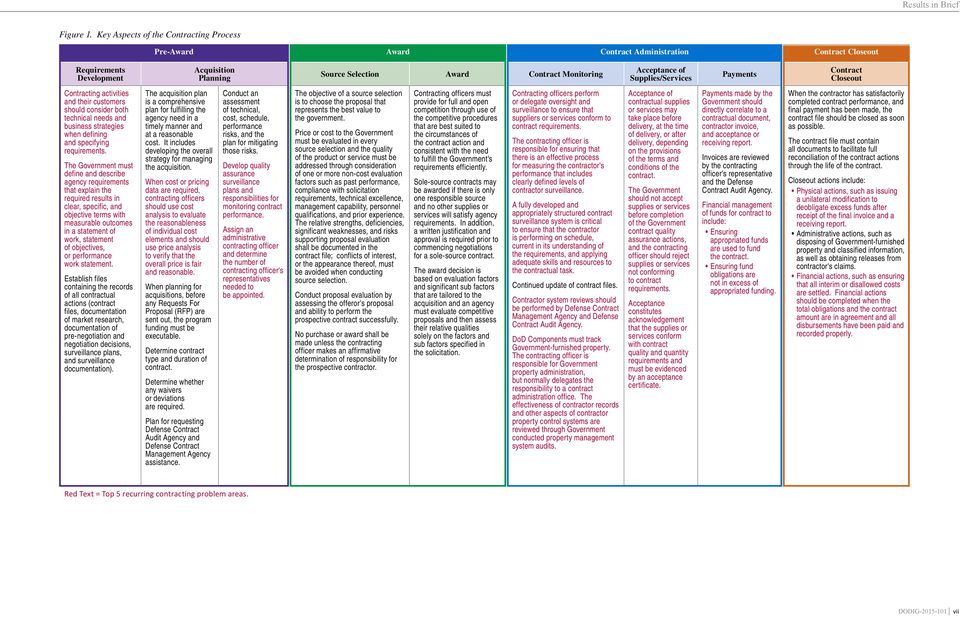
10 Figure 1. Key Aspects of the Contracting Process

11 Results in Brief Figure 2. Fraud Indicators and Poor Practices in Relation to the Contracting Problem Areas Pre-Award Award Contract Administration Requirements Contract Documentation Contract Type Source Selection Contract Pricing Oversight and Surveillance Contractor Personnel Property Accountability Financial Management The Government fails to state requirements functionally to the maximum extent possible. Specifications that are vague make it difficult to reasonably compare estimates. The Government defines statements of work and specifications to fit products or capabilities of a single contractor, which effectively excludes competition. The Government splits requirements to use simplified acquisition procedures in order to avoid review and approval. The Government modifies the contract shortly after award in order to make material changes in the requirements or statement of work. A pattern of missing documents or documentation with outdated information in the contract file. Contract documents that are altered, backdated, or modified to cover deficiencies. Contract awards are made without adequate documentation of all pre award and award actions. Invoices that do not have adequate supporting documentation or supporting documentation is incomplete. Using a costreimbursement type contract may increase the risk that the contractor will fraudulently overcharge the Government. Award/use of an illegal cost-pluspercentage-of cost contract. Improper relationships between Government and contractor personnel. The Government fails to perform market research to determine evaluation factors, contracting method, or whether commercial items or non-developmental items would meet the Government's needs. The Government restricts procurement to exclude or hamper any qualified contractor. The Government reveals information about procurements to one contractor which is not revealed to another. The Government accepts late or non responsive proposals. The Government improperly disqualifies offerors. The Government exercises favoritism towards a particular contractor during the evaluation process. The Government awards contracts to contractors with poor records of performance. The Government awards contracts that include items other than those contained in the bid specifications. The Government's approval or a justification for less than full and open competition is based on improper reasons or inaccurate facts. The Government does not prepare estimates or prepares estimates after solicitations are requested. The Government and contractor utilize unqualified personnel to develop cost or pricing data used in estimates. Government estimates and contract award prices are consistently very close. The Government approves items that are of lesser value but the contract cost is not reduced. The contractor issues an engineering change proposal soon after the award of a contract. Certain contractors always bid against each other or conversely, certain contractors do not bid against one another. There is an apparent pattern of low bids regularly recurring, such as corporation "x" always being the low bidder in a certain geographical area or in a fixed rotation with other bidders. The successful bidder repeatedly subcontracts work to companies that submitted higher bids or to companies that picked up bid packages and could have bid as prime contractors, but did not. Statements by a bidder that it is not their turn to receive a job or conversely that it is another bidder's turn. Contractors award subcontracts to unsuccessful bidders. The Government provides materials to contractors even though contractors are being paid to provide the materials. The contracting officer's representative approves contract modifications. Contractors failed to meet terms but no compliance efforts are undertaken. The Government certifies receipt of goods without performing inspections. The users frequently complain of poor quality of supplies or services provided under a contract. This may indicate that contractors are delivering something less than what you are paying for. The Government fails to closeout contracts in a timely and appropriate manner. Increased workloads and responsibilities that prohibit ongoing DoD monitoring of each contractor's work. Contractors certify payments for vendor goods, services, or salaries. Inadequate management oversight and physical inventory control. Unreliable property inventory data. Inventory records disclose unusual patterns that cannot be reasonably explained. Inventory items marked with incorrect disposal condition codes, such as repairable or scrap, when they should be labeled excellent. Contractors are not required to return excess materials. The contractor submits false invoices or claims to the Government. The Government pays contractors twice for the same items or services without attempting to recoup the overpayments. The Government does not regularly reconcile contract payments, daily transactions, and inventory. The contractor fails to correct known business system deficiencies. Contractors or suppliers complain that they are not being paid in a timely manner. This may indicate fraudulent manipulations and diversion of Government resources through supply or finance operations. Excess profits on either a specific contract, product line, or diversion. Later billings showing a downward adjustment in material costs as labor/ overhead costs increase. The Government's failure to deobligate funds. DODIG ix
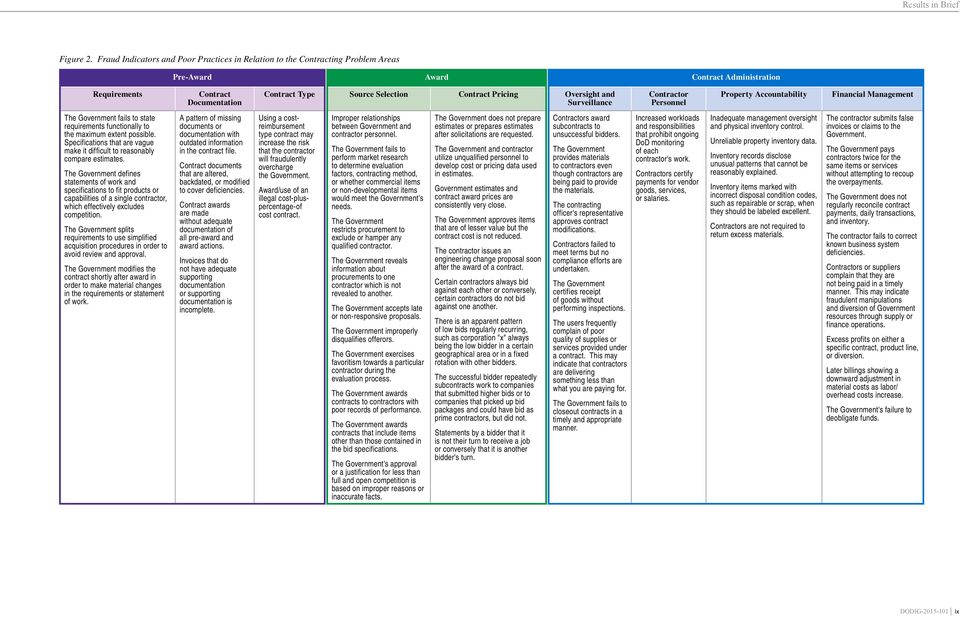
12 Figure 2. Frau d I n th e d C ic o a n t t o r r ac s a n ti ng d P Pr o o o b r P r le m ac A t r ices in Relation to eas

13 Introduction Introduction Objectives Our objective was to provide DoD field commanders and contract managers with information on contracting problems related to contingency operations that the DoD Office of Inspector General (OIG) identified and reported from April 1, 2012, through December 31, This report provides a framework and tool for contracting personnel to use when assessing whether their contracting operations implement the best practices and when identifying vulnerabilities to fraud, waste, and abuse. We discussed current problems related to contingency contracting, as well as re emphasized ongoing problems identified in the DoD IG Report No. D , Contingency Contracting: A Framework for Reform 2012 Update, September 18, 2012, and Report No. D , Contingency Contracting: A Framework for Reform, May 14, Appendix A explains the scope and methodology we used to prepare this follow up summary report. Background Contingency contracting is used to procure supplies and services that directly support domestic and overseas armed conflict and noncombat contingency operations (such as stability operations and disaster relief efforts). A contingency contract is a legally binding agreement awarded by Government contracting officers in the operational area as well as contracts that have a prescribed area of performance within a designated operational area. For contingency operations, DoD routinely relies on contractors to provide front-line support and assist with the cradle-to-grave contracting process. These contractors perform vital tasks in support of U.S. defense and development objectives, including logistics support, equipment processing, construction, base operations support, and transportation. Additionally, because contingency contracting occurs in less controlled environments and within varying cultural, political, and economic conditions overseas, there is a greater potential for violations of law, regulations and contract terms, which increase the need to maintain high ethical standards and procurement integrity for DoD contracting officers. DODIG

14 Introduction Figures 1 and 2 are useful resources to DoD field commanders and contract managers. These flowcharts provide: a visual tool for field commanders and contracting officers to assess the strengths and weaknesses in their contracting approaches; information to encourage real-time awareness of areas that might be susceptible to fraud and contributors to waste and abuse; and a useful snapshot of key contract problems and fraud indicators related to contingency operations. Withdrawal of U.S. Military and Contractor Personnel in Afghanistan As requirements in Afghanistan continue to be reduced, there will be a further decline in the number of contractors in Afghanistan. Since 2011, DoD has been drawing down U.S. forces in Afghanistan for Operation Enduring Freedom (OEF). DoD will continue to support the Afghan National Security Forces as they assume full responsibility for security in Afghanistan after December DoD has drawn down to approximately 9,800 military personnel in Afghanistan in February 2015 from an average of 38,000 in FY In March 2015, President Obama stated that troop strength in Afghanistan would remain at approximately 9,800 through the end of President Obama added that the 2016 drawdown plan would be developed later in Additionally, DoD contractor personnel in Afghanistan have been decreasing since FY In first quarter of FY 2013, DoD had 110,404 contractor personnel in Afghanistan for OEF. By first quarter of FY 2014, the number of contractors decreased to 78,136, and as of first quarter of FY 2015, DoD had 39,609 contractor personnel in Afghanistan. Figure 3 illustrates the decreases in DoD contractor personnel numbers in Afghanistan from FY 2013 to FY Figure 3. Number of DoD Contractor Personnel in Afghanistan 120, , ,000 80,000 78,136 60,000 40,000 39,609 20,000 0 FY 2013 FY 2014 FY DODIG

15 Introduction DoD Spending On Overseas Contingency Operations is Declining Beginning with the FY 2010 budget request, the Office of Management and Budget made significant changes to the criteria for developing the DoD Overseas Contingency Operations (OCO) budget request. The changes will provide more budget transparency and more accurately reflect the temporary and extraordinary requirements of OCO. DoD spending on OCO has declined because DoD has been decreasing combat operations in Afghanistan for OEF. In FY 2010, DoD received $162 billion for its OCO budget. This amount decreased to $88 billion in FY 2013 and further decreased to $65 billion in FY Figure 4 illustrates DoD OCO funded amounts from FY 2010 through FY Figure 4. DoD OCO Budget Authority $180 DoD OCO Budget Authority (in billions) $160 $162 $159 $140 $120 $115 $100 $80 $60 $40 $20 $88 $85 $65 $0 FY 2010 Enacted FY 2011 Enacted FY 2012 Enacted FY 2013 Enacted FY 2014 Enacted FY 2015 Enacted DODIG

16 Introduction Continued Need to Implement Best Contracting Practices in Contingency Environments Although OCO spending has decreased, contingencies continue to occur across the scope of DoD operations. In November 2014, Congress requested FY 2015 Budget amendments for the DoD to increase OCO funding, which were not included in the initial request from June The budget request would provide an additional $5.6 billion for OCO activities to defeat the Islamic State of Iraq and the Levant, including military operations as part of Operation Inherent Resolve. As a result, the total DoD FY 2015 enacted OCO budget was $65 billion. Therefore, although OCO funding is decreasing, it is still essential for DoD field commanders and contracting personnel to ensure that the United States receives what it pays for in a timely manner, at a reasonable price, while meeting quality requirements, especially in contingency operations where the environment is less controlled. Problems Identified in Previous DoD IG Summary Reports on Contingency Contracting On May 14, 2010, DoD OIG issued the first summary report, Report No. D , covering contingency contracting problems in 34 reports issued from October 1, 2007, through April 1, DoD OIG subsequently issued an update to the summary report on September 18, 2012, Report No. DODIG The updated report covered contingency contracting problems in 38 reports issued from April 2, 2010, through March 31, For this report, DoD OIG reviewed 40 reports covering contingency contracting deficiencies from April 1, 2012 through December 31, These 3 summary reports covered 112 DoD IG reports issued during a period of approximately 7 years. DoD OIG consistently identified a total of nine systemic problems in all three summary reports. These nine problem areas included oversight and surveillance, requirements, property accountability, financial management, contract pricing, source selection, contract documentation, contract type, and contractor personnel. 4 DODIG

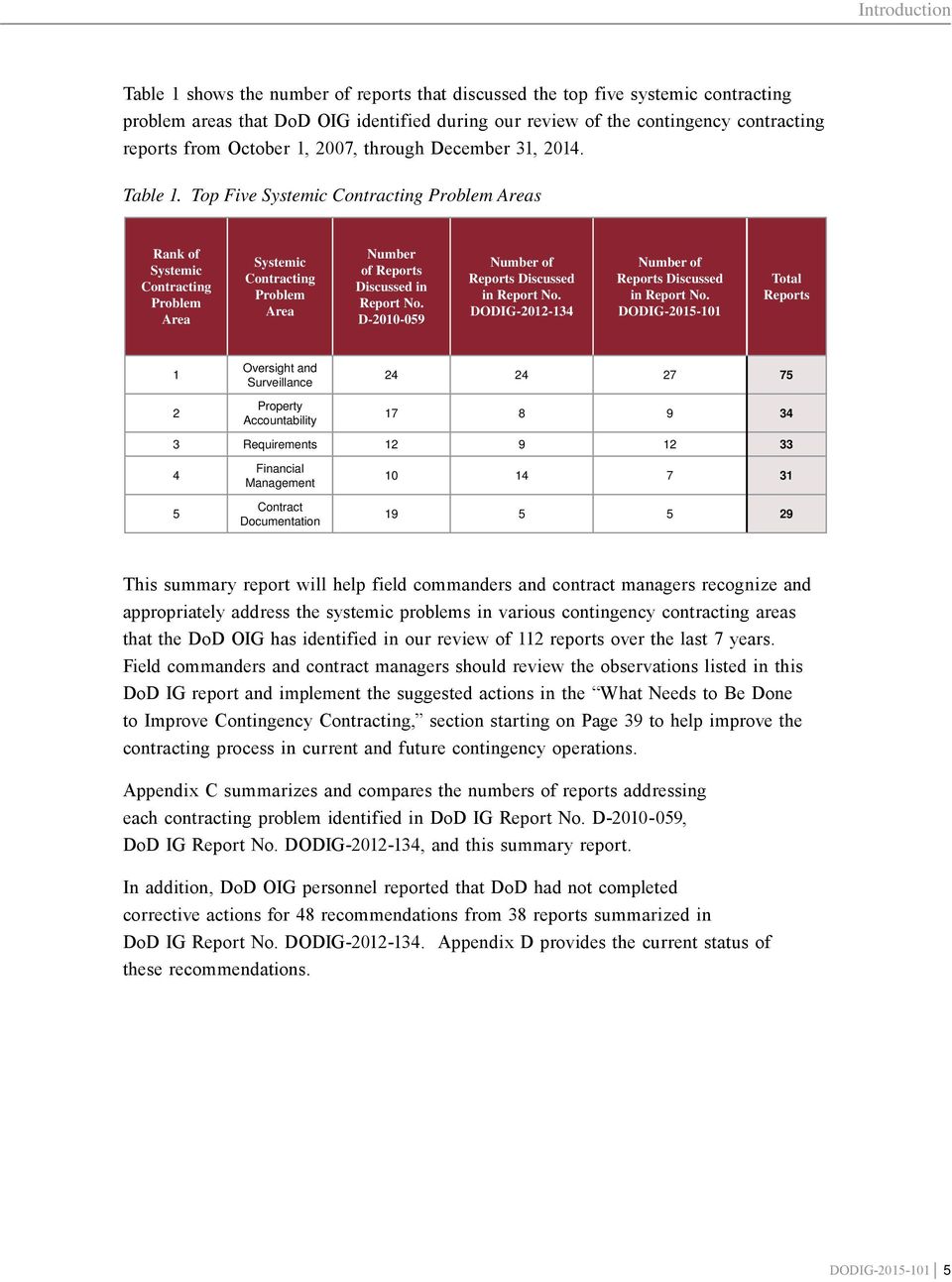
17 Introduction Table 1 shows the number of reports that discussed the top five systemic contracting problem areas that DoD OIG identified during our review of the contingency contracting reports from October 1, 2007, through December 31, Table 1. Top Five Systemic Contracting Problem Areas Rank of Systemic Contracting Problem Area Systemic Contracting Problem Area Number of Reports Discussed in Report No. D Number of Reports Discussed in Report No. DODIG Number of Reports Discussed in Report No. DODIG Total Reports 1 2 Oversight and Surveillance Property Accountability Requirements Financial Management Contract Documentation This summary report will help field commanders and contract managers recognize and appropriately address the systemic problems in various contingency contracting areas that the DoD OIG has identified in our review of 112 reports over the last 7 years. Field commanders and contract managers should review the observations listed in this DoD IG report and implement the suggested actions in the What Needs to Be Done to Improve Contingency Contracting, section starting on Page 39 to help improve the contracting process in current and future contingency operations. Appendix C summarizes and compares the numbers of reports addressing each contracting problem identified in DoD IG Report No. D , DoD IG Report No. DODIG , and this summary report. In addition, DoD OIG personnel reported that DoD had not completed corrective actions for 48 recommendations from 38 reports summarized in DoD IG Report No. DODIG Appendix D provides the current status of these recommendations. DODIG
18 Problems in Contingency Contracting Operations Problems in Contingency Contracting Operations DoD OIG personnel issued 40 reports from April 1, 2012, through December 31, 2014, that identified systemic contracting problems in supporting OCO. DoD IG audits and assessments were self-initiated or based on DoD management requests or statutory requirements. These reports identified a variety of problems in which DoD officials did not properly follow nine contracting areas, which are listed below, in accordance with Federal and DoD policies. We grouped the deficiencies discussed in the reports into these nine contracting problem areas: 1. Oversight and Surveillance; 2. Requirements; 3. Property Accountability; 4. Financial Management; 5. Contract Pricing; 6. Source Selection; 7. Contract Documentation; 8. Contract Type; and 9. Contractor Personnel. Appendix B contains a list of the contracting problem areas by report number. Many of the reports identified more than one contracting problem area. Appendix F contains a list of the 40 contingency contracting reports issued from April 1, 2012, through December 31, In addition, Appendix E provides a description of various fraud indicators at different phases in the contracting process. 1. Inadequate Oversight and Surveillance Twenty seven contingency contracting reports identified oversight and surveillance problems. Specifically, DoD officials did not develop adequate oversight and surveillance procedures to assure that contract requirements were met before the acceptance of deliverables. As a result, DoD officials may not have had effective processes in place to measure contractor s performance, and supplies and services may not have conformed to contract requirements. 6 DODIG

19 Problems in Contingency Contracting Operations We classified the problems in oversight and surveillance into six categories: 1. contracting officer; 2. contracting officer s representative (COR); 3. Defense Contract Management Agency (DCMA); 4. written procedures; 5. insufficient staff; and 6. training and certification. See Appendix B for the 27 reports that addressed the oversight and surveillance problem area. Contract oversight and surveillance are covered under contract administration functions. Oversight and surveillance is an ongoing process to make contractors provide supplies or services on time that conform with quality requirements. Effective oversight and surveillance helps identify contractors that may have performance problems and allows the appropriate course of action to be taken to make sure those supplies or services to be delivered meet the contract requirements. Oversight and surveillance is an ongoing process to make contractors provide supplies or services on time that conform with quality requirements. In general, contracting officers ensure that supplies and services conform to contract requirements and that there is an effective process to measure the contractor s performance with clearly defined levels of contractor surveillance. Contracting officers also obtain technical requirements and product quality requirements (such as testing and inspection) from the responsible activity to include in the contracts. A fully developed and appropriately structured contract surveillance system (like a quality assurance surveillance plan) is critical to ensure that contractors perform on schedule, are current in their understanding of the requirements, and apply adequate skills and resources to the contractual task. Furthermore, to have appropriate contract oversight and surveillance, sufficient personnel should be trained and in place. Contracting officers may delegate contract administration or specialized support services to other Defense agencies, such as DCMA. Contracting officers may also delegate certain contract administration functions to administrative contracting officers and appoint CORs. CORs perform technical monitoring, inspections, acceptance of contract deliverables, and ensure that the contracting officer is fully aware of the contractor s performance. However, CORs do not have authority to make any commitments or changes that affect price, quality, quantity, delivery, or other terms and conditions of the contract. DODIG
20 Problems in Contingency Contracting Operations In addition, the contracting officer should make sure that the quality assurance surveillance plans are prepared in conjunction with the statement of work (SOW). The quality assurance surveillance plans should specify all work requiring surveillance and the method of surveillance. Criteria for Contracting Officer s Responsibilities The Federal Acquisition Regulation (FAR) 1 states that contracting officers are required to ensure that all necessary actions for effective contracting are performed, ensure compliance with terms of the contract, and safeguard the interest of the United States in its contractual relationships. Additionally, the FAR 2 states that contracting officers are required to: ensure that there is an effective process for measuring the contractor s performance; and develop quality assurance surveillance plans. Example of Contracting Officer Not Establishing Adequate Surveillance A contractor received payments for Mi-17 manuals not accepted by or delivered to either Army Contracting Command (ACC) Redstone or Non-Standard Rotary Wing Aircraft Project Management Office officials. This occurred because ACC Redstone contracting officers did not establish adequate surveillance procedures for the cost-reimbursable contract or modify the contract to include the manuals as a deliverable item. As result, the Army paid $216,345 in questionable costs. 3 Criteria for Contracting Officer s Representatives Responsibilities DoD guidance 4 states that contract surveillance is vital to ensure contractors provide quality services and supplies in a timely manner, that the Government receives best value for the warfighter, and to reduce or minimize contractor performance problems. CORs also conduct contract surveillance to verify that the contractor FAR Part 1, Federal Acquisition Regulations System. FAR Part 46, Quality Assurance. DoD IG Report No. DODIG , Improvements Needed in Contract Award of Mi-17 Cockpit Modification Task Order, September 19, Defense Contingency COR Handbook, Version 2, September DODIG

21 Problems in Contingency Contracting Operations fulfills contract requirements and to document performance for the contract record. CORs function as the eyes and ears of the contracting officer and are a liaison between the Government and contractor when they execute surveillance responsibilities. Remediating nonconformance relies heavily on the CORs observation and documentation. CORs must monitor contractor performance through review of monthly reports, onsite visits, and surveillance reviews. CORs function as the eyes and ears of the contracting officer and are a liaison between the Government and contractor when they execute surveillance responsibilities. Example of Contracting Officer s Representatives Not Conducting Effective Surveillance The CORs for the Afghan National Police contract did not conduct effective contractor surveillance. Specifically, the CORs did not always complete the required number of audit checklists based on assigned risk levels. When the CORs documented surveillance on the audit checklists, they did not always provide adequate or consistent information on the audit checklists to communicate their oversight results, complete the entire checklist, or properly document contractor noncompliance for 147 of 166 audit checklists we reviewed. This occurred because the DCMA lead quality assurance representative did not consistently review the COR audit checklists for compliance with the theater quality plan, provide the CORs with feedback on the completed audit checklists, or properly train the CORs on their oversight responsibilities. As a result, DCMA officials could not verify that the Army fully received approximately $20.9 million per month of services paid under the Afghan National Police contract. 5 Criteria for DCMA Responsibilities DoD guidance 6 states that the DCMA mission is to provide contract administration services for the DoD, other authorized Federal agencies, foreign governments, international organizations, and others as authorized. When DCMA is assigned a contract for administration, the FAR 7 requires DCMA to perform contract administration functions to the extent they apply to the contract, except for functions specifically withheld. When DCMA is delegated as the contract administration office, the FAR 8 requires DCMA to: develop and apply efficient procedures for performing Government contract quality assurance actions under the contract in accordance with the written direction of the contracting office; DoD IG Report No. DODIG , DoD Needs to Improve Oversight of the Afghan National Police Training/Mentoring and Logistics Support Contract, June 25, DoD Directive , Defense Contract Management Agency, January 10, FAR Part 42, Contract Administration and Audit Services. FAR Part 46, Quality Assurance. DODIG
22 Problems in Contingency Contracting Operations perform all actions necessary to verify whether the supplies or services conform to contract quality requirements; maintain, as part of the performance records of the contract, suitable records reflecting the (1) nature of Government contract quality assurance actions, including, when appropriate, the number of observations made and the number and type of defects; and (2) decisions regarding the acceptability of the products, the processes, and the requirements, as well as action to correct defects. Example of DCMA Not Adequately Performing Contract Administration Responsibilities North Atlantic Treaty Organization Training Mission Afghanistan/Combined Security Transition Command Afghanistan, DCMA, and ACC Rock Island officials did not implement adequate oversight of the Afghan National Police contract. Specifically, DCMA officials did not: include portions of all 22 sections of the SOWs in the audit checklist used to perform oversight of the Afghan National Police contract; maintain oversight of the contractor s program management office or the Afghan National Police logistics warehouse; provide timely updates to the 11 Afghan National Police audit checklists based on modifications to the contract SOW and DCMA oversight criteria; provide 8 of the 10 CORs we interviewed with the proper audit checklists or require the CORs to complete the required audit checklists; maintain consistent oversight at the 12 Afghan National Police training locations where we reviewed audit checklists; or validate that the contractor resolved internal corrective action reports in a timely manner. This occurred because DCMA personnel did not: coordinate with the North Atlantic Treaty Organization Training Mission Afghanistan/Combined Security Transition Command Afghanistan program management personnel, requirements owners, or ACC Rock Island contracting personnel when they generated or updated audit checklists; coordinate oversight procedures with ACC Rock Island contracting personnel during the contracting process; and implement the quality assurance requirements for oversight in Afghanistan that DCMA considered critical to mission success. As a result, ACC Rock Island could not determine that the contractor fully delivered $439 million of services outlined in the Afghan National Police contract. Additionally, the ACC Rock Island contracting officer could not determine whether 10 DODIG
23 Problems in Contingency Contracting Operations the contractor provided effective training for the Afghan National Police, which could affect the Afghan National Security Forces capabilities to lead security operations throughout Afghanistan. 9 Criteria to Maintain Written Procedures The FAR 10 states that quality assurance surveillance plans should be prepared in conjunction with the preparation of the SOW. The plans should specify all work that requires surveillance and the method of surveillance. Example of Inadequate Written Procedures Landstuhl Regional Medical Center officials, the contracting officer, and the administrative contracting officer did not verify the contractor possessed required authorizing documentation before the contractor performed medical services at Camp As Sayliyah. Specifically, Landstuhl officials did not verify one physician assistant s license was active before granting clinical privileges. Additionally, Landstuhl officials, the contracting officer, and the administrative contracting officer did not verify whether the contractor obtained host-country waivers that authorized medical personnel to perform health care services at U.S. Government facilities within the State of Qatar. The contracting officer at ACC Rock Island did not verify the contractor indemnified the U.S. Government. This occurred because Landstuhl officials did not have a written standard operating procedure that verified authorizing documentation, such as state licenses and host-country waivers. Furthermore, contracting officials were not familiar with and did not implement an Army Regulation 11 when they obtained host-country waivers or FAR 12 requirements for indemnification. As a result, Landstuhl officials may have put DoD personnel at risk for receiving less than optimal health care, endangered patient safety, and increased contractor-initiated compensable events. In addition, Landstuhl officials, the contracting officer, and the administrative contracting officer may have put the Army at risk of violating host country laws. 13 Criteria for Assigning Sufficient Staff The FAR 14 states that cost-reimbursement contracts may only be used when appropriate Government surveillance during performance will provide reasonable assurance that efficient methods and effective cost controls are used DoD IG Report No. DODIG , DoD Needs to Improve Oversight of the Afghan National Police Training/Mentoring and Logistics Support Contract, June 25, FAR Part 46, Quality Assurance. Army Regulation 40-68, Clinical Quality Management, May 22, FAR Part 37, Service Contracting. DoD IG Report No. DODIG , Improvements Needed in the Oversight of the Medical-Support Services and Award Fee Process Under the Camp As Sayliyah, Qatar, Base Operation Support Services Contract, June 26, FAR Part 16, Types of Contracts. DODIG
24 Problems in Contingency Contracting Operations Example of Insufficient Staff Army Field Support Battalion Kuwait personnel did not provide appropriate contract oversight to validate that repairs were needed and labor hours billed were accurate. This occurred because the U.S. Army Sustainment Command did This not sufficiently staff Army Field Support Battalion Kuwait occurred with experienced personnel to oversee the contract. Of the because the U.S. Army Sustainment 13 oversight personnel the audit team interviewed, 11 did Command did not not have experience in providing contract oversight before sufficiently staff Army Field they were assigned to Army Field Support Battalion Support Battalion Kuwait with experienced Kuwait. Additionally, the Quality Assurance Maintenance personnel to oversee Work Plan did not generally require Army Field Support the contract. Battalion Kuwait personnel to approve repairs before the contractor could begin work or review contract labor hours billed. As a result, contractor personnel ordered and installed almost 4 million repair parts and billed $ million for maintenance labor hours worked and the U.S. Army did not have assurance that those costs were justified. 15 Criteria to Train and Certify According to DoD guidance, 16 CORs must possess the necessary qualifications (training) and experience commensurate with the responsibilities delegated to them. The FAR 17 states that contracting officers are required to appoint and train CORs. DoD guidance 18 also states that contracting officers are responsible for monitoring the performance of CORs. Example of Training Not Completed DCMA and International Security Assistance Force Joint Command personnel did not perform adequate oversight of the fielded mentors 19 for the Afghan National Police contract. Specifically, DCMA and International Security Assistance Force Joint Command personnel did not consistently nominate and appoint CORs for fielded mentor oversight and the CORs did not adequately complete DCMA audit checklists. This occurred because DCMA and International Security Assistance Force Joint Command personnel did not have an adequate strategy for oversight of the fielded mentors to overcome the challenges in performing these services in remote and dangerous locations. Additionally, DCMA personnel did not always train fielded mentor CORs or review and follow up on audit checklists received from CORs. As a result, the Commanders for DCMA and International Security Assistance Force Joint Command had limited DoD IG Report No. DODIG , Adequate Contract Support and Oversight Needed for the Tactical Wheeled Vehicle Maintenance Mission in Kuwait, June 1, Defense Contingency COR Handbook, Version 2, September FAR Part 1, Federal Acquisition Regulations System. Defense Contingency Contracting Handbook, Version 4, October Fielded mentors provided on-the-job training and guidance to Afghan National Police mentoring teams and were required to live, sleep, and eat with the teams. 12 DODIG
25 Problems in Contingency Contracting Operations assurance the Army received contracted fielded mentor services for the Afghan National Civil Order Police, Afghan Uniform Police, and Afghan Border Patrol in headquarters, regional, provincial, and district locations throughout Afghanistan Requirements Were Unclear or Changing, Out of-scope, and Incomplete Twelve contingency contracting reports identified requirements problems. Specifically, DoD officials did not establish clear requirements, make sure changes were within the scope of the contract, or include complete contract policy requirements. As a result, unclear requirements and out-of-scope contract changes may have led to increased or questioned contract costs. Additionally, not including all applicable policy requirements for contractors working in contingency operations could put the contractors, DoD civilians, and military personnel at risk of harm. See Appendix B for the 12 reports that addressed the requirements problem. Acquisition begins when agencies establish their needs and define requirements necessary to satisfy those needs. The Government must define and describe agency requirements that explain the required results in clear, specific, and objective terms with measurable outcomes. Contracting officials should consider the technical needs and business strategies when they define and specify requirements. Additionally, contracting officials must ensure that specifications reflect only what is needed to meet the requirements of the mission, and that the SOW, statement of objectives, or performance work statement will not unnecessarily restrict competition or innovation. Further, if changing requirements necessitate contract modification, the contracting officer must determine the modification is within the overall scope of the contract. Modifications that exceed the scope of the original contract should be satisfied through full and open competition, with certain limited exceptions. Criteria to Establish Clear Requirements The FAR 21 states that acquisition planning should begin as soon as the agency identifies a need, preferably well in advance The agency of the fiscal year in which the contract award or order should avoid issuing requirements placement is necessary. The agency should avoid issuing on an urgent basis or requirements on an urgent basis or with unrealistic with unrealistic delivery or performance schedules delivery or performance schedules since it generally since it generally restricts competition and increases prices. Early in the restricts competition and increases planning process, responsible officials should coordinate to prices. determine type, quality, quantity, and delivery requirements DoD IG Report No. DODIG , DoD Needs to Improve Oversight of the Afghan National Police Training/Mentoring and Logistics Support Contract, June 25, FAR Part 7, Acquisition Planning. DODIG
26 Problems in Contingency Contracting Operations Example of Unclear or Changing Requirements Army contracting officials at the ACC Aberdeen Proving Ground did not appropriately award and administer the Afghan National Police contract in accordance with Federal and DoD guidance. Specifically, the Combined Security Transition Command Afghanistan personnel made substantial changes to the Afghan National Police contract SOW immediately after contract award to include: additional job categories; increased qualifications for specific job categories; and additional contractor reporting requirements. This occurred because Combined Security Transition Command Afghanistan, International Security Assistance Force Joint Command, and Army contracting personnel at ACC Aberdeen Proving Ground did not adequately define contract requirements before they awarded the Afghan National Police contract. Additionally, the contractor more than doubled the size and cost of its program management office in the first 4 months of contract performance by adding key program office positions that should have been included as part of its contract proposal. The increase occurred because Combined Security Transition Command Afghanistan and Army contracting personnel at ACC Aberdeen Proving Ground did not identify the omissions during the source selection process. As a result, in the first 4 months of contract performance, the cost of the Afghan National Police contract increased by $145.3 million, approximately 14 percent. In addition, ACC Aberdeen Proving Ground contracting officials may not have awarded the Afghan National Police contract based on the best value. Furthermore, contractor officials had not reached the mentor and trainer staffing levels required by the contract and may not be able to adequately train the Afghans to take full responsibility of the police force by the end of the Afghan National Police contract. 22 Criteria for Awarding Out-of-Scope Requirements The FAR 23 requires contracting officers to promote and provide for full and open competition. Out-of-scope modifications to existing Government contracts should be competed. Contracting officers must include a reference to specific authority when they award a contract without full and open competition. In addition, the FAR 24 requires the agency head to ensure that the SOW is closely aligned with performance outcomes and cost estimates. To reduce the risk of overpaying for goods and services, DoD officials should ensure the SOW is closely aligned with the expectations of the Government and adequately promotes full and open competition DoD IG Report No. DODIG , Afghan National Police Contract Requirements Were Not Clearly Defined but Contract Administration Improved, May 30, FAR Part 6, Competition Requirements. FAR Part 7, Acquisition Planning. 14 DODIG
27 Problems in Contingency Contracting Operations Example of Out-of-Scope Requirements An official from the Non-Standard Rotary Wing Aircraft Project Management Office created an unauthorized commitment for repair work outside the scope of the Mi 17 cockpit modifications under Task Order Task Order 0102 did not include provisions to repair Mi-17 defects; however, the Program Management Office directed the contractor to perform repair work on the task order. This occurred because: the assistant product manager at the Non-Standard Rotary Wing Aircraft Project Management Office, without proper authority, directed a contractor s performance; the contractor did not comply with Logistics Support Facility contract clauses by failing to provide the contracting officer timely notification of work it regarded as changes to the contract terms and conditions; and Figure 5. An Afghan Airman prepares an Mi 17 for flight. Source: U.S. Air Force photo by Senior Master Sgt. Jill LaVoie the ACC Redstone contracting officer was not aware that unauthorized personnel had directed the contractor to perform repair work and did not modify the contract to include the repair work. These actions resulted in the contractor incurring $151,014 in questionable costs for repair work not included in the contract and that may have been covered by an existing overhaul warranty. 25 See Figure 5 above capturing an Mi 17 preparing for flight. Criteria to Include Policy Requirements Contracting officials should ensure all applicable Government policy requirements are included in contracts being procured for contingency operations. The United States has adopted a zero tolerance policy regarding trafficking in persons. The FAR 26 requires the contracting officer to include a Combating Trafficking in Persons (CTIP) clause 27 in all solicitations and contracts. The FAR clause requires the contractor to report any alleged participation in human trafficking and describes the actions taken against employees who violate the policy. Due to the unique situations and locations in which contractor personnel may be immersed during contingency operations, a special emphasis on DoD IG Report No. DODIG , Improvements Needed in Contract Award of Mi-17 Cockpit Modification Task Order, September 19, FAR Part 22, Application of Labor Laws to Government Acquisitions. FAR Part 52, Solicitation Provisions and Contract Clauses, Subpart 52.2, Text of Provisions and Clauses, , Combating Trafficking in Persons. DODIG
28 Problems in Contingency Contracting Operations Government policy requirements is necessary. Contracting officials negligence to include all applicable policy requirements for contractors working in contingency operations could put the contractors, DoD civilians, and military personnel at risk of harm. Example of Missing Contract Policy The FAR requires the contracting officer to include a CTIP clause in all solicitations and contracts. Out of a selected sample of contracts for construction and services within the Islamic Republic of Afghanistan, 227 of 240 (95 percent) included the proper version of FAR clause , Combating Trafficking in Persons. The report noted that this was a marked improvement compared to results discussed in three prior CTIP reports where approximately half of the contracts reviewed did not include the FAR CTIP clause or included an outdated or incorrect version of the CTIP clause. As a result, in most cases, contracting officers responsible for contracts performed in the Islamic Republic of Afghanistan were equipped to apply remedies in the case of substantiated CTIP related violations Property Accountability Not Properly Maintained Nine contingency contracting reports identified property accountability problems. Specifically, DoD officials did not provide appropriate oversight of Government property. As a result, DoD officials may not have maintained effective property accountability for financial reporting purposes and inventory systems may not accurately reflect available Government property. Additionally, not maintaining adequate accountability over Government property increases the vulnerability for loss or theft. See Appendix B for the nine reports that addressed the property accountability problems. The Government relies on and requires contractors to provide effective and efficient stewardship of Government property in their custody. The contracting officer is responsible for oversight of stewardship, but normally delegates the responsibility to a contract administration office. When responsibility is delegated to DCMA, DCMA assigns a property administrator to review the contract to determine whether property administration is required and to ensure contracts contain appropriate clauses that pertain to furnished or acquired property. For contingency contracts, the property administrator should advise buying commands to coordinate their requests for property administration with U.S. Central Command Contracting Command. The property administrator should be alert to unique in-theater contractual and technical requirements, period of performance dates, contracts with special terms and conditions, and inappropriate instances of furnished or acquired property. 28 DoD IG Report No. DODIG , Evaluation of DoD Contracts Regarding Combating Trafficking in Persons: Afghanistan, May 15, DODIG
29 Problems in Contingency Contracting Operations Criteria to Maintain Property Accountability DoD guidance 29 requires DoD Components to maintain accountability for property, including Government property furnished to contractors. Accountable property records must include the current status, location, and condition of the property until the authorized disposition of the property. An accountable property system of record should include: name, part number, and description; accountable and custodial organization; quantity and status of the property; unique item identifier; location of property; and current condition. In addition, the guidance also requires DoD Components to maintain accountable property records to provide a complete trail of all transactions suitable for audit. Those records will be the authoritative source that validates the existence and completeness of an asset. Furthermore, DoD Components should establish and maintain records and accountability for property of any value furnished to contractors as Government furnished property. Example of Property Accountability Not Properly Maintained Defense Logistics Agency Disposition Services in Afghanistan did not adequately control excess equipment disposal. Specifically, Defense Logistics Agency Disposition Services officials did not: have accountability over $7.5 million of $8.5 million in excess equipment or correctly code all excess equipment that required demilitarization. 30 This occurred because Defense Logistics Agency Disposition Services officials did not appropriately train personnel during reutilization business integration implementation to effectively perform daily operations. Specifically, Defense Logistics Agency Disposition Services officials did not have accountability over $7.5 million of $8.5 million in excess equipment DoD Instruction , Accountability and Management of DoD Equipment and Other Accountable Property, May 19, Demilitarization is destroying an item s military offensive and defensive capability. DODIG
30 Problems in Contingency Contracting Operations certify and verify demilitarization of excess equipment for 28 of 93 disposal turn-in documents, valued at $1.6 million, in accordance with applicable guidance, nor accurately account for and bill scrapped equipment sold on 5 of 30 days. This occurred because Defense Logistics Agency Disposition Services Afghanistan officials did not adequately monitor the certification and scrap accounting processes to identify control weaknesses or implement effective measures to correct control weaknesses related to those processes. implement access and security controls to adequately safeguard equipment. This occurred because Defense Logistics Agency Disposition Services officials did not develop local standard operating procedures for staff rotating into Afghanistan to follow. include the export-controlled items clause in the Defense Logistics Agency Disposition Services Afghanistan labor contract. This occurred because the clause was inadvertently omitted by Defense Logistics Agency Disposition Services officials. In addition, these conditions occurred because Defense Logistics Agency Disposition Services officials did not complete an assessment to determine the appropriate number of personnel responsible for oversight within Afghanistan and assign staff accordingly to provide adequate oversight. Defense Logistics Agency Disposition Services lack of controls and oversight during the drawdown period increased the risk of fraud, theft, improper release of sensitive excess equipment in Afghanistan without proper disposal, and transfer of sensitive equipment technology. In addition, Defense Logistics Agency Disposition Services did not receive approximately $13,900 for scrapped equipment sold Financial Management Not Adequate Seven contingency contracting reports identified financial management problems. Specifically, DoD officials did not verify whether contractor invoices contained appropriate charges or did not manage funds in accordance with laws and regulations to prevent potential violations of the Antideficiency Act. As a result, DoD officials may have paid contractor invoices that were not allowable, allocable, or reasonably within the scope of the contract. Additionally, DoD officials may have violated the Antideficiency Act when they obligated funds to contracts. We classified the problems related to financial management into two categories: billing and payments and fund execution. See Appendix B for the seven reports that addressed financial management problems. 31 DoD IG Report No. DoDIG , Defense Logistics Agency Disposition Services Afghanistan Disposal Process Needed Improvement, November 8, DODIG
31 Problems in Contingency Contracting Operations DoD officials are required to ensure that DoD organizations maintain control of payments made to contractors. Further, the FAR 32 states that the Government may only pay for contract costs that are allowable, allocable, and reasonable. Moreover, the Government should only make payments that directly correlate to a contractual document, contractor invoice, and acceptance or receiving report. In addition, complete, consistent, and accurate contract files and accounting records are necessary to minimize the number of problem disbursements and reduce the potential for inappropriate fund execution. Criteria for Billings and Payments The FAR 33 states that a payment will be based on receipt of a proper invoice and satisfactory contract performance. Further, DoD guidance 34 states that the COR must maintain a copy of all invoices and vouchers. Without these necessary documents, it is impossible to determine whether invoices approved for payment were allowable, allocable, or reasonably within the contract scope. Therefore, before a payment is made, DoD Components must ensure that appropriate payment documentation is established to support payment of invoices. This documentation normally includes the contract, receipt/acceptance report, and a proper invoice. The FAR 35 states that normally, the Defense Contract Audit Agency (DCAA) is the responsible Government Audit Agency. Additionally, the Defense Federal Acquisition Regulation Supplement (DFARS) 36 and DoD guidance 37 states that DCAA is the authorized representative to receive vouchers from contractors; approve interim vouchers for provisional payment; and review completion/final vouchers and send them to the administrative contracting officer. Example of Billings and Payments Not Properly Verified Program Executive Office for Simulation, Training, and Instrumentation contracting and oversight personnel did not review contractor interim invoices, totaling $192.7 million, on the Kuwait Observer Controller Team task orders before provisionally paying the interim invoices. This occurred because the contracting officer used a quality assurance surveillance plan that did not include procedures for reviewing contractor invoices. Additionally, DCAA only performs administrative evaluations of interim FAR Part 31, Contract Cost Principles and Procedures. FAR Part 32, Contract Financing. Defense Contingency COR Handbook, Version 2, September FAR Part 42, Contract Administration and Audit Services. DFARS Part 242, Contract Administration and Audit Services. DoD Directive , Defense Contract Audit Agency, January 4, DODIG
32 Problems in Contingency Contracting Operations invoices before approving them for payment. As of August 2012, DCAA auditors had not yet audited the costs claimed on the interim invoices to determine whether the costs were allowable because of a backlog of pending incurred cost audits. As a result, the Program Executive Office for Simulation, Training, and Instrumentation paid approximately $70,000 in questioned direct travel costs and may be paying for other unreasonable and unallowable supplies and services on the task orders. 38 Criteria for Funds Execution The Antideficiency Act, Misappropriation Act, and the Bona Fide Needs Rule are three legal provisions that control the execution of appropriated funds. Antideficiency Act 39 states that an agency cannot obligate more funds than appropriated or obligate funds in advance of appropriations. Bona Fide Needs Rule 40 requires that appropriated funds be used only for goods and services for which a need arises during the period of that appropriation s availability for obligation. Misappropriation Act 41 states that appropriations shall be applied only to the objects for which the appropriations were made except as otherwise provided by law. Example of Potential Antideficiency Act Violations U.S. Agency for International Development inappropriately obligated $17.6 million of Commander s Emergency Response Program funds for projects that were not approved by U.S. Central Command Joint Theater Support Contracting Command and U.S. Forces Afghanistan, and were outside the original scope of the approved Economy Act Orders. As a result, U.S. Central Command Joint Theater Support Contracting Command and U.S. Agency for International Development may have committed Antideficiency Act violations Contract Price Reasonableness Was Not Adequately Determined Six contingency contracting reports identified contract pricing problems. Specifically, contracting officials did not perform adequate price reasonableness determinations. As a result, the DoD paid more than fair and reasonable prices for goods and services procured. See Appendix B for the six reports that addressed the contract price reasonableness problem DoD IG Report No. DODIG , Improved Oversight, but No Invoice Reviews and Potential Antideficiency Act Violation May Have Occurred on the Kuwait Observer Controller Team Task Orders, August 2, The Antideficiency Act is codified in sections 1341, 1342, and 1517, of title 31, United States Code (31 U.S.C. 1341, 1342, 1517 [2014]). The Bona Fide Needs Rule is codified in 31 U.S.C (2014). The Misappropriation Act is codified in 31 U.S.C (2014). DoD IG Report No. DODIG , DoD Needs to Improve Controls Over Economy Act Orders with U.S. Agency for International Development, August 14, DODIG
33 Problems in Contingency Contracting Operations Contracting officers must purchase supplies and services at fair and reasonable prices and evaluate the reasonableness of the offered prices. Contracting officers should determine the level of detailed analysis needed based on the complexity and circumstances of each acquisition, and they may request the advice and assistance of other experts to ensure that they perform appropriate analysis. When the contract does not require certified cost or pricing data, the contracting officer must perform price analysis. The Government may use a variety of price analysis techniques to ensure fair and reasonable pricing, such as: compare the proposed price to prices found reasonable on previous purchases; compare the proposed price to independent Government cost estimates; and analyze the pricing information provided by the offeror. When the contract requires certified cost or pricing data, contracting officers should use cost analysis to evaluate the reasonableness of individual cost elements and should use price analysis to verify that the overall price is fair and reasonable. Criteria for Obtaining Fair and Reasonable Prices The FAR 43 states that the objective of proposal analysis is to ensure that the final agreed upon price is fair and reasonable. The contracting officer may use various price and cost analysis procedures to ensure that the Government receives a fair and reasonable price. Example of Contract Price Reasonableness Not Adequately Determined The ACC Redstone contracting officer did not determine whether prices were fair and reasonable for the $8.1 million value of Mi-17 parts inventory procured to support the overhaul of five Pakistani Mi-17 aircraft under Task Order Specifically, the contracting officer did not require subcontractor competition, obtain cost and pricing data, document a price reasonableness determination, conduct negotiations, or perform cost analysis on the proposed Mi-17 parts inventory in accordance with the FAR. This occurred because the ACC Redstone contracting officer relied on a previous price reasonableness analysis she had performed on a forecasted list of replacement parts. As a result, the Army did not obtain the benefits of either competition or negotiation based on price and costing data for the Mi-17 parts inventory and therefore, overspent about $1.3 million for parts and storage costs previously received at a less expensive price FAR Part 15, Contracting by Negotiation. DoD IG Report No. DODIG , Army Needs To Improve Mi-17 Overhaul Management and Contract Administration, August 30, DODIG
34 Problems in Contingency Contracting Operations 6. Source Selection Without Full and Open Competition Five contingency contracting reports identified source selection problems. Specifically, contracting officials did not provide full and open competition or select qualified vendors during source selection. As a result, DoD is at greater risk that it will not receive quality goods and services or receive the best value for the Government without proper source selection. See Appendix B for the five reports that addressed the source selection problem. Contracting officers must provide for full and open competition Contracting when they solicit offers and award Government contracts, officers must unless exceptions apply. The objective of source selection provide for full and open competition is to select the proposal that represents the best value to when they solicit the Government. The Government sends prospective offers and award Government contracts, contractors solicitations to request the submission of offers unless exceptions or quotations. Proposal evaluation is an assessment of the apply. offeror s proposal and ability to perform the prospective contract successfully. The contracting officer must award contracts based on evaluation factors that are tailored to the acquisition. The contracting officer must evaluate price or cost in every source selection, as well as the quality of the product or service. The evaluation must be made through consideration of one or more noncost evaluation factors, such as past performance, compliance with solicitation requirements, technical excellence, management capability, personnel qualification, and prior experience. The contracting officer must document strengths, deficiencies, significant weaknesses, and risks supporting proposal evaluation in the contract file. Furthermore, the contracting officer must avoid conflicts of interest, or the appearance thereof, when conducting source selection. Criteria for Selecting Qualified Vendors The FAR 45 states the source selection authority shall ensure consistency among the solicitation requirements, notices to offerors, proposal preparation instructions, evaluation factors and subfactors, solicitation provisions or contract clauses, and data requirements. The FAR 46 states the award of a contract to a supplier based on lowest evaluated price alone can be false economy if there is subsequent default, late deliveries, or other unsatisfactory performance resulting in additional contractual or administrative costs FAR Part 15, Contracting by Negotiation. FAR Part 9, Contractor Qualifications. 22 DODIG
35 Problems in Contingency Contracting Operations Example of Vendor Not Qualified The U.S. Transportation Command contracting officer awarded a contract 47 to a contractor that did not meet the security clearance requirements established by U.S. Central Command. Specifically, the foreign-owned and based contractor was not eligible for and could not obtain a secret-level facility clearance. This occurred because U.S. Transportation Command awarded the contract based on U.S. Central Command s immediate needs for super-heavy lift transportation services, rather than on the contractor s abilities to fully perform contracted services in accordance with the security requirements for the Afghanistan Rotary Wing Transport contracts. As a result, U.S. Central Command personnel released classified operations and threat information for nearly 3 years to contractor personnel who did not possess the requisite security clearances. 48 Criteria for Competitive Contract Awards The FAR 49 states a contract price is based on adequate price competition if two or more responsible offerors submit priced offers that satisfy the Government s expressed requirement and: the award is made to the offeror whose proposal represents the best value, where price is a substantial factor in source selection; and there is no finding that the price of the otherwise successful offeror is unreasonable. Example of Noncompetitive Contract Award The ACC contracting officials did not properly award or manage 19 of the 45 contract actions the audit team reviewed, valued at approximately $45.4 million of a $103.2 million total, in accordance with applicable contract regulations. In addition, for 13 contract actions, valued at approximately $43 million, ACC contracting officials did not include specific quality requirements in the contract to verify that the small arms were in working order before acceptance. This occurred because ACC contracting officials did not perform all necessary contracting procedures when they expedited the procurements. Specifically, the contracting officials did not: properly compete or adequately justify sole-source awards for 6 actions; adequately determine foreign subcontractor qualifications before award for 13 actions; Contract No. HTC D R027. DoD IG Report No. DODIG , Improvements Are Needed in Contractor Oversight, Mission Security, and Personnel Safety for the Afghanistan Rotary Wing Program Contracts, March 11, FAR Part 15, Contracting by Negotiation. DODIG
36 Problems in Contingency Contracting Operations adequately address contractor nonperformance on 2 actions; and require Government officials to perform anything other than a visual inspection to verify that the correct weapons and quantity were shipped before acceptance in Afghanistan for 13 actions. As a result, ACC Warren (Rock Island) may have overpaid on six contract actions, valued at approximately $2.3 million, and foreign-manufactured small arms may be delivered late, not at all, or be poor quality. In addition, the Department of the Army may have to pay a delinquent contractor up to $182,661 in incurred costs and will be unable to recoup the excess costs for any replacement contracts Inadequate Contract Documentation Five contingency contracting reports identified contract documentation problems. Specifically, contracting officials did not prepare and maintain required contract documentation to support decisions made as required by the FAR and DFARS. As a result, contracting officials may not have supported contractual decision making and actions taken. See Appendix B for the five reports that addressed the contract documentation problem. The head of the contracting office and the contract administration office, if assigned, Figure 6. U.S. Air Force contract should maintain files that contain the administrator, pulls a contract. Source: U.S. Air Force photo by record of all contractual actions. The Senior Airman Camilla A Elizeu/Released documentation in the contract file should document the rationale and actions taken for the entire procurement process and support all contractual actions taken. Specifically, the contract file should contain documentation that supports the basis of the acquisition and the award of the contract; assignment of contract administration; the performance of contract administration responsibilities; and actions taken reflecting contract payment. Additionally, the contract file should provide a complete audit trail that can be used to support future reviews, investigations, litigation, and congressional inquiries. See Figure 6 above demonstrating a U.S. Air Force contract administrator pulling a contract. Contracting officials should maintain the following documentation in the contract file: a signed copy of the awarded contract, all contract modifications, and documents that support the contract modifications; 50 DoD IG Report No. DODIG , Improving Army Contract Award and Management for Small Arms Acquired Using Afghanistan Security Forces Funds, May 30, DODIG
37 Problems in Contingency Contracting Operations justifications and approvals, determinations and findings, and associated documents; contract type justification; source selection documentation; cost or price analysis; quality assurance and property records; and bills, invoices, vouchers, and supporting documents. By maintaining a complete contract file containing records of all contractual actions, contracting officials can support decision making, actions taken, and reviews and investigations, as well as furnish essential facts in case of litigation or congressional review. Criteria to Maintain Contract File The FAR 51 states that contract administration files should document actions that reflect the basis for and the performance of contract administration responsibilities. DFARS 52 requires that official contract files consist of original, authenticated, or conformed copies of contractual instruments, as well as signed or official copies of correspondence, memorandums, and other documents. Each contract file should provide a complete background for decision making, actions taken, and reviews and investigations, as well as furnish essential facts in case of litigation or congressional review. Example of Contract File Not Maintained ACC contracting officials did not document the need for the requirement for 25 of 45 contract actions, valued at ACC contracting approximately $49.3 million of $103.2 million total, and officials did not the use of commercial acquisition procedures for 10 of document the need for the requirement 45 contract actions, valued at approximately $19.2 million. for 25 of 45 contract This occurred because contracting officials did not obtain actions, valued at approximately and maintain a letter of offer and acceptance to support $49.3 million. the requirement and did not have documentation in the contract file to support that the foreign-manufactured small arms were commercial items as required by the FAR. As a result, ACC contracting officials could procure the incorrect item or quantity because the letter of offer and acceptance was not in the file to validate the customer request. In addition, FAR Part 4, Administrative Matters. DFARS Part 204, Administrative Matters. DODIG
38 Problems in Contingency Contracting Operations ACC contracting officials could inappropriately use commercial acquisition procedures that may limit the Government s ability to monitor and inspect the foreign manufactured small arms before delivery Use of Inappropriate Contract Type Four contingency contracting reports identified contract type problems. Specifically, contracting officials used an inappropriate contract type to award contracts. As a result, contracting officials allowed for the use of contracts that provided less incentive for the contractor to control costs. See Appendix B for the four reports that addressed the contract-type problem. A wide selection of contract types are available to provide needed flexibility in the large variety and volume of supplies and services required by the DoD. Contract types vary according to the degree and timing of the responsibility assumed by the contractor for the costs of performance and the incentive offered to the contractor who meets or exceeds specified standards. The specific contract types range from firm-fixed price, which the contractor has full responsibility for the performance costs and resulting profit (or loss), to cost plus fixed fee contracts, which the contractor has minimal responsibility for the performance costs and the negotiated fee (profit) is fixed. Criteria for the Use of Cost-Type Contracts The FAR 54 states that: cost-reimbursement contracts shall only be used when the agency cannot define its requirements sufficiently to allow for a fixed-price type contract; circumstances may dictate that different contract types be used during the course of an acquisition program; and contracting officers should avoid using a cost-reimbursement or time and materials contract after experience provides a basis for firm pricing. Additionally, the FAR 55 states that contract requirements should be structured in a manner that will permit some, if not all, of the requirements to be awarded on a firm fixed price basis either in the current contract, or in future option years. This will facilitate an easier transition to a firm-fixed-price contract because a cost history will be developed for a recurring definitive requirement DoD IG Report No. DODIG , Improving Army Contract Award and Management for Small Arms Acquired Using Afghanistan Security Forces Funds, May 30, FAR Part 16, Types of Contracts. FAR Part 7, Acquisition Planning. 26 DODIG
39 Problems in Contingency Contracting Operations Example of the Inappropriate Use of Cost Type Contracts ACC officials could gain efficiencies in the Camp As Sayliyah installation operating contract by reviewing the base-operations contract line items to determine if contract requirements could be reduced to align with current personnel levels and whether those requirements could be provided on a firm-fixed-price basis. Specifically, personnel levels have been stable, contractor work requirements stabilized, and all subcontracts were firm-fixed-price. However, the procuring contracting officer did not fully implement FAR requirements to avoid extended use of cost-reimbursement contracts. Specifically, the procuring contracting officer had not implemented FAR Part 17, Special Contracting Methods, to determine if the requirements covered by the option year fulfilled an existing need, and FAR Part 16 to determine whether historical costs and experience provided a basis for reduced risk and therefore, firmer contract pricing before executing the option years. As a result, the procuring contracting officer exercised option years that may have unnecessarily increased ACC Rock Island contracting costs as cost-reimbursement contracts provide contractors with less incentive to control invoiced costs. Furthermore, costs and administrative oversight may be reduced by converting portions of the cost-reimbursement contract to a lower risk firm fixed-price contract with reduced contract requirements Contractor Personnel Performed Prohibited Functions One contingency contracting report identified contractor personnel performing prohibited functions. Specifically, DoD officials did not implement appropriate measures to prevent contractors from performing functions that might be personal services. As a result, DoD officials may have created an improper employer-employee relationship. See Appendix B for the report that addressed contractor personnel performing prohibited functions. DoD relies on contractors to deliver a large range of products and services to support contingency operations. This can create problems with respect to the roles and relationships between Government employees and contractor employees. The Government requires the contracting officer to be aware of potential conflicts of interest problems during the procurement process and prohibits the award of personal service contracts unless specifically authorized by statute. 56 DoD IG Report No. DODIG , Invoice Processes Administered in Accordance With DoD Guidance; However, Purchase Request Approvals Need Improvement and the Army Could Gain Efficiencies by Converting to a Firm-Fixed-Price Contract, May 2, DODIG
40 Problems in Contingency Contracting Operations Criteria for Personal Services The FAR 57 states that personal services are an employer-employee relationship between the Government and contractor personnel. The Government is normally required to obtain its employees by direct hire under competitive appointment or other procedures required by the civil service laws. Obtaining personal services by contract, rather than by direct hire, circumvents those laws unless Congress has specifically authorized acquisition of the services by contract. When assessing whether a proposed contract is personal in nature, the FAR provides the following descriptive elements as potential indicators of personal services contracts. performance onsite; principal tools and equipment furnished by the Government; services are applied directly to the integral effort of agencies or an organizational subpart in furtherance of assigned function or mission; comparable services that meet comparable needs are performed in the same or similar agencies using civil service personnel; the need for the type of service provided can reasonably be expected to last beyond 1 year; and inherent nature of the service, or manner in which provided, reasonably requires direct or indirect Government supervision of contractor employees. Example of Contractors Performing Personal Services Army and DCMA officials did not administer the medical services functional area of the Camp As Sayliyah Installation Base Operations Support Services contract in compliance with the FAR. 58 Specifically, the administrative contracting officers did not verify contractor physician assistants provided medical services under proper supervision and Landstuhl Regional Medical Center officials erroneously authorized the Area Support Group Qatar command surgeon to supervise contractor physician assistants under a nonpersonal services contract FAR Part 37, Service Contracting. FAR Part 37, Service Contracting. 28 DODIG
41 Problems in Contingency Contracting Operations This occurred because the contracting officer at ACC Rock Island did not clarify in the performance work statement, the contractor s responsibility to provide a medical doctor to supervise the medical and professional aspects of health care services provided in accordance with the FAR 59 and the contract proposal. In addition, an Army Regulation 60 did not prohibit the appointment of Government employees that supervised physician assistants who provided services under a nonpersonal health care contract, which directly contradicts the FAR. 61 As a result, the contracting officer created an improper employer-employee relationship and put the Army at risk of liability for any claims that would allege negligent professional judgment and diagnosis for specific medical treatments by the contractor. DoD officials paid approximately $211,000 in questionable labor costs for a medical health service manager who was not a medical doctor and not qualified to direct the medical staff to perform clinical tasks. 62 The contracting officer created an improper employer employee relationship and put the Army at risk of liability for any claims that would allege negligent professional judgment FAR Part 37, Service Contracting. Army Regulation 40-68, Clinical Quality Management, May 22, FAR Part 37, Service Contracting. DoD IG Report No. DODIG , Improvements Needed in the Oversight of the Medical-Support Services and Award Fee Process Under the Camp As Sayliyah, Qatar, Base Operation Support Services Contract, June 26, DODIG
42 What Has Been Done Based on Our Audits What Has Been Done Based on Our Audits DoD OIG personnel made 304 recommendations in 40 reports to address the 9 contracting problem areas related to contingency operations. As of March 3, 2015, 233 recommendations were closed and 71 remain open. See Table 2 below for an overview of the number of reports for each problem area and the associated recommendations and status. Additionally, Table 3. Number of Closed and Open Recommendations by Report for Each Contracting Problem Area on Page 37 provides a breakdown of the 304 recommendations by report number. Table 2. Number of Reports and Recommendations by Contracting Problem Area Contracting Problem Area Number of Reports Number of Closed Recommendations Number of Open Recommendations Oversight and Surveillance Requirements Property Accountability Financial Management Contracting Pricing Source Selection Contract Documentation Contract Type Contractor Personnel* Total: * This problem area includes contractor personnel performing prohibited functions. Note: The reports numbers do not add up to 40 because some reports had more than one contracting problem. The following provides a brief discussion of the open and closed recommendations in the 40 reports by each problem area. The discussion also includes an example of corrective actions taken to address the contracting problem areas. 30 DODIG
43 What Has Been Done Based on Our Audits Oversight and Surveillance Of the 150 recommendations to improve oversight and surveillance, 125 recommendations were closed, and 25 remain open. For example, DoD IG Report No. DODIG recommended that the Contracting Officer, ACC Rock Island, coordinate with the Combined Security Transition Command Afghanistan Training Program Support Officer, Program Manager, Afghan National Police training contract; and the Commander, DCMA Afghanistan, to review the Afghan National Police training contract oversight strategy and: determine whether the current oversight strategy is appropriate to oversee contractor performance on the Afghan National Police contract and modify the oversight strategy as required; and develop audit checklists or a quality assurance surveillance plan, or both, that includes which SOW and contract requirements are critical to the success of the Afghan Nation Police Contract. Additionally, the report recommended the contracting officer, at ACC Rock Island to subsequently coordinate with the Training Program Support Office and DCMA Afghanistan personnel and update the audit checklists or quality assurance surveillance plan as necessary when the Afghan Nation Police contract SOW is modified. The Commander, ACC concurred and commented that ACC Rock Island continuously worked with the Training Program Support Office and DCMA Afghanistan to review and refine the oversight strategy. ACC Rock Island determined that use of the audit checklists instead of a quality assurance surveillance plan was adequate, but it was vital that the checklists be regularly updated as the SOW was modified. DCMA indicated that its personnel must follow the theater quality plan for surveillance and that the lead quality assurance representative was responsible for updating the audit checklists. Additionally, the Commander commented that ACC Rock Island had always provided DCMA Afghanistan with an updated SOW after every change. After further discussions on the oversight strategy, DCMA Afghanistan agreed to update the audit checklists after every SOW change. Furthermore, ACC Rock Island added the lead quality assurance representative directly to the distribution of any SOW changes to ensure that audit checklists were updated expeditiously. DODIG
44 What Has Been Done Based on Our Audits Requirements Of the 32 recommendations to address inadequate requirements, 19 recommendations were closed, and 13 remain open. For example, DoD IG Report No. DODIG recommended the Assistant Secretary of the Army for Acquisition, Logistics, and Technology ensure that a FAR Clause 63 was included in all contracts identified as deficient in our review. In response, the Army stated that the required FAR clause was included in all contracts identified as deficient. Property Accountability Of the 24 recommendations to improve property accountability, 21 recommendations were closed, and 3 remain open. For example, DoD IG Report No. DODIG recommended that the Commanding General, U.S. Army Communications Electronics Command, verify the COR who provides oversight confirm the Bagram Air Field repair facility contractor is conducting physical inventories and maintaining accurate inventories of sensitive items. In response, the U.S. Army Material Command stated that the U.S. Army Communications Electronics Command Logistics and Readiness Center Field Support Directorate, Field Support Sustainment Division, revised the standard operating procedure for the Bagram Regional Support Command manager to require the performance of monthly inventories for 100 percent accountability of all night vision devices, associated spare parts, and repair parts at each Regional Support Center. The Executive Deputy stated that the COR now receives reports for verification and completeness. In addition, he stated that U.S. Army Communications Electronics Command Logistics and Readiness Center Field Support Directorate, Field Support Sustainment Division deploys Department of the Army civilians under the Electronic Sustainment Support Center as CORs for the task order responsible for the Afghan National Security Forces sustainment support. These civilians deploy on a rotating basis, providing key management and oversight controls to verify standardized operating procedures are properly performed. Financial Management Of the 41 recommendations that addressed financial management, 30 recommendations were closed, and 11 remain open. For example, DoD IG Report No. DoDIG recommended the Under Secretary of Defense (Comptroller)/Chief Financial Officer, DoD, chair a meeting with the Under Secretary of Defense for Acquisition, Technology, and Logistics and the Under Secretary of Defense for Personnel and Readiness to select a DoD functional proponent to oversee the billing system for health care provided to contractor personnel authorized to accompany U.S. Armed Forces in contingency 63 FAR Clause , Combating Trafficking in Persons. 32 DODIG
45 What Has Been Done Based on Our Audits operations. In response, the Deputy Comptroller stated that the Assistant Secretary of Defense for Health Affairs was designated as the functional proponent. The multi functional team meets on an as needed basis to address deficiencies as they arise. Contract Pricing Of the 25 recommendations that addressed contract pricing, 17 recommendations were closed, and 8 remain open. For example, DoD IG Report No. DODIG recommended that the Executive Director, Aviation and Missile Life Cycle Management Command/Army Space and Missile Defense Command, ACC, establish controls to verify that the contracting officers obtain cost and pricing data, for modifications expected to exceed $700,000, as required by the FAR. 64 As a result, the Army established controls to verify that contracting officers use cost and price analyses appropriately, obtain cost and pricing data for modifications when required, and document fair and reasonable price determinations. An ACC Redstone standard operating procedure 65 specified several requirements for contract awards to ensure that cost or price analyses are used appropriately, cost and pricing data is obtained appropriately, and that fair and reasonable price determinations are appropriately documented. Source Selection Of the 12 recommendations to address contract source selection, 9 recommendations were closed and 3 recommendations remain open. For example, DoD IG Report No. DODIG recommended the Commander, Combined Security Transition Command Afghanistan, in coordination with the Afghanistan Office of the Assistant Minister of Acquisition, Technology, and Logistics, officials, improve the vendor selection and evaluation process by ensuring a thorough review of proposals and maintaining and including in the summary reports sufficient documentation on how each vendor was evaluated and selected. In response, the Command Surgeon provided a mapped source selection process. Contract Documentation Of the 13 recommendations to correct contract documentation, 6 recommendations were closed and 7 remain open. For example, DoD IG Report No. DODIG recommended that the U.S. Transportation Command Contracting Officer require CORs to send copies of their files back to the contracting officer when completing their tours of duty in accordance with a U.S. Transportation Command Instruction. 66 In addition, the contracting officer should require the CORs to provide their files to her to FAR Part 15, Contracting by Negotiation. ACC Redstone Standard Operating procedure 715.1, Part 15. U.S. Transportation Command Instruction 63-5, Contracting Officer s Representative Program. DODIG
46 What Has Been Done Based on Our Audits verify the adequacy of surveillance performed. In response, the Deputy Commander, U.S. Transportation Command, indicated that the quality assurance surveillance plan was revised to include the requirement for CORs to send copies of their files back to the contracting officer when they complete their tours of duty. Also, the U.S. Transportation Command contracting officer received a copy of the CORs files by the completion of the CORs tour of duty. Contract Type Of the five recommendations that addressed the selection of contract type, four recommendations were closed and 1 remains open. For example, DoD IG Report No. DODIG recommended that the Commanding General, U.S. Central Command Joint Theater Support Contracting Command establish a quality control oversight program for Economy Act Orders, including procedures to ensure that contracts issued under Economy Act Orders provide the maximum performance incentives possible for construction services by using firm fixed price contracts. In response, U.S. Central Command Joint Theater Support Contracting Command stated that they updated their acquisition instruction to state: A contracting officer in U.S. Central Command Joint Theater Support Contracting Command, or another contracting officer upon appointment of the Senior Contracting Official, shall review all proposed Economy Act orders for organizations where U.S. Central Command Joint Theater Support Contracting Command would typically have authority to contract for the supplies and services to be ordered. That contracting officer shall...ensure that the servicing agency uses fixed-price contracts to the maximum extent practicable. Contractor Personnel Of the two recommendations that addressed the duties and performance of contractor personnel, both recommendations were closed. For example, DoD IG Report No. DODIG recommended the Director, ACC Rock Island, require the contractor to provide a medical health services manager who is a medical doctor, to supervise the medical and professional aspects of the physician assistant s clinical tasks, in accordance with the contractor s proposal. As a result, a supervising physician was incorporated into the contract. The Troop Medical Clinic Director/ Command Surgeon reviewed and approved the supervising physician s resume and qualifications prior to being hired by the contractor and a temporary physician was hired until the permanent physician began work. 34 DODIG
47 What Has Been Done Based on Our Audits Summary DoD OIG personnel reported 9 systemic contracting problem areas in 40 reports issued from April 1, 2012, through December 31, These reports identified a variety of problems that related to DoD officials who did not properly award, administer, or manage contingency contracts in accordance with Federal and DoD policies. In these reports, DoD OIG personnel made 304 recommendations to address the 9 systemic problems. DoD completed corrective actions on 233 recommendations, but 71 remain open. DODIG
48
49 What Has Been Done Based on Our Audits Table 3. Number of Closed and Open Recommendations by Report for Each Contracting Problem Area Requirements Contract Documentation Contract Type Source Selection Contract Pricing Oversight and Surveillance Contractor Personnel Property Accountability Financial Management Report #s Closed Recommendations Open Recommendations Closed Recommendations Open Recommendations Closed Recommendations Open Recommendations Closed Recommendations DODIG DODIG DODIG DODIG DODIG * Open Recommendations DODIG DODIG DODIG DODIG DODIG DODIG DODIG DODIG DODIG DODIG DODIG DODIG DODIG DODIG DODIG DODIG DODIG DODIG DODIG DODIG DODIG DODIG * 0 0 Closed Recommendations Open Recommendations Closed Recommendations Open Recommendations Closed Recommendations Open Recommendations Closed Recommendations Open Recommendations Closed Recommendations Open Recommendations DODIG
50 What Has Been Done Based on Our Audits Table 3. Number of Closed and Open Recommendations by Report for Each Contracting Problem Area (cont d) Requirements Contract Documentation Contract Type Source Selection Contract Pricing Oversight and Surveillance Contractor Personnel Property Accountability Financial Management Report #s Closed Recommendations Open Recommendations Closed Recommendations Open Recommendations Closed Recommendations Open Recommendations Closed Recommendations DODIG DODIG DODIG DODIG DODIG DODIG DODIG DODIG DODIG Open Recommendations DODIG DODIG DODIG DODIG Totals Grand Total Closed Recommendations Open Recommendations Closed Recommendations Open Recommendations Closed Recommendations Open Recommendations Closed Recommendations Open Recommendations Closed Recommendations Open Recommendations * These reports included contingency contracting deficiencies, but did not have recommendations. 38 DODIG
51 What Needs to Be Done to Improve Contingency Contracting What Needs to Be Done to Improve Contingency Contracting Based on the problems that DoD OIG personnel identified in the 40 reports, DoD officials need to take the following steps to improve the contracting process in current and future contingency operations. These steps are not all-inclusive in a contingency contracting environment and should be considered in unison with Federal and DoD guidance. Oversight and Surveillance Program and contracting officials must ensure a well documented surveillance approach is in place. They should make sure that quality assurance surveillance plans and surveillance logs are measurable and documented to show the quality and quantity of actual surveillance performed. Because of the magnitude of surveillance problems found in our audit work, a robust surveillance system is essential. Program and contracting officials must ensure that sufficient contract oversight occurs and that oversight personnel are adequately trained. Program and contracting officials must ensure a well documented surveillance approach is in place. When evaluating the amount of oversight needed for a contract, the following should be considered: contract type; products versus services; criticality of product and service; and the contractor s history of contract performance. For example, a cost-type service contract puts minimal responsibility on the contractor for performance costs and negotiated profit, which requires a much more robust oversight staff. Contracts that allow for award fee should be well documented with measurable criteria, and award fee decisions must be well documented. Contract oversight personnel should perform realistic and measurable reviews and ratings of contractor performance. DODIG
52 What Needs to Be Done to Improve Contingency Contracting Requirements Requirements can change quickly in contingency operations and officials should react to fluid operations by re-evaluating requirements as necessary. Program personnel must ensure that clear, complete, well-defined requirements exist for the entire contract. When conditions do not allow for clearly defined requirements for the entire contract, the contracting officer should use a contract structure that allows development of well-defined requirements for segments of work, such as task orders or basic ordering agreements. Property Accountability The contracting officer should administer or delegate administration of the contract provisions that specify the contractor s obligations to acquire, control, use, care for, report, and dispose of Government property. The property administrator plans property management system audits and chooses the appropriate audit type for the contractor. The Government s policy is to rely upon contractors to account for and maintain official records of Government property in their possession. However, Government officials should periodically review contractor records and contractor property control systems. Financial Management The contracting officer should make sure that appropriate financial management occurs for the life of the contract, to include the type and amount of funds obligated to the contract. Maintenance of complete, consistent, and accurate contract files and accounting records is necessary to reduce the potential for violations of the Antideficiency Act and to minimize the number of problem disbursements. Additionally, the contracting officer should ensure the COR maintains a copy of all invoices and vouchers and a payment register, indicating a balance of funds remaining. Without these necessary documents, it is impossible to determine whether invoices approved for payment by the COR are allowable, allocable, or reasonably within the contract scope. The contracting officials should provide certifying officers needed information to verify that vouchers are factually accurate, including computed costs and allowable charges. Contract Pricing The contracting officer should have robust pre award pricing support. As a general rule, DCAA evaluates estimates of cost and profit supporting contract price proposals and DCMA provides technical support for labor hours, labor mix, and procurement quantities. To the extent available, DCAA and DCMA should be brought into the process early and used throughout the life of the contract. In addition, for cost-type contracts, DCAA should review the accounting system of the proposed contractors. Contractors must account for and properly record costs. If DCAA and DCMA are 40 DODIG
53 What Needs to Be Done to Improve Contingency Contracting not used, suitable alternative pricing or technical expertise, or both, should be used. Furthermore, the contracting officer should document pricing and technical support decisions in detail. The contracting officer should document all aspects of the negotiation, specifically the price negotiation memorandum, in The contracting detail, to allow an independent party to understand the negotiated officer should conclusions. The contracting officer must obtain certified cost document all aspects of the or pricing data for sole-source procurements unless an exception negotiation. applies. If negotiations include certified cost or pricing data, the contracting officer should document that he or she relied on the data. If an exception applies, the contracting officer should obtain other cost or pricing data to the extent necessary. Unless competitive proposed prices or previous contract prices are not available, the contracting officer should not use comparison of independent government cost estimates to proposed price as the primary or only basis for establishing price reasonableness. Independent Government cost estimates, when used, should be detailed and well documented as to the basis for the supporting documentation. The contracting officer should scrutinize use of prior price history for other contracts and not rely on prior prices without knowing how those prices were established or the scope of the other awards relative to the anticipated procurements. Source Selection The contracting officer must have source selection criteria that are well-defined and measurable and well-documented selection decisions that appropriately discuss price and technical tradeoffs for competitive procurements. For negotiated procurements, the contracting officer must properly support and document prices. Contract Documentation Complete and detailed documentation is essential to all phases of the contracting process. The contracting officer should make sure that a complete and well-documented contracting file is maintained for the life of the contract. The file should include the basis of the acquisition and award of the contract, assignment of contract administration, the performance of contract administration responsibilities and duties, the basic contract, and all the modifications or task orders. DODIG
54 What Needs to Be Done to Improve Contingency Contracting Contract Type When determining whether the contract should be fixed-price or a cost-type, the contracting officer should consider the procurement history and, if applicable, evaluate prior work to support the contract type decision. The contracting officer should structure the contract to allow for fixed-price and cost-type line items when appropriate. Contract type is important to future surveillance considerations. If a contracting officer includes more cost-type work, then more surveillance assets are required. Contractor Personnel The contracting officer should not award personal services contracts unless specifically authorized by statute. A personal services contract is a contract that, by its express terms or as administered, makes the contractor personnel, in effect, to be Government employees. Summary The effectiveness of contractor support for U.S. overseas contingency operations could be compromised by the failure The effectiveness of to apply lessons learned from Iraq and Afghanistan. It is contractor support crucial that DoD officials review the shortfalls identified in for U.S. overseas contingency operations this report and develop a framework for better contracting could be compromised in a contingency environment. The steps identified in by the failure to apply lessons learned this section need to be taken to improve the contracting from Iraq and process in current and future DoD contingency operations. Afghanistan. Figure 7. Contingency Contracting Problems Identified by DoD IG Reports on Page 43 describes specific contingency contracting problems identified in previous DoD IG reports. 42 DODIG
55 What Needs to Be Done to Improve Contingency Contracting Figure 7. Contingency Contracting Problems Identified by DoD IG Reports Pre-Award Award Contract Administration Requirements Contract Documentation 1 Contract Type Source Selection Contract Pricing Oversight and Surveillance Contractor Personnel Property Accountability Financial Management 2 DoD officials did not include the required export controlled items clause in the contract. (DODIG ) Army officials did not update the performance work statement to reflect operations at the Army Redistribution Property Assistance Team yard. (DODIG ) The contracting officials did not adequately define contract requirements before awarding the contract. (DODIG ) The contracting officer inappropriately authorized the prime contractor to award a subcontract for work that was outside the scope of work of the prime contract. (DODIG ) NTM-A/CSTC-A 3 did not develop supportable equipment recapitalization and maintenance requirements. (DODIG ) The program officials created an unauthorized commitment for work outside the scope of the contract. (DODIG ) Army personnel developed Letters of Offer and Acceptance for more equipment than was requested in the Memorandums of Request. (DODIG ) The contracting officials did not document the need for the requirement of contract actions. (DODIG ) DoD officials did not report actual cost data or could not provide expenditure supporting documentation for some projects reviewed. (DODIG ) The contracting officials allowed the use of cost-plus-fixed-fee contracts that provided no incentives for positive performance or penalties for poor contractor performance. (DODIG ) The contracting officials used a contract type that did not incentivize the contractor to perform quality work. (DODIG ) The contracting officer did not fully implement FAR requirements to avoid extended use of cost reimbursement contracts. (DODIG ) The contracting officer awarded a contract to a contractor that did not meet the security clearance requirements established by U.S. Central Command. (DODIG ) The contracting officials did not properly compete or adequately justify sole source awards. (DODIG ) The program officials did not perform adequate market research and directed a modification requirement to a contractor that had no prior experience. (DODIG ) The contracting officer did not maintain documentation on pricing, used flawed methodologies, and misinterpreted the FAR for pricing determinations. (DODIG ) The contracting officers did not obtain cost and pricing data or perform cost analyses for contract modifications exceeding $650,000. (DODIG ) The contracting officers did not conduct sufficient pre- or post award price analysis and did not always obtain the most favored customer price on commercial sales items. (DODIG ) The contracting officer did not require subcontractor competition, obtain cost and pricing data, document price reasonableness determination, conduct negotiations, or perform cost analysis on the proposed parts inventory in accordance with the FAR. (DODIG ) Army officials published conflicting guidance on accounting for equipment. (DODIG ) The contracting officials did not appoint a contracting officer s representative to oversee contractor operations. (DODIG , DODIG ) Contracting officials did not validate contractor submitted data. (DODIG ) The contracting officials did not have effective procedures for processing and safeguarding equipment. (DODIG , DODIG ) Bagram Regional Contracting Command did not have enough qualified contracting officer s representatives to provide sufficient oversight. (DODIG ) The contracting officer did not verify the contractor possessed required authorizing documentation prior to performing medical services. (DODIG ) Army Sustainment Command did not sufficiently staff Army Field Support Battalion Kuwait with experienced personnel to provide adequate oversight. (DODIG ) DCMA did not verify that the contracting officer s representative had the appropriate skills to provide oversight. (DODIG ) The contracting officers did not establish adequate oversight procedures for a cost reimbursable contract. (DODIG ) The contracting officials did not establish standard operating procedures to guide constantly rotating oversight personnel. (DODIG ) The contracting officials did not monitor and enforce a delivery requirement written in the contract. (DODIG ) The contracting officer s representatives did not always complete required audit checklists. (DODIG ) DCMA quality assurance representatives did not consistently review contracting officer s representative audit checklists for compliance, provide contracting officer s representatives with feedback, or properly train them on their oversight responsibilities. (DODIG ) Air Force officials did not develop a formal process to monitor, assess, and document the quality of work performed by the contractor. (DODIG ) The contracting officer did not perform periodic reviews of the contracting officer s representatives files, or require the contracting officer s representatives to send their files back to the contracting office when they completed their tour of duty. (DODIG ) Quality assurance personnel did not follow contracting officer s representative responsibilities cited in the contracting officer s designation memoranda. (DODIG ) The contracting officer s representatives accepted completed aircraft even though the contractor did not meet the terms and conditions of its contracts. (DODIG ) The contracting officials did not incorporate measurable performance standards in the contract. (DODIG ) The contracting officials did not require Government officials to perform anything other than visual inspection to verify the correct weapons and quantity were shipped before acceptance. (DODIG ) The contracting officer did not provide adequate guidance in the Performance Work Statement to administer the contract. (DODIG ) The Army Corps of Engineers did not hold contractors accountable for performance that did not meet the required acceptable standards of quality. (DODIG ) The contracting officer created an improper employer employee relationship by authorizing a Government employee to supervise contractor physician assistants providing services under a non personal health care contract. (DODIG ) DoD officials did not verify that equipment was recorded in accountability records. (DODIG , DODIG ) Army Redistribution Property Assistance Team personnel did not accurately record equipment in accountability systems or maintain documentation to support that items had been transferred. (DODIG ) Army officials did not effectively report inventory losses. (DODIG ) The Supply Support Activity accountable officer in Afghanistan did not implement command inspections to verify that assets were properly accounted for and safeguarded. (DODIG ) The Defense Security Cooperation Agency did not maintain adequate cost accounting records to determine if surcharge rates represented reasonable estimates of actual costs of foreign military sales. (DODIG ) DoD officials potentially violated the Purpose Statute when they inappropriately obligated Commander s Emergency Response Program funds for unauthorized projects whose requirements were not a bona fide need. (DODIG ) The Defense Security Cooperation Agency personnel did not track contract administration service fees collected through procurement of equipment and did not match service fee collections to actual expenses for the contract. (DODIG ) Contract documentation is required throughout the contracting process. For the purpose of this report, we placed the contract documentation problem area under the pre-award phase because contract documentation starts at the beginning of the contracting process. Financial management is also required throughout the contracting process. For the purpose of this report, we placed the financial management problem area under the contract administration phase because the majority of financial management functions occur during contract administration. North Atlantic Treaty Organization Training Mission Afghanistan/Combined Security Transition Command Afghanistan. DODIG
56 Figure 7. Contingen cy Co DoD ntrac t IG R e g Problems Identified by orts in p
57 Fraudulent Activities in Overseas Contingency Contracting Fraudulent Activities in Overseas Contingency Contracting As of December 2014, the Defense Criminal Investigative Service (DCIS) had 138 open investigations that pertained to OCO. In addition, DCIS identified 21 cases related to OCO that resulted in charges, prison sentences, fines, restitution, or criminal and civil agreements from April 1, 2012, through December 31, DCIS conducts the majority of its investigations with other Federal law enforcement agencies, such as the Federal Bureau of Investigation (FBI), the U.S. Army Criminal Investigation Command, the Naval Criminal Investigative Service, and the U.S. Air Force Office of Special Investigations. Ongoing Investigations DCIS classified the 138 ongoing investigations into seven investigative categories 67 that related to OCO: Public Corruption, Procurement Fraud, Theft, Product Substitution, Kickbacks, and Technology Protection. Public Corruption. The breach of public trust by elected or appointed U.S. Government officials who ask, demand, solicit, accept, receive or agree to receive anything of value in return for preferred treatment. Public Corruption includes bribery, gratuities, conflicts of interest, and anti-trust cases. Procurement Fraud. Includes, but is not limited to, false claims and statements and cost/labor mischarging. According to the generally accepted government auditing standards, fraud is a type of illegal act involving obtaining something of value through willful misrepresentation. 68 Whether an act is in fact fraud, is a determination to be made through the judicial or other adjudicative systems. Fraud may occur at any point during the procurement process. Theft. A criminal act in which property belonging to another is taken without that person s consent. Theft is a term for all crimes in which a person intentionally and fraudulently takes personal property of another without permission or consent with the intent of potential sale. Theft involves the taking of funds, property, equipment, and supplies. Product Substitution. Goods delivered by contractors to the Government that do not conform to contract requirements, and the contractors do not inform the Government. Product substitution includes undelivered products and defective products The seventh investigative category was listed as non-priority/other. See Table 4. DCIS Open Investigations as of December 2014 on Page 46. Federal law specifies, defines, and prescribes particular types of fraudulent conduct. DODIG
58 Fraudulent Activities in Overseas Contingency Contracting Kickbacks. A payment made by a vendor to an employee, at the request of the employee, for their assistance to obtain business or other favorable consideration for the vendor. Technology Protections. The illegal export of U.S. technologies. The U.S. Government controls exports of sensitive equipment, software and technology as a means to promote national security interests and foreign policy objectives. It is unlawful to export or attempt to export any defense article or technical data from the United States without first obtaining the required license or other written approval. Table 4 below summarizes the 138 ongoing investigations by investigative category as related to overseas contingency contracting. Table 4. DCIS Open Investigations as of December 2014 Predominant Investigative Category for Overseas Contingency Contracting Number of Ongoing Investigations Subject Types Public Corruption Bribery Gratuities Conflicts of Interest Anti-Trust Act Procurement Fraud False claims and statements Cost/labor mischarging Theft Theft of funds, property, equipment, and supplies Product Substitution Undelivered Products Defective Products Kickbacks 8 Technology Protection Export violations: U.S. Technology DoD Contractor; Foreign National; U.S. Government Employee-Civilian; Military Personnel; Military or Civilian Dependent; DoD Subcontractor DoD Contractor; Foreign National; Military Personnel; U.S. Government Employee Civilian; DoD Subcontractor DoD Contractor; Foreign National, U.S. Government Employee-Civilian; Military Personnel; and DoD Subcontractor 9 DoD Contractor DoD Contractor; Foreign National; U.S. Government Employee-Civilian; DoD Subcontractor 4 Military Personnel and Foreign National Nonpriority/Other Cases 3 DoD Contractor and Military Personnel In addition, Appendix E provides a description of various fraud indicators at different phases in the contracting process. 46 DODIG
59 Fraudulent Activities in Overseas Contingency Contracting Results of Investigations DCIS identified 21 investigations that pertained to OCO from April 1, 2012, through December 31, 2014, which were reported in the public domain. The 21 investigations resulted in charges, prison sentences, fines, restitution, or criminal and civil settlement agreements. To assist theater commanders and contract managers to better identify the warning signs of fraudulent activities, we organized the investigations based on where the fraud occurred within the contracting process. As discussed earlier in the report, fraud can occur at any point in the contracting process, so it is important to know how to recognize the indicators. Based on the results of the 21 investigations, we identified six contracting process areas where most fraudulent activities occurred. See Table 5 below for a summary of the selected investigations by contracting process areas. Table 5. Investigations by Contracting Process Areas Contracting Process Areas Impacted by the Fraudulent Activities Numbers of Investigations Subject Types Oversight and Surveillance 11 Source Selection 9 DoD Contractor; Military Personnel; DoD Subcontractor DoD Contractor; Foreign National; Military Personnel; Civilian Dependent; and DoD Subcontractor Property Accountability 4 Military Personnel Financial Management 4 Military Personnel and DoD Contractor Contract Documentation 3 Military Personnel Contractor Personnel 1 DoD Contractor Note: The sum of investigations does not equal 21 because an investigation can affect more than one contracting area. DODIG
60 Fraudulent Activities in Overseas Contingency Contracting Examples of Investigations by Contracting Areas Oversight and Surveillance 69 Contractor Indicted on Fraud Charges: Armet Armored Vehicles Accused of Defrauding U.S. Military on Armor Used in Convoy Vehicles in Iraq (7/19/2012) The Criminal Chief for the Western District of Virginia, Trial Attorney for the Department of Justice s Fraud Section, and the U.S. Attorney s office will prosecute the case. DCIS, the Special Inspector General for Iraq Reconstruction, the Department of Justice s Fraud Section, and the FBI investigated the case. Armet Armored Vehicles was indicted by a federal grand jury on July 19, 2012, on charges that it falsely represented the level of protection provided by armored vehicles used by conveys in Iraq. The company and its president, William R. Whyte, was charged with three counts of major fraud against the United States, seven counts of wire fraud, and three counts of false, fictitious, and fraudulent claims. Armet was awarded $4 million contract in April 2006 to provide 24 armored vehicles for DoD to use in Iraq. Additionally, in June 2006, Armet entered into a second contract to deliver an additional eight armored vehicles to be used as security vehicles to Iraqi officials who regularly traveled by motorcade through a hostile and dangerous environment. Both contracts included specific requirements for the armoring of the vehicles, including that each vehicle be reinforced to a standard at which an armor-piercing bullet could not penetrate the passenger compartment and ceiling; the undercarriage of each armored truck have mine plating protection that could withstand explosions underneath the vehicles; and the armored vehicles to have run-flat tires, plus one spare, so they could continue to operate should their tires be shot out or otherwise flattened. The first contract required that the first 24 vehicles be delivered by July 31, However, Armet failed to deliver a single vehicle by the deadline. Armet finally delivered seven vehicles after the contract deadline and was paid $2,019,454. These vehicles were delivered with a material inspection and receiving report certifying that the vehicles met the contract standards. However, none of those vehicles met the ballistic and blast protection requirements of the contracts. Armet and Whyte allegedly knew that each of the armored gun trucks failed to meet the required standards, that they were defective, and that they would not protect the officials they were intended to protect. 69 The company/individual identified in this section was accused of misconduct as reported in a press release on the date shown. They are presumed innocent until such time as they are convicted. The information reported may not be current. It is included solely for analytical purposes. 48 DODIG
61 Fraudulent Activities in Overseas Contingency Contracting Louisiana Man Arrested on Charges of Receiving Illegal Kickbacks in Afghanistan (12/13/2012) The Trial Attorney of the Criminal Division s Fraud Section, will prosecute the case. DCIS, Special Inspector General for Afghanistan Reconstruction (SIGAR), the FBI, the Internal Revenue Service Criminal Investigation, the U.S. Army Criminal Investigation Command, and the Air Force Office of Special Investigations investigated the case. Elton Maurice Mark McCabe was arrested on December 13, 2012, on allegations of accepting tens of thousands of dollars in gratuities from subcontractors during his employment in Afghanistan. McCabe worked for a construction company that received subcontracts from prime contractors to the U.S. government for reconstruction efforts in Kandahar, Afghanistan. McCabe allegedly solicited and accepted cash payments and a wire transfer of approximately $53,000 to his wife s bank account from subcontractors in exchange for awarding subcontracts in connection with U.S. reconstruction projects in Kandahar. Additionally, McCabe allegedly accepted cash payments and arranged for a contractor s consultant to wire $20,000 to McCabe s wife s bank account in exchange for construction material that belonged to McCabe s company and that McCabe did not have the authority to sell for his personal benefit. Source Selection Two Individuals Plead Guilty to Conspiring to Launder Bribes Received in Afghanistan (5/28/2014) The U.S. Attorney s office prosecuted the case. DCIS, the FBI, the U.S. Army Criminal Investigative Division, the Air Force Office of Special Investigation, and SIGAR jointly investigated the case. Mr. Jimmy Dennis and Mr. James Pittman pleaded guilty for their roles in a scheme to launder approximately $250,000 in bribes received from Afghanistan contractors. From March 2008 through March 2009, Dennis was an Army Sergeant assigned as a paying agent in the Humanitarian Aid Yard at Bagram Air Field, Afghanistan. Dennis was a team member in the Humanitarian Aid Yard that purchased supplies from local Afghanistan vendors for distribution as part of the Commander s Emergency Response Program for urgent humanitarian relief requirements in Afghanistan. Dennis entered into an agreement to steer contracts to certain Afghanistan vendors in return for approximately $250,000 in cash bribes. DODIG
62 Fraudulent Activities in Overseas Contingency Contracting Dennis smuggled the bribe money back to the United States hidden in packages addressed to his wife, his father, and a former Army friend, Mr. James Pittman. Dennis met with Pittman, advised him that he had obtained money through kickbacks, and asked him for help laundering the funds. Pittman, owner of a landscaping business, agreed to run the bribe proceeds through his company. After returning to Afghanistan, Dennis sent approximately $60,000 to Pittman and also arranged for his father to send approximately $20,000 to Pittman, who returned it in the form of salary checks from Pittman s company. Two U.S Contractor Employees Sentenced for Kickback Conspiracy and Tax Crimes Related to Iraq Reconstruction Efforts (10/10/2012) The Director of Procurement Fraud for the Criminal Division s Fraud Section, Department of Justice, and the Assistant U.S. Attorney for the Northern District Alabama prosecuted the case. The FBI, DCIS, the Internal Revenue Service Criminal Investigations Division, and SIGAR jointly investigated this case. Billy Joe Hunt was sentenced to 15 months in prison, 3 years supervised release, $66,212 in restitution to the Internal Revenue Service, and forfeiture of $236,472 after pleading guilty to one count of conspiracy to commit mail and wire fraud and pay kickbacks and one count of submitting a false tax return. Additionally, Gaines R. Newell Jr. was sentenced to 27 months in prison, 3 years of supervised release, $1,102,115 in restitution to the U.S. Army Corps of Engineers and the Internal Revenue Service, and forfeiture of $861,027 after pleading guilty to one count of conspiracy to commit mail and wire fraud and to pay kickbacks and one count of submitting a false tax return. Newell and Hunt admitted taking over $1 million in kickbacks from subcontractors from 2005 to 2007 in return for arranging to award contracts. Newell and Hunt were employed by Parsons in Iraq as program manager and deputy program manager, respectively, under a contract that Parsons held to support the Coalition Munitions Clearance Program operated by the U.S. Army Corps of Engineers in Huntsville, AL. Newell and Hunt admitted taking over $1 million in kickbacks from subcontractors from 2005 to 2007 in return for arranging to award contracts on the munitions clearance program to subcontractors. Newell and Hunt also admitted to filing false federal income tax returns by not disclosing kickback income. Hunt and Newell s co-conspirator Ahmed Sarchil Kazzaz, also plead guilty for his role in the scheme. Kazzaz and his business, Leadstay Company, were indicted for paying over $947,000 in kickbacks to Newell and Hunt. Between March 2006 and June 2007, Kazzaz agreed to pay kickbacks to Newell and Hunt and obtained over $23 million in subcontracts providing materials and equipment to Parsons. 50 DODIG
63 Fraudulent Activities in Overseas Contingency Contracting Property Accountability Warrant Officer Sentenced in Theft of Government Property (11/15/2013) The U.S. Attorney s office prosecuted the case. DCIS, the FBI, the U.S. Army Criminal Investigation Command, and the Defense Logistics Agency conducted the investigation. Kurt Allen Bennett was sentenced to 36 months imprisonment and 3 years of supervised release on November 15, 2013, after pleading guilty to conspiracy to steal and convert property belonging to the U.S. Government and two counts of theft and conversion of Government property. From October 2008 through October 2009, Bennett was deployed as an Apache helicopter pilot in the U.S. Army to Iraq. During his deployment, Bennett stole approximately $1.3 million worth of Government property. Army Master Sergeant Sentenced for Violating Arms Export Control Act and International Traffic in Arms Regulations (10/30/2012) The U.S. Attorney s office and a Department of Justice Counterespionage Section Trial Attorney prosecuted the case. DCIS and the U.S. Immigration and Customs Enforcement s Homeland Security Investigations conducted the investigation. Fidel Ignacio Cisneros was sentenced on October 30, 2012, to 46 months in prison followed by 2 years of supervised release for violating the Arms Export Control Act and International Traffic in Arms Regulations. From 2007 to 2010, Cisneros served as a soldier in the U.S. Army where he performed various missions in that capacity in Iraq and elsewhere. During his deployment, Cisneros stole three Acquired Tactical Illuminating Laser Aimers, a rifle scope, and several other items. He brought all of the items back to the United States and sold them. Financial Management Defense Contractor Pleads Guilty to Major Fraud in Provision of Supplies to U.S. Troops in Afghanistan (12/8/2014) The Department of Justice Civil Division, the U.S. Attorney for the Eastern District Pennsylvania, the U.S. Attorney for the Eastern District Virginia, and the U.S. Attorney for the Southern District of Illinois prosecuted the case. The U.S. Army Criminal Investigative Command, DCIS, the FBI, the DCAA Office of Investigative Support, the Army Audit Agency, the International Contract Corruption Task Force, SIGAR, the U.S. Air Force Office of Special Investigations, and the Naval Criminal Investigative Service investigated the case. Supreme Foodservice GmbH (privately held Swiss company) and Supreme Foodservice FZE (privately held United Arab Emirates company) pleaded guilty on December 8, 2014, to major fraud against the United States and agreed to resolve civil violations of the False Claims Act, in connection with a contract to provide food and water to the U.S. troops serving in Afghanistan. The companies paid $ million in penalties under the criminal case. DODIG
64 Fraudulent Activities in Overseas Contingency Contracting In 2005, Supreme Foodservice GmbH entered into a contract with the Defense Logistics Agency to provide food and water for U.S. forces serving in Afghanistan. Between July 2005 and April 2009, Supreme Foodservice GmbH, together with Supreme Foodservice FZE, devised and implemented a scheme to overcharge the United States to make profits over and above those provided in the Defense Logistics Agency contract. The companies fraudulently inflated the price charged for local market ready goods and bottled water sold to the United States under the contract. Additionally, Supreme Group and several of its subsidiaries agreed to pay an additional $146 million to resolve a related civil lawsuit, as well as two separate civil matters, alleging false billings to the DoD for fuel and transporting cargo to American soldiers in Afghanistan. Contractor Documentation Army Sergeant Pleaded Guilty for Scheme to Defraud the Military (9/23/2014) The Criminal Division s Fraud Section of SIGAR and an Assistant U.S. Attorney of the Eastern District of North Carolina prosecuted the case. DCIS, the FBI, U.S. Army Criminal Investigation Command, and SIGAR investigated the case. Christopher Ciampa pleaded guilty on September 23, 2014, to bribery and conspiracy to defraud the U.S. Government for his role in a scheme to steal more than 1 million gallons of fuel from the U.S. Military for resale on the black market in Afghanistan. Ciampa was deployed to Afghanistan with the 3 rd Special Forces Group Service Detachment and was assigned to Camp Brown at Kandahar Air Field, Afghanistan between February 2011 and January During the deployment, Ciampa s chief responsibility was management of the transportation movement requests for fuel and other items in support of military units in Afghanistan. Over the course of the conspiracy, Ciampa and others created and submitted false transportation movement requests for the purchase of thousands of gallons of fuel that were not necessary or used by military units. Instead, Ciampa and his co conspirators stole the fuel and resold it on the black market in neighboring towns. As a result, the U.S. Government suffered a total loss of $10,812,000. The loss resulted from stolen fuel and payments on the fraudulent transportation movement requests. 52 DODIG
65 Fraudulent Activities in Overseas Contingency Contracting Contractor Personnel Academi/Blackwater Charged and Enters Deferred Prosecution Agreement (8/07/2012) The U.S. Attorney s office prosecuted the case. The investigation was conducted by a task force established by the U.S. Attorney s office, the National Security Division of the Department of Justice, the FBI, DCIS, the Internal Revenue Service, the Bureau of Alcohol, Tobacco, Firearms, and Explosives, and the U.S. Immigration and Customs Enforcement Homeland Security Investigations. Summary On August 7, 2012, the U.S. Attorney s office announced the unsealing of a bill of information and an agreement involving Academi, LLC, formerly known as Blackwater Worldwide and Xe Services, LLC (Academi/Blackwater). The agreement permitted the company to resolve charges with the U.S. Government. The Department of Justice entered into the agreement with Academi/Blackwater, which acknowledged the company s efforts to reform its conduct, provided for a period of supervision during which its activities are monitored, and required the payment of a $7.5 million fine. In the agreement, the company admitted the violations set forth in the bill of information. The bill of information was the result of a 5-year, multi-agency federal investigation that covered an array of criminal allegations including export and International Emergency Economic Powers Act allegations involving the manufacture and shipment of short-barreled rifles, fully automatic weapons, armored helicopters, armored personnel carriers, Foreign Corrupt Practices Act allegations in both Iraq and Sudan, and unlicensed training of foreign nationals and firearms violations. As a result of the investigation, the U.S Government brought 17 criminal charges against Academi/Blackwater. The agreement also acknowledged and referenced a $42 million settlement between the company and the Department of State as part of a civil administrative settlement of violations of the Arms Export Control Act and the International Trafficking in Arms Regulations. As of December 2014, DCIS had 138 ongoing investigations that were classified into 7 investigative categories that pertained to Overseas Contingency Contracting. In addition, from April 1, 2012, through December 31, 2014, DCIS identified 21 cases related to OCO that resulted in charges, prison sentences, fines, restitution, or criminal and civil settlement agreements, where results were publicly released. These 21 investigations revealed fraudulent activities that affected 6 contracting areas. See Table 6. Reported Results of DCIS OCO Investigations From April 1, 2012, Through December 31, 2014 on Page 55 for a summary of the 21 highlighted investigations. DODIG
66
67 Fraudulent Activities in Overseas Contingency Contracting Table 6. Reported Results of DCIS OCO Investigations From April 1, 2012, Through December 31, 2014 Date Press Release Title Case Names 8/7/2012 Academi/Blackwater Charged and Enters Deferred Prosecution Agreement Public Corruption Procurement Fraud Kickbacks Fraud Types Product Substitution Theft Technology Protection (Export Violations) Source Selection Financial Management Contracting Areas Impacted by Fraud Oversight and Surveillance Academi/Blackwater X X X Contractor Personnel Property Accountability Contract Documentation 7/28/2014 Iraq Extradites Fugitive Defense Contractor to U.S. to Face Fraud Charges Metin Atilan X X X 7/22/2013 Staff Sergeant Sentenced in Army Finance Office Misconduct 11/15/2013 Warrant Officer Sentenced in Theft of Government Property Case Jason Begany, Edwin Vando, and Juan Lamboy-Rivera Kurt Allen Bennett and Robert Allan Walker X X X X X X X 7/30/2014 Former Employee of a U.S. Construction Company Working in Afghanistan Pleads Guilty to Receiving Illegal Kickback Robert L. Bertolini X X 9/23/2014 Army Sergeant Pleads Guilty for Scheme to Defraud the Military Christopher Ciampa X X X X X 7/1/2014 U.S. Government Contractor Sentenced to 24 Months for Tax Fraud Darrin Albert Searle X X 5/28/2014 Two Individuals Plead Guilty to Conspiring to Launder Bribes Received in Afghanistan Jimmy Dennis and James Pittman X X X 3/7/2014 Former Army Sergeant First Class Sentenced for Government Theft Charges Mauricio Espinoza and Sergeant Philip Wooten X X X X 10/30/2012 Army Master Sergeant Sentenced for Violating Arms Export Control Act and International Traffic in Arms Regulations Fidel Ignacio Cisneros X X 10/10/2012 Two U.S. Contractor Employees Sentenced for Kickback Conspiracy and Tax Crimes Related to Iraq Reconstruction Efforts Billy Joe Hunt, Gaines R. Newell, and Ahmed Sarchil Kazzaz X X 7/16/2014 Horn Lake Man Pleads Guilty To Conspiring to Launder Bribes Received in Afghanistan Jerry Dennis X X 10/30/2013 Former Employee of Defense Contractor and Wife Plead Guilty to Conspiring to Defraud Millions in Scheme Involving Supplies to Afghan National Army Keith Johnson, Angela Johnson, John Eisner, and Jerry Kieffer X X 7/10/2013 Former U.S. Army Reserve Captain Pleads Guilty in Nevada to Bribery Scheme Edward William Knotts X X 3/4/2013 Staff Sergeant Sentenced for Bulk Cash Smuggling Tonya Long X X X 12/13/2012 Louisiana Man Arrested on Charges of Receiving Illegal Kickbacks in Afghanistan Elton Maurice "Mark" McCabe* X X 1/10/2013 Former Staff Sergeant Sentenced for Stealing Public Money Earmarked for her Military Unit Nancy Nicole Smith X X X 4/9/2014 Former Sergeant First Class Sentenced for Bribery and Theft Schemes James Edward Travis X X X X X 6/13/2014 Defendant in Procurement Fraud Case Involving Services In Afghanistan Sentenced to 42 Months in Federal Prison David Young, Michael Taylor, Christopher Harris X X 7/19/2012 Contractor Indicted on Fraud Charges Armet Armored Vehicles Accused of Defrauding U.S. Military on Armor Used in Convoy Vehicles in Iraq Arnet Armored Vehicles* X X X 12/8/2014 Defense Contractor Pleads Guilty to Major Fraud in Provision of Supplies to U.S. Troops in Afghanistan Supreme Foodservice GmbH, Supreme Foodservice FZE, and Supreme Group B.V. X X Totals * This individual/compay was accused of misconduct as reported in a press release on the date shown. They are presumed innocent until such time as they are convicted. The information reported may not be current. It is included in this chart solely for analytical purposes. DODIG
68 Table 6. Re p o A p ri sul 2, T d Re, 201 rte l 1 t h s o rou f D CI g h D S O ece C O I m be nve sti r 3 1, 2 g 0 a 1 tions From 4
69 Appendixes Appendix A Scope and Methodology We are providing this summary report to help DoD field commanders and contract managers understand systemic contracting problems related to contingency operations. To prepare this report, we reviewed reports issued by DoD OIG from April 1, 2012, through December 31, We conducted this audit in accordance with generally accepted government auditing standards, except for planning and evidence requirements of the field work standards, because this audit only summarized previously released DoD IG reports and investigations. Furthermore, this report included the review of DoD IG assessment reports and investigations relating to contingency contracting that were not required to be conducted in accordance with generally accepted auditing standards. We did not validate the information or results stated in the reports and investigations summarized because these reports already went through a DoD IG quality control process before they were issued. Generally accepted government auditing standards require that we plan and perform the audit to obtain sufficient, appropriate evidence to provide a reasonable basis for our findings and conclusions based on our audit objectives. We believe that the evidence obtained provides a reasonable basis for our findings and conclusions based on our audit objectives. We conducted this summary report from December 2014 through March This report summarized 40 DoD IG reports and 21 DCIS investigations. We identified 38 audit reports, 1 Special Plans and Operations report, and 1 Technical Assessment Directorate report pertaining to contingency contracting. We reviewed the findings, conclusions, observations, and recommendations contained in these reports. Based on these reports, we identified nine systemic problem areas in the contingency contracting process. 1. Oversight and Surveillance 2. Requirements 3. Property Accountability 4. Financial Management 5. Contract Pricing 6. Source Selection 7. Contract Documentation 8. Contract Type 9. Contractor Personnel DODIG
70 Appendixes In addition, we reviewed press releases provided by DCIS for 21 investigations issued from April 1, 2012, through December 31, 2014, to summarize fraudulent activities and specific contracting problems. DCIS also identified 138 open investigations that pertained to overseas contingency contracting. DCIS classified its work into seven investigative categories: Public Corruption, Procurement Fraud, Theft, Product Substitution, Kickbacks, Technology Protection, and Non-Priority/Other. We followed up on open recommendations identified in DoD IG Report No. D , Contingency Contracting: A Framework for Reform 2012 Update, September 18, Use of Computer-Processed Data We did not use computer-processed data to perform this audit. Prior Coverage During the past 5 years, the DoD OIG issued two reports on the summary of audit reports pertaining to contingency contracting. Unrestricted audit reports can be accessed at DoD IG Report No. D , Contingency Contracting: A Framework for Reform 2012 Update, September 18, 2012 DoD IG Report No. D , Contingency Contracting: A Framework for Reform, May 14, DODIG
71 Appendixes Appendix B Contracting Problem Areas by Audit Report Matrix Please see Table B. Contracting Problems Areas by Audit Report Matrix on Page 61 identifying the list of contracting problem areas by report number. DODIG
72
73 Appendixes Table B. Contracting Problem Areas by Audit Report Matrix Requirements Contract Documentation Contract Type Source Selection Contract Pricing Oversight and Surveillance Contractor Personnel Property Accountability Financial Management Report #s Unclear or Changing Out of Scope Missing Policy Cost Type Vendor Not Qualified Non- Competitive Award Contracting Officer CORs DCMA Written Procedures Insufficient Staff Training and Certification Personal Services Billing and Payments Funds Execution DODIG X X DODIG X X DODIG X X X DODIG X X DODIG X X X X DODIG X X X DODIG X X DODIG X X X X X DODIG X X X X DODIG X DODIG X X X DODIG X X DODIG X X X X DODIG X X X DODIG X X DODIG X X X DODIG X X X X X DODIG X DODIG X X DODIG X X DODIG X X DODIG X X X X DODIG X X X DODIG X DODIG X DODIG X X DODIG X DODIG X DODIG X X X DODIG X X X X DODIG X X DODIG X X X X DODIG X X X X DODIG X DODIG X DODIG X DODIG X X X X DODIG X X X DODIG X DODIG X TOTALS DODIG
74 Table B. Contracting Problem Areas by Audit Report Matrix
75 Appendixes Appendix C Comparing Contingency Contracting Problems Between Current and Prior DoD IG Summary Reports We compared the contingency contracting problems noted in this report to the prior DoD IG reports: D and DODIG These three summary reports covered 112 DoD IG reports issued during a period of approximately 7 years, from October 1, 2007, through December 31, DoD IG Report No. D included 34 reports; DoD IG Report No. DODIG included 38 reports; and this report included 40 reports. The DoD OIG identified systemic problems in many of the same contracting areas in all three reports. For instance, we continued to observe a large number of systemic deficiencies with inadequate oversight of contractor performance. Table C below shows the number of reports that discuss each contracting problem area. Each report may discuss more than one contracting problem area; therefore, the total number of reports for the third, fourth, and fifth columns do not equal the actual sum of 34, 38, 40 or 112 reports, respectively. Table C. Number of Reports by Contracting Problem Area Systemic Contracting Problem Area Number of Reports Discussed in Report No. D Number of Reports Discussed in Report No. DODIG Number of Reports Discussed in Report No. DODIG Total Reports Oversight and Surveillance Property Accountability Requirements Financial Management Contract Documentation Contract Pricing Contract Type Source Selection Contractor Personnel Award Fee DODIG
76 Appendixes The DoD OIG reported oversight and surveillance problems in more than half of the reports issued. In addition, we continued to observe systemic problems with property accountability, requirements, financial management, and contract documentation. We encourage field commanders and contract managers to use this summary report to assist in recognizing and addressing the systemic problems in the various contingency contracting areas that the DoD OIG has identified in our review of 112 reports over the last 7 years. 64 DODIG
77 Appendixes Appendix D Status of Open Recommendations in Prior Contingency Contracting Summary Report In the prior DoD IG Report No. DODIG , DoD OIG personnel identified 9 contracting problems with 48 open recommendations in 38 reports. We reviewed the status of the open recommendations as of February 2, 2015 and determined that 33 of 48 recommendations had been closed. Table D below summarizes the current status of the open recommendations identified in the prior summary report. Table D. Number of Open Recommendations for Each Contracting Problem Contracting Problems Number of Open Recommendations in DoD IG Report No. DODIG Number of Recommendations That Are Still Open Financial Management Oversight and Surveillance Property Accountability Requirements 1 0 Source Selection 1 0 Contract Pricing 1 1 Contractor Personnel Contract Documentation Contract Type 0 0 Total: As of February 2, 2015, 15 recommendations from the prior DoD IG summary reports on contingency contracting problems remain open because of pending actions such as updated versions of DoD guidance not yet published, ongoing DCAA audits on contract costs, and ongoing collections of funds. DODIG
78 Appendixes Appendix E Fraud Indicators in the Contracting Process The need to maintain high ethical standards and procurement integrity is always important for DoD contracting officers; however, this requirement can be a challenge in a deployed environment where the expectations and business habits of suppliers may be affected by varying cultural, political, and economic conditions. Additionally, the pressures to meet mission requirements can be even more intense in a contingency contracting environment. Fraud is the misrepresentation of a material fact with the intent to deceive. Fraud may occur at any stage in the Federal Government procurement process. Although poor management decisions or negligence may lead to indications of fraud, the difference between fraud and negligence is intent. Common fraud offenses include: bribery, kickbacks, and gratuities; making or using a false statement; falsely making or altering a document; making or presenting a false claim; companies conducting business under several names; collusive bidding (bid rigging); conflict of interest; conspiracy to defraud; disclosure of proprietary source selection sensitive information; insufficient delivery of contracting items; and failure to meet specifications. 66 DODIG
79 Appendixes Requirements Fraud Indicators The potential for fraud is created when the need assessment is not adequately or accurately developed. Sloppy or carelessly written specifications make it easy for a contractor to overcharge or deliver less than expected. Fraud indicators regarding requirements definition include, but are not limited to the following Government actions. fail to state requirements functionally to the maximum extent possible (specifications that are vague make it difficult to reasonably compare estimates); define statements of work and specifications to fit products or capabilities of a single contractor, which effectively excludes competition; split requirements to use simplified acquisition procedures to avoid review and approval; and modify the contract shortly after award to make material changes in the requirements or SOW. Contract Documentation Fraud Indicators Individuals may attempt to hide evidence of fraudulent activity by omitting certain documents from a contract file or including outdated information. Fraud indicators that relate to contract documentation include, but are not limited to: a pattern of missing documents or documentation with outdated information in the contract file; contract documents that are altered, backdated, or modified to cover deficiencies; contract awards made without adequate documentation of all pre award and award actions; and invoices that do not have adequate supporting documentation or supporting documentation is incomplete. Contract Type Fraud Indicators In a fixed-price contract, the risk of performance falls on the contractor. Cost reimbursement contracts shift the risk of performance to the Government and the contractor agrees to provide its best effort to complete the contract requirements. The high risk to the Government in cost-reimbursement contracts may provide an opportunity for fraud to occur. Specifically, the use of a cost-reimbursement type contract provides less incentive to the contractor to manage costs. This increases the risk that the contractor will fraudulently overcharge the government. DODIG
80 Appendixes Source Selection Fraud Indicators The contracting officer is required to select the proposal that represents the best value to the Government. While the contract award process has been designed to efficiently ensure the delivery of goods and services, the complex procedures involved in source selection may provide an opportunity for fraud to exist. The fraud indicators that relate to source selection include, but are not limited to improper relationships between Government and contractor personnel and when the Government: fails to perform market research to determine evaluation factors, contracting method, or whether commercial items or nondevelopmental items would meet the Government s needs; restricts procurement to exclude or hamper any qualified contractor; reveals information about procurements to one contractor that is not revealed to another; accepts late or nonresponsive proposals; improperly disqualifies offerors; exercises favoritism towards a particular contractor during the evaluation process; awards contracts to contractors with poor records of performance; awards contracts that include items other than those contained in the bid specifications; and approves a justification for less than full and open competition based on improper reasons or inaccurate facts. Contract Pricing Fraud Indicators Contracting officers must purchase supplies and services at fair and reasonable prices. Failure to implement procedures to obtain fair and reasonable prices may create opportunities for fraudulent activities, including kickbacks and bribes, that may be unknowingly included in the contract price. Fraud indicators that relate to contract pricing include, but are not limited to: prepare estimates or preparing estimates after solicitations are requested; uses unqualified personnel to develop cost or pricing data used in estimates; Government estimates and contract award prices are consistently very close; the Government approves items that are of lesser value but the contract cost is not reduced; and issue an engineering change proposal soon after the award of a contract. 68 DODIG
81 Appendixes Collusive bidding, price fixing, or bid rigging are commonly used as interchangeable terms that describe illegal anti-competitive activity. These are activities that involve agreements or informal arrangements among competitors to limit competition. Indicators of these anti-competitive activities include: regularly occurring patterns of low bids; successful bidder repeatedly subcontracting work to companies that submitted higher bids; and certain contractors that always bid against each other or conversely contractors that do not bid against each other. Oversight and Surveillance Fraud Indicators Shortages in quality assurance and surveillance staffing are a major challenge to DoD. The increasing level of contract support along with urgencies of the war efforts has spread the availability of quality assurance and surveillance staff thin. Failure to properly monitor contract performance enables fraud. Fraud indicators that relate to contract oversight and surveillance include, but are not limited to: contractors award subcontracts to unsuccessful bidders; Government provides materials to contractors even though contractors are being paid to provide the materials; COR approves modifications; contractors fail to meet terms but no compliance efforts are undertaken; Government certifies receipt of goods without performing inspections; the user frequently complains of poor quality of supplies or services provided under a contract this may indicate that contractors are delivering something less than what you are paying for; and untimely and inappropriate closeout of contracts. Contractor Personnel Fraud Indicators DoD relies on contractors for a wide range of products and services; however, the Government s exposure to fraud increases as the roles and relationships between Government and contractor employees are increasingly entwined. Fraud indicators include, but are not limited to: increased workloads and responsibilities that prohibit ongoing DoD monitoring of each contractor s work; and contractors who certify payments for vendor goods, services, or salaries. DODIG
82 Appendixes Property Accountability Fraud Indicators DoD continues to face ongoing challenges with its ability to accurately account for, monitor, and report inventory amounts. Fraud indicators that relate to property accountability include, but are not limited, to: inadequate management oversight and physical inventory control; unreliable property inventory data; inventory records disclose unusual patterns that cannot be reasonably explained; inventory items marked with incorrect disposal condition codes, such as repairable or scrap, when they should be labeled excellent; and contractors not required to return excess materials. Financial Management Fraud Indicators Expenses billed to the Government are limited to costs that are allowable, allocable, and reasonable. Additionally, payments made by the Government must directly correlate to a contractual document, contractor invoice, and acceptance or receiving report. Fraud indicators that relate to financial management include, but are not limited to: contractor submits false invoices or claims to the Government; excess profits on either a specific contract, product line, or division; later contractor billings show a downward adjustment in material costs as labor/overhead costs increase; Government pays contractors twice for the same items or services without an attempt to recoup the overpayments; Government does not regularly reconcile contract payments, daily transactions, and inventory; contractor fails to correct known system deficiencies; contractors or suppliers complain that they are not being paid in a timely manner this may indicate fraudulent manipulations and diversion of Government resources through supply or finance operations; and Government fails to deobligate funds. 70 DODIG
83 Appendixes Appendix F DoD IG Reports During the last 5 years the DoD IG personnel issued 38 audit reports, 1 Special Plans and Operations report, and 1 Technical Assessment Directorate report related to contracting in contingency operations. Unrestricted DoD IG reports can be accessed at DoD IG Report No. DODIG , The Army Needs to Improve the Processes for Reporting Inventory Losses in Afghanistan, October 30, 2014 Report No. DODIG , Improvements Needed in Contract Award of Mi 17 Cockpit Modification Task Order, September 19, 2014 Report No. DODIG , The Army Did Not Properly Account For and Manage Force Provider Equipment in Afghanistan, July 31, 2014 Report No. DODIG , Improvements Needed in Contract Administration of Mi 17 Cockpit Modification Task Order, July 28, 2014 Report No. DODIG , Navy Controls Over the Requirements Development Process for Military Construction Projects at Camp Lemonnier, Djibouti, Need Improvement, May 16, 2014 Report No. DODIG , Invoice Processes Administered in Accordance With DoD Guidance; However, Purchase Request Approvals Need Improvement and the Army Could Gain Efficiencies By Converting to a Firm-Fixed-Price Contract, May 2, 2014 Report No. DODIG , Commercial Multimodal Cargo Procedures in Dubai Were Generally Effective, but Contract Oversight Could be Improved, April 11, 2014 Report No. DODIG , Improvements Are Needed in Contractor Oversight, Mission Security, and Personnel Safety for the Afghanistan Rotary Wing Program Contracts, March 11, 2014 Report No. DODIG , The Army Needs To Improve Property Accountability and Contractor Oversight at Redistribution Property Assistance Team Yards in Afghanistan, March 4, 2014 Report No. DODIG , U.S. Army Contracting Command Did Not Obtain Fair and Reasonable Prices for Communications Equipment, December 5, 2013 DODIG
84 Appendixes Report No. DODIG , U.S. Army Corps of Engineers Transatlantic District North Needs To Improve Oversight of Construction Contractors in Afghanistan, November 22, 2013 Report No. DODIG , Defense Logistics Agency Disposition Services Afghanistan Disposal Process Needed Improvement, November 8, 2013 Report No. DODIG , Combined Joint Task Force Horn of Africa Needed Better Guidance and Systems to Adequately Manage Civil Military Operations, October 30, 2013 Report No. DODIG , DoD Is Not Properly Monitoring the Initiation of Maintenance for Facilities at Kandahar Airfield, Afghanistan, September 30, 2013 Report No. DODIG , Army Needs to Improve Mi-17 Overhaul Management and Contract Administration, August 30, 2013 Report No. DODIG , Contract Administration of the Subsistence Prime Vendor Contract for Afghanistan Improved, but Additional Actions are Needed, July 2, 2013 Report No. DODIG , Compliance with Electrical and Fire Protection Standards of U.S. Controlled and Occupied Facilities in Afghanistan, July 18, 2013 Report No. DODIG , Award and Administration of Radio Contracts for the Afghan National Security Forces Need Improvement, June 27, 2013 Report No. DODIG , Improvements Needed in the Oversight of the Medical Support Services and Award-Fee Process Under the Camp As Sayliyah, Qatar, Base Operation Support Services Contract, June 26, 2013 Report No. DODIG , DoD Needs to Improve Oversight of the Afghan National Police Training/Mentoring and Logistics Support Contract, June 25, 2013 Report No. DODIG , Inadequate Contract Oversight of Military Construction Projects in Afghanistan Resulted in Increased Hazards to Life and Safety of Coalition Forces, March 8, 2013 Report No. DODIG , Quality Controls for the Rotary Wing Transport Contracts Performed in Afghanistan Need Improvement, January 15, 2013 Report No. DODIG , Supply Support Activities in Afghanistan Could Be Managed More Effectively to Improve Inventory Accountability, November 30, DODIG
85 Appendixes Report No. DODIG , U.S. Army Corps of Engineers Needs to Improve Contract Oversight of Military Construction Projects at Bagram Airfield, Afghanistan, November 26, 2012 Report No. DODIG Wholesale Accountability Procedures Need Improvement for the Redistribution Property Assistance Team Operations, September 26, 2012 Report No. DODIG , Mi-17 Overhauls Had Significant Cost Overruns and Schedule Delays, September 27, 2012 Report No. DODIG , Fees and Surcharges Assessed on Afghanistan Security Forces Fund Orders Need Improved Cost Accounting, September 19, 2012 Report No. DODIG , DoD Needs to Improve Controls Over Economy Act Orders with U.S. Agency for International Development, August 14, 2012 Report No. DODIG , Improved Oversight, but No Invoice Reviews and Potential Antideficiency Act Violation May Have Occurred on the Kuwait Observer Controller Team Task Orders, August 2, 2012 Report No. DODIG , DoD Needs to Improve the Billing System for Health Care Provided to Contractors at Medical Treatment Facilities in Southwest Asia, June 27, 2012 Report No. DODIG , DoD Needs to Improve Vocational Training Efforts to Develop the Afghan National Security Forces Infrastructure Maintenance Capabilities, June 18, 2012 Report No. DODIG , Accountability of Night Vision Devices Procured for the Afghan National Security Forces Needs Improvement, June 18, 2012 Report No. DODIG , Adequate Contract Support and Oversight Needed for the Tactical Wheeled Vehicle Maintenance Mission in Kuwait, June 1, 2012 Report No. DODIG , Afghan National Police Contract Requirements Were Not Clearly Defined but Contract Administration Improved, May 30, 2012 Report No. DODIG , Improving Army Contract Award and Management for Small Arms Acquired Using Afghanistan Security Forces Funds, May 30, 2012 Report No. DODIG , Development of Individual Equipment Requirements for the Afghan National Army Needs Improvement, May 25, 2012 DODIG
86 Appendixes Report No. DODIG , Better Contract Oversight Could Have Prevented Deficiencies in the Detention Facility in Parwan, Afghanistan, May 17, 2012 Report No. DODIG , Evaluation of DoD Contracts Regarding Combating Trafficking in Persons: Afghanistan, May 15, 2012 Report No. DODIG , Additional Guidance and Training Needed to Improve Afghan National Army Pharmaceutical Distribution, May 7, 2012 Report No. DODIG , DoD s Management of the Redistribution Property Assistance Team Operations in Kuwait, April 10, DODIG
87 Acronyms and Abbreviations Acronyms and Abbreviations ACC COR CTIP DCAA DCIS DCMA DFARS FAR FBI OCO OEF SIGAR SOW U.S.C. Army Contracting Command Contracting Officer s Representative Combating Trafficking in Persons Defense Contract Audit Agency Defense Criminal Investigative Service Defense Contract Management Agency Defense Federal Acquisition Regulation Supplement Federal Acquisition Regulation Federal Bureau of Investigation Overseas Contingency Operations Operation Enduring Freedom Special Inspector General for Afghanistan Reconstruction Statement of Work United States Code DODIG
88 Whistleblower Protection U.S. Department of Defense The Whistleblower Protection Enhancement Act of 2012 requires the Inspector General to designate a Whistleblower Protection Ombudsman to educate agency employees about prohibitions on retaliation, and rights and remedies against retaliation for protected disclosures. The designated ombudsman is the DoD Hotline Director. For more information on your rights and remedies against retaliation, visit For more information about DoD IG reports or activities, please contact us: Congressional Liaison [email protected]; Media Contact [email protected]; Monthly Update [email protected] Reports Mailing List [email protected] Twitter twitter.com/dod_ig DoD Hotline dodig.mil/hotline
89
90
Enhanced Army Global Logistics Enterprise Basic Ordering Agreements and Task Orders Were Properly Executed and Awarded
 Report No. DODIG-2014-095 I nspec tor Ge ne ral U.S. Department of Defense J U LY 2 5, 2 0 1 4 Enhanced Army Global Logistics Enterprise Basic Ordering Agreements and Task Orders Were Properly Executed
U.S. Army Contracting Command Rock Island Needs to Improve Contracting Officer s Representative Training and Appointment for Contingency Contracts
 Inspector General U.S. Department of Defense Report No. DODIG-2015-147 JULY 10, 2015 U.S. Army Contracting Command Rock Island Needs to Improve Contracting Officer s Representative Training and Appointment
Small Business Contracting at Marine Corps Systems Command Needs Improvement
 Inspector General U.S. Department of Defense Report No. DODIG-2016-019 NOVEMBER 10, 2015 Small Business Contracting at Marine Corps Systems Command Needs Improvement INTEGRITY EFFICIENCY ACCOUNTABILITY
U.S. Army Corps of Engineers, New York District Monitoring of a Hurricane Sandy Contract Needs Improvement
 Inspector General U.S. Department of Defense Report No. DODIG-2016-028 DECEMBER 3, 2015 U.S. Army Corps of Engineers, New York District Monitoring of a Hurricane Sandy Contract Needs Improvement INTEGRITY
DoD Methodologies to Identify Improper Payments in the Military Health Benefits and Commercial Pay Programs Need Improvement
 Report No. DODIG-2015-068 I nspec tor Ge ne ral U.S. Department of Defense JA N UA RY 1 4, 2 0 1 5 DoD Methodologies to Identify Improper Payments in the Military Health Benefits and Commercial Pay Programs
Navy s Contract/Vendor Pay Process Was Not Auditable
 Inspector General U.S. Department of Defense Report No. DODIG-2015-142 JULY 1, 2015 Navy s Contract/Vendor Pay Process Was Not Auditable INTEGRITY EFFICIENCY ACCOUNTABILITY EXCELLENCE INTEGRITY EFFICIENCY
Navy and Marine Corps Have Weak Procurement Processes for Cost reimbursement Contract Issuance and Management
 Inspector General U.S. Department of Defense Report No. DODIG-2014-092 JULY 11, 2014 Navy and Marine Corps Have Weak Procurement Processes for Cost reimbursement Contract Issuance and Management INTEGRITY
Improvement Needed for Inventory Management Practices on the T700 Technical, Engineering, and Logistical Services and Supplies Contract
 Inspector General U.S. Department of Defense Report No. DODIG-2015-050 DECEMBER 10, 2014 Improvement Needed for Inventory Management Practices on the T700 Technical, Engineering, and Logistical Services
Hotline Complaint Regarding the Defense Contract Audit Agency Examination of a Contractor s Subcontract Costs
 Inspector General U.S. Department of Defense Report No. DODIG-2015-061 DECEMBER 23, 2014 Hotline Complaint Regarding the Defense Contract Audit Agency Examination of a Contractor s Subcontract Costs INTEGRITY
The Army s Information Technology Contracts Awarded Without Competition Were Generally Justified
 Inspector General U.S. Department of Defense Report No. DODIG 2015 096 MARCH 25, 2015 The Army s Information Technology Contracts Awarded Without Competition Were Generally Justified INTEGRITY EFFICIENCY
DoD Cloud Computing Strategy Needs Implementation Plan and Detailed Waiver Process
 Inspector General U.S. Department of Defense Report No. DODIG-2015-045 DECEMBER 4, 2014 DoD Cloud Computing Strategy Needs Implementation Plan and Detailed Waiver Process INTEGRITY EFFICIENCY ACCOUNTABILITY
Evaluation of Defense Contract Management Agency Actions on Reported DoD Contractor Business System Deficiencies
 Inspector General U.S. Department of Defense Report No. DODIG-2016-001 OCTOBER 1, 2015 Evaluation of Defense Contract Management Agency Actions on Reported DoD Contractor Business System Deficiencies INTEGRITY
VA Office of Inspector General
 w VA Office of Inspector General OFFICE OF AUDITS AND EVALUATIONS Veterans Health Administration Audit of Support Service Contracts November 19, 2014 12-02576-30 ACRONYMS AND ABBREVIATIONS A&A COR ecms
Air Force Officials Did Not Consistently Comply With Requirements for Assessing Contractor Performance
 Inspector General U.S. Department of Defense Report No. DODIG-2016-043 JANUARY 29, 2016 Air Force Officials Did Not Consistently Comply With Requirements for Assessing Contractor Performance INTEGRITY
Followup Audit: Enterprise Blood Management System Not Ready for Full Deployment
 Inspector General U.S. Department of Defense Report No. DODIG 2015 008 OCTOBER 23, 2014 Followup Audit: Enterprise Blood Management System Not Ready for Full Deployment INTEGRITY EFFICIENCY ACCOUNTABILITY
Defense Information Systems Agency and Defense Logistics Agency Information Technology Contracts Awarded Without Competition Were Generally Justified
 Inspector General U.S. Department of Defense Report No. DODIG 2015 152 JULY 29, 2015 Defense Information Systems Agency and Defense Logistics Agency Information Technology Contracts Awarded Without Competition
U.S. Army Corps of Engineers Transatlantic District-North Needs To Improve Oversight of Construction Contractors in Afghanistan
 Report No. DODIG-2014-010 I nspec tor Ge ne ral U.S. Department of Defense NOVEMBER 22, 2013 U.S. Army Corps of Engineers Transatlantic District-North Needs To Improve Oversight of Construction Contractors
Allegations of the Defense Contract Management Agency s Performance in Administrating Selected Weapon Systems Contracts (D-2004-054)
 February 23, 2004 Acquisition Allegations of the Defense Contract Management Agency s Performance in Administrating Selected Weapon Systems Contracts (D-2004-054) This special version of the report has
Program Management Office Provided Adequate Oversight of Two Contracts Supporting the Defense Enterprise Accounting and Management System
 Report No. DODIG-2014-006 I nspec tor Ge ne ral U.S. Department of Defense OCTOBER 25, 2013 Program Management Office Provided Adequate Oversight of Two Contracts Supporting the Defense Enterprise Accounting
DoD Needs an Effective Process to Identify Cloud Computing Service Contracts
 Inspector General U.S. Department of Defense Report No. DODIG-2016-038 DECEMBER 28, 2015 DoD Needs an Effective Process to Identify Cloud Computing Service Contracts INTEGRITY EFFICIENCY ACCOUNTABILITY
Improvements Needed for Awarding Service Contracts at Naval Special Warfare Command
 Inspector General U.S. Department of Defense Report No. DODIG-2015-124 MAY 15, 2015 Improvements Needed for Awarding Service Contracts at Naval Special Warfare Command INTEGRITY EFFICIENCY ACCOUNTABILITY
Defense Logistics Agency Effectively Managed Continental U.S. Mission-Critical Batteries
 Report No. DoDIG-2014-032 I nspec tor Ge ne ral U.S. Department of Defense JA N UA RY 2 7, 2 0 1 4 Defense Logistics Agency Effectively Managed Continental U.S. Mission-Critical Batteries I N T E G R I
Improvements Needed for Triannual Review Process at Norfolk Ship Support Activity
 Report No. DODIG-2014-070 I nspec tor Ge ne ral U.S. Department of Defense M AY 6, 2 0 1 4 Improvements Needed for Triannual Review Process at Norfolk Ship Support Activity I N T E G R I T Y E F F I C
Testimony. Patrick J. Fitzgerald Director, Defense Contract Audit Agency. before the. Commission on Wartime Contracting In Iraq and Afghanistan
 Testimony of Patrick J. Fitzgerald Director, Defense Contract Audit Agency before the Commission on Wartime Contracting In Iraq and Afghanistan July 26, 2010 Chairman Thibault, Chairman Shays, and members
Status of Enterprise Resource Planning Systems Cost, Schedule, and Management Actions Taken to Address Prior Recommendations
 Report No. DODIG-2013-111 I nspec tor Ge ne ral Department of Defense AUGUST 1, 2013 Status of Enterprise Resource Planning Systems Cost, Schedule, and Management Actions Taken to Address Prior s I N T
Office of Audits. Independent Auditor s Report on the Application of Agreed-Upon Procedures Related to Selected DynCorp Invoices UNCLASSIFIED
 United States Department of State and the Broadcasting Board of Governors Office of Inspector General Office of Audits Independent Auditor s Report on the Application of Agreed-Upon Procedures Related
CONTRACT ADMINISTRATION AND MANAGEMENT GUIDE
 CONTRACT ADMINISTRATION AND MANAGEMENT GUIDE STATE OF IDAHO DEPARTMENT OF ADMINISTRATION DIVISION OF PURCHASING REVISED 01 01 14 Table of Contents I. Purpose... 1 II. Overview of Contract Management and
GC GUIDANCE ON INHERENTLY GOVERNMENTAL FUNCTIONS
 GC GUIDANCE ON INHERENTLY GOVERNMENTAL FUNCTIONS Federal law prohibits contractors from performing inherently governmental functions. But determining which functions may be performed by contractors and
Contracting Officer s Technical Representation
 Court Services and Offender Supervision Agency for the District of Columbia POLICY STATEMENT Policy Area: Procurement Effective Date: Approved: Paul A. Quander, Jr., Director Contracting Officer s Technical
Summary of DoD Office of the Inspector General Audits of DoD Financial Management Challenges
 Inspector General U.S. Department of Defense Report No. DODIG-2015-144 JULY 7, 2015 Summary of DoD Office of the Inspector General Audits of DoD Financial Management Challenges INTEGRITY EFFICIENCY ACCOUNTABILITY
THE U.S. COST OF THE AFGHAN WAR: FY2002-FY2013
 - THE U.S. COST OF THE AFGHAN WAR: FY2002-FY2013 COST IN MILITARY OPERATING EXPENDITURES AND AID AND PROSPECTS FOR TRANSITION Anthony H. Cordesman Arleigh A. Burke Chair in Strategy May 14, 2012 To comment,
Department of Homeland Security. U.S. Coast Guard s Maritime Patrol Aircraft
 Department of Homeland Security OIG-12-73 (Revised) August 2012 August 31, 2012 Office of Inspector General U.S. Department of Homeland Security Washington, DC 20528 August 31, 2012 Preface The Department
Report No. D-2010-058 May 14, 2010. Selected Controls for Information Assurance at the Defense Threat Reduction Agency
 Report No. D-2010-058 May 14, 2010 Selected Controls for Information Assurance at the Defense Threat Reduction Agency Additional Copies To obtain additional copies of this report, visit the Web site of
DEPARTMENT-LEVEL ACCOUNTING ENTRIES FOR FY1999. Report No. D-2000-179 August 18, 2000. Office of the Inspector General Department of Defense
 DEPARTMENT-LEVEL ACCOUNTING ENTRIES FOR FY1999 Report No. D-2000-179 August 18, 2000 Office of the Inspector General Department of Defense Additional Copies To obtain additional copies of this audit report,
LEGAL SERVICES CORPORATION OFFICE OF INSPECTOR GENERAL FINAL REPORT ON SELECTED INTERNAL CONTROLS RHODE ISLAND LEGAL SERVICES, INC.
 LEGAL SERVICES CORPORATION OFFICE OF INSPECTOR GENERAL FINAL REPORT ON SELECTED INTERNAL CONTROLS RHODE ISLAND LEGAL SERVICES, INC. RNO 140000 Report No. AU 16-05 March 2016 www.oig.lsc.gov TABLE OF CONTENTS
General Terms and Conditions of Purchase
 General Terms and Conditions of Purchase Supplement 1 Federal Acquisition Regulation (FAR) Government Contract Provisions 1. When the materials or products furnished are for use in connection with a U.S.
Information Technology
 May 7, 2002 Information Technology Defense Hotline Allegations on the Procurement of a Facilities Maintenance Management System (D-2002-086) Department of Defense Office of the Inspector General Quality
DoD s Efforts to Consolidate Data Centers Need Improvement
 Inspector General U.S. Department of Defense Report No. DODIG-2016-068 MARCH 29, 2016 DoD s Efforts to Consolidate Data Centers Need Improvement INTEGRITY EFFICIENCY ACCOUNTABILITY EXCELLENCE INTEGRITY
Distribution of Funds and Mentoring of Finance Officers for the Afghanistan National Army Payroll Need Improvement
 Report No. DODIG-2012-058 February 29, 2012 Distribution of Funds and Mentoring of Finance Officers for the Afghanistan National Army Payroll Need Improvement Additional Copies To obtain additional copies
Department of Defense Inspector General OAIG-Audit Policy and Oversight ATTN: APO, Suite 11D28 4800 Mark Center Drive Alexandria, VA 22350-1500
 Additional Copies To obtain additional copies of the final report, visit www.dodig.mil/audit/reports or contact the Office of the Assistant Inspector General for Audit Policy and Oversight at (703) 604-8760
Page 1 of 7. Corporate Form CC009 Rev 13, Dated 31 Jan 2015
 1. When the materials or products furnished are for use in connection with a U.S. Government contract or subcontract, in addition to the L-3 General Terms and Conditions (Corp Form CC008), the following
PROCUREMENT PRACTICES AT PUBLIC HOUSING AGENCIES
 PROCUREMENT PRACTICES AT PUBLIC HOUSING AGENCIES Table of Contents Procurement Regulations and Agency 3 Procurement Policies and Procedures 3 Roles and Responsibilities 4 Board of Commissioners 4 Sample
Supplement 1 Federal Acquisition Regulation (FAR) Government Contract Provisions
 General Terms and Conditions of Purchase Supplement 1 Federal Acquisition Regulation (FAR) Government Contract Provisions 1. When the products or services furnished are for use in connection with a U.S.
CHAPTER 23. Contract Management and Administration
 Date Issued: June 12, 2009 Date Last Revised: September 28, 2015 CHAPTER 23. Contract Management and Administration Table of Contents CHAPTER 23. Contract Management and Administration... 23-1 23.1 Policy...
Office of the Inspector General Department of Defense
 INDEPENDENT REVIEW OF THE DEFENSE FINANCE AND ACCOUNTING SERVICE COST COMPARISON STUDY OF CIVILIAN PAY FUNCTION Report No. D-2001-173 August 14, 2001 Office of the Inspector General Department of Defense
Acquisition. Controls for the DoD Aviation Into-Plane Reimbursement Card (D-2003-003) October 3, 2002
 October 3, 2002 Acquisition Controls for the DoD Aviation Into-Plane Reimbursement Card (D-2003-003) Department of Defense Office of the Inspector General Quality Integrity Accountability Report Documentation
TREASURY INSPECTOR GENERAL FOR TAX ADMINISTRATION
 TREASURY INSPECTOR GENERAL FOR TAX ADMINISTRATION The Internal Revenue Service September 14, 2010 Reference Number: 2010-10-115 This report has cleared the Treasury Inspector General for Tax Administration
Review of Audits Issued by the Defense Contract Audit Agency in FY 2012 and FY 2013
 Report No. DODIG-2014-109 Inspector General U.S. Department of Defense SEPTEMBER 8, 2014 Review of Audits Issued by the Defense Contract Audit Agency in FY 2012 and FY 2013 INTEGRITY EFFICIENCY ACCOUNTABILITY
PART 252 SERVICE-DISABLED VETERAN-OWNED-BUSINESS ENTERPRISE PROGRAM. (Statutory authority: Executive Law, 200, 369-i[5])
![PART 252 SERVICE-DISABLED VETERAN-OWNED-BUSINESS ENTERPRISE PROGRAM. (Statutory authority: Executive Law, 200, 369-i[5])](/thumbs/29/13317715.jpg "PART 252 SERVICE-DISABLED VETERAN-OWNED-BUSINESS ENTERPRISE PROGRAM. (Statutory authority: Executive Law, 200, 369-i[5])") PART 252 SERVICE-DISABLED VETERAN-OWNED-BUSINESS ENTERPRISE PROGRAM Sec. (Statutory authority: Executive Law, 200, 369-i[5]) 252.1 Definitions. 252.2 State agency responsibilities: purpose, scope and applicability.
PART 252 SERVICE-DISABLED VETERAN-OWNED-BUSINESS ENTERPRISE PROGRAM Sec. (Statutory authority: Executive Law, 200, 369-i[5]) 252.1 Definitions. 252.2 State agency responsibilities: purpose, scope and applicability.
TITLE III INFORMATION SECURITY
 H. R. 2458 48 (1) maximize the degree to which unclassified geographic information from various sources can be made electronically compatible and accessible; and (2) promote the development of interoperable
DODIG-2013-105 July 18, 2013. Navy Did Not Develop Processes in the Navy Enterprise Resource Planning System to Account for Military Equipment Assets
 DODIG-2013-105 July 18, 2013 Navy Did Not Develop Processes in the Navy Enterprise Resource Planning System to Account for Military Equipment Assets Additional Copies To obtain additional copies of this
Delinquent Medical Service Accounts at Landstuhl Regional Medical Center Need Additional Management Oversight
 Inspector General U.S. Department of Defense Report No. DODIG-2016-079 APRIL 28, 2016 Delinquent Medical Service Accounts at Landstuhl Regional Medical Center Need Additional Management Oversight INTEGRITY
State and District Monitoring of School Improvement Grant Contractors in California FINAL AUDIT REPORT
 State and District Monitoring of School Improvement Grant Contractors in California FINAL AUDIT REPORT ED-OIG/A09O0009 March 2016 Our mission is to promote the efficiency, effectiveness, and integrity
Office of Inspector General
 United States Department of State and the Broadcasting Board of Governors Office of Inspector General March 20, 2014 UNCLASSIFIED TO: FROM: M-Patrick F. Kennedy A -Joyce A. Barr OIG/AUD -Norman P. Brow
VA Office of Inspector General
 VA Office of Inspector General OFFICE OF AUDITS AND EVALUATIONS Veterans Health Administration Review of the Management of Travel, Duty Stations, Salaries and Funds in the Procurement and Logistics Office
Audit of the Transfer of DoD Service Treatment Records to the Department of Veterans Affairs
 Inspector General U.S. Department of Defense Report No. DODIG-2014-097 JULY 31, 2014 Audit of the Transfer of DoD Service Treatment Records to the Department of Veterans Affairs INTEGRITY EFFICIENCY ACCOUNTABILITY
THE UNDER SECRETARY OF DEFENSE 3010 DEFENSE PENTAGON WASHINGTON, DC 20301-3010
 THE UNDER SECRETARY OF DEFENSE 3010 DEFENSE PENTAGON WASHINGTON, DC 20301-3010 ACQUISITION, TECHNOLOGY AND LOGISTICS MAR 292010 MEMORANDUM FOR SECRETARIES OF THE MILITARY DEPARTMENTS CHAIRMAN OF THE JOINT
Department of Veterans Affairs
 Audit Report Department of Veterans Affairs December 2013 OFFICE OF LEGISLATIVE AUDITS DEPARTMENT OF LEGISLATIVE SERVICES MARYLAND GENERAL ASSEMBLY This report and any related follow-up correspondence
REVIEW OF NASA S INTERNAL CONTROLS FOR AWARDS WITH SMALL BUSINESSES
 FEBRUARY 28, 2013 AUDIT REPORT OFFICE OF AUDITS REVIEW OF NASA S INTERNAL CONTROLS FOR AWARDS WITH SMALL BUSINESSES OFFICE OF INSPECTOR GENERAL National Aeronautics and Space Administration REPORT NO.
MORE INCURRED-COST AUDITS OF DOT PROCUREMENT CONTRACTS SHOULD BE OBTAINED
 MORE INCURRED-COST AUDITS OF DOT PROCUREMENT CONTRACTS SHOULD BE OBTAINED Office of the Secretary Report Number: FI-2007-064 Date Issued: August 29, 2007 U.S. Department of Transportation Office of the
Peckar & Abramson. A Professional Corporation Attorneys & Counselors at Law
 A Professional Corporation Attorneys & Counselors at Law EXPANSION OF FEDERAL GOVERNMENT AUDIT POWERS AND PROGRAMS: WHAT TO DO WHEN THE AUDITORS ARRIVE Our earlier s described initiatives by the federal
THE FCA INSPECTOR GENERAL: A COMMITMENT TO PUBLIC SERVICE
 THE FCA INSPECTOR GENERAL: A COMMITMENT TO PUBLIC SERVICE FORWARD I am pleased to introduce the mission and authorities of the Office of Inspector General for the Farm Credit Administration. I hope this
10/30/2015. Procurement Under the New Requirements. Why This Session Is Needed. Lesson Overview & Module Objectives. Changes to conflict of interest
 Requirements Procurement under the New Requirements 1 1 Why This Session Is Needed New provisions in Uniform Guidance Changes to conflict of interest requirements in Uniform Guidance Distinctions between
Supply Inventory Management
 December 6, 2002 Supply Inventory Management Accountability and Control of Materiel at the Naval Air Depot, North Island (D-2003-033) Department of Defense Office of the Inspector General Quality Integrity
Department of Defense INSTRUCTION
 Department of Defense INSTRUCTION NUMBER 7640.02 April 15, 2015 IG DoD SUBJECT: Policy for Follow-Up on Contract Audit Reports References: See Enclosure 1 1. PURPOSE. This instruction reissues DoD Instruction
Statement of Mr. William H. Reed Director, Defense Contract Audit Agency Senate Armed Services Committee April 19, 2007
 1 Statement of Mr. William H. Reed Director, Defense Contract Audit Agency Senate Armed Services Committee April 19, 2007 Mr. Chairman, members of the Committee, my statement will summarize the Defense
SIGAR. USAID s Measuring Impact of Stabilization Initiative: Audit of Costs Incurred by Management Systems International APRIL
 SIGAR Special Inspector General for Afghanistan Reconstruction SIGAR 15-53 Financial Audit USAID s Measuring Impact of Stabilization Initiative: Audit of Costs Incurred by Management Systems International
SIGIR AGENCIES NEED IMPROVED FINANCIAL DATA REPORTING FOR PRIVATE SECURITY CONTRACTORS. October 30, 2008. What SIGIR Found. Why SIGIR Did This Study
 OFFICE OF THE SPECIAL INSPECTOR GENERAL FOR IRAQ RECONSTRUCTION AGENCIES NEED IMPROVED FINANCIAL DATA REPORTING FOR PRIVATE SECURITY CONTRACTORS SIIGIIR--09--005 OCTOBER 30,, 2008 SIGIR Special Inspector
Texas Commission on Environmental Quality Contract Management Handbook
 Texas Commission on Environmental Quality Contract Management Handbook Page 1 of 87 82 Table of Contents Chapter 1: Overview of Contract Management Chapter 2: Ethics Chapter 3: Planning Chapter 4: Post-Award
INSTRUCTION NUMBER 7640.02 August 22, 2008
 Department of Defense INSTRUCTION NUMBER 7640.02 August 22, 2008 IG DoD SUBJECT: Policy for Follow-up on Contract Audit Reports References: See Enclosure 1 1. PURPOSE. This Instruction: a. Reissues DoD
Project Management Procedures
 1201 Main Street, Suite 1600 Columbia, South Carolina 29201 Project Management Procedures Start Up The grant becomes effective upon return of one copy of the grant award executed by the Chief Executive
INSTALLATION REPORT OF AUDIT
 INSTALLATION REPORT OF AUDIT F2010-0034-FCI000 Impresa Contract Implementation 309th Maintenance Wing Hill AFB UT Hill Area Audit Office 8 March 2010 Executive Summary INTRODUCTION OBJECTIVES In January
SIGAR. Afghan National Army: Millions of Dollars at Risk Due to Minimal Oversight of Personnel and Payroll Data A P R I L
 SIGAR Special Inspector General for Afghanistan Reconstruction SIGAR 15-54 Audit Report Afghan National Army: Millions of Dollars at Risk Due to Minimal Oversight of Personnel and Payroll Data A P R I
Defense Contract Audit Agency: What Do They Do and How Does It Affect ME as a Resource Manager? (Breakout #63)
 Defense Contract Audit Agency: What Do They Do and How Does It Affect ME as a Resource Manager? (Breakout #63) Pat Fitzgerald Director Defense Contract Audit Agency The views expressed in this presentation
Audit Report OFFICE OF INSPECTOR GENERAL. Farm Credit Administration s Purchase Card Program A-14-02. Auditor-in-Charge Sonya Cerne.
 OFFICE OF INSPECTOR GENERAL Audit Report Farm Credit Administration s Purchase Card Program A-14-02 Auditor-in-Charge Sonya Cerne Issued September 5, 2014 FARM CREDIT ADMINISTRATION Farm Credit Administration
AUDIT REPORT. Cybersecurity Controls Over a Major National Nuclear Security Administration Information System
 U.S. Department of Energy Office of Inspector General Office of Audits and Inspections AUDIT REPORT Cybersecurity Controls Over a Major National Nuclear Security Administration Information System DOE/IG-0938
GAO DEFENSE CONTRACTING. Contract Risk a Key Factor in Assessing Excessive Pass-Through Charges. Report to Congressional Committees
 GAO United States Government Accountability Office Report to Congressional Committees January 2008 DEFENSE CONTRACTING Contract Risk a Key Factor in Assessing Excessive Pass-Through Charges GAO-08-269
April 17, 2006. Human Capital. Report on the DoD Acquisition Workforce Count (D-2006-073) Department of Defense Office of Inspector General
 April 17, 2006 Human Capital Report on the DoD Acquisition Workforce Count (D-2006-073) Department of Defense Office of Inspector General Quality Integrity Accountability Additional Copies To obtain additional
Department of Defense MANUAL
 Department of Defense MANUAL NUMBER 7600.07 August 3, 2015 IG DoD SUBJECT: DoD Audit Manual References: See Enclosure 1 1. PURPOSE. This manual: a. Reissues DoD 7600.07-M (Reference (a)) in accordance
Report No. DODIG-2015-010. U.S. Department of Defense OCTOBER 28, 2014
 Inspector General U.S. Department of Defense Report No. DODIG-2015-010 OCTOBER 28, 2014 Defense Logistics Agency Did Not Fully Implement the Business Enterprise Architecture Procure to Pay Business Process
Enterprise Resource Planning Systems Schedule Delays and Reengineering Weaknesses Increase Risks to DoD's Auditability Goals
 Report No. DODIG-2012-111 July 13, 2012 Enterprise Resource Planning Systems Schedule Delays and Reengineering Weaknesses Increase Risks to DoD's Auditability Goals Additional Copies To obtain additional
Uniform Grant Guidance Checklist
 2 CFR 200 Uniform Administrative Requirements, Cost Principles, and Audit Requirements for Federal Awards Initial Implementation / Planning (LEAs) 1. New awards or additional funding received after December