
Is Globalization Making War More or Less Likely?
|
|
|
- Emerald Green
- 9 years ago
- Views:
Transcription
1 Elliott School of International Affairs Course: Globalization and National Security IAFF , Spring 2007 Instructor: Professor Henry H. Gaffney Student: Christopher Paun XXXXXXXXXXXX Date: May 1 st 2007 Is Globalization Making War More or Less Likely? This paper examines how globalization influences the likelihood of war, including interstate war as well as intrastate war. The first part focuses on the positive effects of globalization, which means those effects reducing the likelihood of war. The main argument here is that globalization reduces the likelihood of interstate war and especially large-scale interstate war through economic interdependence and integration into one economic system that also includes a system of norms on how to deal with each other and intense communication between civil societies. This argument is also known as liberal peace theory. The second part focuses on the negative effect of globalization. The main argument there is that increased globalized black market trade empowers the actors of uncivil society, which are criminals, rebel groups and terrorists. Thereby globalization increases the likelihood of intrastate war and terrorism. In the conclusion the positive effects and negative effects are summarized and the combined effects are examined. Positive Effects of Globalization Globalization is often understood as the increase in international trade, but it is actually more than that. The process of globalization is more broad and involves increasing global connectivity, integration and interdependence in the economic, social, technological, cultural and political sphere. The economy and international trade is often 1

2 the driving factor of globalization and this is facilitated by technology. For example since the end of WW2 the cost of air-transportation has decreased by 80%, sea-transportation by 50%, and the cost of telecommunication by 99%. (Koslowski 2001: 339) The dramatic decrease of telecommunications-cost is a good example to explain how technological and economic globalization also affects society, politics and legal standards. Cheap telecommunication does not only facilitate international trade, it also brings societies together, as they can learn about each other through classic media as well as new media like online-videos, online-blogs or online-chats. And in order to facilitate cheap international telecommunications, there have been some adjustments to political and legal standards. Many national telecommunications markets around the world have been changed from a state-monopoly to a free market of private companies or companies in privatization. This is only one example of how economic interaction leads to common political and legal standards on how to interact with each other. The World Trade Organization (WTO) is dealing with a lot of issues in this field. There are a lot of issues that have not been solved and often states do not stick to the rules, but the process of globalization has already achieved quite something. The old realist assumption that international relations are a sphere of anarchy is becoming less true, especially between those states that are highly integrated in the world economy. The interaction between those states is increasingly influenced by international treaties, rules and norms of behavior. Due to economic interdependence, deviation would often be so costly that it influences behavior and especially pacifies behavior even if there is no international law enforcement system. 2

3 The idea that economic ties and shared liberal-democratic norms reduce the likelihood of war between nations is usually called liberal peace theory. (Kant 1795, Oneal et. al. 1996) Better known is the democratic peace theory that is a reduction to the idea that the shared norms between democracies reduce the likelihood of war between states that are both democracies. However, studies such as by Oneal (et. al. 1996) have found that the findings are much more robust if not only democracy, but also economic interdependence are taken as indicators. The findings get even more robust if the membership in international organizations is included as an indicator. But this third variable did not have such a big impact on the finding, since most states with a high level of economic interdependence that are both democracies, are usually already members in many international organizations. These quantitative findings also show the link between economic and political globalization. The liberal peace theory is a very robust finding in international relations and can therefore be taken as a proof that globalization reduces the likelihood of interstate war between states within the globalized system. Some critics of the liberal peace theory argue that the peace is actually not caused by democracy, but rather by a strong hegemon like the USA (e.g. Rosato 2003). A counterargument is therefore often the socialist peace theory, which says that war between socialist states is less likely as well. However, in today s post-cold-war world, where there is no longer a competition between two systems, globalization also means integration into one global system. This certainly means that at least a large-scale interstate war between two systems is very unlikely if not impossible. Obviously the globalization of the economic sphere is much more advanced than the globalization of the political sphere. But a forced integration of 3

4 those states lacking behind is also very unlikely. A system of democratic states and free trade can not be achieved by force because of its very definition: self-government and voluntary exchange of goods and services. The USA is currently making this experience in Iraq and will probably learn from this lesson. Those states that are well-integrated in the peaceful global system are not held there by force, but by economic interdependence, shared norms and political, social, and cultural exchange and that is exactly what globalization is. Negative Effects of Globalization When looking for a definition or description of globalization, one usually finds references to official international interactions like statistics about international trade. But as legal international trade increases, so does also the illegal trade. Criminal entrepreneurs profit from the same technological advances that are also beneficial to legal entrepreneurs. The smuggling of drugs, humans, arms or counterfeited products is a huge international business that is often overlooked when talking about globalization. It is difficult to get a grip on the illicit economy since it operates in the secret and there are no official statistics available. But for example the United Nations in their Human Development Report calculates the annual trade alone in illicit drugs at 400 billion US$. This is about the size of the Spanish economy or about 8% of world trade (Naim 2003: 30). To counter that, the USA is spending roughly billion US$ on the so-called war on drugs. Even though this war on drugs is not a war in the conventional sense, some aspects of it involve violent conflict or civil war. One instance where the war on drugs has led to a full-fledged interstate war is the US invasion of Panama in The Panamanian state leader Manuel Noriega was accused of supporting drug trafficking 4

5 and money laundering, and one of the official main reasons for the invasion of Panama was therefore the capture and extradition of Noriega. This goal was achieved within 14 days from the start of the invasion. He was taken to the United States and convicted on charges of drug trafficking, racketeering, and money laundering, and is imprisoned in Miami until today. Another case of militarized war on drugs is the US involvement in Colombia. The US never invaded Colombia but is actively supporting the Colombian government in a civil war against the communist guerrilla groups FARC and ELN. Since these guerrilla finance themselves with drug trafficking, they are often referred to as narco-guerrillas. In 1982 the Colombian government agreed to US demands to change it s laws in order to allow the extradition of Colombian nationals, because the Columbian judicial system was simply too corrupt to deal with the drug barons effectively. The result was an increase of violence. Besides the guerrillas also the drug cartels attacked the government by killing high-ranking officials, such as the justice minister in 1984, and also by campaigning for election of their own candidates with the clearly stated aim to abolish the laws on extradition of Colombian nationals. They finally achieved their goal in 1991, when the new constitution prohibited any extraditions of citizens. Two years later the Colombian drug baron Pablo Escobar was killed by a US trained Colombian police unit after he was located with the help of US intelligence. During the hunt for Escobar there have been so many spy-planes over Medelin that the Air Force needed to assign an AWACS to control the air traffic. (Andreas / Nadelmann 2006: 162) 5

6 Besides this blending of law enforcement and military engagement, the globalization of the black market economy fuels civil wars almost everywhere. During the cold war the Soviet Union delivered arms to left-wing guerrillas all around the world. Today Russian organized crime is delivering the arms to everyone who pays for it. The payment can be from drug money, but also from the illegal trade in otherwise legal commodities. According to many studies of the causes of civil wars, economic incentives for rebel groups are a very important factor, if not the most important factor. Paul Collier (2003) explains in a World Bank study that the combination of a weak government and easily lootable resources makes a country very prone to civil war. This is why he says that diamonds are a rebel s best friend. If diamond mines are conquered by rebels, the diamonds represent value in such a compact format that they can be easily smuggled out of the country and sold on a globalized market. Such conflict diamonds or blood diamonds are now well known and the Kimberly process limits the problem by providing a certification of the origin of diamonds. Yet there is still a remaining black market for conflict diamonds and many other resources that allow rebels to fund their arms purchases. Scholars such as Duffield (2000) or Keen (2000) challenge the idea that a civil war is a breakdown of a system. They describe civil war economies as functioning systems, where it is hard to distinguish if rebels are actually looting to support their war or if they are fighting a war in order to loot. For example Charles Taylor is reported to have made about million US$ from the conflict in Liberal (Duffield 2000: 82) And government officials may very well depend on bribes that criminals pay to get looted resources out of the country and arms inside. In such a system the government bureaucracy depends on the rebels that they are officially fighting. And the globalization of a black market economy is fueling such civil wars. 6

7 Today s terrorists also heavily depend on globalization. Their ideology may be directed against cultural globalization and a perceived imperialism of the USA. But no matter what their ideology is, their organization and funding depends on globalization and especially on the illicit side of globalization. They employ modern technologies, such as the internet or cellphones, to communicate. They use legal and illegal migration streams to establish a global network between ethnic communities in different parts of the world. And they get their supplies as well as their funding through trade on the global black market. For example Hezbollah is reported to have a major source of income through criminals of the Shi'ite Lebanese diaspora in West Africa, the United States and the tri-border area of Paraguay, Argentina and Brazil. Their activities include cigarette smuggling, cigarette counterfeiting and other product piracy. (Horwitz 2004, Madani 2002) Ordinary criminals and terrorists may have different motives, but very often they work together to achieve their aims not only through exchange of goods on the black market. Criminals and Terrorists both have an interest to operate out of areas with weak law enforcement, so that they are safe from prosecution. For example Louise Shelley (2005) describes how organized crime creates very effective networks of corruption that are also used by terrorists to avoid prosecution. And corruption is a phenomenon that is far more widespread than only to those failed states that are usually expected to harbor terrorists. The profit margins on the globalized black market are very high. For example the cocaine trade has a profit margin of about 1000%. With such profits, criminals are willing to pay bribes that are so high, that they also make officials in well-established western democracies vulnerable to corruption. This is one way how the dark side of globalization strikes the very core countries of the globalized system. 7

8 Conclusion Globalization has two sides: a bright side and a dark side. The bright side decreases the likelihood of interstate war and the dark side increases the likelihood of intrastate war and terrorism. The bright side of globalization is the increasing global integration and interdependence of the economy, the civil society, and the political sphere. As the liberal peace theory shows, this interdependence makes war less likely. As globalization integrates states into one global system, and not into two different systems like during the cold war, a large-scale interstate war is very unlikely. The strong states in the global system would certainly have the potential to attack weak states outside of the system. But, as everybody can currently see how difficult it is to force a state to integrate into the system at the example of Iraq, this is very unlikely to happen, unless there is a state with a strong pro-democracy and pro-globalization movement that just needs a little help from outside. On the other hand, weak states outside of the system are very unlikely to attack states within the system, since they are effectively deterred by an overwhelming military force. But they could instead covertly give support to non-state actors operating in the dark side of globalization. The dark side of globalization is the globalization of illegal activities such as the smuggling of drugs, humans, counterfeited products, arms or looted goods from civil wars. These illegal activities empower the actors of uncivil society, which are not only criminals, but also rebel groups and terrorists. Both heavily depend on a globalized black market to get supplies and funding for their goals. Therefore globalization increases the likelihood of civil war and terrorism. A strategy to a more peaceful world is therefore on the one hand to help states to join the peaceful global system and on the other hand to take effective measures against the dark side of globalization. 8

9 Bibliography: ANDREAS, P. & NADELMANN, E. (2006) Policing the Globe. Criminalization and Crime Control in International Relations, Oxford University Press. COLLIER, P. (2003) The Market for Civil War. Foreign Policy, 136, DUFFIELD, M. (2000) Globalization, Transborder Trade, and War Economies. IN BERDAL, M. & MALONE, D. M. (Eds.) Greed and Grievance. Economic Agendas in Civil Wars. Lynne Rienner Publishers HORWITZ, S. (2004) Cigarette Smuggling Linked to Terrorism. Washington Post. KEEN, D. (2000) Incentives and Disincentives for Violence. IN BERDAL, M. & MALONE, D. M. (Eds.) Greed and Grievance. Economic Agendas in Civil Wars. Lynne Rienner Publishers KOSLOWSKI, R. (2001) Economic Globalization, Human Smuggling, and Global Governance. IN KYLE, D. & KOSLOWSKI, R. (Eds.) Global Human Smuggling. Johns Hopkins University Press MADANI, B. (2002) Hezbollah's Global Finance Network: The Triple Frontier. Middle East Intelligence Bulletin, 4. NAÍM, M. (2003) The Five Wars of Globalization. Foreign Policy, Jan/Feb 2003, ONEAL, J. R., ONEAL, F. H., MAOZ, Z. & RUSSET, B. (1996) The Liberal Peace: Interdependence, Democracy, and International Conflict. Journal of Peace Research, 33, ROSATO, S. (2003) The Flawed Logic of Democratic Peace Theory. American Political Science Review, 97, SHELLEY, L. (2005) The Unholy Trinity: Transnational Crime, Corruption, and Terrorism. The Brown Journal of World Affairs, XI,

Business. Democratic Socialism. Sponsoring Faculty Member: Professor Cindi Bearden. Levi Evans
 Business Levi Evans Democratic Socialism Sponsoring Faculty Member: Professor Cindi Bearden Levi Evans Democratic presidential primary candidate, Bernie Sanders, wants America to adopt the political and
CHAPTER 13: International Law, Norms, and Human Rights
 CHAPTER 13: International Law, Norms, and Human Rights MULTIPLE CHOICE 1. Why did the former Secretary General of the United Nations, Kofi Annan, state that the US invasion of Iraq in 2003 was illegal?
Crime Prevention and Criminal Justice Issues: the UN System and UNODC Mechanisms
 Crime Prevention and Criminal Justice Issues: the UN System and UNODC Mechanisms -Ajit Joy Expert, Crime Prevention UNODC Jakarta The mandate of the United Nations Office on Drugs and Crime, the organization
ECOWAS COUNTER-TERRORISM STRATEGY AND IMPLEMENTATION PLAN Draft Dr Deo Barakamfitiye
 ECOWAS COUNTER-TERRORISM STRATEGY AND IMPLEMENTATION PLAN Draft Dr Deo Barakamfitiye Director, ISS Regional Office for West Africa [email protected] 0 www.issafrica.org OUTLINE Historical Overview
Une nouvelle gouvernance mondiale pour le développement durable. The Exhaustion of Sovereignty: International Shaping of Domestic Authority Structures
 Une nouvelle gouvernance mondiale pour le développement durable Taking the Initiative on Global Governance and Sustainable Development Paris, 13-14 avril 2003. The Exhaustion of Sovereignty: International
External Factors that May Affect Goal Achievement
 External Factors that May Affect Goal Achievement External Factors that May Affect Goal Achievement A number of external factors could affect our ability to achieve our strategic goals and objectives.
Does NATO s Article V Genuinely Protect Its Members?
 Does NATO s Article V Genuinely Protect Its Members? NATO has been the most successful alliance of history. We repeat this truth quite frequently, especially now that we celebrate 60 years of its successful
MISION PERMANENTE DEL PERU ANTE LAS NACIONES UNIDAS
 MISION PERMANENTE DEL PERU ANTE LAS NACIONES UNIDAS Statement by the Minister of Foreign Affairs of Peru, H.E. Jose Antonio Garcia Belaiinde, at the General Debate of 64th Period of Sessions of the United
THE ROLE OF ECOWAS IN SECURITY SECTOR & JUSTICE REFORM AND REGIONAL DYNAMICS INFLUENCING EFFECTIVE SSR
 THE ROLE OF ECOWAS IN SECURITY SECTOR & JUSTICE REFORM AND REGIONAL DYNAMICS INFLUENCING EFFECTIVE SSR 1. ECOWAS regional approach to SSR Insertion of security as insurance for and complement to regional
Home Security: Russia s Challenges
 Home Security: Russia s Challenges A Russian Perspective Andrei Fedorov * Home security: Russia s challenges Home security and the struggle against terrorism is one of the most crucial issues for the Russian
Geoff Harris Durban University of Technology [email protected]
 Geoff Harris Durban University of Technology [email protected] Ten amazing successes from the 20th Century (Galtung 1996) Indian independence from Britain The Ayran wives of Jewish men, February, 1943
BORDER SECURITY AND MANAGEMENT CONCEPT
 MC.DOC/2/05 Organization for Security and Co-operation in Europe Ministerial Council Ljubljana 2005 Original: ENGLISH Second day of the Thirteenth Meeting MC(13) Journal No. 2, Agenda item 8 BORDER SECURITY
Fighting Big Money, Empowering People: A 21st Century Democracy Agenda
 : A 21st Century Democracy Agenda Like every generation before us, Americans are coming together to preserve a democracy of the people, by the people, and for the people. American democracy is premised
TITLE III JUSTICE, FREEDOM AND SECURITY
 TITLE III JUSTICE, FREEDOM AND SECURITY Article 14 The rule of law and respect for human rights and fundamental freedoms In their cooperation on justice, freedom and security, the Parties shall attach
Ordinary Legislative Procedure
 Annex 4 LIST OF THE ARTICLES COMING UNDER ORDINARY LEGISLATIVE PROCEDURE The Treaty of Lisbon plans for extension of the so-called "codecision" procedure, which is now called "ordinary legislative procedure",
Resolved: The abuse of illegal drugs ought to be treated as a matter of public health, not of criminal justice.
 DISCLAIMER: This topic overview is provided by the National Forensics League to assist coaches in teaching the new topic. It is not intended to be a definitive statement of the topic to be debated, to
CEAS ANALYSIS. of the Law on Amendments of the Law on the Security Intelligence Agency
 CEAS ANALYSIS of the Law on Amendments of the Law on the Security Intelligence Agency Belgrade, July 2014. CEAS is supported by the Rockefeller Brother s Fund The views and analysis in this report do not
First of all, taking opportunity of the conference, I feel pleased to come together with you in distinguished and historical city, Belgrade.
 SOUTHEAST EUROPE REGIONAL CONFERENCE ON COMBATING ORGANIZED CRIMES AND CORRUPTION (12 April 2013, Belgrad) Distinguished Participants; First of all, taking opportunity of the conference, I feel pleased
The School of Policy, Government, and International Affairs (SPGIA) GOVT 322 002 CRN 75997 International Relations Theory. Overview.
 The School of Policy, Government, and International Affairs (SPGIA) GOVT 322 002 CRN 75997 International Relations Theory Fall 2014 Wednesday 7:20 pm 10:00 pm in Planetary Hall room 206 Instructor: Prof.
May 2009 syllabus. Syllabus revised October 2009. For first examinations in May 2011
 This is an edited version of the subject guide, for use with extended essay candidates. Assessment details for the subject are not included: please refer to the assessment criteria in the Extended Essay
Assessment of the Terror Threat to Denmark
 19 March 2015 Assessment of the Terror Threat to Denmark Summary The terrorist attacks in Copenhagen on 14 and 15 February 2015 confirm that the terror threat to Denmark is significant. There are individuals
DECLARATION STRENGTHENING CYBER-SECURITY IN THE AMERICAS
 DECLARATION STRENGTHENING CYBER-SECURITY IN THE AMERICAS INTER-AMERICAN COMMITTEE AGAINST TERRORISM (CICTE) TWELFTH REGULAR SESSION OEA/Ser.L/X.2.12 7 March, 2012 CICTE/DEC.1/12 rev. 1 Washington, D.C.
It is well known that drug prohibition has created a lucrative. War on two fronts. The global convergence of terrorism and narcotics trafficking
 War on two fronts The global convergence of terrorism and narcotics trafficking Nikesh Trecarten It is well known that drug prohibition has created a lucrative global black market and has not been effective
Economics and Social Council (ECOSOC) Issue: Director: Chair: Moderators: Committee Background II. Introduction
 Economics and Social Council (ECOSOC) Issue: Drug Trafficking in Conflict Zones Director: Ben Wagor Chair: Rebecca Moderators: Regine Ip, Shiurou Quek I. Committee Background ECOSOC (a.k.a. The United
Chairman's Summary of the Outcomes of the G8 Justice and Home Affairs Ministerial Meeting. (Moscow, 15-16 June 2006)
 Chairman's Summary of the Outcomes of the G8 Justice and Home Affairs Ministerial Meeting (Moscow, 15-16 June 2006) At their meeting in Moscow on 15-16 June 2006 the G8 Justice and Home Affairs Ministers
Situation of trafficking in Thailand
 Wanchai Roujanavong Thailand UNODC, Vienna 27-29 January 2010 Situation of trafficking in Thailand Thailand has 3 statuses: 1 Sending country, 2 Destination country, 3 Transit country. Forced prostitution,
BRUNEI DARUSSALAM'S SECURITY CONCEPTS AND PERCEPTIONS
 ARF WORKSHOP 21-22 JUNE 2005 ULAANBAATAR, MONGOLIA BRUNEI DARUSSALAM'S SECURITY CONCEPTS AND PERCEPTIONS Overall, Brunei Darussalam security assessment remains peaceful and stable. However, the range of
Erbil Declaration. Regional Women s Security Forum on Resolution UNSCR 1325
 Erbil Declaration Regional Women s Security Forum on Resolution UNSCR 1325 The Women s Security Forum on Resolution No 1325 for the Middle East and North Africa (MENA) region concluded its work in Erbil
Obstacles for Security Cooperation in North America. Roberto Domínguez 2012-2013 Jean Monnet/GGP Fellow
 Obstacles for Security Cooperation in North America Roberto Domínguez 2012-2013 Jean Monnet/GGP Fellow What is North America? IR literature: United States and Canada After NAFTA: US, Canada, Mexico Over-theorization
Linkages Between Terrorist and Organized Crime Groups in Nuclear Smuggling
 Linkages Between Terrorist and Organized Crime Groups in Nuclear Smuggling A Case Study of Chelyabinsk Oblast PONARS Policy Memo No. 392 Robert Orttung and Louise Shelley American University December 2005
EUROPEAN UNION COMMON POSITION ON UNGASS 2016
 EUROPEAN UNION COMMON POSITION ON UNGASS 2016 UNGASS 2016 is a key opportunity for the international community to take stock of the achievements of the international drug control system to date, to elaborate
Full Time JD/MA Int l Studies Recommended Degree Plan
 Full Time JD/MA Int l Studies Recommended Degree Plan 1st Year 2nd Year 3rd Year 4th Year Fall Semester (JD) Spring Semester (JD) Fall Quarter Winter Quarter Spring Quarter Fall Qtr/Fall Sem Winter Qtr/
STRATEGIC OBJECTIVE 2.4 OVERCOME GLOBAL SECURITY CHALLENGES THROUGH DIPLOMATIC ENGAGEMENT AND DEVELOPMENT COOPERATION
 Performance Goal 2.4.1 By September 30, 2017, achieve key milestones to promote arms control and nonproliferation by implementing the President s Prague Agenda of steps toward a world without nuclear weapons;
Good governance and the Non-Governmental Organizations
 Good governance and the Non-Governmental Organizations Magdalena Stankowska Member of the Polish Delegation to the OSCE Abstract In this article I would like to concentrate on connections between the values
JUSTICE SECTOR RESOURCES AND TOOLKITS
 JUSTICE SECTOR RESOURCES AND TOOLKITS INTERNATIONAL NETWORK TO PROMOTE RULE OF LAW WWW.INPROL.ORG INPROL is a global network of professionals dedicated to promoting justice, security and the rule of law
CYBERTERRORISM THE USE OF THE INTERNET FOR TERRORIST PURPOSES
 COMMITTEE OF EXPERTS ON TERRORISM (CODEXTER) CYBERTERRORISM THE USE OF THE INTERNET FOR TERRORIST PURPOSES UNITED STATES OF AMERICA September 2007 Kapitel 1 www.coe.int/gmt The responses provided below
Bangkok Declaration Synergies and Responses: Strategic Alliances in Crime Prevention and Criminal Justice
 Bangkok Declaration Synergies and Responses: Strategic Alliances in Crime Prevention and Criminal Justice We, the States Members of the United Nations, Having assembled at the Eleventh United Nations Congress
The Study of Conflict in Political Science and International Relations. Stefan Wolff
 The Study of Conflict in Political Science and International Relations Stefan Wolff The Study of Conflict in the Social Sciences Conflict as a social phenomenon of competition between actors with incompatible
q17 How much attention have you been able to pay to the 2004 Presidential campaign -- a lot, some, not much, or no attention so far?
 B.E.T/CBS News Poll African Americans and the 2004 Vote July 6-15, 2004 q17 How much attention have you been able to pay to the 2004 Presidential campaign -- a lot, some, not much, or no attention so far?
Terrorist or freedom fighter or..?
 Learning outcomes Students will practice arguing and understanding views which are not necessarily their own Students will gain an understanding of how history can judge events in a different way from
The Iraqi Conflict: Its Impact on the Israeli-Palestinian Conflict
 T The Iraqi Conflict: Its Impact on the Israeli-Palestinian Conflict by Eric Rouleau here is a widespread belief in the Arab world and in western pro- Palestinian circles that there is a strong Israeli
To What Extent is The Cold War a Result of Two Conflicting Ideologies?
 Rahaf Alwattar Daniela Morales Kiley Smith Madison So To What Extent is The Cold War a Result of Two Conflicting Ideologies? The Cold War was an unceasing state of political and military tensions between
Signposts of Democracy (adapted from Signposts of Democracy, Streetlaw, Inc.
 Signposts of Democracy (adapted from Signposts of Democracy, Streetlaw, Inc. http://www.streetlaw.org/democlesson.html) Introduction: Freedom House, an international organization that monitors political
Mr José Raúl Mulino Quintero, Minister of Public Security, Panama (Speaker 4);
 OPENING ADDRESS BY MR KHOO BOON HUI PRESIDENT OF INTERPOL 2012 INTERNATIONAL LAW ENFORCEMENT IP CRIME CONFERENCE CO- HOSTED BY INTERPOL AND POLICÍA NACIONAL DE PANAMÁ TO BE HELD AT THE WESTIN PLAYA BONITA
Corporations and Human Rights: Do They Have Obligations?
 Corporations and Human Rights: Do They Have Obligations? International law has traditionally been understood as a system set up by states to regulate the affairs between them. 1 Especially, since the Second
Andrea Gimenez-Salinas Framis
 3 rd Research Conference on Organised Crime - OC-Research in Southern and South-Western European States - in Frankfurt/Main on 12 13 October 2010 Drug trafficking and Money laundering in Spain: Evidence
APPROVED VERSION. Centro de Estudios Estratégicos de la Defensa Consejo de Defensa Suramericano Unión de Naciones Suramericanas.
 CEED S PRELIMINARY REPORT TO THE SOUTH AMERICAN DEFENSE COUNCIL ON THE TERMS OF REFERENCE FOR THE CONCEPTS OF SECURITY AND DEFENSE IN THE SOUTH AMERICAN REGION The Centre for Strategic Defense Studies
COMMISSION ON CRIME PREVENTION AND CRIMINAL JUSTICE
 2015 COMMISSION ON CRIME PREVENTION AND CRIMINAL JUSTICE Twenty-fourth session, 18 22 May 2015 PROGRAMME OF EVENTS Time Plenary Committee of the Whole MONDAY, 18 MAY 10-11 a.m. Opening of the session Item
working group on foreign policy and grand strategy
 A GRAND STRATEGY ESSAY Managing the Cyber Security Threat by Abraham Sofaer Working Group on Foreign Policy and Grand Strategy www.hoover.org/taskforces/foreign-policy Cyber insecurity is now well established
Adopted by the Security Council at its 5430th meeting, on 28 April 2006
 United Nations S/RES/1674 (2006) Security Council Distr.: General 28 April 2006 Resolution 1674 (2006) Adopted by the Security Council at its 5430th meeting, on 28 April 2006 The Security Council, Reaffirming
KB KNOWLEDGE BRIEF. Sandisiwe Tsotetsi 18 September 2012. Sandisiwe Tsotetsi 09 July 2012. Introduction. Background and history
 KB KNOWLEDGE BRIEF South African young people and drug trafficking Sandisiwe Tsotetsi 18 September 2012 Sandisiwe Tsotetsi 09 July 2012 Introduction The recent increase in the number of young South Africans
8674/15 MC/pf 1 DGD 1B
 Council of the European Union Brussels, 21 May 2015 (OR. en) 8674/15 JAIEX 22 RELEX 348 ASIM 23 CATS 51 COSI 49 CYBER 32 CORDROGUE 31 DATAPROTECT 71 JUSTCIV 102 EUROJUST 94 VISA 173 ENFOPOL 101 USA 16
Vulnerabilities in the U.S. Passport System Can Be Exploited by Criminals and Terrorists
 Statement of Michael Johnson Former Special Agent in Charge, Miami Field Office, Diplomatic Security Service United States Department of State Before the U.S. Senate Homeland Security and Governmental
SUMMARY OF KEY SECTIONS OF THE USA PATRIOT ACT OF 2001 By Richard Horowitz, Esq.
 . SUMMARY OF KEY SECTIONS OF THE USA PATRIOT ACT OF 2001 By Richard Horowitz, Esq. The Patriot Act was signed into law by President George W. Bush on October 26, 2001. It passed in the Senate by a vote
Undergraduate Criminology Courses
 Undergraduate Criminology Courses CRM 110: Introduction to the Criminal Justice System (3 Credits) Introduction to the structure and operation of the criminal justice system in the United States: Attention
Lucas Logan Texas A&M University SUMMMARY: The IPR GPR: The Emergence of a Global Prohibition Regime to Regulate Intellectual Property Infringement
 1 Lucas Logan Texas A&M University SUMMMARY: The IPR GPR: The Emergence of a Global Prohibition Regime to Regulate Intellectual Property Infringement This research is guided by the following question:
SCREENING CHAPTER 24 JUSTICE, FREEDOM AND SECURITY AGENDA ITEM 7A: ORGANISED CRIME
 1 SCREENING CHAPTER 24 JUSTICE, FREEDOM AND SECURITY Country Session: Republic of TURKEY 13-15 February 2006 CONTENT -LEGAL BASIS -ORGANISATION -COMBATTING INSTRUMENTS -EXPERTISE AND TRAINING -INTERNATIONAL
Hearing before the Senate Committee on the Judiciary Subcommittee on Oversight, Agency Action, Federal Rights and Federal Courts On
 Hearing before the Senate Committee on the Judiciary Subcommittee on Oversight, Agency Action, Federal Rights and Federal Courts On The War on Police: How the Federal Government Undermines State and Local
CRIMINAL INVESTIGATION IN THE SLOVAK REPUBLIC
 124 CRIMINAL INVESTIGATION IN THE SLOVAK REPUBLIC Vladimíra Trnkócyová 56 General background Historical overview and future vision of investigation in the Slovak Republic The 2001 Accession Partnership
Europol External Strategy. Business Case: Cooperation with Georgia
 A EX 3 The Hague, 4 April 2012 File no. 2641-127 Edoc # 595554v8 Europol External Strategy Business Case: Cooperation with Georgia 1. Aim The purpose of this Business Case is to provide additional information
INTERNATIONAL CONFERENCE SUSTAINABLE DISARMAMENT FOR SUSTAINABLE DEVELOPMENT THE BRUSSELS CALL FOR ACTION. 13 October 1998, Brussels, Belgium
 INTERNATIONAL CONFERENCE SUSTAINABLE DISARMAMENT FOR SUSTAINABLE DEVELOPMENT THE BRUSSELS CALL FOR ACTION 13 October 1998, Brussels, Belgium The international Conference on Sustainable Disarmament for
Jesuit Refugee Service
 Submission of the Jesuit Refugee Service to the Peace Forums organised by the United Nations and Universidad Nacional on resolution of armed conflict in Colombia Jesuit Refugee Service The Jesuit Refugee
How To Study Political Science At Pcj.Edu
 Political Science Courses-1 American Politics POL 110/American Government Examines the strengths and weaknesses, problems and promise of representative democracy in the United States. Surveys the relationships
Sub-Saharan Africa. Strategy for Sweden s regional development cooperation in 2016 2021 MFA
 MINISTRY FOR FOREIGN AFFAIRS, SWEDEN UTRIKESDEPARTEMENTET Strategy for Sweden s regional development cooperation in Sub-Saharan Africa 2016 2021 MFA 103 39 Stockholm Telephone: +46 8 405 10 00, Web: www.gov.se
JUSTICE and HOME AFFAIRS COUNCIL Thursday 29 and Friday 30 January in Riga
 BACKGROUND Riga, 27 January, 2015 Informal JUSTICE and HOME AFFAIRS COUNCIL Thursday 29 and Friday 30 January in Riga The Informal Meeting of Ministers for JUSTICE and HOME AFFAIRS (JHA) will be chaired
United Nations Office on Drugs and Crime (UNODC)
 United Nations Office on Drugs and Crime (UNODC) Moderator: Juan Pablo Yga Director: Patricio Williams Secretary: Andrea Cisneros Topic B: Decreasing drug abuse among minors Description of Committee: The
COMPARATIVE CRIMINAL JUSTICE SYSTEMS
 COMPARATIVE CRIMINAL JUSTICE SYSTEMS A Topical Approach PHILIP L. REICHEL University of Northern Colorado PEARSON 1'ivnikv Upper Saddle River, New Jersey 07458 Preface Acknowledgments Chapter 1 An International
LEGAL AND ILLEGAL MONEY TRANSFERS AS RUSSIAN FOREIGN POLICY INSTRUMENTS
 LEGAL AND ILLEGAL MONEY TRANSFERS AS RUSSIAN FOREIGN POLICY INSTRUMENTS FATIH OZBAY SENIOR FELLOW, CENTER ON FOREIGN POLICY AND SECURITY, HASEN FATIH OZBAY 128 Migrants who are mostly coming from former
HUMAN RIGHTS AND INTERNATIONAL HUMANITARIAN LAW
 UNITED STATES INSTITUTE OF PEACE Academy for International Conflict Management and Peacebuilding HUMAN RIGHTS AND INTERNATIONAL HUMANITARIAN LAW May 15 17, 2012 Tuesday Thursday Washington, DC Developed
Addressing Global Software Piracy
 Addressing Global Software Piracy Partnering with Governments, Industry, and Customers to Strengthen Economies, Drive Innovation, and Protect Information Systems 2 addressing global software Piracy For
Notice of Finding That Banca Privada d Andorra Is a Financial Institution of Primary Money Laundering Concern
 (BILLINGCODE: 4810-02) DEPARTMENT OF THE TREASURY Notice of Finding That Banca Privada d Andorra Is a Financial Institution of Primary Money Laundering Concern AGENCY: Financial Crimes Enforcement Network
INTERNATIONAL RELATIONS
 INTERNATIONAL RELATIONS ACADEMIC YEAR: DEGREE COURSE YEAR: 1º SEMESTER 2º SEMESTER CATEGORY: CORE COMPULSORY OPTIONAL NO. OF CREDITS (ECTS): 6 LANGUAGE: English TUTORIALS: FORMAT: PREREQUISITES: 1- SUBJECT
Read the texts carefully and then choose the alternative which correctly completes the statement in each question.
 PROVA DE INGLÊS INSTRUCTIONS: Read the texts carefully and then choose the alternative which correctly completes the statement in each question. TEXT Questions from 46 to 50 Political corruption From Wikipedia,
Part 1: The Origins of the Responsibility to Protect and the R2PCS Project
 Part 1: The Origins of the Responsibility to Protect and the R2PCS Project What is the Responsibility to Protect (R2P)? R2P is an emerging international norm which sets forth that states have the primary
Department of Political Science
 Colorado State University 1 Department of Political Science Office in Clark Building, Room C346 (970) 491-5156 polisci.colostate.edu (http://polisci.colostate.edu) Professor Michele Betsill, Chair Undergraduate
Commonwealth Organised Crime Strategic Framework: Overview
 Commonwealth Organised Crime Strategic Framework: Overview Commonwealth Organised Crime Strategic Framework: Overview ISBN: 978-1-921241-94-9 Commonwealth of Australia 2009 This work is copyright. Apart
G20 ANTI-CORRUPTION WORKING GROUP PROGRESS REPORT 2013
 G20 ANTI-CORRUPTION WORKING GROUP PROGRESS REPORT 2013 September, 2013 G20 Anti-Corruption Working Group Progress Report 2013 ANTI-CORRUPTION WORKING GROUP PROGRESS Introduction 1. The renewal of the G20
WHAT IS ECONOMICS. MODULE - 1 Understanding Economics OBJECTIVES 1.1 MEANING OF ECONOMICS. Notes
 1 WHAT IS Economics as a subject has assumed great importance in the field of social science. In our day to day life we use a lot of economic concepts such as goods, market, demand, supply, price, inflation,
CHAPTER 11: The Problem of Global Inequality
 CHAPTER 11: The Problem of Global Inequality MULTIPLE CHOICE 1. The claim that poverty is unethical is essentially a. Normative c. political b. theoretical d. scientific 2. Self-interest is an important
COUNCIL OF EUROPE COMMITTEE OF MINISTERS
 COUNCIL OF EUROPE COMMITTEE OF MINISTERS Recommendation Rec(2006)8 of the Committee of Ministers to member states on assistance to crime victims (Adopted by the Committee of Ministers on 14 June 2006 at
Marketers must: The Political, Legal, and Regulatory Environments of Global Marketing. Nation-States and Sovereignty. The Political Environment
 Marketers must: The Political, Legal, and Regulatory Environments of Global Marketing Global Marketing Chapter 5 Attempt to comply with each nation s laws and regulations. Keep up with laws and regulations
EFFECTIVE LEGAL AND PRACTICAL MEASURES FOR COMBATING CORRUPTION: A CRIMINAL JUSTICE RESPONSE
 EFFECTIVE LEGAL AND PRACTICAL MEASURES FOR COMBATING CORRUPTION: A CRIMINAL JUSTICE RESPONSE Vladimir Georgiev * I. INTRODUCTION Corruption is a global problem and although it appears even in highly developed
Final (RUSSIA-EU VISA DIALOGUE) GENERAL FRAMEWORK
 Final COMMON STEPS TOWARDS VISA FREE SHORT-TERM TRAVEL OF RUSSIAN AND EU CITIZENS (RUSSIA-EU VISA DIALOGUE) GENERAL FRAMEWORK The European Union and the Russian Federation reiterate their international
Edward Lowery III. Special Agent in Charge Criminal Investigative Division, U.S. Secret Service. Prepared Testimony
 Edward Lowery III Special Agent in Charge Criminal Investigative Division, U.S. Secret Service Prepared Testimony Before the United States Senate Committee on Homeland Security and Governmental Affairs
Honourable members of the National Parliaments of the EU member states and candidate countries,
 Speech by Mr Rudolf Peter ROY, Head of division for Security Policy and Sanctions of the European External Action Service, at the L COSAC Meeting 29 October 2013, Vilnius Honourable members of the National
ILLICIT TRADE IN TOBACCO
 ILLICIT TRADE IN TOBACCO A SUMMARY OF THE EVIDENCE AND COUNTRY RESPONSES Introduction This presentation summaries the evidence on illicit trade in tobacco products and measures that countries and the international
The Geography of International terrorism
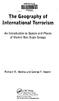 SUB Hamburg A/596060 The Geography of International terrorism An Introduction to Spaces and Places of Violent Non-State Groups Richard M. Medina and George F. Hepner CRC Press Taylor & Francis Croup Boca
Principles of Oversight and Accountability For Security Services in a Constitutional Democracy. Introductory Note
 Principles of Oversight and Accountability For Security Services in a Constitutional Democracy Introductory Note By Kate Martin and Andrzej Rzeplinski The 1990 s saw remarkable transformations throughout
CORRUPTION. A Reference Guide and Information Note. to support the fight against Corruption. Safeguarding public sector integrity
 FINANCIAL ACTION TASK FORCE CORRUPTION A Reference Guide and Information Note on the use of the FATF Recommendations to support the fight against Corruption The Financial Action Task Force (FATF) is the
Homeland Security and Terrorism COURSE SYLLABUS
 Homeland Security and COURSE SYLLABUS Course: CRJU 491T Section: 001 Semester: Spring 2015 UNIVERSITY OF SOUTH CAROLINA DEPARTMENT OF CRIMINOLOGY AND CRIMINAL JUSTICE Instructor: Leslie G. Wiser, Jr. Office:
Examples of International terrorist attacks since 9/11
 PAPER ONE INTERNATIONAL TERRORISM: THE THREAT Any discussion of the Government s strategy to reduce the threat from international terrorism to the UK and its citizens must begin with the nature of the
Democracy and Multidimensional Security: The rising need for citizen security in Latin America
 March 15, 2005 McShain Lounge Large McCarthy Hall, Southwest Quadrangle 5:30 pm-7:00 pm Democracy and Multidimensional Security: The rising need for citizen security in Latin America Dr. Beatriz M. Ramacciotti
EU COOPERATION. The Madrid bombings have provided additional impetus for action. In an 18-page declaration on counter terrorism on
 TESTIMONY BY AMBASSADOR J. COFER BLACK COORDINATOR FOR COUNTERTERRORISM DEPARTMENT OF STATE BEFORE THE SENATE FOREIGN RELATIONS SUBCOMMITTEE ON EUROPE MARCH 31, 2004 Thank you Mr. Chairman and members
Cyber Diplomacy A New Component of Foreign Policy 6
 Cyber Diplomacy A New Component of Foreign Policy 6 Assistant Lecturer Dana DANCĂ, PhD. candidate Titu Maiorescu University, Bucharest [email protected] Abstract Nowadays, the boundary between virtual