
SECTION 4 I - CHILDREN & YOUNG PEOPLE WHO DISPLAY HARMFUL SEXUAL BEHAVIOUR. Introduction p. 2. Principles p. 2. Definition p. 3. Recognition p.
|
|
|
- Elwin Booth
- 9 years ago
- Views:
Transcription

1 Staffordshire Safeguarding Children Board and Stoke-on-Trent Safeguarding Children Board Inter-Agency Procedures for Safeguarding Children and Promoting their Welfare. SECTION 4 I - CHILDREN & YOUNG PEOPLE WHO DISPLAY HARMFUL SEXUAL BEHAVIOUR Introduction p. 2 Principles p. 2 Definition p. 3 Recognition p. 4 Procedure p. 5 Strategy Discussion/Meeting p. 6 Outcomes of Section 47 Enquiries p. 7 Appendices: 1. Information and link to Brook organisation Sexual Behaviours Traffic light Tool 2. Identifying Harmful Sexual Behaviour - pointers for professionals 3. Procedural Flowchart 4. NSPCC HSB service criteria 5. Contact details 1

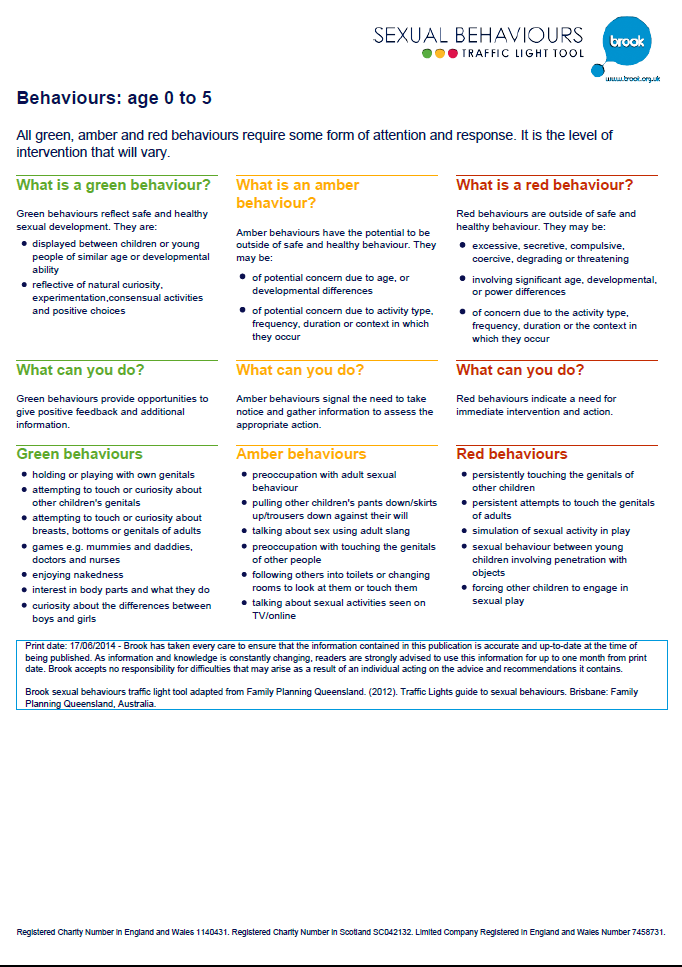
2 Introduction 1. It is recognised that sexual exploration and experimentation are a normal part of childhood development and as such these procedures recognise that some children do engage in age-appropriate behaviours as part of natural childhood sexual development; such sexual activity is essentially characterised by mutuality and consent and it is not intended that such behaviours fall within the remit of these procedures. For further guidance on healthy, concerning/problematic or harmful sexual behaviours please refer to Appendix 1, Brook Traffic Light Tool (as at 17/06/14) which must always be read in conjunction with their up to date guidance (link 2. Work with children and young people who abuse others, including those who sexually abuse/offend, should recognise that such children are likely to have considerable needs themselves, and that they may pose a significant risk of harm to other children. Evidence suggests that children who abuse others may have suffered considerable disruption in their lives, been exposed to violence within the family, may have witnessed or been subject to physical or sexual abuse, have problems in their educational development and may have committed other offences. Such children and young people are likely to be children in need, and some will, in addition, be suffering, or at risk of suffering, significant harm, and may themselves be in need of protection. Children and young people who abuse others should be held responsible for their abusive behaviour, while being identified and responded to in a way that meets their needs as well as protecting others. 3. The purpose of these procedures is to provide a clear operational framework in respect of children and young people who display harmful sexual behaviour and their alleged victims. It is important to note that professionals need to remain aware of the negative effect of labelling children and young people as young sex offenders or young abusers. The use of children or young people who display harmful sexual behaviour is considered to be more appropriate as this terminology acknowledges that their development as a child or young person is the first and foremost consideration and that they are displaying or enacting behaviour(s) that need to be appropriately addressed to work towards change. 4. The primary objective of all work with children and young people who display harmful sexual behaviour must be the protection of the victim and the prevention of a reoccurrence of the harmful sexual behaviour. It is therefore essential for there to be a coordinated, multi-disciplinary response in accordance with statutory guidance and these procedures. Principles 5. The following is a guide to key principles that should underpin work with children/young people who display harmful sexual behaviour: 2

3 To ensure that all children/young people under the age of 18 years who display harmful sexual behaviour towards other children or adults are identified and reported by professionals within the multi-agency network. The needs of children/young people who display harmful sexual behaviour should be considered separately from the needs of their victims. The consequences for the victim should be considered just as seriously as when the abuse is perpetrated by an adult A holistic child-centered assessment should be completed for each child / young person and a multi-agency response coordinated to address individual need and any risk factors. The reason why young people display harmful sexual behaviour is multi-faceted and needs to be explored further. In all cases child protection enquiries under section 47 (Children Act 1989) will need to be considered irrespective of whether abuse is inter-familial. Effective inter-agency information-sharing is central to these arrangements. Definition 6. The definition of harmful sexual behaviour by children / young people is the same as for adults who sexually abuse and is often characterised by a lack of true consent, the presence of power imbalance and exploitation. Sexual abuse involves forcing or enticing a child or young person to take part in sexual activities, not necessarily involving a high level of violence, whether or not the child is aware of what is happening. The activities may involve physical contact, including assault by penetration (e.g. rape, or oral sex) or non penetrative acts such as masturbation, kissing, rubbing and touching outside of clothing, They may also include non-contact activities, such as involving children in looking at, or in the production of, sexual online images, watching sexual activities, or encouraging children to behave in sexually inappropriate ways, or grooming a child in preparation for abuse (including via the internet). Sexual abuse is not solely perpetrated by adult males. Women can also commit acts of sexual abuse, as can other children. (Working Together to Safeguard Children 2015 page 93) 7. The boundary between what is harmful and what is normal childhood sexual exploration/experimentation can be blurred. Appendices 1 & 2 offer guidance for professionals making an initial judgement. 8. Abusive sexual activity is characterised by behaviour that involves coercion, verbal or physical threats together with secrecy and where an individual child or young person relies on an unequal power base due to such variables as; age difference, understanding or physical size. The issues of equality, true consent and coercion are key factors within the assessment of whether a child or young person s behaviour is problematic or harmful and should be placed within the context of the incident(s) that have occurred (see Appendix 2). 3

4 Consent Issues Please note that if a young person is under the age of 13 years old, they cannot legally consent to any form of sexual activity (Sexual Offences Act 2003). Therefore a child protection referral is required in all such cases. Action in relation to 13, 14 and 15 year olds The Sexual Offences Act 2003 reinforces that, whilst mutually agreed, non-exploitative sexual activity between teenagers does take place and that often no harm comes from it, the age of consent should still remain at 16. This acknowledges that this group of young people is still vulnerable, even when they do not view themselves as such. An assessment should take place of the young person s competency to give consent and of the nature of the relationship. Consider any differences of age, maturity, level of development, functioning and experience and also the awareness of the potential consequences of their actions. For further information and guidance you should consult the Staffordshire or Stoke-on-Trent Safeguarding Children Board procedures (see Appendix 5 for links and contact details) and consider the guidance in the Policy Working with Sexually Active Young People under 16 ) A child protection referral or referral to the police is not mandatory in all cases of sexual activity involving a child under the age of 16 years of age, but an assessment (including whether the children are Gillick competent using Fraser guidelines) in line with these procedures must be undertaken by the professionals making these decisions Recognition 9. It should be recognised that disclosure of sexually inappropriate or harmful behaviour by a child can be extremely distressing not only for the children/young people involved, but also for parents, carers and other family members. They may react with disbelief and minimise the situation which could escalate concerns and it is therefore important that professionals help them through this process at an early stage so that they can support and where appropriate, protect their child. 10. It is also important to remember that not all children/young people displaying sexualised or harmful sexual behaviour have been sexually abused themselves. They may however have been living in an environment with few or inappropriate boundaries or been exposed to information or sexual activity which is beyond their natural level of development and understanding. Hence in general the younger the child displaying sexualised/sexually harmful behaviour the higher the likelihood of that child having been sexually abused or living in a sexualised environment. (Wilkinson and Carson, 2002). 11. Harmful sexual behaviour may also include children who exhibit a range of sexually problematic behaviour such as indecent exposure, obscene telephone 4

5 calls, fetishism, downloading child abuse images from the internet, exhibiting harmful sexual behaviour against other children, masturbating in public and non contact behaviour via information technology. 12. Sexual exploitation is not covered by these procedures. (For more information on working with Sexual Exploitation of young people see SSCB procedures 4H, Stoke-on-Trent SCB procedure p14) Procedure 13. Where there is suspicion or an allegation of a child or young person having been harmed in a sexual way by another child or young person, it should be referred immediately to the children s social care referral team in the local authority where the child lives. Both the victim and the child who has allegedly displayed the harmful sexual behaviour will need to be referred for assessment - see Appendix 5 for the contact details of Staffordshire s First Response service and Stoke-on- Trent s Advice and Referral Team (ART). 14. The police are generally the first point of contact when an allegation of sexual harm has been made and it is critical for them to always consult with the First Response Team (Staffordshire) or Stoke-on-Trent s Advice and Referral Team regarding cases that come to their attention in order to ensure that there is an appropriate assessment of the victims needs and of the alleged perpetrator s needs, including any risk factors within and outside the family home. 15. On receipt of a referral an initial strategy discussion must occur between Children s Social Care (CSC) Services, the Police and Health professionals to share information and determine whether the threshold for section 47 enquiry (Children Act 1989) has been reached. The Police should be involved in the decision making process even if the child is under ten years of age and therefore below the age of criminal prosecution as they may, for example, have information about the child s family which is relevant to the enquiries. 16. Where the decision is reached within the strategy discussion that the alleged behaviour does not meet the threshold criteria for significant harm, the details of the referral and reasons for this decision must be clearly recorded. The outcome should also be appropriately shared with any professionals involved; if the referrer is not a professional, only limited information can be shared in accordance with inter-agency information sharing arrangements. The need for further assessment and support services to either child / young person should still be considered within a multi-agency framework. 17. A Social Work Assessment will normally be undertaken by CSC. The exception to this is if it is apparent from the outset that behaviours are within the scope of healthy, age-appropriate development; at this stage the First Response Team or Stoke ART may offer advice, refer the caller to other universal service provision, advise that an assessment under Staffordshire or Stoke-on-Trent s Early Help Assessment be initiated, or conclude that no further action is required. 18. Where a section 47 enquiry is required, a different social worker must be allocated for the victim and for the child / young person who is suspected or 5

6 alleged to have harmed in a sexual way, even if they live in the same household, to ensure that both are supported through the assessment process and that their individual welfare and safety needs are being addressed. 19. Where abuse is inter-familial or where the child / young person who is alleged to have harmed sexually is in the same household, as other younger or more vulnerable children, the protection of any other potential victims must be addressed. Consideration should be given for the need to remove the young person who may have caused the sexual harm from the household, at least in the short term. 20. In all cases requiring a social work assessment, lateral checks must be undertaken, and information about the concerns shared appropriately with organisations, such as schools, so they can manage the risks that a child may pose to others. Lateral checks should include information in regard to all the children involved. Other organisations working closely with children and families may need to be consulted at this stage and risk management must be borne in mind when decisions around information sharing in these cases are made. Staffordshire schools/education settings may seek the support of the Education Safeguarding Advice Service in regards to completion of a Risk Management plan in relation to the child who may have demonstrated the harmful sexual behaviour (see contact details appendix 5). 21. If the threshold for undertaking a section 47 enquiry has not been met, the assessments completed by the social workers must indicate whether support needs to be offered to the children, young people and their families via a coordinated, multi-agency, child in need service plan or Early Help Assessment (under the Staffordshire threshold framework), or Early Help meeting (under the Stoke process). It is important that all involved professionals must be invited to the meetings in order to share information and offer a coordinated, multi-agency approach that takes account of risk to other children and young people. 22. Where possible children and young people have a right to be consulted and involved in all matters and decisions that affect their lives and the use of interpreter services should be accessed if needed to achieve this. This right and respect extends to parents and carers and their active participation should be promoted. 23. The NSPCC HSB Service supports children, young people and their families/carers in addressing harmful sexual behaviours. Their referral criteria and contact details are specified in Appendix 4. Strategy Discussion/Meeting 24. When a child / young person is suspected or alleged to have harmed another in a sexual way, the Police and Children s Services must convene a strategy discussion or, in most cases, a strategy meeting within the required timescales. It is not always apparent at the outset whether a particular behaviour is abusive and a strategy meeting is an appropriate forum in which to share concerns before 6

7 reaching a collective way forward. The potential complexities of these concerns usually require that the appropriate planning takes place in the form of a meeting. 25. When the children / young people concerned reside in differing local authorities, it is recommended that the strategy meeting is convened and chaired by the authority in which the potentially harmful behaviour occurred. In most cases a combined strategy meeting will be convened to share information in respect of the alleged victim and the child/young person who is suspected of displaying harmful sexual behaviour. The primary aim of any intervention should remain focussed on the protection of the victim, the protection of any other potential victims and the avoidance of repetition of the harmful sexual behaviour. 26. Strategy meetings will be convened and chaired by Children s Services (social care) and a record of the meeting made. It is important that appropriate representation is invited from relevant organisations working closely with the child and family, e.g. Designated Safeguarding Leads from the schools that all the children attend. 27. The strategy discussion or meeting must plan in detail the respective roles of participants at the meeting. It also must address risk management measures that may be required within individual organisations, including voluntary and faith. The discussion/meeting must take into account the immediate protection of all of the children involved and any others in contact with the child/young person who is suspected or alleged to have harmed others sexually. 28. If at this stage no further action is required, all agencies who have been involved should be informed of the outcome in writing. The parents or carers of the children will also be informed of the outcome of the meeting. Parents or carers should not be invited to, or receive minutes of, the strategy meeting(s). Outcomes of Section 47 Enquiries 29. The decision about initiating a child protection conference should be made following the outcome of the section 47 enquiry. A young person who is alleged or suspected to have displayed harmful sexual behaviour should only be the subject of an initial child protection conference if they are considered to be at risk of significant harm. 30. If a child protection conference is not convened and there is an identified need for services to address the needs of the children concerned, a service plan should be drawn up in consultation with the young person, their parents / carers and professionals. The multi-agency service plan should be subject to review and include the child's need for any work to address their harmful sexual behaviour. Appropriate consideration should be given to maintaining care and education arrangements. 31. Regardless of whether the process followed is through an initial child protection conference or a multi-agency service planning meeting, it is important that children receive a level of intervention appropriate to their needs and risk factors. Bibliography 7

8 DOH Children Act 1989 & 2004 HMSO Working Together to Safeguard Children 2015 Staffordshire Safeguarding Children Board Procedures; Stoke-on-Trent Safeguarding Board - Stoke-on-Trent Safeguarding Children Board Carson, C & AIM Project (2007): An Initial Assessment & Intervention: For children under 12 years who display sexually harmful behaviour Johnson, T.C (1999); Understanding Your Child s Sexual Behaviour - New Harbinger Publications. Brook Organisation - Wilkinson, L. & Carson, C. (2002): Guidelines for the Initial Assessment of Children under 10 years old with Problematic Sexual Behaviour AIM Project Initial Assessment Manual. 8

9 Appendix 1 The following 4 pages (Traffic Light Tool) must be read in conjunction with the guidance on These indicators are a guide and do not replace, but should assist the exercise of professional judgement 9

10 10


11 11


12 12


13 13

14 Appendix 2 When looking at harmful sexual behaviour the following should be considered: The immediate protection of all of the children involved and any others in contact with the child/ young person who is suspected or alleged to have sexually harmed. The attitude and response of parents or carers and their ability to protect their own child/ren. Can they ensure appropriate supervision is in place around other children? The Behaviour: Did both parties agree to the sexual activity? Is the sexual activity age appropriate? How frequently has the behaviour occurred? Has the type of behaviour changed over time? Is there evidence of aggression, force, coercion or bribery? Have the individuals tried to ensure that the behaviour remains secret? The child or young person who has displayed harmful sexual behaviour: Have there been any previous concerns around harmful sexual behaviour or lack of sexual boundaries? Whether the child / young person who is alleged to have sexually harmed acknowledges their behaviour or actions, minimises or denies the allegations made. The likelihood or progress of any criminal prosecution. Whether there is any evidence or grounds to believe that the child or young person who is suspected or alleged to have sexually harmed, has also been the victim of abuse themselves. The Victim: The age and vulnerability of the victim? The impact on the victim The victim s needs (considered separately from the child who has demonstrated the harmful behaviour) 14

15 Appendix 3 PROCEDURE FOR INTERVENTIONS FOR CHILDREN AND YOUNG PEOPLE WHO DISPLAY HARMFUL SEXUAL BEHAVIOUR Information concerning harmful sexual behaviour or sexual offence by a child or young person Appropriate advice given to family and/or professionals Inform relevant Children s Service Referral Team (appendix 6) or the MASH 101 Referral passed to area social work team for Strategy Discussion Strategy Meeting/discussion re s47 investigation. Different social workers allocated to victim and the child who has allegedly harmed sexually. Protection of victim and other children must be considered Multi-agency meeting complete Social Work Assessment or Early Help Assessment Social Work Assessments completed No further action Individual agencies to complete appropriate risk assessments/risk management plans Initial Child Protection Conference Child Protection Plan Service Plan/ /Child in Need Plan / Early Help/ Locality Team 15

16 Appendix 4 NSPCC Harmful Sexualised Behaviour The Harmful Sexual Behaviour (HSB) Service, based at NSPCC Service Centre, Carole House, Stoke-on-Trent offers individual assessment and treatment of children and young people who display HSB. The HSB team works closely with key agencies, in order to ensure that a multi-agency approach is in place whilst working with this group of young people and their families/carers. Criteria for Inclusion: Boys aged 5-17 Girls aged 5-17 Girls and boys with a mild or moderate learning disability. Referrals are taken from all Children s Services, Local Support Teams, Youth Offending and Educational Provisions within the Staffordshire and Stoke-on-Trent areas. Children and young people do not require an allocated social worker, however, require a lead worker who coordinates the overall plan, risk management plan and resources for the child and their family. Criteria for Exclusion: Children and Young People with a diagnosed learning disability, where their disability it too such an extent that it would prevent them from engaging in the HSB service. Reading assessments are available for young people where there is a query about their capacity to engage in this service. What do we offer? Assessment The service comprises of an AIM 2 and AIM (U12 s) Assessment, which determines potential for committing further HSB, levels of supervision which may be required and whether the young person requires referral onto a treatment programme. The process of assessment is focused on the four domains of; development, family, environment and sexual and nonsexual harmful behaviours. Following this assessment, practitioners will provide the young person, their parents/carers and relevant professionals with a report. A decision would then be reached as to whether the child or young person may require intervention work. 16

17 Intervention The intervention may differ depending upon the individuals age, gender, learning needs and level of supervision recommended, for example: Males aged 5-11 and all females will be offered an individually tailored intervention programme. Males (aged 12 18) o Who do not have a diagnosed learning disability, o Who may have a diagnosed learning difficulty, but whose levels of comprehension enables them to manage written work which would be considered to be within the remit of main stream education. For these young people we would offer the Change For Good treatment programme that consists of weekly sessions (divided into four blocks: Engagement, Relationships, Self- Regulation and a Positive Road Map for the Future) delivered individually. Referrals After using the Traffic Light Tool to determine that the behaviour being displayed is HSB, please make referrals by contacting the NSPCC Service Centre. NSPCC Service Centre, Carole House, 213 Basford Park Road, Newcastle Under Lyme, Staffordshire, ST5 0PG

18 Appendix 6 Contact details Child living in Stoke-on-Trent Local Authority: Stoke-on-Trent Advice and Referral Team (ART) Emergency Duty Team for out of hours child protection referrals Safeguarding Education Development Officer Locality social workers Stoke-on-Trent (for advice and support about child welfare concerns in that area) North / or mobile Central / or mobile South or mobile Stoke-on-Trent Safeguarding Children Board Procedures: Child living in Staffordshire Local Authority First Response Team Tel Emergency Duty Team (outside office hours) Fax [email protected] Staffordshire Safeguarding Children Board: Staffordshire Police Staffordshire and Stoke Tel. 101 and ask for M.A.S.H. (Multi-agency safeguarding hub) Education Safeguarding Advice Service (ESAS) (not for Child Protection or Welfare referrals) Education Safeguarding Advice Service (ESAS) website NSPCC Harmful Sexual Behaviour project: Base 58 support for children who have been subjected to or are at risk of sexual exploitation (Stoke on Trent only) ; 18

Managing individual cases: the Framework for the Assessment of Children in Need and their Families
 Managing individual cases: the Framework for the Assessment of Children in Need and their Families Preface 1.1 A consistent message from cases involving harm to children is the importance of identifying
Working Together to Safeguard Children
 Working Together to Safeguard Children A guide to inter-agency working to safeguard and promote the welfare of children March 2013 Contents Summary 5 About this guidance 5 What is the status of this guidance?
Devon Safeguarding Children s Board Child Sexual Exploitation Risk Assessment Tool v. 12/11/15
 Devon Safeguarding Children s Board Child Sexual Exploitation Risk Assessment Tool v. 12/11/15 What is Child Sexual Exploitation? See Barnados Puppet on a String for more guidance http://www.barnardos.org.uk/ctf_puppetonastring_report_final.pdf
GREAT WALTHAM C of E PRIMARY SCHOOL
 GREAT WALTHAM C of E PRIMARY SCHOOL CHILD PROTECTION POLICY JULY 2015 Approved by Staff July 2015 Adopted by Governors of the FGB Committee July 2015 Recommended Review Date July 2016 1 KEY CONTACTS WITHIN
SAFEGUARDING CHILDREN AND CHILD PROTECTION POLICY
 SAFEGUARDING CHILDREN AND CHILD PROTECTION POLICY Our setting will work with children, parents and the community to ensure the rights and safety of children and to give them the very best start in life.
SECTION 10 SUMMARY ORGANISED AND COMPLEX ABUSE
 SECTION 10 SUMMARY ORGANISED AND COMPLEX ABUSE The following is a summary, with some updating, of Complex Child Abuse Investigations: Inter-Agency Issues, Department of Health & the Home Office (2002).
This document has been archived. What to do if you re worried a child is being abused
 What to do if you re worried a child is being abused Contents Preface Safeguarding Children 5 1 Introduction Working with children about whom there are child welfare concerns 7 2 What is a child in need?
Working together to safeguard children. A guide to inter-agency working to safeguard and promote the welfare of children
 Working together to safeguard children A guide to inter-agency working to safeguard and promote the welfare of children March 2015 Contents Introduction 5 About this guidance 6 What is the status of this
How To Deal With Abuse In A School
 Guidance for schools on dealing with Allegations of abuse against Staff and Volunteers Guidance for schools on dealing with Allegations of abuse against Staff and Volunteers 2 CONTENTS 1. Introduction
Mandatory Reporting of Child Sexual Abuse in Western Australia
 Government of Western Australia Department for Child Protection Mandatory Reporting of Child Sexual Abuse in Western Australia A guide for mandatory reporters Mandatory reporting of child sexual abuse
Reparation Protocol i
 Reparation Protocol i ii Contents: Aims and Objectives of Reparation 5 1 Health and Safety 6 2 Risk Management 6 3 Safeguarding 6 4 Code of Conduct 7 5 Information Sharing 8 6 Reparation Process 8 7 Expectation
How To Deal With An Allegation Of Sexual Abuse In A School
 1 Model Allegations Management Policy for Knowsley Schools and Education Settings July 2015 Introduction 1. All schools and education settings have a duty to promote and safeguard the welfare of children
Example of a Child Protection Policy
 Example of a Child Protection Policy Introduction Policy Statement/aims Promoting good practice Good practice guidelines Use of photographic/filming equipment Recruitment and training of staff and volunteers
Safeguarding Children at risk of Sexual Exploitation
 Kent and Medway Safeguarding Children at risk of Sexual Exploitation RISK ASSESSMENT TOOLKIT VERSION 3: May 2014 CHILDREN ABUSED THROUGH SEXUAL EXPLOITATION 1 Introduction RISK ASSESSMENT TOOLKIT Who is
National Standards for the Protection and Welfare of Children
 National Standards for the Protection and Welfare of Children For Health Service Executive Children and Family Services July 2012 About the Health Information and Quality Authority The (HIQA) is the independent
MODEL CHILD PROTECTION POLICY
 Fact Series Child Protection Policy (Model) version 2.2 July 2009 MODEL CHILD PROTECTION POLICY NODA Headquarters regularly receives requests from affiliated societies for advice about implementing a Child
Protection from Abuse in Supporting People Services
 Protection from Abuse in Supporting People Services INTRODUCTION Supporting People Core Objective C1.4 is to safeguard the right of the service user to be protected from abuse. This is one of two objectives
SAFEGUARDING POLICY AND CHILD PROTECTION PROCEDURES
 INTRODUCTION COLCHESTER ENGLISH STUDY CENTRE (CESC) and INTERNATIONAL LANGUAGE HOLIDAYS (ilh) fully recognise their responsibility to safeguard and promote the welfare of the children and young people
Child Protection Procedures and Enquiries. Information for Parents and Carers
 South Gloucestershire Safeguarding Children Board (SGSCB) Child Protection Procedures and Enquiries Information for Parents and Carers If you need this information in another format or language please
Stage 2: Making a referral
 Stage 2: Making a referral This Stage covers: How to make a referral and where to send it Screening referrals Trafford s 5 Harms 16.5 What is a referral? A referral is the direct reporting of an allegation,
Safeguarding Children Policy (Early Years Child Protection)
 Safeguarding Children Policy (Early Years Child Protection) All parents and carers are asked to read this document carefully prior to a child being placed The purpose of this is to keep each child safe
ANGUS COUNCIL EDUCATION DEPARTMENT. 5. How Getting it Right will operate in Angus Staged Intervention
 ANGUS COUNCIL EDUCATION DEPARTMENT 5. How Getting it Right will operate in Angus Staged Intervention 5.1 Stage 1: Universal Provision The first stage involves Health and Education staff working together
Education Department Policy
 Education Department Policy Title: Young Offenders in Jersey Schools, Colleges and Youth Projects Guidelines for Schools, Colleges, Youth Service & Education staff Date: May 2016 Author: Director, Inclusion
June 2014. Early Help Pathways. Operational Guidance. Croydon Safeguarding Children Board (CSCB) Keeping Croydon Safe for Children
 June 2014 Early Help Pathways Operational Guidance Croydon Safeguarding Children Board (CSCB) Keeping Croydon Safe for Children 2 Contents 4 1. Introduction 6 8 12 14 2. Principles of early help 3. Staged
What s Going On to safeguard children and young people from sexual exploitation? : A data monitoring Tool
 What s Going On to safeguard children and young people from sexual exploitation? : A data monitoring Tool Introduction In 2009 the government published guidance on Safeguarding children and young people
Protecting children and supporting families. A guide to reporting child protection concerns and referring families to support services
 Protecting children and supporting families A guide to reporting child protection concerns and referring families to support services About this guide This guide has been developed for professionals working
All photographers and staff at Success Photography must ensure that:
 Child Protection Policy All photographers and staff at Success Photography must ensure that: The welfare of the child is paramount. All children, whatever their age, culture, disability, gender, language,
Guidance to support the Levels of Need poster
 Guidance to support the Levels of Need poster V.1 Approved by Cheshire East Safeguarding Children Board 24 th January 2014 1 Introduction This Framework aims to provide all professionals working with children
Derby Safeguarding Children Board. Serious Case Review BD09. Executive Summary July 2010
 Derby Safeguarding Children Board Serious Case Review BD09 Executive Summary July 2010 Agreed by Derby Safeguarding Children Board on 13 August 2010 Author: Janet Galley Independent Social Worker Version
SCHOOL CHILD PROTECTION POLICY
 SCHOOL CHILD PROTECTION POLICY (NAME OF SCHOOL) This policy was originally developed on (INSERT DATE) and adopted on (INSERT DATE). The name of the Designated Senior Person is: (INSERT NAME) The name of
Saskatchewan Child Abuse Protocol 2014
 Saskatchewan Child Abuse Protocol 2014 A commitment by the Saskatchewan Government, police, professionals and organizations to collaborate in an effort to prevent and investigate child abuse and provide
F36D 04 (LMC B1) Lead and manage provision of care services that respects, protects and
 Elements of competence LMC B1.1 LMC B1.2 LMC B1.3 Lead and manage provision that complies with legislation, registration, regulation and inspection requirements Lead and manage provision that promotes
3. Frequently asked questions about CAF and Lead Professional 3.1 List of Frequently asked Questions 3.2 Frequently Asked Questions and Answers
 Contents Overview 1. Common Assessment Framework 1.1 Introduction 1.2 The Doncaster CAF Paperwork 1.3 How we have introduced the CAF in Doncaster 1.4 An overview of the CAF 1.5 Using the CAF in Doncaster:
Policy for Safeguarding Adults from Abuse
 Policy for Safeguarding Adults from Abuse ID # 2008 Line 67 Author Brenda Rance Author s Job Title Named Nurse, Safeguarding Adults Division Corporate Nursing & Patient Services Department Corporate Nursing
BRIDGE HOUSE COLLEGE IKOYI, LAGOS knowledge for success
 BRIDGE HOUSE COLLEGE IKOYI, LAGOS knowledge for success CHILD PROTECTION POLICY FOR BRIDGE HOUSE COLLEGE (BHC) KEY CONTACTS WITHIN THE BRIDGE HOUSE COLLEGE (SEPTEMBER 2013) DESIGNATED CHILD PROTECTION
Tameside Children s Social Work - Local Assessment Framework
 Tameside Children s Social Work - Local Assessment Framework Contents Preface...3 The purpose of social work assessments...4 Statutory assessments under the Children Act 1989...5 The local framework for
Keeping children safe in education. Statutory guidance for schools and colleges
 Keeping children safe in education Statutory guidance for schools and colleges July 2015 Contents Summary 4 About this guidance 4 Who this guidance is for 4 What it replaces 5 Part one: Safeguarding information
Child Protection Policy for Schools
 Child Protection Policy for Schools This example policy provides a basic structure to which amendments can be made, and to which school specific information should be added e.g. information about the curriculum
Tier 3/4 Social Work Services
 Children s Services key guidelines 2010 Information from Southampton City Council The threshold criteria for accessing Tier 3/4 Social Work Services Introduction Information sharing is as important as
Southfields Academy: Safeguarding Principles
 Southfields Academy: Safeguarding Principles Author: Jacqueline Valin, Principal Date: 9 th October 2015 Review: Annually Reviewed by: Board of Trustees Committee / Delegated to Principal/Headteacher Safeguarding
Assessing the risks to children from domestic violence. No. 7. Policy and practice briefing
 No. 7 Policy and practice briefing I feel a lot more confident now going out to visit a family where there is domestic violence. Social worker Assessing the risks to children from domestic violence Julie
Common Assessment Framework (CAF) Frequently Asked Questions
 Common Assessment Framework (CAF) Frequently Asked Questions Last updated November 2009 Content Q1. What is the Common Assessment Framework (CAF)?... 1 Q2. What does the Common Assessment Framework consist
Boothville Primary School. Dealing with Allegations against School Personnel, Volunteers, Headteacher or Pupils. Allegations
 Dealing with against School Personnel, Volunteers, Headteacher or Pupils Dealing with against School Personnel, Volunteers, Headteacher or Pupils Date Sept 15 Review Date Sept 16 Designated Child Protection
Work placement students undertaking work placement over a long period of time (one or two days per week over a period of two months or more)
 Safeguarding Policy 1. Background In 2015 the Department for Education and Skills published a statutory guidance document Keeping Children Safe in Education on safeguarding and promoting the welfare of
KING CHARLES PRIMARY SCHOOL CHILD PROTECTION & SAFEGUARDING POLICY. For Schools and Education Establishments in Cornwall
 KING CHARLES PRIMARY SCHOOL CHILD PROTECTION & SAFEGUARDING POLICY For Schools and Education Establishments in Cornwall May 2014 1 Child Protection and Safeguarding Policy This policy was developed and
The purpose of this policy is to support a comprehensive and collaborative approach to responding to child abuse and neglect by:
 SECTION 1000: STUDENTS AND SCHOOLS POLICY 1045: CHILD PROTECTION Date Adopted: June 18, 2014 POLICY STATEMENT The Board affirms that children have a right to be protected from abuse and neglect, and employees
BUDEHAVEN COMMUNITY SCHOOL CHILD PROTECTION & SAFEGUARDING. For Schools and Education Establishments in Cornwall
 BUDEHAVEN COMMUNITY SCHOOL CHILD PROTECTION & SAFEGUARDING POLICY For Schools and Education Establishments in Cornwall May 2014 (Reviewed) 1 Review/changes to document Updates to this document will be
Model Safeguarding Policy and Procedure for Smaller Voluntary and Community Groups
 Introduction Model Safeguarding Policy and Procedure for Smaller Voluntary and Community Groups This NAME OF ORGANISATION policy follows guidelines set out in Bath & North East Somerset (B&NES) Safeguarding
ECB Guidance for Coaches Working with Children
 ECB Guidance for Coaches Working with Children Coaches have a vital role to play in safeguarding children in cricket and, at a club, will often become the focus for children and their activities. The ECB
DOMESTIC VIOLENCE POLICY
 OXFORD CITY COUNCIL HOUSING SERVICES DOMESTIC VIOLENCE POLICY If you need a larger print copy, audiotape or other means to have a copy of this publication, please contact the number below Translation available
HOUSING SERVICES. Policy Anti Social Behaviour Policy Version 2. Issue Date Lead Officer Neil Turton Review Date
 HOUSING SERVICES Policy Anti Social Behaviour Policy Version 2 Ref ASB2 Issue Date Lead Officer Neil Turton Review Date Jan 2011 Jan 2013 Policy working group members Approved by Policy Unit Landlord Services
Plymouth City Council. Plymouth Children and Young People s Trust
 Plymouth Practitioners Guide to the Common Assessment Framework Plymouth City Council Plymouth Children and Young People s Trust Introduction The Common Assessment Framework (CAF) is a core element of
Guide to making a child protection report
 Child Wellbeing & Child Protection NSW Interagency Guidelines Guide to making a child protection report What to do when children and young people are at risk of significant harm This guide to Making a
Responding to, Recording and Reporting Concerns Which Might Arise Within or Outside the Club
 Responding to, Recording and Reporting Concerns Which Might Arise Within or Outside the Club Across cricket, at all levels, there is a requirement to have clear and unambiguous procedures in place in respect
Critical client incident management summary guide and categorisation table: 2011 For further information refer to the Department of Human Services
 Critical client incident management summary guide and categorisation table: 2011 For further information refer to the Department of Human Services Critical client incident management instruction: 2011
Safeguarding Children and Child Protection
 Safeguarding and Welfare Requirement: Child Protection. Providers must have and implement a policy and procedure to safeguard children. Safeguarding Children and Child Protection Including managing allegations
When should this tool be used?
 Protecting adults at risk: The London Multi-agency policy and procedures to safeguard adults from abuse. Practice Guidance: Safeguarding Adults Risk Assessment & Risk Rating Tool Why do we need this tool?
Local Social Work Assessment Framework. Child and Family Assessments
 Local Social Work Assessment Framework Child and Family Assessments 2 Contents Preface The Purpose of Social Work assessments Statutory assessments under the Children Act 1989 The Local Framework for Social
Draft: Keeping children safe in education. Statutory guidance for schools and colleges
 Draft: Keeping children safe in education Statutory guidance for schools and colleges September 2016 Contents Summary 3 What is the status of this guidance? 3 About this guidance 3 Who this guidance is
School Child Protection & Safeguarding Policy 2014/2015
 School Child Protection & Safeguarding Policy 2014/2015 Abbey Park Primary Academy Child Protection & Safeguarding Policy 2014/2015 The Acting Principal is Emme Ford This policy was developed on the 10
Safeguarding Children, Young People and Vulnerable Adults Policy
 Safeguarding Children, Young People and Vulnerable Adults Policy Issue Date: August 2012 Author: Head of Student Services Approval Body: Senior Leadership Team Next Review Date: May 2016 Safeguarding Children,
Guidance Notes for Safeguarding Children and Vulnerable Adults
 Guidance Notes for Safeguarding Children and Vulnerable Adults All those who come into contact with children and families in their everyday work have a duty to safeguard and promote the welfare of children
WIMBLEDON CHASE PRIMARY SCHOOL CHILD PROTECTION POLICY WIMBLEDON CHASE PRIMARY SCHOOL IS AN INNOVATIVE LEARNING COMMUNITY COMMITTED TO EXCELLENCE
 WIMBLEDON CHASE PRIMARY SCHOOL CHILD PROTECTION POLICY VISION STATEMENT WIMBLEDON CHASE PRIMARY SCHOOL IS AN INNOVATIVE LEARNING COMMUNITY COMMITTED TO EXCELLENCE AIMS OF CHILD PROTECTION POLICY To provide
Employment Policies, Procedures & Guidelines for Schools
 DEALING WITH ALLEGATIONS OF ABUSE AGAINST TEACHERS, OTHER STAFF AND VOLUNTEERS GUIDANCE FOR LOCAL AUTHORITIES, HEAD TEACHERS, SCHOOL STAFF AND GOVERNING BODIES July 2014 1 ABOUT THIS GUIDANCE This is statutory
Getting it right for children and young people who present a risk of serious harm
 Getting it right for children and young people who present a risk of serious harm Meeting Need, Managing Risk and Achieving Outcomes 1 Contents Introduction Pg 3 Definitions Pg 5 Background Pg 8 Self Assessment
Sexual Offences Definitive Guideline DEFINITIVE GUIDELINE
 Sexual Offences Definitive Guideline DEFINITIVE GUIDELINE Contents Applicability of guideline 7 Rape and assault offences 9 Rape 9 Sexual Offences Act 2003 (section 1) Assault by penetration 13 Sexual
Employment Policies, Procedures & Guidelines for Schools
 DEALING WITH ALLEGATIONS OF ABUSE AGAINST TEACHERS, OTHER STAFF AND VOLUNTEERS GUIDANCE FOR LOCAL AUTHORITIES, HEAD TEACHERS, SCHOOL STAFF AND GOVERNING BODIES March 2012 1 ABOUT THIS GUIDANCE This is
CHILDREN ADMITTED TO HOSPITAL WITH SUSPECTED OR CONFIRMED ABUSE OR NEGLECT
 Schedule 1 CHILDREN ADMITTED TO HOSPITAL WITH SUSPECTED OR CONFIRMED ABUSE OR NEGLECT PURPOSE 1. This schedule sets out the agreement between the District Health Board (DHB), Child, Youth and Family (CYF)
The Code. for Crown Prosecutors
 The Code for Crown Prosecutors January 2013 Table of Contents Introduction... 2 General Principles... 3 The Decision Whether to Prosecute... 4 The Full Code Test... 6 The Evidential Stage... 6 The Public
Doncaster Safeguarding Children Board. A Serious Case Review. J children. The Executive Summary. January 2010
 Doncaster Safeguarding Children Board A Serious Case Review J children The Executive Summary January 2010 1 The terms of reference I. The following agencies to undertake Individual Management Reviews,
Safeguarding / Child Protection Policy
 Safeguarding / Child Protection Policy Policy statement on equality and diversity The School will promote equality of opportunity for students and staff from all social, cultural and economic backgrounds
Statement of Purpose. Child Protection/Safeguarding Service
 Statement of Purpose Child Protection/Safeguarding Service 1. What we do Child Protection/Safeguarding is part of the South Eastern HSC Trust s Children s Services which provides services to ensure the
COUNCIL OF EUROPE COMMITTEE OF MINISTERS
 COUNCIL OF EUROPE COMMITTEE OF MINISTERS Recommendation Rec(2006)8 of the Committee of Ministers to member states on assistance to crime victims (Adopted by the Committee of Ministers on 14 June 2006 at
SOCIAL WORK PRACTICE AND DOMESTIC VIOLENCE
 SOCIAL WORK PRACTICE AND DOMESTIC VIOLENCE Working with Children and Families Mary Kate Barry, IASW 2015 How are you? Grand Ask me In the hospital Please ask me In the clinic In the church Ask me, ask
How To Protect A Child
 TREVIGLAS COMMUNITY COLLEGE CHILD PROTECTION & SAFEGUARDING POLICY October 2015 Reviewed by Governing body October 2015 1 Review/changes to document Updates to this document will be identified below. Please
UNIVERSITY OF BATH CHILD PROTECTION AND SAFEGUARDING POLICY
 UNIVERSITY OF BATH CHILD PROTECTION AND SAFEGUARDING POLICY 1. INTRODUCTION 1.1. Purpose of Policy 1.1.1. The University aims to provide a safe environment for children and young persons (i.e. those aged
CHILD SEXUAL EXPLOITATION RISK ASSESSMENT
 RESTRICTED CHILD SEXUAL EXPLOITATION RISK ASSESSMENT This screening tool should be used by all professionals working with children aged 10+. Professionals may also decide it is appropriate to use the tool
Children s Hearings (Scotland) Act 2011 2011 asp 1
 Children s Hearings (Scotland) Act 2011 (asp 1) Section Children s Hearings (Scotland) Act 2011 2011 asp 1 CONTENTS PART 1 THE NATIONAL CONVENER AND CHILDREN S HEARINGS SCOTLAND The National Convener and
CHILD PROTECTION POLICY. City of London School (CLS) City of London School for Girls (CLSG) City of London Freemen's School (CLFS)}
 CHILD PROTECTION POLICY City of London School (CLS) City of London School for Girls (CLSG) City of London Freemen's School (CLFS)} Statement: We The School are committed to safeguarding and promoting the
ACTIV-8 SAFEGUARDING POLICY
 ACTIV-8 SAFEGUARDING POLICY The Department for Education s Working Together to Safeguard Children (2013) defines safeguarding and promoting the welfare of children as: protecting children from maltreatment;
Job Description. Job Title: Social Worker Intake Team
 Job Description Job Title: Social Worker Intake Team Grade: SWMS 33 40: The pay scale for qualified Social Workers ranges from 29898 through to 35772 and there is an additional 100 monthly supplement for
HOSPITAL POLICY AND INFORMATION MANUAL Date Issued: Date Last Revised: Next Review Date: Approved By:
 Page 1 of 12 Policy Applies to: All Mercy Hospital staff. Compliance by Credentialed Specialists or Allied Health Professionals, contractors, visitors and patients will be facilitated by Mercy Hospital
The Role of Police in Dealing With Vulnerable People
 PEEL: Police effectiveness 2015 (Vulnerability) An inspection of Lincolnshire Police December 2015 HMIC 2015 ISBN: 978-1-911194-28-6 www.justiceinspectorates.gov.uk/hmic Contents Vulnerability in numbers...
Guidance. Wigan s Threshold of Need. www.wiganlscb.com. Wigan Safeguarding Children Board
 Wigan Safeguarding Children Board Wigan s Threshold of Need Guidance Working to keep children and young people happy, healthy and safe. www.wiganlscb.com Contents Welcome.........................................................................Page
ALCOHOL AND OTHER DRUGS (AOD) RESIDENTIAL PROGRAMMES: SERVICE SPECIFICATIONS
 ALCOHOL AND OTHER DRUGS (AOD) RESIDENTIAL PROGRAMMES: SERVICE SPECIFICATIONS 2015 Table of Contents Table of Contents... 1 1. About these Service Specifications... 2 Who are these specifications for?...
County Durham Practice Framework: Single Assessment Procedure & Practice Guidance
 County Durham Practice Framework: Single Assessment Procedure & Practice Guidance April 2014 Contents Page No 1.0 Introduction 1 2.0 The 0-19 Integrated Children s Services Pathway 3 3.0 The Single Assessment