
Biomarkers for Alzheimer's Disease in Down Syndrome
|
|
|
- Prudence Anthony
- 9 years ago
- Views:
Transcription
1 Biomarkers for Alzheimer's Disease in Down Syndrome Brad Christian, Ph.D. Waisman Laboratory for Brain Imaging

2 Outline Rationale for Studying AD in Down Syndrome Background of Alzheimer s Disease Biomarkers for Alzheimer s Disease Details and Findings of the Natural History of Amyloid Deposition in Adults with Down Syndrome Recent Findings of the Role of Amyloid in Alzheimer s Disease What s New in Waisman Center Down Syndrome Research?
3 Research Rationale and Goals Adults with Down syndrome (DS) are at an extremely high risk for developing Alzheimer s disease (AD), with most individuals over age 40 evidencing amyloid deposits. The goal of our research is to track biomarkers of AD in adults with DS and to follow these individuals to understand the course of cognitive, imaging and biochemical changes and their effects on functioning over time. This offers an opportunity to deepen our understanding of the pathophysiology of AD in DS but may also offer information that will prove useful in the prevention and treatment of AD in the general population.

4 Alzheimer s Disease (AD) and Down Syndrome The prevalence of dementia in the general population less than 5% among those 65 years and younger 15-30% for those beyond the age of 80 years The prevalence of dementia in the DS population 9% of adults with DS will be diagnosed between 40 and 49 years 18% for individuals in the year age span 32% for those greater than years of age % for individuals in their 60 s

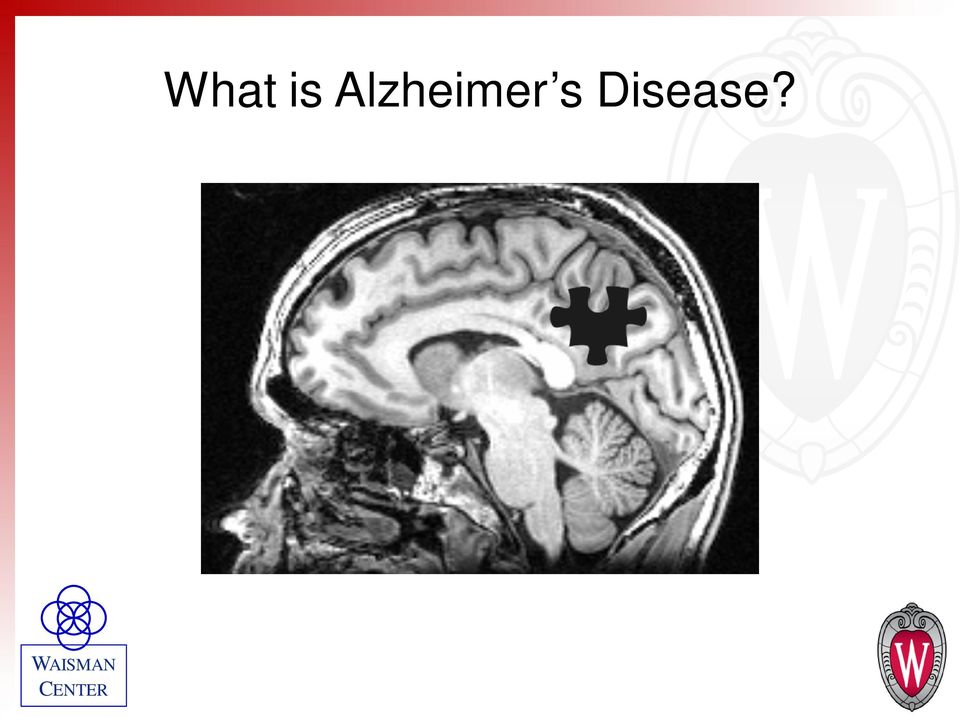
5 What is Alzheimer s Disease?
6 Characteristics of Alzheimer s Disease Dementia progressive deterioration of cognitive function that ultimately prevents a person from independently performing their daily activities Alzheimer s Disease accounts for 70% of cases of dementia Symptoms include difficulty in: Language, memory, perception, emotional behavior, cognitive skills (e.g. judgment)
7 Why is AD a public policy issue? 5.3 million Americans have AD 110,000 in Wisconsin 7 th leading cause of death The elderly are already the fastest growing segment of US. This will increase. ~ 10,000 Baby Boomers turned 65 per day

8 Down Syndrome and APP File:Down_Syndrome_Karyotype.png J Neural Transm 2000;59(Suppl.):

9 Pathology of Alzheimer s Disease

10 AD Pathology - tangles and plaques Preclinical AD Mild to Moderate AD Severe AD Neurofibrillary tangles

11 β Amyloid Plaques Non-amyloidogenic Amyloidogenic

12 Aβ plaques

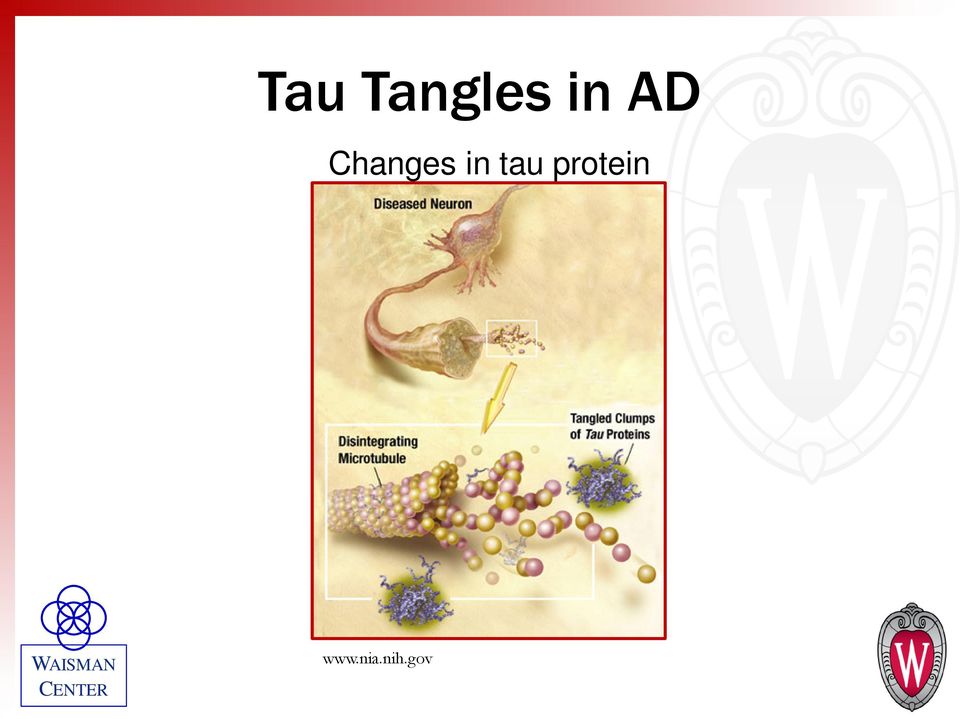
13 Tau Tangles in AD Changes in tau protein
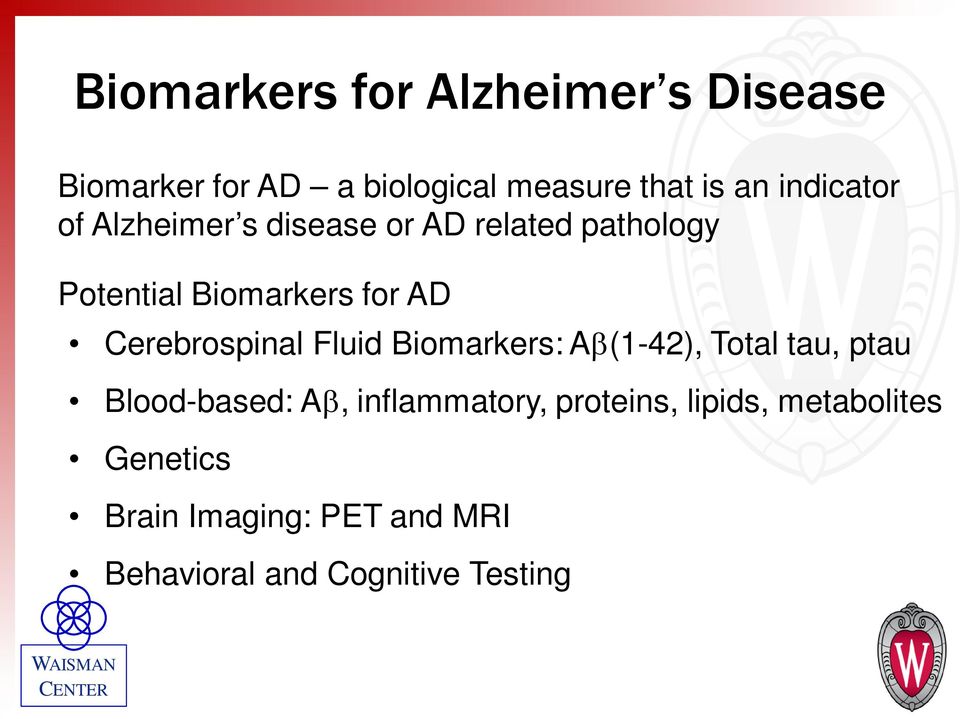
14 Biomarkers for Alzheimer s Disease Biomarker for AD a biological measure that is an indicator of Alzheimer s disease or AD related pathology Potential Biomarkers for AD Cerebrospinal Fluid Biomarkers: Aβ(1-42), Total tau, ptau Blood-based: Aβ, inflammatory, proteins, lipids, metabolites Genetics Brain Imaging: PET and MRI Behavioral and Cognitive Testing
15 The use of medical imaging in the study of Alzheimer s Disease
16 Magnetic Resonance Imaging (MRI) Positron Emission Tomography (PET) PET Bo

17 Alzheimer s Disease: FDG 18 Healthy Control AD Subject

18 Brain Scanning in Aging and Dementia - early identification of β-amyloid PET image of [C-11]PIB MRI scan [C-11]PIB binding in AD [C-11]PIB binding HC Amyloid Binding Rowe CC, et al., Neurology 2007; 68:
![MRI scan [C-11]PIB binding in AD [C-11]PIB binding](/docs-images/47/21007878/images/page_18.jpg "HC Amyloid Binding Rowe CC, et al.")
19 Measuring Tau and Amyloid in the AD Progression Betthauser, HAI 2016
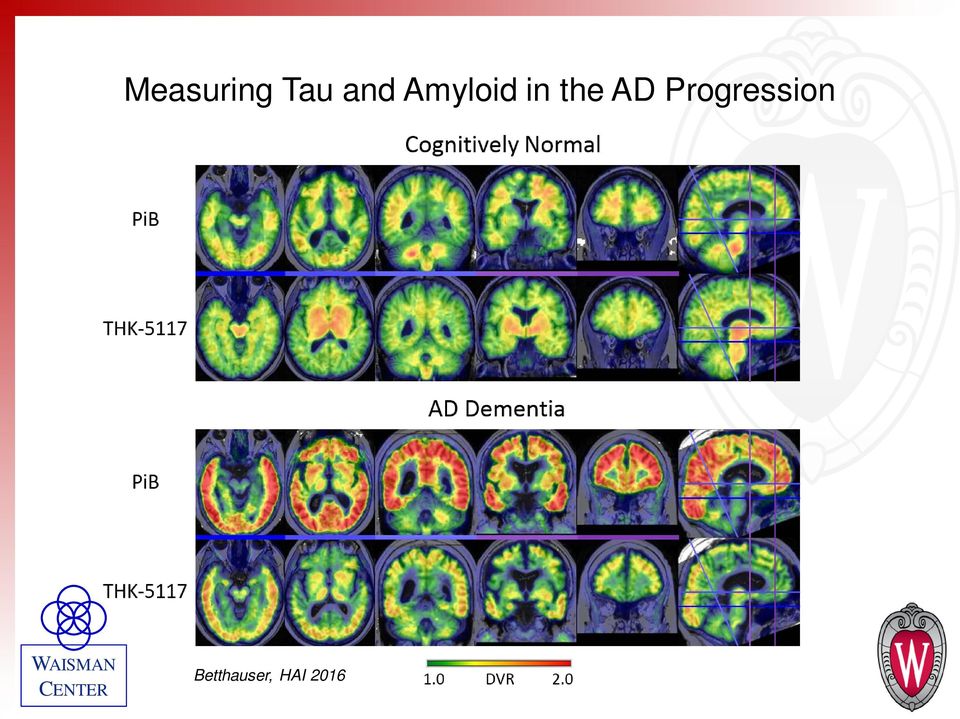
20 Slide provided by Prof. Sterling Johnson The presence of amyloid in the brain precedes cognitive change.

21 What is the progression of β-amyloid in people with Down Syndrome?
22 Experimental Details Current Study Procedures and Measures Measure Informant/ Participant Time (minutes) Screen/ Baseline Follow-Up Visit Day 1 Day 1 (Informant and Neuropsychological Measures) Informed Consent Caretaker & Subject X DSDS Interview Caregiver 30 X X SIB/IQ/Neuropsych Subject X X Psychiatric Assessment Subject 15 X X Vineland/Reiss Screen Caregiver 60 X X Medical/Psychiatric Hx Caregiver 15 X X Day 2 Day 2 (Neuroimaging Measures) MRI Subject 30 X X PiB PET Scan Subject 90 X X
23 Down Syndrome PiB Results PiB Status Tissue ratios calculated for cortical regions-of-interest (ROI) and normalized to cerebellum (SUVR) PiB+ = above the cutoff (>1.5) in 5 cortical areas defined using the iterative outlier approach
24
25
26 Independent Living Skills - communication, daily living, socialization 190 Vineland Adaptive Behavior Scales (Sparrow, Cicchetti & Balla, 2005) PiB- PiB Vineland Sigan L. Hartley et al. Gatlinburg 2012
27 Behavior Problems - aggression, paranoia, depression Reiss Screen for Maladaptive Behavior (Reiss, 1990, 1997) PiB- PiB Reiss Screen Sigan L. Hartley et al. Gatlinburg 2012
28 Executive Control and Working Memory Cat and Dog Stroop Test # Errors Switch Trial - Naming Trial Time * P < 0.05 using one-tailed * PiB- PiB+ Sigan L. Hartley et al. Gatlinburg 2012
29 Visuospatial Working Memory Corsi Block Tapping Test (Corsi, 1974) 100% 95% 90% 85% PiB- 80% 75% 70% 65% 60% Forward * Backward PiB+ * P < 0.05 using one-tailed Sigan L. Hartley et al. Gatlinburg 2012
30 Sequence of Changes in AD Progression Villemagne et al., Lancet Neurology, 2013.
31 Rate of β-amyloid Deposition - in general population Villemagne et al., Lancet Neurology, 2013.
32 New Research in Down Syndrome Natural History of Amyloid Deposition in Adults with Down Syndrome - funded since 2010 to study the presence of amyloid deposition and its effect on functioning over time NiAD: Neurodegeneration in Aging Down Syndrome - newly funded grant by the National Institutes of Health to study clinical, cognitive, imaging, genetic and biochemical biomarkers
33 Conclusions Advances in healthcare have dramatically increased the life expectancy for adults with Down syndrome, now approaching 60 years, making them at greater risk for developing AD. Approximately 30% of the DS subjects have been found PiB+. Despite having elevated amyloid binding, few show signs of dementia. Subjects with elevated amyloid have reduced cognitive function, but this has not yet affected their living skills. Future Directions We will be examining a wide range of clinical, cognitive, imaging and biochemical data to identify biomarkers for AD in Down syndrome
34 Thanks to our Participants! Stray Cats Dan from Wisconsin Harvey A. Stevens International Collection of Art by People with Developmental Disabilities, by the Friends of the Waisman Center Funding Sources: AG031110, P30 HD03352, P50 AG033514, AG033514, AG029479, AG030524, AG15001, AA12277, HD03352, VCRSP Award, UW-ADRC, Vilas Life Cycle Award, T32 CA009206
2012 Medical School for Actuaries Nov. 6-7, 2012 Session #1: Alzheimer s Disease
 2012 Medical School for Actuaries Nov. 6-7, 2012 Session #1: Alzheimer s Disease Dylan Wint, M.D. ALZHEIMER DISEASE Dylan Wint, M.D. Lou Ruvo Center for Brain Health DEFINITIONS Cognitive related to thinking,
MCDB 4777/5777 Molecular Neurobiology Lecture 38 Alzheimer s Disease
 MCDB 4777/5777 Molecular Neurobiology Lecture 38 Alzheimer s Disease Outline of Today s Lecture Why is Alzheimer s disease a problem? What is Alzheimer s Disease? What causes Alzheimer s disease? How can
Local Clinical Trials
 Local Clinical Trials The Alzheimer s Association, Connecticut Chapter does not officially endorse any specific research study. The following information regarding clinical trials is provided as a service
Cholinesterase inhibitors and memantine use for Alzheimer s disease TOPIC REVIEW
 Cholinesterase inhibitors and memantine use for Alzheimer s disease TOPIC REVIEW Diagnosis of Dementia : DSM-IV criteria Loss of memory and one or more other cognitive abilities Aphasia Apraxia Agnosia
Diseases of the Nervous System. Neal G. Simon, Ph.D. Professor, Dept of Biological Sciences Lehigh University
 Diseases of the Nervous System Neal G. Simon, Ph.D. Professor, Dept of Biological Sciences Lehigh University Outline A. Stress-related Disorders 1. Emotional Circuitry: Key Components 2. The Hypothalamic
Steps to getting a diagnosis: Finding out if it s Alzheimer s Disease.
 Steps to getting a diagnosis: Finding out if it s Alzheimer s Disease. Memory loss and changes in mood and behavior are some signs that you or a family member may have Alzheimer s disease. If you have
Alzheimer s disease. What is Alzheimer s disease?
 Alzheimer s disease What is Alzheimer s disease? What we know about dementia and Alzheimer s disease Alzheimer s disease is the most common of a large group of disorders known as dementias. It is an irreversible
CRITERIA FOR AD DEMENTIA June 11, 2010
 CRITERIA F AD DEMENTIA June 11, 2010 Alzheimer s Disease Dementia Workgroup Guy McKhann, Johns Hopkins University (Chair) Bradley Hyman, Massachusetts General Hospital Clifford Jack, Mayo Clinic Rochester
Social Security Disability Insurance and young onset dementia: A guide for employers and employees
 Social Security Disability Insurance and young onset dementia: A guide for employers and employees What is Social Security Disability Insurance? Social Security Disability Insurance (SSDI) is a payroll
Primary Endpoints in Alzheimer s Dementia
 Primary Endpoints in Alzheimer s Dementia Dr. Karl Broich Federal Institute for Drugs and Medical Devices (BfArM) Kurt-Georg-Kiesinger-Allee 38, D-53175 Bonn Germany Critique on Regulatory Decisions in
The Role of Neuropsychological Testing in Guiding Decision- Making Related to Dementia
 The Role of Neuropsychological Testing in Guiding Decision- Making Related to Dementia By Scott Knight, Director, SLR Diagnostics & Assessments, a division of Sibley & Associates Inc., and Konstantine
Is there a Distinct Phenotype to Memory Loss in Alzheimer's Disease?
 Is there a Distinct Phenotype to Memory Loss in Alzheimer's Disease? David A. Wolk, M.D. Assistant Director Penn Memory Center Assistant Professor of Neurology University of Pennsylvania 5 Million Clinical
Traumatic brain injury (TBI)
 Traumatic brain injury (TBI) A topic in the Alzheimer s Association series on understanding dementia. About dementia Dementia is a condition in which a person has significant difficulty with daily functioning
Alzheimer s & Dementia 9 (2013) e1 e16
 Alzheimer s & Dementia 9 (2013) e1 e16 Appropriate use criteria for amyloid PET: A report of the Amyloid Imaging Task Force, the Society of Nuclear Medicine and Molecular Imaging, and the Alzheimer s Association
Participating in Alzheimer s Disease Clinical Trials and Studies
 Participating in Alzheimer s Disease Clinical Trials and Studies FACT SHEET When Margaret was diagnosed with earlystage Alzheimer s disease at age 68, she wanted to do everything possible to combat the
J/601/2874. This unit must be assessed in accordance with Skills for Care and Development s QCF Assessment Principles.
 Unit 13: Dementia Awareness Unit code: DEM 201 Unit reference number: J/601/2874 QCF level: 2 Credit value: 2 Guided learning hours: 17 Unit summary The aim of the unit is to enable learners to gain knowledge
Alzheimer s & Dementia 7 (2011) 280 292
 Alzheimer s & Dementia 7 (2011) 280 292 Toward defining the preclinical stages of Alzheimer s disease: Recommendations from the National Institute on Aging-Alzheimer s Association workgroups on diagnostic
Scandinavian Bio-Business Seminar, Zürich. Presentation 10 February 2016 Håkon Sæterøy, CEO
 Scandinavian Bio-Business Seminar, Zürich Presentation 10 February 2016 Håkon Sæterøy, CEO Clinical need 75 m patients WW A global estimate of 75m patients with Mild Cognitive Impairment (MCI) who may
Primary Care Update January 28 & 29, 2016 Alzheimer s Disease and Mild Cognitive Impairment
 Primary Care Update January 28 & 29, 2016 Alzheimer s Disease and Mild Cognitive Impairment Kinga Szigeti, MD Associate Professor UBMD Neurology UB Department of Neurology Questions How do we differentiate
GOING BEYOND RISK REDUCTION: PHYSICAL EXERCISE MAY BE AN EFFECTIVE TREATMENT FOR ALZHEIMER S DISEASE AND VASCULAR DEMENTIA
 CONTACT: Alzheimer s Association AAIC newsroom, 202-249-4002, [email protected] Niles Frantz, Alzheimer s Association, 312-335-5777, [email protected] GOING BEYOND RISK REDUCTION: PHYSICAL EXERCISE MAY
2014 Alzheimer s Disease Facts and Figures
 2014 Alzheimer s Disease Facts and Figures Includes a Special Report on Women and Alzheimer s Disease Almost two-thirds of Americans with Alzheimer s disease are women. Alzheimer s Disease is the six eading
Appropriate Use of CPT Coding in Treatment of Persons with Memory Impairment
 Appropriate Use of CPT Coding in Treatment of Persons with Memory Impairment Cameron J. Camp, Ph.D. Director of Research and Development Center for Applied Research in Dementia [email protected] www.cen4ard.com
By Sarah Walter, M.S. ADNI Coordinating Center, Alzheimer s Disease Cooperative Study with assistance from the ADNI MRI Core and ADNI PET Core.
 The National Cell Repository is a repository for families with Alzheimer s Disease or severe memory loss. Families having two or more living individuals with memory loss are encouraged to participate.
CHAPTER 2: CLASSIFICATION AND ASSESSMENT IN CLINICAL PSYCHOLOGY KEY TERMS
 CHAPTER 2: CLASSIFICATION AND ASSESSMENT IN CLINICAL PSYCHOLOGY KEY TERMS ABC chart An observation method that requires the observer to note what happens before the target behaviour occurs (A), what the
Current Industry Neuroimaging Experience in Clinical Trials Jerome Barakos, M.D.
 Current Industry Neuroimaging Experience in Clinical Trials Jerome Barakos, M.D. Melbourne Australia March 28, 2012 Synarc Experience and Expertise Largest imaging service provider dedicated to clinical
Practice Guideline. Neuropsychological Evaluations
 Practice Guideline Neuropsychological Evaluations Adapted from the practice guideline of the same name by the Arizona Department of Health Services Division of Behavioral Health Services Effective: 06/30/2006
Alzheimer s disease. Information sheet
 IS27 September 2003 Information sheet Alzheimer s disease Introduction This information sheet is for people with early Alzheimer s disease who want to know more about their illness, and for carers of people
Diagnostik der Zukunft: Wissen wir mit Proteomik und Genomik wirklich mehr?
 Diagnostik der Zukunft: Wissen wir mit Proteomik und Genomik wirklich mehr? Prof. Dr. J. Wiltfang Klinik für Psychiatrie und Psychotherapie (Direktor: Prof. Dr. J. Wiltfang), Rheinische Kliniken, Universität
Montreal Cognitive Assessment (MoCA) Debbie Froese, B.M.R.-O.T., B.A. Christine Knight, Ph.D.,R.Psych.
 Montreal Cognitive Assessment (MoCA) Debbie Froese, B.M.R.-O.T., B.A. Christine Knight, Ph.D.,R.Psych. Community Geriatric Mental Health Model of Continuum of Cognition with Aging Normal Mild cognitive
FUNCTIONAL EEG ANALYZE IN AUTISM. Dr. Plamen Dimitrov
 FUNCTIONAL EEG ANALYZE IN AUTISM Dr. Plamen Dimitrov Preamble Autism or Autistic Spectrum Disorders (ASD) is a mental developmental disorder, manifested in the early childhood and is characterized by qualitative
Sandro Sorbi DIPARTIMENTO DI SCIENZE NEUROLOGICHE E PSICHIATRICHE
 Sandro Sorbi DIPARTIMENTO DI SCIENZE NEUROLOGICHE E PSICHIATRICHE L Ignoto, il Mistero, stimolano il pensiero, sono indispensabili al poeta ed all artista, aprono alla creatività. L Ignoto, il Mistero,
basics of alzheimer s disease What it is and what you can do
 basics of alzheimer s disease What it is and what you can do What is Alzheimer s disease? Alzheimer s (AHLZ-high-merz) is a disease of the brain that causes problems with memory, thinking and behavior.
1 in 3 seniors dies with Alzheimer s or another dementia.
 2013 Alzheimer s disease facts and figures Includes a Special Report on long-distance caregivers 1 in 3 seniors dies with Alzheimer s or another dementia. Out-of-pocket expenses for long-distance caregivers
How are Parts of the Brain Related to Brain Function?
 How are Parts of the Brain Related to Brain Function? Scientists have found That the basic anatomical components of brain function are related to brain size and shape. The brain is composed of two hemispheres.
Dementia: Delivering the Diagnosis
 Dementia: Delivering the Diagnosis Daniel D. Christensen, M.D. Clinical Professor of Psychiatry Clinical Professor of Neurology Adjunct Professor of Pharmacology University of Utah Diagnosing Dementia
2015 Alzheimer s Disease Facts and Figures
 2015 Alzheimer s Disease Facts and Figures Includes a Special Report on Disclosing a Diagnosis of Alzheimer s Disease Alzheimer s Disease is the sixth-leading cause of death in the United States. more
TABLE OF CONTENTS. Introduction... 1. Preventing a Complex Disease Like AD is a Challenge... 3. AD Risk Factors We Can t Control...
 TABLE OF CONTENTS Introduction........................................... 1 Preventing a Complex Disease Like AD is a Challenge......... 3 AD Risk Factors We Can t Control......................... 3 The
No Dementia Stage 2: Very Mild Cognitive Decline
 Stages of Dementia Health professionals sometimes discuss dementia in "stages," which refers to how far a person's dementia has progressed. Defining a person's disease stage helps physicians determine
Memory Development and Frontal Lobe Insult
 University Press Scholarship Online You are looking at 1-10 of 11 items for: keywords : traumatic brain injury Memory Development and Frontal Lobe Insult Gerri Hanten and Harvey S. Levin in Origins and
Introduction to the DSM-IV and Psychological Testing
 Introduction to the DSM-IV and Psychological Testing Significance of Mental Illness In any given year, how many Americans will suffer with a diagnosable mental illness? How many will suffer with a serious
Montreal Cognitive Assessment (MoCA) as Screening tool for cognitive impairment in mtbi.
 Montreal Cognitive Assessment (MoCA) as Screening tool for cognitive impairment in mtbi. Suresh Kumar, M.D. AUTHOR Director of: Neurology & Headaches Center Inc. Neurocognitve &TBI Rehabilitation Center
PHYSICAL ACTIVITY FOR BRAIN HEALTH AND FIGHTING DEMENTIA
 PHYSICAL ACTIVITY FOR BRAIN HEALTH AND FIGHTING DEMENTIA PAPER 36 SEPTEMBER 2013 DR MAREE FARROW DR KATHRYN ELLIS ISBN 978-1-921570-31-5 2013 Alzheimer s Australia Inc ABN 79 625 582 771 ARBN 066 779 557
Why study clinical neuropsychology?
 University Leiden, The Netherlands Master (MSc) in Clinical Neuropsychology [email protected] www.neuropsychologie.leidenuniv.nl Why study clinical neuropsychology? You are interested in: brain/behavior
The Center for Prostate Cancer. Personalized Treatment. Clinical Excellence.
 The Center for Prostate Cancer Personalized Treatment. Clinical Excellence. The Center for Prostate Cancer Leaders in Prostate Cancer Treatment and Research The Center for Prostate Cancer at the North
Normal and Abnormal Aging and the Brain. Joel Kramer, PsyD Saul Villeda, PhD Kristine Yaffe, MD
 Normal and Abnormal Aging and the Brain Joel Kramer, PsyD Saul Villeda, PhD Kristine Yaffe, MD The myth of cognitive decline The myth of cognitive decline Individual change varies Individual change varies
Alzheimer s Disease 2009. Alzheimer s Disease. Markets, Pipeline and Opportunities. April 2009. By John Bates Ph.D. 1 Copyright 2009 Biopharm Reports
 Alzheimer s Disease Markets, Pipeline and Opportunities April 2009 By John Bates Ph.D 1 About the Author John Bates is a consultant and author in the drug markets and R&D fields. After a first degree in
Frequently Asked Questions about Fee-for-Service Medicare For People with Alzheimer s Disease
 Frequently Asked Questions about Fee-for-Service Medicare For People with Alzheimer s Disease This brochure answers questions Medicare beneficiaries with Alzheimer s disease, and their families, may have
Surgery in Individuals Age 65+ Possible Risks. Possible Benefits. Potential Causes of POCD 11/24/2014. What is POCD?
 Surgery in Individuals Age 65+ Postoperative Cognitive Dysfunction in Older Adults Ryan W. Schroeder, Psy.D., LP, ABPP-CN Neuropsychologist & Assistant Professor University of Kansas School of Medicine
Meeting the Needs of Aging Persons. Aging in Individuals with a
 Meeting the Needs of Aging Persons with Developmental Disabilities Cross Network Collaboration for Florida Aging in Individuals with a Developmental Disability Module 3 Based on ADRC training developed
Psychology and Aging. Psychologists Make a Significant Contribution. Contents. Addressing Mental Health Needs of Older Adults... What Is Psychology?
 AMERICAN PSYCHOLOGICAL ASSOCIATION Psychologists Make a Significant Contribution Psychology and Aging Addressing Mental Health Needs of Older Adults... People 65 years of age and older are the fastest
2013 Report. New York State Coordinating Council. For Services Related to Alzheimers Disease and. Other Dementias. Governor Andrew M.
 2013 Report of the New York State Coordinating Council For Services Related to Alzheimers Disease and Other Dementias to Governor Andrew M. Cuomo and the New York State Legislature Table of Contents Section
Trauma Insurance Claims Seminar Invitation
 Trauma Insurance Claims Seminar Invitation Introduction Since the development of Trauma Insurance in Australia in the 1980s, the product has evolved at a great pace. Some of the challenges faced by claims
placebo-controlledcontrolled double-blind, blind,
 Clinical Potential of Minocycline for Depression with Psychotic Features Tsuyoshi Miyaoka Department of Psychiatry Shimane University School of Medicine Minocycline 1. Second-generation tetracycline which
Early detection of dementia and the Initial-phase intensive support team for preventing BPSD.
 Early detection of dementia and the Initial-phase intensive support team for preventing BPSD. Haruyasu Yamaguchi, MD Gunma University Graduate School of Health Sciences Japanese cat is now doing weight
2016 ALZHEIMER S DISEASE FACTS AND FIGURES
 2016 ALZHEIMER S DISEASE FACTS AND FIGURES Includes a Special Report on the Personal Financial Impact of Alzheimer s on Families About this report 2016 Alzheimer s Disease Facts and Figures is a statistical
Early Changes in the Brain Proteome Associated with Alzheimer's Disease Risk
 Early Changes in the Brain Proteome Associated with Alzheimer's Disease Risk Nicholas T. Seyfried Assistant Professor Departments of Biochemistry and Neurology Alzheimer s Disease Research Center Emory
2016 Programs & Information
 Mayo Alzheimer s Disease Research Clinic Education Center 2016 Programs & Information BROCHURE TITLE FLUSH RIGHT for Persons & Families impacted by Mild Cognitive Impairment Alzheimer s Disease Dementia
Disorders Considered. A Brief Synopsis of Select Neurological Disorders. Neurological and Psychiatric Symptoms. Neurological Basis
 Disorders Considered A Brief Synopsis of Select Neurological Disorders Four neurological disorders are examined to illustrate pathological conditions that can develop related to course material Myasthenia
1: Motor neurone disease (MND)
 1: Motor neurone disease (MND) This section provides basic facts about motor neurone disease (MND) and its diagnosis. The following information is an extracted section from our full guide Living with motor
GE Global Research. The Future of Brain Health
 GE Global Research The Future of Brain Health mission statement We will know the brain as well as we know the body. Future generations won t have to face Alzheimer s, TBI and other neurological diseases.
August 2015. AP Psych Reading Schedule 2015-2016. Sun Mon Tue Wed Thu Fri Sat. 19 Freshmen only. 20 First Day! 24 25 26 or 27 BLOCK
 August 2015 1 Unit 1: History and Approaches: 8/20-8/28 Reading: Myers modules 1, 2. Unit 1 Guide : 8/28 Crash course #1 8/28 * 2 3 4 5 6 7 8 Unit 2: Research Methods: 8/31-9/4 Reading: Myers module 3.
Biogen Global Medical Grants Office Multiple Sclerosis: Areas of Interest
 Biogen Global Medical Grants Office Multiple Sclerosis: Areas of Interest Cycle C June 2, 2015 1 Introduction The landscape for the treatment of relapsing Multiple Sclerosis (MS) has quickly evolved over
How To Navigate Early-Stage Alzheimer s Disease
 How To Navigate Early-Stage Alzheimer s Disease PRODUCED BY What We Can Expect Unless there is a cure, over the next 20 years, as Baby Boomers turn 65, the age after which Alzheimer s disease becomes most
Copywrite - Eric Freitag, Psy.D., 2012
 Diagnosis, Intervention and Care for Patients With Cognitive Impairment Eric J. Freitag, Psy.D, FACPN Diplomate, American College of Professional Neuropsychology Mt. Diablo Memory Center Founder/Executive
Automatic Morphological Analysis of the Medial Temporal Lobe
 Automatic Morphological Analysis of the Medial Temporal Lobe Neuroimaging analysis applied to the diagnosis and prognosis of the Alzheimer s disease. Andrea Chincarini, INFN Genova Clinical aspects of
Objectives. Aging and Forgetfulness Define Dementia Types of Dementia Treatment
 Dementia David Lam, MD, FRCPC, Psychiatry Assistant Clinical Professor Department of Psychiatry and Behavioural Neurosciences McMaster University Hamilton, Ontario Objectives Aging and Forgetfulness Define
Changes affecting concentration,
 When Should An Older Adult Be Referred to Neuropsychology? provide a systematic, evidence-based and comprehensive approach to assessing an individual s cognitive and emotional functioning, and can complement
Geriatric Psychiatrists
 Mentoring the Next Generation of Geriatric Psychiatrists Tips for Inspiring, Encouraging, and Guiding Medical Students 7910 Woodmont Avenue Suite 1050 Bethesda, MD 20814 phone: 3016547850 [email protected]
Why Study Psychology at The University of Western Ontario?
 Why Study Psychology at The University of Western Ontario? The Psychology Department at Western has over 50 faculty members representing seven Areas of Research Excellence. They work with talented graduate
The Aging Brain: A Lesson on Alzheimer s Disease
 The Aging Brain: A Lesson on Alzheimer s Disease Laura Stiles Wakefield High School Raleigh, North Carolina Jessica Ogulnik Niles West High School Skokie, Illinois Acknowledgement: The authors appreciate
09/05/2014. Painting pictures of the brain with numbers. Overview
 Painting pictures of the brain with numbers Neurology for Insurers Dr Ian Cox & Adele Groyer (Gen Re) Overview Critical Illness Product Background Why should we be interested in neurology? Consult our
Alzheimer Disease (AD)
 1 Alzheimer Disease (AD) 2 Alzheimer's disease is a progressive degenerative disease that attacks the brain and results in impaired memory, thinking and behavior. It was first described by Dr. Alois Alzheimer
Clinical Features of Mild Cognitive Impairment and Dementia in a Community: An update of the Osaki-Tajiri Project
 Tohoku J. Exp. Med., 2008, 215, 125-131 MCI and Dementia in a Community 125 Review Clinical Features of Mild Cognitive Impairment and Dementia in a Community: An update of the Osaki-Tajiri Project KENICHI
Magnetic Resonance Techniques in Neurodegenerative Diseases First Course Alzheimer s disease and frontotemporal lobar degeneration spectrum
 Università Vita-Salute San Raffaele Neuroimaging Research Unit Institute of Experimental Neurology, Division of Neuroscience, San Raffaele Scientific Institute and Vita-Salute San Raffaele University Magnetic
Overview. Neuropsychological Assessment in Stroke. Why a Neuropsychologist. How to make a referral. Referral Questions 11/6/2013
 Overview Neuropsychological Assessment in Stroke Brandon Ally, PhD Department of Neurology What is Neuropsychology Stroke Specific Neuropsychology Neuropsychological Domains Case Study What is Neuropsychology?
Written Example for Research Question: How is caffeine consumption associated with memory?
 Guide to Writing Your Primary Research Paper Your Research Report should be divided into sections with these headings: Abstract, Introduction, Methods, Results, Discussion, and References. Introduction:
Project Narrative I.The Statement of Work: 1. First Year: 2. Second Year: 3. Third Year:
 Project Summary/Abstract: Effects of traumatic brain injury and post traumatic stress disorder on Alzheimer s disease (AD) in Veterans using ADNI. Principal Investigator: Michael W. Weiner MD Key Words:
Practice Protocol. Neuropsychological Evaluations
 Practice Protocol Neuropsychological Evaluations Jointly Developed by the Arizona Department of Health Services/Division of Behavioral Health Services and AHCCCS/Health Plans Effective June 30, 2006 Revised