
Two copies of each autosomal gene affect phenotype.
|
|
|
- Garey Warren
- 9 years ago
- Views:
Transcription
1 SECTION 7.1 CHROMOSOMES AND PHENOTYPE Study Guide KEY CONCEPT The chromosomes on which genes are located can affect the expression of traits. VOCABULARY carrier sex-linked gene X chromosome inactivation MAIN IDEA: Two copies of each autosomal gene affect phenotype. 1. What are sex chromosomes? 2. What are autosomes? 3. How is a carrier different from a person who has a genetic disorder? Complete the two Punnett squares below to compare autosomal recessive disorders with autosomal dominant disorders. Fill in the possible genotypes for offspring, and write in the phenotype (no disorder, carrier, or disorder) for each. Autosomal Recessive Autosomal Dominant D d D d D D d d MAIN IDEA: Males and females can differ in sex-linked traits. 4. What are sex-linked genes? Unit 3 Resource Book Study Guide 35

2 STUDY GUIDE, CONTINUED Fill in the Punnett square below to show the pattern of inheritance for sex chromosomes. Sex Chromosome Inheritance X X X Y 5. In humans, how does a gamete from a male determine the sex of offspring? 6. For what are genes on the Y chromosome responsible? 7. How are sex-linked genes expressed differently in the phenotypes of males and females? Vocabulary Check 8. The verb carry means to transport. How is the everyday meaning of carry related to the meaning of the term carrier in genetics? 9. What is X chromosome inactivation? 36 Study Guide Unit 3 Resource Book

3 SECTION 7.1 CHROMOSOMES AND PHENOTYPE Power Notes Autosomes Autosomes are: Sex Chromosomes Sex chromosomes are: Autosomal gene expression: Inheritance of sex chromosomes: Inheritance of autosomes: Expression of sex-linked genes in males: Expression of sex-linked genes in females: Unit 3 Resource Book Power Notes 37

4 SECTION 7.1 CHROMOSOMES AND PHENOTYPE Reinforcement KEY CONCEPT expression of traits. The chromosomes on which genes are located can affect the There are two types of chromosomes: autosomes and sex chromosomes. Genes on the sex chromosomes determine an organism s sex. Autosomes are all of the other chromosomes, and they do not directly affect sex determination. Gene expression can differ depending on the type of chromosome on which a gene is located. Autosomal genes: There are two copies of each autosome, which means that there are two copies of each autosomal gene. However, the two copies of a gene may be different alleles. Both copies of a gene can affect phenotype. Much of what has been learned about human genes comes from studies of genetic disorders. Many genetic disorders are caused by recessive alleles on autosomes. People who have one dominant allele and one recessive, disorder-causing allele, do not have the disorder, but can pass it on because they are carriers of the disorder. Sex-linked genes: Genes on the sex-chromosomes (the X and Y chromosomes in many species) are sex-linked genes. In mammals, including humans, and some other animals, XX individuals are female and XY individuals are male. Because males have only one copy of each sex chromosome, all of the genes on each chromosome will be expressed. Expression of sex-linked genes in females is similar to the expression of autosomal genes: two copies of each gene can affect phenotype. However, one X chromosome in each cell is randomly turned off by a process called X chromosome inactivation. 1. What is the pattern of expression for autosomal genes? 2. What is a carrier? 3. What are sex-linked genes? 4. What are the patterns of expression for sex-linked genes? 38 Reinforcement Unit 3 Resource Book

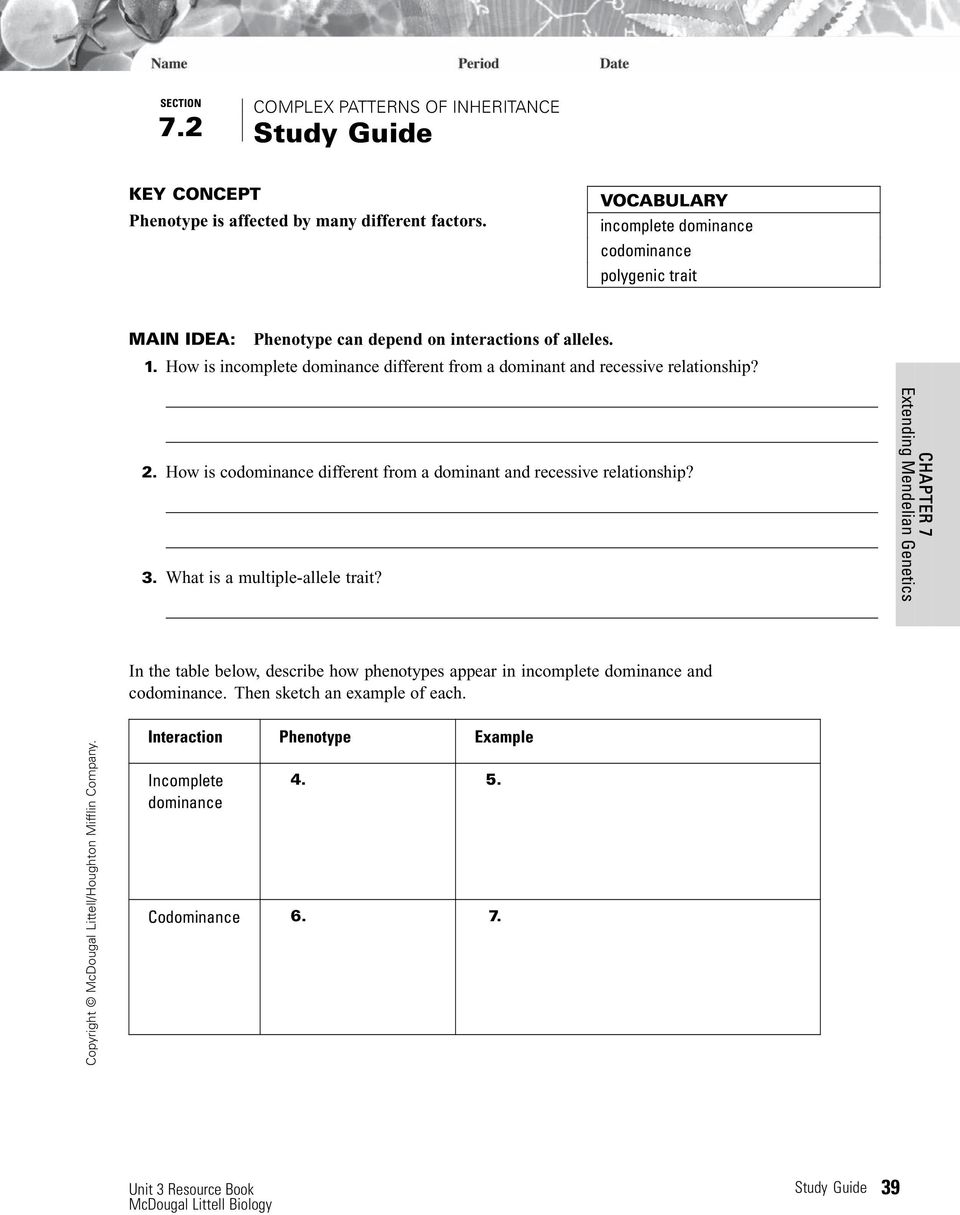
5 SECTION 7.2 COMPLEX PATTERNS OF INHERITANCE Study Guide KEY CONCEPT Phenotype is affected by many different factors. VOCABULARY incomplete dominance codominance polygenic trait MAIN IDEA: Phenotype can depend on interactions of alleles. 1. How is incomplete dominance different from a dominant and recessive relationship? 2. How is codominance different from a dominant and recessive relationship? 3. What is a multiple-allele trait? In the table below, describe how phenotypes appear in incomplete dominance and codominance. Then sketch an example of each. Interaction Phenotype Example Incomplete dominance Codominance Unit 3 Resource Book Study Guide 39
6 STUDY GUIDE, CONTINUED MAIN IDEA: Many genes may interact to produce one trait. Use the chart below to take notes on polygenic traits and epistasis. Many genes may interact to produce one trait. Polygenic Traits Epistasis MAIN IDEA: The environment interacts with genotype. 8. Why is genotype not the only factor that affects phenotype? 9. List and explain two examples of how environment and genotype can interact. Vocabulary Check 10. The prefix in- means not. How is the meaning of this prefix related to the meaning of incomplete dominance? 11. The prefix co- means together. How is the meaning of this prefix related to the meaning of codominance? 12. The prefix poly- means many, and the term genic means related to genes. How do these word parts combine to give the meaning of polygenic? 40 Study Guide Unit 3 Resource Book

7 SECTION 7.2 COMPLEX PATTERNS OF INHERITANCE Power Notes Complex Patterns of Inheritance Incomplete dominance: Codominance: Multiple alleles: Polygenic traits: Epistasis: Interaction of environment and genotype: Unit 3 Resource Book Power Notes 41

8 SECTION 7.2 COMPLEX PATTERNS OF INHERITANCE Reinforcement KEY CONCEPT Phenotype is affected by many different factors. Although some genetic traits are produced by one gene with dominant and recessive alleles, most genetic traits are the result of more complex relationships among genes and alleles. In many cases phenotype comes from more than just one gene, and many genes have more than just two alleles. Incomplete dominance: In incomplete dominance, neither of two alleles is completely dominant or completely recessive. Instead, the alleles show incomplete dominance, where the heterozygous phenotype is somewhere between the homozygous dominant and homozygous recessive phenotypes. The heterozygous phenotype is a third, distinct phenotype. Codominance: In codominance, two alleles of a gene are completely and separately expressed, and both phenotypes are also completely expressed. Human blood type is an example of both codominance and a multiple allele trait. The alleles for blood types A and B are codominant, which can be expressed as an AB blood type. The allele for type O blood is recessive to the other two alleles. Polygenic traits: Traits that are produced by two or more genes are polygenic traits. Because many different gene interactions can occur with polygenic traits, these traits often have a wide, continuous range of phenotypes. Epistasis: An epistatic gene is a gene that can affect the expression of all of the other genes that affect a trait. The environment can influence gene expression, which then affects phenotype. Human height is a trait that is partially due to environment. Another example is how temperature affects sex determination of sea turtles. 1. What is incomplete dominance? 2. What is codominance? 3. What is a polygenic trait? 4. Describe what happens in epistasis. 5. Give an example of how genotype and the environment can interact. 42 Reinforcement Unit 3 Resource Book
9 SECTION 7.3 GENE LINKAGE AND MAPPING Study Guide KEY CONCEPT Genes canbemappedto specific locations onchromosomes. VOCABULARY linkage map MAIN IDEA: 1. What is gene linkage? Gene linkage was explained through fruit flies. 2. Why were fruit flies useful in Morgan s research? 3. What is the difference between a wild type and a mutant type? 4. What did Morgan conclude from his research on fruit flies? Complete the sequence below to take notes about the discovery of gene linkage. Mendel: Genes assort independently of one another. Punnett, Bateson: Morgan: Unit 3 Resource Book Study Guide 43

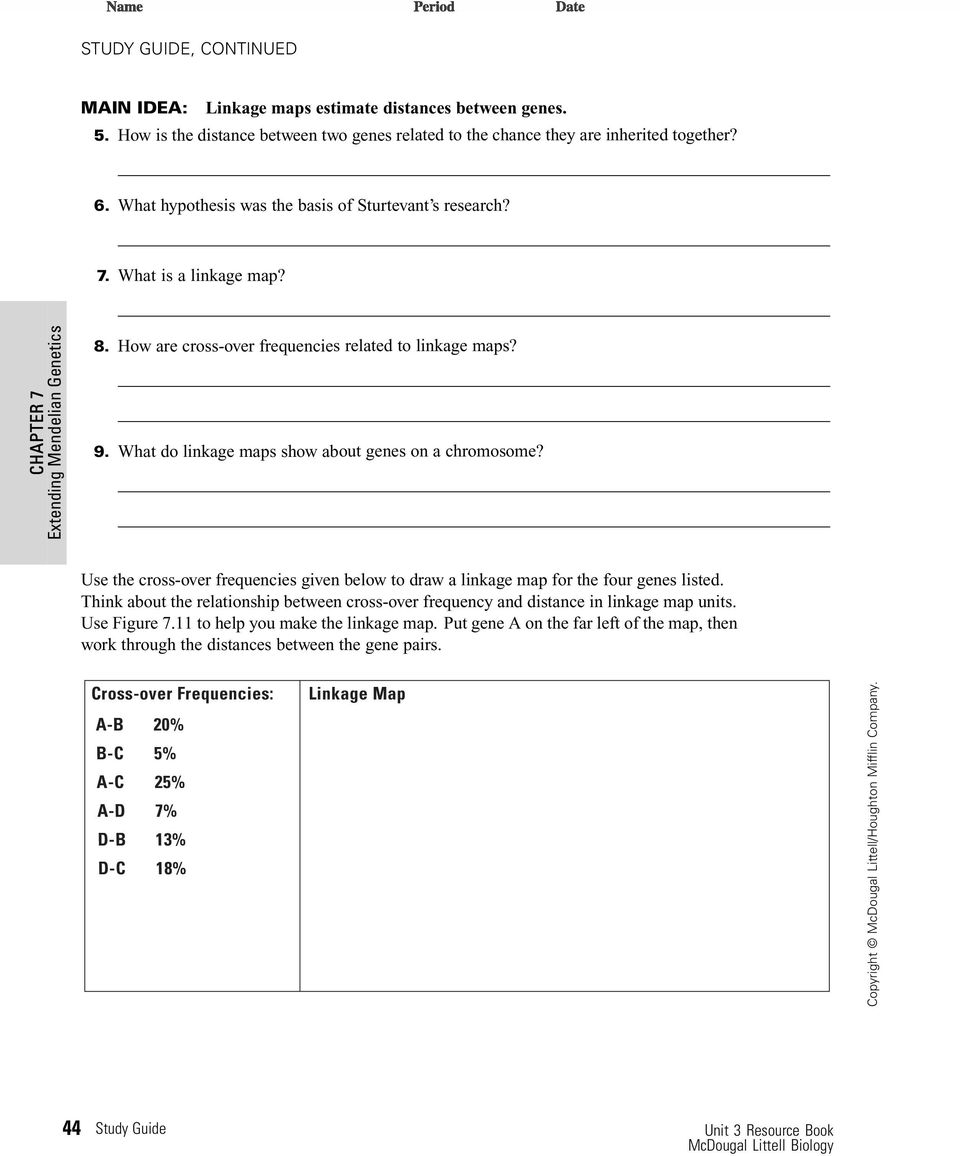
10 STUDY GUIDE, CONTINUED MAIN IDEA: Linkage maps estimate distances between genes. 5. How is the distance between two genes related to the chance they are inherited together? 6. What hypothesis was the basis of Sturtevant s research? 7. What is a linkage map? 8. How are cross-over frequencies related to linkage maps? 9. What do linkage maps show about genes on a chromosome? Use the cross-over frequencies given below to draw a linkage map for the four genes listed. Think about the relationship between cross-over frequency and distance in linkage map units. Use Figure 7.11 to help you make the linkage map. Put gene A on the far left of the map, then work through the distances between the gene pairs. Cross-over Frequencies: A-B 20% B-C 5% A-C 25% A-D 7% D-B 13% D-C 18% Linkage Map 44 Study Guide Unit 3 Resource Book
11 SECTION 7.3 GENE LINKAGE AND MAPPING Power Notes Mendel s experiments: Conclusions: Punnett and Bateson: Conclusions: Morgan: Conclusions: Sturtevant s hypothesis: Sturtevant s experiments: Making a linkage map: Unit 3 Resource Book Power Notes 45

12 SECTION 7.3 GENE LINKAGE AND MAPPING Reinforcement KEY CONCEPT Genes can be mapped to specific locations on chromosomes. One of Mendel s conclusions from his work on inheritance in pea plants was the law of independent assortment, which stated that genes assort independently of each other during meiosis. However, later experiments suggested that some genes were linked together and did not assort independently. Eventually, research with fruit flies demonstrated that chromosomes, not genes, assort independently and that during meiosis chromosomes could exchange homologous genes. The chance that two genes on a chromosome will be inherited together is related to the distance between the genes. If two genes are close together, it is very likely that they will be inherited together. If two genes are far apart, it is much more likely that they will be separated by the crossing over that occurs during meiosis. Crossing over takes place when segments of sister chromatids are exchanged. The frequency of cross-overs is related to the distance between genes on a chromosome. By finding the percentage of times that cross-overs occur from observations of phenotypes in offspring, it is possible to make a map of the locations of the genes. A linkage map is a map of the relative locations of genes on a chromosome. The distance between two genes on a linkage map is expressed in map units. Two genes that cross over one percent of the time are one map unit apart. Two genes that cross over 20 percent of the time are 20 map units apart. Linkage maps can be made for several different genes at one time if all of their cross-over frequencies are known. 1. How was Mendel s law of independent assortment inaccurate? 2. What is the relationship between the distance between two genes and the chance that they will be inherited together? 3. What is a linkage map? 4. How are the distances between genes determined for a linkage map? 46 Reinforcement Unit 3 Resource Book

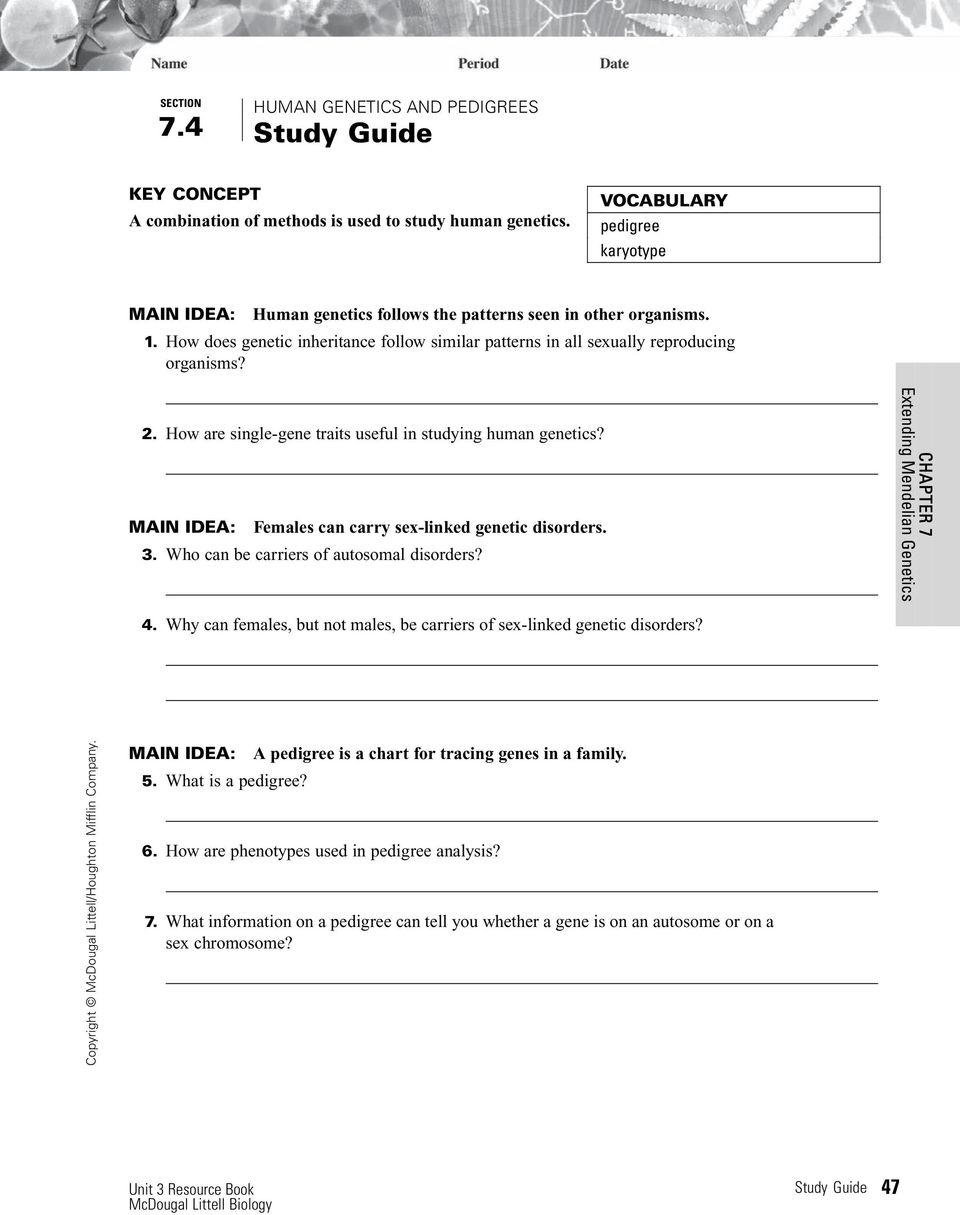
13 SECTION 7.4 HUMAN GENETICS AND PEDIGREES Study Guide KEY CONCEPT A combination of methods is used to study human genetics. VOCABULARY pedigree karyotype MAIN IDEA: Human genetics follows the patterns seeninotherorganisms. 1. How does genetic inheritance follow similar patterns in all sexually reproducing organisms? 2. How are single-gene traits useful in studying human genetics? MAIN IDEA: Females can carry sex-linked genetic disorders. 3. Who can be carriers of autosomal disorders? 4. Why can females, but not males, be carriers of sex-linked genetic disorders? MAIN IDEA: 5. What is a pedigree? Apedigreeis a chart for tracing genes in a family. 6. How are phenotypes used in pedigree analysis? 7. Whatinformationonapedigreecantellyouwhetherageneisonanautosomeorona sex chromosome? Unit 3 Resource Book Study Guide 47
14 STUDY GUIDE, CONTINUED 8. Complete the chart to follow the logic necessary to fill out a pedigree for a sex-linked gene. Use X D and X d for the dominant and recessive X-linked genes, respectively. Tracing Sex-Linked Genes Phenotype Female, recessive phenotype Male, recessive phenotype must have must have must have must have Genotype must could Parental Phenotype have Parental Genotype have Offspring Genotypes Female carrier, normal male Female carrier, male with recessive phenotype Female with recessive phenotype, normal male must have must have must have X D X d could have could have could have Female with recessive phenotype, male with recessive phenotype must have could have MAIN IDEA: Several methods help map human chromosomes. 9. What are two methods that are used to directly study human chromosomes? 10. What does a karyotype show about chromosomes? Vocabulary Check 11. What is a karyotype? 48 Study Guide Unit 3 Resource Book

15 SECTION 7.4 HUMAN GENETICS AND PEDIGREES Power Notes Sex-Linked Disorders Males: Females: A pedigree chart is: Tracing Autosomal Genes Tracing Sex-Linked Genes A karyotype is: A karyotype shows: Unit 3 Resource Book Power Notes 49

16 SECTION 7.4 HUMAN GENETICS AND PEDIGREES Reinforcement KEY CONCEPT A combination of methods is used to study human genetics. The patterns of inheritance in humans are the same as the patterns of inheritance in other sexually reproducing organisms. Phenotypes are often the result of varying degrees of dominance, several genes, multiple alleles, or sex-linked genes. Only females can be carriers of sex-linked disorders. Females, who have an XX genotype for their sex chromosomes, must have two recessive alleles to show a recessive phenotype, such as for a recessive sex-linked disorder. Males, on the other hand, have an XY genotype. They will show all of the phenotypes from the genes on their X chromosome, even the recessive alleles, because they cannot have a second, dominant allele that could mask the recessive allele. The potential for a genetic disorder to be passed on through a family can be studied using pedigree analysis. A pedigree is a chart that is used to trace phenotypes and genotypes within a family. It can help show whether someone in a family may have recessive alleles that cause a genetic disorder. Known phenotypes in a family are used to infer genotypes. Both autosomal genes and sex-linked genes can be traced with pedigrees. Tracing autosomal genes: Equal numbers of males and females will have the recessive phenotype. Anyone with the recessive phenotype must be homozygous recessive. Two heterozygous parents can have children who are homozygous dominant, heterozygous, or homozygous recessive. Tracing sex-linked genes: More males than females will have the recessive phenotype. Males with a recessive allele will pass it on to all of his daughters. Females can be carriers of a recessive allele and pass it on to either sons or daughters. In addition to pedigrees, other methods of studying human genetics are used. Karyotypes, for example, are pictures of all of a person s chromosomes that can show any large changes in the chromosomes. 1. Why can only females be carriers of sex-linked disorders? 2. What is a pedigree? 3. What is one major difference in pedigrees between autosomal and sex-linked genes? 50 Reinforcement Unit 3 Resource Book

17 CHAPTER 7 CONSTRUCTING BAR GRAPHS Data Analysis Practice Bar graphs are used to display data collected during an investigation. Bar graphs are used to compare groups of data that are independent of each other. The temperature at which sea turtle eggs mature helps determine the sex of the turtles. Evidence suggests that black sea turtle eggs that mature at temperatures below 27.1ºC result in all males. In contrast, black sea turtle eggs that mature above 31ºC result in all females. Suppose a team of scientists studied the effect of a range of temperatures between those two extremes by incubating different groups of black sea turtle eggs at different temperatures in an incubator. Each group contained 20 eggs. The scientists collected the data shown in the table below. EFFECT OF TEMPERATURE ON SEA TURTLE SEX DETERMINATION Incubation Temperature (ºC) Males Females Graph On the next page, construct a bar graph that shows the data in the table. Be sure to include labels on each axis and a title for the graph. Unit 3 Resource Book Data Analysis Practice 51

18 2. Analyze Describe the relationship shown in the graph between incubation temperature and sex determination in sea turtles. 52 Data Analysis Practice Unit 3 Resource Book

19 CHAPTER 7 INCOMPLETE DOMINANCE IN FOUR O CLOCKS Pre-AP Activity In Chapter 7, you have learned that when a homozygous red-flowered four o clock plant is crossed with a homozygous white-flowered four o clock plant, the offspring all have pink flowers. This is an example of incomplete dominance, a type of non-mendelian genetics. DOMINANCE AT THE MOLECULAR LEVEL One of the traits Mendel studied in pea plants was flower color. When he crossed a purple-flowered plant, PP, with a white-flowered plant, pp, all flowers in the first generation of offspring (F 1 ) had purple flowers. The allele for purple flowers was completely dominant to white flowers. Each gene holds the genetic information for the production of a particular protein, usually an enzyme. When the dominant allele for purple flower color is present, a series of enzymatic reactions results in the flower cells making a purple pigment. When no dominant allele is present, as in the pp homozygous recessive plant, no purple pigment is made, and the flowers are white. The recessive allele most likely codes for an enzyme that is defective and unable to catalyze the reaction that leads to the production of the purple pigment. In the Pp heterozygote, only half the amount of pigment is produced, but it is enough to make the flowers purple. The flowers of a Pp plant cannot be distinguished from those of a PP plant. INHERITANCE PATTERN OF INCOMPLETE DOMINANCE Why does the heterozygote four o clock have pink flowers? The allele for red flower color causes a red pigment, called anthocyanin, to be produced. If only one copy of the allele is present, only half the amount of red pigment is made, which effectively dilutes the coloring so that the flowers appear pink, not red. Red four o clock R 1 R 1 White four o clock R 1 R 1 R 2 R 2 R 1 R 1 R 1 R 2 Pink R 1 R 2 Pink R 1 R 2 Pink R 1 R 2 Pink F 1 generation: four pink four o clocks What is the inheritance pattern of a trait that is controlled by incomplete dominance? To find out, you will diagram the self-fertilization of one heterozygous F 1 plant and then the self-fertilization of all the resulting genotypes of the F 2 generation. Unit 3 Resource Book Pre-AP Activity 53

20 1. In the Punnett squares below, diagram the self-fertilization, a self-cross, of one pink-flowered F 1 heterozygous plant (R 1 R 2 ). Then use the second series of Punnett squares to diagram the self-fertilization of each genotype of the F 2 generation. Include both the genotype and phenotype in the cells of the Punnett Square. If you have colored pencils available, you can color in the squares with the appropriate flower colors. F 1 self-cross F 2 self-crosses 2. Describe the pattern of inheritance for incomplete dominance. 3. As described in Chapter 6, Mendel s work with pea plants demonstrated that the factors that control heritable traits exist as discrete units, what we now call genes. Yet the cross of a red four o clock plant with a white four o clock clearly shows a blend in the phenotype: red plus white equals pink. How are the Punnett squares you completed evidence that heritable factors are discrete units, despite the blending of colors? 54 Pre-AP Activity Unit 3 Resource Book

21 CHAPTER 7 ROYAL HEMOPHILIA Pre-AP Activity In Chapter 7, you have learned how sex-linked traits are inherited, and how to analyze a pedigree. You also learned how to make and analyze a pedigree. Hemophilia, a condition that results in excessive bleeding after injury due to an abnormal blood clotting factor, is a sex-linked trait. By analyzing a pedigree of Queen Victoria s family, you will learn more about this genetic disorder. QUEEN VICTORIA S FAMILY The most famous example of hemophilia occurred in the family of Victoria, Queen of England from 1837 to She was England s longest reigning monarch. Victoria married her cousin, Prince Albert, and they had nine children five girls and four boys. As you can see in the pedigree on the next page, three of her children inherited the allele for hemophilia. Because it was common for members of European royal families to marry into other royal families, the defective allele was carried into the royal families of Russia, Germany, and Spain. The disease has been called the royal disease, or royal hemophilia. Ten of Victoria s male descendants had hemophilia. Answer the following questions on a separate sheet of paper. 1. Victoria s youngest child, Beatrice, had one daughter, one normal son, and two sons with hemophilia. Beatrice s daughter, Eugenie, marriedkingalfonsoxiiiofspain.they had six children, one of whom was the father of Juan Carlos, the current King of Spain. What is Juan Carlos s phenotype normal, carrier, or hemophilic? Explain. 2. Victoria s daughter Alice had a daughter, Alix, who carried the defective allele into the royal Russian family when she married Tsar Nicholas II. They had four daughters and one son, Alexis. Alexis had hemophilia. The entire family was murdered during the Russian Revolution. What is the probability that one of Alexis s sisters was a carrier? What is the probability that all four of Alexis s sisters were carriers? Explain. 3. If Alexis had lived and married a normal woman, what is the probability that he would have had a daughter with hemophilia? Explain. 4. Is it possible for a female to have hemophilia? Explain. 5. What is the probability that the next generation of the present British royal family Charles, Andrew, Edward, and Ann will have hemophilia? Explain. Unit 3 Resource Book Pre-AP Activity 55
22 Elizabeth Philip Ann Andrew Diana Charles William Harry Edward Victoria Albert Victoria Alice Beatrice Tsar Nicholas II Alfonso XIII Alexis? Edward? Normal male Hemophilic male Male died in infancy possible hemophilic Normal female Carrier female Eugenie Juan Carlos 56 Pre-AP Activity Unit 3 Resource Book
23 CHAPTER 7 EXTENDING MENDELIAN GENETICS Vocabulary Practice carrier incomplete dominance linkage map sex-linked gene codominance pedigree X chromosome inactivation polygenic trait karyotype A. Compound Word Puzzle Read the phrase and write the word that it most closely describes. Then write another phrase that describes the same word in a different way. PHRASE 1 WORD PHRASE 2 picture of all human chromosomes genes located on the sex chromosomes it shows the relative locations of genes on a chromosome Example karyotype can show large changes in chromosomes one X chromosome is randomly turned off 3. a chart that is used to trace phenotypes and genotypes in a family many genes interact to produce asingletrait an in-between phenotype 6. Unit 3 Resource Book Vocabulary Practice 57
24 VOCABULARY PRACTICE, CONTINUED B. Words in Context Answer the questions to show your understanding of the vocabulary words. 1. Which is like a karyotype, a satellite weather map, or the temperature on one street corner? 2. Is incomplete dominance like a glass of cranberry-raspberry juice or a pizza with everything? 3. Is Xchromosome inactivation like an electrical generator or a power failure? 4. Would a pedigree be used to trace genes in a family or to send a dog to obedience school? 5. Is codominance like doing your homework or two people talking at the same time? 6. Which is like a carrier, a ferry crossing a lake, or a door opening? 7. Are exact directions or a general idea of where you are going more like a linkage map? 8. Is a polygenic trait more like a basketball team or a figure skater? C. Do-It Yourself Matching In a random order, write short definitions for each term on the blank lines to the right. Then give your paper to a classmate who should write the number of the term next to the correct definition. 1. sex-linked gene 2. incomplete dominance 3. carrier 4. linkage map 5. codominance 6. karyotype 58 Vocabulary Practice Unit 3 Resource Book
25 VOCABULARY PRACTICE, CONTINUED D. Who Am I? Choose among these terms to answer the riddles below: carrier karyotype polygenic trait codominance linkage map X chromosome inactivation incomplete dominance pedigree 1. I am the process that randomly turns off one X chromosome in a human female s cells. 2. I am an interaction between two alleles in which both alleles are fully and separately expressed. 3. I am a chart that can be used to trace genes through a family. 4. I am a picture that shows the overall structure of chromosomes. 5. I am an interaction between two alleles that produces a phenotype that is between the phenotypes of homozygotes. 6. I am a person who does not show a genetic disorder, but I can pass it on to my offspring. 7. I am a map of genes on a chromosome, but I do not show the exact locations of the genes. 8. I am a trait that is the result of many genes. E. Find the Odd Word Put a checkmark next to the word that does not belong. 1. karyotype linkage map X chromosome inactivation 2. sex-linked gene polygenic trait carrier Explanation Explanation Unit 3 Resource Book Vocabulary Practice 59
26 VOCABULARY PRACTICE, CONTINUED 3. linkage map incomplete dominance Explanation codominance 4. incomplete dominance karyotype Explanation pedigree F. Analogies Read each analogy. Decide which term is most like it. carrier codominance linkage map X chromosome inactivation polygenic trait karyotype incomplete dominance 1. Airport baggage handler 2. Blending the ingredients of a fruit smoothie 3. Randomly flipping switches in an electrical panel 4. A still-life painting 5. All of the people who make up the United States 6. Mixing the ingredients of a fruit salad 7. A train schedule that shows the stops made by the train Write your own analogies to show the meaning of these terms: 8. sex-linked gene 9. pedigree 60 Vocabulary Practice Unit 3 Resource Book
CCR Biology - Chapter 7 Practice Test - Summer 2012
 Name: Class: Date: CCR Biology - Chapter 7 Practice Test - Summer 2012 Multiple Choice Identify the choice that best completes the statement or answers the question. 1. A person who has a disorder caused
somatic cell egg genotype gamete polar body phenotype homologous chromosome trait dominant autosome genetics recessive
 CHAPTER 6 MEIOSIS AND MENDEL Vocabulary Practice somatic cell egg genotype gamete polar body phenotype homologous chromosome trait dominant autosome genetics recessive CHAPTER 6 Meiosis and Mendel sex
Chapter 9 Patterns of Inheritance
 Bio 100 Patterns of Inheritance 1 Chapter 9 Patterns of Inheritance Modern genetics began with Gregor Mendel s quantitative experiments with pea plants History of Heredity Blending theory of heredity -
Heredity. Sarah crosses a homozygous white flower and a homozygous purple flower. The cross results in all purple flowers.
 Heredity 1. Sarah is doing an experiment on pea plants. She is studying the color of the pea plants. Sarah has noticed that many pea plants have purple flowers and many have white flowers. Sarah crosses
Mendelian and Non-Mendelian Heredity Grade Ten
 Ohio Standards Connection: Life Sciences Benchmark C Explain the genetic mechanisms and molecular basis of inheritance. Indicator 6 Explain that a unit of hereditary information is called a gene, and genes
7A The Origin of Modern Genetics
 Life Science Chapter 7 Genetics of Organisms 7A The Origin of Modern Genetics Genetics the study of inheritance (the study of how traits are inherited through the interactions of alleles) Heredity: the
Heredity - Patterns of Inheritance
 Heredity - Patterns of Inheritance Genes and Alleles A. Genes 1. A sequence of nucleotides that codes for a special functional product a. Transfer RNA b. Enzyme c. Structural protein d. Pigments 2. Genes
Name: 4. A typical phenotypic ratio for a dihybrid cross is a) 9:1 b) 3:4 c) 9:3:3:1 d) 1:2:1:2:1 e) 6:3:3:6
 Name: Multiple-choice section Choose the answer which best completes each of the following statements or answers the following questions and so make your tutor happy! 1. Which of the following conclusions
CHROMOSOMES AND INHERITANCE
 SECTION 12-1 REVIEW CHROMOSOMES AND INHERITANCE VOCABULARY REVIEW Distinguish between the terms in each of the following pairs of terms. 1. sex chromosome, autosome 2. germ-cell mutation, somatic-cell
Name: Class: Date: ID: A
 Name: Class: _ Date: _ Meiosis Quiz 1. (1 point) A kidney cell is an example of which type of cell? a. sex cell b. germ cell c. somatic cell d. haploid cell 2. (1 point) How many chromosomes are in a human
The correct answer is c A. Answer a is incorrect. The white-eye gene must be recessive since heterozygous females have red eyes.
 1. Why is the white-eye phenotype always observed in males carrying the white-eye allele? a. Because the trait is dominant b. Because the trait is recessive c. Because the allele is located on the X chromosome
Problems 1-6: In tomato fruit, red flesh color is dominant over yellow flesh color, Use R for the Red allele and r for the yellow allele.
 Genetics Problems Name ANSWER KEY Problems 1-6: In tomato fruit, red flesh color is dominant over yellow flesh color, Use R for the Red allele and r for the yellow allele. 1. What would be the genotype
A trait is a variation of a particular character (e.g. color, height). Traits are passed from parents to offspring through genes.
 1 Biology Chapter 10 Study Guide Trait A trait is a variation of a particular character (e.g. color, height). Traits are passed from parents to offspring through genes. Genes Genes are located on chromosomes
Chromosomes, Mapping, and the Meiosis Inheritance Connection
 Chromosomes, Mapping, and the Meiosis Inheritance Connection Carl Correns 1900 Chapter 13 First suggests central role for chromosomes Rediscovery of Mendel s work Walter Sutton 1902 Chromosomal theory
Bio EOC Topics for Cell Reproduction: Bio EOC Questions for Cell Reproduction:
 Bio EOC Topics for Cell Reproduction: Asexual vs. sexual reproduction Mitosis steps, diagrams, purpose o Interphase, Prophase, Metaphase, Anaphase, Telophase, Cytokinesis Meiosis steps, diagrams, purpose
Biology Final Exam Study Guide: Semester 2
 Biology Final Exam Study Guide: Semester 2 Questions 1. Scientific method: What does each of these entail? Investigation and Experimentation Problem Hypothesis Methods Results/Data Discussion/Conclusion
Human Blood Types: Codominance and Multiple Alleles. Codominance: both alleles in the heterozygous genotype express themselves fully
 Human Blood Types: Codominance and Multiple Alleles Codominance: both alleles in the heterozygous genotype express themselves fully Multiple alleles: three or more alleles for a trait are found in the
Genetics Module B, Anchor 3
 Genetics Module B, Anchor 3 Key Concepts: - An individual s characteristics are determines by factors that are passed from one parental generation to the next. - During gamete formation, the alleles for
Recovering the Romanovs
 Recovering the Romanovs ACTIVITY 1 The Romanov Family: Screen #4 Inheritance of a Sex-linked Trait Key: H=normal allele; h=hemophilia allele; X=X chromosome; Y=Y chromosome 1. Use a Punnett square to show
17. A testcross A.is used to determine if an organism that is displaying a recessive trait is heterozygous or homozygous for that trait. B.
 ch04 Student: 1. Which of the following does not inactivate an X chromosome? A. Mammals B. Drosophila C. C. elegans D. Humans 2. Who originally identified a highly condensed structure in the interphase
Biology 1406 Exam 4 Notes Cell Division and Genetics Ch. 8, 9
 Biology 1406 Exam 4 Notes Cell Division and Genetics Ch. 8, 9 Ch. 8 Cell Division Cells divide to produce new cells must pass genetic information to new cells - What process of DNA allows this? Two types
BioBoot Camp Genetics
 BioBoot Camp Genetics BIO.B.1.2.1 Describe how the process of DNA replication results in the transmission and/or conservation of genetic information DNA Replication is the process of DNA being copied before
CHAPTER 15 THE CHROMOSOMAL BASIS OF INHERITANCE. Section B: Sex Chromosomes
 CHAPTER 15 THE CHROMOSOMAL BASIS OF INHERITANCE Section B: Sex Chromosomes 1. The chromosomal basis of sex varies with the organism 2. Sex-linked genes have unique patterns of inheritance 1. The chromosomal
Mendelian inheritance and the
 Mendelian inheritance and the most common genetic diseases Cornelia Schubert, MD, University of Goettingen, Dept. Human Genetics EUPRIM-Net course Genetics, Immunology and Breeding Mangement German Primate
GENETIC CROSSES. Monohybrid Crosses
 GENETIC CROSSES Monohybrid Crosses Objectives Explain the difference between genotype and phenotype Explain the difference between homozygous and heterozygous Explain how probability is used to predict
MCB41: Second Midterm Spring 2009
 MCB41: Second Midterm Spring 2009 Before you start, print your name and student identification number (S.I.D) at the top of each page. There are 7 pages including this page. You will have 50 minutes for
PRACTICE PROBLEMS - PEDIGREES AND PROBABILITIES
 PRACTICE PROBLEMS - PEDIGREES AND PROBABILITIES 1. Margaret has just learned that she has adult polycystic kidney disease. Her mother also has the disease, as did her maternal grandfather and his younger
LAB : PAPER PET GENETICS. male (hat) female (hair bow) Skin color green or orange Eyes round or square Nose triangle or oval Teeth pointed or square
 Period Date LAB : PAPER PET GENETICS 1. Given the list of characteristics below, you will create an imaginary pet and then breed it to review the concepts of genetics. Your pet will have the following
DNA Determines Your Appearance!
 DNA Determines Your Appearance! Summary DNA contains all the information needed to build your body. Did you know that your DNA determines things such as your eye color, hair color, height, and even the
Chapter 13: Meiosis and Sexual Life Cycles
 Name Period Concept 13.1 Offspring acquire genes from parents by inheriting chromosomes 1. Let s begin with a review of several terms that you may already know. Define: gene locus gamete male gamete female
Genetics 1. Defective enzyme that does not make melanin. Very pale skin and hair color (albino)
 Genetics 1 We all know that children tend to resemble their parents. Parents and their children tend to have similar appearance because children inherit genes from their parents and these genes influence
Chapter 13: Meiosis and Sexual Life Cycles
 Name Period Chapter 13: Meiosis and Sexual Life Cycles Concept 13.1 Offspring acquire genes from parents by inheriting chromosomes 1. Let s begin with a review of several terms that you may already know.
Mendelian Genetics in Drosophila
 Mendelian Genetics in Drosophila Lab objectives: 1) To familiarize you with an important research model organism,! Drosophila melanogaster. 2) Introduce you to normal "wild type" and various mutant phenotypes.
Genetics for the Novice
 Genetics for the Novice by Carol Barbee Wait! Don't leave yet. I know that for many breeders any article with the word genetics in the title causes an immediate negative reaction. Either they quickly turn
Genetics with a Smile
 Teacher Notes Materials Needed: Two coins (penny, poker chip, etc.) per student - One marked F for female and one marked M for male Copies of student worksheets - Genetics with a Smile, Smiley Face Traits,
Influence of Sex on Genetics. Chapter Six
 Influence of Sex on Genetics Chapter Six Humans 23 Autosomes Chromosomal abnormalities very severe Often fatal All have at least one X Deletion of X chromosome is fatal Males = heterogametic sex XY Females
AP: LAB 8: THE CHI-SQUARE TEST. Probability, Random Chance, and Genetics
 Ms. Foglia Date AP: LAB 8: THE CHI-SQUARE TEST Probability, Random Chance, and Genetics Why do we study random chance and probability at the beginning of a unit on genetics? Genetics is the study of inheritance,
The Making of the Fittest: Natural Selection in Humans
 OVERVIEW MENDELIN GENETIC, PROBBILITY, PEDIGREE, ND CHI-QURE TTITIC This classroom lesson uses the information presented in the short film The Making of the Fittest: Natural election in Humans (http://www.hhmi.org/biointeractive/making-fittest-natural-selection-humans)
Recovering the Romanovs
 Recovering the Romanovs Description of activity Recovering the Romanovs is an excellent opening to any unit on human genetics. To complete the three parts of this module, approximately three 40-minute
Bio 102 Practice Problems Mendelian Genetics and Extensions
 Bio 102 Practice Problems Mendelian Genetics and Extensions Short answer (show your work or thinking to get partial credit): 1. In peas, tall is dominant over dwarf. If a plant homozygous for tall is crossed
Phenotypes and Genotypes of Single Crosses
 GENETICS PROBLEM PACKET- Gifted NAME PER Phenotypes and Genotypes of Single Crosses Use these characteristics about plants to answer the following questions. Round seed is dominant over wrinkled seed Yellow
Terms: The following terms are presented in this lesson (shown in bold italics and on PowerPoint Slides 2 and 3):
 Unit B: Understanding Animal Reproduction Lesson 4: Understanding Genetics Student Learning Objectives: Instruction in this lesson should result in students achieving the following objectives: 1. Explain
B2 5 Inheritrance Genetic Crosses
 B2 5 Inheritrance Genetic Crosses 65 minutes 65 marks Page of 55 Q. A woman gives birth to triplets. Two of the triplets are boys and the third is a girl. The triplets developed from two egg cells released
Meiosis is a special form of cell division.
 Page 1 of 6 KEY CONCEPT Meiosis is a special form of cell division. BEFORE, you learned Mitosis produces two genetically identical cells In sexual reproduction, offspring inherit traits from both parents
Gene Mapping Techniques
 Gene Mapping Techniques OBJECTIVES By the end of this session the student should be able to: Define genetic linkage and recombinant frequency State how genetic distance may be estimated State how restriction
Summary. 16 1 Genes and Variation. 16 2 Evolution as Genetic Change. Name Class Date
 Chapter 16 Summary Evolution of Populations 16 1 Genes and Variation Darwin s original ideas can now be understood in genetic terms. Beginning with variation, we now know that traits are controlled by
LAB : THE CHI-SQUARE TEST. Probability, Random Chance, and Genetics
 Period Date LAB : THE CHI-SQUARE TEST Probability, Random Chance, and Genetics Why do we study random chance and probability at the beginning of a unit on genetics? Genetics is the study of inheritance,
The Genetics of Drosophila melanogaster
 The Genetics of Drosophila melanogaster Thomas Hunt Morgan, a geneticist who worked in the early part of the twentieth century, pioneered the use of the common fruit fly as a model organism for genetic
Saffiyah Y. Manboard Biology Instructor Seagull Alternative High School [email protected]
 The Effect of Discovery Learning through Biotechnology on the Knowledge and Perception of Sickle Cell Anemia and It s Genetics on Lower Income Students Saffiyah Y. Manboard Biology Instructor Seagull Alternative
Mitosis, Meiosis and Fertilization 1
 Mitosis, Meiosis and Fertilization 1 I. Introduction When you fall and scrape the skin off your hands or knees, how does your body make new skin cells to replace the skin cells that were scraped off? How
Chromosomal Basis of Inheritance. Ch. 3
 Chromosomal Basis of Inheritance Ch. 3 THE CHROMOSOME THEORY OF INHERITANCE AND SEX CHROMOSOMES! The chromosome theory of inheritance describes how the transmission of chromosomes account for the Mendelian
Chapter 4 Pedigree Analysis in Human Genetics. Chapter 4 Human Heredity by Michael Cummings 2006 Brooks/Cole-Thomson Learning
 Chapter 4 Pedigree Analysis in Human Genetics Mendelian Inheritance in Humans Pigmentation Gene and Albinism Fig. 3.14 Two Genes Fig. 3.15 The Inheritance of Human Traits Difficulties Long generation time
I. Genes found on the same chromosome = linked genes
 Genetic recombination in Eukaryotes: crossing over, part 1 I. Genes found on the same chromosome = linked genes II. III. Linkage and crossing over Crossing over & chromosome mapping I. Genes found on the
1 Mutation and Genetic Change
 CHAPTER 14 1 Mutation and Genetic Change SECTION Genes in Action KEY IDEAS As you read this section, keep these questions in mind: What is the origin of genetic differences among organisms? What kinds
DRAGON GENETICS LAB -- Principles of Mendelian Genetics
 DragonGeneticsProtocol Mendelian Genetics lab Student.doc DRAGON GENETICS LAB -- Principles of Mendelian Genetics Dr. Pamela Esprivalo Harrell, University of North Texas, developed an earlier version of
Incomplete Dominance and Codominance
 Name: Date: Period: Incomplete Dominance and Codominance 1. In Japanese four o'clock plants red (R) color is incompletely dominant over white (r) flowers, and the heterozygous condition (Rr) results in
If you crossed a homozygous, black guinea pig with a white guinea pig, what would be the phenotype(s)
 Biological Principles Name: In guinea pigs, black hair (B) is dominant to white hair (b). Homozygous black guinea pig White guinea pig Heterozygous black guinea pig Genotype Phenotype Why is there no heterozygous
Test Two Study Guide
 Test Two Study Guide 1. Describe what is happening inside a cell during the following phases (pictures may help but try to use words): Interphase: : Consists of G1 / S / G2. Growing stage, cell doubles
Can receive blood from: * I A I A and I A i o Type A Yes No A or AB A or O I B I B and I B i o Type B No Yes B or AB B or O
 Genetics of the ABO Blood Groups written by J. D. Hendrix Learning Objectives Upon completing the exercise, each student should be able: to explain the concept of blood group antigens; to list the genotypes
This fact sheet describes how genes affect our health when they follow a well understood pattern of genetic inheritance known as autosomal recessive.
 11111 This fact sheet describes how genes affect our health when they follow a well understood pattern of genetic inheritance known as autosomal recessive. In summary Genes contain the instructions for
Genetic Mutations. Indicator 4.8: Compare the consequences of mutations in body cells with those in gametes.
 Genetic Mutations Indicator 4.8: Compare the consequences of mutations in body cells with those in gametes. Agenda Warm UP: What is a mutation? Body cell? Gamete? Notes on Mutations Karyotype Web Activity
Population Genetics and Multifactorial Inheritance 2002
 Population Genetics and Multifactorial Inheritance 2002 Consanguinity Genetic drift Founder effect Selection Mutation rate Polymorphism Balanced polymorphism Hardy-Weinberg Equilibrium Hardy-Weinberg Equilibrium
Lesson Plan: GENOTYPE AND PHENOTYPE
 Lesson Plan: GENOTYPE AND PHENOTYPE Pacing Two 45- minute class periods RATIONALE: According to the National Science Education Standards, (NSES, pg. 155-156), In the middle-school years, students should
Science 10-Biology Activity 14 Worksheet on Sexual Reproduction
 Science 10-Biology Activity 14 Worksheet on Sexual Reproduction 10 Name Due Date Show Me NOTE: This worksheet is based on material from pages 367-372 in Science Probe. 1. Sexual reproduction requires parents,
5 GENETIC LINKAGE AND MAPPING
 5 GENETIC LINKAGE AND MAPPING 5.1 Genetic Linkage So far, we have considered traits that are affected by one or two genes, and if there are two genes, we have assumed that they assort independently. However,
BioSci 2200 General Genetics Problem Set 1 Answer Key Introduction and Mitosis/ Meiosis
 BioSci 2200 General Genetics Problem Set 1 Answer Key Introduction and Mitosis/ Meiosis Introduction - Fields of Genetics To answer the following question, review the three traditional subdivisions of
Genetics Lecture Notes 7.03 2005. Lectures 1 2
 Genetics Lecture Notes 7.03 2005 Lectures 1 2 Lecture 1 We will begin this course with the question: What is a gene? This question will take us four lectures to answer because there are actually several
2 18. If a boy s father has haemophilia and his mother has one gene for haemophilia. What is the chance that the boy will inherit the disease? 1. 0% 2
 1 GENETICS 1. Mendel is considered to be lucky to discover the laws of inheritance because 1. He meticulously analyzed his data statistically 2. He maintained pedigree records of various generations he
A and B are not absolutely linked. They could be far enough apart on the chromosome that they assort independently.
 Name Section 7.014 Problem Set 5 Please print out this problem set and record your answers on the printed copy. Answers to this problem set are to be turned in to the box outside 68-120 by 5:00pm on Friday
Genetics Part 1: Inheritance of Traits
 Genetics Part 1: Inheritance of Traits Genetics is the study of how traits are passed from parents to offspring. Offspring usually show some traits of each parent. For a long time, scientists did not understand
MCAS Biology. Review Packet
 MCAS Biology Review Packet 1 Name Class Date 1. Define organic. THE CHEMISTRY OF LIFE 2. All living things are made up of 6 essential elements: SPONCH. Name the six elements of life. S N P C O H 3. Elements
BIO 184 Page 1 Spring 2013 NAME VERSION 1 EXAM 3: KEY. Instructions: PRINT your Name and Exam version Number on your Scantron
 BIO 184 Page 1 Spring 2013 EXAM 3: KEY Instructions: PRINT your Name and Exam version Number on your Scantron Example: PAULA SMITH, EXAM 2 VERSION 1 Write your name CLEARLY at the top of every page of
Evolution (18%) 11 Items Sample Test Prep Questions
 Evolution (18%) 11 Items Sample Test Prep Questions Grade 7 (Evolution) 3.a Students know both genetic variation and environmental factors are causes of evolution and diversity of organisms. (pg. 109 Science
Variations on a Human Face Lab
 Variations on a Human Face Lab Introduction: Have you ever wondered why everybody has a different appearance even if they are closely related? It is because of the large variety or characteristics that
Bio 102 Practice Problems Mendelian Genetics: Beyond Pea Plants
 Bio 102 Practice Problems Mendelian Genetics: Beyond Pea Plants Short answer (show your work or thinking to get partial credit): 1. In four-o'clock flowers, red flower color (R) is incompletely dominant
Lecture 2: Mitosis and meiosis
 Lecture 2: Mitosis and meiosis 1. Chromosomes 2. Diploid life cycle 3. Cell cycle 4. Mitosis 5. Meiosis 6. Parallel behavior of genes and chromosomes Basic morphology of chromosomes telomere short arm
About The Causes of Hearing Loss
 About 1 in 500 infants is born with or develops hearing loss during early childhood. Hearing loss has many causes: some are genetic (that is, caused by a baby s genes) or non-genetic (such as certain infections
CHROMOSOME STRUCTURE CHROMOSOME NUMBERS
 CHROMOSOME STRUCTURE 1. During nuclear division, the DNA (as chromatin) in a Eukaryotic cell's nucleus is coiled into very tight compact structures called chromosomes. These are rod-shaped structures made
Using Blood Tests to Identify Babies and Criminals
 Using Blood Tests to Identify Babies and Criminals Copyright, 2012, by Drs. Jennifer Doherty and Ingrid Waldron, Department of Biology, University of Pennsylvania 1 I. Were the babies switched? Two couples
Type A carbohydrate molecules on their red blood cells. Type B carbohydrate molecules on their red blood cells
 Using Blood Tests to Identify Babies and Criminals Copyright, 2010, by Drs. Jennifer Doherty and Ingrid Waldron, Department of Biology, University of Pennsylvania 1 I. Were the babies switched? Two couples
Basics of Marker Assisted Selection
 asics of Marker ssisted Selection Chapter 15 asics of Marker ssisted Selection Julius van der Werf, Department of nimal Science rian Kinghorn, Twynam Chair of nimal reeding Technologies University of New
Biology 1406 - Notes for exam 5 - Population genetics Ch 13, 14, 15
 Biology 1406 - Notes for exam 5 - Population genetics Ch 13, 14, 15 Species - group of individuals that are capable of interbreeding and producing fertile offspring; genetically similar 13.7, 14.2 Population
The Developing Person Through the Life Span 8e by Kathleen Stassen Berger
 The Developing Person Through the Life Span 8e by Kathleen Stassen Berger Chapter 3 Heredity and Environment PowerPoint Slides developed by Martin Wolfger and Michael James Ivy Tech Community College-Bloomington
5. The cells of a multicellular organism, other than gametes and the germ cells from which it develops, are known as
 1. True or false? The chi square statistical test is used to determine how well the observed genetic data agree with the expectations derived from a hypothesis. True 2. True or false? Chromosomes in prokaryotic
Tuesday 14 May 2013 Morning
 THIS IS A NEW SPECIFICATION H Tuesday 14 May 2013 Morning GCSE TWENTY FIRST CENTURY SCIENCE BIOLOGY A A161/02 Modules B1 B2 B3 (Higher Tier) *A137150613* Candidates answer on the Question Paper. A calculator
Chapter 3. Chapter Outline. Chapter Outline 9/11/10. Heredity and Evolu4on
 Chapter 3 Heredity and Evolu4on Chapter Outline The Cell DNA Structure and Function Cell Division: Mitosis and Meiosis The Genetic Principles Discovered by Mendel Mendelian Inheritance in Humans Misconceptions
Life Insurance. What you need to know about. Mucopolysaccharide and related diseases including Fabry disease
 Society for Mucopolysaccharide Diseases MPS House, Repton Place White Lion Road, Amersham Buckinghamshire, HP7 9LP, UK 0345 389 9901 [email protected] www.mpssociety.org.uk Mucopolysaccharide and related
Genetics Test Biology I
 Genetics Test Biology I Multiple Choice Identify the choice that best completes the statement or answers the question. 1. Avery s experiments showed that bacteria are transformed by a. RNA. c. proteins.
1. Why is mitosis alone insufficient for the life cycle of sexually reproducing eukaryotes?
 Chapter 13: Meiosis and Sexual Life Cycles 1. Why is mitosis alone insufficient for the life cycle of sexually reproducing eukaryotes? 2. Define: gamete zygote meiosis homologous chromosomes diploid haploid
Baby Lab. Class Copy. Introduction
 Class Copy Baby Lab Introduction The traits on the following pages are believed to be inherited in the explained manner. Most of the traits, however, in this activity were created to illustrate how human
Biology 274: Genetics Syllabus
 Biology 274: Genetics Syllabus Description: An examination of the basic principles of genetics in eukaryotes and prokaryotes at the level of molecules, cells, and multicelluar organisms, including humans.
2 GENETIC DATA ANALYSIS
 2.1 Strategies for learning genetics 2 GENETIC DATA ANALYSIS We will begin this lecture by discussing some strategies for learning genetics. Genetics is different from most other biology courses you have
12.1 The Role of DNA in Heredity
 12.1 The Role of DNA in Heredity Only in the last 50 years have scientists understood the role of DNA in heredity. That understanding began with the discovery of DNA s structure. In 1952, Rosalind Franklin
Hemophilia: The Royal Disease
 Hemophilia: The Royal Disease by Yelena Aronova-Tiuntseva and Clyde Freeman Herreid University at Buffalo State University of New York Hemophilia is an X-linked recessive disorder characterized by the
Biology Behind the Crime Scene Week 4: Lab #4 Genetics Exercise (Meiosis) and RFLP Analysis of DNA
 Page 1 of 5 Biology Behind the Crime Scene Week 4: Lab #4 Genetics Exercise (Meiosis) and RFLP Analysis of DNA Genetics Exercise: Understanding how meiosis affects genetic inheritance and DNA patterns
Hardy-Weinberg Equilibrium Problems
 Hardy-Weinberg Equilibrium Problems 1. The frequency of two alleles in a gene pool is 0.19 (A) and 0.81(a). Assume that the population is in Hardy-Weinberg equilibrium. (a) Calculate the percentage of
CTY Genetics Syllabus
 CTY Genetics Syllabus Week 1: Review and Mendelian Genetics What (DUE DATE) 1 Introduction and Review Morning Classroom Policies/ Ice Breaker Game/Introductions Syllabus Distribute Syllabus, Discuss Course
Cat caryotype (38 chromosomes)
 CAT GENETICS Cat caryotype (38 chromosomes) D Dense pigment d dilute pigment L short hair dominant l long hair monohybrid dihybrid Cat Genetics and Mosaicism The Calico phenotype reflects transcriptional
XII. Biology, Grade 10
 XII. Biology, Grade 10 Grade 10 Biology Pilot Test The spring 2004 Grade 10 MCAS Biology Test was based on learning standards in the Biology content strand of the Massachusetts Science and Technology/Engineering
Basic Concepts Recombinant DNA Use with Chapter 13, Section 13.2
 Name Date lass Master 19 Basic oncepts Recombinant DN Use with hapter, Section.2 Formation of Recombinant DN ut leavage Splicing opyright lencoe/mcraw-hill, a division of he Mcraw-Hill ompanies, Inc. Bacterial