
Manager's Guide to TachoFTA Codes
|
|
|
- Suzan Hicks
- 9 years ago
- Views:
Transcription
1 Manager's Guide to TachoFTA Codes Code Description Link EU Drivers Hours Infringements EBR1 Insufficient break for cumulative drive/no break taken after cumulative drive Detail EDD1 Daily driving excessive Detail EDD2 Daily driving excessive, no extensions available Detail EDD3 Fortnightly driving excessive Detail EDD4 Weekly driving excessive Detail EDR1 Insufficient daily rest Detail EDR2 Insufficient daily rest, no reductions left Detail EWR1 Failure to take at least one regular weekly rest in 2 consecutive weeks Detail EWR2 Failure to take weekly rest after six 24 - hour periods Detail EWR3 Failure to compensate for reduced weekly rest Detail Domestic Drivers Hours Infringements DDD1 Domestic daily drive excessive Detail DDU1 Domestic daily duty excessive Detail Records Infringements C1 Surname and first name required Detail C2 Vehicle registration number omitted/incorrect/incomplete Detail C3 Place of start/end omitted/incorrect Detail C4 Date of start/end omitted/incorrect Detail C5 Odometer readings omitted/incorrect/incomplete Detail C6 Vehicle change details omitted Detail C7 Time of vehicle change details omitted/incorrect Detail C8 Vehicle change registration omitted/incorrect Detail

2 C9 Vehicle change odometer readings omitted/incorrect Detail D1 Time overlap Detail D2 Card insertion while driving Detail D3 Last card session not correctly closed Detail D4 Power supply interruption Detail D5 Motion data error Detail D6 Security breach attempt Detail D7 Card fault Detail D8 Recording equipment fault Detail F1 Overlapping traces Detail F2 No traces recorded Detail F3 Speed trace irregularity Detail F4 Activity trace irregularity Detail F5 Distance trace irregularity Detail F6 Discontinuity of distance trace Detail F7 Speed trace base line high/low Detail F8 Traces malfunctioning/illegible Detail I2 Chart trace overrun Detail I3 Start and finish lines/times required (Special instruction only) Detail I4 Start and finish lines/times must be labelled (Special instruction only) Detail I5 Distance traces and odometer totals do not correspond Detail I6 Head may not be closed properly Detail I7 Head may have been opened at speed Detail I8 Wrong chart may have been used Detail I9 Chart may have been inserted incorrectly Detail K1 Clock possibly 12 hours out Detail

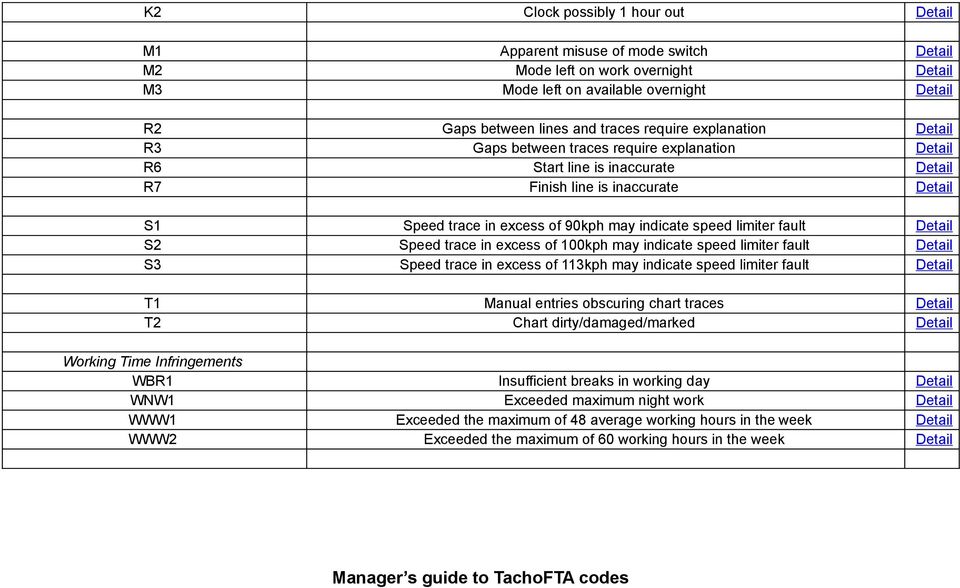
3 K2 Clock possibly 1 hour out Detail M1 Apparent misuse of mode switch Detail M2 Mode left on work overnight Detail M3 Mode left on available overnight Detail R2 Gaps between lines and traces require explanation Detail R3 Gaps between traces require explanation Detail R6 Start line is inaccurate Detail R7 Finish line is inaccurate Detail S1 Speed trace in excess of 90kph may indicate speed limiter fault Detail S2 Speed trace in excess of 100kph may indicate speed limiter fault Detail S3 Speed trace in excess of 113kph may indicate speed limiter fault Detail T1 Manual entries obscuring chart traces Detail T2 Chart dirty/damaged/marked Detail Working Time Infringements WBR1 Insufficient breaks in working day Detail WNW1 Exceeded maximum night work Detail WWW1 Exceeded the maximum of 48 average working hours in the week Detail WWW2 Exceeded the maximum of 60 working hours in the week Detail Manager s guide to TachoFTA codes
4 Code Description What does the law say? What are the potential penalties? What should be done about it? Advice from FTA

5 C1 C2 Surname and first name required Vehicle registration number omitted/incorrect /incomplete Article 15(5): Each crew member shall enter the following information on his record sheet: (a) on beginning to use the sheet his surname and first name; The GB enforcement agency the Vehicle and Operator Services Agency (VOSA) publication Rules on Drivers Hours and Tachographs Revised 2009 GV262-02, page30 confirms: the law does not stipulate which order the names are put but your employer may have a policy on this. Page 31 also confirms: It is not acceptable for written entries to extend outside the centrefield area if they might interfere with chart recordings. If, for example, the driver s name or a place name is so long it must be abbreviated in order to avoid any possible interference with the recordings, the full name should be noted on the reverse of the chart. 3821/85 and Chapter II of this Regulation. The transport undertakings shall properly instruct the driver and shall make regular checks to ensure that Regulation (EEC) 3821/85 and Chapter II of this Regulation are Article 15(5): Each crew member shall enter the following information on his record sheet: (c) the registration number of each vehicle to which he is assigned, both at the start of the first journey recorded on the sheet. Fixed penalty 30* omission with intent to deceive up to two years in prison plus a fine on indictment. Fixed penalty 30* This code is given where the drivers name is missing or not entered correctly. FTA analysis will only accept abbreviated names under exceptional circumstances, where prior consent had been received by the employer. This is because abbreviations are only acceptable in GB and only if the name is so long it must be abbreviated to avoid interference with recordings. Interview the driver to establish the reason for the error and take appropriate steps to ensure it does not happen again. It can sometimes mistakenly be believed that chart errors are minor problems. This is not so. Remind the driver that the maximum penalties for records infringements are double those of hours infringements (up to 5,000 per offence, rather than 2,500) and if considered by a court to be a deliberate omission with intent to deceive the driver could face up to two years in As this is a driver error, you should also look to your organisation s policy on training and disciplinary processes, as appropriate. This code is given where the vehicle registration is missing or not entered correctly. Interview the driver to establish the reason for the error and take appropriate steps to ensure it does not happen again. It can sometimes mistakenly be

6 C3 Place of start/end omitted/incorrect Article 15(5): Each crew member shall enter the following information on his record sheet: (b) the place where use of the sheet begins and the place where such use ends The GB enforcement agency the Vehicle and Operator Services Agency (VOSA) publication Rules on Drivers Hours and Tachographs Revised 2009 GV262-02, page30 confirms: If the start and finish places are the same, both must be written on the chart ditto marks are not acceptable Page 31 also confirms: It is not acceptable for written entries to extend outside the centrefield area if they might interfere with chart recordings. If, for example, the driver s name or a place name is so long it must falsification or omission with intent to deceive up to two years in prison plus a fine on indictment. Fixed penalty 30* falsification or omission with intent to deceive up to two years in prison plus a fine on indictment. believed that chart errors are minor problems. This is not so. Remind the driver that the maximum penalties for records infringements are double those of hours infringements (up to 5,000 per offence, rather than 2,500) and if considered by a court to be a deliberate omission with intent to deceive the driver could face up to two years in As this is a driver error, you should also look to your organisation s policy on training and also disciplinary processes, as appropriate. This code is given where the start or end location is missing or not entered correctly. FTA analysis will only accept abbreviated places under exceptional circumstances, where it is clear that the name so long it must be abbreviated to avoid interference with recordings. Post codes are not acceptable. Interview the driver to establish the reason for the error and take appropriate steps to ensure it does not happen again. It can sometimes mistakenly be believed that chart errors are minor problems. This is not so. Remind the

7 C4 Date of start/end omitted/incorrect be abbreviated in order to avoid any possible interference with the recordings, the full name should be noted on the reverse of the chart. Article 15(5): Each crew member shall enter the following information on his record sheet: (b) the date where use of the sheet begins and the date where such use ends VOSA publication Rules on Drivers Hours and Tachographs Revised 2009 GV262-02, page30 confirms: The year may be written in full or abbreviated so both 2007 and 07 are acceptable Fixed penalty 30* falsification or omission with intent to deceive up to two years in prison plus a fine on indictment. driver that the maximum penalties for records infringements are double those of hours infringements (up to 5,000 per offence, rather than 2,500) and if considered by a court to be a deliberate omission with intent to deceive the driver could face up to two years in As this is a driver error, you should also look to your organisation s policy on training and also disciplinary processes, as appropriate. This code is given where the start or end date is missing or not entered correctly. Interview the driver to establish the reason for the error and take appropriate steps to ensure it does not happen again. It can sometimes mistakenly be believed that chart errors are minor problems. This is not so. Remind the driver that the maximum penalties for records infringements are double those of hours infringements (up to 5,000 per offence, rather than 2,500) and if considered by a court to be a deliberate omission with intent to deceive the driver could face up to two years in As this is a driver error, you should also look to your organisation s policy on training and also disciplinary processes, as appropriate...

8 C5 C6 Odometer readings omitted/incorrect /incomplete Vehicle change details omitted Article 15(5): Each crew member shall enter the following information on his record sheet: (d) the odometer reading: - at the start of the first journey recorded on the sheet, - at the end of the last journey recorded on the sheet, VOSA publication Rules on Drivers Hours and Tachographs Revised 2009 GV262-02, page30 confirms: Note that the total kms field does not have to be completed. Article 15(5): Each crew member shall enter the following information on his record sheet: (c) the registration number of each vehicle to which he is assigned, both at the start of the first journey recorded on the sheet and then, in the event of a change of vehicle, during use of the Fixed penalty 30 (4-26)* falsification or omission with intent to deceive up to two years in prison plus a fine on indictment. Fixed penalty 30* This code is given where the vehicle odometer readings are missing or not entered correctly. Interview the driver to establish the reason for the error and take appropriate steps to ensure it does not happen again. It can sometimes mistakenly be believed that chart errors are minor problems. This is not so. Remind the driver that the maximum penalties for records infringements are double those of hours infringements (up to 5,000 per offence, rather than 2,500) and if considered by a court to be a deliberate omission with intent to deceive the driver could face up to two years in As this is a driver error, you should also look to your organisation s policy on training and also disciplinary processes, as appropriate. This code is given where all the vehicle change details (time of change, registration and odometer readings) are missing. Interview the driver to establish the reason for the error and take appropriate steps to ensure it does not

9 C7 Time of vehicle change details omitted/incorrect sheet; (d) the odometer reading: - in the event of a change of vehicle during a working day (reading on the vehicle to which he is assigned and reading on the vehicle to which he is to be assigned); (e) the time of any change of vehicle. Article 15(5): Each crew member shall enter the following information on his record sheet: (e) the time of any change of vehicle. omission with intent to deceive up to two years in prison plus a fine on indictment. Fixed penalty 30* falsification or omission with intent to deceive up to two years in prison plus a fine on indictment. happen again. It can sometimes mistakenly be believed that chart errors are minor problems. This is not so. Remind the driver that the maximum penalties for records infringements are double those of hours infringements (up to 5,000 per offence, rather than 2,500) and if considered by a court to be a deliberate omission with intent to deceive the driver could face up to two years in As this is a driver error, you should also look to your organisation s policy on training and also disciplinary processes, as appropriate. This code is given where the time of a vehicle change is missing or not entered correctly. Interview the driver to establish the reason for the error and take appropriate steps to ensure it does not happen again. It can sometimes mistakenly be believed that chart errors are minor problems. This is not so. Remind the driver that the maximum penalties for records infringements are double those of hours infringements (up to 5,000 per offence, rather than 2,500) and if considered by a court to be a deliberate omission with intent to deceive the

10 C8 Vehicle change registration omitted/incorrect Article 15(5): Each crew member shall enter the following information on his record sheet: (c) the registration number of each vehicle to which he is assigned, both at the start of the first journey recorded on the sheet and then, in the event of a change of vehicle, during use of the sheet; Fixed penalty 30* falsification or omission with intent to deceive up to two years in prison plus a fine on indictment. driver could face up to two years in As this is a driver error, you should also look to your organisation s policy on training and also disciplinary processes, as appropriate. This code is given where the registration details a vehicle change is missing or not entered correctly. Interview the driver to establish the reason for the error and take appropriate steps to ensure it does not happen again. It can sometimes mistakenly be believed that chart errors are minor problems. This is not so. Remind the driver that the maximum penalties for records infringements are double those of hours infringements (up to 5,000 per offence, rather than 2,500) and if considered by a court to be a deliberate omission with intent to deceive the driver could face up to two years in As this is a driver error, you should also look to your organisation s policy on training and also disciplinary processes, as appropriate.

11 C9 Vehicle change odometer readings omitted/incorrect Article 15(5): Each crew member shall enter the following information on his record sheet: (d) the odometer reading: - in the event of a change of vehicle during a working day (reading on the vehicle to which he is assigned and reading on the vehicle to which he is to be assigned); D1 Time overlap Article 13: The employer and drivers shall ensure the correct functioning and proper use of the Fixed penalty 30* falsification or omission with intent to deceive up to two years in prison plus a fine on indictment. Fixed penalty 60* This code is given where the odometer readings of a vehicle change are missing or not entered correctly. Interview the driver to establish the reason for the error and take appropriate steps to ensure it does not happen again. It can sometimes mistakenly be believed that chart errors are minor problems. This is not so. Remind the driver that the maximum penalties for records infringements are double those of hours infringements (up to 5,000 per offence, rather than 2,500) and if considered by a court to be a deliberate omission with intent to deceive the driver could face up to two years in As this is a driver error, you should also look to your organisation s policy on training and also disciplinary processes, as appropriate. An overlap can be the result of a driver changing vehicles where the clocks are not accurately set. The regulation allows

12 recording equipment. Annex 1B, paragraph III(9.3): Time overlap event. This event shall be triggered when the date/time of last withdrawal of the driver card, as read from the card, is later than the current time/date of the recording equipment in which the card is inserted. Annex 1B, paragraph III(3) (Time measurement): Time drift shall be within +/- 2 seconds per day in type approval conditions. Time measured shall have a resolution better than or equal to 1 second. Time measured shall not be affected by an external power supply cut-off of less than 12 months in type approval conditions. Annex 1B, paragraph III(21) (Time adjustment): The time adjustment function shall allow for adjusting the current time in amounts of one minute maximum at intervals of not less than seven days. The time adjustment function shall allow for adjusting the current time without limitation in calibration mode. Annex 1B, paragraph VI(4) (Periodic inspections): Periodic inspections of the equipment shall take place after equipment UTC time is wrong by more than 20 minutes falsification with intent to deceive up to two years in an in-use tolerance of up to two seconds per digital tachograph, which corresponds to a maximum total overlap on a single occasion of 4 seconds. Examine the data and investigate the circumstances to determine the cause of the overlap. Overlaps up to 4 seconds which can be explained with a corresponding vehicle change can be discounted. Overlaps of more than four seconds or those that cannot be explained with a vehicle change should be investigated further with a view to taking the appropriate action. UTC time can be adjusted by one minute every seven days without calibration. If the UTC time is out by more than 20 minutes the vehicle must be recalibrated. Drivers must report UTC clock inaccuracies, as they are also legally responsible for ensuring the correct functioning of each tachograph they use. It can sometimes mistakenly be believed that record errors are minor problems. This is not so. Remind the driver that the maximum penalties for records infringements are double those of hours infringements (up to 5,000 per offence, rather than 2,500) and if considered by a court to be a deliberate falsification with intent to deceive the driver could face up to two years in As this may be a driver error, you

13 D2 Card insertion while driving Article 13: The employer and drivers shall ensure the correct functioning and proper use of the recording equipment. Article 15(2): Drivers shall use the driver cards every day on which they are driving, starting from the moment they take over the vehicle. The 1998 case Vehicle Inspectorate v. Anelay (RTR279) stated that in cases of multi-manning, the second man takes over the vehicle on boarding the vehicle, not when he actually begins driving. Annex 1B, paragraph III(9.5): This event shall be triggered when a tachograph card is inserted in any slot while the driver activity is DRIVING. Fixed penalty 120* omission with intent to deceive up to two years in prison plus a fine on indictment. should also look to your organisation s policy on training and also disciplinary processes, as appropriate. This often occurs when driver inserts card in second man position after journey has begun, but equally could be a single driver (or driver one) starting his journey after forgetting to insert his card and then doing it en route. Investigate reasons for driver s infringement and take appropriate steps to ensure it does not happen again. It can sometimes mistakenly be believed that record errors are minor problems. This is not so. Remind the driver that the maximum penalties for records infringements are double those of hours infringements (up to 5,000 per offence, rather than 2,500) and if considered by a court to be a deliberate omission or falsification with intent to deceive the driver could face up to two years in As this is a driver error, you should also look to your organisation s policy on training and also disciplinary processes, as appropriate. D3 Last card session not correctly closed Article 13: The employer and drivers shall ensure the correct functioning and proper use of the recording equipment. Fixed penalty 60* This code occurs when the card has been withdrawn on a previous shift without storing all the relevant data. This code is usually triggered by

14 D4 Power supply interruption Annex 1B, paragraph III(9.6): Last card session not correctly closed event. This event shall be triggered when at card insertion the recording equipment detects that, despite the provisions laid down in paragraph III(1), the previous card session has not been correctly closed (the card has been withdrawn before all the relevant data have been stored on the card). This event shall be triggered by driver and workshop cards only. Article 13: The employer and drivers shall ensure the correct functioning and proper use of the recording equipment. Annex 1B, paragraph III(9.8): Power supply interruption event. This event shall be triggered, while not in calibration mode, in case of any interruption exceeding 200 milliseconds of the power supply of the motion sensor and/or of the vehicle unit. The interruption threshold shall be defined by the manufacturer. The drop in power supply due to the starting of the engine of the vehicle shall not trigger this event. If considered deliberate omission with intent to deceive up to two years in prison plus a fine on indictment. Fixed penalty 60* If considered deliberate falsification with intent to deceive up to two years in something that the driver is not able to control usually it is because there is a fault either with the VU or the card. It could also occur if the driver card was manually removed by a calibration centre (because the VU was faulty and would not eject the card). Check the correct functioning of the card (try it in another VU) and VU (with another card) and take appropriate action -driver to apply for replacement card or VU to be repaired. Also note that this event may also cause excessive driving time and security breach errors. This happens when there is an interruption in the power supply to the motion sensor or the vehicle unit. The interruption must exceed 200 milliseconds and different manufacturers will set different time perimeters for the interruption. Managers should examine the data and investigate the circumstances to determine the cause of the interruption of power. It may be explained by a vehicle breakdown, VU malfunction or other unusual mechanical/equipment

15 D5 Motion data error Article 13: The employer and drivers shall ensure the correct functioning and proper use of the recording equipment. Annex 1B, paragraph III(9.9): Motion data error event. This event shall be triggered in case of interruption of the normal data flow between the motion centre and the vehicle unit and/or in the case of data integrity or data authentication error during data exchange between the motion sensor and the vehicle unit. Fixed penalty 60* If considered deliberate omission or falsification with intent to deceive up to two years in prison plus a fine on indictment. event, in which case the details should be fully documented. In any other case, the circumstances should be investigated and appropriate action taken to ensure it will not happen again. Where this is proven to be a driver deliberately interfering with equipment, which is a very serious offence, you should look to your organisation s disciplinary processes, as appropriate. This error occurs if there is an interruption in the normal flow of data between the motion sensor and the vehicle unit and/or an error occurs during the data exchange between the motion sensor and the vehicle unit which affects the integrity or authentication of that data. Managers should examine the data and investigate the circumstances to determine the cause of the motion data error. It may be explained by a vehicle breakdown, VU malfunction or other unusual mechanical/equipment event, in which case the details should be fully documented. In any other case, the circumstances should be investigated and appropriate action taken to ensure it will not happen again. Where this is proven to be a driver deliberately interfering with equipment,

16 D6 Security breach attempt Article 13: The employer and drivers shall ensure the correct functioning and proper use of the recording equipment. Annex 1B, paragraph III(9.10): Security breach attempt event. This event shall be triggered for any other event affecting the security of the motion sensor and/or of the vehicle unit as specified within the generic security targets of those components, while not in calibration mode. Fixed penalty 60* If considered deliberate falsification with intent to deceive up to two years in D7 Card fault Article 13: The employer and drivers shall ensure Fixed penalty 60* which is a very serious offence, you should look to your organisation s disciplinary processes, as appropriate. This is triggered by any other event that affects the security of the motion sensor and/or the vehicle unit (other than codes D4 and D5). Managers should examine the data and investigate the circumstances to determine the cause of the motion data error. It may be explained by a vehicle breakdown, VU malfunction or other unusual mechanical/equipment event, in which case the details should be fully documented. In any other case, the circumstances should be investigated and appropriate action taken to ensure it will not happen again. Where this is proven to be a driver deliberately interfering with equipment, which is a very serious offence, you should look to your organisation s disciplinary processes, as appropriate. Managers should investigate the card fault. Try the driver s card in another VU

17 the correct functioning and proper use of the recording equipment. Annex 1B, paragraph III(9.11): Card fault. This fault shall be triggered when a tachograph card failure occurs during operation. Article 16(2): If the driver card is damaged, malfunctions the driver shall, at the end of his journey, printout the information relating to the periods of time recorded by the recording equipment and mark on that document the details that enable him to be identified (the driver card number and/or name and/or driving licence number), including his signature. Article 16(2): If a driver card is damaged or if it malfunctions, the driver shall return it to the competent authority of the Member State in which he has his normal residence. The driver may continue to driver without a driver card for a maximum of 15 calendar days or for a longer period if this is necessary for the vehicle to return to its premises, provided he can prove the impossibility of producing or using the card during this period. Article 15(1): If a driver card is damaged, malfunctions the driver shall apply within seven calendar days for its replacement to the competent authorities of the Member State in which he has his normal residence. Where a driver card is damaged, malfunctions the driver shall: (a) at the start of his journey, print out the details of the vehicle the driver is driving, and shall enter onto that printout: (i) details that enable the driver to be identified (name, driver card or driver licence number), including his signature; falsification or omission with intent to deceive up to two years in prison plus a fine on indictment. to verify. Also check another card in the VU to make sure it is not a VU fault (make sure you have pressed OK on the VU to remove the card fault message first) If it is a malfunctioning driver card, the driver must advise DVLA (or DVLNI) and apply for a replacement card within 7 calendar days. Managers should ensure drivers have followed the correct procedures in relation to printouts and manual records. Drivers may continue to drive for a maximum of 15 days (unless they need more time for the vehicle to return to base) provided printouts (two per day) and manual records are kept according to the rules (see legal requirements). As this may be a driver error for example if an obviously damaged card has been used, or the fault ignored for some time - you should also look to your organisation s policy on training and also disciplinary processes, as appropriate. It can sometimes mistakenly be believed that record errors are minor problems. This is not so. Remind the driver that the maximum penalties for records infringements are double those of hours infringements (up to 5,000 per offence, rather than 2,500) and if considered by a court to be a deliberate omission with intent to deceive the driver could face up to two years in

18 D8 Recording equipment fault (ii) the periods referred to in paragraph 3, second indent (b), (c) and (d); [namely, other work, periods of availability, breaks from driving and rest] (b) at the end of his journey, print out the information relating to periods of time recorded by the recording equipment, record any periods of other work, availability and rest undertaken since the printout was made at the start of the journey, where not recorded by the tachograph, and mark on that document details that enable the driver to be identified (name, driver card or driver s licence number) including the driver s signature. Article 13: The employer and drivers shall ensure the correct functioning and proper use of the recording equipment. Annex 1B, paragraph III(9.12): Recording equipment fault. This fault shall be triggered for any of these failures, while not in calibration mode: - VU internal fault - printer fault - display fault - downloading fault - sensor fault. Article 16(1): In the event of breakdown or faulty operation of the equipment, the employer shall have it repaired by an approved fitter or workshop as Fixed penalty 60* falsification with intent to deceive up to two years in If the VU is faulty, ensure the fault is rectified (see code D8). This can be triggered by any of the following faults: VU internal fault Printer fault Display fault Downloading fault Sensor fault Managers should investigate the VU fault. The VU may need to go to an approved tachograph centre for repair and recalibration. See the legislation section for details of when a vehicle with a defective tachograph may be used and the requirements for written

19 soon as circumstances permit. If the vehicle is unable to return to the premises within a period of one week calculated from the day of the breakdown or the discovery of the defective operation, the repair shall be carried out en route. Transport Act 1968 Section 97(3): A person shall not be liable to be convicted under subsection 1(a) of this section by reason of the recording equipment installed in the vehicle in question not being in working order if he proves to the court that (a) it had not become reasonably practicable for the equipment to be repaired by an approved fitter or workshop; and (b) the requirements of Article 16(2) of the Community Recording Equipment Regulation were being Article 16(2): While the recording equipment is unserviceable or malfunctioning, drivers shall mark on the record sheet or sheets, or on a temporary sheet to be attached to the record sheet or to the driver card, on which he shall enter data enabling him to be identified (driver s card number and/or name and/or driving licence number), including his signature, all information for the various periods of time which are no longer recorded or printed out correctly by the recording equipment.. records. As this may be a driver error for example if a fault has been ignored by the driver - you should also look to your organisation s policy on training and also disciplinary processes, as appropriate. It can sometimes mistakenly be believed that record errors are minor problems. This is not so. Remind the driver that the maximum penalties for records infringements are double those of hours infringements (up to 5,000 per offence, rather than 2,500) and if considered by a court to be a deliberate omission with intent to deceive the driver could face up to two years in DDD1 Domestic daily Transport Act 1968, Section 96(1): a driver shall This code is used when a driver has

20 DDU1 drive excessive Domestic daily duty excessive not on any working day drive a vehicle or vehicles to which this Part of the Act applies for periods amounting in the aggregate to more than ten hours. Section 103(3): In this part of this Act references to a person driving a vehicle are references to his being at the driving controls of the vehicle for the purpose of controlling its movement, whether it is in motion or stationary with the engine running. Drivers Hours (Goods Vehicles) (Modifications) Order 1986, Regulation 2(d): for the definition of working day in section 103(1) there were substituted the following definition working day, in relation to any driver, means (a) any working period (that is to say any period during which he is on duty) which does not fall to be aggregated with the whole or part of any other such period or periods by virtue of paragraph (b) of this definition; and (b) where a working period is followed by one or more other such periods beginning within the 24 hours next after the beginning of that working period, the aggregate of that working period and so much of the other such periods as fall within those 24 hours;. Transport Act 1968, Section 96(3): the working day of a driver (a).shall not exceed eleven hours; Section 103(4): In this part of this Act references to a driver being on duty are references (a) in the Fixed penalty*: More than 10hrs, but less than 11hrs 60 11hrs or more, but less than 12hrs hrs or more 200 of 2,500 per offence. Fixed penalty*: More than 11hrs, but less than 12hrs 60 driven for more than 10 hours in 24hr day. Investigate reasons for infringement and take appropriate steps to ensure it does not happen again. Ensure schedules allow compliance with the rules, that payments or bonuses do not encourage breaches as well as the driver understands and complies with rules. As this may be a driver error, you should also look to your organisation s policy on training and also disciplinary processes, as appropriate. This code is used when a driver has worked for more than 11 hours in a day (24hrs). Investigate reasons for infringement and take appropriate steps to ensure it does not happen again.

21 EBR1 Insufficient break for cumulative drive/no break taken after cumulative drive case of an employee-driver, to his being on duty (whether for the purpose of driving a vehicle to which this Part of this Act applies or for other purposes) in the employment by virtue of which he is an employee-driver, or in any other employment under the person who is his employer in the firstmentioned employment; and (b) in the case of an owner-driver, to his driving a vehicle to which this Part of the Act applies for the purpose of a trade or business carried on by him or otherwise engaged in work for the purpose of that trade or business, being work in connection with such a vehicle or the load carried thereby. Drivers Hours (Goods Vehicles) (Modifications) Order 1986, Regulation 2(d): for the definition of working day in section 103(1) there were substituted the following definition working day, in relation to any driver, means (a) any working period (that is to say any period during which he is on duty) which does not fall to be aggregated with the whole or part of any other such period or periods by virtue of paragraph (b) of this definition; and (b) where a working period is followed by one or more other such periods beginning within the 24 hours next after the beginning of that working period, the aggregate of that working period and so much of the other such periods as fall within those 24 hours;. Regulation (EC) No 561/2006 Article 7: After a driving period of four and a half hours a driver shall take an uninterrupted break of not less than 45 minutes, unless he takes a rest period. This break may be replaced by a break of at least 15 minutes followed by a break of at least 30 minutes each distributed over the period in such a way as to comply with the provisions of the first 12hrs or more, but less than 13hrs hrs or more 200 of 2,500 per offence. Fixed penalty*: More than 4.5hrs, but less than 5.5hrs hrs or more, but less than 6.5hrs 120 Ensure schedules allow compliance with the rules and that the driver understands and complies with rules. As this may be a driver error, you should also look to your organisation s policy on training and also disciplinary processes, as appropriate. This code means the driver has driven for more than 4.5 hours without taking the required break. Investigate reasons for infringement and take appropriate steps to ensure it does not happen again. Ensure schedules allow compliance with the rules and that payments or
22 EDD1 Daily driving excessive paragraph. Article 4(d): break means nay period during which the driver may not carry out any driving or any other work and which is used exclusively for recuperation. Article 10: (1) A transport undertaking shall not give drivers it employs or who are put at its disposal any payment, even in the form of a wage supplement, related to distances travelled and/or the amount of goods carried if that payment is of such a kind as to endanger road safety and/or encourages infringement of this Regulation. (2) A transport undertaking shall organise the work of drivers referred to in paragraph 1 in such a way that the drivers are able to comply with Chapter II of this Regulation. The transport undertakings shall properly instruct the driver and shall make regular checks to ensure that Chapter II of this Regulation are Regulation (EC) No 561/2006 Article 6(1): The daily driving time shall not exceed nine hours. However, the daily driving time may be extended to at most 10 hours not more than twice during the week. Article 4(j): driving time means the duration of driving activity recorded: - automatically or semiautomatically by the recording equipment as defined in Annex 1 or Annex 1B of Regulation (EEC) No 3821/85, or manually as required by Article 16(2) of Regulation (EEC) No 3821/85; (see D7 for Article 16(2)) 6.5hrs or more 200 of 2,500 per offence. Fixed penalty*: More than 10hrs, but less than 11hrs 60 11hrs or more, but less than 12hrs hrs or more 200 bonuses do not encourage breaches as well as the driver understands and complies with rules. A common problem is where a driver has split the break from driving, but taken a 30minute break followed by a 15 minute break (the rules require the last break to be at least 30 minutes long). In this instance, the driver needs to be instructed in the correct rules. Also drivers can often misjudge the amount of break recorded and be just a few minutes short particularly when using a digital tachograph which rounds up driving and so can round down breaks. Drivers should be advised that if in doubt they should take slightly too much break, rather than too little. As this may be a driver error, you should also look to your organisation s policy on training and also disciplinary processes, as appropriate. This code means the driver has driven for more than 10 hours between daily rests (or between a daily and weekly rest). A common issue can be that digital tachographs round up minutes, but remember in law driving is whatever the tachograph records as driving. Investigate reasons for infringement and take appropriate steps to ensure it does not happen again. Ensure schedules allow compliance with the rules, that payments or
23 EDD2 Daily driving excessive, no extensions available Article 4(k): daily driving time means the total accumulated driving time between the end of one daily rest period and the beginning of the following daily rest period or between a daily rest period and a weekly rest period. Article 4(i): week means the period of time between on Monday and on Sunday. Article 10: (1) A transport undertaking shall not give drivers it employs or who are put at its disposal any payment, even in the form of a wage supplement, related to distances travelled and/or the amount of goods carried if that payment is of such a kind as to endanger road safety and/or encourages infringement of this Regulation. (2) A transport undertaking shall organise the work of drivers referred to in paragraph 1 in such a way that the drivers are able to comply with Chapter II of this Regulation. The transport undertakings shall properly instruct the driver and shall make regular checks to ensure that Chapter II of this Regulation are Regulation (EC) No 561/2006 Article 6(1): The daily driving time shall not exceed nine hours. However, the daily driving time may be extended to at most 10 hours not more than twice during the week. Article 4(j): driving time means the duration of driving activity recorded: - automatically or semiautomatically by the recording equipment as defined in Annex 1 or Annex 1B of Regulation (EEC) No 3821/85, or manually as required by Article 16(2) of Regulation (EEC) No 3821/85; (see D7 for Article 16(2)) Article 4(k): daily driving time means the total accumulated driving time between the end of one daily rest period and the beginning of the following of 2,500 per offence. Fixed penalty*: More than 9hrs, but less than 10hrs 60 10hrs or more, but less than 11hrs hrs or more 200 bonuses do not encourage breaches as well as the driver understands and complies with rules. As this may be a driver error, you should also look to your organisation s policy on training and also disciplinary processes, as appropriate. This code means that the driver has driven for more than 9hrs when he/she has no more extensions available within the current fixed week. Common misconceptions can be where the driver believes that he/she has only extended their driving when they have driven to or near 10hrs, rather than just over 9hrs. So, for example they may not understand that a day of 9hrs and five minutes driving counts as one extended driving day. Also, there can be confusion where a driver s working week is different to the fixed week. The rules only allow two extensions per fixed
24 EDD3 Fortnightly driving excessive daily rest period or between a daily rest period and a weekly rest period. Article 4(i): week means the period of time between on Monday and on Sunday. Article 10: (1) A transport undertaking shall not give drivers it employs or who are put at its disposal any payment, even in the form of a wage supplement, related to distances travelled and/or the amount of goods carried if that payment is of such a kind as to endanger road safety and/or encourages infringement of this Regulation. (2) A transport undertaking shall organise the work of drivers referred to in paragraph 1 in such a way that the drivers are able to comply with Chapter II of this Regulation. The transport undertakings shall properly instruct the driver and shall make regular checks to ensure that Chapter II of this Regulation are Regulation (EC) No 561/2006 Article 6(3): The total accumulated driving time during any two consecutive weeks shall not exceed 90 hours. Article 4(j): driving time means the duration of driving activity recorded: - automatically or semiautomatically by the recording equipment as defined in Annex 1 or Annex 1B of Regulation (EEC) No 3821/85, or manually as required by Article 16(2) of Regulation (EEC) No 3821/85; (see D7 for Article 16(2)) Article 4(i): week means the period of time between on Monday and on Sunday. Article 10: (1) A transport undertaking shall not give drivers it employs or who are put at its disposal any payment, even in the form of a wage supplement, related to distances travelled and/or the amount of goods carried if that payment is of such a kind as to endanger road safety and/or of 2,500 per offence. Fixed penalty*: More than 90hrs, but less than 93hrs 60 93hrs or more, but less than 94hrs hrs or more 200 of 2,500 per offence. week (00.00 Monday to 24:00 Sunday). Another common issue can be that digital tachographs round up minutes, but remember in law driving is whatever the tachograph records as driving. Investigate reasons for infringement and take appropriate steps to ensure it does not happen again. Ensure schedules allow compliance with the rules, that payments or bonuses do not encourage breaches as well as the driver understands and complies with rules. As this may be a driver error, you should also look to your organisation s policy on training and also disciplinary processes, as appropriate. This code is used where a driver has driven for more than 90 hours in any consecutive two weeks. There can be confusion where a driver s working week is different to the fixed week. Another common issue can be that digital tachographs round up minutes, but remember in law driving is whatever the tachograph records as driving. Investigate reasons for infringement and take appropriate steps to ensure it does not happen again. Ensure schedules allow compliance with the rules, that payments or bonuses do not encourage breaches as well as the driver understands and complies with rules.
25 EDD4 Weekly driving excessive encourages infringement of this Regulation. (2) A drivers referred to in paragraph 1 in such a way that the drivers are able to comply with Chapter II of this Regulation. The transport undertakings shall properly instruct the driver and shall make regular checks to ensure that Chapter II of this Regulation are Regulation (EC) No 561/2006 Article 6(2): The weekly driving time shall not exceed 56 hours Article 4(j): driving time means the duration of driving activity recorded: - automatically or semiautomatically by the recording equipment as defined in Annex 1 or Annex 1B of Regulation (EEC) No 3821/85, or manually as required by Article 16(2) of Regulation (EEC) No 3821/85; (see D7 for Article 16(2)) Article 4(i): week means the period of time between on Monday and on Sunday. Article 4(l): weekly driving time means the total accumulated driving time during the week. Article 10: (1) A transport undertaking shall not give drivers it employs or who are put at its disposal any payment, even in the form of a wage supplement, related to distances travelled and/or the amount of goods carried if that payment is of such a kind as to endanger road safety and/or encourages infringement of this Regulation. (2) A transport undertaking shall organise the work of drivers referred to in paragraph 1 in such a way that the Fixed penalty*: More than 56hrs, but less than 58hrs 60 58hrs or more, but less than 59hrs hrs or more 200 of 2,500 per offence. As this may be a driver error, you should also look to your organisation s policy on training and also disciplinary processes, as appropriate. This code is used where a driver has driven for more than 56 hours in any fixed week. There can be confusion where a driver s working week is different to the fixed week. Another common issue can be that digital tachographs round up minutes, but remember in law driving is whatever the tachograph records as driving. Investigate reasons for infringement and take appropriate steps to ensure it does not happen again. Ensure schedules allow compliance with the rules, that payments or bonuses do not encourage breaches as well as the driver understands and complies with rules. As this may be a driver error, you should also look to your organisation s policy on training and also disciplinary processes, as appropriate. However,
26 EDR1 Insufficient daily rest drivers are able to comply with Chapter II of this Regulation. The transport undertakings shall properly instruct the driver and shall make regular checks to ensure that Chapter II of this Regulation are Regulation (EC) No 561/2006 Article 8(2): Within each period of 24 hours after the end of the previous daily rest period or weekly rest period a driver shall have taken a new daily rest period. Article 4(g): daily rest period means the daily period during which the driver may freely dispose of his time and covers a regular daily rest period and a reduced daily rest period : - regular daily rest period means any period of rest of at least 11 hours. Alternatively, this regular daily rest period may be taken in two periods, the first of which must be an uninterrupted period of at least 3 hours and the second an uninterrupted period of at least nine hours. - reduced daily rest period means any period of rest that is at least nine hours but less than 11 hours; Article 10: (1) A transport undertaking shall not give drivers it employs or who are put at its disposal any payment, even in the form of a wage supplement, related to distances travelled and/or the amount of goods carried if that payment is of such a kind as to endanger road safety and/or encourages infringement of this Regulation. (2) A transport undertaking shall organise the work of drivers referred to in paragraph 1 in such a way that the Fixed penalty*: Less than 9hrs, but more than 8hrs 60 8hrs or less, but more than 7hrs 120 7hrs or less 200 of 2,500 per offence. this is also likely to be a scheduling/management error. Audit systems to track drivers hours compliance to prevent future breached. This code indicates that the driver has failed to take at least 9hrs of rest in 24hr period (or 9hrs in 30 if multi-manned manned and the record indicates multimanning applies). It is also used when insufficient rest is taken on an interrupted ferry/train daily rest or split rest, again where this is indicated on the record. Common problems with this can occur when the driver forgets that the rest needs to be completed within a 24hr period (or 30hr if multi-manning). This period starts when the driver begins duty following a daily or weekly rest. Therefore, in order to ensure a minimum 9hr rest in a 24hr period the maximum shift or spread over time (from start of duty to end of duty) is 15hrs. Also, drivers can be caught out if shifts start at irregular times, causing them to finish a rest too early. Investigate reasons for infringement and take appropriate steps to ensure it does not happen again. Ensure schedules allow compliance
27 EDR2 Insufficient daily rest, no reductions left drivers are able to comply with Chapter II of this Regulation. The transport undertakings shall properly instruct the driver and shall make regular checks to ensure that Chapter II of this Regulation are Regulation (EC) No 561/2006 Article 8(2): Within each period of 24 hours after the end of the previous daily rest period or weekly rest period a driver shall have taken a new daily rest period. If the portion of the daily rest period which falls within that 24 hour period is at least nine hours but less than 11 hours, then the daily rest period in question shall be regarded as a reduced daily rest period. Article 8(4): A driver may have at most three reduced daily rest periods between any two weekly rest periods. Article 4(g): daily rest period means the daily period during which the driver may freely dispose of his time and covers a regular daily rest period and a reduced daily rest period : - regular daily rest period means any period of rest of at least 11 hours. Alternatively, this regular daily rest period may be taken in two periods, the first of which must be an uninterrupted period of at least 3 hours and the second an uninterrupted period of at least nine hours. - reduced daily rest period means any period of rest that is at least nine hours but less than 11 Fixed penalty*: Less than 11rs, but more than 10hrs 60 10hrs or less, but more than 9hrs 120 9hrs or less 200 of 2,500 per offence. with the rules, that payments or bonuses do not encourage breaches as well as the driver understands and complies with rules. As this may be a driver error, you should also look to your organisation s policy on training and also disciplinary processes, as appropriate. However, this is also likely to be a scheduling/management error. Audit systems to track drivers hours compliance to prevent future breached. This code is used when the driver has taken less than 11hrs, when he/she has no reductions left in that working week (between weekly rests). There can be confusion where a driver s working week is different to the fixed week. Also, problems with this can occur when the driver forgets that the rest needs to be completed within a 24hr period. This period starts when the driver begins duty following a daily or weekly rest. Therefore, in order to ensure a minimum 11hr rest in a 24hr period the maximum shift or spread over time (from start of duty to end of duty) is 13hrs. Also, drivers can be caught out if shifts start at irregular times, causing them to finish a rest too early. Investigate reasons for infringement and take appropriate steps to ensure it does not happen again. Ensure schedules allow compliance with the rules, that payments or
28 EWR1 Failure to take at least one regular weekly rest in 2 consecutive weeks hours; Article 4(h): weekly rest period means the weekly period during which a driver may freely dispose of his time and covers a regular weekly rest period and a reduced weekly rest period. Article 10: (1) A transport undertaking shall not give drivers it employs or who are put at its disposal any payment, even in the form of a wage supplement, related to distances travelled and/or the amount of goods carried if that payment is of such a kind as to endanger road safety and/or encourages infringement of this Regulation. (2) A transport undertaking shall organise the work of drivers referred to in paragraph 1 in such a way that the drivers are able to comply with Chapter II of this Regulation. The transport undertakings shall properly instruct the driver and shall make regular checks to ensure that Chapter II of this Regulation are Regulation (EC) No 561/2006 Article 8(6): In any two consecutive weeks a driver shall take at least: - two regular weekly rest periods, or one regular weekly rest period and one reduced weekly rest period of at least 24 hours. Article 10: (1) A transport undertaking shall not give drivers it employs or who are put at its disposal any payment, even in the form of a wage supplement, related to distances travelled and/or the amount of goods carried if that payment is of such a kind as to endanger road safety and/or encourages infringement of this Regulation. (2) A transport undertaking shall organise the work of drivers referred to in paragraph 1 in such a way that the drivers are able to comply with Chapter II of this Regulation. The transport undertakings shall properly instruct the driver and shall make regular Fixed penalty*: Less than 45rs, but more than 43hrs 60 43hrs or less, but more than 42rs hrs or less 200 of 2,500 per offence. bonuses do not encourage breaches as well as the driver understands and complies with rules. As this may be a driver error, you should also look to your organisation s policy on training and also disciplinary processes, as appropriate. However, this is also likely to be a scheduling/management error. Audit systems to track drivers hours compliance to prevent future breached. This infringement will be triggered if the driver has not taken at least one weekly rest of at least 45hrs long in any fixed two-week period. Weekly rest is the most complex of the drivers hours rules. Further information can be found in the FTA guide to weekly rest, which includes worked examples to illustrate the rules. We have also produced a weekly rest spreadsheet so that you can schedule work correctly and check for compliance. Investigate reasons for infringement and take appropriate steps to ensure it does not happen again. Ensure schedules allow compliance with the rules, that payments or
29 EWR2 Failure to take weekly rest after six 24-hour periods checks to ensure that Chapter II of this Regulation are Regulation (EC) No 561/2006 Article 8(6): A weekly rest period shall start no later than at the end of six 24-hour periods from the end of the previous weekly rest period. Article 10: (1) A transport undertaking shall not give drivers it employs or who are put at its disposal any payment, even in the form of a wage supplement, related to distances travelled and/or the amount of goods carried if that payment is of such a kind as to endanger road safety and/or encourages infringement of this Regulation. (2) A transport undertaking shall organise the work of drivers referred to in paragraph 1 in such a way that the drivers are able to comply with Chapter II of this Regulation. The transport undertakings shall properly instruct the driver and shall make regular checks to ensure that Chapter II of this Regulation are Fixed penalty 30*: of 2,500 per offence. bonuses do not encourage breaches as well as the driver understands and complies with rules. As this may be a driver error, you should also look to your organisation s policy on training and also disciplinary processes, as appropriate. However, this is also likely to be a scheduling/management error. Audit systems to track drivers hours compliance to prevent future breached. This code is applied when there is more than 144hrs (6 x 24hrs) between weekly rests. Weekly rest is the most complex of the drivers hours rules. Further information can be found in the FTA guide to weekly rest, which includes worked examples to illustrate the rules. We have also produced a weekly rest spreadsheet so that you can schedule work correctly and check for compliance. Investigate reasons for infringement and take appropriate steps to ensure it does not happen again. Ensure schedules allow compliance with the rules, that payments or bonuses do not encourage breaches as well as the driver understands and complies with rules. As this may be a driver error, you should also look to your organisation s
30 EWR3 Failure to compensate for reduced weekly rest Regulation (EC) No 561/2006 Article 8(6): However, the reduction shall be compensated by an equivalent period of rest taken en bloc before the end of the third week following the week in question. Article 8(7): Any rest taken as compensation for a reduced weekly rest period shall be attached to another rest period of at least nine hours. Article 10: (1) A transport undertaking shall not give drivers it employs or who are put at its disposal any payment, even in the form of a wage supplement, related to distances travelled and/or the amount of goods carried if that payment is of such a kind as to endanger road safety and/or encourages infringement of this Regulation. (2) A transport undertaking shall organise the work of drivers referred to in paragraph 1 in such a way that the drivers are able to comply with Chapter II of this Regulation. The transport undertakings shall properly instruct the driver and shall make regular checks to ensure that Chapter II of this Regulation are Fixed penalty*: Up to 3hrs less rest than required 60 3hrs or more but less than 4hrs less rest than required 120 4hrs or more less rest than required 200 of 2,500 per offence. policy on training and also disciplinary processes, as appropriate. However, this is also likely to be a scheduling/management error. Audit systems to track drivers hours compliance to prevent future breached. This code is used where weekly rest reductions have not been compensated. If a driver reduces weekly rest the reduction must be compensated in en bloc by the end of the third following week, attaching it to another rest period of at least 9hrs. A common problem can occur when a reduction is split into smaller blocks of time and compensated but this is not permitted. For example a reduced weekly rest of 24hrs represents a reduction of 21hrs (45-24). This must be compensated in one block and added to a period of at least 9hrs long. So this means the minimum rest period to compensate for this is 30hrs in total. Weekly rest is the most complex of the drivers hours rules. Further information can be found in the FTA guide to weekly rest, which includes worked examples to illustrate the rules. We have also produced a weekly rest spreadsheet so that you can schedule work correctly and check for compliance. Investigate reasons for infringement and take appropriate steps to ensure it does not happen again. Ensure schedules allow compliance with the rules, that payments or
31 F1 Overlapping traces. This code is applied where there appears to be one trace overlapping another. Article 13: The employer and drivers shall ensure the correct functioning and proper use of the recording equipment. Article 15(2): No record sheet may be used to cover a period longer than that for which it is intended. Annex 1(f)(3)(c) (in use tolerances): time: + or two minutes per day, or + or 10 minutes per seven days Fixed penalty 30 * falsification with intent to deceive up to two years in bonuses do not encourage breaches as well as the driver understands and complies with rules. As this may be a driver error, you should also look to your organisation s policy on training and also disciplinary processes, as appropriate. However, this is also likely to be a scheduling/management error. Audit systems to track drivers hours compliance to prevent future breached. This code is used when traces on the chart overlap. Managers should examine the tachograph chart and investigate the circumstances to determine whether the overlap signifies an infringement by the driver or that the recording equipment needs recalibrating. An overlap can be the result of a driver changing vehicles where the clocks are not accurately set. The regulation allows an in-use tolerance of up to two minutes per tachograph, which corresponds to a maximum total overlap on a single trace of 4 minutes. Overlaps up to 4 minutes which can be explained with a corresponding vehicle change can be discounted. Overlaps of more than four minutes or those that cannot be explained with a vehicle change should be investigated further with a view to taking the appropriate action (such as recalibration of equipment). If a driver has used a record sheet for
32 F2 No traces recorded Article 13: The employer and drivers shall ensure the correct functioning and proper use of the recording equipment. Fixed penalty 60*: omission with intent to deceive up to two years in prison plus a fine on indictment. more than 24 hours (see also I2) or used the same sheet more than once, an infringement has occurred. Drivers must report clock inaccuracies of more than two minutes, as they are also legally responsible for ensuring the correct functioning of each tachograph they use. It can sometimes mistakenly be believed that record errors are minor problems. This is not so. Remind the driver that the maximum penalties for records infringements are double those of hours infringements (up to 5,000 per offence, rather than 2,500) and if considered by a court to be a deliberate omission or falsification with intent to deceive the driver could face up to two years in As this may be a driver error, you should also look to your organisation s policy on training and also disciplinary processes, as appropriate. This code will be applied when all the trace lines are missing and the driver has not made any manual entries to account for his activities, this could be for the whole or part of a shift. This usually indicates that the equipment has failed to record possibly because the chart has failed to turn properly, or the chart was placed in the head upside-down. Investigate to determine if this is an equipment malfunction or driver error. Other codes (such as F6, R2 or R3)
33 F3 Speed trace irregularity Article 13: The employer and drivers shall ensure the correct functioning and proper use of the recording equipment. Annex 1, III (f) 3 (in use tolerances): (b) speed: 6 km/h more or less than the real speed. Fixed penalty 60* falsification with intent to deceive up to two years in may also help to narrow this down. Where equipment is faulty arrange for it to be repaired as soon as possible. It can sometimes mistakenly be believed that record errors are minor problems. This is not so. Remind the driver that the maximum penalties for records infringements are double those of hours infringements (up to 5,000 per offence, rather than 2,500) and if considered by a court to be a deliberate omission or falsification with intent to deceive the driver could face up to two years in Where this is a driver error, or where a driver has ignored a fault, you should also look to your organisation s policy on training and also disciplinary processes, as appropriate. Where this is proven to be a driver deliberately interfering with equipment, which is a very serious offence, you should look to your organisation s disciplinary processes, as appropriate. This code will be applied to speed trace irregularities which are unrelated to the base line in other words for reasons other than the trace being too high or too low on the chart (we use code F7 for that). The speed trace could be unusually thick or thin, have intermittent gaps. One of the most common irregularities is caused by oil in the sender unit which produces a thick and black block in the speed trace.
34 F4 Activity trace irregularity Article 13: The employer and drivers shall ensure the correct functioning and proper use of the recording equipment. Fixed penalty 60* Examine the tachograph chart and decide whether the irregularity makes the trace in any way illegible or inaccurate above the 6km tolerance if so make arrangements to have the tachograph repaired to the required standard. It can sometimes mistakenly be believed that record errors are minor problems. This is not so. Remind the driver that the maximum penalties for records infringements are double those of hours infringements (up to 5,000 per offence, rather than 2,500) and if considered by a court to be a deliberate omission or falsification with intent to deceive the driver could face up to two years in Where this is a driver error, or where a driver has ignored a fault, you should also look to your organisation s policy on training and also disciplinary processes, as appropriate. Where this is proven to be a driver deliberately interfering with equipment, which is a very serious offence, you should look to your organisation s disciplinary processes, as appropriate. This code will be applied to activity trace irregularities. The trace could be unusually thick or thin, have intermittent gaps. Common irregularities include a faint activity trace, rounding of the trace and the continuation of the trace in drive when the distance and speed traces
35 F5 Distance trace irregularity Article 13: The employer and drivers shall ensure the correct functioning and proper use of the recording equipment. Annex 1, III(c)2.2: Even at speeds reaching the upper limit range of the measurement, the record of distances must still be clearly legible. Annex 1, III (f) 3 (in use tolerances): (a) distance falsification with intent to deceive up to two years in Fixed penalty 60* indicate the vehicle is stationary. Examine the tachograph chart and decide whether the irregularity makes the distance trace in any way illegible or inaccurate if so make arrangements to have the tachograph repaired to the required standard. It can sometimes mistakenly be believed that record errors are minor problems. This is not so. Remind the driver that the maximum penalties for records infringements are double those of hours infringements (up to 5,000 per offence, rather than 2,500) and if considered by a court to be a deliberate omission or falsification with intent to deceive the driver could face up to two years in Where this is a driver error, or where a driver has ignored a fault, you should also look to your organisation s policy on training and also disciplinary processes, as appropriate. Where this is proven to be a driver deliberately interfering with equipment, which is a very serious offence, you should look to your organisation s disciplinary processes, as appropriate. This code will be applied to distance trace irregularities. The trace could be unusually thick or thin, have intermittent gaps. One of the most common irregularities is where the V s do not deflect fully to form a full V-shape. Another is where the distance trace is recording too low
36 F6 Discontinuity of distance trace travelled: 2% more or less than the real distance, where that distance is at least 1 kilometre Article 14(1): The employer shall issue to drivers only sheets of an approved model suitable for use in the equipment installed in the vehicle. Article 13: The employer and drivers shall ensure the correct functioning and proper use of the recording equipment. falsification with intent to deceive up to two years in Fixed penalty 60* and encroaching into the centerfield. (However, note that if all traces are low, this may indicate that an incorrect chart has been used see I8). Examine the tachograph chart and decide whether the irregularity makes the distance trace in any way illegible or inaccurate if so make arrangements to have the tachograph repaired to the required standard. It can sometimes mistakenly be believed that record errors are minor problems. This is not so. Remind the driver that the maximum penalties for records infringements are double those of hours infringements (up to 5,000 per offence, rather than 2,500) and if considered by a court to be a deliberate omission or falsification with intent to deceive the driver could face up to two years in Where this is a driver error, or where a driver has ignored a fault, you should also look to your organisation s policy on training and also disciplinary processes, as appropriate. Where this is proven to be a driver deliberately interfering with equipment, which is a very serious offence, you should look to your organisation s disciplinary processes, as appropriate. This code is applied when the distance trace does not follow on from where it last finished. Common reasons for this are that the vehicle ahs been moved without a chart
37 F7 Speed trace base line high/low Article 13: The employer and drivers shall ensure the correct functioning and proper use of the recording equipment. Annex 1, III (f) 3 (in use tolerances): (b) speed: 6 km/h more or less than the real speed. falsification or omission with intent to deceive up to two years in prison plus a fine on indictment. Fixed penalty 60* in or the driver has changed vehicles without manual entries indicating the reasons or the change on the chart. Investigate the infringement and take appropriate action to prevent reoccurrence. It can sometimes mistakenly be believed that record errors are minor problems. This is not so. Remind the driver that the maximum penalties for records infringements are double those of hours infringements (up to 5,000 per offence, rather than 2,500) and if considered by a court to be a deliberate omission or falsification with intent to deceive the driver could face up to two years in Where equipment is faulty arrange for it to be repaired as soon as possible. Where this is a driver error, or where a driver has ignored a fault, you should also look to your organisation s policy on training and also disciplinary processes, as appropriate. Where this is proven to be a driver deliberately interfering with equipment, which is a very serious offence, you should look to your organisation s disciplinary processes, as appropriate. If the speed trace is sitting consistently above or below the baseline with a gap larger than approximately 6kph (level with the centre of number 3 or 8) then this code will be applied. Examine the tachograph chart and decide whether the trace is in any way
38 F8 Traces malfunctioning/ill egible Article 13: The employer and drivers shall ensure the correct functioning and proper use of the recording equipment. falsification with intent to deceive up to two years in Fixed penalty 60* falsification or omission with illegible or inaccurate above the 6km tolerance if so make arrangements to have the tachograph repaired to the required standard. (However, note that if all traces are low, this may indicate that an incorrect chart has been used see I8). It can sometimes mistakenly be believed that record errors are minor problems. This is not so. Remind the driver that the maximum penalties for records infringements are double those of hours infringements (up to 5,000 per offence, rather than 2,500) and if considered by a court to be a deliberate omission or falsification with intent to deceive the driver could face up to two years in Where a driver has ignored a fault, you should also look to your organisation s policy on training and also disciplinary processes, as appropriate. Where this is proven to be a driver deliberately interfering with equipment, which is a very serious offence, you should look to your organisation s disciplinary processes, as appropriate. This code indicates that more than one trace has irregularities, such as gaps or appearing too thin or thick, high or low. Examine the tachograph chart and decide whether the irregularities make the traces in any way illegible or inaccurate if so make arrangements to have the tachograph repaired to the required standard.
39 I2 Chart trace overrun Article 13: The employer and drivers shall ensure the correct functioning and proper use of the recording equipment. Article 15(2): No record sheet may be used to cover a period longer than that for which it is intended. intent to deceive up to two years in prison plus a fine on indictment. Fixed penalty 30* falsification with intent to deceive up to two years in It can sometimes mistakenly be believed that record errors are minor problems. This is not so. Remind the driver that the maximum penalties for records infringements are double those of hours infringements (up to 5,000 per offence, rather than 2,500) and if considered by a court to be a deliberate omission or falsification with intent to deceive the driver could face up to two years in Where this is a driver error, or where a driver has ignored a fault, you should also look to your organisation s policy on training and also disciplinary processes, as appropriate. Where this is proven to be a driver deliberately interfering with equipment, which is a very serious offence, you should look to your organisation s disciplinary processes, as appropriate. This code is used when a chart has been left in the head for more than 24hrs. This is common where a driver has left a chart in overnight on rest but has started work slightly later the next day causing the traces to overrun. If the chart has been left to overrun for a long time, particularly in what appears to be the wrong mode, then it may not be possible to analyse the chart. Interview the driver to establish the reason for the error and take appropriate steps to ensure it does not
40 happen again. It can sometimes mistakenly be believed that chart errors are minor problems. This is not so. Remind the driver that the maximum penalties for records infringements are double those of hours infringements (up to 5,000 per offence, rather than 2,500) and if considered by a court to be a deliberate omission with intent to deceive the driver could face up to two years in I3 Start and finish lines/times required* (Special Instruction only) Article 13: The employer and drivers shall ensure the correct functioning and proper use of the recording equipment. Article 15(2): Drivers shall use the record sheets every day on which they are driving, starting from the moment they take over the vehicle. The record sheet shall not be withdrawn before the end of the daily working period unless its withdrawal is otherwise authorised When as a result of being away from the vehicle, a driver is unable to use the equipment fitted to the vehicle, the periods of time referred to in paragraph 3, second indent (b) [other work], (c) [availability] and (d) [breaks in work and daily rest periods] shall be entered on the record sheet, either manually, by automatic recording or other means, legibly and without dirtying the As this is a driver error, you should also look to your organisation s policy on training and disciplinary processes, as appropriate. This code is only used when special instructions have been received by FTA to check for this. VOSA Rules on Drivers Hours and Tachographs (GV262) confirms: Drivers must produce a record of their whole daily working period Employers may also ask drivers to indicate on a chart where their duty (or rest) begins and ends, so that they can ensure that a full record has been submitted. and Most analogue charts have a specified place to make manual entries (usually on the reverse). However, manual entries may be made anywhere on the chart provided they are clear and do not obliterate other recordings. Interview the driver to establish the
41 I4 Start and finish lines/times must be labelled* (Special Instruction only) sheet European Court of Justice ruling in 2001(Skills Coaches Ltd) ruled: the obligation to record such a period [other periods of work] applies regardless of whether it precedes the taking over of a tachograph vehicle. VOSA Rules on Drivers Hours and Tachographs (GV262) confirms: Drivers must produce a record of their whole daily working period Employers may also ask drivers to indicate on a chart where their duty (or rest) begins and ends, so that they can ensure that a full record has been submitted. and Most analogue charts have a specified place to make manual entries (usually on the reverse). However, manual entries may be made anywhere on the chart provided they are clear and do not obliterate other recordings. Article 13: The employer and drivers shall ensure the correct functioning and proper use of the recording equipment. Article 15(2): Drivers shall use the record sheets every day on which they are driving, starting from the moment they take over the vehicle. The record sheet shall not be withdrawn before the end of the daily working period unless its withdrawal is reason for the error and take appropriate steps to ensure it does not happen again. Where this may be a driver failing to comply with a reasonable request you should also look to your organisation s policy on training and also disciplinary processes, as appropriate. This code is only used when special instructions have been received by FTA to check for this. VOSA Rules on Drivers Hours and Tachographs (GV262) confirms: Drivers must produce a record of their whole daily working period Employers may also ask drivers to indicate on a chart where their duty (or rest) begins and ends, so that they can ensure that
42 I5 Distance traces and odometer otherwise authorised When as a result of being away from the vehicle, a driver is unable to use the equipment fitted to the vehicle, the periods of time referred to in paragraph 3, second indent (b) [other work], (c) [availability] and (d) [breaks in work and daily rest periods] shall be entered on the record sheet, either manually, by automatic recording or other means, legibly and without dirtying the sheet European Court of Justice ruling in 2001(Skills Coaches Ltd) ruled: the obligation to record such a period [other periods of work] applies regardless of whether it precedes the taking over of a tachograph vehicle. VOSA Rules on Drivers Hours and Tachographs (GV262) confirms: Drivers must produce a record of their whole daily working period Employers may also ask drivers to indicate on a chart where their duty (or rest) begins and ends, so that they can ensure that a full record has been submitted. and Most analogue charts have a specified place to make manual entries (usually on the reverse). However, manual entries may be made anywhere on the chart provided they are clear and do not obliterate other recordings. Article 13: The employer and drivers shall ensure Fixed penalty 30* a full record has been submitted. and Most analogue charts have a specified place to make manual entries (usually on the reverse). However, manual entries may be made anywhere on the chart provided they are clear and do not obliterate other recordings. Interview the driver to establish the reason for the error and take appropriate steps to ensure it does not happen again. Where this may be a driver failing to comply with a reasonable request you should also look to your organisation s policy on training and also disciplinary processes, as appropriate. The balance of the odometer readings provided on the chart should agree with
43 I6 totals do not correspond Head may not be closed properly the correct functioning and proper use of the recording equipment. Article 15(2): Drivers shall use the record sheets every day on which they are driving, starting from the moment they take over the vehicle. The record sheet shall not be withdrawn before the end of the daily working period unless its withdrawal is otherwise authorised Article 13: The employer and drivers shall ensure the correct functioning and proper use of the recording equipment. Article 15(2): Drivers shall use the record sheets every day on which they are driving, starting from the moment they take over the vehicle. The record falsification with intent to deceive up to two years in Fixed penalty 120* the distance traces (each complete V equals 10km. each complete side is 5km) and this code is applied when the totals do not match. The most common reason for this is where the odometer reading has been incorrectly entered particularly look for transposed numbers. Odometer readings on previous charts or fuel records may help to determine this. Interview the driver to establish the reason for the error and take appropriate steps to ensure it does not happen again. It can sometimes mistakenly be believed that record errors are minor problems. This is not so. Remind the driver that the maximum penalties for records infringements are double those of hours infringements (up to 5,000 per offence, rather than 2,500) and if considered by a court to be a deliberate omission or falsification with intent to deceive the driver could face up to two years in As this may be a driver error, you should also look to your organisation s policy on training and disciplinary processes, as appropriate. The tachograph records the opening and closing of the tachograph head. This code is used where frequent opening and closing of the head have been recorded which suggest the head may not be properly closed. Gaps will be visible throughout all the traces with
44 I7 Head may have been opened at speed sheet shall not be withdrawn before the end of the daily working period unless its withdrawal is otherwise authorised Article 13: The employer and drivers shall ensure the correct functioning and proper use of the recording equipment. falsification or omission with intent to deceive up to two years in prison plus a fine on indictment. Fixed penalty 120* a distinctive tail on the end of each trace. Interview the driver and investigate to establish the reason for the frequent opening recordings and take appropriate steps to ensure it does not happen again. It can sometimes mistakenly be believed that record errors are minor problems. This is not so. Remind the driver that the maximum penalties for records infringements are double those of hours infringements (up to 5,000 per offence, rather than 2,500) and if considered by a court to be a deliberate omission or falsification with intent to deceive the driver could face up to two years in Where equipment is faulty arrange for it to be repaired as soon as possible. As this may be a driver error the head may not have been closed properly or the driver may be opening the head for inappropriate reasons - you should also look to your organisation s policy on training and disciplinary processes, as appropriate. Where this is proven to be a driver deliberately interfering with equipment, which is a very serious offence, you should look to your organisation s disciplinary processes, as appropriate. The tachograph records the opening and closing of the tachograph head. This code is used where the head appears to have been opened whilst the
45 falsification or omission with intent to deceive up to two years in prison plus a fine on indictment. vehicle was in motion. Gaps will be visible throughout all the traces with a distinctive tail on the end of each trace. The legislation states that the chart should not be removed from the head before the end of duty unless otherwise authorised. The rules are not specific on who can authorise removal, but cases where charts can be removed include a change of vehicle or to make manual entries in the event of an emergency, equipment malfunction etc. Opening the head whilst the vehicle in motion however, is unlikely to be considered authorised as this prevents driving time from being recorded and is likely to arouse the suspicions of enforcement officers. Interview the driver and investigate to establish the reason for the head opening and take appropriate steps to ensure it does not happen again. It can sometimes mistakenly be believed that record errors are minor problems. This is not so. Remind the driver that the maximum penalties for records infringements are double those of hours infringements (up to 5,000 per offence, rather than 2,500) and if considered by a court to be a deliberate omission or falsification with intent to deceive the driver could face up to two years in Where equipment is faulty arrange for it to be repaired as soon as possible. As this may be a driver error the head
46 I8 I9 Wrong chart may have been used Chart may have been inserted incorrectly Article 14(1): The employer shall issue to drivers only sheets of an approved model suitable for use in the equipment installed in the vehicle. Article 13: The employer and drivers shall ensure the correct functioning and proper use of the recording equipment. falsification with intent to deceive up to two years in Fixed penalty 120* falsification or omission with intent to deceive up to two years in prison plus a fine on indictment. may not have been closed properly - you should also look to your organisation s policy on training and disciplinary processes, as appropriate. Where this is proven to be a driver deliberately interfering with the record, which is a very serious offence, you should look to your organisation s disciplinary processes, as appropriate. This code is used when it appears that an incorrect chart has been used. Managers should check that the e number and speed gradient on the chart match the tachograph. Where an incorrect chart was used, this is an infringement committed primarily by the employer. The manager must take steps to ensure that the correct charts are issued in future. Where a correct chart has been used, check the functioning of the tachograph and the chart. This code is used when it appears the chart may not have been inserted correctly. The chart may have been put in upside down (in which case the driver should have explained this on the chart and used manual entries to account for his activities) or inserted incorrectly, which sometimes rips or distorts the centre hole and prevents accurate recordings. Interview the driver to establish the reason for the error and take appropriate steps to ensure it does not
47 K1 Clock possibly 12 hours out Article 13: The employer and drivers shall ensure the correct functioning and proper use of the recording equipment. Article 15(3): Drivers shall: - ensure that the time recorded on the sheet agrees with the official time in the country of registration of the vehicle. Fixed penalty 30* falsification with intent to deceive up to two years in happen again. It can sometimes mistakenly be believed that record errors are minor problems. This is not so. Remind the driver that the maximum penalties for records infringements are double those of hours infringements (up to 5,000 per offence, rather than 2,500) and if considered by a court to be a deliberate omission or falsification with intent to deceive the driver could face up to two years in As this may be a driver error, you should also look to your organisation s policy on training and disciplinary processes, as appropriate. This code is used when it appears that the clock may be inaccurate by 12hrs. Drivers are specifically required to ensure the tachograph time is correctly adjusted to the official time of the country of registration. A 12-hour difference may have occurred following a repair or recalibration where the clock has been set to the wrong 12-hour period. However, this should have also been picked up and reported by the driver. Where a driver finds the clock is showing an incorrect time during his working period he should make a note on the back of the chart as soon as possible, but should not adjust the time until the end of the working period otherwise an overlap or gap will appear in the record.
48 K2 Clock possible 1 hour out Article 13: The employer and drivers shall ensure the correct functioning and proper use of the recording equipment. Article 15(3): Drivers shall: - ensure that the time recorded on the sheet agrees with the official time in the country of registration of the vehicle. Fixed penalty 30* falsification with intent to deceive up to two years in Investigate the problem and take appropriate steps to ensure it does not happen again. It can sometimes mistakenly be believed that record errors are minor problems. This is not so. Remind the driver that the maximum penalties for records infringements are double those of hours infringements (up to 5,000 per offence, rather than 2,500) and if considered by a court to be a deliberate omission or falsification with intent to deceive the driver could face up to two years in As this may be a driver error, you should also look to your organisation s policy on training and disciplinary processes, as appropriate. This code is used when it appears that the clock may be inaccurate by an hour. Drivers are specifically required to ensure the tachograph time is correctly adjusted to the official time of the country of registration. For UK registered vehicles, the most common reason for an hour s difference is the change to and from British Summer Time (BST) at 01:00 on the last Sunday in March (clocks go forward one hour) and the last Sunday in October (clocks go back one hour). A recent repair or recalibration may also explain the problem. However, this should have also been picked up and reported by the driver. Where a driver finds the clock is
49 M1 Apparent misuse of mode switch Article 13: The employer and drivers shall ensure the correct functioning and proper use of the recording equipment. Article 15(3): Drivers shall: - operate the switch mechanisms enabling the following periods of time to be recorded separately and distinctly: [legislation then shows signs for driving, other work, availability and breaks and rest] Fixed penalty 30* omission with intent to deceive up to two years in prison plus a fine on indictment. showing an incorrect time during his working period he should make a note on the back of the chart as soon as possible, but should not adjust the time until the end of the working period otherwise an overlap or gap will appear in the record. Investigate and take appropriate steps to ensure it does not happen again. It can sometimes mistakenly be believed that record errors are minor problems. This is not so. Remind the driver that the maximum penalties for records infringements are double those of hours infringements (up to 5,000 per offence, rather than 2,500) and if considered by a court to be a deliberate omission or falsification with intent to deceive the driver could face up to two years in As this may be a driver error, you should also look to your organisation s policy on training and disciplinary processes, as appropriate. This code is used when it appears that the driver may not have used the mode switch on the tachograph correctly. The driver is legally required to produce a full and accurate record and in particular to ensure the correct mode is selected when the vehicle is stationary. For drivers, digital tachographs default to other work when the vehicle stops moving, but analogue tachographs default to the last mode selection. A common problem can occur with
50 M2 Mode left on work overnight Article 13: The employer and drivers shall ensure the correct functioning and proper use of the Fixed penalty 30* analogue tachographs when a driver drives off following a rest/break period or POA and forgets to change the mode switch to show other work throughout the rest of, or large parts of the shift. As most drivers are likely to carry out some other work (routine vehicle checks, paperwork, loading and unloading etc.), this code is used when there is very little or no other work recorded - where the record consistently toggles between driving and rest/break or riving and POA. Investigate the driver s shift on that day to determine if the record accurately matches the activities. If the driver s duty only consisted of driving and rest/break or POA, then no offence has occurred. However, if this is a driver error, you should look to your organisation s policy on training and disciplinary processes, as appropriate. It can sometimes mistakenly be believed that records errors are minor problems. This is not so. Remind the driver that the maximum penalties for records infringements are double those of hours infringements (up to 5,000 per offence, rather than 2,500) and if considered by a court to be a deliberate omission with intent to deceive the driver could face up to two years in This code is used when it appears that the driver may have incorrectly left the tachograph mode on other work during
51 recording equipment. Article 15(3): Drivers shall: - operate the switch mechanisms enabling the following periods of time to be recorded separately and distinctly: [legislation then shows signs for driving, other work, availability and breaks and rest] falsification or omission with intent to deceive up to two years in prison plus a fine on indictment. a rest period. The driver is legally required to produce a full and accurate record and in particular to ensure the correct mode is selected when the vehicle is stationary. For drivers, digital tachographs default to other work when the vehicle stops moving and analogue tachographs default to the last mode selection. A common problem can occur when the driver leaves his chart or card in the tachograph during the daily rest period and forgets to change the mode switch to show rest. This code is used when this appears to have happened. Investigate the driver s shift on that day to determine if the record accurately matches the activities. If the record is accurate, there are likely to be daily and/or weekly rest infringements to investigate. If the record is inaccurate, the driver has committed a records offence. It can sometimes mistakenly be believed that record errors are minor problems. This is not so. Remind the driver that the maximum penalties for records infringements are double those of hours infringements (up to 5,000 per offence, rather than 2,500) and if considered by a court to be a deliberate omission with intent to deceive the driver could face up to two years in As this may be a driver error, you should look to your organisation s policy on training and disciplinary processes, as appropriate.
52 M3 Mode left on available overnight Article 13: The employer and drivers shall ensure the correct functioning and proper use of the recording equipment. Article 15(3): Drivers shall: - operate the switch mechanisms enabling the following periods of time to be recorded separately and distinctly: [legislation then shows signs for driving, other work, availability and breaks and rest] Fixed penalty 30* falsification or omission with intent to deceive up to two years in prison plus a fine on indictment. This code is used when it appears that the driver may have incorrectly left the tachograph mode on availability during a rest period. The driver is legally required to produce a full and accurate record and in particular to ensure the correct mode is selected when the vehicle is stationary. For drivers, digital tachographs default to other work when the vehicle stops moving and analogue tachographs default to the last mode selection. A common problem can occur when the driver leaves his chart or card in the tachograph during the daily rest period and forgets to change the mode switch to show rest. This code is used when this appears to have happened. Investigate the driver s shift on that day to determine if the record accurately matches the activities. If the record is accurate, there are likely to be daily and/or weekly rest infringements to investigate. If the record is inaccurate, the driver has committed a records offence. It can sometimes mistakenly be believed that record errors are minor problems. This is not so. Remind the driver that the maximum penalties for records infringements are double those of hours infringements (up to 5,000 per offence, rather than 2,500) and if considered by a court to be a deliberate omission with intent to deceive the driver could face up to two years in As this may be a driver error, you
53 R2 Gaps between lines and traces require explanation. Article 13: The employer and drivers shall ensure the correct functioning and proper use of the recording equipment. Article 15(2): Drivers shall use the record sheets every day on which they are driving, starting from the moment they take over the vehicle. The record sheet shall not be withdrawn before the end of the daily working period unless its withdrawal is otherwise authorised When as a result of being away from the vehicle, a driver is unable to use the equipment fitted to the vehicle, the periods of time referred to in paragraph 3, second indent (b) [other work], (c) [availability] and (d) [breaks in work and daily rest periods] shall be entered on the record sheet, either manually, by automatic recording or other means, legibly and without dirtying the sheet European Court of Justice ruling in 2001(Skills Coaches Ltd) ruled: the obligation to record such a period [other periods of work] applies regardless of whether it precedes the taking over of a tachograph vehicle. VOSA Rules on Drivers Hours and Tachographs (GV262) confirms: Drivers must produce a record of their whole daily working period Employers may also ask drivers to indicate on a chart where their duty (or rest) begins and ends, so that they can ensure that a full record has been submitted. and Most analogue charts have a specified place to make manual entries (usually on the reverse). However, manual entries may be made anywhere on the chart provided they are clear and do not Fixed penalty 120* omission with intent to deceive up to two years in prison plus a fine on indictment. should look to your organisation s policy on training and disciplinary processes, as appropriate. This code is used when there is an unexplained gap between the activity traces and a manual entry, particularly start of duty or end of duty line marked on the tachograph. FTA analysts only code for gaps of more than two minutes (the tachograph time tolerance). Drivers are legally required to provide a full and accurate record of their daily working period by using the recording equipment or where this is not possible by way of manual entry. All gaps in records of the driver s daily working period outside the tachograph time tolerances (plus or minus two minutes per day) are infringements. It can sometimes mistakenly be believed that record errors are minor problems. This is not so. Remind the driver that the maximum penalties for records infringements are double those of hours infringements (up to 5,000 per offence, rather than 2,500) and if considered by a court to be a deliberate omission with intent to deceive the driver could face up to two years in prison plus a fine on indictment. Managers should investigate the reason for the gap to ensure action is taken to prevent its reoccurrence. As this may be a driver error, you should look to your organisation s policy on training and disciplinary processes,
54 R3 Gaps between traces require explanation. obliterate other recordings. Annex 1(f)(3)(c) (in use tolerances): time: + or two minutes per day, or + or 10 minutes per seven days Article 15(2): Drivers shall use the record sheets every day on which they are driving, starting from the moment they take over the vehicle. The record sheet shall not be withdrawn before the end of the daily working period unless its withdrawal is otherwise authorised When as a result of being away from the vehicle, a driver is unable to use the equipment fitted to the vehicle, the periods of time referred to in paragraph 3, second indent (b) [other work], (c) [availability] and (d) [breaks in work and daily rest periods] shall be entered on the record sheet, either manually, by automatic recording or other means, legibly and without dirtying the sheet Annex 1(f)(3)(c) (in use tolerances): time: + or two minutes per day, or + or 10 minutes per seven days Fixed penalty 120* falsification or omission with intent to deceive up to two years in prison plus a fine on indictment. as appropriate. Unexplained gaps are analysed as other work, so they could also lead to drivers hours and working time rules infringements. This code is used when there is an unexplained gap between the activity traces. FTA analysts only code for gaps of more than two minutes (the tachograph time tolerance). Drivers are legally required to provide a full and accurate record of their daily working period by using the recording equipment or where this is not possible by way of manual entry. All gaps in records of the driver s daily working period outside the tachograph time tolerances (plus or minus two minutes per day) are infringements. It can sometimes mistakenly be believed that record errors are minor problems. This is not so. Remind the driver that the maximum penalties for records infringements are double those of hours infringements (up to 5,000 per offence, rather than 2,500) and if considered by a court to be a deliberate omission with intent to deceive the driver could face
55 R6 Start line is inaccurate Article 13: The employer and drivers shall ensure the correct functioning and proper use of the recording equipment. Article 15(2): Drivers shall use the record sheets every day on which they are driving, starting from the moment they take over the vehicle. The record sheet shall not be withdrawn before the end of the daily working period unless its withdrawal is otherwise authorised When as a result of being away from the vehicle, a driver is unable to use the equipment fitted to the vehicle, the periods of time referred to in paragraph 3, second indent (b) [other work], (c) [availability] and (d) [breaks in work and daily rest periods] shall be entered on the record sheet, either manually, by automatic recording or other means, legibly and without dirtying the sheet European Court of Justice ruling in 2001(Skills Coaches Ltd) ruled: the obligation to record such a period [other periods of work] applies regardless of whether it precedes the taking over of a tachograph vehicle. Fixed penalty 120* falsification with intent to deceive up to two years in up to two years in prison plus a fine on indictment. Managers should investigate the reason for the gap to ensure action is taken to prevent its reoccurrence. As this may be a driver error, you should look to your organisation s policy on training and disciplinary processes, as appropriate. Unexplained gaps are analysed as other work, so they could also lead to drivers hours and working time rules infringements. This code is used where the line drawn on a chart to indicate the start of a shift appears to be inaccurate because it differs by more than 2 minutes from the chart traces or manual entries. It is also used if the top and bottom of the line differ by more than 10 minutes. Drivers are legally required to provide a full and accurate record of their daily working period. It can sometimes mistakenly be believed that record errors are minor problems. This is not so. Remind the driver that the maximum penalties for records infringements are double those of hours infringements (up to 5,000 per offence, rather than 2,500) and if considered by a court to be a deliberate omission with intent to deceive the driver could face up to two years in Managers should investigate the reason for the gap to ensure action is taken to prevent its reoccurrence. If the error
56 R7 Finish line is inaccurate VOSA Rules on Drivers Hours and Tachographs (GV262) confirms: Drivers must produce a record of their whole daily working period Employers may also ask drivers to indicate on a chart where their duty (or rest) begins and ends, so that they can ensure that a full record has been submitted. and Most analogue charts have a specified place to make manual entries (usually on the reverse). However, manual entries may be made anywhere on the chart provided they are clear and do not obliterate other recordings. Annex 1(f)(3)(c) (in use tolerances): time: + or two minutes per day, or + or 10 minutes per seven days Article 13: The employer and drivers shall ensure the correct functioning and proper use of the recording equipment. Article 15(2): Drivers shall use the record sheets every day on which they are driving, starting from the moment they take over the vehicle. The record sheet shall not be withdrawn before the end of the daily working period unless its withdrawal is otherwise authorised When as a result of being away from the vehicle, a driver is unable to use the equipment fitted to the vehicle, the periods of time referred to in paragraph 3, second indent (b) [other Fixed penalty 120* falsification with intent to deceive up to two years in occurred because of a difference between the top and bottom of the line, one solution may be to ask the driver to draw a shorter line (at the top, as this is less likely to interfere with chart traces). As this may be a driver error, you should look to your organisation s policy on training and disciplinary processes, as appropriate. This code is used where the line drawn on a chart to indicate the end of a shift appears to be inaccurate because it differs by more than 2 minutes from the chart traces or manual entries. It is also used if the top and bottom of the line differ by more than 10 minutes. Drivers are legally required to provide a full and accurate record of their daily working period. It can sometimes mistakenly be believed that record errors are minor problems. This is not so. Remind the driver that the maximum
57 S1 Speed trace in excess of 90kph that may indicate speed limiter fault work], (c) [availability] and (d) [breaks in work and daily rest periods] shall be entered on the record sheet, either manually, by automatic recording or other means, legibly and without dirtying the sheet VOSA Rules on Drivers Hours and Tachographs (GV262) confirms: Drivers must produce a record of their whole daily working period Employers may also ask drivers to indicate on a chart where their duty (or rest) begins and ends, so that they can ensure that a full record has been submitted. and Most analogue charts have a specified place to make manual entries (usually on the reverse). However, manual entries may be made anywhere on the chart provided they are clear and do not obliterate other recordings. Annex 1(f)(3)(c) (in use tolerances): time: + or two minutes per day, or + or 10 minutes per seven days Regulations 36A and 36B of the Road Vehicles (Construction and Use) Regulations 1986 (as amended) requires certain vehicles to have a speed limiter fitted which must be set so that the stabilised speed of the vehicle must not exceed 90kph (56mph). The holder of an operator s licence signs a declaration stating that: The licensed operator Fixed penalty 120* of 2,500 per offence. penalties for records infringements are double those of hours infringements (up to 5,000 per offence, rather than 2,500) and if considered by a court to be a deliberate omission with intent to deceive the driver could face up to two years in Managers should investigate the reason for the gap to ensure action is taken to prevent its reoccurrence. If the error occurred because of a difference between the top and bottom of the line, one solution may be to ask the driver to draw a shorter line (at the top, as this is less likely to interfere with chart traces). As this may be a driver error, you should look to your organisation s policy on training and disciplinary processes, as appropriate. Any incident of speeds over 56mph recorded on a tachograph is reported in analysis, as it is potentially an indication that the vehicle s speed limiter is not functioning correctly. If you believe this is not the relevant speed limiter threshold for this vehicle, contact TachoFTA.
58 UNDERTAKES to make proper arrangements so that: the laws relating to the driving and operation of vehicles are observed. I understand that the above undertakings will be recorded on the licence. Failure to comply with the conditions or undertakings recorded on the licence may result in the licence being revoked, suspended or curtailed. Vehicle operators are obliged to inform Traffic Commissioners about any relevant notifiable convictions (which includes defective speed limiters) received by them or their servants or agents. These are taken into account when determining the operator s fitness to hold a licence or good repute. In use tolerances for analogue tachographs are contained in Annex 1(f)(3)(b): Speed: 6km/h more or less than the real speed In use tolerances for digital tachographs are contained in Annex 1B 025: To ensure a maximum tolerance on speed of ± 6km/h in use The speed limiter serves only to restrict power to the drive wheels once 56mph is reached. It will not restrict the vehicle when travelling down a hill and the momentum of the vehicle may carry the vehicle over this speed. However, this does not remove the obligation for managers to investigate every overspeed incident in a systematic and effective way to ensure speed limiters are working and the organisation s operator s licence is safeguarded. Having considerable numbers of over speed events reported on analysis means that managers time may be wasted carrying out unnecessary investigations, and arrangements for compliance are undermined. Therefore, it is advisable that drivers are required to be aware of their vehicle s speed and take action where necessary ensure that 56mph is not exceeded (e.g. apply the brakes). Interview the driver to establish the reason for the over-speed event and take appropriate steps to ensure it does not happen again. Note the ± 6km/h tolerance for recording speed on both analogue and digital tachographs. If the maximum speed recorded for the incident in question is within this tolerance and you are happy that there are no other issues, you may decide that you are happy that no further action is
59 necessary. Where this may be a fault with the speed limiter, make sure it is rectified as soon as possible. S2 Speed trace in excess of 100kph may indicate speed limiter fault Regulations 36A and 36B of the Road Vehicles (Construction and Use) Regulations 1986 (as amended) requires certain vehicles to have a speed limiter fitted which must be set so that the stabilised speed of the vehicle must not exceed 100kph (around 60mph). A person or organisation using a vehicle which does not have a functioning speed limiter fitted is committing a criminal offence under Section 42 of the Road Traffic Act 1988 (as amended), which carries a maximum fine of 2,500. For certain large goods and passenger vehicles the maximum permissible road speed on any road is 60mph. Section 89 of the Road Traffic Regulation Act 1984 makes it an offence to drive above the speed limit. The holder of an operator s licence signs a declaration stating that: The licensed operator UNDERTAKES to make proper arrangements so that: the laws relating to the driving and operation of Fixed penalty 120* speed limiter fault of 2,500 per offence. Fixed penalty 60 plus 3 penalty points* if exceeding road speeds of 1,000 per offence, obligatory 3-6 penalty points Where this may be a driver failing to report the fault or failing to comply with a reasonable request you should also look to your organisation s policy on training and also disciplinary processes, as appropriate. Where this is proven to be a driver deliberately interfering with the speed limiter, which is a very serious offence, you should look to your organisation s disciplinary processes, as appropriate. Any incident of speeds over 60mph recorded on a tachograph is reported in analysis, as it is potentially an indication that the vehicle s speed limiter is not functioning correctly and/or that a road speed limit has been exceeded. If you believe this is not the relevant speed limiter/speed limit threshold for this vehicle, contact TachoFTA. The speed limiter serves only to restrict power to the drive wheels once 60mph is reached. It will not restrict the vehicle when travelling down a hill and the momentum of the vehicle may carry the vehicle over this speed. However, this does not remove the obligation for managers to investigate every overspeed incident in a systematic and effective way to ensure speed limiters
60 vehicles are observed. I understand that failure to comply with the conditions or undertakings recorded on the licence may result in the licence being revoked, suspended or curtailed. Vehicle operators are obliged to inform Traffic Commissioners about any relevant notifiable convictions (which include defective speed limiters and speeding) received by them or their servants or agents. These are taken into account when determining the operator s fitness to hold a licence or good repute. In use tolerances for analogue tachographs are contained in Annex 1(f)(3)(b): Speed: 6km/h more or less than the real speed In use tolerances for digital tachographs are contained in Annex 1B 025: To ensure a maximum tolerance on speed of ± 6km/h in use and discretionary disqualification from driving. are working and the organisation s operator s licence is safeguarded. Having considerable numbers of over speed events reported on analysis means that managers time may be wasted carrying out unnecessary investigations, and arrangements for compliance are undermined. Therefore, it is advisable that drivers are required to be aware of their vehicle s speed and take action where necessary ensure that 60mph is not exceeded (e.g. apply the brakes). Interview the driver to establish the reason for the over-speed event and take appropriate steps to ensure it does not happen again. Note the ± 6km/h tolerance for recording speed on both analogue and digital tachographs. If the maximum speed recorded for the incident in question is within this tolerance and you are happy that there are no other issues, you may decide that you are happy that no further action is necessary. Where this may be a fault with the speed limiter, make sure it is rectifed as soon as possible. Where this may be a driver failing to report the fault or failing to comply with a reasonable request you should also look to your organisation s policy on training and also disciplinary processes, as appropriate.
61 S3 Speed trace in excess of 113kph may indicate speed limiter fault Regulations 36A and 36B of the Road Vehicles (Construction and Use) Regulations 1986 (as amended) requires certain vehicles to have a speed limiter fitted which must be set so that the stabilised speed of the vehicle must not exceed around 113kph (70mph). A person or organisation using a vehicle which does not have a functioning speed limiter fitted is committing a criminal offence under Section 42 of the Road Traffic Act 1988 (as amended), which carries a maximum fine of 2,500. For most vehicles the maximum permissible road speed on any road is 70mph. Section 89 of the Road Traffic Regulation Act 1984 makes it an offence to drive above the speed limit. The holder of an operator s licence signs a declaration stating that: The licensed operator UNDERTAKES to make proper arrangements so that: the laws relating to the driving and operation of vehicles are observed. I understand that failure to comply with the conditions or undertakings recorded on the licence may result in the licence being revoked, suspended or curtailed. Vehicle operators are obliged to inform Traffic Commissioners about any relevant notifiable convictions (which include defective speed limiters and speeding) received by them or their servants or agents. These are taken into account when determining the operator s fitness to hold a licence or good repute. Fixed penalty 120* speed limiter fault of 2,500 per offence. Fixed penalty 60 plus 3 penalty points* if exceeding road speeds of 1,000 per offence, obligatory 3-6 penalty points and discretionary disqualification from driving. Where this is proven to be a driver deliberately interfering with the speed limiter or a speeding offence, which are both a very serious offences, you should look to your organisation s disciplinary processes, as appropriate. Any incident of speeds over 70mph recorded on a tachograph is reported in analysis, as it is potentially an indication that the vehicle s speed limiter is not functioning correctly and/or that a road speed limit has been exceeded. If you believe this is not the relevant speed limiter/speed limit threshold for this vehicle, contact TachoFTA. The speed limiter serves only to restrict power to the drive wheels once 70mph is reached. It will not restrict the vehicle when travelling down a hill and the momentum of the vehicle may carry the vehicle over this speed. However, this does not remove the obligation for managers to investigate every overspeed incident in a systematic and effective way to ensure speed limiters are working and the organisation s operator s licence is safeguarded. Having considerable numbers of over speed events reported on analysis means that managers time may be wasted carrying out unnecessary investigations, and arrangements for compliance are undermined. Therefore, it is advisable that drivers are required to be aware of their vehicle s speed and take action where necessary ensure
62 In use tolerances for analogue tachographs are contained in Annex 1(f)(3)(b): Speed: 6km/h more or less than the real speed In use tolerances for digital tachographs are contained in Annex 1B 025: To ensure a maximum tolerance on speed of ± 6km/h in use that 70mph is not exceeded (e.g. apply the brakes). Interview the driver to establish the reason for the over-speed event and take appropriate steps to ensure it does not happen again. Note the ± 6km/h tolerance for recording speed on both analogue and digital tachographs. If the maximum speed recorded for the incident in question is within this tolerance and you are happy that there are no other issues, you may decide that you are happy that no further action is necessary. Where this may be a fault with the speed limiter, make sure it is rectified as soon as possible. T1 Manual entries obscuring chart traces Article 13: The employer and drivers shall ensure the correct functioning and proper use of the recording equipment. Fixed penalty 30* Where this may be a driver failing to report the fault or failing to comply with a reasonable request you should also look to your organisation s policy on training and also disciplinary processes, as appropriate. Where this is proven to be a driver deliberately interfering with the speed limiter or a speeding offence, which are both a very serious offences, you should look to your organisation s disciplinary processes, as appropriate. This code is used when the manual entries applied to the chart by the driver are interfering with the chart traces. Interview the driver to establish the
63 T2 Chart dirty/damaged/m arked Article 15(2): When as a result of being away from the vehicle, a driver is unable to use the equipment fitted to the vehicle, the periods of time referred to in paragraph 3, second indent (b) [other work], (c) [availability] and (d) [breaks in work and daily rest periods] shall be entered on the record sheet, either manually, by automatic recording or other means, legibly and without dirtying the sheet VOSA Rules on Drivers Hours and Tachographs (GV262) confirms: Most analogue charts have a specified place to make manual entries (usually on the reverse). However, manual entries may be made anywhere on the chart provided they are clear and do not obliterate other recordings. Article 15(1): Drivers shall not use dirty or damaged record sheets or driver cards. The sheets or driver cards shall be adequately protected on this account. Article 14(1): The employer shall issue a sufficient number of record sheets to drivers bearing in mind the possible obligation to replace sheets which are damaged destruction of record with intent to deceive up to two years in Fixed penalty 30* destruction of record with intent to deceive up to two years in reason for the error and take appropriate steps to ensure it does not happen again. It can sometimes mistakenly be believed that chart errors are minor problems. This is not so. Remind the driver that the maximum penalties for records infringements are double those of hours infringements (up to 5,000 per offence, rather than 2,500) and if considered by a court to be a deliberate omission with intent to deceive the driver could face up to two years in As this is a driver error, you should also look to your organisation s policy on training and disciplinary processes, as appropriate. Where this is proven to be a driver deliberately defacing the record, which is a very serious offence, you should look to your organisation s disciplinary processes, as appropriate. This code is used when the chart is dirty, damaged or marked. Interview the driver to establish the reason for the error and take appropriate steps to ensure it does not happen again. It can sometimes mistakenly be believed that chart errors are minor problems. This is not so. Remind the driver that the maximum penalties for records infringements are double those of hours infringements (up to 5,000 per offence, rather than 2,500) and if considered by a court to be a deliberate
64 WBR1 Insufficient breaks in working day The Road Transport (Working Time) Regulations 2005 Regulation 7: (1) No mobile worker shall work for more than six hours without a break. (2) Where a mobile worker s working time exceeds six hours, but does not exceed nine hours, the worker shall be entitled to a break lasting at least 30 minutes and interrupting that time. (3) Where a mobile worker s working time exceeds nine hours, the worker shall be entitled to a break lasting at least 45 minutes and interrupting that time. (4) Each break may be made up of separate periods of not less than 15 minutes each. (5) An employer shall take all reasonable steps, in keeping with the need to protect the health and safety of the mobile worker, to ensure that the limits specified above are complied with in the case of each mobile worker employed by him. Penalties range from the issue of an improvement notice (giving a period of time to put the problem right), a prohibition notice (prohibiting operations until the problem is rectified) to unlimited fines and up to two years in prison on indictment. omission with intent to deceive the driver could face up to two years in As this is a driver error, you should also look to your organisation s policy on training and disciplinary processes, as appropriate. Where this is proven to be a driver deliberately defacing the record, which is a very serious offence, you should look to your organisation s disciplinary processes, as appropriate. This code means the driver has worked for more than 6hrs without taking a break, and/or has taken insufficient total breaks for the amount of total working time completed in the shift (30 minutes if total working time is 9hrs or less or 45minutes if total working time exceeds 9hrs). Investigate reasons for infringement and take appropriate steps to ensure it does not happen again. Ensure schedules allow compliance with the rules and that payments or bonuses do not encourage breaches as well as the driver understands and complies with rules. A common problem is where a driver has concentrated on taking sufficient breaks from driving under EU rules, but gone on to work for more than 6hrs without taking sufficient breaks. In this instance, the driver needs to be instructed in the correct rules. Also
65 WNW1 Exceeded maximum night work The Road Transport (Working Time) Regulations 2005 Regulation 9: (1) The working time of a mobile worker who performs night work in any period of 24 hours, shall not exceed 10 hours during that period. (2) The period of 10 hours may be extended in relation to particular mobile workers or groups of mobile workers for objective or technical reasons concerning the organisation of work, by a collective agreement or a workforce agreement. (4) An employer shall take all reasonable steps in keeping with the need to protect the health and safety of mobile workers, to ensure that the limit specified in paragraph (1), or extended in accordance with paragraph (2), is complied with in the case of each mobile worker employed by him. Regulation 2: night work means any work performed during night time and. night time means in respect of goods vehicles the period between midnight and 4am and in respect of a passenger vehicles the period between 1am and 5am; Penalties range from the issue of an improvement notice (giving a period of time to put the problem right), a prohibition notice (prohibiting operations until the problem is rectified) to unlimited fines and up to two years in prison on indictment. drivers can often misjudge the amount of break recorded and be just a few minutes short particularly when using a digital tachograph which rounds up driving and so can round down breaks. Drivers should be advised that if in doubt they should take slightly too much break, rather than too little. As this may be a driver error, you should also look to your organisation s policy on training and also disciplinary processes, as appropriate. This code means the driver has worked during night time (midnight-4am for goods vehicle drivers, 1am-5am for passenger vehicle drivers) for more than 10hrs in any 24-hour period. The 24-hour period is a rolling period, rather than one that starts and ends at a fixed point so the check rolls forward and backwards for 24hrs. If your organisation has a collective or workforce agreement to vary the night work limit, advise your TachoFTA contact and we will not apply this code in future. Otherwise, investigate reasons for infringement and take appropriate steps to ensure it does not happen again. Ensure schedules allow compliance with the rules and that payments or bonuses do not encourage breaches as well as the driver understands and complies with rules. As this may be a driver error, you should also look to your organisation s
66 WWW1 WWW2 Exceeded the maximum of 48 average working hours in the week Exceeded the maximum of 60 The Road Transport (Working Time) Regulations 2005 Regulation 4: (2) In any reference period which is applicable to his case, a mobile worker s working time shall not exceed an average of 48 hours for each week. (8) An employer shall take all reasonable steps, in keeping with the need to protect the health and safety of the mobile worker, to ensure that the limits specified above are complied with in the case of each mobile worker employed by him. Penalties range from the issue of an improvement notice (giving a period of time to put the problem right), a prohibition notice (prohibiting operations until the problem is rectified) to unlimited fines and up to two years in prison on indictment. The Road Transport (Working Time) Regulations 2005 Penalties range from the issue policy on training and also disciplinary processes, as appropriate. However, this may also be a scheduling/management error. Audit systems to track working time compliance to prevent future breaches. This code means the driver has exceeded 48hrs average over the reference period. If your organisation has a collective or workforce agreement to vary the reference period, advise your TachoFTA contact, as this may affect the calculations. However, note that drivers in scope of the Road Transport (Working Time) Regulations may not opt out of the 48hr average week. Investigate reasons for infringement and take appropriate steps to ensure it does not happen again. Ensure schedules allow compliance with the rules and that payments or bonuses do not encourage breaches as well as the driver understands and complies with rules. As this may be a driver error, you should also look to your organisation s policy on training and also disciplinary processes, as appropriate. However, this is more likely to be a scheduling/management error. Audit systems to track working time compliance to prevent future breaches. This code means the driver has exceeded 60hrs total working time in a
67 working hours in the week Regulation 4: (1) the working time, including overtime, of a mobile worker shall not exceed 60 hours in a week. (8) An employer shall take all reasonable steps, in keeping with the need to protect the health and safety of the mobile worker, to ensure that the limits specified above are complied with in the case of each mobile worker employed by him. Regulation 2: week means any period of seven days beginning at midnight between Sunday and Monday. of an improvement notice (giving a period of time to put the problem right), a prohibition notice (prohibiting operations until the problem is rectified) to unlimited fines and up to two years in prison on indictment. fixed week. Investigate reasons for infringement and take appropriate steps to ensure it does not happen again. Ensure schedules allow compliance with the rules and that payments or bonuses do not encourage breaches as well as the driver understands and complies with rules. As this may be a driver error, you should also look to your organisation s policy on training and also disciplinary processes, as appropriate. However, this is more likely to be a scheduling/management error. Audit systems to track working time compliance to prevent future breaches. FTA September 2009
Guide to Digital Tachographs REGULATION (ECC) NO. 3821/1985 REGULATION (EC) NO. 561/2006. Údarás Um Shábháilteacht Ar Bhóithre Road Safety Authority
 Guide to Digital Tachographs REGULATION (ECC) NO. 3821/1985 REGULATION (EC) NO. 561/2006 Údarás Um Shábháilteacht Ar Bhóithre Your guide to Digital Tachographs What is a digital tachograph? Digital tachographs
European Union (EU) rules on drivers hours and working time. Simplified guidance. Driving whilst tired is dangerous!
 European Union (EU) rules on drivers hours and working time Simplified guidance 1 whilst tired is dangerous! Introduction As part of both the Logistics Growth Review and the Red Tape Challenge the Department
Drivers Hours and Tachograph Rules for Road Passenger Vehicles in the UK and Europe
 Drivers Hours and Tachograph Rules for Road Passenger Vehicles in the UK and Europe Second Edition: Effective from December 2006 PSV 375 (second edition 12/2006) Department for Transport Vehicle and Operator
Work time and logbooks. A basic guide to work time and rest time requirements and logbook standards for transport operators and drivers.
 Work time and logbooks A basic guide to work time and rest time requirements and logbook standards for transport operators and drivers. 2 NZ Transport Agency Work time and logbooks February 2015 For additional
002199/EU XXV. GP. Eingelangt am 15/11/13 COUNCIL OF THE EUROPEAN UNION. Brussels, 15 November 2013 (OR. en) 11532/4/13 REV 4
 002199/EU XXV. GP Eingelangt am 15/11/13 COUNCIL OF THE EUROPEAN UNION Brussels, 15 November 2013 (OR. en) Interinstitutional File: 2011/0196 (COD) 11532/4/13 REV 4 TRANS 354 PARLNAT 282 CODEC 1599 LEGISLATIVE
Digital Tachographs. FTA Compliance guide. Delivering safe, efficient, sustainable logistics. Edition 9 June 2011
 Digital Tachographs FTA Compliance guide Edition 9 June 2011 Delivering safe, efficient, sustainable logistics Introduction FTA digital tachograph compliance guide Edition 9 June 2011 Editor: Sally Thornley
A. European Social Regulations
 (ECR/ed (2005) 3) Euro Controle Route - Offence Codes - Fining Goal of the document : - Look for differences and similarities between sanctions - Bring the findings under attention of the Commission -
Stoneridge Electronics. Digital Tachograph SE5000. Workshop Manual
 Stoneridge Electronics Digital Tachograph SE5000 Workshop Manual WORKSHOP MANUAL Page 1 I M P O R T A N T I N F O R M A T I O N Due to driver and road safety requirements, it is strongly advised that driver
Operating Instructions Tachograph 1324
 Operating Instructions Tachograph 1324 Contents System overview... 1 General information... 2 Operating controls... 3 Enable the device... 5 Opening the drawer... 5 Inserting the driver 2 chart...6 Inserting
Vocational Qualifications (QCF, NVQ, NQF) CPC (Certificate of Professional Competence)
 Vocational Qualifications (QCF, NVQ, NQF) CPC (Certificate of Professional Competence) Level 3 CPC (Certificate of Professional Competence) for Transport Managers (Road Haulage) - 05669 Unit R2: Certificate
Employment Policies, Procedures & Guidance CONTRACT HIRE (CAR LEASING) SCHEME
 CONTRACT HIRE (CAR LEASING) SCHEME 1. Introduction GUIDANCE NOTES The following details describe the conditions for providing a contract hire car to employees of the Council. Under the scheme, the Council
www.dtco.vdo.com Your fleet leading the way Digital tachograph solutions and services
 www.dtco.vdo.com Your fleet leading the way Digital tachograph solutions and services Identify needs create market-driven solutions Being mobile means moving with the times. Whether you re a vehicle manufacturer,
www.vdo.com Digital Tachograph DTCO 1381 Service only Operating instructions Company & Driver
 www.vdo.com Digital Tachograph DTCO 1381 Operating instructions Company & Driver Impressum Dear user, The DTCO 1381 digital tachograph, with its system components, is an EC recording device that complies
HKM Tours have asked HKM coaches to provide a price for operating the 35 seat Gold standard coach on the proposed 10 day tour to Edinburgh.
 R CHIEF EXAMINER S REPORT Certificate of Professional Competence International Passenger Transport (P2 05678) December 2012 General Comments It was encouraging to note that the majority of candidates seemed
Food Law and Due Diligence Defence
 The Society of Food Hygiene and Technology INTRODUCTION This document explains the general requirements of food law and covers the main EC and UK legislation on food imports and exports, safety, traceability,
Tallinn Airport Ltd. Conditions of infrastructure use for ground handling service providers. Valid since 01.11.2010. Lennart Meri Tallinn Airport
 Authorised with the 01 October 2010 Directive of the Chairman of the Management Board no 48 Tallinn Airport Ltd. Conditions of infrastructure use for ground handling service providers Valid since 01.11.2010
Rules on Drivers Hours and Tachographs
 (Revised 2011 GV262-03) Rules on Drivers Hours and Tachographs Goods vehicles in GB and Europe GUIDE Saving lives, safer roads, cutting crime, protecting the environment Disclaimer This publication gives
Fleet Policy. Version Number: 2 Controlled Document Director of Corporate Affairs
 Fleet Policy CONTROLLED DOCUMENT CATEGORY: CLASSIFICATION: PURPOSE: This Document supports: Controlled Document Number: Policy Governance To set out the principles for the management of the Trust Fleet
DIRECTIVE 2006/95/EC OF THE EUROPEAN PARLIAMENT AND OF THE COUNCIL. of 12 December 2006
 L 374/10 EN Official Journal of the European Union 27.12.2006 DIRECTIVE 2006/95/EC OF THE EUROPEAN PARLIAMENT AND OF THE COUNCIL of 12 December 2006 on the harmonisation of the laws of Member States relating
GENERAL CONTRACT OF USE FOR WAGONS GCU
 GENERAL CONTRACT OF USE FOR WAGONS GCU Edition dated 1 January 2016 CONTENTS PREAMBLE 5 CHAPTER I OBJECT, SCOPE OF APPLICATION, TERMINATION, FURTHER DEVELOPMENT OF THE CONTRACT, DISCONTINUANCE OF BEING
THE UK GREENHOUSE GAS EMISSIONS TRADING SCHEME 2002
 THE UK GREENHOUSE GAS EMISSIONS TRADING SCHEME 2002 PART A - INTRODUCTION A1. Citation and purposes of scheme A2. Interpretation A3. Participation in the scheme ARRANGEMENT OF SCHEME PART B - EMISSIONS
The Passenger and Freight Elevator Act
 1 PASSENGER AND FREIGHT ELEVATOR c. P-4 The Passenger and Freight Elevator Act being Chapter P-4 of The Revised Statutes of Saskatchewan, 1978 (effective February 26, 1979) as amended by the Statutes of
FACTSHEET ON ON-CALL DUTY
 Federal Department of Economic Affairs, Education and Research (EAER) State Secretariat for Economic Affairs (SECO) ing conditions Employee protection English is not an official language of the Swiss Confederation.
Working Hours Act (605/1996) (as amended by several acts, including No. 991/2010) Chapter 1. Scope of the act
 NB: Unofficial translation Ministry of Employment and the Economy, Finland March 2011 Working Hours Act (605/1996) (as amended by several acts, including No. 991/2010) Chapter 1. Scope of the act Section
Statement of Practice on penalties for incorrect returns
 Statement of Practice on penalties for incorrect returns States of Guernsey Income Tax PO Box 37 2 Cornet Street St Peter Port Guernsey GY1 3AZ Telephone: (01481) 724711 Facsimile: (01481) 713911 E-mail:
Vehicle Maintenance planner tool Page 1/9
 Page 1/9 1 Introduction Welcome to the Freight Best Practice Vehicle Maintenance Planner. This tool is intended to help logistics and transport professionals plan their maintenance operations in order
Using Microsoft Project 2000
 Using MS Project Personal Computer Fundamentals 1 of 45 Using Microsoft Project 2000 General Conventions All text highlighted in bold refers to menu selections. Examples would be File and Analysis. ALL
Health (Tobacco, Nicotine etc. and Care) (Scotland) Bill [AS PASSED]
![Health (Tobacco, Nicotine etc. and Care) (Scotland) Bill [AS PASSED]](/thumbs/40/21390255.jpg "Health (Tobacco, Nicotine etc. and Care) (Scotland) Bill [AS PASSED]") Health (Tobacco, Nicotine etc. and Care) (Scotland) Bill [AS PASSED] CONTENTS Section PART 1 TOBACCO, NICOTINE VAPOUR PRODUCTS AND SMOKING CHAPTER 1 SALE AND PURCHASE OF TOBACCO AND NICOTINE VAPOUR PRODUCTS
Health (Tobacco, Nicotine etc. and Care) (Scotland) Bill [AS PASSED] CONTENTS Section PART 1 TOBACCO, NICOTINE VAPOUR PRODUCTS AND SMOKING CHAPTER 1 SALE AND PURCHASE OF TOBACCO AND NICOTINE VAPOUR PRODUCTS
Financial Services (Collective Investment Schemes) FINANCIAL SERVICES (EXPERIENCED INVESTOR FUNDS) REGULATIONS 2012
 Financial Services (Collective Investment Schemes) 2005-48 Legislation made under s. 52. FINANCIAL SERVICES (EXPERIENCED INVESTOR FUNDS) (LN. ) Commencement 12.4.2012 Amending enactments Relevant current
Credit Terms and Conditions for Natural Persons (Non- Business)
 Credit Terms and Conditions for Natural Persons (Non- Business) 1. Introductory Provisions 1.1. The below Credit Terms and Conditions for Natural Persons /Non-Business/ (hereinafter the Credit Conditions")
Application for Employment
 Application for Employment Thank you for considering a career with us. Please think carefully about the completion of this application form. If you are interested in working with people and helping your
Digital Tachograph EFAS
 Digital Tachograph EFAS User Guide 2009 by EFKON AG Copyright No specifications in this user guide may be changed without the written permission of EFKON AG. EFKON AG does not assume liability for this
TM1: Application to add a Transport Manager to a licence
 Office of the Traffic Commissioner Contact centre: 0300 123 9000* web: www.gov.uk TM1: Application to add a Transport Manager to a licence Filling in the form This form is to be completed by the nominated
---------------------------------------------------------------------------------------------- LIMITED LIABILITY PARTNERSHIP
 ---------------------------------------------------------------------------------------------- LIMITED LIABILITY PARTNERSHIP LAW DIFC LAW NO.5 OF 2004 ----------------------------------------------------------------------------------------------
The Town of Lincoln COUNCIL POLICY. Policy Number: CS-2004-01 Date of Council Approval: August 2, 2004
 Page 1 The Town of Lincoln COUNCIL POLICY Policy Number: CS-2004-01 Date of Council Approval: August 2, 2004 Policy Section: Corporate Services Date of Latest Revision: May 1, 2006 Policy Name: PARKING
Penalty Fares Rules. 55 VICTORIA STREET, LONDON SW1H 0EU TEL 020 7654 6000 www.sra.gov.uk. May 2002
 Penalty Fares Rules 55 VICTORIA STREET, LONDON SW1H 0EU TEL 020 7654 6000 www.sra.gov.uk May 2002 1 Contents Page 1 The rules 2 2 Definitions 2 3 Setting up a penalty fares scheme 4 4 Displaying warning
SUPPLEMENTARY INTERNAL RULES IMPLEMENTING REGULATION (EC) N 45/2001 IN RELATION TO THE DATA PROTECTION OFFICER
 SUPPLEMENTARY INTERNAL RULES IMPLEMENTING REGULATION (EC) N 45/2001 IN RELATION TO THE DATA PROTECTION OFFICER 10 September 2009 page 1 / 8 SUPPLEMENTARY INTERNAL RULES IMPLEMENTING REGULATION (EC) N 45/2001
For Employers Driving at Work Policy
 For Employers Driving at Work Policy Road Safety You may already have a driving for work policy within your health and safety policy or as a separate document. If you do, it may be useful to check that
CONSUMER PROTECTION LAW OF MONGOLIA. 24 June, 1991 Ulaanbaatar. Chapter One. General Provisions
 CONSUMER PROTECTION LAW OF MONGOLIA 24 June, 1991 Ulaanbaatar Chapter One Article 1. Purpose of the Law General Provisions 1. The purpose of this law is to regulate relations connected with protection
GUIDE TO IMPLEMENTING A REGULATORY FOOD SAFETY AUDITOR SYSTEM
 GUIDE TO IMPLEMENTING A REGULATORY FOOD SAFETY AUDITOR SYSTEM FEBRUARY 2016 2 Contents Introduction... 4 Scope and objectives... 5 Scope... 5 Objectives... 5 Responsibilities... 5 The role of the licensee
Guidance for employers on stakeholder pensions
 Guidance for employers on stakeholder pensions Introduction The 'Welfare Reform and Pensions Act 1999' requires employers to offer their relevant employees access to a stakeholder pension scheme, unless
The Patents Act 1977 (as amended)
 The Patents Act 1977 (as amended) An unofficial consolidation produced by Patents Legal Section 1 October 2014 Intellectual Property Office is an operating name of the Patent Office Note to users This
Appendix 1. This appendix is a proposed new module of the DFSA Rulebook. Therefore, the text is not underlined as it is all new text.
 Appendix 1 This appendix is a proposed new module of the DFSA Rulebook. Therefore, the text is not underlined as it is all new text. The DFSA Rulebook Auditor Module (AUD) PART 1 INTRODUCTION 1 APPLICATION
Tachograph analysis and compliance management made easy
 Tachograph analysis and compliance management made easy Contents What is Smartanalysis? Who is Smartanalysis for? 3 steps to managing compliance How Smartanalysis works Data submission Features and Benefits
Bank of Brodhead PO Box 108 806 E Exchange St Brodhead WI 53520-0108
 Bank of Brodhead PO Box 108 806 E Exchange St Brodhead WI 53520-0108 Consumer Internet Banking Agreement and Disclosures 1. Coverage. This Agreement applies to your use of our Online Banking Service ("Internet
Guidance for Electrical Contractors on Emergency Lighting Legislation
 Guidance for Electrical Contractors on Emergency Lighting Legislation Issued in the interests of safety by in conjunction with the Industry Committee for Emergency Lighting ECA / ICEL Guidance For Electrical
PC Connect Agreement & Disclosure Receipt of Disclosures Equipment Requirements Definition of Business Day
 PC Connect Agreement & Disclosure This agreement provides information about the Sutter Community Bank PC Connect Online banking service and contains the disclosures required by the Electronic Funds Transfer
NOTICE TO BANKS MONETARY AUTHORITY OF SINGAPORE ACT, CAP. 186 PREVENTION OF MONEY LAUNDERING AND COUNTERING THE FINANCING OF TERRORISM - BANKS
 MAS 626 2 July 2007 Last revised on 1 July 2014 (Refer to endnotes for history of amendments) NOTICE TO BANKS MONETARY AUTHORITY OF SINGAPORE ACT, CAP. 186 PREVENTION OF MONEY LAUNDERING AND COUNTERING
Guidelines for the Acceptance of Manufacturer's Quality Assurance Systems for Welding Consumables
 (1987) Guidelines for the Acceptance of Manufacturer's Quality Assurance Systems for Welding Consumables 1. General 1.1 Introduction 1.1.1 The present guidelines are to serve as a supplement to the IACS
Crimes (Computer Hacking)
 2009-44 CRIMES (COMPUTER HACKING) ACT 2009 by Act 2011-23 as from 23.11.2012 Principal Act Act. No. 2009-44 Commencement except ss. 15-24 14.1.2010 (LN. 2010/003) Assent 3.12.2009 Amending enactments Relevant
Contractor s Obligations and Liability when Work is Contracted Out
 Contractor s Obligations and Liability when Work is Contracted Out Introduction There are many ways of combating the negative effects caused to enterprises by the grey or undeclared economy and unhealthy
BERMUDA PENSION TRUST FUNDS ACT 1966 1966 : 204
 QUO FA T A F U E R N T BERMUDA PENSION TRUST FUNDS ACT 1966 1966 : 204 TABLE OF CONTENTS 1 1A 2 2A 3 4 5 6 7 8 9 10 11 12 13 14 15 Interpretation Application where 1998 Act applies to pension plan Qualification
Co-operative Energy, Co-operative House Warwick Technology Park, Warwick CV34 6DA.
 Terms and Conditions May 2014 Co-operative Energy: General Terms and Conditions for Domestic Customers Only Applicable from 1st June 2014. Co-operative Energy Limited is a limited liability company registered
COMMISSION DIRECTIVE 2003/94/EC
 L 262/22 COMMISSION DIRECTIVE 2003/94/EC of 8 October 2003 laying down the principles and guidelines of good manufacturing practice in respect of medicinal products for human use and investigational medicinal
S G C Sentencing Guidelines Council New Sentences: Criminal Justice Act 2003 Guideline
 S G C Sentencing Guidelines Council New Sentences: Criminal Justice Act 2003 Guideline FOREWORD In accordance with the provisions of section 170(9) Criminal Justice Act 2003, the Sentencing Guidelines
2015 No. 0000 FINANCIAL SERVICES AND MARKETS. The Small and Medium Sized Businesses (Credit Information) Regulations 2015
 Draft Regulations to illustrate the Treasury s current intention as to the exercise of powers under clause 4 of the the Small Business, Enterprise and Employment Bill. D R A F T S T A T U T O R Y I N S
PLEASE NOTE. For more information concerning the history of this Act, please see the Table of Public Acts.
 PLEASE NOTE This document, prepared by the Legislative Counsel Office, is an office consolidation of this Act, current to December 2, 2015. It is intended for information and reference purposes only. This
REQUIREMENTS OF NEW ZEALAND COMPANY (LIMITED LIABILITY COMPANY)
 ABACONDA MANAGEMENT GROUP REQUIREMENTS OF NEW ZEALAND COMPANY (LIMITED LIABILITY COMPANY) COMPANIES ACT 1993 SUMMARY WITH REFERENCES 2011 Table of Contents Shares of New Zealand Company... 2 Shareholders
COMMISSION REGULATION (EU)
 L 122/22 Official Journal of the European Union 11.5.2011 COMMISSION REGULATION (EU) No 445/2011 of 10 May 2011 on a system of certification of entities in charge of maintenance for freight wagons and
PRIVACY POLICY. comply with the Australian Privacy Principles ("APPs"); ensure that we manage your personal information openly and transparently;
 PRIVACY POLICY Our Privacy Commitment Glo Light Pty Ltd A.C.N. 099 730 177 trading as "Lighting Partners Australia of 16 Palmer Parade, Cremorne, Victoria 3121, ( LPA ) is committed to managing your personal
ACCReDITATION COuNCIL OF TRINIDAD AND TOBAGO ACT
 ACCReDITATION COuNCIL OF TRINIDAD AND TOBAGO ACT ChAPTeR 39:06 Act 16 of 2004 Amended by 16 of 2007 10 of 2008 Current Authorised Pages Pages Authorised (inclusive) by 1 8.. 9 16.. 17 19.. 2 Chap. 39:06
Application to be licensed as a new driver
 Application to be licensed as a new driver This form should be completed and together with the appropriate fee and supporting documentation submitted at one of the Herefordshire council customer service
German Civil Code (BGB) - Excepts -
 Translation provided by the Langenscheidt Translation Service. Translation regularly updatet by Neil Mussett. German Civil Code (BGB) - Excepts - in the version promulgated on 2 January 2002 (Federal Law
VEHICLE LOCATION SYSTEM POLICY. Version 0.2. Paul Robinson, Strategic Director, Richard Kniveton, Fleet and Depot Manager
 VEHICLE LOCATION SYSTEM POLICY Version 0.2 Document owner Paul Robinson, Strategic Director, Neighbourhoods Document author Richard Kniveton, Fleet and Depot Manager Document manager Richard Kniveton,
Swedbank, AB payment services provision conditions
 Swedbank, AB payment services provision conditions 1. TERMS 1.1. Terms used in these Swedbank, AB Payment Services Provision Regulations have the following meanings: 1.1.1. Personal Data means any information
MARINE BANK ONLINE BANKING INTERNET ACCOUNT ACCESS USER AGREEMENT
 MARINE BANK ONLINE BANKING INTERNET ACCOUNT ACCESS USER AGREEMENT In this agreement, the words "you" and "yours" refer to the Online Banking Customer. The terms "we", "us" and "our" refer to Marine Bank.
REPUBLIC OF TRINIDAD AND TOBAGO. Act No. 16 of 2004
 Legal Supplement Part A to the Trinidad and Tobago Gazette, Vol. 43, No. 102, 17th June, 2004 Legal Supplement Part A to the Trinidad and Tobago Second Session Eighth Parliament Republic of Trinidad and
Consumer rights to return faulty goods
 Consumer rights to return faulty goods Standard Note: SN/HA/2239 Last updated: 2 April 2012 Author: Lorraine Conway Section Home Affairs Section The Sale of Goods Act 1979, as amended by the Sale and Supply
SUMMARY GUIDE FOR EMPLOYERS ON PREVENTING ILLEGAL WORKING IN THE UK. April 2012
 SUMMARY GUIDE FOR EMPLOYERS ON PREVENTING ILLEGAL WORKING IN THE UK April 2012 CONTENTS Who should read this guide?...3 Complaints...3 1. Why is preventing illegal working so important?...4 2. What is
Translation of the 27 th June 1921 Act on non-profit-making associations, non-profit-making international associations and foundations
 Albert I, King of the Belgians, To all, present and to come, Hail. The Parliament has adopted and We sanction what follows: 27 th June 1921 Act on non-profit-making associations, non-profit-making international
General Contractual Terms and Conditions of KRÁLOVOPOLSKÁ SLÉVÁRNA, s.r.o.
 General Contractual Terms and Conditions of KRÁLOVOPOLSKÁ SLÉVÁRNA, s.r.o. 1. General provisions 1.1. These terms and conditions (TC) govern the sale of products and services (hereinafter as goods ) of
Act on the Supervision of Financial Institutions etc. (Financial Supervision Act)
 FINANSTILSYNET Norway Translation update January 2013 This translation is for information purposes only. Legal authenticity remains with the official Norwegian version as published in Norsk Lovtidend.
Terms and Conditions of Use and Sale as at 1 st January 2009
 Terms and Conditions of Use and Sale as at 1 st January 2009 The present standard terms and conditions of use and sale, also called the Contract, are concluded between the following parties: - with capital
ROAD TRAFFIC ACT (CHAPTER 276)
 ROAD TRAFFIC ACT (CHAPTER 276) History Ordinance 26 of 1961 -> 1970 Cap. 92 -> Reprint 1973 -> Reprint 1985 -> 1985 Cap. 276 -> 1994 Cap. 276 -> 1997 -> 2004 An Act for the regulation of road traffic and
Act of Law 424/1991 Coll., on association in political parties and political movements
 Source: http://www.psp.cz/docs/laws/1991/en/424.html (accessed: April 2009) Act of Law 424/1991 Coll., on association in political parties and political movements Act of Law No. 424/1991 Coll., of October
2013 No. 233 ENVIRONMENTAL PROTECTION. The Timber and Timber Products (Placing on the Market) Regulations 2013
 STATUTORY INSTRUMENTS 2013 No. 233 ENVIRONMENTAL PROTECTION The Timber and Timber Products (Placing on the Market) Regulations 2013 Made - - - - 6th February 2013 Laid before Parliament 8th February 2013
2015 No. 1945 FINANCIAL SERVICES AND MARKETS. The Small and Medium Sized Business (Credit Information) Regulations 2015
 S T A T U T O R Y I N S T R U M E N T S 2015 No. 1945 FINANCIAL SERVICES AND MARKETS The Small and Medium Sized Business (Credit Information) Regulations 2015 Made - - - - 26th November 2015 Coming into
Number 19 of 2013. Criminal Justice Act 2013
 Number 19 of 2013 Criminal Justice Act 2013 Number 19 of 2013 CRIMINAL JUSTICE ACT 2013 CONTENTS PART 1 PRELIMINARY AND GENERAL SECTION 1. Short title, collective citation and commencement PART 2 AMENDMENT
Offender Rehabilitation Act 2014
 Offender Rehabilitation Act 2014 CHAPTER 11 Explanatory Notes have been produced to assist in the understanding of this Act and are available separately 9. 75 Offender Rehabilitation Act 2014 CHAPTER 11
Police National Computer (PNC) Page 1 of 20 Guidance Police National Computer (PNC) version 5.0 Valid from 23 January 2014
 Police (PNC) Page 1 of 20 Guidance Police (PNC) version 5.0 Valid from 23 January 2014 Police (PNC) What is the Police and Legislation and Home Office access to Police Requesting Police checks Updating
The Consumer Protection from Unfair Trading Regulations 2008
 Trading Standards Service Factsheet The Consumer Protection from Unfair Trading Regulations 2008 Background The Consumer Protection from Unfair Trading Regulations 2008 (CPR s), came into force on 26 th
MANUAL FOR THE GRANT OF THE DORA PLUS SUB-ACTIVITY 1.2 STUDY MIGRATION OF DOCTORAL DEGREE STUDENTS
 Page 1/5 MANUAL FOR THE GRANT OF THE DORA PLUS SUB-ACTIVITY 1.2 STUDY MIGRATION OF DOCTORAL DEGREE STUDENTS Approved by: Rait Toompere Approved on 03.05.2016 No. 1-11.1/3532 PURPOSE, SCOPE, RESPONSIBILITY
Fraud Act 2006 CHAPTER 35 CONTENTS
 Fraud Act 2006 CHAPTER 35 CONTENTS Fraud 1 Fraud 2 Fraud by false representation 3 Fraud by failing to disclose information 4 Fraud by abuse of position 5 Gain and loss 6 Possession etc. of articles for
Electrical Equipment (implementing the Low Voltage Directive)
 PRODUCT STANDARDS Electrical Equipment (implementing the Low Voltage Directive) GUIDANCE NOTES ON THE UK ELECTRICAL EQUIPMENT (SAFETY) REGULATIONS 1994 (S.I. 1994/3260) MARCH 2007 URN 07/616 Contents
A Revised EMC Directive from Europe
 TÜV America Inc. Phone: (978) 739-7000 5 Cherry Hill Drive Fax: (978) 777-8441 Danvers, MA 01923 E-mail: [email protected] www.tuvamerica.com A Revised EMC Directive from Europe INTRODUCTION The Commission
(Chapter No. not allocated yet) EMPLOYMENT RIGHTS ORDINANCE
 (Chapter No. not allocated yet) EMPLOYMENT RIGHTS ORDINANCE Non-authoritative Consolidated Text This is not an authoritative revised edition for the purposes of the Revised Edition of the Laws Ordinance;
CAYMAN ISLANDS. Supplement No. 1 published with Gazette No. 22 of 22nd October, 2012. MUTUAL FUNDS LAW (2012 REVISION)
 CAYMAN ISLANDS Supplement No. 1 published with Gazette No. 22 of 22nd October, 2012. MUTUAL FUNDS LAW (2012 REVISION) Law 13 of 1993 consolidated with Laws 18 of 1993, 16 of 1996 (part), 9 of 1998, 4 of
ELECTRICITY SUPPLY/ TRADE LICENSE KORLEA INVEST A.S
 Hamdi Mramori Street, No 1 Prishtina 10000 Kosovo Tel: +381 (0) 38 247 615 ext. 103 Fax: +381 (0) 38 247 620 e-mail: [email protected] www.ero-ks.org ELECTRICITY SUPPLY/ TRADE LICENSE GRANTED TO: KORLEA
HEALTHCARE ASSISTANT BAND 2
 HEALTHCARE ASSISTANT BAND 2 INTRODUCTION Thank you for your interest in applying for the waiting list for Temporary Band 2 Healthcare Assistants within the Western Trust. This short information sheet is
The Dangerous Goods Transportation Act
 1 DANGEROUS GOODS TRANSPORTATION c. D-1.2 The Dangerous Goods Transportation Act being Chapter D-1.2 of the Statutes of Saskatchewan, 1984-85-86 (effective June 11, 1985) as amended by the Statutes of
Access to Information by Succeeding Auditors
 AA Access to Information by Succeeding Auditors September 2011 The Institute of Certified Public Accountants in Ireland Disclaimer This document has been developed by the Consultative Committee of Accountancy
Declaration Form for EP Online/ WP Online User Agreement
 Work Pass Division 18 Havelock Road Singapore 059764 Tel: 6438 5122 www.mom.gov.sg [email protected] Declaration Form for EP Online/ WP Online User Agreement You may need about 2 minutes to complete this
Act on the Contractor s Obligations and Liability when Work is Contracted Out (1233/2006) (as amended by several Acts, including 678/2015)
 Unofficial Translation Ministry of Employment and the Economy, Finland September 2015 Section 1. Objectives of the Act Act on the Contractor s Obligations and Liability when Work is Contracted Out (1233/2006)
Number 45 of 2013. Credit Reporting Act 2013
 Number 45 of 2013 Credit Reporting Act 2013 Number 45 of 2013 CREDIT REPORTING ACT 2013 CONTENTS PART 1 PRELIMINARY AND GENERAL Section 1. Short title and commencement 2. Interpretation 3. Regulations