
INTRODUCTORY GUIDE TO USING AN AR SERIES RHEOMETER USING RHEOLOGY ADVANTAGE SOFTWARE* (VERSIONS 4.1)
|
|
|
- Fay Lillian Wilcox
- 9 years ago
- Views:
Transcription
1 INTRODUCTORY GUIDE TO USING AN AR SERIES RHEOMETER USING RHEOLOGY ADVANTAGE SOFTWARE* (VERSIONS 4.1) Fred Mazzeo, Ph.D. TA Instruments, 109 Lukens Drive, New Castle, DE 19720, USA 1. Turn on the computer controller. 2. Turn on the air supply to the rheometer. Pressure requirements are as follows: AR2000: 30 psi, AR1000: 25 psi, AR 550/500: 37.5 psi. 3. Remove the black bearing lock by holding it in place while turning the draw rod knob at the top in a counter-clockwise direction. Once the bearing lock is removed, make sure that the spindle rotates freely. NOTE: For an AR2000 system with a drive-shaft slide lock, please ensure that the drive-shaft slide lock is pulled-out. NOTE: If air supply is interrupted while bearing lock is off, DO NOT TURN the DRIVE SHAFT, this will cause damage to the bearing. Locate another gas source, attach it to the gas port on the rheometer, and then attach bearing lock while the air bearing is floating. 4. Turn on the Power to Rheometer Switch the power button, located on the rear of the electronics control box, to the ON position. For AR1000/550/500 systems equipped with an ETC, turn on the power to the ETC electronics box. NOTE: If step 4 is performed before step 3, an alarm will sound and the instrument controller display will read optical init. fail. At this point, turn off the power and perform step When using a Peltier control device, please ensure that the water supply is turned on. If using a pump and tank system, ensure that the water is clean and the pump is fully submerged. 6. When the instrument has finished the system check, turn on the instrument control software: Start>Programs>TA Rheology Advantage>AR Instrument Control. 7. Choose the Instrument Status Page icon,, to make certain that communication has been established between the computer and the instrument. If communication is not established, the page will appear blank. The Instrument Status Page can also be used to manually control the instrument. 8. Instrument Inertia Determine the instrument inertia by selecting Options>Instrument>Inertia and press the Calibrate button. This value is unique for each air bearing assembly. An acceptable range for this value is ~14-16 µnms 2 for the AR1000 and AR2000, and ~26 µnms 2 for the AR500 and AR550. The value for the instrument should not change by more than 1 of 7

2 15% of the original Inertia value. ± If you notice a continual drift of this value, check the quality of the air used, as it could be indicative of a poor quality supply. If the problem persists, contact the instrument service department. 9. Geometry Attach test geometry by sliding it up the drive shaft and hold it stationary while turning the draw rod knob at the top in a clockwise direction. If the geometry file was previously created, choose the appropriate geometry (Geometry>Open ), or create a new geometry by selecting Geometry>New, and follow the New Geometry dialogue window. NOTE: If testing a solid sample, attach the appropriate spacers based on the sample s dimensions before calibrating the geometry. Refer to 18.c. for determining spacer size. 10. Geometry Inertia The value of the inertia for each measuring system differs because they all have been uniquely engineered and have different masses. It is important to calibrate the inertia value for every geometry, particularly if high frequency oscillations are being used, or if low viscosity fluids are being measured. Calibrate the geometry inertia by pressing the Calibrate button that is found in the Geometry Page >Settings>Inertia: Calibrate. 11. Bearing Friction Correction An air bearing is used to set the drive shaft afloat and provide virtually friction free application of torque to the sample. However, there will always be some residual friction. With most test materials, this is insignificant, but in about 1% of low viscosity samples, this inherent friction causes inaccuracies in the final rheological data. To overcome this, the software has an air bearing friction correction that should be activated. NOTE: Please ensure that the Instrument (Step 9) and Geometry inertia (Step 10) has been calibrated before determining the bearing friction correction value. If using Rheology Advantage 3.0 or higher, go to Options>Instrument>Miscellaneous, check the bearing friction correction box and press the Calibrate button. If using Rheology Advantage 2.0 or lower, uncheck the bearing friction correction box located within Options>Instrument>Miscellaneous. Go to Help>Index, type in the phrase friction: calibration>determining bearing friction correction and follow the steps. This value is unique for each air bearing assembly and rheometer model. An acceptable range for this value is ~ µnm/(rad/s). This value should be within ~20% of the original BFC value. ± 12. Temperature System Selection For an AR2000 system, attach the appropriate Smart Swap lower geometry temperature stage/system. (See Smart Swap operational instructions by going to Start>Programs>TA Rheology Advantage>Rheology Advantage Manuals: AR2000 pg 5-6) 2 of 7

3 For an AR1000/550/500 system, attach the appropriate lower geometry temperature stage, not necessary if using the Peltier plate. The temperature read and control must be set to the appropriate temperature system. This is accomplished by choosing Options>Instrument>Temperature: Temperature Read and Temperature Control setting both to Peltier, if using the Peltier Plate, or Temperature System if any other system is being used, such as a water circulator, ETC or ETM. NOTE: If the rheometer is equipped with an ETC and it is being used for testing, set the ETC flow meter to 10 lpm. NOTE: If using Rheology Advantage 4.0 or greater and using an ETC equipped with low temperature fittings, checking purge gas only (located in Options>Instrument>Temperature) will convert a low temperature flow meter to use only the ETC purge gas instead of Liquid Nitrogen to control temperature. Recommended lower temperature range when using this setting is 45 C. For tests that require lower temperatures using ETC, attach LN 2 feed and disable this setting. 13. Mapping a. Rotational Mapping: Due to the micron-level tolerances needed to make an air bearing work, any bearing will have small variations in torque behavior around one complete revolution of the shaft. They are consistent over time unless changes occur in the air bearing. By combining the absolute angular position data from the optical encoder with microprocessor control of the motor, these small variations can be mapped automatically and stored in memory for subsequent real-time corrections in the test. To create a map, the software rotates the drive shaft at a fixed speed, monitoring the torque required to maintain this speed through a full 360 of rotation. This results in a very wide operating range of the bearing without operator intervention - a confidence check in bearing performance. Perform a rotational mapping on the geometry when the test procedure will be applying either a flow or transient (Creep or Stress Relaxation) mode of deformation. Begin the rotational mapping by pressing the icon or go to Instrument>Rotational Mapping. If using Rheology Advantage 3.0 or higher, select either the number of iterations or mapping type within the icon dialog window. If using Rheology Advantage 2.0 or lower, go to Options>Settings>Mapping and Options>Instrument>Miscellaneous: Mapping Type. The number of points in the map and the speed of rotation used are dependent upon the mapping type used. When mapping the geometry, the recommended settings are one iteration and standard type. i. The mapping type can be set to fast, standard, precision (AR500/550/1000/2000) or extended (AR2000 only). For critical low-torque measurements, using <10 µnm, precision mapping is more suited, unless extended mapping is available. ii. If extended mapping is available (AR2000 only) and chosen, the number of iterations is not an option. When using fast, standard or precision mapping the number of iterations should be set greater than one. If performing a Creep procedure and using fast, standard or precision mapping, the number of iterations should be set to four, if the Recovery step is set to zero. Otherwise, setting the 3 of 7

4 number of iterations greater than three has diminishing returns in the mapping performance. b. Oscillation Mapping [AR2000 only, using 4.1]: This mapping will perform a baseline subtraction only when using the continuous controlled strain mode and will improve the performance for low torque, low displacement data. To access in the software, go to Instrument>Oscillatory mapping. Refer to TA Rheology Manuals found on the computer controller s hard drive for more information. 14. Zero the Geometry Gap Choose the zero gap icon, or select Instrument>Gap>Zero Gap and follow the directions on screen. NOTE: The upper geometry should be at the testing temperature before zeroing the gap. This will account for the change in dimensions due to the coefficient of thermal expansion of the testing geometry/system. If equipped with normal force, there are two options can be used to zero the gap, deceleration or normal force. These options are located in Options>Instrument>Gap>Gap Zero Mode: Deceleration or Normal Force. If using Normal Force, set the value equal to 1 N. NOTE: If using Rheology Advantage 4.0 or greater and using the torsion rectangular system, move the clamps within 5 mm. Manually, align the fixed raised surface of each clamp and go to Instrument>Bearing Lock or depress the Bearing lock icon. This will electronically inhibit any rotation of the geometry and allow one to zero the gap without the geometry rotating. 15. Gap Compensation NOTE: Predetermined values can be entered by going to Help>Index: compensation. NOTE: The gap compensation check box must be activated, which is located within the Options>Instrument>Temperature dialog window, to account for the correction. NOTE: Gap Compensation needs only to be used when testing over a temperature range. NOTE: If controlling normal force throughout an experiment, the gap compensation value should be activated. If using Rheology Advantage 3.0 and have the normal force transducer or 4.0 or greater with or without the normal force transducer, use the gap compensation button located in the Geometry Page>Settings>Gap Temperature Compensation: Calibrate. If using Rheology Advantage 2.0 or lower and have the normal force transducer, perform an oscillatory temperature ramp procedure (Step 16). Using a torque of 0.1 µnm, a frequency of 1 Hz conducted at a ramp rate of 2 C/min under global normal force control (1N +/- 0.1, 1000 µm up/down, compression, set initial value) with a conditioning step temperature equal to the starting value of the temperature range of the experiment with an equilibration time equal to 5 minutes. Plot the data and then fit a straight line to the graph of Gap vs. Temperature. The slope must be then entered in the Options>Instrument>Temperature: Temperature Calibration region within 4 of 7

5 the cell located to the right of the appropriate temperature system. NOTE (version 2.0 or lower): The gap compensation value must be set to zero before this step is performed. Also, zero the normal force before running this gap compensation test. 16. Procedure Create a new procedure by selecting Procedure>New or open a previously created procedure by selecting the appropriate file, by choosing Procedure>Open. The procedure can be viewed and adapted in the Procedure Page. 17. Experimental Notes Enter sample information within the Notes Page or by selecting Notes>New. 18. Sample Loading The amount of sample volume that is required, based on the dimensions entered in the Geometry page>dimensions tab for cone, parallel and concentric cylinder systems, can be found in Geometry page>settings: Approximate sample volume. a. When testing a dispersion or polymer melt when using the Peltier or Parallel Plate ETC, go to Help>Video Clips: Loading and Trimming a Sample or review Steps 19 & 20. b. When testing a polymer in pellet form, use the 25mm plates in conjunction with a melt ring, supplied in the Reusable Plate ETC kit, to contain the pellets. Place the melt ring around the lower 25mm stepped plate to form a well into which the pellets are placed, close the ETC, set a melt temperature, allow sufficient time for the pellets to melt, and then lower the gap appropriately, then follow Step 19 & 20. c. When testing a solid torsion sample using the ETC Torsion Kit: choose Help>Content and Index>Index>Torsion>Guide to Sample Preparation. NOTE: Make sure that you run the compliance sample to determine the instrument compliance. This is determined by pressing the compliance calibrate button, located within the Geometry Page>Settings>Compliance: Calibrate. This value should be less than 1.0E-2. NOTE: Close the left ETC door and bend the upper moveable thermocouple (not the braided thermocouple attached to the heating elements) approximately mm away from sample. Ensure that the thermocouple does not contact the geometry or the sample when the doors are fully closed. d. Concentric cylinder: Use the volume of material specified in the Geometry page>settings: Approximate Sample Volume. e. Disposable ETC: Attach the plates loosely to the upper shaft and lower stage, in order for the plates to slide without slipping out of the holder, and then lower the plates to within 5mm. Activate normal force control when viewing the Instrument Status Page, with settings: Normal force: 5N, Tolerance: 1N, Limit Up/Down: 100µm, Set initial value: On, Return to Window: On, Compression mode. Once the normal force has 5 of 7

6 reached 5N, then tighten screws, this will to ensure that the plates are parallel. Then raise the upper geometry and load the sample following 18.a. f. Solid Sample Submersion System: Follow the Submersion Clamp Loading Wizard found in Geometry page>dimensions: Load sample 19. Gap Closure After loading a sample, the gap is closed by three different methods. NOTE: When using the cone geometry, the gap set must be equal to the truncation gap value that is scribed on the geometry shaft. NOTE: When using the parallel plate geometry, the gap is variable, and should be between 750 microns and Geometry Diameter (microns)/10. a. Manually enter the desired gap by selecting the enter gap icon or by selecting Instrument>Gap>Enter Gap b. Automatically have the instrument go to the gap value entered in the Geometry Page>Dimensions by using the go to gap icon or select Instrument>Gap>Go To Geometry Gap. NOTE: When using 19.a or 19.b, the compression settings (type, speed and distance above the geometry gap) can be adjusted by going to Options>Instrument>Gap: Sample Compression. c. Manually raise or lower the gap by using the icons. NOTE: These icons are only available when viewing the Instrument Status Page. 20. Trimming the Gap (cone or plate geometry systems) Load extra material and close the gap to a value of 5% larger than the required gap, so that excess material is expelled from between the upper geometry, and lower the plate, i.e. overfilled state. Then hold the spindle knob with one hand, in order to keep the geometry from rotating, and trim the excess material using a right edged tool with the other hand. Then lower the gap to the final test gap, i.e. by 5% to allow the correct filled state to be achieved. NOTE: If using Rheology Advantage 4.0 or greater, go to Instrument>Bearing Lock or depress the Bearing lock icon. This will electronically inhibit any rotation of the geometry and allow one to trim the sample without holding the spindle knob. Under-filling Over-filling Correct filling 21. Run Test Proper loading of sample after closing the gap for cone and parallel plate geometry systems Run test by selecting the run experiment icon or choose Experiment>Run. * To upgrade to the latest version of Rheology Advantage, please request the upgrade form from TA Instruments 6 of 7

7 Table 1. Calibration Guide (Step 8) Instrument Inertia Monthly (Step 10) Geometry Inertia Once (Step 11) Bearing Friction Correction Monthly (Steps 13.a.i & 13.a.ii) Rotational Mapping Once (Step 13.b) Oscillation Mapping [AR2000] Only (Step 14) Zero Gap Every (Step 15) Gap Compensation Once Recommendation: Keep a log of this value during the geometry setup Verification of value is recommended daily, but not required Recommendation: Keep a log of this value daily (if same geometry) Every time the geometry is changed when using continuous strain control requiring low torque and displacement data time geometry is removed or replaced if using same geometry/heating system Support and Service Website: TA Instruments Applications Support: (M-F 8:00-4:30pm EST) TA Instruments Instrument Service Support: (M-F 8:00-4:30pm EST) 7 of 7

Discovery Hybrid Rheometer
 Discovery Hybrid Rheometer New Castle, DE USA Lindon, UT USA Hüllhorst, Germany Shanghai, China Beijing, China Tokyo, Japan Seoul, South Korea Taipei, Taiwan Bangalore, India Sydney, Australia Guangzhou,
TA INSTRUMENTS DYNAMIC MECHANICAL ANALYZER
 TA INSTRUMENTS DYNAMIC MECHANICAL ANALYZER THE TA INSTRUMENTS DYNAMIC MECHANICAL ANALYZER The TA Instruments Q800 is the culmination of years of engineering expertise in Dynamic Mechanical Analyzers. TA
Module 5 Couplings. Version 2 ME, IIT Kharagpur
 Module 5 Couplings Lesson 1 Introduction, types and uses Instructional Objectives At the end of this lesson, the students should have the knowledge of The function of couplings in machinery. Different
Table of Contents. Overview 1. Pump Disassembly 2. Control Disassembly / Reassembly 7. Pump Reassembly 13. Adjustment Procedures DR Control 19
 Table of Contents Overview 1 Pump Disassembly 2 Control Disassembly / Reassembly 7 Pump Reassembly 13 Adjustment Procedures DR Control 19 Adjustment Procedures DRG Control 20 Adjustment Procedures DFR
Installation Guide. WSD-100 Wind Speed and Direction Sensor For XR5 Data Loggers. February, 2011
 WSD-100 Wind Speed and Direction Sensor For XR5 Data Loggers Installation Guide February, 2011 Pace Scientific Inc www.pace-sci.com Tel: 704-799-0688 [email protected] 1 Disclaimer The following warranty
Thermal cover:layout 1 1/18/11 3:56 PM Page 2 TA Instruments
 TA Instruments Thermomechanical Analysis Sensitive Measurement, Unmatched Versatility TMA Q400EM/Q400 SPECIFICATIONS 98 The Q400EM is the industry s leading research-grade thermomechanical analyzer with
1 DESCRIPTION OF THE APPLIANCE
 1 DESCRIPTION OF THE APPLIANCE 1.1 INTRODUCTION The cast iron SF boilers are a valid solution for the present energetic problems, since they can run with solid fuels: wood and coal. These series of boilers
COUNTERBALANCE VALVES
 COUNTERBALANCE VALVES Introduction They are modulating valves which allow free flow into the actuator and then block the reverse flow until they feel a pilot pressure inversely proportional to the load
Physics 41, Winter 1998 Lab 1 - The Current Balance. Theory
 Physics 41, Winter 1998 Lab 1 - The Current Balance Theory Consider a point at a perpendicular distance d from a long straight wire carrying a current I as shown in figure 1. If the wire is very long compared
Torque and Rotary Motion
 Torque and Rotary Motion Name Partner Introduction Motion in a circle is a straight-forward extension of linear motion. According to the textbook, all you have to do is replace displacement, velocity,
Force measurement. Forces VECTORIAL ISSUES ACTION ET RÉACTION ISOSTATISM
 Force measurement Forces VECTORIAL ISSUES In classical mechanics, a force is defined as "an action capable of modifying the quantity of movement of a material point". Therefore, a force has the attributes
AUTOMATED, FULL LOAD MOTOR TESTING AT PRODUCTION SPEEDS
 AUTOMATED, FULL LOAD MOTOR TESTING AT PRODUCTION SPEEDS Abstract: Revolutionary test method coupled with innovative automation yields superior motor performance measurement data without sacrifice of production
TRIMMING UNIT/DIAMOND MACHINE TST.13
 TRIMMING UNIT/DIAMOND MACHINE TST.13 REFERENCE BOOK rel. 02.15 TRIMMING UNIT/DIAMOND MACHINE TST.13 REL. 02.15 ENGLISH LANGUAGE 1 MACHINE DESCRIPTION TST.13 was designed and built for processing methacrylate.
Ti-Pure TITANIUM DIOXIDE. DETERMINATION OF BROOKFIELD VISCOSITY, TiO 2 SLURRY METHOD: T4400.535.01.WP
 Ti-Pure TITANIUM DIOXIDE DETERMINATION OF BROOKFIELD VISCOSITY, TiO 2 SLURRY METHOD: T4400.535.01.WP 1 TITANIUM DIOXIDE (Ti-Pure ) Determination of Viscosity by Brookfield Viscometer I. Principle Viscosity
951SX LONER Temperature Controlled Soldering Station
 Instructions for 951SX LONER Temperature Controlled Soldering Station UL LISTED made in U S A COMPLIES WITH DOD-STD-2000-1B, MIL-STD-2000A and ESD SPEC. DOD-STD 1868, DOD-HDBK-263 Specifications for Model
VISCOTECH Research Rheometer Performance on a QC Rheometer Budget
 * Rheometers from REOLOGICA Instruments represent the latest technology in controlled strain and stress rheometers. Designed for research, yet with ease of use allowing for routine testing, all instruments
CALIBRATION FOR LAL20X & LAL24X
 CALIBRATION AND FAULT FINDING FOR LAL20X & LAL24X DUMPY LEVELS MEASURING EXPERTS SINCE 1869 How The LAL20X & LAL24X Works The Automatic level is called Automatic because it requires only a simple basic
KNC Model 3666 Automatic Pressure Calibration System
 KNC Model 3666 Automatic Pressure Calibration System Product Description The Model 3666 Automatic Pressure Calibration (APC) System by King Nutronics Corporation is a portable secondary standards laboratory
Ground Resistance Clamp On Tester
 USER MANUAL Ground Resistance Clamp On Tester MODEL 382357 Introduction Congratulations on your purchase of Extech s 382357 Ground Resistance Tester. This Clamp on device allows the user to measure ground
Technical Data. 7. Bearing Fits. 7.1 Interference. 7.2 Calculation of interference F B LLLLLLLLL( A-54
 Technical Data 7. Bearing Fits 7.1 Interference For rolling s the rings are fixed on the or in the housing so that slip or movement does not occur between the mated surface during operation or under. This
The simulation of machine tools can be divided into two stages. In the first stage the mechanical behavior of a machine tool is simulated with FEM
 1 The simulation of machine tools can be divided into two stages. In the first stage the mechanical behavior of a machine tool is simulated with FEM tools. The approach to this simulation is different
TA INSTRUMENTS DIFFERENTIAL SCANNING CALORIMETER (DSC) Insert Nickname Here. Operating Instructions
 TA INSTRUMENTS DIFFERENTIAL SCANNING CALORIMETER (DSC) Insert Nickname Here Operating Instructions Table of Contents 1 INTRODUCTION Safety 2 Sample Preparation 3 2 BACKGROUND Background Information 4 Resources
UNIVERSITY OF MINNESOTA DULUTH DEPARTMENT OF CHEMICAL ENGINEERING ChE 3211-4211 DOUBLE PIPE HEAT EXCHANGER
 UNIVERSITY OF MINNESOTA DULUTH DEPARTMENT OF CHEMICAL ENGINEERING ChE 3211-4211 DOUBLE PIPE HEAT EXCHANGER OBJECTIVE Determine the Reynolds number for each flow. Determine the individual heat transfer
Volkswagen B3 Passat Manual Transmission 02A 34 Manual Transmission - Controls, Assembly (Page GR-34) 02A 5-speed. Gearshift cable/lever installing
 34 Manual Transmission - Controls, Assembly (Page GR-34) 02A 5-speed Gearshift cable/lever installing Gearshift housing repairing Gearshift lever repairing lever/relay lever, installing Gearshift mechanism
Equipment Manual. for. Operation of Automatic Polishing Plate Control on the PM5 Precision Lapping & Polishing Machine.
 Equipment Manual for Operation of Automatic Polishing Plate Control on the PM5 Precision Lapping & Polishing Machine Ref: BE-01-53-5 PREFACE: PM5 auto-lap/pol MACHINES The PM5 auto-lap/pol features two
Notes on Polymer Rheology Outline
 1 Why is rheology important? Examples of its importance Summary of important variables Description of the flow equations Flow regimes - laminar vs. turbulent - Reynolds number - definition of viscosity
Field Application Note
 Field Application Note Reverse Dial Indicator Alignment RDIA Mis-alignment can be the most usual cause for unacceptable operation and high vibration levels. New facilities or new equipment installations
2003 ACCORD - Automatic Transmission Removal
 2003 ACCORD - Automatic Transmission Removal Special Tools Required Engine support hanger, A and Reds AAR-T-12566 Engine hanger balancer bar VSB02C000019 Front subframe adapter VSB02C000016 These special
Instruction Manual Manual No. 012-06053B. Rotary Motion Sensor. Model No. CI-6538
 Instruction Manual Manual No. 012-06053B Rotary Motion Sensor Table of Contents Equipment List... 3 Optional Accessories... 4-5 Mini-Rotational Accessory...4 Linear Motion Accessory...4 Chaos Accessory...4
Competence gives security. A competitive edge in rotary axes through experience, simulation, calculation, testing
 Competence gives security A competitive edge in rotary axes through experience, simulation, calculation, testing Bearings for rotary axes Competence gives security Figure 1: Axial/radial bearing YRTSM
Operation Manual For NDJ-8S Digital Rotary Viscometer
 Operation Manual For NDJ-8S Digital Rotary Viscometer 1 Contents 1. General... 2 2. Main technical data... 2 3. Working principle... 2 4. Installation... 3 5. Operation procedures... 4 6. Precautions...
Development of a Crumb Rubber Modified (CRM) PG binder Specification
 Development of a Crumb Rubber Modified (CRM) PG binder Specification Gaylon Baumgardner Paragon Technical Services A P.O. Box 1639 Jackson, MS 39215 [email protected] John A. D Angelo D Angelo
GMC 2013: Piping Misalignment and Vibration Related Fatigue Failures
 GMC 2013: Piping Misalignment and Vibration Related Fatigue Failures www.betamachinery.com Authors/Presenters: Gary Maxwell, General Manager, BETA Machinery Analysis Brian Howes, Chief Engineer, BETA Machinery
951SX LONER Temperature Controlled Soldering Station
 951SX LONER Temperature Controlled Soldering Station COMPLIES WITH MIL-S-45743E, MIL-STD-2000-1B, WS6536E AND ESD SPEC, DOD-STD-1686, DOD-HDBK-263 UL listed made in U S A Instruction manual Specifications
MEASURING WHEEL ALIGNMENT
 MEASURING WHEEL ALIGNMENT 2003-04 WHEEL ALIGNMENT Specifications & Procedures - Hummer - H2 Steering and vibration complaints are not always the result of improper alignment. One possible cause is wheel
ALIGNMENT. Pump and Driver Alignment
 ALIGNMENT Pump and Driver Alignment Alignment Subject: Pump and Driver Alignment In the pump business alignment means that the centerline of the pump is aligned with the centerline of the driver. Although
Example. Fluid Power. Circuits
 Example Fluid Power Circuits To Enhance Symbol Reading Skills To Work On Circuit Reading Skills With Answers HI LO Pump Circuit 18 A1 B1 17 16 15 13 Set 14 2,000 PSI PG2 Set 500 PSI 12 11 7 8 10 PG1 9
Activity P13: Buoyant Force (Force Sensor)
 July 21 Buoyant Force 1 Activity P13: Buoyant Force (Force Sensor) Concept DataStudio ScienceWorkshop (Mac) ScienceWorkshop (Win) Archimedes Principle P13 Buoyant Force.DS P18 Buoyant Force P18_BUOY.SWS
MONO BLOCK DIRECTIONAL CONTROL VALVE TS
 SHIPPING: 2332 S 25TH STREET (ZIP 6815) MAILING: P.O. BOX #669 OMAHA, NE 6816 PHONE: (42) 344-4434 FAX: (42) 341-5419 HTTP://WWW.BRAND-HYD.COM MONO BLOCK DIRECTIONAL CONTROL VALVE TS TS312TSDTSTKJB TS2
Torque Sensor Technical Information
 Torque Sensor Technical Information Highlights Introduction to torque sensors Glossary of terms Figure 1. Wheatstone Bridge Principle of Operation All torque sensors manufactured by PCB are strain gage
LECTURE 28 to 29 ACCUMULATORS FREQUENTLY ASKED QUESTIONS
 LECTURE 28 to 29 ACCUMULATORS FREQUENTLY ASKED QUESTIONS 1. Define an accumulator and explain its function A hydraulic accumulator is a device that stores the potential energy of an incompressible fluid
FALEX Four-Ball Extreme Pressure Test Machine
 FALEX Four-Ball Extreme Pressure Test Machine The Four-Ball EP Test measures a lubricant s extreme pressure properties under High Hertzian contact in pure sliding, or pure rolling, motion. The test is
Maxi-Stamper. 200 to 1,000 Tons STAMPING OUT DOWNTIME
 TM Maxi-Stamper 200 to 1,000 Tons STAMPING OUT DOWNTIME Standard Features Steel Fabricated Construction Drive Capacity Rated 1/2 Above Bottom of Stroke Self-Diagnostic Solid State Controller Moveable Operator
Cane Creek Double Barrel Instructions
 Cane Creek Double Barrel Instructions Congratulations on your purchase of the Cane Creek Double Barrel (CCDB) rear shock. Developed in partnership with Öhlins Racing, the Double Barrel brings revolutionary
MODELLING AND COMPUTATIONAL ANALYSIS
 DAAAM INTERNATIONAL SCIENTIFIC BOOK 2011 pp. 205-214 CHAPTER 17 MODELLING AND COMPUTATIONAL ANALYSIS OF SPINDLES IN COMSOL SYSTEM WOLNY, R. Abstract: This paper presents the opportunities of COMSOL multiphysics
Injection molding equipment
 Injection Molding Process Injection molding equipment Classification of injection molding machines 1. The injection molding machine processing ability style clamping force(kn) theoretical injection volume(cm3)
Carbon Dioxide and an Argon + Nitrogen Mixture. Measurement of C p /C v for Argon, Nitrogen, Stephen Lucas 05/11/10
 Carbon Dioxide and an Argon + Nitrogen Mixture Measurement of C p /C v for Argon, Nitrogen, Stephen Lucas 05/11/10 Measurement of C p /C v for Argon, Nitrogen, Carbon Dioxide and an Argon + Nitrogen Mixture
Index 11.1. Page. Pumping Systems...11.2-11.4 Intensifiers...11.5 Gas Boosters...11.6-11.7 High Pressure Generators...11.8-11.9
 Pumping Systems, Intensifiers, Gas Boosters and High Pressure Generators High Pressure Equipment Company produces a number of components and systems for general industrial, elevated pressure applications.
Nonlinear Analysis Using Femap with NX Nastran
 Nonlinear Analysis Using Femap with NX Nastran Chip Fricke, Principal Applications Engineer, Agenda Nonlinear Analysis Using Femap with NX Nastran Who am I? Overview of Nonlinear Analysis Comparison of
Measurement of Specific Heat Capacity Using Differential Scanning Calorimeter
 INL/EXT-08-15056 Measurement of Specific Heat Capacity Using Differential Scanning Calorimeter J. E. Daw November 2008 The INL is a U.S. Department of Energy National Laboratory operated by Battelle Energy
SERVICE PARTS LIST PAGE 1 OF 6 BASE ASSEMBLY SPECIFY CATALOG NO. AND SERIAL NO. WHEN ORDERING PARTS 12" DUAL BEVEL COMPOUND MITER SAW B27A
 PAGE 1 OF 6 BASE ASSEMBLY 00 0 EXAMPLE: Component Parts (Small #) Are Included When Ordering The Assembly (Large #). SPECIFY CATALOG NO. AND NO. WHEN ORDERING PARTS 1 02-80-0050 Thrust Bearing (1) 2 05-80-0510
MONO BLOCK DIRECTIONAL CONTROL VALVE TS1120TSLB
 MONO BLOCK DIRECTIONAL CONTROL VALVE TS112TSLB TS TS212TSTSJB P T TS312TSDTSTKJ TS112TSJB FEATURES: O RG PORTS to eliminate leakage. POWER BEYOND CAPABILITY to fit your multi valve circuits. BUILT ANTI-DROP
SECUREPAK DIGITAL TORQUE TESTER
 SECUREPAK DIGITAL TORQUE TESTER Overview: The SecurePak Torque Tester is used to test and measure applied torque. The system firmware includes functions to automatically zero the unit when no torque is
MINIMAT-EC-Servo Screwdriver Spindles
 Screwdriving technology Automation Air motors Air tools Screwdriver Spindles electric MINIMAT-EC-Servo Screwdriver Spindles Maximum Flexibility and process Control Straight Spindle Form - Torque range
Precision Miniature Load Cell. Models 8431, 8432 with Overload Protection
 w Technical Product Information Precision Miniature Load Cell with Overload Protection 1. Introduction The load cells in the model 8431 and 8432 series are primarily designed for the measurement of force
CEEN 162 - Geotechnical Engineering Laboratory Session 7 - Direct Shear and Unconfined Compression Tests
 PURPOSE: The parameters of the shear strength relationship provide a means of evaluating the load carrying capacity of soils, stability of slopes, and pile capacity. The direct shear test is one of the
BOWIE PUMPS OPERATION - MAINTENANCE
 BOWIE PUMPS OPERATION - MAINTENANCE PUMPING PRINCIPLE: The meshing owieeof the gears cause a slight depression, with the resulting enmeshing of the gears causing a vacuum drawing the fluid being pumped
STEERING SYSTEM - POWER
 STEERING SYSTEM - POWER 1990 Nissan 240SX 1990 STEERING Nissan - Power Rack & Pinion Axxess, Maxima, Pulsar NX, Sentra, Stanza, 240SX, 300ZX DESCRIPTION The power steering system consists of a rack and
MIME 3330 Mechanics Laboratory LAB 5: ROTATING BENDING FATIGUE
 MIME 3330 Mechanics Laboratory LAB 5: ROTATING BENDING FATIGUE Introduction In this experiment, the finite life fatigue behavior of a smooth cylindrical specimen as shown in Figure 1 will be studied in
Activity P13: Buoyant Force (Force Sensor)
 Activity P13: Buoyant Force (Force Sensor) Equipment Needed Qty Equipment Needed Qty Economy Force Sensor (CI-6746) 1 Mass and Hanger Set (ME-9348) 1 Base and Support Rod (ME-9355) 1 Ruler, metric 1 Beaker,
AN INSTRUMENT FOR GRAVIMETRIC CALIBRATION OF FLOW DEVICES WITH CORROSIVE GASES. J. O. Hylton C. J. Remenyik Oak Ridge National Laboratory *
 AN INSTRUMENT FOR GRAVIMETRIC CALIBRATION OF FLOW DEVICES WITH CORROSIVE GASES J. O. Hylton C. J. Remenyik Oak Ridge National Laboratory * Paper prepared for the 4 th International Symposium on Fluid Flow
Electricity. Confirming Coulomb s law. LD Physics Leaflets P3.1.2.2. 0909-Wie. Electrostatics Coulomb s law
 Electricity Electrostatics Coulomb s law LD Physics Leaflets Confirming Coulomb s law P3... Measuring with the force sensor and newton meter Objects of the experiments Measuring the force between two charged
Detector transparent with Color Inserts. FAA 500 TR P Trim Ring transparent with Color Inserts. FCA 500 / FCA 500 E Detector Bases
 Detector Color Detector transparent with Color Inserts FAA 500 TR W Trim Ring FAA 500 TR P Trim Ring transparent with Color Inserts FAA 500 BB Ceiling Mount Back Box FCA 500 / FCA 500 E Detector Bases
Analytical Testing Services Commercial Price List ManTech International Corporation January 2016
 Analytical ing Services Commercial List ManTech International Corporation January 2016 TABLE OF CONTENTS MECHANICAL TENSILE TESTING... 1 DIFFERENTIAL SCANNING CALORIMETRY (DSC)... 2 THERMOMECHANICAL ANALYSIS
Practice Exam Three Solutions
 MASSACHUSETTS INSTITUTE OF TECHNOLOGY Department of Physics Physics 8.01T Fall Term 2004 Practice Exam Three Solutions Problem 1a) (5 points) Collisions and Center of Mass Reference Frame In the lab frame,
Highly flexible couplings
 Construction and operation 8.03.00 Instructions for installation 8.03.00 Types of stress 8.04.00 Diagrams for static deformation of the coupling ring 8.05.00 Coupling size 8.07.00 Examples of combinations
Alternative Linear Motion Systems. Iron Core Linear Motors
 Alternative Linear Motion Systems ME EN 7960 Precision Machine Design Topic 5 ME EN 7960 Precision Machine Design Alternative Linear Motion Systems 5-1 Iron Core Linear Motors Provide actuation forces
DMS 680. Universal length measuring system gauge inspection for»iso 9000«requirements
 DMS 680 Universal length measuring system gauge inspection for»iso 9000«requirements Universal length measuring system DMS 680 Wide range of applications For periodic inspection of gauges, reference gauges,
Reaction Torque Sensor
 Force 1 1 N m up to 1 000 1 000 N m Type 9329A 9389A These easy to install piezoelectric reaction torque sensors are particularly suitable for measuring rapidly changing torques at non-rotating shafts.
Tri-Homo Style Operation and Maintenance Instructions
 Tri-Homo Style Operation and Maintenance Instructions One Research Drive Stratford, CT 06615 (203) 375-0063 www.sonicmixing.com 1 Installation and Start-up Do not perform following adjustments without
Geometry and dimensional tolerances of engine bearings
 Geometry and dimensional tolerances of engine bearings Dr. Dmitri Kopeliovich (Research & Development Manager.) 1. Hydrodynamic lubrication Engine bearings operate mostly in the hydrodynamic regime of
Volkswagen Jetta, Golf, GTI 1999, 2000 Brake System 46 Brakes - Mechanical Components (Page GR-46)
 46 Brakes - Mechanical Components (Page GR-46) Front brakes Brake pads, removing and installing Brake pads, removing and installing FN 3 brake caliper, servicing FS III brake caliper, servicing Rear wheel
DUPONT PERFORMANCE POLYMERS Joint Design: A Critical Factor in Strong Bonds GENERAL GUIDELINES FOR ULTRASONIC, VIBRATION AND SPIN WELDING
 DUPONT PERFORMANCE POLYMERS Joint Design: A Critical Factor in Strong Bonds GENERAL GUIDELINES FOR ULTRASONIC, VIBRATION AND SPIN WELDING Introduction Welding techniques for assembling parts molded with
Calibration and Use of a Strain-Gage-Instrumented Beam: Density Determination and Weight-Flow-Rate Measurement
 Chapter 2 Calibration and Use of a Strain-Gage-Instrumented Beam: Density Determination and Weight-Flow-Rate Measurement 2.1 Introduction and Objectives This laboratory exercise involves the static calibration
Step-by-step instructions:
 Spark plug thread repair for Ford Triton cylinder heads Step-by-step instructions: Identification Installation Verification Specifically designed and tested for 4.6L, 5.4L, and 6.8L 2 and 4 valve heads,
Measurement Types in Machinery Monitoring
 February 2014 Measurement Types in Machinery Monitoring Online machinery monitoring for rotating equipment is typically divided into two categories: 1. Protection Monitoring 2. Prediction Monitoring This
PHYS 211 FINAL FALL 2004 Form A
 1. Two boys with masses of 40 kg and 60 kg are holding onto either end of a 10 m long massless pole which is initially at rest and floating in still water. They pull themselves along the pole toward each
Thermal Analysis Excellence
 Thermal Analysis Excellence DMA/SDTA861 e STAR e System Innovative Technology Versatile Modularity Swiss Quality Dynamic Mechanical Analysis Sets New Standards DMA/SDTA861 e Precise Measurement Technology
STANDARD CLEANING AND CALIBRATION PROCEDURE FOR TGA-50(H) AND TGA-51(H)
 STANDARD CLEANING AND CALIBRATION PROCEDURE FOR TGA-50(H) AND TGA-51(H) by Joseph F. Greenbeck, Jr. And Courtney W. Taylor INTRODUCTION The following procedure is to be used for the maintenance and calibration
Developments in Low Temperature Testing of Rubber Materials
 Developments in Low Temperature Testing of Rubber Materials Technical report 01/4, 2nd edition Nov 2010 Göran Spetz Elastocon AB SWEDEN Introduction The low temperature properties of rubber materials are
The quadrature signals and the index pulse are accessed through five 0.025 inch square pins located on 0.1 inch centers.
 Quick Assembly Two and Three Channel Optical Encoders Technical Data HEDM-550x/560x HEDS-550x/554x HEDS-560x/564x Features Two Channel Quadrature Output with Optional Index Pulse Quick and Easy Assembly
WHAT YOU DON T KNOW ABOUT ACCUMULATORS CAN KILL YOU!
 WHAT YOU DON T KNOW ABOUT ACCUMULATORS CAN KILL YOU! Atlanta (Monroe) GA 770-267-3787 [email protected] www.gpmhydraulic.com What You Don t Know About Hydraulic Accumulators Can Kill You TABLE OF CONTENTS
DIESEL EFFECT PROBLEM SOLVING DURING INJECTION MOULDING
 RESEARCH PAPERS FACULTY OF MATERIALS SCIENCE AND TECHNOLOGY IN TRNAVA SLOVAK UNIVERSITY OF TECHNOLOGY IN BRATISLAVA 2014 Volume 22, Special Number DIESEL EFFECT PROBLEM SOLVING DURING INJECTION MOULDING
Lymon C. Reese & Associates LCR&A Consulting Services Tests of Piles Under Axial Load
 Lymon C. Reese & Associates LCR&A Consulting Services Tests of Piles Under Axial Load Nature of Services The company has a long history of performance of tests of piles and pile groups under a variety
Tool Turrets and Tool Discs
 Our other products Automatic Tool Changer Chucking Cylinders Tool Discs Indexing Tables Tool Turrets and Tool Discs Pragati Automation Pvt. Ltd. 1, IV Phase, 11th Cross, Peenya Industrial Area Bangalore
INJECTION MOULD DESIGN: MARPLEX PVC RESINS
 MACHINE RECCOMENDATIONS PVC requires reciprocating screw injection moulding machine with a plasticising screw to produce homogeneous melt. It is recommended that a shot weight of the part should take two
Advanced bolt assessment through process automation
 Titelmasterformat Bolt Assessment inside durch ANSYS Klicken bearbeiten Advanced bolt assessment through process automation Contents Short presentation of VDI 2230 Workflow with Bolt Assessment inside
SECTION G2: CABLE PROCESSOR MODULE MAINTENANCE
 SECTION G2: CABLE PROCESSOR MODULE MAINTENANCE Cable Processor Module overview WARNING! When tipping the Cable Processor Module back, (after removing the toggle arm pin), use extreme caution not to drop
Series 6000 Torque measured metal bellow coupling
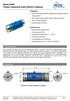 Properties Free of float metal bellow coupling with integrated torque measurement Non-contact measurement system, high robustness High torsional stiffness Limited torque of inertia Performance Measurement
VISCOSITY OF A LIQUID. To determine the viscosity of a lubricating oil. Time permitting, the temperature variation of viscosity can also be studied.
 VISCOSITY OF A LIQUID August 19, 004 OBJECTIVE: EQUIPMENT: To determine the viscosity of a lubricating oil. Time permitting, the temperature variation of viscosity can also be studied. Viscosity apparatus
Advantages of Auto-tuning for Servo-motors
 Advantages of for Servo-motors Executive summary The same way that 2 years ago computer science introduced plug and play, where devices would selfadjust to existing system hardware, industrial motion control
The "DAVID" Steam Engine By Alan Marconett Hobbit Engineering HTTP://WWW.HobbitEngineering.com Alan@HobbitEngineering.
 The "DAVID" Steam Engine By Alan Marconett Hobbit Engineering HTTP://WWW.HobbitEngineering.com [email protected] (c) 2/20/03 The David steam engine is a simple oscillating steam engine, many plans
INSTRUCTION MANUAL CIRRO MK 3/TYPE 2 MIST GENERATOR
 INSTRUCTION MANUAL CIRRO MK 3/TYPE 2 MIST GENERATOR INTRODUCTION The Cirro MK 3 is a fully professional mist generator for producing sufficient airborne reflection particles to enable effect lighting to
BARREL ALIGNMENT- A CRITICAL FACTOR IN REDUCING EXTRUDER WEAR
 BARREL ALIGNMENT- A CRITICAL FACTOR IN REDUCING EXTRUDER WEAR Jeff A. Myers- BARR Inc., Onsted, MI Mike Puhalla Milacron, Batavia, OH Abstract As processors increase the demand on the extruder for increased
SP AF 300mm F/2.8 LD [IF] for Canon (Model 360EE)
![SP AF 300mm F/2.8 LD [IF] for Canon (Model 360EE)](/thumbs/40/21493790.jpg "SP AF 300mm F/2.8 LD [IF] for Canon (Model 360EE)") SP AF 300mm F/2.8 LD [IF] for Canon (Model 360EE) We greatly appreciate your purchase of this Tamron lens. The Tamron SP AF 300mm F/2.8 LD [IF] is a fast telephoto lens developed for Canon AF single-reflex
SP AF 300mm F/2.8 LD [IF] for Canon (Model 360EE) We greatly appreciate your purchase of this Tamron lens. The Tamron SP AF 300mm F/2.8 LD [IF] is a fast telephoto lens developed for Canon AF single-reflex
SCHMIDT ManualPress 300 Series Manual Presses with Process Monitoring
 Manual Presses with Process Monitoring Process reliability, force/stroke monitoring of the joining process and EN ISO- compatible documentation of the results are becoming the major factors for small and
Effect of Pressure and UV Intensity on the Rheological Cure Profile and Dimensional Change of Developing Networks
 by Jared A. Tatum, Tien T. Dao, Nick Roye, and Kaj Hedman Effect of Pressure and UV Intensity on the Rheological Cure Profile and Dimensional Change of Developing Networks Rheology is defined as the study
due to uncertainty. This, in turn, has a direct impact on equipment availability and maintenance costs. Unfortunately, due to misconceptions and
 due to uncertainty. This, in turn, has a direct impact on equipment availability and maintenance costs. Unfortunately, due to misconceptions and pressure from plant operators to get "back on line", it
3-Way heavy duty flow control, with pressure compensated and solenoid controlled priority flow
 1/6 RE 18309-3/06.10 Replaces: RE 18309-3/04.10 3-Way heavy duty flow control, with pressure compensated and solenoid controlled priority flow A-VRFC3C-VEI-VS 0M.43.20.80 - Y - Z Description The flow control