
The Keirsey Temperament Sorter II Guide to Interacting With Your Boss
|
|
|
- Alyson McKinney
- 9 years ago
- Views:
Transcription
1 The Keirsey Temperament Sorter II Guide to Interacting With Your Boss Report prepared for: John Doe October 21, 2010 Keirsey Temperament Sorter-II Guide to Interacting With Your Boss Copyright Keirsey.com. All rights reserved. This report is based on Please Understand Me II by David W. Keirsey, PhD Copyright 1998 Prometheus Nemesis Book Company The Keirsey Temperament Sorter II Copyright 1998 Prometheus Nemesis Book Company. Keirsey Temperament Sorter, Guardian, Artisan, Idealist, and Rational are registered trademarks of Prometheus Nemesis Book Company.


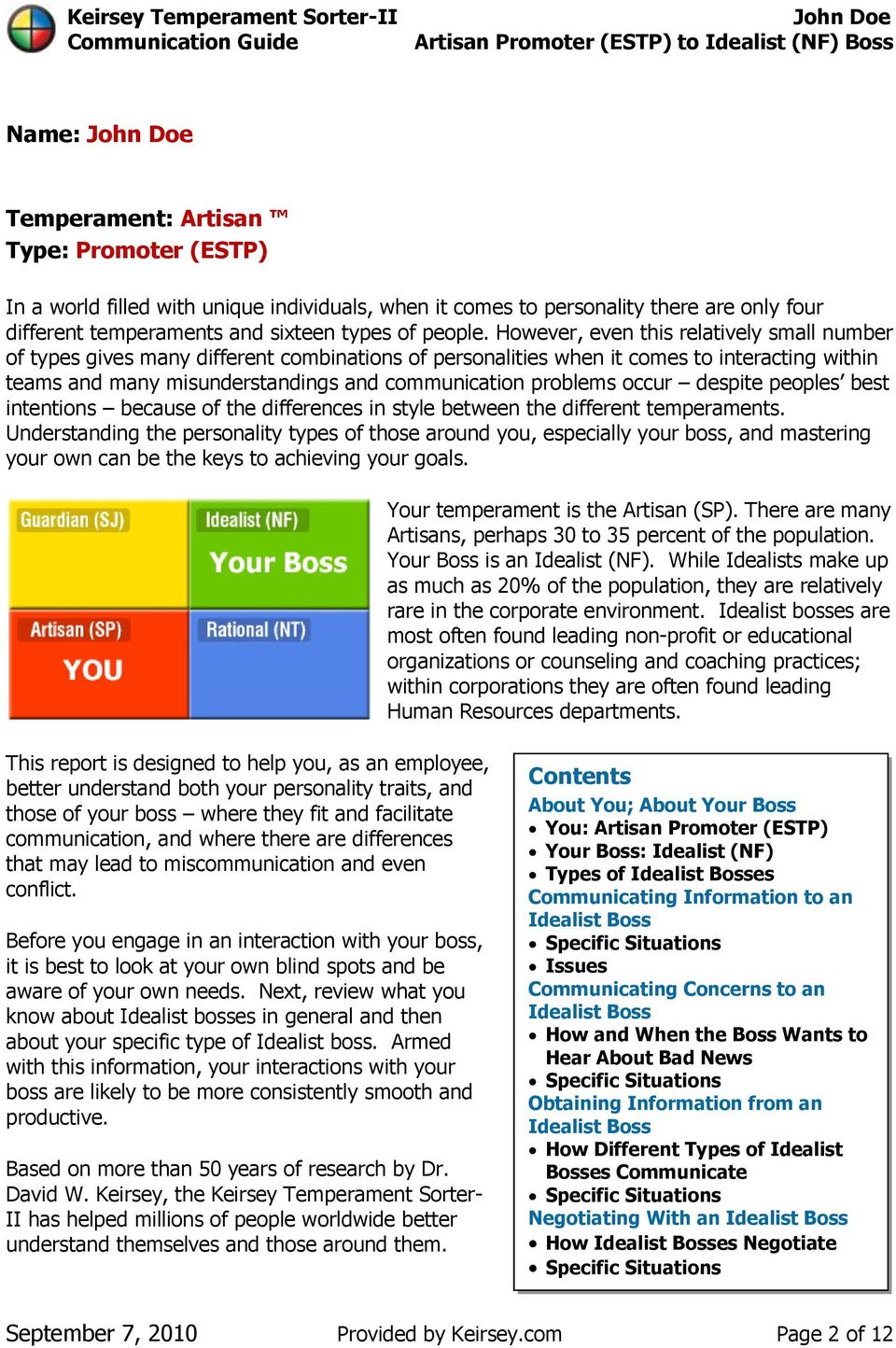
2 Name: John Doe Temperament: Artisan Type: Promoter (ESTP) In a world filled with unique individuals, when it comes to personality there are only four different temperaments and sixteen types of people. However, even this relatively small number of types gives many different combinations of personalities when it comes to interacting within teams and many misunderstandings and communication problems occur despite peoples best intentions because of the differences in style between the different temperaments. Understanding the personality types of those around you, especially your boss, and mastering your own can be the keys to achieving your goals. Your temperament is the Artisan (SP). There are many Artisans, perhaps 30 to 35 percent of the population. Your Boss is an Idealist (NF). While Idealists make up as much as 20% of the population, they are relatively rare in the corporate environment. Idealist bosses are most often found leading non-profit or educational organizations or counseling and coaching practices; within corporations they are often found leading Human Resources departments. This report is designed to help you, as an employee, better understand both your personality traits, and those of your boss where they fit and facilitate communication, and where there are differences that may lead to miscommunication and even conflict. Before you engage in an interaction with your boss, it is best to look at your own blind spots and be aware of your own needs. Next, review what you know about Idealist bosses in general and then about your specific type of Idealist boss. Armed with this information, your interactions with your boss are likely to be more consistently smooth and productive. Based on more than 50 years of research by Dr. David W. Keirsey, the Keirsey Temperament Sorter- II has helped millions of people worldwide better understand themselves and those around them. Contents About You; About Your Boss You: Artisan Promoter (ESTP) Your Boss: Idealist (NF) Types of Idealist Bosses Communicating Information to an Idealist Boss Specific Situations Issues Communicating Concerns to an Idealist Boss How and When the Boss Wants to Hear About Bad News Specific Situations Obtaining Information from an Idealist Boss How Different Types of Idealist Bosses Communicate Specific Situations Negotiating With an Idealist Boss How Idealist Bosses Negotiate Specific Situations September 7, 2010 Provided by Keirsey.com Page 2 of 12
3 About You; About Your Idealist Boss As an Artisan Promoter (ESTP) employee working with an Idealist (NF) boss, you ll find the biggest difference between you and your boss is in the area of competition. You generally find competitiveness is motivating and fun while your boss wants to avoid competition in favor of cooperation and working all together. Your boss is concerned with the human resources of the department while you are concerned with troubleshooting, fixing crises, and making things work. Your boss probably has a strong vision on how the department should be run. Understanding their vision will help you communicate and work more effectively with each other. Your boss will give you lots of freedom to be you, and is likely to also give you plenty of praise. About You (Artisan Performer): You are apt to: pride yourself about being able to quickly respond to emergencies. be able to solve problems at high speed and make split-second decisions. want people to communicate logically and quickly. be direct in your communication and can be seen as blunt or lacking in tact. like to grab new opportunities and have a lot of variety in your job. want to have an impact on co-workers, projects, and the company. be skilled in promotion and negotiating. About Your Idealist Boss: Idealists tend to: see the workplace as an arena for interdependent labor. be particularly effective in leading teams as they have an uncanny insight into each individual s needs. appreciate the employee who is willing to grow in their abilities. enjoy helping an employee learn new skills. want employees to work harmoniously with others and dislike conflict and those that foster conflict. value appreciation of their caring for others and ignore unappreciative employees. Types of Idealist Bosses Idealist Teachers (ENFJ): The Idealist Teacher boss is the Idealist boss most like you. You both enjoy talking out solutions. The Teacher boss is more cooperative, team-based oriented, while you are more problem-focused and pragmatic. Since this type of boss manages in a participative and democratic manner, your contributions are likely to be heard as long as you realize that to your boss, people concerns are paramount. Together you are likely to craft the most complete and effective solutions. September 7, 2010 Provided by Keirsey.com Page 3 of 12

4 Hot Buttons for your Idealist Teacher Boss are: Employees who don t want to learn new skills Employees who are deliberately cruel to others Employees who don t value cooperation and teamwork Idealist Counselors (INFJ): Your Idealist Counselor boss is your personality opposite. Your hard-charging competitive style may intimidate them, but they will also be able to spot most of your b.s. In fact you are both good at spotting phonies. Communicate with your boss in terms of how others will benefit from your ideas, whether within the company or with the clients. Hot Buttons for your Idealist Counselor Boss are: Employees who try to change others. Making them normal Employees who gang up on someone weaker Employees who don t try to do their very best and try to learn new things Idealist Champions (ENFP): The Idealist Champion boss is somewhat similar to you, but less likely to give direct orders. You and your boss are likely to have a lot of fun together. Avoid doing anything your boss might perceive as mean. Watch for the subtle cues your boss gives that it s time to get to work. If you miss the subtle cues, this boss is likely to give you orders in an angry manner. They will resent you for forcing them to do so. Hot Buttons for your Idealist Champion Boss are: Ambitious employees who try to get up the ladder by stepping on others Employees who refuse to work effectively with others and are judgmental of others Employees who don t know how to have fun while working Idealist Healers (INFP): Your Idealist Healer boss is likely to communicate commands in the form of questions or suggestions. They will go to great lengths to avoid conflict except when their values are challenged. Then they become a warrior and may even publicly dress you down. To avoid this, you will need to pay careful attention to your boss s style of leadership and values. Most of the time this type of boss is very accepting and tolerant and allows their employees lots of freedom in how to tackle their work. Hot Buttons for your Idealist Healer Boss are: Employees who are intolerant of others beliefs Employees who are not sensitive to the group culture and well-being Employees who ignore their suggestions and disregard their leadership September 7, 2010 Provided by Keirsey.com Page 4 of 12

5 Communicating Information to an Idealist Boss Giving information to an Idealist boss is best done in an upbeat manner. Emphasize your ability to be a good team member since this is one of their goals for their employees. They are particularly skilled at helping to create a harmonious workplace where everyone is able to succeed. The more you can learn how to create success for multiple people, the more seriously your ideas will be considered. Specific Situations: Giving a Project Update: Idealist bosses have many different ways they like to receive project updates. However, most enjoy hearing stories about the people involved and projections as to how the project will benefit people in the future. When there is bad news, be careful not to lay blame on others. Suggest how things can be fixed in ways that will give the greatest benefit to the greatest number of people. New idea or suggestion for improvement: Idealists tend to be open to suggestions, especially those which will make people s lives fuller. Be sure that your suggestion is framed in a positive way. Pitching a proposal: Idealists are especially fond of proposals made by a group of people or which show individual creativity with a new way of thinking about things. Presentations which tug at the heart strings while providing solutions to human suffering are especially effective. Promoting yourself to your boss: Most Idealist bosses love hearing or reading your stories about learning new skills, reaching new insights and conquering personal challenges. It makes them feel good to see you grow as a person, especially if that makes you a more valued employee. If you can also add examples of instances when your boss has really helped you to improve, it will let the boss know that you are giving them credit for helping you. Idealist bosses thrive with praise just like you thrive -- behaving in this way will gain added trust between you. Issues That May be Part of the Communicating Information Process: Giving information outside of the chain of command: If your boss s boss asks for an update, your Idealist boss is likely to want you to answer the direct question, but not get into a lengthy discussion. Do not disclose negative information. If negative information is asked for, tell the questioner to talk directly to your boss who has more information. Then immediately inform your boss about this discussion. What the boss really means when asking for your honest opinion: Your Idealist boss probably wants your honest opinion given very tactfully. They especially like when you give appropriate credit to other people. As an example, your boss might ask your opinion about a new company product that you dislike. First give the benefits of the product, then the downside. Say, I like the way the product does X. Customers want a product that September 7, 2010 Provided by Keirsey.com Page 5 of 12

6 can help in that area. However, I am concerned about Y. Then describe your concerns. Be careful not to lay blame at anyone s feet. Communicating Concerns to an Idealist Boss If you are sensitive to appropriate timing and setting for communicating concerns to your Idealist boss, you are more likely to have a positive outcome. Idealist bosses really want everyone to feel comfortable. The more you can generate options to mitigate the concerns before talking to your boss, the most successful you will be. How and When the Boss Wants to Hear About Bad News: If a meeting is scheduled with the objective of discussing project deadlines and obstacles, this is a good time to give your Idealist boss any bad news. It is best to present the news along with ideas for how to solve the problem even if it means a schedule slip. Otherwise, communicate bad news or problems to your boss in private. Be sensitive to their emotional state. It is not a good idea to present this type of information when your boss is upset unless the topic is urgent and can t be postponed. Key communication factor: With Idealist bosses, you need to present a balanced picture. First, outline the problem, and then present potential solutions with their pros and cons, especially those connected with impact on people. Idealist bosses will see you as being very professional when you approach them in this manner. Specific Situations: Inability to meet a deadline: Idealist bosses can be understanding if your reasons are well founded. They are generally sympathetic to people, but get quite frustrated if the person hasn t made an effort. Give them a quick heads-up if you are dealing with a last minute rush to meet a deadline. You may enjoy the adrenaline high of meeting a challenge, but most Idealist bosses don t enjoy it as much as you. They can view you negatively if you have underestimated the time it will take to do the work and may see you as having let them down if you don t inform them of the potential problem. Feeling overwhelmed: Idealists may have already sensed that you are feeling overwhelmed. Let them know your feelings and what you have done to mitigate this problem. Then ask for their suggestions and act on them. Sometimes Artisan employees lose energy if their job has become too routine. Talk to your boss on how you can spice it up. Dealing with an unhappy customer, a product problem, or a failed experiment: Idealist bosses usually give their employees a lot of latitude when dealing with these types of issues. They recognize that each person has their own unique style and September 7, 2010 Provided by Keirsey.com Page 6 of 12

7 works best within that style. Sometimes a person needs to learn additional behaviors so they have a broader set of responses to choose from. If what you normally do isn t working, then consider the possibility that the different perspective of your Idealist boss may give you some new insights that you can incorporate into your own style. Inadequate resources available to complete task: Idealist bosses are usually in tune with what resources are available and what ones are not. Since they don t like warring with others, they may be somewhat less aggressive than some of the other types of bosses in getting the resources. Have your arguments ready ahead of time. If you can show that the lack of resources will really affect the bottom line or the success of the project, you ll be helping them prepare their arguments for talking to their superiors. If the resources are already within their control, they will do their best to make them available. Idealists are concerned with fairness and will not cheat one group to help another. Don t ask them to step over this line. Problems with a co-worker: Idealists are very sensitive to co-worker problems within their group. They want harmony and teamwork to prevail. First, try to solve the problem on your own. If that doesn t work, brainstorm solutions with friends who do not work in the same company. If you reply, Yes, but... to every potential solution your friends mention, you will lose their help. Note down all possibilities even if you don t think they will work. Sometimes when you sleep on things, solutions come to you. Getting plenty of ideas rolling around in your brain is necessary for this to work. If the brain-stormed solution doesn t work, then approach your boss and tell them the problems and the efforts you have made to solve the problem. Remember, you and the co-worker are on the same team so if you concentrate on your common objective, you are more likely to find a solution. Personal issues with the boss: Conversations on personal issues need to be handled in a private, calm setting where both parties can be at ease. Before you talk to your Idealist boss, take the time to put two columns on a piece of paper. In one column put Employee at the top of the sheet; in the other put Boss. (It s best to omit real names so if anyone else finds the paper, it will not cause an upset.) Start with the problems you see in your column. Then start with the problems you think your boss sees in the other column. Take a second sheet of paper and make the same two columns. Now write the things you like about your boss in the first column. Then write the things you think your boss likes about you in the second column. You don t need to take these papers to your meeting with the boss. The exercise helps you get more balanced in your view of what is going on and will ensure a more productive conversation. Cutting through red tape to meet objectives: Red tape is something that frustrates Idealists and they are likely to be very creative about what can be done to solve the problem. Since most of them are very sensitive to ethics, the actions they take to cut through red tape are likely to be ethical but can be somewhat unconventional. September 7, 2010 Provided by Keirsey.com Page 7 of 12

8 Potential problems in a project: Don t keep the boss in the dark when you run into a problem. First, try to solve it on your own or with help from co-workers. But don t get too close to the final deadline before informing your boss. Need more directions on assignment: Idealists may not give enough details to satisfy you. They can be overly optimistic and somewhat vague. Only ask for the ones that are critical to you not every little step. Network with other employees to get their help and suggestions. If you still need more direction, ask your boss for a brainstorming session on handling the project. Obtaining Information from an Idealist Boss Getting information from your Idealist boss is usually a very smooth process as long as you are open to personal growth. When the information from them suggests follow-up action from you, act as soon as possible and show that you appreciate their mentoring you. If you do not follow up on their suggestions, they will be very disappointed in you and may redouble their efforts to help you grow. If they see you as habitually rejecting their advice, they will likely shelve you. How Different Types of Idealist Bosses Communicate: Idealist Teachers (ENFJ): Teacher bosses generally give information by talking in a friendly manner. They tend to have very animated faces which convey part of their meaning. They may invite discussion while they are giving information to make sure everyone is on the same track. They are looking for harmony within the group and will usually continue the conversation until it has been achieved. Your boss wants you to receive even negative facts in a positive manner. They want you and every group member to believe that the job can be done and success can be achieved even when things are difficult. Your boss wants you to know that they believe in you. Idealist Counselors (INFJ): Counselor bosses generally give information in a one-on-one conversation or in a meeting. They may bolster their talk with proof through examples that emphasize actions taken by people and impact on people. They may ask questions to make sure that you have understood what they said. Your boss wants you to receive the information with the same level of seriousness as they are giving it. They dislike strong negative emotional responses to information they are giving. They can become overwhelmed by other s negative emotion. Do your best to stay positive or at least neutral. They are usually quite willing to answer any questions. September 7, 2010 Provided by Keirsey.com Page 8 of 12

9 Idealist Champions (ENFP): Champion bosses typically talk a lot when giving information. They are very expressive with their hands and face and expect you to be able to read the emotional as well as the factual message. They may engage others in discussion to keep the energy up. Since your boss prefers to be tactful, you may have to search for hidden messages. Directives are usually stated as suggestions since they don t like to control other s freedom. They want you to find a way to make the suggestions part of your own reason for doing things and then to act. Idealist Healers (INFP): Healer bosses prefer to tactfully avoid speaking unpleasant things or giving direct orders. When possible, they will give their information either one-on-one or in a small, intimate group. If they are particularly visual, they may back it up with pictures. There may be non verbal messages in their communication. The non verbal messages are usually attached to their personal values. Your boss wants you to receive the information by listening and noting the overt message as well as the tactful, but less obvious message. Particularly listen for words or phrases which seem to have a higher than usual emotional charge. These contain your boss s areas of caution. If you re not sure you understand, ask polite questions. Specific Situations: Information on project parameters: Idealists are likely to have very wide parameters so as to allow for individual creativity and initiative. This should suit your style of liking to vary things. Just make sure that you are in synch with their objectives. How to handle clients: Idealists want all relationships to be harmonious even those with difficult clients. Ask them to tell you how they have been successful in handling clients. Be sure to explore the entire range of client response from the upbeat to the downbeat. If you concentrate on downbeat only, you will miss how they are able to get people focused on staying upbeat from the beginning. Feeling left out or in the dark: Idealist bosses never want you to feel left out. You may be in the dark because they simply didn t realize that you need to know something. They hold back information only when it is critical to do so because they prefer their employees to be connected. If you need information, ask them privately. Never let them feel that you are blaming them for your feelings! Seeking appreciation /validation: Your Idealist Teacher boss is usually good at giving positive strokes. They prefer to be seen as a positive influence in everyone s lives and generally present a sunny demeanor. If you need validation, approach them when they are in a sunny mood. Don t complain. Ask them if they are happy with what you are doing. If they are not, they will usually give you some positive ways in which you can improve. September 7, 2010 Provided by Keirsey.com Page 9 of 12

10 Your Idealist Counselor boss gives positive verbal strokes upon occasion. Most of the time, they convey their regard by giving you friendly greetings and having short discussions. If you need validation, ask for a time when you can meet privately so you can get an assessment of how you are doing. Your Idealist Champion boss is the best of all types for giving positive verbal strokes. They have a unique ability for making people feel that they really understand them. Most people easily feel validated by them. If you are having trouble, arrange for a one-to-one meeting. Be upbeat when describing your concerns. Make them sense that you believe any problems can be easily solved, and they will help you solve them. Your Idealist Healer boss gives occasional positive verbal strokes. If you are still feel unsure of your position, if possible, go on a walk with them. They tend to like friendly, personal companionship and this will help cement their positive regard for you. Don t project doom and gloom; project hope. Skills strengths or weaknesses evaluation: Technical, personal, leadership Idealists, particularly Teachers and Counselors, are likely to be direct in their assessments. They tend to tell you both the good and the bad as they see it. Champions and Healers are more indirect and may soften the less flattering assessments. With the latter two, you may need to ask a lot of questions until you really understand what they are saying. All Idealists try to be as tactful as possible when delivering bad news. They also will be quite helpful if you ask how you can improve on your weaknesses. Opportunities for improvement and resources available: Idealists think primarily about the future and how things could be better for people in general and their employees in particular. They really enjoy watching their employees grow and will use resources readily available to make this happen. They are likely to be able to tell you about where you need to improve and will alert you to opportunities for personal growth. They might be a bit short on the details or exact steps you need to take. Be sure to ask if you can t quite catch their vision. Resources can be a tricky subject because sometimes they are readily available and other times not. Be aware of the group s budget. Only ask for resources, such as a new computer, a trip, training time/money, etc. when the money might be available. An often overlooked resource is help from others. On-the-job training by others in the group can be a big help to you. Unless the group is under high stress and deadline pressure, this type of help can cost little to the company and make the boss feel like a real boss with people resources in their control. Where are the areas of career growth, i.e. skills needed: This type of conversation should occur at least once a year with your boss. Many companies have formal plans to help foster this type of conversation. Before starting the conversation, come in with some ideas of your own, but also be open to new information which may surprise you. Your boss is likely to have been thinking about your growth long before you have. What are the company plans for the future: Since Idealist bosses are future thinkers, they are likely to have thought a lot about this topic. The Teacher and Champion bosses are usually aware of broader issues within the company and areas for growth while the Counselor and Healer might focus more locally. September 7, 2010 Provided by Keirsey.com Page 10 of 12

11 With the constant changes and adaptations going on in the workplace, employees need to know what is coming up. Artisan employees, such as you, can benefit from the longer-term viewpoint of Idealist bosses who are exceptionally good at coaching their employees in getting needed new skills. Negotiating With Your Idealist Boss If you think about negotiations with your Idealist boss as a partnership in win-win, you will find negotiations will go more smoothly. Have plenty of options from which to choose and be open to new ideas the boss may toss out. The more options on the table, the more effective the end result will be for both of you. How Idealist Bosses Negotiate: Idealist bosses always look for a win-win situation. They become quite uncomfortable if they seriously disadvantage another person or group. Keep this in mind when entering a negotiation with them. What kind of a response the boss wants from you Your Idealist boss wants you to understand the pros and cons of each option. Until these are explored, no agreement is likely to occur. Be sure to point out the advantages for each person or group for each option. By having options and being willing to concede on things that are less necessary or likely to disadvantage others, you ll be more likely to get the things you want. Specific Situations: Time off: Idealist bosses are sensitive to human needs, so requests for time off or flexible hours will usually be granted if it doesn t violate strict company policy and you don t abuse the privilege. Be sure your reasons are real not phony. If you take advantage of your Idealist boss s concern for your welfare, they will feel betrayed. Needing additional resources: You may think you need more resources than your boss does. Be able to explain what you need each thing for, but only give this information when asked for it. Your boss is likely to have some good ideas for alternative acceptable resources. Getting a raise, promotion, or other perks: When trying to get something new, you often have to give something for it. Your Idealist boss is interested in what you ve done for the company in the past, but they are even more interested in what you ll do for the company in the future. Present your ideas as a vision for the future, then sit back to see how they re-work that vision to be in line with their own. Show some enthusiasm. It may take more than one conversation to get the vision to take more concrete form. Before each meeting take some steps to make the vision become real. This is the way to make them be an effective partner for you. September 7, 2010 Provided by Keirsey.com Page 11 of 12

12 Want more responsibility: Your Idealist boss will usually give you more responsibility if you ask for it as long as they believe you are ready for it. If your boss seems hesitant, ask them about their reservations and together come up with a plan to mitigate them. When that issue is resolved, set a new meeting where you ask for more responsibility. This time your boss is likely to grant it, if feasible. Performance evaluation: The performance evaluation is more than a simple report of what you ve done and a grading on how well you have done it. It also is necessary to set in motion options for your future development. Have some idea of what you might want to learn to benefit the company or what new tasks you can take on. Be sure to encourage your boss to come up with options that haven t occurred to you. Then you can ask for resources you will need to accomplish the objective the two of you have agreed upon. There is likely to be some giveand-take in the discussion about resources available and needed. The more upbeat you are, the more likely you are to get at least some of the resources you will need to make the agreement viable. September 7, 2010 Provided by Keirsey.com Page 12 of 12

50 Tough Interview Questions
 You and Your Accomplishments 1. Tell me a little about yourself. 50 Tough Interview Questions Because this is often the opening question, be careful that you don t run off at the mouth. Keep your answer
DESCRIBING OUR COMPETENCIES. new thinking at work
 DESCRIBING OUR COMPETENCIES new thinking at work OUR COMPETENCIES - AT A GLANCE 2 PERSONAL EFFECTIVENESS Influencing Communicating Self-development Decision-making PROVIDING EXCELLENT CUSTOMER SERVICE
What was the impact for you? For the patient? How did it turn out? How has this helped you in your job? What was the result?
 EXAMPLE VALUE BASED INTERVIEW QUESTIONS VALUE LEADING QUESTION FOLLOW UP QUESTIONS KEY CRITERIA Compassion Give me an example of a time when you were particularly perceptive regarding a Describe what you
Myers Briggs Type Indicator (MBTI)
 Myers Briggs Type Indicator (MBTI) The Myers-Briggs Type Indicator (MBTI) is a system for understanding differences in personality. It is a tool that can explain differences in behavior and perspective.
PREPARING FOR THE INTERVIEW
 U N I V E R S I T Y C A R E E R S E R V I C E S PREPARING FOR THE INTERVIEW THE INTERVIEW The interview is an opportunity to demonstrate to an employer why you are the best fit for the position. Essentially,
Session Seven - Problem-Solving Skills for Families
 105 Session Seven - Problem-Solving Skills for Families Materials Needed: Handout L: Problem-Solving Skills As the popular bumper sticker says, Stuff happens. Problems are an inevitable part of life, and
Sample interview question list
 Sample interview question list Category A Introductory questions 1. Tell me about yourself. 2. Why would you like to work for this organisation? 3. So what attracts you to this particular opportunity?
Emotional Intelligence Self Assessment
 Emotional Intelligence Self Assessment Emotional Intelligence When people in the workplace do not act with Emotional Intelligence (EQ) the costs can be great: low morale, bitter conflict and stress all
Career Readiness Skills
 Interests, Aptitudes, and Abilities... 1 Entrepreneurship... 2 Taking an Interest Inventory... 3 TSA... 5 Keys to a Positive Attitude... 6 Teamwork... 7 Work Habits... 9 Personal Employability Traits...
Potential Interview Questions
 Potential Interview Questions Listed below are some questions commonly asked by employers during interviews along with some hints about how to best answer each question. Outline or write out your responses
Coaching and Career Development
 Coaching and Career Development Overview Five key ways to coach and support career development. What is coaching? Hold frequent coaching meetings with employees Work on your coaching skills Plan and prepare
Coaching and Feedback
 Coaching and Feedback Follow the Guidelines for Effective Interpersonal Communication There are fundamental strategies that should always be part of interpersonal communication in the work place. Don t
Part 5. Dinosaur School Notes to Teachers. 1. Introduction. 2. Iguanodon Unit: How to be Successful in School
 Part 5 Dinosaur School Notes to Teachers 1. Introduction 2. Iguanodon Unit: How to be Successful in School 3 & 4. Triceratops Unit: Detecting, Understanding and Talking About Feelings 5. Stegosaurus Unit:
Human Resources Training. Performance Management Training Module 2: Managing Employee Performance
 Human Resources Training Performance Management Training Module 2: Managing Employee Performance Table of Contents Learning Objectives...1 Expectations Of You As A Leader...3 Setting and Communicating
Difficult Tutoring Situations
 Difficult Tutoring Situations At some time or other, all tutors will find themselves faced with difficult situations in a tutoring session. The following information will provide you with some common categories
Improve Your Ability to Handle Workplace Conflict: An Interview with Judy Ringer
 Improve Your Ability to Handle Workplace Conflict: An Interview with Judy Ringer Recently our local newspaper interviewed me on the subjects of workplace conflict, difficult people, and how to manage them
BEHAVIORAL INTERVIEW QUESTIONS INVENTORY
 ACCOUNTABILITY/DEPENDABILITY Provide a specific example that best illustrates your ability to be counted on. Tell us about a time when you took responsibility for an error and were held personally accountable.
SAMPLE INTERVIEW QUESTIONS
 SAMPLE INTERVIEW QUESTIONS Before you start an interview, make sure you have a clear picture of the criteria and standards of performance that will make or break the job, and limit your questions to those
The 2014 Ultimate Career Guide
 The 2014 Ultimate Career Guide Contents: 1. Explore Your Ideal Career Options 2. Prepare For Your Ideal Career 3. Find a Job in Your Ideal Career 4. Succeed in Your Ideal Career 5. Four of the Fastest
Workplace Success Strategies for Adults with Asperger Syndrome
 Workplace Success Strategies for Adults with Asperger Syndrome This is a summary of the recommendations made in Dan and Julie Coulter s June 10, 2010 APSE presentation. The presentation uses examples from
Mindset: The New Psychology of Success Carol S. Dweck, Ph.D.
 Mindset: The New Psychology of Success Carol S. Dweck, Ph.D. Chapter 1: The Mindsets Chapter 1 presents the two different mindsets fixed and growth. Ms. Dweck reveals that she came upon the idea of researching
BBC Learning English Talk about English Business Language To Go Part 1 - Interviews
 BBC Learning English Business Language To Go Part 1 - Interviews This programme was first broadcast in 2001. This is not a word for word transcript of the programme This series is all about chunks of language
Sample Interview Questions
 Sample Interview Questions Questions an interviewer may ask you, and suggestions for responses! THE OFFICE OF CAREER SERVICES SLU 10492, Hammond, LA 70402 (985) 549-2121 www.selu.edu/career [email protected]
Customer Experience Outlines
 Customer Experience Outlines Professional Persuasive Language Customer satisfaction is a feeling and a perception. The consummate professional manages perception so that the customer always feels cared
The Doctor-Patient Relationship
 The Doctor-Patient Relationship It s important to feel at ease with your doctor. How well you are able to talk with your doctor is a key part of getting the care that s best for you. It s also important
Tools for Effective Performance Management
 Tools for Effective Performance Management TABLE OF CONTENTS Section Page How to Get the Most from the Formal Review Process 2 Six Key Actions to Prepare for the Review 5 Sample Forms 11 How to Deal with
How can I help my child with ADHD? Management Strategies for Parents
 How can I help my child with ADHD? Management Strategies for Parents Raising a child with ADHD can be incredibly challenging for any parent Russell Barkley, 2000 The challenge of raising a child with ADHD
Assertive Communication
 Using assertive communication is an important part of recovery from drugs and alcohol. Being assertive can help you express your opinions and feelings, make requests of others and respond to requests of
Making the Transition to Management
 Making the Transition to Management Overview Advice on making the move to a management or supervisory position. Mistakes new managers often make The pressures and challenges new managers face Tips for
Learning to Delegate
 Learning to Delegate Overview Tips for managers on how to delegate Why is delegation necessary? Why do many managers have a hard time delegating? What to delegate What not to delegate How to delegate Give
The 5 P s in Problem Solving *prob lem: a source of perplexity, distress, or vexation. *solve: to find a solution, explanation, or answer for
 The 5 P s in Problem Solving 1 How do other people solve problems? The 5 P s in Problem Solving *prob lem: a source of perplexity, distress, or vexation *solve: to find a solution, explanation, or answer
Student s Guide To Interviewing..
 Student s Guide To Interviewing.. Provided by: Linda Thurman, Faculty Associate for The Office of Student Professional Development and Success, The W S Lee College of Engineering. [email protected] 704-687-4415
A P C T. 3. lighthearted industrious. 5. talkative a listener. 6. quick methodical. 9. relaxed conscientious. 10. generalist detailed
 PERSONALITY AUDIT By Susan Vogt, MA, CFLE Before entering into any healthy, intimate relationship, you need to know yourself. One important aspect of identity is personality. Generally one s personality
Accountability for Others being responsible for the consequences of the actions of those whom you manage.
 List of Soft Skill Competencies with Descriptions Each title is available as a separate training and development module and is based on the competencies measured by the TriMetrix Job and Personal Talent
MOST FREQUENTLY ASKED INTERVIEW QUESTIONS. 1. Why don t you tell me about yourself? 2. Why should I hire you?
 MOST FREQUENTLY ASKED INTERVIEW QUESTIONS 1. Why don t you tell me about yourself? The interviewer does not want to know your life history! He or she wants you to tell how your background relates to doing
Making a positive difference for energy consumers. Competency Framework Band C
 Making a positive difference for energy consumers Competency Framework 2 Competency framework Indicators of behaviours Strategic Cluster Setting Direction 1. Seeing the Big Picture Seeing the big picture
The Annual Evaluation
 Email: [email protected] The Annual Evaluation The annual evaluation sums up a year s activity of setting expectations, goals, and measurements; providing regular performance feedback;
Sample Behavioural Questions by Competency
 Competencies that support LEADING PEOPLE Change Leadership Please tell us about a time when you led a significant change in your organization and how you helped others to deal with the change. Tell me
REPUTATION MANAGEMENT SURVIVAL GUIDE. A BEGINNER S GUIDE for managing your online reputation to promote your local business.
 REPUTATION MANAGEMENT SURVIVAL GUIDE A BEGINNER S GUIDE for managing your online reputation to promote your local business. About Main Street Hub: Main Street Hub is the voice for more local businesses
TALENT MANAGEMENT Readiness Assessment. Competency Example Writing Workbook
 TALENT MANAGEMENT Readiness Assessment Competency Example Writing Workbook May 2010 TIPS FOR WRITING COMPETENCY EXAMPLES 1. Keep in mind as you write your examples that the Leader-Manager competencies
How to Handle Anger. What is Anger? How are Children Affected? How are Parents and Other Caregivers Affected?
 How to Handle Anger Anger is a natural emotion felt by everyone from time to time. Like other emotions we experience, such as happiness and sadness, anger can affect our mood. Since our mood influences
NETWORKING GUIDE CONTRIBUTOR: CAREERS SERVICE, ANNA PERSSON
 NETWORKING GUIDE CONTRIBUTOR: CAREERS SERVICE, ANNA PERSSON NETWORK YOUR WAY TO A JOB Networking is an important part of any job search. It s the process of establishing contacts for the purpose of gathering
Leading Self. Leading Others. Leading Performance and Change. Leading the Coast Guard
 Coast Guard Leadership Competencies Leadership competencies are the knowledge, skills, and expertise the Coast Guard expects of its leaders. The 28 leadership competencies are keys to career success. Developing
Getting the best from your 360 degree feedback
 1 Contents Getting the best from your 360 degree feedback... 3 What it is.... 3 And isn t.... 4 Using the system... 5 Choosing your respondents... 5 Choosing your competencies... 5 Compiling your questionnaire...
TIPS TO HELP YOU PREPARE FOR A SUCCESSFUL INTERVIEW
 TIPS TO HELP YOU PREPARE FOR A SUCCESSFUL INTERVIEW Preparing for the Interview RESEARCH Don t forget to research the organization/company before the interview. Learn what you can about the workplace prior
WHAT S YOUR TYPE? A HIGH SENSE OF DUTY AN INSPIRATION TO OTHERS INFP ISFP SEES MUCH BUT SHARES LITTLE ESFP ENFP ENTP YOU ONLY GO AROUND ONCE IN LIFE
 WHAT S YOUR TYPE? ISTJ DOING WHAT SHOULD BE DONE ISFJ A HIGH SENSE OF DUTY INFJ AN INSPIRATION TO OTHERS INTJ EVERYTHING HAS ROOM FOR IMPROVEMENT ISTP READY TO TRY ANYTHING ONCE ISFP SEES MUCH BUT SHARES
TEMPERAMENT DISCOVERY SYSTEM
 THE TEMPERAMENT DISCOVERY SYSTEM BASED ON KEIRSEY S TEMPERAMENT THEORY F E A T U R I N G The Keirsey Temperament Sorter -II PERSONALITY INSTRUMENT AN PUBLICATION INTRODUCTION The Keirsey TM Temperament
it happens, he or she is ready provided that the coach has the mindset and skill set needed to be an effective coach. The Coaching Mindset
 Coaching at Work Coaching occurs in many different fields of endeavor. The skills and methods of coaches vary depending on the nature of the coaching relationship: the techniques used by an athletic instructor
6864 NE 14th Street, Suite 5 Ankeny, IA 50023 800.277.8145 Toll free 515.289.4567 Dsm area www.ifapa.org Website ifapa@ifapa.
 About IFAPA The Iowa Foster and Adoptive Parents Association (IFAPA) is a non profit organization serving as a resource to foster, adoptive and kinship families in Iowa. Membership with IFAPA is free for
INTERVIEW QUESTIONS & TECHNIQUES Collected by MBA Dept
 INTERVIEW QUESTIONS & TECHNIQUES Collected by MBA Dept General Advice Before you go for your interview you need to find out everything you can about the company. Reread your application/cv/covering letter,
SAMPLE INTERVIEW QUESTIONS TEACHER S MASTER
 C-12 INFORMATION SHEET SAMPLE INTERVIEW QUESTIONS TEACHER S MASTER QUESTIONS ABOUT YOU Tell Me a Little about Yourself. The interviewers want to know if you are well adjusted, work well with others, have
Short-form Enneagram Screening Initial Indicator for Enneagram Type Copyright 1997, Lori Ohlson MA, LPC and Dee Marcotte MS, MA, LPC
 Short-form Enneagram Screening Initial Indicator for Enneagram Type Copyright 1997, Lori Ohlson MA, LPC and Dee Marcotte MS, MA, LPC This short survey of your characteristics or tendencies will give you
The Competent Communicator Manual
 The Competent Communicator Manual Speech 1: The Ice Breaker For your first speech project, you will introduce yourself to your fellow club members and give them some information about your background,
DiSC Personality Profile
 DiSC Personality Profile Assessment Copyright 2007 Associated Employers Copyright 2007 Associated Employers 1 Model of Human Behavior Outgoing - Task D i Outgoing - People C S Reserved - Task Reserved
Chapter One Love Is the Foundation. For Group Discussion. Notes
 Group Study Guide How can you learn to speak each of the fi ve love languages with your children and fi ll their love tank? This interactive guide includes study questions and exercises for you, for your
Module 2: Conflict Management
 Module 2: Conflict Management Conflict management, like effective communication skills, is another important element of social competency. This module promotes the use of several forms of conflict management
Ten Tough Interview Questions and Ten Great Answers
 This tool is designed to identify typical questions asked and the kinds of answers that demonstrate a concise and thoughtful response. The following are some of the most difficult questions asked during
How to Run an Effective Staff Meeting
 How to Run an Effective Staff Meeting Wesley E. Cook, BSN, RN Clinical Aesthetics Nurse Specialist Clinical Administrator MSN Candidate (NLHSM) Drexel University Welcome to the third set of Concurrent
Terex Leadership Competency Model
 Terex Leadership Competency Model INDIVIDUAL CONTRIBUTOR MANAGER EECUTIVE Creating and Creativity Innovation Business Acumen Strategic Agility Global Business Knowledge Making it Happen Time Action Oriented
Emotional Quotient. Michael Sample. CEO Sample Co. 5-22-2013. Your Address Here Your Phone Number Here Your Email Address Here
 Emotional Quotient CEO Sample Co. 5-22-2013 Introduction The Emotional Quotient report looks at a person's emotional intelligence, which is the ability to sense, understand and effectively apply the power
DEVELOPING EFFECTIVE COMMUNICATION SKILLS
 DEVELOPING EFFECTIVE COMMUNICATION SKILLS Being able to communicate effectively with others is important to our psychological well-being for a number of important reasons. Communication allows us to convey
Interviewing Strategies & Tips. Career Center For Vocation & Development
 Interviewing Strategies & Tips Career Center For Vocation & Development Before the Interview A job interview is an opportunity to showcase your strengths, experience, and interest in the position for which
ICF CORE COMPETENCIES RATING LEVELS
 coachfederation.org ICF CORE COMPETENCIES RATING LEVELS Adapted from the Minimum Skills Requirements documents for each credential level Includes will-not-receive-passing-score criteria. COMPETENCY 1.
The Essential Elements of Writing a Romance Novel
 The Essential Elements of Writing a Romance Novel by Leigh Michaels Even if you re a seat-of-the-pants, explore-as-you-go sort of writer, there are a few things you need to know about your story before
APPLICATIONS GUIDE. TRACOM Sneak Peek. Excerpts from. Improving Personal Effectiveness With Versatility
 APPLICATIONS GUIDE TRACOM Sneak Peek Excerpts from Improving Personal Effectiveness With Versatility TABLE OF CONTENTS PAGE Introduction...1 Prerequisites...1 A Guide for You...1 Why Learn to Become Highly
EMPOWERING YOURSELF AS A COMMITTEE MEMBER
 1 EMPOWERING YOURSELF AS A COMMITTEE MEMBER Bernice R. Sandler Senior Scholar Women s Research and Education Institute www.bernicesandler.com 202 833-3331 On virtually all campuses, committees are the
SAMPLE INTERVIEW QUESTIONS
 SAMPLE INTERVIEW QUESTIONS Interviews and interview styles vary greatly, so the best way to prepare is to practice answering a broad range of questions. For other great interview strategies, see our Successful
Average producers can easily increase their production in a larger office with more market share.
 The 10 Keys to Successfully Recruiting Experienced Agents by Judy LaDeur Understand whom you are hiring. Don t make the mistake of only wanting the best agents or those from offices above you in market
DiSC Assessment Results
 DiSC Assessment Results Understanding Yourself and Those You Work With MVMA Power of Ten Presented By Barbara Dartt Kick Off Exercise 1. Take one blank sheet of paper from your table 2. Stand up 3. Close
NEGOTIATION SKILLS SELF ASSESSMENT P. Jean Baker, Esq.
 NEGOTIATION SKILLS SELF ASSESSMENT P. Jean Baker, Esq. Instructions: This is a self scoring assessment. It is designed to test your knowledge of negotiation theory and best practices. Select the answer
COMPETENCY ACC LEVEL PCC LEVEL MCC LEVEL 1. Ethics and Standards
 ICF CORE COMPETENCIES RATING LEVELS Adapted from the Minimum Skills Requirements documents for each credential level (Includes will-not-receive-passing-score criteria- gray background) COMPETENCY ACC LEVEL
HOW TO RESPOND TO INTERVIEW QUESTIONS
 HOW TO RESPOND TO INTERVIEW QUESTIONS Interviewers typically use a variety of question techniques to determine if you re the person they want to hire. First, they ll choose questions designed to get specific
Chapter Four: How to Collaborate and Write With Others
 Chapter Four: How to Collaborate and Write With Others Why Collaborate on Writing? Considering (and Balancing) the Two Extremes of Collaboration Peer Review as Collaboration * A sample recipe for how peer
Strategies for a Positive Attitude
 This sample chapter is for review purposes only. Copyright The Goodheart-Willcox Co., Inc. All rights reserved. 150 Part 3 Succeeding on the Job 14 Strategies for a Positive Attitude Discover the three
15 Most Typically Used Interview Questions and Answers
 15 Most Typically Used Interview Questions and Answers According to the reports made in thousands of job interviews, done at ninety seven big companies in the United States, we selected the 15 most commonly
WHAT S YOUR TYPE? A HIGH SENSE OF DUTY AN INSPIRATION TO OTHERS INFP ISFP SEES MUCH BUT SHARES LITTLE ESFP ENFP ENTP YOU ONLY GO AROUND ONCE IN LIFE
 WHAT S YOUR TYPE? ISTJ DOING WHAT SHOULD BE DONE ISFJ A HIGH SENSE OF DUTY INFJ AN INSPIRATION TO OTHERS INTJ EVERYTHING HAS ROOM FOR IMPROVEMENT ISTP READY TO TRY ANYTHING ONCE ISFP SEES MUCH BUT SHARES
REDEMPTIVE GIFTS QUESTIONNAIRE. Directions for completing the questionnaire:
 1 REDEMPTIVE GIFTS QUESTIONNAIRE Directions for completing the questionnaire: For each of the statements, think about how you usually function in your organisation. There may be times when you find it
100 Ways To Improve Your Sales Success. Some Great Tips To Boost Your Sales
 100 Ways To Improve Your Sales Success Some Great Tips To Boost Your Sales 100 Ways To Improve Your Sales Success By Sean Mcpheat, Managing Director Of The Sales Training Consultancy What makes a successful
Big 5 Personality Questionnaire (B5PQ)
 MSP Feedback Guide 2009 Big 5 Personality Questionnaire (B5PQ) Feedback to Test Takers Introduction (page 2) The Big 5 Personality Questionnaire (B5PQ) measures aspects of your personality by asking you
36 TOUGH INTERVIEW QUESTIONS And ways to structure the responses
 1 36 TOUGH INTERVIEW QUESTIONS And ways to structure the responses (Management specific questions start with question 30) 1. Tell me about yourself Frame it: Describe how you are today vs. a long story
360 feedback. Manager. Development Report. Sample Example. name: email: date: [email protected]
 60 feedback Manager Development Report name: email: date: Sample Example [email protected] 9 January 200 Introduction 60 feedback enables you to get a clear view of how others perceive the way you work.
GIVING VOICE TO VALUES: BRIEF INTRODUCTION
 GIVING VOICE TO VALUES: BRIEF INTRODUCTION Most of us want to bring our whole selves to work. Yet, experience and research demonstrate that many of us will encounter values conflicts in our careers, when
Family law a guide for legal consumers
 Family law a guide for legal consumers Image Credit - Jim Harper A relationship breakdown is a difficult time for anyone. It is one of the most stressful experiences in life. Where you have to involve
qüé= RJjfkrqb=mboplk^ifqv=qbpqÒ=
 qüé= RJjfkrqb=mboplk^ifqv=qbpqÒ= Below are ten horizontal lines with four words on each line, one in each column. In each line, put the number 4 next to the word that best describes you in that line; a
Goal Setting. Your role as the coach is to develop and maintain an effective coaching plan with the client. You are there to
 Goal Setting Your role as the coach is to develop and maintain an effective coaching plan with the client. You are there to Brainstorm with the client to define actions that will enable the client to demonstrate,
Team Building MARZIO ZANATO
 Team Building 1 What is Teamwork & Team Building Teamwork Concept of people working together as a team Team player A team player is someone who is able to get along with their colleagues and work together
Showing Interest and Expressing Appreciation
 Showing Interest and Expressing Appreciation Starting Point 29 Showing Interest and Expressing Appreciation Section 1 Starting Point: Treating people well A. Warm Up: Discuss the following questions with
Myers-Briggs Personality Type Indicator MBTI
 Myers-Briggs Personality Type Indicator MBTI Kathy Prem Engineering Career Services University of Wisconsin-Madison MBTI, Myers-Briggs, Myers-Briggs Type Indicator and Introduction to Type are registered
Opening Our Hearts, Transforming Our Losses
 Preface Alcoholism is a disease of many losses. For those of us who are the relatives and friends of alcoholics, these losses affect many aspects of our lives and remain with us over time, whether or not
The Good Roommate Guide
 The Good Roommate Guide Contents: p. 2 COMMUNICATING WITH YOUR ROOMMATE 101 p. 3 IDENTIFYING COMMUNICATION STYLES p. 4 TOP 10 TIPS FOR HEALTHY RELATIONSHIP p. 5 10 EFFECTIVE WAYS TO HANDLE CONFLICT p.
Active Listening. Learning Objectives. By the end of this module, the learner will have
 1 Active Listening Learning Objectives By the end of this module, the learner will have An understanding of what is meant by active listening Gained insight into your natural listening strengths and areas
-----------------------------2008 Farmer Mentor Handbook----------------------------- Adult Learning Styles. Adult Learning Styles
 Learning Styles Primer for Farmer Mentors You are now considering the possibility of mentoring a future farmer; taking an intern under your wing; and inviting someone to come to your farm to observe, listen
HOW TO PREPARE FOR YOUR PARENT INTERVIEW By The Testing Mom
 HOW TO PREPARE FOR YOUR PARENT INTERVIEW By The Testing Mom If you are applying to a private kindergarten, the parent interview is just one of the hoops you ll be jumping through. Many gifted programs,
FAMILY LAW AND YOUNG PEOPLE
 FAMILY MATTERS FAMILY LAW AND YOUNG PEOPLE IN SCOTLAND FAMILY LAW AND YOUNG PEOPLE IN SCOTLAND Scottish Ministers vision for children and young people 1 in Scotland is that they are safe, nurtured, achieving,
Having Conversations at Work that Work!
 Having Conversations at Work that Work! Presented by Stephen R. Pearson, Director UW-Madison Employee Assistance Office [email protected] Having Conversations at Work that Work In order for any organization
Guide 7 Iceberg beliefs underlying beliefs that can undermine our resilience
 Guide 7 Iceberg beliefs underlying beliefs that can undermine our resilience Some of our beliefs are difficult to identify because they are deeper and more complex. These beliefs operate at an unconscious