
Operation Manual CD RECEIVER FH-P800BT. English
|
|
|
- Alice Pope
- 9 years ago
- Views:
Transcription
1 Operation Manual CD RECEIVER FH-P800BT English

2 Contents Thank you for buying this Pioneer product. Please read through these operating instructions so you will know how to operate your model properly. After you have finished reading the instructions, keep this manual in a safe place for future reference. Before You Start Information to User 5 For Canadian model 5 About this unit 5 Operating environment 7 After-sales service for Pioneer products 8 Visit our website 8 In case of trouble 8 Resetting the microprocessor 8 About the demo mode 9 Use and care of the remote control 9 Installing the battery 9 Using the remote control 9 Operating this unit What s What 10 Head unit 10 Remote control 11 Display indication 12 Basic Operations 13 Power ON/OFF 13 Selecting a source 13 Adjusting the volume 14 Tuner 14 Basic Operations 14 Storing and recalling broadcast frequencies 14 Introduction to advanced operations 15 Storing the strongest broadcast frequencies 15 Tuning in strong signals 15 Built-in CD Player 16 Basic Operations 16 Selecting a track directly 17 Displaying text information on disc 17 Selecting tracks from the track title list 18 Selecting files from the file name list 18 Introduction to advanced operations 18 Selecting a repeat play range 19 Playing tracks in random order 19 Scanning folders and tracks 19 Pausing playback 19 Using Sound Retriever 19 Using disc title functions 20 Playing songs on USB portable audio player/ USB memory 21 Basic Operations 21 Selecting an audio file directly in the current folder 21 Displaying text information of an audio file 21 Selecting files from the file name list 21 Introduction to advanced operations 22 Playing songs on ipod 23 Basic Operations 23 Browsing for a song 23 Displaying text information on ipod 24 Introduction to advanced operations 24 Playing songs in a random order (shuffle) 25 Playing all songs in a random order (shuffle all) 25 Selecting songs from album list of currently playing artist 25 Operating this unit s ipod function from your ipod 25 Changing audiobook speed 26 Bluetooth Audio 26 Connecting a Bluetooth audio player 27 Disconnecting a Bluetooth audio player 28 Basic Operations 28 Introduction to advanced operations 28 Playing songs on a Bluetooth audio player 29 Stopping playback 29 2 En

3 Contents Connecting to a Bluetooth audio player automatically 29 Displaying BD (Bluetooth Device) address 29 Bluetooth Telephone 30 Setting up for hands-free phoning 30 Introduction to connection and pairing 30 Connecting and disconnecting a cellular phone 31 Making a phone call 34 Taking a phone call 34 Using the phone number list 35 Using the call history 35 Using the phone book 36 Using preset numbers 37 Introduction to advanced operations 39 Downloading phone books from your cellular phone 40 Transferring entries to the phone book 40 Setting the automatic connection 41 Setting automatic answering 41 Echo canceling and noise reduction 41 Switching the ring tone 41 Making a call by entering phone number 42 Clearing memory 42 Changing the phone book display order 42 Selecting menu language 42 Audio Adjustments Introduction of audio adjustments 44 Using balance adjustment 44 Using the equalizer 44 Recalling equalizer curves 44 Adjusting equalizer curves 45 Adjusting 7-band graphic equalizer 45 Adjusting loudness 46 Using subwoofer output 46 Adjusting subwoofer settings 46 Boosting the bass 47 Using the high pass filter 47 Adjusting source levels 47 Initial Settings Adjusting initial settings 48 Setting the date 48 Setting the clock 48 Switching the auxiliary setting 49 Switching the dimmer setting 49 Setting the rear output and subwoofer controller 49 Switching the sound muting/attenuation 50 Setting the internal power amplifier 50 Switching the feature demo 50 Switching the ever scroll 50 Activating the BT AUDIO source 51 Entering PIN code for Bluetooth wireless connection 51 Editing device name 51 Displaying system version for repair 52 Resetting the Bluetooth wireless technology module 52 Updating the software about Bluetooth connection 52 Other Functions Using the AUX source 53 About AUX1 and AUX2 53 AUX1 source: 53 AUX2 source: 53 Selecting AUX as the source 53 Setting the AUX title 53 Using the external unit 53 Selecting the external unit as the source 53 Basic operation 54 Advanced operations 54 Turning the clock display on or off 54 Switching the display indication and button illumination 54 Using the PGM button 54 En 3

4 Contents Available accessories Playing songs on ipod 56 Basic operation 56 Displaying text information on ipod 56 Browsing for a song 56 Introduction to advanced operations 56 Playing songs in a random order (shuffle) 57 XM tuner 57 Listening to XM Satellite Radio 57 Selecting an XM channel directly 58 Switching the XM display 58 Storing and recalling broadcast stations 58 Switching the XM channel select mode 58 Displaying the Radio ID 59 SIRIUS Satellite Radio tuner 59 Listening to SIRIUS Satellite Radio 59 Selecting a SIRIUS channel directly 60 Switching the SIRIUS display 60 Storing and recalling broadcast stations 60 Introduction of advanced operations 60 Selecting the SIRIUS channel select mode 61 Using the Game Alert function 61 Displaying the Radio ID 62 Using Instant Replay function 62 HD Radio tuner 63 Basic Operations 63 Storing and recalling broadcast frequencies 63 Switching the display 63 Introduction to advanced operations 64 Switching the seek mode 64 Switching the reception mode 64 Multi-CD Player 65 Basic Operations 65 Using CD TEXT functions 65 Introduction to advanced operations 65 Using compression and bass emphasis 66 Using ITS playlists 66 Using disc title functions 68 DVD Player 69 Basic Operations 69 Selecting a disc 69 Selecting a folder 69 Introduction to advanced operations 69 TV tuner 71 Basic Operations 71 Storing and recalling broadcast stations 71 Storing the strongest broadcast stations sequentially 71 Additional Information Troubleshooting 73 Error messages 73 Handling guideline of discs and player 75 Dual Discs 75 Compressed audio compatibility 75 Compressed audio files on the disc 76 Example of a hierarchy 76 USB audio player/usb memory 76 USB audio player/usb memory compatibility 76 Handling guideline and supplemental information 77 ipod 78 About handling the ipod 78 About ipod settings 78 Bluetooth profiles 78 Specifications 79 4 En

5 Before You Start Section 01 Information to User FCC ID: AJDK017 MODEL NO.: FH-P800BT IC: 775E-K017 This device complies with Part 15 of FCC Rules and RSS-Gen of IC Rules. Operation is subject to the following two conditions: (1) this device may not cause interference, and (2) this device must accept any interference, including interference that may cause undesired operation of this device. MADE IN MALAYSIA This equipment has been tested and found to comply with the limits for a class B digital device, pursuant to Part 15 of the FCC Rules. These limits are designed to provide reasonable protection against harmful interference in a residential installation. This equipment generates, uses and can radiate radio frequency energy and, if not installed and used in accordance with the instructions, may cause harmful interference to radio communications. However, there is no guarantee that interference will not occur in a particular installation. If this equipment dose cause harmful interference to radio or television reception, which can be determined by turning the equipment off and on, the user is encouraged to try to correct the interference by one or more of the following measures:! Reorient or relocate the receiving antenna.! Increase the separation between the equipment and receiver.! Connect the equipment into an outlet on a circuit different from that to which the receiver is connected.! Consult the dealer or an experienced radio/ TV technician for help.! This transmitter must not be co-located or operated in conjunction with any other antenna or transmitter.! This equipment complies with FCC/IC radiation exposure limits set forth for uncontrolled equipment and meets the FCC/IC radio frequency (RF) Exposure Guidelines in Supplement C to OET65 and RSS-102 of the IC radio frequency (RF) exposure rules. This equipment has very low levels of RF energy that it is deemed to comply without testing of specific absorption ratio (SAR). For Canadian model Operation is subject to the following two conditions: (1) This device may not cause harmful interference, and (2) this device must accept any interference received, including interference that may cause undesired operation. This Class B digital apparatus complies with Canadian ICES-003. About this unit The tuner frequencies on this unit are allocated for use in North America. Use in other areas may result in poor reception. WARNING Handling the cord on this product or cords associated with accessories sold with the product may expose you to chemicals listed on proposition 65 known to the State of California and other governmental entities to cause cancer and birth defects or other reproductive harm. Wash hands after handling. Before You Start Alteration or modifications carried out without appropriate authorization may invalidate the user s right to operate the equipment. En 5

6 Section 01 Before You Start CAUTION: USE OF CONTROL OR ADJUSTMENT OR PERFORMANCE OF PROCEDURES OTHER THAN THOSE SPECIFIED HEREIN MAY RESULT IN HAZARDOUS RADIATION EXPOSURE. CAUTION: THE USE OF OPTICAL INSTRUMENTS WITH THIS PRODUCT WILL INCREASE EYE HAZARD. CAUTION! Do not allow this unit to come into contact with liquids. Electrical shock could result. Also, damage to this unit, smoke, and overheating could result from contact with liquids.! Keep this manual handy as a reference for operating procedures and precautions.! Always keep the volume low enough so that you can hear sounds from outside the vehicle.! Protect this unit from moisture.! If the battery is disconnected or discharged, the preset memory will be erased and must be reprogrammed. Important (Serial number) The serial number is located on the bottom of this unit. For your own security and convenience, be sure to record this number on the enclosed warranty card. About WMA The Windows Media logo printed on the box indicates that this unit can play back WMA data. Windows Media and the Windows logo are trademarks or registered trademarks of Microsoft Corporation in the United States and/or other countries.! This unit may not operate correctly depending on the application used to encode WMA files. About MP3 Supply of this product only conveys a license for private, non-commercial use and does not convey a license nor imply any right to use this product in any commercial (i.e. revenuegenerating) real time broadcasting (terrestrial, satellite, cable and/or any other media), broadcasting/streaming via internet, intranets and/ or other networks or in other electronic content distribution systems, such as pay-audio or audio-on-demand applications. An independent license for such use is required. For details, please visit About AAC This unit plays back AAC files encoded by itunes. itunes is a trademark of Apple Inc., registered in the U.S. and other countries. Portable audio player compatibility! Inquire at the manufacturer about your USB portable audio player/usb memory. This unit corresponds to the following. USB MSC (Mass Storage Class) compliant portable audio player and memory WMA, MP3, AAC and WAV file playback For details about the compatibility, refer to USB audio player/usb memory compatibility on page 76. ipod compatibility This unit can control and listen to songs on an ipod.! This unit supports only the following ipods. Supported ipod software versions are shown below. Older versions of ipod software may not be supported. ipod fifth generation (software version 1.2.1) ipod nano first generation (software version 1.3.1) ipod nano second generation (software version 1.1.3) 6 En

7 Before You Start Section 01 ipod nano third generation (software version 1.0.2) ipod classic (software version 1.0.2) ipod touch (software version 1.1.1)! Operations may vary depending on the software version of ipod.! When using an ipod, ipod Dock Connector to USB Cable is required.! This unit can control previous generations ipod models with a Pioneer ipod adapter (e.g. CD-IB100N). For details concerning operation with the ipod adapter, refer to Playing songs on ipod on page 56.! ipod is a trademark of Apple Inc., registered in the U.S. and other countries. About Bluetooth Bluetooth is a short-range wireless radio connectivity technology that is developed as a cable replacement for mobile phones, handheld PCs and other devices. Bluetooth operates in 2.4 GHz frequency range and transmits voice and data at speeds up to 1 megabit per second. Bluetooth was launched by a special interest group (SIG) that comprises of Ericsson Inc., Intel Corp., Nokia Corp., Toshiba and IBM in 1998, and it is currently developed by nearly companies worldwide.! The Bluetooth word mark and logos are owned by the Bluetooth SIG, Inc. and any use of such marks by Pioneer Corporation is under license. Other trademarks and trade names are those of their respective owners. About the SAT RADIO READY mark The SAT RADIO READY mark indicates that the Satellite Radio Tuner for Pioneer (i.e., XM tuner and Sirius satellite tuner which are sold separately) can be controlled by this unit. Please inquire to your dealer or nearest authorized Pioneer service station regarding the satellite radio tuner that can be connected to this unit. For satellite radio tuner operation, please refer to the satellite radio tuner owner s manual.! The system will use direct satellite-to-receiver broadcasting technology to provide listeners in their cars and at home with crystal-clear sound seamlessly from coast to coast. Satellite radio will create and package over 100 channels of digital-quality music, news, sports, talk and children s programming.! SAT Radio, the SAT Radio logo and all related marks are trademarks of Sirius Satellite Radio inc., and XM Satellite Radio Inc. About HD Radio! The HD Radio Ready logo is a proprietary trademark of ibiquity Digital Corp. CAUTION! Pioneer accepts no responsibility for data lost on the USB portable audio player/usb memory even if that data is lost while using this unit.! Pioneer accepts no responsibility for data lost on the ipod even if that data is lost while using this unit. Operating environment This unit should be used within the temperature ranges shown below. Operating temperature range: -10 C to +60 C (14 F to 140 F) EN ETC test temperature: -20 C and +55 C (-4 F and 131 F) Before You Start En 7

8 Section 01 Before You Start After-sales service for Pioneer products Please contact the dealer or distributor from where you purchased this unit for after-sales service (including warranty conditions) or any other information. In case the necessary information is not available, please contact the companies listed below: Please do not ship your unit to the companies at the addresses listed below for repair without advance contact. U.S.A. Pioneer Electronics (USA) Inc. CUSTOMER SUPPORT DIVISION P.O. Box 1760 Long Beach, CA CANADA Pioneer Electronics of Canada, Inc. CUSTOMER SATISFACTION DEPARTMENT 300 Allstate Parkway Markham, Ontario L3R 0P In case of trouble Should this product fail to operate properly, contact your dealer or nearest authorized Pioneer Service Station. Resetting the microprocessor The microprocessor must be reset under the following conditions:! Prior to using this unit for the first time after installation! If the unit fails to operate properly! When strange or incorrect messages appear on the display RESET button % Press RESET with a pen tip or other pointed instrument. For warranty information please see the Limited Warranty sheet included with this unit. Visit our website Visit us at the following site: 1 Register your product. We will keep the details of your purchase on file to help you refer to this information in the event of an insurance claim such as loss or theft. 2 Receive updates on the latest products and technologies. 3 Download owner s manuals, order product catalogues, research new products, and much more. 8 En

9 Before You Start Section 01 About the demo mode This unit features the feature demo mode. Important The red lead (ACC) of this unit should be connected to a terminal coupled with ignition switch on/off operations. If this is not done, the vehicle battery may be drained. Feature demo mode The feature demo automatically starts when power to this unit is turned off while the ignition switch is set to ACC or ON. Press DISP during feature demo operation to cancel the feature demo mode. Press DISP again to start. Remember that if the feature demo continues operating when the car engine is turned off, it may drain battery power. Use and care of the remote control Installing the battery Slide the tray on the back of the remote control out and insert the battery with the plus (+) and minus ( ) poles aligned properly.! When using for the first time, pull out the film protruding from the tray.! There is a danger of explosion if the battery is incorrectly replaced. Replace only with the same or equivalent type.! Do not handle the battery with metallic tools.! Do not store the battery with metallic objects.! If the battery leaks, wipe the remote control completely clean and install a new battery.! When disposing of used batteries, comply with governmental regulations or environmental public institutions rules that apply in your country/area.! Perchlorate Material special handling may apply. See perchlorate. (Applicable to California, U.S.A.) Using the remote control Point the remote control in the direction of the front panel to operate.! The remote control may not function properly in direct sunlight. Important! Do not store the remote control in high temperatures or direct sunlight.! Do not let the remote control fall onto the floor, where it may become jammed under the brake or accelerator pedal. Before You Start WARNING Keep the battery out of the reach of children. Should the battery be swallowed, consult a doctor immediately. CAUTION! Use one CR2025 (3 V) lithium battery.! Remove the battery if the remote control is not used for a month or longer. En 9

10 Section 02 Operating this unit What s What Head unit 1 S.Rtrv/SAT MODE button Press to switch Sound Retriever settings. When XM tuner or SIRIUS tuner is selected as the source, press to change the channel select mode. When SIRIUS tuner is selected as the source, press and hold to perform the Instant Replay mode. 2 DISP/SCROLL button Press to select different displays. Press and hold to scroll through the text information. 3 Disc loading slot Insert a disc to play. 4 EJECT button Press to eject a CD from your built-in CD player. 5 CLOCK/DISP OFF button Press to change to the clock display. Press and hold to turn the display indication and button illumination off or on. 6 RESET button Press to reset the microprocessor. 7 MUTE/HOLD button Press to turn off the sound. To turn on the sound, press again. While talking on the phone, press to put the call on hold. 8 indicator Lights up when your Bluetooth audio player is connected via Bluetooth wireless technology.! While connecting, this indicator flashes. 9 indicator Lights up when your cellular phone is connected via Bluetooth wireless technology.! While connecting, this indicator flashes.! While phone connection is not completed, this indicator flashes. a LIST button Press to display the disc title list, track title list, folder list, file list, preset channel list or phone number list depending on the source. b PHONE/ /CONNECT button Press to select the phone as the source. While operating a phone source, press to end a call, reject an incoming call or cancel making a call. Press and hold to perform Bluetooth connection. c MULTI-CONTROL Move to perform manual seek tuning, fast forward, reverse and track search controls. Also used for controlling functions. Turn to increase or decrease the volume. d BAND/ESC button Press to select among three FM bands and one AM band. Press to return to the ordinary display when operating the menu. e SOURCE/OFF button This unit is turned on by selecting a source. Press to cycle through all the available sources. 10 En
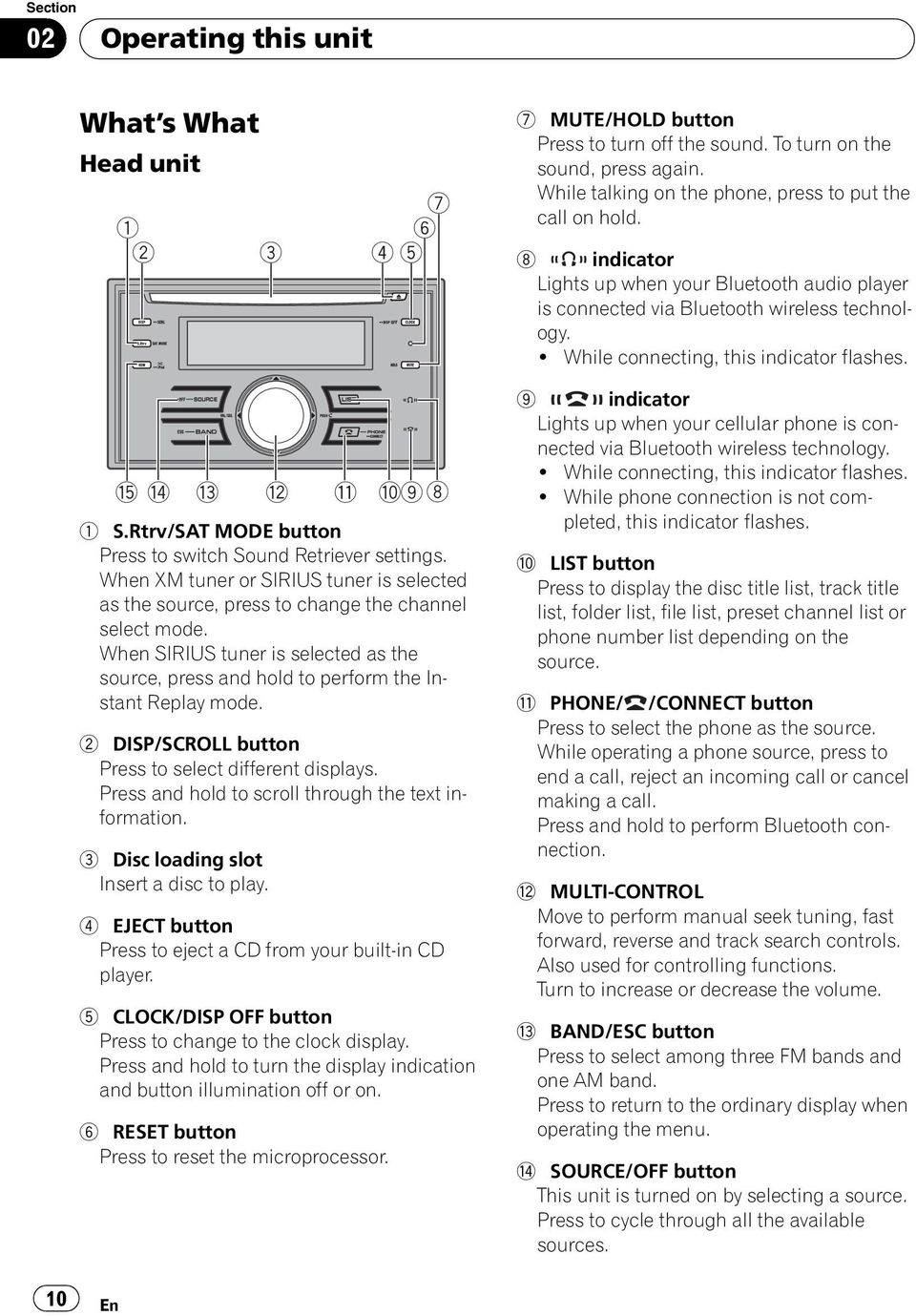
11 Operating this unit Section 02 f RDM/ /ipod button Press to turn random function on or off while using CD or USB. While using an ipod, press to shuffle all tracks. Press and hold to switch the control mode while using an ipod. If using the ipod with an interface adapter (CD-IB100N), press to switch the shuffle function. Remote control Operation is the same as when using the buttons on the head unit. g VOLUME buttons Press to increase or decrease the volume. h FUNCTION button Press to select functions. i Thumb pad Move to perform manual seek tuning, fast forward, reverse and track search controls. Also used for controlling functions. Functions are the same as MULTI-CONTROL except for volume control. Press to display the disc title list, track title list, folder list, file list or preset channel list depending on the source. j DIRECT button Press to directly select the desired track. k CLEAR button Press to cancel the input number when 0 to 9 are used. l 0 to 9 buttons Press to directly select the desired track, preset tuning or disc. Buttons 1 to 6 can operate the preset tuning for the tuner or disc number search for the multi-cd player. m OFF HOOK button Press to start talking on the phone while operating a phone source. n ON HOOK button While operating the phone source, press to end a call or reject an incoming call. o MUTE button Press to turn off the sound. To turn on the sound, press again. p PGM button Press to operate the preprogrammed functions for each source. (Refer to Using the PGM button on page 54.) q AUDIO button Press to select various sound quality controls. Operating this unit En 11

12 Section 02 Operating this unit Display indication 6 (song) indicator Appears when the track (song) name is displayed on the main display section. Appears when song search refinement on the ipod browsing function is in use. 7 (ipod connection) indicator Appears when the ipod connection is recognized while USB source is being selected. 8 F-RDM indicator Appears when folder random is on. When random function is on, only RDM is displayed. 9 F-RPT indicator Appears when folder repeat is on. When repeat function is on, only RPT is displayed. 1 Main display section Displays band, frequency, elapsed playback time and other settings. 2 (artist) indicator Appears when the disc (track) artist name is displayed on the main display section. Appears when artist search refinement on the ipod browsing function is in use. 3 (shuffle) indicator Appears when shuffle function is on while ipod source is being selected. 4 (disc) indicator Appears when the disc (album) name is displayed on the main display section. Appears when album search refinement on the ipod browsing function is in use. 5 (folder) indicator Appears when operating list function. When an upper tier folder or menu exists, c appears. When a lower tier folder or menu exists, d appears. a LOC indicator Appears when local seek tuning is on. b 5 (stereo) indicator Appears when the selected frequency is being broadcast in stereo. c (Sound Retriever) indicator Appears when Sound Retriever function is on. d AUTO (auto answer) indicator Shows when the automatic answering function is on (for more details, refer to Setting automatic answering on page 41). e (missed call) indicator Appears when there are missed call log. Appears when missed call list is displayed while telephone source is being selected. f (dialled call) indicator Appears when dialled call list is displayed while telephone source is being selected. g (received call) indicator Appears when received call list is displayed while telephone source is being selected. 12 En

13 Operating this unit Section 02 h (phone book) indicator Appears when phone book list is displayed while telephone source is being selected. Basic Operations Power ON/OFF Turning the unit on % Press SOURCE to turn the unit on. Turning the unit off % Press OFF and hold until the unit turns off. Selecting a source You can select a source you want to listen to. To switch to the built-in CD player, load a disc in the unit (refer to page 16). % Press SOURCE repeatedly to switch between the following sources. XM tuner Sirius tuner HD Radio Tuner Television DVD player/multi- DVD player Built-in CD player Multi- CD player ipod USB External unit 1 External unit 2 AUX1 AUX2 BT Audio BT Telephone Operating this unit Notes! In the following cases, the sound source will not change. When no unit corresponding to the selected source is connected. When there is no disc or magazine in the player. When the ipod is not connected to this unit. When AUX (auxiliary input) is set to off (refer to page 49). When the BT audio source is set to off (refer to Activating the BT AUDIO source on page 51).! If the HD Radio tuner is connected to this unit, tuner source is skipped.! AUX1 is set to on by default. Turn off the AUX1 when not in use (refer to Switching the auxiliary setting on page 49). En 13

14 Section 02 Operating this unit! Charging the portable audio player using car s DC power source while connecting it to AUX input may generate noise. In this case, stop charging.! External unit refers to a Pioneer product (such as ones available in the future) that, although incompatible as a source, enables control of basic functions with this unit. Two external units can be controlled with this unit. When two external units are connected, the external unit is automatically allocated to external unit 1 or external unit 2 by this unit.! When this unit s blue/white lead is connected to the vehicle s auto-antenna relay control terminal, the vehicle s antenna extends when this unit s source is turned on. To retract the antenna, turn the source off. Adjusting the volume % Turn MULTI-CONTROL to adjust the sound level. Tuner Basic Operations 1 Band indicator 2 Preset number indicator 3 Frequency indicator % Select a band Press BAND. # Band can be selected from among FM1, FM2, FM3 or AM. % Manual tuning (step by step) Push MULTI-CONTROL left or right. % Seek tuning Push and hold MULTI-CONTROL left or right, and then release. # You can cancel seek tuning by pushing MULTI-CONTROL left or right. # While pushing and holding MULTI-CONTROL left or right, you can skip stations. Seek tuning starts as soon as you release MULTI-CONTROL. Storing and recalling broadcast frequencies You can easily store up to six broadcast frequencies for later recall.! Six stations for each band can be stored in memory. 1 Press LIST. Preset screen is displayed. 2 Use MULTI-CONTROL to store the selected frequency in memory. Turn to change the preset number. Press and hold to store. 14 En

15 Operating this unit Section 02 3 Use MULTI-CONTROL to select the desired station. Turn to change the station. Press to select. # You can also change the station by pushing MULTI-CONTROL up or down. # To return to the ordinary display, press BAND or LIST. # If you do not operate the list within about 30 seconds, the display automatically returns to the ordinary display. Using the remote control % When you find a frequency that you want to store in memory, press one of preset tuning buttons 1 to 6 and hold until the preset number stops flashing. The number you have pressed will flash in the preset number indicator and then remain lit. The selected radio station frequency has been stored in memory. The next time you press the same preset tuning button the radio station frequency is recalled from memory. # You can also recall radio station frequencies assigned to preset tuning numbers by pushing MULTI-CONTROL up or down during the frequency display. Introduction to advanced operations 1 Press MULTI-CONTROL to display the main menu. FUNCTION. Turn to change the menu option. Press to select. The function menu is displayed. 3 Turn MULTI-CONTROL to select the function. BSM (best stations memory) LOCAL (local seek tuning) Notes! You can also select the function by pressing FUNCTION on the remote control.! To return to the ordinary display, press BAND. Storing the strongest broadcast frequencies BSM (best stations memory) lets you automatically store the six strongest broadcast frequencies. 1 Display the function menu. Refer to Introduction to advanced operations on this page. BSM in the function menu. 3 Press MULTI-CONTROL to turn BSM on. The six strongest broadcast frequencies are stored in the order of their signal strength. # To cancel, press MULTI-CONTROL again. Tuning in strong signals Local seek tuning lets you tune in only those radio stations with sufficiently strong signals for good reception. 1 Display the function menu. Refer to Introduction to advanced operations on this page. LOCAL in the function menu. 3 Press MULTI-CONTROL to turn local seek tuning on. # To turn local seek tuning off, press MULTI-CONTROL again. 4 Push MULTI-CONTROL left or right to set the sensitivity. FM: LEVEL 1 LEVEL 2 LEVEL 3 LEVEL 4 AM: LEVEL 1 LEVEL 2 Operating this unit En 15

16 Section 02 Operating this unit The LEVEL 4 setting allows reception of only the strongest stations, while lower settings let you receive progressively weaker stations. Built-in CD Player Basic Operations 1 Folder number indicator Shows the folder number currently playing when the compressed audio is playing. 2 Track number indicator 3 Play time indicator 4 Bit rate/sampling frequency indicator Shows the bit rate or sampling frequency of the current track (file) when the compressed audio is playing.! When playing back VBR (variable bit rate)-recorded WMA files, the average bit rate value is displayed.! When playing back VBR (variable bit rate)-recorded MP3 files, VBR is displayed instead of bit rate value. % Insert a disc into the disc loading slot. Playback will automatically start. # When loading a disc, face the label side of a disc up. % Eject a disc Press EJECT. % Select a folder Push MULTI-CONTROL up or down. # You cannot select a folder that does not have a compressed audio file recorded in it. % Select a track Push MULTI-CONTROL left or right. % Fast forward or reverse Push and hold MULTI-CONTROL left or right. # When playing compressed audio, there is no sound on fast forward or reverse. 16 En

17 Operating this unit Section 02 % Return to root folder Press and hold BAND. # If folder 01 (ROOT) contains no files, playback commences with folder 02. % Switch between compressed audio and CD-DA Press BAND. # This operation is available only when playing CD-EXTRA or MIXED-MODE CDs. # If you have switched between compressed audio and CD-DA, playback starts at the first track on the disc. Notes! The built-in CD player can play back audio CD and compressed audio recorded on a CD- ROM. (Refer to page 76 for files that can be played back.)! Read the precautions for discs and player on page 75.! A disc has already been inserted, press SOURCE to select the built-in CD player.! There is sometimes a delay between starting up disc playback and the sound being issued. When being read, FORMAT READ is displayed.! If an error message is displayed, refer to Error messages on page 73.! Playback is carried out in order of file number. Folders are skipped if they contain no files. (If folder 01 (ROOT) contains no files, playback commences with folder 02.) Selecting a track directly When using the remote control, you can select a track directly by entering the desired track number.! When audio files are being played back, you can select track in the current folder. 1 Press DIRECT. Track number input display appears. 2 Press 0 to 9 to enter the desired track number. # You can cancel the input number by pressing CLEAR. 3 Press DIRECT. The track for the entered number will play. # After entering the number input mode, if you do not perform an operation within about eight seconds, the mode is automatically canceled. Displaying text information on disc % Press DISP to select the desired text information.! For title entered CD Play time disc title and play time! For CD TEXT discs Play time disc artist name and track title disc artist name and disc title disc title and track title track artist name and track title track title and play time! For WMA/MP3/AAC Play time folder name and file name artist name and track title artist name and album title album title and track title track title and play time comment and play time! For WAV Play time folder name and file name Notes! You can scroll to the left of the title by pressing and holding DISP.! Audio CD that contains certain information such as text and/or number is CD TEXT.! If specific information is not recorded on a disc, title or name is not displayed.! Depending on the version of itunes used to write MP3 files onto a disc, comment information may not be correctly displayed.! Depending on the version of Windows Media Player used to encode WMA files, album names and other text information may not be correctly displayed. Operating this unit En 17

18 Section 02 Operating this unit! When playing back VBR (variable bit rate)-recorded WMA files, the average bit rate value is displayed.! When playing back VBR (variable bit rate)-recorded MP3 files, VBR is displayed instead of bit rate value.! The sampling frequency shown in the display may be abbreviated.! When Ever Scroll is set to ON at the initial setting, text information scrolls continuously in the display. Refer to Switching the ever scroll on page 50.! Depending on the character sets in the disc, Russian texts may be garbled. About the allowed character sets for Russian texts, refer to Compressed audio files on the disc on page 76. Selecting tracks from the track title list Track title list lets you see the list of track titles on a CD TEXT disc and select one of them to play back. 1 Press LIST to switch to the track title list mode. the desired track title. Turn to change the track title. Press to play. # You can also change the track title by pushing MULTI-CONTROL up or down. # To return to the ordinary display, press BAND or LIST. # If you do not operate the list within about 30 seconds, the display automatically returns to the ordinary display. Selecting files from the file name list File name list lets you see the list of file names (or folder names) and select one of them to playback. 1 Press LIST to switch to the file name list mode. Names of files and folders appear in the display. the desired file name (or folder name). Turn to change the name of file or folder. when a file is selected, press to play. when a folder is selected, press to see a list of files (or folders) in the seleted folder. when a folder is selected, press and hold to play a song in the selected folder. # You can also play the file by pushing MULTI-CONTROL right. # You can also play a song in the selected folder by pushing and holding MULTI-CONTROL right. # To return to the previous list (the folder one level higher), push MULTI-CONTROL left. # Number of the folders/files in the currently selected folder will be indicated on the right side of the display. # To return to the ordinary display, press BAND or LIST. # If you do not operate the list within about 30 seconds, the display automatically returns to the ordinary display. Introduction to advanced operations 1 Press MULTI-CONTROL to display the main menu. FUNCTION. Turn to change the menu option. Press to select. The function menu is displayed. 3 Turn MULTI-CONTROL to select the function. PLAY MODE (repeat play) RANDOM MODE (random play) SCAN MODE (scan play) PAUSE (pause) SOUND RETRIEVER (sound retriever) TITLE INPUT (disc title input) 18 En

19 Operating this unit Section 02 Notes! You can also select the function by pressing FUNCTION on the remote control.! To return to the ordinary display, press BAND.! If you do not operate functions except for TITLE INPUT within about 30 seconds, the display automatically returns to the ordinary display.! When playing a compressed audio disc or CD TEXT disc, you cannot switch to disc title input display. Selecting a repeat play range 1 Display the function menu. Refer to Introduction to advanced operations on the previous page. PLAY MODE in the function menu. 3 Press MULTI-CONTROL to select the repeat range.! DISC REPEAT Repeat all tracks! TRACK REPEAT Repeat the current track! FOLDER REPEAT Repeat the current folder # If you select another folder during repeat play, the repeat play range changes to disc repeat. # Performing track search or fast forward/reverse during TRACK REPEAT (track repeat) changes the repeat play range to disc/folder. # When FOLDER REPEAT (folder repeat) is selected, it is not possible to play back a subfolder of that folder. Playing tracks in random order Tracks in a selected repeat range are played in random order. % Press RDM to turn random play on. Tracks play in a random order. # To turn random play off, press RDM again. Note You can also turn this function on or off in the menu that appears by using MULTI-CONTROL. Scanning folders and tracks Scan play searches the song within the selected repeat range. 1 Display the function menu. Refer to Introduction to advanced operations on the previous page. SCAN MODE in the function menu. 3 Press MULTI-CONTROL to turn scan play on. The first 10 seconds of each track is played. 4 When you find the desired track press MULTI-CONTROL to turn scan play off. # If the display has automatically returned to the playback display, select SCAN MODE again by using MULTI-CONTROL. # After scanning of a disc (folder) is finished, normal playback of the tracks begins. Pausing playback 1 Display the function menu. Refer to Introduction to advanced operations on the previous page. PAUSE in the function menu. 3 Press MULTI-CONTROL to turn pause on. Playback of the current track pauses. # To turn pause off, press MULTI-CONTROL again. Using Sound Retriever Sound Retriever function automatically enhances compressed audio and restores rich sound. Operating this unit En 19

20 Section 02 Operating this unit % Press S.Rtrv repeatedly to select the desired setting. OFF (off) 1 2 # 2 is more effective than 1. Note You can also perform this operation in the menu that appears by using MULTI-CONTROL. Using disc title functions You can input CD titles and display the title. The next time you insert a CD for which you have entered a title, the title of that CD is displayed. Entering disc titles Use the disc title input feature to store up to 48 CD titles in the unit. Each title can be up to 10 characters long. 1 Display the function menu. Refer to Introduction to advanced operations on page Move the cursor to the last position by pushing MULTI-CONTROL right after entering the title. When you push MULTI-CONTROL right one more time, the entered title is stored in memory. 8 Press BAND to return to the playback display. Notes! Titles remain in memory, even after the disc is removed from the unit, and are recalled when the disc is reinserted.! After data for 48 discs are stored in the memory, data for a new disc overwrites the oldest one.! If you connect a multi-cd player, you can input disc titles for up to 100 discs.! When a multi-cd player that does not support disc title functions is connected, you cannot enter disc titles in this unit. 2 Play the CD that you want to enter a title for. 3 Use MULTI-CONTROL to select TITLE INPUT in the function menu. 4 Press DISP to select the desired character type. Press DISP repeatedly to switch between the following character types: Alphabet Numbers and symbols 5 Push MULTI-CONTROL up or down to select a letter of the alphabet. 6 Push MULTI-CONTROL left or right to move the cursor to the previous or next character position. 20 En

21 Operating this unit Section 02 Playing songs on USB portable audio player/usb memory For details about the supported device, refer to Portable audio player compatibility on page 6. Basic Operations unit and the ignition switch is set to ACC or ON, the battery is charged.! You can disconnect the USB portable audio player/usb memory anytime you want to finish listening to it.! If USB portable audio player/usb memory is connected to this unit, the source is changed to USB automatically. If you do not use an USB device, disconnect it from this unit. Depending on the connected USB device, turning on the ignition switch while USB device is connected to this unit may change the source automatically. Operating this unit 1 Folder number indicator 2 Track number indicator 3 Play time indicator 4 Bit rate/sampling frequency indicator! When playing back VBR (variable bit rate)-recorded WMA files, the average bit rate value is displayed.! When playing back VBR (variable bit rate)-recorded MP3 files, VBR is displayed instead of bit rate value. % Select a folder Push MULTI-CONTROL up or down. % Select a track Push MULTI-CONTROL left or right. % Fast forward or reverse Push and hold MULTI-CONTROL left or right. % Return to root folder Press and hold BAND. Notes! Optimum performance of this unit may not be obtained depending on the connected USB portable audio player/usb memory.! If folder 01 (ROOT) contains no files, playback commences with folder 02.! When the USB portable audio player having battery charging function is connected to this Selecting an audio file directly in the current folder The operation is the same as that of the builtin CD player. Refer to Selecting a track directly on page 17. Displaying text information of an audio file The operation is the same as that of the builtin CD player. Refer to Displaying text information on disc on page 17. Notes! If the characters recorded on the audio file are not compatible with the head unit, those characters are not displayed.! The text information of some audio files may not be correctly displayed. Selecting files from the file name list The operation is the same as that of the builtin CD player. Refer to Selecting files from the file name list on page 18. En 21
22 Section 02 Operating this unit Introduction to advanced operations 1 Press MULTI-CONTROL to display the main menu. FUNCTION. Turn to change the menu option. Press to select. The function menu is displayed. 3 Turn MULTI-CONTROL to select the function. PLAY MODE (repeat play) RANDOM MODE (random play) SCAN MODE (scan play) PAUSE (pause) SOUND RETRIEVER (sound retriever) Notes! You can also select the function by pressing FUNCTION on the remote control.! To return to the ordinary display, press BAND.! If you select another folder during repeat play, the repeat play range changes to ALL REPEAT.! If you perform track search or fast forward/reverse during TRACK REPEAT, the repeat play range changes to FOLDER REPEAT.! When FOLDER REPEAT is selected, it is not possible to play back a subfolder of that folder.! After file or folder scanning is finished, normal playback of the files begins again. Function and operation PLAY MODE, RANDOM MODE, SCAN MODE, PAUSE and SOUND RETRIEVER operations are basically the same as that of the built-in CD player. Function name PLAY MODE RANDOM MODE SCAN MODE PAUSE SOUND RETRIEVER Operation Refer to Selecting a repeat play range on page 19. However, the repeat play ranges you can select are different from that of the built-in CD player. The repeat play ranges of the USB portable audio player/usb memory are:! TRACK REPEAT Repeat just the current file! FOLDER REPEAT Repeat the current folder! ALL REPEAT Repeat all files Refer to Playing tracks in random order on page 19. Refer to Scanning folders and tracks on page 19. Refer to Pausing playback on page 19. Refer to Using Sound Retriever on page En
23 Operating this unit Section 02 Playing songs on ipod For details about the supported ipod, refer to ipod compatibility on page 6. Basic Operations 1 Song number indicator 2 Play time indicator % Fast forward or reverse Push and hold MULTI-CONTROL left or right. % Select a track (chapter) Push MULTI-CONTROL left or right. Notes! When using an ipod, ipod Dock Connector to USB Cable is required.! Read the precautions for ipod on page 78.! While ipod is connected to this unit, PIONEER (or (check mark)) is displayed on the ipod.! If an error message is displayed, refer to Error messages on page 73.! When the ignition switch is set to ACC or ON, the ipod s battery is charged while the ipod is connected to this unit.! While the ipod is connected to this unit, the ipod cannot be turned on or off.! Before connecting the dock connector of this unit to the ipod, disconnect the headphones from the ipod.! The ipod is turned off about two minutes after the ignition switch is set to OFF. Browsing for a song Searching songs by category Operations to control an ipod with this unit is designed to be as close to the ipod as possible to make operation and song search easy.! Depending on the number of files in the ipod, there may be a delay when displaying a list.! If the characters recorded on the ipod are not compatible with this unit, those characters are not displayed. 1 Press LIST. a category. Turn to change the category; press to select. PLAYLISTS (playlists) ARTISTS (artists) ALBUMS (albums) SONGS (songs) PODCASTS (podcasts) GENRES (genres) COMPOSERS (composers) AUDIOBOOKS (audiobooks) List for the selected category is displayed. # You can start playback throughout the selected category by pressing and holding MULTI-CONTROL. You can also perform this operation by pushing and holding MULTI-CONTROL right. # You can also change the category by pushing MULTI-CONTROL up or down. # You can also select the category by pushing MULTI-CONTROL right. # To return to the previous category, push MULTI-CONTROL left. # To return to the top tier of categories, push and hold MULTI-CONTROL left. # To return to the ordinary display, press BAND. # If you do not operate the list within about 30 seconds, the display automatically returns to the ordinary display. 3 Repeat step 2 to find a song you want to listen to. Operating this unit Searching songs by alphabet 1 Press LIST. En 23
24 Section 02 Operating this unit a category. Turn to change the category. Press to select. 3 Press LIST to switch to alphabet search mode. 4 Turn MULTI-CONTROL to select a desired alphabet. 5 Press MULTI-CONTROL to display the alphabetical list. # If alphabet search is aborted, NOT FOUND is displayed. 3 Turn MULTI-CONTROL to select the function. PLAY MODE (repeat play) SHUFFLE MODE (shuffle) SHUFFLE ALL (shuffle all) LINK SEARCH (link search) CONTROL MODE (control mode) PAUSE (pause) AUDIOBOOKS (audiobook speed) SOUND RETRIEVER (sound retriever) Function and operation PLAY MODE, PAUSE and SOUND RETRIEVER operations are basically the same as that of the built-in CD player. Displaying text information on ipod % Press DISP to select the desired text information. Play time and song number artist name and song title artist name and album title album title and song title song title and play time # If the characters recorded on the ipod are not compatible with this unit, those characters are not displayed. Function name PLAY MODE PAUSE Operation Refer to Selecting a repeat play range on page 19. However, the repeat play ranges you can select are different from that of the built-in CD player. The repeat play ranges of the ipod are:! REPEAT ONE Repeat the current song! REPEAT ALL Repeat all songs in the selected list Refer to Pausing playback on page 19. Notes! You can scroll the text information to the left by pressing and holding DISP.! When Ever Scroll is set to ON at the initial setting, text information scrolls continuously in the display. Refer to Switching the ever scroll on page 50. Introduction to advanced operations 1 Press MULTI-CONTROL to display the main menu. SOUND RETRIEVER Refer to Using Sound Retriever on page 19. Notes! You can also select the function by pressing FUNCTION on the remote control.! To return to the ordinary display, press BAND.! If you do not operate functions within about 30 seconds, the display automatically returns to the ordinary display.! When CONTROL MODE is on, only CONTROL MODE and SOUND RETRIEVER can be operated. FUNCTION. Turn to change the menu option. Press to select. The function menu is displayed. 24 En
25 Operating this unit Section 02 Playing songs in a random order (shuffle) 1 Display the function menu. Refer to Introduction to advanced operations on the previous page. SHUFFLE MODE in the function menu. 3 Press MULTI-CONTROL to select your favorite setting.! SHUFFLE SONGS Play back songs in the selected list in random order.! SHUFFLE ALBUMS Play back songs from a randomly selected album in order.! SHUFFLE OFF Cancel random play. Playing all songs in a random order (shuffle all) % Press to turn shuffle all on. All songs on the ipod play randomly. # To turn shuffle all off, set SHUFFLE MODE in the FUNCTION menu to off. Note You can also turn this function on in the menu that appears by using MULTI-CONTROL. Selecting songs from album list of currently playing artist Album list of the currently selected artist is displayed. You can select an album or song from the artist name.! Depending on the number of files in the ipod, there may be a delay when displaying a list. 1 Press and hold LIST to turn link search on. Searches albums of the artist and displays the list. an album or song from the list. For more details about the selecting operation, refer to step 2 of Searching songs by category on page 23. Notes! If link search is aborted, NOT FOUND is displayed.! You can also turn this function on in the menu that appears by using MULTI-CONTROL. Operating this unit s ipod function from your ipod This function cannot be operated with the following ipod models. ipod nano first generation (software version 1.3.1) ipod fifth generation (software version 1.2.1) This unit s ipod function can be operated from your ipod. Sound can be heard from car s speaker, and operation can be conducted from your ipod.! While this function is in use, even if the ignition key is turned off, ipod is not turned off. To turn off power, operate the ipod. 1 Press ipod and hold to switch the control mode. # Each pressing and holding ipod switches the control mode. # While using this function, play time and titles are not displayed on this unit. # Even if this function is performed, track up/ down can be operated from this unit. # While using this function, browse function cannot be operated from this unit. 2 Operate the connected ipod to select a song and play. Note You can also turn this function on or off in the menu that appears by using MULTI-CONTROL. Operating this unit En 25
26 Section 02 Operating this unit Changing audiobook speed While listening to an audiobook on ipod, playback speed can be changed. 1 Display the function menu. Refer to Introduction to advanced operations on page 24. AUDIOBOOKS in the function menu. 3 Press MULTI-CONTROL to select your favorite setting. Press MULTI-CONTROL repeatedly until the desired setting appears in the display.! FASTER Playback faster than normal speed! NORMAL Playback in normal speed! SLOWER Playback slower than normal speed Bluetooth Audio Important! Depending on the Bluetooth audio player connected to this unit, the operations available with this unit are limited to the following two levels: Lower level: Only playing back songs on your audio player is possible. Higher level: Playing back, pausing, selecting songs, etc., are possible (all the operations illustrated in this manual).! Since there are a number of Bluetooth audio players available on the market, operations with your Bluetooth audio player using this unit vary extensively. Refer to the instruction manual that came with your Bluetooth audio player as well as this manual while operating your player on this unit.! Information about songs (e.g. the elapsed playing time, song title, song index, etc.) cannot be displayed on this unit.! While you are listening to songs on your Bluetooth audio player, refrain from using on your cellular phone as much as possible. If you use your cellular phone, the signal from your cellular phone may cause noise on the song playback.! When you are talking on a cellular phone connected to this unit via Bluetooth wireless technology, song playback from your Bluetooth audio player connected to this unit is muted.! Even if you are listening to a song on your Bluetooth audio player and you switch to another source, song playback continues. 26 En
27 Operating this unit Section 02 Even though your audio player does not contain a Bluetooth module, you can still control it from this unit via Bluetooth wireless technology using a Bluetooth adapter (sold separately). 1 Device name Shows the device name of the connected Bluetooth audio player (or Bluetooth adapter). Connecting a Bluetooth audio player! Before you can use audio players you may need to enter the PIN code into this unit. If your player requires a PIN code to establish a connection, look for the code on the player or in its accompanying documentation. Refer to Entering PIN code for Bluetooth wireless connection on page 51. Using a Bluetooth audio player to initiate a connection 1 Press MULTI-CONTROL to display the main menu. CONNECTION. Turn to change the menu option. Press to select. 3 Turn MULTI-CONTROL to select BT AUDIO DEVICE. # If there is previous connection log in this unit, you can select the Bluetooth device from PAIRED DEVICE. Refer to Connecting a paired Bluetooth audio player. 4 Use MULTI-CONTROL to select a group. Push MULTI-CONTROL up or down to select a group. NOKIA (Nokia) STANDARD (standard) # Normally select STANDARD. If the device of Nokia is not paired to this unit, select NOKIA. # Push MULTI-CONTROL left or right to display a group name or an ID. 5 Press MULTI-CONTROL to open the connection. READY will be displayed. This unit is now on standby for connection from Bluetooth audio player. # Push MULTI-CONTROL left or right to display the device name, BD address and PIN code of this unit. 6 Use your Bluetooth audio player to establish connection. PIN code is set to 0000 as the default. You can change this code in the initial setting. Refer to Entering PIN code for Bluetooth wireless connection on page 51. While connecting, CONNECTING is displayed. If the connection is established, CONNECTED is displayed. # If the connection fails, ERROR is displayed. In this case, try again from the beginning. Connecting a paired Bluetooth audio player 1 Press MULTI-CONTROL to display the main menu. CONNECTION. Turn to change the menu option. Press to select. 3 Turn MULTI-CONTROL to select PAIRED DEVICE. Paired device name will be displayed. # Push MULTI-CONTROL left or right to switch the device name, BD address, group name and group ID. Operating this unit En 27
28 Section 02 Operating this unit 4 Press MULTI-CONTROL to establish connection. # While connecting, CONNECTING flashes. If the connection is established, CONNECTED is displayed. # If the connection fails, ERROR is displayed. In this case, try again from the beginning. Disconnecting a Bluetooth audio player This function can be operated only when the Bluetooth wireless connection is being established. 1 Press MULTI-CONTROL to display the main menu. CONNECTION. Turn to change the menu option. Press to select. 3 Turn MULTI-CONTROL to select DISCONNECT AUDIO. 4 Press MULTI-CONTROL to disconnect the Bluetooth wireless connection. Basic Operations % Fast forward or reverse Push and hold MULTI-CONTROL left or right. % Select a track Push MULTI-CONTROL left or right. Note Even though your audio player does not contain a Bluetooth module, you can still control it from this unit via Bluetooth wireless technology. To control your audio player using this unit, connect a product featuring Bluetooth wireless technology (available on the market) to your audio player. Introduction to advanced operations 1 Press MULTI-CONTROL to display the main menu. FUNCTION. Turn to change the menu option. Press to select. The function menu is displayed. 3 Turn MULTI-CONTROL to select the function. PLAY (play) STOP (stop) PAUSE (pause) AUTO CONNECT (automatic connection setting) DEVICE INFO (device information) Notes! If a Bluetooth audio player is not connected to this unit yet, AUTO CONNECT and DEVICE INFO appear in the function menu and other functions are not available.! If a Bluetooth audio player is connected via A2DP (Advanced Audio Distribution Profile), only AUTO CONNECT and DEVICE INFO appear in the function menu.! You can also select the function by pressing FUNCTION on the remote control.! To return to the ordinary display, press BAND.! If you do not operate functions within about 30 seconds, the display automatically returns to the ordinary display. Function and operation PAUSE is the same as that of the built-in CD player. Function name PAUSE Operation Refer to Pausing playback on page En
29 Operating this unit Section 02 Playing songs on a Bluetooth audio player 1 Display the function menu. Refer to Introduction to advanced operations on the previous page. PLAY in the function menu. 3 Press MULTI-CONTROL to start playback. Stopping playback 1 Display the function menu. Refer to Introduction to advanced operations on the previous page. STOP in the function menu. 3 Press MULTI-CONTROL to stop the playback. Displaying BD (Bluetooth Device) address This unit displays the BD address of this unit. 1 Display the function menu. Refer to Introduction to advanced operations on the previous page. DEVICE INFO in the function menu. 3 Push MULTI-CONTROL left to switch to the BD address. 12-digit hexadecimal string is displayed. # Pushing MULTI-CONTROL right returns to the device name. Operating this unit Connecting to a Bluetooth audio player automatically! Initially, this function is set to on. 1 Display the function menu. Refer to Introduction to advanced operations on the previous page. AUTO CONNECT in the function menu. 3 Press MULTI-CONTROL to turn automatic connection on. If your Bluetooth audio player is ready for Bluetooth wireless connection, connection to this unit is automatically established. # To turn automatic connection off, press MULTI-CONTROL again. # If this function is turned off, device information of the previously connected Bluetooth audio player is deleted. En 29
30 Section 02 Operating this unit Bluetooth Telephone Important! Since this unit is on standby to connect with your cellular phone via Bluetooth wireless technology, using this unit without running the engine can result in battery drainage.! Advanced operations that require your attention such as dialing numbers on the monitor, using phone book, etc., are prohibited while you are driving. When you need to use these advanced operations, stop your vehicle in a safe place. 1 Device name Shows the device name of the cellular phone. 2 User number indicator Shows the registration number of the cellular phone. 3 Clock display Shows the time (if connected with a phone). 4 Calendar display Shows the day, month and year (if connected with a phone). Setting up for hands-free phoning Before you can use the hands-free phoning function you must set up the unit for use with your cellular phone. This entails establishing a Bluetooth wireless connection between this unit and your phone, pairing your phone with this unit, and adjusting the volume level. 1 Connection For detailed instructions on connecting your phone to this unit via Bluetooth wireless technology, refer to Connecting and disconnecting a cellular phone on the next page. 2 Pairing Pairing is usually performed automatically during the connection operation. You only need to perform this operation manually when your phone is connected temporarily for any reason. We recommend you pair the phone to this unit to make best use of the technology. To pair your temporarily connected phone, refer to Pairing a connected cellular phone on page Volume adjustment Adjust the earpiece volume on your cellular phone for comfort. When adjusted, the volume level is recorded in this unit as the default setting. # Caller s voice volume and ring volume may vary depending on the type of cellular phone. # If the difference between the ring volume and caller s voice volume is big, overall volume level may become unstable. # Before disconnecting the cellular phone from this unit, make sure to adjust the volume to a proper level. If the volume is muted (zero level) on your cellular phone, the volume level of your cellular phone remains muted even after the cellular phone is disconnected. Notes! The equalizer curve for the phone source is fixed.! When selecting the phone source, you can only operate FADER/BALANCE (balance adjustment) in the audio menu.! When selecting the phone source, the fader value is set to F15as an initial setting. Introduction to connection and pairing 1 Press MULTI-CONTROL to display the main menu. 30 En
31 Operating this unit Section 02 CONNECTION. The connection menu is displayed. Turn to change the menu option. Press to select. 3 Turn MULTI-CONTROL to select the function. PAIRED PHONE (paired phone) BT HANDS FREE (new phone) SET PHONE (phone registration) DISCONNECT PHONE (disconnect phone) DELETE PHONE (delete phone) If the phone is not connected and not paired The following function can be operated.! BT HANDS FREE (new phone) If the phone is not connected but paired The following functions can be operated.! PAIRED PHONE (pair phone manually)! BT HANDS FREE (new phone)! DELETE PHONE (delete phone) If the phone is connected but not paired The following functions can be operated.! SET PHONE (phone registration)! DISCONNECT PHONE (disconnect phone)! DELETE PHONE (delete phone) If the phone is connected and paired The following functions can be operated.! DISCONNECT PHONE (disconnect phone)! DELETE PHONE (delete phone) Connecting and disconnecting a cellular phone Using a cellular phone to initiate a connection 1 Display the connection menu. Refer to Introduction to connection and pairing on the previous page. BT HANDS FREE. 3 Use MULTI-CONTROL to select a group. Push MULTI-CONTROL up or down to select a group. NOKIA (Nokia) STANDARD (standard) # Normally select STANDARD. If the device of Nokia is not paired to this unit, select NOKIA. # Push MULTI-CONTROL left or right to display a group name or an ID. 4 Press MULTI-CONTROL to switch to PAIR FROM PHONE. Push MULTI-CONTROL up or down to switch PAIR FROM PHONE and SEARCH DEVICE. 5 Select PAIR FROM PHONE and then press MULTI-CONTROL to ready for pairing. READY will be displayed. 6 Use your cellular phone to establish connection. PIN code is set to 0000 as the default. You can change this code in the initial setting. Refer to Entering PIN code for Bluetooth wireless connection on page 51. While connecting, CONNECTING is displayed. If the connection is established, COMPLETED is displayed. After connected, this unit automatically changes to PH.BOOK DL (phone book download confirmation) display. # If the connection fails, ERROR is displayed. In this case, check the cellular phone and try again. # If three cellular phones have already been paired, the pairing assignment selection display will appear. Select one assignment to pair the new phone. The newly paired phone overwrites the previously paired phone. The assignment selection operation is the same as Step 3 to 4 of Pairing a connected cellular phone on page 33 except for the operation below.! Switching the BD address and device name 7 Use MULTI-CONTROL to decide to download the phone book from your cellular phone or not. Push MULTI-CONTROL left or right to select NO (No) or YES (Yes). Press MULTI-CONTROL to decide. Operating this unit En 31
32 Section 02 Operating this unit When you select YES, this unit changes to PH BOOK DOWNLOAD and the download operation automatically begins. After completing, DATA DOWNLOADED is displayed. According to the circumstances, this unit changes to PH BOOK TRANSFER. In this case, refer to step 4 on Transferring entries to the phone book on page 40. # When you select NO, the display reverts to normal. Using this unit to initiate a connection 1 Display the connection menu. Refer to Introduction to connection and pairing on page 30. BT HANDS FREE. 3 Use MULTI-CONTROL to select a group. Push MULTI-CONTROL up or down to select a group. NOKIA (Nokia) STANDARD (standard) # Normally select STANDARD. If the device of Nokia is not paired to this unit, select NOKIA. # Push MULTI-CONTROL left or right to display a group name or an ID. 4 Press MULTI-CONTROL to switch to PAIR FROM PHONE. Push MULTI-CONTROL up or down to switch PAIR FROM PHONE and SEARCH DEVICE. 5 Select SEARCH DEVICE and then press MULTI-CONTROL to start searching. While searching, SEARCHING is displayed. # If this unit fails to find any available cellular phones, NOT FOUND is displayed. 6 Use MULTI-CONTROL to select a device. Push MULTI-CONTROL up or down to select a device name you want to connect. Press MULTI-CONTROL to select a device name. # Push MULTI-CONTROL left or right to switch the BD address and device name. 7 Use your cellular phone to establish connection. PIN code is set to 0000 as the default. You can change this code in the initial setting. Refer to Entering PIN code for Bluetooth wireless connection on page 51. While connecting, CONNECTING is displayed. If the connection is established, COMPLETED is displayed. After connected, this unit automatically changes to PH.BOOK DL (phone book download confirmation) display. # If the connection fails, ERROR is displayed. In this case, check the cellular phone and try again. # If three cellular phones have already been paired, the pairing assignment selection display will appear. Select one assignment to pair the new phone. The newly paired phone overwrites the previously paired phone. The assignment selection operation is the same as Step 3 to 4 of Pairing a connected cellular phone on the next page except for the operation below.! Switching the BD address and device name 8 Use MULTI-CONTROL to decide to download the phone book from your cellular phone or not. Push MULTI-CONTROL left or right to select NO (No) or YES (Yes). Press MULTI-CONTROL to decide. When you select YES, this unit changes to PH BOOK DOWNLOAD and the download operation automatically begins. After completing, DATA DOWNLOADED is displayed. According to the circumstances, this unit changes to PH BOOK TRANSFER. In this case, refer to step 4 on Transferring entries to the phone book on page 40. # When you select NO, the display reverts to normal. Connecting a paired cellular phone 1 Display the connection menu. Refer to Introduction to connection and pairing on page En
33 Operating this unit Section 02 2 Turn MULTI-CONTROL to select PAIRED PHONE. # Push MULTI-CONTROL up or down to select a desired phone. # Push MULTI-CONTROL left or right to display the BD address, group and ID number. 3 Press MULTI-CONTROL to start connection. PIN code is set to 0000 as the default. You can change this code in the initial setting. Refer to Entering PIN code for Bluetooth wireless connection on page 51. While connecting, CONNECTING is displayed. If the connection is established, CONNECTED is displayed. After connected, this unit automatically changes to PH.BOOK DL (phone book download confirmation) display. # If the connection fails, ERROR is displayed. In this case, check the cellular phone and try again. 4 Use MULTI-CONTROL to decide to download the phone book from your cellular phone or not. Push MULTI-CONTROL left or right to select NO (No) or YES (Yes). Press MULTI-CONTROL to decide. When you select YES, this unit changes to PH BOOK DOWNLOAD and the download operation automatically begins. After completing, DATA DOWNLOADED is displayed. # When you select NO, the display reverts to normal. Disconnecting a cellular phone 1 Display the connection menu. Refer to Introduction to connection and pairing on page 30. DISCONNECT PHONE. 3 Press MULTI-CONTROL to disconnect a cellular phone from this unit. After disconnection is completed, DISCONNECTED is displayed. Pairing a connected cellular phone Pairing is usually performed automatically during the connection operation. You only need to perform this operation manually when your phone is connected temporarily for any reason. We recommend you pair the phone to this unit to make best use of the technology. 1 Display the connection menu. Refer to Introduction to connection and pairing on page 30. SET PHONE. 3 Push MULTI-CONTROL up or down to select a pairing assignment. P1 (user phone 1) P2 (user phone 2) P3 (user phone 3) # Push MULTI-CONTROL left or right to switch the BD address and device name. # If a phone is already assigned to the user phone number, the new phone will overwrite the old one. # As you select each assignment, you can see whether or not a phone is already paired. If the assignment is empty, NO DATA is displayed. 4 Press MULTI-CONTROL to pair the currently connected phone. When pairing is completed, COMPLETED is displayed. # If the pairing fails, REGISTER ERROR is displayed. In this case, return to step 1 and try again. Deleting a paired phone 1 Display the connection menu. Refer to Introduction to connection and pairing on page 30. DELETE PHONE. Operating this unit En 33
34 Section 02 Operating this unit 3 Push MULTI-CONTROL up or down to select a pairing assignment. P1 (user phone 1) P2 (user phone 2) P3 (user phone 3) # Push MULTI-CONTROL left or right to switch the BD address and device name. # If the assignment is empty, NO DATA is displayed and operation is not possible. 4 When the device name is being displayed, push MULTI-CONTROL right to select DELETE YES. DELETE YES is displayed. Deleting phone is now on standby. # If you do not want to delete the phone, push MULTI-CONTROL left. The display reverts to normal. 5 Press MULTI-CONTROL to delete the phone. After the phone is deleted, DELETED is displayed. Making a phone call Dial a number The most basic way to make a call is to simply dial the number. Refer to Making a call by entering phone number on page 42 for detailed instructions. Calling a number in the Phone Book or the Call History Refer to Calling a number in the phone book on page 36 and Using the call history on the next page for detailed instructions. Preset number Numbers that you dial frequently can be assigned to presets for quick recall. Refer to Using preset numbers on page 37 for how to assign a number to a preset. Voice recognition If your cellular phone features voice recognition technology, you can make a call by voice commands.! Operation varies depending on the type of cellular phone. Refer to the instruction manual that came with your cellular phone for detailed instructions.! This function can be operated only when the connection is established with HFP (Hands Free Profile). 1 Press BAND and hold until VOICE DIAL appears in the display. When VOICE DIAL ON is displayed, voice recognition function is ready. # If your cellular phone does not feature voice recognition function, NO VOICE DIAL appears in the display and operation is not possible. 2 Pronounce the name of your contact. Taking a phone call Answering or rejecting an incoming call % Answering an incoming call When a call comes in, press MULTI-CONTROL. # You can also take a phone call by pressing OFF HOOK on the remote control. % End a call Press. # You can also end the call by pressing ON HOOK on the remote control. % Rejecting an incoming call When a call comes in, press. # You can also reject an incoming call by pressing ON HOOK on the remote control. % Put the call on hold Press MUTE while talking on the phone. 34 En
35 Operating this unit Section 02 Notes! Pressing MULTI-CONTROL while talking on the phone changes into ECHO CANCEL of FUNCTION. For details on ECHO CANCEL, refer to Echo canceling and noise reduction on page 41.! The estimated call time appears in the display (this may differ slightly from the actual call time). Operating a call waiting % Answering a call waiting When a call comes in, press MULTI-CONTROL. # You can also answer a call waiting by pressing OFF HOOK on the remote control. % End all calls Press. # You can also end all calls by pressing ON HOOK on the remote control. % Switch between callers on hold Press MULTI-CONTROL. # You can also switch between callers on hold by pressing OFF HOOK on the remote control. % Rejecting call waiting Press. # You can also reject call waiting by pressing ON HOOK on the remote control. Note To end the call, both you and your caller need to hang up the phone. Using the phone number list Important Be sure to park your vehicle and apply the parking brake when operating the list. % Press LIST to display the list. Press LIST repeatedly to switch between the following lists: RECENT CALLS (call history) PHONE BOOK (phone book) DIAL PRESET (preset number list)! For more details about the call history, refer to Using the call history on this page.! For more details about the Phone Book list, refer to Using the phone book on the next page.! For more details about the preset number list, refer to Using preset numbers on page 37. # If no phone numbers are stored in the selected list, NO DATA is displayed. Using the call history The 20 most recent calls dialed, received, and missed are stored in the call history. You can browse the call history and call numbers from it. 1 Press LIST to display RECENT CALLS (call history list). Refer to Using the phone number list on this page. 2 Turn MULTI-CONTROL to select a phone number. Turning MULTI-CONTROL to change the phone numbers stored in the list. # If the phone number is already in the phone book, the corresponding name is displayed. # You can also change the phone number by pushing MULTI-CONTROL up or down. 3 Press MULTI-CONTROL to display the detailed list. Name, phone number and date are displayed in the detailed list. # You can also display the detailed list by pushing MULTI-CONTROL right. # You can scroll literal information by pressing and holding DISP. # Turning MULTI-CONTROL switches to the previous or next phone number diplayed in the detailed list. Operating this unit En 35
36 Section 02 Operating this unit # If you do not operate anything within about 30 seconds, the list display is canceled automatically. 4 Press MULTI-CONTROL to make a call. # While in the phone number list, press and hold MULTI-CONTROL to add or delete + to the phone number. 5 To end the call, press. Using the phone book Before using the phone book, you need to set up the phone book. To set up the phone book, refer to Downloading phone books from your cellular phone on page 40 and refer to Transferring entries to the phone book on page 40. Calling a number in the phone book After finding the number you want to call in the phone book, you can select the entry and make the call. 1 Press LIST to display PHONE BOOK (phone book). ABC SEARCH appears in the display. Refer to Using the phone number list on the previous page. 2 Turn MULTI-CONTROL to select the first letter of the name you are looking for. # You can also perform the same operation by pushing MULTI-CONTROL up or down. 3 Press MULTI-CONTROL to display entries. The display shows the first three Phone Book entries starting with that letter (e.g. Ben, Brian and Burt when B is selected). 4 Turn MULTI-CONTROL to select a phone book entry you want to call. # You can also perform the same operation by pushing MULTI-CONTROL up or down. 5 Press MULTI-CONTROL to display the phone number list of the selected entry. # You can also display the phone number list of the selected entry by pushing MULTI-CONTROL right. # You can scroll literal information by pressing and holding DISP. # If several phone numbers are included in an entry, select one by turning MULTI-CONTROL. # If you want to go back and select another entry, push MULTI-CONTROL left. 6 Press MULTI-CONTROL to make a call. 7 To end the call, press. Editing phone numbers You can edit the phone numbers of phone book entries. 1 Display the phone number list of your desired phone book entry. See step 1 to 5 on Calling a number in the phone book on this page for how to do this. 2 Press and hold MULTI-CONTROL to display the edit screen. 3 Turn MULTI-CONTROL to display EDIT NUMBER (number edit screen). Turning MULTI-CONTROL switches input screens in the following order: EDIT NUMBER (number edit screen) EDIT GENRE (genre edit screen) CLEAR MEMORY (clear memory screen) 4 Push MULTI-CONTROL left or right to move the cursor to the number you want to change. 5 Push MULTI-CONTROL up or down to change numbers. Repeat these steps until you have finished changing the number. # Press and hold MULTI-CONTROL to add or delete + to the phone number. 36 En
37 Operating this unit Section 02 6 Press MULTI-CONTROL to store the new number. After the number is stored, the display reverts to the detailed list. Assign genres to phone numbers If there are a lot of entries in the Phone Book it can be useful to assign them to specific genres (categories) for easier searching. There are four preset genres that you can assign entries to: HOME, MOBILE, OFFICE and OTHERS. 1 Display the phone number list of your desired phone book entry. See step 1 to 5 on Calling a number in the phone book on the previous page for how to do this. 2 Press and hold MULTI-CONTROL to display the edit screen. 3 Turn MULTI-CONTROL to display EDIT GENRE (genre edit screen). Turning MULTI-CONTROL switches input screens in the following order: EDIT NUMBER (number edit screen) EDIT GENRE (genre edit screen) CLEAR MEMORY (clear memory screen) 4 Push MULTI-CONTROL up or down to select a genre. Each time MULTI-CONTROL is pushed up or down, the genres are switched in the following order: HOME (home) MOBILE (mobile) OFFICE (office) OTHERS (other) 5 Press MULTI-CONTROL to assign a genre to the phone number. The selected genre is assigned to the phone number, and the display reverts to the detailed list. Clearing a phone book entry 1 Display the phone number list of your desired phone book entry. See step 1 to 5 on Calling a number in the phone book on the previous page for how to do this. 2 Press and hold MULTI-CONTROL to display the edit screen. 3 Turn MULTI-CONTROL to display CLEAR MEMORY (clear memory screen). Turning MULTI-CONTROL switches input screens in the following order: EDIT NUMBER (number edit screen) EDIT GENRE (genre edit screen) CLEAR MEMORY (clear memory screen) 4 Push MULTI-CONTROL right to show a confirmation display. CLEAR MEMORY: YES is displayed. # If you do not want to clear the memory that you have selected, push MULTI-CONTROL left. The display reverts to normal. 5 Press MULTI-CONTROL to delete the Phone Book entry. The Phone Book entry is deleted and CLEARED is displayed. The display returns to Phone Book entry list. Using preset numbers Numbers that you dial frequently can be assigned to presets for quick recall. Assigning preset numbers 1 Press LIST to display DIAL PRESET (preset number list). Refer to Using the phone number list on page Turn MULTI-CONTROL to switch preset numbers. You can select preset number from P1 to P10. # You can also change the phone number by pushing MULTI-CONTROL up or down. Operating this unit En 37
38 Section 02 Operating this unit 3 Press MULTI-CONTROL to select a preset number that you want to assign a phone number to. 4 Press and hold MULTI-CONTROL to display MEMORY. Push MULTI-CONTROL up or down to switch MEMORY (memory) and DELETE (delete). # If a phone number is already stored in the selected preset number, the new phone number will overwrite the old one. # For details on deleting, refer to Deleting preset numbers on this page. 5 Select MEMORY and then press MULTI-CONTROL to display the phone book. 6 Turn MULTI-CONTROL to select the first letter of the name you are looking for. # You can also perform the same operation by pushing MULTI-CONTROL up or down. 7 Press MULTI-CONTROL to display entries. The display shows the first three Phone Book entries starting with that letter (e.g. Ben, Brian and Burt when B is selected). 8 Turn MULTI-CONTROL to select a phone book entry you want to store in the preset list. # You can also perform the same operation by pushing MULTI-CONTROL up or down. 9 Press MULTI-CONTROL to display the phone number list of the selected entry. # You can also display the phone number list of the selected entry by pushing MULTI-CONTROL right. # If several phone numbers are included in an entry, select one by turning MULTI-CONTROL. # You can scroll literal information by pressing and holding DISP. # If you want to go back and select another entry, push MULTI-CONTROL left. Deleting preset numbers 1 Press LIST to display DIAL PRESET (preset number list). Refer to Using the phone number list on page Turn MULTI-CONTROL to switch preset numbers. # You can also change the preset phone number by pushing MULTI-CONTROL up or down. 3 Press MULTI-CONTROL to select a preset phone number that you want to delete. 4 Press and hold MULTI-CONTROL to display MEMORY. Push MULTI-CONTROL up or down to switch MEMORY (memory) and DELETE (delete). # About assigning, Assigning preset numbers on the previous page. 5 Select DELETE and then press MULTI-CONTROL to delete the preset phone number. Calling a number in the preset list After finding the number you want to call in the preset list, you can select the entry and make a call. 1 Press LIST to display DIAL PRESET (preset number list). Refer to Using the phone number list on page Turn MULTI-CONTROL to select the phone number. # You can also change the phone number by pushing MULTI-CONTROL up or down. 3 Press MULTI-CONTROL to make a call. 4 To end the call, press. 10 Press MULTI-CONTROL to store the phone number in the preset list. 38 En
39 Operating this unit Section 02 Assigning preset numbers by using MULTI-CONTROL 1 Push MULTI-CONTROL up or down to switch preset numbers. 2 Perform from step 4 to 10 of Assigning preset numbers on page 37. Assigning preset numbers by using remote control 1 Press thumb pad to display RECENT CALLS (call history list). 2 Push thumb pad up or down to select a phone number. 3 Press a number from 0 to 9 and hold to preset in memory. Preset number 10 is assigned to 0. Calling number in the preset list by using MULTI-CONTROL 1 Push MULTI-CONTROL up or down to switch preset numbers. 2 Press MULTI-CONTROL to make a call. 3 To end the call, press. Calling number in the preset list by using remote control 1 Push thumb pad up or down to select a preset phone number. # Pressing a number from 0 to 9 also recalls the preset phone number. 2 Press thumb pad to make a call. # Pressing OFF HOOK can also make a call. 3 To end the call, press ON HOOK. Introduction to advanced operations 1 Press MULTI-CONTROL to display the main menu. FUNCTION. The function menu is displayed. Turn to change the menu option. Press to select. 3 Turn MULTI-CONTROL to select the function. PH BOOK DOWNLOAD (phone book download) PH BOOK TRANSFER (phone book transfer) AUTO CONNECT (automatic connection setting) AUTO ANSWER (automatic answer setting) ECHO CANCEL (echo cancel) RING TONE (ring tone select) NUMBER DIAL (call by entering number) CLEAR MEMORY (clear memory) PH. B. NAME VIEW (phone book name view) MENU (menu language) DEVICE INFO (device information) If not connected yet The following functions cannot be operated.! PH BOOK DOWNLOAD (phone book download)! ECHO CANCEL (echo cancel)! NUMBER DIAL (call by entering number)! CLEAR MEMORY (clear memory)! PH. B. NAME VIEW (phone book name view) If connected but not paired yet The following functions cannot be operated.! PH BOOK DOWNLOAD (phone book download)! ECHO CANCEL (echo cancel)! CLEAR MEMORY (clear memory)! PH. B. NAME VIEW (phone book name view) Notes! To return to the playback display, press BAND. Operating this unit En 39
40 Section 02 Operating this unit! DEVICE INFO is the same as that of the Bluetooth audio. (Refer to Displaying BD (Bluetooth Device) address on page 29.)! PH. B. NAME VIEW (phone book name view) cannot be selected for cellular phone registered guest phone.! If cellular phone is connected to this unit via Bluetooth wireless technology with HFP (Hands-Free Profile), PBAP (Phone Book Access Profile) and SPP (Serial Port Profile), PH BOOK DOWNLOAD can be operated.! If you do not operate functions other than PH BOOK DOWNLOAD, PH BOOK TRANSFER, and NUMBER DIAL within about 30 seconds, the display automatically returns to the ordinary display. Downloading phone books from your cellular phone Phone books in your cellular phone can be downloaded and stored in this unit.! Depending on the cellular phone, you cannot use this function.! 400 entries for each user (max. 3 users) can be stored in the phone book. Each independent entry can hold three phone numbers and genres. 1 Display the function menu. Refer to Introduction to advanced operations on the previous page. PH BOOK DOWNLOAD. 3 Press MULTI-CONTROL to enter in the phone book download standby mode. Phone book downloading starts automatically. # The display indicates how many entries have been transferred and the total number to be transferred. # If the ID and the password are requested, refer to Entering the ID and the password on this page. 4 DATA DOWNLOADED is displayed and phone book download is completed. Entering the ID and the password If the ID and the password are requested, read the following instructions to enter the ID and the password.! Up to 20 characters can be entered for the ID and up to 16 characters can be entered for the password. 1 Press DISP to switch between alphabet and numbers. Press DISP repeatedly to switch between the following character types: Alphabet Numbers and symbols 2 Push MULTI-CONTROL up or down to select a letter. 3 Push MULTI-CONTROL left or right to move the cursor to the previous or next character position. 4 Press MULTI-CONTROL to determine the ID and the password. 5 After entering the ID and password, use your cellular phone to continue the procedure. Transferring entries to the phone book Phone books in your cellular phone can be transferred to this unit by using your cellular phone.! 400 entries for each user (max. 3 users) can be stored in the phone book. Each independent entry can hold three phone numbers and genres. 1 Display the function menu. Refer to Introduction to advanced operations on the previous page. PH BOOK TRANSFER. 3 Press MULTI-CONTROL to enter the phone book transfer standby mode. 40 En
41 Operating this unit Section 02 4 Use the cellular phone to perform phone book transfer. Perform phone book transfer using the cellular phone. For detailed instructions, refer to the instruction manual that came with your cellular phone. # Depending on the cellular phone, phone book can only be transferred one by one. # The display indicates how many entries have been transferred and the total number to be transferred. 5 DATA TRANSFERRED is displayed and phone book transfer is completed. Setting the automatic connection It is possible to set the automatic connection between your cellular phone and this unit. If this function is set to on, connection between your cellular phone and this unit will take place automatically as soon as the two devices are less than a few meters apart.! With some cellular phones, it may not be possible to perform the automatic connection. 1 Display the function menu. Refer to Introduction to advanced operations on page 39. AUTO CONNECT. 3 Press MULTI-CONTROL to turn automatic connection on. # To turn automatic connection off, press MULTI-CONTROL again. Note Automatic connection is performed in the registration number order. Setting automatic answering 1 Display the function menu. Refer to Introduction to advanced operations on page 39. AUTO ANSWER. 3 Press MULTI-CONTROL to turn automatic answering on. # To turn automatic answering function off, press MULTI-CONTROL again. Echo canceling and noise reduction 1 Display the function menu. Refer to Introduction to advanced operations on page 39. ECHO CANCEL. 3 Push MULTI-CONTROL left or right to select the desired setting. OFF (off) LOW MID HIGH # This function can be performed even while talking on the phone. In this case, press MULTI-CONTROL to switch to ECHO CANCEL. Switching the ring tone 1 Display the function menu. Refer to Introduction to advanced operations on page 39. RING TONE in the function menu. 3 Push MULTI-CONTROL left or right to select the desired setting. OFF (off) BEEP1 BEEP2 BEEP3 Operating this unit En 41
42 Section 02 Operating this unit Making a call by entering phone number Important Be sure to park your vehicle and apply the parking brake when performing this operation. 1 Display the function menu. Refer to Introduction to advanced operations on page 39. NUMBER DIAL. # You can also enter in this menu from the standby display by pressing DIRECT on the remote control. 3 Push MULTI-CONTROL up or down to select a number. # You can also input numbers by pressing 0 to 9 on the remote control. 4 Push MULTI-CONTROL left or right to move the cursor to the previous or next position. # Up to 24 digits can be entered. 5 When you finish entering the number, press MULTI-CONTROL. Call confirmation appears. 6 Press MULTI-CONTROL again to make a call. 7 To end the call, press. Clearing memory 1 Display the function menu. Refer to Introduction to advanced operations on page 39. CLEAR MEMORY. 3 Push MULTI-CONTROL up or down to select an item. PHONE BOOK (phone book) ALL CLEAR (delete all memory) DIAL PRESET (preset phone numbers) RECENT CALLS (call history) # If you want to clear the entire Phone Book, call history list and preset phone number, select ALL CLEAR. 4 Push MULTI-CONTROL right to determine the item that you want to delete from this unit. CLEAR MEMORY: YES is displayed. Clearing memory is now on standby. # If you do not want to clear the memory that you have selected, push MULTI-CONTROL left. The display reverts to normal. 5 Press MULTI-CONTROL to clear the memory. CLEARED is displayed and data on the selected item is cleared from this unit s memory. Changing the phone book display order 1 Display the function menu. Refer to Introduction to advanced operations on page 39. PH. B. NAME VIEW. INVERT NAMES YES is displayed. 3 Press MULTI-CONTROL to change the name view order. Pressing MULTI-CONTROL repeatedly changes the name view order between first and last name. Selecting menu language Menu language related to Bluetooth audio/telephone can be changed.! Some characters may not be displayed properly. 1 Display the function menu. Refer to Introduction to advanced operations on page 39. MENU. 42 En
43 Operating this unit Section 02 3 Press MULTI-CONTROL to select the language. ENGLISH (English) PYCCKOE (Russian) ESPANOL (Spanish) Operating this unit En 43
44 Section 03 Audio Adjustments Introduction of audio adjustments Using balance adjustment You can change the fader/balance setting so that it can provide the ideal listening environment in all occupied seats. 1 Display the audio menu. Refer to Introduction of audio adjustments on this page. 1 Audio display Shows the audio adjustment status. 1 Press MULTI-CONTROL to display the main menu. AUDIO. Turn to change the menu option. Press to select. The audio menu is displayed. 3 Turn MULTI-CONTROL to select the audio function. Turn MULTI-CONTROL to switch between the audio functions in the following order. FADER/BALANCE (balance adjustment) EQUALIZER (graphic equalizer adjustment) G.EQ ADJUST (7-band graphic equalizer adjustment) LOUDNESS (loudness) SUB W1 (subwoofer on/off setting) SUB W2 (subwoofer setting) BASS BOOST (bass boost) HIGH PASS FILTER (high pass filter) SLA (source level adjustment) # You can also select the audio function by pressing AUDIO on the remote control. # You can select the SUB W2 only when subwoofer output is turned on in SUB W1. # When selecting FM as the source, you cannot switch to SLA. # To return to the display of each source, press BAND. # If you do not operate functions except for G.EQ ADJUST within about 30 seconds, the display is automatically returned to the ordinary display. FADER/BALANCE. 3 Push MULTI-CONTROL up or down to adjust front/rear speaker balance. Each time MULTI-CONTROL is pushed up or down, the front/rear speaker balance moves towards the front or rear. F15to R15is displayed as the front/rear speaker balance moves from front to rear. # 0 is the proper setting when only two speakers are used. # When the rear output setting is REAR SP :S/W, you cannot adjust front/rear speaker balance. Refer to Setting the rear output and subwoofer controller on page Push MULTI-CONTROL left or right to adjust left/right speaker balance. Each time MULTI-CONTROL is pushed left or right, the left/right speaker balance moves towards the left or right. L15to R15is displayed as the left/right speaker balance moves from left to right. Using the equalizer The equalizer lets you adjust the equalization to match the car s interior acoustic characteristics as desired. Recalling equalizer curves There are seven stored equalizer curves which you can easily recall at any time. Here is a list of the equalizer curves. 44 En
45 Audio Adjustments Section 03 Display POWERFUL NATURAL Equalizer curve Powerful Natural 1 Recall the equalizer curve you want to adjust. See Recalling equalizer curves on the previous page. VOCAL Vocal CUSTOM1 Custom 1 CUSTOM2 Custom 2 FLAT Flat S.BASS Super bass! CUSTOM1 and CUSTOM2 are adjusted equalizer curves that you create. Adjustments can be made with a 7-band graphic equalizer.! When FLAT is selected, no supplement or correction is made to the sound. This is useful to check the effect of the equalizer curves by switching alternatively between FLAT and a set equalizer curve. 1 Display the audio menu. Refer to Introduction of audio adjustments on the previous page. the graphic equalizer adjustment. EQUALIZER appears in the display. If the equalizer curve has been previously selected, the curve of that previously selected will be displayed instead of EQUALIZER. 3 Push MULTI-CONTROL left or right to select an equalizer curve. Each time MULTI-CONTROL is pushed left or right, equalizer curves are selected in the following order: POWERFUL NATURAL VOCAL CUSTOM1 CUSTOM2 FLAT S.BASS Adjusting equalizer curves The factory supplied equalizer curves, with the exception of FLAT, can be adjusted to a fine degree (nuance control). 2 Push MULTI-CONTROL up or down to adjust the equalizer curve. Each time MULTI-CONTROL is pushed up or down, the equalizer curve increases or decreases respectively. +6 to 4 (or 6) is displayed as the equalizer curve is increased or decreased. # The actual range of the adjustments are different depending on which equalizer curve is selected. # The equalizer curve with all frequencies set to 0 cannot be adjusted. Adjusting 7-band graphic equalizer For CUSTOM1 and CUSTOM2 equalizer curves, you can adjust the level of each band.! A separate CUSTOM1 curve can be created for each source. (The built-in CD player and the multi-cd player are set to the same equalizer adjustment setting automatically.) If you make adjustments when a curve other than CUSTOM2 is selected, the equalizer curve settings will be memorized in CUSTOM1.! A CUSTOM2 curve can be created common to all sources. If you make adjustments when the CUSTOM2 curve is selected, the CUSTOM2 curve will be updated. 1 Recall the equalizer curve you want to adjust. See Recalling equalizer curves on the previous page. G.EQ ADJUST. Frequency and the level (e.g., 50HZ :+4) appears in the display. Audio Adjustments En 45
46 Section 03 Audio Adjustments 3 Push MULTI-CONTROL left or right to select the equalizer band to adjust. Each time MULTI-CONTROL is pushed left or right, equalizer bands are selected in the following order: 50HZ 125HZ 315HZ 800HZ 2KHZ 5KHZ 12.5KHZ 4 Push MULTI-CONTROL up or down to adjust the level of the equalizer band. Each time MULTI-CONTROL is pushed up or down, the level of the equalization band increases or decreases. +6 to 6 is displayed as the level is increased or decreased. # You can then select another band and adjust the level. 5 Press BAND to cancel the 7-band graphic equalizer adjustment. Adjusting loudness Loudness compensates for deficiencies in the low- and high-sound ranges at low volume. 1 Display the audio menu. Refer to Introduction of audio adjustments on page 44. LOUDNESS. 3 Press MULTI-CONTROL to turn loudness on. Loudness level (e.g., MID) appears in the display. # To turn loudness off, press MULTI-CONTROL again. 4 Push MULTI-CONTROL left or right to select a desired level. Each time MULTI-CONTROL is pushed left or right, level is selected in the following order: LOW (low) MID (mid) HIGH (high) Using subwoofer output This unit is equipped with a subwoofer output which can be turned on or off. 1 Display the audio menu. Refer to Introduction of audio adjustments on page 44. SUB W1. 3 Press MULTI-CONTROL to turn subwoofer output on. NORMAL appears in the display. Subwoofer output is now on. # To turn subwoofer output off, press MULTI-CONTROL again. 4 Push MULTI-CONTROL left or right to select the phase of subwoofer output. Push MULTI-CONTROL left to select reverse phase and REVERSE appears in the display. Push MULTI-CONTROL right to select normal phase and NORMAL appears in the display. Adjusting subwoofer settings When the subwoofer output is on, you can adjust the cut-off frequency and the output level of the subwoofer. Only frequencies lower than those in the selected range are outputted from the subwoofer.! When the subwoofer output is on, you can select SUB W2. 1 Display the audio menu. Refer to Introduction of audio adjustments on page 44. SUB W2. 3 Push MULTI-CONTROL left or right to select cut-off frequency. Each time MULTI-CONTROL is pushed left or right, cut-off frequencies are selected in the following order: 50HZ 63HZ 80HZ 100HZ 125HZ 46 En
47 Audio Adjustments Section 03 4 Push MULTI-CONTROL up or down to adjust the output level of the subwoofer. Each time MULTI-CONTROL is pushed up or down, subwoofer level increases or decreases. +6 to -24 is displayed as the level is increased or decreased. Boosting the bass Bass boost function boosts the bass level of sound. 1 Display the audio menu. Refer to Introduction of audio adjustments on page 44. BASS BOOST. 3 Push MULTI-CONTROL up or down to select a desired level. 0 to +6 is displayed as the level is increased or decreased. Using the high pass filter When you do not want low sounds from the subwoofer output frequency range to play from the front or rear speakers, turn on the HPF (high pass filter). Only frequencies higher than those in the selected range are output from the front or rear speakers. 1 Display the audio menu. Refer to Introduction of audio adjustments on page 44. HIGH PASS FILTER. 3 Press MULTI-CONTROL to turn high pass filter on. 80HZ appears in the display. High pass filter is now on. # If the high pass filter has been previously adjusted, the frequency of that previously selected will be displayed instead of 80HZ. # To turn high pass filter off, press MULTI-CONTROL again. 4 Push MULTI-CONTROL left or right to select cut-off frequency. Each time MULTI-CONTROL is pushed left or right, cut-off frequencies are selected in the following order: 50HZ 63HZ 80HZ 100HZ 125HZ Adjusting source levels Source level adjustment (SLA) lets you adjust the volume level of each source to prevent radical changes in volume when switching between sources.! Settings are based on the FM volume level, which remains unchanged. 1 Compare the FM volume level with the level of the source you wish to adjust. 2 Display the audio menu. Refer to Introduction of audio adjustments on page Use MULTI-CONTROL to select SLA. 4 Push MULTI-CONTROL up or down to adjust the source volume. Each time MULTI-CONTROL is pushed up or down, source volume increases or decreases. +4 to 4 is displayed as the source volume is increased or decreased. Notes! The AM volume level can also be adjusted with source level adjustments.! The built-in CD player and the multi-cd player are set to the same source level adjustment volume automatically.! External unit 1 and external unit 2 are set to the same source level adjustment volume automatically.! XM tuner and SIRIUS tuner are set to the same source level adjustment volume automatically. Audio Adjustments En 47
48 Section 04 Initial Settings Adjusting initial settings Setting the date The calender display adjusted in this mode appears when the telephone source is selected or sources and the feature demo are off. 1 Display the initial setting menu. Refer to Adjusting initial settings on this page. Using the initial settings, you can customize various system settings to achieve optimal performance from this unit. 1 Function display! Shows the function status. 1 Press SOURCE and hold until the unit turns off. 2 Press MULTI-CONTROL and hold until the initial setting menu appears in the display. 3 Turn MULTI-CONTROL to select one of the initial settings. Turn MULTI-CONTROL to switch between the functions in the following order. CALENDAR (calendar) CLOCK (clock) AUX1 (auxiliary input 1) AUX2 (auxiliary input 2) DIMMER (dimmer) S/W CONTROL (rear output and subwoofer controller) MUTE (sound muting/attenuation) BUILT-IN AMP (power amp setting) DEMONSTRATION (feature demo) EVER-SCROLL (ever scroll) BT AUDIO (Bluetooth audio) PIN CODE INPUT (pin code input) EDIT DEVICE NAME (device name edit) BT VERSION INFO. (Bluetooth version information) BT RESET (Bluetooth reset) SOFTWARE UPDATE (software update) Use the following instructions to operate each particular setting. # You can also select the function by pressing FUNCTION on the remote control. # To cancel initial settings, press BAND. CALENDAR. 3 Push MULTI-CONTROL left or right to select the segment of the calendar display you wish to set. Pushing MULTI-CONTROL left or right will select one segment of the calendar display: Day Month Year As you select segments of the calendar display the segment selected will blink. 4 Push MULTI-CONTROL up or down to set the date. Pushing MULTI-CONTROL up will increase the selected day, month or year. Pushing MULTI-CONTROL down will decrease the selected day, month or year. Setting the clock Use these instructions to set the clock. 1 Display the initial setting menu. Refer to Adjusting initial settings on this page. CLOCK. 3 Push MULTI-CONTROL left or right to select the segment of the clock display you wish to set. Pushing MULTI-CONTROL left or right will select one segment of the clock display: Hour Minute As you select segments of the clock display, the selected segment blinks. 4 Push MULTI-CONTROL up or down to put a clock right. 48 En
49 Initial Settings Section 04 Note You can match the clock to a time signal by pressing MULTI-CONTROL.! If 00 to 29, the minutes are rounded down. (e.g., 10:18 becomes 10:00.)! If 30 to 59, the minutes are rounded up. (e.g., 10:36 becomes 11:00.) Switching the auxiliary setting Auxiliary devices connected to this unit can be activated individually. Set each AUX source to ON when using. For more information about connecting or using auxiliary devices, refer to Using the AUX source on page Display the initial setting menu. Refer to Adjusting initial settings on the previous page. AUX1/ AUX2. 3 Press MULTI-CONTROL to turn AUX1/ AUX2 on. # To turn AUX off, press MULTI-CONTROL again. Switching the dimmer setting To prevent the display from being too bright at night, the display is automatically dimmed when the car s headlights are turned on. You can turn the dimmer on or off. 1 Display the initial setting menu. Refer to Adjusting initial settings on the previous page. DIMMER. 3 Press MULTI-CONTROL to turn dimmer on. # To turn dimmer off, press MULTI-CONTROL again. Setting the rear output and subwoofer controller This unit s rear output (rear speaker leads output and RCA rear output) can be used for fullrange speaker (REAR SP :FULL) or subwoofer (REAR SP :S/W) connection. If you switch the rear output setting to REAR SP :S/W, you can connect a rear speaker lead directly to a subwoofer without using an auxiliary amp. Initially, the unit is set for rear full-range speaker connection (REAR SP :FULL). 1 Display the initial setting menu. Refer to Adjusting initial settings on the previous page. S/W CONTROL. 3 Press MULTI-CONTROL to switch the rear output setting. Pressing MULTI-CONTROL will switch between REAR SP :FULL (full-range speaker) and REAR SP :S/W (subwoofer) and that status will be displayed. # When no subwoofer is connected to the rear output, select REAR SP :FULL (full-range speaker). # When a subwoofer is connected to the rear output, select REAR SP :S/W (subwoofer). Notes! Even if you change this setting, there is no output unless you turn the subwoofer output on (refer to Using subwoofer output on page 46).! If you change this setting, subwoofer output in the audio menu return to the factory settings.! Both rear speaker lead outputs and RCA rear output are switched simultaneously in this setting. Initial Settings En 49
50 Section 04 Initial Settings Switching the sound muting/attenuation Sound from this system is muted or attenuated automatically when the signal from the equipment with mute function is received.! The sound is muted or attenuated, TEL MUTE or TEL ATT are displayed and no audio adjustment is possible.! Sound from this system returns to normal when the muting or attenuation is canceled. 1 Display the initial setting menu. Refer to Adjusting initial settings on page 48. MUTE. 3 Press MULTI-CONTROL to switch the telephone muting/attenuation. Pressing MULTI-CONTROL will switch between TEL ATT (attenuation) and TEL MUTE (muting) and that status will be displayed. Setting the internal power amplifier This unit features high power amplifier. However, in particular system, external amplifiers are used instead of internal amplifier. If you use external amplifiers in order to establish a multi-amp system, and don t use internal amplifier, it is recommended to turn off the internal amplifier. Turning off internal amplifier reduces the noise that comes from the behavior of internal amplifier. 1 Display the initial setting menu. Refer to Adjusting initial settings on page 48. BUILT-IN AMP. 3 Press MULTI-CONTROL to turn the internal power amplifier on. # To turn the internal power amplifier off, press MULTI-CONTROL again. Switching the feature demo The feature demo automatically starts when power to this unit is turned off while the ignition switch is set to ACC or ON. 1 Display the initial setting menu. Refer to Adjusting initial settings on page 48. DEMONSTRATION. 3 Press MULTI-CONTROL to turn the feature demo on. # To turn the feature demo off, press MULTI-CONTROL again. Notes! Remember that if the feature demo continues operating when the car engine is turned off, it may drain battery power.! You can also turn on or off feature demo by pressing DISP while this unit is turned off. For more details, see About the demo mode on page 9. Switching the ever scroll When ever scroll is set to on, CD text information scrolls continuously in the display. Set to off if you prefer the information to scroll just once. 1 Display the initial setting menu. Refer to Adjusting initial settings on page 48. EVER-SCROLL. 3 Press MULTI-CONTROL to turn the ever scroll on. # To turn the Ever Scroll off, press MULTI-CONTROL again. 50 En
51 Initial Settings Section 04 Activating the BT AUDIO source You need to activate the BT AUDIO source in order to use a Bluetooth audio player. 1 Display the initial setting menu. Refer to Adjusting initial settings on page 48. BT AUDIO. 3 Press MULTI-CONTROL to turn the BT AUDIO source on. # To turn the BT AUDIO source off, press MULTI-CONTROL again. Entering PIN code for Bluetooth wireless connection To connect your cellular phone to this unit via Bluetooth wireless technology, you need to enter PIN code on your phone to verify the connection. The default code is 0000, but you can change this in this function.! With some Bluetooth audio players, you may be required to enter the Bluetooth audio player PIN code in advance to set this unit for a connection. 1 Display the initial setting menu. Refer to Adjusting initial settings on page 48. PIN CODE INPUT. 3 Push MULTI-CONTROL up or down to select a number. 4 Push MULTI-CONTROL left or right to move the cursor to the previous or next position. 5 After inputting PIN code (up to 16 digits), press MULTI-CONTROL. PIN code can be stored in memory. When you press MULTI-CONTROL again on the same display, the PIN code you entered is stored in this unit. # Pushing MULTI-CONTROL right in the confirmation display returns you to the PIN code input display, and you can change the PIN code. # If an invalid character has been entered in the beginning, PIN code cannot be stored in memory. Editing device name You can edit the device name. The device name is set to PIONEER W-DIN BT as default. 1 Display the initial setting menu. Refer to Adjusting initial settings on page 48. EDIT DEVICE NAME. 3 Press DISP to select the desired character type. Press DISP repeatedly to switch between the following character types: Alphabet Numbers 4 Push MULTI-CONTROL up or down to select a letter of the alphabet. 5 Push MULTI-CONTROL left or right to move the cursor to the previous or next character position. 6 Move the cursor to the last position by pushing MULTI-CONTROL right after entering the device name. Push MULTI-CONTROL right again to store the device name in memory temporarily. # Pressing MULTI-CONTROL can also store the device name in memory temporarily. In this method, cursor doesn t need to be the last position. # If an invalid character has been entered, subsequent characters are not displayed. # If an invalid character has been entered in the beginning, device name cannot be stored in memory. Initial Settings En 51
52 Section 04 Initial Settings Displaying system version for repair Should this unit fails to operate properly and you consult your dealer for repair, you may be asked to indicate the system versions of this unit and of Bluetooth module. You can display the versions and confirm them. 1 Display the initial setting menu. Refer to Adjusting initial settings on page 48. BT VERSION INFO. The system (microprocessor) version of this unit is displayed. 3 Push MULTI-CONTROL left to switch to the version of the Bluetooth module of this unit. # Pushing MULTI-CONTROL right returns to the system version of this unit. Resetting the Bluetooth wireless technology module Bluetooth telephone and Bluetooth Audio data can be deleted. To protect personal information, we recommend deleting this data before transferring the unit to other persons. The following settings will be deleted. phone book entries on the Bluetooth telephone preset numbers on the Bluetooth telephone registration assignment of Bluetooth telephone call history of Bluetooth telephone history of the most recently connected Bluetooth audio 3 Push MULTI-CONTROL right to show a confirmation display. CLEAR MEMORY YES is displayed. Clearing memory is now on standby. # If you do not want to reset phone memory, push MULTI-CONTROL left. The display reverts. 4 Press MULTI-CONTROL to clear the memory. Updating the software about Bluetooth connection This function is used to update this unit with the latest software. For about software and updating, refer to our website. 1 Display the initial setting menu. Refer to Adjusting initial settings on page 48. SOFTWARE UPDATE. 3 Push MULTI-CONTROL up or down to select a appropriate group. 4 Press MULTI-CONTROL to display the data transfer mode. # To finish the updating, follow the on-screen instructions. 1 Display the initial setting menu. Refer to Adjusting initial settings on page 48. BT RESET. 52 En
53 Other Functions Section 05 Using the AUX source Up to two auxiliary devices such as VCR or portable devices (sold separately) can be connected to this unit. When connected, auxiliary devices are automatically read as AUX sources and assigned to AUX1 or AUX2. The relationship between AUX1 and AUX2 sources is explained below. About AUX1 and AUX2 There are two methods to connect auxiliary devices to this unit. AUX1 source: When connecting auxiliary device using a stereo mini plug cable % Insert the stereo mini plug into the input jack on this unit. For more details, refer to the installation manual. This auxiliary device is automatically set to AUX1. AUX2 source: When connecting auxiliary device using an IP- BUS-RCA Interconnector (sold separately) % Use an IP-BUS-RCA Interconnector such as the CD-RB20/CD-RB10 (sold separetely) to connect this unit to auxiliary device featuring RCA output. For more details, refer to the IP-BUS-RCA Interconnector owner s manual. This auxiliary device is automatically set to AUX2. # You can only make this type of connection if the auxiliary device has RCA outputs. Selecting AUX as the source % Press SOURCE to select AUX as the source. # If the auxiliary setting is not turned on, AUX cannot be selected. For more details, see Switching the auxiliary setting on page 49. Setting the AUX title The title displayed for the AUX1 or AUX2 source can be changed. 1 After you have selected AUX as the source, use MULTI-CONTROL and select FUNCTION to display TITLE INPUT. 2 Enter a title in the same way as the built-in CD player. For details concerning operation, refer to Entering disc titles on page 20. Using the external unit External unit refers to a Pioneer product (such as ones available in the future) that, although incompatible as a source, enables control of basic functions with this unit. Two external units can be controlled with this unit. When two external units are connected, the external unit is automatically allocated to external unit 1 or external unit 2 by this unit. Basic operations of the external unit are explained below. Allocated functions are different depending on the connected external unit. For details concerning functions, refer to external unit s owner s manual. Selecting the external unit as the source % Press SOURCE to select EXTERNAL as the source. Other Functions En 53
54 Section 05 Other Functions Basic operation Functions allocated to the following operations are different depending on the connected external unit. For details concerning functions, refer to the connected external unit s owner s manual. % Press BAND. % Press and hold BAND. % Push MULTI-CONTROL left or right. % Push and hold MULTI-CONTROL left or right. % Push MULTI-CONTROL up or down. % Press any of 1 to 6 on the remote control. Advanced operations 1 Press MULTI-CONTROL to display the main menu. FUNCTION. Turn to change the menu option. Press to select. 3 Turn MULTI-CONTROL to select the function. FUNCTION1 (function 1) FUNCTION2 (function 2) FUNCTION3 (function 3) FUNCTION4 (function 4) AUTO/MANUAL (auto/manual) # You can also turn FUNCTION1 on or off by pressing PGM on the remote control. Notes! You can also select the function by pressing FUNCTION on the remote control.! To return to the ordinary display, press BAND. Turning the clock display on or off You can turn the clock display on or off.! Even when the sources and the feature demo are off, the clock display appears on the display. % Press CLOCK to turn the clock display on or off. Each press of CLOCK turns the clock display on or off. # The clock display disappears temporarily when you perform other operations, but the clock display appears again after 4 seconds. Switching the display indication and button illumination Display indication and button illumination can be switched on or off. % Press and hold DISP OFF. Pressing and holding DISP OFF switches the display indication and button illumination on or off. # While the display indication is turned off, CLOCK/DISP OFF button lights up. # Even if the display indication is turned off, operation can be conducted. If operation is conducted while the display indication is off, display will light up for a few seconds and then turn off again. Using the PGM button You can operate the preprogrammed functions for each source by using PGM on the remote control. % Press PGM to turn pause on when selecting the following sources:! COMPACT DISC Built-in CD player! MULTI CD Multi-CD player 54 En
55 Other Functions Section 05! USB USB portable audio player/usb memory! IPOD ipod! BT AUDIO Bluetooth audio player! DVD DVD player/multi-dvd player # To turn pause off, press PGM again. % Press PGM and hold to turn BSM on when selecting tuner or HD Radio as the source. Press PGM and hold until the BSM turns on. # To cancel the storage process, press PGM again. % Press PGM and hold to turn BSSM on when selecting television as the source. Press PGM and hold until the BSSM turns on. # To cancel the storage process, press PGM again. Other Functions % Press PGM to select the desired channel select setting when selecting XM or SIRIUS as the source. Press PGM repeatedly to switch between the following channel select settings: CHANNEL NUMBER (channel number select setting) CATEGORY (channel category select setting) % Press PGM to turn FUNCTION1 (function 1) on when selecting external unit as the source. # To turn FUNCTION1 (function 1), press PGM again. # Function allocated FUNCTION1 (function 1) is different depending on the connected external unit. En 55
56 Section 06 Available accessories Playing songs on ipod Basic operation You can use this unit to control an interface adapter for ipod, which is sold separately. 1 Song number indicator 2 Play time indicator % Fast forward or reverse Push and hold MULTI-CONTROL left or right. % Select a track Push MULTI-CONTROL left or right. Notes! Read the precautions for ipod on page 78.! While ipod is connected to this unit, PIONEER (or (check mark)) is displayed on the ipod.! If an error message is displayed, refer to Error messages on page 73.! When the ignition switch is set to ACC or ON, the ipod s battery is charged while the ipod is connected to this unit.! While the ipod is connected to this unit, the ipod cannot be turned on or off.! Before connecting the dock connector of this unit to the ipod, disconnect the headphones from the ipod.! The ipod is turned off about two minutes after the ignition switch is set to OFF. Displaying text information on ipod The operation is the same as that of the ipod connected to USB interface of this unit. (Refer to Displaying text information on ipod on page 24.) Browsing for a song The operation is the same as that of the ipod connected to USB interface of this unit. (Refer to Searching songs by category on page 23.) However, the selectable categories are slightly different. Selectable categories are PLAYLISTS (playlists) ARTISTS (artists) ALBUMS (albums) SONGS (songs) GENRES (genres) Introduction to advanced operations 1 Press MULTI-CONTROL to display the main menu. FUNCTION. Turn to change the menu option. Press to select. The function menu is displayed. 3 Turn MULTI-CONTROL to select the function. PLAY MODE (repeat play) SHUFFLE MODE (shuffle) PAUSE (pause) Function and operation PLAY MODE and PAUSE operations are basically the same as that of the built-in CD player. Function name PLAY MODE PAUSE Operation Refer to Selecting a repeat play range on page 19. However, the repeat play ranges you can select are different from that of the built-in CD player. The repeat play ranges of the ipod are:! REPEAT ONE Repeat the current song! REPEAT ALL Repeat all songs in the selected list Refer to Pausing playback on page En
57 Available accessories Section 06 Notes! You can also select the function by pressing FUNCTION on the remote control.! To return to the ordinary display, press BAND.! If you do not operate functions within about 30 seconds, the display automatically returns to the ordinary display. Playing songs in a random order (shuffle) % Press repeatedly to select the desired setting.! SHUFFLE SONGS Play back songs in the selected list in random order.! SHUFFLE ALBUMS Play back songs from a randomly selected album in order.! SHUFFLE OFF Cancel random play. Note You can also turn this function on in the menu that appears by using MULTI-CONTROL. XM tuner Listening to XM Satellite Radio You can use this unit to control an XM satellite digital tuner (GEX-P920XM), which is sold separately. For details concerning operation, refer to the XM tuner s operation manuals. This section provides information on XM operations with this unit which differs from that described in the XM tuner s operation manual.! With this unit, you can operate two additional functions: XM channel direct selection and preset channel list. 1 XM band indicator 2 XM preset number indicator 3 XM channel number indicator 4 XM text information Shows the text information of broadcast channel. % Select an XM band. Press BAND. # Band can be selected from XM1, XM2 or XM3. Available accessories % Select a channel. Push MULTI-CONTROL left or right. # If you push and hold MULTI-CONTROL left or right, you can increase or decrease channel number continuously. # You can also perform tuning from a desired channel category. (Refer to Selecting a channel in the channel category on page 59.) En 57
58 Section 06 Available accessories Selecting an XM channel directly When using the remote control, you can select the XM channel directly by entering the desired channel number. 1 Press DIRECT. Channel number input display appears. 2 Press 0 to 9 to enter the desired channel number. # You can cancel the input number by pressing CLEAR. 3 Press DIRECT. The XM channel of entered number is selected. # After entering the number input mode, if you do not perform an operation within about eight seconds, the mode is automatically canceled. Switching the XM display % Press DISP to switch the XM display. # You can scroll the text information to the left by pressing and holding DISP. Storing and recalling broadcast stations You can easily store up to six broadcast stations for later recall.! Six stations for each band can be stored in memory. 1 Press LIST. Preset screen is displayed. 2 Use MULTI-CONTROL to store the selected station in memory. Turn to change the preset number. Press and hold to store. The XM preset number you have selected will flash and then remain lit. The selected station has been stored in memory. # You can also change the station by pushing MULTI-CONTROL up or down. # If you do not operate the list within about 30 seconds, the display is automatically returned to the ordinary display. Using the remote control % When you find a station that you want to store in memory, press one of preset tuning buttons 1 to 6 and hold until the XM preset number stops flashing. The number you have pressed will flash in the XM preset number indicator and then remain lit. The selected station has been stored in memory. The next time you press the same preset tuning button the station is recalled from memory. # You can also recall stations assigned to preset tuning numbers by pushing MULTI-CONTROL up or down. Switching the XM channel select mode You have two methods for selecting a channel: by number and by category. When selecting by number, channels in any category can be selected. Select by category to narrow your search down to only channels in a particular category. % Press SAT MODE repeatedly to select the desired channel select setting. CHANNEL NUMBER (channel number select setting) CATEGORY (channel category select setting) Note You can also perform this operation in the menu that appears by using MULTI-CONTROL. 3 Use MULTI-CONTROL to select the desired station. Turn to change the station; press to select. 58 En
59 Available accessories Section 06 Selecting a channel in the channel category 1 Select the channel select settings to CATEGORY. Refer to Switching the XM channel select mode on the previous page. 2 Push MULTI-CONTROL up or down to select the desired channel category. 3 Push MULTI-CONTROL left or right to select the desired channel in the selected channel category. Displaying the Radio ID Channel number select setting 1 Select the channel select settings to CHANNEL NUMBER. Refer to Switching the XM channel select mode on the previous page. 2 Push MULTI-CONTROL left or right to select RADIO ID. # If you select another channel, display of the ID code is canceled. # Display of the ID code repeats displaying RADIO ID and the ID code one after the other. SIRIUS Satellite Radio tuner Listening to SIRIUS Satellite Radio You can use this unit to control a SIRIUS Satellite Radio tuner, which is sold separately. When the SIRIUS tuner is used together with this unit, some operations differ slightly from those described in the SIRIUS operation manual. This manual provides information on these points. For all other information on using the SIRIUS tuner, please refer to the SIR- IUS operation manual. 1 SIRIUS band indicator 2 SIRIUS preset number indicator 3 SIRIUS channel number indicator 4 SIRIUS channel name Shows the channel name of broadcast channel. % Select a SIRIUS band. Press BAND. # Band can be selected from SR1, SR2 or SR3. % Select a channel. Push MULTI-CONTROL left or right. # If you push and hold MULTI-CONTROL left or right, you can increase or decrease channel number continuously. # You can also perform tuning from a desired channel category. (Refer to Selecting a channel in the channel category on page 61.) Available accessories Note It may take a few seconds before you can hear anything while this unit acquires and processes the satellite signal when you change the source to SIRIUS tuner or select a channel. En 59
60 Section 06 Available accessories Selecting a SIRIUS channel directly When using the remote control, you can select the SIRIUS channel directly by entering the desired channel number. 1 Press DIRECT. Channel number input display appears. 2 Press 0 to 9 to enter the desired channel number. # You can cancel the input number by pressing CLEAR. 3 Press DIRECT. The SIRIUS channel of entered number is selected. # After entering the number input mode, if you do not perform an operation within about eight seconds, the mode is automatically canceled. Switching the SIRIUS display % Press DISP to switch the SIRIUS display. Each press of DISP changes the SIRIUS display in the following order: Play time Channel number Channel name Category name Artist name Song title/ program title Composer name # Play time is displayed during the Instant Replay mode. Refer to Using Instant Replay function on page 62. # Play time display indicates the time inverted from the live broadcast. Play time is displayed in negative number. Storing and recalling broadcast stations You can easily store up to six broadcast stations for later recall.! Only the remote control can operate this function.! Six stations for each band can be stored in memory. % When you find a station that you want to store in memory press one of preset tuning buttons 1 to 6 and hold until the SIRIUS preset number stops flashing. The number you have pressed will flash in the SIRIUS preset number indicator and then remain lit. The selected station has been stored in memory. The next time you press the same preset tuning button the station is recalled from memory. # You can also recall stations assigned to preset tuning numbers by pushing MULTI-CONTROL up or down. Introduction of advanced operations 1 Press MULTI-CONTROL to display the main menu. FUNCTION. The function selection menu is displayed. Turn to change the menu option. Press to select. 3 Turn MULTI-CONTROL to select the function. CHANNEL MODE (channel select mode setting) GAME ALERT (game alert setting) TEAM SETTING (team setting) GAME INFO (game info) PAUSE (pause) Notes! You can also select the function by pressing FUNCTION on the remote control.! To return to the ordinary display, press BAND.! If you do not operate functions within about 30 seconds, the display is automatically returned to the ordinary display.! During the Instant Replay mode, you can select PAUSE (pause). Refer to Using Instant Replay function on page 62.! PAUSE is the same as that of the built-in CD player. (Refer to Pausing playback on page 19.) 60 En
61 Available accessories Section 06 Selecting the SIRIUS channel select mode You have two methods for selecting a channel: by number and by category. When selecting by number, channels in any category can be selected. Select by category to narrow your search down to only channels in a particular category. % Press SAT MODE repeatedly to select the desired channel select setting. CHANNEL NUMBER (channel number select setting) CATEGORY (channel category select setting) Note You can also perform this operation in the menu that appears by using MULTI-CONTROL. Selecting a channel in the channel category 1 Select the channel select settings to CATEGORY. Refer to Selecting the SIRIUS channel select mode on this page. 2 Push MULTI-CONTROL up or down to select the desired channel category. 3 Push MULTI-CONTROL left or right to select the desired channel in the selected channel category. Using the Game Alert function Only when SIR-PNR2/SIR-PNR2C is connected to this unit, you can operate this function. This system can alert you when games involving your favorite teams are about to start. To use this function you need in advance to set up a game alert for the teams. Selecting teams for Game Alert 1 Display the function selection menu. Refer to Introduction of advanced operations on the previous page. TEAM SETTING in the function menu. 3 Push MULTI-CONTROL left or right to select a desired league. League names are switched in the display. 4 Push MULTI-CONTROL up or down to select a desired team. Teams in the selected category are switched in the display. 5 Press MULTI-CONTROL to store the selected team in memory. The game alert function will start on that team. # To turn the Game Alert off of the selected team, press MULTI-CONTROL again. # When you have already made 12 team selections, FULL is displayed and additional team selection is not possible. In this case, first delete the team selection and then try again. 6 Repeat these steps for selecting other teams. Up to 12 teams can be selected. Switching the Game Alert on or off Once you made team selections, you need to turn the Game Alert function on.! The Game Alert function is on at the default setting. 1 Display the function selection menu. Refer to Introduction of advanced operations on the previous page. GAME ALERT in the function menu. 3 Press MULTI-CONTROL to turn the Game Alert on. The Game Alert function is now on. # To turn the Game Alert function off, press MULTI-CONTROL again. Available accessories En 61
62 Section 06 Available accessories When the game of the selected team starts When a game of the selected team is about to start (or is currently playing) on a different station, GAME ALERT INFO is displayed. Press and hold MULTI-CONTROL to switch to that station, and you can listen to that game.! If you do not operate the function within about 10 seconds, the display is automatically returned. Displaying game information If games of your selected teams are currently playing, you can display information of the games and tune to the broadcast channel. You can display information of the games while enjoying the sound from currently tuning station. You can also tune to the broadcast channel when you wish to. 1 Display the function selection menu. Refer to Introduction of advanced operations on page 60. GAME INFO in the function menu. The game information of your selected team is displayed. 3 Push MULTI-CONTROL up or down to select a game. The game is displayed, followed by more detailed game information.! Game score will be updated automatically. 4 Press MULTI-CONTROL to switch to that station to listen to the game. % Push MULTI-CONTROL left or right to select CH 000. Note To select CH 000, set the channel select setting to CHANNEL NUMBER. About the channel select setting, refer to Selecting the SIRIUS channel select mode on the previous page. Using Instant Replay function Following functions can be operated during the Instant Replay mode.! To use this function, Pioneer SIRIUS bus interface (e.g. CD-SB10) is required.! To use this function, SIRIUS plug-and-play unit with Instant Replay Function is required.! For details, refer to SIRIUS plug-and-play unit s manuals. % Performing the Instant Replay mode When SIRIUS tuner is selected as the source, press and hold SAT MODE. # In the following conditions, tuner exits from the Instant Replay mode. When BAND is pressed When another source is selected % Select a track Push MULTI-CONTROL left or right. % Fast forward or reverse Push and hold MULTI-CONTROL left or right for about one second and release. Notes! If you have not made any team selections, NOT SET is displayed.! When games involving your favorite teams are not currently playing, NO GAME is displayed. Displaying the Radio ID If you select CH 000, the ID code is displayed. 62 En
63 Available accessories Section 06 HD Radio tuner Basic Operations You can use this unit to control an HD Radio tuner (GEX-P10HD), which is sold separately. For details concerning operation, refer to the HD Radio s operation manual. 1 Band indicator 2 Preset number indicator 3 Frequency indicator % Select a band Press BAND. # Band can be selected from among FM1, FM2, FM3 or AM. % Manual tuning (step by step) Push MULTI-CONTROL left or right. % Seek tuning Push and hold MULTI-CONTROL left or right, and then release. # You can cancel seek tuning by pushing MULTI-CONTROL left or right. Storing and recalling broadcast frequencies You can easily store up to six broadcast frequencies for later recall.! Six stations for each band can be stored in memory. 1 Press LIST. Preset screen is displayed. 2 Use MULTI-CONTROL to store the selected frequency in memory. Turn to change the preset number. Press and hold to store. 3 Use MULTI-CONTROL to select the desired station. Turn to change the station. Press to select. # You can also change the station by pushing MULTI-CONTROL up or down. # To return to the ordinary display, press BAND or LIST. # If you do not operate the list within about 30 seconds, the display automatically returns to the ordinary display. Using the remote control % When you find a frequency that you want to store in memory, press one of preset tuning buttons 1 to 6 and hold until the preset number stops flashing. The number you have pressed will flash in the preset number indicator and then remain lit. The selected radio station frequency has been stored in memory. The next time you press the same preset tuning button the radio station frequency is recalled from memory. # You can also recall radio station frequencies assigned to preset tuning numbers by pushing MULTI-CONTROL up or down during the frequency display. Switching the display Desired information can be displayed. % Press DISP. Press DISP repeatedly to switch between the following settings: Station name song title artist name program type # Only when the tuner has been tuned in to an HD Radio broadcasting, display can be changed. # When the tuner has been tuned in to an HD Radio broadcasting, default display is changed into station name instead of frequency. Available accessories En 63
64 Section 06 Available accessories Introduction to advanced operations 1 Press MULTI-CONTROL to display the main menu. FUNCTION. Turn to change the menu option. Press to select. The function menu is displayed. 3 Turn MULTI-CONTROL to select the function. BSM (best stations memory) LOCAL (local seek tuning) SEEK MODE (seek mode) BLENDING (reception mode) Function and operation BSM and LOCAL operations are basically the same as that of the tuner. Function name BSM Operation Refer to Storing the strongest broadcast frequencies on page Press MULTI-CONTROL to select your favorite setting. SEEK ALL SEEK HD Switching the reception mode If a digital broadcast reception condition gets poor, this unit automatically switches to the analog broadcast of the same frequency level. If this function is set to on, the tuner switches between digital broadcast and analog broadcast automatically. If this function is off, reception will be conducted within an analog broadcast. 1 Display the function menu. Refer to Introduction to advanced operations on this page. BLENDING in the function menu. 3 Press MULTI-CONTROL to select your favorite setting. ON OFF LOCAL Refer to Tuning in strong signals on page 15. Notes! You can also select the function by pressing FUNCTION on the remote control.! To return to the playback display, press BAND. Switching the seek mode There are two method of seek tuning settings, one is SEEK HD (Digital broadcasting stations seek) and the other is SEEK ALL (normal seek). 1 Display the function menu. Refer to Introduction to advanced operations on this page. SEEK MODE in the function menu. 64 En
65 Available accessories Section 06 Multi-CD Player Basic Operations You can use this unit to control a multi-cd player, which is sold separately.! Only functions described in this manual are supported by 50-disc multi-cd players.! This unit is not designed to operate disc title list functions with a 50-disc multi-cd player. For information about the disc title list functions, refer to Selecting discs from the disc title list on page Disc number indicator 2 Track number indicator 3 Play time indicator % Select a disc Push MULTI-CONTROL up or down. # You can also select a disc by using 1 to 6 buttons on the remote control.! For discs 1 to 6, press the corresponding button number.! For discs 7 to 12, press and hold the corresponding numbers, such as 1 for disc 7, until the disc number appears in the display. % Fast forward or reverse Push and hold MULTI-CONTROL left or right. % Select a track Push MULTI-CONTROL left or right. Notes! When multi-cd player completes preparatory operations, READY is displayed.! If an error message such as ERROR-11 is displayed, refer to the multi-cd player owner s manual.! If there are no discs in the multi-cd player magazine, NO DISC is displayed. Using CD TEXT functions You can use these functions only with a CD TEXT compatible multi-cd player. The operation is the same as that of the builtin CD player. Refer to Displaying text information on disc on page 17. Introduction to advanced operations You can only use COMPRESSION (compression and DBE) with a multi-cd player that supports them. 1 Press MULTI-CONTROL to display the main menu. FUNCTION. Turn to change the menu option. Press to select. The function menu is displayed. 3 Turn MULTI-CONTROL to select the function. PLAY MODE (repeat play) RANDOM MODE (random play) SCAN MODE (scan play) PAUSE (pause) COMPRESSION (compression and DBE) ITS PLAY MODE (ITS play) ITS MEMO (ITS programming) TITLE INPUT (disc title input) # If you do not operate functions other than ITS MEMO and TITLE INPUT within about 30 seconds, the display automatically returns to the ordinary display. # When playing a CD TEXT disc on a CD TEXT compatible multi-cd player, you cannot switch to TITLE INPUT. The disc title is already recorded on the CD TEXT disc. Available accessories En 65
66 Section 06 Available accessories Function and operation PLAY MODE, RANDOM MODE, SCAN MODE, PAUSE and TITLE INPUT operations are basically the same as that of the built-in CD player. Function name PLAY MODE RANDOM MODE SCAN MODE PAUSE TITLE INPUT Operation Refer to Selecting a repeat play range on page 19. However, the repeat play ranges you can select are different from that of the built-in CD player. The repeat play ranges of the multi- CD player are:! M-CD REPEAT Repeat all discs in the multi-cd player! TRACK REPEAT Repeat just the current track! DISC REPEAT Repeat the current disc Refer to Playing tracks in random order on page 19. Refer to Scanning folders and tracks on page 19. Refer to Pausing playback on page 19. Refer to Entering disc titles on page 20. Notes! You can also select the function by pressing FUNCTION on the remote control.! To return to the playback display, press BAND.! If you select other discs during repeat play, the repeat play range changes to M-CD REPEAT.! If you perform track search or fast forward/reverse during TRACK REPEAT, the repeat play range changes to DISC REPEAT.! After track or disc scanning is finished, normal playback of the tracks begins again. Using compression and bass emphasis You can only use these functions with a multi- CD player that supports them. COMP (compression) and DBE (dynamic bass emphasis) functions lets you adjust the sound playback quality of the multi-cd player. 1 Display the function menu. Refer to Introduction to advanced operations on the previous page. COMPRESSION in the function menu. # If the multi-cd player does not support COMP/DBE, NO COMP is displayed when you attempt to select it. 3 Press MULTI-CONTROL to select your favorite setting. COMP OFF COMP 1 COMP 2 COMP OFF DBE 1 DBE 2 Using ITS playlists ITS (instant track selection) lets you make a playlist of favorite tracks from the multi-cd player magazine. After you have added your favorite tracks to the playlist, you can turn on ITS play and play just those selections. You can use ITS to enter and play back up to 99 tracks per disc from up to 100 discs (with the disc titles). (With multi-cd players sold before the CDX-P1250 and CDX-P650, up to 24 tracks can be stored in the playlist.) Creating a playlist with ITS programming 1 Play a CD that you want to program. Push MULTI-CONTROL up or down to select the CD. 2 Display the function menu. Refer to Introduction to advanced operations on the previous page. 3 Use MULTI-CONTROL to select ITS MEMO in the function menu. 4 Select the desired track by pushing MULTI-CONTROL left or right. 66 En
67 Available accessories Section 06 5 Push MULTI-CONTROL up to store the currently playing track in the playlist. MEMORY COMPLETE is displayed and the currently playing selection is added to your playlist. 6 Press BAND to return to the playback display. Note After data for 100 discs is stored in memory, data for a new disc will overwrite the oldest one. Playback from your ITS playlist ITS play lets you listen to the tracks that you have entered into your ITS playlist. When you turn on ITS play, tracks from your ITS playlist in the multi-cd player begin to play. 1 Select the repeat range. Refer to Playing tracks in random order on page Display the function menu. Refer to Introduction to advanced operations on page Use MULTI-CONTROL to select ITS PLAY MODE in the function menu. 4 Press MULTI-CONTROL to turn ITS play on. ITS PLAY appears in the display. Playback begins of those tracks from your playlist within the previously selected M-CD REPEAT or DISC REPEAT ranges. # If no tracks in the current range are programmed for ITS play, then ITS EMPTY is displayed. # To turn ITS play off, press MULTI-CONTROL again. Erasing a track from your ITS playlist You can delete a track from your ITS playlist if ITS play is on. If ITS play is already on, skip to step 2. If ITS play is off, use MULTI-CONTROL. 1 Play the CD with the track you want to delete from your ITS playlist, and turn ITS play on. Refer to Playback from your ITS playlist on this page. 2 Display the function menu. Refer to Introduction to advanced operations on page Use MULTI-CONTROL to select ITS MEMO in the function menu. 4 Select the desired track by pushing MULTI-CONTROL left or right. 5 Push MULTI-CONTROL down to erase the track from your ITS playlist. The currently playing selection is erased from your ITS playlist and playback of the next track begins. # If there are no tracks from your playlist in the current range, ITS EMPTY is displayed and normal playback resumes. 6 Press BAND to return to the playback display. Erasing a CD from your ITS playlist You can delete all tracks of a CD from your ITS playlist if ITS play is off. 1 Play the CD that you want to delete. Push MULTI-CONTROL up or down to select the CD. 2 Display the function menu. Refer to Introduction to advanced operations on page Use MULTI-CONTROL to select ITS MEMO in the function menu. Available accessories En 67
68 Section 06 Available accessories 4 Push MULTI-CONTROL down to erase all tracks on the currently playing CD from your ITS playlist. All tracks on the currently playing CD are deleted from your playlist and MEMORY DELETED is displayed. 5 Press BAND to return to the playback display. Using disc title functions You can input CD titles and display the titles. Then, you can easily search for and play a desired disc. Entering disc titles Use the disc title input feature to store up to 100 CD titles (with ITS playlist) into the multi- CD player. Each title can be up to 10 characters long. For details concerning operation, refer to Entering disc titles on page 20.! Titles remain in the memory even after the disc is removed from the magazine, and are recalled when the disc is reinserted.! After data for 100 discs is stored in memory, data for a new disc will overwrite the oldest one. 1 Press LIST to switch to the disc title list mode during the playback display. the desired disc title. Turn to change the disc title. Press to play. # You can also change the disc title by pushing MULTI-CONTROL up or down. # When playing CD TEXT disc, push MULTI-CONTROL right to see a list of the tracks in the selected disc. Push MULTI-CONTROL left to return to the disc list. # If no title is entered for a disc, NO TITLE is displayed. # NO DISC is displayed next to the disc number when there is no disc in the magazine. # If you do not operate the list within about 30 seconds, the display automatically returns to the ordinary display. Displaying disc titles % Press DISP to select the desired text information.! For title entered CD Play time disc title and play time! For CD TEXT discs Play time disc artist name and track title disc artist name and disc title disc title and track title track artist name and track title track title and play time Selecting discs from the disc title list Disc title list lets you see the list of disc titles entered in the multi-cd player and select one of them to play back. 68 En
69 Available accessories Section 06 DVD Player Basic Operations You can use this unit to control a DVD player or multi-dvd player, which is sold separately. For details concerning operation, refer to the DVD player s or multi-dvd player s operation manual. This section provides information on DVD operations with this unit which differs from that described in the DVD player sor multi-dvd player s operation manual. 1 Disc number indicator Shows the number of the disc currently playing when using a multi-dvd player. 2 Title/Folder number indicator Shows the title (when playing DVD video) or folder (when playing compressed audio) of the selection currently playing. 3 Chapter/track number indicator Shows the chapter (when playing DVD video) or track (when playing Video CD, CD or compressed audio) currently playing. 4 Play time indicator % Select a chapter/track Push MULTI-CONTROL left or right. % Fast forward or reverse Push and hold MULTI-CONTROL left or right. # When playing compressed audio, there is no sound on fast forward or reverse. % To skip back or forward to another chapter/track, push MULTI-CONTROL left or right. Selecting a disc! You can operate this function only when a multi-dvd player is connected to this unit. Press any of 1 to 6 on the remote control to select the desired disc. Push MULTI-CONTROL up or down. Selecting a folder! You can operate this function only when a DVD player compatible with compressed audio playback is connected to this unit. % Push MULTI-CONTROL up or down to select a folder. Introduction to advanced operations 1 Press MULTI-CONTROL to display the main menu. FUNCTION. Turn to change the menu option. Press to select. The function menu is displayed. 3 Turn MULTI-CONTROL to select the function. During DVD video or Video CD playback PLAY MODE (repeat play) PAUSE (pause) During CD playback PLAY MODE (repeat play) RANDOM MODE (random play) SCAN MODE (scan play) PAUSE (pause) ITS PLAY MODE (ITS play) ITS MEMO (ITS input) TITLE INPUT (disc title input) During compressed audio playback PLAY MODE (repeat play) RANDOM MODE (random play) SCAN MODE (scan play) PAUSE (pause) # You can also select the function by pressing FUNCTION on the remote control. # To return to the playback display, press BAND. Available accessories En 69
70 Section 06 Available accessories # If you do not operate functions except for ITS MEMO and TITLE INPUT within about 30 seconds, the display is automatically returned to the ordinary display. Function and operation PLAY MODE, RANDOM MODE, SCAN MODE, PAUSE and TITLE INPUT operations are basically the same as that of the built-in CD player. Also, ITS PLAY MODE and ITS MEMO operations are basically the same as that the multi- CD player. Function name PLAY MODE Operation Refer to Selecting a repeat play range on page 19. But the repeat play range that you can select is vary depending on the type of disc or system. The repeat play ranges of the DVD player/multi-dvd player are as below: During PBC playback of Video CDs, this function cannot be operated.! DISC REPEAT Repeat the current disc! FOLDER REPEAT Repeat the current folder! TITLE REPEAT Repeat just the current title! CHAPTER REPEAT Repeat just the current chapter! TRACK REPEAT Repeat the current track Notes! If you select other discs during repeat play, the repeat play range changes to DISC REPEAT.! When playing back Video CD or CD, if you perform track search or fast forward/reverse during TRACK REPEAT, the repeat play range changes to DISC REPEAT.! When playing back compressed audio, if you select another folder during repeat play, the repeat play range changes to DISC REPEAT.! When playing back compressed audio, if you perform track search or fast forward/reverse during TRACK REPEAT, the repeat play range changes to FOLDER REPEAT.! Multi-DVD player that has ITS functions and disc title functions can also be connected to this unit. In this case, ITS PLAY MODE, ITS MEMO and disc title input can be controlled.! The ITS function of a DVD player differs slightly from ITS playback with a multi-cd player. With multi-dvd player, ITS playback applies only to the CD playing. For details, refer to Using ITS playlists on page 66. RANDOM MODE SCAN MODE PAUSE ITS PLAY MODE ITS MEMO TITLE INPUT Refer to Playing tracks in random order on page 19. Refer to Scanning folders and tracks on page 19. Refer to Pausing playback on page 19. Refer to Using ITS playlists on page 66. Refer to Using ITS playlists on page 66. Refer to Entering disc titles on page En
71 Available accessories Section 06 TV tuner Basic Operations You can use this unit to control a TV tuner, which is sold separately. For details concerning operation, refer to the TV tuner s operation manual. This section provides information on TV operations with this unit, which differs from that described in the TV tuner s operation manual. 1 Band indicator 2 Preset number indicator 3 Channel indicator % Select a band Press BAND. % Select a channel (step by step) Push MULTI-CONTROL left or right. % Seek tuning Push and hold MULTI-CONTROL left or right, and then release. Notes! Band can be selected from TV1 or TV2.! You can cancel seek tuning by pushing MULTI-CONTROL left or right.! While pushing and holding MULTI-CONTROL left or right, you can skip stations. Seek tuning starts as soon as you release MULTI-CONTROL. Storing and recalling broadcast stations You can easily store up to 12 broadcast stations for later recall.! 12 stations for each band can be stored in memory. 1 Press LIST. Preset screen is displayed. 2 Use MULTI-CONTROL to store the selected station in memory. Turn to change the preset number. Press and hold to store. # You can also store the station in memory by pushing and holding MULTI-CONTROL right. 3 Use MULTI-CONTROL to select the desired station. Turn to change the station. Press to select. # You can also change the station by pushing MULTI-CONTROL up or down. # If you do not operate the list within about 30 seconds, the display automatically returns to the ordinary display. Using the remote control You can also store and recall stations assigned to preset tuning numbers P1to P6by using the remote control. % When you find a station that you want to store in memory, press one of preset tuning buttons 1 to 6 and hold until the preset number stops flashing. The number you have pressed will flash in the preset number indicator and then remain lit. The selected station has been stored in memory. The next time you press the same preset tuning button the station is recalled from memory. # You can also recall stations assigned to preset tuning numbers by pushing MULTI-CONTROL up or down during the channel display. Storing the strongest broadcast stations sequentially 1 Press MULTI-CONTROL to display the main menu. Available accessories En 71
72 Section 06 Available accessories 2 Use MULTI-CONTROL and select FUNCTION to display BSSM. # You can also select the function by pressing FUNCTION on the remote control. 3 Press MULTI-CONTROL to turn BSSM on. SEARCHING begins to flash. While SEARCHING is flashing, the 12 strongest broadcast stations are stored in order from the lowest channel up. When finished, the preset channel list appears. # To cancel the storage process, press MULTI-CONTROL again. 4 Use MULTI-CONTROL to select the desired station. Turn to change the station. Press to select. # You can also change the station by pushing MULTI-CONTROL up or down. # To return to the ordinary display, press BAND. # If you do not operate the list within about 30 seconds, the display automatically returns to the ordinary display. 72 En
73 Additional Information Appendix Troubleshooting Bluetooth audio/telephone Symptom Cause Action The audio of the Bluetooth audio source is not played back. A Bluetooth-connected cellular phone is currently in a phone call. A Bluetooth-connected cellular phone is currently in operation. A call was made with a Bluetoothconnected cellular phone and then immediately terminated. As a result, communication between this unit and the cellular phone was not terminated properly. Error messages The audio will be played back when the call is completed. Do not operate the cellular phone at this time. Reconnect the Bluetooth connection between this unit and the cellular phone. When you contact your dealer or your nearest Pioneer Service Center, be sure to have the error message recorded. Built-in CD Player Message Cause Action ERROR-11, 12, Dirty disc Clean disc. 17, 30 ERROR-11, 12, 17, 30 Scratched disc Replace disc. ERROR-10, 11, 12, 15, 17, 30, A0 ERROR-15 Electrical or mechanical The inserted disc does not contain any data Turn the ignition switch OFF and back ON, or switch to a different source, then back to the CD player. Replace disc. ERROR-22, 23 NO AUDIO TRK SKIPPED PROTECT The CD format cannot be played back The inserted disc does not contain any files that can be played back The inserted disc contains WMA files that are protected by DRM All the files on the inserted disc are secured by DRM USB audio player/usb memory Replace disc. Replace disc. Replace disc. Replace disc. Message Cause Action NO AUDIO No songs Transfer the audio files to the USB portable audio player/usb memory and connect. TRK SKIPPED PROTECT N/A USB USB memory with security enabled is connected No songs The connected USB portable audio player/ USB memory contains WMA files that are protected by Windows Media DRM 9/10 All the files on the connected USB portable audio player/ USB memory are protected by Windows Media DRM 9/10 The USB device connected to is not supported by this unit. Follow the USB memory instructions to disable the security. Transfer the songs to ipod. Play an audio file not protected by Windows Media DRM 9/10. Transfer audio files not protected by Windows Media DRM 9/10 to the USB portable audio player/usb memory and connect. Connect a USB portable audio player or USB memory that is USB Mass Storage Class compliant. Additional Information En 73
74 Appendix Additional Information CHECK USB ERROR-19 ERROR-23 ipod The USB connector or USB cable is short-circuited. The connected USB portable audio player/ USB memory consumes more than 500 ma (maximum allowable current). Communication failure USB device is not formatted with FAT16 or FAT32 Confirm that the USB connector or USB cable is not caught in something or damaged. Disconnect the USB portable audio player/usb memory and do not use it. Turn the ignition switch to OFF, then to ACC or ON and then connect the compliant USB portable audio player/ USB memory. Perform one of the following operations. -Turn the ignition switch OFF and back ON. -Disconnect the USB portable audio player/usb memory. -Change to a different source. Then, return to the USB portable audio player/usb memory. USB device should be formatted with FAT16 or FAT32. Message Cause Action ERROR-19 Communication failure Disconnect the cable from ipod. Once ipod main menu is displayed, connect the cable again. Reset the ipod. ipod failure Disconnect the cable from ipod. Once ipod main menu is displayed, connect the cable again. Reset the ipod. N/A USB ERROR-16 ERROR-A1 CHECK USB Old version of ipod ipod failure Old version of ipod ipod failure ipod is not charged but operates correctly Update the ipod version. Reset the ipod. Update the ipod version. Disconnect the cable from ipod. Once ipod main menu is displayed, connect the cable again. Reset the ipod. Check if the connection cable for ipod shorted out (e.g., not caught in metal objects). After checking, turn the ignition switch OFF and back ON or disconnect the ipod and connect again. NO SONGS No songs Transfer the songs to ipod. STOP No songs in the current list Bluetooth audio/telephone Select a list that contains the songs. Message Cause Action ERROR-10 Built-in Bluetooth unit encountered an error Turn the ignition OFF and ON. ERROR-80 Built-in FLASH ROM encountered an error Turn the ignition OFF and ON. 74 En
75 Additional Information Appendix Handling guideline of discs and player! Use only discs featuring either of following two logos.! Use only conventional, fully circular discs. Do not use shaped discs.! Use 12-cm or 8-cm CD. Do not use an adapter when playing 8-cm CDs.! Do not insert anything other than a CD into the CD loading slot.! Do not use cracked, chipped, warped, or otherwise damaged discs as they may damage the player.! Unfinalized CD-R/CD-RW disc playback is not possible.! Do not touch the recorded surface of the discs.! Store discs in their cases when not in use.! Avoid leaving discs in excessively hot environments including under direct sunlight.! Do not attach labels, write on or apply chemicals to the surface of the discs.! To clean a CD, wipe the disc with a soft cloth outward from the center.! Condensation may temporarily impair the player s performance. Leave it to adjust to the warmer temperature for about one hour. Also, wipe any dump discs with a soft cloth.! Playback of discs may not be possible because of disc characteristics, disc format, recorded application, playback environment, storage conditions, and so on.! Text information may not be correctly displayed depending on the recorded environment.! Road shocks may interrupt disc playback.! Read the precautions for discs before using them. Dual Discs! Dual Discs are two-sided discs that have a recordable CD for audio on one side and a recordable DVD for video on the other.! Since the CD side of Dual Discs is not physically compatible with the general CD standard, it may not be possible to play the CD side with this unit.! Frequent loading and ejecting of a Dual Disc may result in scratches on the disc. Serious scratches can lead to playback problems on this unit. In some cases, a Dual Disc may become stuck in the disc loading slot and will not eject. To prevent this, we recommend you refrain from using Dual Disc with this unit.! Please refer to the information from the disc manufacturer for more detailed information about Dual Discs. Compressed audio compatibility WMA! Compatible format: WMA encoded by Windows Media Player! Bit rate: 48 kbps to 320 kbps (CBR), 48 kbps to 384 kbps (VBR)! Sampling frequency: 32 khz to 48 khz! Windows Media Audio 9 Professional, Lossless, Voice: No MP3! Bit rate: 8 kbps to 320 kbps! Sampling frequency: 16 khz to 48 khz (32, 44.1, 48 khz for emphasis)! Compatible ID3 tag version: 1.0, 1.1, 2.2, 2.3, 2.4 (ID3 tag Version 2.x is given priority than Version 1.x.)! M3u playlist: No Additional Information En 75
76 Appendix Additional Information! MP3i (MP3 interactive), mp3 PRO: No AAC! Compatible format: AAC encoded by itunes! Sampling frequency: khz to 48 khz! Transmission rate: 16 kbps to 320 kbps! Apple Lossless: No WAV! Compatible format: Linear PCM (LPCM), MS ADPCM! Quantization bits: 8 and 16 (LPCM), 4 (MS ADPCM)! Sampling frequency: 16 khz to 48 khz (LPCM), khz to 44.1 khz (MS AD- PCM)! File extensions such as.wma,.mp3,.m4a or.wav must be used properly.! Only 32 characters from the beginning can be displayed as a file name (including the extension such as.wma,.mp3,.m4a or.wav) or a folder name when using Russian text. Example of a hierarchy : Folder : Compressed audio file 1 2 Compressed audio files on the disc! Depending on the version of Windows Media Player used to encode WMA files, album names and other text information may not be correctly displayed.! There may be a slight delay when starting playback of WMA/AAC files encoded with image data.! ISO 9660 Level 1 and 2 compliant. Romeo and Joliet file systems are both compatible with this player.! Multi-session playback is possible.! Compressed audio files are not compatible with packet write data transfer.! Only 64 characters from the beginning can be displayed as a file name (including the extension such as.wma,.mp3,.m4a or.wav) or a folder name.! Folder selection sequence or other operation may be altered depending on the encoding or writing software.! Regardless of the length of blank section between the songs of original recording, compressed audio discs play with a short pause between songs Level 1 Level 2 Level 3 Level 4! This unit assigns folder numbers. The user cannot assign folder numbers.! Folder hierarchy is allowed up to eight tiers. However, a practical hierarchy of folder is less than two tiers.! Up to 99 folders on a disc can be played back. USB audio player/usb memory USB audio player/usb memory compatibility! USB version: 2.0, 1.1 and 1.0! USB data transfer rate: full speed! USB Class: MSC (Mass Storage Class) device! Protocol: bulk! Minimum amount of memory: 250 MB! Maximum amount of memory: 250 GB! File system: FAT32 and FAT16 76 En
77 Additional Information Appendix! Supply current: 500 ma Notes! Partitioned USB memory is not compatible with this unit.! Depending on the kind of USB portable audio player/usb memory you use, this unit may not recognize the USB audio player/usb memory or audio files may not be played back properly.! This unit can play back files in the USB portable audio player/usb memory that is USB Mass Storage Class. However, copyright protected files that are stored in above-mentioned USB devices cannot be played back. (If the ipod is connected to this unit, file playback condition depends on the ipod specifications.)! You cannot connect a USB portable audio player/usb memory to this unit via a USB hub. Handling guideline and supplemental information! Do not leave the USB portable audio player/usb memory in direct sunlight for extended amounts of time. Extended exposure to direct sunlight can result in USB portable audio player/usb memory malfunction due to the resulting high temperature.! Do not leave the USB portable audio player/usb memory in high temperature.! Firmly secure the USB portable audio player/usb memory when driving. Do not let the USB portable audio player/usb memory fall onto the floor, where it may become jammed under the brake or accelerator pedal.! There may be a slight delay when starting playback of audio files encoded with image data.! Depending on the USB devices connected to this unit, it may generate noise in the radio.! Only 32 characters from the beginning can be displayed as a file name (including the extension) or a folder name when USB portable audio player/usb memory is selected as a source.! The text information of some audio files may not be correctly displayed.! File extensions must be used properly.! Up to files on a USB portable audio player/usb memory can be played back.! Up to 500 folders on a USB portable audio player/usb memory can be played back.! Up to eight tiers directory on a USB portable audio player/usb memory can be played back.! There may be a slight delay when starting playback of audio files on a USB portable audio player/usb memory with numerous folder hierarchies.! Do not connect anything other than the USB portable audio player/usb memory.! Operations may vary depending on the kind of USB audio player and a USB memory. The sequence of audio files on USB memory For USB portable audio players, the sequence is different from that of USB memory and depends on the player. Additional Information En 77
78 Appendix Additional Information Example of a hierarchy : Folder : Compressed audio file Level 1 Level 2 Level 3 Level 4! 01 to 05 represent assigned folder numbers. 1 to 6 represent the playback sequence. The user cannot assign folder numbers and specify the playback sequence with this unit.! Playback sequence of the audio file is the same as recorded sequence in the USB device.! To specify the playback sequence, the following method is recommended. 1 Create the file name including numbers that specify the playback sequence (e.g., 001xxx.mp3 and 099yyy.mp3). 2 Put those files into a folder. 3 Record the folder containing files into the USB device. However, depending on the system environment, you cannot specify the file playback sequence. ipod About handling the ipod! Do not leave the ipod in direct sunlight for extended amounts of time. Extended exposure to direct sunlight can result in ipod malfunction due to the resulting high temperature.! Do not leave the ipod in a high temperature.! Connect directly the dock connector cable to the ipod so that this unit works properly.! Firmly secure the ipod when driving. Do not let the ipod fall onto the floor, where it may become jammed under the brake or accelerator pedal.! For details, refer to the ipod s manuals. About ipod settings! You cannot operate the ipod Equalizer on Pioneer products. We recommend that you set the ipod Equalizer to off, before connecting to this unit.! You cannot set Repeat to off on the ipod when using this unit. Even if you set Repeat to off on the ipod, Repeat is automatically changed to All when connecting the ipod to this unit. Bluetooth profiles! In order to use Bluetooth wireless technology, devices must be able to interpret certain profiles. This unit is compatible with the following profiles. A2DP (Advanced Audio Distribution Profile) AVRCP (Audio/Video Remote Control Profile) GAP (Generic Access Profile) SDP (Service Discovery Protocol) OPP (Object Push Profile) HFP (Hands Free Profile) PBAP (Phone Book Access Profile) SPP (Serial Port Profile) 78 En
79 Additional Information Appendix Specifications General Power source V DC (10.8 V to 15.1 V allowable) Grounding system... Negative type Max. current consumption A Dimensions (W H D): D Chassis mm 100 mm 160 mm (7 in. 3-7/8 in. 6-1/4 in.) Nose mm 94 mm 8 mm (6-3/4 in. 3-3/4 in. 3/8 in.) Weight kg (4 lbs) Audio Maximum power output W 4 50 W 2/4 W + 70 W 1/2 W (for subwoofer) Continuous power output W 4 (50 Hz to Hz, 5% THD, 4 W load, both channels driven) Load impedance... 4 W to 8 W 4 4 W to 8 W 2+2W 1 Preout max output level... 4 V Equalizer (7-Band Graphic Equalizer): Frequency... 50/125/315/800/2k/5k/12.5k Hz Gain... ±12 db HPF: Frequency... 50/63/80/100/125 Hz Slope db/oct Subwoofer (mono): Frequency... 50/63/80/100/125 Hz Slope db/oct Gain db to 24 db Phase... Normal/Reverse Bass boost: Gain db to 0 db CD player System... Compact disc audio system Usable discs... Compact disc Signal-to-noise ratio db (1 khz) (IHF-A network) Number of channels... 2 (stereo) MP3 decoding format... MPEG-1 & 2 Audio Layer 3 WMA decoding format... Ver. 7, 7.1, 8, 9, 10, 11 (2ch audio) (Windows Media Player) AAC decoding format... MPEG-4 AAC (itunes encoded only) (.m4a) (Ver. 7.2 and earlier) WAV signal format... Linear PCM & MS ADPCM (Non-compressed) USB Specification... USB 2.0 full speed Supply current ma Maximum amount of memory GB File system... FAT16, FAT32 MP3 decoding format... MPEG-1 & 2 Audio Layer 3 WMA decoding format... Ver. 7, 7.1, 8, 9, 10, 11 (2ch audio) (Windows Media Player) AAC decoding format... MPEG-4 AAC (itunes encoded only) (.m4a) (Ver. 7.2 and earlier) WAV signal format... Linear PCM & MS ADPCM (Non-compressed) FM tuner Frequency range MHz to MHz Usable sensitivity... 8 dbf (0.7 µv/75 W, mono, S/N: 30 db) Signal-to-noise ratio db (IHF-A network) AM tuner Frequency range khz to khz (10 khz) Usable sensitivity µv (S/N: 20 db) Signal-to-noise ratio db (IHF-A network) Bluetooth Version... Bluetooth 2.0 certified CEA2006 Specifications Power output W RMS 4 Channels (4 W and 1 % THD+N) S/N ratio dba (reference: 1 W into 4 W) Note Specifications and the design are subject to modifications without notice due to improvements. Additional Information En 79
80 PIONEER CORPORATION 4-1, MEGURO 1-CHOME, MEGURO-KU TOKYO , JAPAN PIONEER ELECTRONICS (USA) INC. P.O. Box 1540, Long Beach, California , U.S.A. TEL: (800) PIONEER EUROPE NV Haven 1087, Keetberglaan 1, B-9120 Melsele, Belgium TEL: (0) 3/ PIONEER ELECTRONICS ASIACENTRE PTE. LTD. 253 Alexandra Road, #04-01, Singapore TEL: PIONEER ELECTRONICS AUSTRALIA PTY. LTD Boundary Road, Braeside, Victoria 3195, Australia TEL: (03) PIONEER ELECTRONICS OF CANADA, INC. 300 Allstate Parkway, Markham, Ontario L3R 0P2, Canada TEL: TEL: PIONEER ELECTRONICS DE MEXICO, S.A. de C.V. Blvd.Manuel Avila Camacho piso Col.Lomas de Chapultepec, Mexico, D.F TEL: 先 鋒 股 份 有 限 公 司 總 公 司 : 台 北 市 中 山 北 路 二 段 44 號 13 樓 電 話 : (02) 先 鋒 電 子 ( 香 港 ) 有 限 公 司 香 港 九 龍 尖 沙 咀 海 港 城 世 界 商 業 中 心 9 樓 室 電 話 : (0852) Published by Pioneer Corporation. Copyright 2007 by Pioneer Corporation. All rights reserved. <KOKZX> <07L00000> <CRB2770-A> UC
Operation Manual CD RECEIVER DEH-P6000UB. English
 Operation Manual CD RECEIVER DEH-P6000UB English Contents Thank you for buying this Pioneer product. Please read through these operating instructions so you will know how to operate your model properly.
CD PLAYER DEX-P99RS. Operation Manual. English
 CD PLAYER DEX-P99RS Operation Manual English Contents Thank you for purchasing this PIONEER product. Please read through this manual before using the product for the first time, to ensure proper use. After
Operation Manual $ English \ Multi-CD control DSP High power CD/MP3/WMA/MD. FM/AM œ @ð CD è d DSP àœ% CD/ MP3/WMA/MD t FH-P9200MP
 Operation Manual $ Multi-CD control DSP High power CD/MP3/WMA/MD player with FM/AM tuner FM/AM œ @ð CD è d DSP àœ% CD/ MP3/WMA/MD t FH-P9200MP English \ Contents Thank you for buying this Pioneer product.
UVO SYSTEM QUICK REFERENCE GUIDE
 UVO SYSTEM QUICK REFERENCE GUIDE Congratulations on the Purchase of your new UVO system! Your new UVO system allows you to enjoy various audio and multimedia features through the main audio system. For
SPH-DA120. English. Operation Manual. Smartphone Receiver
 Operation Manual Smartphone Receiver SPH-DA120 Notice to all users: This software requires that the product is properly connected to your vehicle s parking brake and depending on your vehicle, additional
2GB MP3 Player USER GUIDE
 DO NOT FORMAT UNIT under FAT. 2GB MP3 Player USER GUIDE Jazwares, Inc. 2010 CONTENTS Please read the instructions along with the MP3 Player carefully before you use it, so that you can operate it conveniently.
Installation & Operation Manual HANDS-FREE BLUETOOTH MEDIA INTEGRATION KIT. Perfect for ANDROID TM
 GET CONNECTED Installation & Operation Manual HANDS-FREE BLUETOOTH MEDIA INTEGRATION KIT TranzIt BLU HF ISFM2351 Perfect for ANDROID TM Note to Readers, The information contained within the following documentation
THE NEW GENERATION IN TECHNOLOGY. NI-3103A Alarm Clock w/fm Radio ipod & iphone Docking. Operating Instructions
 THE NEW GENERATION IN TECHNOLOGY NI-3103A Alarm Clock w/fm Radio ipod & iphone Docking Operating Instructions Table of Contents Important Safeguards... 3 Parts... 6 Controls... 6 To Set Up... 7 ipod/iphone
BTX180 Wireless Bluetooth Speaker
 BTX180 Wireless Bluetooth Speaker User Manual 2012 Kinivo LLC. All rights reserved. Kinivo is a trademark of Kinivo LLC. Bluetooth word mark and the Bluetooth logo are registered trademarks of Bluetooth
Hands-free phone system features (for cellular phone)
 Hands-free phone system features (for cellular phone) This system supports Bluetooth, which allows you to make or receive calls without using cables to connect a cellular phone and the system, and without
Owner s Manual AWM910 JENSEN AWM910 COMPACT DISC PLAYER RADIO CD COMPACT MUSIC SYSTEM MUTE AUX BAND AUX IN PUSH PUSH PWR VOL ALARM T/F AUD SPK A SPK B
 AWM910 Owner s Manual COMPACT DISC PLAYER PUSH 1 2 3 4 5 6 RPT SCAN RDM H M PUSH PWR VOL ALARM SET ON/OFF EQ T/F AUD RADIO CD COMPACT MUSIC SYSTEM MUTE AUX BAND CD AUX IN A B A+B JENSEN AWM910 Thank You!
Fit Clip Plus Portable Media Player
 Fit Clip Plus Portable Media Player User Guide BL 8GB Thank you for purchasing a Fit Clip Plus Portable Media Player! To get the most out of your Fit Clip Plus, please read this entire user guide carefully.
Business Audio System: Music & Messaging MP3 Player. by Grace Digital Audio. User Guide. Model No. GDI-USBM10
 Business Audio System: Music & Messaging MP3 Player by Grace Digital Audio User Guide Model No. GDI-USBM10 User Guide Contents Introduction 2 Safety & General Use Information 2 Features 3 Set Up & Operation
BCS1 Bluetooth Aux Car Adapter Kit
 BCS1 Bluetooth Aux Car Adapter Kit Table of Contents Introduction 3 What s In the Box? 4 Controls and Indicators 5 Installation 6 Pairing Your Phone 14 Operation 15 Troubleshooting 24 Safety Warnings 25
Plantronics.Audio 995 User Guide
 Plantronics.Audio 995 User Guide Welcome Congratulations on purchasing your new Plantronics.Audio 995. This User Guide contains instructions for setting up and using the.audio 995. Please refer to the
CINEMATE 1 SR DIGITAL HOME THEATER SPEAKER SYSTEM. Operating Guide Guía del usuario Guide d utilisation
 CINEMATE 1 SR DIGITAL HOME THEATER SPEAKER SYSTEM Operating Guide Guía del usuario Guide d utilisation Notice This equipment has been tested and found to comply with the limits for a Class B digital device,
User Guide for the Wireless Headset (HS-11W) 9235346 Issue 1
 User Guide for the Wireless Headset (HS-11W) 9235346 Issue 1 DECLARATION OF CONFORMITY We, NOKIA CORPORATION declare under our sole responsibility that the product HS-11W is in conformity with the provisions
Contents. Product Code -------------------------------------------------------15. Page 1
 Contents Important Safety Instructions -------------------------------------2 BT HP01 --------------------------------------------------------------4 BT HP01 Anatomy ---------------------------------------------------5
Bluetooth Stereo Headphone. User Guide. Hive
 Bluetooth Stereo Headphone User Guide Hive 1. Product Description Avantree Hive is a Bluetooth stereo headphone with MIC from the Avantree family. It delivers clear voice transmission and high quality
Audio System TOYOTA PART NO. PT546-00130. Owner s Manual for AM/FM/HD Radio Broadcast/CD Player with ipod/ USB control/bluetooth Audio
 Audio System TOYOTA PART NO. PT546-00130 Owner s Manual for AM/FM/HD Radio Broadcast/CD Player with ipod/ USB control/bluetooth Audio Alteration or modifications carried out without appropriate authorization
Operation Manual for Users
 Operation Manual for Users Model No.: FLTAMFMRCD!!!!!!!!!! ATTENTION!!!!!!!!!! THE RESET BUTTON MUST BE PRESSED TO ENSURE PROPER OPERATION. SEE INSTRUCTION MANUAL Table of Contents Table of Contents ---------------------------------------------------------------------------------------------
DAB1001. Wireless Digital Radio Interface. Installation & User Guide
 DAB1001 Wireless Digital Radio Interface Installation & User Guide Contents Contents... 2 Introduction... 3 Contents of Package... 4 Installation... 5 Product Overview... 5 Installation Procedure... 5
AVH-P4300DVD AVH-P3300BT
 Owner s Manual DVD AV RECEIVER AVH-P4300DVD AVH-P3300BT English Contents Thank you for purchasing this PIONEER product. To ensure proper use, please read through this manual before using this product.
PORTABLE ALARM CLOCK. Dual Alarm. FM Radio. Wake-up Sounds. USB Phone Charger G-1CR
 G-BUZZ PORTABLE ALARM CLOCK Dual Alarm FM Radio Wake-up Sounds USB Phone Charger G-1CR Welcome Alarm clocks can be boring. Get ready to shake things up with your new G-BUZZ. Slap the snooze for more ZZZ
SP1790JK 900MHz Wireless Indoor/Outdoor Speakers. User Manual INTRODUCTION FEATURES IMPORTANT SAFETY INFORMATION
 SP1790JK 900MHz Wireless Indoor/Outdoor Speakers INTRODUCTION This 900 MHz digital hybrid wireless speaker system uses the latest wireless technology that enables you to enjoy music and TV sound anywhere
Contents. 5. Navigating the Software Menus 25 The Basics 25 Diagrams of Top Level Sub Menus 27. 6. Tips and Troubleshooting 34
 Contents 1. Quick Start 1 Features 1 What You Need to Begin 2 Installing the Battery 2 The Basic Controls 3 Play Music 5 Listen to the FM Radio 7 Voice recording 8 Headphone/Earphone 9 2. Playing Music
Multi-Channel AV Master Unit ENGLISH. Before Using This Product. Owner s Manual AVM-P9000. This product conforms to new cord colors.
 Multi-Channel AV Master Unit ENGLISH Before Using This Product Owner s Manual AVM-P9000 This product conforms to new cord colors. Contents Before Using This Product... 3 Key Finder... 3 About This Product...
INSTRUCTION MANUAL K100C
 INSTRUCTION MANUAL K100C MP3/WMA CD PLAYER WITH AM/FM RADIO BEFORE USE Before operating the unit, please read this manual thoroughly and retain it for future reference 1. OPERATING INSTRUCTIONS ---------------------------------------------
Smart Music Control Application CONTENTS. Smart Music Control Application. User Guide CONTENTS 1 GETTING STARTED 1 MEDIA PLAYER MODE 1
 Smart Music Control Application JVC KENWOOD Corporation Smart Music Control Application User Guide CONTENTS CONTENTS 1 GETTING STARTED 1 How to Install Smart Music Control App 1 Preparing the Music Player
User guide. Stereo Bluetooth Headset SBH50
 User guide Stereo Bluetooth Headset SBH50 Contents Stereo Bluetooth Headset User guide...3 Introduction...4 Function overview...4 Hardware overview...4 Status icon overview...5 Basics...6 Charging the
Stereo Bluetooth In-Car FM Transmitter. Owner s Manual. Model BTC008
 Stereo Bluetooth In-Car FM Transmitter Owner s Manual Model BTC008 Thank you for choosing the Alva FM transmitter Model BTC008. Please read this user s manual carefully before use. Features Play Smartphone
by QUICK START GUIDE 1
 by QUICK START GUIDE 1 BUTTONS & CONTROLS TALK* PREVIOUS / NEXT* POWER BUTTON & LED PAIRING BUTTON LINE IN USB DC IN PLAY / PAUSE* VOLUME DOWN / UP * Only works when connected wirelessly via Bluetooth
Portable media PORTABLE MEDIA PORTABLE MEDIA CONNECTIONS
 Portable media PORTABLE MEDIA Do not adjust the auxiliary device or allow the device to distract the driver while the vehicle is moving. Driver distraction can lead to accidents causing serious injury
Get started. Issue 1
 Get started Issue 1 2008 Nokia. All rights reserved. Nokia, Nokia Connecting People, Nseries, N85, Navi, and Nokia Care are trademarks or registered trademarks of Nokia Corporation. Other product and company
USER GUIDE. BLUETOOTH HEADSET system
 USER GUIDE Plantronics VOYAGER 510-USB BLUETOOTH HEADSET system 0 0 0 TABLE OF CONTENTS PACKAGE CONTENTS Package Contents 3 Features 4 Charging 5 Powering 6 Pairing 7 Installing PerSono Suite Software
PERSONAL music center II
 PERSONAL music center II Owner s Guide Guía de usario Notice d utilisation Français English INTRODUCTION Thank you By choosing a Bose PERSONAL music center II, you have opened the door to a variety of
Installation & Operation Manual
 GET CONNECTED Installation & Operation Manual DEVICE INTEGRATION AND CHARGING KIT TranzIt USB IS32 Note to Readers, The information contained within the following documentation is subject to change without
Tiny Audio C3. English TINY AUDIO C3. Please read carefully before using this product
 English TINY AUDIO C3 Please read carefully before using this product 1 Safety Instructions: 1. Do not use this radio near water. 2. Clean with dry cloth. 3. Do not block any ventilation openings. 4. Do
3-IN-1 DIGITAL MUSIC PLAYER
 3-IN-1 DIGITAL MUSIC PLAYER 1 Gateway digital music player 3-IN-1 DIGITAL MUSIC PLAYER Contents Preparing to Use Features 6 Package content 6 Product overview 7 LCD Panel 7 Button function table 8 Using
AVH-5200DVD AVH-5200BT
 Operation Manual DVD RDS AV RECEIVER AVH-5200DVD AVH-5200BT English Contents Thank you for purchasing this PIONEER product. To ensure proper use, please read through this manual before using this product.
AVH-P4350DVD AVH-P3350BT
 Owner s Manual DVD RDS AV RECEIVER AVH-P4350DVD AVH-P3350BT English Contents Thank you for purchasing this PIONEER product. To ensure proper use, please read through this manual before using this product.
TR7322U-OR RDS / MP3-USB TUNER (24 Volt)
 www.vdo.com TR7322U-OR RDS / MP3-USB TUNER (24 Volt) OWNER'S MANUAL Safety Information Safety Information Thank you for purchasing this product, please read the manual carefully before operating, and reserve
Table of Contents Function Keys of Your RF Remote Control Quick Setup Guide Advanced Features Setup Troubleshooting
 Congratulations on your purchase of the AT&T U-verse TV Point Anywhere RF Remote Control. This product has been designed to provide many unique and convenient features to enhance your AT&T U-verse experience.
User Guide Microsoft Screen Sharing for Lumia Phones (HD-10)
 User Guide Microsoft Screen Sharing for Lumia Phones (HD-10) Issue 1.1 EN-US User Guide Microsoft Screen Sharing for Lumia Phones (HD-10) Contents Safety 3 About your accessory 4 Keys and parts 5 Connect
Digital Radio/DAB+/FM RDS digital clock radio with dual alarm Operating instruction
 381SE1D-A Digital Radio/DAB+/FM RDS digital clock radio with dual alarm Operating instruction GB Contents Controls... 2-3 Using the clock radio for the first time... 4 Operating your clock radio... 5 Selecting
To prevent possible hearing damage, do not listen to high volume levels for long periods.
 To prevent possible hearing damage, do not listen to high volume levels for long periods. Fully understand user manual before use. Ensure your player is at low volume levels or power off when not in use.
WAVE BLUETOOTH MUSIC ADAPTER
 WAVE BLUETOOTH MUSIC ADAPTER FOR WAVE SYSTEMS Owner s Guide Bedienungsanleitung Guía de usuario Notice d utilisation Manuale di istruzioni Gebruiksaanwijzing Tab 8, 16 Tab 7, 15 Tab 6, 14 Tab 5, 13 Tab
Quick Connection and Setup Guide
 3-300-262-13(1) Read this first Quick Connection and Setup Guide Quick start guide to main features GB HDD Network Audio System NAS-SC55PKE 2008 Sony Corporation Printed in Malaysia Table of Contents Checking
Product Overview. Product Interface
 mobile speaker Product Overview Thank you for purchasing the bēm wireless Mobile Speaker. Our speaker will bring you a new found freedom from wires while delivering an incredible sound. The Mobile Speaker
Digital Satellite Receiver
 USER GUIDE Digital Satellite Receiver Models DSR207, DSR317, DSR505, and DSR530 CONTENTS IMPORTANT SAFETY INSTRUCTIONS...1 DSR BASICS SYMBOLS/ICONS...6 Front Panel...6 Back Panel...7 CONNECTING YOUR DSR...10
Nokia Car Kit CK-300 Quick Guide and Safety Information
 Nokia Car Kit CK-300 Quick Guide and Safety Information Issue 1 EN DECLARATION OF CONFORMITY Hereby, NOKIA CORPORATION, declares that this HF-21W product is in compliance with the essential requirements
Anti Shock CD / USB / SD Card Reader / Remote Control Player RM-CD
 Anti Shock CD / USB / SD Card Reader / Remote Control Player RM-CD DESCRIPTION OF CONTROLS: POWER: ON: Press Power button to switch on the power. OFF: Press and hold to switch off the power. CD / USB /
DR-1 Portable Digital Recorder OWNER'S MANUAL
 » D01019610A DR-1 Portable Digital Recorder OWNER'S MANUAL Contents 1 Introduction... 3 Main functions... 3 Supplied accessories... 3 Recycling the rechargeable battery... 3 Notes about this manual...
Getting to Know Xsight... 3. Home Screen and Everyday Use... 9. Settings... 11. PC Setup... 17. 2 www.oneforall.com
 User Manual English English Getting to Know Xsight........................................ 3 Unpacking and Setting Up Xsight............................................................. 3 Using Xsight
itunes 4.2 User Guide for Windows Apple Computer, Inc.
 itunes 4.2 User Guide for Windows Apple Computer, Inc. itunes 4.2 User Guide for Windows Apple Computer, Inc. itunes 4.2 User Guide 2000-2003 Apple Computer, Inc. All rights reserved. First printing September,
Point of View Mobii 10 Tegra Tablet. Notice... 2
 TABLE OF CONTENTS Notice... 2 1.0 Preface... 2 2.0 Getting to know the basics... 4 3.0 How to Start... 7 3.1 Home Shell... 7 3.1.1 Home Shell > Widgets (Search RSS Weather)... 8 3.1.2 Home Shell > Widgets,
WIRELESS EARPHONES with ACTIVE NOISE CANCELLING Thank you for purchasing PHIATON BT 100 NC
 WIRELESS EARPHONES with ACTIVE NOISE CANCELLING Thank you for purchasing PHIATON BT 100 NC - Please follow the directions, and read the guidelines carefully before use. Please keep the owner s guide for
Bluetooth Wireless Stereo Solution. User Manual (GBMA201, GBMH201, GBMHKIT)
 Bluetooth Wireless Stereo Solution User Manual (GBMA201, GBMH201, GBMHKIT) Welcome Now you can experience the most comfortable way to listen to your favorite music without wires! IOGEAR s wireless Bluetooth
USB2VGA. Instruction Manual. USB to VGA Adapter. USB 2.0 to VGA External Multi Monitor Video Adapter
 USB to VGA Adapter USB2VGA Instruction Manual USB 2.0 to VGA External Multi Monitor Video Adapter FCC Compliance Statement This equipment has been tested and found to comply with the limits for a Class
User Guide Microsoft Screen Sharing for Lumia Phones (HD-10)
 User Guide Microsoft Screen Sharing for Lumia Phones (HD-10) Issue 1.1 EN User Guide Microsoft Screen Sharing for Lumia Phones (HD-10) Contents Safety 3 About your accessory 4 Keys and parts 5 Connect
DSB-100 Portable Premium Bluetooth Speaker Owner s Manual
 . DSB-100 Portable Premium Bluetooth Speaker Owner s Manual You can print more than one page of a PDF onto a single sheet of paper. 1 Index Preparation Unpacking 3 Overview 4 Sound Quality 4 Design 4 Operation
How To Use A Bluetooth Ipod 2 With A Bluestore (Ipod) With A Powerline (Iplayer) With An Ipod 3.5 (Iphones) With Bluetooth) With The Ipod (Phones) And
 Operation Manual CD RDS RECEIVER FH-X700BT English Section 01 Before you start Thank you for purchasing this PIONEER product To ensure proper use, please read through this manual before using this product.
AV SURROUND RECEIVER AVR-5805 AVR-4806. OPERATING INSTRUCTIONS Upgrade version for network function
 AV SURROUND RECEIVER AVR-5805 AVR-4806 OPERATING INSTRUCTIONS Upgrade version for network function Getting Started This manual includes explanations of functions that are added after upgrading the amplifier.
COMPANION 20 MULTIMEDIA SPEAKER SYSTEM. Owner s Guide Guía de usuario Notice d utilisation
 COMPANION 20 MULTIMEDIA SPEAKER SYSTEM Owner s Guide Guía de usuario Notice d utilisation Safety and Regulatory Information Please read this owner s guide Please take the time to follow the instructions
Intercom and Music System Operation & User s Guide
 Intercom and Music System Operation & User s Guide dmc1 System Master dmc1 System Master with dmc1 iplay Dock for ipod - MP3 Player & Player USA & Canada (800) 421-1587 & (800) 392-0123 (760) 438-7000
High Power Receiver CR-W400U Operating Instructions
 High Power Receiver CR-W400U Operating Instructions Please read these instructions carefully before using this product and save this manual for future use. Panasonic welcomes you to our ever growing family
HANDS-FREE BLUETOOTH CONTROLLER for SMART READY TABLETS AND COMPUTERS
 HANDS-FREE BLUETOOTH CONTROLLER for SMART READY TABLETS AND COMPUTERS Operating Manual 2 CONTENTS Before Turning on Your PED... 4 Power... 5 ON... 5 OFF... 5 Modes... 6 Changing the MODE... 7 Connecting
Infotainment Manual Model Year 2015 Edition: March 2014 KTA-2701/5-VX-en. VAUXHALL Movano
 Infotainment Manual Model Year 2015 Edition: March 2014 KTA-2701/5-VX-en VAUXHALL Movano 0-1 Infotainment Manual Model Year 2015 Edition: March 2014 KTA-2701/5-VX-en Contents Introduction... 2 Radio...
Mini Speaker. Printed in China Part No. 480-919-P Version D. CWA BT300 Product Information Guide
 Mini Speaker Printed in China Part No. 480-919-P Version D CWA BT300 Product Information Guide IMPORTANT To get the full capability of your new Cobra Airwave Mini, please read this manual. It's more than
When you switch off your system, or mute the sound, the red indicator light appears immediately, indicating that the subwoofer is not in use.
 BeoLab 11 Guide WARNING: To reduce the risk of fire or electric shock, do not expose this appliance to rain or moisture. Do not expose this equip ment to dripping or splashing and ensure that no objects
IMPORTANT SAFETY INSTRUCTIONS
 IMPORTANT SAFETY INSTRUCTIONS Before you install or use the apparatus, you must read and understand these Important Safety Instructions. At all times when using the apparatus you must follow these Important
AVH-P4450BT AVH-P3450DVD AVH-2450BT AVH-1450DVD
 Owner s Manual DVD RDS AV RECEIVER AVH-P4450BT AVH-P3450DVD AVH-2450BT AVH-1450DVD English Contents Thank you for purchasing this PIONEER product. To ensure proper use, please read through this manual
Bluetooth Audio Receiver GDI-BTPB300. Quick Start Guide
 Bluetooth Audio Receiver GDI-BTPB300 Quick Start Guide 1. Before You Start Using Your 3play Bluetooth Audio Receiver Important Safety Instructions and Warnings Please read this user guide carefully before
Compaq ipaq Personal Mini-CD Player PM-1. User Guide
 Compaq ipaq Personal Mini-CD Player PM-1 User Guide Notice 2001 Compaq Computer Corporation COMPAQ and the Compaq logo registered in U.S. Patent and Trademark Office. ipaq is a trademark of Compaq Information
Wireless Optical Mouse
 Wireless Optical Mouse User s Manual Model PD950P FCC STATEMENT PD950P This device complies with part 15 of FCC Rules. Operation is subject to the following two conditions: (1) this device may not cause
Table of Contents. 16 Technical Support System Requirements. Included in the Box General Controls Playback Features Care Charging
 Instruction Manual Table of Contents 01 02 02 03 04 Included in the Box General Controls Playback Features Care Charging 05 06 07 08 09 10 10 10 Uploading Songs Supported Audio Files Manual Drag and Drop
TurboFire 2 Wireless Controller
 TurboFire 2 Wireless Controller Index 1. Introduction 2. Safety Information 3. Insert Batteries 4. Controller Layout 5. Syncing the Controller 6. Using the Turbo Rapid Fire Feature Step 1: Set Turbo Rapid
Jabra CRUISER2. User manual. www.jabra.com MUTE VOL - VOL + jabra
 Jabra CRUISER2 VOL - VOL + MUTE jabra User manual www.jabra.com Contents THANK YOU...2 ABOUT YOUR JABRA CRUISER2...2 WHAT YOUR SPEAKERPHONE CAN DO...3 GETTING STARTED...4 CHARGE YOUR SPEAKERPHONE...4 TURNING
Owner's Manual STEREO EARPHONES WITH BLUETOOTH WIRELESS TECHNOLOGY. Model: CBH515-OD PLEASE READ BEFORE OPERATING THIS EQUIPMENT.
 Size: 148.5(W) x 210(H)mm (A5) STEREO EARPHONES WITH BLUETOOTH WIRELESS TECHNOLOGY Owner's Manual PLEASE READ BEFORE OPERATING THIS EQUIPMENT. Model: CBH515-OD FCC INFORMATION: This equipment has been
user manual It is important to read this user manual prior to using your new product for the first time.
 user manual Thank you for purchasing an Acoustic Research product. We pride ourselves on the quality and reliability of all our electronic products. For service or repairing, please contact the authorized
Key. ➍ Micro USB Port ➎ Operating System Toggle Keys ➏ Foam Screen Protectors. ➊ On/Off switch ➋ Bluetooth Connect Button (flashes when searching)
 INSTRUCTION MANUAL ➏ ➋ ➊ Product Features ➎ ➍ ➌ Built-in wireless Bluetooth 3.0 keyboard Compatible across ios, Android, and Windows, enabling you to mix and match with devices Ultra-thin, lightweight
Wireless Mouse USER GUIDE. for Mac. www.targus.com/us/formac ONE YEAR LIMITED WARRANTY N2953
 AMW43US / 410-1514-001C N2953 www.targus.com/us/formac 2008 Manufactured or imported by Targus Group International, Inc. (for U.S. sales: 1211 North Miller Street, Anaheim, CA 92806 USA, for Australia
User Guide Nokia Portable Wireless Charging Plate DC-50
 User Guide Nokia Portable Wireless Charging Plate DC-50 Issue 1.1 EN User Guide Nokia Portable Wireless Charging Plate DC-50 Contents For your safety 3 About your accessory 4 Keys and parts 5 Top up your
Kinivo 301BN HDMI Switch
 Kinivo 301BN HDMI Switch User Manual 2012 Kinivo LLC. All rights reserved. Kinivo is a trademark of Kinivo LLC. Bluetooth word mark and the Bluetooth logo are registered trademarks of Bluetooth SIG. All
Jabra BIZ 2400 USB USER MANUAL
 Jabra BIZ 2400 USB USER MANUAL 1 2011 GN Netcom A/S. All Rights Reserved. This user guide is published by GN Netcom A/S. The information in this user guide is furnished for informational use only, is subject
Blue&Me. Live life while you drive. What you can do: Introduction. What it consists of:
 Blue&Me Live life while you drive Introduction Blue&Me is an innovative in-car system that allows you to use your Bluetooth mobile phone and to listen to your music while you drive. Blue&Me can be controlled
User guide. Stereo Bluetooth Headset SBH80
 User guide Stereo Bluetooth Headset SBH80 Contents Introduction...3 Function overview...3 Hardware overview...3 Basics...5 Charging the battery...5 Battery status...5 Turning the headset on and off...5
In-Car Digital Radio Adaptor User Guide
 S1000-DAB In-Car Digital Radio Adaptor User Guide Table of Content INTRODUCTION... 1 CONTENTS OF PACKAGE... 2 INSTALLATION...3 OVERVIEW OF CONTROLS AND CONNECTORS... 5 STARTING UP THE SYSTEM... 7 USING
Jarv Joggerz BT-301 Bluetooth Stereo Headphones Users Guide
 Jarv Joggerz BT-301 Bluetooth Stereo Headphones Users Guide Features: Bluetooth Wireless technology Compact design fits in the palm of your hand and weighs less than 2 oz. Comfortable Behind the Neck design
Lynx User Guide 120110a
 Lynx User Guide 120110a Table of Contents Introduction to Lynx... 5 Lynx Buttons and Controls... 5 Battery... 7 Installing the Battery... 7 Charging the Battery... 7 Home Screen... 9 Listening Modes...
AVH-X4500BT and AVH-X2500BT Firmware Update for iphone 5 Compatibility (August 2013)
 AVH-X4500BT and AVH-X2500BT Firmware Update for iphone 5 Compatibility (August 2013) This firmware update applies only to AVH-X4500BT and AVH-X2500BT units sold in the United States and Canada and provides
Contents Connections Playback Settings Tips Appendix AVR-S510BT AV SURROUND RECEIVER. Owner s Manual. Front panel Display Rear panel Remote Index
 . Contents Connections Playback Settings Tips Appendix AVR-S510BT AV SURROUND RECEIVER Owner s Manual 1 Accessories 5 Inserting the batteries 6 Operating range of the remote control unit 6 Features 7 High
UVO SYSTEM USER'S MANUAL
 UVO SYSTEM USER'S MANUAL Preface Congratulations on the Purchase of your new UVO system! Your new UVO system allows you to enjoy various audio and multimedia features through the main audio system. For
Eclipse 180 User s Manual
 Eclipse 180 User s Manual Congratulations on purchasing your Eclipse Personal Media Player! To get the most out of your purchase, please take the time to carefully read through this manual. Foreword If
VMB070 QUICK START GUIDE
 VMB070 QUICK START GUIDE WELCOME! Thank you for purchasing the VIZIO 7 LED LCD Portable TV. The TV s features include: www.vizio.com. PACKAGE CONTENTS 7 LED LCD Portable TV Remote Carrying Pouch Power
Single Day Alarm Clock with. Bluetooth and USB Play-through
 Single Day Alarm Clock with Bluetooth and USB Play-through MODEL : BSC 200 READ THIS INSTRUCTION MANUAL BEFORE OPERATING THE APPLIANCE. SAVE THIS MANUAL FOR FUTURE REFERENCE. TABLE OF CONTENTS IMPORTANT
Daily use. Never use alcohol or other solvents to clean any part of the loudspeakers!
 BeoLab 6002 Guide WARNING: To reduce the risk of fire or electric shock, do not expose this appliance to rain or moisture. Do not expose this equip ment to dripping or splashing and ensure that no objects
Movie Cube N150H. User s Manual
 Movie Cube N150H User s Manual (v1.0) TABLE OF CONTENTS 1. Main Features... 4 1.1 Front panel... 4 1.2 Back panel... 4 2. Remote Control... 5 3. Welcome Page... 6 4. Installation Guide... 6 5. Program...