
GUJARAT TECHNOLOGICAL UNIVERSITY, AHMEDABAD, GUJARAT. COURSE CURRICULUM COURSE TITLE: FUNDAMENTALS OF SOFTWARE DEVELOPMENT (Code: )
|
|
|
- Rafe Craig
- 9 years ago
- Views:
Transcription
1 GUJARAT TECHNOLOGICAL UNIVERSITY, AHMEDABAD, GUJARAT COURSE CURRICULUM COURSE TITLE: FUNDAMENTALS OF SOFTWARE DEVELOPMENT (Code: ) Diploma Programmes in which this course is offered Information Technology, Computer Engineering Semester in which offered 4 th Semester 1. RATIONALE is the single most important technology on the world stage. s are used by almost all peoples for various purposes such as withdrawing payments from ATM machines, paying bills of electricity, telephone using ECS systems. Airline, railway tickets reservation online etc. People can work with computers flawlessly over a long period of time. One can also easily modify, upgrade the software without any problem or error. This course helps the students to develop, design, analyze, test & implement the software project during the courses in higher semesters of diploma programme. 2. COMPETENCY The course content should be taught and implemented with the aim to develop different types of skills so that students are able to acquire following competency: Identify and analyze problems in the field of S/W development 3. COURSE OUTCOMES: The theory should be taught and practical should be carried out in such a manner that students are able to acquire different learning out comes in cognitive, psychomotor and affective domain to demonstrate following course outcomes. i. Explain and Engineering ii. Distinguish various Process Models (Approach of Development). iii. Analyze gather and prepare Requirement Specification for given project. iv. Draw use case diagrams for given modules and design user interface v. Apply code standard and Identify Testing Techniques. 4. Teaching and Examination Scheme Teaching Scheme (In Hours) Credits (L+T+P) Examination Scheme Theory Practical L T P C ESE PA ESE PA Legends: L-Lecture; T Tutorial/Teacher Guided Theory Practice; P - Practical; C Credit ESE - End Semester Examination; PA - Progressive Assessment. 150

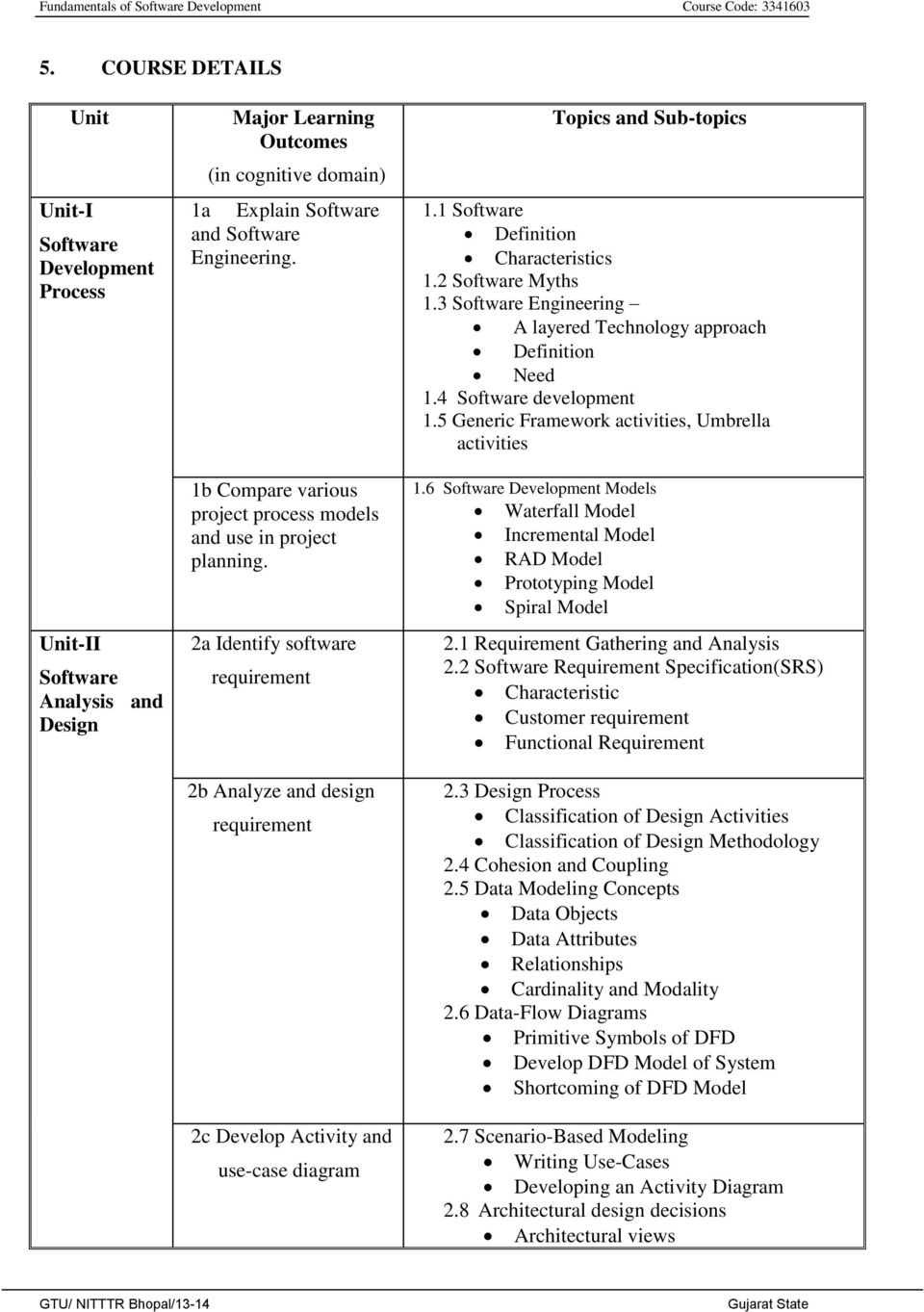
2 5. COURSE DETAILS -I Development Process -II Analysis and Design Major Learning Outcomes (in cognitive domain) 1a Explain and Engineering. 1b Compare various project process models and use in project planning. 2a Identify software requirement 2b Analyze and design requirement 2c Develop Activity and use-case diagram Topics and Sub-topics 1.1 Definition Characteristics 1.2 Myths 1.3 Engineering A layered Technology approach Definition Need 1.4 development 1.5 Generic Framework activities, Umbrella activities 1.6 Development Models Waterfall Model Incremental Model RAD Model Prototyping Model Spiral Model 2.1 Requirement Gathering and Analysis 2.2 Requirement Specification(SRS) Characteristic Customer requirement Functional Requirement 2.3 Design Process Classification of Design Activities Classification of Design Methodology 2.4 Cohesion and Coupling 2.5 Data Modeling Concepts Data Objects Data Attributes Relationships Cardinality and Modality 2.6 Data-Flow Diagrams Primitive Symbols of DFD Develop DFD Model of System Shortcoming of DFD Model 2.7 Scenario-Based Modeling Writing Use-Cases Developing an Activity Diagram 2.8 Architectural design decisions Architectural views
3 Architectural patterns Application architectures -III Project Management -IV Coding testing and 3a Prepare and manage Schedule for different software development activities 4a Prepare software Documentation 4b Prepare test cases and test the software 3.1 Responsibility of software project Manager Job responsibility Required skill to manage software project 3. 2 Metrics for Size Estimation Line of Code Function Points 3. 3 Project Estimation Technique Empirical Estimation Technique Heuristic Technique Analytical Estimation Technique 3. 4 Scheduling Work breakdown structure Activity network and critical path Method Gantt Chart Project Monitoring and control 3. 5 Risk Management Risk Identification Risk Assessment Risk Containment 4.1 Code review Code Work through Code Inspection 4.2 Documentation Internal Documentation External Documentation 4.3 Testing Testing Black-box Testing White-box testing 4.4 Test Documentation 6. SUGGESTED SPECIFICATION TABLE WITH HOURS & MARKS (THEORY) Title Teaching Distribution of Theory Hours R U A I Development Process II Analysis and Design III Project Management IV Coding and testing

4 Title Teaching Distribution of Theory Hours R U A Legends: R = Remembrance; U = Understanding; A = Application and above levels (Revised Bloom s taxonomy) Note: This specification table shall be treated as a general guideline for students and teachers. The actual distribution of marks in the question paper may vary slightly from above table. 7. SUGGESTED LIST OF EXERCISES/PRACTICALS The practical/exercises should be properly designed and implemented with an attempt to develop different types of skills (outcomes in psychomotor and affective domain) so that students are able to acquire the competencies/programme outcomes. Following is the list of practical exercises for guidance. Note: Here only outcomes in psychomotor domain are listed as practical/exercises. However, if these practical/exercises are completed appropriately, they would also lead to development of certain outcomes in affective domain which would in turn lead to development of Course Outcomes related to affective domain. Thus over all development of Programme Outcomes (as given in a common list at the beginning of curriculum document for this programme) would be assured. Faculty should refer to that common list and should ensure that students also acquire outcomes in affective domain which are required for overall achievement of Programme Outcomes/Course Outcomes. S. Practical Exercises Hrs. (Outcomes in Psychomotor Domain) required 1 I Identify the development model for software with proper 02 explanation 2 II Gather requirement for software II Prepare SRS Document for 04 4 II Design Activity Diagram for system 02 5 II Design Use-case Diagram for system 02 6 II Design Data Dictionary of system 04 7 II Prepare E-R Diagram of System 02 8 II Design Data Flow Diagram of system 04 9 III Prepare Gantt chart of system IV Prepare suitable test case for system testing SUGGESTED LIST OF STUDENT ACTIVITIES Following is the list of proposed student activities like: i. Prepare charts for various models, SDLC life cycles, UML notations etc. ii. Prepare SRS documents based on case study. iii. Discuss various case studies available on internet.

5 9. SPECIAL INSTRUCTIONAL STRATEGIES (if any) Application for practical will be assigned to the students by the subject faculty and students will work in a group of SUGGESTED LEARNING RESOURCES A) List of Books S. Title of Book Author Publication 1. Engineering: A Roger S. Pressman Tata McGraw Hill, Practitioner's Approach 2. Engineering Ian Somerville Pearson education PHI 3. Fundamentals of Rajib Mall PHI Engineering 4. Structured System analysis and Madhulika JAin Bph Publication Design Object Oriented Modeling and Michael R Blaha Pearson Prentice Hall 5. design with UML, second and James R edition Rambaugh B) List of Major Equipment/ Instrument with Broad Specifications Sufficient number of PCs are required according to number of students in the class for practicing development and maintenance of different software. C) List of /Learning Websites i. ii. iii. iii Notes- All-8-s iv. Ppts: v. Ppts: COURSE CURRICULUM DEVELOPMENT COMMITTEE Faculty Members from Polytechnics Prof. Sunil K. Paryani, Lecturer IT, Govt. Polytechnic, Ahmadabad Prof. Bhadresh G. Prajapati, Lecturer IT, Govt. Polytechnic, Himatnagar Coordinator and Faculty Members from NITTTR Bhopal Dr. Shailendra Singh, HOD, Department of Computer Engineering and Application Dr.K.J.Mathai, Associate Professor, Department of Computer Engineering and Application

GUJARAT TECHNOLOGICAL UNIVERSITY, AHMEDABAD, GUJARAT. COURSE CURRICULUM COURSE TITLE: COMPUTER ORGANIZATION AND ARCHITECTURE (Code: 3340705)
 GUJARAT TECHNOLOGICAL UNIVERSITY, AHMEDABAD, GUJARAT COURSE CURRICULUM COURSE TITLE: COMPUTER ORGANIZATION AND ARCHITECTURE (Code: 3340705) Diploma Programmes in which this course is offered Computer Engineering
GUJARAT TECHNOLOGICAL UNIVERSITY, AHMEDABAD, GUJARAT. Course Curriculum. DATA STRUCTURES (Code: 3330704)
 GUJARAT TECHNOLOGICAL UNIVERSITY, AHMEDABAD, GUJARAT Course Curriculum DATA STRUCTURES (Code: 3330704) Diploma Programme in which this course is offered Semester in which offered Computer Engineering,
GUJARAT TECHNOLOGICAL UNIVERSITY, AHMEDABAD, GUJARAT. COURSE CURRICULUM COURSE TITLE: DATABASE MANAGEMENT (Code: 3341605 ) Information Technology
 GUJARAT TECHNOLOGICAL UNIVERSITY, AHMEDABAD, GUJARAT COURSE CURRICULUM COURSE TITLE: DATABASE MANAGEMENT (Code: 3341605 ) Diploma Programme in which this course is offered Information Technology Semester
COURSE CODE : 4072 COURSE CATEGORY : A PERIODS / WEEK : 4 PERIODS / SEMESTER : 72 CREDITS : 4
 COURSE TITLE : SOFTWARE ENGINEERING COURSE CODE : 4072 COURSE CATEGORY : A PERIODS / WEEK : 4 PERIODS / SEMESTER : 72 CREDITS : 4 TIME SCHEDULE MODULE TOPICS PERIODS 1 Software engineering discipline evolution
GUJARAT TECHNOLOGICAL UNIVERSITY, AHMEDABAD, GUJARAT COURSE CURRICULUM COURSE TITLE: ESSENTIALS OF NETWORK SECURITY (COURSE CODE: 3351602)
 GUJARAT TECHNOLOGICAL UNIVERSITY, AHMEDABAD, GUJARAT 1. RATIONALE COURSE CURRICULUM COURSE TITLE: ESSENTIALS OF NETWORK SECURITY (COURSE CODE: 3351602) Diploma Program in which this course is offered Information
GUJARAT TECHNOLOGICAL UNIVERSITY, AHMEDABAD, GUJARAT COURSE CURRICULUM COURSE TITLE: ENERGY CONSERVATION & AUDIT (COURSE CODE: 3350902)
 GUJARAT TECHNOLOGICAL UNIVERSITY, AHMEDABAD, GUJARAT COURSE CURRICULUM COURSE TITLE: ENERGY CONSERVATION & AUDIT (COURSE CODE: 335090) Diploma Programme in which this course is offered Electrical Engineering
COURSE CURRICULUM COURSE TITLE: ESTIMATING, COSTING AND ENGINEERING CONTRACTING (COURSE CODE: 3351905)
 GUJARAT TECHNOLOGICAL UNIVERSITY, AHMEDABAD, GUJARAT COURSE CURRICULUM COURSE TITLE: ESTIMATING, COSTING AND ENGINEERING CONTRACTING (COURSE CODE: 3351905) Diploma Programme in which this course is offered
GUJARAT TECHNOLOGICAL UNIVERSITY, AHMEDABAD, GUJARAT COURSE CURRICULUM COURSE TITLE: NETWORK MANAGEMENT AND ADMINISTRATION (COURSECODE: 3360703)
 GUJARAT TECHNOLOGICAL UNIVERSITY, AHMEDABAD, GUJARAT COURSE CURRICULUM COURSE TITLE: NETWORK MANAGEMENT AND ADMINISTRATION (COURSECODE: 3360703) Diploma Programmes in which this course is offered Computer
GUJARAT TECHNOLOGICAL UNIVERSITY, AHMEDABAD, GUJARAT COURSE CURRICULUM COURSE TITLE: ADVANCE WEB TECHNOLOGY (COURSE CODE: 3360706)
 GUJARAT TECHNOLOGICAL UNIVERSITY, AHMEDABAD, GUJARAT COURSE CURRICULUM COURSE TITLE: ADVANCE WEB TECHNOLOGY (COURSE CODE: 3360706) Diploma Programme in which this course is offered Computer Engineering
GUJARAT TECHNOLOGICAL UNIVERSITY, AHMEDABAD, GUJARAT
 GUJARAT TECHNOLOGICAL UNIVERSITY, AHMEDABAD, GUJARAT COURSE CURRICULUM COURSE TITLE: NETWORK MANAGEMENT AND ADMINISTRATION (COURSE CODE: 3360703) Diploma Programmes in which this course is offered Computer
GUJARAT TECHNOLOGICAL UNIVERSITY, AHMEDABAD, GUJARAT. COURSE CURRICULUM COURSE TITLE: INFORMATION COMMUNICATION TECHNOLOGY (Code: 3341601)
 GUJARAT TECHNOLOGICAL UNIVERSITY, AHMEDABAD, GUJARAT COURSE CURRICULUM COURSE TITLE: INFORMATION COMMUNICATION TECHNOLOGY (Code: 3341601) Diploma Program in which this course is offered Information Technology
GUJARAT TECHNOLOGICAL UNIVERSITY, AHMEDABAD, GUJARAT COURSE CURRICULUM COURSE TITLE: CONSTRUCTION PROJECT MANAGEMENT (COURSE CODE: 3360603)
 Construction Project Course code: 3360603 GUJARAT TECHNOLOGICAL UNIVERSITY, AHMEDABAD, GUJARAT COURSE CURRICULUM COURSE TITLE: CONSTRUCTION PROJECT MANAGEMENT (COURSE CODE: 3360603) Diploma Programme in
Course Title: Architectural Drawing I (Code: 3315002)
 GUJARAT TECHNOLOGICAL UNIVERSITY, AHMEDABAD, GUJARAT COURSE CURRICULUM Course Title: Architectural Drawing I (Code: 3315002) Diploma Programmes in which this course is offered Architectural Assistanship
COURSE CURRICULUM COURSE TITLE: WEB PROGRAMMING USING ASP.NET (COURSE CODE: 3351603)
 Web Programming using Course code: 3351603 GUJARAT TECHNOLOGICAL UNIVERSITY, AHMEDABAD, GUJARAT 1. RATIONALE COURSE CURRICULUM COURSE TITLE: WEB PROGRAMMING USING (COURSE CODE: 3351603) Diploma Program
GUJARAT TECHNOLOGICAL UNIVERSITY, AHMEDABAD, GUJARAT Course Curriculum ADVANCE PATTERN MAKING (Code: 3335105)
 GUJARAT TECHNOLOGICAL UNIVERSITY, AHMEDABAD, GUJARAT Course Curriculum ADVANCE PATTERN MAKING (Code: 3335105) Diploma programmes in which this course is offered Semester in which offered Computer Aided
GUJARAT TECHNOLOGICAL UNIVERSITY, AHMEDABAD, GUJARAT. Course Curriculum. ELECTRONIC COMPONENTS AND CIRCUITS (Code: 3330905) Electrical Engineering
 GUJARAT TECHNOLOGICAL UNIVERSITY, AHMEDABAD, GUJARAT Course Curriculum ELECTRONIC COMPONENTS AND CIRCUITS (Code: 3330905) Diploma Programme in which this course is offered Semester in which offered Electrical
IT3205: Fundamentals of Software Engineering (Compulsory)
 INTRODUCTION : Fundamentals of Software Engineering (Compulsory) This course is designed to provide the students with the basic competencies required to identify requirements, document the system design
GUJARAT TECHNOLOGICAL UNIVERSITY, AHMEDABAD, GUJARAT COURSE CURRICULUM. Course Title: Basic Graphic Design (Code: 3325802)
 GUJARAT TECHNOLOGICAL UNIVERSITY, AHMEDABAD, GUJARAT COURSE CURRICULUM Course Title: Basic Graphic Design (Code: 3325802) Diploma Programs in which this course is offered Diploma in Printing Technology
How To Understand Software Engineering
 PESIT Bangalore South Campus Department of MCA SOFTWARE ENGINEERING 1. GENERAL INFORMATION Academic Year: JULY-NOV 2015 Semester(s):III Title Code Duration (hrs) SOFTWARE ENGINEERING 13MCA33 Lectures 52Hrs
IT3203 Fundamentals of Software Engineering (Compulsory) BIT 2 nd YEAR SEMESTER 3
 Fundamentals of Software Engineering (Compulsory) BIT 2 nd YEAR SEMESTER 3 INTRODUCTION This course is designed to provide the students with the basic competencies required to identify requirements, document
GUJARAT TECHNOLOGICAL UNIVERSITY, AHMEDABAD, GUJARAT COURSE CURRICULUM COURSE TITLE: ADVANCE JAVA PROGRAMMING (COURSE CODE: 3360701)
 GUJARAT TECHNOLOGICAL UNIVERSITY, AHMEDABAD, GUJARAT COURSE CURRICULUM COURSE TITLE: ADVANCE JAVA PROGRAMMING (COURSE CODE: 3360701) Diploma Programme in which this course is offered Computer Engineering/
GUJARAT TECHNOLOGICAL UNIVERSITY, AHMEDABAD, GUJARAT COURSE CURRICULUM. Course Title: Advanced Computer Programming (Code: 3320702)
 GUJARAT TECHNOLOGICAL UNIVERSITY, AHMEDABAD, GUJARAT COURSE CURRICULUM Course Title: Advanced Computer Programming (Code: 3320702) Diploma Programmes in which this course is offered Computer Engineering,
IT2404 Systems Analysis and Design (Compulsory)
 Systems Analysis and Design (Compulsory) BIT 1 st YEAR SEMESTER 2 INTRODUCTION This is one of the 4 courses designed for Semester 1 of Bachelor of Information Technology Degree program. CREDITS: 04 LEARNING
Karunya University Dept. of Information Technology
 PART A Questions 1. Mention any two software process models. 2. Define risk management. 3. What is a module? 4. What do you mean by requirement process? 5. Define integration testing. 6. State the main
Masters of Science in Software & Information Systems
 Masters of Science in Software & Information Systems To be developed and delivered in conjunction with Regis University, School for Professional Studies Object Oriented Design Table of Contents January
A Case study based Software Engineering Education using Open Source Tools
 A Case study based Software Engineering Education using Open Source Tools Sowmya B J Dept. of CSE M. S. Ramaiah Institute of Technology [email protected] Srinidhi Hiriyannaiah Dept. of CSE M.S. Ramaiah
CS6403-SOFTWARE ENGINEERING UNIT-I PART-A
 Handled By, VALLIAMMAI ENGINEERING COLLEGE SRM Nagar, Kattankulathur-603203. Department of Information Technology Question Bank- Even Semester 2014-2015 IV Semester CS6403-SOFTWARE ENGINEERING MS.R.Thenmozhi,
SOFTWARE ENGINEERING INTERVIEW QUESTIONS
 SOFTWARE ENGINEERING INTERVIEW QUESTIONS http://www.tutorialspoint.com/software_engineering/software_engineering_interview_questions.htm Copyright tutorialspoint.com Dear readers, these Software Engineering
ISSUES OF STRUCTURED VS. OBJECT-ORIENTED METHODOLOGY OF SYSTEMS ANALYSIS AND DESIGN
 ISSUES OF STRUCTURED VS. OBJECT-ORIENTED METHODOLOGY OF SYSTEMS ANALYSIS AND DESIGN Mohammad A. Rob, University of Houston-Clear Lake, [email protected] ABSTRACT In recent years, there has been a surge of
Chapter 7: Software Engineering
 Chapter 7: Software Engineering Computer Science: An Overview Eleventh Edition by J. Glenn Brookshear Copyright 2012 Pearson Education, Inc. Chapter 7: Software Engineering 7.1 The Software Engineering
CS 487. Week 8. Reference: 1. Software engineering, roger s. pressman. Reading: 1. Ian Sommerville, Chapter 3. Objective:
 CS 487 Week 8 Reading: 1. Ian Sommerville, Chapter 3. Objective: 1. To check the understandibility of the students in life cycle and process model for development of a software product. 2. To check if
GUJARAT TECHNOLOGICAL UNIVERSITY, AHMEDABAD, GUJARAT COURSE CURRICULUM COURSE TITLE:COMPUTER MAINTENANCE AND TROUBLE SHOOTING (COURSE CODE: 3350701)
 GUJARAT TECHNOLOGICAL UNIVERSITY, AHMEDABAD, GUJARAT COURSE CURRICULUM COURSE TITLE:COMPUTER MAINTENANCE AND TROUBLE SHOOTING (COURSE CODE: 3350701) Diploma Programmes in which this course is offered Computer
COURSE TITLE: (OLS 207) INFORMATION SYSTEMS ANALYSIS, DESIGN AND EVALUATION
 COURSE TITLE: (OLS 207) INFORMATION SYSTEMS ANALYSIS, DESIGN AND EVALUATION Course Instructor Nelson Msagati (Assistant Lecturer) Said Ally (Assistant Lecturer) Course Description The course introduces
SAULTCOLLEGE OF APPLIED ARTS AND TECHNOLOGY SAULT STE. MARIE, ONTARIO COURSE OUTLINE
 SAULTCOLLEGE OF APPLIED ARTS AND TECHNOLOGY SAULT STE. MARIE, ONTARIO COURSE OUTLINE COURSE TITLE: Systems Analysis & Design CODE NO. : SEMESTER: 3 PROGRAM: AUTHOR: Computer Programmer Dennis Ochoski DATE:
Component Based Development in Software Engineering
 Component Based Development in Software Engineering Amandeep Bakshi, Rupinder Singh Abstract--In today s world, Component Based development is an active research area for more than a decade in software
COSC 3351 Software Design. Recap for the first quiz. Edgar Gabriel. Spring 2008. For the 1 st Quiz
 COSC 3351 Software Design Recap for the first quiz Spring 2008 For the 1 st Quiz Three large topic areas: UML syntax and diagrams Software architectural styles Object oriented design principles A couple
MSE-201 SOFTWARE PROJECT MANAGEMENT
 MSE-201 SOFTWARE PROJECT MANAGEMENT Unit-I Introduction to Software project Management: Software projects, Contract management and technical project management, Activities covered by software project management,
Lab Manual. Advanced Pr I IT 314
 Lab Manual Advanced Pr I IT 314 Lab Instructions Several practicals / programs? Whether an experiment contains one or several practicals /programs One practical / program Lab Teacher forms groups of the
Analysis / Design. Traditional Development. Process models. Common Methodologies. Common Approach. Analysis: DFD. Traditional Software Development 1
 Analysis / Design Traditional Development requirements gathering WHAT? HOW? requirements analysis coding Ali Doğru METU 66 Process models Usually Waterfall derivatives Data and Function based models Dataflow
GUJARAT TECHNOLOGICAL UNIVERSITY, AHMEDABAD, GUJARAT Course Curriculum PROCESS APPLICATION AND INSTRUMENTATION MAINTENANCE MANAGEMENT
 GUJARAT TECHNOLOGICAL UNIVERSITY, AHMEDABAD, GUJARAT Course Curriculum PROCESS APPLICATION AND INSTRUMENTATION MAINTENANCE MANAGEMENT (Code: 3331705) Diploma Programme in which this course is offered Instrumentation
Assuming the Role of Systems Analyst & Analysis Alternatives
 Assuming the Role of Systems Analyst & Analysis Alternatives Nature of Analysis Systems analysis and design is a systematic approach to identifying problems, opportunities, and objectives; analyzing the
Business Systems Analysis - Course Outline -
 Business Systems Analysis ms110 - Course Outline - Objective Lecturer The objective of this course is to develop in students an understanding of the concepts, skills and techniques required to become an
I. General Knowledge, Conduct, and Ethics (16 Questions)
 Certified Software Quality Engineer (CSQE) Body of Knowledge The topics in this Body of Knowledge include additional detail in the form of subtext explanations and the cognitive level at which the questions
Requirements Analysis (RA): An Analytical Approach for Selecting a Software Process Models ABSTRACT
 Evolving Ideas Computing, Communication and Networking Publish by Global Vision Publishing House Edited by Jeetendra Pande Nihar Ranjan Pande Deep Chandra Joshi Requirements Analysis (RA): An Analytical
The traditional project management uses conventional methods in software project management process.
 Volume 5, Issue 1, January 2015 ISSN: 2277 128X International Journal of Advanced Research in Computer Science and Software Engineering Research Paper Available online at: www.ijarcsse.com Analysis of
D6 INFORMATION SYSTEMS DEVELOPMENT. SOLUTIONS & MARKING SCHEME. June 2013
 D6 INFORMATION SYSTEMS DEVELOPMENT. SOLUTIONS & MARKING SCHEME. June 2013 The purpose of these questions is to establish that the students understand the basic ideas that underpin the course. The answers
Unit Title: Personnel Information Systems Unit Reference Number: F/601/7510 Guided Learning Hours: 160 Level: Level 5 Number of Credits: 18
 Unit Title: Personnel Information Systems Unit Reference Number: F/601/7510 Guided Learning Hours: 160 Level: Level 5 Number of Credits: 18 Unit objective and aim(s): This unit aims to give learners a
(Refer Slide Time: 01:52)
 Software Engineering Prof. N. L. Sarda Computer Science & Engineering Indian Institute of Technology, Bombay Lecture - 2 Introduction to Software Engineering Challenges, Process Models etc (Part 2) This
A Process Model for Software Architecture
 272 A Process Model for Software A. Rama Mohan Reddy Associate Professor Dr. P Govindarajulu Professor Dr. M M Naidu Professor Department of Computer Science and Engineering Sri Venkateswara University
Chapter 8 Approaches to System Development
 Systems Analysis and Design in a Changing World, sixth edition 8-1 Chapter 8 Approaches to System Development Table of Contents Chapter Overview Learning Objectives Notes on Opening Case and EOC Cases
Introduction to Systems Analysis and Design
 Introduction to Systems Analysis and Design What is a System? A system is a set of interrelated components that function together to achieve a common goal. The components of a system are called subsystems.
Introduction to Software Engineering. Week 1
 Introduction to Software Engineering Week 1 Software Engineering Software engineering is "(1) the application of a systematic, disciplined, quantifiable approach to the development, operation, and maintenance
DEVELOPMENT OF PROJECT DOCUMENTATION: KEY INGREDIENT IN TEACHING SYSTEMS ANALYSIS AND DESIGN
 DEVELOPMENT OF PROJECT DOCUMENTATION: KEY INGREDIENT IN TEACHING SYSTEMS ANALYSIS AND DESIGN Mohammad A. Rob, University of Houston Clear Lake, [email protected] ABSTRACT Systems Analysis and Design (SAD) is
A New Generalised Model of Software Development Life Cycle.
 A New Generalised Model of Software Development Life Cycle. Ramkrishna Das, Assistant Professor, Haldia Institute of Technology, Haldia, [email protected] Nilanjan Das, Assistant Professor, Siliguri
Department of Computer Science
 Department of Computer Science Unless indicated to the contrary the Period of Registration, Entry Requirements, Curriculum, Assessment and Qualifications for Programmes are as follows: Period of Registration:
SITE & PROJECT MANAGEMENT
 ANCHOR INSTITUTE FOR INFRASTRUCTURE, CEPT UNIVERSITY OFFERS TRAINING OF TRAINERS On SITE & PROJECT MANAGEMENT 8 TH TO 12 TH AUGUST Promoted by Industries Commissionerate, Goverment of Gujarat Centre for
Software Engineering Question Bank
 Software Engineering Question Bank 1) What is Software Development Life Cycle? (SDLC) System Development Life Cycle (SDLC) is the overall process of developing information systems through a multi-step
Investigate Requirements for Software Solutions
 Unit 29: Investigate Requirements for Software Solutions Learning Outcomes A candidate following a programme of learning leading to this unit will be able to: Gather and analyse appropriate and relevant
CS 1632 SOFTWARE QUALITY ASSURANCE. 2 Marks. Sample Questions and Answers
 CS 1632 SOFTWARE QUALITY ASSURANCE 2 Marks Sample Questions and Answers 1. Define quality. Quality is the degree of goodness of a product or service or perceived by the customer. Quality concept is the
PROJECT GUIDELINES FOR BACHELOR IN COMPUTER APPLICATIONS (GENERAL) PROGRAM
 PROJECT GUIDELINES FOR BACHELOR IN COMPUTER APPLICATIONS (GENERAL) PROGRAM Dr. Babasaheb Ambedkar Open University, R. C. Technical Campus, Opp. Gujarat High Court, Sarkhej-Gandhinagar Highway, Ahmedabad
DECISION SUPPORT SYSTEM IS A TOOL FOR MAKING BETTER DECISIONS IN THE ORGANIZATION
 DECISION SUPPORT SYSTEM IS A TOOL FOR MAKING BETTER DECISIONS IN THE ORGANIZATION Abstract K P TRIPATHI Assistant Professor (MCA Programme) Bharati Vidyapeeth University Institute of Management, Kolhapur
Course Computer Science Academic year 2012/2013 Subject Software Engineering II ECTS 6
 Course Computer Science Academic year 2012/2013 Subject Software Engineering II ECTS 6 Type of course Compulsory Year 3rd Semester 1st semester Student Workload: Professor(s) Maria Clara Silveira Total
SUMMARY OF INFORMATION ON EACH COURSE
 1. Name of Course Software Project Management 2. Course Code TPM7011 3. Status of Course Core [Applies to (cohort) ] 4. MQF Level/Stage Masters MQF Level 7 Note : Certificate MQF Level 3 Diploma MQF Level
RULE BASED EXPERT SYSTEM FOR SELECTING SOFTWARE DEVELOPMENT METHODOLOGY
 RULE BASED EXPERT SYSTEM FOR SELECTING SOFTWARE DEVELOPMENT METHODOLOGY M. AYMAN AL AHMAR Asstt. Prof. and Deputy Dean, College of Engineering and Information Technology, Fujairah Campus, Ajman University
Total Quality Management (TQM) Quality, Success and Failure. Total Quality Management (TQM) vs. Process Reengineering (BPR)
 Total Quality Management (TQM) Quality, Success and Failure Total Quality Management (TQM) is a concept that makes quality control a responsibility to be shared by all people in an organization. M7011
What is a life cycle model?
 What is a life cycle model? Framework under which a software product is going to be developed. Defines the phases that the product under development will go through. Identifies activities involved in each
How To Design An Information System
 Information system for production and mounting of plastic windows MARCEL, MELIŠ Slovak University of Technology - Faculty of Material Sciences and Technology in Trnava, Paulínska 16 street, Trnava, 917
A. Waterfall Model - Requirement Analysis. System & Software Design. Implementation & Unit Testing. Integration & System Testing.
 Processing Models Of SDLC Mrs. Nalkar Sanjivani Baban Asst. Professor, IT/CS Dept, JVM s Mehta College,Sector 19, Airoli, Navi Mumbai-400708 [email protected] Abstract This paper presents an
The So5ware Development Process (SDLC)
 h(p://home.hit.no/~hansha/?page=so5ware_development O. Widder. (2013). geek&poke. Available: h(p://geek- and- poke.com The So5ware Development Process (SDLC) Hans- Pe(er Halvorsen, M.Sc. 1 IT System B.
Axiomatic design of software systems
 Axiomatic design of software systems N.P. Suh (1), S.H. Do Abstract Software is playing an increasingly important role in manufacturing. Many manufacturing firms have problems with software development.
Software Design. Design (I) Software Design Data Design. Relationships between the Analysis Model and the Design Model
 Software Design Design (I) Software Design is a process through which requirements are translated into a representation of software. Peter Lo CS213 Peter Lo 2005 1 CS213 Peter Lo 2005 2 Relationships between
ECS-602: Software Engineering
 ECS-601: Computer Network Unit -I Introduction Concepts: Goals and Applications of Networks, Network structure and architecture, The OSI reference model, services, Network Topology Design - Delay Analysis,
SOFTWARE ENGINEERING IT 0301 Semester V B.Nithya,G.Lakshmi Priya Asst Professor SRM University, Kattankulathur
 SOFTWARE ENGINEERING IT 0301 Semester V B.Nithya,G.Lakshmi Priya Asst Professor SRM University, Kattankulathur School of Computing, Department of IT 1 2 Process What is it? A series of predictable steps
(BA122) Software Engineer s Workshop (SEW)
 Training for the Business Analyst (BA122) Software Engineer s Workshop (SEW) Duration: 4 days CDUs (Continuing Development Units): 28 Description: A practical workshop covering the role of the Business-Systems
Decomposition into Parts. Software Engineering, Lecture 4. Data and Function Cohesion. Allocation of Functions and Data. Component Interfaces
 Software Engineering, Lecture 4 Decomposition into suitable parts Cross cutting concerns Design patterns I will also give an example scenario that you are supposed to analyse and make synthesis from The
How To Understand The Limitations Of An Agile Software Development
 A Cynical View on Agile Software Development from the Perspective of a new Small-Scale Software Industry Apoorva Mishra Computer Science & Engineering C.S.I.T, Durg, India Deepty Dubey Computer Science
Title: Topic 3 Software process models (Topic03 Slide 1).
 Title: Topic 3 Software process models (Topic03 Slide 1). Topic 3: Lecture Notes (instructions for the lecturer) Author of the topic: Klaus Bothe (Berlin) English version: Katerina Zdravkova, Vangel Ajanovski
Artificial Intelligence BEG471CO
 Artificial Intelligence BEG471CO Year IV Semester: I Teaching Schedule Examination Scheme Hours/Week Theory Tutorial Practical Internal Assessment Final Total 3 1 3/2 Theory Practical * Theory** Practical
Educational Software Development Life Cycle Stages. Salah Alkhafaji, B. Sriram. Sur University College, Sur, Sultanate of Oman
 Chinese Business Review, ISSN 1537-1506 January 2012, Vol. 11, No. 1, 128-137 D DAVID PUBLISHING Educational Software Development Life Cycle Stages Salah Alkhafaji, B. Sriram Sur University College, Sur,
In this Lecture you will Learn: Development Process. Unified Software Development Process. Best Practice
 In this Lecture you will Learn: Development Chapter 5C About the Unified Software Development How phases relate to workflows in an iterative life cycle An approach to system development Major activities
Higher National Unit specification. General information. Software Development: Analysis and Design (SCQF level 7) Unit code: HA4C 34.
 Higher National Unit specification General information Unit code: HA4C 34 Superclass: CB Publication date: January 2016 Source: Scottish Qualifications Authority Version: 02 Unit purpose The purpose of
Unit I. Introduction
 Unit I Introduction Product Life Cycles Products also have life cycles The Systems Development Life Cycle (SDLC) is a framework for describing the phases involved in developing and maintaining information
Unit I Page No. 1 System Development Object Basics Development Life Cycle Methodologies Patterns Frameworks Unified Approach UML
 Unit I Page No. 1 System Development Object Basics Development Life Cycle Methodologies Patterns Frameworks Unified Approach UML System Development (SD) : - o SD refers to all activities that go into producing
s от Systems Analysis and Design
 s от Systems Analysis and Design lourih EDITION Joseph S. Valacich Washington State University Joey F. George Florida State University Jeffrey A. Hoffer University of Dayton Pearson Education International
How To Model Software Development Life Cycle Models
 Various Software Development Life Cycle Models Sahil Jindal, Puneet Gulati, Praveen Rohilla Dronacharya College of Engineering, India Abstract:An SDLC model is a conceptual framework describing different
Data Encryption and Network Security
 Data Encryption and Network Security College: Department: Engineering Electrical Engineering Department First: Course Definition 1 Course Code: EE627 2 Units 3 3 Semester 4 Prerequisite 5 Corequisite 6
Chapter 10 Practical Database Design Methodology and Use of UML Diagrams
 Chapter 10 Practical Database Design Methodology and Use of UML Diagrams Copyright 2011 Pearson Education, Inc. Publishing as Pearson Addison-Wesley Chapter 10 Outline The Role of Information Systems in
THE BCS PROFESSIONAL EXAMINATIONS Certificate in IT. October 2006. Examiners Report. Information Systems
 THE BCS PROFESSIONAL EXAMINATIONS Certificate in IT October 2006 Examiners Report Information Systems General Comments The pass rate for Section A was disappointing, being lower than previously. One reason
INTERMEDIATE QUALIFICATION
 PROFESSIONAL QUALIFICATION SCHEME INTERMEDIATE QUALIFICATION SERVICE CAPABILITY PLANNING, PROTECTION AND OPTIMIZATION CERTIFICATE SYLLABUS The Swirl logo is a trade mark of the Cabinet Office ITIL is a
Course contribution to the programme: The course contributes to the programme by helping the students to:
 Course: Operations Management I Code: 10BBA40002 Type: Required Year: 2 Semester: 1 ECTS Credits: 4 Language: Spanish Coordination: Faculty: Pere Batallé Descals Cristina Giménez Thomsen Miguel Angel Heras