
A. Waterfall Model - Requirement Analysis. System & Software Design. Implementation & Unit Testing. Integration & System Testing.
|
|
|
- Scot Willis
- 10 years ago
- Views:
Transcription
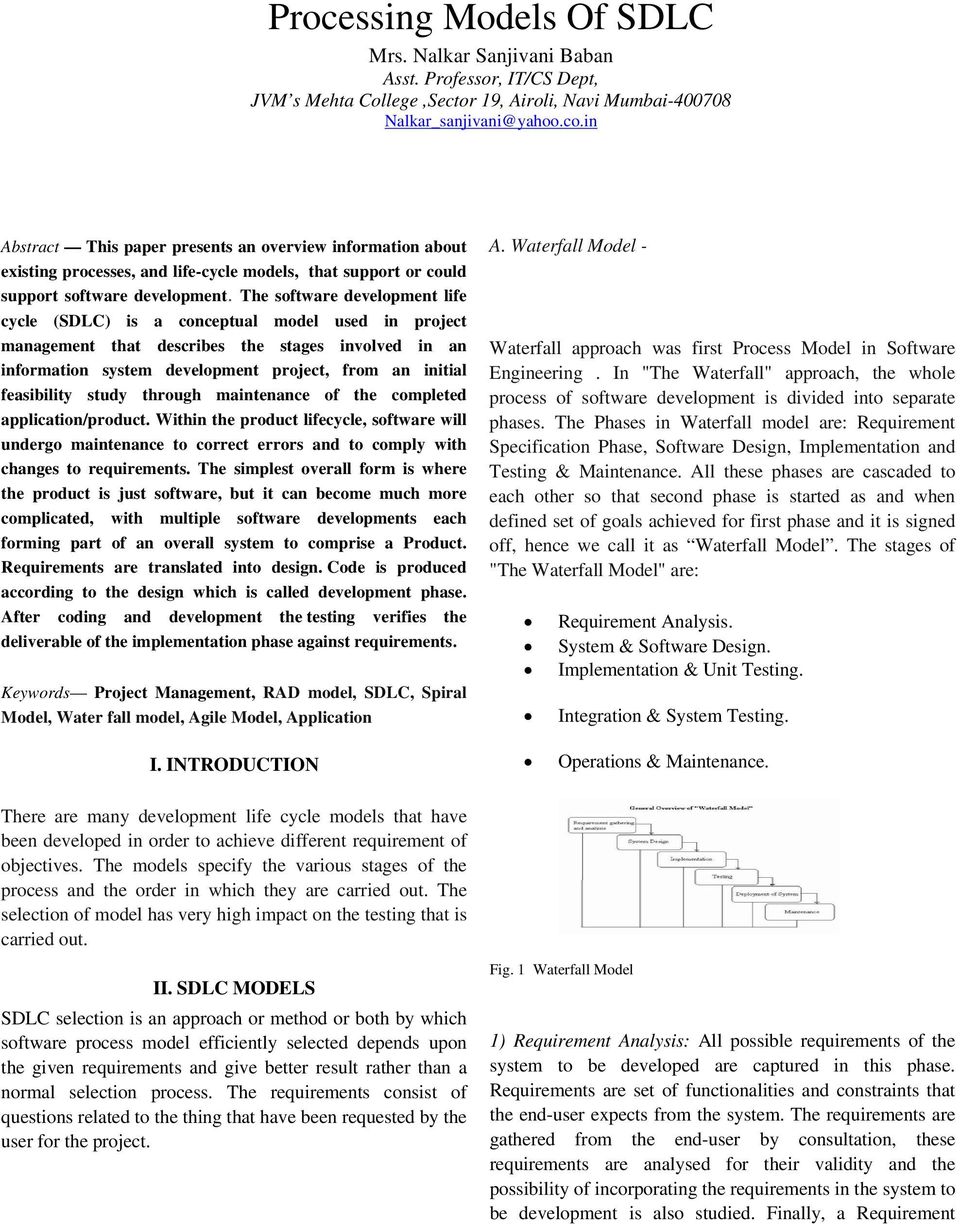
1 Processing Models Of SDLC Mrs. Nalkar Sanjivani Baban Asst. Professor, IT/CS Dept, JVM s Mehta College,Sector 19, Airoli, Navi Mumbai [email protected] Abstract This paper presents an overview information about existing processes, and life-cycle models, that support or could support software development. The software development life cycle (SDLC) is a conceptual model used in project management that describes the stages involved in an information system development project, from an initial feasibility study through maintenance of the completed application/product. Within the product lifecycle, software will undergo maintenance to correct errors and to comply with changes to requirements. The simplest overall form is where the product is just software, but it can become much more complicated, with multiple software developments each forming part of an overall system to comprise a Product. Requirements are translated into design. Code is produced according to the design which is called development phase. After coding and development the testing verifies the deliverable of the implementation phase against requirements. Keywords Project Management, RAD model, SDLC, Spiral Model, Water fall model, Agile Model, Application I. INTRODUCTION A. Waterfall Model - Waterfall approach was first Process Model in Software Engineering. In "The Waterfall" approach, the whole process of software development is divided into separate phases. The Phases in Waterfall model are: Requirement Specification Phase, Software Design, Implementation and Testing & Maintenance. All these phases are cascaded to each other so that second phase is started as and when defined set of goals achieved for first phase and it is signed off, hence we call it as Waterfall Model. The stages of "The Waterfall Model" are: Requirement Analysis. System & Software Design. Implementation & Unit Testing. Integration & System Testing. Operations & Maintenance. There are many development life cycle models that have been developed in order to achieve different requirement of objectives. The models specify the various stages of the process and the order in which they are carried out. The selection of model has very high impact on the testing that is carried out. II. SDLC MODELS SDLC selection is an approach or method or both by which software process model efficiently selected depends upon the given requirements and give better result rather than a normal selection process. The requirements consist of questions related to the thing that have been requested by the user for the project. Fig. 1 Waterfall Model 1) Requirement Analysis: All possible requirements of the system to be developed are captured in this phase. Requirements are set of functionalities and constraints that the end-user expects from the system. The requirements are gathered from the end-user by consultation, these requirements are analysed for their validity and the possibility of incorporating the requirements in the system to be development is also studied. Finally, a Requirement
2 Specification document is created which serves the purpose of guideline for the next phase of the model. 2) System & Software Design: The requirement specifications from first phase are studied in this phase and system design is prepared. System Design helps in specifying hardware and system requirements and also helps in defining overall system architecture. The system design specifications serve as input for the next phase of the model. 3). Implementation & Unit Testing: On receiving system design documents, the work is divided in modules/units and actual coding is started. The system is first developed in small programs called units, which are integrated in the next phase. Each unit is developed and tested for its functionality; this is referred to as Unit Testing. Unit testing mainly verifies if the modules/units meet their specifications. 4). Integration & System Testing: As above, the system is first divided in units which are developed and tested for their functionalities. These units are integrated into a complete system during Integration phase and tested to check if all modules/units coordinate between each other and the system works as per the specifications. After successfully testing the software, it is delivered to the customer. Easy to manage due to the rigidity of the model each phase has specific deliverables and a review process. Phases are processed and completed one at a time. Works well for smaller projects where requirements are very well understood. Disadvantages : Once an application is in the testing stage, it is very difficult to go back and change something that was not well-through out in the concept stage. No working software is produced until late during the life cycle. High amounts of risk and uncertainty. Not a good model for complex and object-oriented projects. Poor model for long and ongoing projects. Not suitable for the projects where requirements are at a moderate to high risk of changing. B. ITERATIVE MODEL- An iterative lifecycle model does not attempt to start with a full specification of requirements. Instead, development begins by specifying and implementing just part of the software, which can then be reviewed in order to identify further requirements. This process is then repeated, producing a new version of the software for each cycle of the model. Consider an iterative lifecycle model which consists of repeating the following four phases in sequence: 1). Requirements phase: In which the requirements for the software are gathered and analysed. 5). Operations & Maintenance: Generally, problems with the system developed (which are not found during the development life cycle) come up after its practical use starts, so the issues related to the system are solved after deployment of the system. Not all the problems come in picture directly but they arise time to time and needs to be solved; hence this process is referred as Maintenance. 2). Design phase: Iteration should eventually result in a requirements phase that produces a complete and final specification of requirements is called design phase, in which a software solution to meet the requirements is designed. This may be a new design, or an extension of an earlier design. 3). Implementation and Test phase: Here the software is coded, integrated and tested. Advantages and Disadvantages Advantages : 4). Review phase: In which the software is evaluated, the current requirements are reviewed, and changes & additions are made to requirements proposed. Simple and easy to understand and use.
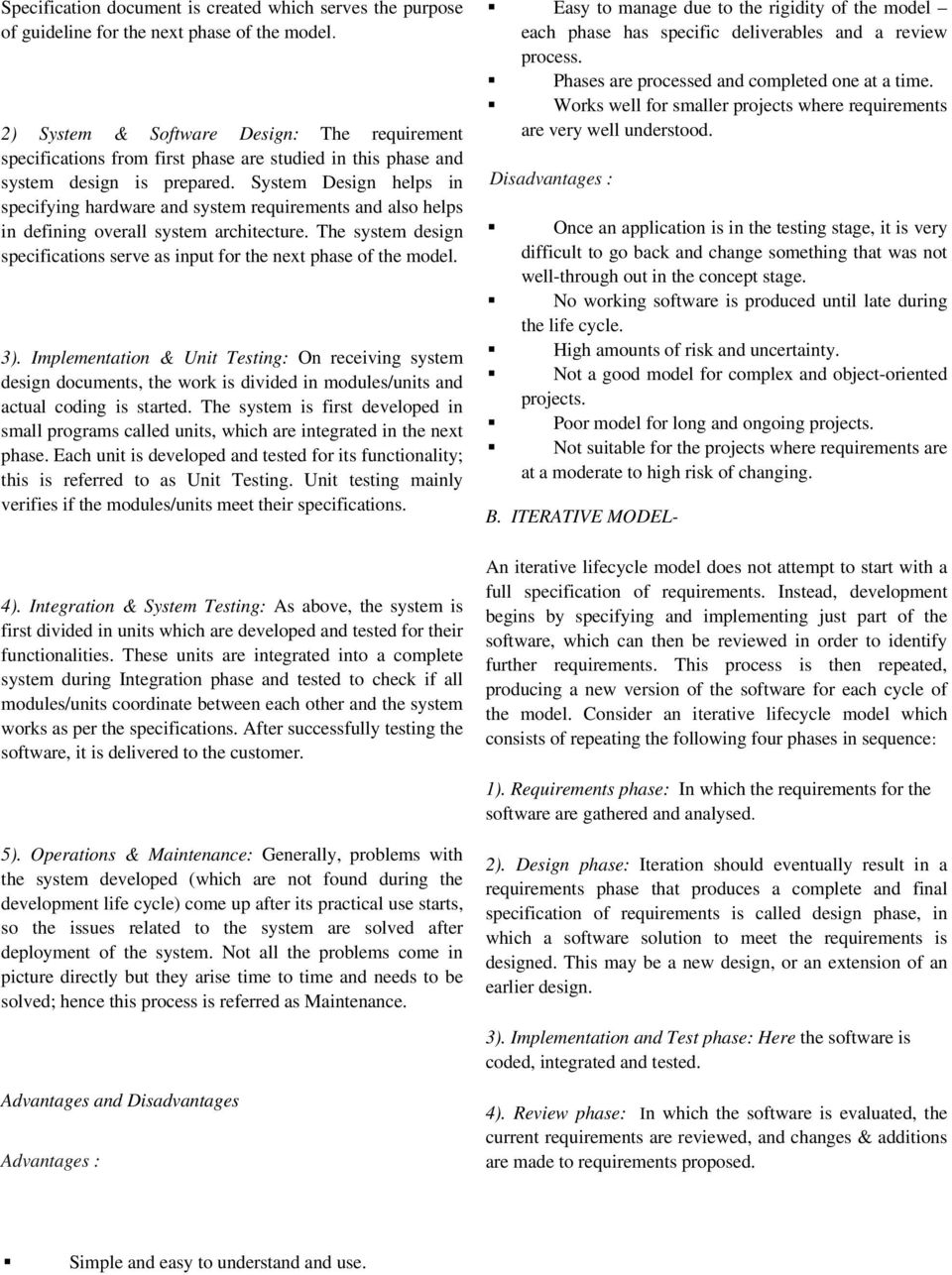
3 Each phase of an iteration is rigid with no overlaps. Costly system architecture or design issues may arise because not all requirements are gathered up front for the entire lifecycle. C. V-MODEL- Fig.2. Iterative Model For each cycle of the model, a decision has to be made as to whether the software produced by the cycle will be discarded, or kept as a starting point for the next cycle. Eventually a point will be reached where the requirements are complete and the software can be delivered, or it becomes impossible to enhance the software as required, and a fresh start has to be made. The V-model is a software development model which can be presumed to be the extension of the waterfall model. Instead of moving down in a linear way, the process steps are bent upwards after the coding phase, to form the typical V shape. The V-Model demonstrates the relationships between each phase of the development life cycle and its associated phase of testing. The key to successful use of an iterative software development lifecycle is rigorous validation of requirements, and verification of each version of the software against those requirements within each cycle of the model. Each cycle of the model produces software that requires testing at the unit level, for software integration, for system integration and for acceptance. As the software evolves through successive cycles, tests have to be repeated and extended to verify each version of the software. Fig.3. V- Model Advantages of Iterative model: In iterative model we can only create a high-level design of the application before we actually begin to build the product and define the design solution for the entire product. Later on we can design and built a skeleton version of that, and then evolved the design based on what had been built. In iterative model we are building and improving the product step by step. Hence we can track the defects at early stages. This avoids the downward flow of the defects. In iterative model we can get the reliable user feedback. When presenting sketches and blueprints of the product to users for their feedback, we are effectively asking them to imagine how the product will work. In iterative model less time is spent on documenting and more time is given for designing. Disadvantages of Iterative model:
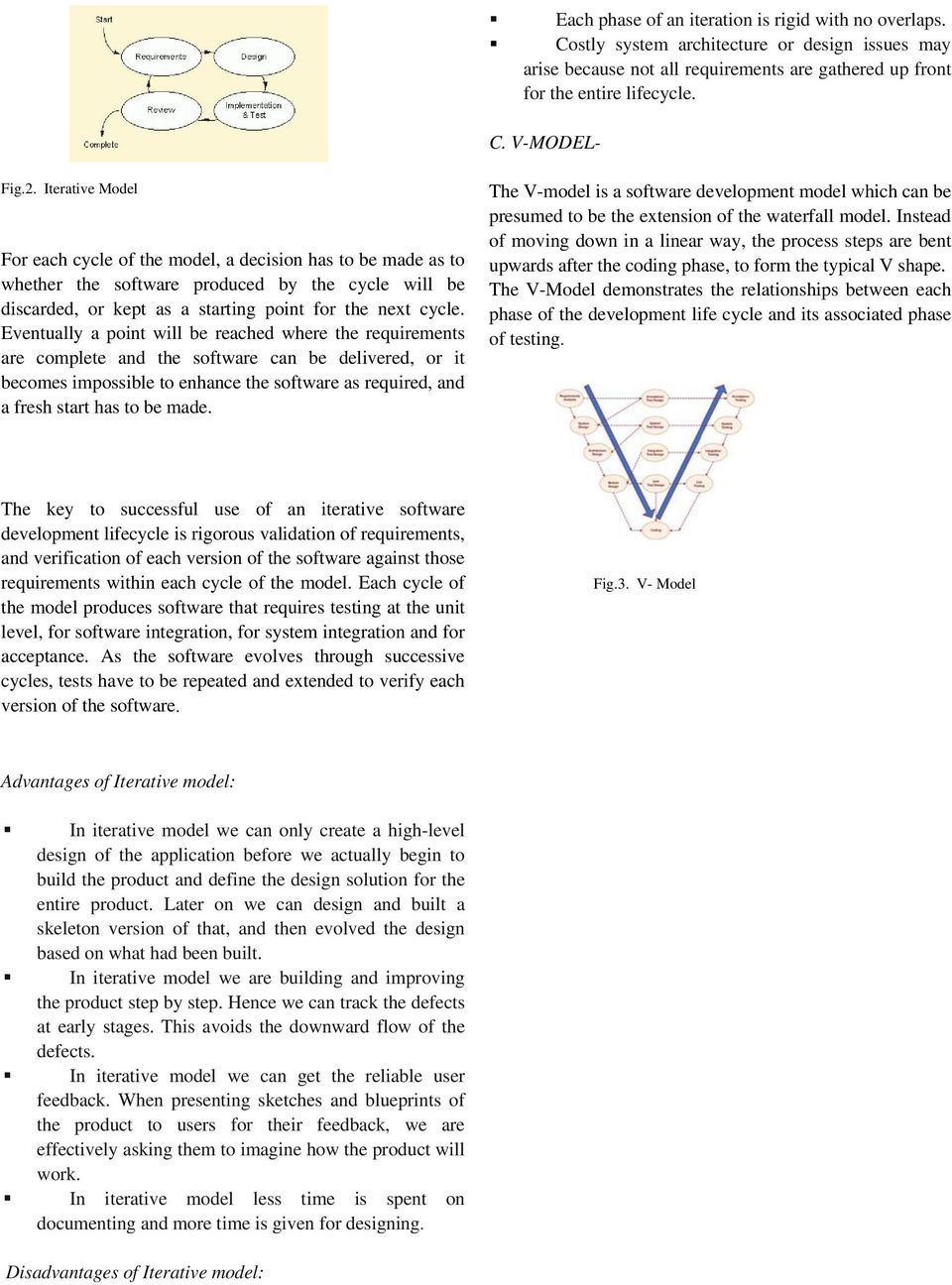
4 Verification Phases- 1).Requirements analysis: In this phase, the requirements of the proposed system are collected by analyzing the needs of the user(s). This phase is concerned about establishing what the ideal system has to perform. However, it does not determine how the software will be designed or built. Often, the users are interviewed and a document called the user requirements document is generated. The user requirements document will typically describe the system s functional, physical, interface, performance, data, security requirements etc as expected by the user. It is one which the business analysts use to communicate their understanding of the system back to the users. The users carefully review this document as this document would serve as the guideline for the system designers in the system design phase. The user acceptance tests are designed in this phase. 4). Module Design: This phase can also be called as low-level design. The designed system is broken up in to smaller units or modules and each of them is explained so that the programmer can start coding directly. The low level design document or program specifications will contain a detailed functional logic of the module, in pseudo code - database tables, with all elements, including their type and size - all interface details with complete API references- all dependency issueserror message listings- complete input and outputs for a module. The unit test design is developed in this stage. D. SPIRAL MODEL- The spiral model is similar to the incremental model, with more emphasis placed on risk analysis. The spiral model has four phases: Planning, Risk Analysis, Engineering and Evaluation. A software project repeatedly passes through these phases in iterations (called Spirals in this model). The baseline spiral, starting in the planning phase, requirements are gathered and risk is assessed. Each subsequent spirals builds on the baseline spiral. 2). System Design: System engineers analyse and understand the business of the proposed system by studying the user requirements document. They figure out possibilities and techniques by which the user requirements can be implemented. If any of the requirements are not feasible, the user is informed of the issue. A resolution is found and the user requirement document is edited accordingly. The software specification document which serves as a blueprint for the development phase is generated. This document contains the general system organization, menu structures, data structures etc. It may also hold example business scenarios, sample windows, reports for the better understanding. Other technical documentation like entity diagrams, data dictionary will also be produced in this phase. The documents for system testing is prepared in this phase. 3).Architecture Design: This phase can also be called as high-level design. The baseline in selecting the architecture is that it should realize all which typically consists of the list of modules, brief functionality of each module, their interface relationships, dependencies, database tables, architecture diagrams, technology details etc. The integration testing design is carried out in this phase. Fig 4. Spiral Model 1). Requirements: In this phase requirements are gathered. 2). Risk analysis Phase: In this phase a process is undertaken to identify risk and alternate solutions. 3). Engineering Phase: In this phase a prototype is produced at the end of the risk analysis phase. Software is produced in the engineering phase, along with testing at the end of the phase. 4). Evaluation phase: It allows the customer to evaluate the output of the project to date before the project continues to the next spiral. Advantages of Spiral model: High amount of risk analysis hence, avoidance of Risk is enhanced. Good for large and mission-critical projects. Strong approval and documentation control.

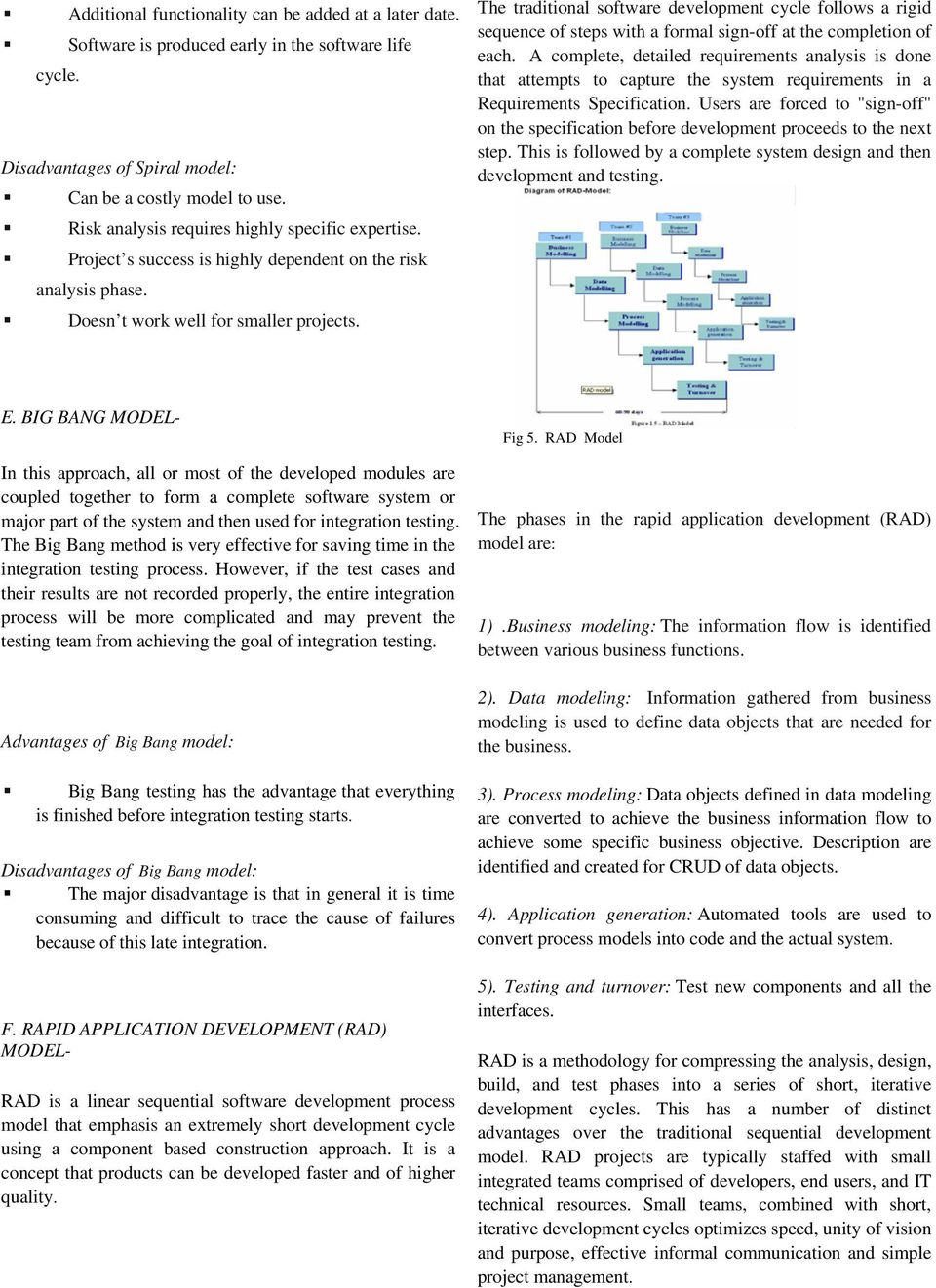
5 Additional functionality can be added at a later date. Software is produced early in the software life cycle. Disadvantages of Spiral model: Can be a costly model to use. Risk analysis requires highly specific expertise. Project s success is highly dependent on the risk analysis phase. Doesn t work well for smaller projects. The traditional software development cycle follows a rigid sequence of steps with a formal sign-off at the completion of each. A complete, detailed requirements analysis is done that attempts to capture the system requirements in a Requirements Specification. Users are forced to "sign-off" on the specification before development proceeds to the next step. This is followed by a complete system design and then development and testing. E. BIG BANG MODEL- In this approach, all or most of the developed modules are coupled together to form a complete software system or major part of the system and then used for integration testing. The Big Bang method is very effective for saving time in the integration testing process. However, if the test cases and their results are not recorded properly, the entire integration process will be more complicated and may prevent the testing team from achieving the goal of integration testing. Advantages of Big Bang model: Big Bang testing has the advantage that everything is finished before integration testing starts. Disadvantages of Big Bang model: The major disadvantage is that in general it is time consuming and difficult to trace the cause of failures because of this late integration. F. RAPID APPLICATION DEVELOPMENT (RAD) MODEL- RAD is a linear sequential software development process model that emphasis an extremely short development cycle using a component based construction approach. It is a concept that products can be developed faster and of higher quality. Fig 5. RAD Model The phases in the rapid application development (RAD) model are: 1).Business modeling: The information flow is identified between various business functions. 2). Data modeling: Information gathered from business modeling is used to define data objects that are needed for the business. 3). Process modeling: Data objects defined in data modeling are converted to achieve the business information flow to achieve some specific business objective. Description are identified and created for CRUD of data objects. 4). Application generation: Automated tools are used to convert process models into code and the actual system. 5). Testing and turnover: Test new components and all the interfaces. RAD is a methodology for compressing the analysis, design, build, and test phases into a series of short, iterative development cycles. This has a number of distinct advantages over the traditional sequential development model. RAD projects are typically staffed with small integrated teams comprised of developers, end users, and IT technical resources. Small teams, combined with short, iterative development cycles optimizes speed, unity of vision and purpose, effective informal communication and simple project management.
6 Advantages of the RAD model: Reduced development time. Increases reusability of components Quick initial reviews occur Encourages customer feedback Integration from very beginning solves a lot of integration issues. Disadvantages of RAD model: Depends on strong team and individual performances for identifying business requirements. Only system that can be modularized can be built using RAD Requires highly skilled developers/designers. High dependency on modeling skills Inapplicable to cheaper projects as cost of modeling and automated code generation is very high. G. AGILE MODEL- Agile development methodology attempts to provide many opportunities to assess the direction of a project throughout the development life cycle. Agile methods break tasks into small increments with minimal planning and do not directly involve long-term planning. Iterations are short time frames that typically last from one to four weeks. Each iteration involves a cross functional team working in all functions: planning, requirements analysis, design, coding, unit testing, and acceptance testing. At the end of the iteration a working product is demonstrated to stakeholders. This minimizes overall risk and allows the project to adapt to changes quickly. An iteration might not add enough functionality to warrant a market release, but the goal is to have an available release at the end of each iteration. Multiple iterations might be required to release a product or new features. People and interactions are emphasized rather than process and tools. Customers, developers and testers constantly interact with each other. Working software is delivered frequently (weeks rather than months). Face-to-face conversation is the best form of communication. Close, daily cooperation between business people and developers. Continuous attention to technical excellence and good design. Regular adaptation to changing circumstances. Even late changes in requirements are welcomed Disadvantages of Agile model: In case of some software deliverables, especially the large ones, it is difficult to assess the effort required at the beginning of the software development life cycle. There is lack of emphasis on necessary designing and documentation. The project can easily get taken off track if the customer representative is not clear what final outcome that they want. Only senior programmers are capable of taking the kind of decisions required during the development process. Hence it has no place for newbie programmers, unless combined with experienced resources. H. PROTOTYPE MODEL- The basic idea here is that instead of freezing the requirements before a design or coding can proceed, a throw away prototype is built to understand the requirements. This prototype is developed based on the currently known requirements. By using this prototype, the client can get an actual feel of the system, since the interactions with prototype can enable the client to better understand the requirements of the desired system. Prototyping is an attractive idea for complicated and large systems for which there is no manual process or existing system to help determining the requirements. The prototype are usually not complete systems and many of the details are not built in the prototype. The goal is to provide a system with overall functionality. Fig 6. Agile Model Advantages of Agile model: Customer satisfaction by rapid, continuous delivery of useful software.

7 Fig 7. Prototype Model Advantages of Prototype model: Users are actively involved in the development Since in this methodology a working model of the system is provided, the users get a better understanding of the system being developed. Errors can be detected much earlier. Quicker user feedback is available leading to better solutions. Missing functionality can be identified easily Confusing or difficult functions can be identified Requirements validation, Quick implementation of, incomplete, but functional, application. Disadvantages of Prototype model: Leads to implementing and then repairing way of building systems. Practically, this methodology may increase the complexity of the system as scope of the system may expand beyond original plans. Incomplete application may cause application not to be used as the full system was designed Incomplete or inadequate problem analysis. XI CONCLUSIONS This was about the various SDLC models available and the scenarios in which these SDLC models are used. The information in this paper will help the project managers decide what SDLC model would be suitable for their project and it would also help the developers and testers understand basics of the development model being used for their project. This paper gives you an insight into the advantages and disadvantages of the SDLC models discussed. Waterfall and V model are traditional SDLC models and are of sequential type. Sequential means that the next phase can start only after the completion of first phase. Such models are suitable for projects with very clear product requirements and where the requirements will not change dynamically during the course of project completion. Iterative and Spiral models are more accommodative in terms of change and are suitable for projects where the requirements are not so well defined, or the market requirements change quite frequently. Big Bang model is a random approach to Software development and is suitable for small or academic projects. Agile is the most popular model used in the industry. Agile introduces the concept of fast delivery to customers using prototype approach. Agile divides the project into small iterations with specific deliverable features. Customer interaction is the backbone of Agile methodology, and open communication with minimum documentation are the typical features of Agile development environment. RAD (Rapid Application Development) and Prototype are modern techniques to understand the requirements in a better way early in the project cycle. These techniques work on the concept of providing a working model to the customer and stockholders to give the look and feel and collect the feedback. This feedback is used in an organized manner to improve the product. ACKNOWLEDGMENT I like to thank all authors who helped me to write this paper. REFERENCES [1]. Mr Joshua Boyde, A Down-To-Earth Guide To SDLC Project Management: Getting your system / software development life cycle project successfully across the line using PMBOK in an agile way [2]. Gerald D. Everett and Raymond McLeod, Software Testing: Testing Across the Entire Software Development Life Cycle [3].Dorthy Gra, Ham,Erik Van Veenendaal, Isabel Evans, Rex Black Foundations Of Software Testing (ISTQB Certification) [4].Roger S. Pressman, Software Engineering A Practitioner s Approach, McGraw-Hill. [6].Software Testing by Yogesh Singh, Cambridge University Press [4].Software Testing Principles, Techniques and Tools, M.G. Limaye, TMH, [7].Software Testing A Craftman s Approach, Second Edition, Paul C. Jorgensen, CRC Press
A Survey of Software Development Process Models in Software Engineering
 , pp. 55-70 http://dx.doi.org/10.14257/ijseia.2015.9.11.05 A Survey of Software Development Process Models in Software Engineering Iqbal H. Sarker 1, Faisal Faruque 1, Ujjal Hossen 2 and Atikur Rahman
How To Model Software Development Life Cycle Models
 Various Software Development Life Cycle Models Sahil Jindal, Puneet Gulati, Praveen Rohilla Dronacharya College of Engineering, India Abstract:An SDLC model is a conceptual framework describing different
Software Development Life Cycle
 4 Software Development Life Cycle M MAJOR A J O R T TOPICSO P I C S Objectives... 52 Pre-Test Questions... 52 Introduction... 53 Software Development Life Cycle Model... 53 Waterfall Life Cycle Model...
Review of Software Development Methodologies Used in Software Design
 ISSN 2278-3091 Volume 3, No.5, September - October 2014 Er. Sheilly Padda et al., International Journal of Advanced Trends in Computer Science and Engineering, 3(5), September-October 2014, 88-93 International
Software Project Models
 INTERNATIONAL JOURNAL OF TECHNOLOGY ENHANCEMENTS AND EMERGING ENGINEERING RESEARCH, VOL 1, ISSUE 4 135 Software Project Models Abhimanyu Chopra, Abhinav Prashar, Chandresh Saini [email protected],
TRADITIONAL VS MODERN SOFTWARE ENGINEERING MODELS: A REVIEW
 Year 2014, Vol. 1, issue 1, pp. 49-56 Available online at: http://journal.iecuniversity.com TRADITIONAL VS MODERN SOFTWARE ENGINEERING MODELS: A REVIEW Singh RANDEEP a*, Rathee AMIT b a* Department of
Elite: A New Component-Based Software Development Model
 Elite: A New Component-Based Software Development Model Lata Nautiyal Umesh Kumar Tiwari Sushil Chandra Dimri Shivani Bahuguna Assistant Professor- Assistant Professor- Professor- Assistant Professor-
Evolving a Ultra-Flow Software Development Life Cycle Model
 RESEARCH ARTICLE International Journal of Computer Techniques - Volume 2 Issue 4, July - Aug Year Evolving a Ultra-Flow Software Development Life Cycle Model Divya G.R.*, Kavitha S.** *(Computer Science,
Evolving a New Software Development Life Cycle Model SDLC-2013 with Client Satisfaction
 International Journal of Soft Computing and Engineering (IJSCE) ISSN: 2231-2307, Volume-3, Issue-1, March 2013 Evolving a New Software Development Life Cycle Model SDLC-2013 with Client Satisfaction Naresh
Software Engineering. What is a system?
 What is a system? Software Engineering Software Processes A purposeful collection of inter-related components working together to achieve some common objective. A system may include software, mechanical,
Process Methodology. Wegmans Deli Kiosk. for. Version 1.0. Prepared by DELI-cious Developers. Rochester Institute of Technology
 Process Methodology for Wegmans Deli Kiosk Version 1.0 Prepared by DELI-cious Developers Rochester Institute of Technology September 15, 2013 1 Table of Contents 1. Process... 3 1.1 Choice... 3 1.2 Description...
Software Development Life Cycle & Process Models
 Volume 1, Issue 1 ISSN: 2320-5288 International Journal of Engineering Technology & Management Research Journal homepage: www.ijetmr.org Software Development Life Cycle & Process Models Paritosh Deore
SDLC Models. Waterfall Model
 SDLC Models There are various software development approaches defined and designed which are used/employed during development process of software, these approaches are also referred as "Software Development
ABHINAV NATIONAL MONTHLY REFEREED JOURNAL OF RESEARCH IN SCIENCE & TECHNOLOGY www.abhinavjournal.com
 SOFTWARE DEVELOPMENT LIFE CYCLE (SDLC) ANALYTICAL COMPARISON AND SURVEY ON TRADITIONAL AND AGILE METHODOLOGY Sujit Kumar Dora 1 and Pushkar Dubey 2 1 Programmer, Computer Science & Engineering, Padmashree
INTERNATIONAL JOURNAL OF ADVANCES IN COMPUTING AND INFORMATION TECHNOLOGY An International online open access peer reviewed journal
 INTERNATIONAL JOURNAL OF ADVANCES IN COMPUTING AND INFORMATION TECHNOLOGY An International online open access peer reviewed journal Research Article ISSN 2277 9140 ABSTRACT Analysis and tabular comparison
Advancements in the V-Model
 Advancements in the V-Model Sonali Mathur Asst. Professor, CSE Dept. ABES Institute of Technology Ghaziabad, U.P-201009 Shaily Malik Lecturer, CSE Dept. Maharaja Surajmal Institute of Tech. Janakpuri,
SEEM4570 System Design and Implementation Lecture 10 Software Development Process
 SEEM4570 System Design and Implementation Lecture 10 Software Development Process Software Development A software development process: A structure imposed on the development of a software product Also
(Refer Slide Time: 01:52)
 Software Engineering Prof. N. L. Sarda Computer Science & Engineering Indian Institute of Technology, Bombay Lecture - 2 Introduction to Software Engineering Challenges, Process Models etc (Part 2) This
Software Development Life Cycle (SDLC)
 Software Development Life Cycle (SDLC) Supriyo Bhattacharjee MOF Capability Maturity Model (CMM) A bench-mark for measuring the maturity of an organization s software process CMM defines 5 levels of process
SOFTWARE DEVELOPMENT SD
 CONTENTS 1.SOFTWARE-DEFINITION 2.TYPES OF SOFTWARE 3.SOFTWARE DEVELOPMENT 4.SOFTWARE LIFECYCLE 5.WATERFALL MODEL 6.ITERATION MODEL 7.V SHAPED MODEL 8.SPIRAL MODEL SOFTWARE DEVELOPMENT SD MODULE 1 1.SOFTWARE:
A Comparative Study of Different Software Development Life Cycle Models in Different Scenarios
 ISSN: 2321-7782 (Online) Volume 1, Issue 5, October 2013 International Journal of Advance Research in Computer Science and Management Studies Research Paper Available online at: www.ijarcsms.com A Comparative
A COMPARISON BETWEEN DIFFERENT TYPES OF SOFTWARE DEVELOPMENT LIFE CYCLE MODELS IN SOFTWARE ENGINEERING
 A COMPARISON BETWEEN DIFFERENT TYPES OF SOFTWARE DEVELOPMENT LIFE CYCLE MODELS IN SOFTWARE ENGINEERING Mr. Ashish Kumar Gupta Assistant Professor, Dept. of C.S.E., I.T.S. Engineering College, Greater Noida,
Advanced Software Engineering. Software Development Processes
 Agent and Object Technology Lab Dipartimento di Ingegneria dell Informazione Università degli Studi di Parma Advanced Software Engineering Software Development Processes Prof. Agostino Poggi Software Development
Chapter 1: Introduction to Rapid Application Development (RAD) 1. Introductions
 Chapter 1: Introduction to Rapid Application Development (RAD) 1. Introductions RAD refers to a development life cycle designed to give much faster development and higher quality systems than the traditional
COMPARISON OF VARIOUS SDLC MODELS
 COMPARISON OF VARIOUS SDLC MODELS SADAF ATEEQ M.TECH in dept of CSE from INTEGRAL UNIVERSITY MR. MOHAMMAD SHUAIB Department of CSE from INTEGRAL UNIVERSITY ABSTRACT There are various SDLC (Software Development
Agile Projects 7. Agile Project Management 21
 Contents Contents 1 2 3 Agile Projects 7 Introduction 8 About the Book 9 The Problems 10 The Agile Manifesto 12 Agile Approach 14 The Benefits 16 Project Components 18 Summary 20 Agile Project Management
Test Cases Design for Software Database Provisioning Development
 Test Cases Design for Software Database Provisioning Development Sunguk Lee Research Institute of Industrial Science and Technology Pohang, Gyeongbuk, South Korea [email protected] Abstract This paper
The traditional project management uses conventional methods in software project management process.
 Volume 5, Issue 1, January 2015 ISSN: 2277 128X International Journal of Advanced Research in Computer Science and Software Engineering Research Paper Available online at: www.ijarcsse.com Analysis of
LECTURE 1. SYSTEMS DEVELOPMENT
 LECTURE 1. SYSTEMS DEVELOPMENT 1.1 INFORMATION SYSTEMS System A system is an interrelated set of business procedures used within one business unit working together for a purpose A system has nine characteristics
Software Development Life Cycle Models- Comparison, Consequences
 Software Development Life Cycle Models- Comparison, Consequences Abstract- Software Development Life Cycle is a well defined and systematic approach, practiced for the development of a reliable high quality
CHAPTER_3 SOFTWARE ENGINEERING (PROCESS MODELS)
 CHAPTER_3 SOFTWARE ENGINEERING (PROCESS MODELS) Prescriptive Process Model Defines a distinct set of activities, actions, tasks, milestones, and work products that are required to engineer high quality
Computer Science Department CS 470 Fall I
 Computer Science Department CS 470 Fall I RAD: Rapid Application Development By Sheldon Liang CS 470 Handouts Rapid Application Development Pg 1 / 5 0. INTRODUCTION RAD: Rapid Application Development By
Keywords Software Engineering, Software cost, Universal models. Agile model, feature of software projects.
 Volume 4, Issue 6, June 2014 ISSN: 2277 128X International Journal of Advanced Research in Computer Science and Software Engineering Research Paper Available online at: www.ijarcsse.com Comparative Analysis
Introduction to Systems Analysis and Design
 Introduction to Systems Analysis and Design What is a System? A system is a set of interrelated components that function together to achieve a common goal. The components of a system are called subsystems.
A Comparison between Five Models of Software Engineering
 International Journal of Research in Information Technology (IJRIT) www.ijrit.com ISSN 2001-5569 A Comparison between Five Models of Software Engineering Surbhi Gupta, Vikrant Dewan CSE, Dronacharya College
CS4507 Advanced Software Engineering
 CS4507 Advanced Software Engineering Lectures 2 & 3: Software Development Lifecycle Models A O Riordan, 2015 Some diagrams from Sommerville, some notes from Maciaszek/Liong Lifecycle Model Software development
Software development life cycle. Software Engineering - II ITNP92 - Object Oriented Software Design. Requirements. Requirements. Dr Andrea Bracciali
 Software development life cycle Software life cycle: Software Engineering - II ITNP92 - Object Oriented Software Design Dr Andrea Bracciali Module Co-ordinator 4B86 [email protected] Spring 2014 (elicitation)
10/4/2013. Sharif University of Technology. Session # 3. Contents. Systems Analysis and Design
 Session # 3 Contents Systems Analysis and Design 2 1 Tiers of Software Development 10/4/2013 Information system development project Realistic behavior 3 Information system development project System Development
Chapter 8 Approaches to System Development
 Systems Analysis and Design in a Changing World, sixth edition 8-1 Chapter 8 Approaches to System Development Table of Contents Chapter Overview Learning Objectives Notes on Opening Case and EOC Cases
Agile Processes and Methodologies: A Conceptual Study
 Agile Processes and Methodologies: A Conceptual Study Sheetal Sharma Amity School of Engineering & Technology Amity University Noida [email protected] Darothi Sarkar Amity School of Engineering &
System Development Life Cycle Guide
 TEXAS DEPARTMENT OF INFORMATION RESOURCES System Development Life Cycle Guide Version 1.1 30 MAY 2008 Version History This and other Framework Extension tools are available on Framework Web site. Release
Waterfall vs. Agile Methodology
 2012 Waterfall vs. Agile Methodology Mike McCormick MPCS, Inc. Revised Edition 8/9/2012 Contents Waterfall vs. Agile Model Comparison...3 Conceptual Difference...3 Efficiency...4 Suitability...4 Waterfall
A Review of an MVC Framework based Software Development
 , pp. 213-220 http://dx.doi.org/10.14257/ijseia.2014.8.10.19 A Review of an MVC Framework based Software Development Ronnie D. Caytiles and Sunguk Lee * Department of Multimedia Engineering, Hannam University
Software Development Process
 Software Development Process A software development process, also known as software development lifecycle, is a structure imposed on the development of a software product. Similar terms include software
Managing TM1 Projects
 White Paper Managing TM1 Projects What You ll Learn in This White Paper: Traditional approaches to project management A more agile approach Prototyping Achieving the ideal outcome Assessing project teams
What is a life cycle model?
 What is a life cycle model? Framework under which a software product is going to be developed. Defines the phases that the product under development will go through. Identifies activities involved in each
SURVEY ON SOFTWARE DEVELOPMENTPROCESSING MODELS
 SURVEY ON SOFTWARE DEVELOPMENTPROCESSING MODELS Nancy Bindal 1, Aanchal Mehta 2 1 Assistant Professor, Department of CSE, Maharishi Markandeshwar University, Mullana, Ambala, Haryana, India 2 M.Tech Research
Foundations for Systems Development
 Foundations for Systems Development ASSIGNMENT 1 Read this assignment introduction. Then, read Chapter 1, The Systems Development Environment, on pages 2 25 in your textbook. What Is Systems Analysis and
How To Design An Information System
 Information system for production and mounting of plastic windows MARCEL, MELIŠ Slovak University of Technology - Faculty of Material Sciences and Technology in Trnava, Paulínska 16 street, Trnava, 917
Information Systems Development Process (Software Development Life Cycle)
 Information Systems Development Process (Software Development Life Cycle) Phase 1 Feasibility Study Concerned with analyzing the benefits and solutions for the identified problem area Includes development
International Journal of Advanced Research in Computer Science and Software Engineering
 ISSN: 2277 128X International Journal of Advanced Research in Computer Science and Software Engineering Research Paper Available online at: A Comparative Analysis of Different types of Models in Software
Custom Software Development Approach
 Custom Software Development Approach Our approach to custom software development combines benefits from several standard development process models. We tend to have a well-defined, predictable and highly
When is Agile the Best Project Management Method? Lana Tylka
 When is Agile the Best Project Management Method? Lana Tylka Staged Incremental Deliveries Prototypes Plan Develop Design Deploy Test Maintain Sequential Steps Multiple Iterations Waterfall Sprints, Spirals
Peter Mileff PhD SOFTWARE ENGINEERING. The Basics of Software Engineering. University of Miskolc Department of Information Technology
 Peter Mileff PhD SOFTWARE ENGINEERING The Basics of Software Engineering University of Miskolc Department of Information Technology Introduction Péter Mileff - Department of Information Engineering Room
SOFTWARE ENGINEERING MODELS CONSEQUENCES AND ALTERNATIVES
 SOFTWARE ENGINEERING MODELS CONSEQUENCES AND ALTERNATIVES Nitin Mishra 1, Shantanu Chowdhary 2, Arunendra Singh 3, Anil Sharma 4 1 Associate professor, School of Engineering, Sangam University, Bhilwara
AGILE METHODOLOGY IN SOFTWARE DEVELOPMENT
 AGILE METHODOLOGY IN SOFTWARE DEVELOPMENT Shivangi Shandilya, Surekha Sangwan, Ritu Yadav Dept. of Computer Science Engineering Dronacharya College Of Engineering, Gurgaon Abstract- Looking at the software
How To Understand The Limitations Of An Agile Software Development
 A Cynical View on Agile Software Development from the Perspective of a new Small-Scale Software Industry Apoorva Mishra Computer Science & Engineering C.S.I.T, Durg, India Deepty Dubey Computer Science
Traditional SDLC Vs Scrum Methodology A Comparative Study
 Traditional SDLC Vs Scrum Methodology A Comparative Study M. Mahalakshmi 1, DR. M. Sundararajan 2 1 Research Scholar, St. Peter s University, Avadi, India 2 Asst. Professor, Department of Computer Science,
The most suitable system methodology for the proposed system is drawn out.
 3.0 Methodology 3.1 Introduction In this chapter, five software development life cycle models are compared and discussed briefly. The most suitable system methodology for the proposed system is drawn out.
Enterprise Content Management (ECM)
 Business Assessment: A Quick-Reference Summary Intro to MIKE2 methodology and phase 1 The methodology that will be used throughout the specialist track is based on the MIKE2 methodology. MIKE stands for
Agile Methodologies and Its Processes
 International Journal of Computational Engineering Research Vol, 03 Issue, 9 Agile Methodologies and Its Processes 1, Akanksha, 2, Akansha Rakheja, 3, Latika Kapur, 4, Kanika Ahuja 1,2,3,, Information
ASSESSMENT OF SOFTWARE PROCESS MODELS
 ASSESSMENT OF SOFTWARE PROCESS MODELS Akhilesh Research Scholar, Department of Computer Science, Manav Bharti University, Solan (H.P.) ABSTRACT The field of software engineering is related to the development
Software Process Models. Xin Feng
 Software Process Models Xin Feng Questions to Answer in Software Engineering? Questions to answer in software engineering What is the problem to be solved? Definition What are the characteristics of the
The Spiral development model is a risk-driven process model generator. It
 1.1 Methodology Research 1.1.1 Spiral Model The Spiral development model is a risk-driven process model generator. It is used to guide multi-stakeholder concurrent engineering of software-intensive systems.
Benefits of Test Automation for Agile Testing
 Benefits of Test Automation for Agile Testing Manu GV 1, Namratha M 2, Pradeep 3 1 Technical Lead-Testing Calsoft Labs, Bangalore, India 2 Assistant Professor, BMSCE, Bangalore, India 3 Software Engineer,
A Capability Maturity Model (CMM)
 Software Development Life Cycle (SDLC) and Development Methods There are some enterprises in which a careful disorderliness is the true method. Herman Melville Capability Maturity Model (CMM) A Capability
And the Models Are 16-03-2015. System/Software Development Life Cycle. Why Life Cycle Approach for Software?
 System/Software Development Life Cycle Anurag Srivastava Associate Professor ABV-IIITM, Gwalior Why Life Cycle Approach for Software? Life cycle is a sequence of events or patterns that are displayed in
International Journal of Advance Research in Computer Science and Management Studies
 Volume 2, Issue 12, December 2014 ISSN: 2321 7782 (Online) International Journal of Advance Research in Computer Science and Management Studies Research Article / Survey Paper / Case Study Available online
In the IEEE Standard Glossary of Software Engineering Terminology the Software Life Cycle is:
 In the IEEE Standard Glossary of Software Engineering Terminology the Software Life Cycle is: The period of time that starts when a software product is conceived and ends when the product is no longer
Fundamentals of Information Systems, Fifth Edition. Chapter 8 Systems Development
 Fundamentals of Information Systems, Fifth Edition Chapter 8 Systems Development Principles and Learning Objectives Effective systems development requires a team effort of stakeholders, users, managers,
Information Technology Policy
 Information Technology Policy Systems Development Life Cycle Policy ITP Number ITP-APP012 Category Recommended Policy Contact [email protected] Effective Date May 1, 2013 Supersedes Scheduled Review
IT2404 Systems Analysis and Design (Compulsory)
 Systems Analysis and Design (Compulsory) BIT 1 st YEAR SEMESTER 2 INTRODUCTION This is one of the 4 courses designed for Semester 1 of Bachelor of Information Technology Degree program. CREDITS: 04 LEARNING
DATABASE DEVELOPMENT LIFE CYCLE
 DATABASE DEVELOPMENT LIFE CYCLE Pranshu Gupta 1 Ramon A. Mata-Toledo 2 Morgan D. Monger 3 Abstract A software development life cycle model (SDLC) consists of a set of processes (planning, requirements,
Software Engineering Question Bank
 Software Engineering Question Bank 1) What is Software Development Life Cycle? (SDLC) System Development Life Cycle (SDLC) is the overall process of developing information systems through a multi-step
Classical Software Life Cycle Models
 Classical Software Life Cycle Models SWEN 301 Trimester 1, 2015 Lecturer: Dr Hui Ma Engineering and Computer Science Lecture slides make use of material provided on the textbook's companion website Motivation
Introduction to the Traditional SDLC
 AU4426_C016.fm Page 209 Tuesday, January 23, 2007 3:58 PM Chapter 16 Introduction to the Traditional SDLC As is expected of any profession that is still relatively young, IT has evolved and is still continuing
EMC PERSPECTIVE. Adopting an Agile Approach to OSS/BSS Development
 EMC PERSPECTIVE Adopting an Agile Approach to OSS/BSS Development Reader ROI The agile software methodology is different from the traditional approach in that requirements gathering and analysis, design,
Alternative Development Methodologies
 Alternative Development Methodologies The Software Development Process described in the course notes and lecture is a generalized process that been in use for decades. Over this time, scholars in the IT
COMP 354 Introduction to Software Engineering
 COMP 354 Introduction to Software Engineering Greg Butler Office: EV 3.219 Computer Science and Software Engineering Concordia University, Montreal, Canada Email: [email protected] Winter 2015 Course
Business Analysis Essentials
 Understand the business analyst's role and responsibilities in a successful project. In this introductory course, you'll delve into the role and responsibilities of the business analyst (BA)- the communication
Practice Overview. REQUIREMENTS DEFINITION Issue Date: <mm/dd/yyyy> Revision Date: <mm/dd/yyyy>
 DEPARTMENT OF HEALTH AND HUMAN SERVICES ENTERPRISE PERFORMANCE LIFE CYCLE FRAMEWORK PRACTIICES GUIIDE REQUIREMENTS DEFINITION Issue Date: Revision Date: Document
A Comparison Between Five Models Of Software Engineering
 94 A Comparison Between Five Models Of Software Engineering Nabil Mohammed Ali Munassar 1 and A. Govardhan 2 1 Ph.D Student of Computer Science & Engineering Jawahrlal Nehru Technological University Kuktapally,
Application of software product quality international standards through software development life cycle
 Central Page 284 of 296 Application of software product quality international standards through software development life cycle Mladen Hosni, Valentina Kirinić Faculty of Organization and Informatics University
Rapid Development & Software Project Survival Guide Steve McConnell Dave Root (Developed with Mel Rosso-Llopart)
 Lifecycle Planning Rapid Development & Software Project Survival Guide Steve McConnell Dave Root (Developed with Mel Rosso-Llopart) Version 1.4 David Root, 2005, all rights reserved 1 Topics Who am I to
Keywords: SQA,Black Box Testing( BBT), White Box testing(wbt).
 Volume 3, Issue 10, October 2013 ISSN: 2277 128X International Journal of Advanced Research in Computer Science and Software Engineering Research Paper Available online at: www.ijarcsse.com Enhancing Software
Journal of. Risk Analysis of the Waterfall Model for Educational Software Development. Abstract
 Journal of of Industrial Technology Ubon Ratchathani Rajabhat University Risk Analysis of the Waterfall Model for Educational Software Development Prawit Simmatun 1, Songsak Songsanit 2, Kanok Samavardhana
JOURNAL OF OBJECT TECHNOLOGY
 JOURNAL OF OBJECT TECHNOLOGY Online at www.jot.fm. Published by ETH Zurich, Chair of Software Engineering JOT, 2006 Vol. 5. No. 8, November-December 2006 Requirements Engineering Tasks Donald Firesmith,
PROCESS OF MOVING FROM WATERFALL TO AGILE PROJECT MANAGEMENT MODEL
 PROCESS OF MOVING FROM WATERFALL TO AGILE PROJECT MANAGEMENT MODEL Sanja Vukićević 1, Dražen Drašković 2 1 Faculty of Organizational Sciences, University of Belgrade, [email protected] 2 Faculty
Building Software in an Agile Manner
 Building Software in an Agile Manner Abstract The technology industry continues to evolve with new products and category innovations defining and then redefining this sector's shifting landscape. Over
Unit I. Introduction
 Unit I Introduction Product Life Cycles Products also have life cycles The Systems Development Life Cycle (SDLC) is a framework for describing the phases involved in developing and maintaining information
Standardized software development model for SME software houses in Pakistan
 Standardized software development model for SME software houses in Pakistan Abstract There are many software development models that exist for software development like Extreme Programming, Waterfall,
IT3203 Fundamentals of Software Engineering (Compulsory) BIT 2 nd YEAR SEMESTER 3
 Fundamentals of Software Engineering (Compulsory) BIT 2 nd YEAR SEMESTER 3 INTRODUCTION This course is designed to provide the students with the basic competencies required to identify requirements, document
5/19/2014. 1 Professor Lili Saghafi
 5/19/2014 1 Professor Lili Saghafi MANAGING INFORMATION TECHNOLOGY Lecture 9 METHODOLOGIES FOR CUSTOM SOFTWARE DEVELOPMENT By : Prof. Lili Saghafi 1-2 METHODOLOGIES FOR CUSTOM SOFTWARE DEVELOPMENT Large
Software Life Cycle Processes
 Software Life Cycle Processes Objective: Establish a work plan to coordinate effectively a set of tasks. Improves software quality. Allows us to manage projects more easily. Status of projects is more
White Paper IT Methodology Overview & Context
 White Paper IT Methodology Overview & Context IT Methodologies - Delivery Models From the inception of Information Technology (IT), organizations and people have been on a constant quest to optimize the
General Problem Solving Model. Software Development Methodology. Chapter 2A
 General Problem Solving Model Software Development Methodology These focus on understanding what the problem is about Chapter 2A Concerned with understanding more about the nature of the problem and possible
How To Understand Software Engineering
 PESIT Bangalore South Campus Department of MCA SOFTWARE ENGINEERING 1. GENERAL INFORMATION Academic Year: JULY-NOV 2015 Semester(s):III Title Code Duration (hrs) SOFTWARE ENGINEERING 13MCA33 Lectures 52Hrs
CS 389 Software Engineering. Lecture 2 Chapter 2 Software Processes. Adapted from: Chap 1. Sommerville 9 th ed. Chap 1. Pressman 6 th ed.
 CS 389 Software Engineering Lecture 2 Chapter 2 Software Processes Adapted from: Chap 1. Sommerville 9 th ed. Chap 1. Pressman 6 th ed. Topics covered Software process models Process activities Coping