
TEACHING CHAIN-WEIGHT REAL GDP MEASURES
|
|
|
- Evelyn Strickland
- 9 years ago
- Views:
Transcription
1 TEACHING CHAIN-WEIGHT REAL GDP MEASURES Miles B. Cahill Associate Professor Department of Economics College of the Holy Cross One College Street Worcester, MA Phone: 508/ Submitted to Journal of Economic Education October 2001 Revised and resubmitted April 2002 Final version submitted October 2002 ABSTRACT In 1996, the Bureau of Economic Analysis (BEA) changed the method used to calculate measures of real GDP from a Laspeyres or Paasche index to a Fisher ideal index, also called a chain-weight index. Even though this is a significant change in approach and has resulted in extensive revisions of reported statistics, many intermediate-level textbooks treat this topic casually, if at all. This article presents two applications in which this topic can be explored more thoroughly, with the help of spreadsheet software. One exercise introduces the concept of the chain-weight index by comparing it to Laspeyres, Paasche and ideal indexes with the use of utility analysis. The second exercise is a step-by-step process to calculate chain-weight index statistics. JEL codes: A22, A20, O47 Keywords: chain-weight GDP, spreadsheets, teaching economics The author gratefully acknowledges helpful suggestions from George Kosicki, Kim Craft, Melaku Lakew, Bill Becker, Hirschel Kasper, Kim Sosin, and anonymous referees.

2 1 TEACHING CHAIN-WEIGHT REAL GDP MEASURES INTRODUCTION Unfortunately, the method changes in the national income and product accounts have received little or no attention from economists in academia. However, the new approach has important implications for the measurement of economic growth and the interpretation of real-dollar estimates of gross domestic product and its components. (Rossiter 2000, 363) In 1996, the Bureau of Economic Analysis (BEA) introduced chain-weight (also known as Fisher ideal) measures of real gross domestic product (GDP) output and price indexes. The new measures are designed to correct for the substitution bias problem associated with the fixed-weight Laspeyres and Paasche indexes used previously. Although this bias has been long known to national income accountants, in recent decades this substitution bias became a serious problem mainly because computer and high-technology goods prices fell dramatically as sales increased substantially (Landefeld and Parker 1995). It is important to note that the chain-weight real GDP figures have other biases, including those related to quality change, new products, and aggregation issues. Several sources discuss these biases in detail with regard to the Consumer Price Index (e.g. Boskin et al. 1998, Schultze and Mackie 2002), and many of the arguments are valid for real GDP. 1 The impact of these changes is surveyed by Rossiter (2000), who introduces the bias issues associated with fixed-weight indexes, discusses generally how chain-weight indexes are formed, and explains how chain-weight data are best used. The latter topic is especially important in light of the fact that chain-weight GDP components are not additive. Finally, Rossiter (2000) provides a brief overview of how the revised estimates have impacted historical data. Rossiter s (2000) quote above highlights the fact that even though chain-weight measures have been the standard way to measure real GDP for the last several years, many intermediate-level macroeconomic textbooks do not provide a thorough explanation of the chain-weight method. In Table A1 in the appendix, I survey 12 well-known textbooks. In this list, five textbooks provide no explanation of chain-weight measures, two provide short overviews that minimize their importance, two provide

3 2 significant descriptions in a sidebar or appendix, two provide short descriptions in the main text, and only one (Gordon 1998) provides a detailed description within the main text. At the same time, Gordon (1998) presents fixed-weight figures in the data appendix. This article builds on Rossiter (2000) by presenting two ways to teach chain-weight concepts in intermediate-level courses. One exercise introduces the concept of the chain-weight index by comparing it to Laspeyres, Paasche and ideal indexes with the use of utility analysis. The second exercise is a stepby-step process to calculate chain-weight index statistics. The applications demonstrate that teaching chain-weight measures provides an opportunity both to explore some fundamental economic concepts and to learn to use important spreadsheet functions. 2 The spreadsheets for the exercises may be downloaded from this article s supplementary Web page: This Web page also includes the spreadsheets used to generate the other figures in this article, student instructing sheets for constructing the exercises, the links referred to in this article, and a short list of other useful links for teaching economics using spreadsheets. CHAIN-WEIGHT INDEXES VS. FIXED-WEIGHT INDEXES Real GDP is an index of the quantity of production for a given year relative to a base year. Whereas with a price index, the base year s index value is usually set to 100, the real GDP index base year value is usually scaled to nominal GDP. 3 The traditional fixed-weight method of computing real GDP involves using the base year s prices as weights in the index to compute GDP for every other year. Although the fixed-weight method makes intuitive sense, it creates a substitution-effect bias. When relative prices change, households substitute towards purchasing relatively cheaper goods, causing relative production to rise for those products. As a result, goods whose relative prices fall over time tend to see relative increases in production, and vice versa. With a fixed-weighting scheme, this means that for years after the base year, the index weight (i.e., the base year s price) for goods with the largest increases in production tend to be relatively large compared to contemporaneous weights, and vice versa. 4 This means that GDP growth is overstated for years after the base year. For years before the base year, goods with the largest increases in production have relatively low base-year price weights, and so GDP growth

4 3 is understated. This in turn creates a further problem: when the base year is periodically changed, historical real GDP growth figures are adjusted downward. The chain-weight method corrects for the bias by taking the geometric average of two fixedweight statistics: the GDP growth rate calculated with the current year s prices (i.e., the end of period prices) and the previous year s prices (i.e., beginning of period prices). 5 Thus, it is the average of a Laspeyres and a Paasche growth quantity index. This type of index is also known as a Fisher ideal index. When applied to price indexes, the Fisher ideal index has been shown to provide a good approximation of an ideal cost of living index (Diewert 1998, 1997, 1976; Stone and Paris 1952). One of the teaching applications that follows demonstrates this attribute of Fisher ideal quantity indexes. In Figure 1, I depict fixed-weight and chain-weight GDP measures for all quarterly data available following the most recent comprehensive National Income and Product Account (NIPA) revision through the end of Note that with the exception of the base year, the fixed-weight measure overstates real GDP, and the bias worsens farther in time from the base year. This is a consequence of the fact that fixed-weight and chain-weight real GDP values use the same base year benchmark, but because of the substitution effect, fixed-weight GDP grows faster after the base year and slower before the base year. The magnitude of the bias grows over time because relative price changes are more extreme farther from the base year. [Figure 1] The biases associated with the fixed-weight measure are shown in Figure 2. About 35 years ago, the bias is approximately 10 percent of GDP; in the fourth quarter of 2001 (with the base year about five years in the past) the bias is about 3 percent. The bias in the GDP growth rate is also shown in Figure 2. As expected, this bias is mostly negative before the base year, and positive after the base year. During periods of recession (e.g., 2001), the bias reverses itself as both prices and quantities fall. The average of the absolute value of the bias is 0.4 percentage points, and the bias ranges from 1.5 percentage points to 1.3 percentage points. This is a significant bias in a single quarter s GDP figure. [Figure 2] Chain-weight indexes are explained more thoroughly in several sources, including Rossiter (2000). The BEA s national accounts Web page ( makes available a

5 4 series of articles from the Survey of Current Business concerning the adoption of the chain-weight method. Landefeld and Parker (1995) provide a detailed description in the article that introduced the chain-weight method. This article contains a sidebar note that provides a clear two-good numerical example that illustrates the shortcomings of the fixed-weight methods and shows how the chain-weight method corrects for the problems. 6 Landefeld and Parker (1997) detail the effect of changing the method on NIPA statistics. TEACHING CHAIN-WEIGHT MEASURES Spreadsheet exercises facilitate the teaching of two key concepts in index methods: how the substitution bias works, and how chain-weight measures are computed. The first exercise uses demand functions derived from a utility function to generate the substitution bias, demonstrates the effect of the substitution bias by computing the Laspeyres and Paasche quantity indexes, and constructs an ideal quantity index using utility analysis. The exercise shows that the chain-weight (Fisher ideal) index is both a compromise between the Laspeyres and Paasche approaches and a good approximation of the ideal index. This example is useful because it clearly depicts the substitution bias at work from first-principles, and demonstrates the desired feature of the chain-weight index. The second example is a more practical example of a chain-weight GDP calculation: it constructs a chain-weight quantity (real GDP) index from data using a multi-step procedure. The first example is based on a framework in Cahill and Kosicki (2000), and the latter is very close to an example available in the Web supplement to Cahill and Kosicki (2000). Understanding the Substitution Bias and the Fisher Ideal Index with Utility Theory The initial set-up of this example follows the initial set-up of section 3 of Cahill and Kosicki (2000), which compares price indexes. Consider an economy with one consumer with a Cobb-Douglas utility function over two goods (x and y), U = x a y b where a > 0, b > 0. Denote the exogenously determined prices of the goods with p x and p y and for expositional purposes assume the consumer has a fixed level of income (I). The individual maximizing utility has demand functions x * = [a/(a+b)](i/p x ) and y * = [b/(a+b)](i/p y ). Assume in this short-run scenario that production equals demand. The top lefthand corner of Figure 3 depicts this information set up on a spreadsheet where parameter values are typed

6 5 into column B (a = b = 1, p x = $4.00, p y = $1.00, I = $400), and Excel formulas are used to calculate the values of x *, y * and U. Note the relative price p x /p y = 4. [Figure 3] Column D depicts the same information copied, with both prices increased in such a way so that the price ratio is changed to p x /p y = 3. With constant nominal income, note that the demand for goods x and y have fallen, but the demand for y has fallen by more in percentage terms as the price of y has increased by more in percentage terms. On the spreadsheet, the Laspeyres quantity index growth rate figure is computed by finding the cost of the new consumption bundle at the original prices and dividing by the cost of the original bundle at the original prices and subtracting one. The Paasche quantity index growth rate is computed similarly, except the new prices are used. At this point, the problem with fixed-weight indexes should be clear: under two reasonable sets of assumptions, two different figures result. Furthermore, the Paasche index method gives the stronger decrease in real GDP; this is to be expected as it uses the new prices, which implicitly gives a higher relative weight to the good whose production decreased the most. Experimentation with different utility functions (exhibiting substitution) and price changes can demonstrate this general result. The chain-weight (Fisher ideal) index is the geometric average of the Laspeyres and Paasche price indexes, and appears to be a reasonable compromise. 7 To more deeply understand why the chain-weight measure is indeed a sound method, consider the concept of a (true) ideal index. If an ideal price index (in percentage change form) is the percentage increase in income at final conditions necessary to leave a consumer at exactly the same level of utility after a price change, a true ideal quantity index (in percentage terms) is the percentage of income taken away from a consumer at initial conditions necessary to leave the consumer at the same level of utility after the price change. 8 That is, it is the change in income that is equivalent to the change in utility. 9 Intuitively, it is a measure of the change in real income because it is the percentage of base year income lost when prices rise after accounting for substitution effects in changes in demand. To compute such an ideal quantity index on the spreadsheet, copy the original scenario information (column B) to column E, and use the Excel Tools/Solver command to set the utility level in column E to the level in column D (after the price change). 10 The ideal quantity growth rate is the percentage difference in income from the original level I. Note that the true ideal quantity growth rate is very close to the chain-weight (Fisher

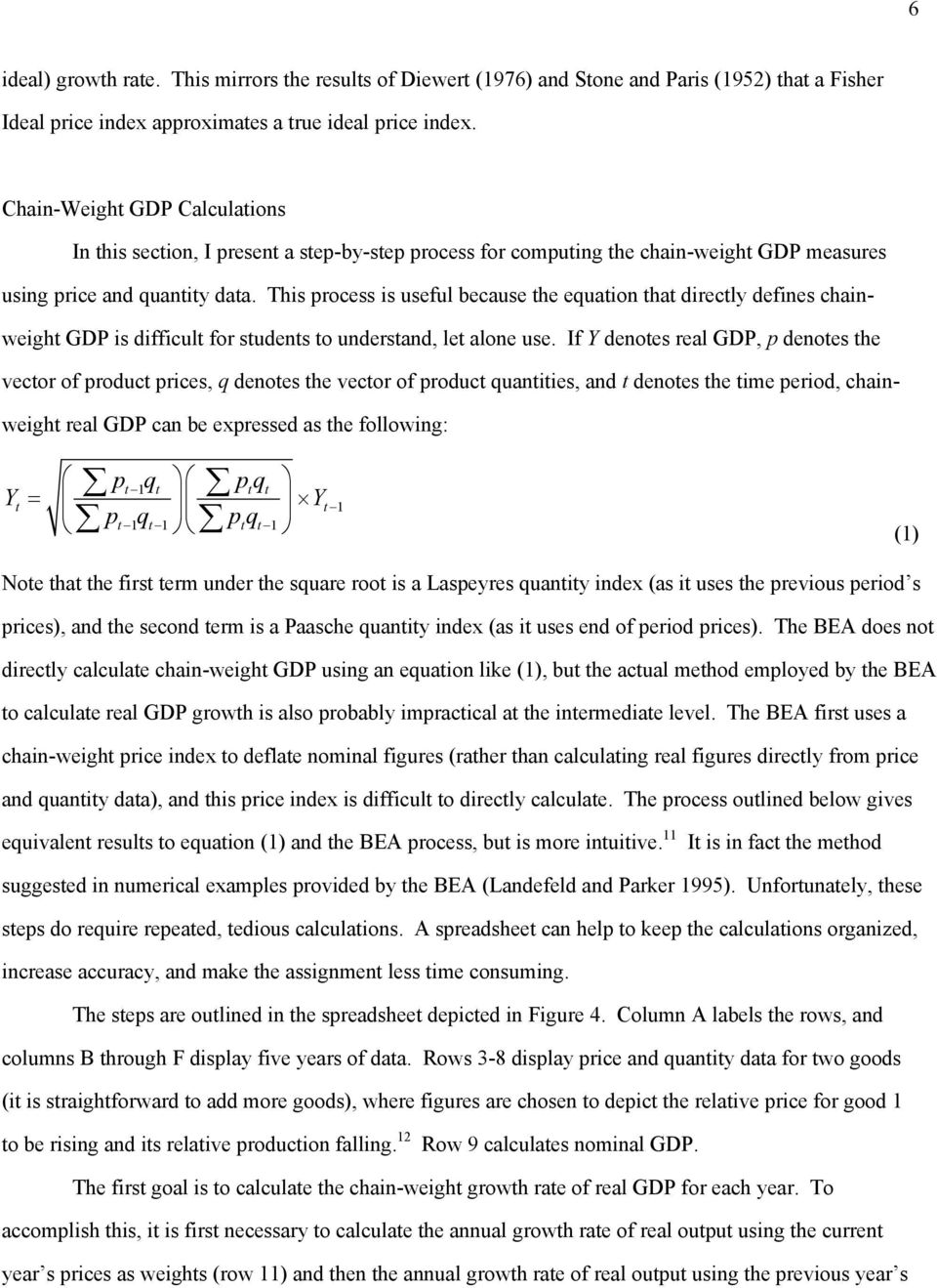
7 6 ideal) growth rate. This mirrors the results of Diewert (1976) and Stone and Paris (1952) that a Fisher Ideal price index approximates a true ideal price index. Chain-Weight GDP Calculations In this section, I present a step-by-step process for computing the chain-weight GDP measures using price and quantity data. This process is useful because the equation that directly defines chainweight GDP is difficult for students to understand, let alone use. If Y denotes real GDP, p denotes the vector of product prices, q denotes the vector of product quantities, and t denotes the time period, chainweight real GDP can be expressed as the following: Y t p q pq t 1 t t t = pt 1q t 1 pq t t 1 Y t 1 (1) Note that the first term under the square root is a Laspeyres quantity index (as it uses the previous period s prices), and the second term is a Paasche quantity index (as it uses end of period prices). The BEA does not directly calculate chain-weight GDP using an equation like (1), but the actual method employed by the BEA to calculate real GDP growth is also probably impractical at the intermediate level. The BEA first uses a chain-weight price index to deflate nominal figures (rather than calculating real figures directly from price and quantity data), and this price index is difficult to directly calculate. The process outlined below gives equivalent results to equation (1) and the BEA process, but is more intuitive. 11 It is in fact the method suggested in numerical examples provided by the BEA (Landefeld and Parker 1995). Unfortunately, these steps do require repeated, tedious calculations. A spreadsheet can help to keep the calculations organized, increase accuracy, and make the assignment less time consuming. The steps are outlined in the spreadsheet depicted in Figure 4. Column A labels the rows, and columns B through F display five years of data. Rows 3-8 display price and quantity data for two goods (it is straightforward to add more goods), where figures are chosen to depict the relative price for good 1 to be rising and its relative production falling. 12 Row 9 calculates nominal GDP. The first goal is to calculate the chain-weight growth rate of real GDP for each year. To accomplish this, it is first necessary to calculate the annual growth rate of real output using the current year s prices as weights (row 11) and then the annual growth rate of real output using the previous year s
8 7 prices as weights (row 12). These are growth rates associated with Paasche and Laspeyres indexes, respectively. The chain-weight real growth rate is then computed as the geometric mean of these two fixed-weight real growth rates (row 13). The next step is to choose a base year and calculate real GDP figures for each year by using the chain-weight real growth rates. In Figure 4, year 3 is chosen as the base year, so nominal GDP in year 3 is declared chain-weight real GDP. Real chain-weight GDP in year 4 is calculated by adding the chain-weight growth to year 3 s real GDP, and chain-weight GDP in year 5 is similarly calculated using its chain-weight growth rate and year 4 s real GDP value. Year 2 s real chainweight GDP level is calculated by dividing year 3 s real GDP figure by year 3 s growth rate plus one, and year 1 s real GDP is calculated similarly. It is here that the term chain-weight shows its relevancy: year 5 s real GDP contains price information on years 5 and 4 (through the chain-weight growth rate calculation) and years 4 and 3 (though year 4 s calculation ). Any given year s real GDP figure contains a chain of prices back to the base year. Finally, the chain-weight GDP deflator (called the chain-weight price index) can be found by dividing the nominal GDP figure by the chain-weight real GDP figure (row 14). Note that because it uses chain-weight real GDP data, it also contains price information chaining to the base year. Chain-weight GDP data are presented as chained base-year dollars ; however, they actually employ a weighted average of prices from any given year to the base year. [Figure 4] An interesting follow-up example is to calculate fixed-weight real GDP, real GDP growth, and the GDP deflator using the base-year prices, and then compare the results to the chain-weight results. If the figures are chosen carefully (as they are in Figure 4), the figures will exhibit the substitution bias. Other rows have been added to calculate inflation rates implied by the fixed-weight and chain-weight deflator. CONCLUSION The chain-weight method is now used by the BEA to calculate official national income and product account statistics. Although it is more complex and less convenient to teach than the standard Laspeyres or Paasche fixed-weight method, it is important for undergraduate students to understand how GDP and related statistics are calculated. 13 Whereas the chain-weight method is certainly more technical, teaching it creates an opportunity to explore other important economic concepts, and indeed to see them

9 8 at work. Most obviously, the chain-weight calculations demonstrate the importance of the substitution effect, both theoretically and empirically. The discussion also highlights the importance of computers in the current economy, as it was indeed the growing high technology sector that led to the switch to chainweight measures. Finally, the exercises introduce both rudimentary and sophisticated spreadsheet operations, and students are likely to use spreadsheets in other courses and in future employment. APPENDIX [Table A1 here] NOTES 1 See also the Symposium on Measuring the CPI in the winter 1998 issue of The Journal of Economic Perspectives which contains Boskin et al. (1998) and Diewert (1998) among several articles and the May/June 1997 issue of the Federal Reserve Bank of St. Louis Review which contains Diewert (1997) among several other articles as part of the proceedings to the conference Measuring inflation and growth. 2 See Cahill and Kosicki (2000) for a review of issues associated with using spreadsheet applications in the classroom. 3 The BEA also reports real GDP in quantity index values with base year set at 100 in section 7 of the data tables in Survey of Current Business. Rossiter (2000) relates these data to the more common base year set at nominal GDP figures. 4 In years before the base year, traditional real GDP figures are a Paasche index; in years after the base year, the figures are a Laspeyres index. 5 This correction is of course imperfect. 6 This example is repeated in the Gordon (1998) textbook. 7 See Diewert (1997, 1998) and references therein for details. There are alternative superlative indexes (e. g. the Törnqvist-Theil index) that also address the substitution bias. However, Diewert (1997, 1998) asserts the Fisher ideal is a superior choice based on a number of criteria. The geometric mean is preferred to the arithmetic mean because the geometric mean has a time reversibility property. This means that for any given price change from the base year to another given year, the price change from the given year back to the base year is the reciprocal of the original price change (Diewert 1997, 1998). Note that with negative growth rates, the negative geometric average value must be forced, as Excel s SQRT command automatically displays only the positive root. 8 Alternatively, it can be expressed as the percentage of income given to a consumer after the price change necessary to leave the consumer at the same level of utility after the price change. For certain types of utility functions (i.e.

10 9 when preferences are homothetic), the two definitions will give identical results. However, if preferences are not homothetic, the two definitions may yield different results. In such cases there is no single ideal quantity (or price) index. The spreadsheet file for Figure 2 on the supplementary web page contains an example of this alternative formulation. The Cobb-Douglas preferences used are homothetic. 9 The supplemental web page contains an exercise that graphically depicts the formulation of the ideal price index on a two-good indifference curve diagram. 10 See Cahill and Kosicki (2000) for details on using Solver. Tools/Goal Seek may also be used, but may not be as accurate. Alternatively, it is possible to solve the utility function analytically for the income level and input the formula into Excel. 11 Rossiter (2000) presents an alternative way to build a chain-weight GDP figure. Rather than first computing growth rates and then imputing levels, index values are first computed from the raw data, which is presented in a matrix. However, the results are equivalent. 12 The figures are carefully chosen, but an example such as Figure 3 can be used to generate quantity data given exogenously determined prices. 13 Chain-weight figures gained new prominence in 2000 when the Federal Open Market Committee announced it uses the personal consumption expenditures (PCE) chain-weight price index as its measure of inflation, rather than the CPI.

11 REFERENCES Abel, A. B., and B. S. Bernanke Macroeconomics, 4 th ed. New York: Addison Wesley Longman. Barro, R Macroeconomics, 5 th ed. Cambridge: MIT Press. Blanchard, O Macroeconomics, 2 nd ed. Upper Saddle River, NJ: Prentice-Hall. Boskin, M. J., E. R. Dulberger, R. J. Gordon, Z. Griliches, and D. W. Jorgenson Consumer prices, the Consumer Price Index, and the cost of living. Journal of Economic Perspectives 12 (Winter): Cahill, M. B., and G. Kosicki A framework for developing spreadsheet applications in economics. Social Science Computer Review 19 (Summer): Cahill, M. B. and G. Kosicki Exploring economic models using Excel. Southern Economic Journal 66 (January): DeLong, J. B Macroeconomics. New York: McGraw-Hill Irwin. Diewert, W.E Index number issues in the Consumer Price Index. Journal of Economic Perspectives 12 (Winter): Diewert, W.E Comment. Review (Federal Reserve Bank of St. Louis) 97 (May/June): Diewert, W. E Exact and superlative index numbers. Journal of Econometrics 4 (2): Dornbusch, R., S. Fischer, and R. Startz Macroeconomics, 8 th ed. New York: McGraw-Hill Irwin. Farmer, R. E. A Macroeconomics. New York: South-Western College Publishing. Federal Reserve Bank of St. Louis Federal Reserve Economic Data (FRED), accessed April 3, Froyen, R. T Macroeconomics: Theories and Policies, 5 th ed. Upper Saddle River, NJ: Prentice- Hall. Gordon, R. J Macroeconomics, 7 th ed. New York: Addison Wesley. Hall, R. E., and J. B. Taylor Macroeconomics, 5 th ed. New York: WW. Norton and Co. Landefeld, J. S., and R. P. Parker BEA s chain indexes, time series, and measures of long-term economic growth. Survey of Current Business 77 (May):

12 Landefeld, J. S. and R. P. Parker Preview of the comprehensive revision of the National Income and Product Accounts: BEA s new featured measures of output and prices. Survey of Current Business 75 (July): Mankiw, N.G Macroeconomics, 5 th ed. New York: Worth Publishers. Miles, D., and A. Scott Macroeconomics: Understanding the wealth of nations. New York: John Wiley and Sons. Rossiter, R. D Fisher ideal indexes in the National Income and Product Accounts. Journal of Economic Education 31 (Fall): Schultze, C. L., and C. Mackie., eds At what price? Conceptualizing and measuring cost-ofliving and price indexes. Washington: National Academy Press. Stone, R., and S. J. Paris Systems of aggregate index numbers and their compatibility. Economic Journal 62 (247): Williamson, S. D Macroeconomics. New York: Addison Wesley.

13 FIGURE 1 Chain-Weight vs. Fixed-Weight GDP (base year 1996) GDP (Billions of Dollars) Fixed weight Chain weight Paasche Laspeyres Year Data Source: Federal Reserve Bank of St. Louis (2002)

14 FIGURE 2 Fixed-Weight Measurement Bias Level percentage bias 10% 8% 6% 4% 2% level % bias (left scale) grth rate bias (right scale) Paasche Laspeyres 2% 1% 0% -1% -2% Growth rate bias (%) 0% Year -3% Data Source: Federal Reserve Bank of St. Louis (2002), author s calculations

15 FIGURE 3 Utility Analysis of Chain-Weight Index A B C D E F Original values New values Use original values to find ideal quantity index a 1 copy & paste, 1 1 b 1 then update prices 1 1 p x $4.00 $4.20 $4.00 p y $1.00 $1.40 $1.00 I $400 $400 $ by adjusting x* income y* U 10,000 6, , Solver drives this cell to new U Laspeyres quantity growth rate -16.7% Ideal quantity growth rate -17.5% Paasche quantity growth rate -18.4% Chain-weight (Fisher ideal) quantity growth rate -17.5%

16 FIGURE 4 Chain-Weight GDP Calculation A B C D E F Year Prices Good 1 $20 $21 $22 $23 $24 Good 2 $60 $59 $58 $57 $56 Quantities Good Good Nominal GDP Chain weight GDP calculations Real growth rate of output (Paasche index) (current year's prices used as weights) 10.36% 9.14% 8.18% 7.39% Real growth rate of output (Laspeyres index) (previous year's prices used as weights) 10.67% 9.39% 8.38% 7.56% Real growth rate of output (chain-weight) 10.51% 9.27% 8.28% 7.48% Real chain-weight GDP (Year 3 = base year) Fixed weight GDP calculations Real fixed-weight GDP (Year 3 = base year) Real growth rate of production (fixed base-year weight) 10.06% 9.14% 8.38% 7.73% Growth difference (chain fixed) 0.45% 0.12% -0.10% -0.25% Inflation calculations Chain-weight GDP deflator Fixed-weight GDP deflator Inflation rate (fixed-weight) 1.94% 1.37% 0.94% 0.62% Inflation rate (chain-weight) 1.53% 1.25% 1.04% 0.85% Inflation difference (chain fixed) -0.41% -0.11% 0.09% 0.24%

17 TABLE A1 Coverage of Chain-Weight Measures in Intermediate-level Macroeconomics Textbooks Textbook Chain-weight material Abel and Bernanke (2001) Solid overview in sidebar (pp. 47-8) Barro (1997) Short overview (p. 35) Blanchard (2000) Solid overview in appendix (pp. 36-7) DeLong (2002) None Dornbusch, Fischer and Startz (2001) None except one footnote reference to Survey of Current Business articles (p. 32) Farmer (2002) None Froyen (1998) One small section with quote The new chain-weighted measures do not differ greatly from previous measures (pp. 24-5) Gordon (1998) Gives solid overview, but reports fixed-weight data in appendix (pp. 50-1, 3) Hall and Taylor (1997) None Mankiw (2003) One small section, brief description with quote: For most purposes, however, the differences are not important. (p. 23) Miles and Scott (2002) None Williamson (2002) Short overview and example (pp. 50-1)

TEACHING CHAIN-WEIGHT REAL GDP MEASURES
 TEACHING CHAIN-WEIGHT REAL GDP MEASURES Miles B. Cahill Associate Professor Department of Economics College of the Holy Cross One College Street Worcester, MA 01610 Presented at the 76 th annual Western
Practice Problems on NIPA and Key Prices
 Practice Problems on NIPA and Key Prices 1- What are the three approaches to measuring economic activity? Why do they give the same answer? The three approaches to national income accounting are the product
Comparing the Consumer Price Index and the Personal Consumption Expenditures Price Index
 26 November 2007 Comparing the Consumer Price Index and the Personal Consumption Expenditures Price Index By Clinton P. McCully, Brian C. Moyer, and Kenneth J. Stewart I N THE United States, there are
Big Concepts. Measuring U.S. GDP. The Expenditure Approach. Economics 202 Principles Of Macroeconomics
 Lecture 6 Economics 202 Principles Of Macroeconomics Measuring GDP Professor Yamin Ahmad Real GDP and the Price Level Economic Growth and Welfare Big Concepts Ways to Measure GDP Expenditure Approach Income
The Data of Macroeconomics
 CHAPTER 2 The Data of Macroeconomics Modified for ECON 2204 by Bob Murphy 2016 Worth Publishers, all rights reserved IN THIS CHAPTER, YOU WILL LEARN:... the meaning and measurement of the most important
Chapter 2 The Measurement and Structure of the National Economy
 Chapter 2 The Measurement and Structure of the National Economy Multiple Choice Questions 1. The three approaches to measuring economic activity are the (a) cost, income, and expenditure approaches. (b)
Aggregation Issues in Integrating and Accelerating BEA s Accounts: Improved Methods for Calculating GDP by Industry
 DRAFT 3/3/2004 Aggregation Issues in Integrating and Accelerating BEA s Accounts: Improved Methods for Calculating GDP by Industry Brian Moyer, Marshall Reinsdorf and Robert Yuskavage Bureau of Economic
Reference: Gregory Mankiw s Principles of Macroeconomics, 2 nd edition, Chapters 10 and 11. Gross Domestic Product
 Macroeconomics Topic 1: Define and calculate GDP. Understand the difference between real and nominal variables (e.g., GDP, wages, interest rates) and know how to construct a price index. Reference: Gregory
Consumer Price Indices in the UK. Main Findings
 Consumer Price Indices in the UK Main Findings The report Consumer Price Indices in the UK, written by Mark Courtney, assesses the array of official inflation indices in terms of their suitability as an
Working with Chain-type Aggregates: A Few Tricks. Brent R. Moulton Bureau of Economic Analysis June 16, 2003
 Working with Chain-type Aggregates: A Few Tricks Brent R. Moulton Bureau of Economic Analysis June 16, 2003 What Is Real about Real GDP? Real GDP is intended to remove the effects of inflation in comparing
Recently, the Bureau of Labor Statistics projected
 and Economic Growth GDP and Economic Growth GDP components contributions to U.S. economic growth Rebasing GDP and its components on chained 2001 dollars enhances the role of services as a contributor to
DATE: January 15, 2015 SUBJECT: Biomedical Research and Development Price Index (BRDPI): Fiscal Year 2014 Update and Projections for FY 2015-FY 2020
 DATE: January 15, 2015 SUBJECT: Biomedical Research and Development Price Index (BRDPI): Fiscal Year 2014 Update and Projections for FY 2015-FY 2020 Summary The estimated growth in the BRDPI for FY 2014
Analyzing the Elements of Real GDP in FRED Using Stacking
 Tools for Teaching with Analyzing the Elements of Real GDP in FRED Using Stacking Author Mark Bayles, Senior Economic Education Specialist Introduction This online activity shows how to use FRED, the Federal
CHAPTER 5: MEASURING GDP AND ECONOMIC GROWTH
 CHAPTER 5: MEASURING GDP AND ECONOMIC GROWTH Learning Goals for this Chapter: To know what we mean by GDP and to use the circular flow model to explain why GDP equals aggregate expenditure and aggregate
Cosumnes River College Principles of Macroeconomics Problem Set 3 Due September 17, 2015
 Cosumnes River College Principles of Macroeconomics Problem Set 3 Due September 17, 2015 Name: Solutions Fall 2015 Prof. Dowell Instructions: Write the answers clearly and concisely on these sheets in
Chapter 1. Introduction
 Chapter 1 Introduction What is productivity, how is it measured and why is it important? These questions are a useful starting point from which we can define and explain the range of productivity measures
Professor Christina Romer. LECTURE 17 MACROECONOMIC VARIABLES AND ISSUES March 17, 2016
 Economics 2 Spring 2016 Professor Christina Romer Professor David Romer LECTURE 17 MACROECONOMIC VARIABLES AND ISSUES March 17, 2016 I. MACROECONOMICS VERSUS MICROECONOMICS II. REAL GDP A. Definition B.
Rethinking the NIPA Treatment of Insurance Services For the Comprehensive Revision
 Page 1 of 10 Rethinking the NIPA Treatment of Insurance Services For the Comprehensive Revision For Presentation at BEA Advisory Committee Meeting, 15 November 2002 Revised 23 December 2002 Dennis Fixler
Chap 11 & 12. Measuring the Cost of Living THE CONSUMER PRICE INDEX
 Chap 11 & 12 Chap 10: Measuring a Nation s Income: GDP, Nominal GDP, Real GDP, and GDP Deflator Next topic: Chap 11: Measuring the Cost of Living: CPI GDP from an whole economy point of view CPI from a
Chapter 8. GDP : Measuring Total Production and Income
 Chapter 8. GDP : Measuring Total Production and Income Instructor: JINKOOK LEE Department of Economics / Texas A&M University ECON 203 502 Principles of Macroeconomics Related Economic Terms Macroeconomics:
Summer 2014 Week 3 Tutorial Questions (Ch2) Solutions
 Chapter 2: Q1: Macroeconomics P.52 Numerical Problems #3 Q2: Macroeconomics P.52 Numerical Problems #6 Q3: Macroeconomics P.53 Numerical Problems #7 Q4: Macroeconomics P.53 Numerical Problems #9 Q5: Macroeconomics
Economic Research Division
 July Economic Commentary Number Why is the Rate of Decline in the GDP Deflator So Large? Exploring the background against the discrepancy from the Consumer Price Index Economic Research Division Maiko
MEASURING GDP AND ECONOMIC GROWTH CHAPTER
 MEASURING GDP AND ECONOMIC GROWTH CHAPTER Objectives After studying this chapter, you will able to Define GDP and use the circular flow model to explain why GDP equals aggregate expenditure and aggregate
NATIONAL INCOME AND PRODUCT ACCOUNTING MEASURING THE MACROECONOMY
 NATIONAL INCOME AND PRODUCT ACCOUNTING MEASURING THE MACROECONOMY 1. NIPA: GNP and GDP 2. Saving and Wealth 3. Prices and Inflation 4. Unemployment 5. Problems with Measuring the Macroeconomy There are
APPENDIX. Interest Concepts of Future and Present Value. Concept of Interest TIME VALUE OF MONEY BASIC INTEREST CONCEPTS
 CHAPTER 8 Current Monetary Balances 395 APPENDIX Interest Concepts of Future and Present Value TIME VALUE OF MONEY In general business terms, interest is defined as the cost of using money over time. Economists
Duration and Bond Price Volatility: Some Further Results
 JOURNAL OF ECONOMICS AND FINANCE EDUCATION Volume 4 Summer 2005 Number 1 Duration and Bond Price Volatility: Some Further Results Hassan Shirvani 1 and Barry Wilbratte 2 Abstract This paper evaluates the
Chapter 5 Macroeconomic Measurement: The Current Approach Macroeconomics In Context (Goodwin, et al.)
 Chapter 5 Macroeconomic Measurement: The Current Approach Macroeconomics In Context (Goodwin, et al.) Chapter Overview In this chapter, you will be introduced to a fairly standard examination of the National
AN INTRODUCTION TO CONSUMER PRICE INDEX METHODOLOGY
 AN INTRODUCTION TO CONSUMER PRICE INDEX METHODOLOGY 1 1.1 A price index is a measure of the proportionate, or percentage, changes in a set of prices over time. A consumer price index (CPI) measures changes
Economics 212 Principles of Macroeconomics Study Guide. David L. Kelly
 Economics 212 Principles of Macroeconomics Study Guide David L. Kelly Department of Economics University of Miami Box 248126 Coral Gables, FL 33134 [email protected] First Version: Spring, 2006 Current
18. Economic Approach A. Introduction
 8. Economic Approach A. Introduction 8. The economic approach differs from the fixed basket, axiomatic, and stochastic approaches outlined in Chapters 6 and 7 in an important respect: quantities are no
LECTURE NOTES ON MACROECONOMIC PRINCIPLES
 LECTURE NOTES ON MACROECONOMIC PRINCIPLES Peter Ireland Department of Economics Boston College [email protected] http://www2.bc.edu/peter-ireland/ec132.html Copyright (c) 2013 by Peter Ireland. Redistribution
Chapter 5: GDP and Economic Growth
 Chapter 5: GDP and Economic Growth Be Mean Green! Please consider the environment before printing this Chapter Outline. It ll be available online throughout the semester. For Firms private accounting measures
GDP: Measuring Total Production and Income
 Chapter 7 (19) GDP: Measuring Total Production and Income Chapter Summary While microeconomics is the study of how households and firms make choices, how they interact in markets, and how the government
MEASURING A NATION S INCOME
 10 MEASURING A NATION S INCOME WHAT S NEW IN THE FIFTH EDITION: There is more clarification on the GDP deflator. The Case Study on Who Wins at the Olympics? is now an FYI box. LEARNING OBJECTIVES: By the
Making the Indifference-Curve Approach to Excess Burden More Understandable
 Making the Indifference-Curve Approach to Excess Burden More Understandable Gregory A. Trandel Department of Economics University of Georgia June 2008 Abstract: This paper presents a simple method by which
MULTIPLE CHOICE. Choose the one alternative that best completes the statement or answers the question.
 Suvey of Macroeconomics, MBA 641 Fall 2006, Final Exam Name MULTIPLE CHOICE. Choose the one alternative that best completes the statement or answers the question. 1) Modern macroeconomics emerged from
Lectures, 2 ECONOMIES OF SCALE
 Lectures, 2 ECONOMIES OF SCALE I. Alternatives to Comparative Advantage Economies of Scale The fact that the largest share of world trade consists of the exchange of similar (manufactured) goods between
A Dynamic Analysis of Price Determination Under Joint Profit Maximization in Bilateral Monopoly
 A Dynamic Analysis of Price Determination Under Joint Profit Maximization in Bilateral Monopoly by Stephen Devadoss Department of Agricultural Economics University of Idaho Moscow, Idaho 83844-2334 Phone:
USES OF CONSUMER PRICE INDICES
 USES OF CONSUMER PRICE INDICES 2 2.1 The consumer price index (CPI) is treated as a key indicator of economic performance in most countries. The purpose of this chapter is to explain why CPIs are compiled
NHE DEFLATOR INTERMEDIATE SUMMARY. National Health Expenditures
 NHE DEFLATOR INTERMEDIATE SUMMARY National Health Expenditures National Health Expenditures (NHE) in the United States include all spending related to the purchase of health care goods and services during
I. Introduction to Aggregate Demand/Aggregate Supply Model
 University of California-Davis Economics 1B-Intro to Macro Handout 8 TA: Jason Lee Email: [email protected] I. Introduction to Aggregate Demand/Aggregate Supply Model In this chapter we develop a model
SHORT-RUN FLUCTUATIONS. David Romer. University of California, Berkeley. First version: August 1999 This revision: January 2012
 SHORT-RUN FLUCTUATIONS David Romer University of California, Berkeley First version: August 1999 This revision: January 2012 Copyright 2012 by David Romer CONTENTS Preface vi I The IS-MP Model 1 I-1 Monetary
Building a real-time database for GDP(E)
 By Jennifer Castle of Oxford University and Colin Ellis of the Bank s Structural Economic Analysis Division. (1) The Bank s Monetary Policy Committee analyses a wide variety of data to inform its monetary
EC201 Intermediate Macroeconomics. EC201 Intermediate Macroeconomics Problem Set 1 Solution
 EC201 Intermediate Macroeconomics EC201 Intermediate Macroeconomics Problem Set 1 Solution 1) Given the difference between Gross Domestic Product and Gross National Product for a given economy: a) Provide
7 AGGREGATE SUPPLY AND AGGREGATE DEMAND* Chapter. Key Concepts
 Chapter 7 AGGREGATE SUPPLY AND AGGREGATE DEMAND* Key Concepts Aggregate Supply The aggregate production function shows that the quantity of real GDP (Y ) supplied depends on the quantity of labor (L ),
Name: Date: 3. Variables that a model tries to explain are called: A. endogenous. B. exogenous. C. market clearing. D. fixed.
 Name: Date: 1 A measure of how fast prices are rising is called the: A growth rate of real GDP B inflation rate C unemployment rate D market-clearing rate 2 Compared with a recession, real GDP during a
Exam 1 Review. 3. A severe recession is called a(n): A) depression. B) deflation. C) exogenous event. D) market-clearing assumption.
 Exam 1 Review 1. Macroeconomics does not try to answer the question of: A) why do some countries experience rapid growth. B) what is the rate of return on education. C) why do some countries have high
Chapter 11: Activity
 Economics for Managers by Paul Farnham Chapter 11: Measuring Macroeconomic Activity 11.1 Measuring Gross Domestic Product (GDP) GDP: the market value of all currently yproduced final goods and services
Households Wages, profit, interest, rent = $750. Factor markets. Wages, profit, interest, rent = $750
 KrugmanMacro_SM_Ch07.qxp 11/9/05 4:47 PM Page 87 Tracking the Macroeconomy 1. Below is a simplified circular-flow diagram for the economy of Micronia. a. What is the value of GDP in Micronia? b. What is
Analyzing the Effect of Change in Money Supply on Stock Prices
 72 Analyzing the Effect of Change in Money Supply on Stock Prices I. Introduction Billions of dollars worth of shares are traded in the stock market on a daily basis. Many people depend on the stock market
Edmonds Community College Macroeconomic Principles ECON 202C - Winter 2011 Online Course Instructor: Andy Williams
 Edmonds Community College Macroeconomic Principles ECON 202C - Winter 2011 Online Course Instructor: Andy Williams Textbooks: Economics: Principles, Problems and Policies, 18th Edition, by McConnell, Brue,
Econ 102 Measuring National Income and Prices Solutions
 Econ 102 Measuring National Income and Prices Solutions 1. Measurement of National Income and Decomposing GDP This question is designed to see if you understand how Gross Domestic Product (GDP) is measured.
FAO s Food Price Index Revisited
 FAO s Food Price Index Revisited Introduction The FAO Food Price Index (FFPI) was introduced in 1996 as a public good to help in monitoring developments in the global agricultural commodity markets. The
Econ 303: Intermediate Macroeconomics I Dr. Sauer Sample Questions for Exam #3
 Econ 303: Intermediate Macroeconomics I Dr. Sauer Sample Questions for Exam #3 1. When firms experience unplanned inventory accumulation, they typically: A) build new plants. B) lay off workers and reduce
Product Mix as a Framing Exercise: The Role of Cost Allocation. Anil Arya The Ohio State University. Jonathan Glover Carnegie Mellon University
 Product Mix as a Framing Exercise: The Role of Cost Allocation Anil Arya The Ohio State University Jonathan Glover Carnegie Mellon University Richard Young The Ohio State University December 1999 Product
Tracking the Macroeconomy
 chapter 7(23) Tracking the Macroeconomy Chapter Objectives Students will learn in this chapter: How economists use aggregate measures to track the performance of the economy. What gross domestic product,
USING SEASONAL AND CYCLICAL COMPONENTS IN LEAST SQUARES FORECASTING MODELS
 Using Seasonal and Cyclical Components in Least Squares Forecasting models USING SEASONAL AND CYCLICAL COMPONENTS IN LEAST SQUARES FORECASTING MODELS Frank G. Landram, West Texas A & M University Amjad
LABOUR PRODUCTIVITY AND UNIT LABOUR COST Economic development Employment Core indicator
 LABOUR PRODUCTIVITY AND UNIT LABOUR COST Economic development Employment Core indicator 1. INDICATOR (a) Name: Labour productivity and unit labour costs. (b) Brief Definition: Labour productivity is defined
Causes of Inflation in the Iranian Economy
 Causes of Inflation in the Iranian Economy Hamed Armesh* and Abas Alavi Rad** It is clear that in the nearly last four decades inflation is one of the important problems of Iranian economy. In this study,
MEASURING GDP AND ECONOMIC GROWTH*
 Chapter 5 MEASURING GDP AND ECONOMIC GROWTH* Gross Domestic Product Topic: GDP 1) Gross domestic product is the total produced within a country in a given time period. A) market value of all final and
Real vs. Nominal GDP Practice
 Name: Real vs. Nominal GDP Practice Period: Real verse Nominal Values Prices in an economy do not stay the same. Over time the price level changes (i.e., there is inflation or deflation). A change in the
Measuring the Aggregate Economy
 CHAPTER 25 Measuring the Aggregate Economy The government is very keen on amassing statistics... They collect them, add them, raise them to the n th power, take the cube root and prepare wonderful diagrams.
Data Practice with FRED Measures of Inflation Objectives
 Data Practice with FRED Measures of Inflation Objectives In this FRED data practice, you will learn: About different ways to measure inflation (CPI, (steps 4-14), GDP deflator (step 15) Different ways
A. GDP, Economic Growth, and Business Cycles
 ECON 3023 Hany Fahmy FAll, 2009 Lecture Note: Introduction and Basic Concepts A. GDP, Economic Growth, and Business Cycles A.1. Gross Domestic Product (GDP) de nition and measurement The Gross Domestic
Nominal, Real and PPP GDP
 Nominal, Real and PPP GDP It is crucial in economics to distinguish nominal and real values. This is also the case for GDP. While nominal GDP is easier to understand, real GDP is more important and used
ECONOMIC QUESTIONS FOR THE MASTER'S EXAM
 ECONOMIC QUESTIONS FOR THE MASTER'S EXAM Introduction 1. What is economics? Discuss the purpose and method of work of economists. Consider observation, induction, deduction and scientific criticism. 2.
ANSWERS TO END-OF-CHAPTER QUESTIONS
 ANSWERS TO END-OF-CHAPTER QUESTIONS 7-1 In what ways are national income statistics useful? National income accounting does for the economy as a whole what private accounting does for businesses. Firms
MULTIPLE CHOICE. Choose the one alternative that best completes the statement or answers the question.
 Econ 111 Summer 2007 Final Exam Name MULTIPLE CHOICE. Choose the one alternative that best completes the statement or answers the question. 1) The classical dichotomy allows us to explore economic growth
Chapter 16 Output and the Exchange Rate in the Short Run
 Chapter 16 Output and the Exchange Rate in the Short Run Prepared by Iordanis Petsas To Accompany International Economics: Theory and Policy, Sixth Edition by Paul R. Krugman and Maurice Obstfeld Chapter
Macroeconomics 2301 Potential questions and study guide for exam 2. Any 6 of these questions could be on your exam!
 Macroeconomics 2301 Potential questions and study guide for exam 2 Any 6 of these questions could be on your exam! 1. GDP is a key concept in Macroeconomics. a. What is the definition of GDP? b. List and
Elasticity. I. What is Elasticity?
 Elasticity I. What is Elasticity? The purpose of this section is to develop some general rules about elasticity, which may them be applied to the four different specific types of elasticity discussed in
ECONOMIC GROWTH* Chapter. Key Concepts
 Chapter 5 MEASURING GDP AND ECONOMIC GROWTH* Key Concepts Gross Domestic Product Gross domestic product, GDP, is the market value of all the final goods and services produced within in a country in a given
14.02 Principles of Macroeconomics Problem Set 1 Fall 2005 ***Solution***
 Part I. True/False/Uncertain Justify your answer with a short argument. 14.02 Principles of Macroeconomics Problem Set 1 Fall 2005 ***Solution*** Posted: Monday, September 12, 2005 Due: Wednesday, September
REVIEW OF MICROECONOMICS
 ECO 352 Spring 2010 Precepts Weeks 1, 2 Feb. 1, 8 REVIEW OF MICROECONOMICS Concepts to be reviewed Budget constraint: graphical and algebraic representation Preferences, indifference curves. Utility function
Notes on Excel Forecasting Tools. Data Table, Scenario Manager, Goal Seek, & Solver
 Notes on Excel Forecasting Tools Data Table, Scenario Manager, Goal Seek, & Solver 2001-2002 1 Contents Overview...1 Data Table Scenario Manager Goal Seek Solver Examples Data Table...2 Scenario Manager...8
FISCAL POLICY* Chapter. Key Concepts
 Chapter 11 FISCAL POLICY* Key Concepts The Federal Budget The federal budget is an annual statement of the government s expenditures and tax revenues. Using the federal budget to achieve macroeconomic
FINANCIAL ANALYSIS GUIDE
 MAN 4720 POLICY ANALYSIS AND FORMULATION FINANCIAL ANALYSIS GUIDE Revised -August 22, 2010 FINANCIAL ANALYSIS USING STRATEGIC PROFIT MODEL RATIOS Introduction Your policy course integrates information
c 2008 Je rey A. Miron We have described the constraints that a consumer faces, i.e., discussed the budget constraint.
 Lecture 2b: Utility c 2008 Je rey A. Miron Outline: 1. Introduction 2. Utility: A De nition 3. Monotonic Transformations 4. Cardinal Utility 5. Constructing a Utility Function 6. Examples of Utility Functions
I. Measuring Output: GDP
 University of California-Davis Economics 1B-Intro to Macro Handout 3 TA: Jason Lee Email: [email protected] I. Measuring Output: GDP As was mentioned earlier, the ability to estimate the amount of production
Beef Demand: What is Driving the Market?
 Beef Demand: What is Driving the Market? Ronald W. Ward Food and Economics Department University of Florida Demand is a term we here everyday. We know it is important but at the same time hard to explain.
Do Commodity Price Spikes Cause Long-Term Inflation?
 No. 11-1 Do Commodity Price Spikes Cause Long-Term Inflation? Geoffrey M.B. Tootell Abstract: This public policy brief examines the relationship between trend inflation and commodity price increases and
Chapter 1 Lecture Notes: Economics for MBAs and Masters of Finance
 Chapter 1 Lecture Notes: Economics for MBAs and Masters of Finance Morris A. Davis Cambridge University Press stands for Gross Domestic Product. Nominal is the dollar value of all goods and services that
Measuring the Cost of Living THE CONSUMER PRICE INDEX
 6 In this chapter, look for the answers to these questions: What is the Consumer (CPI)? How is it calculated? What s it used for? What are the problems with the CPI? How serious are they? How does the
EC2105, Professor Laury EXAM 2, FORM A (3/13/02)
 EC2105, Professor Laury EXAM 2, FORM A (3/13/02) Print Your Name: ID Number: Multiple Choice (32 questions, 2.5 points each; 80 points total). Clearly indicate (by circling) the ONE BEST response to each
The Macroeconomic Effects of Tax Changes: The Romer-Romer Method on the Austrian case
 The Macroeconomic Effects of Tax Changes: The Romer-Romer Method on the Austrian case By Atila Kilic (2012) Abstract In 2010, C. Romer and D. Romer developed a cutting-edge method to measure tax multipliers
Long run v.s. short run. Introduction. Aggregate Demand and Aggregate Supply. In this chapter, look for the answers to these questions:
 33 Aggregate Demand and Aggregate Supply R I N C I L E S O F ECONOMICS FOURTH EDITION N. GREGOR MANKIW Long run v.s. short run Long run growth: what determines long-run output (and the related employment
ECON 102 Spring 2014 Homework 3 Due March 26, 2014
 ECON 102 Spring 2014 Homework 3 Due March 26, 2014 1. For this problem, you need to download data about the country Badgerstan from the website: https://mywebspace.wisc.edu/mmorey/web/102data.xls The file
Chapter 10. Key Ideas Correlation, Correlation Coefficient (r),
 Chapter 0 Key Ideas Correlation, Correlation Coefficient (r), Section 0-: Overview We have already explored the basics of describing single variable data sets. However, when two quantitative variables
Basics of Dimensional Modeling
 Basics of Dimensional Modeling Data warehouse and OLAP tools are based on a dimensional data model. A dimensional model is based on dimensions, facts, cubes, and schemas such as star and snowflake. Dimensional
The Profit Function: A Pedagogical Improvement For Teaching Operating Breakeven Analysis
 The Profit Function: A Pedagogical Improvement For Teaching Operating Breakeven Analysis Bruce D. Bagamery, Central Washington University - Lynnwood Abstract This paper presents a graphical approach for
The labour market, I: real wages, productivity and unemployment 7.1 INTRODUCTION
 7 The labour market, I: real wages, productivity and unemployment 7.1 INTRODUCTION Since the 1970s one of the major issues in macroeconomics has been the extent to which low output and high unemployment