
Cosumnes River College Principles of Macroeconomics Problem Set 3 Due September 17, 2015
|
|
|
- Ami Henderson
- 9 years ago
- Views:
Transcription
1 Cosumnes River College Principles of Macroeconomics Problem Set 3 Due September 17, 2015 Name: Solutions Fall 2015 Prof. Dowell Instructions: Write the answers clearly and concisely on these sheets in the spaces provided. Do not attach extra sheets. 1. You are given the following data for a hypothetical economy: Spending Component Value (billions of dollars) Personal Consumption Expenditure $600 Exports 75 Government Purchases of Goods and Services 200 Construction of New Homes and Apartments 100 Sale of Existing Homes and Apartments 200 Imports 50 Beginning of Year Inventory 100 End of Year Inventory 125 Business Fixed Investment 100 Government Payments to Retirees 100 Beginning of Year Capital Stock 3,000 End of Year Capital Stock 3,175 Showing your work, complete the following: a. Calculate for this economy. Also explain what you are doing and why. Using the expenditure approach, add up personal consumption, investment, government spending and net exports. To get investment, add new home construction, business fixed investment and the change in inventory. Sale of existing homes is not included because they were not produced in the current year. Government payments to retirees are excluded because it is a transfer payment. Beginning and ending capital stocks are not included because they are stock variables. They tell us how much capital we own, not what we ve produced in the current year. Note that with respect to inventories, we include only the change, not the level. Adding up, you get b. Calculate net investment. Y = (75 50) = 1,050 Net investment is just the change in the capital stock or 3,175 3,000 = 175 c. Calculate Net Domestic Product (NDP). First, calculate depreciation. Use the relation, Net Investment = Gross Investment Depreciation. We know the values of Gross and Net Investment. Substitute these and solve. 175 = 225 Depreciation => Depreciation = 50. Use this to find NDP: NDP = 1, = 1,000 Principles of Macroeconomics: Problem Set 3 Solutions Page 1

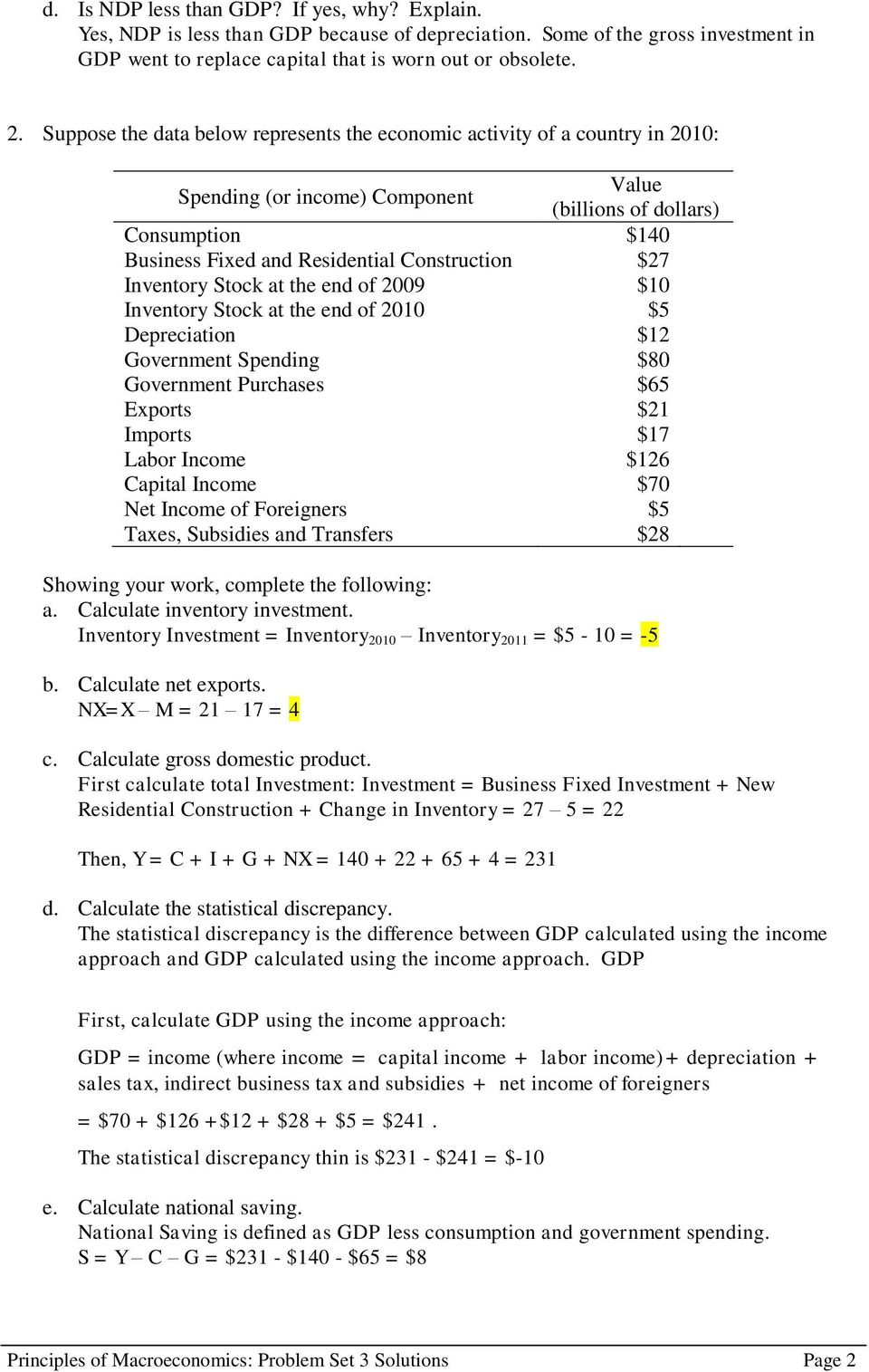
2 d. Is NDP less than? If yes, why? Explain. Yes, NDP is less than because of depreciation. Some of the gross investment in went to replace capital that is worn out or obsolete. 2. Suppose the data below represents the economic activity of a country in 2010: Spending (or income) Component Value (billions of dollars) Consumption $140 Business Fixed and Residential Construction $27 Inventory Stock at the end of 2009 $10 Inventory Stock at the end of 2010 $5 Depreciation $12 Government Spending $80 Government Purchases $65 Exports $21 Imports $17 Labor Income $126 Capital Income $70 Net Income of Foreigners $5 Taxes, Subsidies and Transfers $28 Showing your work, complete the following: a. Calculate inventory investment. Inventory Investment = Inventory 2010 Inventory 2011 = $5-10 = -5 b. Calculate net exports. NX=X M = = 4 c. Calculate gross domestic product. First calculate total Investment: Investment = Business Fixed Investment + New Residential Construction + Change in Inventory = 27 5 = 22 Then, Y = C + I + G + NX = = 231 d. Calculate the statistical discrepancy. The statistical discrepancy is the difference between calculated using the income approach and calculated using the income approach. First, calculate using the income approach: = income (where income = capital income + labor income) + depreciation + sales tax, indirect business tax and subsidies + net income of foreigners = $70 + $126 +$12 + $28 + $5 = $241. The statistical discrepancy thin is $231 - $241 = $-10 e. Calculate national saving. National Saving is defined as less consumption and government spending. S = Y C G = $231 - $140 - $65 = $8 Principles of Macroeconomics: Problem Set 3 Solutions Page 2
3 3. You are given the following data on a hypothetical economy: Good Quantity in 2013 Price in 2013 Quantity in 2014 Price in 2014 Ice Cream Cones 1,000 $ $3.50 Hot Dogs 500 $ $2.25 Surf Boards 10 $ $ a. Showing your work, calculate the following: i. nominal in 2013 Y 2013 = (1,000 x $2.50) + (500 x $1.25) + (10 x $100) = $4,125 ii. nominal in 2014 Y 2014 = (800 x $3.50) + (400 x $2.25) + (14 x $100) = $5,100 iii. real in 2013 using 2013 as the base year Y 2013 = (1,000 x $2.50) + (500 x $1.25) + (10 x $100) = $4,125 iv. real in 2014 using 2013 as the base year Y 2014 = (800 x $2.50) + (400 x $1.25) + (14 x $100) = $3,900 v. real growth from 2013 to 2014 using your results from parts iii and iv $3,900 $4,125 % x % $4,125 vi. real in 2013 using 2014 as the base year Y 2013 = (1,000 x $3.50) + (500 x $2.25) + (10 x $100) = $5,625 vii. real in 2014 using 2014 as the base year Y 2014 = (800 x $3.50) + (400 x $2.25) + (14 x $100) = $5,100 viii real growth from 2013 to 2014 using your results from parts vi and vii $5,100 $5,625 % x % $5,625 b. If your answers to parts v and viii above are different, why? Explain. The answers are different because the starting points are different. Think of it this way: Suppose you buy a share of stock for $100 and that its value falls by 50%. If from this point the value rises by 50%, do you recover all your losses? No! Now it is worth $75, not the original $100. After the 50% drop the value must increase by 100% for you to recover all your losses. This happens because your starting points are different, $11 vs. $50. Principles of Macroeconomics: Problem Set 3 Solutions Page 3

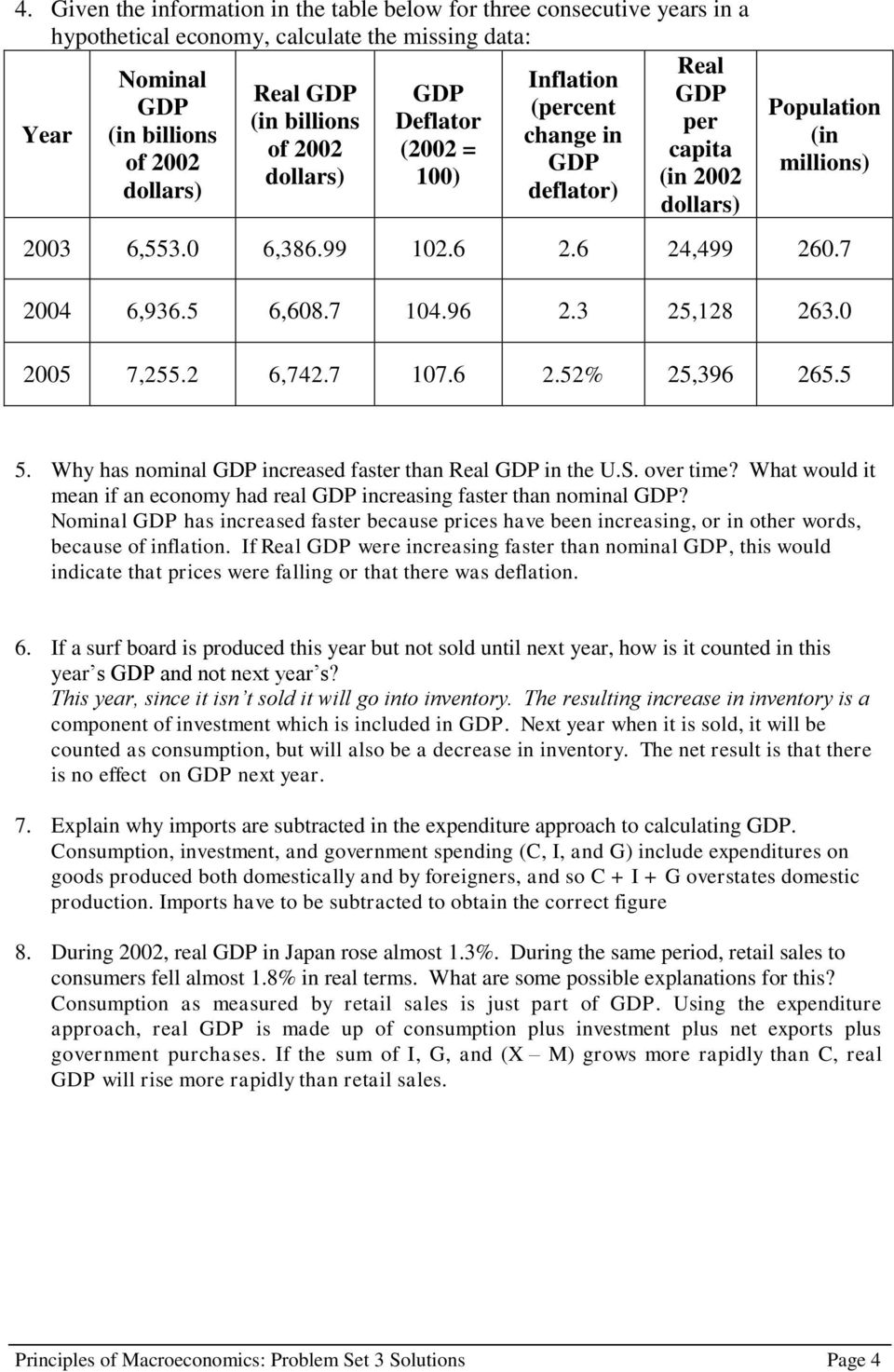
4 4. Given the information in the table below for three consecutive years in a hypothetical economy, calculate the missing data: Real Nominal Inflation Real (percent (in billions Deflator per Year (in billions change in of 2002 (2002 = capita of 2002 dollars) 100) (in 2002 dollars) deflator) dollars) Population (in millions) , , , , , , , , % 25, Why has nominal increased faster than Real in the U.S. over time? What would it mean if an economy had real increasing faster than nominal? Nominal has increased faster because prices have been increasing, or in other words, because of inflation. If Real were increasing faster than nominal, this would indicate that prices were falling or that there was deflation. 6. If a surf board is produced this year but not sold until next year, how is it counted in this year s and not next year s? This year, since it isn t sold it will go into inventory. The resulting increase in inventory is a component of investment which is included in. Next year when it is sold, it will be counted as consumption, but will also be a decrease in inventory. The net result is that there is no effect on next year. 7. Explain why imports are subtracted in the expenditure approach to calculating. Consumption, investment, and government spending (C, I, and G) include expenditures on goods produced both domestically and by foreigners, and so C + I + G overstates domestic production. Imports have to be subtracted to obtain the correct figure 8. During 2002, real in Japan rose almost 1.3%. During the same period, retail sales to consumers fell almost 1.8% in real terms. What are some possible explanations for this? Consumption as measured by retail sales is just part of. Using the expenditure approach, real is made up of consumption plus investment plus net exports plus government purchases. If the sum of I, G, and (X M) grows more rapidly than C, real will rise more rapidly than retail sales. Principles of Macroeconomics: Problem Set 3 Solutions Page 4
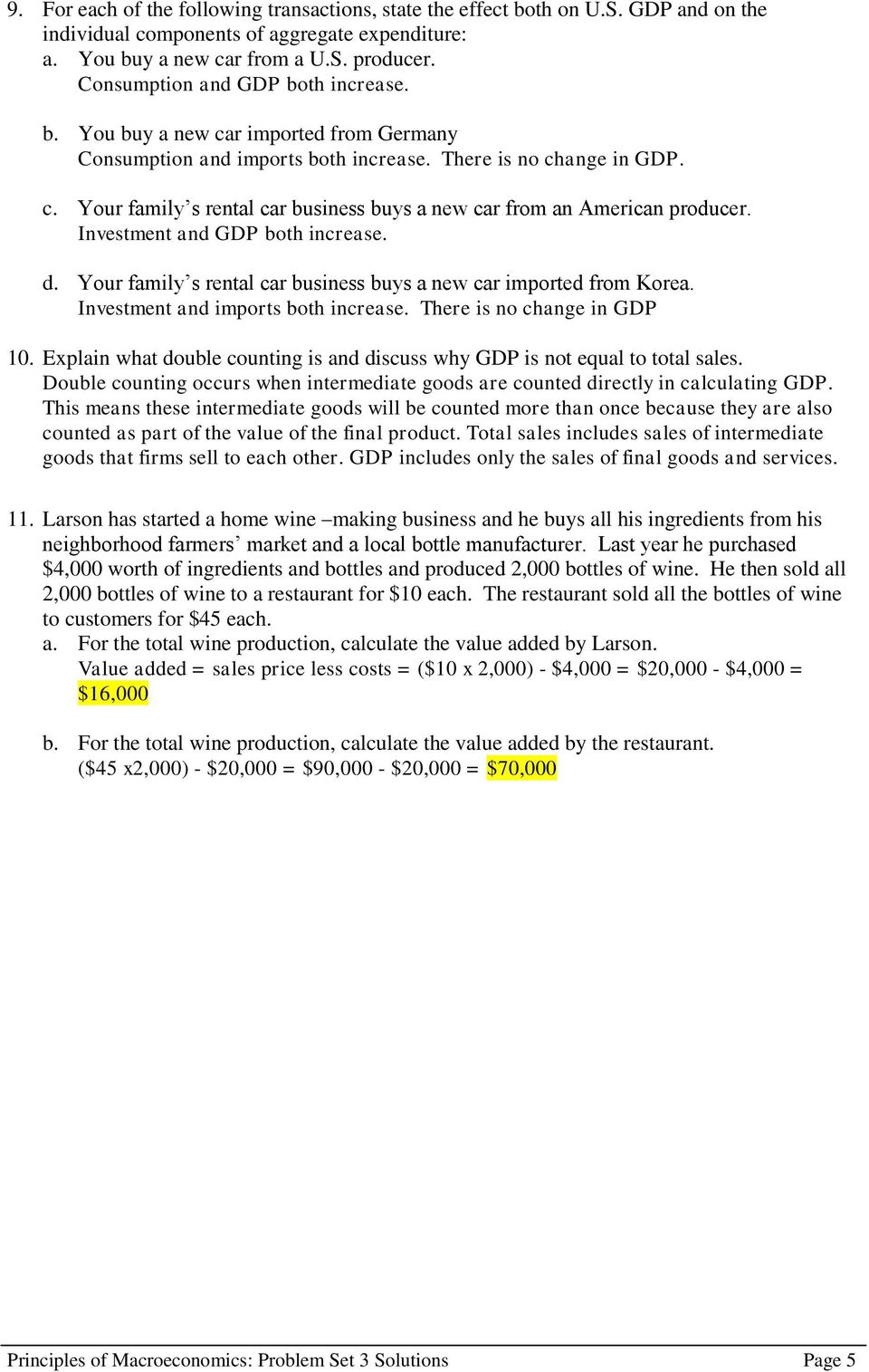
5 9. For each of the following transactions, state the effect both on U.S. and on the individual components of aggregate expenditure: a. You buy a new car from a U.S. producer. Consumption and both increase. b. You buy a new car imported from Germany Consumption and imports both increase. There is no change in. c. Your family s rental car business buys a new car from an American producer. Investment and both increase. d. Your family s rental car business buys a new car imported from Korea. Investment and imports both increase. There is no change in 10. Explain what double counting is and discuss why is not equal to total sales. Double counting occurs when intermediate goods are counted directly in calculating. This means these intermediate goods will be counted more than once because they are also counted as part of the value of the final product. Total sales includes sales of intermediate goods that firms sell to each other. includes only the sales of final goods and services. 11. Larson has started a home wine making business and he buys all his ingredients from his neighborhood farmers market and a local bottle manufacturer. Last year he purchased $4,000 worth of ingredients and bottles and produced 2,000 bottles of wine. He then sold all 2,000 bottles of wine to a restaurant for $10 each. The restaurant sold all the bottles of wine to customers for $45 each. a. For the total wine production, calculate the value added by Larson. Value added = sales price less costs = ($10 x 2,000) - $4,000 = $20,000 - $4,000 = $16,000 b. For the total wine production, calculate the value added by the restaurant. ($45 x2,000) - $20,000 = $90,000 - $20,000 = $70,000 Principles of Macroeconomics: Problem Set 3 Solutions Page 5
CHAPTER 5: MEASURING GDP AND ECONOMIC GROWTH
 CHAPTER 5: MEASURING GDP AND ECONOMIC GROWTH Learning Goals for this Chapter: To know what we mean by GDP and to use the circular flow model to explain why GDP equals aggregate expenditure and aggregate
Chapter 20. The Measurement of National Income. In this chapter you will learn to. National Output and Value Added
 Chapter 20 The Measurement of National Income In this chapter you will learn to 1. Use the concept of value added to solve the problem of double counting when measuring national income. 2. Describe the
Unit 4: Measuring GDP and Prices
 Unit 4: Measuring GDP and Prices ECO 120 Global Macroeconomics 1 1.1 Reading Reading Module 10 - pages 106-110 Module 11 1.2 Goals Goals Specific Goals: Understand how to measure a country s output. Learn
Households Wages, profit, interest, rent = $750. Factor markets. Wages, profit, interest, rent = $750
 KrugmanMacro_SM_Ch07.qxp 11/9/05 4:47 PM Page 87 Tracking the Macroeconomy 1. Below is a simplified circular-flow diagram for the economy of Micronia. a. What is the value of GDP in Micronia? b. What is
11.1 Estimating Gross Domestic Product (GDP) Objectives
 11.1 Estimating Gross Domestic Product (GDP) Objectives Describe what the gross domestic product measures. Learn two ways to calculate the gross domestic product, and explain why they are equivalent. 11.1
MEASURING GDP AND ECONOMIC GROWTH*
 Chapter 5 MEASURING GDP AND ECONOMIC GROWTH* Gross Domestic Product Topic: GDP 1) Gross domestic product is the total produced within a country in a given time period. A) market value of all final and
Reference: Gregory Mankiw s Principles of Macroeconomics, 2 nd edition, Chapters 10 and 11. Gross Domestic Product
 Macroeconomics Topic 1: Define and calculate GDP. Understand the difference between real and nominal variables (e.g., GDP, wages, interest rates) and know how to construct a price index. Reference: Gregory
Macroeconomics: GDP, GDP Deflator, CPI, & Inflation
 HOSP 2207 (Economics) Learning Centre Macroeconomics: GDP, GDP Deflator, CPI, & Inflation Macroeconomics is the big picture view of an economy. Microeconomics looks at the market for a specific good, like
Economics 212 Principles of Macroeconomics Study Guide. David L. Kelly
 Economics 212 Principles of Macroeconomics Study Guide David L. Kelly Department of Economics University of Miami Box 248126 Coral Gables, FL 33134 [email protected] First Version: Spring, 2006 Current
Econ 102 Measuring National Income and Prices Solutions
 Econ 102 Measuring National Income and Prices Solutions 1. Measurement of National Income and Decomposing GDP This question is designed to see if you understand how Gross Domestic Product (GDP) is measured.
Big Concepts. Measuring U.S. GDP. The Expenditure Approach. Economics 202 Principles Of Macroeconomics
 Lecture 6 Economics 202 Principles Of Macroeconomics Measuring GDP Professor Yamin Ahmad Real GDP and the Price Level Economic Growth and Welfare Big Concepts Ways to Measure GDP Expenditure Approach Income
The Data of Macroeconomics
 CHAPTER 2 The Data of Macroeconomics Modified for ECON 2204 by Bob Murphy 2016 Worth Publishers, all rights reserved IN THIS CHAPTER, YOU WILL LEARN:... the meaning and measurement of the most important
Lecture 1: Gross Domestic Product
 Lecture 1: Gross Domestic Product August 28, 2014 Prof. Wyatt Brooks MEASURING A NATION S INCOME 0 Structure of the Course First Part of the Class: The macroeconomy in the long run Why are countries rich
MEASURING GDP AND ECONOMIC GROWTH CHAPTER
 MEASURING GDP AND ECONOMIC GROWTH CHAPTER Objectives After studying this chapter, you will able to Define GDP and use the circular flow model to explain why GDP equals aggregate expenditure and aggregate
ECONOMIC GROWTH* Chapter. Key Concepts
 Chapter 5 MEASURING GDP AND ECONOMIC GROWTH* Key Concepts Gross Domestic Product Gross domestic product, GDP, is the market value of all the final goods and services produced within in a country in a given
Topic 4: Different approaches to GDP
 Topic 4: Different approaches to GDP PRINCIPLES OF MACROECONOMICS Dr. Fidel Gonzalez Department of Economics and Intl. Business Sam Houston State University Three different approaches to measure the GDP
GDP: Measuring Total Production and Income
 Chapter 7 (19) GDP: Measuring Total Production and Income Chapter Summary While microeconomics is the study of how households and firms make choices, how they interact in markets, and how the government
Chapter 24. What will you learn in this chapter? Valuing an economy. Measuring the Wealth of Nations
 Chapter 24 Measuring the Wealth of Nations 2014 by McGraw-Hill Education 1 What will you learn in this chapter? How to calculate gross domestic product (GDP). Why each component of GDP is important. What
Chapter 8. GDP : Measuring Total Production and Income
 Chapter 8. GDP : Measuring Total Production and Income Instructor: JINKOOK LEE Department of Economics / Texas A&M University ECON 203 502 Principles of Macroeconomics Related Economic Terms Macroeconomics:
MEASURING A NATION S INCOME
 10 MEASURING A NATION S INCOME WHAT S NEW IN THE FIFTH EDITION: There is more clarification on the GDP deflator. The Case Study on Who Wins at the Olympics? is now an FYI box. LEARNING OBJECTIVES: By the
Measuring the Aggregate Economy
 CHAPTER 25 Measuring the Aggregate Economy The government is very keen on amassing statistics... They collect them, add them, raise them to the n th power, take the cube root and prepare wonderful diagrams.
Chapter 5 Macroeconomic Measurement: The Current Approach Macroeconomics In Context (Goodwin, et al.)
 Chapter 5 Macroeconomic Measurement: The Current Approach Macroeconomics In Context (Goodwin, et al.) Chapter Overview In this chapter, you will be introduced to a fairly standard examination of the National
Problem Set for Chapter 10(Multiple choices)
 Problem Set for Chapter 10(Multiple choices) 1. Because every transaction has a buyer and a seller, a. GDP is more closely associated with an economy s income than it is with an economy s expenditure.
ANSWERS TO END-OF-CHAPTER QUESTIONS
 ANSWERS TO END-OF-CHAPTER QUESTIONS 7-1 In what ways are national income statistics useful? National income accounting does for the economy as a whole what private accounting does for businesses. Firms
National Income Accounting
 : A set of rules and definitions for measuring economic activity in the aggregate economy (The economy as a whole.) As we noted earlier, the main measure of aggregate economic activity are GDP and GNP
Chapter 2 The Measurement and Structure of the National Economy
 Chapter 2 The Measurement and Structure of the National Economy Multiple Choice Questions 1. The three approaches to measuring economic activity are the (a) cost, income, and expenditure approaches. (b)
Practice Problems on NIPA and Key Prices
 Practice Problems on NIPA and Key Prices 1- What are the three approaches to measuring economic activity? Why do they give the same answer? The three approaches to national income accounting are the product
Macroeconomics Instructor Miller GDP Practice Problems
 Macroeconomics Instructor Miller GDP Practice Problems 1. Gross domestic product in the economy is measured by the A) total number of goods and services produced in the economy. B) dollar value of all
I. Measuring Output: GDP
 University of California-Davis Economics 1B-Intro to Macro Handout 3 TA: Jason Lee Email: [email protected] I. Measuring Output: GDP As was mentioned earlier, the ability to estimate the amount of production
Tracking the Macroeconomy
 chapter 7(23) Tracking the Macroeconomy Chapter Objectives Students will learn in this chapter: How economists use aggregate measures to track the performance of the economy. What gross domestic product,
Chapter 1 Lecture Notes: Economics for MBAs and Masters of Finance
 Chapter 1 Lecture Notes: Economics for MBAs and Masters of Finance Morris A. Davis Cambridge University Press stands for Gross Domestic Product. Nominal is the dollar value of all goods and services that
NATIONAL INCOME AND PRODUCT ACCOUNTING MEASURING THE MACROECONOMY
 NATIONAL INCOME AND PRODUCT ACCOUNTING MEASURING THE MACROECONOMY 1. NIPA: GNP and GDP 2. Saving and Wealth 3. Prices and Inflation 4. Unemployment 5. Problems with Measuring the Macroeconomy There are
Chapter 4 Measuring GDP and Economic Growth
 Chapter 4 Measuring GDP and Economic Growth 1 Gross Domestic Product 1) Gross domestic product is the total produced within a country in a given time period. A) market value of all final and intermediate
HW 2 Macroeconomics 102 Due on 06/12
 HW 2 Macroeconomics 102 Due on 06/12 1.What are the three important macroeconomic goals about which most economists, and society at large, agree? a. economic growth, full employment, and low interest rates
Lesson 3 - National Income Accounting
 Lesson 3 - National Income Accounting Acknowledgement: Ed Sexton and Kerry Webb were the primary authors of the material contained in this lesson. Section 1 - National Income Accounting History of National
Measuring GDP. A Precise Definition of GDP
 Measuring GDP 131 the U.S. economy. BEA releases are eagerly awaited throughout the economy. Top officials at the White House (including the president) find these data so important that they ensure that
Chapter 11: Activity
 Economics for Managers by Paul Farnham Chapter 11: Measuring Macroeconomic Activity 11.1 Measuring Gross Domestic Product (GDP) GDP: the market value of all currently yproduced final goods and services
Lecture 3: National Income Accounting Reference - Chapter 5. 3) The Income Approach
 Lecture 3: National Income Accounting Reference - Chapter 5 3) The Income Approach The income approach defines GDP in terms of the income derived or created from producing final goods and services. Net
Macroeconomia Capitolo 7. Seguire l andamento della macroeconomia. What you will learn in this chapter:
 Macroeconomia Capitolo 7 Seguire l andamento della macroeconomia PowerPoint Slides by Can Erbil 2006 Worth Publishers, all rights reserved What you will learn in this chapter: How economists use aggregate
Name: Date: 3. Variables that a model tries to explain are called: A. endogenous. B. exogenous. C. market clearing. D. fixed.
 Name: Date: 1 A measure of how fast prices are rising is called the: A growth rate of real GDP B inflation rate C unemployment rate D market-clearing rate 2 Compared with a recession, real GDP during a
Cosumnes River College Principles of Macroeconomics Problem Set 11 Will Not Be Collected
 Name: Solutions Cosumnes River College Principles of Macroeconomics Problem Set 11 Will Not Be Collected Fall 2015 Prof. Dowell Instructions: This problem set will not be collected. You should still work
Chapter 15: Spending, Income and GDP
 Chapter 15: Spending, Income and GDP By the end of this chapter, you will be able to: Define GDP Calculate GDP by: adding up value added of production. adding up expenditure. adding up income. Distinguish
Exam 1 Review. 3. A severe recession is called a(n): A) depression. B) deflation. C) exogenous event. D) market-clearing assumption.
 Exam 1 Review 1. Macroeconomics does not try to answer the question of: A) why do some countries experience rapid growth. B) what is the rate of return on education. C) why do some countries have high
Week 4 Tutorial Question Solutions (Ch2 & 3)
 Chapter 2: Q1: Macroeconomics P.52 Numerical Problems #3 part (a) Q2: Macroeconomics P.52 Numerical Problems #5 Chapter 3: Q3: Macroeconomics P.101 Numerical Problems #5 Q4: Macroeconomics P102 Analytical
Chapter 5: GDP and Economic Growth
 Chapter 5: GDP and Economic Growth Be Mean Green! Please consider the environment before printing this Chapter Outline. It ll be available online throughout the semester. For Firms private accounting measures
Chapter 12: Gross Domestic Product and Growth Section 1
 Chapter 12: Gross Domestic Product and Growth Section 1 Key Terms national income accounting: a system economists use to collect and organize macroeconomic statistics on production, income, investment,
Professor Christina Romer. LECTURE 17 MACROECONOMIC VARIABLES AND ISSUES March 17, 2016
 Economics 2 Spring 2016 Professor Christina Romer Professor David Romer LECTURE 17 MACROECONOMIC VARIABLES AND ISSUES March 17, 2016 I. MACROECONOMICS VERSUS MICROECONOMICS II. REAL GDP A. Definition B.
The National Accounts and the Public Sector by Casey B. Mulligan Fall 2010
 The National Accounts and the Public Sector by Casey B. Mulligan Fall 2010 Factors of production help interpret the national accounts. The factors are broadly classified as labor or (real) capital. The
LECTURE NOTES ON MACROECONOMIC PRINCIPLES
 LECTURE NOTES ON MACROECONOMIC PRINCIPLES Peter Ireland Department of Economics Boston College [email protected] http://www2.bc.edu/peter-ireland/ec132.html Copyright (c) 2013 by Peter Ireland. Redistribution
Summer 2014 Week 3 Tutorial Questions (Ch2) Solutions
 Chapter 2: Q1: Macroeconomics P.52 Numerical Problems #3 Q2: Macroeconomics P.52 Numerical Problems #6 Q3: Macroeconomics P.53 Numerical Problems #7 Q4: Macroeconomics P.53 Numerical Problems #9 Q5: Macroeconomics
MULTIPLE CHOICE. Choose the one alternative that best completes the statement or answers the question.
 Suvey of Macroeconomics, MBA 641 Fall 2006, Final Exam Name MULTIPLE CHOICE. Choose the one alternative that best completes the statement or answers the question. 1) Modern macroeconomics emerged from
Introduction to Macroeconomics. TOPIC 1: Introduction, definition, measures
 TOPIC 1: Introduction, definitions, measures Annaïg Morin CBS - Department of Economics August 2013 What is macroeconomics about? Understanding the behavior of an economy as a whole. studying aggregated
EC201 Intermediate Macroeconomics. EC201 Intermediate Macroeconomics Problem Set 1 Solution
 EC201 Intermediate Macroeconomics EC201 Intermediate Macroeconomics Problem Set 1 Solution 1) Given the difference between Gross Domestic Product and Gross National Product for a given economy: a) Provide
The level of price and inflation Real GDP: the values of goods and services measured using a constant set of prices
 Chapter 2: Key Macroeconomics Variables ECON2 (Spring 20) 2 & 4.3.20 (Tutorial ) National income accounting Gross domestic product (GDP): The market value of all final goods and services produced within
Econ 202 Final Exam. Table 3-1 Labor Hours Needed to Make 1 Pound of: Meat Potatoes Farmer 8 2 Rancher 4 5
 Econ 202 Final Exam 1. If inflation expectations rise, the short-run Phillips curve shifts a. right, so that at any inflation rate unemployment is higher. b. left, so that at any inflation rate unemployment
7. Refer to Table 10-1. The market value of all final goods and services produced within Bahkan in 2010 is a. $95. b. $100. c. $110. d. $120.
 Chapter 10 1. For an economy as a whole, income must equal expenditure because a. the number of firms is equal to the number of households in an economy. b. individuals can only spend what they earn each
University of Lethbridge Department of Economics ECON 1012 Introduction to Microeconomics Instructor: Michael G. Lanyi. Chapter 20 Measuring GDP
 University of Lethbridge Department of Economics ECON 1012 Introduction to Microeconomics Instructor: Michael G. Lanyi Chapter 20 Measuring GDP 1) Gross domestic product is A) the market value of all the
Real vs. Nominal GDP Practice
 Name: Real vs. Nominal GDP Practice Period: Real verse Nominal Values Prices in an economy do not stay the same. Over time the price level changes (i.e., there is inflation or deflation). A change in the
Nominal, Real and PPP GDP
 Nominal, Real and PPP GDP It is crucial in economics to distinguish nominal and real values. This is also the case for GDP. While nominal GDP is easier to understand, real GDP is more important and used
2 0 0 0 E D I T I O N CLEP O F F I C I A L S T U D Y G U I D E. The College Board. College Level Examination Program
 2 0 0 0 E D I T I O N CLEP O F F I C I A L S T U D Y G U I D E College Level Examination Program The College Board Principles of Macroeconomics Description of the Examination The Subject Examination in
Econ 202 Section 4 Final Exam
 Douglas, Fall 2009 December 15, 2009 A: Special Code 00004 PLEDGE: I have neither given nor received unauthorized help on this exam. SIGNED: PRINT NAME: Econ 202 Section 4 Final Exam 1. Oceania buys $40
The Keynesian Cross. A Fixed Price Level. The Simplest Keynesian-Cross Model: Autonomous Consumption Only
 The Keynesian Cross Some instructors like to develop a more detailed macroeconomic model than is presented in the textbook. This supplemental material provides a concise description of the Keynesian-cross
Macroeconomics Machine-graded Assessment Items Module: Macroeconomic Measures of Performance
 Macroeconomics Machine-graded Assessment Items Module: Macroeconomic Measures of Performance Machine-graded assessment question pools are provided for your reference and are organized by learning outcome.
Measuring the Wealth of Nations
 Measuring the Wealth of Nations Chapter 24 LEARNING OBJECTIVES LO 24.1 LO 24.2 LO 24.3 LO 24.4 LO 24.5 LO 24.6 Justify the importance of using the market value of final goods and services to calculate
Measuring GDP and Economic Growth
 20 Measuring GDP and Economic Growth After studying this chapter you will be able to Define GDP and explain why GDP equals aggregate expenditure and aggregate income Explain how Statistics Canada measures
ECON 102 Spring 2014 Homework 3 Due March 26, 2014
 ECON 102 Spring 2014 Homework 3 Due March 26, 2014 1. For this problem, you need to download data about the country Badgerstan from the website: https://mywebspace.wisc.edu/mmorey/web/102data.xls The file
Chapter 12. National Income Accounting and the Balance of Payments. Slides prepared by Thomas Bishop
 Chapter 12 National Income Accounting and the Balance of Payments Slides prepared by Thomas Bishop Preview National income accounts measures of national income measures of value of production measures
INTRODUCTION TO MACROECONOMICS MIDTERM- SAMPLE QUESTIONS
 INTRODUCTION TO MACROECONOMICS MIDTERM- SAMPLE QUESTIONS MULTIPLE CHOICE. Choose the one alternative that best completes the statement or answers the question. 1) In May 2009, Ford Motor Company's sales
EC2105, Professor Laury EXAM 2, FORM A (3/13/02)
 EC2105, Professor Laury EXAM 2, FORM A (3/13/02) Print Your Name: ID Number: Multiple Choice (32 questions, 2.5 points each; 80 points total). Clearly indicate (by circling) the ONE BEST response to each
Douglas, Spring 2008 February 21, 2008 PLEDGE: I have neither given nor received unauthorized help on this exam.
 , Spring 2008 February 21, 2008 PLEDGE: I have neither given nor received unauthorized help on this exam. SIGNED: PRINT NAME: Econ 202 Midterm 1 1. What will happen to the equilibrium price of hamburgers
Econ 102 Aggregate Supply and Demand
 Econ 102 ggregate Supply and Demand 1. s on previous homework assignments, turn in a news article together with your summary and explanation of why it is relevant to this week s topic, ggregate Supply
A. GDP, Economic Growth, and Business Cycles
 ECON 3023 Hany Fahmy FAll, 2009 Lecture Note: Introduction and Basic Concepts A. GDP, Economic Growth, and Business Cycles A.1. Gross Domestic Product (GDP) de nition and measurement The Gross Domestic
A HOW-TO GUIDE: UNDERSTANDING AND MEASURING INFLATION
 A HOW-TO GUIDE: UNDERSTANDING AND MEASURING INFLATION By Jim Stanford Canadian Centre for Policy Alternatives, 2008 Non-commercial use and reproduction, with appropriate citation, is authorized. This guide
Pre-Test Chapter 10 ed17
 Pre-Test Chapter 10 ed17 Multiple Choice Questions 1. Refer to the above diagrams. Assuming a constant price level, an increase in aggregate expenditures from AE 1 to AE 2 would: A. move the economy from
7 AGGREGATE SUPPLY AND AGGREGATE DEMAND* Chapter. Key Concepts
 Chapter 7 AGGREGATE SUPPLY AND AGGREGATE DEMAND* Key Concepts Aggregate Supply The aggregate production function shows that the quantity of real GDP (Y ) supplied depends on the quantity of labor (L ),
FISCAL POLICY* Chapter. Key Concepts
 Chapter 11 FISCAL POLICY* Key Concepts The Federal Budget The federal budget is an annual statement of the government s expenditures and tax revenues. Using the federal budget to achieve macroeconomic
BUSINESS ECONOMICS CEC2 532-751 & 761
 BUSINESS ECONOMICS CEC2 532-751 & 761 PRACTICE MACROECONOMICS MULTIPLE CHOICE QUESTIONS Warning: These questions have been posted to give you an opportunity to practice with the multiple choice format
Chapter 12. Aggregate Expenditure and Output in the Short Run
 Chapter 12. Aggregate Expenditure and Output in the Short Run Instructor: JINKOOK LEE Department of Economics / Texas A&M University ECON 203 502 Principles of Macroeconomics Aggregate Expenditure (AE)
Pre-Test Chapter 11 ed17
 Pre-Test Chapter 11 ed17 Multiple Choice Questions 1. Built-in stability means that: A. an annually balanced budget will offset the procyclical tendencies created by state and local finance and thereby
2 Macroeconomics LESSON 2 ACTIVITY 11 Answer
 2 Macroeconomics LESSON 2 ACTIVITY 11 Answer Measuring Broad Economic Goals Part A Measuring Employment The unemployment rate (UR) is defined as number of unemployed UR = x 100 labor force The labor force
SAMPLE PAPER II ECONOMICS Class - XII BLUE PRINT
 SAMPLE PAPER II ECONOMICS Class - XII Maximum Marks 100 Time : 3 hrs. BLUE PRINT Sl. No. Form of Very Short Short Answer Long Answer Total Questions (1 Mark) (3, 4 Marks) (6 Marks) Content Unit 1 Unit
Answer: A. Answer: A.16. Use the following to answer questions 6-9:
 1. The rate of economic growth is best defined as the: A) percentage increase in real GDP over time. B) increase in investment as a percentage of GDP over time. C) percentage increase in consumption expenditures
Chapter 1. Introduction
 Chapter 1 Introduction What is productivity, how is it measured and why is it important? These questions are a useful starting point from which we can define and explain the range of productivity measures
Forecasting Chinese Economy for the Years 2013-2014
 Forecasting Chinese Economy for the Years 2013-2014 Xuesong Li Professor of Economics Deputy Director of Institute of Quantitative & Technical Economics Chinese Academy of Social Sciences Email: [email protected]
Econ 202 Final Exam. Douglas, Spring 2006 PLEDGE: I have neither given nor received unauthorized help on this exam.
 , Spring 2006 PLEDGE: I have neither given nor received unauthorized help on this exam. SIGNED: PRINT NAME: Econ 202 Final Exam 1. When the government spends more, the initial effect is that a. aggregate
Wages Coconuts 200 Fish 100 Consumption Coconuts 200 Fish 100
 Chapter 2 Numerical 1 Professor Gilligan Production Coconuts 1000 Fish 500 Gilligan wages Fish 100 Stored coconuts Fertilizer 100 Price 2 coconuts per fish Wages Fish 100 Consumption Fish 100 GDP= Value
MULTIPLE CHOICE. Choose the one alternative that best completes the statement or answers the question.
 Chatper 34 International Finance - Test Bank MULTIPLE CHOICE. Choose the one alternative that best completes the statement or answers the question. 1) The currency used to buy imported goods is A) the
Consumers face constraints on their choices because they have limited incomes.
 Consumer Choice: the Demand Side of the Market Consumers face constraints on their choices because they have limited incomes. Wealthy and poor individuals have limited budgets relative to their desires.
Objectives for Chapter 9 Aggregate Demand and Aggregate Supply
 1 Objectives for Chapter 9 Aggregate Demand and Aggregate Supply At the end of Chapter 9, you will be able to answer the following: 1. Explain what is meant by aggregate demand? 2. Name the four categories
SHORT-RUN FLUCTUATIONS. David Romer. University of California, Berkeley. First version: August 1999 This revision: January 2012
 SHORT-RUN FLUCTUATIONS David Romer University of California, Berkeley First version: August 1999 This revision: January 2012 Copyright 2012 by David Romer CONTENTS Preface vi I The IS-MP Model 1 I-1 Monetary
MULTIPLE CHOICE. Choose the one alternative that best completes the statement or answers the question.
 Econ 111 Summer 2007 Final Exam Name MULTIPLE CHOICE. Choose the one alternative that best completes the statement or answers the question. 1) The classical dichotomy allows us to explore economic growth
14.02 Principles of Macroeconomics Problem Set 1 Fall 2005 ***Solution***
 Part I. True/False/Uncertain Justify your answer with a short argument. 14.02 Principles of Macroeconomics Problem Set 1 Fall 2005 ***Solution*** Posted: Monday, September 12, 2005 Due: Wednesday, September
Measuring the Macroeconomy
 Measuring the Macroeconomy CHAPTER 2 Learning Objectives After studying this chapter, you should be able to: 2.1 Explain how economists use gross domestic product (GDP) to measure total production and
April 4th, 2014. Flow C was 9 trillion dollars, Flow G was 2 trillion dollars, Flow I was 3 trillion dollars, Flow (X-M) was -0.7 trillion dollars.
 Problem Session I April 4th, 2014 Reference: Parkin, Introduction to economics, 2011 1. The rm that printed your Introduction to economics textbook bought the paper from XYZ Paper Mills. Was this purchase
Merchandise Accounts. Chapter 7 - Unit 14
 Merchandise Accounts Chapter 7 - Unit 14 Merchandising... Merchandising... There are many types of companies out there Merchandising... There are many types of companies out there Service company - sells
Balance Sheet. Financial Management Series #1 9/2009
 Balance Sheet Prepared By: James N. Kurtz, Extension Educator Financial Management Series #1 9/2009 A complete set of financial statements for agriculture include: a Balance Sheet; an Income Statement;
Answers to Text Questions and Problems. Chapter 22. Answers to Review Questions
 Answers to Text Questions and Problems Chapter 22 Answers to Review Questions 3. In general, producers of durable goods are affected most by recessions while producers of nondurables (like food) and services
Chapter 13. Aggregate Demand and Aggregate Supply Analysis
 Chapter 13. Aggregate Demand and Aggregate Supply Analysis Instructor: JINKOOK LEE Department of Economics / Texas A&M University ECON 203 502 Principles of Macroeconomics In the short run, real GDP and