
Food Dye Chromatography Student Laboratory Kit
|
|
|
- Jonah Montgomery
- 9 years ago
- Views:
Transcription
1 Introduction Food Dye Chromatography Student Laboratory Kit Catalog o. AP7394 Publication o Food dyes have been used extensively for more than 100 years. Would you eat maraschino cherries if they were their natural color of beige instead of red or green? Explore the properties of the seven certified artificial food dyes with this chromatography activity. Concepts Chromatography Polarity Food chemistry Background The use of color additives increased dramatically in the United States in the second half of the the nineteenth century. As the economy became more industrial, demographics shifted, fewer people lived on farms, and city populations grew. People were becoming more dependent on mass produced foods. Color additives were initially used to make food more visually appealing to the consumer and, in some cases, to mask poorquality, inferior, or imitation foods. For example, meat was colored to appear fresh long after it would have naturally turned brown. Jams and jellies were colored to give the impression of higher fruit content than they actually contained. Some food was colored to look like something else imitation crab meat, for example. Many of the food colorings and additives were later discovered to be harmful or toxic. In 1883, Dr. Harvey Wiley began leading the United States Department of Agriculture (USDA) Bureau of Chemistry agency. His mission was to protect people by regulating the food industry and thus ensuring a safe food supply. Food coloring regulation is just one example of his efforts. Food colorants were being added to food with little or no health testing. To propagate the food safety effort, in 1906 the USDA hired a consultant, Dr. Bernance Hess, to determine colorants that would be safe to consume in food. In 1907, the number of synthetic food dyes approved for use in the United States was reduced from 695 to just seven. As additional data was collected through consumer reports and laboratory testing, more dyes were eliminated or restricted. Only two of the original dyes from 1907 are still accepted for use today. Five others have been added between 1907 and In total, only seven dyes color all U.S. food today. All of the FD&C approved food dyes are charged, water-soluble organic compounds that bind to natural ionic and polar sites in large food molecules, including proteins and carbohydrates. The seven food dyes can be separated and identified by paper chromatography. The word chromatography is derived from two Greek words meaning color (chroma) and writing (graphein) color writing. The term was coined by the Russian chemist Michael Tswet ( ) in 1903 to describe a new technique he had invented to separate the pigments in green plant leaves. Since Tswet s discovery, many different types of chromatography have been developed for separating the components in a mixture. Paper chromatography is an example of a more general type of chromatography called adsorption chromatography. The paper acts as an adsorbent, a solid which is capable of attracting and binding the components in a mixture (see Figure 1). The mixture to be separated is spotted onto the surface of the paper and a solvent is then allowed to seep or flow through the paper by capillary action. If one of the components in the mixture is more strongly adsorbed onto the paper than another, it will spend a smaller fraction of time free in solution and will move up the paper more slowly than the solvent. Components that are not strongly adsorbed onto the paper will spend a greater fraction of time free in solution and will move up the paper at a faster rate. This partitioning Figure 1. Adsorption of solute particles onto the surface of a solid. Solute adsorbed on surface of solid CHEM-FAX...makes science teaching easier. I

2 of the components of a mixture between the paper and the solvent separates the components and gives rise to different bands or spots. If the components of the mixture are colored, like the food dyes or pigments in an ink, the bands are easily distinguished. Different samples will spend varying amounts of time interacting with the paper and the solvent. Through these different interactions, the samples will move different distances along the chromatography paper. In general, food dye molecules that are more highly charged, that is, have more ionic binding sites, and are more polar will be attracted to the paper more strongly and will thus have lower R f values. The distance a sample moves along the chromatography paper is compared to the overall distance the solvent travels this ratio is called the R f or rate of flow. Experiment Overview The purpose of this experiment is to use paper chromatography to separate the components of the seven Food, Drug, and Cosmetic (FD&C) food dyes. The R f value of each substance will be calculated and compared to determine the composition of food dyes in an unknown mixture. Pre-Lab Questions 1. What is the primary factor influencing the distance a sample will move along the chromatography paper compared to the solvent? 2. Check for food labels at home or in a grocery store and find items with food dyes in them. List the food(s) and the FD&C dyes included in the ingredient list. Materials Dye mixture solution A, 1 ml Dye mixture solution B, 1 ml Food Dye FD&C Blue o. 1, 0.5%, 1 ml Food Dye FD&C Blue o. 2, 0.5%, 1 ml Food Dye FD&C Green o. 3, 0.5%, 1 ml Food Dye FD&C Red o. 3, 0.5%, 1 ml Food Dye FD&C Red o. 40, 0.5%, 1 ml Sodium chloride solution, acl, 0.1%, 50 ml Beaker, tall-form, 1000-mL Chromatography paper, 20 cm 20 cm Pencil Ruler Scissors Stapler Food Dye FD&C Yellow o. 5, 0.5%, 1 ml Toothpicks, 9 Food Dye FD&C Yellow o. 6, 0.5%, 1 ml Safety Precautions Watch glass that fits on tall-form beaker The FD&C dyes are slightly hazardous by ingestion, inhalation, eye and skin contact. Red o. 40 may be absorbed through skin and Yellow o. 5 may be a skin contact sensitizer. All are irritating to skin and eyes. Avoid contact with eyes, skin, and clothing. Wear chemical splash goggles, chemical-resistant gloves, and a chemical-resistant apron. Use proper exhaust ventilation to keep airborne concentrations low. Wash hands thoroughly with soap and water before leaving the laboratory. Please follow all laboratory safety guidelines. Procedure 1. Cut 2 cm off of one side of the chromatography paper making the new paper dimensions 20 cm 18 cm (see Figure 2). ote: Handle the paper by the edges so the analysis area is not accidently compacted or contaminated. 2 cm 18 cm 2. Orientate the chromatography paper so that it is 20 cm wide and 18 cm tall. 3. Using a ruler and a pencil, draw a faint line 1.5 cm from the bottom of the paper across the entire width of the paper (see Figure 3). 20 cm Figure 2. 2 I Flinn Scientific, Inc. All Rights Reserved. Reproduction permission is granted only to science teachers who have purchased Food Dye Chromatography, Catalog o. AP7394, from Flinn Scientific, Inc. o part of this material may be reproduced or transmitted in any form or by any means, electronic or mechanical, including, but not limited to photocopy, recording, or any information storage and retrieval system, without permission in writing from Flinn Scientific, Inc.

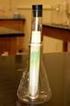
3 4. Using the same ruler and pencil, draw nine small dots. Measure 2 cm from the edge for the first dot on the line drawn in step 3 and then add a dot every 2 cm across the line. Label the first dot 1 (see Figure 3). 5. Obtain the seven 0.5% individual dye solutions and two unknown dye mixtures. 6. List on the data table the location where each dye will be placed. ote: Dye samples may be spotted in any order but location must be recorded. 7. Label the top of the chromatography paper in pencil, dot 1 = 1, dot 2 = Using a clean toothpick for each individual dye sample, spot the chromatography paper by putting the toothpick into the dye sample solution and then touch the tip of the toothpick gently onto a self-designated pencil dot. Repeat the procedure as necessary to increase the concentration of the sample but do not increase the size of the dot. 9. After spotting all nine samples, wait 1 2 minutes for the samples on the chromatography paper to completely dry. 10. While the sample is drying obtain the 1000-mL tall-form beaker and watch glass that is sized to fit the tall-form beaker. (ote: See teacher list for other options if tall-form beakers are not available.) 11. Pour 50 ml of 0.1% acl solution into the tall-form beaker and cover the top of the beaker with a watch glass. This is the chromatography chamber. The 0.1% acl is the developing solvent. 12. Once the sample is dry, wrap the chromatography paper into a cylinder, and slightly overlap the blank ends. Staple, being careful not to disrupt the samples (see Figure 4). 13. Remove the watch glass from the tall-form beaker and carefully place the cylinder-shaped chromatography paper into the prepared chromatography chamber with the sample end down (as shown in Figure 5). Do not get any solvent on the upper portion of the chromatography paper. The sample spots must remain above the level of the solvent. If the solvent level is too high, the samples will dilute into the solvent! 14. Place the watch glass back on the tall-form beaker. Allow the chromatography paper to develop. ote: This should take minutes. 15. When the developing solvent is within 1 2 cm of the top of the chromatography paper, stop the run by removing the rolled chromatography paper from the beaker. 16. With a pencil, lightly draw a line to mark the distance the solvent traveled to the top of the chromatography paper. This is called the solvent front. 17. Gently remove the staples and lay the chromatography paper flat. Figure 4. 2 cm 20 cm 18. Measure the distance from the pencil line at the bottom of the chromatography paper to the solvent front. Record this distance in cm on the worksheet. 19. In pencil, trace the shape of each dye band or spot to mark the location of each separated band on the chromatography paper. This should be done immediately because the color and brightness of some spots may fade over time. 20. Measure the distance traveled in cm by each dye in each pure solution or mixture. Measure from the line at the bottom of the paper to the center of each band. Record the results in cm on the worksheet. } 2 cm } Figure 3. Figure cm } 1.5 cm Paper Developing solvent 0.1% acl 3 I Flinn Scientific, Inc. All Rights Reserved. Reproduction permission is granted only to science teachers who have purchased Food Dye Chromatography, Catalog o. AP7394, from Flinn Scientific, Inc. o part of this material may be reproduced or transmitted in any form or by any means, electronic or mechanical, including, but not limited to photocopy, recording, or any information storage and retrieval system, without permission in writing from Flinn Scientific, Inc.

4 Data Table ame: Food Dye Chromatography Worksheet To compare and identify compounds separated by paper chromatography, you can calculate the R f (rate of flow) value for each dye using the formula below. distance traveled by dye R f = distance traveled by solvent front To maintain consistency, always measure from the pencil line marked at the bottom of the chromatography paper to the center of each spot. Record R f values for each of the dyes. Distance traveled by solvent front cm. Location from left ame of dye or unknown Sample color Distance traveled by dye (cm) R f calculated Post-Lab Questions (Use a separate sheet of paper to answer the following questions.) 1. Calculate the R f value for each dye in both the pure solutions and unknown mixtures. Record the results in the data table. 2. Identify the dyes present in the unknown mixtures. Include supporting data and reasoning for your conclusions. 3. Compare the R f values of the pure dyes. Which pairs of dyes appeared to have very similar properties, based on their R f values, despite their different colors? 4. Which food dye(s) had the greatest interaction with or affinity for the paper versus the solvent? Explain. 5. You are asked to mix an additional experimental unknown and want to make sure the mixture is a challenging one. Using observations and data from the completed experiment, develop a new three-dye component mixture that may be difficult to analyze. Explain why you chose this mixture. 4 I Flinn Scientific, Inc. All Rights Reserved. Reproduction permission is granted only to science teachers who have purchased Food Dye Chromatography, Catalog o. AP7394, from Flinn Scientific, Inc. o part of this material may be reproduced or transmitted in any form or by any means, electronic or mechanical, including, but not limited to photocopy, recording, or any information storage and retrieval system, without permission in writing from Flinn Scientific, Inc.

5 Materials Included in Kit (for 15 groups of students) Food Dye FD&C Blue o. 1, 2 g Food Dye FD&C Blue o. 2, 2 g Food Dye FD&C Green o. 3, 1 g Teacher s otes Food Dye Chromatography Food Dye FD&C Yellow o. 5, 2 g Food Dye FD&C Yellow o. 6, 2 g Sodium chloride, acl, 0.1 g Food Dye FD&C Red o. 3, 1 g Chromatography paper 20 cm 20 cm, 15 Food Dye FD&C Red o. 40, 2 g Toothpicks, 150 Additional Materials eeded (for each lab group) Beaker, tall-form, 1000-mL Pencil Ruler Scissors Stapler Watch glass, large (to fit beaker) Additional Materials eeded (for Pre-Lab Preparation) Water, distilled or deionized Beakers, 250-mL, 7 Graduated cylinder, 100-mL Unknown dye mixtures Pre-Lab Preparation 1. To prepare the individual dye solutions, add each 0.5 g of solid dye to separate beakers with 100 ml of distilled or deionized water each and mix thoroughly. 2. Dissolve 1 g of solid sodium chloride in 1000 ml of distilled or deionized water and mix thoroughly. 3. See the Lab Hints section for suggestions for unknown mixtures of dyes. Safety Precautions The FD&C dyes are slightly hazardous by ingestion, inhalation, and eye or skin contact. Red o. 40 may be absorbed through skin and Yellow o. 5 may be a skin contact sensitizer. All are irritating to skin and eyes. Avoid contact with eyes, skin, and clothing. Wear chemical splash goggles, chemical-resistant gloves, and a chemical-resistant apron. Remind students to wash their hands thoroughly with soap and water before leaving the laboratory. Please review current Material Safety Data Sheets for additional safety, handling, and disposal information. Disposal Please consult your current Flinn Scientific Catalog/Reference Manual for general guidelines and specific procedures, and review all federal, state and local regulations that may apply, before proceeding. Excess dye solutions and sodium chloride solution may be disposed of down the drain with plenty of excess water according to Flinn Suggested Disposal Method #26b. Connecting to the ational Standards This laboratory activity relates to the following ational Science Education Standards (1996): Unifying Concepts and Processes: Grades K 12 Evidence, models, and explanation Constancy, change, and measurement Content Standards: Grades 5 8 Content Standard A: Science as Inquiry Content Standard B: Physical Science, properties and changes of properties in matter, motions and forces, Content Standards: Grades 9 12 Content Standard A: Science as Inquiry Content Standard B: Physical Science, structure and properties of matter, motions and forces Flinn Scientific, Inc. All Rights Reserved. I7394

6 Teacher s otes continued Lab Hints Enough materials are provided in this kit for 30 students working in pairs, or for 15 groups of students. Both parts of this laboratory activity can reasonably be completed in one 50-minute class period. The Pre-Laboratory assignment may be completed before coming to lab, and the data analysis and Post-Lab Questions may be completed the day after the lab. Suggestions for unknown mixtures: a) Red o. 3, Blue o. 2, and Yellow o. 5, b) Red o. 40, Yellow o. 6, Blue o. 1, c) Red o. 3, Green o. 3, Blue o. 1, d) Red o. 3, Red o. 40, and Blue o. 2. Mix equal volumes of each dye desired to create a mixture. In this activity, it is extremely important that the initial sample spots are as small as possible. If the spots are too large or if there is too much material (dye) on the initial spot, the students may only see a streak of color up the entire chromatogram. Allowing enough time for the development of the chromatography paper is critical. The chromatography paper must be left in the chromatography chamber long enough for the solvent to be drawn up near the top of the strip. Do not stop the development until the solvent front nears the top of the strip. Underdevelopment will lead to incomplete separation. Do not allow the solvent front to move off the paper, however. Solvent used for development can be reused. Leftover chromatography solvent can be saved and used by another class. Other size beakers or mason jars will also work for chromatography chambers however, the taller the better. Covering alternatives for the chromatography chambers include plastic wrap, Petri dishes, and other suitable inert coverings such as Parafilm M. If changing chromatography chamber components, reconfigure the chromatography paper to fit the alternative chromatography chamber. If needed, other filter paper sizes and shapes can be used such as radial circular paper. Confirm all modified materials are acceptable by conducting a lab trial before introducing the procedure to students. Extra dyes are provided for chromatography and spectroscopy lab activities. Other FD&C food dye kits available from Flinn Scientific include Exploring Chemical Reactions with Food Dyes, Catalog o. AP7418, and Quantitative Determination of Food Dyes, Catalog o. AP7428. Teaching Tips The structures of the food dyes are shown in the Supplementary section at the end of these kit instructions. Connect with the history of food dyes and have students find a substance now considered toxic that was once purposely added to food. Encourage students to try other solvent mixtures to achieve different or better separations. Students can construct a design of experiment (DOE) to identify the dyes in for colored food products such as M&Ms or Skittles. Candy may be placed in 5 6 drops of water. Stir the candy until the color dissolves. Repeat with two more candies. This is the color extract sample. Expand the students chromatographic repertoire by using Sep Pak C18 Cartridges such as Flinn Scientific Kit AP9093. Blue o. 1 Yellow o. 5 Green o. 3 Yellow o. 6 Answers to Pre-Lab Questions (Student answers will vary.) 1. What is the primary factor determining the distance a sample will move along the chromatography paper? The attraction between the sample and the chromatography paper determines how much time the sample spends bonded to the paper and how much time it remains in solution. These factors determine the distance/time a sample will move. 2. Check for food labels at home or in a grocery store and find items with food dyes in them. List the food(s) and the FD&C dyes included in the ingredient list. Student answers will vary. Much of the processed food today has dyes in it. Blue o. 2 Red o. 40 Red o. 3 Sample Unknown Mixtures Results Flinn Scientific, Inc. All Rights Reserved. I7394

7 Teacher s otes continued Sample Data Table (Student data will vary.) Location from left ame of dye or unknown Sample color Distance traveled by dye (cm) R f calculated 1 Yellow o. 5 Yellow Blue o.2 Dark navy blue Green o.3 Dark blue-green Red o.3 Red Blue o.1 Dark turquoise blue Red o.40 Dark red Yellow o.6 Dark orange Mixture 1 Dark reddish brown 0.96/4.80/9.18/ /0.34/0.64/ Mixture 2 Dark reddish brown 3.09/6.30/8.64/ /0.44/0.60/0.79 Answers to Post-Lab Questions (Student answers will vary.) 1. Calculate the R f value for each dye in both the pure solutions and unknown mixtures. Record the results in the data table. See data table for sample data. 2. Identify the dyes present in the unknown mixtures. Include supporting data and reasoning for your conclusions. Answers will vary depending on the unknown mixtures. Students should cite references to visual color and rate of flow R f.. 3. Compare the R f values of the pure dyes. Which pairs of dyes appeared to have very similar properties, based on their R f values, despite their different colors? Red o. 40 and Blue o. 2 had similar R f values as did Blue o. 1 and Green o Which food dye(s) had the greatest interaction with or affinity for the paper versus the solvent? Explain. A high interaction or affinity for the paper would take quite a bit of time and the sample would not move very much resulting in a low distance traveled. Red o. 3 has a very low distance traveled, showing it has more affinity for the paper than the solvent. 5. You are asked to mix an additional experimental unknown and want to make sure the mixture is a challenging one. Using observations and data from the completed experiment, develop a new three-dye component mixture that may be difficult to analyze. Explain why you chose this mixture. Reference Several student answers may be correct. Examples may include: A mixture containing Blue o. 1 and Green o. 3 might be hard to separate due to rate-of-flow values. A mixture containing Yellow o. 5 and Yellow o. 6 is visually hard to separate. Markow, P. G. The Ideal Solvent for Paper Chromatography of Food Dyes. J. Chem. Ed. 1988, 65, 10, pp The Food Dye Chromatography Student Laboratory Kit is available from Flinn Scientific, Inc. Catalog o. Description AP7394 Food Dye Chromatography Student Laboratory Kit AP7375 FD&C Food Dyes, Set of 7 AP4299 Chromatography Paper AP7418 Exploring Chemical Reactions with Food Dyes AP7428 Quantitative Determination of Food Dyes Consult your Flinn Scientific Catalog/Reference Manual for current prices Flinn Scientific, Inc. All Rights Reserved. I7394

8 Teacher s otes continued Supplementary Information H(C 2 H 5 )CH 2 C ao 3 S O (C 2 H 5 )CH 2 Figure 1. FD&C Blue o. 1 O Figure 2. FD&C Blue o. 2 HO C H(C 2 H 5 )CH 2 ao I O I O I CO 2 a I (C 2 H 5 )CH 2 Figure 3. FD&C Green o. 3 Figure 4. FD&C Red o. 3 OCH 3 HO ao 3 S CH 3 aso 3 HO Figure 5. FD&C Red o. 40 ao 2 C Figure 6. FD&C Yellow o. 5 ao 3 S Figure 7. FD&C Yellow o Flinn Scientific, Inc. All Rights Reserved. I7394

Separation of Dyes by Paper Chromatography
 Cautions: The FD&C food dyes used are concentrated and may stain clothing and skin. Do not ingest any of the food dyes or food samples used in this lab. Purpose: The purpose of this experiment is to determine
Reaction in a Bag. Scientific Method Demonstrations
 elearning 2009 Introduction Reaction in a Bag Scientific Method Demonstrations Publication No. 91419 Careful observation is the foundation of science, leading to questions about what we have observed how,
Paper Chromatography: Separation and Identification of Five Metal Cations
 Paper Chromatography: Separation and Identification of Five Metal Cations Objectives Known and unknown solutions of the metal ions Ag +, Fe 3+, Co 2+, Cu 2+ and Hg 2+ will be analyzed using paper chromatography.
Dry Ice Color Show Dry Ice Demonstrations
 elearning 2009 Introduction Dry Ice Color Show Dry Ice Demonstrations Publication No. 95016 Add a small piece of solid carbon dioxide to a colored indicator solution and watch as the solution immediately
PAPER CHROMATOGRAPHY
 PAPER CHROMATOGRAPHY INTRODUCTION Chromatography is a technique that is used to separate and to identify components of a mixture. This analytical technique has a wide range of applications in the real
Target Mole Lab. Mole Relationships and the Balanced Equation. For each student group Hydrochloric acid solution, HCl, 3 M, 30 ml
 elearning 2009 Introduction Target Mole Lab Mole Relationships and the Balanced Equation Publication No. A common chemical reaction used in chemistry class is zinc and hydrochloric In this lab, students
Tin Man Electrolysis
 elearning 2009 Introduction Tin Man Electrolysis Electrolysis Reactions Publication No. 91646 Grow a beautiful tin-man crystal tree by running an electric current through a solution of tin(ii) chloride.
Colorful Iron Complexes
 elearning 2009 Introduction Colorful Iron Complexes Transition Metal Complex Ions Publication No. 91857 Easily distinguish between solutions of iron(ii) and iron(iii) ions by performing re-dox reactions
Ink Analysis 2005, 2004, 2002, 1993 by David A. Katz. All rights reserved.
 Ink Analysis 2005, 2004, 2002, 1993 by David A. Katz. All rights reserved. Ink from most ball-point pens and markers can be developed by paper chromatography using 70% isopropyl rubbing alcohol as the
Separation of Amino Acids by Paper Chromatography
 Separation of Amino Acids by Paper Chromatography Chromatography is a common technique for separating chemical substances. The prefix chroma, which suggests color, comes from the fact that some of the
Lab 6: Paper Chromatography. Pages145-154 Pre-lab page 151 No Post lab Chromatogram must be turned in attached to lab report
 Lab 6: Paper Chromatography Pages145-154 Pre-lab page 151 No Post lab Chromatogram must be turned in attached to lab report Chromatography Chromatography is an analytical technique used to separate the
DYES AND DYEING 2003 by David A. Katz. All rights reserved. Permission for classroom use provided original copyright is included.
 DYES AND DYEING 2003 by David A. Katz. All rights reserved. Permission for classroom use provided original copyright is included. Dyeing of textiles has been practiced for thousands of years with the first
ANALYSIS OF PLANT PIGMENTS USING PAPER CHROMATOGRAPHY AND VISIBLE AND/OR UV SPECTROSCOPY (1-31-96)
 ANALYSIS OF PLANT PIGMENTS USING PAPER CHROMATOGRAPHY AND VISIBLE AND/OR UV SPECTROSCOPY (1-31-96) INTRODUCTION We have seen that all cells must constantly consume fuel molecules to maintain themselves,
Petri Dish Electrolysis Electrolysis Reactions
 elearning 2009 Introduction Petri Dish Electrolysis Electrolysis Reactions Publication No. 95008 Electrolysis is defined as the decomposition of a substance by means of an electric current. When an electric
Luminol Test PROCESS SKILLS SCIENCE TOPICS VOCABULARY
 EXPERIMENT: LUMINOL TEST Luminol Test Visitors mix a solution of luminol with fake blood (hydrogen peroxide) to produce a reaction that gives off blue light. OBJECTIVES: Visitors learn that some chemical
RECITATION NOTES FOR EXPERIMENT # 5 A&B THIN LAYER CHROMATOGRAPHY
 RECITATION NOTES FOR EXPERIMENT # 5 A&B THIN LAYER CHROMATOGRAPHY Have your lab textbook available for quick reference to specific pages, indicated in red. BASIC PRINCIPLES OF CHROMATOGRAPHY Chromatography
Kinetics of Crystal Violet Fading AP* Chemistry Big Idea 4, Investigation 11 An Advanced Inquiry Lab
 Introduction Kinetics of Crystal Violet Fading AP* Chemistry Big Idea 4, Investigation 11 An Advanced Inquiry Lab Catalog o. AP7644S Publication o. 7644S Crystal violet is a common, beautiful purple dye.
Acid Base Titrations
 Acid Base Titrations Introduction A common question chemists have to answer is how much of something is present in a sample or a product. If the product contains an acid or base, this question is usually
Chromatography...Oh Yeah!
 Chromatography...Oh Yeah! What s In Kool-Aid? An Introduction to Extraction and Chromatography OVERVIEW: The purpose of the experiment is to separate and analyze the components of prepared Kool- Aid using
Recovery of Elemental Copper from Copper (II) Nitrate
 Recovery of Elemental Copper from Copper (II) Nitrate Objectives: Challenge: Students should be able to - recognize evidence(s) of a chemical change - convert word equations into formula equations - perform
Polarity and Properties Lab PURPOSE: To investigate polar and non-polar molecules and the affect of polarity on molecular properties.
 Name!!!! date Polarity and Properties Lab PURPOSE: To investigate polar and non-polar molecules and the affect of polarity on molecular properties. STATION 1: Oil and water do not mix. We all know that.
experiment5 Understanding and applying the concept of limiting reagents. Learning how to perform a vacuum filtration.
 81 experiment5 LECTURE AND LAB SKILLS EMPHASIZED Synthesizing an organic substance. Understanding and applying the concept of limiting reagents. Determining percent yield. Learning how to perform a vacuum
Hands-On Labs SM-1 Lab Manual
 EXPERIMENT 4: Separation of a Mixture of Solids Read the entire experiment and organize time, materials, and work space before beginning. Remember to review the safety sections and wear goggles when appropriate.
Thin Layer and Column Chromatography
 Thin Layer and Column Chromatography Chromatography is a widely used chemical separation method that takes advantage of different affinities of compounds to a fixed or stationary phase and a mobile phase.
Vitamin C Content of Fruit Juice
 1 Vitamin C Content of Fruit Juice Introduction Vitamin C Vitamins are organic compounds that have important biological functions. For instance, in humans they enable a variety of enzymes in the body to
Chapter 5, Lesson 3 Why Does Water Dissolve Salt?
 Chapter 5, Lesson 3 Why Does Water Dissolve Salt? Key Concepts The polarity of water molecules enables water to dissolve many ionically bonded substances. Salt (sodium chloride) is made from positive sodium
Properties of Acids and Bases
 Properties of Acids and Bases (Adapted from Flinn Scientific Acid Base Test Kit I #AP4567) Introduction Battery acid, stomach acid, acid rain just a few acids in our everyday life! What does it mean when
Separation and Identification of Plant Pigments Dr. Gergens - SD Mesa College
 Separation and Identification of Plant Pigments Dr. Gergens - SD Mesa College PURPOSE In this experiment, the photosynthetic pigments common to all flowering plants will be extracted by liquidliquid extraction.
Making Biodiesel from Virgin Vegetable Oil: Teacher Manual
 Making Biodiesel from Virgin Vegetable Oil: Teacher Manual Learning Goals: Students will understand how to produce biodiesel from virgin vegetable oil. Students will understand the effect of an exothermic
Lab 25. Acid-Base Titration and Neutralization Reactions: What Is the Concentration of Acetic Acid in Each Sample of Vinegar?
 Lab 25. Acid-Base Titration and Neutralization Reactions: What Is the Concentration of Acetic Acid in Each Sample of Vinegar? Introduction Vinegar is basically a solution of acetic acid (CH3COOH). It is
Written By Kelly Lundstrom & Kennda Lynch January 31, 2012 Milk Dye ACTIVITY PLAN
 Milk Dye ACTIVITY PLAN Objective: Students will use the scientific method to test the difference between using whole milk and skim milk in this milk and food dye experiment. Students will explore ideas
Chemical Bonding: Polarity of Slime and Silly Putty
 Lab 12 Chemical Bonding: Polarity of Slime and Silly Putty TN Standard 3.1: Investigate chemical bonding. Students will distinguish between polar and non-polar molecules. Have you ever read the newspaper
THE ACTIVITY OF LACTASE
 THE ACTIVITY OF LACTASE Lab VIS-8 From Juniata College Science in Motion Enzymes are protein molecules which act to catalyze the chemical reactions in living things. These chemical reactions make up the
Chemistry 101. Chemistry Experiments for the Home Acidity Determination Using Indicators
 Chemistry 101 Chemistry Experiments for the Home Acidity Determination Using Indicators I. Objective: To determine the acidity of a variety of common substances by the use of indicators. To prepare your
Solubility Curve of Sugar in Water
 Solubility Curve of Sugar in Water INTRODUCTION Solutions are homogeneous mixtures of solvents (the larger volume of the mixture) and solutes (the smaller volume of the mixture). For example, a hot chocolate
EXPERIMENT 7 Reaction Stoichiometry and Percent Yield
 EXPERIMENT 7 Reaction Stoichiometry and Percent Yield INTRODUCTION Stoichiometry calculations are about calculating the amounts of substances that react and form in a chemical reaction. The word stoichiometry
Experiment 5: Column Chromatography
 Experiment 5: Column Chromatography Separation of Ferrocene & Acetylferrocene by Column Chromatography Reading: Mohrig, Hammond & Schatz Ch. 18 pgs 235-253 watch the technique video on the course website!
PREPARATION AND PROPERTIES OF A SOAP
 (adapted from Blackburn et al., Laboratory Manual to Accompany World of Chemistry, 2 nd ed., (1996) Saunders College Publishing: Fort Worth) Purpose: To prepare a sample of soap and to examine its properties.
TIE DYE CHEMISTRY INTRODUCTION. LAB MSC 1 From Flinn CHEM FAX Publication #10075
 TIE DYE CHEMISTRY LAB MSC 1 From Flinn CHEM FAX Publication #10075 INTRODUCTION The art of dying clothing fibers probably originated in India or China no later than 2500 BC. Most natural dyes came from
Determination of a Chemical Formula
 1 Determination of a Chemical Formula Introduction Molar Ratios Elements combine in fixed ratios to form compounds. For example, consider the compound TiCl 4 (titanium chloride). Each molecule of TiCl
Stoichiometry. Can You Make 2.00 Grams of a Compound?
 Introduction Stoichiometry... Can You Make 2.00 Grams of a Compound? Catalog No. AP4554 Publication No. 4554 Use your skills of predicting chemical reactions, balancing equations, and calculating molar
The Empirical Formula of a Compound
 The Empirical Formula of a Compound Lab #5 Introduction A look at the mass relationships in chemistry reveals little order or sense. The ratio of the masses of the elements in a compound, while constant,
Explain the role of blood and bloodstain patterns in forensics science. Analyze and identify bloodstain patterns by performing bloodstain analysis
 Lab 4 Blood Learning Objectives Explain the role of blood and bloodstain patterns in forensics science Analyze and identify bloodstain patterns by performing bloodstain analysis Introduction Blood, a
In this experiment, we will use three properties to identify a liquid substance: solubility, density and boiling point..
 Identification of a Substance by Physical Properties 2009 by David A. Katz. All rights reserved. Permission for academic use provided the original copyright is included Every substance has a unique set
Properties of Acids and Bases
 Lab 22 Properties of Acids and Bases TN Standard 4.2: The student will investigate the characteristics of acids and bases. Have you ever brushed your teeth and then drank a glass of orange juice? What
DNA SPOOLING 1 ISOLATION OF DNA FROM ONION
 DNA SPOOLING 1 ISOLATION OF DNA FROM ONION INTRODUCTION This laboratory protocol will demonstrate several basic steps required for isolation of chromosomal DNA from cells. To extract the chromosomal DNA,
Whoosh Bottle Safe Laboratory Practices
 E-Learning Introduction Whoosh Bottle Safe Laboratory Practices Teach essential safety precautions relative to combustion, flammability, and the fire triangle. Publication No. 95010 Concepts Flammable
Sugar or Salt? Ionic and Covalent Bonds
 Lab 11 Sugar or Salt? Ionic and Covalent Bonds TN Standard 2.1: The student will investigate chemical bonding. Have you ever accidentally used salt instead of sugar? D rinking tea that has been sweetened
The Great Peanut Problem
 elearning 2009 Introduction The Great Peanut Problem Calorimetry Publication No. 91259 All human activity requires burning food for energy. How much energy is released when food burns in the body? How
Lab: Properties of Polar and Nonpolar Substances
 Lab: Properties of Polar and Nonpolar Substances Purpose: To explain the interactions of matter in relation to polarity. Stations 1 and 2 - il and water do not mix As a metaphor, oil and water are often
Household Acids and Bases
 Household Acids and Bases GRADE LEVEL INDICATORS Experiment Demonstrate that the ph scale (0-14) is used to measure acidity and classify substances or solutions as acidic, basic, or neutral. 21 Develop
Neutralizing an Acid and a Base
 Balancing Act Teacher Information Objectives In this activity, students neutralize a base with an acid. Students determine the point of neutralization of an acid mixed with a base while they: Recognize
Surface Tension: Liquids Stick Together Teacher Version
 Surface Tension: Liquids Stick Together Teacher Version In this lab you will learn about properties of liquids, specifically cohesion, adhesion, and surface tension. These principles will be demonstrated
Absorbance Spectrophotometry: Analysis of FD&C Red Food Dye #40
 Absorbance Spectrophotometry: Analysis of FD&C Red Food Dye #40 Note: there is a second document that goes with this one! 2046 - Absorbance Spectrophotometry - Calibration Curve Procedure. The second document
SEPARATION OF A MIXTURE OF SUBSTANCES LAB
 SEPARATION OF A MIXTURE OF SUBSTANCES LAB Purpose: Every chemical has a set of defined physical properties, and when combined they present a unique fingerprint for that chemical. When chemicals are present
Activity Sheets Enzymes and Their Functions
 Name: Date: Activity Sheets Enzymes and Their Functions amylase What are Enzymes? starch glucose Enzymes are compounds that assist chemical reactions by increasing the rate at which they occur. For example,
For Chromatography, you must remember Polar Dissolves More, not like dissolves like.
 Chromatography In General Separation of compounds based on the polarity of the compounds being separated Two potential phases for a compound to eist in: mobile (liquid or gas) and stationary Partitioning
ASPARTAME The Study of a Peptide Bond
 ASPARTAME The Study of a Peptide Bond INTRODUCTION Aspartame, commonly known as NutraSweet or Equal, is the most popular artificial, low-calorie sweetener available to consumers today. Chemically, aspartame
Physical and Chemical Properties and Changes
 Physical and Chemical Properties and Changes An understanding of material things requires an understanding of the physical and chemical characteristics of matter. A few planned experiments can help you
Designing An Experiment Using Baking Soda and Vinegar
 Designing An Experiment Using Baking Soda and Vinegar Introduction: Kinetics is the study of chemical reaction rates. It is the study of how fast different chemicals react with one another to form new
Amino Acids, Peptides, and Proteins
 1 Amino Acids, Peptides, and Proteins Introduction Amino Acids Amino acids are the building blocks of proteins. In class you learned the structures of the 20 common amino acids that make up proteins. All
A Beer s Law Experiment
 A Beer s Law Experiment Introduction There are many ways to determine concentrations of a substance in solution. So far, the only experiences you may have are acid-base titrations or possibly determining
MATERIAL SAFETY DATA SHEET TOILET BOWL SANITIZER
 MATERIAL SAFETY DATA SHEET TOILET BOWL SANITIZER No. 1 Date Issued: 07/03/2011 COMPANY DETAILS NAME: Hygiene Systems (Pty) Ltd EMERGENCY TEL: 0860 494 4363 ADDRESS: 7 Hargan Road, TEL: 011 552 8403 SECTION
To determine the equivalence points of two titrations from plots of ph versus ml of titrant added.
 Titration Curves PURPOSE To determine the equivalence points of two titrations from plots of ph versus ml of titrant added. GOALS 1 To gain experience performing acid-base titrations with a ph meter. 2
Greatest Discoveries With Bill Nye: Chemistry Teacher s Guide
 Teacher s Guide Grade Level: 6 8 Curriculum Focus: Physical Science Lesson Duration: Two class periods Program Oxygen and Atoms Explore atomic and molecular structure and see how oxygen was first isolated.
Chemistry 119: Experiment 7. Potentiometric Titration of Ascorbic Acid in Vitamin C Tablets
 Chemistry 119: Experiment 7 Potentiometric Titration of Ascorbic Acid in Vitamin C Tablets Vitamin C is another name for ascorbic acid (C 6 H 8 O 6, see below ), a weak acid that can be determined by titration
Lab #13: Qualitative Analysis of Cations and Anions
 Lab #13: Qualitative Analysis of Cations and Anions Objectives: 1. To understand the rationale and the procedure behind the separation for various cations and anions. 2. To perform qualitative analysis
Enzyme Activity Measuring the Effect of Enzyme Concentration
 6 Measuring the Effect of Enzyme Concentration Enzymes are proteins that serve as biological catalysts in a wide variety of life sustaining chemical reactions that take place in cells. As catalysts, enzymes
IDENTIFICATION OF POLYMERS 1998 by David A. Katz. All rights reserved
 IDENTIFICATION OF POLYMERS 1998 by David A. Katz. All rights reserved David A. Katz Chemist, Educator, Science Communicator, and Consultant 133 N. Desert Stream Dr., Tucson, AZ 85745 Voice/Fax: 520-624-2207
WARNING NOTICE. Chemiluminescence What s inside of a light stick anyway?
 WARNING NOTICE The experiments described in these materials are potentially hazardous. Among other things, the experiments should include the following safety measures: a high level of safety training,
Separation by Solvent Extraction
 Experiment 3 Separation by Solvent Extraction Objectives To separate a mixture consisting of a carboxylic acid and a neutral compound by using solvent extraction techniques. Introduction Frequently, organic
SOLUBILITY OF A SALT IN WATER AT VARIOUS TEMPERATURES LAB
 SOLUBILITY OF A SALT IN WATER AT VARIOUS TEMPERATURES LAB Purpose: Most ionic compounds are considered by chemists to be salts and many of these are water soluble. In this lab, you will determine the solubility,
TEACHER ACTIVITY GUIDE
 Page 1/5 TEACHER ACTIVITY GUIDE EFFECT OF HEAT & ph ON COLOR & TEXTURE OF GREEN VEGETABLES Taken from IFT Experiments in Food Science Series Color plays a key role in establishing consumer acceptability
EFFECT OF SALT ON CELL MEMBRANES
 EFFECT OF SALT ON CELL MEMBRANES LAB CELL 2 INTRODUCTION A eukaryotic cell, a cell with a nucleus, not only has a plasma membrane as its external boundary, but it also has a variety of membranes that divide
Concentrations and Dilutions of Food Dyes
 Concentrations and Dilutions of Food Dyes Learning Goals: 1. Develop an understanding of the use of volumetric glassware. 2. Prepare a series of dye solutions of known concentrations. 3. Explore the relationship
General Chemistry I (FC, 09-10) Lab #3: The Empirical Formula of a Compound. Introduction
 General Chemistry I (FC, 09-10) Introduction A look at the mass relationships in chemistry reveals little order or sense. The ratio of the masses of the elements in a compound, while constant, does not
The Synthesis of trans-dichlorobis(ethylenediamine)cobalt(iii) Chloride
 CHEM 122L General Chemistry Laboratory Revision 2.0 The Synthesis of trans-dichlorobis(ethylenediamine)cobalt(iii) Chloride To learn about Coordination Compounds and Complex Ions. To learn about Isomerism.
Experiment 13H THE REACTION OF RED FOOD COLOR WITH BLEACH 1
 Experiment 13H FV 1/25/2011(2-run) THE REACTION OF RED FOOD COLOR WITH BLEACH 1 PROBLEM: Determine the rate law for the chemical reaction between FD&C Red Dye #3 and sodium hypochlorite. LEARNING OBJECTIVES:
Chemical reaction (slow): Enzyme-catalyzed reaction (much faster):
 1 Enzymes Introduction Enzymes are Biological Catalysts Recall that a catalyst is an agent which speeds up a chemical reaction without actually being consumed or changed by the reaction. Enzymes are proteins
PHYSICAL SEPARATION TECHNIQUES. Introduction
 PHYSICAL SEPARATION TECHNIQUES Lab #2 Introduction When two or more substances, that do not react chemically, are blended together, the result is a mixture in which each component retains its individual
Acetic Acid Content of Vinegar: An Acid-Base Titration E10-1
 Experiment 10 Acetic Acid Content of Vinegar: An Acid-Base Titration E10-1 E10-2 The task The goal of this experiment is to determine accurately the concentration of acetic acid in vinegar via volumetric
Enzyme Pre-Lab. Using the Enzyme worksheet and Enzyme lab handout answer the Pre-Lab questions the pre-lab must be complete before beginning the lab.
 Enzyme Pre-Lab Using the Enzyme worksheet and Enzyme lab handout answer the Pre-Lab questions the pre-lab must be complete before beginning the lab. Background: In this investigation, you will study several
COMMON LABORATORY APPARATUS
 COMMON LABORATORY APPARATUS Beakers are useful as a reaction container or to hold liquid or solid samples. They are also used to catch liquids from titrations and filtrates from filtering operations. Bunsen
Acids, Bases, and ph
 CHAPTER 9 1 SECTION Acids, Bases, and Salts Acids, Bases, and ph KEY IDEAS As you read this section, keep these questions in mind: What properties do acids have? What properties do bases have? How can
Teacher Demo: Photosynthesis and Respiration: Complementary Processes
 SNC1D/1P Sustainable Ecosystems/ Sustainable Ecosystems and Human Activity Teacher Demo: Photosynthesis and Respiration: Complementary Processes Topics photosynthesis and respiration gas tests for oxygen
Return to Lab Menu. Acids and Bases in Your House
 Return to Lab Menu Acids and Bases in Your House OBJECTIVES Isolate a natural acid-base indicator. Determine the acid-base properties of common household solutions. INTRODUCTION Acids and bases are among
Respiration and Photosynthesis
 Respiration and Photosynthesis Topic Plants and animals carry out cellular respiration, but only plants conduct photosynthesis. Introduction Cellular respiration is the process in which a cell uses oxygen
How do you digest milk? In this experiment you will test the ability of two substances, an acid and enzyme, to break down protein.
 3.3 (page 1) Science Projects For ALL Students Digestion How do you digest milk? In this experiment you will test the ability of two substances, an acid and enzyme, to break down protein. Digestion is
# 12 Condensation Polymerization: Preparation of Two Types of Polyesters
 # 12 Condensation Polymerization: Preparation of Two Types of Polyesters Submitted by: Arturo Contreras, Visiting Scholar, Center for Chemical Education, Miami University, Middletown, OH; 1996 1997. I.
Austin Peay State University Department of Chemistry CHEM 1111. Empirical Formula of a Compound
 Cautions Magnesium ribbon is flammable. Nitric acid (HNO 3 ) is toxic, corrosive and contact with eyes or skin may cause severe burns. Ammonia gas (NH 3 ) is toxic and harmful. Hot ceramic crucibles and
ALVERNIA UNIVERSITY OSHA REGULATION: 29 CFR 1910.1200 HAZARD COMMUNICATION SECTION: 1700 REVISION DATE: 2/3/2012 REVISION: 4 NUMBER:
 OSHA REGULATION: 29 CFR 90.200 HAZARD COMMUNICATION 700 : DATE: /3/200 DATE: 2/3/202 A. POLICY. This procedure follows requirements set forth in 29 CFR 90.200. 2. It is the policy of Alvernia University
AN EXPERIMENT IN ALCHEMY: COPPER TO SILVER TO GOLD 2005, 2000, 1996 by David A. Katz. All rights reserved
 AN EXPERIMENT IN ALCHEMY: COPPER TO SILVER TO GOLD 2005, 2000, 1996 by David A. Katz. All rights reserved INTRODUCTION One of the goals of the ancient alchemists was to convert base metals into gold. Although
RAINBOW ELECTROPHORESIS 1 An Introduction to Gel Electrophoresis
 RAINBOW ELECTROPHORESIS 1 An Introduction to Gel Electrophoresis INTRODUCTION This laboratory will demonstrate the basics of electrophoresis and the theory behind the separation of molecules on an agarose
Mixtures and Pure Substances
 Unit 2 Mixtures and Pure Substances Matter can be classified into two groups: mixtures and pure substances. Mixtures are the most common form of matter and consist of mixtures of pure substances. They
EFFECT OF ALCOHOL ON CELL MEMBRANES
 EFFECT OF ALCOHOL ON CELL MEMBRANES LAB CELL 1 INTRODUCTION A eukaryotic cell, a cell with a nucleus, not only has a plasma membrane as its external boundary, but it also has a variety of membranes that
Extraction: Separation of Acidic Substances
 Extraction: Separation of Acidic Substances Chemists frequently find it necessary to separate a mixture of compounds by moving a component from one solution or mixture to another. The process most often
Both drink mixes contain similar basic ingredients, as listed in Table 1. Ascorbic acid (vitamin C) Ascorbic acid (vitamin C)
 MAKE YOUR OWN ORANGE DRINK AN EXPERIMENT IN DETERMINING HOW ADDITIVES AFFECT OUR FOOD 2000, 1999, 1996 by David A. Katz. All rights reserved. Reproduction permitted for education use provided original
EXPERIMENT 12: Empirical Formula of a Compound
 EXPERIMENT 12: Empirical Formula of a Compound INTRODUCTION Chemical formulas indicate the composition of compounds. A formula that gives only the simplest ratio of the relative number of atoms in a compound
Experiment 8 - Double Displacement Reactions
 Experiment 8 - Double Displacement Reactions A double displacement reaction involves two ionic compounds that are dissolved in water. In a double displacement reaction, it appears as though the ions are
Prussian blue and cyanotype printing
 CHEM 101lab, fall 2008, J. Peters and cyanotype printing Ferric ferrocyanide, commonly known as, was first synthesized in 1704 in Berlin. has a very intense dark blue color and has been used extensively