
Introduction to animal cell culture
|
|
|
- Milo Jenkins
- 9 years ago
- Views:
Transcription
1 Introduction to animal cell culture
2 Make proteins: commercial scale Stem and cancer cells Antibody production: monoclonals CELL CULTURE Why do it? Primary Human and animal Cell culture Gene Therapy Embryo culture
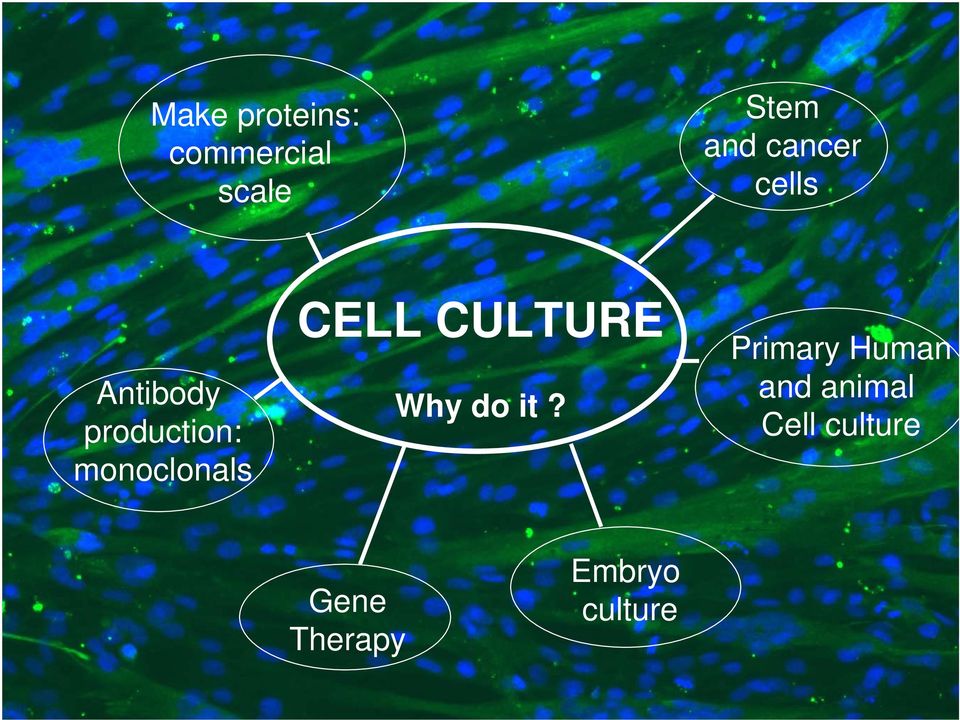
3 Cell Culture: why do it? Tool for the study of animal cell biology using convenient in vitro model of cell growth Mimic of in vivo cell behaviour (e.g( cancer cells) Artificial (some cell types are thus difficult to culture) Highly selective and defined environment which is easily manipulated (used to optimise cell signalling pathways)

4 Cell Culture is a Fussy Discipline In the tissue culture laboratory: bench tops should be kept clear and clean wearing a long sleeve lab coat : minimises contamination from street clothing (hair, etc) wearing gloves while doing tissue culture work: minimises contamination from skin organisms Surfaces, gloves, solutions and plasticware sprayed with 70% alcohol before placed into the biological hood solutions, reagents and glassware used in tissue culture work should not be shared with non-tissue culture work

5 Primary application of animal cell culture in the investigation of: Mechanisms of cell cycle control Characteristics of cancer cells Detection, production and function of : growth factors hormones viruses The study of: differentiation processes specialised cell function cell-cell and cell-matrix interactions

6 Primary culture vs Cell line Primary culture freshly isolated from tissue source Cell line Finite cell line: dies after several sub-cultures Continuous cell line: transformed immortal In our lab: C2C12 immortalised skeletal muscle cell line Myoblasts were extracted from the thigh muscle of C3H mice 70 h after a crush injury and cultured. They became immortalised.. (Yaffe( and Saxel,1977). Very useful tool to study effects of various factors s on myoblast proliferation and differentiation and myotube formation Note: mouse cells readily immortalise whereas human cells do NOT. This is due to telomerase (discussed later under ageing) Can STORE cells, cryopreserved in liquid nitrogen for years

7 Passaging or sub-culture Cells dissociated from flask using enzymes Split 1 into 2 flasks

8 Contact inhibition Therefore need to split them to maintain growth

9 Initiation, establishment and propagation of cell cultures

10 Cultures can be initiated from tissue or organ fragments single cell suspensions Choices to be made Disaggregation techniques Media Culture conditions Selection procedures

11 Considerations Sensitivity to mechanical dispersal or enzymes; cell-cell contact may be required for proliferation Dispersed cells in culture are vulnerable Most primary cells require satisfactory adherence Some cells are not normally adherent in vivo and can be grown in liquid suspension In a mixed primary culture differences in growth rate may mean a loss of the cell type of interest selection techniques Some cells are prone to spontaneous transformation Limited life span of some cultures

12 (1) Dispersal of tissues Mechanical Mincing, shearing, sieves Chemical Enzymatic (proteases that affect ECM) Trypsin, pronase,, collagenase, dispase Can be a combination

13 The cell culture environment

14 8 well culture dish. Allows comparison of 8 samples: can have different stains or are fixed at different times. THEN- remove wells and gasket. Leaves ONE slide with 8 separate samples for easy microscopic analysis of (stained) cells 96 well plate Allows comparison of many culture conditions. Samples often in triplicate.

15 Factors affecting cell behaviour in the complex in vivo environment The local micro-environment: metabolites, local growth factors, ECM, architecture Cell-cell interactions Circulating proteins, cytokines, hormones How to best mimic this in vitro?

16 (2) Culture Surface Most adherent cells require attachment to proliferate Change charge of the surface Poly-L-lysine lysine Coating with matrix proteins Collagen, laminin, gelatin,, fibronectin

17 (3) Media formulation Initial studies used body fluids Plasma, lymph, serum, tissue extracts Early basal media Salts, amino acids, sugars, vitamins supplemented with serum More defined media Cell specific extremely complex PLUS SERUM

18 DMEM

19 Media Formulation Inorganic ions Osmotic balance cell volume Trace Elements Co-factors for biochemical pathways (Zn, Cu) Amino Acids Protein synthesis Glutamine required at high concentrations Vitamins Metabolic co-enzymes for cell replication Energy sources glucose

20 Serum provides the following [Horse serum, foetal calf serum, chick embryo extract: all not fully defined] Basic nutrients Hormones and growth factors Attachment and spreading factors Binding proteins (albumin, vitronectin, transferrin), hormones, vitamins, minerals, lipids Protease inhibitors ph buffer

21 Freshney.(1992) Animal Cell Culture.
22 (4) The gas phase Oxygen Aerobic metabolism Atmospheric 20% Tissue levels between 1-7% 1 Carbon dioxide Buffering
23 CO 2 Incubator Controlled CO 2 Humidified 37 o C
24 Physiological ph 7 ph can affect (5) ph Control Cell metabolism Growth rate Protein synthesis Availability of nutrients CO 2 acts as a buffering agent in combination with sodium bicarbonate in the media
25 (6) Temperature and Humidity Normal body temperature 37 o C Humidity must be maintained at saturating levels as evaporation can lead to changes in Osmolarity Volume of media and additives
26 You have the ingredients Now let us look at the procedures. Contamination Minimise the risk
27 Sources of Contamination Bacteria Fungi Mould Yeast Mycoplasma Other cell types Free organisms, dust particles or aerosols Surfaces or equipment
28 Class 1 Cabinets: Preparation of primary cultures (removing muscle from mice) protect the product only
29 Class 2 Cabinets: Protection of personnel, environment and product Laminar Flow Hood
30 Class 2 Biological Safety Cabinet HEPA filters Laminar flow Exhaust Fan Exhaust HEPA Filter Laminar Flow Fan Laminar HEPA Filter Air Barrier Vertical Laminar Airflow
31 Humans shed particles of skin, bacteria, fungi etc all the time Sitting or standing with no movement,, wearing cleanroom garments, an individual will shed approximately 100,000 particles of 0.3um and larger per minute.. The same person with only simple arm movement will emit 500,000 particles. Average arm and body movements with some slight leg movement will produce over 1,000,000 particles per minute; ; average walking pace 7,500,000 particles per minute; and walking fast 10,000,000 particles per minutes. Boisterous activity can result in the release of as many as 15x10 6 to 30x10 6 particles per minute into the cleanroom environment.
32 Aseptic Techniques Controlled environment Traffic, air flow Sterile media and reagents Avoid aerial contamination of solutions Avoid manual contamination of equipment Avoid repeated opening of bottles 70% ethanol swab UV irradiation before and after Only use disposable equipment once
33 Lab coat Gloves tip does not touch the tube holding of the tube Aseptic Technique
34 Pipette-Aid - power or battery operated Motorised intake and expelling of fluids transferred from one sterile container to another. In line air filter. Transfer Pipette Disposable Enclosed Plastic Packaged as Sterile so their contained air is sterile.
35 S I Z E Clarification Human Hair Diameter Smallest Visible Particle Erythrocyte Micron = 10-6 m Microfiltration Ultrafiltration Reverse Osmosis Bacteria Mycoplasma Polio Virus 0.8µ pre-filter 0.22µ end filter 0.1 µ
36 Tissue culture medium cannot be autoclaved. It is filtered through 0.2µ membrane filters. There are different filter membrane types for sterilizing gases, solvents and aqueous solutions. NOW many items are purchased sterile (expensive)
37 In the LAB you will be studying Myogenesis: skeletal muscle formation Myoblast Proliferation Differentiation Fusion Myotube maturation
38 IN VIVO Muscle regeneration - likeness to formation of myotubes in culture. Haematoxylin and Eosin stained paraffin embedded section of mouse muscle 12 days after injury IN VITRO Myotubes formed by myoblasts grown in culture for 7 days. Culture viewed on an inverted phase microscope. (phase microscopy)
39 Inverted Microscope
40 C2C12 Mouse Skeletal Muscle Cultured Cell Line Proliferation Scattered myoblasts 24h after subculture. High Serum Media (20% FCS DMEM) Differentiation and fusion Myotubes formed at 7 days in fusion medium (2% HS DMEM)
41 Cell Counting - haemocytometer
42 Media Formulation Proliferation/maintenance Hams F10 nutrient mix (for primary cell culture) 20% FCS (foetal calf serum) 5ng/ml bfgf Differentiation and fusion DMEM 2% horse serum (Note:( change in serum type) Insulin Linoleic aciud
43 Fusion Media changed from nutrient rich to nutrient poor Induces withdrawal from the cell cycle giving the cells 3 choices Die (apoptosis) Senesce (become quiescent) Differentiate leading to fusion and myotubes
44 Analysis
45 Adult Mouse Skeletal Muscle - Primary culture Note: this also contains fibroblasts. cultured (on fibronectin) in 8 well slide, fixed and stained for desmin
46 Mouse Skeletal Muscle Cell line (H-2Kb) cultured (on poly-d-lysine) in 35mm dish, fixed and stained for desmin
47 C2C12 skeletal muscle cell line stained with desmin (green) to identify myotubes and Hoescht (blue) to identify cell nuclei Bjanka Gebski
Human Adult Mesothelial Cell Manual
 Human Adult Mesothelial Cell Manual INSTRUCTION MANUAL ZBM0025.01 SHIPPING CONDITIONS Human Adult Mesothelial Cells Orders are delivered via Federal Express courier. All US and Canada orders are shipped
Instructions. Torpedo sirna. Material. Important Guidelines. Specifications. Quality Control
 is a is a state of the art transfection reagent, specifically designed for the transfer of sirna and mirna into a variety of eukaryotic cell types. is a state of the art transfection reagent, specifically
MTT Cell Proliferation Assay
 ATCC 30-1010K Store at 4 C This product is intended for laboratory research purposes only. It is not intended for use in humans, animals or for diagnostics. Introduction Measurement of cell viability and
Cell Culture Experiments
 Cell Culture Experiments Cell cultures are another way to observe and analyze biological systems. These in vitro (in glass; outside the living body and in an artificial environment) models allow experimental
Xpert TM Animal Tissue Culture Teaching Kit
 Xpert TM Animal Tissue Culture Teaching Kit Product Code: CCK005 Contents 1. About the kit 2. Kit contents and storage instructions 3. Materials required but not provided in the kit 4. Aseptic techniques
Lab Exercise 3: Media, incubation, and aseptic technique
 Lab Exercise 3: Media, incubation, and aseptic technique Objectives 1. Compare the different types of media. 2. Describe the different formats of media, plate, tube etc. 3. Explain how to sterilize it,
Figure 5. Energy of activation with and without an enzyme.
 Biology 20 Laboratory ENZYMES & CELLULAR RESPIRATION OBJECTIVE To be able to list the general characteristics of enzymes. To study the effects of enzymes on the rate of chemical reactions. To demonstrate
What affects an enzyme s activity? General environmental factors, such as temperature and ph. Chemicals that specifically influence the enzyme.
 CH s 8-9 Respiration & Metabolism Metabolism A catalyst is a chemical agent that speeds up a reaction without being consumed by the reaction. An enzyme is a catalytic protein. Hydrolysis of sucrose by
Aseptic Technique. A GMP/GTP Training Module
 Aseptic Technique A GMP/GTP Training Module Aseptic Technique The GMP Facility manufactures products for clinical use These products must meet a number of requirements, one of which is that they are sterile
Lab 4: Osmosis and Diffusion
 Lab 4: Osmosis and Diffusion The plasma membrane enclosing every cell is the boundary that separates the cell from its external environment. It is not an impermeable barrier, but like all biological membranes,
RESPIRATION AND FERMENTATION: AEROBIC AND ANAEROBIC OXIDATION OF ORGANIC MOLECULES. Bio 171 Week 6
 RESPIRATION AND FERMENTATION: AEROBIC AND ANAEROBIC OXIDATION OF ORGANIC MOLECULES Bio 171 Week 6 Procedure Label test tubes well, including group name 1) Add solutions listed to small test tubes 2) For
Effective Methods For Culturing Breast Cancer Cell Lines
 Abstract Effective Methods For Culturing Breast Cancer Cell Lines William H. Marshall II Life Science Team Cell culturing is one of the most useful and prolific techniques practiced in biological science
Science. NZQA Support Material Page 1 of 8. Unit standard 26114 version 1 Perform methods for animal tissue culture Level 6 Credits 5
 NZQA Support Material Page 1 of 8 Science Unit standard 26114 version 1 Perform methods for animal tissue culture Level 6 Credits 5 Assessor guidelines Candidate instructions Assessment task/s Assessment
Environmental Monitoring of Clean Rooms
 Environmental Monitoring of Raul Duarte President DDK Scientific, Corp. Copyright DDK Scientific, Corp. 2008, 2009, DDK Scientific, Corp. Proprietary A manufacturing facility for pharmaceutical products
Cleaning. By the end of this chapter, you will be able to: Introduction. Definitions. Chapter 9
 Chapter 9 By the end of this chapter, you will be able to: l Define the terms cleaning, decontamination, disinfection l List the factors that affect disinfection l Describe the aims of a cleaning schedule
HARVESTING AND CRYOPRESERVATION OF HUMAN EMBRYONIC STEM CELLS (hescs)
 HARVESTING AND CRYOPRESERVATION OF HUMAN EMBRYONIC STEM CELLS (hescs) OBJECTIVE: can be cryopreserved in a liquid nitrogen (LN 2 ) freezer for long-term storage. This Standard Operating Procedure (SOP)
Workshop 14-16 February 2006
 Theoretical and practical approaches of Hepatocyte primary culture Workshop 14-16 February 2006 Lecture (2) Disaggregation & purification of target cells Coarse organizer Dr. Abo bakr Mohamed Eltayeb General
Cellular Respiration: Practice Questions #1
 Cellular Respiration: Practice Questions #1 1. Which statement best describes one of the events taking place in the chemical reaction? A. Energy is being stored as a result of aerobic respiration. B. Fermentation
1. The diagram below represents a biological process
 1. The diagram below represents a biological process 5. The chart below indicates the elements contained in four different molecules and the number of atoms of each element in those molecules. Which set
Photo Cell Resp Practice. A. ATP B. oxygen C. DNA D. water. The following equation represents the process of photosynthesis in green plants.
 Name: ate: 1. Which molecule supplies the energy for cellular functions?. TP. oxygen. N. water 2. Photosynthesis The following equation represents the process of photosynthesis in green plants. What happens
Cellartis Protocol Culturing of hes Cells
 Cellartis Protocol Culturing of hes Cells This material was cultured and frozen using Cellartis protocols. WiCell recommends that stem cells should be thawed and established in the conditions in which
Welcome to chapter 10. The following chapter is called Equipment maintenance and monitoring. The author is Ronny Janssens.
 Welcome to chapter 10. The following chapter is called Equipment maintenance and monitoring. The author is Ronny Janssens. 1 After finishing this chapter, the student should be familiar with - the requirements
6023-1 - Page 1. Name: 4) The diagram below represents a beaker containing a solution of various molecules involved in digestion.
 Name: 6023-1 - Page 1 1) Which one of the following situations indicates a serious organ system malfunction? A) Mitochondria stop functioning in a unicellular organism exposed to pollutants. B) White blood
GASTRIC ORGANOID CULTURE PROTOCOL
 GASTRIC ORGANOID CULTURE PROTOCOL THIS PROTOCOL PROVIDES THE PROCEDURE FOR SUBCULTURING NORMAL HUMAN GASTRIC ORGANOIDS WHICH WAS DERIVED FROM THE SUBMERGED METHOD AS DESCRIBED IN BARKER N, ET AL. LGR5+VE
An Overview of Cells and Cell Research
 An Overview of Cells and Cell Research 1 An Overview of Cells and Cell Research Chapter Outline Model Species and Cell types Cell components Tools of Cell Biology Model Species E. Coli: simplest organism
PROTOCOL. Immunocytochemistry (ICC) MATERIALS AND EQUIPMENT REQUIRED
 PROTOCOL Immunocytochemistry (ICC) 1850 Millrace Drive, Suite 3A Eugene, Oregon 97403 11-07 MATERIALS AND EQUIPMENT REQUIRED Materials: MitoSciences primary monoclonal antibody/antibodies Fluorophore-conjugated
1. Enzymes. Biochemical Reactions. Chapter 5: Microbial Metabolism. 1. Enzymes. 2. ATP Production. 3. Autotrophic Processes
 Chapter 5: Microbial Metabolism 1. Enzymes 2. ATP Production 3. Autotrophic Processes 1. Enzymes Biochemical Reactions All living cells depend on biochemical reactions to maintain homeostasis. All of the
Chapter 8: An Introduction to Metabolism
 Chapter 8: An Introduction to Metabolism Name Period Concept 8.1 An organism s metabolism transforms matter and energy, subject to the laws of thermodynamics 1. Define metabolism. The totality of an organism
Functions of Blood. Collects O 2 from lungs, nutrients from digestive tract, and waste products from tissues Helps maintain homeostasis
 Blood Objectives Describe the functions of blood Describe blood plasma Explain the functions of red blood cells, white blood cells, and platelets Summarize the process of blood clotting What is Blood?
Endocrine System: Practice Questions #1
 Endocrine System: Practice Questions #1 1. Removing part of gland D would most likely result in A. a decrease in the secretions of other glands B. a decrease in the blood calcium level C. an increase in
Cells, tissues and organs
 Chapter 8: Cells, tissues and organs Cells: building blocks of life Living things are made of cells. Many of the chemical reactions that keep organisms alive (metabolic functions) take place in cells.
Cellular Energy. 1. Photosynthesis is carried out by which of the following?
 Cellular Energy 1. Photosynthesis is carried out by which of the following? A. plants, but not animals B. animals, but not plants C. bacteria, but neither animals nor plants D. all living organisms 2.
Animal and Plant Cell Culture: An Introduction (SCQF level 7)
 Higher National Unit specification General information Unit code: H920 34 Superclass: RH Publication date: May 2015 Source: Scottish Qualifications Authority Version: 01 Unit purpose This Unit is designed
7. A selectively permeable membrane only allows certain molecules to pass through.
 CHAPTER 2 GETTING IN & OUT OF CELLS PASSIVE TRANSPORT Cell membranes help organisms maintain homeostasis by controlling what substances may enter or leave cells. Some substances can cross the cell membrane
Microbiology Laboratory Safety and Basic Procedures Safety in a microbiology laboratory is important in the prevention of infection that might be
 Microbiology Laboratory Safety and Basic Procedures Safety in a microbiology laboratory is important in the prevention of infection that might be caused by the microorganisms being studied. This laboratory
Cell Phone Radiation Effects on Cancer. Tyler Barkich Central Catholic High School Grade 11
 Cell Phone Radiation Effects on Cancer Tyler Barkich Central Catholic High School Grade 11 Cancer Overview Cancer cells are cells that grow and divide at an irregular, unregulated pace. Apoptosis does
RiboZol RNA Extraction Reagents
 RiboZol RNA Extraction Reagents Code Description Size N580-30ML-SAMPLE Ribozol TM RNA Extraction Reagent 30 ml N580-30ML Ribozol TM RNA Extraction Reagent 30 ml N580-100ML Ribozol TM RNA Extraction Reagent
Metabolism: Cellular Respiration, Fermentation and Photosynthesis
 Metabolism: Cellular Respiration, Fermentation and Photosynthesis Introduction: All organisms require a supply of energy and matter to build themselves and to continue to function. To get that supply of
Biotechnology. Srivatsan Kidambi, Ph.D.
 Stem Stem Cell Cell Engineering-What, Biology and it Application Why, How?? to Biotechnology Srivatsan Kidambi, Ph.D. Assistant Professor Department of Chemical & Biomolecular Engineering University of
Bio-manufacturing of antigens, antibodies and bioresearch materials
 Bio-manufacturing of antigens, antibodies and bioresearch materials Foetal Bovine Serum (FBS) Human AB Serum Chick Embryo Extract (CEE) Custom polyclonal antibody production Custom monoclonal antibody
Environmental Monitoring
 Chapter 10 Environmental Monitoring By the end of this chapter, you will be able to: l List the types of environmental testing l Name three types of checks that are carried out to ensure the isolator is
Protease Peptide Microarrays Ready-to-use microarrays for protease profiling
 Protocol Protease Peptide Microarrays Ready-to-use microarrays for protease profiling Contact us: InfoLine: +49-30-97893-117 Order per fax: +49-30-97893-299 Or e-mail: [email protected] www: www.jpt.com
FIGURE 2.18. A. The phosphate end of the molecule is polar (charged) and hydrophilic (attracted to water).
 PLASMA MEMBRANE 1. The plasma membrane is the outermost part of a cell. 2. The main component of the plasma membrane is phospholipids. FIGURE 2.18 A. The phosphate end of the molecule is polar (charged)
BIOLOGICAL SAFETY CABINET PROGRAM
 BIOLOGICAL SAFETY CABINET PROGRAM TABLE OF CONTENTS: 1. INTRODUCTION 2. PURPOSE AND SCOPE 3. SELECTION AND INSTALLATION 4. USE OF BIOLOGICAL SAFETY CABINETS 5. CERTIFICATION OF BIOLOGICAL SAFETY CABINETS
Recommendations for the Safe Use of Handling of Cytotoxic Drugs
 Recommendations for the Safe Use of Handling of Cytotoxic Drugs Introduction Cytotoxic drugs are toxic compounds and are known to have carcinogenic, mutagenic and/or teratogenic potential. With direct
Fundamental Autoclave Techniques
 Fundamental Autoclave Techniques Version 3, September 2010 Veronika Tatarinoff GSBmE University of NSW Brandy Nelson University of Kentucky The following information is directed at aseptic/sterile surgical,
Transferring a Broth Culture to Fresh Broth
 Sterile Technique It is very important in microbiology to work with pure cultures. Unfortunately this is difficult. The world around us is covered with microorganisms. Microorganisms are even carried on
2. Which type of macromolecule contains high-energy bonds and is used for long-term energy storage?
 Energy Transport Study Island 1. During the process of photosynthesis, plants use energy from the Sun to convert carbon dioxide and water into glucose and oxygen. These products are, in turn, used by the
Chemistry 20 Chapters 15 Enzymes
 Chemistry 20 Chapters 15 Enzymes Enzymes: as a catalyst, an enzyme increases the rate of a reaction by changing the way a reaction takes place, but is itself not changed at the end of the reaction. An
Follicle Dermal Papilla Cell
 Follicle Dermal Papilla Cell Instruction Manual Product Size Catalog Number Human Follicle Dermal Papilla Cells (HFDPC) 500,000 cryopreserved cells 500,000 proliferating cells C-12071 C-12072 Product Description
Metabolism Dr.kareema Amine Al-Khafaji Assistant professor in microbiology, and dermatologist Babylon University, College of Medicine, Department of
 Metabolism Dr.kareema Amine Al-Khafaji Assistant professor in microbiology, and dermatologist Babylon University, College of Medicine, Department of Microbiology. Metabolism sum of all chemical processes
Cells & Cell Organelles
 Cells & Cell Organelles The Building Blocks of Life H Biology Types of cells bacteria cells Prokaryote - no organelles Eukaryotes - organelles animal cells plant cells Cell size comparison Animal cell
Todays Outline. Metabolism. Why do cells need energy? How do cells acquire energy? Metabolism. Concepts & Processes. The cells capacity to:
 and Work Metabolic Pathways Enzymes Features Factors Affecting Enzyme Activity Membrane Transport Diffusion Osmosis Passive Transport Active Transport Bulk Transport Todays Outline -Releasing Pathways
Basics of Cell Culture A student laboratory manual
 Basics of Cell Culture A student laboratory manual By Golnar Afshar PhD Table of Contents: Introduction 3 Laboratory Exercises Laboratory Safety 3 Aseptic Technique Exercise30 30 Laboratory Notebooks5
Chondrogenical Differentiation of Umbilical Cord Lining. Stem Cells
 Chondrogenical Differentiation of Umbilical Cord Lining Stem Cells He Xi, Masilamani Jeyakumar, Phan Toan Thang Bioengineering, National University of Bioengineering Abstract Cartilage defects, such as
Working With Enzymes. a world of learning. Introduction. How Enzymes Work. Types and Sources of Enzymes
 Working With Enzymes a world of learning Presented by Peter J Ball, Southern Biological. For further information, please contact the author by phone (03) 9877-4597 or by email [email protected].
DNA SPOOLING 1 ISOLATION OF DNA FROM ONION
 DNA SPOOLING 1 ISOLATION OF DNA FROM ONION INTRODUCTION This laboratory protocol will demonstrate several basic steps required for isolation of chromosomal DNA from cells. To extract the chromosomal DNA,
DNA Analyst Training Laboratory Training Manual Protocol 2.02 Clean Technique
 DNA Analyst Training Laboratory Training Manual Protocol 2.02 Clean Technique This laboratory protocol (or part thereof) has been provided as an example of a laboratory SOP, courtesy of the Illinois State
MEF Starter Nucleofector Kit
 page 1 of 7 MEF Starter Nucleofector Kit for Mouse Embryonic Fibroblasts (MEF) MEF display significant phenotypic variations which depend on the strain, the genetic background of the mice they are isolated
Keystone Review Practice Test Module A Cells and Cell Processes. 1. Which characteristic is shared by all prokaryotes and eukaryotes?
 Keystone Review Practice Test Module A Cells and Cell Processes 1. Which characteristic is shared by all prokaryotes and eukaryotes? a. Ability to store hereditary information b. Use of organelles to control
HBV Quantitative Real Time PCR Kit
 Revision No.: ZJ0002 Issue Date: Aug 7 th, 2008 HBV Quantitative Real Time PCR Kit Cat. No.: HD-0002-01 For Use with LightCycler 1.0/LightCycler2.0/LightCycler480 (Roche) Real Time PCR Systems (Pls ignore
DP419 RNAsimple Total RNA Kit. RNAprep pure Series. DP501 mircute mirna Isolation Kit. DP438 MagGene Viral DNA / RNA Kit. DP405 TRNzol Reagent
 Overview of TIANGEN Products DP419 RNAsimple Total RNA Kit DP430 RNAprep pure Kit(For Cell/Bacteria) DP315/DP315-R TIANamp Virus DNA/RNA Kit DP431 RNAprep pure Kit (For Tissue) Silica-membrane Technology
Modulating Glucose Uptake in Skeletal Myotubes:
 icell Skeletal Myoblasts Application Protocol Introduction Modulating Glucose Uptake in Skeletal Myotubes: Insulin Induction with Bioluminescent Glucose Uptake Analysis The skeletal muscle is one of the
LAB 4. Cultivation of Bacteria INTRODUCTION
 LAB 4. Cultivation of Bacteria Protocols for use of cultivation of bacteria, use of general growth, enriched, selective and differential media, plate pouring, determination of temperature range for growth
Hazardous Waste Procedures
 Hazardous Waste Procedures Hazardous waste is defined as a waste, or combination of wastes, which because of its quantity, concentration, or physical or chemical characteristics may pose a substantial
LAB 14 ENZYME LINKED IMMUNOSORBENT ASSAY (ELISA)
 STUDENT GUIDE LAB 14 ENZYME LINKED IMMUNOSORBENT ASSAY (ELISA) GOAL The goal of this laboratory lesson is to explain the concepts and technique of enzyme linked immunosorbent assay (ELISA). OBJECTIVES
Osteoblast Differentiation and Mineralization
 Osteoblast Differentiation and Mineralization Application Note Background Osteoblasts are specialized fibroblasts that secrete and mineralize the bone matrix. They develop from mesenchymal precursors.
Annexin V-EGFP Apoptosis Detection Kit
 ab14153 Annexin V-EGFP Apoptosis Detection Kit Instructions for Use For the rapid, sensitive and accurate measurement of apoptosis in various samples This product is for research use only and is not intended
The Huntington Library, Art Collections, and Botanical Gardens. How Sweet It Is: Enzyme Action in Seed Germination
 The Huntington Library, Art Collections, and Botanical Gardens How Sweet It Is: Enzyme Action in Seed Germination Overview This experiment is intended to familiarize students with the macromolecule starch,
KEY CHAPTER 14: BLOOD OBJECTIVES. 1. Describe blood according to its tissue type and major functions.
 KEY CHAPTER 14: BLOOD OBJECTIVES 1. Describe blood according to its tissue type and major functions. TISSUE TYPE? MAJOR FUNCTIONS connective Transport Maintenance of body temperature 2. Define the term
Protocol for Disinfection of Cell Culture and Tissue Culture in Media:
 Protocol for Disinfection of Cell Culture and Tissue Culture in Media: Location: Hickory Hall 001 Director: Dr. Guido Verbeck DECONTAMINATION OF CELL CULTURE WASTE Cell culture has become a common laboratory
Fast, easy and effective transfection reagent for mammalian cells
 METAFECTENE EASY + Fast, easy and effective transfection reagent for mammalian cells For ordering information, MSDS, publications and application notes see www.biontex.com Description Cat. No. Size METAFECTENE
The chemical reactions inside cells are controlled by enzymes. Cells may be specialised to carry out a particular function.
 12.1 What are animals and plants built from? All living things are made up of cells. The structures of different types of cells are related to their functions. to relate the structure of different types
Biology for Science Majors
 Biology for Science Majors Lab 10 AP BIOLOGY Concepts covered Respirometers Metabolism Glycolysis Respiration Anaerobic vs. aerobic respiration Fermentation Lab 5: Cellular Respiration ATP is the energy
PRESTWICK ACADEMY NATIONAL 5 BIOLOGY CELL BIOLOGY SUMMARY
 Name PRESTWICK ACADEMY NATIONAL 5 BIOLOGY CELL BIOLOGY SUMMARY Cell Structure Identify animal, plant, fungal and bacterial cell ultrastructure and know the structures functions. Plant cell Animal cell
THE UNIVERSITY OF NEWCASTLE- DISCIPLINE OF MEDICAL BIOCHEMISTRY. STANDARD OPERATING PROCEDURE PROCEDURE NO: GLP 079 MOD: 1st Issue Page: 1 of 7
 THE UNIVERSITY OF NEWCASTLE- DISCIPLINE OF MEDICAL BIOCHEMISTRY STANDARD OPERATING PROCEDURE PROCEDURE NO: GLP 079 MOD: 1st Issue Page: 1 of 7 Procedure Type: Title: General Laboratory Procedure Cell Counts
Mesenchymal Stem Cells
 Mesenchymal Stem Cells Instruction Manual Product Size Catalog Number from Bone Marrow (hmsc-bm) from Umbilical Cord Matrix (hmsc-uc) from Adipose Tissue (hmsc-at) 500,000 cryopreserved cells 500,000 proliferating
UNIT 3 : MAINTAINING DYNAMIC EQUILIBRIUM
 BIOLOGY - 2201 UNIT 3 : MAINTAINING DYNAMIC EQUILIBRIUM What happens to your body as you run? Breathing, heart rate, temperature, muscle pain, thirsty... Homeotasis Homeostasis is the process of maintaining
Procedures for the Effective Use of Biological Safety Cabinets
 Procedures for the Effective Use of Biological Safety Cabinets APPROVAL DATE BY BIOHAZARDS SUBCOMMITTEE: August 10, 2012 SUPERSEDES: March 1, 2012 This corporate guideline/procedure is intended as a minimum
Week 30. Water Balance and Minerals
 Week 30 Water Balance and Minerals Water: more vital to life than food involved in almost every body function is not stored--excreted daily largest single constituent of the human body, averaging 60% of
Risk Assessment: Biosafety Cabinet
 Risk Assessment: Biosafety Cabinet Biosafety cabinets (BSCs) serve as primary containment devices for operations involving potential splashes, spills or aerosolization of hazardous biological materials.
B2 Revision. Subject Module Date Biology B2 13 TH May (am)
 B2 Revision Subject Module Date Biology B2 13 TH May (am) Useful websites www.aqa.org.uk This website contains the specifications that we follow and also has a large number of past papers and mark schemes
Vitamin C Content of Foods
 Vitamin C Content of Foods Experiment #11 Objective: To measure the heat and alkaline stability of vitamin C and its quantity in juices or tablets. Introduction Vitamin C is an essential component of the
BSC 2010 - Exam I Lectures and Text Pages. The Plasma Membrane Structure and Function. Phospholipids. I. Intro to Biology (2-29) II.
 BSC 2010 - Exam I Lectures and Text Pages I. Intro to Biology (2-29) II. Chemistry of Life Chemistry review (30-46) Water (47-57) Carbon (58-67) Macromolecules (68-91) III. Cells and Membranes Cell structure
Poietics human mesenchymal stem cells Instructions for use
 Poietics human mesenchymal stem cells Instructions for use www.lonza.com U.S. Scientific Support: 800-521-0390 [email protected] EU/ROW Scientific Support: +49-221-99199-400 [email protected]
Chapter 48. Nutrients in Food. Carbohydrates, Proteins, and Lipids. Carbohydrates, Proteins, and Lipids, continued
 Carbohydrates, Proteins, and Lipids The three nutrients needed by the body in the greatest amounts are carbohydrates, proteins, and lipids. Nutrients in Food All of these nutrients are called organic compounds,
Anabolic and Catabolic Reactions are Linked by ATP in Living Organisms
 Chapter 5: Microbial Metabolism Microbial Metabolism Metabolism refers to all chemical reactions that occur within a living a living organism. These chemical reactions are generally of two types: Catabolic:
7 Answers to end-of-chapter questions
 7 Answers to end-of-chapter questions Multiple choice questions 1 B 2 B 3 A 4 B 5 A 6 D 7 C 8 C 9 B 10 B Structured questions 11 a i Maintenance of a constant internal environment within set limits i Concentration
pathway that involves taking in heat from the environment at each step. C.
 Study Island Cell Energy Keystone Review 1. Cells obtain energy by either capturing light energy through photosynthesis or by breaking down carbohydrates through cellular respiration. In both photosynthesis
Total body water ~(60% of body mass): Intracellular fluid ~2/3 or ~65% Extracellular fluid ~1/3 or ~35% fluid. Interstitial.
 http://www.bristol.ac.uk/phys-pharm/teaching/staffteaching/sergeykasparov.htmlpharm/teaching/staffteaching/sergeykasparov.html Physiology of the Cell Membrane Membrane proteins and their roles (channels,
Given these characteristics of life, which of the following objects is considered a living organism? W. X. Y. Z.
 Cell Structure and Organization 1. All living things must possess certain characteristics. They are all composed of one or more cells. They can grow, reproduce, and pass their genes on to their offspring.
WHY IS THIS IMPORTANT?
 CHAPTER 10 BACTERIAL GROWTH Eye of Science / Science Photo Library WHY IS THIS IMPORTANT? Increase in numbers is one of the requirements for infection. This increase is dependent upon bacterial growth.
Innovation and Progress in Water Treatment Technology
 Innovation and Progress in Water Treatment Technology Degree of separation of ultrafiltration Summary of the various processes The water will be pressed through the between the raw water side and the filtrate
Transformation of the bacterium E. coli. using a gene for Green Fluorescent Protein
 Transformation of the bacterium E. coli using a gene for Green Fluorescent Protein Background In molecular biology, transformation refers to a form of genetic exchange in which the genetic material carried
PCR and Sequencing Reaction Clean-Up Kit (Magnetic Bead System) 50 preps Product #60200
 3430 Schmon Parkway Thorold, ON, Canada L2V 4Y6 Phone: 866-667-4362 (905) 227-8848 Fax: (905) 227-1061 Email: [email protected] PCR and Sequencing Reaction Clean-Up Kit (Magnetic Bead System)
Respiration Worksheet. Respiration is the controlled release of energy from food. Types of Respiration. Aerobic Respiration
 Respiration Worksheet Respiration is the controlled release of energy from food The food involved in respiration is usually Internal respiration is controlled by which allow energy to be released in The
Topic 3: Nutrition, Photosynthesis, and Respiration
 1. Base your answer to the following question on the chemical reaction represented below and on your knowledge of biology. If this reaction takes place in an organism that requires sunlight to produce
TOTAL PROTEIN FIBRINOGEN
 UNIT: Proteins 16tproteins.wpd Task Determination of Total Protein, Albumin and Globulins Objectives Upon completion of this exercise, the student will be able to: 1. Explain the ratio of albumin and globulin
B2 1 Cells, Tissues and Organs
 B2 Cells, Tissues and Organs 5 minutes 5 marks Page of 7 Q. The diagram shows a bacterium. On the drawing, name the structures labelled A, B, C and D. (Total 4 marks) Q2. (a) The diagrams show cells containing
CYTOTOXICITY TEST: MEM ELUTION. Test Substance: LEGA PER CERAMICA CERAM 450. Test Report N 0103/04. Study performed for
 CYTOTOXICITY TEST: MEM ELUTION Test Substance: LEGA PER CERAMICA CERAM 450 Test Report N 0103/04 Study performed for NUOVA FRANCO SUISSE ITALIA S.r.l. Via Dell Artigianato, 26 PERAGA DI VIGONZA PD by BIOCHEM