
American Osteopathic Association Protocols for Osteopathic Manipulative Treatment (OMT) Revised July 1998
|
|
|
- Shana Harrington
- 9 years ago
- Views:
Transcription
1 American steopathic Association rotocols for steopathic Manipulative Treatment (MT) Revised July 1998 steopathic physicians utilize all recognized medical procedures and available technologies to provide comprehensive health care to their patients. The osteopathic profession is recognized by its distinctive philosophical approach. 1,2,19,33,34,39 This approach led to unique contributions by the osteopathic profession in the development of techniques used in osteopathic manipulative treatment, and by their integration into a physician-directed management of the total patient. 3.4 steopathic manipulative treatment involves the use by the physician of manual procedures to optimize patient health and function. 5,6,32 It should be emphasized that osteopathic manipulative treatment is a distinctive medical procedure and should not be confused with services provided by non-physicians. 7 steopathic manipulative treatment is a general term currently encompassing approximately twenty-five different types of physician-performed manipulative treatment. 19 steopathic manipulative treatment (MT) is defined in the "Glossary of steopathic Terminology", the professionwide accepted resource for osteopathic terminology, which is published by the American steopathic Association. tructural Dysfunction tructural diagnosis involves the use of expanded observation and palpatory examination of the neuro-musculoskeletal system with its venous, lymphatic and pulmonary interactions, 8, 9, 10,11, 12, 13, 14, 15, 25 as part of evaluation of the entire patient. The goal is to identify the presence of significant impediments to health and well being in the entire patient through an understanding of the interrelationships between the musculoskeletal system and all other systems of the body. 16,17 This includes but is not limited to the identification of somatic dysfunction and related visceral disease/dysfunction. 10,32, 38, 35 The performance of the history and physical examination of a patient should not be viewed as an isolated examination of the musculoskeletal system since many organ systems are examined. 18 The definition of somatic dysfunction is correlated with the entire patient as follows: Impaired or altered function of related components of the somatic (body framework) system; skeletal, arthrodial and myofascial structures; 19 21, 25, 36, 37, 38 and related vascular, lymphatic and neural elements. During the process of diagnosis of altered structural function, somatic dysfunction is identified by one or more of the following physical findings: asymmetry of related parts of the musculoskeletal system, range of motion abnormalities, tenderness and/or tissue texture abnormalities. 20, 21 Alteration in the range of motion may be exhibited by either restricted or increased motion. Alterations in quality and range of motion are the most common and often most significant findings indicating the presence of somatic dysfunction. 33, 39 ain or tenderness or their provocation can be of assistance in the diagnosis but their provocation is not diagnostic in and of itself. omatic dysfunction is also made clinically 19, 22, 23, 24, 25, 33, 39 relevant by interpreting the effects of personal injury history MT Case Management steopathic manipulative treatment involves the same principles utilized in diagnosing and treating any disease. This diagnosis must be specific. nce an accurate diagnosis is made, the physician will determine the appropriate techniques and treatment. It is not usually

2 appropriate to create a "treatment plan" for MT. everal different treatment techniques may be integrated for use in the same patient. Adjunctive modalities may be employed in the total case management of the patient's condition. The choice of osteopathic manipulative technique is based on multiple factors. These include the age and physical condition of the patient, and the effectiveness of previous forms of treatment. The physician must also keep in mind his or her own experience and expertise in each of the treatment methods, and must choose those that can be performed effectively. Due to the complex interrelations of body systems, and the body's innate ability to make compensatory changes during each treatment, tissues both adjacent to and remote from the area of primary involvement may require concomitant treatment. The three key components of an E/M service: history, examination and medical decision making are essential in the decision making process and management of the patient prior to the performance of subsequent MT. Therefore it is appropriate for an E/M service to be performed at each follow-up patient encounter. An appropriate significant, separately identifiable E/M service, documented according to the E/M Documentation Guidelines should be provided and reported. This is all necessary in determining: If additional MT needs to be provided and if so, 1) What body regions need to be treated, 2) What MT technique(s) should be utilized, and 3) If MT needs to be augmented with other medical services/ procedures. Basic Treatment Concepts A. atients who present with a dysfunctional somatic component to their condition may benefit from MT. B. The primary goal of using MT is to enable the patient to return to health and optimize function. C. MT should be performed at the appropriate effective frequency as determined through the on-going process of medical evaluation and management. D. MT should be performed for the minimum appropriate duration. This can be defined as that duration of time from the initiation of treatment which will result in continued improvement, and where additional treatment will not further benefit the patient. E. ubsequent treatments may be an appropriate response to unstable or recurrent conditions as part of the overall management of the patient's condition. Every attempt is made to reach maximum improvement of the patient and MT should be coupled with other appropriate medical and/or surgical interventions. ccasionally, less frequent, periodic treatment may be utilized effectively to help continue maximum medical improvement. The frequency of such treatment should be consistent with the phase of the patient's disease or dysfunctional process as determined by on-going evaluation and management of the patient's condition. 26 ome stabilized conditions that acutely decompensate may require reinstitution of MT. 27 ubsequent evaluation and management in conjunction with MT is appropriate for patients 28, 29 with long term conditions.

3 assive physical medicine modalities should be combined with an active treatment program which emphasizes progressive exercises with a decreasing frequency of passive treatments. The modalities provided should be appropriate to the individual patient's presenting problem and their response to prior treatment. rolonged application of physical rnedicine modalities beyond the acute phase of treatment should be limited in frequency and number of modalities utilized and should not be utilized as the sole form of treatment. MT arameters The guidelines below are meant to be used as a basic reference for appropriate osteopathic manipulative treatment. They are not intended to set restrictive criteria that would override an osteopathic physician's good judgment in comprehensive case management. Most patients should fall within the parameters below and there should be sufficient latitude for physicians with varying treatment styles and approaches. ome patients have additional factors which complicate successful completion of treatment. Among these factors are the severity of the illness, duration or chronicity of the condition, as well as the existence and extent of comorbidities. 30 Acute, ost-acute and Chronic refer to the phase of illness determined by the time elapsed from the onset of symptoms. Date of injury, diagnosis, acute exacerbation or surgery must be taken into consideration. 31 Initial refers to the interval during which MT is first utilized by a particular physician in the treatment process regardless of the phase. The initial use of MT may occur through its use by the primary treating physician in the acute illness, or it may be first used in subsequent phases of the illness through appropriate referral. atients are treated more frequently during the first several encounters regardless of the phase of the illness, with a subsequent decrease in treatment as appropriate. ubsequent refers to the treatment period following the initial interval of treatment by a particular physician within an illness phase, and as continuing treatment through subsequent phases patient's progress to recovery or maximum medical improvement. Treatment of Recurrent roblems: If a patient has multiple recurrent episodes related to their original complaint within one year, it should not be classified or treated as an acute problem. In this circumstance, it would be classified as a recurrent problem and secondary assessment and treatment methods should be used with an emphasis on active therapy and prevention strategies. Additional treatment may be necessary if repeated efforts to withdraw from treatment results in significant deterioration of clinical status. atients with recurrent problems may require additional evaluation and interventions for psychosocial and ergonomic factors which may be contributing to the recurrent nature of the problem. A history of previous episodes of similar complaints should be considered as well as possible contributory factors such as chronic pain, depression, alcohol/substance abuse, smoking and extreme obesity. upervised changes in physical activity and lifestyle should also he considered. The routine scheduled provision of osteopathic manipulative treatment (MT) would not be considered appropriate in the absence of acute or chronic problems. arameters For Frequency f Application f steopathic Manipulative Treatment

4 TREATMENT INTERVAL hase of Illness* Acute ost-acute Chronic 0-12 weeks 12 wks - 6 months 6 months or longer 1-3/wk for 2 wks 1-2x/wk for 2 wks Initial 1-3x/wk for 2 wks ubsequent 2-3x/wk for 2 wks 1-2x/wk 1-2x/wk nce every 1-2 wks *hase of Illness is defined as the time elapsed from onset of symptoms. A Note - New atient Example A patient complains of low back pain that began 3 days ago after he lifted a heavy object. Cannot straighten up when walking. ain with change of position. Denies radiation of pain; it stays along the low back and waistline. Denies areas of numbness. Comfortable when lying down. Aspirin helps some. Has used heat with some help. No prior history of back pain or injury. Denies allergies. Medical/surgical history is unremarkable. Tenderness noted over lumbar and sacral regions Inability to extend lumbar spine when standing Flexion posture when standing Muscle spasms noted in paraspinals of the lumbar region Decreased range of motion of lumbar spine and sacrum was noted on active and passive motion testing Neurological exam normal

5 A 1. Lumbosacral sprain omatic dysfunction - lumbar, sacral and MT (appropriate techniques used*), applied to the lumbar and sacral regions 2. Continue aspirin 3. No lifting, bending or twisting 4. Follow up in two days to reevaluate patient progress CDING FR THI CAE Evaluation/management; new patient MT two body regions; lumbar/sacral *ee AA Glossary of steopathic Terminology for appropriate techniques. A Note - Established atient Example atient is here for re-evaluation. He states that the pain has decreased in his low back and that he can get around better. He states that he has no radiation of pain into his legs. He does state that he feels stiff and achy if he tries to do his normal daily activities. He is still taking aspirin with some relief. Tenderness with palpation and stretch of the erector spinae muscles ain with extention and rotation left of L5 ain along with right I joint with sacral extension No muscle spasms noted with active or passive range of motion Negative neurological exam of lower extremities A 1. Lumbosacral sprain/strain; improving omatic dysfunction - lumbar, sacral; improving and MT (appropriate techniques used*), applied to the lumbar and sacral regions 2. Instructed on proper posture when lifting

6 3. Increase home activities gradually and to tolerance 4. Follow up if improvement does not continue CDING FR THI CAE Evaluation/management; established patient MT two body regions; lumbar/sacral *ee AA Glossary of steopathic Terminology for appropriate techniques A Note - Established atient Example atient ambulating, non-smoker with chief complaint of deep cough and with occasional vomiting, x three weeks. nset nasal congestion; hoarseness; cough; low grade temperature ( degrees). Almost dry cough with occasional clear sputum. ain in center chest with coughing and no radiation of chest pain. atient did have right rib pain with deep inspiration and cough. Cough worse in M with occasional insomnia. ccasional slight chills and sweats. Temperature = 100 degrees; blood pressure = 120/80; pulse = 92; respiration = 18. Chest- diffuse insp. rales (fine and course). Heart - RRR without murmur. H& ENT - nasal congestion with TMs non--injected; pharynx-injected with cervical lymphadenopathy. Abdomen - non-tender, no splinting, negative Lloyds. tructural exam - resp diaphragm amplitude diminished with lateral rib restrictions R>L. ternal tenderness with palpation T6-L1 (N) B R R L C3-7 B R R R AA R R A B R R L Tentorium restricted with CRI A 1. heumonia, prob mycoplasma omatic Dysfunction - head cervica, 739.0, 739.1, 739.2, 739.8, thoracic, lumbar, rib cage, abdomen regions 3. trained anterior cervical fascia Treatment plan - Erythromycin 250 mg qid x 2 wks Tessalon erles: Two tablets q 6-8 hrs prn

7 Lab - CxR, CBC with diff, cold agglutinins MT - head, cervical, thoracic, lumbar, rib cage, abdomen regions (soft tissue and HVLA) Lymphatic pump; rib raising Call in 24 hrs; return in one wk for re-eval. CDING FR THI CAE Evaluation/management; established patient MT, five to six body regions A Note - New atient Example atient presents with a chief complaint of achy, dull pain in the upper thoracic and lower cervical region, radiating into the posterolateral right arm. atient has been having stiffness in the morning since then. He states the onset was two days ago, after golfing in cold weather. The symptoms have been gradually increasing since that time. The symptoms are aggravated while driving and working at his computer station; relieved when lying down. He denies anesthesias, parasthesias or weakness in the right fingers, hand or forearm. He has taken Tylenol with minimum relief. H: Denies. MH: Noncontributory. H: atient owns an insurance agency and spends several hours per day at a computer keyboard. FH: Negative for rheumatologic problems. resent Medications: Tylenol. No known drug allergies. R: Cardiac, pulmonary and GI all negative B/ 122/70 ulse 64 Respirations 18 Weight 167 Heart has a regular rate and rhythm with no murmurs. Lungs are clear to auscultation bilaterally. Neurologic DTRs are +2/4 in the upper and lower extremities bilaterally.

8 ensation is intact and there is no evidence of weakness or atrophy in the upper extremities. tructural Exam: T1 is rotated and sidebent right. C6 and 7 are sidebent left. T3 is rotated right with posterior displacement of the right 3rd rib. There is pain at the end point of range of motion of these areas. There are acute tissue texture changes and muscular hypertonicity in the upper right thoracic and lower cervical paravertebral muscles. Extension of the neck reproduces the patient's symptoms. The lumbar spine is sidebent left with secondary right rotation and significant restriction at the thoracolumbar and lumbosacral junctions. The sacral base declines to the right. 1.) Examination of the shoulders revealed negative impingement test, a negative drop arm test. 2.) The rotator cuff had normal motion both active and passive. A 1. omatic dysfunction - cervical, thoracic, costal, lumbar, sacral 739.1, 739.2, 739.4, Mild cervical nerve root irritation secondary to #1 above; suspect DJD MT to above areas with excellent response. 2. Rx - Lodine 400mg to be taken one b.i.d. with food. 3. Recheck 1 week for signs and symptoms persist. CDING FR THI CAE Evaluation/management; new patient MT five body regions; cervical, thoracic, lumbar, sacrum, ribs A Note - Established atient Example atient continues to experience achy and dull pain in the right lower cervical region, particularly with extension of the neck. It continues to radiate into the right lateral arm. He has experimented with some different positions of his car seat, which he feels has been helpful. He has tolerated the Lodine well and states that overall he fees somewhat improved. Further work history reveals improper placement of video screen at computer station and lack of wrist rest at keyboard. B/ 126/64 ulse 64 Respirations 18 Cardiac and pulmonary exam again negative. DTRs are +2/4 in the upper extremities bilaterally. No weakness or atrophy in the upper extremity. Tl and T3 are again rotated right with right 3rd rib dysfunction and hypertonicity of the right rhomboid muscles. The lower cervical segments are again sidebent left with tightness of the short restrictor muscles on

9 the right. The lumbar spine is in better balance today with level sacral base. X-rays taken in the office today reveal an uncovertebral osteophyte at the C5-6 level on the right, causing mild foraminal narrowing. Radiologist report pending. A 1. omatic dysfunction - cervical, thoracic and costal, with secondary muscular Hypertonicity , 739.1, 739.2, DJD cervical spine, Mild cervical nerve root irritation econdary to #1 and 2 above. 1. MT to above areas with good mobilization. 2. Continue Lodine, 3. Recommend changes in work station configuration, 4. Re-evaluate in 1 week. CDING FR THI CAE Evaluation/management; established patient MT three body regions; cervical, thoracic, ribs The development of this document by the American steopathic Association was prompted by the growing need among non-osteopathic peer reviewers and entities for guidance in the appropriate frequency and uses of osteopathic manipulative treatment (MT). While these materials provide a framework, they are not absolute rules and should not be used to set absolute restrictions or other restrictions criteria that would override an osteopathic physician's professional judgment on case management. As with all medical treatments, patients may present with a broad variety of complicating factors and physicians should be afforded sufficient latitude to apply varying treatment styles and approaches to patient care. The use or omission of any of the techniques described herein for the purposes indicated herein should not be construed as adherence to the standard of care or failure to adhere to the standard of care. Finally, these materials are only a basic reference and can not substitute for the education and training of an osteopathic physician. Use of the enclosed guidelines, accompanied by proper documentation from the physician, should provide the reviewer with the information necessary to make an accurate determination. For further information please consult the osteopathic professionâ s standard textbook: Foundations for steopathic Medicine, Robert C. Ward, D, FAA, Executive Editor, (Copyright 1997, Williams and Wilkins). American steopathic Association Division of ocioeconomic Affairs

Gilbert Varela, M.D., Inc 5232 E. Beverly Boulevard Los Angeles, California 90022 Phone: (323) 724-6911 Fax: (323) 724-6915
 Gilbert Varela, M.D., Inc 5232 E. Beverly Boulevard Los Angeles, California 90022 Phone: (323) 724-6911 Fax: (323) 724-6915 September 10, 2007 Law offices of xxxxxxxxx Santa Monica, CA 90405 REGARDING:
Coding for OMT. Rance McClain, DO Assistant Professor Family Medicine KCUMB-COM
 Coding for OMT Rance McClain, DO Assistant Professor Family Medicine KCUMB-COM Learning Objectives n Understand CPT codes for Osteopathic Manipulative Treatment (OMT) n Apply correct coding to a thorough
Notice of Independent Review Decision DESCRIPTION OF THE SERVICE OR SERVICES IN DISPUTE:
 Notice of Independent Review Decision DATE OF REVIEW: 08/15/08 IRO CASE #: NAME: DESCRIPTION OF THE SERVICE OR SERVICES IN DISPUTE: Determine the appropriateness of the previously denied request for physical
Upper Arm. Shoulder Blades R L B R L B WHICH SIDE IS MORE PAINFUL? (CERVICAL PAIN SIDE) RIGHT LEFT EQUAL NOT APPLICABLE (N/A) CERVICAL.
 1 NECK PAIN Patient Name In order to properly assess your condition, we must understand how much your NECK/ARM problems has affected your ability to manage everyday activities. For each item below, please
Osteopathic Manipulative Treatment is a distinct and separate procedure,
 The Science of Medicine The Art of Caring The Power of Touch The purpose of this letter is to request reconsideration of your denial of the Evaluation and Management service (with the -25 modifier) when
Back & Neck Pain Survival Guide
 Back & Neck Pain Survival Guide www.kleinpeterpt.com Zachary - 225-658-7751 Baton Rouge - 225-768-7676 Kleinpeter Physical Therapy - Spine Care Program Finally! A Proven Assessment & Treatment Program
Closed Automobile Insurance Third Party Liability Bodily Injury Claim Study in Ontario
 Page 1 Closed Automobile Insurance Third Party Liability Bodily Injury Claim Study in Ontario Injury Descriptions Developed from Newfoundland claim study injury definitions No injury Death Psychological
OUTPATIENT PHYSICAL AND OCCUPATIONAL THERAPY PROTOCOL GUIDELINES
 OUTPATIENT PHYSICAL AND OCCUPATIONAL THERAPY PROTOCOL GUIDELINES General Therapy Guidelines 1. Therapy evaluations must be provided by licensed physical and/or occupational therapists. Therapy evaluations
A Patient s Guide to Diffuse Idiopathic Skeletal Hyperostosis (DISH)
 A Patient s Guide to Diffuse Idiopathic Skeletal Hyperostosis (DISH) Introduction Diffuse Idiopathic Skeletal Hyperostosis (DISH) is a phenomenon that more commonly affects older males. It is associated
1 REVISOR 5223.0070. (4) Pain associated with rigidity (loss of motion or postural abnormality) or
 1 REVISOR 5223.0070 5223.0070 MUSCULOSKELETAL SCHEDULE; BACK. Subpart 1. Lumbar spine. The spine rating is inclusive of leg symptoms except for gross motor weakness, bladder or bowel dysfunction, or sexual
The Effects of Cox Decompression Technic in the Treatment of Low Back Pain and Sciatica in a Golf Professional
 Cox Technic Email Case Report 72, June 2009, James Schantz DC 1 The Effects of Cox Decompression Technic in the Treatment of Low Back Pain and Sciatica in a Golf Professional James E. Schantz, D.C. Leading
Chiropractor Compliance Summary Documentation Compliance Criteria for Chiropractic Claims Submitted to the Funds
 Chiropractor Compliance Summary Documentation Compliance Criteria for Chiropractic Claims Submitted to the Funds Date: April 23, 2012 Source Information: Medicare Policy Purpose The United Mine Workers
American Chiropractic Association. Commentary on Centers for Medicare and Medicaid Services (CMS)/PART. Clinical Documentation Guidelines
 American Chiropractic Association Commentary on Centers for Medicare and Medicaid Services (CMS)/PART Clinical Documentation Guidelines DISCLAIMER The American Chiropractic Association provides this commentary
A Patient s Guide to Rib Joint Pain
 A Patient s Guide to Rib Joint Pain Anatomy Where are the rib joints? Your rib cage is made up of twelve pairs of ribs. The ribs attach to the spine in the back, and to the breastbone in the front. The
6/3/2011. High Prevalence and Incidence. Low back pain is 5 th most common reason for all physician office visits in the U.S.
 High Prevalence and Incidence Prevalence 85% of Americans will experience low back pain at some time in their life. Incidence 5% annual Timothy C. Shen, M.D. Physical Medicine and Rehabilitation Sub-specialty
Standard of Care: Cervical Radiculopathy
 Department of Rehabilitation Services Physical Therapy Diagnosis: Cervical radiculopathy, injury to one or more nerve roots, has multiple presentations. Symptoms may include pain in the cervical spine
WORKERS COMPENSATION BOARD APPEAL TRIBUNAL. [Personal information] CASE I.D. #[personal information]
![WORKERS COMPENSATION BOARD APPEAL TRIBUNAL. [Personal information] CASE I.D. #[personal information]](/thumbs/25/6156167.jpg "WORKERS COMPENSATION BOARD APPEAL TRIBUNAL. [Personal information] CASE I.D. #[personal information]") WORKERS COMPENSATION BOARD APPEAL TRIBUNAL BETWEEN: [personal information] CASE I.D. #[personal information] PLAINTIFF AND: WORKERS COMPENSATION BOARD OF PRINCE EDWARD ISLAND DEFENDANT DECISION #41 [Personal
WORKERS COMPENSATION BOARD APPEAL TRIBUNAL BETWEEN: [personal information] CASE I.D. #[personal information] PLAINTIFF AND: WORKERS COMPENSATION BOARD OF PRINCE EDWARD ISLAND DEFENDANT DECISION #41 [Personal
Welcome to the July 2012 edition of Case Studies from the files of the Institute for Nerve Medicine in Santa Monica, California.
 Welcome to the July 2012 edition of Case Studies from the files of the Institute for Nerve Medicine in Santa Monica, California. In this issue, we focus on a 23-year-old female patient referred by her
Case Studies Updated 10.24.11
 S O L U T I O N S Case Studies Updated 10.24.11 Hill DT Solutions Cervical Decompression Case Study An 18-year-old male involved in a motor vehicle accident in which his SUV was totaled suffering from
Employees Compensation Appeals Board
 U. S. DEPARTMENT OF LABOR Employees Compensation Appeals Board In the Matter of DEBORAH R. EVANS and U.S. POSTAL SERVICE, POST OFFICE, Orlando, FL Docket No. 02-1888; Submitted on the Record; Issued December
OMT Documentation & Coding. John J. Wolf, DO, FACOFP
 OMT Documentation & Coding John J. Wolf, DO, FACOFP OBJECTIVES Improve financial reimbursement for additional time spent treating patients Enhance knowledge of specific Tx areas to maximize patient benefit
Clinical Care Program
 Clinical Care Program Therapy for the Cardiac Patient What s CHF? Not a kind of heart disease o Heart disease is called cardiomyopathy o Heart failure occurs when the heart can t pump enough blood to meet
Basic techniques of pulmonary physical therapy (I) 100/04/24
 Basic techniques of pulmonary physical therapy (I) 100/04/24 Evaluation of breathing function Chart review History Chest X ray Blood test Observation/palpation Chest mobility Shape of chest wall Accessory
.org. Fractures of the Thoracic and Lumbar Spine. Cause. Description
 Fractures of the Thoracic and Lumbar Spine Page ( 1 ) Spinal fractures can vary widely in severity. While some fractures are very serious injuries that require emergency treatment, other fractures can
How to Get and Keep a Healthy Back. Amy Eisenson, B.S. Exercise Physiologist
 How to Get and Keep a Healthy Back Amy Eisenson, B.S. Exercise Physiologist Lesson Objectives Statistics of Back Pain Anatomy of the Spine Causes of Back Pain Four Work Factors Core Muscles Connection
Pathoanatomical Changes of the Brachial Plexus and of C5-C6 Following Whiplash-Type Injury: A Case Report
 Pathoanatomical Changes of the Brachial Plexus and of C5-C6 Following Whiplash-Type Injury: A Case Report 1 Journal Of Whiplash & Related Disorders Vol. 1, No, 1, 2002 Gunilla Bring, Halldor Jonsson Jr.,
Breakout 2 - OMT for the Lumbar Spine and Sacrum Gretta A. Gross, DO
 Breakout 2 - OMT for the Lumbar Spine and Sacrum Gretta A. Gross, DO Osteopathic Diagnosis and Treatment of the Lumbar Spine and Sacrum Gretta A. Gross, DO, MMedEd, FACOFP DOME/PD Houston Healthcare Family
Large L5 S1 Disc Protrusion Treated Successfully With Cox Technic
 Cox Technic Email Case #77 October 2009 by Dr. Greenwood 1 Large L5 S1 Disc Protrusion Treated Successfully With Cox Technic A case study presented to the Part III Hospital Based Training Course for Cox
Introduction: Anatomy of the spine and lower back:
 Castleknock GAA club member and Chartered Physiotherapist, James Sherry MISCP, has prepared an informative article on the common causes of back pain and how best it can be treated. To book a physiotherapy
Options for Cervical Disc Degeneration A Guide to the Fusion Arm of the M6 -C Artificial Disc Study
 Options for Cervical Disc Degeneration A Guide to the Fusion Arm of the M6 -C Artificial Disc Study Each year, hundreds of thousands of adults are diagnosed with Cervical Disc Degeneration, an upper spine
Information for the Patient About Surgical
 Information for the Patient About Surgical Decompression and Stabilization of the Spine Aging and the Spine Daily wear and tear, along with disc degeneration due to aging and injury, are common causes
LUMBAR. Hips R L B R L B LUMBAR. Hips R L B R L B LUMBAR. Hips R L B R L B
 1 Patient Name In order to properly assess your condition, we must understand how much your BACK/LEG (SCIATIC) PAIN has affected your ability to manage everyday activities. For each item below, please
SPINE. Postural Malalignments 4/9/2015. Cervical Spine Evaluation. Thoracic Spine Evaluation. Observations. Assess position of head and neck
 SPINE Observations Body type Postural alignments and asymmetries should be observed from all views Assess height differences between anatomical landmarks Figure 25-9 Figure 25-10 Figure 25-11 & 12 Postural
Adult Forearm Fractures
 Adult Forearm Fractures Your forearm is made up of two bones, the radius and ulna. In most cases of adult forearm fractures, both bones are broken. Fractures of the forearm can occur near the wrist at
Degenerative Lumbar Scoliosis with Stenosis Successfully Treated with Cox Distraction Manipulation
 Cox Technic Case Report #92 (sent February 2011 2/8/11 ) 1 Degenerative Lumbar Scoliosis with Stenosis Successfully Treated with Cox Distraction Manipulation Presented By Robert E. Patterson Jr., D.C.
New York State Workers' Comp Board. Mid and Lower Back Treatment Guidelines. Summary From 1st Edition, June 30, 2010. Effective December 1, 2010
 New York State Workers' Comp Board Mid and Lower Back Treatment Guidelines Summary From 1st Edition, June 30, 2010 Effective December 1, 2010 General Principles Treatment should be focused on restoring
Cervical Spondylosis (Arthritis of the Neck)
 Copyright 2009 American Academy of Orthopaedic Surgeons Cervical Spondylosis (Arthritis of the Neck) Neck pain is extremely common. It can be caused by many things, and is most often related to getting
CHA SERIES. Key Chiropractic Concepts for the CHA. Ontario Chiropractic Association. Treatment That Stands Up.
 CHA SERIES Key Chiropractic Concepts for the CHA AGENDA Welcome & Introductions About Chiropractic Terminology ABOUT CHIROPRACTIC You will get lots of questions about the profession & chiropractic care
L5 S1 Extruded Disc Relieved with Cox Technic Decompression Spinal Adjusting
 1 L5 S1 Extruded Disc Relieved with Cox Technic Decompression Spinal Adjusting submitted by Joseph d'angiolillo DC 11 Clyde Road, Suite 103 Somerset, NJ 08873 (732) 873 2222 This is a case study of a patient
Each year, hundreds of thousands of adults are diagnosed with Cervical Disc Degeneration, The Cervical Spine. What is the Cervical Spine?
 Each year, hundreds of thousands of adults are diagnosed with Cervical Disc Degeneration, an upper spine condition that can cause pain and numbness in the neck, shoulders, arms, and even hands. This patient
Colossus Important Diagnoses. Instructions for How to List Diagnoses
 1 Colossus Important Diagnoses Instructions for How to List Diagnoses 1. Only list diagnoses on HCFA-1500 or CMS-1500 billing forms 2. Use as many billing forms/pages as necessary (4 diagnoses per billing
Psoas Syndrome. The pain is worse from continued standing and from twisting at the waist without moving the feet.
 Psoas Syndrome The iliopsoas muscle is a major body mover but seldom considered as a source of pain. Chronic lower back pain involving the hips, legs, or thoracic regions can often be traced to an iliopsoas
Soft-tissue injuries of the neck in automobile accidents: Factors influencing prognosis
 Soft-tissue injuries of the neck in automobile accidents: Factors influencing prognosis 1 Mason Hohl, MD FROM ABSTRACT: Journal of Bone and Joint Surgery (American) December 1974;56(8):1675-1682 Five years
Denver Spine Surgeons David Wong, MD, Sanjay Jatana, MD, Gary Ghiselli, MD
 Cervical and Lumbar Spine Health History Name: Today s Date: Referring Provider: How did you find us: (Please circle) Primary care physician, Google search, Facebook, Friend or Family member, Website (JatanaSpine
Medical Massage Client Intake Form Medical Massage Client Intake Form
 Medical Massage Client Intake Form Medical Massage Client Intake Form Client Name: Date: Please note: The more information you are able to provide, the better equipped our therapists will be to help you.
.org. Rotator Cuff Tears. Anatomy. Description
 Rotator Cuff Tears Page ( 1 ) A rotator cuff tear is a common cause of pain and disability among adults. In 2008, close to 2 million people in the United States went to their doctors because of a rotator
Lower Back Pain An Educational Guide
 Lower Back Pain An Educational Guide A publication from the Center of Pain Medicine and Physiatric Rehabilitation 2002 Medical Parkway Ste 150 1630 Main St Ste 215 Annapolis, MD 21401 Chester, MD 21619
Fact Sheet: Occupational Overuse Syndrome (OOS)
 Fact Sheet: Occupational Overuse Syndrome (OOS) What is OOS? Occupational Overuse Syndrome (OOS) is the term given to a range of conditions characterised by discomfort or persistent pain in muscles, tendons
Information on the Chiropractic Care of Lower Back Pain
 Chiropractic Care of Lower Back Pain Lower back pain is probably the most common condition seen the the Chiropractic office. Each month it is estimated that up to one third of persons experience some type
Medical Report Prepared for The Court on
 Medical Report Prepared for The Court on Mr Sample Report Claimant's Address Claimant's Date of Birth Instructing Party Instructing Party Address Instructing Party Ref Solicitors Ref Corex Ref 1 The Lane
Chiropractic ICD-10 Common Codes List
 Chiropractic ICD-10 Common Codes List This is a preliminary list of common ICD-10 codes for chiropractic diagnoses. This is a common code list to be used as a guide for coding and is not intended to represent
For Deep Pressure Massage
 T H E R A C A N E O W N E R S M A N U A L For Deep Pressure Massage Thera Cane is a self massager used to apply pressure to sore muscles. The unique design of the Thera Cane lets you apply deep pressure
Herniated Disk. This reference summary explains herniated disks. It discusses symptoms and causes of the condition, as well as treatment options.
 Herniated Disk Introduction Your backbone, or spine, has 24 moveable vertebrae made of bone. Between the bones are soft disks filled with a jelly-like substance. These disks cushion the vertebrae and keep
Sciatica Yuliya Mutsa PTA 236
 Sciatica Yuliya Mutsa PTA 236 Sciatica is a common type of pain affecting the sciatic nerve, which extends from the lower back all the way through the back of the thigh and down through the leg. Depending
A Patient s Guide to Artificial Cervical Disc Replacement
 A Patient s Guide to Artificial Cervical Disc Replacement Each year, hundreds of thousands of adults are diagnosed with Cervical Disc Degeneration, an upper spine condition that can cause pain and numbness
Physiotherapy fees and utilization guidelines for auto insurance accident claimants
 No. A-12/97 Property & Casualty ) Auto Physiotherapy fees and utilization guidelines for auto insurance accident claimants To the attention of all insurance companies licensed to transact automobile insurance
Management of spinal cord compression
 Management of spinal cord compression (SUMMARY) Main points a) On diagnosis, all patients should receive dexamethasone 10mg IV one dose, then 4mg every 6h. then switched to oral dose and tapered as tolerated
Current Concepts of Low Back Pain. Terry L. Grindstaff, PhD, PT, ATC, SCS, CSCS
 Current Concepts of Low Back Pain Terry L. Grindstaff, PhD, PT, ATC, SCS, CSCS 28% population reports LBP in past 3 months (CDC 2010) 60% recurrence rate (Turner et al, 1992) Low Back Pain Low Back Pain
OSTEOPATHIC CARE OF CHILDREN
 OSTEOPATHIC CARE OF CHILDREN OSTEOPATHIC HEALTHCARE OF MAINE OSTEOPATHIC CARE OF CHILDREN Donald V. Hankinson, D.O. Childhood is a time when the potential for mental, physical and spiritual growth is profound.
CLINICAL PRACTICE GUIDELINES FOR MANAGEMENT OF LOW BACK PAIN
 CLINICAL PRACTICE GUIDELINES FOR MANAGEMENT OF LOW BACK PAIN Low back pain is very common, up to 90+% of people are affected by back pain at some time in their lives. Most often back pain is benign and
Shoulder Impingement/Rotator Cuff Tendinitis
 Copyright 2011 American Academy of Orthopaedic Surgeons Shoulder Impingement/Rotator Cuff Tendinitis One of the most common physical complaints is shoulder pain. Your shoulder is made up of several joints
New England Pain Management Consultants At New England Baptist Hospital
 New England Pain Management Consultants At New England Baptist Hospital Pain Management Center Health Assessment Dear New Pain Management Patient, Welcome to the New England Pain Management Consultants
Pilates for Kyphosis A BASI Pilates program designed to help correct thoracic kyphosis
 Pilates for Kyphosis A BASI Pilates program designed to help correct thoracic kyphosis 1 Lucy Penrose 19/01/2014 Wimbledon UK, April 2013 Abstract Kyphosis refers to an exaggerated curve in the thoracic
This Clinical Osteopathically Integrated
 Description of COIL This Clinical Osteopathically Integrated Learning (COIL) scenario focuses primarily on the palpatory evaluation and supportive osteopathic manipulative treatment for a patient suffering
The opinions expressed in the report are solely those of the physician performing the examination.
 401 Second Avenue South, Suite 110 Seattle, WA 98104 Telephone: 206.324.6622 Toll Free: 1.800.331.6622 Fax: 206.726.8605 Medical Examination of Employer: : of Exam: of Birth: of Injury: Location of Exam:
Neck Pain Overview Causes, Diagnosis and Treatment Options
 Neck Pain Overview Causes, Diagnosis and Treatment Options Neck pain is one of the most common forms of pain for which people seek treatment. Most individuals experience neck pain at some point during
ORTHOPAEDIC SPINE PAIN QUESTIONNAIRE
 ORTHOPAEDIC SPINE PAIN QUESTIONNAIRE NAME: DATE: ADDRESS: AGE: TELEPHONE#: RELIGION: OCCUPATION: REFERRED BY WHOM: NEAREST FRIEND/RELATIVE: TELEPHONE#: ADDRESS: PLEASE EXPLAIN WHY YOU HAVE COME TO SEE
Therapeutic Canine Massage
 Meet our Certified Canine Massage Therapist, Stevi Quick After years of competitive grooming and handling several breeds in conformation, I became interested in training and competing with my dogs in the
Clinical guidance for MRI referral
 MRI for cervical radiculopathy Referral by a medical practitioner (excluding a specialist or consultant physician) for a scan of spine for a patient 16 years or older for suspected: cervical radiculopathy
.org. Cervical Spondylosis (Arthritis of the Neck) Anatomy. Cause
 Cervical Spondylosis (Arthritis of the Neck) Page ( 1 ) Neck pain can be caused by many things but is most often related to getting older. Like the rest of the body, the disks and joints in the neck (cervical
Rotator Cuff Pathophysiology. treatment program that will effectively treat it. The tricky part about the shoulder is that it is a ball and
 Rotator Cuff Pathophysiology Shoulder injuries occur to most people at least once in their life. This highly mobile and versatile joint is one of the most common reasons people visit their health care
THORACIC OUTLET SYNDROME
 THORACIC OUTLET SYNDROME The Problem The term thoracic outlet syndrome is used to describe a condition of compression of the nerves and/or blood vessels in the region around the neck and collarbone, called
Herniated Cervical Disc
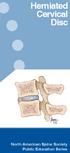 Herniated Cervical Disc North American Spine Society Public Education Series What Is a Herniated Disc? The backbone, or spine, is composed of a series of connected bones called vertebrae. The vertebrae
Care and Prevention of Sedentary Workplace Injuries. By: Colin Beattie, BKIN, mpt, cafci Registered physical therapist & medical acupuncturist
 Care and Prevention of Sedentary Workplace Injuries By: Colin Beattie, BKIN, mpt, cafci Registered physical therapist & medical acupuncturist Learning Objectives By the end of this presentation you should
Shoulder Tendonitis. Brett Sanders, MD Center For Sports Medicine and Orthopaedic 2415 McCallie Ave. Chattanooga, TN (423) 624-2696
 Shoulder Tendonitis Brett Sanders, MD Center For Sports Medicine and Orthopaedic 2415 McCallie Ave. Chattanooga, TN (423) 624-2696 Shoulder tendinitis is a common overuse injury in sports (such as swimming,
Cervical Whiplash: Considerations in the Rehabilitation of Cervical Myofascial Injury. Canadian Family Physician
 Cervical Whiplash: Considerations in the Rehabilitation of Cervical Myofascial Injury 1 Canadian Family Physician Volume 32, September 1986 Arthur Ameis, MD Dr. Ames practices physical medicine and rehabilitation,
What are Core Muscles?... 2. A Healthy Lumbar Spine...3. What is Low Back Pain?...4. Rehabilitation...6. Stages of Rehabilitation...
 Table of Contents What are Core Muscles?... 2 A Healthy Lumbar Spine...3 What is Low Back Pain?...4 Rehabilitation...6 Stages of Rehabilitation...7 Pain Management....................... 8 Heat/Ice What
SPINAL FUSION. North American Spine Society Public Education Series
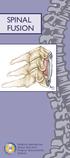 SPINAL FUSION North American Spine Society Public Education Series WHAT IS SPINAL FUSION? The spine is made up of a series of bones called vertebrae ; between each vertebra are strong connective tissues
Lumbar Disc Herniation/Bulge Protocol
 Lumbar Disc Herniation/Bulge Protocol Anatomy and Biomechanics The lumbar spine is made up of 5 load transferring bones called vertebrae. They are stacked in a column with an intervertebral disc sandwiched
LOW BACK PAIN; MECHANICAL
 1 ORTHO 16 LOW BACK PAIN; MECHANICAL Background This case definition was developed by the Armed Forces Health Surveillance Center (AFHSC) for the purpose of epidemiological surveillance of a condition
DIFFERENTIAL DIAGNOSIS OF LOW BACK PAIN. Arnold J. Weil, M.D., M.B.A. Non-Surgical Orthopaedics, P.C. Atlanta, GA
 DIFFERENTIAL DIAGNOSIS OF LOW BACK PAIN Arnold J. Weil, M.D., M.B.A. Non-Surgical Orthopaedics, P.C. Atlanta, GA MEDICAL ALGORITHM OF REALITY LOWER BACK PAIN Yes Patient will never get better until case
The type of cancer Your specific treatment Your pre training levels before diagnose (your current strength and fitness levels)
 Exercise and Breast Cancer: Things you can do! Cancer within the fire service is one of the most dangerous threats to our firefighter s health & wellness. According to the latest studies firefighters are
Workplace Health, Safety & Compensation Review Division
 Workplace Health, Safety & Compensation Review Division WHSCRD Case No: WHSCC Claim No: Decision Number: 15171 Gordon Murphy Review Commissioner The Review Proceedings 1. The hearing of the review application
Lumbar Spondylolisthesis or Anterolisthesis Patient Educational Information
 Lumbar Spondylolisthesis or Anterolisthesis Patient Educational Information What is a Spondylolisthesis or Anterolisthesis? Spondylolisthesis is a condition of the spine when one of the vertebra slips
Laparoscopic Anti-Reflux (GERD) Surgery Patient Information from SAGES
 Laparoscopic Anti-Reflux (GERD) Surgery Patient Information from SAGES Surgery for "Heartburn" If you suffer from moderate to severe "heartburn" your surgeon may have recommended Laparoscopic Antireflux
Refer to Specialist. The Diagnosis and Management of Shoulder Pain 1. SLAP lesions, types 1 through 4
 The Diagnosis Management of Shoulder Pain 1 Significant Hisry -Age -Extremity Dominance -Hisry of trauma, dislocation, subluxation -Weakness, numbness, paresthesias -Sports participation -Past medical
Herniated Lumbar Disc
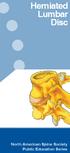 Herniated Lumbar Disc North American Spine Society Public Education Series What Is a Herniated Disc? The spine is made up of a series of connected bones called vertebrae. The disc is a combination of strong
Low Back Injury in the Industrial Athlete: An Anatomic Approach
 Low Back Injury in the Industrial Athlete: An Anatomic Approach Earl J. Craig, M.D. Assistant Professor Indiana University School of Medicine Department of Physical Medicine and Rehabilitation Epidemiology
Shoulder and Related Upper Extremity Radiating Pain
 Shoulder and Related Upper Extremity Radiating Pain ICD-9-CM codes: 723.3 Cervical brachial syndrome ICF codes: Activities and Participation Domain codes: d4301 Carrying in the hands (Taking or transporting
Lumbar Back Pain in Young Athletes
 Lumbar Back Pain in Young Athletes MS CAQ in Sports Medicine Blair Orthopedics Altoona, PA OMED 2012 San Diego CA AOASM Tuesday October 9 th 1:00pm Lumbar Back Pain in Learning ObjecKves Epidemiology Anatomy
Options for Cervical Disc Degeneration A Guide to the M6-C. clinical study
 Options for Cervical Disc Degeneration A Guide to the M6-C clinical study Each year, hundreds of thousands of adults are diagnosed with Cervical Disc Degeneration, an upper spine condition that can cause
Stuart B Black MD, FAAN Chief of Neurology Co-Medical Director: Neuroscience Center Baylor University Medical Center at Dallas
 Billing and Coding in Neurology and Headache Stuart B Black MD, FAAN Chief of Neurology Co-Medical Director: Neuroscience Center Baylor University Medical Center at Dallas CPT Codes vs. ICD Codes Category
Vtial sign #1: PULSE. Vital Signs: Assessment and Interpretation. Factors that influence pulse rate: Importance of Vital Signs
 Vital Signs: Assessment and Interpretation Elma I. LeDoux, MD, FACP, FACC Associate Professor of Medicine Vtial sign #1: PULSE Reflects heart rate (resting 60-90/min) Should be strong and regular Use 2
BEFORE THE ARKANSAS WORKERS COMPENSATION COMMISSION CLAIM NUMBER F205928 DOUGLAS EUGENE WHIPKEY, EMPLOYEE CLAIMANT XPRESS BOATS, EMPLOYER RESPONDENT
 BEFORE THE ARKANSAS WORKERS COMPENSATION COMMISSION CLAIM NUMBER F205928 DOUGLAS EUGENE WHIPKEY, EMPLOYEE CLAIMANT XPRESS BOATS, EMPLOYER RESPONDENT CONTINENTAL CASUALTY CO., INSURANCE CARRIER RESPONDENT
Name Date of Birth Social Security # XXX-XX- Address Apt. # City State Zip. Home Ph# Cell Ph# Driver s License #
 PATIENT INFORMATION Name Date of Birth Social Security # XXX-XX- Address Apt. # City State Zip Home Ph# Cell Ph# Driver s License # E-mail address: Race: Afro-American Am-Indian American Asian Black Caucasian
Whiplash injuries can be visible by functional magnetic resonance imaging. Pain Research and Management Autumn 2006; Vol. 11, No. 3, pp.
 Whiplash injuries can be visible by functional magnetic resonance imaging 1 Bengt H Johansson, MD FROM ABSTRACT: Pain Research and Management Autumn 2006; Vol. 11, No. 3, pp. 197-199 Whiplash trauma can
COMMON ROWING INJURIES
 COMMON ROWING INJURIES Prevention and Treatment Jo A. Hannafin, MD, PhD Professor of Orthopaedic Surgery Hospital for Special Surgery, Cornell University Medical College Team Physician, US Rowing FISA
Spinal Surgery 2. Teaching Aims. Common Spinal Pathologies. Disc Degeneration. Disc Degeneration. Causes of LBP 8/2/13. Common Spinal Conditions
 Teaching Aims Spinal Surgery 2 Mr Mushtaque A. Ishaque BSc(Hons) BChir(Cantab) DM FRCS FRCS(Ed) FRCS(Orth) Hunterian Professor at The Royal College of Surgeons of England Consultant Orthopaedic Spinal
CHAPTER 32 QUIZ. Handout 32-1. Write the letter of the best answer in the space provided.
 Handout 32-1 QUIZ Write the letter of the best answer in the space provided. 1. All of the following are signs and symptoms in patients with spinal injuries except A. paralysis. C. hyperglycemia. B. priapism.
THE LUMBAR SPINE (BACK)
 THE LUMBAR SPINE (BACK) At a glance Chronic back pain, especially in the area of the lumbar spine (lower back), is a widespread condition. It can be assumed that 75 % of all people have it sometimes or