
_remobbing: A REVIEW OF TURKISH LITERATURE
|
|
|
- Shonda Bishop
- 9 years ago
- Views:
Transcription
1 _remobbing: A REVIEW OF TURKISH LITERATURE Duygu SECKIN HALAC, MBA Student [email protected] Assoc.Prof.Dr. Çağrı BULUT [email protected] Yasar University, Turkey ABSTRACT Mobbing as a workplace concept comes into the picture only 30 years back in the world and less than 10 years in Turkey. Considering destructive counterproductive effects on organizations and the society in addition to effects on both physical and psychological health of people, mobbing is a concept needed to paid strong attention. The aim of this study is to provide a general sense to understand Turkey-based specific characteristics of mobbing by reviewing empirical studies conducted in Turkey. In the study, 31 papers reviewed which are published in refereed journals and conference proceedings and their findings are summed up. Keywords: Mobbing, Mobbing in Turkey INTRODUCTION As a human instinct, for centuries people compete with each other or try to eliminate the counter side even before he/she becomes a real threat to him/her for food, for the loved ones, for money, for being or perceived as successful, so and so forth. Everyone can come across a situation, moreover could have been a figure in such a situation that one being humiliated just because of her/his beauty/fit body, ethnicity, success, or how people can become aggressive when there is a high pressure to finalize the report with a short-notice deadline, or in case of a merger with a floating rumor that layoffs takes place. All such annoying situations are common and often normal in all workplaces but when these or worse harassing actions takes place for a long time on purpose, then the alarms on. Comparing the long history of working life, psychological terror at work is quite a new subject. It backs only to 1980 s when Heinz Leymann first adopted the term mobbing - to explain adults ganging up on a target to harass his/her on purpose (Leymann, 1990) - from studies on animals and children when he observed similar behaviors take place at work. Mobbing is initially used to describe animal group behavior - the attacks from a group of smaller animals threatening a single larger animal-. Later, it was used to explain the very destructive behavior in small groups of children directed against (most often) a single child. After adapting it as an organizational concept, Leymann (1990 & 1996) described mobbing as 223

2 a hostile and unethical communication which is directed in a systematic way (at least once a week in at last six months period) by one or a number of persons mainly toward one individual, who is pushed into a helpless and defenseless position. It is an interpersonal phenomenon (Zapf and Einarsen, 2001) and defined as one of the extreme negative social interaction at work (Vartia, 1996). It is also mentioned that the final aim of abusive behaviors is to make the victim leave the organization (Davenport, et al. 2003). In addition, it is also an encroachment to civil rights at work (Yuceturk and Oke, 2005). Yuksel (2009) summed up the concept and redefined mobbing as an unmanaged protracted conflict and consequent rumor through grapevine that is distorted over time and turned into a psychological terror at work environment. There are many definitions used in the literature but the commonly used traits are; the victim must feel harassed, their work is to be affected, and there must be a measure of frequency to the action (Rayner and Hoel, 1997). Other than mobbing, there are several different terms used to explain this workplace concept in the literature such as psychological violence/harassment, workplace/psychological terror, scape-goating, abusive behaviors, emotional abuse, workplace trauma, bullying, etc. (Zapf, 1999; Einarsen, 1999) As opposed to many researchers using mobbing and bullying interchangeably, Leymann (1996) differentiated these two concepts on the bases of physical/psychological violence and age. According to him, bullying is a physical aggression and threatening activities among teenagers whereas mobbing is primarily related to psychological violent rather than physical (Zapf, Knorz and Kulla, 1996) and takes place at work among adult people. Research on mobbing started in 1980 s in Nordic countries and spread to other European countries in mid-1990s (Zapf and Einarsen, 2001). According to the database of Turkish Academic Network and Information Center (ULAKBIM), mobbing has started to attract attentions by Yuceturk s narrative studies at the beginning of 2000s. While considering its destructive effects on individual, organizational and societal effects, the significance of understanding and making employees and managers aware of the concept, taking actions to prevent them is vital. The idea that by the help and contributions of researchers to understand the facts, frequently faced mobbing actions and its affects can guide practitioners to both prevent possible psychological violations and find ways to heal previously exposed mobbing victims in order to construct a healthier and productive work place and a society. The purpose of this study is to understand the general run of events and provide a synthesis of the mobbing studies in Turkey to reveal the nomological network of the concept in all facets 224

3 of and put forth the necessary future cautions and prevention methods by reviewing the Turkish empirical studies. Thus, after this brief introduction, in the second section the literature review is given, third part covers the mobbing studies in Turkey and the fourth part covers methodology; fifth section concludes this study. LITERATURE REVIEW After Leymann became ascertain in the psychological violations at work, he developed a typology consists of 45 different items in 5 categories to define the mobbing behaviors: (1) attacks on the victim s communication (e.g. to get no possibility to communicate, and verbal threats), (2) attacks on the victim s social contacts (e.g. isolated in a room, peers not talking with you anymore), (3) attacks on the victim s reputation (e.g. gossiping, making fun of the way victim talk or walk), (4) attacks on the victim s professional life (e.g. meaningless tasks or no tasks at all), (5) attacks on the victim s physical health (e.g. given dangerous work tasks, threaten physically or sexual harassment). Vartia s (1993) grouping was (1) slander, (2) social isolation, (3) giving a person too few or overly simple tasks, (4) threatening or criticizing, (5) physical violence and threat of violence, and (6) insinuations about the victim s mental health. Rayner and Hoel (1997) grouped the mobbing behaviors as follows: (1) threat to professional status (e.g. belittling opinion, public professional humiliation, and accusation regarding lack of effort); (2) threat to personal standing (e.g. name-calling, insults, intimidation, devaluing with reference to age); (3) isolation (e.g. preventing access to opportunities, physical or social isolation, withholding of information); (4) overwork (e.g. undue pressure, impossible deadlines, unnecessary disruptions); and (5) destabilization (e.g. failure to give credit when due, meaningless tasks, removal of responsibility, repeated reminders of blunders, setting up to fail). Thus, mobbing behaviors can be thought as direct and indirect: Direct behaviors include verbal declarations in order to stigmatize and belittling the victims. The indirect behaviors cannot be easily proven to others in the workplace setting even though the victim is well aware of and suffering from these harassments (Ozen, 2007). By evaluating several studies, Zapf, Knorz and Kulla (1996) concluded that it is most likely for a mobber to choose a victim in a weaker power position, also called downward mobbing; but there are also cases that cannot be undervalued that choosing someone in the same power structure which is also called horizontal mobbing, and less likely seen one, upward mobbing in which a mobber choose a victim from a higher power position cannot be ignored. It can be said that there are three factors can be thought as the reason(s) for the existence of mobbing situations at work: mobbing victim, mobber, and the organization. Leymann and 225

4 Gustafsson (1996) was totally against the idea to take the mobbing victim s personality as a trigger for mobbing situation; indeed, he insists if any change has happened in the victim s personal trait, this was the result of the mobbing process. On the other hand, it is actually stated in a study that the victims being exposed to mobbing behaviors once or more than once before, are feeling less self-confidence than the first-time victims (Vartia, 2001). As mentioned in the study of Matthiesen and Einarsen (2007), Olweus (2003) labels the victims as passive and submissive and this trait signals to others that they are insecure and worthless individuals who will not retaliate if they are attacked or insulted. It is also argued that the irritated behaviors of provocative victims, thought as experienced mobbing in early ages or at the previous work, provoke the mobber (Matthiesen and Einarsen, 2007). As opposed to Olweus, Gates (2004) define the victims as good performers, intelligent, competent and creative people who can be dangerous for less successful peers (Tigrel and Kokalan, 2009). Being in a salient position, being low on social competence, and self-assertiveness as well as overachievement and high conscientiousness of the victim are given as antecedents to contribute the mobbing behavior (Zapf and Einarsen, 2003). According to Huber (1994), there are four personality traits for mobbing victims: (1) a lonely person: e.g. only one woman surrounded by men in an office or vice versa, (2) a bizarre person: e.g. not socialized, somehow different from others such as outfit, handicapped or foreigner, (3) a successful person: e.g. rate-busters, (4) a new-comer: e.g. being a target just because of being enchanting, or being replaced to a loved one in the office (Tinaz, 2006). The victim s characteristic is especially important on how she/he perceives the mobbing behaviors or on how to react. One can think of the situation as a result of envy to his/her success, poor structure of the organization and bad luck; whereas the other can conclude the reasons for mobbing behaviors are just the private life, external appearance, religious or political tendencies and try to explain the behavior by the mobbers characteristics (Ozen, 2007). Although there is a lack in explaining the mobbers characteristics because of the data gathered from the victims and those reflect their perceptions on mobbers, there are some studies can lighten up the subject. In their study Zapf, Knorz and Kulla (1996), found that mobbers are often not aware of what they are doing because of not knowing the exact consequences of their actions. Motive to protect self-esteem, lack of social competencies, and micropolitically motivated behaviors internal rivalry/competition in the workplace, not clearly defined work tasks and responsibilities, and poor organizational structure are given as the contributors of the mobbing behavior (Matthiesen and Einarsen,2007; Einarsen et al., 2003). Tinaz (2006) divides mobbers personal traits into five categories: narcissists, furious, 226

5 dissembler, megalomaniac, frustrated. In Vartia s (1996) study states that competition for superior s favor and approval are also most often perceived as reasons for mobbing, thus brownnoser characteristic may also be thought in the personal traits. There are four reasons that the mobber having one or more traits above channels his/her efforts to disturb the victim: to keep them in line with the organizational norms (stick to the rules or make them leave the company); enjoying to act maliciously (try to eliminate successful ones at workplace); to overcome boredom (sadistic fun), prejudicial attitude (ethnicity, religion, or just being resembled to one the mobber dislikes can make you a target) (Yuceturk, 2002). There are oppositions and arguments on the subject that whether there are common traits of the mobbing victim and mobber but dominant affects of organization and managerial factors on mobbing behaviors are commonly agreed. Leymann (1996) shows how an organization becomes the main source of such behaviors: poor conflict management and poor communication- e.g. after a conflict arise, consider a manager ignores the problem and allow the gossip turn around, and even chooses side; lack in procedural and cultural structure- e.g. administering no punish to the mobber and letting the victim alone fosters to further similar situations. Changing nature of work, work organization, culture and climate, and leadership has showed as the contributors to mobbing at work by Zapf and Einarsen (2003). Cooper (1999) mentioned that for many organizations the globalization, economic crisis, needs to reduce operating costs required restructuring and downsizing, and as a result pressure has increased and stress factor is getting higher (Zapf and Einarsen, 2003). It is likely that restructuring attempts and downsizing also result in role conflicts and role ambiguity. This gives rise to micropolitical behavior (Matthiesen and Einarsen, 2007). In line with the view, Vartia s study (1996) found that competitiveness with people pursuing their own interest, poor flow of information, lack of mutual conversations about tasks and goals cause the mobbing situations. Large and hierarchical structures, reduced human resources budgets, closed door policy, poor communication channels, complaints not taking seriously or even better to cover up the problems, little or no teamwork, poor leadership are seemed as signs of poor management (Zapf and Einarsen, 2003; Yuceturk, 2002). Mobbing is mostly practiced in public establishments, health services, schools (Zapf, Knorz and Kulla, 1996), educational settings, religious organizations (Leymann, 1996), and according to Leymann, this is a consequence of such organizations are controlling by more than one hierarchy, and workload in addition to labor shortage even worsened the situation. When it comes to culture, it could be either accepted directly- if humorous joking with new comers comes a part of socialization process, or indirectly- no policy or punishment system for such actions (Zapf and Einarsen, 227

6 2003). But also it should be kept in mind that there could always be someone who tends to violate the working environment and peers no matter which organizational culture was imposed and how strict policy or punishments are in use (Zapf, Knorz and Kulla). On the other side, mobbing can be used consciously as an organizational weapon or strategy to reduce employment, renew employee profile and get rid of an undesirable employee (Yuceturk, 2002). In every organization there exist conflicts, stress and pressure, irritations or personal differences but that doesn t mean that it turns out to a mobbing situation. It could be a mistake to consider only the mobber s character, the mobbing victim s, or the organizational character as a main reason why mobbing arises. Indeed, it seems that at some points, in some proportions or combinations of these characteristics are becoming effective. When looking at Einarsen s (2000) theoretical framework figure, it s clear that the three components are effective in the mobbing process. According to her, when organizational factors enable the aggressive individual and social behaviors, the mobbing takes place and, the impact of the violence and the victim s perception are shaped by the victim s characteristic and the organizational actions taken or not taken like tolerance/intolerance or policies against mobbing. Thus, mobbing has seen as a process. Four critical phases described in Leymann s study are; (1) a triggering situation mostly a conflict, (2) to manipulate the victim s reputation, victim s communication and social channels, nature of or possibility of performing the job and violence/threat of violence in a consistent and systematic way, (3) the case becomes an official case by the management s step in, (4) expulsion (Leymann 1990). In general the effects of mobbing have divided into three parts in the literature: effect on victim, effects on organization and the effects on the society. Being exposed to hostile behaviors for a quite a long period for at least once a week, results in psychological, psychosomatic and social suffering (Leymann and Gustafsson, 1996). According to Yuceturk (2002), at the first stage the victims are suffering from: crying for no reason, sleep disorders, sudden aggression, and concentration problems; at the second stage, in addition to first stage symptoms: high blood pressure, gastrointestinal diseases, depression, unwillingness to go to work and being late to work; at the third stage: depression level increases, panic attack and anxiety starts; at the last stage: accidents and tendency to suicidal attempts occur. A decrease in self-esteem and self-confidence also can be seen (Tinaz, 2006). Personal and professional reputation damages, being exposed to isolation, increased health expenses, income losses due to being unemployed are the effects in social and economical facets on the victim (Tinaz, 2006). Even worse, likely to encounter future losses due to not being able to find any jobs 228

7 because of getting older (Leymann and Gustafsson, 1996), or because of economic crisis and/or higher unemployment rate. Vartia (2001) states that repeated exposure to mobbing aggravates the impacts especially on lowering self-esteem. Organization as a whole also suffers deeply by the ignored mobbing events and not taking precautions before it becomes unable to solve. At first, more conflicts arise; organizational climate and culture negatively affected; erodes trust; lack of personal motivation and commitment and respect to each other start to dominate the working environment; then economic costs such as increase in sick leaves, personal turnovers, and additional costs for new recruits and their socialization process, general declines in performance and quality; increased production and operation costs; increased amends and court expenses; damages in organization s reputation (Leymann 1996; Yuceturk, 2002; Tinaz, 2006; Bozbel and Palaz, 2007). And finally, in the macro level, effects of mobbing on society are required to mention. Health problems and expenses increase as a whole; early retirement, unemployment rate and unemployment allowances increase; increase in number of psychologically collapsed people with lost self-esteem who supposed to be included in highly talented work force; increased separated families in the society and dominated unhappiness (Leymann, 1996; Tinaz, 2006). Mobbing Studies in Turkey There are several studies in Turkish literature, especially in health sector more specifically for nurses, researching for violence, abuse and/or harassment, however, these cannot be mentioned as mobbing studies. Although the perceived harassing behaviors shows strong similarities, because mostly the victims are not under a continuous violation by the same harasser and more importantly the harassers reported as patients or patients relative mostly. Yuceturk started narrative mobbing studies in 2002 and mobbing studies have continued increasingly. These narrative studies give a general understanding of definition of mobbing, its process, mostly seen mobbing behaviors, the victim s, the mobber s and the organization s possible characteristics as a trigger to cause these behaviors, the effects on the victim, to the organization and to the society as a whole, and some studies conducted to discuss the issue from the viewpoint of law, its progress in developed countries and not having any law in Turkey (Yuceturk, 2002, 2003; Yuceturk and Oke, 2005; Tinaz, 2006; Ozen, 2007; Bozbel and Palaz, 2007). Empirical studies in Turkey started to conduct in In the period , studies conducted to understand if mobbing exists in the selected groups, whether there are any differences related to demographic characteristics of participants, sectors the organizations conducted, or cross-cultural (one study), and the effects of mobbing, victims 229

8 responses. Two studies in 2008, and one in 2009 were conducted to develop a scale to evaluate psychologically violent behaviors at workplace by a more appropriate, culturally adopted instrument. By 2008, mobbing and climate, mobbing and commitment relations started to be searched. Empirical studies in Turkey have been conducted mostly in public institutions but private and both institutions are not too little to be undervalued. Another important point is almost all studies focused on service sectors. METHODOLOGY This study reviews survey-based research papers published in refereed journals and conference proceedings and focusing in on mobbing behaviors in Turkey. The study covers the period that survey studies have been conducted. At the beginning of the research, online research databases,such as Business Source Complete-EBSCO, Science Direct- Elsevier, ULAKBIM, and Google Scholar, were scanned by using mobbing, bullying, psychological abuse/harassment/terror/ abuse as key words, then to scan further and reach all possible sources, in addition to electronic scanning by keywords some other significant papers have been chosen from the reference lists of the articles and proceedings which are published in electronic databases. At the end, as can be seen at Table.1, 31 survey-based papers studied in detail, in which 24 of them published in refereed journals and 7 of them published in conference proceedings. According to survey-based studies conducted in Turkey, general tendency about mobbing in all dimensions given in a descriptive way. Being first Turkish literature review in empirical mobbing studies makes this study important with a thought that reviewing mobbing studies in Turkey will provide a significant insight to both practitioners for their applications and researchers to decide necessary fields to focus in on. Findings Table 1 sets out the papers reviewed in this study: private/public distinction, interested groups, samples, and which relations to be searched are given in a nutshell. As can be seen in the table, 17 out of 31 studies (%54.8) were conducted to analyze public sector, 8 of them (%25.8) to private sector, and the remaining 6 (%19.4)were held for both public and private sector institutions. When considering interested groups, it is prominently dominant that most studies held in service sectors (%83.9). In the remaining 3 studies out of 6 were not identified as regards to the respondent work groups, one was in production and the 230

9 other one was mixed-service and production analyzed together. Another noteworthy point in the participant work groups is 10 of them (%32.3) directly related to health staff and the following 6 (%19.4) is directly related to primary and secondary school teachers. The last column of table 1 summaries the relations in request. Other than scale development studies, the studies focus on whether mobbing exists and displays any demographical differences, its effects, victim s responses, and mobbing and culture, climate, and/or commitment relations. The paper of Ozturk et al. (2007) is the first study to construct a scale and the findings indicate that it is valid and reliable for academic nurses. Yildirim and Yildirim s (2008) results show that the instrument is valid and reliable for testing mobbing for nurses. Yaman (2009) in his scale development concludes that the instrument is valid and reliable, and can be used in the field of education. Some studies did not collect any demographic characteristics of participants, and in some studies the collected data were not shared but the relation was. Table 2 sums up the studies searched for the relation of demographic characteristics and mobbing. The sign + represents that a statistically significant difference is found, and the sign - represent that there is no significant difference according to that specific demographic characteristics on mobbing. The headings for characteristics are as followed: age, sex, marital status, education level, years of experience, position at work, and public/private differentiation. As shown in table 2, six studies find that there is no statistical difference according to variable age. However, there is four other studies findings show that younger employees- younger than 25 (Koc and Urasoglu Bulut, 2009) and age between (Yilmaz et al., 2008) - are more likely to be exposed to mobbing than the elderly peers. One study only looks for whether a relation exists and found that it is but not specified the way of the relation (Acar and Dundar, 2008). Seven studies find that there is no statistical difference according to variable sex. Some studies mentioned that the results show a significant difference: on the one hand, some studies find female employees are more likely to exposed mobbing (Bayrak Kok, 2006; Aydin and Ozkul, 2007; Dogan Kilic, 2009), on the other hand some find male employees are more likely to (Cemaloglu and Erturk, 2007; Koc and Urasoglu Bulut, 2009). Yilmaz et al. (2008) details the study and not looks for whether a relation exists between demographic characteristics and mobbing but for the relation in the subcategories of mobbing. According to this study, for the variable sex, in the subcategories of communication, occupational situation, and health, females are more likely to exposed mobbing where, for the other subcategories - social contacts and personal reputation- no significant relation is found. 231

10 Five studies find that there is no statistical difference according to variable marital status, where three of them find a significant relation. 2 out of these 3 studies mention that married employees are more exposed to mobbing (Bayrak Kok, 2006; Aydin and Ozkul, 2007) while Dogan Kilic (2009) claims that single employees are more likely to. When it comes to education level, four studies find that there is no statistical difference according to variable education level. Three studies findings show that a relation exists. Acar and Dundar (2008) not specified but only mention that a relation exists. According to Ozaralli and Torun (2007) university graduates are more exposed to mobbing than high school graduates and Yilmaz et al. s (2008) study shows that in all subcategories higher education level employees are at risk of being more exposed to mobbing. Four studies find that there is no statistical difference according to variable years of experience, where Yilmaz et al. (2008) find no significant difference only in social contacts and occupational situation subcategories. However, there are also studies shows a significant relation. Yilmaz et al. s (2008) study shows, in communication, personal reputation and health subcategories, less experienced employees are likely to be exposed to mobbing. Tanoglu et al. (2007) and Dogan Kilic (2009) support these findings and according to them less experienced (1-5 years) employees are more likely to be the victims of mobbing. For position at work also can be used for department- four studies find no statistical difference on mobbing. Acar and Dundar (2008) only mentioned a relation exists. Aydin and Ozkul s (2007) study shows hotel employees in housekeeping and catering departments are more likely to be the mobbing victims. According to Cemaloglu (2007), classroom teachers are more likely to be exposed to mobbing than branch teachers. It can be said that according to the sector and interested work groups given data of demographic characteristics vary. According to studies of Ozaralli and Torun (2007), and Ozdemir and Acikgoz (2007) employees in public institutions are more exposed to mobbing than private sector organizations, while as opposed Yildirim and Yildirim (2006) found that private hospital nurses, Kok (2006) found private banking employees, and Koc and Urasoglu Bulut (2009) found that private school teachers are more exposed to mobbing than public hospital nurses, public banking employees, and public school teachers respectively. In addition to above common traits to be tested, Aydin and Ozkul (2007) also find a significant relation with being exposed to mobbing and salary. According to their study, employees with lower level salaries are more exposed to mobbing in hotels. Also when considering the hotel characteristics, 5 star hotel s employees more than 4 stars, city center hotel s employees more than sea side hotels, and seasonal hotel s employees more than the 232

11 employees working for the hotels running during the year are likely to be exposed to mobbing. In their study, Demirel and Yoldas (2008) define Turkey and Kazakhstan by the management types. To the study, in Turkey there is a guiding management style whereas in Kazakhstan there is bureaucratic style. Thus, according to them this difference is the explanation of employees in Kazakhstan being more exposed to mobbing than employees in Turkey. Table 3 shows which studies defined a general mobbing percentage among the sample, and at what percentage. As it shows, the mobbing percentages range from 2% to 91%. When considering the studies conducted in Sweden 3.5% (Leymann, 1996), in Norwey 8% (Mathiesen and Einarsen), in Finland around 10 % (Vartia, 1996; 2001, other than 4 of specified studies the ratio is extremely high in Turkey. 233

12 Table 1. Summary of Studies # Author & Year Private/Pu blic 1 Aksu and Balci, 2009 Public primary school 2 Bulutlar and Unler Oz, Acar and Dundar, 2008 Private airline Interested Group Sample Relation/Aim 373 teachers from 25 primary schools in 4 big districts of Izmir Private mixed 197 from different companies in Istanbul 40 people from one airline company's head office and branches located in Istanbul. 4 Aydın and Ozkul, 2007 Private hotel 427 people from 29 hotels in different cities 5 Bayrak Kok, 2006 Both banking 6 Bilgel et al., 2006 Public mixed 7 Cemaloglu and Erturk, 2007 Public primary school teachers 8 Cemaloglu, 2007 Public primary school 9 Demirel and Yoldaş, 2008 Public health sector / all, Turkey & Kazakhstan 189 people from 2 public and 13 private banks 944 people from 25 primary health care units and 1 hospital, 9 schools and 13 police stations 347 teachers from 16 schools in Ankara 337 primary school teachers from 7 different regions of Turkey 150 people from 3 hospitals in 2 cities in Turkey and 165 people from 4 hospitals in Kazakhstan 10 Dogan Kilic, 2009 Public primary school 310 teachers living in Sanliurfa 11 Elibol et al., 2008 Private defense, banking, cleaning 337 people in defense, banking and cleaning sectors in Ankara mobbing perceptions and responses mobbing& ethical climate types& commitment if demographic differences effect mobbing whether mobbing differs according to demographic characteristics if demographic differences effected mobbing; public& private differences whether mobbing exists, effects, responses, if any demographic differences if mobbers' sex is effected in sub categories of mobbing and which sex exposed more whether mobbing differ acc. to sex, marital status, experience and branch/class teachers mobbing comparison between Turkey and Kazakhstan according to management culture whether mobbing differ according to sex, marital status and experience whether mobbing exists and if any differences in sectors 12 Ergun Ozler et al., 2008 Public health sector / all 121 employees from 2 hospitals in Kutahya mobbing& commitment 13 Gunduz and Yilmaz, Iyem, 2007 Private 15 Koc and Urasoglu Bulut, 2009 Public secondary school professional soccer players Both secondary school 225 teachers and school managers of the middle schools in Duzce 19 professional soccer players in Sakaryaspor 396 secondary education teachers from 6 different cities. whether mobbing exists, effects, responses whether mobbing exists, effects, responses if demographic differences effected mobbing 234

13 16 17 Özaralli and Torun, 2007 Ozdemir and Acikgoz, 2007 Both bank, automotive, education, IT and tourism 18 Ozturk et al., 2008 Public academia/ nurses 19 Tanoglu et al., 2007 Public Academia Tengilimoglu and Akdemir Mansur, 2009 Tengilimoglu et al., 2010 Tigrel and Kokalan, 2009 Unal and Karaahmet, people effects on victim and if any difference acc. to education and public & private enterprises Both everybody 300 people chosen from malls in Aydın whether mobbing exists, effects Public health Staff /all 162 academic nurses from seven out of nine nursing schools state universities in Turkey to construct scale; 98 of them answer the questions later 316 academicians from 5 different faculties of a university 320 people from a university hospital in Ankara health sector / 320 administrative staff of a teaching hospital Public administrative staff in Ankara Both Academia 103 academician from 3 public and 2 private universities in Istanbul Private 24 Yaman, 2009 Public mixed Yildirim and Yildirim, 2008 Yildirim and Yildirim, 2006 Public Both textile, machine and automotive health sector/ hospital nurses health sector/ hospital nurses 141 people from 3 companies in Bursa (textile, machine and automotive sectors) 515 people from different sectors in Sakarya and Bursa scale development whether mobbing exists, effects, responses mobbing& commitment (all types) mobbing& commitment ( all types) whether mobbing exists, effects, responses whether mobbing differs according to sex, marital status, position scale development 476 nurses scale development 505 nurses from 1 private and 2 public hospitals over 200 beds on the European side of Istanbul. 27 Yildirim et al., 2007 Public academia/ nurses 210 teaching staff from 10 nursing schools 28 Yildirim, 2009 Public 29 Yilmaz and Uzuncarsılı Soydas, 2006 health sector/ hospital nurses Private banking 286 registered nurses from a teaching hospital in Ankara 90 full-time employees from 3 biggest banks of Turkey 30 Yilmaz et al., 2008 Public health sector / all 121 employees from 2 hospitals in Kutahya 31 Yuksel, 2009 Private media for interviews: 20 HR managers; survey: 77 employees from a media company whether mobbing exists, effects, responses; if any demographic or private& public differences whether mobbing exists, effects, responses whether mobbing exists,effects, if any demographic differences whether mobbing exists, effect on sick leave; mobber s sex demographic differences; mobbing& climate gossip, conflict, power misuse& mobbing 235

14 AUTHOR Table 2. Summary of Respondents Demographic Characteristics MARITAL AGE GENDER STATUS EDUCATION LEVEL YEARS OF EXPERIENCE POSITION PUBLIC/ PRIVATE Tanoglu et al., Ozturk et al., 2008 Acar and Dundar, Özaralli and Torun, Bayrak Kok, Yilmaz and Uzuncarsili Soydas, 2006 Ozdemir and Acikgoz, 2007 Yilmaz et al., 2008 All + Yildirim and Yildirim, 2006 Communication, occupational situation, health: +; social contacts, personal reputation: All + Communication, personal reputation, health: +; social contacts, occupational situation: + + Yildirim, Aydin and Ozkul, Bilgel et al., 2006 Dogan Kilic, Aksu and Balci, 2009 Cemaloglu, Cemaloglu and Erturk, Koc and Urasoglu Bulut, Unal and Karaahmet,

15 According to the surveys replied by the respondents who defined as the victims of mobbing, most perceived mobbing behaviors are as follows: (1) being ignored in decisions or in social gatherings (Tigrel and Kokalan, 2009; Tengilimoglu and Akdemir Mansur, 2009; Tengilimoglu et al., 2010; Aydin and Ozkul, 2007; Yuksel, 2009; Cemaloglu, 2007; Gunduz and Yilmaz, 2008); (2) belittling in front of others (Yildirim et al., 2007; Yildirim and Yildirim, 2006; Yildirim, 2009; Aksu and Balci, 2009; Gunduz and Yilmaz, 2008; Unal and Karaahmet, 2008); (3) unfairly criticized/under evaluation on job performance (Tigrel and Kokalan, 2009; Tengilimoglu and Akdemir Mansur, 2009; Tengilimoglu et al., 2010; Aksu and Balci, 2009; Gunduz and Yilmaz, 2008); (4) being blamed for something that not in responsible for (Yildirim et al., 2007; Elibol et al., 2008; Yildirim and Yildirim, 2006; Yildirim, 2009; Gunduz and Yilmaz, 2008); (5) exposing to unmanageable workload (Elibol et al., 2008; Yuksel, 2009; Bilgel et al., 2006; Unal and Karaahmet, 2008); (6) making up gossips/rumors (Tigrel and Kokalan, 2009; Tanoglu et al., 2007; Elibol et al., 2008; Tengilimoglu and Akdemir Mansur, 2009); (7) given jobs being controlled directly or indirectly (Tigrel and Kokalan, 2009; Yildirim and Yildirim, 2006; Yildirim, 2009; Gunduz and Yilmaz, 2008); (8) given meaningless tasks (Tigrel and Kokalan, 2009; Elibol et al., 2008; Tengilimoglu and Akdemir Mansur, 2009; Yuksel, 2009). Table 3. Mobbing in % Authors Mobbing% Authors Mobbing% Tigrel and Kokalan, % Yildirim, % Tanoglu et al., % Tengilimoglu et al., % Ozturk et al., % Aydin and Ozkul, % Yildirim et al., % Yuksel, % Ozaralli and Torun, % Bilgel et al., % Yilmaz and Uzuncarsili Soydas, % Dogan Kilic, 2009 **65.9% Elibol et al., 2008 *45.4% Cemaloglu, % Ozdemir and Acikgoz, % Cemaloglu and Erturk, % Tengilimoglu and Akdemir Mansur, % Iyem, % Yilmaz et al., % Gunduz and Yilmaz, % Ergun Ozler et al., % Unal and Karaahmet, % Yildirim and Yildirim, % * 41.6% in defense, 34.6% in banking and 80.6% in cleaning sector ** 83% of female and 54% of male Although rarely asked or mentioned in findings, it is also noteworthy to imply that the lowest perceived mobbing behaviors are teasing about personal qualifications/ making fun of 237

16 personal or religious or political preferences, physical violence, written threats (Tigrel and Kokalan, 2009; Cemaloglu, 2007; Aksu and Balci, 2009; Aydin and Ozkul, 2007). From the victims point of view, the most perceived reasons for mobbing behaviors are: (1) envy (Tanoglu et al., 2007; Ozturk et al., 2008; Bayrak Kok, 2006; Tengilimoglu et al., 2010; Bilgel et al., 2006; Tengilimoglu and Akdemir Mansur, 2009); (2) poor management (Tengilimoglu and Akdemir Mansur, 2009; Bayrak Kok, 2006; Tengilimoglu et al., 2010); (3) stressful work environment (Tengilimoglu and Akdemir Mansur, 2009; Bayrak Kok, 2006; Tengilimoglu et al., 2010); (4) bad character of the mobber (Tanoglu et al., 2007; Bayrak Kok, 2006). Mobbers are mostly reported as the victims superior/manager and following with peers (Ozaralli and Torun, 2007; Ozturk et al., 2008; Tigrel and Kokaln, 2009; Gunduz and Yilmaz, 2008; Bilgel et al., 2006; Yildirim and Yildirim, 2006; Yildirim et al., 2007; Yildirim, 2009). Moreover, in three studies - Yildirim and Yildirim (2006); Yildirim et al. (2007); Yildirim (2009) - they further detail the findings: the percentages of reported mobbers are changing in order to perceived mobbing behaviors. Tanoglu et al., 2007 order is a little bit differs: according to that study managers come first again but the second is a group of people containing both the manager and peers, then third peers come. Tengilimoglu et al., 2010 and Iyem, 2007 claim that mobbing behaviors are mostly come from peers. Another finding about the mobber is about the sex. Cemaloglu and Erturk (2007) claim that for both men and women the mobber is mostly men, whereas Yimaz and Uzuncarsili Soydas (2006) shows the mobbers are mostly female if they are dominant at work place as they sampled banking sector. On the other hand, there are other studies argue that the mobber and the victim are most likely to be in the same sex (Bilgel et al., 2006; Tanoglu et al., 2007). Another point is according to Bayrak Kok (2006), when the experiences of employees increase, their mobber perceptions are likely to be managers mostly. Most victims according to surveys choose to talk face-to-face with the mobber in order to make the mobber give an end to such behaviors (Gunduz and Yilmaz, 2008; Yildirim and Yildirim, 2006; Yildirim et al., 2007; Ozturk et al., 2008; Tanoglu et al., 2007; Aksu and Balci, 2009; Bilgel et al., 2006). Another response most victims try to stop the violence they have been exposed to is thinking seriously to resign or propose to a rotation (Yilmaz and Uzuncarsili Soydas, 2006; Gunduz and Yilmaz, 2008; Ozaralli and Torun, 2007; Yildirim et al., 2007; Ozturk et al., 2008; Tanoglu et al., 2007; Tengilimoglu et al., 2010; Tigrel and Kokalan, 2009). However, giving up and choosing to do nothing is also another most frequently chosen answer (Ozturk et al., 2008; Tanoglu et al., 2007; Aksu and Balci, 2009; 238

17 Tengilimoglu et al., 2010). Other than these, being more organized and careful to avoid criticism (Yildirim and Yildirim, 2006; Gunduz and Yilmaz, 2008; Yildirim et al., 2007), reporting situation to the management (Yildirim and Yildirim, 2006; Tanoglu et al., 2007; Tengilimoglu et al., 2010; Aydin and Ozkul, 2007), sharing the suffering with friends and family (Ozturk et al., 2008; Tanoglu et al., 2007; Bilgel et al., 2006), and ignoring or reacting in the same way against the mobber (Tigrel and Kokalan, 2009; Tengilimoglu et al., 2010) are also seems as notable responses reported. Being under such a psychological violence for a long period of time, affects the victims in many serious forms. Physiological reactions can be sorted as: feeling tired, angry and stressed, having headaches, feeling anxiety and depression, eating excessively or not having an appetite, sleeping anomaly (Yildirim and Yildirim, 2006; Yildirim et al., 2007; Tanoglu et al., 2007; Iyem, 2007; Tengilimoglu et al., 2010; Bilgel et al., 2006; Tigrel and Kokalan, 2009; Yildirim, 2009). Emotional reactions listed as: extreme sadness when remember the mobbing behaviors, negatively affected private life away from work, feel like want to cry, contemplated committed a suicide, negatively affected self-respect, increase aggressiveness and fear, feeling unhappiness and guilt (Yildirim and Yildirim, 2006; Yildirim et al., 2007; Ozaralli and Torun, 2007; Ozturk et al., Iyem, 2007). Tanoglu et al. (2007) also mentioned the increased consumption of alcohol and smoking habits to the participants replies. Tigrel and Kokalan (2009) claim that the victims first blame themselves, but then realized the situation is mobbing and also need to undergone therapy sessions in order to overcome psychological effects of mobbing. According to Yildirim et al. (2007) and Yildirim (2009), such psychological violations also affect the victims in several ways that leads to effect organization as a whole negatively. For instance, people starts not to trust anyone in the organization and furthermore they want to take out the pain experienced by belittling someone else and this leads even more conflicts between employees, thus work motivation and attachment to organization getting lower. Five studies especially focus in on the mobbing and commitment and climate relations. As to Tengilimoglu et al (2010) and Tengilimoglu and Akdemir Mansur (2009), there is no significant relation between being subjected to mobbing and organizational commitment but when pin the research down to commitment types it is found out that there is a negative relation between subjected to mobbing and affective commitment and normative commitment while no relation found between continuance commitment. In Bulutlar and Unler Oz (2008) study notes that there is only a partial relation between being bullying and commitment. According to findings, employees who are being bullied have lower affective commitment 239

18 and lower normative commitment; however, employees who are being bullied have higher continuance commitment than those who are not bullied. Also another finding in the same study is that employees who are being bullied and take support from their supervisor will be more committed to the organization than the employees who do not receive support. Ergun Ozler et al. (2008) examine one by one the relation between subcategories of mobbing and commitment types. As to the study, increased attacks on communication, personal reputation, health and occupational situation negatively effects (decreases) affective commitment whereas no significant relation between social contacts and affective commitment; increased attacks on communication, social contacts and occupational situation negatively effects (decreases) continuance commitment whereas increased attacks on personal reputation positively effects continuance commitment, and there is no significant relation between health and continuance commitment; increased attacks on communication, social contacts, personal reputation, health and occupational situation negatively effects (decreases) normative commitment. The findings of all studies almost in line with each other and the reason for the positive relation between violence and continuance commitment is considered as the need for work (Ergun Ozler et al., 2008). Yilmaz et al. (2008, conclude that (1) increased supercilious of management negatively affected the employees' communication, and it leads to mobbing, (2) job-oriented management positively affect the employees' communication and occupational situation, and leads to decreased risk of mobbing, (3) being tolerant positively affect employees' communication, occupational situation, social contacts and health, and it leads to decreased risk of mobbing. Bulutlar and Unler Oz s (2008) analysis support that a positive relation between instrumental climate and bullying behavior exists, and partially supported that there is a negative relation between law and code and bullying, rules and bullying. It is also found that physical threats have no effect on normative commitment alone; its interaction with supervisory support produces a significant relationship: Employees who encounter physical threats but receive supervisory support have lower normative commitment levels, and employees who are underestimated by others and at the same time supported by their supervisor have higher normative commitment level than those who do not take support. CONCLUSION Although it is not possible to make generalizations from the papers because of the sample sizes not really utilized to estimate about the population, still provide significant insights about the subject. Most studies show that there is statistically no difference on variables age, sex, marital status, education level, position and level of experience. Thus, anyone can be a 240

19 mobbing victim at work. Besides the limitation, when considering the reported mobbing events being reached to a point as 91% is thought-provoking. According to victim s perceptions, they mostly face with ignorance, belittling, and criticisms or under evaluation on job performance. So as far as to the answers it can be concluded that, in Turkey, mobbing behaviors are targeting on to first socials contacts, second personal reputation, and then professional life. It could confidently be declared that the mobbers are mostly the superiors/managers of the victims, and the victim and the mobber are most likely in same sex. Victims mostly choose to talk with the mobber face-to-face or nothing to do then they seriously thinks to leave the organization or want a rotation within the organization to move away from the mobber. These highly destructive interactions make the victims suffer from several physiological and psychological illnesses and these most likely to affect negatively their private life away from work either. Organizations in which mobbing occurs, also affected by the decreased motivation and commitment. Studies show that mobbing effects affective and normative commitment mostly. But because of the high unemployment rate and the economic crises prevent employees to leave their organizations even they really want to. And it is also found that supervisory support absorbs the effect of mobbing and, laws and codes can decrease the mobbing intentions. Thus, at first organizations need to take precautions to prevent mobbing even before it starts. To do that, construct a culture that not tolerated such acts are seemed vital, also necessary punishment methods need to be declared and applied objectively if necessary. Another point is to make all employees conscious of mobbing and let them know the way can be followed in such a situation occurred at workplace, so that if someone faces with mobbing can easily understand situation, consequences and consciously take actions to stop the disturbances. Hopeful news of an initiating legislation for mobbing is a pleasing progress broadcasted by NTV news on January 9th, Thus, at least taking the subject on a legal base can keep people who intend to initiate such actions or if happened, victims can also seek justice. REFERENCES Acar, A. B. and G. Dundar (2008), Isyerinde Psikolojik Yıldırmaya (Mobbing) Maruz Kalma Sıklıgı ile Demografik Ozellikler Arasindaki Iliskinin Incelenmesi, Istanbul Universitesi Isletme Fakultesi Dergisi, 37 (2),

20 Aydin, S. and E. Ozkul (2007), Is Yerinde Yasanan Psikolojik Siddetin Yapisi ve Boyutlari: 4-5 Yildizli Otel Isletmeleri Örnegi, Anadolu Universitesi Sosyal Bilimler Dergisi, 7 (2), Aksu A. and Y. Balci (2009),Ilkogretim Okullarinda Psikolojik Yildirma ve Psikolojik Yildirmayla Basetme, e-journal of New World Sciences Academy, 4 (4) Bayrak Kok, S. (2006), Is Yasaminda Psiko-Siddet Sarmali Olarak Yildirma Olgusu ve Nedenleri, 14. Ulusal Yönetim ve Organizasyon Kongresi Bildiriler Kitabi, Bilgel, N., S. Aytac and N. Bayram (2006), Bullying in Turkish White-collar Workers, Occupational Medicine, 56, Bozbel, S. and S. Palaz (2007), Isyerinde Psikolojik Taciz (Mobbing) ve Hukuki Sonuclari, TISK Akademi, 1, Bulutlar F. and E. Unler Oz (2009), The Effects of Ethical Climates on Bullying Behavior in the Workplace, Journal of Business Ethics, 86, Cemaloglu, N. (2007), The Exposure of Primary School Teachers to Bullying: An Analysis of Various Variables, Social Behavior and Personality, 35 (6), Cemaloglu, N. and A. Ertur (2007),Ogretmenlerin Maruz Kaldiklari Yildirma Eylemlerinin Cinsiyet Yonunden Incelenmesi, Türk Egitim Bilimleri Dergisi, 5(2), Demirel Y. and M. A. Yoldas (2008), Saglık Kuruluslarinda Karsilasilan Psikolojik Yildirma Davranislarinin Turkiye ve Kazakistan Acisindan Karsilastirilmasi, Uluslararası İnsan Bilimleri Dergisi, 5(2), Dogan Kilic, E. (2009), Psychological Violence in Learning Organizations: A Case Study in Sanliurfa, Turkey, Social Behavior and Personality, 37(7), Davenport, N., R. Schwartz and G. P. Elliott (2003), Mobbing: Emotional Abuse in the American Workplace, Civil Society Publishing Einarsen, S. (1999), The Nature And Causes Of Bullying At Work, International Journal of Manpower, 20 (1/2), Einarsen, S. (2000), Bullying and harassment at work: Unveiling an organizational taboo, Conference Proceedings of Transcending Boundaries: Integrating People, Processes and Systems,

21 Einarsen S., H. Hoel, D. Zapf and C. L. Cooper (2003), Bullying and Emotional Abuse in the Workplace: International Perspective in Research and Practice, Taylor and Francis. Elibol, H., I. Gokdeniz and T. Gungor (2008), Treatment Incompatible with Human Dignity: An Application of Private Sector, International Research Journal of Finance and Economics, 18, Ergun Ozler, D., C. Giderler Atalay and M. Dil Sahin (2008), Mobbing in Orgutsel Baglilik Uzerine Etkisini Belirlemeye Yonelik Bir Arastirma, Dumlupinar Universitesi Sosyal Bilimler Dergisi, 22, Gunduz, H. B. And O. Yilmaz 2008), Ortaogretim Kurumlarinda Mobbing (Yildirma) Davranislarina Iliskin Ogretmen ve Yonetici Gorusleri (Duzce Ornegi), Milli Egitim Dergisi, 179, Iyem, C. (2007), Futbolda Mobbing: Sakarya Spor A.S. Ornegi, 15. Ulusal Yönetim ve Organizasyon Kongresi Bildiriler Kitabi, Koc, M. and H. Urasoglu Bulut (2009), Ortaogretim Ogretmenlerinde Mobbing: Cinsiyet Yas ve Lise Turu Degiskenleri Acisindan Incelenmesi, International Online Journal of Educational Sciences, 1 (1), Leymann, H. (1990), Mobbing and Psychological Terror at Workplaces, Violence and Victims, 5 (2), Leyman, H. (1996), The Content and Development of Mobbing at Work, European Journal of Work and Organizational Psychology, 5 (2), Leymann, H. and A. Gustafsson (1996), Mobbing at Work and the Development of Posttraumatic Stress Disorders, European Journal of Work and Organizational Psychology, 5 (2), Matthiesen S. B. and S. Einarsen (2007), Perpetrators and Targets of Bullying at Work: Role Stress and Individual Differences, Violence and Victims, 22 (6), Ozaralli, N. and A. Torun (2007), Calisanlara Uygulanan Zorbaligin Magdurlarin Kisilik Ozellikleri, Negatif Duygular ve Isten Ayrilma Niyetleriyle Iliskisi Uzerine Bir Arastirma, 15. Ulusal Yönetim ve Organizasyon Kongresi Bildiriler Kitabi,
22 Ozdemir, M. and B. Acikgoz (2007), Mobbing e Maruz Kalanlarin Tepki Seviyelerinin Olcumu, 15. Ulusal Yönetim ve Organizasyon Kongresi Bildiriler Kitabi, Ozen, S. (2007), Isyerinde Psikolojik Siddet ve Nedenleri, Is, Guc Endustri Iliskileri ve Insan Kaynaklari Dergisi, 9 (3), Ozturk H., S. Sokmen, F. Yilmaz and D. Cilingir (2008), Measuring mobbing experiences of academic nurses: Development of a mobbing scale, Journal of the American Academy of Nurse Practitioners, 20, Psikolojik Tacize Onlem in ntvmsnbc video gallery, retrieved on < Rayner, C. and H. Hoel (1997), A Summary Review of Literature Relating to Workplace Bullying, Journal of Community and Applied Social Psychology, 7, Tanoglu S. C., M. A. Aricioglu and M. Kocabas (2007), Research on Mobbing in Organizations: A Case Study on Academicians, Proceedings of the 37th International Conference on Computers and Industrial Engineering, Tengilimoglu D., F. Akdemir Mansur and S.F. Dziegielewski (2010), The Effect of the Mobbing on Organizational Commitment in the Hospital Setting: A Field Study, Journal of Social Service Research, 36 (2), Tengilimoglu D. and F. Akdemir Mansur (2009),Isletmelerde Uygulanan Mobbing in (Psikolojik Siddet) Orgutsel Bagliliga Etkisi, Uluslararasi Iktisadi ve Idari Incelemeler Dergisi, 1 (3), pages Tinaz, P. (2006), Isyerinde Psikolojik Taciz (Mobbing), Calisma ve Toplum, 4, Tigrel E. Y. and O. Kokalan (2009), Academic Mobbing in Turkey, International Journal of Behavioral, Cognitive, Educational and Psychological Sciences, 1 (2), Unal A. and E. Karaahmet (2008), Mobbing Among Employees in Bursa, Turkey: A Cross- Sectional Survey Study, Trakya Üniversitesi Sosyal Bilimler Dergisi, 10 (2), Vartia, M. (1996), The Sources of Bullying- Psychological Work Environment and Organizational Climate, European Journal of Work and Organizational Psychology, 5 (2),
23 Vartia, M. (2001), Consequences of Workplace Bullying with Respect to the Well-being of its Targets and the Observers of Bullying, Scandinavian Journal of Work, Environment and Health, 27 (1), Yaman, E. (2009), The Validity and Reliability of the Mobbing Scale (MS), Kuram ve Uygulamada Eğitim Bilimleri / Educational Sciences: Theory & Practice, 9 (2), Pages Yildirim D. and A. Yildirim (2008), Development and psychometric evaluation of workplace psychologically violent behaviors instrument, Journal of Clinical Nursing, 17, Yildirim D., (2009), Bullying Among Nurses and its Effects, International Nursing Review, 56, Yildirim A. and D. Yildirim (2007), Mobbing in the Workplace by Peers and Managers: Mobbing Experienced by Nurses Working in Healthcare Facilities in Turkey and its Effect on Nurses, Journal of Clinical Nursing, 16, Yildirim D., A. Yildirim and A. Timucin (2007), Mobbing Behaviors Encountered by Nurse Teaching Staff, Nursing Ethics, 14 (4), Yilmaz, A., D. Ergun Ozler and N. Mercan (2008), Mobbing ve Orgut Iklimi ile Iliskisine Yonelik Ampirik Bir Arastirma, Elektronik Sosyal Bilimler Dergisi, 7 (26), Yilmaz, G. and A. Uzunçarşılı Soydaş (2006), Bullying Among Turkish Bank Employees and Its Relation with Sick Leave, Proceedings of Asia Pacific Management Conference, 1-4. Yuceturk, E. E. (2003), Bilgi Caginda Orgutlerin Gorunmeyen Yuzu: Mobbing, 2. Ulusal Bilgi, Ekonomi ve Yonetim Kongresi Bildiriler Kitabi, Yuceturk E. E. and Oke M. K. (2005), Mobbing and Bullying: Legal Aspects Related to Workplace Bullying in Turkey, South-East Europe Review, 2, Yuksel M. (2010), Mobbing: Psychological Terrorism at Workplace, Proceedings of International Conference on Conflict, Terrorism, and Society, Zapf, D. (1999), Organizational Work Group Related and Personal Causes of Mobbing/Bullying at Work, International of Manpower, 20 (1/2),
24 Zapf, D. and S. Einarsen (2001), Bullying in the Workplace: Recent Trends in Research and Practice-an Introduction, European Journal of Work and Organizational Psychology, 10 (4), Zapf, D., C. Knorz and M. Kulla (1996), On the Relationship between Mobbing Factors, and Job Content, Social Work Environment, and Health Outcomes, European Journal of Work and Organizational Psychology, 5 (2),
Bullying. Take Action Against. stealing money. switching seats in the classroom. spreading rumors. pushing & tripping
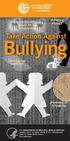 switching seats in the classroom stealing money Take Action Against Bullying spreading rumors pushing & tripping U.S. DEPARTMENT OF HEALTH & HUMAN SERVICES Substance Abuse and Mental Health Services Administration
OPENING ACTIVITY BALL OF STRING FLING
 NWAC Youth Violence Prevention Workshop Bullying OPENING ACTIVITY BALL OF STRING FLING Acknowledgements Recognizing and Responding to Violence against Women in Aboriginal Communities created in conjunction
4 Possessive/Jealous. Men in Relationships
 4 Possessive/Jealous Men in Relationships A possessive/jealous man will: Tell you how to dress; Be overly concerned about where you are going when socializing; Insist on escorting you to mundane places;
MEDICINA y SEGURIDAD del trabajo
 Editorial Senior Specialist on Occupational Health. Programme on Health Promotion and Well-being. International Labour Office. Correspondencia Specialist on Occupational Health Programme on Health Promotion
WORKPLACE BULLYING AND DISRUPTIVE BEHAVIOR. What everyone needs to know! ASEA/AFSCME Local 52, AFL-CIO
 WORKPLACE BULLYING AND DISRUPTIVE BEHAVIOR What everyone needs to know! ASEA/AFSCME Local 52, AFL-CIO Workplace bullying refers to repeated, unreasonable actions of individuals (or a group) directed towards
Talking to our children about Violence and Terrorism: Living in Anxious times
 Talking to our children about Violence and Terrorism: Living in Anxious times Living in Anxious Times: Introductory Remarks Since the September 11 attack America has changed. Children and adults alike
Bullying. Introduction
 Bullying 1 Introduction In recent years, bullying has become a topic of greater public concern. Research has shown the damaging long-term effects that bullying behavior can have on its victims. Approximately
Campus and Workplace Violence Prevention
 Campus and Workplace Violence 1 Prevention SECTION I Policy SUNYIT is committed to providing a safe learning and work environment for the college community. The College will respond promptly to threats,
Sexual Ethics in the Workplace
 Sexual Ethics in the Workplace 1 Why Training To communicate the policy UWGB has in place to address this topic Training is the best way to ensure our policies are more than just pieces of paper. Communication
Bullying and Harassment at Work Policy
 Bullying and Harassment at Work Policy i) Statement Everyone should be treated with dignity and respect at work, irrespective of their status or position within the organisation. Bullying and harassment
The Respectful Workplace: You Can Stop Harassment: Opening the Right Doors. Taking Responsibility
 The Respectful Workplace: Opening the Right Doors You Can Stop Harassment: Taking Responsibility Statewide Training and Development Services Human Resource Services Division Department of Administrative
Bullying 101: Guide for Middle and High School Students
 Bullying 101: Guide for Middle and High School Students A guide to the basics of bullying, what it is and isn t, the role of students, and tips on what you can do. 952.838.9000 PACERTeensAgainstBullying.org
A Guide for Parents. of Elementary and Secondary School Students
 A Guide for Parents of Elementary and Secondary School Students The effects of bullying go beyond the school yard. As a parent, here s what to watch for, what you can do, and where you can go to get help.
Children / Adolescents and Young Adults
 INFORMATION SHEET Age Group: Sheet Title: Children / Adolescents and Young Adults Bullying WHAT IS BULLYING? Bullying is not always easy to define. It can be Physical, Verbal, Emotional, Racist or Sexual.
Preventing Bullying and Harassment of Targeted Group Students. COSA August 2013 John Lenssen
 Preventing Bullying and Harassment of Targeted Group Students COSA August 2013 John Lenssen Definition Bullying is unfair and one-sided. It happens when someone keeps hurting, frightening, threatening,
What Is the Olweus Bullying Prevention Program?
 Dear Parent/Guardians, Your child s school will be using the Olweus Bullying Prevention Program. This research-based program reduces bullying in schools. It also helps to make school a safer, more positive
Workplace Violence and Harassment Prevention
 Workplace Violence and Harassment Prevention Workplace Violence & Harassment Prevention "The government has acted to protect workers from workplace violence. Everyone should be able to work without fear
WHAT IS PTSD? A HANDOUT FROM THE NATIONAL CENTER FOR PTSD BY JESSICA HAMBLEN, PHD
 WHAT IS PTSD? A HANDOUT FROM THE NATIONAL CENTER FOR PTSD BY JESSICA HAMBLEN, PHD Posttraumatic Stress Disorder (PTSD) is an anxiety disorder that can occur following the experience or witnessing of a
Session Seven - Problem-Solving Skills for Families
 105 Session Seven - Problem-Solving Skills for Families Materials Needed: Handout L: Problem-Solving Skills As the popular bumper sticker says, Stuff happens. Problems are an inevitable part of life, and
Delusions are false beliefs that are not part of their real-life. The person keeps on believing his delusions even when other people prove that the be
 Schizophrenia Schizophrenia is a chronic, severe, and disabling brain disorder which affects the whole person s day-to-day actions, for example, thinking, feeling and behavior. It usually starts between
WAYS TO INTERVENE IN CASE OF MOBBING
 WAYS TO INTERVENE IN CASE OF MOBBING TEODORA-SIMONA CORNOIU* University of Bucharest, Faculty of Psychology and Educational Sciences, Department of Psychology Abstract This article reviews possible causes
Cyber-bullying is covered by this policy: all members of the community need to be aware that
 DUKE OF KENT SCHOOL A8 ANTI-BULLYING POLICY Aims and Objectives: Duke of Kent School values every individual in the community and believes each deserves to be treated with respect. Sensitivity to the feelings
Learners with Emotional or Behavioral Disorders
 Learners with Emotional or Behavioral Disorders S H A N A M. H A T Z O P O U L O S G E O R G E W A S H I N G T O N U N I V E R S I T Y S P E D 2 0 1 S U M M E R 2 0 1 0 Overview of Emotional and Behavioral
USVH Disease of the Week #1: Posttraumatic Stress Disorder (PTSD)
 USVH Disease of the Week #1: Posttraumatic Stress Disorder (PTSD) Effects of Traumatic Experiences A National Center for PTSD Fact Sheet By: Eve B. Carlson, Ph.D. and Josef Ruzek, Ph.D. When people find
Secretary-General s bulletin Prohibition of discrimination, harassment, including sexual harassment, and abuse of authority
 United Nations ST/SGB/2008/5 Secretariat 11 February 2008 Secretary-General s bulletin Prohibition of discrimination, harassment, including sexual harassment, and abuse of authority The Secretary-General,
TAKING CONTROL OF WORKPLACE VIOLENCE
 TAKING CONTROL OF WORKPLACE VIOLENCE Second Edition A Training Program for Supervisors and Managers Participant Manual TAKING CONTROL OF WORKPLACE VIOLENCE A Training Program for Supervisors and Managers
1) What is the difference between compassion fatigue, vicarious trauma and burnout?
 Compassion Fatigue Q&A What is compassion fatigue? Compassion fatigue has been described as cost of caring" for others in emotional pain. (Figley, 1982) The helping field has gradually begun to recognize
St. John s Church of England Junior School. Policy for Stress Management
 St. John s Church of England Junior School Policy for Stress Management Review Date: September 2012 Policy to be reviewed next: September 2014 ST. JOHN S C OF E JUNIOR SCHOOL STRESS MANAGEMENT FRAMEWORK
European School Brussels II. Avenue Oscar Jespers 75. 1200 Brussels
 European School Brussels II Avenue Oscar Jespers 75 1200 Brussels 1. Introduction The protection, care and welfare of children within the European Schools system are of paramount importance. As part of
For Parents and Families: What to do if a Child is Being Bullied
 WHAT IS BULLYING? For Parents and Families: What to do if a Child is Being Bullied Bullying among children is aggressive behavior that is intentional and that involves an imbalance of power or strength.
POLICY 5111 ANTI-BULLYING/HARASSMENT/HATE
 POLICY 5111 Purpose/Introduction: The Kenosha Unified School District strives to provide a safe, secure and respectful learning environment for all students in school buildings, on school grounds, in school
WORKPLACE VIOLENCE POLICY
 WORKPLACE VIOLENCE POLICY SUNY Canton is committed to providing a safe work environment for all employees that is free from intimidation, threats, and violent acts. The college will respond promptly to
THE UNDERSTANDING OF WORKPLACE COUNSELLING: A STUDY ON UNIVERSITY SAMPLE
 THE UNDERSTANDING OF WORKPLACE COUNSELLING: A STUDY ON UNIVERSITY SAMPLE F. Ceyda AYDOGDU Yeditepe University, Faculty of Commerce / International Trade and Business 26 Agustos Campus Kayısdagi Street,
The European Marine Energy Centre Ltd. HARASSMENT AND BULLYING POLICY
 The European Marine Energy Centre Ltd. HARASSMENT AND BULLYING POLICY Table of Contents 1 Policy Statement... 3 2 Scope... 3 3 Definitions... 3 4 Detailed Guidelines... 5 4.1 What to do if you are being
HealthStream Regulatory Script
 HealthStream Regulatory Script Diversity in the Workplace Version: May 2007 Lesson 1: Introduction Lesson 2: Significance of Workplace Diversity Lesson 3: Diversity Programs Lesson 4: Doing Your Part Lesson
Personality Difficulties
 Personality Difficulties The essential features of a personality disorder are impairments in personality (self and interpersonal) functioning and the presence of pathological personality traits. There
EVERYONE'S RESPONSIBILITY
 EVERYONE'S RESPONSIBILITY Guideline for Preventing Harassment and Violence in the Workplace November 2010 Guideline for Preventing Harassment and Violence in the Workplace Workplace Safety & Health Division
Their stories are tragic. A new chapter starts now. now.
 ! Their stories are tragic. A new chapter starts now. now.! Bully is a movie that tells powerful stories about children and their families dealing with extreme pain and tragic consequences related to bullying.
Establishing Healthy Boundaries in Relationships (Adapted by C. Leech from Tools for Coping with Life s Stressors from the Coping.
 Establishing Healthy Boundaries in Relationships (Adapted by C. Leech from Tools for Coping with Life s Stressors from the Coping.org website) Introduction People with low self-esteem have their major
What Employers Need to Know to Help
 Occupational Health & Safety Council of Ontario (OHSCO) WORKPLACE VIOLENCE PREVENTION SERIES Domestic Violence Doesn t Stop When Your Worker Arrives at Work: What Employers Need to Know to Help What is
Racial Harassment and Discrimination Definitions and Examples (quotes are from the Stephen Lawrence Inquiry report, 23 March, 1999)
 APPENDIX C Racial Harassment and Discrimination Definitions and Examples (quotes are from the Stephen Lawrence Inquiry report, 23 March, 1999) Racial Harassment is an act designed to intimidate, humiliate,
HOW PARENTS CAN HELP THEIR CHILD COPE WITH A CHRONIC ILLNESS
 CENTER FOR EFFECTIVE PARENTING HOW PARENTS CAN HELP THEIR CHILD COPE WITH A CHRONIC ILLNESS Parenting a chronically ill child is a challenge. Having a child with a chronic illness is stressful for any
THE EFFECTS OF FAMILY VIOLENCE ON CHILDREN. Where Does It Hurt?
 THE EFFECTS OF FAMILY VIOLENCE ON CHILDREN Where Does It Hurt? Child Abuse Hurts Us All Every child has the right to be nurtured and to be safe. According to: Family Violence in Canada: A Statistical Profile
INTRODUCTION 2 WORKPLACE HARASSMENT
 INTRODUCTION This brochure is intended to educate Treasury employees about the prevention of harassment in the workplace. Harassment is a matter of particular concern because it seriously damages the employee-employer
BULLYING/ANTI-HARASSMENT
 BULLYING/ANTI-HARASSMENT The state of Mississippi has established legislation requiring Bullying Prevention to be taught in schools. Executive Summary The purpose of this policy is to assist the Mississippi
Trauma and the Family: Listening and learning from families impacted by psychological trauma. Focus Group Report
 Trauma and the Family: Listening and learning from families impacted by psychological trauma Focus Group Report A summary of reflections and remarks made by Baltimore City families impacted by trauma and
State University of New York at Potsdam. Workplace Violence Prevention Policy and Procedures
 State University of New York at Potsdam Workplace Violence Prevention Policy and Procedures Revision Date: September 15, 2015 Page 1 of 7 TABLE OF CONTENTS Policy... 3 Statement... 3 Definitions... 3 Application
Coping With Stress and Anxiety
 Coping With Stress and Anxiety Stress and anxiety are the fight-and-flight instincts that are your body s way of responding to emergencies. An intruder crawling through your bedroom window in the dark
VIOLENCE AT WORK* Duncan Chappell and Vittorio Di Martino
 VIOLENCE AT WORK* by Duncan Chappell and Vittorio Di Martino The real image of violence ta work The variety of behaviours which may be covered under the general rubric of violence at work is so large,
GRANGE TECHNOLOGY COLLEGE ANTI-BULLYING POLICY
 GRANGE TECHNOLOGY COLLEGE ANTI-BULLYING POLICY Approved: 4 September 2014 Review Date: Page 1 of 7 GRANGE TECHNOLOGY COLLEGE ANTI-BULLYING POLICY Introduction Schools have a duty of care for pupils and
Harassment Prevention
 Harassment Prevention An employer s guide for developing a harassment policy 2016 saskatchewan.ca PLEASE NOTE The original legislation should be consulted for all purposes of interpretation and application
Stress Assessment questionnaire
 MySkillsProfile Report Stress Assessment questionnaire Dave Smith myskillsprofile.com around the globe Report The SAQ questionnaires are copyright MySkillsProfile.com. MySkillsProfile.com developed and
The Highly Sensitive Person in Love. Highly Sensitive Person (HSP) motto is Look before you leap. Or A stitch in time saves nine.
 By Elaine Aron The Highly Sensitive Person in Love Highly Sensitive Person (HSP) motto is Look before you leap. Or A stitch in time saves nine. Non-HSP motto is He who hesitates is lost. Positives Very
Adverse Childhood Experiences International Questionnaire (ACE-IQ)
 0 DEMOGRAPHIC INFORMATION 0.1 Sex (Record Male / Female as observed) Male [C1] Female 0.2 [C2] What is your date of birth? Day [ ][ ] Month [ ][ ] Year [ ][ ][ ][ ] Unknown (Go to Q.C3) 0.3 [C3] How old
What is DOMESTIC VIOLENCE?
 What is DOMESTIC VIOLENCE? Domestic violence is a pattern of control used by one person to exert power over another. Verbal abuse, threats, physical, and sexual abuse are the methods used to maintain power
Workplace Anti-Harassment Policy (Alberta)
 Workplace Anti-Harassment Policy (Alberta) Intent It is public policy in Canada to recognize the dignity and worth of every person and to provide for equal rights and opportunities free of discrimination.
Three Theories of Individual Behavioral Decision-Making
 Three Theories of Individual Decision-Making Be precise and explicit about what you want to understand. It is critical to successful research that you are very explicit and precise about the general class
Explain how Employee Performance is Measured and Managed
 Explain how Employee Performance is Measured and Managed For this last section of my report I will be discussing how employee performance can be both managed and measured. In addition to this, I will also
Work Related Stress - Information for Managers / Supervisors
 Work Related Stress - Information for Managers / Supervisors What is Stress? The Health and Safety Executive have defined stress as:- 'The adverse reaction people have to excessive pressure or other types
How To Prevent Bullying At The Beaconsfield School
 ANTI-BULLYING POLICY 2015 Approved by the Governing Body: 25 th November 2015 Approved by the Learning & Development Committee: 21 st October 2015 Approved by Leadership Team: 8 th October 2015 Review
Opening Our Hearts, Transforming Our Losses
 Preface Alcoholism is a disease of many losses. For those of us who are the relatives and friends of alcoholics, these losses affect many aspects of our lives and remain with us over time, whether or not
APPENDIX B. ASSESSMENT OF RISK POSED TO CHILDREN BY DOMESTIC VIOLENCE Anne L. Ganley, Ph.D.
 APPENDIX B ASSESSMENT OF RISK POSED TO CHILDREN BY DOMESTIC VIOLENCE Anne L. Ganley, Ph.D. Assessment of Domestic Violence for Child Protective Services (CPS) Decision Making Guidelines for Interviewing
Are you feeling... Tired, Sad, Angry, Irritable, Hopeless?
 Are you feeling... Tired, Sad, Angry, Irritable, Hopeless? I feel tired and achy all the time. I can t concentrate and my body just doesn t feel right. Ray B. I don t want to get out of bed in the morning
Schizophrenia National Institute of Mental Health
 Schizophrenia National Institute of Mental Health U.S. DEPARTMENT OF HEALTH AND HUMAN SERVICES National Institutes of Health Schizophrenia Do you know someone who seems like he or she has lost touch with
YOUTH SOCCER COACHES GUIDE TO SUCCESS Norbert Altenstad
 The Reason Why Most Youth Soccer Coaches Fail Lack of knowledge to make and keep practice fun and enjoyable for the kids is really the primary cause for failure as a youth soccer coach, it s sad. It s
Potential Interview Questions
 Potential Interview Questions Listed below are some questions commonly asked by employers during interviews along with some hints about how to best answer each question. Outline or write out your responses
15 Most Typically Used Interview Questions and Answers
 15 Most Typically Used Interview Questions and Answers According to the reports made in thousands of job interviews, done at ninety seven big companies in the United States, we selected the 15 most commonly
This report provides the executive summary for Indicators of School Crime and Safety: 2014.
 1 Liability Report Number: LB-10-66 Release Date: August 6, 2015 Section Title: General Information Abstract School violence not only has a direct impact on students, but also on educators, parents, and
Stand up to bullying. Serving those who serve the public
 Stand up to bullying Serving those who serve the public Beating bullying IMPACT first published guidelines on workplace bullying in 1997. We ve now updated them to take account of a major report by the
WORKPLACE VIOLENCE WHAT IS WORKPLACE VIOLENCE?
 WORKPLACE VIOLENCE Violence in the workplace has become an epidemic. Not only is workplace violence increasingly common in workplaces where violence is expected -- for example, corrections, law enforcement
FAQs: Bullying in schools
 FAQs: Bullying in schools FAQs: Bullying in schools answers frequently asked questions about bullying, provides useful advice to parents and students about dealing with bullying, and summarises contemporary
Vol. 1-6 (09/03/2003) by Nicholas Yee. (http://www.nickyee.com/daedalus)
 The Daedalus Project Vol. 1-6 (09/03/2003) by Nicholas Yee (http://www.nickyee.com/daedalus) FAQ on the Good and Bad (transcript of interview) I was recently interviewed over email over some issues centered
HELPING YOUNG CHILDREN COPE WITH TRAUMA
 HELPING YOUNG CHILDREN COPE WITH TRAUMA Disasters are upsetting to everyone involved. Children, older people, and/or people with disabilities are especially at risk. For a child, his or her view of the
Conflict... An Opportunity for Development
 Conflict... An Opportunity for Development ~ Agenda ~ Introductions and Workshop Objectives Understanding Conflict: What is Conflict? The Conflict Cycle Resolving Conflict: Using I Messages College Conflict
WHY DO WE HAVE EMOTIONS?
 WHY DO WE HAVE EMOTIONS? Why do we have emotions? This is an excellent question! Did you think: Emotions make us human or They help us feel? These are partly correct. Emotions do define us as humans and
You ve heard about workplace diversity, but how much do
 INTRODUCTION You ve heard about workplace diversity, but how much do you really know about it? First of all, diversity is important to your employer. Your employer doesn t want to place the future of the
Government of Western Australia Department for Child Protection and Family Support. How do I recognise when a child is at risk of abuse or neglect?
 Government of Western Australia Department for Child Protection and Family Support How do I recognise when a child is at risk of abuse or neglect? Physical abuse Physical abuse is when someone is deliberately
Conflict in Organizations
 Joel A. DiGirolamo, BSEE, MBA, MS Psychology Conflict in Organizations Agenda Background When Conflict Arises Good Conflict Tools Going Postal Is the homicide rate for postal workers higher or lower than
ASSERTIVENESS AND PERSUASION SKILLS
 TROY CONTINUTING EDUCATION AND ARCTURUS TRAINING ACADEMY PERSONAL ENRICHMENT WORKSHOPS ASSERTIVENESS AND PERSUASION SKILLS Do you find yourself saying Yes when you want to say No? Do you end up agreeing
"The Moral / Psychological Harassment and its Dimensions in the Mental Health of the Employee in the Modern Workplace"
 "The Moral / Psychological Harassment and its Dimensions in the Mental Health of the Employee in the Modern Workplace" Liliane K. Soumeli * *Psychologist, Family Counsellor and Career Guidance External
Bullying: Analysis of 10 year Global Data
 Bullying: Analysis of 10 year Global Data While discourse on bullying is predominantly focused on developed countries or those that are high or very high on the Human Development Index, the fact is it
Chapter One Love Is the Foundation. For Group Discussion. Notes
 Group Study Guide How can you learn to speak each of the fi ve love languages with your children and fi ll their love tank? This interactive guide includes study questions and exercises for you, for your
Presented by: Deborah Bourne C/O Hope Enterprises Ltd. 25 Burlington Ave., KGN 10, Jamaica W.I
 Findings and methodological and ethical challenges involved in conducting the FHI study Early Sexual Debut, Sexual Violence, and Sexual Risk-taking among Pregnant Adolescents and Their Peers in Jamaica
Mental Health Role Plays
 Mental Health Role Plays Goals: To discuss various mental health issues and mental illnesses. To discuss stigma, support and treatment options surrounding mental health issues and mental illnesses. Requirements:
The State of Sexual Harassment in America: What is the Status of Sexual Harassment in the US Workplace Today?
 The State of Sexual Harassment in America: What is the Status of Sexual Harassment in the US Workplace Today? Steven V. Cates, DBA, SPHR Lynn Machin, Kaplan University, USA ABSTRACT The purpose of this
The Doctor-Patient Relationship
 The Doctor-Patient Relationship It s important to feel at ease with your doctor. How well you are able to talk with your doctor is a key part of getting the care that s best for you. It s also important
SWITZERLAND COUNTY School Corporation Policy Anti-Bullying Policy
 SWITZERLAND COUNTY School Corporation Policy Anti-Bullying Policy SCSC POLICY 6.72 The following policy has been established by the school board of Switzerland County School Corporation regarding anti-bullying.
How to Protect Students from Sexual Harassment: A Primer for Schools
 How to Protect Students from Sexual Harassment: A Primer for Schools This fact sheet is part of a series of tools designed by the National Women s Law Center to help schools address the dropout crisis.
Bullying/Harassment Policy
 STATEMENT OF POLICY Bullying/harassment are forms of abuse. Bullying/Harassment Policy Bullying/harassment breaks down the positive and protective environment we seek to develop, and, at its worst, is
Abuse in Same-Sex Relationships
 1 Abuse in Same-Sex Relationships Abuse in relationships is any behavior or pattern of behavior used to coerce, dominate or isolate the other partner. It is the use of any form of power that is imposed
Job Description. Community Social Worker
 Job Description 5/30/2005 Page 1 PURPOSE OF THE POSITION (The main reason for the position, in what context and what is the overall end result) The Community Social Services Worker (CSSW) is responsible
Bullying and harassment at work:
 Bullying and harassment at work: a guide for RCN members Healthy workplace, healthy you Dignity at work Healthy workplace, healthy you 3 Introduction The nursing workforce should be treated fairly and
Assertive Communication
 Using assertive communication is an important part of recovery from drugs and alcohol. Being assertive can help you express your opinions and feelings, make requests of others and respond to requests of
Attitudes to Mental Illness - 2011 survey report
 Attitudes to Mental Illness - 2011 survey report Copyright 2011, The Health and Social Care Information Centre. All Rights Reserved. 1 Acknowledgements This document was published by the NHS Information
To Kill a Mockingbird Journal Prompts
 Chapters 1-3: Recall a first day of school when you were younger. How did you view school: with excitement, dread, or boredom? How did you react to teachers? How did you interact with classmates? What
Management Assistance Program
 Management Assistance Program COMMUNICATING WITH EMPLOYEES DURING A CRISIS: How to prepare and help employees cope with a workplace related crisis GOALS: The goal of this module is to provide organizations,
The policy also aims to make clear the actions required when faced with evidence of work related stress.
 STRESS MANAGEMENT POLICY 1.0 Introduction Stress related illness accounts for a significant proportion of sickness absence in workplaces in the UK. Stress can also be a contributing factor to a variety