
Generally Accepted Recordkeeping Principles How Does Your Program Measure Up?
|
|
|
- Elijah Newman
- 9 years ago
- Views:
Transcription
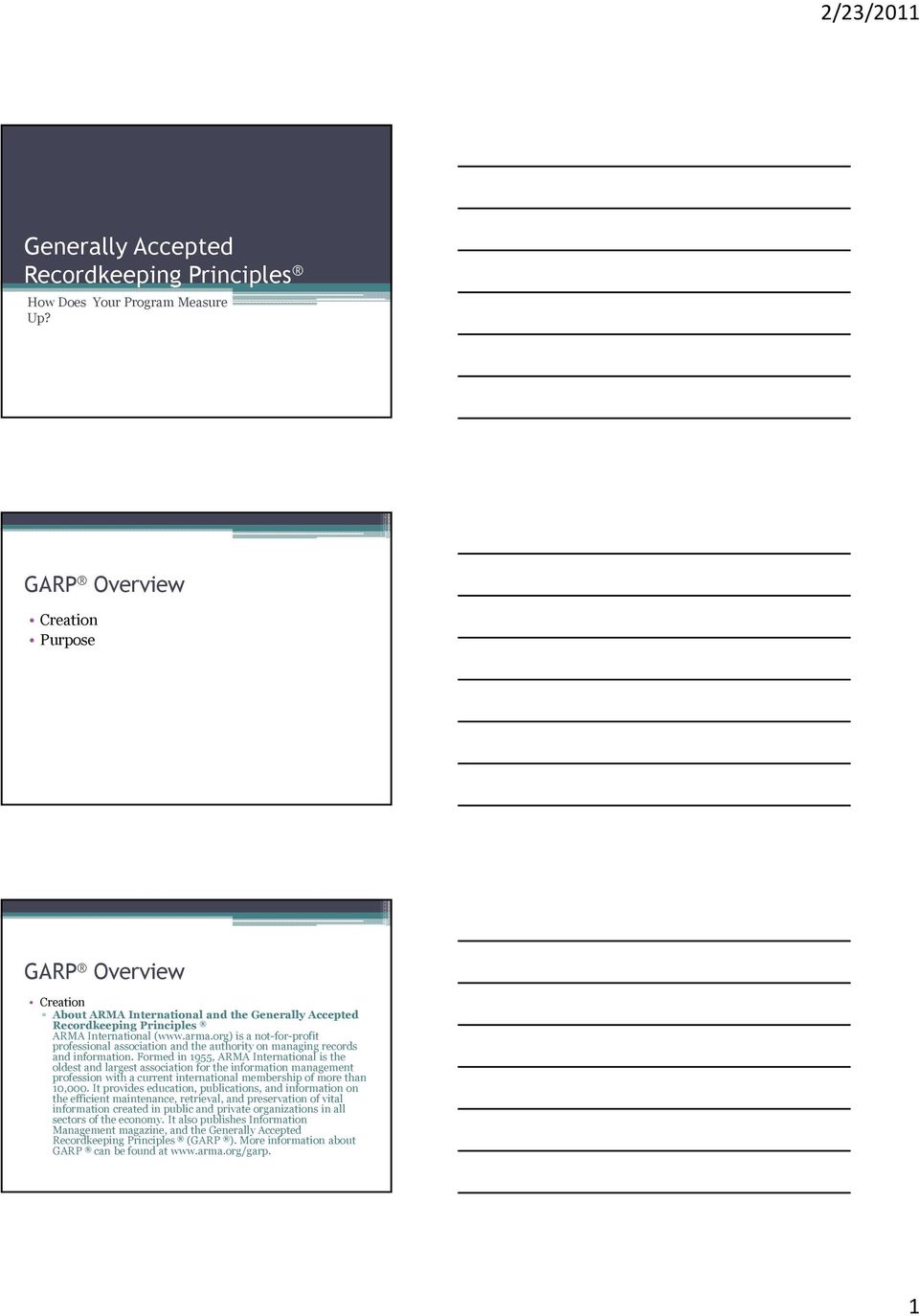
1 Generally Accepted Recordkeeping Principles How Does Your Program Measure Up? GARP Overview Creation Purpose GARP Overview Creation About ARMA International and the Generally Accepted Recordkeeping Principles ARMA International ( is a not-for-profit professional association and the authority on managing records and information. Formed in 1955, ARMA International is the oldest and largest association for the information management profession with a current international membership of more than 10,000. It provides education, publications, and information on the efficient maintenance, retrieval, and preservation of vital information created in public and private organizations in all sectors of the economy. It also publishes Information Management magazine, and the Generally Accepted Recordkeeping Principles (GARP ). More information about GARP can be found at 1
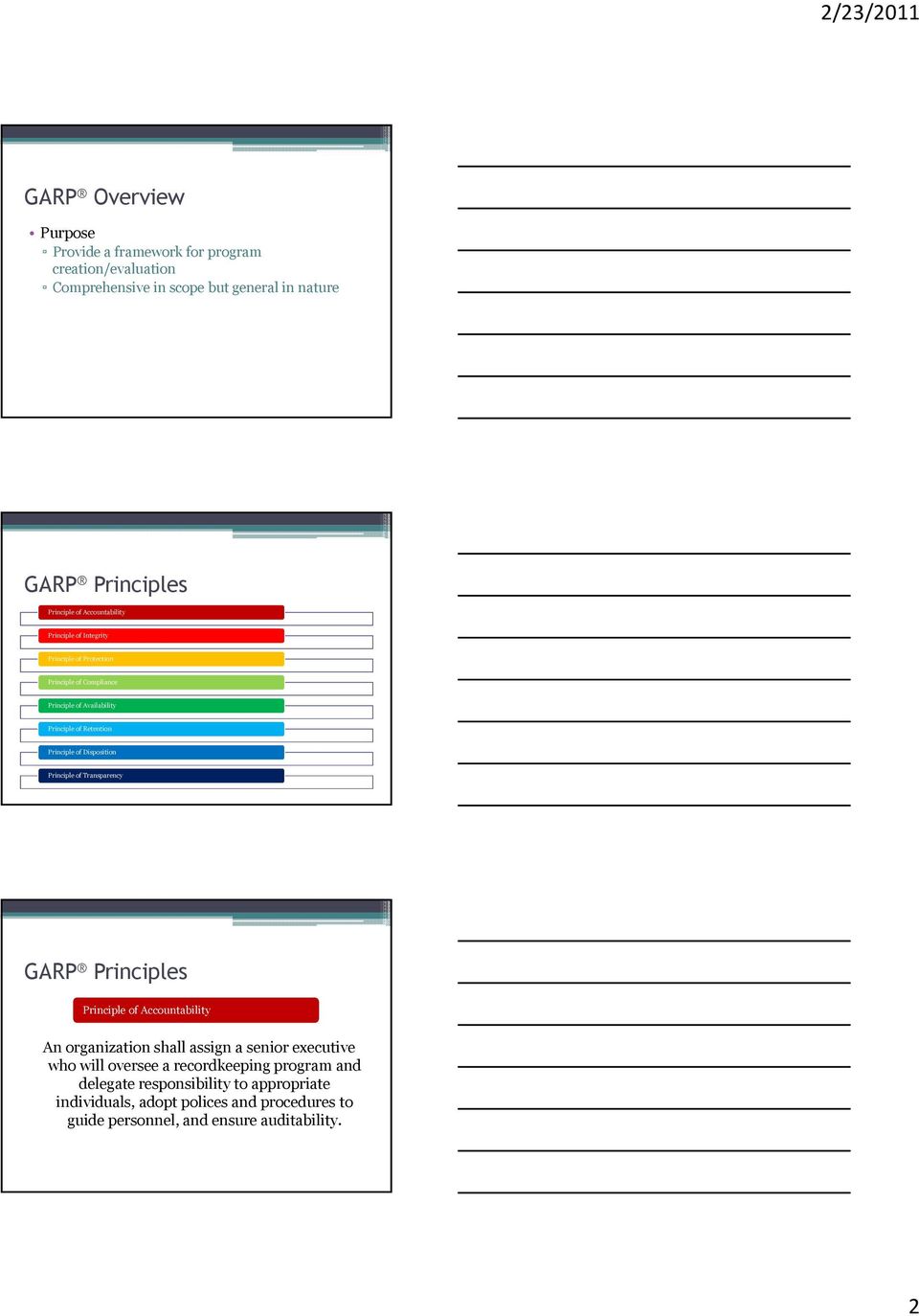
2 GARP Overview Purpose Provide a framework for program creation/evaluation Comprehensive in scope but general in nature GARP Principles Principle of Accountability Principle of Integrity Principle of Protection Principle of Compliance Principle of Availability Principle of Retention Principle of Disposition Principle of Transparency GARP Principles Principle of Accountability An organization shall assign a senior executive who will oversee a recordkeeping program and delegate responsibility to appropriate individuals, adopt polices and procedures to guide personnel, and ensure auditability. 2
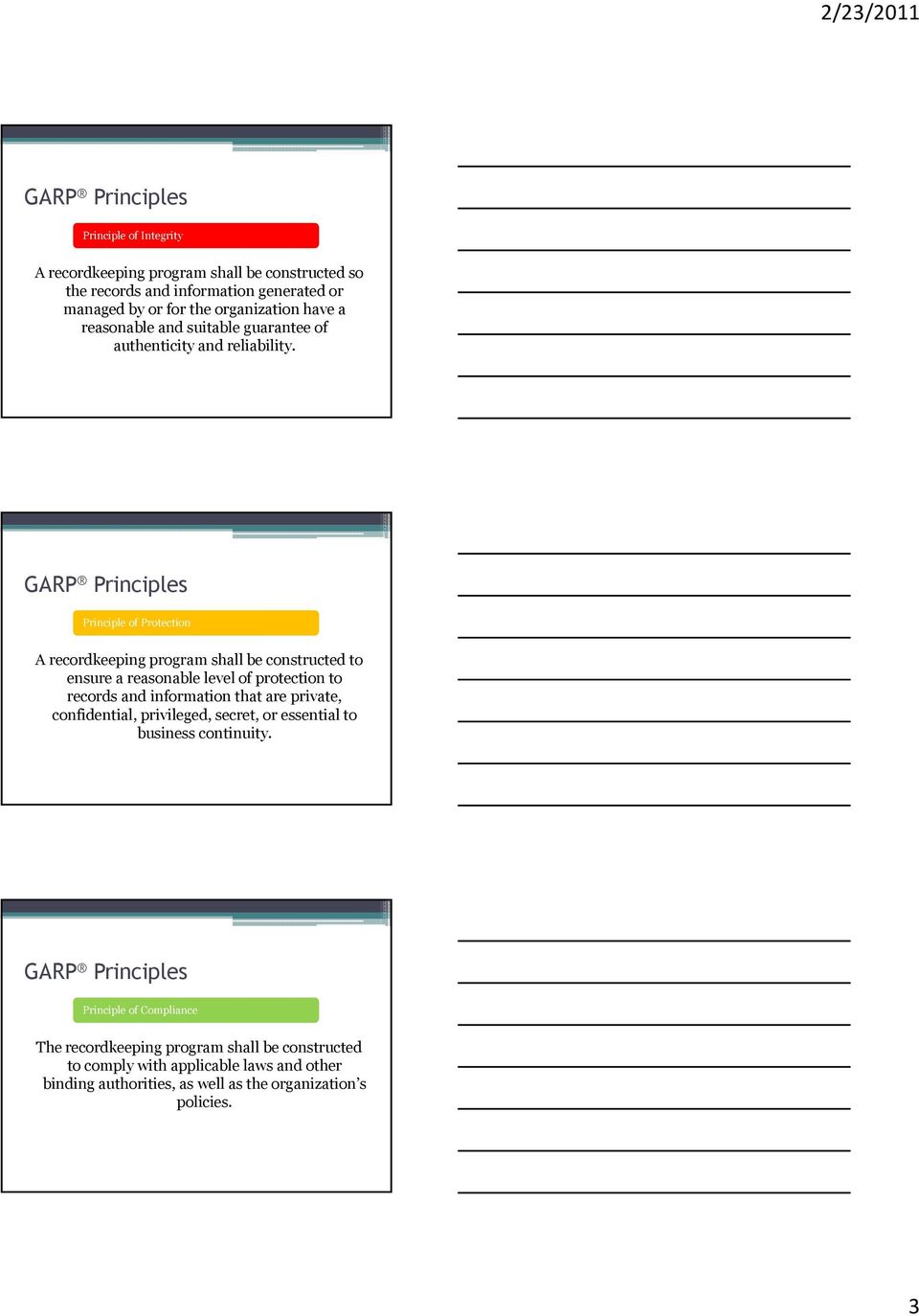
3 GARP Principles Principle of Integrity A recordkeeping program shall be constructed so the records and information generated or managed by or for the organization have a reasonable and suitable guarantee of authenticity and reliability. GARP Principles Principle of Protection A recordkeeping program shall be constructed to ensure a reasonable level of protection to records and information that are private, confidential, privileged, secret, or essential to business continuity. GARP Principles Principle of Compliance The recordkeeping program shall be constructed to comply with applicable laws and other binding authorities, as well as the organization s policies. 3
4 GARP Principles Principle of Availability An organization shall maintain records in a manner that ensures timely, efficient, and accurate retrieval of needed information. GARP Principles Principle of Retention An organization shall maintain its records and information for an appropriate time, taking into account legal, regulatory, fiscal, operational, and historical requirements. GARP Principles Principle of Disposition An organization shall provide secure and appropriate disposition for records that are no longer required to be maintained by applicable laws and the organization s policies. 4

5 GARP Principles Principle of Transparency The processes and activities of an organization s recordkeeping program shall be documented in an understandable manner and be available to all personnel and appropriate interested parties. GARP Maturity Model 1 - RED 2 - ORANGE 3 - AMBER 4 - BLUE 5 - GREEN GARP Maturity Model 1 - RED Sub-standard: This level describes an environment where recordkeeping concerns are either not addressed at all, or are addressed in a very ad hoc manner. 5
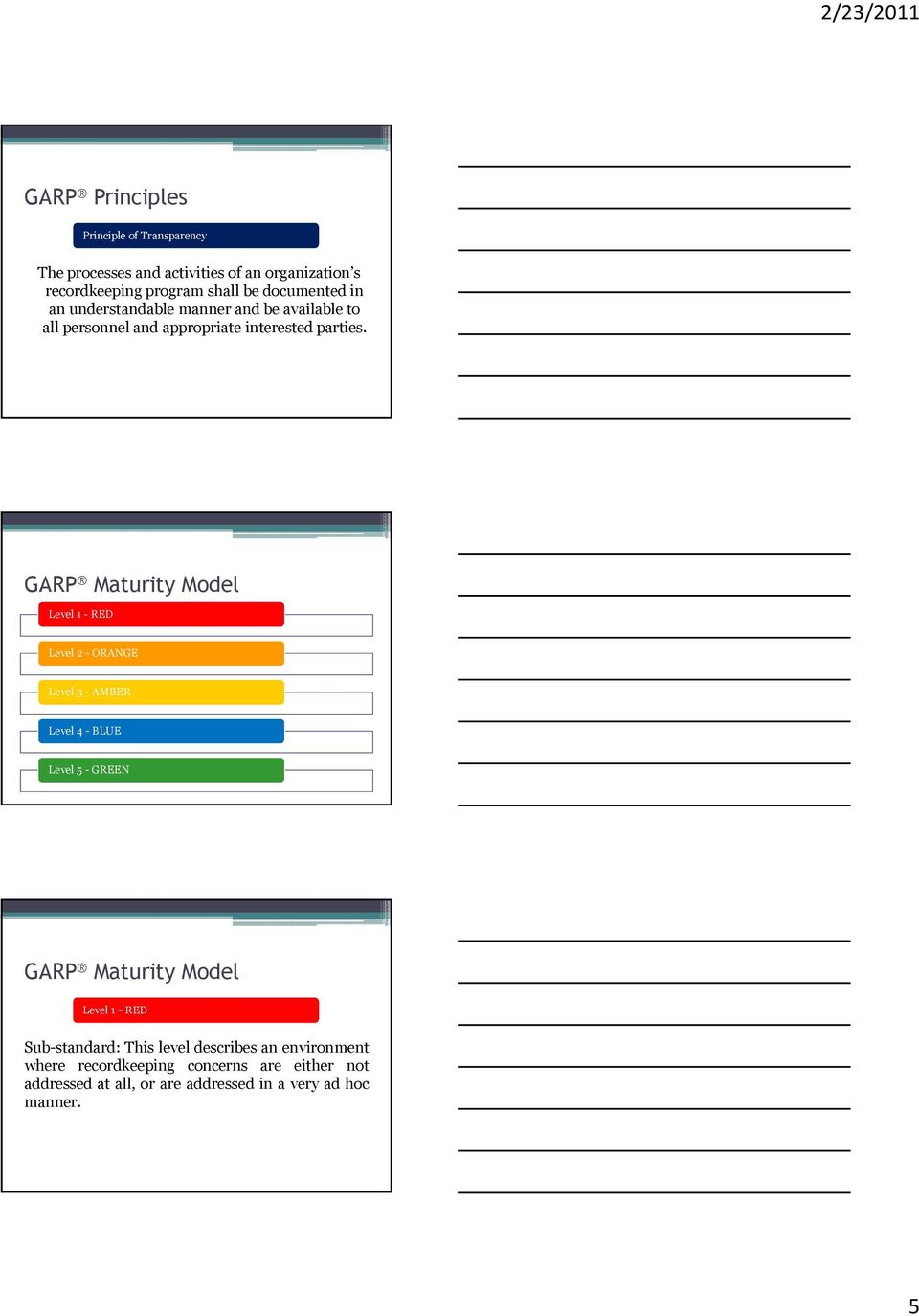
6 GARP Maturity Model 2 - ORANGE In Development: This level describes an environment where there is a developing recognition that recordkeeping had an impact on the organization, and that the organization may benefit from a more defined information governance program. GARP Maturity Model 3 - AMBER Essential: This level describes the essential or minimum requirements that must be addressed in order to meet the organization's legal and regulatory requirements. GARP Maturity Model 4 - BLUE Proactive: This level describes an organization that is initiating information governance program improvements throughout its business operation. Information governance issues and considerations are integrated into business decisions on a routine basis, and the organization easily meets its legal and regulatory requirements. 6
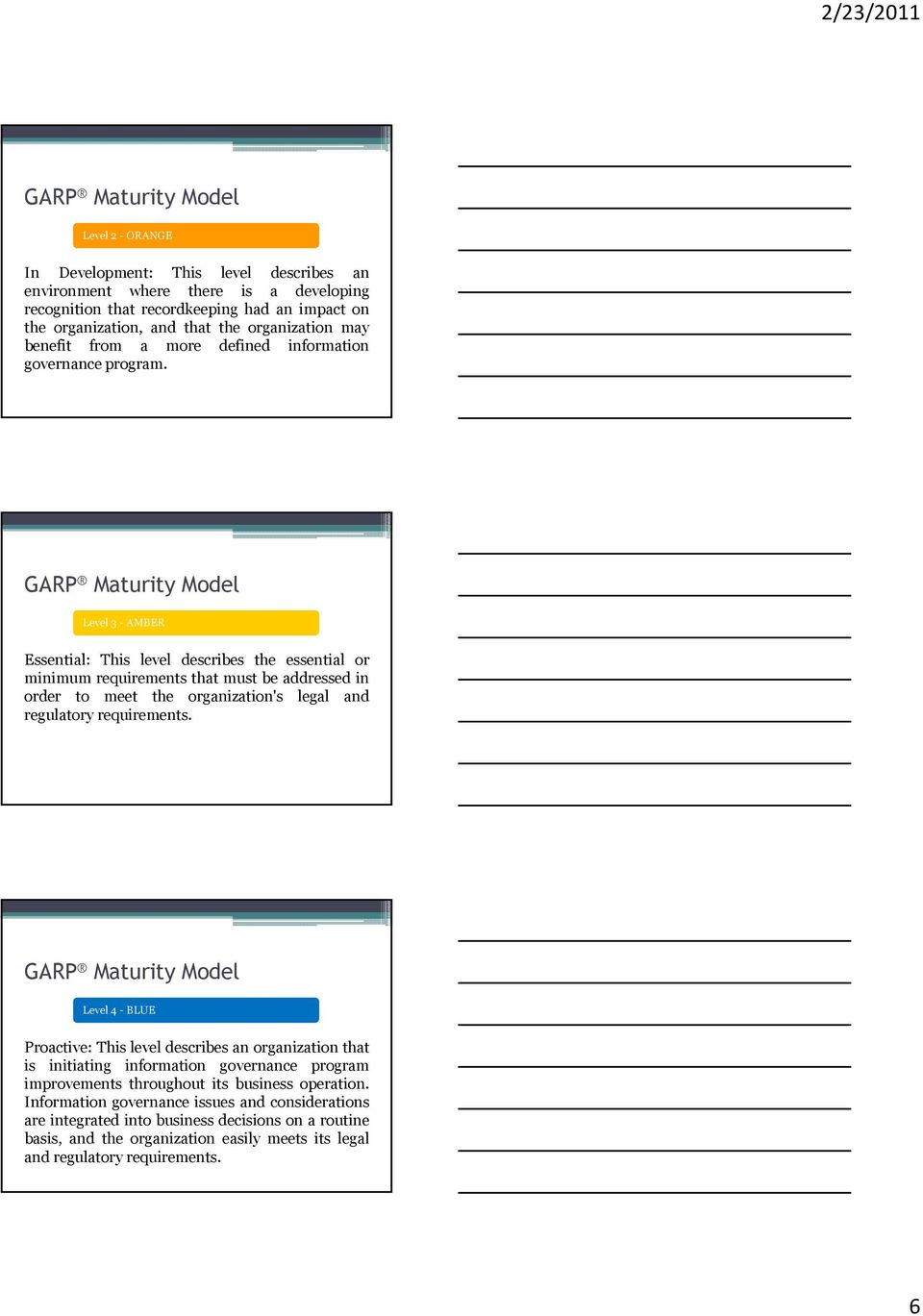
7 GARP Maturity Model 5 - GREEN Transformational: This level describes an organization that has integrated information governance into its overall corporate infrastructure and business processes to such an extent that compliance with the program requirements is routine. For more information Log onto Download.pdf version of the GARP Principles Download.pdf version of the GARP Information Governance Maturity Model View presentations and articles on the topic Questions? 7
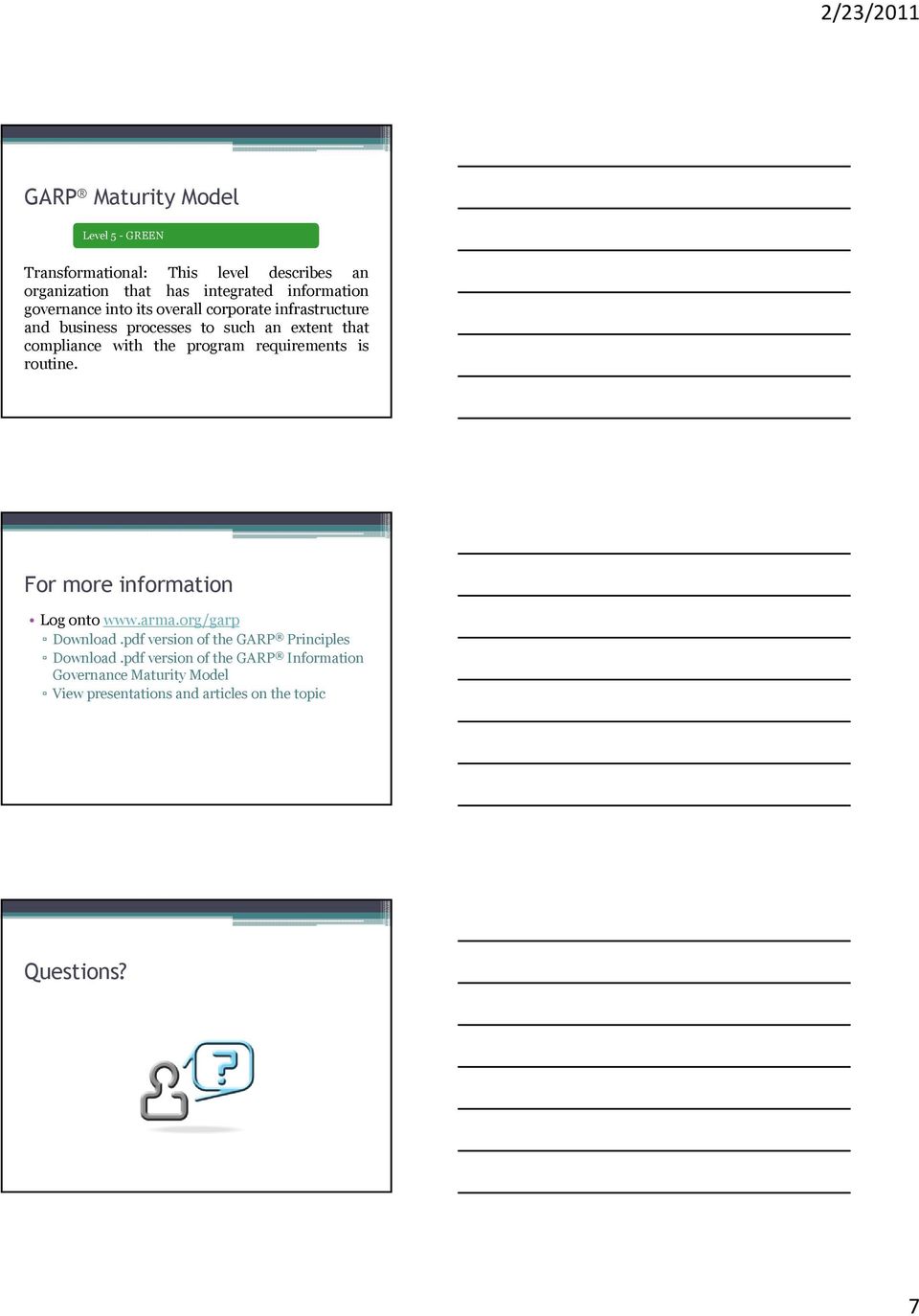
8 Contact information Ember D. Krumwied, CRM Corporate Records Manager Investco Financial Corporation (253) How to Guide GARP Maturity Model How to use the model Use to identify gaps between the organization s current practices and the desirable level of maturity for each principle Assess the risk(s) to the organization, based on the biggest gaps Determine whether additional information and analysis is necessary Develop priorities and assign accountability for further development of the program 8
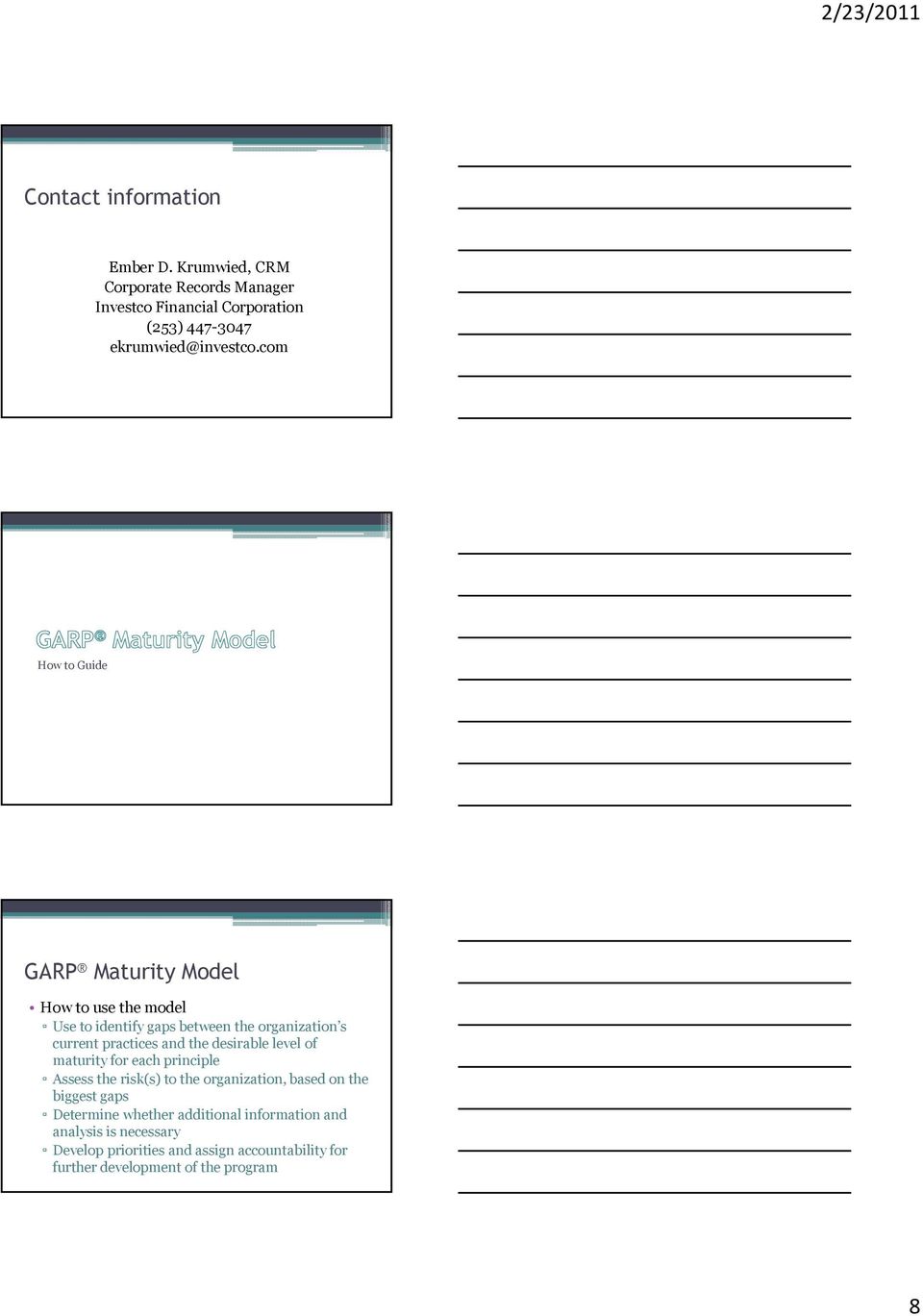
9 Principle of Accountability 1 Sub-Standard No senior executive (or person of comparable authority) is responsible for the records management program. The records manager role is largely non-existent or is an administrative and/or clerical role distributed among general staff. Principle of Accountability No senior executive (or person of comparable authority) is involved in or responsible for the records management program. 2 In Development The records manager role is recognized, although he/she is responsible for tactical operation of the existing program. In many cases, the existing program covers paper records only. The information technology function or department is the de facto lead for storing electronic information, but this is not done in a systematic fashion. The records manager is not involved in discussions of electronic systems. Principle of Accountability 3 Essential The records manager is an officer of the organization and is responsible for the tactical operation of the ongoing program on an organization-wide basis. The records manager is actively engaged in strategic information and record management initiatives with other officers of the organization. Senior management is aware of the program. The organization has defined specific goals related to accountability. 9

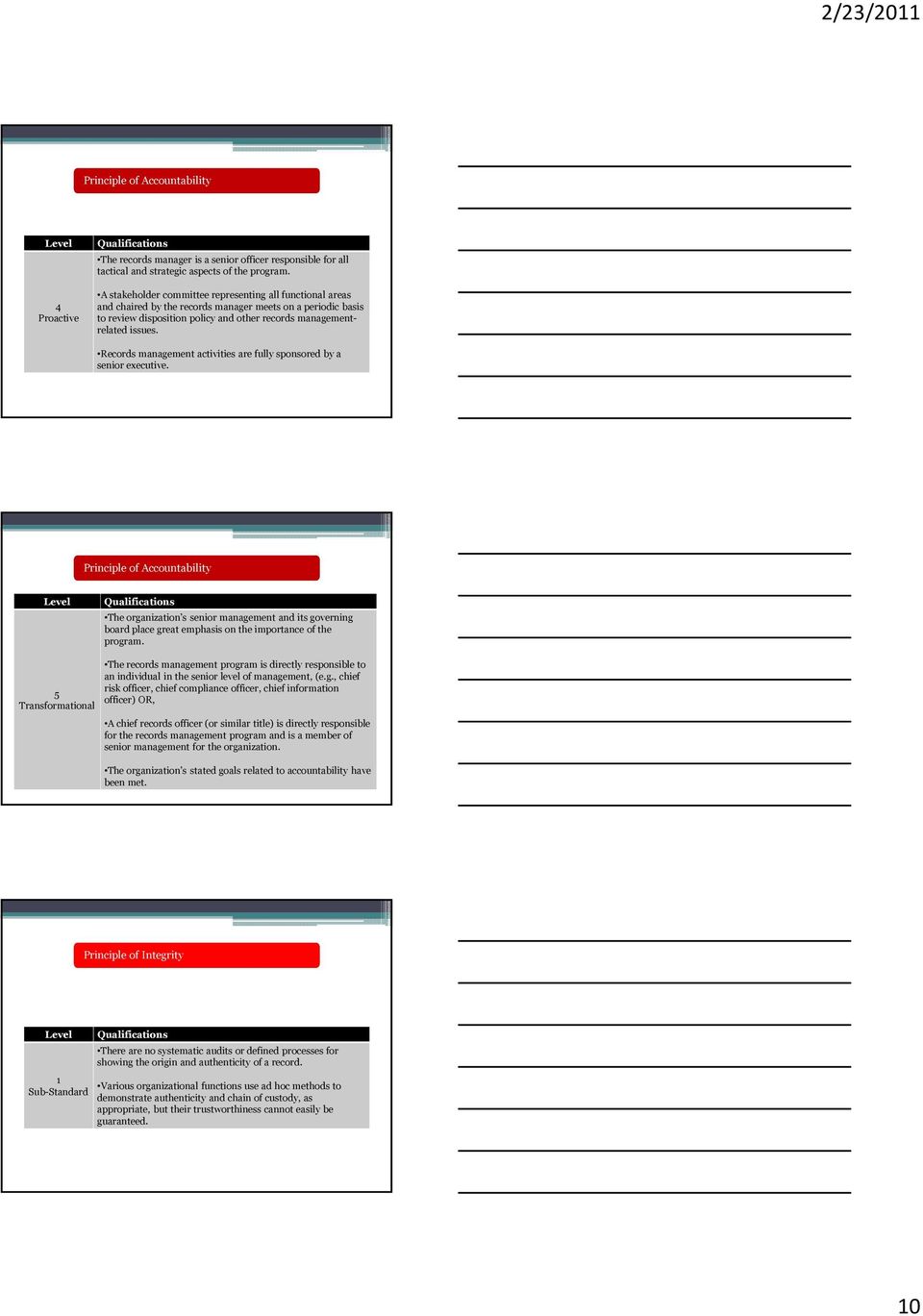
10 Principle of Accountability 4 Proactive The records manager is a senior officer responsible for all tactical and strategic aspects of the program. A stakeholder committee representing all functional areas and chaired by the records manager meets on a periodic basis to review disposition policy and other records managementrelated issues. Records management activities are fully sponsored by a senior executive. Principle of Accountability The organization s senior management and its governing board place great emphasis on the importance of the program. 5 Transformational The records management program is directly responsible to an individual in the senior level of management, (e.g., chief risk officer, chief compliance officer, chief information officer) OR, A chief records officer (or similar title) is directly responsible for the records management program and is a member of senior management for the organization. The organization s stated goals related to accountability have been met. Principle of Integrity 1 Sub-Standard There are no systematic audits or defined processes for showing the origin and authenticity of a record. Various organizational functions use ad hoc methods to demonstrate authenticity and chain of custody, as appropriate, but their trustworthiness cannot easily be guaranteed. 10
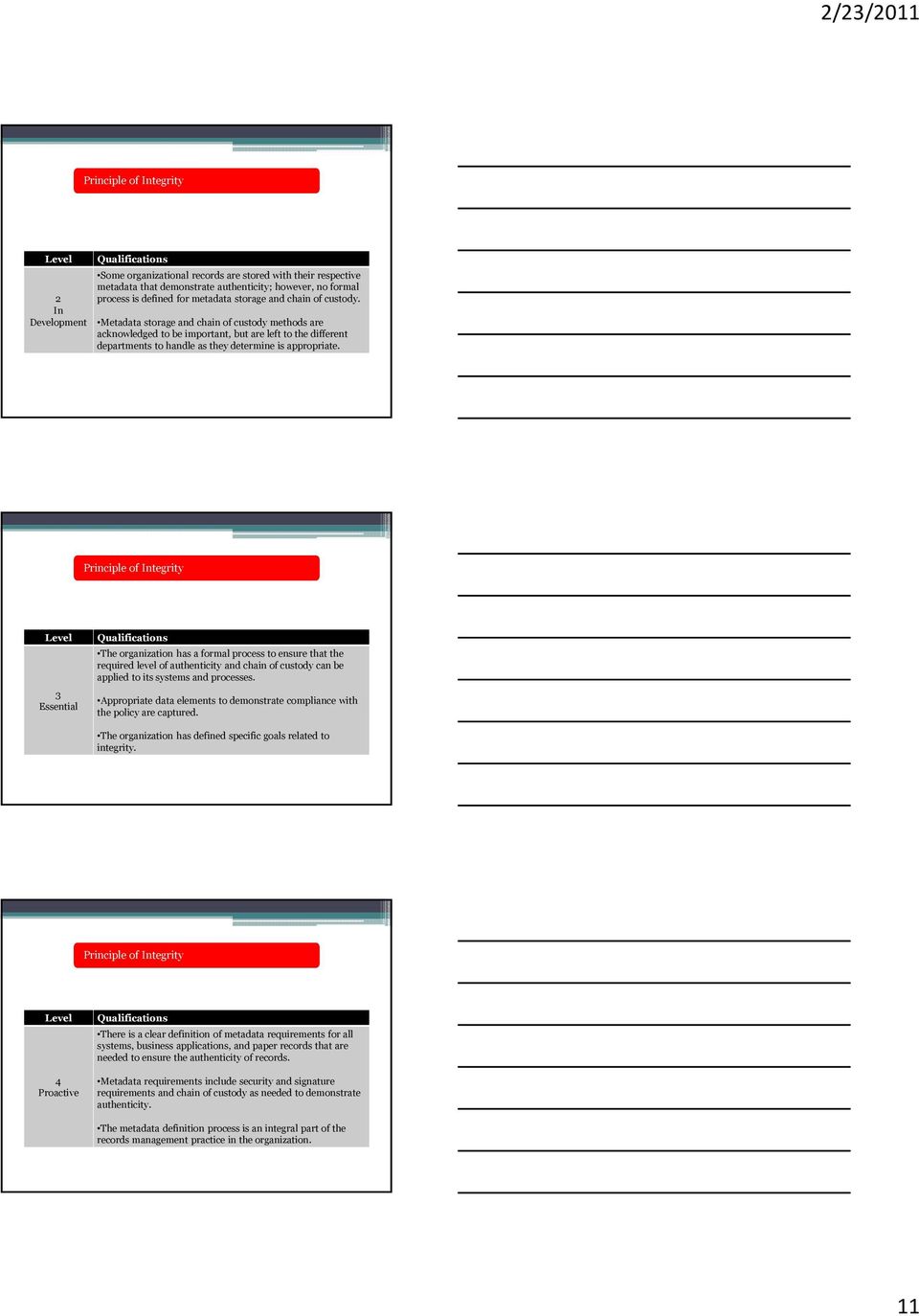
11 Principle of Integrity 2 In Development Some organizational records are stored with their respective metadata that demonstrate authenticity; however, no formal process is defined for metadata storage and chain of custody. Metadata storage and chain of custody methods are acknowledged to be important, but are left to the different departments to handle as they determine is appropriate. Principle of Integrity 3 Essential The organization has a formal process to ensure that the required level of authenticity and chain of custody can be applied to its systems and processes. Appropriate data elements to demonstrate compliance with the policy are captured. The organization has defined specific goals related to integrity. Principle of Integrity 4 Proactive There is a clear definition of metadata requirements for all systems, business applications, and paper records that are needed to ensure the authenticity of records. Metadata requirements include security and signature requirements and chain of custody as needed to demonstrate authenticity. The metadata definition process is an integral part of the records management practice in the organization. 11
12 Principle of Integrity 5 Transformational There is a formal, defined process for introducing new record-generating systems and the capture of their metadata and other authenticity requirements, including chain of custody. This level is easily and regularly audited. The organization s stated goals related to integrity have been met. The organization can consistently and confidently demonstrate the accuracy and authenticity of its records. Principle of Protection No consideration is given to record privacy. 1 Sub-Standard Records are stored haphazardly, with protection taken by various groups and departments with no centralized access controls. Access controls, if any, are assigned by the author. Principle of Protection Some protection of records is exercised. 2 In Development There is a written policy for records that require a level of protection (e.g., personnel records). However, the policy does not give clear and definitive guidelines for all records in all media types. Guidance for employees is not universal or uniform. Employee training is not formalized. The policy does not address how to exchange these records between employees. Access controls are still implemented by individual record owners. 12

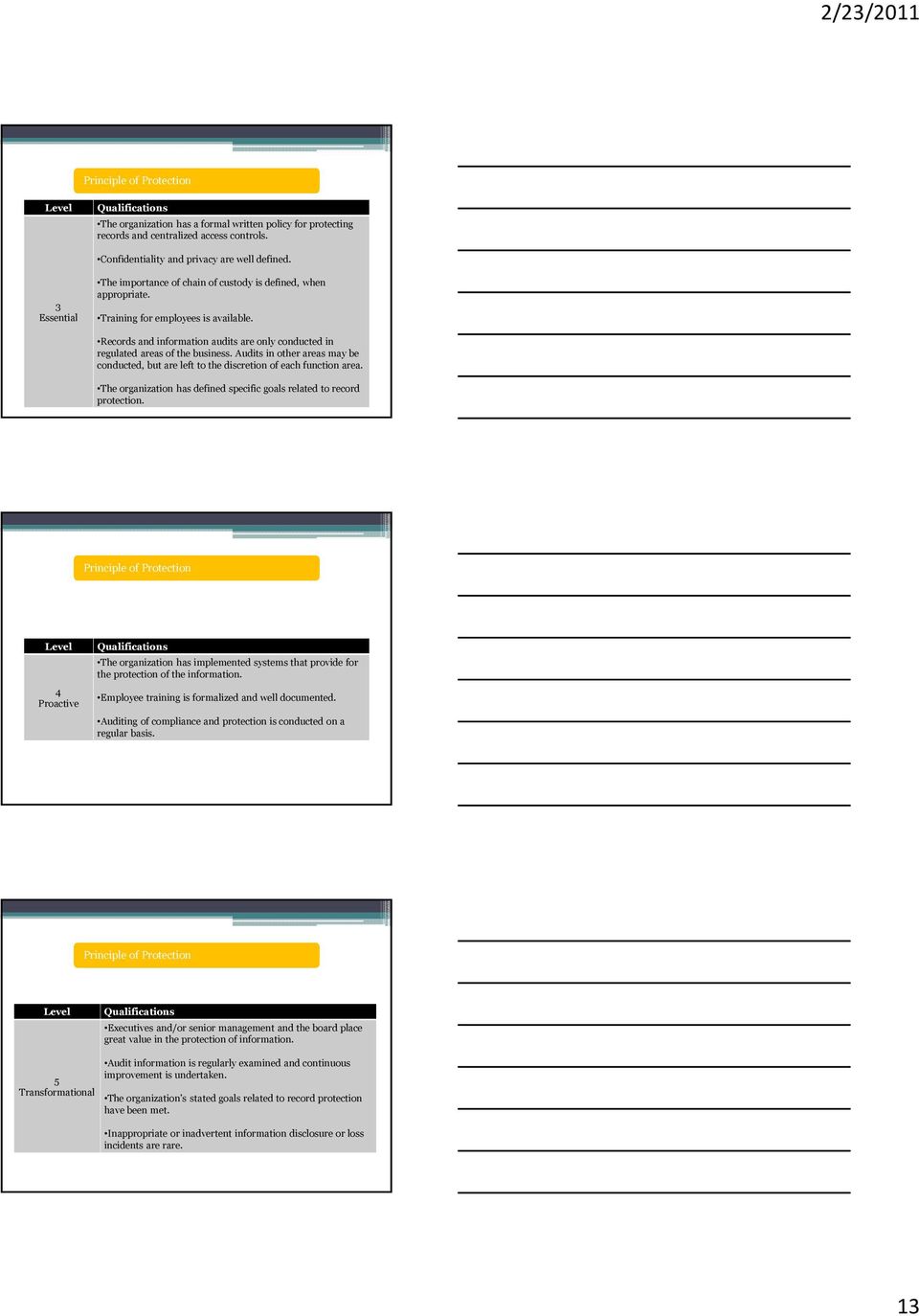
13 Principle of Protection The organization has a formal written policy for protecting records and centralized access controls. Confidentiality and privacy are well defined. 3 Essential The importance of chain of custody is defined, when appropriate. Training for employees is available. Records and information audits are only conducted in regulated areas of the business. Audits in other areas may be conducted, but are left to the discretion of each function area. The organization has defined specific goals related to record protection. Principle of Protection 4 Proactive The organization has implemented systems that provide for the protection of the information. Employee training is formalized and well documented. Auditing of compliance and protection is conducted on a regular basis. Principle of Protection Executives and/or senior management and the board place great value in the protection of information. 5 Transformational Audit information is regularly examined and continuous improvement is undertaken. The organization s stated goals related to record protection have been met. Inappropriate or inadvertent information disclosure or loss incidents are rare. 13
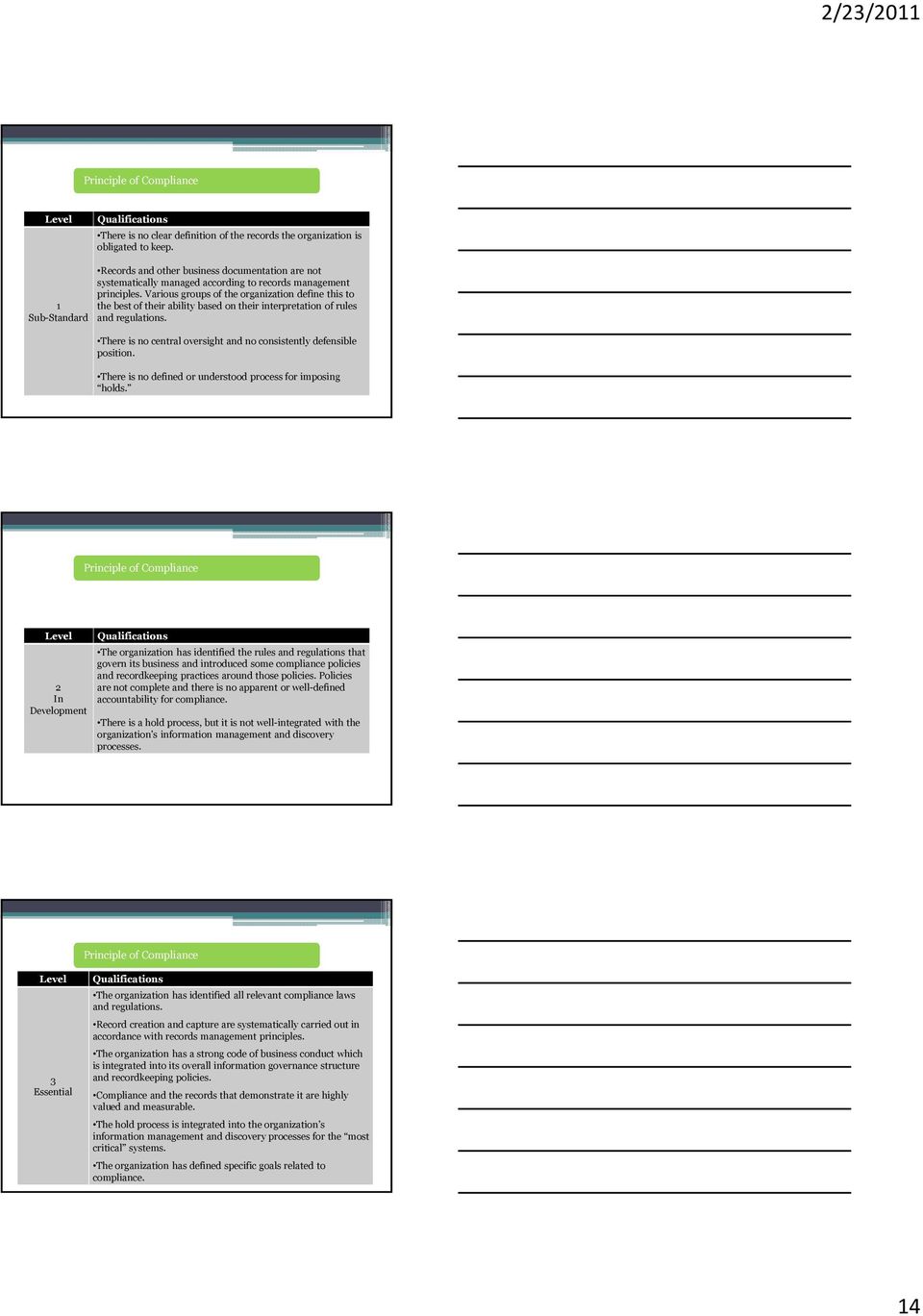
14 Principle of Compliance There is no clear definition of the records the organization is obligated to keep. 1 Sub-Standard Records and other business documentation are not systematically managed according to records management principles. Various groups of the organization define this to the best of their ability based on their interpretation of rules and regulations. There is no central oversight and no consistently defensible position. There is no defined or understood process for imposing holds. Principle of Compliance 2 In Development The organization has identified the rules and regulations that govern its business and introduced some compliance policies and recordkeeping practices around those policies. Policies are not complete and there is no apparent or well-defined accountability for compliance. There is a hold process, but it is not well-integrated with the organization s information management and discovery processes. Principle of Compliance 3 Essential The organization has identified all relevant compliance laws and regulations. Record creation and capture are systematically carried out in accordance with records management principles. The organization has a strong code of business conduct which is integrated into its overall information governance structure and recordkeeping policies. Compliance and the records that demonstrate it are highly valued and measurable. The hold process is integrated into the organization s information management and discovery processes for the most critical systems. The organization has defined specific goals related to compliance. 14
15 Principle of Compliance 4 Proactive The organization has implemented systems to capture and protect records. Records are linked with the metadata used to demonstrate and measure compliance. Employees are trained appropriately and audits are conducted regularly. Records of the audits and training are available for review. Lack of compliance is remedied through implementation of defined corrective actions. The hold process is well-managed with defined roles and a repeatable process that is integrated into the organization s information management and discovery processes. Principle of Compliance The importance of compliance and the role of records and information in it are clearly recognized at the senior management and board levels. 5 Transformational Auditing and continuous improvement processes are wellestablished and monitored by senior management. The roles and processes for information management and discovery are integrated. The organization s stated goals related to compliance have been met. The organization suffers few or no adverse consequences based on information governance and compliance failures. Principle of Availability Records are not readily available when needed and/or it is unclear who to ask when records need to be produced. 1 Sub-Standard It takes time to find the correct version, the signed version, or the final version, if it can be found at all. The records lack finding aides: indices, metadata, and locators. Legal discovery is difficult because it is not clear where information resides or where the final copy of a record is located. 15

16 Principle of Availability Record retrieval mechanisms have been implemented in certain areas of the organization. 2 In Development In those areas with retrieval mechanisms, it is possible to distinguish between official records, duplicates, and nonrecord materials. There are some policies on where and how to store official records, but a standard is not imposed across the organization. Legal discovery is complicated and costly due to the inconsistent treatment of information. Principle of Availability There is a standard for where and how official records and information are stored, protected, and made available. Record retrieval mechanisms are consistent and contribute to timely records retrieval. 3 Essential Most of the time, it is easy to determine where to find the authentic and final version of any record. Legal discovery is a well-defined and systematic business process. The organization has defined specific goals related to availability. Principle of Availability 4 Proactive There are clearly defined policies regarding storage of records and information. There are clear guidelines and an inventory that identifies and defines the systems and their information assets. Records and information are consistently and readily available when needed. Appropriate systems and controls are in place for legal discovery. Automation is adopted to facilitate the implementation of the hold process. 16

17 Principle of Availability The senior management and board levels provide support to continually upgrade the processes that affect record availability. 5 Transformational There is an organized training and continuous improvement program. The organization s stated goals related to availability have been met. There is a measurable ROI to the business as a result of records availability. Principle of Retention There is no current documented records retention schedule. 1 Sub-Standard Rules and regulations that should define retention are not identified or centralized. Retention guidelines are haphazard at best. In the absence of retention schedules, employees either keep everything or dispose of records based on their own business needs, rather than organizational needs. Principle of Retention 2 In Development A retention schedule is available, but does not encompass all records, did not go through official review, and is not well known around the organization. The retention schedule is not regularly updated or maintained Education and training about the retention policies are not available. 17

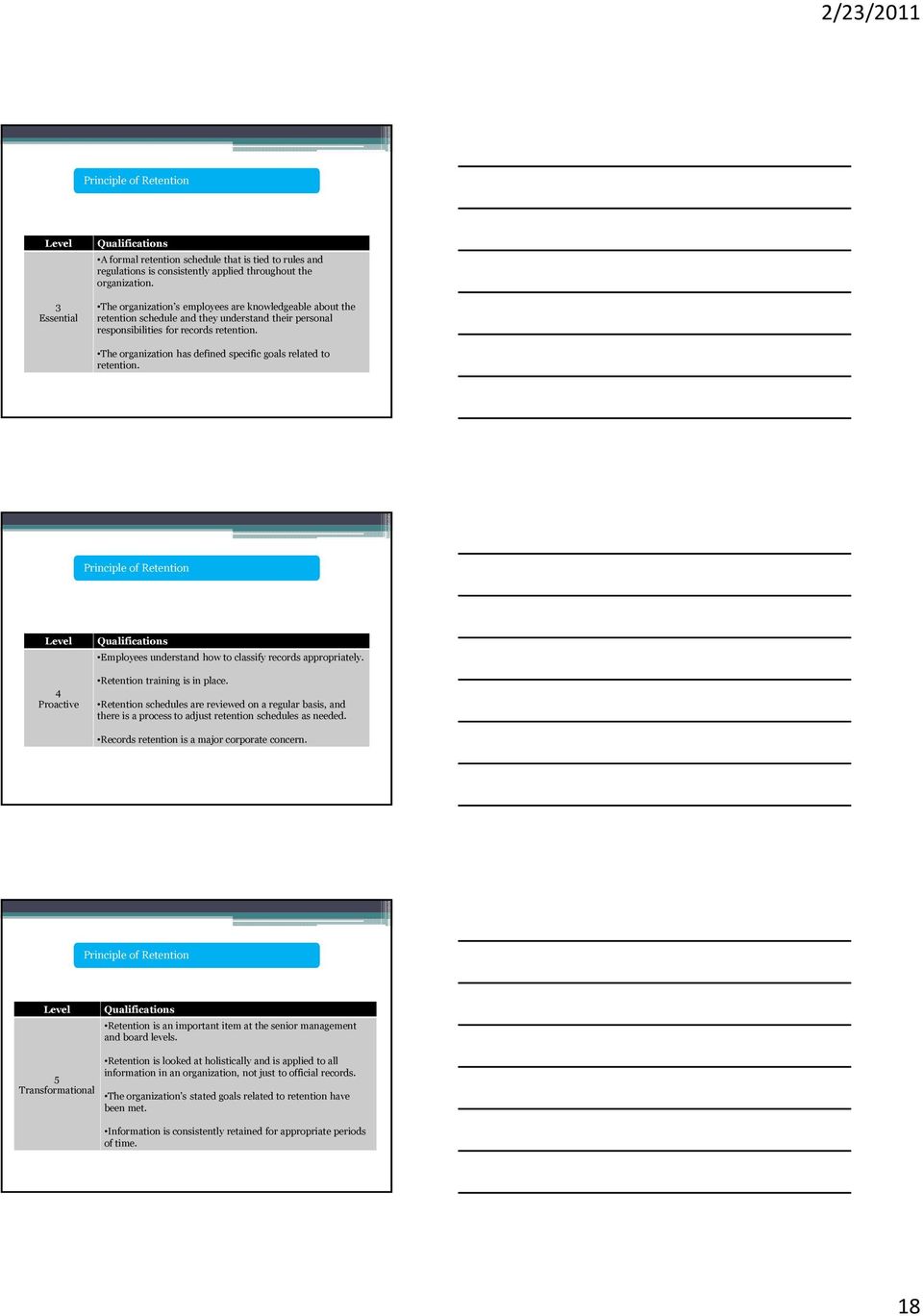
18 Principle of Retention 3 Essential A formal retention schedule that is tied to rules and regulations is consistently applied throughout the organization. The organization s employees are knowledgeable about the retention schedule and they understand their personal responsibilities for records retention. The organization has defined specific goals related to retention. Principle of Retention 4 Proactive Employees understand how to classify records appropriately. Retention training is in place. Retention schedules are reviewed on a regular basis, and there is a process to adjust retention schedules as needed. Records retention is a major corporate concern. Principle of Retention Retention is an important item at the senior management and board levels. 5 Transformational Retention is looked at holistically and is applied to all information in an organization, not just to official records. The organization s stated goals related to retention have been met. Information is consistently retained for appropriate periods of time. 18
19 Principle of Disposition 1 Sub-Standard There is no documentation of the processes, if any, that are used to guide the transfer or disposition of records. The process for suspending disposition in the event of investigation or litigation is non-existent or is inconsistent across the organization. Principle of Disposition Preliminary guidelines for disposition are established. 2 In Development There is a realization of the importance of suspending disposition in a consistent manner, repeatable by certain legal groupings. There may or may not be enforcement and auditing of disposition. Principle of Disposition Official procedures for records disposition and transfer are developed. Official policy and procedures for suspending disposition have been developed. 3 Essential Although policies and procedures exist, they are not standardized across the organization. Individual departments have devised alternative procedures to suit their particular business needs. The organization has defined specific goals related to disposition. 19

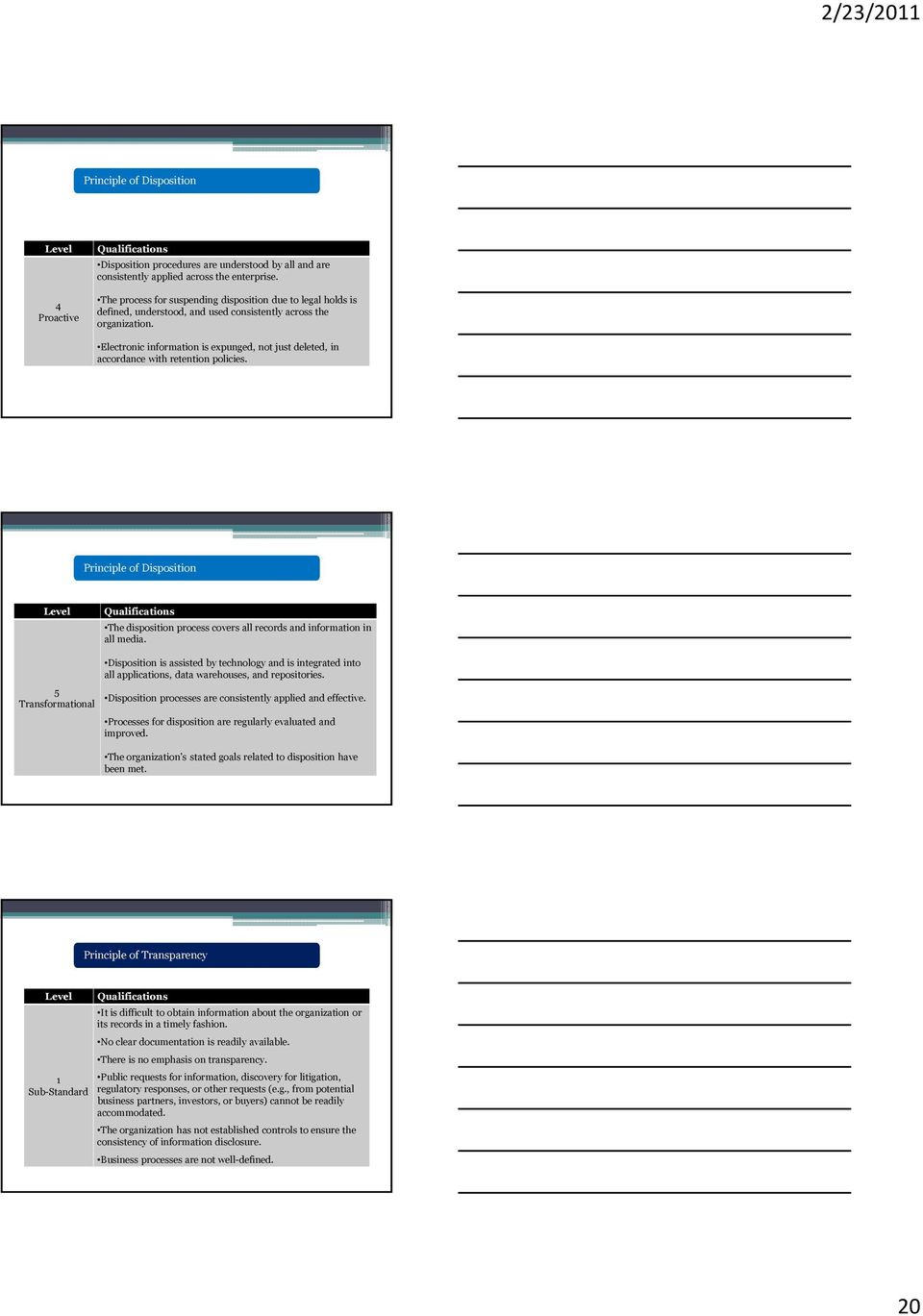
20 Principle of Disposition 4 Proactive Disposition procedures are understood by all and are consistently applied across the enterprise. The process for suspending disposition due to legal holds is defined, understood, and used consistently across the organization. Electronic information is expunged, not just deleted, in accordance with retention policies. Principle of Disposition The disposition process covers all records and information in all media. 5 Transformational Disposition is assisted by technology and is integrated into all applications, data warehouses, and repositories. Disposition processes are consistently applied and effective. Processes for disposition are regularly evaluated and improved. The organization s stated goals related to disposition have been met. Principle of Transparency 1 Sub-Standard It is difficult to obtain information about the organization or its records in a timely fashion. No clear documentation is readily available. There is no emphasis on transparency. Public requests for information, discovery for litigation, regulatory responses, or other requests (e.g., from potential business partners, investors, or buyers) cannot be readily accommodated. The organization has not established controls to ensure the consistency of information disclosure. Business processes are not well-defined. 20
21 Principle of Transparency 2 In Development The organization realizes that some degree of transparency is important in its recordkeeping for business or regulatory needs. Although a limited amount of transparency exists in areas where regulations demand transparency, there is no systematic or organization-wide drive to transparency. Principle of Transparency 3 Essential Transparency in recordkeeping is taken seriously and information is readily and systematically available when needed. There is a written policy regarding transparency. Employees are educated on the importance of transparency and the specifics of the organization s commitment to transparency. The organization has defined specific goals related to transparency. Principle of Transparency 4 Proactive Exceeds 3 in the following ways: Transparency is an essential part of the corporate culture and is emphasized in training. The organization monitors compliance on a regular basis. 21
22 Principle of Transparency The organization s senior management considers transparency as a key component of information governance. 5 Transformational The organization s stated goals related to transparency have been met. The organization has implemented a continuous improvement process to ensure transparency is maintained over time. Software tools that are in place assist in transparency. Requestors, courts, and other legitimately interested parties are consistently satisfied with the transparency of the processes and the response. For more information Log onto Download.pdf version of the GARP Principles Download.pdf version of the GARP Information Governance Maturity Model View presentations and articles on the topic Questions? 22
23 Contact information Ember D. Krumwied, CRM Corporate Records Manager Investco Financial Corporation (253)
Generally Accepted Recordkeeping Principles
 Generally Accepted Recordkeeping Principles Information Governance Maturity Model Information is one of the most vital strategic assets any organization possesses. Organizations depend on information to
How the Information Governance Reference Model (IGRM) Complements ARMA International s Generally Accepted Recordkeeping Principles (GARP )
 The Electronic Discovery Reference Model (EDRM) How the Information Governance Reference Model (IGRM) Complements ARMA International s Generally Accepted Recordkeeping Principles (GARP ) December 2011
The World of Information Governance
 The World of Information Governance Society of Corporate Compliance and Ethics Maggi Johnsen, CRM October 12, 2012 Table of Contents What is Information Governance (IG)? What Might Lead to an IG Failure?
State of Florida ELECTRONIC RECORDKEEPING STRATEGIC PLAN. January 2010 December 2012 DECEMBER 31, 2009
 State of Florida ELECTRONIC RECORDKEEPING STRATEGIC PLAN January 2010 December 2012 DECEMBER 31, 2009 Florida Department of State State Library and Archives of Florida 850.245.6750 http://dlis.dos.state.fl.us/recordsmanagers
How To Manage Cloud Data Safely
 Information Governance In The Cloud Galina Datskovsky, Ph. D., CRM President of ARMA International SVP Information Governance Solutions Topics Cloud Characteristics And Risks Information Management In
ARMA: Information Governance: A Revenue Source Potential
 ARMA: Information Governance: A Revenue Source Potential Presenter: Martin Tuip Executive Director for IG Products ARMA International Agenda About ARMA International What is Information Governance? Generally
Electronic Records Management
 Electronic Records Management HOW TRANSIT AGENCIES CAN LEVERAGE THEIR USE What is Electronic Records Management Electronic Records Management (ERM) utilizes technology to enable the indexing, imaging,
Successful Implementation of Enterprise-Wide Information Governance
 Successful Implementation of Enterprise-Wide Information Governance ARMA Austin Monthly Meeting November 13, 2014 TAD C. HOWINGTON, CRM, FAI Manager, E- Records and Information Governance Kinder- Morgan
Building a GARP -Compliant Solution
 Building a GARP -Compliant Solution How the ability to understand meaning helps organizations govern information in compliance with ARMA International s GARP Principles Autonomy White Paper Index Introduction
GARP and how it helps you achieve better information governance
 E-Guide GARP and how it helps you achieve better information governance Sponsored By: E-Guide GARP and how it helps you achieve better information governance Table of Contents Resources from IBM Sponsored
Information Management Strategic Plan - Methodology
 OVERVIEW: According to ISO 15489-1 and -2 Information and Documentation Records Management, Part 1 (General) and Part 2 (Guidelines), in order to design and implement sustainable record systems, a design
 IG DG ITG Data Gov IT Gov Info Gov Data Governance vs. Information Governance? Data Gov Info Gov Data Governance vs. Information Governance Data Governance vs. Information Governance Data Facts, Measurements
RECORD AND INFORMATION MANAGEMENT FRAMEWORK FOR ONTARIO SCHOOL BOARDS/AUTHORITIES
 PURPOSE Records and information are important strategic assets of an organization and, like other organizational assets (people, capital and technology), must be managed to maximize their value. Information
Fundamentals of Information Governance:
 Fundamentals of Information Governance: More than just records management PETER KURILECZ CRM CA IGP Hard as I try, I simply cannot make myself understand how Information Governance isn t just a different
TERRITORY RECORDS OFFICE BUSINESS SYSTEMS AND DIGITAL RECORDKEEPING FUNCTIONALITY ASSESSMENT TOOL
 TERRITORY RECORDS OFFICE BUSINESS SYSTEMS AND DIGITAL RECORDKEEPING FUNCTIONALITY ASSESSMENT TOOL INTRODUCTION WHAT IS A RECORD? AS ISO 15489-2002 Records Management defines a record as information created,
How To Manage Records And Information Management In Alberta
 8. RECORDS AND INFORMATION MANAGEMENT Overview This chapter is intended to help public bodies understand how good records and information management practices assist in the effective administration of
Management of Official Records in a Business System
 GPO Box 2343 ADELAIDE SA 5001 Tel (08) 8204 8773 Fax (08) 8204 8777 DX:467 [email protected] www.archives.sa.gov.au Management of Official Records in a Business System October 2011 Version
Life Cycle of Records
 Discard Create Inactive Life Cycle of Records Current Retain Use Semi-current Records Management Policy April 2014 Document title Records Management Policy April 2014 Document author and department Responsible
Approved by: Vice President, Human Resources & Corporate Resources and Vice President, Treasury & Compliance Date: October 14, 2009
 RECORDS AND INFORMATION Approved by: Vice President, Human Resources & Corporate Resources and Vice President, Treasury & Compliance Date: October 14, 2009 PURPOSE Penn West recognizes that responsible
Implementing Enterprise Information Governance: A Practical Approach
 Implementing Enterprise Information Governance: A Practical Approach TAD C. HOWINGTON, CRM, CA, FAI MANAGER, RECORDS AND INFORMATION COPANO ENERGY HOUSTON, TEXAS 512.627.9181 Learning Objectives Upon completion
Administrative Procedures Memorandum A2005
 Page 1 of 12 Date of Issue: June 2014 Original Date of Issue: Subject: References: Links: Contact: June 2014 RECORDS AND INFORMATION MANAGEMENT Policy 2196 Records and Information Management Policy 2197
PROCEDURES FOR ELECTRONIC MANAGEMENT OF RULEMAKING AND OTHER DOCKETED RECORDS IN THE FEDERAL DOCKET MANAGEMENT SYSTEM
 Issued by the EPA Chief Information Officer, Pursuant to Delegation 1-19, dated 07/07/2005 PROCEDURES FOR ELECTRONIC MANAGEMENT OF RULEMAKING AND OTHER DOCKETED RECORDS IN THE FEDERAL DOCKET MANAGEMENT
Real World Strategies for Migrating and Decommissioning Legacy Applications
 Real World Strategies for Migrating and Decommissioning Legacy Applications Final Draft 2014 Sponsored by: Copyright 2014 Contoural, Inc. Introduction Historically, companies have invested millions of
Retention & Disposition in the Cloud Do you really have control?
 InterPARES Trust Retention & Disposition in the Cloud Do you really have control? Franks Patricia, San Jose State University, San Jose, USA and Alan Doyle, University of British Columbia, Canada October
Considerations for Outsourcing Records Storage to the Cloud
 Considerations for Outsourcing Records Storage to the Cloud 2 Table of Contents PART I: Identifying the Challenges 1.0 Are we even allowed to move the records? 2.0 Maintaining Legal Control 3.0 From Storage
Defensible Disposition Strategies for Disposing of Structured Data - etrash
 Defensible Disposition Strategies for Disposing of Structured Data - etrash Presented by John Isaza, Esq., FAI Co-Founder & CEO, Information Governance Solutions, LLC Tom Reding, CRM Executive Consultant,
Scotland s Commissioner for Children and Young People Records Management Policy
 Scotland s Commissioner for Children and Young People Records Management Policy 1 RECORDS MANAGEMENT POLICY OVERVIEW 2 Policy Statement 2 Scope 2 Relevant Legislation and Regulations 2 Policy Objectives
9. GOVERNANCE. Policy 9.8 RECORDS MANAGEMENT POLICY. Version 4
 9. GOVERNANCE Policy 9.8 RECORDS MANAGEMENT POLICY Version 4 9. GOVERNANCE 9.8 RECORDS MANAGEMENT POLICY OBJECTIVES: To establish the framework for, and accountabilities of, Lithgow City Council s Records
State of Montana E-Mail Guidelines
 State of Montana E-Mail Guidelines A Management Guide for the Retention of E-Mail Records for Montana State Government Published by the: Montana State Records Committee Helena, Montana September 2006 Based,
Non-Profit Records Management Tool Kit
 Non-Profit Records Management Tool Kit January 2013 Contents Introduction.... 3 Generally Accepted Record Keeping Principles.... 4 What is a Record?.... 5 File Maintenance.... 6 Classifying a Record.....8
About ARMA International
 ARMA International 13725 W. 109 th Street, Suite 101 Lenexa, KS 66215 PH: 913.341.3808 FAX: 913.341.3742 Comments Regarding the Role of Records and Information Management: Compliance with the Internal
Achieving a Step Change in Digital Preservation Capability
 Essential Guide Achieving a Step Change in Digital Preservation Capability An assessment of Preservica using the Digital Preservation Capability Maturity Model (DPCMM) Executive Summary Nearly every organization
BPA Policy 236-1 Information Governance & Lifecycle Management
 B O N N E V I L L E P O W E R A D M I N I S T R A T I O N BPA Policy 236-1 Table of Contents 236-1.1 Purpose & Background... 2 236-1.2 Policy Owner... 2 236-1.3 Applicability... 2 236-1.4 Terms & Definitions...
SAME PRINCIPLES APPLY, BUT NEW MANDATES FOR CHANGE
 Information is an organization s most important strategic asset the lifeblood of the organization s knowledge, processes, transactions, and decisions. With information continuing to grow exponentially,
What We ll Cover. Defensible Disposal of Records and Information Litigation Holds Information Governance the future of records management programs
 What We ll Cover Foundations of Records and Information Management Creating a Defensible Retention Schedule Paper v. Electronic Records Organization and Retrieval of Records and Information Records Management
From Information Management to Information Governance: The New Paradigm
 From Information Management to Information Governance: The New Paradigm By: Laurie Fischer Overview The explosive growth of information presents management challenges to every organization today. Retaining
What is Records Management?
 What is Records Management? Records management, "RM", is the practice of maintaining the records of a company from the time they are created up to their eventual disposal. This may include classifying,
Transition Guidelines: Managing legacy data and information. November 2013 v.1.0
 Transition Guidelines: Managing legacy data and information November 2013 v.1.0 Document Control Document history Date Version No. Description Author October 2013 November 2013 0.1 Draft Department of
Rowan University Data Governance Policy
 Rowan University Data Governance Policy Effective: January 2014 Table of Contents 1. Introduction... 3 2. Regulations, Statutes, and Policies... 4 3. Policy Scope... 4 4. Governance Roles... 6 4.1. Data
INFORMATION GOVERNANCE Principles for Healthcare (IGPHC)
 INFORMATION GOVERNANCE Principles for Healthcare (IGPHC) AHIMA 3 INFORMATION GOVERNANCE Principles for Healthcare (IGPHC) Preamble...3 Principle of Accountability...5 Principle of Transparency...6 Principle
ASTRAZENECA GLOBAL POLICY SAFEGUARDING COMPANY ASSETS AND RESOURCES
 ASTRAZENECA GLOBAL POLICY SAFEGUARDING COMPANY ASSETS AND RESOURCES THIS POLICY SETS OUT THE REQUIREMENTS FOR SAFEGUARDING COMPANY ASSETS AND RESOURCES TO PROTECT PATIENTS, STAFF, PRODUCTS, PROPERTY AND
Breaking Down the Silos: A 21st Century Approach to Information Governance. May 2015
 Breaking Down the Silos: A 21st Century Approach to Information Governance May 2015 Introduction With the spotlight on data breaches and privacy, organizations are increasing their focus on information
Office of the Auditor General of Canada. Internal Audit of Document Management Through PROxI Implementation. July 2014
 Office of the Auditor General of Canada Internal Audit of Document Management Through PROxI Implementation July 2014 Practice Review and Internal Audit Her Majesty the Queen in Right of Canada, represented
Developing a Records Retention Program
 Developing a Records Retention Program This site is intended to help you design and implement a records retention program for your organization. Here you will find a basic explanation of a records retention
CORPORATE RECORD RETENTION IN AN ELECTRONIC AGE (Outline)
 CORPORATE RECORD RETENTION IN AN ELECTRONIC AGE (Outline) David J. Chavolla, Esq. and Gary L. Kemp, Esq. Casner & Edwards, LLP 303 Congress Street Boston, MA 02210 A. Document and Record Retention Preservation
a Legal Project Management Consultancy Plan. Resource. Realize.
 a Legal Project Consultancy Plan. Resource. Realize. Disclaimer Information is Not Legal Advice Alice E Burns of Eleventh Hour provides information regarding businesses, compliance and litigation trends
MICHIGAN AUDIT REPORT OFFICE OF THE AUDITOR GENERAL THOMAS H. MCTAVISH, C.P.A. AUDITOR GENERAL
 MICHIGAN OFFICE OF THE AUDITOR GENERAL AUDIT REPORT THOMAS H. MCTAVISH, C.P.A. AUDITOR GENERAL ...The auditor general shall conduct post audits of financial transactions and accounts of the state and of
IBM Unstructured Data Identification & Management An on ramp to reducing information costs and risk
 Amir Jaibaji - Product Management Program Director IBM Information Lifecycle Governance IBM Unstructured Data Identification & Management An on ramp to reducing information costs and risk Enterprise big
Office of the Auditor General Performance Audit Report. Statewide Oracle Database Controls Department of Technology, Management, and Budget
 Office of the Auditor General Performance Audit Report Statewide Oracle Database Controls Department of Technology, Management, and Budget March 2015 071-0565-14 State of Michigan Auditor General Doug
Polices and Procedures
 The University of British Columbia Land and Building Services Polices and Procedures Prepared by: Robson Agnew Approved by: Geoff Atkins Records and Information Management I-A-29 Issue Date: Aug. 20, 2007
September 28 2011. Tsawwassen First Nation Policy for Records and Information Management
 Tsawwassen First Nation Policy for Records and Information Management September 28 2011 Tsawwassen First Nation Policy for Records and Information Management Table of Contents 1. RECORDS AND INFORMATION
One of the first steps in managing information in today s
 ractice brief Practice Guidelines for Managing Health Information Appendix A ECRM Concepts, Terms, and Definitions One of the first steps in managing information in today s challenging environment is to
Information Governance Policy
 Information Governance Policy Implementation date: 30 September 2014 Control schedule Approved by Corporate Policy and Strategy Committee Approval date 30 September 2014 Senior Responsible Officer Kirsty-Louise
Copyright 2014 Carnegie Mellon University The Cyber Resilience Review is based on the Cyber Resilience Evaluation Method and the CERT Resilience
 Copyright 2014 Carnegie Mellon University The Cyber Resilience Review is based on the Cyber Resilience Evaluation Method and the CERT Resilience Management Model (CERT-RMM), both developed at Carnegie
WHITE PAPER Practical Information Governance: Balancing Cost, Risk, and Productivity
 WHITE PAPER Practical Information Governance: Balancing Cost, Risk, and Productivity Sponsored by: EMC Corporation Laura DuBois August 2010 Vivian Tero EXECUTIVE SUMMARY Global Headquarters: 5 Speen Street
Applicability: All Employees Effective Date: December 6, 2005; revised January 27, 2009 Source(s):
 Title: Category: Administration Information Management Policy No.: B5010 Replaces: B5010 Applicability: All Employees Effective Date: December 6, 2005; revised January 27, 2009 Source(s): Approval: (President
How To Ensure Health Information Is Protected
 pic pic CIHI Submission: 2011 Prescribed Entity Review October 2011 Who We Are Established in 1994, CIHI is an independent, not-for-profit corporation that provides essential information on Canada s health
Business System Recordkeeping Assessment - Digital Recordkeeping Compliance
 Introduction The following assessment will assist to identify whether the system complies with State Records Authority of NSW Standards on Records Management The broad Principles of this standard are as
University of Michigan Medical School Data Governance Council Charter
 University of Michigan Medical School Data Governance Council Charter 1 Table of Contents 1.0 SIGNATURE PAGE 2.0 REVISION HISTORY 3.0 PURPOSE OF DOCUMENT 4.0 DATA GOVERNANCE PROGRAM FOUNDATIONAL ELEMENTS
United Cerebral Palsy of Greater Chicago Records and Information Management Policy and Procedures Manual, December 12, 2008
 United Cerebral Palsy of Greater Chicago Records and Information Management Policy and Procedures Manual, December 12, 2008 I. Introduction United Cerebral Palsy of Greater Chicago ( UCP ) recognizes that
UNIVERSITY OF MANITOBA PROCEDURE
 UNIVERSITY OF MANITOBA PROCEDURE Procedure: Parent Policy: Effective Date: June 23, 2015 Revised Date: Review Date: June 23, 2025 Approving Body: Authority: Responsible Executive Officer: Delegate: Contact:
The Inventory Maturity Model for Information Governance
 The Inventory Maturity Model for Information Governance Challenges Information Governance has a significant impact on business The absence of solid Information Governance is told in fines, lawsuits, and
Interagency Science Working Group. National Archives and Records Administration
 Interagency Science Working Group 1 National Archives and Records Administration Establishing Trustworthy Digital Repositories: A Discussion Guide Based on the ISO Open Archival Information System (OAIS)
NightOwlDiscovery. EnCase Enterprise/ ediscovery Strategic Consulting Services
 EnCase Enterprise/ ediscovery Strategic Consulting EnCase customers now have a trusted expert advisor to meet their discovery goals. NightOwl Discovery offers complete support for the EnCase Enterprise
E-mail Management: A Guide For Harvard Administrators
 E-mail Management: A Guide For Harvard Administrators E-mail is information transmitted or exchanged between a sender and a recipient by way of a system of connected computers. Although e-mail is considered
4.01. Archives of Ontario and Information Storage and Retrieval Services. Chapter 4 Section. Background
 Chapter 4 Section 4.01 Ministry of Government Services Archives of Ontario and Information Storage and Retrieval Services Follow-up on VFM Section 3.01, 2007 Annual Report Background The Archives of Ontario
Realizing the ROI of Information Governance. Gregory P. Kosinski Director, Product Marketing EMC
 Realizing the ROI of Information Governance Gregory P. Kosinski Director, Product Marketing EMC Copyright 2009 2010 EMC Corporation. All rights reserved. 1 2 Just How Important IS this? Technologies That
US EPA REGION III QUALITY MANAGEMENT PLAN REVIEW CHECKLIST
 US EPA REGION III Organization: EPA Organization: EPA Program: Contact: EPA Contact: EPA Contract/Grant/IAG Number: Phone Number: Phone Number: Reviewer: Date Reviewed: Reviewer Organization: Check New
Records Management Focus White Paper Understanding Digital Records Management
 Records Management Focus White Paper Understanding Digital Records Management Records Management Solutions for Today s Regulatory Environment Contents Executive Summary... 1 Records Management Overview...
RUTGERS POLICY. Approval Authority: Executive Vice President for Academic Affairs and Senior Vice President for Administration
 RUTGERS POLICY Section: 30.4.5 Section Title: Business Services Policy Name: Records Management Formerly Book: Formerly Policy 50.3.10 Approval Authority: Executive Vice President for Academic Affairs
ISO/IEC 17025 QUALITY MANUAL
 1800 NW 169 th Pl, Beaverton, OR 97006 Revision F Date: 9/18/06 PAGE 1 OF 18 TABLE OF CONTENTS Quality Manual Section Applicable ISO/IEC 17025:2005 clause(s) Page Quality Policy 4.2.2 3 Introduction 4
Using EMC SourceOne Email Management in IBM Lotus Notes/Domino Environments
 Using EMC SourceOne Email Management in IBM Lotus Notes/Domino Environments Technology Concepts and Business Considerations Abstract EMC SourceOne Email Management enables customers to mitigate risk, reduce
RECORDS MANAGEMENT POLICY
 RECORDS MANAGEMENT POLICY POLICY STATEMENT The records of Legal Aid NSW are a major component of its corporate memory and risk management strategies. They are a vital asset that support ongoing operations
Electronic Discovery. Answers to life s enduring questions
 Electronic Discovery Answers to life s enduring questions 1 Electronic Discovery 1. Requirements: What do courts expect? 2. Potential consequences of missteps? Sanctions and unnecessary expense 3. Solutions:
DOCUMENT RETENTION STRATEGIES FOR HEALTHCARE ORGANIZATIONS
 Overview. DOCUMENT RETENTION STRATEGIES FOR HEALTHCARE ORGANIZATIONS A comprehensive and consistently applied document retention policy is necessary to reduce the risk of being charged with spoliation
ROLES & RESPONSIBILITIES OF RECORDS MANAGER
 ROLES & RESPONSIBILITIES OF RECORDS MANAGER DATE : 12 June 2014 (Thursday) VENUE : National Archives of Malaysia PRESENTED BY : Mr. Mohd Saufi Samsudin Records Manager Malaysia Administrative Modernization
Southern Law Center Law Center Policy #IT0004. Title: Email Policy
 Southern Law Center Law Center Policy #IT0004 Title: Email Policy Authority: Department Original Adoption: 7/20/2007 Effective Date: 7/20/2007 Last Revision: 9/17/2012 1.0 Purpose: To provide members of
Strategies for Developing a Document Imaging & Electronic Retention Program
 Is it okay to destroy the paper source records? Are there any exceptions? Strategies for Developing a Document Imaging & Electronic Retention Program How do we ensure the program will stand up in court?
Research Data Management Framework: Capability Maturity Guide
 ANDS Guides Research Data Management Framework: Capability Maturity Guide Introduction The outline set out below shows five levels of attainment or maturity which institutions may achieve in managing their
YORK REGION DISTRICT SCHOOL BOARD. Policy and Procedure #160.0 Records and Information Management
 YORK REGION DISTRICT SCHOOL BOARD Policy and Procedure #160.0 Records and Information Management Policy and Procedure #160.0 Records and Information Management outline the process for ensuring information
RECORDS AND INFORMATION MANAGEMENT AND RETENTION
 RECORDS AND INFORMATION MANAGEMENT AND RETENTION Policy The Health Science Center recognizes the need for orderly management and retrieval of all official records and a documented records retention and
Digital Continuity Plan
 Digital Continuity Plan Ensuring that your business information remains accessible and usable for as long as it is needed Accessible and usable information Digital continuity Digital continuity is an approach
Managing Government Records A Cooperative Undertaking. An Introduction to Kentucky s Public Records Management Law
 Managing Government Records A Cooperative Undertaking An Introduction to Kentucky s Public Records Management Law Revised August 2012 Table of Contents Introduction 3 What are public records? 3 What is
Corporate Governance - The Importance of a Compliant Record Retention Program. by Christopher N. Weiss 1
 Corporate Governance - The Importance of a Compliant Record Retention Program by Christopher N. Weiss 1 A. Rationale for a Sound Record Retention Policy Record retention is crucial to disciplined corporate