
USSSA Fast Pitch National Committee Members
|
|
|
- Ethelbert McBride
- 9 years ago
- Views:
Transcription
1
2
3 USSSA Fast Pitch National Committee Members USSSA Fast Pitch Regional Directors Vice President of Fast Pitch/Region 3 Director Gordon Glennie, MI [email protected] Executive VP of Director Development/Region 5 Director Tom Turley, KS [email protected] Region 3 Asst. Director Tonya Perkins, IN [email protected] Region 1 Director Bill Dowell, MD [email protected] Region 2 Director Dan Simpson, FL [email protected] Region 4 Director Mark Blackford, TX [email protected] National Collegiate Coordinator/Region 5 Asst. Director Steve Leasure, KS [email protected] Region 6 Director Stacy Fish, CAS [email protected] Region 7 Director Roy Fetherolf, CAN [email protected] Region 1 Connecticut, Delaware, Maine, Massachusetts, Maryland, New Hampshire, New Jersey, New York, North Carolina, Pennsylvania, Rhode Island, South Carolina, Vermont, Virginia, DC, West Virginia 6th Edition Region 2 Alabama, Florida, Georgia, Mississippi, Tennessee Region 3 Illinois, Indiana, Kentucky, Michigan, Ohio, Wisconsin, Canada Region 4 Arkansas, Louisiana, Oklahoma, Texas (North & South), Texas (West) Region 5 Colorado, Iowa, Kansas, Minnesota, Missouri, Nebraska, North Dakota, South Dakota Region 6 Arizona, California (Southern), Hawaii, Nevada (Southern), New Mexico Region 7 Alaska, California (Northern), Idaho, Montana, Nevada (Northern), Oregon, Utah, Washington, Wyoming 1

4

5 USSSA Fast Pitch National Umpire Committee John Dye Maryland Chairman Sam Ellis Michigan Tony Coates Kansas USSSA Fast Pitch Regional UIC S Region 1 Jake Jacobs [email protected] Region 2 Steve Schiller [email protected] Region 3 Sam Ellis [email protected] Region 4 Mark Blackford [email protected] Region 5 Tony Coates [email protected] Region 6 Bob Cheney [email protected] Region 7 Roy Fetherolf [email protected] 6th Edition 3

6 SIXTH EDITION FAST PITCH RULES & BY-LAWS The Field Diagram BASE AND PITCHING MEASUREMENT - 60' BASES FAST PITCH USSSA s On-Line Fast Pitch Rulebook Is Located At: The On-Line Rulebook Supersedes This Printed Edition 4 6th Edition

7

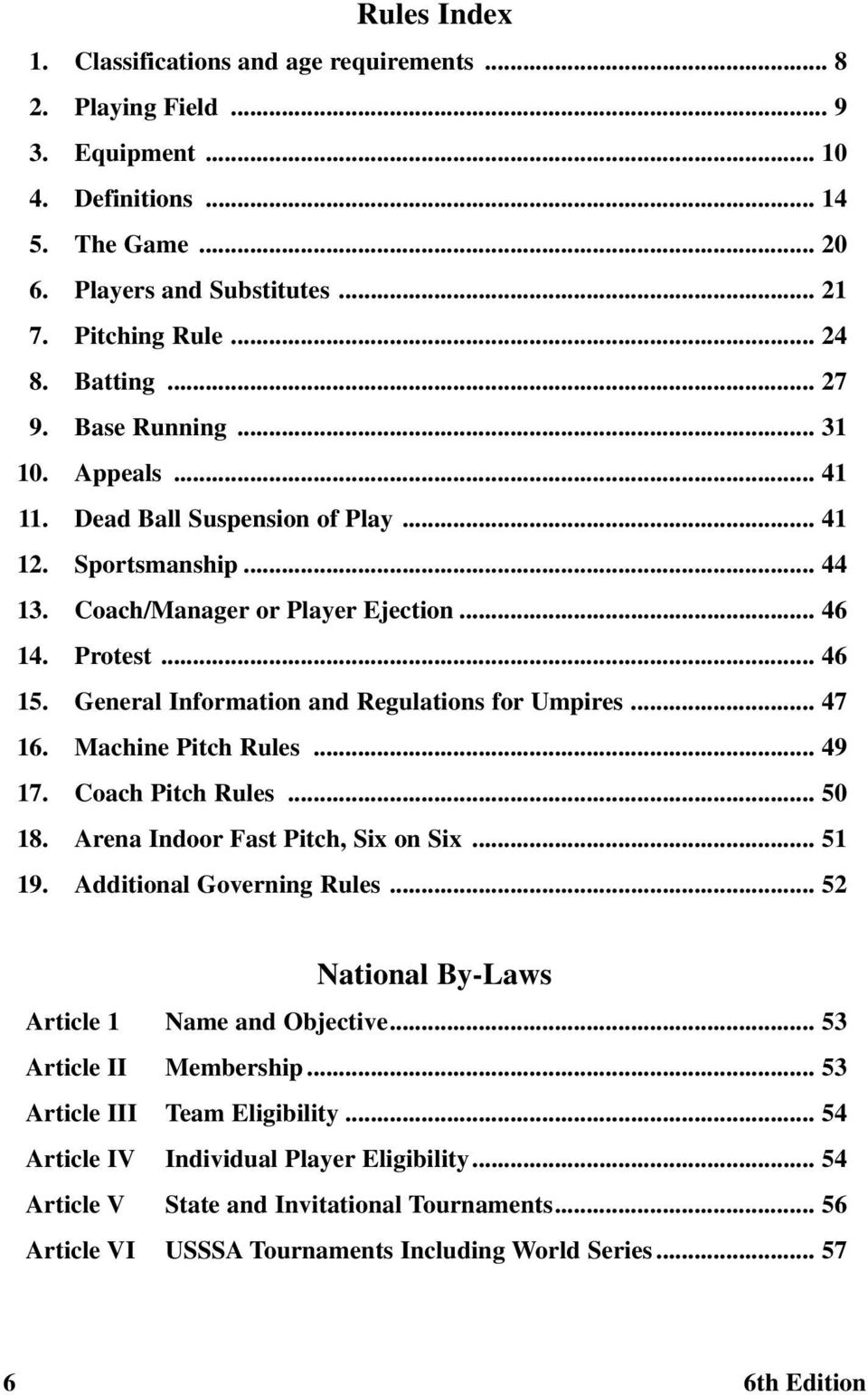
8 Rules Index 1. Classifications and age requirements Playing Field Equipment Definitions The Game Players and Substitutes Pitching Rule Batting Base Running Appeals Dead Ball Suspension of Play Sportsmanship Coach/Manager or Player Ejection Protest General Information and Regulations for Umpires Machine Pitch Rules Coach Pitch Rules Arena Indoor Fast Pitch, Six on Six Additional Governing Rules National By-Laws Article 1 Name and Objective Article II Membership Article III Team Eligibility Article IV Individual Player Eligibility Article V State and Invitational Tournaments Article VI USSSA Tournaments Including World Series th Edition
9

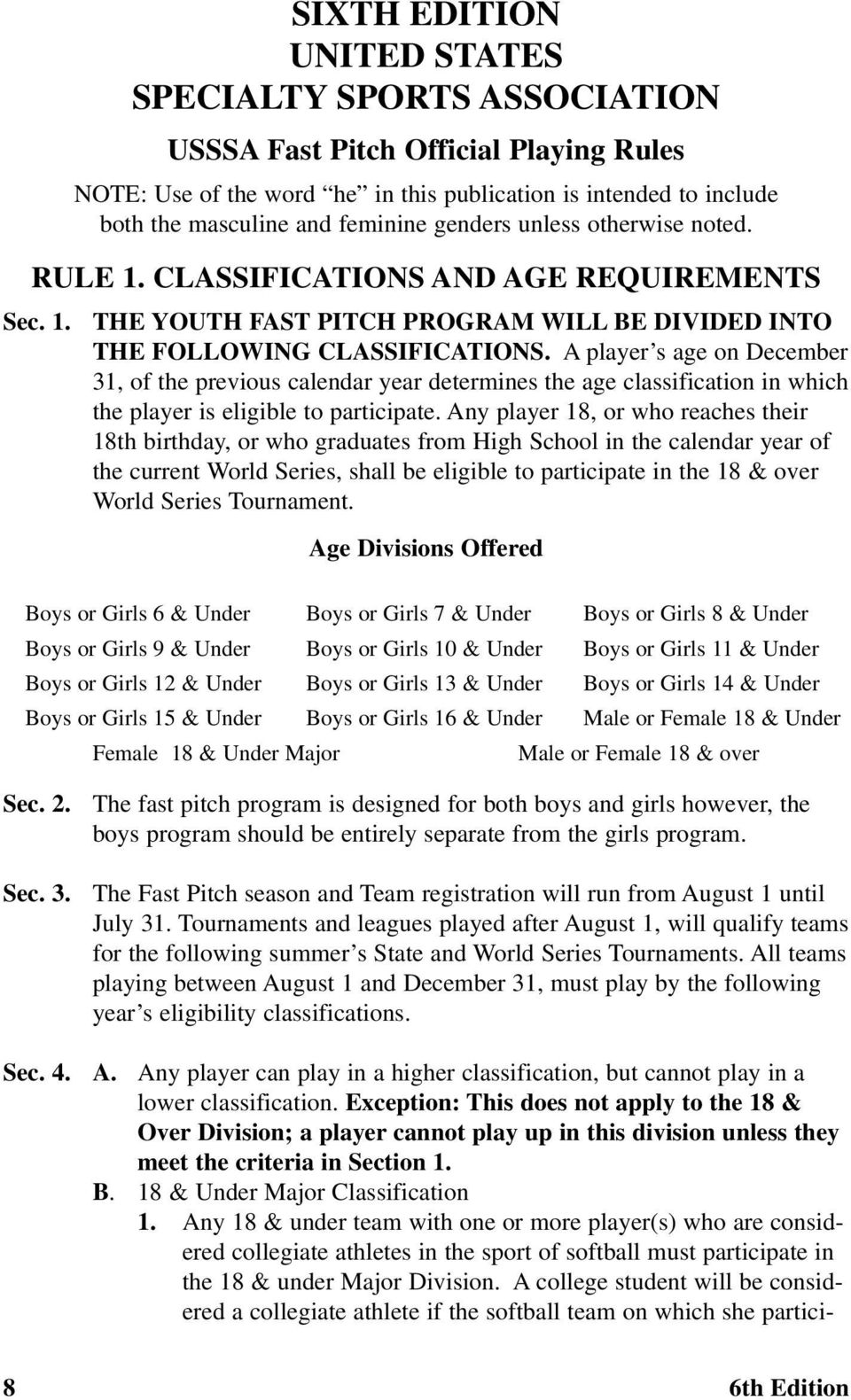
10 SIXTH EDITION UNITED STATES SPECIALTY SPORTS ASSOCIATION USSSA Fast Pitch Official Playing Rules NOTE: Use of the word he in this publication is intended to include both the masculine and feminine genders unless otherwise noted. RULE 1. CLASSIFICATIONS AND AGE REQUIREMENTS Sec. 1. THE YOUTH FAST PITCH PROGRAM WILL BE DIVIDED INTO THE FOLLOWING CLASSIFICATIONS. A player s age on December 31, of the previous calendar year determines the age classification in which the player is eligible to participate. Any player 18, or who reaches their 18th birthday, or who graduates from High School in the calendar year of the current World Series, shall be eligible to participate in the 18 & over World Series Tournament. Age Divisions Offered Boys or Girls 6 & Under Boys or Girls 7 & Under Boys or Girls 8 & Under Boys or Girls 9 & Under Boys or Girls 10 & Under Boys or Girls 11 & Under Boys or Girls 12 & Under Boys or Girls 13 & Under Boys or Girls 14 & Under Boys or Girls 15 & Under Boys or Girls 16 & Under Male or Female 18 & Under Female 18 & Under Major Male or Female 18 & over Sec. 2. Sec. 3. The fast pitch program is designed for both boys and girls however, the boys program should be entirely separate from the girls program. The Fast Pitch season and Team registration will run from August 1 until July 31. Tournaments and leagues played after August 1, will qualify teams for the following summer s State and World Series Tournaments. All teams playing between August 1 and December 31, must play by the following year s eligibility classifications. Sec. 4. A. Any player can play in a higher classification, but cannot play in a lower classification. Exception: This does not apply to the 18 & Over Division; a player cannot play up in this division unless they meet the criteria in Section 1. B. 18 & Under Major Classification 1. Any 18 & under team with one or more player(s) who are considered collegiate athletes in the sport of softball must participate in the 18 & under Major Division. A college student will be considered a collegiate athlete if the softball team on which she partici- 8 6th Edition
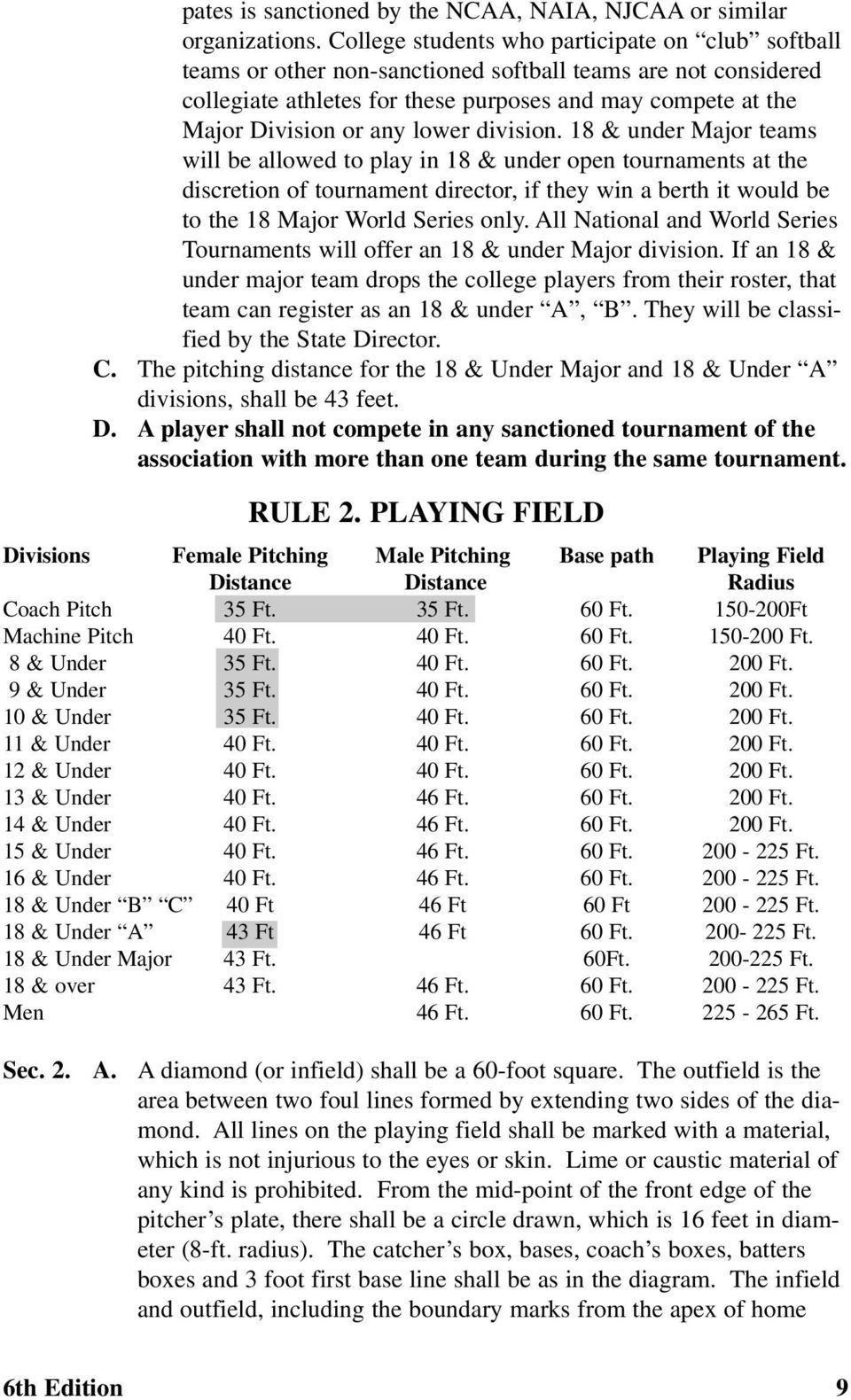
11 pates is sanctioned by the NCAA, NAIA, NJCAA or similar organizations. College students who participate on club softball teams or other non-sanctioned softball teams are not considered collegiate athletes for these purposes and may compete at the Major Division or any lower division. 18 & under Major teams will be allowed to play in 18 & under open tournaments at the discretion of tournament director, if they win a berth it would be to the 18 Major World Series only. All National and World Series Tournaments will offer an 18 & under Major division. If an 18 & under major team drops the college players from their roster, that team can register as an 18 & under A, B. They will be classified by the State Director. C. The pitching distance for the 18 & Under Major and 18 & Under A divisions, shall be 43 feet. D. A player shall not compete in any sanctioned tournament of the association with more than one team during the same tournament. RULE 2. PLAYING FIELD Divisions Female Pitching Male Pitching Base path Playing Field Distance Distance Radius Coach Pitch 35 Ft. 35 Ft. 60 Ft Ft Machine Pitch 40 Ft. 40 Ft. 60 Ft Ft. 8 & Under 35 Ft. 40 Ft. 60 Ft. 200 Ft. 9 & Under 35 Ft. 40 Ft. 60 Ft. 200 Ft. 10 & Under 35 Ft. 40 Ft. 60 Ft. 200 Ft. 11 & Under 40 Ft. 40 Ft. 60 Ft. 200 Ft. 12 & Under 40 Ft. 40 Ft. 60 Ft. 200 Ft. 13 & Under 40 Ft. 46 Ft. 60 Ft. 200 Ft. 14 & Under 40 Ft. 46 Ft. 60 Ft. 200 Ft. 15 & Under 40 Ft. 46 Ft. 60 Ft Ft. 16 & Under 40 Ft. 46 Ft. 60 Ft Ft. 18 & Under B C 40 Ft 46 Ft 60 Ft Ft. 18 & Under A 43 Ft 46 Ft 60 Ft Ft. 18 & Under Major 43 Ft. 60Ft Ft. 18 & over 43 Ft. 46 Ft. 60 Ft Ft. Men 46 Ft. 60 Ft Ft. Sec. 2. A. A diamond (or infield) shall be a 60-foot square. The outfield is the area between two foul lines formed by extending two sides of the diamond. All lines on the playing field shall be marked with a material, which is not injurious to the eyes or skin. Lime or caustic material of any kind is prohibited. From the mid-point of the front edge of the pitcher s plate, there shall be a circle drawn, which is 16 feet in diameter (8-ft. radius). The catcher s box, bases, coach s boxes, batters boxes and 3 foot first base line shall be as in the diagram. The infield and outfield, including the boundary marks from the apex of home 6th Edition 9
12 plate to 1st and 3rd, and their extended foul lines, are fair ground. All other areas are foul grounds. The recommended width of all marked (chalked) lines on the playing field is 2 1/2 inch. On deck circles shall be a safe distance to the side and away from home plate; at least 30 feet if space allows. Neither team s players shall warm up in the other teams on deck circle. The on deck circle does not have to be occupied, but if a player wishes to warm up, they shall do so in their teams on deck circle. B. The batters box shall be 7 feet long. The front of the batters box shall be 4 feet forward from the center of home plate and 3 feet wide starting 6 inch from the plate. C. Three foot running lane is a line drawn 3 feet from and parallel to the first base foul line starting halfway between home and first base and extending to first base. D. The double base may be used. This base shall be 15 by 30 inches and made of canvas or other suitable material and not more than 5 inches high. Half the base is white [over fair territory] and half is orange [over foul territory]. 1. A batted ball hitting the white portion is declared fair and a batted ball hitting the colored potion is declared foul. 2. Whenever a play is being made on the batter runner, the defense must use the white portion and the batter runner the colored portion. The batter runner is out when there is a play being made at first base and the batter-runner touches only the white portion, providing the defense appeals prior to the batter-runner returning to first base. This is treated the same as missing the base. Once the runner returns to the white, no appeal can be made. Exceptions: If the ball is thrown from the foul side of first base line. A. When an errant or missed throw pulls the defensive player into foul ground. 3. If using the double base, and there is a force play by an infielder on the batter-runner, who touches only the white portion and collides with the fielder about to catch a thrown ball while on the white. Penalty: Interference is ruled, the ball is dead, the batter-runner is out, and all other runners are returned to the base last occupied at the time of interference. Sec. 1. RULE 3. EQUIPMENT In the youth program, NOCSAE approved batting helmets with extended ear flaps, which cover both ears and temples are mandatory for all batters, on deck batters, base runners, non-adult bat & ball shaggers and any offensive player in live ball territory, even if the ball is dead. Batting helmets 10 6th Edition

13 must have attached face mask/guard and they must be NOCSAE approved. In the adult program it is highly recommended that NOCSAE approved helmets be worn. Sec. 2. Sec. 3. Sec. 4. In the Youth and collegiate programs, the catcher shall wear a NOCSAE approved head protector (with dual earflaps), an approved mask with throat protector, a body chest protector and shin guards. If a hockey style NOCSAE approved catchers helmet is used, a separate throat protector is not needed. A male catcher or any male player warming up a pitcher shall wear an approved protective cup. In the adult program, the catcher shall wear a mask with throat protector. All protective equipment must conform to industry standards. Any non-adult warming up a pitcher within the confines of the playing, field shall wear an approved protective mask with throat protector. The official ball to be used shall have raised seams and shall be of spherical design with a smooth surface. The center or core of the ball shall be of a material and design traditionally used to make softballs, or of other material, or design, approved by the USSSA. The cover shall be of horsehide, cowhide, or other material approved by USSSA and shall be cemented to the core and stitched with cotton, linen, or nylon or any other material approved by USSSA. A multiple layer core design ball or a multiple material core design ball may be approved in the sole discretion of the USSSA on a case-by-case basis. The stitch color must be blue. The internal composition of the core and the material of the cover must be clearly printed on the ball and the words Official Fast Pitch Softball must be clearly printed on the ball. FAST PITCH (12 ) OPTIC YELLOW COVER ONLY -BLUE STITCH Ball must have USSSA FAST PITCH, 47 MAX COR, 375# MAX COMPRESSION in 1/8 minimum letters and the USSSA logo in at least 1-1/8 diameter. (Lettering and logo in blue) Compression: 330 +/- 45# COR: / Circumference: 12 +/- 1/8 Weight: 6.6 +/ oz. FAST PITCH (11 ) OPTIC YELLOW COVER ONLY -BLUE STITCH Ball must have USSSA FAST PITCH 47 MAX COR, 375# MAX COMPRESSION in 1/8 minimum letters and the USSSA logo in at least 1-1/8 diameter. (Lettering and logo in blue) Compression: 330 +/- 45# COR: / Circumference: 11 +/- 1/8 Weight: 6.0 +/ oz 6th Edition 11

14 A. All 10 year old and younger divisions shall use the 11-inch softball. All other programs shall use the 12-inch softball. Sec. 5. Shoes are required equipment. Shoe sole or heel protectors other than the standard shoe plate are prohibited. Metal cleats and metal toe plates are prohibited in the 8 and under thru the 18 and under, including the 18 & Under Major Division (18 & Over) All players must wear shoes with plastic, nylon, canvas, leather or similar synthetic material uppers. The sole may be smooth, have soft or hard rubber cleats or rectangular metal spikes. Spikes must not extend in excess of 3/4 -inch from the sole and may not be round. Shoes with detachable cleats that screw into the sole of the shoe are allowed. Pitching toes are allowed for all players as long as the pitching toes are securely fastened. Sec. 6. Players in the game are prohibited from wearing jewelry. Medical alert bracelets or necklaces are not considered jewelry. If worn they must be taped to the body, so as to remain visible. If jewelry is not removed, that player will not be able to play until the jewelry is removed. Sec. 7. A. At all national and world qualifying tournaments, teams must wear identical uniforms. This includes jerseys, long pants or shorts and leggings. Whether long pants or shorts are worn, all team members must be uniformed alike. Caps are optional, however when worn they must be all alike and worn with the bill forward. B. Non duplicating numbers will be required at all national and World Series qualifying tournaments. The numbers must be minimum of three inches in size and clearly visible. Sec. 8. Sec. 9. HELMETS - When an umpire observes anyone required to wear a batting helmet deliberately removing the batting helmet while the ball is alive, and that person is in live ball territory, the umpire shall issue a warning to the coach of the involved person s team. All subsequent violations of the rule shall result in an ejection; player is confined to bench area. A. A chinstrap is optional. A commercially manufactured face mask/guard may be attached to a batting helmet, provided it is attached by the manufacture; or a face mask/guard may be attached to a helmet that does not have a face mask, provided the attachment procedure is approved by the manufacture. Batting helmets must have attached face mask/guard and they must be NOCSAE approved. Gloves/mitts made of leather shall be worn by all fielders. A. The glove/mitt by the catcher may be any size. B. The glove/mitt worn by the pitcher shall be uniform in color and nei- 12 6th Edition

15 ther white, optic yellow nor gray. Gloves/mitts with white, optic yellow or gray circles on the outside giving the appearance of a ball are illegal for all players. NOTE: Two tints of the same color on a glove are considered uniform in color. C. The glove/mitt worn by all fielders except the catcher shall conform to the following maximum specifications: 1. Height measured from the bottom edge or heel straight up across the center of the palm to a line even with the highest point of the glove/mitt: 14 inches 2. Width of palm measured from the bottom edge of the webbing farthest from the thumb in a horizontal line to the outside of the little finger edge of the glove/mitt: 8 inches 3. Webbing measured across the top end or along any line parallel to the top: 5 3/4 inches. Sec. 10. THE OFFICIAL BAT shall be round in cross section, straight in length, and measure not more than 34 inches long including tape or other grip additions to the bat, and not more than 2 1/4 inches in diameter in its largest part and its weight shall not exceed 31 1/2 ounces, including tape or grip addition to the bat. The bat shall have a safety grip of tape or some other material to facilitate holding the bat during the batter s swing. The safety grip shall be not less than 10 inches long, nor extend more than 15 inches from the small end or handle end of the bat. Graphics, including BPF markings, must be permanent and cannot be decals or any other method that can be easily removed or added to the bat. A. THE BAT shall be made of hard wood, in one piece, or laminated from sections of hard wood bonded together with adhesive in such a way that the grain directions of all the pieces are essentially parallel to the lengths of the bat. B. THE BAT may also be made of aluminum or other metals, Fiberglass, graphite or a composite material. The bat may be made in pieces from different materials; but must have a closed barrel end and may be modular with interchangeable parts, subject to additional safety and tampering requirements as set forth in the standard USSSA Bat Licensing Agreement. The knob portion must be welded, or mechanically attached to the bat. Only USSSA approved bats, USSSA approved weighted bats, or USSSA approved bat weight attachments may be used in loosening up. Nothing such as a donut or fan may be used when loosening up. C. Authorized bat manufacturers shall mark their products with the words Official Softball or words to that effect. If the words Official Softball are illegible the bat should be declared legal if it is legal in all other respects. When a bat does not meet the specifications as defined, has flat spots or pronounced dents, or if in the Umpire s judg- 6th Edition 13

16 Sec. 1. ment, the bat has been altered, the Umpire shall prohibit the use of the doubtful bat. D. The performance standard for all non-wooden bats will be a Bat Performance Factor (BPF) of 1.20 or less under the ASTM BPF test as applied under the standard USSSA Bat License Agreement. A list of those bats licensed and complying with this standard and therefore legal in USSSA play shall be kept by USSSA and published and made available by means including, but not limited to, the USSSA website. Only bats on the published list will be legal for USSSA play. In addition, no bat shall be legal in USSSA play unless it is marked USSSA BPF 1.20 for bats manufactured before January 1, 2004 is marked 1.20 BPF or BPF 1.20 E. A USSSA Director may at any time ask to inspect a bat that has been brought into the location of a USSSA sanctioned event. The owner and / or user may either: 1. Allow the Director to inspect the bat and reach an initial conclusion on whether the bat might be altered. If after making an inspection, the Director, in his sole discretion, decides that the bat might be an altered bat, the suspected offending owner may either: A. Allow the Director to send the bat to the USSSA Altered Bat Committee and/or the Manufacturer of the bat for a determination as to whether the bat is altered. NOTE: During the time of the examination of the bat by the Manufacturer/ Altered Bat Committee, the USSSA, in the sole discretion of the USSSA Altered Bat Committee, may suspend the suspected offending player pending the decision. If the Manufacturer or the USSSA Altered Bat Committee determines in their sole discretion that the bat has been altered, the Altered Bat Committee may suspend a first time offender for up to two years from USSSA play. For any second time offender, any suspension may be up to a lifetime suspension. B. Accept a one-year (up to life for second time offenders) suspension from USSSA play with no right of appeal. 2. Withhold the bat from inspection and accept a one-year (up to life suspension for second time offenders) suspension from USSSA play with no right to appeal. F. After examination of a bat to determine if it is altered, the bat shall be returned to the owner. No owner and/or player altered bat suspensions will occur unless the suspect bat is determined to be altered. RULE 4. Definitions A DEAD BALL is not considered in play again, until the pitcher is stationed within the 16-foot circle and the umpire calls play ball. 14 6th Edition
17 Sec. 2. Sec. 3. Sec. 4. Sec. 5. Sec. 6. Sec. 7. Sec. 8. Sec. 9. A FOUL TIP is a batted ball, which goes directly and speedily from the bat to the catcher s mitt or hand not higher than the batters head and is legally caught by the catcher, ball remains alive. A CROW HOP is the replanting of the pivot foot prior to delivery of the pitch. A LEAP is when both feet are airborne. THE STRIKE ZONE is that space over home plate, which is between the batters forward armpit and the top of the knees when the batter assumes a natural batting stance. Any part of the ball passing through the strike zone in flight shall be considered a strike; the umpire shall determine the batter s strike zone according to the batter s usual stance A BUNT is a fair ball, which occurs when the batter does not swing to hit the ball, but holds the bat in the path of the ball to tap it slowly to the infield. A DRAG BUNT is a bunt where the batter attempts to bunt the ball by running forward in the batter box, carrying the bat with her. The movement of the bat is in conjunction with the batters forward movement. An ATTEMPTED BUNT ( OFFER ) is any movement of the bat toward the ball when the ball is over or near the plate area. The mere holding of the bat in the strike zone is not an attempt to bunt. If an attempted bunt results in a foul ball, it is treated as any other foul ball, if the batter has two strikes and this happens, he is out. A SLAP HIT occurs when the batter gives the appearance of bunting, using a modified swing or slap at the ball as it approaches home plate. If an attempt to SLAP is a foul ball, it is treated the same as any other foul ball including an attempt by the batter with two strikes. Sec. 10. PIVOT FOOT, the pitchers pivot foot is that foot which is in contact with the ground, as opposed to the non-pivot foot, which the pitcher uses to step toward home plate. Sec. 11. WILD PITCH, A wild pitch is a pitch that cannot be handled by the catcher with ordinary effort. Sec. 12. PASSED BALL, a passed ball is a pitch which the catcher fails to stop or control with ordinary effort and which enables a runner to advance. Sec. 13. The ball is one of the playing implements. The term is also used to desig- 6th Edition 15

18 nate a pitch, which is not touched by the bat and is not a strike. There is no intentional walk in fast pitch. If a batter receives four such balls, she is awarded a base on ball (often referred to as a walk ) and shall go immediately to first base before time-out can be called. Sec. 14. A batted or thrown ball is in flight until it has touched the ground or some object on fair or foul ground, or it has touched a person other than a fielder. Sec. 15. it is a dead ball when the ball is not in play. The ball is not considered in play again until the pitcher is in possession of the ball and is stationed within the 16-foot circle and the plate umpire call out Play Ball. Sec. 16. A blocked ball is a fair ball, batted or thrown, which is touched, stopped or handled by a person not engaged in the game; or touches any object which is not part of the official equipment or official playing area; or touches loose equipment. Sec. 17. Dead-ball area is that area beyond any real boundary, such as a fence, rope, chalk line, any stands, bleachers, dugouts, players bench or designated media area; or any imaginary boundary line as determined in the pregame conference. If a ball becomes lodged in a fence or backstop, it is considered to be in dead-ball area. Sec. 18. The batter-runner is a player who has finished his time at bat until he is put out or playing action ends. Sec. 19. The batter s box is the area, including the lines. Sec. 20. An on-deck circle for each team is a circle 5 feet in diameter located a safe distance to the side and away from home plate, at least 30 feet if space allows. Sec. 21. A catch is the act of a fielder getting secure possession in a hand or glove of a live ball in flight and firmly holding it, provided a cap, protector, mask, pocket or other part of the uniform is not used to trap the ball. It is considered a catch. If a fielder catches a fair or foul ball and then leaves live-ball area with both feet by stepping or falling into a beach, dugout, stand, bleacher or over any boundary or barrier, such as a fence, rope, chalk line, or a pre-game determined imaginary boundary line of the field of play. Falling into does not include merely running against such object. It is not a catch when a fielder touches a batted ball in flight and the ball then contacts a member of the offensive team or an umpire and is then caught by a defensive player. 16 6th Edition
19 NOTE: When a batted ball or pitch is involved, the above definition of catch applies. For any other thrown ball, the term is used loosely to also apply to a pickup or to the trapping of a low throw which has touched the ground. A fielder may be grasping the ball even though it is touching the ground while in the glove. Sec. 22. A pre-game conference is a meeting involving the umpires, coaches and/or team captains near home plate. The meeting should begin approximately five minutes prior to the game and before the home team takes the field. There shall be no ball hit or thrown in the infield area (fair or foul territory) during this meeting. The purpose of the pre-game conference is to exchange and check each team s lineup cards and discusses ground rules. Umpires shall also ask the coaches if their players are legally and properly equipped. Sec. 23. Offensive interference is an act (physical or verbal) by the team at bat, which interferes with, obstructs, impedes, hinders or confuses any fielder attempting to make a play. Or when a runner creates malicious contact with any fielder with or without the ball, in or out of the baseline; or when a coach physically assists a runner during playing action. It is umpire interference when the umpire, inadvertently moves so as to hinder a catcher s attempt to throw or when a fair ball touches an umpire. Spectator interference is any action by a spectator, which impedes the progress of the game. Sec.24. Obstruction is an act (intentional or unintentional, physical or verbal) by a fielder, any member of the defensive team or its team personnel, which hinders a runner or changes the pattern of play or when a catcher or fielder hinders a batter. A. It is catcher obstruction when a catcher hinders or prevents a batter from swinging at a pitch. B. A fake tag is an act by a defensive player that simulates an attempt to tag a runner. Faking a tag is always considered obstruction. Sec. 25. A regulation game is seven innings (term at bat) unless extra inning(s) are necessary because of a tie score, or unless shortened because the home team does not require it half of the seventh inning or only a fraction of it, or because of weather or darkness. A called game is one that is ended by order of the umpire. A suspended game is a game to be completed at a later time. Sec. 26. An inning is A. that portion of the game, which includes a term at bat for each team. B. A half inning is the interval during which one team is on offense (batting) and the other is on defense (fielding). A half inning ends when there is a third out or when, in the last inning, the winning run is scored. In either case, if there is a delayed out declared by the umpire 6th Edition 17
20 for a base running infraction, a possible fourth out may be recognized for the inning, depending on the circumstances. C. An extra inning is one, which extends the game beyond regulation play in an attempt to break a tie score. Sec. 27. A forfeited game is one awarded to the opponent of the offending team. The score shall be recorded as 7 to 0. Sec. 28. A fair ball is a batted ball which: A. Settles or is touched on or over fair territory between home and first base or home and third base; B. Is on or over fair territory including any part of first and third base when bounding to the outfield. C. Touches first, second or third bases. D. While on or over fair territory touches the person of any umpire or player or their clothing or equipment. E. While over fair territory passes out of the playing field in flight. F. First falls or is touched on or over fair territory beyond first or third base. NOTE: A fair fly shall be judged according to the relative position of the ball and the foul line, including the foul pole, and not as to whether the fielder is in fair or foul territory at the time she touches the ball. It does not matter whether the ball first touches fair or foul territory as long as it does not touch anything foreign to the natural ground in foul territory and complies with all other aspects of a fair ball. Sec. 29. A foul ball is a batted ball which: A. Settles on foul territory between home and first base, or between home and 3rd base. B. Bounds past first or third base on or over foul territory. C. First falls on foul territory beyond first or third base. D. While on or over foul territory touches the person of an umpire, a player or any object foreign to the natural ground. Sec. 30. A sacrifice is a bunt which enables any runner to advance, or a fly ball which enables a runner to score; but, in either case, results in the batterrunner being put out before reaching first base or would have resulted in the batter-runner being put out if the hit had been fielded without error and provided two were not out when the ball was hit. A sacrifice is not listed as a time-at-bat. Sec. 31. An infield fly is a fair fly (not including a line drive or an attempted bunt) which can be caught by an infielder with ordinary effort (rule does not preclude outfielders from being allowed to make the catch); and provided the hit is made before two are out and at a time when first and second base or all bases are occupied. 18 6th Edition
21 When it seems apparent that a batted ball will be an infield fly, the plate umpire immediately announces it for the benefit of the runners. If the ball is near the base line the umpire shall declare, Infield fly, if fair. Sec. 32. A. A fly ball is a batted ball that rises to an appreciable height above the ground. B. A line drive is a batted ball which travels parallel or nearly so with the ground through most of its flight. C. A ground ball is one that is neither a fly nor a line drive. Sec. 33. A tag out is the putting out of a runner (including the batter-runner), who is not touching a base, by touching the runner with a live ball or with the glove or hand when the live ball is securely held therein by a fielder. The ball is not considered as having been held securely if it is juggled or dropped after the touching unless the runner deliberately knocks the ball from the hand of the fielder. NOTE: If the ball is securely held in hand, it is up to the umpire to rule that the ball has touched the runner if that hand or glove clearly touches the runner. Sec. 34. A throw out is a putout caused by a throw to first base to retire a batterrunner, or to any other base to which a runner is forced or is required to retouch Sec. 35. A strikeout is the result of the pitcher getting a third strike charged to a batter. In fast pitch, this usually results in the batter being out. Anytime first base is unoccupied, or there are two outs, and the third strike is not caught, the batter-runner is entitled to advance. Sec. 36. A throw is the act of voluntarily losing possession through having the ball leave the hand for a purpose other than a pitch. It may result in the ball being bounced, handed, rolled, tossed or thrown. Sec. 37. A legal slide can be either foot first or head first. If a runner slides feet first, at least one leg and buttock shall be on the ground. If a runner slides, the runner shall be within reach of the base with either a hand or a foot when the slide is completed. Sec. 38. A slide is illegal if: A. The runner uses a rolling, cross-body or pop-up slide into the fielder. B. The runner s raised leg is higher than the fielder s knee when the fielder is in a standing position. C. The runner goes beyond the base and makes contact with or alters the play of the fielder. D. The runner slashes or kicks the fielder with either leg. E. The runner tries to injure the fielder. 6th Edition 19
22 Sec. 39. Time is the command of the umpire to suspend play. The ball becomes dead when it is given. RULE 5. The GAME Sec. 1. A. In the Youth Program no new inning will start after 1 hour and 30 minutes, excluding the fast pitch World Series Tournament. B. In World Series Tournament pool play, the 1 hour and 30 minute time limit will be in effect. 1. In the 10 and under World Series Tournament double elimination bracket, the 1 hour and 45 minute time limit will be in effect. 2. In the Machine Pitch Nationals and qualifiers, there will be a 1 hour and 15 minute time limit in all games. Machine Pitch special rules are listed in rule In the Coach Pitch Nationals and qualifiers, there will be a 1 hour and 15 minute time limit. Coach Pitch special rules are listed in rule 17. Sec. 2. Sec. 3. Sec. 4. Sec. 5. The run rule awards a win to a team that has a 15 runs lead after 3 completed innings or 21/2 innings if the home team is ahead, 12 runs after 4 completed inning or 31/2 innings if the home team is ahead, 8 runs lead after 5 completed innings or 41/2 innings if the home team is ahead. After the completion of 7- innings, or when time limits have expired, and the score is still tied, the tiebreaker procedure will begin (there will be no exception to this rule). The last batter who had the last completed at bat the previous inning, assumes a position on 2nd base. A substitute may be inserted, a courtesy runner may be used for the pitcher or catcher. This procedure would be done at the beginning of each half inning; until a winner is determined. A game ends when the team behind in score has completed its turn at bat in the seventh inning, in any extra inning or time limit has expired. If the home team scores a go ahead run in the bottom of the seventh inning, in any extra inning or time limit has expired the game is terminated at that point. If a game ends because of weather conditions and the tournament director feels that the possibility of resuming the game is not likely, it is then a regulation game provided: A. Three full innings have been played; or if the home team has scored an equal or greater number of runs in two or two and a fraction turns at bat than the visiting team has scored in their three-inning turn. B. Play has gone beyond three full innings and is called when the teams have not had an equal number of completed turn s at bats. The score shall be the same as it was at the end of the last completed inning; 20 6th Edition
23 unless the home team in its half of the incomplete inning, scores a run (or runs) which equals or exceeds the opponent s score, in which case, the final score shall be as recorded when the game is called. Sec.6. Sec. 7. Sec. 1. Sec. 2. Sec. 3. A game shall be forfeited to the offended team by the tournament director when a team: A. Is late in appearing or in beginning play after the umpire calls Play Ball. B. Refuses to continue play after the game has started. C. Delays more than one minute in resuming play after the umpire calls Play ball or in obeying the umpire s order to remove a player for violation of the rules. D. Persists in tactics designed to delay or shorten the game. E. Willfully and persistently violates any one of the rules after being warned by the umpire. Score of a forfeited game is 7 to 0 unless the game is forfeited after the number of innings required for a regulation game and the offending team is behind, then the score remains as recorded. If the offending team is leading, the score shall be 7 to 0. All individual and team averages shall be included in the official records, except that no pitcher shall be credited with a victory or charged with a loss in such a game if it is not a regulation game. RULE 6. PLAYERS AND SUBSTITUTES A team shall consist of at least nine players, whose positions shall be designated as; (1) Pitcher, (2) Catcher, (3) First Baseman, (4) Second Baseman, (5) Third Baseman, (6) Short Stop, (7) Left Fielder, (8) Center Fielder, (9) Right Fielder, and a designated hitter and/or an additional player. If a team begins play with normally allowed number of players, that team may continue a game with one less player than it started with, whenever a player leaves the game for any reason other than ejection. If the player leaving the game is a runner, they shall be declared out. When the player who has left the game is scheduled to bat, an out shall be declared for each turn at bat. The players who have left the game cannot return to the lineup. Exception: a player, who has left the game under the blood rule, may return. The additional player can be used as the tenth batter; The additional player will be placed in the line up in the batting position he is to occupy. He can also be used on defense (only 9 defensive players in the field), but must keep same position in the batting order. The additional player if used must be selected prior to the start of the game, and his name must be included 6th Edition 21
24 on the line up card presented to the umpire. Failure to declare the use of the additional player prior to the game precludes the use of an additional player in that game. If a pinch-hitter or pinch runner is used, that player becomes the new additional player. The player who was the original additional player may re-enter like any other player under the re-entry rule. If the additional player is used, the position must be used the entire game. Sec. 4. A DESIGNATED HITTER - A hitter may be designated for any one starting player (not just pitchers) and all subsequent substitutes for that player in the game. A designated hitter for said player must be selected prior to the start of the game, and her name shall be included on the lineup cards presented to the umpire and the official score keeper. It is not mandatory that a team uses a designated hitter, but failure to declare a designated hitter prior to the game precludes the use of a designated hitter in that game. If a pinch-hitter or a pinch runner for the designated hitter is used, that player becomes the new designated hitter. The player who was the designated hitter may re-enter like any other player under the re-entry rule. A designated hitter and the player for whom they are batting are locked into the same position in the batting order. No multiple substitutions may be made that will alter the batting rotation. The role of the designated hitter is terminated for the remainder of the game when: 1. The defensive player, or any previous defensive player for whom the designated hitter batted, subsequently bats, pinch hits or pinch runs for the designated hitter. 2. The designated hitter or any other previous designated hitter assumes a defensive position. Note: The starting designated hitter and the starting associated defensive player retain re-entry privileges. The designated hitter and the person the designated hitter is batting for cannot be in the game at the same time. Sec. 5. A. CHARGED CONFERENCES - Each team when on defense, may be granted not more than three charged conferences without penalty during a seven-inning game to permit coaches or their representatives to confer with a defensive player or players. In any extra inning game, each team shall be permitted one charged conference without penalty each inning while on defense. The number of charged conferences is not cumulative. A coach, player, substitute or an attendant may make a request for time for a conference. Time granted for an obviously incapacitated player shall not constitute a charged conference. A conference is not charged when the pitcher is removed as a pitcher. This defensive team charged conference is effective when the ball first becomes alive at the start of each half inning. PENALTY: AFTER THREE CHARGED CONFERENCES IN A SEVEN INNING GAME, OR FOR ANY CHARGED CONFER- 22 6th Edition
25 ENCE IN EXCESS OF ONE IN EACH EXTRA INNING, THE PITCHER SHALL BE REMOVED AS A PITCHER FOR THE DURATION OF THE GAME. B. Each team, when on offense, may be granted not more than one charged conference per inning to permit the coach or any of that team s personnel to confer with the base runners, the batter, the ondeck batter or other offensive team personnel. The umpire shall deny any subsequent offensive team request for charged conferences. This offensive team charged conference rule is effective when the ball first becomes alive at the start of each half inning. Time granted for an obviously incapacitated player shall not constitute a charged conference. C. When either team has a charged conference, the other team may also have a conference, which is not charged, provided the non-charged conference concludes when the opposing team s charged conference concludes, thus not delaying the game. D. Substitute, a player who replaces a player that is in the game (offense or defense). Teams are required to immediately report all substitutions to the plate umpire. Upon notification by either team, the umpire shall announce the legal substitute and make the appropriate lineup card changes. An unannounced legal substitute brought to the umpire s attention will result in a penalty, all prior play shall stand. PENALTY: First offense: A team warning is issued. Second offense: The manager is ejected, from the remainder of the game only. 1. A substitute or player who replaces a pitcher while the team is on defense shall pitch to the first opponent to bat against the substitute until that batter has advanced to first base, or has been put out or until there has been a third out. To ensure that the requirements are fulfilled, the umpire will deny any coach-defensive player conference that will violate it. a. If the starting pitcher is replaced before the first opposing batter has been put out or advanced to first base, the pitcher may play or re-enter at another position, but shall not return to pitch. b. A player may be removed as a pitcher and returned as a pitcher only once per inning. Provided the return as a pitcher does not violate either the pitching, substitution, or charged conference rule. If the pitcher, because of injury or being incapacitated, is replaced as pitcher and the above rule is not satisfied; or if the pitcher s substitute requires more warm-up throws than permitted, the pitcher shall not return to the game as a pitcher. E. Re-entry, any player may be withdrawn from the game and re-entered once, provided such player occupies the same batting position whenever in the line-up. A violation results in an illegal substitution. A substitute who is withdrawn may re-enter. 6th Edition 23
26 F. Improper re-entry, an improper re-entry is handled as protest by the offended team. Improper re-entry is a violation after a pitch is made. Examples of improper re-entry are as follows: 1. Starter and/or substitute who re-enters in an incorrect batting position. 2. Starter and/or substitute who re-enters a second time. EFFECT: 1. If an improper re-entry is discovered by the defense while the player is playing offensively, the following penalties will be enforced: A. If the improper re-entry is discovered while player is at bat, player is ejected and a proper substitute assumes any accumulated balls and strikes. B. If the improper re-entry is discovered after he has completed his time at bat, but before a pitch has been made to succeeding batter they are called out and the player is ejected from the game. All base runners if they have advanced must return to the base occupied at the time the improper re-entry took a position in the batter s box. C. If the improper re-entry is not discovered until a pitch is made to the next batter or the improper re-entry enters as a substitute runner, player is ejected. All play that occurred while the improper re-entry was in the game will stand. 2. If an improper re-entry is discovered by the offense while the player is playing defensively, the following penalties will be enforced: A. If the improper re-entry is discovered after he makes a play on a fair batted (catch or throw) or a play on a foul fly ball before the next pitch, revert back to the previous pitch, the batter and base runner are advanced one base, the improper player is ejected. B. If the improper re-entry is discovered after a pitch that did not result in a batted ball on which the improper player made a play, the improper player is ejected (this includes the pitcher). RULE 7. PITCHING RULE Sec. 1. A. Prior to the pitch, the pitcher shall take a position with: (1) the pivot foot on or partially on the surface of the pitcher s plate; (2) the non pivot foot in contact with or behind the pitcher s plate. Both feet must be on the ground within or partially within the 24-inch length of the pitcher s plate. The hands must be apart. B. Preliminary to pitching, the pitcher must take a position with the 24 6th Edition
27 shoulders in line with first and third base with the ball in the glove or pitching hand, with the hands separated. C. While in this position, the pitcher shall take (or simulate taking) a signal from the catcher. D. After completing C above, the pitcher shall bring the hands together in front of the body for not less than one second and not more than 10 seconds before releasing the ball. The hands may be motionless or moving. E. ABOUT THE PITCH: a. The pitch starts when one hand is taken off the ball or the pitcher makes any motion that is part of the windup after the hands have been brought together. b. Once the hands are brought together, the pitcher shall not take more than one-step, which must be forward, toward the batter and simultaneous with the delivery. Any step backward shall begin before the hands come together. The step backward may end before or after the hands come together. NOTE: Toward is interpreted as within or partially within the 24- inch length of the pitcher s plate. c. The pivot foot may remain in contact with or may push off and drag away from the pitching plate prior to the front foot touching the ground, as long as the pivot foot remains in contact with the ground. Pushing off with the pivot foot from a place other than the pitcher s plate is illegal. NOTE 1: It is not a step if the pitcher slides his foot in any direction on the pitcher s plate, provided contact is maintained. NOTE 2: Techniques such as the crow hop and the leap are illegal. F. A LEGAL DELIVERY - shall be a pitched ball that is delivered to the batter with an underhand motion. a. The release of the ball and the follow-through of the hand and wrist must be forwarded past the vertical line of the body. b. The hand shall be below the hip and the wrist not father from the body than the elbow. c. The pitch is completed with a step toward the batter. G. THE PITCHER MAY USE ANY WINDUP DESIRED PROVIDED: a. No motion to pitch is made without immediately delivering the ball to the batter. b. The pitcher does not use a rocker action in which, after having the ball in both hands in pitching position, she removes one hand from the ball, takes a backward and forward swing and returns the ball to both hands in front of the body. c. The pitcher does not use a windup in which there is a stop or reversal of the forward motion. 6th Edition 25
28 d. The pitcher does not make more than one revolution of the arm in the windmill pitch. A pitcher may drop the pitching arm to the side and to the rear before starting the windmill motion. The ball does not have to be released the first time past the hip. NOTE: One revolution is interpreted as not two revolutions, provided the pitching arm Is dropped to the side and to the rear before starting the windmill motion. e. The pitcher does not continue to wind up after taking the forward step or after the ball is released. NOTE: Continuation of the windup is considered any action that, after the ball is released, causes the arm to continue to rotate past the shoulder. H. The pitcher shall not wear any item on the pitching hand, wrist, arm or thigh that may be distracting to the batter. 1. Foreign Substance on the ball/items on pitcher A. The pitcher shall not at any time be allowed to use any moisture or foreign substance on the ball, the pitching hand or fingers nor do anything to deface the ball. Neither shall any other player or team personnel apply moisture or a foreign substance to the ball nor do anything to deface the ball. Under the supervision and control of the umpire, powdered resin may be on the hands to dry them. B. Penalty - For the offense, an illegal pitch shall be called. 2. BATTING HELMET - If a pitcher wears a batting helmet while on defense, the outer covering and shield shall be a non-glare surface. I. The pitcher shall not deliberately drop, roll, bounce, etc., the ball while in the pitching position in order to prevent the batter from striking it. J. Once the ball has been returned to the pitcher, the pitcher has 20 seconds to release the next pitch, after the umpire says play. K. At the beginning of an inning or when a pitcher relieves another pitcher, one minute may be used to deliver not more than five practice pitches to the catcher, or some other teammate. For excessive warmup pitches awarding a ball for each pitch in excess of five shall penalize a pitcher. L. If the ball slips from the pitcher s hand during the back swing or forward motion, a ball is called on the batter. In either case, the ball remains in play and runners may advance at their own risk. Effect Sec. 1. A - K An illegal pitch is called immediately. It is a delayed dead ball and should be signaled by the umpire calling the illegal pitch and verbalized so a player could hear the call. The pitch is declared a ball and base runners are awarded one base without liability to be 26 6th Edition
29 put out if the ball is not hit. If the pitch is hit then the coach will have the option of taking the results of the play or accepting the penalty. Sec. 2. A. A catcher shall be inside the lines of the catcher s box when the pitcher takes a position to pitch and when the pitch is released. PENALTY: An illegal pitch is called. B. The catcher shall return the ball directly to the pitcher after each pitch, except after a strikeout or a putout made by the catcher, or to play on a base runner. PENALTY: The batter is awarded a ball. Exception: Intentionally violating the rule in order to walk the batter without pitching shall not result in a ball being awarded to the batter. Sec. 1. RULE 8. BATTING POSITION AND BATTING ORDER each player of the team at bat shall become the batter and shall take her position within the batter s box (on either side of home base), in the order in which his name appears on the lineup card as delivered to the umpire and the opposing team prior to the game. The order shall be followed during the entire game except that an entering substitute shall take the replaced player s place in the batting order. A batter is in proper order if he follows the preceding player in the lineup, even though such preceding batter may have batted out of order. An improper batter is considered to be at bat as soon as he enters the batters box and one pitch has been thrown. When an improper batter s infraction is first discovered, time may be requested and the improper batter replaced by the proper batter who will assume the improper batter s ball and strike count, provided the infraction is detected before the improper batter is put out or becomes a base runner. Sec. 2. After the first inning, the first batter in each inning shall be the player whose name follows that of the last batter who completed her time at bat in the preceding inning. PENALTY: For batting out of order (Sec. 1 and 2): A. A batter shall be called out on appeal when he fails to bat in his proper turn and another batter completes a time at bat in his place. NOTE: Only the defensive team may appeal out of order after the batter has completed his time at bat. B. When an improper batter becomes a runner or is put out and the defensive team appeals to the umpire before the next pitch (legal or illegal), or before the infielders leave the diamond if a halfinning is ending. the umpire shall declare the proper batter out 6th Edition 27
30 and return all runners to the base occupied at the time of the pitch. Exception: Any outs made on the play stand. An out for batting out of order supersedes an out by the improper batter on a play. NOTE: If a runner advances because of a stolen base, wild pitch or passed ball while the improper batter is at bat, such advance is legal. C. If an improper batter becomes a runner or is put out and a legal or illegal pitch has been delivered to the succeeding batter, or all infielders have left the diamond if a half-inning has ended and, in all cases, before an appeal is made, the improper batter becomes the proper batter and the results of his time at bat become legal. D. When the proper batter is called out because he has failed to bat in turn, the next batter shall be the batter whose name follows that of the proper batter who was called out. E. When an improper batter becomes a proper batter because no appeal is properly made as above, the next batter shall be the batter whose name follows that of such legalized improper batter. The instant an improper batter s actions are legalized, the batting order picks up with the name following that of the legalized improper batter. NOTE: When several players bat out of order before discovery so that a player s time at bat occurs while she is a runner, such player remains on base, but she is NOT out as a batter. Sec. 3. Sec. 4. Sec. 5. Sec. 6. A strike is charged to the batter when: A. A pitched ball enters any part of the strike zone in flight and is not struck at. B. A pitched ball is struck at and missed. C. A pitched ball becomes a foul when the batter has less than two strikes. D. A pitched ball becomes a foul tip (even on a third strike) or a foul from an attempted bunt. E. A penalty strike is called because a batter delays. F. A batter ball contacts the batter in the batter s box (foul ball). A ball is credited to the batter when a pitch is not touched by the bat and is not a strike or when there is an illegal pitch or for catcher / pitcher s delay. A foul hit or fair hit, which may be a bunt, occurs when a pitch is touched by the bat of the batter who is in the batter s box. EXCEPTION: Foul Tip. A batter shall not delay the game by failing to promptly take her position in the batter s box within 20 seconds, or by stepping out of the box when the pitcher is on the pitcher s plate. 28 6th Edition
31 PENALTY: If a pitcher is committed to delivering the pitch, the batter leaves the box at the risk of having a strike called while being out of position. For failure of the batter to be ready within 20 seconds after the ball has been returned to the pitcher, the umpire shall call a strike. If it is the third strike, the umpire shall call time and declare the batter out. NOTE 1: After entering the batter s box, the batter leaves it at the risk of being charged with delay. The batter may request time-out if he desires to step out for a valid reason and, if granted, the 20-second count will begin anew when the ball is declared live. The umpire is authorized to refuse to grant time-out if the batter repeatedly causes delay or if his leaving the batter s box appears to be an attempt to worry the pitcher or to gain some other advantage. NOTE 2: If the pitcher stops or hesitates in his delivery as a result of the batter stepping out of the box or holding up his hand to request time, it shall not be an illegal pitch. However, if the batter steps out of the box or holds up his hand to request time and the pitcher legally delivers the ball, it shall be called a strike and the ball remains alive. If a pitch is not delivered, a rule has been violated by both the batter and the pitcher. The umpire shall call time, declare, no-pitch and begin play again. If the umpire judges the batter s action to be a deliberate attempt to create an illegal pitch, the umpire shall eject the offender from the game. Failure to comply shall result in game being forfeited. Sec. 7. Sec. 8. Sec. 9. A batter shall not hit the ball fair or foul while either foot is touching the ground completely outside the lines of the batter s box or while touching the plate. NOTE: A follow-through with the bat may carry one of the batter s feet entirely outside the box so it touches the ground as the ball is leaving the bat. It is customary for the umpire to ignore this if both feet were in legal position at the start of the swing and if it is not considered an attempt to circumvent the spirit of the rule. PENALTY: The ball becomes dead immediately. The batter is out. A batter shall not disconcert the pitcher by stepping out of the box on one side of home plate to the box on the other side while the pitcher is in position ready to pitch. PENALTY: The ball becomes dead immediately. The batter is out. A batter shall not permit a pitched ball to touch him PENALTY: The batter remains at bat (pitch is a ball or strike), unless pitch was a third strike. Sec. 10. A batter shall not interfere with the catcher s fielding or throwing by leaning over home plate. By stepping out of the batter s box, by making any other movement which hinders action at home or the catcher s attempt 6th Edition 29
32 to play on a runner, or by failing to make a reasonable effort to vacate congested area when there is a throw to home and there is time for the batter to move away. PENALTY: When there are two outs, the batter is out. When there are not two outs and a runner is advancing to home, the runner is out and the ball is dead unless the runner is tagged out, in which case the ball remains alive and interference is ignored. When an attempt to put out a runner at any other base is unsuccessful, the batter is out and all runners must return to the base occupied at time of pitch. Sec. 11 If the bat breaks and is hit by the ball or hits a runner or a fielder, no interference will be called. If a whole bat is thrown and interferes with a defensive player attempting a play, interference shall be called. PENALTY: The batter is out and runners return. If, in the umpire s judgment, interference prevented a possible double play, two may be declared out. (the batter throwing the bat and the runner closest to home) Sec. 12. A batter shall be called out when: A. He enters the batter s box with an illegal bat or is discovered having used an illegal bat and the infraction is detected before the next pitch (only the umpire or defense may detect an illegal bat). B. A third strike is caught. C. His foul (other than a foul tip not a third strike) is caught in flight by fielder or such catch is prevented by a spectator reaching into the playing area. D. A bunt on a third strike is foul. E. A third strike (in flight) is not caught, provided a runner occupies first base at the time of the pitch and there are less than two outs. NOTE: If there are two outs or if no runner occupies first base, the batter is not out unless the third strike is caught. The batter is entitled to try to reach first base before being tagged out or thrown out. F. He hits an infield fly when the infield fly rule is in effect, if it is not called. NOTE: The plate umpire usually makes the infield fly call. However, this does not preclude the base umpire from making the call as well. The umpire calls Infield fly if fair and batter is out. If the hit then becomes a foul, umpire reverses decision. The batter is always out on an infield fly, but the ball is alive and runners may advance in the hope the fly may not be caught, or they may retouch and advance after the ball is touched. NOTE: In 10 & Under program, Machine Pitch program and the Coach Pitch program the infield fly rule is not in effect. The ball remains alive with all runners in jeopardy of being put out or advancing. 30 6th Edition
33 Sec. 1. Sec. 2. Sec. 3. G. Any coach or member of the offensive team interferes with a fielder attempting to field a foul fly ball. H. A team is playing with one less than the starting number and his turn to bat is reached. I. After hitting or bunting a ball, he intentionally hits the ball a second time in fair or foul territory, the ball is dead, no runner(s) advance and the batter is out. EXCEPTION: If the bat and ball accidentally come in contact with each other a second time while the batter is holding the bat in the batter s box, it is a foul ball. NOTE: In the case of intentional contact with a foul ball, it must have a chance to become fair in the umpire s judgment. J. An infielder intentionally drops a fair fly, fair line drive or fair bunt in flight with at least first base occupied and with less than two outs. PENALTY: All runners must return to the base occupied at the time of pitch in A, C, D, I, J. EXCEPTION: In (a), runners would not return if they were put out on the play. RULE 9. BASE RUNNING Each runner is awarded one base if a pitch goes into dead ball territory, or lodges in an umpire or catcher s equipment. Stealing of bases permitted. The runner is out and the ball is dead if the runner is not in contact with the base at the time when a pitched ball leaves the pitcher s hand. Exceptions 10 & under: A. If a batter strikes out and the ball is dropped, the batter is out and cannot advance to first base. The ball remains alive for the purpose of throwing advancing base runners out. Once the pitcher has the ball within the 16-foot circle and the batter-runner reaches 1st base, runners are obligated to move directly towards the next base or the last base touched without any motion or recognition by the pitcher. The runner, off base, may not stand motionless. However, if the pitcher makes an attempt on any of the runners then this rule does not apply. Effect: Ball is dead and runner is out. Exception: The runner will not be declared out if a play is made on another runner, (a fake throw is considered a play), the pitcher no longer has possession of the ball within the 16-foot circle, or the pitcher releases the ball on a pitch to the batter. Sec. 4. A. The team at bat may use a courtesy runner for the pitcher and/or catcher any time after they reach base. The same runner may not be 6th Edition 31
34 used for both positions in the same inning. Neither the pitcher nor the catcher will be required to leave under such circumstances B. Players who have participated in the game in any other capacity are ineligible to serve as a courtesy runner. Penalty: An ineligible courtesy runner shall immediately be called out and a team warning issued. On the second offense: The manager is ejected for the remainder of game only. C. A runner put in for any player other than the pitcher or catcher will be considered a substitute player. D. A player may not run as a courtesy runner and be used as a substitute for another player in that half inning. E. Once a courtesy runner is designated for that half inning, no other courtesy runner or the pitcher or catcher may return to run for the original courtesy runner. Should an injury occur, another courtesy runner or the pitcher or catcher may run until they score or are put out. F. The courtesy runner is not permitted to be used if there is a designated player being used for the pitcher or catcher. Sec. 5. A batter becomes a runner with the right to attempt to score by advancing to first, second and third and then home plate in the listed order when: A. Hitting a fair ball. NOTE: Batter becomes a runner when entitled to run. B. Charged with a third strike. NOTE: if a third strike is caught, the batter is out an instant after becoming a runner. C. A fourth ball is called by the umpire. D. A pitched ball, legal or illegal, hits the batter s person or clothing, provided the batter does not strike at the ball. EXCEPTION: If the batter makes no effort to avoid being hit, or if the umpire calls the pitched ball a strike, the batter being hit by the ball is disregarded and the ball is dead. It is a strike or ball depending on location of the pitch. NOTE: If a batter s loose garment, such as a shirt that is not buttoned is hit by a pitched ball, the batter is not entitled to first base. E. The catcher or any infielder obstructs him. Obstruction on the batter is a delayed dead ball. The coach or captain of the team at bat, after being informed by the umpire-in-chief of the obstruction, shall indicate to the umpire whether he elects to accept the result of the play or to accept the penalty of awarding the batter first base and advancing all other runners only if forced. Such election shall be made before the next pitch (legal or illegal) or before the infielders leave the diamond. Obstruction of the batter (before he has become a batter-runner) is ignored if the batter runner reaches first and all other runners advance at least one base. NOTE 1. Any runner attempting to advance (i.e., steal or squeeze) on 32 6th Edition
35 a catcher s or any infielder s obstruction of the batter shall be awarded the base he is attempting. If a runner is not attempting to advance on the catcher s obstruction, he shall not be entitled to the next base, unless forced to advance because of the batter being awarded first base. NOTE 2. If obstruction is, enforced, all other runners on the play will return to the base occupied at time of the pitch unless forced to advance because of the batter being awarded first base. NOTE 3. If the obstruction penalty is not enforced, all other runners advance at their own risk. Sec. 6. Sec. 7. Sec. 8. Sec. 9. A batter-runner is awarded first base if: A. He is a runner because of c, d or e of section 5 B. A fair ball, other than an infield fly, becomes dead and provided a preceding runner or retired runner does not interfere in such a way as to prevent an obvious double play. NOTE: Unless awarded first base as above, a batter-runner is entitled to first base only if the batter-runner reaches it before being tagged out, thrown out or called out for hitting an infield fly. An advancing runner shall touch first, second, third and then home plate in order. A returning runner shall retouch the bases in reverse order. When an uncaught foul ball causes the ball to become dead, the runner need not touch intervening bases. Any runner who misses a base while advancing may not return to touch the missed base if a following runner has scored. NOTE: Any runner who misses the first base to which she is advancing and who is later called out shall be considered as having advanced one base. If a batted ball (fair or foul other than a foul tip) is caught, the initial contact of the ball by a fielder releases the runner(s) from the base(s) occupied at the time of the pitch. If a batter-runner is entitled to return to first base after overrunning, or if a runner fails to touch home plate, and if either such runner desires to return to such base, the runner shall return immediately. PENALTY (3,4,5): For failure to touch base (advancing or returning), or failure to tag up after a fly ball, the runner is out. During playing action, the runner is out if, before returning to each untouched base, the runner is touched by the ball in the hand of a fielder, or the ball is held by a fielder on that missed base (including home plate). In this instance, the out would be called immediately before time is called. When a runner is legally returning after a long fly ball has been caught; she can be put out by being tagged or by the defense merely 6th Edition 33
36 touching the base occupied at the time of the pitch. If a base running infraction were the third out, runs scored by the following runner(s) would not count or when a runner crosses home plate after a preceding runner is declared the third out for a base running infraction. With two outs, if the base missed were the first to which the batter or runner was forced to advance, no runs would score. Sec. 10. A batter-runner who reaches first base safely and then overruns or over slides may immediately return without liability of being put out, provided she does not feint or attempt to advance to second. NOTE 1: When a walk or dropped third strike occurs in which the batter is entitled to run, it is treated the same as a batted ball. The batter-runner may continue past first base and is entitled to run toward second base as long as he does not stop at first base, if the pitcher has possession of the ball in the 16-foot circle. If he stops after rounding first base, the runner must comply with rule 9, section 18K note. NOTE 2: A player who is awarded first base on a base on balls may continue on down the first base line after touching first base and immediately return without liability of being put out, if there is no feint or attempt to advance to second. He may also round first base and go directly to second base without stopping. If he does stop, he must comply with rule 9, section 18K Note. Sec. 11. A runner acquires the right to the proper unoccupied base if the runner touches it before being put out. The runner is then entitled to this base until being put out, or until legally touching the next base while it is unoccupied or until a following runner is forced to advance to the base occupied. Sec. 12. Each runner shall touch her base after the ball becomes dead. All awarded bases must be touched in their proper order. The runner returns to the base he had reached or passed when the ball became dead. In the event of interference, a runner returns to the base he had legally reached at the time of the interference. If the interference does not cause the batter to be out and any other runner cannot return to the base last legally occupied at the time of the interference, he is advanced to the next base. EXCEPTION: The runner returns to the base occupied at the time of the pitch if his advance was during an uncaught foul. Sec. 13. All awarded bases must be touched. Sec. 14. When a runner is obstructed while advancing or returning to a base, by a fielder who neither has the ball nor is attempting to field a batted ball, the umpire shall award the obstructed runner, and each other runner affected by the obstruction, the bases they would have reached, in the umpire s 34 6th Edition
37 judgment, had there been no obstruction. If the obstructed runner advances beyond the base the runner would have reached, in the umpire s judgment, the runner advances with liability to be put out. If a runner maliciously runs into a fielder, there shall be no award for obstruction. If any preceding runner is forced to advance by the awarding of a base or bases to an obstructed runner, the umpire shall award this preceding runner the necessary base or bases. The penalty for faking a tag is obstruction. NOTE: When obstruction occurs, the umpire gives the delayed dead-ball signal and calls out obstruction. If an award is to be made, the ball becomes dead when time is taken to make the award. Sec. 15. Each runner including the batter-runner is awarded: A. Four bases (home base): 1. If a fair- batted ball goes over a fence in flight between the foul poles. 2. If a fair -batted ball hits a foul pole. 3. If a fair -batted ball is prevented from going over the fence by a spectator. 4. If a fair-batted ball is prevented from going over the fence by an illegal glove/mitt. 5. If a fair-batted ball is prevented from going over the fence by detached player equipment, which is thrown, tossed, kicked or held by a fielder. B. Three bases: 1. If a fair-batted ball (other than in item a) is touched by an illegal glove/mitt or by detached player equipment which is thrown, tossed, held or kicked by a fielder, provided the ball when touched: a. Is on or over fair ground. b. Is a fair ball, while on or over foul ground. c. Is over foul ground in a situation that it might become a fair ball. C. Two bases: 1. If a fair-batted ball becomes dead because of bouncing over or, when passing through a fence, becomes blocked. 2. If a live thrown ball, including a pitch is touched by an illegal glove/mitt or detached player equipment, which is thrown, held, tossed or kicked by a fielder. 3. If a live thrown ball (not by a pitcher from the pitcher s plate as in item D) goes into a stand for spectators, or a players bench, or over or through or lodges in a fence. 4. If the fielder, in the judgment of the umpire, intentionally touches loose equipment left on or near the field by the defensive team. 5. Intentionally carries or throws ball into dead-ball territory. NOTE: When two runners are between the same bases on an 6th Edition 35
38 overthrow into dead-ball territory, the lead runner receives two bases and the following runner is awarded one base, since both runners cannot share the same-awarded base. EXCEPTION: Runners between second and third would score, because the award does not result in both runners occupying the same base. D. One base: 1. If a pitch by the pitcher from the pitching position on the pitcher s plate goes into a dead-ball area, becomes blocked, lodges in an umpire or catcher s equipment. 2. If a fielder loses possession of the ball on a tag play and the ball enters dead-ball area. 3. If there is an illegal pitch, which is not, ignored. 4. If forced from the base occupied by a following runner who must advance because a batter receives, a fourth ball, is hit by a pitched ball or hits a fair ball, which becomes dead. 5. If a runner is attempting to steal or he is forced from the base he occupies by a batter-runner or runner who must advance because the catcher or any fielder obstructed a batter (such as stepping on or across home plate, pushing the batter to reach the pitch, or touching the bat. Instances may occur when the infraction may be ignored or when the batter may be awarded first base. 6. If, with less than two outs, the batter hits a fair or foul ball (fly or line drive) which is caught by a fielder who then steps with both feet or falls into a dead ball area. NOTE 1.: Illegal use of detached player equipment, as in items a, b or c, does not cause ball to immediately become dead. If each runner advances to or beyond the base that each would have reached as a result of the award, the infraction is ignored. NOTE 2.: If a ball is touched with an illegal glove or mitt, any runner who advances on the play beyond the base she would be awarded does so at her own risk and may be put out. E. When there is spectator interference with any thrown or batted ball, the ball shall be dead at the moment of interference and the umpire shall impose such penalties and/or make any awards as in the umpire s judgment will nullify the act of interference. NOTE EXCEPTION: It is not spectator interference if a spectator physically hinders a fielder who is reaching into a dead ball area to make a play on a batted or thrown ball. Sec. 16. An award is from the base determined as follows: A. The pitch: 1. If any pitch, (batted or unbatted), is followed by a dead ball before the pitcher is in the 16-foot circle for the next pitch and before there is any throw by the fielding team. 36 6th Edition
39 2. For a runner required to tag up after a caught fly ball. B. The infraction: 1. If the award is for any pitching infraction followed by a pitch. 2. For use of detached player equipment or ball touches an illegal glove. 3. For fielder losing possession of the ball. 4. Obstruction. C. The time the ball last left the hand of the thrower (in any situation other than A or B). Sec. 17. The batter-runner is out: A. When interfering with the catcher s attempt to field the ball after a third strike. B. When a batted ball in flight is caught by a fielder, or such catch is prevented by a spectator reaching into the field enclosure. C. When a fair fly, fair line drive or a fair bunted ball in flight is intentionally dropped by an infielder with at least first base occupied and less than two outs; the ball is dead and the runners shall return to their respective bases. NOTE: In this situation, the batter is not out if the infielder permits a fair fly ball, line drive or a fair bunted ball in flight to drop untouched to the ground, except when the infield-fly rule applies. D. When a third strike is caught; or a third strike is not caught while a runner is on first base and there are less than two outs. E. If, after a third strike or a fair hit, any fielder, while holding the ball, touches the batter-runner before the batter-runner touches first base; or if any fielder, while holding the ball securely in a hand, touches first base or touches first base with the ball before the batter-runner touches first base. F. When he runs outside the three-foot running lane (last half of the distance from home plate to first base) while the ball is being fielded or thrown to first base. EXCEPTION: This infraction is ignored if it is to avoid a fielder who is attempting to field the batted ball or if the act does not interfere with a fielder or a throw. G. When he intentionally contacts the ball a second time in fair or foul territory, if, in the umpire s judgment, the ball had a chance to become fair. H. When he moves backward toward home plate to avoid or delay being tagged out. The ball is dead and base runners must return to the last base touched at the time of the infraction. I. When he hits an infield fly and the infield-fly rule is in effect. J. When, with two outs on a dropped third strike, he does not attempt to reach first base before all infielders leave the diamond, the half-inning ends, or he gives up by entering the bench or dugout area. K. When he is an illegal substitute and is discovered. 6th Edition 37
40 Sec. 18. Any runner is out when: A. Running more than three feet away from a direct line between bases to avoid being tagged, or to hinder a fielder while the runner is advancing or returning to a base. EXCEPTION: This is not an infraction if a fielder, attempting to field a batted ball, is in the runner s proper path and if the runner runs behind the fielder to avoid interfering. NOTE: When a play is being made on a runner or batter-runner, the runner establishes his base line as directly between the runner s position and the base toward which the runner is moving. B. He does not legally slide and causes illegal contact and/or illegally alters the actions of a fielder in the immediate act of making a play on him. PENALTY: The runner is out and the ball is dead immediately and interference is called. NOTE: Runners are never required to slide but, if the runner elects to slide, the slide shall be legal. C. He does not legally attempt to avoid a fielder in the immediate act of making a play on him. PENALTY: The runner is out and the ball remains alive unless interference is called. NOTE: Jumping, hurdling, and leaping are all legal attempts to avoid a fielder only if the fielder is lying on the ground. D. Malicious contact occurs (always supersedes obstruction). E. On a force play at any base, the runner or retired runner fails to execute a legal slide, or does not attempt to avoid the fielder on the play. F. Intentionally interfering with a throw or thrown ball. G. Hindering a fielder s initial or subsequent attempt to field a batted ball. H. Being put out is prevented by an illegal act by anyone connected with the team. NOTE 1: If, in the judgment of the umpire, a runner interferes in any way and prevents a double play anywhere, two shall be declared out (the runner who interferes and the runner closest to home). If a retired runner interferes and, in the judgment of the umpire, another runner could have been put out, the umpire shall declare the runner closest to home out. If the batter-runner interferes, the umpire shall call the batter-runner and the runner who has advanced the nearest to home base out. NOTE 2: If two fielders try to field a batted ball and the runner contacts one or both, the umpire shall decide which one is entitled to field the ball and that fielder only is entitled to protection. If a batted ball is misplayed and remains in front of a fielder so that the fielder still has an opportunity to obtain an out, and the runner contacts the fielder, this is still interference. If the misplayed ball bounds away or past the 38 6th Edition
41 fielder and then contact occurs as the fielder and runner collide, this may be considered inadvertent contact or obstruction. I. Touched by a live ball securely held by a fielder or is touched by a fielder s glove or hand with the live ball held therein while the runner is not touching base. EXCEPTIONS: If a batter-runner safely touches first base and then over slides or overruns it, the batter-runner may immediately return to first base without liability of being tagged out, provided there was no feint or attempt to advance to second. Also, if any base comes loose from its fastening when any runner contact it, such runner cannot be tagged out because the base slides away from the runner. NOTE: The ball is not securely held if it is dropped or juggled after the runner is touched, unless the ball was deliberately knocked from the fielder s hand by the runner. J. A base is not retouched before a fielder tags the runner out or the fielder holds the ball while touching such base after a caught fly ball or missed base. It is not necessary for a runner to retouch base after a foul tip. K. Not in contact with the base at the time a pitched ball leaves the pitcher s hand. However, if the pitcher does not allow sufficient time for a runner to return to base, the runner shall not be called out for being off the base before the pitcher releases the ball. The runner may advance as though the base was left legally. NOTE: When a base runner is legitimately off base (i.e., moving off a base after a pitch or rounding a base after a hit, walk or dropped third strike), the pitcher is obligated to allow sufficient time for the runner to return. However, once the pitcher has the ball within the 16-foot circle, the runner is obligated to move directly toward the next base or the base last touched without any motion or recognition by the pitcher. The runner may not stand motionless or, after returning to the base, may not move off that base even though the pitcher is standing off the pitcher s plate. Failure of the runner to respond as indicated shall cause the umpire to signal the runner out. The ball shall be declared dead. However, if the ball is not in the 16-foot circle or a fake throw is made, the runners are not governed by this note. Being in the 16- foot circle is defined as both feet within or partially within the line. The feet may touch the line and extend outside the line. When the pitcher is in the pitcher s circle and a runner(s) is off the base, the pitcher is considered to be playing on the runner(s) when the throwing arm is raised or any forward movement of the body is made toward the runner. Movement of the head is not considered an attempt play. L. He fails to reach the next base before a fielder either tags runner out; or holds the ball while touching such base, after runner has been forced from the base occupied because the batter became a runner. EXCEPTION: No runner may be forced out if a runner who follows 6th Edition 39
42 in the batting order is first put out, including a batter-runner who is out for an infield fly. M. A fair-batted ball contacts him before it touches an infielder, or after it passes any infielder, except the pitcher, and the umpire judges that another infielder has a play. EXCEPTION: If a runner is touching a base when hit by a batted fair ball, the runner is not out unless he intentionally interferes with the ball or an infielder making a play. The ball is dead and the batter is awarded first base. All base runners return to the base occupied at the time of the infraction, unless forced. NOTE: When the infield-fly rule is in effect, if a runner is hit by an infield fly when not touching a base, both the runner and the batter are out. N. Detected attempting to advance to home plate when the batter interferes with a play at home plate, with less than two outs. NOTE: If there are two outs, the batter is out because of interference and, since this is the third out, the runner cannot score. But if there are not two outs, the runner is out and the batter is not penalized. O. Detected passing an unobstructed preceding runner before such runner is out (including awarded bases). P. Detected running bases in reverse to confuse opponents or to make a travesty of the game. Q. After at least touching first base, the runner leaves the baseline, obviously abandoning his effort to touch the next base. R. Detected taking a position for a running start behind and not in contact with a base. S. On or beyond a succeeding base when the ball is declared dead after having left a base too soon on a caught fly ball; or having failed to touch a preceding base; or continuing and touching a succeeding base after the ball become dead. NOTE: A runner shall not be declared out if the fielder deliberately throws or carries the ball into dead-ball territory to prevent that runner, who has touched or advanced beyond a succeeding base, from returning to a missed base or a base left too soon. T. If using the double base: 1. A batted ball hitting the white portion is declared fair and a batted ball hitting only the colored potion is declared foul. 2. Whenever a play is being made on the batter runner, the defense must use the white portion and the batter runner the colored portion. The batter runner is out when there is a play being made at first base and the batter-runner touches only the white portion, providing the defense appeals prior to the batter-runner returning to first base. This is treated the same as missing the base. Once the runner returns to the white, no appeal can be made. Exceptions: 40 6th Edition
43 Sec. 1. Sec. 2. Sec. 1. A. If the ball is thrown from the foul side of first base line. B. When an errant or missed throw pulls the defensive player into foul ground. C. If using the double base, and there is a force play by an infielder on the batter-runner, who touches only the white portion and collides with the fielder about to catch a thrown ball while on the white. Penalty: Interference is ruled, the ball is dead, the batter-runner is out, and all other runners are returned to the base last occupied at the time of interference. 3. The batter-runner or runner may touch the white or colored base. A. When advancing or returning on balls hit to outfield with no play being attempted. B. When tagging up on fly ball. C. When returning on an attempted pick-off play. RULE 10. APPEALS Live ball appeal (before umpire calls time). Any fielder can appeal a runner once. The ball is live and all runners may advance with liability of being put out. Dead ball appeal. Umpire signals Play Ball, pitcher announces which runner and base he is appealing. The ball is now alive only for the purpose of making an appeal. Effect: 1. Defensive team can have only one attempted appeal per runner. 2. No runner may advance on a dead ball appeal. 3. No runner is out if he steps off base during an appeal. RULE 11. DEAD BALL - SUSPENSION OF PLAY The batter is awarded 1st base and all base runners advance one base (if forced), when a pitched ball, not struck at and not called a strike, touches any part of the batter s person or clothing (if not loose garment). The ball may strike the ground before it hits the batter. EFFECT: Sec.1. A. The batter makes no effort to avoid being hit. The hitting of the batter is disregarded except that the ball is dead immediately and is a strike or ball depending on location of the pitch. Note: 1. It does not matter if the ball strikes the ground before hitting the batter. 2. The batter s hands are not considered part of the bat. 3. If a batter swings and the ball hits her hands which send it into fair or foul territory, the ball is dead 6th Edition 41
44 immediately and a strike is called on the batter and if third strike batter is out. Sec. 2. It is a delayed dead ball when the umpire obstructs the catcher attempting to throw the ball. EFFECT: Sec. 2. A. If the runner is not out, he is returned to the last base attained before the obstruction occurred. Sec. 3. Ball becomes dead immediately when: A. A pitch touches a batter or the batter s clothing. NOTE: the ball becomes dead even though the batter strikes at it. B. The ball is illegally batted or comes in contact with the bat a second time. C. The batter enters the batter s box with an illegal bat. D. Any batted ball, while on or over foul ground. 1. Touches any object other than the ground or any person other than a fielder. 2. Goes directly from the bat to the catcher s protector, mask or person without first touching the catcher s glove or hand. 3. Becomes an uncaught foul. E. There is interference by a runner or a retired runner. F. A fair ball, which is on or over fair ground. 1. Touches a runner or an umpire before touching any fielder and before passing any fielder other than the pitcher. 2. Touches a runner after passing through or by an infielder and another infielder could have made a play on the ball. 3. Touches a spectator. 4. Goes over, through or wedges in the field fence. G. A pitch or any other thrown ball 1. Is touched by a spectator. 2. Is touched by nonparticipating team personnel. 3. Goes into a stand or player s bench (even if it rebounds to the field). 4. Goes over or through or wedges in the field fence. 5. Lodges in an umpire. or catcher s equipment or touches loose equipment. H. The umpire handles a live ball, calls Time for inspecting the ball, or for any other reason. I. A fielder, after catching a fair or foul ball (fly or line drive), leaves the field of play by stepping with both feet or by falling into a designated dead-ball area (i.e., bench, dugout, stand/bleacher, etc.). NOTE: if a chalk line is used to designate an out-of-play area, the line is considered in play. If a fielder is touching the line, he is in the field of play and may make a catch. When the fielder completely unin- 42 6th Edition
45 tentionally leaves live-ball area and then re-establishes himself within live-ball territory (one foot touching out of play line), a catch would be allowed. If the fielder unintentionally leaves a live-ball area with both feet after making a catch, the ball become dead and all base runners are awarded one base from the time of the pitch. Two bases shall be awarded each runner if a fielder intentionally leaves live-ball area with both feet. J. Any personnel connected with the offensive team requests Time or uses any other command or commits an act for the purpose of trying to cause the opposing pitcher to commit an illegal pitch. K. An infielder intentionally drops a fair fly. EXCEPTION: INFIELD FLY RULE. L. A runner interferes with a fielder attempting to catch a foul fly. M. The batter-runner moves backward toward home plate to avoid or delay being tagged out. N. A batted, thrown or pitched ball touches in an occupied designated media area (a ball that passes through a dead-ball area in flight is not considered dead). O. An illegal pitch occurs, but no pitch is delivered to the batter. Sec. 4. Sec. 5. Sec. 6. Sec. 7. It is a delayed dead ball when: A. An illegal pitch is delivered. 1. The pitch is a ball and base runners are awarded one base if the ball is not hit or batter becomes base runner. Otherwise, if ball is hit, team at bat has choice of accepting the play or the penalty. B. There is interference by a batter. C. A catcher or any fielder obstructs a batter or obstructs the ball through use of detached play equipment. D. The umpire interferes with catcher who is attempting to throw. E. A coach physically assists a runner. F. A ball touches an illegal glove/mitt. G. Any one who is required to wear a batting helmet deliberately removes the helmet while the ball is alive. The ball becomes dead when time is taken to make an award when a catcher or any fielder illegally obstructs a runner. After a dead-ball situation, the ball becomes alive when it is held by the pitcher within the 16-foot circle and the umpire calls and/or signals Play Ball and gives the beckoning hand signal. Time shall be called by the umpire and play suspended: A. When the umpire and/ or tournament director considers the weather or ground conditions unfit for play. 6th Edition 43
46 NOTE: After 30 minutes, the umpire and/ or tournament director may declare the game ended or suspended. B. When a player, bench personnel or spectator is ordered from the field of play, or player is ordered to secure protective equipment. C. When an umpire or player is incapacitated, unless injury occurs during a live ball, then time shall not be called until any further advancement or putout is possible. NOTE: If necessary, the umpire may suspend play immediately if, in the umpire s judgment, further play may cause injury or jeopardize a participant s safety. D. When a player or coach is granted time for a substitution, conference with the pitch, or for similar cause. E. When play is suspended for any other cause, including an award of a base after an infraction, inspection of the ball, or the ending of a halfinning. Sec. 8. Sec. 1. Sec. 2. When the ball becomes dead: A. No action by the defense during that time can cause a player to be put out. B. A runner may not advance, nor return to a base that was not touched or that the runner was not in contact with on a caught fly ball during a live ball if the runner had advanced to or beyond a succeeding base. C. Any runner may advance when awarded a base or bases for an act, which occurred before the ball became dead. All awarded bases must be touched. RULE 12. SPORTSMANSHIP All players and coaches will be expected to behave in a sportsman like manner at all times. Any player, coach or parent / fan whose conduct is unbecoming or abusive will at a minimum be warned and may be removed from the playing field or stands at the discretion of the Tournament Officials or the umpires. Foul or abusive language will not be tolerated under any circumstances. Cursing or throwing equipment will be an automatic ejection. This includes a team forfeiting or being removed from the tournament if necessary. A coach, player, substitute, attendant or other bench personnel shall not: A. Fake a tag without the ball. B. Carelessly throw a bat. Fail to wear or deliberately remove helmet when it is required to be worn. C. Wear jewelry or tape over jewelry (players participating in the game). D. Hit the ball to teammates on defense after the game has started. E. Use electronic communication, television monitoring or replay equipment for coaching purposes during the course of the game. 44 6th Edition
47 F. Use tobacco products in any form. PENALTY: FIRST OFFENSE IS A TEAM WARNING. SECOND OFFENSE AND ANY SUBSEQUENT VIOLATION THE PLAY- ER IS RESTRICTED TO THE BENCH FOR THE REMAINDER OF THE GAME. THE COACH SHALL BE EJECTED EXCEPT FOR (E); NOTE: A REMINDER AT HOME PLATE BY THE UMPIRE DOES NOT CONSTITUTE A WARNING FOR EITHER TEAM. G. Commit any unsportsmanlike act to include, but not limited to: 1. Using words or actions to incite spectators to demonstrations. 2. Using profanity, intimidation tactics, or baiting or taunting. Note: The USSSA disapproves of any form of taunting which is intended or designed to embarrass, ridicule or demean others under circumstances including race, religion, gender or national origin. 3. Behaving in any manner not in accordance with the spirit of fair play. 4. Leaving their positions or bench area when a fight has broken out. Coaches who enter the field to restrain combatants from their team shall not be considered to have violated this rule. Note: Fighting is any attempt by a player or nonplayer to strike or engage an opponent in a combative manner unrelated to softball. Such acts include, but are not limited to, attempts to strike an opponent(s) with arm(s), hand(s), leg(s) or foot (feet), whether or not there is contact. H. Enter the area behind the catcher while the opposing pitcher and catcher are in their positions. I. Be in possession of any object in the coach s box other than a scorebook, which shall be used for scorekeeping purposes only. J. Be outside the designated dugout/bench or bullpen areas unless they are a batter, runner, on deck batter, in the coach s box or one of the nine players on defense. Note: A single on-deck batter shall remain in their team s on-deck circle while the opposing pitcher is warming up. K. Charge an umpire. L. Use amplifiers or bullhorns for coaching purpose during the course of the game. M. Argue ball and strike calls or other umpire judgment calls. Penalty: The umpire shall eject the offender from the game, unless the offense is judged to be of a minor nature. Then, the umpire may warn the offender and eject her if she repeats the offense. [Exception: for violation of the fighting rule-ejection] Failure to comply shall result in the game being forfeited. For coaches who violate (G 1, 2, 3) (H, K L M) & I the umpire may 1. Restrict the offender to the bench/dugout for the remainder of the game. 2. Eject the offender. 6th Edition 45
48 Sec. 1. Any coach restricted to the bench shall be ejected for further misconduct. A coach may leave the bench/dugout to attend to a player who becomes ill or injured. N. Deliberately throw a bat, helmet or any other piece of equipment. O. Initiate malicious contact. P. Call time or use any command any act for the purpose of causing an illegal pitch. Penalty: The umpire shall eject the offender from the game. Failure to comply shall result in game being forfeited. In O an ejected player is declared out unless she has already scored. RULE 13. COACH/MANAGER OR PLAYER EJECTION A coach/manager who is ejected shall leave the vicinity (out of sight and out of sound) of the playing area immediately and is prohibited from any further contact (direct or indirect) with the team during the remainder of the game. Sec. 2. Sec. 1. Sec. 2. Sec. 3. Sec. 4. If a coach/manager is ejected from a game he must sit out the remainder of that game and the following game. A player ejected must sit out the remainder of that game. Anyone ejected will be asked to leave the park at the discretion of the umpire and Tournament Director. RULE 14. PROTEST Umpires will work to settle all problems on the field. Protests will be allowed for age and rule interpretations only. Protests must be declared to the plate umpire before the next pitch following the dispute. No protest will be allowed following the game. Tournament Officials and UIC will rule on all protests and their decision will be final. The Tournament Director may at his discretion charge a protest fee. Tournament Officials will be available at all times. If you have any questions, please talk to a Tournament Official. In tournament play, all protests must be settled, before any play can be resumed except protests concerning player eligibility. If a player eligibility protest is lodged during tournament play and cannot be resolved at the time of the protest, the game shall be completed. If the eligibility question cannot be resolved until the tournament is completed and it is subsequently found that the involved player or players are ineligible, the team shall be placed last in the tournament standings and the standings shall be adjusted accordingly. 46 6th Edition
49 Sec. 5. Sec. 1. Sec. 2. Sec. 3. Sec. 4. Sec. 5. In tournament play, when an ineligible player is discovered during the game, the offending team loses the game, is ejected from the tournament, placed last in the standing and forfeits all awards, sponsor travel money and berths that would have been awarded at that tournament. If this ineligible player is discovered after the completion of the game (but during the tournament) the game shall stand as played. However the offending team is ejected from the tournament, and assumes the same penalties as above. RULE 15. GENERAL INFORMATION AND REGULATION FOR UMPIRES All tournaments and leagues played under the jurisdiction and administration of the USSSA Fast Pitch program shall utilize only umpires who are currently registered with the association, umpires shall have USSSA registration card available at all games worked. The umpire should not be connected in any way with either team. The umpire should be sure of the date, time and location of the game and should arrive at the field 30 minutes before the game time, prepared to work. The official Umpire uniform standard for sanctioned play includes approved and licensed products, which allow for freedom of movement. The official uniform shall consist of: A. Licensed mesh pullover shirt. If a shirt is to be worn under the umpire shirt, it shall be plain short or long sleeve and white or black in color. B. USSSA Licensed Umpire cap. This will include the USSSA embroidery on the cap and the official licensed label inside. C. Long heather gray slacks with black socks. 1. If the umpire wears shin guards, they may not be exposed. D. Gray or black ball bag. When ball bags are necessary, only the plate umpire shall wear one. E. Black belt. F. Black polished shoes and black shoelaces. G. Licensed windbreaker jacket, v-neck pullover may be worn as outside apparel. Note: If more than one umpire is used per game, they must be dressed alike. H. The umpire behind the plate must wear a mask. Game officials include the umpire-in-chief and may include one, two or three field umpires. Any umpire has the authority to order a player, coach, or team attendant to do or refrain from doing anything, which affects the administering of these rules, and to enforce prescribed penalties. The 6th Edition 47
50 National Fast Pitch Program Committee strongly recommends there be at least two umpires. Sec. 6. Sec. 7. Sec. 8. Sec. 9. Umpire jurisdiction begins upon the arrival of one umpire within the confines of the field and end when the umpires leave the playing field at the conclusion of the game. If there is only one umpire, that umpire has complete jurisdiction in administering the rules and shall take a position behind the catcher. The only exception will be the 8 & under Machine Pitch, where the umpire feeds the pitching machine. Any umpire s decision, which involves judgment, such as whether a hit is fair or foul, whether a pitch is a strike or ball, or whether a runner is safe, or out, is final. If there is a reasonable doubt about some decision being in conflict with the rules, the coach or captain may ask that the correct ruling be made. The umpire making the decision may ask another umpire for information before making a final decision. The use of videotape by game officials for the purpose of making calls or rendering decision is prohibited. No umpire shall criticize or interfere with another umpire s decision unless asked by the one making it. NOTE: The umpire-in-chief sometimes asks for aid from the base umpire when there is a question as to whether a batter s half-swing is to be called a strike. As an aid in deciding, the umpire shall note whether the swing carried the barrel portion of the bat in front of the batter s body and in the direction of the infield, but the final decision is based on whether the batter actually struck at the ball. No umpire may be replaced during a game unless he or she becomes ill or injured. Sec. 10. The umpire s right to disqualify players or remove nonplayers for objecting to decisions or for unsportsmanlike conduct is absolute. Sec. 11. Equipment such as crutches, canes, wheelchairs, etc., are prohibited. Casts, splints and braces may be worn, if padded. Sec. 12. Umpires shall not use tobacco products in any form in the vicinity of the playing field. Sec. 13. If there are two (or more) umpires, the umpire-in-chief shall stand behind the catcher. The umpire-in-chief shall call and count balls and strikes, signal fair hits, and call out foul ball while signaling each foul hit and make all decisions on the batter. The umpire-in-chief shall make all decisions except those commonly reserved for the field umpire. 48 6th Edition
51 Sec. 14. The duties include those listed in Sec.13 and also the following: A. Ask both coaches if their teams are legally and properly equipped, inspect equipment and condition of the field, receive batting order of both team, announce special ground rules and formulate such if the two teams cannot agree, designate the dugout/bench area, if necessary, designate the official scorekeeper and see that each player takes her glove and other loose equipment to the bench at the end of her team s term in the field. B. Call Play Ball and give beckoning hand signal to start the game or to resume play, and call Time whenever ball becomes dead. C. Eject a player or send a coach from the field of play if it becomes necessary. D. Announce each substitute. E. Call game if conditions become unfit for play. F. Penalize for rule infractions, such as illegal pitch, interference, delay, unwarranted disputing of decision, unsportsmanlike conduct or defacement of the ball by the pitcher. G. Make final decision on points not covered by the rules. H. Forfeit the game for prescribed infraction by spectators, player or attendants. I. When game is played under the auspices of an organization which permits protests to be filed, the umpire-in-chief shall report the protest to the organization along with all related conditions at the time of the protested play, provided the protest is brought to the attention of an umpire by the offended team at the time of the play and before the next pitch after such play. EXCEPTION: Protests resulting from the last play of the game shall be brought to the attention of an umpire by the offended team prior to leaving the field. The umpire-in-chief shall then inform the coach of the opposing team and the official scorekeeper. NOTE: If there is a question about a rule that was possibly misapplied, the team s coach or captain shall inform the umpire at the time of play and before a pitch to the next batter of the team currently at bat or before the first batter for the team that was on defense, if the teams have changed positions; or before the umpire leaves the field, if the play in question was the last play of the game. J. Keep a record of defensive team charged conferences and team warnings for each team. K. Prohibit a player who has been rendered unconscious during a game to resume playing that day without written authorization from a physician. L. Penalize for jewelry violation. M. Rectify any situation in which an umpire s decision that was reversed has placed either team in jeopardy. 6th Edition 49
52 N. Correct a scorekeeping error if brought to attention before the umpires leave the field when the game is over. RULE 16. Machine Pitch Rules: 10/9/8/7/6 & Under 1. The ball will be pitched at 37 mph from 40 feet. The cord that runs to the Pitching Machine may not be exposed. 2. After 8 hittable pitch s, the batter will be called out. This will include foul balls. 3. Only swinging strikes will be called. 4. There will be no walks. 5. Only one base is allowed on a pitched ball. There is no stealing home allowed. There is stealing allowed on all other bases 6. On a hit ball there is no limit on bases allowed 7. One base will be allowed on any type overthrow. 8. A batted ball that hits the pitching machine will be considered a single and all runners will advance one base. 9. The Umpire will be responsible for feeding the pitching machine; it is recommended that only one umpire be used. 10. Unless mentioned above, the Machine Pitch will follow all other fast pitch rules as outlined in this book. RULE 17. Coach Pitch Rules: 10/9/8/7/6 & Under Pool Games: minute time limit. International tie breaker rule used if tied after 7 innings or time limit 2. runs per half-inning Run Rules: runs after 3 innings runs after 4 innings 3. 8 runs after 5 innings 4. All players on roster will bat in order. Bracket Games: minute time limit. International tie breaker rule used if tied after 7 innings or time limit 2. 6 runs per half inning 3. Run rules:15 runs after 3 innings runs after 4 innings 5. 8 runs after 5 innings 6. All players on roster will bat in order. General: 1. Play will be governed by USSSA Rulebook, unless specified above or in this section. Coach will make a maximum of 6 pitches. If the batter has not hit a 50 6th Edition
53 fair ball, struck out, or been put out after receiving the maximum number of pitches without completing any of these situations will be called out. There are no walks. 2. There will be 9 defensive players on the field, but no more than 6, including the catcher, can be positioned inside the infield baselines. 3. Batters hit by a pitch from the opposing pitcher will not be awarded 1st base. 4. Runners may steal 1 base per pitch, except home. 5. Batters may bunt. 6. The player pitcher must have at least 1 foot in the pitcher s circle when the batter s coach is pitching. No other defensive players may be positioned inside the pitcher s circle at any time. 7. Time will be called when the ball is returned to the player pitcher, with at least foot inside the pitcher s circle. 8. Game time is forfeit time. 9. Have team ready to take the field within 15 minutes of the end of the prior game on that field. 10. All protests must be filed with the home plate umpire prior to the next pitch immediately following the event under protest. 11. All protests will be resolved by the UIC or the Tournament Director before the game resumes. The decision is final. 12. Pitching distance: 35 feet RULE 18. Arena Indoor Fast Pitch, Six on Six 1. Each team will be allowed to use 6 players on defense and offense. Pitcher, catcher, first base, second base, third base and shortstop. 2. The Pitching distance shall be 40 feet for the following age groups 11,12,13,14,15,16,18B, and 35 feet for 10, 9,8,7,6 & under. 18 Major and 18 A shall pitch at 43 feet. 3. Bases shall be at 60 feet. 4. There are no outfielders in arena fast pitch, infielders must play their normal positions and not in the outfield. 5. There will be a series of nets or fencing placed in the outfield at a distance suitable to arena. 6. Outfield hits will be determined at each site. Banners can be used to designate a certain hit or you can use any ball hit to outfield in air is an out and if a liner or ground ball goes to the outfield it will be a single or whatever the site determines. Cones can also be used to regulate the distance of a hit. 7. All games will have a 1 hour 15 minute time limit. 8. Arena teams will be a separate registration from regular fast pitch teams. The registration fee will be set by National Fast Pitch Committee. 9. Arena fast pitch will be a state level program only. 10. If not mentioned above, all of USSSA fast pitch rules apply. 6th Edition 51
54 Sec. 1. RULE 19. ADDITIONAL GOVERNING RULE Team and player eligibility rules not specifically covered above shall be referred to the USSSA Fast Pitch National Committee only. The National Committee shall have a policy and procedures manual or information data to be used by State and /or Area directors. There are no other rulebooks that govern USSSA Fast Pitch. 52 6th Edition
55 USSSA FAST PITCH SOFTBALL PROGRAM NATIONAL BY-LAWS Sec.1. Sec.2. Sec.1. Sec.2. Sec. 3. Sec. 4. Sec. 5. Sec.6. ARTICLE 1. NAME AND OBJECTIVE Name. The program shall be known as USSSA Fast Pitch Softball. Object. The object of USSSA Fast Pitch Softball is to organize and promote youth and adult fast pitch to perpetuate the interest and love of the game. To organize and provide an opportunity for teams to compete in tournament competition that leads to state and world championships in their respective competitive classes in there age groups. ARTICLE II. MEMBERSHIP Team membership. Team membership: Men s, Women s, Youth 18&over, 18 & Under Major, 18/16/15/14/13/12/11/10/9/8/7/6 & under class A, B and C team s fees shall be set annually by the USSSA Fast Pitch National Committee. The fast pitch season and team registration will run from August 1 until July 31. Tournaments and leagues played after August 1, (excluding current year s World Series) will qualify teams for the following season s State and World Series Tournaments. All teams playing between August 1 and December 31, (excluding current year s World Series) must play by the following year s eligibility classifications. Umpire Membership. Will be set annually by the Board of Directors League participation. All USSSA Fast Pitch sanctioned leagues will qualify teams for state and / or World Series tournament play. Teams must play in their State Tournament in order to advance to World Series or National play. Tournament participation. All USSSA Fast Pitch tournaments held prior to championship events will qualify teams for state and / or World Series tournament play. Teams must play in their State Tournament in order to advance to World Series or National play. Division of play. USSSA will offer two divisions for National and World Series play, which shall be A and B, except in 11, 13 and 15 & under. Each state will adopt an acceptable method to classify teams. The main criteria for classifying teams shall be the overall defensive and offensive strength and overall experience of the team. Teams will be classified by their State Director. 6th Edition 53
56 Sec.1. Sec.2. Sec.3. Sec.4. ARTICLE III. TEAM ELIGIBILITY No team shall be allowed to compete in USSSA sanctioned leagues or tournaments without paying their National Team registration fees to the association. A team must be composed of not more than twenty eligible players. Coaches or managers must be included in the twenty in order to be eligible to play, except in the youth division. The cut-off date for adding players to the roster shall be in accordance with the rules set forth in this handbook. A team winning a tournament and advancing to a higher tournament may be allowed expense money in accordance with advance rules governing the tournament, which rules shall be promulgated by the National Headquarters of the association and are consistent with the constitution of the USSSA. Such expense monies shall be presented to the team and not the individual players and must be used by the team to offset team expenses. The same rule shall apply to any such rule governing league winners advancing to tournaments Sec.5. A. A Tournament Director shall not accept an out-of -state team without a team registration number, unless: 1. They contact the team s State Director to establish proper team classification and advise the team to register online. 2. They collect the proper team registration fee if the team cannot show proof of prior registration. 3. They issue the team a team registration number from where the team resides. If unable to do this, contact Fast Pitch Vice President or Regional Director. 4. They submit the proper paper work and fees to the National Headquarters with copies sent to the team s State Director. Tournament Directors in violation of this rule shall be subject to sanction by the Association and the Tournament, which violated this rule, may not be considered sanctioned by the Association and the awarding of any advancement berth may not be honored. Sec.6. A State Director has the authority to re-classify any team during the current season except when a team has been reclassified by the USSSA Fast Pitch National Committee. Sec.1. ARTICLE IV. INDIVIDUAL PLAYER ELIGIBILITY A player is eligible to compete in the USSSA Fast Pitch program as long as they abide by the Fast Pitch by-laws, and playing rules, when listed as a member of an eligible team. 54 6th Edition
57 Sec.2. Sec.3. Sec.4. Sec.5. Sec.6. Sec.7. Sec.8. Sec.9. A player shall not compete in any sanctioned tournament of the association with more than one team during the same tournament. A tournament director may not manage, coach, participate as a player, or umpire in any tournament in which they serve as Tournament Director When a team qualifies for a state or World Series Tournament the team roster will be frozen, whether a team accepts the berth or not. A. The team roster becomes frozen immediately at the qualifying event. Players will be bound to this qualified team up to and including the teams respective World Tournament. A team may decline a World Series Tournament berth that is passed down. The team manager shall be allowed to add three players to a qualified team s roster as late as 72 hours prior to the start of the tournament. Such additional players can only be added to the rosters that have openings to allow for such add-ons. B. A team manager may release up to three players from his team s qualified frozen roster, all such releases must be made on or before 7 days prior to start of World Series. A team manager cannot replace a released player with an add-on. C. All players added to a qualified frozen roster must meet the following requirements 1. Players cannot be on another qualified team s roster. 2. All roster additions must be approved by the State Fast Pitch Director. A player that is released from a qualified team s roster cannot return to that team during the current season. A player may be released from only one qualified team s roster during the current season. A team with a frozen roster with less than ten players, which has used all options for additions and releases, may apply for status of disbandment with the State Fast Pitch Director. If approval is given, the team forfeits all berths, and sponsor travel monies earned. A disbanded team may not reform. A player that is in violation the Association s Fast Pitch by-laws and / or official playing rules and regulations shall be considered an ineligible player. Any time during a game or after, if the Tournament Director discovers an ineligible player; they have the authority to apply penalties as described in the USSSA Fast Pitch rulebook. Any time during a tournament game or after, or after the completion of a tournament date, penalties may be applied as described in the USSSA Fast Pitch rulebook. 6th Edition 55
58 Sec.10. All players participating in the USSSA Fast Pitch youth tournament play shall have photocopies of their birth certificate in possession of their team manager. Failure to have a copy of birth certificate available upon demand will result in the offending team losing the game, being placed last in the standings and forfeiting all awards, sponsors travel money and tournament berths that would have been awarded at the tournament. ARTICLE V. STATE AND INVITATIONAL TOURNAMENTS Sec.1. Sec.2. Sec.3. Sec.4. Sec.5. Sec.6. Sec.7. Sec.8. Sec.9. The State or Area Director shall conduct all tournaments within their defined area to assure that proper administration is being effected at all times. No team will be allowed to compete in any State or Invitational tournament unless they are registered with the Association. A team can only participate in a State tournament in one state during the season. Amounts to be charged as entry fees for such tournaments shall be left up to the discretion of the State or Area Fast Pitch Director. The number of trophies and awards and amount of travel monies to be awarded will be left up to the discretion of the State Fast Pitch Director Each State or Area Fast Pitch Director shall adopt an acceptable system to be used for qualifying teams for State and World Series Tournaments. Established league participation may be included in such a system if so desired. No tournament shall be considered as sanctioned by the Association if all applicable fees and registrations are not promptly paid to the Association. Only USSSA Fast pitch approved softballs can be used in any USSSA event. Such approval will be made by the USSSA Board of Directors. State tournaments shall be scheduled to provide each team at least two games of participation. This can be changed at the site of the tournament, by the Tournament Director, after starting date of tournament has begun and it is determined that it would not be feasible to attempt to continue on the double elimination plan due to weather conditions or other acts of God. A substitute plan will be decided upon at the tournament site. Refund of tournament fees for any USSSA Fast Pitch sanctioned tournament will be made only under the following conditions: A. Request for refund must be made in writing prior to the published tournament cut-off date for acceptance of cancellations. Such request must be sent by certified mail, return receipt requested to the Tournament director. U.S. Postal mark will be considered as date of refund request. 56 6th Edition
59 Sec.1. B. Immediately upon receipt of such request, the Tournament Director will forward check to cover the fee previously paid. C. Tournament Director shall not be compelled to make refunds after published tournament cut-off date regardless of circumstances. ARTICLE VI. USSSA TOURNAMENTS INCLUDING WORLD SERIES World Series Tournament entry fees will be established by the USSSA Board of Directors. Sec.2 A. The USSSA Fast Pitch program will use pool play format in its World Series Tournaments. Teams will be placed in pools where they will play a minimum of three games. A double elimination format will be used in the championship bracket following pool play. The exact format of the tournament, number of pools, number of teams in each pool will be set by the Tournament Director and approved by the USSSA Fast Pitch program Committee. B. Teams will be seeded into pool play based on their National points on file with the National office at the time of pool play bracketing. If points are not at National office at that time, they will not be allowed to be used. Teams will be seeded into double elimination base on pool play results. This format will be used in all National and World Series Tournaments. C. In case of a tie in the standings in pool play at Qualifiers, State, National and World Series Tournaments the following tiebreaker formula will be used in: This process continues and does not start over if a tie is broken when three or more teams are tied. 1. Tie Breaker for individual pools. A. Overall record. B. Head to head competition. C. Least amount of runs given up between teams tied with in pool play. D. Least amount of runs given up overall in pool play. E. Runs scored with a maximum allowed of 8 per game. F. Coin flip. 2. If teams are tied after pool play for seeding into the double elimination bracket. A. Least amount of runs given up in pool play. B. Runs scored with a maximum of 8 runs allowed per game. C. Coin flip. 3. At all qualifying Tournaments State level and above, the following tiebreaker system will be used in the event a tournament cannot be completed. A. Undefeated team will be placed 1st, if more than one team is 6th Edition 57
60 undefeated; than it will be decided by average runs allowed in single or double elimination. B. Loser of winner bracket final will be second. C. Winner of loser bracket final will be third. D. Average runs allowed in single or double elimination will decide all other places. E. Coin flip would be last resort if the above still ends up in tie. Sec.3. Sec.4. Sec.5. Sec.6. Sec.7. Sec.8. Team sponsor travel expense monies may be awarded for State and World Series Tournaments. Travel expense monies may be awarded in qualifying tournaments that lead to advancement to a State or World Series Tournament. The awards can only be made when a team participates at the higher classified tournament. World Series Tournament play shall be under the jurisdiction of the USSSA Fast Pitch National Program Committee. The Association s appropriate Assistant Executive Director and/or the Fast Pitch Vice-President shall appoint a duly qualified person to serve as Tournament Director. The Tournament director shall supervise the event and be responsible for insuring that the tournament is run according to all the rules, procedures and terms of the written contract and to insure that the event is run according to all rules and regulations of the association. The Tournament Director in carrying out his or her duties shall report directly to the Association Assistant Executive director and/or the Fast Pitch Vice-President World Series Tournaments with 12 or more entries may not be canceled for lack of participation. World Series Tournaments that draw less than twelve teams must notify all teams that they have the option of withdrawing from the tournament with full entry fee refunded. World Series tournaments requesting cancellation must do so by notifying the Executive director within 24 hours of the published cut-off date. All teams receiving berth to World Series tournaments must play in their Home State s State Tournament provided such a State Tournament is held. Failure to play in the State tournament, if held will result in forfeiture of the World Series tournament berth. No team will be allowed to compete in a World Series Tournament unless they are registered with the Association. All entry forms of teams entering World Series Tournament must be approved by applicable State Fast Pitch directors. If a state does not have a State Director, then such approval can be given by the USSSA Fast Pitch Vice- President or Regional Director. A properly completed letter of transmittal form must accompany each entry form for World Series Tournaments. State Directors may not issue a letter of transmittal for teams from another state. 58 6th Edition
61 Sec.9. When a team has qualified to compete in a World Series Tournament but for some legitimate reason cannot compete; the State or Area Director may select the next team in line to take their place or may select a substitute plan to award the berth. Sec.10. No change to a team s roster will be allowed after the team has begun play in its first game during a tournament. All team rosters MUST be posted on the USSSA Fast Pitch Web Page and approved by state director. Sec. 11 A deadline for accepting entries in the World Series Tournament shall be set by the Tournament Director and approved by the USSSA National Program Committee. Sec.12. It shall be mandatory that the following awards are presented at all World Series Tournaments: A. Championship team award. B. Second place team award. C. Third place team award. D. Fourth, place team award. E. Fifth, place team awards (2). F. Individual awards to each member and manager of the first, second, third, fourth, and fifth (2) place teams G. Suitable award to outstanding defensive player. H. Suitable award to outstanding offensive player. I. Suitable award to tournament most valuable player. J. Suitable award for team sportsmanship. K. Suitable award for outstanding pitcher L. A minimum of 15 suitable awards will be given to players on All World Series Tournament team plus one award for the manager selected to the All World Series Tournament team. M. All awards where applicable must bear the name USSSA Fast Pitch or the USSSA Fast Pitch logo and must identify the specific event. N. All awards must be ordered from National Office as part of the National Fast Pitch World Series package. Sec.13. Any team in a World Series that forfeits their next game shall be considered as withdrawing from the tournament. They will be placed last in standings and will not be eligible for any awards, sponsor travel expense allocations, national ranking points or berths that were intended to be given in that particular tournament. The scheduled opponent will be credited with a victory and be advanced immediately on the tournament bracket. Sec.14. Players, coaches and managers participating in a National Invitational or World Series cannot be charged any additional fees to gain admission to said playing site. Coaches and managers will be limited to a total of three [3] passes. Sec.15. At all World Series umpires will be paid a minimum fee per game, which will be set by the USSSA National Fast Pitch Program Committee. 6th Edition 59
62 Sec.16. World Series Tournament Umpire Qualifications A. Umpires must be registered and in good standing with USSSA. B. Umpires should be selected by the Tournament and State Fast Pitch U.I.C. It is recommended that the umpires be selected also include umpires from within the division where the tournament is being held. Umpires may be selected outside the division. All umpires selected must be approved by the State Fast Pitch Director and State Fast Pitch U.I.C. in the State they are registered. C. Umpires should have worked Fast Pitch for a minimum of two (2) years and be knowledgeable of all USSSA Fast Pitch rules. It is strongly recommended that they attend all USSSA umpire clinics when available. D. All umpires must be dressed in the official Licensed USSSA Umpire s Uniform. 1. Licensed mesh pullover shirt. If a shirt is to be worn under the umpire shirt, it shall be plain short or long sleeve and white or black in color. 2. USSSA licensed Umpire cap (short bill hat for behind the plate and long bill hat for the bases.) 3. Heather gray slacks with black socks. A. If the umpire wears shin guards, they may not be exposed. 4. Gray or black ball bag. When ball bags are necessary, only the plate umpire shall wear one. 5. Black belt. 6. Black polished shoes and black shoelaces. 7. Licensed windbreaker jacket, v-neck pullover may be worn as outside apparel. 8. Umpires working together must be dressed alike. 9. The umpire working behind the plate must wear a mask. 60 6th Edition
63
64
Marion County Girls Softball. 2014 Rule Book
 Marion County Girls Softball 2014 Rule Book Revised Mar 2, 2014 2 General Rules PLAYING TIME: Regular season and Tournament All players will get 1 time at-bat and 2 innings in the field. Any violation
ANDY S SOFTBALL LEAGUE 2015 OFFICIAL RULES
 ANDY S SOFTBALL LEAGUE 2015 OFFICIAL RULES American Softball Association Rules are the official rules for this league. The following are highlights of these rules and special modifications for this league.
YOUTH SOFTBALL RULES. *** Archer Lodge, Knightdale, Louisburg, Rolesville, Wendell, Zebulon ***
 *** Archer Lodge, Knightdale, Louisburg, Rolesville, Wendell, Zebulon *** The East Wake Fast Pitch Softball Area Representatives Board has approved these rules and regulations. They are in effect for the
Harleysville Girls Softball Association Youth Softball 6U League Rules
 Harleysville Girls Softball Association Youth Softball 6U League Rules ASA rules will apply except as listed below. It is the responsibility of the coach and parents of children to enforce the rules. Uniform
LEXINGTON COUNTY SOFTBALL 2016 YOUTH RULES FAST PITCH (10U/12U/14U/16U) 1. All equipment must be kept in dugouts during games.
 LEXINGTON COUNTY SOFTBALL 2016 YOUTH RULES FAST PITCH (10U/12U/14U/16U) 1. All equipment must be kept in dugouts during games. 2. Players are to remain in the dugout during the game 3. Shoes will be worn
Baseball Senior League Rules
 Baseball Senior League Rules Code of Conduct: Rules Overview: The Dobbs Ferry Youth Little League is committed to advancing the principals of sportsmanship and fair play. Our goal is to promote mutual
PUYALLUP PARKS & RECREATION YOUTH T-BALL AND COACH PITCH RULES
 PUYALLUP PARKS & RECREATION YOUTH T-BALL AND COACH PITCH RULES ADMINISTRATION 1. This program is sponsored by Puyallup Parks & Recreation Department. Scheduling is provided by the City of Puyallup Parks
OFFICIAL FASTPITCH. PLAYING RULES and BY-LAWS
 OFFICIAL FASTPITCH PLAYING RULES and BY-LAWS Thirteenth Edition USSSA, LLC 611 Line Dr Kissimmee, FL 34744 (800) 741-3014 Fax: (321) 697-3647 www.usssa.com 13th Edition 1 USSSA FASTPITCH RULES & BY-LAWS
SOFTBALL CANADA P.W.S.A. O.A.S.A. O.R.S.A.
 Rev Jun 11/14 2015 ASSOCIATION FAST PITCH RULES THAT TAKE PRECEDENCE OVER SOFTBALL CANADA RULES DOUBLE BASE Rule 2-4 i Note: Softball Canada Rulebook. Runner must go to orange bag on the first attempt
CABARRUS COUNTY ACTIVE LIVING & PARKS DEPT. CABARRUS COUNTY YOUTH ATHLETIC LEAGUES
 CABARRUS COUNTY ACTIVE LIVING & PARKS DEPT. CABARRUS COUNTY YOUTH ATHLETIC LEAGUES LEAGUE BY LAWS RULES AND REGULATIONS 2015 YOUTH SOFTBALL AGES 7-8 Co-Sponsoring Agencies Bethel Athletic Association Odell
2016 GIRLS MAJORS GENERAL RULES NBAA / Greendale Twinite / Whitnall Youth Fastpitch
 2016 GIRLS MAJORS GENERAL RULES NBAA / Greendale Twinite / Whitnall Youth Fastpitch I. GENERAL RULES A. We use National Federation of High School (NFHS) rules as the basis for youth Baseball/Softball.
Northern California. Girls Softball. Association. Rules of Play & Policies of Operation
 Northern California Girls Softball Association Rules of Play & Policies of Operation (Updated January 2013) PART A. SECTION 1. RULES OF PLAY OVERVIEW 3 SECTION 2. PITCHING REGULATIONS 3 SECTION 3. NORCAL
COACH PITCH RULES (7-8 Year Olds) COACHES SHOULD MEET TO DISCUSS GROUND RULES PRIOR TO EVERY GAME
 COACH PITCH RULES (7-8 Year Olds) COACHES SHOULD MEET TO DISCUSS GROUND RULES PRIOR TO EVERY GAME FIELD Base lines shall be 50 feet 6 Pitchers line will be 36 feet from point of plate Cross line at 3 for
1. No drinking before and in between games for any coach, anyone caught or suspected will be removed from coaching that day.
 TOP CHOICE BASEBALL USSSA TOURNAMENT RULES Note: These rules are for AZ USSSA Baseball Tournaments only and May not apply for other USSSA Tournaments and World Series 2015 NEW Rules Added at all parks
Compression identical for all balls in game. Page 1 of 9
 2016 BASEBALL SOFTBALL RULES DIFFERENCES AUTHOR Andrew F. Pecora UPDATED 02/02/16 To all who visit this document, please be advised it is to be used as a guide it does not replace the rules book of either
Denville Summer Softball League 2016 Rules
 Denville Summer Softball League 2016 Rules Updated: May 27, 2015, March 2016 These league rules will be reviewed and accepted at the pre-season coaches meeting. Rules shall be followed, without alteration,
CABARRUS COUNTY ACTIVE LIVING & PARKS DEPT. CABARRUS COUNTY YOUTH ATHLETIC LEAGUES
 CABARRUS COUNTY ACTIVE LIVING & PARKS DEPT. CABARRUS COUNTY YOUTH ATHLETIC LEAGUES LEAGUE BY LAWS RULES AND REGULATIONS 2015 YOUTH SOFTBALL AGES 9-10 Co-Sponsoring Agencies Bethel Athletic Association
Diocese of Austin Youth Softball Rules
 1.0 Before the Game 1.1 Purpose of Event This tournament event is for fun and fellowship amongst parish youth. At the same time we remember Christ as a part in our daily lives at the beginning and ending
RULE 1 Sec. 1/DEFINITIONS/Altered Bat
 RULE 1 Sec. 1/DEFINITIONS/Altered Bat OFFICIAL RULES OF SOFTBALL (Copyright by the International Softball Federation Playing Rules Committee) New Rules and/or changes are bolded and italicized in each
Future Stars Tournament Baseball
 Future Stars Tournament Baseball 2016 RULES----Updated 01/26/16 (Season runs from September 1st 2015- August 31, 2016) Rules, Information, & Policies Bracket formats will be double elimination when we
2016 Alabama USSSA All-Star Rules
 2016 Alabama USSSA All-Star Rules RULES INDEX IF RULE IS NOT COVERED WITHIN, REVERT BACK TO THE USSSA 2015 RULEBOOK 1. CLASSIFICATIONS AND AGE REQUIREMENTS.... 3 2. PLAYING FIELD... 3 3. ALL-STAR RULES
DELHI TOWNSHIP PARKS & RECREATION GIRLS INTERMEDIATE SOFTBALL (3-4)
 DELHI TOWNSHIP PARKS & RECREATION GIRLS INTERMEDIATE SOFTBALL (3-4) LEAGUE PHILOSOPHY This program exists to serve the needs of our youth. All involved are allowed to participate on an equal basis in a
2016 NFHS Baseball Exam I
 2016 NFHS Baseball Exam I NOTE: In the exam situations, F refers to a fielder, B refers to a batter and R refers to a runner. All situations and acts are legal, and no errors or mistakes are involved unless
IF RULE IS NOT COVERED WITHIN, REVERT BACK TO THE USSSA 2014 RULEBOOK
 RULES INDEX IF RULE IS NOT COVERED WITHIN, REVERT BACK TO THE USSSA 2014 RULEBOOK 1. CLASSIFICATIONS AND AGE REQUIREMENTS.... 3 2. PLAYING FIELD... 3 3. ALL-STAR RULES - THE GAME... 4 Section 3.1 6U...
Softball Rules and Regulations. Divisions 12U & 15U
 Softball Rules and Regulations Divisions 12U & 15U All play will be judged according to the rules set down by the Amateur Softball Association (ASA) with the following exceptions. Any situation not specifically
Game 6 Innings 6 Innings 6 Innings 6 Innings 6 Innings 7 Innings 7 Innings. No No No Yes Yes Yes Yes. No Restrictions
 8U Coach 9U 10U 11U 12U 13U/14U 16U/18U Pitch Base 60 60 60 70 70 90 90 Distance Pitching 46 46 46 50 50 60 6 60 6 Distance Game 6 Innings 6 Innings 6 Innings 6 Innings 6 Innings 7 Innings 7 Innings Length
RULES OF THE GAME FOR INTRAMURAL VOLLEYBALL Revised July 10, 2013
 RULES OF THE GAME FOR INTRAMURAL VOLLEYBALL Revised July 10, 2013 OFFICE OF INTRAMURAL SPORTS DEPARTMENT OF UNIVERSITY RECREATION DIVISION OF STUDENT AFFAIRS MISSISSIPPI STATE UNIVERSITY General Information
Frisco Baseball/Softball Association Frisco, Texas General Rules. Single-A Baseball
 Frisco Baseball/Softball Association Frisco, Texas General Rules Single-A Baseball Reviewed and Updated: May 2015 FRISCO BASEBALL/SOFTBALL ASSOCIATION GENERAL RULES (Single-A Baseball) Reviewed and Updated
Q1. The game is ready to start and not all my girls are here, what do I do?
 Frequently Asked Softball Questions JGSL.ORG Q1. The game is ready to start and not all my girls are here, what do I do? A1. The game begins at the scheduled starting time. If you have less than seven
Bentonville Youth Softball League Coaches Packet and League Information
 Bentonville Youth Softball League Coaches Packet and League Information Page 1 of 13 Page 2 of 13 Table of Contents Fast Pitch Rules..3 Ejection Policy.4 Protest Policy.....4 League Tie Breaker Rules..5
A League Baseball Local Rules REVISION HISTORY
 A League Baseball Division A League Baseball Local Rules Document Title: A League Baseball Local Rules Rules Committee 2015: Signature: Rick Hill Brian Kane Gary Blonigen Bill Mills Mike Gracia REVISION
THE AMATEUR SOFTBALL ASSOCIATION OF AMERICA 2801 NE 50 TH STREET Oklahoma City, Oklahoma 73111-7203 (405) 424-5266 Fax: (405) 424-3855
 THE AMATEUR SOFTBALL ASSOCIATION OF AMERICA 2801 NE 50 TH STREET Oklahoma City, Oklahoma 73111-7203 (405) 424-5266 Fax: (405) 424-3855 ASA Umpire Casebook All rights reserved. No part of this publication
WGSL Clinic Division Rules SPRING SEASON 2015
 WGSL Clinic Division Rules SPRING SEASON 2015 It is the objective of the Wallingford Girls' Softball League to provide an organized slow pitch softball league to girls who live in the Town of Wallingford
DELHI TOWNSHIP PARKS & RECREATION GIRLS MIDGET SOFTBALL (1-2)
 DELHI TOWNSHIP PARKS & RECREATION GIRLS MIDGET SOFTBALL (1-2) LEAGUE PHILOSOPHY This program exists to serve the needs of our youth. All involved should be allowed to participate on an equal basis on a
DEFENSE Warm-Up Arm Warm up with starting light and gradually throw harder. Spend 5-15 minutes. OFFENSE
 10-12 Year Old Practice Format & Outline (1-2 Hour) Begin each practice with Team Announcements & Warm Up Lap Stretch i.e., Upper & Lower Body Form Run (Agility) i.e., High Knees, Power Skips, Shuffle,
OHIO GIRLS SOFTBALL ORGANIZATION
 OHIO GIRLS SOFTBALL ORGANIZATION 2010 Rules And Regulations http://ogso.org Printed January 2010 BACKGROUND SCREENING A. OGSO has made it mandatory that the following must have a background screening completed
2015 GIRLS 10U FASTPITCH SOFTBALL RULES. Peninsula Softball League
 2015 GIRLS 10U FASTPITCH SOFTBALL RULES Peninsula Softball League RULE 1 DEFINITIONS..3 RULE 2 THE PLAYING FIELD.3 A. Field B. Set-up RULE 3 EQUIPMENT....3 A. Uniforms B. Sweatshirts or Jackets on Cold
State by State Pitching Restrictions. (These restrictions were submitted by the respective state associations)
 State by State Pitching Restrictions (These restrictions were submitted by the respective state associations) Alabama (A) Pitching limitations apply for all regular season, tournament and playoff games
Central Mass League Northborough Southbough Westborough Hudson Shrewsbury. Girls Minor Division Softball League. Objectives Guidelines Rules
 2014 Central Mass League Northborough Southbough Westborough Hudson Shrewsbury Girls Minor Division Softball League Objectives Guidelines Rules For all the latest Minor Division Softball League news and
Mid-Summer Classic Baseball Tournament
 Mid-Summer Classic Baseball Tournament at PYO Dates: July 2-5, 2015 Main Location: PYO Complex 9124 Cincinnati-Columbus Road West Chester, OH Divisions: 7u, 8u, 9u, 10u, 11u, 12u, 13u, 14u, 15u, 16u, 17u
FALL SOFTBALL RULES TOWN OF CHEEKTOWAGA Y & R
 FALL SOFTBALL RULES TOWN OF CHEEKTOWAGA Y & R July 2, 2015 SECTION 1: TEAM, UMPIRE, AND PERFORMANCE FEES Article 1a. FEES The collection of team and non-resident fees is the responsibility of the team
ADIRONDACK GIRLS SOFTBALL LEAGUE RULES AND REGULATIONS
 2011 ADIRONDACK GIRLS SOFTBALL LEAGUE RULES AND REGULATIONS RULE 1 PLAYERS, SUBSTITUTES, COACHES A. PLAYERS: All players must be permanent residents of the city, town, village, school district, or fire
NFHS 2013-14 FOOTBALL EXAM PART 2 (Answers)
 NFHS 2013-14 FOOTBALL EXAM PART 2 (Answers) 1) Football gloves must meet the NOCSAE test standard at the time of manufacture, unless made of unaltered plain cloth. [Rule 1-5-2b] 2) The field of play is
PSA GIRLS' FAST PITCH SOFTBALL RULES SPRING 2015. 6500 Preston Meadow Drive Plano, TX 75024 www.psaplano.org 972-208-5437
 PSA GIRLS' FAST PITCH SOFTBALL RULES SPRING 2015 6500 Preston Meadow Drive Plano, TX 75024 www.psaplano.org 972-208-5437 P a g e 2 1.0 GENERAL RULES 1.1 Game Rules: The Amateur Softball Association Rules
Modified Baseball rules for NC GameOn Sports in NC
 NC GameOn Sports Handbook Modified Baseball rules for NC GameOn Sports in NC 1 Modified NC Rules for NC GameOn Sports The internet version of these rules, at www.ncgameonsports.com, has priority at all
Rules of Softball. North American Fastpitch Association. http://nafa.mmfl.net/ & www.playnafa.com. EFFECTIVE: January 1, 2010
 North American Fastpitch Association Rules of Softball The North American Fastpitch Association (NAFA) gratefully acknowledges it s Rules Committee, State Directors, Managers, Umpires, and others for their
Suggested Practice Plan Rookie and Tee Ball
 Suggested Practice Plan Rookie and Tee Ball Table of Contents General Coaching Tips --------------------------------------------------------- 2 Stretching Exercises ------------------------------------------------------------
DAVIESS COUNTY GIRLS SOFTBALL ASSOCIATION
 DAVIESS COUNTY GIRLS SOFTBALL ASSOCIATION GOVERNING RULES ARTICLE I NAME This organization shall be known as Daviess County Girls Softball Association. ARTICLE II Section 1. PURPOSE General Purpose A.
Note: These rules do not necessarily apply to BRHLL Rookies or Minors.
 Little League Softball Rules Summary Note: This is intended to be a helpful guide to know the basic rules of BRHLL Softball for AAA and Major Girls. It does not replace the official Little League rulebook.
Each player must present a Rowan ID card before each contest to be eligible to participate.
 5 on 5 Basketball Rules Each player must present a Rowan ID card before each contest to be eligible to participate. All intramural participants are responsible for their own medical expenses. Any student
FLOOR HOCKEY RULES. Rule 1: Eligibility
 INTRAMURAL SPORTS Mission Statement The mission of the Department of Campus Recreation is to develop and provide high quality innovative fitness, recreation, and leadership programming to promote retention
Three-Year Moving Averages by States % Home Internet Access
 Three-Year Moving Averages by States % Home Internet Access Alabama Alaska Arizona Arkansas California Colorado Connecticut Delaware Florida Georgia Hawaii Idaho Illinois Indiana Iowa Kansas Kentucky Louisiana
OFFICIAL RULES OF THE NATIONAL SHUFFLEBOARD ASSOCIATION, INC. Revised 1997 Updated January 2005
 OFFICIAL RULES OF THE NATIONAL SHUFFLEBOARD ASSOCIATION, INC. Revised 1997 Updated January 2005 A - GAME 1. The game of shuffleboard is played by: two (2) persons (called singles), or by four (4) persons
III. TEAM COMPOSITION
 Volleyball Rules I. GAME CHARACTERISTICS 1. Volleyball is a sport played by two teams on a playing court divided by a net. There are different, versions available for specific circumstances in order to
FUTSAL RULES Below are additions and/or highlights to FIFA Futsal Rules For details on FIFA Rules, see Rules PDF.
 FUTSAL RULES Below are additions and/or highlights to FIFA Futsal Rules For details on FIFA Rules, see Rules PDF. Equipment & Uniforms Game balls are to be provided. Personal Futsal balls are allowed,
2013 SCFOA Football Rules & Mechanics Examination
 2013 SCFOA Football Rules & Mechanics Examination Use a #2 pencil to COMPLETELY fill in the correct answer. To change your answer ERASE COMPETELY & CLEANLY and mark again. Make no extra marks on the answer
Tee Ball Practice Plans and Drills
 Tee Ball Practice Plans and Drills Introduction: Whether you are a parent whose child is about to start Tee Ball for the first time or you are about to take on the responsibility of coaching a Tee Ball
Differences Between Box Lacrosse and Hockey
 Differences Between Box Lacrosse and Hockey Referees on the Floor Both referees on the floor have the same level of authority. o The more senior of the 2 officials will face off the ball at the beginning
Table of Contents. Stretching Exercises --------------------------------------------------------------------5
 Table of Contents General Coaching Tips --------------------------------------------------------------------3 Basic Practice Set-Up --------------------------------------------------------------------4
Men's, Women's, and Co-Rec Slow Pitch Softball Rules
 Men's, Women's, and Co-Rec Slow Pitch Softball Rules Current A.S.A. slow pitch rules will be enforced unless exceptions are noted: 1. GENERAL A. Forfeit time has been established as game time. Teams should
PART 8: FLOOR HOCKEY TECHNICAL RULES
 2013 IDAF Rules 32 7.8 OFFICIALS 7.8.1 Minimum number. There shall be one head referee for the overall boccia tournament, one match referee for each match, and one scorekeeper for each match. The head
High Risk Health Pools and Plans by State
 High Risk Health Pools and Plans by State State Program Contact Alabama Alabama Health 1-866-833-3375 Insurance Plan 1-334-263-8311 http://www.alseib.org/healthinsurance/ahip/ Alaska Alaska Comprehensive
Kearney Park & Recreation Department ADULT SOFTBALL LEAGUE RULES & REGULATIONS
 4/ Kearney Park & Recreation Department ADULT SOFTBALL LEAGUE RULES & REGULATIONS Rev. 4/2016 EACH TEAM CAPTAIN / COACH HAS THE RESPONSIBILITY TO MAKE SURE THAT ALL TEAM MEMBERS ARE AWARE OF THE FOLLOWING
TABLE OF CONTENTS FIELD DIMENSIONS... 2 OFFICIAL BALL... 2
 Cecilia Suzuki, Program Specialist Phone: 270-7314 Kaunoa Senior Services Fax: 270-8037 401 Alakapa Place Paia, Hawaii 96779 E-Mail: [email protected] Kathy Ramos, Program Assistant III Phone:
Official Softball Statistics Rules Extracted in entirety from Rule 14 in NCAA Softball Rules and Interpretations Book
 Official Softball Statistics Rules Extracted in entirety from Rule 14 in NCAA Softball Rules and Interpretations Book Note: Failure of an official scorer to adhere to Rule 14 shall not be grounds for protest.
Public School Teacher Experience Distribution. Public School Teacher Experience Distribution
 Public School Teacher Experience Distribution Lower Quartile Median Upper Quartile Mode Alabama Percent of Teachers FY Public School Teacher Experience Distribution Lower Quartile Median Upper Quartile
SUBURBAN FRIENDSHIP LEAGUE. Guide to Referees
 SUBURBAN FRIENDSHIP LEAGUE Guide to Referees SFL Guide to Referees - 1 - October 20, 2014 SFL Guide to Referees Contents SFL MODIFICATIONS TO FIFA LAWS 3 Law 3 The Number of Players 3 SFL Play-Down Rule
Play is governed by NFHS Soccer rules with the following modifications:
 Play is governed by NFHS Soccer rules with the following modifications: 1. AREA OF PLAY All Soccer matches will be played at the Intramural Fields with the below modifications to a regulation pitch. The
2016 SUBURBAN GIRLS FASTPITCH SOFTBALL RULE BOOK
 2016 SUBURBAN GIRLS FASTPITCH SOFTBALL RULE BOOK 1 The 2016 Suburban League girls softball teams will be divided into three divisions. 9 10, 11 12 & 13 14. All divisions expose the players to the fast
NATIONS BASEBALL GUIDELINES & REGULATIONS
 NATIONS BASEBALL GUIDELINES & REGULATIONS www.nations-baseball.com The Internet version of these rules has priority at all times. TABLE OF CONTENTS I. The Primary Goal II. Membership III. Player Requirements
NON-RESIDENT INDEPENDENT, PUBLIC, AND COMPANY ADJUSTER LICENSING CHECKLIST
 NON-RESIDENT INDEPENDENT, PUBLIC, AND COMPANY ADJUSTER LICENSING CHECKLIST ** Utilize this list to determine whether or not a non-resident applicant may waive the Oklahoma examination or become licensed
YMCA Youth Sports Baseball/Softball/T-ball Coaching Tips
 YMCA Youth Sports Baseball/Softball/T-ball Coaching Tips Maximize participation. articipation and movement is key in development of young athletes. Try to keep groups and drill lines small in size. Give
Delaware Sports League Flag Football Rules
 1 Field Delaware Sports League Flag Football Rules A. The field will be 80 yards long from goal line to goal line with the end zones being 10 yards each. B. The field will be divided into four (4) zones
2015 NFHS BASEBALL RULES BOOK
 2015 NFHS BASEBALL RULES BOOK ROBERT B. GARDNER, Publisher B. Elliot Hopkins, MLD, CAA, Editor NFHS Publications To maintain the sound traditions of this sport, encourage sportsmanship and minimize the
This handbook is designed to be a guide for present and future members of the Central Perkiomen Youth Association (CPYA).
 Central Perk Youth Association Softball Rules and Goals This handbook is designed to be a guide for present and future members of the Central Perkiomen Youth Association (CPYA). The Philosophy, objectives,
Chapter Three Laws of the Game Of the Greater Longview Soccer Association
 Chapter Three Laws of the Game Of the Greater Longview Soccer Association 3.1 General FIFA Laws of the Game as Modified (recommended 2016/2017, mandatory 2017/2018). The Rules of play for Adult and Youth
State Tax Information
 State Tax Information The information contained in this document is not intended or written as specific legal or tax advice and may not be relied on for purposes of avoiding any state tax penalties. Neither
Tab Ramos Sports Center Adult Roller Hockey Rules & Regulations
 Tab Ramos Sports Center Adult Roller Hockey Rules & Regulations 1) Leagues / Format: Sunday/Monday/Wednesday Men s Open will play 4v4 w/goalie & two 24 minute halves Tuesday Men s Over 30 will play 4v4
State Tax Information
 State Tax Information The information contained in this document is not intended or written as specific legal or tax advice and may not be relied on for purposes of avoiding any state tax penalties. Neither
Intramural Sports 4- on- 4 Volleyball Rules
 Intramural Sports 4- on- 4 Volleyball Rules Men s, Women s and Co- Rec Participation Warning There are inherent risks of mental and physical injury in Intramural Sports Volleyball; therefore, you may be
Impacts of Sequestration on the States
 Impacts of Sequestration on the States Alabama Alabama will lose about $230,000 in Justice Assistance Grants that support law STOP Violence Against Women Program: Alabama could lose up to $102,000 in funds
A Let Serve is allowed. It is when the serve touches the net and goes over the net.
 League Rules Please make sure that the scoresheet is correct and signed before you leave the court. I can only record score I see that are valid by both captains. Sitzmark Volleyball is COED sixes. Which
BEAVER COUNTY FASTPITCH RULES FOR 2013 SEASON
 BEAVER COUNTY FASTPITCH RULES FOR 2013 SEASON The League Website is www.eteamz.com/bcgfpl this will be updated as league schedule of events are completed, team schedules and scores are submitted. Basic
Player Information eligible to play on only one intramural soccer team per season. Illegal or Ineligible Penalty: Penalty: poor weather conditions
 Soccer Rules The following rules will govern play in Intramural Soccer. Rules not covered below are governed by FIFA (Federation International of Football Association) Rules. I. Player Information A. Player
Youth League rules are subject to change at the discretion of the League Director at any time during the course of the season.
 Youth League Rule Handbook 6v6 / 7v7 / 8v8 Youth Leagues* *5v5 League Rules included in separate handbook Youth League rules are subject to change at the discretion of the League Director at any time during
MEMORANDUM. Stefanie Sparks Smith Secretary-Rules Editor, NCAA Women s Lacrosse Rules Committee.
 MEMORANDUM September 25, 2015 VIA EMAIL TO: Head Women s Lacrosse Coaches and Officials. FROM: Julie Myers Chair, NCAA Women s Lacrosse Rules Committee. Stefanie Sparks Smith Secretary-Rules Editor, NCAA
Hamlin Park Baseball Association Rules 2015 Copyright Hamlin Park Baseball Association 2007
 Hamlin Park Baseball Association Rules 2015 Copyright Hamlin Park Baseball Association 2007 The Rules herein are put forth as a guideline. Umpires and coaches are advised to adhere to the spirit of the
MAINE (Augusta) Maryland (Annapolis) MICHIGAN (Lansing) MINNESOTA (St. Paul) MISSISSIPPI (Jackson) MISSOURI (Jefferson City) MONTANA (Helena)
 HAWAII () IDAHO () Illinois () MAINE () Maryland () MASSACHUSETTS () NEBRASKA () NEVADA (Carson ) NEW HAMPSHIRE () OHIO () OKLAHOMA ( ) OREGON () TEXAS () UTAH ( ) VERMONT () ALABAMA () COLORADO () INDIANA
Englishinusa.com Positions in MSN under different search terms.
 Englishinusa.com Positions in MSN under different search terms. Search Term Position 1 Accent Reduction Programs in USA 1 2 American English for Business Students 1 3 American English for Graduate Students
COMPETITION RULES BY-LAWS AND RELATED PROCEDURES
 COMPETITION RULES BY-LAWS AND RELATED PROCEDURES VACT Competition By-Laws (2015) Page 1 of 14 Foreword Volleyball ACT Inc (VACT) conducts its competitions and matches according to FIVB Rules except as
Belton Youth Baseball Association Standing Rules Amended September 11, 2012
 I. General Rules A. All concession rules and ground rules will be adhered to as voted on. B. Alcoholic beverages will not be permitted at any time on practice and/or playing fields. C. Profanity will not
2015 8U, 10U & 12U GIRLS SOFTBALL YORK, CLOVER AND TEGA CAY PARKS AND RECREATION DEPARTMENTS LEAGUE BY-LAWS
 2015 8U, 10U & 12U GIRLS SOFTBALL YORK, CLOVER AND TEGA CAY PARKS AND RECREATION DEPARTMENTS LEAGUE BY-LAWS 1 LEAGUE AFFILIATION York Parks and Recreation Department, along with Clover and Tega Cay Parks
MARBLE FALLS LEAGUES. Volleyball Rules
 MARBLE FALLS LEAGUES Volleyball Rules MATCH - Matches may either consist of 15 points or 30 minutes (whichever is first) TO WIN A GAME - One game match: 15 points, win by 2, no cap (until 30 minute mark)