
TRANSMITTAL Section 8 Renewal Policy Guide Book Issued: 4/17/2009
|
|
|
- Valerie Hood
- 10 years ago
- Views:
Transcription
1

2 U.S. Department of Housing and Urban Development Office of Housing SPECIAL ATTENTION OF: Hub and Program Center Directors; Project Managers; PBCAs; Owners; and Management Agents TRANSMITTAL Section 8 Renewal Policy Guide Book Issued: 4/17/ This Transmits. Page changes to the Section 8 Renewal Policy Guide Book dated 1/15/08 (revised as of 12/12/06). These changes are effective immediately. 2. Explanation of Changes. All page changes have light grey shading to denote what has changed on the page unless a section was completely removed. Furthermore, if a complete chapter has been revised there will be no light grey shading. a. Section 7-9, Preservation Updates, has been added to Chapter 7. It discusses shallow rent subsidy and new debt in a budget-based rent increase. b. Section 16-1.C.2. has been updated to clarify when more than one rent adjustment is permitted. c. Section 16-2, REMS Reporting, has been removed and the remaining sections of Chapter 16 are renumbered. d. The new Section 16-3 contains a clarification concerning the use of the debt service associated with the current financing when computing an OCAF rent adjustment. e. Appendix 15-2 has been revised to be an Addendum to the Renewal Contract. f. Attachment 1, Acronyms, has been updated. g. Attachment 7, Section 8 Renewal Help Desk Contacts, is being removed. The Department maintains an up-to-date list of Section 8 Renewal Help Desk Contacts on the web at:

3 Filing Instructions: Remove: Chapter 7 Page 7 dated 01/15/08 Chapter 16 dated 01/15/08 Appendix 15-2 dated 01/15/08 Attachment 1 dated 01/15/08 Attachment 7 dated 01/15/08 Insert: Chapter 7 Page 7 dated 4/17/2009 Chapter 16 dated 4/17/2009 Appendix 15-2 dated 4/17/2009 Attachment 1 dated 4/17/2009 /S/ Brian D. Montgomery Assistant Secretary for Housing- Federal Housing Commissioner, H

4 U.S. Department of Housing and Urban Development Office of Housing SPECIAL ATTENTION OF: Hub and Program Center Director; Project Manager; PBCAs; Owner; and Management Agents TRANSMITTAL Section 8 Renewal Policy Guide Book Issued: 04/13/09 1. This Transmits. Page changes to the Section 8 Renewal Policy Guide Book dated 1/15/08 (revised as of 12/12/06). These changes are effective immediately. 2. Explanation of Changes. All page changes have light grey shading to denote what has changed on the page unless a section was completely removed. Furthermore, if a complete chapter has been revised there will be no light grey shading. a. Chapter 4, Option Two Contract Renewals for Other Projects with Current Rents At or Below Comparable Market Rents, has been updated. The revision includes two major changes: Permits increased distributions to for-profit owners that have or are willing to enter into long term Section 8 contracts. Directs the Owner to use the project s current debt service when preparing a budget based rent increase. b. The opening paragraph of Chapter 14, RHS Section 515/8, is revised to clarify that RHS projects are not eligible for a debt restructuring under MAHRA. c. Attachment 2, Glossary of Terms, has been updated. d. Four new forms are being added to the Guide. The four collateral assignment forms have been revised to require signature by HUD rather than by HUD or the PHA CA. These forms are to be used verbatim, i.e., without any alteration of any kind to the language or form.

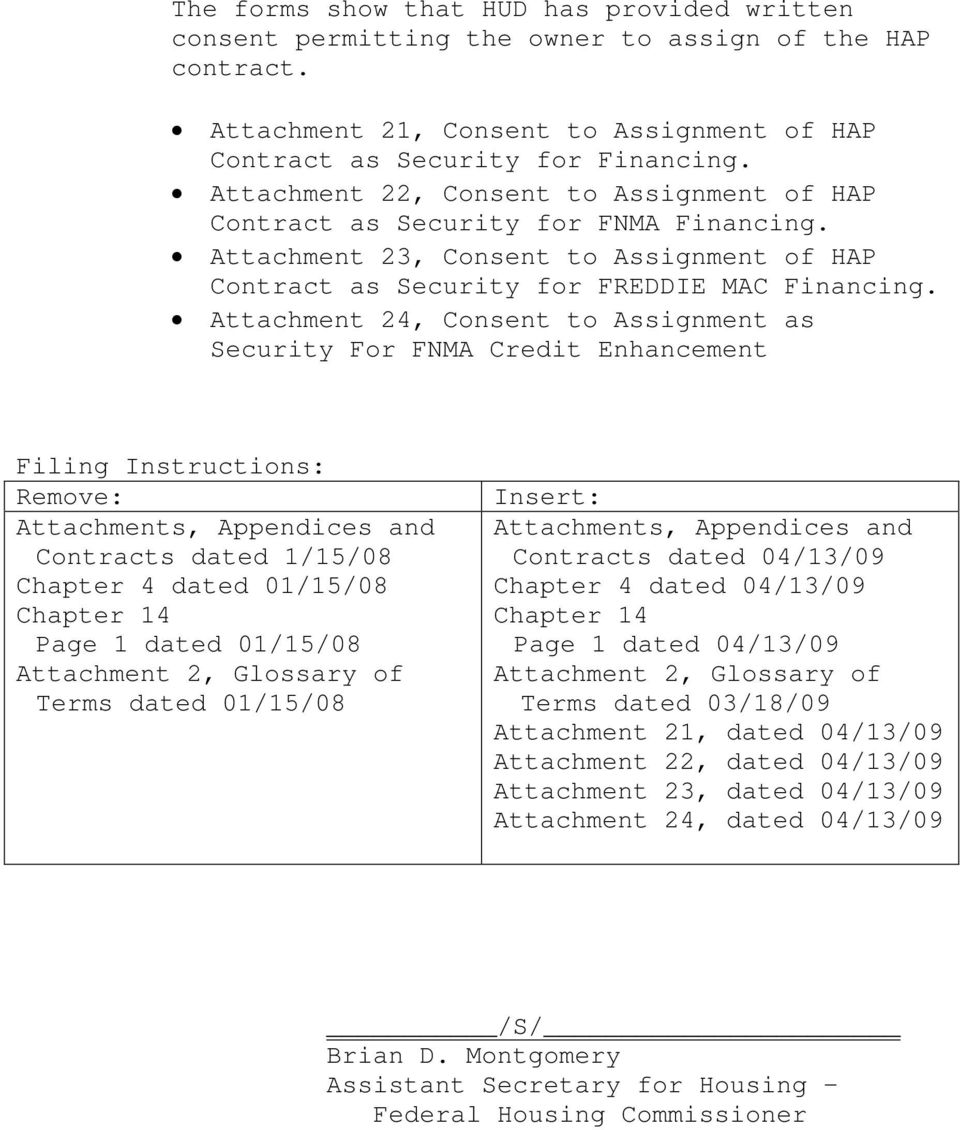
5 The forms show that HUD has provided written consent permitting the owner to assign of the HAP contract. Attachment 21, Consent to Assignment of HAP Contract as Security for Financing. Attachment 22, Consent to Assignment of HAP Contract as Security for FNMA Financing. Attachment 23, Consent to Assignment of HAP Contract as Security for FREDDIE MAC Financing. Attachment 24, Consent to Assignment as Security For FNMA Credit Enhancement Filing Instructions: Remove: Attachments, Appendices and Contracts dated 1/15/08 Chapter 4 dated 01/15/08 Chapter 14 Page 1 dated 01/15/08 Attachment 2, Glossary of Terms dated 01/15/08 Insert: Attachments, Appendices and Contracts dated 04/13/09 Chapter 4 dated 04/13/09 Chapter 14 Page 1 dated 04/13/09 Attachment 2, Glossary of Terms dated 03/18/09 Attachment 21, dated 04/13/09 Attachment 22, dated 04/13/09 Attachment 23, dated 04/13/09 Attachment 24, dated 04/13/09 /S/ Brian D. Montgomery Assistant Secretary for Housing Federal Housing Commissioner
6 U.S. Department of Housing and Urban Development Office of Housing SPECIAL ATTENTION OF: Hub and Program Center Directors; Project Managers; PBCAs; Owners; and Management Agents TRANSMITTAL Section 8 Renewal Policy Guide Book Issued: 09/26/08 1. This Transmits. Page changes to the Section 8 Renewal Policy Guide Book dated 1/15/08 (revised as of 12/12/06). These changes are effective immediately. 2. Explanation of Changes. All page changes have light grey shading to denote what has changed on the page unless a section was completely removed. Furthermore, if a complete chapter has been revised there will be no light grey shading. a. Chapter 15 has been revised to simplify its use. There are two key changes in the chapter. First is the removal of the 6 percent return on equity. This passage is being moved to new Chapter 2 that will be released in the near future. Secondly, we have removed the prohibition of identity-ofinterest transfer transactions. b. The addition of Attachment 20 provides for extension of the term of an existing 524 MAHRA Housing Assistance Contract renewed under Option One or Option Two of the Section 8 Renewal Policy Guide. 1) The Department will permit a one time extension of the existing contract term if: There is no resetting of contract rents upon execution of the contract extension; and Annual rent adjustments and if applicable, RCS updates adhere to the original anniversary date. 2). Only the term of the existing MAHRA contract is affected by the extension. If the PM/CA

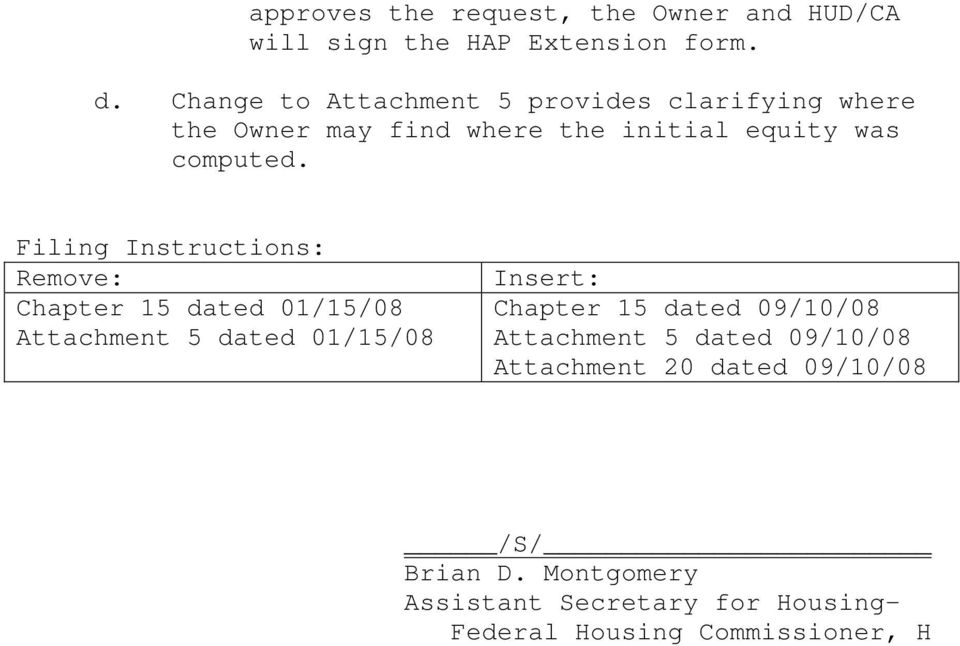
7 approves the request, the Owner and HUD/CA will sign the HAP Extension form. d. Change to Attachment 5 provides clarifying where the Owner may find where the initial equity was computed. Filing Instructions: Remove: Chapter 15 dated 01/15/08 Attachment 5 dated 01/15/08 Insert: Chapter 15 dated 09/10/08 Attachment 5 dated 09/10/08 Attachment 20 dated 09/10/08 /S/ Brian D. Montgomery Assistant Secretary for Housing- Federal Housing Commissioner, H
8

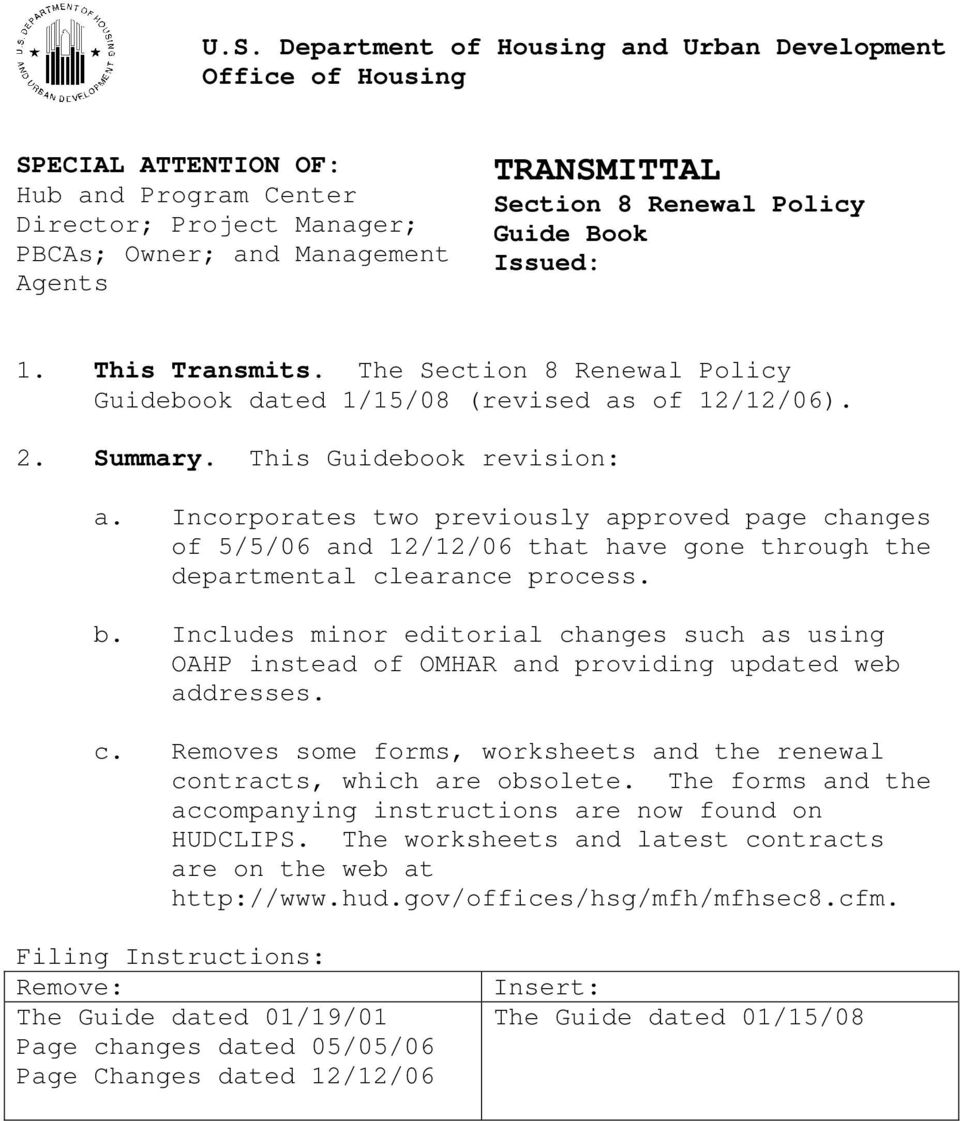
9 U.S. Department of Housing and Urban Development Office of Housing SPECIAL ATTENTION OF: Hub and Program Center Director; Project Manager; PBCAs; Owner; and Management Agents TRANSMITTAL Section 8 Renewal Policy Guide Book Issued: 1. This Transmits. The Section 8 Renewal Policy Guidebook dated 1/15/08 (revised as of 12/12/06). 2. Summary. This Guidebook revision: a. Incorporates two previously approved page changes of 5/5/06 and 12/12/06 that have gone through the departmental clearance process. b. Includes minor editorial changes such as using OAHP instead of OMHAR and providing updated web addresses. c. Removes some forms, worksheets and the renewal contracts, which are obsolete. The forms and the accompanying instructions are now found on HUDCLIPS. The worksheets and latest contracts are on the web at Filing Instructions: Remove: The Guide dated 01/19/01 Page changes dated 05/05/06 Page Changes dated 12/12/06 Insert: The Guide dated 01/15/08
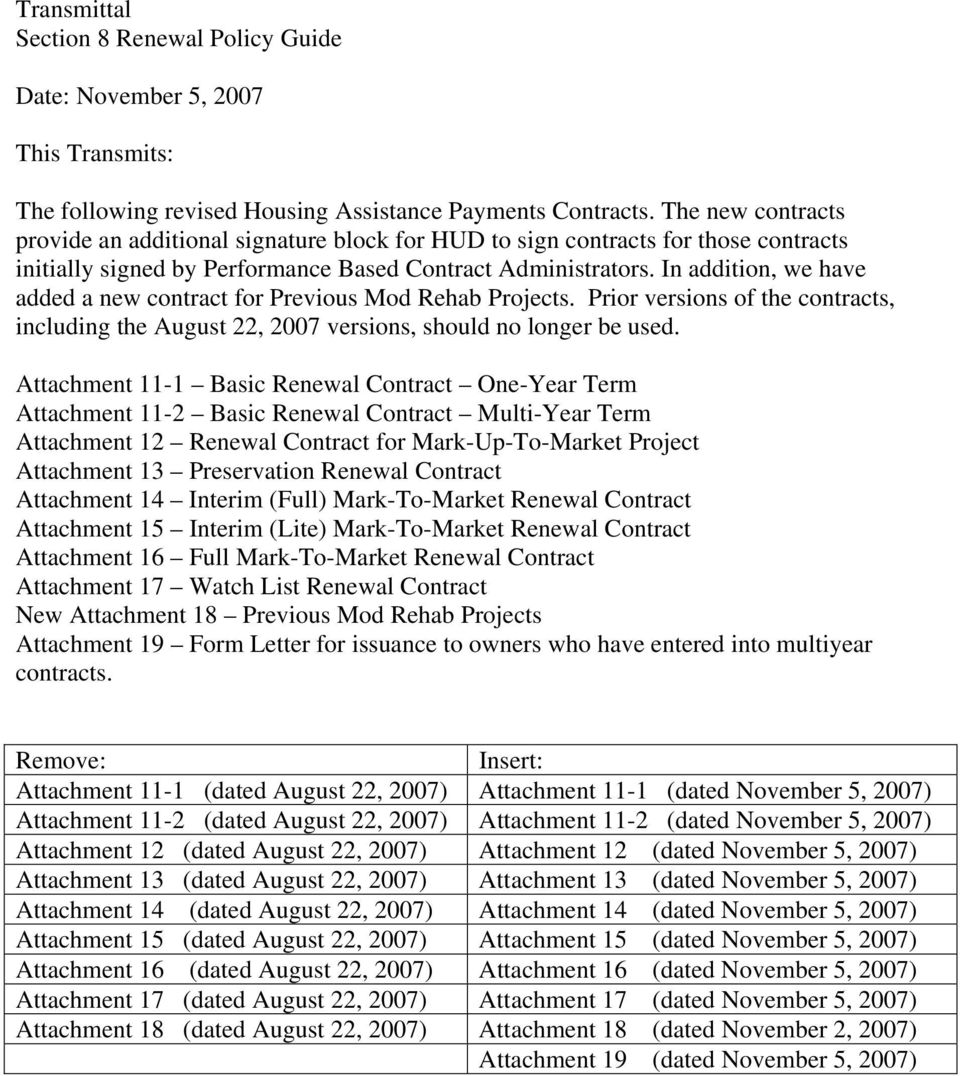
10 Transmittal Section 8 Renewal Policy Guide Date: November 5, 2007 This Transmits: The following revised Housing Assistance Payments Contracts. The new contracts provide an additional signature block for HUD to sign contracts for those contracts initially signed by Performance Based Contract Administrators. In addition, we have added a new contract for Previous Mod Rehab Projects. Prior versions of the contracts, including the August 22, 2007 versions, should no longer be used. Attachment 11-1 Basic Renewal Contract One-Year Term Attachment 11-2 Basic Renewal Contract Multi-Year Term Attachment 12 Renewal Contract for Mark-Up-To-Market Project Attachment 13 Preservation Renewal Contract Attachment 14 Interim (Full) Mark-To-Market Renewal Contract Attachment 15 Interim (Lite) Mark-To-Market Renewal Contract Attachment 16 Full Mark-To-Market Renewal Contract Attachment 17 Watch List Renewal Contract New Attachment 18 Previous Mod Rehab Projects Attachment 19 Form Letter for issuance to owners who have entered into multiyear contracts. Remove: Insert: Attachment 11-1 (dated August 22, 2007) Attachment 11-1 (dated November 5, 2007) Attachment 11-2 (dated August 22, 2007) Attachment 11-2 (dated November 5, 2007) Attachment 12 (dated August 22, 2007) Attachment 12 (dated November 5, 2007) Attachment 13 (dated August 22, 2007) Attachment 13 (dated November 5, 2007) Attachment 14 (dated August 22, 2007) Attachment 14 (dated November 5, 2007) Attachment 15 (dated August 22, 2007) Attachment 15 (dated November 5, 2007) Attachment 16 (dated August 22, 2007) Attachment 16 (dated November 5, 2007) Attachment 17 (dated August 22, 2007) Attachment 17 (dated November 5, 2007) Attachment 18 (dated August 22, 2007) Attachment 18 (dated November 2, 2007) Attachment 19 (dated November 5, 2007)
11

12 Table of Contents Chapter One - Chapter Two - Chapter Three - Chapter Four - Chapter Five - Chapter Six - Chapter Seven- Chapter Eight - Chapter Nine - Chapter Ten - Chapter Eleven - Chapter Twelve - Chapter Thirteen - Chapter Fourteen - Chapter Fifteen- Chapter Sixteen- Introduction Contract Renewals Owner Option One Owner Option Two Owner Option Three Owner Option Four Owner Option Five Owner Option Six Rent Comparability Studies Residual Receipts Tenant Issues Physical Condition of the Property HUD s Refusal to Renew Section 8 Contracts RHS 515/8 Projects Nonprofit Rent Increases Other Issues 01/15/08

13 Attachments, Appendices and Contracts Attachments 1. Acronyms 2. Glossary of Terms 3A1. Contract Renewal Request Instructions Item has been removed from the Guide and placed on the web at hudclips.org 3A2. Form HUD 9624, Contract Renewal Request Form - Item has been removed from the Guide and placed on the web at hudclips.org 3B. Form HUD 9625, OCAF Rent Adjustment Worksheet - Item has been removed from the Guide and placed on the web at hudclips.org 3B1. OCAF Worksheet Instructions - Item has been removed from the Guide and placed on the web at hudclips.org 4. Overview of Conversion Process 5. Additional Guidance for Budget Submission (to be used with Chapter 7 of HUD Handbook ) 6. Operating Cost Adjustment Factors (OCAF s) 7. Help Desk Officers Item has been removed from the Guide and placed on the web at 8. Anticipated Abatement Termination of Full Section 8 HAP Contract Chart 9. Voucher Processing Division Procedures 10. When to Use a Contract 21. Consent to Assignment of HAP Contract as Security for Financing 22. Consent to Assignment of HAP Contract as Security for FNMA Financing 23. Consent to Assignment of HAP Contract as Security for FREDDIE MAC Financing 24. Consent to Assignment as Security For FNMA Credit Enhancement Contracts The contracts have been removed from the Guide Book. Current copies of the contracts are available at: 04/13/09 1

14 11-1. Basic Renewal Contract One-Year Term Basic Renewal Contract Multi-year Term 12. Mark-Up-To-Market Renewal Contract 13. Preservation Renewal Contract 14. Interim (Full) Mark-To-Market Renewal Contract 15. Interim (Lite) Mark-To-Market Renewal Contract 16. Full Mark-To-Market Renewal Contract 17. Watch List Renewal Contracts 18. Previous Mod Rehab Projects 19. Form Letter for issuance to owners who have entered into multi-year contracts 20. Extension of Contract Term Appendices 3-1. Mark-Up-to-Market Initial Eligibility Worksheets (Sample Version) Item has been removed from the Guide and placed on the web at Mark-Up-to-Market Initial Eligibility Worksheets (Blank Versions) Item has been removed from the Guide and placed on the web at Implementation of Statutory Authority for Continuing Mark To Market Eligibility (dated April 22, 2002) 5-2. Certification of Reduction of Rents in Accordance with Rent/Debt Restructuring Form 5-3. Watch List Memorandum Revising Guidance on Monitoring OMHAR Watch List Projects (dated September 27, 2001) 5-4. Watch List Tracking and Servicing Memorandum (dated July 25, 2002) 5-5. Sample Post Closing Transmission Memorandum 9-1. Appraisers Certification 9-2. Rent Comparability Grid (92273-S8) 9-3. Sample Rent Comparability Study (RCS) 9-4. Suggested RCS Profile 9-5 Reserved for future use 9-6. Request to Renew Using Non Section 8 Units as Market Ceiling 9-6b. Compare Section 8 Rents and Rents Paid by Tenants Not Receiving Rental Assistance 9-7. Request to Renew Option 2 Using FMR as Ceiling 9-8. Completing the Rent Comparability Grid Instructions 9-9. USPAP Competency Rule Required Contents for RCS Sample One Year Notification Letter When Owner Does Not Intend To Renew Sample One Year Notification when Owner Intends to Renew Use Agreement HAP Contract Addendum Project Capital Needs Assessment (PCNA) 11/10/2010 2

15 Chapter One Section 8 Renewal Guide Since the mid-1990 s, when long-term project-based Section 8 contracts began expiring, Section 8 policy has evolved dramatically. For several years, the Department issued Notices and other guidance to implement new policy related to renewing expiring Section 8 contracts and preserving affordable housing in a piecemeal fashion. In order to make Section 8 policy more effective and accessible for HUD s partners, this guide provides comprehensive guidance for renewing expiring Section 8 project-based contracts. It incorporates the procedures contained in previous Section 8 expiring contract Housing Notices, along with a number of changes. As a living document, over time this guide is expected to contain nearly all of the information related to the renewal of expiring Section 8 contracts. In order to respond to the evolving nature of Section 8 renewal legislation and policy, the format of this Guide provides the opportunity to accommodate changes through revisions of one or more sections without a complete revision of the entire document. As is the case with HUD Handbooks, when legislation or policy decisions warrant modifications to this guide, HUD will issue the revisions and make them available to all users. Only those portions of the guide that are affected by the change will be modified. This Guide is available on the web at It is noted that the instructions in this guide apply to all Contract Administrators who are responsible for overseeing Section 8 project based contracts. This includes Contract Administrators who have performance based contracts with the Department. Contract Administrators with performance based contracts are also required to follow the Guidebook for the Section 8 Contract Administration Initiative issued to them by the Office of Housing Assistance Contract Administration Oversight. For purposes of assisting users, a Glossary of the terms used throughout this Guide can be found at Attachment 1. Chapter One 01/15/08 1
16 CONTENTS OF THIS GUIDE Chapter 1: Introduction This Chapter provides the legislative history of the Multifamily Assisted Housing Reform and Affordability Act (MAHRA). It also provides a chronological listing of HUD s rule making and administrative policies for implementing statutory requirements associated with Section 8 expiring contract renewals. Chapter 2: Contract Renewals This chapter outlines the various ways a contract can be renewed and provides six options available to Owners with expiring Section 8 contracts. It defines initial and subsequent renewals, and explains how rent adjustments are made during the term of a multi-year section 524 contract. This chapter also discusses contract terms, rent calculations for short-term renewals and instructions for combining contracts. Chapter 3: Owner Option One, Mark-Up-To-Market This Chapter provides instructions for renewing a contract under the Mark-Up-To- Market option. It identifies who is eligible for renewal under this option and how to process the renewal request. Owners must meet certain eligibility criteria which are outlined in the chapter. This chapter also provides information on how to calculate owner distributions and future rent adjustments. Chapter 4: Owner Option Two, Other Contract Renewals with Current Rents At or Below Comparable Market Rents This Chapter provides instructions for renewing a contract in cases where a contract s current rents are at or below comparable market rents but the contract is not being renewed using the mark-up-to-market option. It outlines who is eligible to renew under this option and identifies documentation to be submitted by the Owner to HUD/Contract Administrators for review. It also provides processing instructions and guidance for future rent adjustments. Chapter 5, Owner Option Three, Referral to the Office of Affordable Housing Preservation (OAHP (formally known as the Office of Multifamily Housing Assistance Restructuring (OMHAR)) This Chapter discusses the procedures by which a project with rents above comparable market rents is referred to the Office of OAHP for processing and renewal. The chapter identifies items an Owner must submit with their renewal request and it outlines Chapter One 01/15/08 2

17 what steps will be taken by OAHP if a restructuring agreement is not reached between the owner and OAHP. Chapter 6, Owner Option Four, Renewal of Projects Exempted From OAHP (formally known as OMHAR) This Chapter identifies exception projects. Exception projects are ineligible for OAHP and as such, they are exempt from having to conduct rent comparability studies and lower rents to comparable market rents. This chapter outlines the Owners renewal submission requirements and provides instructions for initial and subsequent renewals. Chapter 7, Option Five, Renewal of Portfolio Reengineering Demonstration or Preservation Projects This chapter details how to renew a contract that has been through the Demonstration program. It provides instructions for renewal in cases where the project had its rents reduced and/or had its mortgage restructured and it provides instructions for processing a renewal in instances where the project failed to have a rent reduction or debt restructuring. It also provides guidance for renewing Preservation contracts according to the approved Plan of Action (POA). Chapter 8, Option Six, Opt-Outs This Chapter provides instructions for processing Owner opt-outs. Opt-outs are expiring Section 8 project-based contracts whose owners elect not to renew the contract. This Chapter identifies owners responsibilities to the tenants and provides processing instructions. Chapter 9, Rent Comparability Studies (RCS) This Chapter provides instructions for conducting and reviewing rent comparability studies. Chapter 10, Residual Receipts This Chapter identifies the steps that must be taken, when appropriate, to assure that residual receipts are returned to HUD. Chapter 11, Resident Issues This Chapter outlines all of the steps that must be followed to assure that tenants are protected during the renewal process. This chapter defines housing conversion actions and identifies notification requirements an owner must meet. It also describes the differences between a regular voucher and an enhanced voucher. Chapter One 01/15/08 3

18 Chapter 12, Physical Condition of the Property This Chapter discusses how a project s physical condition impacts the contract renewal process. Chapter 13, HUD s Refusal to Renew/Section 8 Contract Owner s Dispute and Appeal of Rejection This Chapter outlines the circumstances under which HUD may refuse to renew an expiring Section 8 contract, and it provides Owners with an appeal process to follow in cases where their request to renew is rejected. Chapter 14, RHS/515 Projects This Chapter outlines how to renew a Farmers Home 515 project. Chapter 15, Nonprofit Rent Increases This Chapter outlines the procedure for providing budget-based rent increases to nonprofit owners. The Chapter identifies eligibility requirements for marking up to budget and provides instructions for future rent adjustments. Chapter 16, Other Issues This Chapter discusses miscellaneous issues that have not been included in previous chapters of this guide. This Chapter includes rent increases for non-section 8 rents, and REMS reporting requirements. It also addresses the effect of refinancing FHA insured properties on Mark-to-Market eligibility and how any new debt should be addressed in a projects operating budget. LEGISLATIVE HISTORY Section 1-1 A. The Multifamily Assisted Housing Reform and Affordability Act of 1997 (MAHRA), Title V of the HUD Fiscal Year 1998 Appropriations Act, Pub. L , was enacted on October 27, This was a major change as MAHRA established new policies for the renewal of Section 8 project-based contracts based on market rents instead of the Fair Market Rent (FMR) standard. For most insured projects with rents above market, the Act transferred Section 8 processing functions from the Multifamily Hubs and Program Centers to the Office of Affordable Housing Preservation (OAHP) (formally known as the Office of Multifamily Housing Assistance Restructuring (OMHAR)). For further information on renewals by OAHP, see Chapter Five. Chapter One 01/15/08 4

19 In general, MAHRA required that expiring Section 8 project-based contracts be renewed under Section 524(a)(1) or 524(a)(2). 1. Section 524(a)(1) renewals required a Rent Comparability Study (RCS). If the RCS indicated rents were at or below comparable market rents, the contract was renewed at current rents adjusted by OCAF, unless the Owner submitted documentation justifying a budget-based rent increase or participation in mark-up-to-market In no case could renewal rents exceed comparable market rents. If the RCS indicated rents above comparable market rents, the contract was referred to OAHP for debt restructuring and/or rent reduction. 2. Section 524(a)(2) renewals were for projects identified as exception projects that were not eligible for OAHP. In some cases these projects had rents greater than market. No RCS was required except for certain FHA insured projects whose contracts were being renewed under 524(a)(2)(E) (projects that do not qualify as eligible multifamily housing projects pursuant to section 512(2) of MAHRA). Examples of projects that do not qualify as eligible multifamily housing projects pursuant to Section 512(2) of MAHRA include a project that is not subject to a HUD-held or insured mortgage; or, a project that has FHA mortgage insurance or is HUD-held with rents at or below comparable market rents. B. The Preserving Affordable Housing for Senior Citizens and Families Into the 21 st Century Act of 1999, Titles II and V of the HUD Fiscal Year 2000 Appropriations Act, Pub. L , was enacted on October 20, This legislation made modifications to the previous Section 8 renewal policies and established specific provisions for rent adjustments in subsequent years after an initial renewal under MAHRA. On December 29, 1999, Notice H99-36 was issued to implement these changes. Specifically, 1. The Act modified Sections 524(a)(1) and 524(a)(2) of the original MAHRA. Projects that previously fell under section 524(a)(1), are now covered under section 524(a), and projects that previously fell under section 524(a)(2), are now covered by section 524(b). 2. Preservation projects and Portfolio Reengineering Demonstration projects are for the first time specifically addressed by sections 524(e)(1) and 524(e)(2). 3 Notice H99-36 created six renewal options for Owners to choose from when renewing their expiring Section 8 contracts. These options are detailed throughout this Guide. C. The Quality Housing and Work Responsibility Act (QHWRA) of 1998, Title V of HUD s Fiscal Year 1999 Appropriations Act, enacted on October 21, 1998, made only minor modifications to the tenant notification requirements stated in MAHRA. On May 27, 1999, HUD issued Notice H implementing these changes. Specifically, QHWRA: Chapter One 01/15/08 5

20 1. Required Owners who intended to renew their expiring Section 8 contract to notify their tenants of their intent to do so. This requirement was amended by subsequent legislation (see Chapter Eleven for tenant notification requirements) 2. For contracts that were renewed for five year terms, QHWRA changed the tenant notification requirement from one year to six months. The six month notification was to be provided to the tenants by the owners six months before expiration of the five year contract. This requirement was changed back to a one-year notification by subsequent legislation. D. The FY 2001 Military Construction and FY 2000 Emergency Supplemental Appropriations Act, amended the enhanced voucher statute at Section 8(t) of the United States Housing Act to grant enhanced voucher families the right to remain. RULE MAKING Section 1-2 A. Interim Rule. An Interim Rule implementing the Multifamily Housing Mortgage and Housing Assistance Restructuring Program (Mark-to-Market), was published in the Federal Register on September 11, 1998, at 63 FR This Rule discussed the 524 requirements and governed the renewal or restructuring of expiring Section 8 projectbased contracts. At the Final Rule stage, the sections of the Interim Rule that governed the renewal of Section 8 that were not participating in the Mark-to-Market program and the sections addressing the Mark-to-Market program are separated into two Final Rules, Part 401 and Part CFR Part 401. The Final Rule implementing the Mark-to-Market program was published on March 22, This Rule details how the Section 8 rents for eligible multifamily projects with HUD-insured or HUD-held mortgages will be reduced. The Mark-to-Market Program Operating Procedures Guide is available on the Office of Affordable Housing Preservation (OAHP) (formally known as the Office of Multifamily Housing Assistance Restructuring (OMHAR)) Webpage at The Guide may also be obtained by contacting the Multifamily Housing Clearinghouse at CFR Part 402. The Final Rule for Part 402 authorizes the renewal of expiring Section 8 project-based assistance contracts for projects without Restructuring Plans under the Mark-to-Market Program, including projects that are not eligible for Restructuring Plans and eligible projects for which the owners require contract renewals without Restructuring Plans. Chapter One 01/15/08 6

21 ADMINISTRATIVE POLICY Section 1-3 HUD Notices. Since the enactment of MAHRA the Department has issued a number of Housing Notices which established Section 8 renewal policies. With the publication of this Guide, these Notices are no longer in effect. H On October 16, 1998, HUD published Housing Notice H which provided instructions for renewing Section 8 contracts expiring in FY H On May 27, 1999, HUD published Housing Notice H which made several modifications to H H On June 16, 1999, HUD published Housing Notice H which implemented the Mark-Up-To-Market Option for Owners of projects with expiring Section 8 contracts. H This Notice, published on September 22, 1999, extended Notices H98-34 and H H This Notice, published December 1, 1999, clarified existing renewal policies. H On December 29, 1999, Notice H99-36 was issued to implement changes to Section 8 renewal policies pursuant to the HUD Fiscal year 2000 Appropriations Act. H On June 29, 2000, HUD published Housing Notice H which provided policies and procedures for preparing, submitting and reviewing Rent Comparability Studies (RCS) associated with renewals of expiring Section 8 contracts. H On October 13, 2000, HUD published Housing Notice H which provided Guidelines for Mark-Up-To-Market Nonprofit Transfers and Budget-Based Rent Increase for Capital Repairs by Nonprofit Owners. APPLICABILITY Section 1-4 This document applies to all Multifamily Housing Projects with expiring project-based Section 8 assistance contracts, unless otherwise noted. It does not apply to Moderate Rehabilitation projects, Section 8 project-based certificate contracts, Section 8 project based Chapter One 01/15/08 7
22 voucher contracts or former Section 23 projects administered by the Office of Public and Indian Housing or to any projects administered by the Office of Community Planning and Development. POLICY CHANGES FROM FISCAL YEAR 2000 Section 1-5 A. The terms initial renewal and subsequent renewal have been clarified and a new term, multi-year rent adjustment has been added. These terms are defined in Chapter 2, Section 2-1. B. Mark-Up-to-Market has been broken into two options: Option 1A which is an Owner entitlement if the statutory requirements are met; and, Option 1B, which is a discretionary mark-up-to-market option which the Department utilizes to preserve scarce affordable housing resources. See Chapter Three for details. C. Under Option One, the original criteria for participation was that a project have current rents that exceed 110% of FMR. HUD was given authority to adjust this percentage upon determination and written notification to the Congress. HUD has determined and notified Congress that, in an effort to preserve scarce housing resources, it is necessary to lower the 110% threshold to 100%. This Guidebook implements this change. D. Owner Distributions. The issuance of the Increased Distributions to Owners of Certain HUD-Assisted Multifamily Rental Projects final rule, published October 13, 2000, gave the Department the authority to allow Owners of certain Section 8 assisted properties to take all surplus cash on Section 8 units participating in Mark-Up-To-Market. Owners of properties with 100% project-based Section 8 units and Owners of partially-assisted properties that are not Section 236, 221(d)(3) BMIR, nor Section 515 may take all surplus cash generated on all units in any project year. Owners of partially-assisted Section 236, 221(d)(3), or Section 515 will continue to calculate their distribution as identified in previous Notices and 99-36, which allows an increased distribution in the amount of the rent increase for the Section 8 units under Mark-Up-To-Market. E. Owners must provide HUD/Contract Administrators and tenants with one year notification of their intent to opt-out of their Section 8 contract in order to opt-out. F. The one year notification letter from HUD to Owners reminding the owners to notify tenants that their Section 8 contracts will be expiring are no longer being provided. However, the field office will review and approve the notices provided by the Owner. G. HUD has provided, as attachments to this guide, revised HAP contracts that may be used for terms up to 20 years. Chapter One 01/15/08 8
23 H. When a Renewal Contract is executed by HUD and a PHA in accordance with the instructions provided in this Guidebook, and in the forms prescribed by HUD, HUD is contractually bound by the Renewal Contract provisions that specify HUD s role in accordance to the Renewal Contract. I. Owners must certify on the Option 6 Renewal Form that they will comply with the requirement to allow families receiving enhanced vouchers who elect to remain to do so as long as the property remains a rental property, unless the owner has just cause for eviction. PAPERWORK REDUCTION ACT. Section 1-6 The information collection requirements contained in this Guide book have been submitted to the Office of Management and Budget (OMB) for review and approval under the Paperwork Reduction Act of 1995 (44 U.S.C. 3520). An OMB approval number has been assigned. The OMB Control Number is Chapter One 01/15/08 9
24 Chapter Two Section 8 Renewals The passage of MAHRA by Congress signaled an important shift in the Section 8 program: Section 8 rents, to the extent possible, must be comparable to unsubsidized rents in the area where the project is located. In some cases, this meant the rents can be adjusted upward. With the establishment of OAHP, formerly known as OMHAR, Congress also clearly recognized that the rents at some Section 8 projects needed to be reduced. To ascertain where a project s Section 8 rents are relative to market rent levels, for most projects MAHRA requires the preparation of a rent comparability study, (RCS). In order to reduce administrative burden, MAHRA does not require an RCS every year. Instead, beginning with the date of the initial renewal of the expiring Section 8 projectbased contract, the RCS will start a maximum five-year life cycle before a new RCS is required (see Chapter Nine for details on the RCS). Types of Renewals Section 2-1 A. Initial Renewals. The first renewal of a project s contract or stage that is processed under the rules established by MAHRA is considered the initial renewal of the contract. B. Subsequent Renewals. A subsequent renewal is the renewal of an expiring Section 524 contract at the end of its term. A contract that received its initial renewal under MAHRA, will, at subsequent renewal, be renewed under any option that the contract is eligible for at the time of renewal. The Owner should follow procedures in place at time of renewal and submit the contract Renewal Request Form and OCAF Rent Adjustment Worksheet, Form HUD 9625, found at Attachment 3 of this guide to the PM/CA for processing. C. Rent Adjustments. Annual adjustments to contract rents that occur during the term of a multi-year Section 524 contract are called rent adjustments. These adjustments may be Chapter Two 01/15/08 1
25 by application of the published OCAF or, if applicable, by a budget-basis subject to HUD s approval. D. The RCS. A RCS that is submitted at initial renewal will be considered valid for five years. It establishes the market rent for renewals of staged contracts and can be used for the initial renewal of any expiring contracts that were not combined (see Section 2-5 below) that will expire during the five year life cycle of the RCS. In order to take advantage of this opportunity, the original RCS must include all of the Section 8 units in the project. The cost of this RCS is an eligible project expense. Owner Options Section 2-2 A. Six Owner Options. At the time of the initial renewal, Owners may choose among any of the following renewal options for which the project is eligible: 1. Option One is Mark-Up-To-Market; 2. Option Two is renewal with existing rents adjusted by OCAF or on the basis of a budget when rents under the expiring contract are at or below market; 3. Option Three is referral to OAHP for processing because the contract has rents greater than market and is subject to an FHA-insured or HUD-held mortgage; 4. Option Four is renewal of contracts for exception projects, which are exempt from debt-restructuring pursuant to 514(h) of MAHRA or are not an eligible multifamily housing project as defined in section 512(2) of MAHRA; 5. Option Five is the renewal of contracts for Portfolio Reengineering Demonstration or Preservation projects; and 6. Option Six is to opt-out of the Section 8 contract. B. Determining Option. When determining which option to select, Owners should be aware that the contract renewal options are determined by their eligibility at the expiration date of the HAP contract which is under consideration. For example: An FHA-insured project referred to OAHP for processing will have its rents reduced to market even if the owner secures non-fha insured financing after contract expiration but prior to OAHP completing its processing. While non-fha insured projects are not eligible for OAHP, this project was insured at the time of expiration, and therefore must have its rents reduced to market. C. Selection Submission. Regardless of the option selected, Owners must submit their selection and the required documentation to HUD or the Contract Administrator at Chapter Two 01/15/08 2
26 least 120 days prior to the expiration of the contract. Owners should be aware that failure to submit their option election to HUD/CA at least 120 days before contract expiration may result in an interruption of subsidy to the project. If at any time the PM feels that the contract should not be renewed, they should refer to Chapter 13, of this Guidebook. If the Performance Based Contract Administrator (PBCA) feels that the contract should not be renewed, the procedures in Section 2-4 of the Section 8 Contract Administrators Guide book should be followed. D. Option Descriptions. The Owner options are outlined in Chapters Three through Eight of this Guide. As statutory and administrative requirements for each option evolve, these Chapters will be revised. Contract Terms Section 2-3 A. General Contract Terms. Generally, contract terms shall be for one year or five years subject to appropriations. The Department believes contracts with terms greater than five years can assist in preserving affordable housing in certain situations. Where an owner is required by HUD to accept renewal for more than five years, use longer terms, such as with the non-profit options in chapter Fifteen. OAHP Full Restructurings may also have longer term contracts, but in no case can the term of the contract exceed the remaining life of the mortgage. Requests for longer term contracts on OAHP Fulls or where owners are required to accept renewals for more than five years do not require HUB approval. For other situations, Program Centers should submit these requests to the HUB Director. The HUB Director should review these requests to ensure that approval will assist in furthering the Departments goal of preserving affordable housing. 1. If an Owner chooses a contract term of more than one year, the contract will be funded for one year with the balance of years selected by the Owner being subject to annual appropriations. 2. The effective date of the new contract is the day following the expiration date of the previous contract. For renewals of OAHP-lites, the original contract is terminated at the end of the month following the month in which the Owner is offered a new contract at the market rents. For renewals in conjunction with a Full debt restructuring, the new contract will become effective on the earlier of the expiration of the interim contract or the first day of the month following closing. B. Aligning Contracts. HUD/CA s should make every effort to align contract renewal terms with the five-year life cycle of the RCS. For example, if an Owner renewed the contract in FY 2000 under Option Two for a one-year term, and in FY 2001 the Owner wishes to renew the contract for a five-year term, the Owner has several options: Chapter Two 01/15/08 3
27 1. They may renew the contract for four years, using the RCS submitted at initial renewal (the Option Two renewal in FY 00) and adjusting it by OCAF annually, or, 2. The Owner may submit a new RCS and renew the contract for a five-year term, C. Short-term Contracts. Short term contracts are for less than one year. The words short term refer to the term of the contract, not the type of contract. Short-term renewals may be provided for the following: 1. To protect the residents (see Chapter Eleven). For example, to allow additional time to cover a delay in providing tenant-based assistance in cases of Owner opt-outs, or in cases where the project is subject to enforcement actions. 2. To align multiple contracts or stages in a project. 3. To provide HUD/CA with adequate time to process an Owner s request to renew under the Mark-Up-To-Market Procedure. 4. To extend the contract of a project that has been referred to OAHP for renewal, but has yet to close. In order to receive a short term renewal under these conditions, the owner must request and receive waiver approval. D. Initial Renewals. For all projects, the short-term renewal discussed above will be considered the contract s initial renewal if it is the first renewal under MAHRA. 1. Owners requesting a short term renewal under Option Two must submit a RCS and all documentation required in the Renewal Worksheet. 2. Owners requesting a short term renewal under Option Four must submit all documentation required in the Contract Renewal Request Form and OCAF Worksheet. 3. Exception project renewal rents will be subject to the lesser of test (as described in Chapter 6, Section 6-2 B) at initial renewal. 4. Hub, Program Center Directors and CA s should use their discretion when determining whether or not to grant a short-term renewal. E. Short-term Contract Execution. Where a short-term contract is executed, it should be renewed in increments of months, not days. The project files should adequately document the need for the short-term renewal. F. Multi-Year Contracts: For multi-year contracts, Owners must submit the OCAF Worksheet on an annual basis. If the Owner is requesting a budget-based rent increase, all documentation required in the OCAF Worksheet must be submitted annually as well. Chapter Two 01/15/08 4
28 Calculating Rents For Short Term Renewals Section 2-4 A. In cases where HUD/CA/PAE has made a determination as to market rents for the project, the short-term renewal rents will be capped at market. B. Section 524 contracts. If the project is eligible for an Operating Cost Adjustment Factor (OCAF) rent adjustment, a pro-rated OCAF should be applied to the contract instead of a full OCAF. By law, Owners are entitled to receive a rent increase at initial renewal, however, the law does not entitle the project to more than one full OCAF increase within a 12-month period. Because the project is entitled to a full OCAF increase at the first anniversary date of a multi-year contract, the OCAF increase for the short-term initial renewal must be pro-rated. Pro-rated budget-based rent adjustments for short-term renewals are not permitted. C. Calculating a pro-rated OCAF. Take the full OCAF, divide it by 12 and multiply that number by the number of months needed for the short-term renewal. Example: Full OCAF: 2.5% Months in Year: 12 Term of Short-term contract: 8 months 2.5 divided by 12 =.21 x 8 = 1.68 The Pro-rated OCAF to apply to the short-term renewal is 1.68%. After determining the pro-rated OCAF, follow the instructions in the Renewal Worksheets for applying the OCAF to the Section 8 units being renewed. D. Applicability. This method of calculating the rents for short-term renewals is only for projects renewing under Section 524 of MAHRA. It is not for Section 514(c) contracts which are used for projects that must be processed by OAHP, (see Chapter Five) or generic contract renewals which are in very limited circumstances primarily to protect the residents, (See Chapter Eleven). Combining Contracts Section 2-5 A. Goal. The Office of Multifamily Housing believes that a desirable goal is to have only one Section 8 contract per project. To achieve this goal, Owners may elect to combine Chapter Two 01/15/08 5
29 multiple contracts or stages. Owners cannot be required to combine contracts. However, the benefits of combining multiple contracts in the same project should be pointed out to Owners. B. Requesting Combination. The Renewal Worksheet includes a checklist format which can be used by Owners to request a contract renewal. The cover sheet of this format has a space for the Owner to designate its choice regarding the combination of multiple contracts or stages. C. Combining. At the Owner s request, multiple contracts or stages that are expiring in the same fiscal year may be combined into one contract. This combination can be achieved in one of two ways: 1. Short-term renewals. At the time of renewal of the first stage or contract, the Owner may request a short-term renewal to bring the earliest expiring contract in line with the latest expiring contract. If the Owner elects to do so, they must meet the appropriate renewal requirements (See Section 2-3 C). Only contracts that are at or below market or that are exempt from OAHP may take a short-term renewal to align contracts. a. Renew the first contract/stage for the period of time necessary to bring it coterminous with the later expiring contract (Remember, only contracts expiring in the same FY may be combined). The rent for the early expiration will be adjusted following the option selected by the Owner and supported by a RCS, if required. If OCAF is appropriate for the first contract, the rent will be adjusted by prorating the OCAF (See above). b. Apply the pro-rated OCAF to the early terminating contract or stage and if applicable, to the RCS. When the contracts or stages expire, they will be combined and renewed for the a minimum term of one year. If an OCAF adjustment is appropriate, the full OCAF should be applied to all the renewing units. 2. Early Termination. The Owner s second option would be to terminate the later expiring contract early, roll those units into the earlier expiring contract and renew all of the units for a one or five year term. D. Not Combining. If an Owner has multiple stages or contracts that they do not want to combine, the contracts or stages that expire during the five-year life cycle of the earlier RCS may use that earlier RCS at the initial renewal of the later expiring contract or stages. The RCS should be adjusted by OCAF, provided that the RCS included all of the Section 8 unit types in the project. If the Owner believes that rents have changed since the initial renewal, he/she may submit an updated RCS for the later expiring contract(s). The cost of the updated RCS is not an eligible project expense. E. Adjusting the RCS. The RCS is good for five years. Chapter Two 01/15/08 6
30 1. During the five-year period, the PM/CA may need to adjust the original comparable market rent to reflect the effects of time. a. Adjust the original comparable market rent when there are multiple Section 8 contracts expiring in different years or the Owner wants a budget based rent increase in later years (See 2 below). b. An adjustment to the original comparable market rent will not be needed if the project has a single Section 8 contract and the Owner is willing to accept annual OCAF adjusted rent increases. 2. The PM/CA adjusts the comparable market rent by the OCAF using the Worksheet for OCAF Adjusted Rents under Option Two in the Renewal Worksheet of this guide. a. Use the subject project s debt service in the formula. b. If more than one year has passed since the submission of the RCS, the PM/CA will have to reprocess the worksheet for each additional year that has passed. 3. HUD Requires New RCS. If the PM/CA believes the OCAF adjusted comparable market rent is not an accurate reflection of the market, they have the authority to request one additional rent comparability study during the 5 year period. The cost of this RCS is a project expense. NOTE: In general, when HUD requires an RCS, the cost of conducting the RCS is an eligible project expense. However, if an Owner elects to conduct and submit an RCS during the five-year life cycle of the original RCS when HUD does NOT require one, the cost of conducting the updated RCS is NOT an eligible project expense. F. Different Fiscal Years. Contracts and stages that expire in different fiscal years may not be combined. However, if an Owner requests a contract renewal to bring multiple contracts or stages in line so that they may be combined more easily in future years, HUD will permit this. An example would be a property which has a contract that expires in January 2001 and another that expires in March The Owner may request a 15 month renewal for the January 2001 contract to bring it coterminous with the March 2002 expiration. G. OAHP. Owners with contracts or stages that expire in the same fiscal year may be referred to OAHP for processing if the Owner requests to do so. Contracts may be combined for OAHP Lites or debt restructuring. Where contracts are being administered by CAs, the CA must refer the contract back to the PM with a recommendation that the contract be sent to OAHP for processing. PBCA s can not refer contracts directly to OAHP for processing. Chapter Two 01/15/08 7
31 For OAHP-Lites, only contracts that expire in the same fiscal year can be combined. For full restructures, OAHP requires that all contracts be combined, including those that expire in later fiscal years. H. Exception. An exception to HUD s preference to combine contracts is when there are pre-and post-october 1, 1981 contracts involved. Due to conflicting income eligibility requirements for these two categories of contracts, it is not practical at this time to allow Owners to combine a pre-october 1981 contract or stage with a post-october 1981 contract or stage. Note: See Chapter Thirteen of this Guide for instructions on Rural Housing Service (RHS) contracts. Preemption of State Laws Limiting Owner Distributions Section 2-6 For consistency in administering the program as it relates to Owner distributions, Section 524(f) of MAHRA preempts State and local laws and regulations that limit or restrict owner distributions to an amount less than that provided for under regulations of the Secretary. This preemption is now available to all projects which have Section 8 contracts renewed under any section of 524 of MAHRA and which have distributions of surplus funds accruing after October 20, Preemption does not apply to State-financed projects. An Owner may elect to waive the preemption. HUD Responsibility for Contract Administrators Section 2-7 The Owner enters a Renewal Contract with the contract administrator. The contract administrator may be HUD, or may be a PHA that executes the Renewal Contract as contract administrator under an annual contributions contract (ACC) with HUD. The Renewal Contract describes the contractual obligations of the contract administrator (whether HUD or a PHA), and also separately defines HUD s contractual role - regardless of whether the contract administrator is HUD or a PHA. In both cases, the contractual commitment to the owner is the same that the contract administrator (HUD or PHA) will live up to its contractual responsibilities in accordance with the terms of the HAP contract, and that HUD will live up to its role as defined by the terms of the Renewal Contract. When a Renewal Contract is executed by a PHA pursuant to this Guidebook, in accordance with HUD requirements and on the form prescribed by HUD, HUD is Chapter Two 01/15/08 8
32 contractually bound by the Renewal Contract provisions that specify HUD s role pursuant to the Renewal Contract (including provisions concerning applicable HUD requirements, statutory changes during the term, distributions and PHA default). For example, the Renewal Contract provides that if HUD determines that the PHA contract administrator has committed a material and substantial obligation of the PHA s obligation to pay amounts due to the Owner, HUD shall take any action HUD determines necessary for the continuation of housing assistance payments to the Owner in accordance with the Renewal Contract. This provision defines HUD s role in the event of PHA default. HUD is contractually bound to carry out this role as defined in the contract, and the Owner may sue to enforce HUD s contractual obligation. If the Renewal Contract is originally executed by HUD, HUD may assign the Renewal Contract to a PHA contract administrator, for the purpose of PHA administration of the Renewal Contract. Such an assignment does not affect the Owner s contractual rights to enforce the contract administrator s contractual obligations against the new contract administrator, and to enforce HUD s contractual obligation to carry out HUD s role as defined in the Renewal Contract. Chapter Two 01/15/08 9
33 Chapter Three Option One Mark-Up-To-Market Overview Section 3-1 A. The Mark-Up-To-Market Option was introduced as an Emergency Initiative in June 1999 to provide Owners of certain below-market properties located in strong markets, an incentive to renew the Section 8 contract and continue providing affordable housing. Because the cost of marking all below-market Section 8 properties up to market would likely have exceeded available resources, Mark-Up-To-Market was made available to only a limited universe of properties. Section 524(a)(4)(A) of MAHRA made Mark-Up- To-Market a permanent program and required the Department to mark rents up to market on properties meeting specific eligibility criteria as described in Section 3-2. Contract renewals under Mark-Up-To-Market as authorized by 524(a)(4)(A) are renewed under Option One-A. B. To protect those most vulnerable and in an effort to further preserve affordable housing, Section 524(a)(4)(C) of MAHRA gave the Department discretionary authority to extend the option of marking rents up to market for properties not meeting the eligibility criteria under Option One-A but still considered an important affordable housing resource. The eligibility criteria for marking rents up to market using the Department s discretionary authority is described in Section 3-3. Contract renewals under the discretionary authority to mark rents up to market are renewed under Option One-B. C. In order to limit rent increases to reasonable levels, rents will be renewed at the lesser of comparable market rents or 150% of the FMR. Exceptions to this cap on rent increases are discussed under Option One-B. D. In addition to the eligibility criteria for Option One-A or Option One-B, the property must be decent, safe, sanitary, and in good repair. It also must have management satisfactory to the Department. Chapter Three-01/15/08 1
34 E. Under Mark-Up-to-Market, Owners must renew the Section 8 contract for a minimum five-year term. Chapter Fifteen of this guide outlines the procedures for marking rents up to budget for nonprofit organizations and for marking rents up to market when a transfer to a nonprofit organization is pending. Option One-A: Entitlement Mark-Up-To-Market Eligibility Section 3-2 All properties that meet the following criteria are eligible for a Section 8 contract renewal under Mark-Up-To-Market: A. Property Condition. A Real Estate Assessment Center (REAC) physical inspection score of 60 or above with no uncorrected Exigent Health and Safety (EHS) violations. B. Ownership. The property owner must be a profit-motivated or limited-distribution entity. C. Market Rents. The RCS must demonstrate that the comparable market rents are at or above 100% of the FMR potential. Use the FMR figures calculated for the fiscal year in which the contract is expiring to demonstrate eligibility. 1. Excel Worksheets. Fillable worksheets are available on the internet for Owners and Contract Administrators. The site address is 2. REMS. PM/CAs can use the Real Estate Management System (REMS) to establish initial eligibility. The worksheets in Appendices 3-1 and 3-2 are available in REMS. D. Use Restrictions. The project does not have a low-and moderate-income use restriction that cannot be eliminated by unilateral action by the Owner. Examples of use restrictions would be the existence of a Rent Supplement Contract, prior or present Flexible Subsidy assistance, or Low-Income Housing Tax Credits. Note 1: Where the use restricted rent levels are greater than the projects Section 8 rents, the new Section 8 rents may be marked up to the use restricted level. For example, project Owners with Flexible Subsidy Agreements that provide rent levels greater than the approved Section 8 contract rent, may request an increase in rents up to, but not exceeding, the approved Flexible Subsidy rent level as indicated in the Use Agreement, and the property must meet the criteria described in Option One-B. These types of transactions do not require Headquarters approval. However, Field Offices must submit a copy of the approval and supporting documentation for a post review for quality control purposes. Chapter Three-01/15/08 2
35 Note 2: If an Owner of an FHA-insured project is not eligible to prepay an FHA-subsidized mortgage, the project is not eligible to Mark-Up-To-Market, under the Entitlement Option One-A or the Discretionary Option One-B. An example of a property that is ineligible to prepay its mortgage would be a Section 236 or Section 221(d)(3) that was originally owned by a nonprofit Owner who transferred ownership to a profit motivated entity. If the change in ownership did not result in the elimination of the low and moderate income use restrictions for the project, the new owner is not entitled to prepay and as a result, is ineligible to Mark-Up-To-Market. E. Once a contract has received its initial renewal under MAHRA, the Owner may request to enter into Mark-Up-To-Market at any time. F. Nonprofit Transfers. In addition to the qualifying criteria above, HUD will use its discretionary authority to mark rents up to market to facilitate a change in ownership from a for-profit Owner or limited-dividend Owner to a nonprofit; or from one nonprofit Owner to another nonprofit Owner (See eligibility criteria and instructions contained in Chapter Fifteen of this Guide). Option One-B: Discretionary Authority Eligibility Section 3-3 A. To further preserve the affordable housing stock, the Secretary has the discretionary authority under Section 524(a)(4)(C) of MAHRA to mark rents up to market for projects that meet certain criteria. In addition, if there is an expectation that rent increases will exceed the amount of appropriations available, HUD may give preference to projects that meet more than one of the characteristics described below. At this time however, HUD expects adequate funding to be available and field offices and contract administrators should not limit discretionary requests due to funding concerns. B. For Owners who request participation in Option One-B, and for Owners of projects that request an increase in rents above the cap on comparable rents of 150% of FMR, HUD will consider these requests if the project meets at least one of the following three characteristics: 1. Vulnerable Populations. The tenants of the property are a particularly vulnerable population, demonstrated by a high percentage (at least 50%) of the units rented to elderly families, disabled families, or large families (large family is defined as a family of five or more persons); 2. Vacancy Rates. The property is located in a low-vacancy market area (or in a rural area with no comparable rental housing) where there is a lack of affordable housing and where Housing Choice vouchers would be difficult to use. Chapter Three-01/15/08 3
36 The determination of a low vacancy area should be made using the most recent available data on the rental inventory, renter households, rental vacancy rates and other factors as appropriate. A market with a rental vacancy rate of less than 3 percent is considered a low vacancy area. Confirm the vacancy rate with HUD EMAS staff/ca staff; or 3. Community Support. The property is a high priority for the local community as demonstrated by a contribution of State or local funds to the property. This matching requirement may be in the form of tax abatements, capital improvement funds etc. C. Discretionary Mark-Up-To-Market requests are processed and approved by the Program Center with jurisdiction over the project. Initial Renewals Section 3-4 At least 120 days before the expiration of the contract, the Owner submits a Contract Renewal Request Form, Form HUD 9624 and a Rent Comparability Study ( RCS ). The RCS is to be prepared based on the instructions in Chapter Nine of this Guide. Annual Adjustments in Years 2 through 5 Section 3-5 At least 120 days before the anniversary date of the contract, the Owner submits the OCAF Rent Adjustment Worksheet, Form HUD 9625, Attachment 3. In years two through five, rents are adjusted by the published OCAF. No budget-based rent increases shall be approved for contracts that Mark-Up-To-Market. After receiving and processing the OCAF renewal worksheet, the PM/CA shall provide the Owner with a revised rent schedule, i.e., Exhibit A. The revised Exhibit A will amend the existing section 524 contract, and the revised rents will go into effect on the day following the anniversary date of the contract. Subsequent Renewals Section 3-6 Chapter Three-01/15/08 4
37 Upon expiration of the contract, Owners may elect to renew under any renewal options available at that time for which the project is eligible. Owners are encouraged to enter into another multi-year contract but are not required to do so. Processing Instructions Section 3-7 A. Initially Eligible. For either Option One-A or One-B, if the property meets the eligibility criteria, the PM/CA orders a rent comparability study from the Department s independent third-party contractor to find out that rents under the expiring contract are less than comparable market rents for the market area. Note: CAs must go through the PM to order the third party RCS. HUD/CA and an Owner may enter into a short-term renewal contract using a prorated OCAF adjustment, if needed, to afford the Owner and HUD time to complete the eligibility analysis. B. Not Eligible. If the property is not eligible for Option One-A, but meets the eligibility criteria for Option One-B, rents may be marked up to market. C. HUD has 120 days to process an Owner s renewal request and is not obligated to complete the process any sooner. If the rent increase process is not completed within the 120 days, through no fault of the Owner, the Owner is due a retroactive rent increase for the period of time beyond the 120 days that it takes HUD to process the renewal request. If however, the Owner submits the request less than 120 days prior to expiration of the contract (e.g., 30 days late) HUD has 120 days from the date of submission of the paperwork to process the request. In all cases the effective date of the contract will be the day following expiration of the last expiring contract. An Owner who submits a renewal request less than 120 days before contract expiration, however, will not receive a retroactive rent increase. Example: An Owner submits a renewal request 90 days prior to contract expiration, HUD has the full 120 days to process the request. If HUD s processing is timely, the renewal rents shall take effect 30 days after the expiration date with no retroactive rent increase permitted. If HUD takes 150 days to process the request, the renewal rents shall take place 60 days after the expiration date with the Owner due retroactive rent increase for only 30 days. The net effect of this policy is that, in all cases, owners who fail to submit their renewal request to HUD at least 120 days before contract expiration will not receive increased rents for the period of time that it takes HUD to process the renewal request. The effective date of the renewal contract, however, will always be the day immediately following the expiration date of the expiring contract. NOTE: This policy applies only to contracts renewing under Option One, Mark-Up-To-Market. Chapter Three-01/15/08 5
38 D. Contract Term. An Owner must accept, at a minimum, a five-year contract, subject to annual appropriations. During the term of the MU2M five-year contract, the Owner of a Section 236 or a 221(d)(3) BMIR project agrees not to prepay any FHA-insured mortgage on this project, except where HUD, in its sole discretion, approves the prepayment as a component of a transaction where the project is preserved as affordable housing. Note: Request for prepayments should be forwarded to the attention of the Director, Office of Portfolio Management, Headquarters. E. Notification. Upon signing a multi-year contract renewal, Owners must notify tenants in writing that they have agreed to a multi-year contract renewal agreement with the Department. This letter must also state that the contract is subject to the availability of annual appropriations. The letter shall advise the tenants that they will receive a oneyear written notification prior to expiration of the Section 8 contract. F. Comparability Studies. Along with a request to Mark-Up-To-Market, the Owner must submit a Rent Comparability Study ( RCS ) prepared following the guidelines detailed in Chapter Nine of this Guide. 1. Accurate Comparable Market Rents. Immediately upon receipt of the Owner s request for renewal use the following process to establish comparable market rents: a. The PM/CA uses the Owner s study as an initial determining factor for participation. HUD will accept the Owner s study without analysis. This initial study is only for determining initial eligibility. b. If the Owner s comparable gross rent potential is below 100% of the FMR potential, the Owner is not eligible for participation in Option One-A. c. If the Owner s comparable gross rent potential is at or above 100% of the FMR potential, the PM/CA immediately orders a HUD comparability study (not applicable for Option One-B). d. HUD will hire an independent third-party appraiser through its Contracting Officer. Since the RCSs will be done for both insured and uninsured properties, contract funds to pay for the studies will come from the sources below. The PM/CA will rely, without an in-depth review, upon the information contained in the third-party appraisal in implementing Mark-Up-To-Market. i. FHA Insured: Technical Discipline Contract PAS Code: MTF. ii. Noninsured: Section 8 program funds. PAS Code: CRE 2. Differences in Comparability Studies. There are no negotiations allowed nor is there an appeal process when there are differences between comparability studies. Chapter Three-01/15/08 6
39 a. When the HUD comparable gross rent potential is greater than the Owner s comparable gross rent potential, the final comparable market rents will be the Owner s comparable market rents. b. When the HUD comparable gross rent potential is less than the Owner s comparable gross rent potential, if the Owner s comparable rent potential is: i. less than 105% of the HUD comparable rent potential, the final comparable market rents will be the Owner comparable market rents; ii. greater than or equal to 105% of the HUD comparable rent potential, the final comparable market rents will be 105% of the HUD comparable market rents. c. When the HUD Comparable Gross Rent Potential is below the owner Comparable Gross Rent Potential and below 100% of the FMR potential, the property is not eligible for Option One-A. 3. Utilities. FMRs are housing market-wide estimates of the rent plus the cost of utilities (excluding telephone). Therefore, where contracts have separately calculated Utility Allowances, add the Utility Allowance amount to the comparable market rents to reach the comparable gross rents to compare them to the FMRs. Rents arrived at in the comparability studies use the same assumptions about payment of utilities as the Section 8 contract rents. 4. REMS. Use REMS for comparing the Owner and HUD comparability studies, determining the final comparable market rents and determining final eligibility. Rents Section 3-8 A. Section 8 Rents. Under Mark-Up-To-Market, the comparable market rents are capped at 150% of the FMR (unless the discretionary criteria outlined in Section 3-5 are met) to limit rent increases to a reasonable level. Use the worksheets provided in Appendices 3-1, and 3-2 to perform all of the calculations. 1. Section 236, 221(d)(3)BMIR and 515 Properties. For properties with subsidized FHA loans, the comparable market rents are reduced to take into account the benefits which the property is already receiving from the below-market interest rate mortgage by using an Interest Subsidy Adjustment Factor. To ensure that this Adjustment Factor is applied consistently between properties with subsidized FHA loans and those without these loans, the 150% of FMR cap on comparable rents is calculated before applying the Interest Subsidy Adjustment Factor. If the final comparable gross rent potential is: Chapter Three-01/15/08 7
40 a. Greater than 150% of the FMR potential, set the New Section 8 Gross Rents at 150% of FMRs multiplied by the Interest Subsidy Adjustment Factor. b. Equal to or less than 150% of the FMR Potential, set the New Section 8 Gross Rents at the Final Comparable Gross Rents multiplied by the Interest Subsidy Adjustment Factor. Note: It is possible that using the Interest Subsidy Adjustment Factor would cut the rents below the level they would have been under a traditional budget-based renewal. In no case shall the Section 8 rents be lower as a result of Mark-Up-To-Market. If the New Section 8 Gross Rents, as calculated above, are less than the New Authorized Gross Rents, then set the New Section 8 Gross Rents at the New Authorized Gross Rents. 2. Other New Construction/Sub Rehab Properties. If the Final Comparable Gross Rent Potential is: a. Greater than 150% of the FMR Potential, set the New Section 8 Gross Rents at 150% of the FMRs. b. Equal to or less than 150% of the FMR Potential, set the New Section 8 Gross Rents at the Final Comparable Gross Rents. B. Non-Section 8 Rents. In Section 236, 221(d)(3)BMIR and Section 515 properties, to protect low and moderate income tenants who do not receive Section 8 assistance but live in affordable units, rent increases for these units are restricted. 1. Section 236 Properties. For Section 236 properties, the increased distribution under Mark-Up-To-Market will be added as an additional expense to the New Authorized Rents to reach the New Section 8 Rents, which will also be the new Section 236 Basic Rents for the Section 8 units under contracts eligible for Mark- Up-To-Market. This increase, however, will only affect the Section 236 Basic and Market Rents for the Section 8 units under contracts eligible for Mark-Up-To- Market. To protect non-section 8 tenants from the hardship of increased rents, the Basic and Market rents for the non-section 8 units (and for Section 8 units under contracts that are not currently expiring) will not be increased as a result of the increased distribution. Instead, they will be set at the New Authorized Rents. 2. Other New Construction/Sub Rehab Properties. Mark-Up-To-Market should have no effect on the non-section 8 units or units under contracts that are not currently expiring. Chapter Three-01/15/08 8
41 Owner Distributions for 100% Section 8 Assisted Properties Section 3-9 In an effort to encourage owners to preserve affordable housing, a final rule was issued October 13, 2000, giving authority to the Department to increase distributions for owners of projects participating in Mark-Up-To-Market or other programs to preserve assisted housing where the rents are below market. The Department is using the authority granted in the final rule to allow Owners of projects with 100% Section 8 project-based assistance, who participate in Mark-Up- To-Market and were subject to limited distributions, to take increased distributions. Owners should follow existing guidance in Handbook REV1, paragraph 2-8 for computing surplus cash. Owners are allowed to keep all surplus cash available each year during the term of the contract for distribution.. Owners of Section 8 properties must maintain the property in good condition, as demonstrated by a REAC score of 60 or higher on their most recent inspection, in order to take distributions. Owner Distributions for Partially-Assisted Properties Section 3-10 Partially-Assisted Properties that are neither Section 236, 221(d)(3) BMIR, nor Section 515. Owners of these properties may take all surplus cash generated on all units in any project year. The Section 8 rents must not exceed the non-section 8 rents. Section 221(d)(3) BMIR, 236, and Section 515. Owners of partially-assisted Section 221(d)(3), 236, and 515 projects are eligible for an increased distribution in the amount of the rent increase for the Section 8 units under Mark-Up-to-Market. This amount will be added to the current limited distribution to reach the total distribution. Chapter Three-01/15/08 9
42 Chapter Four Option Two Contract Renewals for Other Projects with Current Rents At or Below Comparable Market Rents 4-1. ELIGIBILITY. Option Two is for Owners who request a renewal of their Section 8 contract where the RCS indicates that: 1. The contract s current rents are at or below comparable market rents; or 2. The contract s current rents exceed comparable market rents, but the project is exempt from OAHP restructuring and the Owner is willing to cut the rents to comparable market rents INITIAL/SUBSEQUENT RENEWAL. At least 120 days before expiration of the Section 8 contract, the Owner submits: A. Owner s Contract Renewal Request Form, Form HUD 9624; B. The OCAF Rent Adjustment Worksheet, Form HUD 9625; C. An RCS prepared following the instructions found in Chapter Nine of this Guide; and D. If applicable, a budget-based rent increase request prepared in accordance with the requirements of HUD Handbook , Chapter 7, and Attachment 5 of this Guide. Chapter Four - REV
43 Note: Under Option 2, the owner should use the project s current debt service when preparing the budget PROCESSING INSTRUCTIONS. A. PM/CA Review. The review should be completed within 45 calendar days. B. The PM/CA checks to see that the Owner: 1. Is eligible to renew the Section 8 projectbased contract under the Option selected. 2. Has provided all required documentation. For example: a. Owner s Contract Renewal Request Form, Form HUD b. OCAF Rent Adjustment Worksheet, Form HUD c. A RCS, if required. d. A budget-based rent increase request, if required. 3. If the Owner specified on the Cover Sheet whether they wanted any multiple stages or contracts combined at this time. See instructions provided in Chapter Two of this Guide. C. Review the Owner s certification regarding suspension or debarment on the worksheet. If the Owner checked that they are not suspended or debarred, verify that information by using 1. If it is determined that the Owner is suspended or debarred, HUD will permit the Owner to renew the Section 8 contract if the project in question is adequately managed and maintained, and activities at the Chapter Four - REV
44 project were not the cause of the administrative actions against the Owner. 2. Where there are material violations and the enforcement process has progressed to the point that the PM has decided to terminate the existing contract or refuse to renew the contract, the PM should deny the renewal request. D. Log the Owner s request as indicated on Renewal Worksheet and any other relevant information in the irems system. E. Non-renewal determination: 1. The CA can recommend that a contract not be renewed but the final decision rests with HUD. 2. If the PM feels that the contract should not be renewed the PM must prepare a notice: a. Advising the Owner of the basis for rejection; and b. Giving the Owner 30 days to appeal the decision not to renew or to cure the problems identified. 3. If the PM s concern is resolved renew the contract. F. Review the RCS to make sure that the study was done in accordance with the requirements included in Chapter Nine of this Guide and that the conclusions are reasonable. Record the finding in REMS. G. Review the OCAF Rent Adjustment Worksheet, Form HUD 9625 to verify that the calculations provided include only those Section 8 units in the expiring contract and the accuracy of the computations. If the worksheet shows that the current contract rent potential of the project is greater than the Chapter Four - REV
45 market rent potential of the comparable rents, the project may be eligible for OAHP processing. (See Chapter Five, Option Three Referral to OAHP.) H. Prepare a contract renewal. 1. Apply the appropriate rent adjustment method. a. Application of OCAF, or b. If applicable, application of budget based rent increase method. 2. For the appropriate term: a. Less than one year b. One to twenty years c. Other 4-4. RENT ADJUSTMENTS FOR MULTIYEAR CONTRACTS. A. At least 120 days before the anniversary date of the contract, the Owner submits: 1. OCAF Rent Adjustment Worksheet, Form HUD If applicable, a budget-based rent increase request. a. The resulting rents cannot exceed the OCAF-adjusted RCS discussed in Chapter Two of this Guide. b. The OCAF-adjusted RCS serves as the market cap. c. If the rents are above the RCS, HUD will not approve the budget-based request. B. If the contract is for a period greater than five years: Chapter Four - REV
46 1. The Owner must complete a new RCS every 5 years. 2. The rent adjustment corresponding with the submission of a new RCS will be upward or downward, if necessary, to make sure that the rents at the project are not less than nor greater than comparable market rents. C. In addition to the comparability analysis and adjustment of contract rents at the fifth year anniversary, the Hub/Program Center Director may, at his/her discretion, require or permit the PM/CA to conduct a RCS one time within each fiveyear period. 4-5 INCREASED OWNER DISTRIBUTIONS. A. In an effort to encourage Owners to preserve affordable housing, the Department will increase distributions for for-profit Owners with Section 8 project-based assistance that are currently subject to limited distributions (i.e. the post 1980 new construction and substantial rehabilitation new regulation contracts), to take increased distributions if: 1. In accordance with 24 CFR (h), (h) or (g) the projects rents are below market; and either: 2. The for-profit Owner enters into a 20 year MARHA contract; or 3. The for-profit Owner modifies its existing MAHRA contract to add enough years when combined with the existing term to have a 20 year remaining life on the MAHRA contract. B. Owner Distributions for 100% Section 8 Assisted Properties: 1. For-Profit Owners should follow existing guidance in Handbook REV-1, paragraph 2-8 for computing surplus cash. Chapter Four - REV
47 2. For-Profit Owners are allowed to keep all surplus cash available each year during the term of the contract for distribution if the property is maintained in good condition, as demonstrated by a REAC score of 60 or higher on their most recent inspection. C. Owner Distributions for Partially-Assisted Properties. 1. Partially-Assisted Properties that are neither Section 236, 221(d)(3) BMIR, nor Section 515: a. Owners of these properties may take all surplus cash generated on all units in any project year if the property is maintained in good condition, as demonstrated by a REAC score of 60 or higher on their most recent inspection. b. The Section 8 rents must not exceed the non-section 8 rents. 2. Section 221(d)(3) BMIR, 236, and Section 515: a. Owners of partially-assisted Section 221(d)(3), 236, and 515 projects are eligible for an increased distribution on the Section 8 units under Option 2, if the property is maintained in good condition, as demonstrated by a REAC score of 60 or higher on their most recent inspection. b. This amount will be added to the current limited distribution on the unassisted units to reach the total distribution. D. The above statements reflect the normal policy on increased distributions. However, an Owner may have agreed to waive payment of distributions and to use all surplus cash to repay flexible subsidy grants/loans. Nearly all flexible subsidy contracts contain such clauses. Even if the Chapter Four - REV
48 project did not receive Flexible Subsidy, the Owner may still have agreed to waive payment of distributions in return for HUD s approval of other forms of mortgage relief (e.g. provisional workout, modification, partial payment of claim, etc.). If this is the case, the amount of increased distributions may be reduced by the Owner s repayment obligation to HUD. Chapter Four - REV
49 Chapter Five Option Three Referral to OAHP Eligibility Section 5-1 A. Expiration of Statutory Authority: The statutory authority for the restructuring tools under MAHRA used by the Office of Affordable Housing Preservation (OAHP) expire on October 1, 2011 ( Sunset ), unless extended by statute. Prior to Sunset, FHAinsured projects or projects with Secretary-held mortgages, the Owners of which request renewal of their Section 8 contracts, and have above-market rents must be referred to OAHP. B. Once Eligible, Always Eligible: Prior to Sunset, FHA-insured projects or projects with Secretary-held mortgages that had above-market rents at the time of initial renewal under MAHRA (on or after October 1, 1998), are eligible for referral to OAHP and the Owner may request debt restructuring even though the rents were reduced earlier. (See Appendix 5-1 Implementation of Statutory Authority for Continuing Mark To Market Eligibility dated April 22, 2002.). C. Projects Previously Renewed under Section 524: FHA-insured projects and projects subject to Secretary-held mortgages previously renewed under Section 524 which did not have rents above market at the time of renewal, but which now have above market rents, are eligible for debt restructuring and, thus, referral to OAHP prior to Sunset. D. Preservation Projects : Preservation projects with approved Plans of Action (POA) under the Emergency Low Income Housing Preservation Act of 1987 or the Low- Income Housing Preservation and Resident Homeownership Act of 1990, are eligible for OAHP restructuring before Sunset, but only if the property is being transferred or sold. E. Exception Projects : Exception projects are projects that are either not an eligible multifamily housing project under Section 512(2) of MAHRA, or are exempt from debt-restructuring under Section 514(h) of MAHRA (Refer to Chapter Six). Chapter Five-Final (12/ 17/08) 1
50 F. Ineligible Project Determinations: A project Owner who is suspended or debarred is ineligible for a full debt restructuring ( Full ). However, even if the project is ineligible for a Full, the property may remain eligible as a project that is financially viable without a debt restructuring after the rents are reduced to comparable market rents ( Lite ). This kind of project should be referred to OAHP for a rent determination. Eligibility for a Lite will be determined on a case by case basis by OAHP after a review of the project s underwriting, which will include the results of the RCS and an analysis of the project s expenses. If the project is determined to be ineligible for a Lite and the Owner or project has been rejected, OAHP will return the housing assistance payment contract ( HAP Contract ) to the Property Manager/Contract Administrator (PM/CA). If the HAP Contract is renewed even though the project is ineligible for a Lite, the PM/CA must renew the HAP Contract using a Watch List Renewal Contract (Attachment 17) at OAHP-determined comparable market rents ( Market Rents ). The property should be designated, monitored and entered into the Real Estate Management System (REMS) as a Watch List contract. Binding Commitment Section 5-2 Binding Commitment: Processing may continue after Sunset if, prior to Sunset, there is a binding commitment to restructure. The Renewal Worksheet for Option Three, which is part of HUD 9624, Contract Renewal Request Form (Attachment 3A-2) contains language which constitutes a binding commitment for purposes of MAHRA. The execution of the Renewal Worksheet for Option Three by the Owner and an authorized HUD representative would allow debt restructuring to continue after Sunset, as does a fully executed Interim (Full) Mark-To-Market Renewal Contract (Attachment 14). Such restructuring may continue so long as the Owner and/or project remains eligible for debt restructuring under MAHRA at all times, and shall be subject to MAHRA, the regulations promulgated under MAHRA ( Regulations ), and the Operating Procedures Guide (OPG). Entry Into OAHP Section 5-3 A. Above-Market Projects: Prior to Sunset, an Owner of an eligible project may request: 1. Option 3A (Lite): A renewal of the contract without debt restructuring, with the rents reduced to comparable market rents. Use the Interim (Lite) Mark-To-Market Renewal Contract (Attachment 15) for entry into OAHP as a Lite. An Interim (Lite) Mark-To-Market Renewal Contract has a term which is not to exceed twelve Chapter Five-Final (12/ 17/08) 2
51 months. Rent adjustments are prohibited during the term of the Interim (Lite) Mark- To-Market Contract. 2. Option 3B (Full): A debt restructuring and contract renewal with the rents reduced to comparable market rents. (with a term of up to twenty years.) Use the Interim (Full) Mark-To-Market Renewal Contract (Attachment 14) for entry into OAHP as a Full. Rent adjustments are prohibited during the term of the Interim (Full) Mark- To-Market Renewal Contract. NOTE 1: If HUD determines that contract rents exceed comparable market rents and the project is otherwise eligible for referral to OAHP for debt restructuring and/or rent reduction, the PM must forward the project to OAHP for processing. NOTE 2: In cases where a CA makes the determination that contract rents exceed comparable market rents and that the project should be referred to OAHP, the CA must return the contract to the PM with the recommendation that the project be referred to OAHP for debt restructuring and/or rent reduction. B. Currently At-Market Projects: Prior to Sunset, any project that had above-market rents at the time of the initial renewal on or after October 1, 1998, may be eligible for a full debt restructuring even if the current rents are at-or below-market. An Owner of such project can request a debt restructuring as follows: 1. Owners with Watch List Renewal Contracts (Attachment 17) may request re-entry into OAHP for restructuring, but must have a binding commitment as set forth in Section 5-2, above, in order for any restructuring to occur after Sunset. If approved by OAHP for re-entry, terminate the Watch List Renewal Contract and issue the Interim (Full) Mark-To-Market Renewal Contract (Attachment 14). 2. Owners who were originally eligible for OAHP, but whose rents were reduced without the benefit of debt restructuring may request entry into OAHP prior to Sunset. Generally, this group includes any project, including previously approved Lite projects, that had above market rents at the time of the initial renewal and are otherwise eligible. Use the Interim (Full) Mark-To-Market Renewal Contract (Attachment 14). C. Required Owner Submissions: 1. For Lite Rent Restructuring: The Owner submits a Contract Renewal Request Form (Attachment 3A-2), including a certification that project rents exceed comparable market rents (or exceeded comparable rents on or after October 1, 1998), and neither the Owner nor any affiliate is suspended or debarred. If the Owner or any affiliate is suspended or debarred, the project may, at the discretion of the Secretary, continue to be eligible for a Lite. (Refer to Chapter 6, Approvals, Ineligibility and Chapter Five-Final (12/ 17/08) 3
52 Appeals, of the OAHP Operating Procedures Guide). The PM/CA executes the Interim Lite Renewal Contract (Attachment 15) for a term not to exceed 12 months. 2. For Full Debt Restructuring: The Owner submits a Contract Renewal Request Form, including a certification that project rents exceed comparable market rents (or exceeded comparable rents at a renewal on or after October 1, 1998) and neither the Owner nor any affiliate of the Owner is suspended or debarred. If the Owner is suspended or debarred, a request for a contract renewal with debt restructuring may be rejected by the Secretary, unless the debt restructuring includes a transfer of the project to a HUD-approved purchaser. If any affiliate of the Owner is suspended or debarred, the project may continue to be eligible for contract renewal with restructuring at the Secretary s discretion. (Refer to Chapter 6, Approvals, Ineligibility and Appeals of the OAHP Operating Procedures Guide.) The PM/CA: If the project is entering OAHP for a debt restructuring, the PM/CA executes the Interim (Full) Mark-To-Market Renewal Contract (Attachment 14) and forwards it to OAHP for processing. The Interim (Full) Mark-To-Market Renewal Contract expires by its terms upon the earlier of: 1) twelve (12) months; 2) last day of the month of closing under the Restructuring Commitment; 3) upon a final determination as defined in MAHRA and the Regulations ( Final Determination ) that results in the discontinuance of the Restructuring process or that the Owner is in default under the renewal contract. If a project with a Watch List Renewal Contract (Attachment 17) is re-entering OAHP, the PM/CA terminates the Watch List Renewal Contract and replaces that contract with the Interim (Full) Mark-To-Market Renewal Contract (Attachment 14) for a specific period of time determined by OAHP to complete the processing. If a completed Lite project wants to return to OAHP for a debt restructuring, the PM/CA executes the contract for a specific period of time (twelve months or less) determined by OAHP to complete the processing. Use the Interim (Full) Mark-To-Market Renewal Contract (Attachment 14) to complete the processing. D. Extensions of Interim Contracts: 1. OAHP/Participating Administrative Entity (PAE)/HUD Delays: The PM, OAHP or the PAE may request an extension of the contract at above market rents for any project that has exceeded the one year period. Extensions at above market rents may not exceed the approved expiration date. As provided in the guidance, OAHP projects with approved extensions must use the appropriate interim contract. 2. Owner Delays: There will be no extension at above-market rents when HUD determines that the Owner is the cause of the delay. In these cases where additional time is required, the PM/CA will extend the Interim Full Renewal contract at market Chapter Five-Final (12/ 17/08) 4
53 rents. OAHP will notify the PM/CA to extend the contract for a sufficient period of time required to bring the project to closing. Contract Renewals - Rent or Debt Restructuring Section 5-4 A. General Policy: Once OAHP processing is completed, Lites and Fulls are renewed as follows: 1. Lites: Lites are renewed under Section 524 of MAHRA with contract rents adjusted annually. Contract rents are adjusted annually, per the renewal contract, by application of an OCAF or, if HUD approves, on a budget basis. 2. Fulls: Upon closing, Fulls are renewed under Section 515 of MAHRA (generally, up to 20 years with an obligation on the Owner to accept offers to renew the contract during the term of the affordability and use restrictions required by section 514(e)(6) of MAHRA). OAHP Fulls only permit annual OCAF rent adjustments. Where an Owner has executed a 20-year Full contract, there is no RCS required during the term of the contract. Owners are required to combine contracts (including those that expire in later fiscal years) under an OAHP Full contract. NOTE 3: A Certification Of Reduction of Rents in Accordance with Rent/Debt Restructuring Form found at Appendix 5-2 must be attached to all OAHP renewals. B. Once OAHP (and the PAE) complete processing, the Section 8 contracts for Lites and Fulls will be executed in one of the following ways: 1. OAHP Lites: OAHP completes the Basic Renewal Contract for either one year (Attachment 11-1) or multiple years (Attachment 11-2) at market rents, forwards the contract to the PAE and submits a copy of the contract to the PM to begin the fund reservation process. OAHP contracts will be forwarded through the PM to the appropriate CA. The PAE will forward the contract to the Owner for signature with instructions to return the contract to the PM/CA for processing. An Owner Certification Form must be attached to the Section 8 HAP Contract in which the Owner certifies that the vouchers submitted for payment are at market rent levels. (See Appendix 5-2, Certification of Reduction of Rents in Accordance with Rent/Debt Restructuring Form.). 2. OAHP Fulls: OAHP completes the Full Mark-To-Market Contract at market rents (Attachment 16)(Owner completes the Owner Certification Form) and forwards the contract to the PM/CA to begin the fund reservation process. Copies are submitted to the PAE. OAHP will inform the Field Office of the closing process, schedule, and address of the designated Escrow Agent to be used at closing. Two weeks prior Chapter Five-Final (12/ 17/08) 5
54 to closing, the PM/CA forwards the executed contract to the designated Escrow Agent. The Owner executes the contract at or prior to closing. C. Post Closing: After closing, the OAHP Regional Office will provide a Closing Docket Transmission Memorandum to the HUD Field Office summarizing the details of the debt restructuring. A Sample of this Transmission Memorandum can be found as Appendix 5-5 to this Guide. Most of the information included in the Transmission Memorandum is also available through the OAHP MIS database system. Refer to Chapter Seven, Closing, and Chapter Eight, Post-Closing Document Distribution of the OAHP Operating Procedures Guide (OPG) for further information. D. Owner Opt Outs: If an Owner has decided to opt out of the project-based Section 8 contract while assigned to OAHP for a rent or debt restructuring, and the Multifamily Hub or Program Center has confirmed that the Owner has opted out, the PAE will complete the rent determination, inform the PM of the rent determination, and cease processing. If additional time is required to either process tenant vouchers or to complete the tenant notification period, the PM/CA will prepare a short term Basic Renewal Contract at comparable market rents. E. Owner Prepayments: If an Owner decides to prepay the FHA-insured mortgage after submitting a Contract Renewal Request Form, and the Multifamily Hub or Program Center has confirmed that prepayment has occurred, the PAE will complete the rent determination, inform the PM of the rent determination, and return the project to Housing. Under these circumstances, the project is not eligible for renewal with Section 524 (of MAHRA) exception rents (Option 4). The PM will prepare a Basic Renewal Contract (Attachment 11-1 or 11-2) at comparable market rents. F. Interim Section 8 Processing Guidance for OAHP Projects: Processing Section 8 contracts for OAHP Lites, Fulls and Watch List properties should be done in accordance with the Multifamily policies and procedures regarding renewals of Project- Based Section 8 Housing Assistance Payments Contracts. G. PAE as CA: Once the contract is renewed and, if the PAE is acting as the CA, the contract will be assigned to the PAE during the next assignment period. Up until that time, the PM will begin the fund reservation process upon receipt of a copy of the contract from OAHP. H. Performance-Based Contract Administrator: The Financial Management Center (FMC) will execute the Annual Contributions Contract (ACC) as well as complete the fund reservation process. I. Contract Types: 1. Interim (Lite) Mark-To-Market Renewal Contract (Attachment 15), see Section 5-3A.1 of this Guide. 2. Interim (Full) Mark-To-Market Renewal Contract (Attachment 14), see Section 5-3A.2 of this Guide. Chapter Five-Final (12/ 17/08) 6
55 3. Basic Renewal Contract, either one year (Attachment 11-1) or multiple years (Attachment 11-2), see Section 5-4A.1 of this Guide. 4. Full Mark-To-Market Renewal Contract (Attachment 16), see Section 5-4A.2 of this Guide. 5. Watch List Renewal Contract (Attachment 17), see Section 5-6A of this Guide. Subsequent Renewals Section 5-5 General Policy: An OAHP contract that received a renewal under a rent restructuring under MAHRA may, at subsequent renewal prior to Sunset, be renewed at the Owner s request under any option that the contract is eligible for at the time of renewal. All renewal contracts during the term of the MAHRA affordability and use restrictions shall be under Section 515 of MAHRA, even if the contract renewal takes place after Sunset. The Owner should submit to the PM/CA for processing a Contract Renewal Request Form and OCAF Worksheet found at Attachment 3 of this Guide. Watch List OAHP Projects Section 5-6 A. Watch List Contracts are used when: (1) OAHP makes a determination of ineligibility under Section 516(a) of MAHRA; or, (2) an Owner refuses to change his/her election from a Lite to a Full after OAHP has determined that a renewal without a debt restructuring would not be sufficient to maintain adequate debt service coverage and/or the physical integrity of the property, or where the Owner refuses to execute a restructuring commitment or close on a Full; or, (3) OAHP concludes that the restructuring process will not result in an economically and/or financially feasible project. Refer to the section entitled Watch List Project Type in the attached guidance (Appendix 5-3) for a description of the circumstances that can result in a Watch List Contract (See Chapter Six, Approvals, Ineligibility, and Appeals in the OPG for further information on ineligibility and discontinuance in OAHP). Use the Watch List Renewal Contract (Attachment 17). These contracts are limited to one year terms. See Attachment 17, Section 4d(2). B. Processing Watch List Contracts: Once the PAE completes the processing, OAHP prepares a new one-year Watch List Renewal Contract (Attachment 17) and forwards a copy of the contract to the PM/CA. The Certification of Reduction of Rents in Accordance with Rent/Debt Restructuring Form found at Appendix 5-2 must be included with the Watch List Renewal Contract. Multi-year contract terms are not permitted for projects placed on the Watch List. Chapter Five-Final (12/ 17/08) 7
56 1. Market Rents and Term: The Watch List Contract reduces rents to market and requires the Owner to submit monthly accounting reports. The project is placed on the Watch List to be monitored by Senior Project Managers. These contracts are limited to one year terms only. 2. Term and Rent Adjustments: Unless the project meets the conditions listed below for removal, a project remains on the Watch List for 3 years and would receive 3 contracts, each of one year s duration. No rent adjustments are allowed during the term of each contract, but OCAF adjustments are permitted between contracts. For example, there could be an OCAF adjustment for the rents established in the second Watch List contract and the third Watch List contract. 3. Continued OAHP Eligibility: If, after the effective date of the Watch List Renewal Contract, the Owner chooses a full debt restructuring, he/she must submit a HUD 9624, Contract Renewal Request Form (Attachment 3A-2), to the PM/CA. OAHP reserves the right to reassess the eligibility and suitability of the project and the Owner, and if approved for re-entry, the Owner must execute an Interim Full Renewal Contract at current market rents. The Owner must have a binding commitment to restructure the debt in order for processing to continue after Sunset. See Section Removal from the Watch List: A project can only be removed from the Watch List if any one of the following is satisfied: (1) the Owner elects to return to OAHP, and OAHP approves the project for re-entry ; (2) the project has been on the Watch List for three years and OAHP has determined that the project is not experiencing physical, financial, or managerial signs of deterioration; (3) the Owner has prepaid the mortgage; or (4) the Owner has opted out of the Section 8 Program. Field Offices may request removal of a project from the Watch List by submitting written justification to OAHP Headquarters. C. Monitoring Watch List Contracts: Projects on the Watch List list are considered to be at greater risk and have questionable long-term financial viability. As a result, these projects must be monitored closely. Refer to Handbook and the Watch List Memorandum: Revised Guidance on Monitoring OMHAR Watch List Properties, dated September 27, 2001, (Appendix 5-3) for policies and procedures that must be applied to all projects on the Watch List. PMs assigned to these Watch List projects are required to submit to their Hub Directors quarterly reports as described in Appendix 5-4, Watch List Tracking and Servicing Memorandum dated July 25, 2002, including the PM Tracking Report. D. File Return and REMS Documentation: The PAE will return project files to the appropriate PM who is responsible for entering the following information in the problem statement screen in REMS: (1) the monitoring category and the reason(s) why; and (2) any other relevant information provided by the PAE/OAHP process that indicate the physical, financial and/or management problems that should be closely monitored over the term of the contract. Chapter Five-Final (12/ 17/08) 8
57 E. If, over the term of the contract, the project shows signs of deterioration, the PM/CA should take immediate actions that are consistent with Handbook , Multifamily Asset Management and Project Servicing Guide and the attached Guidance on Monitoring OAHP Watch List Properties (See Chapter Thirteen of this Guide if it is determined that the housing assistance payments should be abated). F. Owner Prepayments: If the Owner prepays the mortgage while under a Watch List Renewal Contract, the PM will notify OAHP Headquarters and the project will be removed from the Watch List and the PM will issue a Basic Renewal Contract at the comparable market rents established under the Watch List Contract. General Information Section 5-7 A. OAHP Processing Information: The OPG addresses program policies and procedures or Lites and Fulls, eligibility requirements, processing rent and debt restructurings, closing and post-closing procedures and PAE responsibilities. The OPG can be found on the Web at: B. OAHP Contacts: Contact your local Debt Restructuring Specialist (DRS) located in one of two Regional OAHP Offices Washington, D.C. or Chicago, or you may contact Headquarters at (202) Chapter Five-Final (12/ 17/08) 9
58 APPENDICES: 5-1 Implementation of Statutory Authority for Continuing Mark To Market Eligibility, dated April 22, Certification of Reduction of Rents in Accordance with Rent/Debt Restructuring Form. 5-3 Watch List Memorandum : Revised Guidance on Monitoring OMHAR Watch List Properties, dated September 27, OMHAR Watch List Tracking and Servicing Memorandum, dated July 25, 2002 (includes Project Manager Tracking Report). 5-5 Mark-to-Market (M2M) Debt Restructuring Post Closing Transition to HUD. Chapter Five-Final (12/ 17/08) 10
59 U.S. DEPARTMENT OF HOUSING AND URBAN DEVELOPMENT WASHINGTON, D.C OFFICE OF MULTIFAMILY HOUSING ASSISTANCE RESTRUCTURING Signed MEMORANDUM FOR: FROM: All Multifamily Hub Directors All Multifamily Program Center Directors All OMHAR Regional Office Directors All OMHAR Participating Administrative Entities All Performance-Based Contract Administrators Frederick Tombar III, Acting Deputy Assistant Secretary for Multifamily Housing Programs, HT Barbara Chiapella, Acting Director, Office of Multifamily Housing Assistance Restructuring, Y SUBJECT: Implementation of Statutory Authority for Continuing Mark to Market Eligibility - (Look-Back Projects) The Mark to Market (M2M) Extension Act of 2001 provides authority to restructure debt for properties with rents at or below market rents, so long as the rents were above market at the time of the initial Section 8 HAP contract renewed under MAHRA (i.e., those renewed after October 1, 1998), and the properties are otherwise eligible for M2M. The relevant statutory language regarding continuing eligibility reads as follows: (f) LOOK-BACK PROJECTS. --Section 512(2) of the Multifamily Assisted Housing Reform and Affordability Act of 1997 (42 U.S.C. 1437f note) is amended by adding after the period at the end of the last sentence the following: Notwithstanding any other provision of this title, the Secretary may treat a project as an eligible multifamily housing project for purposes of this title if (I) the project is assisted pursuant to a contract for project-based assistance under section 8 of the United States Housing Act of 1937 renewed under section 524 of this Act, (II) the owner consents to such treatment, and (III) the project met the requirements of the first sentence of this paragraph for eligibility as an eligible multifamily housing project before the initial renewal of the contract under section 524. The applicable definition at 24 CFR 401.2, Eligible Project (3) will be revised to reflect this statutory change. In the meantime, this memorandum implements the above noted statutory change. APPENDIX 5-1
60 Applicability. The provision in the statute applies to any property that had above market rents at the time of initial renewal under the Multifamily Assisted Housing Reform and Affordability Act of 1997, but whose rents are now at or below market, so long as they are otherwise eligible for OMHAR, and the owner has now requested a debt restructuring. Such properties include: 1) Properties on the Watch List where restructuring was discontinued but are now receiving market rents under their Watch List or subsequent contracts; 2) Properties that were previously given a Potentially Troubled Contract and have since received a Section 8 renewal; 3) Properties that completed OMHAR rent restructures ( Lites ); or 4) Properties where Field Offices processed Section 8 renewals since October 1, 1998 (including those that received a reduction in the rents associated with these renewals). Properties that no longer have project-based Section 8 HAP contracts or no longer have FHA insured or HUD held mortgages cannot be considered. Properties in which OMHAR made bad owner or bad project determinations pursuant to Section 516 of MAHRA will generally not be considered. However, Multifamily HUB or Program Center Directors may request reconsideration of the debt restructuring if specific circumstances of the property or owner have changed (e.g., the owner has agreed to a transfer of physical assets). Procedure. The owner elects to pursue debt restructuring by filing a Contract Renewal Request Form, checking Owner Option 3B 1 (debt restructuring) with the HUD Field Office and completing the Renewal Worksheet For Option Three. Owners may revise the certifications in the Worksheet to clarify that rents were above market. Owners may submit this form at any time during the term of the contract or at the time of renewal. Properties submitting request forms prior to the expiration of their Section 8 contracts are OMHAR eligible as out-year contracts. OMHAR must determine and document that the project had above market rents at the time of the initial expiration prior to assigning the property to a PAE. HUD staff should contact their Headquarters Desk Officers in Asset Management or the appropriate OMHAR Relationship Manager with any questions or concerns. 1 The Request Form (including Worksheets and instructions) can be found in the Section 8 Renewal Policy Guide as Attachment 3A and Option Three Referral To OMHAR is discussed in Chapter 5 of the Guide. APPENDIX 5-1
61 Appendix 5-2 CERTIFICATION OF REDUCTION OF RENTS IN ACCORDANCE WITH RENT/DEBT RESTRUCTURING In accordance with the provisions of the Mortgage Restructuring and/or Rent Reduction for (Property Name), which became effective on, I, (Owner) certify that gross rent changes have been completed for all residents receiving Section 8 Housing Assistance Payments under contract number from the Department of Housing and Urban Development. The Voucher for Rental Assistance Payments reflects the new rental amounts. By: Name of Owner (Print) BY Signature of Authorized Representative Name and Official Title (Print) Date
62 U.S. DEPARTMENT OF HOUSING AND URBAN DEVELOPMENT WASHINGTON, DC OFFICE OF THE ASSISTANT SECRETARY FOR HOUSING-FEDERAL HOUSING COMMISSIONER Signed MEMORANDUM FOR: All Multifamily Hub Directors All Multifamily Program Center Directors All Performance-Based Contract Administrators All Property Disposition Centers All OMHAR Regional Offices All OMHAR Participating Administrative Entities FROM: Frederick Tombar III, Acting Deputy Assistant Secretary for Multifamily Housing, HT Ira Peppercorn, Director, Office of Multifamily Housing Assistance Restructuring, Y SUBJECT: Revised Guidance on Monitoring OMHAR Watch List Properties The August 15, 2000 Monitoring Guidance outlined the monitoring protocol to be used by Multifamily Field Offices for OMHAR properties with potentially troubled Section 8 contracts. This revised guidance clarifies the OMHAR properties that are covered, how the field will classify and monitor these properties, and who is responsible for monitoring during the terms of these contracts. New Terminology: Up to this point, OHMAR has referred to certain properties as potentially troubled because with rents reduced to market without mortgage restructuring, the long-term viability of these properties is a major concern. OMHAR is replacing the term potentially troubled with Watch List when referring to these particular properties. The Potentially Troubled HAP Renewal Contract is relabeled as the OMHAR Watch List Renewal Contract. All references in the Guidance for the Renewal of Project-Based Section 8 Contracts, dated January 19, 2001, as well as the OMHAR Operations Procedures Guide are changed to reflect the new terminology. Watch List Project Type: The mark-to-market restructuring process can result in the owner being offered an OMHAR Watch List Renewal Contract. Generally, this can occur under three distinct transaction situations: 1. Determination of Ineligibility: OMHAR must declare the property ineligible for Appendix 5-3
63 restructuring if an owner has been suspended or debarred as defined in Section 516 of MAHRA and is unwilling to transfer the property. Other grounds for an ineligibility determination may include: a) an owner, affiliate or purchaser has engaged in material adverse financial or managerial actions or omissions or has any outstanding Civil Rights violations, and/or b) the physical condition of the property is unacceptable. 2. Discontinuance of the Restructuring Process: For reasons other than above, OMHAR may conclude that it is appropriate to discontinue the restructuring process. Examples where this action may be appropriate include: a. Non-Responsive Owner: An owner is uncooperative if, for example, the owner fails to perform or respond during the mark-to-market process; fails to convert from a Lite to a Full restructuring; fails to address critical repair needs in a timely manner; or fails to close an otherwise viable transaction. When confronted with an uncooperative owner of this type, OMHAR may discontinue the restructuring process and offer the owner a Watch List HAP Contract at market rents. In some of these situations, the immediate reduction in rents, without debt restructuring, may severely impact the tenants as well as the physical and financial condition of the properties. The impact may be immediate (within the first renewal year) or occur in later years. OMHAR also has the option of considering an elective referral to the Departmental Enforcement Center (DEC) if a particular owner has been determined to be uncooperative. b. Economic Conditions: Situations where high exception rents are needed but the property is not sufficiently preservation worthy 1, or where the demand for housing is so reduced that the property could not be made financially viable may cause OMHAR to discontinue the restructuring process. Monitoring Responsibilities: All Watch List properties must be assigned to a Senior Project Manager for the term of the contract including any subsequent renewals as a Watch List property. The Senior Project Manager must discuss the property s current condition and status with the OMHAR Regional Office and obtain from OMHAR copies of all relevant data. OMHAR is responsible for scheduling the initial discussion, meeting or conference call and for insuring that all relevant information is submitted to the Senior Project Manager. Senior Project Managers are encouraged to closely review Handbook , Multifamily Asset Management and Project Servicing, Chapter 5, Initial Servicing (paying particular attention to Chapter 5, Section 2, Preventing Defaults, 5-4 and 5-5); and Chapter 6, Reserve Funds for Replacements. Field Offices will be required to respond to reporting requirements to be developed by 1 Generally, preservation worthy should be measured against the availability of affordable housing locally (market conditions relating to overbuilt conditions or lack of demand) and/or repair costs per unit (restoration costs are too expensive to make the property financially viable.) 2 Appendix 5-3
64 Headquarters to track the status of all OMHAR Watch List properties. PAEs are required to return property files to the appropriate Senior Project Manager once an OMHAR Watch List Renewal Contract has been executed. REMS Classification and Documentation: All Watch List properties must be identified in REMS as Watch List and be reviewed accordingly. Senior Project Managers are responsible for entering the following information in the Project Action screen in REMS: 1. The monitoring category of Watch List and the reason(s) why the asset is a Watch List property; 2. The identification of the specific monitoring factor(s) applicable to the property; 3. Any other relevant information provided by OMHAR or the PAE that clearly show where physical, financial, and/or management problems may arise over the term on the contract; and 4. Documentation of their ongoing monitoring activities and findings by logging physical inspection follow-up actions, management review results, and FASS compliance actions in the appropriate REMS Screen. Future REMS enhancements may include specific data fields for Watch List projects. Quarterly Reporting Requirements: Since Watch List properties will not match all required Housing conditions to be classified as troubled or potentially troubled properties in REMS and because these projects are at risk, these properties will require close monitoring and must be singled out for reporting purposes. Senior Project Managers will be required to prepare quarterly status reports on all Watch List properties. The format for these reports will be developed and disseminated to the field shortly. These reports are to be submitted to HUB Directors (and to the OMHAR Regional Directors) for their review. Any issues or concerns must be reported to the Asset Management Desk Officers in Headquarters. Contract Administration: HUD will continue to be the Contract Administrator (CA) or will become the CA on any property currently with a non-performance-based contract administrator when an OMHAR Watch List Renewal Contracts is executed. All current Watch List properties subject to this notice will not be assigned to a Performance-Based Contract Administrator (PBCA). However, if a property currently assigned to a PBCA is subsequently referred to OMHAR and is classified as a Watch List property, the PBCA will continue to perform the tasks detailed below: 1. Role and Responsibilities of the Performance-Based Contract Administrator (PBCA): For any property on the Watch List that has Section 8 contracts assigned to a Performance-Based Contract Administrator, the PBCA will continue to perform the following tasks: a. Review, verify and authorize monthly Section 8 voucher payments; 3 Appendix 5-3
65 b. Notify owner of any corrective action needed (relative to the voucher); c. Respond to life threatening and non-life threatening health and safety issues; 2 d. Complete year-end statements and annual audit: and e. Provide general reporting per the Annual Contributions Contract (ACC). All other tasks otherwise stated in the ACC become the responsibility of the Senior Project Manager as outlined below. Continuing coordination with the field offices is essential. Questions or concerns with regard to the role of PBCAs should be directed to the appropriate Contract Administration Oversight Monitor (CAOM). A listing of CAOMs by field office can be found on the Contract Administration website. 2. Role of the Participating Administrative Entity (PAE): Any PAE, who is selected to become a Contract Administrator and who also was assigned a Watch List property during the restructuring process, will not be assigned any of these properties for contract administration purposes. Monitoring Factors: Since rents were reduced to market without debt restructuring, Watch List properties may experience some degree of stress. The indicators used to monitor these types of projects must be consistent with: 1. The attached Guidance on Monitoring OMHAR Watch List Properties, September, 2001, issued with this memorandum; 2. Handbook , Multifamily Asset Management and Project Servicing; and, 3. The Revised Guidance for Oversight of Multifamily Housing Physical Inspections, issued on May 24, During the contract term, the Senior Project Manager (SPM) assigned to a Watch List property will be responsible for evaluation and ongoing monitoring. At a minimum, the monitoring must be consistent with the appropriate guidance listed above and should also include the following: 1. Physical Condition: The Senior Project Manager must pay special attention to the physical condition of the property especially if the REAC PASS score falls below 60. The SPM must follow-up with the owner to assure that all exigent deficiencies (health and safety issues) are corrected in three (3) business days. The SPM is encouraged to make site visits in order to monitor repairs, and must review repair, maintenance and rehabilitation costs on the Annual Financial Statement. A decline in repair and/or maintenance or an increase in the usage of Reserves for Replacement may indicate physical problems. The SPM should also address tenant complaints concerning repairs appropriately. The last physical inspection score dictates the inspection cycle for each property as defined in The Revised Guidance for Oversight of Multifamily Housing Physical Inspections. The highest performing properties with physical inspection scores 90 and above are inspected 2 Follow-up on life threatening health and safety issues can be found in the PBCA ACC, Exhibit A, Part 3, Statement of Work Section 3.6 (health and safety). The ACC is posted on the Section 8 Contract Administration website. 4 Appendix 5-3
66 every 3 years; properties with scores 80 to 89 are inspected every 2 years and properties with scores 79 and below are inspected every year. If annual management reviews or subsequent physical inspections reveal the potential or existence of diminished property viability, consideration should be given to (a) requesting an interim ( on demand ) inspection to Headquarters when a property is not on an annual cycle; (b) making an elective referral to the Departmental Enforcement Center (DEC); or (c) continuing to monitor the property in the HUB/PC. Handbook also refers to REAC physical inspections. Senior Project Managers should (a) closely monitor the result of REAC inspections especially if the score falls or is under 60 and (b) review the scores over the last three years to monitor problems and trends. 2. Property Management: The Senior Project Manager should also monitor and work with the owner if there is any decline in management operations, such as increases in tenant, local government and/or vendor complaints, neighborhood deterioration, as well as police issues, etc.. The SPM will conduct a Management Review annually on his or her assigned properties on the Watch List if one or more indicators of impending default outlined in Chapter 5, 5-4, Handbook , becomes evident. 3. Financial Performance: As rents have been reduced, the Senior Project Manager must review and monitor financial performance. Monthly accounting reports are required for a minimum of at least one year. The SPM must review these reports within ten (10) business days, and, if not acceptable, follow up with a letter of rejection to the owner within fifteen (15) business days. Owner failure to make monthly mortgage payments on time, or a pattern of late payments over time can be indicative of financial stress. The SPM must handle and resolve compliance and performance problems if revealed by the FASS review. The additional review done by the SPM must be thorough. Requests by the owner to use Reserves for Replacement or Residual Receipts to augment cash flow should be carefully considered prior to a decision to approve or disapprove the request and should be consistent with existing policies. Contract Terms Relating to Continuing Eligibility: The OMHAR Watch List Renewal Contract continues the property s eligibility for debt restructuring, in the event the owner decides to return to OMHAR to complete the process. However, OMHAR reserves the right to determine which types of situations warrant re-entry into the program. For example, if a suspended or debarred owner is willing to do a Transfer of Physical Assets (TPA) with a negotiated sales contract in hand, there may be sufficient reason to allow for the restructuring to resume. The Senior Project Manager and OMHAR will jointly review these TPAs. 5 Appendix 5-3
67 Additional Contract Terms: The OMHAR Watch List Renewal Contract reduces the rents to market; has a term of one year; and requires the owner to submit monthly accounting reports to Multifamily Housing. Once the owner executes the contract, the property is returned to Multifamily Housing for monitoring. There are no rent adjustments during the term of the contract. The owner may be entitled to OCAF adjustments if Housing has determined to renew the Watch List Contract for an additional year provided such adjustment does not exceed market rents. Re-Entering OMHAR: During the term of the contract, if HUD and the owner agree to resume the restructuring process, the owner must submit a Contract Renewal Request form 3 (Option Three) to Multifamily Housing. Multifamily Housing will refer the property to OMHAR using the Interim Full Renewal/Re-Entry Contract found in Attachment 14(a) of the Guidance for the Renewal of Project-Based Section 8 Contracts, dated January 19, Current market rents without OCAF adjustment will be used in the Interim Re-Entry contract. Term of Interim Re-Entry Contract: Prior to issuing the interim contract, the field office must obtain a determination from OMHAR on how much time is needed to complete the restructuring process from the point when the process was discontinued. If OMHAR reaches agreement with the owner on restructuring, Multifamily Housing will be notified to issue the Interim Full Renewal/Re- Entry Contract at market rents for the time required to complete the restructuring process and close the deal. In most cases, an Interim Contract will not be issued if the property is in the Departmental Enforcement Center (DEC) or if the owners (or affiliates) are suspended or debarred unless the owners are proposing a TPA and have a sales agreement in hand. Subsequent Renewals Based on Owner Decision not to Re-Enter OMHAR: Continuing eligibility in OMHAR is contingent on the property not having deteriorated while on the Watch List to the point that an M2M restructuring is no longer appropriate. A Watch List property may be renewed annually for up to three years, or for the duration of OMHAR restructuring authority, if longer. The renewal terms and conditions may be found in Sections 4 d (2) and 4 d (3) of the revised Watch List Renewal Contract. Continued Deterioration: If, however, the property is experiencing more stress, that is, showing physical, financial or management signs of deterioration, Multifamily Housing may decide against renewing the contract for another year and may refer the property to the Departmental Enforcement Center to initiate appropriate enforcement actions. In some selected cases, Multifamily Housing or the DEC may offer the owner an option to return to OMHAR for restructuring purposes. Prior to making a final decision, Housing must notify OMHAR to re-contact the owner to suggest that the owner re-enter the restructuring process. (Refer to the process outlined in the attached Guidance on Monitoring OMHAR Watch List Properties, September 2001.) 3 HUD reserves the right to reassess the project s eligibility for debt restructuring at the time such Request form for Reelection is submitted. 6 Appendix 5-3
68 Signs of deterioration that may trigger a referral to DEC may include any of the following: 1. No surplus cash (as evidenced from audited financial statements). 2. Accounts payable in excess of cash on hand (evidenced by monthly accounting reports). 3. REAC PASS score dropping below 60 or a significant drop while still above Increase in REAC FASS no-compliance flags. 5. Local Code Violations 6. Increasing Crime in the area 7. Increasing Payables 8. Increasing Vacancy Rates 9. Non-economic rents in non-subsidized units 10. Any combination of the above Stabilization: Under certain circumstances after the third renewal, Multifamily Housing may determine that the property has stabilized for three consecutive years and no longer should be on the Watch List. If such determination is made at that time, Housing may offer the owner a basic renewal contract for a term of up to five years. Additional Questions: HUD staff should contact their Headquarters Desk Officer in Asset Management with any questions or concerns. Attachments 1. Revised: Watch List Renewal Contract (Attachment 17 of the Guidance for the Renewal of Project-Based Section 8 Contracts) 2. New: Interim Full Renewal/Re-Entry Contract (Attachment 14(a) of the Guidance for the Renewal of Project-Based Section 8 Contracts) 3. Guidance on Monitoring OMHAR Watch List Properties, dated September, Chapter 5: Referral to OMHAR (Revised) Section 8 Renewal Policy, Guidance for the Renewal of Project-Based Section 8 Contracts, January 19, Appendix 5-3
69 Appendix 5-4 U.S. DEPARTMENT OF HOUSING AND URBAN DEVELOPMENT WASHINGTON, D.C OFFICE OF THE ASSISTANT SECRETARY FOR HOUSING-FEDERAL HOUSING COMMISSIONER July 25, 2002 MEMORANDUM FOR: All Multifamily Hub Directors All Multifamily Program Center Directors All Multifamily Operation Directors FROM: Beverly J. Miller, Director, Office of Asset Management, HTG SUBJECT: OMHAR Watch List Tracking and Servicing Acting Deputy Assistant Secretary Frederick Tombar III, forwarded the Revised Guidance and Monitoring OMHAR Watch List properties on September 27, That Guidance explained that a formal tracking system would be developed. In the meantime, the Field was to follow the Guidance for servicing and develop an interim tracking process. This interim servicing/tracking system was to, at a minimum, keep the Hub Director informed of troubled Watch List properties, and in turn, the Hub Director was to advise Headquarters, through their Desk Officer, of all troubled properties where the Department was at risk. Since the Guidance was issued, Watch List servicing was discussed on a number of conference calls, during the most recent Hub Directors meeting, and in some detail, during the satellite training. Attached is the Headquarters developed tracking format. Tracking of all data on the Watch List properties, to be comprehensive, requires using this tracking regime in concert with REMS. This is to take effect immediately, with the first report being due July 31, You will shortly be provided additional guidance in the form of an Excel Workbook to assist you with inputting and reporting capability. Attachment
70 Appendix 5-4 Project Manager (PM) Tracking Report This report is to augment the OMHAR Watch List Guidance dated September 27,2001. It is designed to be a working tracking report for the Watch List properties assigned to the PM. This also revises the Guidance in that the Watch List properties are to be assigned to a seasoned PM, rather than a Senior Project Manager. In future guidance revisions, the word senior will be deleted. It is expected Watch List properties will be assigned to experienced Project Managers. The PM is to forward the entire report to the Hub Director & OMHAR Regional Director quarterly indicating in Column 18 the properties which the PM wishes to call particular attention to. The Hub Director in turn must forward a report on to the Headquarters assigned Desk Officer on any serious problem. They can merely designate in Column 18 the particular property they wish to point out. The narrative in column 13 and data in REMS should be sufficient to explain the problem. With the exception of denoting if Monthly Accounting Reports are being received by filling in Column 12, REMS must be used to track and explain Monthly Accounting Reports and all other matters related to the property. All WATCH LIST PROPERTIES REQUIRE CLOSE FOLLOW-UP. THIS TRACKING REPORT IS FOR THE PM to track monthly activity PM to report on all cases to the HUB Director and OMHAR quarterly HUB Director to report to the HQ Desk Officer, at least quarterly, on serious problem cases Instructions to complete the tracking file on multifamily Watch List properties. Column Number Column Name Column s Input data and/or explanation 1 Project Manager (PM) Name of PM assigned 2 Property-id Self-explanatory 3 FHA number Self-explanatory 4 Contract number Self-explanatory 5 Property name Use official property name 6 Reac last inspection date Self-explanatory 7 Reac last inspection score Self-explanatory 8 AFS required indicator AFS required Y or N. This should be same as in REMS. 9 Fiscal Year ending date AFS last received 10 Fass last performance value Self-explanatory. (Red, Yellow or Green) 11 Watch List effective date Self-explanatory 12 Monthly accounting report received. All Watch List properties are to submit monthly accounting reports (at least during the first year). If reports are being received, denote by Y if not denote by N.
71 Appendix 5-4 Column Number Column Name Column s Input data and/or explanation 13 Problem Statement and/or Followup Plan (Narrative Description) Provide problem narrative on anything the PM wants to record for the records and for personal tracking. This should be current, as the PM must inform the Hub Director on specific problems on a monthly basis. The entire report is to be transmitted to the Hub Director quarterly with an telling the Hub Director which properties should receive special scrutiny. This column should be used to add narrative explaining any anomaly. 14 Hub Director Notified Date Date of quarterly report transmitted to Hub Director. 15 Asset Management Desk Officers in Headquarters Notified Date Date the Asset Management Desk Officers notified. Check problem cases in column Returned to OHMAR Date Place the date in this column when the property is formally taken back by OHMAR for any reason. 17 Watch List removal Date Place the date in this column that OHMAR advised the property has been dropped from the Watch List. 18 Problem cases indicator If property is a problem case, denote by Y. NOTE: Where there is no value, place a NA in the appropriate column. For example, if property is not required to file an annual financial statement, place a NA in column 9 and column 10. Also, if annual financial statement is required but not being submitted, leave column 9 blank and explain in comments.
72 Office of Multifamily Housing Assistance Restructuring Memo To: From: HUD Field Office Director OMHAR Regional Office Director Date: Subject: Mark-to-Market (M2M) Debt Restructuring Post Closing Transmission to HUD Project Name: Project Address: Date Closed: Attached is the official HUD Field Office copy of the Closing Docket for the subject M2M Debt Restructuring including copies of all closing documents. The following is a synopsis of the transaction: Restructured Loans Lien Position* Lender Type of Loan Post Closing FHA # 1st FHA-Insured Note, Conventional $ Note or no 1st 2nd HUD M2M Mortgage Restructuring $ Note 3rd HUD M2M Contingent Repayment $ Note *Lien positions and mortgages can vary. Boilerplate should be modified to fit the terms of the transaction. Principal Amount Terms of 1 st Mortgage Interest Rate Term Maturity Date Monthly Payment % Yrs Terms of Mortgage Restructuring Note (MRN) Interest Rate Term Maturity Date Payment Terms % Yrs Annual surplus cash flow split - xx/xx Due at Maturity of 1 st Mortgage Other: Terms of Contingent Repayment Note (CRN) Interest Rate Term Maturity Date Payment Terms 1 Appendix 5-5
73 % Yrs Annual surplus cash flow split: xx/xx Due at Maturity of 1st Mortgage Other: M2M Surplus Cash Calculation: Reflecting projected first year cash flow of the transaction : Eff. Gross Income (Assisted and unassisted rents + $ Comm & other income vacancy/bad debt) Less: Expenses $ Reserve for Replacement $ CRP (invested funds returned to owner; amount anticipated per underwriting) Equals: ANOI $ Less: 1 st Mortgage Debt Service $ Equals: Gross Cash Flow $ Less: IPF (owner incentive fee, calculated 1 st year, available thereafter if cashflow and performance allow; amount anticipated per underwriting) $ $ Equals: Surplus Cash Available for MRN (or CRN) and Owner Split Amount to MRN (or CRN) $ Amount to Owner $ $ CRP and IPF CRP: Monthly Payments: $ IPF : Percentage of Effective Gross Income: : % Number of Months: R4R Initial Post-M2M R4R Account Balance: $ R4R Minimum Annual Amount: $ R4R Monthly Deposit: $ Rehab Escrow: Indicate Total Amount Escrowed and Contingency Amount. Attach Schedule of Items and Costs. Total Amount Escrowed $ Contingency Amount $ Rehabilitation Escrow Administrator: Cash Management Repair Oversight Name: Address: Phone Number: Name: Address: Phone Number: Other Escrow Appendix 5-5
74 Taxes Escrowed at Closing $ Hazard Insurance Escrowed at Closing $ IRP and Section 8 Out-Year Recapture (if applicable) IRP Available (yes/no): If yes: IRP Payments to be made to R4R: $ IRP Payments to be applied to 1 st Mortgage Debt Service: $ Number of Months: Number of Months: Section 8 Out-Year Recapture Funds Available (yes/no): Section 8 Recapture applied to R4R: $ Section 8 Recapture applied to 1 st Mortgage Debt Service: $ If yes: Number of Months: Number of Months: Rent Determination for Next HAP Contract: 0 Bedroom $ 1 Bedroom $ 2 Bedroom $ 3 Bedroom $ Add more rows to table if necessary Other Special Conditions or Issues: (List any unusual or important issues that should be brought to the attention of the Project Manager) Direct questions to (name Relationship Manager) at (phone number). If the First Mortgage is HUD-held, direct any post-closing cash management questions to Pat Bolster, OMHAR Closing/Post Closing Coordinator at x3785. Appendix 5-5
75 Chapter Six Option Four Renewal of Projects Exempted from OAHP ELIGIBILITY Section 6-1 Certain project types are not eligible for OAHP, formally known as OMHAR, even though the contract rents may exceed market. Projects without FHA-insured loans are exempt, as are certain FHA-insured properties. Specifically, the following projects are identified by the statute as exception projects. A. Definition. Section 524(b) of MAHRA defines exception projects as those that may be renewed at rents above market. Projects fitting one of the following characteristics may renew under Option Four as an exception project. 1. State or Local Government financing. Projects for which the primary financing or mortgage insurance was provided by a unit of State government or a unit of general local government (or an agency or instrumentality of either) and is not insured under the National Housing Act. However, if the primary financing or mortgage insurance is provided by a State government or a unit of general local government, and the financing involves mortgage insurance under the National Housing Act, a determination must be made by OAHP as to whether or not implementation of a Mark-to-Market Restructuring Plan is in conflict with applicable law, or agreements governing such financing. In these cases, the contract and supporting documentation of the potential conflict must be referred to OAHP for review. The Owner (or lender) must submit an opinion of counsel in a form acceptable to HUD, along with copies of the relevant financing documents or applicable local or State legal authority. Chapter Six 01/15/08 1
76 Upon receipt of the Owner s documentation, OAHP will complete its review and notify the PM/CA of its determination generally within 5 business days. In cases where OAHP determines that the contract is eligible for debt restructuring, the PM/CA will notify the owner that a RCS is required. If the RCS demonstrates that the rents are above market, the project will be renewed for six months using the Contract for Entry Into OAHP and OAHP will process the renewal. Note: In cases where referral to OAHP is necessary, CAs must return the contract to the PM with the recommendation that the PM forward the contract to OAHP for review. In cases where OAHP determines that the Restructuring Plan would be in conflict with applicable laws and/or agreements, OAHP will return the case to the Project Manager or Contract Administrator for a renewal under the Option Four provisions. 2. Section 202/8 and 515/8 Projects. Projects currently financed under Section 202 of the Housing Act of 1959 or Section 515 of the Housing Act of However, these projects can be eligible for restructuring if refinanced with FHA mortgage insurance. Section 202 and 811 Capital Advance projects are not eligible because they do not have Section 8 contracts. 3. SRO Mod Rehab. Projects that have an expiring contract under Section 8 of the United States Housing Act of 1937 pursuant to Section 441 of the Stewart B. McKinney Homeless Assistance Act. 4. Section 512 (2) of MAHRA. Projects that do not qualify as eligible multifamily housing projects pursuant to Section 512(2) of MAHRA include: a. a project that is not subject to a HUD-held or insured mortgage; or, b. a project that has FHA mortgage insurance or is HUD-held with rents at or below comparable market rents. For an Owner of an FHA-insured or HUD-held project to claim eligibility under 4b, they must obtain a RCS. INITIAL RENEWALS Section 6-2 A. Owner submission. At least 120 days before contract expiration, the Owner submits: Chapter Six 01/15/08 2
77 1. Contract Renewal Request Form and OCAF Worksheet. The Renewal Worksheet documents the Owner s option selection and the OCAF-adjusted rent potential. 2. Budget. A Budget and rent schedule must be completed in accordance with the requirements of HUD Handbook , Chapter 7, or the RHS approved budget, and Attachment RCS. For an FHA-insured or HUD-held project that is requesting renewal (as described in Section A.4. above), a RCS must demonstrate that the project s current rents are at or below comparable market rents. 4. If the primary financing or mortgage insurance is provided by a State government or a unit of general local government, and the financing involves mortgage insurance under the National Housing Act: 1. Copies of the original financing documents and, 2. The under lying statutory authority which the Owner believes conflicts with a mark-to-market restructuring plan, and 3. Counsel s opinion as to the conflict. B. Rent Determination. Based on the documentation submitted by the Owner, the initial renewal rents shall be set at the lesser of: 1. Current Rents + OCAF. The current rent potential of the expiring Section 8 contract(s) adjusted by the published OCAF; or 2. Budget. The rent level required to meet operating expenses based on the format required by HUD Handbook , Chapter 7 and Attachment 5, and submitted with the request for renewal. If the project had a budget approved by HUD less than one year before processing the initial renewal, a copy of that budget may be submitted in lieu of a new budget, unless the Owner refinanced the project. RENT ADJUSTMENTS FOR MULTI YEAR CONTRACTS Section 6-3 For multi-year contracts, at least 120 days before the anniversary date of the contract, the owner should submit: 1. OCAF Worksheet, Attachment 3; or 2. A budget-based rent increase request. If requesting a budget based rent adjustment, the rent level required to meet operating expenses based on the format required by Chapter Six 01/15/08 3
78 HUD Handbook , Chapter 7 and Attachment 5, must be submitted with the request. SUBSEQUENT RENEWALS Section 6-4 A. The lesser of test is required at subsequent renewal. (24 CFR 402.5(b)). B. Owner Submission. At least 120 days before expiration of the Section 8 contract, the Owner should submit: 1. The Contract Renewal Request Form and OCAF Worksheet; and 2. A budget prepared in accordance with HUD Handbook , Chapter 7. PROCESSING INSTRUCTIONS Section 6-5 A. PM/CA Review. The PM should complete his/her review within 45 calendar days or whatever period is required to allow sufficient time for processing the contract renewal. B. The PM/CA checks to see: 1. That the owner requested to renew under Option Four, Renewal of Contract for Projects Exempted From OAHP; 2. If the Owner is eligible to renew the section 8 project-based contract under Option Four; 3. That the Owner submitted all the required documentation. For example: a. Contract Renewal Request Form and OCAF Worksheet; b. A Rent Comparability Study, if applicable, prepared in accordance with Chapter Nine of this Guide; c. A budget-based rent adjustment, prepared in accordance with Chapter 7 of HUD Handbook If the Owner specified on the Cover Sheet of the Contract Renewal Request Form whether they wanted any multiple stages or contracts combined at this time. See instructions provided in Chapter Two of this Guide. Chapter Six 01/15/08 4
79 C. Review the Owner s certification regarding suspension or debarment on the worksheet. If the Owner checked that they are not suspended or debarred, verify that information by using the D. If it is determined that the Owner is suspended or debarred, HUD will permit the Owner to renew the Section 8 contract if the project(s) in question were not the cause of the administrative actions against the Owner. E. Log the Owner s request as indicated on Contract Renewal Request Form and any other relevant information in the REMS system. F. Prepare a 524(b) contract renewal. 1. Renewals shall be at the lesser of the current rents adjusted by OCAF or the budgetbased rent level. 2. Rent Adjustments during term of multi year contracts shall be by: a. Application of OCAF, or b. Application of budget-based method. Chapter Six 01/15/08 5
80 Chapter Seven Option Five Renewal of Portfolio Reengineering Demonstration or Preservation Projects Eligibility Section 7-1 Preservation Projects primarily consist of Section 236 and 221d3 BMIR projects whose Owners entered into long-term use agreements with HUD under the Preservation Program. A Portfolio Reengineering Demonstration ( Demo ) Program Project is any project that completed the Demo Program, as evidenced by a recorded Demo Program Use Agreement. If the Owner entered into the Demo Program but did not execute and record a Demo Program Use Agreement, it is not eligible for renewal under Option Five. Renewal of Portfolio Reengineering Demonstration Projects Section 7-2 A. If the project has either a recorded Mortgage Restructuring Demo Program Use Agreement or a recorded Budget Based Without Mortgage Restructuring Demo Program Use Agreement: 1. The Section 8 contract cannot be forwarded to OAHP. 2. The owner is required to accept offers from the Department to renew the Section 8 contract throughout the term of the Demo Use Agreement. Owners therefore cannot opt-out of its contracts. Chapter Seven- 01//15/08 1
81 B. If the project went through the Demo Program but does not have a recorded Demo Program Use Agreement, it does not qualify as a Demo project. The Owner: 1. Cannot renew its contract under Option Five. 2. May renew its contract under any other Option it qualifies for. Owner Submission for Demonstration Projects Under Option 5 Section 7-3 A. Initial Renewal: HUD is no longer conducting initial renewals under the Portfolio Reengineering Demonstration Program. B. Subsequent renewal under Option 5: The HAP contract for the subsequent renewal of a Demonstration Project may be a multiyear contract but may not exceed the number of years remaining at that time under the project s Demo Program Use Agreement. C. Rent Adjustments 1. At the end of each 5-year period, the owner must obtain an RCS to permit HUD/CA to adjust project rents to that extent that they have risen above or fallen below market during such 5-year time period. a. If the rents are below comparable market rents adjust the rents to equal the comparable market rents. b. If the rents are above comparable market rents cut the rents to the comparable market rents. 2. Rents will be adjusted annually in years two through 5 by the published OCAF. Processing Instructions for Demonstration Projects Section 7-4 Portfolio Reengineering Demonstration Contract (OAHP ineligible) A. PM Review. The PM should complete their review within 45 calendar days or whatever period is required to allow sufficient time for contract renewal. B. The PM/CA checks to see Chapter Seven- 01//15/08 2
82 1. That the owner selected to renew under Option Five, Renewal of Portfolio Reengineering and Preservation Contracts. 2. If the Owner is eligible to renew the Section 8 project-based contract under Option Five. C. The PM/CA checks to see that the Owner has provided the required documentation, for example: At rent adjustment, the Owner must submit the OCAF worksheet, and at Subsequent renewal, the Owner must submit a new Contract Renewal Request Form. D. The PM/CA must check to see if the Owner specified on the Cover sheet of the Contract Renewal Request Form whether or not they wanted any multiple stages or contracts combined at this time (see instructions provided in Chapter Two of this Guide). E. Review the Owner s certification regarding suspension or debarment on the worksheet. If the Owner checked that they are not suspended or debarred, verify that information by using the 1. If it is determined that the Owner is suspended or debarred, HUD will permit the Owner to renew the Section 8 contract if the projects in question are adequately managed and maintained, and activities there were not the cause of the administrative actions against the Owner. 2. If the Owner is suspended or debarred for actions involving the project, and who expressed their willingness to sell the project as part of the restructuring transaction, the certification will be acceptable. 3. Where there are material violations and the enforcement process has progressed to the point that the field staff is in a position to terminate the existing contract or refuse to renew the contract, the PM should deny the request. F. Log the Owner s request as indicated on the Contract Renewal Request Form and any other relevant information in the REMS system. G. Prepare a contract renewal using the Basic Renewal Contract for the appropriate term. Chapter Seven- 01//15/08 3
83 PRESERVATION PROJECTS (LIPHRA and ELIHPA) Section 7-5 When Owners entered into long-term Use Agreements with HUD under the Preservation Program, HUD agreed to certain items which were outlined in the Preservation property s approved Plan of Action (POA). In a majority of Preservation contracts, the POA allows for either a budget-based rent adjustment or an Annual Adjustment Factor (AAF) rent adjustment. Initially, MAHRA limited rent adjustments to OCAF for all preservation projects and in many cases required a renewal under 524(a) that would have resulted in rent reductions for the contract. As a result, some Preservation Owners would have been denied the benefits called for in the POA. Legislation in FY2000 provided a means for rectifying this situation. A. Renew a Preservation contract according to the provisions outlined in the project s POA. Preservation contracts cannot be renewed under any option other than Option 5. B. Corrections. There are instances where some contracts of Preservation projects were renewed under terms different than the terms in the approved POA. In these cases PM/CA s should calculate the rent as it would have been if the contract(s) had been renewed under terms consistent with the POA. This is the current rent that should be used as the basis for determining the renewal rent. There is no reimbursement for income lost due to past renewals. C. Opt-Outs/Prepayments. In general, POA s do not permit the Owner to opt-out of the Section 8 contract. However, if a Preservation project Owner believes they have the authority to opt-out of the Section 8 contract or prepay: 1. Plan. The Owner must submit a detailed plan to the PM/CA that indicates how they intend to honor their obligations under the Use Agreement to maintain the project as affordable housing. a. This plan should detail how the Owner intends to maintain the appropriate income mix. b. Owners must be made aware that should they elect to opt-out or prepay, they are not released from their obligations set forth under the long-term Use Agreement to provide affordable housing. 2. Local HUD. The Hub or Program Center (or Contract Administrators) should take the following steps: a. The PM/CA should review the POA to determine if it provides the right for the Owner to opt-out of the Section 8 contract. In general, opt-outs were precluded, but each Preservation POA was structured differently, and as a result, Chapter Seven- 01//15/08 4
84 the PM/CA must review each POA and Use Agreement to determine whether or not the project is eligible to opt-out of the Section 8 contract. b. If the POA does not allow the Owner to opt-out, the PM/CA should advise the Owner that they must renew the Section 8 contract. c. If the POA allows the Owner to opt-out, the owner must provide the standard one year notification to the tenants. Eligible families will be issued enhanced vouchers. 3. Plan Submission to HQ: If after review of the Owner s plan, the PM/CA agrees that the Owner is allowed to prepay and opt-out, the PM/CA forwards a copy of the plan to Willie Spearmon, Director, Office of Housing Assistance and Grant Administration, Headquarters. D. Conflicting Documents. The Use Agreement was recorded to implement the terms of the POA. However, there may be instances where the terms of the POA and the Use Agreement conflict. 1. Since the Use Agreement is a recorded instrument, binding on all third parties, in the event of a discrepancy between the Use Agreement and the POA, the Use Agreement prevails, and is binding on all third parties. 2. POAs are far more extensive and cover many more items than are covered in a Use Agreement. As a result, in cases where there are items contained in the POA that are not addressed in the Use Agreement, the terms of the POA, as they relate to the specific item, are binding on all parties. Owner Submission for Preservation Projects Section 7-6 A. A multiyear contract, not to exceed the lesser of 20 years or the remaining term of the recorded Use Agreement are now available to Preservation projects. B. The only renewal option available to an Owner of a preservation project is Option 5. C. The Owner must submit, at least 120 days before contract expiration, the Contract Renewal Request Form and, if applicable, the OCAF Worksheet. Chapter Seven- 01//15/08 5
85 Processing Instructions for Preservation Projects Section 7-7 Preservation Contracts (OAHP ineligible) A. PM Review. The PM should complete their review within 45 calendar days or whatever period is required to allow sufficient time for contract renewal or to obtain tenant based assistance if the Owner is opting out of its Section 8 project-based contract. B. The PM checks to see: 1. That the Owner selected to renew under Option Five, Renewal of Portfolio Reengineering and Preservation Contracts; 2. If the Owner is eligible to renew the Section 8 project-based contract under Option Five. C. If the Owner has provided all required documentation, including the Contract Renewal Request Form, found at Attachment 3 of this Guide. D. If the Owner specified on the Cover Sheet of the Form whether they wanted any multiple stages or contracts combined at this time. See instructions provided in Chapter Two of this Guide. E. Review the Owner s certification regarding suspension or debarment on the Worksheet. If the Owner checked that they are not suspended or debarred, verify that information by using the 1. If it is determined that the Owner is suspended or debarred, HUD will permit the Owner to renew the Section 8 contract if the projects in question are adequately managed and maintained, and activities there were not the cause of the administrative actions against the Owner. 2. Where there are material violations and the enforcement process has progressed to the point that the field staff is in a position to terminate the existing contract or refuse to renew the contract, the PM should deny the request. (See Chapter Thirteen for additional guidance.) F. Log the Owner s request as indicated on the Contract Renewal Request Form and any other relevant information in the REMS system. G. If at any time the PM/CA feels that the contract should not be renewed they should prepare a notice advising the Owner of the basis for rejection, giving the Owner 30 days to object to the reasons or to cure the problems identified. If the PM/CA s concern is resolved, renew the contract. Chapter Seven- 01//15/08 6
86 H. Prepare a renewal contract using the Preservation Renewal Contract for the appropriate term. The rent adjustment method provided in the approved plan of action should be used for adjusting contract rents. Section 7-9 Preservation Updates A. Shallow Rent Subsidy. 1. The Fiscal Year 1995 appropriations act enacted September 28, 1994 contained modifications to the Low-Income Housing Preservation and Homeownership Act (LIHPRHA). All LIHPRHA Plans of Action approved on or after September 28, 1994 and through September 30, 1995 would have to meet the Shallow Rent Subsidy requirements set forth in the law. This includes LIHPRHA properties that received final approval prior to September 28, 1994, but for which a use agreement was not executed until after that date. 2. HUD issued two Notices dealing with processing Shallow Rental Subsidy for LIHPRHA properties. The first Notice, H95-26, was issued March 30, The second Notice, H95-54, was issued on June 15, 1995, and among other things cancelled and replaced the first Notice. Both Notices stated in the background discussion that the Shallow Rent Subsidy requirements were a result of FY 1995 appropriations act that would be in effect until September 30, The second Notice goes on to state that the rent modifications will remain in effect for the life of the Use Agreement, unless modified by law. 3. The law did in fact change, in that the 1995 Appropriations Act language establishing the Shallow Rent Subsidy was not made permanent. Therefore, the Shallow Rent Subsidy is no longer applicable. B. Budget-Based Rent Increase. 1. Instruction for processing a budget-based rent increase for LIHPRHA projects is found in Chapter 11 of HUD Handbook Section 11-7C.3. states: if non-operating costs increase or decrease, e.g., a loan secured by the project is repaid; the budget will be adjusted for the change. Therefore, HUD will recognize new debt in a budget-based rent increase request. Chapter Seven - REV. 4/17/2009 7
87 Chapter Eight Option Six Opt-Outs HUD is committed to preserving affordable housing. Local Offices should make every effort to inform Owners of all available options, including Mark-Up-To-Market. However, if an Owner ultimately chooses to opt-out of the Section 8 contract, and has satisfied the relevant requirements, the Owner may request to opt-out of the Section 8 program by providing the Contract Renewal Request Form and electing Option Six. Owners should be aware of their obligation to honor the right of residents to remain. The request is sent to the Director of the Multifamily Program Center, Hub or CA which has jurisdiction over the project, 120 days before contract expiration. The PM/CA should ensure that the Owner has no restriction from opting-out, for example, Preservation properties, Portfolio Reengineering Demonstration properties, etc. Processing Instructions Section 8-1 A. PM/CA Review. The PM/CA should complete their review in a timely fashion in order to allow sufficient time to obtain tenant-based assistance and to assure that tenants have adequate search time to locate another unit should they desire to relocate. 1. The PM/CA checks to see that the Owner elected to opt-out under Option Six; 2. Ensures that the Owner has provided all required documentation (Contract Renewal request Form, Option 6, certification); 3. Makes sure that the Owner is eligible to opt-out of the Section 8 contract. a. Are there any restrictions stated in the Section 8 HAP contract or Use Agreement that prohibit the Owner from opting-out? For example, Portfolio Reengineering Demonstration projects are required to accept Section 8 contracts offered by the Department, and as such, they may not opt-out if HUD offers to renew. Chapter Eight 01/15/08 1
88 b. Did the Owner provide an acceptable one-year notification to the tenants and HUD/CA that they intended to opt-out of the Section 8 project-based contract? Does the letter state that the owner will honor the right of residents to remain? If proper notification was not provided, the Owner must provide acceptable one-year written notification to HUD/CA and the families. During this one-year period: i. The families contribution to the rent cannot be increased for the period of time necessary to fulfill the full notification time frame. ii. HUD/CA will offer the owner a short-term contract. See Chapter Two for information on rent setting for the short-term renewal. c. Does the owner certify that it will honor the tenants right to remain at the property as long as it continues to be offered for rental housing if the PHA approves a rent equal to the new rent charged for the unit, unless the owner has grounds for eviction under State or local law? 4. Logs the owner s request as indicated on the Contract Renewal Request Form and any other relevant information in the REMS system. B. To ensure adequate processing time, the process of providing tenant-based assistance should begin 120 days before the expiration of the project-based contract (please refer to Chapter 11 for information on tenant-based assistance, enhanced vouchers, tenant notification requirements, etc.). If there is a delay in the provision of tenant-based assistance, offer the owner a short-term contact. It is imperative that the PM/CA coordinate this effort with the Public and Indian Housing (PIH) staff. Refer to PIH Notice 00-9 for detailed guidance of the conversion process. C. OAHP Projects. If an Owner has decided to opt out while the project is assigned to OAHP for a rent reduction or debt restructuring, the PAE will complete the rent determination and return the project to Housing. If additional time is required to either process tenant-based vouchers or to complete the tenant notification period, the PM/CA will prepare a short term contract at market rent. Chapter Eight 01/15/08 2
89 Chapter Nine Rent Comparability Studies BACKGROUND APPLICABILITY AND OVERVIEW Section 9-1 As a requirement for renewal under Section 524(a) of MAHRA, most project Owners with expiring Section 8 project-based contracts must submit a RCS at initial renewal to demonstrate that current rents are at or below comparable market rents. Beginning with the date of the initial renewal of the expiring Section 8 project-based contract, the RCS will start a maximum five-year life cycle before a new RCS is required. In general, any contract that renews during the five year life cycle can only be renewed for a term that does not exceed the remaining life of the RCS. An exception is when the owner submits a new RCS when requesting permission to mark rents up to market. APPLICABILITY Section 9-2 A. This Chapter applies to all RCSs required by this Guide regardless of who [HUD Housing staff, Contract Administrator (CA) or OAHP, formally known as OMHAR] reviews the RCS. B. The Office of Affordable Housing Preservation (OAHP, formally known as the Office of Multifamily Housing Assistance and Restructuring (OMHAR) has agreed to amend its Operating Guide and will apply the Rent Comparability Grid and policies similar to those in Sections 9-7 through 9-16 of this Guide to RCSs OAHP processes or purchases. C. When HUD Notice H (AAF Rent Adjustment Procedures) requires Owners of new construction/ substantial rehabilitation projects to submit a HUD 92273, Estimates of Market Rent by Comparison, Owners instead must either: Chapter Nine-01/15/08 1
90 1. Submit the new Rent Comparability Grid (HUD S8) and other materials required by Section 9-14 of this Chapter. Owners must require appraisers preparing the reports to do so in accordance with the guidance in Sections 9-7 through 9-13 of this Chapter, but should follow instructions provided in HUD Notice H to determine which units must be included in the RCS. or 2. Ask to use non-section 8 units at the Section 8 project to set the market rent ceiling instead of performing a RCS if the project meets all of the conditions in Section 9-6A 2 through 6 of this Chapter for all unit types for which HUD Notice H requires a HUD rent comparison. The Owner must submit a request in the format shown in Appendix 9-6, but should delete references to renewals and instead refer to rent comparisons required by HUD Notice H (also substitute rent comparisons for references to renewals when reading Section 9-6). Other provisions of HUD Notice H (e.g., adding initial difference to the rent resulting from the analysis in Paragraph 1 or 2 above) still apply and HUD Notice H determines which units the RCS must cover. D. This Chapter does not apply to market rent analyses required in development processing of applications for FHA insurance. OVERVIEW OF CHANGES Section 9-3 This Chapter gives HUD staff, Section 8 contract administrators (CAs), and appraisers guidance on HUD s standards for preparing, submitting and reviewing RCSs. More specifically, this Chapter: A. Sets forth HUD s expectations regarding scope of appraiser s research and selection of comparable units. These topics are addressed in Sections 9-7 through The selecting comparables portion provides answers to questions such as: Can comparables be selected from outside the project s market area? Do government boundaries (e.g., state or county lines) affect market area definitions? May unassisted units in partially assisted projects be used as comparables? May tax credit (LIHTC) or other rent restricted units be used as comparables? This Chapter provides specific guidance on each of these questions and, hopefully, will standardize practice so that RCSs will be treated similarly around the country. B. Standardizes the content of the RCS. Sections 9-14 through 9-16 set forth content requirements. These requirements include clear, convincing narratives that explain what appraisers should do on key points (e.g., selecting comparables, adjusting rents, deriving market rents from adjusted rents). Chapter Nine-01/15/08 2
91 C. Clarifies how the Uniform Standards of Professional Appraisal Practice (USPAP) relate to the appraiser s preparation and HUD's / CA s review of RCSs. The main references to USPAP are contained in Section 9-7 A5 and Section D. Provides a form, the Rent Comparability Grid ( Rent Grid ), for valuing and documenting adjustments to comparables rents and provides detailed guidance on valuing adjustments. The new Rent Grid (HUD S8) is shown in Appendix 9-2 and a sample completed Grid is included in Appendix 9-3 s Sample RCS. 1. The Rent Grid retains the basic structure of the HUD 92273, but reorders lines to make the analysis more logical. When prepared in Excel, the Grid automatically performs any calculation required on the form and displays a summary of adjustments that helps appraisers catch loading errors and gives reviewers a quick picture of the volume, level and direction of the adjustments. Note: This Rent Grid replaces the HUD 92273, Estimate of Market Rents by Comparison, for purposes of Section 8 renewal processing, but the HUD will continue to be used for development processing as the Multifamily Accelerated Processing (MAP) program becomes operational. Later, Housing will explore applying the new form to market rent analyses used in development processing. 2. Section 9-12 provides general guidance on valuing adjustments and specific guidance on valuing differences in utility, unit size and non-shelter services (e.g., elderly services, neighborhood networks, service coordination). In addition, Appendix 9-8 s instructions for preparing the Rent Grid provide detailed guidance for each line of the Grid. E. Permits some projects to demonstrate that rents are less than market without doing a RCS (i.e., selecting comparables and adjusting for differences between the comparables and the Section 8 project). Only Owners renewing under Option Two (Chapter Four, using current rents adjusted by OCAF/ budget) may, at their option, ask to use these alternate methods. 1. Owners may ask to renew without an RCS if the contract s current gross rent potential and proposed OCAF/ budget based renewal rent potential is less than 75% of FMR. (See policies and procedures in Section 9-5.) 2. Owners of projects only partially-assisted with Section 8 may ask to use the non- Section 8 units in the Section 8 project to set the market rent ceiling if: a) the proposed OCAF/ budget-based rent for each Section 8 unit type being renewed does not exceed the average rent charged for nearly identical, non-section 8 units at the Section 8 project; and b) the project meets all criteria set forth in Section 9-6 of this Chapter. Chapter Nine-01/15/08 3
92 F. Provides detailed procedures for CAs and HUD staff to follow in checking the timeliness, completeness and substance of RCSs. These procedures are in Sections 9-17 through 9-20 of the Chapter. G. Requires that all HUD offices and Section 8 contract administrators give Owners an opportunity to appeal the decisions HUD / the CA makes on RCSs. Given the significant financial impact that RCS conclusions have, HUD believes that all offices should share the reasoning underlying their decisions and give Owners an opportunity to discuss and appeal those decisions. (See Section 9-21 for appeal procedures). ALTERNATIVES TO THE RENT COMPARABILITY STUDY Section 9-4 This Section gives Owners three methods of demonstrating how the Section 8 rents proposed at renewal compare to rents charged for other units. The methods are listed below. Options A and B are provided to avoid the costs, processing times and delays associated with RCSs when facts strongly suggest that the proposed rents would be under rents computed in a RCS. A. Comparing proposed Section 8 rents to fair market rents (FMRs), as provided in Paragraph 9-5. B. Comparing Section 8 rents to rents charged for other units in that Section 8 project, as provided in Paragraph 9-6. C. Purchasing and submitting a RCS in accordance with Sections 9-7 through 9-16 of this Chapter. Note: Owners may elect Option A or B, but HUD may not require Owners to use those options. The FMRs or rents for non-section 8 units in the Section 8 project act as a cap or ceiling on rents computed using an OCAF or budget approach. Rents are not automatically set at FMRs or rent levels charged for other units in the Section 8 project. USING FMRS TO DETERMINE BELOW MARKET STATUS Section 9-5 A. Eligibility. Owners eligible to renew under Chapter Four of this guide may request to renew without a RCS if the current Section 8 gross rent potential and the proposed Section 8 gross rent potential at renewal are less than 75% of the FMR potential for the units being renewed. Since the FMRs represent the 40 th percentile of area market rents collected in HUD s phone surveys, rents under the limit used here should almost Chapter Nine-01/15/08 4
93 always be below the typical market rent for the area. Any exceptions to this normal conclusion can be captured by the control imposed in Paragraph B1 below. 1. The Section 8 renewal potential used in the above comparison must be the current rent potential found in the Contract Renewal Request Form and OCAF Worksheet (Attachment 3 of this guide) and adjusted by the OCAF or the budget. The potential must be the gross potential (contract rent + utilities) to make the figure comparable to FMRs, which include utilities. 2. To request renewal using this FMR comparison, an Owner must submit a request using the format in Appendix 9-7. The Owner also must submit only the following parts of the Contract Renewal Request Form and OCAF Worksheet found at Attachment 3 of this Guide: The first page of Attachment 3 s Cover Sheet identifying all contracts at the project and indicating which contracts will be renewed. If seeking a budget-based adjustment, a Budget Worksheet (Form HUD A). If seeking an OCAF driven adjustment, Steps 1 and 2 of the OCAF calculation. Note: Since Appendix 9-7 will impose the market rent ceiling, don t impose a market rent ceiling on Line O of the OCAF worksheet. Instead, to compute the increase factor on Line N of Step 2, divide the adjusted potential (Line N) by the current Section 8 potential for the expiring contracts (Line E of Step 1). 3. Use the form in Appendix 9-7 to compare the proposed OCAF/ budget adjusted rents and FMR rent levels. The FMRs create the market rent ceiling that is usually created using an RCS rents. The proposed rent potential must be less than 75% of the FMR potential for the units being renewed. (FMRs are updated annually around early October and are posted on HUD s 4. If an Owner elects this FMR method, there will be no RCS to update for budgetbased rent adjustments or for renewals that occur within the next five years as discussed in Chapter Two. Budget-based rent adjustments made during multiple year contracts will be processed as described in Chapter Four, Section 4-4 A-2, but the market ceiling will be set by 75% of the FMRs in effect at the time the adjustment is processed. At any subsequent renewal, the Owner must choose one of the three methods allowed in Section 9-4 above. B. HUD/CA processing. Staff should make a decision on the request within 20 calendar days after receiving the Owner s request. Project managers may process these requests, but they should be familiar with the property s condition and amenities and must seek an appraiser s input as to prevailing rent levels in the subject market area. Chapter Nine-01/15/08 5
94 1. Field staff should approve the request unless they have reason to believe that the proposed rents are over market. The field might challenge the request if, for example: The units are unusually small, have limited appeal or offer substantially fewer amenities than typically offered in that market. or RCSs completed on other projects in the subject s area often produced market rents that were significantly lower than FMRs. or A previous RCS on this project concluded that the project s Section 8 rents were above market. 2. If HUD denies the Owner s request, HUD may issue a short-term renewal to allow the Owner a reasonable period of time to obtain a RCS prepared in accordance with Sections 9-7 through 9-16 of this Chapter. Owners may not appeal HUD/CA s denial of their requests to use FMRs in lieu of submitting a RCS. (See Section 2-4 for guidance on setting rent levels in short-term contracts.) 3. Staff should document their decision on the Owner s request form and in REMS. USING RENTS FOR NON-SECTION 8 UNITS IN THE SECTION 8 PROJECT Section 9-6 A. Eligibility. If the criteria below are met, the Owner may request to use non-section 8 units at that Section 8 project to set the market rent ceiling instead of purchasing and submitting a RCS. The project must meet these criteria for each unit type that will be included in the renewal contract. 1. The contract(s) is eligible to be renewed under Chapter Four of this Guide. 2. At least 25% of each unit type being renewed is occupied by tenants who pay the full rent due the Owner and receive no tenant rental assistance. Tenant rental assistance includes project-based Section 8, certificates/vouchers, PRAC/PAC in a 202/811 project, Rent Supplement, Rental Assistance (RAP), or any comparable federal/state/other public subsidy. Tenant rental assistance does not include Section 236 interest reduction (IRP) subsidies, other construction/mortgage based subsidies, or LIHTC / comparable state credits. 3. For each unit type being renewed, the proposed Section 8 contract rent is no more than the average rent tenants not receiving tenant rental assistance pay for that unit type. Chapter Nine-01/15/08 6
95 4. Tenants in units used to compute Paragraph 3 s average have been paying (without assistance and for three or more months) at least the rent levels used in computing the average. These tenants did and do not receive rental concessions or rebates and have no business or family relationship with the project s Ownership or management. 5. The Section 8 units and the units occupied by tenants not receiving tenant rental subsidies are nearly identical and would not require adjustments if the units without tenant rent subsidies were used as comps in a RCS. Nearly identical means the two sets of units have the same number of bedrooms & baths; are similar in condition, layout & size; and have the same amenities & utilities included in the rent. 6. Occupancy rates in the units occupied by tenants not receiving tenant rental subsidies are not significantly less than occupancy levels for those unit types in the project s market area. B. Owner Request. 1. To request a renewal that limits OCAF/ budget adjusted rents to rents paid by tenants not receiving tenant rental assistance at the Section 8 project, an Owner must submit a request in the format shown in Appendices 9-6 and 9-6b. The Owner also must submit the parts of the Contract Renewal Request Form and OCAF Worksheet found as Attachment 3 of this Guide that are listed in Section 9-5A2 above. 2. If an Owner elects this method, there will be no RCS to update for budget-based rent adjustments or for renewals that occur within the next five years as discussed in Chapter Two. Budget-based rent adjustments made during multiple year contracts will be processed as described in Chapter Four, Section 4-4 A-2, but the market ceiling will be set by computing the average rent paid by tenants not receiving rental subsidies at the time the adjustment is processed. At any subsequent renewal, the Owner must choose one of the three methods allowed in Section 9-4 above. C. HUD/CA processing. Staff should make a decision on the request within 20 calendar days after receiving the Owner s request. Project managers may process these requests, but they should be familiar with the property s condition and amenities and must seek an appraiser s input as to prevailing rent levels in the subject market area. 1. Field staff should approve the request unless they have reason to believe that the rents paid by tenants not receiving rental subsidies are significantly higher than rents in the surrounding area or that some of the eligibility conditions listed above are not met. Staff should: Use REMS/ TRACS to check the data reported in the rent table attached to the Owner s request. Use Columns J and I of the Owner s rent table to help assess compliance with the occupancy criterion in Section 9-6A6 above. A significant vacancy may indicate that the project is asking too much for these units. Chapter Nine-11/10/2010 7
96 2. If HUD denies the Owner s request, HUD may issue a short-term renewal to allow the Owner a reasonable period of time to obtain the RCS. Owners may not appeal HUD/CA s denial of their requests to use projects non-section 8 units in lieu of submitting a RCS. (See Section 2-4 for guidance on setting rent levels in short-term contracts.) 3. Staff should document their decision on the Owner s request form and in REMS. PREPARING RENT COMPARABILITY STUDIES Section 9-7 A. Each RCS must: 1. Be prepared by or under the direction of an appraiser that meets the qualifications set forth in Section 9-8 below. 2. Cover at least all unit types that have Section 8 assistance in the contracts being renewed now. Owners may also include other Section 8 unit types in other contracts that the Owner plans to renew during the next five years. (For projects submitting RCSs to support AAF requests, Chapter Fifteen determines which units must be studied.) 3. Estimate market rents for each Section 8 unit type, by adjusting rents of comparable units to reflect the location, condition, appeal, amenities, and utilities of the Section 8 units. Market Rent is the rent that a knowledgeable tenant would most probably pay for the Section 8 units as of the date of the appraiser s report if the tenants were not receiving rental subsidies and rents were not restricted by HUD or other government agencies. Note: Appraisers should estimate market rent without considering the market s ability to absorb all Section 8 units. 4. Be concise, but contain enough information that a person not familiar with the properties and market areas involved can understand how the appraiser arrived at his/her adjustments and opinion of market rent. At a minimum, the RCS must include the materials listed in Appendix Be prepared in accordance with this Chapter and with the Uniform Standards of Professional Appraisal Practice ( USPAP ). (Standards are available at a. If this Chapter s requirements go beyond USPAP, appraisers should consider the Chapter s requirements to be supplemental standards and comply with them. b. If this Chapter s requirements conflict with USPAP, appraisers must comply with HUD s requirements and may invoke USPAP s Jurisdictional Exception Rule for the parts on which HUD and USPAP requirements conflict. Jurisdictional Exception is justified by The Preserving Affordable Housing for Senior Citizens and Families into the 21 st Century Act of 1999 (Title V of the Year 2000 HUD-VA Appropriations Act.) Section 524(a)(5) of Title V directs that The Secretary [of Chapter Nine-01/15/08 8
97 HUD] shall prescribe the method for determining comparable market rent by comparison with rents charged for comparable properties.... c. Appraisers should review State laws and State real estate appraisal regulatory board rulings and determine whether the RCS is a consultation or an appraisal and comply with the appropriate parts of USPAP. HUD will accept RCSs prepared under Standards 1 and 2 (for appraisals) or Standards 4 and 5 (for consulting services). B. In preparing the RCS, the appraiser must take the actions listed below and further described in the rest of this Chapter. The appraiser must have collected, updated or verified all data within 90 calendar days before the date of the appraiser s letter transmitting the RCS to the Owner (or to HUD, when HUD purchases the study on mark-up-to-market or other cases.) 1. Inspect and analyze the subject Section 8 property and its surrounding neighborhood as discussed in Section Select comparable units in accordance with Section Collect and document data on the comparable units as discussed in Section Report the data on the Rent Grid shown in Appendix 9-2 and on a Comparable Property Profile. (See Section 9-11C and sample profile in Appendix 9-4) 4. Compare each comparable to the subject and adjust each comparable s rent to reflect the rental value tenants in the subject s market area would assign to differences between the comparable and the subject. To value the adjustments, follow the general instructions in Section 9-12 and the Line-by-Line instructions in Appendix 9-8. Enter the adjustments on the Rent Grid included in Appendix Use the comparables adjusted rents to derive an estimated market rent for each Section 8 unit type as directed in Section (This rent was formerly called the correlated rent.) Note: Appraisers must comply with the Fair Housing Act and the provisions of USPAP related to that Act. Appraisers may not use or rely on unsupported conclusions related to the racial, ethnic or religious mix of the comparable or subject properties or their surrounding areas or upon other factors prohibited by the Fair Housing Act. Appraisers opinions, conclusions and reports must be impartial and objective and not illegally discriminate or contribute to illegal discrimination through subjective or stereotypical assumptions. (See USPAP Advisory Opinion #16 for additional guidance on complying with Fair Housing requirements.) C. The project Owner must review the appraiser s report and submit it as directed in Section 9-16 of this Chapter. No more than 90 calendar days should have elapsed between the date the Owner submits the RCS to HUD and the date of the RCS. Chapter Nine-01/15/08 9
98 APPRAISER'S QUALIFICATIONS Section 9-8 A. The appraiser must: 1. Be a Certified General Appraiser, licensed and in good standing in the state where the property is located. The license may be temporary or permanent. (Owners can obtain lists of appraisers meeting this standard at or from each state s appraiser regulatory agency.) 2. Be currently active and regularly engaged in performing RCSs or appraisals of multifamily housing. 3. Meet all the requirements of the Competency Provision in the Uniform Standards of Professional Appraisal Practice (USPAP) and have read all of this HUD Chapter. (Attachment 1b contains the USPAP 2000 version of the Competency Rule. Additional or updated information on USPAP can be obtained at 4. Have no prospective or present financial interest in the Section 8 property, its Ownership or management agent entity, or the principals of those entities. 5. Not be an employee of the Owner, the management agent, or the principals of those entities or have a business or close personal/family relationship with those parties that would commonly be perceived to create bias or a conflict-of-interest. 6. Not be debarred or suspended from doing business with the Federal Government and not be under a Limited Denial of Participation (LDP) imposed by the HUB or Program Center having jurisdiction over the Section 8 project. B. The Appraiser must sign and take full responsibility for the report, but appraisal assistants may contribute to any of the tasks if: 1) they are employed by the same firm as the appraiser; and 2) the report identifies the roles the assistant appraiser performed. ANALYZING THE SUBJECT PROPERTY Section 9-9 A. Identify Primary and Secondary Unit Types. 1. Identify all unit types that will be included in the renewal contract and any other units the Owner elected, per Section 9-7A2, to include in this study. Recognize a unit type for each rent level the Owner is seeking following renewal. Chapter Nine-01/15/08 10
99 2. Use the guidance in the rest of this Paragraph to label each unit type as a primary or secondary type. Note: Appraisers must estimate a market rent for each Section 8 unit type, but comparables and a Rent Grid will be required only for primary unit types. Appraisers may derive the market rent for a similar, secondary type by adjusting the market rent derived on the primary type s Rent Grid. (See Section 9-13C.) a. Consider the number of bedrooms and baths, the unit size, the structure (e.g., townhouse, elevator, walk-up), and any other factors the market would consider as significant differences. If two unit types have the same number of bedrooms and the same structure type but the units have only slight differences (e.g., an half bath, a few square feet, a view), consider the more common unit type to be primary and the other unit type to be secondary. Example: Project has bedroom, 2-Bath, 1000 sq. ft. units and bedroom, 1.5 Bath, 900 sq. ft units. The Owner is charging different rents for these two types. Label the most common type (the 2 bath, 1000 sq. ft unit) primary and the other secondary. b. If the units being renewed are located on scattered sites, the appraiser must determine if separate unit types are needed for different sites. The appraiser must visit each site and assess the extent of any differences in neighborhood, condition, street appeal, services, or market area. If units are located in different market areas or other differences suggest that separate comparables are needed, the appraiser should generally create separate unit types for the sites that vary significantly. Appraisers should use their professional judgment to categorize the unit types as primary or secondary. B. Inspect and Photograph the Subject Property. 1. Inspect: at least one unit of each primary unit type; project grounds; and the interior and exterior common areas (lobby, laundry rooms, community or dining rooms, recreation rooms, parking areas, outdoor play areas). If the units being renewed are located on scattered sites, visit each site. 2. Take color photos of the items listed below. Take additional close-up photos as needed to show the property s condition. subject s exterior, showing location on the site, exterior design, site layout, and site amenities interior of typical units. interior common areas (e.g., meeting rooms) C. Determine and document project characteristics, condition and appeal. The appraiser must: Chapter Nine-01/15/08 11
100 1. Determine and document the project s design, age, and structure. Assess the project s physical condition and overall appeal. Determine the extent of any major renovations made. 2. Identify all unit and site amenities and the type of utilities. The appraiser must consider all characteristics listed on the Rent Grid in Appendix 9-2 and any other characteristics that would affect the rent a tenant would be willing to pay. a. Projects designed for the elderly/ disabled. Appraisers should identify all services provided for elderly/ disabled. Appraisers should consider whether emergency call systems, transportation, social or educational activities, service coordination, meals, laundry or housekeeping are offered. Appraisers should determine which services are actually provided by the project and which are just accessed through arrangements the project has established with outside agencies. 3. Identify which services are included in the rent and any charges collected in addition to rent for services/ amenities. At projects providing non-shelter services (e.g., service coordination, neighborhood networks, the elderly services noted above), the appraiser should ask the Owner/ agent to identify which services HUD/CA has authorized to be paid from rental income and which are paid from other sources. Other sources could include fees paid by tenants, other project funds (e.g. residual receipts), or grants from HUD or other agencies/businesses. [See Section C4 for guidance on how funding source may affect valuing adjustments.] 4. Determine or verify the size of each unit type. Estimate the rentable interior square footage of the unit. Do not count balconies, mechanical areas, or other non-living spaces. D. Assess and describe the surrounding neighborhood. Assess the project s location, noting factors that would impact market rent levels. Consider access to schools, employment and medical centers, transportation, shopping, recreation, and community services. Identify nuisance (e.g., street noise), crime rates, and other factors affecting the perceived quality of the neighborhood. E. Identify the project s market area -- i.e., the geographic area from which the subject property would draw the majority of its applicants. Identify street or other boundaries. Consider mobility patterns and natural or man-made barriers (rivers, freeways, rails, etc). NOTE: Government boundaries like state or county lines usually do not establish market area boundaries as projects often draw from more than one town, county or state. F. If the units being renewed are located on scattered sites, assess whether the sites vary significantly on condition, street appeal, services, neighborhood, or other factors. Chapter Nine-01/15/08 12
101 SELECTING COMPARABLE UNITS Section 9-10 A. Strive for Five Comparables Meeting Six Criteria. For each primary unit type identified pursuant to Section 9-9A2 above, the appraiser must attempt to identify comparable units from five different properties. The appraiser should select projects that would compete with the subject for tenants. The Appraiser must exert good faith effort to find comparable units that meet all of the conditions listed below. If the appraiser cannot find units that meet all of these criteria, the appraiser may use the methods discussed in Paragraphs B & C below. 1. Are in the same market area as the subject property 2. Are not receiving tenant rental assistance (project-based Section 8, certificates/ vouchers, PRAC/PAC in a 202/811 project, Rent Supplement, Rental Assistance (RAP), or any comparable federal/state/ other public subsidy). The tenant must be responsible for the full rent due the landlord. 3. Have locations and neighborhood conditions (including crime rates and accessibility to services, employment, transportation, etc.) similar to the subject s. 4. Are located in projects that are similar to the subject in terms of project structure and layout, design, street appeal, age, size and unit mix, unit amenities and utilities. 5. Provide services and have project amenities similar to those available at the subject. 6. Are not rent restricted or rent controlled by a federal, state, local or other public program. This category includes LIHTC, HOME, HOPE VI, state/local rent controlled and rent stabilization units, and all units in 236, BMIR, 202/811, and Section 515 Rural Development projects. (Important: See Section 3-4B below for additional guidance on using rent restricted units.) Important: If a property contains rent restricted units or units with tenant subsidies but also has other units with no restrictions or subsidies, those units that are both unrestricted and unassisted may be used as comparables. Such mixes will often exist in tax credit, tax-exempt, state-financed, HOPE VI or Section 221d3/ d4 FHA insured projects. If the subject project has unassisted units that have the same number of bedrooms as a Section 8 unit type and are very similar to the subject, those unassisted units generally should be used as a comparable. (If they aren t used, the appraiser must explain why in the selecting comparables narrative required by Section 9-14 through 9-16 of this Chapter.) If the appraiser selects comparables that he/she knows have the same Ownership/management as the subject or are owned or managed by a company/individual having an identity-of-interest with the Owner or management agent of the subject property, this must be disclosed in the Selection of Comparables Section of the RCS report. (See Handbook , Chapter Nine-01/15/08 13
102 Paragraph 2-3 for a definition of the term identity-of-interest.) Furthermore, the appraiser should take special care to verify the information, preferably through an unrelated party. For example, to verify that a unit is leased at the rent on-site management verbally gives, the appraiser might ask to see a copy of the lease. B. Rent-Restricted Units: 1. If the appraiser cannot find five properties that meet all of the six conditions above, but can find rent restricted units that meet conditions 1 through 5, the appraiser may use the rent restricted units. Rent restricted units should only be used as comparables when they reasonably represent the market. 2. The appraiser may also use rent restricted units if less than five unrestricted, very similar units are available in the same market place but rent restricted units, that meet criteria A2-5, are available in a nearby, similar market area. 3. The appraiser must clearly disclose the use of rent restricted comparables and the nature of the rent restriction in the Selecting Comparables narrative part of the RCS and on the Rent Comparability Grid. (Note: Appraisers may not adjust rents because the comparable unit is rent restricted.) 4. While rent restricted units may in some cases reflect market rent (e.g., when LIHTC units make up a large percent of the multifamily units in a neighborhood or nearly all units are rent controlled), rent restricted units can also be below market rent. Therefore, the appraiser may want to discuss the use of rent restricted units with the Owner and HUD appraisal staff before finalizing the selection of comparables. Appraisers hired by HUD/CAs to prepare studies for mark-up-to-market requests should be especially careful to avoid selecting rent restricted units that would artificially depress the RCS s rent conclusions. C. When five strong comparables don t exist. HUD recognizes that finding five comparables meeting all of the criteria in Section 9-10A above can be difficult in some markets. Example: when the subject is the only multifamily complex in a rural town or is the only property with four bedroom units. When the appraiser exerts good faith effort and conducts appropriate research but cannot find five comparables that meet all of the conditions in Section 9-10A, the appraiser may adopt one or more of the following strategies. Use rent restricted comparables as discussed in Section 9-10B. Select comparables from outside the market area. Note: Appraisers should try to select a market area that is similar to the subject s market area. In assessing similarity, appraisers should consider rent levels, housing prices, demographics, job opportunities and other relevant economic indicators. If equally good comparables are available in more than one alternate market area and those market areas are similar, the appraiser should generally consider using an alternate that is near the subject. For Section 8 projects in rural areas, however, HUD recognizes that it will often be necessary to go to distant, alternate markets that are sometimes of a different character. Chapter Nine-01/15/08 14
103 Use comparables located in the same market, but less similar to the subject. If the above strategies do not produce five comparables for each unit type, use only three or four comparables for a unit type. Note: No unit type may have less than three comparables. Before proceeding with less than five comparables, the appraiser may ask the local HUD office if it is aware of any comparables the appraiser has not already identified. 1. The appraiser shall use his/ her professional judgment to decide the pairing and ordering of the alternate strategies listed above. 2. If the appraiser adopts any of these alternate strategies, the appraiser must: Disclose that he/she did so in the Selecting Comparables narrative part of the RCS. Document what research was done to conclude that no other similar, non-rent restricted units or no units in the subject s market area were appropriate comparables. Provide market-based data to support adjustments for physical or market area differences resulting from relying on less similar comparables or going outside the subject s market area. Try to select some comparables that are superior and some that are inferior to the subject so that the subject is within the range of indicators. Use units with a different number of bedrooms, units in properties of a different structure type (e.g. high rise vs. garden) or units in a different housing/service category (e.g., assisted living/luxury retirement vs. a 202/811) only when comparables in the same category are not available in the same market area. The appraiser must provide market support for both the decision to use a different number of bedrooms or a different structure/housing type and for any adjustments made for these differences. D. Housing for Elderly/ Disabled. Many Section 8 elderly housing projects provide services that are greater than traditional rentals would provide but less than assisted living facilities provide. The mix of services varies widely among projects. Appraisers should attempt to locate comparables that offer the same level of services as the subject. Appraisers should select comparables with significantly higher service levels only if they can make market-based adjustments for significant differences in service levels. For example, a complex that offers meals, transportation, assistance with dressing and medication, and 24 hour nursing oversight should be used as a comparable for a 202/ other elderly Section 8 project that offers transportation and activities only if more comparable rentals are not available. Chapter Nine-01/15/08 15
104 COLLECTING AND DOCUMENTING DATA ON COMPARABLE UNITS Section 9-11 A. Collecting Data. For each unit type, the appraiser must collect data on the elements listed in Parts A through E of the Rent Grid in Appendix 9-2 and on any other characteristics that would affect the rent a tenant would pay. The appraiser must also identify any services that are provided for additional fees and that a tenant would consider in selecting a rental. If the comparable is located outside of the subject s market area, the appraiser must provide the market data requested in Paragraph A4 below. The appraiser must: 1. Independently verify any information pulled from existing files, Internet research, newspaper ads or apartment guides. 2. View each comparable s grounds and exterior common areas. If access is given, also view interior common areas (e.g., lobby, laundry rooms, community or dining rooms, recreation/ fitness areas, business centers). Note: The appraiser is not required to inspect a comparable s unit interiors, but should do so if a unit is available and access is given. 3. Take color photos of each comparable s exterior, showing location on the site and exterior design and condition. 4. If the comparable project is in a different market area than the subject, the appraiser must collect market-based data to compare the rent levels in the two markets. 5. Obtain the unit s rentable interior square footage. Balconies, mechanical areas or other non-living spaces should be excluded. If the square footage available represents an exterior measurement, the appraiser must use his/ her professional judgment to convert the square footage to an interior measurement that can be compared with the interior measurements Section 9-9C4 requires on the subject. 6. Talk with management to obtain overall occupancy rates for the project, typical and current occupancy levels specific to the unit type used as a comparable, and whether any unit type is particularly difficult to rent. If the comparable s occupancy rate for a unit type included in the RCS is not typical of the comparable s market, determine why. Is the rent too high or are other factors causing the vacancy? Also confirm and quantify the existence/ absence of any rent or use restrictions and tenant subsidies. Note: If the contact person does not provide the unit size or other required information, the appraiser must try to obtain the data from other sources. The appraiser must use his/her professional judgment to determine if the data is sufficient to justify using the unit as a comparable. (Section 9-11C2 requires disclosure of data limitations.) B. Identifying Non-Shelter Services. Appraisers should determine if the project provides non-shelter services. At projects for the elderly/ disabled, appraisers should take special care to determine if the project provides emergency call systems, transportation, social or educational activities, service coordination, meals, laundry or housekeeping. Chapter Nine-01/15/08 16
105 Appraisers should determine which services are actually provided by the project and which are just accessed through arrangements the project has established with outside agencies. Appraisers should also identify which services are included in the rent and which are covered by additional fees residents pay. C. Reporting Comparable Data. 1. For each primary unit type, the appraiser must report the data collected by completing the data columns of the Rent Grid shown in Appendix 9-2 and the Comparable Property Profile required by Section 9-14A and Item 10 of Appendix a. The appraiser must complete all lines of the Grid s data columns - i.e., even lines/items for which the appraiser will make no adjustment. All comparables for one unit type must be shown on one grid. (See Section 9-15 for more guidance on using this Grid.) b. Appendix 9-4 provides a suggested format for the Comparable Property Profile, but appraisers may use their own formats if those formats include all of the information listed in Item 10 of Appendix In the Scope of Work Section of the RCS report, the appraiser must identify any data that was unobtainable or estimated and all efforts to obtain data. (See Appendix 9-10, Item 2 for more detail on what the Scope of Work write-up must cover.) COMPUTING ADJUSTED RENTS FOR COMPARABLE UNITS Section 9-12 The appraiser must use the Rent Grid in Appendix 9-2 to derive an adjusted rent for each comparable. Before doing so, appraisers should review the instructions in this paragraph and the line-by-line instructions provided in Appendix 9-8. A. To compute the adjusted rent, the appraiser must: Compute an effective rent by adjusting the most recently charged rent for factors (e.g., rent concessions) listed in Part A of the Grid. Determine which differences between the subject and the comparable unit would affect the amount of rent a typical applicant would be willing to pay in the subject s market area. For each difference tenants would value, adjust the comparable s rent by the amount tenants in the subject s market area would typically pay for that difference. Adjustments must be displayed in dollar amounts. Chapter Nine-01/15/08 17
106 B. Adjust the comparable to the subject. 1. The goal is to determine what rent the comparable would obtain if the comparable were nearly identical to the subject. Thus, if the comparable is: Inferior to the subject on a particular characteristic, adjust the comparable upward. Enter the adjustment as a positive value to indicate that residents of the comparable would pay more if the comparable had the subject s characteristic. superior to the subject on a particular characteristic, adjust the comparable downward. Enter the adjustment as a negative value to indicate that residents of the comparable would pay less if the comparable had the subject s characteristic. Example: If the subject has a washer/dryer hook-up in the unit and the comparable does not and the appraiser determines that a typical renter would pay $xx/month more for a unit with a washer/dryer hook-up, then the adjustment would be entered as a positive $xx. 2. Appraisers must provide concise, but professionally complete explanations as to why the adjustments were made and how the dollar values were derived. If the data shows that a comparable differs from the subject significantly but no adjustment is made, appraisers must explain why. The explanations must be clear and convincing to a person not familiar with the properties and market areas involved. a. Do not just reiterate the entries in the data column. Example: Do not just say: A negative adjustment was made to comparable 1 for location.. Instead, outline the data and logic used to arrive at the adjustment amount. Say something like: Comparable #1 was adjusted downward to reflect its location in a more desirable neighborhood that consists primarily of single-family homes, has little crime and has good access to shopping. The adjustment was estimated by comparing the rents at Comparable #1 with those of Comparable #4, which is in the subject s neighborhood but otherwise very similar to Comparable #1. The average value of the superior location was estimated to be $25. b. For all large adjustments and for items that are particularly quantitative (e.g., utilities), the appraiser must present market data to support his/ her conclusions. For minor adjustments (generally in the $5 to $10 range), the appraiser may state his/ her subjective evaluation of why the observed differences would affect rent. C. Special Concerns 1. Rent Restricted/ Comparables. No adjustment may be made for the fact that a rent is restricted as defined in Section Comparables Outside the Subject s Market Area. If a comparable is located in a different market area than the subject, the appraiser must adjust for any significant differences in rent levels between the two areas. Line 10 of the Rent Grid provides space for the adjustment. Chapter Nine-01/15/08 18
107 3. Utility Adjustments. If a utility (heat for example) is included in the rent at both the subject and the comparable, a prospective tenant would probably perceive these as equal choices even if the energy sources (gas, electric, or oil) differed and no adjustment would usually be needed. But, if a utility is included in the subject s rent but not the rent of the comparable (or vice versa), the appraiser must estimate the rental value of that utility and adjust accordingly. a. For properties with typical utility costs, the rental value is probably close to what prospective tenants would expect to pay. However, for properties with unusually low utilities, prospective tenants initially may overestimate utility costs, putting rental value slightly above actual cost. For properties with unusually high utilities, the reverse may be true. Prospective tenants initially may underestimate utility outlays, causing rental value to be less than utility costs they actually incur following move-in. b. If a utility is: excluded from the comparable rent but included in the subject rent, enter a positive adjustment that reflects the amount prospective tenants would reasonably expect to pay for that utility at the comparable. included in the comparable rent but not the subject rent, enter a negative adjustment that reflects what prospective tenants would reasonably expect to pay for that utility at the subject. [Since tenants make housing choices based upon total shelter cost (rent + utilities), estimated outlays for utilities reduce, dollar for dollar, the amount a prospective tenant is willing to pay for rent.] c. The appraiser may use any reasonable method to value expected utility outlays, but must identify the method used and explain how the dollar adjustment was derived. Some data sources commonly used to value utility adjustments are listed below. Appraisers should use data that reflects the characteristic of the property on which the adjustment is based -- i.e., the subject or comparable as bolded in paragraph b above. Regional utility allowances published by independent public agencies data gathered from utility providers data gathered from tenants and landlords a HUD/ CA approved utility allowance if the type of service and building attributes considered in developing the utility allowance are similar to the comparable being adjusted. 4. Non-Shelter Services. If a project is seeking to mark up or down to market rent, appraisers must value adjustments as directed in Paragraph 4a below. For other projects requesting an OCAF or budget-based rent adjustment, appraisers must value adjustments as directed in Paragraph 4b below. Paragraph 4a applies to projects requesting OAHP lites, projects seeking to mark-up-to-market, and exception projects renewing under option two. Note: If compliance with Paragraph 4a produces a market rent below the eligibility for marking up to market or an Owner wishes to see the RCS before making a final decision on whether to Chapter Nine-01/15/08 19
108 request to mark up, appraisers may need to value adjustments pursuant to both Paragraph a and b below. See Section 9-13D below for guidance on how to present dual adjustment methods on the Rent Grid. a. Marking-to-Market Projects. (See applicability at end of Paragraph 4 above.) When comparing these projects with their comparables, appraisers may value the availability of any service regardless of funding source, but should recognize the value of services actually provided only for services that HUD/ CA has authorized to be paid from rental income. Example: If meals are provided but paid by tenant charges, the project s residual receipts or outside grants, the appraiser may recognize the value tenants place on having access to meals but not the value of actually supplying the meals. Note: While the cost factor (OCAF) or budget will drive the rent levels on other projects that submit RCSs, on mark-to-market projects the market rent will drive or set the level of the renewed Section 8 rent. If services not authorized to be paid from rental income were valued in developing the market rent, Section 8 subsidies would end up paying for non-shelter services that Section 8 is not allowed to cover. b. Projects Requesting OCAF/ Budget-Based Rents. Appraisers should assess the value of all services offered, regardless of whether the service is paid by the project, the tenant or other sources. Even services offered for a charge may have value as the market generally values the availability. Generally, services included in the rent or funded from sources other than tenant charges should be more valuable than services offered to residents for an extra charge. On these under-market projects, the project s budget or the applicable OCAF drives the rent levels and HUD rules on use of project funds and budget approvals determine which services may be paid from rental income. Hence, valuing all services will not result in the misuse of Section 8 as it would in the marking-to-market projects discussed above. Valuing all services is consistent with USPAP s directive to consider rental value to tenants and will ensure that the market rent ceiling does not inappropriately hold rents to less than amounts authorized through HUD s budget rent procedures. D. Concepts to Keep in Mind when Valuing Adjustments. 1. Not all differences between the subject and the comp require adjustments. Adjust only for differences that would affect how much rent a tenant is willing to pay. If a difference would appear to affect rental value and no adjustment is made, explain why you didn t adjust. 2. Adjustments must reflect local markets. Base adjustments on what typical renters in the subject s particular market area will pay. Tenants in different markets may value amenities and services differently. Examples: Chapter Nine-01/15/08 20
109 Tenants in the Northeast might pay less for a swimming pool than renters in the South would. Tenants in colder regions are more conscious of heating costs and might pay more if heat were included in the rent than tenants in warmer climates would. 3. Adjustments often vary by unit type. Even in the same market, renters may value the same service differently among unit types. A second bathroom may be more valuable in a three-bedroom than in a two-bedroom unit. Similarly, 50 additional square feet may be valued differently in a 550 sq. ft, one bedroom unit than in an 800 sq. ft, two-bedroom unit. 4. Adjustments levels must reflect rental value, not construction cost or the cost of providing a service. Example: In adjusting for differences like an elevator, amortizing the cost of the elevator over its useful life is not what a market renter would do. Any adjustment should reflect only what residents would typically pay for the convenience of using the elevator rather than climbing stairs. 5. Adjustments, whether positive or negative, must be applied consistently. Don t make small negative adjustments when an amenity is superior while making large adjustments when the same feature is inferior. 6. Do not duplicate adjustments. Appraisers should be careful not to adjust for the same element in more than one place. Example: If adjustments are made for project appeal (Line 8) and age (Line 7), the appraiser should take care to ensure that the sum of those lines is not more than the value the tenant would place on all features covered by those lines. DERIVING ESTIMATED MARKET RENTS (FORMERLY CALLED CORRELATED RENT ) Section 9-13 For each primary unit type, the appraiser must analyze the adjusted rents computed pursuant to Section 9-12 and determine, using his/her knowledge of the comparables, what point in that range of adjusted rents best represents the rent the subject could most probably obtain. The appraiser must enter this amount on Line 46 of the Rent Grid. A. The appraiser must consider: the type, size and number of adjustments made; the quality of each comparable; whether a comparable s data was estimated or incomplete; and how the adjusted rents for each unit type relate to each other. Better comparables should receive more weight. While appraisers may compute and consider averages and other mathematical formulas, those calculations do not allow for exercise of the appraiser's professional judgment and should not, by themselves, determine market rents. B. The appraiser must explain how the market rent was derived and why it was derived that way. If the appraiser weights some comparables more than others or sets the Chapter Nine-01/15/08 21
110 market rent at the very high end of the range of adjusted rents, the appraiser must explain why. Explanations should be brief, but understandable and convincing. The explanation should be included as comments for Line 46 of the Rent Comparability Grid. C. Primary vs. Secondary Unit Types. If secondary unit types are included in the RCS, the appraiser may adjust the market rent of the related primary unit type to arrive at the secondary unit type's market rent. To do so, the appraiser may adjust the primary s market rent to reflect the slight differences (e.g., half bath) between the secondary and primary type and set the secondary s market rent at the resulting amount. The appraiser must explain how and why the adjustment was made. These comments should be presented immediately following Line 46 s comments on derivation of market rent. (Note: See Section 9-9A2 for guidance on classifying unit types as primary or secondary.) D. Marking-to-Market Projects with Non-shelter Services. If an Owner is considering marking rents to market under any vehicle to which Section 9-12C- 4a applies, the appraiser should first prepare the Rent Grid in accordance with Section 9-12C4a s instructions on valuing adjustments. If the resulting rents indicate the project may not be eligible to mark up or the Owner wishes to see what market rent would be under Section 9-12 C4b s rules for OCAF/ budget requests, the appraiser need not complete a new grid. The appraiser may adjust the rent derived for marking up using the techniques described above for primary and secondary units. The appraiser must explain how and why the additional adjustments were made. These comments should be presented immediately following Line 46 s comments on derivation of market rent. CONTENT OF THE RENT COMPARABILITY STUDY Section 9-14 A. Each RCS must include at least the materials listed below. Each item below must cover the topics or data identified in Appendix 9-10 at the end of this Chapter. An appraiser should provide information that goes beyond Appendix 9-10 if such information is needed for HUD to understand the appraiser s conclusions. Appraiser s Transmittal Letter Scope of Work Description of Subject Property (including color photographs) Identification of the Subject s Market Area Description of Neighborhood Narrative Describing Selection of Comparables Locator Map for Subject and Comparables Chapter Nine-01/15/08 22
111 Rent Comparability Grid for Each Primary Unit Type Narrative Explaining Adjustments and Market Rent Conclusions (one set of explanations for each Rent Grid) Comparable Property Profiles (each including a color photograph) Appraiser s Certification Copy of Appraiser s License (only if relying upon a temporary license) B. To expedite HUD review, appraisers must order material in hard copy reports in the same order as Appendix 9-10 and present material in the format (e.g., grid/ table vs. narrative) noted in that Appendix. C. Narratives required by Appendix 9-10 should be concise but contain enough information that a person not familiar with the properties and market areas involved can understand how the appraiser arrived at his/her conclusions. Appendix 9-3 provides a sample RCS. D. To expedite preparation, the appendices to this Chapter provide Word or Excel files for any table/ grid requested in the Appendix. Appraisers may download electronic versions of these The Rent Grid may also be PREPARING THE RENT COMPARABILITY GRID ( RENT GRID ) Section 9-15 Appraisers must use the Rent Grid (HUD S8) shown in Appendix 9-2 to document both the characteristics of the subject and the comparables and the adjustments made for differences between a comparable and the subject. Entries on the Rent Grid must comply with guidance provided in Sections 9-7 through 9-13 (especially Section 9-12) and in Appendix 9-2 s line-by-line instructions. A. A Rent Grid is required only for each primary unit type. For any secondary unit types, appraisers need not complete an entire grid. Instead, appraisers may start with the market rent for a primary type and adjust for the minor difference(s) between the secondary type and the related primary type. Appraisers must explain why adjustments were made and how they were made. The explanation should be presented immediately following the Line 46 explanation of how the market rent for the primary unit type was derived. B. While appraisers may manually type entries onto a hard copy form, appraisers are encouraged to use the Excel file in Appendix 9-2 as it: a) automates all calculations; and b) lets appraisers copy project-level data that stays constant across unit types. The Excel Chapter Nine-01/15/08 23
112 version is available as Form HUD S8 on HUD s website at the addresses noted in Section 9-14D. NOTE: Owner Responsible for Completeness of RCS. The Owner must ensure that the RCS includes all information required by Appendix Section 9-14B1 requires Owners to certify that they have checked the RCS for completeness. SUBMITTING THE RCS TO HUD Section 9-16 A. The Owner must submit the RCS to HUD (or the Section 8 Contract Administrator (CA) if there is one) no later than 120 days before the expiration of the Section 8 contract. Early submissions are allowed, but Owners should not submit more than 180 days before the contract expires. Owners should submit the RCS along with the other information required in this guide. B. The submittal must include a cover letter in which the Owner: 1. States that he/she has reviewed the content of the RCS and concluded that the RCS includes all material required by Appendix States that the appraiser s narratives and Rent Grid accurately describe the subject project and properly treat non-shelter services and their funding sources as required by Section Identifies any identity-of-interest existing between principals of the subject s Ownership or management agent entity and the principals that manage/ own the projects used as comparables. (See Handbook , Paragraph 2-3 for a definition of the term identity-of-interest.) 4. Certifies that: a) neither the selection of the appraiser nor the appraiser s compensation was/is contingent upon the appraiser reporting a predetermined rent or direction in rent; and b) to the best of the Owner s knowledge, the appraiser meets Section 9-8A s conditions regarding absence of financial, employment, and family relationships. 5. Certifies that the fee paid for the RCS is the only compensation the appraiser will receive for the RCS work and there is no side agreement or other consideration. 6. Identifies whom HUD/CA should contact at the agent/ Owner s office if staff have questions on the RCS and gives the and phone number of the contact. Note: HUD/CA will send its decision letter to this contact unless the Owner directs otherwise. Chapter Nine-01/15/08 24
113 7. States whether HUD/CA may talk with the appraiser directly and copy the appraiser on written materials. HUD/CA REVIEWS OF RENT COMPARABILITY STUDY Section 9-17 This Section gives Housing staff and Section 8 Contract Administrators (CAs) guidance on how to review RCSs prepared and submitted in accordance with Sections 9-7 through 9-16 of this Chapter. (Sections 9-4 through 9-6 provide procedures for reviewing Owner requests to use FMRs or the Section 8 project s non-section 8 units in lieu of performing a RCS.) When referring to a particular staff position, this Section uses titles typically used at HUD. Contract Administrators should translate those to their own position titles. A. While Field Offices and CAs may develop their own worksheets for completing these reviews, both Housing staff and CAs must adhere to the policies and time frames set forth in this Section. B. A State-certified general appraiser should oversee all RCS processing and ensure that all staff involved in processing have read and understand this Chapter. While Program Assistants (PAs) or Project Managers (PMs) may screen the RCS for compliance with timeliness and content requirements, ideally a HUD/CA appraiser should complete all substantive reviews of the RCS s facts, reasoning and conclusions. If staffing does not permit that, the Director of Multifamily may authorize PMs to assist with the substantive reviews if the conditions below are met. 1. Rejections are issued only after a State-certified general appraiser has reviewed the study and concluded that the rejection is warranted. Rejections are decision letters that either: a) tell the Owner the study must be redone and resubmitted; or 2) challenge the study s rent conclusions and suggest an alternate rent. 2. PMs have read and understand this Chapter. 3. PMs are allowed to independently accept an RCS s rent conclusions only: a. after the HUD/ CA appraiser has reviewed the PM s processing of several cases and found the PM s work to be acceptable. b. If the Director requires the PM to seek appraiser input on exceptional cases. The Director and appraiser may establish the list of factors that would trigger appraiser input. It is suggested that appraiser input be required when: less than 5 comparables are used or comparables are rent restricted units, located outside of the subject s market area, or significantly dissimilar to the Chapter Nine-01/15/08 25
114 subject (e.g., different number of bedrooms, structure type or level of services). adjustments are unusually large or not commonly made in the applicable market area, the adjustments don t meet the general rules in Section 9-12, or the RCS appraiser did not adjust for differences that the PM reasonably expects would require an adjustment. the explanation of how market rent was derived from adjusted rents is not convincing or the market rent is set very near the top of the range of adjusted rents. 4. HUD/CA appraisers should retain review of RCSs submitted by RCS appraisers who have previously submitted inadequate RCSs. SPECIAL PROCEDURES FOR MARK-UP-TO-MARKET PROJECTS Section 9-18 Since Chapter Three requires two RCSs on projects seeking to Mark-Up-to-Market and establishes final rents by comparing the results of those studies, review procedures for these projects vary slightly from reviews required on other projects. A. CA/HUD staff must complete Section 9-19 s completeness and timeliness checks on both the Owner submitted and the HUD-purchased study, but Section 9-20 s substantive review is required only on the study HUD purchases. B. Section 9-20C s communications are between the contract appraiser and CA/HUD staff. Staff need not send Owners copies of written correspondence questioning the contract appraiser s work. C. Owners seeking to Mark-Up-to-Market may not appeal HUD s determination of renewal rents. INITIAL SCREENING FOR COMPLETENESS AND TIMELINESS Section 9-19 A. Within 10 calendar days, the PM/CA should determine: 1. Is the date on the RCS appraiser s cover letter within 90 calendar days of the date the Owner submitted the study to HUD? Did the RCS appraiser update data within Chapter Nine-01/15/08 26
115 90 calendar days prior to the date of his/her report? (Data collection dates should be discussed in the Scope of Work Section of the appraiser s report.) 2. Has the Owner submitted all information required by Section 9-16? 3. Has the appraiser included all items required by Section 9-14 and do those materials contain all of the information required by Appendix 9-10? Be sure to check for these items: Did the appraiser sign the appraiser certification, fill in blanks and enter the license information requested on the bottom of the form? Are names of contacts at the comparables and the subject included? Is the market area identified and a locator map included? Are photos of interior and exterior of the subject included? Photos of exterior of all comparables? Was selection of comparables explained? If applicable, was justification for using fewer than 5 comparables, rent restricted units, units outside of subject s market area or units significantly dissimilar to the subject (e.g., different number of bedrooms, structure type or level of services) included? Was justification for not using similar unassisted units in project as a comparable included, if applicable? Is a Rent Grid included for at least every primary Section 8 unit type? If Grids were included only for primary unit types, did the appraiser include an explanation of how market rent was derived for any secondary unit types? Is an explanation of adjustments provided for each Rent Grid? Did the appraiser explain how market rent was derived from adjusted rents? B. If more than 180 calendar days elapsed between the date the RCS appraiser updated the data and the date the Owner submitted the report to HUD/CA, staff should return the report to the Owner and ask the Owner to have the appraiser update the data. Note: Staff should not return reports when either the Owner or the RCS appraiser exceeded the 90 day timeframe Section 9-7C imposes on the Owner or Section 9-7B imposes on the appraiser, but the data is no older than 180 days. C. If the submission is incomplete, within 10 calendar days after receipt staff should ask the RCS appraiser (by phone or ) to submit missing items within 7 calendar days. If the appraiser does not submit the missing items within the 7 days, staff should write (hard copy/ ) the Owner contact and advise that the report will not be processed until the items are submitted. Note: The Owner contact should be specified in the Owner letter required by Section Staff may contact the RCS Chapter Nine-01/15/08 27
116 appraiser directly unless the Owner has specifically objected to that in the Owner certification required by Section SUBSTANTIVE REVIEW Section 9-20 The HUD/CA appraiser, or the PM working in coordination with the appraiser, must determine if the RCS appraiser s selection of comparables, adjustments, and rent conclusions are reasonable. The HUD/CA appraiser is not required to agree with every detail of the RCS, but only be convinced that the suggested market rents are reasonably supported by market facts. The RCS should contain sufficient information to convince a person unfamiliar with the market areas or properties involved. Note: Policing compliance with USPAP should not be the focus of HUD/ CA s review. HUD/CA appraisers should be concerned about a RCS s compliance with USPAP only if they find significant problems in the research, facts, reasoning or conclusions noted in the report. Staff should not check for completeness of USPAP clauses just for the sake of doing so. A. Listed below are key questions staff should answer. Staff should document any concerns or conclusions. 1. Do the facts presented in the appraiser s narratives and grid accurately depict the subject? Note: Section 9-16B requires the Owner to certify to the accuracy of these facts. 2. Does HUD/ CA have any data on comparables that differs significantly from data the RCS appraiser presented on comparables? If an appraiser has submitted incorrect facts on other reports or HUD/CA questions the facts, HUD/CA may wish to verify the facts with the contact persons identified in the RCS. 3. Is the appraiser s definition of the market area reasonable? 4. Does the appraiser s explanation of how comparables were selected cover all points required by Section 9-10 and Appendix 9-10 s Narrative on Selecting Comparables? If applicable, is justification for using fewer than five comparables, rent restricted units, units outside of subject s market area or units significantly dissimilar to the subject (e.g., different number of bedrooms, structure type or level of services) convincing? Is justification for not using similar unassisted units in the subject as a comparable convincing? Chapter Nine-01/15/08 28
117 5. If comparables were selected from outside the subject s market, did the appraiser adequately describe how the two markets rent levels compare? If the rent levels differed, did the appraiser make a reasonable adjustment in Part B of the Rent Grid? 6. Are other adjustments in Parts A through E of the Rent Grids reasonable - i.e., consistent with the facts, standard appraisal practice, and Section 9-12? (Pay special attention to extremely large adjustments and adjustments in Parts A and B of the Grids.) a. Staff should not challenge minor differences between the RCS adjustments and values the HUD/ CA appraiser would assign if they were doing the RCS. Appraisal is not a science and two reasonable, informed estimates may differ slightly. b. Staff should not spend significant time reviewing and challenging adjustments if correcting the perceived flaws would not affect the rent an Owner will receive (now or in next few years) or the estimated market rent shown on the grid. Example: Current contract rent is $450, the Owner is seeking a $20 increase and it s clear the market rent will be well above the $20 even if adjustments were revised. In this case, it would not be cost effective to spend extensive time analyzing or challenging adjustments that are reasonably close. c. For projects with non-shelter services, staff should assess whether the RCS appraiser complied with Section 9-12C4 s guidance on valuing adjustments. Did the appraiser consider the funding source and whether services were actually provided or just accessed through the project? For marking-to-market projects, did the appraiser value service delivery only for services the HUD /CA has authorized to be paid from the project s rental income as directed in Section 9-12C4a? 7. If the facts indicate an adjustment is needed but no adjustment is shown, did the RCS appraiser adequately explain why an adjustment was not made? 8. Is the estimated market rent for each primary unit type within the range of adjusted rents? Did the appraiser convince you that the market rent was an appropriate point in the range? 9. If the appraiser adjusted the market rent of a primary unit type to arrive at the market rent for a secondary unit type, is the appraiser s explanation of the adjustment reasonable? B. Field Visits. While HUD/CA reviews usually only require a desk review, HUD/CA appraisers may conduct a field review if they believe a site visit is needed to accurately assess the RCS. Appraisers may wish to consider site visits when: 1. The desk review raises major questions. Chapter Nine-01/15/08 29
118 2. The reviewing appraiser is not familiar with the market area, the subject project or the comparables. 3. The reviewing appraiser is considering challenging adjustments for condition, appeal, neighborhood or other factors that can change quickly and that appraiser has not visited the property recently. C. Communicating Results of HUD/CA Reviews. HUD/CA should convey the results of their substantive review within 30 calendar days after receiving a complete package from the Owner. 1. If HUD/ CA staff agree with the appraiser s market rent conclusions, they should document that agreement on any office review form and notify the PM that the market rents in the RCS are acceptable for use in further processing of the renewal. 2. If aspects of the RCS are unclear or unconvincing, the HUD/CA staff should ask the appraiser for additional information or explanation. If the issues are minor and staff expect easy resolution, staff may call the appraiser. If concerns are many, more significant or complicated, staff should send the appraiser an / fax/ hard copy letter stating the concerns and giving the appraiser 7 to 10 calendar days to respond. (Copy the Owner contact on any written correspondence except on mark-up-to-market cases.) The RCS appraiser should send the information to HUD and copy the Owner. 3. If the appraiser s response does not resolve the HUD/ CA staff s concern, staff may talk with or write the appraiser / Owner again. (Copy the Owner contact on any written correspondence except on mark-up-to-market cases.) 4. Within 10 calendar days after final information was due from the Owner/ appraiser, HUD/CA staff must either: 1) accept the study and proceed as described in Item C1 above; or 2) draft a decision letter challenging the RCS. a. The decision letter must be signed by the Program Center Director, clearly state the reasons the RCS is challenged, and list the Owner options and deadline cited in subparagraph 4b below. The letter may reject the study completely and require resubmission of a new study or present alternate rents. Any alternate rents must be developed by a HUD/CA appraiser and be consistent with this Chapter s procedures and USPAP. The letter must tell the Owner how the appraiser arrived at the suggested market rent. b. The Owner may accept the letter s rents, resubmit a new study, or appeal HUD s decision. Within 10 calendar days after the date of HUD/CA s letter, the Owner must advise HUD in writing of his/her choice. Submission of a new study restarts processing. Chapter Nine-01/15/08 30
119 c. If the Owner appeals or will resubmit an RCS, HUD/ CA may prepare a short term renewal to allow time for processing the appeal. OWNER APPEALS Section 9-21 A. If an Owner decides to appeal, the Owner must note that choice as required by Section 9-20 C4b above and must then submit a written statement of his/her reasons for appeal and any data that supports his/ her objections. The Owner may request a meeting, but must still submit the written data. The reasons and data must be submitted within 15 calendar days after the date of HUD/CA s initial decision letter. The letter must be delivered, via /fax/ mail, to the Program Center Director. B. If the Owner requests a meeting, HUD/CA should hold the meeting or a conference call within 15 calendar days of the date of the Owner s appeal. The Owner, the RCS appraiser, the HUD/CA appraiser that reviewed the RCS, and the Program Center Director/ designee should participate. The Director and HUD/CA appraiser should consider if a field visit is needed to accurately process the appeal. (See Section 9-20B for more on field visits.) C. The Program Center Director should issue a letter reporting the results of the Agency s review of the appeal. HUD/CA may accept the RCS, reject the study completely and require resubmission of a new study, or propose alternate rents. The Program Center should issue the letter within 15 calendar days after the latest of: the date the Owner submitted the basis for the appeal; the date of any meeting/ conference call conducted per Paragraph B; or the date by which Owner agrees to submit additional information requested by HUD. D. The Owner may accept/ appeal the Program Center Director s decision on the first level appeal. The Owner must submit a written statement of his/her reasons for appeal and any data that supports his/ her objections. The submission must be received within 15 calendar days after the Program Center Director s decision letter and must be addressed to the HUB Director and copy the Program Center Director. The Owner may also request a short-term renewal if the contract has expired or if expiration is imminent. 1. The HUB Director will determine if the appeal has potential merit and, if so, issue a short term renewal to allow time to process the appeal. The HUB Director may contact the Owner, the RCS appraiser, or the Program Center Appraiser for clarification or additional information. 2. The HUB Director should issue a decision letter to the Owner within 15 calendar days after the date the Owner appealed to the HUB. The letter must clearly state the basis for HUD s decision. Chapter Nine-01/15/08 31
120 Note: No appeals are allowed on projects seeking to mark-up-to-market. If an Owner claims to have rents under market but the HUD/ CA review concludes that rents are over market, HUD/ CA should follow the procedures in Items 1 through 3 of Section 9-20C above before referring cases to OAHP. IMPOSING SANCTIONS ON APPRAISERS Section 9-22 If, after the substantive review and communication, discussion or appeal pursuant to Section 9-20 or 9-21, a CA or Program Center Director still concludes that the appraiser s work is seriously deficient, the CA/ Program Center Director should consider: reporting egregious violations or repeated technical violations of USPAP to the state s real estate appraisal regulatory authority; and imposing or recommending imposition of HUD s administrative sanctions [Limited Denial of Participation (LDP), suspension or debarment]. Chapter Nine-01/15/08 32
121 Appendix 9-1 Appraiser Certification Project Name: FHA Project No : By my signature below, I certify that, to the best of my knowledge and belief: 1. The statements of fact contained in this report are true and correct. 2. The reported analyses, opinions, and conclusions are limited only by the reported assumptions and limiting conditions, and are my personal, impartial, and unbiased professional analyses, opinions, and conclusions. 3. I have no present or prospective financial interest in the above property, its ownership or management agent entity, or the principals of those entities. I am not an employee of those principals or entities and I have no business or close personal/family interest with those parties that commonly would be perceived to create bias or a conflict of interest. 4. I have no bias with respect to the property that is the subject of this report or to the ownership or management parties involved with this assignment. 5. My engagement in and compensation for this assignment were and are not contingent upon the reporting of a predetermined rent or direction in rent. My fee is my only compensation for this rent study assignment. There are no other side agreements or considerations. 6. My analyses, opinions, and conclusions were developed, and this report has been prepared, in conformity with the Uniform Standards of Professional Appraisal Practice and all applicable HUD procedures for performing Rent Comparability Studies for Section 8 contracts. 7. inspected the interior and exterior of the subject property. inspected the exteriors of the properties used as comparables in this report. 8. No one provided significant professional assistance to the person signing this report except the persons listed here:. If anyone is listed here, his/her contribution is identified in the Scope of Work section of this report. 9. I am a certified general appraiser, licensed and in good standing with the state appraiser regulatory agency where the subject property is located and I meet all of the appraiser qualifications required in HUD s rent comparability procedures. 10. I am not debarred or suspended from doing business with the Federal Government. I also am not under a Limited Denial of Participation (LDP) imposed by the HUD Multifamily HUB or Program Center having jurisdiction over the Section 8 project. Any LDPs in effect now or in the past three years were imposed by the following HUD offices:. Warning: If you knowingly make a false statement on this form, you may be subject to civil penalties under Section 1001 of Title 18 of the United States Code. In addition, any person who knowingly and materially violates any required disclosure of information, including intentional non-disclosure, is subject to civil money penalty not to exceed $10, for each violation. Appraiser s Name: Signature: Date: Permanent License No: Issuing State: Expires: Did you prepare the RCS under a temporary license? If so, attach a copy of the temporary license. 01/15/08 1
122 Appendix 9-2 OMB Approval # (exp. 7/01) Rent Comparability Grid Unit Type Subject's FHA #: Subject Comp #1 Comp #2 Comp #3 Comp #4 Comp #5 Project Name Data Project Name Project Name Project Name Project Name Project Name Street Address on Street Address Street Address Street Address Street Address Street Address City County Subject City County City County City County City County City County A. Rents Charged Data $ Adj Data $ Adj Data $ Adj Data $ Adj Data $ Adj 1 $LastRent/Restricted? $ / Restricted? 2 Dt Date Last tleased d( (mo/yr) 3 Rent Concessions o s 4 Occupancy for Unit Type % % % % % Effective Rent & Rent/ sq. ft 5 In Parts B thru E, adjust only for differences the subject's s market values. B. Design, Location, Condition Data $ Adj Data $ Adj Data $ Adj Data $ Adj Data $ Adj 6 Structure /S Stories 7 Yr. Built/Yr. Renovated 8 Condition /Street Appeal 9 Nihb Neighborhoodh 10 Same Market? Miles to Subj C. Unit Equipment/ Amenities Data $ Adj Data Adj Data $ Adj Data $ Adj Data $ Adj 11 # Bedrooms 12 #B Baths 13 Unit Interior Sq. Ft. 14 Balcony/ Patio 15 AC: Central/ Wall 16 Range/ refrigerator 17 Microwave/ Dishwasher 18 Washer/Dryer 19 Floor Coverings 20 Window Coverings 21 Cable/ Satellite/Internet 22 Special Features 23 D Site Equipment/ Amenities Data $Adj Data $Adj Data $Adj Data $Adj Data $Adj 24 Parking ( $ Fee) 25 Extra Storage 26 Security 27 Clubhouse/ Meeting Rooms 28 Pool/ l/recreation Areas 29 Business Ctr / Nbhd Netwk 30 Service Coordination 31 Non-shelter Services 32 E. Utilities Data $ Adj Data $ Adj Data $ Adj Data $ Adj Data $ Adj 33 Heat (in rent?/ type) 34 Cooling (in rent?/ type) 35 Cooking (in rent?/ type) 36 Hot Water (in rent?/ type) 37 Other Electric 38 Cold Water/ Sewer 39 Trash /Recycling F. Adjustments Recap Pos Neg Pos Neg Pos Neg Pos Neg Pos Neg 40 #Adj Adjustments t Bt to D 41 Sum Adjustments B to D 42 Sum Utility Adjustments Net Gross Net Gross Net Gross Net Gross Net Gross 43 Nt/G Net/ Gross Adjmts Bt to E G. Adjusted & Market Rents Adj. Rent Adj. Rent Adj. Rent Adj. Rent Adj. Rent j j j j j j 44 Adjusted Rent (5+ 43) 45 Adj Rent/Last rent 46 Estimated Market Rent Estimated Market Rent/ Sq. Ft / / Attached are a. why & how each adjustment was made b. how market rent was derived from adjusted rents c. Appraiser's Signature Date explanations of : how this analysis was used for a similar unit type 01/15/08 Grid was prepared: Manually Using HUD's Excel form HUD S8
123 Appendix 9-3 Rent Comparability Study On ABC Village Apartments 100 Main Street Smithville, State Date of Report April 15, 2000 Prepared For ABC Village Associates P.O. Box 2255 Smithville, State Prepared By Appraisal Services International 123 Allen Street, Suite 456 Smithville, State /15/08 1
124 Appraisal Services International 123 Allen Street, Suite 456 Smithville, State (000) (phone) (000) (facsimile) April 15, 2000 Mr. Owner ABC Village Associates P.O. Box 2255 Smithville, State Re: Rent Comparability Study / ABC Village Apartments Section 8 Contract Number: PA FHA No Dear Mr. Owner: Attached is the Rent Comparability Study (RCS) you requested for ABC Village Apartments. The purpose of the study was to estimate the market rents for units that will be assisted under the renewed Section 8 contract. Market rent is the rent that a knowledgeable tenant would most probably pay for the Section 8 units as of the date of this report, if the tenants were not receiving rental subsidies and rents were not restricted by HUD or other government agencies. The following table lists the market rent I concluded for each Section 8 unit type. Estimated Market Unit Type # Units Size (Sq. Ft) Rent $/ Sq. Ft Prepared Grid? (Y/N) Efficiency $485 $1.08 Y Efficiency $505 $1.01 N Total 10 The RCS was prepared in accordance with the Uniform Standards of Professional Appraisal Practice (USPAP) and the supplemental standards of HUD Notice H
125 Appendix 9-3 Market Rents were defined and estimated in accordance with Section 3 of Notice H and the report was prepared in accordance with Section 4 of the Notice H I understand that HUD/the Section 8 Contract Administrator (CA) and the project owner will use my estimate of market rents to determine: 1) the owner s options for renewing the project s Section 8 contracts; and 2) the maximum rents allowed under any renewal contract. Should you have any questions or require more information, please contact me directly at the phone number or address listed above. Sincerely, Joseph Jones Joe Jones ST Certified General Appraiser #CG /15/08 2
126 Table of Contents Appraiser s Transmittal Letter Page No. Item 1 Scope of Work 2 Description of Subject Property 3 Definition of the Subject s Market Area 3 Description of Neighborhood 3 How Comparable Properties were Selected 5 Locator Map For Subject and Comparables 6 Rent Comparability Grid for Primary Unit Type 7 Explanation of Adjustments & Market Rent Conclusions 13 Comparable Property Profiles 18 Appraiser s Certification Exhibits Color Photographs of Subject Additional Photos of Comparables
127 Appendix 9-3 Scope of Work This Rent Comparability Study was completed in accordance with the requirements set forth in HUD's Notice H Joe Jones, a State certified general appraiser employed by Appraisal Services International (ASI), oversaw and supervised all data collection and analysis. Sharon Allen, an associate at ASI, performed some of the research under Joe Jones s supervision. The following actions were taken to complete this RCS. On March 13, 2000, Joe Jones and Sharon Allen inspected the interior and exterior of the subject property to determine the property s physical and functional characteristics. Jones & Allen inspected two small efficiency units, one large efficiency unit, interior common areas (lobby and community room), and exterior grounds. Ms. Sue Hancock, the on-site property manager, accompanied Jones & Allen on all inspections. Ms. Allen measured the interior of the units and interviewed Ms. Hancock to determine the rental rates, services, and amenities offered to tenants of the subject property. Ms. Allen researched comparable apartment rental activity in the subject township and competing locations. The research included pulling data from internet sites, local newspapers and rental publications, town records, owners and managers of local apartment properties, local real estate brokers, fellow appraisers, and files of Appraiser Services International. During the weeks of March 13 and 20, Jones & Allen inspected the exterior of each comparable property. For three of the comparables (Holland Apartments, BCD Village Apartments and Glen Park), Jones & Allen also inspected interior common areas and a model unit. At the other two comps (Park Village and Lebanon Apts) access was denied or no models were available, but Jones & Allen did view on-site photos of these units interiors. During the site inspections or in separate phone interviews, Ms. Allen talked with the managers of the comparable properties to confirm all data and to collect additional information about each comparable, including size, age, and amenities, occupancy rates and general market information. The property manager provided floor plans or other information describing the size of comparable units after Sharon Allen explained that the interior size was needed. Ms. Allen completed the data & adjustment columns of the Rent Comparability Grid using the instructions in Attachment 2b and Sections 3 and 4 of Notice H Mr. Jones reviewed all entries, modified some, and derived an estimated market rent for each unit type. 01/15/08 1
128 Appendix 9-3 Description of Subject Property ABC Village Apartments is a 5-story, brick elevator building located at 100 Main Street, Smithville, State. The site is located on a level, rectangular corner lot with 100 feet of frontage on Main Street and 200 feet of frontage on High Street in the Central Business District of Smithville, in the county of Gloucester. The corner lot provides excellent visibility and access. The table below describes the unit mix for all 50 units at the property. This RCS applies only to the 10 efficiency units, as these are the only units in the complex that receive Section 8 subsidy. The market rent for the one-bedroom units is $595. The property is occupied by elderly residents. Elderly are drawn to the complex because of its central location and the services it provides. Unit Type # Units Interior Size (SF) # Pjt- Based Sec 8 units # Other Rent Restricted Units # Units Not Rent Restricted 0/ / / The building was originally constructed in 1950 as a manufacturing facility and was converted to its present use in Renovations at conversion were extensive and the building has been well maintained since the renovation. Occupancy for the subsidized units has consistently been near 100 %. Occupancy for the market-rate units has been just slightly lower, at 93% to 95% for the last three years. Each efficiency unit contains a galley-style kitchen, a bathroom, and a living/bedroom area. The two groups of efficiency units are identical except for a difference in size: seven units contain 450 square feet and three contain 500 square feet. All units are carpeted, with linoleum flooring in the kitchens and bathrooms. Each unit contains a stove, refrigerator, garbage disposal, and small patio or balcony. The units have central air conditioning. Gas heat and hot water are included in the rent. Tenants pay for electricity, including air conditioning. Each unit has an emergency call system that, if activated, will alert the manager's office and a 24-hour call service. If the manager does not respond to the emergency, the service will. Three days per week, a van makes scheduled trips to the grocery store, the shopping mall and the senior center. Tenants requiring transportation to doctor appointments may request a ride on the remaining two weekdays. ABC Village also offers well-organized social activities and gives tenants the use of a lounge, a television area, and a large, sunny meeting room with tables and chairs for game activities. The building is accessed by key only, and tenants may call a 24-hour maintenance line in case of accidental lockout or maintenance emergency. An on-site manager is at the property six days a week during the hours of 9:00 am to 6:00 p.m. The complex has a coin operated laundry facility 01/15/08 2
129 Appendix 9-3 with five washers and dryers and a small, paved parking lot for 20 cars. Parking is offered at an additional charge of $20 per month. There are no other amenities that require a charge in addition to rent. Ms. Sue Hancock, the property manager, confirmed the above data. She is employed by Smithville Managers Inc. and her telephone number is (000) Definition of the Subject s Market Area Smithville is located in the northeast section of Gloucester County at the junction of Interstates 80 and 180. Smithville is the county seat of Gloucester County and a commercial and residential center for the surrounding towns. The market area for Smithville includes the Gloucester County towns within a fifteen-mile radius (Bainbridge, Lexington, Upton, Newbury, and Barre) and two Orange County towns within a ten-mile radius (Exeter and Cypress Lakes). This is the area from which the subject would normally draw its applicants. Description of Neighborhood The subject neighborhood is located in the central business district of Smithville, which is in the northeastern section of the city and near the historic Highlands area. The neighborhood contains a mix of professional and town offices, upscale boutiques, churches, older single-family homes that have been gentrified, and some older apartment buildings that were renovated between ten and twenty years ago. Property values in the area are generally growing and most properties are well kept. Access to Interstates 80 and 180 is less than five minutes from the subject property. A senior center is within seven blocks of the complex. A small grocery store and a drug store are on the same block as the subject complex and a larger grocery store is three miles away (accessed by the van service.) A shopping mall and medical center are also within ten miles and van service is provided to them. There is no apparent crime in the area, nor are there any other significant negative influences. How Comparable Properties Were Selected The appraiser researched rental housing in the market area and identified ten market-rate apartment properties that appeared similar in age, condition and location. Six of them did not contain efficiency units. The four that do provide efficiencies are Lebanon Apartments, BCD Village, Holland Apartments, and Park View Apartments. Lebanon Apartments and BCD Village are elderly projects, located within one mile of the subject and offering amenities similar to those at the subject. Holland Apartments is 75-unit family complex in Smithville (six miles away). It offers mostly one and two bedroom units and has only three efficiencies. Park View is located in 01/15/08 3
130 Appendix 9-3 Lexington about 13 miles from the subject. It was renovated in 1999 through the use of low income housing tax credits. It is a mixed income property, offering 30 efficiency units at market rents and 30 one-bedroom tax credit units to elderly residents earning less than 60% of median income. The property is in the rent up phase. The appraiser conducted additional research to identify other comparable efficiencies that were outside the market area, contained rent restrictions or were less similar to the subject. Brokers, property managers and owners were consulted as well as staff at the senior center. Additional efficiencies were found at Glen Park -- a 50-unit, market-rate, elderly property located in Channel Crossing, a town 30 miles away and outside the market area. Glen Park is very similar to the subject property. It was built and renovated in the same time period, serves a similar population, and offers similar amenities. Ten of its units are efficiencies. The remaining units consist of 25 one-bedroom units and 15 two-bedroom units. Generally, the appraiser believes that the comparables are of good quality. While one of the comparables (Glen Park) is outside of the market area and, thus, does not meet all of the target criteria in the HUD notice, all comparables are otherwise similar to the subject and the appraiser is confident that the adjustments made adequately valued the differences. Based on information provided to the appraiser, none of the selected comparables are owned or managed by the entities having an identity - of - interest with the owner or management of the subject property. 01/15/08 4
131 Appendix /15/08 5
132 Appendix 9-3 OMB Approval # (exp 7/01) Rent Comparability Grid Unit Type efficiency Subject's FHA #: Subject Comp #1 Comp #2 Comp #3 Comp #4 Comp #5 ABC Village Apartments Data Lebanon Apts BCD Village Apts Holland Apts Park View Apts Glen Park 100 Main Street on 13 Main Street 212 South Street 117 South Street 17 Park Ave th Street Smithville, ST Subject Smithville, State Smithville, State Smithville, State Lexington, State Channel Crossing, State A. Rents Charged Data $Adj Data $Adj Data $Adj Data $Adj Data $Adj 1 $ Last Rent / Restricted? $505 N $500 N $415 N $525 N $525 N 2 Date Last Leased (mo/yr) Dec-99 Feb-00 Feb-00 Mar-00 Jan-00 3 Rent Concessions 1 month free ($44) 4 Occupancy for Unit Type 93% 93% 66% 82% 95% 5 Effective Rent & Rent/ sq ft $ $ $ $ $ In Parts B thru E, adjust only for differences the subject's market values. B. Design, Location, Condition Data $Adj Data $Adj Data $Adj Data $Adj Data $Adj 6 Structure / Stories E/5 E/4 E/3 WU/3 $15 G/2 $15 E/7 7 Yr Built/Yr Renovated 1950/ /90 ($15) 1950/ / /99 ($30) 1958/75 8 Condition /Street Appeal G G G F $20 G G 9 Neighborhood G G G G E ($15) G 10 Same Market? Miles to Subj Y/1-2 Y/1 Y/6 Y/13 N/30 ($35) C. Unit Equipment/ Amenities Data $Adj Data Adj Data $Adj Data $Adj Data $Adj 11 # Bedrooms #Baths Unit Interior Sq. Ft ($20) 550 ($40) 500 ($20) 550 ($40) Balcony/ Patio Y Y N $10 N $10 Y N $10 15 AC: Central/ Wall C C C N $10 C W 16 Range/ ReFrigerator RF RF RF RF RF RF 17 Microwave/ Dishwasher N D ($5) D ($5) D ($5) D ($5) N 18 Washer/Dryer L HU $5 N $10 L WD ($15) L 19 Floor Coverings C C V $5 C C V $5 20 Window Coverings B B B B B D 21 Cable/ Satellite/Internet C C C C C, S, I ($5) S 22 Special Features N N N N N N 23 D Site Equipment/ Amenities Data $Adj Data $Adj Data $Adj Data $Adj Data $Adj 24 Parking ( $ Fee) L/$20 G/$55 ($5) N $5 L/$0 ($20) G/$65 ($5) L/$0 ($20) 25 Extra Storage Y Y Y Y Y N $15 26 Security Y Y Y Y N $10 N $10 27 Clubhouse/ Meeting Rms MR MR MR MR Y $5 MR $5 28 Pool/ Recreation Areas N N N P ($15) R ($10) N 29 Business Ctr / Nbhd Netwk N N N N N N 30 Service Coordination N N N N Y N 31 Non-shelter Services EC/T EC $10 EC/T N $20 N $20 EC/T 32 E. Utilities Data $Adj Data $Adj Data $Adj Data $Adj Data $Adj 33 Heat (in rent?/ type) Y/gas N/gas $25 Y/gas Y/elec N/gas $25 Y/gas 34 Cooling (in rent?/ type) N/elec N/elec N/elec N/elec N/elec 35 Cooking (in rent?/ type) N/elec N/elec N/elec N/elec N/elec Y/elec ($5) 36 Hot Water (in rent?/ type) Y/gas N/gas $10 Y/gas Y/elec N/gas $10 Y/gas 37 Other Electric N N N N N Y ($20) 38 Cold Water/ Sewer Y Y Y Y Y Y 39 Trash /Recycling Y Y Y Y Y Y F. Adjustments Recap Pos Neg Pos Neg Pos Neg Pos Neg Pos Neg 40 # Adjustments B to D Sum Adjustments B to D $15 ($45) $30 ($45) $75 ($60) $50 ($125) $45 ($55) 42 Sum Utility Adjustments $35 $35 ($25) Net Gross Net Gross Net Gross Net Gross Net Gross 43 Net/ Gross Adjmts B to E $5 $95 ($15) $75 $15 $135 ($40) $210 ($35) $125 G. Adjusted & Market Rents Adj. Rent Adj. Rent Adj. Rent Adj. Rent Adj. Rent 44 Adjusted Rent (5+ 43) $510 $485 $430 $441 $ Adj Rent/Last rent 101% 97% 104% 92% 93% 46 Estimated Market Rent $485 $1.08 Estimated Market Rent/ Sq Ft Joe Jon es / / Appraiser's Signature Date Attached are explanations of : a. why & how each adjustment was made b. how market rent w as derived from adjusted rents c. how this analysis w as used for a similar unit type Grid was prepared: Manually Using HUD's Excel form HUD S8 01/15/08 6
133 Appendix 9-3 Explanation of Adjustments and Market Rent Conclusions ABC Apartments Primary Unit Type- Efficiency - Small A Rent Comparability Grid was prepared for the primary unit type with 450 sq. ft. The market rent for the 450-sq. ft. unit was adjusted to create a market rent for the secondary, 500-sq. ft. unit. The only difference in these unit types is their size. Line 1. Last Rented / Restricted? All of the units are currently rented at the rates shown on the grid. Rents range from $415 to $525. No unit used in the analysis has any rent restrictions. However, Park View is a mixed-income property with half of the units setaside for tax credit residents. The unit used in this analysis is market rate. Line 2. Date Last Leased. The Grid shows the effective date of the leases most recently signed. Effective dates range from December 1999 to March No adjustments were necessary. Line 3. Rent Concessions. Park View is currently offering one month of free rent with a 12-month lease. The adjustment was derived by dividing the Line 1 rent by 12 months to arrive at a $44 adjustment. The complex has undergone a substantial renovation and is currently in lease up. The new owner does not anticipate any vacancy problems, but wanted to offer concessions to quickly fill the units. Line 4. Occupancy for Unit Type. According to data collected, the market area has historically maintained an occupancy level between 90 percent and 95 percent for efficiency units over the past several years. The comparables current occupancy rates range from 66% to 95%. Park View s low 82% occupancy is due to its recent substantial renovation. Since the appraiser does not believe the rent level contributed to the Park View vacancies, no adjustment has been made. Holland has an overall occupancy rate of 94%, but a 66% occupancy rate in the efficiency apartments. There are only three efficiencies and one unit is vacant. The tenant vacated two months ago. The unit is being renovated and is not available for occupancy. Therefore, no adjustment was made. Line 6. Structures / Stories. The subject, Lebanon, BCD Village, and Glen Park are elevator-buildings. Holland is a three-story walk up and Park View is a garden apartment complex. Area brokers reported that: 1) rents on units in buildings with elevators are consistently higher than rents for similar units in buildings without an elevator, regardless of which floor the unit is on; and 2) rents on similar units in buildings without elevators are typically not affected by which floor the unit is on. These brokers noted that tenants found elevator buildings more attractive for several reasons increased availability of common areas; possibility of views; sense of increased security; and convenient access to upper-level units. Typically, elevator buildings can command an additional $10 to $20 rent. A $15 adjustment was made to buildings without elevators. Line 7. Yr. Built/Yr. Renovated - The subject and three of the comparables (Holland, Glen Park, and BCD Village) are 1950 s vintage, with renovations completed between 01/15/08 7
134 Appendix and These properties are similar in condition and utility and have a similar effective age. No adjustments were made to these properties. Park View was built in 1978 and was substantially renovated last year, with new exterior siding and windows and interior finishes including carpeting, flooring, and appliances. A $30 adjustment was made to Park View to reflect the almost-new condition of this comparable as compared to the subject s 20-year-old renovations. Lebanon was constructed 20 years after the subject, with renovations completed ten years ago. Based on our analysis of the rental data, a $15 adjustment was made to reflect the more modern utility and unit finishes of this comparable. Line 8. Condition / Street Appeal. The subject and four of the comparables are in good condition and have good street appeal. Holland s exterior shows signs of deferred maintenance, including neglected landscaping. Based on our analysis of the rental data, a $20 adjustment was made to reflect the inferior appeal of this property. Line 9. Neighborhood. The subject, Lebanon, and BCD Village are located in the CBD of Smithville, a congested area with surrounding land used for light industry and businesses. Glen Park is located in a similar neighborhood in Channel Crossing. Park View is located about 13 miles from the subject, outside the city limits and surrounded by residential properties. Rents for properties in the residential areas as compared to the city locations have been consistently higher. Based on our analysis of the rental data, a $15 negative adjustment was made to Park View to reflect the market preference for residential areas. Line 10. Same Market? Miles to Subject. Glen Park is the only comparable that is outside the market. It is located in Channel Crossing about 30 miles north of Smithville on State Route 44. Channel Crossing is a suburb of the state capital (Gotham) and has higher property values than Smithville. To arrive at an adjustment, the Appraiser interviewed local brokers and apartment owners that have direct experience with both markets. The market data provided by brokers and managers indicated that rents in Channel Crossing are $30 to $50 higher than in the subject market area. The appraiser found that generally a $40 to $50 difference existed in larger units (two bedroom) and a $30 to $40 difference existed in smaller units (efficiencies and one bedrooms). Hence, a $35 adjustment was made to Glen Park to reflect the difference for efficiencies between the two markets. (This adjustment is also consistent with the $34 difference in fair market rents for the two communities.) Line 13. Unit Square Footage. Four of the five comparables are larger than the subject. To value the size differences between the subject and these comparables, the appraiser reviewed the indicated rents after adjustments for all characteristics except size. The appraiser concluded that there is a value of $20 for each 50 square feet above the subject s 450 square feet. Thus, a $20 negative adjustment was made to Holland and Lebanon, and a $40 negative adjustment was made to Park View and BCD Village. Line 14. Balcony / Patio. A $10 adjustment was made to comparable properties that lacked balconies. Line 15. AC: Central/Wall. The subject has central air conditioning, as do three of the comparables. Holland does not provide air conditioning, but tenants may install their 01/15/08 8
135 Appendix 9-3 own window units. According to local property managers, tenants consider it worth $10 per month not to have the nuisance of installing a window unit. Glen Park has wall units provided, but no adjustment has been made because there is no evidence of a marketable difference in rent between central air and wall units in efficiencies in this market. Line 17. Microwave/Dishwasher. Park View, Lebanon, Holland, and BCD Village all have dishwashers and the subject does not. In efficiency units in this market, tenants place a minimal value on these amenities. Therefore, a nominal negative adjustment of $5 was made to the comparables for this amenity. Line 18. Washer/Dryer. The subject has a coin-operated laundry facility. Park View provides stacked, washer-dryer units. Based on the appraiser s analysis of the data, renters appear willing to pay a $15 premium for in-unit washer/dryer combinations. Lebanon has hook-ups available in each unit and does not have a common laundry. In this market, elderly renters generally prefer common laundries to hook-ups. BCD Village has no laundry facilities at all. The Appraiser made a $5 adjustment at Lebanon and a $10 adjustment at BCD Village to reflect the inferior services. Line 19. Floor Covering. All but two of the comparables have carpeting like the subject. Those comparables that have only vinyl floors were allocated a positive $5 adjustment to reflect the inferior floor covering. Line 20. Window Coverings. Glen Park has drapes and the subject has blinds. Since the market does not recognize a rent differential between blinds and drapes, no adjustment was made. Line 21. Cable / Satellite / Internet. All of the comparables and the subject have either cable or satellite service available. All the properties require that the tenants pay for their own cable/satellite service. Since Park View also has internet service in all the units, a nominal $5 negative adjustment was made. Line 24. Parking. Parking in the Central Business District is limited and parking on the street is difficult. As a result, owners of neighborhood parking lots typically charge $20- $30 per month. Winter and summer conditions are harsh enough to make garage parking valuable and garage parking typically costs $60-$70 per month. a. The subject offers limited lot parking for $20. BCD Village has no parking available, and tenants who need parking typically pay $20 per month to park in a lot several blocks away. Lebanon Apts and Park View Apts have no lot parking, but offer garage parking for $55 and $65, respectively. Holland Apts and Glen Park have lot parking available at no cost. b. Comparables were adjusted to reflect whether parking was available and how its cost and quality compared to parking at the subject. Since tenants at BCD Village pay the same parking fee as tenants at the subject but the parking is less convenient, a small upward adjustment of $5 was made to reflect the inferior access to parking. A net, downward adjustment of $5 was made to Lebanon Apts and Park View Apts -- a negative $10 adjustment for the convenience of having highly desirable, on-site garage parking plus a positive $5 for the lack of on-site, 01/15/08 9
136 Appendix 9-3 lot parking. Holland Apts and Glen Park were adjusted downward $20, to reflect the fact that their lot parking is free. Line 25. Extra Storage. The subject and four of the comparables have extra storage space available outside the living unit. Since the efficiency apartments are small, this extra storage space is desirable. Typically, these spaces are about half the size of the smallest storage units available in self-storage facilities in the market area for $30 per month. Assuming that about half of the tenants would value this amenity, a positive $15 adjustment is made for the lack of storage at Glen Park. Line 26. Security. The subject, Holland and Lebanon have electronic entry systems. Park View has limited security with dead bolts on the doors. Glen Park does not have a secured entrance. Based on conversations with local brokers and property managers and an analysis of the market data, the appraiser concluded that a $10 adjustment is warranted to reflect the appeal to the market of the subject s entry system. Crime is not a problem in the area. Line 27. Clubhouse / Meeting Rooms. Since Glen Park and Park View have no community meeting rooms, a nominal $5 adjustment was made. Line 28. Pool / Recreation Areas. Park View has a fitness room with weights and aerobic equipment. Holland, the family project, has a swimming pool. Park View was adjusted negatively by $10 to reflect the fitness room and Holland was adjusted by $15 to reflect the swimming pool amenity. The adjustments were based on data collected from property managers. Line 31. Non-Shelter Services. The subject property offers several amenities geared to its elderly tenancy: emergency call system, community sitting and meeting room, and limited transportation. Two comparables (Holland and Park View) have no elderly services. Glen Park, BCD Village and Lebanon have pull cords in each unit, and Glen Park and BCD Village also offer limited transportation for residents. The property manager at Glen Park reported that, based on his experience leasing units at another complex that does not offer elderly services, elderly tenants requiring these elderly services will typically pay up to $50 additional rent for the emergency services and the availability of transportation. Based on this information and the fact that only a portion of the market would value these services, the appraiser estimated that the market overall would place a $10 value on the pull cords and a $10 value for the availability of transportation. Positive adjustments were made accordingly to Lebanon, Holland, and Park View. Line 33. Heat. Heat is included in the rent at the subject and three of the comparables. At Lebanon and Park View, residents pay their own heat. Gas is the heat source at both of these complexes. The Smithville Housing Authority s published utility allowances estimate gas heat for efficiencies in this market to be $25. The Appraiser confirmed, with local brokers and the property manager at Lebanon, that $25 per month was a reasonable estimate of the amount tenants would expect to pay for gas heat in this market. Based on this information, a positive $25 adjustment was made to Lebanon and Park View. 01/15/08 10
137 Appendix 9-3 Line 35. Cooking. At the subject property and four of the comparables, electricity used for cooking is not included in the rent. Tenants must pay for this separately. However, at Glen Park, all utilities are included in the rent. The Appraiser made a negative $5 adjustment at Glen Park because, in his judgment, a knowledgeable tenant would expect to pay slightly less if electricity for cooking was not included in the rent. This adjustment is consistent with utility allowances published by the housing authorities in both Smithville and Channel Crossing. Line 36. Hot Water. The cost of heating hot water is included in the rent at the subject and three of the comparables. At Lebanon and Park View, tenants pay for hot water. Gas is the heat source at both of these complexes. The Smithville Housing Authority s published utility allowances estimate gas hot water for an efficiency in this market to be $10. The Appraiser confirmed, with local brokers and the property manager at Lebanon, that $10 per month was a reasonable estimate of the amount tenants would expect to pay for gas hot water in this market. Based on this information, a positive $10 adjustment was made to Lebanon and Park View. Line 37. Other Electric. At the subject property, the electric utility charges associated with lights and plugs are not included in the rent. Tenants must pay for this separately. This is also the case at four of the comparables. However, at Glen Park all utilities, including electricity for lights and plugs, are included in the rent. According to the utility allowances published by the housing authorities in Smithville and Channel Crossing, the cost of electricity for lights and plugs is typically $20 per month. The appraiser made a negative $20 adjustment at Glen Park to indicate that tenants would typically be willing to pay $20 less if they were required to pay directly for other electric. Line 46. Conclusion of Market Rent, Primary Unit Type. a. The adjusted rents range from $430 to $510. Lebanon and BCD Village are the best comparables, because they are most similar to ABC Village Apartments. Both complexes are located in the subject s neighborhood within a mile of the subject, lease to the elderly and offer elderly services, and are elevator buildings with comparable street appeal. Therefore, greatest weight was placed on Lebanon and BCD Village. b. Glen Park is a good comparable except for the fact that it is outside the subject s market area. Less weight was placed on it for this reason. c. Minimal weight was given to Holland and Park View, which are outside the subject s neighborhood and are not elevator buildings. Further, Holland is a family complex and Park View required the most adjustments (primarily because it just recently completed renovation, is still in lease up, lacks elderly amenities, and is located in a more desirable location). The Appraiser concluded the market rent for the 450 square foot efficiency units to be $485, which is $1.08 per square foot. Conclusion of Market Rent, Secondary Unit Type. Since the two unit types would be identical except for the 50 square foot difference in size, a separate grid was not prepared. A rental conclusion for 500 sq. ft. units was obtained by adjusting the primary, 450 sq. ft unit by the appropriate square foot adjustment ($20 for 50 square feet, as 01/15/08 11
138 Appendix 9-3 computed in Comment #13 above). The Appraiser concluded market rent for the larger, 500 sq. ft. efficiency units to be $ the primary unit s $485 rent plus the $20 adjustment. This is $1.01 per square foot. 01/15/08 12
139 Lebanon Apartments 13 Main Street Smithville, ST Appendix 9-3 Management Agent: XXX Management Contact: Ira Menzer Contact Phone: (000) County: Gloucester Cross Street: Broad and Main Street Neighborhood: Highlands Unit Type No. of Units Used as Comp in RCS? (Y/N) Average Rent Interior Size (SF) Any Rent Restrictions? (Y/N) 0 / 1 3 Y $ N 1 / 1 45 N 2 / N Total Units: 50 Project Occupancy: 93% Charges in Addition to Rent: Garage parking available for $55 Subsidies and Restrictions at Project: None Other Comments: Elderly project Date Information Verified: 3 / 22 / 00 01/15/08 13
140 BCD Apartments 212 South Street Smithville, ST Appendix 9-3 Management Agent: ABC Management Contact: Betty Smith Contact Phone: (000) County: Gloucester Cross Street: South and Main Street Neighborhood: Highlands Unit Type No. of Units Used as Comp in RCS? (Y/N) Average Rent Interior Size (SF) Any Rent Restrictions? (Y/N) 0 / 1 25 Y $ N 1 / 1 25 N Total Units: 50 Project Occupancy: 93% Charges in Addition to Rent: Subsidies and Restrictions at Project: None Other Comments: Date Information Verified: 3 / 18 / 00 01/15/08 14
141 Holland Apartments 117 South Street Smithville, ST Appendix 9-3 Management Agent: XXX Management Contact: Ira Menzer Contact Phone: (000) County: Gloucester Cross Street: Broad and Marginal Way Neighborhood: Mixed commercial & residential Unit Type No. of Units Used as Comp in RCS? (Y/N) Average Rent Interior Size (SF) Any Rent Restrictions? (Y/N) 0 / 1 3 Y $ N 1 / 1 48 N 2 / N Total Units: 75 Project Occupancy: 94% Charges in Addition to Rent: Subsidies and Restrictions at Project: None Other Comments: Date Information Verified: 3 / 22 / 00 01/15/08 15
142 Park View Apartments 17 Park Avenue Lexington, ST Appendix 9-3 Management Agent: 123 Management Contact: Janet Spence Contact Phone: (000) County: Gloucester Cross Street: Main Street at Maple Ave Neighborhood: Residential Unit Type No. of Units Used as Comp in RCS? (Y/N) Average Rent Interior Size (SF) Any Rent Restrictions? (Y/N) 0 / 1 30 Y $ N 1 / 1 30 N Total Units: 60 Project Occupancy: 80% Charges in Addition to Rent: Garage parking available for $65 Subsidies and Restrictions at Project: One-bedroom units are restricted to households earning less than 60% of median income. Rent is based on requirements of low-income housing tax-credit regulations. Other Comments: Elderly project Date Information Verified: 3 / 20 / 00 01/15/08 16
143 Glen Park th Street Channel Crossing, ST Appendix 9-3 Management Agent: XYZ Management Contact: John Adams Contact Phone: (000) County: Jefferson Cross Street: Pleasant Avenue and 37th Neighborhood: Park East Unit Type No. of Units Used as Comp in RCS? (Y/N) Average Rent Interior Size (SF) Any Rent Restrictions? (Y/N) 0 / 1 10 Y $ N 1 / 1 25 N 2/1 15 N Total Units: 50 Project Occupancy: 98% Charges in Addition to Rent: Subsidies and Restrictions at Project: None Other Comments: Elderly project Date Information Verified: 3 / 29 / 00 01/15/08 17
144 Appendix 9-3 Appraiser Certification Project Name: ABC Village Apts FHA Project No : By my signature below, I certify that, to the best of my knowledge and belief: 1. The statements of fact contained in this report are true and correct. 2. The reported analyses, opinions, and conclusions are limited only by the reported assumptions and limiting conditions, and are my personal, impartial, and unbiased professional analyses, opinions, and conclusions. 3. I have no present or prospective financial interest in the above property, its ownership or management agent entity, or the principals of those entities. I am not an employee of those principals or entities and I have no business or close personal/family interest with those parties that commonly would be perceived to create bias or a conflict of interest. 4. I have no bias with respect to the property that is the subject of this report or to the ownership or management parties involved with this assignment. 5. My engagement in and compensation for this assignment were and are not contingent upon the reporting of a predetermined rent or direction in rent. My fee is my only compensation for this rent study assignment. There are no other side agreements or considerations. 6. My analyses, opinions, and conclusions were developed, and this report has been prepared, in conformity with the Uniform Standards of Professional Appraisal Practice and all applicable HUD procedures for performing Rent Comparability Studies for Section 8 contracts. 7. Joe Jones & Sharon Allen inspected the interior and exterior of the subject property. Sharon Allen inspected the exteriors of the properties used as comparables in this report. 8. No one provided significant professional assistance to the person signing this report except the persons listed here: Sharon Allen, Assistant Appraiser. If anyone is listed here, his/her contribution is identified in the Scope of Work section of this report. 9. I am a certified general appraiser, licensed and in good standing with the state appraiser regulatory agency where the subject property is located and I meet all of the appraiser qualifications required in HUD s rent comparability procedures. 10. I am not debarred or suspended from doing business with the Federal Government. I also am not under a Limited Denial of Participation (LDP) imposed by the HUD Multifamily HUB or Program Center having jurisdiction over the Section 8 project. Any LDPs in effect now or in the past three years were imposed by the following HUD offices. None Warning: If you knowingly make a false statement on this form, you may be subject to civil penalties under Section 1001 of Title 18 of the United States Code. In addition, any person who knowingly and materially violates any required disclosure of information, including intentional non-disclosure, is subject to civil money penalty not to exceed $10, for each violation. Appraiser s Name: Joe Jones Signature: Joseph Jones Date: 4/15/00 Permanent License No: CG2222 Issuing State: ST Expires: 4/15/01 Did you prepare the RCS under a temporary license? No If so, attach a copy of the temporary license. 01/15/08 18
145 Appendix 9-3 Subject Photos Additional Photos of Comps 01/15/08 19
146 Property Name Address City/Town, State Zip Code Appendix 9-4 Management Agent: Contact: Contact s Phone: County: Cross Street: Neighborhood: PHOTO Unit Type No. of Units Used as Comp in RCS? (Y/N) Average Rent Interior Size (SF) Any Rent Restrictions? (Y/N) Total Units: Project Occupancy: % Charges in Addition to Rent: Subsidies and Restrictions at Project: Other Comments: Date Information Verified: / / 01/15/08 1
147 Appendix 9-5 Reserved for future use. 01/15/08 1
148 Appendix 9-6 Request to Renew Using Non-Section 8 Units in the Section 8 Project as a Market Rent Ceiling Project Name: Section 8 contract No (s): FHA Project No: I am asking to renew the above Section 8 contract(s) under Option 2 (Chapter Four of this Guide), using the non-section 8 units in that project as a market rent ceiling instead of performing a traditional rent comparability study. The top half of the attached table compares the current and proposed Section 8 rents with the rents paid by tenants not receiving tenant rental assistance. The bottom half of the table shows how the proposed Column D rents were computed. The applicable OCAF or budget worksheet is attached to the table. I certify that: 1. The above contract(s) is eligible to be renewed under Option 2 of this Guide. 2. At least 25% of each unit type being renewed is occupied by tenants who pay the full rent due the owner and receive no tenant rental assistance. Tenant rental assistance includes projectbased Section 8, certificates / vouchers, PRAC/PAC in a 202/811 project, Rent Supplement, Rental Assistance (RAP), or any comparable federal/state/ other public subsidy. 3. For each unit type being renewed, the proposed Section 8 contract rent is no more than the average rent tenants not receiving rental assistance pay for that unit type. The average rent for each unit type is shown on the attached table. Units and rents used to compute the average rent are identified on the attached rent roll. 4. Units used to compute Paragraph 3 s average rent have been paying (without assistance and for three or more months) at least the rent levels used in computing the average. These units do not receive rental concessions or rebates and tenants in these units have no business or family relationship with the project s ownership or management. 5. The Section 8 units and the units occupied by tenants not receiving tenant rental subsidies are nearly identical. They have the same number of bedrooms & baths; are similar in condition, layout & size; and have the same amenities & utilities included in the rent. 01/15/08 1
149 Appendix Occupancy rates in the units occupied by tenants not receiving tenant rental subsidies are not significantly less than occupancy levels for those unit types in the project s market area. Warning: If you knowingly make a false statement on this form, you may be subject to civil penalties under Section 1001 of Title 18 of the United States Code. In addition, any person who knowingly and materially violates any required disclosure of information, including intentional non-disclosure, is subject to civil money penalty not to exceed $10,000 for each violation. Owner Name Owner Signature Date 01/15/08 2
150 Appendix 9-6b Compare Section 8 Rents and Rents Paid by Tenants Not Receiving Rental Assistance Project Name: Project is(circle one. ): 236 BMIR 221d4/d3 202/811 Other ( Specify. ) Date: A B C D E F G H I J K Unit Type Interior Sq. Ft Current Sec 8 Contract Rent Proposed Sec 8 Contract Rent Avg. Rent for Units Without Assistance Total Units at Project # Sec 8 Units at Project (all contracts) # Sec 8 Units Now Renewing # Units Offered Without Rental Assistance # Units Occupied Without Rental Assistance % of Total Occupied Without Rental Assistance (J / F) Important: For each unit type, entry in last column must be at least 25%. Attach rent roll showing units & rents used to compute the average in Column E. The proposed Section 8 Rents were computed using: Check One. OCAF: See OCAF Rent Adjustment Worksheet. Attach completed OCAF Rent Adjustment Worksheet. % increase allowed per OCAF is: % Budget: See Form HUD A / Budget Worksheet of Handbook Attach completed form HUD A / Budget Worksheet. Current Budget Potential for Units being Renewed $ New Budget Potential for Units Being Renewed $ % increase in budget potential is: % Preparer's Name: Preparer's Title: Owner's Signature: Date Date Date
151 Request to Renew Using FMRs as Market Ceiling This is a sample. See next page for a blank form. Attachment 9-7 Project Name: Project No: Contract No(s): I am requesting to renew the above Section 8 contract(s) under Option 2 using 75% of FMRs as a market rent ceiling instead of performing a Rent Comparability Study. I believe both the current and proposed Section 8 rents are below market rents for similar units in the Section 8 project s market area. FMRs used below are from FMR schedule effective October 1,1999 for Boulder-Longmont, CO PMSA, the county or MSA where project is located. Proposed rents were calculated using the OCAF/ budget procedures from Attachment 4 of Notice The OCAF/ budget worksheet is attached. Increase factor from s Attmt 4: Complete columns 1-4, 6 and 9. Spreadsheeet will compute the Units Renewing Sec 8 Contract Rent Sec 8 Gross Rent Sec 8 Gross Potential Unit Type # of Units Sq. Ft. Current Proposed (col 4 x factor) Utility Allowance Current (Cols 4 + 6) Proposed (Cols 5 + 6) FMR Current (Cols 2 x 7) Proposed (Cols 2 x 8) FMR (Cols 2 1 BD/1 B ,450 2,496 3,14 2 BD/1 B ,005 3,061 4,03 2 BD/1.75 B ,123 3,360 3,421 5,61 Both current & proposed potential must be < 75% of FMR potential. Total $8,815 $8,978 $12,7 I certify this table is accurate to the best of my knowledge and belief. 75% of FMR pot'l $9,5 Total/ FMR Pot'l 69% 70% Warning: If you knowingly make a false statement on this form, you may be subject to civil penalties under Section 1001 of Title 18 of the United States Code. In addition, any person who knowingly and materially violates any required disclosure of information, including intentional non-disclosure, is subject to civil money penalty not to exceed $ f h i l ti Owner Name Owner Signature Date 01/15/08
152 Request to Renew Using FMRs as Market Ceiling Attachment 9-7a Project Name: Project No: Contract No(s): I am requesting to renew the above Section 8 contract(s) under Option 2 of Notice using 75% of FMRs as a market rent ceiling instead of performing a Rent Comparability Study. I believe both the current and proposed Section 8 rents are below market rents for similar units in the Section 8 project s market area. FMRs used below are from FMR schedule published in for, the county or MSA where project is located. Proposed rents were calculated using the OCAF/ budget procedures from Attachment 4 of Notice The OCAF/ budget worksheet is attached. Increase factor from s Attmt 4: Complete columns 1-4, 6 and 9. Spreadsheeet will compute the Units Renewing Sec 8 Contract Rent Sec 8 Gross Rent Sec 8 Gross Potential Unit Type # of Units Sq. Ft. Current Proposed (col 4 x factor) Utility Allowance Current (Cols 4 + 6) Proposed (Cols 5 + 6) FMR Current (Cols 2 x 7) Proposed (Cols 2 x 8) FMR (Cols 2 Both current & proposed potential must be < 75% of FMR potential. Total I certify this table is accurate to the best of my knowledge and belief. Total/ FMR Pot'l 75% of FMR pot'l Warning: If you knowingly make a false statement on this form, you may be subject to civil penalties under Section 1001 of Title 18 of the United States Code. In addition, any person who knowingly and materially violates any required disclosure of information, including intentional non-disclosure, is subject to civil money penalty not to exceed $ f h i l ti Owner Name Owner Signature Date 01/15/08
153 Appendix 9-8 Completing the Rent Comparability Grid (HUD S8) Important: Before preparing the Rent Grid, read the guidance provided in Chapter Nine of this Guide, pay special attention to the information contained in Sections 9-12 and If you are using HUD s Excel worksheet, be sure to read the notes to Excel users on the next page before you set up your Rent Grids or start loading data. General Instructions 1. Prepare a separate Rent Grid for each primary Section 8 unit type. See Section 9-9A2 for guidance on classifying unit types as primary or secondary. Complete a data and an adjustment column for each comparable. Show all comparables for one unit type on one grid. Enter the comparable s name and address at the top of each column. 2. Data Columns. Complete all lines of the Grid s data columns i.e., even lines/characteristics for which you will make no adjustment. Use the letter codes listed in the line-by-line instructions below. Use blank lines to add other characteristics that would affect the rent a property could command in the subject s market area. 3. Adjustment Columns. Not all of the characteristics will affect rents. Local market conditions will dictate if, when and how much of an impact each characteristic will have upon rent. Make adjustments only for differences in characteristics that would affect the amount of rent tenants in the subject s market area are willing to pay. a. The goal is to determine what rent the comparable could obtain if it were more like the subject. Thus, if the comparable is: inferior to the subject on a particular characteristic, adjust the comparable upward -- i.e., enter the adjustment as a positive value to indicate that residents of the comparable would pay more if the comparable looked more like the subject on that characteristic. superior to the subject, adjust the comparable downward -- i.e., enter the adjustment as a negative value to indicate that residents of the comparable would pay less if the comparable looked more like the subject on that characteristic. b. Leave adjustment entries blank (not zero) if local renters would not pay for the difference shown on that line. Display adjustments in dollar amounts. If you are using Excel, precede negative adjustments with a minus sign and Excel will format the entry in red type and parentheses. If you are typing on hard copy, enclose negative values in parentheses. 4. Narrative Explanations. a. Attach a narrative explaining why each adjustment was made and how the dollar value of the adjustment was derived. Prepare a separate set of explanations for each Grid. If an explanation applies to more than one comparable, you may refer back to that explanation rather than repeating it each time (e.g., the location adjustment for comp #Y was estimated for the same reason and in the same way as for comp #X). b. If the data columns show a comparable differs significantly from the subject project but you did not adjust, explain why. 01/15/08 1
154 Appendix 9-8 c. Be sure to include the two additional narrative explanations required for the estimated market rent, Line 46 of the instructions. These include an explanation of how: 1) market rent was derived from the comparables adjusted rents; and 2) a primary unit type s market rent was adjusted to derive a market rent for a secondary unit type. If you are using the Excel version of the Rent Grid The worksheet is protected and cells containing formulas are locked. If you try to enter data in a formula cell, you will receive an error message telling you the cells are locked and cannot be changed. The tab key will move you horizontally within the print area of the worksheet. It will let you skip locked, formula cells and stop only at cells designed to receive data. As you enter adjustments, Excel will automatically compute any counts, sums or percentages requested on the form. Note: The Tab Key will navigate as described only if the Excel settings are configured to: 1) not check the Transition Navigation Keys box; and 2) check the Microsoft Excel Menus button. Go to Tools-Options-Transition Tab to check settings. As you scroll horizontally to the right, columns will shift left and be hidden behind Column C s row labels. This keeps line labels next to the data cells, making it easier to accurately load data. To view the hidden columns, just scroll back to the left. Similarly, as you scroll down, rows will move up and disappear under the column headings. To bring the rows back into view, just scroll up. The Create New Grid button allows you to simultaneously add a new unit type worksheet, label the tab at the bottom of the worksheet, and fill in the Unit Type box at the top of the worksheet. You can enter different names/ labels for the tab and the unit type box on top. IMPORTANT: If you use the Create New Grid button, the resulting worksheet will contain all of the data that was on the worksheet containing the button. You will need to edit any data that is not appropriate for the new unit type. So, decide how you want to use the button. For example, you could: 1. Load just the project names and other identifying header data that will apply to most unit types and then use the Create New Grid button to create a worksheet for each unit type. You could then load amenity and adjustment entries either individually on each sheet, by copying specific cells from one worksheet to another, or by clicking the control key and selecting multiple worksheets. When you use the control key option, data is entered simultaneously in the same cell location on all of the worksheets you selected. 2. Fully complete one unit type worksheet, use the Create Grid button to add another worksheet, and edit the resulting worksheet to change data that is not appropriate for the new unit type. Be careful! Don t forget to check any copied data. 01/15/08 2
155 Appendix 9-8 Part A: Rents Charged (lines 1 through 5) Before the rents for comparable units can be adjusted for differences from the subject, they must be adjusted for conditions at the comparable property itself. This section makes adjustments that are primarily internal to each individual comparable and produces an effective rent. Subsequent sections adjust each comparable s effective rent by comparing the comparable to the subject property. Line 1. $ Last Rent/Restricted? In the data column, enter the rent at which this unit type was last leased. This must be a rent that was actually paid; do not enter an asking rent which has not yet been achieved. In the adjustments column, enter Y if the unit is rent restricted and N if it is not. Rent restricted units include those that are subject to rent control, rent stabilization or other restrictions on the unit rent. (Example: LIHTC, HOME, HOPE VI, and 236/BMIR/ Rural Development Section 515 units). Identify the specific reason for a yes answer in the narrative explanation of adjustments. Note: No dollar adjustments may be made on this line. Rent restricted units should be used as comparables only when they reasonably represent market rents. Line 2. Date Last Leased. In the data column, enter the date (month/ year) that unit type was most recently leased. This should be the date the most recent lease for the rent on Line 1 became effective. Make an adjustment here only if the rental market has changed significantly between the date on this line and the date of your analysis. This adjustment may be needed when the comparable is at full occupancy and has had no turnover for an extended period. If market conditions have not changed, do not adjust even if considerable time has elapsed since Line 1 s rent became effective. Line 3. Rent Concessions. Is the comparable offering rent or renewal concessions? Enter Y or N. Enter a negative adjustment to reflect the value of the concession. Prorate the concession over the typical lease period for the market. For example, make a ($33) adjustment for one month free on a 12-month lease, at $400 /month. Line 4. Occupancy % for Unit Type. Consider only the unit type represented by the comparable. Enter the approximate percent of units in that type that are occupied as of your data collection date. Do not enter occupancy for all unit types at the comparable. If the comparable s occupancy rate for the unit type under consideration is not typical of the comparable s market, determine if the occupancy differential is due to the rent being set too high/ too low or to other factors. a. If the occupancy gap is due to factors other than Line 1 s rent level (e.g. condition or location), do not make an adjustment. Adjust only if the occupancy gap is clearly due to the rent level used on Line 1. If the comparable s occupancy for the unit type being studied is significantly lower than the typical occupancy rate for that unit type, adjust negatively to indicate that the rent is too high. If the comparable s occupancy for the unit type being studied is significantly higher than the typical occupancy rate for that unit type, make a positive adjustment. 01/15/08 3
156 Appendix 9-8 b. If the property manager/ other contact for a comparable is unwilling or unable to provide occupancy rates by unit type, the appraiser should report overall occupancy for the comparable and note in the Item 4 explanation that the occupancy rate is project-wide. If only overall occupancy is reported, an occupancy adjustment may be made only if the unit mix is such that the appraiser can still conclude that the occupancy for the unit type is significantly different than market occupancy levels for that unit type. Example: If a project has 99% occupancy and 100 units (50 one bedrooms, 50 two bedrooms), one could still conclude that the two - bedroom units being studied were at least 98% occupied. The appraiser must explain how he/ she arrived at that conclusion. Line 5. Effective Rent and Rent/ Sq. Ft. Enter the sum of lines 2, 3, and 4. This yields an effective rent after age of the lease, occupancy, and rental concessions are taken into account. If you are using Excel, the form will automatically calculate the total rent. After you enter the unit size in Part C, the form will also display the effective rent per square foot. Note: If you are typing on hard copy, enter the rent / sq. ft in the adjustment column of each comparable. Divide the effective rent on Line 5 by the unit size on Line C13. Part B. Design, Location, Condition (lines 6 through 10) This section allows for comparison of the comparable to the subject in terms of design, materials, condition, location, and appeal. The total adjustments in this section should not exceed the value a typical renter would place on these characteristics in the aggregate. Line 6. Structure/ Stories. Enter the type of structure. Use E for Elevator, G for Garden, WU for other walk-up, and T for townhouse. Follow the letters with a slant bar and the number of stories. For example, enter WU/3 for a three-story walk-up. Try to select comparables that have the same structure type as the subject. Line 7. Year built/year renovated. Enter the year the property was built. If it has been renovated, follow with a slant bar and the year the property was renovated. For example, 1939/70 would indicate that the property was built in 1939 and renovated in Adjust on this line if the effective age (the age indicated by the utility/ quality of the structure and major equipment) affects rental value. Consider if basic structures and major equipment have been replaced and whether baths and kitchens have been renovated. Line 8. Condition/ Street Appeal. Enter E for excellent, G for good, F for fair, or P for poor. If the design of the building or the street appeal of the property would affect the rents it can command, adjust appropriately. Consider the overall appearance of the property -e.g., are grounds clean? landscaping well maintained? paint or siding in good shape? layout on site appealing (open space, shrubbery, etc)? especially appealing exterior architecture? Would the comparable s condition/street appeal cause applicants to pay more or less than they would pay at the subject? Take care not to duplicate adjustments made on line 7. Adjustments made on lines 7 and 8 should not add to more than a tenant would pay if factors on Lines 7 and 8 were considered collectively. 01/15/08 4
157 Appendix 9-8 Line 9. Neighborhood. Enter E for excellent, G for good, F for fair, or P for poor. The entry should reflect the market s reaction to location features that affect rental values -- e.g., neighborhood desirability; nuisances such as street noise; nearby land uses; crime volume; and access (time/distance) to schools, transportation, shopping, recreation, and medical and employment centers. The Multifamily Assisted Housing Reform and Affordability Act of 1997 (MAHRA) specifically requires that neighborhood (including risk of crime), location and access be considered. HUD FHEO guidelines prohibit negative adjustments based solely on the racial, ethnic, religious mix of properties or their surrounding areas or other discriminatory criteria. Adjustments must be based on objective, quantifiable factors. Line 10. Same Market? Miles to Subject? Is the comparable in the same market area as the subject? Enter Y or N. Follow the entry with a slant bar, and the distance between the comparable and the subject in miles. If the comparable is in a different market area, collect quantitative data to compare the rent levels in the two market areas. Adjust for any significant difference in rental costs between the two market areas and explain how you computed the adjustment. If the comparable is in a different market area and you don t adjust, explain why. Part C. Unit Equipment/Amenities (lines 11 through 23) This section details specifics about the unit and its equipment and amenities. Use the blank line to add unit amenities or equipment that aren t listed but significantly affect the rent a tenant would pay. Total adjustments made for this Part should not exceed the value a typical renter would place on all unit amenities. Line 11. # Bedrooms. Enter the number of bedrooms in the unit. Use 0 for efficiencies. If a comparable and the subject have a different number of bedrooms, explain why you selected a comparable of a different bedroom type in the Selecting Comparables narrative required by Section 4 of the Notice. Line 12. # Baths. Enter the number of bathrooms in the unit. Use decimals to represent partial baths. For example, enter 1.5 to indicate one full bath and one bath with a toilet and sink, but no tub or shower stall. Line 13. Unit Interior Sq. Ft. Enter the rentable interior square footage of the unit. Do not include balconies, mechanical areas or other non-living spaces. Explain: a) how the square footage of the subject was derived and how it corresponds to the square footage of the comparables; and b) the method used to determine the size adjustment. Note: Adjust only if and to the extent the subject s market values a size difference. Some markets may not value small size differences and a difference in size may not increase the market value of a larger unit to the same degree that it might a smaller unit. For example, a difference of 50 sq.ft. might command a higher rent in a 500 sq. ft., 1-bedroom unit, than in an 800-sq. ft., two-bedroom unit. 01/15/08 5
158 Line 14. Balcony/Patio. Does the unit have a balcony or a patio? Enter Y or N. Appendix 9-8 Line 15. AC: Central/Wall. The entry should reflect the type of cooling equipment in the unit, using C for central, W for wall unit, or "N for none. Adjust only for the value of having AC equipment and for differences in the type of equipment (wall, central, etc.). Do not adjust for the cost of running the air conditioner; adjust for that on Line 34. Line 16. Range /Refrigerator. Enter R for range, F for refrigerator, or RF if the unit has both appliances. If neither is present, enter N. Line 17. Microwave/ Dishwasher. Enter M for microwave, D for dishwasher, or MD if the unit has both appliances. If neither is present, enter N. Line 18. Washer/Dryer. If there is a washer/dryer hookup in the unit but the landlord supplies neither appliance, enter HU. If the appliances are provided in the unit, enter W for washer, D for dryer or WD for both. If there is a common laundry area in the property, enter L. If the property offers no laundry facilities, hookup, or appliances in the unit, enter N. Line 19. Floor Coverings. Indicate the predominant floor covering in the unit, using V for vinyl, W for wood, and C for carpet. Line 20. Window Coverings. If the unit is rented with window treatments, enter B for blinds or S for shades or D for drapes. If the unit is rented without window coverings of any kind, enter N for none. Line 21. Cable/Satellite/Internet. Enter C for cable TV, S for satellite TV, and I for Internet access. If the property has more than one of these amenities, enter all the corresponding letters. For example, CSI would indicate a property that offers all of these amenities. Consider whether the property merely offers access to the services or whether it offers the service itself as part of the rent. If only access is offered, adjust based on market value attributable to availability of the service. If the service is included in the base rent, reflect the value of both access to and provision of the service. Line 22. Special Features. Use this line to adjust for items that are valued in the project s market but not listed above - e.g., views, fireplaces, vaulted ceiling. Enter VW for view, F for fireplace, or VC for vaulted ceiling. If the unit has safety bars, ramps, or other features to improve access for disabled or elderly, enter A. Lines 23. Blank line. Use this line to add a unit amenity that isn t listed but significantly affects the rent a tenant would pay. Describe the amenity on the line provided and make dollar adjustments as appropriate. Part D. Site Equipment/Amenities (lines 24 through 32) This section details specifics about the property and its amenities. Use the blank to add site amenities that aren t listed but affect the rent a tenant would pay. Total adjustments 01/15/08 6
159 Appendix 9-8 in this Part should not exceed the total value a typical renter would place on all amenities in this Part. Line 24. Parking ($ Fee). Enter L for lot parking, G for garage, and CP for covered parking, followed by a slant bar and the amount of the additional charge, if any, the tenant pays for the service. In there is no charge, enter 0. Adjustments for the presence of a garage or carport should relate to local market demand for parking at similar unit/project types. Adequacy of parking at the subject or comparable properties must also be considered in the adjustment. If on-site parking is inadequate, comment on the availability and adequacy of on-street parking. What constitutes adequate parking will vary according to the location of the property and the type of tenancy. If tenants pay for parking outside of rent, adjust based upon the market value of having the parking available. If the parking is included in the rent, reflect the value of the parking itself. Line 25. Extra Storage. Enter Y or N indicating whether tenants are provided with additional storage space. This may include extremely large or functional closets or outside storage. Before adjusting for any storage inside the unit, be sure that any adjustment for unit size did not already capture that value. Line 26. Security. Does the property offer security features such as locked doors with intercom or security guards? Enter Y or N. Consider whether lack of security has a negative influence on the rent. Describe any security in your comments on Item 26. Line 27. Clubhouse/Meeting Rooms/Dining Rooms. Enter C for clubhouse, MR for meeting rooms, and DR for dining room. If the property has none, enter N Line 28. Pool/Recreation Areas. Enter P for pool, E for exercise rooms, or R for other recreation facilities such as playgrounds, volleyball or basketball courts. Be sure to describe the type of recreation facilities in your narrative description of adjustments. Line 29. Business Center/Neighborhood Network. If the property has a business center offering office services such as copying and faxing, enter BC. If the property has a HUD sponsored Neighborhood Network, enter NNW. Enter N for neither. Important: Before completing this line, see Section 9-12C4 of this Chapter for guidance on valuing non-shelter amenities. Line 30. Service Coordination. Does the property have a service coordinator that helps residents access social services, health care or resources for meeting other needs? Enter Y or N. Important: Before completing this line, see Paragraph 3-6C4 of the Notice for guidance on valuing non- shelter amenities. Line 31. Non-Shelter Services. Enter M for meals, T for transportation, EC for emergency call systems, H for housekeeping, and L for laundry service or N for none. Write in and fully describe (in your adjustment explanations) any other services provided for the elderly or disabled. Important: Before completing this line, see Section 9-12C4 of this Chapter for guidance on valuing non-shelter amenities. That paragraph discusses valuing access to services vs. valuing actual delivery of service and precludes certain adjustments for mark-tomarket projects. 01/15/08 7
160 Appendix 9-8 Lines 32. Blank. Use this blank line to add a site equipment or amenity that isn t listed but significantly affects the rent a tenant would pay. Describe these on the lines provided and make dollar adjustments as appropriate. Part E. Utilities (lines 33 through 39) a. For each line in this part, enter Y if the service is included in the rent and N if it isn t. Follow the Y or N entry with a slant bar and the energy source for the utility addressed on that line. If the property does not have a utility listed here, leave the space blank. Other Electric on line 37 includes the cost of electricity for things not listed separately on the form (e.g., lights and outlets). b. If a utility is: excluded from the comparable rent but included in the subject rent, enter a positive adjustment that reflects the amount prospective tenants would reasonably expect to pay for that utility at the comparable. included in the comparable rent but not the subject rent, enter a negative adjustment that reflects what prospective tenants would reasonably expect to pay for that utility at the subject. c. See Section 9-12C3 of this Chapter for more guidance on valuing differences in utilities. Part F. Adjustments Recap (lines 40 through 43) This section calculates both the number and dollar value of adjustments, both before and after utility adjustments. If you are using Excel, the form will automatically calculate these items. If you are typing on hard copy, compute these manually. Line 40 # of Adjustments B through D. Enter the total number of positive and, separately, negative adjustments you made to each comparable for items in Parts B through D. Line 41. Sum of Adjustments B through D. Enter the total dollar amount of positive and, separately, negative adjustments you made to each comparable for items in Parts B through D. Line 42. Sum of Utility Adjustments. Enter the total dollar amount of positive and, separately, negative adjustments you made to each comparable for the utility items in Part E of the form. Line 43 Net/Gross Adjustments B to E. For net adjustments, add the four entries (positive and negative) on Lines 41 and 42. For the gross adjustments, add the positive entries on Lines 41 and 42 to the absolute value of the negative entries on those lines. (See sample completed Grid in Appendix 9-3 for an example.) Part G. Adjusted Rents (lines 44 through 45) If you are using Excel, the form will automatically calculate these items. If you are typing on hard copy, compute these manually. 01/15/08 8
161 Appendix 9-8 Line 44. Adjusted Rent. Add the net adjustments (Line 43) to the Effective Rent (Line 5) to derive an adjusted rent for each comparable. Line 45. Adjusted Rent/Last rent. Divide the Adjusted Rent (Line 44) by the Last Rent (Line 1) and express the answer as a percent. [This shows the impact of all adjustments made for all Parts of the form. The previous totals in Part F did not include the adjustments in Part A.] Line 46. Estimated Market Rent. Using your professional judgment, determine what point in the range of adjusted rents best represents the rent a knowledgeable applicant would most probably pay for that unit type at the subject. Enter that amount. Excel will divide that rent by the square footage shown for the subject in Part C. Do this manually if you are typing on hard copy. Be sure to explain the points listed below. Present these explanations immediately after your Item 46 comments. Studies without these explanations will be rejected. how the estimated market rent was derived from comparables adjusted rents. Explain how the estimated market rent was derived and why it was derived that way. Note which comparables were given the most weight and why. If the estimated market rent is set at the high or low end of the adjusted rents range, explain why. how the estimated market rent derived on the Grid was adjusted to estimate a market rent for a similar, secondary unit type. Explain what adjustments were made and why. (Note: See Section 9-9A2 of this Chapter for guidance on classifying unit types as primary or secondary.) Bottom of form: Be sure to sign and date the form. Also indicate whether you prepared the Grid in Excel (with the computer running the calculations using HUD s formulas) or by manually entering the data and calculations. If you used another approach (e.g., imported to Lotus), note that on bottom of the grid or at the end of your Grid comments. Public reporting burden for this rent study is estimated to average 28 hours per study. This includes time for reviewing instructions, research and data collection and preparing the report. The 1997 Housing Act (MAHRA) and the HUD 2000 or 1997 Appropriations Act requires this information. The information is used to ensure that Section 8 rents do not exceed market limits imposed by statutes. This information is considered non-sensitive and does not require special protection. HUD may collect this information and you are required to complete this form only if it displays a valid OMB number. 9
162 Appendix 9-9 USPAP 2006 COMPETENCY RULE 1 Prior to accepting an assignment or entering into an agreement to perform any assignment, an appraiser must properly identify the problem to be addressed and have the knowledge and experience to complete the assignment competently; or alternatively: 1. disclose the lack of knowledge and/or experience to the client before accepting the assignment; 2. take all steps necessary or appropriate to complete the assignment competently; and 3. describe the lack of knowledge and or experience and the steps taken to complete the assignment competently in the report. Comment: Competency applies to factors such as, but not limited to, an appraiser s familiarity with a specific type of property, a market, a geographic area, or an analytical method. If such a factor is necessary for an appraiser to develop credible appraisal assignment results, the appraiser is responsible for having the competency to address that factor, or for following the steps outlined above to satisfy this Competency Rule. The background and experience of appraisers varies widely, and a lack of knowledge or experience can lead to inaccurate or inappropriate appraisal practice. The COMPETENCY RULE requires an appraiser to have both the knowledge and the experience required to perform a specific appraisal service competently. If an appraiser is offered the opportunity to perform an appraisal service but lacks the necessary knowledge or experience to complete it competently, the appraiser must disclose his or her lack of knowledge or experience to the client before accepting the assignment and then take the necessary or appropriate steps to complete the appraisal service competently. This may be accomplished in various ways including, but not limited to, personal study by the appraiser; association with an appraiser reasonably believed to have the necessary knowledge or experience; or retention of others who possess the required knowledge or experience. In an assignment where geographic competency is necessary, an appraiser preparing an appraisal in an unfamiliar location must spend sufficient time to understand the nuances of the local market and the supply and demand factors relating to the specific property type and the location involved. Such understanding will not be imparted solely from a consideration of specific data such as demographics, costs, sales, and rentals. The necessary understanding of local market conditions provides the bridge between a sale and a comparable sale or a rental and a comparable rental. If an appraiser is not in a position to spend the necessary amount of time in a market area to obtain this understanding, affiliation with a qualified local appraiser may be the appropriate response to ensure development of credible assignment results. Although this rule requires an appraiser to identify the problem and disclose any deficiency in competence prior to accepting an assignment, facts or conditions uncovered during the course of an assignment could cause an appraiser to discover that he or she lacks the required knowledge or experience to complete the assignment competently. At the point of such discovery, the appraiser is obligated to notify the client and comply with items 2 and 3 of the rule. 1 Uniform Standards Of Professional Appraisal Practice, page 11 (Appraisal Foundation, 2006) 01/15/08
163 Appendix 9-10 Required Contents for Rent Comparablity Study See Appendix 9-3 for a Sample RCS. 1. Transmittal Letter signed by the Appraiser. Address to project owner and date as of the date you gave the report to the owner. Include: appraiser's name, company name, address, telephone, fax number and address (These may be included in letterhead or body of letter.) project name, FHA/other project number of the Section 8 project table of estimated market rent for each unit type included in the study. Use table format shown below. In last column, enter Y for yes if you prepared a Rent Grid for that unit type. Enter N for No for secondary unit types for which you did not prepare a grid, but instead adjusted the primary type s estimated rent. Estimated Market Unit Type # Units Size (Sq. Ft) Rent $/ Sq. Ft Prepared Grid? (Y/N) Total statement that market rents were defined and estimated in accordance with Sections 9-7 through 9-13 of this Chapter and the report was prepared in accordance with Sections 9-14 through 9-16 of this Chapter. appraiser s acknowledgment of how his / her report will be used: Suggested language -- I understand that HUD/the Section 8 Contract Administrator (CA) and the project owner will use my estimate of market rents to determine: 1) the owner s options for renewing the project s Section 8 contracts; and 2) the maximum rents allowed under any renewal contract. 2. Scope of Work. Acknowledge that all work was done in accordance with the requirements set forth in this notice. Provide a narrative describing: dates, number and types of inspections, and how unit sizes were verified. how rent, condition and amenity data were collected and verified. Note interviews, records reviewed, Internet sites used, etc. Indicate time period during which data was collected. any data that was unobtainable or estimated and all efforts to obtain that data. 01/15/08 1
164 any assistance from assistant appraisers. Appendix Description of Subject Property. Address the items listed below. Note: If the units being renewed are located on scattered sites and those sites differ significantly on condition, services, street appeal or other factors listed below, note those differences. property name and address (street, city, county, cross streets) and neighborhood name if applicable). site characteristics and improvements: number of buildings and their design (construction material, structure type), number of units; topography and density; and access to site. unit mix for all units in the project, not just the Section 8 units. Use the table format below. Include all revenue-producing units in the project & group them by major unit types (e.g., # bedrooms/ # baths). (See Section 9-10A 6 for a definition of rent restricted units.). Unit Type # Units Interior Size (SF) # Pjt- Based Sec 8 units # Other Rent Restricted Units # Units Not Rent Restricted Total Total Total Total condition: age of property, state of repair, any recent/ planned rehab or refurbishing. schedule of charges collected in addition to rent. 3 to 5 labeled, color photos of exterior and interior (See Section 9-9B for more on photos. Place photos at the end of the RCS or in the body of RCS s description of the subject.). population or occupancy group targeted for this project (e.g., elderly), if any. summary of unit design and amenities. summary of project service/ site amenities: parking, recreational facilities, community areas, security, service coordination, neighborhood networks, transportation, meal services, social or educational activities, emergency call systems, laundry or housekeeping, and any other amenities for elderly or disabled. name and phone number of contact person with whom you verified or collected information on the subject property 4. Identification of the Subject s Market Area. Identify the geographic area from which the subject would normally draw its applicants. 01/15/08 2
165 Appendix Description of Neighborhood. Discuss the project s location noting factors that would impact market rent level. Cover at least the factors listed below. Note: If the units being renewed are located on scattered sites and those sites differ significantly on the factors listed below, note those differences. property types (multifamily, single family, commercial) and rural/ suburban /urban nature of community. access to schools, recreation, transportation, shopping, medical and employment centers, community services or other features tenants at subject would seek nuisance (e.g., street noise), crime rates, and other factors affecting the perceived quality of the neighborhood. 6. Narrative Describing Selection of Comparables. Provide an overall assessment of the availability of comparables and the quality of the comparables selected and state why the comparables used were selected. If the unassisted units in the subject project have the same number of bedrooms and were not used as comparables, explain why. If less than five comparables were provided for any primary unit type, say so and explain why. Identify any comparables that are significantly dissimilar to the subject (e.g., different number of bedrooms, different structure type, different level of services). Describe what research was performed to determine that more similar comparables were not available. Identify any comparables that are outside the subject s market area. Describe what research was performed to determine that better comparables were not available in the subject s market area. Compare the rent levels in the alternate market area with those in the subject s market area. Identify any rent restricted units used as comparables. Explain the type of restriction (e.g., LIHTC, local rent control, etc.). Identify any comparables that are owned or managed by companies having an identity-of interest with the owner or management agent of the subject property. 7. Locator Map. Identify subject property and each comparable. Clearly mark major roadways and natural or man-made barriers (e.g., rivers, freeways, railways, etc). 8. Rent Comparability Grid (Appendix 9-2) Complete one grid for each primary unit type using instructions in Appendix 9-8 and guidance in Section 9-15 of this Chapter. Show all comparables for one unit type on one grid. Fill in all lines of the Grid s data columns, even if no adjustment is made on a line. 9. Narrative Explaining Adjustments and Market Rent Conclusions for Each Rent Grid. Review the guidance in Sections 9-12 and 9-13 and the line-by-line 01/15/08 3
166 Appendix 9-10 instructions in Appendix 9-8 before preparing this narrative. Be sure you explain the items listed below. Note: Prepare a separate set of explanations for each grid. If an explanation applies to more than one comparable, you may refer back to that explanation rather than repeating it each time (e.g., the location adjustment was estimated for the same reason and in the same way as for comparable #X). Adjustments made / not made: For each adjustment, briefly explain why the adjustment was made and how you arrived at the dollar value of the adjustment. If data columns show a comparable differs significantly from the subject project but no adjustment was made, explain why. How market rent was derived from comparables adjusted rents. Explain how the market rent was estimated and why it was derived that way. Note which comparables were given the most weight and why. If some comparables were weighted more heavily than others were or the estimated market rent is set at high end of adjusted rents range, explain why. How market rent for a primary unit was used to derive a market rent for a similar, secondary unit type. Explain what adjustments were made and why. Put these comments immediately following Line 46 s comments. (Note: See Section 9-9A2 for guidance on classifying unit types as primary or secondary). 10. Comparable Property Profiles. Provide a one-page, table/ grid profile of each comparable property used in the RCS. Profile each property only once, regardless of the number of unit types for which the property was used. The profile must include at least the items listed below. Appendix 9-4 provides a sample profile, but appraisers may create their own table / grid formats. property name and address (street, city, county, cross streets) and neighborhood name name and phone number of contact person with whom you verified or collected information on the property and the date you did so. a color photo (at least 3 by 5 ) of the project s exterior. (Interior photos may be included if available, but they are not required). A rent and unit mix table. Include all units in the project and group them by major unit types (e.g., # bedrooms/ # baths). Indicate which unit types are used as comparables in the RCS. 01/15/08 4
167 Appendix 9-10 Unit Type No. of Units Used as Comp in RCS? (Y/N) Average Rent Interior Size ( SF) Any Rent Restrictions? (Y/N) Total Total number of units at the project and project-wide occupancy. List of any charges tenants pay in addition to rent. Describe any rent / income/ use restrictions or tenant rent subsidies (Section 8, certificates, vouchers, state/local payments on behalf of residents) in effect at the property. Provide this information even if the units covered by the restriction/ subsidy were not the units studied in the RCS. 11. Appraiser Certification (Appendix 9-1) Fill in blanks and sign and date the Certification. When entering names, also give title. (Example: Sharon Jones, Assistant Appraiser) Enter none in items 8 and 10 if you have nothing to disclose. 12. Copy of any Temporary License the appraiser is relying upon for this RCS. Any temporary license relied upon must be issued by the state where the property is located. Important: The following items are NOT required in a RCS. Demographic trends for the market Interior photographs of comparables Copy of Engagement Letter Appraiser Qualifications (In Appendix 9-1 Appraiser Certification, appraisers certify that they meet all of the appraiser qualifications set forth in Section 9-8 of this Chapter) Copy of Appraiser's Permanent License 01/15/08 5
168 Chapter Ten Residual Receipts Residual Receipts Section 10-1 A. Owners of projects whose Section 8 contracts were executed subsequent to 1980 and who are subject to the regulations at (e), (e), and (e) are reminded that at any time during a project s fiscal year, the PM/CA may determine that project funds are more than are needed for project operations, reserve requirements, and permitted distributions. Upon such a determination, the PM/CA may require that all or a portion of the funds in the project s residual receipts account be used to reduce the Housing Assistance Payments or for other project purposes. Field Offices and project owners/management agents are reminded that Residual Receipts may be used for other purposes that would inure to the benefit of the project and its tenants in accordance with the long standing practices of the Department. These guidelines are set out in HUD Handbook , Chapter 25, Residual Receipts. Disposition of Residual Receipts Section 10-2 Upon Termination of the Section 8 Housing Assistance Payments (HAP) Contract or Upon Owner Opt-Out: A. Owners are reminded that under the regulations for Section 8 New Construction (effective November 5, 1979), Substantial Rehabilitation (effective February 28, 1980), and State Agency (effective February 28, 1980) projects, for Section 8 assisted projects as defined by 24 CFR or , as applicable, when the HAP contract terminates, HUD has the right to require the designated Depository to return to HUD the unused balance of funds remaining in the Residual Receipts Account at the time of the HAP contract s termination. Chapter Ten 01/15/08 1
169 In general, the date located at the top of the Use Agreement to enter into the HAP contract should be used to determine whether the new or old regulations govern the contract. PM/CA s are advised to consult with HUD field office counsel any time there may be an issue with respect to the release of funds from the residual receipts account at the time of HAP expiration. B. HAP Contracts where the Mortgage Insurance is terminated by the Owner before termination of the HAP Contract. Should an Owner elect to prepay the mortgage before termination of a HAP Contract and the Owner has a 100 percent subsidized HAP Contract under the new regulations, any balance remaining in the Residual Receipts account at the time of the insurance termination must continue to be held in trust by a Depository and under the control of HUD. Upon expiration of the contract under this guide, these funds must be remitted to HUD. Notification Requirements Section 10-3 The Hub or Program Center Director must notify the Section 8 Financial Management Center and the Fort Worth Accounting Center once an Owner s decision to opt out is final or HUD terminates any Section 8 HAP Contract. 1. Any remaining subsidy, as well as funds in an applicable Residual Receipts account, must be returned to HUD. 2. The Hub or Program Center Director should send a memorandum to the Comptroller, Fort Worth Accounting Center, informing the Comptroller of the termination of the Section 8 HAP Contract(s) and any impending deposit of remaining funds in a Residual Receipts Account by a depository. a. Include documentation to evidence the termination of the HAP Contract with the memorandum. b. Simultaneously, send a letter of instructions to the Depository advising them of the disposition of the Residual Receipts Account. 3. The Depository must forward all remaining or prorated funds held in the Residual Receipts Account to a Lockbox administered by Bank of America of Georgia, P. O. Box , Atlanta, GA It is critical that the Section 8 contract number(s) be disclosed on the front of the check so that the funds can be returned to the proper HAP Contract or else the Lockbox will not know where to place the funds. Chapter Ten 01/15/08 2
170 4. Once the Fort Worth Accounting Center receives confirmation of the termination of the HAP contract(s), all of the funds remaining in the Lockbox will ultimately be sent to the Budget Office in HUD Headquarters for recapture. Chapter Ten 01/15/08 3
171 Chapter Eleven Resident Issues DEFINITIONS Section 11-1 A. Regular Housing Choice Voucher. Section 8 tenant-based assistance which is provided to eligible families in order to assist them in obtaining affordable housing in the private market. 1. The voucher is provided on behalf of the family or individual and allows the holder to choose any housing that meets the requirements of the program. 2. The vouchers are administered by local Public Housing Agencies (PHAs). The local PHA establishes the payment standard for the vouchers, determines tenant eligibility, certifies tenant income and calculates the tenant s share of the rent. The payment standard for these vouchers is based on the established Fair Market Rents (FMR) for the area. 3. The payment standard determines the maximum amount of subsidy that may be paid on behalf of an assisted family. The monthly housing assistance payment on behalf of the family is the lesser of the PHA payment standard minus the family total tenant payment (TTP) or the gross rent of the unit minus the family TTP. The family TTP is the greater of 30 percent of adjusted monthly income, 10 percent of gross monthly income, the welfare rent in as-paid states, or the PHA minimum rent ($0-$50). In cases where the gross rent exceeds the payment standard, the family is responsible for paying the difference out-of-pocket in addition to the TTP. B. Enhanced Voucher. Tenant-based housing assistance used to assist eligible families affected by certain types of housing conversion actions. 1. Unlike a regular voucher, the subsidy is enhanced to cover the difference between the normally applicable payment standard and the possibly higher proposed rent of Chapter Eleven 01/15/08 1
172 the unit that is going through the housing conversion action. The payment standard for enhanced vouchers is the gross rent of the unit, provided the PHA determines the gross rent is reasonable in comparison to similar, unassisted units in the market area. 2. Enhanced vouchers have a special minimum rent requirement. The family must continue to contribute towards rent at least the same amount they were paying for rent on the date of the housing conversion action 3. The enhanced feature of a voucher is tied to the project in which the housing conversion action took place. If the tenant moves from the project, the enhanced feature is eliminated and the voucher will have the features of a regular voucher issued by the PHA. C. Housing Conversion Actions. Housing conversion actions include Project-based Section 8 opt-out, preservation prepayment, HUD enforcement actions and HUD property disposition (PD). On March 7, 2000, HUD issued Notice PIH (HA) Section 8 Tenant-Based Assistance for Housing Conversion Actions in FY This Notice outlines policies and processing guidelines for administering vouchers in cases of Housing Conversion Actions. For more information contact the local PIH Office. HOUSING CONVERSION ACTIONS Section 11-2 A. Opt-outs. This term refers to a conversion action where an Owner chooses to opt-out of certain programs by not renewing an expiring Section 8 or rent supplement program project-based contract. 1. In order for an Owner to opt-out of the project-based Section 8 program, they must satisfy all notification requirements and submit the request and certification to the local HUD Office/Contract Administrator (CA), not less than 120-days prior to the expiration of the contract. 2. The Department is committed to protecting families living in assisted units, regardless of the actions a project Owner may take. To protect families living in assisted units, Section 538 of the FY 2000 Appropriations Act (Public Law , enacted October 20,1999) enables the Department to make enhanced vouchers available to limit the displacement of families living in assisted units when an Owner elects to opt-out of the Section 8 project-based program. Subject to the availability of appropriations, enhanced vouchers are provided for the eligible residents who were assisted under the expiring project-based contract on the date of expiration. B. HUD enforcement actions. In these cases, (or in conjunction with a HUD Property Disposition (PD) action) HUD is either terminating the Section 8 project-based HAP Chapter Eleven 01/15/08 2
173 contract or not offering the Owner the option to renew an expiring contract due to an Owner s failure to comply with the terms of the HAP contract or other HUD requirements. 1. HUD enforcement actions may result from material adverse financial or managerial actions or omissions which lead to either Owner default under a FHA-insured mortgage (monetary or technical) or a documented material violation of one or more of the obligations under the project s Regulatory Agreement. Regular housing choice vouchers will normally be provided in these circumstances to assist eligible families affected by the enforcement action because property condition or other issues will not allow residents to remain in the property. 2. In a few unique situations, families may qualify for enhanced vouchers and remain in the property after the contract termination. For example, where a property is in good condition and the Owner elects to turn the property over to acceptable ownership and management, it may be possible for eligible families to remain at the property and receive enhanced voucher assistance. TENANT PROTECTIONS Section 11-3 A. Overall Process. The process of converting from project-based assistance to tenantbased assistance can produce worry and fear for many families. Therefore, care must be taken to make sure the process is completed correctly and information is made clear and available for all families, Owners, and PHAs. PMs are encouraged to enlist the aid of a Community Builder to help address tenant questions and concerns B. Right to Remain. Tenants who receive an enhanced voucher have the right to remain in their units as long at the units are offered for rental housing when issued an enhanced voucher sufficient to pay the rent charged for the unit, provided that the rent is reasonable. Owners may not terminate the tenancy of a tenant who exercises this right to remain except for cause under Federal, State or local law. In order to receive the full rent charged for the unit, the owner must agree to enter into a Housing Choice Voucher Housing Assistance Payment contract with the local PHA on behalf of each covered family. If an owner refuses to honor the tenants right to remain, the tenant s remedy will depend on State and local law. 1. The FY 2001 Military Construction and FY 2000 Emergency Supplemental Appropriations law, Pub. L. No , Section 2801 (July 13, 2000) amended the enhanced voucher statute passed in the FY 2000 Appropriations Act (USHA Section 8(t), 42 USC Sec. 1437f(t)) and reads: the assisted family may elect to remain in the same project in which the family was residing on the date of the eligibility event for the project Chapter Eleven 01/15/08 3
174 2. This protection continues after the first lease term. As long as the property is offered as rental housing, absent good cause to terminate tenancy under Federal, State or local law and provided the PHA continues to find the rent reasonable, owners must continually renew the lease of an enhanced voucher family. C. Tenant-Based Eligibility. Only eligible families will receive enhanced vouchers at the time of an opt-out. While a family may be income eligible, they are not automatically eligible for admission to the tenant-based program. 1. The tenant-based assistance program is administered through the Office of Public and Indian Housing (PIH). Some of the eligibility and admissions standards for PIH programs differ from those of project-based Section 8 programs. In some cases, a tenant may be denied assistance under the tenant-based assistance program. a. The PHA will recertify and screen potentially eligible families and may deny them access to the tenant-based assistance program based on the grounds outlined in the Regulations (Section and ). The Department encourages PHAs to use maximum flexibility during this process, such as setting up repayment agreements for tenants who owe funds to the PHA. However, if a family is ultimately denied assistance, the PHA must give them prompt notice of this decision which includes a brief statement of the reasons for the decision. An informal review can be requested by the family (the process is described in the Regulations, Section ). b. Provided that the Owner s current income certification for a tenant is no more than six months old and the PHA determines it is acceptable (through reviewing a small sampling), the PHA may use the Owner s most recent tenant income examination in determining eligibility for enhanced vouchers. 2. In general, to be eligible to receive an enhanced voucher in the case of a regular optout (not proceeded by a pre-payment) the family must be low-income (including very low-income) and residing in a unit covered by the expiring Section 8 contract. a. Unlike in a preservation pre-payment situation, a family with an income above 80% of AMI is not eligible for tenant-based assistance as a result of the opt-out. b. In cases of preservation pre-payments, families living in the property on the date of the prepayment may be income eligible by virtue of the different eligibility standards which apply to prepayment vouchers (namely, moderate income elderly and disabled families and moderate income families residing in low vacancy areas are eligible for such assistance). A family which is not income eligible may reach an agreement with the Owner to remain in the unit and pay the rent set by the Owner, even though no Section 8 tenant-based assistance is being provided by HUD. Chapter Eleven 01/15/08 4
175 3. Tenants admitted to a PHA's tenant-based voucher program as a result of a housing conversion action are not subject to the income targeting requirements of the Section 8 tenant-based program. D. Mobility. While tenants have the choice of using their voucher in a different property, once the family moves from the project, the enhanced feature is no longer in effect. The voucher reverts to a regular housing choice voucher and is subject to those payment standards. E. Processing Delays. If there is any delay in processing the tenant-based assistance, the Department may ask the Owner to consider a short-term renewal of the contract in order to provide the Department with sufficient time to get the vouchers in place. OWNER NOTIFICATION REQUIREMENTS Section 11-4 A. Law. Section 8(c)(8) of the United States Housing Act requires that Owners give a oneyear written notice to tenants and HUD of the contract s termination or expiration. The one-year notification must state the owner s intentions (i.e. to renew or not renew) at the time of the contract s expiration. B. Format. The Notice must be: 1. On the Owner s or duly authorized representative s letterhead and signed. 2. The notice must be served by delivery directly to each unit in the project or mailed to each tenant. Note: taping the Notice to the outside of each unit is not acceptable. 3. If the population of the property speaks a language other than English, Owners are strongly encouraged to provide the notification letters in the appropriate language(s). The cost of the translation of the letter is an eligible project expense. C. Content of Notification Letter. Owners must include certain information in a notification letter. In order to meet the legal requirements for notification, this Guide provides Owners with a sample one-year notification letter for use when an Owner intends to opt-out of the Section 8 project-based contract (see Appendix 11-1). Appendix 11-2 is HUD s sample one-year notification letter when an Owner intends to renew the Section 8 project-based contract. 1. Owners must use a letter that contains the language included in the sample letters provided in this Guide. Chapter Eleven 01/15/08 5
176 2. While Owners are not required to specify the reasons for contract termination, Owners are strongly encouraged to provide as much information as possible to the tenants and HUD. 3. Owners must state that they will honor the residents right to remain and will continually renew leases as long as the property is offered as rental housing, the PHA continues to find the rent reasonable and there is no cause for eviction under Federal, State or local law. 4. If an owner states that they intend to renew the contract but later changes their mind and decides to opt-out of the contract, they must provide tenants with a new one-year notification of this change of plans. In other words, tenants must receive a one-year notification of an owner s decision to opt-out. D. PM/CA review. All tenant notification letters must be reviewed by the PM/CA to ensure that they are consistent with the established requirements. If the letter is not in compliance with the requirements, it should be returned to the Owner for corrections. For purposes of determining when the one-year notification clock begins, if HUD/CA returns the letter to the Owner for corrections, the one-year clock does not start until a notification letter that is in compliance with program requirements is provided to HUD and the tenants. The PM/CA should contact the owner to discuss the reasons for the intended opt out. All renewal options should be discussed with the owner, particularly mark-up-to-market, to ensure that every effort is made to preserve affordable housing. E. Short-term Contracts. In general, upon execution of a short-term contract, the Owner must provide a one-year notification to tenants and HUD/CA. Over the course of this one-year period, the Owner and HUD/CA may agree to additional short-term extensions. The Owner is not required to provide a new Notice each time a subsequent short-term extension is granted within the one year time-frame of the Notice. If the Owner accepts another short-term renewal after the 12-month notification period has expired, the Owner will be subject to another 12-month notification requirement. Exceptions to this general policy are as follows: 1. Where the Owner has fulfilled his/her notification requirement, but agrees to execute a contract for less than one year solely to provide HUD with enough time to provide Section 8 tenant-based assistance, execution of a short-term contract does not require a new notice requirement because it is granted to protect the tenants. 2. Where an Owner provided tenants and HUD with the proper notification of their intent to opt-out and then accepts a short-term renewal to consider accepting a Section 8 contract under the terms of Mark-Up-To-Market, the Owner would not be subject to another one-year notification requirement. F. Selection of Option at Contract Expiration. Four months (120 days) before the contract expiration, Owners must notify HUD s local Hub/Program Center Director/CA (whichever is applicable) in writing that they are going to renew or opt-out of their Section 8 contract (as noted in earlier chapters). In cases of an opt-out, HUD Chapter Eleven 01/15/08 6
177 needs this time to obtain enhanced vouchers for the eligible families living in the assisted units. At this time, the PM/CA should again contact the owner to explore alternatives to opting out, particularly mark-up-to-market. G. State and Local Requirements. In addition to meeting the above Federal notification requirements, Section 8 project Owners must also comply with any State or local notification requirements. Owners should check with their appropriate local authorities to find out about such requirements. H. Long-Term Contracts. Upon signing a long-term contract renewal, Owners are strongly encouraged to notify tenants in writing that they have agreed to a long-term contract renewal agreement with the Department. This letter should inform the tenants that they will receive a one-year written notification of the expiration of the long-term contract. I. Unacceptable Notice. If an Owner fails to provide proper one-year notification to HUD/CA and the tenants, legally, the Owner must permit the tenants to remain in their units without increasing their portion of the rent for whatever period of time is necessary to meet all of the notification requirements. Chapter Eleven 01/15/08 7
178 Appendix 11-1 ONE-YEAR NOTIFICATION LETTER - Owner Does Not Intend To Renew Dear Resident: (Date) The Department of Housing and Urban Development subsidizes the rent of your apartment through the project-based Section 8 program. Federal law requires that owners provide tenants with a one-year notification before the expiration of a Section 8 contract. The Section 8 contract that pays the government s share of your apartment rent at (name of project) expires on (one year from date of this letter). Although there will be no immediate change in your rental assistance, we are required to inform you of our intended actions when the contract expires one year from now. This letter is to notify you that we do not intend to renew the current Section 8 contract when it expires. Since we do not intend to renew this project-based contract upon its expiration, it is our understanding that, if Congress makes funds available (which it has in the past and is expected to in the future), the Department of Housing and Urban Development will provide all eligible tenants currently residing in a Section 8 project-based assisted unit with tenant-based assistance. Unlike the current project-based Section 8 contract, Section 8 vouchers are issued to the tenants and allows them to choose the place they wish to rent. The Section 8 voucher program is administered by local Public Housing Authorities. Federal law allows you to elect to continue living at this property provided that the unit, the rent, and we, the owners, meet the requirements of the Section 8 tenant-based assistance program. As an Owner, we will honor your right as a tenant to remain at the property on this basis as long as it continues to be offered as rental housing, provided that there is no cause for eviction under Federal, State or local law. You will also have the opportunity to choose another development or single family house in which to move provided that the new landlord will accept the voucher and the owner and the unit meet Section 8 tenant-based program requirements. Please remember that project-based Section 8 rental assistance will continue to be provided on your behalf for one year. In addition, we may agree to a renewal of the project-based contract with HUD, thus avoiding contract termination altogether. Chapter Eleven 01/15/08 8
179 Appendix 11-1(cont.) Approximately four months (120 days) before the expiration of the Section 8 contract, HUD requires that we confirm our final decision to not renew this contract. Following this confirmation, you will be contacted by the local Public Housing Authority (PHA) to determine your household s eligibility for tenant-based assistance. If you intend to apply for Section 8 tenant-based rental assistance you should not move from your current unit until you have consulted with the local PHA about your eligibility for tenantbased assistance. If you have any questions or would like information on the Section 8 Program, the following sources may be of assistance: Name: Telephone Number: Name: Telephone Number: - click on rental help. Contract Administrator (if applicable) HUD Field Office HUD Web Sincerely, (Owner) (contact info) cc: Local HUD Office/ (Contract Administrator) Chapter Eleven 01/15/08 9
180 Appendix 11-2 ONE-YEAR NOTIFICATION LETTER - Owner Intends To Renew (Date) Dear Resident: The Department of Housing and Urban Development subsidizes the rent of your apartment through the project-based Section 8 program. Federal law requires that owners provide tenants with a one-year notification before the expiration of a Section 8 contract. The Section 8 contract that pays the government s share of your apartment rent at (name of project) expires on (one year from date of this letter). While there will be no immediate change in your rental assistance, we are required to inform you of our intended actions when the contract expires one year from now. This letter is to notify you that we intend to renew the current Section 8 contract when it expires. If Congress make funds available, which it has in the past and is expected to in the future, we will renew the Section 8 contract. However, in the unlikely circumstance that we cannot renew our contract, it is our understanding that, subject to the availability of funds, HUD will provide all eligible tenants currently residing in a Section 8 project-based assisted unit with tenant-based assistance. If you have any questions or would like information on the Section 8 Program, the following sources may be of assistance: Name: Telephone Number: Name: Telephone Number: Contract Administrator (if applicable) HUD Field Office Chapter Eleven 01/15/08 10
181 Appendix 11-2 (cont.) - click on rental help. HUD Web Sincerely, (Owner) (contact info) cc: Local HUD Office/ (Contract Administrator) Chapter Eleven 01/15/08 11
182 Chapter Twelve Physical Condition of the Property Physical Condition of the Property Section 12-1 A. The physical condition of a property is an important component in deciding whether or not to renew a Section 8 contract. The Real Estate Assessment Center (REAC) will complete a physical inspection that will assist field staff in making this important decision. Based on the results of the inspection, HUD can either renew, terminate or simply let a contract expire. The vast majority of properties will not show serious problems and will have their contract renewed. However, some properties will be shown to be in material violation of their agreements with HUD. The course of action that the PM/CA takes will depend on the score the property receives on the report and whether the Owner corrects the deficiencies in an acceptable and timely manner. In cases where there are multiple contracts or stages on one property, there will only be one inspection each year. The PM/CA should refer back to the results of the earlier inspection and the Owner's response. If the Owner submitted a Plan to complete the repairs, as described below, the PM/CA should assess compliance with that Plan when making a recommendation on renewing the contract. If it is clear in the owner s plan that they do not intend to address needed repairs or if the Owner is not in compliance with the approved plan, the contract should not be renewed. (If a contract is not renewed or terminated, see below.) B. An Exigent Health and Safety (EHS) Deficiency Notice or a Full Physical Inspection Report from REAC may affect renewals of Section 8 HAP contracts. 1. EHS Deficiency Notice PM/CA should not take action to terminate the contract or refuse to renew the contract based solely upon receipt of the EHS Notice. However, if the condition is not promptly corrected or mitigated, the Section 8 subsidy should be abated on individual units. Abatement on units identified on the Deficiency Notice should occur only if the units are clearly identified, the deficiency is deemed exigent and the Chapter Twelve-REV 01/15/08 1
183 Owner cannot or will not repair or mitigate the problem. If EHS deficiencies are not quickly corrected or mitigated (within 72 hours) the Field should not renew the contract in addition to abating the Section 8 on individual units. 2. Full Physical Inspection Report (REAC) Upon receipt of a full inspection report the PM/CA has a complete picture of the condition of the property and, subject to the Owner s response to the inspection, is prepared to assess how to handle renewal of the Contract. a. For inspections where the score is 60 or above: i. Renew the contract if all EHS deficiencies were corrected or mitigated; and ii. If the Owner does not correct or mitigate EHS, follow the procedures listed in D below. b. For inspections where the score is 59 or below: i. If all EHS deficiencies and repair items have been corrected or mitigated or the Owner submits an acceptable repair Plan within the prescribed time, renew the contract. ii. Whenever the Owner fails to correct or mitigate the EHS repairs or provide an acceptable, comprehensive Plan that addresses all deficiencies, and either the Owner indicates that it cannot or will not bring the property into compliance or the PM/CA is certain that based on what the Owner has submitted as a Plan that the Owner cannot bring the property into compliance, do not renew the contract. However, the decision to not renew the Contract will depend on whether there is sufficient time to obtain vouchers to protect the residents. C. Any decision not to renew a Contract or terminate must be made by the Program Center Director or a Supervisor in the Hubs. Generally, the decision should be to not renew if serious physical problems exist at the property that threaten the health and safety of the families, unless the Owner has a viable plan underway and is current under that plan. The Hub Director must be informed before any termination in order to advise Headquarters of the potential termination. Every effort should be made to obtain compliance from the Owner. The PM/CA should continue to actively service the asset to correct the physical problems of the property up until the time the vouchers are about to be issued. The PM/CA should utilize all resources that are available to restore full compliance, including the proposed sale of the property to a new Owner, (Transfer of Physical Assets). The involvement of the Community Builder to address local issues is advisable. Appeals regarding any decision to terminate the contract should go to the Hub Director. Chapter Twelve-REV 01/15/08 2
184 D. The process to obtain vouchers to assist residents is expected to take no more than 120 days. 1. If more than 120 days remain on the contract: a. Notify the Owner that because the EHS repairs were not corrected or mitigated or the Owner did not submit an acceptable Plan, HUD intends to not renew the Contract. b. Follow Attachment 4, to immediately begin processing vouchers; however, allow up to 120 days. c. Monitor the processing of the vouchers with the Owner, PIH and the assigned Public Housing Agency (PHA). 2. If less than 120 days remain on the contract. a. Notify the Owner that because the physical condition of the property remains uncorrected, HUD intends to end the project-based subsidy. However, to protect families in the interim, HUD is renewing the contract on a short-term basis (not to exceed 120 days) in order for HUD to process vouchers for residents. The Owner must also sign the new HAP Addendum. b. Do not sign the contract renewal with the Owner immediately. i. Make all necessary preparations to get funding for housing vouchers in place. ii. Do not sign the renewal Contract with the Owner until very near the expiration of the existing contract. c. Enter into a short-term renewal of the contract utilizing either of the appropriate generic contracts, at current rents, not to exceed 120 percent of Fair Market Rent (FMR), or, if a determination has been made as to where project rents are in relation to market rents, renew at rents that do not exceed market rent using a section 524 contract. d. Follow procedures in Attachment 4 in order to obtain the vouchers, allowing up to 120 days, if necessary. e. Terminate the contract after vouchers have been issued to eligible families and sufficient search-time has been provided to locate eligible housing units with the tenant-based assistance. 3. HUD s decision not to renew: Chapter Twelve-REV 01/15/08 3
185 a. If the Contract is about to expire and the Owner appeals the decision to not renew the contract under this guide, the PM/CA should renew the contract for one year with the new HAP Addendum, pending the appeal. b. If the Owner subsequently becomes compliant or prevails with the appeal and the Field Office changes its decision, leave the contract in place. c. If the Owner does not prevail in the appeal, the PM must request vouchers to protect the families and coordinate with PIH. Terminate the Contract after vouchers have been issued to the eligible families and sufficient search time has been provided to locate eligible housing units with the family-based assistance. d. Should an Owner want to appeal the physical inspection upon which certain decisions were made, see the Instructions to the Field for REAC Inspections. E. REMS and Reporting Requirements 1. All activities related to bringing a property into Regulatory and Contractual compliance because of a REAC physical inspection must be entered in the Project Action Screen of REMS. a. It is important to Owners for PM/CAs to document compliance since that is part of the asset management record which may influence future decisions; and it is important to PM/CAs to have an accurate administrative record should HUD proceed with enforcement. b. All close-out activity regarding Physical Inspections must be entered into REMS. 2. The Hub Director must submit Attachment 8, Anticipated Abatement or Termination of Full Section 8 HAP Contracts on a monthly basis to Willie Spearmon, Director, Office of Housing Programs and Grant Administration, Headquarters. a. The report will be used to track the number of anticipated abatements or termination of full Section 8 Contracts, as well as to identify Owners and the properties within a particular Hub or Program Center which may have abatements of Section 8 subsidy. b. The Hub Director must contact Willie Spearmon, via , before the actual termination of any contract. Chapter Twelve-REV 01/15/08 4
186 Chapter Thirteen HUD s Refusal to Renew Section 8 Contracts/ Owner s Dispute and Appeal of Rejection HUD s REFUSAL TO RENEW A SECTION 8 CONTRACT Section 13-1 A. Under Sections 516 of and 524 of MAHRA: 1. HUD/CA may refuse to renew a contract if it is determined that: a. The Owner or Purchaser of the project has engaged in material adverse financial or managerial actions or omissions with regard to such project; b. The Owner or Purchaser of the project has engaged in material adverse financial or managerial actions or omissions with regard to other projects of such Owner or purchaser that are federally assisted or financed with a loan from, or mortgage insured or guaranteed by, an agency of the Federal Government; c. The project does not meet the physical condition standards for HUD housing that is decent, safe, sanitary, and in good repair, unless HUD determines the project will meet the standards within a reasonable time after renewal. 2. Material adverse financial or managerial actions or omissions include: Chapter Thirteen 01/15/08 1
187 a. Materially violating any Federal, State, or local law or regulation with regard to this project or any other federally assisted project, after receipt of Notice and an opportunity to cure; b. Materially breaching a contract for assistance under Section 8 of the United States Housing Act of 1937, after receipt of Notice and an opportunity to cure; c. Materially violating any applicable regulatory or other agreement with the Secretary or a participating administrative entity, after receipt of Notice and an opportunity to cure; d. Repeatedly and materially violating any Federal, State, or local law or regulation with regard to the project or any other federally assisted project; e. Repeatedly and materially breaching a contract for assistance under Section 8 of the United States Housing Act of 1937; f. Repeatedly and materially violating any applicable regulatory or other agreement with the Secretary or a participating administrative entity; g. Repeatedly failing to make mortgage payments at times when project income was sufficient to maintain and operate the property; h. Materially failing to maintain the property according to housing quality standards after receipt of Notice and a reasonable opportunity to cure; i. Committing any actions or omissions that would warrant suspension or debarment by the Secretary. j. The Owner or Purchaser of the property materially failed to follow the procedures and requirements of MAHRA, after receipt of Notice and an opportunity to cure. NOTE: The Hub Director must contact Willie Spearmon, Director, Office of Housing Programs and Grant Administration in Headquarters as early as possible before terminating the contract. A detailed summary of the actions taken on behalf of the project should also be provided to Headquarters. B. Owner s Dispute and Appeal of Rejection. If HUD/CA refuses to renew an Owner s contract, the following appeal process should be followed. In the case of an appeal, HUD/CA staff should take all steps necessary to protect the families. This includes executing a short-term contract to complete the appeal process and issue vouchers if necessary. 1. HUD/CA will provide a Notice to the Owner giving the reason(s) for rejection. Chapter Thirteen 01/15/08 2
188 2. The Owner has 30 calendar days from receipt of this Notice to provide written objections or cure the problems identified. If the Owner does not submit written objections or cure the problems identified during that period, the decision will become a final determination under Section 516(c) of MAHRA and is not subject to judicial review. 3. If the Owner submits written objections or asserts that the problems identified have been cured, HUD/CA will consider the matter, review the Owner s action, if any, and send the Owner a final decision affirming, modifying, or reversing the rejection and setting forth the rationale for the final decision. 4. Within 10 days of receiving the final decision, the Owner may submit a written appeal to HUD/CA contesting the decision and requesting a conference to discuss the issues with the Hub that has jurisdiction over the project. 5. A representative of the Hub will meet with the Owner at a mutually agreeable time, but no later than 10 calendar days after request by Owner for meeting. 6. If the Owner wants to provide additional information, establish a mutually agreeable deadline for submission of the material. 7. Within 20 days after the conference, or 20 days after any agreed-upon extension of time for submission of additional materials, the Hub will advise the Owner in writing of the decision to either reverse, modify or affirm the original decision. 8. HUD will designate an official to review any appeal, conduct the conference, and issue the written decision. The official designated will be one who was not directly involved in making the decision being appealed. The reviewing official s decision is a final determination and is not subject to judicial review. Chapter Thirteen 01/15/08 3
189 RHS Section 515/8 Chapter Fourteen Representing a significant share of the affordable housing in many rural communities, RHS housing projects with Section 8 are not eligible for a debt restructuring under MAHRA. The information below provides additional guidance on the renewal process for these exception projects which is discussed in general in Chapter 6. A. Owners of Section 515/8 projects who are requesting a contract renewal under Option 4 pursuant to 524(b)(1) of MAHRA must submit their project budget approved by the Rural Housing Service. HUD staff /CAs are not required to review and approve these budgets. As long as the budget has been approved by RHS, the budget-based rent should be accepted by HUD/CA s. The RHS budget-based rent is the "basic" rent. B. HUD/CA will accept RHS-approved budgets reflecting the appropriate 8 percent allowable Owner s distribution on equity or any higher level as approved by RHS as an incentive to the Owner to prevent prepayment. (This is explained in RHS s administrative Notice dated April 12, 1999) Note: If the Owner of the project is a for-profit who is not restricted by RHS at the State level, HUD cannot and will not limit the owner distributions for the project. C. An Owner of a Section 515/8, 236 and 221(d)(3)BMIR project may receive a short-term renewal to align the project s accounting cycle with the anniversary date of the Section 8 HAP contract. The PM/CA will issue a short-term contract covering the months between the end of the current HAP contract and the end of the current accounting cycle (December 31). Upon expiration of the short-term contract, the Owner will be eligible for renewal under the provisions of MAHRA, as described above. The short-term contract is the Initial renewal under both 524(a) and 524(b) of MAHRA. After the short-term contract expires, the first full subsequent renewal contract will be based on current rents adjusted by an OCAF or RHS-approved budget as described in Chapter Six of this Guide. Chapter Fourteen REV 04/13/09 1
190
191 Chapter Fifteen NONPROFIT SECTION 8 PRESERVATION EFFORT Overview. One of HUD's primary goals is the long-term preservation of affordable housing. This Chapter gives guidance on preservation efforts to save affordable housing by encouraging the repair/rehabilitation of Section 8 projects controlled by nonprofit entities and/or the sale of multifamily Section 8 projects to nonprofit entities. Throughout this Chapter, the two will be referred to as the Capital Repair Program and the Transfer Program respectively. This Chapter has been broken into four parts. Part One addresses the definition of Nonprofit Owner, Part Two addresses the general criteria for both programs, Part Three addresses the Capital Repairs Program and Part Four addresses the Transfer Program. PART ONE: DEFINITION OF NONPROFIT OWNER Nonprofit Owner. A. An acceptable nonprofit owner must: 1. Be financially solvent with no open or unresolved audit findings or findings from analyses of the audited annual financial statements. 2. Have a tax exemption ruling from the Internal Revenue Service under Section 501(c) of the Internal Revenue Code of a. If the nonprofit is applying for the tax exemption ruling, the entity is eligible. However, increased rents will be withheld until the entity provides HUD with evidence that the tax exempt ruling has been issued. Chapter Fifteen-REV
192 b. Exceptions: 1) Any project where the nonprofit owner was not previously required to have a 501(c)(3) rating from the IRS to participate in HUD programs. 2) Limited-Equity Cooperative entities that are not 501(c)(3) eligible. 3. Have a resolution from the organization s Board of Directors that authorizes the additional debt to be incurred to purchase and/or rehabilitate the project. B. An unacceptable nonprofit owner includes: 1. A public body or instrumentality of a public body, or, 2. An entity whose organizational documents permit any part of its net earnings to inure to the benefit of any private shareholder, contributor, or individual Nonprofit Controlled For-Profit Entity. A nonprofit may form a for-profit entity for a specific project. For example, the nonprofit may want to obtain low income housing tax credits and raise capital through the sale of the tax credits. A. For this Guide, the term nonprofit owner includes: 1. A limited partnership with a sole general partner that is wholly owned and controlled by a nonprofit entity; or 2. A limited liability company where the managing member of the LLC is wholly owned and controlled by a nonprofit entity. B. The nonprofit must meet the requirements of section 15-2.A. above. PART TWO: GENERAL CRITERIA FOR BOTH CAPITAL REPAIRS AND TRANSFER PROGRAMS APPLICABILITY. Chapter Fifteen-REV
193 A. This section applies to most multifamily housing projects with either: 1. A non-mahra Section 8 contract, with rents below comparable market rents, that ends in HUD s current fiscal year; or 2. A 524(a) or (b) MAHRA Section 8 contract with rents below comparable market rents. B. Owners with the following Section 8 contracts cannot apply: 1. Section 8 Moderate Rehabilitation projects administered by the Office of Public and Indian Housing. 2. Section 8 Moderate Rehabilitation Single Room Occupancy Projects administered by the Office of Community Planning and Development. 3. Section 8 contracts administered by OAHP. 4. A non-mahra Section 8 contract that either: a. Is not eligible to renew in HUD s current fiscal year; or b. Is eligible to renew in the current fiscal year but has rents at or above comparable market rents 5. A 524(a) or (b) MAHRA Section 8 contract with rents at or above comparable market rents Basic Requirements. A. The owner/purchaser must agree to accept: 1. A twenty-year recorded Use Agreement. If currently under a Use Agreement, the term must be extended for an additional 20 years. For example, if the current Use Agreement ends in 2010 the term will be extended to Note: There are various conditions imposed by the use agreement, therefore the existing Use Agreement may have to be modified to include the conditions imposed by the sample Use Agreement found in Appendix Chapter Fifteen-REV
194 2. A twenty year Section 8 contract, subject to annual appropriations. B. Terminating an existing Section 8 contract. 1. HUD and the owner may terminate by mutual agreement most existing Section 524 MAHRA Contract(s) to take advantage of these programs. 2. The following contracts cannot be terminated early to take advantage of these programs: Non-MAHRA contract Section 514 MAHRA contract Section 524(b) MAHRA Contract with rents above comparable market rents Section 524 (e)(1) MAHRA Demo Contract Section 524(e)(2) MAHRA Preservation Contract C. Combine Multiple Contracts or Stages. 1. Owners must combine multiple contracts or stages. 2. The only exception to combining contracts is in cases where a project has both pre- and post-october 1, 1981 contracts. Due to conflicting income eligibility requirements for these two categories of contracts, it is not practical at this time to allow owners to combine a pre-october 1981 contract or stage with a post-october 1981 contract or stage. D. Renewal Options. 1. The owner/purchaser renews under Option 2, Contract Renewals for Other Projects with Current Rents At or Below Comparable Market Rents. 2. A nonprofit controlled for-profit entity, if eligible, may renew under Option 1, Mark-Up-To- Market. In this situation, the rent setting mechanisms of Option 1 override the rent setting mechanisms contained in Section BUDGET BASED RENT INCREASE. A. If the owner/purchaser intends to renew the Section 8 contract under Option 2 then they must submit a proposed budget-based rent increase not to exceed comparable market rents to pay for costs associated with the transaction including new debt. The budget-based rent Chapter Fifteen-REV
195 increase request is prepared in accordance with paragraph 16-1.A. of this Guide. In addition, the owner/purchaser must provide: 1. A rent comparability study. a. If applicable, the comparable market rents assume all repairs and/or rehabilitation work was completed as of the date of the rent comparability study. The concept of prospective rents, forecasting rents into the future is not acceptable. b. If the owner/purchaser contemplates the use of tax credits then the RCS must reflect the tax credit restricted rents. 2. A detailed description of the proposed transaction including but not limited to: a. For the Transfer Program: 1) A letter of intent to sell the project to an eligible nonprofit; and 2) Cost of recapitalizing the replacement account. b. For the Capital Repairs Program the cost of: 1) Capital repairs and rehabilitation (e.g., lead-based paint, energy efficient equipment, repairs, etc.) and recapitalizing the replacement reserve escrow; or 2) Substantial rehabilitation. 3. A Project Capital Needs Assessment (PCNA) or Comprehensive Needs Assessment (CNA) as discussed in Section A detailed sources and uses funding statement. B. Upon receiving the owner/purchaser s submission, the PM/CA checks the owner/purchaser s RCS for completeness and timeliness. C. Effective Date of the New Rents. Chapter Fifteen-REV
196 The PM/CA will notify the owner/purchaser of the maximum new rent levels. 1. For the Capital Repairs Program involving: a. Modest repairs or rehabilitation, the finalized new rents will not be available until the PCNA is completed, financing is approved and, if applicable, the critical repairs are complete. b. Substantial rehabilitation with a construction loan, the final rents will not be available until all the work is completed and accepted. (See Appendix 15-2, PROJECT-BASED SECTION 8 HOUSING ASSISTANCE PAYMENTS - Addendum to RENEWAL CONTRACT.) 2. For the Transfer Program, the final new rents will be effective once the transfer is approved and completed. 3. In the case of a blended transaction, involving both a transfer and capital repairs, the rents will be adjusted after the strictest requirement in 1 or 2 above has been met UNASSISTED UNITS IN A HUD PROJECT. A. To protect low and moderate income tenants who live in other HUD subsidized units, including Rent Supplement, RAP, BMIR, and Section 236 properties (refer to Handbook REV-1, Occupancy Requirements of Subsidized Multifamily Housing Programs) rents may be increased by no more then 10 percent as a result of the transaction. B. Owners who raise these rents are reminded that they must comply with the notification requirements in 24 CFR CAP ON MARKET RENTS. If applicable, the PM/CA must lower the comparable market rents in the RCS to reflect any use restriction on the level of rents that can be charged; for example tax credit restricted rents. This requirement for adjusting the comparable market rents will apply during the life of the Section 8 contract PROJECT NEEDS ASSESSMENT AND INCREASED DEPOSITS TO THE REPLACEMENT RESERVE ACCOUNT. Chapter Fifteen-REV
197 A. The owner/purchaser s mortgagee must submit a PCNA prepared in accordance with Appendix The PCNA includes: 1. A Physical Inspection Report (PIR) containing detailed information about: a. The condition of the Project. b. Identification of the Project's immediate repair needs and expected repair, replacement, and major maintenance needs over various time periods: The near-term from the transaction through the tenth year; The long-term from the eleventh through the twentieth year of the transaction; and The remainder from the twenty-first year until some future point in time. For example: two years beyond the maturity date of a note and mortgage. c. An estimated cost, adjusted for inflation, to complete the needs identified. 2. A Statement of Resources and Needs, which discusses: a. The Mortgagee's review of and possible adjustment to the PIR. b. All critical repairs must be completed before final loan closing. Any associated cost of doing the work must be paid no later than the closing. c. If applicable, non-critical repairs may be completed after final loan closing if the associated costs are escrowed at the closing. d. Recommendations to HUD regarding: 1) The amount of the initial and monthly deposits to the replacement reserve. 2) How the monthly deposit to the replacement reserve will be funded and its impact on the long-term viability of the project. This should detail the level monthly payment and a monthly payment that increases over time. Chapter Fifteen-REV
198 B. If the transaction does not include new debt, the owner/purchaser assumes the role of the mortgagee discussed in Section A above. C. PM/CA should review the additional application exhibits. If the material and recommendations are found acceptable, HUD may incorporate them, in part or whole, into HUD's underwriting determinations for a rent increase. D. Those projects that are legally required to submit CNA may submit a current CNA in lieu of a PCNA. The CNA must have been updated or resubmitted within the previous 12 months HUD Mortgage Insurance Programs. A. An owner/purchaser may use the Department s mortgage insurance programs with the Capital Repairs and Transfer Programs. B. The application for mortgage insurance will be processed as a for-profit transaction if the proposed mortgagor is a nonprofit-controlled for-profit entity as defined in Section Note: Form HUD-3433, Request for Preliminary Determination of Eligibility as Nonprofit Sponsor and/or Mortgagor, is not required. C. Davis-Bacon prevailing wage rate requirements are applicable under certain HUD mortgage insurance programs General. Note: Performance of rehabilitation under Appendix 15-2, PROJECT-BASED SECTION 8 HOUSING ASSISTANCE PAYMENTS - Addendum to RENEWAL CONTRACT, involving renewal of a Section 8 contract along with conventional financing does not trigger application of Davis-Bacon requirements. PART THREE: CAPITAL REPAIRS PROGRAM The Capital Repairs Program is intended to cover the costs of: A. Capital repairs and rehabilitation (e.g., lead-based paint, energy efficient developments, repairs, etc.); and B. Recapitalize the replacement reserve escrow; or Chapter Fifteen-REV
199 C. Substantial rehabilitation; and D. New financing needed to cover the cost of repairs and rehabilitation ADDITIONAL ACCEPTABILITY REQUIREMENTS FOR THE OWNER. The owner must be: A. In good standing and not subject to administrative sanctions (i.e., debarment, suspension, unresolved adverse audit findings or has failed to correct material violations of HUD rules); B. In compliance with the terms of the current Regulatory Agreement, Note, and Mortgage; and C. Current in debt service and all payments, including the Reserve Fund for Replacement (or current under a workout agreement). Note: If the current owner is subject to administrative sanctions, they may still participate in the Transfer Program. Such owners may not receive funds from the transaction until all costs associated with bringing the project to an acceptable standard are covered PROJECT Eligibility. The PM/CA checks that: A. The project has a physical inspection performed using the Uniform Physical Condition Standards [24 CFR Part 5] by the Real Estate Assessment Center ( REAC ) with a score greater than 30; and B. If applicable, a substantial rehabilitation proposal must: General. 1. Be in compliance with HUD s environmental regulations at 24 CFR Part Have a relocation plan for the residents during the rehabilitation acceptable to HUD. PART FOUR: TRANSFER PROGRAM Under the Transfer Program, HUD will permit a rent increase, provided the new rents do not exceed comparable market rent, Chapter Fifteen-REV
200 to facilitate a change in ownership from a for-profit owner or limited-dividend owner to a nonprofit owner or a nonprofit controlled entity; or from one nonprofit owner to another nonprofit owner or a nonprofit controlled entity ADDITIONAL ACCEPTABILITY REQUIREMENTS FOR THE PURCHASER. A. The purchaser must have managerial experience in owning and/or operating multifamily projects or significant activities related to the provision of decent housing that is affordable to very low-, low-, and/or moderateincome families. B. The nonprofit entity must have ties to the community. National or regional nonprofit organizations that are not active in the community may meet this requirement by: 1. Entering into a joint venture with a local nonprofit organization; or 2. Obtaining the support of a majority of the residents living in the project PROJECT ELIGIBILITY. The Transfer Program without repair or rehabilitation requires that the project have a physical inspection performed using the Uniform Physical Condition Standards [24 CFR Part 5] by the REAC with a score greater than 60 with no uncorrected Exigent Health and Safety (EHS) violations. Additionally, the property must not be designated as a troubled project TRANSFER OF PHYSICAL ASSETS (TPA) FOR HUD INSURED TRANSACTION. To encourage nonprofit transfers, HUD will waive the transfer fee. Follow outstanding TPA instructions found in HUD Handbook , Asset Management and Project Servicing RESIDUAL RECEIPTS AND REPLACEMENT RESERVE ACCOUNTS. A. With an old regulation Section 8 contract or a LMSA Section 8 contract, the seller may keep the funds in both the residual receipts and reserve for replacement accounts. Therefore, the purchaser will be required to replenish the reserve for replacement account. B. With a new regulation Section 8 Contract, the funds in both the residual receipts and reserve for replacement accounts must stay with the project. Furthermore, the purchaser must establish the adequacy of reserve for replacement account. Chapter Fifteen-REV
201 Appendix 15-1 SAMPLE USE AGREEMENT Mark-up-to-Market Where a For-Profit Owner is Transferring the Property to a Non-Profit Owner or Budget-Based Rent Increase for Capital Repairs for a Nonprofit Owner This Agreement entered into this day of, 2000 by and between (herein called Housing Owner") and the Secretary of Housing and Urban Development, acting by and through the Assistant Secretary for Housing-Federal Housing Commissioner (herein called HUD"), Witnesseth: WHEREAS, pursuant to section 24 of the Multifamily Assisted Housing Reform and Affordability Act of 1997, (P.L , 111 Stat. 1384) HUD is authorized in connection with the expiration of section 8 project-based Housing Assistance Payments contracts to renew such contracts with owners of eligible projects upon such terms and conditions as HUD considers appropriate; and, WHEREAS, HUD may approve rent levels at budget-based rents, not to exceed comparable market rents for the area, and has determined to approve such budget-based rents as may be necessary to restore or maintain the financial soundness of certain eligible projects, to assist in improvement of the management, and to maintain the low-tomoderate-income character of the eligible projects; and, WHEREAS, HUD has determined that renewals providing for increased section 8 budget-based comparable market rents may be made available to eligible housing owners only if said eligible housing owners have agreed to maintain the project 01/15/08 1
202 Appendix 15-1 as affordable for low-income families and the housing owners agree to accept future section 8 project-based contract renewals for twenty (20) years in accordance with this Use Agreement and the section 8 Housing Assistance Payments contract for the project, subject to the availability of appropriations; and WHEREAS, the Housing Owner and HUD, or a section 8 Contract Administrator under an Annual Contributions Contract with HUD, have entered into a section 8 Housing Assistance Payments Contract for (project name or contract number) pursuant to said authority under section 524, and the parties intend said contract to be incorporated herein and made a part hereof. NOW THEREFORE, in consideration of the mutual promises set forth herein and in the said section 8 Housing Assistance Payments Contract, the parties hereto agree as follows: 1. The Housing Owner, for itself, its successors and assigns, covenants with HUD that the Housing Owner will continue to operate the project in accordance with the requirements of section 8 of the U.S. Housing Act of 1937 (42 USC 1437f), as amended, all applicable Federal regulations, the section 8 Housing Assistance Payments Contract and applicable HUD requirements for twenty (20) years from the date of this Use Agreement. 2. Subject to the availability of appropriations and so long as Housing Owner is in compliance with all HUD requirements, including but not limited to this Use Agreement, HUD shall provide the Housing Owner and the Housing Owner shall accept annual renewals of the section 8 Housing Assistance Payments contract in accordance with its terms. 3. In the event of a breach or a threatened breach of 01/15/08 2
203 Appendix 15-1 any of the above covenants and agreements by the Housing Owner, HUD and/or any tenant of the project receiving the benefits of the section 8 Housing Assistance Payments Contract as a third-party beneficiary shall be entitled to institute legal action to enforce performance and observance of such covenants and agreements and to enjoin any acts which are violative of such covenants and agreements. 4. The Housing Owner shall not (a) impede the reasonable efforts of tenants to organize as detailed in 24 CFR Part 245, or (b) unreasonably withhold the use of any community room or other available space appropriate for meetings which is part of the mortgaged property when requested by: (1) a resident tenant organization in connection with the representational purposes of the organization; or (ii) tenants seeking to organize or to consider collectively any matter pertaining to the operation of the mortgaged property. 5. The Housing Owner, for itself, its successors and assigns, hereby agrees and acknowledges that this Use Agreement shall be recorded in the appropriate land records and that HUD and any successors and assigns and/or any third-party beneficiary may file suit against the Housing Owner or any of its successors or assigns for an order of the court demanding specific performance of any of these covenants and agreements, enjoining any acts which are violative of such covenants and agreements, for an award of whatever damages can be proven and/or for such other relief as may be appropriate. Should any of the above covenants be held invalid in whole or in part, it shall not affect or invalidate the balance of such covenant or any other covenants. In witness whereof, the parties hereto have hereunto caused these presents to be executed on their behalf and their seals affixed the day and year written below. 01/15/08 3
204 Appendix 15-1 WITNESS BY (Housing Owner) Secretary of Housing and Urban Development Acting by and through the Assistant Secretary for Housing - Federal Housing Commissioner BY (Authorized Agent) 01/15/08 4
205 Appendix 15-1 ACKNOWLEDGEMENT BY OWNER BEFORE NOTARY PUBLIC (Complete according to requirements of state of execution.) ACKNOWLEDGEMENT BY COMMISSIONER:) STATE OF ) SS: CITY AND COUNTY OF ) ON this day of, 20, before me, a Notary Public in and for the City and County of,, appeared to me personally known and known to me to be the duly Authorized Agent of, and the person who executed the aforesaid instrument bearing the date of, 20, and acknowledged that he executed the aforesaid instrument for and on behalf of for the purposes herein. My Commission Expires: (NOTARY PUBLIC) 01/15/08 5
206 Appendix 15-1 ACKNOWLEDGEMENT BY COMMISSIONER:) STATE OF ) SS: CITY AND COUNTY OF ) ON this day of, 20, before me, a Notary Public in and for the City and County of,, appeared to me personally known and known to me to be the duly Authorized Agent of the Secretary of Housing and Urban Development acting by and through the Assistant Secretary for Housing - Federal Housing Commissioner, and the person who executed the aforesaid instrument bearing the date of, 20, and acknowledged that he executed the aforesaid instrument for and on behalf of the said Secretary of Housing and Urban Development for the purposes herein. (NOTARY PUBLIC) My Commission Expires: 01/15/08 6
207 Appendix 15-2 U.S. DEPARTMENT OF HOUSING AND URBAN DEVELOPMENT OFFICE OF HOUSING PROJECT-BASED SECTION 8 HOUSING ASSISTANCE PAYMENTS Addendum to RENEWAL CONTRACT for Capital Repairs MARK-UP-TO-BUDGET Scope of Addendum: This Addendum, including the exhibits, whether attached or incorporated by reference, comprises the entire agreement between the Owner and HUD with respect to the matters contained in it. Neither party is bound by any representations or agreements of any kind except as contained in this Addendum, any applicable regulations, and agreements entered into in writing by the parties, which are consistent with this Addendum. Nothing contained in this Addendum shall create or affect any relationship between HUD and the lender or any contractors or subcontractors employed by the Owner in the completion of the project. The HAP Contract as amended by this Addendum includes the following Exhibits: Exhibit A1: Identification of Units (Contract Units) by Size and Applicable Contract Rents; Exhibit A2: Identification of Units (Contract Units) by Size and Applicable Contract Rents after Capital Repairs; Exhibit C: Federal Labor Standards Provisions - HUD Form 4010 (For projects with 9 or more units.) Exhibit D: Certifications for Contracts, Grants, Loans and Cooperative Agreements Additional Exhibits: (Specify any additional Exhibits if applicable) Addendum to RENEWAL CONTRACT Page 1 of 7
208 Appendix 15-2 A1. Initial Rents. Except as otherwise provided herein, Contract Rents shall be as provided in Exhibit A attached hereto. A2. Rents after Capital Repairs. HUD and the Owner agree that the Owner may make capital repairs to the Project s dwelling units. The Owner and HUD agree that, until the acceptance by HUD of completion of the repairs of the project and cost certification, the Contract Rents shall continue to be those rents provided for in Exhibit A. If HUD determines after review and inspection to accept the capital repairs, the Contract Rents by unit size and the amounts of housing assistance payments shall be as provided for in Exhibit B. Thereafter, all subsequent adjustments to Contract Rents shall be determined in accordance with section 6 of the Renewal Contract and Section 524(c) of MAHRA. A3. Scope of Work and Significant Dates. The Owner hereby agrees and certifies that the capital repairs are permissible under the applicable State or local zoning and housing codes, ordinances or regulations as modified by any waivers obtained from the appropriate officials. The Owner further agrees to repair and substantially rehabilitate the project to meet all applicable local standards, including as applicable the following: State and local building codes, ordinances and regulations; Standards set forth in the Project Capital Needs Assessment; Economic Opportunities at 24 CFR Part 135 Handicapped Accessibility Guidelines at 24 CFR Part 41; Section 504 of the Rehabilitation Act of 1973; Smoke Detector Requirements at 24 CFR (r); Lead-Based Paint Requirements at 24 CFR Part 35; Addendum to RENEWAL CONTRACT Page 2 of 7
209 Appendix 15-2 Equal Employment Opportunity Regulations (for contracts in excess of $10,000) at 41 CFR Chapter 60; Any environmental conditions that were prepared for this rehabilitation pursuant to regulations at 24 CFR Part 50 and 51; and The relocation plan or statement prepared pursuant to any HUD requirements or the Uniform Acquisition Policies Act of A4. Date for Commencement of Work. The date for commencement of work is not later than calendar days after the effective date of this Contract. A5. Time for Completion of Work. The date for completion of the work is not later than calendar days after the date for commencement. A6. Wage Claims and Adjustments. If the project has 9 or more units, the Owner shall be responsible for the correction of all violations, as applicable, under the Fair Labor Standards attached hereto, including violations committed by other contractors. In cases where there is evidence of underpayment of salaries or wages to any laborers or mechanics (including apprentices and trainees) by the Owner or other contractor or a failure by the Owner or other contractor to submit payrolls and related reports: a. The Owner shall be required to place an amount in escrow, as determined by HUD, sufficient to pay persons employed on the work covered by the Contract the difference between the salaries or wages actually paid such employees for the total number of hours worked and the full amount of wages required under this Contract, as well as an amount determined by Addendum to RENEWAL CONTRACT Page 3 of 7
210 Appendix 15-2 HUD to be sufficient to satisfy any liability of the Owner of other contractor for liquidated damages pursuant to such Fair Labor Standards. HUD may disburse the amounts withheld for and on account of the Owner or other contractor to the respective employees to whom they are due, and to the Federal Government in satisfaction of liquidated damages under the Fair Labor Standards. and b. The escrow required by paragraph (a) shall be paid to HUD, as escrowee, or to an escrowee designated by HUD, and the conditions and manner of releasing such escrows shall be designated and approved by HUD. A7. Flood Insurance. If the project is located in an area that has been identified by the Federal Emergency Management Agency as an area having special flood hazards and if the sale of flood insurance has been made available under the National Flood Insurance Program, the Owner agrees that (1) the project will be covered, during the life of the property, by flood insurance in an amount at least equal to its development or project cost (less estimated land cost) or to the limit of coverage made available with respect to the particular type of property under the National Flood Insurance Act of 1968, whichever is less; and (2) that it will advise any prospective purchaser or transferee of the property in writing of the continuing statutory requirement to maintain such flood insurance during the life of the property. A8. Review and Inspection. The Owner or an architect employed or engaged by the Owner must inspect the capital repairs for acceptable completion. a. The inspection must be sufficient to enable the inspector to report that he/she has inspected the observable elements and features of the repair Addendum to RENEWAL CONTRACT Page 4 of 7
211 Appendix 15-2 work (both assisted and unassisted units) in accordance with professional standards of care and judgment and that, on the basis of the inspection, the repair work has been completed in accordance with this Addendum and that there were no observable conditions inconsistent with the evidence of completion. The results of the inspection must be evidenced by a written report. HUD may perform an inspection of its own prior to accepting the capital repair work. b. FHA-insured project - In the case of HUD-insured projects, the provisions of the otherwise applicable mortgage insurance program in place at the time repairs commence shall also apply. In the event of a conflict between this contract and the applicable mortgage insurance program provisions, the mortgage insurance provisions shall govern. A9. Capital Repair Completion. If, after review and inspection, HUD determines that the repair work has been completed according to this Addendum HUD may accept the repairs. a. The Owner will notify HUD of completion by submitting to HUD: i. A certificate of occupancy and/or other local approvals necessary for occupancy; and ii. A certification by the owner or inspecting architect that there are no defects or deficiencies in the work except for ordinary punch list items or items of delayed completion which are minor in nature or which are incomplete because of weather conditions and which do Addendum to RENEWAL CONTRACT Page 5 of 7
212 Appendix 15-2 not preclude or affect occupancy. The Owner agrees that its notification of the completion of work is a certification as to compliance with those requirements under paragraph A3 herein. b. If HUD determines that the repairs can be accepted, the Owner will be notified in writing of this decision. If there are punch list items or items of delayed completion awaiting seasonal opportunity which do not preclude or affect occupancy and all other requirements of this Addendum have been met the project may be accepted, in which case an escrow will be required, along with a written agreement between the Owner and HUD specifying a schedule for completion. c. If other defects or deficiencies exist, HUD will determine whether, and to what extent, the defects or deficiencies are correctable, what corrective actions are necessary to permit acceptance of the repairs and whether and to what extent Contract Rents should be reduced as a condition of acceptance. If the owner is unwilling to correct such defects or deficiencies, HUD need not accept the repairs. d. If HUD determines that the repairs cannot be accepted, the Owner will be notified in writing of this decision and the reason thereof. e. In the case of HUD-insured projects, the provisions of the otherwise applicable mortgage insurance program in place at the time repairs commence shall also apply. In the event of a conflict between this Addendum and the applicable mortgage insurance program provisions, the mortgage insurance provisions shall govern. Addendum to RENEWAL CONTRACT Page 6 of 7
213 Appendix 15-2 A10. Cost Certification. The Owner will, upon completion of the rehabilitation work, submit to HUD an Owner s certification of actual costs prepared by a certified public accountant and a certification that the costs support an increase in Contract Rents. The form used for the cost certification is Form HUD 2330, Mortgagor s Certificate of Actual Cost. After HUD determines that the work can be accepted HUD will determine in accordance with applicable requirements whether, and the extent to which, the certified costs support an increase in Contract Rents. Addendum to RENEWAL CONTRACT Page 7 of 7
214 Appendix 15-3 PROJECT CAPITAL NEEDS ASSESSMENTS AND REPLACEMENT RESERVE ESCROW I. WHAT IS A PROJECT CAPITAL NEEDS ASSESSMENT? A Project Capital Needs Assessment (PCNA) identifies the immediate and long-term capital needs of a project and provides a plan detailing the financing to address those needs. It consists of two distinct components: Physical Inspection; and Statement of Resources and Needs. II. THE PHYSICAL INSPECTION. A. The Physical Inspection Report (PIR) supplies the Mortgagee and HUD with detailed information regarding: 1. The condition of the project. 2. Immediate critical and non-critical repair needs. 3 Expected repair, replacement, and major maintenance needs over a specified time period. 3. The total estimated cost, adjusted for inflation, to complete the identified needs. B. The Mortgagee hires a "Needs Assessor" to prepare a PIR on the project. 1. A Needs Assessor is any firm or individual qualified by training and experience to evaluate building systems and site conditions and to provide cost estimates. a. HUD does not approve the Needs Assessor. b. The Mortgagee is solely responsible for the final determination of the acceptability of the firm and/or the individual and its work. 2. The Needs Assessor and its Subcontractors participating in the preparation of the PIR may not have an identity-of-interest with the 01/15/08 1
215 Appendix 15-3 Mortgagee, Mortgagor, sponsor and managing agent (if any) of the proposed project. An armslength relationship is essential. C. Conducting the Inspections. 1. The Needs Assessor may find it desirable to subcontract with other entities or persons for portions of the project's physical inspection. For example, the Needs Assessor may wish to engage the services of a roofing subcontractor to furnish a roof inspection, a paving subcontractor to inspect the parking lots and sidewalks, a plumbing subcontractor to inspect the plumbing system, etc. 2. The Mortgagee and the Needs Assessor are responsible for the working details of these arrangements. 3. The Needs Assessor must inspect enough dwelling units to be able to formulate an accurate estimate of repair, replacement and major maintenance needs. In some cases, depending on the size and condition of the project, all or nearly all units will need to be inspected by the Needs Assessor. In other cases, a lesser number of units may need to be inspected by the Needs Assessor. The Department expects that the Needs Assessors will employ appropriate statistical sampling methods and techniques to reach their conclusions about repair needs. D. Estimating Repair, Replacement and Major Maintenance Needs Costs. Regardless of the inspection procedures used, the final cost estimates of repairs should be as accurate as practical in terms of present dollar values. The present dollar values will then be trended for future repairs using a reasonable inflation factor supplied by the Mortgagee. E. Explicit Assumption for Estimating Future Repair, Replacement and Major Maintenance Needs. 01/15/08 2
216 Appendix The Needs Assessor should assume that the project will be in a better than "Satisfactory" condition when the project's note and mortgage is paid off. a. This assumption is made explicit only for the purpose of standardizing or normalizing the data that will be furnished to the Department. b. Assume the project to be in such a financial and physical condition that no unfunded major capital repairs would be anticipated for a period ending approximately two years after the maturity date of the note. In other words, the PIR should not anticipate that the buildings would be run down or in need of unfunded major repairs as of the maturity dates of their notes and mortgages. 2. The Department realizes that these long-term estimates are projections that are subject to change. F. Projections of Repairs, Replacements and Major Maintenance Costs. The Needs Assessor itemizes repairs, replacements and major maintenance needs. The following format shall be used to break-out the estimated dates, by year, that repairs, replacements, and major maintenance needs will be required. 1. "Immediate critical (health and safety) and noncritical after issuance of the firm commitment and before initial/final endorsement of the mortgage. Note: For deferred maintenance items, if the project is being processed as: A refinance transaction, the items must be completed before initial/final endorsement of the mortgage. A purchase transaction, the items may be included in the non-critical repairs list to be completed after initial/final endorsement. 01/15/08 3
217 Appendix 15-3 At the Mortgagee s option, other non-critical repairs may be completed after initial/final endorsement. 2. Near-term from the initial/final endorsement through the tenth year of the mortgage. 3. Long-term from the eleventh through the twentieth year of the mortgage. 4. Remainder from the twenty first year until approximately two years beyond the maturity date of the note and mortgage. G. The Needs Assessor will prepare a schedule to estimate the remaining useful life of all short-lived building components equipment included in the project. The estimated useful life estimates must come from a nationally recognized organization such as Marshall and Swift. H. The Physical Inspection Report. The PIR describes the current and future physical needs of the multifamily project in the following format. 1. Cover Sheet, which must include: a. The project name, number and location. b. Name, address, and telephone number of the preparer(s). 2. Table of Contents. 3. Summary of Physical Inspection Report. 4. Project description. 5. Project Inspection Report(s). 6. Project Inspection Work Write-Up. 7. Physical Inspection Cost Estimate(s). 8. Computation of: a. The cost of immediate critical (health and safety) and non-critical items. 01/15/08 4
218 Appendix 15-3 b. The initial deposit to the Reserve for Replacement Account and the annual deposit to the Reserve for Replacement Account based on the Near-term repair, replacement and major maintenance needs of the project. c. The cost of Long-term repair, replacement and major maintenance needs of the project. d. The cost of Remaining repair, replacement and major maintenance needs of the project. 9. Engineering and Specialty Reports. 10. Standard size color photographs with narrative descriptions are necessary to illustrate the conditions discussed in the report. III. STATEMENT OF RESOURCES AND NEEDS. The Mortgagee s statement must: A. Address the quality of the PIR. B. Discuss any adjustments made to the PIR by the Mortgagee. C. Identify the repair, replacement, and major maintenance items for which the owner may be reimbursed from the Replacement Reserve. Note: HUD will only disburse funds for those repair, replacement, or major maintenance items specifically listed in this statement. D. Recommend to HUD the dollar amount for: 1. The cost of repairs to be completed before initial/final endorsement of the mortgage. 2. The cost of, and the amount to escrow for, noncritical repairs to be completed within one year of the date of initial/final endorsement of the mortgage. 3. The initial deposit, if any, and the amount of the monthly deposits and the funding schedule of such deposits into the Replacement Reserve based on 01/15/08 5
219 Appendix 15-3 E. Describe: Near-term Projections of repair, replacement and associated costs. 1. Current financial or other assistance needs and resources of the project. 2. Future financial or other assistance needs and resources. Specifically how Long-term and Remainder projected repair, replacement and major maintenance costs will be covered. 3. The debt service coverage selected for the transaction. 4. The strength of the market in which the project is located. 5. The amount of competition that the project currently faces. 6. The probability of increased competition from new properties. 7. The Mortgagor's motivation and ability (including consideration of the Mortgagor's liquidity and other obligations) to finance necessary repairs, replacements and major maintenance items in case the Replacement Reserve is depleted. F. An estimate of the likelihood of obtaining the resources identified above IV. REVIEW OF THE PHYSICAL INSPECTION REPORT. The Mortgagee reviews the PIR and makes any appropriate adjustments as indicated below. A. The Mortgagee s review is to determine whether: 1. The PIR covers the appropriate mortgage term. 2. All items requiring action (during the term covered by the PIR) are included in the Needs Assessor s Summary. 3. An adequate sampling of units was made, and management reported replacements have been verified and considered. 01/15/08 6
220 Appendix The appropriate age is given for individual elements and whether any deviations from the expected useful lives are adequately justified. 5. The Needs Assessor s Summary contains any material mathematical errors. B. Some items identified in the PIR may be part of the current operating budget for the project. 1. If these items (such as replacement of garbage disposals or smoke detectors) are included in the normal operating budget for the project, funds for their repair or replacement do not need to be included in the Replacement Reserve. 2. The Mortgagee should only remove such items from the Needs Assessor's estimates if there is clear evidence that the operating budget for the project includes such items and the items are of relatively nominal cost. 3. The Mortgagee should also ensure, in the review of prior operating statements for the project, that any "capital" items deleted from the maintenance line items are addressed in the calculation of reserves if they are likely to recur during the term covered by the PCNA. C. The Mortgagee should review the PIR to confirm that all items of the type listed below are appropriately listed and that the Needs Assessor s cost estimates and projected dates of completion are reasonable. 1. Complete list of repair, replacement or major maintenance items that could potentially impact the health or safety of tenants (e.g., installation of exit lighting at a basement exit). 2. Complete list of repair, replacement or major maintenance items (other than routine items). Included in this category are any items that are necessary to: a. Correct any deferred maintenance (i.e., conditions that should have been prevented or repaired as part of a previous year's project maintenance program. Items that coincidentally become necessary at the time 01/15/08 7
221 Appendix 15-3 of underwriting are not considered deferred maintenance). b. Prevent physical deterioration of the project. c. Correct conditions that violate applicable codes. d. Correct conditions that decrease the marketability of the project. 3. The Mortgagee must determine the dates for the completion of all work. a. These completion dates must be appropriate for the significance of the work being done. b. However, in all events, the critical repairs must be completed before and non-critical repairs no later than 12 months after initial/final endorsement. D. The Mortgagee should review the PIR to ascertain that the time period identified to complete repairs, replacements, or major maintenance items represents a reasonable conclusion and that the Needs Assessor's cost estimate is reasonable and adequate to address the project's needs. The Needs Assessor should not: 1. Estimate costs based on the worst case (e.g., replacement of all aging refrigerators in a single year). 2. Be unduly optimistic in determining the schedule or costs (e.g. replacement of only a small percentage of refrigerators per year such that replacements are stretched beyond the term of the Mortgage without justification). V. METHOD FOR COMPUTING THE REPLACEMENT RESERVE ACCOUNT. The Needs Assessor prepares an analysis of the remaining useful life of short-lived building components and systems, and other project features. Mortgagee uses this to evaluate the adequacy of the Replacement Reserve Account and any necessary initial deposit to that account. 01/15/08 8
222 Appendix 15-3 A. Ineligible items. Items generally considered routine maintenance are not included in the calculation of Replacement Reserve Account. 1. To derive the remaining useful life of an item, subtract the actual age of the item from the estimated economic life of the item. 2. The schedule shall provide a description of the item, actual age and estimated economic life of the item using the format shown below. B. Prepare a 100 percent replacement cost estimate (less salvage) for each item in the group whose estimated remaining useful life is expected to expire within ten years. 1. Include the sum of the costs of labor/ installation, materials, and appropriate fees, when applicable. Using a cost adjustment factor for time, project the cost of each item from the date (month and year) of the estimate to the expected expiration date. The sum of the estimated cost is the total initial deposit. 2. Where the owner seeks new FHA mortgage insurance under a program that is subject to Davis-Bacon prevailing wage requirements, the Davis-Bacon wage rates shall be used in computing the costs of labor. 3. Identify the location of items, if required for clarification. VI. EVALUATION OF THE REPLACEMENT ACCOUNT FOR THE FIRST TEN YEARS. A. The total replacement reserve includes the initial deposit. The annual deposits should be satisfactory to provide for any anticipated repairs, replacements and major maintenance needs which may occur within the first ten-year period. B. An additional evaluation must be made every ten years to determine whether annual deposits to the reserve account are sufficient. C. The Mortgagee must address how later adjustments in the annual deposit will be made and the financial risk to HUD. 01/15/08 9
223 Appendix 15-3 VII. COMPLETION OF REPAIRS. The Mortgagee is expected to exercise independent judgment when recommending which items must be completed before initial/final endorsement and which items are non-critical items that may be completed after initial/final endorsement. A. At initial/final endorsement of the mortgage, the project shall not have any conditions that threaten the health or safety of tenants. B. Non-critical repairs may be completed after initial/final endorsement. VIII. DETERMINATION OF TOTAL REPLACEMENT RESERVE AMOUNT. After reviewing the PIR, the Mortgagee must, in the Statement of Resources and Need, determine and recommend to HUD the Total Replacement Reserve Amount for the project. A. The Total Replacement Reserve Amount must be at least equal to the total estimated cost (adjusted for inflation) of completing the items shown in the Nearterm repair and replacement needs of the project. B. The total deposits by the Mortgagor into the Replacement Reserve should equal the Total Replacement Reserve Amount. C. The Total Replacement Reserve Amount must be at least equal to $150 per unit, per annum. IX. FUNDING SCHEDULES FOR THE REPLACEMENT RESERVE. The Mortgagee recommends to HUD the appropriate funding structure for the Replacement Reserve based on the timing of the expected repairs, replacements and major maintenance items, and the overall financing structure of the mortgage (e.g., whether the Mortgagor will receive cash upon closing the mortgage). If HUD accepts the Mortgagee s recommendation, the funding schedule will be inserted into the Regulatory Agreement by HUD. A. The following are examples of alternative funding schedules: 1. No initial deposit and large monthly deposits because the repairs and replacements are 01/15/08 10
224 Appendix 15-3 concentrated in the later years of the mortgage term. 2. Monthly deposits that increase over the term of the mortgage (e.g. payments which increase five percent per year over the term of the mortgage) to match the estimated timing of repairs and replacements may be appropriate in some instances. Note: Absent an initial deposit, a disproportionately small monthly deposit in the first year, designed to reduce the impact on underwriting is unacceptable. B. If the Mortgagor is required to make an initial deposit into the Replacement Reserve, the Mortgagee may subtract the amount of the initial deposit from the Total Replacement Reserve Amount in determining the amount of the monthly deposits to the Replacement Reserve to be made by the Mortgagor. C. The Mortgagee s Statement of Resources and Needs must set forth a funding schedule and demonstrate that the funding schedule shows that money will be there yearly to meet the physical needs of the project and the overall underwriting of the loan. X. HUD FIELD OFFICE REVIEWS. A. The Field Office should: 1. Review the PCNA for completeness and adequacy. The review should include a careful examination of the Department s long-term risk associated with non-traditional calculation of annual deposits to the replacement reserves. 2. Discuss all weaknesses or inadequacies of the PCNA with the Mortgagee in an effort to reach consensus about the needs and resources of the project. The results of these discussions and agreements reached must be incorporated into the firm commitment and loan closing documents. B. If the Field Office determines that a PCNA is substantially incomplete or inadequate: 01/15/08 11
225 Appendix Notify the Mortgagee of the portion(s) of the PCNA that require completion or revision and require the Mortgagee to submit an amended PCNA within thirty (30) days from receipt of the Field Office's notification. 2. If HUD and the Mortgagee fail to reach closure, HUD will impose its own methodology for computation of annual deposit to the replacement reserve. C. The Mortgagee will recommend, and HUD may set up, the Total Replacement Reserve Amount as though the mortgage term were ten years. 1. If the Mortgage term is over ten years. HUD will reevaluate the project's Replacement Reserve needs and, if appropriate, adjust the Mortgagor's required deposits to the Replacement Reserve every ten years. a. To assist in completing this evaluation, the Mortgagee must obtain a new PCNA every ten years which covers the next ten years (or the remaining term of the Mortgage) plus two years. b. Replacement Reserve funds may be used to pay for the additional PCNAs. 2. At the time of initial/final endorsement the Hub or Program Center will have a rider signed by the Mortgagee and HUD to attach to the Mortgagee s Certificate which will require the Mortgagee to comply with the requirements of C.1. above. 01/15/08 12
226 Chapter Sixteen Other Issues Other Rent Increases Section 16-1 A. Budget-based rent increase requests. PM/CA s should consider a project s residual receipts account balance prior to approving budget-based rent increase requests. PM/CAs should be certain that some or all of the increase in expenses being requested in the budget can not be covered by existing surplus project funds. B. Rent increases for Sections 236 and 221(d)(3) BMIR Projects. 1. These projects traditionally have used the budget-based method for all rent increases. Under MAHRA, Section 8 rents are renewed according to the option selected by the Owner. However, unassisted units continue to follow Chapter 7 of HUD Handbook Recent legislation gave the Department more flexibility in setting Section 236 rents. The Department s policy is that this flexibility will only be used for units with project-based Section 8 assistance. 2. PM/CAs may approve a short-term renewal to permit Owners to bring into alignment the Section 8 contract renewal process and the submission of the annual budget-based rent increase. C. Rent adjustments. 1. Normally all rent adjustment requests should be made on an annual basis. These requests should be submitted to PM/CA at least 120 days prior to contract anniversary date. 2. The restriction on mid-year rent adjustments does not apply where an Owner requests to enter into Mark-Up-To-Market. See Section 3-2.E. Chapter Sixteen-REV 4/17/2009 1
227 Effect of Prepayment on OAHP Eligibility Section 16-2 In cases where the owner of a project that is eligible for debt-restructuring selects Option Three (debt-restructuring) but subsequently prepays the FHA-insured or HUD held mortgage, the prepayment does not provide an opportunity for the owner to revise the renewal selection. While the project under such scenario is no longer subject to an FHAinsured or HUD-held mortgage and would ordinarily be eligible on this basis for renewal at exception rents (Option Four), eligibility for a Restructuring Plan is determined by the status of the project on the earlier of the termination or expiration date of the project based assistance contract, which may include a contract renewed under section 524 of MAHRA, or the date of the owner s request for a Restructuring Plan. Any later prepayment of the FHA-insured or HUD-held mortgage does not provide the owner an opportunity to revise the renewal selection and will result in a reduction of rents to market. Refinancing of FHA Insured Properties Section 16-3 Effective with the publication date of this Guide, the Department requires the owner of an exception project to use: A. The debt service associated with the original insured mortgage when establishing the budget based rent. For example, a project that prepays the FHA-insured mortgage to become an exception project must use the debt service that was associated with the FHA-insured mortgage in computing the budget-based rent level for the required comparison to the current rent level plus OCAF to determine the renewal rent level. The Department believes that this policy is consistent with the intent of Congress to ensure that subsidized rent levels that are above comparable market rents are not higher than necessary to operate the project. B. The debt service associated with the current financing when computing the current rent level plus OCAF. Note: Owners of exception projects with rents less than market are also eligible to renew under Option 1 or Option 2. For Further Information Section 16-4 Chapter Sixteen-REV 4/17/2009 2
228 A. Section 8 Renewal Help Desks have been established in each Hub and certain Program Centers to provide technical assistance to Project Owners, managers and contract administrators who have questions regarding the Section 8 contract renewal process. B. A complete and up-to-date list of Section 8 Renewal Help Desk Officers is available on the Multifamily Business Page for Section 8 Expiring Contracts web page. Chapter Sixteen-REV 4/17/2009 3
229 Section 8 Renewal Policy Guide Attachment 1 ACRONYMS USED IN THIS GUIDE AAF ACC AHAP APPS BMIR CA CDE CFR CNA CPD CRN DEC DEMO DRS EHS ELIHPA EMAS FHA FMR FY HAP HFA Annual Adjustment Factor Annual Contributions Contract Agreement to Enter into a Housing Payments Contract Active Partners Participation System Below Market Interest Rate Contract Administrator Compliance Disposition Enforcement Plan Code of Federal Regulations Comprehensive Needs Assessment Office of Community Planning and Development Contingent Repayment Note Departmental Enforcement Center Portfolio Reengineering Demonstration Program Debt Restructuring Specialist Exigent Health and Safety Emergency Low-Income Housing Preservation Act Economic and Marketing Analysis Section Federal Housing Administration Fair Market Rents Fiscal Year Housing Assistance Payment Housing Finance Agency REV
230 Section 8 Renewal Policy Guide Attachment 1 LIHPRHA LMSA MAHRA MFI MIP Mod Rehab MRN mu2b mu2m OAHP OCAF OGC OMHAR PAE PBCA PCNA PD PHA PIH PM PMSA Low-Income Housing Preservation and Resident Homeownership Act Loan Management Set Aside Multifamily Assisted Housing Reform and Affordability Act Median Family Income Mortgagee in Possession Moderate Rehabilitation Mortgage Restructuring Note Mark-up-to-budget Mark-up-to-market Office of Affordable Housing Preservation Operating Cost Adjustments Factor Office of General Counsel Office of Multifamily Housing Assistance Restructuring Participating Administrative Entity Performance Based Contract Administrator Project Capital Needs Assessment Property Disposition Public Housing Agency (as defined and qualified in accordance with the United States Housing Act of U.S.C et seq.). Office of Public and Indian Housing Housing Project Manager Primary Metropolitan Statistical Area REV
231 Section 8 Renewal Policy Guide Attachment 1 POA Plan of Action QHWRA Quality of the Quality Housing and Work Responsibility Act of 1998 RCS REAC REMS RHS SRO TPA TRACS Rent Comparability Study Real Estate Assessment Center Real Estate Management System Rural Housing Service - 515/8 Projects Single Room Occupancy Transfer of Physical Asset Tenant Rental Assistance Certification System REV
232 Section 8 Renewal Policy Guide Attachment 2 GLOSSARY OF TERMS Adjusted Rents. Existing rents under the expiring contract, as adjusted by an operating cost adjustment factor (OCAF) established by the Secretary (which shall not result in a negative adjustment) or adjusted by budget-based method. Affiliate. Any person or entity (including, but not limited to, a general partner or managing member, or an officer of either) that controls an Owner or purchaser, is controlled by an Owner or purchaser, or is under common control with the Owner or purchaser. Annual Interest Subsidy. For Section 236 properties, the Annual Interest Subsidy equals the current Annual Interest Reduction Payment Amount, as defined in 24 CFR For other properties, the Annual Interest Subsidy equals the unpaid principal balance of the subsidized loan multiplied by the difference between the annual original interest rate (7% if original market note rate is not available) and the annual subsidized interest rate (1% for Section 515, 3% for Section 221(d)(3) BMIR). Annual Eligible Interest Subsidy. The Annual Interest Subsidy multiplied by the percentage of the total units in the property that are in the Section 8 contract(s) eligible under the Mark-Up-To- Market Procedure. Assignment as Security. The creation of a security interest in the owner s interest pursuant to the HAP Contract, and a transfer of such security interest to a successor secured party. Assisted Dwelling Unit. A unit that is in a covered project and receives project-based rental assistance. Budget-Based Increase. Rent increase used to promote the efficient management and continued financial viability of projects when current rent levels are not sufficient to cover operating costs. Capped Comparable Gross Rents. If the Final Comparable Gross Rent Potential is less than 150% of the FMR Potential, then the Capped Comparable Gross Rents are the Final Comparable Gross Rents. If the Final Comparable Gross Rent Potential is not less that 150% of the FMR Potential, then the Capped Comparable Gross Rents are 150% of the FMRs. Capped Comparable Gross Rent Potential. The lesser of the Final Comparable Gross Rent Potential or 150% of the FMR. Comparable Market Rents. Comparable market rents are the rents charged for properties determined to be comparable properties, which Glossary of Terms REV
233 Section 8 Renewal Policy Guide Attachment 2 means, properties in the same market areas that are similar to the eligible multifamily housing project as to neighborhood (including risk of crime), type of location, access, street appeal, age, property size, apartment mix, physical configuration, property and unit amenities, utilities, and other relevant characteristics; and are not receiving project-based assistance. Comparability Study. Also known as a Rent Comparability Study (RCS). A method of estimating market rent for the Section 8 units in the subject property. The appraiser derives an indicated (market) rent by comparing the Section 8 units with similar, but unsubsidized properties, applying appropriate units of comparison and making adjustments as appropriate to the comparable rents. The results should then be correlated into an indicated market rent. The study must include all Section 8 units in the subject property. Comparability Analysis. These analyses summarizes the results of the Comparability Study, however, only those unit types in the expiring contract will be considered in this report. The report will include an estimate of income generated by the Section 8 unit types as though they were generating as market units. Community-based nonprofit organization. A private nonprofit organization that 1) is organized under State or local laws, 2) provides no part of net income to anyone, and 3) has a long-term record of service in providing or financing quality affordable housing for low-income families through relationships with public entities. Contract rent. The total monthly rent to owner for a contract unit, including the tenant rent (the portion of rent to owner paid by the assisted family). Contract units. The units in the Project that are identified in Exhibit A by size and applicable contract rents. Control. Direct or indirect power (under contract, equity ownership, the right to vote or determine a vote, or otherwise) to direct the financial, legal, beneficial or other interests of the Owner or purchaser. Coterminous. This term means to bring contracts or stages into alignment so that they expire at the same time. Covered Project. Any multifamily housing project that consists of more than 4 dwelling units and receives project-based assistance. Current Section 8 Rents. The rents specified by the Section 8 contract(s). Glossary of Terms REV
234 Section 8 Renewal Policy Guide Attachment 2 Current Section 8 Rent Potential. The sum of all current Section 8 Rents for the units in the Section 8 contract(s). Current Section 8 Gross Rents. The Current Section 8 Rents plus the applicable Utility Allowances, if any. Current Section 8 Gross Rent Potential. The sum of all Current Section 8 Gross Rents under the Section 8 contract(s). Eligible Multifamily Housing Project. A property that consists of more than 4 dwelling units and receives project-based assistance. Enhanced Vouchers. Vouchers that are worth the market value of the unit, provided that the Local Housing Authority approves the rent as reasonable. These enhanced vouchers can only be used in opt-outs and prepayments. Expiring Contract. Project-based assistance contract attached to an eligible multifamily housing project which, under the terms of the contract, will expire. Fair Market Rent (FMR). The rent, including the cost of utilities (except telephone), that would be required to be paid in the housing market area to obtain privately owned, existing, decent, safe and sanitary rental housing of modest (non-luxury) nature with suitable amenities. Fair Market Rents for existing housing are established by HUD for housing units of varying sizes (number of bedrooms), and are published in the Federal Register in accordance with 24 CFR part 888. Final Comparable Gross Rents. The Final Comparable Market Rents plus the applicable Utility Allowances, if any. Final Comparable Gross Rent Potential. The sum of all Final Comparable Gross Rents for units in the Section 8 contract(s). Final Comparable Market Rents. The rents that will be used by HUD as the comparable market rents for determining rent increases under the Mark-Up-To-Market Procedure. The Final Comparable Market rents will be set based on the comparison of the Owner Comparable Market Rents and the HUD Comparable Market Rents. Final Comparable Rent Potential. The sum of all Final Comparable Market Rents for units in the Section 8 contract(s). FMR Potential. The sum of FMRs for all units in the Section 8 contract(s). Glossary of Terms REV
235 Section 8 Renewal Policy Guide Attachment 2 Full Assignment. An assignment of the HAP contract other than an assignment as security. Full Assignment includes a sale, conveyance or other transfer of the HAP Contract, voluntary or involuntary, to a successor in interest. HAP Contract. A housing assistance payments contract between HUD (or the Housing Agency) and the Owner. HUD (or the Housing Agency) pays housing assistance payments to the Owner in accordance with the HAP contract. HUD Comparable Gross Rents. The HUD Comparable Market rents plus the applicable Utility Allowances, if any. HUD Comparable Gross Rent Potential. The sum of all HUD Comparable Gross Rents for the units in the Section 8 contract(s). HUD Comparable Market Rents. The rents specified by the comparability study performed by the HUD appraiser. HUD Comparable Rent Potential. The sum of all HUD Comparable Market Rents for the units in the Section 8 contract(s). HUD Section 236 Fair Market Rental Charge. The rental charge in a Section 236 project based upon operating it with payments to principal and interest under the actual mortgage interest rate, and also including payment of the mortgage insurance premium. Interest Subsidy Adjustment Factor. The Interest Subsidy Adjustment Factor is the Annual Capped Comparable Gross Rent Potential minus the Annual Eligible Interest Subsidy, all divided by the annual Capped Comparable Gross Rent Potential. Initial Renewal. The first renewal of a project s contract or stage that is processed under Section 524 of MAHRA. MAHRA. Multifamily Assisted Housing Reform and Affordability Act of Market Rents. Comparable market rents for the market area. New Authorized Gross Rents. The New Authorized Rents plus the applicable Utility Allowances, if any. New Authorized Gross Rent Potential. The sum of all New Authorized Gross Rents for the units in the Section 8 contract(s). New Authorized Rents. For Section 236, Section 221(d)(3) BMIR and Section 515 properties, the rents calculated by following the Glossary of Terms REV
236 Section 8 Renewal Policy Guide Attachment 2 existing guidance under Handbook Chapter 7 using a budget submitted by the Owner, if any. New Authorized Rent Potential. The sum of all new Authorized Rents for the units in the Section 8 contract(s). New Section 8 Gross Rents. The new gross rents for the Section 8 contract(s). New Section 8 Gross Rent Potential. The sum of all New Section 8 Gross Rents for the units in the Section 8 contract(s). New Section 8 Rents. The New Section 8 Gross Rents minus the applicable Utility Allowances, if any. New Section 8 Rent Potential. The sum of all New Section 8 for the units in the Section 8 contract(s). Use Agreement. A document governing use and that restricts a project s rents to a level that is less than market. OCAF. Operating Cost Adjustment Factor. A factor that is established by HUD, which may not be negative, that is applied to the existing contract rent (less the portion of the rent that is paid for debt service). OAHP-lite/Haircut. Request for contract renewal without restructuring, with rents marked down to market. Owner. Any private person or entity, including a cooperative, an agency of the Federal Government or a public housing agency, having the legal right to lease or sublease dwelling units. Owner Comparable Gross Rents. The Owner Comparable Market Rents plus the applicable Utility Allowances, if any. Owner Comparable Gross Rent Potential. The sum of all Owner Comparable Gross rents for units under the expiring Section 8 contract(s). Owner Comparable Market Rents. The rents specified by the comparability study submitted by the Owner. Owner Comparable Rent Potential. The sum of all Owner Comparable Markets Rents for the units in the Section 8 contract(s). Participating Administrative Entity. A public agency (including State housing finance agency or a local housing agency), a nonprofit organization, or any other entity (including a law firm or an Glossary of Terms REV
237 Section 8 Renewal Policy Guide Attachment 2 accounting firm) or a combination of such entities, that meets the requirements under Section 513(b) of MAHRA. Preservation Project. A project that is subject to a HUD-approved Plan of Action under the Emergency Low -Income Housing Preservation Act of 1987 (12 U.S.C. 1715l note) or the Low-Income Housing Preservation and Resident Homeownership Act of 1990 (12 U.S.C. 4113). Project-Based Assistance. Rental assistance that is attached to a multifamily housing project. Purchaser. Any private person or entity, including a cooperative, an agency of the Federal Government, or a public housing agency, that, upon purchase of the project, would have the legal right to lease or sublease dwelling units in the project, and also means an affiliate of the purchaser. Renewal. Replacement of an expiring Federal rental contract with a new contract under Section 8 of the United States Housing Act of Rent Comparability Study (RCS). See Comparability Study. Secured Party. A party that holds a security interest in the owner s interest pursuant to the HAP contract, including the lender, and successors to the lender s security interest. Stub Contract. Short-term renewals for less than 12 months, which is designed to protect the tenants and to align multiple contracts or stages in a project. Subsequent Renewal. The renewal of an expiring contract that was initially renewed under 524 of MAHRA. Tenant-Based Assistance. Rental assistance that is not projectbased assistance and provides for eligible families to select suitable housing. Termination. Expiration of the Section 8 contract or an owner s refusal to renew the contract. Glossary of Terms REV
238 Attachment 4 OVERVIEW OF CONVERSION PROCEDURE Conversion from Project-Based Contract to Rental Voucher Assistance Note: This funding process will be revised shortly by a new PIH/Housing notice on tenant-based assistance relating to all Housing conversion actions for FY Processing Timelines The greatest challenge to a successful transition to voucher assistance is time. The purpose of these timelines and the processing steps is to identify the various tasks that must occur to complete the process in the context of the dates by which they should be completed. Please keep in mind these timelines are provided as a rough guide only. While the steps are identified in the general sequence they may occur, some steps are conditioned on completion of the preceding steps, whereas others may be completed concurrently or even earlier than some of the preceding steps. The description of each step is followed by a code that identifies the entity primarily responsible for completing the step (e.g., OMH-2 indicates that the step in question is the second step for which the Field Office Multifamily staff has primary responsibility). All parties are encouraged to complete their respective tasks at the earliest opportunity possible. Abbreviations The following abbreviations are used: OMH Office of Multifamily Housing staff (Field Office unless otherwise noted) OPH - Office of Public Housing staff (Field Office unless otherwise noted) FMC - Section 8 Financial Management Center staff PHA - Public Housing Agency staff HQ - HUD Headquarters (Program area follows) TD - Target Date (the date when a family may suffer a rent increase or displacement unless the Housing conversion action is completed and the eligible families are under Section 8 tenant-based HAP contracts). 01/15/08 1
239 Attachment 4 The target dates for the various Housing conversion actions are as follows: Preservation prepayment -- The date the owner can first increase the rent after the prepayment, generally 60 days after effective date of prepayment. Straight Opt-out -- Expiration date of the projectbased contract. Enforcement Action -- Termination or expiration of project-based contract. PD Sales -- The date of the sale of the property. Timeline 1 This timeline applies to all Opt-outs and Preservation Prepayments. The timeline also applies to PD Sales where the units meet program requirements. Steps TD Days Timeline 2 This timeline applies to all HUD Enforcement Actions. It also applies to PD Sales where units do not meet program requirements. Steps Days Steps 1. Field Office OMH determines that housing vouchers are needed for a Housing conversion action. Field OMH advises Field OPH of the number of occupants and family composition using the current Form HUD-50059s (or other information from the owner in cases where Form HUD-50059s do not apply). Provides copies of project fact sheet and Form HUD-50059s or other tenant profiles to OPH. This step must occur at least 01/15/08 2
240 Attachment days prior to the TD for opt-outs and preservation prepayments, and at least 180 days before the TD for HUD enforcement actions. (OMH-1) 2. Upon receiving notice from Field OMH, Field OPH determines the appropriate PHA to administer the tenantbased assistance Contacts, and extends invitation to the PHA. Upon PHA acceptance of offer, Field OPH completes memorandum for special fee funding that is jointly signed by OMH director. Submits memorandum to PIH HQ, PAHD, Funding Division. (OPH-1) 3. Field OPH then provides copies of the Form HUD-50059s and/or tenant profiles to the PHA and requests that the PHA submit an application with the unit distribution based on tenant profile and PHA subsidy standards as soon as possible. (OPH-2) 4. PHA informs Field OPH of bedroom distribution. The PHA submits the application (Form HUD-52515) to Field OPH as soon as possible. (PHA-1) 5. Field OPH determines budget authority requirements for tenant-based funding in consultation with Field OMH. Use the Preservation Funding Worksheet for Preservation prepayments and opt-outs to request enhanced voucher funding, for all other conversion actions, use the New Increment Funding Worksheet for Housing Vouchers. In case of an opt-out (not connected with a preservation prepayment) please indicate that this is not a preservation conversion action. Provide completed worksheet to Field OMH. (OPH-3) 6. Field OMH notifies HQ OMH of funding needs and the PHA identified by Field OPH through memo/ and Funding Worksheet. (OMH-2) 7. As necessary, Headquarters OMH reallots budget authority to Headquarters OPH through Budget Office. (HQMF-1) 8. Headquarters OPH reviews special fee memorandum and assigns budget authority for the fee. Transmits Form HUD- 185 to the Financial Management Center. (HQPH-1) 9. FMC reserves special fee funds, prepares special fee ACC documents and transmittal letter. Executes special fee ACC and sends to PHA with copy of letter to Field OPH. (FMC-1) 10. PHA should review owner income certifications to determine if acceptable. PHA is encouraged to begin income examination and verification process as necessary. (PHA-2) 01/15/08 3
241 Attachment Headquarters OPH reviews Funding Worksheet and contacts Field OPH to obtain corrections if necessary. (HQPH-2) 12. Headquarters OMH authorizes HQ OPH to assign Section 8 funds to Field OPH. (HQMH-2) 13. Headquarters OPH assigns budget authority for the tenant-based assistance to FMC (form 185 Fund Assignment, HUDCAPS record). (HQPH-3) 14. PHA must submit application if they have not done so already (Form HUD and certifications). (PHA-3) 15. Field OPH reviews and approves the PHA application; transmits the application approval letter to the PHA with a copy to FMC. (OPH-4) 16. Upon receiving approval letter from FO PH and budget authority from HQ (HUDCAPS), FMC reserves/contracts the tenant-based funds. (FMC-2) 17. FMC prepares the ACC documents and the ACC transmittal letter, forwards transmittal letter and ACC documents to PHA with copy of letter to Field Office OPH. (FMC-3) 18. PHA issues vouchers to eligible families. If at all possible, issue vouchers no later than 60 days before TD. (PHA-4) 19. PHA prepares and submits Budget Revision to FMC. (PHA- 5) 20. FMC processes Budget Revision. (FMC-5) 21. Family decides whether to stay in place or move. Family submits request for lease approval to PHA. PHA reviews rents and inspects units. If unit is approved, PHA executes HAP contract. NOTE: If family is staying inplace, effective date of voucher HAP contract may not commence before TD. (PHA-6) 22. PHA submits justification for amount of special fee actually claimed to FMC as part of the PHA fiscal year-end settlement (submit with Form HUD and Form HUD ) (PHA-7) 01/15/08 4
242 Attachment FMC reconciles approved fee amount during year-end settlement process. (FMC-6) 01/15/08 5
243 Projects Preparing A Budget-Based Rent Increase Attachment 5 Guidance for preparing a budget-based rent increase may be found in Chapter 7 of HUD Handbook , REV-1. Projects that have not previously prepared or submitted a budget based increase should carefully follow these instructions. The basic components to be included are listed in Chapter 7, paragraph Allowance for Owner Distribution For Profit Motivated Projects that Have Not Previously Submitted a Budget Based Rent Increase. Projects falling under this category may factor in an allowance for owner return/distribution as follows: For Section 515/8 projects (regardless of whether they are for the elderly or families), 8% of the initial Owner equity. For all other projects: Elderly, 6% of the initial owner equity. Families, 10% of the initial owner equity. To determine initial owner equity, the owner(s) should refer to the Maximum Insurable Mortgage Form (FHA 2580/HUD 92580). If the project was not insured or the HUD is not available, the Owner(s) must certify as to the amount of the initial equity and provide supporting documentation. For Section 515/8 projects: x.08 = Initial Owner Equity Allowance for Owner Return/Distribution For Elderly Projects: x.06 = Initial Owner Equity Allowance for Owner Return/Distribution For Family Projects: x.10 = Initial Owner Equity Allowance for Owner Return/Distribution I hereby certify that this accurately reflects the initial Owner equity in the project as of the date the project initially entered into a Section 8 contract. Owner(s) Signature Date The allowance for Owner Return/Distribution should be factored into the Rent Computation Worksheet (Appendix 5, Chapter 7 of the ) in Box C, Return/Net Income Reserve. Attachment 5-Rev
244 Attachment 6 Operating Cost Adjustment Factors (OCAF) for Rent Adjustments at Section 8 Contract Renewal are published annually in the Federal Register. (In percent) State FY 2008 Operating Cost Adjustment Factor ALABAMA 5.0 ALASKA 3.9 ARIZONA 6.8 ARKANSAS 6.8 CALIFORNIA 5.3 COLORADO 2.7 CONNECTICUT 3.5 DELAWARE 8.2 DISTRICT OF COLUMBIA 6.8 FLORIDA 7.0 GEORGIA 3.5 HAWAII 9.2 IDAHO 6.1 ILLINOIS 3.4 INDIANA 2.6 IOWA 3.7 KANSAS 3.8 KENTUCKY 3.6 LOUISIANA 5.7 MAINE 8.0 MARYLAND 4.3 MASSACHUSETTS 4.7 MICHIGAN 2.8 MINNESOTA 0.5 MISSISSIPPI 5.7 MISSOURI 2.9 MONTANA 3.4 NEBRASKA 1.8 NEVADA 7.3 NEW HAMPSHIPE 3.0 NEW JERSEY 4.6 NEW MEXICO 1.5 NEW YORK 2.7 NORTH CAROLINA 4.8 NORTH DAKOTA 1.6 OHIO 2.6 OKLAHOMA 4.2 OREGON 3.3 PENNSYLVANIA 3.6 RHODE ISLAND 3.2 SOUTH CAROLINA 5.5 SOUTH DAKOTA 2.2 TENNESSEE 3.7 TEXAS 5.1 UTAH 2.2 VERMONT 0.9 VIRGINIA 5.3 WASHINGTON 6.0 WEST VIRGINIA 3.1 WISCONSIN 3.2 WYOMING 5.2 PACIFIC ISLANDS 9.2 PUERTO RICO 7.4 VIRGIN ISLANDS 6.6 UNITED STATES AVERAGE /15/08
245 Attachment 7 For the most up-to-date list of Help Deck Contacts go to SECTION 8 RENEWAL HELP DESK CONTACTS Hub/Program Center Namel Telephone Number Extension Albuquerque Leticia V. Wood Atlanta Hub Baltimore Hub Birmingham Boston Hub Patricia D. Coffee Roberta T. Barnes Sue H. Barron Robin D. Harrison Florence Dorm Liz Perryman Marcia J. Fullerton Elaine Ormond Jerry Melillo Maurice Barry Buffalo Hub Barbara J. Lyon Bridget S. Martin Caribbean Evelyn Escobar Magaly Mendez Charleston Michael Torreyson Phyllis J. Ball Chicago Hub Constance Montgomery Victor Taylor Cincinnati Rita M. Juergens Cleveland Pam Johnson Columbia Sandra Wood Elisa A. Large Columbus Hub Joann A. Drake Denver Hub Donna L. Beem Mary E. Clark Des Moines Nicole A. Salazar Detroit Hub Silas W. Polk III Fort Worth Hub Delores G, Timsah Trini Rodriguez Barbara A. Herriage Grand Rapids Kay Hammel Greensboro Hub Linda F. Robertson Hartford Kathy P. Murray Ann Pechulis Honolulu Raymond H. Gota Houston Cheryl P. Henderson D. F. Thompson Donald R. Hogan Indianapolis Jackson Jacksonville Delores J. Everett Franca G. Hetue Juanita Morris William J. Duckworth Belinda P. Koros Eleanor Y. Hammonds Patricia A. Hills Rachel Parshall Kansas City Hub Robert D. Summers or Knoxville Shawna R. Hunley /15/08
246 Attachment 7 Las Vegas Frank J. Castro Little Rock Patricia A. Burgess TDD Los Angeles Hub Edith V. Lyons Bonita J. Hovey Wanda G Louisville David Williams Manchester Cecile Chabot Miami Eleanor Y. Hammonds Milwaukee Paul A. Duhr Michael D. Furnner Minneapolis Hub Karin Anderson Laura Simpson Nashville Joy M. Wall Crystal H. Goodman Newark Pamela M. Breitenbach Myrita R. Willis New Orleans Annie C. Maywether Roy White New York Hub Doris Goodman Leonora R. McJolly Northwest/Alaska Becky Sands Oklahoma City April Harrington Omaha Felicia Jackson Philadelphia Hub Carolyn M. Anastasi Diane B. Lima Phoenix Lynn M. Serfling Pittsburgh Mary A. Budziszewski Carol A. Fleming Portland Patrick Shea Providence Christine M. Keshura Richmond Carol Schrader Yolanda Webster Sacramento Woody H. Wilson San Antonio Linda M. Paxson San Francisco Hub Christine J. Day Augusto D. Ruiz Seattle Hub Becky Sands Kathy Klein Shreveport Annie C. Maywether Roy White St. Louis Patricia A. Micksa Theresa A. Willis Washington DC Jose C. Nunez Barbara A. Wade-Brinkley /15/08
247 Attachment 8 Anticipated Abatement or Termination of Full Section 8 HAP Contracts Report For The Month Of, 20 Hub or Program Center: Project Name FHA Number Section 8 Number Number of Section 8 Units Name of Officer or General Partner of Owner Entity Reason For Action 01/15/08
248 Attachment 9 VOUCHER PROCESSING DIVISION PROCEDURES Voucher Intake Owners of HUD-administered rental assistance contracts transmit monthly automated payment requests to the Tenant Rental Assistance Certification System (TRACS). TRACS verifies that each automated payment request is supported by an active rental assistance contract and forwards it to the Line of Credit Control System (LOCCS). LOCCS edits each automated payment request to determine if it exceeds a system-generated program threshold (currently 180% of the average disbursement during the previous year.) A fixed project threshold may also be set for the rental assistance contract. Each automated payment request that does not exceed a threshold is scheduled for payment. Each automated payment request that exceeds a threshold is suspended in LOCCS until it is reviewed and approved by the Voucher Processing Division. Concurrently, an electronic message is sent to the owner requesting that a copy of the paper voucher (for HUD and form HUD-52670A-Part 1) be faxed to the Voucher Processing Division for prepayment review. Voucher Database Lists of vouchers that exceed thresholds are downloaded from LOCCS on a daily basis and stored in a Microsoft Access database. The database contains the following information. Rental assistance contract number TRACS voucher identification number TRACS processing date Voucher receipt date Voucher review date Voucher status Remarks Voucher examiner name Rental assistance contract numbers, TRACS voucher identification numbers, TRACS processing dates, and voucher 01/15/08 1
249 Attachment 9 examiner names are system-generated. Voucher receipt dates and voucher review dates are maintained by the reviewing official (voucher specialist). Voucher status and remarks are maintained by the approving official (division director). Voucher Review Procedures - Automated Payment Requests Automated payment requests are required to be reviewed within three weeks of receipt of the paper voucher from the owner. A review is complete when the basis for recommending approval or disapproval is adequately documented on the attached review form and all findings that require corrective actions have been verbally communicated to the owner. Automated payment requests must meet the following conditions for approval: The automated payment request must conform to the total requested payment on the paper voucher. The total units on the paper voucher must not exceed the total units authorized in the rental assistance contract. At least 85% of tenants listed on the paper voucher must have current income certifications in the TRACS database. Total adjustment errors must not exceed 15% of the total requested payment. Voucher Review Procedures - Manual Payment Requests Manual payment request is processed when an owner cannot transmit an automated payment to TRACS. Manual payment requests are required to be reviewed within three weeks of receipt of the paper voucher from the owner. A review is complete when the basis for recommending approval or disapproval is adequately documented on the attached review form and all findings that require corrective actions have been verbally communicated to the owner. Manual payment requests must meet the following conditions for approval: 01/15/08 2
250 Attachment 9 The rental assistance contract must be TRACS-controlled (at least one automated payment request has been successfully transmitted to LOCCS). The existing automated payment request, if any, cannot be retransmitted. The total units on the paper voucher must not exceed the total units authorized in the rental assistance contract. The contract rents and utility allowances used to calculate tenant assistance payments must conform to contract rents and utilities authorized in the rental assistance contract. At least 85% of tenants listed on the paper voucher must have current income certifications in the TRACS database. Total adjustment errors must not exceed 15% of the total requested payment. Special claims on the voucher must be approved by the field office. Adequate funding must be available. Voucher Review Exceptions Manual payment requests are approved without review if the total voucher amount is below the existing threshold. Automated and manual payment requests for voucher months prior to April 1998 are approved without review because HUD policy prior to that date was to pay all paper vouchers without prepayment review. Automated payment requests for service coordinator contracts are reviewed by field office staff. When an automated payment request for service coordinator fees exceeds a threshold, is sent to the field office requesting that the voucher be approved or disapproved. For tracking purposes, a service coordinator voucher is considered to be reviewed when the is sent. No voucher is required. A copy of the must be attached to the review form. Automated payment requests for the initial months of merged rental assistance contracts are approved when less than 85% of the tenants listed on the paper voucher have current income certifications in the TRACS database in order to allow owners an additional month to transfer tenant data 01/15/08 3
251 Attachment 9 from canceled rental assistance contracts. (At least one current certification is required.) Payment Approval Procedures Payment approvals are documented on review forms. Requests for payment of approved automated and manual payment requests are sent to the CFO National Accounting Center via on a daily basis. 01/15/08 4
252 Attachment 10 When To Use A Contract The Basic Renewal Contract (Attachment 11) should be used by Owners who request to renew their Section 8 contract(s) at or below comparable market rents (Option Two), projects exempted from OAHP (Option Four) and by Owners of projects that went through the Portfolio Reengineering Demonstration Program (Option 5). The Basic Renewal Contract is used for all short-term renewals, excluding those that receive short-term renewals using the OAHP Interim Renewal Contracts listed below. The Basic Renewal Contract is also used for OAHP Lites that have completed their rent restructurings. It should NOT be used for Mark-Up-To-Market (Option One) renewals. The Mark-Up-To-Market Contract (Attachment 12) should be used by Owners of eligible below market projects requesting renewal of their Section 8 contract(s) under Mark-Up-To- Market (Option One). The Preservation Renewal Contract (Attachment 13) should be used by eligible Owners of Preservation projects that are requesting renewal of their Section 8 contract(s). (Option Five). The Interim Full Contract (Attachment 14) is an interim/short-term OAHP renewal contract that should be used when owners are referred to OAHP for debt restructuring. Owners can make their own initial determinations that they probably will agree to restructure the debt (Option Three), or the PM/CA believe their rents are above market and can refer the project for debt restructuring. The Interim Mark-To-Market Renewal/Re-Entry Contract (Attachment 14A) is for owners who were initially referred to OAHP for a debt restructuring but who decide before the process is completed not to follow through with the restructure, or for projects that OAHP has discontinued the restructuring process. The Renewal/Re-Entry contract continues the property s eligibility for debt restructuring in the event the owner decides to return to OAHP to complete the process. For further information, see Appendix 5-4. The Interim-Lite Renewal Contract (Attachment 15) is an interim short-term OAHP renewal contract. This contract is used when owners are referred to OAHP for rent restructurings. Owners can make their own initial determination that they will probably agree to restructure rents but not the debt. (Option Three) or the PM/CA believes their rents are above market and can refer the project for rent restructuring, The Full Mark-To-Market-Renewal Contract (Attachment 16), should be used by owners that previously entered one of the two Interim Contracts discussed above, and who have reached an agreement with HUD on the terms of the debt restructuring. (Option Three) The Watch List Renewal Contract (Attachment 17) is an OAHP contract for owners who: (i) previously entered into one of the two Interim Contracts; (ii) chose not to restructure or OAHP discontinued the restructuring process; and (iii) agree that they may need to change their mind and opt back into the Mark-To-Market Program. In this scenario, the Owner retains eligibility under the Mark-to-Market Program but they must make an election to opt 01/15/08 1
253 Attachment 10 back into the program at a later date. Through the execution of an Interim Full Renewal/Re-Entry contract, HUD and the Owner agree to simultaneously terminate the Watch List Contract and agree to proceed in good faith to work out the terms of and complete a Debt Restructuring: 01/15/08 2
254 Attachment 21 U.S. Department of Housing and Urban Development (HUD) Project-based Section 8 Contract Administration CONSENT TO ASSIGNMENT OF HAP CONTRACT AS SECURITY FOR FINANCING I. IDENTIFICATION OF ACC AND HAP CONTRACT Annual Contributions Contract Number: Section 8 HAP Contract Number: Section 8 Project Number: Project Name: Project Location: HUD ( ) PAGE 1 CONSENT TO ASSIGNMENT AS SECURITY
255 Attachment 21 II. NAMES Contract administrator Contract administrator address Owner Owner address Lender Lender address HUD ( ) PAGE 2 CONSENT TO ASSIGNMENT AS SECURITY
256 Attachment 21 III. DEFINITIONS ACC. Annual Contributions Contract. ASSIGNMENT AS SECURITY. The creation of a security interest in the owner s interest pursuant to the HAP Contract, and a transfer of such security interest to a successor secured party. CONTRACT ADMINISTRATOR. HUD or a PHA acting as contract administrator under an ACC with HUD. FULL ASSIGNMENT. An assignment of the HAP contract other than an assignment as security. Full Assignment includes a sale, conveyance or other transfer of the HAP Contract, voluntary or involuntary, to a successor in interest. HAP CONTRACT. The Housing Assistance Payments Contract for units in the project. The HAP Contract was entered between the owner and the contract administrator pursuant to Section 8 of the United States Housing Act of 1937 (42 U.S.C. 1437f). PHA. Public Housing Agency. PROJECT. The project identified in section I of the consent to assignment. SECURED PARTY. A party that holds a security interest in the owner s interest pursuant to the HAP contract, including the lender, and successors to the lender s security interest. SUCCESSOR. The term successor includes an assignee. HUD ( ) PAGE 3 CONSENT TO ASSIGNMENT AS SECURITY
257 Attachment 21 IV. BACKGROUND Pursuant to the terms of the HAP Contract, the HAP Contract (including any interest in the HAP Contract or any payments under the HAP Contract) may not be assigned without the prior written consent of HUD. The owner has advised the contract administrator that the owner wants to grant the lender a security interest in the HAP Contract, as security for a loan by the lender to the owner with respect to the project. V. CONSENT TO ASSIGNMENT AS SECURITY By execution of this consent to assignment as security, the HUD consents to the assignment as security of the HAP Contract by the owner to the lender as security for a loan by the lender to the owner with respect to the project. HUD consents to transfer of the lender s security interest to successor secured parties. VI. EFFECT OF CONSENT TO ASSIGNMENT The contract administrator is not a party to the loan or the loan documents, nor to any assignment of the HAP Contract by the owner to the lender as security for the loan, nor to any transfer of the HAP contract or the loan by the lender. Issuance of the consent to assignment does not signify that HUD or the contract administrator has reviewed, approved or agreed to the terms of any financing or refinancing; to any term of the loan documents; or to the terms of any assignment of the HAP contract by the owner to the lender as security for the loan, or by the lender to any transferee of the loan. HUD ( ) PAGE 4 CONSENT TO ASSIGNMENT AS SECURITY
258 Attachment 21 The consent to assignment of the HAP Contract as security for the loan does not change the terms of the HAP Contract in any way, and does not change the rights or obligations of HUD, the contract administrator or the owner under the HAP Contract. The creation or transfer of any security interest in the HAP Contract is limited to amounts payable under the HAP Contract in accordance with the terms of the HAP Contract.. VII. EXERCISE OF SECURITY INTEREST ASSIGNEE ASSUMPTION OF HAP CONTRACT OBLIGATIONS Notwithstanding HUD s grant of consent to assignment by the owner of a security interest in the HAP Contract to the lender as security for the loan, and to further transfer of such security interest to successor secured parties, HUD s execution of this consent does not constitute consent to a full assignment of the HAP contract to any entity, including the lender or any successor secured party. A secured party may not exercise any rights or remedies against the contract administrator or HUD under the HAP Contract, and shall not have any right to receive housing assistance payments that may be payable to the owner under the HAP Contract, until and unless: HUD has approved the secured party as successor to the owner pursuant to the HAP contract, and The secured party seeking to exercise such rights or remedies, or to receive such payments, has executed and delivered, in a form acceptable to HUD in accordance with HUD requirements, an agreement by the assignee to comply with all the terms of the HAP Contract, and to assume all obligations of the owner under the HAP Contract. HUD ( ) PAGE 5 CONSENT TO ASSIGNMENT AS SECURITY
259 Attachment 21 VIII. PAYMENT TO SECURED PARTY When a secured party notifies the contract administrator, in writing, that housing assistance payments payable pursuant to the HAP Contract should be directed to the secured party (in accordance with paragraph VII above), the contract administrator may make such payments to the secured party instead of the owner. In making such payments, the contract administrator is not required to consider or make any inquiry as to the existence of a default under the loan documents, but may rely on notice by the secured party; and any payments by the contract administrator to the secured party shall be credited against amounts payable by the contract administrator to the owner pursuant to the HAP Contract. IX. WHEN ASSIGNMENT IS PROHIBITED The consent to assignment as security shall be void ab initio if HUD determines that any assignee, or any principal or interested party of the assignee, is debarred, suspended or subject to a limited denial of participation under 24 CFR part 24, or is listed on the U.S. General Services Administration list of parties excluded from Federal procurement or nonprocurement programs. HUD ( ) PAGE 6 CONSENT TO ASSIGNMENT AS SECURITY
260 Attachment 21 HUD Name of Authorized Representative (Print) By: Signature of authorized representative Name and official title (Print) Date CONTRACT ADMINISTRATOR Name of Authorized Representative (Print) By: Signature of authorized representative Name and official title (Print) Date HUD ( ) PAGE 7 CONSENT TO ASSIGNMENT AS SECURITY
261 Attachment 21 OWNER AGREEMENT TO ASSIGNMENT AS SECURITY The owner has read the terms of HUD s consent to assignment by the owner of a security interest in the HAP Contract to the lender as security for the loan, and to further transfer of such security interest to successor secured parties. In consideration for HUD s grant of such consent to assignment, the owner agrees to all the terms of the consent to assignment, and agrees that any assignment by the owner is subject to all such terms. OWNER Name of Owner (Print) By Signature of authorized representative Name and title (Print) Date HUD ( ) PAGE 8 CONSENT TO ASSIGNMENT AS SECURITY
262 Attachment 22 U.S. Department of Housing and Urban Development (HUD) Project-based Section 8 Contract Administration CONSENT TOASSIGNMENT OF HAP CONTRACT AS SECURITY FOR FNMA FINANCING I. IDENTIFICATION OF ACC AND HAP CONTRACT Annual Contributions Contract Number: Section 8 HAP Contract Number: Section 8 Project Number: Project Name: Project Location: HUD ( ) PAGE 1 CONSENT TO ASSIGNMENT FNMA TRANSACTION
263 Attachment 22 II. NAMES Contract administrator Contract administrator address Owner Owner address Lender Lender address HUD ( ) PAGE 2 CONSENT TO ASSIGNMENT FNMA TRANSACTION
264 Attachment 22 III. DEFINITIONS FANNIE MAE. The Federal National Mortgage Association (FNMA). HAP CONTRACT. The Housing Assistance Payments Contract for units in the project. The HAP Contract was entered between the owner and the contract administrator pursuant to Section 8 of the United States Housing Act of 1937 (42 U.S.C. 1437f). PROJECT. The project identified in section I of the consent to assignment. IV. ASSIGNMENT OF HAP CONTRACT Pursuant to the terms of the HAP Contract, the HAP Contract (including any interest in the HAP Contract or any payments under the HAP Contract) may not be assigned without the prior written consent of HUD. Assignment includes the creation of a security interest in the HAP Contract, or any sale, conveyance or other transfer of the HAP Contract, voluntary or involuntary, to any assignee, transferee or successor in interest. The owner has advised HUD that the owner wants to assign the owner s interest in the HAP Contract to the lender, as security for a loan by the lender to the owner, and that the lender will assign the loan to Fannie Mae. HUD consents to assignment of the HAP Contract by the owner to the lender as security for the loan, and consents that the lender may assign its security interest in the HAP Contract to Fannie Mae. The consent to assignment is not consent for any other or further assignment of the HAP Contract (including any interest in the HAP Contract or any payments under the HAP Contract) by the owner, lender or Fannie Mae, to any other assignee, transferee or successor in interest. HUD ( ) PAGE 3 CONSENT TO ASSIGNMENT FNMA TRANSACTION
265 Attachment 22 V. EFFECT OF CONSENT TO ASSIGNMENT Neither the contract administrator nor HUD is a party to the loan or the loan documents, nor to any assignment of the HAP Contract by the owner to the lender, nor to any assignment of the HAP Contract or the loan to Fannie Mae. Issuance of the consent to assignment does not signify that HUD or the contract administrator has reviewed, approved or agreed to the terms of any financing or refinancing; to any term of the loan documents; or to the terms of any assignment by the owner to the lender, or by the lender to Fannie Mae. The consent to assignment of the HAP Contract does not change the terms of the HAP Contract in any way, and does not change the rights or obligations of HUD, the contract administrator or the owner under the HAP Contract. The creation or transfer of any security interest in the HAP Contract is limited to amounts payable under the HAP Contract in accordance with the terms of the HAP Contract. The grant of consent by HUD to assignment of the HAP Contract by the owner to the lender, and the grant of consent by HUD to assignment of the HAP Contract by the lender to Fannie Mae, does not constitute consent to any further assignment or other transfer of the HAP Contract or of any interest in the property, including any further assignment or transfer to any assignee, transferee or successor in interest. HUD ( ) PAGE 4 CONSENT TO ASSIGNMENT FNMA TRANSACTION
266 Attachment 22 VI. EXERCISE OF SECURITY INTEREST ASSIGNEE ASSUMPTION OF HAP CONTRACT OBLIGATIONS Notwithstanding HUD s grant of consent to assignment by the owner of a security interest in the HAP Contract to the lender, and to further assignment of such security interest by the lender to Fannie Mae, the assignee (lender or Fannie Mae) may not exercise any rights or remedies against the contract administrator or HUD under the HAP Contract, and shall not have any right to receive housing assistance payments that may be payable to the owner under the HAP Contract, until and unless the assignee seeking to exercise such rights or remedies, or to receive such payments, has executed and delivered, in a form acceptable to the contract administrator in accordance with HUD requirements, an agreement by the assignee to comply with all the terms of the HAP Contract, and to assume all obligations of the owner under the HAP Contract. VII. PAYMENT TO ASSIGNEE When the assignee (lender or Fannie Mae) notifies the contract administrator, in writing, that housing assistance payments payable pursuant to the HAP Contract should be directed to the assignee, the contract administrator may make such payments to the assignee instead of the owner. In making such payments, the contract administrator is not required to consider or make any inquiry as to the existence of a default under the loan documents, but may rely on notice by the assignee; and any payments by the contract administrator to the assignee shall be credited against amounts payable by the contract administrator to the owner pursuant to the HAP Contract. VIII. WHEN ASSIGNMENT IS PROHIBITED The consent to assignment shall be void ab initio if HUD determines that any assignee, or any principal or interested party of the assignee, is debarred, suspended or subject to a limited denial of participation HUD ( ) PAGE 5 CONSENT TO ASSIGNMENT FNMA TRANSACTION
267 Attachment 22 under 24 CFR part 24, or is listed on the U.S. General Services Administration list of parties excluded from Federal procurement or nonprocurement programs. HUD Name of Authorized Representative By: Signature of authorized representative Name and official title (Print) Date CONTRACT ADMINISTRATOR Name of Authorized Representative By: Signature of authorized representative Name and official title (Print) Date OWNER AGREEMENT HUD ( ) PAGE 6 CONSENT TO ASSIGNMENT FNMA TRANSACTION
268 Attachment 22 The owner has read the terms of the contract HUD s consent to assignment of the HAP Contract by the owner to the lender, and by the lender to Fannie Mae. In consideration for HUD s grant of such consent to assignment, the owner agrees to all the terms of the consent to assignment, and agrees that any assignment by the owner is subject to all such terms. OWNER Name of Owner (Print) By Signature of authorized representative Name and title (Print) Date HUD ( ) PAGE 7 CONSENT TO ASSIGNMENT FNMA TRANSACTION
269 Attachment 23 U.S. Department of Housing and Urban Development (HUD) Project-based Section 8 Contract Administration CONSENT TO ASSIGNMENT OF HAP CONTRACT AS SECURITY FOR FREDDIE MAC FINANCING I. IDENTIFICATION OF ACC AND HAP CONTRACT Annual Contributions Contract Number: Section 8 HAP Contract Number: Section 8 Project Number: Project Name: Project Location: HUD ( ) PAGE 1 CONSENT TO ASSIGNMENT FREDDIE MAC TRANSACTION
270 Attachment 23 II. NAMES Contract administrator Contract administrator address Owner Owner address Lender Lender address HUD ( ) PAGE 2 CONSENT TO ASSIGNMENT FREDDIE MAC TRANSACTION
271 Attachment 23 III. DEFINITIONS FREDDIE MAC. The Federal Home Loan Mortgage Corporation (Freddie Mac). HAP CONTRACT. The Housing Assistance Payments Contract for units in the project. The HAP Contract was entered between the owner and the contract administrator pursuant to Section 8 of the United States Housing Act of 1937 (42 U.S.C. 1437f). PROJECT. The project identified in section I of the consent to assignment. IV. ASSIGNMENT OF HAP CONTRACT Pursuant to the terms of the HAP Contract, the HAP Contract (including any interest in the HAP Contract or any payments under the HAP Contract) may not be assigned without the prior written consent of HUD. Assignment includes the creation of a security interest in the HAP Contract, or any sale, conveyance or other transfer of the HAP Contract, voluntary or involuntary, to any assignee, transferee or successor in interest. The owner has advised the contract administrator (HUD or a public housing agency (PHA) acting as contract administrator under an annual contributions contract (ACC) with HUD) that the owner wants to assign the owner s interest in the HAP Contract to the lender, as security for a loan by the lender to the owner, and that the lender will assign the loan to Freddie Mac. HUD consents to assignment of the HAP Contract by the owner to the lender as security for the loan, and consents that the lender may assign its security interest in the HAP Contract to Freddie Mac. The consent to assignment is not consent for any other or further assignment of the HAP Contract (including any interest in the HAP Contract or any payments under the HAP Contract) by the owner, HUD ( ) PAGE 3 CONSENT TO ASSIGNMENT FREDDIE MAC TRANSACTION
272 Attachment 23 lender or Freddie Mac, to any other assignee, transferee or successor in interest. V. EFFECT OF CONSENT TO ASSIGNMENT The contract administrator is not a party to the loan or the loan documents, nor to any assignment of the HAP Contract by the owner to the lender, nor to any assignment of the HAP Contract or the loan to Freddie Mac. Issuance of the consent to assignment does not signify that HUD or the contract administrator has reviewed, approved or agreed to the terms of any financing or refinancing; to any term of the loan documents; or to the terms of any assignment by the owner to the lender, or by the lender to Freddie Mac. The consent to assignment of the HAP Contract does not change the terms of the HAP Contract in any way, and does not change the rights or obligations of HUD, the contract administrator or the owner under the HAP Contract. The creation or transfer of any security interest in the HAP Contract is limited to amounts payable under the HAP Contract in accordance with the terms of the HAP Contract. The grant of consent by HUD to assignment of the HAP Contract by the owner to the lender, and the grant of consent by HUD of the HAP Contract by the lender to Freddie Mac, does not constitute consent to any further assignment or other transfer of the HAP Contract or of any interest in the property, including any further assignment or transfer to any assignee, transferee or successor in interest. HUD ( ) PAGE 4 CONSENT TO ASSIGNMENT FREDDIE MAC TRANSACTION
273 Attachment 23 VI. EXERCISE OF SECURITY INTEREST ASSIGNEE ASSUMPTION OF HAP CONTRACT OBLIGATIONS Notwithstanding HUD s grant of consent to assignment by the owner of a security interest in the HAP Contract to the lender, and to further assignment of such security interest by the lender to Freddie Mac, the assignee (lender or Freddie Mac) may not exercise any rights or remedies against the contract administrator or HUD under the HAP Contract, and shall not have any right to receive housing assistance payments that may be payable to the owner under the HAP Contract, until and unless the assignee seeking to exercise such rights or remedies, or to receive such payments, has executed and delivered, in a form acceptable to HUD in accordance with HUD requirements, an agreement by the assignee to comply with all the terms of the HAP Contract, and to assume all obligations of the owner under the HAP Contract. VII. PAYMENT TO ASSIGNEE When the assignee (lender or Freddie Mac) notifies the contract administrator, in writing, that housing assistance payments payable pursuant to the HAP Contract should be directed to the assignee, the contract administrator may make such payments to the assignee instead of the owner. In making such payments, the contract administrator is not required to consider or make any inquiry as to the existence of a default under the loan documents, but may rely on notice by the assignee; and any payments by the contract administrator to the assignee shall be credited against amounts payable by the contract administrator to the owner pursuant to the HAP Contract. VIII. WHEN ASSIGNMENT IS PROHIBITED The consent to assignment shall be void ab initio if HUD determines that any assignee, or any principal or interested party of the assignee, is debarred, suspended or subject to a limited denial of participation under 24 CFR part 24, or is listed on the U.S. General Services HUD ( ) PAGE 5 CONSENT TO ASSIGNMENT FREDDIE MAC TRANSACTION
274 Attachment 23 Administration list of parties excluded from Federal procurement or nonprocurement programs. HUD Name of Authorized Representative (Print) By: Signature of authorized representative Name and official title (Print) Date CONTRACT ADMINISTRATOR Name of Authorized Representative (Print) By: Signature of authorized representative Name and official title (Print) Date HUD ( ) PAGE 6 CONSENT TO ASSIGNMENT FREDDIE MAC TRANSACTION
275 Attachment 23 OWNER AGREEMENT The owner has read the terms of HUD s consent to assignment of the HAP Contract by the owner to the lender, and by the lender to Freddie Mac. In consideration for HUD s grant of such consent to assignment, the owner agrees to all the terms of the consent to assignment, and agrees that any assignment by the owner is subject to all such terms. OWNER Name of Owner (Print) By Signature of authorized representative Name and title (Print) Date HUD ( ) PAGE 7 CONSENT TO ASSIGNMENT FREDDIE MAC TRANSACTION
276 Attachment 24 U.S. Department of Housing and Urban Development (HUD) Project-based Section 8 Contract Administration CONSENT TOASSIGNMENT OF HAP CONTRACT TO FNMA AS SECURITY FOR FNMA CREDIT ENHANCEMENT I. IDENTIFICATION OF ACC AND HAP CONTRACT Annual Contributions Contract Number: Section 8 HAP Contract Number: Section 8 Project Number: Project Name: Project Location: HUD (06/05/2009) PAGE 1 CONSENT TO ASSIGNMENT AS SECURITY FNMA CREDIT ENHANCEMENT
277 Attachment 24 II. NAMES Contract administrator Contract administrator address Owner Owner address FNMA FNMA address HUD (06/05/2009) PAGE 2 CONSENT TO ASSIGNMENT AS SECURITY FNMA CREDIT ENHANCEMENT
278 Attachment 24 III. DEFINITIONS ACC. Annual Contributions Contract. ASSIGNMENT AS SECURITY. The creation of a security interest in the owner s interest pursuant to the HAP Contract. CONTRACT ADMINISTRATOR. HUD or a PHA acting as contract administrator under an ACC with HUD. FANNIE MAE. The Federal National Mortgage Association (FNMA). FULL ASSIGNMENT. An assignment of the HAP contract other than an assignment as security. Full Assignment includes a sale, conveyance or other transfer of the HAP Contract, voluntary or involuntary, to an assignee or successor in interest. HAP CONTRACT. The Housing Assistance Payments Contract for units in the project. The HAP Contract was entered between the owner and the contract administrator pursuant to Section 8 of the United States Housing Act of 1937 (42 U.S.C. 1437f). PHA. Public Housing Agency. PROJECT. The project identified in section I of the consent to assignment. IV. BACKGROUND Pursuant to the terms of the HAP Contract, the HAP Contract (including any interest in the HAP Contract or any payments under the HAP Contract) may not be assigned without the prior written consent of HUD. HUD (06/05/2009) PAGE 3 CONSENT TO ASSIGNMENT AS SECURITY FNMA CREDIT ENHANCEMENT
279 Attachment 24 The owner has advised the contract administrator that the owner wants to grant the FNMA a security interest in the HAP Contract, as security for the obligations of the owner to FNMA on account of FNMA s credit enhancement of a loan to the owner. V. CONSENT TO ASSIGNMENT AS SECURITY By execution of this consent to assignment as security, HUD consents to the owner s assignment of the HAP Contract to the FNMA as security for FNMA s credit enhancement of a loan to the owner. VI. EFFECT OF CONSENT TO ASSIGNMENT The contract administrator is not a party to the loan or the loan documents, nor to any assignment of the HAP Contract by the owner to the FNMA as security for FNMA credit enhancement. Issuance of the consent to assignment does not signify that HUD or the contract administrator has reviewed, approved or agreed to the terms of any financing or refinancing; to any term of the loan documents; or to the terms of any assignment of the HAP contract by the owner to the FNMA as security for FNMA credit enhancement. The consent to assignment of the HAP Contract as security for FNMA credit enhancement does not change the terms of the HAP Contract in any way, and does not change the rights or obligations of HUD, the contract administrator or the owner under the HAP Contract. The creation or transfer of any FNMA security interest in the HAP Contract is limited to amounts payable under the HAP Contract in accordance with the terms of the HAP Contract.. HUD (06/05/2009) PAGE 4 CONSENT TO ASSIGNMENT AS SECURITY FNMA CREDIT ENHANCEMENT
280 Attachment 24 VII. EXERCISE OF SECURITY INTEREST ASSIGNEE ASSUMPTION OF HAP CONTRACT OBLIGATIONS Notwithstanding HUD s grant of consent to assignment by the owner of a security interest in the HAP Contract to the FNMA, HUD s execution of this consent does not constitute consent to a full assignment of the HAP contract to any entity, including the FNMA. FNMA may not exercise any rights or remedies against the contract administrator or HUD under the HAP Contract, and shall not have any right to receive housing assistance payments that may be payable to the owner under the HAP Contract, until and unless FNMA has executed and delivered, in a form acceptable to the contract administrator in accordance with HUD requirements, an agreement by the FNMA to comply with all the terms of the HAP Contract, and to assume all obligations of the owner under the HAP Contract. VIII. PAYMENT TO SECURED PARTY When FNMA notifies the contract administrator, in writing, that housing assistance payments payable pursuant to the HAP Contract should be directed to the FNMA (in accordance with paragraph VII above), the contract administrator may make such payments to FNMA instead of the owner. In making such payments, the contract administrator is not required to consider or make any inquiry as to the existence of a default under the loan documents, but may rely on notice by FNMA; and any payments by the contract administrator to FNMA shall be credited against amounts payable by the contract administrator to the owner pursuant to the HAP Contract. IX. WHEN ASSIGNMENT IS PROHIBITED The consent to assignment as security shall be void ab initio if HUD determines that any assignee, or any principal or interested party of the assignee, is debarred, suspended or subject to a limited denial of HUD (06/05/2009) PAGE 5 CONSENT TO ASSIGNMENT AS SECURITY FNMA CREDIT ENHANCEMENT
281 Attachment 24 participation under 24 CFR part 24, or is listed on the U.S. General Services Administration list of parties excluded from Federal procurement or nonprocurement programs. HUD Name of Authorized Representative (Print) By: Signature of authorized representative Name and official title (Print) Date HUD (06/05/2009) PAGE 6 CONSENT TO ASSIGNMENT AS SECURITY FNMA CREDIT ENHANCEMENT
282 Attachment 24 CONTRACT ADMINISTRATOR Name of Authorized Representative (Print) By: Signature of authorized representative Name and official title (Print) Date HUD (06/05/2009) PAGE 7 CONSENT TO ASSIGNMENT AS SECURITY FNMA CREDIT ENHANCEMENT
283 Attachment 24 OWNER AGREEMENT TO ASSIGNMENT AS SECURITY The owner has read the terms of HUD s consent to assignment by the owner of a security interest in the HAP Contract to the FNMA as security for FNMA credit enhancement. In consideration for the HUD s grant of such consent to assignment of a security interest, the owner agrees to all the terms of the consent to assignment, and agrees that any assignment by the owner is subject to all such terms. OWNER Name of Owner (Print) By Signature of authorized representative Name and title (Print) Date HUD (06/05/2009) PAGE 8 CONSENT TO ASSIGNMENT AS SECURITY FNMA CREDIT ENHANCEMENT
Section 8 Contract Renewals And Rent Adjustments. Pennsylvania Multifamily Asset Managers
 Section 8 Contract Renewals And Rent Adjustments Objectives 1. Renewals options available to property owners of expiring Section 8 contracts 2. Rent adjustment methods Multifamily Assisted Housing Reform
Project-Based Rental Assistance
 Project-Based Rental Assistance By Staff of the National Housing Trust Administering agency: HUD s Office of Multifamily Housing Programs and Office of Recapitalization Years started: 1961 - Section 221(d)(3)
HUD Update. Novogradac & Company Affordable Housing Preservation: Challenges and Opportunities
 HUD Update Novogradac & Company Affordable Housing Preservation: Challenges and Opportunities Ritz Carlton South Beach Miami, FL January 12-13, 2012 Monica H. Sussman, Esq. Nixon Peabody LLP 401 9th Street,
U.S. DEPARTMENT OF HOUSING AND URBAN DEVELOPMENT WASHINGTON, DC 20410-8000 ASSISTANT SECRETARY FOR HOUSING- FEDERAL HOUSING COMMISSIONER
 U.S. DEPARTMENT OF HOUSING AND URBAN DEVELOPMENT WASHINGTON, DC 20410-8000 ASSISTANT SECRETARY FOR HOUSING- FEDERAL HOUSING COMMISSIONER Special Attention of All Multifamily Hub Directors Notice H 2011-05
8.1 Subordinate Debt
 8.1 Subordinate Debt Table of Contents Page 8.1.1 Introduction... 1 8.1.2 Uses and Types of Subordinate Finance... 1 A. Uses... 1 B. Types... 2 8.1.3 Basic Terms and Conditions... 3 8.1.4 Required HUD
U.S. DEPARTMENT OF HOUSING AND URBAN DEVELOPMENT WASHINGTON, DC 20410-8000
 U.S. DEPARTMENT OF HOUSING AND URBAN DEVELOPMENT WASHINGTON, DC 20410-8000 ASSISTANT SECRETARY FOR HOUSING- FEDERAL HOUSING COMMISSIONER Special Attention of All Multifamily Hub Directors Notice H 2012-3
SUBJECT: Updated Requirements for Prepayment and Refinance of Section 202 Direct Loans
 U.S. DEPARTMENT OF HOUSING AND URBAN DEVELOPMENT WASHINGTON, DC 20410-8000 ASSISTANT SECRETARY FOR HOUSING- FEDERAL HOUSING COMMISSIONER Special Attention of: All Multifamily Hub Directors Notice H 2013-17
H.R. 3965 Mark-to-Market Extension and Enhancement Act of 2007
 CONGRESSIONAL BUDGET OFFICE COST ESTIMATE November 30, 2007 H.R. 3965 Mark-to-Market Extension and Enhancement Act of 2007 As ordered reported by the House Committee on Financial Services on October 31,
U.S. DEPARTMENT OF HOUSING AND URBAN DEVELOPMENT WASHINGTON, DC 20410-8000
 U.S. DEPARTMENT OF HOUSING AND URBAN DEVELOPMENT WASHINGTON, DC 20410-8000 ASSISTANT SECRETARY FOR HOUSING- FEDERAL HOUSING COMMISSIONER Special Attention of: All Multifamily Hub Directors Notice H 2012-25
HUD. Ginnie Mae. Fair. Housing. Housing. Inspector General. Public and Indian. Housing. Center for Faith-Based Partnerships
 U.S. Department of Housing and Urban Development (HUD) 2 Ginnie Mae Public and Indian Housing Center for Faith-Based Partnerships Community Planning and Development HUD Inspector General Departmental Enforcement
Notice PIH 99-14 (HA)
 U.S. Department of Housing and Urban Development Office of Public and Indian Housing Special Attention: State and Area Office Directors of Public Housing; Director, Section 8 Financial Management Center;
Mark-to-Market (M2M) Process. Office of Affordable Housing Preservation (OAHP)
 Mark-to-Market (M2M) Process Office of Affordable Housing Preservation (OAHP) Goals of the M2M Program Social: Preservation of the Affordable Housing Stock Maintenance of Housing Quality Standards New
U.S. DEPARTMENT OF HOUSING AND URBAN DEVELOPMENT WASHINGTON, DC 20410-8000
 U.S. DEPARTMENT OF HOUSING AND URBAN DEVELOPMENT WASHINGTON, DC 20410-8000 ASSISTANT SECRETARY FOR HOUSING- FEDERAL HOUSING COMMISSIONER Special Attention of: Notice: H 2012-10 All Regional Directors,
Complete Package Requirements Budget-Based Rent Adjustment
 California Affordable Housing Initiatives, Inc. Complete Package Requirements Budget-Based Rent Adjustment For eligible properties, Budget-Based Rent Adjustments (BBRA s) may be requested at the contract
NEW YORK STATE HOMES AND COMMUNITY RENEWAL S MITCHELL-LAMA REHABILITATION AND PRESERVATION PROGRAM
 NEW YORK STATE HOMES AND COMMUNITY RENEWAL S MITCHELL-LAMA REHABILITATION AND PRESERVATION PROGRAM PROGRAM GOALS To offer flexible low cost financing to allow statefinanced Mitchell Lama rental properties
Special Attention of: NOTICE H 2012-1 All FHA Approved Multifamily Mortgagees Issued: February 3, 2012 Expires: February 28, 2013
 U.S. DEPARTMENT OF HOUSING AND URBAN DEVELOPMENT WASHINGTON, DC 20410-8000 ASSISTANT SECRETARY FOR HOUSING- FEDERAL HOUSING COMMISSIONER Special Attention of: NOTICE H 2012-1 All FHA Approved Multifamily
Public Housing Agency (PHA) Plan
 Public Housing Agency (PHA) Plan Desk Guide U.S. Department of Housing and Urban Development Office of Public and Indian Housing Office of Policy, Program and Legislative Initiatives Please Note: This
HUD HANDBOOK 4350.3: OCCUPANCY REQUIREMENTS OF SUBSIDIZED MULTIFAMILY HOUSING PROGRAMS SUMMARY FOR PROPERTY OWNER
 HUD HANDBOOK 4350.3: OCCUPANCY REQUIREMENTS OF SUBSIDIZED MULTIFAMILY HOUSING PROGRAMS SUMMARY FOR PROPERTY OWNER TABLE OF CONTENTS Purpose of the Handbook and This Summary... 1 I. Introduction... 1 II.
DEVELOPMENT COST CERTIFICATION AUDIT GUIDANCE
 CHAPTER 5. DEVELOPMENT COST CERTIFICATION AUDIT GUIDANCE 5-1 Program Objective. Multifamily projects are an integral part of the U.S. Department of Housing and Urban Development s (HUD) housing programs,
Real Estate Assessment Center. Summary of Financial Reporting and Auditing Guidance for HUD Multifamily Program Participants and Independent Auditors
 Real Estate Assessment Center Summary of Financial Reporting and Auditing Guidance for HUD Multifamily Program Participants and Independent Auditors Table of Contents Real Estate Assessment Center... 1
ROADMAP TO THE REVISED RENTAL ASSISTANCE DEMONSTRATION (RAD) NOTICE: PIH NOTICE 2012-32, REV-2 MOD REHAB/SRO
 ROADMAP TO THE REVISED RENTAL ASSISTANCE DEMONSTRATION (RAD) NOTICE: PIH NOTICE 2012-32, REV-2 MOD REHAB/SRO June 17. 2015 Presenters Katie Buckner (Housing) Brian Fitzmaurice (CPD) WHY A REVISED NOTICE?
U.S. DEPARTMENT OF HOUSING AND URBAN DEVELOPMENT. SUBJECT: Rental Assistance Demonstration Partial Implementation and Request for Comments
 U.S. DEPARTMENT OF HOUSING AND URBAN DEVELOPMENT Office of Public and Indian Housing Office of Housing Special Attention of: Public Housing Agencies Public Housing Hub Office Directors Public Housing Program
SPECIAL CLAIMS PROCESSING GUIDE
 SPECIAL CLAIMS PROCESSING GUIDE June 2006 U. S. Department of Housing and Urban Development Office of Multifamily Housing The information collection requirements contained in this Guide have been approved
CHAPTER 7. RECERTIFICATION, UNIT TRANSFERS, AND GROSS RENT CHANGES
 CHAPTER 7. RECERTIFICATION, UNIT TRANSFERS, AND GROSS RENT CHANGES 7-1 Introduction A. As discussed in Chapter 5, a family s eligibility for assistance is based on its income, as determined in accordance
Welcome! Presented by: Don Bernards, Partner Baker Tilly Brian Coate, Vice President Lancaster Pollard Ryan Miles, Vice President Lancaster Pollard
 Welcome! HUD 202 refinancing: i Preserving multifamily il properties Presented by: Don Bernards, Partner Baker Tilly Brian Coate, Vice President Lancaster Pollard Ryan Miles, Vice President Lancaster Pollard
Community Investments Vol. 15, Issue 2 Ginnie Mae Project Loans Maintain Affordability
 Community Investments Vol. 15, Issue 2 Ginnie Mae Project Loans Maintain Affordability August 2003 Introduction Multifamily mortgage-backed securities issued by Ginnie Mae offer investors the opportunity
Services for Residents of Low Income Housing
 Services for Residents of Low Income Housing By Judith Chavis, Executive Vice President/Public Policy, American Association of Service Coordinators HUD currently has three distinct service coordinator
Section 811 Project Rental Assistances (PRA) Frequently Asked Questions (FAQs) (Questions #1-16 are from March 2014 FAQs)
 April 2014 Section 811 Project Rental Assistances (PRA) Frequently Asked Questions (FAQs) (Questions #1-16 are from March 2014 FAQs) 1. Question: Grantees requested clarification regarding the A-133 audit
MEMORANDUM of UNDERSTANDING
 Subsidy Layering Review MEMORANDUM of UNDERSTANDING USDA Development Committed to the future of rural communities. March 27, 2012 SUBSIDY LAYERING REVIEW MEMORANDUM OF UNDERSTANDING BY AND AMONG THE RURAL
RAD Overview NCHMA Chicago Meeting. September 7, 2012
 RAD Overview NCHMA Chicago Meeting September 7, 2012 CURRENT CHALLENGES Public Housing Capital repair needs in excess of $25.6B across portfolio, or $23,365/unit Section 9 funding platform unreliable (pro
Chapter 11. Lender Underwriting HUD Review. 11.1 Lender Underwriting
 Lender Underwriting HUD Review 11.1 Lender Underwriting A. Pre-application. When a Lender is contemplating submitting a pre-application to HUD, the Lender should provide HUD immediately in writing the
DEPARTMENT OF HOUSING AND URBAN DEVELOPMENT
 DEPARTMENT OF HOUSING AND URBAN DEVELOPMENT Funding Highlights: Provides $44.8 billion, an increase of 3.2 percent, or $1.4 billion, above the 2012 program funding level. Increases are made to protect
UNITED STATES DEPARTMENT OF THE INTERIOR BUREAU OF LAND MANAGEMENT MANUAL TRANSMITTAL SHEET MS 1221 DIRECTIVES MANUAL
 Form 1221-2 (June 1969) Subject UNITED STATES DEPARTMENT OF THE INTERIOR BUREAU OF LAND MANAGEMENT MANUAL TRANSMITTAL SHEET MS 1221 DIRECTIVES MANUAL Release 1-1759 Date 7/25/2014 1. Explanation of Materials
Understanding SRO. January 2001
 Understanding SRO January 2001 The Single Room Occupancy (SRO) program is authorized by Section 441 of the McKinney- Vento Homeless Assistance Act. Under the program, HUD enters into Annual Contributions
U.S. DEPARTMENT OF HOUSING AND URBAN DEVELOPMENT WASHINGTON, DC 20410-8000
 U.S. DEPARTMENT OF HOUSING AND URBAN DEVELOPMENT WASHINGTON, DC 20410-8000 ASSISTANT SECRETARY FOR HOUSING- FEDERAL HOUSING COMMISSIONER Special Attention of: All Multifamily Hub Directors Notice H 2012-20
TITLE 47: HOUSING AND COMMUNITY DEVELOPMENT CHAPTER II: ILLINOIS HOUSING DEVELOPMENT AUTHORITY
 IHDA 47 ILLINOIS ADMINISTRATIVE CODE 310 TITLE 47: HOUSING AND COMMUNITY DEVELOPMENT CHAPTER II: ILLINOIS HOUSING DEVELOPMENT AUTHORITY PART 310 MULTIFAMILY RENTAL HOUSING MORTGAGE LOAN PROGRAM SUBPART
April 23, 2015 Mortgagee Letter 2015-10. All Approved Home Equity Conversion Mortgage (HECM) Servicers
 U.S. DEPARTMENT OF HOUSING AND URBAN DEVELOPMENT WASHINGTON, DC 20410-8000 ASSISTANT SECRETARY FOR HOUSING- FEDERAL HOUSING COMMISSIONER April 23, 2015 Mortgagee Letter 2015-10 To All Approved Home Equity
CHAPTER 11: LOAN RESTRUCTURING SECTION 1: ALLOWABLE TYPES OF RESTRUCTURING
 11.1 INTRODUCTION CHAPTER 11: LOAN RESTRUCTURING During the term of an Agency loan, borrowers may request Agency consent to restructure the loan for their project that will simplify the operation of the
FHA INSURED LOANS ~ Multifamily Accelerated Processing (MAP)
 FHA INSURED LOANS ~ Multifamily Accelerated Processing (MAP) STREAMLINED REFINANCE Of EXISTING OCCUPIED RENTAL APARTMENTS with EXISTING FHA INSURED LOAN Section 223(a)(7) Family & Elderly Family Apartments
OFFICE OF AUDIT REGION 9 LOS ANGELES, CA. Marina Village Apartments Sparks, NV. Section 221(d)(4) Multifamily Insurance Program
 OFFICE OF AUDIT REGION 9 LOS ANGELES, CA Marina Village Apartments Sparks, NV Section 221(d)(4) Multifamily Insurance Program 2014-LA-1001 OCTOBER 24, 2013 Issue Date: October 24, 2013 Audit Report Number:
RAD Implementation - Development Team RFQ. SF Housing Authority Commission. January 30, 2014
 RAD Implementation - Development Team RFQ SF Housing Authority Commission January 30, 2014 2 Background Consistent with the findings of the San Francisco Public Housing Re-Envisioning process and July
MOR FREQUENTLY ASKED QUESTIONS
 MOR FREQUENTLY ASKED QUESTIONS The responses to these questions are organized in order of the form HUD-9834 s format. As additional questions/responses are added, they will be added to the bottom of each
 Asset Management Outcomes Logic Model Outcomes Asset Management Outcomes Indicators Activities Timing Frequency Who is Accountable Financial Management Process Roles Other Relevant Persons Mission/Housing
Billing Code 4210-67 DEPARTMENT OF HOUSING AND URBAN DEVELOPMENT. [Docket No. FR-5876-N-02] Changes in Certain Multifamily Mortgage Insurance Premiums
![Billing Code 4210-67 DEPARTMENT OF HOUSING AND URBAN DEVELOPMENT. [Docket No. FR-5876-N-02] Changes in Certain Multifamily Mortgage Insurance Premiums](/thumbs/28/12991612.jpg "Billing Code 4210-67 DEPARTMENT OF HOUSING AND URBAN DEVELOPMENT. [Docket No. FR-5876-N-02] Changes in Certain Multifamily Mortgage Insurance Premiums") This document is scheduled to be published in the Federal Register on 01/28/2016 and available online at http://federalregister.gov/a/2016-01511, and on FDsys.gov Billing Code 4210-67 DEPARTMENT OF HOUSING
This document is scheduled to be published in the Federal Register on 01/28/2016 and available online at http://federalregister.gov/a/2016-01511, and on FDsys.gov Billing Code 4210-67 DEPARTMENT OF HOUSING
Section 1. Overview of Relationships and Responsibilities
 CHAPTER 1. INTRODUCTION TO COINSURED LOAN SERVICING 1-1. ORGANIZATION OF HANDBOOK. This Handbook sets forth HUD's requirements regarding owners' management, lenders' loan servicing and oversight and lenders'
M E M O R A N D U M TO:
 703 Market St., Suite 2000 San Francisco, CA 94103 415.546.7000 [email protected] www.nhlp.org M E M O R A N D U M TO: Affordable Housing and Tenant Advocates FROM: National Housing Law Project 1 RE: Rental
Monitoring HOME. U.S. Department of Housing and Urban Development Office of Community Planning and Development. Prepared by
 Monitoring HOME U.S. Department of Housing and Urban Development Office of Community Planning and Development Prepared by September 2010 Introduction Purpose of this Guidebook When HUD provides a HOME
IHDA 47 ILLINOIS ADMINISTRATIVE CODE 355 TITLE 47: HOUSING AND COMMUNITY DEVELOPMENT CHAPTER II: ILLINOIS HOUSING DEVELOPMENT AUTHORITY
 IHDA 47 ILLINOIS ADMINISTRATIVE CODE 355 TITLE 47: HOUSING AND COMMUNITY DEVELOPMENT CHAPTER II: ILLINOIS HOUSING DEVELOPMENT AUTHORITY PART 355 ILLINOIS AFFORDABLE HOUSING TAX CREDIT PROGRAM SUBPART A:
Resident Rights. & Responsibilities. Secretary of HUD
 U.S. DEPARTMENT OF HOUSING Resident Rights & Responsibilities AND URBAN DEVELOPMENT Secretary of HUD This brochure does not apply to the Public Housing Program, the Section 8 Moderate Rehabilitation Program
U.S. Department of Housing and Urban Development Office of Multifamily Housing
 U.S. Department of Housing and Urban Development Office of Multifamily Housing RAD FHA Lenders Frequently Asked Questions Updated: January 2, 2015 I. Collateral A. Scattered sites. What is FHA s policy
How Subsidized Rents are Set: Area Median Incomes and Fair Markets Rents
 How Subsidized Rents are Set: Area Median Incomes and Fair Markets Rents Many NMHC and NAA members own and/or operate apartment communities that provide affordable housing throughout the country using
Form HUD-9634 10/09 Appendix 15-1
 SAMPLE USE AGREEMENT Mark-up-to-Market Where a For-Profit Owner is Transferring the Property to a Non-Profit Owner or Budget-Based Rent Increase for Capital Repairs for a Nonprofit Owner This Agreement
The American Association of Homes and Services for the Aging Written Testimony
 The American Association of Homes and Services for the Aging Written Testimony House Financial Services Committee Subcommittee on Housing and Community Development Legislative Options for Preserving Federally-
October 20, 2008 MORTGAGEE LETTER 2008-33. Home Equity Conversion Mortgage (HECM) for Purchase Program
 U.S. DEPARTMENT OF HOUSING AND URBAN DEVELOPMENT WASHINGTON, DC 20410-8000 ASSISTANT SECRETARY FOR HOUSING- FEDERAL HOUSING COMMISSIONER October 20, 2008 MORTGAGEE LETTER 2008-33 TO: ALL APPROVED MORTGAGEES
19. In Supplement I to part 1026, under Section 1026.35 Prohibited Acts or Practices
 19. In Supplement I to part 1026, under Section 1026.35 Prohibited Acts or Practices in Connection with Higher-Priced Mortgage Loans: A. Under 35(a) Definitions, the heading and paragraphs 1, 2, and 3
Brief History of HUD-Subsidized Mortgage Preservation Issues
 Brief History of HUD-Subsidized Mortgage Preservation Issues This piece provides a brief historical description of how the federal government s reliance on timelimited mortgage subsidy programs inherently
SECTION V COMPLIANCE MONITORING PROCEDURES
 SECTION V COMPLIANCE MONITORING PROCEDURES This section of the manual outlines CTCAC s procedures for monitoring all projects receiving credit. Monitoring is designed to determine if the owner is in compliance
36 CFR PART 800 -- PROTECTION OF HISTORIC PROPERTIES (incorporating amendments effective August 5, 2004)
 1 36 CFR PART 800 -- PROTECTION OF HISTORIC PROPERTIES (incorporating amendments effective August 5, 2004) Subpart A -- Purposes and Participants Sec. 800.1 Purposes. 800.2 Participants in the Section
National Park Service, Interior 61.2
 National Park Service, Interior 61.2 The Keeper shall notify the petitioner and the applicable State Historic Preservation Officer, Federal Preservation Officer, or person or local government where there
XI. HOME RENTAL REHABILITATION PROGRAM
 XI. HOME RENTAL REHABILITATION PROGRAM Introduction... XI-1 Compliance Eligible Costs... XI-1 Property Type and Location... XI-2 Long-Term Affordability... XI-3 The Applicant/Beneficiary... XI-5 Determining
Your Rights Under the Protecting Tenants at Foreclosure Act
 Your Rights Under the Protecting Tenants at Foreclosure Act Are you a renting a house that is in foreclosure or has been foreclosed? Under the Protecting Tenants at Foreclosure Act (PTFA) a new owner needs
Resident Management Corporations; Resident Councils Cross References: PIH Notice 2009-48
 U.S. Department of Housing and Urban Development Office of Public and Indian Housing Special Attention of: Notice PIH-2015-12 (HA) Public Housing Agency Directors; Public Housing Hub Office Directors;
BUYER'S DISCLOSURE STATEMENT
 BUYER'S DISCLOSURE STATEMENT CITY OF WALNUT CREEK INCLUSIONARY HOUSING PROGRAM ADMINISTRATIVE COVER SHEET (Remove Upon Completion) BLANK LINES: CHECKLIST Eligible Purchaser Income Level, p. 3, Section
U.S. DEPARTMENT OF HOUSING AND URBAN DEVELOPMENT WASHINGTON, DC 20410-8000. November 10, 2014 Mortgagee Letter 2014-21 All Approved Mortgagees
 U.S. DEPARTMENT OF HOUSING AND URBAN DEVELOPMENT WASHINGTON, DC 20410-8000 ASSISTANT SECRETARY FOR HOUSING- FEDERAL HOUSING COMMISSIONER November 10, 2014 Mortgagee Letter 2014-21 To: All Approved Mortgagees
Questions and Answers on the Eligibility of Students for Assisted Housing Under the Multifamily Housing Project-based Section 8 Program
 s and s on the Eligibility of Students for Assisted Housing Under the Multifamily Housing Project-based 8 Program Group 1: Eligibility and Income Determinations 327(a) Amended by Public Law 109-249 327(b)
a GAO-05-174 GAO ELDERLY HOUSING Federal Housing Programs That Offer Assistance for the Elderly Report to Congressional Requesters
 GAO United States Government Accountability Office Report to Congressional Requesters February 2005 ELDERLY HOUSING Federal Housing Programs That Offer Assistance for the Elderly a GAO-05-174 Accountability
SUMMARY: This rule implements provisions of the National Defense Authorization
 Billing Code: 8025-01 SMALL BUSINESS ADMINISTRATION 13 CFR Part 121 RIN: 3245-AG59 Advisory Small Business Size Decisions AGENCY: Small Business Administration. ACTION: Final rule. SUMMARY: This rule implements
San Francisco Multifamily Hub Asset Management: Tricks of the Trade. Western Mortgagee Advisory Council Conference April 24, 2014
 San Francisco Multifamily Hub Asset Management: Tricks of the Trade Western Mortgagee Advisory Council Conference April 24, 2014 1 Introductions 1. Stephanie McFadden Managing Director, CBRE Capital Markets
U.S. Department of Housing and Urban Development
 U.S. Department of Housing and Urban Development Special Attention of: Transmittal Handbook No.: Directors of Housing; CHG-1 Directors of Multifamily Issued: January 23, 1996 Housing Division; Asset Management
Substitute Resolution Changes:
 Substitute Resolution Changes: Changes Exhibit A Ballot Title o Updated MFI numbers for a family of four making 60% of median family income o Change in word from citizen to independent describing the oversight
PENNSYLVANIA HOUSING FINANCE AGENCY. FINANCIAL REPORTING MANUAL for Agency Financed Properties and Tax Credit Only Properties (no Agency Financing)
 PENNSYLVANIA HOUSING FINANCE AGENCY FINANCIAL REPORTING MANUAL for Agency Financed Properties and Tax Credit Only Properties (no Agency Financing) Housing Management Division 211 North Front Street P.O.
City of Wichita. Housing and Community Services Department HOME INVESTMENT PARTNERSHIPS PROGRAM HOUSING DEVELOPMENT LOAN PROGRAM
 City of Wichita Housing and Community Services Department HOME INVESTMENT PARTNERSHIPS PROGRAM HOUSING DEVELOPMENT LOAN PROGRAM 2015-2016 Program Year INFORMATION PACKET APPLICATION FORM 1 Overview and
U.S. Department of Housing and Urban Development Office of Public and Indian Housing
 U.S. Department of Housing and Urban Development Office of Public and Indian Housing Special Attention: NOTICE: PIH 2016-08 (HA) Public Housing Agencies; Public Housing Directors Issued: May 6, 2016 Expires: