
U.S. DEPARTMENT OF HOUSING AND URBAN DEVELOPMENT. SUBJECT: Rental Assistance Demonstration Partial Implementation and Request for Comments
|
|
|
- Katherine Booth
- 10 years ago
- Views:
Transcription
1 U.S. DEPARTMENT OF HOUSING AND URBAN DEVELOPMENT Office of Public and Indian Housing Office of Housing Special Attention of: Public Housing Agencies Public Housing Hub Office Directors Public Housing Program Center Directors Multifamily HUB Directors Multifamily Program Center Directors Regional and Field Office Directors Regional Administrators Performance Based Contract Administrators Notice PIH (HA) Issued: March 8, 2012 Expires: This Notice remains in effect until amended, superseded, or rescinded. SUBJECT: Rental Assistance Demonstration Partial Implementation and Request for Comments Purpose This notice (Notice) provides program instructions for the Rental Assistance Demonstration (RAD or Demonstration), including eligibility and selection criteria, and seeks public comment on these instructions and criteria. While this Notice seeks public comment on all instructions and criteria provided in this Notice, the instructions and criteria applicable to the Section III of this Notice are effective upon issuance of this Notice. Following receipt and consideration of public comment, a second notice (Final Notice) will be issued with final program instructions and eligibility and selection criteria, which may include revisions to the Section III instructions and criteria. Background RAD is authorized by the Consolidated and Further Continuing Appropriations Act of 2012 (Public Law , approved November 18, 2011), which provided fiscal year 2012 appropriations for HUD (2012 Appropriations Act). RAD has two separate components: First component. The first component allows projects funded under the public housing and Section 8 Moderate Rehabilitation (Mod Rehab) programs to convert their assistance to long-term, project-based Section 8 rental assistance contracts. 1 Under this component of RAD, public housing agencies (PHAs) and Mod Rehab owners may choose between two forms of Section 8 Housing Assistance Payment (HAP) contracts: project-based 1 Conversions of properties under the Moderate Rehabilitation program exclude single room occupancy (SRO) dwellings as authorized by title IV of the McKinney-Vento Homeless Assistance Act. PIH (HA) Rental Assistance Demonstration Partial Implementation and Request for Comments 1

2 vouchers (PBVs) or project-based rental assistance (PBRA). No incremental funds are authorized for this component. PHAs and Mod Rehab owners will convert their assistance at current subsidy levels. The 2012 Appropriations Act authorizes up to 60,000 units to convert assistance under this component, to be selected competitively. Sections I and II of this Notice provide further instructions for PHAs and owners of Mod Rehab projects, respectively. Second component. The second component allows owners of projects funded under the Rent Supplement (Rent Supp), Rental Assistance Payment (RAP), and Mod Rehab programs to convert tenant protection vouchers (TPVs) to PBVs, upon contract expiration or termination occurring after October 1, 2006, and no later than September 30, While there is no cap on the number of units that can convert assistance under this component of RAD, and no requirement for competitive selection, actions under this component are subject to the availability of TPVs. Sections II and III of this Notice provide further instructions for owners of Mod Rehab projects and owners of Rent Supp and RAP projects, respectively. Collectively, projects that convert their form of assistance under the Demonstration are referred to in this Notice as covered projects. Notice Organization and Schedule of Effective Authority The main body of this Notice (Program Instructions) is divided into three sections: Section I: Provides proposed instructions to PHAs and their partners, who can convert the assistance of public housing projects under the first component of the Demonstration. HUD seeks public comment on this Section. Section II: Provides proposed instructions to owners of Mod Rehab projects, who can convert the assistance of these projects under the first or second component of the Demonstration. HUD seeks public comment on this Section. Section III: Provides interim instructions to owners of Rent Supp and RAP projects, who can convert the assistance of these projects under the second component of the Demonstration. This Section is effective immediately; however, the Department still seeks public comment and reserves the right to issue further instructions in the Final Notice. Projects that convert assistance prior to the Final Notice will be subject to the interim instructions in this Notice. Please refer to the appropriate section for relevant instructions. A table of contents is provided on pages 6-7 of this document for reference. Although the 2012 Appropriations Act specifies that HUD shall provide an opportunity for public comment only on draft eligibility and selection criteria and procedures that will apply to the selection of properties that will participate in the first component of the Demonstration, HUD has decided to seek public comment on all program requirements contained in the Notice. HUD PIH (HA) Rental Assistance Demonstration Partial Implementation and Request for Comments 2

3 may revise the program requirements and eligibility and selection criteria and procedures based upon HUD s ongoing deliberations and in response to public comments received. Due Date for Public Comment All comments are due no later than April 9, HUD will issue a Final Notice that takes into consideration the comments received in response to solicitation of comment on this Notice. Demonstration Goals RAD provides the opportunity to test the conversion of public housing and other HUD-assisted properties to long-term, project-based Section 8 rental assistance to achieve certain goals, including the preservation and improvement of these properties through access by public housing agencies (PHAs) and owners to private debt and equity to address immediate and long-term capital needs. RAD is also designed to test the extent to which residents have increased housing choices after the conversion, and the overall impact on the subject properties. Evaluation Each component of RAD will be evaluated separately: For the conversion of public housing assistance to long-term, project-based Section 8 with no incremental funding, HUD is required to assess and publish findings regarding the impact of the conversion on: the preservation and improvement of the former public housing units, the amount of private capital leveraged as a result of such conversion, and the effect of such conversion on residents. (The 2012 Appropriations Act does not require an evaluation of the conversion of Mod Rehab under the first component.) HUD is currently developing an evaluation design. For the conversion of TPVs to PBVs, the legislation requires that the Comptroller General of the United States conduct a study of the long-term impact on the ratio of tenant-based vouchers to project-based vouchers. Submission of Comments Interested persons are invited to submit comments on such applicable parts. Submissions must refer to companion Federal Register notice published on March 8, 2012 (FR-5630-N-01). There are two methods for submitting public comments (note: Facsimile (FAX) comments are not acceptable): Electronic Submission of Comments. Interested persons may submit comments electronically through the Federal erulemaking Portal at HUD strongly encourages commenters to submit comments electronically. Electronic submission of comments allows the commenter maximum time to prepare and submit a comment, ensures timely receipt by HUD, and enables HUD to make comments PIH (HA) Rental Assistance Demonstration Partial Implementation and Request for Comments 3

4 immediately available to the public. Comments submitted electronically through can be viewed by other commenters and interested members of the public. Commenters should follow the instructions provided on the site to submit comments electronically. Submission of Comments by Mail. Comments may be submitted by mail to the Regulations Division, Office of General Counsel, Department of Housing and Urban Development, 451 Seventh Street, SW, Room 10276, Washington, DC To receive consideration as public comments, comments must be submitted through one of the two methods specified above. Also, to expedite review of public comments, it is recommended that commenters reference the specific Section(s) of the Notice in their comments. Public Inspection of Public Comments. Copies of all comments submitted are available for inspection and downloading at Further Information Please check for the latest information on RAD or to join the RAD listserv. All materials referenced in this Notice may be obtained from this RAD website. questions to Additionally, HUD will offer a series of public webinars, each of which will be archived for later viewing, to address questions about: The Notice, application form (and related submission requirements), and award process; Financing considerations (targeted to lenders and investors); The Financing Plan, Physical Condition Assessments (PCAs), and milestone reporting; The closing and post-closing processes; and Rehabilitation administration and close-out. HUD will create a searchable Frequently Asked Questions (FAQ) database that will be updated periodically during the RAD application and closing period. Paperwork Reduction Act In accordance with the Paperwork Reduction Act (PRA), HUD may not conduct or sponsor, and a person is not required to respond to, a collection of information unless the collection displays a currently valid OMB control number. OMB approved application and information collection forms will be posted on the RAD website. /s/ Sandra B. Henriquez, Assistant Secretary for Public and Indian Housing /s/ Carol J. Galante, Acting Assistant Secretary for Housing Federal Housing Commissioner PIH (HA) Rental Assistance Demonstration Partial Implementation and Request for Comments 4

5 Program Instructions PIH (HA) Rental Assistance Demonstration Partial Implementation and Request for Comments 5

6 Table of Contents Table of Contents DEFINITIONS 8 SECTION I: PUBLIC HOUSING PROJECTS PURPOSE EFFECTIVE DATE GENERAL PROGRAM DESCRIPTION ELIGIBILITY REHABILITATION AND FINANCING CONSIDERATIONS WAIVERS AND OTHER ALTERNATIVE PUBLIC HOUSING REQUIREMENTS SPECIAL PROVISIONS AFFECTING CONVERSIONS TO PBVS SPECIAL PROVISIONS AFFECTING CONVERSIONS TO PBRA RESIDENT PARTICIPATION, MOBILITY, AND PROCEDURAL RIGHTS APPLICATION SUBMISSION REQUIREMENTS APPLICATION SUBMISSION INSTRUCTIONS SELECTION CRITERIA NOTIFICATION OF AWARD, EXECUTION OF CHAP, AND RELATED MILESTONES PRELIMINARY IMPLEMENTATION TIMETABLE ADDITIONAL INFORMATION 50 ATTACHMENT 1A CONVERSION DOCUMENTATION AND GUIDELINES 51 1A.1 CONTENTS OF THE FINANCING PLAN 51 1A.2 FINANCING PLAN FEASIBILITY BENCHMARKS 54 1A.3 CONTENTS OF THE RAD CONVERSION COMMITMENT (RCC) 57 1A.4 CLOSING PREPARATIONS 59 1A.5 REQUIREMENTS FOR MANAGEMENT OF REHAB 61 ATTACHMENT 1B KEY PROVISIONS OF RAD USE AGREEMENT 63 ATTACHMENT 1C CALCULATION OF HAP CONTRACT RENTS 65 ATTACHMENT 1D 24 CFR PART 880 REGULATION, STRICKEN FOR PBRA CONVERSIONS 68 ATTACHMENT 1E THE U.S. HOUSING ACT OF 1937, STRICKEN FOR PBRA CONVERSIONS 101 SECTION II: MODERATE REHABILITATION PROJECTS PURPOSE EFFECTIVE DATE CONVERSIONS UNDER THE FIRST COMPONENT: CONVERSIONS TO PBRA OR PBVS, SUBJECT TO COMPETITION GENERAL PROGRAM DESCRIPTION ELIGIBILITY REHABILITATION AND FINANCING CONSIDERATIONS SUBSTANTIAL CONVERSION OF ASSISTANCE SPECIAL PROVISIONS AFFECTING CONVERSIONS TO PBVS SPECIAL PROVISIONS AFFECTING CONVERSIONS TO PBRA 108 PIH (HA) Rental Assistance Demonstration Partial Implementation and Request for Comments 6

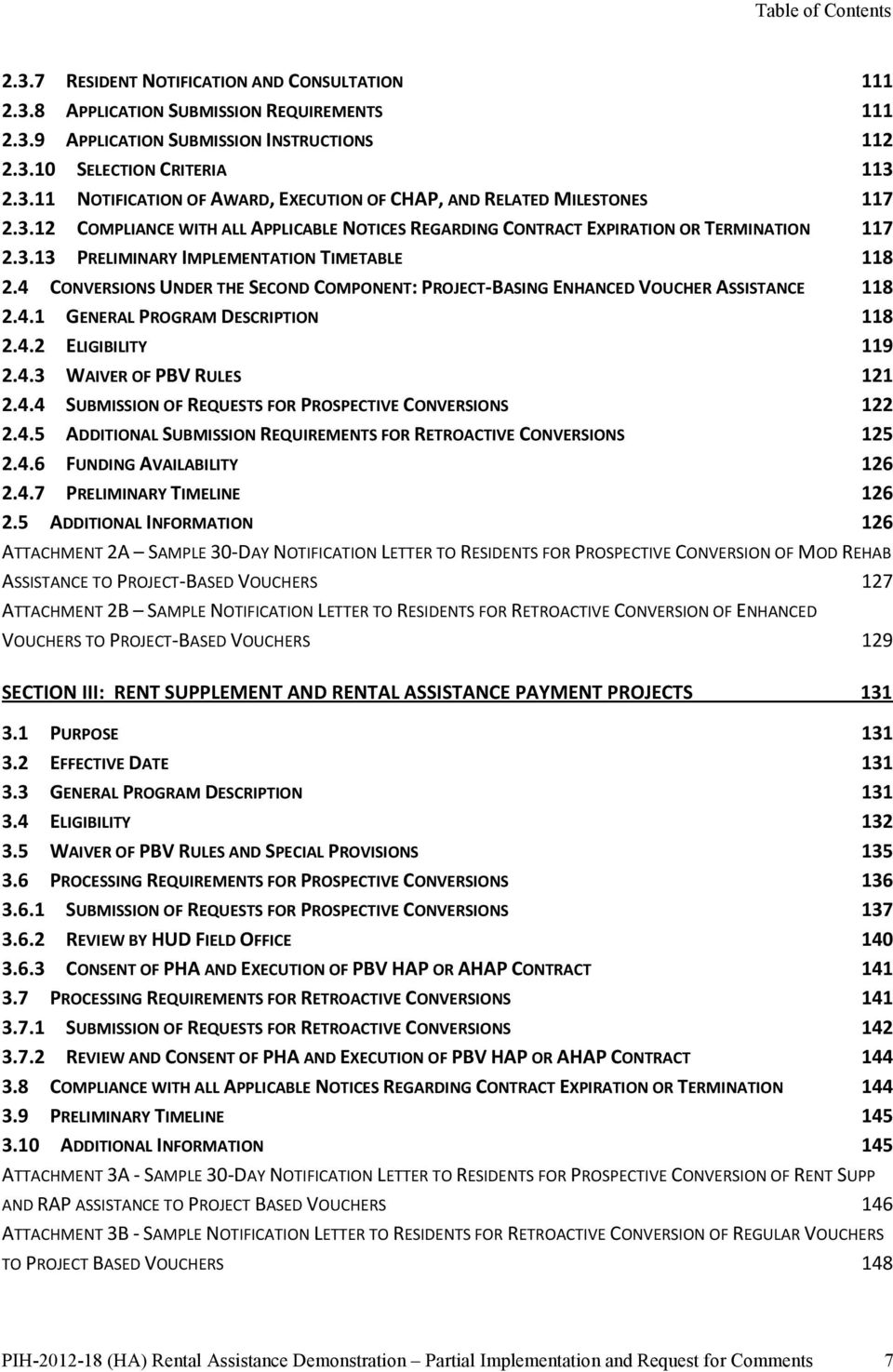
7 Table of Contents RESIDENT NOTIFICATION AND CONSULTATION APPLICATION SUBMISSION REQUIREMENTS APPLICATION SUBMISSION INSTRUCTIONS SELECTION CRITERIA NOTIFICATION OF AWARD, EXECUTION OF CHAP, AND RELATED MILESTONES COMPLIANCE WITH ALL APPLICABLE NOTICES REGARDING CONTRACT EXPIRATION OR TERMINATION PRELIMINARY IMPLEMENTATION TIMETABLE CONVERSIONS UNDER THE SECOND COMPONENT: PROJECT-BASING ENHANCED VOUCHER ASSISTANCE GENERAL PROGRAM DESCRIPTION ELIGIBILITY WAIVER OF PBV RULES SUBMISSION OF REQUESTS FOR PROSPECTIVE CONVERSIONS ADDITIONAL SUBMISSION REQUIREMENTS FOR RETROACTIVE CONVERSIONS FUNDING AVAILABILITY PRELIMINARY TIMELINE ADDITIONAL INFORMATION 126 ATTACHMENT 2A SAMPLE 30-DAY NOTIFICATION LETTER TO RESIDENTS FOR PROSPECTIVE CONVERSION OF MOD REHAB ASSISTANCE TO PROJECT-BASED VOUCHERS 127 ATTACHMENT 2B SAMPLE NOTIFICATION LETTER TO RESIDENTS FOR RETROACTIVE CONVERSION OF ENHANCED VOUCHERS TO PROJECT-BASED VOUCHERS 129 SECTION III: RENT SUPPLEMENT AND RENTAL ASSISTANCE PAYMENT PROJECTS PURPOSE EFFECTIVE DATE GENERAL PROGRAM DESCRIPTION ELIGIBILITY WAIVER OF PBV RULES AND SPECIAL PROVISIONS PROCESSING REQUIREMENTS FOR PROSPECTIVE CONVERSIONS SUBMISSION OF REQUESTS FOR PROSPECTIVE CONVERSIONS REVIEW BY HUD FIELD OFFICE CONSENT OF PHA AND EXECUTION OF PBV HAP OR AHAP CONTRACT PROCESSING REQUIREMENTS FOR RETROACTIVE CONVERSIONS SUBMISSION OF REQUESTS FOR RETROACTIVE CONVERSIONS REVIEW AND CONSENT OF PHA AND EXECUTION OF PBV HAP OR AHAP CONTRACT COMPLIANCE WITH ALL APPLICABLE NOTICES REGARDING CONTRACT EXPIRATION OR TERMINATION PRELIMINARY TIMELINE ADDITIONAL INFORMATION 145 ATTACHMENT 3A - SAMPLE 30-DAY NOTIFICATION LETTER TO RESIDENTS FOR PROSPECTIVE CONVERSION OF RENT SUPP AND RAP ASSISTANCE TO PROJECT BASED VOUCHERS 146 ATTACHMENT 3B - SAMPLE NOTIFICATION LETTER TO RESIDENTS FOR RETROACTIVE CONVERSION OF REGULAR VOUCHERS TO PROJECT BASED VOUCHERS 148 PIH (HA) Rental Assistance Demonstration Partial Implementation and Request for Comments 7
8 Definitions DEFINITIONS The Act. The United States Housing Act of Annual Contributions Contract (ACC). The contract between HUD and a PHA under which HUD agrees to provide funding for a program (e.g., public housing or Housing Choice Vouchers) under the Act, and the PHA agrees to comply with HUD requirements for the program. Cash Flow. The cash available after receipt of all project revenues and payment of all project expenses, including debt service and required deposits to reserves. Closing. The transaction during which any converting units are released from legacy contracts (e.g., the public housing Annual Contributions Contract), the new PBRA or PBV contract and RAD Use Agreement are executed, any debt and/or equity financing agreement is entered into, and the terms and conditions of the RAD Conversion Commitment are recorded. The closing is the event at which conversion of subsidy takes place; conversion has not occurred until completion of closing. (See 1.13(C) and Attachment 1A for further details on closing.) Combined Agency. A PHA that either directly, or through an affiliate, administers both a Housing Choice Voucher program and public housing. Commitment to Enter into a Housing Assistance Payments Contract (CHAP). Document executed by HUD and the PHA or owner for projects that have been selected during the RAD competition under the first component of the Demonstration. The CHAP describes the terms under which HUD will enter into a HAP contract with the project owner. (See Section 1.13(A) for further details on the CHAP.) Covered Project. A project that converts from one form of rental assistance to another under the Demonstration. Choice-Mobility. For residents of covered projects, the option to obtain a Housing Choice Voucher from a PHA after a defined period of residency. (See Section 1.8(C)(5) of this Notice and section 8(o)(13)(E) of the Act for further details on the choice-mobility component.) Contract Administrator. An entity that executes a HAP contract with a project owner and is responsible for monitoring and reporting to HUD on activities related to the HAP contract. In conversions to PBRA, projects will be assigned to existing Performance Based Contract Administrators (PBCAs). In conversions to PBV, the PHA that administers the voucher funding will also administer the PBV HAP. PIH (HA) Rental Assistance Demonstration Partial Implementation and Request for Comments 8

9 Definitions Contract Rent. The total amount of rent specified in the HAP contract as payable to the owner for a unit occupied by an eligible family. Current Funding. Applicable to the first component of the Demonstration, the combination of Federal subsidy and tenant rents for which a project is eligible under its existing rental assistance program in the fiscal year of conversion. (See Sections 1.7(B)(5), 1.8(A)(5), and Attachment 1C for further details on current funding.) Declaration of Trust (DOT). The restrictive covenant on projects assisted through a public housing ACC that obligates PHAs to operate developments in accordance with the ACC, the Act, and HUD regulations and requirements. Distributions. Cash Flow from property operations that may be paid or distributed to the PHA or owner without restriction. (See Section 1.8(A)(7) for further details on distributions.) Date of Full Availability (DOFA). For a public housing project, the date when the dwelling units become available for occupancy. Enhanced Vouchers (EVs). Tenant protection vouchers provided pursuant to an eligibility event under Section 8(t) of the Act. EVs differ from regular vouchers in two ways: (1) the payment standard used to calculate the voucher housing assistance payment for EVs may exceed a PHA s ordinary payment standard and (2) an EV provides the tenant with a right to remain in the project as long as the units are used for rental housing and are otherwise eligible for voucher assistance. If the tenant elects to move, the voucher is administered as a regular voucher. HUD provides funding for EVs to a voucher agency that has jurisdiction over the area in which the property that the eligibility event occurred is located. Fair Market Rent (FMR). The rent in a particular housing market area needed to obtain privately owned, decent, safe and sanitary rental housing. HUD establishes and publishes in the Federal Register separate FMRs for dwelling units of varying sizes for each metropolitan area. FMRs are gross rent estimates, i.e., they include the cost of tenant-paid utilities. Financing Plan. Documentation submitted to HUD for review that is intended to demonstrate that the covered project will be sustained physically and financially for the term of the HAP contract at the rent levels permitted under the Demonstration, including the means by which the project s immediate and long-term capital needs will be addressed. PIH (HA) Rental Assistance Demonstration Partial Implementation and Request for Comments 9

10 Definitions Good-Cause Exemption. An allowance made by HUD on a competitive basis, exempting a covered PBRA project from the choice-mobility component. (See Sections 1.8(C)(5) and 2.3.6(C)(4) for further details on good-cause exemptions.) Green Building. An approach to building, rehabilitation, repairs, maintenance, and property operations that is more sustainable than traditional approaches to such activities and results in a project that is more energy efficient, costs less to operate, has better indoor air quality, and reduces its overall impact on the environment. (See Section 1.5(A) for further details on green building.) Housing Assistance Payment (HAP). The payment made by the contract administrator to the owner of an assisted unit as provided in the HAP contract. Where the unit is leased to an eligible household, the payment is the difference between the contract rent for a particular assisted unit and the HUD-required rental contribution from eligible tenant families. HAP Contract. The contract entered into by the owner and the contract administrator that sets forth the rights and duties of the parties with respect to the project and the payments under the contract. Mixed-Finance Project. A public housing project that has been developed with a combination of private financing and public housing development funds in accordance with 24 CFR Part 941 (subpart F). Operating Cost Adjustment Factor (OCAF). Operating cost adjustment factor established by HUD, which may not be negative, that is applied to the existing contract rent, less the portion of the rent paid for debt service. PHA. A Public Housing Agency that administers programs under the Act, which could include public housing and Housing Choice Vouchers. Unless otherwise noted, for the purposes of this Notice, the term PHA refers to the owner of a public housing project or a converted public housing project, and not to the HCV administrator. In addition, this Notice always uses the term PHA to refer to the owner of the project, even though in some cases, the owner may be another public, non-profit, or private owner (e.g., mixed-finance projects). Physical Conditions Assessment (PCA). A detailed physical inspection of a property to determine critical repair needs, short- and long-term rehabilitation needs, market comparable improvements, and environmental concerns. Owners of public housing and Mod Rehab properties converting assistance under RAD will use HUD s PCA for the Mark-to-Mark program, or substantial equivalent, which contains a Green Building component. The PCA tool can be accessed at (See Section 1.5(A) for further details on the PCA.) PIH (HA) Rental Assistance Demonstration Partial Implementation and Request for Comments 10

11 Definitions Public Housing Assessment System (PHAS). The system used to measure the performance of PHAs administering the public housing program, per 24 CFR Part 902. Public Housing Project. A public housing development with a unique project identification number in the Public and Indian Housing Information Center (PIC). Project-Based Voucher (PBV). A component of a PHA s Housing Choice Voucher program, wherein a PHA can attach voucher assistance to specific housing units through a HAP contract with an owner. Project-Based Rental Assistance (PBRA). Rental assistance provided by HUD to owners according to the terms of a HAP contract for the provision of housing to eligible tenants. The PBRA program is administered by HUD s Office of Housing. RAD Conversion Commitment (RCC). Contract executed by HUD and the PHA or owner, following HUD approval of the submitted Financing Plan, that describes the terms and conditions of the conversion. (See Section 1.13(B) and Attachment 1A for further details on the RCC.) RAD Use Agreement. Document specifying the affordability and use restrictions on the covered project, which will be coterminous with the HAP contract and will be recorded prior to the lien of the first mortgage and structured to survive foreclosure. The RAD Use Agreement is used only in connection with public housing conversions under the Demonstration. (See Sections 1.7(B)(4), 1.8(A)(4) and Attachment 1B for further details on the RAD Use Agreement.) Section Eight Management Assessment Program (SEMAP). The system used to measure the performance of PHAs administering the Section 8 Housing Choice Voucher program, per 24 CFR Part 985. Tenant Protection Vouchers. Vouchers issued to eligible tenants of certain properties when an event at the property would otherwise expose tenants to a loss of rental assistance, resulting in an increase in their housing costs. Such events include when a Rent Supp or RAP contract terminates due to expiration, prepayment of the underlying mortgage, or an enforcement action. HUD provides funding for TPVs to a voucher agency that has jurisdiction over the area in which the property is located. TPVs may be regular HCVs, which are administered in accordance with all HCV program requirements, or enhanced vouchers, as described above. Tenant Rent. The amount payable monthly by the household as rent to the unit owner. PIH (HA) Rental Assistance Demonstration Partial Implementation and Request for Comments 11

12 Definitions Utility Allowance. The amount that a PHA or owner determines is necessary to cover reasonable tenant-paid utility costs. In the case where the utility allowance exceeds the total tenant payment, the tenant is reimbursed in the amount of such excess. Voucher Agency A PHA that administers a Housing Choice Voucher program. PIH (HA) Rental Assistance Demonstration Partial Implementation and Request for Comments 12

13 Section I: Public Housing Projects SECTION I: PUBLIC HOUSING PROJECTS 1.1 Purpose This Section provides RAD program instructions to PHAs and their partners seeking to convert assistance of public housing projects. 2,3 1.2 Effective Date The instructions contained in this Section are proposed and public comment is sought. Final instructions will be provided in the Final Notice. Instructions for submitting public comments are found in the introductory Section of this Notice. 1.3 General Program Description PHAs will apply competitively to convert assistance of projects in accordance with the terms of this Notice. Applications must be submitted for specific projects. Following review and selection of application, the PHA will execute with HUD a Commitment to Enter into a Housing Assistance Payment (CHAP) contract, under which the PHA will have to present a Financing Plan for HUD to approve. After HUD approval of the long-term viability of the Financing Plan and successful closing of the conversion, the project will receive a long-term Section 8 HAP contract. Upon conversion, covered projects will be removed from the public housing program and will be released from the public housing Declaration of Trust (DOT). (For more details on the execution of a CHAP, milestones, and closing, see Section 1.13 of this Notice.) PBV Conversions. Where the PHA converts assistance of a public housing project to Section 8 project-based vouchers (PBVs), the project will be administered by the agency on whose Annual Contributions Contract (ACC) the vouchers are assigned (which in many cases will be the same agency that is converting assistance). PBV contract rents will be equal to the project s current funding, subject to a cap established in the Notice, and will be adjusted annually only by HUD s Operating Cost Adjustment Factor (OCAF) at each anniversary of the execution of the HAP contract. The initial contract will be for a period of at least 15 years (up to 20 years upon approval of the administering voucher agency) and will be subject to annual appropriations. At expiration of the initial contract, HUD shall offer, and the PHA shall accept, a renewal contract. Each project with a PBV contract will also carry a concurrent renewable RAD Use Agreement. 2 For the purposes of this section, HUD uses the term PHA to refer to the owner of a converting or covered project. In some instances the owner of a project could be a public, non-profit, or private owner (e.g., mixed-finance projects). See Sections 1.7(B)(3) and 1.8(A)(3). 3 For the purposes of this section, a project is defined as a public housing project with a unique project identification number in the Public and Indian Housing Information Center (PIC). For background information on numbering public housing projects, see PIH Notice Changes in the Project Numbering System and Process for Requesting Changes in Project Identifications. PIH (HA) Rental Assistance Demonstration Partial Implementation and Request for Comments 13

14 Section I: Public Housing Projects Further, PHAs will provide a choice-mobility option to residents of covered projects, consistent with existing program rules. With the exception of provisions identified in this Notice, regulatory and statutory requirements of the PBV program in 24 CFR Part 983 shall apply. PBRA Conversions. Where the PHA converts assistance of a public housing project to Section 8 project-based rental assistance (PBRA), the project will be administered by HUD s Office of Housing and HAP oversight will be performed by a Performance Based Contract Administrator (PBCA). PBRA contract rents will be equal to the project s current funding, subject to a cap established in the Notice, and will be adjusted annually only by HUD s OCAF at each anniversary of the HAP contract. The initial contract will be for a period of 20 years and will be subject to annual appropriations. At expiration of the initial contract, HUD shall offer, and the PHA shall accept, a renewal contract under the Multifamily Assisted Housing Reform and Affordability Act (MAHRA) of Each project with a PBRA contract will also carry a concurrent 20-year renewable RAD Use Agreement. Further, PHAs will provide a choicemobility option to residents of covered projects, as specified in Section 1.8 of this Notice. With the exception of provisions identified in this Notice, regulatory and statutory requirements of the PBRA program in 24 CFR Part 880 and applicable standing and subsequent Office of Housing guidance, including handbooks, shall apply. 1.4 Eligibility To be eligible for the Demonstration, a PHA must: Have public housing units under an ACC; Be classified as a Standard or High Performer under the Public Housing Assessment System (PHAS), or, if classified as troubled (Troubled), the PHA must be making substantial progress under its Corrective Action Plan (CAP) or Memorandum of Agreement (MOA) and HUD must have determined that the factors resulting in the PHA s Troubled status will not affect its capacity to carry out a successful conversion under this Demonstration; Be classified as a Standard or High Performer under the Section Eight Management Assessment Program (SEMAP), or, if classified as Troubled, the PHA must be making substantial progress under the CAP and HUD must have determined that the factors resulting in the PHA s Troubled status will not affect its capacity to carry out a successful conversion under this Demonstration; Be otherwise in substantial compliance with HUD reporting and programmatic requirements and/or satisfactorily in compliance with any CAP or MOA related to any program finding or deficiency; PIH (HA) Rental Assistance Demonstration Partial Implementation and Request for Comments 14

15 Section I: Public Housing Projects Not have debarments, suspensions, or Limited Denials of Participation in Federal programs lodged against the applicant, PHA Executive Director, Board members, or affiliates; Submit a completed application that complies with all RAD Application instructions; and Be in compliance with all fair housing and civil rights requirements set forth at 24 CFR 5.105(a). If any of the charges, cause determinations, lawsuits, or letter of findings referenced below has not been resolved to HUD s satisfaction before the application deadline, a PHA is ineligible to apply: o A charge from HUD concerning a systemic violation of the Fair Housing Act or a cause determination from a substantially equivalent state or local fair housing agency concerning a systemic violation of a substantially equivalent state or local fair housing law proscribing discrimination because of race, color, religion, sex, national origin, disability or familial status; o A Fair Housing Act lawsuit filed by the Department of Justice alleging a pattern or practice of discrimination or denial of rights to a group of persons raising an issue of general public interest pursuant to 42 U.S.C. 3614(a); o A letter of findings identifying systemic noncompliance under Title VI of the Civil Rights Act of 1964, section 504 of the Rehabilitation Act of 1973, or section 109 of the Housing and Community Development Act of 1974; o A cause determination from a substantially equivalent state or local fair housing agency concerning a systemic violation of provisions of a state or local law proscribing discrimination in housing based on sexual orientation or gender identity; or o A cause determination from a substantially equivalent state or local fair housing agency concerning a systemic violation of a state or local law proscribing discrimination in housing based on lawful source of income. HUD will determine if actions to resolve the charge, cause determination, lawsuit, or letter of findings taken before the deadline are sufficient to resolve the matter. While only PHAs may apply, PHAs may want to consider enlisting partners to facilitate recapitalization and development of their projects. Additionally, while certain public housing mixed-finance projects are eligible under the Demonstration (see Section 1.12(B) of this Notice), the application for conversion of assistance must be submitted by the PHA on whose ACC the units are included. 4 4 This requirement also applies to directly-funded Resident Management Corporations (RMCs). PIH (HA) Rental Assistance Demonstration Partial Implementation and Request for Comments 15

16 Section I: Public Housing Projects 1.5 Rehabilitation and Financing Considerations As one of the main purposes of RAD is to demonstrate how the conversion of current assistance to long-term, project-based Section 8 rental assistance contracts can generate access to private debt and equity to address immediate and long-term capital needs through rehabilitation, eligible applicants and their development partners are encouraged to consider any and all viable forms of debt and equity financing, including available grant funding, to support conversion. A. Rehabilitation Considerations Physical Condition Assessment (PCA), Determination of Rehab Needs. Projects selected for award, regardless of whether the PHA is pursuing third-party financing, will be required to perform a detailed physical inspection of the subject property to determine short-term rehabilitation needs, and long-term capital needs to be funded through a Reserve for Replacement account. The inspection must use the PCA Statement of Work that is currently used for debt restructuring transactions in HUD s Mark-to-Market program, or a substantially equivalent standard approved in advance in writing by HUD (in HUD s sole and absolute discretion). 5 The PCA must be completed by a qualified, independent third-party inspector as required in the Statement of Work and submitted to HUD with the Financing Plan subsequent to issuance of the CHAP (see Attachment 1A of this Notice). PHAs pursuing debt financing should discuss this PCA standard with their lenders; while this PCA standard should satisfy most lender requirements, some lender standards will not fulfill this HUD requirement. Green Building and Energy Efficiency. For all projects retrofitted under a RAD conversion, if systems and appliances are being replaced as part of the initial repairs identified in the approved Financing Plan, PHAs shall replace with the most energyand water-efficient options, including Energy Star, WaterSense or Federal Energy Management Program (FEMP)-designated products and appliances, to the extent that those investments are financially feasible. 6 The PCA described above will provide detailed analyses of energy saving alternatives and other green building components, including payback and cost/saving analyses. PHAs are strongly encouraged, for all RAD conversion projects, to scope rehabilitation and ongoing replacements and operations, utilizing the components that the PCA indicates make financial sense, and 5 The PCA tool and Statement of Work used in HUD s Mark-to-Market program can be accessed at 6 For Energy Star, see For WaterSense, see For FEMP, see PIH (HA) Rental Assistance Demonstration Partial Implementation and Request for Comments 16

17 Section I: Public Housing Projects non-utility saving components that the PCA indicates will improve indoor air quality and/or reduce overall environmental impact where those components have little or no cost premium, consistent with the principles and best practices of the green building industry. Applicants that have indicated a commitment to green building utilizing an industryrecognized standard will receive preference points in the selection process (see Section 1.12(D) of this Notice). In this case, determinations about scope of rehab, and components and materials to utilize in that rehabilitation will be driven by the requirements of the green building program to which the PHA has committed. B. Financing Considerations Debt Financing. RAD projects are eligible for financing from private and public lending sources. All loans made that are secured by covered projects are subject to a RAD Use Agreement that will be recorded in first position (see Attachment 1B of this Notice for key provisions of RAD Use Agreement). Debt financing on covered projects must be at a fixed rate of interest, for a fixed term, fully amortized over no more than 40 years, and with a maturity date no earlier than the term of the initial HAP contract, i.e., 20 years for PBRA conversions and either 15 or 20 years for PBV conversions. Balloon payments are not permitted within the term of the initial 20-year HAP. Sources of private and public debt financing to consider include any and all sources that are commonly used in other low-income, use-restricted developments. In addition to commercial lenders, applicants should consider facilities both construction and permanent offered by Community Development Financial Institutions (CDFIs); Government Sponsored Enterprises (GSEs), including the network of Federal Home Loan Banks; and applicable private foundation financing. Public financing that may be available includes state and locally provided facilities employing federal Community Development Block Grants (CDBG) and state housing agency provided financing. Many municipalities offer infrastructure and other forms of development financing through payment in lieu of tax (PILOT) initiatives and transit-oriented development programs that may prove accessible. Additionally, while HOME Investment Partnerships program (HOME) funding is not permitted in any project that utilizes public housing Capital or Operating Funds, covered projects would be eligible to use HOME funding. Similarly, while conversions under this Notice would not be an eligible use of Neighborhood Stabilization Program (NSP) funding, program income from the NSP could be used for RAD financing purposes. PIH (HA) Rental Assistance Demonstration Partial Implementation and Request for Comments 17

18 Section I: Public Housing Projects Public Housing Capital and Operating Program Funds. PHAs are permitted under the Demonstration to use available prior year public housing funding, including Operating Reserves and unobligated Capital Funds, as an additional source of capital to support conversion (see Section 1.6 of this Notice for more details). These funds must be identified in the Financing Plan submitted to HUD for review. (A PHA may not use public housing program funds, or any other funds, to augment the contract rent on a project.) PHAs are encouraged to structure such funds in the Financing Plan as a source of either debt or equity (grant) contribution relative to the requirements of the Financing Plan (see Attachment 1A of this Notice). Existing PHA Indebtedness. In its application, a PHA must disclose the estimated amount of any indebtedness including energy performance contracts, Capital Fund Financing, Operating Fund Financing, Public Housing Mortgage Program, or other sources that is associated with the subject property. Any outstanding debt on the project must be addressed in the project s Financing Plan. The PHA may want to consider refinancing these existing debt obligations as part of conversion. Conversion does not relieve the PHA of these or other obligations. PHAs should be aware that any new first mortgage lender, where applicable, may require that existing indebtedness be paid off or subordinated in connection with the refinancing and conversion of the project. Federal Housing Administration (FHA) Insured Financing. FHA mortgage insurance provides high leverage and long-term, fully amortizing fixed-rate financing at competitive interest rates. For more information, PHAs should contact an approved FHA Multifamily Lender: Some properties converting under RAD may qualify for financing under section 223(f) of the National Housing Act, which provides mortgage insurance for a permanent loan and may include project repairs. If the scope of required property repairs indicates substantial rehabilitation, as defined by the FHA Multifamily Mortgage Insurance Program in the Multifamily Accelerated Processing (MAP) Guide, the appropriate FHA-insured financing would be under section 221(d)(4) of the National Housing Act. Section 221(d)(4) provides a combined construction and permanent loan under one commitment for mortgage insurance and permits extensive rehabilitation. Risk sharing programs offered by state housing financing agencies, Freddie Mac, and/or Fannie Mae should be considered as well as the basic FHA-insured programs. Secondary financing, tax credits, and other public sources can be used in conjunction PIH (HA) Rental Assistance Demonstration Partial Implementation and Request for Comments 18

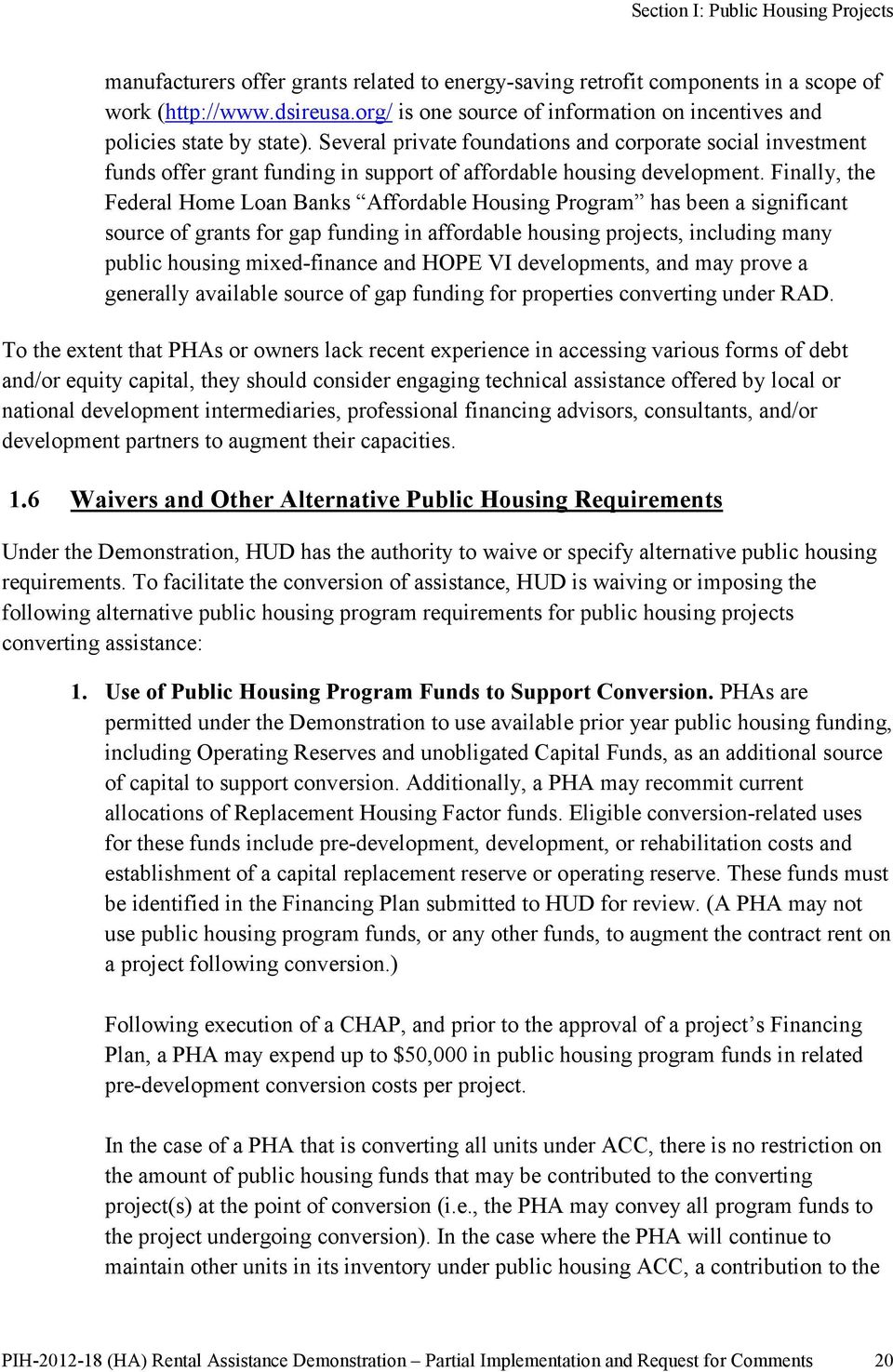
19 Section I: Public Housing Projects with FHA-insured financing and risk-sharing programs. All of the above financing options may be used to credit-enhance tax-exempt bonds. Low-Income Housing Tax Credits (LIHTC). Applicants are encouraged to use LIHTC and, potentially, historic preservation tax credits, to support recapitalization of their projects. Some properties converting under RAD may also be eligible to participate in HUD s recently announced Multifamily Low Income Housing Tax Credit Pilot Program (Notice H ), which offers a distinct application platform and a separate processing track under the FHA section 223(f) program described above. 7 Many states face excessive demand on an annual basis for allocations of nine percent LIHTCs. Yet many more routinely do not fully allocate their supply of four percent as-of-right credits coupled with tax-exempt bond financing allowed under their annual Private Activity Bond Volume Cap. Applicants are encouraged to assess local demand and supply considerations if proposing to utilize LIHTCs. While the applicant should indicate in its application if it intends to use tax credits, there is no requirement to have secured these credits prior to submitting an application. Instead, the application must document only that the proposed project would qualify for an allocation of tax credits under a state or local allocating agency s Qualified Allocation Plan (QAP). All state and local tax credit allocating agencies are required to publish and routinely update a QAP that explains the amounts of available tax credits, priorities, processes, and timelines for allocating tax credits in their jurisdictions. PHAs and owners considering accessing tax credits in Financing Plans for RAD conversions should carefully review the relevant QAP for applicable details. If an applicant proposes to use tax credits and the project is selected and offered a CHAP, the PHA or owner will have 360 days from the execution of the CHAP to submit evidence to HUD of a LIHTC or historic preservation tax credit reservation or comparable commitment. Note that extensions to the timeline and milestones outlined in this Notice will not be granted because the application requires LIHTC equity and no LIHTC reservation letter has been obtained. Grant Funding. In addition to equity from the sale of tax credits, there are numerous additional sources of equity that PHAs should explore. Beyond being a source of debt, state and local CDBG and HOME funds are often applied as gap grants in other forms of affordable housing developments. Numerous state and local governments offer other grant funds that can be used as an equity contribution in financing plans, particularly if a scope of work includes green retrofitting or weatherization components. In many localities, utility companies and appliance 7 Notice H can be found at PIH (HA) Rental Assistance Demonstration Partial Implementation and Request for Comments 19

20 Section I: Public Housing Projects manufacturers offer grants related to energy-saving retrofit components in a scope of work ( is one source of information on incentives and policies state by state). Several private foundations and corporate social investment funds offer grant funding in support of affordable housing development. Finally, the Federal Home Loan Banks Affordable Housing Program has been a significant source of grants for gap funding in affordable housing projects, including many public housing mixed-finance and HOPE VI developments, and may prove a generally available source of gap funding for properties converting under RAD. To the extent that PHAs or owners lack recent experience in accessing various forms of debt and/or equity capital, they should consider engaging technical assistance offered by local or national development intermediaries, professional financing advisors, consultants, and/or development partners to augment their capacities. 1.6 Waivers and Other Alternative Public Housing Requirements Under the Demonstration, HUD has the authority to waive or specify alternative public housing requirements. To facilitate the conversion of assistance, HUD is waiving or imposing the following alternative public housing program requirements for public housing projects converting assistance: 1. Use of Public Housing Program Funds to Support Conversion. PHAs are permitted under the Demonstration to use available prior year public housing funding, including Operating Reserves and unobligated Capital Funds, as an additional source of capital to support conversion. Additionally, a PHA may recommit current allocations of Replacement Housing Factor funds. Eligible conversion-related uses for these funds include pre-development, development, or rehabilitation costs and establishment of a capital replacement reserve or operating reserve. These funds must be identified in the Financing Plan submitted to HUD for review. (A PHA may not use public housing program funds, or any other funds, to augment the contract rent on a project following conversion.) Following execution of a CHAP, and prior to the approval of a project s Financing Plan, a PHA may expend up to $50,000 in public housing program funds in related pre-development conversion costs per project. In the case of a PHA that is converting all units under ACC, there is no restriction on the amount of public housing funds that may be contributed to the converting project(s) at the point of conversion (i.e., the PHA may convey all program funds to the project undergoing conversion). In the case where the PHA will continue to maintain other units in its inventory under public housing ACC, a contribution to the PIH (HA) Rental Assistance Demonstration Partial Implementation and Request for Comments 20
21 Section I: Public Housing Projects converting project of Operating Funds that exceeds the average amount the project has held in Operating Reserves over the past three years will trigger a subsidy layering review under 24 CFR Similarly, any contribution of Capital Funds, including Replacement Housing Factor funds, will trigger a subsidy layering review. In such cases, the loan amount may not exceed the amount required for feasibility. Following execution of the HAP, a PHA may not contribute prior-year public housing program funds to the covered project unless such funding has been identified in the Financing Plan. 2. Inapplicability of Section 18 of the Act for Properties Converting All or Substantially All Units. PHAs that propose to remove public housing units from their ACC through RAD do not require section 18 approval, unless the proposal would reduce the number of assisted units by more than a de minimis amount, defined for RAD conversions as the greater of five percent of the current project size (i.e., the number of units under ACC immediately prior to conversion) or five units. A unit is excluded from this de minimis threshold if: The unit has already received approval from HUD under section 18 for Demolition or Disposition; 8 The unit is beyond reasonable repair and/or the unit has been vacant for more than 24 months; or Reducing the total unit number will allow the PHA to more effectively or efficiently serve assisted households through: 1) reconfiguring efficiency apartments; or 2) repurposing dwelling units in order to facilitate social service delivery (e.g., converting a basement unit into community space). In all of these cases, the PHA, within the application, shall submit a narrative explanation of the proposed reduction, including a description of the units to be 8 If a PHA has requested or received HUD approval under section 18 for a project, but the project could otherwise be preserved through conversion under RAD, the PHA may submit a RAD application for the project. If units are under review by HUD and in demo-dispo proposed status in PIC, the PHA must notify the Special Applications Center (SAC) in writing that it wishes to withdraw its application because the PHA intends to propose the project for conversion. If the PHA does not receive HUD approval to convert the project under RAD, the PHA may submit a new application to the SAC for approval to demolish or dispose of the project under section 18. (If a PHA does not submit a request to the SAC to withdraw its section 18 application prior to submitting an application to convert the project under RAD, the SAC will reject the PHA s section 18 application upon notification that the PHA has proposed to convert the project under RAD.) If units have already received section 18 approval, upon application to RAD, but have not yet been actually demolished or disposed of, the PHA may apply for conversion of the units under RAD so long as the PHA commits (as part of its RAD application) to request HUD approval to rescind the section 18 approval under 24 CFR 970.7(b)(1), upon HUD approval of the Financing Plan. PIH (HA) Rental Assistance Demonstration Partial Implementation and Request for Comments 21
22 Section I: Public Housing Projects removed, an explanation of why the project can better serve assisted residents at the reduced number, and any supporting evidence. 3. Ineligibility for Asset Repositioning Fee (ARF) or Replacement Housing Factor (RHF) Fee. PHAs may not apply for ARF or RHF for converted projects, as contained in 24 CFR (h) and 24 CFR (i), respectively. 4. Effect of Conversion on PHA s Faircloth Limit. Section 9(g)(3) of the Act limits the construction of new public housing units, referred to as the Faircloth Limit. Under the Faircloth Limit, a PHA may not use funds allocated under the Capital or Operating Funds for the purpose of constructing any new public housing units if the construction of those units would result in a net increase in the number of units the PHA owned, assisted, or operated as of October 1, Conversions under the Demonstration will reduce a PHA s Faircloth Limit. For example, a PHA with a pre-rad Faircloth Limit of 1,000 public housing units would have its Faircloth Limit reduced to 900 units if it converted a 100-unit project. 5. Conversion is a Significant Amendment to Annual/Five Year Plan. Conversion of assistance under the Demonstration will be considered a significant amendment to the PHA s Five Year Plan for qualified and non-qualified PHAs, and the Annual Plan for non-qualified PHAs. As such, the PHA is subject to the public notice and Resident Advisory Board consultation requirements outlined in 24 CFR Part 903. A PHA must submit this amendment prior to or along with the Financing Plan. In addition to the information already required by 24 CFR Part 903 for PHA Plan amendments, the amendment must: (1) indicate any change in the total number and mix of units at the project; and (2) describe the policies that govern resident eligibility selection, admission preferences, admissions, and occupancy. 6. Moving-To-Work (MTW) Agencies. If an MTW agency converts assistance to PBRA under this Demonstration, the covered project(s) will no longer be included as part of the PHA s MTW program. Any projects that convert to PBRA will leave the public housing program and will be administered by HUD s Office of Housing through a PBCA. If an MTW agency converts assistance to PBVs under the Demonstration, the covered projects will be governed by the terms of this Notice. 7. Outstanding Debt Incurred Under Section 4 of the Act. The outstanding principal balance and interest due on loans held by HUD made under section 4 for the PIH (HA) Rental Assistance Demonstration Partial Implementation and Request for Comments 22
23 Section I: Public Housing Projects development and modernization of the covered project shall be forgiven upon conversion Special Provisions Affecting Conversions to PBVs Under the Demonstration, HUD has the authority to waive statutory and regulatory provisions governing the PBV program, or to establish alternative requirements for the effective conversion of assistance. Additionally, the RAD statute imposes certain unique requirements. Listed below are the special requirements applicable to public housing projects converting assistance to long-term PBVs under the first component of the Demonstration, with reference to the affected statute and/or regulation, where applicable. Special requirements are grouped into four categories: Project Selection, Contract Terms, Tenant Rights and Participation, and Other Miscellaneous Provisions. All other regulatory and statutory requirements of the PBV program in 24 CFR Part 983 and section 8(o)(13) of the Act shall apply, including resident choice, environmental review, and fair housing requirements. A. Project Selection 1. Maximum Amount of PBV assistance. Covered projects do not count against the maximum amount of assistance a PHA may utilize for the PBV program, which is currently set at 20 percent of the amount of budget authority allocated to a PHA under the Housing Choice Voucher program. To implement this provision, HUD is waiving section 8(o)(13)(B) of the Act as well as 24 CFR Cap on the Number of PBV Units in Each Project. The 25 percent limitation on the number of units that may be project-based in a project is increased to 50 percent. The exceptions to the limitation for elderly and/or disabled households, for single-family properties, and for units occupied by households receiving supportive services, described in 24 CFR (b) and (c), continue to apply, with the exception noted below. In cases where the exception is based on the provision of supportive services, existing residents shall be offered the provision of supportive services. If the existing resident declines the offer of supportive services, the unit shall remain under the HAP contract, the household shall not be terminated from the PBV program, and the decision to decline an offer for supportive services shall not represent a ground for lease termination. Once the initial household residing in the excepted unit under RAD vacates such unit, all PBV program requirements related to the receipt of supportive services, shall apply. 9 This is similar to the action HUD takes for applicable projects when they have been approved for Demolition or Disposition under section 18 of the Act. PIH (HA) Rental Assistance Demonstration Partial Implementation and Request for Comments 23
24 Section I: Public Housing Projects To implement these provisions, HUD is waiving section 8(o)(13)(D) of the Act, as well as related provisions of 24 CFR , (c), (a) and (d) Owner Proposal Selection Procedures. Selections of covered projects shall be made in accordance with program requirements outlined in this Notice. To implement this provision, HUD is waiving 24 CFR Site selection Compliance with PBV Goals, section 8(o)(13)(C) of the Act and 24 CFR (b)(1) and (c). HUD reserves the right to waive these two provisions, having to do with deconcentration of poverty. Applicants will notify HUD through the application of their need for a waiver if the agency administering the vouchers determines that the project does not meet the associated requirements for deconcentration under the statute or regulation. B. Contract Terms 1. Length of Contract. Covered projects shall have an initial HAP term of at least 15 years (up to 20 years upon request of the PHA and with approval by the agency administering the vouchers). To implement this provision, HUD is waiving section 8(o)(13(f) of the Act (which establishes a maximum term of 15 years) as well as 24 CFR (a) (which governs contract term). 11 Owners of covered projects are required to make available for occupancy by eligible tenants the number of assisted units. With HUD approval, in limited circumstances, an owner may transfer the rental assistance contract and RAD Use Agreement to other units owned by a public or non-profit entity. 2. Mandatory Contract Renewal. By statute, upon contract expiration, HUD shall offer, and the PHA shall accept, renewal of the contract subject to the terms and conditions applicable at the time of renewal and the availability of appropriations each year for such renewal. Consequently, section 8(o)(13)(G) of the Act, as well as 24 CFR (b), governing the PHA discretion to renew the contract for terms of up to 15 years, will not apply Ownership and Control. During the initial term and all renewal terms of the HAP contract, HUD will require ownership or control of assisted units by a public or nonprofit 10 See also 73 FR 71037, which implements language in the Housing and Economic Recovery Act, allowing for up to 25 percent of units in a project, rather than a building, to be project-based. Although this change is not yet reflected in 24 CFR , these statutory changes are self-implementing CFR (a) has not been updated to reflect changes made to the initial contract term in the Housing and Economic Recovery Act of As reflected in 73 FR 71037, these statutory changes are self-implementing; therefore, the initial term of the contract is 15 years. 12 See previous note. PIH (HA) Rental Assistance Demonstration Partial Implementation and Request for Comments 24
25 Section I: Public Housing Projects entity. However, as HUD, in its sole discretion, determines necessary pursuant to foreclosure, bankruptcy, or termination and transfer of assistance for material violations of, or default under, the HAP contract, HUD will require ownership or control of assisted units in the following priority: (1) a capable public entity; and (2) a capable non-public entity (e.g., a private entity), as determined by HUD. HUD may allow ownership of the project to be transferred to a for-profit entity to facilitate such entity s use of tax credits, but only if the PHA preserves its interest in the property in a manner approved by the Secretary. 4. RAD Use Agreement. Covered projects shall have an initial RAD Use Agreement that will be recorded superior to other liens on the property, run for the same term as the initial HAP contract, automatically renew upon extension or renewal of the HAP contract, and remain in effect even in the case of abatement or termination of the HAP contract (for the term the HAP contract would have run, absent the abatement or termination). Among other terms, the RAD Use Agreement will require the owner to preserve unit affordability, maintain housing standards, observe fair housing and civil rights requirements, and maintain the converted number of assisted units, or if reducing the number of units, replace that assistance with the same number of units elsewhere. 5. Contract Rent Setting. The statutory and regulatory PBV requirements governing contract rents will apply (see 24 CFR ), except that rents cannot exceed current funding (see Attachment 1C Calculation of Contract Rent for more detail on the determination of current funding). To this effect, initial contract rents cannot exceed the lower of: (a) current funding (adjusted for bedroom size); (b) the reasonable rent (as defined under 24 CFR ); (c) up to 110 percent of the applicable FMR (or applicable Exception Rent Payment Standard), minus any utility allowance; or (d) the rent requested by the owner Method of Adjusting Contract Rents. Contract rents will be adjusted annually only by HUD s OCAF at each anniversary of the date of execution of the HAP contract. 14 As such, section 8(o)(13)(I) of the Act and 24 CFR and shall not apply when adjusting rents. 13 In the event that current funding exceeds the amounts established above, a PHA may make a permanent transfer of any subsidy in excess of the allowable rent caps to its voucher program or to another project applying for conversion of assistance under RAD. The transfer of subsidy will occur at the date of closing of the conversion of the contributing project. 14 OCAF are calculated by HUD each year and are applied to the portion of a contract rent that is not committed to debt service payment in order to calculate the contract rent for the project in the following fiscal year. For the most recent guidance on OCAF, please see: PIH (HA) Rental Assistance Demonstration Partial Implementation and Request for Comments 25
26 Section I: Public Housing Projects C. Tenant Rights and Participation 1. No Re-screening of Tenants Upon Conversion. By statute, at conversion, existing residents are not subject to rescreening and cannot lose their unit if over-income. Consequently, a unit with a household that was over-income at time of conversion would continue to be treated as an assisted unit. Once that remaining household moves out, the unit must be leased to an eligible family. Consequently, 24 CFR (b) will not apply. Additionally, residents would be grandfathered for conditions, including criminal history, which occurred prior to conversion, but would be subject to any on-going eligibility requirements triggered by new events or conditions. 2. Right of Return. Any residents that might need to be temporarily relocated to facilitate rehab or construction will have a first right of return. 3. Renewal of Lease. Under current regulations at 24 CFR (b)(3), upon lease expiration, an owner can choose not to renew the lease, without good cause. In such a case, the regulatory consequence is the loss of the assisted unit. Under RAD, the owner must renew all leases upon lease expiration, unless cause exists. Consequently, 24 CFR (b)(3) will not apply. 4. Phase-in of Tenant Rent Increases. If a tenant s monthly rent increases by more than the greater of 10 percent or $25 purely as a result of conversion, the rent increase will be phased in over 3 years, which a PHA may extend to 5 years with good-cause. 15 To implement this provision, HUD is waiving section 3(a)(1) of the Act, as well as 24 CFR (definition of total tenant payment ) and (b)(1), to the limited extent necessary to allow for the phase-in of tenant rent increases. 5. Resident Participation and Funding. To support resident participation following conversion of assistance, PHAs are required to: Recognize legitimate tenant organizations in covered projects. Resident organizations should work towards improving the quality of life and resident satisfaction as well as participate in initiatives to create a positive living environment for families. Legitimate resident organizations must have an elected leadership and written by-laws, including procedures for fair elections. Members of these organizations must be adults, aged 18 or older, residing in the covered project and on the lease; and 15 Such rent increases are expected to be rare and could occur if, prior to conversion, a tenant s rent was less than 30 percent of income as a result of a flat rent or ceiling rent that did not represent current market conditions or due to a rent reform policy instituted by a MTW Agency. PIH (HA) Rental Assistance Demonstration Partial Implementation and Request for Comments 26
27 Section I: Public Housing Projects Provide $25 per occupied unit annually for resident participation, of which at least $15 per occupied unit shall be provided to the legitimate resident organization at the covered property. These funds must be used for organizing and tenancy issues, resident education, and training activities. 6. Resident Procedural Rights. Under the authority granted by the RAD statute, HUD is incorporating additional procedural rights for owner terminations of tenancy, in addition to regulations at 24 CFR , as modified by the waiver in number (3), above. The grievance procedure will require that residents: Be advised of the specific grounds of any proposed adverse owner action; Have an opportunity for a hearing before an impartial party upon timely request; Have an opportunity to examine any documents or records or regulations related to the proposed action; Be entitled to be represented by another person of their choice at any hearing; Be entitled to ask questions of witnesses and have others make statements on their behalf; and Be entitled to receive a written decision by the owner on the proposed action. D. Other Miscellaneous Provisions 1. Access to Records, Including Requests for Information Related to Evaluation of Demonstration. Owners must agree to any reasonable HUD request for data to support program evaluation, including project financial statements, operating data, choicemobility utilization, and rehabilitation work. 2. Non-Luxury Rehabilitation Standard. Any rehabilitation or construction conducted in accordance with the approved Financing Plan shall only be for the purpose of restoring or constructing the project to a non-luxury standard adequate for the rental market. 3. Additional Monitoring Requirements. Covered projects will be subject to the following additional monitoring requirements: (1) the PHA s Board must approve the operating budget prior to the start of each fiscal year; and (2) the project will be subject to annual independent inspections in accordance with 24 CFR Part 5, subpart G, Physical Condition Standards and Inspection Requirements. (The PHA will still be required to comply with all applicable Housing Quality Standards and inspection provisions.) 4. Davis-Bacon Act and Section 3 of the Housing and Urban Development Act of 1968 (Section 3). The Davis-Bacon Act (prevailing wages, the Contract Work Hours and Safety Standards Act, and other related regulations, rules, and requirements) and Section 3 (24 CFR Part 135) apply to all initial repairs that are identified in the Financing Plan to PIH (HA) Rental Assistance Demonstration Partial Implementation and Request for Comments 27
28 Section I: Public Housing Projects the extent that such repairs qualify as construction or rehabilitation, regardless of whether the project qualifies as existing housing (see 24 CFR Part 135 for the Section 3 regulations). (Under existing PBV program rules, projects that qualify as existing housing under 24 CFR (a) are not subject to Davis-Bacon or Section 3.) Developmental requirements under 24 CFR and fair housing provisions under 24 CFR (c)(vi) continue to apply. (The Davis-Bacon Act only applies for projects with nine or more units.) 5. Administration of Waiting List. In establishing the waiting list for the converted project, the PHA must honor any public housing waiting list that currently exists for the project at the time of conversion. To implement this provision, HUD is waiving section 8(o)(13(J) of the Act and 24 CFR (c)(2). 6. Agreement Waiver. Under RAD, there will be no Agreement to Enter into a Housing Assistance Payments (AHAP) contract. Therefore, all regulatory references to the Agreement (AHAP), including regulations under 24 CFR Part 983 Subpart D are waived. 1.8 Special Provisions Affecting Conversions to PBRA Under the Demonstration, HUD has the authority to waive certain statutory and regulatory provisions, or to establish alternative requirements, for the effective conversion of assistance. Additionally, the RAD statute imposes certain unique requirements. For public housing projects converting assistance to PBRA under the first component of the Demonstration, 24 CFR Part 880, Section 8 Housing Assistance Payments Program for New Construction, (and applicable standing and subsequent Office of Housing guidance, including handbooks) will apply, except for the provisions listed below. These special provisions are grouped into three categories: Contract Terms, Tenant Rights and Participation, and Other Miscellaneous Provisions. Where applicable, reference is made to the affected statute and/or regulation. For additional background purposes, HUD has provided Attachment 1D, which is a copy of the existing 24 CFR Part 880 regulation with the provisions stricken that will not apply to covered projects. 16 Additionally, Attachment 1E includes the specific provisions of the Act that are inapplicable to PBRA conversions. A. Contract Terms 1. Length of Contract. Covered projects shall have an initial HAP term of 20 years. To implement this provision, HUD is waiving section 8(d)(2)(A) of the Act, which establishes a maximum term of 15 years for an existing structure, as well as 24 CFR , which imposes maximum contract terms for New Construction projects 16 Attachment 1D also includes technical amendments. PIH (HA) Rental Assistance Demonstration Partial Implementation and Request for Comments 28
29 Section I: Public Housing Projects consistent with statutory authority that was repealed in Owners of covered projects are required to make available for occupancy by eligible tenants the number of assisted units under the terms of the contract and may not reduce the number of assisted units without HUD approval. Any HUD approval of a PHA s request to reduce the number of assisted units under the contract shall be subject to conditions that HUD may impose. With HUD approval, in limited circumstances, an owner may transfer the rental assistance contract (and RAD Use Agreement) to other units owned by a public or nonprofit entity. 2. Mandatory Contract Renewal. Upon contract expiration, the Secretary shall offer, and the PHA shall accept, renewal of the contract subject to the terms and conditions applicable at the time of renewal and the availability of appropriations each year of such renewal. Consequently, to the extent that they are in effect upon contract expiration, the various provisions of section 524 of MAHRA and 24 CFR Part 402 stating or requiring that any renewal of an expiring contract for project-based assistance under Section 8 shall be at the request of the owner will not apply. 3. Ownership and Control. During the initial term and all renewal terms of the HAP contract, HUD will require ownership or control of assisted units by a public or nonprofit entity. However, as HUD, in its sole discretion, determines necessary pursuant to foreclosure, bankruptcy, or termination and transfer of assistance for material violations of, or default under, the HAP contract, HUD will require ownership or control of assisted units in the following priority: (1) a capable public entity; and (2) a capable non-public entity (e.g., a private entity), as determined by HUD. In addition, HUD may allow ownership of the project to be transferred to a for-profit entity to facilitate such entity s use of tax credits but only if the PHA preserves its interest in the property in a manner approved by the Secretary. 4. RAD Use Agreement. Covered projects shall have an initial RAD Use Agreement that will be recorded superior to other liens on the property, runs for the same term as the initial HAP contract, automatically renews upon renewal of the HAP contract, and remains in effect even in the case of abatement or termination of the HAP contract (for the term the HAP contract would have run, absent the abatement or termination). Among other terms, the RAD Use Agreement will require the owner to preserve unit affordability, maintain housing standards, observe fair housing and civil rights requirements, and maintain the converted number of assisted units, or if reducing the number of units, replace that assistance with the same number of units elsewhere. 5. Contract Rent Setting. No additional or incremental funding is associated with this Demonstration. Consequently, section 8(c)(1) of the Act, which governs rent setting for PIH (HA) Rental Assistance Demonstration Partial Implementation and Request for Comments 29
30 Section I: Public Housing Projects project-based Section 8 units, shall not apply. Nor shall section 8(c)(5) of the Act or 24 CFR (b), which govern the project account, apply. At the time that assistance will be converted, initial contract rents will be established based on the funding for which a project is currently eligible, including pro-rated Operating Subsidy eligibility, the portion of the PHA s Capital Fund Formula Grant attributable to the project, and tenant rents (see Attachment 1C of this Notice for more detail). Initial contract rents will be capped at the lesser of (a) current funding; or (b) 120 percent of the Section 8 FMR, adjusted by the number of bedrooms, and after subtracting any applicable utility allowance. However, when current funding exceeds 120 percent of the FMR but where the PHA believes that such rents are below market, the PHA may request an exception under which the project may receive rents in excess of 120 percent of the FMR but not in excess of the lower of comparable market rents or 150 percent of FMR. HUD will grant such a request only when HUD determines that a Rent Comparability Study (RCS), which the PHA must procure and pay for, establishes that current rents are below comparable market rents. 17 Any such determination will be made solely by HUD in its sole and absolute discretion Method of Adjusting Contract Rents. Rents will be adjusted annually only by HUD s OCAF at each anniversary of the HAP contract. Consequently, neither section 8(c)(2) of the Act nor 24 CFR , which govern rent adjustments for project-based Section 8 units, shall apply. 7. Distributions. Distributions may not be earned or disbursed until all rehabilitation work is completed, inspected, and approved by HUD. Thereafter, regardless of type of financing, converted projects will not be subject to any limitation on distributions. To implement this provision, HUD is waiving 24 CFR , which, among other provisions, establishes certain limitations on distributions for profit-motivated owners and authorizes HUD to require the owner to establish a residual receipts account. B. Tenant Rights and Participation 1. No Rescreening of Tenants upon Conversion. By statute, at conversion, existing families are not subject to rescreening and cannot lose their unit if over-income. 17 The Rent Comparability Study must be prepared in accordance with Chapter 9 of HUD s Section 8 Renewal Guide. See A RCS will not be required in any other instance during the initial 20-year contract term. 18 A PHA may make a permanent transfer of any subsidy in excess of the allowable rent caps from a project converting under RAD to its voucher program or to another project applying for conversion of assistance under RAD. The transfer of subsidy will occur at the date of closing of the conversion of the contributing project. PIH (HA) Rental Assistance Demonstration Partial Implementation and Request for Comments 30
31 Section I: Public Housing Projects Consequently, a unit with a household that was over-income at time of conversion would continue to be treated as an assisted unit. The first clause of section 8(c)(4) of the Act and the provisions of 24 CFR (b) concerning income eligibility will therefore not apply upon conversion. Once that remaining household moves out, the units must be leased to an eligible household. Additionally, residents would be grandfathered for conditions that occurred prior to conversion but would be subject to any on-going eligibility requirement triggered by new events or conditions. 2. Right of Return. Any residents that might need to move out of the project to facilitate rehab or construction will have a first right of return. 3. Phase-in of Tenant Rent Increases. If a resident s monthly rent increases by more than the greater of 10 percent or $25 purely as a result of conversion, the rent increase will be phased in over 3 years, which a PHA may extend to 5 years for good cause. 19 To implement this provision, HUD is waiving section 3(a)(1) of the Act, as well as 24 CFR (definition of total tenant payment ), to the limited extent necessary to allow for the phase-in of tenant rent increases. 4. Family Self-Sufficiency (FSS). Current FSS participants will continue to be eligible under public housing FSS guidelines once their housing is converted under RAD. However, once the property is converted, residents not then enrolled in FSS will not be eligible to participate in the program. 5. Resident Participation Funding. To support resident participation beyond the conversion of assistance, PHAs are required to: Recognize legitimate tenant organizations in covered projects in accordance with 24 CFR Part 245 (Tenant Participation in Multifamily Housing Projects); and Provide $25 per occupied unit annually for resident participation, of which at least $15 per occupied unit shall be provided to the legitimate tenant organization at the covered property. These funds must be used for resident education, organizing around tenancy issues, and training activities. 6. Resident Procedural Rights. Residents will continue to be eligible for formal grievance processes as outlined in section 6 of the Act The grievance procedure will require that residents: Be advised of the specific grounds of any proposed adverse owner action; 19 Such rent increases are expected to be rare and could occur if, prior to conversion, a tenant s rent was less than 30 percent of income as a result of a flat rent or ceiling rent that did not represent current market conditions or due to a rent reform policy instituted by a MTW Agency. PIH (HA) Rental Assistance Demonstration Partial Implementation and Request for Comments 31
32 Section I: Public Housing Projects Have an opportunity for a hearing before an impartial party upon timely request; Have an opportunity to examine any documents or records or regulations related to the proposed action; Be entitled to be represented by another person of their choice at any hearing; Be entitled to ask questions of witnesses and have others make statements on their behalf; and Be entitled to receive a written decision by the owner on the proposed action. C. Other Miscellaneous Provisions 1. Access to Records, including Requests for Information Related to Evaluation of Demonstration. PHAs must agree to any reasonable HUD request for data to support program evaluation, including project financial statements, operating data, choicemobility utilization, and rehabilitation work. 2. Non-Luxury Rehabilitation Standard. Any rehabilitation or construction conducted in accordance with the approved Financing Plan shall only be for the purpose of restoring or constructing the project to a non-luxury standard adequate for the rental market. 3. Davis-Bacon Act and Section 3 of the Housing and Urban Development Act of 1968 (Section 3). The Davis-Bacon Act (prevailing wages, the Contract Work Hours and Safety Standards Act, and other related regulations, rules, and requirements) and Section 3 (24 CFR Part 135) apply to all initial repairs that are identified in the Financing Plan to the extent that such repairs qualify as construction or rehabilitation. (The Davis-Bacon Act only applies for projects with nine or more units.) 4. Administration of Waiting List. In establishing the waiting list for the converted project, the PHA must honor any waiting list that currently exists for the project at the time of conversion. 5. Choice-Mobility. HUD seeks to provide all residents of covered projects with viable choice-mobility options. PHAs that are applying to convert the assistance of a project to PBRA are required to provide a choice-mobility option to residents of covered projects in accordance with the following: 20 Resident Eligibility. Residents are eligible to move with a tenant based voucher the later of: (a) 24 months from date of execution of the HAP; (b) the date of completion of initial repairs identified in the Financing Plan; or (c) 24 months after the move-in date. 20 The choice-mobility requirements that apply to covered PBRA projects differ from the requirements that apply to covered PBV projects. PIH (HA) Rental Assistance Demonstration Partial Implementation and Request for Comments 32
33 Section I: Public Housing Projects Voucher Cap. In any year, a PHA would not be required to provide more than one-third of its turnover vouchers to the residents of covered projects that the PHA owns. The PHA may voluntarily exceed this cap in order to earn and comply with the Choice-Mobility ranking factor described in Section 1.12(D) of this Notice. Project Cap. In any year, a PHA may limit the number of choice-mobility moves to 20 percent of the assisted units in the project. (For example, if the project has 100 assisted units, the PHA could limit the number of families exercising choicemobility to 20 in any year, but not less than 20.) If a PHA exercises this provision, it must create a waiting list policy for families requesting a tenant-based voucher to exercise their choice-mobility option. HUD s goal is to have 100 percent of residents in the Demonstration offered a choicemobility option within a reasonable time after conversion. However, as HUD recognizes that not all PHAs will have vouchers sufficient to support this effort, HUD may grant a good-cause exemption from the choice-mobility requirement for no more than 10 percent of units in the Demonstration. HUD will only consider requests for good-cause exemptions from the following type(s) of PHA(s): Public housing only agencies, defined as agencies that own units under a public housing ACC, but do not administer, directly or through an affiliate, a Housing Choice Voucher program; or Combined agencies that currently have more than one-third of their turnover vouchers set aside for veterans, as defined for the purpose of HUD-VASH, or homeless populations, as defined in 24 CFR To be eligible for this exemption, the PHA s admission policies must have been formally approved by the PHA s board prior to the time of application. 1.9 Resident Participation, Mobility, and Procedural Rights HUD strongly supports meaningful resident involvement in the conversion and management of covered projects as well as strong resident procedural rights. Towards that end, the following requirements will apply: No rescreening at conversion (see Section 1.7(C)(1) of this Notice for conversions to PBV and Section 1.8(B)(1) for conversions to PBRA); 21 A Veteran is, for the purpose of HUD-VASH, a person who served in the active military, naval, or air service, and who was discharged or released under conditions other than dishonorable and is eligible for VA health care. PIH (HA) Rental Assistance Demonstration Partial Implementation and Request for Comments 33
34 Section I: Public Housing Projects Continued recognition of and funding for legitimate residents organizations (see Section 1.7(C)(5) of this Notice for conversions to PBV and Section 1.8(B)(5) of this Notice for conversions to PBRA); Rent contributions consistent with section 5 of the Act (see Section 1.7(C)(4) of this Notice for conversions to PBV and Section 1.8(B)(3) of this Notice for conversions to PBRA); Choice-mobility option allowing a resident to move with a tenant-based voucher after tenancy in the covered project (see 24 CFR for conversions to PBV and Section 1.8(C)(5) of this Notice for conversions to PBRA); Procedural rights consistent with section 6 of the Act (see Section 1.7(C)(6) of this Notice for conversions to PBV and Section 1.8(B)(6) of this Notice for conversions to PBRA); and Resident notification and consultation prior to conversion. Prior to submitting an application to participate in the Demonstration, HUD requires a PHA to: o conduct at least two meetings with residents of projects proposed for conversion to discuss conversion plans; and o prepare comprehensive written responses to resident comments received on the proposed conversion. Once a PHA is selected to participate in the Demonstration, it must have at least one more meeting with residents before HUD will execute a HAP contract. Upon issuance of the RAD Conversion Commitment (see Section 1.13 of this Notice), the PHA must notify each affected household that conversion of the project has been approved, and inform households of the specific rehab plans and any impact the conversion may have on them. Households in the affected project(s) who do not want to transition to a new program may be offered, if available, the opportunity to move to other public housing owned by the PHA Application Submission Requirements All applicants must complete the Microsoft Excel-based RAD Application, which can be obtained from the RAD website ( along with all other required submittals. The RAD Application will include certain pre-populated project data and will require the applicant to input proposed data related to the long-term physical and financial feasibility of the project and other conversion-related items. For an application to be complete, user inputs must meet any applicable thresholds embedded and described in the RAD Application. Upon completion of required entries, the PHA will be able to generate a number of key exhibits, including a financing pro-forma for the project. The purpose of the pro-forma is to ensure that the PHA has sufficiently considered the long-term preservation needs of the property and the PIH (HA) Rental Assistance Demonstration Partial Implementation and Request for Comments 34
35 Section I: Public Housing Projects means by which those needs will be financed. In completing the financing pro-forma, the PHA must identify likely sources of debt and/or equity financing. The RAD Application contains a template of each of the followings documents, which must be submitted where applicable: 1. A RAD Board Approval Form, which will include the proposed pro-forma and other key certifications, must be approved by the PHA s Board and signed by the authorized representative of the PHA. This form will be required for all submitted applications. 2. A Financing Letter of Intent from each lender or equity investor, indicating, among other conditions, that the proposed pro-forma is reasonable. This letter is required where third-party financing is indicated in the application pro-forma. (A Financing Letter of Intent is not required where the pro-forma indicates that no financing is required, e.g., where immediate and long-term project capital needs can be met through a Reserve for Replacements account.) The Financing Letter of Intent does not promise or imply a commitment to make a loan or equity investment but does signify that the lender or investor has reviewed the pro-forma for the subject project and considers it reasonable to proceed with further analysis and due diligence. 3. A Mixed-Finance Affidavit is required where the PHA is requesting to convert the public housing assistance in a mixed-finance project. This affidavit must be signed by both the PHA administering the public housing ACC and the Owner Entity of the project. Since only PHAs can apply under the Demonstration (see Section 1.4 of this Notice), the affidavit is needed to document that the Owner Entity of the project consents to the application. Please note, however, that the HAP contract for a mixedfinance conversion will be executed between the Contract Administrator and the mixed-finance Owner Entity, not the PHA administering the public housing ACC. (The PHA may be part of the ownership structure, however.) 4. A Choice-Mobility Commitment Letter signed by: (a) the voucher agency that has committed to provide choice-mobility vouchers to the covered project of another PHA (and that wants to earn a Ranking Factor, per Section 1.12(D) of this Notice); and (b) the agency that obtains a commitment from a voucher agency to support choice-mobility for a specified project. PHAs that are able to meet the choicemobility requirement through turnover from their own voucher programs do not need to complete this letter. PIH (HA) Rental Assistance Demonstration Partial Implementation and Request for Comments 35
36 Section I: Public Housing Projects Applications will be accepted only for entire projects. If a PHA desires to change the configuration of a project (i.e., to combine one or more projects or to divide projects), the PHA must first seek a change in project configuration consistent with PIH Notice If a PHA does not administer a voucher program, chooses to convert assistance to PBVs, and does not seek a good-cause exemption, the PHA must identify in the RAD Application a voucher agency that is willing to administer the PBVs. (The PHA may contact the local HUD Office of Public Housing to identify a list of voucher agencies that have appropriate legal jurisdiction to perform this role). If there is no voucher agency with overlapping legal jurisdiction that is willing to administer the PBVs, the PHA may want to consider converting the project to PBRA. However, in so doing, the PHA would still be required to meet the choice-mobility requirement described above Application Submission Instructions All required materials (including attachments) must be submitted electronically using the Microsoft Excel-based RAD Application. The executed attachments must be included as PDF files. No paper or fax submissions are permitted. HUD estimates that it will begin accepting applications for public housing projects 60 days after the date of issuance of the Final Notice. (See Section 1.14 of this Notice for a preliminary implementation timetable.) There is no HUD fee associated with the submission of an application or the withdrawal of an application or award. Additionally, there is no cap on the number of project applications that a PHA may submit or resubmit. Only applications that have met all applicable submission requirements will be considered. Rejected applicants will be notified and the PHA may choose to re-submit. If resubmitted, the application will be considered according to the date of the resubmission. HUD reserves the right to close or reopen the application process at any time if it determines that sufficient applications have been received to utilize the allowable units. Applications must be sent via to [email protected] Selection Criteria This section explains the criteria that HUD will use to select projects competitively for participation under the Demonstration, including targets, program caps, application periods, and ranking factors. 22 See PIH (HA) Rental Assistance Demonstration Partial Implementation and Request for Comments 36
37 Section I: Public Housing Projects A. Targets As required under the 2012 Appropriations Act, HUD seeks to offer awards to PHAs of varying sizes and across geographies. Awards will be made according to the CHAP Unit Commitment Targets (or pools) as indicated in the table below, representing approximately five percent of the public housing stock. These targets reflect the share of public housing units within each Census Region by PHA size (from IMS/PIC extract December 31, 2011). 23 Upon receipt of applications, HUD may, to utilize all available units, make minor modifications to one or more of these caps in order to accommodate the number of units represented by the actual applicant properties. Further, if there are insufficient applications to meet the 1,250 units targeted for Mod Rehab conversions (see Section of this Notice), representing approximately five percent of the Mod Rehab stock, HUD reserves the right to make additional awards to qualified public housing applications. PHA Size Public Housing CHAP Unit Commitment Targets, by Census Region and PHA Size ( Pools ) Region Northeast Midwest South West Total Fewer than 250 units 1,315 2,985 5, , ,249 units 3,952 3,263 7,566 1,513 16,294 1,250 or more units 14,099 4,772 10,542 2,543 31,956 Total 19,365 11,020 23,545 4,820 58,750 B. Program Caps 1. PHA Caps. To seek diversity in awards, HUD will limit awards to any one PHA to no more than 1,000 units (or 4,000 in the case of the New York City Housing Authority) Mixed-Finance Cap. While HUD recognizes the emerging capital needs of certain maturing mixed-finance public housing projects, and while HUD wishes to test the feasibility of converting public housing mixed-finance assistance to the Section 8 platform, eligibility is 23 For a list of the states contained in each Census regions, please see Puerto Rico and the Virgin Islands will be included in the South and Guam will be included in the West. 24 While NYCHA owns nearly 15 percent of the nation s public housing units, it will be limited to not more than 7 percent of total awards under RAD in order to ensure broad participation. PIH (HA) Rental Assistance Demonstration Partial Implementation and Request for Comments 37

38 Section I: Public Housing Projects limited to projects with a Date of Full Availability (DOFA) prior to July 1, In addition, HUD reserves the right to limit the number of awards offered to eligible mixed-finance applicants. Notwithstanding the above, current and future Choice Neighborhood Initiative Implementation grantees that are otherwise eligible for RAD are not prohibited from applying for conversions. C. Application Periods On the date of issuance of the Final Notice, HUD will release the final RAD Application form and establish RAD Application submission dates. 25 The competition will contain two application submission periods, as indicated in the chart and explanation below. Competition Application Periods 1. Applicant Prep Period Once the Final Notice is issued, PHAs will have approximately 60 days from the date of the Final Notice until the Initial Application Period begins to prepare applications. 2. Initial Application Period a) Application Submission. The Initial Application Period will last for 30 calendar days. During this time, HUD will accept applications electronically and sort them into their appropriate geographic and size pools. Each RAD Application will generate a score according to the four ranking factors described in Section 1.12(D) of this Notice. The maximum points that an application can receive is 100. Tiebreakers will be decided by random lottery. After the close of the Initial Application Period, applications will be ranked in their respective pools. 25 The release date of the final RAD Application willl be subject to Paperwork Reduction Act (PRA) approval. PIH (HA) Rental Assistance Demonstration Partial Implementation and Request for Comments 38
39 Section I: Public Housing Projects b) HUD Review. During the 30-day period following the close of the Initial Application Period, HUD will review the applications in rank order to ensure that they are complete and meet the eligibility requirements under Section 1.4 of this Notice. 26 Applications that pass this review are referred to as qualified applications. Incomplete applications or those that fail to meet eligibility requirements will be withdrawn from the competition. Note: During the 30-day review period, HUD may elect not to review applications that are, in HUD s judgment, unlikely to be selected due to over-subscription of the application pool. Similarly, HUD may decide to review certain applications only for completeness, deferring review for compliance with threshold criteria until there is a likelihood of additional awards being made as a result of undersubscribed pools (see below). c) Awards. Beginning with the highest ranked applications, HUD will select projects until CHAP Unit Commitment Targets have been met in each pool. If accepting an application would cause the program cap for that PHA (see Section 1.12.B of this Notice) to be exceeded, the application will be initially passed over but will be placed on the waiting list. In pools that are oversubscribed where the units associated with qualified applications exceed the CHAP Unit Commitment Targets during the Initial Application Period applications that are not selected will be placed on a waiting list in rank order. Following the review and selection of applications submitted during the Initial Application Period, HUD will post a summary of applications selected for award, total units by pool, and waiting list status for all other qualified projects. All applicants will be notified of their status after the 30-day review period. For each project selected, HUD will notify the applicant of CHAP award via an application acceptance letter (see Section 1.13 of this Notice). 3. Ongoing Application Period a) The Ongoing Application Period commences when the 30-day Initial Application Period closes. All applications submitted during the Ongoing Application Period will compete on a first-come, first-serve basis (i.e., ranking factors will not apply). An application submitted during the Initial Application Period, rejected, and resubmitted during the Ongoing Application Period will be considered solely in accordance with its date of resubmission. 26 HUD will reject applications that are incomplete or that have not satisfactorily met the feasibility benchmarks that have been built into the Application. PIH (HA) Rental Assistance Demonstration Partial Implementation and Request for Comments 39
40 Section I: Public Housing Projects All applications submitted during this period will be reviewed in the order in which they are received. 27 HUD may elect not to review applications that are, in HUD s judgment, unlikely to be selected due to over-subscription of the application pool. Similarly, HUD may decide to review certain applications only for completeness, deferring review for compliance with threshold criteria until there is a likelihood of additional awards being made as a result of undersubscribed pools (see below). With respect to applications that undergo HUD review, HUD expects to notify the PHA applicant within 60 days of the date of application submission whether their application is complete and has been selected, placed on a waiting list, or rejected for failure to meet threshold criteria, as applicable. Applications that HUD determines to meet the threshold criteria for eligibility will be placed into their applicable pools. Acceptable applications that fall into oversubscribed pools will be placed on the end of the waiting list in the order in which they were received electronically. Acceptable applications that fall into pools with available awards under the CHAP Unit Commitment Targets will be selected for CHAP awards in the order in which they were received until the Targets are met. To utilize all available units, HUD may make minor modifications to some or all of the caps for the pools in order to accommodate the number of units represented by the actual applicant properties. b) If the applications submitted within the first 60 calendar days from the start of the Initial Application Period do not produce sufficient qualified applications to meet the CHAP Unit Commitment Targets in any of the pools, HUD will combine the waiting lists from the 12 original pools into four consolidated pools by Census Region (see below). Waiting list applications from the original pools will be reordered according to their rank, i.e., by ranking points they received (if they were submitted during the Initial Application Period) and then by the date and time that they were submitted (if they were submitted during the Ongoing Application Period). HUD will make awards from these consolidated waiting lists until the Consolidated CHAP Unit Commitment Targets have been met, as indicated in the table below. 27 HUD will begin the review of applications submitted during the Ongoing Application Period only after it has completed its review of applications submitted during the Initial Application Period. Within any given pool, a qualified application submitted during the Ongoing Application Period cannot be ranked higher than a qualified application submitted during the Initial Application Period because, by definition, it was submitted later. PIH (HA) Rental Assistance Demonstration Partial Implementation and Request for Comments 40
41 Section I: Public Housing Projects Consolidated CHAP Unit Commitment Targets, by Census Region Census Regions Northeast Midwest South West Total 19,365 11,020 23,545 4,820 58,750 D. Ranking Factors Applications received after the waiting list has been consolidated will continue to be reviewed in the order in which they are received. c) If after 360 days from the start of the Initial Application Period there is insufficient demand for CHAP awards, HUD reserves the right to modify any applicable PHA or mixed-finance cap that this Notice or subsequent Departmental discretion imposes. d) During the Ongoing Application Period HUD will post a summary of applications selected for CHAP award, total units by pool, and waiting list status for all other applicants. The summary will be updated monthly. e) Unless the application process is closed, the last date that HUD will accept an application is September 30, There are four categories of ranking factors, with a total of 100 points. 1. High Capital Need Projects (0-50 points). All project applications will be scored on a scale between zero and 50 points based on the level of immediate capital needs that the PHA proposes to address through conversion. Applications that propose to address high capital needs will receive the maximum 50 points, while those that propose to address low capital needs will receive no points under this factor. 28 The rehabilitation thresholds relative to high and low needs are indicated in the table below. 28 High and low capital needs have been calculated by occupancy type based on the 75 th and 25 th percentile of perunit national capital needs as identified in Capital Needs in the Public Housing Program (Cambridge, MA: Abt Associates. 2010), Starting with the inspection-based backlog at the 75 th and 25 th percentiles, respectively, the Department 1) made adjustments based on the average estimated difference identified in the study between family and elderly projects and then 2) added the estimated per unit amount needed for lead paint abatement, accommodating persons with disabilities, and improving energy-and water-efficiency. PIH (HA) Rental Assistance Demonstration Partial Implementation and Request for Comments 41
42 Section I: Public Housing Projects National Rehabilitation Thresholds to Qualify For Factor (per unit) Occupancy Type 29 Low Need High Need (25 th Percentile) 75 th Percentile Family Threshold $10,469 $37,665 Elderly Threshold $7,561 $21,834 The per unit capital costs proposed in each application will be scored on this scale and assigned a value, rounded to three decimal places. For example, as shown below, a family project with capital needs of $48,000 per unit would receive the maximum 50 points, while a proposal for an elderly project with capital needs of $16,000 per unit would receive points under this ranking factor. 30 High Need Ranking Factor Scale (per unit) High Need Points Family Scale Elderly Scale 0 50 $10,469 $37, pts $7,561 $21,834 $16, pts $48,000 A PHA must provide evidence on how such capital needs will be addressed in its RAD Application and, if selected, in its Financing Plan. Failure to address, at a minimum, the amount on which the application was scored will result in a termination of the CHAP. Additionally, the PHA must submit a certification of completion once renovations have been completed. 29 Consistent with the approach used in Capital Needs in the Public Housing Program, projects with an average bedroom size of at least 1.5, or those with an average bedroom size between 1.2 and 1.5 and at least bedroom units will be subject to the Family Threshold. Projects with average bedroom size less than 1.5, except when average bedroom size is between 1.2 and 1.5 and the property has at least bedroom units, will be subject to the Elderly Threshold. 30 The elderly project was scored using the following calculation: ($16,000 $7,561 ) ݏݐ ͻǥͷʹ ݏݐ ͷͳ ʹ ݏݐ ͷͳ ͲǤͷͻͳ ቆ ቇ ($21,834 $7,561) PIH (HA) Rental Assistance Demonstration Partial Implementation and Request for Comments 42
43 Section I: Public Housing Projects 2. Choice-Mobility Commitment (20 points). Where a voucher agency has committed to provide vouchers to the covered project of another PHA in order to achieve the choicemobility component under either PBV or PBRA, both agencies are eligible to earn points under this ranking factor. The application of the covered project that will be served by the voucher agency will receive 20 points. The voucher agency agreeing to provide needed choice-mobility vouchers to another PHA s covered project will earn 20 points. The donating agency providing such vouchers will then be able to apply these points to a RAD Application of its own, if applicable. (If the voucher agency provides turnover vouchers for two projects, it can apply ranking factor points to two projects.) The voucher agency must demonstrate that it has sufficient annual turnover that it could reasonably offer 20 percent of the assisted residents a choice-mobility voucher on an annual basis. Both agencies must complete and sign the Choice-Mobility Commitment Letter attached to the Application. Neither application will receive the ranking factor points if HUD determines that the RAD Application from the project being served is incomplete or fails to meet the feasibility benchmarks that are required for eligibility. 3. Green Building and Energy Efficiency (10 points). Project applications will receive 10 points if the PHA commits to pursue an industry-recognized standard for green building rehabilitation and operation, such as the Enterprise Green Communities Program, LEED certification, EnergyStar building certification, Earth Craft, Earth Advantage, Greenpoint Rated/GreenBuilt, and the Green Building Standard of the National Association of Home Builders (NAHB) or other industry-recognized green building rehabilitation standard in HUD s sole discretion. This commitment indicates the PHA s intent to scope rehabilitation and size reserves that will achieve these industry standards for rehabilitation, and operation for the term of the HAP contract. The PCA submitted for the Financing Plan must include a certification that the planned scope of rehabilitation is reasonably sufficient to achieve the certification. Additionally, the PHA must submit a certification of completion once renovations have been completed, and provide evidence that the green building standard has been achieved. 4. PHA Priority Project (20 points). A PHA may designate only one project for which it submits a RAD Application as a priority project. The project will automatically earn 20 ranking factor points. PIH (HA) Rental Assistance Demonstration Partial Implementation and Request for Comments 43
44 Section I: Public Housing Projects The Ranking Factors and associated points are summarized in the table below. Summary of Ranking Factors Points High Capital Need Projects 0-50 Choice Mobility Commitment 20 Green Building and Energy Efficiency 10 PHA Priority Project 20 TOTAL 100 E. CHAP Termination and Replacement Awards If a CHAP that is awarded to a PHA is terminated, withdrawn, or fails to comply with milestones detailed in Section 1.13 of this Notice, HUD will utilize the waiting list to make a replacement award. HUD will first identify the highest ranked application that is within the same Census Region and of similar PHA size as the application it is replacing. If no qualified application exists that meets this criteria, HUD will select the highest ranked application from the consolidated waiting lists. F. Choice-Mobility in the Competition All applicants will be required to meet the choice-mobility component for PBV or PBRA conversions; however, HUD may grant a limited number of good-cause exemptions for eligible projects (see Section 1.8 of this Notice) up to 10 percent of awards under the Demonstration. Applicants will need to indicate in the RAD Application whether they are applying for the goodcause exemption, which will be limited to one project per PHA. HUD will allot good-cause exemptions based on the number of eligible PHAs that apply. For a project that is selected for a good-cause exemption, all of the assisted units will count against these allowances. If after the Initial Application Period all of the good-cause exemptions have not been allotted up to the 10 percent limit, HUD may allow good-cause exemptions during the Ongoing Application Period on a first-come, first-serve basis, and not limited to one project per PHA. A PHA that meets all requirements of the Notice and requests a good-cause exemption, but is not selected during the Initial Application Period, will be placed on the waiting list and considered for selection only in the Ongoing Application Period. While a PHA s rank on the waiting list will be determined by the ranking factors, a PHA will be passed over if all of the good-cause exemptions as indicated above have been exhausted. A PHA may be selected if a CHAP is terminated for a project that originally received a good-cause exemption. At any point during the Ongoing Application Period, a PHA may revise its application only to certify that it will meet the PIH (HA) Rental Assistance Demonstration Partial Implementation and Request for Comments 44
45 Section I: Public Housing Projects choice-mobility component. If an application is modified in this way, it would retain its place on the waiting list Notification of Award, Execution of CHAP, and Related Milestones The following diagram illustrates the sequence of events from the submission of a RAD Application to the Closing of a RAD conversion over a 360-day timeline. Application to Closing Process A. CHAP All PHAs will be notified of selection via issuance of an application acceptance letter, signed by HUD. Attached to the acceptance letter will be a CHAP, which will be a template document not subject to negotiation by the PHA or any third party. The CHAP will describe the terms on which HUD will later issue the HAP, if the PHA submits a Financing Plan that is accepted by HUD. For this reason, the CHAP should be useful in the PHA s discussions with lenders, investors and other providers of financing. The PHA will be required to execute the CHAP and return it to HUD within 30 business days of CHAP issuance, or forfeit its award. PHAs should note that execution of a CHAP does not create a presumption that the Financing Plan will be approved or that a HAP will be issued. The CHAP will include PIH (HA) Rental Assistance Demonstration Partial Implementation and Request for Comments 45
46 Section I: Public Housing Projects provisions that it may be terminated (1) upon HUD s determination of financial infeasibility, (2) for PHA failure to meet required deadlines, or (3) for PHA non-cooperation. Milestones Because units under the Demonstration are limited it is critically important that recipients of a CHAP diligently pursue the Financing Plan and complete conversion or withdraw so that HUD might award those units to a PHA that is able and willing to convert the assistance of units. The CHAP will require each PHA to meet contractual milestones. Milestones generally apply to all RAD transactions; however, some milestones apply only to transactions that include debt or equity financing. In these cases, the PHA is responsible for ensuring the timelines are met by their lenders. Milestones include the following: 1. Within 30 days following CHAP issuance the PHA submits to HUD: a) Accepted Lender Engagement or Commitment Letter (if applicable), which must include language, specified by HUD, that the lender is aware of all relevant RAD policies including RAD Use Agreement provisions and restrictions on foreclosure or bankruptcy. The letter must include the proposed loan amount, proposed key business terms of the loan, pro forma sources and uses, and pro forma stabilized cash flow. The letter may be conditioned upon the lender s due diligence and underwriting determinations, and the lender s approval processes. If the PHA has paid a cash fee associated with this Engagement Letter, the amount of that fee must be reasonable and customary at this point in a loan transaction; and a b) Statement of development team capacity, which must identify its proposed development team members, with evidence demonstrating the team s recent successful experience financing, developing, rehabilitating, owning, and operating similar properties, including at least three transaction with mixed or multiple sources of financing (if multiple sources have been identified for the project), or has retained similar capacity. The statement must describe teaming partner relationships, including resumes, that demonstrate such capacity. If, in HUD s determination, the applicant does not demonstrate it has sufficient relevant experience, HUD may require an applicant to bolster its development team as a condition of participating in RAD. 2. Within 90 days following CHAP issuance, the PHA submits to HUD a certification from PHA that all industry-standard due diligence has been performed for and received by the Lender or other financing source. Due diligence must, in all cases, include a PCA and appropriate environmental reports (with the exception of Phase II or other reports required by extraordinary circumstances). Other due PIH (HA) Rental Assistance Demonstration Partial Implementation and Request for Comments 46
47 Section I: Public Housing Projects diligence required of and by financing sources, which might include an appraisal, a current survey report, and a pro forma title insurance policy, must also be received within this timeframe. For conversions without financing, at a minimum, a final PCA must have been completed by this milestone. 3. Within 150 days following CHAP issuance, the PHA submits to HUD a certification from PHA that lender (or other financing source) has submitted the Firm Commitment Application to FHA or reached an equivalent point for financing not involving FHA mortgage insurance (if applicable). 4. Within 180 days following CHAP issuance, the PHA submits to HUD a Financing Plan, which HUD will review and, within 60 days, approve, reject, or respond to. (See Attachment 1A.1 and 1A.2 for contents of Financing Plan and Financing Plan Feasibility Benchmarks.) Following HUD approval of the PHA s proposed Financing Plan, HUD will issue a RAD Conversion Commitment (RCC). 5. Within 360 days following CHAP issuance the PHA must reach closing, upon which the RAD conversion is completed. The closing is a concurrent event, which must include removal from the Public Housing ACC, release of the Public Housing Declaration of Trust, execution of the new PBRA or PBV contract and RAD Use Agreement, closing of the debt and/or equity financing (if there is debt and/or equity), closing of the terms and conditions of the RCC, and recordation of the RAD Use Agreement. 6. Generally 12 to 18 months from closing of conversion and any financing, the PHA must complete rehab scope of work (if applicable). The Financing Plan and RCC must include a reasonable timeline for completion of all rehab items acceptable to HUD, generally 12 to18 months from the date of closing the conversion and any financing, depending on the scope of rehab funded. A PHA that fails to meet a contractual milestone will cause the CHAP to be terminated unless it has submitted, and HUD has approved, a request for extension of the contractual deadline. The extension request must include a justification and explain why failure to meet the milestone should not jeopardize the PHA s ability to complete the RAD conversion. Approval of extensions is at HUD s sole discretion. Extensions will not be approved if the delays resulted from factors that are within the PHA s control or because the application requires LIHTC equity and no LIHTC reservation letter has been obtained In addition to the above-stated milestones, a PHA that identifies 9% LIHTC equity as a source must have identified in its RAD Application the LIHTC application competition deadline stated in the Qualified Application PIH (HA) Rental Assistance Demonstration Partial Implementation and Request for Comments 47
48 Section I: Public Housing Projects B. RAD Conversion Commitment (RCC) Following HUD review and approval of the PHA s proposed Financing Plan, HUD will issue a RAD Conversion Commitment (see Attachment 1A of this Notice for the contents of the RCC Letter.) The RCC will outline the key components of the planned RAD conversion and will discuss the conditions that need to be satisfied in order to close the conversion. The RCC will be a template document not subject to negotiation by the PHA or by the lender. The PHA will be required to execute the RCC or forfeit its award. The PHA will have 30 calendar days from the date of issuance of the RCC to execute the RCC and return it to HUD. Once the RCC is executed, HUD expects that the RAD conversion will close in a timely manner. The RCC will allow 90 calendar days (from the date the RCC is issued to the PHA) in which to close the RAD conversion transaction. The PHA and lender will need to work diligently to achieve closing within the timeframe required under this Notice in order to avoid rescission of the RCC. The RCC will be an attachment to the recorded RAD Use Agreement. Therefore, the terms of the RCC will survive the closing. C. Closing The closing is a concurrent event that must include: Release of the Public Housing Declaration of Trust; Removal from the public housing ACC; The execution of the new PBRA or PBV HAP contract and RAD Use Agreement; Closing of the debt financing (if there is debt); Closing of the equity financing (if there is equity); Closing of the terms and conditions of the RCC; and Recordation of the RAD Use Agreement. See Attachment 1A of this Notice for a list of closing preparations. If the project is being financed with an FHA-insured loan, the closing requirements listed under the MAP guide will apply. Plan for its state. The PHA must provide a certification that it has submitted its LIHTC application within the competition timeframe. PIH (HA) Rental Assistance Demonstration Partial Implementation and Request for Comments 48
49 Section I: Public Housing Projects D. Post Closing and Management of Rehab The PHA will have agreed, by executing the RCC, and will compel its lender, to make any post-closing corrections to the closing documents that HUD may require. For a list of the requirements applicable for the management of rehab, please see Attachment 1A of this Notice. E. PHA RAD Developer Fee HUD recognizes that in order to administer debt and equity sources, and oversee the successful completion of significant rehabilitation, PHAs will have to either dedicate experienced staff, if such experience currently exists on staff, or hire or contract for the expertise necessary to successfully complete rehabilitation on schedule and on budget. The PHA may earn a RAD Developer Fee if permitted by the funding source(s): For transactions utilizing FHA-insured financing, the RAD Developer Fee may be up to 10 percent of the total rehabilitation budget (not including the building value or soft costs), not to exceed $1,000,000. A portion of the developer fee must be deferred, to serve as additional contingency for the development budget. The release of the RAD Developer Fee will be made upon achievement of these milestones: o At initial closing, up to 33 percent of the total RAD Developer Fee may be released. o At 50 percent completion of rehabilitation, as certified by HUD s inspector, another 33 percent of the total RAD Developer Fee may be released. o At 100 percent completion, as certified by HUD s inspector, the remainder of the total earned RAD Developer Fee may be released. Development cost overruns that exceed funded contingencies may be drawn from any unearned and unreleased portion of the RAD Developer Fee, and may therefore reduce the ultimate fee paid to the PHA. For transactions using conventional sources of debt, or other sources of debt or equity, PHAs may earn a developer fee subject to the limitations on developer fees imposed by the funding source(s), and in no case to exceed 10 percent of the total rehabilitation budget (not including the building value or soft costs), payable on the schedule allowable by the funding source(s). Transactions utilizing LIHTC involve much greater complexity. Therefore, for transactions utilizing LIHTC (with or without private debt), PHAs may earn a PIH (HA) Rental Assistance Demonstration Partial Implementation and Request for Comments 49
50 Section I: Public Housing Projects developer fee payable from the tax credit equity subject to the LIHTC allocating agency s limitations on developer fees, and in no case to exceed 15 percent of total development costs, payable on the schedule allowed by the allocating agency and/or equity investor. PHAs eligible to earn a LIHTC developer fee are not eligible to earn the RAD Developer Fee Preliminary Implementation Timetable To assist PHAs in their planning efforts, the table below provides a preliminary implementation timetable. Please note that these timeframes may change. Event Date Proposed Program Notice Published March 8, day Public Comment Period Ends April 9, 2012 Final Program Notice Published June 1, 2012 Applications Window Opens August 1, 2012 (Initial Application Period) September 1, 2012 (Ongoing Application Period) Initial CHAP Awards October 1, Additional Information For additional information on this section of the Notice, please check or questions to [email protected] PIH (HA) Rental Assistance Demonstration Partial Implementation and Request for Comments 50
51 Attachment 1A Conversion Documentation and Guidelines Attachment 1A Conversion Documentation and Guidelines This Attachment contains five sections, describing: 1A.1 Contents of the Financing Plan, 1A.2 Financing Plan Feasibility Benchmarks, 1A.3 Contents of the RAD Conversion Commitment (RCC), 1A.4 Closing Preparations, and 1A.5 Management of Rehab 1A.1 Contents of the Financing Plan The Financing Plan must contain the following elements: A. Proposed Financing. For each proposed loan or grant: Summary of key business terms (amount, repayment terms, interest rate, amortization, maturity, prepayment restrictions, etc); Brief discussion of conditions / milestones to be satisfied prior to closing; Documentation that the first mortgage lender has consented to the Use Agreement and that the lien of the new first mortgage loan will be subject to the Use Agreement; and Copy of the commitment letter from the funding provider. B. Physical Condition Assessment (PCA). The PCA submission must include: Electronic copy of the PCA; Brief discussion of the PHA s/owner s choices for replacement components; Brief discussion of any differences between the conclusions / recommendations of the PCA provider, and the levels of immediate needs (rehab), long term needs, and reserve deposits included in the Financing Plan; Rehab list, including quantities and costs; Brief summary of information from the Application regarding environmental issues known at that time, including a discussion of any planned environmental remediation (including post-closing Operations & Maintenance plans); and Brief summary of information from the Application regarding accessibility issues known at that time. Discuss any accessibility related repairs that are planned. C. Utility Savings. Provide a discussion explaining the extent of energy and water savings that are anticipated as a result of the rehab. Explain to what extent anticipated savings in utility cost have been included in the pro forma operating expenses. PIH (HA) Rental Assistance Demonstration Partial Implementation and Request for Comments 51
52 Attachment 1A Conversion Documentation and Guidelines D. Competitiveness. Briefly summarize information from the Application regarding competitiveness issues known at the time. Discuss any competitive upgrades that are included in the rehab, including justifications for each such upgrade. In addition, for the purposes of rent-setting in PBRA conversions, in the case where current funding is greater than 120 percent of the FMR and the PHA desires to retain that funding level, the PHA will be required to submit a Rent Comparability Study to demonstrate that the current funding is below market (see Section 1.8(A)(5) of this Notice). E. Pro Forma Stabilized Cash Flow. F. Pro Forma Sources and Uses of Funds. Must include a fully detailed list of anticipated transaction costs. G. Development Team. Include the following: Identification of all participants, including legal entity names and discussion of principals; Evidence of recent successful experience with similar rehab projects; Evidence for all principals of Previous Participation Certification in the Active Partners Performance System (APPS) (formerly the Form 2530); and Certification that no member of the development team is debarred, suspended, or subject to a Limited Denial of Participation. H. Tenant Relocation. If any tenant relocation is planned in connection with the rehab, provide a discussion covering the extent of relocation, the relocation budget, and how the relocation plan complies with all applicable HUD requirements. I. Initial Operating Deficits. Discuss any aspects of the planned rehab that may result in reduced Net Operating Income (NOI) during the rehab period. Discuss whether the pro forma uses include an operating deficit escrow or similar fund; if so, discuss how the amount of the escrow was determined. J. Rehab Management. Discuss how rehab will be managed, including Identification of who will hold the funds and any provisions for investing the funds. Discussion of the fees that will be paid for administration of the rehab. Discussion of the procurement (bid) process, including anticipated timing. Discussion of the inspection and draw processes. Discussion of whether there will be a general contractor. Discussion of how the work is proposed to be scheduled. Statement of whether work will begin within 30 days after closing; if not, explain why. PIH (HA) Rental Assistance Demonstration Partial Implementation and Request for Comments 52
53 Attachment 1A Conversion Documentation and Guidelines Discussion of the timeframe that you request be allowed for completion of rehab, and why you believe that timeframe is appropriate. K. Completed Environmental Review. Under Federal Environmental Review Requirements the provision of a new contract for project-based rental assistance or project-based vouchers is subject to environmental review. HUD will perform the environmental review for all Moderate Rehabilitation conversions under Section II of this Notice where the assistance is converting to a PBRA contract and where the owner is not a PHA. For all projects (including Moderate Rehabilitation, public housing, and Rent Supplement or RAP assisted properties) that will use FHA multifamily mortgage insurance in financing related to the conversion, HUD will perform the environmental review under 24 CFR Part 50, and no review will be required under 24 CFR Part 58. For all other projects, the environmental review will be completed by a state or unit of general local government (Responsible Entity) under 24 CFR Part 58, or by HUD under 24 CFR Part 50 if a PHA objects to the RE or the RE objects to performing the review. While many projects will be categorically excluded from review under the National Environmental Policy Act because they do not involve major rehabilitation, they remain subject to review under related environmental laws and authorities. The environmental review may result in rejection of the site for this demonstration, or may result in a rejection of the application for multifamily mortgage insurance. Consequently, a completed environmental review (including a HUD approval of a Release of Funds, where required under Part 58) will be required as part of the Financing Plan. The environmental review may require carrying out mitigation measures. Any required environmental conditions will be included in the RCC and the HAP contract. L. Projected Closing Date. Discuss any known impediments to closing within the timeframe required under the Notice. Include a discussion of key milestones in the closing process and when the PHA anticipates completing each such milestone. Upon submission of a Financing Plan, HUD will have 60 calendar days from the date of submission to approve or disapprove the Financing Plan. HUD s decisions regarding the approvability of the Financing Plan will be made in HUD s sole discretion. If HUD determines that a Financing Plan is not feasible, the PHA may make corrections that satisfactorily address HUD s concerns, or may appeal that decision to HUD within 30 days of notification. If a Financing Plan is disapproved, HUD s letter of disapproval will discuss changes that would result in an acceptable Financing Plan. A PHA will be notified of HUD s acceptance of the Financing Plan via issuance of a RAD Conversion Commitment (RCC), conditioned upon firm commitment of financing from the lender on substantially the same terms as those presented with the Financing Plan. PIH (HA) Rental Assistance Demonstration Partial Implementation and Request for Comments 53
54 Attachment 1A Conversion Documentation and Guidelines 1A.2 Financing Plan Feasibility Benchmarks In addition to the eligibility criteria stated in Section 1.3 of this Notice (Section and of this Notice for Mod Rehab projects), the following contains the criteria that HUD will use to review the submission of Financing Plans. HUD s purpose in reviewing Financing Plans is to ensure the long-term physical and financial viability of the project. If a Financing Plan fails one or more feasibility benchmarks, HUD will still accept the Financing Plan if HUD determines that, taken as a whole, the Financing Plan is consistent with the long-term physical and financial viability of the property and/or the PHA can adequately support, through historical data or other means, the presented figures. The feasibility benchmarks for the Financing Plan are: A. Underwriting of Net Operating Income (NOI). Rents not greater than the amounts permitted under program rules. Other income not greater than 90 percent of the average for the last three years (other income should not include interest income on the replacement reserve account, which must remain in the reserve and is not available for other purposes). Rents and expenses, not trended forward from date of application to date of anticipated effective date. Vacancy Loss not less than 5 percent. Allowance for Bad Debt not less than 2 percent. Real Estate Taxes For Mod Rehab, not less than the most recent tax bill amount. For public housing conversions, the PHA must explain whether it has negotiated a PILOT and must adequately support the real estate tax estimates. Insurance PHAs/owners must submit documentation of insurance cost, such as quotes from an insurance agent based on actual recent premiums for similar projects. Other Operating Expenses at least 90 percent of the average for the last three years. Annual reserve deposit at least equal to the estimate of 20 year needs 20. The amount funded for the initial scope of rehabilitation should not be included in this calculation. B. First Mortgage Characteristics (for projects that propose mortgage financing as part of the Financing Plan). FHA-Insured Loans terms are governed by the loan program used. Non FHA-Insured Loans i. Debt financing on converted properties must be at a fixed rate of interest, for a fixed term, and fully amortized over that term. Balloon payments are not permitted within the term of the initial 20-year HAP. ii. Amortization term not longer than 40 years. PIH (HA) Rental Assistance Demonstration Partial Implementation and Request for Comments 54
55 Attachment 1A Conversion Documentation and Guidelines iii. Interest rate estimate provided by lender, which must be competitive relative to current market interest rates for affordable multifamily properties, including credit enhancement such as FHA MIP. iv. Debt service coverage not less than C. Physical Condition Assessment (PCA). The PHA must submit a PCA using the Statement of Work and Contractor Qualifications currently used for debt restructure transactions in HUD s Mark-to- Market Program, or a substantially equivalent standard that is approved in advance in writing by HUD (in HUD s sole and absolute discretion). The PCA must be performed by a qualified third party provider, as detailed in that Statement of Work and Contractor Qualifications referenced in paragraph a of this subsection C. A PCA is required on every property (regardless of whether third party financing is involved). D. Annual Deposit to Reserve for Replacement Account. The PHA/ owner must submit the 20 year schedule from the PCA. That schedule, unless modified by early replacement of components due to increasing the upfront rehabilitation, will dictate the required annual deposit to reserves E. Rehabilitation. Since the level of rehab is a factor in the competitive selection of projects (see Section 1.12(D) of this Notice), the amount of rehab identified in the Financing Plan must, at a minimum, reflect the amount proposed in the RAD Application (unless the actual rehabilitation costs would not have decreased the points the application would have received under the High Needs Ranking Factor). All items identified in the PCA as not functioning at the time of the site visit are replaced in rehab (unless otherwise replaced prior to conversion). Any market upgrades needed to be competitive, in the neighborhood market, at the RAD rents (e.g., installation of air conditioning), will be completed in rehab. All utility consuming components that are past estimated useful life at the time of the RAD application (or that are not functioning at the time of the PCA inspection) will be replaced in rehab with the most financially efficient alternative (taking into account initial cost and utility savings), as documented in the PCA. F. Existing Debts (such as Capital Fund loans or Energy Performance Contract loans). Existing loans or debt must be paid off at the closing or supported through NOI. PIH (HA) Rental Assistance Demonstration Partial Implementation and Request for Comments 55
56 Attachment 1A Conversion Documentation and Guidelines Any Identity of Interest (IOI) loans or advances must be converted to unsecured Surplus Cash Notes (IOI loans may not be paid off from the proceeds of new financing). G. Development Team Members. In the case of non-fha financing, the following must be demonstrated for the developer partner, general contractor, the legal entity that will own the project, the proposed management agent, and all principals of those entities. Evidence of recent successful experience with similar rehab projects. If the PHA does not have recent successful experience, a qualified third-party general contractor. No member is debarred, suspended, or is under a Limited Denial of Participation. APPS/2530 approval for all members has been received at the time the Financing Plan is submitted. H. Tenant Relocation. Any relocation of tenants will be in compliance with all applicable HUD requirements. The cost of relocation is fully funded in the pro forma sources and uses. PIH (HA) Rental Assistance Demonstration Partial Implementation and Request for Comments 56
57 Attachment 1A Conversion Documentation and Guidelines 1A.3 Contents of the RAD Conversion Commitment (RCC) The RCC letter will include the following information: A. HAP Effective Date. HUD will execute the HAP pre closing and deliver it to the closing escrow agent, but the HAP will not be effective until the closing date. Applicable for both PBVs and PBRA B. Owner s Obligation to Accept HAP Renewals. C. Use Agreement. RAD Use Agreement will be recorded at closing prior to the lien of the first mortgage; Initial term equal to initial HAP term, automatically renewing for the term of any HAP renewal or extension; Will survive HAP abatement or termination, or foreclosure; Restricts units to affordable use; Requires property continue to meet Housing Standards; Requires compliance with fair housing and civil rights requirements; Requires one-for-one replacement of any unit reductions; and Restricts future ownership of the project. D. Level of Rehab / Contingency / Rehab Management. Rehab amount (including contingency) and requirements for establishment and administration of the rehab funds. Note: if Federal Housing Administration (FHA) financing under Section 221(d) of the National Housing Act is used, rehab will be funded by draws during construction rather than through an escrow. Escrow will be managed by the lender if there is a lender, with inspection and draw requirements acceptable to HUD. If rehab funds are provided by the PHA from its Capital Fund allotment or other sources, rehab will be managed by the PHA. E. Owner Counsel Opinion Prior to Escrow Release. Legal opinion of owner s counsel (once owner has executed the closing documents), required prior to closing. This opinion assures that the owner signatory was authorized to sign, the closing documents do not conflict with any other agreements of the owner, the closing documents are effective, the owner entity is in good standing, etc. F. Lender Counsel Opinion Post Closing. Legal opinion of lender s counsel (that closing occurred in accordance with HUD requirements), required post-closing. This will be PIH (HA) Rental Assistance Demonstration Partial Implementation and Request for Comments 57
58 Attachment 1A Conversion Documentation and Guidelines submitted post-closing because it is an assurance that the closing occurred correctly. Any problems will be corrected post-closing (in the RCC the owner agrees to make any post closing corrections HUD deems necessary). G. Distributions. Converted projects will not be subject to any limitation on distributions, subject to the following: No distribution of cash flow may be made until completion of rehab and acceptance by rehab escrow administrator. If there is FHA-insured financing, there will be a standard FHA multifamily Regulatory Agreement (HUD-92465) that restricts disbursements to eligible project expenses and restricts cash distributions to annual positive Surplus Cash. H. Regulation of Uses of Funds. The required rehab must be funded and administered in a manner acceptable to HUD. If subsidy layering review is required, the subsidy layering review may result in a reduction of federally funded sources of funds. I. Key Aspects of the Planned Conversion Transaction. To include key business terms of all loans and grants, pro forma stabilized cash flow, pro forma sources and uses, transaction costs, and disposition of existing loans. J. Special Conditions. Transaction-specific conditions such as environmental remediation, or key requirements regarding funding sources other than a new first mortgage loan. K. Other Provisions. The RCC will specify other important features of the planned conversion transaction such as whether title to the real estate will be transferred prior to or at the closing, replacement reserve requirements, property management requirements, and the owner s agreement to correct the closing documents post-closing as HUD deems necessary. L. Terms of the RCC Survive Closing. The terms of the RCC survive closing and remain legally binding. PIH (HA) Rental Assistance Demonstration Partial Implementation and Request for Comments 58
59 Attachment 1A Conversion Documentation and Guidelines 1A.4 Closing Preparations When the closing escrow agent confirms that all documents have been properly executed and have been received into escrow, that all funds have been received into escrow, and that all preconditions to closing have been fully satisfied, the closing will take place. At the closing, the closing escrow agent will distribute the proceeds of any new loan, any other sources of funds, and executed documents (including the HAP), and will deliver appropriate documents for recordation in the local land records. The lien of the new first mortgage loan (if any) shall be subject to the encumbrance of the RAD Use Agreement. Closing preparations will include: Selection by the lender of a closing escrow agent acceptable to HUD. Receipt by the closing escrow agent of the requisite number of copies of all closing Documents, un-executed. HUD execution of the RAD Use Agreement and HAP and delivery of the executed documents to the closing escrow agent. The HAP will provide for an effective date as of the closing date. The HAP and the RAD Use Agreement will be template documents not subject to negotiation by the PHA or by the lender. Owner execution of the HAP signature page and RAD Use Agreement signature page, with executed signature pages delivered to the closing escrow agent. All arrangements for management of rehab have been completed, to HUD s satisfaction. Preparation of the settlement statement, by the closing escrow agent, to the satisfaction of all parties. Lender and borrower execution of signature pages for all other Closing Documents and delivery of the executed signature pages to the closing escrow agent. Receipt by the closing escrow agent of an opinion of counsel to the owner, to include at least the following: that the owner signatories were duly authorized, that the owner is authorized to enter into the RAD conversion transaction, and that all Closing Documents are valid and enforceable as against the owner. Lender funding of the loan, into the account of the closing escrow agent. If the loan will be funded in draws, the first draw proceeds must be funded into the closing escrow, and PIH (HA) Rental Assistance Demonstration Partial Implementation and Request for Comments 59
60 Attachment 1A Conversion Documentation and Guidelines the closing escrow agent must determine that sources and uses are in balance at the Closing. Investor funding of any new equity, into the account of the closing escrow agent. If the equity will be funded in installments, the first installment proceeds must be funded into the closing escrow, and the closing escrow agent must determine that sources and uses are in balance at the Closing. PHA funding of any out of pocket transaction costs, into the account of the closing escrow agent. Receipt by the closing escrow agent of any other funds required to balance the sources and uses of funds for the RAD conversion transaction. Following the closing, counsel to the lender will deliver an opinion to HUD, to include at least the following: that the closing took place in accordance with this Notice and with all other applicable HUD requirements. PIH (HA) Rental Assistance Demonstration Partial Implementation and Request for Comments 60
61 Attachment 1A Conversion Documentation and Guidelines 1A.5 Requirements for Management of Rehab The following requirements will be applicable for the management of initial repairs identified in the approved Financing Plan: Rehab estimates must be based upon reasonable market estimates of actual costs, confirmed either by cost estimating completed by the architect/engineer, or through actual competitive bids for major rehab items, and accepted by HUD. The Financing Plan and RCC must include a reasonable timeline for completion of all rehab items acceptable to HUD, generally months from the date of closing the conversion and any financing, depending on the scope of rehab funded. Any temporary relocation of families that is necessitated by any rehabilitation to the project may be subject to the Uniform Relocation Assistance and Real Property Acquisition Policies Act of 1970 (URA) and its implementing regulations (49 CFR Part 24). Rehab must be fully funded, including a contingency of at least 10 percent (HUD may require a higher contingency on a case-by-case basis). Any alterations of converted projects must meet the accessibility requirements of Section 504 of the Rehabilitation Act of 1973 (24 CFR 8.23) and any other applicable design and construction standards including the Fair Housing Act, where applicable. Additionally, housing first occupied after March 13, 1991, must comply with design and construction requirements of the Fair Housing Amendments Act of 1988 and its implementing regulations at 24 CFR , as applicable. Furthermore, any substantial alterations of existing housing as defined in 24 CFR 8.23, will trigger the new construction requirements of 24 CFR 8.22, which requires that a minimum of five percent or at least one unit, whichever is greater, is accessible for persons with mobility impairments and that an additional two percent of units or not less than one unit shall be made accessible for individuals with visual or hearing impairments. The party responsible for managing the rehab, and the party responsible for managing the rehab funding, must be acceptable to HUD. In the event of owner default under the rehab agreement, the rehab administrator must notify HUD, and HUD will have the right (but not the obligation), at any point during the remaining life of the rehab escrow agreement, to take over administration of the rehab, contract for the remaining repairs, pay for completion of repairs from rehab funds, place a PIH (HA) Rental Assistance Demonstration Partial Implementation and Request for Comments 61
62 Attachment 1A Conversion Documentation and Guidelines lien on the project for any actual costs of rehab and administration that exceed available funds in the escrow, and enforce the lien in the event of nonpayment. Rehab funds remaining, including any remaining contingency, after completion of rehab and acceptance of rehab by the administrator, will be deposited to the Reserve for Replacements. The project owner shall not be entitled to earn or receive cash flow distributions from the project until after completion, inspection, and HUD acceptance of all rehab. For properties undergoing rehab beyond simple repairs or appliance replacements, PHAs are required to engage a general contractor, unless the PHA can demonstrate recent and comparable experience managing rehab. Reasonable and customary general contractor fees may be paid to third-party general contractors from the rehab funds in this situation. Section 3 of the Housing Act of 1968 Covered projects will be subject to section 3 requirements for any repairs included in the approved Financing Plan that qualify as development, including rehabilitation. See 24 CFR Part 135. Davis-Bacon Act projects with nine or more assisted units will be subject to Davis- Bacon, prevailing wages, the Contract Work Hours and Safety Standards Act, and all other related regulations, rules and requirements for any repairs included in the approved Financing Plan that qualify as development, including rehabilitation. PIH (HA) Rental Assistance Demonstration Partial Implementation and Request for Comments 62
63 Attachment 1B Key Provisions of RAD Use Agreement Attachment 1B Key Provisions of RAD Use Agreement The terms of the RAD Use Agreement will be substantially similar to use restrictions currently in force with other HUD-assisted multifamily properties. The RAD Use Agreement will be required for all public housing RAD conversions, pursuant to Sections 1.7 and 1.8 of this Notice. The following provisions apply when all project units will be assisted under the HAP Contract. HUD will develop alternate forms of the RAD Use Agreement for other situations, such as when public housing Mixed Finance projects are converted: A. Superiority. The RAD Use Agreement will be structured to survive foreclosure. Any mortgage liens will be subject to the RAD Use Agreement. B. Term. The RAD Use Agreement will remain in force through the initial term, and any renewal term, of the HAP Contract. If the HAP Contract is abated, terminated for noncompliance, or otherwise terminated, the RAD Use Agreement will remain in force, and will expire when the HAP Contract would have expired absent the abatement or termination. C. Tenant Incomes. Eligibility and income-targeting are subject to the terms of the HAP contract. In the case that the HAP contract is removed due to breach, non-compliance or insufficiency of Appropriations, new tenants must have incomes at or below 80 percent of the average median income (AMI) at the time of admission for the remainder of the term of the RAD Use Agreement. D. Fair Housing and Civil Rights Requirements. The RAD Use Agreement will require compliance with all applicable fair housing and civil rights requirements. E. Housing Standards. Physical condition of the project shall comply with the Uniform Physical Condition Standards at 24 CFR Part 5, Subpart G, and 24 CFR Part 200, Subpart P. F. Retention of Units. Beyond any de minimis number of units removed through conversion (see Section 1.6.2), The owner shall not demolish any part of the project. In the event of damage, insurance proceeds shall be applied to repair / rebuild the project. One for one replacement will require that any units demolished or otherwise removed as an affordable housing unit will have to be replaced. PIH (HA) Rental Assistance Demonstration Partial Implementation and Request for Comments 63
64 Attachment 1B Key Provisions of RAD Use Agreement G. For Public Housing RAD Conversions, the RAD Use Agreement shall include: Restrictions on future ownership (including ownership as a result of foreclosure), as provided in the enabling legislation; Resident procedural rights, as provided in this Notice; and The owner s obligation to provide resident participation funding, as provided in this Notice. H. Transfer of RAD Use Agreement. Under the limited circumstances where HUD approves the transfer of the rental assistance contract, the RAD Use Agreement will also be transferred. PIH (HA) Rental Assistance Demonstration Partial Implementation and Request for Comments 64
65 Attachment 1C Calculation of HAP Contract Rents Attachment 1C Calculation of HAP Contract Rents This attachment explains the method by which HUD will establish the contract rents for each project, including the application of applicable rent caps for PBRA and PBV conversions. Step One Determine Current Funding Current funding will be determined based on the sum of the following for each project: Subsidy eligibility at full occupancy under the Operating Fund program, adjusted for the current year s pro-ration, The amount of the PHA s Capital Fund Formula Grant attributable to the project, and Current annualized rent roll, adjusted for full occupancy. Thus, if the operating subsidy eligibility for a 100-unit project is $400,000 (adjusted for proration), the Capital Fund formula grant attributable to the project is $180,000, and the current annualized rent roll at full occupancy is $360,000, then current funding would be $940,000. Step Two Convert Current Annualized Funding to a Per Unit Monthly (PUM) Amount In the case of the 100 unit project in the example above, the PUM amount would be $783, as shown below: Step Three Apply Bedroom Adjustment Factor $940,000 = $783 per unit monthly (100 units x 12 months) The project-wide current PUM funding amount will then be adjusted by a bedroom adjustment factor to arrive at bedroom-specific contract rents. HUD will use the same bedroom adjustment factors as reflected in the metropolitan FMR schedules for the area in which the project is located. The following is an illustration: Bedroom Adjusted Contract Rent Based on FMR Bedroom Size 0BR 1BR 2BR 3BR 4BR 5BR 6BR TOTAL Units Metropolitan FMRs $550 $650 $775 $900 $1,000 $1,150 $1,300 FMR Bedroom Adjustments Bedroom Adjusted Rent $646 $770 $894 $783 PIH (HA) Rental Assistance Demonstration Partial Implementation and Request for Comments 65
66 Attachment 1C Calculation of HAP Contract Rents Step Four Apply Rent Caps Finally, HUD would compare the Gross Rent the Bedroom-Adjusted Rents calculated above, plus any Utility Allowance when applicable with the applicable rent caps to determine the HAP Contract Rent for conversions to either PBRA or PBV (see Sections 1.7 and 1.8 of this Notice for a discussion of rent caps). Comparison to Applicable Rent Caps Bedroom Size 1BR 2BR 3BR Bedroom-Adjusted Rent $646 $770 $894 Utility Allowance $50 $60 $70 Gross Rent $696 $830 $964 Conversion to PBRA 120% FMR $780 $930 $1,080 Market Rent $700 $800 $900 --Gross Rent does not exceed rent cap-- PBRA Contract Rent $646 $770 $894 Conversion to PBV Reasonable Rent $700 $800 $ % FMR $715 $853 $990 --Gross Rent exceeds Reasonable Rent-- Bedroom-Adjusted Rent $646 $770 $894 Rent Cap Reduction $0 -$30 -$64 PBV Contract Rent $646 $740 $830 When converting to PBRA, the contract rent is the lower of 120 percent of FMR or current funding. In the case above, the bedroom-adjusted Gross Rents in Step 4 are below 120 percent of FMR and so the contract rent is unchanged from the bedroom-adjusted rent calculated in Step 3. When converting to PBV, the contract rent is the lower of the Reasonable Rent or 110 percent of the FMR. In the case above, the bedroom-adjusted Gross Rents in Step 4 exceed the Reasonable Rent. As a result, the contract rent on the project would be capped at the Reasonable Rent, less any Utility Allowances. PIH (HA) Rental Assistance Demonstration Partial Implementation and Request for Comments 66
67 Attachment 1C Calculation of HAP Contract Rents Notes 1. HUD will post presumptive contract rent calculations for every public housing project at based on the most current data. A project s final contract rent will be determined at the time of closing. 2. Operating subsidy is calculated based on the pro-rated Operating Fund appropriation for the applicable Calendar Year (CY), adjusted for any calculation of Asset Repositioning Fee. 3. A PHA may propose a cost-neutral adjustment to the contract rents of two proposed projects by making a one time, permanent transfer of rental assistance subsidy from one project to the other. The PHA must include in the RAD Applications for each project the amount of subsidy that will be transferred from one project and received by another project and the resulting contract rent. Each project must meet the feasibility benchmarks following the subsidy transfer. HUD will only execute the transfer if both projects are selected in the competition, meet all required milestones, and HUD approves each Financing Plan. Failure of one project to meet the requirements set forth in this Notice may result in the termination of the second project if that project is no longer feasible without the transferred subsidy. 4. Once converted the PHA and project will no longer be eligible for public housing Operating or Capital subsidies. 5. Moving-To-Work (MTW) PHAs a. The calculation of contract rents for MTW agencies with an alternative subsidy calculation under the public housing program may differ from the approach illustrated above because their Operating subsidy is not currently allocated at a project level. For these agencies, HUD will calculate an Operating subsidy for each project. b. MTW agencies will not be permitted to augment the calculation of contract rent with other program funds. 6. For applications where the PHA proposes a de minimis reduction of units, projects will not be permitted to retain the subsidy of any units that are not included in the conversion application. PIH (HA) Rental Assistance Demonstration Partial Implementation and Request for Comments 67
68 Attachment 1D 24 CFR Part 880 Regulation, Stricken for PBRA Conversions Attachment 1D 24 CFR Part 880 Regulation, Stricken for PBRA Conversions Title 24: Housing and Urban Development PART 880 SECTION 8 HOUSING ASSISTANCE PAYMENTS PROGRAM FOR NEW CONSTRUCTION Section Contents Subpart A Summary and Applicability General Applicability of part Applicability to proposals and projects under 24 CFR part 811. Subpart B Definitions and Other Requirements Definitions Limitation on distributions Property standards Financing Audit. Subparts C D [Reserved] Subpart E Housing Assistance Payments Contract The contract Term of contract Maximum annual commitment and project account Leasing to eligible families Contract administration and conversions Default by owner (private-owner/hud and PHA-owner/HUD projects) Default by PHA and/or owner (private-owner/pha projects) Notice upon contract expiration. PIH (HA) Rental Assistance Demonstration Partial Implementation and Request for Comments 68
69 Attachment 1D 24 CFR Part 880 Regulation, Stricken for PBRA Conversions Subpart F Management Responsibilities of owner Replacement reserve Selection and admission of assisted tenants Tenant rent Overcrowded and underoccupied units Lease requirements Termination of tenancy and modification of lease Security deposits Adjustment of contract rents Adjustment of utility allowances Conditions for receipt of vacancy payments Reviews during management period a Preference for occupancy by elderly families. Authority: 42 U.S.C. 1437a, 1437c, 1437f, 3535(d), 12701, and Source: 44 FR 59410, Oct. 15, 1979, unless otherwise noted. Subpart A Summary and Applicability General. (a) The purpose of the Section 8 program is to provide low-income families with decent, safe and sanitary rental housing through the use of a system of housing assistance payments. This part contains the policies and procedures applicable to the Section 8 new construction program. The assistance may be provided to public housing agency owners or to private owners either directly from HUD or through public housing agencies. (b) This part does not apply to projects developed under other Section 8 program regulations, including 24 CFR parts 881, 882, 883, 884, and 885, except to the extent specifically stated in those parts. Portions of subparts E and F of this part 880 have been cross-referenced in 24 CFR parts 881 and 883. [61 FR 13587, Mar. 27, 1996] Applicability of part 880. (a) Part 880, in effect as of November 5, 1979, applies to all proposals for which a notification of selection was not issued before the November 5, 1979 effective date of part 880. (See 24 CFR part 880, revised as of April 1, 1980.) Where a notification of selection was issued for a proposal PIH (HA) Rental Assistance Demonstration Partial Implementation and Request for Comments 69
70 Attachment 1D 24 CFR Part 880 Regulation, Stricken for PBRA Conversions before the November 5, 1979 effective date, part 880, in effect as of November 5, 1979, applies if the owner notified HUD within 60 calendar days that the owner wished the provisions of part 880, effective November 5, 1979, to apply and promptly brought the proposal into conformance. (b) Subparts E (Housing Assistance Payments Contract) and F (Management) of this part apply to all projects for which an Agreement was not executed before the November 5, 1979, effective date of part 880. Where an Agreement was so executed: (1) The owner and HUD may agree to make the revised subpart E of this part applicable and to execute appropriate amendments to the Agreement and/or Contract. (2) The owner and HUD may agree to make the revised subpart F of this part applicable (with or without the limitation on distributions) and to execute appropriate amendments to the Agreement and/or Contract. (c) Section (Termination of tenancy and modification of leases) applies to all families. (d) Notwithstanding the provisions of paragraph (b) of this section, the provisions of 24 CFR part 5 apply to all projects, regardless of when an Agreement was executed. [61 FR 13587, Mar. 27, 1996, as amended at 65 FR 16722, Mar. 29, 2000] Applicability to proposals and projects under 24 CFR part 811. Where proposals and projects are financed with tax-exempt obligations under 24 CFR part 811, the provisions of part 811 will be complied with in addition to all requirements of this part. In the event of any conflict between this part and part 811, part 811 will control. Subpart B Definitions and Other Requirements Definitions. Annual Contributions Contract (ACC). As defined in part 5 of this title. Agency. As defined in 24 CFR part 883. Agreement. (Agreement to Enter into Housing Assistance Payments Contract) The Agreement between the owner and the contract administrator which provides that, upon satisfactory completion of the project in accordance with the HUD-approved final proposal, the administrator will enter into the Contract with the owner. Annual income. As defined in part 5 of this title. Contract. (Housing Assistance Payments Contract) The Contract entered into by the owner and the contract administrator upon satisfactory completion of the project, which sets forth the rights and duties of the parties with respect to the project and the payments under the Contract. PIH (HA) Rental Assistance Demonstration Partial Implementation and Request for Comments 70
71 Attachment 1D 24 CFR Part 880 Regulation, Stricken for PBRA Conversions Contract Administrator. The entity which enters into the Contract with the owner and is responsible for monitoring performance by the owner. The contract administrator is a PHA in the case of private-owner/pha projects, and HUD in private-owner/hud and PHA-owner/HUD projects. Contract rent. The total amount of rent specified in the contract as payable to the owner for a unit. Decent, safe, and sanitary. Housing is decent, safe, and sanitary if it meets the physical condition requirements in 24 CFR part 5, subpart G. Drug-related criminal activity. The illegal manufacture, sale, distribution, use or possession with the intent to manufacture, sell, distribute, or use, of a controlled substance as defined in section 102 of the Controlled Substances Act, 21 U.S.C Elderly family. As defined in part 5 of this title. Fair Market Rent (FMR). As defined in part 5 of this title. Family. As defined in part 5 of this title. Final proposal. The detailed description of a proposed project to be assisted under this part, which an owner submits after selection of the preliminary proposal, except where a preliminary proposal is not required under (c). (The final proposal becomes an exhibit to the Agreement and is the standard by which HUD judges acceptable construction of the project.) Housing assistance payment. The payment made by the contract administrator to the owner of an assisted unit as provided in the contract. Where the unit is leased to an eligible family, the payment is the difference between the contract rent and the tenant rent. An additional payment is made to the family when the utility allowance is greater than the total tenant payment. A housing assistance payment, known as a vacancy payment. may be made to the owner when an assisted unit is vacant, in accordance with the terms of the contract. HUD. Department of Housing and Urban Development. Independent Public Accountant. A Certified Public Accountant or a licensed or registered public accountant, having no business relationship with the owner except for the performance of audit, systems work and tax preparation. If not certified, the Independent Public Accountant must have been licensed or registered by a regulatory authority of a State or other political subdivision of the United States on or before December 31, In States that do not regulate the use of the title public accountant, only Certified Public Accountants may be used. Low income family. As defined in part 5 of this title. NOFA. As defined in part 5 of this title. PIH (HA) Rental Assistance Demonstration Partial Implementation and Request for Comments 71
72 Attachment 1D 24 CFR Part 880 Regulation, Stricken for PBRA Conversions Owner. Any private person or entity (including a cooperative) or a public entity which qualifies as a PHA, having the legal right to lease or sublease newly constructed dwelling units assisted under this part. The term owner also includes the person or entity submitting a proposal under this part. Partially-assisted Project. A project for non-elderly families under this part which includes more than 50 units of which 20 percent or fewer are assisted. PHA-Owner/HUD Project. A project under this part which is owned by a PHA. For this type of project, the Agreement and the Contract are entered into by the PHA, as owner, and HUD, as contract administrator. Private-Owner/HUD Project. A project under this part which is owned by a private owner. For this type of project, the Agreement and Contract are entered into by the private owner, as owner, and HUD, as contract administrator. Private-Owner/PHA Project. A project under this part which is owned by a private owner. For this type of project, the Agreement and Contract are entered into by the private owner, as owner, and the PHA, as contract administrator, pursuant to an ACC between the PHA and HUD. The term also covers the situation where the ACC is with one PHA and the owner is another PHA. Project Account. A specifically identified and segregated account for each project which is established in accordance with (b) out of the amounts by which the maximum annual commitment exceeds the amount actually paid out under the Contract or ACC, as applicable, each year. Public Housing Agency (PHA). As defined in part 5 of this title. Rent. In the case of an assisted unit in a cooperative project, rent means the carrying charges payable to the cooperative with respect to occupancy of the unit. Replacement cost. The estimated construction cost of the project when the proposed improvements are completed. The replacement cost may include the land, the physical improvements, utilities within the boundaries of the land, architect's fees, and miscellaneous charges incident to construction as approved by the Assistant Secretary. Secretary. The Secretary of Housing and Urban Development (or designee). Small Project. A project for non-elderly families under this part which includes a total of 50 or fewer (assisted and unassisted) units. Tenant rent. As defined in part 5 of this title. Total tenant payment. As defined in part 5 of this title. PIH (HA) Rental Assistance Demonstration Partial Implementation and Request for Comments 72
73 Attachment 1D 24 CFR Part 880 Regulation, Stricken for PBRA Conversions Utility allowance. As defined in part 5 of this title. Utility reimbursement. As defined in part 5 of this title. Vacancy payment. The housing assistance payment made to the owner by the contract administrator for a vacant assisted unit if certain conditions are fulfilled as provided in the Contract. The amount of the vacancy payment varies with the length of the vacancy period and is less after the first 60 days of any vacancy. Very low income family. As defined in part 5 of this title. [44 FR 59410, Oct. 15, 1979, as amended at 45 FR 18923, Mar. 24, 1980; 48 FR 12703, Mar. 28, 1983; 49 FR 6714, Feb. 23, 1984; 49 FR 17449, Apr. 24, 1984; 49 FR 19943, May 10, 1984; 61 FR 5212, Feb. 9, 1996; 61 FR 13587, Mar. 27, 1996; 61 FR 47382, Sept. 6, 1996; 63 FR 46578, Sept. 1, 1998; 65 FR 16722, Mar. 29, 2000] Limitation on distributions. (a) Non-profit owners are not entitled to distributions of project funds. (b) For the life of the Contract, project funds may only be distributed to profit-motivated owners at the end of each fiscal year of project operation following the effective date of the Contract after all project expenses have been paid, or funds have been set aside for payment, and all reserve requirements have been met. The first year's distribution may not be made until cost certification, where applicable, is completed. Distributions may not exceed the following maximum returns: (1) For projects for elderly families, the first year's distribution will be limited to 6 percent on equity. The Assistant Secretary may provide for increases in subsequent years' distributions on an annual or other basis so that the permitted return reflects a 6 percent return on the value in subsequent years, as determined by HUD, of the approved initial equity. Any such adjustment will be made by Notice in thefederal Register. (2) For projects for non-elderly families, the first year's distribution will be limited to 10 percent on equity. The Assistant Secretary may provide for increases in subsequent years' distributions on an annual or other basis so that the permitted return reflects a 10 percent return on the value in subsequent years, as determined by HUD, of the approved initial equity. Any such adjustment will be made by Notice in thefederal Register. (c) For the purpose of determining the allowable distribution, an owner's equity investment in a project is deemed to be 10 percent of the replacement cost of the part of the project attributable to dwelling use accepted by HUD at cost certification (see ) unless the owner justifies a higher equity contribution by cost certification documentation in accordance with HUD mortgage insurance procedures. PIH (HA) Rental Assistance Demonstration Partial Implementation and Request for Comments 73
74 Attachment 1D 24 CFR Part 880 Regulation, Stricken for PBRA Conversions (d) Any short-fall in return may be made up from surplus project funds in future years. (e) If HUD determines at any time that project funds are more than the amount needed for project operations, reserve requirements and permitted distribution, HUD may require the excess to be placed in an account to be used to reduce housing assistance payments or for other project purposes. Upon termination of the Contract, any excess funds must be remitted to HUD. (f) Owners of small projects or partially-assisted projects are exempt from the limitation on distributions contained in paragraphs (b) through (d) of this section. (g) In the case of HUD-insured projects, the provisions of this section will apply instead of the otherwise applicable mortgage insurance program provisions. (h) HUD may permit increased distributions of surplus cash, in excess of the amounts otherwise permitted, to profit-motivated owners who participate in a HUD-approved initiative or program to preserve below-market housing stock. The increased distributions will be limited to a maximum amount based on market rents and calculated according to HUD instructions. Funds that the owner is authorized to retain under section 236(g)(2) of the National Housing Act are not considered distributions to the owner. (i) Any State or local law or regulation that restricts distributions to an amount lower than permitted by this section or permitted by the Commissioner under this paragraph (i) is preempted to the extent provided by section 524(f) of the Multifamily Assisted Housing Reform and Affordability Act of [44 FR 59410, Oct. 15, 1979, as amended at 45 FR 18923, Mar. 24, 1980; 49 FR 6714, Feb. 23, 1984; 61 FR 5212, Feb. 9, 1996; 65 FR 61074, Oct. 13, 2000] Property standards. Projects must comply with: (a) [Reserved] (b) In the case of manufactured homes, the Federal Manufactured Home Construction and Safety Standards, pursuant to Title VI of the Housing and Community Development Act of 1974, and 24 CFR part 3280; (c) In the case of congregate or single room occupant housing, the appropriate HUD guidelines and standards; (d) HUD requirements pursuant to section 209 of the Housing and Community Development Act of 1974 for projects for the elderly or handicapped; (e) HUD requirements pertaining to noise abatement and control; and PIH (HA) Rental Assistance Demonstration Partial Implementation and Request for Comments 74
75 Attachment 1D 24 CFR Part 880 Regulation, Stricken for PBRA Conversions (f) Applicable State and local laws, codes, ordinances and regulations. (g) Smoke detectors (1) Performance requirement. After October 30, 1992, each dwelling unit must include at least one battery-operated or hard-wired smoke detector, in proper working condition, on each level of the unit. If the unit is occupied by hearing-impaired persons, smoke detectors must have an alarm system, designed for hearing-impaired persons, in each bedroom occupied by a hearing-impaired person. (2) Acceptability criteria. The smoke detector must be located, to the extent practicable, in a hallway adjacent to a bedroom, unless the unit is occupied by a hearing-impaired person, in which case each bedroom occupied by a hearing-impaired person must have an alarm system connected to the smoke detector installed in the hallway. [44 FR 59410, Oct. 15, 1979, as amended at 50 FR 9269, Mar. 7, 1985; 57 FR 33851, July 30, 1992; 63 FR 46578, Sept. 1, 1998] Financing. (a) Types of financing. Any type of construction financing and long-term financing may be used, including: (1) Conventional loans from commercial banks, savings banks, savings and loan associations, pension funds, insurance companies or other financial institutions; (2) Mortgage insurance programs under the National Housing Act; (3) Mortgage and loan programs of the Farmers' Home Administration of the Department of Agriculture compatible with the Section 8 program; and (4) Financing by tax-exempt bonds or other obligations. (b) HUD approval. HUD must approve the terms and conditions of the financing to determine consistency with these regulations and to assure they do not purport to pledge or give greater rights or funds to any party than are provided under the Agreement, Contract, and/or ACC. Where the project is financed with tax-exempt obligations, the terms and conditions will be approved in accordance with the following: (1) An issuer of obligations that are tax-exempt under any provision of Federal law or regulation, the proceeds of the sale of which are to be used to purchase GNMA mortgage-backed securities issued by the mortgagee of the Section 8 project, will be subject to 24 CFR part 811, subpart B. (2) Issuers of obligations that are tax-exempt under Section 11(b) of the U.S. Housing Act of 1937 will be subject to 24 CFR part 811, subpart A if paragraph (b)(1) of this section is not applicable. PIH (HA) Rental Assistance Demonstration Partial Implementation and Request for Comments 75
76 Attachment 1D 24 CFR Part 880 Regulation, Stricken for PBRA Conversions (3) Issuers of obligations that are tax-exempt under any provision of Federal law or regulation other than section 11(b) of the U.S. Housing Act of 1937 will be subject to 24 CFR part 811, subpart A if paragraph (b)(1) of this section is not applicable, except that such issuers that are State Agencies qualified under 24 CFR part 883 are not subject to 24 CFR part 811 subpart A and are subject solely to the requirements of 24 CFR part 883 with regard to the approval of taxexempt financing. (c) Pledge of Contracts. An owner may pledge, or offer as security for any loan or obligation, an Agreement, Contract or ACC entered into pursuant to this part: Provided, however, That such financing is in connection with a project constructed pursuant to this part and approved by HUD. Any pledge of the Agreement, Contract, or ACC, or payments thereunder, will be limited to the amounts payable under the Contract or ACC in accordance with its terms. If the pledge or other document provides that all payments will be paid directly to the mortgagee or the trustee for bondholders, the mortgagee or trustee will make all payments or deposits required under the mortgage or trust indenture or HUD regulations and remit any excess to the owner. (d) Foreclosure and other transfers. In the event of foreclosure, assignment or sale approved by HUD in lieu of foreclosure, or other assignment or sale approved by HUD: (1) The Agreement, the Contract and the ACC, if applicable, will continue in effect, and (2) Housing assistance payments will continue in accordance with the terms of the Contract. (e) Financing of manufactured home parks. In the case of a newly constructed manufactured home park, the principal amount of any mortgage attributable to the rental spaces in the park may not exceed an amount per space determined in accordance with (b) of this title. [44 FR 59410, Oct. 15, 1979, as amended at 45 FR 62797, Sept. 22, 1980; 48 FR 12704, Mar. 28, 1983; 49 FR 17449, Apr. 24, 1984] Audit. (a) Where a State or local government is the eligible owner of a project or a contract administrator under receiving financial assistance under this part, the audit requirements in 24 CFR part 44 shall apply. (b) Where a nonprofit organization is the eligible owner of a project, receiving financial assistance under this part, the audit requirements in 24 CFR part 45 shall apply. [50 FR 39091, Sept. 27, 1985; 51 FR 30480, Aug. 27, 1986; 57 FR 33256, July 27, 1992] Subparts C D [Reserved] Subpart E Housing Assistance Payments Contract PIH (HA) Rental Assistance Demonstration Partial Implementation and Request for Comments 76
77 Attachment 1D 24 CFR Part 880 Regulation, Stricken for PBRA Conversions The contract. (a) Contract. The Housing Assistance Payments Contract sets forth rights and duties of the owner and the contract administrator with respect to the project and the housing assistance payments. The owner and contract administrator execute the Contract in the form prescribed by HUD upon satisfactory completion of the project. (b) [Reserved] (c) Housing Assistance Payments to Owners under the Contract. The housing assistance payments made under the Contract are: (1) Payments to the owner to assist eligible families leasing assisted units, and (2) Payments to the owner for vacant assisted units ( vacancy payments ) if the conditions specified in are satisfied. The housing assistance payments are made monthly by the contract administrator upon proper requisition by the owner, except payments for vacancies of more than 60 days, which are made semi-annually by the contract administrator upon requisition by the owner. (d) Amount of Housing Assistance Payments to Owner. (1) The amount of the housing assistance payment made to the owner of a unit being leased by an eligible family is the difference between the contract rent for the unit and the tenant rent payable by the family. (2) A housing assistance payment will be made to the owner for a vacant assisted unit in an amount equal to 80 percent of the contract rent for the first 60 days of vacancy, subject to the conditions in If the owner collects any tenant rent or other amount for this period which, when added to this vacancy payment, exceeds the contract rent, the excess must be repaid as HUD directs. (3) For a vacancy that exceeds 60 days, a housing assistance payment for the vacant unit will be made, subject to the conditions in , in an amount equal to the principal and interest payments required to amortize that portion of the debt attributable to the vacant unit for up to 12 additional months. (e) Payment of utility reimbursement. Where applicable, the owner will pay a utility reimbursement in accordance with of this title. HUD will provide funds for the utility reimbursement to the owner in trust solely for the purpose of paying the utility reimbursement. [44 FR 59410, Oct. 15, 1979, as amended at 49 FR 19943, May 10, 1984; 61 FR 13587, Mar. 27, 1996; 65 FR 16722, Mar. 29, 2000] Term of contract. PIH (HA) Rental Assistance Demonstration Partial Implementation and Request for Comments 77
78 Attachment 1D 24 CFR Part 880 Regulation, Stricken for PBRA Conversions (a) Term (except for Manufactured Home Parks). The term of the contract will be as follows: (1) For assisted units in a project financed with the aid of a loan insured or co-insured by the Federal government or a loan made, guaranteed or intended for purchase by the Federal government, the term will be 20 years. (2) For assisted units in a project financed other than as described in paragraph (a)(1) of this section, the term will be the lesser of (i) the term of the project's financing (but not less than 20 years), or (ii) 30 years, or 40 years if (A) the project is owned or financed by a loan or loan guarantee from a state or local agency, (B) the project is intended for occupancy by non-elderly families and (C) the project is located in an area designated by HUD as one requiring special financing assistance. (b) Term for Manufactured Home Parks. For manufactured home units or spaces in newly constructed manufactured home parks, the term of the Contract will be 20 years. (c) Staged Projects. If the project is completed in stages, the term of the Contract must relate separately to the units in each stage. The total Contract term for the units in all stages, beginning with the effective date of the Contract for the first stage, may not exceed the overall maximum term allowable for any one unit under this section, plus two years. [44 FR 59410, Oct. 15, 1979, as amended at 45 FR 18924, Mar. 24, 1980; 48 FR 12705, Mar. 28, 1983; 49 FR 17449, Apr. 24, 1984] Maximum annual commitment and project account. (a) Maximum Annual Commitment. Where HUD is the contract administrator, the maximum annual amount that may be committed under the Contract is the total of the contract rents and utility allowances for all assisted units in the project. Where the PHA is the contract administrator, the maximum annual contribution that may be contracted for in the ACC is the total of the contract rents and utility allowances for all assisted units plus an administrative fee for the PHA as approved by HUD. (b) Project Account. (1) A project account will be established and maintained by HUD as a specifically identified and segregated account for each project. The account will be established out of the amounts by which the maximum annual commitment exceeds the amount actually paid out under the Contract or ACC each year. Payments will be made from this account for housing assistance payments (and fees for PHA administration, if appropriate) when needed to cover increases in contract rents or decreases in tenant rents and for other cost specifically approved by the Secretary. (2) Whenever a HUD-approved estimate of required annual payments under the Contract or ACC for a fiscal year exceeds the maximum annual commitment and would cause the amount in the project account to be less than 40 percent of the maximum, HUD will, within a reasonable PIH (HA) Rental Assistance Demonstration Partial Implementation and Request for Comments 78
79 Attachment 1D 24 CFR Part 880 Regulation, Stricken for PBRA Conversions period of time, take such additional steps authorized by Section 8(c)(6) of the U.S. Housing Act of 1937, as may be necessary, to assure that payments under the Contract or ACC will be adequate to cover increases in Contract rents and decreases in tenant rents Leasing to eligible families. (a) Availability of units for occupancy by Eligible Families. During the term of the Contract, an owner shall make available for occupancy by eligible families the total number of units for which assistance is committed under the Contract. For purposes of this section, making units available for occupancy by eligible families means that the owner: (1) Is conducting marketing in accordance with (a); (2) has leased or is making good faith efforts to lease the units to eligible and otherwise acceptable families, including taking all feasible actions to fill vacancies by renting to such families; and (3) has not rejected any such applicant family except for reasons acceptable to the contract administrator. If the owner is temporarily unable to lease all units for which assistance is committed under the Contract to eligible families, one or more units may be leased to ineligible families with the prior approval of the contract administrator in accordance with HUD guidelines. Failure on the part of the owner to comply with these requirements is a violation of the Contract and grounds for all available legal remedies, including specific performance of the Contract, suspension or debarment from HUD programs, and reduction of the number of units under the Contract as set forth in paragraph (b) of this section. (b) Reduction of number of units covered by Contract (1) Part 880 and 24 CFR part 881 projects. HUD (or the PHA at the direction of HUD, as appropriate) may reduce the number of units covered by the Contract to the number of units available for occupancy by eligible families if: (i) The owner fails to comply with the requirements of paragraph (a) of this section; or (ii) Notwithstanding any prior approval by the contract administrator to lease such units to ineligible families, HUD (or the PHA at the direction of HUD, as appropriate) determines that the inability to lease units to eligible families is not a temporary problem. (2) For 24 CFR part 883 projects. HUD and the Agency may reduce the number of units covered by the Contract to the number of units available for occupancy by eligible families if: (i) The owner fails to comply with the requirements of paragraph (a) of this section; or (ii) Notwithstanding any prior approval by the Agency to lease such units to ineligible families, HUD and the Agency determine that the inability to lease units to eligible families is not a temporary problem. (c) Restoration. For this part 880 and 24 CFR part 881 projects, HUD will agree to an amendment of the ACC or the Contract, as appropriate, to provide for subsequent restoration of any reduction made pursuant to paragraph (b) of this section, and for 24 CFR part 883 projects, PIH (HA) Rental Assistance Demonstration Partial Implementation and Request for Comments 79
80 Attachment 1D 24 CFR Part 880 Regulation, Stricken for PBRA Conversions HUD will agree to an amendment of the ACC and the Agency may agree to an amendment to the Contract to provide for subsequent restoration of any reduction made pursuant to paragraph (b) of this section, if: (1) HUD determines (for 24 CFR part 883 projects, HUD and the Agency determine) that the restoration is justified by demand, (2) The owner otherwise has a record of compliance with his obligations under the Contract, and (3) Contract and budget authority is available. (d) Applicability. In accordance with section 555 of the Cranston-Gonzalez National Affordable Housing Act of 1990, paragraphs (a) and (b) of this section apply to all Contracts. An owner who had leased an assisted unit to an ineligible family consistent with the regulations in effect at the time will continue to lease the unit to that family. However, the owner must make the unit available for occupancy by an eligible family when the ineligible family vacates the unit. (e) Termination of assistance for failure to submit evidence of citizenship or eligible immigration status. If an owner who is subject to paragraphs (a) and (b) of this section is required to terminate housing assistance payments for the family in accordance with 24 CFR part 5 because the owner determines that the entire family does not have U.S. citizenship or eligible immigration status, the owner may allow continued occupancy of the unit by the family without Section 8 assistance following the termination of assistance, or if the family constitutes a mixed family, as defined in 24 CFR part 5, the owner shall comply with the provisions of 24 CFR part 5 concerning assistance to mixed families, and deferral of termination of assistance. (f) Subpart L of 24 CFR part 5 applies to selection of tenants and occupancy requirements in cases where there is involved or claimed to be involved incidents of, or criminal activity related to, domestic violence, dating violence, or stalking. [44 FR 59410, Oct. 15, 1979, as amended at 49 FR 31397, Aug. 7, 1984; 51 FR 11224, Apr. 1, 1986; 53 FR 846, Jan. 13, 1988; 53 FR 6601, Mar. 2, 1988; 59 FR 13652, Mar. 23, 1994; 60 FR 14841, Mar. 20, 1995; 61 FR 13587, Mar. 27, 1996; 73 FR 72342, Nov. 28, 2008; 75 FR 66260, Oct. 27, 2010] Contract administration and conversions. (a) Contract administration. For private-owner/pha projects, the PHA is primarily responsible for administration of the Contract, subject to review and audit by HUD. For private-owner/hud and PHA-owner/HUD projects, HUD is responsible for administration of the Contract. The PHA or HUD may contract with another entity for the performance of some or all of its contract administration functions. PIH (HA) Rental Assistance Demonstration Partial Implementation and Request for Comments 80
81 Attachment 1D 24 CFR Part 880 Regulation, Stricken for PBRA Conversions (b) PHA fee for Contract administration. A PHA will be entitled to a reasonable fee, determined by HUD, for administering a Contract except under certain circumstances (see 24 CFR part 883) where a state housing finance agency is the PHA and finances the project. (c) Conversion of Projects from one Ownership/Contractual arrangement to another. Any project may be converted from one ownership/contractual arrangement to another (for example, from a private-owner/hud to a private-owner/pha project) if: (1) The owner, the PHA and HUD agree, (2) HUD determines that conversion would be in the best interest of the project, and (3) In the case of conversion from a private-owner/hud to a private-owner/pha project, contract authority is available to cover the PHA fee for administering the Contract Default by owner (private-owner/hud and PHA-owner/HUD projects). The Contract will provide: (a) That if HUD determines that the owner is in default under the Contract, HUD will notify the owner and the lender of the actions required to be taken to cure the default and of the remedies to be applied by HUD including specific performance under the Contract, reduction or suspension of housing assistance payments and recovery of overpayments, where appropriate; and (b) That if the owner fails to cure the default, HUD has the right to terminate the Contract or to take other corrective action Default by PHA and/or owner (private-owner/pha projects). (a) Rights of Owner if PHA defaults under Agreement or Contract. The ACC, the Agreement and the Contract will provide that, in the event of failure of the PHA to comply with the Agreement or Contract with the owner, the owner will have the right, if he is not in default, to demand that HUD investigate. HUD will first give the PHA a reasonable opportunity to take corrective action. If HUD determines that a substantial default exists, HUD will assume the PHA's rights and obligations under the Agreement or Contract and meet the obligations of the PHA under the Agreement or Contract including the obligations to enter into the Contract. (b) Rights of HUD if PHA defaults under ACC. The ACC will provide that, if the PHA fails to comply with any of its obligations, HUD may determine that there is a substantial default and require the PHA to assign to HUD all of its rights and interests under the Contract; however, HUD will continue to pay annual contributions in accordance with the terms of the ACC and the Contract. Before determining that a PHA is in substantial default, HUD will give the PHA a reasonable opportunity to take corrective action. PIH (HA) Rental Assistance Demonstration Partial Implementation and Request for Comments 81
82 Attachment 1D 24 CFR Part 880 Regulation, Stricken for PBRA Conversions (c) Rights of PHA and HUD if Owner defaults under Contract. (1) The Contract will provide that if the PHA determines that the owner is in default under the Contract, the PHA will notify the owner and lender, with a copy to HUD, (i) of the actions required to be taken to cure the default, (ii) of the remedies to be applied by the PHA including specific performance under the Contract, abatement of housing assistance payments and recovery of overpayments, where appropriate, and (iii) that if he fails to cure the default, the PHA has the right to terminate the Contract or to take other corrective action, in its discretion or as directed by HUD. (2) If the PHA is the lender, the Contract will also provide that HUD has an independent right to determine whether the owner is in default and to take corrective action and apply appropriate remedies, except that HUD will not have the right to terminate the Contract without proceeding in accordance with paragraph (b) of this section Notice upon contract expiration. (a) The Contract will provide that the owner will notify each assisted family, at least 90 days before the end of the Contract term, of any increase in the amount the family will be required to pay as rent which may occur as a result of its expiration. If the Contract is to be renewed but with a reduction in the number of units covered by it, this notice shall be given to each family who will no longer be assisted under the Contract. (b) The notice provided for in paragraph (a) of this section shall be accomplished by: (1) Sending a letter by first class mail, properly stamped and addressed, to the family at its address at the project, with a proper return address; and (2) serving a copy of the notice on any adult person answering the door at the leased dwelling unit, or if no adult responds, by placing the notice under or through the door, if possible, or else by affixing the notice to the door. Service shall not considered to be effective until both required notices have been accomplished. The date on which the notice shall be considered to be received by the family shall be the date on which the owner mails the first class letter provided for in this paragraph, or the date on which the notice provided for in this paragraph is properly given, whichever is later. (c) The notice shall advise each affected family that, after the expiration date of the Contract, the family will be required to bear the entire cost of the rent and that the owner will be free (to the extent the project is not otherwise regulated by HUD) to alter the rent without HUD approval, but subject to any applicable requirements or restrictions under the lease or under State or local law. The notice shall also state: (1) The actual (if known) or the estimated rent which will be charged following the expiration of the Contract; (2) the difference between the rent and the Total Tenant Payment toward rent under the Contract; and (3) the date the Contract will expire. (d) The owner shall give HUD a certification that families have been notified in accordance with this section with an example of the text of the notice attached. PIH (HA) Rental Assistance Demonstration Partial Implementation and Request for Comments 82
83 Attachment 1D 24 CFR Part 880 Regulation, Stricken for PBRA Conversions (e) This section applies to all Contracts entered into pursuant to an Agreement executed on or after October 1, 1981, or entered into pursuant to an Agreement executed before October 1, 1981, but renewed or amended on or after October 1, [49 FR 31283, Aug. 6, 1984] Subpart F Management Responsibilities of owner. (a) Marketing. (1) The owner must commence diligent marketing activities in accordance with the Agreement not later than 90 days prior to the anticipated date of availability for occupancy of the first unit of the project. (2) Marketing must be done in accordance with the HUD-approved Affirmative Fair Housing Marketing Plan and all Fair Housing and Equal Opportunity requirements. The purpose of the Plan and requirements is to assure that eligible families of similar income in the same housing market area have an equal opportunity to apply and be selected for a unit in projects assisted under this part regardless of their race, color, creed, religion, sex or national origin. (3) With respect to non-elderly family units, the owner must undertake marketing activities in advance of marketing to other prospective tenants in order to provide opportunities to reside in the project to non-elderly families who are least likely to apply, as determined in the Affirmative Fair Housing Marketing Plan, and to non-elderly families expected to reside in the community by reason of current or planned employment. (4) At the time of Contract execution, the owner must submit a list of leased and unleased units, with justification for the unleased units, in order to qualify for vacancy payments for the unleased units. (b) Management and maintenance. The owner is responsible for all management functions, including determining eligibility of applicants, selection of tenants, reexamination and verification of family income and composition, determination of family rent (total tenant payment, tenant rent and utility reimbursement), collection of rent, termination of tenancy and eviction, and performance of all repair and maintenance functions (including ordinary and extraordinary maintenance), and replacement of capital items. (See part 5 of this title.) All functions must be performed in accordance with applicable equal opportunity requirements. (c) Contracting for services. (1) For this part 880 and 24 CFR part 881 projects, with HUD approval, the owner may contract with a private or public entity (except the contract administrator) for performance of the services or duties required in paragraphs (a) and (b) of this section. PIH (HA) Rental Assistance Demonstration Partial Implementation and Request for Comments 83
84 Attachment 1D 24 CFR Part 880 Regulation, Stricken for PBRA Conversions (2) For 24 CFR part 883 projects, with approval of the Agency, the owner may contract with a private or public entity (but not with the Agency unless temporarily necessary for the Agency to protect its financial interest and to uphold its program responsibilities where no alternative management agent is immediately available) for performance of the services or duties required in paragraphs (a) and (b) of this section. (3) However, such an arrangement does not relieve the owner of responsibility for these services and duties. (d) Submission of financial and operating statements. After execution of the Contract, the owner must submit to the contract adminstrator: (1) Financial information in accordance with 24 CFR part 5, subpart H; and (2) Other statements as to project operation, financial conditions and occupancy as HUD may require pertinent to administration of the Contract and monitoring of project operations. (e) Use of project funds. (1) Project funds must be used for the benefit of the project, to make required deposits to the replacement reserve in accordance with and to provide distributions to the owner as provided in , of this chapter, or of this chapter, as appropriate. (2) For this part 880 and 24 CFR part 881 projects: (i) Any remaining project funds must be deposited with the mortgagee or other HUD-approved depository in an interest-bearing residual receipts account. Withdrawals from this account will be made only for project purposes and with the approval of HUD. (ii) Partially-assisted projects are exempt from the provisions of this section. (iii) In the case of HUD-insured projects, the provisions of this paragraph (e) will apply instead of the otherwise applicable mortgage insurance provisions. (3) For 24 CFR part 883 projects: (i) Any remaining project funds must be deposited with the Agency, other mortgagee or other Agency-approved depository in an interest-bearing account. Withdrawals from this account may be made only for project purposes and with the approval of the Agency. (ii) In the case of HUD-insured projects, the provisions of this paragraph will apply instead of the otherwise applicable mortgage insurance provisions, except in the case of partially-assisted projects which are subject to the applicable mortgage insurance provisions. (Approved by the Office of Management and Budget under control number ) PIH (HA) Rental Assistance Demonstration Partial Implementation and Request for Comments 84
85 Attachment 1D 24 CFR Part 880 Regulation, Stricken for PBRA Conversions [44 FR 59410, Oct 15, 1979, as amended at 45 FR 18924, Mar. 24, 1980; 51 FR 11224, Apr. 1, 1986; 53 FR 846, Jan. 13, 1988; 53 FR 1145, Jan. 15, 1988; 53 FR 6601, Mar. 2, 1988; 54 FR 39702, Sept. 27, 1989; 56 FR 7536, Feb. 22, 1991; 60 FR 14841, Mar. 20, 1995; 61 FR 13588, Mar. 27, 1996; 63 FR 46593, Sept. 1, 1998; 65 FR 16722, Mar. 29, 2000] Replacement reserve. (a) A replacement reserve must be established and maintained in an interest-bearing account to aid in funding extraordinary maintenance and repair and replacement of capital items. (1) Part 880 and 24 CFR part 881 projects. (i) For this part 880 and 24 CFR part 811 projects, an amount equivalent to.006 of the cost of total structures, including main buildings, accessory buildings, garages and other buildings, or any higher rate as required by HUD from time to time, will be deposited in the replacement reserve annually. This amount will be adjusted each year by the amount of the automatic annual adjustment factor. (ii) The reserve must be built up to and maintained at a level determined by HUD to be sufficient to meet projected requirements. Should the reserve achieve that level, the rate of deposit to the reserve may be reduced with the approval of HUD. (iii) All earnings including interest on the reserve must be added to the reserve. (iv) Funds will be held by the mortgagee or trustee for bondholders, and may be drawn from the reserve and used only in accordance with HUD guidelines and with the approval of, or as directed by, HUD. (v) Partially-assisted part 880 and 24 CFR part 881 projects are exempt from the provisions of this section. (2) Part 883 of this chapter projects. (i) For 24 CFR part 883 projects, an amount equivalent to at least.006 of the cost of total structures, including main buildings, accessory buildings, garages and other buildings, or any higher rate as required from time to time by: (A) The Agency, in the case of projects approved under 24 CFR part 883, subpart D; or (B) HUD, in the case of all other projects, will be deposited in the replacement reserve annually. For projects approved under 24 CFR part 883, subpart D, this amount may be adjusted each year by up to the amount of the automatic annual adjustment factor. For all projects not approved under 24 CFR part 883, subpart D, this amount must be adjusted each year by the amount of the automatic annual adjustment factor. (ii) The reserve must be built up to and maintained at a level determined to be sufficient by the Agency to meet projected requirements. Should the reserve achieve that level, the rate of deposit to the reserve may be reduced with the approval of the Agency. PIH (HA) Rental Assistance Demonstration Partial Implementation and Request for Comments 85
86 Attachment 1D 24 CFR Part 880 Regulation, Stricken for PBRA Conversions (iii) All earnings, including interest on the reserve, must be added to the reserve. (iv) Funds will be held by the Agency, other mortgagee or trustee for bondholders, as determined by the Agency, and may be drawn from the reserve and used only in accordance with Agency guidelines and with the approval of, or as directed by, the Agency. (v) The Agency may exempt partially-assisted projects approved under 24 CFR part 883, subpart D, from the provisions of this section. All partially-assisted projects not approved under the Fast Track Procedures formerly in 24 CFR part 883, subpart D, are exempt from the provisions of this section. (b) In the case of HUD-insured projects, the provisions of this section will apply instead of the otherwise applicable mortgage insurance provisions, except in the case of partially-assisted insured projects which are subject to the applicable mortgage insurance provisions. [61 FR 13588, Mar. 27, 1996] Selection and admission of assisted tenants. (a) Application. The owner must accept applications for admission to the project in the form prescribed by HUD. Both the owner (or designee) and the applicant must complete and sign the application. For this part 880 and 24 CFR part 881 projects, on request, the owner must furnish copies of all applications to HUD and the PHA, if applicable. For 24 CFR part 883 projects, on request, the owner must furnish to the Agency or HUD copies of all applications received. (b) Determination of eligibility and selection of tenants. The owner is responsible for obtaining and verifying information related to income eligibility in accordance with 24 CFR part 5, subpart F, and evidence related to citizenship and eligible immigration status in accordance with 24 CFR part 5, subpart E, to determine whether the applicant is eligible for assistance in accordance with the requirements of 24 CFR part 5, and to select families for admission to the program, which includes giving selection preferences in accordance with 24 CFR part 5, subpart D. (1) If the owner determines that the family is eligible and is otherwise acceptable and units are available, the owner will assign the family a unit of the appropriate size in accordance with HUD standards. If no suitable unit is available, the owner will place the family on a waiting list for the project and notify the family of when a suitable unit may become available. If the waiting list is so long that the applicant would not be likely to be admitted for the next 12 months, the owner may advise the applicant that no additional applications are being accepted for that reason, provided the owner complies with the procedures for informing applicants about admission preferences as provided in 24 CFR part 5, subpart D. (2) If the owner determines that an applicant is ineligible on the basis of income or family composition, or because of failure to meet the disclosure and verification requirements for Social Security Numbers (as provided by 24 CFR part 5), or because of failure by an applicant to sign PIH (HA) Rental Assistance Demonstration Partial Implementation and Request for Comments 86
87 Attachment 1D 24 CFR Part 880 Regulation, Stricken for PBRA Conversions and submit consent forms for the obtaining of wage and claim information from State Wage Information Collection Agencies (as provided by 24 CFR parts 5 and 813), or that the owner is not selecting the applicant for other reasons, the owner will promptly notify the applicant in writing of the determination and its reasons, and that the applicant has the right to meet with the owner or managing agent in accordance with HUD requirements. Where the owner is a PHA, the applicant may request an informal hearing. If the PHA determines that the applicant is not eligible, the PHA will notify the applicant and inform the applicant that he or she has the right to request HUD review of the PHA's determination. The applicant may also exercise other rights if the applicant believes that he or she is being discriminated against on the basis of race, color, creed, religion, sex, or national origin. See 24 CFR part 5 for the informal review provisions for the denial of a Federal preference or the failure to establish citizenship or eligible immigration status and for notice requirements where assistance is terminated, denied, suspended, or reduced based on wage and claim information obtained by HUD from a State Wage Information Collection Agency. (3) Records on applicants and approved eligible families, which provide racial, ethnic, gender and place of previous residency data required by HUD, must be maintained and retained for three years. (c) Reexamination of family income and composition (1) Regular reexaminations. The owner must reexamine the income and composition of all families at least every 12 months. After consultation with the family and upon verification of the information, the owner must make appropriate adjustments in the Total Tenant Payment in accordance with part 5 of this title and determine whether the family's unit size is still appropriate. The owner must adjust Tenant Rent and the Housing Assistance Payment to reflect any change in Total Tenant Payment and must carry out any unit transfer required by HUD. At the time of the annual reexamination of family income and composition, the owner must require the family to disclose the verify Social Security Numbers, as provided by 24 CFR part 5. For requirements regarding the signing and submitting of consent forms by families for the obtaining of wage and claim information from State Wage Information Collection Agencies, see 24 CFR part 5. At the first regular reexamination after June 19, 1995, the owner shall follow the requirements of 24 CFR part 5 concerning obtaining and processing evidence of citizenship or eligible immigration status of all family members. Thereafter, at each regular reexamination, the owner shall follow the requirements of 24 CFR part 5 and verify the immigration status of any new family member. (2) Interim reexaminations. The family must comply with provisions in its lease regarding interim reporting of changes in income. If the owner receives information concerning a change in the family's income or other circumstances between regularly scheduled reexaminations, the owner must consult with the family and make any adjustments determined to be appropriate. Any change in the family's income or other circumstances that results in an adjustment in the Total Tenant Payment, Tenant Rent and Housing Assistance Payment must be verified. See 24 CFR part 5 for the requirements for the disclosure and verification of Social Security Numbers at PIH (HA) Rental Assistance Demonstration Partial Implementation and Request for Comments 87
88 Attachment 1D 24 CFR Part 880 Regulation, Stricken for PBRA Conversions interim reexaminations involving new family members. For requirements regarding the signing and submitting of consent forms for the obtaining of wage and claim information from State Wage Information Collection Agencies, see 24 CFR part 5. At any interim reexamination after June 19, 1995, when a new family member has been added, the owner shall follow the requirements of 24 CFR part 5 concerning obtaining and processing evidence of the citizenship or eligible immigration status of any new family member. (3) Continuation of housing assistance payments. A family's eligibility for Housing Assistance Payments continues until the Total Tenant Payment equals the contract rent plus any utility allowance. The termination of eligibility at such point will not affect the family's other rights under its lease, nor will such termination preclude the resumption of payments as a result of later changes in income, rents, or other relevant circumstances during the term of the Contract. However, eligibility also may be terminated in accordance with HUD requirements, for such reasons as failure to submit requested verification information, including failure to meet the disclosure and verification requirements for Social Security Numbers, as provided by 24 CFR part 5, or failure to sign and submit consent forms for the obtaining wage and claim information from State Wage Information Collection Agencies, as provided by 24 CFR part 5. See 24 CFR part 5 for provisions requiring termination of assistance for failure to establish citizenship or eligible immigration status and also for provisions concerning certain assistance for mixed families (families whose members include those with eligible immigration status, and those without eligible immigration status) in lieu of termination of assistance, and for provisions concerning deferral of termination of assistance. (Approved by the Office of Management and Budget under control number ) [61 FR 13589, Mar. 27, 1996, as amended at 65 FR 16722, Mar. 29, 2000; 70 FR 77744, Dec. 30, 2005] Tenant rent. The eligible Family pays the Tenant Rent directly to the Owner. [49 FR 19943, May 10, 1984] Overcrowded and underoccupied units. If the contract administrator determines that because of change in family size an assisted unit is smaller than appropriate for the eligible family to which it is leased, or that the unit is larger than appropriate, housing assistance payments with respect to the unit will not be reduced or terminated until the eligible family has been relocated to an appropriate alternative unit. If possible, the owner will, as promptly as possible, offer the family an appropriate unit. The owner may receive vacancy payments for the vacated unit if he complies with the requirements of PIH (HA) Rental Assistance Demonstration Partial Implementation and Request for Comments 88
89 Attachment 1D 24 CFR Part 880 Regulation, Stricken for PBRA Conversions Lease requirements. (a) Term of Lease. The term of the lease will be for not less than one year. The lease may, or in the case of a lease for a term of more than one year must, contain a provision permitting termination on 30 days advance written notice by the family. (b) Form (1) Part 880 and 24 CFR part 881 projects. For this part 880 and 24 CFR part 881 projects, the form of lease must contain all required provisions, and none of the prohibited provisions specified in the developer's packet, and must conform to the form of lease included in the approved final proposal. (2) 24 CFR part 883 projects. For 24 CFR part 883 projects, the form of lease must contain all required provisions, and none of the prohibited provisions specified below. (i) Required provisions (Addendum to lease). Addendum to Lease The following additional Lease provisions are incorporated in full in the Lease between (Landlord) and (Tenant) for the following dwelling unit:. In case of any conflict between these and any other provisions of the Lease, these provisions will prevail. a. The total rent will be $ per month. b. Of the total rent, $ will be payable by the State Agency (Agency) as housing assistance payments on behalf of the Tenant and $ will be payable by the Tenant. These amounts will be subject to change by reason of changes in the Tenant's family income, family composition, or extent of exceptional medical or other unusual expenses, in accordance with HUD-established schedules and criteria; or by reason of adjustment by the Agency of any applicable Utility Allowance; or by reasons of changes in program rules. Any such change will be effective as of the date stated in a notification to the Tenant. c. The Landlord will not discriminate against the Tenant in the provision of services, or in any other manner, on the grounds of race, color, creed, religion, sex, or national origin. d. The Landlord will provide the following services and maintenance: e. A violation of the Tenant's responsibilities under the Section 8 Program, as determined by the Agency, is also a violation of the lease. Landlord By Date PIH (HA) Rental Assistance Demonstration Partial Implementation and Request for Comments 89
90 Attachment 1D 24 CFR Part 880 Regulation, Stricken for PBRA Conversions Tenant Date [End of addendum] (ii) Prohibited provisions. Lease clauses which fall within the classifications listed below must not be included in any Lease. Lease Clauses a. Confession of Judgment. Consent by the tenant to be sued, to admit guilt, or to accept without question any judgment favoring the landlord in a lawsuit brought in connection with the lease. b. Seize or Hold Property for Rent or Other Charges. Authorization to the landlord to take property of the tenant and/or hold it until the tenant meets any obligation which the landlord has determined the tenant has failed to perform. c. Exculpatory Clause. Prior agreement by the tenant not to hold the landlord or landlord's agents legally responsible for acts done improperly or for failure to act when the landlord or landlord's agent was required to do so. d. Waiver of Legal Notice. Agreement by the tenant that the landlord need not give any notices in connection with (1) a lawsuit against the tenant for eviction, money damages, or other purposes, or (2) any other action affecting the tenant's rights under the lease. e. Waiver of Legal Proceeding. Agreement by the tenant to allow eviction without a court determination. f. Waiver of Jury Trial. Authorization to the landlord's lawyer to give up the tenant's right to trial by jury. g. Waiver of Right to Appeal Court Decision. Authorization to the landlord's lawyer to give up the tenant's right to appeal a decision on the ground of judicial error or to give up the tenant's right to sue to prevent a judgment being put into effect. h. Tenant Chargeable with Cost of Legal Actions Regardless of Outcome of Lawsuit. Agreement by the tenant to pay lawyer's fees or other legal costs whenever the landlord decides to sue the tenant whether or not the tenant wins. (Omission of such a clause does not mean that the tenant, as a party to a lawsuit, may not have to pay lawyer's fees or other costs if the court so orders.) [End of clauses] [44 FR 59410, Oct. 15, 1979, as amended at 61 FR 13590, Mar. 27, 1996] Termination of tenancy and modification of lease. PIH (HA) Rental Assistance Demonstration Partial Implementation and Request for Comments 90
91 Attachment 1D 24 CFR Part 880 Regulation, Stricken for PBRA Conversions (a) Applicability. The provisions of this section apply to all decisions by an owner to terminate the tenancy of a family residing in a unit under Contract during or at the end of the family's lease term. (b) Entitlement of Families to occupancy (1) Grounds. The owner may not terminate any tenancy except upon the following grounds: (i) Material noncompliance with the lease; (ii) Material failure to carry out obligations under any State landlord and tenant act; (iii) Criminal activity by a covered person in accordance with sections and 5.859, or alcohol abuse by a covered person in accordance with section If necessary, criminal records can be obtained for lease enforcement purposes under section 5.903(d)(3). (iv) Other good cause, which may include the refusal of a family to accept an approved modified lease form (see paragraph (d) of this section). No termination by an owner will be valid to the extent it is based upon a lease or a provisions of State law permitting termination of a tenancy solely because of expiration of an initial or subsequent renewal term. All terminations must also be in accordance with the provisions of any State and local landlord tenant law and paragraph (c) of this section. (2) Notice of good cause. The conduct of a tenant cannot be deemed other good cause under paragraph (b)(1)(iv) of this section unless the owner has given the family prior notice that the grounds constitute a basis for termination of tenancy. The notice must be served on the family in the same manner as that provided for termination notices under paragraph (c) of this section and State and local law. (3) Material noncompliance. (i) Material noncompliance with the lease includes: (A) One or more substantial violations of the lease; or (B) Repeated minor violations of the lease that disrupt the livability of the building; adversely affect the health or safety of any person or the right of any tenant to the quiet enjoyment of the leased premises and related facilities; interfere with the management of the building or have an adverse financial effect on the building. (ii) Failure of the family to timely submit all required information on family income and composition, including failure to submit required evidence of citizenship or eligible immigration status (as provided by 24 CFR part 5), failure to disclose and verify Social Security Numbers (as provided by 24 CFR part 5), failure to sign and submit consent forms (as provided by 24 CFR part 5), or knowingly providing incomplete or inaccurate information, shall constitute a substantial violation of the lease. PIH (HA) Rental Assistance Demonstration Partial Implementation and Request for Comments 91
92 Attachment 1D 24 CFR Part 880 Regulation, Stricken for PBRA Conversions (c) Termination notice. (1) The owner must give the family a written notice of any proposed termination of tenancy, stating the grounds and that the tenancy is terminated on a specified date and advising the family that it has an opportunity to respond to the owner. (2) When a termination notice is issued for other good cause (paragraph (b)(1)(iv) of this section), the notice will be effective, and it will so state, at the end of a term and in accordance with the termination provisions of the lease, but in no case earlier than 30 days after receipt by the family of the notice. Where the termination notice is based on material noncompliance with the lease or material failure to carry out obligations under a State landlord and tenant act pursuant to paragraph (b)(1)(i) or (b)(1)(ii) of this section, the time of service must be in accord with the lease and State law. (3) In any judicial action instituted to evict the family, the owner may not rely on any grounds which are different from the reasons set forth in the notice. (4) See 24 CFR part 5 for provisions related to termination of assistance because of failure to establish citizenship or eligible immigration status, including informal hearing procedures and also for provisions concerning certain assistance for mixed families (families whose members include those with eligible immigration status, and those without eligible immigration status) in lieu of termination of assistance, and for provisions concerning deferral of termination of assistance. (5) In actions or potential actions to terminate tenancy, the Owner shall follow 24 CFR part 5, subpart L, in all cases where domestic violence, dating violence, stalking, or criminal activity directly related to domestic violence, dating violence, or stalking is involved or claimed to be involved. (d) Modification of Lease form. The owner, with the prior approval of HUD or, for a 24 CFR part 883 project, the Agency, may modify the terms and conditions of the lease form effective at the end of the initial term or a successive term, by serving an appropriate notice on the family, together with the offer of a revised lease or an addendum revising the existing lease. This notice and offer must be received by the family at least 30 days prior to the last date on which the family has the right to terminate the tenancy without being bound by the modified terms and conditions. The family may accept the modified terms and conditions by executing the offered revised lease or addendum, or may reject the modified terms and conditions by giving the owner written notice in accordance with the lease that the family intends to terminate the tenancy. Any increase in rent must in all cases be governed by and other applicable HUD regulations. (Approved by the Office of Management and Budget under control number ) [44 FR 59410, Oct. 15, 1979, as amended at 51 FR 11225, Apr. 1, 1986; 53 FR 846, Jan. 13, 1988; 53 FR 6601, Mar. 2, 1988; 54 FR 39703, Sept. 27, 1989; 56 FR 7537, Feb. 22, 1991; 60 PIH (HA) Rental Assistance Demonstration Partial Implementation and Request for Comments 92
93 Attachment 1D 24 CFR Part 880 Regulation, Stricken for PBRA Conversions FR 14842, Mar. 20, 1995; 61 FR 13590, Mar. 27, 1996; 61 FR 47382, Sept. 6, 1996; 66 FR 28797, May 24, 2001; 73 FR 72342, Nov. 28, 2008; 75 FR 66260, Oct. 27, 2010] Security deposits. (a) At the time of the initial execution of the lease, the owner will require each family to pay a security deposit in an amount equal to one month's Total Tenant Payment or $50, whichever is greater. The family is expected to pay the security deposit from its own resources and/or other public sources. The owner may collect the security deposit on an installment basis. (b) The owner must place the security deposits in a segregated, interest-bearing account. The balance of this account must at all times be equal to the total amount collected from the families then in occupancy, plus any accrued interest. The owner must comply with any applicable State and local laws concerning interest payments on security deposits. (c) In order to be considered for the return of the security deposit, a family which vacates its unit will provide the owner with its forwarding address or arrange to pick up the refund. (d) The owner, subject to State and local law and the requirements of this paragraph, may use the security deposit, plus any accrued interest, as reimbursement for any unpaid family contribution or other amount which the family owes under the lease. Within 30 days (or shorter time if required by State, or local law) after receiving notification of the family's forwarding address, the owner must: (1) Refund to a family owing no rent or other amount under the lease the full amount of the security deposit, plus accrued interest; (2) Provide to a family owing rent or other amount under the lease a list itemizing any unpaid rent, damages to the unit, and estimated costs for repair, along with a statement of the family's rights under State and local law. If the amount which the owner claims is owed by the family is less than the amount of the security deposit, plus accrued interest, the owner must refund the unused balance to the family. If the owner fails to provide the list, the family will be entitled to the refund of the full amount of the security deposit plus accrued interest. (e) In the event a disagreement arises concerning reimbursement of the security deposit, the family will have the right to present objections to the owner in an informal meeting. The owner must keep a record of any disagreements and meetings in a tenant file for inspection by the contract administrator. The procedures of this paragraph do not preclude the family from exercising its rights under State and local law. (f) If the security deposit, including any accrued interest, is insufficient to reimburse the owner for any unpaid tenant rent or other amount which the family owes under the lease, and the owner has provided the family with the list required by paragraph (d)(2) of this section, the owner may PIH (HA) Rental Assistance Demonstration Partial Implementation and Request for Comments 93
94 Attachment 1D 24 CFR Part 880 Regulation, Stricken for PBRA Conversions claim reimbursement from the contract administrator, as appropriate, for an amount not to exceed the lesser of: (1) The amount owed the owner, or (2) One month's contract rent, minus the amount of the security deposit plus accrued interest. Any reimbursement under this section will be applied first toward any unpaid tenant rent due under the lease. No reimbursement may be claimed for unpaid rent for the period after termination of the tenancy. [44 FR 59410, Oct. 15, 1979, as amended at 49 FR 19943, May 10, 1984; 61 FR 13591, Mar. 27, 1996] Adjustment of contract rents. (a) Automatic annual adjustment of Contract Rents. Upon request from the owner to the contract administrator, contract rents will be adjusted on the anniversary date of the contract in accordance with 24 CFR part 888. (b) Special additional adjustments. For all projects, special additional adjustments will be granted, to the extent determined necessary by HUD (for 24 CFR part 883 projects, by the Agency and HUD), to reflect increases in the actual and necessary expenses of owning and maintaining the assisted units which have resulted from substantial general increases in real property taxes, assessments, utility rates, and utilities not covered by regulated rates, and which are not adequately compensated for by annual adjustments under paragraph (a) of this section. The owner must submit to the contract administrator required supporting data, financial statements and certifications. (c) Overall limitation. Any adjustments of contract rents for a unit after Contract execution or cost certification, where applicable, must not result in material differences between the rents charged for assisted units and comparable unassisted units except to the extent that the differences existed with respect to the contract rents set at Contract execution or cost certification, where applicable. [44 FR 59410, Oct. 15, 1979, as amended at 59 FR 22755, May 3, 1994; 61 FR 13591, Mar. 27, 1996] Adjustment of utility allowances. In connection with annual and special adjustments of contract rents, the owner must submit an analysis of the project's Utility Allowances. Such data as changes in utility rates and other facts affecting utility consumption should be provided as part of this analysis to permit appropriate adjustments in the Utility Allowances. In addition, when approval of a utility rate change would result in a cumulative increase of 10 percent or more in the most recently approved Utility PIH (HA) Rental Assistance Demonstration Partial Implementation and Request for Comments 94
95 Attachment 1D 24 CFR Part 880 Regulation, Stricken for PBRA Conversions Allowances, the project owner must advise the contract administrator and request approval of new Utility Allowances. Whenever a Utility Allowance for a unit is adjusted, the owner will promptly notify affected families and make a corresponding adjustment of the tenant rent and the amount of the housing assistance payment for the unit. (Approved by the Office of Management and Budget under control number ) [50 FR 39097, Sept. 27, 1985] Conditions for receipt of vacancy payments. (a) General. Vacancy payments under the Contract will not be made unless the conditions for receipt of these housing assistance payments set forth in this section are fulfilled. (b) Vacancies during Rent-up. For each assisted unit that is not leased as of the effective date of the Contract, the owner is entitled to vacancy payments in the amount of 80 percent of the contract rent for the first 60 days of vacancy if the owner: (1) Conducted marketing in accordance with (a) and otherwise complied with ; (2) Has taken and continues to take all feasible actions to fill the vacancy; and (3) Has not rejected any eligible applicant except for good cause acceptable to the contract administrator. (c) Vacancies after Rent-Up. If an eligible family vacates a unit, the owner is entitled to vacancy payments in the amount of 80 percent of the contract rent for the first 60 days of vacancy if the owner: (1) Certifies that he did not cause the vacancy by violating the lease, the Contract or any applicable law; (2) Notified the contract administrator of the vacancy or prospective vacancy and the reasons for the vacancy immediately upon learning of the vacancy or prospective vacancy; (3) Has fulfilled and continues to fulfill the requirements specified in (a) (2) and (3) and paragraph (b) (2) and (3) of this section; and (4) For any vacancy resulting from the owner's eviction of an eligible family, certifies that he has complied with (d) Vacancies for longer than 60 days. If an assisted unit continues to be vacant after the 60-day period specified in paragraph (b) or (c) of this section, the owner may apply to receive additional vacancy payments in an amount equal to the principal and interest payments required to amortize PIH (HA) Rental Assistance Demonstration Partial Implementation and Request for Comments 95
96 Attachment 1D 24 CFR Part 880 Regulation, Stricken for PBRA Conversions that portion of the debt service attributable to the vacant unit for up to 12 additional months for the unit if: (1) The unit was in decent, safe and sanitary condition during the vacancy period for which payments are claimed; (2) The owner has fulfilled and continues to fulfill the requirements specified in paragraph (b) or (c) of this section, as appropriate; and (3) The owner has (for 24 CFR part 883 projects, the owner and the Agency have) demonstrated to the satisfaction of HUD that: (i) For the period of vacancy, the project is not providing the owner with revenues at least equal to project expenses (exclusive of depreciation), and the amount of payments requested is not more than the portion of the deficiency attributable to the vacant unit, and (ii) The project can achieve financial soundness within a reasonable time. (e) Prohibition of double compensation for vacancies. The owner is not entitled to vacancy payments for vacant units to the extent he can collect for the vacancy from other sources (such as security deposits, payments under (f), and governmental payments under other programs). [44 FR 59410, Oct. 15, 1979, as amended at 61 FR 13591, Mar. 27, 1996] Reviews during management period. (a) After the effective date of the Contract, the contract administrator will inspect the project and review its operation at least annually to determine whether the owner is in compliance with the Contract and the assisted units are in decent, safe and sanitary condition. (b) In addition: (1)(i) For this part 880 and 24 CFR part 881 private-owner/pha projects, HUD will review the PHA's administration of the Contract at least annually to determine whether the PHA is in compliance with the ACC; and (ii) For 24 CFR part 883 projects, HUD will periodically review the Agency's administration of the Contract to determine whether it is in compliance with the Contract. (2) HUD may independently inspect project operations and units at any time. (c) Equal Opportunity reviews may be conducted by HUD at any time. [44 FR 59410, Oct. 15, 1979, as amended at 61 FR 13591, Mar. 27, 1996] PIH (HA) Rental Assistance Demonstration Partial Implementation and Request for Comments 96
97 Attachment 1D 24 CFR Part 880 Regulation, Stricken for PBRA Conversions a Preference for occupancy by elderly families. (a) Election of preference for occupancy by elderly families (1) Election by owners of eligible projects. (i) An owner of a project assisted under this part (including a partially assisted project) that was originally designed primarily for occupancy by elderly families (an eligible project ) may, at any time, elect to give preference to elderly families in selecting tenants for assisted, vacant units in the project, subject to the requirements of this section. (ii) For purposes of this section, a project eligible for the preference provided by this section, and for which the owner makes an election to give preference in occupancy to elderly families is referred to as an elderly project. Elderly families refers to families whose heads of household, their spouses or sole members are 62 years or older. (iii) An owner who elects to provide a preference to elderly families in accordance with this section is required to notify families on the waiting list who are not elderly that the election has been made and how the election may affect them if: (A) The percentage of disabled families currently residing in the project who are neither elderly nor near-elderly (hereafter, collectively referred to as non-elderly disabled families ) is equal to or exceeds the minimum required percentage of units established for the elderly project in accordance with paragraph (c)(1) of this section, and therefore non-elderly families on the waiting list (including non-elderly disabled families) may be passed over for covered section 8 units; or (B) The project, after making the calculation set forth in paragraph (c)(1) of this section, will have no units set aside for non-elderly disabled families. (iv) An owner who elects to give a preference for elderly families in accordance with this section shall not remove an applicant from the project's waiting list on the basis of having made the election. (2) HUD approval of election not required. (i) An owner is not required to solicit or obtain the approval of HUD before exercising the election of preference for occupancy provided in paragraph (a)(1) of this section. The owner, however, if challenged on the issue of eligibility of the project for the election provided in paragraph (a)(1) of this section must be able to support the project's eligibility through the production of all relevant documentation in the possession of the owner that pertains to the original design of the project. (ii) The Department reserves the right at any time to review and make determinations regarding the accuracy of the identification of the project as an elderly project. The Department can make such determinations as a result of ongoing monitoring activities, or the conduct of complaint investigations under the Fair Housing Act (42 U.S.C through 3619), or compliance PIH (HA) Rental Assistance Demonstration Partial Implementation and Request for Comments 97
98 Attachment 1D 24 CFR Part 880 Regulation, Stricken for PBRA Conversions reviews and complaint investigations under section 504 of the Rehabilitation Act of 1973 (29 U.S.C. 794) and other applicable statutes. (b) Determining projects eligible for preference for occupancy by elderly families (1) Evidence supporting project eligibility. Evidence that a project assisted under this part (or portion of a project) was originally designed primarily for occupancy by elderly families, and is therefore eligible for the election of occupancy preference provided by this section, shall consist of at least one item from the sources ( primary sources) listed in paragraph (b)(1)(i) of this section, or at least two items from the sources ( secondary sources) listed in paragraph (b)(1)(ii) of this section: (i) Primary sources. Identification of the project (or portion of a project) as serving elderly (seniors) families in at least one primary source such as: The application in response to the notice of funding availability; the terms of the notice of funding availability under which the application was solicited; the regulatory agreement; the loan commitment; the bid invitation; the owner's management plan, or any underwriting or financial document collected at or before loan closing; or (ii) Secondary sources. Two or more sources of evidence such as: lease records from the earliest two years of occupancy for which records are available showing that occupancy has been restricted primarily to households where the head, spouse or sole member is 62 years of age or older; evidence that services for elderly persons have been provided, such as services funded by the Older Americans Act, transportation to senior citizen centers, or programs coordinated with the Area Agency on Aging; project unit mix with more than fifty percent of efficiency and onebedroom units [a secondary source particularly relevant to distinguishing elderly projects under the previous section 3(b) definition (in which disabled families were included in the definition of elderly families ) from non-elderly projects and which in combination with other factors (such as the number of accessible units) may be useful in distinguishing projects for seniors from those serving the broader definition of elderly families which includes disabled families]; or any other relevant type of historical data, unless clearly contradicted by other comparable evidence. (2) Sources in conflict. If a primary source establishes a design contrary to that established by the primary source upon which the owner would base support that the project is an eligible project (as defined in this section), the owner cannot make the election of preferences for elderly families as provided by this section based upon primary sources alone. In any case where primary sources do not provide clear evidence of original design of the project for occupancy primarily by elderly families, including those cases where primary sources conflict, secondary sources may be used to establish the use for which the project was originally designed. (c) Reservation of units in elderly projects for non-elderly disabled families. The owner of an elderly project is required to reserve, at a minimum, the number of units specified in paragraph (c)(1) of this section for occupancy by non-elderly disabled families. PIH (HA) Rental Assistance Demonstration Partial Implementation and Request for Comments 98
99 Attachment 1D 24 CFR Part 880 Regulation, Stricken for PBRA Conversions (1) Minimum number of units to be reserved for non-elderly disabled families. The number of units in an elderly project required to be reserved for occupancy by non-elderly disabled families, shall be, at a minimum, the lesser of: (i) The number of units equivalent to the higher of (A) The percentage of units assisted under this part in the elderly project that were occupied by non-elderly disabled families on October 28, 1992; and (B) The percentage of units assisted under this part in the elderly project that were occupied by non-elderly disabled families upon January 1, 1992; or (ii) 10 percent of the number of units assisted under this part in the eligible project. (2) Option to reserve greater number of units for non-elderly disabled families. The owner, at the owner's option, and at any time, may reserve a greater number of units for non-elderly disabled families than that provided for in paragraph (c)(1) of this section. The option to provide a greater number of units to non-elderly disabled families will not obligate the owner to always provide that greater number to non-elderly disabled families. The number of units required to be provided to non-elderly disabled families at any time in an elderly project is that number determined under paragraph (c)(1) of this section. (d) Secondary preferences. An owner of an elderly project also may elect to establish secondary preferences in accordance with the provisions of paragraph (d) of this section. (1) Preference for near-elderly disabled families in units reserved for elderly families. If the owner of an elderly project determines, in accordance with paragraph (f) of this section, that there are an insufficient number of elderly families who have applied for occupancy to fill all the vacant units in the elderly project reserved for elderly families (that is, all units except those reserved for the non-elderly disabled families as provided in paragraph (c) of this section), the owner may give preference for occupancy of such units to disabled families who are near-elderly families. (2) Preference for near-elderly disabled families in units reserved for non-elderly disabled families. If the owner of an elderly project determines, in accordance with paragraph (f) of this section, that there are an insufficient number of non-elderly disabled families to fill all the vacant units in the elderly project reserved for non-elderly disabled families as provided in paragraph (c) of this section, the owner may give preference for occupancy of these units to disabled families who are near-elderly families. (e) Availability of units to families without regard to preference. An owner shall make vacant units in an elderly project generally available to otherwise eligible families who apply for housing, without regard to the preferences and reservation of units provided in this section if either: PIH (HA) Rental Assistance Demonstration Partial Implementation and Request for Comments 99
100 Attachment 1D 24 CFR Part 880 Regulation, Stricken for PBRA Conversions (1) The owner has adopted the secondary preferences and there are an insufficient number of families for whom elderly preference, reserve preference, and secondary preference has been given, to fill all the vacant units; or (2) The owner has not adopted the secondary preferences and there are an insufficient number of families for whom elderly preference, and reserve preference has been given to fill all the vacant units. (f) Determination of insufficient number of applicants qualifying for preference. To make a determination that there are an insufficient number of applicants who qualify for the preferences, including secondary preferences, provided by this section, the owner must: (1) Conduct marketing in accordance with (a) to attract applicants qualifying for the preferences and reservation of units set forth in this section; and (2) Make a good faith effort to lease to applicants who qualify for the preferences provided in this section, including taking all feasible actions to fill vacancies by renting to such families. (g) Prohibition of evictions. An owner may not evict a tenant without good cause, or require that a tenant vacate a unit, in whole or in part because of any reservation or preference provided in this section, or because of any action taken by the Secretary pursuant to subtitle D (sections 651 through 661) of title VI of the Housing and Community Development Act of 1992 (42 U.S.C through 13620). [59 FR 65850, Dec. 21, 1994, as amended at 61 FR 9046, Mar. 6, 1996; 65 FR 16722, Mar. 29, 2000] PIH (HA) Rental Assistance Demonstration Partial Implementation and Request for Comments 100
101 Attachment 1E The U.S. Housing Act of 1937, Stricken for PBRA Conversions Attachment 1E The U.S. Housing Act of 1937, Stricken for PBRA Conversions The following lists the sections of the Act that are stricken for PBRA conversions under the first component of the Demonstration: Section 8(c)(1) Section 8(c)(2) Section 8(c)(4) (clause preceding the first comma) Section 8(c)(5) Section 8(d)(2)(A) Please note that in addition to this list there are provisions of section 8 that are not germane to PBRA conversions under RAD and therefore do not apply. PIH (HA) Rental Assistance Demonstration Partial Implementation and Request for Comments 101
102 Section II: Moderate Rehabilitation Projects SECTION II: MODERATE REHABILITATION PROJECTS 2.1 Purpose This section of the Notice provides RAD program instructions to owners of Section 8 Moderate Rehabilitation (Mod Rehab) projects. 32 Under the Demonstration, Mod Rehab owners have two application options: Conversion of Mod Rehab contracts to project-based vouchers (PBVs) or Project-Based Rental Assistance (PBRA) assistance at current funding levels, subject to competition (Section 2.3 of this Notice), or Project-basing of Enhanced Vouchers (Section 2.4 of this Notice). Please refer to the applicable sections for more background information and associated program instructions. Note: Because Mod Rehab has different options under the Demonstration, HUD requires similar criteria that can be reviewed in order to ensure preservation. Consequently, all Mod Rehab projects, regardless of option, will submit Financing Plans for HUD review and approval, as described further in this Section II of the Notice. 2.2 Effective Date The instructions contained in this section are proposed. Final instructions will be published in the Federal Register following public comment. Instructions for submitting public comments are found in the introductory section of this Notice. 2.3 Conversions Under the First Component of RAD: Conversions to PBRA or PBVs, Subject to Competition This section of the Notice applies to Mod Rehab owners wishing to convert assistance to PBRA or PBVs, at current funding levels, through a competition in which HUD will make awards to up to 1,250 units, i.e., the first component of the Demonstration Conversions of properties under the Moderate Rehabilitation program exclude single room occupancy (SRO) dwellings as authorized by title IV of the McKinney-Vento Homeless Assistance Act. 33 Congress authorized no more than 60,000 public housing and Section 8 Moderate Rehab units to convert assistance under the first component of the Demonstration. HUD intends to permit approximately five percent of the public housing stock (58,750 units) and up to five percent of the Mod Rehab stock (1,250 units) to convert. PIH (HA) Rental Assistance Demonstration Partial Implementation and Request for Comments 102
103 Section II: Moderate Rehabilitation Projects General Program Description Owners will apply competitively to convert assistance of projects in accordance with the terms of this Notice. Following review and selection of application, the owner will execute with HUD a Commitment to Enter into a Housing Assistance Payment (CHAP) contract, under which the Mod Rehab owner will have to present a Financing Plan for HUD to approve. After HUD approval of the long-term viability of the Financing Plan and successful closing of the conversion, the project will receive a long-term Section 8 HAP contract. (For more details on the execution of a CHAP, milestones, and closing, see Section 1.13 of this Notice.) PBV Conversions. Where the owner converts assistance of a Mod Rehab project to Section 8 PBVs, the project will be administered by the agency currently administering the Mod Rehab HAP contract. PBV contract rents will be determined based on the project s current funding and will be adjusted annually only by HUD s Operating Cost Adjustment Factor (OCAF) at each anniversary date of execution of the HAP contract. The initial contract will be for a period of at least 15 years (up to 20 years upon approval of the administering PHA) and will be subject to annual appropriations. At expiration of the initial contract, the PHA may renew the contract at the owner s request. Further, PHAs that administer the vouchers will provide a choice-mobility option to residents of covered projects, consistent with existing program rules. With the exception of provisions identified in this Notice regulatory and statutory requirements of the PBV program in 24 CFR Part 983 shall apply. PBRA Conversions. Where the owner converts assistance to Section 8 PBRA, the project will be administered by HUD s Office of Housing and HAP oversight will be performed by a Performance Based Contract Administrator (PBCA). PBRA contract rents will be determined based on the project s current funding and will be adjusted annually only by HUD s OCAF at each anniversary date of execution of the HAP contract. The initial contract will be for a period of 20 years and will be subject to annual appropriations. At expiration of the initial contract, the owner is eligible to renew the contract under the Multifamily Assisted Housing Reform and Affordability Act of 1997 (MAHRA). Further, residents of covered projects must be provided a choice-mobility option, in accordance with Section of this Notice. With the exception of provisions identified in this Notice, regulatory and statutory requirements of the PBRA program in 24 CFR Part 880 and applicable standing and subsequent Office of Housing guidance, including handbooks, shall apply Eligibility Owners of Mod Rehab projects are eligible to submit a request to convert assistance under this section of the Notice if all eligibility requirements outlined below are satisfied. A. Eligible Owners. Owners must be in good standing with HUD and the PHA. The owner must have a history of compliance with program and contractual requirements, PIH (HA) Rental Assistance Demonstration Partial Implementation and Request for Comments 103
104 Section II: Moderate Rehabilitation Projects including maintaining units in a decent, safe, and sanitary manner. If the request for PBVs is in the context of an acquisition, the administering PHA must consent to the assignment of the contract in accordance with the provisions of the Mod Rehab HAP contract. The purchaser must provide evidence of successful experience owning and operating HUD or other affordable multifamily housing properties. B. Eligible Properties. Eligible properties are those properties currently receiving assistance through a Mod Rehab contract or a one-year Mod Rehab renewal HAP contract (excluding Section 8 Mod Rehab SRO). The Mod Rehab contract or oneyear renewal HAP contract must be active and may not have expired or been terminated. C. Physical Condition. All Mod Rehab contract units must be in decent, safe, and sanitary conditions as determined by the administering PHA as of the date of the PHA s most recent annual inspection. D. FHEO Compliance. An owner must be in compliance with all Fair Housing and Civil Rights requirements set forth at 24 CFR 5.105(a). If any of the charges, cause determinations, lawsuits, or letter of findings referenced below has not been resolved to HUD s satisfaction before the application deadline, an owner is ineligible to apply. A charge from HUD concerning a systemic violation of the Fair Housing Act or a cause determination from a substantially equivalent state or local fair housing agency concerning a systemic violation of a substantially equivalent state or local fair housing law proscribing discrimination because of race, color, religion, sex, national origin, disability or familial status; A Fair Housing Act lawsuit filed by the Department of Justice alleging a pattern or practice of discrimination or denial of rights to a group of persons raising an issue of general public interest pursuant to 42 U.S.C. 3614(a); A letter of findings identifying systemic noncompliance under Title VI of the Civil Rights Act of 1964, section 504 of the Rehabilitation Act of 1973, or section 109 of the Housing and Community Development Act of 1974; and A cause determination from a substantially equivalent state or local fair housing agency concerning a systemic violation of provisions of a state or local law proscribing discrimination in housing based on sexual orientation or gender identity; or A cause determination from a substantially equivalent state or local fair housing agency concerning a systemic violation of a state or local law proscribing discrimination in housing based on lawful source of income. PIH (HA) Rental Assistance Demonstration Partial Implementation and Request for Comments 104
105 Section II: Moderate Rehabilitation Projects HUD will determine if actions to resolve the charge, cause determination, lawsuit, or letter of findings taken before the deadline are sufficient to resolve the matter Rehabilitation and Financing Considerations As the main purpose of RAD is to demonstrate how the conversion of current assistance to longterm, project-based Section 8 rental assistance can generate access to private debt and equity to address immediate and long-term capital needs, eligible applicants and their development partners are encouraged to consider any and all viable forms of debt and equity financing including available grant funding to support their conversion application(s). For more background, please see the discussion on Rehabilitation and Financing Considerations under Section 1.5 of this Notice Substantial Conversion of Assistance Owners may not submit RAD Applications that would reduce the number of assisted units, unless the proposal would reduce the number of assisted units by a de minimis amount, defined as the greater of five percent of the current project size (i.e., the number of units under HAP immediately prior to conversion) or five units. A unit is excluded from this de minimis threshold if it is beyond reasonable repair, has been vacant for more than 24 months, or if reducing the total number of units will allow the owner to more effectively or efficiently serve assisted households through: (a) reconfiguring efficiency apartments; or (b) repurposing dwelling units in order to facilitate social service delivery (e.g., converting a basement unit into community space). In all of these cases, the owner, within the application, shall submit a narrative explanation of the proposed reduction, including a description of the units to be removed, an explanation of why the project can better serve assisted residents at the reduced number, and any supporting evidence Special Provisions Affecting Conversions to PBVs Under the Demonstration, HUD has the authority to waive statutory and regulatory provisions governing the PBV program, or to establish alternative requirements, for the effective conversion of assistance. Additionally, the RAD statute imposes certain unique requirements. Listed below are the special requirements applicable to Mod Rehab projects converting assistance to long-term PBVs under the first component of the Demonstration, with reference to the affected statute and/or regulation, where applicable. Special requirements are grouped into four categories: Project Selection, Contract Terms, Tenant Rights and Participation, and Other Miscellaneous Provisions. All other regulatory and statutory requirements of the PBV program in 24 CFR Part 983 and section 8(o)(13) of the Act shall apply, including resident choice, environmental review, and fair housing requirements. PIH (HA) Rental Assistance Demonstration Partial Implementation and Request for Comments 105
106 Section II: Moderate Rehabilitation Projects A. Project Selection 1. Maximum Amount of PBV assistance. Covered projects do not count against the maximum amount of assistance a PHA may utilize for the PBV program, which is currently set at 20 percent of the amount of budget authority allocated to a PHA under the Housing Choice Voucher program. To implement this provision, HUD is waiving section 8(o)(13(B) of the Act as well as 24 CFR Cap on the Number of PBV Units in Each Project. The 25 percent limitation on the number of units that may be project-based in a project is increased to 50 percent. The exceptions to the limitation for elderly and/or disabled households, for single-family properties, and for units occupied by households receiving supportive services, described in 24 CFR (b) and (c), continue to apply, with the exception noted below. In cases where the exception is based on the provision of supportive services, existing residents shall be offered the provision of supportive services. If the existing resident declines the offer of supportive services, the unit shall remain under the HAP contract, the household shall not be terminated from the PBV program, and the decision to decline an offer for supportive services shall not represent a ground for lease termination. Once the initial household residing in the excepted unit under RAD vacates such unit, all PBV program requirements related to the receipt of supportive services, shall apply. To implement these provisions, HUD is waiving section 8(o)(13)(D) of the Act, as well as related provisions of 24 CFR , (c), (a) and (d) Owner Proposal Selection Procedures. Selections of covered projects shall be made in accordance with program requirements outlined in this Notice. To implement this provision, HUD is waiving 24 CFR Site selection Compliance with PBV Goals, section 8(o)(13)(C) of the Act and 24 CFR (b)(1) and (c). HUD reserves the right to waive these two provisions, having to do with deconcentration of poverty. Applicants will notify HUD through the application of their need for a waiver if the agency administering the vouchers determines that the project does not meet the associated requirements for deconcentration under the statute or regulation. B. Contract Terms 1. Length of Contract. Covered projects shall have an initial HAP term of at least 15 years (up to 20 years upon request of owner and approved by the agency administering the 34 See also 73 FR 71037, which implements language in the Housing and Economic Recovery Act, allowing for up to 25 percent of units in a project, rather than a building, to be Project-based. Although this change is not yet reflected in 24 CFR , these statutory changes are self-implementing. PIH (HA) Rental Assistance Demonstration Partial Implementation and Request for Comments 106
107 Section II: Moderate Rehabilitation Projects vouchers). To implement this provision, HUD is waiving section 8(o)(13(f) of the Act (which establishes a maximum term of 15 years) as well as 24 CFR (a) (which governs contract term). 35 Owners of covered projects are required to make available for occupancy by eligible tenants the number of assisted units. With HUD approval, in limited circumstances, an owner may transfer the rental assistance contract to other units. 2. Contract Rent Setting. The statutory and regulatory PBV requirements governing contract rents will apply (see 24 CFR ), except that rents cannot exceed current funding. As such, initial contract rents cannot exceed the lower of: (a) current funding (adjusted for bedroom size); (b) the reasonable rent (as defined under 24 CFR ); (c) up to 110 percent of the applicable FMR (or applicable Exception Rent Payment Standard), minus any utility allowance; or (d) the rent requested by the owner. 3. Method of Adjusting Contract Rents. Contract rents will be adjusted annually only by HUD s OCAF at each anniversary of the date of execution of the HAP contract. 36 As such, section 8(o)(13)(I) and 24 CFR and shall not apply when adjusting rents. C. Tenant Rights and Participation 1. No Re-screening of Tenants Upon Conversion. By statute, at conversion, existing residents are not subject to rescreening and cannot lose their unit if over-income. Consequently, a unit with a household that was over-income at time of conversion would continue to be treated as an assisted unit. Once that remaining households moves out, the unit must be leased to an eligible households. Consequently, 24 CFR (b) will not apply. Additionally, residents would be grandfathered for conditions, including criminal history, which occurred prior to conversion, but would be subject to any ongoing eligibility requirements triggered by new events or conditions. 2. Right of Return. Any residents that might need to be temporarily relocated to facilitate rehab or construction will have a first right of return. 3. Renewal of Lease. Under current regulations at 24 CFR (b)(3), upon lease expiration, an owner can choose not to renew the lease, without good cause. In such a case, the regulatory consequence is the loss of the assisted unit. Under RAD, the owner CFR (a) has not been updated to reflect changes made to the initial contract term in the Housing and Economic Recovery Act of As reflected in 73 FR 71037, these statutory changes are self-implementing; therefore, the initial term of the contract is 15 years. 36 OCAF are calculated by HUD each year and are applied to the portion of a contract rent that is not committed to debt service payment in order to calculate the contract rent for the project in the following fiscal year. For the most recent guidance on OCAFs, please see: PIH (HA) Rental Assistance Demonstration Partial Implementation and Request for Comments 107
108 Section II: Moderate Rehabilitation Projects must renew all leases upon lease expiration, unless cause exists. Consequently, 24 CFR (b)(3) will not apply. D. Other Miscellaneous Provisions 1. Access to Records, Including Requests for Information Related to Evaluation of Demonstration. Owners must agree to any reasonable HUD request for data to support program evaluation, including project financial statements, operating data, choicemobility utilization, and rehabilitation work. 2. Non-Luxury Rehabilitation Standard. Any rehabilitation or construction conducted in accordance with the approved Financing Plan shall only be for the purpose of restoring or constructing the project to a non-luxury standard adequate for the rental market. 3. Administration of Waiting List. In establishing the waiting list for the converted project, the owner must honor any wait list that currently exists for the project at the time of conversion. To implement this provision, HUD is waiving section 8(o)(13(J) of the Act and 24 CFR (c)(2). 4. Agreement Waiver. Under RAD, there will be no Agreement to Enter into a Housing Assistance Payments (AHAP) contract. Therefore, all regulatory references to the Agreement (AHAP), including regulations under 24 CFR Part 983 subpart D are waived Special Provisions Affecting Conversions to PBRA Under the Demonstration, HUD has the authority to waive certain statutory and regulatory provisions, or to establish alternative requirements, for the effective conversion of assistance. Additionally, the RAD statute imposes certain unique requirements. For Mod Rehab projects converting assistance to PBRA under the first component of the Demonstration, 24 CFR Part 880, Section 8 Housing Assistance Payments Program for New Construction, (and applicable standing and subsequent Office of Housing guidance, including handbooks) will apply, except for the provisions listed below. These special provisions are grouped into three categories: Contract Terms, Tenant Rights and Participation, and Other Miscellaneous Provisions. Where applicable, reference is made to the affected statute and/or regulation. For additional background purposes, HUD has provided Attachment 1D, which is a copy of the existing Part 880 regulation with the provisions stricken that will not apply to covered projects. 37 Additionally, Attachment 1E includes the specific provisions of the Act that are inapplicable to PBRA conversions. 37 Attachment 1D also includes technical amendments. PIH (HA) Rental Assistance Demonstration Partial Implementation and Request for Comments 108
109 Section II: Moderate Rehabilitation Projects A. Contract Terms 1. Length of Contract. Covered projects shall have an initial HAP term of 20 years. To implement this provision, HUD is waiving section 8(d)(2)(A) of the Act, which establishes a maximum term of 15 years for an existing structure, as well as 24 CFR , which imposes maximum contract terms for New Construction projects consistent with statutory authority that was repealed in Owners of covered projects are required to make available for occupancy by eligible tenants the number of assisted units under the terms of the contract and may not reduce the number of assisted units without HUD approval. Any HUD approval of an owner s request to reduce the number of assisted units under the contract shall be subject to conditions that HUD may impose. With HUD approval, in limited circumstances, an owner may transfer the rental assistance contract to other units. 2. Contract Renewal. After the initial term of the HAP contract, the owner is eligible for renewal of the contract under section 524 of MAHRA, subject to the terms and conditions applicable at the time of renewal and the availability of appropriations each year of such renewal. 3. Contract Rent Setting. No additional or incremental funding is associated with this Demonstration. Consequently, section 8(c)(1) of the Act, which governs rent setting for project-based Section 8 units, shall not apply. Nor shall section 8(c)(5) of the Act or 24 CFR (b), which govern the project account, apply. At the time that assistance will be converted, initial contract rents will be established based on current contract rent levels. Initial contract rents will be capped at the lesser of: (a) current funding or (b) 120 percent of the applicable Section 8 FMR minus any utility allowance. However, when current funding exceeds 120 percent of the FMR but where the resulting rents are below market, the owner may request an exception in which the project may receive rents in excess of 120 percent of the FMR but not in excess of either comparable market rents or 150 percent of FMR. Comparable market rents shall be determined by HUD in its sole and absolute discretion, based on a Rent Comparability Study, procured and paid for by the owner Method of Adjusting Contract Rents. Rents will be adjusted annually only by HUD s OCAF at each anniversary of the HAP contract. Consequently, neither section 8(c)(2) of the Act nor 24 CFR , which govern rent adjustments for project-based section 8 units, shall apply. 38 The Rent Comparability Study must be prepared in accordance with Chapter 9 of HUD s Section 8 Renewal Guide. See PIH (HA) Rental Assistance Demonstration Partial Implementation and Request for Comments 109
110 Section II: Moderate Rehabilitation Projects 5. Distributions. Distributions may not be earned or disbursed until all rehabilitation work is completed, inspected, and approved by HUD. Thereafter, regardless of type of financing, converted projects will not be subject to any limitation on distributions. To implement this provision, HUD is waiving 24 CFR , which, among other provisions, establishes certain limitations on distributions for profit-motivated owners and authorizes HUD to require the owner to establish a residual receipts account. B. Tenant Rights and Participation 1. No Rescreening of Tenants upon Conversion. By statute, at conversion, existing residents are not subject to rescreening and cannot lose their unit if over-income. Consequently, a unit with a household that was over-income at time of conversion would continue to be treated as an assisted unit. The first clause of section 8(c)(4) of the Act and the provisions of 24 CFR (b) concerning income eligibility will therefore not apply upon conversion. Once that remaining household moves out, the units must be leased to an eligible household. Additionally, residents would be grandfathered for conditions that occurred prior to conversion but would be subject to any on-going eligibility requirement triggered by new events or conditions. 2. Right of Return. Any residents that might need to move out of the project to facilitate rehab or construction will have a first right of return. C. Other Miscellaneous Provisions 1. Access to Records, including Requests for Information Related to Evaluation of Demonstration. Owners must agree to any reasonable HUD request for data to support program evaluation, including project financial statements, operating data, choicemobility utilization, and rehabilitation work. 2. Non-Luxury Rehabilitation Standard. Any rehabilitation or construction conducted in accordance with the approved Financing Plan shall only be for the purpose of restoring or constructing the project to a non-luxury standard adequate for the rental market. 3. Administration of Waiting List. In establishing the waiting list for the converted project, the owner must honor any waiting list that currently exists for the project at the time of conversion. 4. Choice-Mobility. HUD seeks to provide all residents of covered projects with viable choice-mobility options. Owners that are applying to convert the assistance of a project to PBRA are required to provide a choice-mobility option to residents of covered projects in accordance with the following: The choice-mobility requirements that apply to covered PBRA projects differ from the requirements that apply to covered PBV projects. PIH (HA) Rental Assistance Demonstration Partial Implementation and Request for Comments 110
111 Section II: Moderate Rehabilitation Projects Resident Eligibility Residents are eligible to move with a tenant-based voucher the later of (a) 24 months from date of execution of the HAP; (b) the date of completion of initial repairs identified in the Financing Plan; or (c) 24 months after the move-in date. Voucher Cap. In any year, a PHA would not be required to provide more than one-third of its voucher turnover to the residents of covered projects that it owns. The PHA may voluntarily exceed this cap in order to earn and comply with the Choice-Mobility ranking factor described in Section 1.12(D) of this Notice. Project Cap. In any year, an owner may limit the number of choice-mobility moves to 20 percent of the assisted units in the project. (For example, if the project has 100 assisted units, the owner could limit the number of families exercising choice-mobility to 20 in any year but not less than 20 percent.) If an owner exercises this provision, the PHA providing choice-mobility vouchers must create a waiting list policy for families requesting a tenant-based voucher to exercise their choice-mobility option. HUD s goal is to have 100 percent of residents in the Demonstration offered a choicemobility option within a reasonable time after conversion; however, HUD may grant a good-cause exemption for no more than 10 percent of units in the Demonstration. All Mod Rehab owners are eligible to request a good-cause exemption, unless the project owner administers, directly or through an affiliate, a Housing Choice Voucher program Resident Notification and Consultation The owner is required to notify residents of its intent to convert assistance under Section 2.3 of this Notice. The owner must conduct a resident meeting with all impacted residents and provide the residents with an opportunity to comment on the conversion. Owners must provide a certification in the application that they have held the required meeting with residents and have provided residents with 30 days to submit comments on the conversion. The owner s application for conversion must include all comments received from residents. The owner must also provide a description of how the residents comments will be addressed in their plan for conversion to PBRA. Upon conversion approval, the owner must notify each affected family that the project has been approved Application Submission Requirements All applicants must complete the Microsoft Excel-based RAD Application, which can be obtained from the RAD website ( along with all other required submittals. The RAD Application will require the applicant to input proposed data related to the long-term physical and financial feasibility of the project and other conversion-related items. For an PIH (HA) Rental Assistance Demonstration Partial Implementation and Request for Comments 111
112 Section II: Moderate Rehabilitation Projects application to be complete, user inputs must meet any applicable thresholds embedded and described in the Application. Upon completion of required entries, the owner will be able to generate a number of key exhibits, including a financing pro-forma for the project. The purpose of the pro-forma is to ensure that the owner has sufficiently considered the long-term preservation needs of the property and the means by which those needs will be financed. In completing the financing proforma, the owner must identify likely sources of debt and/or equity financing. The RAD Application contains a template of each of the followings documents, which must be submitted where applicable: 1. A Financing Letter of Intent from each lender or equity investor, indicating, among other conditions, that the proposed pro-forma is reasonable. This letter is required where third-party financing is indicated in the application pro-forma. (A Financing Letter of Intent is not required where the pro-forma indicates that no financing is required, e.g., where immediate and long term project capital needs can be met through a Reserve for Replacements account.) The Financing Letter of Intent does not promise or imply a commitment to make a loan or equity investment but does require that the lender or investor has reviewed the pro-forma for the subject project and considers it reasonable to proceed with further analysis and due diligence. 2. A Choice-Mobility Commitment Letter signed by: (a) the voucher agency that has committed to provide choice-mobility vouchers to the covered project converting from Mod Rehab (and that wants to earn a Ranking Factor, per Section 1.12(D) of this Notice); and (b) the owner that obtains a commitment from a voucher agency to support choice-mobility for a specified project Application Submission Instructions All required materials (including attachments) must be submitted electronically using the Excelbased RAD Application. The attachments must be included as PDF files. No paper or fax submissions are permitted. Applications must be sent to [email protected]. HUD estimates that it will begin accepting applications within approximately 60 days after issuance of the Final Notice (See Section of this Notice for a preliminary implementation timetable). There is no fee associated with the submission of an application or the withdrawal of an application or award. Additionally, there is no cap on the number of project applications that an owner may submit or resubmit. Only applications that have met all applicable submission requirements will be considered. Rejected applicants will be notified and the owner may choose to re-submit. If resubmitted, the application will be considered according to the date of the resubmission. PIH (HA) Rental Assistance Demonstration Partial Implementation and Request for Comments 112
113 Section II: Moderate Rehabilitation Projects HUD reserves the right to close or reopen the application process at any time if it determines that sufficient applications have been received to utilize the allowable units Selection Criteria This section explains the criteria HUD will use to select projects competitively for participation under the Demonstration, including targets, application periods, and ranking factors. A. Targets As required under the statute, HUD seeks to offer awards across geographies. Awards will be made according to the Mod Rehab CHAP Targets (i.e., pools) contained in the table below, representing approximately five percent of the units currently assisted through Mod Rehab contracts. Upon receipt of applications, HUD may, to utilize all available units, make minor modifications to one or more of these caps in order to accommodate the number of units represented by the actual applicant properties. Mod Rehab CHAP Unit Commitment Targets, by Census Region ( Pools ) Mod Rehab Units Region Northeast Midwest South West Total ,250 B. Application Period a. Application Submission. On the date of issuance of the Final Notice, HUD will release the RAD Application and establish Mod Rehab RAD Application submission dates. 40 The Mod Rehab Application Period will last for 30 calendar days and will coincide with the Public Housing Initial Application Period. During this time, HUD will accept applications electronically and sort them into their appropriate pools. Each RAD Application will generate a score according to the three ranking factors described below. The maximum points that an application can receive is 80. Tiebreakers will be decided by random lottery. After 30 days, the Mod Rehab Application Period will close and application will be ranked in their respective pools. b. HUD Review. During the 30-day period following the close of the Mod Rehab Application Period, HUD will review the applications in rank order to ensure that they 40 The release date of the RAD Application will be subject to PRA approval. PIH (HA) Rental Assistance Demonstration Partial Implementation and Request for Comments 113
114 Section II: Moderate Rehabilitation Projects are complete and meet the eligibility requirements under Section 2.3 of this Notice. Applications that pass this review are referred to as qualified applications. Incomplete applications or those that fail to meet eligibility requirements will be withdrawn from the competition. All applicants will be notified of their status after the 30-day review period. Note: During the 30-day review period, HUD may elect not to review applications that are, in HUD s judgment, unlikely to be selected due to over-subscription of the application pool. Similarly, HUD may decide to review certain applications only for completeness, deferring review for compliance with threshold criteria until there is a likelihood of additional awards being made as a result of under-subscribed pools (see below). c. Awards. Beginning with the highest ranked applications, HUD will select projects until CHAP Unit Commitment Targets have been met in each pool. In pools that are oversubscribed where the units associated with qualified applications exceed the CHAP Unit Commitment Targets during the Initial Application Period applications that are not selected will be placed on a waiting list in rank order. Because of the limited number of awards that may be available, HUD anticipates that sufficient qualified applications will be received to make awards. If insufficient qualified applications are received during the Mod Rehab Application Period, HUD will make additional awards to public housing applications. Following the review and selection of applications submitted during the Initial Application Period, HUD will post a summary of applications selected for award, total units by pool, and waiting list status for all other qualified projects. All applicants will be notified of their status after the 30-day review period. For each project selected, HUD will notify the applicant of CHAP award via an application acceptance letter (see Section 1.13 of this Notice). C. Ranking Factors There are three categories of ranking factors: 1. High Capital Need Projects (0-50 points). All project applications will be scored on a scale between zero and 50 points based on the level of immediate capital needs that the owner proposes to address through conversion. Applications that propose to address high capital needs will receive the maximum 50 points, while those that propose to address low capital PIH (HA) Rental Assistance Demonstration Partial Implementation and Request for Comments 114
115 Section II: Moderate Rehabilitation Projects needs will receive no points under this factor. 41 The rehabilitation thresholds relative to high and low needs are indicated in the table below. National Rehabilitation Thresholds to Qualify For Factor (per unit) Occupancy Type Low Need High Need (25 th Percentile) 75 th Percentile Family Threshold $10,469 $37,665 Elderly Threshold $7,561 $21,834 The per unit capital costs proposed in each application will be scored on this scale and assigned a value, rounded to three decimal places. For example, as shown below, a family project with capital needs of $48,000 per unit would receive the maximum 50 points, while a proposal for an elderly project with capital needs of $16,000 per unit would receive points under this ranking factor. 42 High Need Ranking Factor Scale (per unit) High Need Points Family Scale Elderly Scale 0 50 $10,469 $37, pts $7,561 $21,834 $16, pts $48,000 An owner must provide evidence on how such capital needs will be addressed in its RAD Application and, if selected, in its Financing Plan. Failure to address, at a minimum, the 41 Lacking national data on the capital needs in the Mod Rehab assisted stock, HUD is using the same high and low capital needs thresholds as is being used for the public housing stock, for the purposes of the High Need Ranking Factor. See Section 1.12.D, for a description of the methodology. 42 The elderly project was scored using the following calculation: ($16,000 $7,561 ) ݏݐ ͻǥͷʹ ݏݐ ͷͳ ʹ ݏݐ ͷͳ ͲǤͷͻͳ ቆ ቇ ($21,834 $7,561) PIH (HA) Rental Assistance Demonstration Partial Implementation and Request for Comments 115
116 Section II: Moderate Rehabilitation Projects amount on which the application was scored will result in a termination of the CHAP. Additionally, the owner must submit a certification of completion once renovations have been completed. 2. Choice-Mobility Commitment (20 points). Where a voucher agency has committed to provide vouchers to a converting Mod Rehab project in order to achieve the choice-mobility component under either PBV or PBRA, both parties are eligible to earn points under this ranking factor. The application of the covered project that will be served by the voucher agency will receive twenty points. The voucher agency agreeing to provide needed choice-mobility vouchers to an owner s covered project will earn 20 points. The donating agency providing such vouchers will then be able to apply these points to a RAD Application of its own, if applicable. (If the voucher agency provides turnover vouchers for two projects, it can apply ranking factor points to two projects.) The voucher agency must demonstrate that it has sufficient annual turnover that it could reasonably offer 20 percent of the assisted residents a choice-mobility voucher on an annual basis. Both the voucher agency and the Mod Rehab owner must complete and sign the Choice- Mobility Commitment Letter attached to the Application. Neither application will receive the ranking factor points if HUD determines that the RAD Application from the project being served is incomplete or fails to meet the feasibility benchmarks that are required for eligibility. 3. Green Building and Energy Efficiency (10 points). Project applications will receive one point if the owner commits to pursue an industry-recognized standard for green building rehabilitation and operation, such as the Enterprise Green Communities Program, LEED certification, EnergyStar building certification, Earth Craft, or other industry-recognized green building rehabilitation standard in HUD s sole discretion. This commitment indicates the owner s intent to scope rehabilitation and size reserves that will achieve these industry standards for rehabilitation, and operation for the term of the HAP contract. The PCA submitted for the Financing Plan must include a certification that the planned scope of rehabilitation is reasonably sufficient to achieve the certification. Additionally, the owner must submit a certification of completion once renovations have been completed. PIH (HA) Rental Assistance Demonstration Partial Implementation and Request for Comments 116
117 Section II: Moderate Rehabilitation Projects The Ranking Factors and associated points are summarized in the table below. Summary of Ranking Factors Points High Capital Need Projects 0-50 Choice Mobility Commitment 20 Green Building and Energy Efficiency 10 TOTAL 80 D. CHAP Terminations and Replacement Awards If a CHAP that is awarded to an owner is terminated, withdrawn, or fails to comply with milestones, HUD will utilize the waiting list to select a replacement award. HUD will first identify the highest ranked application that is within the same Census Region as the application it is replacing. If no qualified application exists that meets this criteria, HUD will select the highest ranked application from the consolidated waiting list. E. Choice-Mobility in the Competition All applicants will be required to meet the choice-mobility component; however, HUD may grant a limited number of good-cause exemptions for eligible projects up to 10 percent of awards under the Demonstration. Applicants will need to indicate in the RAD Applications for each project whether they are applying for the good-cause exemption, which will be limited to one project per owner. All of the assisted units of a project that is selected for a good-cause exemption will count against these allowances. An owner that requests a good-cause exemption, but is not awarded one will be placed on the waiting list and may be selected if a CHAP is terminated for a project that originally received a good-cause exemption Notification of Award, Execution of CHAP, and Related Milestones Please see Section 1.13 of this Notice for information regarding notification of award, execution of CHAP, and related milestones. (Where the term PHA is used to refer to the PHA as owner, the term owner applies to the Mod Rehab applicants.) Compliance with all Applicable Notices Regarding Contract Expiration or Termination Section 8(c)(8)(A) of the Act requires that not less than one year before the termination or expiration of the Section 8 Mod Rehab HAP contract, the owner must provide written notice to tenants assisted under the Mod Rehab HAP contract. This notice is required to inform residents PIH (HA) Rental Assistance Demonstration Partial Implementation and Request for Comments 117
118 Section II: Moderate Rehabilitation Projects of the impending HAP contract expiration. An owner requesting conversion under this section of the Notice must comply with this requirement. The law also requires that the owner submit the notice to HUD; however, since local PHAs administer the Mod Rehab program, the owner shall submit the notice to the appropriate PHA instead of HUD. A PHA may not issue a letter of support/consent for a Mod Rehab conversion of EVs to PBVs for an owner who has failed to comply with these notice requirements Preliminary Implementation Timetable To assist Mod Rehab owners in their planning efforts, the table below provides a preliminary implementation timetable. Please understand that these timeframes may change. Event Date Proposed Program Notice Published March 8, day Public Comment Period Ends April 9, 2012 Final Program Notice Published June 1, 2012 Applications Window Opens August 1, 2012 Initial CHAP Awards October 1, Conversions Under the Second Component of RAD: Project-Basing Enhanced Voucher Assistance This Section 2.4 of the Notice applies to Mod Rehab owners wishing to project-base enhanced vouchers (EVs), i.e., the second component of the Demonstration General Program Description At contract expiration and subject to the availability of tenant protection voucher (TPV) funding, an owner may request to convert Section 8 EVs 43 assistance to Section 8 project-based voucher (PBV) assistance for which assisted families residing in units under the Mod Rehab HAP contract would otherwise be eligible (or that may have already have been issued), in accordance with Section 2.4 of this Notice. Under the Demonstration, an owner may request to enter into a PBV HAP contract with the administering PHA for a term of 15 years at the Mod Rehab 43 Enhanced vouchers are a form of tenant protection voucher, pursuant to Section 8(t) of the United States Housing Act. PIH (HA) Rental Assistance Demonstration Partial Implementation and Request for Comments 118
119 Section II: Moderate Rehabilitation Projects property in lieu of the issuance of EVs to eligible families. In such cases, EVs converted to PBVs will have rents determined by the administering PHA s PBV program. HUD will consider two types of conversions: Prospective Conversions. For prospective conversions, the contract expiration must occur no earlier than 120 days following the date of issuance of this Notice, and no later than September 30, 2013, and owners and PHAs must comply with the resident consultation procedures described in this Notice. Where the contract expiration has not occurred as of the effective date of this Notice, but will occur prior to 120 days following the issuance of this Notice, and EVs have not been issued to residents pursuant to an owner s decision not to renew the Mod Rehab HAP contract, the PHA and the owner may enter into a short term Mod Rehab renewal contract for the period necessary to pursue the conversion to PBV assistance under this Section. Retroactive Conversions. For retroactive conversions, where contract expiration occurred after October 2, 2006, and EVs have been issued to project residents, an owner may request that the EV assistance be converted to PBV assistance, subject to PHA and resident consent. The request for conversion must first be made to the PHA that serves as the Mod Rehab Contract Administrator, which must consent to the conversion. HUD Headquarters will verify the PHA consent as part of the review of the Mod Rehab owner s request. In all cases, the PHA that will administer the PBV contract will be the same PHA that administered the Mod Rehab HAP contract prior to expiration. The owner is advised that early planning is critical to reduce any delays in the execution of the PBV HAP contract and gaps in rental assistance payments Eligibility Owners of Mod Rehab projects may submit a request to convert EVs to PBVs under this Section of the Notice if all eligibility requirements described below are met. A. Eligible Owners. Owners must be in good standing with HUD and the PHA. The owner must have a history of compliance with program and contractual requirements, including maintaining units in a decent, safe, and sanitary manner. If the request for attachment of PBVs is in the context of an acquisition, the administering PHA must consent to the assignment of the contract in accordance with the provisions of the Mod Rehab HAP contract. The purchaser must provide evidence of successful experience owning and operating HUD or other affordable multifamily housing properties. PIH (HA) Rental Assistance Demonstration Partial Implementation and Request for Comments 119
120 Section II: Moderate Rehabilitation Projects B. Eligible Properties. Eligible properties are (1) multifamily housing projects assisted under a Section 8 Mod Rehab HAP contract (excluding Section 8 Mod Rehab SRO) that is subject to a one-year renewal that has not yet expired, but will expire prior to September 30, 2013; or (2) properties where the Mod Rehab HAP contract or oneyear Mod Rehab renewal contract expired on October 1, 2006 or later, provided that households residing in units covered by the Mod Rehab HAP contract were issued EVs and are still in occupancy at the time of the owner s request. Regardless of the number of units that were previously assisted under the former Mod Rehab HAP contract, eligible units are only those units occupied at the time of the owner s application by EV holders that were previously assisted under the former Mod Rehab HAP contract. Properties that were previously assisted under the Mod Rehab program where the HAP contract has been terminated by the administering PHA due to non-compliance are ineligible to participate under this Notice. C. Physical Condition. All Mod Rehab contract units must be in decent, safe, and sanitary condition as determined by the administering PHA as of the date of the PHA s most recent annual inspection. E. FHEO Compliance. An owner must be in compliance with all Fair Housing and Civil Rights requirements set forth at 24 CFR 5.105(a). If any of the charges, cause determinations, lawsuits, or letter of findings referenced below has not been resolved to HUD s satisfaction before the application deadline, an owner is ineligible to apply: A charge from HUD concerning a systemic violation of the Fair Housing Act or a cause determination from a substantially equivalent state or local fair housing agency concerning a systemic violation of a substantially equivalent state or local fair housing law proscribing discrimination because of race, color, religion, sex, national origin, disability or familial status; A Fair Housing Act lawsuit filed by the Department of Justice alleging a pattern or practice of discrimination or denial of rights to a group of persons raising an issue of general public interest pursuant to 42 U.S.C. 3614(a); A letter of findings identifying systemic noncompliance under Title VI of the Civil Rights Act of 1964, section 504 of the Rehabilitation Act of 1973, or section 109 of the Housing and Community Development Act of 1974; A cause determination from a substantially equivalent state or local fair housing agency concerning a systemic violation of provisions of a state or local law proscribing discrimination in housing based on sexual orientation or gender identity; or PIH (HA) Rental Assistance Demonstration Partial Implementation and Request for Comments 120
121 Section II: Moderate Rehabilitation Projects A cause determination from a substantially equivalent state or local fair housing agency concerning a systemic violation of a state or local law proscribing discrimination in housing based on lawful source of income. HUD will determine if actions to resolve the charge, cause determination, lawsuit, or letter of findings taken before the deadline are sufficient to resolve the matter Waiver of PBV Rules Under the Demonstration, the provisions of section 8(o)(13)(B) of the Act, governing the maximum amount of HCV assistance that may be project-based, do not apply to properties converting their assistance under Section 2.4 of this Notice. Therefore, HUD is waiving the associated implementing regulation at 24 CFR (concerning the maximum amount of PBV assistance). Accordingly, selections under Section of this Notice do not count against the 20 percent limitation on the maximum amount of assistance a PHA may utilize for the PBV program. In addition, HUD has the authority to waive or alter the provisions of sections 8(o)(13)(C) and (D) of the Act, governing the cap on the number of PBV units in each building and the site selection standards, respectively. Accordingly, for properties converting their assistance under Section 2.4 of this Notice, HUD is making the following changes to the regulations implementing these two statutory provisions: Cap on the Number of PBV Units in Each Project, 24 CFR (a). The 25 percent limitation on the number of units that may be project-based in a project is increased to 50 percent. The exceptions to the limitation for elderly and/or disabled households, for single-family properties, and for units occupied by households receiving supportive services, described in 24 CFR (b) and (c), continue to apply, with the exception noted below. In cases where the exception is based on the provision of supportive services, existing residents shall be offered the provision of supportive services. If the existing resident declines the offer of supportive services, the unit shall remain under the HAP contract, the household shall not be terminated from the PBV program, and the decision to decline an offer for supportive services shall not represent a ground for lease termination. Once the initial household residing in the excepted unit under RAD vacates such unit, all PBV program requirements related to the receipt of supportive services, shall apply. PIH (HA) Rental Assistance Demonstration Partial Implementation and Request for Comments 121
122 Section II: Moderate Rehabilitation Projects To implement these provisions, HUD is waiving section 8(o)(13)(D) of the Act, as well as related provisions of 24 CFR , (c), (a) and (d). 44 Site Selection Compliance with PBV goals, 24 CFR (b)(1) and (c). HUD reserves the right to waive these two provisions, having to do with deconcentration of poverty. Applicants will notify HUD through the application of their need for a waiver if the agency administering the vouchers determines that the project does not meet the associated requirements for deconcentration under the statute or regulation. HUD is also waiving the owner proposal selection requirements for eligible projects under Section 2.4 of this Notice. Owner Proposal Selection Procedures, 24 CFR Selections under Section 2.4 of this Notice shall be made in accordance with program requirements detailed in this Notice and selection requirements under are not applicable. Finally, for all projects that will use FHA multifamily mortgage insurance in financing related to the conversion, HUD will perform the environmental review under 24 CFR Part 50, and no review will be required under 24 CFR Part 58. All other regulatory and statutory requirements of the PBV program in 24 CFR Part 983 shall apply to conversions pursuant to Section 2.4 of this Notice, including Family Right to Move under 24 CFR (i.e., choice-mobility), environmental review, and fair housing requirements Submission of Requests for Prospective Conversions This Section covers prospective conversions of EVs to PBVs. A. Submission of Request to Administering PHA For prospective conversions (initial or renewal contract expirations expected to occur prior to September 30, 2013) the owner must contact the administering PHA and make a preliminary request pursuant to this Notice. The owner must make the request to the administering PHA at least 120 days, but no more than 12 months, prior to the date of expiration of the HAP contract. Where the contract expiration has not occurred as of the effective date of this Notice, but will occur prior to 120 days following the date of issuance of this Notice, and EVs have not been 44 See also 73 FR 71037, which implements language in the Housing and Economic Recovery Act, allowing for up to 25 percent of units in a project, rather than a building, to be Project-based. Although this change is not yet reflected in 24 CFR , these statutory changes are self-implementing. PIH (HA) Rental Assistance Demonstration Partial Implementation and Request for Comments 122
123 Section II: Moderate Rehabilitation Projects issued to residents pursuant to an owner s decision not to renew the Mod Rehab HAP contract, the PHA and the owner may enter into a short term Mod Rehab renewal contract for the period necessary to pursue the conversion to PBV assistance under this section of the Notice. B. Household Notification and Comment For prospective conversions, the owner is required to notify residents of its request for PBV assistance in lieu of the provision of EV assistance to eligible families. The administering PHA must schedule resident briefings in order to inform residents fully of the PBV program rules, including the statutory choice-mobility option. Residents must have the opportunity to comment on the owner s request. The PHA must take these resident comments into consideration and follow the requirements outlined below. 1. The notification letter, which must include the date and time of the PHA s resident briefings, must be delivered to each Mod Rehab-assisted household, as well as posted in the project office or other common area, the PHA s office, and at no fewer than three prominent locations on the project site. 2. The notification letter must include a description of the anticipated contract expiration, the date of the expiration, the units that are affected by the expiration of the contract, and the units that would be covered under a HAP contract for PBV assistance. A sample resident notification letter is attached to this Notice as Attachment 2A of this Notice. 3. If relocation of households will be required due to rehabilitation, the notification letter must state the owner s plan for relocation, including the expected length of the relocation, and must specify that all relocation costs will be the responsibility of the owner. All relocating households will have a right of first return. 4. The notification letter must supply information on the method to submit comments to the PHA and provide for a 30-day comment period. 5. The PHA must provide the owner with a copy of all comments received. The owner must provide a description of how the residents comments will be addressed in their plan for the conversion of EV assistance to PBV assistance. The PHA must consider all resident comments and the owner s plan to address the comments before entering into a PBV HAP contract with the owner. 6. The owner shall not employ any tactics to pressure a family into relinquishing its EV assistance and may not terminate a family s lease based on a family s decision to remain in the unit with EV assistance. 7. PIH (HA) Rental Assistance Demonstration Partial Implementation and Request for Comments 123
124 Section II: Moderate Rehabilitation Projects C. PHA Review and Consent The PHA will review the owner s submission and the resident comments. If more than 50 percent of written resident comments disapprove of the conversion of assistance, the PHA may contact the owner to discuss options for proceeding with the conversion request or may decline the request. Within 14 days of the date of owner s submission, the PHA must respond with either a letter of support that indicates the PHA s consent or a letter that declines the owner s request. In the latter case, the owner will be considered ineligible to participate under this Section of the Notice (the owner may, however, submit an application to HUD Headquarters under Section 2.3 of this Notice. D. Submission of Request to HUD Headquarters Once the owner obtains the administering PHA s consent to provide PBV assistance for eligible units in lieu of EV assistance to eligible families, the owner must submit its request, including a certification from the PHA that the applicant has met all requirements described in paragraphs A through C above, to [email protected]. Please see Attachment 1A.1 and 1A.2 for Financing Plan submission requirements and Feasibility Benchmarks. E. Approval and Execution of PBV HAP or Agreement to Enter into a Housing Assistance Payment (AHAP) Contract HUD Headquarters will review the Mod Rehab owner s request, make a determination of whether the conversion of assistance is approved, and notify the administering PHA. If approved, the PHA and owner will enter into a PBV HAP contract for projects that qualify as existing housing under the PBV program, or an Agreement to Enter into Housing Assistance Payment (AHAP) for projects requiring rehabilitation under the PBV program. The PHA will verify the number of units that are eligible to receive PBV assistance under the conversion, and will perform income re-examinations on households whose incomes have not been re-determined within 12 months of the owner s approved application. The owner is advised that if units are vacated or if households do not meet income requirements, those units will not be assisted under the PBV program. Therefore, the total number of units assisted under the PBV HAP contract may be fewer than originally requested by the owner. If a unit that was vacant at the time of the owner s request is reoccupied with an eligible household prior to the approval of the owner s application, the unit may be included in the conversion provided the household is informed, by the PHA, of the pending application for conversion prior to occupying the unit. The PHA will also inspect the converting units to determine that they meet HQS, as required by PBV program rules. Units must meet HQS prior to execution of the PBV PIH (HA) Rental Assistance Demonstration Partial Implementation and Request for Comments 124
125 Section II: Moderate Rehabilitation Projects HAP Contract. If the units do not meet the definition of existing housing under the PBV program, the PHA and owner must enter into an AHAP and all rehabilitation must be performed pursuant to the terms of the AHAP Additional Submission Requirements for Retroactive Conversions A Mod Rehab owner may submit a request to convert EVs that were previously issued to assisted households of the former Mod Rehab project to PBV assistance, provided that the EVs were issued to eligible residents of the project following a contract expiration that occurred after October 1, For such retroactive conversions, the same processing requirements stated in Section of this Notice apply to conversions under this Section except the noted differences described in paragraphs A, B, and C below. A sample resident notification letter for retroactive conversions is attached to this Notice (Attachment 2B). A. During the PHA s briefing of affected residents, the PHA must explain and provide written documentation that completely and accurately describes both the EV and PBV programs, including different rights under the affected programs (Mod Rehab, EVs, and PBVs) and how these programs impact tenant rent payments and resident mobility. 45 Households must be made aware that if they elect to remain in the unit with EV assistance, the unit would be ineligible for the conversion. A household currently assisted with an EV would retain the right to move from the project with tenant-based voucher assistance. If the household were to move prior to the execution of the PBV HAP contract, the unit would not receive PBV assistance. Households must also be informed that in order to effectuate the conversion of EV assistance to PBV assistance, the household is required to relinquish its EV assistance and accept PBV assistance. Such relinquishment must be a voluntary decision of the assisted household. The owner shall not employ any tactics to pressure a household into relinquishing its EV assistance and may not terminate a household s lease based on its decision to remain in the unit with EV assistance. B. During the briefing, each affected household must be provided with a form that acknowledges their consent or non-consent and given at least 30 days from the date of the briefing to make the decision. The consent form must be signed by the head of household and returned to the PHA. Units occupied by households that affirmatively withhold consent are ineligible for conversion and shall not be included in the PBV contract. If a household does not reply within the timeframe outlined, the PHA must attempt to contact the household; however, if the PHA is unsuccessful at obtaining 45 In accordance with 24 CFR 8.6, Title VI, Executive Order and HUD s Limited English Proficiency Guidance, published February 16, 2007 (72 FR 2732), the briefing should include accessible communications for persons with disabilities and language assistance to persons with limited English proficiency. PIH (HA) Rental Assistance Demonstration Partial Implementation and Request for Comments 125
126 Section II: Moderate Rehabilitation Projects the household s consent, the unit shall not be included in the PBV contract. Units occupied by households that consent to the conversion are eligible for PBV assistance, provided all other requirements are satisfied. C. As part of its review, the PHA will verify the number of families that have consented to convert the EV assistance to PBV assistance. If the PHA consents to the conversion, the PHA will provide a letter of support to the owner and the owner will submit the application to HUD Headquarters using the process described in Section 2.4.4(D) of this Notice, above Funding Availability Funding for Tenant Protection Vouchers (TPVs) is subject to the availability of appropriations. Therefore, conversions under Section 2.4 of this Notice may be suspended if HUD determines there to be insufficient appropriations to satisfy requests under this Notice and to adequately fund other activities that require tenant protection funding (e.g., certain prepayments, opt outs, etc.) Preliminary Timeline To assist owners in their planning efforts, the table below provides a preliminary implementation timetable. Please note that these timeframes may change. Event Date Proposed Program Notice Published March 8, day Public Comment Period Ends April 9, 2012 Final Program Notice Published June 1, 2012 Requests for Conversion Accepted (60 days from the date of issuance of the Final Notice) August 1, Additional Information For additional information on this Section of the Notice, please check or questions to [email protected] PIH (HA) Rental Assistance Demonstration Partial Implementation and Request for Comments 126
127 Attachment 2A Sample Notification Letter for Prospective Conversion Attachment 2A Sample 30-Day Notification Letter to Residents for Prospective Conversion of Mod Rehab Assistance to Project-Based Vouchers Date Dear Resident: I/We the Owner(s) of [Name of Project] are writing to inform you that the project-based rental assistance contract in place at this property under the Mod Rehab program is anticipated to expire on [date]. This expiration may impact the form of assistance you currently receive, as summarized below. Your comments on these potential changes will be welcomed and considered; details on how to provide comments and to obtain additional information are provided at the end of this letter. Under the Department of Housing and Urban Development s Rental Assistance Demonstration, I/we, the owner(s) of the property, are requesting authority to enter into a Project-Based Voucher (PBV) contract at this property to provide rental assistance to all units occupied by households that would otherwise receive Enhanced Vouchers (EVs) when the Mod Rehab contract expires. The PBV assistance would be administered through a contract between the owner and the Public Housing Agency (PHA) that administers the Mod Rehab assistance you now receive. The PBV contract would provide project-based assistance to the property. Households that choose to move one year or more after the PBV contract is put in place would receive a Housing Choice Voucher, or other comparable tenant-based assistance, if available, to use to seek housing elsewhere. Households will have the right to remain in their units whether or not the conversion to PBV occurs. No household will be displaced or made to relocate as part of the conversion, nor will they be subject to a rent increase as a result of the conversion. The PBV contract would provide assistance to this property for a 15 year period, with renewal options. [Indicate if the Owner is planning to use the PBV contract to obtain financing to make project repairs/upgrades, if residents are expected to be relocated and the expected length of the relocation, and specify that all relocation costs will be the responsibility of the owner.] The expiration of the Mod Rehab contract at this property, and our intent to provide Project-Based Voucher assistance rather than tenant-based assistance, may impact your household's housing options. However, your household will not experience an increase in rent due to the proposed conversion of assistance to PBV assistance, nor will residents be displaced from the property. PIH (HA) Rental Assistance Demonstration Partial Implementation and Request for Comments 127
128 Attachment 2A Sample Notification Letter for Prospective Conversion The PHA will hold briefings for the potentially affected households to explain the different forms of assistance, and the potential benefits and drawbacks of the conversion. The initial briefing is scheduled for [date and time], at [location]. We welcome your comments. If you have comments, please submit them to the PHA office located at [location] no later than 30 days from the date of this letter. All comments will be reviewed and, where appropriate, a response will be provided. If you have any questions, please call the owner at [owner s contact/representative]. For additional information, you may also contact [the administering PHA] at [Office phone number]. Sincerely, cc: Local HUD Office Local Public Housing Agency Owner PIH (HA) Rental Assistance Demonstration Partial Implementation and Request for Comments 128
129 Attachment 2B Sample Notification Letter for Retroactive Conversion Attachment 2B Sample Notification Letter to Residents for Retroactive Conversion of Enhanced Vouchers to Project-Based Vouchers Date Dear Resident: I/we, the Owner(s) of this property, are writing to notify you of some potential changes to your rental assistance. As you are aware, your household receives assistance in the form of a Housing Choice Voucher. This voucher was provided as an Enhanced Voucher when the [Mod Rehab or RAP] assistance at the property terminated or expired on [date]. Households with Enhanced Vouchers have the right to reside at this property, or to move out of the property and use the voucher to seek housing elsewhere. The payment standard used to determine the amount of subsidy paid on your behalf is equal to the gross rent for your unit provided that such rent is reasonable in relation to rents for other comparable unassisted units. This enhanced payment standard may exceed the otherwise applicable payment standard established by the Public Housing Agency (PHA) for its regular housing choice voucher program. Under the Department of Housing and Urban Development s Rental Assistance Demonstration, I/we, the owner(s) of the property, are requesting authority to convert your tenant-based enhanced voucher assistance to Project-Based Voucher (PBV) assistance. The PBV assistance would be administered through a contract between the owner and the Public Housing Agency (PHA) that now administers your tenant-based voucher assistance. The PBV contract would provide project-based assistance to the property. Households that choose to move one year or more after the PBV contract is put in place would receive a Housing Choice Voucher, or other comparable tenant-based assistance, if available, to use to seek housing elsewhere. Households will have the right to remain in their units whether or not the conversion to PBV occurs. No household will be displaced or made to relocate as part of the conversion, nor will they be subject to a rent increase as a result of the conversion. The PBV contract would provide assistance to this property for a 15 year period, with renewal options. [Indicate if the Owner is planning to use the PBV contract to obtain financing to make project repairs/upgrades, if residents are expected to be relocated and the expected length of the relocation, and specify that all relocation costs will be the responsibility of the owner.] Your tenant-based assistance will not be converted to project-based assistance without your consent. The PHA will hold briefings for the affected households to explain the different forms of assistance, and the potential benefits and drawbacks of the conversion. The initial briefing is scheduled for [date and time], at [location]. During the briefing, each affected household will receive a form to complete and return to the PHA to acknowledge their consent or PIH (HA) Rental Assistance Demonstration Partial Implementation and Request for Comments 129
130 Attachment 2B Sample Notification Letter for Retroactive Conversion non-consent to the conversion; each household will be provided at least 30 days from the date of the PHA briefing to make the decision. The form must be signed by the head of household and returned to the PHA, with a copy to the owner. Your current assistance will be converted to PBV assistance only if your household has signed a document consenting to the conversion of assistance. (Households that do not provide consent will continue to receive enhanced voucher assistance and shall not be forced to relocate). If your household does not complete and return the form within 30 days, your non-response will be considered non-consent. Non-consent to the conversion is not grounds for lease termination by the owner. If you have any questions, please call the [owner contact] at [owner s contact/representative]. For additional information, you may also contact [administering PHA] at [office phone number]. Sincerely, Owner cc: Administering Public Housing Agency PIH (HA) Rental Assistance Demonstration Partial Implementation and Request for Comments 130
131 Section III: Rent Supplement and Rental Assistance Payment Projects SECTION III: RENT SUPPLEMENT AND RENTAL ASSISTANCE PAYMENT PROJECTS 3.1 Purpose This Section of the Notice provides RAD program instructions to owners of Rent Supplement (Rent Supp) and Rental Assistance Payment (RAP) projects. 3.2 Effective Date This Section of the Notice is effective immediately; however, the Department still seeks public comment and reserves the right to issue further instructions. Consequently, any Rent Supp or RAP projects that convert their assistance prior to the issuance of the Final Notice will be governed by the terms of this interim authority. Any subsequent conversions will be subject to any future instructions issued by HUD in the Final Notice. 3.3 General Program Description Under the Demonstration, an owner may elect to receive a 15-year Section 8 project-based voucher (PBV) contract at the property, subject to annual appropriations, in lieu of tenant protection vouchers (TPVs) that would be provided or have been provided in response to a Rent Supp or RAP contract expiration, or termination due to a mortgage prepayment. HUD will consider two types of conversions: prospective conversions and retroactive conversions. Prospective conversions include projects where the contract expiration or termination due to mortgage prepayment will occur during FY12 or FY13 (between publication of this notice and September 30, 2013). The contract termination must occur no sooner than 60 days following submission of the owner s request for conversion under RAD. Where the contract expiration or termination will occur prior to 60 days following the date of issuance of this Notice, and TPVs have not been issued to residents, HUD and the owner may enter into a short term extension of the contract for the period necessary to pursue a prospective conversion to PBV assistance, provided that the owner is eligible for such extension under current guidance. In a prospective conversion, the project will receive PBV assistance in lieu of the TPV assistance that would have been otherwise provided to project residents. In a very small number of cases, the Department is aware of Rent Supp and RAP contracts that expired during FY11 or in early FY12 where TPVs have not yet been issued to project residents. Since the TPVs have not yet been issued, and that TPV assistance would otherwise be provided in FY12, these projects may qualify as prospective conversions, provided that the contract expiration occurred on or after PIH (HA) Rental Assistance Demonstration Partial Implementation and Request for Comments 131
132 Section III: Rent Supplement and Rental Assistance Payment Projects October 1, Because the provision of TPVs is subject to the availability of appropriations, prospective conversions may be suspended if HUD does not have sufficient appropriations for the TPV assistance that would otherwise be issued. Retroactive conversions are conversions of TPVs that have already been issued to project residents as a result of a Rent Supp or RAP contract expiration or the termination of a Rent Supp or RAP contract due to prepayment of a mortgage. The contract expiration or termination and issuance of TPVs must have occurred after October 1, Only the units occupied by low-income residents that received TPV assistance and consent to the conversion may be assisted under the PBV HAP contract. Retroactive conversions also include conversions of TPVs in projects where the contract termination will occur in fewer than 60 days following the submission of the owner s conversion request, unless the termination will occur within 60 days of the date of issuance of this Notice (see Section 3.4(B) of this Notice). If the contract termination will be fewer than 60 days from the owner s RAD submission, TPVs will be issued to the eligible residents, and the conversion request will be processed as a retroactive conversion to PBVs. Conversion Type Prospective Characteristics Determining Conversion Type 1. Termination or expiration occurs at least 60 days after the issuance of this Notice 2. Termination or expiration occurred after 10/1/2010, but before issuance of this Notice (where TPVs were not provided) Retroactive 1. Termination or expiration occurred after 10/1/2006 and TPVs were provided 2. Termination or expiration occurs within 60 days of the issuance of this Notice 3. Termination or expiration occurs within 60 days of the owner s request for conversion 3.4 Eligibility Owners of Rent Supp and RAP projects may submit a request to convert TPVs to PBVs under this Notice if all eligibility requirements described below are met. A. Eligible Owners. For prospective conversions, the owner must demonstrate a rating of Satisfactory or higher in the most recent Management and Occupancy Review, or must certify that the management company is being replaced by a management agent PIH (HA) Rental Assistance Demonstration Partial Implementation and Request for Comments 132
133 Section III: Rent Supplement and Rental Assistance Payment Projects with a record of successful operation of HUD-assisted multifamily housing. The HUD Departmental Enforcement Center must have no active referrals attributable to the owner. (For retroactive conversions, see paragraphs B and C, below.) If a contract terminates due to an enforcement action, the project will not be eligible to convert assistance under this Demonstration. If the request to enter into a PBV contract is in the context of an acquisition, the purchaser must provide evidence of successful experience owning and operating HUD or other affordable multifamily housing properties. Examples of the standard for this review may be found in HUD Handbook , Chapter 13, Transfer of Physical Assets. B. Eligible Properties. Eligible properties are those properties receiving assistance through a Rent Supp or RAP contract where a contract expiration or termination due to prepayment is anticipated during FY12 or FY13 and where TPVs will be provided, or where a Rent Supp or RAP contract expired or terminated due to prepayment after October 1, 2006, and that action made residents of the project eligible to receive TPVs. HUD will not authorize the early termination of Rent Supp or RAP contracts outside of the context of a mortgage prepayment for the purposes of the Demonstration. If the assistance contracts at these properties have expiration dates sooner than 60 days following the date of issuance of this Notice, these owners may, if eligible, request a short-term extension of the assistance contract 46 with an expiration date at least 60 days following the issuance of this Notice and may then request a prospective conversion of assistance to be effective at the time that the contract extension expires. Alternatively, an owner of a project with a Rent Supp or RAP contract expiring within 60 days of the date of issuance of this notice may request TPV assistance for all units covered by the original Rent Supp or RAP contract, and after the TPVs are provided to eligible families, the owner may submit a request for a retroactive conversion of TPV assistance to PBV assistance as discussed below. If a project with an impending contract expiration date is not eligible for a short term contract extension, the owner may request TPVs and pursue a retroactive conversion. C. Physical Conditions. The owner must provide evidence that the property meets one of the following standards: i. For prospective conversions, the most recent REAC score at the property must be 60 or above. Exceptions may be made by the Office of Multifamily 46 Such extensions are authorized under Section 2249 of the Department of Defense and Full Year Continuing Appropriations Act, 2011 PIH (HA) Rental Assistance Demonstration Partial Implementation and Request for Comments 133
134 Section III: Rent Supplement and Rental Assistance Payment Projects Housing as part of its review of the request, but only if the owner demonstrates that there is a plan in place to obtain debt or equity financing that will address the physical needs of the project over the course of the PBV contract period. Please note: as required by statute, prior to entering into a PBV HAP Contract, the PHA will inspect the units proposed for conversion to ensure compliance with Housing Quality Standards (HQS). The HAP Contract will not be executed unless and until the converting units meet HQS. This requirement stands even if the Office of Multifamily Housing grants an exception to the requirement that the REAC score be 60 or above. If the converting units fail to meet HQS, and therefore cannot be selected as existing housing under the PBV program, the PHA and owner must enter into an Agreement to Enter into a HAP (AHAP) and all rehabilitation must be performed pursuant to the terms of the AHAP. Upon completion of the rehabilitation, and when all other regulatory requirements are satisfied, the PHA and owner shall enter into the HAP contract for the eligible units. ii. For retroactive conversions, the units to be converted must meet HUD s HQS as determined by the PHA. The PBV contract will not be executed unless and until the units meet HQS. If rehabilitation is required to meet this standard, the PHA and owner may execute an AHAP for the rehab period. D. FHEO Compliance. An owner must be in compliance with all Fair Housing and Civil Rights requirements set forth at 24 CFR 5.105(a). If any of the charges, cause determinations, lawsuits, or letter of findings referenced below has not been resolved to HUD s satisfaction before the application deadline, an owner is ineligible to apply: A charge from HUD concerning a systemic violation of the Fair Housing Act or a cause determination from a substantially equivalent state or local fair housing agency concerning a systemic violation of a substantially equivalent state or local fair housing law proscribing discrimination because of race, color, religion, sex, national origin, disability or familial status; A Fair Housing Act lawsuit filed by the Department of Justice alleging a pattern or practice of discrimination or denial of rights to a group of persons raising an issue of general public interest pursuant to 42 U.S.C. 3614(a); A letter of findings identifying systemic noncompliance under Title VI of the Civil Rights Act of 1964, section 504 of the Rehabilitation Act of 1973, or section 109 of the Housing and Community Development Act of 1974; A cause determination from a substantially equivalent state or local fair housing agency concerning a systemic violation of provisions of a state or local PIH (HA) Rental Assistance Demonstration Partial Implementation and Request for Comments 134
135 Section III: Rent Supplement and Rental Assistance Payment Projects law proscribing discrimination in housing based on sexual orientation or gender identity; or A cause determination from a substantially equivalent state or local fair housing agency concerning a systemic violation of a state or local law proscribing discrimination in housing based on lawful source of income. HUD will determine if actions to resolve the charge, cause determination, lawsuit, or letter of findings taken before the deadline are sufficient to resolve the matter. 3.5 Waiver of PBV Rules and Special Provisions Under the Demonstration, the provisions of section 8(o)(13)(B) of the Act, governing the maximum amount of HCV assistance that may be project-based, do not apply to properties converting their assistance under Sections 3.6 and 3.7 of this Notice. Therefore, HUD is waiving the associated implementing regulation at 24 CFR (concerning the maximum amount of PBV assistance). Accordingly, selections under Sections 3.6 and 3.7 of this Notice do not count against the 20 percent limitation on the maximum amount of assistance a PHA may utilize for the PBV program. In addition, HUD has the authority to waive or alter the provisions of sections 8(o)(13)(C) and (D) of the Act, governing the cap on the number of PBV units in each building and the site selection standards, respectively. Accordingly, for properties converting their assistance under Sections 3.6 and 3.7 of this Notice, HUD is making the following changes to the regulations implementing these two statutory provisions: Cap on the Number of PBV Units in Each Project, 24 CFR (a). The 25 percent limitation on the number of units that may be project-based in a project is increased to 50 percent. The exceptions to the limitation for elderly and/or disabled households, for single-family properties, and for units occupied by households receiving supportive services, described in 24 CFR (b) and (c), continue to apply, with the exception noted below. In cases where the exception is based on the provision of supportive services, existing residents shall be offered the provision of supportive services. If the existing resident declines the offer of supportive services, the unit shall remain under the HAP contract, the household shall not be terminated from the PBV program, and the decision to decline an offer for supportive services shall not represent a ground for lease termination. Once the initial household residing in the excepted unit under RAD vacates such unit, all PBV program requirements related to the receipt of supportive services, shall apply. PIH (HA) Rental Assistance Demonstration Partial Implementation and Request for Comments 135
136 Section III: Rent Supplement and Rental Assistance Payment Projects To implement these provisions, HUD is waiving section 8(o)(13)(D) of the Act, as well as related provisions of 24 CFR , (c), (a) and (d). 47 Site Selection Compliance with PBV goals, 24 CFR (b)(1) and (c). HUD is waiving these two provisions, having to do with income mixing and deconcentration of poverty, instead making selections in accordance with program requirements detailed in this Notice. HUD is also waiving the owner proposal selection requirements for eligible projects under Section 3 of this Notice: Owner Proposal Selection Procedures, 24 CFR Selections under Sections 3.6 and 3.7 of this Notice shall be made in accordance with program requirements detailed in this Notice and selection requirements under are not applicable. Finally, for all projects that will use FHA multifamily mortgage insurance in financing related to the conversion, HUD will perform the environmental review under 24 CFR Part 50, and no review will be required under 24 CFR Part 58. All other regulatory and statutory requirements of the PBV program in 24 CFR Part 983 shall apply to conversions pursuant to Sections 3.6 and 3.7 of this Notice, including Family Right to Move under 24 CFR (i.e., choice-mobility), environmental review, and fair housing requirements. 3.6 Processing Requirements for Prospective Conversions HUD has authority to provide TPVs to eligible households for all units on the Rent Supp or RAP contract that were occupied within 24 months of the contract termination. For purposes of this Demonstration, HUD will consider the conversion of TPV assistance to PBV assistance only for units that are occupied by households eligible for TPVs on the date of the owner s request. The owner is advised that the final number of units where assistance is converted may change between the time the owner submits the request to the HUD Multifamily Hub/PC office and the time the PHA and the owner execute the PBV HAP contract, due to increased or decreased vacancies of units where assistance is proposed for conversion. If a household moves from the property after the owner submits the request and the unit is not occupied at the time the PBV contract is executed, this unit will not be included in the PBV HAP contract. If a unit is vacant at the time of the owner s initial application and is re-occupied prior to execution of the PBV HAP contract, or if a household moves from the property and the unit is re-occupied prior to execution 47 See also 73 FR 71037, which implements language in the Housing and Economic Recovery Act, allowing for up to 25 percent of units in a project, rather than a building, to be project-based. Although this change is not yet reflected in 24 CFR , these statutory changes are self-implementing. PIH (HA) Rental Assistance Demonstration Partial Implementation and Request for Comments 136
137 Section III: Rent Supplement and Rental Assistance Payment Projects of the PBV HAP contract, the unit may be included in the conversion, provided that the TPV funding has not already been requested from HUD Headquarters for the lesser number of units. However, the owner must inform the household of the pending application for conversion before the household moves into the project Submission of Requests for Prospective Conversions The owner must submit the conversion request to their HUD Multifamily Project Manager, with a copy to the HUD Multifamily Hub/PC Director, at least 60 days, but no more than 12 months, prior to the anticipated termination of the Rent Supp or RAP Contract. The owner is advised that early planning is critical to ensure the PBV contract is effective upon termination of the Rent Supp or RAP Contract. If the Rent Supp or RAP contract is anticipated to expire or terminate fewer than 60 days following the date of application for the RAD conversion, the owner may pursue a retroactive conversion (see Section 3.7). The owner is not responsible for locating a PHA to administer the PBV contract. As described below, the HUD PH Field Office Director will make this determination. However, the owner is encouraged to contact a PHA in the local area prior to submitting the conversion request to obtain information on the likely rent levels the PBV contract will provide. This information will be important for owners seeking to determine the viability of their conversion request, since the likely rent levels will be a key factor in determining whether the project can leverage resources adequate to address project repairs. If all conditions described below are met, the HUD Multifamily Hub/PC Director shall issue a recommendation to the HUD PH Field Office Director that the owner be permitted to convert TPV assistance to PBV assistance pursuant to a PBV HAP contract. The owner s request must include the following information: A. Statement Requesting PBV Assistance in lieu of TPV Assistance. This narrative statement must include: i. Number of units eligible. Identify the number of project residents that would be eligible for TPVs due to a termination of the Rent Supp or RAP contract (termination may be due to a prepayment of the underlying mortgage, or the expiration of the contract). To correctly identify the units eligible for conversion to PBV assistance, the owner should refer to the following points: Number of units. The owner should review the original Rent Supp or RAP Contract to obtain the correct number of TPVs. This is the total number of Rent Supp or RAP units on the original rental assistance contract that are currently occupied by income-eligible (low-income) households, PIH (HA) Rental Assistance Demonstration Partial Implementation and Request for Comments 137
138 Section III: Rent Supplement and Rental Assistance Payment Projects regardless of how many units are now actively billing as Rent Supp or RAP units. Conversion only applicable to Rent Sup/RAP assisted units. The assistance proposed for conversion must not include any TPVs that may be anticipated at the property for any other purpose. For example, if the owner is prepaying the underlying FHA-insured loan and anticipates that unassisted project residents may receive enhanced vouchers (EVs) triggered by the prepayment, these EVs may not be included in the calculation of the number of TPVs to be converted to PBVs. In the case of a contract termination due to a mortgage prepayment, the owner must certify that only units assisted by the Rent Supp/RAP contract are included in the request to convert assistance to PBVs and that households living in preservation eligible units that may be eligible for EVs are not included in the request. The one exception to this rule is in the case of a termination of a RAP contract due to the prepayment of an underlying mortgage at a RAP property, where the mortgage prepayment qualifies as an eligibility event under section 8(t) of the Act (a preservation eligible project). In such RAP property events, all income-eligible residents in the property are eligible to receive EVs, and therefore all income-eligible residents should be considered in the count of units proposed for the conversion. In such cases, EVs will be converted to PBVs, and rent-setting will be determined in accordance with the administering PHA s PBV program. Supportive services. The statement must clearly identify if more than 50 percent of the units in the project are proposed for conversion to PBVs. If the assistance in more than 50 percent of the project units is proposed for conversion to PBVs and the project is a family project (not an elderly and/or disabled project) the owner must provide detail on the supportive services that will be provided in accordance with the PBV program requirements at 24 CFR (b) and (c). Conversion of selected properties in project. If the assistance in more than 50 percent of the units at a family project is eligible for conversion to PBVs, but the owner is not proposing to offer supportive services, only the assistance in 50 percent of the units may be converted to PBVs. In such a case, the owner must clearly identify the specific units where assistance is to be converted, and the households that will receive TPVs rather than experiencing a conversion in assistance to PBVs. The owner must, in such a case, receive consent of all households where assistance is proposed for conversion to PBVs, following the guidelines for Retroactive Conversions in Section 3.7 of this Notice. The signed consent forms, as discussed in Section 3.7 of this Notice, must be submitted with the owner s application to the Multifamily Hub/PC for the prospective conversion. PIH (HA) Rental Assistance Demonstration Partial Implementation and Request for Comments 138
139 Section III: Rent Supplement and Rental Assistance Payment Projects ii. Date of the contract termination/expiration and verification that the date meets the time period specified in this Notice (61 or more days from the date of issuance of this Notice and no later than September 13, 2013). If the termination will be due to the prepayment of the underlying mortgage, the owner must detail the status of the prepayment request and the anticipated date of the prepayment. B. Resident Notification and Comment. The owner is required to notify residents of the owner s request to provide PBV assistance in lieu of TPV assistance. The owner is also required to schedule a resident briefing in conjunction with the HUD Office of Public Housing and HUD Office of Multifamily Housing in order to inform residents fully of the features of TPV and PBV assistance and the impact of the proposed conversion on residents mobility options and anticipated rent payment. HUD officials will conduct the briefing, which will clarify which specific units will be covered by the PBV HAP contract. The owner must attend the briefing and be available to respond to residents questions and comments. In accordance with 24 CFR 8.6, Title VI, Executive Order and HUD s Limited English Proficiency Guidance, published in the Federal Register on February 16, 2007 (72 FR 2732), the briefing should include accessible communications for persons with disabilities and language assistance to persons with limited English proficiency. Residents of units where assistance is proposed for conversion must have the opportunity to comment on the owner s request and the owner must take these written and oral resident comments into consideration and follow the requirements outlined below: i. The notification letter must offer the residents a description of the anticipated contract termination, the date of the termination, the units that are affected by the termination of the Rent Supp or RAP contract, and the units that would receive PBV assistance in lieu of TPV assistance. The notification letter must also include a description of the different rights under the affected programs (Rent Supp or RAP, TPVs, and PBVs) and how these programs impact resident rent payments and resident mobility. A sample resident notification letter is attached to this Notice as Attachment 3A. ii. iii. The notification letter must provide a 30-day comment period during which residents will have the opportunity to comment, and must contain instructions on how to submit comments (in writing, by , etc.) and to whom to submit the comments. The notification letter must be delivered to each unit eligible for conversion as well as posted in the project office and at least three (3) prominent locations on the project site. PIH (HA) Rental Assistance Demonstration Partial Implementation and Request for Comments 139
140 Section III: Rent Supplement and Rental Assistance Payment Projects iv. The notification letter must indicate a date and time for the required resident briefing and provide a contact name and method of contact for questions and comments. v. The owner must submit a copy of the notification letter, copies of all comments received, and a description of how the owner has considered the resident comments and addressed them in the plan for the conversion of TPVs to PBVs to the HUD Multifamily Hub/PC. HUD will carefully consider these resident comments as part of the review of the proposal, as discussed below. C. Statement of Compliance. A statement of compliance with business practices detailed in Section 3.4(A) of this Notice for owner eligibility, along with evidence of the most recent REAC score and Management and Occupancy Review ratings that comply with Sections 3.4(A) and 3.4(C) of this Notice Review by HUD Field Office The HUD Multifamily Hub/PC will carefully review the owner s request to: Verify that the conditions of this Notice are met; Confirm the number of units that should be included in the PBV HAP contract to be executed by the PHA and the owner; and Review the resident comments and owner response to the comments. If more than 50 percent of written resident comments disapprove of the conversion of assistance, the HUD Multifamily Hub/PC must contact the owner to discuss options for proceeding with the conversion request. HUD reserves the right to deny the conversion request if the conditions of this Notice are not met, or if the owner does not satisfactorily address concerns raised in the resident comments. If the conditions of this Notice are met, within 30 days of the date of receipt of the owner s request, the HUD Multifamily Hub/PC Director will communicate with the HUD PH Field Office Director to request funding for the project. The HUD PH Field Office Director will determine the appropriate PHA to administer the PBVs in accordance with established criteria for selection of PHA administration of TPVs, including, but not limited to, jurisdiction and PHA administrative capacity. However, the PHA will have the opportunity to consent to entering into a PBV HAP contract for eligible units at the project. In the case that the initially-selected PHA does not wish to enter into a PBV HAP contract, the HUD PH Field Office Director will make a reasonable effort to find a PHA willing to enter into a PBV contract with the owner for eligible units at the project. If no PHA consents to enter into the PBV contract, the owner s conversion request will not be approved. PIH (HA) Rental Assistance Demonstration Partial Implementation and Request for Comments 140
141 Section III: Rent Supplement and Rental Assistance Payment Projects Consent of PHA and Execution of PBV HAP or AHAP Contract The selected PHA must inform the local HUD PH Field Office within 15 days of the date of its selection if it consents or does not consent to enter into the PBV contract at the Rent Supp or RAP property. The consenting PHA will enter into a PBV HAP contract with the project owner, if the project that qualifies as existing housing under the PBV program, or an Agreement to Enter into a Housing Assistance Payment (AHAP) for projects requiring rehabilitation under the PBV program. As noted above, prior to execution of the HAP contract, the units proposed for conversion must meet HQS. If the units do not meet HQS, an AHAP will be required and all repair work must be performed pursuant to AHAP requirements. Once the rehabilitation work is completed, and all other program requirements are satisfied, the PHA and owner shall enter into a HAP contract on eligible, occupied units. 3.7 Processing Requirements for Retroactive Conversions Retroactive conversions are conversions of TPVs that have already been issued to project residents as a result of a Rent Supp or RAP contract expiration or the termination of a Rent Supp or RAP contract due to prepayment of a mortgage. The contract expiration or termination must have occurred on or after October 1, For retroactive conversions, the owner will submit a conversion request directly to the PHA that administers the TPVs that were issued in response to the Rent Supp or RAP contract termination. Only the Housing Choice Vouchers originally provided as TPVs at the time of contract termination or expiration are eligible for conversion to PBVs, and only units occupied by households that received TPVs and are still residing at the project may have assistance converted to PBV assistance. An owner may not submit a request for a prospective conversion if the Rent Supp or RAP contract is anticipated to expire or terminate fewer than 60 days following the date of application for the RAD conversion. If the Rent Supp or RAP contract is expected to expire or terminate within 60 days, the owner may pursue a retroactive conversion. In these instances, eligible residents will receive TPVs in accordance with current practice described in PIH Notice After the TPVs are issued, the owner may apply for a retroactive conversion of assistance. Residents that were previously issued TPVs will be considered continuing participants and no recertification must be done at the time of conversion, provided that the PHA has completed an income re-certification within the past 12 months from the date of conversion. Subsequent to all conversions, households will be required to comply with income re-certification as required under the PBV program. The owner is advised that the final number of units where assistance is converted may change between the time the owner submits the request to the PHA and the time the PHA and the owner execute the PBV HAP contract, due to increased vacancies of units where assistance is proposed PIH (HA) Rental Assistance Demonstration Partial Implementation and Request for Comments 141
142 Section III: Rent Supplement and Rental Assistance Payment Projects for conversion or higher than expected tenant non-consent. The only units that may be covered by the PBV HAP contract are units occupied at the time of execution of the HAP contract by households that received TPVs due to the termination of the Rent Supp or RAP assistance contract. Any household that has consented would relinquish its voucher at the time of conversion. However, residents retain the right to move from the property with their voucher assistance up until the time the PBV HAP contract is executed. If a household with a TPV moves from the property prior to the execution of the PBV HAP contract, the unit that was occupied by that household will not receive assistance under the PBV HAP contract. Only those households that consent to the conversion will receive assistance under the PBV HAP contract Submission of Requests for Retroactive Conversions A Rent Supp or RAP project owner may submit a request to the PHA administering the TPVs to convert such assistance to PBV assistance. The owner may request conversion of TPVs that were issued to residents of the project following a contract termination that occurred after October 1, The owners request must include the following information: A. Statement Requesting Conversion of TPV Assistance to PBV Assistance. This narrative statement must: i. Identify the households for which a conversion of TPVs to PBVs is requested. The owner must list the specific households, by name and unit number, that received TPVs because of a contract termination due to prepayment or contract expiration that occurred after October 1, 2006 and who still reside at the project with HCV assistance. Additionally, the owner must supply supporting documentation that these households have consented to conversion of the TPV assistance to PBV assistance, as described below. ii. iii. The statement must clearly identify if more than 50 percent of the units in the project are proposed for conversion to PBVs. If the assistance in more than 50 percent of the project units is proposed for conversion to PBVs, and the project is a family project (not an elderly and/or disabled project), the owner must provide detail on the supportive services that will be provided in accordance with the PBV program requirements at 24 CFR (b) and (c). If the assistance in more than 50 percent of the units at a family project is eligible for conversion to PBVs, but the owner is not proposing to offer supportive services, only the assistance in 50% of the units may be converted to PBVs. In such a case, the owner must clearly identify the specific units where assistance is to be converted. Verify that the date of the contract termination/expiration was no earlier than October 1, PIH (HA) Rental Assistance Demonstration Partial Implementation and Request for Comments 142
143 Section III: Rent Supplement and Rental Assistance Payment Projects B. Documentation of Resident Consent. The owner is required to notify affected households of its plans to request conversion of TPV assistance to PBV assistance using the language in the sample Resident Notification document attached to this Notice (Attachment 3B). Additionally, the below activities must be documented and submitted with the owner s request: i. The notification letter must be delivered to each eligible unit occupied by an eligible household and posted in the project office, the PHA office, and at least three prominent locations on the project site. ii. The notification letter must include a list of the potential affected units and must indicate that consent by each affected household must be obtained prior to any such conversion. The notification letter must also indicate that the administering PHA will schedule and hold household briefings; the time and date of such briefings must be stated in the letter. iii. The administering PHA must conduct a briefing of affected households, during which the PHA must explain and provide written documentation that completely and accurately describes the different rights under the affected programs TPVs and PBVs, as well as how these programs impact resident rent payments and resident mobility. Households must be made aware that they may remain in the unit with the voucher assistance, and, if a household does not consent to the conversion of their voucher assistance to PBV assistance, they must not be made to move out of the unit. The owner cannot employ any tactics to pressure the household into relinquishing its HCV and may not terminate a household s lease on such basis. iv. If relocation of households will be required due to rehabilitation, the notification letter must state the owner s plan for relocation, including the expected length of the relocation, and must specify that all relocation costs will be the responsibility of the owner. All relocating households will have a right of first return. v. During the briefing, each affected household must be provided with a form to complete and return to the PHA to acknowledge their consent or non-consent; each household must be provided at least 30 days from the date of the PHA briefing to make the decision. The form must be signed by the head of household and returned to the PHA, with a copy to the owner. vi. TPV assistance will be converted to PBV assistance only for units where the household has signed a document consenting to the conversion of assistance. PIH (HA) Rental Assistance Demonstration Partial Implementation and Request for Comments 143
144 Section III: Rent Supplement and Rental Assistance Payment Projects Households that do not provide consent will continue to receive HCV assistance and shall not be forced to relocate. Non-consent to the conversion is not grounds for lease termination by the owner. C. Statement of Compliance. A statement of compliance with business practices for owner eligibility detailed in paragraph Section 3.4(A) of this Notice, along with evidence that the property meets HQS Review and Consent of PHA and Execution of PBV HAP or AHAP Contract The PHA will review the request of the owner. The PHA will have an opportunity to consent to enter into a PBV HAP contract with the project owner. The PHA must inform the local HUD PH Field Office within 15 days of the date of the owner s request to the PHA if they do not consent to enter into the PBV contract at the Rent Supp or RAP property. The consent or non-consent must be submitted, in writing, to the local HUD Office of Public Housing with a copy to the local HUD Multifamily Hub/PC Director. If the PHA does not consent, the conversion of assistance will not be authorized. If the PHA consents to convert the assistance, the PHA and owner will enter into a PBV AHAP for units requiring rehabilitation or a PBV HAP contract if the units meet the PBV regulatory requirements for existing housing. The contract will have a term of 15 years. The owner is advised that the PBV HAP contract will only cover occupied units. If units have become vacant since the request was submitted, the PBV HAP contract may cover fewer units. 3.8 Compliance with all Applicable Notices Regarding Contract Expiration or Termination The owner must adhere to all applicable Notice requirements, including, but not limited to, the Notification of Prepayment (where an FHA direct or insured loan prepayment is occurring). A project where contract termination is anticipated within 60 days of the date of issuance of this Notice is ineligible for a prospective conversion of TPV assistance to PBV assistance, unless the termination will occur within 60 days of the date of issuance of this Notice (see Section 3.4(B) of this Notice). HUD and the PHA must have sufficient time to assess the viability of the request, process funding, and enter into a PBV HAP or AHAP contract. If the contract termination is anticipated within 60 days of the date of issuance of this Notice, the owner must instead follow the process for retroactive conversions described in this Notice. PIH (HA) Rental Assistance Demonstration Partial Implementation and Request for Comments 144
145 Section III: Rent Supplement and Rental Assistance Payment Projects 3.9 Preliminary Timeline To assist owners in their planning efforts, the table below provides a preliminary implementation timetable. Please note that these timeframes may change. Event Date Proposed Program Notice Published (Requests for Conversions Accepted from RS/RAP owners under Interim Authority) March 8, day Public Comment Period Ends April 9, 2012 Final Program Notice Published ( Requests for Conversions Accepted under Final Notice) June 1, Additional Information For additional information on this section of the Notice, please check or questions to [email protected]. PIH (HA) Rental Assistance Demonstration Partial Implementation and Request for Comments 145
146 Attachment 3A Sample Notification Letter for Prospective Conversion Attachment 3A - Sample 30-Day Notification Letter to Residents for Prospective Conversion of Rent Supp and RAP assistance to Project Based Vouchers Date Dear Resident: I/We the Owner(s) of [Name of Project] are writing to inform you that the project-based rental assistance contract in place at this property under the [Rent Supplement or RAP program] is anticipated to [expire or terminate] on [date]. This expiration may impact the form of assistance you currently receive, as summarized below. Your comments on these potential changes will be welcomed and considered; details on how to provide comments and to obtain additional information are provided at the end of this letter. Under the Department of Housing and Urban Development s Rental Assistance Demonstration, I/we, the owner(s) of the property, are requesting authority to enter into a Project-Based Voucher (PBV) contract at this property to provide rental assistance to all units occupied by households that would otherwise receive Tenant Protection Vouchers (TPVs). The PBV assistance would be administered through a contract between the owner and a Public Housing Agency (PHA). The PBV contract would provide project-based assistance to the property. Households that choose to move one year or more after the PBV contract is put in place would receive a Housing Choice Voucher, or other comparable tenant-based assistance, if available, to use to seek housing elsewhere. Households will have the right to remain in their units whether or not the conversion to PBV occurs. No households will be displaced or made to relocate as part of the conversion, nor will they be subject to a rent increase as a result of the conversion. The PBV contract would provide assistance to this property for a 15 year period, with renewal options. [Indicate if the Owner is planning to use the PBV contract to obtain financing to make project repairs/upgrades, if residents are expected to be relocated and the expected length of the relocation, and specify that all relocation costs will be the responsibility of the owner.] The [expiration or termination] of the [Rent Supplement or RAP] contract at this property, and our intent to provide Project-Based Voucher assistance rather than tenant-based assistance, may impact your household s housing options. However, your household will not experience an increase in rent due to the proposed conversion of assistance to PBV assistance, nor will residents be displaced from the property. PIH (HA) Rental Assistance Demonstration Partial Implementation and Request for Comments 146
147 Attachment 3A Sample Notification Letter for Prospective Conversion I/we, the owner of the property, and a representative from the Department of Housing and Urban Development, will hold a briefing for the potentially affected households to explain the different forms of assistance, and the potential benefits and drawbacks of the conversion. The initial briefing is scheduled for [date and time], at [location]. We welcome your comments. If you have comments, please submit them to [the project office located at ] no later than 30 days from the date of this letter. All comments will be reviewed and, where appropriate, a response will be provided. If you have any questions, please call the on-site property manager at [On-site project manager s address or owner s contact/representative]. For additional information, you may also contact [Local Multifamily Hub office] at [Office phone number]. cc: Local HUD Office Local Public Housing Agency Sincerely, Owner PIH (HA) Rental Assistance Demonstration Partial Implementation and Request for Comments 147
148 Attachment 3B Sample Notification Letter for Prospective Conversion Attachment 3B - Sample Notification Letter to Residents for Retroactive Conversion of Regular Vouchers to Project Based Vouchers Date Dear Resident: I/we, the Owner(s) of this property, are writing to notify you of some potential changes to your rental assistance. As you are aware, your household receives assistance in the form of a Housing Choice Voucher. This voucher was provided as a Tenant Protection Voucher when the [Rent Supplement or RAP] assistance at the property terminated or expired on [date]. Households with Housing Choice Vouchers may use the tenant-based assistance to reside at this property, or may use the voucher to seek housing elsewhere. Under the Department of Housing and Urban Development s Rental Assistance Demonstration, I/we, the owner(s) of the property, are requesting authority to convert your tenant-based voucher assistance to Project-Based Voucher (PBV) assistance. The PBV assistance would be administered through a contract between the owner and the Public Housing Agency (PHA) that now administers your tenant-based voucher assistance. The PBV contract would provide project-based assistance to the property. Households that choose to move one year or more after the PBV contract is put in place would receive a Housing Choice Voucher, or other comparable tenant-based assistance, if available, to use to seek housing elsewhere. Households will have the right to remain in their units whether or not the conversion to PBV occurs. No families will be displaced or made to relocate as part of the conversion, and families will not be subject to a rent increase as a result of the conversion. The PBV contract would provide assistance to this property for a 15 year period, with renewal options. [Indicate if the Owner is planning to use the PBV contract to obtain financing to make project repairs/upgrades, if residents are expected to be relocated and the expected length of the relocation, and specify that all relocation costs will be the responsibility of the owner.] Your tenant-based assistance will not be converted to project-based assistance without your consent. The PHA will hold briefings for the affected households to explain the different forms of assistance, and the potential benefits and drawbacks of the conversion. The initial briefing is scheduled for [date and time], at [location]. During the briefing, each affected household will receive a form to complete and return to the PHA to acknowledge their consent or non-consent to the conversion; each household will be provided at least 30 days from the date of the PHA briefing to make the decision. The form must be signed by the head of household and PIH (HA) Rental Assistance Demonstration Partial Implementation and Request for Comments 148
149 Attachment 3B Sample Notification Letter for Prospective Conversion returned to the PHA, with a copy to the owner. Your current assistance will be converted to PBV assistance only if your household has signed a document consenting to the conversion of assistance. (Households that do not provide consent will continue to receive tenant-based voucher assistance and shall not be forced to relocate). If your household does not complete and return the form within 30 days of the date of this letter, your non-response will be considered non-consent. Non-consent to the conversion is not grounds for lease termination by the owner. If you have any questions, please call the [owner contact] at [owner s contact/representative]. For additional information, you may also contact [administering PHA] at [office phone number]. Sincerely, Owner cc: Administering Public Housing Agency PIH (HA) Rental Assistance Demonstration Partial Implementation and Request for Comments 149
U.S. DEPARTMENT OF HOUSING AND URBAN DEVELOPMENT WASHINGTON, DC 20410-8000 ASSISTANT SECRETARY FOR HOUSING- FEDERAL HOUSING COMMISSIONER
 U.S. DEPARTMENT OF HOUSING AND URBAN DEVELOPMENT WASHINGTON, DC 20410-8000 ASSISTANT SECRETARY FOR HOUSING- FEDERAL HOUSING COMMISSIONER Special Attention of All Multifamily Hub Directors Notice H 2011-05
RAD Overview NCHMA Chicago Meeting. September 7, 2012
 RAD Overview NCHMA Chicago Meeting September 7, 2012 CURRENT CHALLENGES Public Housing Capital repair needs in excess of $25.6B across portfolio, or $23,365/unit Section 9 funding platform unreliable (pro
U.S. DEPARTMENT OF HOUSING AND URBAN DEVELOPMENT WASHINGTON, DC 20410-8000
 U.S. DEPARTMENT OF HOUSING AND URBAN DEVELOPMENT WASHINGTON, DC 20410-8000 ASSISTANT SECRETARY FOR HOUSING- FEDERAL HOUSING COMMISSIONER Special Attention of: All Multifamily Hub Directors Notice H 2012-20
HUD Update. Novogradac & Company Affordable Housing Preservation: Challenges and Opportunities
 HUD Update Novogradac & Company Affordable Housing Preservation: Challenges and Opportunities Ritz Carlton South Beach Miami, FL January 12-13, 2012 Monica H. Sussman, Esq. Nixon Peabody LLP 401 9th Street,
Project-Based Rental Assistance
 Project-Based Rental Assistance By Staff of the National Housing Trust Administering agency: HUD s Office of Multifamily Housing Programs and Office of Recapitalization Years started: 1961 - Section 221(d)(3)
Rental Assistance Demonstration Conversion Guide for Public Housing Agencies
 This RAD Conversion Guide (Guide) is intended to assist public housing agencies (PHAs) as they prepare to apply for conversion of assistance under the Rental Assistance Demonstration (RAD) pursuant to
ROADMAP TO THE REVISED RENTAL ASSISTANCE DEMONSTRATION (RAD) NOTICE: PIH NOTICE 2012-32, REV-2 MOD REHAB/SRO
 ROADMAP TO THE REVISED RENTAL ASSISTANCE DEMONSTRATION (RAD) NOTICE: PIH NOTICE 2012-32, REV-2 MOD REHAB/SRO June 17. 2015 Presenters Katie Buckner (Housing) Brian Fitzmaurice (CPD) WHY A REVISED NOTICE?
U.S. DEPARTMENT OF HOUSING AND URBAN DEVELOPMENT WASHINGTON, DC 20410-8000
 U.S. DEPARTMENT OF HOUSING AND URBAN DEVELOPMENT WASHINGTON, DC 20410-8000 ASSISTANT SECRETARY FOR HOUSING- FEDERAL HOUSING COMMISSIONER Special Attention of All Multifamily Hub Directors Notice H 2012-3
8.1 Subordinate Debt
 8.1 Subordinate Debt Table of Contents Page 8.1.1 Introduction... 1 8.1.2 Uses and Types of Subordinate Finance... 1 A. Uses... 1 B. Types... 2 8.1.3 Basic Terms and Conditions... 3 8.1.4 Required HUD
U.S. DEPARTMENT OF HOUSING AND URBAN DEVELOPMENT WASHINGTON, DC 20410-8000
 U.S. DEPARTMENT OF HOUSING AND URBAN DEVELOPMENT WASHINGTON, DC 20410-8000 ASSISTANT SECRETARY FOR HOUSING- FEDERAL HOUSING COMMISSIONER Special Attention of: All Multifamily Hub Directors Notice H 2012-25
SUBJECT: Updated Requirements for Prepayment and Refinance of Section 202 Direct Loans
 U.S. DEPARTMENT OF HOUSING AND URBAN DEVELOPMENT WASHINGTON, DC 20410-8000 ASSISTANT SECRETARY FOR HOUSING- FEDERAL HOUSING COMMISSIONER Special Attention of: All Multifamily Hub Directors Notice H 2013-17
Billing Code 4210-67 DEPARTMENT OF HOUSING AND URBAN DEVELOPMENT. [Docket No. FR-5876-N-02] Changes in Certain Multifamily Mortgage Insurance Premiums
![Billing Code 4210-67 DEPARTMENT OF HOUSING AND URBAN DEVELOPMENT. [Docket No. FR-5876-N-02] Changes in Certain Multifamily Mortgage Insurance Premiums](/thumbs/28/12991612.jpg "Billing Code 4210-67 DEPARTMENT OF HOUSING AND URBAN DEVELOPMENT. [Docket No. FR-5876-N-02] Changes in Certain Multifamily Mortgage Insurance Premiums") This document is scheduled to be published in the Federal Register on 01/28/2016 and available online at http://federalregister.gov/a/2016-01511, and on FDsys.gov Billing Code 4210-67 DEPARTMENT OF HOUSING
This document is scheduled to be published in the Federal Register on 01/28/2016 and available online at http://federalregister.gov/a/2016-01511, and on FDsys.gov Billing Code 4210-67 DEPARTMENT OF HOUSING
Special Attention of: NOTICE H 2012-1 All FHA Approved Multifamily Mortgagees Issued: February 3, 2012 Expires: February 28, 2013
 U.S. DEPARTMENT OF HOUSING AND URBAN DEVELOPMENT WASHINGTON, DC 20410-8000 ASSISTANT SECRETARY FOR HOUSING- FEDERAL HOUSING COMMISSIONER Special Attention of: NOTICE H 2012-1 All FHA Approved Multifamily
Notice PIH 99-14 (HA)
 U.S. Department of Housing and Urban Development Office of Public and Indian Housing Special Attention: State and Area Office Directors of Public Housing; Director, Section 8 Financial Management Center;
TRANSMITTAL Section 8 Renewal Policy Guide Book Issued: 4/17/2009
 U.S. Department of Housing and Urban Development Office of Housing SPECIAL ATTENTION OF: Hub and Program Center Directors; Project Managers; PBCAs; Owners; and Management Agents TRANSMITTAL Section 8 Renewal
Economic Development and Housing Challenge Program
 Economic Development and Housing Challenge Program 8/6/2015 Minnesota Housing does not discriminate on the basis of race, color, creed, national origin, sex, religion, marital status, status with regard
HUD. Ginnie Mae. Fair. Housing. Housing. Inspector General. Public and Indian. Housing. Center for Faith-Based Partnerships
 U.S. Department of Housing and Urban Development (HUD) 2 Ginnie Mae Public and Indian Housing Center for Faith-Based Partnerships Community Planning and Development HUD Inspector General Departmental Enforcement
U.S. Department of Housing and Urban Development Office of Public and Indian Housing
 U.S. Department of Housing and Urban Development Office of Public and Indian Housing Special Attention: NOTICE: PIH 2016-08 (HA) Public Housing Agencies; Public Housing Directors Issued: May 6, 2016 Expires:
Welcome! Presented by: Don Bernards, Partner Baker Tilly Brian Coate, Vice President Lancaster Pollard Ryan Miles, Vice President Lancaster Pollard
 Welcome! HUD 202 refinancing: i Preserving multifamily il properties Presented by: Don Bernards, Partner Baker Tilly Brian Coate, Vice President Lancaster Pollard Ryan Miles, Vice President Lancaster Pollard
Resident Rights. & Responsibilities. Secretary of HUD
 U.S. DEPARTMENT OF HOUSING Resident Rights & Responsibilities AND URBAN DEVELOPMENT Secretary of HUD This brochure does not apply to the Public Housing Program, the Section 8 Moderate Rehabilitation Program
PASS-THROUGH SHORT-TERM BOND PROGRAM. (Debt Financing Under Section 44c of the Authority's Act)
 PASS-THROUGH SHORT-TERM BOND PROGRAM (Debt Financing Under Section 44c of the Authority's Act) The Authority s Act permits the Michigan State Housing Development Authority (the Authority ) to participate
TITLE 47: HOUSING AND COMMUNITY DEVELOPMENT CHAPTER II: ILLINOIS HOUSING DEVELOPMENT AUTHORITY
 IHDA 47 ILLINOIS ADMINISTRATIVE CODE 310 TITLE 47: HOUSING AND COMMUNITY DEVELOPMENT CHAPTER II: ILLINOIS HOUSING DEVELOPMENT AUTHORITY PART 310 MULTIFAMILY RENTAL HOUSING MORTGAGE LOAN PROGRAM SUBPART
U.S. DEPARTMENT OF HOUSING AND URBAN DEVELOPMENT WASHINGTON, DC 20410-8000. November 10, 2014 Mortgagee Letter 2014-21 All Approved Mortgagees
 U.S. DEPARTMENT OF HOUSING AND URBAN DEVELOPMENT WASHINGTON, DC 20410-8000 ASSISTANT SECRETARY FOR HOUSING- FEDERAL HOUSING COMMISSIONER November 10, 2014 Mortgagee Letter 2014-21 To: All Approved Mortgagees
U.S. DEPARTMENT OF HOUSING AND URBAN DEVELOPMENT WASHINGTON, DC 20410-8000
 U.S. DEPARTMENT OF HOUSING AND URBAN DEVELOPMENT WASHINGTON, DC 20410-8000 ASSISTANT SECRETARY FOR HOUSING- FEDERAL HOUSING COMMISSIONER Special Attention of: Notice: H 2012-10 All Regional Directors,
U.S. Department of Housing and Urban Development Office of Multifamily Housing
 U.S. Department of Housing and Urban Development Office of Multifamily Housing RAD FHA Lenders Frequently Asked Questions Updated: January 2, 2015 I. Collateral A. Scattered sites. What is FHA s policy
Webinar Thursday, October 16, 2013 1:00 PM ET
 Webinar Thursday, October 16, 2013 1:00 PM ET Presented By: Anthony Luzzi, President Andrew J. Patykula, Senior Vice President Sims Mortgage Funding, Inc. Webinar Objectives: To introduce HUD s major mortgage
DEPARTMENT OF HOUSING AND URBAN DEVELOPMENT
 DEPARTMENT OF HOUSING AND URBAN DEVELOPMENT Funding Highlights: Provides $44.8 billion, an increase of 3.2 percent, or $1.4 billion, above the 2012 program funding level. Increases are made to protect
Residential Rehabilitation Loan Program Guidelines
 Residential Rehabilitation Loan Program Guidelines City of Middletown Department of Planning, Conservation and Development Community Development Division February 1999 Table of Contents Purpose 1 General
NEW YORK STATE HOMES AND COMMUNITY RENEWAL S MITCHELL-LAMA REHABILITATION AND PRESERVATION PROGRAM
 NEW YORK STATE HOMES AND COMMUNITY RENEWAL S MITCHELL-LAMA REHABILITATION AND PRESERVATION PROGRAM PROGRAM GOALS To offer flexible low cost financing to allow statefinanced Mitchell Lama rental properties
Funding Programs: HUD Performance Funding System (operating subsidy for PHA) Private foundation operating grants
 Funding Programs by Funding Tools Federal Funding Programs 1. Owner or participant investment - An investment of funds from agency operation or fees paid by a participant to offset the cost of providing
Cross References: SUBJECT: Implementation of the Federal Fiscal Year (FFY) 2015 Funding Provisions for the Housing Choice Voucher Program
 U.S. Department of Housing and Urban Development Public and Indian Housing Special Attention of: Notice PIH 2015-03 Office Directors of Public Housing; Regional Directors; Public Housing Issued: February
IHDA 47 ILLINOIS ADMINISTRATIVE CODE 355 TITLE 47: HOUSING AND COMMUNITY DEVELOPMENT CHAPTER II: ILLINOIS HOUSING DEVELOPMENT AUTHORITY
 IHDA 47 ILLINOIS ADMINISTRATIVE CODE 355 TITLE 47: HOUSING AND COMMUNITY DEVELOPMENT CHAPTER II: ILLINOIS HOUSING DEVELOPMENT AUTHORITY PART 355 ILLINOIS AFFORDABLE HOUSING TAX CREDIT PROGRAM SUBPART A:
South Carolina State Housing Finance and Development Authority Tax Credit Assistance Program Implementation Plan
 South Carolina State Housing Finance and Development Authority Tax Credit Assistance Program Implementation Plan I. Introduction and Purpose On February 17, 2009, President Obama signed into law the American
 Asset Management Outcomes Logic Model Outcomes Asset Management Outcomes Indicators Activities Timing Frequency Who is Accountable Financial Management Process Roles Other Relevant Persons Mission/Housing
NEW YORK STATE HOMES AND COMMUNITY RENEWAL S 80/20 HOUSING PROGRAM
 NEW YORK STATE HOMES AND COMMUNITY RENEWAL S 80/20 HOUSING PROGRAM ELIGIBILE PROJECTS New construction of multifamily rental housing properties. Generally, HFA expects that applications for project loans
GOLDEN STATE FINANCE AUTHORITY MULTI-FAMILY HOUSING BOND PROGRAM APPLICATION
 Golden State Finance Authority (GSFA) 1215 K Street, Suite 1650 Sacramento, California 95814 Phone: (855) 740-8422 Fax: (916) 444-3219 www.chfloan.org GOLDEN STATE FINANCE AUTHORITY Section 4 PROGRAM GUIDELINES
Subject: Revised Information and Procedures for PHAs to Acquire and Rehabilitate HUD Real Estate Owned (REO) Properties
 U.S. DEPARTMENT OF HOUSING AND URBAN DEVELOPMENT WASHINGTON, DC 20410-5000 OFFICE OF PUBLIC AND INDIAN HOUSING Subject: Revised Information and Procedures for PHAs to Acquire and Rehabilitate HUD Real
H.R. 3965 Mark-to-Market Extension and Enhancement Act of 2007
 CONGRESSIONAL BUDGET OFFICE COST ESTIMATE November 30, 2007 H.R. 3965 Mark-to-Market Extension and Enhancement Act of 2007 As ordered reported by the House Committee on Financial Services on October 31,
Chapter 11. Lender Underwriting HUD Review. 11.1 Lender Underwriting
 Lender Underwriting HUD Review 11.1 Lender Underwriting A. Pre-application. When a Lender is contemplating submitting a pre-application to HUD, the Lender should provide HUD immediately in writing the
Attachment B. FCRHA Housing Choice Voucher Section 8 Homeownership Capacity Statement
 Attachment B FCRHA Housing Choice Voucher Section 8 Homeownership Capacity Statement The Fairfax County Redevelopment and Housing Authority (FCRHA) has the capacity to administer a Section 8 (Housing Choice
Understanding SRO. January 2001
 Understanding SRO January 2001 The Single Room Occupancy (SRO) program is authorized by Section 441 of the McKinney- Vento Homeless Assistance Act. Under the program, HUD enters into Annual Contributions
October 20, 2008 MORTGAGEE LETTER 2008-33. Home Equity Conversion Mortgage (HECM) for Purchase Program
 U.S. DEPARTMENT OF HOUSING AND URBAN DEVELOPMENT WASHINGTON, DC 20410-8000 ASSISTANT SECRETARY FOR HOUSING- FEDERAL HOUSING COMMISSIONER October 20, 2008 MORTGAGEE LETTER 2008-33 TO: ALL APPROVED MORTGAGEES
- 1 - Neighborhood Stabilization Program Information Summary Sheet
 - 1 - Neighborhood Stabilization Program Information Summary Sheet Eligible Uses: Purchase and rehab abandoned or foreclosed homes and residential properties. Establishing financing mechanisms for purchase
(LABOR HOUSING LOAN AND GRANT TO A NONPROFIT CORPORATION)
 Form RD 3560-41 ` FORM APPROVED (02-05) OMB NO 0575-0189 (LABOR HOUSING LOAN AND GRANT TO A NONPROFIT CORPORATION) LOAN AND GRANT RESOLUTION OF, 20 RESOLUTION OF THE BOARD OF DIRECTORS OF PROVIDING FOR
Attachment 3 DCHA Response to FY2016 Budget Oversight Pre-hearing Questions. DC Housing Authority Capital Needs and Maintenance Review
 DC Housing Authority Capital Needs and Maintenance Review Capital Needs Overview The District of Columbia Housing Authority is responsible for providing safe, affordable housing for the District s low-income
HUD HANDBOOK 4350.3: OCCUPANCY REQUIREMENTS OF SUBSIDIZED MULTIFAMILY HOUSING PROGRAMS SUMMARY FOR PROPERTY OWNER
 HUD HANDBOOK 4350.3: OCCUPANCY REQUIREMENTS OF SUBSIDIZED MULTIFAMILY HOUSING PROGRAMS SUMMARY FOR PROPERTY OWNER TABLE OF CONTENTS Purpose of the Handbook and This Summary... 1 I. Introduction... 1 II.
Multi-family Affordable. Becky Christoffersen, Midwest Housing Development Fund, Inc.
 Multi-family Affordable Housing Capital Solutions Becky Christoffersen, Midwest Housing Development Fund, Inc. Midwest Housing Development Fund, Inc. CDFI since 2000 Revolving loan fund Affordable Housing
DEPARTMENT OF HOUSING AND URBAN DEVELOPMENT
 DEPARTMENT OF HOUSING AND URBAN DEVELOPMENT This chapter presents the budget estimates and program justifications for the Department of Housing and Urban Development (HUD). HUD s core mission is to promote
OFFICE OF AUDIT REGION 9 LOS ANGELES, CA. Marina Village Apartments Sparks, NV. Section 221(d)(4) Multifamily Insurance Program
 OFFICE OF AUDIT REGION 9 LOS ANGELES, CA Marina Village Apartments Sparks, NV Section 221(d)(4) Multifamily Insurance Program 2014-LA-1001 OCTOBER 24, 2013 Issue Date: October 24, 2013 Audit Report Number:
Services for Residents of Low Income Housing
 Services for Residents of Low Income Housing By Judith Chavis, Executive Vice President/Public Policy, American Association of Service Coordinators HUD currently has three distinct service coordinator
HOUSING FINANCE AND LOW-INCOME HOUSING TAX CREDITS. September 2012 With gratitude to Kathleen Foster
 BASIC AFFORDABLE HOUSING FINANCE AND LOW-INCOME HOUSING TAX CREDITS September 2012 With gratitude to Kathleen Foster Public Housing Finance Today Conventional Public Housing Finance: Capital and operating
DEPARTMENT OF HOUSING AND URBAN DEVELOPMENT. [Docket No. FR-5735-N-04]
![DEPARTMENT OF HOUSING AND URBAN DEVELOPMENT. [Docket No. FR-5735-N-04]](/thumbs/26/6956729.jpg "DEPARTMENT OF HOUSING AND URBAN DEVELOPMENT. [Docket No. FR-5735-N-04]") Billing Code: 4210-67 DEPARTMENT OF HOUSING AND URBAN DEVELOPMENT [Docket No. FR-5735-N-04] Home Equity Conversion Mortgage (HECM) Program: Mortgagee Optional Election Assignment for Home Equity Conversion
Billing Code: 4210-67 DEPARTMENT OF HOUSING AND URBAN DEVELOPMENT [Docket No. FR-5735-N-04] Home Equity Conversion Mortgage (HECM) Program: Mortgagee Optional Election Assignment for Home Equity Conversion
Article 1 - Definitions
 FHA Case No. HOME EQUITY CONVERSION MORTGAGE ADJUSTABLE RATE LOAN AGREEMENT THIS AGREEMENT is made this day of ( Borrower ) and ( Lender )., 20, among Article 1 - Definitions 1.1. Borrower is defined above.
Community Investments Vol. 15, Issue 2 Ginnie Mae Project Loans Maintain Affordability
 Community Investments Vol. 15, Issue 2 Ginnie Mae Project Loans Maintain Affordability August 2003 Introduction Multifamily mortgage-backed securities issued by Ginnie Mae offer investors the opportunity
506 Loan Terms The Loan amount is $14,000.00 and will be a second mortgage lien closed with a DCA-approved Lender s first mortgage.
 Chapter 5 Georgia Dream NSP Purchase Program 501 Georgia Dream NSP Purchase Program The Georgia Dream NSP Purchase Program is funded with proceeds from an allocation of federal funds from the Housing and
FHA Section 542(c) Risk-Sharing Program for Multifamily Housing Program Rules
 FHA Section 542(c) Risk-Sharing Program for Multifamily Housing Program Rules Purpose Kentucky Housing Corporation (KHC) has partnered with HOPE of Kentucky, LLC, and the Community Reinvestment Fund, USA
Subject: Reporting and Portability Requirements for the HUD-Veterans Affairs Supportive Housing (VASH) Program
 U.S. Department of Housing and Urban Development Public and Indian Housing Special Attention of: Notice PIH 2011-53(HA) Directors of HUD Regional and Field Offices of Public Housing; Housing Issued: September
SHIP LOCAL HOUSING ASSISTANCE PLAN (LHAP)
 CITY OF OCALA SHIP LOCAL HOUSING ASSISTANCE PLAN (LHAP) FISCAL YEARS COVERED 2013/2014, 2014/2015 AND 2015/2016-1 - Table of Contents Title Page #. Section I. Program Description: 3 Section II. Strategies:
HOME Investment Partnerships Program FAQs
 HOME Investment Partnerships Program FAQs Last Updated: April 25, 2016 Description: This document contains the HOME Investment Partnerships Program FAQs posted on the HUD Exchange website (https://www.hudexchange.info/home/).
HOME & CDBG RESIDENTIAL ANTIDISPLACEMENT AND RELOCATION ASSISTANCE PLAN
 HOME & CDBG RESIDENTIAL ANTIDISPLACEMENT AND RELOCATION ASSISTANCE PLAN This Residential Anti-displacement and Relocation Assistance Plan is prepared by the New York State Division of Housing and Community
CAPITAL AREA HOUSING FINANCE CORPORATION
 CAPITAL AREA HOUSING FINANCE CORPORATION APPLICATION FOR FINANCING QUALIFIED RESIDENTIAL RENTAL PROJECTS INSTRUCTIONS AND APPLICATION FORM EFFECTIVE JUNE 1, 2013 4101 Parkstone Heights Drive, Suite 280
City of Wichita. Housing and Community Services Department HOME INVESTMENT PARTNERSHIPS PROGRAM HOUSING DEVELOPMENT LOAN PROGRAM
 City of Wichita Housing and Community Services Department HOME INVESTMENT PARTNERSHIPS PROGRAM HOUSING DEVELOPMENT LOAN PROGRAM 2015-2016 Program Year INFORMATION PACKET APPLICATION FORM 1 Overview and
CHAPTER 7. RECERTIFICATION, UNIT TRANSFERS, AND GROSS RENT CHANGES
 CHAPTER 7. RECERTIFICATION, UNIT TRANSFERS, AND GROSS RENT CHANGES 7-1 Introduction A. As discussed in Chapter 5, a family s eligibility for assistance is based on its income, as determined in accordance
Vacant Properties Rehabilitation Program
 City of Columbus Department of Development Housing Division Vacant Properties Rehabilitation Program Redevelopment for Homeownership/ Lease-Purchase Guidelines Capital Bond Funds Home Funds NSP 1, 2, 3
GUAM HOUSING AND URBAN RENEWAL AUTHORITY. SINGLE AUDIT AND HUD REPORTS And SUPPLEMENTARY INFORMTION
 GUAM HOUSING AND URBAN RENEWAL AUTHORITY SINGLE AUDIT AND HUD REPORTS And SUPPLEMENTARY INFORMTION FOR THE YEAR ENDED SEPTEMBER 30, 2014 SAIPAN Family Building, Suite 201 PMB 297 Box 10000 Saipan, MP 96950
Tax Credit Assistance Program Notice of Funding Availability
 Tax Credit Assistance Program Notice of Funding Availability Approved by the MFA Board of Directors June 17, 2009 Background and Purpose The American Recovery and Reinvestment Act (ARRA) of 2009 provided
Get Your Multifamily Deal Done With FHA
 January 7, 2009 Get Your Multifamily Deal Done With FHA Arbor Commercial Mortgage, LLC Overview In 2008, the housing finance system came to a near standstill as creditors began losing confidence in the
SMALL BUSINESS LOAN FUND GUIDELINES. Funded By: Fay-Penn Economic Development Council
 SMALL BUSINESS LOAN FUND GUIDELINES Funded By: Fay-Penn Economic Development Council SMALL BUSINESS LOAN FUND 1.0 INTRODUCTION Fay-Penn Economic Development Council has established a Small Business Loan
Brooklyn Park Economic Development Authority
 Brooklyn Park Economic Development Authority Neighborhood Stabilization Program NSP HOMEBUYER ASSISTANCE PROGRAM FOR CITY/PARTNER ACQUISITION AND REHAB Program Description & Guidelines July 2011 TABLE