
Lesson Plan -- Simple and Compound Interest
|
|
|
- Griffin Benson
- 9 years ago
- Views:
Transcription
1 Lesson Plan -- Simple and Compound Interest Chapter Resources - Lesson 4-14 Simple Interest - Lesson 4-14 Simple Interest Answers - Lesson 4-15 Compound Interest - Lesson 4-15 Compound Interest Answers 1

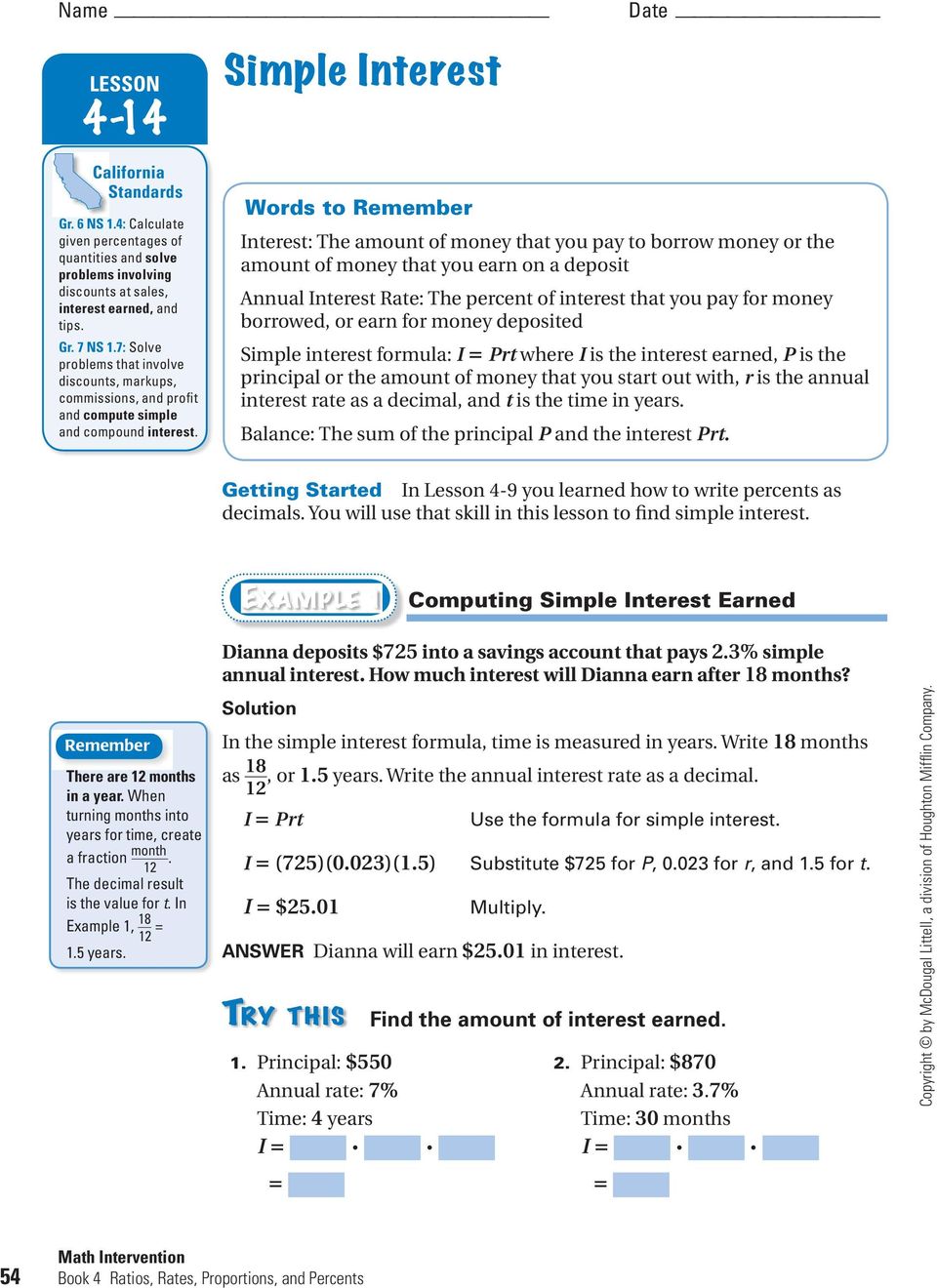
2 LESSON 4-14 California Standards Gr. 6 NS 1.4: Calculate given percentages of quantities and solve problems involving discounts at sales, interest earned, and tips. Gr. 7 NS 1.7: Solve problems that involve discounts, markups, commissions, and profit and compute simple and compound interest. Words to Remember Interest: The amount of money that you pay to borrow money or the amount of money that you earn on a deposit Annual Interest Rate: The percent of interest that you pay for money borrowed, or earn for money deposited Simple interest formula: I 5 Prt where I is the interest earned, P is the principal or the amount of money that you start out with, r is the annual interest rate as a decimal, and t is the time in years. Balance: The sum of the principal P and the interest Prt. Getting Started In Lesson 4-9 you learned how to write percents as decimals. You will use that skill in this lesson to find simple interest. E Computing Simple Interest Earned There are 12 months in a year. When turning months into years for time, create a fraction month }. 12 The decimal result is the value for t. In Example 1, } 18 = years. Dianna deposits $725 into a savings account that pays 2.3% simple annual interest. How much interest will Dianna earn after 18 months? Solution In the simple interest formula, time is measured in years. Write 18 months as 18 } 12, or 1.5 years. Write the annual interest rate as a decimal. I 5 Prt Use the formula for simple interest. I 5 (725)(0.023)(1.5) Substitute $725 for P, for r, and 1.5 for t. I 5 $25.01 Multiply. ANSWER Dianna will earn $25.01 in interest. T Find the amount of interest earned. 1. Principal: $ Principal: $870 Annual rate: 7% Annual rate: 3.7% Time: 4 years Time: 30 months I 5 I
3 E Computing Simple Interest Paid Turn all interest rates into decimals when computing simple interest. Also, remember that time must be expressed in years. Josh borrowed $250 from his mother to buy an electric scooter. Josh will pay her back in 1 year with 3% simple annual interest. How much interest will Josh pay? Solution I 5 Prt Use the formula for simple interest. I 5 (250)(0.03)(1) Substitute $250 for P, 0.03 for r, and 1 for t. I 5 $750 Multiply. ANSWER Josh will pay his mom $7.50 in interest. Balance When an account earns interest, the interest is added to the money in the account. The balance A of an account that earns simple annual interest is the sum of the principal P and the interest Prt. A 5 P 1 Prt E Finding the Balance You deposit $300 in a savings account that pays 4% simple annual interest. Find your account balance after 9 months. Solution Write 9 months as 9 } 12 year, or 0.75 year. A 5 P 1 Prt Write the balance formula (300)(0.04)(0.75) Substitute $300 for P, 0.04 for r, and 0.75 for t Multiply Add. ANSWER Your account balance after 9 months is $309. T Find the amount of interest paid. 3. Principal: $ Principal: $1225 Annual rate: 5.2% Annual rate: 8.3% Time: 2.5 years Time: 42 months 5. You deposit $800 in a savings account that pays 3.2% simple annual interest. Find your account balance after 15 months. 55

4 Summarize Computing Simple Interest Use the formula I 5 Prt where I represents the interest earned or paid, P represents the principal or the amount that you deposit or borrow, r represents the interest rate as a decimal, and t represents the time in years. Finding the Balance Use the formula A 5 P 1 Prt where A represents the sum of the principal and the interest earned. Write the given time period as a fraction of a year months 2. 6 months months months Find the simple interest earned. 5. Principal: $ Principal: $575 Annual rate: 4.3% Annual rate: 2.6% Time: 30 months Time: 3.3 years 7. Principal: $ Principal: $850 Annual rate: 1.9% Annual rate: 5.1% Time: 5 years Time: 54 months Find the simple interest paid. 9. Principal: $ Principal: $2575 Annual rate: 4% Annual rate: 8.2% Time: 3 years Time: 10 years 11. Principal: $ Principal: $600 Annual rate: 5.5% Annual rate: 6.2% Time: 42 months Time: 8 years Find the balance of the account. 13. Principal: $ Principal: $1020 Annual rate: 3% Annual rate: 4.1% Time: 2 years Time: 18 months 15. Principal: $ Principal: $1580 Annual rate: 2.56% Annual rate: 3.75% Time: 15 months Time: 2.5 years 56

5 Write the rate as a decimal. Then find the amount of simple interest. Explain your answer. 17. Anna deposited $460 into a savings account that pays 3.2% simple annual interest. In 5 years, how much interest did Anna earn? 18. Michael borrowed $375 for a new bicycle. He will pay the money back in 18 months with simple interest of 5.7%. How much interest will Michael pay back? 19. Tameka borrowed $300 to buy a digital music player. She will pay the money back in 1 year at 5% simple interest. How much money will Tameka pay in interest? 20. Victor deposited $2350 in a savings account that pays 4.5% simple annual interest. If Victor keeps the money in the account for 30 months, how much interest will he earn? 21. Fill in the missing words. To find simple interest you use the formula I 5 Prt where P stands for, r stands for annual interest rate written as a, and t stands for in years. 22. Find the balance of the account. Belinda deposits $550 in an account that pays 3.7% simple annual interest. If she keeps the money in the account for 2 years, how much will Belinda have in her account after 2 years? 57

6 Answer Key Lesson 4-14, pp Try this: ; 0.07; 4; $ ; 0.037; 2.5; $ $ $ $ Practice: 1. 1 } 3 year 2. 1 } 2 year 3. Sample answer: 7 } 4 or 1 3 } 4 years 4. Sample answer: 8 } 3 or 2 2 } 3 years 5. $ $ $ $ $ $ $ $ $ $ $ $ ; $73.60; Sample answer: ; $32.06; Sample answer: ; $15.00; Sample answer: ; $264.38; Sample answer: principal; decimal; time 22. $590.70

7 LESSON 4-15 California Standards Gr. 7 NS 1.7: Solve problems that involve discounts, markups, commissions, and profit and compute simple and compound interest. Gr. 1/2 MR 2.0: Students solve problems and justify their reasoning. Also included: Gr. 3/4/5 MR 1.2 and Gr. 6/7 MR 1.3; Gr. 3/4/5/6/7 MR 2.2 Words to Remember Compound interest: Interest that is earned on both the principal and any interest that has been earned previously. Compound interest formula: A 5 P(1 1 r) t where A represents the amount of money in the account at the end of the time period, P is the principal, r is the annual interest rate, and t is the time in years. Balance: The sum of the principal and the interest Getting Started In Lesson 4-14 you learned how to find simple interest or the total amount of interest earned or paid over a period of time. In this lesson you will learn how to find compound interest using these methods. E Computing Compound Interest using Simple Interest In step 2, the principal for the second year is the balance of the first year. Simon deposits $400 in an account that pays 3% interest compounded annually. What is the balance of Simon s account at the end of 2 years? Solution Find the balance at the end of the first year. I 5 Prt Use the simple interest formula. 5 (400)(0.03)(1) 5 12 Balance 5 P 1 Prt Use the balance formula The balance at the end of the first year is $412. Find the balance at the end of the second year. I 5 Prt Use the simple interest formula. 5 (412)(0.03)(1) Balance 5 P 1 Prt Use the balance formula ANSWER Simon has $ in his account after 2 years. 58

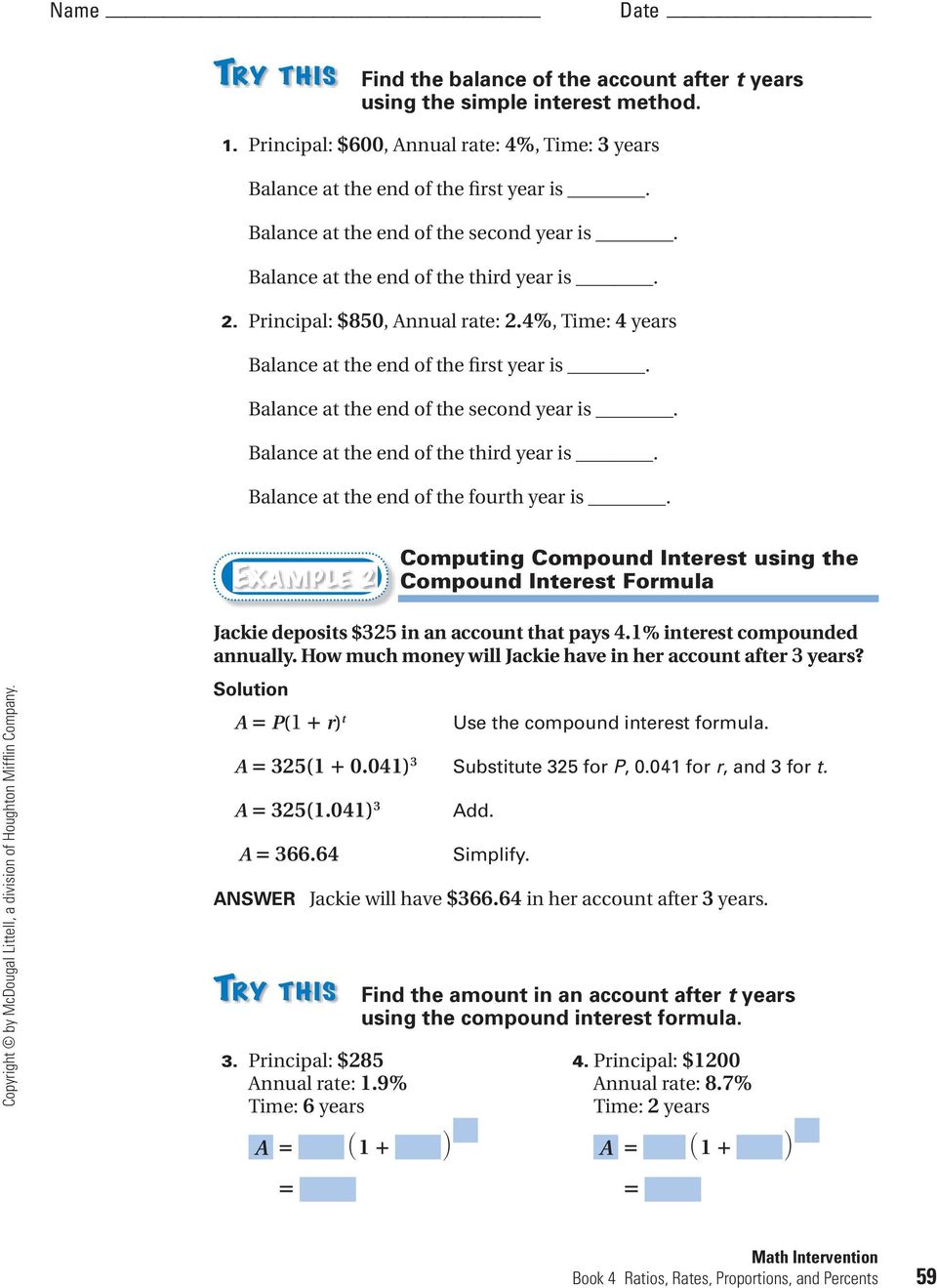
8 T Find the balance of the account after t years using the simple interest method. 1. Principal: $600, Annual rate: 4%, Time: 3 years Balance at the end of the first year is. Balance at the end of the second year is. Balance at the end of the third year is. 2. Principal: $850, Annual rate: 2.4%, Time: 4 years Balance at the end of the first year is. Balance at the end of the second year is. Balance at the end of the third year is. Balance at the end of the fourth year is. E Computing Compound Interest using the Compound Interest Formula Jackie deposits $325 in an account that pays 4.1% interest compounded annually. How much money will Jackie have in her account after 3 years? Solution A 5 P(1 1 r) t Use the compound interest formula. A 5 325( ) 3 Substitute 325 for P, for r, and 3 for t. A 5 325(1.041) 3 A Add. Simplify. ANSWER Jackie will have $ in her account after 3 years. T Find the amount in an account after t years using the compound interest formula. 3. Principal: $ Principal: $1200 Annual rate: 1.9% Annual rate: 8.7% Time: 6 years Time: 2 years A A
9 Summarize Computing Compound Interest using Simple Interest Compute simple interest for 1 year. Add the interest to the principal. This becomes the principal for year 2. Repeat these steps for t years. Computing Compound Interest using the Compound Interest Formula Use the formula A 5 P(1 1 r) t to determine the amount of money in an account after t years. 1. Fill in the missing information to find the balance of the account. Principal: $600, Annual rate: 4%, Time: 3 years The initial principal P is. The interest rate written as a decimal is. The balance for year 1 is. The principal for year 2 is. The balance for year 2 is. The principal for year 3 is. The balance for year 3 is. Find the balance of the account after time t using the simple interest method. 2. $375 at 4% interest compounded annually for 3 years 3. $975 at 8.2% interest compounded annually for 2 years 4. $135 at 2.3% interest compounded annually for 7 years 5. $250 at 3.1% interest compounded annually for 4 years Find the balance of the account after time t using the compound interest formula. 6. $1200 at 2.5% interest compounded annually for 8 years 7. $750 at 4.6% interest compounded annually for 4 years 8. $435 at 1.7% interest compounded annually for 10 years 9. $815 at 5% interest compounded annually for 6.5 years 60

10 In Exercises 12 and 13, how many steps of simple interest need to be performed? Solve the problem. 10. Julio deposits $345 in an account that earns 3.1% interest compounded annually. How much money is in the account after 4 years? 11. Kim deposits $650 in an account that earns 4% interest compounded annually. How much money is in the account after 2 years? 12. Solve the problem using the compound interest formula. Jong deposits $500 in an account that earns 2.5% interest compounded annually and keeps the money in the account for 3 years. Monty deposits $500 in an account that earns 5.1% interest compounded annually and keeps the money in the account for 2 years. Who has more money when he closes his account? Explain your reasoning. 13. Fill in the missing words. Compound interest is interest that is earned on both the and any that has been earned. 14. Use the compound interest formula. Nora deposits $450 in an account that earns 2.4% interest compounded annually. How much money is in the account after 5 years? 61

11 Answer Key Lesson 4-15, pp Try this: 1. $624.00; $648.96; $ $870.40; $891.29; $912.68; $ ; 0.019; 6; $ ; 0.087; 2; $ Practice: 1. $600; 0.04; $624.00; $624.00; $648.96; $648.96; $ $ $ $ $ $ $ $ $ ; $ ; $ Monty; Sample answer: The amount in Jong s account is $538.45, and the amount in Monty s account is $ principal; interest; previously 14. $506.65

Lesson Plan -- Percent of a Number/Increase and Decrease
 Lesson Plan -- Percent of a Number/Increase and Decrease Chapter Resources - Lesson 4-11 Find a Percent of a Number - Lesson 4-11 Find a Percent of a Number Answers - Lesson 4-12 Percent of Increase and
Lesson Plan -- Rational Number Operations
 Lesson Plan -- Rational Number Operations Chapter Resources - Lesson 3-12 Rational Number Operations - Lesson 3-12 Rational Number Operations Answers - Lesson 3-13 Take Rational Numbers to Whole-Number
Percent, Sales Tax, & Discounts
 Percent, Sales Tax, & Discounts Many applications involving percent are based on the following formula: Note that of implies multiplication. Suppose that the local sales tax rate is 7.5% and you purchase
4 Percentages Chapter notes
 4 Percentages Chapter notes GCSE Specification concepts and skills Find a percentage of a quantity (N o): 4. Use percentages to solve problems (N m): 4., 4.2, 4., 4.4 Use percentages in real-life situations:
Percentages. You will need a calculator 20% =
 What is a percentage? Percentage just means parts per hundred, for example 20% stands for 20 parts per hundred. 20% is a short way of writing 20 over a hundred. When using a percentage in a calculation
$496. 80. Example If you can earn 6% interest, what lump sum must be deposited now so that its value will be $3500 after 9 months?
 Simple Interest, Compound Interest, and Effective Yield Simple Interest The formula that gives the amount of simple interest (also known as add-on interest) owed on a Principal P (also known as present
Sequences. A sequence is a list of numbers, or a pattern, which obeys a rule.
 Sequences A sequence is a list of numbers, or a pattern, which obeys a rule. Each number in a sequence is called a term. ie the fourth term of the sequence 2, 4, 6, 8, 10, 12... is 8, because it is the
5.1 Simple and Compound Interest
 5.1 Simple and Compound Interest Question 1: What is simple interest? Question 2: What is compound interest? Question 3: What is an effective interest rate? Question 4: What is continuous compound interest?
Lesson Plan -- Integers, Opposites, Absolute Value
 Lesson Plan -- Integers, Opposites, Absolute Value Chapter Resources - Lesson 3-1 Integers and the Number Line - Lesson 3-1 Integers and the Number Line Answers - Lesson 3-2 Opposites and Absolute Value
Compounding Quarterly, Monthly, and Daily
 126 Compounding Quarterly, Monthly, and Daily So far, you have been compounding interest annually, which means the interest is added once per year. However, you will want to add the interest quarterly,
With compound interest you earn an additional $128.89 ($1628.89 - $1500).
 Compound Interest Interest is the amount you receive for lending money (making an investment) or the fee you pay for borrowing money. Compound interest is interest that is calculated using both the principle
Comparing Simple and Compound Interest
 Comparing Simple and Compound Interest GRADE 11 In this lesson, students compare various savings and investment vehicles by calculating simple and compound interest. Prerequisite knowledge: Students should
Personal Financial Literacy
 Personal Financial Literacy 7 Unit Overview Being financially literate means taking responsibility for learning how to manage your money. In this unit, you will learn about banking services that can help
Review Page 468 #1,3,5,7,9,10
 MAP4C Financial Student Checklist Topic/Goal Task Prerequisite Skills Simple & Compound Interest Video Lesson Part Video Lesson Part Worksheet (pages) Present Value Goal: I will use the present value formula
MGF 1107 Spring 11 Ref: 606977 Review for Exam 2. Write as a percent. 1) 3.1 1) Write as a decimal. 4) 60% 4) 5) 0.085% 5)
 MGF 1107 Spring 11 Ref: 606977 Review for Exam 2 Mr. Guillen Exam 2 will be on 03/02/11 and covers the following sections: 8.1, 8.2, 8.3, 8.4, 8.5, 8.6. Write as a percent. 1) 3.1 1) 2) 1 8 2) 3) 7 4 3)
Unit 7 The Number System: Multiplying and Dividing Integers
 Unit 7 The Number System: Multiplying and Dividing Integers Introduction In this unit, students will multiply and divide integers, and multiply positive and negative fractions by integers. Students will
21.1 Arithmetic Growth and Simple Interest
 21.1 Arithmetic Growth and Simple Interest When you open a savings account, your primary concerns are the safety and growth of your savings. Suppose you deposit $1000 in an account that pays interest at
What You ll Learn. And Why. Key Words. interest simple interest principal amount compound interest compounding period present value future value
 What You ll Learn To solve problems involving compound interest and to research and compare various savings and investment options And Why Knowing how to save and invest the money you earn will help you
MAT12X Intermediate Algebra
 MAT12X Intermediate Algebra Workshop I - Exponential Functions LEARNING CENTER Overview Workshop I Exponential Functions of the form y = ab x Properties of the increasing and decreasing exponential functions
Financial Mathematics
 Financial Mathematics For the next few weeks we will study the mathematics of finance. Apart from basic arithmetic, financial mathematics is probably the most practical math you will learn. practical in
TIME VALUE OF MONEY PROBLEM #7: MORTGAGE AMORTIZATION
 TIME VALUE OF MONEY PROBLEM #7: MORTGAGE AMORTIZATION Professor Peter Harris Mathematics by Sharon Petrushka Introduction This problem will focus on calculating mortgage payments. Knowledge of Time Value
Math and FUNDRAISING. Ex. 73, p. 111 1.3 0. 7
 Standards Preparation Connect 2.7 KEY VOCABULARY leading digit compatible numbers For an interactive example of multiplying decimals go to classzone.com. Multiplying and Dividing Decimals Gr. 5 NS 2.1
Lecture Notes on MONEY, BANKING, AND FINANCIAL MARKETS. Peter N. Ireland Department of Economics Boston College. [email protected]
 Lecture Notes on MONEY, BANKING, AND FINANCIAL MARKETS Peter N. Ireland Department of Economics Boston College [email protected] http://www2.bc.edu/~irelandp/ec261.html Chapter 16: Determinants of the Money
Algebra Word Problems
 WORKPLACE LINK: Nancy works at a clothing store. A customer wants to know the original price of a pair of slacks that are now on sale for 40% off. The sale price is $6.50. Nancy knows that 40% of the original
Regular Annuities: Determining Present Value
 8.6 Regular Annuities: Determining Present Value GOAL Find the present value when payments or deposits are made at regular intervals. LEARN ABOUT the Math Harry has money in an account that pays 9%/a compounded
2. In solving percent problems with a proportion, use the following pattern:
 HFCC Learning Lab PERCENT WORD PROBLEMS Arithmetic - 11 Many percent problems can be solved using a proportion. In order to use this method, you should be familiar with the following ideas about percent:
3.3 Addition and Subtraction of Rational Numbers
 3.3 Addition and Subtraction of Rational Numbers In this section we consider addition and subtraction of both fractions and decimals. We start with addition and subtraction of fractions with the same denominator.
C:\Documents and Settings\tracey_hbutters\Desktop\mathematics\year_levels\math_stage6\General\hsc\financial_maths\financial5\annuities_loan_repa
 Annuities and Loan Repayments H General Maths HSC NAME: 1 HSC CAPACITY MATRIX GENERAL MATHEMATICS TOPIC: Financial Mathematics 5 Annuities & loan repayments 3 weeks AM1 rn1 CONTENT CAPACITY BREAKDOWN!
3.2 Matrix Multiplication
 3.2 Matrix Multiplication Question : How do you multiply two matrices? Question 2: How do you interpret the entries in a product of two matrices? When you add or subtract two matrices, you add or subtract
Singapore Math Bar Model Strategy
 Singapore Math Bar Model Strategy Bill Jackson Scarsdale Public Schools [email protected] This presentation cannot be copied or used without the consent of the author. Part-Whole Model for
Chapter 2 Finance Matters
 Chapter 2 Finance Matters Chapter 2 Finance Matters 2.1 Pe r c e n t s 2.2 Simple and Compound Interest 2.3 Credit Cards 2.4 Annuities and Loans Chapter Summary Chapter Review Chapter Test Handling personal
Section 8.1. I. Percent per hundred
 1 Section 8.1 I. Percent per hundred a. Fractions to Percents: 1. Write the fraction as an improper fraction 2. Divide the numerator by the denominator 3. Multiply by 100 (Move the decimal two times Right)
Solving Equations by the Multiplication Property
 2.2 Solving Equations by the Multiplication Property 2.2 OBJECTIVES 1. Determine whether a given number is a solution for an equation 2. Use the multiplication property to solve equations. Find the mean
The Distributive Property
 The Distributive Property Objectives To recognize the general patterns used to write the distributive property; and to mentally compute products using distributive strategies. www.everydaymathonline.com
14 ARITHMETIC OF FINANCE
 4 ARITHMETI OF FINANE Introduction Definitions Present Value of a Future Amount Perpetuity - Growing Perpetuity Annuities ompounding Agreement ontinuous ompounding - Lump Sum - Annuity ompounding Magic?
Solution Guide Chapter 14 Mixing Fractions, Decimals, and Percents Together
 Solution Guide Chapter 4 Mixing Fractions, Decimals, and Percents Together Doing the Math from p. 80 2. 0.72 9 =? 0.08 To change it to decimal, we can tip it over and divide: 9 0.72 To make 0.72 into a
Ch 3 Understanding money management
 Ch 3 Understanding money management 1. nominal & effective interest rates 2. equivalence calculations using effective interest rates 3. debt management If payments occur more frequently than annual, how
Maths Workshop for Parents 2. Fractions and Algebra
 Maths Workshop for Parents 2 Fractions and Algebra What is a fraction? A fraction is a part of a whole. There are two numbers to every fraction: 2 7 Numerator Denominator 2 7 This is a proper (or common)
Time Value of Money, Part 4 Future Value aueof An Annuity. Learning Outcomes. Future Value
 Time Value of Money, Part 4 Future Value aueof An Annuity Intermediate Accounting I Dr. Chula King 1 Learning Outcomes The concept of future value Future value of an annuity Ordinary annuity versus annuity
What s the Cost of Spending and Saving?
 LESSON DESCRIPTION AND BACKGROUND This lesson examines the benefits and opportunity cost of spending and saving. The students learn how compound interest makes savings grow. Compounding provides an incentive
Chapter 1 The Measurement of Interest
 Interest: the compensation that a borrower of capital pays to a lender of capital for its use. It can be viewed as a form of rent that the borrower pays to the lender to compensate for the loss of use
9.2 Summation Notation
 9. Summation Notation 66 9. Summation Notation In the previous section, we introduced sequences and now we shall present notation and theorems concerning the sum of terms of a sequence. We begin with a
Consumer Math 15 INDEPENDENT LEAR NING S INC E 1975. Consumer Math
 Consumer Math 15 INDEPENDENT LEAR NING S INC E 1975 Consumer Math Consumer Math ENROLLED STUDENTS ONLY This course is designed for the student who is challenged by abstract forms of higher This math. course
International Financial Strategies Time Value of Money
 International Financial Strategies 1 Future Value and Compounding Future value = cash value of the investment at some point in the future Investing for single period: FV. Future Value PV. Present Value
7 Literal Equations and
 CHAPTER 7 Literal Equations and Inequalities Chapter Outline 7.1 LITERAL EQUATIONS 7.2 INEQUALITIES 7.3 INEQUALITIES USING MULTIPLICATION AND DIVISION 7.4 MULTI-STEP INEQUALITIES 113 7.1. Literal Equations
SOCIETY OF ACTUARIES/CASUALTY ACTUARIAL SOCIETY EXAM FM SAMPLE QUESTIONS
 SOCIETY OF ACTUARIES/CASUALTY ACTUARIAL SOCIETY EXAM FM FINANCIAL MATHEMATICS EXAM FM SAMPLE QUESTIONS Copyright 2005 by the Society of Actuaries and the Casualty Actuarial Society Some of the questions
ICASL - Business School Programme
 ICASL - Business School Programme Quantitative Techniques for Business (Module 3) Financial Mathematics TUTORIAL 2A This chapter deals with problems related to investing money or capital in a business
3.4 Multiplication and Division of Rational Numbers
 3.4 Multiplication and Division of Rational Numbers We now turn our attention to multiplication and division with both fractions and decimals. Consider the multiplication problem: 8 12 2 One approach is
Lesson 1: Fractions, Decimals and Percents
 Lesson 1: Fractions, Decimals and Percents Selected Content Standards Benchmarks Addressed: N-2-H Demonstrating that a number can be expressed in many forms, and selecting an appropriate form for a given
2) Based on the information in the table which choice BEST shows the answer to 1 906? 906 899 904 909
 0 0 0 0 0 0 0 0 0 0 0 0 0 0 0 ) Multiplying a number by results in what type of. even. 0. even.,0. odd..,0. even ) Based on the information in the table which choice BEST shows the answer to 0? 0 0 0 )
CARMEN VENTER COPYRIGHT www.futurefinance.co.za 0828807192 1
 Carmen Venter CFP WORKSHOPS FINANCIAL CALCULATIONS presented by Geoff Brittain Q 5.3.1 Calculate the capital required at retirement to meet Makhensa s retirement goals. (5) 5.3.2 Calculate the capital
Annuities and loan. repayments. In this chapter. syllabusreference. Financial mathematics 5 Annuities and loan. repayments
 Annuities and loan repayments 8 syllabusreference Financial mathematics 5 Annuities and loan repayments In this chapter 8A 8B 8C 8D Future value of an annuity Present value of an annuity Future and present
3.1. Solving linear equations. Introduction. Prerequisites. Learning Outcomes. Learning Style
 Solving linear equations 3.1 Introduction Many problems in engineering reduce to the solution of an equation or a set of equations. An equation is a type of mathematical expression which contains one or
6-3 Solving Systems by Elimination
 Warm Up Simplify each expression. 1. 2y 4x 2(4y 2x) 2. 5(x y) + 2x + 5y Write the least common multiple. 3. 3 and 6 4. 4 and 10 5. 6 and 8 Objectives Solve systems of linear equations in two variables
CHAPTER 1. Compound Interest
 CHAPTER 1 Compound Interest 1. Compound Interest The simplest example of interest is a loan agreement two children might make: I will lend you a dollar, but every day you keep it, you owe me one more penny.
Three Types of Percent Problems
 6.4 Three Types of Percent Problems 6.4 OBJECTIVES. Find the unknown amount in a percent problem 2. Find the unknown rate in a percent problem 3. Find the unknown base in a percent problem From your work
Lesson Plan. N.RN.3: Use properties of rational and irrational numbers.
 N.RN.3: Use properties of rational irrational numbers. N.RN.3: Use Properties of Rational Irrational Numbers Use properties of rational irrational numbers. 3. Explain why the sum or product of two rational
Chapter 6. Time Value of Money Concepts. Simple Interest 6-1. Interest amount = P i n. Assume you invest $1,000 at 6% simple interest for 3 years.
 6-1 Chapter 6 Time Value of Money Concepts 6-2 Time Value of Money Interest is the rent paid for the use of money over time. That s right! A dollar today is more valuable than a dollar to be received in
Session 7 Fractions and Decimals
 Key Terms in This Session Session 7 Fractions and Decimals Previously Introduced prime number rational numbers New in This Session period repeating decimal terminating decimal Introduction In this session,
Investigating Investment Formulas Using Recursion Grade 11
 Ohio Standards Connection Patterns, Functions and Algebra Benchmark C Use recursive functions to model and solve problems; e.g., home mortgages, annuities. Indicator 1 Identify and describe problem situations
HFCC Math Lab Arithmetic - 4. Addition, Subtraction, Multiplication and Division of Mixed Numbers
 HFCC Math Lab Arithmetic - Addition, Subtraction, Multiplication and Division of Mixed Numbers Part I: Addition and Subtraction of Mixed Numbers There are two ways of adding and subtracting mixed numbers.
DATE PERIOD. Estimate the product of a decimal and a whole number by rounding the Estimation
 A Multiplying Decimals by Whole Numbers (pages 135 138) When you multiply a decimal by a whole number, you can estimate to find where to put the decimal point in the product. You can also place the decimal
GEOMETRIC SEQUENCES AND SERIES
 4.4 Geometric Sequences and Series (4 7) 757 of a novel and every day thereafter increase their daily reading by two pages. If his students follow this suggestion, then how many pages will they read during
LESSON 5 - DECIMALS INTRODUCTION
 LESSON 5 - DECIMALS INTRODUCTION Now that we know something about whole numbers and fractions, we will begin working with types of numbers that are extensions of whole numbers and related to fractions.
EXPONENTIAL FUNCTIONS 8.1.1 8.1.6
 EXPONENTIAL FUNCTIONS 8.1.1 8.1.6 In these sections, students generalize what they have learned about geometric sequences to investigate exponential functions. Students study exponential functions of the
Sixth Grade Problem Solving Tasks Weekly Enrichments Teacher Materials. Summer Dreamers 2013
 Sixth Grade Problem Solving Tasks Weekly Enrichments Teacher Materials Summer Dreamers 2013 SOLVING MATH PROBLEMS KEY QUESTIONS WEEK 1 By the end of this lesson, students should be able to answer these
CHAPTER 6 Accounting and the Time Value of Money
 CHAPTER 6 Accounting and the Time Value of Money 6-1 LECTURE OUTLINE This chapter can be covered in two to three class sessions. Most students have had previous exposure to single sum problems and ordinary
Chapter 6: Measuring the Price Level and Inflation. The Price Level and Inflation. Connection between money and prices. Index Numbers in General
 Chapter 6: The Price Level and Measuring the Price Level and Microeconomic causes changes in individual markets can explain only a tiny fraction of price change For the most part, price rises came about
For additional information, see the Math Notes boxes in Lesson B.1.3 and B.2.3.
 EXPONENTIAL FUNCTIONS B.1.1 B.1.6 In these sections, students generalize what they have learned about geometric sequences to investigate exponential functions. Students study exponential functions of the
From the Webisode: Math Meets Fashion
 lesson CCSS CONNECTIONS Percent Markups From the Webisode: Math Meets Fashion In this lesson, s solve a multi-step problem by identifying percent markups of a whole and calculating a final sale price.
Algebraic expressions are a combination of numbers and variables. Here are examples of some basic algebraic expressions.
 Page 1 of 13 Review of Linear Expressions and Equations Skills involving linear equations can be divided into the following groups: Simplifying algebraic expressions. Linear expressions. Solving linear
Lecture Notes on MONEY, BANKING, AND FINANCIAL MARKETS. Peter N. Ireland Department of Economics Boston College. [email protected]
 Lecture Notes on MONEY, BANKING, AND FINANCIAL MARKETS Peter N. Ireland Department of Economics Boston College [email protected] http://www2.bc.edu/~irelandp/ec261.html Chapter 15a: Introduction to the Money
Recall the process used for adding decimal numbers. 1. Place the numbers to be added in vertical format, aligning the decimal points.
 2 MODULE 4. DECIMALS 4a Decimal Arithmetic Adding Decimals Recall the process used for adding decimal numbers. Adding Decimals. To add decimal numbers, proceed as follows: 1. Place the numbers to be added
MTH 150 SURVEY OF MATHEMATICS. Chapter 11 CONSUMER MATHEMATICS
 Your name: Your section: MTH 150 SURVEY OF MATHEMATICS Chapter 11 CONSUMER MATHEMATICS 11.1 Percent 11.2 Personal Loans and Simple Interest 11.3 Personal Loans and Compound Interest 11.4 Installment Buying
Using a Scientific Calculator
 1 Using a Scientific Calculator In this course, we will be using a scientific calculator to do all of our computations. So, in this section, we want to get use to some of the features of a scientific calculator.
Finance CHAPTER OUTLINE. 5.1 Interest 5.2 Compound Interest 5.3 Annuities; Sinking Funds 5.4 Present Value of an Annuity; Amortization
 CHAPTER 5 Finance OUTLINE Even though you re in college now, at some time, probably not too far in the future, you will be thinking of buying a house. And, unless you ve won the lottery, you will need
Section 6C Commission, Interest, Tax, Markup and Discount
 Section 6C Commission, Interest, Tax, Markup and Discount In the last section, we looked at percent conversions and solving simple percent problems with a proportion. We are now going to look at some more
Chapter Two. THE TIME VALUE OF MONEY Conventions & Definitions
 Chapter Two THE TIME VALUE OF MONEY Conventions & Definitions Introduction Now, we are going to learn one of the most important topics in finance, that is, the time value of money. Note that almost every
Simple vs. True. Simple vs. True. Calculating Empirical and Molecular Formulas
 Calculating Empirical and Molecular Formulas Formula writing is a key component for success in chemistry. How do scientists really know what the true formula for a compound might be? In this lesson we
Time Value of Money. 2014 Level I Quantitative Methods. IFT Notes for the CFA exam
 Time Value of Money 2014 Level I Quantitative Methods IFT Notes for the CFA exam Contents 1. Introduction...2 2. Interest Rates: Interpretation...2 3. The Future Value of a Single Cash Flow...4 4. The
Also, compositions of an exponential function with another function are also referred to as exponential. An example would be f(x) = 4 + 100 3-2x.
 Exponential Functions Exponential functions are perhaps the most important class of functions in mathematics. We use this type of function to calculate interest on investments, growth and decline rates
Session 29 Scientific Notation and Laws of Exponents. If you have ever taken a Chemistry class, you may have encountered the following numbers:
 Session 9 Scientific Notation and Laws of Exponents If you have ever taken a Chemistry class, you may have encountered the following numbers: There are approximately 60,4,79,00,000,000,000,000 molecules
Solving Rational Equations
 Lesson M Lesson : Student Outcomes Students solve rational equations, monitoring for the creation of extraneous solutions. Lesson Notes In the preceding lessons, students learned to add, subtract, multiply,
Topics Covered. Compounding and Discounting Single Sums. Ch. 4 - The Time Value of Money. The Time Value of Money
 Ch. 4 - The Time Value of Money Topics Covered Future Values Present Values Multiple Cash Flows Perpetuities and Annuities Effective Annual Interest Rate For now, we will omit the section 4.5 on inflation
To learn the proper method for conducting and analyzing a laboratory experiment. To determine the value of pi.
 Name Date Regents Physics Lab #3R Period Mrs. Nadworny Partners: (1 pt) Circumference vs. Diameter Due Date Purpose To learn the proper method for conducting and analyzing a laboratory experiment. To determine
Chapter. Percentage. Contents:
 Chapter 3 Percentage Contents: A B C D E F G H Percentage The unitary method in percentage Finding a percentage of a quantity Percentage increase and decrease Percentage change using a multiplier Finding
Algebra I Teacher Notes Expressions, Equations, and Formulas Review
 Big Ideas Write and evaluate algebraic expressions Use expressions to write equations and inequalities Solve equations Represent functions as verbal rules, equations, tables and graphs Review these concepts
Prentice Hall: Middle School Math, Course 1 2002 Correlated to: New York Mathematics Learning Standards (Intermediate)
 New York Mathematics Learning Standards (Intermediate) Mathematical Reasoning Key Idea: Students use MATHEMATICAL REASONING to analyze mathematical situations, make conjectures, gather evidence, and construct
Calculating profitability indicators - profitability
 Calculating profitability indicators - profitability Introduction When a business is deciding whether to grant credit to a potential customer, or whether to continue to grant credit terms to an existing
Time Value of Money Practice Questions Irfanullah.co
 1. You are trying to estimate the required rate of return for a particular investment. Which of the following premiums are you least likely to consider? A. Inflation premium B. Maturity premium C. Nominal
Solutions of Linear Equations in One Variable
 2. Solutions of Linear Equations in One Variable 2. OBJECTIVES. Identify a linear equation 2. Combine like terms to solve an equation We begin this chapter by considering one of the most important tools
first complete "prior knowlegde" -- to refresh knowledge of Simple and Compound Interest.
 ORDINARY SIMPLE ANNUITIES first complete "prior knowlegde" -- to refresh knowledge of Simple and Compound Interest. LESSON OBJECTIVES: students will learn how to determine the Accumulated Value of Regular
Using Credit. SSEPF4.a, SSEPF4.b, SSEPF4.c
 Using Credit SSEPF4.a, SSEPF4.b, SSEPF4.c Loans and Credit Cards: Buy Now, Pay Later The U.S. economy runs on credit. Credit The ability to obtain goods now, based on an agreement to pay for them later.
Chapter 5. Decimals. Use the calculator.
 Chapter 5. Decimals 5.1 An Introduction to the Decimals 5.2 Adding and Subtracting Decimals 5.3 Multiplying Decimals 5.4 Dividing Decimals 5.5 Fractions and Decimals 5.6 Square Roots 5.7 Solving Equations
8-6 Radical Expressions and Rational Exponents. Warm Up Lesson Presentation Lesson Quiz
 8-6 Radical Expressions and Rational Exponents Warm Up Lesson Presentation Lesson Quiz Holt Algebra ALgebra2 2 Warm Up Simplify each expression. 1. 7 3 7 2 16,807 2. 11 8 11 6 121 3. (3 2 ) 3 729 4. 5.
Counting Money and Making Change Grade Two
 Ohio Standards Connection Number, Number Sense and Operations Benchmark D Determine the value of a collection of coins and dollar bills. Indicator 4 Represent and write the value of money using the sign
COMPOUND INTEREST AND ANNUITY TABLES
 COMPOUND INTEREST AND ANNUITY TABLES COMPOUND INTEREST AND ANNUITY TABLES 8 Percent VALUE OF AN NO. OF PRESENT PRESENT VALUE OF AN COM- AMORTIZ ANNUITY - ONE PER YEARS VALUE OF ANNUITY POUND ATION YEAR
Solving Compound Interest Problems
 Solving Compound Interest Problems What is Compound Interest? If you walk into a bank and open up a savings account you will earn interest on the money you deposit in the bank. If the interest is calculated
Six Functions of a Dollar. Made Easy! Business Statistics AJ Nelson 8/27/2011 1
 Six Functions of a Dollar Made Easy! Business Statistics AJ Nelson 8/27/2011 1 Six Functions of a Dollar Here's a list. Simple Interest Future Value using Compound Interest Present Value Future Value of
Contents. Subtraction (Taking Away)... 6. Multiplication... 7 by a single digit. by a two digit number by 10, 100 or 1000
 This booklet outlines the methods we teach pupils for place value, times tables, addition, subtraction, multiplication, division, fractions, decimals, percentages, negative numbers and basic algebra Any