
MODULE 5: EFFECTIVE SUPERVISION : OUTLINE
|
|
|
- Hector Dean
- 9 years ago
- Views:
Transcription
1 Field Instructor Training Program: From Practitioner to Educator MODULE 5: EFFECTIVE SUPERVISION : OUTLINE Competency Objectives: 1) Define the elements of effective field supervision; 2) Identify strategies to incorporate these elements into the supervision of students; 3) Describe the elements of an effective supervisory conference. Module Outline: A. Welcome and Introductions. B. Review of Learning Objectives C. Solicit Examples of Student Challenges for Supervision D. ACTIVITY: SUPERVISORY QUIZ E. Elements of Effective Supervision Rationale for Supervision Training Characteristics NOT Associated with Effective Supervision Elements of Effective Supervision ACTIVITY: MAKING THE ELEMENTS OF SUPERVISION A REALITY F. The Supervisory Conference What Students Want During Supervisory Conferences DISCUSSION G. Ineffective Supervisory Behaviors DISCUSSION H. Areas and Stages of Supervision Review: PHASES of SUPERVISION ACTIVITY Handouts: 5A: SUPERVISORY QUIZ ACTIVITY Handouts 5B 5E: MAKING THE ELEMENTS OF SUPERVISION A REALITY 5B: Agency Elements 5C: Tasks and Assignments 5D: Supervisory Skills 5E: The Supervision Meetings Supplemental Materials: Handout 5F: SUPERVISION NOTES Handout 5G: STAGES OF SUPERVISION

2 Field Instructor Training: From Practitioner to Educator MODULE 5: Effective Field Supervision Dettlaff, Alan J. (2003). From Mission to Evaluation: A Field Instructor Training Manual (CSWE: Alexandria, VA). Competency Objectives: 1) Define the elements of effective field supervision; 2) Identify strategies to incorporate these elements into the supervision of students; 3) Describe the elements of an effective supervisory conference. I. Elements of Effective Field Education Why do field instructors need to know about effective supervision methods? Much empirical research has been conducted on field supervision, particularly concerning student satisfaction with the field experience and the behaviors of field instructors that influence this satisfaction, both positively and negatively; Research indicates that the quality of the field instruction is the most significant factor affecting the satisfaction with the field placement (Fortune & Abramson, 1993). Since field instructors are busy, even small changes can make a difference in effectiveness. Many of the elements discussed in this session involve only small changes. Characteristics NOT Associated with Effective Field Education Research has indicated which characteristics are and are not associated with effective field instructors (Fortune & Abramson, 1993; Knight, 1996). Those NOT associated: Age Race Gender Experience in social work Educational status Years of experience as a field instructor Position in the agency This information suggests that it is only the quality of supervision provided that influences students perceptions of their field instructor, rather than the field instructor s personal characteristics (Knight, 1996). Effective Supervision, Handout5G, updated 10/22/08 1

3 CASE EXAMPLE: Solicit one or two examples about student learning situations that the participant would like input from the instructors and workshop participants. Trainers should be prepared with their own case example if none are shared. Refer to examples during presentation to show application of material to real-life settings. ACTIVITY: SUPERVISION QUIZ Objective: To identify the topics currently addressed by participants in supervision sessions. Access Handout 5A: Supervision Quiz Instructions: This quiz is for participant information only and will not be shared with the group. It is designed to introduce the topic of essential elements of the supervisory conference. Participants are to write down areas currently discussed with students during supervision sessions, or areas the participant covers with their own supervisor (if no current or previous student). After everyone is finished, the next sections will discuss the topics students want to address during their supervisory sessions. Elements of Effective Supervision The components of effective field supervision can be divided into four categories: The agency Tasks and assignments Supervisory skills Supervision meetings 1. Elements Related to the Agency Making the student feel desired by the agency Including the student in agency functions and activities Treating the student like a professional Helping the student learn about the agency 2. Elements Related to Tasks and Assignments Clarifying the purpose of assignments Providing detailed directions and instructions Working with the student to complete tasks Regularly reviewing the student s workload Providing a variety of learning activities Clarifying expectations for the student s performance Providing early opportunities for client contact 3. Elements Related to Supervisory Skills Explaining your role and the role of the student Encouraging discussion of the student s concerns Effective Supervision, Handout5G, updated 10/22/08 2

4 Helping the student link theory to practice Providing clear and consistent feedback Validating the student s feelings Reassuring students they can succeed Demonstrating that the student is valued as a person and as a colleague 4. Elements Related to Supervision Meetings Holding regularly scheduled supervision meetings Being available outside of regular supervision times Providing a thorough discussion of the student s learning needs Reviewing and analyzing the student s cases or projects Providing consistent supervision throughout the placement (Adapted from Ellison, 1994; Fortune & Abramson, 1993; Fortune et al, 2001; Gray, Alperin & Wik, 1989; Knight, 1996; Lazar & Eiskovits, 1997). ACTIVITY: MAKING THE ELEMENTS OF EFFECTIVE SUPERVISION A REALITY Objective: To identify strategies for incorporating the elements of effective supervision into practice and to share these strategies with other participants. Instructions for groups or online discussion: Divide into four groups or respond to bulletin board questions Access handouts 5B-5E Each group is assigned one of the four content areas about supervision. Discuss specific ways or techniques that you use or can use to make these elements of effective supervision a reality in your agency. Identify a spokesperson to share the techniques they identified with the larger group. II. The Supervisory Conference The supervisory conference is crucial to the success of the field placement. Research indicates that students want consistent and regularly scheduled supervision sessions throughout the field placement (Fortune & Abramson, 1993; Gray et al., 1989; Knight, 2001); Research also indicates that there are specific topics that students want to discuss during their supervision (Gray et al., 1989). What Do Students Want to Discuss During Supervision Meetings? Research indicates that, during supervision sessions, elements associated with student satisfaction are primarily issues concerning students practice experience (Gray et al., 1989). These topics include: Practice skills used by students; Effective Supervision, Handout5G, updated 10/22/08 3

5 Cases, clients, and projects; Ongoing performance issues; Personal strengths, limitations, and areas for growth Topics NOT Associated with Satisfaction: Community issues Career plans Administrative issues Agency gossip What Can We Learn From This? Students want direct and practical information that is going to help them become ethical and effective social workers; Students want dedicated time with their supervisor to focus on their practice issues. Though students may want to discuss issues such as career plans with their field instructor, research (Gray et. Al, 1989) suggests that students do not want to discuss these issues during supervision sessions. Students want this time with their field instructor to focus on their practice, their work in the field, and areas that need improvement. DISCUSSION Participants are invited to discuss their results from the Supervision Quiz and responses to information provided. Feedback and comments on learning, surprises, challenges, and potential solutions are helpful. HANDOUT: SUPERVISION NOTES Access / distribute Handout 5F Instructions: This is an example of a format that can be used during supervisory sessions to ensure that you are addressing the essential elements of the supervisory conference. Invite participants to share other useful formats. Time permitting, elicit other formats from participants. III. Ineffective Supervisory Behaviors Research has also identified elements of supervision that are not effective (Ellison, 1994) and should be avoided. Supervision that is too directive -- students are not given opportunities to practice skills on their own or learning opportunities are limited; Lack of monitoring failure to monitor the student s workload or failure to make arrangements for supervision during the field instructor s absence; Effective Supervision, Handout5G, updated 10/22/08 4

6 Inappropriate use of the student assigning tasks that do not meet the learning needs of the student or assigning tasks that are too difficult or too easy; Inadequate supervisory contact meeting infrequently or allowing too little time to meet; Lack of information failure to provide students with necessary information or instructions; failure to provide adequate feedback concerning their performance DISCUSSION Participants are invited to discuss their experiences providing supervision in which some of these factors have been an issue and to share what they have learned from these experiences. IV. Interactional Supervision Shulman (1993) emphasizes the need for instructors to recognize that there are three areas for supervision and phases of supervision in which different tasks and processes need to occur. Supervisors who insure that all areas Three Areas for Supervision: Administrative: Tasks, requirements, policies and procedures, accountability, etc. Educational: Linkage of tasks to classroom theory, applying theory to practice Personal Development: Attention to growth of insight, judgment, self-awareness, etc. While each area is addressed throughout field education, the emphasis will be different as students orient, train, begin their tasks, evaluate their progress, and reassess their activities. ACTIVITY: ACCESS HANDOUT 5G: Phases of Supervision Review with participants and solicit examples of effective student supervision in each phase. Phases of Supervision I. Preliminary Phase: Tuning In Instructors need to assist students in understanding the supervisory relationship and expectations, and in negotiating ways to approach supervision. Critical in the initial discussions of the supervisory relationship, this phase also begins each supervisory session. Personal preparation for sessions (feelings, issues, concerns) Flexibility necessary to reassess needs every time; Responding to direct and indirect cues of self and others; Prioritizing needs, setting agendas. II. Beginning Phase: Contracting Critical to a successful internship is clarity about roles, expectations, the vision of the practicum of both student and instructor, and attention to how each is communicating and understanding the scope of the practicum and supervisory relationship. Instructors should insure that students are involved in setting the Learning Contract and negotiating a professional and mutually Effective Supervision, Handout5G, updated 10/22/08 5

7 satisfying experience that leads to a positive learning environment. Students need mentoring in order to understand how instructors and other staff navigate complex systems. Purpose and role of supervision; supervisor s and supervisee responsibilities; Learning about organizational mission, priorities, procedures, populations; Authority and how power is utilized; consequences of breach of protocols; Questions of limits and boundaries, wiggle room/flexibility vs. clear borders; Perceptions of obligations, expectations, esp. re help needed and offered; Job descriptions, staging and sequencing of learning; others to be involved; Use of language: avoiding stereotypes, jargon but professional terminologies; Discovering and building on strengths; agreeing on areas for growth; Learning new skills, unlearning unhelpful old behavior or ways of working. III. Middle Phase: Working In this stage, students are building and applying new skills through the assignment of activities related to their learning objectives, practicum requirements, and agency need. Students need instruction, monitoring and review to insure that their competencies are progressing and that they are meeting expectations for effective and ethical practice. Students also need feedback as to areas of strength and need for growth, and opportunity to express and integrate their emotions, concerns, and reflections in relation to their practice. Building empathic skills and relationships; Learning how to articulate and elaborate re client, organization, system, self; Improving skills in self-awareness and self-disclosure re deeper learning; Identifying obstacles to successful completion of tasks and processes; Learning how data is used to evaluate practice and inform organization; Reviewing theoretical knowledge as it informs practice; Moving from the general to the specific, and the specific to the general; Containment of anxiety and negative feelings in service of the client; Understanding the change process and the parallel process (mirroring clients); Challenging illusions, issues with authority, deepening the work; Evaluating, summarizing, identifying next steps. IV. End Phase: Termination As students approach the end of each quarter, particularly in the final quarter of their practicum, Instructors should include ample opportunity for review and reflection, including planning for subsequent quarters or ongoing learning in new settings. Reviewing assumptions and realities about teaching and learning; Reviewing progress and performance; Clarifying skills development and abilities; Clarifying processes for transitioning clients; Saying goodbyes and modeling healthy exits/transitions; Evaluations, future learning goals, and positive reinforcement; Celebrations and rituals to mark milestones. DISCUSSION Solicit final comments, examples, and questions about effective supervision. Effective Supervision, Handout5G, updated 10/22/08 6

8 Field Instructor Training Program: From Practitioner to Educator HANDOUT 5A: SUPERVISION QUIZ Instructions: Review the areas you usually discuss during your supervision sessions with students (or, if you don t have a student yet, with your employees or supervisor). During supervision conferences, I talk about 1. The cases / projects the student (or employee) is working on Yes No 2. Classroom assignments the student (or employee) is working on Yes No 3. Clients the student (employee) is working with Yes No 4. The student s career plans and goals Yes No 5. The student s (employee s) ongoing performance Yes No 6. Areas in which the student (employee) can improve performance Yes No 7. Issues that are affecting the community Yes No 8. The student s (employee s) strengths and areas for growth Yes No 9. Social work skills the student (employee) is using Yes No 10. Administrative issues affecting the agency Yes No 11. Agency gossip Yes No Effective Supervision, Handout5G, updated 10/22/08 7

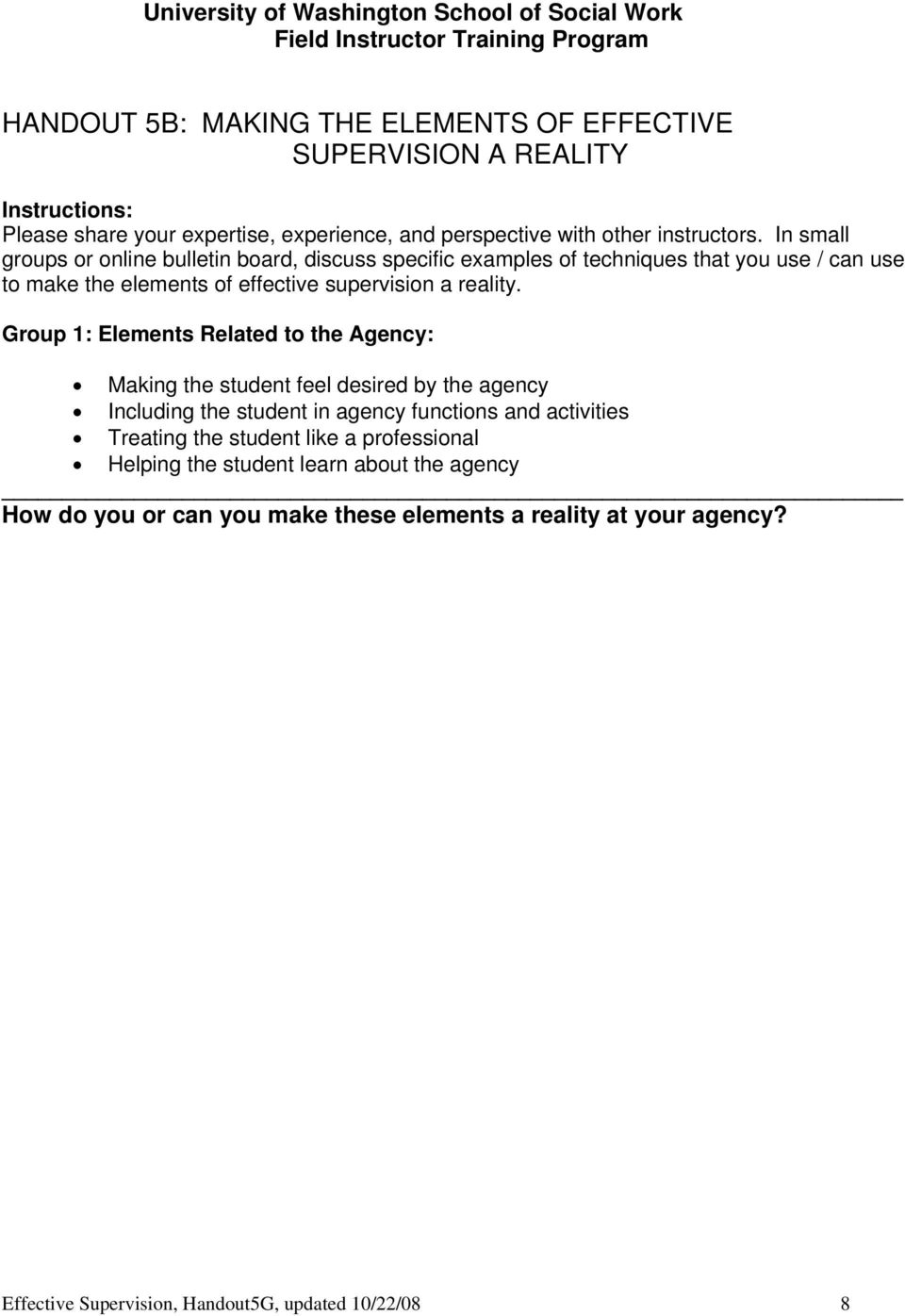
9 Field Instructor Training Program HANDOUT 5B: MAKING THE ELEMENTS OF EFFECTIVE SUPERVISION A REALITY Instructions: Please share your expertise, experience, and perspective with other instructors. In small groups or online bulletin board, discuss specific examples of techniques that you use / can use to make the elements of effective supervision a reality. Group 1: Elements Related to the Agency: Making the student feel desired by the agency Including the student in agency functions and activities Treating the student like a professional Helping the student learn about the agency How do you or can you make these elements a reality at your agency? Effective Supervision, Handout5G, updated 10/22/08 8
10 Field Instructor Training Program HANDOUT 5C: MAKING THE ELEMENTS OF EFFECTIVE SUPERVISION A REALITY Instructions: Please share your expertise, experience, and perspective with other instructors. In small groups or online bulletin board, discuss specific examples of techniques that you use / can use to make the elements of effective supervision a reality. Group 2. Elements Related to Tasks and Assignments Clarifying the purpose of assignments Providing detailed directions and instructions Working with the student to complete tasks Regularly reviewing the student s workload Providing a variety of learning activities Clarifying expectations for the student s performance Providing early opportunities for client contact How do you or can you make these elements a reality at your agency? Effective Supervision, Handout5G, updated 10/22/08 9

11 Field Instructor Training Program HANDOUT 5D: MAKING THE ELEMENTS OF EFFECTIVE SUPERVISION A REALITY Instructions: Please share your expertise, experience, and perspective with other instructors. In small groups or online bulletin board, discuss specific examples of techniques that you use / can use to make the elements of effective supervision a reality. Group 3. Elements Related to Supervisory Skills Explaining your role and the role of the student Encouraging discussion of the student s concerns Helping the student link theory to practice Providing clear and consistent feedback Validating the student s feelings Reassuring students they can succeed Demonstrating that the student is valued as a person and as a colleague How do you or can you make these elements a reality at your agency? Effective Supervision, Handout5G, updated 10/22/08 10

12 Field Instructor Training Program HANDOUT 5E: MAKING THE ELEMENTS OF EFFECTIVE SUPERVISION A REALITY Instructions: Please share your expertise, experience, and perspective with other instructors. In small groups or online bulletin board, discuss specific examples of techniques that you use / can use to make the elements of effective supervision a reality. Group 4. Elements Related to Supervision Meetings Holding regularly scheduled supervision meetings Being available outside of regular supervision times Providing a thorough discussion of the student s learning needs Reviewing and analyzing the student s cases or projects Providing consistent supervision throughout the placement How do you or can you make these elements a reality at your agency? Effective Supervision, Handout5G, updated 10/22/08 11

13 UW School of Social Work Field Instructor Training Program: From Practitioner to Educator HANDOUT 5F: SUPERVISION NOTES Student Date Review of cases / clients / projects Use of social work skills Performance (strengths, limitations, competency development) Areas to work on over the next week Effective Supervision, Handout5G, updated 10/22/08 12

14 Field Instructor Training Program HANDOUT 5G: PHASES OF SUPERVISION From Lawrence Shulman Interactional Supervision (WA. D.C.: NASW Press). I. Preliminary Phase: Tuning In Personal preparation for sessions (feelings, issues, concerns) Flexibility necessary to reassess needs every time; Responding to direct and indirect cues of self and others; Prioritizing needs, setting agendas. II. Beginning Phase: Contracting Purpose and role of supervision; supervisor s and supervisee responsibilities; Learning about organizational mission, priorities, procedures, populations; Authority and how power is utilized; consequences of breach of protocols; Questions of limits and boundaries, wiggle room/flexibility vs. clear borders; Perceptions of obligations, expectations, esp. re help needed and offered; Job descriptions, staging and sequencing of learning; others to be involved; Use of language: avoiding stereotypes, jargon but professional terminologies; Discovering and building on strengths; agreeing on areas for growth; Learning new skills, unlearning unhelpful old behavior or ways of working. III. Middle Phase: Working Building empathic skills and relationships; Learning how to articulate and elaborate re client, organization, system, self; Improving skills in self-awareness and self-disclosure re deeper learning; Identifying obstacles to successful completion of tasks and processes; Learning how data is used to evaluate practice and inform organization; Reviewing theoretical knowledge as it informs practice; Moving from the general to the specific, and the specific to the general; Containment of anxiety and negative feelings in service of the client; Understanding the change process and the parallel process (mirroring clients); Challenging illusions, issues with authority, deepening the work; Evaluating, summarizing, identifying next steps. IV. End Phase: Termination Reviewing assumptions and realities about teaching and learning; Reviewing progress and performance; Clarifying skills development and abilities; Clarifying processes for transitioning clients; Saying goodbyes and modeling healthy exits/transitions; Evaluations, future learning goals, and positive reinforcement; Celebrations and rituals to mark milestones. Effective Supervision, Handout5G, updated 10/22/08 13

15

MODULE 6: INTEGRATING THEORY AND PRACTICE: OUTLINE
 University of Washington School of Social Work Field Instructor Training Program: From Practitioner to Educator MODULE 6: INTEGRATING THEORY AND PRACTICE: OUTLINE Competency Objectives: 1) Describe the
PERFORMANCE MANAGEMENT Planning & Goal Setting
 PERFORMANCE MANAGEMENT Planning & Goal Setting To whom much is given, much is expected. Leadership Development Series Summer 2011 Areas We Will Cover Today 1. Discuss our collective lessons and learnings
Performance Factors and Campuswide Standards Guidelines. With Behavioral Indicators
 Performance Factors and Campuswide Standards Guidelines With Behavioral Indicators Rev. 05/06/2014 Contents PERFORMANCE FACTOR GUIDELINES... 1 Position Expertise... 1 Approach to Work... 2 Quality of Work...
X: Licensed Practical Nurse Leadership Role
 X: Alberta s Competency Profile 241 Priority: One Competency: X-1 Leadership Skills X-1-1 X-1-2 X-1-3 X-1-4 X-1-5 Demonstrate ability to apply critical thinking and clinical judgment to leadership skills
The Ohio Resident Educator Program Standards Planning Tool. 1 9-1-11 Final
 The Ohio Resident Educator Program Standards Planning Tool 1 The Resident Educator Program Standards Planning Tool The Resident Educator Program Standards Planning Tool is intended to assist district/schools
FIELD EDUCATION PROGRAM OVERVIEW
 FIELD EDUCATION PROGRAM OVERVIEW TABLE OF CONTENTS Field Education Program. 2 Objectives of Field Education. 2 Junior Year Field Work. 3 Senior Year Field Work... 3 Core Year Field Work 4 Advanced Year
Student Learning Contract [SAMPLE] 1. University of Wisconsin Oshkosh: Social Work Department
![Student Learning Contract [SAMPLE] 1. University of Wisconsin Oshkosh: Social Work Department](/thumbs/39/19865194.jpg "Student Learning Contract [SAMPLE] 1. University of Wisconsin Oshkosh: Social Work Department") Student Learning Contract [SAMPLE] 1 University of Wisconsin Oshkosh: Social Work Department STUDENT LEARNING CONTRACT Applied Generalist Practice I and II Semester Academic Year Student Name: SAMPLE Address:
Student Learning Contract [SAMPLE] 1 University of Wisconsin Oshkosh: Social Work Department STUDENT LEARNING CONTRACT Applied Generalist Practice I and II Semester Academic Year Student Name: SAMPLE Address:
The Learning Contract
 The What is a? The is a guide to monitor and direct the student s learning and the field instructor s teaching. It is a joint process and negotiated agreement between the student, the field instructor,
School Counselor Supervision: Practices. True or False? Why talk about supervision? 2/26/2012. Cher N. Edwards, Ph.D., LPCC Seattle Pacific University
 School Counselor Supervision: Strategies and School Based Best Practices Cher N. Edwards, Ph.D., LPCC Seattle Pacific University True or False? WA state does not have a supervision credential for school
Evaluating Training. Debra Wilcox Johnson Johnson & Johnson Consulting
 Debra Wilcox & Consulting Learning new behavior new or enhanced skills is the most powerful outcome of training. Behavioral change is the most difficult outcome to achieve, but may be the most important.
MACRO CONCENTRATION Student Integrative Learning Contract
 MACRO CONCENTRATION Student Integrative Learning Contract Student Name Home Phone Work Phone Cell Phone Email (Please Check) Full-time Part-time Field Instructor Work Phone Cell Phone Email Agency Site
Bloomsburg University Midterm and Final Competency Field Evaluation. Task Supervisor (if appropriate) :
 Bloomsburg University and Competency Field Evaluation BSW EVALUATION OF THE COMPETENCIES AND PRACTICE BEHAVIORS Student : Field Instructor : Task Supervisor (if appropriate) : _ Agency : University Faculty
EVALUATION OF MSW STUDENT FIELD WORK FOUNDATION FIELD PLACEMENT
 EVALUATION OF MSW STUDENT FIELD WORK School of Social Work University of Pittsburgh FOUNDATION FIELD PLACEMENT Date of Evaluation: 4/24/10 Term: Spring Year: 2010 Student's Name: FOUNDATION STUDENT Term
Self Assessment Tool for Principals and Vice-Principals
 The Institute for Education Leadership (IEL) brings together representatives from the principals' associations, the supervisory officers' associations, councils of directors of education and the Ministry
National Standards. Council for Standards in Human Service Education. http://www.cshse.org 2013 (2010, 1980, 2005, 2009)
 Council for Standards in Human Service Education National Standards ASSOCIATE DEGREE IN HUMAN SERVICES http://www.cshse.org 2013 (2010, 1980, 2005, 2009) I. GENERAL PROGRAM CHARACTERISTICS A. Institutional
How To Be A Team Member
 The following rating descriptions are examples of the behaviors employees would be demonstrating at each of the four levels of performance. These examples should assist the supervisor and employee during
STANDARDS FOR SOCIAL WORK PRACTICE WITH GROUPS. Second Edition
 STANDARDS FOR SOCIAL WORK PRACTICE WITH GROUPS Second Edition ASSOCIATION FOR THE ADVANCEMENT OF SOCIAL WORK WITH GROUPS, INC. An International Professional Organization (AASWG, Inc.) First edition Adopted
SAMPLE BSW Learning Agreement
 Boise State University Social Work Program SAMPLE BSW Learning Agreement Student: Semester: Faculty Field Liaison: Agency: Agency Field Instructor: Agency Task Supervisor: (if applicable) Year: NOTE: This
CONDUCTING EFFECTIVE MEETINGS WORKBOOK A BASIC BUSINESS VICTORY GUIDE
 CONDUCTING EFFECTIVE MEETINGS WORKBOOK A BASIC BUSINESS VICTORY GUIDE This book was developed by James H. Saylor Copyright 2006. All rights reserved. Printed in the United States of America. Except as
Council on Social Work Education. Curriculum Policy Statement for Baccalaureate Degree Programs in Social Work Education
 Council on Social Work Education Curriculum Policy Statement for Baccalaureate Degree Programs in Social Work Education B1.0 SCOPE AND INTENT OF THE CURRICULUM POLICY STATEMENT B1.1 This document sets
National Standards. Council for Standards in Human Service Education. http://www.cshse.org 2013 (2010, 1980, 2005, 2009)
 Council for Standards in Human Service Education National Standards BACCALAUREATE DEGREE IN HUMAN SERVICES http://www.cshse.org 2013 (2010, 1980, 2005, 2009) I. GENERAL PROGRAM CHARACTERISTICS A. Institutional
Leading Self. Leading Others. Leading Performance and Change. Leading the Coast Guard
 Coast Guard Leadership Competencies Leadership competencies are the knowledge, skills, and expertise the Coast Guard expects of its leaders. The 28 leadership competencies are keys to career success. Developing
Evaluation of Practicum Student Competencies SIU Counseling Psychology Program
 Evaluation of Practicum Student Competencies SIU Counseling Psychology Program Student Agency Focus: Career Personal Other: Supervisor Semester (eg, SP-3 rd year) The following evaluation items reflect
ADMINISTRATOR PERFORMANCE APPRAISAL GUIDELINES
 ADMINISTRATOR PERFORMANCE APPRAISAL GUIDELINES The Performance Appraisal Process at Madison College is designed to accomplish the following objectives: Encourage meaningful communication between the employee
Syracuse University. Office of Field Instruction. School of Social Work. Program Competencies, Resulting Practice Behaviors & Examples of Field Tasks
 Syracuse University School of Social Work Office of Field Instruction Program Competencies, Resulting Practice Behaviors & Examples of Field Tasks Program Competency Resulting Practice Behavior Example
Shell Mentoring Toolkit
 Shell Mentoring Toolkit A reference document for mentors and mentees Human Resources LEARNING 25/07/2007 Copyright: Shell International Ltd 2006 CONTENTS What is Mentoring? 4 The Mentor s Role The Role
Counseling Psychology Program. CNP 4751 Counseling M.A. Internship. CNP 4762 School Counseling Internship 2 M.A. INTERNSHIP PACKET 2015-2016
 Counseling Psychology Program CNP 4751 Counseling M.A. Internship CNP 4762 School Counseling Internship 2 M.A. INTERNSHIP PACKET 2015-2016 1. Introduction to Master s Internship 2. Field Supervisor Memorandum
PERFORMANCE MANAGEMENT COACHING AND PERFORMANCE GEORGIA PERIMETER COLLEGE
 PERFORMANCE MANAGEMENT COACHING AND PERFORMANCE GEORGIA PERIMETER COLLEGE Module 2 Coaching and Performance with the GPC Strategic Plan Agenda 1. Performance Management Process The Next Plateau 2. Aspects
Jennifer M. Scagnelli Comprehensive Exam Question (O Bannon) Instructional Technology - Fall 2007
 Jennifer M. Scagnelli Comprehensive Exam Question (O Bannon) Instructional Technology - Fall 2007 Instructional design is a system of procedures used to plan and develop instructional materials and activities
Mediation Skills in Conflict Resolution
 Mediation Skills in Conflict Resolution Presented by the Federal Mediation and Conciliation Service Considerations of Mediator Training Much is common sense Learn skills and approaches No prescribed or
KIPP King Leadership Class: Individual Learning Plan
 School Focus : HIGH EXPECTATIONS. Expresses high expectations for all teammates and expresses belief in their potential to grow. : STUDENT BEST INTERESTS. Seeks to understand the needs and motivations
EXAMPLE FIELD EXPERIENCE PLANNING TEMPLATE CCSU MAT Program
 EXAMPLE FIELD EXPERIENCE PLANNING TEMPLATE CCSU MAT Program Secondary Education (Math, History/Social Studies, Science, World Languages) and Special Education (K-12) Goal: The MAT program focuses on preparing
A guide to helping people to succeed at work
 Coaching: Helping you to improve social outcomes A guide to helping people to succeed at work This guide is for anyone wanting to use coaching skills to help colleagues succeed. In particular, it is intended
C.P. Haggard Graduate School of Theology
 Page 1 of 5 Dear Ministry Site Supervisor, Thank you for your willingness to invest in the growth of our student! By meeting with our student regularly during the course of this semester you are serving
Standards for the School Social Worker [23.140]
![Standards for the School Social Worker [23.140]](/thumbs/40/21507228.jpg "Standards for the School Social Worker [23.140]") Standards for the School Social Worker [23.140] STANDARD 1 - Content The competent school social worker understands the theories and skills needed to provide individual, group, and family counseling; crisis
Standards for the School Social Worker [23.140] STANDARD 1 - Content The competent school social worker understands the theories and skills needed to provide individual, group, and family counseling; crisis
360 feedback. Manager. Development Report. Sample Example. name: email: date: [email protected]
 60 feedback Manager Development Report name: email: date: Sample Example [email protected] 9 January 200 Introduction 60 feedback enables you to get a clear view of how others perceive the way you work.
Field Education in the 2008 EPAS: Implications for the Field Director s Role Dean Pierce
 Field Education in the 2008 EPAS: Implications for the Field Director s Role Dean Pierce 2008 EPAS Curriculum Features The 2008 EPAS consists of four curriculum features: 1) program mission and goals;
Customer Service and Sales Skill Standards Sales & Service Voluntary Partnership
 Customer Service and Sales Skill Standards Sales & Service Voluntary Partnership A Partner in the National Skill Standards System Notice The Sales & Service Voluntary Partnership is pleased to present
Student Bi-Annual Review. Professional Counseling Programs
 Student Bi-Annual Review Professional Counseling Programs Updated Fall 2011 Professional Counseling Programs Student Bi-Annual Review Process Students are required to complete a bi-annual review as a component
The Network for Social Work Management
 The Network for Social Work Management An International Organization Advancing Social Work Management Invest in your Career: Join the Network Starting on July 1, 2013 Membership to the Network became free
MSW LEARNING CONTRACT WITH SAMPLE TEXT
 P a g e 1 MSW LEARNING CONTRACT WITH SAMPLE TEXT The following template may be used to construct a learning contract based on HPU s MSW program goals. For examples of expected competencies, please refer
Commission on Teacher Credentialing (CTC) and Council on Social Work Education Educational Policy Standards and Accreditation Standards (CSWE-EPAS)
 (CTC) and Educational Policy Standards and Accreditation Standards (CSWE-) Standards Crosswalk June 2013 An institution that is offering a nationally accredited Pupil Personnel Services: School Social
Practice Behaviors Educational Outcomes Method of Assessment Competencies 2.1.3 Analytical Reasoning
 Writing for : 205 Core Behaviors Educational Outcomes Method of Assessment Competencies 2.1.3 Analytical Reasoning Demonstrate ability to assess analytically and for clarity in communication work products
Performance Evaluation. August 20, 2013
 Performance Evaluation Discussion Points for University Support Staff August 20, 2013 Performance Evaluations method to assess job performance. A PSU system would include the following: 1. University Support
Leadership and Management Competencies
 Leadership and Management Competencies 0 The Saskatchewan Public Service Vision: The Best Public Service in Canada Our Commitment to Excellence Dedicated to service excellence, we demonstrate innovation,
ETHICAL GUIDELINES FOR COUNSELING SUPERVISORS
 ETHICAL GUIDELINES FOR COUNSELING SUPERVISORS The following Ethical Guidelines for Counseling Supervisors were adopted by the Association for Counselor Education and Supervision (ACES) Governing Council
Wiltshire Council s Behaviours framework
 Wiltshire Council s Behaviours framework It s about how we work Trust and respect Simplicity Responsibility Leadership Working together Excellence Why do we need a behaviours framework? Wiltshire Council
THE GEORGE WASHINGTON UNIVERSITY GRADUATE SCHOOL OF EDUCATION AND HUMAN DEVELOPMENT SCHOOL COUNSELING PROGRAM The Alexandria Center
 THE GEORGE WASHINGTON UNIVERSITY GRADUATE SCHOOL OF EDUCATION AND HUMAN DEVELOPMENT SCHOOL COUNSELING PROGRAM The Alexandria Center COUNSELING PRACTICUM and INTERNSHIP STUDENT and SCHOOL SITE SUPERVISOR
FIELD EDUCATION ROLES AND RESPONSIBILITIES. General Criteria for the Selection of Field Sites
 FIELD EDUCATION ROLES AND RESPONSIBILITIES The Coordinator of Field Education The Community Advisory Board The Faculty Liaison General Criteria for the Selection of Field Sites The Field Instructor The
FRAMEWORK OF SUPPORT: SCHOOL-LEVEL PRACTICE PROFILE
 FRAMEWORK OF SUPPORT: SCHOOL-LEVEL PRACTICE PROFILE S The Framework of Supports are a set of Practice Profiles that serve as an implementation overview of Support for Personalized Learning (SPL). Practice
Making a positive difference for energy consumers. Competency Framework Band C
 Making a positive difference for energy consumers Competency Framework 2 Competency framework Indicators of behaviours Strategic Cluster Setting Direction 1. Seeing the Big Picture Seeing the big picture
GLOBAL FINANCIAL PRIVATE CAPITAL Job Description. JOB TITLE: Client Relationship Manager
 GLOBAL FINANCIAL PRIVATE CAPITAL Job Description JOB TITLE: Client Relationship Manager Reports To: Financial Advisor Exempt Prepared by: ADP Resource June 10, 2014 SUMMARY This position is primarily responsible
YALE CLINICAL PSYCHOLOGY: TRAINING MISSION AND PROGRAM STRUCTURE RESEARCH TRAINING
 YALE CLINICAL PSYCHOLOGY: TRAINING MISSION AND PROGRAM STRUCTURE The Clinical Psychology Program at Yale University aspires to educate the next generation of leading academic and research psychologists
THE FOUR NON NEGOTIABLES
 THE FOUR NON NEGOTIABLES ACADEMIC EXCELLENCE COLLEGE AND CAREER READINESS SAFE AND SUPPORTIVE LEARNING ENVIRONMENT PURPOSEFUL, TIMELY TWO WAY COMMUNICATION ECISD STRATEGIC PLAN 2015 2016 1 Beliefs Definition:
On-Site Supervisor Handbook
 On-Site Supervisor Handbook Student Affairs Services Internship Radford University Department of Counselor Education Revised Fall 2010 Radford University Department of Counselor Education PO Box 6994,
Bloomsburg University Social Work Program BSW Field Education Learning Agreement (All information needs to be completed)
 Bloomsburg University Social Work Program BSW Field Education Learning Agreement (All information needs to be completed) Student Name Address Agency Name Agency Address Agency Field Supervisor (FI) or
Ayers Institute Leadership Resources: PSEL Alignment
 Professional Standards for al Leaders Standard 1: Mission, Vision, and Core Values Effective educational leaders develop, advocate, and enact a shared mission, vision, and core values of high-quality education
MASTER SYLLABUS FIELD WORK FOR SOCIAL WORKERS I FOUNDATION YEAR SOCIAL WORK 7998 SW 7998 (.5 credit hours)
 Professor First Last Name Office Hours Office #, Building Email address Phone number MASTER SYLLABUS FIELD WORK FOR SOCIAL WORKERS I FOUNDATION YEAR SOCIAL WORK 7998 SW 7998 (.5 credit hours) COURSE DESCRIPTION
PROGRAM SUMMARY: http://www.uky.edu/socialwork/trc/indexqic.html 1/20/05 1
 PROGRAM SUMMARY: Testing the Impact of Structured Clinical Supervision in Frontline Public Child Welfare on Organizational, Worker Practice and Case Outcomes University of Kentucky College of Social Work
Nine Probation Officer Competencies. Alberta Justice & Solicitor General
 Nine Probation Officer Competencies 2014 Officer 1. Managing Information & People The ability to interact with others to access, retrieve, input analyze, apply, interpret and process information for investigative
Workshop Synopsis 1 Tips for Facilitators 3 Overview of Activities 5 Sample Agendas 7
 CONTENTS Introduction Workshop Synopsis 1 Tips for Facilitators 3 Overview of Activities 5 Sample Agendas 7 The Conflict Mode Workshop Getting Started 9 Defining Conflict 10 Identifying Objectives 12 Understanding
How To Be A Successful Supervisor
 Quick Guide For Administrators Based on TIP 52 Clinical Supervision and Professional Development of the Substance Abuse Counselor Contents Why a Quick Guide?...2 What Is a TIP?...3 Benefits and Rationale...4
Message from the Chief Executive of the RCM
 Message from the Chief Executive of the RCM The Midwifery Leadership Competency Framework has been derived from both the NHS Leadership Qualities Framework and the Clinical Leadership Competency Framework.
Precepting is NOT. Someone to do your work An opportunity to show off all that you know An opportunity to judge others About you Easy
 Precepting The term preceptor, or teacher, has been known since 15 th century England. Preceptors are the most important teachers in providing a solid clinical experience for nurse practitioner students.
The Emotional Competence Framework
 The Emotional Competence Framework 1 SOURCES: This generic competence framework distills findings from: MOSAIC competencies for professional and administrative occupations (U.S. Office of Personnel Management);
LEADERSHIP DEVELOPMENT FRAMEWORK
 LEADERSHIP DEVELOPMENT FRAMEWORK February 13, 2008 LEADERSHJP PERSPECTIVE I consider succession planning to be the most important duty I have as the Director of the NOAA Corps. As I look toward the future,
Rubric for Evaluating North Carolina s School-Based Occupational Therapists
 Rubric for Evaluating North Carolina s School-Based Occupational Therapists Standard 1: School-based therapists demonstrate leadership, advocacy, and collaborative and ethical Element a. Leadership. School-based
Social Work Field Education: Overview
 Social Work Field Education: Overview As with all practice-based careers, social work requires its students to apply theory to direct and community practice with clients. Assimilation of theory occurs
The Basics of Supervision for Counselors. Best Practices in Counseling Supervision
 The Basics of Supervision for Counselors Best Practices in Counseling Supervision What is Supervision? Supervision is an intensive, interpersonally focused, one-to-one relationship in which one person
Employee Engagement Survey 2015. Nova Scotia Government-wide Report
 Employee Engagement Survey 2015 Nova Scotia Government-wide Report Employee Engagement Survey 2015 This summary report provides information on the state of employee engagement in the Nova Scotia public
Career Development Plan & Research Strategy Template
 Career Development Plan & Research Strategy Template (not to exceed 12 pages) As the K candidate, your training plan should demonstrate that you have undertaken a thorough self-assessment, which carefully
FOUNDATION COMPETENCY ACTIVITY EXAMPLES from 12/6/10 PI Training. COMP. 1. IDENTIFY AS A PROFESSIONAL SOCIAL WORKER: Activity Examples
 FOUNDATION COMPETENCY ACTIVITY EXAMPLES from 12/6/10 PI Training COMP. 1. IDENTIFY AS A PROFESSIONAL SOCIAL WORKER: Activity Examples Keep a reflective journal log of professional development and challenges;
Need Information? Go to: www.chr.alberta.ca/apscompetencies. Have Questions? Email: [email protected]
 Need Information? Go to: www.chr.alberta.ca/apscompetencies Have Questions? Email: [email protected] Table of Contents Background... 3 Why Behavioural Competencies?... 3 The APS Competency Model...
Fall Term Syllabus MASTER SYLLABUS. Course Domain and Boundaries
 Fall Term Syllabus MASTER SYLLABUS Social Work 7771 Field Work Seminar I Core Year School of Social Work Fall semester.5 credit First of Four Field Seminars for MSW Students Course Domain and Boundaries
SASS 602: FIELD EDUCATION Intensive Weekend Advanced Standing Fall 2012. Master Syllabus
 SASS 602: FIELD EDUCATION Intensive Weekend Advanced Standing Fall 2012 Master Syllabus Mailing Address: Case/Mandel School Office Location: MSASS, Room 110 10900 Euclid Avenue Office Hours: By appointment
Supervision and the Clinical Social Worker
 Supervision and the Clinical Social Worker By Jamie Berman, LCSW-R, CASAC Presented by CEUSchool Course Summary This course will provide mental health professionals with the understanding that the central
Counseling Psychology Program. CNP 4751 Counseling Psychology M.A. Internship. CNP 4762 School Counseling Internship 2
 Counseling Psychology Program CNP 4751 Counseling Psychology M.A. Internship CNP 4762 School Counseling Internship 2 M.A. INTERNSHIP PACKET 2014-2015 1. Introduction to Master s Internship 2. Field Supervisor
Framework and Guidelines for Principal Preparation Programs
 THE FRAMEWORK FOR PRINCIPAL PREPARATION PROGRAM GUIDELINES PENNSYLVANIA DEPARTMENT OF EDUCATION 1 Purpose Of all the educational research conducted over the last 30 years in the search to improve student
Program Administrator Definition and Competencies
 I. Program Administrator Definition The program administrator is the individual responsible for planning, implementing, and evaluating a child care, preschool or kindergarten program. The role of the administrator
DATA COACHING WORKSHOP DAY 1 PRESENTED BY SARITA SIQUEIROS THORNBURG, JILL PATNODE & KRISSY SOLTMAN
 DATA COACHING WORKSHOP DAY 1 PRESENTED BY SARITA SIQUEIROS THORNBURG, JILL PATNODE & KRISSY SOLTMAN January 28, 2014 Success for Each Child and Eliminate the Opportunity Gap Welcome and Introductions Overview
Professional Development Workbook
 Economic Empowerment through Entrepreneurship University of Michigan Institute for Social Research 2014-2015 Professional Development Workbook Surry Scheerer LMSW www.surryscheerer.com [email protected]
IC Performance Standards
 IC Performance Standards Final Version 1 23 April 2009 1 TABLE OF CONTENTS BACKGROUND... 3 OCCUPATIONAL STRUCTURE... 4 PERFORMANCE ELEMENT CONTENT MODELS... 7 Professional and Technician/Administrative
Southern Illinois University At Carbondale
 Southern Illinois University At Carbondale School of Social Work Graduate Program Handbook of Field Instruction Dr. Mizan Miah, Director Judith McFadden Graduate Field Practicum Coordinator School of Social
Possible examples of how the Framework For Teaching could apply to Instructional Coaches
 Possible examples of how the Framework For Teaching could apply to 1b. Specific Examples 1b. Demonstrating Knowledge of Students 1a. Specific Examples 1a. Demonstrating knowledge of Content and Pedagogy
MASTERS SOCIAL WORK PROGRAM ASSESSMENT REPORT
 MASTERS SOCIAL WORK PROGRAM ASSESSMENT REPORT This report covers the academic year 2010-2011 and includes activity during the summer of 2011 Outcomes The current mission is to prepare graduate social work
Theory and Practice of Counselor Supervision. CMHC Practicum and Internship
 Theory and Practice of Counselor Supervision CMHC Practicum and Internship OBJECTIVES Supervisors will be able to: Identify qualifications for supervision Define Supervision Access Liberty s policies Identify
School of Social Work Renison University College. Master of Social Work Practicum Manual
 School of Social Work Renison University College Master of Social Work Practicum Manual 2014-2015 Please read this manual in its entirety. It contains valuable information that can be of great assistance
How To Be A Field Supervisor At Metro Diana Human Services
 Department of Human Services Manual for Field Supervisors Updated Spring 2015 Table of Contents What Field Supervisors Need to Know about Supervising Students... 3 Contact information for the Field Coordinator:...
Leadership Development Catalogue
 The TrainingFolks Approach The importance of superior management, leadership and interpersonal skills are critical to both individual and organizational success. It is also critical to apply these skills
Valuing Diversity & Inclusion with ACPE
 Valuing Diversity & Inclusion with ACPE Audrey D. Hines & Marita Harrell, Facilitators May 6, 2015 Today We Will Application: External Relations & Engagement Self - Awareness Application: Organizational
NIH Executive Leadership Program
 NIH Executive Leadership Program The Partnership for Public Service and NIH Developing Strong Leaders The NIH Executive Leadership Program brings together change-makers in government and strong executive
PRINTED NAME WESTERN ILLINOIS UNIVERSITY - DEPARTMENT OF COUNSELOR EDUCATION - CN 597 INTERNSHIP SCHOOL COUNSELING STUDENTS ONLY TO STUDENTS:
 WESTERN ILLINOIS UNIVERSITY - DEPARTMENT OF COUNSELOR EDUCATION - CN 597 INTERNSHIP SCHOOL COUNSELING STUDENTS ONLY TO STUDENTS: Students are responsible for the completion of all activities on this form.