
Sounds and symbols: An overview of pinyin
|
|
|
- April Preston
- 9 years ago
- Views:
Transcription
1 Sounds and symbols: An overview of pinyin The writer was required at school to read his lessons aloud sixty times; that was for reading books in his own language. Chao Yuen Ren, talking about himself, in Mandarin Primer, Harvard University Press, 1961, fn. 1, p Contents 1 The syllable Exercise 1 2 Tones Exercise 2 3 Initial consonants Exercise 3 4 Rhymes Exercises 4, 5, 6 5 Miscellany 6 Writing connected text in pinyin 7 Recapitulation Exercise 7 To learn to converse in Chinese, it helps to develop two abilities: the ability to recognize and produce the sounds of the language adequately so you can hear and repeat Chinese material; and the ability to match the sounds of Chinese to phonetic notation so you can read, take notes or otherwise keep track of language material before you have internalized the formal character based writing system. However, it is monotonous and probably inefficient to try to learn the sounds and transcription before you learn how to say anything. So this introductory lesson serves a short-term and a long-term purpose. In the short-term, it provides the information you need to proceed to the first speech samples in Unit 1. And in the long-term, it provides detailed information about the sounds and their notation, which you will be able to refer to regularly as you progress through the book. Station sign at a Beijing subway station, written in characters and pinyin (the latter showing word divisions but not tones). [JKW 2005] 16

2 1 The syllable As noted in the introduction, Hànyǔ Pīnyīn (literally Chinese-language joined-sounds ), called pinyin for short, is the a notation for representing standard Mandarin pronunciation. It has official status not only in China but also in the international community, and is now generally used throughout the Chinese speaking world. Though based on familiar Roman letters (only v is not utilized), both consonantal letters (c, x, and q, for example) and vocalic (such as i, u and o) are sometimes matched to sounds in ways unfamiliar, or even counterintuitive to speakers used to modern English spelling conventions. 1.1 Sound versus symbol (letter) From the start, it is important to make a distinction between sound and the representation of sound. In pinyin, for example, jī is pronounced jee (with 'level tone'), qī is chee. Neither is hard (for English speakers) to pronounce, but the way the latter is represented with a q (and no following u ) is counterintuitive, and difficult to remember at first. On the other hand, pinyin r represents a sound that, for many speakers of standard Mandarin, is a blend of the r of run with the s of pleasure (or the j of French je) in other words, an r with friction. This sound may be difficult for a non-mandarin speaker to produce well, but associating it with the symbol r is less problematical. So, as you learn pinyin, you will encounter problems of pronunciation on the one hand, and problems of transcription, on the other. It is important to keep the distinction clear. 1.2 The syllable When introducing the sounds of standard Chinese, it is useful to begin with the syllable, a unit whose prominence is underscored by the one-character-per-syllable writing system. The spoken syllable in Chinese is often analyzed in terms of an initial consonant sound and a rhyme, the latter being everything other than the initial. Chinese school children, when focusing on pronunciation, often read out pinyin syllables (which are usually also meaningful units associated with characters) in an exaggerated initial-rhyme division: tuh--ù > tù ( hare ), luh--óng > lóng ( dragon ), etc. The pinyin written syllable can also be usefully analyzed in terms of an initial and a rhyme. The rhyme, in turn, contains vowels (V), a tones (T) written above the vowels, medials (M) and endings (E). Of these, only the vowel is always present (as, for example, in the sentence-final particle that is simply an untoned a). Thus, all possible pinyin syllables can be represented by the following formula: Initial Rhyme T C i M V E i,u,ü i,o/u,n,ng 17

3 Vowel: Vowel\Tone: Initial + Vowel\Tone: Initial + Medial + Vowel\Tone: Initial + Vowel\Tone + Ending: Initial + Medial + Vowel\Tone + Ending: a ā, è tā, bǐ, kè, shū xiè, zuò, duì, xué, jiù, nüé hěn, máng, hǎo, lèi, dōu jiàn, jiǎng, jiāo Initials are 21 in number, and are usually presented in a chart of representative syllables, arranged in rows and columns (shown in 3.1 below). Whether the initials are written with a single consonant letter (l, m, z) or several (sh, zh), they all represent only one sound unit (or phoneme). Chinese has no initial clusters of the sort represented by cl or sn in English. There are six possible [written] vowels: a, e, i, o, u and ü (the last representing a rounded high front vowel, as in German über or the last vowel of French déjà vu). Vowels can be preceded by medials (i, u and ü), and followed by endings, two of which are written with vowel symbols (i, o), and two with consonantal (n, ng). There is actually a third vowel ending that can occur after the main vowel (in addition to i and o), and that is u; for with the main vowel o, the ending o is written u to avoid the misleading combination oo. Thus, to cite words from Unit 1, one finds hǎo, lǎo (both with -o), but instead of dōo, you get dōu, and instead of zhōo, you get zhōu (both with u). Notice that the inventory of consonantal endings in Mandarin is small only n and ng. Regional Chinese languages, such as Cantonese, have more (-p, -t, -m, etc.) The well known name of the Chinese frying pan, the wok, is derived from a Cantonese word, with a final k sound; its Mandarin counterpart, guō, lacks the final consonant. In historical terms, Mandarin has replaced final consonants, Cantonese has preserved them. Surnames often show the same kind of distinction between the presence and absence of a final consonant in Mandarin and Cantonese: Lu and Luk, Yip and Ye, for example. Tones are a particularly interesting feature of the Mandarin sound system and will be discussed in more detail in 2 in this unit. For now, we note that stressed syllables may have one of four possible tones, indicated by the use of diacritical marks written over the main vowel (V). Unstressed syllables, however, do not have tonal contrasts; their pitch is, for the most part, conditioned by that of surrounding syllables. Because medials, vowels and some endings are all written with vowel letters, pinyin rhymes may have strings of two or three vowel letters, eg: -iu, -ui, -iao, -uai. By convention, the tone mark is placed on the vowel proper, not on the medial or on the ending: lèi, jiāo, zuò. As a rule of thumb, look to see if the first of two vowel letters is a possible medial; if it is, then the next vowel letter is the core vowel, and that gets the tone mark; if not, then the first gets it: iè, ǎo, ué, ōu, iào. 18

4 Exercise 1. Without trying to pronounce the syllables, place the tone marks provided over the correct letter of the pinyin representations: xie [\] jiang [ ] dui [\] hao [ˇ] lian [/] gui [\] zhou [ ] qiao [/] One sound that is not shown in the syllable formula given in 1.2 above is the final r-sound. It is represented, not surprisingly, by r in pinyin, and is obligatory in a few words with the e-vowel, such as èr two. However, in northern Mandarin, a common word-building suffix, appearing mostly in nouns, and favored by some speakers and some regions more than others, is also represented by a final r, eg diǎnr, huàr, bànr, huángr. The final r often blends with the rest of the syllable according to rather complicated rules that will be discussed in detail elsewhere. 2 Tones Words in Mandarin are pronounced with a regular tonal contour, or pitch, much like the stress patterns that distinguish the English verb record from the noun REcord. In Mandarin, the word lǎoshī teacher, for example, is pronounced lao shi ( low followed by high ), which in English terms is like having to say tea cher rather than tea cher each time you say the word. The presence of tones in Chinese is often cited as another of those lurid features that makes the language unique and difficult to learn; but tones are, in fact, not unique to Chinese and probably no more difficult to learn than stress or intonation is for learners of English. As noted earlier, there are four basic tones in Mandarin. Regional dialects of Mandarin, such as those spoken in the Tianjin area or in the far southwest (Kunming, for example) may realize the four tones with markedly different pitch contours from those found in standard Mandarin. Moreover, the regional languages have more than four tones. Cantonese, for example, is usually analyzed as having four tones on two levels, for a total of [at least] eight. Mandarin also differs from most of the regional languages in having a predilection for words with [non-initial] toneless syllables: shūshu uncle ; xíngli luggage. In some cases, toneless syllables are virtually swallowed up by the previous syllable; wǒmen we, for example, is often pronounced wǒm in speech. 2.1 The 4 tones It is difficult to learn to produce or even recognize tones from descriptions, though we will use the descriptive terms high (and level), rising, low, falling as a way of referring to them. These terms are only suggestive of the actual shape of the tone, but they do underscore the symmetry of the system: a high and a low, a rising and a falling. In modern Mandarin, though the tones have formal names (that can only be rationalized by reference to earlier stages of the language), it is common practice to refer to them numerically by using the numbers 1-4 (yī, èr, sān, sì) and the word for sound, shēng [shuhng]: yīshēng, èrshēng, sānshēng, sìshēng. (Toneless syllables are called qīngshēng light-toned.) In English we can also refer to the tones as first, second, third and 19

5 fourth. As noted earlier, in pinyin, tones are indicated iconically by marks placed over the main vowel letter. TONES ā high 1st yīshēng á rising 2nd èrshēng ǎ low 3rd sānshēng à falling 4th sìshēng a context dependent qīngshēng 2.2 Tone concepts To learn to produce tones, it is useful to conceive of them in particular ways. The first tone, for example, which has a high and level contour, can be thought of as SUNG OUT, because singing a syllable in English usually results in sustained level pitch rather like the high tone. The second tone, which rises from mid-low to high, can be associated with DOUBT: Did you say Wáng? Máo? The third tone is the subject of the next paragraph, but the fourth tone, which falls from a very high pitch to a low, can usefully be associated with LIST FINAL intonation, or for many people CERTAINTY: I said Wèi or It s late! ; or 1,2,3 (all rising) and 4! 2.3 The low-tone You will notice that the pinyin symbol for the low-tone is v-shaped, suggesting a contour that falls, then rises. In isolation, it does indeed fall and rise: hǎo be good ; wǒ I; me ; jiǎng speak; explain. But in close conjunction with a following syllable (other than one with the same low-tone as shown below), it tends to have a low, non-rising pitch. If you can find a Chinese speaker to model the following phrases (from Unit 1), you can try listening for relatively low pitch in the low-toned syllable, hěn [huhn] very; quite, that appear at the beginning of the following phrases: hěn gāo hěn máng hěn lèi tall busy tired For most speakers, a low-toned syllable in second position of a phrase will also stay low, without much of a rise. Again, if you can find a speaker to model the following phrases, see if you agree that the second syllable is primarily low: shūfǎ tuántǐ kànfǎ calligraphy group point of view 20

6 For learners, regarding the third tone as low, then learning that it rises in certain contexts, seems to produce better results than thinking of it as falling-rising and canceling the final rise in certain contexts. So the third tone, we will refer to as low, and to produce it, you aim low and add the final rise only when the syllable is isolated. 2.4 The tone chart The chart below takes 12 of the most common surnames to illustrate the four tones. (In Chinese, the surname is the first component of the full name, not the last: eg Lǐ in Lǐ Liánjié (Jet Li s Chinese name). In the chart, the four tones are characterized in terms of their pitch contours (high and level, rising, etc.) as well as by the four heuristic concepts (sung out, doubt, etc.) that help us to produce them correctly. tone: egs. Zhōu Wáng Lǐ Wèi Zhāng Máo Kǒng Dù Gāo Chén Mǎ Zhào description: high, level rising low (with rise) falling concept: sung out doubt (?) low finality (!) Exercise 2. The following short sentences consist of a pronoun tā he; she, the verb xìng (think syìng), meaning be surnamed, and one of the 12 surnames presented above. Keeping your tone concepts in mind, and ideally, with feedback from a Chinese speaker, focus on the different tones of the surnames while pronouncing the sentences. Tā xìng Zhāng. Tā xìng Máo. Tā xìng Wèi. Tā xìng Wáng. Tā xìng Kǒng. Tā xìng Zhōu. Tā xìng Dù. Tā xìng Gāo. Tā xìng Mǎ. Tā xìng Chén. Tā xìng Zhào. Tā xìng Lǐ His/her surname s Zhang. 2.5 On the history of Mandarin tones Tone systems as complex, or more complex than that of Mandarin are a feature of dozens of languages spoken in southwest China and adjoining regions of mainland Southeast Asia, including the national languages of Burma, Thailand and Vietnam. While tone may 21

7 be a more or less permanent feature of the region, within particular languages, tone systems may appear, evolve, or disappear. The tonal system of Chinese is also known to have evolved over the centuries. Evidence from ancient rhyme tables and other sources indicates that at an earlier stage, prior to the 7 th century, the ancestor of modern Mandarin also had four tones. They were named píng level, shǎng rising, qù going and rù entering (which are the modern pronunciations of the names given to them then). The last was found only on checked syllables, those ending with stopped consonants such as -k, -t and p, which as noted earlier, are no longer found in Mandarin. The earlier names of the tones are suggestive, but we cannot know precisely what the four sounded like. We do know, however, that they were distributed differently from those of modern Mandarin. In fact, the modern names for the four tones of Mandarin reflect their evolution. The modern tones are called, formally, yīnpíng, yángpíng, shăng and qù (tones 1 through 4, respectively). The rù-tone has disappeared (along with the consonantal endings), and the words that once had that tone now appear with other tones. As the names suggest, old píng toned words are now divided between yīnpíng (the level) and yángpíng (the rising). It is known that the tonal distinction between level and rising, seen on words such as tīng listen versus tíng stop, emerged from a contrast that was formerly found in the initial consonants. Similar splits in all the original four tones are at the basis of the eight tone systems of regional languages such as Cantonese. Some linguists have adduced evidence for pre-tonal stages of Chinese, or at least stages when pitch differences were not so prominent. A more detailed discussion of tone in Chinese can be found in books listed at the end of introduction. 3 Initial consonants Many pinyin letters are pronounced like English : the el of lǎo, for example, is very like English l, and pinyin f, s, n and m all have more or less the same values in Chinese and English scripts. Unfortunately, such cases are liable to make you think of English even where the pinyin letters have rather different values from those of English. Below is a table of symbols that represent all the possible initial consonants of Mandarin. Following Chinese custom, they are presented with a particular set of vowels, and ordered from front of the mouth (labials) to back (velars, and glottals). 3.1 The consonant chart Two notes: First of all, letters w and y, which do appear initially in pinyin (eg in the numbers wǔ five and yī one ), are treated as special cases of u and i, respectively, in initial position; thus, instead of ī, one finds yī, instead of ǔ, wǔ, instead of iě, yě, instead of uǒ, wǒ, etc. Second, the vowels conventionally placed with the different classes of initials to make them pronounceable turn out to be some of those that have quite idiosyncratic values for speakers of English. Thus o in the first line of the table below is not pronounced oh, but waw ; e in the second line is uh ; i in the third and fourth lines is swallowed up by the initial, but in the fifth line, it represents the more expected ee. The vowel sounds will be discussed in 4 below, but for now, you can use 22

8 the hints provided on the right hand side of the chart, and imitate your teacher or some other speaker of Chinese: like I II III IV V-sound 1 lips bo po mo fo ( waw ) 2 tongue tip at teeth ^ de te ne le ( uh ) dzz/tsz/sz 3 flat tongue at teeth _ zi ci si (not ee ) jr/chr/shr 4 tongue tip raised! zhi chi shi ri (not ee ) yie[ld] 5 spread lips <> ji qi xi ( ee ) 6 back of tongue high ~ ge ke he ( uh ) 3.2 Notes Columns I and II In English, the distinction between sounds such as b and p or d and t is usually said to be one of voicing (vocal chord vibration): with b and d, voicing begins relatively earlier than with p and t. However, in Chinese, the onset of voicing of the row I consonants is different from that of English. The that the sound of pinyin b is actually between English b and p, that of pinyin d, between English d and t, etc. That is why the Wade-Giles system of Romanization (mentioned in the introduction) writes p/p rather than b and p (T aipei rather than Taibei); in phonetic terms, both are voiceless, but the first is unaspirated, the second aspirated. Being aware of this will help you to adjust to what you hear; and remembering to articulate the column I initials lightly should keep you from sounding too foreign. Row 1 These consonants are labials all involve the lips. Pinyin writes the sound waw (cf. English paw ) with just an o only after the labials; otherwise it writes it uo. Thus bo, po, mo, fo rhyme with duo, tuo, nuo, luo (the latter set not shown in the table above). In other words, o by itself always equals uo (and never ou). Apparently, the creators of pinyin felt that after the labial initials it was unnecessary to indicate the labial onset with u. It will be important to keep the sound of o / uo separate from that of ou, which rhymes with both syllables of English oh no. Rows 3, 4 and 5 the crucial rows! With z, c, and s in row 3, the tongue is flat and touching the back of the teeth at the gum line. The letter i following row 3 initials is not pronounced ee ; it simply represents a continuation of the voicing of the consonantal sound. So for zi, ci, si, think dzz, tsz, ssz (as indicated on the left of the chart). English does not have consonants comparable to the first two row-3 initials, z and c, except at the end of words and across root boundaries: pads; cats. In German and Russian, though, similar sounds do occur at the beginning of words, eg German zehn [dz-] ten, or Russian cená [ts-] price. [The last, also written with a c, suggests the source of the pinyin convention.] With zh, ch, sh and r in row-4, the tip of the tongue is raised towards the roof of the mouth (on or near the rough area behind the teeth known as the alveolar ridge) in what is called a retroflex position. As with the row-3 initials, the letter i in this position 23
![zhi chi shi ri (not ee ) yie[ld] 5 spread lips <> ji qi xi ( ee ) 6 back of tongue high ~ ge ke he ( uh ) 3.](/docs-images/47/20661376/images/page_8.jpg "2 Notes Columns I and II In English, the distinction between sounds such as b and p or d and t is usually said to be one of voicing (vocal chord vibration): with b and d, voicing begins relatively")
9 represents only a persistence of the consonantal sound. So for zhi, chi, shi and ri, think zhr, chr, shr, and rr. In English, an r following a consonant will often produce the retroflex articulation of the tongue that is characteristic of the row-4 consonants; so another way to get your tongue in the correct position for those initials is to make reference to English, and match zh to the dr of drill, ch to the tr of trill, sh to the shr of shrill and r to the r of rill. Finally, with j, q, and x of row-5, the tongue is positioned like the yie in English yield ; and this time, the letter i is pronounced ee, so for ji, qi, xi think jyee, chyee, syee. Later, you will see that row-5 initials are only followed by the written vowels i and u. The first will always be pronounced ee in this context, the second, always ü. The initial-r of row-4 R-sounds vary considerably among languages: the Scots trill their tongue tips; the Parisians flutter their uvulas; Spanish flap their tongues; and Barbara Walters (a TV news broadcaster and interviewer) has an r that sounds like a cross been r and w. The Chinese r is different again; it has a little bit of a buzz to it. Like zh, ch, and sh, it is retroflex (with tongue tip up) so it resembles the initial sound of English rill or ridge ; but it also has friction like the s in pleasure (or French je I ). You will observe considerable variation in the quality of Chinese r, depending on the following vowel and on the particular speaker. Examples: rén, rè, rù, ràng, ruò, ròu, rì. Exercise 3. a) Try pronouncing the following syllables, randomly selected from rows 3, 4 and 5 initials, on level (ie 1 st ) tone: qi si zhi zi ji qi si ri chi xi shi ci zhi qi si chi ji xi b) Now try pronouncing these Chinese names: Cí Xì Qí Báishí Lǐ Shízhēn Qízhōu (last empress) (famous calligrapher) (16 th C herbalist, from Qizhou) 3.3 An expanded chart of initials The conventional chart of initial consonants exhibits a rather restricted and idiosyncratic set of rhymes. We can make the initial consonant chart a little more comprehensive by adding one or two lines to each row, as follows: (i) (ii) (iii) (iv) (1) bo po mo fo ban pan man fan 24

10 (2) de te ne le duo tuo nuo luo dai tai nai lai (3) zi ci si zao cao sao (4) zhi chi shi ri zhuo chuo shuo ruo zhou chou shou rou (5) ji qi xi ju qu xu jian qian xian (6) ge ke he gan kan han 4 Rhymes A table showing all possible rhymes follows below. It is too long and complicated to be quickly internalized like the chart of initials, but you can practice reading the rows aloud with the help of a teacher or native speaker. You can also map your progress through the rhymes by circling syllables, or adding meaningful examples, as you learn new vocabulary. The table is organized by main vowel (a, e, i, o, u, ü), and then within each vowel, by medial (i, u and ü) and final (i, o/u, n, ng). The penultimate column, marked w/o C i (ie without initial consonant ), lists syllables that lack an initial consonant (with the rarer ones placed in parentheses) and so begin with a (written) vowel or medial (the latter always represented with an initial y or w). The final column gives pronunciation hints. Asterisks (*), following certain numbered rows, mark sets that need special attention. Final-r, whose special properties were mentioned above, is treated separately. Rhymes with (a): egs w/o C i 1 a ta cha da ma ba la a 2 a-i tai chai dai mai chai zai ai 3 a-o tao chao dao pao zao rao ao 4 a-n tan ran zhan can lan pan an 5 a-ng dang sang zhang mang lang zang ang 6 i-a jia qia xia ya 7 i-a-o jiao qiao xiao yao 8* i-a-n jian qian xian yan [yen] 9 i-a-ng jiang qiang xiang yang 10 u-a hua gua zhua shua wa 11 u-a-i chuai (wai) 12 u-a-n huan guan zhuan shuan cuan wan 13 u-a-ng huang guang zhuang shuang wang [wahng] 25
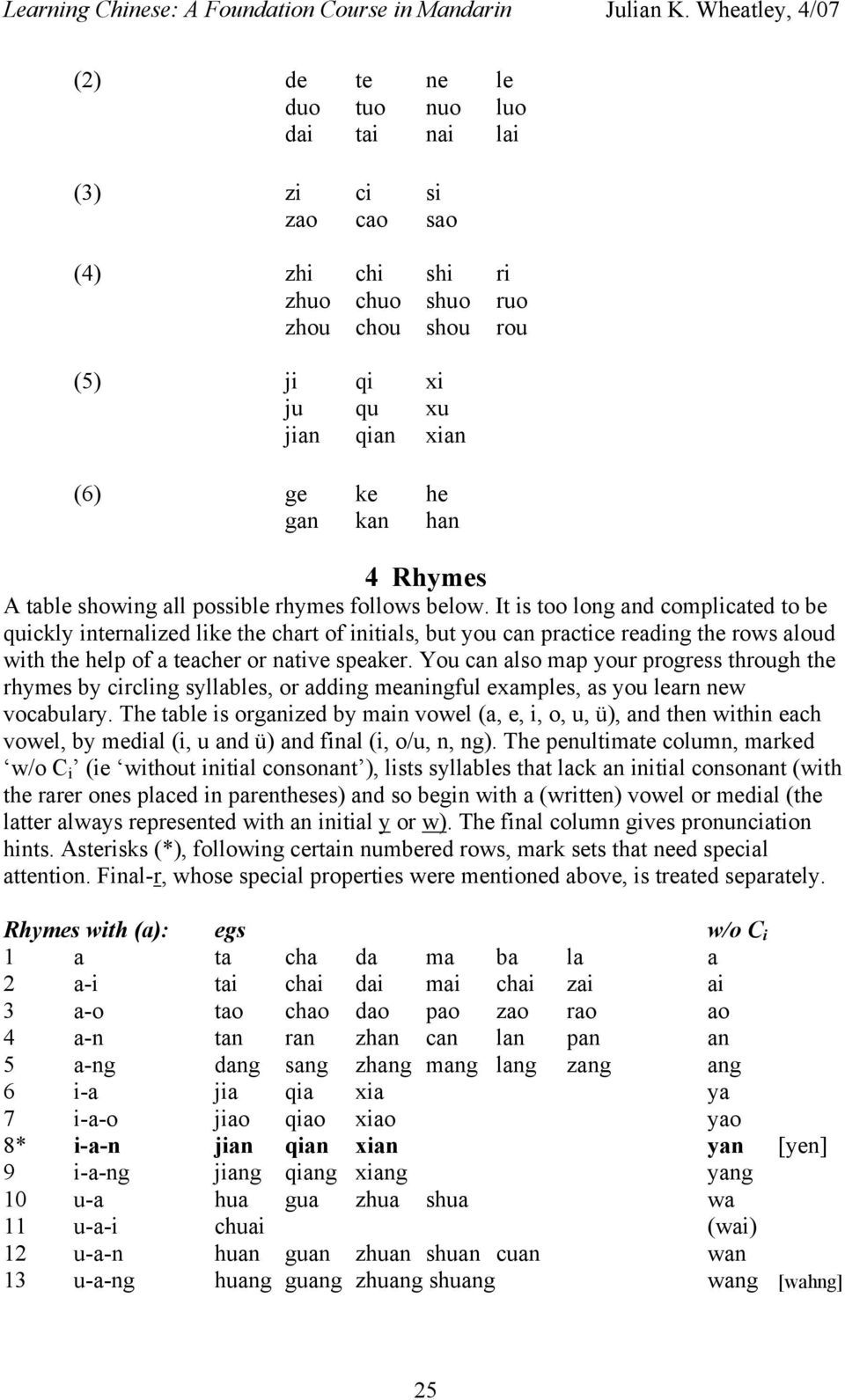
11 Rhymes with (e) 14 e zhe che she re le e [uh] 15 e-i zhei shei lei fei bei (ei) [ay] 16 e-n zhen shen fen cen men en [uhn] 17 e-ng leng sheng ceng deng zheng (eng) [uhng] 19 i-e jie xie lie mie ye [yeh] 20* u-e jue que xue nüe lüe yue [yüeh] Rhymes with (i) the ee rhymes 21a i li bi ti yi [yee] 21b ji qi xi yi [yee] 22 i-n jin qin xin lin bin yin [yeen] 23 i-ng jing qing xing ling bing ying [yeeng] 24* u-i dui gui shui rui chui [-way] wei [way] the buzzing i-rhymes 25* i zi ci si [dzz, tsz ] 26 i zhi chi shi ri [jr, chr ] Rhymes with (o) 27* o bo po mo fo [-waw] 28 u-o duo tuo guo shuo zuo [-waw] wo [waw] 29* o-u zhou zou dou hou chou [-oh] ou [oh] 30 o-ng zhong dong long zong 31 i-o-ng jiong qiong xiong yong Rhymes with (u) the oo rhymes 32 u shu lu zhu zu cu [-oo] wu [woo] 33* u-n shun lun zhun kun cun [-wuhn] wen [wuhn] 34* i-u jiu qiu xiu liu diu [-yoo ~ -yeo] you [yeo] Rhymes with (ü) the ü rhymes 35* u ju qu xu lü nü [-yü] yu [yü] 36 u-n jun qun xun [-yün] yun [yün] 4.1 Notes on the rhymes The relationship between the i- and u-rhymes and C i Recall that in the C i chart presented earlier, the row-4 C i (zh, ch, sh, r) are distinguished from the row-5 (j, q, x) by position of the tongue. In English terms, the distinction is a j, ch or sh with the tongue in the position of dr, tr or shr (respectively), versus a j, ch or sh with the tongue in the position of the y of yield (ji, qi, xi). But this difference, even if it is appreciated, seems, nonetheless, very slight. And, indeed, it would be much more difficult to perceive it if the vowels that followed were identically pronounced. But they never are! 26
![[yeeng] 24* u-i dui gui shui rui chui [-way] wei [way] the buzzing i-rhymes 25* i zi ci si [dzz, tsz ] 26 i zhi chi shi ri [jr, chr ] Rhymes with (o) 27* o bo po mo fo [-waw] 28 u-o duo tuo guo shuo](/docs-images/47/20661376/images/page_11.jpg "zuo [-waw] wo [waw] 29* o-u zhou zou dou hou chou [-oh] ou [oh] 30 o-ng zhong dong long zong 31 i-o-ng jiong qiong xiong yong Rhymes with (u) the oo rhymes 32 u shu lu zhu zu cu [-oo] wu [woo] 33*")
12 Note that row-5 C i initials (j, q, x) are ONLY followed by the sounds (not the written letters, the sounds!) ee and ü, written i and u, respectively. Here are some examples: ji, jie, jian, qi, qie, qian, xi, xie, xian; ju, jue, jun, qu, que, qun, xu, xue, xun. Row-4 C i, on the other hand (and the same goes for row-3) are NEVER followed by the sounds ee and ü : zhi, zi, zhu, zu, zhan, zan, chi, ci, chu, cu, chan, chen etc. Because the creators of pinyin let i and u each represent two different sounds, this complementary distribution is obscured: the vowels of ji and zhi look alike, but they do not sound alike; the same for ju and zhu. So if you hear chee it must be written qi, for ee never follows ch; if you hear chang, it must be written chang, for q can only be followed by the sound ee. And so on. Exercise 4. The following syllables all contain the written vowels i and u. Practice reading them clearly, on a single tone. As with all the exercises in this lesson, repeat daily until confident. chi qi xie qu chu chun jia qin cu qu shun qun shu ju ci xu zi zhu shi xi xia qu 4.2 The value of the letter e The value of e also violates the expectations of English speakers. It is uh in all contexts (ze, deng, chen) except where it follows written i or u, when it is pronounced eh (xie, nie, xue), or when it precedes a written i, where it is pronounced ey (lei, bei, zei). Exercise 5. a) Practice reading the following syllables containing e: chen wei zhen xie ben ren lei re bei jie e leng zei che bie b) Now try pronouncing the following proper names: [uh] [uh] [eh] [ey] Zhōu Ēnlái Máo Zédōng Jiǎng Jièshí Běijīng (premier) (chairman) (Chiang Kai-shek) Lǐ Dēnghuī Éméi shān Lièníng Sòng Měilíng (former Tw pres.) (Omei Mtn.) (Lenin) (wife of Chiang) 27

13 4.3 The o rhymes: ou versus uo / o On early encounters, it is easy to confuse pinyin rhymes that are spelled similarly, such as -ou and -uo. This can lead to some pronunciation problems that are very difficult to correct later, so you need to make sure you master them early. The rhyme ou, with the O leading, is pronounced like the name of the letter O (in English) rhyming with know. The rhyme, uo, on the other hand, with the O trailing, is pronounced like war without the final r. However, as you now know, after the row-1 C i, uo is spelled o: bo, po, mo, fo rhyme with duo, tuo, nuo and luo. Exercise 6. a) Here are some more names (mostly), all containing o : Bōlán Sūzhōu Mòxīgē (Poland) (city near Shanghai) (Mexico) luòtuo Zhāng Yìmóu Zhōu Ēnlái (camel) (film director) (premier) luóbo Guō Mòruò Lǐ Bó (aka Lǐ Bái) (radish) (20 th C writer) (Tang poet) b) And more single syllables, which you can read on a tone of your choosing: mou tuo bo fo zhou duo po dou zuo fou luo rou 4.4 The ü-rhymes The first note in 4.1 (under the list of rhymes) makes the point that many of the ü- rhymes are revealed by the class of consonantal initial. Written u after row-5 initials (j, q, x) is always pronounced ü; after any other initial, it is oo ; thus (with any particular tone): zhu - ju, chu - qu, shu - xu, but pu, fu, du, ku, hu, etc. However, the sound ü does occur after two initials other than the j, q and x of row-5. It occurs after n and l, as well. In these cases, ü may contrast with u, and the difference has to be shown on the vowel, not on the initial: lù road versus lǜ green ; nǔ a crossbow versus nǚ female. In addition to being a core vowel, the sound ü also occurs as a medial. Again, when it follows row-5 initials, it is written as u: jue, que, xue; but following l or n it is written with ü: lüèzì abbreviation ; nüèji malaria. In the latter cases, it is redundant, since there is no contrast üe versus ue. 5 Miscellany 5.1 Tonal shifts Before leaving the survey of sounds and notation, we need to return to the subject of tone, and take note of the phenomenon of tonal shifts (called tone sandhi by linguists). It turns out that in certain contexts, tones undergo shifts from one to the other. (In Mandarin, the contexts where this occurs are very limited; in regional languages such as 28

14 Hokkien, such shifts are much more pervasive.) We will mention these shifts here, and then practice producing them more systematically over the course of later units. 5.2 Low-tone shift If two low tones (tone-3s) appear consecutively in the same phrase, the first shifts to a rising tone: > low + low > rising + low hěn + hǎo > hén hǎo good hěn + lěng > hén lěng cold Lǐ + lǎoshī > Lí lǎoshī Professor Lee It is, of course, possible to have three or more low tones in a row, but such cases will be considered later. 5.3 Two single-word shifts The are also a few more idiosyncratic shifts that involve only single words. The negative, bu, is falling tone except when followed by another falling tone, in which case it shifts to rising tone: bù hǎo not well, but bú lèi not tired. In the latter case, the result is a trajectory like the sides of a mountain, up, then down, and students in the past have kept track of this shift by calling it the Fuji shift, after Mount Fuji (which is, of course, in Japan, not China). Below, bu is shown in combination with some adjectival verbs (called Stative Verbs in Chinese grammatical tradition); these sets (involving stative verbs from the conversational material in Unit 1) should be repeated regularly until fully internalized. bù gāo bù máng bù hǎo not tall not busy not well And exaggerated > bú lèi not tired bú è not hungry bú rè not hot bú cuò not bad Another single-word shift involves the numeral yi one. In counting, and in many compounds, it is level toned: yī, èr, sān, sì 1, 2, 3, 4 ; yīshēng. But where yi is grammatically linked to a following measure word, it shows the same tonal shift as bu, rising before a falling tone (yí fèn a copy ), but falling before any other (yì bāo a pack ). yì zhāng yì tiáo yì běn a [table] a [fish] a [book] but yí fèn a copy [of a newspaper] 29

15 Note that the low tone shift (hěn + hǎo > hén hǎo) applies to any word (or syllable) that fits the grammatical condition (of being within a phrase); but the shift from falling to rising affects only a few words, including bu and yi. 5.4 The apostrophe In certain contexts, an apostrophe appears between the syllables of a compound written in pinyin: Xī ān [the name of a city in China]; hǎi ōu seagull ; chǒng ài dote on. The apostrophe is used when a syllable beginning with a vowel letter (a, e, o) is preceded (without space) by another syllable; in other words, where the syllable boundary is ambiguous. By convention, the apostrophe is only used when the trailing syllable begins with a vowel; a word like yīngān, with two potential syllable divisions, is always to be interpreted as yīn + gān, never yīng + ān (which would be yīng ān). 6 Writing connected text in pinyin Unlike earlier systems of Chinese phonetic notation, some of which were intended as fully fledged auxiliary writing systems that could co-exist with (or even replace) characters, pinyin was intended as an adjunct to characters, used to indicate pronunciation and to provide a means for alphabetical ordering. For this reason, the rules and conventions for writing connected text in pinyin were not well defined at first. However increasing use of computers for the production of text and in everyday communication, as well as the proliferation of contact between China and the rest of the world has put a premium on the use of pinyin. Nowadays, in addition to its use in pedagogical materials such as this book, pinyin is used for ing, for input in word processing, for url or addresses, and to complement characters on advertisements, announcements, and menus, particularly those intended for an international audience in Chinese cities and abroad. In 1988, the State Language Commission issued a document with the translated title of The Basic Rules for Hanyu Pinyin Orthography, and with a few minor exceptions, this textbook conforms to those proposed rules. [The ABC Chinese-English Dictionary, cited at the end of the Background chapter, contains a translation of this document as an appendix.] Only two general points will be mentioned here. First, normal punctuation practices hold. Sentences begin with capital letters, as do proper names; they end with periods, and other punctuation marks are used more or less as in English. Second, words, not syllables, are enclosed by spaces. Thus teacher is written lǎoshī, not lǎo shī. Characters, by contrast, which always represent syllable-length units, are separated by a space regardless of word boundaries. Of course, defining what a word is can be problematical, but pinyin dictionaries or glossaries can be relied upon to make those decisions for us. Other conventions, such as the use of the hyphen, will be noted when needed. So when you write pinyin, it should look like this: Gémìng bú shì qǐngkè chīfàn. revolution not be invite-guests eat-meal Revolution isn t [like] inviting guests over for a meal. Mao Zedong 30
![4 The apostrophe In certain contexts, an apostrophe appears between the syllables of a compound written in pinyin: Xī ān [the name of a city in China]; hǎi ōu seagull ; chǒng ài dote on.](/docs-images/47/20661376/images/page_15.jpg "The apostrophe is used when a syllable beginning with a vowel letter (a, e, o) is preceded (without space) by another syllable; in other words, where the syllable boundary is ambiguous.")
16 Writing pinyin in this way makes it readable. And in fact, where ing in characters is restricted by technical problems, pinyin can serve even without tone marks so long as the above orthographical conventions are observed: Geming bu shi qingke chifan. 7 Recapitulation That completes our survey of the sounds and transcription of Mandarin Chinese. Already you will be able to pronounce the names of Chinese people and places considerably better than television and radio newscasters and announcers generally do. Exercise 7 reviews what you have covered in this lesson. Exercise 7 a) Write out the formula for all possible pinyin syllables; list the medials; list the finals. b) Place the tone marks given in the parentheses in the correct position in the syllables: xue (/) bei ( ) sou (v) jie (\) bie (/) suo (v) c) List (or recite) 12 surnames, grouped by tone. d) Write out the table of initial consonants. How many rows are there? Which rows are particularly problematical? What sounds (and vowel symbols) can follow the row-5 initials? e) Pronounce the pairs on the tone indicated. Note: in this exercise, as well as in (h) below, not all syllables are actual Chinese words on the tone cited; cf. English brink and blink, bring and bling, but only brick no blick (yet). i. (tone 1) qi ci, xi si, ji zi, qu cu, xu su, ju zu ii. (tone 2) zi zhi, ci chi, ji zhi, xi shi, si shi, qi chi iii. (tone 3) de dei, ge gei, le lei, zhe zhei iv. (tone 3) bie bei, lie lei, pie pei, die dei. v. (tone 1) po pou, bo duo, luo lou, tuo po, ruo rou, mo luo, tuo tou f) Pronounce the following personal and place names: Zhōu Ēnlái Máo Zédōng Jiǎng Jièshí Cáo Yǔ (premier) (chairman) (Chiang Kai-shek) (20 th C playwrite) Lǐ Dēnghuī Lǐ Xiāngjūn Sòng Měilíng Wáng Zhìzhì (former Tw pres.) (a patriotic courtesan) (wife of Chiang) (b-ball player) 31

17 Dèng Xiǎopíng Zhū Róngjī Lǐ Xiǎolóng Cáo Cāo (post Mao leader) (recent premier) (Bruce Lee) (historical figure) Běijīng Xī ān Guǎngzhōu Zhèngzhōu (capital) (in Shaanxi) (Canton city) (city in Henan) Sìchuān Jiāngxī Chóngqìng Chǔxióng (province) (province) (city in W. China) (city in Yunnan) g) Apply the tone-change rules to the following phrases: hĕn lěng bu gāo lăobăn bu guì lăo Lĭ yi běn cold not tall boss cheap old Lee one book bu hăo yǔsǎn bu duì nĭ hăo bu cuò yi fèn not good umbrella wrong hello not bad one copy h) Read the sets listed below aloud. Each set of three syllables follows the pattern rising, rising, falling, like the usual list intonation of English 1, 2, 3, or boats, trains, planes ; lá, wéi, jìn! lá wéi jìn! láo tái dù! sóu sí mìng! zí xiá qìng! ní zhí hòu! lái duó zhèn! fó qí cì! xíng cuó shì! móu guó shòu! rén béi zhà! 32

18 Coda Chinese who studied English in China in the sloganeering days prior to the 80s can often remember their first English sentence, because in those days textbook material was polemical and didactic and lesson content was carefully chosen for content and gravity. So let your first sentence also carry some weight, and be appropriate for the endeavors you are about to begin. Here it is, then: 種 瓜 得 瓜, 種 豆 得 豆 Zhòng guā dé guā, zhòng dòu dé dòu. plant melon get melon, plant bean get bean [You] reap what you sow. (Cf. xīguā water melon ; dòuzi beans; peas.) Zàijiàn. Goodbye. (again-see) Míngtiān jiàn. See you tomorrow! (tomorrow see) Shrine in a Kūnmíng restaurant to Guāndì, a guardian spirit revered by owners of small businesses, soldiers, secret societies and others. [JKW 1997] 33
![Here it is, then: 種 瓜 得 瓜, 種 豆 得 豆 Zhòng guā dé guā, zhòng dòu dé dòu. plant melon get melon, plant bean get bean [You] reap what you sow. (Cf. xīguā water melon ; dòuzi beans; peas.) Zàijiàn.](/docs-images/47/20661376/images/page_18.jpg "Goodbye. (again-see) Míngtiān jiàn. See you tomorrow!")
19 MIT OpenCourseWare Resource: Learning Chinese: A Foundation Course in Mandarin Dr. Julian K. Wheatley The following may not correspond to a particular course on MIT OpenCourseWare, but has been provided by the author as an individual learning resource. For information about citing these materials or our Terms of Use, visit:

1. (Inflight conversation) On business or on holiday?
 Mandarin Chinese Vol 2 with Chinese characters English Chinese Pinyin 1. (Inflight conversation) On business or on holiday? chū chāi huò zhě dù jià? Are you going to Beijing on business - or - on holiday?
A STUDY ON THE NARRATOR S VOICE IN THE CHINESE TRANSLATION OF A ROOM OF ONE S OWN (1929) LAW TSZ SANG
 A STUDY ON THE NARRATOR S VOICE IN THE CHINESE TRANSLATION OF A ROOM OF ONE S OWN (1929) by LAW TSZ SANG A dissertation submitted to the School of Humanities of the University of Birmingham in partial
Appendix 1: Search strategies for randomized controlled trials on Chinese herbal medicine for symptom management in cancer palliative care
 Appendix 1: Search strategies for randomized controlled trials on Chinese herbal medicine for symptom management in cancer palliative care i) The Cochrane Central Register of Controlled Trials (CENTRAL)
Introduction. Research methodology
 A Primary Study of the Size in Working Area of Librarians Ko-Li Chen Associate Professor, Department of Architecture, Tunghai University Li -Wen Pan Library Clerk, Nan-Kai Institute of Technology Introduction
BBC Learning English - Talk about English July 18, 2005
 BBC Learning English - July 18, 2005 About this script Please note that this is not a word for word transcript of the programme as broadcast. In the recording and editing process changes may have been
SYLLABUS. 9778 and 1341. Cambridge International Level 3 Pre-U Certificate in Mandarin Chinese (Principal and Short Course)
 SYLLABUS Cambridge International Level 3 Pre-U Certificate in Mandarin Chinese (Principal and Short Course) 9778 and 1341 For examination in 2016, 2017 and 2018 Principal: QN: 500/4738/3 Short Course:
ZhangFu or Meridian theory related to Ear disease 1. Organs: Kidney: Kidney in charge of the ear s function Heart: Heart also open on the ear Liver &
 Ear disease ZhangFu or Meridian theory related to Ear disease 1. Organs: Kidney: Kidney in charge of the ear s function Heart: Heart also open on the ear Liver & GB: Liver & GB Qi connect with ear & easily
Points of Interference in Learning English as a Second Language
 Points of Interference in Learning English as a Second Language Tone Spanish: In both English and Spanish there are four tone levels, but Spanish speaker use only the three lower pitch tones, except when
Comparative Analysis on the Armenian and Korean Languages
 Comparative Analysis on the Armenian and Korean Languages Syuzanna Mejlumyan Yerevan State Linguistic University Abstract It has been five years since the Korean language has been taught at Yerevan State
Articulatory Phonetics. and the International Phonetic Alphabet. Readings and Other Materials. Introduction. The Articulatory System
 Supplementary Readings Supplementary Readings Handouts Online Tutorials The following readings have been posted to the Moodle course site: Contemporary Linguistics: Chapter 2 (pp. 15-33) Handouts for This
Study on Tacit Knowledge Identification of Independent Documentary Film Directors
 Study on Tacit Knowledge Identification of Independent Documentary Film Directors Ming-Shu Yuan Associate Professor Graduate Program and Department of Information and Communications Shih Hsin University
Common Pronunciation Problems for Cantonese Speakers
 Common Pronunciation Problems for Cantonese Speakers P7 The aim of this leaflet This leaflet provides information on why pronunciation problems may occur and specific sounds in English that Cantonese speakers
Unit 12: What's the Weather Like Here?
 Unit 12: What's the Weather Like Here? Part I: Listen and Learn 1. Wǒ zhù zài Bīn Zhōu Pittsburgh. I live in Pittsburgh, Pennsylvania. 我 住 在 宾 州 Pittsburgh. Zhèlǐ tiānqì hěn hǎo. The weather is very nice
Things to remember when transcribing speech
 Notes and discussion Things to remember when transcribing speech David Crystal University of Reading Until the day comes when this journal is available in an audio or video format, we shall have to rely
Style Guide for Essays in Chinese Studies
 Style Guide for Essays in Chinese Studies Introduction... General Formatting... Chinese Words and Pinyin... Using Chinese Characters... 2 Quotes... 3 Footnotes and Reference Lists... 3 Footnotes... 3 Reference
Chinese I. Content Skills Learning Targets Assessment Resources & Technology
 St. Michael-Albertville High School Teacher: Sonny Wang I December 2014 CEQ: HOW DO I COMMUNICATE IN CHINESE? WHAT KNOWLEDGE AND UNDERSTANDING CAN I GAIN ABOUT CHINESE CULTURE? o HOW DOES CHINESE CONNECT
5 Free Techniques for Better English Pronunciation
 5 Free Techniques for Better English Pronunciation Enhancing Communication Skills Enhancing Performance Judy Ravin, President The Accent Reduction Institute, LLC 410 N. 4th Ave. Ann Arbor, MI. 48104 734-665-2915
Level 1 Part 1 Integrated Chinese
 Lesson Shopping i Level Part Integrated Chinese CHARACTER WORKBOOK Simplified and Traditional Characters Third Edition Third Edition AUTHORS Yuehua Liu, Tao-chung Yao Nyan-Ping Bi, Liangyan Ge, and Yaohua
Radicals of Chinese Characters
 Radicals of Chinese Characters In order to function in a CJK environment, one must first become comfortable with the concept of radicals ( 部 首 Ch. bùshǒu, J. bushu, K. bŭsu). What is a radical? Simply
The Chinese Language and Language Planning in China. By Na Liu, Center for Applied Linguistics
 The Chinese Language and Language Planning in China By Na Liu, Center for Applied Linguistics This brief introduces the Chinese language and its varieties and describes Chinese language planning initiatives
Subtitle Translation Strategies as a Reflection of Technical Limitations: a Case Study of Ang Lee s Films
 Asian Social Science January, 2009 Subtitle Translation Strategies as a Reflection of Technical Limitations: a Case Study of Ang Lee s Films Ying Zhang & Junyan Liu School of Foreign Language Jiangxi Science
Teaching and Learning Mandarin Tones. 19 th May 2012 Rob Neal
 Teaching and Learning Mandarin Tones 19 th May 2012 Rob Neal Aims of the presentation Reflect on why tones are so challenging for Anglophone learners Review several empirical studies which have examined
stress, intonation and pauses and pronounce English sounds correctly. (b) To speak accurately to the listener(s) about one s thoughts and feelings,
 Section 9 Foreign Languages I. OVERALL OBJECTIVE To develop students basic communication abilities such as listening, speaking, reading and writing, deepening their understanding of language and culture
Thai Pronunciation and Phonetic Symbols Prawet Jantharat Ed.D.
 Thai Pronunciation and Phonetic Symbols Prawet Jantharat Ed.D. This guideline contains a number of things concerning the pronunciation of Thai. Thai writing system is a non-roman alphabet system. This
PUSD High Frequency Word List
 PUSD High Frequency Word List For Reading and Spelling Grades K-5 High Frequency or instant words are important because: 1. You can t read a sentence or a paragraph without knowing at least the most common.
Intercultural Communication Studies XIX: 1 2010
 A Proposed Approach for Successful Cloning of Foreign TV Shows in China Chunying, Peking University It is a popular phenomenon for Chinese TV entertainment to clone Western original TV shows. This paper
Speaking for IELTS. About Speaking for IELTS. Vocabulary. Grammar. Pronunciation. Exam technique. English for Exams.
 About Collins series has been designed to be easy to use, whether by learners studying at home on their own or in a classroom with a teacher: Instructions are easy to follow Exercises are carefully arranged
Very often my clients ask me, Don I need Chinese translation. If I ask which Chinese? They just say Just Chinese. If I explain them there re more
 Hello, fellow colleagues in Translation industry. And, Thank you very much for nice introduction. Vanessa. When you hear the topic Asian Languages and Markets, each of you probably had some questions or
Beijing BISS International School Why BISS?
 Beijing BISS International School Why BISS? BISS Today's educational leader, shaping tomorrow's global leaders "BISS feels like home" Long and Proud History Established in 1994 as the sister school of
Indiana Department of Education
 GRADE 1 READING Guiding Principle: Students read a wide range of fiction, nonfiction, classic, and contemporary works, to build an understanding of texts, of themselves, and of the cultures of the United
Teaching of Chinese grammars for Hungarian students and study of teaching-grammars
 SHS Web of Conferences 24, 02010 (2016) DOI: 10.1051/ shsconf/20162402010 C Owned by the authors, published by EDP Sciences, 2016 Teaching of Chinese grammars for Hungarian students and study of teaching-grammars
HSBC Bank (China) Shanghai Branch Network
 HSBC Bank (China) Shanghai Branch Network Shanghai Branch (Premier, Advance, Commercial Banking) LG1, HSBC Building, Shanghai ifc, No.8 Century Avenue, Lujiazui, Pudong, Shanghai, 200120, China Tel : [86]
en fi lm af Zhang Yang instruktøren bag den kinesiske fi lmperle Badeanstalten Premiere 31. oktober
 produced by Harvey Wong, Liu Qiang producer Stanley Tong co-producer Michael J. Werner, Wouter Barendrecht producer Er Yong, Zhang Yang screenplay by Zhang Yang, Wang Yao director Zhang Yang Line producer
How to become a successful language learner
 How to become a successful language learner By Alison Fenner English and German Co-ordinator, Institution Wide Language Programme Introduction Your success in learning a language depends on you! You may
SHANGHAI MEDICAL FACILITIES
 SHANGHAI MEDICAL FACILITIES AND DOCTORS This list is intended to provide information and does not represent the Consulate General's endorsement. The Consulate General assumes no responsibility for the
Researching & Cite Checking Chinese, Japanese & Korean (CJK) Law. Wei Luo, JD & MLS
 Researching & Cite Checking Chinese, Japanese & Korean (CJK) Law Wei Luo, JD & MLS Director of Technical Services and Lecturer in Law Room 257A, [email protected] August 20, 2009 Wei Luo What do we have
Grade 1 LA. 1. 1. 1. 1. Subject Grade Strand Standard Benchmark. Florida K-12 Reading and Language Arts Standards 27
 Grade 1 LA. 1. 1. 1. 1 Subject Grade Strand Standard Benchmark Florida K-12 Reading and Language Arts Standards 27 Grade 1: Reading Process Concepts of Print Standard: The student demonstrates knowledge
SEPTEMBER Unit 1 Page Learning Goals 1 Short a 2 b 3-5 blends 6-7 c as in cat 8-11 t 12-13 p
 The McRuffy Kindergarten Reading/Phonics year- long program is divided into 4 units and 180 pages of reading/phonics instruction. Pages and learning goals covered are noted below: SEPTEMBER Unit 1 1 Short
Program 2014 Tsinghua-Sanya Workshop on Big Data: Opportunities, Challenges and Innovations Dec. 27 Dec. 30, 2014 Sanya, China
 Program 2014 Tsinghua-Sanya Workshop on Big Data: Opportunities, Challenges and Innovations Dec. 27 Dec. 30, 2014 Sanya, China Dec 27, Saturday 09:00 am - 09:30 am Opening Ceremony 09:30 am - 10:20 am
Modern foreign languages
 Modern foreign languages Programme of study for key stage 3 and attainment targets (This is an extract from The National Curriculum 2007) Crown copyright 2007 Qualifications and Curriculum Authority 2007
KPC Herbs. Capsules/Pin Yin. Name Alternate Name Code Size Price
 Ai Fu Nuan Gong Wan Mugwort & Cyperus Combination C1400 100 Vcaps 13.25 An Zhong San Fennel & Galanga Formula C1340 100 Vcaps 7.75 Ba Wei Dai Xia Fang Tangkuei Eight Herb Formula C0110A 100 Vcaps 8.75
http://setup.clihome.com/cli.cmap.web/home/maps/viewmapmultipleyear.aspx?teach...
 Page 1 of 6 READING - 1st School Teacher Email Course# Grade Level Lettie Brown Elementary School VanDerVoorn, Lauri [email protected] LA1100 1 Show Icon August 2015 August 2014 Review of
Phonetic Perception and Pronunciation Difficulties of Russian Language (From a Canadian Perspective) Alyssa Marren
 The Arbutus Review, Vol. 2, No. 1 (2011) 75 Phonetic Perception and Pronunciation Difficulties of Russian Language (From a Canadian Perspective) Alyssa Marren Abstract: This study looked at the most important
CAMBRIDGE FIRST CERTIFICATE Listening and Speaking NEW EDITION. Sue O Connell with Louise Hashemi
 CAMBRIDGE FIRST CERTIFICATE SKILLS Series Editor: Sue O Connell CAMBRIDGE FIRST CERTIFICATE Listening and Speaking NEW EDITION Sue O Connell with Louise Hashemi PUBLISHED BY THE PRESS SYNDICATE OF THE
UNIT 1: NAMING AROUND THE WORLD. English Reading 1 for Foreign Students 2 nd week, Fall, 2012 Prof. Hyojin Chung Dongguk University
 UNIT 1: NAMING AROUND THE WORLD English Reading 1 for Foreign Students 2 nd week, Fall, 2012 Prof. Hyojin Chung Dongguk University VOCABULARY 1) choose = (v) select: 선택( 选 ), 결정하다( 决 定 ) 2) tradition =
Strand: Reading Literature Topics Standard I can statements Vocabulary Key Ideas and Details
 Strand: Reading Literature Key Ideas and Craft and Structure Integration of Knowledge and Ideas RL.K.1. With prompting and support, ask and answer questions about key details in a text RL.K.2. With prompting
DUI-YAO (HERB PAIRS)
 DUI-YAO (HERB PAIRS) ( ) 1. RELEASE EXTERIOR WIND COLD 1 MA HUANG + GUI ZHI 2 MA HUANG + XING REN 3 JING JIE + FANG FENG 4 XIN YI HUA + CANG ER ZI WIND HEAT 5 SANG YE + JU HUA 6 SHENG MA + GE GEN 2. CLEAR
The Contrast of Chinese and English in the Translation of Chinese Poetry
 Asian Social Science December, 2008 The Contrast of Chinese and English in the Translation of Chinese Poetry Ning Li Continuing Education College Beijing Information Science & Technology University Beijing
Chinese Odyssey, Volume 1 CD-ROM: English Translations of Video Dialogues
 Chinese Odyssey, Volume 1 CD-ROM: English Translations of Video Dialogues Lesson 2: Basic Greetings Li Lili: Good morning, Lin Di. Lin Di: Morning. Li Lili: Hello, Professor Shi! Professor Shi: Hello,
Teaching Chinese language skills
 Teaching Chinese language skills A general report on the teaching of reading, speaking and listening skills Shio-yun KAN 1. Background and outcome 2. Teaching and learning methods 3. Issues arising when
BBC Learning English - Talk about English July 11, 2005
 BBC Learning English - July 11, 2005 About this script Please note that this is not a word for word transcript of the programme as broadcast. In the recording and editing process changes may have been
The sound patterns of language
 The sound patterns of language Phonology Chapter 5 Alaa Mohammadi- Fall 2009 1 This lecture There are systematic differences between: What speakers memorize about the sounds of words. The speech sounds
How Can Teachers Teach Listening?
 3 How Can Teachers Teach Listening? The research findings discussed in the previous chapter have several important implications for teachers. Although many aspects of the traditional listening classroom
Cambridge English: Advanced Speaking Sample test with examiner s comments
 Speaking Sample test with examiner s comments This document will help you familiarise yourself with the Speaking test for Cambridge English: Advanced, also known as Certificate in Advanced English (CAE).
Phonics. Phonics is recommended as the first strategy that children should be taught in helping them to read.
 Phonics What is phonics? There has been a huge shift in the last few years in how we teach reading in UK schools. This is having a big impact and helping many children learn to read and spell. Phonics
Automatic Mining of Internet Translation Reference Knowledge Based on Multiple Search Engines
 , 22-24 October, 2014, San Francisco, USA Automatic Mining of Internet Translation Reference Knowledge Based on Multiple Search Engines Baosheng Yin, Wei Wang, Ruixue Lu, Yang Yang Abstract With the increasing
Parent Education Activities
 PART III: PARENT EDUCATION Parent education sessions need to be planned and should follow a similar sequence each time. The suggested sequence is listed here and is explained later in this article. Also,
An Axiomatic Approach to Korean Grammar
 An Axiomatic Approach to Korean Grammar Akio Kawasaki 1 1 Department of Physics, Massachusetts Institute of Technology, Cambridge, Massachusetts 02139, USA June 1, 2014 Preface The copyright of this article
Modeling Risk Management in Sustainable Construction
 Desheng Dash Wu Editor Modeling Risk Management in Sustainable Construction 4^ Springer Contents Part I Enterprise Risk Management in Supply Chains An Improved Approach for Supplier Selection in Project
The National Reading Panel: Five Components of Reading Instruction Frequently Asked Questions
 The National Reading Panel: Five Components of Reading Instruction Frequently Asked Questions Phonemic Awareness What is a phoneme? A phoneme is the smallest unit of sound in a word. For example, the word
Applying writing scales of the Common European Framework in Chinese Proficiency Test (HSK)?
 Applying writing scales of the Common European Framework in Chinese Proficiency Test (HSK)? Realities, problems and suggestions for Chinese language teachers and learners Ya Ping Hsiao (www.chinees-leren.nl)
儿 童 诗 歌 Children s Songs and Rhymes
 儿 童 诗 歌 Children s Songs and Rhymes (Book One) Learning Through Songs and Nursery Rhymes An innovative way of learning Chinese Content Foreword Children can learn a language best when what they re learning
Grade 8 English Language Arts 90 Reading and Responding, Lesson 9
 GRADE 8 English Language Arts Reading and Responding: Lesson 9 Read aloud to the students the material that is printed in boldface type inside the boxes. Information in regular type inside the boxes and
PRESSURE POINTS 101 By William Parsons 2004
 PRESSURE POINTS 101 By William Parsons 2004 The purpose of this paper is to familiarize the reader with using basic pressure points used for self defense. The points described are the fifty basic points
Useful classroom language for Elementary students. (Fluorescent) light
 Useful classroom language for Elementary students Classroom objects it is useful to know the words for Stationery Board pens (= board markers) Rubber (= eraser) Automatic pencil Lever arch file Sellotape
Houghton Mifflin Harcourt StoryTown Grade 1. correlated to the. Common Core State Standards Initiative English Language Arts (2010) Grade 1
 Houghton Mifflin Harcourt StoryTown Grade 1 correlated to the Common Core State Standards Initiative English Language Arts (2010) Grade 1 Reading: Literature Key Ideas and details RL.1.1 Ask and answer
Office Phone/E-mail: 963-1598 / [email protected] Office Hours: MW 3:50-4:50, TR 12:00-12:30
 ENG 432/532: Phonetics and Phonology (Fall 2010) Course credits: Four (4) Time/classroom: MW2:00-3:40 p.m./ LL243 Instructor: Charles X. Li, Ph.D. Office location: LL403H Office Phone/E-mail: 963-1598
Transitional Plan Levels J-M Based on 20-minute lesson each day. Prompts for Guided Reading
 Next Step in Guided Reading K-2 Emergent & Early Plan levels A-I Transitional Plan Levels J-M Based on 20-minute lesson each day Based on 20-minute lesson each day Day 1 Day 2 Day 1 Day 2 Day 3 Sight word
I. The Establishment and Development of Teaching of Traditional Chinese Instrumental Music Theory in the 20 th Century
 The Teaching of Traditional Chinese Instrumental Music Theory In the 20 th Century and Its Future Development Yuan Jingfang, Central Conservatory of Music, Beijing, China I. The Establishment and Development
Workshop on Internet and BigData Finance (WIBF)
 Workshop on Internet and BigData Finance (WIBF) Central University of Finance and Economics June 11-12, 2015 In a 2013 study, IBM found that 71 percent of the banking and financial firms report that the
Depression / Qi, Blood and Body Fluids illnesses / TCM internal Medicine, 15.01.13, 15:17 Page 1. Depression. Qi, Blood and Body Fluids illnesses
 Depression / Qi, Blood and Body Fluids illnesses / TCM internal Medicine, 15.01.13, 15:17 Page 1 References Depression Qi, Blood and Body Fluids illnesses [1] Acupuncture treatment study, Shanghai technical
California. www.heinemann.com Phone: 800.225.5800
 California Preschool Learning Foundations, Vol. 1 (Foundations in Language and Literacy) and The Continuum of Literacy Learning, Grades PreK 8: A Guide to Teaching by Gay Su Pinnell and Irene C. Fountas
On Blood Deficiency. Giovanni Maciocia
 Origin of Blood Blood is derived mostly from the gu qi (food qi) produced by the Spleen. The Spleen sends gu qi upwards to the Lungs, and through the propelling action of Lung qi, this is sent to the Heart,
There are many reasons why reading can be hard. This handout describes
 Understand the problems a child may be having with reading, and target what you can do to help! Look inside for practical, research-based information for parents and teachers about: Phonological and Phonemic
English Phonetics: Consonants (i)
 1 English Phonetics: Consonants (i) 1.1 Airstream and Articulation Speech sounds are made by modifying an airstream. The airstream we will be concerned with in this book involves the passage of air from
Assessment in Modern Foreign Languages in the Primary School
 Expert Subject Advisory Group Modern Foreign Languages Assessment in Modern Foreign Languages in the Primary School The National Curriculum statutory requirement from September 2014 asks Key Stage Two
Reading IV Grade Level 4
 Reading IV Reading IV introduces students to a variety of topics to enrich their reading experience including: a review of consonant and vowel sounds using phonetic clues and diacritical marks to identify
KINDGERGARTEN. Listen to a story for a particular reason
 KINDGERGARTEN READING FOUNDATIONAL SKILLS Print Concepts Follow words from left to right in a text Follow words from top to bottom in a text Know when to turn the page in a book Show spaces between words
A Comparison of Jolly Phonics and Jolly Grammar with the Six Phases of Letters and Sounds
 A Comparison of Jolly Phonics and Jolly Grammar with the Six Phases of Letters and Sounds Same Letters and Sounds Jolly Phonics Direct, daily, systematic teaching Active multisensory lessons, including
INTERMEDIATE STUDENT S BOOK B1+ Adrian Doff, Craig Thaine Herbert Puchta, Jeff Stranks, Peter Lewis-Jones with Rachel Godfrey and Gareth Davies
 INTERMEDIATE STUDENT S BOOK B1+ Adrian Doff, Craig Thaine Herbert Puchta, Jeff Stranks, Peter Lewis-Jones with Rachel Godfrey and Gareth Davies Contents Lesson and objective Grammar Vocabulary Pronunciation
International Conference on Education, Management and Computing Technology
 International Conference on Education, Management and Computing Technology (ICEMCT 2014) Advances in Intelligent Systems Research Volume 100 Tianjin, China 14-15 June 2014 ISBN: 978-1-63439-016-3 Printed
TREATING VIRAL INFECTIONS WITH PLUM FLOWER PRODUCTS
 1 TREATING VIRAL INFECTIONS WITH PLUM FLOWER PRODUCTS Originally published in the Mayway Newsletter The Failure of Antibiotics. One of the great contributions Chinese medicine offers the West is the availability
Linked sounds Listening for spelling of names and phone numbers. Writing a list of names and phone numbers Work book pg 1-6
 TOPICS: Alphabet; greetings, names and titles of address; numbers and phone numbers PG 2-7 introduce themselves friends, say hello goodbye; ask for names and phone numbers Possessive adjectives my, your,
Five Pronunciation Games for Brazil
 Five Pronunciation Games for Brazil Mark Hancock with Ricardo Sili I presented a workshop called 'Pronunciation Games for Brazil' with Ricardo Sili at the 13th BRAZ-TESOL National Convention. This article
Minnesota K-12 Academic Standards in Language Arts Curriculum and Assessment Alignment Form Rewards Intermediate Grades 4-6
 Minnesota K-12 Academic Standards in Language Arts Curriculum and Assessment Alignment Form Rewards Intermediate Grades 4-6 4 I. READING AND LITERATURE A. Word Recognition, Analysis, and Fluency The student
L2 EXPERIENCE MODULATES LEARNERS USE OF CUES IN THE PERCEPTION OF L3 TONES
 L2 EXPERIENCE MODULATES LEARNERS USE OF CUES IN THE PERCEPTION OF L3 TONES Zhen Qin, Allard Jongman Department of Linguistics, University of Kansas, United States [email protected], [email protected]
Ohio Early Learning and Development Standards Domain: Language and Literacy Development
 Ohio Early Learning and Development Standards Domain: Language and Literacy Development Strand: Listening and Speaking Topic: Receptive Language and Comprehension Infants Young Toddlers (Birth - 8 months)
GESE Initial steps. Guide for teachers, Grades 1 3. GESE Grade 1 Introduction
 GESE Initial steps Guide for teachers, Grades 1 3 GESE Grade 1 Introduction cover photos: left and right Martin Dalton, middle Speak! Learning Centre Contents Contents What is Trinity College London?...3
GLOSSARY. APA The style manual for documenting the use of sources in researched writing that is prescribed by the American Psychological Association.
 GLOSSARY ANALYSIS 1. Level four of Bloom s Taxonomy of Educational Objectives. 2. Separating into basic parts for detailed study. 3. The detailed examination of anything complex. 4. In literature, the
Domain and goal Activities Dancing game Singing/Vocalizing game Date What did your child do?
 AUDITION Sways, dances or vocalizes to music and singing CD, MP3, radio Voice Bombardment of /p/ Speech Sounds p.5 6 An important aspect of learning to listen is learning that music and singing is different
Year 1 reading expectations (New Curriculum) Year 1 writing expectations (New Curriculum)
 Year 1 reading expectations Year 1 writing expectations Responds speedily with the correct sound to graphemes (letters or groups of letters) for all 40+ phonemes, including, where applicable, alternative
Language, Learning, and Content Instruction
 CHAPTER 2 Language, Learning, and Content Instruction WHAT DO YOU KNOW WHEN YOU KNOW A LANGUAGE? Have you ever thought about what you know when you know a language? Most people s first reaction is to say,
Virginia English Standards of Learning Grade 8
 A Correlation of Prentice Hall Writing Coach 2012 To the Virginia English Standards of Learning A Correlation of, 2012, Introduction This document demonstrates how, 2012, meets the objectives of the. Correlation
The Goal of Advertisement Translation: With Reference to C-E/E-C Advertisements
 Ying Cui 7 Journal of Language & Translation 10-2 September 2009, 7-33 The Goal of Advertisement Translation: With Reference to C-E/E-C Advertisements Ying Cui City University of Hong Kong Abstract Advertisements
The Good Old Days. 2. Famous places: Next, students must drag the pictures of the famous places to the names of the cities where they are.
 The Good Old Days Level: 2º E.S.O. Grammar: Positive and negative descriptive adjectives. The simple past tense of the verb to be. There was / there were. The time. Functions: Describing past habits and
Colaboradores: Contreras Terreros Diana Ivette Alumna LELI N de cuenta: 191351. Ramírez Gómez Roberto Egresado Programa Recuperación de pasantía.
 Nombre del autor: Maestra Bertha Guadalupe Paredes Zepeda. [email protected] Colaboradores: Contreras Terreros Diana Ivette Alumna LELI N de cuenta: 191351. Ramírez Gómez Roberto Egresado Programa
Sentence Blocks. Sentence Focus Activity. Contents
 Sentence Focus Activity Sentence Blocks Contents Instructions 2.1 Activity Template (Blank) 2.7 Sentence Blocks Q & A 2.8 Sentence Blocks Six Great Tips for Students 2.9 Designed specifically for the Talk
Articulatory Phonetics. and the International Phonetic Alphabet. Readings and Other Materials. Review. IPA: The Vowels. Practice
 Supplementary Readings Supplementary Readings Handouts Online Tutorials The following readings have been posted to the Moodle course site: Contemporary Linguistics: Chapter 2 (pp. 34-40) Handouts for This