
Guide to Controlling Cancer Pain
|
|
|
- Amie Stone
- 9 years ago
- Views:
Transcription
1 Guide to Controlling Cancer Pain
2 Talk to your doctor or nurse about your pain.

3 What do I need to know about pain control? This information is written to help people with cancer learn about pain control. Reading this can help you: Work with your doctors, nurses, and pharmacists to find the best ways to control your pain. Know about different types of pain and how each type is treated. Learn about different types of pain medicines. Know about other ways to help manage pain. Take your medicines safely. Talk with your cancer care team about your pain and how well your pain treatment plan is working. Having cancer does not always mean having pain. But for people who do have pain, there are many different kinds of medicines, different ways to take the medicines, and non-drug methods that can help relieve pain. Pain can affect all parts of your life. If you have pain, you may not be able to take part in your normal day-to-day activities. You may have trouble sleeping and eating. You may be irritable with the people you love. It s easy to get frustrated, sad, and even angry when you re in pain. 1
4 Family and friends don t always understand how you re feeling, and you may feel very alone in your distress. You should never accept pain as a normal part of having cancer. All pain can be treated, and most pain can be controlled or relieved. When pain is controlled, people can sleep and eat better, enjoy being with family and friends, and continue with their work and hobbies. Only you know how much pain you are in. Telling your cancer care team when you re in pain is very important because pain is easier to treat when it first starts. Pain can also be an early warning sign of the side effects of cancer treatment or some other problem. Together, you and your cancer care team can talk about how to best treat your pain. You have the right to be treated for cancer pain, and you should insist on it. Be sure you and your family members know how to contact the cancer care team anytime, day or night, and on weekends and holidays. 2

5 In this booklet Facts about cancer pain treatment 5 What causes pain in people with cancer? 10 Pain from the cancer 10 Pain from procedures and surgery 11 Pain from other cancer treatments 13 Types of pain 15 Breakthrough pain 15 Treating cancer pain 18 Developing a plan for pain control 19 Keep a record of your pain. 22 Medicines used to relieve pain 25 For mild to moderate pain 25 For moderate to severe pain 26 For breakthrough pain 26 For tingling and burning pain 27 For pain caused by swelling or pressure 27 How is pain medicine given? 28 Different ways to treat chronic and breakthrough pain 30 Treating chronic pain 30 Treating breakthrough pain 30 Common questions about breakthrough pain 32 Non-opioid pain medicines 36 Brand-name drugs and generic drugs 36 Non-steroidal anti-inflammatory drugs 40 Acetaminophen 42 Aspirin, acetaminophen, and ibuprofen in other medicines 43 3

6 Opioid pain medicines 45 Common opioids by generic name 45 Opioid tolerance 46 How to get proper pain relief with opioids 47 Be safe when taking opioids. 48 Side effects of opioids 49 When you no longer need opioids 53 Other types of pain medicine 55 Other medical methods to relieve pain 57 Stopping pain impulses from going through the nerves 57 More cancer treatment may be given to shrink the tumor. 58 Non-medical treatments for pain 60 Relaxation 61 Biofeedback 65 Imagery 65 Distraction 67 Hypnosis 69 Skin stimulation 70 Acupuncture 75 Emotional support and counseling 76 To learn more about cancer pain 78 More information from your American Cancer Society 78 National organizations and websites 79 4

7 Facts about cancer pain treatment Cancer pain can almost always be relieved or lessened. There are many medicines and methods that can be used to control cancer pain. You should expect your cancer care team to work with you so that you can be as comfortable as possible. But even though a lot of progress has been made, some doctors and nurses don t know the best ways to treat cancer pain. If you re in pain and your doctor has nothing more to offer, ask to see a pain specialist or have your doctor consult with a pain specialist. Pain specialists may be oncologists, anesthesiologists, neurologists, neurosurgeons, other doctors, nurses, or pharmacists. A pain control team may also include psychologists and social workers. If you have trouble finding a pain specialist, contact a cancer center, a hospice, or the oncology department of your local hospital or medical center. They should be able to recommend someone to you. Controlling your pain is part of your cancer treatment. Your cancer care team wants and needs to hear about what works for your pain and what doesn t. Knowing about the pain will help them know more about how the cancer and the treatment are affecting you. 5

8 Talking about pain won t distract your cancer care team from treating the cancer. Keeping pain from starting and keeping it from getting worse are the best ways to control it. Pain is best relieved when treated early. Don t try to hold off as long as possible between doses of pain medicine. Pain may get worse if you wait. Then it may take longer for the medicine to work, or you may need larger doses. You have a right to ask for pain relief. Talking about your pain is not a sign of weakness. Not everyone feels pain in the same way. There s no need to tough it out or be brave. In fact, as soon as you have any pain you should speak up. Remember, it s easier to control pain right when it starts rather than waiting until it becomes severe. People who take cancer pain medicines the way the cancer care team tells them to rarely become addicted to them. Addiction is a common fear of people taking pain medicine. Such fear may keep you from taking the medicine. Or it may cause family members to encourage you to hold off as long as you can between doses. 6

9 Addiction is defined as uncontrollable drug craving, seeking, and continued use. When opioids (also known as narcotics) the strongest pain relievers available are taken for pain, they rarely cause addiction as defined here. When you re ready to stop taking opioids, the doctor will lower the amount of medicine you re taking over a few days or weeks. By the time you stop using it completely, your body has had time to adjust. Talk to your cancer care team about how to take pain medicines safely and about any concerns you have about addiction. Most people do not get high or lose control when they take cancer pain medicines the way they re told to. Some pain medicines can cause you to feel sleepy when you first start taking them. This feeling usually goes away within a few days. Sometimes you become drowsy because now that the pain is under control, you re able to get the much-needed sleep you missed when you were in pain. Sometimes, people get dizzy or feel confused when they take pain medicines. Tell your cancer care team if this happens to you. Changing your dose or type of medicine can often solve these problems. Side effects from pain medicines can be managed and often prevented. Some pain medicines can cause nausea and vomiting, itching, constipation, or drowsiness. A few can cause 7

10 liver or kidney damage. (We talk about side effects in more detail in the sections on the different types of pain medicines commonly used.) Your cancer care team can help you manage these side effects. Some of these problems go away after a few days of taking the medicine. Many side effects can be managed by changing the medicine, the dose, or the times when the medicine is taken. Others, like constipation, can often be prevented with stool softeners and other measures. Your body does not become immune to pain medicine. Pain should be treated early, and stronger medicines should not be saved for later. It s important to take whatever medicine is needed when it s needed. Your body may get used to the medicine you re taking, so over time the medicine may not relieve the pain as well as it once did. This is called tolerance. Tolerance is seldom a problem with cancer pain treatment because your cancer care team can increase the amount of medicine you re taking or add other medicines. Some people are alarmed by this because they think it means they re addicted, but it s not the same thing. It only means that your body has learned to adjust to the drug over time. 8
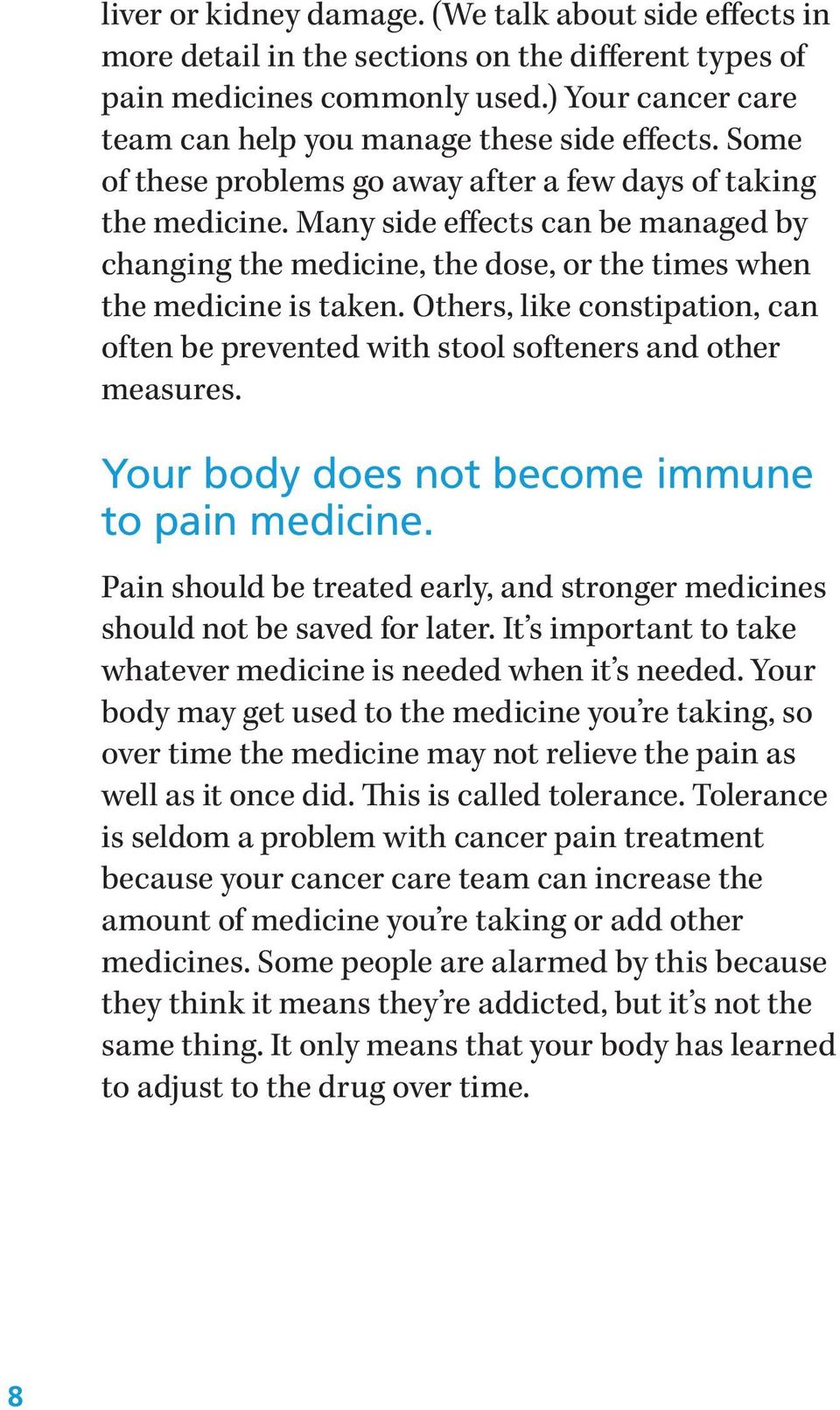
11 When pain is not relieved, you may feel: Tired Depressed Angry Worried Lonely Stressed When cancer pain is relieved, you re more able to: Enjoy being active. Sleep better. Enjoy family and friends. Eat better. Enjoy sexual intimacy. Prevent depression. 9
12 What causes pain in people with cancer? Pain is most often caused by the cancer itself. But pain can also be caused by cancer-related treatment or tests. You may also have pain that has nothing to do with the cancer or its treatment. Like anyone, you can get headaches, muscle strains, and other aches and pains. Pain from the cancer Whether you have pain and the amount of pain you have depends on the type of cancer, its stage (extent), and your pain threshold (tolerance for pain). People with advanced cancer are more likely to have pain. Pain from the cancer can be caused by a tumor pressing on bones, nerves, or body organs. Spinal cord compression When a tumor spreads to the spine, it can press on the spinal cord. This is called spinal cord compression. The first sign of compression is usually back and/ or neck pain, sometimes with pain, numbness, or weakness in an arm or leg. Coughing, sneezing, or other movements often make it worse. If you have this pain, get help right away. This compression must be treated quickly to keep you from losing control of your bladder or bowel or being paralyzed. Your cancer care team can treat the cause of the pain and give you 10
13 medicine to help relieve the pain. If you re treated for the compression soon after the pain begins, you can usually avoid serious outcomes. Treatments usually involve radiation therapy and steroids to shrink the tumor. Or you may have surgery to remove a tumor that s pressing on the spine, which may then be followed by radiation. Bone pain This type of pain can happen when cancer spreads to the bones. Treatment may be aimed at controlling the cancer, or it can focus on protecting the affected bones. External radiation may be used to treat the weakened bone. Sometimes a radioactive medicine is given that settles in the affected areas of bone and helps to make them stronger. Bisphosphonates are other medicines that can help make diseased bones stronger and help keep bones from breaking. These are examples of treatments that are aimed at stopping the cause of the bone pain. You may still need pain medicines, but sometimes these treatments can greatly reduce your pain. Pain from procedures and surgery Procedures and testing Some tests used to diagnose cancer and see how well treatment is working are painful. If such a procedure is needed, concern about pain should not keep you from having it done. Any pain you have during and after the procedure can usually be relieved. Your needs and the type of procedure to be done should dictate the 11

14 kinds of medicine you get for the pain. You may be told that the pain from the procedure can t be avoided or that it won t last long. Even so, you should ask for pain medicine if you need it. Surgical pain Surgery is often part of the treatment for cancers that grow as solid tumors. Depending on the kind of surgery you have, some amount of pain is usually expected. You ll be given pain medicines so you won t be in pain when your surgery is over. Pain due to surgery can last from a few days to a few weeks, depending on the type of surgery. Phantom pain Phantom pain is a longer-lasting effect of surgery, beyond the usual surgical pain. If you ve had an arm, leg, or even a breast removed, you may still feel pain or other unusual or unpleasant feelings that seem to be coming from the absent (phantom) body part. Doctors are not sure why this happens, but phantom pain is real; it s not all in your head. No single pain relief method controls phantom pain in all patients all the time. Many methods have been used to treat this type of pain, including pain medicine, physical therapy, antidepressant medicines, and transcutaneous electric nerve stimulation (TENS). If you re having phantom pain, ask your cancer care team what can be done. 12

15 Pain from other cancer treatments Some of the side effects that occur with chemotherapy and radiation treatments may cause pain for some people. Pain can even cause some people to stop treatment if it s not managed. Talk to your cancer care team about any changes you notice or any pain you have. Here are some examples of pain caused by cancer treatment: Peripheral neuropathy (PN) This condition refers to pain, burning, tingling, numbness, weakness, clumsiness, trouble walking, or unusual sensations in the hands and arms and/or legs and feet. Peripheral neuropathy is due to nerve damage caused by certain types of chemotherapy, by vitamin deficiencies, cancer, and other problems. Be sure to tell your doctor right away if you notice these kinds of problems. You can learn more about peripheral neuropathy online at or call us at to have free information sent to you. Mouth sores (stomatitis or mucositis) Chemotherapy can cause sores and pain in the mouth and throat. The pain can cause people to have trouble eating, drinking, and even talking. 13

16 Radiation mucositis and other radiation injuries Pain from external radiation depends on the part of the body that s treated. It can cause skin burns, mucositis (mouth sores), and scarring all of which can result in pain. The throat, intestine, and bladder are also prone to radiation injury, and you may have pain if these areas are treated. 14

17 Types of pain The type of pain you have affects the treatment you will need. Pain may be acute or chronic: Acute pain is severe and lasts a fairly short time. It s most often a sign that the body is being injured in some way. This pain generally goes away as the injury heals. Chronic or persistent pain lasts for long periods of time. It may range from mild to severe. You ll notice that here we talk mostly about chronic pain, because it can disrupt your life if it s not well treated. There s a third type of pain that s very important in managing chronic cancer pain. Some people with chronic pain that s mostly controlled by medicine can have breakthrough pain. This is when moderate to severe pain breaks through the medicine that s giving pain relief and is felt for a short time. Breakthrough pain People with cancer pain often notice that their pain changes throughout the day. Many people with chronic cancer pain (pain that lasts longer than 3 months) have 2 types of pain persistent or chronic pain and breakthrough pain. Chronic pain doesn t go 15
18 away, but it can usually be controlled by taking pain medicines on a regular schedule. Breakthrough pain is pain that s not controlled by the regular doses of pain medicines. Breakthrough pain is a flare of pain that happens even though you re taking pain medicine regularly for chronic pain. It s called breakthrough pain because it breaks through the pain relief you get from the regular pain medicine. Breakthrough pain may be different for each person, and the person usually can t tell when it will happen. As a rule, it comes on quickly, lasts as long as an hour, and feels much like chronic pain except that it s more severe or intense. It may happen many times a day, even when the chronic pain is controlled by the regular pain medicine. Breakthrough pain is shown in the picture on the next page as spikes through the relief provided by the around-the-clock analgesic (pain medicine taken regularly to treat chronic pain). Breakthrough pain varies in intensity and usually can t be predicted. 16

19 Breakthrough pain often has the same cause as chronic pain. It may be the cancer itself, or it may be related to cancer treatment. Some people have breakthrough pain during a certain activity, like walking or dressing. For others, it happens unexpectedly without any clear cause. Breakthrough pain Around-the-clock analgesic Cronic Pain Time Breakthrough Cancer Pain 17

20 Treating cancer pain Your doctor will want to find out more about what s causing your pain because that will affect how it s treated. Drugs, procedures, cancer treatments, or even surgeries may be used in special ways to manage your pain. If you have severe pain, your cancer care team will try to find the treatment plan that best relieves your pain with the fewest side effects. You ll need to stay in touch and let them know how the pain treatment is working and how you re doing day to day. The goal is an effective pain control plan that works for you. Cancer pain is usually treated with drugs called analgesics, also known as pain relievers. Many pain relievers are available without a prescription (for example, aspirin, acetaminophen, or ibuprofen). These medicines are called non-prescription or overthe-counter (OTC) analgesics. OTC pain medicines can be used alone for mild pain, and along with other medicines for more severe pain. For other pain medicines, you ll need a prescription. Check with your cancer care team before you take any medicine for pain, even OTC medicines, because some of them can interact with cancer drugs or worsen certain problems. Medicines are mostly safe when they re used properly, but they can be very harmful if not managed carefully. 18

21 In some cases, medicines and non-medical treatments may not work well. But there are special pain treatments that can often be used for these kinds of cancer pain. For instance, things like: Radiation to shrink the tumor Surgery to remove all or part of the tumor Nerve blocks, in which medicine is injected into or around a nerve or into the spine to block the pain Neurosurgery, where nerves are cut to relieve the pain There are other methods that may be used, too. See the section called Other medical methods to relieve pain on page 57 for details. You may also use non-medical treatments such as relaxation techniques, biofeedback, guided imagery, and others along with the medicines. See the section called Non-medical treatments for pain on page 60. Developing a plan for pain control The first step in developing a pain control plan is talking with your cancer care team about your pain. You need to be able to describe your pain to your family or friends, too. You may want to have your family or friends help you talk to your cancer care team about your pain, especially if you re too tired or in too much pain to talk to them yourself. 19
22 Using a pain scale is a helpful way to describe how much pain you re feeling. To use the Pain Intensity Scale shown here, try to assign a number from 0 to 10 to your pain level. If you have no pain, use a 0. As the numbers get higher, they stand for pain that s getting worse. A 10 means the worst pain you can imagine No pain Worst pain For instance, you could say, Right now, my pain is a 7 on a scale of 0 to 10. You can use the rating scale to describe: How bad your pain is at its worst What your pain is like most of the time How bad your pain is at its least How your pain changes with treatment Tell your cancer care team and your family or friends: Where you feel pain What it feels like for instance, sharp, dull, throbbing, gnawing, burning, shooting, steady How strong the pain is (using the 0 to 10 scale) 20
23 How long it lasts What eases the pain What makes the pain worse How the pain affects your daily life What medicines you re taking for the pain and how much relief you get from them Your cancer care team may also need to know: All the medicines you re taking now, including vitamins, minerals, herbs, supplements, and nonprescription medicines The pain medicines you ve taken in the past, including what has and has not worked for you Any known allergies to medicines, foods, dyes, or additives When working on a pain control plan, it helps to take all your medicines, vitamins, minerals, herbs, and non-prescription drugs with you. Show them to your cancer care team and explain how you take them. Questions you may want to ask about pain medicine include: How much medicine should I take? (What s the dose?) How often can I take it? How do I take it? 21
24 If my pain is not relieved, can I take more? If so, how much? Should I call you before increasing the dose? What if I forget to take it or take it too late? Should I take the pain medicine with food? How much liquid should I drink with the medicine? How long does it take the medicine to start working? Is it safe to drink alcohol, drive, or operate machinery after I ve taken this pain medicine? What other medicines can I take with the pain medicine? What medicines should I stop taking or not take while I m taking the pain medicine? What side effects from the medicine are possible? How can I prevent them? What should I do if I have them? Keep a record of your pain. You may find it helpful to keep a record or a diary to track details about your pain and what works to ease it. You can share this record with those caring for you. This will help them figure out what method of pain control works best for you. Your records can include: Words to describe the pain 22
25 Any activity that seems to increase or decrease the pain Any activity that you can t do because of the pain The name, dose, and time you take your pain medicines The times you use other pain-relief methods (such as relaxation techniques, distraction, or imagery) The number you rate your pain at the time you use a pain-relief measure (medicine or method to reduce pain) Your pain rating 1 to 2 hours after using the painrelief measure How long the pain medicine works Your pain rating throughout the day (to get an idea of your general comfort) How pain interferes with your normal activities, such as sleeping, eating, sex, or work Any side effects you have that may be from the medicines 23
26 Here s an example of how you might set up your pain diary: Date & time 3/12 7:40 a.m. Pain score (0 to 10) 8 Where pain is and how it feels (ache, sharp, throbbing, shooting, etc.) Stabbing pain in right side under my arm What I was doing when it began Getting out of bed Name, time, and amount of medicine taken 2 Percocet at 7:45 a.m. Non-drug techniques I tried Deep breathing How long the pain lasted About 35 min. Other notes Pain came down to a 3, and I was able to get up and shower at 8: You can also print out a Pain Diary from our website, or call us to have a copy mailed to you.
27 Medicines used to relieve pain The type of medicine and the way the medicine is given depend on the type and cause of pain. For example, chronic pain is best relieved by methods that deliver a steady dose of pain medicine over a long period of time, such as a patch that releases medicine through the skin or slow (extended)-release pills. On the other hand, breakthrough pain is best treated with medicines that work fast (quick release), and stay in the body only for a short time. Below is an overview of the types of medicines used to relieve pain. For mild to moderate pain Non-opioids: Acetaminophen (Tylenol) and nonsteroidal anti-inflammatory drugs (NSAIDs), such as aspirin and ibuprofen (Advil, Motrin), are often used. You can buy many of these over the counter (without a prescription). For others, you need a prescription. Check with your doctor before using these medicines. NSAIDs can slow blood clotting. This may be a problem if you re having surgery or getting Opioids or narcotics are the strongest pain relievers available. 25
28 chemotherapy. NSAIDs and acetaminophen may also affect other parts of the body and may interact with other medicines. For moderate to severe pain Opioids (also known as narcotics): Morphine, fentanyl, hydromorphone, oxycodone, codeine and others You need a written prescription for these medicines. Non-opioids may be used along with opioids for moderate to severe pain. For breakthrough pain Rapid-onset opioids: Fast-acting oral morphine; fentanyl in a lozenge, sucker, or under-the-tongue spray (These forms of fentanyl are absorbed from your mouth they are not swallowed.) You need a written prescription for these medicines. A short-acting opioid, which relieves breakthrough pain quickly, is often used with a long-acting opioid. Many times the same opioid drug is used to treat both the chronic and the breakthrough pain, so be sure you know what you re taking. For example, hydrocodone ER (Zohydro ER ) may be for your chronic pain and hydrocodone with acetaminophen (Lortab ) is for your breakthrough pain. Do not mix them up! 26
29 For tingling and burning pain Antidepressants: Amitriptyline, nortriptyline, venlafaxine, and others You need a prescription for these medicines. Antidepressants are prescribed to relieve certain types of pain. Taking an antidepressant does not mean that you re depressed or have a mental illness. Anti-convulsants (anti-seizure medicines): Carbamazepine, gabapentin, and others You need a prescription for these medicines. Despite the name, anti-convulsants are not only used for convulsions (seizures), but also to control burning and tingling (nerve) pain. For pain caused by swelling or pressure Steroids: Prednisone, dexamethasone You need a prescription for these medicines. They re most often used to lessen swelling, which often causes pressure and pain. 27
30 How is pain medicine given? Some people think that if their pain becomes severe, they ll need to get injections or shots of pain medicine. In fact, shots are rarely given to relieve cancer pain. There are many other ways you can take pain medicine. Oral means the drug is taken by mouth, either by being swallowed or absorbed in the mouth. Medicine is given as a liquid, pill, capsule, or in transmucosal form (the drug is in a lozenge, sucker, or spray and absorbs directly through the tissues of the mouth). Skin patch a clear, sticky patch placed on the skin. It slowly but constantly releases medicine through the skin for 2 to 3 days. Rectal suppositories medicine that dissolves in the rectum and is absorbed by the body Injections Subcutaneous (SC) injection Medicine is put just under the skin using a small needle. Intravenous (IV) injection Medicine goes right into a vein through a needle, port, or catheter. 28
31 Intrathecal and epidural injections Medicine is put into the fluid around the spinal cord (intrathecal) or into the space around the spinal cord (epidural). Pump, or patient-controlled analgesia (PCA) With this method, you have control over the amount of pain medicine you take. When you need pain relief, you press a button to get a pre-set dose of pain medicine through a computerized pump. (The pump carefully controls how much you can get at a time, so you can t take too much.) The pump is connected to a small tube going into your body. The medicine goes into a vein, just under the skin, or into the area around the spine. Never crush, break, or open extended-release pills or capsules. Talk to your doctor if you have trouble swallowing your pain medicines. There are many different ways to take them. 29
32 Different ways to treat chronic and breakthrough pain Treating chronic pain Drugs used to treat chronic or persistent pain need to work for a long time. They re called long-acting or extended-release drugs and are taken at regular times. They re slowly released into the body and keep pain at a lower level over a long period of time. You take these pain medicines on a schedule even if you re not having pain at the time the medicine is due. By taking these drugs on a schedule, you can maintain a fairly constant level of pain relief through the day and night. These drugs may be given in the form of tablets or capsules taken every 8 to 12 hours or as a skin patch that s worn for several days. Again, these drugs are taken on a schedule and not just when you re in pain. Treating breakthrough pain Breakthrough pain is best treated with pain medicines that work quickly and for a short period of time. They re usually taken as needed, which means that they should be taken as soon as you 30
33 You may want to take a dose of your breakthrough medicine to prevent pain before it starts if you know that you re likely to have breakthrough pain during or after a certain activity. notice breakthrough pain. These short-acting drugs (sometimes called rescue medicines) work faster than those used for chronic pain. They also stay in your body for a shorter time and tend to cause fewer side effects. You should take your short-acting medicine when you first notice pain, so that it can start to work to relieve your pain right away. Do not let the pain build up and become too severe it will be much harder to get under control. Follow the directions given to you. If the usual dose doesn t relieve your breakthrough pain, or if you think you re having breakthrough pain too often, tell your cancer care team. They may need to adjust the dose or frequency of the medicine you take for chronic pain. 31
34 Common questions about breakthrough pain If I have breakthrough pain, does it mean that the pain medicine I m using regularly for my chronic pain isn t working? No. Breakthrough pain is an intense flare-up of pain that s usually more severe than chronic pain. Remember, breakthrough pain is common in people with cancer pain. It can happen even when a person is taking the right dose of pain medicine on a regular schedule for their chronic pain. Still, let your cancer care team know if you re having more breakthrough flare-ups than usual, and just how often you need your breakthrough medicine. You may need a larger dose of your chronic pain medicine. How can I be sure that I m getting the right dose of breakthrough pain medicine? Your breakthrough pain medicine should relieve most of your breakthrough pain without causing unacceptable side effects, such as extreme drowsiness. If your breakthrough pain medicine doesn t relieve the breakthrough pain or if you have breakthrough pain more than 4 times a day, contact your cancer care team. They may need to adjust your dose or type of pain medicines to help you get the best pain relief. 32
35 Can I take my chronic pain medicine and my breakthrough pain medicine at the same time? Yes, if you need to. You may have breakthrough pain just before or after taking your regular (chronic) pain medicine. At such times, you should take your breakthrough pain medicine and keep taking your chronic pain medicine on schedule. Always follow the directions given to you by your cancer care team. If you notice that you often have breakthrough pain right before your usual dose of chronic pain medicine, talk to your team. They may need to adjust the dose, timing, or frequency of your chronic pain medicine. If you have any questions about when to take either your chronic or breakthrough pain medicines, contact your team to discuss your pain medicine schedule. What if I need a different pain medicine? If one medicine or treatment doesn t work, there s almost always another one that can be tried. If the schedule or way that you re taking medicine doesn t work for you, it can be changed, too. Some pain medicines cost more than others, and this may also be an issue. Talk to your cancer care team about finding the pain medicine and/or method that works best for you. You may need a different pain medicine, a combination of pain medicines, or a change in the dose or timing of your pain medicines if: Your pain is not relieved. 33
36 Your pain medicine doesn t start working within the time your doctor said it would. Your pain medicine doesn t work for the length of time your doctor said it would. You have breakthrough pain more than 4 times a day, it s getting worse, or it s not relieved with the short-acting medicine you re taking for it. You have side effects. Side effects such as sleepiness, nausea, and itching usually go away as your body adjusts to the medicine. Let your cancer care team know if these bother you. You have serious side effects such as trouble breathing, dizziness, and/or rashes. Call your cancer care team right away if any of these start. The schedule or the way you re taking the medicine doesn t work for you. Pain interferes with your normal activities, such as eating, sleeping, working, and sex. To help make the most of your pain control plan: Take your pain medicine on a regular schedule (around the clock) to help control chronic pain. Take it when it s time to take it even if you re not having pain. Do not skip doses of your scheduled medicine. The more pain you have, the harder it is to control. 34
37 If you have breakthrough pain, use your shortacting medicine as instructed. Don t wait for the pain to get worse if you do, it can be harder to control. Be sure only one doctor prescribes your pain medicine. If another doctor changes your medicine, the two doctors should discuss your treatment with each other. Don t run out of pain medicine. Remember that prescriptions are needed for opioid pain medicines they can t be called in and drugstores don t always have them in stock. It can take a few days to get the medicine, so give yourself time for delays. Store pain medicines safely away from children, pets, and others who might take them. Never take someone else s medicine. Medicines that helped a friend or relative may not be right for you. Do not use old pain medicine or medicine left over from other problems. Drugs that worked for you in the past may not be right for you now. Pain medicines affect different people in different ways. A very small dose may work for you, while someone else may need to take a much larger dose to get pain relief. Remember, your pain control plan can be changed at any time. 35
38 Non-opioid pain medicines Non-opioids control mild to moderate pain. Some can be bought without a prescription. In many cases, non-opioids are all you ll need to relieve your pain, especially if you stay on top of the pain by taking them regularly. These medicines are stronger pain relievers than most people realize. Brand-name drugs and generic drugs Drugs may have as many as 3 different names: brand, generic, and chemical. Drug companies give their products brand names, and some products have more than one brand name. You should also know that the same brand name may be used on different drugs, since the name belongs to the company. Read the labels to see what ingredients are in each medicine. Chemical names are long and tend to be hard to pronounce. The Food and Drug Administration (FDA) approves the generic, shortened names by which drugs are usually known. Here s an example: Brand names: Tylenol, Tempra, Liquiprin, Anacin, Paramol (and many more) Generic name: acetaminophen Chemical name: N-(4-hydroxyphenyl) acetamide 36
39 Table 1. Common non-opioids Acetaminophen and NSAIDs and their side effects Type Action Side effects Acetaminophen (Tylenol) Reduces pain and fever Large doses (more than 4 grams in 24 hours) can damage the liver and/ or kidneys. Use by people who have 3 or more alcoholic drinks per day may cause liver damage. Acetaminophen reduces fever, so ask your doctor what to do if your body temperature is higher than normal (98.6 F or 37 C) while you are taking this medicine. NSAIDs (Non-steroidal anti-inflammatory drugs) Over the counter: Aspirin* Ibuprofen (Motrin) Naproxen sodium (Aleve or Naprosyn) Prescription: Diclofenac (Voltaren) Etodolac (Lodine) Fenoprofen calcium (Nalfon) Indomethacin (Indocin) Ketorolac (Toradol) Meclofenamate Nabumetone (Relafen) Naproxen (Naprosyn or Anaprox) Oxaprozin (Daypro) Piroxicam (Feldene) Sulindac (Clinoril) Reduce pain, inflammation, and fever Can irritate the stomach Can cause bleeding of the stomach lining, especially if combined with alcohol or if you smoke Can cause kidney problems Avoid these drugs if you are on anticancer drugs that may cause bleeding, or if you are taking blood thinners, steroids, blood pressure medicines, or lithium. Aspirin and NSAIDs reduce fever, so ask your doctor what to do if your body temperature is higher than normal (98.6 F or 37 C) while you are taking one of these medicines. NSAIDs may increase your risk of stroke or heart attack. * Children and teens should NOT take aspirin or products that contain it. 37
40 Many pain relievers are available under both generic and brand names. We have included some of the more common generic names with their common brand names in parentheses in Table 1. Your doctor, nurse, or pharmacist can tell you the generic and common brand names of any medicines you re taking. It s always good to know both because you may hear either name when talking about your medicines. Knowing both names can also keep you from getting confused when keeping track of prescriptions and pill bottles. It can also keep you from taking too much of the same medicine if it s prescribed using 2 different names. Generic drugs usually cost less than brand-name ones. Sometimes medicines can have the same generic name, but are made by different companies. Because the companies may produce the medicines differently, they may differ slightly in the way they re absorbed by the body. For this reason, your doctor may sometimes prefer that you take a brand-name drug. Ask your doctor, nurse, or pharmacist if you can use a cheaper generic medicine. Pharmacists are careful to get high-quality generic products, so it s often possible to substitute a generic. Along with the main substance (for example aspirin, acetaminophen, or ibuprofen), some brands contain substances called additives. Common additives include: 38
41 Buffers (such as magnesium carbonate or aluminum hydroxide) to decrease stomach upset Caffeine to act as a stimulant and help improve the effect of some pain medicines Antihistamines (such as diphenhydramine or pyrilamine) to help you relax or sleep Medicines with additives can cause side effects you wouldn t expect from the main drug. For example, antihistamines sometimes cause drowsiness. This may be all right at bedtime, but it could be a problem during the day. Also, additives tend to increase the cost of non-prescription pain relievers. They can also change the action of other medicines you may be taking or even keep your body from absorbing the other drug. When you start a new drug, even one you can get over the counter, always talk with your doctor or pharmacist about what you re already taking to see if the combination can cause harmful effects. Plain aspirin, acetaminophen, or ibuprofen probably works as well as the same medicines with additives. But if you find that a brand with certain additives is a better pain reliever, ask your doctor, nurse, or pharmacist if the additives are safe for you. Talk with them about any concerns you may have about the drugs contained in your non-prescription pain medicines. 39
42 Non-steroidal anti-inflammatory drugs Non-steroidal anti-inflammatory drugs (NSAIDs) work a lot like aspirin (see list in Table 1 on page 37). Either alone or used with other medicines, NSAIDs can help control pain. Before you take any NSAIDs or other non-opioids, ask your doctor, pharmacist, or nurse if it s safe for you to take it with your other medicines, and how long you can take it. Precautions when taking NSAIDs Some people are at increased risk of complications related to NSAIDS. In general, NSAIDs should be avoided by people who: Are allergic to aspirin or any other NSAIDs Are on chemotherapy Are taking steroids Are taking blood pressure medicines Have stomach ulcers or a history of ulcers, gout, or bleeding disorders Are taking oral medicine (drugs by mouth) for diabetes or gout Have kidney problems Will have surgery within a week 40
43 Talk to your doctor, nurse, or pharmacist about how to take your medicine. Are taking blood-thinning medicine Are taking lithium Be careful about mixing NSAIDs with alcohol taking NSAIDs and drinking alcohol can cause stomach upset and raise the risk of bleeding in the stomach. Smoking may also increase this risk. NSAIDs may also raise your risk of heart attack or stroke, especially if you take them a long time. Children and teens should not take aspirin or products that contain it. 41
44 Side effects of NSAIDs The most common side effect from NSAIDs is upset stomach, especially in older people. Taking NSAIDs with a snack or just after a meal may lessen your chance of stomach problems. Ask your pharmacist to tell you which NSAID products are less likely to upset your stomach. NSAIDs also keep platelets from working the way they should. Platelets are the blood cells that help blood clot after an injury. When platelets don t work like they should, it takes a longer time to stop bleeding. If your stools become darker than normal or if you notice unusual bruising both signs of bleeding tell your doctor or nurse. Other side effects include kidney problems and stomach ulcers. NSAIDs can sometimes cause people to retain fluids and worsen heart failure. They also can affect the actions of other drugs. There are other less common side effects of many NSAIDs that happen in some people. Acetaminophen This medicine relieves pain much the same way NSAIDs do, but it doesn t reduce inflammation as well as NSAIDs. People rarely have side effects from the usual dose of acetaminophen. But liver and kidney damage may result if you use large doses of this medicine every day for a long time or drink alcohol 42
45 with the usual dose. Even moderate amounts of alcohol (3 drinks per day) can lead to liver damage in people taking acetaminophen. You also need to be careful about taking other drugs with added acetaminophen. See Aspirin, acetaminophen, and ibuprofen in other medicines. Your doctor may not want you to take acetaminophen regularly if you re getting chemotherapy because it can cover up a fever. Your doctor needs to know about any fever because it may be a sign of infection, which needs to be treated. Aspirin, acetaminophen, and ibuprofen in other medicines Some opioid medicines also contain aspirin or acetaminophen (Tylenol) in the same pill. A few also contain ibuprofen. This can pose dangers for people who take these drugs without knowing about the extra medicine. If one of your doctors tells you not to take aspirin or ibuprofen, or if you can t take NSAIDs for some reason, be sure to check your medicine labels carefully. If one of your prescription medicines has acetaminophen in it, and you also take over-thecounter acetaminophen for pain, you can get too much without knowing it. Too much acetaminophen can damage your liver. 43
46 If you re not sure if a medicine contains aspirin, acetaminophen, or ibuprofen, ask your pharmacist. If you take any non-prescription medicine for a cold, sinus pain, or menstrual symptoms while you re taking pain medicines, read the label carefully. Most of these drugs are combination products that contain aspirin, ibuprofen, or acetaminophen. Check with a pharmacist to find out what you can safely take with your pain medicines. 44
47 Opioid pain medicines These medicines are used alone or with non-opioids to treat moderate to severe pain. Opioids are much like natural substances (called endorphins) made by the body to control pain. These medicines were once made from the opium poppy, but today many are synthetic, that is, they re man-made in a lab. Common opioids by generic name Here are some of the opioids used in cancer care. The more common brand names are added in parentheses. An ER behind the name of any of these drug names stands for extended release, and is a sign that the drug is taken on a regular schedule to treat chronic pain. Codeine* Hydromorphone (Dilaudid) Levorphanol (Levo-Dromoran) Methadone (Dolophine, Methadose) Morphine (Apokyn, Avinza, Kadian, MS-Contin, and others) Oxycodone* (OxyContin, OxyIR, Roxicodone) Hydrocodone* Oxymorphone (Opana) 45
48 Fentanyl (Duragesic, Actiq, Fentora, Lazanda, and others) *Common combination opioid and acetaminophen or NSAID drugs: Codeine may be added to aspirin or acetaminophen. For instance, Fiorinal with codeine has aspirin; Fioricet with codeine, Tylenol #3, and Tylenol #4 all contain acetaminophen. Oxycodone may be added to aspirin, acetaminophen, or ibuprofen. For instance, Percodan has aspirin in it; Percocet, Roxicet, Roxilox, Oxycet, and Tylox all have acetaminophen; Combunox has ibuprofen. Hydrocodone may be added to acetaminophen or ibuprofen. For instance, Zydone, Norco, and Lortab all contain acetaminophen; Vicoprofen and Reprexain have ibuprofen Opioid tolerance People who take opioids for pain sometimes find that over time they need to take larger doses. This may be due to an increase in the pain or the development of drug tolerance. Drug tolerance is when your body gets used to the opioid you re taking, and it takes more medicine to relieve the pain as well as it once did. Many people do not develop a tolerance to opioids. But if tolerance does develop, usually small increases in the dose or a change in the kind of medicine will help relieve the pain. 46
49 If you re taking a combination pain medicine, be sure you know what drugs are in each pill. Increasing the doses of opioids to relieve increasing pain or to overcome drug tolerance does NOT mean that a person is addicted. How to get proper pain relief with opioids When a medicine doesn t give you the pain relief you need, your doctor may prescribe a higher dose or tell you to take it more often. When your cancer care team is working closely with you, doses of strong opioids can be raised safely to ease severe pain. Do not increase the dose of your pain medicine on your own. If dose changes don t work, your doctor may prescribe a different drug or add a new drug to the one you re taking. If your pain relief isn t lasting long enough, ask your doctor about extended-release medicines that come 47
50 in pills and patches. These can control your pain for a longer period of time. If your pain is controlled most of the time, but you sometimes have breakthrough pain, your doctor may prescribe a fast-acting medicine or immediate-release opioid that will give you faster pain relief right when it s needed. Be safe when taking opioids. Doctors carefully watch you and adjust the doses of pain medicine so you don t take too much. For this reason, it s important that only one doctor prescribe your pain medicines. If you re working with 2 or more doctors, be sure that one does not prescribe opioids for you without talking to the others about it. If you drink alcohol or take tranquilizers, sleeping pills, antidepressants, antihistamines, or any other medicines that make you sleepy, tell your doctor how much and how often you do this. Combinations of opioids with alcohol or tranquilizers can be dangerous. Even small doses may cause problems. Using such combinations can lead to overdoses and symptoms such as weakness, trouble breathing, confusion, anxiety, or more severe drowsiness or dizziness. 48
51 Side effects of opioids Not everyone has side effects from opioids. The most common side effects are usually drowsiness, constipation, nausea, and vomiting. Some people might also have dizziness, itching, mental effects (such as nightmares, confusion, and hallucinations), slow or shallow breathing, or trouble passing urine. Many side effects from opioid pain medicine can be prevented. Some of the mild ones such as nausea, itching, or drowsiness, often go away without treatment after a few days, as your body adjusts to the medicine. Let your cancer care team know if you re having any side effects and ask for help in managing them. Here are a few of the more common side effects: Drowsiness When you first start taking them, opioids may cause drowsiness, but this usually goes away after a few days. If your pain has kept you from sleeping, you may sleep more for a few days after starting opioids while you catch up on your sleep. Drowsiness will also lessen as your body gets used to the medicine. Call your cancer care team if you still feel too sleepy for your normal activities after you ve been taking the medicine for a week. 49
52 Sometimes it may be unsafe for you to drive a car, or even to walk up and down stairs alone. Do not do anything that requires you to be alert until you know how the medicine affects you. Here are some ways to handle drowsiness: Wait a few days and see if it goes away. Check to see if other medicines you re taking can also cause drowsiness. Ask the doctor if you can take a smaller dose more often or an extended-release opioid. If the opioid is not relieving the pain, the pain itself may be tiring you out. In this case, better pain relief may lead to less drowsiness. Ask your cancer care team what you can do to get better pain relief. Sometimes a small decrease in the dose of an opioid will still relieve your pain without causing drowsiness. If the drowsiness is very bad, you may be taking more medicine than you need. Talk to your doctor about lowering the amount you re taking. Ask your doctor about changing to a different medicine. Ask your doctor if you can take a mild stimulant such as caffeine during the day. 50
53 If drowsiness is bad or if it suddenly starts to be a problem after you ve been taking opioids for a while, call your cancer care team right away. Constipation Opioids cause constipation in most people. This is because opioids slow the movement of stool through the intestinal tract, which allows more time for water to be absorbed by the body. The stool then becomes hard. It s best to start a laxative, stool softener, or other treatment to keep your bowels moving when you start taking opioids. Constipation can often be prevented or controlled. After checking with your cancer care team, try the following to prevent constipation: Talk with your team about stool softeners and laxatives. Ask how often and how much you should take. Drink plenty of liquids. Eight to 10 8-ounce glasses of fluid each day can help keep your stools soft. This is a very important step if your stool is dry, it will be hard to pass. Eat foods high in fiber or roughage such as uncooked fruits (with the skin on), vegetables, and 100% whole-grain breads and cereals. Add 1 or 2 tablespoons of unprocessed bran to your food. This adds bulk and promotes bowel movements. Keep a shaker of bran handy at 51
54 mealtimes to make it easy to sprinkle on foods. Be sure to drink plenty of water when you eat bran so that it softens in the bowel. Exercise as much as you can. Talk with your doctor about what kind of exercise is best for you. Walking is often a good start if you haven t exercised recently. Eat foods that have helped you relieve constipation in the past. If you haven t been getting out of bed, try to use the toilet or bedside commode when you have a bowel movement, even if that s the only time you get out of bed. If you re still constipated after trying all the above measures, ask your doctor about changing your stool softener or laxative. Check with your cancer care team before taking any laxative or stool softener on your own. If you haven t had a bowel movement for 2 days or more, call your team. Nausea and vomiting Nausea and vomiting caused by opioids will usually go away after a few days of taking the medicine. These tips may help: If you have more nausea when you re up or walking around but not when you re lying down, stay in bed for an hour or so after you take your pain medicine. This type of nausea is like motion sickness. 52
55 Sometimes over-the-counter medicines such as meclizine (Bonine or Antivert) or dimenhydrinate (Dramamine) help this type of nausea. Check with your cancer care team before taking these medicines, since they can cause problems for some people. If pain itself is causing the nausea, using opioids to relieve the pain usually makes the nausea go away. Medicines that relieve nausea can be prescribed if you need them. Talk with your cancer care team if you can t hold down foods or liquids for a full day, or if nausea lasts more than a few days. Ask your team if the cancer, another medical problem, steroids, chemo, or other medicines might be causing your nausea. Constipation may also worsen nausea. Some people think they re allergic if they have nausea after they take an opioid. Nausea and vomiting alone usually are not allergic reactions. But a rash or itching along with nausea and vomiting may be an allergic reaction. If this happens, stop taking the medicine and call your cancer care team right away. If you have swelling in your throat, hives (itchy welts on the skin), and/or trouble breathing, get help right away. When you no longer need opioids You should not suddenly stop taking opioids. People who stop taking opioids are usually tapered off the medicine slowly so that their bodies have time 53
56 54 to adjust. If you stop taking opioids suddenly and develop a flu-like illness, excessive sweating, diarrhea, or any other unusual reaction, tell your cancer care team. These symptoms can be treated and tend to go away in a few days to a few weeks. Again, slowly decreasing your opioid dose over time usually keeps these kinds of symptoms from happening. Check with your doctor about the best dose schedule for tapering off your pain medicines.
57 Other types of pain medicine Many different types of medicines can be used along with (or instead of) opioids to help relieve cancer pain. Some of these medicines relieve pain or increase the effect of opioids. Others lessen the side effects of opioids. These drugs are often started at low doses and increased over time. Table 2 on page 56 shows the classes of non-opioid drugs that your doctor might prescribe to help you get the best pain relief with as few side effects as possible. 55
58 Table 2. Other medicines commonly used to relieve cancer pain Drug class Generic (brand) name Action Side effects Antidepressants aamitriptyline (Elavil), imipramine (Tofranil), nortriptyline (Pamelor), desipramine, duloxetine (Cymbalta), venlafaxine (Effexor) Used to treat tingling or burning pain from damaged nerves. Nerve injury (and nerve pain) can be caused by surgery, radiation, chemo, or the cancer itself. Dry mouth, blurred vision, trouble passing urine, sleepiness, constipation Drop in blood pressure with dizziness or fainting when standing. May cause irregular heartbeat, especially in patients with heart disease. Antihistamines hydroxyzine (Atarax, Vistaril), diphenhydramine (Benadryl) Can help control nausea and help people sleep. Can help control itching. Drowsiness, dry mouth and nose, irritability, restlessness, nervousness, trouble passing urine Anti-anxiety drugs diazepam (Valium), lorazepam (Ativan) Used to treat muscle spasms that may go along with severe pain. Also lessens anxiety. Drowsiness. May cause urinary incontinence (loss of bladder control). Stimulants and amphetamines caffeine, dextroamphetamine (Dexedrine), methylphenidate (Ritalin), modafinil (Provigil) Increase the painrelieving action of opioids and reduce the drowsiness they cause Irritability, rapid heartbeat, decreased appetite Anticonvulsants carbamazepine (Tegretol), clonazepam (Klonopin), gabapentin (Neurontin), pregabalin (Lyrica) Help to control tingling or burning from nerve pain caused by the cancer or cancer treatment Liver problems, low red and white blood cell counts. Some may cause sleepiness and dizziness. Steroids dexamethasone (Decadron), prednisone Help relieve bone pain, pain caused by spinal cord and brain tumors, and pain caused by inflammation Increased appetite and thirst. Fluid build-up in the body, increased blood sugar, stomach irritation, confusion. Changes in behavior, trouble sleeping. 56
59 Other medical methods to relieve pain Some people have pain that s not relieved by drugs or non-medical methods. When this happens, other treatments can often be used to help reduce pain. Stopping pain impulses from going through the nerves Surgery Pain can t be felt if the nerve pathways that carry pain impulses or signals to the brain are interrupted. To block these pathways, a neurosurgeon may cut nerves, usually near the spinal cord. When the nerves that relay pain are cut, feelings of pain, pressure, and temperature can no longer be felt the area becomes numb. Only surgeons with special skills, who are also experts in pain management, should do this kind of surgery. These surgeons normally work with other pain specialists to explore other methods of pain control before they cut nerves this treatment can t be reversed. Nerve block A nerve block is a procedure where a local anesthetic (a numbing drug), often combined with a steroid, is injected into or around a nerve or into the space around the spinal cord to block pain. After the injection, the nerve is no longer able to relay pain so the pain is relieved for some time. For longer-lasting pain relief, phenol or alcohol can be injected. A nerve block 57
60 may cause muscle paralysis or a loss of all feeling in the affected area. Spinal analgesia Low doses of pain medicine may be injected into the fluid around the spine (called intrathecal injection). If this works, a tube and a pump may be used to deliver the pain medicine right into the spinal fluid to control the pain. Morphine is often used for this purpose, and you can still have side effects like itching and constipation. Surgery is done to put the small pump and tube into your body. Epidural Certain kinds of pain may respond to pain medicine that s injected into the space around the layers of the spine. If this works, a pump can be implanted so that you can get pain medicines right around the nerves. This may cause numbness or weakness of the treated area. More cancer treatment may be given to shrink the tumor. Sometimes, even when cancer treatment can t cure the cancer, it can shrink the size of a tumor that s pressing on nerves and organs and causing pain. Chemo, hormone therapy, or radiation may be used in this way. Radioactive injections are sometimes used when the cancer has spread to many places in the bone the radioactive drug settles in the bones near the cancer and helps to stop its growth and relieve pain. In a few cases, other treatments like radiofrequency ablation can 58
61 be used in certain areas of the body. In this treatment, electrodes are put in near the tumor to heat and destroy the cancer. Call us or go to our website if you d like to learn more about any of these pain treatments. 59
62 Non-medical treatments for pain Non-medical treatments may be used along with pain medicine, though they can also be used alone for mild pain or discomfort. Some people find they can take a lower dose of pain medicine when they also use nonmedical treatments. These methods include things like relaxation, biofeedback, imagery, distraction, hypnosis, skin stimulation, transcutaneous electric nerve stimulation (TENS), acupuncture, exercise or physical therapy, and emotional support and counseling. We give you some basic tips here, but you may need the help of health professionals social workers, physical therapists, psychologists, nurses, or others to learn to use these techniques. Family and friends can also help. To find someone who specializes in these techniques or learn more about them: Talk with your doctor or nurse. Contact a local hospice, cancer treatment center, or pain clinic. Visit your local bookstores or library. You can also contact the National Center for Complementary and Alternative Medicine Clearinghouse to learn more about these techniques. (See the To learn more about cancer pain section on page 78 for contact information.) 60
63 Pain may be a sign that the cancer has spread, an infection has started, or there are problems caused by the cancer treatment. Because of this, you should report any new pain problems to your cancer care team before trying any medical or non-medical treatments to relieve the pain on your own. Some general guidelines for managing pain with nonmedical methods include: Try using a non-medical method along with your regular pain medicines. For instance, you might use a relaxation technique (to lessen tension, reduce anxiety, and manage pain) at the same time you take medicine. Know yourself and what you can do. Often when people are rested and alert, they can use a method that demands more attention and energy. When tired, people may need to use a method that requires less effort. For example, try distraction when you are rested and alert; use hot or cold packs when you re tired. Try different methods to learn which ones work for you. Be open-minded, and keep a record of what makes you feel better and what doesn t help. Relaxation Relaxation helps relieve pain and/or keep it from getting worse by reducing muscle tension. It can help you fall asleep, give you more energy, make you less 61
64 tired, reduce your anxiety, and help other pain-relief methods work better. How to use relaxation Relaxation may be done sitting up or lying down. Choose a quiet place whenever possible. Close your eyes. Do not cross your arms and legs because that may cut off circulation and cause numbness or tingling. If you re lying down, be sure you are comfortable. Put a small pillow under your neck and under your knees or use a low stool to support your lower legs. You can also ask your cancer care team to recommend relaxation CDs for you. These recordings provide stepby-step instructions in relaxation techniques. There are many relaxation methods. Here are some for you to try: Visual concentration and rhythmic massage: Open your eyes and stare at an object, or close your eyes and think of a peaceful, calm scene. With the palm of your hand, firmly massage near the area of pain in a circular movement. Avoid red, raw, or swollen areas. A family member or friend can do this for you. Inhale/tense, exhale/relax: Breathe in deeply. At the same time, tense your muscles or a group of muscles. For example, you can squeeze your eyes shut, frown, clench your teeth, 62
65 make a fist, stiffen your arms and legs, or draw up your arms and legs as tightly as you can. Hold your breath and keep your muscles tense for a second or two. Let go. Breathe out and let your body go limp. Slow, rhythmic breathing: Stare at an object or close your eyes and focus on your breathing or on a peaceful scene. Take a slow, deep breath and, as you breathe in, tense your muscles (such as your arms). As you breathe out, relax your muscles and feel the tension draining. Now stay relaxed and begin breathing slowly and comfortably. Focus on your breathing, taking about 9 to 12 breaths a minute. Breathing too fast or too deeply can cause dizziness or other symptoms. To keep a slow, even rhythm as you breathe out, you can say silently to yourself, In, 1, 2; out, 1, 2. It may be helpful at first if someone counts out loud for you. If you ever feel out of breath, take a deep breath and then continue the slow breathing. Each time you breathe out, feel yourself relaxing and going limp. If some muscles, such as your shoulder muscles, aren t relaxed, tense them as you breathe 63
66 in and relax them as you breathe out. Do this only once or twice for each muscle group. Continue slow, rhythmic breathing for a few seconds up to 10 minutes, depending on your need. To end your slow, rhythmic breathing, count silently and slowly from 1 to 3. Open your eyes. Say silently to yourself, I feel alert and relaxed. Begin moving about slowly. Precautions Some people who have used relaxation for pain relief have noticed some common problems and have made these suggestions: Relaxation may be hard to use when you have severe pain. Try quick and easy relaxation methods such as rhythmic massage or breathe in/tense, breathe out/relax. Or you can wait until your pain medicine starts working before you start with the relaxation methods. Sometimes breathing too deeply for a while can make you feel short of breath. If this happens, take shallow breaths and/or breathe more slowly. You may fall asleep. This can be a good thing if you re ready to go to bed. If you don t want to fall asleep, sit in a hard chair while doing the relaxation exercise or set a timer or alarm. 64
67 If you have trouble using these methods, ask your cancer care team to refer you to someone experienced in relaxation techniques. Do not keep using any technique that increases your pain, makes you feel uneasy, or causes unpleasant effects. Biofeedback You ll need the help of a licensed biofeedback technician to learn this technique. With the help of special machines that give you instant feedback on the state of your body, you can learn to control certain body functions such as heart rate, blood pressure, and muscle tension. Biofeedback is sometimes used to help people learn to relax and cope with pain. This technique is usually used with other pain-relief methods. Imagery Imagery is using your imagination to create mental pictures or situations. The way imagery relieves pain is not fully understood, although it may be simply a combination of relaxation and distraction. Imagery can be thought of as a deliberate daydream that uses all of your senses sight, touch, hearing, smell, and taste. Some people believe that imagery is a form of self-hypnosis. Certain images may reduce your pain both during imagery and for hours afterward. If you must stay in bed or can t leave the house, you may find that imagery helps you feel less closed in you can 65
68 imagine and revisit your favorite spots in your mind. Imagery can help you relax, relieve boredom, decrease anxiety, and help you sleep. How to use imagery Imagery usually works best with your eyes closed. The image can be something like a ball of healing energy moving through your body, or a picture drawn in your mind of yourself as a person without pain. (For example, imagine that you re cutting the wires that send pain signals from each part of your body to your brain.) Or think of a pleasant, safe, relaxing place or activity that has made you happy. Exploring this place or activity in your mind can help you feel calm. Here s an exercise with the ball of energy. Close your eyes. Breathe slowly and feel yourself relax. Focus on your breathing. Breathe slowly and comfortably from your abdomen (belly). As you breathe in, say silently and slowly to yourself, In, 1, 2. As you breathe out, say, Out, 1, 2. Breathe in this slow rhythm for a few minutes. Imagine a ball of healing energy forming in your lungs or on your chest. It may be like a white light. It can be vague it doesn t have to be clear or vivid. Imagine this ball forming, taking shape. When you re ready, imagine that the air you breathe in blows this healing ball of energy to the area of 66
69 your pain. Once there, the ball heals and relaxes you. When you breathe out, imagine the air blows the ball away from your body. As it goes, the ball takes your pain with it. Repeat the last 2 steps each time you breathe in and out. You may imagine that the ball gets bigger and bigger as it takes more and more discomfort away from your body. To end the imagery, count slowly to 3, breathe in deeply, open your eyes, and say silently to yourself, I feel alert and relaxed. Begin moving about slowly. Problems that may occur with imagery are much like the ones that occur with the relaxation techniques. Distraction Distraction means turning your attention to something other than the pain. People often use this method without realizing it when they watch television or listen to music to take their minds off a worry. Distraction may be used alone to manage mild pain or used with medicine to manage brief bouts of severe pain, such as pain related to procedures. Distraction 67
70 is useful when you re waiting for pain medicine to start working. How to use distraction Any activity that you must focus on can be used for distraction. Distractions can be internal, such as counting, singing to yourself, praying, or repeating statements in your head such as I can cope. Or distractions can be external, such as needlework, model building, or painting. Losing yourself in a good book might divert your mind from pain. Watching TV and listening to music are also good distractions. Slow, rhythmic breathing can be used along with distraction to help you relax. Visiting with friends or family is another useful distraction technique. You may find it helpful to listen to rather fast music through a headset or earphones. To help keep your attention on the music, tap out the rhythm. This technique doesn t require much energy, so it may be useful when you re tired. After using some distraction techniques, people have reported feeling tired, irritable, and in more pain. If this happens to you, try different techniques, and use them only when you have mild pain. 68
71 Hypnosis Hypnosis is the trance-like state of high concentration in which you are awake but calm and still. In this relaxed state, people might become more open to suggestion. Hypnosis can be used to blunt the awareness of pain, to substitute another feeling for the pain, or to change the feeling to one that s less painful. You can be hypnotized by a person trained in hypnosis, often a psychologist, psychiatrist, or other mental health therapist. You can also be taught to hypnotize yourself. During hypnosis, many people feel much like we do when we begin to wake up in the morning. Even with our eyes closed, we are very aware. We can hear sounds inside or outside our house. We may feel as though we either can t or don t want to wake up and open our eyes. A trained hypnotherapist can teach people to put themselves in a hypnotic state, make positive suggestions to themselves, and leave the hypnotic state when they re ready. Choose a hypnotherapist who s licensed in the healing arts or who works under the supervision of someone who is licensed. To find a therapist skilled in hypnosis, ask your cancer care team, or contact a large cancer center near you. 69
72 Massage can lessen or block the feeling of pain. Skin stimulation In this series of techniques, pressure, warmth, or cold is used on the skin, while the feeling of pain is lessened or blocked. Massage, pressure, vibration, heat, cold, and menthol preparations can also be used to stimulate the skin. These techniques also change the flow of blood to the area that s stimulated. Sometimes skin stimulation will get rid of pain or lessen pain during the stimulation and for hours after it s finished. Skin stimulation is done either on or near the area of pain. You can also use skin stimulation on the side of the body opposite the pain. For example, you might stimulate the left knee to decrease pain in the right knee. 70
73 What you should know about skin stimulation If you re getting radiation therapy, check with your cancer care team before using skin stimulation. You shouldn t put ointments, salves, menthol, or liniments on the treatment area, and you shouldn t use heat or extreme cold on treated areas. If you re getting chemotherapy, check with your team before using hot or cold packs. Massage: Using a slow, steady, circular motion, massage over or near the area of pain with just your bare hand or with any substance that feels good, such as talcum powder, warm oil, or hand lotion. Depending on where your pain is, you may do it yourself or get help from a family member, friend, or a massage therapist. Some people find brushing or stroking lightly feels better than deep massage. Use whatever works best for you. Precautions: If you re getting radiation therapy, avoid massage in the treatment area as well as in any red, raw, tender, or swollen areas. Pressure: To use pressure, press on various areas over and near your pain with your entire hand, the heel of your hand, your fingertip or knuckle, the ball of your thumb, or by using one or both hands to encircle your arm or leg. You can test this by applying pressure for about 10 seconds to see if it helps. You can also feel around your pain and outward to see if you can find trigger points, small areas under the skin that are 71
74 very sensitive or that cause more pain. Sometimes gradual pressure on the trigger points helps to relieve pain. Pressure usually works best if it s applied as firmly as possible without causing more pain. You can use pressure for up to 1 minute. This often will relieve pain for several minutes to many hours after the pressure is released. Vibration: Vibration over and near the area of the pain may bring short-term relief. For example, the scalp attachment of a hand-held vibrator often relieves a headache. For low back pain, a long, slender battery-operated vibrator placed at the small of the back may be helpful. You can use a vibrating device such as a small battery-operated vibrator, a hand-held electric vibrator, or a large heat-massage electric pad. Precautions: If you re getting radiation therapy, avoid vibration in the treatment area. Do not use a vibrator on the stomach or over red, raw, tender, or swollen areas. Cold or heat: Heat often relieves sore muscles. Cold can lessen the feeling of pain by partly numbing the painful area. You can also switch back and forth between heat and cold for added relief in some cases. For cold, try gel packs that are sealed in plastic and stay soft and flexible even when frozen. You can get them at drugstores and medical supply stores. They can be stored in the freezer and reused. You may want to wrap the pack in a towel to make it more 72
75 comfortable. An ice pack, ice cubes wrapped in a towel, frozen peas, or water frozen in a paper cup also works. Precautions: If you start to shiver when using cold, stop right away. Do not use cold so intense or for so long that the cold itself causes more pain. Avoid cold over any area where you are getting radiation treatments and for 6 months after it has ended. If you re getting chemotherapy, check with your cancer care team before using a cold pack. Do not use cold over any area where your circulation or sensation is poor. Do not apply cold for more than 5 to 10 minutes at a time. To use heat for pain relief, a heating pad with a moisture option is handy. You can also try gel packs warmed in hot water; hot water bottles; a hot, moist towel; a regular heating pad; or a hot bath or shower. You might want to try one of the heat patches you can buy at the drugstore. For aching joints, such as elbows and knees, wrap the joint in a lightweight plastic wrap (tape the plastic to itself). This retains body heat and moisture. 73
76 Precautions: Do not use a heating pad on bare skin. Do not fall asleep with the heating pad turned on. Be very careful if you are taking medicines that make you sleepy or if you don t have much feeling in the area. Do not use heat over a new injury because heat can increase bleeding. Avoid heat over any area where you re getting radiation treatments and for 6 months after treatment has ended. Do not use heat over any area where your circulation or sensation is poor. Do not apply heat for more than 5 to 10 minutes at a time. Menthol: Many menthol preparations creams, lotions, or gels are available for pain relief. When they re rubbed into the skin, they increase blood circulation to the affected area and produce a warm (or sometimes cool) soothing feeling that lasts for several hours. To use menthol, test your skin by rubbing a small amount of the substance in a circle about the size of a quarter in the area you want to treat. This will let you know if menthol is uncomfortable to you or irritates your skin. If the menthol doesn t cause a problem, rub 74
77 some more into the area. The feeling from the menthol slowly increases and lasts up to several hours. Precautions: Do not rub menthol near your eyes, or over broken skin, a skin rash, or mucous membranes (such as inside your nose or mouth, or around your genitals and rectum). Make sure you do not get menthol in your eyes. Wash your hands well with soap and warm water after using menthol. Do not use menthol on the skin of the treatment area during radiation therapy. Transcutaneous electric nerve stimulation (TENS): This is a technique in which mild electric currents are applied to some areas of the skin through electrodes attached to a small power pack. The feeling is described as a buzzing, tingling, or tapping feeling. The small electric impulses seem to interfere with pain sensations for some people. The current can be adjusted so that the sensation is comfortable or even pleasant. Your doctor or a physical therapist can tell you where to get a TENS unit, and how to use it. Acupuncture In acupuncture, very thin needles are put into the body at certain points and at various depths and angles. Each point is thought to control the feeling of pain in a different part of the body. When the needle 75
78 In support groups, people meet and share their feelings about how they cope with cancer. is put in, some people feel a slight ache, dull pain, tingling, or electrical sensation for a few seconds. Once the needles are in place, they shouldn t hurt. The needles are usually left in for 15 to 30 minutes. It doesn t hurt when the needles are removed. Acupuncture is now widely available, but it should only be done by a licensed, certified acupuncturist. Ask your cancer care team where to get acupuncture. Precaution: If you are getting chemotherapy, talk to your doctor before starting acupuncture. Emotional support and counseling If you feel anxious or depressed, your pain may feel worse. Pain also can make you feel worried, depressed, or easily discouraged. Some people feel hopeless or helpless. Others may feel embarrassed, inadequate, angry, frightened, lonely, or frantic. These are all normal feelings. 76
79 Finding support Try to talk about your feelings with someone you feel comfortable with doctors, nurses, social workers, family or friends, a member of the clergy, or other people with cancer. You may also wish to talk to a counselor or a mental health professional. Your cancer care team can help you find a counselor who is specially trained to help people with chronic illnesses. You may want to try a support group where people with cancer meet and share their feelings. Support groups can be face-to-face meetings, or you can meet in a group online. For information about support groups in your community and online, ask your cancer care team or call us at Also, many newspapers carry a special health supplement with information about where to find local support groups. 77
80 To learn more about cancer pain More information from your American Cancer Society Here is more information you might find helpful. You can read these on our website, or order free copies from our toll-free number at Pain Diary Peripheral Neuropathy Caused by Chemotherapy Coping With Cancer in Everyday Life (also in Spanish) Caring for The Patient With Cancer At Home: A Guide for Patients and Families (also in Spanish) Bone Metastasis (also in Spanish) Advanced Cancer (also in Spanish) Health Professionals Associated With Cancer Care 78
81 National organizations and websites* Along with the American Cancer Society, there are many other sources of information about cancer and pain, including those listed here. American Academy of Pain Medicine (AAPM) Telephone: Website: Offers free general pain information and the Find a Physician tool to help find pain specialists by city and state. City of Hope Pain/Palliative Care Resource Center (COHPPRC) Website: Has many articles and materials focused on quality pain management, as well as pain assessment tools and information on non-drug pain relief measures National Cancer Institute Toll-free number: ( CANCER) TTY: Website: Provides accurate, up-to-date information on cancer to patients, their families, and the general public. Information specialists translate the latest scientific information into understandable 79
82 language and respond in English, Spanish, or on TTY equipment. National Center for Complementary and Integrative Health (NCCIH) Toll-free number: TTY: Website: Part of the National Institutes of Health (NIH), NCCIH facilitates research and evaluation of complementary and alternative medicine (CAM) healing practices and shares this information with the public. Also lists CAM-related clinical trials. *Inclusion on this list does not imply endorsement by the American Cancer Society. No matter who you are, we can help. Contact us anytime, day or night, for information and support. Visit or call us at
83 Notes 81
84 Written June 2015 This booklet is to help people with cancer learn about pain control. Reading it can help you: Work with your doctors, nurses, and pharmacists to find the best ways to control your pain. Know about different types of pain and how each type is treated. Learn about different types of pain medicines. Know about other ways to help manage pain. Take your medicines safely. Talk with your cancer care team about your pain and how well your treatment is working. Having cancer doesn t mean you will have pain, but if you do, there are treatments that can help. Work with your cancer care team to get the pain control you need. You have the right to be treated for your pain, and you should insist on it American Cancer Society, Inc. No Rev. 6/15 Models used for illustrative purposes only.
Controlling Pain Part 2: Types of Pain Medicines for Your Prostate Cancer
 Controlling Pain Part 2: Types of Pain Medicines for Your Prostate Cancer The following information is based on the general experiences of many prostate cancer patients. Your experience may be different.
Pain Management after Surgery Patient Information Booklet
 Pain Management after Surgery Patient Information Booklet PATS 509-15-05 Your Health Care Be Involved Be involved in your healthcare. Speak up if you have questions or concerns about your care. Tell a
Cancer Pain. What is Pain?
 Cancer Pain What is Pain? The International Association for the Study of Pain says that pain is "an unpleasant sensory and emotional experience associated with actual or potential tissue damage." Pain
Questions and answers on breast cancer Guideline 10: The management of persistent pain after breast cancer treatment
 Questions and answers on breast cancer Guideline 10: The management of persistent pain after breast cancer treatment I ve had breast cancer treatment, and now I m having pain. Does this mean the cancer
Understanding Your Pain
 Toll Free: 800-462-3636 Web: www.endo.com Understanding Your Pain This brochure was developed by Margo McCaffery, RN, MS, FAAN, and Chris Pasero, RN, MS, FAAN authors of Pain: Clinical Manual (2nd ed.
Medications for chronic pain
 Medications for chronic pain When it comes to treating chronic pain with medications, there are many to choose from. Different types of pain medications are used for different pain conditions. You may
A handbook for patients COPING WITH CANCER PAIN
 A handbook for patients COPING WITH CANCER PAIN Introduction This booklet is about pain and how to control it. Many patients with cancer fear that they will have pain. Although pain is a common problem,
A Patient s Guide to PAIN MANAGEMENT. After Surgery
 A Patient s Guide to PAIN MANAGEMENT After Surgery C o m p a s s i o n a n d C o m m i t m e n t A Patient s Guide to Pain Management After Surgery If you re facing an upcoming surgery, it s natural to
Pain Handbook for Cancer Patients. A Guide for Management of Pain and Side Effects
 Pain Handbook for Cancer Patients A Guide for Management of Pain and Side Effects Relief of Pain Is Important There is no benefit from suffering with pain. Pain can actually be harmful to you. It can:
August Is Palliative Care and Cancer Pain Awareness Month
 August Is Palliative Care and Cancer Pain Awareness Month What Is Palliative Care? Palliative care is a growing research area that focuses on improving the quality of life of all people living with cancer,
Australian and New Zealand College of Anaesthetists and Faculty of Pain Medicine. Managing Acute Pain. A Guide for Patients.
 Australian and New Zealand College of Anaesthetists and Faculty of Pain Medicine Managing Acute Pain A Guide for Patients Approved by MANAGING ACUTE PAIN AGUIDE FOR PATIENTS Australian and New Zealand
A Guide to pain relief medicines For patients receiving Palliative Care
 A Guide to pain relief medicines For patients receiving Palliative Care 1 Which pain medicines are you taking? Contents Page No. Amitriptyline 8 Codeine 9 Co-codamol 10 Co-dydramol 11 Diclofenac (Voltarol
Support for People With Cancer. National Cancer Institute. Pain Control U.S. DEPARTMENT OF HEALTH AND HUMAN SERVICES. National Institutes of Health
 National Cancer Institute Support for People With Cancer Pain Control U.S. DEPARTMENT OF HEALTH AND HUMAN SERVICES National Institutes of Health For more information... This booklet is only one of many
Opioid Analgesic Medication Information
 Opioid Analgesic Medication Information This handout provides information about treating pain with opioid analgesics or narcotics. Please read this entire handout. We want to be sure that you understand
How to take your Opioid Pain Medication
 How to take your Opioid Pain Medication Today your doctor gave you a prescription for medication to help relieve your pain. The pain medication is called an opioid or narcotic. Taking pain medication,
PAIN RELIEF GUIDE. Tips and advice from your pharmacist.
 PAIN RELIEF GUIDE Tips and advice from your pharmacist. Rite Aid Pharmacists: Your Pain Relief Managers Rite Aid is committed to providing everyday products and services that help our valued customers
Colon Cancer Surgery and Recovery. A Guide for Patients and Families
 Colon Cancer Surgery and Recovery A Guide for Patients and Families This Booklet You are receiving this booklet because you will be having surgery shortly. This booklet tells you what to do before, during,
Venous Thrombosis and Pulmonary Embolism Treatment with Rivaroxaban
 Venous Thrombosis and Pulmonary Embolism Treatment with Rivaroxaban Information for patients and families Read this booklet to learn: about venous thrombosis and pulmonary embolism how the medicine Rivaroxaban
Objectives. Pain Management Knowing How To Help Yourself. Patients and Family Requirements. Your Rights As A Consumer
 Objectives Pain Management Knowing How To Help Yourself Jackie Carter, RN MSN CNS Become familiar with the definitions of pain Be aware of your rights to have your pain treated Become familiar with the
Opioids in Palliative Care- Patient Information Manual
 Version 2.0 with MST example Introduction The following pages explain what opioids are and what we think you may want to know about them. There is quite a lot of information here, most of it is based on
Treating Severe Migraine Headaches in the Emergency Room A Review of the Research for Adults
 Treating Severe Migraine Headaches in the Emergency Room A Review of the Research for Adults Is This Information Right for Me? Yes, this information is right for you if: Your doctor* has told you that
How To Take A Strong Opioid Painkiller
 Using strong painkillers for cancer pain This information is an extract from the booklet Controlling cancer pain. You may find the full booklet helpful. We can send you a copy free see page 8. Contents
Choosing Pain Medicine for Osteoarthritis. A Guide for Consumers
 Choosing Pain Medicine for Osteoarthritis A Guide for Consumers Fast Facts on Pain Relievers Acetaminophen (Tylenol ) works on mild pain and has fewer risks than other pain pills. Prescription (Rx) pain
Children s Cancer Pain Can Be Relieved A Guide for Parents and Families
 Children s Cancer Pain Can Be Relieved A Guide for Parents and Families This booklet is dedicated to Shaney Banks and all other children with cancer. Wisconsin Cancer Pain Initiative 1989 This booklet
Lumbar or Thoracic Decompression and Fusion
 Lumbar or Thoracic Decompression and Fusion DO NOT TAKE ANY ASPIRIN PRODUCTS OR NON-STEROIDAL ANTI- INFLAMMATORY DRUGS (ie NSAIDs, Advil, Celebrex, Ibuprofen, Motrin, Naprosyn, Aleve, etc) FOR 2 WEEKS
Patient information. Using strong Opioids to control your pain
 Patient information Using strong Opioids to control your pain Published: April 2013. Date for review: April 2016 Introduction This leaflet explains what strong opioids (pronounced oh-pee-oyds) e are and
What you should know about treating your pain with opioids. Important information on the safe use of opioid pain medicine.
 What you should know about treating your pain with opioids Important information on the safe use of opioid pain medicine. If your healthcare provider has determined that opioid therapy is right for you,
Epidural Continuous Infusion. Patient information Leaflet
 Epidural Continuous Infusion Patient information Leaflet April 2015 Introduction You may already know that epidural s are often used to treat pain during childbirth. This same technique can also used as
UW MEDICINE PATIENT EDUCATION. Xofigo Therapy. For metastatic prostate cancer. What is Xofigo? How does it work?
 UW MEDICINE PATIENT EDUCATION Xofigo Therapy For metastatic prostate cancer This handout explains how the drug Xofigo is used to treat metastatic prostate cancer. What is Xofigo? Xofigo is a radioactive
Getting Older ]Wiser: safer drinking. as you age. Massachusetts Department of Public Health Office of Healthy Aging
![Getting Older ]Wiser: safer drinking. as you age. Massachusetts Department of Public Health Office of Healthy Aging](/thumbs/25/6007827.jpg "Getting Older ]Wiser: safer drinking. as you age. Massachusetts Department of Public Health Office of Healthy Aging") Massachusetts Department of Public Health Office of Healthy Aging Getting Older ]Wiser: safer drinking as you age Do you drink alcohol even just one drink now and then? Are you over 50? Do you ever take
Massachusetts Department of Public Health Office of Healthy Aging Getting Older ]Wiser: safer drinking as you age Do you drink alcohol even just one drink now and then? Are you over 50? Do you ever take
What you need for Your to know Safety about longterm. opioid pain care. What you need to know about long-term opioid
 What you need to know about longterm opioid pain care. What you need to know about long-term opioid and the Safety of Others pain care. TAKING What you OPIOIDS need to know about long-term RESPONSIBLY
Medicines To Treat Alcohol Use Disorder A Review of the Research for Adults
 Medicines To Treat Alcohol Use Disorder A Review of the Research for Adults Is This Information Right for Me? Yes, this information is right for you if: Your doctor* said you have alcohol use disorder
ANTERIOR CERVICAL DECOMPRESSION AND FUSION
 ANTERIOR CERVICAL DECOMPRESSION AND FUSION NOTE: PLEASE DO NOT TAKE ANY NON-STEROIDAL ANTI-INFLAMMATORY DRUGS (NSAIDs like Advil, Celebrex, Ibuprofen, Motrin, Vioxx, etc) OR ASPIRIN PRODUCTS FOR 2 WEEKS
For the Patient: Dasatinib Other names: SPRYCEL
 For the Patient: Dasatinib Other names: SPRYCEL Dasatinib (da sa' ti nib) is a drug that is used to treat many types of cancer. It is a tablet that you take by mouth. Tell your doctor if you have ever
Lumbar or Thoracic Fusion +/- Decompression
 Lumbar or Thoracic Fusion +/- Decompression PLEASE DO NOT TAKE ANY NON-STEROIDAL ANTI-INFLAMMATORY DRUGS (NSAIDs like Advil, Celebrex, Ibuprofen, Motrin, Vioxx, Naprosyn, Aleve, etc) OR ASPIRIN PRODUCTS
TC: Docetaxel and Cyclophosphamide
 PATIENT EDUCATION patienteducation.osumc.edu What is TC? It is the short name for the drugs used for this chemotherapy treatment. The two drugs you will receive during this treatment are Docetaxel (Taxotere
It is important that you tell your family and the people closest to you of this increased sensitivity to opioids and the risk of overdose.
 MEDICATION GUIDE VIVITROL (viv-i-trol) (naltrexone for extended-release injectable suspension) Read this Medication Guide before you start receiving VIVITROL injections and each time you receive an injection.
Treatment with Rivaroxaban
 UW MEDICINE PATIENT EDUCATION Treatment with Rivaroxaban Xarelto This handout explains the medicine rivaroxaban, a drug that helps prevent blood clots. What is rivaroxaban? Rivaroxaban (brand name Xarelto)
Alcohol and older people. What you need to know
 Alcohol and older people What you need to know Alcohol and older people 1 Contents As we age, we become more sensitive to alcohol s effects...3 Alcohol can cause problems if you re taking certain medicines...4
POST-TEST Pain Resource Professional Training Program University of Wisconsin Hospital & Clinics
 POST-TEST University of Wisconsin Hospital & Clinics True/False/Don't Know - Circle the correct answer T F D 1. Changes in vital signs are reliable indicators of pain severity. T F D 2. Because of an underdeveloped
How to Talk to Your Doctor
 Patient Series How to Talk to Your Doctor A Resource for Patients with Chronic Pain Because I have a responsibility to know the risks. Introduction CARES Alliance is dedicated to improving safety in patients
medicineupdate Tramadol for pain Asking the right questions about new medicines Page Section 1: What tramadol is 1 Section 2: What tramadol is for 1
 medicineupdate Asking the right questions about new medicines Tramadol for pain Page Section 1: What tramadol is 1 Section 2: What tramadol is for 1 Section 3: Who can take tramadol 2 Section 4: What does
Breast Cancer Surgery and Pain
 Breast Cancer Surgery and Pain Princess Margaret Information for women who have had breast surgery Read this pamphlet to learn about: Pain after surgery What you need to know about pain What you need to
DRUG INTERACTIONS: WHAT YOU SHOULD KNOW. Council on Family Health
 DRUG INTERACTIONS: WHAT YOU SHOULD KNOW Council on Family Health Drug Interactions There are more opportunities today than ever before to learn about your health and to take better care of yourself. It
Paclitaxel and Carboplatin
 PATIENT EDUCATION patienteducation.osumc.edu What is Paclitaxel (pak-li-tax-el) and how does it work? Paclitaxel is a chemotherapy drug known as an anti-microtubule inhibitor. Another name for this drug
For the Patient: Paclitaxel injection Other names: TAXOL
 For the Patient: Paclitaxel injection Other names: TAXOL Paclitaxel (pak'' li tax' el) is a drug that is used to treat many types of cancer. It is a clear liquid that is injected into a vein. Tell your
Weaning off your pain medicine
 Weaning off your pain medicine UHN Information for patients taking opioid pain medicines Read this booklet to learn about: why you need to wean off your pain medicine how to wean off slowly how to control
Recognizing and Understanding Pain
 Because multiple myeloma is a cancer involving the bone marrow, a common myeloma symptom is bone pain. But the good news is that most pain can be managed. This resource can help you better understand pain
What Causes Cancer-related Fatigue?
 What Causes Cancer-related Fatigue? The causes of cancer-related fatigue are not fully understood. It may be the cancer and/or the cancer treatment. Cancer and cancer treatment can change normal protein
Chemotherapy Side Effects Worksheet
 Page 1 of 6 Chemotherapy Side Effects Worksheet Medicines or drugs that destroy cancer cells are called cancer chemotherapy. It is sometimes the first choice for treating many cancers. Chemotherapy differs
For the Patient: GDP Other names: LYGDP
 1 For the Patient: GDP Other names: LYGDP G D P Gemcitabine Dexamethasone (taken by mouth) CISPlatin Uses: GDP is a drug treatment given for Non-Hodgkins and Hodgkin Lymphoma with the expectation of destroying
Herniated Lumbar Disc
 Herniated Lumbar Disc North American Spine Society Public Education Series What Is a Herniated Disc? The spine is made up of a series of connected bones called vertebrae. The disc is a combination of strong
MEDICATION GUIDE KOMBIGLYZE XR (kom-be-glyze X-R) (saxagliptin and metformin HCl extended-release) tablets
 MEDICATION GUIDE KOMBIGLYZE XR (kom-be-glyze X-R) (saxagliptin and metformin HCl extended-release) tablets Read this Medication Guide carefully before you start taking KOMBIGLYZE XR and each time you get
Like cocaine, heroin is a drug that is illegal in some areas of the world. Heroin is highly addictive.
 Heroin Introduction Heroin is a powerful drug that affects the brain. People who use it can form a strong addiction. Addiction is when a drug user can t stop taking a drug, even when he or she wants to.
Gemcitabine and Cisplatin
 PATIENT EDUCATION patienteducation.osumc.edu What is Gemcitabine (jem-site-a been)? Gemcitabine is a chemotherapy medicine known as an anti-metabolite. Another name for this drug is Gemzar. This drug is
Peptic Ulcer. Anatomy The stomach is a hollow organ. It is located in the upper abdomen, under the ribs.
 Peptic Ulcer Introduction A peptic ulcer is a sore in the lining of your stomach or duodenum. The duodenum is the first part of your small intestine. Peptic ulcers may also develop in the esophagus. Nearly
Chemotherapy for non-small cell lung cancer
 Chemotherapy for non-small cell lung cancer This information is an extract from the booklet Understanding lung cancer. You may find the full booklet helpful. We can send you a free copy see page 3. Contents
PAIN MANAGEMENT During Your Hospital Stay
 PAIN MANAGEMENT During Your Hospital Stay TABLE OF CONTENTS Understanding Pain...2 Pain Assessment...2 Describing Your Pain...5 Pain Treatment...5 Comfort Measures...6 Medication...7 Specialty Procedures...8
Medications to help you quit smoking
 Medications to help you quit smoking How can medication help me quit smoking? Using medications can increase your chances of quitting smoking 2 to 3 times more than quitting without using medications.
Femoral artery bypass graft (Including femoral crossover graft)
 Femoral artery bypass graft (Including femoral crossover graft) Why do I need the operation? You have a blockage or narrowing of the arteries supplying blood to your leg. This reduces the blood flow to
Share the important information in this Medication Guide with members of your household.
 MEDICATION GUIDE BUPRENORPHINE (BUE-pre-NOR-feen) Sublingual Tablets, CIII IMPORTANT: Keep buprenorphine sublingual tablets in a secure place away from children. Accidental use by a child is a medical
Herniated Cervical Disc
 Herniated Cervical Disc North American Spine Society Public Education Series What Is a Herniated Disc? The backbone, or spine, is composed of a series of connected bones called vertebrae. The vertebrae
AC: Doxorubicin and Cyclophosphamide
 PATIENT EDUCATION patienteducation.osumc.edu What is AC? It is the short name for the drugs used for this chemotherapy treatment. The two drugs you will receive during this treatment are Doxorubicin (Adriamycin
MEDICATION GUIDE ACTOPLUS MET (ak-tō-plus-met) (pioglitazone hydrochloride and metformin hydrochloride) tablets
 MEDICATION GUIDE (ak-tō-plus-met) (pioglitazone hydrochloride and metformin hydrochloride) tablets Read this Medication Guide carefully before you start taking and each time you get a refill. There may
Herniated Disk. This reference summary explains herniated disks. It discusses symptoms and causes of the condition, as well as treatment options.
 Herniated Disk Introduction Your backbone, or spine, has 24 moveable vertebrae made of bone. Between the bones are soft disks filled with a jelly-like substance. These disks cushion the vertebrae and keep
MEDICATION GUIDE POMALYST (POM-uh-list) (pomalidomide) capsules. What is the most important information I should know about POMALYST?
 MEDICATION GUIDE POMALYST (POM-uh-list) (pomalidomide) capsules What is the most important information I should know about POMALYST? Before you begin taking POMALYST, you must read and agree to all of
Treatment with Apixaban
 UW MEDICINE PATIENT EDUCATION Treatment with Apixaban Eliquis This handout explains the medicine apixaban, a drug that helps prevent blood clots. What is apixaban? Apixaban (brand name Eliquis) is an anticoagulant
Buprenorphine/Naloxone Maintenance Treatment for Opioid Dependence
 Buprenorphine/Naloxone Maintenance Treatment for Opioid Dependence Information for Family Members Family members of patients who have been prescribed buprenorphine/naloxone for treatment of opioid addiction
Chemotherapy for head and neck cancers
 Chemotherapy for head and neck cancers This information is from the booklet Understanding head and neck cancers. You may find the full booklet helpful. We can send you a free copy see page 7. Contents
Panadol Extra (paracetamol and caffeine) for pain
 Panadol Extra (paracetamol and caffeine) for pain This Medicine Update is for people who are taking, or thinking about taking, Panadol Extra. Summary Panadol Extra is a pain reliever available from pharmacies.
TCH: Docetaxel, Carboplatin and Trastuzumab
 PATIENT EDUCATION patienteducation.osumc.edu TCH: Docetaxel, Carboplatin and Trastuzumab What is TCH? It is the short name for the drugs used for this chemotherapy treatment. The three drugs you will receive
m y f o u n d a t i o n i n f o s h e e t
 Pain and Myeloma m y f o u n d a t i o n i n f o s h e e t Pain is the most common symptom of myeloma and can greatly affect all areas of your life, especially if it is untreated or poorly managed. This
Cancer Pain. Relief from PALLIATIVE CARE
 PALLIATIVE CARE Relief from Cancer Pain National Clinical Programme for Palliative Care For more information on the National Clinical Programme for Palliative Care, go to www.hse.ie/palliativecareprogramme
What to Expect While Receiving Radiation Therapy for Prostate Cancer
 What to Expect While Receiving Radiation Therapy for Prostate Cancer Princess Margaret Information for patients who are having radiation therapy Read this pamphlet to learn about: The main steps in planning
Pain and problem drug use
 Pain and problem drug use Information for patients Prepared by the British Pain Society in consultation with the Royal College of Psychiatrists, the Royal College of General Practitioners and the Advisory
Pain relief at home. Information for adult patients
 Pain relief at home Information for adult patients 3 Contents Page 3 Page 3 Page 5 Page 7 Page 8 Introduction to pain relief Common pain relief medicines and their side effects More information about pain
Chemotherapy What It Is, How It Helps
 Chemotherapy What It Is, How It Helps What s in this guide If your doctor has told you that you have cancer, you may have a lot of questions. Can I be cured? What kinds of treatment would be best for me?
Electroconvulsive Therapy - ECT
 Electroconvulsive Therapy - ECT Introduction Electroconvulsive therapy, or ECT, is a safe and effective treatment that may reduce symptoms related to depression or mental illness. During ECT, certain parts
Review of Pharmacological Pain Management
 Review of Pharmacological Pain Management CHAMP Activities are possible with generous support from The Atlantic Philanthropies and The John A. Hartford Foundation The WHO Pain Ladder The World Health Organization
After Your Abdominal Surgery
 UW MEDICINE PATIENT EDUCATION After Your Abdominal Surgery Self-care and follow-up You recently had abdominal surgery. This handout explains what to expect during your recovery. Please read these instructions
Multiple Myeloma. Understanding your diagnosis
 Multiple Myeloma Understanding your diagnosis Multiple Myeloma Understanding your diagnosis When you first hear that you have cancer, you may feel alone and afraid. You may be overwhelmed by the large
Surgery for breast cancer in men
 Surgery for breast cancer in men This information is an extract from the booklet Understanding breast cancer in men. You may find the full booklet helpful. We can send you a free copy see page 9. Contents
Patient Information Once Weekly FOSAMAX (FOSS-ah-max) (alendronate sodium) Tablets and Oral Solution
 Patient Information Once Weekly FOSAMAX (FOSS-ah-max) (alendronate sodium) Tablets and Oral Solution Read this information before you start taking FOSAMAX *. Also, read the leaflet each time you refill
Managing Constipation
 Managing Constipation The following information is based on the general experiences of many prostate cancer patients. Your experience may be different. If you have any questions about what prostate cancer
MEDICATION GUIDE WELLBUTRIN (WELL byu-trin) (bupropion hydrochloride) Tablets
 MEDICATION GUIDE WELLBUTRIN (WELL byu-trin) (bupropion hydrochloride) Tablets Read this Medication Guide carefully before you start using WELLBUTRIN and each time you get a refill. There may be new information.
Section II When you are finished with this section, you will be able to: Define medication (p 2) Describe how medications work (p 3)
 Section II When you are finished with this section, you will be able to: Define medication (p 2) Describe how medications work (p 3) List the different medication effects (p5) List the ways that medications
MEDICATION GUIDE COUMADIN (COU-ma-din) (warfarin sodium)
 MEDICATION GUIDE COUMADIN (COU-ma-din) (warfarin sodium) Read this Medication Guide before you start taking COUMADIN (warfarin sodium) and each time you get a refill. There may be new information. This
There is a risk of renal impairment in dehydrated children and adolescents.
 PACKAGE LEAFLET: INFORMATION FOR THE USER MELFEN 200mg FILM-COATED TABLETS MELFEN 400mg FILM-COATED TABLETS Ibuprofen Read all of this leaflet carefully before you start taking this medicine because it
CMF: Cyclophosphamide, Methotrexate and Fluorouracil
 PATIENT EDUCATION patienteducation.osumc.edu CMF: Cyclophosphamide, Methotrexate and Fluorouracil What is CMF? This is the short name for the drugs used for this chemotherapy treatment. The three drugs
X-Plain Preparing For Surgery Reference Summary
 X-Plain Preparing For Surgery Reference Summary Introduction More than 25 million surgical procedures are performed each year in the US. This reference summary will help you prepare for surgery. By understanding
MEDICATION GUIDE mitoxantrone (mito-xan-trone) for injection concentrate
 MEDICATION GUIDE mitoxantrone (mito-xan-trone) for injection concentrate Read this Medication Guide before you start receiving mitoxantrone and each time you receive mitoxantrone. There may be new information.
CVP Chemotherapy Regimen for Lymphoma Information for Patients
 CVP Chemotherapy Regimen for Lymphoma Information for Patients The Regimen Contains: C: Cyclophosphamide (Cytoxan ) V: Vincristine (Oncovin ) P: Prednisone How Is This Regimen Given? CVP is given every
You will be having surgery to remove a tumour(s) from your liver.
 Liver surgery You will be having surgery to remove a tumour(s) from your liver. This handout will help you learn about the surgery, how to prepare for surgery and your care after surgery. Surgery can be
VAD Chemotherapy Regimen for Multiple Myeloma Information for Patients
 VAD Chemotherapy Regimen for Multiple Myeloma Information for Patients The Regimen contains: V = vincristine (Oncovin ) A = Adriamycin (doxorubicin) D = Decadron (dexamethasone) How Is This Regimen Given?
Chemotherapy for lung cancer
 This information is an extract from the booklet Understanding lung cancer. You may find the full booklet helpful. We can send you a free copy see page 8. Contents Chemoradiation Small cell lung cancer