
Introduction to Kentucky s Immigration Chart and Basic Immigration Concepts
|
|
|
- Amos Dalton
- 9 years ago
- Views:
Transcription
1 Introduction to Kentucky s Immigration Chart and Basic Immigration Concepts The Supreme Court s ruling in Padilla v. Kentucky requires defense counsel to provide affirmative, competent advice to a noncitizen defendant regarding the immigration consequences of a guilty plea; absent such advice, a noncitizen defendant may raise claims of ineffective assistance of counsel. 1 The Kentucky Department of Public Advocacy (DPA) responded immediately to the requirements of Padilla through implementation of tiered system of immigration training and support for its defenders throughout the state of Kentucky. Each DPA office has one person designated as the immigration specialist. These specialists receive on-going training from renowned national expert, Dan Kesselbrenner, on the intersection of criminal and immigration law. These specialists are expected to share the training they receive and field basic immigration questions as they arise in their respective offices. DPA also created a position through the Equal Justice Works/Public Defender Corps program for Public Defender Corps fellow, Kate Benward, to receive on-going immigration training and support from Dan Kesselbrenner. She works as a more specialized contact person for each office s designated immigration specialists. Anyone from any DPA office can contact Kate directly with specific questions about a case and client or with general questions about immigration that Kate can advise on or consult with outside immigration experts as needed. She provides continued training and outreach to the immigration specialists in each office. The immigration chart is a crucial part of DPA s strategic plan to ensure that all of its public defenders are able to provide competent, affirmative advice to non-citizens about the consequences of criminal. This tool will be made available on-line and in hard copy, and can be consulted by DPA attorneys to enable them to more effectively advise their clients about the immigration consequences of a criminal. Public defenders will receive ongoing support and training on the immigration concepts used in the chart as well as updates in the law that will affect the immigration advice offered in the chart. I. Introduction to the immigration chart This chart is intended to be a tool that provides generalized advice about the adverse immigration consequences that flow from of selected Kentucky offenses. It cannot be relied on as a definitive advice about the immigration consequences of a ; the purpose of the chart is to allow criminal defense attorneys to minimize the immigration risks of a given criminal charge and in some instances provide tips that allow a defense attorney to craft a safer plea for the client. This article will discuss the terminology used in the chart as well as some of the basic immigration concepts that a criminal defense attorney must be familiar with in order to effectively advise clients on the immigration consequences of a criminal. II. Client intake and determining immigration status S. Ct (2010). 1

2 To begin analysis of your client s immigration and defense goals, you will need to gather facts about the client s immigration status, which can be ascertained through a client intake sheet. 2 It is always important to see if the defendant s family can retain an immigration expert with whom you can confer. The types of immigration statuses to look for include U.S. citizen, legal permanent resident (green card holder), lawful non-immigrant (e.g. H1B visa), refugees and asylees, temporary protected status, and undocumented (including non-citizens who have lost their status). It is also important to find out about your client s entire criminal history and whether she has been deported before. III. Deportability and inadmissibility After ascertaining your client s immigration status, you will need to consider the categories of deportability 3 and inadmissibility 4 in working to achieve your client s defense/immigration goals. Deportability: A non-citizen who has been admitted to the United States and gained legal status through the Department of Homeland Security is concerned with avoiding deportation. This includes both the category of immigrant (e.g. legal permanent resident (LPR)) and nonimmigrants (e.g. visitors and students admitted to the U.S. on short term visas). Lawfully admitted immigrant and non-immigrants can lose this status and be deported if convicted of a deportable offense. An admitted person s highest priority is to avoid becoming deportable based on of an aggravated felony (AF) The next priority is to avoid the grounds of deportability that are triggered by the following: crimes of domestic violence, stalking, certain judicial finding of a violation of certain DV protection orders, firearms offense, a crime involving moral turpitude (2 s after admission, one with max sentence of one year, committed within 5 years of admission), of an offense relating to substance (except less than 30 g. marijuana), drug addict or abuser any time after admission, or for running non-usc prostitution business. If an LPR is not convicted of an aggravated felony, she might still be eligible for some forms of relief if convicted of only a deportable offense. Inadmissibility: The grounds of inadmissibility apply to those non-citizens who came into the United States without appearing before an immigration officer (i.e. crossed the border without inspection) and to someone seeking to immigrate to the U.S., who may seek to apply for admission to the United States in the future. Someone who did not present herself to an immigration official lacks documentation permitting her to stay in the United States and is already deportable. This person s primary concern is maintaining eligibility to gain legal status in the future, or avoiding the grounds of inadmissibility. The grounds of inadmissibility are triggered by both s and non-s. The first major ground of inadmissibility applies to a non-citizen convicted of, or who formally admits to, a crime involving moral turpitude (CIMT). There is a petty offense exception to inadmissibility for a crime involving moral turpitude if the client does not have a prior 2 Defenders can find a sample intake form at: (Item number 7 under Padilla v. Kentucky: Basic Materials). 3 The grounds of deportability are listed in 8 USC 1227(a). 4 The grounds of inadmissibility are listed in 8 USC 1182(a). 2

3 for a crime involving moral turpitude, the carries the maximum sentence of a year or less, and the sentence imposed was six months or less. Another exception to automatic inadmissibility for a crime involving moral turpitude is for a youthful offender, which includes a non-citizen convicted as an adult of only one crime of moral turpitude that was committed while under the age of 18, and the or imprisonment occurred at least five years ago. Further grounds of inadmissibility that do not require a criminal include offenses relating to a substances, evidence that the person is a drug addict or drug abuser, and if the Government has a reason to believe the person was or helped a drug trafficker, or engaging in prostitution. Inadmissibility is also triggered where a non-citizen receives a five year aggregate sentence for two or more s of any type. There is no per se bar on aggravated felonies, grounds of domestic violence, child abuse, stalking, or firearms; however, many of these offenses are likely to fall into another category of inadmissibility, such as a crime involving moral turpitude. Examples of deportability v. inadmissibility: Your client is charged with the offense of carrying concealed deadly weapon ( ). A for this offense has a different effect for an admitted person (e.g. LPR) versus an undocumented person: As an LPR, the primary goal is to avoid deportability: so the client must avoid a for even a minor offense that comes under the deportability grounds, which includes the offense of carrying a concealed deadly weapon (referred to in the chart as a FO), which would make the LPR deportable. For a person with no lawful status (undocumented), there are no inadmissibility grounds based on a domestic violence, child abuse, stalking, or firearms offenses, UNLESS the would also be a crime of moral turpitude (e.g. assault with a deadly weapon). Here, carrying a concealed deadly weapon is not a crime of moral turpitude, so it could be a safe plea for the undocumented client. It should be noted that for a client with lawful status, her concern is generally the category of deportability, not inadmissibility; however, if the client leaves the country after becoming inadmissible, she will be denied readmission to the country and should be advised not to leave the U.S. if she is convicted of an offense that makes her inadmissible. IV. Aggravated felony (AF) All non-citizens, whether concerned with deportability or inadmissibility, should avoid an aggravated felony. An aggravated felony under immigration law can be either a felony or misdemeanor, and refers to the category of offense that carries the most severe immigration consequences. If convicted of an aggravated felony, a non-citizen will face 3

4 mandatory detention, nearly certain deportation, and ineligibility for most forms of relief. 5 For instance, a person who is deportable but not convicted of an aggravated felony might be eligible to seek a waiver of deportability and remain in the U.S. despite her. But if convicted of an aggravated felony, almost all forms of relief are barred, including asylum, waiver for longtime permanent residents and cancellation of removal. In addition, if the non-citizen returns illegally to the United States, he or she will face criminal penalties of up to 20 years in federal prison. The chart distinguishes between the different kinds of aggravated felonies some aggravated felonies are such regardless of the sentence imposed, and other offenses constitute aggravated felonies only if the sentence imposed is over a year or a certain dollar amount is met. Common criminal offenses that are aggravated felonies, regardless of the sentence, include murder, rape, sexual abuse of a minor, drug-trafficking crimes (covers wide range of drug offenses, not just drug-trafficking), felon in possession of a firearm, child pornography, and deceit or fraud where the loss to the victim exceeds $10,000. These offenses have been generically defined by immigration and federal circuit courts, and the state offenses must fit this generic definition in order to qualify as an aggravated felony. Theft, burglary, crimes of violence (COV) 6, perjury, bribery of a witness, obstruction of justice, alien smuggling, forgery, counterfeiting, and altering a VIN are generally aggravated felonies where a sentence of 365 days or more is imposed. The chart indicates that where this category of aggravated felony applies, a sentence of 364 days or less will avoid the one year threshold and potentially save your client from an aggravated felony. V. Crime involving moral turpitude (CIMT) Crimes involving Moral Turpitude (CIMT) trigger both grounds of deportability and inadmissibility, but unlike an aggravated felony, a CIMT does not make a non-citizen removable in every case. This category has been vaguely defined as a reprehensible act with a mens rea of at least recklessness. 7 If the statute does not have as an element specific intent, deliberateness, willfulness, or recklessness, then it will not be considered a Crimes involving moral turpitude have been interpreted to include crimes involving theft or an intent to defraud; an intent to cause bodily harm; reckless crimes that result in serious bodily harm; some drug trafficking offenses; and most offenses involving sexual conduct. 5 There are several exceptions to this bar, including applicants for the T or U visas (for persons who are victims of alien smuggling or a serious crime and who cooperate with authorities in prosecuting the crime). See 8 USC 1101(a)(15)(T) and (U)l. 6 Crimes of Violence (COV) constitute an aggravated felony where a sentence imposed is one year (365) days or more. A crime of violence is defined in 18 U.S.C. 16 a & b: (a) an offense that has as an element the use, attempted use, or threatened use of physical force against the person or property of another; or (b) any other offense that is a felony and that, by its nature, involves a substantial risk that physical force against the person or property of another may be used in the course of committing the offense. 18 U.S.C. 16 (a) applies to either a misdemeanor or felony, and requires that the statute have physical force as an element of the offense. 18 U.S.C. 16(a) requires a felony, but physical force need not be an element of the offense. 7 Matter of Silva-Trevino, 24 I&N Dec. 687 (AG 2008). 4

5 VI. Controlled substance offense (CSO) Controlled substance offenses (CSO) trigger the grounds of deportability and inadmissibility. The category includes offenses relating to a defined by federal law and is broadly interpreted by immigration courts. 8 Deportability for Controlled Substance Offenses: A non-citizen convicted of an offense relating to a substance is deportable and subject to removal from the United States. A noncitizen with a solicitation will also fall under the substances ground of deportability. There is an exception for a of a single offense involving possession for one s own use of thirty grams or less of marijuana. 9 The exception has been expanded to apply where a person has two s, one for possession of marijuana and one for possession of drug paraphernalia, where, the paraphernalia in question was merely an adjunct to the offender's simple possession or ingestion of 30 grams or less of marijuana. 10 It should be noted that in making such a determination, the immigration judge can now look at the factual details of the conduct underlying these s to determine whether the exception should in fact apply, so it cannot necessarily be relied on as a safe plea where a structured plea agreement is belied by the underlying facts of the case. Inadmissibility for substance offenses: A single for any substance offense triggers inadmissibility, but a is not even necessary for a noncitizen to become inadmissible it is sufficient for the non-citizen to make a formal, knowing, admission of a drug offense to a Department of State or an INS official. There is no exception for 30 grams or less of marijuana like there is for drug deportability, but a person with only one of possession of less than 30 grams of marijuana may be eligible to apply for a waiver of inadmissibility based on hardship to relatives. VII. Crimes against children (CAC) A crimes against children triggers the grounds of deportability. The deportability grounds for a CAC will only apply where the minor age of the child is an element of the statute of. Though a CAC is not a specific ground of inadmissibility, it could also qualify as a VIII. Crimes of Domestic Violence (CODV) Crimes of domestic violence triggers the grounds of deportability (is not a specific ground of inadmissibility unless also a crime of moral turpitude). In order to qualify as a CODV, the offense must qualify as crime of violence (discussed supra in footnote 4) and the offense must 8 Any alien who at any time after admission has been convicted of a violation of (or a conspiracy or attempt to violate) any law or regulation of a State, the United States, or a foreign country relating to a substance (as defined in section 102 of the Controlled Substances Act (21 U.S.C. 802)), other than a single offense involving possession for one's own use of 30 grams or less of marijuana, is deportable. INA 237(a)(2)(B)(i). 9 8 U.S.C. 1227(a)(2)(B)(i), INA 237(a)(2)(B)(i). 10 Matter of Davey, 26 I&N Dec. 37, 41 (BIA 2012). 5

6 have been committed against a person with whom the non-citizen shares a domestic relationship as defined in the Immigration Code. 11 IX. Firearms offense (FO) A firearms offense (FO) triggers the grounds of deportability and is broadly defined to include the purchase, sale, possession use, ownership, or carrying of a firearm or destructive device. A FO is not a specific ground of inadmissibility. X. Record of (ROC) The record of (ROC) refers to the documents that can be reviewed by the immigration judge, and is generally limited to the statutory definition of the crime, charging documents (only those counts which defendant plead to, not dismissed counts or charges), the written plea agreement, transcript of plea colloquy and any explicit finding of court to which defendant assented. 12 The ROC does not include prosecutors remarks, the police report (unless included in an Alford plea or otherwise relied upon for factual basis), or the presentence report. XI. Divisible statutes A statute is divisible if it criminalizes offenses that both carry immigration consequences and do not. Divisible statutes can be used to the client s advantage to construct a plea that limits damage to her immigration status. Once your client enters immigration proceedings, the immigration judge will look to see if the non-citizen s prior carries immigration consequences (e.g. an aggravated felony or crime involving moral turpitude). Immigration courts apply what is called the categorical approach, in making this determination. This limits the initial inquiry to the elements of the actual as defined by statute and case law, and not the actual conduct of the defendant. In the case where a statute covers multiple offenses and one of them does not trigger immigration consequences, the court will look to the statute to see whether it is divisible. Currently the Board of Immigration Appeals (BIA) holds that a statute is divisible if it contains an element or elements that could be satisfied either by removable or non-removable conduct. 13 In cases of divisibility, immigration courts apply what is called the modified categorical approach. This means that the immigration judge can consult the record of to determine whether the defendant was necessarily convicted of an offense that triggers the immigration consequences. The Government has the burden of showing that a non-citizen is deportable, and if the criminal statute is divisible with a vague record of that makes it 11 8 U.S.C (a)(2)(e)(i.)(includes a current or former spouse of the person, by an individual with whom the person shares a child in common, by an individual who is cohabiting with or has cohabited with the person as a spouse, by an individual similarly situated to a spouse of the person under the domestic or family violence laws of the jurisdiction where the offense occurs, or by any other individual against a person who is protected from that individual's acts under the domestic or family violence laws of the United States or any State, Indian tribal government, or unit of local government.) 12 See Shepard v. United States, 544 U.S. 13, 26 (2005). 13 Matter of Lanferman, 25 I&N Dec. 721, 727 (BIA 2012). 6

7 so that the Government cannot show by clear and convincing evidence that the non-citizen is deportable, then the person could have an argument against deportation. Where there is a divisible statute, defense counsel should attempt to obtain a plea to the section of the statute that does not carry the adverse immigration consequence. If that is not possible, counsel should attempt to create a vague record of by not specifying which section of the statute the client is being convicted under and to omit any specific facts from the record of. It is specifically helpful to not let the record of reflect that an offense involved violence, a domestic relationship between the defendant and victim, or whether there was a minor victim. It should be noted that keeping the record vague may not necessarily help the noncitizen whose concern is inadmissibility or whether she qualifies for status or relief, because in most circuits the noncitizen has the burden of proving admissibility or eligibility for relief. Example of how to use a divisible statute: Below is a section from the chart analyzing 218A This is a classic divisible statute because it contains three separate prongs under which a person could be convicted. Section (1) will result in an aggravated felony (AF) and a crime involving moral turpitude (CIMT); section (2) is probably not an AF or CIMT; and section (3) could be an AF, depending on what is reflected in the record of. 218A Prohibited Activities relating to Controlled Substances; penalties Violation of provisions (1) or (3) shall be guilty of Class D felony for first offense; Class C Felony for subsequent offenses; violation of (2) guilty of Class A Misdemeanor for first offense and Class D felony for subsequent offenses. (1)-AF (Drug trafficking) if record of defined in 21 (2)-Not AF unless defendant has prior drug (which has become final) and is prosecuted as recidivist under the statute that corresponds to federal recidivist possession felonies under 21 U.S.C. 844(a)). (3)-Probably AF (Drug trafficking) if record of defined in 21 (1)- (2) Matter of Abreu-Semino, 12 I & N Dec. 775 (BIA 1968)(Not CIMT if no evil intent.) (3) CSO if record of defined in 21 Divisible statute-do not specify section or plead to safer sections (2) or (3) to avoid AF and (1)-To potentially avoid AF, allocute to possess or transfer of small amount of marijuana for no remuneration. (3)-Allocute to prescribes or administers (terms not contained in 21 U.S.C. 841(a)( 1)). 7

8 In negotiating a plea deal with the prosecution, the defense attorney whose client is concerned with deportability and/or inadmissibility could attempt to obtain a plea under section (2), regardless of the facts of the underlying. A prosecutor might agree to concede to this through creative plea negotiation, such as agreeing to not give your client credit for time served or a longer sentence in exchange for a under section (2). Under the modified categorical approach, the reviewing immigration judge would be limited to the documents contained in the record of, and so it would be of paramount importance to ensure that no extraneous information about the underlying factual allegations are excluded from the record of. If it was not possible to get the under (2), the next best thing is to leave the record of as vague as possible and to not specify under which prong the client was convicted (in the case of a client concerned with deportability). A statute can also be divisible if the language is disjunctive, as in section (3) of 218A Here, a safer plea would contain the language prescribes or administers (as opposed to dispense or distribute ) because this language is not included in the federal definitions of a substance offense. This could preserve an argument in immigration court that the statute under which the client was convicted is not an aggravated felony. XII. Convictions and sentences under immigration law A sentence is defined as any formal judgment of guilt entered by a court where the judge has ordered some form of punishment, penalty, or restraint on the alien s liberty, 14 whether this time is served in jail, probated or suspended. A juvenile court disposition is not a, nor is a pre-plea diversion such as a deferred prosecution under 218A A restraint on liberty has even been interpreted to include court fines, 15 so generally it is in a client s best interest to avoid a by obtaining a deferred prosecution or an informal agreement with the prosecution that does not include a court order. XIII. Conclusion This chart and the terms discussed above contain a brief overview of a complex area of law that will continue to be updated as the law changes. Please don t hesitate to contact me if you have questions, disagree with an analysis, have updates on new relevant case law, or want to suggest ideas of safer pleas. All input is welcome. Send s to: [email protected]. 14 Definition of term of imprisonment at INA 101(a)(48)(B), 8 USC 1101(a)(48)(B). 15 Matter of Cabrera,24 I&N Dec. 459 (BIA 2008). 8

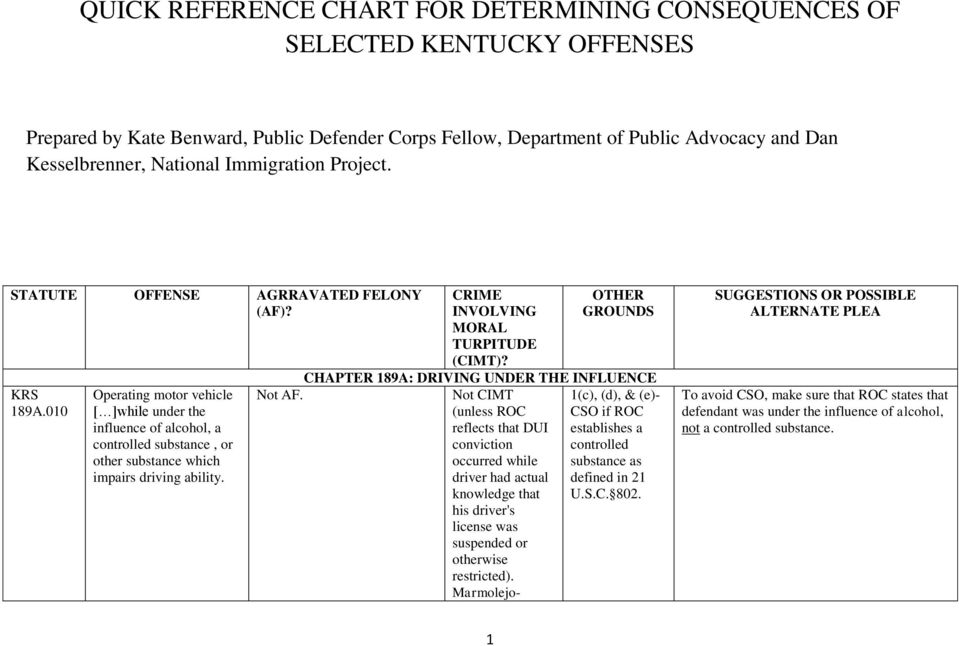
9 QUICK REFERENCE CHART FOR DETERMINING CONSEQUENCES OF SELECTED KENTUCKY OFFENSES Prepared by Kate Benward, Public Defender Corps Fellow, Department of Public Advocacy and Dan Kesselbrenner, National Immigration Project. STATUTE OFFENSE AGRRAVATED FELONY (AF)? 189A.010 Operating motor vehicle [ ]while under the influence of alcohol, a substance, or other substance which impairs driving ability. CRIME INVOLVING MORAL TURPITUDE (CIMT)? OTHER GROUNDS CHAPTER 189A: DRIVING UNDER THE INFLUENCE Not CIMT 1(c), (d), & (e)- (unless ROC CSO if ROC reflects that DUI occurred while driver had actual knowledge that his driver's license was suspended or otherwise restricted). Marmolejo- SUGGESTIONS OR POSSIBLE ALTERNATE PLEA To avoid CSO, make sure that ROC states that defendant was under the influence of alcohol, not a substance. 1
10 189A A.345 Operating motor vehicle while license is revoked or suspended for driving under the influence. Penalties for violation of hardship license and ignition interlock device. Campos v. Holder, 558 F.3d 903 (9 th Cir. 2009)). 2(c)-CIMT if driving under the influence while license is DUI revoked or suspended. Marmolejo- Campos v. Holder, 558 F.3d 903 (9 th Cir. 2009). Not Chapter 218A:Controlled Substances 2

11 218A.140 Prohibited acts relating to substances; penalties Class D felony. 1(a)-Possibly AF (Drug trafficking) (Federal felony under 21 U.S.C. 843(a)(3) to knowingly or intentionally acquire or obtain possession of a substance by misrepresentation, fraud, forgery, deception, or subterfuge. ) 1(b)-Could be AF (see 1(a)); 1(c)- Could be AF (see 1(a)); 1(d)- Could be AF (see 1(a)); 1(e)- Could be AF (see 1(a)); 1(f)- Could be AF (see 1(a)); 1(g)- )- Could be AF (see 1(a)); (2)-Probably AF (Drug trafficking)(21 U.S.C. 841 (a)(2), it is a federal felony to create, distribute, or dispense, or possess with intent to distribute or dispense, a counterfeit substance ); (3)- AF. (4)-Possibly AF (see 1(a)). 1(a)-CIMT 1(b)- 1(c)- 1(d)- 1(e)- 1(f)-Probably 1(g)- 1(a)-(g)CSO if record of U.S.C. 802; (2)-CSO if record of U.S.C. 802; (3)- CSO if record of U.S.C. 802; (4)-Possibly CSO. To avoid CSO or AF, negotiate pre-plea diversion. (1)(a)-(c) Allocute to attempt to obtain. Divisible statute do not specify section or plead to safer sections, (1)(a)-(c) with allocution to attempt to obtain; or (3), or (4). (2)-To possibly avoid AF (Drug Trafficking), affirmatively allocute to possess, prescribe, or administer (terms not contained in 21 U.S.C. 841(a)(1). If alternative plea to non- substance offense is not possible, omit name of substance from ROC. 218A A.1402 Selling substances (other than synthetic cannabinoid or piperazines or salvia) to minor; penalties are class C felony for first offense; Class B felony for any subsequent offense unless more severe trafficking charge applies. Criminal conspiracy to commit offense in AF (Drug trafficking) if record of defined in 21 If underlying offense is AF, charge of conspiracy will be CIMT if underlying CSO if record of Possibly CAC. CSO if record of To avoid CSO or AF, negotiate pre-plea diversion. To potentially avoid AF for drug trafficking, allocute to transfer of small amount of marihuana for no remuneration. If alternative plea to non- substance offense is not possible, omit name of substance from ROC. To avoid CSO or AF, negotiate pre-plea diversion. 3

12 218A A A.1405 Chapter 218A subject to same penalties as provided for underlying offense. Advertising substance; penalties First Offense Class B misdemeanor; Class A misdemeanor for each subsequent offense. Prohibited activities relating to substances; penalties violation of provisions (1) or (3) shall be guilty of Class D felony for first offense; Class C felony for subsequent offenses; violation of (2) shall be guilty of Class A misdemeanor for first offense and Class D felony for subsequent offenses. Use and investment of drug-related income; penalties Class D felony and other penalties. AF. See Matter of Aruna, 24 I&N Dec. 452 (BIA 2008). offense is Not CSO if record of (1)-AF (Drug trafficking) if record of defined in 21 U.S.C. 802; (2)-Not AF unless defendant has prior drug (which has become final) and is prosecuted as recidivist under the statute that corresponds to federal recidivist possession felonies under 21 U.S.C. 844(a)); (3)-Probably AF (Drug trafficking) if record of defined in 21 Probably AF (Drug trafficking) if ROC defined in 21 U.S.C. 802 (Corresponds with Controlled Substances (1)- (2)- Matter of Abreu-Semino, 12 I & N Dec. 775 (BIA 1968)(Not CIMT if no evil intent); (3)- Probably CSO if record of CSO if record of To potentially avoid AF for drug trafficking, allocute to transfer of a small amount of marihuana for no remuneration. If alternative plea to non- substance offense is not possible, omit name of substance from ROC. To avoid AF, do not let ROC reflect elements of 21 U.S.C. 843(c): Knowingly place in any newspaper, magazine, handbill, or other publications, any written advertisement that has the purpose of seeking or offering illegally to receive, buy, or distribute a schedule I substance. Divisible statute-do not specify section or plead to safer sections (2) & (3) to avoid AF and (1)-To potentially avoid AF, allocute to possess or transfer of small amount of marijuana for no remuneration. (3)-Allocute to prescribes or administers (terms not contained in 21 U.S.C. 841(a)(1)). To potentially avoid AF and CSO, plead to non- substance related offense such as , Deceptive Business Practices. 4

13 218A A A A A.1415 Trafficking in substance in or near school; penalty Class D felony, unless more severe penalty in chapter is set forth. Trafficking in substance first degree; penalties First offense Class C felony; Class B felony for second or subsequent offense. Trafficking in substance second Degree; penalties First offense Class D felony; Class C felony for second or subsequent offense. Trafficking in substance third degree; penalties First offense Class A misdemeanor; Class D felony for second or subsequent offense. Possession of substance first degree; penalties First offense Class D felony; Class C felony for second or subsequent offense. Act 21 U.S.C. 854). AF (Drug trafficking) CSO if record of if record of defined in 21 AF (Drug trafficking) if record of defined in 21 AF (Drug trafficking) if record of defined in 21 AF (Drug trafficking) if record of defined in 21 Not AF except 1(g)-AF(Drug trafficking). CSO if record of CSO if record of CSO if record of CSO if record of To avoid CSO or AF, negotiate pre-plea diversion. To avoid AF, plead to simple possession. To avoid AF, plead to simple possession. To avoid AF, plead to simple possession. Allocute to transfer of small amount of marihuana for no remuneration to potentially avoid AF drug trafficking. To avoid CSO, enter pre-plea diversion pursuant to 218A Avoid under section 1(g) because it will be AF. 5

14 218A A A A A.1422 Possession of substance second degree; penalties First offense Class A misdemeanor; Class D felony for second or subsequent offense. Possession of Controlled Substance Third Degree; penalties First offense Class A misdemeanor; Class D felony for second or subsequent offense. Theft of a substance; penalties First offense Class D felony if substance value < $300; Class C felony for second and subsequent offense if value > $300. Trafficking in marijuana; penalties 8 oz. or less, class A misd.; 8 oz.-5 lbs. is Class D felony for first offense, Class C felony for second offense; Trafficking in 5 lbs. or more is Class C felony for first offense, Class B felony for second offense. Possession of marijuana; penalty Class A AF (Theft) if sentence of more than 364 days imposed. 6 CSO if record of CSO if record of CSO if record of To avoid CSO, enter pre-plea diversion pursuant to 218A To avoid CSO, enter pre-plea diversion pursuant to 218A Plead to attempt ( ) which will reduce it to Class A misdemeanor, and obtain sentence of 364 days or less to avoid AF. To avoid CSO consider alternative plea to Theft, (with sentence of 364 days or less), Theft by deception (amount under $10,000), Trespass, or Disorderly Conduct. AF (Drug trafficking). CSO. Allocute to transfer small amount of marihuana for no remuneration to potentially avoid AF (Drug trafficking). Is CSO for inadmissibility purposes. To avoid AF (Drug trafficking) consider plea to possession of marijuana (less than 30 grams)( 218A.1422). Obtain pre-plea diversion to avoid CSO. Affirmatively allocute to amount less than 30

15 218A A A.1437 Marijuana cultivation; penalties cultivation of five (5) or more plants of marijuana is: (a) For a first offense a Class D felony; (b) For a second or subsequent offense a Class C felony; (3) Marijuana cultivation of fewer than five (5) plants is: (a) For a first offense a Class A misdemeanor; (b) For a second or subsequent offense a Class D felony. Manufacturing Methamphetamine; penalties First offense Class B felony; Class A felony for second and subsequent offense. Unlawful possession of a methamphetamine precursor; Prima Facie Evidence of Intent; penalties First Offense Class D Felony; Class C For grams. deportability purposes, is CSO only if record of establishes possession of more than 30 grams of marihuana. AF(Drug trafficking). Probably CSO. To avoid AF consider plea to possession of marijuana (under 30 grams) ( 218A.1422). AF(Drug trafficking). CSO. Probably AF(Drug trafficking). CSO if record of 7

16 218A A A A A.1443 felony for each subsequent offense. Unlawful distribution of a methamphetamine precursor; penalties Class D felony for first offense, Class C felony for each subsequent offense. Trafficking in or transferring a Dietary Supplement; exceptions; penalties First offense Class A misdemeanor; Class D felony for second or subsequent offense. Controlled substance endangerment to a Child First Degree; penalty Class A felony. Controlled substance endangerment to a child Second Degree; penalty Class B felony. Controlled substance endangerment to a child Third Degree; penalty Class C felony. 8 AF (Drug trafficking). CSO if record of Possibly AF (Drug trafficking). Probably CSO if record of AF(COV) & possibly AF (Drug trafficking) if ROC establishes person manufactured a substance. AF (COV) & possibly AF (Drug trafficking) if ROC establishes person manufactured a substance. AF (COV) & possibly AF (Drug trafficking) if ROC establishes person manufactured a substance. CAC. CSO if record of CAC. CSO if record of CAC. CSO if record of

17 218A A A A A.1453 Controlled substance endangerment to a child Fourth Degree; penalty Class D felony. Trafficking in salvia Class A Possession of salvia Class B Salvia cultivation Class A Trafficking in substituted cathinones Class A AF (COV) & possibly AF (Drug trafficking) if ROC establishes person manufactured a substance. Not AF (not currently a defined in 21 U.S.C. 802). Not AF (not currently a defined in 21 U.S.C. 802). Not AF (not currently a defined in 21U.S.C. 802). AF if included as a substance in 21 Note: three synthetic stimulants that are used to make bath salts, including: Mephedrone, 3,4 methylenedioxypyrovalerone (MDPV) and Methylone are temporarily included as Schedule I substances. Possibly CAC. CSO if record of Not CSO (not currently a U.S.C. 802). Not CSO (not currently a U.S.C. 802). Not CSO (not currently a CSO if record of Possession of substituted CSO if record To potentially avoid AF, plead to attempt to reduce to Class A Misdemeanor and obtain sentence of 364 days or less so long as ROC does not reflect defendant convicted of manufacturing. 9

18 218A.1454 cathinones Class A 218A A A A A. 282 Manufacturing substituted cathinones Distribution by practitioner or pharmacist; prescription requirements; penalties First offense Class A misdemeanor; Class D felony for second or subsequent offense. Record-keeping and inventory requirements; penalties First offense Class A misdemeanor; Class D felony for subsequent offenses. Controlled substances may be possessed only in original container; penalties First offense Class B misdemeanor; Class A misdemeanor for subsequent offenses. Forgery of a prescription First Offense Class D felony; of AF (Drug trafficking). Probably CSO if record of AF. Not AF (Misdemeanor offense under 21 U.S.C. 842(c)). Probably AF (Forgery) if sentence of 364 or more days imposed; possibly AF (Drug 10 Could be CSO if record of Could be CSO if record of Could be CSO if record of Could be CSO if record of To potentially avoid AF if charged with first offense, plead to attempt to reduce to Class A misdemeanor and obtain sentence of 364 days

19 218A A.286 Class C felony for second and subsequent offense. Criminal possession of a forged prescription First offense Class D felony; Class C felony for second or subsequent offense. Theft, criminal possession, trafficking, or unlawful possession of a prescription or blank First offense Class D felony; Class C felony for second or subsequent offense. trafficking). Probably AF (Forgery) if sentence of more than 364 days imposed. Possibly AF (Drug trafficking). (1) AF; (2) AF; (3)- AF. Probably (1)- Could be CSO if record of Could be CSO if record of or less. To avoid potential AF (Drug trafficking), ensure that ROC does not establish substance was acquired or obtained (21 U.S.C. 843(a)(3) makes it a felony to acquire or obtain possession of a substance by misrepresentation, fraud, forgery, deception, or subterfuge ). To avoid potential AF (Drug trafficking), ensure that ROC does not reflect that substance was acquired or obtained. (21 U.S.C. 843(a)(3) makes it a felony to acquire or obtain possession of a substance by misrepresentation, fraud, forgery, deception, or subterfuge ). Divisible statute do not specify section of statute client is convicted under. (1)-To potentially avoid AF (Drug trafficking) by ensuring that ROC does not reflect that substance was acquired or obtained (21 U.S.C. 843(a)(3) makes it a felony to acquire or obtain possession of a substance by misrepresentation, fraud, forgery, deception, or subterfuge ). To avoid potential AF(Theft), ensure that ROC does not reflect the taking of property or an exercise of control over property without consent with the criminal intent to deprive the owner of rights and benefits of ownership (2)-To potentially avoid AF (Drug trafficking), ensure that ROC does not reflect that substance was acquired or obtained (21 U.S.C. 843(a)(3); (3)-To potentially avoid AF (Drug trafficking), ensure that ROC does not 11

20 establish substance was acquired or obtained (21 U.S.C. 843(a)(3). To ensure that under (1)-(3) is not AF (Forgery), plead to attempt ( ) which will reduce it to Class A misdemeanor, and obtain sentence of 364 days or less to avoid AF. 218A A.322 Criminal possession of a medical record; penalties First offense Class D felony; Class C felony for second or subsequent offense. Theft of a medical record; penalties First offense Class D felony; Class C felony for second or subsequent offense. Possibly AF (Drug trafficking). Probably CSO if record of AF. Not CSO. To avoid CIMT, ensure that ROC does not reflect a specific intent to effect a permanent taking of another's property without consent. See Matter of Grazley, 14 I&N Dec. 330, 333 (BIA 1973). To avoid potential AF (Drug trafficking), ensure that ROC does not reflect that substance was acquired or obtained. (21 U.S.C. 843(a)(3) makes it a felony to acquire or obtain possession of a substance by misrepresentation, fraud, forgery, deception, or subterfuge ). To avoid potential AF (Theft), ensure that ROC does not reflect the taking of property or an exercise of control over property without consent with the criminal intent to deprive the owner of rights and benefits of ownership See Matter of Garcia-Madruga, 24 I&N Dec. 436, (BIA 2008). 218A.324 Criminal falsification of a medical record; penalties First offense Class D felony; Class C felony for second or Probably AF (Forgery); Could be AF (Drug trafficking). Probably CSO if record of To avoid potential CIMT, ensure that ROC does not reflect a specific intent to effect a permanent taking of another's property without consent. See Matter of Grazley, 14 I&N Dec. 330, 333 (BIA 1973). To avoid AF (Forgery), plead to attempt ( ) which will reduce it to Class A misdemeanor, and obtain sentence of 364 days or less to avoid AF. 12

21 218A A subsequent offense. Prohibited practices concerning substances that simulate substances; penalties First offense Class A misdemeanor; Class D felony for subsequent offenses. Possession of drug paraphernalia; penalties First offense Class A misdemeanor; Class D felony for subsequent offenses. Criminal Attempt Class C felony when the crime attempted is a violation of or ; Class B felony when the crime attempted is a Class A (1)- AF; (2)- AF; (3)- AF; (4)- AF. An attempt to commit an AF would be deemed an AF. See Umang Desai, A (BIA March 20, 2007); (Westlaw cite: 2007 WL )(unpubli shed) (Not crime of moral turpitude where defendant falsely purported chocolate to be laced with the hallucinogen psilocybin). Chapter 506: INCHOATE OFFENSES An attempt to commit a CIMT would probably also be considered a CSO if record of does not establish it is a Probably CSO. Conviction would be CSO or FO if underlying would be. To avoid potential AF(Drug trafficking), ensure that ROC does not reflect that substance was acquired or obtained. (21 U.S.C. 843(a)(3) makes it a felony to acquire or obtain possession of a substance by misrepresentation, fraud, forgery, deception, or subterfuge ). AF because a counterfeit substance is U.S.C. 802(7) is not identical to the prohibited activity in 218A.350. To potentially avoid CSO, where client is charged with possession of 30 grams or less marijuana, let ROC reflect that the paraphernalia in question was merely an adjunct to the offender's simple possession or ingestion of 30 grams or less of marijuana. If client is charged with a Class C or D felony, under (4)(d), if a sentence of 364 days or less, an attempt will not be categorized as AF(COV), so is a much safer plea. 13
22 felony or capital offense; Class C felony when the crime attempted is a Class B felony; Class A misdemeanor when the crime attempted is a Class C or D felony; Class B misdemeanor when the crime attempted is a Criminal Solicitation Penalties (2)(a) Class C felony where the crime solicited is a violation of or ; (b) Class B felony when the crime solicited is a Class A felony or capital offense; (c) Class C felony where the crime solicited is a Class B felony; (d) Class A misdemeanor when the crime solicited is a Class C or D felony; (e) Class B misdemeanor when the crime solicited is a AF if the crime solicited is AF. Likely CIMT if the underlying offense is CSO if underlying offense is CSO. Matter of Zorilla, 24 I&N Dec. 768 (BIA 2009) (holds that solicitation is a CSO outside Ninth Circuit. But see U.S. v. Dolt, 27 F.3d 235 (6 th Cir. 1994)(Holding that solicitation to traffic in cocaine is not a substance offense under 4B1.1). If underlying offense is a Class C or D felony, try to avoid AF(COV) under (2)(d) by obtaining sentence of 364 days or less. 14
23 Criminal Conspiracy Penalties Class C felony where the conspiratorial agreement is a violation of or ; (b)class B felony when the conspiratorial agreement is a Class A felony or capital offense; (c)class C felony where the crime solicited is a Class B felony; (d) Class A misdemeanor when conspiratorial agreement is a Class C or D felony; (e)class B misdemeanor when the conspiratorial agreement is a AF if the underlying offense is an AF. CIMT if underlying offense is a CSO, FO, or CAC, etc. if underlying offense is the same. If underlying charge is a Class C or D felony, try to avoid AF (COV) under (2)(d) by obtaining sentence of 364 days or less Criminal Facilitation- Please contact [email protected] for advice on this charge Engaging in organized crime Penalties Class B felony, unless the offense involves only the theft or acquisition of retail merchandise for the purpose of reselling the stolen merchandise, in which case it is a Class C felony. 1(a-f): AF(RICO offense) if more than 364 day sentence imposed; 1(g): AF(Commercial bribery) or AF(RICO offense) if more than 364 day sentence imposed; 1(h-i): AF (Theft) if more than 364 day sentence imposed; 3(a): Likely AF(Commercial bribery) if more than 364 day sentence imposed; 3(b):AF(Prostitution offense); 3(c) & (i): AF(Theft) if more than 364 day sentence imposed; 3(e)-CSO Divisible statute: do not specify section. 1(i) &(h): To avoid AF (theft) plead to attempt with a maximum 364 day sentence. 3(a): Do not allocute to violating ; Instead allocute to violating (1) (b) (c)(d)(e)(f) and amount < $10,000 to avoid AF (Theft). 3(d): If pleading to gambling offense cannot be avoided, keep record clear of facts satisfying elements of 18 U.S.C
24 Criminal Gang Recruitment Penalties Class A misdemeanor and Class D felony for a second or subsequent offense. Murder Capital offense. Manslaughter First degree Class B felony. 3(d): AF(Gambling) if more than 364 day sentence imposed; 3(e): AF (drug trafficking); 3(f): Possibly AF(RICO offense) if more than 364 day sentence imposed. Possibly AF if more than 364 day sentence imposed. AF(COV) under 1(a); Probably AF(COV) under 1(b). AF(COV). Might be See Guillermo Gonzalez- Sanchez a.k.a. Guillermo Gonzalez, A (BIA May 26, 2011)(Westlaw cite: 2011 WL ) (unpublished opinion) Chapter 507: CRIMINAL HOMICIDE 1(a)- 1(b)- likely to be CIMT (crime in which bodily harm is caused or threatened by an intentional act). CODV if committed against spouse or similarly situated family member; CAC if record of identifies victim as child. FO if ROC establishes use of a firearm. CODV if committed against spouse or similarly situated family member; CAC if record of 3(e) should reflect trafficking in liquors or spirits so as to avoid CSO. 3(a) or (f) could be safer pleas to avoid AF. Divisible statute: 1(b) may be marginally safer plea. To preserve an argument against CIMT, plead to attempted manslaughter. 16
25 A A.030 Manslaughter Second degree Class C felony. Reckless Homicide Class D felony Fetal Homicide First degree Capital offense. Fetal Homicide Second degree Class B felony. Possibly be AF(COV) under (a); Probably AF under (b). Not AF U.S. v. Portela, 469 F.3d 496 (6 th Cir. 2006)( crime requiring only recklessness does not qualify as a crime of violence under 18 U.S.C. 16 and is therefore not an AF) AF(COV) under 1(a); Very likely AF under 1(b). AF(COV). Probably Likely CIMT but not yet decided: Saqr v. Holder, 548 F.3d 414 (6 th Cir. 2009). Chapter 507A: FETAL HOMICIDE CIMT (crime in which bodily harm is caused or threatened by an intentional act). identifies victim as child. FO if firearm used. CODV if committed against spouse or similarly situated family member; CAC under (1)(b). CODV if committed against spouse or similarly situated family member; CAC if record of identifies victim as child. FO if firearm used. CODV if committed against spouse or similarly situated family member; CAC if record of identifies victim as child. Probably CAC. Fetal Homicide Third Likely AF. Likely Probably CAC. Divisible statute: section (a) is a safer plea to avoid CAC. Attempt to plead down to Reckless Homicide to prevent AF. Divisible statute- under 1(b) could be marginally safer plea. 17
26 507A.040 degree Class C felony. 507A Fetal Homicide Fourth degree Class D felony. Assault First degree Class B felony. Assault Second degree Class C felony. See U.S. v. Portela, 469 F.3d 496 (6 th Cir. 2006)(holding that crime requiring only recklessness does not qualify as a crime of violence under 18 U.S.C. 16 and is therefore not an AF). 1(a)-AF (COV). 1(b)- Likely AF (COV). Likely CIMT, but not yet decided. Saqr v. Holder, 548 F.3d 414 (6 th Cir. 2009). Probably CAC. Chapter 508: ASSAULT AND RELATED OFFENSES 1(a)- Could be FO if 1(b)-Very likely record of See In re Fualaau, 21 I. & shows firearm N. Dec. 475, 478 used under 1(a). (BIA 1996) (an Could be assault involving CODV if victim a reckless state of was spouse or mind is a crime similarly of moral situated turpitude if it individual; CAC results in the if assault against infliction of a child. serious bodily injury. ) 1(a) and 1(b)-AF (COV); 1(c)-likely AF (COV). Likely Could be FO if record of shows firearm used under (1(b) or (c). Could be CODV if victim was spouse or similarly situated individual; CAC if ROC establishes assault against a child. Divisible statute ensure that ROC reflects dangerous instrument (not a firearm) under 1(a) to avoid FO; 1b could be safer pleaallocute to wantonly. 1(b) with allocution to dangerous instrument could be safer plea to avoid CIMT because not serious physical injury. See In re. Fualaau, 21 I. & N. Dec. 475, 478 (BIA 1996) (stating that an assault involving a reckless state of mind is a crime of moral turpitude if it results in the infliction of serious bodily injury. ); See Matter of Medina, 15 I. & N. Dec. 611 (BIA 1976)(the use of a deadly weapon turns an assault into CIMT). 1(c) could be safer plea for CIMT allocute to a dangerous instrument (not deadly weapon) (see above Matter of Medina). 18
27 Assault Third degree Class D felony. Assault Fourth degree Class A 1(a)-Possibly AF(COV); 1(b)-Likely not AF. 1(a)-Not AF(COV) if sentence of 364 or fewer days imposed. 1(b)-Not AF if sentence of 364 or fewer days imposed. Even if 365 day sentence imposed, likely not AF because no intentional use of physical force required.. Probably CIMT, especially if record of shows injury or special knowledge of victim or assault with deadly weapon. See Matter of Danesh, 19 I & N Dec. 669, 670 (BIA 1988)(holding that the fact that the assault was on a peace officer was a key element in establishing a ) 1(a)-Likely not CIMT if wantonly. See Matter of Solon, 24 I. & N. Dec. 239, 241 (BIA 2007) ( Offenses characterized as simple assaults' are generally not considered to be crimes involving moral Could be FO if record of shows firearm used under (1)(a). Could be FO if ROC shows use of firearm under (1)(b).Could be CODV if victim was spouse or similarly situated individual; CAC if assault against a child. Plead to attempt for section 1(c) See Gill v. INS, 420 F.3d 82 (2d Cir. 2006)(a person cannot intend to commit a reckless act; therefore an attempted reckless assault could not constitute CIMT even though the completed crime itself is CIMT). Divisible statute; 1(a): Allocute to recklessly with a dangerous instrument (not firearm or deadly weapon); intentionally causing physical injury is an AF (COV). 1(a)-To decrease CIMT risk, consider alternative offense of an attempt to recklessly with a dangerous instrument. See Gill v. INS, 420 F.3d 82 (2d Cir. 2006); Under 1(b) ensure ROC does not reflect the mental state of intent and the use of physical force. To avoid AF, plead to EED which becomes Class B misd with 364 or less day sentence imposed. Divisible statute. Under (1)(a) allocute to wantonly. Under (1)(b) allocute to dangerous instrument (not deadly weapon). Keep ROC clear of reference to domestic violence and deadly weapon or firearm. To avoid AF obtain sentence of 364 days or less. To decrease CIMT risk, consider alternative offense of an attempt. See Gill v. INS,
28 Assault Enhancement May be prosecuted as Class D felony if it is the third or subsequent offense of assault in the 4 th degree under within 5 years and the relationship between the perpetrator and victim meets definition of family member. Assault under extreme emotional disturbance (EED) Class D felony when it would be assault in the first or second degree if not committed under influence of EED; Class B misdemeanor when it would be assault in the 4 th degree not committed under the influence of an extreme emotional disturbance. Probably (COV) if sentence of 365 or more days imposed. AF. turpitude. ) 1(b)-May be CIMT if ROC reflects recklessness with a deadly weapon. See Matter of Medina, 15 I&N Dec. 611 (BIA 1976). Probably See In Re. Tran, 21 I&N Dec. 291(BIA 1996)(infliction of bodily harm upon a person with whom one has such a familial relationship is an act of depravity which is contrary to accepted moral standards). Likely not CIMT if committed under EED. If the victim was a current or former spouse or similarly situated individual, most likely CODV. If the victim was a child, might be CAC. If the victim was a current or former spouse or similarly situated individual, might also be CODV. If the victim was a child, might be CAC. FO if ROC establishes use of a firearm. F.3d 82 (2d Cir. 2006). Obtain sentence of 364 days or less to preclude any possibility of AF (COV). 20
29 Menacing Class B Wanton Endangerment Class D felony. Not AF if sentence of 364 days or less imposed. Possibly AF (COV). Likely not CIMT, but not yet decided See Singh v. Holder, 321 Fed. Appx. 473 (6 th Cir.2009) (unpublished (Supports finding that Menacing is not CIMT: the apprehension variety of assault is less morally turpitudinous than the attempted-battery variety, as it requires no intention to physically harm another person. ) Likely not Matter of Solon, 24 I&N Dec. 239, 242 (BIA 2007)( As the level of conscious behavior decreases, i.e., from intentional to reckless conduct, more serious resulting harm is required in order to find that the crime involves moral turpitude). See If the victim was a current or former spouse or similarly situated individual, might also be CODV. If the victim was a child, might be CAC. FO if ROC establishes use of a firearm. CAC if victim is child. FO if offense involves firearm. CODV if spouse or other similarly situated family member. Obtain sentence of 364 days or less to avoid AF (COV). Do not let ROC reflect use of firearm or familial relation to the victim. Ensure that ROC does not establish firearm or relation of victim to the defendant. To further avoid CIMT, plead to attempt. See Gill v. INS, 420 F.3d 82 (2d Cir. 2006). 21
30 Wanton Endangerment in the 2 nd degree Class A Not AF if 364 or less day sentence imposed. also Matter of Falaau, 21 I. & N. Dec. 475 (BIA 1996)(The BIA held that to find moral turpitude, the element of a reckless state of mind must be coupled with an offense involving the infliction of serious bodily injury). Possibly Matter of Solon, 24 I&N Dec. 239, 242 (BIA 2007)( As the level of conscious behavior decreases, i.e., from intentional to reckless conduct, more serious resulting harm is required in order to find that the crime involves moral turpitude). See also Matter of Falaau, 21 I. & N. Dec. 475 (BIA 1996)( The BIA held that to find moral turpitude, the element of a reckless state of Ensure that ROC does not establish firearm or relation of victim to the defendant. To further avoid CIMT, plead to attempt. See Gill v. INS, 420 F.3d 82 (2d Cir. 2006). Obtain sentence of 364 days or less to avoid possible AF. 22
31 Terroristic Threatening First degree Class C felony. Terroristic Threatening Second degree Class D felony. mind must be coupled with an offense involving the infliction of serious bodily injury). But see Matter of M, 3 I&N Dec. 272 (BIA 1948)(found property damage offense was CIMT because was not one where the act was merely accompanied by negligence or carelessness, but one which was perpetrated maliciously and wantonly ) May be AF(COV). Probably May be CAC under 1(a)(1-3). Could be FO if ROC reflects firearm. May be AF(COV). Probably May be CAC under 1(a)(1-3). Could be FO if ROC reflects firearm. Let ROC establish that no force was used. Divisible statute; 1(b) may be safer plea to avoid AF. To avoid CODV or CAC, keep age/relationship of victim out of ROC Terroristic Threatening Third degree Class A Not AF if sentence of 364 or less days imposed. Probably CAC if victim is child. CODV if spouse or other similarly Let ROC establish that no force was used to possibly avoid AF. Obtain sentence of 364 days or less. 23
32 Criminal Abuse First degree Class C felony. Criminal Abuse Second degree Class D felony. Criminal Abuse Third degree Class A Stalking First Degree Class D felony. 1(a)- AF(COV); 1(b) AF; 1(c)- AF(COV) (statute does not require active use of force). 1(a)- AF(COV); 1(b)-Probably AF (COV); 1(c)-Probably AF(COV). situated family member. FO if offense involves firearm. CAC if ROC reflects victim is a child; possibly CODV if ROC reflects victim is spouse or similarly situated family member. CAC if ROC reflects victim is a child; possibly CODV if ROC reflects victim is spouse or similarly situated family member. AF. Probably CAC if ROC reflects victim is a child and possibly CODV if ROC reflects victim is spouse or similarly situated family member. Possibly AF(COV). Probably Stalking is deportable offense; could be CAC if victim is child or CODV if victim is spouse or similarly situated family Divisible statute-allocute to permits and not abuses; 1(b) likely safer plea to avoid AF. Divisible statute: allocute to permits and not abuses; To possibly avoid CIMT, plead to attempt. See Gill v. INS, 420 F.3d 82 (2d Cir. 2006). 1(b) is likely a safer plea to avoid AF. To avoid CIMT, plead to attempt. See Gill v. INS, 420 F.3d 82 (2d Cir. 2006). To foreclose possibility of AF, obtain sentence of 364 days or less. Do not let ROC establish the use of a firearm. 24
33 Stalking Second Degree Class A Not AF if sentence of 364 or less days imposed. Probably member. Also deportable offense as violation of order of protection under (1)(b)1(A); Could be FO offense under (1)(b)(4). Stalking is a deportable offense. Could be CAC if victim is child or CODV if victim is spouse or similarly situated family member. To avoid AF, obtain sentence of 364 days or less Disarming a police officer Class D felony Unlawful Imprisonment First Degree Class D felony. Possibly AF(COV). Probably See Matter of Danesh, 19 I & N Dec. 669, 670 (BIA 1988)(Holding that the fact that the assault was on a peace officer was a key element in establishing a ) Could be FO offense. Chapter 509: KIDNAPPING AND RELATED OFFENSES Probably AF(COV). Probably Probably See In Re. Luis CODV if ROC A. Nunez Ramos identifies victim A.K.A Luis as a protected Nunez, (Westlaw household Plead to attempt and obtain sentence of 364 days or less to potentially avoid AF. Plead to attempt with sentence of 364 days or less to potentially avoid AF (COV). 25
34 Unlawful Imprisonment Second Degree Class A Kidnapping Class B felony when victim is released alive and in safe place prior to trial; Class A felony when victim is Probably AF(COV) unless sentence of 364 days or less days imposed. 1(a)-Probably AF(COV); 1(b)-Probably AF(COV); 1(c)-Probably AF(COV); 1(d)-Probably AF (COV); 1(e)-Probably AF (COV); cite: 2010 WL ) (unpublished opinion)(finding that there is no evidence that the Fifth Circuit Court of Appeals would not view an identical New York statute (NY Penal Law ) to be a crime of moral turpitude). Probably See Carlos Armando Bojorquez- Montante, A (BIA May 12, 2005) (Westlaw cite: 2005 WL ) (unpublished opinion) (unlawful imprisonment statute that does not have element of injury or bodily harm is still crime of moral turpitude). Probably member; CAC if ROC establishes offense committed against a child. Possibly CAC or CODV if ROC identifies victim as a protected household member or child. Possibly CAC or CODV if ROC identifies victim as a protected Obtain sentence of 364 days or less to avoid AF(COV). Divisible statute: 1(f) might be safer plea to avoid AF. 26
35 alive but suffered serious physical injury during the kidnapping, or as a result of not being released in a safe place, or as a result of being released in any circumstances which are intended, known, or should have been known to cause or lead to serious physical injury. Capital offense when victim is not released alive but subsequently dies Custodial Interference Class D felony unless the person taken from lawful custody is returned voluntarily by the defendant. Criminal Coercion Class A Rape First degree Class B felony unless victim is under twelve (12) years old or receives a serious physical injury, in which case it is a Class A felony. 1(f)-Could be AF(COV);See Wei Ly Bokel, A (BIA January 13, 2009)(Westlaw cite: 2009 WL ) (unpublished opinion) ( International parental kidnapping does not categorically present a [ material, important, or significant ] possibility that physical force would be used in the course of its commission. ) (2)(a)-AF(COV); 2(b)-AF (COV); 2(c)-AF (COV). (1)-Possibly AF(COV) if sentence of 365 or more days imposed. Likely household member or child. Possible CAC or CODV if ROC identifies victim as a protected household member or child. AF. Probably Possible CAC or CODV if ROC identifies victim as a protected household member or child. 1(a)-AF(COV) and AF(Rape). 1(b)(1) AF(Rape); 1(b)(2) AF(Sexual abuse of a minor) & AF(Rape). Chapter 510: SEXUAL OFFENSES CAC if convicted under 1(b)(2). Divisible statute: allocute to entices to avoid possible AF (COV). Plead to attempt with sentence of 364 days or less to ensure not an AF (COV). Obtain sentence of 364 days or less to avoid AF. 27
36 Rape Second degree Class C felony. Rape Third degree Class D felony. Sodomy First degree Class B felony unless the victim is less than twelve (12) years old or receives a serious physical injury, in which case it is a Class A felony. Sodomy Second degree Class C felony. Sodomy Third degree Class D felony. Sodomy Fourth degree Class A (1)(a)-AF(Sexual abuse of a child) & AF(Rape); 1(b)-AF(Rape). 1(a)-AF(Rape); 1(b)-AF(Rape) & and AF(Sexual abuse of a minor); 1(c)-AF(Rape) & AF (Sexual abuse of a minor); 1(d)-AF(Rape) and AF(Sexual abuse of a minor); 1(e)-AF(Rape). 1(a)-AF(COV) and AF(Rape); 1(b)(1)-AF(Rape); 1(b)(2)-AF(Rape) and (AF) Sexual abuse of a minor). 1(a) AF (Rape and Sexual abuse of a minor). 1(b)-(Rape) 1(a)-AF(Rape) 1(b)-AF(Rape); & AF(Sexual abuse of a minor); 1(c)-AF(Rape) and AF(Sexual abuse of a minor); 1(d) AF-(Rape) & AF(Sexual abuse of a minor); 1(e)-AF (Rape) (Lack of consent defined in (3)(e), includes any person under the care or custody of a state or local agency pursuant to court order ) CAC if convicted under (1)(a). CAC if convicted under 1(b),(c),(d). CAC if convicted under 1(b). CAC if convicted under 1(a). CAC if convicted under 1(b), (c), (d). (1)- Not (unconstitutional statute) Sexual Abuse First 1(a)-AF(COV) & AF(Rape); CAC under Divisible statute. 28
37 degree Class D felony, unless the victim is less than twelve (12) years old, in which case it is a Class C felony Sexual Abuse Second degree Class A Sexual Abuse Third degree Class B 1(b)(1)-AF(Rape); 1(b)(2)-(Rape and Sexual abuse of a minor); 1(b)(3)-AF(Rape); 1(c)(1)- AF(Sexual abuse of a minor); 1(c)(2)-Probably AF(Sexual abuse of a minor); 1(c)(3)-Probably AF(Sexual abuse of a minor). 1(d)-AF(Sexual abuse of a minor). In Re. Pedro Rodriguez- Rodriguez, 22 I & N Dec. 991 (1999)(finding that indecency with a child by exposure in the presence of a child by one intent on sexual arousal constitutes sexual abuse of a minor, AF). 1(a)- 1(b)-Probably AF(Sexual abuse of a minor); 1(c)- (1)-Possibly AF if victim is a minor. Probably See Mehboob v. Att'y Gen. of U.S., 549 F.3d 272 (3d Cir. 2008)(holding that moral turpitude inheres in sex offenses involving minors under the age of 16 notwithstanding the lack of any mens rea requirement with respect to the age of the victim). CIMT if crime involves a minor. 1(a), (b),(c)(1); Probably CAC under 1(c)(2), (3) and (d). 1(b): CAC CAC if victim is a minor. Likely safer plea under 1(c)(2),(3) & 1(d) because there is no intent for sexual arousal and no physical contact required and does not require the use of persuasion, inducement, enticement, or coercion of a child to engage in, or assist another to engage in sexually explicit conduct or rape, etc. as defined in 18 U.S.C (a)(8) and some of the guiding definitions followed by In Re. Pedro Rodriguez-Rodriguez, 22 I & N Dec. 991 (1999). Under 1(d) do not allocute to sexual contact. 1(a)&(c)-Obtain sentence of 364 days or less to preclude possibility of COV. Section 1(b)-Keep ROC clear of facts establishing sexual abuse of a minor. 29
38 Sexual Misconduct Class A Indecent Exposure First Degree Class B misdemeanor for first offense; Class A misdemeanor for second offense, if committed within three (3) years of the first ; Class D felony for the third offense, if committed within three (3) years of the second ; and Class D felony if it was committed within three (3) years of the Note: In Ninth Circuit, will be AF Sexual abuse of a minor if the record reflects (1) the mens rea of knowingly ; (2) a sexual act; (3) with a minor between ages of 12-16; and (4) an age difference of at least four years between the defendant and minor as defined by 18 U.S.C Estrada Espinoza v. Mukasey, 546 F.3d 1147, 1159 (9th Cir.2008) (en banc), abrogated on other grounds by United States v. Aguila Montes de Oca, 655 F.3d 915 (9th Cir.2011) (en banc). Otherwise, probably not CIMT (no mens rea). Probably CODV if the victim was a current or former spouse or similarly situated individual. 1(a)-Likely CAC. See Matter of Velazquez- Herrera, 24 I&N Dec. 503 (BIA 2008) ( [We] interpret the term crime of child abuse broadly to mean any offense involving an intentional, knowing, Obtain sentence of 364 days or less to preclude possibility of COV. 30
39 prior. Indecent Exposure Second Degree Class B Unlawful use of electronic means Class D felony. Probably reckless, or criminally negligent act or omission that constitutes maltreatment of a child or that impairs a child's physical or mental wellbeing, including sexual abuse or exploitation [ ]also including acts that induce (or omissions that permit) a child to engage in prostitution, pornography, or other sexually explicit conduct) Probably AF. Likely CAC. See Matter of Velazquez- Herrera, 24 I&N Dec. 503 (BIA 2008). Could be safer to plead to section (1) with an allocution to section 531, which contains offenses that do not necessarily require the sexual exploitation of a child (e.g , Promoting sale of obscenity ) CHAPTER 511: BURGLARY AND RELATED OFFENSES Burglary First Degree AF. 1(a)-FO Class B felony. Burglary Second AF Degree Class C felony. Burglary Third AF. Possibly To minimize CIMT risk, consider alternative 31
40 Degree Class D felony. Matter of M-, 2 I&N Dec. 721 (BIA 1946)( The determinative factor is whether the crime intended to be committed at the time of entry or prior to breaking in involves moral turpitude ). offense of Criminal Trespass. If that is not possible, specify in the record that the underlying offense is NOT a If that is not possible, leave record of vague as to what was the underlying crime intended Possession of Burglar s Tools Class A Not AF, unless term of imprisonment imposed is 365 days or more, in which case might be attempted burglary or AF(Theft). Probably CIMT if record of establishes that the offense intended to be committed was Divisible statute: Section 1(b) may be safer plea because it lacks intent. To avoid attempted burglary or AF(Theft), obtain sentence of 364 days or less. To minimize CIMT risk, consider alternative offense of Criminal Trespass. If that is not possible, specify in the record that the underlying offense is NOT a If that is not possible, leave ROC vague as to what was the underlying crime intended Criminal Trespass First degree Class A Criminal Trespass Second degree Class B Criminal Trespass Third degree a violation. Not Not Not Chapter 512: CRIMINAL DAMAGE TO PROPERTY Criminal Mischief First Probably AF. Probably Divisible statute as to AF: allocute to 32
41 degree Class D felony. See Matter of M, 3 I&N Dec. 272 (BIA 1948) (property damage offense was CIMT because it was perpetrated maliciously and wantonly ); contra Matter of N-, 8 I&N Dec. 272, 273 (BIA 1948) (Alien s vandalism offense was not CIMT) Criminal Mischief Second degree Class A Criminal Mischief Third Degree Class B Criminal Use of Noxious substance Class B Criminal Possession of noxious substance Class B Criminal Littering Class A Unlawfully Posting Advertisements a violation. AF. Possibly CIMT (see above). May be CIMT (see above). Not Not Not Not Chapter 513: ARSON AND RELATED OFFENSES Arson First degree AF Class A felony. Arson Second degree AF. wantonly and/or deface which might be safer pleas. Divisible statute as to AF: allocute to wantonly and/or deface which might be safer pleas. Obtain sentence of 364 days or less to avoid AF. Divisible statute: 1(b) likely safer to avoid CIMT as no damage or destruction of property is required. 33
42 Class B felony. Arson Third degree Class D felony. AF. See U.S. v. Corona, 108 F.3d 565, 568(5 th Cir. 1997)(Agreeing with the Fourth Circuit that maliciously as used in 18 U.S.C. 844(i) includes wanton and willful burnings without justification or excuse ) Burning Personal Property to Defraud Insurer Class D Felony Theft by unlawful taking or disposition; penalties (2) Class A misdemeanor unless value is over $500, in which case it is Class D felony; (2)(a)Theft of Firearm Class D felony; (2)(b) The property is anhydrous ammonia Class D felony; theft with intent to manufacture meth is Class B felony for first offense, and Class A felony for each subsequent offense. (2)(c) Theft of property valued over $10,000 is Class C felony. Theft by deception Class A misdemeanor unless value of property or services or amount of check AF. (2)-AF only if sentence of more than 364 days imposed; 2(a)- AF; 2(b)-AF; 2(c)-AF. Chapter 514: THEFT AND RELATED OFFENSES CIMT unless offense qualifies as petty offense exception (misd. punishable by less than one year, with six month or less sentence imposed). 1(a)-AF if ROC reflects amount of $10,000 or more. See Matter of Garcia- Madruga, 24 I&N Dec. 436 CIMT unless offense qualifies as petty offense exception (misd. 2(a)-FO offense. 2(b)-CSO (Intent to manufacture meth) (2)-(for Class A misdemeanor)- Obtain sentence of 364 days or less to avoid AF. If charged with Class C or D offense, plead to attempt ( ) which will reduce it to Class A misdemeanor, and obtain sentence of 364 days or less. To avoid CIMT, consider alternative offenses such as Disorderly Conduct, Trespass. If charged with Class A misd, plead to attempt ( ) to reduce to Class B misdemeanor or otherwise obtain sentence of less than six months (petty offense exception). To avoid AF (fraud) allocute to amount less than $10,000. (Note that to avoid AF fraud dollar amount must still be under $10,000 even if charge 34
43 is more than $500 but less than $10,000, in which case it is a Class D felony. If value is $10,000 or more, it is a Class C felony. Theft of property lost, mislaid, or delivered by mistake Class A misdemeanor unless the value of the property is more than $500 but less than $10,000, in which case it is a class D felony. Over $10,000 is a Class C felony. (BIA 2008)(Defining fraud offense as the taking or acquisition of property with consent that has been fraudulently obtained; Theft defined as the taking of, or exercise of control over, property without consent and with the criminal intent to deprive the owner of the rights and benefits of ownership. ) 1(b)-see above; 1(c)-see above; 1(d)-see above; (6)-AF if amount is $10,000 or greater. (7)- AF if amount is $10,000 or greater. 1(a)-Could be AF (Theft) if sentence of more than 364 days imposed or AF(Fraud) if amount is $10,000 or greater. 1(b)-See 1(a). punishable by less than six months). CIMT unless offense qualifies as petty offense exception (misd. punishable by less than one year with less than six month sentence imposed). reduced to attempt. See Matter of Onyido, 22 I & N Dec. 552 (BIA 1999). To avoid CIMT, consider alternative offenses such as Disorderly Conduct, Trespass. If charged with Class A, plead to attempt ( ) to reduce to Class B misdemeanor with sentence of less than six months (petty offense exception). To avoid AF(Theft), obtain sentence of 364 days or less. To avoid AF(Fraud), allocute to amount less than $10,000. If charged with Class C or D offense, plead to attempt ( ), which will reduce offense to Class A misdemeanor, and obtain sentence of 364 days or less. Note that to avoid AF(Fraud), dollar amount must still be under $10,000 even if charge reduced to attempt. See Matter of Onyido, 22 I & N Dec. 552 (BIA 1999). To avoid CIMT, consider alternative offenses such as Disorderly Conduct or Trespass. If charged with Class A, obtain sentence of less than six months to qualify as petty offense exception. Theft of Property Lost, 1(a)-Could be AF(Theft) if CIMT unless To avoid AF(Theft), obtain sentence of
44 Mislaid, or Delivered by Mistake Class A misdemeanor unless the value of the property is more than $500 but less than $10,000, in which case it is a class D felony. Over $10,000 is a Class C felony. sentence of more than 364 days imposed or AF(Fraud) if amount is $10,000 or greater. 1(b)-See 1(a). offense qualifies as petty offense exception (misd. punishable by less than one year with less than six month sentence imposed). days or less. To avoid AF(Fraud), allocute to amount less than $10,000. If charged with Class C or D offense, plead to attempt, which will reduce it to Class A misdemeanor, and obtain sentence of 364 days or less ( ). Note that to avoid AF fraud dollar amount must still be under $10,000 even if charge reduced to attempt. See Matter of Onyido, 22 I & N Dec. 552 (BIA 1999). To avoid CIMT, consider alternative offenses such as Disorderly Conduct, Trespass Theft of Services Class A misdemeanor unless the value of services is (a) $500 or more but less than $10,000, in which case it is a Class D felony; (c) $10,000 or more is a class C felony. 1(a)-Possibly AF if sentence of more than 364 days imposed and loss to victim exceeds $10,000. 1(b)(1)- AF. 1(b)(2)- AF. 1(b)(3)- AF. 1(b)(4)-Possibly AF if sentence of more than 364 days imposed and loss to victim exceeds $10,000. 1(c)-Possibly AF if loss to victim exceeds $10,000. 1(a)- 1(b)(1)-(3)- CIMT 1(b)(4)- 1(c)-Probably If charged with Class A misdemeanor, obtain sentence of less than six months to qualify as petty offense exception. Divisible statute. 1(b) (1),(2), &(3) may be safer pleas to avoid AF and CIMT (no fraud, deprivation or intent to deprive). Obtain sentence at 364 days or less to avoid AF (theft); specify dollar amount under $10,000 to avoid AF(Fraud). If charged with Class C or D offense, plead to attempt ( (4)(d) which will reduce it to Class A misdemeanor, and obtain sentence of 364 days or less. (Note that to avoid AF fraud dollar amount must still be under $10,000 even if charge reduced to attempt. See Matter of Onyido, 22 I & N Dec. 552 (BIA 1999)). To avoid CIMT, consider alternative offenses such as Disorderly Conduct or Trespass. Possession, use, or transfer 2(a)-Not AF; 2(a)-Probably To foreclose possibility of AF, obtain 36
45 of device for theft of telecommunications services Class A misdemeanor; Class D felony if the defendant has previously been convicted of violating the section Theft by failure to make required disposition of property Class A misdemeanor unless value is over $500 and less than $10,000, which is Class D felony; Over $10,000 is Class C felony. Theft by extortion Class A misdemeanor unless value of property obtained is: $500 or more but less than $10,000, in which case it is Class D misdemeanor; over $10,000 is a Class C felony. Theft by labor already rendered Class A misdemeanor unless the value is over $500 or more but less than $10,000, in which case it is a Class D felony; If amount 2(b)- AF. AF(Fraud) if loss to victim exceeds $10,000. 1(a)-AF; 1(b)-If sentence of more than 364 days imposed AF(Theft); also probably AF (COV) See James v. United States, 550 U.S. 192, 196 (2007) (one could imagine an extortion scheme where the [ ] risk of physical injury to another approaches zero. But that does not mean that the offense [ ][is] categorically nonviolent); 1(c)- see above. 1(d)- see above. 1(e)- see above. 1(f)- see above. AF. See United States v. Espinoza-Cano, 456 F.3d 1126, 1131 (9th Cir. 2006)(Theft of labor generally not a Theft offense). Not CIMT; 2(B)-Probably not CIMT unless offense qualifies as petty offense exception (misd. punishable by less than one year with less than six month sentence imposed). sentence of 364 days or less. If charged with Class A obtain sentence of less than six months to qualify as petty offense exception. To avoid CIMT, consider alternative offenses such as Disorderly Conduct or Trespass. Obtain sentence of 364 days or less to avoid AF (Theft) or (COV). To avoid AF, obtain sentence of 364 days or less. If charged with Class A, obtain total sentence of less than six months to qualify as petty offense exception. 37
46 is $10,000 or more, it is a Class C felony. To avoid CIMT, consider alternative offenses such as Disorderly Conduct or Trespass Unauthorized use of automobile or other propelled vehicle Class A misdemeanor unless Defendant has previously been convicted of the offense or of for having stolen an automobile, in which case it is Class D felony. Receiving Stolen Property Class A misdemeanor unless The value is $500 or more but less than $10,000, which is Class D felony; the value is $10,000 or more, which is Class C felony; the property is a firearm, which is Class D felony; the property is anhydrous ammonia, regardless of value, which is Class D felony unless proven to be for manufacture of meth, which makes it a Class B for first offense, Class A for each subsequent offense. Probably AF(Theft) if sentence of more than 364 days imposed. 3(a)-Possibly not AF See Edgar Uribe-Rocha, A.K.A., Edgar Uribe, A (October 28, 2010)((Westlaw cite: 2010 WL )(unpublished opinion)( the mens rea of knowledge or belief is an essential element of a receipt of stolen property aggravated felony and does not include a reason to believe or equivalent. ); Knowledge or belief defined: Matter of Bahta, 22 I&N Dec. 1381, 1385 (BIA 2000)(The general rule is that there is an aggravated felony where there is knowledge or evidence demonstrating that a reasonable person would have realized that the goods had been stolen. ). 3(b)-Possibly not AF (see above); 3(c)-Possibly not be AF (see above); CIMT if there is no showing that a permanent taking was involved. See Matter of K-, 2 I& N Dec. 90 (BIA 1944)(finding that receipt of stolen goods without knowledge they are stolen or without intent to deprive owner of his possession is not a crime involving moral turpitude). 3(c)-FO To avoid FO, avoid under 3(c). A under 3(d) will likely be a drug trafficking aggravated felony. To potentially avoid AF, allocute to having a reason to believe that property was stolen rather than knowing that it has been stolen. 38
47 Obscuring identity of machine or other property Class A misdemeanor unless value of property is more than $500 but less than $10,000, in which case it is Class D felony; or more than $10,000 which is Class C felony. Theft of mail matter Class D felony. Possession of stolen mail matter Class D Felony. 3(d)-Probably AF(Drug trafficking ). (a)- (b)- 1(a)-AF (Theft) if sentence of more than 364 days imposed; 1(b)-AF (Theft) if sentence of more than 364 days imposed; AF (Fraud) if amount exceeds $10,000. 1(c)-AF(Theft) if sentence of more than 364 days imposed; or AF (Fraud) if amount exceeds $10,000. (d)af(theft) if sentence of more than 364 days imposed; (e) AF(Theft) if sentence of more than 364 days imposed; (f) AF(Theft) if sentence of more than 364 days imposed. Possibly not AF. See Edgar Uribe-Rocha, A.K.A., Edgar Uribe, A (October 28, 2010)((Westlaw cite: 2010 WL )(unpublished opinion)( the mens rea of knowledge or belief is an essential element of a receipt of stolen property aggravated felony and does not include a reason to believe or equivalent. ) Not See Matter of K-, 2 I& N Dec. 90 (BIA 1944)(finding that receipt of stolen goods without knowledge they are stolen or without intent to To avoid AF, plead to attempt ( (4)(d)) which will reduce it to Class A misdemeanor, and obtain sentence of 364 days or less. To potentially avoid AF, allocute to having a reason to believe that property was stolen rather than knowing that it has been stolen. 39
48 Knowledge or belief defined: Matter of Bahta, 22 I&N Dec. 1381, 1385 (BIA 2000)(The general rule is that there is an aggravated felony where there is knowledge or evidence demonstrating that a reasonable person would have realized that the goods had been stolen. ) deprive owner of his possession is not a crime involving moral turpitude) Theft of identity Class D felony. Trafficking in stolen identities Class C felony. 1(a)- Possibly not AF. Matter of Garcia-Madruga, 24 I&N Dec. 436, (BIA 2008)(Holding that to be considered an aggravated felony, a theft offense requires that the stolen property be obtained from the owner without consent. ) 1(b)AF (Fraud) if amount is $10,000 or more. 1(c)AF(Fraud) if amount is over $10,000. 1(d)Possibly not AF (see section 1(a) above). 1(e)Possibly not AF (see section 1(a) above). Could be AF(Forgery)or (Counterfeiting) if ROC reflects forgery or counterfeiting; otherwise possibly not AF because offense does not require property be obtained from owner without consent. Matter of Garcia-Madruga, 24 I&N Dec. 436, (BIA 2008). Chapter 515: ROBBERY To further avoid AF, do not let ROC reflect that defendant knew the identification belonged to another person. See Flores-Figueroa v. United States, 556 U.S. 646, 647 (2009)(Holding that Government must show that the defendant knew that the means of identification at issue belonged to another person where adverb knowingly applies to the entire action in the sentence). To avoid AF, allocute to sell, transfer, purchase, or possess, not manufacture. 40
49 Robbery First degree Class B felony. Robbery Second degree Class C felony. Forgery First degree Class C felony. Forgery Second degree Class D felony. Forgery Third degree Class A Criminal Possession of forged instrument First degree Class C felony. Criminal possession of forged instrument Second degree Class D felony. AF(COV). 1(b)-Probably FO if ROC reflects use of firearm. AF(COV). Probably FO if ROC reflects use of firearm. Do not let ROC reflect use of firearm. Do not let ROC reflect use of firearm. Plead to attempt to bring down to A misd and obtain sentence of 364 days or less to avoid AF (COV). Chapter 516: FORGERY AND RELATED OFFENSES AF. If charged with Class C or D offense, plead to attempt ( ) which will reduce it to Class A misdemeanor, and obtain sentence of 364 days or less. AF. If charged with Class C or D offense, plead to attempt ( ) which will reduce it to Class A misdemeanor, and obtain sentence of 364 days or less. Not AF if sentence of 364 days or less imposed. To avoid CIMT, plead to attempt ( ) to reduce to Class B misdemeanor or otherwise obtain sentence of less than six months (petty offense exception). AF. If charged with Class C or D offense, plead to attempt ( ) which will reduce it to Class A misdemeanor, and obtain sentence of 364 days or less. AF. If charged with Class C or D offense, plead to attempt ( ) which will reduce it to Class A misdemeanor, and obtain sentence of 364 days or less Criminal Possession of forged instrument Third degree Class A Possession of forgery device Class D felony. Not AF if sentence of 364 days or less imposed. AF. 1(a)- To avoid CIMT, Plead to attempt ( ) to reduce to Class B misdemeanor or otherwise obtain sentence of less than six months (petty offense exception). Divisible statute to possibly avoid CIMT, section (a) may be safer because intent not an 41
50 1(b)- element of the offense. To avoid AF, plead to attempt ( ) which will reduce it to Class A misdemeanor, and obtain sentence of 364 days or less Criminal simulation First degree Class D felony. Criminal simulation Second degree Class A Using Slugs First degree Class D Felony Using Slugs Second Degree Class B Misdemeanor Deceptive business practices Class A Not AF unless loss to victim exceeds $10,000. 1(a)-Not AF unless loss to victim exceeds $10,000; 1(b)-Not AF unless loss to victim exceeds $10,000; 1(c)-Not AF unless loss to victim exceeds $10,000. Not AF unless loss to victim exceeds $10,000. 1(a)- CIMT; 1(b)- Probably Chapter 517: BUSINESS AND COMMERICAL FRAUDS 1(a)-Probably 1(b)-Probably 1(c)-Probably 1(d)-Probably 1(e)-Probably False Advertising Class A Probably Misdemeanor Bait Advertising Class A Misdemeanor Falsifying Business AF if loss to victim exceeds Records Class A Misdemeanor $10,000. Defrauding Secured AF if loss to victim exceeds Probably Creditors $10,000 (Class C felony). Defrauding Judgment AF if loss exceeds $10,000. Avoid possible AF by obtaining sentence of 364 days or less. Ensure that ROC does not reflect loss to victim that exceeds $10,000. Divisible statute-section 1(b) may be safer to avoid 42
51 Creditors Class A Misdemeanor Fraud in Insolvency Class A Misdemeanor Issuing False Financial Statement Class A Misdemeanor Receiving Deposits in Failing Financial Institution Class D Felony Misapplication of Entrusted Property Class A Misdemeanor Operating a Sham or Front Company Class D Felony AF if loss exceeds $10,000. AF if loss exceeds $10,000. Probably AF if sentence of 365 days or more imposed. (a)- Probably (b)-probably CIMT (c)-probably Possibly Not 43 To avoid possibility of AF (Theft), obtain sentence of 364 days or less. Chapter 518: MISCELLANEOUS CRIMES AFFECTING BUSINESSES; OCCUPATIONS, AND PROFESSIONS Commercial Bribery Class Not AF unless sentence of To avoid AF, obtain sentence of 364 days or A Misdemeanor 365 days or more imposed. less. Receiving Commercial Not AF unless sentence of To avoid AF, obtain sentence of 364 days or Bribe Class A 365 days or more imposed. less. Misdemeanor Sports Bribery Class D Felony Receiving Sports Bribery Class D Felony Tampering with or Rigging Sports Contest Class A Misdemeanor Ticket Scalping a Violation Assault of Sports Official Class A misdemeanor, Class D felony for second or subsequent offense or if defendant assembles five (5) AF (commercial bribery). To avoid AF, plead to attempt and obtain sentence of 364 days or less. Possibly AF (commercial bribery). (a) AF; (b) Possibly AF if loss to victim exceeds $10,000. Class A misdemeanor- Not AF if sentence of 364 days or less imposed; Class D felony-af (COV) Not Not Possibly See Matter of Danesh, 19 I & N Dec. 669, 670 (BIA To foreclose possibility of AF, plead to attempt and obtain sentence of 364 days or less.
52 or more persons to assault the official. Obstructing Governmental Operations Class A Misdemeanor Compounding a Crime Class A Misdemeanor Falsely Reporting an Incident Class A Misdemeanor 1988)(Holding that the fact that the assault was on a peace officer was a key element in establishing a ) Chapter 519: OBSTRUCTION OF PUBLIC ADMINISTRATION AF if sentence of 365 days or more is imposed. AF if loss exceeds $10,000 or if sentence of 365 days or more is imposed. 44 To avoid AF, obtain sentence of 364 days or less Not Compounding a Crime Class A Misdemeanor (a)-possibly (b)-probably (c)-probably (d)-probably (e)-probably CIMT See Matter of Kochlani, 24 I&N Dec. 128, (BIA 2007)(Moral turpitude[ ] inheres in crimes that involve inherently deceptive conduct and that result in the impairment of governmental functions or other significant
53 societal harm, whether or not the specific intent to defraud is an element of the crime) Impersonating a Public Servant Class A Misdemeanor Impersonating a Peace Officer Class D Felony Tampering with Public Records Class D Felony Tampering with a Prisoner Monitoring Device Class D Felony AF(Fraud) if loss to victim exceeds $10,000. AF(Fraud) if loss to victim exceeds $10,000. AF(Fraud) if loss to victim exceeds $10,000. Possibly AF (Obstruction of justice)see In Re. Cesar Duran-Morales, 2008 WL (BIA 2008)( Escaping or attempting to escape from custody imposed as a result of being been arrested for or charged with a felony may be See Matter of H, 1 I&N Dec. 509 (BIA 1943)(The act of impersonating a Federal officer in and of itself does not involve moral turpitude). See Matter of H, 1 I&N Dec. 509 (BIA 1943)(The act of impersonating a Federal officer in and of itself does not involve moral turpitude). Probably Probably CIMT See Matter of Kochlani, 24 I&N Dec. 128, (BIA 2007)(Moral turpitude[ ] inheres in crimes To avoid AF, plead to attempt and obtain sentence of 364 days or less. 45
54 construed as obstruction of justice ). that involve inherently deceptive conduct and that result in the impairment of governmental functions or other significant societal harm, whether or not the specific intent to defraud is an element of the crime) Attempting to escape from penitentiary Class D felony. Chapter 520: ESCAPE AND OTHER OFFENSES RELATING TO CUSTODY Probably AF (COV) if sentence of more than 364 days imposed. United States v. Aragon, 983 F.2d 1306, 1313 (4 th Cir. 1993)( the crime of assisting or instigating the escape or attempted rescue of a prisoner is a crime of violence as defined in 16(b) ). Possibly CIMT based on whether aggravating factors exist. See Matter of B-, 5 I&N Dec. 538 (BIA 1953)(absent aggravating circumstances, an attempt to escape from prison [ ]is not a crime involving moral turpitude. ) To avoid AF, plead to attempt ( ) which will reduce it to Class A misdemeanor, and obtain sentence of 364 days or less. To avoid CIMT, keep ROC void of details that could be construed as aggravating, such as an assault Escape First degree Class C felony. Probably AF(Obstruction of justice) See Cesar Duran- Morales, A (April 10, 2008 BIA)(Westlaw cite: 2008 WL )(unpublished Possibly CIMT based on whether aggravating factors exist See Matter of B-, 5 I&N Dec. 538 To avoid AF, plead to attempt ( ) which will reduce it to Class A misdemeanor, and obtain sentence of 364 days or less. To avoid CIMT, keep ROC void of details that could be construed as aggravating, such 46
55 Escape Second degree Class D felony. Escape Third degree Class B Promoting contraband First degree Class D felony. opinion)( Escaping or attempting to escape from custody imposed as a result of being been arrested for or charged with a felony may be construed as obstruction of justice ); or AF (COV) if sentence of 364 or more days imposed. Probably AF(Obstruction of justice) See Cesar Duran- Morales, A (April 10, 2008 BIA)(Westlaw cite: 2008 WL )(unpublished opinion)( Escaping or attempting to escape from custody imposed as a result of being been arrested for or charged with a felony may be construed as obstruction of justice ); or AF(COV) if sentence of 364 or more days imposed. AF. (BIA 1953)(absent aggravating circumstances, an attempt to escape from prison [ ]is not a crime involving moral turpitude. ) Could be CIMT based on whether aggravating factors exist. Matter of B-, 5 I&N Dec. 538 (BIA 1953)(absent aggravating circumstances, an attempt to escape from prison [ ]is not a crime involving moral turpitude. ) Possibly CSO if record of U.S.C as an assault. To avoid AF, plead to attempt ( ) which will reduce it to Class A misdemeanor, and obtain sentence of 364 days or less. To avoid CIMT, keep ROC void of details that could be construed as aggravating, such as an assault. Foreclose possibility of CSO by affirmatively allocating to non- substance Promoting contraband Second degree Class A Possibly CSO if record of 47
56 Bail Jumping First degree Class D felony. Bail Jumping Second degree Class A Resisting Arrest Class A Misdemeanor AF(Bail jumping) if ROC establishes underlying charge involves a sentence of two years or more imprisonment that could be imposed; OR an offense relating to a failure to appear by a defendant for service of sentence if the underlying offense is punishable by imprisonment for a term of 5 years or more. 8 U.S.C. 1101(a)(43)(Q) &(T). 1(a)-AF(COV) if sentence of 364 days or more imposed; 1(b)- Not Not Probably See Matter of Danesh. 19 I&N Dec. 669 (BIA 1988)(Agg Assault was a crime involving moral turpitude because bodily injury was an essential element of the pertinent statute, which indicated that sufficient force must have been used to cause U.S.C Divisible statute-avoid AF by pleading to section 1(b). Consider alternative plea to Assault 4 ( ) or Disorderly conduct ( ). 48
57 Fleeing or evading police First degree Class D felony. Fleeing or evading police Second degree Class A Hindering prosecution or apprehension First degree Class D felony. Hindering Prosecution or Apprehension Second Degree Class A Misdemeanor Bribery of public servant Class C felony. Soliciting unlawful compensation Class B Unlawful compensation for assistance in public matters Class A Providing a pecuniary benefit for bribery of a public servant Class C felony. Official misconduct First degree Class A 1(a)(1)-Possibly AF (COV); 1(a)(2)-Probably AF(COV); 1(a)(3)-Possibly AF(COV). 1(a)(4)- AF(COV). 1(b)(1)- AF. 1(b)(2)-AF (COV). Probably AF(Obstruction of justice). Probably AF(Obstruction of justice). harm to the police officer ) 1(a)(1)-Possibly not CIMT; 1(a)(2)-Probably CIMT; 1(a)(3)-Probably not CIMT; 1(a)(4)- 1(b)(1)-Probably CIMT; 1(b)(2)- Probably Probably 1(a)(1)-CODV. 1(b)(1)-CODV. Chapter 521: BRIBERY AND CORRUPT INFLUENCES 1(a)- AF. Probably 1(b)- AF. Probably 1(a)- 1(b)- 1(a)-Not AF; 1(b)-Not AF; 1(a)- 1(b)-Probably Chapter 522: ABUSE OF PUBLIC OFFICE 1(a)-Not CIMT; 1(b)- Divisible statute-do not state which section defendant is pleading to potentially avoid CIMT or AF. Safer to plead 1(a)(3) to possibly avoid To possibly avoid AF, safer to plead to 1(a)(1), 1(a)(2), 1(a)(3)(safest), and 1(b)(1). To foreclose any possibility of AF, obtain sentence of 364 or fewer days. 49
58 (c)- CIMT; 1(c)-Not Official misconduct 1(a)-Not AF; 1(a)-Not CIMT; Second degree Class B 1(b)-Not AF; 1(b)-Not CIMT; 1(c)- 1(c)-Not Misuse of Confidential Information Class D Felony 1(a)- 1(b)- 1(c)- 1(a)-Not 1(b)-Not 1(c)-Not Abuse of public trust Penalties Class D felony if value of public property is less than $10,000; Class C felony if value of public money is $10,000 or more but less than $100,000; Class B felony if value of public money is $100,000 or more. Perjury First degree Class D felony. Perjury Second degree Class A False swearing Class B Unsworn falsification to authorities Class B Giving peace officer a false name or address Class B Bribing a witness Class D felony. Bribe receiving by witness Class D felony. AF(Fraud) if loss to victim exceeds $10, To avoid AF, plead to Class D offense, where loss to victim is less than $10,000 or if unable to obtain for Class D felony, do not let ROC for Class C felony, allocute to $10,000 so that amount will not exceed $10,000. Chapter 523: PERJURY AND RELATED OFFENSES AF(Perjury). To avoid AF, plead to attempt ( ) which will reduce it to Class A misdemeanor, and obtain sentence of 364 days or less. AF(Perjury) if sentence of more than 364 days imposed. 1(a)-Not AF; 1(b)-Not AF; 1(c)- Possibly 1(a)- CIMT; 1(b)-CIMT; 1(c)- Obtain sentence of 364 or fewer days to avoid AF. Chapter 524: INTERFERENCE WITH JUDICIAL ADMINISTRATION AF(Obstruction of justice). To avoid AF, plead to attempt ( ) which will reduce it to Class A misdemeanor, and obtain sentence of 364 days or less. AF(Obstruction of justice). To avoid AF, plead to attempt ( ) which will reduce it to Class A misdemeanor,
59 Intimidating a participant in the legal process Class D felony. Tampering with a witness Class D felony. Retaliating against a participant in the legal process Class D felony. Bribing a juror Class D felony. and obtain sentence of 364 days or less. AF(Obstruction of justice). To avoid AF, plead to attempt ( ) which will reduce it to Class A misdemeanor, and obtain sentence of 364 days or less. AF(Obstruction of justice). To avoid AF, plead to attempt ( ) which will reduce it to Class A misdemeanor, and obtain sentence of 364 days or less. AF(Obstruction of justice). To avoid AF, plead to attempt ( ) which will reduce it to Class A misdemeanor, and obtain sentence of 364 days or less. AF(Obstruction of justice). To avoid AF, plead to attempt ( ) which will reduce it to Class A misdemeanor, and obtain sentence of 364 days or less Bribe Receiving by a Juror Class D Felony Jury tampering Class D felony. Tampering with Physical Evidence Class D Felony AF(Obstruction of justice). To avoid AF, plead to attempt ( ) which will reduce it to Class A misdemeanor, and obtain sentence of 364 days or less. AF(Obstruction of justice). To avoid AF, plead to attempt ( ) which will reduce it to Class A misdemeanor, and obtain sentence of 364 days or less. AF(Obstruction of justice). To avoid AF, plead to attempt ( ) which will reduce it to Class A misdemeanor, and obtain sentence of 364 days or less. Not AF unless loss to victim Probably exceeded $10,000. Not Simulating legal process Class B Misdemeanor Unauthorized practice of law Class B Chapter 525: RIOT, DISORDERLY CONDUCT, AND RELATED OFFENSES Riot First degree Class AF(COV). D felony. Riot Second degree Class A Misdemeanor See In the Matter of O, 4 I & N Dec. 301 (BIA 1951)(Not CIMT if the act is not premeditated. ) See In the Matter of O, 4 I To avoid AF, plead to attempt ( ) which will reduce it to Class A misdemeanor, and obtain sentence of 364 days or less. Obtain sentence of 364 days or less to ensure that is not an AF. 51
60 Inciting to Riot Class A Misdemeanor Unlawful assembly Class B Disorderly conduct First degree Class A Disorderly conduct Second degree Class B Harassment Class B Harassing communications Class B Not AF (so long as sentence does not exceed 364 days). & N Dec. 301 (BIA 1951)(Not CIMT if the act is not premeditated. ) See In the Matter of O, 4 I & N Dec. 301 (BIA 1951)(Not CIMT if the act is not premeditated. ) Not Not Not 1(a)-Probably CIMT; 1(b)-Probably CIMT; 1(c)-Not CIMT; 1(d)-Not CIMT; 1(e)-Not CIMT; 1(f)(1)-Probably CIMT; 1(f)(2)-Not CIMT; 1(f)(3)-Not 52 If the victim was a current or former spouse or similarly situated individual, might be CODV. Loitering a violation. Not 1(b)-Could be CSO if ROC Obtain sentence of 364 days or less to ensure that is not an AF. Divisible statute as to CIMT do not allocute to 1(f)(2), especially not theft. Also safer to avoid 1(a) &(b). Do not let ROC name a substance to avoid CSO.
61 Public intoxication Class B Desecration of venerated objects First degree Class C felony. Desecration of venerated objects Second degree Class A Institutional vandalism Class D felony. U.S.C Not Could be CSO if ROC Possibly Probably AF (COV). Probably See Rafal Baczeweski, A (January 12, 2007 BIA) (Westlaw cite: 2007 WL ) (Unpublished opinion) ( Any hate crime is, by its very nature, contrary to the accepted rules of morality and the duties owed between persons or to society in general. ) 53 Do not let ROC name a substance to avoid CSO. Divisible statute as to AF: allocute to desecrate or deface to potentially avoid AF (COV). To avoid AF, plead to attempt ( ) which will reduce it to Class A misdemeanor, and obtain sentence of 364 days or less Violating graves Class D felony. 1(a)- Probably AF (COV); 1(b)-Probably AF (COV); 1(c)- Probably AF (COV). Probably To avoid AF, plead to attempt ( ) which will reduce it to Class A misdemeanor, and obtain sentence of 364 days or less. Abuse of a corpse--class A AF(Fraud) if prosecuted as Probably To avoid AF (Fraud) affirmatively allocute to
62 misdemeanor, unless the act attempted or committed involved sexual intercourse or deviate sexual intercourse with the corpse or the deliberate failure to prepare, bury, or cremate a corpse after the acceptance of remuneration in accordance with any contract negotiated, in which case it is a Class D felony. Cruelty to animals First degree Class D felony. Cruelty to animals Second degree Class A Torture of dog or cat Class A misdemeanor for the first offense and a Class D felony for each subsequent offense if the dog or cat suffers physical injury as a result of the torture, and a Class D felony if the dog or cat suffers serious physical injury or death as a result of the torture. Obstructing a highway or other public passage Class B Disrupting meetings and processions First degree Class A failure to perform contract with acceptance of remuneration and loss to victim exceeds $10, loss to victim that is less than $10,000. AF. Not To foreclose possibility of AF(COV) obtain sentence of 364 days or less. 1(a)-Could be AF(COV) if Probably 1(a)-To foreclose possibility of AF, obtain sentence of more than 364 sentence of 364 days or less; let ROC reflect days imposed; that animal was not the property of another. 1(b)-Not AF; 1(c)-Not AF(COV). Class A misd-not AF (COV) unless sentence of 364 days or greater imposed. Class D felony-probably AF(COV). Probably Not Disrupting meetings and Not Class A misd-obtain sentence of 364 days or less. To possibly avoid AF (COV), let ROC reflect that animal was not the property of another.
63 processions Class B Interference with a funeral Class B Failure to disperse Class B Assault on a service animal First degree Class D felony. Not Not Probably AF (COV). Probably To avoid AF, plead to attempt ( ) which will reduce it to Class A misdemeanor, and obtain sentence of 364 days or less Assault on a service animal Second degree Class B Eavesdropping Class D felony. Installing eavesdropping device Class D felony. Possession of eavesdropping device Class A Tampering with private communications Class A Divulging illegally obtained information Class A Carrying Concealed Deadly Weapon Class A misdemeanor, unless the defendant has been previously convicted of a felony in which a deadly weapon was possessed, used, or displayed, in which case it is a Class D felony. Probably Chapter 526: EAVESDROPPING AND RELATED OFFENSES Not Not Not Not Not 55 To possibly avoid AF (COV), let ROC reflect that animal was not the property of another. Chapter 527: OFFENSES RELATING TO FIREARMS AND WEAPONS Class A misd-not AF; FO offense if If charged with Class A misdemeanor, obtain See ROC establishes sentence of 364 days or less. Class D felony-af(firearm Eduardo Zuniga- firearm or offense) See Matter of Gallardo, A098 destructive Vasquez-Muniz, 23 I&N Dec (January device as 207 (BIA 2002)(Possession of 2, 2009 defined in 18 a firearm by a convicted felon BIA)(Westlaw U.S.C. is an aggravated felony as cite: 2009 WL 921(a)(3). described in 18 U.S.C )
64 Defacing a firearm Class A Possession of firearm by convicted felon Class D felony unless the firearm possessed is a handgun in which case it is a Class C felony. 922(g)(1)). (Unpublished opinion) ( Typically s for unlawfully possessing a concealed firearm have not been held to constitute crimes involving moral turpitude absent evidence that the alien unlawfully possessed the firearm with the intent of harming someone. ) Not Probably FO if record of establishes firearm or destructive device (as defined in 18 USC AF(Firearm offense) See Matter of Vasquez-Muniz, 23 I&N Dec. 207 (BIA 2002)(Possession of a firearm by a convicted felon is an aggravated felony as described in 18 U.S.C. 922(g)(1)). See Eduardo Zuniga- Gallardo, A (January 2, 2009 BIA)(Westlaw cite: 2009 WL ) (Unpublished opinion) ( Typically 921(a)). FO if record of establishes firearm or destructive device (as defined in 18 U.S.C. 921(a)). 56
65 Possession of defaced firearm Class A Unlawful Possession of a Weapon on School Property; Posting of Sign; exemptions Class D Felony s for unlawfully possessing a concealed firearm have not been held to constitute crimes involving moral turpitude absent evidence that the alien unlawfully possessed the firearm with the intent of harming someone. ) Not FO if record of establishes firearm or destructive device (as defined in 18 U.S.C. See Eduardo Zuniga- Gallardo, A (January 2, 2009 BIA)(Westlaw cite: 2009 WL ) (Unpublished opinion) ( Typically s for unlawfully possessing a concealed 921(a)). FO if record of establishes firearm or destructive device (as defined in 18 USC 921(a)). Divisible statute allocute to booby trap device or deadly weapon (not a firearm or dangerous weapon as defined in 26 U.S.C. 5845) to potentially avoid FO offense. 57
66 Using restricted ammunition during the commission of a crime Penalties (a) Class D felony if no shot is fired; (b) Class C felony if a shot is fired and no person is killed or wounded thereby; (c)class B felony if a shot is fired and a person other than the defendant or an accomplice of the defendant is wounded by the shot; and (d) A Class A felony if a shot is fired and a person other than the defendant or an accomplice of the defendant is killed by the shot. Possession of handgun by minor First offense class A misdemeanor; each subsequent Offense Class D felony. AF(COV) if the underlying felony is one that, by its nature, involves a substantial risk that physical force against the person or property of another may be used in the course of committing the offense under 18 U.S.C. 16(b). Class A misd- AF; Class D felony If ROC n offense akin to one described in 18 U.S.C. 922(g) (1), (2), (3), (4), or (5), firearm have not been held to constitute crimes involving moral turpitude absent evidence that the alien unlawfully possessed the firearm with the intent of harming someone. ) Probably Not FO if record of establishes firearm or destructive device (as defined in 18 USC 921(a)). FO if record of establishes firearm or destructive device (as defined in 18 USC 921(a)). To potentially avoid AF(COV), allocute to commission of a crime in which there is not a substantial risk that physical force against person or property of another. 58
67 Unlawfully providing handgun to juvenile or permitting juvenile to possess handgun Class D felony. Use of a weapon of mass destruction First degree Class A felony. Use of a weapon of mass destruction Second degree Class B felony. Use of weapon of mass destruction Third degree Class C felony. (j), (n), (o), (p), or (r), 18 U.S.C. 924 (b) or (h), or 26 U.S.C. 5861, probably AF(Firearm offense). 1(a)- 1(b)- If ROC n offense akin to one described in 18 U.S.C. 922(g) (1), (2), (3), (4), or (5), (j), (n), (o), (p), or (r), 18 U.S.C. 924 (b) or (h), or 26 U.S.C. 5861, might be AF (firearm FO if record of establishes firearm or destructive device (as defined in 18 USC 921(a)). offense). Probably AF(COV). Probably FO if record of establishes firearm or destructive device (as defined in 18 USC 921(a)). Probably AF (COV). FO if record of establishes firearm or destructive device (as defined in 18 USC 921(a)). Probably AF (COV). FO if record of establishes To potentially avoid AF, not let ROC reflect that offense was in violation of (Possession of firearm by convicted felon). Allocute to form of destructive device that does not meet the definition of 26 U.S.C to potentially avoid firearm offense (FO). Allocute to form of destructive device that does not meet the definition of 26 U.S.C to potentially avoid firearm offense (FO). Allocute to form of destructive device that does not meet the definition of 26 U.S.C to potentially avoid firearm offense 59
68 Promoting gambling First degree Class D felony. Promoting gambling Second degree Class A Conspiracy to promote gambling Class D felony. Possession of gambling records First degree Class D felony. Probably AF(Gambling) See Carlos Calderon-Figueroa, a.k.a. Carlos Calderon, A (April 21, 2006) (Westlaw cite: 2006 WL )(Unpublished opinion) (One conducts an illegal gambling business within the meaning of 18 U.S.C. 1955(a) by performing any necessary function in the gambling operation, other than that of a mere bettor.) Not AF if sentence of 364 days or less imposed. Possibly AF(Gambling) if record of shows that offense is one described in 18 U.S.C Possibly AF(Gambling) if record of shows that offense is one Chapter 528: GAMBLING Not See Matter of Gaglioti, 10 I&N Dec. 719 (BIA 1964). Not See Matter of Gaglioti, 10 I&N Dec. 719 (BIA 1964). Not See Matter of Gaglioti, 10 I&N Dec. 719 (BIA 1964). Not See Matter of Gaglioti, 10 I&N Dec. 719 (BIA 1964). firearm or destructive device (as defined in 18 USC 921(a)). Possibly commercialized vice inadmissibility. Possibly commercialized vice inadmissibility. Possibly commercialized vice inadmissibility. Possibly commercialized vice inadmissibility. (FO). Plead to attempt and obtain sentence of 364 days or less to avoid aggravated felony. Avoid AF by obtaining sentence of 364 days or less. To foreclose any possibility of an AF(Gambling), plead to attempt and obtain sentence of 364 days or less. Also, ensure that ROC does not reflect that defendant conduct[ed] an illegal gambling business as defined in 18 U.S.C. 1955(a). To foreclose any possibility of an AF(Gambling), plead to attempt and obtain sentence of 364 days or less. Also, ensure that ROC does not reflect that defendant conduct[ed] an illegal gambling 60
69 Possession of gambling records Second degree Class A Permitting gambling Class B Possession of gambling device Class A Horse races, messenger betting prohibited Class A Off-track acceptance of money for pari-mutuel wagering Class A Prostitution Class B Promoting prostitution Class A misdemeanor unless the person managed, supervised,, or described in 18 U.S.C Not AF if sentence of 364 days or less imposed. Not AF if sentence of 364 days or less imposed. Not AF if sentence of 364 days or less imposed. Not AF if sentence of 364 days or less imposed. Not See Matter of Gaglioti, 10 I&N Dec. 719 (BIA 1964). Not See Matter of Gaglioti, 10 I&N Dec. 719 (BIA 1964). Not See Matter of Gaglioti, 10 I&N Dec. 719 (BIA 1964). Not See Matter of Gaglioti, 10 I&N Dec. 719 (BIA 1964). Not See Matter of Gaglioti, 10 I&N Dec. 719 (BIA 1964). Chapter 529: PROSTITUTION OFFENSES Probably is prostitution inadmissibility Class A misd- Probably is prostitution Class D felony- AF Inadmissibility (Prostitution). business as defined in 18 U.S.C. 1955(a). Ensure that sentence of 364 days or less is imposed to avoid AF(Gambling). Ensure that sentence of 364 days or less is imposed to avoid AF(Gambling). Ensure that sentence of 364 days or less is imposed to avoid AF (gambling). Ensure that ROC does not reflect that defendant conduct[ed] an illegal gambling business as defined in 18 U.S.C. 1955(a) (i.e. allocute to wagering of money as a bettor.) Ensure that sentence of 364 days or less is imposed to avoid AF (gambling). Ensure that ROC does not reflect that defendant conduct[ed] an illegal gambling business as defined in 18 U.S.C. 1955(a) (i.e. allocute to wagering of money as a bettor.) 61
70 owned, either alone or in association with others, a house of prostitution or a prostitution business or enterprise involving prostitution activity by two (2) or more prostitutes, in which case it is a Class D felony. Permitting prostitution Class B Loitering for prostitution purposes First offense is a Violation; Class B misdemeanor for second and subsequent offenses. Human trafficking Class C felony unless it involves serious physical injury to a trafficked person, in which case it is Class B felony. Promoting human trafficking Class D felony unless victim is under eighteen (18), in which case it is Class C felony. AF. 12(a)-AF(COV) & AF(Trafficking in persons); 12(b)-AF(COV) & AF(Trafficking in persons). 12(a)-AF(COV) & AF(Trafficking in persons); 12(b)-AF(COV) & AF(Trafficking in persons). Probably CIMT (Unless client has no other CIMT and sentence is less than six months, will qualify for petty offense exception). Chapter 530: FAMILY OFFENSES Bigamy Class D felony. 1(a)- 1(b)-Possibly not See In the Matter of E I. & N. Dec. 328, 337 (BIA 1945) (A 62 Possibly prostitution inadmissibility. Possibly prostitution inadmissibility. Could be CAC if ROC reflects age of victim is less than 18. Could be CAC if ROC reflects age of victim is less than 18. Allocute affirmatively that age of victim was over 18. Allocute affirmatively that age of victim was over 18. To possibly avoid CIMT, 1(b) may be safer plea if ROC does not name other state (other state s bigamy law might not contain requirement of a guilty mind ).
71 for bigamy is a crime of moral turpitude is required to have a guilty mind ) Incest 2(a)-Class C felony if committed by two consenting adults; 2(b)- Class B felony if committed on a victim who is: (1)Less than eighteen (18) years of age; or (2)Incapable of consent because he or she is physically helpless or mentally incapacitated; 2(c)-Class A felony if (1) committed on a victim less than twelve (12) years of age; or (2) The victim receives serious physical injury. Concealing birth of infant Class A Abandonment of minor Class D felony. 2(a)-Not AF; 2(b)(1)-AF; 2(b)(2)-AF; 2(c)(1)-AF; 2(c)(2)-AF. 2(a)-Probably CIMT; 2(b)(1)-CIMT; 2(b)(2)-CIMT; 2(c)(1)-CIMT; 2(c)(2)- Possibly not See Rodriguez- Castro v. Gonzales, 427 F. 3d. 316 (5 th Cir. 2005) (Is not a crime of moral turpitude where intentionally refers only to the offender's act of leaving the child unattended by another...) 2(b)(1)-Probably CAC; 2(c)(1)-CAC. CAC. To possibly avoid AF-Statute is divisible-if client cannot obtain under 2(a), do not allow ROC to reflect under which section client was convicted. 63
72 Nonsupport and flagrant nonsupport nonsupport Class A misdemeanor; flagrant non-support Class is D felony. Endangering welfare of minor Class A Unlawful transaction with a minor First degree Class C felony if the minor so used is less than eighteen (18) years old at the time the minor engages in the prohibited activity; (b) Class B felony if the minor so used is less than sixteen (16) years old at the time the minor engages in the prohibited activity; and (c) Class A felony if the minor so used incurs physical injury thereby. Unlawful transaction with a minor Second degree Class D felony. Not Possibly CAC. To avoid CIMT, affirmatively allocute to fails rather than refuses. 1(a)-AF(Sexual abuse of a minor) 1(b)- AF. Possibly AF if ROC establishes offense that qualifies as an AF. 1(a)- 1(b)-Probably Possibly CIMT if ROC establishes offense that qualifies as a 1(a)-Probably CAC. 1(b)-CSO if record of U.S.C. 802; Possibly CAC. CSO if record of Possibly CAC. To possibly avoid CSO, keep the name of the substance out of the ROC. Keep ROC free of reference to nature of the offense minor is induced, assisted, or caused to perform. Allocute to any other criminal activity to keep ROC free of direct reference to AF or 64
73 Unlawful transaction with a minor Third degree Class A (a)-not AF; (b)-possibly AF if ROC establishes criminal activity is an AF; (c)- Not AF; (d)- (a)-not (b)-not CIMT unless ROC establishes criminal activity is a (c)-not See In the Matter of C. 2 I&N Dec. 220 (BIA 1944). (d)-not CIMT (b)-could be CSO if ROC establishes that other criminal activity involves a (b)-avoid AF and/or CIMT by keeping ROC clear of any mention of criminal activity that qualifies as AF or CIMT, preferably allocating to other criminal activity Endangering the welfare of an incompetent person Class A Distribution of obscene matter Class B misdemeanor unless defendant possesses more than one unit of material defined in the chapter, in which case it shall be Class A Distribution of obscene matter to minors Class A misdemeanor unless the defendant has previously been convicted of this section or , in which case it is a Class D felony. Using Minors to Distribute Obscene Material Class A misdemeanor unless the defendant has previously been convicted of this Probably Chapter 531: PORNOGRAPHY AF. Possibly CAC. AF. Possibly CAC. 65
74 section or , which case it is Class D felony. Advertising obscene material Class B Promoting sale of obscenity Class B misdemeanor for the first offense; Class A misdemeanor for the second offense; Class D felony for each subsequent offense. Voyeurism Class A Video voyeurism- Class D felony. Use of a minor in a sexual performance Class C felony if the minor so use is less than eighteen (18) years old; Class B felony if the minor is less than sixteen (16) years old; Class A felony if the minor involved in the sexual performance incurs physical injury thereby. Promoting a sexual performance by a minor Class C felony if minor is less than eighteen (18) years old; Class B felony if minor involved is less than sixteen (16) years old; Class A felony if the minor Probably Might be CAC if the victim is a minor; keep age out of ROC. Probably CAC if the victim is a minor; keep age AF(Child pornography) & AF(Sexual abuse of a minor). AF(Child pornography) & AF(Sexual abuse of a minor). out of ROC. CAC. CAC. To be certain to avoid AF for section 1(a)(3), obtain sentence of 364 days or less. Keep age out of ROC if the victim is a minor. Keep age out of ROC if the victim is a minor. 66
75 involved in the sexual performance incurs physical injury thereby. Possession of matter portraying a sexual performance by a minor Class D Felony. Distribution of matter portraying a sexual performance by a minor Class D felony for the first offense; Class C felony for each subsequent offense. Promoting sale of material portraying a sexual performance by a minor Class A misdemeanor for the first offense; Class D felony for second offense; Class C felony for each subsequent offense. Advertising material portraying a sexual performance by a minor Class D felony for second offense; Class C felony for each subsequent offense. Using minors to distribute material portraying a sexual performance by a minor Class D felony unless defendant has been previously convicted of a violation of this section or , in which case it shall be a Class C felony. AF(Child pornography). CAC. AF(Child pornography). CAC. AF(Child pornography). Could be CAC. AF(Child pornography). Could be CAC. AF(Child pornography). Could be CAC. 67
Aggravated Felony (AF) deportability, see Appendix G, 1 (for AF practice aids and sample caselaw determinations, see also
 Quick Reference Chart for Determining Immigration Consequences of Common New York Offenses APPENDIX A For information on the applicability of these consequences to a specific category of immigrants, see
APPENDIX A Quick Reference Chart for Determining Key Immigration Consequences of Common New York Offenses
 APPENDIX A Quick Reference Chart for Determining Key Immigration Consequences of Common New York s For information on the applicability of these consequences to a specific noncitizen, see Chapter 3. For
Quick Reference Chart for Determining. Immigration Consequences of Common New York Offenses (Updated Jan. 2016) Quick Reference Chart for Determining
 Quick Reference Chart for Determining A P P E N D I X Immigration Consequences of Common New York s (Updated Jan. 2016) Quick Reference Chart for Determining Immigration Consequences This chart is intended
Quick Reference Chart for Determining. Immigration Consequences of Common New York Offenses
 Quick Reference Chart for Determining Immigration Consequences of Common New York s Quick Reference Chart for Determining Immigration Consequences of Common New York s A P P E N D I X A For information
OTHER GROUNDS OF DEPORTABILITY OR INADMISSIBILITY? 1
 Manufacture, sell, give, distribute or possess w/intent to manufacture, sell, give, distribute subst. or imitation 248 Yes Yes 2 (See also FN10) Yes, a crime related 3 Keep reference to particular (s)
Certain criminal convictions can cause
 Immigration Consequences of State Criminal Convictions Elizabeth L. Young Assistant Professor Certain criminal convictions can cause a foreign national to be deemed deportable from the United States. 1
Immigration Consequences of Domestic Violence & Related Offenses. Presented by NACDL & the DEFENDING IMMIGRANTS PARTNERSHIP FEBRUARY 1, 2012
 Immigration Consequences of Domestic Violence & Related Offenses Presented by NACDL & the DEFENDING IMMIGRANTS PARTNERSHIP FEBRUARY 1, 2012 Presenters Dan Kesselbrenner, National Immigration Project of
Common Criminal Grounds of Removal:
 Common Criminal Grounds of Removal: These grounds are enumerated in Immigration & Nationality Act (INA) 212(a)(2), 8 USC 1182(a)(2) (inadmissibility) and INA 237(a)(2), 8 USC 1227(a)(2) (deportability):
Immigration Consequences of Criminal Conduct for the Appellate Attorney. CPCS Immigration Impact Unit 2012
 Immigration Consequences of Criminal Conduct for the Appellate Attorney CPCS Immigration Impact Unit 2012 Topics of Discussion Types of Immigration Status Immigration Terms of Art Immigration Consequences
Mary Kramer, Law Offices of Mary Kramer, Miami, FL
 How a Criminal Conviction Will Impact Your Client s Future Immigration Status Mary Kramer, Law Offices of Mary Kramer, Miami, FL Mary Kramer, Attorney at Law Miami, Florida **author, The Immigration Consequences
Representing Immigrant Defendants After Padilla v. Kentucky
 Representing Immigrant Defendants After Padilla v. Kentucky Training Agenda Padilla v. Kentucky (130 S. Ct. 1473) How to integrate immigration consequences into your practice Basic introduction to immigration
Introduction -- Immigration Consequences of Drug Offenses. -- Drug offenses have some of the most serious and unforgiving immigration consequences.
 Immigration Consequences of Drug Offenses: Handout Introduction -- Immigration Consequences of Drug Offenses Presenters: -- Drug offenses have some of the most serious and unforgiving immigration consequences.
IMMIGRATION CONSEQUENCES OF CRIMINAL CONVICTION
 NATIONAL LAWYERS GUILD Massachusetts Chapter, Inc. 14 Beacon St., Suite 407, Boston, MA 02108 tel. 617-227-7335 * fax: 617-227-5495 * [email protected] * www.nlgmass.org May, 2002 IMMIGRATION CONSEQUENCES
IMMIGRATION CONSEQUENCES OF SELECTED FLORIDA OFFENSES: A QUICK REFERENCE CHART 1
 IMMIGRATION CONSEQUENCES OF SELECTED FLORIDA OFFENSES: A QUICK REFERENCE CHART 1 Disclaimer: Immigration consequences of crimes are a complex, unpredictable, and constantly changing area of law in which
Good Moral Character and Criminal Issues in Naturalization
 Good Moral Character and Criminal Issues in Naturalization C. Lynn Calder (DL), Raleigh, NC Gus M. Shihab, Columbus, OH JoJo Annobil, New York, NY Imperfect Naturalization: Analyzing the Risks of Naturalizing
Criminals and Immigration. The Effects of Convictions on Immigration Status
 Criminals and Immigration The Effects of Convictions on Immigration Status INITIAL CONSULTATION Determine immigration status of client. Determine immigration status of immediate family members, including
OVERVIEW OF IMMIGRATION LAW RELATING TO CRIMINAL OFFENSES
 OVERVIEW OF IMMIGRATION LAW RELATING TO CRIMINAL OFFENSES Presented by the Houston Office of Chief Counsel Immigration and Customs Enforcement Department of Homeland Security I. The Law The Immigration
N.7 Crimes Involving Moral Turpitude
 (For more information, see Defending Immigrants in the Ninth Circuit, Chapter 4, including Appendix 4-A, Annotations and Chart of Crimes Involving Moral Turpitude under California Law) Overview Box A.
PADILLA V. KENTUCKY: WHAT IT MEANS FOR CRIMINAL DEFENSE LAWYERS
 PADILLA V. KENTUCKY: WHAT IT MEANS FOR CRIMINAL DEFENSE LAWYERS Immigration law can be complex, and it is a legal specialty of its own. Some members of the bar who represent clients facing criminal charges,
Considerations When Representing Foreign Nationals in Criminal Proceedings
 Considerations When Representing Foreign Nationals in Criminal Proceedings by Jeffrey Y. Bennett (www.jybennettlaw.com) Padilla v. Kentucky, 130 S. Ct. 1473 (2010), is a case in which the US Supreme Court
How To Know If You Will Be Deported From The United States
 Immigration Consequences of DUI Convictions in Illinois Summer of 2009 SIU School Of Law 166N Lesar Law Building Carbondale, IL 62901 [email protected] (618) 453-3217 Written by Erin Piscitelli Updated
Immigration Consequences of Criminal Convictions Rehan Alimohammad, Partner Alimohammad & Zafar, PLLC 281-340-2074 rehan@aandzlegal.
 Immigration Consequences of Criminal Convictions Rehan Alimohammad, Partner 281-340-2074 [email protected] Immigration Law Corporate Law Tax Law Estate Planning Family Law Litigation Speaker Our Team
N.5 Immigration Holds and Immigration Detention; When to Obtain Release from Criminal Incarceration, and When Not To
 and Immigration Detention; When to Obtain Release from Criminal Incarceration, and When Not To By Michael K. Mehr and Katherine Brady For more information about immigration holds/detainers, and state enforcement
Collateral Consequences of Conviction:
 Collateral Consequences of Conviction: A Reminder of Some Possible Civil Penalties Judge Harold Baer, Jr. Rev. 11/1/11 THIS IS NOT A COMPLETE LIST CONSIDER ALL POTENTIAL PENALTIES. You are required to
CHALLENGING CRIMINAL HISTORY CALCULATIONS
 CHALLENGING CRIMINAL HISTORY CALCULATIONS I. Challenging Predicates for Career Offender! The Basic Rule for Career Offender 4B1.1 A defendant is a career offender if: 1. The defendant is at least 18 years
Immigration Consequences of Drug Offenses: Overview and Strategies
 Padilla in Practice Series Immigration Consequences of Drug Offenses: Overview and Strategies January 31, 2012 National Association of Criminal Defense Lawyers and the Defending Immigrants Partnership
Matter of Julio Cesar AHORTALEJO-GUZMAN, Respondent
 Matter of Julio Cesar AHORTALEJO-GUZMAN, Respondent Decided April 19, 2011 U.S. Department of Justice Executive Office for Immigration Review Board of Immigration Appeals Evidence outside of an alien s
Crimmigration: Red Flags for Criminal Defense Attorneys Representing Non U.S. Citizens
 Crimmigration: Red Flags For Criminal Defense Attorneys representing Non U.S. Citizens Crimmigration: Red Flags for Criminal Defense Attorneys Representing Non U.S. Citizens JoJo Annobil Legal Aid Society
Understanding the Criminal Bars to the Deferred Action Policy for Childhood Arrivals
 Understanding the Criminal Bars to the Deferred Action Policy for Childhood Arrivals 1. What are the criminal bars for deferred action? In addition to a number of other requirements, to qualify for deferred
Immigration Consequences of Criminal Conduct
 Immigration Consequences of Criminal Conduct AGENCIES AND DEPARTMENTS DHS: U.S. Citizenship and Immigration Services (USCIS) Administering immigration benefits and services is primary focus Services include
Colorado Legislative Council Staff
 Colorado Legislative Council Staff Room 029 State Capitol, Denver, CO 80203-1784 (303) 866-3521 FAX: 866-3855 TDD: 866-3472 MEMORANDUM October 9, 2012 TO: Interested Persons FROM: Hillary Smith, Research
State v. XXXXXX XXXXX County Case No. XX-CF-XXXX
 Via Standard & Electronic Mail Defense Attorney Re: State v. XXXXXX XXXXX County Case No. XX-CF-XXXX Dear Defense Attorney: I have been retained by Defendant to analyze the immigration consequences of
U. S. Citizenship and Immigration Services
 U.S. Department of Homeland Security U.S. Citizenship and Immigration Services Oj$ce ofadministrative Appeals MS 2090 washington, DC 20529-2090 U. S. Citizenship and Immigration Services Office: BALTIMORE,
Adult Plea Negotiation Guidelines
 From the office of the Rice County Attorney: Adult Plea Negotiation Guidelines Revision June, 2004 1. These guidelines apply to any adult felony defendant case prosecuted by this office, which is not disposed
Practice Advisory for Criminal Defenders: New Deferred Action for Parental Accountability (DAPA) Immigration Program Announced by President Obama
 Practice Advisory for Criminal Defenders: New Deferred Action for Parental Accountability (DAPA) Immigration Program Announced by President Obama What Is Deferred Action for Parental Accountability (DAPA)?
www.thompsonlawoffices.org 1
 SENTENCING IN PA COURTS: Top Ten Immigration Law Considerations For The PA Criminal Defense Attorney & Sentence Dependent Immigration Consequences PBI: Sentencing in PA Courts June 22/29 2015 THOMPSON
HOW TO OBTAIN AND POST AN IMMIGRATION BOND: A Guide for Non-Citizens in Detention
 HOW TO OBTAIN AND POST AN IMMIGRATION BOND: A Guide for Non-Citizens in Detention January 2011 1 AM I ELIGIBLE FOR A BOND? Figuring out whether or not you are eligible for a bond is a very complicated
N.13 Burglary, Theft and Fraud
 A. Burglary N.13 Burglary, Theft and Fraud (For more information, see Defending Immigrants in the Ninth Circuit, Chapter 9, 9.10, 9.13 and 9.35, www.ilrc.org/criminal.php) With careful attention to creating
PRACTICE ADVISORY: APPENDIX RECENT DEVELOPMENTS IN THE CATEGORICAL APPROACH. January 31, 2011
 PRACTICE ADVISORY: RECENT DEVELOPMENTS IN THE CATEGORICAL APPROACH Tips For Criminal Defense Lawyers Representing Immigrant Clients APPENDIX L January 31, 2011 Isaac Wheeler, Immigrant Defense Project
OFFENCE CLASS I-V, SEX OFFENDER REGISTRATION & DNA PROFILE CODES. 750.83 100 Assault with intent to murder.
 JJ3 300 1 of 10 EXHIBIT I: CLASS I OFFENSE Class I Offense - Any one of the following crimes committed by a youth who is 14 through 16 years of age and adjudicated or convicted by circuit court or the
CRIMINAL CODE REVISION BILL H.B. 1006, 2013
 CRIMINAL CODE REVISION BILL H.B. 1006, 2013 Background: Criminal Code Evaluation Commission (CCEC) established by HEA 1001, 2009 Purpose: evaluating the criminal laws of Indiana Final Report: November
MARYLAND OFFICE OF THE PUBLIC DEFENDER IMMIGRATION PROGRAM
 MARYLAND OFFICE OF THE PUBLIC DEFENDER IMMIGRATION PROGRAM EXPANDED ADVISORY 4.0 RULES FOR DACA/ DAPA AND IMPACT OF COMMON MARYLAND CONVICTIONS i Rules for DHS program of Deferred Action for Childhood
DELAWARE COUNTY TREATMENT COURT APPLICATION
 DELAWARE COUNTY TREATMENT COURT APPLICATION Please read each question carefully before answering. Failure to complete this form accurately will delay the processing of your application. False or misleading
Introduction to Analyzing Immigration Consequences of Crimes PRESENTERS IMMIGRATION LAW AND THE IMPACT OF CRIMES
 Introduction to Analyzing Immigration Consequences of Crimes Dallas, TX March 25, 2014 PRESENTERS Sarah Bronstein Oakland, CA [email protected] Susan Schreiber Chicago, IL [email protected]
IMMIGRATION DETENTION AND REMOVAL: A Guide for Detainees and Their Families
 IMMIGRATION DETENTION AND REMOVAL: A Guide for Detainees and Their Families By Bryan Lonegan & the Immigration Law Unit of the Legal Aid Society October, 2004 Table of Contents Introduction...1 Detention...2
Immigration and Washington State Criminal Law
 Immigration and Washington State Criminal Law Including: Detailed Immigration Law Analysis and an RCW Quick Reference Chart for Determining Immigration Consequences of Selected Washington State Offenses
A BRIEF GUIDE TO REPRESENTING NON-CITIZEN CRIMINAL DEFENDANTS IN CONNECTICUT (Revised May 2014)
 A BRIEF GUIDE TO REPRESENTING NON-CITIZEN CRIMINAL DEFENDANTS IN CONNEICUT (Revised May 2014) Prepared by Jorge L. Barón; 2014 Revisions by Ruth Swift and Grace Kao 1 Disclaimer: This brief guide is intended
CRIMINAL DEFENDANTS. PENNSYLVANIA Last Revised 7/2010
 GUIDE TO REPRESENTING NONCITIZEN A BRIEF GUIDE TO REPRESENTING NONCITIZEN CRIMINAL DEFENDANTS CRIMINAL DEFENDANTS IN IN PENNSYLVANIA PENNSYLVANIA Last Revised 7/2010 Introduction:... 2 Dispelling some
Quick Reference Chart For Determining The Immigration Consequences of Selected New Jersey Criminal Offenses 1
 Quick Reference Chart For Determining The Immigration Consequences of Selected Criminal s 1 08/05 Abbreviations: Degree of Intent Degree of Harm Oer Abbreviations K=knowing(ly) BI=bodily injury CDS=controlled
A&B UPON A POLICE OFFICER OR OTHER LAW OFFICER A&B WITH A DANGEROUS WEAPON
 Department of Mental Health and Substance Abuse Services Oklahoma Forensic Center (OFC) Persons Court-Ordered As Treat to Competent List of Pending Charges (Summarized From Available Court Records) PRISONER
H&S Code Section 11352 Article Defined
 H&S Code Section 11352 Article Defined California Health and Safety Code section 11352 states, in pertinent part: Except as otherwise provided in this division, every person who transports, imports into
HOW TO APPLY FOR VOLUNTARY DEPARTURE
 HOW TO APPLY FOR VOLUNTARY DEPARTURE WARNING: This booklet provides general information about immigration law and does not cover individual cases. Immigration law changes often, and you should try to consult
IN THE MUNICIPAL COURT OF THE CITY OF SEATTLE
 IN THE MUNICIPAL COURT OF THE CITY OF SEATTLE THE CITY OF SEATTLE, PLAINTIFF vs, DEFENDANT Statement of Defendant on Plea of Guilty Case # 1. My true name is. 2. My age is. Date of Birth. 3. I went through
Overview. Chapter 1: 1.1 Purpose of Manual 2
 Chapter 1: Overview 1.1 Purpose of Manual 2 1.2 Role of Defense Counsel 2 A. Practice Standards and Cases Recognize Defense Counsel s Role B. More Noncitizen Clients May Face Adverse Immigration Consequences
).t.~ ra~ Ron Rosenberg Acting Chief, Administrative Appeals Office. U.S. Citizenship and Immigration Services. (b)(6) FILE: Office: CHICAGO
 U.S. Department of Homeland Security U.S. Citizenship and Immigration Services Office of Administrative Appeals 20 Massachusetts Ave., N.W., MS 2090 Washington, DC 20529-2090 (b)(6) U.S. Citizenship and
2010 CRIMINAL CODE SENTENCING PROVISIONS. Effective July 29, 2010
 010 CRIMINAL CODE SENTENCING PROVISIONS Effective July 9, 010-0- GENERAL CRIMES SENTENCING RANGES Class NON-DANGEROUS OFFENSES ( 13-70) First Offense ( 13-70(D)) MIT* MIN P MAX AGG* 3 4 5 10 1.5 3.5 3.5
It s a Privilege to Drive: Snapshot of Impaired Driving in Montana
 It s a Privilege to Drive: Snapshot of Impaired Driving in Montana Unlawful Acts Notes Montana Code Drive under the influence of drugs or alcohol: DUI Operate a noncommercial vehicle with excessive alcohol
WHAT EVERY CRIMINAL DEFENSE ATTORNEY SHOULD KNOW WHEN REPRESENTING FOREIGN NATIONALS. -James Chesser Chesser & Associates, P.C.
 WHAT EVERY CRIMINAL DEFENSE ATTORNEY SHOULD KNOW WHEN REPRESENTING FOREIGN NATIONALS -James Chesser Chesser & Associates, P.C. January 2005 For all practical purposes, Immigration Judges can no longer
SUBCHAPTER IV. OFFENSES AND PENALTIES
 DISTRICT OF COLUMBIA OFFICIAL CODE TITLE 48. FOOD AND DRUGS SUBTITLE III. ILLEGAL DRUGS CHAPTER 9. CONTROLLED SUBSTANCES UNIT A. CONTROLLED SUBSTANCES ACT SUBCHAPTER IV. OFFENSES AND PENALTIES 48-904.01.
IMMIGRATION DETENTION AND REMOVAL: A Guide for Detainees and Their Families
 IMMIGRATION DETENTION AND REMOVAL: A Guide for Detainees and Their Families By Bryan Lonegan & the Immigration Law Unit of the Legal Aid Society (Revised June 2007) ACKNOWLEDGEMNTS The following people
Practice Advisory on Representing Noncitizens Charged With Drug Trafficking Crimes October 2013
 Washington Defender Association s Immigration Project 110 Prefontaine Place S., Suite 610, Seattle, Washington 98104 www.defensenet.org/immigration-project Ann Benson, Directing Attorney [email protected]
DOMESTIC VIOLENCE PENALTIES UNDER COLORADO LAW Fact/Discussion Sheet
 DOMESTIC VIOLENCE PENALTIES UNDER COLORADO LAW Fact/Discussion Sheet If you are convicted of a domestic violence charge, the penalties can be onerous. The following penalties assume a misdemeanor conviction.
CRIMINAL HISTORY SELF DISCLOSURE AFFIDAVIT
 LCR-1034A FORNA (9-09) ARIZONA DEPARTMENT OF ECOMIC SECURITY CRIMINAL HISTORY SELF DISCLOSURE AFFIDAVIT Your fingerprints will be submitted to the Arizona Department of Public Safety (DPS) and the Federal
MANDATORY MINIMUM PENALTIES FOR IDENTITY THEFT OFFENSES
 Chapter 11 MANDATORY MINIMUM PENALTIES FOR IDENTITY THEFT OFFENSES A. INTRODUCTION This chapter analyzes the application of mandatory minimum penalties for identity theft offenses. First, this chapter
IN RE: - U.S. Citizenship and Immigration Services APPLICATION:
 U.S. Department of Homeland Security U. S. Citizenship and Immigration Services Ofice ofadministrative Appeals MS 2090 Washington, DC 20529-2090 - U.S. Citizenship and Immigration Services IN RE: APPLICATION:
A GUIDE* FOR NEW YORK STATE CRIMINAL DEFENSE ATTORNEYS: HOW MELLOULI V. LYNCH IMPACTS CONTROLLED SUBSTANCE 1 CASES FOR YOUR IMMIGRANT 2 CLIENTS
 A GUIDE* FOR NEW YORK STATE CRIMINAL DEFENSE ATTORNEYS: HOW MELLOULI V. LYNCH IMPACTS CONTROLLED SUBSTANCE 1 CASES FOR YOUR IMMIGRANT 2 CLIENTS Introduction On June 1, 2015, the United States Supreme Court
How To Get Bail In Orange County
 2007 UNIFORM BAIL SCHEDULE (Felony and Misdemeanor) SUPERIOR COURT OF CALIFORNIA COUNTY OF ORANGE ORANGE COUNTY UNIFORM BAIL SCHEDULE TABLE OF CONTENTS Felony Bail Schedule...1 Application...1 Persons
N.8 Controlled Substances
 (For more information, see Defending Immigrants in the Ninth Circuit, Chapter 3, www.ilrc.org/criminal.php) Table of Contents I. Penalties for Drug Offenses: Deportable, Inadmissible, Aggravated Felony,
2011 UNIFORM BAIL SCHEDULE (Felony and Misdemeanor) SUPERIOR COURT OF CALIFORNIA COUNTY OF ORANGE
 2011 UNIFORM BAIL SCHEDULE (Felony and Misdemeanor) SUPERIOR COURT OF CALIFORNIA COUNTY OF ORANGE Superior Court of California County of Orange Chambers of 700 CIVIC CENTER DRIVE WEST Thomas M. Goethals
Barriers Faced by Immigrant Crime Victims
 U Visas for Immigrant Victims of Crime Valerie Hink, Southern Arizona Legal Aid [email protected] 623-9465 x 4124 Brea Burgie, Asylum Program of Arizona [email protected] 623-4555 Southern Arizona
QUICK REFERENCE CHART FOR DETERMINING SELECTED IMMIGRATION CONSEQUENCES OF SELECTED CALIFORNIA OFFENSES
 www.ilrc.org/criminal.html QUICK REFERENCE CHART FOR DETERMINING SELECTED IMMIGRATION CONSEQUENCES OF SELECTED CALIFORNIA OFFENSES Katherine Brady Immigrant Legal Resource Center National Defending Immigrants
N.8 Controlled Substances
 N.8 Controlled Substances (For more information, see Defending Immigrants in the Ninth Circuit, Chapter 3, www.ilrc.org/criminal.php) A. Overview of Penalties for Drug Offenses B. Key Defense Strategies:
Chapter 813. Driving Under the Influence of Intoxicants 2013 EDITION. Title 59 Page 307 (2013 Edition)
 Chapter 813 2013 EDITION Driving Under the Influence of Intoxicants GENERAL PROVISIONS 813.010 Driving under the influence of intoxicants; penalty 813.011 Felony driving under the influence of intoxicants;
Matter of Jennifer Adassa DAVEY, Respondent
 Matter of Jennifer Adassa DAVEY, Respondent Decided October 23, 2012 U.S. Department of Justice Executive Office for Immigration Review Board of Immigration Appeals (1) For purposes of section 237(a)(2)(B)(i)
PRACTICE ADVISORY FOR DEFENDERS
 PRACTICE ADVISORY FOR DEFENDERS April 29, 2015 Attorney General Holder Issues Order that Should Give Defense Lawyers Better Ability to Limit the Immigration Consequences of Guilty Pleas to Certain Charges
Utica College Annual Notice Regarding Drug and Alcohol Abuse Prevention Policies
 Utica College Annual Notice Regarding Drug and Alcohol Abuse Prevention Policies Utica College is required by federal law to provide the following notice to all students and employees. This notice is being
N.9: Violence, Domestic Violence, and Child Abuse
 N.9: Violence, Domestic Violence, and Child Abuse (For more information, see Defending Immigrants in the Ninth Circuit, 6.15) I. Overview, Categorical Approach II. Conviction of a Crime of Domestic Violence,
2013 UNIFORM BAIL SCHEDULE (Felony and Misdemeanor) SUPERIOR COURT OF CALIFORNIA COUNTY OF ORANGE
 2013 UNIFORM BAIL SCHEDULE (Felony and Misdemeanor) SUPERIOR COURT OF CALIFORNIA COUNTY OF ORANGE Superior Court of California County of Orange Chambers of 700 Civic Center Drive West Craig E. Robison
QUICK REFERENCE CHART FOR DETERMINING IMMIGRATION CONSEQUENCES OF SELECTED CALIFORNIA OFFENSES Feb-10
 QUICK REFERENCE CHART FOR DETERMINING IMMIGRATION CONSEQUENCES OF SELECTED S Feb-10 Business & Professions 4324 Forgery of prescription, possession of any drugs May be divisible as CS or forgery AF; see
QUICK REFERENCE CHART AND ANNOTATIONS
 QUICK REFERENCE CHART AND ANNOTATIONS FOR DETERMINING IMMIGRATION CONSEQUENCES OF SELECTED ARIZONA OFFENSES Immigrant Legal Resource Center Florence Immigrant and Refugee Rights Project Maricopa County
DISQUALIFICATIONS. What is a disqualification?
 DISQUALIFICATIONS As part of licensing you for childcare, our agency must conduct background study on you and anyone age 13 or older, living in your home or working with the children in care. We will give
N.9: Violence, Domestic Violence, and Child Abuse
 N.9: Violence, Domestic Violence, and Child Abuse (For more information, see Defending Immigrants in the Ninth Circuit, 6.15) I. Conviction of a Crime of Domestic Violence, and a Crime of Violence II.
Drug-Free Workplace. Policy Statement. Reason for the Policy. Policy V. 7.2.1
 Policy V. 7.2.1 Responsible Official: Vice President for Human Resources, Diversity, and Multicultural Affairs Effective Date: October 26, 2009 Drug-Free Workplace Policy Statement The University of Vermont
QUICK REFERENCE CHART For Determining Key Immigration Consequences Of Selected California Offenses 1
 Immigrant Legal Resource Center QUICK REFERENCE CHART For Determining Key Immigration Consequences Of Selected California Offenses 1 January 2013 CALIF. CODE SECTION OFFENSE AGGRAVATED FELONY CRIMES INVOLVING
I. ELIGIBILITY FOR BOTH PRE-CHARGE AND POST-CHARGE DIVERSION: 1. Admit guilt and acknowledge responsibility for their action.
 ANOKA COUNTY ADULT CRIMINAL DIVERSION PLAN Effective July 1, 1994 - Revised 8/1/02, 9/5/07, 9/11/08 (Revisions apply only to crimes occurring on or after 9/1/08). The following plan has been developed
HIRE A SPECIALIST ALWAYS FIGHTING FOR THE ACCUSED
 HIRE A SPECIALIST I am an experienced Board Certified criminal lawyer in Pasco Florida. Less than one percent of attorneys in Florida are Board Certified. Only Board Certified criminal lawyers are permitted
N.11 Burglary, Theft and Fraud
 N.11 Burglary, Theft and Fraud (For more information, see Defending Immigrants in the Ninth Circuit, Chapter 9, 9.10, 9.13 and 9.35, www.ilrc.org/crimes) Table of Contents I. Overview II. Burglary: How
9 FAM 40.21(a) CRIMES INVOLVING MORAL TURPITUDE
 9 FAM 40.21(a) CRIMES INVOLVING MORAL TURPITUDE (CT:VISA-1442; 06-15-2010) (Office of Origin: CA/VO/L/R) 9 FAM 40.21(a) RELATED STATUTORY PROVISIONS (CT:VISA-1442; 06-15-2010) See INA 212(a)(2) (8 U.S.C.
UNDERSTANDING THE CRIMINAL JUSTICE SYSTEM Anne Benson
 UNDERSTANDING THE CRIMINAL JUSTICE SYSTEM Anne Benson What is the Criminal Justice System? The criminal justice system is the system we have in the United States for addressing situations where it is believed
Overview of Federal Criminal Cases
 Overview of Federal Criminal Cases Fiscal Year 2012 Glenn R. Schmitt Jennifer Dukes Office of Research and Data The United States Sentencing Commission 1 received information on 84,360 federal criminal
2015 UNIFORM BAIL SCHEDULE (Felony and Misdemeanor) SUPERIOR COURT OF CALIFORNIA COUNTY OF ORANGE
 2015 UNIFORM BAIL SCHEDULE (Felony and Misdemeanor) SUPERIOR COURT OF CALIFORNIA COUNTY OF ORANGE 1 Superior Court of California County of Orange Chambers of 700 Civic Center Drive West Richard M. King
IMMIGRANTS & PLEAS IN PROBLEM-SOLVING COURTS: A GUIDE FOR NONCITIZEN DEFENDANTS & THEIR ADVOCATES
 IMMIGRANTS & PLEAS IN PROBLEM-SOLVING COURTS: A GUIDE FOR NONCITIZEN DEFENDANTS & THEIR ADVOCATES Prepared by the New York State Defenders Association Immigrant Defense Project Last Updated August 2007
I. DIVIDEND VOLUNTEER CRIMINAL BACKGROUND SCREENING GUIDELINES & PROCEDURES. A. Criminal Background Screening Requirements
 I. DIVIDEND VOLUNTEER CRIMINAL BACKGROUND SCREENING GUIDELINES & PROCEDURES A. Criminal Background Screening Requirements 1. General Information (a) F.S. 1012.01 (5) SCHOOL VOLUNTEER. A K-12 school volunteer
PROHIBITIVE OFFENSE PROCEDURE FOR SCHOOL OF HEALTHCARE SCIENCE PROGRAMS AT LEHIGH CARBON COMMUNITY COLLEGE
 PROHIBITIVE OFFENSE PROCEDURE FOR SCHOOL OF HEALTHCARE SCIENCE PROGRAMS AT LEHIGH CARBON COMMUNITY COLLEGE I. Purpose Outline the steps to be taken in all cases of criminal findings. It is LCCC s position,
Prohibitive Offense Procedure for Health Career Programs
 Prohibitive Offense Procedure for Health Career Programs I. Purpose Outline the steps to be taken in all cases of criminal findings. It is HACC s position, in order to protect the safety of the client
QUICK REFERENCE CHART AND ANNOTATIONS FOR DETERMINING IMMIGRATION CONSEQUENCES OF SELECTED ARIZONA OFFENSES
 QUICK REFERENCE CHART AND ANNOTATIONS FOR DETERMINING IMMIGRATION CONSEQUENCES OF SELECTED ARIZONA OFFENSES Immigrant Legal Resource Center Florence Immigrant and Refugee Rights Project Maricopa County