
installation and getting started guide hp procurve switch
|
|
|
- Amberlynn Smith
- 9 years ago
- Views:
Transcription
1 installation and getting started guide hp procurve switch

2

3 HP Procurve Switch 2650 Installation and Getting Started Guide

4 Copyright 2002 Hewlett-Packard Company All Rights Reserved. This document contains information which is protected by copyright. Reproduction, adaptation, or translation without prior permission is prohibited, except as allowed under the copyright laws. Publication Number J October 2002 Applicable Products HP Procurve Switch 2650 (J4899A) Disclaimer The information contained in this document is subject to change without notice. HEWLETT-PACKARD COMPANY MAKES NO WARRANTY OF ANY KIND WITH REGARD TO THIS MATERIAL, INCLUDING, BUT NOT LIMITED TO, THE IMPLIED WARRANTIES OF MERCHANTABILITY AND FITNESS FOR A PARTICULAR PURPOSE. Hewlett-Packard shall not be liable for errors contained herein or for incidental or consequential damages in connection with the furnishing, performance, or use of this material. Hewlett-Packard assumes no responsibility for the use or reliability of its software on equipment that is not furnished by Hewlett-Packard. Warranty See the Customer Support/Warranty booklet included with the product. A copy of the specific warranty terms applicable to your Hewlett-Packard products and replacement parts can be obtained from your HP Sales and Service Office or authorized dealer. Safety Before installing and operating these products, please read the Installation Precautions in chapter 2, Installing the Switch 2650, and the safety statements in appendix C, Safety and Regulatory Statements. Hewlett-Packard Company 8000 Foothills Boulevard, m/s 5552 Roseville, California
5 Contents 1 Introducing the HP Procurve Switch 2650 Front of the Switch Network Ports LEDs Port LED View Select Button and Indicator LEDs Reset Button Clear Button Back of the Switch Console Port Power Connector Switch Features Installing the Switch 2650 Included Parts Installation Procedures Summary Installation Precautions: Prepare the Installation Site Installing or Removing mini-gbics Verify the Switch Passes Self Test LED Behavior: Mount the Switch Rack or Cabinet Mounting Wall Mounting Horizontal Surface Mounting Connect the Switch to a Power Source Connect the Network Cables Using the RJ-45 Connectors Connecting Cables to mini-gbics i

6 7. (Optional) Connect a Console to the Switch Terminal Configuration Direct Console Access Sample Network Topologies As a Desktop Switch As a Segment Switch Connecting to a Backbone Switch Stacking the Switch Getting Started With Switch Configuration Recommended Minimal Configuration Using the Console Setup Screen Where to Go From Here Using the IP Address for Remote Switch Management Starting a Telnet Session Starting a Web Browser Session Troubleshooting Basic Troubleshooting Tips Diagnosing with the LEDs Proactive Networking Hardware Diagnostic Tests Testing the Switch by Resetting It Checking the Switch LEDs Checking Console Messages Testing Twisted-Pair Cabling Testing Switch-to-Device Network Communications Testing End-to-End Network Communications Restoring the Factory Default Configuration Downloading New Switch Software HP Customer Support Services Before Calling Support ii

7 A Specifications Physical A-1 Electrical A-1 Environmental A-1 Acoustic A-2 Connectors A-2 Safety A-2 Lasers A-2 B Switch Ports and Network Cables Switch Ports B-1 Twisted-Pair Cables B-1 Mode Conditioning Patch Cord for Gigabit-LX B-3 Installing the Patch Cord B-4 Recommended Patch Cords B-4 Twisted-Pair Cable/Connector Pin-Outs B-5 Straight-Through Twisted-Pair Cable for 10 Mbps or 100 Mbps Network Connections B-7 Cable Diagram B-7 Pin Assignments B-7 Crossover Twisted-Pair Cable for 10 Mbps or 100 Mbps Network Connection B-8 Cable Diagram B-8 Pin Assignments B-8 Straight-Through Twisted-Pair Cable for 1000 Mbps Network Connections B-9 Cable Diagram B-9 Pin Assignments B-9 C Safety and EMC Regulatory Statements Safety Information C-1 EMC Regulatory Statements C-8 Index Index-1 iii
8

9 1 Introducing the HP Procurve Switch 2650 The HP Procurve Switch 2650 is a multiport switch that can be used to build high-performance switched workgroup networks. This switch is a store-andforward device that offers low latency for high-speed networking. Introducing the HP Procurve Switch 2650 HP Procurve Switch 2650 (HPJ4899A) Power Fault hp procurve switch 2650 J4899A Self Test Fan Status Reset Port LED View Lnk Act FDx Spd Clear Spd mode: off = 10 Mbps, flash = 100 Mbps, on = 1000 Mbps 18 10/100Base-TX Ports (1-48) ! T 49 M T 50 M Gig-T Ports Mini- GBIC Ports Use only one (T or M) for each Gigabit port Throughout this manual, this switch will be abbreviated as the Switch The Switch 2650 has 48 auto-sensing 10/100Base-TX RJ-45 ports and two dualpersonality ports either auto-sensing 10/100/1000Base-T RJ-45 or mini- GBIC. This switch is designed to be used primarily as a high-density wiring closet or desktop switch. With this switch you can directly connect computers, printers, and servers to provide dedicated bandwidth to those devices, and you can build a switched network infrastructure by connecting the switch to hubs, other switches, or routers. In addition, the Switch 2650 offers full network management capabilities. This chapter describes your HP Switch 2650 including: Front and back of the switch Switch features 1-1

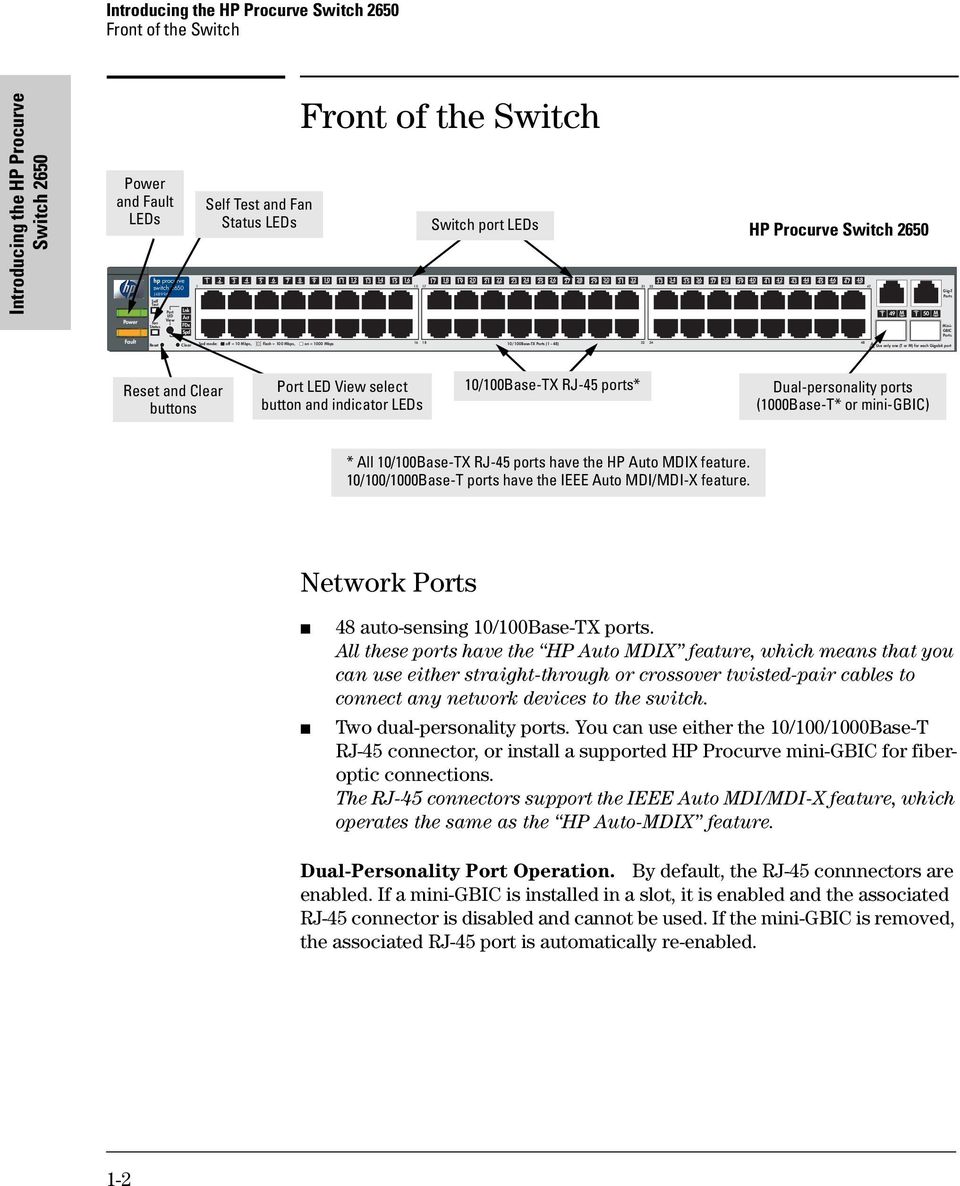
10 Introducing the HP Procurve Switch 2650 Front of the Switch Introducing the HP Procurve Switch 2650 Power and Fault LEDs Power Fault hp procurve switch 2650 J4899A Self Test Fan Status Reset Port LED View Lnk Act FDx Spd Clear Self Test and Fan Status LEDs Front of the Switch Switch port LEDs Spd mode: off = 10 Mbps, flash = 100 Mbps, on = 1000 Mbps /100Base-TX Ports (1-48) HP Procurve Switch ! T 49 M T 50 M Gig-T Ports Mini- GBIC Ports Use only one (T or M) for each Gigabit port Reset and Clear buttons Port LED View select button and indicator LEDs 10/100Base-TX RJ-45 ports* Dual-personality ports (1000Base-T* or mini-gbic) * All 10/100Base-TX RJ-45 ports have the HP Auto MDIX feature. 10/100/1000Base-T ports have the IEEE Auto MDI/MDI-X feature. Network Ports 48 auto-sensing 10/100Base-TX ports. All these ports have the HP Auto MDIX feature, which means that you can use either straight-through or crossover twisted-pair cables to connect any network devices to the switch. Two dual-personality ports. You can use either the 10/100/1000Base-T RJ-45 connector, or install a supported HP Procurve mini-gbic for fiberoptic connections. The RJ-45 connectors support the IEEE Auto MDI/MDI-X feature, which operates the same as the HP Auto-MDIX feature. Dual-Personality Port Operation. By default, the RJ-45 connnectors are enabled. If a mini-gbic is installed in a slot, it is enabled and the associated RJ-45 connector is disabled and cannot be used. If the mini-gbic is removed, the associated RJ-45 port is automatically re-enabled. 1-2
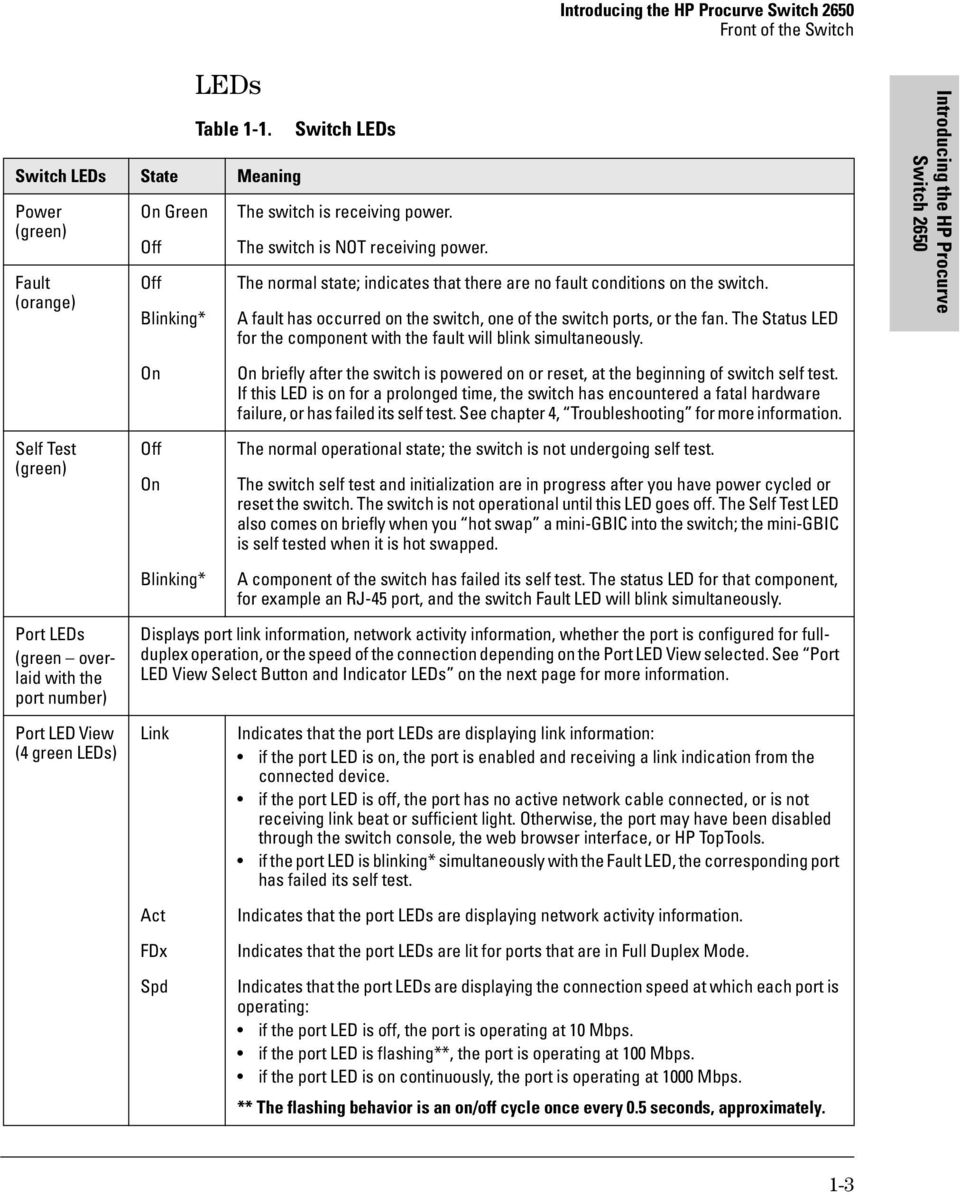
11 Introducing the HP Procurve Switch 2650 Front of the Switch LEDs Table 1-1. Switch LEDs State Meaning Power (green) Fault (orange) On Green Off Off Blinking* Switch LEDs The switch is receiving power. The switch is NOT receiving power. The normal state; indicates that there are no fault conditions on the switch. A fault has occurred on the switch, one of the switch ports, or the fan. The Status LED for the component with the fault will blink simultaneously. Introducing the HP Procurve Switch 2650 Self Test (green) On Off On Blinking* On briefly after the switch is powered on or reset, at the beginning of switch self test. If this LED is on for a prolonged time, the switch has encountered a fatal hardware failure, or has failed its self test. See chapter 4, Troubleshooting for more information. The normal operational state; the switch is not undergoing self test. The switch self test and initialization are in progress after you have power cycled or reset the switch. The switch is not operational until this LED goes off. The Self Test LED also comes on briefly when you hot swap a mini-gbic into the switch; the mini-gbic is self tested when it is hot swapped. A component of the switch has failed its self test. The status LED for that component, for example an RJ-45 port, and the switch Fault LED will blink simultaneously. Port LEDs (green overlaid with the port number) Displays port link information, network activity information, whether the port is configured for fullduplex operation, or the speed of the connection depending on the Port LED View selected. See Port LED View Select Button and Indicator LEDs on the next page for more information. Port LED View (4 green LEDs) Link Act FDx Spd Indicates that the port LEDs are displaying link information: if the port LED is on, the port is enabled and receiving a link indication from the connected device. if the port LED is off, the port has no active network cable connected, or is not receiving link beat or sufficient light. Otherwise, the port may have been disabled through the switch console, the web browser interface, or HP TopTools. if the port LED is blinking* simultaneously with the Fault LED, the corresponding port has failed its self test. Indicates that the port LEDs are displaying network activity information. Indicates that the port LEDs are lit for ports that are in Full Duplex Mode. Indicates that the port LEDs are displaying the connection speed at which each port is operating: if the port LED is off, the port is operating at 10 Mbps. if the port LED is flashing**, the port is operating at 100 Mbps. if the port LED is on continuously, the port is operating at 1000 Mbps. ** The flashing behavior is an on/off cycle once every 0.5 seconds, approximately. 1-3
12 Introducing the HP Procurve Switch 2650 Front of the Switch Introducing the HP Procurve Switch 2650 Switch LEDs State Meaning T/M (green ports 49 and 50 only) Fan Status (green) On On Blinking* For the dual-personality ports, indicates the enabled port: if the T is on, the 10/100/1000Base-T RJ-45 port is enabled. if the M is on, the mini-gbic port is enabled. The cooling fan is operating normally. The cooling fan has failed. The switch Fault LED will be blinking simultaneously. * The blinking behavior is an on/off cycle once every 1.6 seconds, approximately. Port LED View Select Button and Indicator LEDs To optimize the amount of information that can be displayed for each of the switch ports without overwhelming you with LEDs, the Switch 2650 uses a single LED for each port. The operation of this LED is controlled by the Port LED View select button, and the current setting is indicated by the Port LED View indicator LEDs near the button. Press the button to step from one view mode to the next. Port LED (one for each port) hp procurve switch 2650 J4899A Self Test Power Fan Status Port LED View Lnk Act FDx Spd Fault Reset Clear Spd mode: off = 10 Mbps, flash = 100 Mbps, on = 1000 Mbps Port LED View select button and indicator LEDs If the Link (Lnk) indicator LED is lit, each port LED displays link information for the associated port. If the port LED is in Link mode and it is blinking, the port has failed its self test. The Fault and Self Test LEDs will be blinking simultaneously. If the Activity (Act) indicator LED is lit, each port LED displays activity information for the associated port it flickers as network traffic is received and transmitted through the port. If the Full Duplex (FDx) indicator LED is lit, the port LEDs light for those ports that are operating in full duplex. 1-4
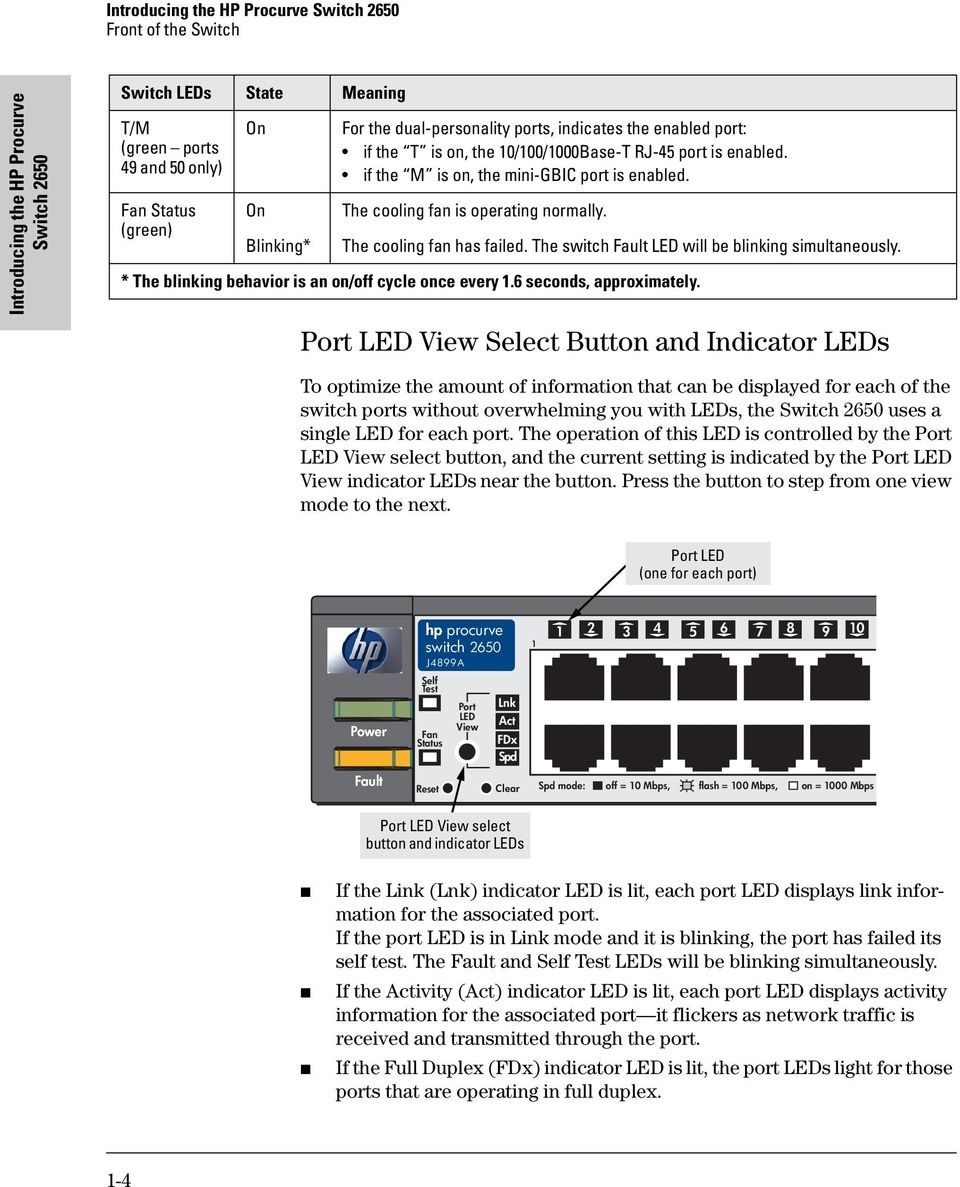
13 Introducing the HP Procurve Switch 2650 Front of the Switch If the Speed (Spd) indicator LED is lit, the port LEDs behave as follows to indicate the connection speed for the port: Off = 10 Mbps Flashing = 100 Mbps (the flashing behavior is a repeated on/off cycle once every 0.5 sec.) On = 1000 Mbps Reset Button This button is used to reset the switch while it is powered on. This action clears any temporary error conditions that may have occurred and executes the switch self test. Introducing the HP Procurve Switch 2650 Clear Button This button is used for these purposes: Deleting Passwords - When pressed by itself for at least one second, the button deletes any switch console access passwords that you may have configured. Use this feature if you have misplaced the password and need console access. This button is provided for your convenience, but its presence means that if you are concerned with the security of the switch configuration and operation, you should make sure the switch is installed in a secure location, such as a locked wiring closet. Restoring Factory Default Configuration - When pressed with the Reset button in a specific pattern, any configuration changes you may have made through the switch console, the web browser interface, and SNMP management are removed, and the factory default configuration is restored to the switch. For the specific method to restore the factory default configuration, see Restoring the Factory Default Configuration in chapter 4, Troubleshooting of this manual. 1-5

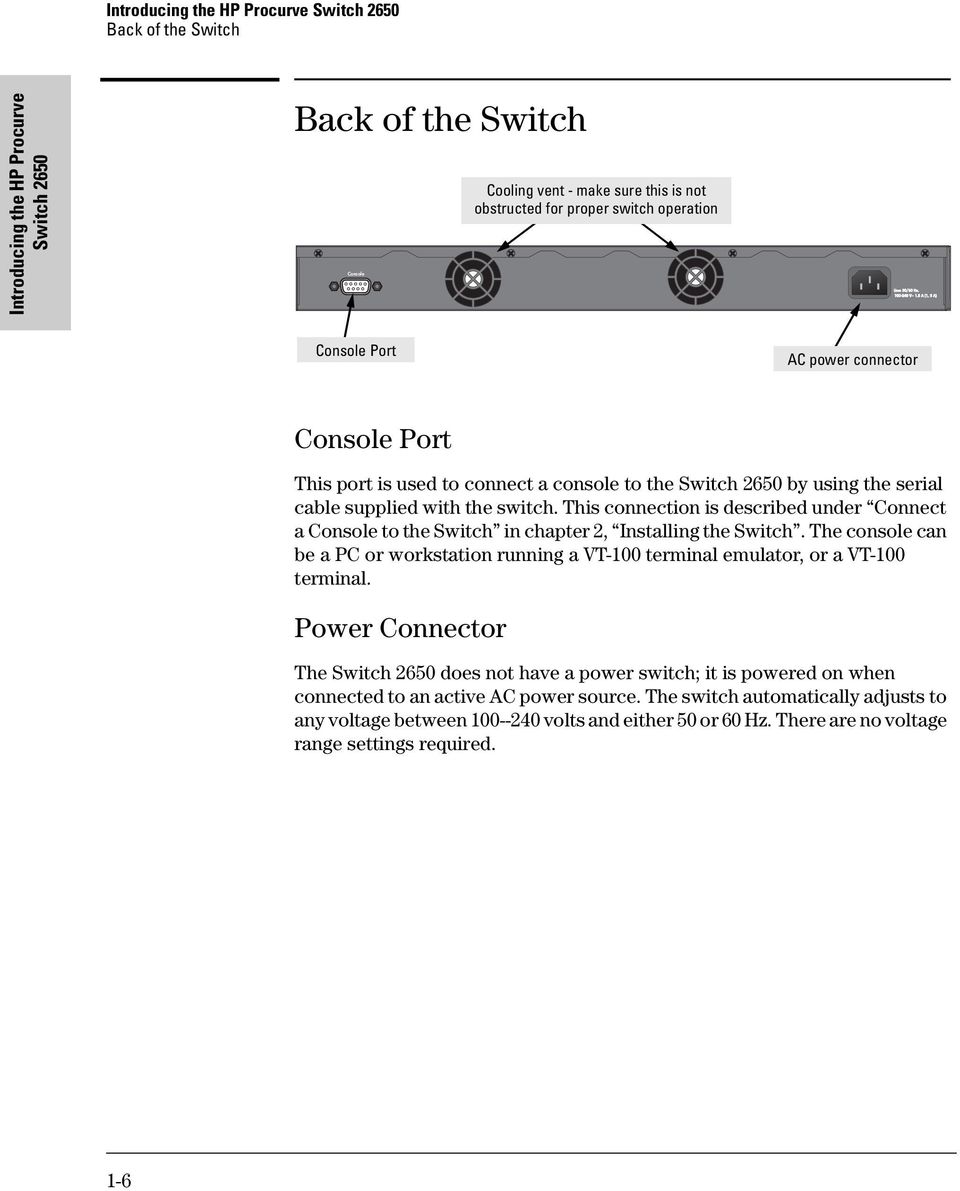
14 Introducing the HP Procurve Switch 2650 Back of the Switch Introducing the HP Procurve Switch 2650 Back of the Switch Console Cooling vent - make sure this is not obstructed for proper switch operation Console Port AC power connector Console Port This port is used to connect a console to the Switch 2650 by using the serial cable supplied with the switch. This connection is described under Connect a Console to the Switch in chapter 2, Installing the Switch. The console can be a PC or workstation running a VT-100 terminal emulator, or a VT-100 terminal. Power Connector The Switch 2650 does not have a power switch; it is powered on when connected to an active AC power source. The switch automatically adjusts to any voltage between volts and either 50 or 60 Hz. There are no voltage range settings required. 1-6
15 Introducing the HP Procurve Switch 2650 Switch Features Switch Features The features of the Switch 2650 include: 48 auto-sensing 10/100Base-TX RJ-45 ports with HP Auto-MDIX. two dual-personality ports either the auto sensing 10/100/1000Base-T RJ-45 or the mini-gbic can be used for each port. plug-and-play networking all ports are enabled just connect the network cables to active network devices and your switched network is operational. HP Auto-MDIX on all 10/100 twisted-pair ports, and IEEE 802.3ab Auto MDI /MDI-X on all 10/100/1000 twisted-pair ports, meaning that all connections can be made using straight-through twisted-pair cables. Cross-over cables are not required, although they will also work. The pin operation of each port is automatically adjusted for the attached device: if the switch detects that another switch or hub is connected to the port, it configures the port as MDI; if the switch detects that an endnode device is connected to the port, it configures the port as MDI-X. automatic learning of the network addresses in each switch s address forwarding table, (with configurable address aging value). automatically negotiated full-duplex operation for the 10/100 and 10/100/1000 RJ-45 ports when connected to other auto-negotiating devices the mini-gbic ports always operate at full duplex. easy management of the switch through several available interfaces: console interface a full featured, easy to use, VT-100 terminal interface that is especially good for out-of-band switch management or for Telnet access to the switch. web browser interface an easy to use built-in graphical interface that can be accessed from common web browsers. HP TopTools for Hubs & Switches an SNMP-based, graphical network management tool that you can use to manage your entire network. This product is included with your new switch. support for the Spanning Tree Protocol to eliminate network loops support for up to 30 IEEE 802.1Q-compliant VLANs so you can divide the attached end nodes into logical groupings that fit your business needs. support for many advanced features to enhance network performance for a description, see the Management and Configuration Guide, which is on the Documentation CD-ROM that is included with your switch. download of new switch software for product enhancements or bug fixes. Introducing the HP Procurve Switch
16

17 2 Installing the Switch 2650 The HP Switch 2650 is easy to install. It comes with an accessory kit that includes the brackets for mounting the switch in a standard 19-inch telco rack, in an equipment cabinet, or on a wall, and with rubber feet that can be attached so the switch can be securely located on a horizontal surface. The brackets are designed to allow mounting the switch in a variety of locations and orientations. This chapter shows you how to install your Switch Included Parts The Switch 2650 has the following components shipped with it: HP Procurve Switch 2650 Installation and Getting Started Guide (J ), this manual HP Procurve Product Documentation CD ROM (contains PDF file copies of the documentation for the Switch 2650, including the Management and Configuration Guide, and for most other HP Procurve switches) HP TopTools for Hubs & Switches - CD ROM and booklet Console cable Customer Support/Warranty booklet Accessory kit ( ) two mounting brackets four 8-mm M4 screws to attach the mounting brackets to the switch four 5/8-inch number screws to attach the switch to a rack four rubber feet Power cord, one of the following: Installing the Switch 2650 Australia/New Zealand China Continental Europe Denmark Japan Switzerland United Kingdom/Hong Kong/Singapore United States/Canada/Mexico
18 Installing the Switch 2650 Installation Procedures Installation Procedures Summary Installing the Switch 2650 Follow these easy steps to install your switch. The rest of this chapter provides details on these steps. 1. Prepare the installation site (page 2-4). Make sure that the physical environment into which you will be installing the switch is properly prepared, including having the correct network cabling ready to connect to the switch and having an appropriate location for the switch. Please see page 2-3 for some installation precautions. 2. Install mini-gbics (optional page 2-6). The switch has two slots for installing mini-gbics. Depending on where you will install the switch, it may be easier to install the mini-gbics first. Note that the mini-gbics can be hot swapped they can be installed or removed while the switch is powered on. 3. Verify that the switch passes self test (page 2-8). This is a simple process of plugging the switch into a power source and observing that the LEDs on the switch s front panel indicate correct switch operation. 4. Mount the switch (page 2-10). The Switch 2650 can be mounted in a 19-inch telco rack, in an equipment cabinet, on a wall, or on a horizontal surface. 5. Connect power to the switch (page 2-15). Once the switch is mounted, plug it into the nearby main power source. 6. Connect the network devices (page 2-16). Using the appropriate network cables, connect the network devices to the switch ports. 7. Connect a console to the switch (optional page 2-17). You may wish to modify the switch s configuration, for example, to configure an IP address so it can be managed using a web browser, from an SNMP network management station, or through a Telnet session. Configuration changes can be made easily by using the included console cable to connect a PC to the switch s console port. At this point, your switch is fully installed. See the rest of this chapter if you need more detailed information on any of these installation steps. 2-2

19 Installing the Switch 2650 Installation Procedures Installation Precautions: Follow these precautions when installing your HP Switch Warning The rack or cabinet should be adequately secured to prevent it from becoming unstable and/or falling over. Devices installed in a rack or cabinet should be mounted as low as possible, with the heaviest devices at the bottom and progressively lighter devices installed above. For safe operation, do not install the switch with the back face of the switch (with the fan vents) facing either downward or upward. Cautions Make sure that the power source circuits are properly grounded, then use the power cord supplied with the switch to connect it to the power source. If your installation requires a different power cord than the one supplied with the switch, be sure to use a power cord displaying the mark of the safety agency that defines the regulations for power cords in your country. The mark is your assurance that the power cord can be used safely with the switch. When installing the switch, note that the AC outlet should be near the switch and should be easily accessible in case the switch must be powered off. Ensure that the switch does not overload the power circuits, wiring, and over-current protection. To determine the possibility of overloading the supply circuits, add together the ampere ratings of all devices installed on the same circuit as the switch and compare the total with the rating limit for the circuit. The maximum ampere ratings are usually printed on the devices near the AC power connectors. Do not install the switch in an environment where the operating ambient temperature might exceed 55 C (131 F). Make sure the air flow around the sides and back of the switch is not restricted. Installing the Switch

20 Installing the Switch 2650 Installation Procedures 1. Prepare the Installation Site Cabling Infrastructure - Ensure that the cabling infrastructure meets the necessary network specifications. See the following table for cable types and lengths, and see appendix B, Cables and Connectors for more information: Table 2-1. Summary of Cable Types to Use With the Switch Port Type Cable Type Length Limits Twisted-Pair Cables Installing the Switch /100Base-TX 10 Mbps operation: Category 3, 4, or 5, 100-ohm unshielded twisted-pair (UTP) 100 Mbps operation: Category 5, 100-ohm UTP or shielded twisted-pair (STP) cable. 100 meters Note: Since the 10Base-T operation is through 10/100Base-TX ports, if you ever want to upgrade the ports to 100Base-TX, it would be best to cable the ports initially with category 5 cable. The 10/100-Base-TX ports on the Switch 2650 include the HP Auto-MDIX feature, which allows you to use either straight-through or crossover twisted-pair cables for connecting to any network devices including end nodes, such as computers, or to other switches, hubs, and routers. 10/100/1000Base-T For either 10, 100 Mbps, or 1000 Mbps operation: Category 5 or better, 100-ohm UTP or shielded twisted-pair (STP) balanced cable. For 1000 Mbps (gigabit) operation, Category 5E cabling or better is recommended. Note: For 1000 Mbps operation, all four wire pairs are used for data transmission. 100 meters Note: The Switch 2650 is compatible with the IEEE 802.3ab standard including the Auto MDI/MDI-X feature, which allows you to use either straight-through or crossover twistedpair cables for connecting to any network devices including end nodes, such as computers, or to other switches, hubs, and routers. 2-4

21 Installing the Switch 2650 Installation Procedures Port Type Cable Type Length Limits Fiber Optic Cables Gigabit-SX (on Gigabit-SX-LC mini-gbic) 62.5/125 µm or 50/125 µm core/cladding diameter, graded-index, multimode fiber-optic cables that are fitted with LC connectors 62.5 µm cable: 160 MHz*km = 220 meters 200 MHz*km = 275 meters 50 µm cable: 400 MHz*km = 500 meters 500 MHz*km = 550 meters Gigabit-LX (on Gigabit-LX-LC mini-gbic) Gigabit-LH (on Gigabit-LH-LC mini-gbic) Single-mode cables fitted with LC connectors. 62.5/125 µm or 50/125 µm core/cladding diameter, graded-index, multimode fiber-optic cables may also be used, but a mode conditioning patch cord may be needed see Mode Conditioning Patch Cord for Gigabit-LX on page B-3 for more information. single-mode cable = 5 kilometers multimode cable = 550 meters Single-mode cables fitted with LC connectors. single-mode cable = 70 kilometers Installation Location - Before installing the switch, plan its location and orientation relative to other devices and equipment: In the front of the switch, leave at least 7.6 cm (3 inches) of space for the twisted-pair and fiber-optic cabling. In the back of the switch, leave at least 3.8 cm (1 1/2 inches) of space for the power cord. On the sides of the switch, leave at least 7.6 cm (3 inches) for cooling, except if the switch is installed in an open EIA/TIA rack. Installing the Switch
22 Installing the Switch 2650 Installation Procedures 2. Installing or Removing mini-gbics You can install or remove a mini-gbic from a mini-gbic slot without having to power off the switch. Use only HP Procurve mini-gbics. Installing the Switch 2650 Notes The mini-gbic slots are shared with the two 10/100/1000Base-T RJ-45 ports. If a mini-gbic is installed in a slot, the associated RJ-45 port is disabled and cannot be used. The mini-gbic ports operate only at full duplex. Half duplex operation is not supported. Make sure that the network cable is NOT connected when you install or remove a mini-gbic. When this manual was printed, the supported mini-gbics include the following: HP Procurve Gigabit-SX-LC mini-gbic (J4858A) HP Procurve Gigabit-LX-LC mini-gbic (J4859A) HP Procurve Gigabit-LH-LC mini-gbic (J4860A) Caution The HP Procurve mini-gbics are Class 1 laser devices. Avoid direct eye exposure to the beam coming from the transmit port. Installing the mini-gbics: Hold the mini-gbic by its sides and gently insert it into either of the slots on the switch until the mini-gbic clicks into place. Gig-T Ports ! T 49 M T 50 M Use only one (T or M) for each Gigabit port Mini- GBIC Ports 2-6
23 Installing the Switch 2650 Installation Procedures Removing the mini-gbics: Note You should disconnect the network cable from the mini-gbic before removing it from the switch. Depending on when you purchased your HP Procurve mini-gbic, it may have either of three different release mechanisms: a plastic tab on the bottom of the mini-gbic, a plastic collar around the mini-gbic, or a wire bail. To remove the mini-gbics that have the plastic or plastic collar, push the tab or collar toward the switch until you see the mini-gbic release from the switch (you can see it move outward slightly), and then pull it from the slot. To remove the mini-gbics that have the wire bail, lower the bail until it is approximately horizontal, and then using the bail, pull the mini-gbic from the slot. Installing the Switch
24 Installing the Switch 2650 Installation Procedures 3. Verify the Switch Passes Self Test Before mounting the switch in its network location, you should first verify that it is working properly by plugging it into a power source and verifying that it passes its self test. 1. Connect the power cord supplied with the switch to the power connector on the back of the switch, and then into a properly grounded electrical outlet. Console Installing the Switch 2650 Note Connect power cord to the power connector The Switch 2650 does not have a power switch. It is powered on when the power cord is connected to the switch and to a power source. For safety, the power outlet should be located near the switch installation. The switch automatically adjusts to any voltage between volts and either 50 or 60 Hz. There are no voltage range settings required. If your installation requires a different power cord than the one supplied with the switch, be sure to use a power cord displaying the mark of the safety agency that defines the regulations for power cords in your country. The mark is your assurance that the power cord can be used safely with the switch. 2-8
25 Installing the Switch 2650 Installation Procedures 2. Check the LEDs on the switch as described below. Self Test LED Switch port LEDs Power Fault hp procurve switch 2650 J4899A Self Test Fan Status Reset Port LED View Lnk Act FDx Spd Clear Spd mode: off = 10 Mbps, flash = 100 Mbps, on = 1000 Mbps /100Base-TX P Power and Fault LEDs When the switch is powered on, it performs its diagnostic self test. Self test takes approximately 50 seconds to complete. LED Behavior: During the self test: Initially, all the switch and port LEDs are on and stay on for most of the duration of the self test. Most of the LEDs go off and then may come on again during phases of the self test. For the duration of the self test, the Self Test LED stays on. When the self test completes successfully: The Power and Fan Status LEDs remain on. The Fault and Self Test LEDs go off. The port LEDs on the front of the switch go into their normal operational mode: If the ports are connected to active network devices, the LEDs behave according to the Port LED View selected. In the default view mode (Link), the LEDs should be on. If the ports are not connected to active network devices, the LEDs will stay off. If the LED display is different than what is described above, especially if the Fault and Self Test LEDs stay on for more than 60 seconds or they start blinking, the self test has not completed correctly. Refer to chapter 4, Troubleshooting for diagnostic help. Installing the Switch
26 Installing the Switch 2650 Installation Procedures 4. Mount the Switch After you have verified that the switch passes self test, you are ready to mount the switch in a stable location. The Switch 2650 can be mounted in these ways: in a rack or cabinet on a horizontal surface on a wall Rack or Cabinet Mounting Installing the Switch 2650 Warning Equipment Cabinet Note The Switch 2650 is designed to be mounted in any EIA-standard 19-inch telco rack or communication equipment cabinet. Note that the mounting brackets have multiple mounting holes and can be rotated allowing for a wide variety of mounting options. For safe operation, please read the mounting precautions on page 2-3, before mounting a switch. The screws supplied with the switch are the correct threading for standard EIA/TIA open 19-inch racks. If you are installing the switch in an equipment cabinet such as a server cabinet, use the clips and screws that came with the cabinet in place of the screws that are supplied with the switch. Complete step 1, on the next page. Then, plan which four holes you will be using in the cabinet and install all four clips and partially install the two bottom screws, as described in step 2 on the following page. Then proceed to step
27 Installing the Switch 2650 Installation Procedures 1. Use a #1 Phillips (cross-head) screwdriver and attach the mounting brackets to the switch with the included 8-mm M4 screws. 8 mm M4 screws Installing the Switch 2650 Note Note that the mounting brackets have multiple mounting holes and can be rotated allowing for a wide variety of mounting options. These include mounting the switch so that its front face is flush with the face of the rack, or mounting it in a more balanced position as shown in the illustration. Note Steps 2, 3, and 4 on the next page describe a convenient method of mounting the switch in a rack by placing it on two screws that you first install in the rack. You may, instead, just hold the switch with attached brackets up to the rack and move it vertically until rack holes line up with the bracket holes and notches, then insert and tighten the four screws holding the brackets to the rack. 2-11
28 Installing the Switch 2650 Installation Procedures 2. Partially install a screw (5/8-inch number 12-24) into the top hole of a pair of holes that are 0.5 inches apart in each rack/cabinet upright as shown in the illustration below. Ensure that the screws are at the same level in each upright. Partially install a screw into the top hole of a close (0.5-inch) pair on both sides of the rack Installing the Switch Place the switch in the rack and lower it so the notches in the bottom of the bracket slide onto the screws, then tighten these screws. Lower switch with mounting brackets onto the partially installed screw 2-12
29 Installing the Switch 2650 Installation Procedures 4. Install the other number screw into the upper hole in each bracket. Tighten these screws. Install additional screw Wall Mounting You can mount the switch on a wall as shown in the illustrations on the next page. Installing the Switch 2650 Warning Caution For safe operation, do not install the switch with the back face of the switch (with the fan vents) facing either downward or upward. The switch should be mounted only to a wall or wood surface that is at least 1/2-inch plywood or its equivalent. 1. Use a #1 Phillips (cross-head) screwdriver and attach the mounting brackets to the switch with the included 8-mm M4 screws. 2. Attach the switch to the wall or wood surface with two 5/8-inch number 12 wood screws (not included). 2-13
30 Installing the Switch 2650 Installation Procedures For Bookshelf Wall Mounting For Flat Wall Mounting M4 screws 5/8-inch wood screw M4 screws Installing the Switch /8-inch wood screws Second 5/8-inch wood screw (hidden) Note that the brackets are attached on opposite corners. This improves the stability of the switch on the wall. 2-14
31 Installing the Switch 2650 Installation Procedures Horizontal Surface Mounting Place the switch on a table or other horizontal surface. The switch comes with rubber feet in the accessory kit that can be used to help keep the switch from sliding on the surface. Attach the rubber feet to the four corners on the bottom of the switch within the embossed angled lines. Use a sturdy surface in an uncluttered area. You may want to secure the networking cables and switch power cord to the table leg or other part of the surface structure to help prevent tripping over the cords. Caution Make sure the air flow is not restricted around the sides and back of the switch. 5. Connect the Switch to a Power Source 1. Plug the included power cord into the switch s power connector and into a nearby AC power source. 2. Re-check the LEDs during self test. See LED Behavior on page 2-9. Installing the Switch
32 Installing the Switch 2650 Installation Procedures 6. Connect the Network Cables Connect the network cables, described under Cabling Infrastructure (page 2-4), from the network devices or your patch panels to the fixed RJ-45 ports on the switch or to any mini-gbics you have installed in the switch. Using the RJ-45 Connectors Installing the Switch 2650 To connect: Push the RJ-45 plug into the RJ-45 jack until the tab on the plug clicks into place. When power is on for the switch and for the connected device, the Link LED for the port should light to confirm a powered-on device (for example, an end node) is at the other end of the cable. If the Link LED does not go on when the network cable is connected to the port, see Diagnosing With the LEDs in chapter 4, Troubleshooting. To disconnect: Press the small tab on the plug and pull the plug out of the jack. hp procurve switch 2650 J4899A Self Test Fan Status eset Port LED View Lnk Act FDx Spd Clear Spd mode: off = 10 Mbps, flash = RJ-45 connector Unshielded twisted-pair cable: Category 3, 4, or 5 for 10 Mbps ports Category 5 or better for 100 Mbps ports Category 5E or better for 1000 Mbps ports Maximum distance: 100 meters Connecting Cables to mini-gbics Note The mini-gbic slots are shared with the two 10/100/1000Base-T RJ-45 ports. If a mini-gbic is installed in a slot, the associated RJ-45 port is disabled. If you have any mini-gbics installed in the switch, the type of network connections you will need to use depends on the type of mini-gbics you have installed. See the table on page 2-5, and appendix B, Switch Ports and Network Cables, for the mini-gbic cabling information. For mini-gbics ports, and in general for all the switch ports, when a network cable from an active network device is connected to the port, the port LED for that port should go on. If the port LED does not go on when the network cable is connected to the port, see Diagnosing With the LEDs in chapter 4, Troubleshooting. 2-16
33 Installing the Switch 2650 Installation Procedures 7. (Optional) Connect a Console to the Switch 2650 The Switch 2650 has a full-featured, easy to use console interface for performing switch management tasks including the following: Monitor switch and port status and observe network activity statistics Modify the switch s configuration to optimize switch performance, enhance network traffic control, and improve network security Read the event log and access diagnostic tools to help in troubleshooting Download new software to the switch Add passwords to control access to the switch from the console, web browser interface, and network management stations The console can be accessed through these methods: Out-of-band: The Switch 2650 comes with a serial cable for connecting a PC or VT-100 terminal, to be used as a console, directly to the switch. In-Band: Access the console using Telnet from a PC or UNIX station on the network, and a VT-100 terminal emulator. This method requires that you first configure the switch with an IP address and subnet mask by using either out-of-band console access or through DHCP/Bootp. For more information on IP addressing and on starting a Telnet session, see chapter 3, Getting Started With Switch Configuration, and the Management and Configuration Guide, which is on the Documentation CD-ROM that came with your switch. Installing the Switch 2650 The Switch 2650 can simultaneously support one out-of-band console session through the Console Port and one in-band Telnet console session. Terminal Configuration To connect a console to the switch, configure the PC terminal emulator as a DEC VT-100 (ANSI) terminal or use a VT-100 terminal, and configure either one to operate with these settings: any baud rate from 1200 to (the switch senses the speed) 8 data bits, 1 stop bit, no parity, and flow control set to Xon/Xoff For the Windows Terminal program, also disable (uncheck) the Use Function, Arrow, and Ctrl Keys for Windows option For the Hilgraeve HyperTerminal program, select the Terminal keys option for the Function, arrow, and ctrl keys act as parameter. If you want to operate the console using a different configuration, make sure you change the settings on both the terminal and on the switch so they are compatible. Change the switch settings first, then change the terminal settings, then reboot the switch and reestablish the console session. 2-17
34 Installing the Switch 2650 Installation Procedures Direct Console Access Installing the Switch 2650 To connect a console to the switch, follow these steps: 1. Connect the PC or terminal to the switch s Console Port using the console cable included with the Switch (If your PC or terminal has a 25-pin serial connector, first attach a 9-pin to 25-pin straight-through adapter at one end of the console cable.) 2. Turn on the terminal or PC s power and, if using a PC, start the PC terminal program. 3. Press [Enter] two or three times and you will see the copyright page and the message Press any key to continue. Press a key, and you will then see the switch console command (CLI) prompt, for example: HP Procurve Switch 2650# Console port Console cable supplied with the switch PC running a terminal emulator program, or a VT-100 terminal Console If you want to continue with console management of the switch at this time, see chapter 3, Getting Started With Switch Configuration for some basic configuration steps. For more detailed information, refer to the Management and Configuration Guide, which is on the Documentation CD-ROM that came with your switch. 2-18
35 Power Fault Reset Fan Status hp procurve switch 2650 J4899A Self Test Port LED View Clear Lnk Act FDx Spd ! Mini- GBIC Ports Gig-T Ports Installing the Switch 2650 Sample Network Topologies Sample Network Topologies This section shows you a few sample network topologies in which the Switch 2650 is implemented. For more topology information, see the HP network products World Wide Web site, As a Desktop Switch Twisted-pair straight-through or crossover cables Server Spd mode: off = 10 Mbps, flash = 100 Mbps, on = 1000 Mbps 10/100Base-TX Ports (1-48) T M T M Use only one (T or M) foreachgigabit port Switch 2650 PCs and peripherals Installing the Switch 2650 The Switch 2650 is designed to be used primarily as a desktop switch to which end nodes, printers and other peripherals, and servers are directly connected, as shown in the above illustration. Notice that the end node devices are connected to the switch by straight-through or crossover twisted-pair cables. Either cable type can be used because of the HP Auto-MDIX and IEEE Auto MDI/MDI-X features on the Switch
36 Power Fault Reset Fan Status hp procurve switch 2650 J4899A Self Test Port LED View Spd Clear Lnk Act FDx ! Mini- GBIC Ports Gig-T Ports Installing the Switch 2650 Sample Network Topologies As a Segment Switch Server with Gigabit Ethernet NIC Switch Spd mode: off = 10 Mbps, flash = 100Mbps, on =1000 Mbps 10/100Base-TX Ports (1-48) T M T M Use only one (T orm)foreachgigabit port Category 5E twisted-pair straight-through or crossover cable for 1000 Mbps connection to server Gigabit fiber-optic cable to backbone Twisted-pair straightthrough or crossover cables to hubs Printers Installing the Switch 2650 Fast Ethernet Hubs Twisted-pair straight-through cables to end nodes Printers PCs, printers, and local servers The Switch 2650 also works well as a segment switch. That is, with its high performance, it can be used for interconnecting network segments simply connect the network hubs that form those segments to the switch, or you can also connect other switches. In the illustration above, two Fast Ethernet hubs with PCs, printers, and local servers attached, are both connected to a Switch The devices attached to the two hubs can now communicate with each other through the switch. They can also all communicate with the server that is connected to a 1000Base-T port on the switch. Because the Switch 2650 has the HP Auto-MDIX and IEEE Auto MDI/ MDI-X features, the connections between the switch and the hubs, and between the switch and end nodes or servers can be through category 5 straight-through or crossover twisted-pair cable. Category 3 or 4 cable can also be used if the connection is 10 Mbps only. In all cases, the device ports must be configured to auto negotiate the link characteristics for this feature to work. The switch, in turn, can be connected to a network backbone through fiberoptic cabling connected to a Gigabit-SX, -LX, or -LH mini-gbic installed in the switch. Now, all the devices on these network segments can access other network resources that are connected elsewhere on the network backbone. 2-20
37 Switch Engine Module HP J4110A Power Reset Fault Console Clear Switch Engine Fail Self Test Status A B C D E Modules F G H I J 1 Power 2 Fan Act Mode Fdx Select 100 A Link Mode Link Mode HP Switch Gigabit-SX Module Tx Rx A Tx 1 Rx Tx 2 Rx Tx 3 Rx Tx 4 Rx HP Switch 10Base-FL Module C 2X 3X 4X 5X 6X 7X 8X HP Switch 10/100Base-T Module 2X 3X 4X 5X 6X 7X 8X HP Switch 10/100Base-T Module 2X 3X 4X 5X 6X 7X 8X HP Switch 10/100Base-T Module 2X 3X 4X 5X 6X 7X 8X HP Switch 10/100Base-T Module Tx Rx Link Mode HP Switch Gigabit-SX Module Link Mode HP Switch Gigabit-SX Module Link Mode Link Mode Link Mode Link Mode A A A Tx Rx Power Fault hp procurve switch 2650 Reset Fan Status J4899A Self Test Port LED View Spd Lnk Act FDx Clear Power Fault Reset Fan Status Self Test hp procurve switch 2650 J4899A 34 Port LED View 35 Clear 36 Spd Lnk Act FDx ! T 49 M T 50 M 17 Mini- GBIC Ports Gig-T Ports ! T 49 M T 50 M Mini- GBIC Ports Gig-T Ports Installing the Switch 2650 Sample Network Topologies Connecting to a Backbone Switch Switch 2650 To Gigabit-Ethernet backbone Gigabit fiber-optic cable Spd mode: off = 10 Mbps, flash = 100 Mbps, on =1000 Mbps 10/100Base-TX Ports (1-48) Use only one (T or M) for eachgigabit port ProCurve Switch 8000M Switch 8000M A 1X A B D E F G H I J A 1X A 1X A 1X Spd mode: off = 10 Mbps, flash = 100 Mbps, on = 1000 Mbps 10/100Base-TX Ports (1-48) Use only one (T or M) for each Gigabit port Switch 2650 Installing the Switch 2650 Printers Printers The simpler desktop and segment networks shown in the previous two examples can easily be combined and expanded. For example, you could use an HP Procurve Switch 8000M to interconnect each of your smaller switched workgroups to form a larger switched network. All the devices in this network can communicate with each other. With a Gigabit-SX Module, for example, in the Switch 8000M, the entire switched topology could be connected to a campus backbone, as shown in the illustration above. Note In the illustration above, the 1000 Mbps fiber-optic connection between the Switch 2650 and the Switch 8000M is by way of a Gigabit-SX mini-gbic installed in the Switch 2650 connected to a Gigabit-SX Module in the Switch 8000M. 2-21
38 Installing the Switch 2650 Sample Network Topologies Stacking the Switch Switch 2650 units can be connected together, through standard network connections, and managed through a single IP address. Up to 16 switches can be connected together in such a virtual stack. You identify the switch as the Commander and give that switch an IP address. Up to 15 other switches in the network can then easily be configured as Members of the stack and managed through the Commander s IP address. The management includes Telnet access and web browser interface access to the Commander and to each Member switch through the Commander. Installing the Switch 2650 For more information on stacking your Switch 2650, please see the Management and Configuration Guide, which is on the Documentation CD-ROM that came with your switch. 2-22
39 3 Getting Started With Switch Configuration This chapter is a guide for using the console Switch Setup screen to quickly assign an IP (Internet Protocol) address and subnet mask to the switch, set a Manager password, and, optionally, configure other basic features. For more information on using the switch console and the other switch management interfaces: the web browser interface and the SNMP management tool, HP TopTools for Hubs & Switches, please see the Management and Configuration Guide, which is on the Documentation CD-ROM that came with your switch. Recommended Minimal Configuration In the factory default configuration, the switch has no IP (Internet Protocol) address and subnet mask, and no passwords. In this state, it can be managed only through a direct console connection. To manage the switch through inband (networked) access, you should configure the switch with an IP address and subnet mask compatible with your network. Also, you should configure a Manager password to control access privileges from the console and web browser interface. Other parameters in the Switch Setup screen can be left at their default settings or you can configure them with values you enter. Many other features can be configured through the switch s console interface, to optimize the switch s performance, to enhance your control of the network traffic, and to improve network security. Once an IP address has been configured on the switch, these features can be accessed more conveniently through a remote Telnet session, through the switch s web browser interface, and from an SNMP network management station running a network management program, such as HP TopTools for Hubs & Switches. For a listing of switch features available with and without an IP address, refer to How IP Addressing Affects Switch Operation in the Management and Configuration Guide, which is on the Documentation CD-ROM that came with your switch. Getting Started With Switch Configuration For more information on IP addressing, refer to IP Configuration in the Management and Configuration Guide. 3-1
40 Getting Started With Switch Configuration Getting Started With Switch Configuration Note By default, the switch is configured to acquire an IP address configuration from a DHCP or Bootp server. To use DHCP/Bootp instead of the manual method described in this chapter, see DHCP/Bootp Operation in the Management and Configuration Guide, which is on the Documentation CD-ROM that came with your switch. Using the Console Setup Screen The quickest and easiest way to minimally configure the switch for management and password protection in your network is to use a direct console connection to the switch, start a console session, and access the Switch Setup screen. 1. Using the method described in the preceding section, connect a terminal device to the switch and display the switch console command (CLI) prompt (the default display). The CLI prompt appears displaying the switch model number: HP Procurve Switch 2650# 2. At the prompt, enter the setup command to display the Switch Setup screen. The following illustration shows the Setup screen with the default settings. 3. Use the [Tab] key to select the Manager Password field and enter a manager password of up to 16 characters. 3-2
41 Getting Started With Switch Configuration 4. [Tab] to the IP Config (DHCP/Bootp) field and use the Space bar to select the Manual option. 5. [Tab] to the IP Address field and enter the IP address that is compatible with your network. 6. [Tab] to the Subnet Mask field and enter the subnet mask used for your network. 7. Press [Enter], then [S] (for Save). Here is some information on the fields in the Setup screen. For more information on these fields, see the Management and Configuration Guide, which is on the Documentation CD-ROM that came with your switch: Parameter Default System Name blank Optional; up to 25 characters, including spaces System Contact blank Optional; up to 48 characters, including spaces Manager Password blank Recommended; up to 16 characters (no blank spaces) Logon Default CLI The default setting selects the command line interface for console access. The alternative is the menu interface. Time Zone 0 (none) Optional; 1440 to The number of minutes your location is to the West (-) or East (+) of GMT. Community Name public Default setting recommended. Spanning Tree Enabled No Default setting recommended unless STP is already running on your network or the switch will be used in complex network topologies. Default Gateway blank Optional; Enter the IP address of the next-hop gateway node if network traffic needs to be able to reach off-subnet destinations. Time Sync Method None Optional; The protocol the switch uses to acquire a time signal. The options are SNTP and TimeP. TimeP Mode Disabled Optional; The method the switch uses to acquire the TimeP server address. Getting Started With Switch Configuration IP Config (DHCP/Bootp) DHCP/Bootp Set to Manual unless a DHCP/Bootp server is used on your network to configure IP addressing. IP Address xxx.xxx.xxx.xxx Recommended; If you set IP Config to Manual, then enter an IP address compatible with your network. Note: The IP address and subnet mask assigned for the switch must be compatible with the IP addressing used in your network. For more information on IP addressing, see the Management and Configuration Guide, which is on the Documentation CD-ROM that came with your switch. Subnet Mask xxx.xxx.xxx.xxx Recommended; If you entered an IP address, then enter a subnet mask compatible with your network. 3-3
42 Getting Started With Switch Configuration Getting Started With Switch Configuration Where to Go From Here The above procedure configures your switch with a Manager password, IP address, and subnet mask. As a result, with the proper network connections, you can now manage the switch from a PC equipped with Telnet, a web browser interface, or from an SNMP-based network management station using a tool such as HP TopTools for Hubs & Switches. Some basic information on managing your switch is included in the next section. For more information on the console, web browser, and SNMP management interfaces and all the features that can be configured on the Switch 2650, please see the Management and Configuration Guide, which is on the Documentation CD-ROM that came with your switch. To Recover from a Lost Manager Password: If you cannot start a console session at the manager level because of a lost Manager password, you can clear all passwords and user names by getting physical access to the switch and pressing and holding the Clear button for a full second. 3-4
43 Getting Started With Switch Configuration Using the IP Address for Remote Switch Management Using the IP Address for Remote Switch Management With your Switch 2650, you can use the switch s IP address to manage the switch from any PC that is on the same subnet as the switch. You can use either a Telnet session or a standard web browser to manage the switch. Starting a Telnet Session To access the switch through a Telnet session, follow these steps: 1. Make sure the switch is configured with an IP address and that the switch is reachable from the PC that is running the Telnet session (for example, by using a Ping command to the switch s IP address). 2. Start the Telnet program on a PC that is on the same subnet as the switch and connect to the switch s IP address. 3. You will see the copyright page and the message Press any key to continue. Press a key, and you will then see the switch console command (CLI) prompt, for example: HP Procurve Switch 2650# Enter help or? to see a list of commands that can be executed at the prompt. Entering any command followed by help provides more detailed context help information about the command. Entering any command followed by? displays a list of options that are available at that point in the command entry. Starting a Web Browser Session Your Switch 2650 can be managed through a graphical interface that you can access from any PC or workstation on the network by running your web browser and typing in the switch s IP address as the URL. No additional software installation is required to make this interface available; it is included in the switch s onboard software. A typical web browser interface screen is shown in the next illustration. Getting Started With Switch Configuration 3-5
44 Getting Started With Switch Configuration Using the IP Address for Remote Switch Management Getting Started With Switch Configuration For more information on using the web browser interface, please see the Management and Configuration Guide, which is on the Documentation CD-ROM that came with your switch. An extensive help system is also available for the web browser interface. To access the help system though, the subnet on which the switch is installed must have access to the internet, or HP TopTools for Hubs & Switches needs to be installed on a network management station that is on the subnet. 3-6
45 4 Troubleshooting This chapter describes how to troubleshoot your HP Procurve Switch Note that this document describes troubleshooting mostly from a hardware perspective. You can perform more in-depth troubleshooting on the Switch 2650 using the software tools available with the switch, including the full-featured console interface, the built-in web browser interface, and HP TopTools for Hubs & Switches, the SNMP-based network management tool. For more information, see the chapter Troubleshooting in the Management and Configuration Guide, which is on the Documentation CD-ROM that came with your switch. This chapter describes the following: basic troubleshooting tips (page 4-1) diagnosing with the LEDs (page 4-4) Proactive Networking tools (page 4-8) hardware diagnostic tests (page 4-9) restoring the factory default configuration (page 4-11) downloading new software to the Switch 2650 (page 4-12) HP Customer Support Services (page 4-12) Basic Troubleshooting Tips Most problems are caused by the following situations. Check for these items first when starting your troubleshooting: Connecting to devices that have a fixed full-duplex configuration. The RJ-45 ports are configured as Auto. That is, when connecting to attached devices, the switch will operate in one of two ways to determine the link speed and the communication mode (half duplex or full duplex): If the connected device is also configured to Auto, the switch will automatically negotiate both link speed and communication mode. Troubleshooting 4-1
46 Troubleshooting Basic Troubleshooting Tips If the connected device has a fixed configuration, for example 100 Mbps, at half or full duplex, the switch will automatically sense the link speed, but will default to a communication mode of half duplex. Because the Switch 2650 behaves in this way (in compliance with the IEEE standard), if a device connected to the switch has a fixed configuration at full duplex, the device will not connect correctly to the switch. The result will be high error rates and very inefficient communications between the switch and the device. Troubleshooting Make sure that all devices connected to the Switch 2650 are configured to auto negotiate, or are configured to connect at half duplex (all hubs are configured this way, for example). Faulty or loose cables. Look for loose or obviously faulty connections. If they appear to be OK, make sure the connections are snug. If that does not correct the problem, try a different cable. Non-standard cables. Non-standard and miswired cables may cause network collisions and other network problems, and can seriously impair network performance. Use a new correctly-wired cable or compare your cable to the cable in appendix B, Cables and Connectors for pinouts and correct cable wiring. A category 5 cable tester is a recommended tool for every 100Base-TX and 1000Base-T network installation. Improper Network Topologies. It is important to make sure you have a valid network topology. Common topology faults include excessive cable length and excessive repeater delays between end nodes. If you have network problems after recent changes to the network, change back to the previous topology. If you no longer experience the problems, the new topology is probably at fault. Sample topologies are shown at the end of chapter 2 in this book, and some topology configuration guidelines can be found online at the HP Procurve web site, hpprocurve. In addition, you should make sure that your network topology contains no data path loops. Between any two end nodes, there should be only one active cabling path at any time. Data path loops will cause broadcast storms that will severely impact your network performance. For your Switch 2650, if you wish to build redundant paths between important nodes in your network to provide some fault tolerance, you should enable Spanning Tree Protocol support on the switch. This ensures that only one of the redundant paths is active at any time, thus avoiding data path loops. Spanning Tree can be enabled through the switch console, the web browser interface, or HP TopTools for Hubs & Switches. 4-2
47 Troubleshooting Troubleshooting Basic Troubleshooting Tips The Switch 2650 also supports Trunking, which allows multiple network cables to be used for a single network connection without causing a data path loop. For more information on Spanning Tree and Trunking, see the Management and Configuration Guide, which is on the Documentation CD-ROM that came with your switch. Check the port configuration. A port on your Switch 2650 may not be operating as you expect because it has been put into a blocking state by Spanning Tree, GVRP (automatic VLANs), or LACP (automatic trunking). (Note that the normal operation of the Spanning Tree, GVRP, and LACP features may put the port in a blocking state.) Or, the port just may have been configured as disabled through software. Use the switch console to determine the port s configuration and verify that there is not an improper or undesired configuration of any of the switch features that may be affecting the port. For more information, see the Management and Configuration Guide, which is on the Documentation CD-ROM that came with your switch. For more information on possible network problems and their solutions, refer to the technical note Troubleshooting LAN Performance and Intermittent Connectivity Problems, which can be found on the HP Procurve web site, in the Information Library section. 4-3
48 Troubleshooting Troubleshooting Diagnosing with the LEDs Diagnosing with the LEDs Table 3-1 shows LED patterns on the switch and the switch modules that indicate problem conditions. 1. Check in the table for the LED pattern that you see on your switch. 2. Refer to the corresponding diagnostic tip on the next few pages. Table 4-1. LED Error Indicators LED Pattern Indicating Problems Power Fault Self Test Off with power cord plugged in Fan Status Port LED (in Link view mode) Diagnostic Tips * * * * ➊ On Prolonged On Prolonged On * * ➋ On Blinking Blinking * * ➌ On Blinking Off Blinking * ➍ On Blinking Blinking * Blinking ➎ On Off Off * Off with cable connected On Off Off * On, but the port is not communicating ➏ ➐ * This LED is not important for the diagnosis. The blinking behavior is an on/off cycle once every 1.6 seconds, approximately. 4-4
49 Troubleshooting Diagnosing with the LEDs Diagnostic Tips: Tip Problem Solution ➊ ➋ ➌ ➍ ➎ The switch is not plugged into an active AC power source, or the switch s power supply may have failed. A switch hardware failure has occurred. All the LEDs will stay on indefinitely. The switch has experienced a software failure during self test. One or both of the switch cooling fans may have failed. The network port for which the LED is blinking has experienced a self test or initialization failure. 1. Verify that the power cord is plugged into an active power source and to the switch. Make sure these connections are snug. 2. Try power cycling the switch by unplugging and plugging the power cord back in. 3. If the Power LED is still not on, verify that the AC power source works by plugging another device into the outlet. Or try plugging the switch into a different outlet or try a different power cord. If the power source and power cord are OK and this condition persists, the switch power supply may have failed. Call your HP-authorized LAN dealer, or use the electronic support services from HP to get assistance. See the Customer Support/Warranty booklet for more information. Try power cycling the switch. If the fault indication reoccurs, the switch may have failed. Call your HP-authorized LAN dealer, or use the electronic support services from HP to get assistance. See the Customer Support/Warranty booklet for more information. 1. Try resetting the switch by pressing the Reset button on the front of the switch, or by power cycling the switch. 2. If the fault indication reoccurs, attach a console to the switch (as indicated in chapter 2) and configure it to operate at 9600 baud. Then, reset the switch. Messages should appear on the console screen and in the console log identifying the error condition. You can view the console log at that point by selecting it from the console Main Menu. If necessary to resolve the problem, contact your HP-authorized LAN dealer, or use the electronic support services from HP to get assistance. See the Customer Support/ Warranty booklet for more information. Try disconnecting power from the switch and wait a few moments. Then reconnect the power to the switch and check the LEDs again. If the error indication reoccurs, one or both of the fans has failed. The switch has two fans and may continue to operate under this condition if the ambient temperature does not exceed normal room temperature, but for best operation, the switch should be replaced. Contact your HP-authorized LAN dealer, or use the electronic support services from HP to get assistance. See the Customer Support/Warranty booklet for more information. Try power cycling the switch. If the fault indication reoccurs, the switch port may have failed. Call your HP-authorized LAN dealer, or use the electronic support services from HP to get assistance. See the Customer Support/Warranty booklet for more information. If the port is a mini-gbic, verify that it is one of the mini-gbics supported by the switch. Unsupported mini-gbics will be identified with this fault condition. The supported mini- GBICs are listed in Chapter 2, Installing the Switch 2650 on page 2-6. The mini-gbics are also tested when they are hot-swapped installed or changed while the switch is powered on. To verify that the port has failed, try removing and reinstalling the mini-gbic without having to power off the switch. If the port fault indication reoccurs, you will have to replace the mini-gbic. continued on the next page Troubleshooting 4-5
50 Troubleshooting Diagnosing with the LEDs Tip Problem Solution ➏ The network connection is not working properly. Try the following procedures: For the indicated port, verify that both ends of the cabling, at the switch and the connected device, are connected properly. Verify the connected device and switch are both powered on and operating correctly. Verify that you have used the correct cable type for the connection: For twisted-pair connections to the fixed 10/100 or 10/100/1000 ports, if the port is configured to Auto (auto negotiate), either straight-through or crossover cables can be used because of the switch s HP Auto-MDIX feature and the Auto MDI/MDI-X feature of the 10/100/1000-T port. Note: If the switch port configuration is changed to one of the fixed configuration options (for example, 100 Mbps/Full Duplex), then the port operates as MDI-X only and you must use the correct type of cable for the connection. In general, for connecting an end node (MDI port) to the switch, use straight-through cable; for connecting to MDI-X ports on hubs, other switches, and routers, use crossover cable. Troubleshooting For fiber-optic connections, verify that the transmit port on the switch is connected to the receive port on the connected device, and the switch receive port is connected to the transmit port on the connected device. For the dual-personality 10/100/1000-T ports, be sure a mini-gbic is not installed in the associated slot. For 1000Base-T connections, verify that the network cabling complies with the IEEE 802.3ab standard. the cable should be installed according to the ANSI/TIA/EIA-568- A-5 specifications. Cable testing should comply with the stated limitations for Attenuation, Near-End Crosstalk, Far-End Crosstalk, Equal-Level Far-End Crosstalk (ELFEXT), Multiple Disturber ELFEXT, and Return Loss. The cable verification process must include all patch cables from any end devices, including the switch, to any patch panels in the cabling path. Verify that the port has not been disabled through a switch configuration change. You can use the console interface, or, if you have configured an IP address on the switch, use the web browser interface, or HP TopTools for Hubs & Switches network management software to determine the state of the port and re-enable the port if necessary. Verify that the switch port configuration matches the configuration of the attached device. For example, if the switch port is configured as Auto, the port on the attached device also MUST be configured as Auto. Depending on the port type, twisted-pair or fiber-optic, if the configurations don t match, the results could be a very unreliable connection, or no link at all. If the other procedures don t resolve the problem, try using a different port or a different cable. 4-6
51 Troubleshooting Troubleshooting Diagnosing with the LEDs Tip Problem Solution ➐ The port may be improperly configured, or the port may be in a blocking state by the normal operation of the Spanning Tree, LACP, or IGMP features. Use the switch console to see if the port is part of a dynamic trunk (through the LACP feature) or to see if Spanning Tree is enabled on the switch, and to see if the port may have been put into a blocking state by those features. The show lacp command displays the port status for the LACP feature; the show spanning-tree command displays the port status for Spanning Tree. Also check the Port Status screen using the show interfaces command to see if the port has been configured as disabled. Other switch features that may affect the port operation include VLANs and IGMP. Use the switch console to see how the port is configured for these features. For software troubleshooting tips, see the chapter Troubleshooting in the Management and Configuration Guide, which is on the Documentation CD-ROM that came with your switch. Make sure also, that the device at the other end of the connection is indicating a good link to the switch. If it is not, the problem may be with the cabling between the devices or the connectors on the cable. 4-7
52 Troubleshooting Troubleshooting Proactive Networking Proactive Networking The HP Procurve Switch 2650 has built-in management capabilities that proactively help you manage your network including: finding and helping you fix the most common network error conditions (for example, faulty network cabling, and non-standard network topologies) informing you of the problem with clear, easy-to-understand messages recommending network configuration changes to enhance the performance of your network The following interfaces provide tests, indicators, and an event log that can be used to monitor the switch and its network connections and to help you take advantage of these proactive networking features: HP TopTools for Hubs & Switches - an SNMP-based network management tool that is included with your switch. A graphical web browser interface that you can use to manage your switch from a PC running a supported web browser, for example Microsoft Internet Explorer, and Netscape Communicator. A full-featured easy-to-use console interface that you can access by connecting a standard terminal or PC running a terminal emulator to the switch s console port. The cable to make that connection is provided with your switch. The console interface is also accessible through a Telnet connection. For more information on using these software tools to diagnose and manage your switch, see the Troubleshooting chapter in the Management and Configuration Guide, which is on the Documentation CD-ROM that came with your switch. 4-8
53 Troubleshooting Hardware Diagnostic Tests Hardware Diagnostic Tests Testing the Switch by Resetting It If you believe that the switch is not operating correctly, you can reset the switch to test its circuitry and operating code. To reset a switch, either: Unplug and plug in the power cord (power cycling) Press the Reset button on the front of the switch Power cycling the switch and pressing the Reset button both cause the switch to perform its power-on self test, which almost always will resolve any temporary operational problems. These reset processes also cause any network traffic counters to be reset to zero, and cause the System Up Time timer to reset to zero. Checking the Switch LEDs The self test passes if the Fault and Self Test LEDs on the front of the switch go off after approximately 50 seconds. If these LEDs stay on longer than 60 seconds or begin blinking, there may be a problem with the switch. See Diagnosing With the LEDs on page 4-4 for information on interpreting the LED patterns. Checking Console Messages Useful diagnostic messages may be displayed on the console screen when the switch is reset. As described in chapter 2 under step 7, Connect a Console to the Switch, connect a PC running a VT-100 terminal emulator program or a standard VT-100 terminal to the switch s Console Port and configure it to run at 9600 baud, and with the other terminal communication settings shown on page Then, when you reset the switch, note the messages that are displayed. Additionally, you can check the switch event log, which can be accessed from the console using the show log command, or from the console Main Menu. Troubleshooting 4-9
54 Troubleshooting Hardware Diagnostic Tests Testing Twisted-Pair Cabling Network cables that fail to provide a link or provide an unreliable link between the switch and the connected network device may not be compatible with the IEEE Type 10Base-T, 100Base-TX, or 1000Base-T standards. The twisted-pair cables attached to the Switch 2650 must be compatible with the appropriate standards. To verify that your cable is compatible with these standards, use a qualified cable test device. Testing Switch-to-Device Network Communications You can perform the following communication tests to verify that the network is operating correctly between the switch and any connected device that can respond correctly to the communication test. Link Test -- a physical layer test that sends IEEE test packets to any device identified by its MAC address Ping Test -- a network layer test used on IP networks that sends test packets to any device identified by its IP address These tests can be performed through the switch console interface from a terminal connected to the switch or through a Telnet connection, or from the switch s web browser interface. For more information, see the Management and Configuration Guide, which is on the Documentation CD-ROM that came with your switch. These tests can also be performed from an SNMP network management station running a program that can manage the switch, for example, HP TopTools for Hubs & Switches. Testing End-to-End Network Communications Troubleshooting Both the switch and the cabling can be tested by running an end-to-end communications test -- a test that sends known data from one network device to another through the switch. For example, if you have two PCs on the network that have LAN adapters between which you can run a link-level test or Ping test through the switch, you can use this test to verify that the entire communication path between the two PCs is functioning correctly. See your LAN adapter documentation for more information on running a link test or Ping test. 4-10
55 Troubleshooting Restoring the Factory Default Configuration Restoring the Factory Default Configuration As part of your troubleshooting process on the Switch 2650, it may become necessary to return the switch configuration to the factory default settings. This process momentarily interrupts the switch operation, clears any passwords, clears the console event log, resets the network counters to zero, performs a complete self test, and reboots the switch into its factory default configuration including deleting the IP address, if one is configured. Note This process removes all switch configuration changes that you have made from the factory default settings. This includes, for example, configuration of VLANs, Spanning Tree, trunks, and stacking. Returning the configuration of these features to their factory default settings (usually disabling them) may result in network connectivity issues. If the switch has a valid configuration, and you are restoring the factory default settings for a reason other than configuration problems, you should save the switch configuration prior to performing the factory default reset. Then, after the reset and resolution of the original problem, you can restore the saved configuration to the switch. For both the save and restore processes, you can use the console copy command. For more information on this command, see the Management and Configuration Guide, which is on the Documentation CD-ROM that came with your switch. You can restore the factory default configuration either on the switch itself, or through the switch console. To execute the factory default reset on the switch, perform these steps: 1. Using pointed objects, simultaneously press both the Reset and Clear buttons on the front of the switch. 2. Continue to press the Clear button while releasing the Reset button. 3. When the Self Test LED begins to blink, release the Clear button. The switch will then complete its self test and begin operating with its configuration restored to the factory default settings. To restore the factory default configuration using the console, execute the erase startup-config command from the console command prompt. Troubleshooting 4-11
56 Troubleshooting Downloading New Switch Software Downloading New Switch Software When product enhancements occur for the Switch 2650, new software can be downloaded to the switch through several methods, for product enhancements and new features. For more information, see the Management and Configuration Guide, which is on the Documentation CD-ROM that came with your switch. The new switch software would be available on the HP Procurve web site, HP Customer Support Services If you are still having trouble with your switch, Hewlett-Packard offers support 24 hours a day, seven days a week through the use of a number of automated electronic services. See the Customer Support/Warranty booklet that came with your switch for information on how to use these services to get technical support. The HP Procurve web site, also provides up-to-date support information. Additionally, your HP-authorized network reseller can provide you with assistance, both with services that they offer and with services offered by HP. Before Calling Support Before calling your networking dealer or HP Support, to make the support process most efficient, you first should have retrieved the following information: Information Item product identification, including mini- GBICs Information Location the front of the switch, Switch 2650 (HP J4899A), and on labels on the mini-gbics Troubleshooting details about the switch s status including the software (OS) version, a copy of the switch configuration, a copy of the switch Event Log, and a copy of the switch status and counters information copy of your network topology map, including network addresses assigned to the relevant devices switch console: show tech command your network records 4-12
57 A Specifications Physical Specifications Width: Depth: Height: Weight: 44.0 cm (17.32 in) 32.5 cm (12.8 in) 4.4 cm (1.7 in) 4.44 kg (9.78 lbs) Electrical The switch automatically adjusts to any voltage between volts and either 50 or 60 Hz. AC voltage: Maximum current: Frequency range: volts 1.5 A 50/60 Hz Environmental Operating Non-Operating Temperature: 0 C to 55 C (32 F to 131 F) -40 C to 70 C (-40 F to 158 F) Relative humidity: (non-condensing) 15% to 95% at 40 C (104 F) 15% to 90% at 65 C (149 F) Maximum altitude: 4.6 Km (15,000 ft) 4.6 Km (15,000 ft) A-1
58 Specifications Acoustic Geraeuschemission LwA=48 db am fiktiven Arbeitsplatz nach DIN T.19 Specifications Noise Emission LwA=48 db at virtual workspace according to DIN T.19 Connectors The 10/100 Mbps RJ-45 twisted-pair ports are compatible with the IEEE 802.3u 100Base-TX and IEEE Type 10Base-T standards. The 10/100/1000 Mbps RJ-45 twisted-pair ports are compatible with the following standards: IEEE 802.3ab 1000Base-T IEEE 802.3u 100Base-TX IEEE Base-T The 1000 Mbps LC fiber-optic ports on the Gigabit-SX and Gigabit-LX mini- GBIC transceivers are compatible with the IEEE 802.3z Gigabit-SX and Gigabit-LX standards. Safety Complies with: EN60950 / IEC 950 CSA 22.2 No. 950 UL 1950 Lasers The Gigabit-SX LC mini-gbic, and the Gigabit-LX LC mini-gbic, both of which can be installed in the Switch 2650, are Class 1 Laser Products. Laser Klasse 1 These mini-gbics comply with IEC 825-2: A-2
59 B Switch Ports and Network Cables This appendix includes switch connector information and network cable information for cables that should be used with the Switch 2650, including minimum pin-out information and specifications for twisted-pair cables. Note Incorrectly wired cabling is the most common cause of problems for LAN communications. HP recommends that you work with a qualified LAN cable installer for assistance with your cabling requirements. Switch Ports The fixed RJ-45 10/100Base-TX and 10/100/1000Base-T ports on the switch accept 100-ohm unshielded and shielded twisted-pair cable with RJ-45 connectors as described on the next page. Twisted-Pair Cables Switch Ports and Network Cables 10 Mbps Operation Category 3, 4, or ohm unshielded twisted-pair (UTP) or shielded twisted-pair (STP) cable, complying with IEEE Type 10Base-T specifications, fitted with RJ-45 connectors 100 Mbps Operation Category ohm UTP or STP cable, complying with IEEE 802.3u 100Base-TX specifications, fitted with RJ-45 connectors 1000 Mbps Operation Category ohm 4-pair UTP or STP cable, complying with IEEE 802.3ab 1000Base-T specifications, fitted with RJ-45 connectors Category 5E or better is recommended (please see Note on 1000Base-T Cable Requirements, below) Note on 1000Base-T Cable Requirements. The Category 5 networking cables that work for 100Base-TX connections should also work for 1000Base-T, as long as all four-pairs are connected. But, for the most robust connections you should use cabling that complies with the Category 5E specifications, as described in Addendum 5 to the TIA-568-A standard (ANSI/ TIA/EIA-568-A-5). B-1
60 Switch Ports and Network Cables Because of the increased speed provided by 1000Base-T (Gigabit-T), network cable quality is more important than for either 10Base-T or 100Base-TX. Cabling plants being used to carry 1000Base-T networking must comply with the IEEE 802.3ab standards. In particular, the cabling must pass tests for Attenuation, Near-End Crosstalk (NEXT), and Far-End Crosstalk (FEXT). Additionally, unlike the cables for 100Base-TX, the 1000Base-T cables must pass tests for Equal-Level Far-End Crosstalk (ELFEXT) and Return Loss. When testing your cabling, be sure to include the patch cables that connect the switch and other end devices to the patch panels on your site. The patch cables are frequently overlooked when testing cable and they must also comply with the cabling standards. Switch Ports and Network Cables Fiber-Optic 1000Base-SX 1000Base-LX 62.5/125 µm or 50/125 µm (core/cladding) diameter, gradedindex, multimode fiber-optic cables, complying with the ITU-T G.651 and ISO/IEC Type A1b or A1a respectively, fitted with LC connectors. single mode fiber-optic cables, complying with the ITU-T G.652 and ISO/IEC Type B1 standards, fitted with LC connectors OR 62.5/125 µm or 50/125 µm (core/cladding) diameter, gradedindex, multimode fiber-optic cables, complying with the ITU-T G.651 and ISO/IEC Type A1b or A1a respectively, fitted with LC connectors Note: Multimode fiber-optic cabling may be used for a 1000Base-LX application, but a mode conditioning patch cord may be needed. See Mode Conditioning Patch Cord for Gigabit-LX on page B-3 for more information. 1000Base-LH single mode fiber-optic cables, complying with the ITU-T G.652 and ISO/IEC Type B1 standards, fitted with LC connectors B-2
61 Switch Ports and Network Cables Mode Conditioning Patch Cord for Gigabit-LX Mode Conditioning Patch Cord for Gigabit-LX The following information applies to installations in which multimode fiber-optic cables are connected to a Gigabit-LX port. Unlike Gigabit-SX, which connects to only multimode fiber-optic cabling, Gigabit-LX can use either single-mode or multimode cable. Multimode cable has a design characteristic called Differential Mode Delay, which requires that the transmission signals be conditioned to compensate for the cable design and thus prevent resulting transmission errors. Since Gigabit-SX is designed to operate only with multimode cable, Gigabit-SX mini-gbics can provide that transmission conditioning internally. Gigabit-LX mini-gbics, since they are designed to operate with both singlemode and multimode cable, do not provide the transmission conditioning internally. Thus, under certain circumstances, depending on the cable used and the lengths of the cable runs, an external Mode Conditioning Patch Cord may need to be installed between the Gigabit-LX transmitting device and the multimode network cable to provide the transmission conditioning. If you experience a high number of transmission errors on the Gigabit-LX ports, usually CRC or FCS errors, you may need to install one of these patch cords between the Gigabit-LX port in your switch and your multimode fiberoptic network cabling, and between the Gigabit-LX transmission device and the network cabling at the other end of the multimode fiber-optic cable run. A patch cord must be installed at both ends. The patch cord consists of a short length of single-mode fiber cable coupled to graded-index multimode fiber cable on the transmit side, and only multimode cable on the receive side. The section of single-mode fiber is connected in such a way that it minimizes the effects of the differential mode delay in the multimode cable. Switch Ports and Network Cables Note Most of the time, if you are using good quality graded-index multimode fiber cable that adheres to the standards listed on page 2-5, there should not be a need to use mode conditioning patch cords in your network. This is especially true if the fiber runs in your network are relatively short. If you are using single-mode fiber-optic cabling in your network, there is no need to use mode conditioning patch cords. Connect the single-mode network cable directly to the Gigabit-LX mini-gbic. B-3
62 Switch Ports and Network Cables Mode Conditioning Patch Cord for Gigabit-LX Installing the Patch Cord As shown in the illustration below, connect the patch cord to the Gigabit-LX mini-gbic with the section of single-mode fiber plugged in to the Tx (transmit) port. Then, connect the other end of the patch cord to your network cabling patch panel, or directly to the network multimode fiber. If you connect the patch cord directly to the network cabling, you may need to install a female-to-female adapter to allow the cables to be connected together. Gigabit-LX port Rx Tx Switch Ports and Network Cables To network multimode cabling The multimode cable in the patch cord must match the characteristics of your network cable Mode Conditioning Patch Cord Single-mode section plugs into Tx port on Gigabit-LX Transceiver or Gigabit-LX mini-gbic Make sure you purchase a patch cord that has LC connectors on the end that connects to the Gigabit-LX mini-gbic, and has multimode fibers that match the characteristics of the multimode fiber in your network. Recommended Patch Cords Hewlett-Packard maintains a list of recommended Mode Conditioning Patch Cords that have been tested and verified to operate correctly with the HP Procurve Gigabit-LX Transceiver and HP Procurve Gigabit-LX LC mini-gbic. The list is on the HP Procurve web site, in the Technical Support section. B-4
63 Switch Ports and Network Cables Twisted-Pair Cable/Connector Pin-Outs Twisted-Pair Cable/Connector Pin-Outs The HP Auto-MDIX Feature: In the default configuration, Auto, the fixed 10/100Base-TX ports on the Switch 2650 all automatically detect the type of port on the connected device and operate as either an MDI or MDI-X port, whichever is appropriate. So for any connection, a straight-through twistedpair cable can be used -- you no longer have to use crossover cables, although crossover cables can also be used for any of the connections. (The 10/100/ 1000-T ports support the IEEE 802.3ab standard, which includes the Auto MDI/MDI-X feature, which operates the same way.) If you connect a Switch 2650 twisted-pair port to another switch or hub, which typically have MDI-X ports, the Switch 2650 port automatically operates as an MDI port. If you connect it to an end node, such as a server or PC, which typically have MDI ports, the Switch 2650 port operates as an MDI-X port. In all cases, you can use standard straight through cables or crossover cables. If you happen to use a correctly wired crossover cable, though, the switch will still be able to automatically detect the MDI/MDI-X operation and link correctly to the connected device. Switch Ports and Network Cables Note Using Fixed Configurations. If the port configuration is changed to any of the fixed configurations though, for example 100 Mbps/full duplex, the port operates as MDI-X only and the correct cable type must be used: for connections to MDI ports, such as end nodes, use a straight-through cable; for connections to MDI-X ports, such as on hubs and other switches, use a crossover cable. Other Wiring Rules: All twisted-pair wires used for 10 Mbps, and 100 Mbps operation must be twisted through the entire length of the cable. The wiring sequence must conform to EIA/TIA 568-B (not USOC). See Twisted-Pair Cable Pin Assignments later in this appendix for a listing of the signals used on each pin. For 1000Base-T connections, all four pairs of wires in the cable must be available for data transmission. Please see Note on 1000Base-T Cable Requirements on page B-1 for more information on 1000Base-T cabling. B-5
64 Switch Ports and Network Cables Twisted-Pair Cable/Connector Pin-Outs For 10 Mbps connections to the ports, you can use Category 3, 4, or 5 unshielded twisted-pair cable, as supported by the IEEE Type 10Base-T standard. For 100 Mbps connections to the ports, use 100-ohm Category 5 UTP or STP cable only, as supported by the IEEE 802.3u Type 100Base-TX standard. For 1000 Mbps connections, 100-ohm Category 5E or better cabling is recommended. Switch Ports and Network Cables B-6
65 Switch Ports and Network Cables Switch Ports and Network Cables Twisted-Pair Cable/Connector Pin-Outs Straight-Through Twisted-Pair Cable for 10 Mbps or 100 Mbps Network Connections Because of the HP Auto-MDIX operation of the 10/100 ports on the switch, for all network connections, to PCs, servers or other end nodes, or to hubs or other switches, you can use straight-through cables. If any of these ports are given a fixed configuration, for example 100 Mbps/ Full Duplex, the ports operate as MDI-X ports, and straight-through cables must be then used for connections to PC NICs and other MDI ports. Cable Diagram Note Pins 1 and 2 on connector A must be wired as a twisted pair to pins 1 and 2 on connector B. Pins 3 and 6 on connector A must be wired as a twisted pair to pins 3 and 6 on connector B. Pins 4, 5, 7, and 8 are not used in this application, although they may be wired in the cable.. Pin Assignments Switch End (MDI-X) Computer, Transceiver, or Other End Signal Pins Pins Signal receive + receive - transmit + transmit transmit + transmit - receive + receive - B-7
66 Switch Ports and Network Cables Twisted-Pair Cable/Connector Pin-Outs Crossover Twisted-Pair Cable for 10 Mbps or 100 Mbps Network Connection The HP Auto-MDIX operation of the 10/100 ports on the switch also allows you to use crossover cables for all network connections, to PCs, servers or other end nodes, or to hubs or other switches. If any of these ports are given a fixed configuration, for example 100 Mbps/ Full Duplex, the ports operate as MDI-X ports, and crossover cables must be then used for connections to hubs or switches or other MDI-X network devices. Switch Ports and Network Cables Cable Diagram Note Pins 1 and 2 on connector A must be wired as a twisted pair to pins 3 and 6 on connector B. Pins 3 and 6 on connector A must be wired as a twisted pair to pins 1 and 2 on connector B. Pins 4, 5, 7, and 8 are not used in this application, although they may be wired in the cable.. Pin Assignments Switch End (MDI-X) Hub or Switch Port, or Other MDI-X Port End Signal Pins Pins Signal receive + receive - transmit + transmit transmit - transmit + receive - receive + B-8
67 Switch Ports and Network Cables Straight-Through Twisted-Pair Cable for 1000 Mbps Network Connections Switch Ports and Network Cables Twisted-Pair Cable/Connector Pin-Outs 1000Base-T connections require that all four pairs or wires be connected. Cable Diagram Note Pins 1 and 2 on connector A must be wired as a twisted pair to pins 1 and 2 on connector B. Pins 3 and 6 on connector A must be wired as a twisted pair to pins 3 and 6 on connector B. Pins 4 and 5 on connector A must be wired as a twisted pair to pins 4 and 5 on connector B. Pins 7 and 8 on connector A must be wired as a twisted pair to pins 7 and 8 on connector B.. Pin Assignments For 1000Base-T operation, all four pairs of wires are used for both transmit and receive. B-9
68
69 C Safety and EMC Regulatory Statements Safety Information! WARNING CAUTION Documentation reference symbol. If the product is marked with this symbol, refer to the product documentation to get more information about the product. A WARNING in the manual denotes a hazard that can cause injury or death. A CAUTION in the manual denotes a hazard that can damage equipment. Do not proceed beyond a WARNING or CAUTION notice until you have understood the hazardous conditions and have taken appropriate steps. Grounding These are safety class I products and have protective earthing terminals. There must be an uninterruptible safety earth ground from the main power source to the product's input wiring terminals, power cord, or supplied power cord set. Whenever it is likely that the protection has been impaired, disconnect the power cord until the ground has been restored. For LAN cable grounding: If your LAN covers an area served by more than one power distribution system, be sure their safety grounds are securely interconnected. LAN cables may occasionally be subject to hazardous transient voltages (such as lightning or disturbances in the electrical utilities power grid). Handle exposed metal components of the network with caution. Safety and EMC Regulatory Statements Servicing There are no user-serviceable parts inside these products. Any servicing, adjustment, maintenance, or repair must be performed only by service-trained personnel. These products do not have a power switch; they are powered on when the power cord is plugged in. C-1
70 Safety and EMC Regulatory Statements Informations concernant la sécurité Informations concernant la sécurité! WARNING CAUTION Symbole de référence à la documentation. Si le produit est marqué de ce symbole, reportez-vous à la documentation du produit afin d'obtenir des informations plus détaillées. Dans la documentation, un WARNING indique un danger susceptible d'entraîner des dommages corporels ou la mort. Un texte de mise en garde intitulé CAUTION indique un danger susceptible de causer des dommages à l'équipement. Ne continuez pas au-delà d'une rubrique WARNING ou CAUTION avant d'avoir bien compris les conditions présentant un danger et pris les mesures appropriées. Cet appareil est un produit de classe I et possède une borne de mise à la terre. La source d'alimentation principale doit être munie d'une prise de terre de sécurité installée aux bornes du câblage d'entrée, sur le cordon d'alimentation ou le cordon de raccordement fourni avec le produit. Lorsque cette protection semble avoir été endommagée, débrancher le cordon d'alimentation jusqu'à ce que la mise à la terre ait été réparée. Safety and EMC Regulatory Statements Mise à la terre du câble de réseau local: si votre réseau local s'étend sur une zone desservie par plus d'un système de distribution de puissance, assurez-vous que les prises de terre de sécurité soient convenablement interconnectées. Les câbles de réseaux locaux peuvent occasionnellement être soumis à des surtensions transitoires dangereuses (telles que la foudre ou des perturbations dans le réseau d'alimentation public). Manipulez les composants métalliques du réseau avec précautions. Aucune pièce contenue à l'intérieur de ce produit ne peut être réparée par l'utilisateur. Tout dépannage, réglage, entretien ou réparation devra être confié exclusivement à un personnel qualifié. Cet appareil ne comporte pas de commutateur principal ; la mise sous tension est effectuée par branchement du cordon d'alimentation. C-2
71 Safety and EMC Regulatory Statements Hinweise zur Sicherheit Hinweise zur Sicherheit! WARNING CAUTION Symbol für Dokumentationsverweis. Wenn das Produkt mit diesem Symbol markiert ist, schlagen Sie bitte in der Produktdokumentation nach, um mehr Informationen über das Produkt zu erhalten. Eine WARNING in der Dokumentation symbolisiert eine Gefahr, die Verletzungen oder sogar Todesfälle verursachen kann. CAUTION in der Dokumentation symbolisiert eine Gefahr, die dis Gerät beschädigen kann. Fahren Sie nach dem Hinweis WARNING oder CAUTION erst fort, nachdem Sie den Gefahrenzustand verstanden und die entsprechenden Maßnahmen ergriffen haben. Dies ist ein Gerät der Sicherheitsklasse I und verfügt über einen schützenden Erdungsterminal. Der Betrieb des Geräts erfordert eine ununterbrochene Sicherheitserdung von der Hauptstromquelle zu den Geräteingabeterminals, den Netzkabeln oder dem mit Strom belieferten Netzkabelsatz voraus. Sobald Grund zur Annahme besteht, daß der Schutz beeinträchtigt worden ist, das Netzkabel aus der Wandsteckdose herausziehen, bis die Erdung wiederhergestellt ist. Für LAN-Kabelerdung: Wenn Ihr LAN ein Gebiet umfaßt, das von mehr als einem Stromverteilungssystem beliefert wird, müssen Sie sich vergewissern, daß die Sicherheitserdungen fest untereinander verbunden sind. LAN-Kabel können gelegentlich gefährlichen Übergangsspannungen ausgesetzt werden (beispielsweise durch Blitz oder Störungen in dem Starkstromnetz des Elektrizitätswerks). Bei der Handhabung exponierter Metallbestandteile des Netzwerkes Vorsicht walten lassen. Dieses Gerät enthält innen keine durch den Benutzer zu wartenden Teile. Wartungs-, Anpassungs-, Instandhaltungs- oder Reparaturarbeiten dürfen nur von geschultem Bedienungspersonal durchgeführt werden. Safety and EMC Regulatory Statements Dieses Gerät hat keinen Netzschalter; es wird beim Anschließen des Netzkabels eingeschaltet. C-3
72 Safety and EMC Regulatory Statements Considerazioni sulla sicurezza Considerazioni sulla sicurezza! WARNING CAUTION Simbolo di riferimento alla documentazione. Se il prodotto è contrassegnato da questo simbolo, fare riferimento alla documentazione sul prodotto per ulteriori informazioni su di esso. La dicitura WARNINGdenota un pericolo che può causare lesioni o morte. La dicituracaution denota un pericolo che può danneggiare le attrezzature. Non procedere oltre un avviso di WARNING o di CAUTIONprima di aver compreso le condizioni di rischio e aver provveduto alle misure del caso. Questo prodotto è omologato nella classe di sicurezza I ed ha un terminale protettivo di collegamento a terra. Dev'essere installato un collegamento a terra di sicurezza, non interrompibile che vada dalla fonte d'alimentazione principale ai terminali d'entrata, al cavo d'alimentazione oppure al set cavo d'alimentazione fornito con il prodotto. Ogniqualvolta vi sia probabilità di danneggiamento della protezione, disinserite il cavo d'alimentazione fino a quando il collegaento a terra non sia stato ripristinato. Safety and EMC Regulatory Statements Per la messa a terra dei cavi LAN: se la vostra LAN copre un'area servita da più di un sistema di distribuzione elettrica, accertatevi che i collegamenti a terra di sicurezza siano ben collegati fra loro; i cavi LAN possono occasionalmente andare soggetti a pericolose tensioni transitorie (ad esempio, provocate da lampi o disturbi nella griglia d'alimentazione della società elettrica); siate cauti nel toccare parti esposte in metallo della rete. Nessun componente di questo prodotto può essere riparato dall'utente. Qualsiasi lavoro di riparazione, messa a punto, manutenzione o assistenza va effettuato esclusivamente da personale specializzato. Questo apparato non possiede un commutatore principale; si mette scotto tensione all'inserirsi il cavo d'alimentazione. C-4
73 Safety and EMC Regulatory Statements Consideraciones sobre seguridad Consideraciones sobre seguridad! WARNING CAUTION Símbolo de referencia a la documentación. Si el producto va marcado con este símbolo, consultar la documentación del producto a fin de obtener mayor información sobre el producto. Una WARNING en la documentación señala un riesgo que podría resultar en lesiones o la muerte. Una CAUTION en la documentación señala un riesgo que podría resultar en averías al equipo. No proseguir después de un símbolo de WARNING o CAUTION hasta no haber entendido las condiciones peligrosas y haber tomado las medidas apropiadas. Este aparato se enmarca dentro de la clase I de seguridad y se encuentra protegido por una borna de puesta a tierra. Es preciso que exista una puesta a tierra continua desde la toma de alimentación eléctrica hasta las bornas de los cables de entrada del aparato, el cable de alimentación o el juego de cable de alimentación suministrado. Si existe la probabilidad de que la protección a tierra haya sufrido desperfectos, desenchufar el cable de alimentación hasta haberse subsanado el problema. Puesta a tierra del cable de la red local (LAN): Si la LAN abarca un área cuyo suministro eléctrico proviene de más de una red de distribución de electricidad, cerciorarse de que las puestas a tierra estén conectadas entre sí de modo seguro. Es posible que los cables de la LAN se vean sometidos de vez en cuando a voltajes momentáneos que entrañen peligro (rayos o alteraciones en la red de energía eléctrica). Manejar con precaución los componentes de metal de la LAN que estén al descubierto. Este aparato no contiene pieza alguna susceptible de reparación por parte del usuario. Todas las reparaciones, ajustes o servicio de mantenimiento debe realizarlos solamente el técnico. Safety and EMC Regulatory Statements Este producto no tiene interruptor de potencia; se activa cuando se enchufa el cable de alimentación. C-5
74 Safety and EMC Regulatory Statements Safety and EMC Regulatory Statements Safety Information (Japan) Safety Information (Japan) C-6
75 Safety and EMC Regulatory Statements Safety and EMC Regulatory Statements Safety Information (China) Safety Information (China) C-7
76 Safety and EMC Regulatory Statements EMC Regulatory Statements EMC Regulatory Statements U.S.A. FCC Class A This equipment has been tested and found to comply with the limits for a Class A digital device, pursuant to Part 15 of the FCC Rules. These limits are designed to provide reasonable protection against interference when the equipment is operated in a commercial environment. This equipment generates, uses, and can radiate radio frequency energy and, if not installed and used in accordance with the instruction manual, may cause interference to radio communications. Operation of this equipment in a residential area may cause interference in which case the user will be required to correct the interference at his own expense. Canada This product complies with Class A Canadian EMC requirements. Safety and EMC Regulatory Statements Australia/New Zealand Japan This product complies with Australia/New Zealand EMC Class A requirements. VCCI Class A C-8
77 Safety and EMC Regulatory Statements Safety and EMC Regulatory Statements EMC Regulatory Statements Korea Taiwan C-9
78 Safety and EMC Regulatory Statements EMC Regulatory Statements European Community DECLARATION OF CONFORMITY according to ISO/IEC Guide 22 and EN45014 Manufacturer's Name: Hewlett-Packard Company Manufacturer's Address: 8000 Foothills Blvd Roseville, CA U.S.A. declares that the product: Product Name: HP Procurve Switch 2650 Model Number: Accessories: J4899A J4858A, J4859A, J4860A Regulatory Model Number: RSVLC-0204 conforms to the following Product Specifications: Safety: EN60950 (1992) +A1,A2,A3,A4,A11 / IEC 950 (1991) +A1,A2,A3,A4 EN (1994) +A11 (1996) / IEC (1993), Class 1 Safety and EMC Regulatory Statements EMC: EN (1998) / CISPR-22 (1997) Class A EN55024 (1998) / CISPR-24 (1997) EN (2000) / IEC (2000) EN (1995) / IEC (1994) Supplementary Information: Harmonics Flicker The product herewith complies with the requirements of the Low Voltage Directive 73/23/EEC and the EMC Directive 89/336/EEC and carries the CE marking accordingly. Tested with Hewlett-Packard Co. products only. Roseville, September 26, 2002 Mike Avery, Regulatory Engineering Manager European Contact: Your local Hewlett-Packard Sales and Service Office or Hewlett-Packard GmbH, Department TRE, Herrenberger Strasse 140, D Böblingen (FAX: ). C-10
79 Index Numerics 10/100Base-TX ports location on switch Base-LH connections, length limitations 2-5 ports, cables used with 2-5, B Base-LX connections, length limitations 2-5 ports, cables used with 2-5, B Base-SX connections, length limitations 2-5 ports, cables used with 2-5, B Base-T connections, length limitations 2-4 ports, cables used with Base-TX connections, length limitations 2-4 ports, cables used with Base-T connections, length limitations 2-4 ports, cables used with 2-4 A AC power connector location on back of switch 1-6 Act LED auto MDI/MDI-X operation B-7, B-9 HP Auto-MDIX feature B-5 B back of switch description 1-6 power connector 1-6 backbone switch topology with basic switch configuration IP address 3-3 manager password 3-2 subnet mask 3-3 Switch Setup screen 3-2 basic troubleshooting tips 4-1 blinking LEDs error indications 4-4 Bootp automatic switch configuration 3-2 for in-band access 2-17 buttons Clear button 1-5 Port LED View select button 1-4 Reset button 1-5 C cabinet mounting the switch in 2-10 cables 1000Base-LH connections 2-5 fiber-optic cable specifications B Base-LX connections 2-5 fiber-optic cable specifications B Base-SX connections 2-5 fiber-optic cable specifications B Base-T connections Base-TX connections Base-T connections 2-4 connecting cables to switch ports 2-16 effects of non-standard cables 4-2 fiber-optic, specifications B-2 infrastructure requirements 2-4 length limitations 2-4 required types 2-4 serial, for direct console connection 2-18 cables, twisted pair category 3, 4, 5 B-6 cross-over cable pin-out B-8 MDI-X to MDI connections B-7, B-9 MDI-X to MDI-X connections B-8 pin-outs B-7, B-9 straight-through cable pin-out B-7, B-9 switch-to-computer connection B-7, B-9 switch-to-switch or hub connection B-8 Index Index 1
80 Index cables, twisted-pair HP Auto-MDIX feature B-5 wiring rules B-5 cables, twisted-pair connector pin-outs B-5 cabling infrastructure 2-4 Clear button deleting passwords 1-5 description 1-5 location on switch 1-2, 1-5 restoring factory default configuration 1-5, 4-11 to delete password protection 3-4 CLI prompt, console displaying 2-18 configuration checking when troubleshooting 4-3 DHCP/Bootp 3-2 full duplex only for mini-gbics 2-6 IP address 3-3 IP address, manually 3-2 manager password 3-2 restoring factory defaults 1-5, 4-11 subnet mask 3-3 Switch Setup screen 3-2 connecting the switch to a power source 2-15 connector specifications A-2 console checking messages during troubleshooting 4-9 displaying the CLI prompt 2-18 features 2-17 how to connect in-band 2-17 how to connect out-of-band 2-17 serial cable connection 2-18 Switch Setup screen 3-2 Telnet access 3-5 terminal configuration 2-17 console port location on switch 1-2 cross-over cable pin-out B-8 D deleting passwords 1-5 description back of switch 1-6 front of switch 1-2 LEDs 1-3 switch 1-1 desktop switch sample topology 2-19 DHCP automatic switch configuration 3-2 for in-band access 2-17 diagnostic tests 4-9 checking the console messages 4-9 checking the LEDs 4-9 end-to-end connectivity 4-10 testing the switch only 4-9 testing twisted-pair cabling 4-10 downloading new switch software 4-12 dual-personality ports LEDs 1-4 location on switch 1-2 operation description 1-2 E electrical specifications, switch A-1 EMC regulatory statements C-8 environmental specifications, switch A-1 F factory default configuration, restoring 1-5, 4-11 Fan Status LED 1-4 Fault LED 1-3 behavior during self test 2-9 behaviors 1-3 blinking definition 1-4 location on switch 1-2 showing error conditions 4-4 FDx LED features console 2-17 switch 1-7 fiber-optic cables B Base-LH B Base-LX B Base-SX B-2 2 Index
81 front of switch /100Base-TX ports 1-2 Clear button 1-5 description 1-2 dual-personality ports 1-2 LEDs 1-3 network ports 1-2 Port LED View select button and LEDs 1-4 Reset button 1-5 full-duplex fixed configuration effects on network connections 4-1 full-duplex operation of mini-gbics 2-6 H horizontal surface mounting switch on 2-15 HP Auto-MDIX feature description B-5 I in-band 3-1 in-band console access types of 2-17 included parts 2-1 installation connecting the switch to a power source 2-15 horizontal surface mounting 2-15 location considerations 2-5 network cable requirements 2-4 precautions 2-3 rack or cabinet mounting 2-10 site preparation 2-4 summary of steps 2-2 wall mounting 2-13 IP address configuring 3-3 L LEDs Act behavior during self test 2-9 blinking definition 1-4 checking during troubleshooting 4-9 descriptions of 1-3 dual-personality ports 1-4 error indications 4-4 Fan Status 1-4 Fault 1-3 behavior during self test 2-9 showing error conditions 4-4 FDx Link 1-3 location on switch 1-2 on switch 1-3 port description 1-3 Port LED View select indicators 1-3 Port View selecting the display 1-4 Power 1-3 behavior during self test 2-9 Self Test 1-3 behavior during self test 2-9 T and M 1-4 length limitations 1000Base-LH connections Base-LX connections Base-SX connections Base-T connections Base-TX connections Base-T connections 2-4 Link LEDs 1-3 link test 4-10 location for the switch, considerations 2-5 M MDI-X to MDI network cable B-7, B-9 MDI-X to MDI-X network cable B-8 mini-gbics full-duplex operation 2-6 slot, location on switch 1-2 Index Index 3
82 Index mounting the switch in a rack or cabinet 2-10 precautions 2-3 on a horizontal surface 2-15 on a wall 2-13 precautions 2-13 N network cables 1000Base-LH connections Base-LX connections Base-SX connections Base-T connections Base-TX connections Base-T connections 2-4 fiber-optic, specifications B-2 HP Auto-MDIX feature B-5 required types 2-4 twisted-pair connector pin-outs B-5 twisted-pair, wiring rules B-5 network devices connecting to the switch 2-16 network ports connecting to 2-16 location on switch 1-2 standards compliance A-2 types of 1-2, 2-4 non-standard network cables, effects 4-2 O out-of-band console access 3-5 P parts, included with the switch 2-1 password configuring 3-2 passwords deleting with the Clear button 3-4 if you lose the password 3-4 passwords, deleting 1-5 physical specifications, switch A-1 Ping test 4-10 pin-outs twisted-pair cables B-5 port configuration checking when troubleshooting 4-3 Port LED View indicator LEDs 1-4 select button 1-4 selecting the display 1-4 port LEDs description 1-3 Link 1-3 normal operation 2-9 T and M 1-4 ports 10/100Base-TX, location on switch 1-2 connecting to 2-16 console 2-17 HP Auto-MDIX feature B-5 network connections 2-16 power connector 1-6 Power LED 1-3 behavior during self test 2-9 behaviors 1-3 location on switch 1-2 power source connecting the switch to 2-15 precautions mounting the switch 2-3 power requirements 2-3 preparing the installation site 2-4 Proactive Network tools diagnostics with 4-8 R rack mounting precautions 2-3 mounting the switch in 2-10 regulatory statements C-8 Reset button description 1-5 location on switch 1-2, 1-5 restoring factory default configuration 4-11 resetting the switch factory default reset 4-11 location of Reset button 1-5 troubleshooting procedure Index
83 S safety and regulatory statements C-1 safety specifications A-2 segment switch sample topology 2-20 selecting the Port LED View display 1-4 self test Fault LED behavior 2-9 LED behavior during 2-9 Power LED behavior 2-9 Self Test LED 1-3 behavior during factory default reset 4-11 behavior during self test 2-9 serial cable for direct console connection 2-18 slots for mini-gbics location on switch 1-2 specifications connectors A-2 electrical A-1 environmental A-1 physical A-1 safety A-2 straight-through cable pin-out B-7, B-9 subnet mask configuring 3-3 summary of cables used with the switch 2-4 of switch installation 2-2 switch connecting to a power source 2-15 description 1-1 downloading new software 4-12 electrical specifications A-1 environmental specifications A-1 features 1-7 front panel description 1-2 included parts 2-1 LED descriptions 1-3 mounting in a rack or cabinet 2-10 mounting on a wall 2-13 mounting on horizontal surface 2-15 physical specifications A-1 switch operation verifying after installation 2-8 Switch Setup screen 3-2 configuring a subnet mask 3-3 configuring an IP address 3-3 field descriptions 3-3 T Telnet access to the console 3-5 terminal configuration 2-17 testing checking the console messages 4-9 checking the LEDs 4-9 diagnostic tests 4-9 end-to-end communications 4-10 link test 4-10 Ping test 4-10 switch operation 4-9 switch-to-device communications 4-10 twisted-pair cabling 4-10 tips for troubleshooting 4-1 topologies effects of improper topology 4-2 samples of 2-19 troubleshooting 4-1 basic tips 4-1 checking port configuration 4-3 checking the console messages 4-9 checking the LEDs 4-9 common network problems 4-1 connecting to fixed full-duplex devices 4-1 diagnostic tests 4-9 effects of improper topology 4-2 effects of non-standard cables 4-2 link test 4-10 Ping test 4-10 Proactive Network tools 4-8 restoring factory default configuration 4-11 testing connections to other devices 4-10 testing end-to-end communications 4-10 testing the switch 4-9 testing the twisted-pair cables 4-10 twisted-pair cable cross-over cable pin-out B-8 pin-outs B-5, B-7, B-9 straight-through cable pin-out B-7, B-9 switch-to-computer connection B-7, B-9 switch-to-switch or hub connection B-8 testing 4-10 Index Index 5
84 Index twisted-pair ports HP Auto-MDIX feature B-5 V VT-100 terminal serial cable connection for 2-18 W wall mounting switch on 2-13 wiring rules for twisted-pair cables B-5 6 Index
85
86 Technical information in this document is subject to change without notice. Copyright Hewlett-Packard Company All right reserved. Reproduction, adaptation, or translation without prior written permission is prohibited except as allowed under the copyright laws. Product of Taiwan October 2002 Manual Part Number J *J *
HP ProCurve 2520G-PoE Switches
 HP ProCurve 2520G-PoE Switches Installation and Getting Started Guide Power over Ethernet HP ProCurve 2520G-PoE Switches Installation and Getting Started Guide Copyright 2009-2011 Hewlett-Packard Development
HP ProCurve High-Speed Transceivers Installation Guide
 HP ProCurve High-Speed Transceivers Installation Guide Introduction The HP ProCurve High-Speed Transceivers can be installed into a number of HP ProCurve networking devices to provide 100 Mbps and 1000
HP 2530 8-Port Switches Quick Setup Guide
 HP 2530 8-Port Switches Quick Setup Guide The switch drawings in this document are for illustration only and may not match your particular switch model. For more detailed instructions and information to
HP ProCurve Wireless Access Point 420
 HP ProCurve Wireless Access Point 420 Installation and Getting Started Guide Copyright 2003 Hewlett-Packard Development Company, L.P. The information contained herein is subject to change without notice.
Quick Start Guide. Cisco Small Business. 300 Series Managed Switches
 Quick Start Guide Cisco Small Business 300 Series Managed Switches Welcome Thank you for choosing the Cisco 300 Series Managed Switch, a Cisco Small Business network communications device. This device
HP 2530 24-Port and 48-Port Switches Quick Setup Guide
 HP 2530 24-Port and 48-Port Switches Quick Setup Guide The switch drawings in this document are for illustration only and may not match your particular switch model. For more detailed instructions and
Quick Start Guide. Cisco Small Business. 200E Series Advanced Smart Switches
 Quick Start Guide Cisco Small Business 200E Series Advanced Smart Switches Welcome Thank you for choosing the Cisco 200E series Advanced Smart Switch, a Cisco Small Business network communications device.
100 240VAC 50/60Hz Power Adapter
 DGS-1224T D-Link 24-Port 10/100/1000Mbps + 2 Combo Mini GBIC Gigabit Smart Switch Broadband Router Before Your Begin This Quick Installation Guide gives step-by-step instructions for setting up the D -Link
Gigabit Switching Ethernet Media Converters - Product User Guide
 Gigabit Switching Ethernet Media Converters - Product User Guide PL0338 Issue3 Introduction These Tyco Electronics Gigabit Media Converters translate between 1000Base-T copper and 1000Base-X fiber optic
GEU-0822 8-Port Gigabit Switch
 GEU-0822 8-Port Gigabit Switch 1 V1. 1_20150622 1. INTRODUCTION... 3 1.1 Product Briefs... 3 1.2 Product Features... 3 1.3 Hardware Introduction... 4 2. CONNECTING THE SWITCH... 5 2.1 Package Contents...
ProCurve Switch 1400 Series
 The ProCurve Switch 1400 series provides plug-and-play simplicity for high-bandwidth connectivity. The Switch 1400 series consists of two unmanaged switches. The ProCurve Switch 1400-24G is a 24-port 10/100/1000
5-port / 8-port 10/100BaseTX Industrial Ethernet Switch User Manual
 5-port / 8-port 10/100BaseTX Industrial Ethernet Switch User Manual Content Overview... 1 Introduction... 1 Features... 3 Packing List... 4 Safety Precaution... 4 Hardware Description... 5 Front Panel...
ProCurve Wireless Access Point 10ag
 Installation and Configuration Guide ProCurve Wireless Access Point 10ag Power over Ethernet Devices www.procurve.com ProCurve Wireless Access Point 10ag Installation and Configuration Guide Copyright
Power over Ethernet Devices
 Planning and Implementation Guide over Ethernet Devices over Ethernet www.procurve.com ProCurve over Ethernet () Planning and Implementation Guide Copyright 2003, 2005 Hewlett-Packard Development Company,
LevelOne IFE-0500 4-Port PoE + 1-Port TP Industrial Fast Ethernet Switch User Manual
 LevelOne IFE-0500 4-Port PoE + 1-Port TP Industrial Fast Ethernet Switch User Manual Ver. 1.0.0-0711 1 FCC Warning This Equipment has been tested and found to comply with the limits for a Class-A digital
4 Ports + 3 SFP Gigabit Smart Switch Use Manual. Ver.A0
 4 Ports + 3 SFP Gigabit Smart Switch Use Manual Ver.A0 Chapter 1 Product Specification 1.1 Product Characteristics Complies with IEEE802.3,IEEE802.3u,IEEE802.3ab standards; 4 10/100/1000Mbps Auto-Negotiation
Quick Start Guide. 500 Series Stackable Managed Switches
 Quick Start Guide 500 Series Stackable Managed Switches Welcome Thank you for choosing the Cisco 500 Series Stackable Managed Switch, a Cisco network communications device. This device is designed to be
User Guide TL-SG1016D 16-Port Gigabit Switch TL-SG1024D 24-Port Gigabit Switch
 User Guide TL-SG1016D 16-Port Gigabit Switch TL-SG1024D 24-Port Gigabit Switch Rev: 1.1.0 7106503251 COPYRIGHT & TRADEMARKS Specifications are subject to change without notice. is a registered trademark
8 Port Gigabit 10M/100M/1000M Fast Ethernet Switch. User Manual
 8 Port Gigabit 10M/100M/1000M Fast Ethernet Switch User Manual Part#: PL-1008G V0613 Package Contents: The following items should be found in your package: 8 Port Desk-top Giga Ethernet Switch Power Adapter
16-Port and 24-Port 10/100 Switches
 16-Port and 24-Port 10/100 Switches Use this guide to install the following products: SR216 SR224 16-Port 10/100 Switch 24-Port 10/100 Switch User Guide COPYRIGHT & TRADEMARKS Specifications are subject
Read Me First for the HP ProCurve Routing Switch 9304M and Routing Switch 9308M
 Read Me First for the HP ProCurve Routing Switch 9304M and Routing Switch 9308M Contents: Software Updates Are Free! New Software Release 05.0.84 Module Installation Getting Started Your Free Ticket to
Quick Installation Guide 24-port PoE switch with 2 copper Gigabit ports and 2 Gigabit SFP ports (af Version 15.4W)
 Quick Installation Guide 24-port PoE switch with 2 copper Gigabit ports and 2 Gigabit SFP ports (af Version 15.4W) Table of Contents Introduction.. Power Over Ethernet (PoE) & Features.... Unpacking and
ProCurve Switch 2500 Series
 The ProCurve Switch 2500 series consists of low-cost, stackable, managed 24- and 12-port switches with 10/100 auto-sensing per port and 2 open transceiver slots for Gigabit or 100Base-FX. ProCurve Switches
D-Link DES-1024D 24-Port 10/100Mbps Ethernet Switch. Manual
 D-Link DES-1024D 24-Port 10/100Mbps Ethernet Switch Manual TABLE OF CONTENTS About This Guide... 1 PURPOSE...1 TERMS/USAGE...1 OVERVIEW OF THIS USER S GUIDE...1 Introduction... 2 FAST ETHERNET TECHNOLOGY...2
ProCurve Switch 8000m (J4110A) and Switch 8000m
 ProCurve Switch 4000m and Switch 8000m The ProCurve Switch 4000m and 8000m are managed modular 10/100/1000 desktop switches that provide scalable, expandable, low-cost migration to 10/100 switching for
management and configuration guide hp procurve series 2500 switches www.hp.com/go/procurve
 management and configuration guide hp procurve series 2500 switches www.hp.com/go/procurve HP ProCurve Switches 2512 and 2524 Software Release F.01or Greater Management and Configuration Guide Copyright
Hardware Manual Product Model: DAS-3626 VDSL2 Switch Release 1.00
 Hardware Manual Product Model: DAS-3626 VDSL2 Switch Release 1.00 Copyright 2009. All rights reserved Information in this document is subject to change without notice. 2009 D-Link Corporation. All rights
ProCurve Switch 1700 Series
 The ProCurve Switch 1700 series complements the ProCurve Switch 1800 series as the newest addition to the ProCurve Web-managed portfolio. Ideal for businesses making the transition from unmanaged to managed
QuickSpecs. Models. ProCurve Mini-GBICs Overview. ProCurve Gigabit-LX-LC Mini-GBIC. ProCurve Gigabit-LH-LC Mini-GBIC
 Overview ProCurve Gigabit-SX-LC Mini-GBIC ProCurve Gigabit-LX-LC Mini-GBIC ProCurve Gigabit-LH-LC Mini-GBIC Models ProCurve Gigabit-SX-LC Mini-GBIC ProCurve Gigabit-LX-LC Mini-GBIC ProCurve Gigabit-LH-LC
DES-1005P 5-Port 10/100Mbps with 1-Port PoE Unmanaged Switch
 DES-1005P 5-Port 10/100Mbps with 1-Port PoE Unmanaged Switch Manual RECYCLABLE V1.01 TABLE OF CONTENTS About This Guide... 1 Purpose... 1 Introduction... 2 Fast Ethernet Technology... 2 Switching Technology...
USER MANUAL MODEL 2300M SERIES. OpticLink Ethernet Media Converters (2300M, 2310M, 2311M, & 2312M)
 USER MANUAL MODEL 2300M SERIES OpticLink Ethernet Media Converters (2300M, 2310M, 2311M, & 2312M) An ISO-9001 Certified Company Part# 07M2300M Doc# 077321U Rev. A Revised 4/14/03 SALES OFFICE (301) 975-1000
User Guide TL-SG1016/ TL-SG1024 16/24-port Gigabit Ethernet Switch
 User Guide TL-SG1016/ TL-SG1024 16/24-port Gigabit Ethernet Switch Rev:2.0.0 7106500823 COPYRIGHT & TRADEMARKS Specifications are subject to change without notice. is a registered trademark of TP-LINK
Gigabit eco-friendly Ethernet Switch AT-GS900/8. Installation Guide. 613-001352 Rev. A
 Gigabit eco-friendly Ethernet Switch AT-GS900/8 Installation Guide 613-001352 Rev. A Copyright 2010 Allied Telesis, Inc. All rights reserved. No part of this publication may be reproduced without prior
MDI/MDIX) FEP-32008T-3
 TM Mico-Switch/8 8 Port 10/100Base-TX Switch (Auto MDI/MDIX) FEP-32008T-3 U SER S M ANUAL (Auto MDI/MDIX) FEP-32008T-3 TM TM Package Contents Package contents include the following: Micro-Switch/8; 8 Port
Full_IG.book Page 1 Monday, January 9, 2012 6:11 PM. ProSafe 24 Port Gigabit Switch Installation Guide
 Full_IG.book Page 1 Monday, January 9, 2012 6:11 PM ProSafe 24 Port Gigabit Switch Installation Guide Full_IG.book Page 2 Monday, January 9, 2012 6:11 PM 2011 NETGEAR, Inc. All rights reserved. No part
User's Manual. 8-Port 10/100Mbps with 4-Port PoE Fast Ethernet Switch FSD-804P - 1 -
 User's Manual FSD-804P 8-Port 10/100Mbps with 4-Port PoE Fast Ethernet Switch - 1 - Trademarks Disclaimer Copyright PLANET Technology Corp. 2007. Contents subject to revision without prior notice. PLANET
Copper to Fiber Stand-Alone Media Converter. Quick Installation Guide
 Copper to Fiber Stand-Alone Media Converter Quick Installation Guide Model No. FVT-2001 FVT-2002 FVT-2201 FVT-2401 GVT-2000 GVT-2001 Description 10/100BASE-TX to 100BASE-FX MMF SC Converter, 2km 10/100BASE-TX
Quick Start Guide. Cisco Small Business. 300 Series Managed Switches
 Quick Start Guide Cisco Small Business 300 Series Managed Switches Welcome Thank you for choosing the Cisco Small Business 300 Series Managed Switch, a Cisco Small Business network communications device.
Quick Start Guide. RV 120W Wireless-N VPN Firewall. Cisco Small Business
 Quick Start Guide Cisco Small Business RV 120W Wireless-N VPN Firewall Package Contents Wireless-N VPN Firewall Ethernet Cable Power Adapter Quick Start Guide Documentation and Software on CD-ROM Welcome
Moxa EtherDevice Switch
 Moxa EtherDevice Switch EDS-205 Hardware Installation Guide Third Edition, June 2008 2008 Moxa Inc., all rights reserved. Reproduction without permission is prohibited. P/N: 1802002050000 Overview The
16-Port and 24-Port 10/100/1000 Gigabit Switches
 16-Port and 24-Port 10/100/1000 Gigabit Switches Use this guide to install the following products: SR2016 16-Port 10/100/1000 Gigabit Switch SR2024 24-Port 10/100/1000 Gigabit Switch User Guide COPYRIGHT
FriendlyNET FX4000 4-Slot Modular Switch. User s Manual
 FriendlyNET FX4000 4-Slot Modular Switch User s Manual 2 Asanté FriendlyNET FX4000 Table of Contents Chapter 1. Introduction 5 Key Features 5 Package Contents 5 Chapter 2. Product Overview 7 Front Panel
TP-LINK TECHNOLOGIES CO.,LTD. E-mail [email protected] Website http:// www.tp-link.com.cn ADD FI.3,Bldg.R1-B.High-Tech Industrial Park,Shenzhen
 71035787 TP-LINK TECHNOLOGIES CO.,LTD. E-mail [email protected] Website http:// www.tp-link.com.cn ADD FI.3,Bldg.R1-B.High-Tech Industrial Park,Shenzhen Road.Shenzhen.China User s Guide TL-SG1008 8-port
ALL8808POE. 8 Port Gigabit PoE+ Switch. Manual
 ALL8808POE 8 Port Gigabit PoE+ Switch Manual FCC Certifications This Equipment has been tested and found to comply with the limits for a Class B digital device, pursuant to part 15 of the FCC Rules. These
Quick Start Guide. RV0xx Series Routers
 Quick Start Guide RV0xx Series Routers RV042 Dual WAN VPN Router RV042G Gigabit Dual WAN VPN Router RV082 Dual WAN VPN Router RV016 Multi-WAN VPN Router Package Contents VPN Router Power Adapter (Cisco
8-port 10/100Base-TX +2-port 100Base-FX Switch. User s Guide
 8-port 10/100Base-TX +2-port 100Base-FX Switch User s Guide COPYRIGHT All rights reserved. No part of this publication may be reproduced, stored in a retrieval system, or transmitted in any form or by
24-Port 10/100/1000Mbps Gigabit Ethernet Web Smart Switch
 24-Port 10/100/1000Mbps Gigabit Ethernet Web Smart Switch with 24 10/100/1000Mbps UTP ports plus 2 1000Mbps mini-gbic ports (share) User s Guide FCC Warning This equipment has been tested and found to
2 Setting Up the Hardware for a Wired Ethernet Network... 13. 3 Setting Up the Software for an Ethernet Network... 21
 Contents 1 Networking Basics............................................... 1 Selecting a network connection........................................ 2 Wired Ethernet network...........................................
MICROSENS Media Converter 10/100/1000T to Gigabit Fiber
 MICROSENS Media Converter 10/100/1000T to Gigabit Fiber User Guide 10/100/100 TX to Gigabit Fiber Media Converter Page 2/7 Package Contents Please refer to the package content list below to verify them
Contents. Section A Networking Basics... 1. 1 Learning the Basics... 3. Section B Wired Ethernet Networking... 17
 Contents Section A Networking Basics...................................... 1 1 Learning the Basics............................................. 3 Selecting a network connection........................................
48-Port 10/100/1000Mbps Gigabit Ethernet Web Smart Switch
 48-Port 10/100/1000Mbps Gigabit Ethernet Web Smart Switch with 48 10/100/1000Mbps UTP ports plus 4 1000Mbps mini-gbic ports (share) User s Guide FCC Warning This equipment has been tested and found to
ENET-710. ENET-710 - Ethernet Module ENET-710 JAN / 06 FOUNDATION
 ENET-710 ENET-710 - Ethernet Module JAN / 06 ENET-710 FOUNDATION E N E T 7 1 0 ME smar www.smar.com Specifications and information are subject to change without notice. Up-to-date address information is
Cisco Unmanaged Rackmount Switches
 Quick Start Guide Cisco Small Business Cisco Unmanaged Rackmount Switches Package Contents Cisco SF 100-16, SF 100-24, SF 102-24, SG 100-16, SG 100-24, or SG 102-24 Unmanaged Rackmount Switch Rackmount
Quick Start Guide. Cisco Small Business. 200 Series 8-Port Smart Switches
 Quick Start Guide Cisco Small Business 200 Series 8-Port Smart Switches Welcome Thank you for choosing the Cisco 200 Series 8-Port Smart Switch, a Cisco Small Business network communications device. This
Compaq Presario Desktop Products. Upgrading and Servicing Guide
 Compaq Presario Desktop Products Upgrading and Servicing Guide The information in this document is subject to change without notice. Hewlett-Packard Company makes no warranty of any kind with regard to
UPS Network Interface. Quick InstallationGuide
 UPS Network Interface Quick InstallationGuide Version 1.1 March 1999 COPYRIGHT Copyright 1999 RINGDALE UK Limited. All rights reserved. No part of this publication may be reproduced, transmitted, transcribed,
48-10/100Mbps + 4G Ethernet Web Smart Switch FGSW-4840S. User s Manual
 48-10/100Mbps + 4G Ethernet Web Smart Switch FGSW-4840S User s Manual Trademarks Copyright PLANET Technology Corp. 2004. Contents subject to revision without prior notice. PLANET is a registered trademark
USER S MANUAL. Ethernet 10/100 Transceiver Series DL221/DL221A
 USER S MANUAL Ethernet 10/100 Transceiver Series DL221/DL221A June 1999 ETHERNET 10/100 TRANSCEIVER INSTRUCTION MANUAL SERIES DL221/DL221A INTRODUCTION Thank you for purchasing the Radiant Communications
GS110TP Hardware Installation Guide
 GS110TP Hardware Installation Guide NETGEAR, Inc. 350 East Plumeria Drive San Jose, California 95134 USA 202-10596-01 March 2010 v1.0 2010 by NETGEAR, Inc. All rights reserved. Trademarks NETGEAR, the
RouteFinder SOHO. Quick Start Guide. SOHO Security Appliance. EDGE Models RF825-E, RF825-E-AP CDMA Models RF825-C-Nx, RF825-C-Nx-AP
 RouteFinder SOHO SOHO Security Appliance EDGE Models RF825-E, RF825-E-AP CDMA Models RF825-C-Nx, RF825-C-Nx-AP Quick Start Guide RouteFinder RF825 Series Quick Start Guide RouteFinder SOHO Security Appliance
USER MANUAL GUIMGR Graphical User Interface Manager for FRM301/FRM401 Media Racks
 USER MANUAL GUIMGR Graphical User Interface Manager for FRM301/FRM401 Media Racks CTC Union Technologies Co., Ltd. Far Eastern Vienna Technology Center (Neihu Technology Park) 8F, No. 60 Zhouzi St. Neihu,
Network Design. Yiannos Mylonas
 Network Design Yiannos Mylonas Physical Topologies There are two parts to the topology definition: the physical topology, which is the actual layout of the wire (media), and the logical topology, which
HP UPS R1500 Generation 3
 HP UPS R1500 Generation 3 Installation Instructions Part Number 650952-001 NOTE: The rating label on the device provides the class (A or B) of the equipment. Class B devices have a Federal Communications
5-port 10/100Base-TX Industrial Switch (314500) User s Guide
 5-port 10/100Base-TX Industrial Switch (314500) User s Guide COPYRIGHT All rights reserved. No part of this publication may be reproduced, stored in a retrieval system, or transmitted in any form or by
Router Setup Manual. NETGEAR, Inc. 4500 Great America Parkway Santa Clara, CA 95054 USA 208-10060-01 2006-03-17
 NETGEAR, Inc. 4500 Great America Parkway Santa Clara, CA 95054 USA 208-10060-01 2006-03-17 2006 by NETGEAR, Inc. All rights reserved. Trademarks NETGEAR is a trademark of Netgear, Inc. Microsoft, Windows,
Quick Start Guide. WAP371 Wireless AC/N Dual Radio Access Point with Single Point Setup Quick Start Guide. Cisco Small Business
 Quick Start Guide Cisco Small Business WAP371 Wireless AC/N Dual Radio Access Point with Single Point Setup Quick Start Guide Versión en Español para México en el CD Version en français sur CD Versione
Quick Installation Guide. 16-Port 10/100Mbps Fast Ethernet Switch
 Quick Installation Guide 16-Port 10/100Mbps Fast Ethernet Switch Model# ASW316 Ver. 1A Trademarks Copyright 2009 Airlink101 Airlink101 is a registered trademark. All other trademarks belong to their respective
Gigabit Content Security Router CS-5800
 Gigabit Content Security Router CS-5800 Quick Installation Guide Table of Contents 1. Package Contents... 3 2. Hardware Installation... 4 2.1 Safety Instruction... 4 2.2 Front panel... 4 2.3 LED & Button
FSW-0505TX/0805TX 5/8 Port SOHO 10/100Mbps NWay Switch FSW-0505TX FSW-0805TX. 5/8 Port SOHO 10/100Mbps NWay Switch. User s Manual. (Revision 1.
 FSW-0505TX FSW-0805TX 5/8 Port SOHO 10/100Mbps NWay Switch User s Manual (Revision 1.0) FCC Class A Appliance This equipment generates and uses radio frequency energy. If it is not installed and used
Acano solution. Acano Solution Installation Guide. Acano. January 2014 76-1002-03-B
 Acano solution Acano Solution Installation Guide Acano January 2014 76-1002-03-B Contents Contents 1 Introduction... 3 1.1 Before You Start... 3 1.1.1 Safety information... 3 1.1.2 You will need the following
User Manual. EtherUSB
 User Manual EtherUSB USB Ethernet Access Point for PDA V 2.0 Clarinet Systems, Inc. Clarinet Systems, Inc. http://www.clarinetsys.com Page 1 Publication Revision No. Control Table Rev. No. Date Contents
8-Port PoE Network Switch
 Page 1 of 12 8-Port PoE Network Switch User s Guide Document Number 91I00-1 Rev A August, 2009 FCC Warning: Page 2 of 12 This devices has been tested and found to comply with the regulations for Class
USER GUIDE. Ethernet Configuration Guide (Lantronix) P/N: 2900-300321 Rev 6
 KRAMER ELECTRONICS LTD. USER GUIDE Ethernet Configuration Guide (Lantronix) P/N: 2900-300321 Rev 6 Contents 1 Connecting to the Kramer Device via the Ethernet Port 1 1.1 Connecting the Ethernet Port Directly
GS1100-16. 16-port Unmanaged Gigabit Ethernet Switch. www.zyxel.com. Firmware Version 1.00 Edition 1, 3/2010
 GS1100-16 16-port Unmanaged Gigabit Ethernet Switch Firmware Version 1.00 Edition 1, 3/2010 www.zyxel.com Copyright 2010 ZyXEL Communications Corporation About This User's Guide Intended Audience This
palm Switch 500 5 Port 10/100 Base-TX Switch with Auto MDI/MDI-X User Guide
 palm Switch 500 5 Port 10/100 Base-TX Switch with Auto MDI/MDI-X User Guide Rev. 1.0 June, 2003 User Guide 1. Introduction Welcome to the World of Mini-Networking. In the modern business society, communication
TCP/IP MODULE CA-ETHR-A INSTALLATION MANUAL
 TCP/IP MODULE CA-ETHR-A INSTALLATION MANUAL w w w. c d v g r o u p. c o m CA-ETHR-A: TCP/IP Module Installation Manual Page Table of Contents Introduction...5 Hardware Components... 6 Technical Specifications...
Cisco TelePresence VCR MSE 8220
 Cisco TelePresence VCR MSE 8220 Getting started 61-0008-05 Contents General information... 3 About the Cisco TelePresence VCR MSE 8220... 3 Port and LED location... 3 LED behavior... 4 Installing the VCR
IP DSLAM IDL-2402. Quick Installation Guide
 IP DSLAM IDL-2402 Quick Installation Guide Table of Contents Package Contents... 3 Overview... 4 Setup the IDL series IP DSLAM... 5 Safety Instruction... 5 Hardware Installation... 6 WEB Configuration...
HP ProCurve 1410 Switch Series Overview. Models HP ProCurve 1410-24G Switch
 Overview Models HP ProCurve 1410-8G Switch HP ProCurve 1410-16G Switch HP ProCurve 1410-24G Switch J9559A J9560A J9561A Key features Unmanaged Layer 2 Gigabit switch 8-, 16-, and 24-port models Fanless
LFH4-M/LFH8-M Mini Fast Hubs. Installation Guide
 LFH4-M/LFH8-M Mini Fast Hubs Installation Guide Table of Contents CHAPTER 1. Introduction 1.1 Product Introduction............................... 2 1.2 Features.........................................
AT-9400Ts Stack Installation Guide
 AT-9400Ts Series Gigabit Ethernet Switches Basic Layer 3 AT-9424Ts AT-9424Ts/XP AT-9448Ts/XP AT-9400Ts Stack Installation Guide 613-001191 Rev. B Copyright 2009 Allied Telesis, Inc. All rights reserved.
HP ProCurve Switch 1400 Series
 Product overview The HP ProCurve Switch 1400 Series provides plug-and-play simplicity for high-bandwidth connectivity. The ProCurve Switch 1400 Series consists of two unmanaged switches. The HP ProCurve
Getting Started Guide for the Catalyst 2960-X and 2960-XR Switches
 Getting Started Guide for the Catalyst 2960-X and 2960-XR Switches Getting Started with Your Switch 2 Box Contents 2 Running Express Setup 3 Managing the Switch 7 Planning and Installing a Switch Stack
ProSAFE 8-Port and 16-Port Gigabit Click Switch
 ProSAFE 8-Port and 16-Port Gigabit Click Switch Model GSS108E and GSS116E User Manual March 2015 202-11520-01 350 East Plumeria Drive San Jose, CA 95134 USA Support Thank you for selecting NETGEAR products.
UPGRADING AND SERVICING GUIDE
 UPGRADING AND SERVICING GUIDE HPTouchSmart 610 PC Computer features may vary by model. Removing and Replacing a CD/DVD Drive...2 Removing the CD/DVD Drive... 2 Installing a New CD/DVD Drive... 5 Removing
HP ProCurve Switch 1800 Series Overview. HP ProCurve Switch 1800-24G. HP ProCurve Switch 1800-24G. HP ProCurve Switch 1800-8G
 Overview HP ProCurve Switch 1800-24G HP ProCurve Switch 1800-8G Models HP ProCurve Switch 1800-8G HP ProCurve Switch 1800-24G J9029A J9028B Key features Web-managed Layer 2 Gigabit switch 8- and 24-port
BEC 6200WZL. 4G/LTE Cellular Broadband Router. Quick Start Guide
 BEC 6200WZL 4G/LTE Cellular Broadband Router Quick Start Guide 1 BEC 6200WZL 4G/LTE Cellular Broadband Router PLEASE READ THE QUICK START GUIDE AND FOLLOW THE STEPS CAREFULLY. THIS QUICK START GUIDE WILL
Powerline 1200 User Manual
 User Manual Models PL1200 PLP1200 January 2016 202-11566-01 350 E. Plumeria Drive San Jose, CA 95134 USA Support Thank you for purchasing this NETGEAR product.you can visit www.netgear.com/support to register
ethernet connection For more information about the printer's ethernet feature, click the topic below: ethernet lights network configuration page
 ethernet table of contents ethernet connection The printer's built-in ethernet feature allows you to connect the printer directly to an ethernet network without the need for an external print server. For
ProCurve Networking. Troubleshooting WLAN Connectivity. Technical White paper
 ProCurve Networking Troubleshooting WLAN Connectivity Technical White paper Introduction... 3 Identifying the Problem... 3 Troubleshooting Wireless Station Connection to AP... 4 Can Any Wireless Stations
Express5800/120Ed. Rack Mount Kit Installation Procedures PN: 455-01607-001
 Express5800/120Ed Rack Mount Kit Installation Procedures PN: 455-01607-001 Proprietary Notice and Liability Disclaimer The information disclosed in this document, including all designs and related materials,
Starting a Management Session
 Management Software AT-S63 Starting a Management Session AT-S63 Version 2.2.0 for the AT-9400 Layer 2+ Switches AT-S63 Version 3.0.0 for the AT-9400 Basic Layer 3 Switches 613-000817 Rev. A Copyright 2007
Configuring the Switch with the CLI-Based Setup Program
 APPENDIX D Configuring the Switch with the CLI-Based Setup Program This appendix provides a command-line interface (CLI)-based setup procedure for a standalone switch. For product overview information,
HP 5400R zl2 Switches
 HP 5400R zl2 Switches Installation and Getting Started Guide Power over Ethernet HP 5400R zl2 Switches Installation and Getting Started Guide HP 5412R zl2 Switch Copyright 2005-2013, 2015 Hewlett-Packard
ProCurve Switch 1700-8 ProCurve Switch 1700-24
 Management and Configuration Guide ProCurve Switch 1700-8 ProCurve Switch 1700-24 www.procurve.com ProCurve Series 1700 Switch Management and Configuration Guide Copyright 2007 Hewlett-Packard Development
AS5600-52X 48-Port 10G Top-of-Rack Switch. Installation Guide. www.edge-core.com
 AS5600-52X 48-Port 0G Top-of-Rack Switch Installation Guide www.edge-core.com Installation Guide AS5600-52X 48-Port 0G Top-of-Rack Switch with 48 0GBASE SFP+ Ports, 4 40GBASE QSFP+ Ports, 000BASE-T (RJ-45)
Intel Express 460T Standalone Switch
 Intel Express 460T Standalone Switch User Guide Copyright 2001, Intel Corporation. All rights reserved. Intel Corporation, 5200 NE Elam Young Parkway, Hillsboro OR 97124-6497 Intel Corporation assumes
This is a product of VCCI Class B Compliance
 FCC Warning This equipment has been tested and found to comply with the regulations for a Class B digital device, pursuant to Part 15 of the FCC Rules. These limits are designed to provide reasonable protection
Unpacking the Product. Rack Installation. Then, use the screws provided with the equipment rack to mount the firewall in the rack.
 About This Guide This guide contains step-by-step instructions for setting up the D-Link DFL-260E/860E Firewall. Please note that the model you have purchased may appear slightly different from those shown
10 Port L2 Managed Gigabit Ethernet Switch with 2 Open SFP Slots - Rack Mountable
 10 Port L2 Managed Gigabit Ethernet Switch with 2 Open SFP Slots - Rack Mountable StarTech ID: IES101002SFP The IES101002SFP 10-port Ethernet switch delivers flexibility and control of your network by