
Claims Compliance Audit Guide
|
|
|
- Randolph Goodwin
- 10 years ago
- Views:
Transcription
1 COLORADO DEPARTMENT OF LABOR & EMPLOYMENT Division of Workers Compensation Claims Compliance Audit Guide July 2012

2 THE INFORMATION IN THIS BOOKLET IS INTENDED TO BE GENERAL INFORMATION ON THE COLORADO WORKERS COMPENSATION SYSTEM AND IS NOT INTENDED TO BE A SUBSTITUTE FOR LEGAL ADVICE Division of Workers Compensation Carrier Practices Unit th Street, Suite 400 Denver, Colorado
3 TABLE OF CONTENTS I. DEFINITIONS...1 II III. OVERVIEW...3 Authority of Director...4 COMPLIANCE AUDITS...5 Selection of Insurers for Audit...5 Audit Scope...5 Audit Sample...6 Audit Process...7 Compliance Categories vs. CommentCategories..8 IV. COMPLIANCE CATEGORIES...9 Reporting of Claims...9 Initial Positions on Liability...10 Timeliness of Compensation Payments...10 Accuracy of Compensation Benefits...11 Medical Benefit Payments...11 Termination of Temporary Disability Benefits...12 Final Admissions...12 V. COMMENT CATEGORIES...14 Average Weekly Wage...14 Waiting Period...14 Document Exchange...15 VI. VII. PRELIMINARY AUDIT FINDINGS AND FINAL AUDIT REPORT PROCESS...16 The Exit Conference...16 Preliminary Audit Findings...16 Agreement on Preliminary Audit Findings...16 Final Audit Report...17 Frequency...18 Training...18 FINES...19 Compliance Standard...19 Compliance Emphasis...19 Calculation of Fines and Fine Schedules...20 Example...21
4 VIII. ACRONYMS...32 IX. DESK AIDS...34 X. PHONE NUMBERS...35 XI. PUBLICATIONS...36
5 I. DEFINITIONS Act Colorado Workers Compensation Act, Articles of Title 8 of the Colorado Revised Statues (C.R.S.). Audit inquiries questions in identified categories considered by the auditor in connection with a compliance audit the answers to which are used to determine an insurer s compliance with the Act and WCRP in such categories. Claim adjusting agent a third-party claim administrator (TPA) or other claims adjusting entity that provides claim adjusting services to an insurance carrier or self-insured employer. Compliance audit a formal review, evaluation and assessment by division authorized personnel of an insurer s compliance with one or more duties under the act and rules. Comment category the classification of a group of identified duties under the Act and/or rules in which an insurer s claim handling performance is measured but where no fines are imposed for the insurer s failure to meet the compliance standard. Compliance category the classification of a group of identified duties under the act and/or rules in which an insurer s claim handling performance is measured and in which fines may be imposed for the insurer s repeated failure to meet the compliance standard. Compliance level the ratio of audit inquiries found to be in compliance with the Act and /or Rules when compared to the total number of applicable audit inquiries reviewed in that category. Compliance standard the rate of compliance, established by rule, that an insurer must meet in a given audit category in order for performance to be regarded as satisfactory. Failure to attain this standard in any Compliance Category on two or more consecutive audits will result in the imposition of fines. 1

6 I. DEFINITIONS (continued) Deficiency (also, error or violation ) an act or omission considered by the division to be a failure to comply with statute, rule or order, regardless of whether the insurer acted in good faith or whether the insurer knew the action or omission was not in compliance. Director the Director of the Colorado Division of Workers Compensation. Division the Division of Workers Compensation within the Department of Labor and Employment for the State of Colorado. Filed or Reported date mailed or delivered unless otherwise specified. Insurer workers compensation insurance carrier, self-insured employer, insurance pool, third-party administrator (TPA) and other claims administration entities with the understanding that the ultimate responsibility and regulatory accountability for compliance with the Act and Rules rests with the insurance carrier or self-insured employer itself. Indemnity claim any claim that is required to be filed with the Division, i.e. lost time of more than three shifts or calendar days, permanent impairment or fatality. Notice or notify to provide actual or to have constructive knowledge of a fact. Order any decision, finding and award, direction, rule, regulation, or other determination arrived at by the director or an administrative law judge. Repeated to perform or to fail to perform an act more than once Rules and WCRP Colorado Workers Compensation Rules of Procedure (7 CCR ) including Self-Insurance (7 CCR ) and Premium Cost Containment Rules (7 CCR ) 2
7 II. OVERVIEW The responsibility and regulatory accountability for compliance with the Workers Compensation Act ( Act ) and Rules of Procedure ( WCRP ) rests with the insurance carrier/self-insured employer and it is the responsibility of the insurance carrier/self-insured employer to demonstrate compliance to the Division. The term insurer, when used in this Guide, includes an insurance carrier/self-insured employer s claim adjusting agent or third-party administrator (TPA) except that the ultimate responsibility and regulatory accountability for compliance with the Act and Rules rests with the insurance carrier/self-insured employer itself. The purpose of this Claims Compliance Audit Guide is to provide information to those responsible for adjusting claims to assist them in understanding the Division s audit responsibilities and methods and to inform them about adjusting requirements needed to achieve and maintain acceptable audit compliance levels. This Guide lists the regulatory criteria governing compliance, outlines the audit inquiries used by Division personnel to evaluate compliance, and explains how fines may result when the compliance levels are unsatisfactory. The Division s Carrier Practices Unit conducts compliance audits. The audit is an autonomous process. Division auditors analyze claim practices, assess compliance, report findings, and, when appropriate, direct corrective action and make recommendations for improving performance. Fines will be imposed on an insurer in those Compliance Categories where compliance levels are unsatisfactory on two or more consecutive compliance audits. Until the compliance audit is completed, all communication regarding audit issues must be directed to the auditor. 3

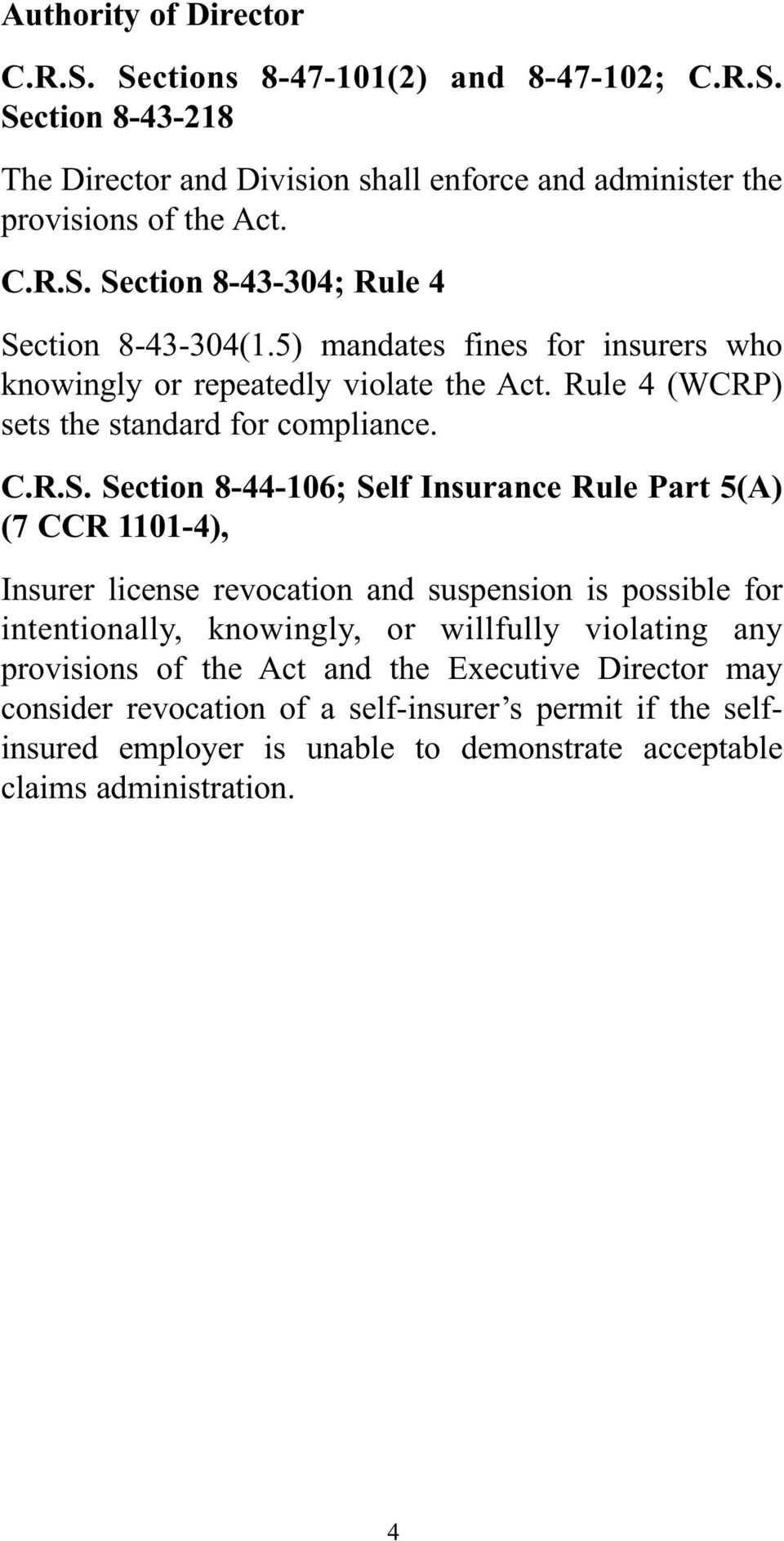
8 Authority of Director C.R.S. Sections (2) and ; C.R.S. Section The Director and Division shall enforce and administer the provisions of the Act. C.R.S. Section ; Rule 4 Section (1.5) mandates fines for insurers who knowingly or repeatedly violate the Act. Rule 4 (WCRP) sets the standard for compliance. C.R.S. Section ; Self Insurance Rule Part 5(A) (7 CCR ), Insurer license revocation and suspension is possible for intentionally, knowingly, or willfully violating any provisions of the Act and the Executive Director may consider revocation of a self-insurer s permit if the selfinsured employer is unable to demonstrate acceptable claims administration. 4
9 III. COMPLIANCE AUDITS Measurement of compliance is based on data from the Division s records and on the insurer s files and records. The objective of the auditor during a compliance audit is to measure insurer compliance with the Act and Rules in those categories determined by the Director and identified in Rule 4 as important to proper claim adjusting and to report the insurer s compliance levels in those categories. Selection of Insurers for Audit An insurer may be selected for audit based on number of indemnity claims filed with the Division rotation past or current performance complaints random designation Audit Scope Claims may be reviewed for compliance with the Act and Rules on any or all of the following matters: timely reporting by insurers of claims required to be filed with the Division to the Division timely statement of positions on liability (admission or denial) accurate calculation and admission of the average weekly wage based on acceptable wage verification accurate calculation and admission of benefit rates timely and accurate compensation payments timely medical benefit payment or denial of payment accurate calculation and admission of temporary disability benefits, consistent with supporting documentation including recovery of the waiting period when applicable 5

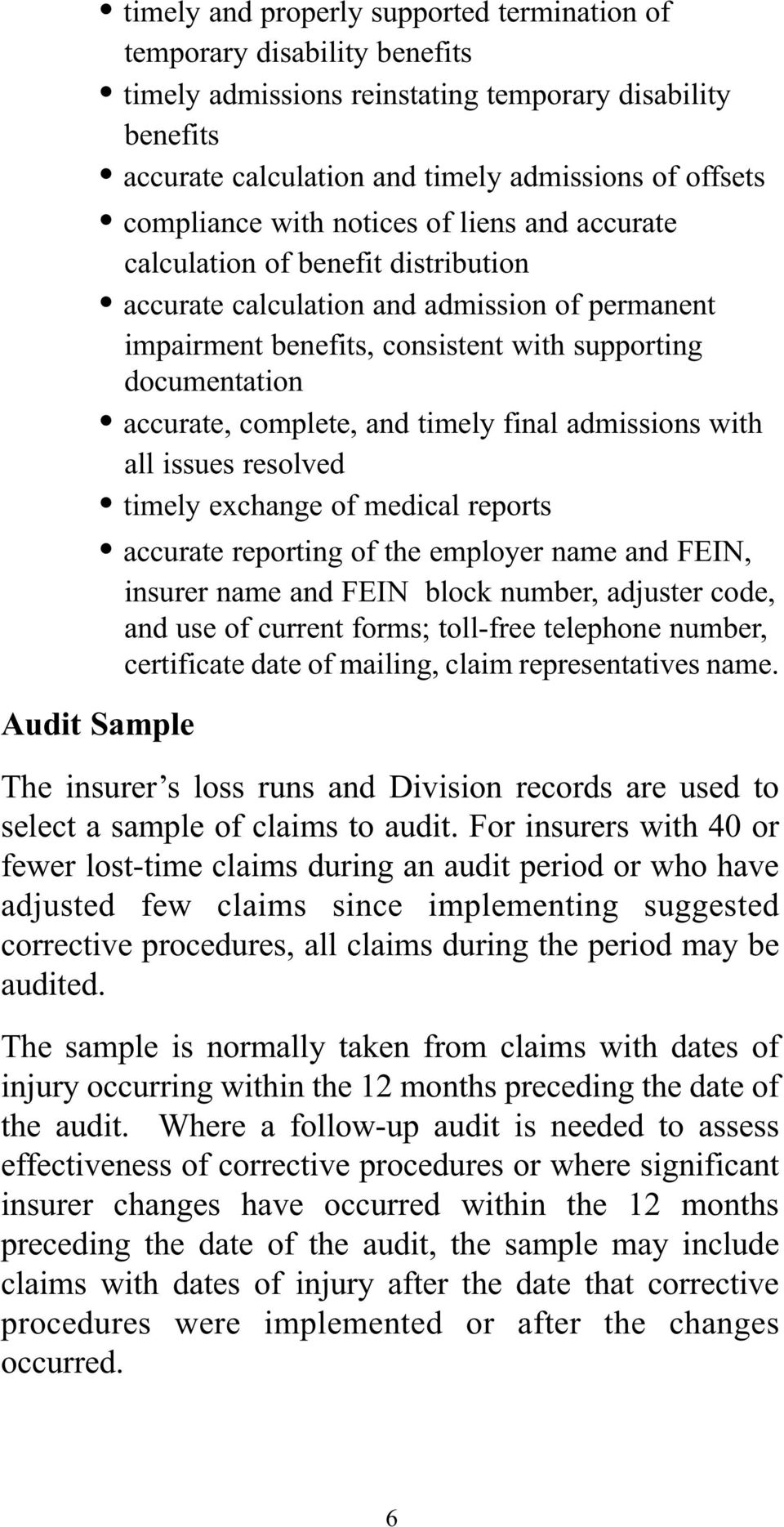
10 timely and properly supported termination of temporary disability benefits timely admissions reinstating temporary disability benefits accurate calculation and timely admissions of offsets compliance with notices of liens and accurate calculation of benefit distribution accurate calculation and admission of permanent impairment benefits, consistent with supporting documentation accurate, complete, and timely final admissions with all issues resolved timely exchange of medical reports accurate reporting of the employer name and FEIN, insurer name and FEIN block number, adjuster code, and use of current forms; toll-free telephone number, certificate date of mailing, claim representatives name. Audit Sample The insurer s loss runs and Division records are used to select a sample of claims to audit. For insurers with 40 or fewer lost-time claims during an audit period or who have adjusted few claims since implementing suggested corrective procedures, all claims during the period may be audited. The sample is normally taken from claims with dates of injury occurring within the 12 months preceding the date of the audit. Where a follow-up audit is needed to assess effectiveness of corrective procedures or where significant insurer changes have occurred within the 12 months preceding the date of the audit, the sample may include claims with dates of injury after the date that corrective procedures were implemented or after the changes occurred. 6
11 Audit Process The Division will provide a notice of the compliance audit to the insurer not less than 15 calendar days prior to the auditor s arrival on-site unless the Division determines that circumstances warrant otherwise. The notice will describe the audit process generally and a copy of this Claims Compliance Audit Guide will be enclosed with the notice. The notice will identify the claims to be audited, confirm the dates the auditor will be on site, and identify the information required to be provided to the auditor prior to and/or at the time of the auditor s arrival on site. Such information may include but is not limited to: answers to questions regarding the insurer operations the dates the employer and insurer were notified of a condition requiring filing insurer s original claim files and access to all electronic claim data wage verification for claims with an admitted average weekly wage wage records for claims with admitted TPD, for the period of TPD a printout of all compensation payments on each listed claim dates of receipt of all or a designated set of medical bills dates of payment of medical bills or copies of notices indicating payment was contested including the reason for the contest. a list of claims for which actual checks or other verifiable payment documentation must be made available to the auditor to confirm the accuracy of information on payment printouts a copy of and/or access to adjuster s original claim adjusting notes on each claim training, instruction and/or insurer procedure manuals as requested 7

12 At an initial interview, the auditor will review the audit process with the insurer and answer preliminary questions regarding the process. The auditor will review the insurer s operations to obtain an understanding of the information in the insurer s claim adjusting system. Compliance Categories vs. Comment Categories Audit categories are divided into two types: Compliance Categories and Comment Categories. Compliance Categories are those seven (7) areas in which the Director has determined that compliance with the act and rules is of the highest importance and in which failure to maintain a satisfactory compliance level (90%) on two or more consecutive audits will result in fines being assessed. Comment Categories are those three (3) areas in which the Director has determined that compliance is important but where varying circumstances require latitude in application of regulatory criteria and where insurer performance does not result in fines if compliance levels within those categories are below the satisfactory compliance level (90%). 8

13 IV. THE COMPLIANCE CATEGORIES Auditors measure and report insurer compliance levels in the following seven (7) Compliance Categories. Insurers who fail to achieve a satisfactory compliance level (90%) in any Compliance Category on two or more consecutive audits will be fined for the deficiencies in those categories in accordance with Rule Reporting of Claims Regulatory Criteria ; (1); ; Rule 5-2(A) and (B); Rule 5-1 As of July 1, 2006, all First Reports of Injury and Notices of Contest must be transmitted to the Division electronically, either via electronic data interchange ( EDI ) or via the Division s internet filing process. Claims must be established with the Division with a workers compensation number assigned before any Position on Liability (admission or denial) will be accepted. Information must be submitted to the Division in the format prescribed by the Division and must be complete and accurate. Non-compliant submissions may not be accepted and therefore may affect the timeliness of those submissions. The employer and insurer must be identified accurately with the correct name and federal employer s identification number ( FEIN ). Inquiries Used to Determine Compliance Within the time prescribed in Rule 5-2, was the first report of injury (FROI) properly transmitted to and accepted by the division prior to the division's receipt of the insurer's Initial Position on Liability 9

14 (For the purposes of a carrier audit under only, if it is determined that the insurer had less than three days from when they had notice or knowledge of the injury or occupational disease to timely file the FROI on a claim required to be filed with the division, the division will not consider the incident a deficiency with respect to the insurer's audit.) 2. Initial Positions on Liability Regulatory Criteria ; Rule 5-2(C); Rule 5-2(D) Inquiries Used to Determine Compliance Did the insurer timely admit or deny liability based on the date the First Report was filed If notice of a claim was based on a Worker s Claim or Dependents Claim, did the insurer timely admit or deny liability based on the date the Division mailed the claim form to the insurer 3. Timeliness of Compensation Payments Regulatory Criteria Regarding Initial Payments (2)(a); (2)(b); Rule 5-6(A); Rule 5-6(B); Rule 5-6(C) Regarding Subsequent Payments (2)(a); Rule 5-6(A); Rule 5-6(B); Rule 5-6 (C) Inquiries Used to Determine Compliance Was the initial payment made at the time of the admission Was the initial payment made so that the claimant would receive the check within five 10

15 calendar days after the date of the admission Did payment include all amounts due at the time of payment Were subsequent payments made on a schedule of at least once every two weeks from the date of the admission Did payments coincide with dates of admissions for additional benefit periods admitted 4. Accuracy of Compensation Benefits Regulatory Criteria Regarding Benefits Admitted, Calculated, and Paid Accurately (1)(b); (1) and (1); ; (2)(a); Rule 1-8; Rule 5, Rule 6 and (13) Inquiries Used to Determine Compliance Were benefit totals calculated accurately Were admitted benefits modified properly Were benefits calculated according to statute Were benefit periods due reflected accurately Were admissions timely upon reinstatement of benefits Was the total amount due paid accurately Was the total amount due admitted accurately Did the total paid equal the total admitted Was the issue of overpayment properly addressed Was any lump sum discount applied accurately and taken properly Did the admitted impairment coincide with the rating 11

16 5. Medical Benefit Payments Regulatory Criteria: (2)(a); Rule Inquiries Used to Determine Compliance Was payment made within 30 days of receipt of the bill Was the bill properly contested within 30 days of receipt Did the bill contain the insurer s date of receipt 6. Termination of Temporary Disability Benefits Regulatory Criteria: (3); (2); Rule 6; Rule 5-5(C). Inquiries Used to Determine Compliance If benefits were terminated, was an admission filed or Order entered If benefits were terminated by admission, did proper supporting documentation accompany the admission Did supporting documentation comply with Rule 6 Was the date of termination consistent with supporting documentation Was an admission with supporting documentation filed or Order received within the time the next payment was due 7. Final Admissions Regulatory Criteria (2)(b)(II); Rule 5-5(E), (F) & (H); (2)-(7); (8); Rule 5-5(A); Rule 1-4; Rule

17 Inquiries Used to Determine Compliance Was the Final Admission (FA) filed timely and did it contain a proper Certificate of Mailing and proper notices to claimant Was the medical report upon which the FA was based filed with the FA and was the medical report specifically referenced in the FA Were permanent impairment benefits admitted pursuant to statute and consistent with the final medical report from a Level II physician or consistent with an indication of no impairment by ATP Was there a statement of the insurer s position on medical benefits after MMI Was an FA based on the provisions of Rule 7 filed in accordance with the requirements of Rule 7 and comply with Rule 7 13

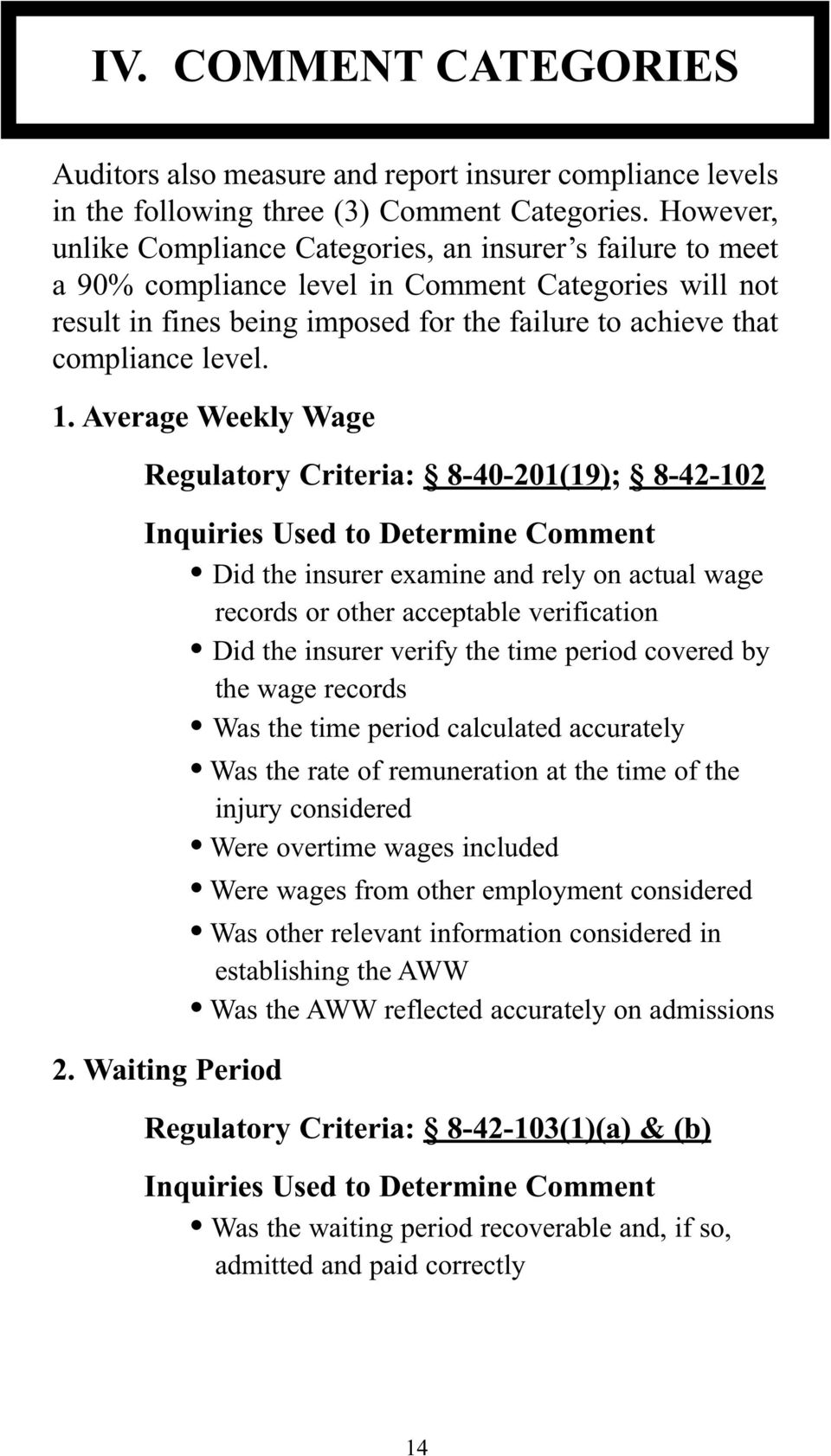
18 IV. COMMENT CATEGORIES Auditors also measure and report insurer compliance levels in the following three (3) Comment Categories. However, unlike Compliance Categories, an insurer s failure to meet a 90% compliance level in Comment Categories will not result in fines being imposed for the failure to achieve that compliance level. 1. Average Weekly Wage Regulatory Criteria: (19); Inquiries Used to Determine Comment Did the insurer examine and rely on actual wage records or other acceptable verification Did the insurer verify the time period covered by the wage records Was the time period calculated accurately Was the rate of remuneration at the time of the injury considered Were overtime wages included Were wages from other employment considered Was other relevant information considered in establishing the AWW Was the AWW reflected accurately on admissions 2. Waiting Period Regulatory Criteria: (1)(a) & (b) Inquiries Used to Determine Comment Was the waiting period recoverable and, if so, admitted and paid correctly 14
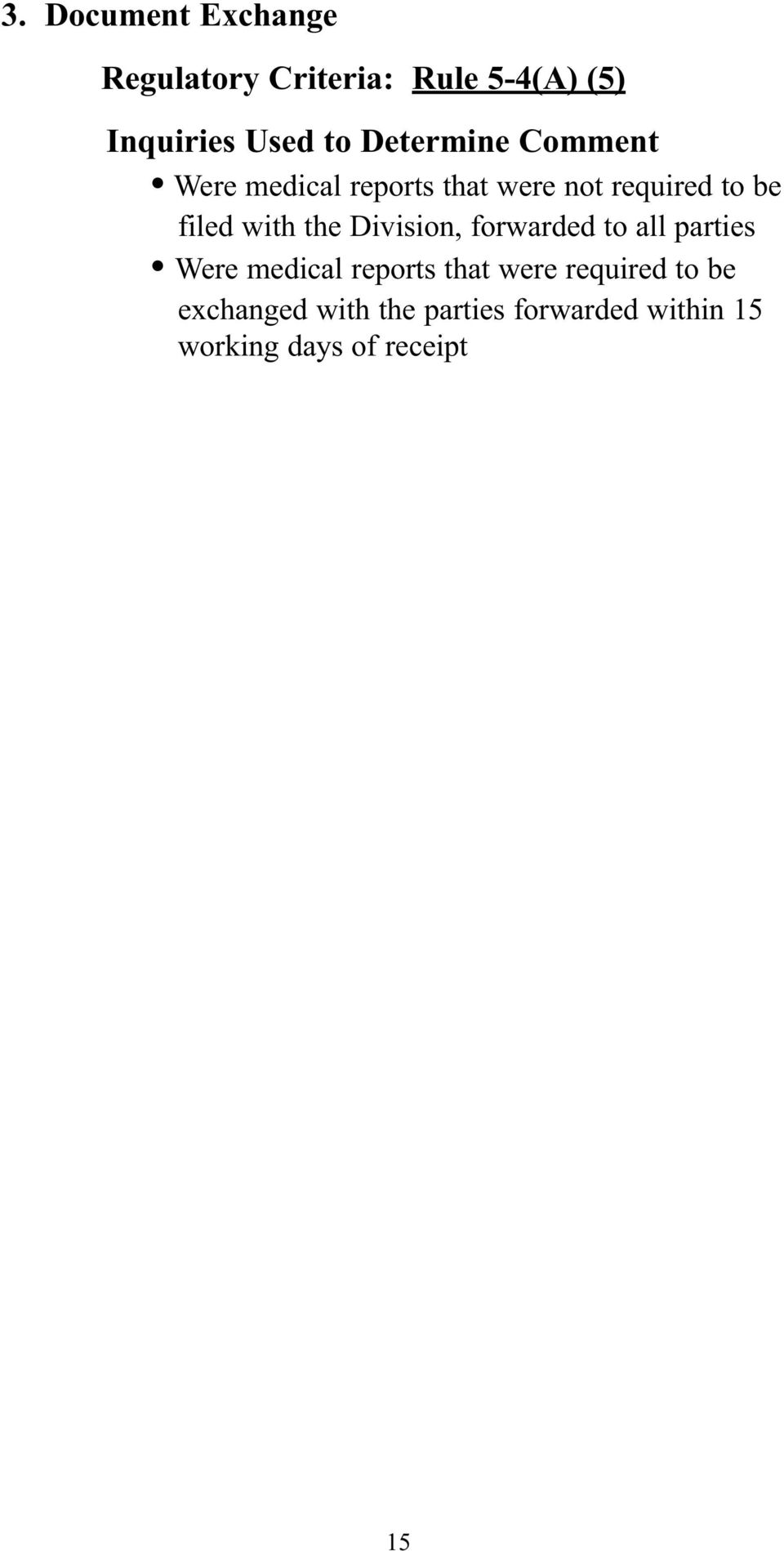
19 3. Document Exchange Regulatory Criteria: Rule 5-4(A) (5) Inquiries Used to Determine Comment Were medical reports that were not required to be filed with the Division, forwarded to all parties Were medical reports that were required to be exchanged with the parties forwarded within 15 working days of receipt 15
20 V. PRELIMINARY AUDIT FINDINGS AND FINAL AUDIT REPORT PROCESS Exit Conference Following collection and review of data from audited files and loss runs, the auditor may meet with the insurer representative at or near the time of completion of the onsite phase of the compliance audit. Anticipated preliminary findings may be discussed at that time and immediate corrections may be required. Preliminary Audit Findings Audit data are collated, analyzed and evaluated by the auditor and at least one other Division reviewer. Preliminary audit findings, including identification of deficiencies, are prepared. Individual claims may be identified for immediate correction or for follow up. These preliminary findings including compliance levels, and, where applicable, a list of claims to be corrected or upon which additional information is required, are then sent to the insurer as preliminary audit findings. Agreement on Preliminary Audit Findings By Rule, the insurer has 30 calendar days within which to agree in writing to the preliminary audit findings or, alternatively, to state with particularity and in writing to the auditor, its reasons for all disagreement with the preliminary findings. The insurer is required to substantiate all disagreements in writing by providing the authority in fact and/or in law upon which it relies in support of its disagreements. Failure to specify and support disagreements with the preliminary findings during this time will result in a waiver of all such disagreements and will constitute the insurer s acceptance of and agreement with the auditor s findings. Accordingly, the insurer should 16

21 try to resolve all differences over the preliminary findings with the auditor and reach written agreement with the auditor on the findings within this 30 day period. If the insurer submits a proper and timely written disagreement with the auditor s preliminary audit findings, then the insurer, the auditor, and the auditor s manager will have 20 calendar days from the date the auditor receives the insurer s written disagreement(s) within which to resolve those disagreements and to agree to the preliminary findings. If the auditor, the auditor s manager, and the insurer are unable to agree on the preliminary findings within the 20 day period afforded, the preliminary audit findings along with the insurer s written disagreements will be referred to the Director for the Director s determination regarding the audit findings. Final determination of the relevance and/or weight given to any authority or proof submitted in connection with the insurer s disagreements regarding audit findings is reserved to the Director. Final Audit Report When the insurer has agreed to the audit findings or does not submit written disagreement in a timely manner, or, as is otherwise provided by Rule, the Final Audit Report will be issued. The Final Audit report will contain a summary of the final audit findings, comments on the insurer s adjusting practices, and a determination of the insurer s compliance levels. Any fines arising from an audit will be determined by statute and rule. Insurers may be required to correct deficiencies in all claims covered by the audit period if compliance levels are below 90% or for such other reasons as may be required by the Director. The insurer is required to demonstrate to the satisfaction of the Director that all deficiencies identified for correction have been corrected. 17
22 Frequency Frequency of audits will generally depend on the insurer s reaching and maintaining satisfactory compliance levels. Insurers can expect increased audit frequency if compliance levels continue to be unsatisfactory. Training Insurers may be required to undergo training by Division personnel if indicated by audit results or as may be otherwise determined by the Director. The auditor may recommend adjuster training. The insurer may also request training. Training can address those areas identified by the audit for improvement and/or all compliance areas covered by the audit as well as other adjusting questions. 18
23 VI. FINES An insurer s first audit conducted after January 1, 2006 establishes the insurer s levels of compliance with statutes and rules in identified categories although no fines will be imposed on this audit for an insurer s failure to achieve satisfactory compliance levels. A compliance level below 90% is considered to be unsatisfactory. However, insurers below satisfactory compliance are expected to improve compliance before the next compliance audit. A compliance level below 90% in a Compliance Category on consecutive compliance audits is considered repeated noncompliance. Repeated non-compliance in Compliance Categories will result in the insurer being ordered to pay fines for unsatisfactory compliance in those categories. For an insurer s unsatisfactory performance to result in fines for failure to meet the 90% compliance standard in any Compliance Category, its compliance level in that category must be below 90% on at least two consecutive audits. Compliance Standard Compliance levels below 90% are unsatisfactory and, if they occur in Compliance Categories on two or more consecutive audits, will result in fines. Compliance Emphasis Auditors emphasize the timely and accurate delivery of compensation benefits to injured workers. Although for audit purposes a 90% compliance level is considered satisfactory, the expectation is that all compensation payments will be paid accurately and on time. Special attention is also given to unilateral terminations of temporary disability benefits and additional sanctions may be imposed where benefits are delayed thereby. 19
24 Calculation of Fines and Fine Schedules Each category for which a fine may be imposed has a fine schedule. The amount of a fine is determined by the findings made in the Final Audit Report and in accordance with the WCRP. Fines for repeated violations in any Compliance Category listed in WCRP Rule 4-1(B) (1) through (7) are based on the compliance level for that category and as set out in WCRP Rule 4-2. The dollar amount of a fine is arrived at by first locating the insurer s compliance level on the appropriate schedule (see below) found in paragraph (E) of WCRP Rule 4-2. The number of identified deficiencies in the relevant category is multiplied by the per deficiency dollar amount for the appropriately numbered finable unsatisfactory occurrence listed in the schedule to arrive at a fine amount for that category. The fine schedule for each finable compliance category is as follows: 1. For the categories listed in WCRP Rule 4-1(B) subparagraphs 1, 5, 7: Compliance Level 1st Finable Occurrence Fines per Audit Deficiency per Compliance Category 2nd Finable Occurrence 3rd and Later Finable Occurrence 80-89% $30 $60 $ % $60 $90 $ % $90 $120 $150 <60% $120 $150 $180 20
25 2. For the categories listed in Rule 4-1(B) subparagraphs 2,3,4,6: Compliance Level 1st Finable Occurrence Fines per Audit Deficiency per Compliance Category 2nd Finable Occurrence 3rd and Later Finable Occurrence 80-89% $50 $100 $ % $100 $200 $ % $200 $400 $600 <60% $400 $600 $1,000 EXAMPLE The following example illustrates how fines under Rule 4 would (or would not) apply. The overall compliance levels of the Colorado workers compensation claims of insurer LARGE, Inc., that resulted from the first compliance audit conducted in March, 2006 ( baseline ) by the Colorado Division of Workers Compensation s Carrier Practice Unit ( CPU ) were as follows: 1. Reporting of claims...70% 2. Initial positions on liability...89% 3. Timeliness of compensation payments...85% 4. Accuracy of compensation benefits...90% 5. Medical benefit payments...91% 6. Termination of temporary benefits...75% 21
26 7. Final Admissions...90% 8. Average Weekly Wage...N/A 9. Waiting period...n/a 10. Document exchange...n/a In July, 2007, the Division advised the insurer, LARGE, Inc., that the CPU intended to conduct the second compliance audit of the insurer s Colorado workers compensation claims again to include those Colorado claims underwritten by the insurer s companies that met the Division s criteria for audit. LARGE, Inc. was required to and did advise the Division of the name, address and contact person for the companies underwriting these claims as well as the names and locations of those third-party administrators that adjusted them. Applying the audit criteria, the Division determined that two third-party administrators ( TPAs ) adjusted these claims and met the Division s criteria, FIRSTPA, Inc., and SECND, Inc. The Division notified LARGE, Inc., FIRSTPA, Inc. and SECND, Inc. that compliance audits would be conducted at FIRSTPA, Inc s Colorado Springs, Colorado location and at SECND, Inc. s Fort Collins, Colorado location. The audit at FIRSTPA, Inc. in Colorado Springs, Colorado reviewed 38 of the insurer s indemnity claims as well as selected denied claims established with the Division with dates of injury from June, 2006 through June, 2007 as adjusted by FIRSTPA, Inc. The audit of these 38 claims as adjusted by FIRSTPA, Inc. resulted in the following findings in the categories noted: 1. Reporting of Claims Required to be Filed with the Division: Of the 38 claims in which it could be determined when the employer had notice of a condition required to be filed with the Division, 30 of the First Reports of Injury were filed timely. The compliance level was 79%. 22
27 2. Initial Positions on Liability Of the 38 claims in which an Employer s First Report of Injury, a Worker s Claim for Compensation or a Dependants Notice of Claim was filed with the Division requiring a position statement, 33 of the position statements were timely. The compliance level was 87%. 3. Timeliness of Compensation Payments The criteria, derived from audit inquiries, considered for determining compliance in the Timeliness of Compensation Payments category were timeliness and payment made through the due date. In the 38 claims audited, there were a total of 205 indemnity payments reviewed, each of which involved the two (2) considerations of timeliness and payment made through the due date (205 x 2 = 410). Of these 410 considerations, 330 were compliant. The compliance level was 80%. 4. Accuracy of Compensation Benefits The criteria, derived from audit inquiries, considered for determining compliance in the Accuracy of Compensation Benefits category were whether or not disability benefits were calculated and paid and admitted accurately. Of 38 claims audited, 36 claims involved payment of disability. benefits, each of which involved the three (3) considerations for accuracy of calculated, paid and admitted benefits (36 x 3 = 108). Of these 108 considerations, 102 were compliant. The compliance level was 94%. 5. Medical Benefit Payments Of 153 medical bill payments reviewed in the 38 claims, 146 payments were paid timely. The compliance level was 95%. 23
28 6. Termination of Temporary Disability Benefits The criteria, derived from audit inquiries, considered for determining compliance in the category of Termination of Temporary Disability Benefits were timeliness and support provided pursuant to Rule. In 38 claims, there were 47 circumstances where temporary disability benefits were terminated, each of which involved the two (2) considerations of timeliness and support provided pursuant to Rule (47 x 2 = 94). Of these 94 considerations, 72 were either properly supported and/or filed timely in accordance with Rules 5-5(C) and 6. The compliance level was 77%. 7. Final Admissions The criteria, derived from audit inquiries, considered for determining compliance in the category of Final Admissions were: 1. Timeliness of the FA with a proper Certificate of Mailing and proper notices to claimant 2. Final medical report referenced in FA and attached to FA 3. Permanent benefits admitted pursuant to statute and consistent with final medical report by Level II physician or containing indication of no impairment by ATP 4. Statement of position on medical benefits after MMI 5. Compliance with Rule 7 where FA based on Rule 7 In 38 claims, there were 28 claims where Final Admissions were filed, each of which involved four (4) of the five criteria, i.e., (1) timeliness of the FA with proper Certificate of Mailing and proper notices to claimant and (2) final medical report referenced in 24
29 FA and attached to FA and (3) permanent benefits admitted pursuant to statute and consistent with final medical report by Level II physician or containing indication of no impairment by ATP and (4) statement on medical benefits after MMI (28 x 4 = 112). Of these 112 considerations, 104 were compliant. The compliance level was 93%. Because fines for an insurer s failure to meet the 90% compliance standard are not imposed in the categories of (8) Average Weekly Wage, (9) Waiting period or (10) Document exchange, those categories are not included in this Example). The audit of the insurer s claims at SECND, Inc. in Fort Collins, Colorado, reviewed 47 of the insurer s indemnity claims as well as selected denied claims established with the Division with dates of injury from June, 2006 through June, 2007 as adjusted by SECND, Inc. 1. Reporting of Claims Required to be Filed with the Division: In 40 claims where it could be determined when the employer had notice of a condition required to be filed with the Division, 32 of the First Reports of Injury were filed timely. The compliance level was 80%. 2. Initial Positions on Liability In 40 claims in which an Employer s First Report of Injury, a Worker s Claim for Compensation or a Dependants Notice of Claim was with the Division requiring a position statement, 31 position statements were timely. The compliance level was 78%. 3. Timeliness of Compensation Payments The criteria, derived from audit inquiries, considered for determining compliance in the 25
30 Timeliness of Compensation Payments category were timeliness and payment made through the due date. In the 47 claims audited, there were a total of 189 indemnity payments reviewed, each of which involved the two (2) considerations of timeliness and payment made through the due date (189 x 2 = 378). Of these 378 considerations, 272 were compliant, a compliance level of 72%. 4. Accuracy of Compensation Benefits The criteria, derived from audit inquiries, considered for determining compliance in the Accuracy of Compensation Benefits category were whether or not disability benefits were calculated and paid and admitted accurately. Of 47 claims audited, 37 claims involved payment of disability benefits, each of which involved the three (3) considerations for accuracy of calculated, paid and admitted benefits (37 x 3 = 111). Of these 111 considerations, 90 were compliant. The compliance level was 81%. 5. Medical Benefit Payments Of 125 medical bill payments reviewed, 123 were paid timely. The compliance level was 98 %. 6. Termination of Temporary Disability Benefits The criteria, derived from audit inquiries, considered for determining compliance in the category of Termination of Temporary Disability Benefits were timeliness and support provided pursuant to Rule. In 47 claims, there were 34 circumstances where temporary disability benefits were terminated, each of which involved the two (2) considerations of timeliness and support provided pursuant to Rule (34 x 2 = 68). Of these 68 considerations, 42 were either properly supported and/or filed timely in accordance with 26
31 Rules 5-5(C) and 6. The compliance level was 62%. 7. Final Admissions The criteria, derived from audit inquiries, considered for determining compliance in the category of Final Admissions were: 1. Timeliness of the FA with a proper Certificate of Mailing and proper notices to claimant 2. Final medical report referenced in FA and attached to FA 3. Permanent benefits admitted pursuant to statute and consistent with final medical report by Level II physician or containing indication of no impairment by ATP 4. Statement of position on medical benefits after MMI 5. Compliance with Rule 7 where FA based on Rule 7 In 47 claims, there were 24 claims where Final Admissions were filed, each of which involved four (4) of the five criteria, i.e., (1) timeliness of the FA with proper Certificate of Mailing and proper notices to claimant and (2) final medical report referenced in FA and attached to FA and (3) permanent benefits admitted pursuant to statute and consistent with final medical report by Level II physician or containing indication of no impairment by ATP and (4) statement on medical benefits after MMI (24 x 4 = 96). Of these 96 considerations, 80 were compliant. The compliance level was 83%. 27
32 SUMMARY OF AUDIT FINDINGS FOR LARGE, INC. Compliance Categories LARGE S 2006 Baseline LARGE S nd Audit 1st Finable Audit Fines? Reporting of claims 70% 79% Y Initial positions on liability Timeliness of comp. payments Accuracy of comp. benefits 89% 82% Y 85% 76% Y 90% 88% N Medical benefit payments 91% 97% N Termination of temporary benefits 75% 70% Y Final Admissions 90% 88% N Comment Categories (not included in this example) Average Weekly Wage Waiting period Document exchange N N N 28
33 QUESTION #1: Will LARGE S July 2008 audit result in fines? Answer: Yes. This is LARGE, Inc. s second (consecutive) audit after January, LARGE, Inc. failed to meet the 90% compliance standard in certain categories in its 2006 audit. LARGE, Inc. has again failed to meet the 90% compliance standard in the present audit (July 2008) of its claims handled by FIRSTPA, Inc. and SECND, Inc. in the following Compliance Categories: Reporting of Claims, Initial Positions on Liability, Timeliness of Compensation Payments and Termination of Temporary Disability Benefits. Therefore, fines will be assessed against LARGE, Inc., for deficiencies in these categories. Although LARGE, Inc. also did not meet the 90% compliance standard in the categories of Accuracy of Compensation Benefits and Final Admissions, LARGE, Inc. s compliance level in those categories in the 2006 audit was satisfactory i.e., 90% or greater. Therefore, by rule, no fine will be imposed (WCRP 4-2(A)) since noncompliance in these categories did not occur in consecutive audits. QUESTION #2: How will LARGE, Inc. s fines be determined? Answer: LARGE, Inc. s fines are determined in accordance with WCRP 4-2(A) through (E). Because LARGE Inc. s compliance level did not meet the 90% compliance standard established by Rule 4-1(C) in the categories of Reporting of Claims, Initial Positions on Liability, Timeliness of Compensation Payments and Termination of Temporary Disability Benefits, fines will be imposed for deficiencies in those categories. 29
34 For the category Reporting of Claims, LARGE Inc. s compliance level was 79% with sixteen (16) total deficiencies identified (8 deficiencies by FIRSTPA, Inc. and 8 deficiencies by SECND, Inc. = 16 deficiencies). LARGE, Inc. has had no prior finable occurrence in this category. The per deficiency dollar amount per Rule 4-2 (E) (1) is $60. Accordingly, the fine for a 79% compliance level in this category is $960 ($60/deficiency x 16 deficiencies). For the category Initial Positions on Liability, LARGE, Inc. s compliance level was 82% with fourteen (14) total deficiencies identified (5 deficiencies by FIRSTPA, Inc. and 9 deficiencies by SECND, Inc. = 14 deficiencies). LARGE, Inc. has had no prior finable occurrence in this category. The per deficiency dollar amount per Rule 4-2(E)(2) is $50. Accordingly, the fine for an 82% compliance level in this category is $700 ($50/deficiency x 14 deficiencies). For the category Timeliness of Compensation Payments, LARGE, Inc. s compliance level is 76% with one hundred eighty-six (186) total deficiencies identified (80 deficiencies by FIRSTPA, Inc. and 106 deficiencies by SECND, Inc. = 186 deficiencies). LARGE, Inc. has had no prior finable occurrence in this category. The per deficiency dollar amount per Rule 4-2(E)(2) is $100. Accordingly, the fine for a 76% compliance level in this category is $18,600 ($100/deficiency x 186 deficiencies). For the category Termination of Temporary Disability Benefits, LARGE, Inc. s compliance level was 70% with forty-eight (48) total deficiencies identified (22 deficiencies by FIRSTPA, Inc. and 26 deficiencies by SECND, Inc. = 48 deficiencies). LARGE, Inc. has had no prior finable occurrence in this category. The per deficiency dollar amount per Rule 4-2(E) (2) is $100. Accordingly, the fine for a 70% compliance level in this category is $4,800 ($100/deficiency x 48 deficiencies). 30
35 The insurer s total fine resulting from the 2007 audit of its Colorado WC claims as adjusted by FIRSTPA, Inc. and SECND, Inc. is $25,060 ($960 + $700 + $18,600 + $4,800). QUESTION #3: If the next audit of the insurer s claims is completed in 2009, irrespective of who has or is adjusting its claims but LARGE, Inc. s compliance level is again below 90% in a compliance category for which a fine was imposed as the result of the 2007 audit, will the per deficiency dollar amount increase to a 2nd finable occurrence (Rule 4-2(E) (1) and (2))? Answer: Yes. The responsibility and regulatory accountability for compliance with the Act and Rules rests with the insurance carrier/self-insured employer. QUESTION #4: Will LARGE, Inc. be fined for failure to meet the compliance standard (90%) in a compliance category in the next audit (2009) where the insurer s compliance level was below 90% in that category in its 2006 audit but at or above 90% in that category in its next, consecutive audit (2008) irrespective of who has or is adjusting its claims? Answer: No. Per Rule 4-2(B), in order for LARGE, Inc. s unsatisfactory performance to result in fines for failure to meet the 90% compliance standard in any category set out in Rule 4-1(B)(1) through (7), LARGE, Inc. s compliance level in that category must be below 90% on at least two consecutive audits irrespective of who has or is adjusting its claims. 31
36 VIII. ACRONYMS The workers' compensation system uses many acronyms and abbreviations. A list of acronyms and their meanings are included. ALJ ATP AWW CDLE COLA CRS DIME DOB DOI DOWC EDI FA FEIN FROI FPN GA ICAP/ICAO IME MMI MMIF NCCI OAC PALJ PERA PHC PPD PTD SIF Administrative Law Judge with OAC Authorized Treating Physician Average Weekly Wage Colorado Department of Labor & Employment Cost of Living Adjustment Colorado Revised Statutes Division Independent Medical Evaluation Date of Birth Date of Injury Division of Workers Compensation Electronic Data Interchange Final Admission of Liability Federal Employer Identification Number First Report of Injury Final Payment Notice General Payment Notice Industrial Claim Appeals Panel Independent Medical Examination Maximum Medical Improvement Major Medical Insurance Fund National Council on Compensation Insurance Office of Administrative Courts Administrative Law Judge with DOWC Prehearing Unit Public Employees Retirement Association Prehearing Conference Permanent Partial Disability Permanent Total Disability Subsequent Injury Fund 32
37 SSDI SSN SROI TPA TPD TTD UR WCC WC# Social Security Disability Income Social Security Number Subsequent Report of Injury (an EDI term) Third Party Administrator Temporary Partial Disability Temporary Total Disability Utilization Review Workers Claim for Compensation Division assigned Workers Compensation No. 33
38 IX. DESK AIDS The following desk aids are available in their entirety on the Division web site at: and can be viewed, printed, and downloaded in Microsoft Word or Adobe Acrobat (a free software viewing program). Average Weekly Wage Worksheet Calculating Lump Sum Discounts on $10,000 or Less $10,000 Lump Sum 4% Discount Table Maximum Benefit Rates Age Factor Chart Scheduled Injuries Table Temporary Partial Disability (TPD) Benefit Worksheet 34
39 X. PHONE NUMBERS DIVISION OF WORKERS' COMPENSATION CUSTOMER SERVICE UNIT th Street, Suite 400 Denver, CO Toll-free number Special Funds Unit Major Medical, Subsequent Injury, and Medical Disaster Funds Toll free number Prehearing Conference Unit Internet Address: OTHER GOVERNMENT OFFICES Office of Administrative Courts Division of Insurance Mine Safety and Health Administration Occupational Safety and Health Administration Denver area employers All other employers Unemployment Insurance Tax Toll-free number (in state) Denver metro area
40 XI. PUBLICATIONS The Division of Workers' Compensation offers a variety of materials to the public regarding the system it administers. Publications are available on the Division's Web Page at or can be requested by calling the Customer Service Unit. Overview of the Division of Workers' Compensation Workers' Compensation Guide for Employees Workers' Compensation Guide for Employers Workers' Compensation Guide for Adjusters Essentials of the Workers' Compensation Premium Cost Containment Program and Employer Certification Workers' Compensation Loss Prevention and Loss Control Program Manual Self-Insurance Information and Application Dispute Resolution Services Workers' Compensation Act All About Claims Newsletter Interpretive Bulletins Brochures Workers' Compensation Insurance Requirements for Employers Customer Service Independent Medical Examination Special Funds Subsequent Injury Fund Major Medical Insurance Fund Electronic Data Interchange Medical Policy and Research Permission is granted to reproduce this publication on condition that no part of this publication is altered or modified. 36
41 NOTES 37
42 NOTES 38
43 NOTES 39
44 COLORADO DEPARTMENT OF LABOR & EMPLOYMENT Division of Workers Compensation th Street, Suite 400 Denver, CO M
Colorado Department of Labor and Employment Division of Workers Compensation. Claims Compliance Audit Guide
 Colorado Department of Labor and Employment Division of Workers Compensation Claims Compliance Audit Guide Division of Workers Compensation Carrier Practices Unit 633 17 th Street Suite 400 Denver, CO
COLORADO DEPARTMENT OF LABOR AND EMPLOYMENT. Division of Workers Compensation EMPLOYER S GUIDE
 COLORADO DEPARTMENT OF LABOR AND EMPLOYMENT Division of Workers Compensation EMPLOYER S GUIDE JULY 2005 THE INFORMATION IN THIS BOOKLET IS INTENDED TO BE GENERAL INFORMATION ON THE COLORADO WORKERS COMPENSATION
How To Get Paid For An Injury From Work
 COLORADO DEPARTMENT OF LABOR & EMPLOYMENT Division of Workers Compensation EMPLOYEE S GUIDE August 2014 THE INFORMATION IN THIS BOOKLET IS INTENDED TO BE GENERAL INFORMATION ON THE COLORADO WORKERS COMPENSATION
MODIFICATION, TERMINATION OR SUSPENSION OF TEMPORARY DISABILITY BENEFITS
 RULE IX MODIFICATION, TERMINATION OR SUSPENSION OF TEMPORARY DISABILITY BENEFITS A. TERMINATION OF TEMPORARY DISABILITY BENEFITS BY AN ADMISSION OF LIABILITY IN CLAIMS ARISING PRIOR TO JULY 2, 1987, AT
FAQs about Virginia s EDI Program
 What is EDI? EDI stands for Electronic Data Interchange and is the electronic exchange of information from one entity to another. For Workers Compensation, it is the electronic exchange of workers compensation
Workers' Compensation
 Workers' Compensation Workers compensation provides benefits to injured employees for accidents or occupational diseases arising out of, and in the course of, their employment. Compensation coverage is
AN EMPLOYER S GUIDE TO WORKERS COMPENSATION IN NEW JERSEY
 AN EMPLOYER S GUIDE TO WORKERS COMPENSATION IN NEW JERSEY I. WHAT IS WORKERS COMPENSATION?... 2 II. WORKERS COMPENSATION BENEFITS... 3 III. INSURANCE REQUIREMENTS... 4 Types of Coverage Definition of Employee
Workers Compensation and Seniors
 Chapter 10 Workers Compensation and Seniors Gregory B. Cairns, Esq. Cairns & Associates, P.C. SYNOPSIS 10-1. Workers Compensation 10-2. Benefits Available 10-3. Filing a Workers Compensation Claim 10-4.
NC WORKERS COMPENSATION: BASIC INFORMATION FOR MEDICAL PROVIDERS
 NC WORKERS COMPENSATION: BASIC INFORMATION FOR MEDICAL PROVIDERS CURRENT AS OF APRIL 1, 2010 I. INFORMATION SOURCES Where is information available for medical providers treating patients with injuries/conditions
Indemnity Issues. Workers Compensation Benefits Overview - California. Temporary Total Benefits
 Major Developments: Last major legislation in 2004 (SB899), affected indemnity rates, disability rating, medical treatment, medical-legal disputes, penalties, and apportionment. 2007 legislation affects
11.4.2.4 DURATION: Permanent, except as provided in 11.4.2.8 NMAC. [6/1/96; 11.4.2.4 NMAC - Rn, 11 NMAC 4.2.4, 11/30/04]
![11.4.2.4 DURATION: Permanent, except as provided in 11.4.2.8 NMAC. [6/1/96; 11.4.2.4 NMAC - Rn, 11 NMAC 4.2.4, 11/30/04]](/thumbs/26/7205462.jpg "11.4.2.4 DURATION: Permanent, except as provided in 11.4.2.8 NMAC. [6/1/96; 11.4.2.4 NMAC - Rn, 11 NMAC 4.2.4, 11/30/04]") TITLE 11 CHAPTER 4 PART 2 LABOR AND WORKERS' COMPENSATION WORKERS COMPENSATION DATA REPORTING AND SAFETY REQUIREMENTS 11.4.2.1 ISSUING AGENCY: Workers Compensation Administration. [6/1/96; 11.4.2.1 NMAC
TITLE 11 CHAPTER 4 PART 2 LABOR AND WORKERS' COMPENSATION WORKERS COMPENSATION DATA REPORTING AND SAFETY REQUIREMENTS 11.4.2.1 ISSUING AGENCY: Workers Compensation Administration. [6/1/96; 11.4.2.1 NMAC
BENEFIT NOTICE INSTRUCTION MANUAL
 Division of Workers' Compensation BENEFIT NOTICE INSTRUCTION MANUAL Title 8, California Code of Regulations, Sections 9810 through 9815 (Revisions effective January 1, 2016) January 2016 CONTENTS English
Key Provisions of Tennessee Senate Bill 200 Effective July 1, 2014, through July 1, 2016
 2014 Construction of Statute Definition of Injury (Causation) Revises Section 50-6-116, Construction of Chapter, to indicate that for dates of injury on or after July 1, 2014, the chapter should no longer
In an effort to provide guidance on the practical applications of the Colorado Workers
 Interpretive Bulletins Director s interpretations of issues impacting the Colorado workers compensation system In an effort to provide guidance on the practical applications of the Colorado Workers Compensation
Also known as Wage Loss. Calculated as AWW (subject to statutory min/max) minus current earnings, multiplied by 2/3.
 Workers Compensation Claim Workers Compensation Benefit Overview California Major Developments: Last major legislation in 2004 (SB899), affected indemnity rates, disability rating, medical treatment, medical-legal
Workers Compensation Frequently Asked Questions
 Workers Compensation Frequently Asked Questions Injured Workers Employers Adjusters/Attorneys/Insurers Vocational Rehabilitation Injured Workers What do I do if my employer has failed to file a claim?
Legislative Update. legal challenge to new law. significant changes to oklahoma work comp
 Quality Insight for Your Industry Legislative Update significant changes to oklahoma work comp Since our last Legislative Update on the new Workers' Compensation system in Oklahoma, the NCCI filed a 12.9%
INDUSTRIAL COMMISSION OF ARIZONA
 INDUSTRIAL COMMISSION OF ARIZONA WORKERS COMPENSATION INFORMATION FOR THE INJURED WORKER Phoenix Office: Industrial Commission of Arizona 800 W. Washington Street Phoenix, Arizona 85007-2922 Claims Phone:
WORKERS COMPENSATION MANUAL
 DPA STATE OFFICE OF RISK MANAGEMENT WORKERS COMPENSATION MANUAL Derived from The Colorado Department of Labor and Employment Division of Workers Compensation Employer s Guide January 2006 Version THE INFORMATION
Quick Guide to Workers Compensation
 Quick Guide to Workers Compensation What Is Workers Compensation Insurance? Workers compensation insurance covers businesses for their statutory and legal obligations for employee expenses that are a direct
FLORIDA WORKERS' COMPENSATION REIMBURSEMENT MANUAL FOR HOSPITALS
 FLORIDA WORKERS' COMPENSATION REIMBURSEMENT MANUAL FOR HOSPITALS 2006 Edition Florida Department of Financial Services Division of Workers Compensation for incorporation by reference into Rule 69L-7.501,
Workers Compensation Claim State Environmental Guide - Tennessee
 Workers Compensation Claim State Environmental Guide - Tennessee TENNESSEE http://www.state.tn.us/labor-wfd/wcomp.html Indemnity issues Temporary Total Benefits Temporary Partial Benefits Permanent Partial
WORKERS COMPENSATION FUNDAMENTALS. Know How to Navigate Your Claim
 WORKERS COMPENSATION FUNDAMENTALS Know How to Navigate Your Claim Overview Workers Compensation System Rights and Responsibilities Return to Work Benefits Dispute Resolution Complaints vs Disputes 1 Workers
RULE V. VOCATIONAL REHABILITATION RULES APPLICABLE TO CLAIMS BASED UPON AN INJURY OR ILLNESS OCCURRING PRIOR TO JULY 2, l987 at 4:16 p.m.
 RULE V VOCATIONAL REHABILITATION RULES APPLICABLE TO CLAIMS BASED UPON AN INJURY OR ILLNESS OCCURRING PRIOR TO JULY 2, l987 at 4:16 p.m. A. STATEMENT OF BASIS AND PURPOSE The rules of procedure governing
Table of Contents ARCHIVE
 Table of Contents 17.02.11 - Administrative Rules of the Under the Workers Compensation Law -- Security for Compensation -- Self-Insured Employers 000. Legal Authority.... 2 001. Title And Scope.... 2
CHAPTER 1. Wyoming Workers Compensation. Workers Compensation Programs Benefit Injured Workers and Employers
 CHAPTER 1 Wyoming Workers Compensation Workers Compensation Programs Benefit Injured Workers and Employers Injured workers receive medical and lost wage benefits, regardless of fault. Employers receive
THE STATE OF NEW HAMPSHIRE DEPARTMENT OF LABOR CONCORD NH 03301 LUMP SUM SETTLEMENT AGREEMENT
 THE STATE OF NEW HAMPSHIRE DEPARTMENT OF LABOR CONCORD NH 03301 LUMP SUM SETTLEMENT AGREEMENT Claimant s SS No. Employer s ID No. (9-digit number assigned by proper Federal Agency) Insurance Carrier (Number)
Customer Workers Compensation Benefit Overview
 Customer Workers Compensation Benefit Overview OREGON INDEMNITY ISSUES Temporary Total Benefits Temporary Partial Benefits Permanent Partial Benefits Permanent Total Benefits Workers injured on or after
Rights & Obligations under the Nebraska Workers Compensation Law
 Nebraska Workers Compensation Court Information Sheet: Rights & Obligations under the Nebraska Workers Compensation Law NEBRASKA WORKERS COMPENSATION COURT OFFICIAL SEAL What is workers compensation? Workers
WORKERS COMPENSATION GLOSSARY
 WORKERS COMPENSATION GLOSSARY ACCIDENT An unplanned and unexpected event which occurs suddenly and at a definite place resulting in injury and/or damage. ACCIDENT FREQUENCY The rate of the occurrence of
What s New With CSU Workers Compensation & Workers Compensation Basics. Kenda Weigang November 2015
 What s New With CSU Workers Compensation & Workers Compensation Basics Kenda Weigang November 2015 Updated Website & WC Process Risk Management has a new website http://rmi.prep.colostate.edu/ Workers
An employee s guide to the Minnesota workers compensation system
 Minnesota Department of Labor and Industry Workers Compensation Division P.O. Box 64221 St. Paul, MN 55164-0221 An employee s guide to the Minnesota workers compensation system Workers Compensation Division
RULES OF TENNESSEE DEPARTMENT OF LABOR DIVISION OF WORKER S COMPENSATION CHAPTER 0800-02-01 GENERAL RULES OF THE WORKERS COMPENSATION PROGRAM
 RULES OF TENNESSEE DEPARTMENT OF LABOR DIVISION OF WORKER S COMPENSATION CHAPTER 0800-02-01 GENERAL RULES OF THE WORKERS COMPENSATION PROGRAM TABLE OF CONTENTS 0800-02-01-.01 Purpose and Scope 0800-02-01-.15
STATE OF MICHIGAN LONG TERM DISABILITY INCOME PROTECTION PLAN October 1, 2007
 STATE OF MICHIGAN LONG TERM DISABILITY INCOME PROTECTION PLAN October 1, 2007 This document is the State of Michigan self-funded Long Term Disability Income Protection Plan (LTD Plan). The LTD Plan is
WORKERS COMPENSATION CLAIMS ADMINISTRATION STANDARDS
 Proposal No. 961-4891 Page 1 WORKERS COMPENSATION CLAIMS ADMINISTRATION STANDARDS WORKERS' COMPENSATION CLAIMS ADMINISTRATION GUIDELINES The following Guidelines have been adopted by the CSAC Excess Insurance
LABOR AND WORKERS COMPENSATION GROUP SELF-INSURANCE
 TITLE 11 CHAPTER 4 PART 9 LABOR AND WORKERS COMPENSATION WORKERS COMPENSATION GROUP SELF-INSURANCE 11.4.9.1 ISSUING AGENCY: Workers Compensation Administration. [8/1/96; 11.4.9.1 NMAC - Rn, 11 NMAC 4.9.1,
Idaho Industrial Commission. EDI Claims Release 3.0 Implementation Guide and Trading Partner Tables. Version 1.2
 Idaho Industrial Commission EDI Claims Release 3.0 Implementation Guide and Trading Partner Tables Version 1.2 For the reporting of First Report of Injury (FROI) and Subsequent Reports of Injury (SROI)
LOUISIANA WORKERS COMPENSATION LAW CHANGES 2012
 LOUISIANA WORKERS COMPENSATION LAW CHANGES 2012 The following is a summary of the 2012 legislative amendments to the Louisiana Workers Compensation Act. The major law changes were at the urging of the
Where Do I Start? A Guide for Injured Workers
 Where Do I Start? A Guide for Injured Workers TABLE OF CONTENTS 1. About Colorado workers compensation 2. When to notify your employer that you ve been injured 3. What benefits you re entitled to 4. Benefits
How To Change A Doctor In Arkansas
 RULE 099.33 MANAGED CARE #099.33 TABLE OF CONTENTS I. DEFINITIONS II. INITIAL CHOICE OF PHYSICIAN III. REFERRALS IV. CHANGE OF PHYSICIAN V. MULTIPLE MCOs VI. RULES, TERMS, AND CONDITIONS OF MCO/IMCS VII.
Quick Guide to Workers Compensation for Small Business
 Quick Guide to Workers Compensation for Small Business Do I Need Workers Compensation Coverage? Generally speaking, businesses must obtain workers compensation coverage if they have employees that are
Workers Compensation Procedure
 City and County of Denver Workers Compensation Procedure Issued September 10, 2001 Revised 2/1/2013 Workplace Safety 201 West Colfax Avenue Dept. 1105 Denver, CO 80202 [email protected] Workplace
Zurich Handbook. Managed Care Arrangement program summary
 Zurich Handbook Managed Care Arrangement program summary A Managed Care Arrangement (MCA) is being used to ensure that employees receive timely and proper medical treatment with respect to work-related
Overview of Massachusetts Workers Compensation Law
 COUNSELORS AT LAW Edgewater Office Park 301 Edgewater Place - Suite 330 Wakefield, MA 01880 Edward M. Moriarty, Jr. TELEPHONE: (781) 246-8000 James L. O Brien (1949-2003) FACSIMILE: (781) 246-8080 David
STATE OF MINNESOTA. Department of Labor and Industry. Rehabilitation Rules 5220.0100-5220.1900 Includes the rule amendments effective June 7, 2005.
 STATE OF MINNESOTA Department of Labor and Industry Rehabilitation Rules 5220.0100-5220.1900 Includes the rule amendments effective June 7, 2005. July, 2005 This booklet has been prepared by the Department
COLORADO DEPARTMENT OF REVENUE GUIDE TO THE MANAGED AUDIT PROGRAM FOR SALES AND USE TAXES
 GUIDE TO THE FOR SALES AND USE TAXES AS OF June 29, 2007 Contents Preface Introduction to the Managed Audit Program............... 3 Reviewing your sales.................................... 5 Reviewing
28 Texas Administrative Code
 28 Texas Administrative Code Chapter 127 - Designated Doctor Procedures and Requirements Link to the Secretary of State for 28 TAC Chapter 127 (HTML): http://info.sos.state.tx.us/pls/pub/readtac$ext.viewtac?tac_view=4&ti=28&pt=2&ch=127.
ADVANCED WORKERS COMPENSATION
 ADVANCED WORKERS COMPENSATION Presented by Carol Cast Manager, Public Resource Section Workers Compensation Division Discussion Recap of Basics A few points to remember Concerns for Employers Horseplay
LONG-TERM DISABILITY BENEFITS
 LONG-TERM DISABILITY BENEFITS Revised September 1, 2004 No. 6 (*) 7000CI-U-EZ E O BENEFIT INFORMATION WHY LONG-TERM DISABILITY COVERAGE People tend to take their good health and ability to work for granted.
FIRST REPORT OF INJURY 5 SUBSEQUENT REPORT OF INJURY 10
 INTRODUCTION 1 EDI REQUIRED CAPABILITIES 1 READING THE ACKNOWLEDGMENT RECORD 1 ERROR PROCESSING 1 MATCHING REQUIREMENTS 2 SELF INSURED EMPLOYERS AND GROUPS 2 Choosing a method of transmission. 2 Filing
Long Term Disability Insurance Conversion Plan
 Long Term Disability Insurance Conversion Plan The Prudential Insurance Company of America INST-A002112-A Long Term Disability Insurance Conversion Plan If you have any questions regarding the conversion
Everything Old is New Again: 2014 Tennessee Workers Compensation Laws
 Everything Old is New Again: 2014 Tennessee Workers Compensation Laws Presented by: Fred Baker [email protected] Statutory Construction Remedial vs. Strict Construction Under old law, all doubts
PUBLIC ENTITY RISK MANAGEMENT AUTHORITY MEMORANDUM OF WORKERS COMPENSATION AND EMPLOYERS LIABILITY COVERAGE
 PUBLIC ENTITY RISK MANAGEMENT AUTHORITY MEMORANDUM OF WORKERS COMPENSATION AND EMPLOYERS LIABILITY COVERAGE FOR THE PERIOD JULY 1, 2015 TO JUNE 30, 2016 EFFECTIVE: JULY 1, 2015 PUBLIC ENTITY RISK MANAGEMENT
Section 4 Rehabilitation Benefits
 Section 4 Rehabilitation Benefits Under the Minnesota workers compensation law, vocational rehabilitation services can be provided to employees and surviving spouses. The intent of rehabilitation is set
2014 CO 5. No. 11SC926, Harman-Bergstedt, Inc. v. Loofbourrow Workers Compensation.
 Opinions of the Colorado Supreme Court are available to the public and can be accessed through the Court s homepage at http://www.courts.state.co.us. Opinions are also posted on the Colorado Bar Association
RISK MODIFICATION PLANS
 Amended Regulation 5-1-11 RISK MODIFICATION PLANS Section 1 Section 2 Section 3 Section 4 Section 5 Section 6 Section 7 Section 8 Authority Basis and Purpose Rules Enforcement Severability Dissemination
SUBCHAPTER 10L INDUSTRIAL COMMISSION FORMS SECTION.0100 WORKERS COMPENS ATION FORMS
 SUBCHAPTER 10L INDUSTRIAL COMMISSION FORMS SECTION.0100 WORKERS COMPENS ATION FORMS 04 NCAC 10L.0101 FORM 21 AGREEMENT FOR COMPENSATION FOR DISABILITY (a) (Effective until July 1, 2015) The parties to
Medicare Dilemma ADMINISTRATION AND SETTLEMENT OF WORKERS COMPENSATION CLAIMS AND THE MEDICARE DILEMMA
 Medicare Dilemma ADMINISTRATION AND SETTLEMENT OF WORKERS COMPENSATION CLAIMS AND THE MEDICARE DILEMMA I. Introduction Craig B. Nichols 2009 Hansen Dordell 3900 Northwoods Drive, Suite 250 St. Paul, MN
YOUR WORKERS COMPENSATION BENEFITS
 YOUR WORKERS COMPENSATION BENEFITS 1 I M INJURED. NOW WHAT? No one ever plans to get hurt on the job. But when an unfortunate incident occurs, Montana State Fund (MSF) and your employer want to make sure
Workers' Compensation in Oklahoma Employee s Rights & Responsibilities
 Workers' Compensation in Oklahoma Employee s Rights & Responsibilities Workers Compensation Court Counselor Program 1915 N. Stiles Avenue, Oklahoma City, OK 73105 210 Kerr State Office Bldg., 440 S. Houston,
Workers' Compensation in Oklahoma Employee s Rights & Responsibilities
 Workers' Compensation in Oklahoma Employee s Rights & Responsibilities The information provided in this pamphlet is general in nature and for informational purposes only. It is not intended to be a legal
PENNSYLVANIA PROFESSIONAL LIABILITY JOINT UNDERWRITING ASSOCIATION
 PENNSYLVANIA PROFESSIONAL LIABILITY JOINT UNDERWRITING ASSOCIATION Hickory Pointe, Suite 125, 2250 Hickory Road, Plymouth Meeting, PA 19462 (610) 828-8890 - Fax: (610) 825-0688 - E-mail: [email protected]
EMPLOYEE FACTS IMPORTANT WORKERS COMPENSATION INFORMATION FOR FLORIDA S WORKERS
 EMPLOYEE FACTS IMPORTANT WORKERS COMPENSATION INFORMATION FOR FLORIDA S WORKERS Please visit our website at www.fldfs.com/wc where you will find extensive information such as publications, a number of
APPLICATION FOR SELF INSURANCE
 Date submitted STATE OF UTAH UTAH LABOR COMMISSION DIVISION OF INDUSTRIAL ACCIDENTS APPLICATION FOR SELF INSURANCE Name: FEIN# Applicant Organization Name hereby applies for the privilege of being a self-insurer
NEGOTIATING WITH MEDICARE AND MEDICAID
 NEGOTIATING WITH MEDICARE AND MEDICAID I. MEDICARE PROVIDES HEALTHCARE COVERAGE A. Persons 65 Years Old and Older B. Certain Disabled Persons under 65 C. Persons with End-Stage Renal Disease II. MEDICARE
MARCH 5, 2015. Referred to Committee on Commerce and Labor. SUMMARY Revises provisions governing workers compensation.
 A.B. ASSEMBLY BILL NO. COMMITTEE ON COMMERCE AND LABOR MARCH, 0 Referred to Committee on Commerce and Labor SUMMARY Revises provisions governing workers compensation. (BDR -) FISCAL NOTE: Effect on Local
State of Indiana Short and Long Term Disability and Worker s Compensation Programs
 State of Indiana Short and Long Term Disability and Worker s Compensation Programs Employee Handbook Governing Statute IC 5-10-8-7 Administrative Rules 31 IAC 5-9-1 to 5-9-31 Workers Compensation Statute
CLAIMS A basic understanding
 CLAIMS A basic understanding Samantha L. Boggess, CWCP Director of Claims Services, OIC Reporting a Claim Who is responsible? Injured Employee/Claimant 2 WV Code 23-4-1a Report of Injuries by Employee
1.00 PURPOSE, STATUTORY AUTHORITY, RESPONSIBILITY, APPLICABILITY, DEFINITIONS, AND RULE
 DEPARTMENT OF PERSONNEL AND ADMINISTRATION Division of Finance and Procurement ACCOUNTS RECEIVABLE COLLECTIONS 1 CCR 101-6 [Editor s Notes follow the text of the rules at the end of this CCR Document.]
California Provider Reference Manual Introduction and Overview of Medical Provider Networks (CA MPNs)
 California Provider Reference Manual Introduction and Overview of Medical Provider Networks (CA MPNs) Coventry/First Health has designed this manual for The Coventry/First Health Network providers participating
Workers' Compensation in Oklahoma Employer s Rights & Responsibilities
 Workers' Compensation in Oklahoma Employer s Rights & Responsibilities Workers Compensation Court Counselor Program 1915 N. Stiles Avenue, Oklahoma City, OK 73105 210 Kerr State Office Bldg, 440 S. Houston,
Workers' Compensation in Oklahoma Employer s Rights & Responsibilities
 Workers' Compensation in Oklahoma Employer s Rights & Responsibilities The information provided in this pamphlet is general in nature and for informational purposes only. It is not intended to be a legal
Workers Compensation Resource Guide
 Workers Compensation Resource Guide TABLE OF CONTENTS I. Definition of Workers Compensation 3 II. Reporting an Injury 3 III. Seeking Medical Treatment 4 IV. Covering the Cost of Medical Treatment 5 V.
Guide for Injured Workers
 Guide for Injured Workers This is a guide to Oklahoma workers' compensation law and rules. It is based on laws and rules in effect in 2015. Laws and rules can change by acts of the Legislature, rulemaking
U.S. Department of Labor Code of Federal Regulations Equal Employment Opportunity In Apprenticeship and Training. Title 29 - Part 30
 U.S. Department of Labor Code of Federal Regulations Equal Employment Opportunity In Apprenticeship and Training Title 29 - Part 30 APPRENTICESHIP SECTION SPECIALITY COMPLIANCE SERVICES DIVISION DEPARTMENT
Comparative Review of Workers Compensation Systems in Select Jurisdictions
 of Workers Compensation Systems in Select Jurisdictions JURISDICTION: TEXAS ENVIRONMENT Population Size 19.3 million in 1997. Labour Force 8 million (1997) Demographic and Economic Indicators has enjoyed
Construction Industry Workers Compensation Coverage Act. Approved by the NCOIL Executive Committee on November 22, 2009.
 Construction Industry Workers Compensation Coverage Act Approved by the NCOIL Executive Committee on November 22, 2009. Table of Contents Page Numbers Section 1. Summary (1) Section 2. Definitions (1)
PERMANENT TOTAL DISABILITY
 Welcome to the West Virginia Workers Compensation Webinars! PERMANENT TOTAL DISABILITY West Virginia OFFICES OF THE INSURANCE COMMISSIONER June 20, 2008 THE PTD APPLICATION A Claimant cannot be considered
NY PIP Rule Revisions
 NY PIP Rule Revisions Effective February 1, 2009 Arbitration Forums, Inc. (AF) has worked in collaboration with the New York State Insurance Department and the Loss Transfer Committee to incorporate revisions
Washington State Labor & Industries Workers Compensation at Hanford
 Washington State Labor & Industries Workers Compensation at Hanford Hanford Site Points of Contact : Patty Hicks, Penser, Third Party Administrator 509-420-7290 Juli Yamauchi, DOE, Program Manager for
Subsequent Injury Fund
 Audit Report Subsequent Injury Fund September 2011 OFFICE OF LEGISLATIVE AUDITS DEPARTMENT OF LEGISLATIVE SERVICES MARYLAND GENERAL ASSEMBLY This report and any related follow-up correspondence are available
Minnesota Workers' Compensation. System Report, 2006. minnesota department of. labor & industry. Policy Development, Research and Statistics
 Minnesota Workers' Compensation System Report, 2006 minnesota department of labor & industry Policy Development, Research and Statistics Minnesota Workers Compensation System Report, 2006 by David Berry
Colorado Division of Workers Compensation FAQs re: Uniform Settlement Agreements ( USAs )
 Question #1: Am I permitted to modify the USA to include additional employment-related matters that my client wants resolved at the time a worker s claim for compensation is settled? My client doesn t
Minnesota Workers' Compensation. System Report, 2012. minnesota department of. labor & industry. research and statistics
 Minnesota Workers' Compensation System Report, 2012 minnesota department of labor & industry research and statistics Minnesota Workers Compensation System Report, 2012 by David Berry (principal) Brian