
Rent-Geared-to-Income. Guide
|
|
|
- Deborah Joleen Morgan
- 9 years ago
- Views:
Transcription
1 Rent-Geared-to-Income Guide
2 TABLE OF CONTENTS: CHAPTERS 1. DEFINITIONS 2. OVERVIEW OF THE SOCIAL HOUSING PROGRAM RGI ADMINISTRATION BY THE CITY OF TORONTO 3. DOES THE HOUSEHOLD QUALIFY FOR RGI? BASIC ELIGIBILITY STANDARDS 4. OCCUPANCY STANDARDS 5. WHAT IS INCOME AND HOW TO VERIFY IT 6. CALCULATING RENT FOR AN RGI HOUSEHOLD 7. REVIEWING RGI INITIAL REVIEWS, ANNUAL REVIEWS, MID-YEAR CHANGES, SPECIAL REVIEWS 8. DO YOU HAVE RGI AVAILABLE? TARGETING PLANS, MANDATES, WAITING LISTS, RGI VACANCIES 9. COLLECTING AND KEEPING INFORMATION, RECORD KEEPING 10. APPENDIXES
3 CHAPTER 1: DEFINITIONS affidavit A written statement sworn before a notary public or another person who has the authority to witness an oath. alternative housing provider [Reg. 367, s.49.(1)3] A housing provider with a mandate to provide housing to households that are homeless or hard to house. arrears Money owed as rent or as a result of damage caused by a member of the household. benefit unit Benefit unit refers to a single person or a family that receives a monthly payment from Ontario Works (OW) or Ontario Disability Support Program (ODSP). business day A day from Monday to Friday, other than a statutory holiday. capital gains Profits from the sale of personal assets such as real estate, stocks, or investments. child An individual s child is a child of the individual a child that the individual has legally adopted a child that the individual treats as their child. This does not include a foster child. A child is less than eighteen years of age. child of the household [Reg. 367, s.42.(1)2] A child of any member of the household. 1
4 CHAPTER 1: DEFINITIONS This household member has always lived at home except for short periods while in full-time attendance at a recognized educational institution has never had a spouse, and is not the parent of a child living in the household There are two applications of "child of the household": one in occupancy standards and one in RGI calculation. divest Sell a property, transfer an interest in a property, or terminate the lease for a property. Family Responsibility Office The Family Responsibility Office is a part of the Ontario Ministry of Community and Social Services. They receive every support order made by a court in Ontario and have the legal authority to collect support payments. family unit A family unit is a person a person and their spouse a person, their spouse, and, if either person has children, any children that live with them. Under the HSA, individuals who receive assistance from Ontario Works or Ontario Disability Support Program are not considered a part of a family unit. household Household refers to the people who live in a housing unit. Household can refer to one person who lives alone or to a group of people who live together in the unit. Housing Connections The City of Toronto has contracted responsibility for managing the centralized waiting list to Housing Connections. Housing Connections maintains waiting lists for rentgeared-to-income units in social housing. 2
5 CHAPTER 1: DEFINITIONS housing provider In general, an organization that provides social housing. In this Guide, non-profit housing or co-operative housing. imputed rate of return The imputed rate of return is an estimate of the financial benefit an individual receives from assets that do not produce regular income or interest, but do increase in value. The imputed rate of return is the interest rate for the first year of the November 1 st issue of Canada Savings Bonds, rounded down to the nearest whole per cent. Always use the rate given in the most recent City Guideline entitled Imputed Rate of Return. income producing asset An investment that produces a predictable income, such as interest from a Guaranteed Investment Certificate or a bond. live independently A person can live independently if they can do the essential activities of day-to-day living (such as dressing, eating, bathing) for themselves or if support services are in place to help them with these tasks. local rules The rules which the HSA allows a service manager to establish, for example, the length of time an RGI household can be absent from their unit. Housing providers must follow the local rules that their service managers set. mandate The Province of Ontario approved mandates for some housing providers. These include a commitment to house seniors homeless or hard to house people (alternative housing) frail seniors people with disabilities people recovering from substance abuse people living with AIDS aboriginal people. 3
6 CHAPTER 1: DEFINITIONS Toronto also recognizes special mandates to house artists in live/work spaces performing artists. The City may also recognize other special mandates. For these special mandates, housing providers must prove that they qualify for the exemptions contained in section 14 or section 18 of the Human Rights Code. market rent The rent paid by a household that is not receiving RGI assistance. modified units Units with special features to meet the needs of people with physical disabilities. non-income-producing assets Assets that do not produce regular income or interest but do increase in value, for example, assets such as financial investments (excludes RRSPs and RESPs) overhousing An RGI household is overhoused if the unit has more bedrooms than the RGI occupancy standards allow. permanent resident A person who is legally residing permanently in Canada but is not a citizen. personal information Personal information is defined as recorded information that identifies an individual and gives information such as their race, national or ethnic origin, colour, religion, age, sex, sexual orientation or marital or family status their education, medical, criminal, or employment history their financial transactions any identifying number or symbol assigned to them their address, telephone number, fingerprints, or blood type 4

7 CHAPTER 1: DEFINITIONS confidential correspondence sent by the individual to an institution and any response to such correspondence the views or opinions of another individual about them. This applies to any record of information however recorded whether in print, on film, or by electronic means. recognized educational institution A recognized educational institution is a school, as defined in the Education Act a university a college of applied arts and technology, established under Ontario Colleges of Applied Arts and Technology Act, a private career college, as defined in the Private Career Colleges Act, a private school, as defined in the Education Act, for which a notice of intention to operate has been submitted to the Ministry of Education in accordance with that Act all educational institutions other than universities must be located in Ontario. record A record is any document or written material created by a housing provider any document or written material related to the operation of a housing project that is given to a housing provider. refugee claimant A refugee claimant is someone who has made a claim to the Government of Canada to be accepted as a Convention refugee. Regulation The government issues regulations to set out the details of legislation. The Housing Services Act has several regulations. Regulation 367/11 and Regulation 298//01 deal with rent-geared-to-income administration. Regulation 367/11 deals with the operation of housing projects. removal order Immigration order that requires a person to leave Canada. 5
8 CHAPTER 1: DEFINITIONS rent In non-profits, rent is defined in the Residential Tenancies Act. For co-ops, rent means housing charges as defined under the Co-op Corporations Act except for fees for sector support or membership. rent-geared-to-income assistance (RGI) Financial assistance given to a housing provider so that a qualified household can pay rent based on their income. residential property A property or part of a property that can be lived in. Review (HSA, s and Regulation 298, s.52-53) Members of a household have the right to request a review of certain housing provider decisions. RGI Service Agreement Section 17 of the HSA allows service managers to delegate some of their duties under the Act to other agencies. Toronto has signed RGI Service Agreements with most of its social housing providers. service manager The HSA designates service managers to administer and fund the social housing program. A service manager may be a municipality, agency, commission, or board (such as a district social services administration board). The City of Toronto is a service manager. Social Housing Reform Act 2000, (HSA) The province of Ontario passed the Social Housing Reform Act in It transferred the Province s responsibility for funding and administering social housing to the municipal level of government. (Federal program co-ops such as Section 61, Section 95 and the Federal Co-operative Housing Program were not transferred.). On January 1, 2012, the Housing Services Act replaced the Social Housing Reform Act. 6

9 CHAPTER 1: DEFINITIONS special needs housing Housing with special features to make it accessible to a person with physical disabilities, or housing that provides provincially-funded support services to help a person live independently. special priority Reg. 367, s.54 Special priority category - eligibility A household may apply for special priority if a member of the household is being abused by someone they live with or have recently lived with, or by a person who has sponsored the member as an immigrant. Special priority households go to the top of Housing Connections waiting list. An RGI household on the special needs waiting list or the internal transfer list can also apply for special priority. spouses If two individuals refer to themselves as spouses, consider them as spouses for RGI issues. The definition in Regulation 367 includes two individuals who live in the same unit if the social and familial aspects of the relationship amount to cohabitation, and one individual provides financial support to the other, or the individuals have a mutual agreement or arrangement regarding their financial affairs. statutory declaration A statutory declaration is a signed, written statement that has been witnessed by a person authorized by the court. support payment A payment required by a court order for support based on the federal Divorce Act or the Ontario Family Law Act, or a legal domestic contract such as a separation agreement, a paternity agreement, a marriage contract, or a co-habitation agreement. support services Services for people who need special help to live independently in the community. 7

10 CHAPTER 1: DEFINITIONS targeting plan Before the provincial government transferred social housing to the municipalities, it sent each housing provider a targeting plan. The targeting plan sets out the minimum number of units of rent-geared-to-income households and market households high need households special needs households, if any. transferred assets An asset that a person has sold, leased or given to someone who is not a member of the household. See City Guideline two person family A two person family consists of either two spouses or a parent and child. 8
11 CHAPTER 2: OVERVIEW OF THE SOCIAL HOUSING PROGRAM RGI Administration by the City of Toronto... 2 RGI Administration... 3 City Guidelines... 3 The Role of the Housing Provider... 5 RGI Service Agreement... 5 Providing Information to the Public... 6 Good Communication
12 CHAPTER 2: OVERVIEW OF THE SOCIAL HOUSING PROGRAM RGI Administration by the City of Toronto Until 1999, the federal and provincial governments administered and funded social housing programs. However, early in 2000, the federal government transferred some of its social housing responsibilities to the provinces. In turn, the Ontario government passed the Social Housing Reform Act. This Act transferred the responsibility for funding and administering social housing to the municipalities. On January 1, 2012, the Housing Services Act (HSA) replaced the Social Housing Reform Act. The HSA applies to non-profit housing developed through provincial programs non-profit housing co-operatives developed through provincial programs any unit in a federal non-profit if the household receives RGI assistance through a Rent Supplement Agreement (formerly CSHP or OCHAP). Most rent geared-toincome (RGI) rent supplement units in privately owned buildings, with some exceptions such as the Strong Communities Rent Supplement Program. Note: The HSA does not apply to federal non-profit and urban native housing. Municipalities administer and fund this housing. However, these housing providers follow their original Operating Agreements. Co-ops developed under federal government programs Section 61, Section 95, and the Federal Co-op Housing Program. The Agency for Cooperative Housing administers and funds this housing. In the HSA, the term service manager refers to the municipal level of administration. In Toronto, the City is the service manager. This means that the City of Toronto administers, funds, and sets local rules. The City must follow the rules set out in the HSA and its regulations. Regulation 367/11 deals with RGI administration, including the rules for handling personal information. Under the Social Housing Program administered by the City of Toronto, co-operatives and non-profits provide housing for households paying market rent and geared to income rent. Rent-geared-to-income (RGI) assistance, a subsidy from the City, makes up the 2

13 CHAPTER 2: OVERVIEW OF THE SOCIAL HOUSING PROGRAM difference between the amount that the household pays for the unit and the market rent for the unit. Most co-operatives and non-profits also provide housing for people with special needs. They offer modified units a unit with special features to help people with physical disabilities. support services services for people who need special help to live independently in the community. To qualify as special needs housing under the HSA, these services must be funded by the province. A modified unit may also provide support services. Some non-profits are alternative housing providers. They house the homeless and the hard to house. RGI Administration Under the HSA, the duties of the service manager include managing a centralized waiting list for people applying for RGI housing administering RGI assistance. The HSA allows the service manager to contract these responsibilities to other organizations. However, the service manager is accountable to the Province of Ontario. [HAS, Section 17] The City has contracted the management of the centralized waiting list for RGI units to Housing Connections. The City has contracted the administration of RGI assistance to housing providers. Most social housing providers have signed an RGI Service Agreement. Housing providers are required by law to implement the HSA and its Regulations. City Guidelines The HSA allows service managers to set local rules to deal with certain issues. You will find the local rules for Toronto in City Guidelines. The City sends these Guidelines to each housing provider that is required to follow them. City Guidelines are available on the City of Toronto s social housing website at 3

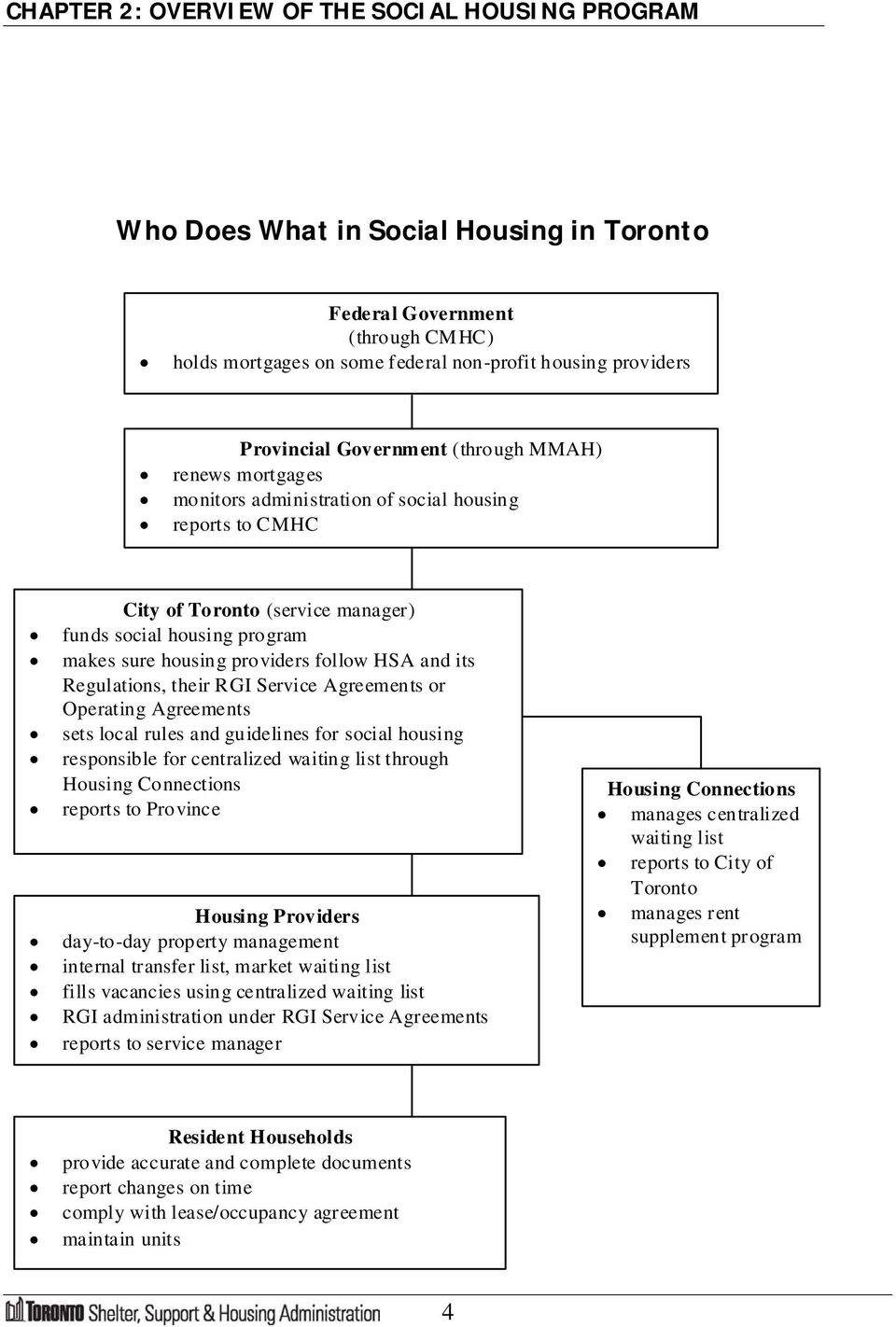
14 CHAPTER 2: OVERVIEW OF THE SOCIAL HOUSING PROGRAM Who Does What in Social Housing in Toronto Federal Government (through CMHC) holds mortgages on some federal non-profit housing providers Provincial Government (through MMAH) renews mortgages monitors administration of social housing reports to CMHC City of Toronto (service manager) funds social housing program makes sure housing providers follow HSA and its Regulations, their RGI Service Agreements or Operating Agreements sets local rules and guidelines for social housing responsible for centralized waiting list through Housing Connections reports to Province Housing Providers day-to-day property management internal transfer list, market waiting list fills vacancies using centralized waiting list RGI administration under RGI Service Agreements reports to service manager Housing Connections manages centralized waiting list reports to City of Toronto manages rent supplement program Resident Households provide accurate and complete documents report changes on time comply with lease/occupancy agreement maintain units 4
15 CHAPTER 2: OVERVIEW OF THE SOCIAL HOUSING PROGRAM The Role of the Housing Provider RGI Service Agreement Most social housing providers administered by the City of Toronto have signed a RGI Service Agreement. This Agreement makes the housing provider responsible for administering RGI. The Board s role is to make sure that the co-operative or non-profit follows the RGI Service Agreement and the rules set out in the HSA and its Regulations. Staff usually look after the day-to-day RGI administration. The RGI Service Agreement requires each staff person who administers RGI to attend training provided by the City. Any new staff must attend a training course within three months of beginning the job. All staff must attend follow-up courses. To comply with the RGI Service Agreement, each housing provider must make sure that a household is eligible for RGI housing (See Chapter 3 of this Guide.) decide the size of unit that the household qualifies for (See Chapter 4 of this Guide.) determine the household s income and assets (See Chapter 5 of this Guide.) calculate how much rent the RGI household will pay (See Chapter 6 of this Guide.) Chapter 7 of this Guide provides information on the housing providers responsibility to review RGI eligibility. These reviews must take place annually (For fixed income households, reviews must be carried out at least every 24 months). when the provider is notified of a change in income, assets, or household size or make up if the service manager requires a review before offering an RGI unit to an applicant Chapter 7 also deals with issues such as proper notice, and reviews. Some co-operatives and non-profits also have special mandates, for example, seniors housing. Housing providers must comply with their targeting plans and mandates, as well as any local priorities. Chapter 8 of this Guide deals with these issues. 5

16 CHAPTER 2: OVERVIEW OF THE SOCIAL HOUSING PROGRAM Housing providers are responsible for personal information about their tenants. They also have a duty to keep certain records. Chapter 9 outlines these duties. Providing Information to the Public Section 54 (1) of the HAS and Regulation 367/11 sections 62 and 83 The legislation has rules about information that housing providers must make available to tenants and the public including special needs clients You must give the public access to procedures for applications for rent-geared-to-income assistance, including what information and documents the service manager requires local eligibility rules occupancy standards the service manager s system for selecting households information on the housing project information about the provincial eligibility rules information about the provincial priority rules Make this information available so that people can copy it at their own expense. Good Communication As a housing provider, you will have to provide information to people who live in the project, to applicants, and to the public. You will need to communicate with people who speak English as a second language with people who find reading difficult with people who have difficulty seeing or hearing. The rules of the program are complicated and strict. The challenge will be to provide information that will help people understand and follow these rules so that they can get and keep the housing they need. 6
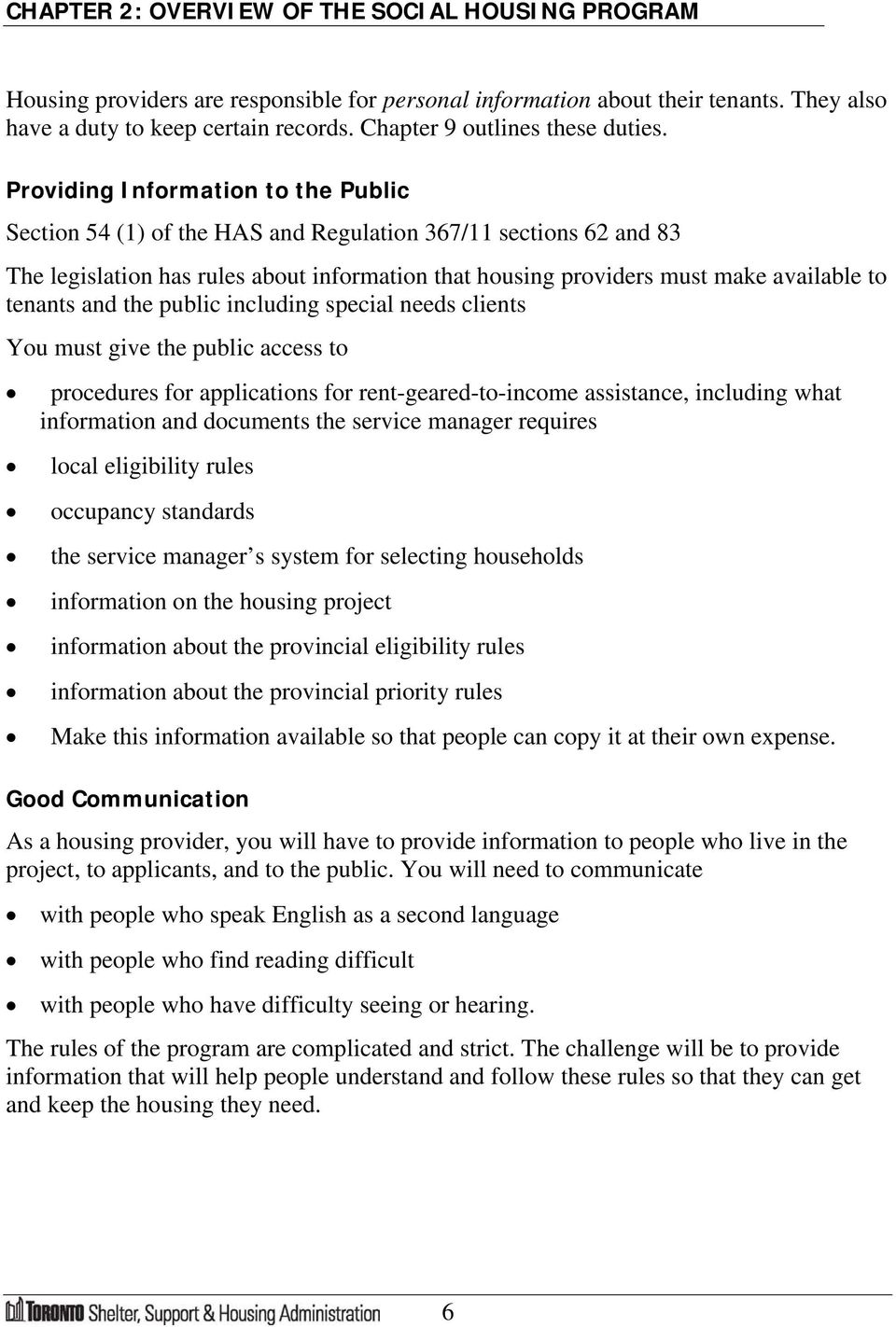
17 CHAPTER 3: DOES THE HOUSEHOLD QUALIFY FOR RGI? Basic Eligibility Rules for Every Household... 2 Other Eligibility Issues... 3 Eligibility for Special Needs Housing... 3 Special Priority as a Victim of Abuse Social Housing Residents... 4 Losing Special Priority Status... 5 Eligibility Issues Applying only to Residents... 5 Ceasing to be Eligible for RGI
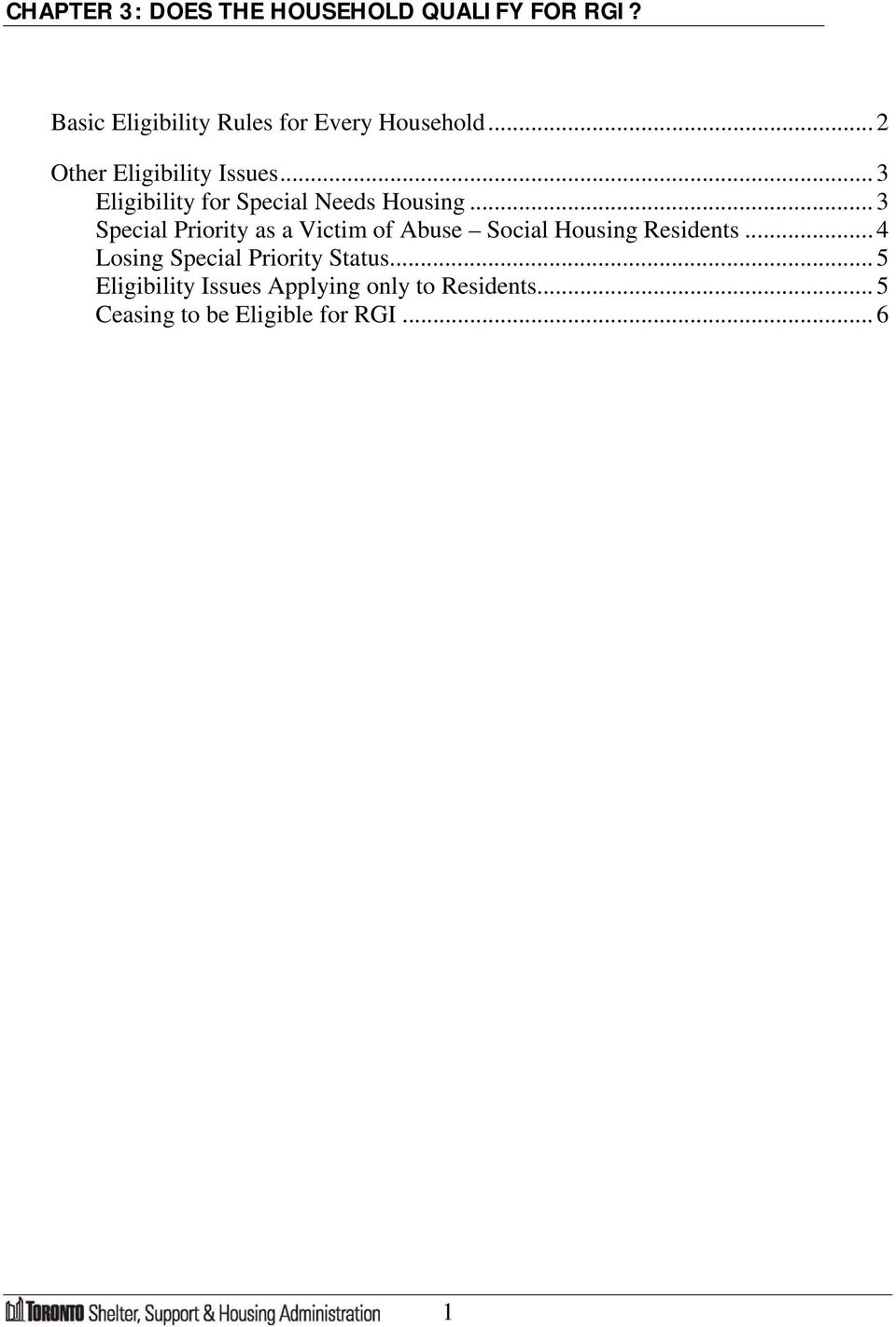
18 CHAPTER 3: DOES THE HOUSEHOLD QUALIFY FOR RGI? Basic Eligibility Rules for Every Household The HSA sets out rules about who is eligible for rent-geared-to-income (RGI) assistance. To be eligible to apply for RGI assistance or continue to receive RGI assistance, a household must meet the following conditions At least one member of the household is 16 years of age or older At least one member of the household is able to live independently, with or without support services Each member of the household is a Canadian citizen a permanent resident of Canada or has applied for permanent resident status, or a refugee claimant or Convention refugee. No removal order has become enforceable against any member of a household No member of the household owes arrears (money for rent or damage) from a former tenancy to a social housing provider in Ontario unless Housing Connections or a provider, decides there are extenuating circumstances about the case, or a member of the household has signed and is following an agreement to pay the money owing or a member of the household has made reasonable efforts to enter into a repayment agreement. Exception: Housing Connections or a provider may accept a special priority household who commits to repaying 50 per cent of the arrears. Exception: Housing Connections will accept RGI applications from tenants living in social housing who owe arrears. The HSA allows the Service Manager to make a local rule about certain convictions related to former RGI households. The City of Toronto rule (City Guideline ) is that: No member, or former member, of the household has been convicted by a court or the Ontario Landlord and Tenant Board of getting RGI assistance that they were not entitled to, or misrepresenting their income to get RGI assistance. 2
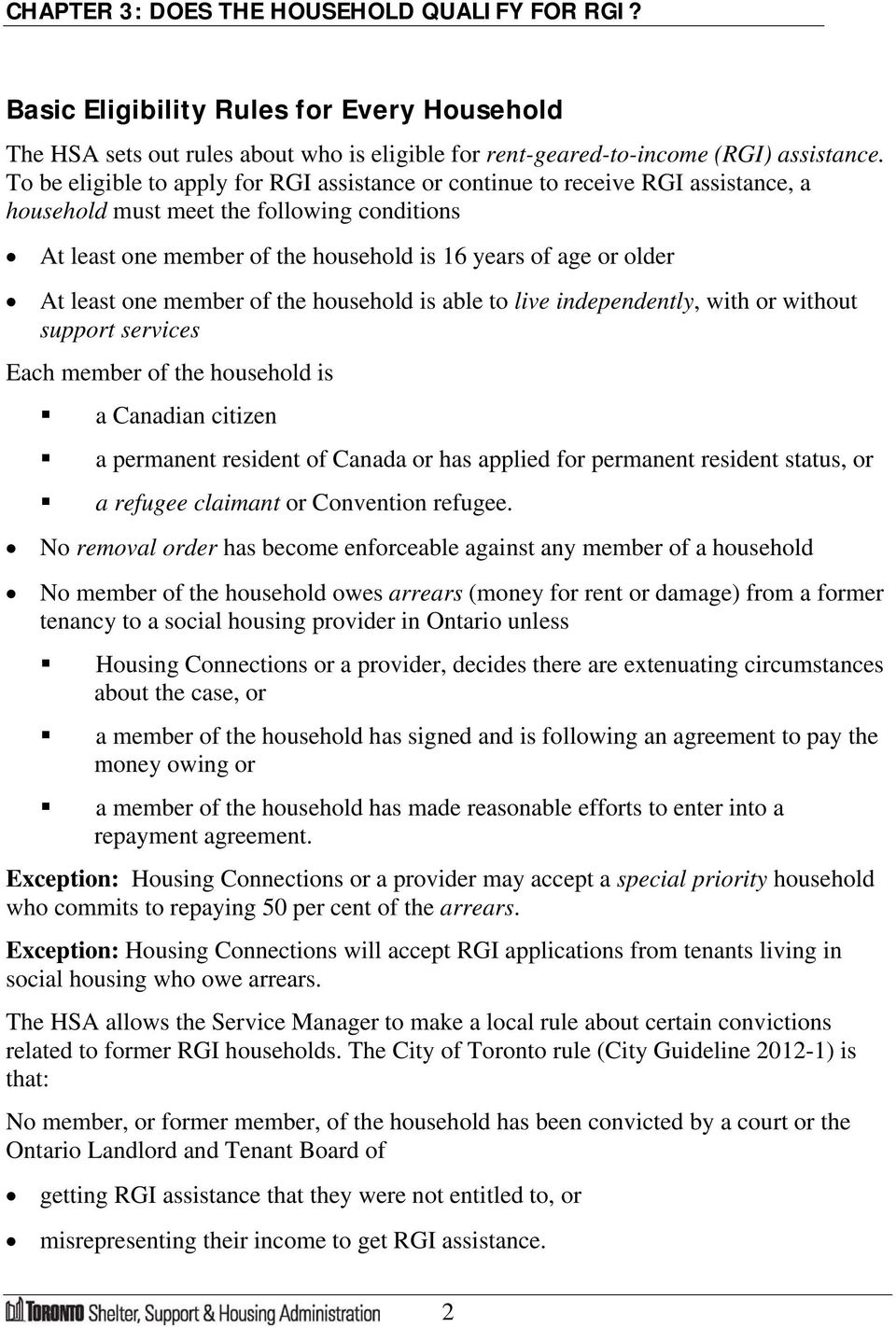
19 CHAPTER 3: DOES THE HOUSEHOLD QUALIFY FOR RGI? Once convicted, no member of the household can reapply for RGI assistance for two years from the date the offence or misrepresentation occurred. Exception: A household may apply earlier if the member of the household who was convicted of RGI fraud or misrepresentation is no longer a part of the household, and the housing provider is satisfied that current members of the household did not know that the former member was committing this offence, or could not have prevented it. Note: Under the City's Local Rule, any person who helps a member of a household to get RGI assistance that the household is not eligible for could be charged with an offence. On conviction, they could be fined up to $5,000 or be imprisoned for up to six months, or both. Other Eligibility Issues Eligibility for Special Needs Housing Every housing provider has units that are modified for accessibility. These units are special needs units. Units in which households receive provincially funded support services are also special needs units. To be eligible for special needs units, households must need the specific modifications of that unit or need the support care services that are available with the unit. They must remain eligible after they move in. In many cases eligibility is assessed by the agency providing support care services in the units. Unless you have delegated vacancy management for special needs housing to Housing Connections, you must maintain a special needs waiting list. Or, special needs units may be handled by a referral agreement with an agency. 3

20 CHAPTER 3: DOES THE HOUSEHOLD QUALIFY FOR RGI? Applicants and residents of special needs units get RGI when they need it, as long as they meet the initial eligibility requirements [HSA, Reg 367, s.51.2] Special Priority as a Victim of Abuse Social Housing Residents Victims of abuse have priority on the centralized waiting list. Housing Connections first assesses an applicant for general eligibility, and if they qualify, places the household on the waiting list. Then Housing Connections assesses the applicant for Special Priority Program (SPP) eligibility. If the applicant qualifies, they move to the top of each subsidiary list for which they express a preference. Victims of abuse currently living in social housing may wish to be placed on the provider s internal transfer list. This will most likely only happen when a housing provider has a lot of different buildings. Housing Connections reviews all applications for Special Priority Status. See Chapter 8 information on the application process. To qualify for special priority, the applicant must make a written request to Housing Connections stating that the abuser is or was living with the applicant, or the abuser is sponsoring the applicant as an immigrant, and the applicant being abused intends to live separately from the abuser on a permanent basis. If the abuser and the applicant being abused do not live together now, the request must be submitted within three months of their separation. Housing Connections must accept a request after three months if they are satisfied that the abuse is ongoing. There is no time limit for making an application in this situation. To verify that the applicant is being abused, the applicant must submit a record written by one of the professionals listed in Reg 367, s. 58 (5). If the applicant is applying for special priority with the current housing provider, Housing Connections will not need a new housing application. If the applicant wishes to apply to a different housing provider, they must submit a new application to Housing Connections. 4

21 CHAPTER 3: DOES THE HOUSEHOLD QUALIFY FOR RGI? Losing Special Priority Status Once special priority status has been given to an applicant they maintain this status until they are housed. There are some exceptions. Applicants will lose their special priority status on the centralized waiting list if Housing Connections confirms that the applicant is adding the abuser to the application for RGI assistance Housing Connections confirms that the abuser has died Housing Connections confirms that the applicant has accepted an offer of RGI housing. If you have information that the abuser is deceased or that the applicant has accepted an offer for RGI housing somewhere else, tell Housing Connections as soon as possible. See City Guideline Eligibility Issues Applying only to Residents To remain eligible for RGI assistance housing, an RGI household must also meet the following conditions: Failure to Obtain Income If a housing provider thinks that a household may be eligible for certain types of income, the housing provider must give them a written notice to try to obtain this income. These types of income are Ontario Works (OW) assistance support payments under the Divorce Act (Canada), the Family Law Act, or the Reciprocal Enforcement of Support Orders Act Employment Insurance (EI) benefits A pension or supplement under Part I or II of the Old Age Security Act, for example, Old Age Security (OAS), Guaranteed Income Supplement (GIS), and Guaranteed Annual Income System (GAINS).This does not include Canada Pension Plan (CPP) benefits. support or maintenance from a sponsor (Immigration Act). See Appendix 10 Failure to Obtain Income - for more information about income entitlements and how to pursue these forms of income. 5
22 CHAPTER 3: DOES THE HOUSEHOLD QUALIFY FOR RGI? The written notice must identify the type of income the household may be eligible for set a reasonable time for the household to inform the housing provider of their efforts to get this income. The household may become ineligible for RGI if they do not respond to the notice from the housing provider within the time stated in the notice the housing provider decides that the household has not made a reasonable effort to obtain this income. As a guideline, the City recommends that households be given 60 days to inform the housing provider of the results of their pursuit of income. This includes 30 days to make a request for income and 30 days to receive and submit the reply to the housing provider. Note: Tenants seeking support from former spouses can go to the provincial Family Responsibility Office if they are afraid to approach the former spouse directly. Ownership of Residential Property If a household owns a residential property that can be lived in year-round, they must sell (divest) the property or their share in it within six months of moving into an RGI unit. If they do not do this, they may become ineligible for RGI assistance. If a household already receiving RGI assistance acquires or inherits a residential property that can be lived in year-round, they must sell (divest) the property or their share in the property within six months. If they do not, they may become ineligible for RGI assistance. The housing provider can extend the period of time beyond six months if there are reasonable grounds for doing so. This rule applies to property in Ontario or outside of Ontario. Exception: If a special priority household informs the housing provider that taking steps to sell a property would put them at risk, the housing provider must extend the period of time past six months. Ceasing to be Eligible for RGI A household may cease to qualify for RGI if the household does not meet an eligibility requirement 6
23 CHAPTER 3: DOES THE HOUSEHOLD QUALIFY FOR RGI? refuses three offers while on the centralized waiting list does not provide information and documents within the required timeframe ( see City Guideline and City Guideline ) is overhoused and cancels their application on the centralized waiting list is overhoused and refuses a total of three offers of housing, while on either the internal transfer waiting list or the centralized waiting list. However, the household cannot cease to be eligible until one year after they are notified that they are overhoused. (Reg 367, s. 38 (2) has failed to obtain income to which they are entitled (this does not apply to applicants on the waiting list) does not divest property (this does not apply to applicants on the waiting list) is absent from the unit for more than 120 days, and does not qualify for the exemptions given in City Guideline revised June 1, has paid market rent for one year. When a household living in social housing ceases to qualify for RGI assistance they are entitled to stay in their unit but will be charged market rent. See Chapter 7 for more information on maintaining or removing eligibility for RGI assistance. 7
24 CHAPTER 4: OCCUPANCY STANDARDS How Many Bedrooms Does a Household Qualify for?... 2 When is a household eligible for an additional bedroom?... 3 Is a student living away from home a member of the household?... 3 Overhoused Households... 4 Housing Preferences... 5 Underhoused Households
25 CHAPTER 4: OCCUPANCY STANDARDS Note: These occupancy standards do not apply to households that were receiving RGI before May 1, 2003 unless the household composition changes the household requests a transfer to another unit, or the household was overhoused under the Occupancy Standards set out in the Appendix to Ministry of Municipal Affairs and Housing Directive 97-16, Implementing a Ministry Approved Co-ordinated Access System. How Many Bedrooms Does a Household Qualify for? Toronto has set their own occupancy standards for RGI households. Housing providers may set different occupancy standards for market-rent households. Under City Guideline , the occupancy standards are there cannot be more than two persons to a bedroom spouses must share a bedroom two children of the same sex must share a bedroom if the bedroom provides at least four square metres (approx. 43 square feet) of space for each child. If not, they will each qualify for their own room children of the opposite sex may have their own bedroom unless the household wants two children to share a bedroom. They may only share a bedroom that provides at least four square metres (approx. 43 square feet) of space for each child a single parent may share a bedroom with a child if the applicant wants to share. bachelor units are normally allocated to single persons. However, a two person family is eligible for a bachelor unit, if the applicant requests it. Two persons who live together are considered "spouses" if the social and familial aspects of the relationship amount to cohabitation, and one individual provides financial support to the other, or the individuals have a mutual agreement or arrangement regarding their financial affairs. A two person family consists of either two spouses or a parent and child. 2
26 CHAPTER 4: OCCUPANCY STANDARDS When is a household eligible for an additional bedroom? A household is eligible for another bedroom if a member of the household has a disability or medical condition that requires a separate bedroom a room to store equipment, or an individual to live in and provide support services. This person cannot be a member of the household a member of the household is pregnant and the household would need an extra bedroom for the child a member of the household has a legal agreement for joint custody of a child and the child would need a separate bedroom a member of the household has a legal agreement for visiting rights with a child and an extra bedroom would be necessary to provide overnight accommodation. The legal agreement must require this overnight accommodation. To decide if a household qualifies for an additional bedroom, you will have to review the documents that the household provides. You will have to base your decision on this information. The forms in Appendix 9 will help you to get the information you need to assess requests for an additional bedroom for medical reasons. Is a student living away from home a member of the household? A student attending school away from home is a member of the household, if the student meets all these conditions: is a child of the household is in regular attendance at a recognized educational institution lives with the household while not attending school and depends in whole or in part, on the household for financial support. 3
27 CHAPTER 4: OCCUPANCY STANDARDS Recognized educational institution A recognized educational institution is a school a university a college of applied arts and technology a private career college a private school. Note: a school, other than a post-secondary institution, must be within the Province of Ontario Overhoused Households An RGI household becomes overhoused if someone in the household leaves and the unit has more bedrooms than the City s RGI occupancy standards allow. If you decide that the household is overhoused, send the household a written notice of the decision, telling them that they could lose their RGI assistance if they do not move to a suitable unit. Make sure that the notice informs the household that they can ask for a review of this decision and tells them the process that they must follow. See Section 7. If you have a unit of the size that the household is eligible for, you must add the household to your internal transfer list. This is the list of households already living in your housing project that would like to or must move to different units. An RGI household that is overhoused has priority on the internal transfer list unless there is a special priority household on the list. After one year on the internal transfer waiting list, the household must be added to the centralized waiting list. Do not remove the household from the internal transfer waiting list, unless the household requests that they be removed. You will have to submit a form, called Provider Authorized Application Form, to Housing Connections. Housing Connections will provide you with this form. You can also download the form from the Housing Provider area of the Housing Connections website: If your project does not include units of the size that the household is eligible for, you will have to submit this form to Housing Connections right away. However, an overhoused household cannot lose eligibility for RGI in the first 12 months after being notified that they are overhoused. 4
28 CHAPTER 4: OCCUPANCY STANDARDS Even if the housing provider has units of the size needed, an overhoused household can ask to be placed on the centralized waiting list right away. They can ask to be removed from the centralized waiting list during the 12 month period after they become overhoused, because their application was voluntary. Once the household has been overhoused for 12 months, their application to the centralized waiting list is no longer voluntary. A housing provider must decide that a overhoused household is no longer eligible for RGI assistance if they have refused three housing offers, whether for internal transfer or from a different housing provider, and they have been overhoused for at least 12 months. Housing Preferences Overhoused households who must apply to the centralized waiting list will have to choose at least 5 housing preferences, not including their current housing provider. They may also choose their current housing provider, but this will not be counted as part of the minimum of five needed to maintain RGI eligibility. See City Guideline When an overhoused household is added to the Housing Connections waiting list, the household s application is ranked as third priority. Victims of abuse are first priority and terminally ill applicants (optional for housing providers) are second priority. Overhoused households that are required to be on the Housing Connections list will lose their eligibility for RGI if they are listed for less than five housing preferences, not including their current housing provider. have been overhoused for at least 12 months and they refuse 3 unit offers of the size that they are eligible for, including both internal transfer offers made before they were added to the centralized waiting list and centralized waiting list offers, or ask to be taken off the centralized waiting list. If a household does not have at least five preferences, not including their current provider, you must issue the household a notice of loss of eligibility for RGI assistance. See City Guideline Once a household has been overhoused for one year, Housing Connections keeps track of all refusals. When an overhoused household on the centralized waiting list refuses an offer, report this refusal to Housing Connections immediately. When Housing Connections tells you that a household has refused three offers, you must issue the 5
29 CHAPTER 4: OCCUPANCY STANDARDS household a notice of loss of eligibility for RGI assistance (if they have been overhoused for at least 12 months). Underhoused Households An RGI household is underhoused if the unit has less bedrooms than the City s RGI occupancy standards would allow. Underhoused households are not considered a priority under the HSA. When developing an internal transfer policy, housing providers may not rank underhoused households before special priority and overhoused households. 6
30 CHAPTER 5: WHAT IS INCOME AND HOW TO VERIFY IT What income is included?... 2 A. Income from Employment... 3 B. Income from Assets or Investments... 3 C. Income from Pensions or Support Agreements... 4 D. Income from Social Assistance... 5 What income is excluded? [Reg. 298, s.50.3]... 5 Excluded Government Program Payments... 5 Excluded Employment-Related Payments... 5 Excluded Assets... 6 Excluded Income from Disposal of Assets... 6 Excluded Gifts... 6 Excluded Interest Income... 7 Excluded Education or Training Income... 7 Excluded Income for Foster Children/Crown Wards... 8 Excluded Home Care Allowances... 8 Excluded Income for Veterans and Victims of War... 8 Excluded Income for Aboriginal People... 8 Excluded Extraordinary Compensation Payments... 9 Verifying Income and Assets... 9 A. Verifying Income from Employment... 9 B. Verifying Income from Assets or Investments C. Verifying Income from Pensions or Agreements for Support D. Verifying Income from Social Assistance (OW and ODSP) Determining Gross Monthly Income A. Determining Income from Employment B. Determining Income from Assets or Investments C. Determining Income from Pensions and Agreements for Support D. Determining Income from Social Assistance
31 CHAPTER 5: WHAT IS INCOME AND HOW TO VERIFY IT Housing providers that have signed RGI Service Agreements are responsible for calculating how much rent a rent-geared-to-income (RGI) household must pay. To calculate the RGI charge, housing providers must first determine the monthly income of each person in an RGI household. For this reason, all members of a household who are 16 years of age or older must report their income and assets and provide documents. Note: there is an exception for students who are children of the household. See City Guideline Income of Full-Time Students Living with their Parents. What income is included? When calculating RGI, always apply income to the month in which the household should have received it (e.g. support payments received late). You must know what is included in income and what is excluded from income before you begin a rent-geared-to-income calculation. There are four types of income A. income from employment B. income from assets or investments C. income from pensions or support agreements D. income from social assistance Deeming Income The HSA does not contain any provisions for deeming income. You may only calculate rent on income actually received. 2
32 CHAPTER 5: WHAT IS INCOME AND HOW TO VERIFY IT A. Income from Employment salary or wages including holiday pay bonuses or incentive pay tips or gratuities overtime pay Employment Insurance (EI) benefits (including parental benefits) short-term Workers Safety and Insurance Board (WSIB) benefits work incentive program payments training allowances income from self-employment regular payments for sick leave or short-term disability under a private or workplace insurance plan strike pay. B. Income from Assets or Investments There are two types of assets income-producing non-income producing. Income-producing assets are investments which produce income such as interest or dividends. The income from these assets is included in the total household income used for the RGI calculation. Some examples of these are interest-bearing bank or credit union accounts term deposits, guaranteed income certificates (GICs), treasury bills, bonds, or debentures annuities (life, fixed-term) and RRIF withdrawals stocks, shares, or mutual funds mortgages and loans. These are mortgages and loans for which the individual receives payment. 3
33 CHAPTER 5: WHAT IS INCOME AND HOW TO VERIFY IT Non-income-producing assets include all investments or holdings which are intended to increase in value rather than produce income. Some examples of these are: non-interest bearing bank or credit union accounts (for example, some chequing accounts do not produce interest income). Deduct $1,000 from the sum of all of a household s minimum monthly bank balances non-income producing equity or share in a business life insurance with cash surrender value non-income producing stocks, shares or mutual funds any property suitable for year-round occupancy until it is sold (see Ownership of Residential Property in Chapter 3, pg. 6) any residential property not suitable for year-round occupancy (for example, a nonwinterized cottage) land holdings or non-residential property non-income-producing assets transferred or given to someone outside of the household, less than 36 months before the household starts receiving RGI assistance or any time after the household starts receiving RGI assistance. life interest in real estate. Note: Personal belongings such as jewellery, family heirlooms, or old family furniture, and possessions that do not normally increase in value (for example, a family automobile) are not considered non-income-producing assets. C. Income from Pensions or Support Agreements Canada Pension Plan for the Disabled (CPP-D) public pensions (OAS, CPP or Québec Pension Plan (QPP), GIS, GAINS) private pensions, benefits, or annuities, including RRIF withdrawals private or public pensions, benefits or annuities received from any other country long-term disability payments from a private insurance company or WSIB child support payments spousal support payments. 4
34 CHAPTER 5: WHAT IS INCOME AND HOW TO VERIFY IT Note: Support payments may be payments required by the federal Divorce Act or the Ontario Family Law Act, or payments required by legally-recognized separation agreements, paternity agreements, marriage contracts, or co-habitation agreements. D. Income from Social Assistance Ontario Works (OW) Ontario Disability Support Program (ODSP). What income is excluded? [Reg. 298, s.50.3] The HSA includes a long list of excluded income income and payments which you are not to include as income. Although this list is long, it will probably not cover all situations. In this Guide, we have grouped these items into categories. The categories may help you to decide which types of income you may exclude. You will need to use good judgement when you decide whether to exclude income or not. Excluded Government Program Payments a payment, refund, or credit from the provincial or federal government such as income tax refunds Canada Child Tax Benefits, Universal Child Care Benefit, Working Income Tax Benefit, Ontario Child Benefit and Ontario Child Care Supplement for Working Families property or sales tax credits, or tax grants for people 65 years of age or older a child benefit received from the Canada Pension Plan a survivor s death benefit received from Canada Pension Plan a special allowance for resettlement assistance. Excluded Employment-Related Payments a lump sum severance payment 5
35 CHAPTER 5: WHAT IS INCOME AND HOW TO VERIFY IT a business expense deduction from self-employed earnings that is allowed by Canada Revenue Agency and the HSA an allowance or payment for childcare, transportation, tuition, or other expenses for a person enrolled in a job training or employment-related program an allowance for travelling expenses related to employment an allowance for room and board expenses if a person is employed away from home a payment from the federal Opportunities Fund for People with Disabilities program if this payment is used to cover the costs of employment-related activities a loan from a government agency or financial institution used to support a business a payment received under the Workers' Compensation Act as of December 31, 1997 subsection 147 (14). Excluded Assets Registered Retirement Savings Plan (RRSP) and Registered Education Savings Plan (RESP) a lump sum payment received as the result of a decision by a court or tribunal a lump sum insurance payment money received on the death or injury of a household member as damages or compensation for pain and suffering reasonable expenses an inheritance lottery winnings a loan to the individual. Excluded Income from Disposal of Assets a capital gain the proceeds from the sale of personal assets such as furniture, equipment, or an automobile the proceeds from the sale of real estate Excluded Gifts a casual gift or casual payment of small value 6
36 CHAPTER 5: WHAT IS INCOME AND HOW TO VERIFY IT a donation from a religious, charitable, or benevolent organization Excluded Interest Income interest accrued on a prepaid funeral plan interest, income, or dividends earned on a RRSP or on a RESP Excluded Education or Training Income income received by a full-time student at a recognized primary or secondary institution if the student is a child of a member of the household has always lived with the household with the exception of short periods while in full-time attendance at a recognized educational institution does not have a spouse does not have dependant children income received by a full-time student in a recognized post-secondary institution if the student is a child of a member of the household has always lived with the household with the exception of short periods while in full-time attendance at a recognized educational institution does not have a spouse does not have dependant children has not been out of secondary school for more than 5 years at the start of the current period of study a bursary for a full-time secondary school student a payment from the Canada Millennium Scholarship Fund an award or grant from the Ministry of Training, Colleges and Universities for a student at a post-secondary institution. This includes a loan or grant from the Ontario Student Assistance Program (OSAP) as well as amounts received through OSAP from the Canada Student Assistance Program. a Dr. Albert Rose bursary for post-secondary students (awarded by the Ministry of Municipal Affairs and Housing) a grant under the federal Employment Insurance Act received by a person receiving social assistance. This grant must be used to pay for a training course approved under the provincial Ontario Works Act. 7
37 CHAPTER 5: WHAT IS INCOME AND HOW TO VERIFY IT a Canada Education Savings Grant if it is paid into a Registered Education Savings Plan for a child of a member of a family unit. Excluded Income for Foster Children/Crown Wards payment from a Children s Aid Society for a child in care development Care Program payments (from Children s Aid Society) foster allowances (from Ontario Works) income earned or received by a foster child who is living with the household extended care and maintenance allowances for former Crown wards (from Children s Aid Society) Excluded Home Care Allowances attendant care allowances disabled children s allowances foster allowances (from Ontario Works) subsidies for adoptive parents under the Child and Family Services Act payments from a trust or life insurance policy or gifts or voluntary payments made on behalf of a disabled person, that will not be reimbursed, including expenses for items or services needed because of the household member s disability education or training expenses incurred because of the household member s disability Excluded Income for Veterans and Victims of War a periodic or lump sum war reparation payment a benefit from Veterans Affairs Canada under the Veterans Independence Program or a special allowance under the Veterans Disability Pension Program Excluded Income for Aboriginal People a payment received from the federal government or a bank for board and lodging of a student attending secondary school off the reserve 8
38 CHAPTER 5: WHAT IS INCOME AND HOW TO VERIFY IT a payment received from a treaty between a band and the government of Canada, other than funds for post-secondary education a payment from a band as an incentive to keep a child of a household in school a payment under Order in Council P.C made under section 40 of the Indian Act (Canada) a payment received as a result of a claim that relates to an aboriginal residential school Excluded Extraordinary Compensation Payments a payment from the federal Extraordinary Assistance Plan a payment from any of the following agreements made with the Ontario government Helpline Reconciliation Model Agreement Multi-Provincial/Territorial Assistance Program Agreement the Grandview Agreement a payment from the Walkerton Compensation Plan a payment from the Government of Alberta as compensation for sterilization a lump sum payment from the Hepatitis C Settlement Agreement (a federal agreement) a payment from the Ontario Hepatitis C Assistance Plan Verifying Income and Assets Here is a summary of the types of documents you will need to collect as proof of income and the value of assets. Each person in the household who is 16 years of age or older must provide information. (See City Guideline for the exception for a student who is a child of the household.) Appendix 1 contains sample forms that you can use for income and asset reviews. There is a list of documents that households should provide to verify their income. A. Verifying Income from Employment Income from Regular Employment consecutive pay stubs covering an 8-week period. The pay stubs must include the employer s name and address and which pay periods are covered, or 9
39 CHAPTER 5: WHAT IS INCOME AND HOW TO VERIFY IT a letter from an employer stating gross annual income and any overtime pay or bonuses. This letter must be on company letterhead, recently dated, and contain the telephone number and signature of the letter writer. Income from Irregular Employment (seasonal, intermittent) current income documents such as payroll stubs, a letter from an employer, or a record of EI benefits, or a working copy of both the income tax return and Notice of Assessment from the previous year (available from Canada Revenue Agency). Income from Self-Employment Self-employment includes freelance workers independent contractors sole proprietors of a business a partner in a business If an individual has been self-employed for less than one year, ask them to provide a financial statement every 3 months. This statement does not have to be audited. After the first year of business, you will need different documents depending on whether or not the business is incorporated. Most self-employed individuals will not incorporate their business; however, some may. For a business that is not incorporated, ask them to provide the working copy of the income tax return, including the Statement of Business Activities and a Notice of Assessment (available from Canada Revenue Agency). Note: if the income is not the same on both documents, seek further information. For an incorporated business, ask them to provide an audited financial statement for the most current fiscal year including a balance sheet which states the value of the business asset the amount of dividends the retained earnings or net income of the business a T4 slip for the individual 10
40 CHAPTER 5: WHAT IS INCOME AND HOW TO VERIFY IT a copy of the corporation s income tax return and the Notice of Assessment received from Canada Revenue Agency, plus a copy of the individual s income tax return and Notice of Assessment. Note: if the individual s income is not the same on both documents, seek further information Employment Insurance (EI) a copy of a benefit statement showing the gross weekly amount Strike pay a cheque stub, or a letter from the union B. Verifying Income from Assets or Investments Income-producing assets Income-producing assets are investments which produce income such as interest or dividends. Interest-bearing bank or credit union accounts a current passbook or a monthly bank statement (showing the account number, the name and address of the bank or credit union, the total interest earned in the past year or the average monthly interest earned in the past year) T5 slips issued by bank or credit union for tax purposes, or a letter from a bank or credit union describing the amount of interest earned in the past year Term deposits, GICs, treasury bills, bonds or debentures a letter from a bank or credit union, or documents or certificates from a bank or credit union which give the following details the principal amount of investment the interest rate the amount of interest earned the date of issue and the term the identifying serial number Stocks, shares or mutual funds cheque stubs or copies of cheques, or 11
41 CHAPTER 5: WHAT IS INCOME AND HOW TO VERIFY IT T5 slips issued for tax purposes, which give the following details the amount of dividends received the company name the series or type of stock the number of stock shares mutual fund company statements with value of investment Mortgages or loans an amortization or loan payment schedule showing the principal and interest of each payment. Include only the interest portion of mortgage or loan payments in determining income for an RGI calculation. Do not include repayments of principal. If the interest rate of the mortgage or loan is below the imputed rate of return, use the imputed rate of return to determine the income. Note: The imputed rate of return is the interest rate for the first year of the November 1 st issue of Canada Savings Bonds, rounded down to the nearest whole per cent. Use the figure given in the most recent City Guideline entitled Imputed Rate of Return. Non-income-producing assets Non-income-producing assets do not produce regular income or interest but do increase in value. Use the imputed rate of return to estimate the financial benefit to an individual from this type of asset. For example, if the imputed rate of return were two per cent, add two per cent of the value of the non-income-producing asset to the individual s total income. Note: RRSPs and RESPs are excluded from non-income-producing assets. Any income earned on an RRSP, an RESP or a prepaid funeral plan is not considered income under the HSA. Non-interest-bearing bank or credit union accounts a copy of a bank passbook or other documents giving details of the account Non-income-producing equity or share in business an audited financial statement, or 12
42 CHAPTER 5: WHAT IS INCOME AND HOW TO VERIFY IT a letter from an accountant Taxi plate or licence a taxi licence in Toronto is not considered to be an asset. Households do not need to provide information about their value. The net income earned from driving a taxi and/or renting the taxi (the amount the owner charges to the other drivers), and/or renting the use of a taxi licence is included in household income. For information about verifying Self-Employment Income, see page nine. Life insurance with a cash surrender value a letter from the insurance company indicating the policy number and the current cash surrender value The value of the non-income producing asset is the current cash surrender value of the policy. If the person has borrowed against the insurance, reduce the value of the asset by the amount borrowed. Note: Include any dividend income from the insurance in the total household income. Non-income producing stocks, shares, bonds, or mutual funds a letter or bank statement from a bank or credit union, or a document from a brokerage company or financial institution, giving the current value Residential property suitable for year-round occupancy a written appraisal of the property done by a qualified appraiser In most cases, any residential property suitable for year-round occupancy must be sold within six months of the household receiving RGI assistance. Until the property is sold, it is considered a non-income producing asset. Note: The household is responsible for the cost of the appraisal. 13
43 CHAPTER 5: WHAT IS INCOME AND HOW TO VERIFY IT Residential property not suitable for year-round occupancy a written appraisal of the property done by a qualified appraiser Non-residential property such as land a written appraisal of the property done by a qualified appraiser Transferred Assets Transferred assets are included in income if they were transferred to reduce RGI rent. If, in the three years (36 months) before receiving RGI assistance, an individual has sold, leased or given an asset to someone who is not a member of the household, include the asset when you determine the individual s income. If the household transferred an asset after beginning to receive RGI assistance, include the asset when you determine the individual s income. Treat it as a non-income producing asset. This applies to incomeproducing or non-income-producing assets. Base the imputed income on the total value of the asset at the time of the transfer. If the asset was real estate, then the individual needs to provide a written appraisal of the property from a qualified appraiser If the asset was a financial holding, the individual needs to provide a letter from a bank or credit union documents or certificates from a bank or credit union, or a letter from an accountant Note: The rule involving transferred assets deals with households that sell or give away valuable assets. The housing provider must use judgement in dealing with a transferred asset. For example, if a couple gave $5,000 to their daughter a month before the husband died in an accident, you may choose to ignore the transferred asset. Life interest in real estate An individual may receive a life interest in real estate through a will or other document. You can determine the value of this non-income producing asset through a written 14
44 CHAPTER 5: WHAT IS INCOME AND HOW TO VERIFY IT appraisal of the value of the life interest which reflects the individual s ability to sell or rent the real estate. For example, a widow may be granted the right to live in her current home, even though the title to the property has been transferred to her son. She lives there for a while, but then moves into social housing. She has the right to rent out the house during her lifetime, but doesn't exercise that right. Her son's family moves into the home. In this situation, the life interest has no value. C. Verifying Income from Pensions or Agreements for Support Pension, long-term disability, or annuity income a copy of a current cheque stub which shows the gross amount of income and how often it is paid or a slip issued for income tax purposes showing the annual amount of the pension, disability or annuity income or a letter from the pension manager stating the amount of the payment Receiving child or spousal support payments a copy of the support agreement or court order, and a letter from a lawyer or the Family Responsibility Office, or a statutory declaration stating how much the person receives and how often they receive it Paying child or spousal support payments a copy of the support agreement or court order, and copies of cancelled cheques (showing support paid) D. Verifying Income from Social Assistance (OW and ODSP) Ontario Works or Ontario Disability Support Program payments a copy of the benefit statement from the City or the Province plus a copy of the monthly drug card. The drug card verifies the number and names of the beneficiaries. 15
45 CHAPTER 5: WHAT IS INCOME AND HOW TO VERIFY IT Note: If a person receiving social assistance has income from employment, assets, or a pension or support agreement, they must provide documents to verify this non-benefit income as well as their social assistance benefits. Determining Gross Monthly Income To determine the RGI Rent for a household, you must first calculate the gross monthly income (net of excluded income) of each individual in the household who is 16 years of age or older. Rounding amounts up and down Do not work with cents in your calculations. For example, if an individual s gross monthly income is $1,533.34, you would round this amount down to $1,533. If the gross monthly income is $1,533.55, then you would round it up to $1,534. A. Determining Income from Employment Regular employment income Remember, you must base your RGI calculation on gross monthly income. Gross income is an employee s income before deductions for income tax, EI payments, CPP payments, union dues, and so on. To find an employee s gross monthly income, find out how often the person is paid and convert the amount to monthly income. Regular employees are usually paid at the middle and the end of each month (semi-monthly), or every 2 weeks (bi-weekly) Semi-monthly pay is received 24 times a year. Bi-weekly pay is received 26 times a year. Use the following table to determine gross monthly amounts. 16
46 CHAPTER 5: WHAT IS INCOME AND HOW TO VERIFY IT Income Frequency Calculation Factor Annual Divide by 12 Semi-monthly (twice a month) Multiply by 2 Weekly Multiply by Bi weekly (every 2 weeks) Divide by 2 and multiply by Daily Multiply by Fluctuating income A tenant s income may change from month to month. For the first year of fluctuating income, calculate their RGI rent every three months based on their income for the previous three months. After the first year, calculate their RGI Rent based on the income from their previous year s tax return. You are not required to decrease their RGI Rent during the year unless there is a significant change in the amount of income or the source of their income changes. See City Guideline For example, a single mother starts a job as a home care worker on an on-call basis. Ask her to submit income documents every three months. Base her RGI Rent for the next three months on the income from the past three months. After the first year, calculate her RGI Rent based on her previous year s tax return. Individuals who receive this type of income should provide a working copy of their income tax return and the Notice of Assessment. You may wish to ask for a statutory declaration stating the amount of tips or gratuities received during the period. Tips, gratuities, or commissions Include any money that an individual receives from tips, gratuities and commissions. Employees that normally receive such income are wait staff taxi drivers 17
47 CHAPTER 5: WHAT IS INCOME AND HOW TO VERIFY IT barbers and hairdressers Irregular income If a person s income is seasonal or intermittent, treat it as fluctuating income. When a source of income ends, start over with a new fluctuating income period. Self-employment income If a tenant has been self-employed for less than a year, ask for financial statements every three months. These statements do not have to be audited. You will have to calculate RGI every three months based on the earnings of the past three months. After the first full year of self-employment, the RGI rent may be adjusted retroactively if the un-audited financial statements did not reflect the actual income. If the tenant has been self-employed for more than a year but the business is not incorporated, determine the net business income from the working copy of the income tax return, including the Statement of Business Activities and the Notice of Assessment. If Canada Revenue Agency has allowed the following deductions, you must add them back to the net income of the business. These are depreciation of capital assets rent child care expenses Negative income from self-employment must be counted as zero income. Divide the net business income by 12 to determine the gross monthly income. After the first year of self-employment, base the household s RGI rent on the average income of the prior year. Once RGI rent is based on a yearly average, do not decrease RGI rent mid-year unless there is significant change in the amount of income from selfemployment or the source of income changes. See City Guideline Employment Insurance benefits Benefits are paid bi-weekly but stated in weekly amounts. Remember to use the factor of to determine gross monthly benefit amount. 18
48 CHAPTER 5: WHAT IS INCOME AND HOW TO VERIFY IT Income from a Child of the Household The legislation defines a child of the household as a child of any member of the household who has always lived at home except for short periods while in full-time attendance at a recognized educational institution has never had a spouse, and is not the parent of a child living in the household. Children who are 16 years of age or older who are not full-time students must report their income. If a child earns more than $75 a month and does not qualify as a student, you must do a separate calculation to determine the child s income. See Chapter 6. There is no age limit. For example, you would treat the income of a 30-year-old daughter who has always lived at home in this way as long as she has always been single and doesn t have any children living with her. Student Income of a Child of the Household Do not include the student s income in the household income if: a child of the household attends primary or secondary school a child of the household is in full-time attendance at a recognized post-secondary educational institution (for example, a college, university, or vocational school) and the student has not been out of secondary school for more than five years at the start of his or her study program. 19
49 CHAPTER 5: WHAT IS INCOME AND HOW TO VERIFY IT Full-time attendance Full-time attendance means taking at least 60% of a full course load. For a student with a permanent disability, full-time attendance means taking 40% of a full course load. Recognized educational institution A recognized educational institution is a school as defined in the Education Act a university a college of applied arts and technology a private career college a private school. Note: A school, other than a post-secondary institution, must be within the Province of Ontario See Reg. 298/01 s. 49.(4) for the complete definitions. To document full-time attendance, the student should provide a letter from the principal or registrar, a certified timetable, a document from a funding agency that outlines the name of the educational institution and the number of courses the student is taking, or a receipt from the educational institution showing the tuition fees paid. Do not ask a child of the household who is a student to provide income documents if the student has provided documents to confirm their status as a full-time student. See City Guidelines Income of Full time Students Living with their Parents. B. Determining Income from Assets or Investments Note: Ignore the first $1,000 of each family unit s total assets in bank accounts when you calculate the RGI assistance. For example, if a family unit has $1,800 as the minimum monthly balance in a chequing account count the asset as $
50 CHAPTER 5: WHAT IS INCOME AND HOW TO VERIFY IT Income-producing assets (interest bearing bank accounts, credit union and trust company accounts, term deposits, bonds or debentures, GICs) Take any income earned and add it to the individual s gross monthly income. For example, if an individual has a Guaranteed Income Certificate (GIC) which produced $90 of interest in the past year, divide the amount of the interest earned by 12 and add $8 to the gross monthly income. $90 12 = $7.50 Rounded to $8. Non-income-producing assets (non-interest bearing bank accounts and non-residential real estate) Use the imputed rate of return to calculate the imputed amount of income from the non-income-producing asset. Add this amount to the individual s monthly income. For example, an individual has a bank account with a minimum monthly value of $4,000. Subtract the first $1,000. If the imputed rate of return were three per cent, the imputed annual amount would be $90. Divide this amount by 12. Add $10 to the household s gross monthly income. Transferred Assets $3,000 x 3% = $90 $90 12 = $7.50 Rounded to $8 If an asset was transferred in order to reduce RGI rent, then the value of the asset at the point of transfer is included in non-income-producing assets. Include this asset value as long as the household continues to receive RGI assistance. See City Guideline This is a policy change following regulation amendment in For assets that were partially depreciated before the Guideline was issued, use the last depreciated value. C. Determining Income from Pensions and Agreements for Support Pensions, child or spousal support, long-term disability payments If a member of the household receives child or spousal support, you must add it to their monthly income. Note: If a member of the household pays child or spousal support, you must subtract it from their income. 21
51 CHAPTER 5: WHAT IS INCOME AND HOW TO VERIFY IT D. Determining Income from Social Assistance Ontario Works, Ontario Disability Support Program If an individual in the household receives income from OW or ODSP, you calculate the RGI Rent by using a set of tables. This process is described in Chapter 6. An individual who receives OW or ODSP may also have income from employment, assets, or pensions or support payments. This is called non-benefit income. 22
52 CHAPTER 6: CALCULATING RENT FOR AN RGI HOUSEHOLD STEPS FOR CALCULATING RENT FOR A RENT-GEARED-TO-INCOME (RGI) HOUSEHOLD... 2 Step 1 Review the income and assets verification form for completeness... 3 Step 2 Determine who lives in the household... 3 Step 3 Determine the monthly income of each person in the household Step 4 Determine the Adjusted Monthly Income... 5 Determine the adjusted monthly income by deducting support payments (if any) and employment related deductions Step 5 Determine the Income part of RGI Rent for a Family Unit... 7 Step 6 Calculate the Income Part of RGI Rent for a Benefit Unit When a Benefit Unit does not receive a Shelter Allowance Calculating RGI for People Receiving ODSP and CPP-D or OAS Spouse s Allowance Step 7 Combine the income parts of RGI for family units and benefit units to get the income part of RGI for the household Step 8 Determine the Utility Part of RGI Rent Step 9 Determine the household RGI Rent and compare the RGI Rent to the Minimum and Maximum Rent Step 10 Determine Total Monthly Rent Calculating Rent for a Partial Month Error in RGI Calculation [Reg 367, s. 64]
53 CHAPTER 6: CALCULATING RENT FOR AN RGI HOUSEHOLD Steps for Calculating Rent for a Rent-Geared-to-Income (RGI) Household You must go through several steps to calculate the rent that an RGI household must pay each month. 1. Review the completed income and assets verification form. 2. Determine who lives in the household and their relationship to each other. This will allow you to identify the family units and benefit units within the household. Note: You will also need to identify children of the household who are 16 years of age or older. Special rules apply to their income. 3. Determine the monthly income for each person in the household who is 16 years of age or older except for children of the household who are students. Exclude any income sources listed under Reg 298, s Determine the adjusted monthly income for each family unit, by deducting support payments (if any) and employment-related deductions. 5. Determine the income part of RGI for each family unit separately. Calculate the income part of RGI for children of the household who are not students separately. Add that to the income part of RGI for the rest of the family unit. 6. Determine the income part of RGI for each benefit unit. Apply the Ontario Works (OW) or Ontario Disability Program (ODSP) Rent Scales if there are no other sources of income. If there is another source of income (non-benefit income) and it is greater than the limits given on the rent scales, use the family unit calculation method. 7. Combine the income parts of RGI for benefit units and family units to get the income part of RGI for the household. 8. Determine the utility charges (+) or allowances ( ) for the housing unit (utility part of RGI). 9. Combine the amounts in step 8 (income part of RGI) and step 9 (utility part of RGI). Note: This amount is the RGI Rent for the household unless the amount is less than the minimum rent ($85). In this case, charge the household $85 2
54 CHAPTER 6: CALCULATING RENT FOR AN RGI HOUSEHOLD the amount is more than the maximum rent (market rent). In this case, charge the household market rent. 10. Determine total monthly rent - add any additional charges such as parking, cable, or sector support (co-ops only) to determine the total monthly rent that the household must pay to the housing provider. Step 1 Review the income and assets verification form for completeness All members of the household 16 years of age or older must report their income from all sources provide documents for each income source ((note exemption for students who are a child of the household), and sign consent forms. These forms will allow you to collect and share the personal information that you will need to verify their eligibility for RGI assistance. Make sure the household has listed all members of the household declared all sources of income provided the correct documents. Step 2 Determine who lives in the household Determine who is in the household, their relationship to each other and their sources of income. This will allow you to identify the family units and benefit units within the household. Family Units and Benefit Units A household may be made up of family units, benefit units, or a combination of family and benefit units. The HSA uses the term benefit unit to refer to a single person or a family whose RGI Rent is based on monthly payments received from OW or ODSP. 3
55 CHAPTER 6: CALCULATING RENT FOR AN RGI HOUSEHOLD The HSA defines a family unit as a person a person and their spouse a person, their spouse and, if either person has children, any children that live with them A family unit s RGI Rent is based on any income sources other than OW or ODSP. Examples of family and benefit units in the household A household is made up of a single woman and her five-year-old son. They receive OW. They are a benefit unit. A household is made up of a couple and a child. One of the partners is self-employed. They are a family unit. A household is made up of a mother with a daughter and a son. The son has a child of his own. The mother is employed. The son and his child receive OW. The household is made up of a family unit, the mother and her daughter, and a benefit unit, the son and his child. You have to calculate the income part of RGI Rent separately for each family unit and benefit unit and then add the amounts together. If a child of the household has income of more than $75 a month and is not a student as defined in the regulations, you have to calculate the income part of RGI Rent separately using a different method. Step 3 Determine the monthly income of each person in the household. Identify all income from all sources and then eliminate excluded income. Identify income from employment income from assets, income producing and non-income producing income from pensions or support agreements income from OW and ODSP Although a household is required to report all sources of income, certain types of income are excluded for the purpose of calculating the RGI Rent. Exclude any income that is listed under Reg. 298, s.50(.3) (see list in Chapter 5). Income of students who are children of the household is excluded under this Chapter. See Chapter 5 for a definition of child of the household. 4
56 CHAPTER 6: CALCULATING RENT FOR AN RGI HOUSEHOLD Student Income The income of a full-time student who is a child of the household is excluded from gross monthly income. See Chapter 5 for definitions of child of the household and student. If a child of the household provides documents to confirm full-time student status, do not ask the child to provide income documents. See City Guideline Income of Full-Time Students Living with their Parents. The income of a part-time student who is a child of the household is included in gross monthly income. The income of a student who is a foster child is not included in gross monthly income. The income of a student who is not a child of the household is included in gross monthly income. Step 4 Determine the Adjusted Monthly Income Determine the adjusted monthly income by deducting support payments (if any) and employment related deductions. Payment of Spousal or Child Support If an individual pays court-ordered support payments, deduct the amount of the support payment from their gross monthly income. Employment-Related Income Deduction Each family unit is allowed a deduction for employment-related income. Remember, a family unit is an individual, an individual with children, a couple or a couple with children employment-related income includes EI benefits, short-term WSIB benefits, and government training allowances. If at least one person in a family unit with children has earned income, the deduction is $150. If there are no children, each person with earned income has a deduction of $75. Household members who have income from OW or ODSP income but also have employment income above the non-benefit income limit (these are considered to be family units) also qualify for the deduction. 5
57 CHAPTER 6: CALCULATING RENT FOR AN RGI HOUSEHOLD A child of the household who earns more than $75 a month does not qualify for the employment deduction. See Step 5 in this chapter. The table on the following page provides examples of employment related income deductions for a variety of family unit types. Examples of Employment Related Income Deductions Household Composition Employment Related Income Deductions One person with earned income and no children. $75 One person with earned income and 1 or more children. A couple both with earned income and no children. A couple both with earned income and 3 children. A household has three adults and two children a couple with two children and an unrelated adult. Each adult has earned income. A household made up of three adult brothers. Each brother is employed. There are no children in the household. A household with a single working parent and a 28-year-old child who has always lived at home with employment income of $2,550 a year. A single woman lives with her 2 adult children and a grandson. The single woman works. Her oldest child and her grandson receive OW benefits. Her younger child is a student. $150 $75 for each person = $150 $150 for the family unit $150 for the couple with children (one family unit) $75 for the single person (another family unit) $75 for each person (3 separate family units) $150 for the single working parent $150 for the single working woman and her younger child 6
58 CHAPTER 6: CALCULATING RENT FOR AN RGI HOUSEHOLD Step 5 Determine the Income part of RGI Rent for a Family Unit Add the adjusted gross monthly income for each member of a family unit. Use 30 per cent of this amount to determine the income part of RGI Rent for the family unit. If there is a child of the household who has income greater than $75 a month and the child is not a student, you must use a different method of calculation for the child s income. You multiply the first $1,000 of gross monthly income by 15 per cent. Multiply the rest by 30 per cent. [There is no age limit for a child of the household] Note: There are special rules for dealing with a student s income. See Step 3 in this chapter. The following examples show how to calculate the income part of RGI Rent for a family unit. Example 1 A family consists of a single parent and one child who attends public school. The parent has gross earned income of $24,000 per year and receives a monthly child support payment of $200. Family Unit 1. Monthly Income Adult A Employment income ($24,000 a year 12 = $2,000) $2,000 Other income Child support received +$ Total Monthly Income $2, Employment-Related Income Deduction Total Adjusted Monthly Income $2, Income part of Monthly RGI Rent (30% of line 4) ($2,050 x 30%) $615 7
59 CHAPTER 6: CALCULATING RENT FOR AN RGI HOUSEHOLD Example 2 A family consists of a couple, both over 65 years of age. They each receive basic Old Age Security (OAS) ($502), Guaranteed Income Supplement (GIS) ($419) and Guaranteed Annual Income System (GAINS) ($83). Family Unit 1. Monthly Income Adult A OAS $502 GIS $419 GAINS $83 Adult B OAS $502 GIS $419 GAINS $83 2. Total Monthly Income $2, Deductions 0 4. Total Adjusted Monthly Income $2, Income part of monthly RGI Rent (30% of line 4) ($2,008 x 30%) $602 8
60 CHAPTER 6: CALCULATING RENT FOR AN RGI HOUSEHOLD Example 3 The household consists of a two-parent family with two children. One parent is self-employed with a net business income of $36,000, as indicated by an income tax return, including the Statement of Business Activities and Notice of Assessment. (You have already determined that there were no deductions made for depreciation, rent, or childcare.) The other parent has no earned income, but holds an RRSP with a total value of $20,000. Family Unit 1. Monthly Income Adult A Employment related income Self-employment (Net business income) ($36,000 a year 12 = $3,000) $3,000 Adult B Other income RRSP this is excluded 2. Total Monthly Income $3, (Employment-Related Income Deductions for Adult A) $ Total Adjusted Monthly Income $2, Income part of Monthly RGI Rent (30% of line 4) ($2,850 x 30%) $855 9
61 CHAPTER 6: CALCULATING RENT FOR AN RGI HOUSEHOLD Example 4 A father lives with his 17 year-old son. The father earns $18,000 annually. The son earns an annual salary of $14,000. The son is not in school. Family Unit 1. Monthly Income Adult A Employment income ($18,000 a year 12 = $1,500) $1, Total Monthly Income $1, Employment-Related Income Deduction $ Total Adjusted Monthly Income $1, Income part of Monthly RGI Rent (30% of line 4) $1,350 x 30% = $405 $405 Child of the Household 1. Monthly Income Employment income ($14, = $1,167) $1, Multiply first $1,000 by 15% $ Multiply remaining amount by 30% ($1,167 $1,000 = $167 x 30% = $50) $50 4. Income part of monthly RGI Rent for child, add lines 2 and 3 ($150 + $50 = $200) $ Income part of RGI Rent for the household ($405 + $200) (Add the income part of the child s RGI Rent to the income part of the father s RGI Rent) $605 10
62 CHAPTER 6: CALCULATING RENT FOR AN RGI HOUSEHOLD Step 6 Calculate the Income Part of RGI Rent for a Benefit Unit To calculate the income part of RGI Rent for a benefit unit, you use Tables 3, 4, or 5 in Regulation 298. We have included these tables in the Guide to help you follow the calculation. As you can see, there are two scales for benefit units who receive OW and one scale for ODSP recipients. Before you use these tables, you must know how many people are covered by a single OW or ODSP cheque. The drug card will tell you this. You will also need to know whether or not they have any non-benefit income. 1. Determine which table applies to the family Table 3, Table 4, or Table Go to Column 1 in the correct table and find the row for the number of people in the benefit unit (covered by one OW or ODSP cheque). 3. Determine if there is any non-benefit income (income from employment, assets, or from pensions or support agreements) If there is no non-benefit income, use Column 2 of the correct table to determine the income part of the monthly RGI Rent. Skip Step 4. If there is non-benefit income, use Column 3 of the correct table to determine if the non-benefit income each month is equal to or less than the amount in Column 3 is more than the amount in Column If the non-benefit income is equal to or less than the limit in Column 3, use Column 2 to determine the income part of the monthly RGI Rent. more than the limit in Column 3, calculate the income part of the monthly RGI Rent using the calculation method for a family unit. See Step 5 in this chapter for the calculation method. Table 3: Ontario Works Rent Scale for a Benefit Unit If the shelter component of the social assistance payment is greater than the scale amount, advise the recipient to report the current rent to Toronto Employment and Social Services. This will prevent overpayment deductions in future. 11
63 CHAPTER 6: CALCULATING RENT FOR AN RGI HOUSEHOLD Use this table for an individual with no spouse and one or more dependants. Column 1 Size of Benefit Unit (Number of people in the benefit unit) Column 2 Income part of RGI for Benefit Unit Column 3 Non-Benefit Income Limit (Monthly) 2 $191 $ , , , , , , , , or more 607 2,117 12
64 CHAPTER 6: CALCULATING RENT FOR AN RGI HOUSEHOLD Table 4: Ontario Works Rent Scale for a Benefit Unit Use the scale for an individual with no spouse and no dependants, or a spouse with no other dependants, or a spouse and one or more dependants Column 1 Size of Benefit Unit (Number of people in the benefit unit) Column 2 Income part of RGI for Benefit Unit Column 3 Non-Benefit Income Limit (Monthly) 1 $85 $ , , , , , , , , or more 593 2,131 13
65 CHAPTER 6: CALCULATING RENT FOR AN RGI HOUSEHOLD Table 5: Ontario Disability Support Program Rent Scale Column 1 Size of Benefit Unit (Number of people in the benefit unit) Column 2 Income part of RGI for Benefit Unit Column 3 Non-Benefit Income Limit (Monthly) 1 $109 $ , , , , , , , , or more 617 2,211 14
66 CHAPTER 6: CALCULATING RENT FOR AN RGI HOUSEHOLD When a Benefit Unit does not receive a Shelter Allowance Some benefit units may not be receiving any shelter allowance from OW or ODSP. For example, a household consists of a single father living with his teenage daughter (under 18) and her child. This household includes two benefit units. In the first benefit unit, the father receives the basic needs amount and shelter allowance for himself and his daughter. In the second benefit unit, her child receives only the basic needs amount and not the shelter allowance. Charge the correct amount from the RGI Rent scale for the benefit unit that receives the shelter allowance. Do not charge rent to a benefit unit that does not receive a shelter allowance. In this example, charge the household the scale amount for two beneficiaries. The following examples show how to calculate the income part of RGI Rent for a benefit unit (OW). Example 5 A family consists of a single parent with two children. The family receives Ontario Works benefits. The parent works on a part-time basis and earns $600 gross per month. The calculation would look like this: 1. The family is made up of a single person with two children, so use Table There are three individuals covered by Ontario Works. Go to Column 1 of Table 3 and find the row for three individuals. 3. The non-benefit income is less than the limit in Column 3 ($907) so you would find the Income Part of the RGI Rent in Column 2 ($226). 15
67 CHAPTER 6: CALCULATING RENT FOR AN RGI HOUSEHOLD Example 6 A family consists of a single parent and one child. The family receives Ontario Works benefits. The parent has gross monthly earned income of $850. The calculation would look like this: 1. The family is made up of a single person and a child. 2. There are two individuals covered by Ontario Works. Go to Column 1 of Table 3 and find the row for two individuals. 3. The non-benefit income is greater than the limit in Column 3 ($791). 4. Use the family unit calculation method. Do not include the Ontario Works benefits. Remember to deduct $150 for the Employment Related Income Deduction. Monthly Income Adult A Employment income $850 Total Monthly Income $850 Employment Related Income Deduction $150 Total Adjusted Monthly Income $700 Income Part of Monthly RGI Rent (30% of line 4) ($700 x 30%) $210 16
68 CHAPTER 6: CALCULATING RENT FOR AN RGI HOUSEHOLD Calculating RGI for People Receiving ODSP and CPP-D or OAS Spouse s Allowance A family that receives ODSP benefits may also receive income from Canada Pension Plan for the Disabled (CPP-D), or Old Age Security (OAS) Spouse s Allowance. To calculate the income part of monthly RGI Rent for these benefit units, you use the ODSP Rates and Table 5 (see page 14). A table of the ODSP Rates is on the next page. If the CPP-D benefit or Spouse s Allowance is equal to or less than the ODSP maximum basic needs allowance (see OSDP Rates), use Table 5 to determine the income part of the RGI Rent. If the income from CPP-D or Spouse s Allowance is greater than the ODSP maximum basic needs allowance, calculate the income part of the RGI Rent by using 30 per cent of the income from CPP-D or the Spouse s Allowance. Do not include the ODSP assistance. 17
69 CHAPTER 6: CALCULATING RENT FOR AN RGI HOUSEHOLD No. of Dependants Other than a Spouse Ontario Disability Support Program (ODSP) Basic Needs Allowances Effective November 1, 2011 from Ontario Disability Support Program Act, Reg. 222., s.30(1) Dependants 18 Years or older Dependants Years Dependants 0-12 Years Single Recipient(with or without dependants) Couple (one partner has a disability) Couple (both partners have a disability) $590 $873 $ For each additional dependant, add $200 if the dependant is 18 years of age or older, or $18 if the dependant is years of age, or $0 if the dependant is 0-12 years of age. Example 7 A couple (one person has a disability) receives ODSP plus a monthly CPP-D benefit of $650. The calculation would look like this: 1. The couple receives ODSP and CPP-D so check the ODSP Rates. 2. The CPP-D benefit ($650) is less than the maximum basic needs allowance ($873) for a couple with one person disabled as stated in the ODSP Rates. 3. Go to Column 1 of Table 5 and go down the column until you come to the row for two individuals. 4. Use Column 2 of Table 5 to find the income part of the monthly RGI Rent ($199). 18
70 CHAPTER 6: CALCULATING RENT FOR AN RGI HOUSEHOLD Example 8 A man with a disability and his spouse receive ODSP plus a monthly CPP-D benefit of $900. The spouse has no earned income. The calculation would look like this: 1. The couple receives ODSP and CPP-D so check the ODSP Rate. 2. The income from CPP-D ($900) is greater than the ODSP maximum basic needs allowance ($873). 3. Use the calculation method that you use for families not receiving OW or ODSP. Do not include the ODSP benefits. There is no deduction for employment related income. 1. Monthly Income Adult A CPP-D benefit $ Total Monthly Income $ Employment Related Income Deduction 0 4. Total Adjusted Monthly Income $ Income part of Monthly RGI Rent (30% of line 4) ($900 x 30%) $270 Step 7 Combine the income parts of RGI for family units and benefit units to get the income part of RGI for the household Total the income parts of RGI Rent for each family unit or benefit unit in the household. If there is a child in the household who makes more than $75 a month, include any RGI that they must pay in the total. Step 8 Determine the Utility Part of RGI Rent Determine the utility charges (+) or allowances (-) for the housing unit (utility part of RGI Rent). A housing provider is expected to supply the following services: heat, hot water, water, refrigerator and stove. If a housing provider provides more services than those listed above, then the RGI Rent includes a utility charge. For instance, if the housing provider pays for electricity for lights, power and cooking facilities, then there is a utility charge in the RGI Rent. 19
71 CHAPTER 6: CALCULATING RENT FOR AN RGI HOUSEHOLD If a housing provider provides fewer services than listed above, then the RGI Rent includes a utility allowance. Services, Utilities and Heating Tables 6, 7, 8, 9, and 10 give the amounts that are added or subtracted from the RGI Rent for services, utilities and heating. These tables are in Regulation 298. We have included them in this Guide to help you follow the calculations. Table 6: Standard Extra Charges If a housing provider pays for the services and utilities listed in Table 6, then the household is charged for the services and utilities that they use. The most common charges are for electricity and cooking power. If the household does not pay directly for hydro, then there is always a charge for electricity (first item in the chart) and power for cooking facilities in the unit (second item in the chart). If a household pays the hydro company directly, then there is no charge. The other charges in the standard extra charges are only applied if the housing provider also supplies the listed service. A charge is added for power to operate a clothes dryer only if the dryer is in the unit. A charge is added for a washer or dryer only if they are in the unit. Charges vary with the unit size. Pick the amount in the column which shows the household s unit size. Add the charge to the RGI Rent. Table 7: Allowances for Water and Appliances If a household must pay directly to a utility company for power to operate a hot water heater, or for water other than hot water, then an allowance, as listed in Table 7, is deducted. This also applies if the household must supply their own refrigerator and stove. Note that there are different allowances for hot water, depending on the power source (oil, gas or electricity) used to heat water and whether or not the hot water tank is owned or leased. Allowances vary with the unit size. Pick the amount in the column which corresponds with the household s unit size. Deduct the allowance from the RGI Rent. Table 8, 9 and 10: Oil, Gas and Electricity Heat Allowances in Southern Region If a household must pay directly to a utility company for oil, gas or electricity to heat their unit, then an allowance, as listed in one of Tables 8, 9 or 10, is deducted. Allowances vary with the type of unit. Pick the type of unit from one of Table 8 (Oil), 9 (Gas) or 10 (Electricity). Deduct the allowance from the RGI Rent. 20
72 CHAPTER 6: CALCULATING RENT FOR AN RGI HOUSEHOLD Table 6: Standard Extra Charges Add a charge for any of the following, if they are paid by the housing provider Service or Utility Hostel bed, bachelor, 1 bedroom unit 2-bedroom unit 3 bedroom unit 4+ bedroom unit Electricity, but not: a) for heating the unit b) for heating the water supplied to the unit c) power for cooking facilities in the unit, or d) to operate a clothes dryer in the unit Power for cooking facilities in the unit Laundry facilities in the housing project that are not coin-operated Power to operate a clothes dryer in the unit A washing machine in the unit that is not coin-operated. Clothes dryer in the unit that is not coin-operated. $24 $34 $39 $
73 CHAPTER 6: CALCULATING RENT FOR AN RGI HOUSEHOLD Table 7: Allowances for Water and Appliances Subtract an allowance for any of the following, if they are paid by the household Service or Utility Hostel bed, bachelor, 1 bedroom 2-bedroom unit 3 bedroom unit 4+ bedroom unit Oil used to operate a hot water heater, where the household does not pay a rental fee for the heater Oil used to operate a hot water heater if the household pays a rental fee for the heater Gas used to operate a hot water heater if the household does not pay a rental fee for the heater Gas used to operate a hot water heater if the household pays a rental fee for the heater Electricity used to operate a hot water heater if the household does not pay a rental fee for the heater Electricity used to operate a hot water heater if the household pays a rental fee for the heater $28 $34 $39 $ Water, other than hot water Refrigerator Stove
74 CHAPTER 6: CALCULATING RENT FOR AN RGI HOUSEHOLD Table 8: Oil Heat Allowance in Southern Region Subtract an allowance for any of the following, if they are paid by the household Type of Unit Allowance Apartment, bachelor or 1 bedroom $49 Apartment, 2 bedroom 51 Apartment, 3 or more bedrooms 64 Row house 68 Semi-detached house 92 Single detached house 136 Table 9: Gas Heat Allowance in Southern Region Subtract an allowance for any of the following, if they are paid by the household Type of Unit Allowance Apartment, bachelor or 1 bedroom $21 Apartment, 2 bedroom 24 Apartment, 3 or more bedrooms 25 Row house 28 Semi-detached house 39 Single detached house 56 23
75 CHAPTER 6: CALCULATING RENT FOR AN RGI HOUSEHOLD Table 10: Electric Heat Allowance in Southern Region Subtract an allowance for any of the following, if they are paid by the household Type of Unit Allowance Apartment, bachelor or 1 bedroom $40 Apartment, 2 bedroom 42 Apartment, 3 or more bedrooms 53 Row house 56 Semi-detached house 76 Single detached house
76 CHAPTER 6: CALCULATING RENT FOR AN RGI HOUSEHOLD These examples show how to determine both the income part and the utility part of RGI Rent. Example 9 A family living in a three-bedroom co-op apartment pays no utility bills. The co-op pays the bill for electrical power for the entire building. This family, a single parent with two children, has a gross monthly income of $2,300 and no income from assets. Family Unit 1. Monthly Income Adult A Employment income $2, Total Monthly Income $2, Employment-Related Income Deduction $ Total Adjusted Monthly Income $2, Income part of Monthly RGI Rent (30% of line 4) ($2,150 x 30%) $ Utility part of Monthly RGI Rent electricity (Table 6) $39 cooking (Table 6) $11 $50 + $50 7. RGI Rent $695 25
77 CHAPTER 6: CALCULATING RENT FOR AN RGI HOUSEHOLD Example 10 A household lives in a two-bedroom apartment in a non-profit. They pay directly for hydro as well as gas heat for the unit and for heating a rented hot water heater. This family receives ODSP for three people and has no employment-related income. Benefit Unit 1. Income part of Monthly RGI Rent (based on Table 5) $ Utility part of Monthly RGI Rent Deduction for gas heat (Table 9) $24 gas for rented hot water heater (Table 7) $40 $64 Total deductions (Add all deductions) $64 3. RGI Rent $172 26
78 CHAPTER 6: CALCULATING RENT FOR AN RGI HOUSEHOLD Step 9 Determine the household RGI Rent and compare the RGI Rent to the Minimum and Maximum Rent Combine the amounts in Steps 7 and 8. This amount is the RGI Rent for the household unless the amount is less than the minimum rent ($85). In this case, charge the household $85. the amount is more than the maximum rent (market rent). In this case, charge the household market rent. The minimum RGI Rent is applied to the unit as a whole. It cannot be charged to more than one family living in the unit. For example, three students live together. They have no income except for student loans. The RGI Rent for the entire unit is $85. You do not charge each student $85. These examples show calculations of minimum rent. Example Income part of monthly RGI Rent $50 2. Utility part of monthly RGI Rent $30 3. Monthly RGI Rent including utilities $80 4. RGI Rent $85 This amount cannot be less than $85 27
79 CHAPTER 6: CALCULATING RENT FOR AN RGI HOUSEHOLD Example 12 A woman lives in a one-bedroom apartment. She receives OW. The co-op is heated by electricity. She pays her own electric bill. Benefit Unit 1. Income part of monthly RGI Rent (based on Table 4) $85 2. Utilities Part of monthly RGI Rent Deduction for electric heat (Table 10) $40 3. Monthly RGI Rent, including utilities $45 4. RGI Rent $85 This amount cannot be less than $85 28
80 CHAPTER 6: CALCULATING RENT FOR AN RGI HOUSEHOLD Step 10 Determine Total Monthly Rent Add non-rgi charges (if any) for extra services such as parking, cable TV, or sector support (for co-ops only). Add these charges to the RGI Rent. The total is the monthly rent that the household must pay to the housing provider each month. Remember to enter the RGI Rent in the Subsidy Receivable account, not the total monthly rent. The Social Housing Program will not pay for services such as cable TV or parking. The RGI household must pay for these services. Charges that are not Related to Rent Co-ops Only Co-ops can charge their members for the enforcement of by-laws and policies such as lock-out charges for providing a key after hours, and late payment fines. These charges cannot be added to rent as they are not monthly charges. Charges must be reasonable. 29
81 CHAPTER 6: CALCULATING RENT FOR AN RGI HOUSEHOLD This RGI Rent example includes non-rgi charges. Example 13 A family of three, two adults and a child has employment income of $1,800 gross per month. They live in a two-bedroom co-op apartment. They pay for their own electricity. The unit is heated by electric baseboard heaters. Family Unit 1. Monthly Income Adult A: Employment income $1, Total Monthly Income $1, Employment-Related Income Deduction $ Total Adjusted Monthly Income $1, Income Part of Monthly RGI Rent (30% of line 4) ($1,650 x 30%) $ Utility Part of Monthly RGI Rent deduct for electric heat (Table 10) $42 7. RGI Rent $ Plus non-rgi charges for parking $65 sector support + 8 $73 +$73 9. Total Monthly Rent to household (Add lines 7 and 8) $526 Note: Line 7 is the amount charged to the project s Subsidy Receivable account. Line 9 is the amount charged monthly to the household. 30
82 CHAPTER 6: CALCULATING RENT FOR AN RGI HOUSEHOLD Calculating Rent for a Partial Month If a family moves in during a month, you must charge them a partial or pro-rated amount. 1. Calculate the Total Monthly Rent 2. To calculate the daily rent, divide this amount by the number of days in the month. 3. Calculate how many days the family will be living in the unit. 4. Multiply the daily amount by the number of days the family will be living in the unit. Example 14 A family moves into a unit on October 22. The total monthly rent for this family is $701. Divide $701 by 31 (the number of days in the month) and multiply by 10 (the number of days the family will be living in the unit). Their partial monthly rent for October would be $ = $22.61 x 10 = $226 Note: The table in Appendix 6 gives the factors to use when calculating partial month s rent. 31
83 CHAPTER 6: CALCULATING RENT FOR AN RGI HOUSEHOLD Error in RGI Calculation [Reg 367, s. 64] If an RGI household has paid less rent than they should have because of an administrative error in the RGI calculation, do not charge the household. When you discover the error, do a new income review as soon as possible. If an RGI household has paid less rent than they should have because of another kind of error, you may increase their rent to recover the difference and reimburse the housing provider. The increase cannot be more than 10 per cent of the correct RGI Rent. [Reg 367, s. 65] Send the household a notice that states the amount of the increase, and the day that it will take effect, that is, the first day of the second month following the month that the notice is given. For example, a household has been paying an RGI Rent of $320 from January to May. In June, the housing provider discovers that they have made an error in the RGI calculation. The household should have been paying $380. On June 15, the housing provider sends a notice to the household telling them that their rent will increase on August 1. Their new RGI Rent will be $418. ($380 + $38 (10% of $380) = $418) The difference between the amount paid and the correct rent is $420 ($60 x 7). The household will have to add $38 to their rent for 11 months. ($ = months). The household will pay the remaining $2 ($38 x 11 = $418 + $2 = $420) with the next month s rent. The household will pay $380 from then on or until their income changes. 32
84 CHAPTER 7: REVIEWING RGI INITIAL REVIEWS, ANNUAL REVIEWS, MID-YEAR CHANGES, SPECIAL REVIEWS... 2 An RGI Review... 3 Issues that may affect a household s RGI assistance... 3 When a Household s Rent Increases to Market Rent (maximum rent)... 6 Not Issuing or Reversing a Loss of Eligibility Notice... 6 Types of Reviews... 8 Annual Income and Asset Review... 8 Mid-Year Change in Income and Assets Notice Periods after a Review Notice after an Annual Review Notice after a Mid-Year Change Notice after a Change in Policy REVIEW OF DECISIONS Reviews of housing provider decisions (except removing eligibility for RGI assistance) Reviews of housing provider decisions to remove eligibility for RGI assistance Examples after a Review of an Annual Review Decision Examples after a Review of a Mid-Year Change
85 CHAPTER 7: REVIEWING RGI Initial Reviews, Annual Reviews, Mid-Year Changes, Special Reviews You must review the RGI assistance for each household annually when an RGI household notifies you of a change in income, assets, or household composition at other times if the service manager requires it before you offer a unit to a household applying for RGI assistance. Chapter 8 deals with this initial RGI assessment. Exception: A housing provider may review RGI assistance every 24 months, or more frequently, for unemployed households with no dependants who have only fixed incomes. This includes households with incomes from one or more of the following sources: Ontario Works (OW) Ontario Disability Support Program (ODSP) Canada Pension Plan for the Disabled (CPP-D) Workers Safety and Insurance Board (WSIB) long-term Old Age Security Pension (OAS) Guaranteed Income for Seniors (GIS) Guaranteed Annual Income Support for Seniors GAINS-A Annuities - either capital investments or insurance settlements Government Reparation Payments Housing providers should use discretion in deciding which Ontario Works recipients should be considered for 24 month reviews, since Ontario Works is often a short term benefit. Households who have been receiving Ontario Works and no other source of income for more than one year may be good candidates for 24 month review. See City Guideline
86 CHAPTER 7: REVIEWING RGI An RGI Review Issues that may affect a household s RGI assistance There are several issues which could affect an RGI household at a review. Changes in income, assets, or household composition These changes may result in a change in RGI Rent Housing providers do not have to increase rent if the increase is less than $10. If an increase to a household s income is less than $33 a month, the monthly rent would change by less than $10. If you do have to change the RGI Rent, make sure that you give the household proper notice. overhousing If the composition of an RGI household has changed, the household may be overhoused. Chapter 4 tells you how to deal with an overhoused household. Absence from unit In Toronto, a household may lose its RGI assistance if all members of the household are absent from their unit for 120 days in a row. See City Guideline , revised June 1, The following are situations in which the household is not considered to be absent from the unit: 1. A household has only one member and that member is absent from the unit for medical reasons. 2. A household with two or more members has one member absent from the unit for medical reasons, and as a result others are absent because they must be housed somewhere else. An example of a valid medical reason for absence may be a long stay in a hospital, rehabilitation, or treatment facility. This must be supported by a document such as a doctor s note. 3. If a household has only one member, and the member is absent for more than 120 days because they are being held in jail while awaiting trial. 3
87 CHAPTER 7: REVIEWING RGI Note that being convicted of a criminal offence does not make someone ineligible for RGI subsidy. However, someone who is convicted of a crime may serve a sentence that makes them absent from their unit for more than 120 days. In this case, the household will lose their eligibility for RGI assistance. When a household is considered to be absent from the unit 1. If a household is absent from the unit for more than 120 consecutive days without a valid medical or legal reason (see awaiting trial above), the housing provider must find the household no longer eligible for RGI subsidy. 2. If the sole member of a household is serving a sentence that makes them absent from the unit for more than 120 days, the housing provider must decide that they are no longer eligible for RGI subsidy Note: An RGI household cannot sublet their unit. Reporting a change in income, assets, or household composition A household receiving RGI assistance must report and provide documents of any increase in income or assets, or change in household size within 30 calendar days of the change. If it doesn t, the household may lose its RGI assistance. Exception: If a household member is 65 years of age or older and has income from pensions or investments only, they can report changes at the next annual review. Exception: If a household member under 65 years of age receives benefit income from the federal or provincial government and the benefit increases by a cost-of living adjustment, they can report this increase at any time up to the next annual review. Exception: If a household is absent for medical reasons or because the sole resident is in jail awaiting trial, the household must report the change and provide documents within 30 calendar days of returning to the unit. Exception: If a household is absent from a unit for less than 120 days (other than for medical reasons), the household must report the change and provide documents within 30 calendar days of returning to the unit. This exception only applies if the household informs the housing provider of their absence before they leave and provides proof of their return date. 4
88 CHAPTER 7: REVIEWING RGI Note: For a decrease in income or assets, the household can report the change and submit documents showing the decrease at any time up to the time of the next annual review. For full rules on reporting mid-year changes, see City Guideline Failing to provide documents The penalties for not following all the legislative requirements can be severe. Tenants may lose their RGI assistance and, if they get into arrears, their housing. A housing provider can decide to remove a household s eligibility for RGI assistance if the household does not submit complete documents within the time frame stated in the notice. However, the City recommends a flexible approach, working with the household to get all the necessary documents. Make sure tenants know that they should submit the documents on time. Get the message out through letters to RGI households, interviews, newsletters, and bulletin boards. Whenever possible and useful, have households sign consent forms that allow housing providers to contact a community agency, family members, or friends, etc. A housing provider may extend the time frame for providing documents. This can occur either before or after the due date stated in the original notice. This means that housing providers can issue new notices requiring that households submit documents, rather than removing eligibility for RGI assistance. Regulation 367 specifies that housing providers will not remove eligibility for RGI assistance in the following situations: A member of a special priority household who believes that they may be at risk if they attempt to obtain information or documents must be exempt from providing income documents. An alternative housing provider (those who provide housing for the homeless or hard-to-house) may decide that their residents cannot comply with a time limit for providing documents. If a household cannot provide income documents to the housing provider within 30 days of the change (mid-year change) or within the time period specified by the housing provider for annual review, the housing provider may accept an affidavit stating estimated income. This is a declaration signed by a notary public or a commissioner for oaths. In addition to the affidavit, actual proof of income documents must be submitted as soon as they are available. 5
89 CHAPTER 7: REVIEWING RGI Note: Housing providers should exercise the utmost care in making a decision to remove RGI eligibility for not providing documents. Make sure that you have met face to face with members of a household, or have discussed getting the documents with family members or support agency staff (with the household s consent). If all efforts to get the documents fail, then you can decide to issue a notice that the household is losing eligibility for RGI assistance. Remember that housing providers may withdraw this notice or reissue it with a new due date. When a Household s Rent Increases to Market Rent (maximum rent) The Act recognizes that households receiving RGI assistance may have difficulty establishing stable incomes. If an RGI household has an increase in income that means that they no longer need RGI assistance, they keep their RGI status for 12 months. This means that, for 12 months, RGI assistance is available to them if their income declines and they need RGI assistance again. The housing provider must provide this assistance. The household does not have to apply to Housing Connections. For example, a household has an increase in income effective November 15, The household informs you of the increase and you give them a notice on December 1, 2007 that their rent will increase to the market rate as of January 1, In mid-october 2008, the household has a reduction in income, which makes them again eligible for RGI assistance. They provide new income verification. The new RGI rent takes effect on November 1, After 12 months of paying market rent, if the household needs RGI assistance, they must apply to Housing Connections. For example, a household has an increase in income effective November 1, The household tells you of the increase and you give them a notice that their rent will increase to full market as of January 1, On January 1, 2009, you issue a Notice of Decision that the household will lose its RGI status. In April 2009, the household has a reduction in income which makes them again eligible for RGI assistance. They must apply to Housing Connections using the date that they signed the original lease or the date they applied to the co-op or non-profit, if this date is available. Not Issuing or Reversing a Loss of Eligibility Notice Housing providers have the discretion to decide not to issue a notice of loss of eligibility for RGI in extenuating circumstances to reverse a notice of loss of eligibility for RGI in extenuating circumstances. 6
90 CHAPTER 7: REVIEWING RGI Note: Housing providers must not issue a notice of loss of eligibility to households whose income decreased and who did not report the decrease, or households who lost or gained household members, if the change had no effect on their eligibility for the unit and would not result in an increase in the RGI rent. Housing providers can decide not to issue a notice of loss of eligibility due to failure to report mid-year changes in income in some circumstances. The following are examples of situations in which a housing provider may decide to reverse a notice of loss of eligibility for RGI assistance a) Household loses eligibility because a person in the household is not legally resident in Canada. If that person either leaves the household or becomes legally resident in Canada, the housing provider can decide to reverse the notice. b) Household loses eligibility because they did not submit annual review documents on time. The housing provider can decide to reverse the notice when they receive the documents. c) Household loses eligibility because they did not submit documents on time for a mid-year change in income. The housing provider can decide to reverse the notice when they receive the documents. d) Household loses eligibility because they did not try to obtain income. The housing provider may decide to reverse this notice if the housing provider believes that the household has subsequently made good efforts to get the income specified. Note: If an RGI household has paid market rent for 12 months because their income increased, housing providers must issue a notice of a decision that the household has lost eligibility for RGI assistance. Housing providers may not reverse this type of notice. To get RGI assistance again, they would have to apply to Housing Connections. Their application would be backdated to the date they originally applied to the housing provider (see City Guidelines and or ). 7
91 CHAPTER 7: REVIEWING RGI If a housing provider decides to reverse a notice of loss of eligibility for RGI assistance, a retroactive rent adjustment may be necessary. Use the table on page 14 to determine the effective date for rent increases or decreases. At an annual or mid-year review, the housing provider may decide that a household receiving RGI must pay more or less RGI Rent is overhoused is no longer eligible for RGI or special needs housing. The legislation gives household members rights to a review of these decisions. Types of Reviews Annual Income and Asset Review You must review the income, assets, and family composition of every RGI household at least once in every 12 month period (up to 24 months for fixed income households (See City Guideline ). You must make sure that the household is still eligible for RGI assistance is still eligible for their unit (size and any special needs modifications or services) is receiving the right amount of assistance. Planning an annual review You can plan the annual review so that any rent changes will take place on the same day for every household, usually the beginning of the fiscal year, or the anniversary of the day that a household took occupancy of a unit, or the anniversary of the last annual review. If you want the changes in rent to occur on a specific day, give yourself enough time to complete the work and give proper notice. Make sure that you allow an extra 30 days for households to have an opportunity to comment. 8
92 CHAPTER 7: REVIEWING RGI Appendixes 1 to 7 of the RGI Guide contain sample documents for annual review. These can be used as is or modified as you see fit. The appendices include the following documents: Appendix 1 - a sample annual review package. This includes all the forms required for a review. It contains a covering letter an income and assets review form including consent to share information a list of income sources, with descriptions of proper income and asset documents Appendix 2 - a sample reminder notice that you can send to a household that has not sent in a completed review form by the deadline Appendix 3 - a sample reminder notice that you can send to a household that has not included all the required documents Appendix 4 - a sample letter that you can send to a household that is no longer eligible for RGI assistance Appendix 6 - a sample Notice of Decision Appendix 7 - a sample worksheet for calculating RGI rent 9
93 CHAPTER 7: REVIEWING RGI The steps in an annual review 1. Send out covering letters and income and asset review forms to every RGI household. The covering letter must include: the name of each resident of the household who is 16 years of age or older the date the address the deadline for returning the signed and completed review form. See Appendix When you receive the signed review form, check that it is complete and signed by every member of the household 16 years of age or older. Make sure income and asset documents are included. 3. Record the receipt of the annual review documents. 4. Send a follow-up request to households who have not submitted their annual review package. See Appendix Send a follow-up request to households who have submitted their annual review package but have not provided all the documents needed. See Appendix Review the size of the household to determine if it is still eligible for the unit according to the occupancy standards. 7. Determine monthly income. Recalculate the rent if necessary. See Appendix Issue a Notice of Decision addressed to each member of the household whose income is taken into consideration when calculating RGI rent. Inform the household of their right to a review of the decision. Make sure that you give them the amount of notice as set out in the HSA. See Appendix If a household did not respond to your requests to submit an annual review package, you can issue a Notice of Decision addressed to each member of the household 16 years of age or older, informing them that they have lost their eligibility for RGI assistance. See Appendix 4. Before taking this step, try to contact the household in person to see if they can provide the documents. See Not Issuing or Reversing a Loss of Eligibility Notice earlier in this chapter for more information. 10
94 CHAPTER 7: REVIEWING RGI Mid-Year Change in Income and Assets The HSA requires a review whenever a household notifies you that they have had a change in income, assets, or family composition. If one member of the household tells you that they have had a change in income or assets, the other members of the household do not have to supply income documents unless they have had a change as well. However, the City recommends that all household members sign off on the declaration of income and assets and any changes to household composition. You can adapt the letters in Appendix 2, 3, 4, and 5. Special Review A service manager can require a housing provider to review an RGI household s assistance at any time. Notice Periods after a Review The HSA and its regulations set out the amount of notice that you must give to a household to tell them that their RGI rent will increase, decrease, or that they are no longer eligible for RGI. Notice after an Annual Review Notice of an increase because of an increase in income or assets If an RGI household has an increase in assets or income, the HSA requires you to increase their RGI Rent on the first day of the second month after the household is given notice. For example, if a household is given a notice of an increase on October 1, the increase will take effect on December 1 if a household is given the notice on October 23, the increase will take effect on December 1. Note: At annual review time, try to give your tenants as much notice as possible. Deliver notices of an increase in RGI Rent on the first day of the month two months before the increase will take place. 11
95 CHAPTER 7: REVIEWING RGI Notice of decrease because of a decrease in income or assets If an RGI household has a decrease in assets or income, the HSA requires that you decrease the RGI Rent on the first day of the first month after the household is given notice. For example, if a household receives a notice of decrease on October 1, the decrease will take effect on November 1. if a household receives a notice of decrease on October 23, the decrease will take effect on November 1. Notice when a household is no longer eligible for RGI assistance (no increase in income) If a household is no longer eligible for RGI for a reason other than an increase in income, the notice is effective on the first day of the month 90 days after the notice of the increase. In co-ops, 60 days notice is required by law, but we recommend you give 90 days notice. The household pays the increased rent on the first day of the month following the 90 days notice. For example (assuming 90 days notice), if an RGI household is given a notice on November 1 that they are no longer eligible for RGI assistance because of a five month absence, their rent will increase to market rent on February 1. if an RGI household is given a notice on November 23 that they are no longer eligible for RGI assistance because they did not provide proper documents for the review, their rent will increase to market rent on March 1. Note: If you decide that a household is no longer eligible for RGI, you must give the household notice of the decision within seven business days. [Reg. 367 s.61 (2)] Notice after a Mid-Year Change The notice periods for an annual review and a mid-year review are not the same. For annual review changes, the effective date depends on the date the notice of decision is given to the household. For mid-year changes, the effective date depends on the date of the change in income. 12
96 CHAPTER 7: REVIEWING RGI Notice of an increase An increase is effective on the first day of the second month following the change. Notice of a decrease A decrease is effective on the first day of the first month following the change. For example, if a household has a change in income on October 15, the decrease takes effect on November 1. A decrease in rent can be retroactive. Notice when a household is no longer eligible for RGI (no increase in income) If a household is no longer eligible for RGI for a reason other than an increase in income, the housing provider must give the household written notice that the increase takes effect on the first day of the month 90 days after the notice of the decision is given (could be 60 days for co-ops but we recommend 90 days). The household pays the increased rent on the first day of the month following the 90 days notice. For example (assuming 90 days), if an RGI household is given a notice on November 1 that they are no longer eligible for RGI assistance because of a five month absence, their rent will increase to market rent on February 1. if an RGI household is given a notice on November 23 that they are no longer eligible for RGI assistance because they did not provide proper documents for the review, their rent will increase to market rent on March 1. Notice after a Change in Policy In a non-profit, a household must be given 90 days notice if the rent increases because of a change in parking fees, cable or other charges, or the policy of the housing provider, the City of Toronto, or the province. The tenant pays the increased rent on the first day of the month following the 90-day notice. For example, if the province increases the amount of a utility charge, you send notices to all RGI households on December 1 st ; the increase would begin on March 1 st. In a co-op, a household must be given 60 days notice if the rent (housing charge) increases because of a change in parking fees, sector support, cable or other charges, or the policy of the housing provider, the City of Toronto, or the province. 13
97 CHAPTER 7: REVIEWING RGI The household pays the increased rent on the first day of the month following the 60-day notice. For example, if the co-op increases the amount of sector support payable and you send notices to every household in the co-op (RGI and market) on December 1st, the increase would begin on February 1st. Summary of Notice Periods after an RGI Review Annual Review Effective Date Mid-Year Change Effective Date At Anytime Effective Date Increase because of an increase in income or assets 1 st day of 2 nd month after notice given [Reg.298, s.52 (8)] 1 st day of the 2 nd month after change occurred [Reg 298, s.53 (3)] Decrease because of a decrease in income or assets 1 st day of the month after notice given [Reg.298, s.52 (7)] 1 st day of the month after change occurred [Reg.298, s.53 (2)] Household no longer eligible for RGI but not because of an increase in income 1 st day of the month following 90 days (60 days for co-ops but we recommend 90 days) notice of decision [Residential Tenancies Act/Cooperative Corporations Act] 14
98 CHAPTER 7: REVIEWING RGI Increase due to change in policy 1 st day of the month following 90 days (60 days for co-ops) notice of decision [Residential Tenancies Act/Cooperative Corporations Act] When you are issuing a decision, it is good practice to include a form that households can complete to request a review. If you receive a verbal request for a review, provide the household member making the request with the review request form. If are making a decision to remove eligibility for RGI assistance, you must include the City's Request for Review form. You can find this form at the end of Chapter 7 and on the Social Housing website. Review of Decisions The Housing Services Act, s , requires the City of Toronto, as service manager, to have a system under which households can request reviews of housing provider decisions about the RGI program. Under the City's review system, the Social Housing Unit carries out the review of housing provider decisions to remove eligibility for RGI assistance. Housing providers carry out reviews of all other decisions about RGI households through their "review body". Reviews of housing provider decisions (except removing eligibility for RGI assistance) The types of housing provider decisions subject to review by housing providers are: a) eligibility for RGI assistance b) size and type of unit that a household is eligible for c) priority category (for internal transfer) d) amount of RGI rent payable, and 15
99 CHAPTER 7: REVIEWING RGI e) eligibility for special needs housing. Regulation 367, s. 138 requires that: no one who participated in the decision may participate in the review as a member of the review body members of the review body must be knowledgeable about the relevant provisions of the Act and regulations no one who discussed the decision with the decision maker may participate in the review as a member of the review body, and no member of the review body may discuss the decision with the decision maker except during the course of the review. Housing providers may designate staff, board, committee or broader community members as members of a review body. Housing providers may also enter into agreements to carry out reviews on each other's behalf or to have another organization carry out the reviews. Housing providers must not pay individuals for their membership on their review body. Housing providers must carry out "procedurally fair" reviews. City Guideline or 5 requires housing providers to establish board approved procedural rules for reviews, which must include the following: The review body will ensure that each household who requests a review has received full disclosure of the reasons why the housing provider made the decision; As part of a review, the household who requested the review must be given an opportunity to attend a hearing in person; As part of a review, the household who requested the review must be given an opportunity to bring a translator to the hearing; As part of a review, the household who requested the review must be given an opportunity to bring another person to the hearing. That person could be a family member, friend, advocate or support worker; and, A household must receive full disclosure of the reasons why the review body made their decision. City Guideline provides the following timelines for review requests: Housing providers may accept internal review requests up to 20 business days after the day the household receives the notice of decision. If housing providers use this extension, they must adopt a policy and apply it consistently. 16
100 CHAPTER 7: REVIEWING RGI Housing providers may extend the time frame for hearing internal reviews from 10 business days to up to 20 business days. If housing providers use this extension, they must adopt a policy and apply it consistently. The review should be completed as quickly as possible, to minimize delays in the start date of a new rental charge. The request must be received within the time frame established by the housing provider. This may not be any shorter than 10 business days and no longer than 20 business days after a household receives a Notice of Decision. The housing provider must give the applicant written notice of the review decision within 5 business days of the review being completed. Section 158 of the HSA requires the housing provider's review body to issue the review decision to the person who requested the review, the person who made the decision that was reviewed. The decision of the review body is final. Reviews of housing provider decisions to remove eligibility for RGI assistance Housing providers must direct requests for review of decisions to remove eligibility for RGI assistance to the Social Housing Unit. When you issue a decision that a household is no longer eligible for RGI assistance, you must include the City's Request for Review form. You can find this form at the end of Chapter 7and on the Social Housing website. If the Social Housing Unit receives a review request, the City will require you to send all documents relevant to decision to the Social Housing Unit. Effective Dates after review of decisions about an Annual Review or Mid-Year Change The decision after a review cannot be effective any earlier than the day on which the review body made its decision. A decision can be effective on a later date decided by the review body. For annual reviews, this would most likely be the date originally given in the notice of decision. 17
101 CHAPTER 7: REVIEWING RGI Summary of Notice Periods after a Review of an Annual Review or Mid-Year Change If the Original Decision was to Review Decision is Effective Date is Decrease RGI rent No change of rent from the rent that was charged prior to the mid-year or annual review Prior rent applies last notice of decision is rescinded through review decision Decrease RGI rent Decrease RGI rent by the same amount or a different amount Date given in original decision Decrease RGI rent Increase RGI rent First day of the month after the review body issues its decision Increase RGI rent No change of rent from the rent that was charged prior to the mid-year or annual review Prior rent applies - last notice of decision is rescinded through review decision Increase RGI rent Increase RGI rent by the same amount or by a lesser amount Date given in original decision Increase RGI rent Increase RGI rent by a greater amount, where the original decision was the result of administrative error The later of : -first day of the month after the review body issues its decision; or -the date given in the original decision Increase RGI rent Increase RGI rent by a greater amount, where the original decision was not the result of administrative error Date given in the original decision Increase RGI rent Decrease RGI rent First day of the month after the decrease in income Examples after a Review of an Annual Review Decision Increase to greater increase An RGI household is given a notice on September 1 that their rent will increase as of November 1. They request a review. The review body decides on a greater increase. The review body gives the notice of this final decision to the household on September 21. The greater increase would be effective November 1 (the date given in the original decision, as this is later than the 1 st of the month after the review body issued its decision). Increase to decrease An RGI household is given a notice on September 1 that their rent will increase as of November 1. They request a review. The review body decides on a decrease to the rent. 18
102 CHAPTER 7: REVIEWING RGI The review body gives the notice of this final decision to the household on September 21. The decrease would be effective on October 1 (first day of the month after issuing the original notice of decision). Decrease to increase An RGI household is given a notice on September 1 that their rent will decrease as of October 1. They disagree with the amount of the decrease and request a review. The review body decides on an increase to the household s rent. The review body gives the notice of this final decision to the household on September 21. The increase would be effective on October 1(first day of the month after the review body issues its decision). Decrease to greater decrease An RGI household is given a notice on September 1 that their rent will decrease as of October 1. They request a review. The review body decides on a greater decrease. The review body gives the notice of this final decision to the household on September 21. The greater decrease would be effective on October 1 (the date given in the original decision). Examples after a Review of a Mid-Year Change Increase to a greater increase An RGI household informed you that they had an increase in income on November 1 st. The household provided documents on November 10. You gave them a notice on November 21 st that informed them of an increase in their rent effective January 1 st. They requested a review on November 22 nd. The review body decided on a higher increase. You gave the notice of this final decision to the household on November 28 th. The greater increase would be effective on January 1 st (date given on the original decision, because this is later than the 1 st day of the month after the review body issued its decision). Increase to decrease An RGI household informed you that they had an increase in income on November 1 st. You gave them a notice on December 5 th that informed them of an increase in their rent effective February 1 st. They requested a review on December 10 th. The review body decided to decrease the rent. You gave the notice of this final decision to the household on December 21 st. The decrease would be effective on December 1 st. (first day of the month after the decrease in income). 19
103 CHAPTER 7: REVIEWING RGI Decrease to increase An RGI household informed you that they had a decrease in income as of November 1 st. They provided documents on November 10 th. You gave them a notice on November 20 th that told them of a decrease in their rent effective December 1 st. They requested a review on November 30 th. The review body decided on an increase. You gave the notice of this final decision to the household on December 15 th. The increase would be effective on January 1 st (first day of the month after the review body issues its decision). Decrease to greater decrease An RGI household informed you that they had a decrease in income on November 1 st. They provided documents on November 10 th. You gave them a notice on November 20 th that told them of a decrease in their rent effective December 1 st. They request a review on December 10 th. The review body decided on a greater decrease. You gave the notice of this final decision to the household on December 21 st. The greater decrease would be effective on December 1 st (same date as the original decision). 20
104 CHAPTER 8: DO YOU HAVE RGI AVAILABLE? Targeting Plans... 2 Mandates... 2 Waiting Lists... 3 Internal Transfer List... 3 Special Priority... 4 Overhoused... 4 Special Needs Waiting List... 4 Centralized Waiting List... 5 Market households in need of RGI [Reg. 367/11 s.48.1]... 6 When You Have a Vacancy... 7 RGI Decisions... 9 Grounds for Refusing to Offer a Unit to an Applicant (Non-Special Needs) [Reg. 367/11, s. 50 (1)]... 9 Grounds for Refusing to Offer a Unit to an Applicant (Special Needs) [Reg. 367/11, s. 77 (1)]... 9 Procedures for Refusing to Offer a Unit [Reg. 367/11, s. 50 (3)] After Refusing To Offer A Unit To An Applicant Household Removing Applicants (that are not housed) from the Subsidiary List Summary of Application Process
105 CHAPTER 8: DO YOU HAVE RGI AVAILABLE? Targeting Plans Before the province transferred former provincial projects to the City, the Ontario Ministry of Municipal Affairs and Housing sent a targeting plan and mandate (if any) to each housing provider. The targeting plan sets out the minimum number of RGI households market households high need households special needs households, if any. The targeting plan for each property is unique. You must read and be aware of it before giving out RGI assistance. You must maintain the minimum numbers set out in the plan. For example, if your targeting plan calls for a minimum of 50 RGI households but only 49 households are receiving RGI, you must fill the next vacant unit with an RGI household. There is an exception for special needs units: the household offered the unit may be market or RGI. Mandates The Ministry assigned mandates prior to transfer. The City may also assign mandates, with housing provider agreement. If you have been assigned a mandate, then households who apply for your project must have at least one person who qualifies for the mandate. If you do not have a mandate, then all households eligible for the centralized waiting list are eligible for your project. 2
106 CHAPTER 8: DO YOU HAVE RGI AVAILABLE? Waiting Lists Housing Connections maintains the centralized list of households waiting for RGI housing. Housing providers may not maintain RGI waiting lists. Market rent households needing RGI subsidy must apply to Housing Connections. See pg. 6 of this Chapter. Housing providers must keep a waiting list for internal transfers for tenants who wish to or are required to move to another unit in the housing project an external waiting list for applicants who require special needs housing. Toronto has given housing providers the opportunity to delegate the management of their special needs waiting list to Housing Connections through the RGI Service Agreement. Exemption: An alternative housing provider can choose not to use Housing Connections to fill their RGI units. However, if they do this, they must provide the City with a copy of their tenant selection process. Housing providers can keep a waiting list for households that can pay market rent Note: City Guidelines , 2 and 3 require housing providers to maintain an internal transfer list. Internal Transfer List The internal transfer list is for tenants who wish to or are required to move to another unit in the housing project. The HSA, section 52 gives priority on waiting lists, including the internal transfer list to special priority households, and Under City Guideline , 2 or 3, as applicable, overhoused households are next on the internal transfer waiting list. You must give a copy of your internal transfer policy to the City. A housing provider can set other priorities on its internal list, for example, underhoused households or households with medical conditions. A housing provider is not required to accept all requests for internal transfers. The provider can use their discretion to approve or decline requests based on their policy. 3
107 CHAPTER 8: DO YOU HAVE RGI AVAILABLE? Note: A member of an RGI household cannot apply independently to the internal transfer list for an RGI unit of their own unless they have been given special priority. Special Priority Housing Connections assesses all applications for special priority. Housing providers must tell applicants requesting special priority status, (SPP) including internal transfers, to apply to Housing Connections. Special Priority applicants requesting an internal transfer must complete the Special Priority Internal Transfer Application. They can get this form from Housing Connections, or from housing providers. Once applicants have completed the form, they must submit the form to Housing Connections along with documentation needed to verify SPP. If Housing Connections confirms a household s eligibility for special priority, you must place the household at the top of the internal transfer list. Rank SPP internal transfers by the SPP application date provided by Housing Connections. See City Guideline Housing Connections will only give reasons for their decision to the applicant, not to the housing provider. Overhoused Second on the internal transfer list will be households who are overhoused. Special Needs Waiting List Each housing provider listed on Schedule 3, Reg. 367/11[Housing Providers That Are Special Needs Housing Administrators (Section 17)]must develop and maintain a system for the selection of waiting households for special needs units. Applicants for special needs units must: for modified units, need the disability modifications provided, or be receiving provincially funded support services, or both of the above 4
108 CHAPTER 8: DO YOU HAVE RGI AVAILABLE? Eligible applicants and residents of special needs units get RGI when they need it, as long as they meet the initial eligibility requirements [HSA, Reg s.51.(2)]. Residents do not need to apply to Housing Connections. Needing or not needing RGI does not affect the ranking of a special needs applicant on your waiting list. If giving RGI to a special needs applicant or resident puts you under your market rent minimum target, fill the next vacancies with market rent applicants until you are back to your target. Centralized Waiting List Housing Connections keeps a separate list for each housing provider. This list is called the subsidiary waiting list. If the housing provider has several properties, there will be a separate subsidiary list for each property. Housing providers can access their subsidiary waiting lists through the internet. All housing providers except for those alternative housing providers who are managing their own tenant selection should be using Housing Connections on-line waiting list and vacancy management systems. To access your subsidiary waiting list through the internet, you must have a valid login ID and password. You can get this by completing the form on the Housing Connections website: housingconnections.ca click on Providers, then click on RGI Provider login on the left side of the page, then click on request one in the text. If you have not registered for internet access to the Housing Connections database, then Housing Connections will send you a subsidiary list upon request. Housing Connections will have reviewed the households on your subsidiary list for basic eligibility and to make sure that they meet any mandate that you may have. In general, the names on the subsidiary list will be in order of the household s application date. However, the HSA gives victims of domestic abuse priority on the centralized waiting list. Housing Connections will place these special priority households at the top of your subsidiary list. 5
109 CHAPTER 8: DO YOU HAVE RGI AVAILABLE? Local Access Priorities The priorities for the centralized waiting list in the City of Toronto are, in order, special priority, as required by the HSA terminal illness, optional for housing providers. If your board has chosen to adopt this priority, you must notify Housing Connections in writing. overhoused households. In addition every seventh RGI vacancy must be filled by a household that is disadvantaged. That is people who are homeless people who are hard-to-house families separated because of a lack of housing youth Market households in need of RGI [Reg. 367/11 s.48.1] Households that are living in social housing and paying market rent can apply for RGI assistance. They must apply to the centralized waiting list. If they wish to stay in their current housing project, the City has given them priority by setting their application date as the date that they originally applied to the housing provider, if the provider still has that information, or the date that they signed the original lease. Note: This priority does not apply to households which lost their eligibility for RGI after a conviction for RGI fraud or misrepresenting income. If a household wishes to apply for RGI housing with another housing provider, their application date will be the date they apply to the new provider. Note: If a market rent household is overhoused under the City s Occupancy Standards, they do not qualify for RGI subsidy in their unit. 6
110 CHAPTER 8: DO YOU HAVE RGI AVAILABLE? If you have RGI available but no vacant unit, you may give RGI assistance to a market household who is not the highest ranked household on your subsidiary waiting list (including priorities) if all of the following conditions are met: the household is requesting RGI assistance in the unit in which they currently live; and the household has lived in any building owned by the housing provider for 5 or more consecutive years; and the household has applied to the centralized waiting list and has been notified that they are eligible; and the household qualifies for the unit size they currently occupy under the local occupancy standards; and the household is in good standing with their housing provider (no arrears and/or damage charges outstanding) (Exception: the household is eligible if they have a repayment agreement in good standing); and the housing provider allocated the previous RGI subsidy to the highest ranked household on their subsidiary waiting list; and before allocating the subsidy, the housing provider has received written consent for the allocation from their Social Housing Consultant. See City Guideline or 7 When You Have a Vacancy When a current household gives you notice that they are going to move, review your targeting plan (Chapter 8, page 2) to see if you have RGI assistance available. If you do not have RGI assistance available, fill the vacancy with a market household using your established process. If you do have RGI assistance available, and you want to select a market household, fill the vacancy with a market household using your established process. If you do have RGI assistance available, and you want to select an RGI household, go to your internal transfer list and offer the unit first to SPP households in order of priority. If there are no SPP internal transfer applicants or if the applicants refuse, offer the unit to overhoused households in date order using the date the household was placed on the waiting list. At this point you will likely still have a vacancy. Depending on your corporation's policy, offer the unit to the next ranked household on the internal transfer list or to an applicant on the centralized waiting list. 7
111 CHAPTER 8: DO YOU HAVE RGI AVAILABLE? If, after these offers, you still have a vacancy because: you have exhausted your internal transfer list completely, or your policy states that you will fill RGI units from the centralized waiting list after offering to SPP and overhoused households on your internal transfer list and you still have RGI available: review your subsidiary waiting list for households who meet your mandate and are eligible for the size of unit that is available contact the first eligible households and or their alternate contacts allow 2 days (recommended) for a reply to your call before determining that the household cannot be reached show the unit to interested households ask interested households to fill in an RGI review form and to provide proper income, assets and status documents. (See model income and assets review form in Appendix 1.) do a rental history check of the applicants hold membership interviews (for co-ops only) determine the total household income complete the RGI calculations confirm the household s eligibility for RGI offer the unit to eligible households in order of priority/chronological order on the waiting list tell Housing Connections which household accepted your offer and which households refused. Do this through Housing Connections Online Vacancy Management System. When a household accepts the unit, have every person in the household who is 16 years of age or older sign a lease (non-profit) or occupancy agreement (co-op). Note this exception: If a household member s income is not taken into consideration when calculating RGI, then that person does not have to sign the lease unless the housing provider wants them to. See City Guideline
112 CHAPTER 8: DO YOU HAVE RGI AVAILABLE? Note for co-ops only: The application process for co-ops is slightly different than it is for non-profits. Co-ops may ask applicants to attend an information session or an interview. If the co-op feels that the applicants will not fulfil their responsibilities as members of the co-op, the co-op can refuse to offer a unit to the household. Note: A City recommended best practice is to inform Housing Connections within 2 days of a household accepting or refusing a unit. Record the results of an offer right away. RGI Decisions During the application process, a housing provider has to decide if a household is eligible for RGI housing or special needs housing the rent that an RGI household must pay the size of unit that applicant household can apply for. The applicant household has a right to ask for a review of these decisions. Grounds for Refusing to Offer a Unit to an Applicant (Non-Special Needs) [Reg. 367/11, s. 50 (1)] You may only refuse to offer a unit to a household if: the applicant does not meet your project s mandate you believe that the applicant will not pay the rent in full or on time. You must base this decision on a rental history check, not a credit check. the unit is a shared unit and you believe that the applicant is not suitable your provider is a co-operative corporation and the co-op decides that the applicants will not accept their responsibilities as members of the co-op. Grounds for Refusing to Offer a Unit to an Applicant (Special Needs) [Reg. 367/11, s. 77 (1)] You may only refuse to offer a unit to a special needs household if: the applicant does not meet your project s mandate you believe that the applicant will not pay the rent in full or on time. You must base this decision on a rental history check, not a credit check. 9
113 CHAPTER 8: DO YOU HAVE RGI AVAILABLE? the unit is a shared unit and you believe that the applicant is not suitable the level of support services that are provided is significantly greater or significantly less than the level of support services required by the applicant household your provider is a co-operative corporation and the co-op decides that the applicants will not accept their responsibilities as members of the co-op. Note: A housing provider cannot refuse to offer a unit to a household who cannot pay a security deposit or last month s rent if the household agrees to a reasonable payment plan. Procedures for Refusing to Offer a Unit [Reg. 367/11, s. 50 (3)] If you decide not to offer a unit to an applicant from Housing Connections, you must follow the procedure set out in the regulations. You must send a written notice of refusal to the applicant within 10 days of offering the unit to another household. The notice must inform the applicant of the refusal and what information you used to make the decision tell the applicant household how to request a review of the decision. tell the applicant household the deadline for requesting a review No one who was involved in making the initial decision can participate in the review. In co-ops, if a membership committee is responsible for member selection, then the board may hear a review of a refusal to offer. The review does not affect the housing provider s ability to fill a unit. If the reviewers reverse the decision, the applicant household keeps its place on the centralized waiting list. The housing provider will offer the household the next suitable unit that becomes available. 10
114 CHAPTER 8: DO YOU HAVE RGI AVAILABLE? After Refusing To Offer A Unit To An Applicant Household You must issue a notice of refusal to offer within 10 days after offering a unit to another household. You must also inform Housing Connections within 10 days. You must keep a file that contains a written record of any review a written record of the notice of refusal. Review of Refusal to Offer a Unit The applicant household must make a written request for a review within the time frame established by the housing provider (up to 20 business days after the housing provider issues the notice of refusal to the household). The applicant may withdraw their request for a review, in writing. Housing providers must complete the review within 20 business days. They must give the applicant written notice of the final decision within 5 business days after the decision is made. See City Guideline No one who was involved in making the initial decision can participate in the review. Removing Applicants (that are not housed) from the Subsidiary List Housing Connections can remove an applicant from your subsidiary list upon housing provider request, in the following situations: An applicant has refused your offer, or You have refused to offer your vacancy to an applicant. Do not ask for the applicant to be removed from your list until you have sent the applicant a Notice of Refusal to Offer. Housing Connections will remove a refused applicant from a subsidiary list when a housing provider records a request to remove on the vacancy management system. If a review panel decides that a refusal to offer should be reversed, the housing provider must inform Housing Connections in writing. Housing Connections will reinstate the applicant to their original position on the waiting list. 11
115 CHAPTER 8: DO YOU HAVE RGI AVAILABLE? Summary of Application Process Filling a Vacant Unit Using Your Internal Transfer List (RGI and Market Units) Housing provider has a vacant unit Go to your internal transfer list and select Special priority household RGI overhoused household Other RGI or market households who wish to relocate, if your internal policy gives these priority over external applicants Internal move results in a vacancy If vacant unit is RGI If market rent unit Go to the centralized waiting list for RGI units Go to the external waiting list for market rent units 12
116 CHAPTER 8: DO YOU HAVE RGI AVAILABLE? Filling a Vacant Unit Using Your External Waiting List (RGI and Market Units) Housing provider has a vacant unit Refer to the targeting plan to determine whether the unit is an RGI unit or a market rent unit. If RGI unit If market rent unit Refer to your subsidiary waiting list provided by Housing Connections. Households are listed in this order special priority hou sehold (highest priority) household with terminally ill member (optional for housing provider) overhoused household 1 in 7 RGI units is given to homeless, hard to house, families separated because of lack of housing, or youth other households requiring RGI assistance. Go to your waiting list for market rent units and select a household offer the unit to the household. Select the first applicant household If you refuse an applicant household, the refusal must be on allowable grounds and the notice of refusal must be in writing. Inform Housing Connections of household s refusal or acceptance (within 10 days) 13
117 CHAPTER 8: DO YOU HAVE RGI AVAILABLE? Allocating RGI assistance to a market rent household currently residing in your housing project(s) Housing Provider is below their maximum target/allocation for RGI/rent The last RGI subsidy allocated by the Housing Provider went to the highest ranked household on their subsidiary waiting list No Go to Filling a Vacant Unit Using Your External Waiting List process (for RGI unit) Yes Select the first market rent household from the subsidiary waiting list who meets all the following conditions: Has requested RGI assistance in the unit in which they currently live; Has lived in a building owned by the housing provider for 5 or more consecutive years; Has applied to the centralized waiting list and has been notified that they are eligible Qualifies for the unit size they currently occupy under the local occupancy standards; and the household is in good standing with their housing provider (no arrears and/or damage).* Submit a request for written consent from Social Housing Consultant for RGI allocation to selected Household Receive written consent and make offer to selected Household *Exception: the household is eligible if they have a repayment program in good standing. 14
118 CHAPTER 9: COLLECTING AND KEEPING INFORMATION Keeping Records... 2 Checklist for RGI file... 3 Protecting Personal Information Reg. 367 sec
119 CHAPTER 9: COLLECTING AND KEEPING INFORMATION Keeping Records Housing providers are responsible for the information they collect in carrying out their duties under the HSA. The HSA sets certain rules about keeping records. A record is any document or written material created by a housing provider any document or written material related to the operation of a housing project that is given to a housing provider. You must keep the financial and project records for each fiscal year for at least 7 years. Each housing provider must keep files for current RGI households. You must keep these files for at least 7 years after the household moves out. Documents about initial eligibility (application, status in Canada etc.) must be kept longer. You must keep a written record of the decision to refuse to offer a unit to an applicant for 7 years. The record must include the decision a copy of the notice given to the household the facts that were used to make the decision. 2
120 CHAPTER 9: COLLECTING AND KEEPING INFORMATION Checklist for RGI file For each household, make sure the file contains a chart or docket for keeping track of what you have done and when you did it. This will help ensure that you follow the correct procedures. all completed income and assets reviews for the duration of the tenancy, including proof of income documents, and a consent form signed by all people in the household 16 years of age or older. If a person in the household is unable to sign, a consent form may be signed by a person with authority to sign on their behalf. Consent forms allow housing providers to collect and share personal information about the applicants. complete documents to verify income and assets a rental history record documents to verify each member s status in Canada completed leases (for a non-profit) or occupancy agreement (for a co-op) signed by every household member 16 years of age or older a written record of any opportunity to comment a written record of any internal review RGI Rent calculation worksheet all notices of annual income and asset reviews all notices of rent changes all correspondence to and from member of households. Exemption: If a member of a special priority household feels that they may be at risk if they attempt to obtain documents to verify their income or family composition, the housing provider cannot require the documents. 3
121 CHAPTER 9: COLLECTING AND KEEPING INFORMATION Protecting Personal Information (Reg. 367 sec ) Housing providers collect personal information to determine if a household is eligible for RGI assistance. They must follow the guidelines in Regulation 367 and the Municipal Freedom of Information and Protection of Privacy Act. When you ask for personal information, you must give the person a written notice that tells them why you need the information. You must also tell them that you may share it with the Minister of Municipal Affairs and Housing other service managers administrators appointed by a service manager other housing providers organizations providing services to any of the above an officer enforcing the law under the HSA, the Ontario Disability Support Program Act, the Ontario Works Act, or the Day Nurseries Act. This notice must be in writing and include the name, title, business address, and phone number of a person that will respond to any questions or complaints about the collecting and keeping of personal information. You can only use the information for the purpose stated in the notice. There are special rules for handling personal information about people experiencing domestic violence. If you collect information to determine if a person is eligible for special priority, you can only use the information for that purpose. Reg 367, s.147 4
122 CHAPTER 9: COLLECTING AND KEEPING INFORMATION Regulation 367 sets out standards for collecting, using, disclosing, keeping, and disposing of personal information. Personal information may be disclosed only if the person the information is about consents to the release of the information the HSA, a Regulation, or an agreement under the Act allows you to share the information an officer, employee, agent such as a lawyer or auditor, or volunteer of the housing provider needs the information to perform their duties the information may affect the health or safety of the person the information is about. In this case, you must notify the person in writing to tell them that you have shared personal information about them. there are compassionate circumstances such as an illness or an injury and sharing the information will allow someone to contact the next of kin or a friend. People have the right to see information about themselves unless the information reveals something personal about another person the information reveals something private about an organization giving out the information will put another person at risk. If a person disagrees with the personal information in their file, they can ask the housing provider to correct it. Or they can add a written statement telling why they disagree with the information. Housing providers should control access to all personal RGI information. Keep RGI files in a cabinet that can be locked. Use passwords to protect RGI information on computer systems. Do not send confidential information by fax. Records should only be viewed by persons who need to see them to make decisions. Housing providers should dispose of confidential records by shredding or destroying the information sending the records to a company that specializes in getting rid of confidential information. Housing providers must make sure that directors, officers, employees, agents, and volunteers are aware of their responsibilities for keeping personal information confidential. They must also assign an individual to make sure that confidential records are dealt with properly. This will usually be a staff person. 5
123 APPENDIXES APPENDIX 1: HOUSEHOLD INCOME AND ASSET REVIEW FORM... 3 Sample Cover Letter... 3 Remember,... 4 Income from Employment... 6 Self-Employment Income... 7 Income from Assets... 7 Income from Pensions or Support Payments... 8 Income from Ontario Works (OW) or Ontario Disability Support Program (ODSP). 8 Information on Income and Assets... 9 Consent and Declaration APPENDIX 2: SAMPLE LETTER REMINDER NOTICE APPENDIX 3: SAMPLE LETTER MISSING INFORMATION APPENDIX 4: SAMPLE LETTER NOTICE OF DECISION, INCREASE TO MARKET RENT APPENDIX 5: SAMPLE LETTER NOTICE OF DECISION APPENDIX 6: RENT CALCULATION WORKSHEET Pro-Rated Rent Table APPENDIX 7: RENT SUPPLEMENT AGREEMENT APPENDIX 8: SAMPLE FORMS FOR ASSESSING A MEDICAL NEED FOR AN ADDITIONAL BEDROOM Form 1: Medical Need for an Additional Bedroom Form 2: Care Agency s Verification
124 APPENDIXES Form 3: Caregiver s Verification APPENDIX 9: FAILURE TO OBTAIN INCOME Types of Income that a household must try to obtain Ontario Works Support under a legal agreement for support Employment Insurance Public pension benefits for seniors Sponsorship support
125 APPENDIXES Appendix 1: Household Income and Asset Review Form Sample Cover Letter [Print on letterhead] This is your annual review package. You must fill it out and return it to [who and where] by [date]. Every household receiving rent-geared-to-income (RGI) assistance must fill out this form at least once a year. This is a government requirement. Here is what to do 1) Have one person fill out this form for all members of your household. 2) List the income or assets of each person in the household who is 16 years of age or older. 3) Attach proof of all the income and asset information you give. (At the end of this package, there is a list of many types of income and assets. There is also a list of the documents that you should provide. You may want to look at it before you complete this form.) Note: Full-time students do not have to provide income and asset verification if they are a child of another member of the household have always lived at home, and do not have a spouse or a child, and for post-secondary students, if they have not been out of secondary school for more than 5 years at the start of their study program. Attach proof of student status for any children 16 years of age or older who attend school full-time. 4) Make sure everyone in the household who is 16 years of age or older signs the form whether they have income or not. 5) Return this form and all the documents to [who and where, same as above] by [date, same as above]. If you have any questions or need help filling out this form, please call [name] at [phone number]. 3
126 APPENDIXES Remember, you must hand this form in by the deadline you must report changes to this information during the year. Report a change in who lives in the household a household member s right to stay in Canada a household member s status as a student the income or assets of any member of the household 16 years of age or older. If your household loses its RGI assistance, you will have to pay market rent for your home. To get RGI assistance again, you would have to apply to Housing Connections and wait until your name reached the top of the waiting list. 4
127 APPENDIXES Household Information Address (number and street name): Apartment or unit: Postal Code: Number of bedrooms in your unit Daytime phone number: Alternative phone number: List all members of your household Include everyone who lives in your unit. Start with yourself. Last Name First Name Relationship to you Date of Birth: Day/Month/ Year Sex: F/M Status in Canada: Canadian Citizen Permanent Resident Convention Refugee or Refugee Claimant Fulltime Student Yes or No Income: Yes or No 5
128 APPENDIXES Income from Employment List the employment income of all members of your household 16 years of age or older. For example, include pay, vacation pay, tips, bonuses, EI, short-term WSIB. Remember to report gross monthly income this is your income before money is taken off for taxes and so on. attach documents to verify each source of employment income Note: You do not have to include the income or assets of full-time students if they Are a child of a member of the household Have always lived at home Do not have a spouse or a child, and For post-secondary students, have not been out of secondary school for more than 5 years at the start of the study program. You must provide proof that the student attends school full time. For example, attach a letter from the principal or registrar, a certified timetable, a loan or bursary document stating the name of the school and the number of courses the student is taking, or a receipt from the school showing the tuition fees paid. Household Member Employer Gross Monthly Income To find monthly income If you are paid weekly, multiply by If you are paid every 2 weeks, divide by 2 and then multiply by
129 APPENDIXES Self-Employment Income List self-employment income for each household member 16 years of age or older. For example, include the income of household members who are freelance workers, independent contractors, sole proprietors of a business, or partners in a business. Household Member Type of Business Income from Assets List the assets of all members of your household 16 years of age or older. For example, include bank accounts, term deposits, GICs, RRIFs and annuities, mutual funds, stocks or shares, bonds and real estate. Do not include personal belongings such as gifts, clothing, jewellery, furniture, or cars unless they are used for business or as investments. Remember to list all assets even if they do not produce regular income attach supporting documents for all assets. Household Member Description of Asset Value/Balance 7
130 APPENDIXES Income from Pensions or Support Payments List any pension or support payments received by members of your household 16 years of age or older. For example, include public pensions (OAS, CPP, QPP, GIS, GAINS), private pensions, long-term disability payments, child or spousal support payments, and sponsorship support. Household Member Pension or Support Agreement Monthly Income Does anyone in your household pay child or spousal support? No Yes If yes, Name of household member Monthly payment Income from Ontario Works (OW) or Ontario Disability Support Program (ODSP) Do any members of your household receive payments from Ontario Works (OW) or Ontario Disability Support Program (ODSP)? No Yes If yes, circle the program and list the names on each drug card. Circle Program: OW OSDP Names on drug card 8
131 APPENDIXES Information on Income and Assets You must report all income, benefits, and gains of every kind and from every source. Some income may be excluded from rent-geared-to-income calculations, but you still have to report it. The following list identifies most sources of income and assets as well as the documents that you will need for proof. However, this is not a complete list. Income Proof required Employment full-time, part-time, casual, seasonal overtime, shift premiums and vacation pay commissions, tips, bonuses illness and disability pay Employment Insurance (EI) payments Workplace Safety and Insurance Board (WSIB) short-term payments strike pay a letter from employer or agency indicating gross income or average earnings and length of employment. This letter must be signed and on letterhead. It must include the name and phone number of a person to contact for verification, or pay stubs or a copy of pay cheques for at least 2 months. They must include the employer s name and address and show which pay periods are covered. Self-employment tutoring babysitting / child care taxi business other If self-employed less than one year, a financial statement every 3 months. This statement does not have to be audited. If self-employed over one year, financial statements prepared by a public accountant, or an income tax return and notice of assessment from the previous year 9
132 APPENDIXES Assets bank, trust or credit union accounts investments (stocks, bonds, shares, securities) Guaranteed Income Certificates (GICs) RRIFs and annuities Savings Plan real estate (house, land, cottage) cash surrender value of life insurance Pensions or Support Old Age Security (OAS) Canada Pension Plan (CPP) or Québec Pension Plan (QPP) Guaranteed Income Support (GIS) or Guaranteed Annual Income System (GAINS) Workplace Safety and Insurance Board (WSIB) long-term disability Pensions: retirement pensions, other country spousal support, child support, separation payments received a copy of bank passbooks for the last 2 months T5s or investment statements or cheque stubs a copy of a real estate appraisal a copy of the policy or a letter from insurer stating cash surrender value cheque stubs or copy of cheque, or copy of pass book entries for previous 3 months or monthly bank statements if direct bank deposit, or letter from government agency issuing payment sworn affidavit with both the applicant s and ex-spouse s signatures or a legal document or letter from a lawyer War Veteran s Allowance, war reparations sponsorship agreement statement from Citizenship and Immigration Canada statement from government agency issuing payment Social Assistance Ontario Works (OW) Ontario Disability Support Program (ODSP) drug card and cheque stub 10
133 APPENDIXES Consent and Declaration Please have all household members 16 years of age and older sign this form. I confirm that all the information given about me in this form is true and complete. I understand that my household can lose its subsidy if I give false or incomplete information to a housing provider. I understand that I must inform [fill in housing provider name] within 30 days of any change in my income or assets or right to stay in Canada inform [housing provider] if there is a change in who lives in my unit provide documents within 30 days of any change. I understand that {fill in housing provider name}must collect personal information about me. I understand that {fill in housing provider name}will use this information to decide if my household qualifies for the unit or apartment we live in if my household continues to be eligible for rent-geared-to income assistance how much rent-geared-to-income assistance my household qualifies for. I agree to allow [fill in housing provider name] to make inquiries to verify the information given about me in this Household Income and Asset Review. I permit any person, corporation, or social agency to release any required information to [housing provider name]. I understand that the housing provider does not have to notify me before giving information on this form, or in any attached documents, to the City of Toronto or to any government or organization with whom the City of Toronto may share information under the Housing Services Act (HSA). 11
134 APPENDIXES I understand that any information on this form or in any attached documents will only be given in accordance with the HSA, the Municipal Freedom of Information and Protection of Privacy Act and associated regulations. Signature of household member 1 Signature of household member 2 Signature of household member 3 Date Date Date If you have any questions or complaints about the collecting and sharing of this information, please call [name and title] at [phone number] 12
135 APPENDIXES Appendix 2: Sample Letter Reminder Notice [Print on letterhead] Last chance to send in your income and asset review form To: Date: Unit: [Name each household member 16 years of age or older] Today was the deadline for sending in your income and asset review form. To keep your subsidy, you must fill in this form and return it with the required proof of income by [fill in the time, day, month, and year] If you do not send in this form with the required documents, you may lose your rentgeared-to-income subsidy. If this happens, you will have to pay market rent for your unit. To get subsidy again, you will have to apply to Housing Connections. This means that you will have to wait until your name reaches the top of the list. This could take several years. If you are having difficulty getting the information, call [name] at [phone number] right away. Sincerely, [Name and Title] 13
136 APPENDIXES Appendix 3: Sample Letter Missing Information [Print on letterhead] Missing information on your income and asset review form To: Date: Unit: [Name each household member 16 years of age or older] Thank you for returning your income and asset review form. Some of the information was missing. This information will help us to confirm that you are still eligible for subsidy, and to set your rent. We need the following information [Fill in the details] If you do not send this information to us at [place] by [date], you could lose your subsidy. If this happens, you will have to pay market rent for your unit. To get subsidy again, you will have to apply to Housing Connections. This means that you will have to wait until your name reaches the top of the list. This could take several years. If you are having difficulty getting the information, call [name] at [phone number] right away. Sincerely, [Name and Title] 14
137 APPENDIXES Appendix 4: Sample Letter Notice of Decision, Increase to Market Rent [Print on letterhead] Notice of Increase to Market Rent To: [name each member of the household 16 years of age and older] Date: Unit: Your household was asked to submit a completed income and asset review form and supporting documents by [insert date]. Your household did not provide the requested documents and information by the required date. Because you did not fulfil this requirement, you are no longer eligible for RGI assistance and your rent will increase to [insert full market charge] as of [insert first day of the month following 90 days from the date of this letter]. This decision was made on [insert date decision was made] You can ask for a review of this decision by completing the attached form and sending it to the Social Housing Unit of the City of Toronto by no later than [date 20 business days after this notice would be received by the household ] in any of the following ways: By mail: Social Housing Unit, Reviews 365 Bloor Street East, 15 th floor Toronto, Ontario, M4W 3L4. By [email protected] If you have sent a Review Request to the Social Housing Unit, they will contact you. Please note that you can still send the income and asset information we requested to our office for review. If you would like to discuss this option, please call [Property Manager's name] at [telephone number]. Sincerely, [Name and title] 15
138 APPENDIXES Appendix 5: Sample Letter Notice of Decision [Print on letterhead] Notice of Decision To: [name each member of the household 16 years of age and older] Date: Unit: This is your notice that (choose one): your rent will [increase or decrease]. You will have to pay your new rent of [insert rent amount $] as of [insert effective date] Or you are overhoused in your current unit. Your household is eligible for a [insert unit size] bedroom unit. You will have to move to a smaller unit. [choose one of the following two statements, insert your household will be placed on the internal waiting list or housing provider will send an application on your behalf to the centralized waiting list].you will be able to refuse two offers. If you refuse 3 offers, you will lose your eligibility for RGI Or you are no longer eligible for special needs housing. You will have to move to another unit. Your household will be added to the internal transfer list for a [insert unit size] bedroom unit. Or This decision was made on [insert date]. [Insert reasons for decisions see Reg. 298 s56(2)(3)(i)] You can ask for al review of this decision by submitting a written request by [insert date as established under your policy] addressed to [insert name of housing provider] at the address shown on this notice. We will complete the internal review within business days of receiving this request [as established under policy). If you have any questions, please contact [insert name and phone number]. Sincerely, [Name and Title] 16
139 APPENDIXES Appendix 6: Rent Calculation Worksheet Always use a worksheet to record your RGI calculations. If you do not want to use this worksheet, you can use another, as long as all necessary information is recorded. Household Name: Unit: Unit size: Remember: weeks a month, 26 pay periods a year if paid every two weeks, 24 pay periods a year if paid twice a month 1. Social Assistance Income Ontario Works ODSP Beneficiaries Scale Rate Non-Benefit Income Limit* Total Monthly RGI rent (income part)based on Social Assistance Scale (*If non-benefit income exceeds limit, go to #2) 2. Employment Income (includes EI, short-term WSIB, training allowance) Gross/Mth (Deduction) Adjusted $ Adult A Adult B See calculation for a child of the household in section # 2a at the end of this worksheet. Adult C Total Adjusted Monthly Income 17
140 APPENDIXES 3. Self-Employment Income Monthly net income after allowable business deductions 4. Other Income (pensions, support income, grants, investment income, etc.) * Deduct $1000 from the household s total assets in bank accounts (use minimum monthly balances) Gross/Mth Adult A Adult B Adult C Total 5. Non-Income-Producing Assets (bank accounts, real estate etc.) Total Value x imputed rate of return (2%) Divided by 12 Adult A Adult B Adult C Total Monthly Income from Assets 6. Total Monthly Adjusted Income (Add Lines 2 to 5) 7. Monthly RGI Rent (income part)based on Adjusted Income (30% of Line 6) 8. Monthly RGI Rent (income part)from Social Assistance Scale (from Line 1) 18
141 APPENDIXES 9. Monthly RGI rent (utility part) add charge or subtract utility allowance 10. Monthly RGI Rent (Line 7 or 8 + 9; or 7 and 8 + 9) 11. Plus Parking (if applicable) 12. Plus Cable TV 13. Other: 14. Total Monthly Rent (Add Lines 10 to 13) 15. Market Rent for the Unit 16. Monthly Rent (from Line 10) 17. Amount Paid by City of Toronto (Line 15 minus Line 16) Notes: * See Social Assistance Scale for non-benefit income thresholds $150 deduction per family with dependants; $75 per person with income from employment in household without dependants with $150 maximum per family unit Net business income = gross business income minus business deductions but adding back draws or salaries, depreciation of capital assets, childcare expenses, RGI rent. Employment related deductions as described above are also applied For children 16 years of age or older who have always lived at home but do not qualify as students, use the calculation for a child of the household. Calculation for child of the household 19
142 APPENDIXES 2.a) Employment Income for a Child of the Household Gross/Mth. Column 1 $1000 of Gross/Mth x 15% Column 2 +$1000 of Gross/Mth. x 30% Total Add column 1 and 2 Child A Child B Add total of 2.a) to Line 10 Special Comments: Prepared By: Date: 20
143 APPENDIXES Pro-Rated Rent Table When a household lives in a unit for less than a full month, you can use this table to calculate the rent for the partial month. Calculate the rent for the part month by multiplying the monthly rent by the factor from the Pro-rated Rent Table. For example: If a tenancy agreement starts on the 18 th day of a 30-day month, the factor is If the rent is $320 per month, the charge for the month is $139. ($320 x = $138.67) Note: There is a decimal point at the beginning of each factor. Move-in day Use these factors in month with: 28 days 29 days 30 days 31 days
144 APPENDIXES Move-in day Use these factors in month with: 28 days 29 days 30 days 31 days
145 APPENDIXES Move-in day Use these factors in month with: 28 days 29 days 30 days 31 days Monthly rent 23
146 APPENDIXES Appendix 7: Rent Supplement Agreement The Rent Supplement Agreement, HSA Regulation 298 and parts of Regulation 367 apply to rent supplement units. Instead, housing providers must follow the terms of their Rent Supplement Agreements. In order to work with the centralized waiting list system, housing providers administering the rent supplement program need to have: 1. an internal transfer policy 2. a guest policy. New rent supplement agreements include sections with these requirements. The City recommends that housing providers with older rent supplement agreements also adopt internal transfer and guest policies. 24
147 APPENDIXES Appendix 8: Sample Forms for Assessing a Medical Need for an Additional Bedroom Under the City of Toronto s local occupancy standards, a household can qualify for an additional room for a number of medical reasons. We recommend that you use these forms to help you decide if a household has a medical need for an additional room. Form 1: Medical Need for an Additional Bedroom Every household that requests an extra bedroom for a medical reason should submit this form. It must be completed and signed by both the patient and their doctor. Form 2: Care Agency Verification Use this form for a caregiver who is contracted by an agency. This form is to verify that the caregiver lives in the unit solely to provide care. A representative of the care agency must complete and sign the form. The care agency may provide care through paid employees or through volunteers. Form 3: Caregiver s Verification Use this form for a caregiver who is contracted by the household. This form is to verify that the caregiver lives in the unit solely to provide care. Electronic versions of each form are available on the social housing unit website. They are in Microsoft Word so that you can easily transfer them onto your letterhead. You will also need to fill in the section at the end of each form that gives information on the housing provider contact. To find the forms, go to our website at < and click on Housing Provider Information. From the next screen, select RGI and then scroll down to the list of RGI Sample Forms. 25
148 APPENDIXES Use letterhead or add housing provider s name, address, and phone number Form 1: Medical Need for an Additional Bedroom Name of applicant Applicant s address Important note to doctors and their patients The City of Toronto has established Local Occupancy Standards for rent-geared-toincome housing. These Standards permit a household to qualify for an extra bedroom if: 1. A spouse who would normally share a bedroom requires a separate bedroom because of a disability or medical condition; 2. A child who would normally share a bedroom requires a separate bedroom because of a disability or medical condition; 3. A room is required to store equipment that a member of the household needs because of a disability or medical condition; or 4. A room is required for a caregiver who provides support services needed because of a member s disability or medical condition. The caregiver cannot be a member of the household. When a household requests an extra bedroom for a medical reason, the housing provider must determine if the household qualifies under the Local Occupancy Standards. From time to time, the housing provider may ask for new information to verify that the household still qualifies for the extra bedroom. The personal health information disclosed on this form will be used only for the purpose of evaluating the household s eligibility for an additional bedroom. This personal health information may also be disclosed to the City of Toronto Social Housing Unit, solely for the purpose of evaluating compliance with the Local Occupancy Standards. The use and disclosure by the housing provider of the personal health information in this report will be subject to the Housing Services Act, 2011, the Health Information Protection Act as applicable, and, in the case of the City of Toronto, the Municipal Freedom of Information and Protection of Privacy Act. 26
149 APPENDIXES This section to be completed and signed by the patient or, if the patient is less than 16 years of age, a parent or guardian. I consent to my doctor disclosing the personal health information requested on this form to (housing provider) for the purposes identified on this form. I also consent to the housing provider disclosing this personal health information to the City of Toronto for the limited purposes stated above. Signature of patient or parent /guardian Date This section to be completed and signed by the patient s doctor. Doctor s Name (PLEASE PRINT) Address Phone 1. How long has this patient been under your care? years 2. What is the medical condition or disability that makes it necessary for your patient to have a separate bedroom? 3. Why does a person with this medical condition or disability need a separate bedroom? 27
150 APPENDIXES 4. If a room is requested to store medical equipment, what is the medical equipment? 5. If a room is being requested for a caregiver, is your patient able to manage the activities of daily living without assistance? Yes No If no, what services does he/she require? Does your patient require overnight care? Yes No If yes, how many nights per week? 6. What is the expected duration of the condition? Doctor s signature I certify that this information represents my best professional judgement and is true and correct to the best of my knowledge. Signature Date Please address any questions or concerns regarding the collection, use, or disclosure of this information to: Name of housing provider contact Title Phone 28
151 APPENDIXES Use housing provider s letterhead or add housing provider s name, address and phone number Form 2: Care Agency s Verification Name of client receiving care Client s Address Important note to care agency and their clients The City of Toronto has established Local Occupancy Standards for rent-geared-toincome housing. These Standards permit a household to have an extra bedroom for a caregiver who provides support services needed because of a household member s disability or medical condition. The caregiver cannot be a member of the household. When a household requests an extra bedroom for a caregiver, the housing provider must determine if the household qualifies under the Local Occupancy Standards. From time to time, the housing provider may ask for new information to verify that the household still qualifies for the extra bedroom. The personal information disclosed on this form will be used only for the purpose of evaluating the household s eligibility for an additional bedroom under the City of Toronto s Local Occupancy Standards under the Housing Services Act, This personal information may also be disclosed to the City of Toronto Social Housing Unit, solely for the purpose of evaluating compliance with the Local Occupancy Standards. The use and disclosure by the housing provider of the personal information in this report will be subject to the Housing Services Act, 2011 the Health Information Protection Act as applicable, and in the case of the City of Toronto, the Municipal Freedom of Information and Protection of Privacy Act. 29
152 APPENDIXES This section to be completed and signed by a representative of the care agency. Note: A care agency provides home-care services. It may be public, private, or voluntary (for example, a hospice society). Care Agency Care Agency representative: Name Title Phone Signature of Care Agency Representative I certify that my agency provides overnight care to on a regular basis. The care is provided to enable the client, who is unable to live independently without care, to continue to live at the client s address given above. Signature of care agency representative Date Please address any questions or concerns regarding the collection, use, or disclosure of this information to: Name of housing provider contact Title Phone 30
153 APPENDIXES Use housing provider s letterhead or add housing provider s name, address and phone number Form 3: Caregiver s Verification Name of client receiving care Client s Address Important note to caregivers and their clients The City of Toronto has established Local Occupancy Standards for rent-geared-toincome housing. These Standards permit a household to have an extra bedroom for a caregiver who provides support services needed because of a household member s disability or medical condition. The caregiver cannot be a member of the household. When a household requests an extra bedroom for a caregiver, the housing provider must determine if the household qualifies under the Local Occupancy Standards. From time to time, the housing provider may ask for new information to verify that the household still qualifies for the extra bedroom. The personal information disclosed on this form will be used only for the purpose of evaluating the household s eligibility for an additional bedroom under the City of Toronto s Local Occupancy Standards under the Housing Services Act, This personal information may also be disclosed to the City of Toronto Social Housing Unit, solely for the purpose of evaluating compliance with the Local Occupancy Standards. The use and disclosure by the housing provider of the personal information in this report will be subject to the Housing Services Act, 2011 the Health Information Protection Act as applicable, and in the case of the City of Toronto, the Municipal Freedom of Information and Protection of Privacy Act. 31
154 APPENDIXES Caregiver to complete and sign this section. Name of caregiver I provide overnight care to on a regular basis. The care is provided to enable my client, who is unable to live independently without care, to continue to live at the address given above. Please check and complete one of the following: The address given above is my permanent address and I live in this household solely for the purpose of providing care to the person named above. Are you currently required, under an arrangement with Citizenship and Immigration Canada, to live with a person requiring care? Yes No The address given above is not my permanent address. My permanent address is Street Number Street Name City Postal Code Caregiver s signature I certify that the information I have provided is true and correct to the best of my knowledge. Caregiver Signature Date Please address any questions or concerns regarding the collection, use, or disclosure of this information to: Name of housing provider contact Title Phone 32
155 APPENDIXES Appendix 9: Failure to Obtain Income Before giving a notice that a household must try to obtain income, it is important to assess whether the individual is likely to be eligible to receive income of the type referred to in Regulation 367. This appendix will provide you with some information that will help you decide if the income should be pursued. Types of Income that a household must try to obtain The types of income that a household must try to obtain are limited to the five that are listed in Regulation 367, s.21. The sections below provide information about eligibility for each of the sources of income. If a person is clearly not eligible for one of these sources, do not require them to try to obtain income. 1. Ontario Works A household should be asked to try to obtain income from Ontario Works if: the household has no other source of income; and the household is not entitled to income from employment insurance; or the household is not entitled to a pension or supplement under the Old Age Security Act (Canada); or the household claims that a sponsorship has broken down and the sponsor is no longer providing support to the household; A student receiving OSAP may be eligible in some circumstances. Persons 65 and over may be eligible for OW if they have not lived in Canada long enough to qualify for Old Age Security (10 years after reaching age 18). OAS entitlement is reduced for persons who have not lived in Canada for at least 40 years. A household member should be asked to try to obtain income if the household member s pension income is less than the amount they would receive from Ontario Works. If a family unit has non-benefit income of which 30 per cent is equivalent to the OW scale amount for that unit, the family should not be asked to obtain income from OW. This is because the receipt of any additional income from OW would not have any effect on RGI rent. 33
156 APPENDIXES Do not ask the following individuals to try to obtain income from Ontario Works: a dependant child of a parent with whom s/he lives. a dependant child who has a child and whose family receives OW a household whose income is greater than the OW entitlement for the size of the household; If you are not sure whether you should require a household to pursue income from Ontario Works, call the Shelter Support Liaison Worker at any of Toronto Employment and Social Services local offices. 2. Support under a legal agreement for support The Family Responsibility Office (FRO) receives every support order made by a court in Ontario and enforces the amounts owed under the order. It also enforces private written agreements that include child or spousal support terms. Private written agreements can include separation agreements, other domestic contracts and paternity agreements. These types of agreements must first be filed with the court according to the procedure in the Family Law Act and the rules of court. An agreement can then be filed with the FRO for enforcement by the FRO. If a tenant does have an agreement for support, the tenant would need to have documentation from the FRO showing that she had registered. If a tenant does not have an agreement for support, refer the tenant to the Family Law Information Centres to find out how they can pursue support. These centres are located within each family court building. If the tenant wants a lawyer and thinks she may be entitled to Legal Aid, she can contact the local Legal Aid office to determine if she is eligible. The local office is listed in the white pages of the telephone directory under Legal Aid Ontario. If a benefit unit is receiving OW, then OW has already required them to pursue income. Do not require the benefit unit to pursue income. 3. Employment Insurance When an individual informs the housing provider that s/he has lost a job, they should be 34
157 APPENDIXES asked to provide a copy of the Record of Employment as proof that the income has decreased. If the resident has not applied for employment insurance, the housing provider must require the resident to pursue employment insurance income. 4. Public pension benefits for seniors The public benefits that a senior may be entitled to are: Old Age Security (OAS) an application must be submitted. The benefit begins at age 65. It is adjusted for inflation every three months. To qualify for OAS, a person must be resident of Canada for 10 years after reaching age 18. OAS entitlement is usually reduced for persons who have not lived in Canada for at least 40 years. Applicants can contact Service Canada at or (TTY/TDD) to request that an application kit be mailed to them. Guaranteed Income Supplement (GIS) To receive the Guaranteed Income Supplement benefit, a person must be receiving an Old Age Security pension. An application must be submitted. It is adjusted for inflation every three months. Applicants can contact Service Canada at or (TTY/TDD) to request an application. Guaranteed Annual Income Support A (GAINS A, Ontario) qualified persons who are receiving GIS automatically receive this supplement. No application is required. Maximum monthly entitlement is $83. The Government of Ontario publishes a quarterly GAINS Benefit Rate Table. This documents the current Guaranteed Income for seniors in Ontario. You can find this page on the internet at Click on PDF version of GAINS Benefit Rate Table. Housing providers cannot ask households to apply for the Canada Pension Plan or private pensions. 35
158 APPENDIXES 5. Sponsorship support Sponsorship documents do not specify the amount of support that the sponsor must provide. This makes it difficult to decide when support needs to be pursued. We recommend that if 30 per cent of a person s income is less than the OW shelter allowance for the family size, then the household should be asked to pursue either sponsorship support or OW. If the household submits a letter from the sponsor saying that the sponsorship has broken down, then the member is eligible for OW and should be required to pursue income through OW. CPP-D and ODSP Individuals who are receiving less CPP-Disabled (CPP-D) than the amount that they would receive from ODSP now automatically qualify to receive ODSP. This is not a source of income that a household must try to obtain. However, we recommend that housing providers help their tenants secure additional income by advising them to apply for ODSP. 36
Household Composition Income & Assets Review
 GREATER SUDBURY SOCIÉTÉ DE LOGEMENT HOUSING CORPORATION DU GRAND SUDBURY Household Composition Income & Assets Review To continue to be eligible for assisted rental housing, you are required by the terms
Application for Subsidized Housing
 Peel Region Upon completion, please return to: Peel Access to Housing Region of Peel - Human Services Large print applications are available upon request Disponible en français Application for Subsidized
Application for Subsidized Housing in Toronto
 Application for Subsidized Housing in Toronto Large print applications are available upon request. Disponible en français 176 Elm Street If you do not speak English or French, choose someone you trust
Rent Supplement Handbook
 Rent Supplement Handbook Housing Connections is a subsidiary of Toronto Community Housing Corporation that manages the waiting list for rent geared to income housing and also manages a rent supplement
Application for Rent Geared-to-Income Housing
 Housing Access Centre (HAC) for the City of London & County of iddlesex or office use only, Page 1 of 10 Please print clearly. All sections must be completed in full. If your application is not completed
East Markham Non-Profit Homes
 MICAH East Markham Non-Profit Homes A MICAH* Affordable Housing Project (*Markham Inter-church Committee for Affordable Housing) Tony Wong Place 25 Deverill Court, Markham Ontario Application for Tenancy
Aboriginal Downpayment Loan Program-Greater Toronto Area (ADLP-GTA) Application Form
 MIZIWE BIIK DEVELOPMENT CORPORATION (MBDC) 167 Gerrard Street East, 2 nd Floor Toronto, Ontario, M5A 2E4 Phone: (416) 640-4684 Fax: (416) 640-4687 Email: [email protected] Aboriginal Downpayment Loan
ONTARIO RENOVATES - APPLICATION REQUIREMENTS
 County of Simcoe Social and Community Services Social Housing Department 1110 Highway 26, Midhurst, Ontario L0L 1X0 Main Line (705) 725-7215 Fax (705) 722-4720 simcoe.ca ONTARIO RENOVATES - APPLICATION
How Can You Reduce Your Taxes?
 RON GRAHAM AND ASSOCIATES LTD. 10585 111 Street NW, Edmonton, Alberta, T5M 0L7 Telephone (780) 429-6775 Facsimile (780) 424-0004 Email [email protected] How Can You Reduce Your Taxes? Tax Brackets.
Local 804 Pension Plan
 Local 804 Pension Plan A guide to your pension plan benefits Union Benefit Plans Services Contact Contact us If you have any questions about the plan, please contact the plan administrator: Union Benefit
APPENDIX I: INCOME AND ASSETS
 APPENDIX I: INCOME AND ASSETS Annual Income Annual gross income means all amounts, monetary or not, which go to, or on behalf of, the family head or spouse or to any other family member received from a
Set out guidelines to assist in determining when a rentgeared-to-income (RGI) tenant or co-op member should be required to pursue income.
 DURHAM SOCIAL HOUSING DIRECTIVES Subject: PURSUIT OF INCOME Directive Number: RGI 2012-05 Date: September 20, 2012 Purpose Set out guidelines to assist in determining when a rentgeared-to-income (RGI)
ONTARIO Court File Number. Form 13: Financial Statement (Support Claims) sworn/affirmed. Applicant(s) Respondent(s)
 ONTARIO Court File Number at (Name of Court) Court office address Form 13: Financial Statement (Support Claims) sworn/affirmed Applicant(s) Full legal name & address for service street & number, municipality,
Chapter 3: Assessment of Income (iv) Lump Sum Payments
 Chapter 3: Assessment of Income (iv) Lump Sum Payments Intent: To determine continued eligibility for Income Support when a recipient receives a lump sum payment Act: (if applicable) Regulations: N/A 8.
CLIENT INTERVIEW FORM - FAMILY LAW CLIENT IDENTIFICATION
 CLIENT INTERVIEW FORM - FAMILY LAW Date: Lawyer: Referred By: Legal Assistant: CLIENT IDENTIFICATION Full Name: Home Address: Mailing Address: Home Phone: Work: Fax: Mobile: Email: Date of Birth: Surname
INCOME TYPE EXEMPTION TABLE. Revised July 31, 2013 1
 Income Type Notes AISH ion Income Category Adult Support payments Other terms used may be Client: Non- Spousal Support, Spousal Maintenance or Alimony Agent Orange- Ex gratia payments related to the testing
Application For Rent Geared To Income Housing in. Upon completion, please return to:
 Application For Rent Geared To Income Housing in HASTINGS COUNTY Upon completion, please return to: Department of Social Services Housing Services 15 Victoria Avenue 2 nd Floor, Box 7 Belleville, Ontario
ANSWERS TO YOUR QUESTIONS ABOUT INHERITANCES AND THE ONTARIO DISABILITY SUPPORT PROGRAM (ODSP) THE INDEPENDENT LIVING CENTRE OF LONDON & AREA
 ANSWERS TO YOUR QUESTIONS ABOUT INHERITANCES AND THE ONTARIO DISABILITY SUPPORT PROGRAM (ODSP) THE INDEPENDENT LIVING CENTRE OF LONDON & AREA MAY, 2007 [NOTE: This pamphlet can provide only general answers
St. Thomas University
 St. Thomas University Group Policy Number: G0050234 Plan B: Support Staff Employee Name: Certificate Number: Welcome to Your Group Benefit Program Group Policy Effective Date: September 1, 2010 This Benefit
2013 No. 2356 PUBLIC SERVICE PENSIONS, ENGLAND AND WALES. The Local Government Pension Scheme Regulations 2013
 S T A T U T O R Y I N S T R U M E N T S 2013 No. 2356 PUBLIC SERVICE PENSIONS, ENGLAND AND WALES The Local Government Pension Scheme Regulations 2013 Made - - - - 12th September 2013 Laid before Parliament
Online Student Loan Application
 Online Student Loan Application Need Help - Spousal Instructions Spousal Instructions - Table of Contents Spouse Demographics................................................................. 2 Spouse Expense...
ALBERTA CHILD SUPPORT GUIDELINES
 Province of Alberta FAMILY LAW ACT ALBERTA CHILD SUPPORT GUIDELINES Alberta Regulation 147/2005 With amendments up to and including Alberta Regulation 153/2009 Office Consolidation Published by Alberta
NIAGARA RENOVATES PROGRAM 2014/2015
 NIAGARA RENOVATES PROGRAM 2014/2015 APPLICATION PACKAGE HOMEOWNER REPAIRS Submit application to: Paula Silta, Program Support Coordinator Niagara Regional Housing, P. O. Box 344 2201 St. David s Road,
University of British Columbia (the University) CUPE Local 2278 English Language Instructors
 University of British Columbia (the University) CUPE Local 2278 English Language Instructors Contract Number 23218 Part G Effective January 1, 2008 Table of Contents Table of Contents General Information...1
EXECUTOR S CHECKLIST. Estate Name: Executor Mailing Address: Executor Name: Executors Responsibilities
 Member JUDITH A. PICCOLO Notary Corporation 20416 Douglas Crescent Langley, B.C. V3A 4B4 Tel. (604) 534-0144 Fax. (604) 534-7985 Email: [email protected] EXECUTOR S CHECKLIST Estate administration
Ontario Works Directives
 Ontario Works Directives 5.5: Family Support Legislative Authority Sections 13, 14, 23, 59 and 69 of the Act. Sections 13(1), 15, 62(2) and 65.1 of Regulation 134/98. Sections 33(3) and 34(3) and (3.1)
ONTARIO Court File Number. Form 13.1: Financial Statement (Property and Support Claims) sworn/affirmed. Applicant(s) Respondent(s)
 ONTARIO Court File Number at (Name of court) Court office address Form 13.1: Financial Statement (Property and sworn/affirmed Applicant(s) Full legal name & address for service street & number, municipality,
Determining Income Eligibility. Student Workbook
 Determining Income Eligibility Student Workbook Introduction: In this course the student will learn how to determine income eligibility for applicants on the Senior Community Service Employment Program.
RETIREMENT CHECKLIST MAKING THE MOST OF YOUR RETIREMENT
 RETIREMENT CHECKLIST MAKING THE MOST OF YOUR RETIREMENT This document has been prepared for use by RBC Dominion Securities Inc.* and RBC DS Financial Services Inc., (collectively, the Companies ). The
Date Received: Time Received: Application taken by:
 Received: Time Received: Application taken by: APPLICATION FOR HOUSING Low-Income Housing Tax Credit Property This is an application for housing at: Whitney Young Manor, LP 358 Nepperhan Avenue, Management
Survivor s Benefits. If your spouse, common-law partner, parent, or guardian dies, you may be entitled to survivor s benefits.
 CPP benefits: Are you entitled? Survivor s Benefits If your spouse, common-law partner, parent, or guardian dies, you may be entitled to survivor s benefits. What is the Canada Pension Plan? The Canada
Instructions for OSAP Paper Application Form for Full-Time Postsecondary Students 2011-2012. April 2011 Version 3
 Student Financial Assistance Branch Ministry of Training, Colleges and Universities Instructions for OSAP Paper Application Form for Full-Time Postsecondary Students 2011-2012 April 2011 Version 3 2011-2012
PLEASE SUBMIT ONLY ONE (1) APPLICATION PER HOUSEHOLD EVEN IF YOU ARE INTERESTED IN MORE THAN ONE (1) PROPERTY. THANK YOU.
 Dear Applicant: Thank you for your recent inquiry of occupancy at a Carabetta Management Company apartment community. Due to the nature of Federal Assistance provided for these properties, we are required
Other Important Information. Apply On-Line!
 Application Form 101 4555 Kingsway, Burnaby, B.C. V5H 4V8 Phone: 604 433-2218 Toll-Free: 1-800 257-7756 Fax: 604 439-4729 Purpose of this Form This form collects personal information in accordance with
Ontario Disability Support Program Income Support Directives
 Ontario Disability Support Program Income Support Directives 5.15 Spousal and Child Support Summary of Policy If a member of the benefit unit does not meet a condition of eligibility, income support can
Personal income tax organizer
 2015 Personal income tax organizer Your Personal tax organizer includes a personal income tax checklist and tracking schedules. It is designed to make it easier to compile information for your tax preparer.
Halifax Health provides emergency services to all patients, without discrimination, based on clinical need and not their ability to pay.
 Department: Patient Business Financial Services Policy Title: Financial Assistance Programs Manual Section: Adm Effective Date: Reviewed Date: 08/201, 05/02/13 Approved by: Mnemonic: PBF Type: P Revised
Coping with Cancer: Know how to get financial help
 Coping with Cancer: Know how to get financial help For patients living with cancer UHN Read this booklet to learn about: What programs are available to you How to apply for and use the programs Programs
LAKEHEAD UNIVERSITY EMPLOYEE PENSION PLAN MEMBER BOOKLET
 LAKEHEAD UNIVERSITY EMPLOYEE PENSION PLAN MEMBER BOOKLET 2011 1 TABLE OF CONTENTS Introduction... 3 Eligibility... 4 Contributions... 5 Individual Account... 8 Short Term Account... 8 Retirement Dates...
Part-Time Studies Application
 2010/2011 Part-Time Studies Application Part-Time Studies Financial Assistance WHO IS ELIGIBLE? Applicants must: Be a Canadian citizen, permanent resident/landed immigrant, convention refugee or a protected
Legal Information for Same Sex Couples
 Community Legal Information Association of Prince Edward Island, Inc. Legal Information for Same Sex Couples People in same sex relationships often have questions about their rights and the rights of their
Application for Provincial Training Allowance 2016-2017 Office Use Only APPLICANT DEMOGRAPHIC APPLICANT CATEGORY. Sask. Health Services Number (HSN)
 Application for Provincial Training Allowance 2016-2017 Office Use Only Date Received File Number Bar Code PSE Number Application Number APPLICANT DEMOGRAPHIC Social Insurance Number (SIN) No SIN Sask.
Affordable Housing Program Application
 Affordable Housing Program Application Airdrie Housing Limited respects your right to privacy; all documentation requested is done so that we may efficiently review an applicant s financial needs and qualify
www.helptobuysw.org.uk
 Help to Buy South West Application Form Please circle the correct answers Would you consider buying a home? Would you consider renting a home? Yes / No Yes / No I/We can confirm that our household income
APPLICATION DEADLINE: JUNE 10, 2016
 APPLICATION DEADLINE: JUNE 10, 2016 Affordable Rental Housing for Seniors 55+ Grace Terrace in Mt. Vernon One Bedroom + 1 Bathroom Apartments Available Located at 125 S. Fifth Avenue, Mt. Vernon, New York
Special Needs Grant International Custody Dispute Payment
 Special Needs Grant International Custody Dispute Payment CLIENT NUMBER If you need help with this form call us on % 0800 559 009. Who can get this payment If you need help filling in this form, please
Nova Scotia College of Art & Design
 Nova Scotia College of Art & Design Plan Document Number: G0080847 Group Policy Number: G0050232 Plan - All Employees Employee Name: Certificate Number: Welcome to Your Group Benefit Program Plan Document
WORKFORCE INVESTMENT ACT
 COMMONWEALTH OF VIRGINIA VIRGINIA COMMUNITY COLLEGE SYSTEM WORKFORCE INVESTMENT ACT VIRGINIA WORKFORCE LETTER (VWL) 13 05 TO: FROM: SUBJECT: LOCAL WORKFORCE INVESTMENT BOARDS WORKFORCE DEVELOPMENT SERVICES
Rent Calculation Guide
 Rent Calculation Guide Housing Provider Kit DECEMBER 2013 RENT CALCULATION GUIDE RENT CALCULATION HELP DESK 1 CHAPTER 1 OVERVIEW 1.1 Introduction 1.1 BC Rent Scale 1.2 Relationships 1.2 Tenant Rent Contribution
REVISED 2015 When I m 64: Benefits for Seniors
 REVISED 2015 When I m 64: Benefits for Seniors This publication tells you about the government benefits you may be entitled to if you are a senior in British Columbia. It covers Old Age Security, the Canada
WORKPLACE INJURY INSURANCE: Worker s Handbook
 WORKPLACE INJURY INSURANCE: Worker s Handbook A GUIDE TO YOUR WORKERS COMPENSATION INSURANCE The following information is provided as a basic guide to your Workers Compensation Insurance. For more complete
2014 1040 Questionnaire
 2014 1040 Questionnaire Please check the appropriate box. Any YES answers require you to attach details and/or documentation! Personal Information YES NO Did your marital status change during the year?...
SUBMIT YOUR COMPLETED 2015-16 STUDENT FINANCIAL ASSISTANCE APPLICATION TO:
 SUBMIT YOUR COMPLETED 2015-16 STUDENT FINANCIAL ASSISTANCE APPLICATION TO: Student Financial Services Department of Post-Secondary Education, Training and Labour PO Box 6000, 440 King St. Fredericton,
What Tenants Need To Know About The Law
 What Tenants Need To Know About The Law Does This Article Apply To You? This article is about tenants rights under the Residential Tenancies Act (RTA). The RTA applies to most rental housing in Nova Scotia
NORTH IOWA SINGLE-FAMILY NEW CONSTRUCTION APPLICATION FOR HOME BUYER ASSISTANCE
 NORTH IOWA SINGLE-FAMILY NEW CONSTRUCTION APPLICATION FOR HOME BUYER ASSISTANCE Applicant Name: Social Security Number: Spouse /Co-Householder Name: Social Security Number: Address/City/Zip: Telephone
Income Calculation Guidelines Competitive Affordable Housing Program (Attachment D)
 Income Calculation Guidelines Competitive Affordable Housing Program (Attachment D) This document sets forth the income guidelines for the Competitive Program of the Affordable Housing Program (AHP) of
Unearned income in the month of receipt. Life Insurance Proceeds of life insurance are unearned income in the month of receipt.
 Chapter: Medically Needy Countable and Income Legal Authority: 45 CFR 233.20 The Medically Needy TennCare Medicaid categories are the only TennCare categories that continue to use the AFDC financial methodology.
How to Apply for Employment and Income Assistance in Manitoba
 How to Apply for Employment and Income Assistance in Manitoba................... Jobs and the Economy WHAT IS EMPLOYMENT AND INCOME ASSISTANCE (EIA)? The Employment and Income Assistance Program (EIA)
Rules of Department of Social Services Division 40 Family Support Division Chapter 7 Family Healthcare
 Rules of Department of Social Services Division 40 Family Support Division Chapter 7 Family Healthcare Title Page 13 CSR 40-7.010 Scope and Definitions...3 13 CSR 40-7.015 Application Procedure for Family
Estate Planning In Saskatchewan
 Estate Planning In Saskatchewan (Last Revised April, 2005, by Allan Haubrich) The following is general information only, regarding some of the issues relating to estate planning in Saskatchewan. You should
Brook Haven 7781 Crystal Brook Circle * Brooksville, FL 34601 Office (352) 397-4340 Fax (813) 925-4287 RENTAL APPLICATION
 Brook Haven 7781 Crystal Brook Circle * Brooksville, FL 34601 Office (352) 397-4340 Fax (813) 925-4287 RENTAL APPLICATION Desired Community Name Desired Move-in Date / /20 Desired Apartment Size (check
Student Allowance Partner s application form
 Student Allowance Partner s application form This form is to be completed by the partner 1 of the person applying for the Student Allowance. The student will also need to complete a Student Allowance application.
Tax offsets QUESTION 19 SPOUSE TAX OFFSETS STOP NOTE. Did you have a spouse married or de facto?
 Tax offsets 19 QUESTION 19 SPOUSE TAX OFFSETS Did you have a spouse married or de facto? STOP If you maintained a child or a student, you cannot complete your tax return using Retirees TaxPack 2004 see
DEFERRED PAYMENT AGREEMENT. Information Pack for our service users and their families or representatives
 12 WEEK PROPERTY DISREGARD PERIOD AND THE DEFERRED PAYMENT AGREEMENT Information Pack for our service users and their families or representatives What is the 12 week Property Disregard Period? The Council
account statement a record of transactions in an account at a financial institution, usually provided each month
 GLOSSARY GLOSSARY Following are definitions for key words as they are used in the financial life skills resource. They may have different or additional meanings in other contexts. A account an arrangement
New Zealand Superannuation Application Spouse/Partner
 New Zealand Superannuation Application Spouse/Partner If you need help with this form call us on % 0800 552 002. Please read this before you start Being included in your spouse/ partner s New Zealand Superannuation
Quick Tips. application 13/14. to complete the
 Quick Tips to complete the application FOR FULL-TIME POST-SECONDARY STUDIES 13/14 Contents 03» Student Aid Alberta 05» Loans and Grants 06» Application Basics 07» Money You Need: Your Expenses 08» Money
we make it easy for you
 Insurance Guide PDS Supplement we make it easy for you Dated 10 November 2015 CARE Super Pty Ltd (Trustee) ABN 91 006 670 060 AFSL 235226 CARE Super (Fund) ABN 98 172 275 725 PDS Supplement The information
manitobastudentaid.ca
 Accessible and Affordable Post-Secondary Education 2015-2016 FINANCE YOUR FUTURE! Manitoba Student Aid manitobastudentaid.ca S E C T I O N O N E PLAN AHEAD Education Costs If you have been looking at post-secondary
Application for Landlords and Tenants
 Application for Landlords and Tenants This application is for landlords in the private market who wish to adapt a unit rented to an eligible tenant with a permanent disability or diminished ability. Part
Deferred Payment Agreement (DPA) Fact Sheet
 Deferred Payment Agreement (DPA) Fact Sheet From April 2015, all councils in England are required to provide a Deferred Payment scheme for local residents. This will apply to anyone who owns a property
LONG-TERM CARE PLANNING QUESTIONNAIRE
 LONG-TERM CARE PLANNING QUESTIONNAIRE Please complete this form to the best of your ability and bring it with you to our initial meeting. Your cooperation in this regard will make your appointment more
QUESTIONS AND ANSWERS ON MEDICAL ASSISTANCE FOR NURSING HOME CARE
 QUESTIONS AND ANSWERS ON MEDICAL ASSISTANCE FOR NURSING HOME CARE Prepared by: Long Term Care Assistance Project, Maryland Legal Aid Updated January 2015 Medical Assistance is a government-funded program
INCOME AND DEDUCTIBLE ITEMS, SUMMARY CHART
 ICOME AD DEDUCTIBLE ITEMS, SUMMAR CHART otes: = ot included = Included = Adjusted Gross = Total Household Resources = Household (2011 and prior years only) Items Alimony received Awards, prizes (in excess
CANADA PENSION PLAN. October 2005. Disability Benefits ISPB 153-10-05E
 CANADA PENSION PLAN October 2005 Disability Benefits ISPB 153-10-05E This booklet on Canada Pension Plan disability benefits contains general information only. When questions arise, the wording and provisions
INTRODUCTION. This information booklet has been prepared to give you an informal summary of the main features of your group insurance program.
 INTRODUCTION This information booklet has been prepared to give you an informal summary of the main features of your group insurance program. This booklet is not an insurance policy, and does not grant
ONTARIO Court File Number. Form 13.1: Financial Statement (Property and Support Claims) sworn/affirmed. Applicant(s) Respondent(s)
 ONTARIO Court File Number at (Name of court) Court office address Form 13.1: Financial Statement (Property and sworn/affirmed Applicant(s) Full legal name & address for service street & number, municipality,
Counting Income for MAGI What Counts as Income
 Counting Income for MAGI What Counts as Income Wages, salaries, tips, gratuities, bonuses, commissions (before taxes are taken out). Form(s) W 2. Alimony received Annuities Awards and Prizes (In addition
Short-Term Disability Insurance
 Short-Term Disability Insurance Developed for the Employees of State of Tennessee, County of Shelby, Shelby County Government Protecting Your Family Securing Your Future As long as you've got your health.
D. MANNING & ASSOCIATES INC. Suite 520-625 Howe Street Vancouver, B.C. V6C 2T6. Telephone: (604) 683-8030 Fax: (604) 683-8327
 D. MANNING & ASSOCIATES INC. Suite 520-625 Howe Street Vancouver, B.C. V6C 2T6 Telephone: (604) 683-8030 Fax: (604) 683-8327 URL: http://www.manning-trustee.com PERSONAL INSOLVENCY HANDOUT FOR CONSUMER
Glasgow City Council. Housing Benefit and Council Tax Reduction Application Information
 Glasgow City Council Housing Benefit and Council Tax Reduction Application Information Section 1 Personal Details To help us process your application and allow us to contact you if we need more information,
ODSP & Aging: What You Need to Know
 ODSP & Aging: What You Need to Know Presented by Kingston Community Legal Clinic September 2013 About the Legal Clinic Providing free legal services in matters relating to: rental housing income support
Accessing and Optimizing Pensions and Public Benefits
 financial literacy series for older adults Federal Public Benefits for Seniors Accessing and Optimizing Pensions and Public Benefits Ontario edition Both Canada and Ontario have several programs in place
HOME OWNERSHIP THE REAL COSTS
 HOME OWNERSHIP THE REAL COSTS THE GOVERNMENT REQUIRES US TO PROVIDE YOU WITH THIS INFORMATION PURSUANT TO SECTION 121AA HOUSING ACT 1985 If you just compare the cost of a mortgage with the cost of your
Canada Pension Plan. Canada Pension Plan Disability Benefits
 Canada Pension Plan Canada Pension Plan Disability Benefits Contents Introduction... 1 CPP disability... 2 Applying for CPP disability benefits... 4 Receiving CPP disability benefits... 7 Children s benefits...
Instructions OSAP Paper Application for Full-Time Students 2012-2013
 Student Financial Assistance Branch Ministry of Training, Colleges and Universities Instructions OSAP Paper Application for Full-Time Students 2012-2013 July 2012 2012-2013 OSAP Instructions Page 1 A.
Understanding a Family Class Sponsorship Breakdown. Ontario Council of Agencies Serving Immigrants, OCASI
 Understanding a Family Class Sponsorship Breakdown Ontario Council of Agencies Serving Immigrants, OCASI What we are NOT going to talk about Family sponsorship applicants either in Canada or overseas waiting
Cotuit Meadows Cotuit, MA 3-Bedroom, 2-Bath Single Family Homes $189,000
 Cotuit Meadows Cotuit, MA 3-Bedroom, 2-Bath Single Family Homes $189,000 Cotuit Meadows is a 124-home development built on 50 acres of land located off Falmouth Road (Route 28) at the Barnstable-Mashpee
(CLICK ON JURISDICTION FOR ADDENDUM) FEDERAL LIRA ALBERTA LIRA BRITISH COLUMBIA LRRSP MANITOBA LIRA NEWFOUNDLAND AND LABRADOR LIRA NOVA SCOTIA LIRA
 Addendum To CANADIAN SHAREOWNER INVESTMENTS INC. Retirement Savings Plan Declaration of Trust for Locked-In Pension Transfers to a Locked-In Registered Retirement Savings Plan or a Locked-In Registered
Factsheet. Bankruptcy. e y. i c e. Make Every Count. The information and benefit rates in this leaflet are correct at April 2009
 M on Factsheet e y E3 A dv i c e Bankruptcy U ni Make Every Count t The information and benefit rates in this leaflet are correct at April 2009 01438 737555 www.hertsdirect.org/benefits Bankruptcy Bankruptcy
Application for Mississippi Medicaid Aged, Blind and Disabled Medicaid Programs
 Application for Mississippi Medicaid Aged, Blind and Disabled Medicaid Programs This application is used for an individual, couple or child to apply for Medicaid due to age or disability. Please read each
CANADA PENSION PLAN. Canada Pension Plan Survivor Benefits. Death Benefit Survivor s Pension Children s Benefit
 CANADA PENSION PLAN Canada Pension Plan Survivor Benefits Death Benefit Survivor s Pension Children s Benefit Contents Introduction...1 Information for contributors about CPP survivor benefits...1 Information