
Rent Calculation Guide
|
|
|
- Jeffry Cannon
- 10 years ago
- Views:
Transcription
1 Rent Calculation Guide Housing Provider Kit DECEMBER 2013

2 RENT CALCULATION GUIDE RENT CALCULATION HELP DESK 1 CHAPTER 1 OVERVIEW 1.1 Introduction 1.1 BC Rent Scale 1.2 Relationships 1.2 Tenant Rent Contribution 1.3 Required Forms 1.3 When to Calculate Tenant Rent Contributions 1.4 Review Process 1.7 Housing Provider Responsibilities 1.7 Resident Responsibilities 1.9 BC Housing Responsibilities 1.9 Rent Calculation Process Overview 1.11 CHAPTER 2 TENANT RENT CONTRIBUTION 2.1 Introduction 2.1 Determining Household Composition 2.2 Family Groups and Dependents 2.2 Age of Resident 2.4 Proof of Student Status 2.4 Co-Parenting Arrangements 2.5 Change in Household Composition 2.5 Caregivers for Disabled Residents 2.7 Determining Income Sources and Amounts 2.7 Important Considerations 2.8 Income Assistance 2.10 Regular Employment Income 2.10 Self-Employment Income 2.12 Employment Insurance Income 2.14 Seasonal or Fluctuating Employment Income 2.16 Child Support Income 2.19 Pension Income 2.20 Family and Other Support 2.21 Rental Income 2.21 Other Income Sources 2.21 No Income 2.22 Income from Assets 2.22 Asset Disposal 2.24 Calculating Tenant Rent Contribution 2.25 CHAPTER 3 ONLINE RENT CALCULATION 3.1 CHAPTER 4 VERIFICATION AUDIT 4.1 Audit Selection 4.1 CHAPTER 5 WHEN ELIGIBILITY FOR SUBSIDY ENDS 5.1 Residential Tenancy Act 5.1 Housing Co-ops 5.1 Over-housed 5.2 When Income Exceeds the Housing Income Limits 5.2 CHAPTER 6 FREQUENTLY ASKED QUESTIONS 6.1 GLOSSARY G.1 APPENDIX Contents APP.A A. Online Links App.A B. Flat and Minimum Rent Tables App.B C. Imputed Rate of Return App.C D. Monthly Heat Allowance Rates App.D E. Income Sources App.E. F. Asset Types App.F G. Rent Form App.G. H. Case Studies Determining the Tenant Rent Contribution App.H BC Housing December 2013

3 For rent calculation questions, please contact: Applicant Services Rent Calculation Help Desk Kingsway Burnaby, BC V5H 4V8 Phone: Toll free: , local Hours of Operation 8:30 am to 4:30 pm Monday Friday (Excluding statutory holidays) For questions regarding your operating budget or the operation of your development, please contact your Non-Profit Portfolio Manager (NPPM).

4 Chapter 1 Overview Introduction This guide helps housing providers calculate the Tenant Rent Contribution (TRC) for residents living in subsidized rent-geared-to-income (RGI) units (including co-op members paying housing charges geared to income). The TRC is the amount an RGI resident contributes towards rent whether they are living in non-profit housing, a housing co-operative, or housing managed by BC Housing. This guide will help: > > Non-profit society staff and volunteers responsible for calculating rent contributions for residents in RGI units > > Co-op members or management staff responsible for calculating housing charges for residents in units where the housing charge is based on income > > BC Housing staff responsible for calculating rent contributions for residents in RGI developments managed by BC Housing and portable rent supplement units in the private market For convenience: > > Resident refers to people living in each type of housing > > Rent refers to the rent or housing charge residents pay in any rental accommodation > > Housing provider includes all providers of subsidized housing This guide does not apply to: > > Units with a fixed rent on the door > > Units where residents pay market rent > > Residents receiving subsidy from the Shelter Aid for Elderly Residents (SAFER) program or the Rental Assistance Program > > Residents in assisted living developments funded by the Independent Living BC (ILBC) program > > Rent supplements funded by the Homeless Outreach Program (HOP) > > Tenant Service Rent Supplement Programs (TSRSP) > > Units under the federal rent scale All websites listed in this guide are included in the appendix, with additional websites of interest. RENT CALCULATION GUIDE >> CHAPTER 1: OVERVIEW 1.1

5 BC Rent Scale The BC Rent Scale ensures that TRCs are calculated consistently for all households in RGI units, and lists what income and assets to include in the rent calculation. The BC Rent Scale forms part of your operating agreement. If you are unsure whether the BC Rent Scale and rent calculation process outlined in this guide apply to you, refer to your operating agreement or contact your BC Housing Non-Profit Portfolio Manager. Relationships 1) Residents in Non-Profit or Co-op Housing Residents living in housing managed by non-profit societies or housing co-ops submit the Application for Rent Subsidy form and Tenant Rent Contribution directly to the housing provider, and BC Housing pays the rent subsidy to the provider. Housing Provider Resident BC Housing While the Application for Rent Subsidy Form creates a legal relationship between the resident and BC Housing, it is not a landlord and tenant relationship. The resident s primary relationship is with their housing provider as landlord; you are responsible for addressing any resident concerns regarding rent calculation. If necessary, you may contact BC Housing on behalf of the resident. 2) Residents in Directly Managed BC Housing Buildings Residents in these buildings submit the Declaration of Income and Assets form directly to BC Housing, and contact BC Housing with questions about rent calculation. Resident BC Housing 3) Portable Rent Supplements in Private Market Units BC Housing provides a limited number of rent supplements to residents in private market units. Generally, BC Housing has no relationship with the landlord. Instead, the resident enters into a tenancy agreement with the private market landlord, which is governed by the Residential Tenancy Act (RTA). Private Market Landlord Resident BC Housing BC Housing enters into an agreement with the resident to provide a rent supplement to help pay the market rent. Usually BC Housing pays the rent supplement to the resident, who is responsible for paying the full market rent to the landlord. However, BC Housing may arrange to pay the rent supplement directly to the landlord in certain cases, and the resident is responsible for paying the landlord the balance (their TRC). RENT CALCULATION GUIDE >> CHAPTER 1: OVERVIEW 1.2

6 Tenant Rent Contribution The TRC is not the actual market or economic rent for the unit, but is based on: 1) Household Composition The number of people living in the unit and their relationship to each other. TRC is not based on the number of bedrooms in the unit. 2) Income Sources and Amount The gross household income of all adults age 19 or older. Subsidy Payments Economic rent is the overall operating cost for each RGI unit. When a resident s TRC is less than the economic rent, BC Housing will provide a subsidy to make up the difference between the TRC and the operating cost for that unit. BC Housing will adjust the subsidy payment as residents move in and out, or experience a change in TRC (as outlined in your operating agreement). Housing providers need to advise BC Housing whenever you calculate a TRC to ensure we pay the correct subsidy for the unit. Section 43 of the Residential Tenancy Act governing rent increases does not apply when calculating a TRC. Consequently, if a resident s income or household composition changes, the TRC may increase beyond the annual limit prescribed by the Residential Tenancy Branch for traditional market tenancies. While all residents should be given as much notice as possible of any rent increase, 90 days notice is not required for rent increases among residents paying RGI. Required Forms 1) Non-Profit and Co-op Housing Providers Application for Rent Subsidy (Rent Form) Gathers relevant information from RGI households on family composition and total household income and assets. This information is used to determine eligibility for a rent subsidy and to calculate the TRC. Notification of Tenancy/Membership Change (Change Form) Summarizes the reasons why Rent Forms are being submitted, provides the date any units are being vacated, and includes the effective date for each change. BC Housing sends these forms to housing providers each year with the Annual Review package. If additional forms are required, please contact the Rent Calculation Help Desk. Online Rent Calculation Housing providers using online rent calculation can download pre-populated Rent Forms, eliminating the need for the Notification of Tenancy/Membership Change form. See Chapter 3 Online Rent Calculation for more information. RENT CALCULATION GUIDE >> CHAPTER 1: OVERVIEW 1.3
7 2) BC Housing Directly Managed Developments Declaration of Income and Assets (Rent Form) - Gathers the same information as the Application for Rent Subsidy form. Private Market Rent Supplements Application for Rent Subsidy Form (Rent Form). Rent Form For the purpose of rent calculation, Rent Form refers to both the Application for Rent Subsidy and the Declaration of Income and Assets. BC Housing is committed to ensuring all residents can access our forms. For example, visually impaired residents can receive an electronic version of the form to use with a screen-reading program. Please contact the Rent Calculation Help Desk if someone requires an electronic form. When to Calculate Tenant Rent Contributions Housing providers have to calculate a TRC in each of the following situations: 1) New Residents Calculate the TRC and submit the Rent Form to BC Housing each time a new household moves into a subsidized unit. 2) Transfers The amount of subsidy is tied to the resident living in a unit. If a resident moves to a different RGI unit, complete and submit a new Rent Form to BC Housing to tie the resident to the new unit and calculate the new subsidy. 3) Change in Income Residents can apply to have their TRC reduced if they experience a permanent reduction in their income (e.g., in wage or hours worked). It is the resident s responsibility to inform the housing provider if their income has permanently decreased. The recalculated TRC will take effect on the first of the month following when the change occurred or the first of the month following when the resident advised of the change, whichever is later. Before the TRC can be recalculated, the resident must provide proof of all current income sources and amounts. If proof is not provided at the time that the resident advises of the change of circumstances please explain that a recalculation cannot be completed without proof. It is recommended that the provider provide the resident with a reasonable timeframe in which to produce the proof (a maximum of 30 days is recommended). If proof is not received within the specified timeframe, the housing provider should notify the applicant, preferably in writing, that the deadline has passed. The letter should clearly outline the information that is outstanding and include an additional period for the information to be received (e.g., 2 weeks or another 30 days). As it is the resident s responsibility to provide information in a timely manner, the letter can advise that if the information is not received before the deadline no retroactive adjustment can be made and any subsequent recalculation of the TRC would be effective the first of the month following when proof is provided. The letter should also include information on who the resident should contact if they have any questions or if they require an extension due to extenuating circumstances. RENT CALCULATION GUIDE >> CHAPTER 1: OVERVIEW 1.4
8 A retroactive adjustment is not usually made if a resident is late in advising of a decrease in income or has not provided proof of the reduced income in a timely manner. However, exceptions can be made where there are mitigating circumstances that resulted in the resident being unable to notify or provide the information in a timely manner (e.g., the resident was hospitalized). If a retroactive adjustment is justified, include the reason on the Rent Form. No minimum decrease is required: an adjustment to the TRC can be made for any permanent reduction in income. However, an adjustment to the TRC is not processed for a temporary decrease in income such as: > > A temporary reduction in hours > > Sick time > > Vacations > > A strike or lock-out during a labour dispute Strike or lock-out While no reduction in the TRC should be processed due to a temporary reduction of income during a labour dispute, the housing provider may elect to allow the resident to pay a reduced amount, permitting the household to accumulate arrears. The resident will need to enter into a repayment agreement with the provider to clear the arrears once the labour dispute is over. A retroactive adjustment is not usually made if a resident is late in providing proof of a decrease in income. However, exceptions can be made in circumstances where the resident was unable to notify the housing provider in a timely manner (e.g., the resident was hospitalized). If a retroactive adjustment is justified, include the reason on the Rent Form. Required documentation for acceptable proof will vary based on individual circumstances, and may include, but is not limited to: > > Three consecutive pay stubs that indicate a permanent decrease in income > > A letter from the employer stating a permanent reduction in income, including the effective date > > A copy of the Record of Employment indicating a job has ended Increase in Income If a resident receives an increase in income between Annual Reviews, the TRC is usually not adjusted until the next scheduled review. 4) Change in Household Composition It is the resident s responsibility to advise you when an occupant moves into or leaves the unit. If someone 19 or older joins or leaves the household, the resident must complete a new Rent Form and submit proof of current income for all household members. If a child under 19 joins or leaves the household, a new Rent Form is not required; unless the change results in a decrease in household income, no TRC adjustment is needed. 5) Short Term Review Rent calculation reviews are required for shorter periods than usual three or six months, for example when: > > A change in income is expected or an income source is temporary in nature (e.g., currently in receipt of Employment Insurance (EI) or Worker s Compensation) RENT CALCULATION GUIDE >> CHAPTER 1: OVERVIEW 1.5

9 > > The resident is unable to provide all required documents (e.g., waiting for confirmation of student status) > > The resident declares no income (the housing provider may elect to set a short-term review if a resident declares very little income) When a short-term review is due to be completed, the resident has to submit a new Rent Form and provide updated proof of income for all household members to determine if they remain eligible for subsidy. Ideally, the new Rent Form should be completed no more than a month before the short-term review period ends. 6) Annual Review Once a year, residents who receive rent subsidies must declare their current income and household composition to determine if they remain eligible for subsidy. Non-profit and co-op housing developments: The Annual Review takes place at the same time for all RGI residents in the development, typically on the anniversary of the initial occupancy of the development. Housing developments managed by BC Housing: The Annual Review typically occurs on the anniversary of the resident s move-in date. When processing an Annual Review, compare proof of income and assets to the previous year s application. This may reveal discrepancies for example, missed income from Canada Pension Plan (CPP), asset disposal, a significant increase in assets or other trends such as seasonal EI income. Exceptions to Annual Review Requirements Residents are not required to complete the Annual Review under the following circumstances: New Residents Residents who move into an RGI unit within three months of the Annual Review date. In this situation, include a photocopy of the original Rent Form and a notation with the Annual Review package. Automatic Rent Calculations BC Housing may set the TRC automatically for the coming year for residents with predictable incomes; e.g., single residents under age 65 whose only income source is Income Assistance, and seniors over 65 receiving only Old Age Security (OAS)/Guaranteed Income Supplement (GIS). BC Housing will advise you if any residents in the development qualify for an automatic rent calculation for the coming year and the amount of their TRCs. You are responsible for advising the resident of the TRC amount for the upcoming period and the effective date. Use this opportunity to have the resident verify their income source(s) and household composition have not changed. If a resident with an automatic rent calculation has a change in income or household composition, they must complete a new Rent Form and provide proof of all income and assets. RENT CALCULATION GUIDE >> CHAPTER 1: OVERVIEW 1.6

10 Review Process Housing Provider Responsibilities 1) Prepare the Rent Forms Enter the name of the primary resident, unit number, building address, and BC Housing file number (block number or project reference number). See Appendix G for a sample Rent Form showing which sections to complete. Online Rent Calculation Users can download and print Rent Forms pre-populated with the resident s name and address. See Chapter 3 Online Rent Calculation for more information. 2) Distribute Rent Forms to Residents Send the Rent Form to each resident to complete. Some providers schedule times for residents to come to their office if they need help completing the Rent Form. 3) Review the Rent Form When a resident returns the Rent Form, verify that: > > All sections of the Rent Form are complete (see Appendix G for a sample) > > The family composition is accurate to the best of your knowledge > > Proof of income and assets has been provided for each household member age 19 or older > > Proof of full time enrollment in school has been provided for a household member age 19 or older who wishes to be considered a dependent for the rent calculation (see Proof of Student Status for more information) > > Each household member 19 or older has signed the form If any information is incomplete or missing, return the form to the resident to complete before calculating the TRC. Cross reference information provided on the Rent Form with the income sources, assets, and household composition declared on the previous Rent Form to check for reasonableness: Are all income sources declared on the previous Rent Form declared on the current form? Has the resident been receiving EI benefits for an unusual period of time? If so, this might signify seasonal or fluctuating employment. Note and consider any significant changes when calculating the new TRC. 4) Calculate the Tenant Rent Contribution See Chapter 2 Calculating Tenant Rent Contribution. 5) Complete the Forms Rent Form Complete the remaining sections of the Rent Form and sign the form verifying that proof of income and assets is on file. Refer to Appendix G for guidance. RENT CALCULATION GUIDE >> CHAPTER 1: OVERVIEW 1.7
11 Change Form Complete a Change Form any time a resident moves in or out, transfers to a new unit, or has a change in income or family composition. Important note: If the staff responsible for performing rent calculation lives in a subsidized unit, they cannot sign the Rent Form verifying their own income and assets. Another authorized staff or board member must review and sign the Rent Form; if no other staff or board member can do this task, submit the Rent Form to BC Housing along with proof of income and assets and an explanation of the situation. 6) Notify Resident of the Tenant Rent Contribution Send a copy of the Rent Form to the resident, advising them of the new TRC and effective date. 7) Submit Rent Calculation to BC Housing Forward two copies of each Rent Form to BC Housing, attached to the Change Form. Online Rent Calculation Users enter the information from the Rent Form directly into the system. See Chapter 3 Online Rent Calculation for more information. 8) File the Rent Forms and Supporting Documents Place a copy of the Rent Form in the resident s file with proof of income, assets and any other supporting documentation. (Refer to the Administration Guide for information on storing and maintaining records.) Provincial Housing Program (HOMES BC) Developments and Index Linked Mortgage (ILM) Co-ops In Provincial Housing Program (HOMES BC) developments, if an RGI resident s income increases enough to make them ineligible for a subsidy, the household can remain in the unit provided the designation is changed to non-rgi. This will change the overall number of RGI versus non-rgi units in the development. You can restore the overall mixture of unit types when the next non-rgi unit becomes vacant, by converting it to an RGI unit and renting it to a household requiring subsidy. The ability to transfer households and their subsidy from one unit to another in ILM co-ops gives flexibility in selecting new members. For example, a household receiving a rent subsidy may wish to move into a different unit once it becomes available. If you permit the move, the subsidy can be transferred to the new unit along with the household. In other cases where a household may no longer require a subsidy, you can transfer the subsidy designation to a vacant market unit or to an existing market member who requires subsidy. When calculating TRCs, ensure you advise BC Housing of any changes to subsidy or unit designation by submitting the required form (Homes BC Change of Unit Designation or ILM Co-op Request to Transfer Subsidy Designation). Online rent calculation users will advise BC Housing of these changes directly through the system. Housing providers are responsible for ensuring the overall mixture of unit types satisfies the requirements of your operating agreement. See the Program Guide for more information on the transfer of PHP unit designations and ILM co-op subsidy transfers. RENT CALCULATION GUIDE >> CHAPTER 1: OVERVIEW 1.8

12 Resident Responsibilities 1) Complete the Rent Form The resident completes the Rent Form, declaring income and assets for all household members age 19 years and older. All household members 19 years or older sign and date the form. Refer to the Rent Form in Appendix G for guidance. Residents should contact their housing provider for help completing the form. 2) Submit the Rent Form and Supporting Documentation Residents in non-profit or co-op housing submit the completed Rent Form and supporting documentation to their housing provider. Residents in BC Housing directly managed buildings, or receiving a private-market rent supplement, submit the completed Rent Form and supporting documentation directly to BC Housing. Proof of income and assets for all household members 19 years of age or older must be included with the form. BC Housing Responsibilities 1) Send the Annual Review Package BC Housing sends an Annual Review package to housing providers, directly managed residents, and residents receiving private market rent supplements three-and-a-half months before the Annual Review date. Non-profit and co-op housing providers BC Housing sends a supply of blank Rent Forms and a list of all residents along with the Annual Review package. The list identifies residents who are eligible for an automatic rent calculation. Online Rent Calculation Users are notified electronically that a rent review is due, and can print Rent Forms pre-populated with the resident s name and address. BC Housing conducts random checks of data entered into this system. See Chapter 3 Online Rent Calculation for more information. BC Housing directly managed residents and private-market rent supplements BC Housing sends a blank Rent Form to each resident. 2) Review Submitted Rent Calculations BC Housing reviews rent calculation information for completeness and: > > Returns incomplete Rent Forms for completion before processing them > > Enters completed Rent Forms into the system > > Sends confirmation of the approved TRC to the housing provider or resident 3) Notify the Housing Provider of any Changes to the TRC If BC Housing needs to change a TRC calculated by a housing provider, we will return one copy of the Rent Form showing the changes: > > Revisions resulting in a decrease to a TRC will be processed for the effective date on the Rent Form. RENT CALCULATION GUIDE >> CHAPTER 1: OVERVIEW 1.9
13 For example, in September BC Housing revises a rent calculation with an effective date of August 1 st, resulting in a decrease to the TRC. Because the revision results in a lower TRC, the adjustment is retroactive to August 1 st. > > Revisions resulting in an increase to a TRC will come into effect on the latter of the: Effective date on the Rent Form, or First of the month following the revision, provided the resident receives at least two weeks notice For example, in September BC Housing revises a rent calculation with an effective date of August 1 st, resulting in an increase to the TRC: If the revision is made between September 1 st and 15 th, the revised TRC will come in to effect on October 1 st If the revision is made between September 16 th and 30 th, the revised TRC will come in to effect on November 1 st This process gives the provider time to notify the resident of the revision without creating undue hardship by putting them into arrears. RENT CALCULATION GUIDE >> CHAPTER 1: OVERVIEW 1.10

14 Rent Calculation Process Overview Rent Calculation Process Housing Provider Prepare the Rent Forms Distribute the Rent Forms to residents Review the Rent Form Complete the Forms Calculate the Tenant Rent Contribution (TRC) Notify tenant of TRC Submit Rent Calculation to BC Housing File Rent Forms and supporting documents Resident Complete the Rent Form Submit the Rent Form and supporting documentation to the Housing Provider Provide more information or supporting documents if requested BC Housing Notify Housing Provider of upcoming Review Verify the Rent Form is complete Enter data into Housing Connections Notify Housing Provider of any changes to TRC RENT CALCULATION GUIDE >> CHAPTER 2: TENANT RENT CONTRIBUTION 1.11

15 CHAPTER 2 Tenant Rent Contribution Introduction Housing providers need to follow three steps to determine the Tenant Rent Contribution: 1) Determine household composition 2) Determine income sources and amounts 3) Calculate the Tenant Rent Contribution For each family group Determine Household Composition NO income from Income Assistance Determine Income Sources and Amounts Use 30% of income or minimum rent Add together rent calculation for each family group Apply surcharges/ allowances ANY income from Income Assistance Use flat rent = Basic Rent Contribution = Tenant Rent Contribution RENT CALCULATION GUIDE >> CHAPTER 2: TENANT RENT CONTRIBUTION 2.1

16 Determining Household Composition The primary resident is the person who signed the tenancy agreement and is listed as the tenant on the Rent Form. Anyone living in the unit who is not a spouse or dependent of the primary resident is considered a separate family group and requires a separate rent calculation. If you encounter a situation that is not covered by this section, please contact the Rent Calculation Help Desk for assistance. For each family group Determine Household Composition NO income from Income Assistance Determine Income Sources and Amounts Use 30% of income or minimum rent Add together rent calculation for each family group Apply surcharges/ allowances ANY income from Income Assistance Use flat rent = Basic Rent Contribution = Tenant Rent Contribution Family Groups and Dependents Review household composition to determine if there is more than one family group in the unit using the following criteria: 1) Family Group Member - A married or common-law spouse (of any gender) 2) Dependent A dependent for the purposes of rent calculation is: A child, stepchild, adopted child, or legal ward under age 19, or A child over the age of 19 who has provided proof of attending school full time, and Is unmarried or not in a common-law relationship RENT CALCULATION GUIDE >> CHAPTER 2: TENANT RENT CONTRIBUTION 2.2

17 Examples of Family Groups Household Members Family Groups Family groups in the unit A single resident 1 family group of one A mother with a child 1 family group of two A mother with a child and the mother s 32-year-old brother + 1 family group of two and 1 family group of one A couple (married or common-law) 1 family group of two A couple (married or common-law), the wife s 18-year-old niece and the niece s two-year-old daughter* + 1 family group of two and 1 family group of two * Although the niece is under 19, she is considered a separate family group because she has a dependent of her own. Complete a rent calculation for each family group and add them together to determine the Basic Rent Contribution for the unit. Examples of Rent Calculation for Households with Multiple Family Groups Household Members Family Groups Basic Rent Contribution Example 1 Mother with three children, ages 15, 16, and 17, and their grandmother Grandmother is not a dependent, and requires a separate rent calculation A 1 family group of four + B 1 family group of one = Calculation A + Calculation B Example 2 Mother with two children, ages 10 and 14, and 18-yearold niece with one-year-old child Because the niece has a dependent of her own, she and her child are considered a separate family group and require a separate rent calculation A 1 family group of three + B 1 family group of two = Calculation A + Calculation B RENT CALCULATION GUIDE >> CHAPTER 2: TENANT RENT CONTRIBUTION 2.3

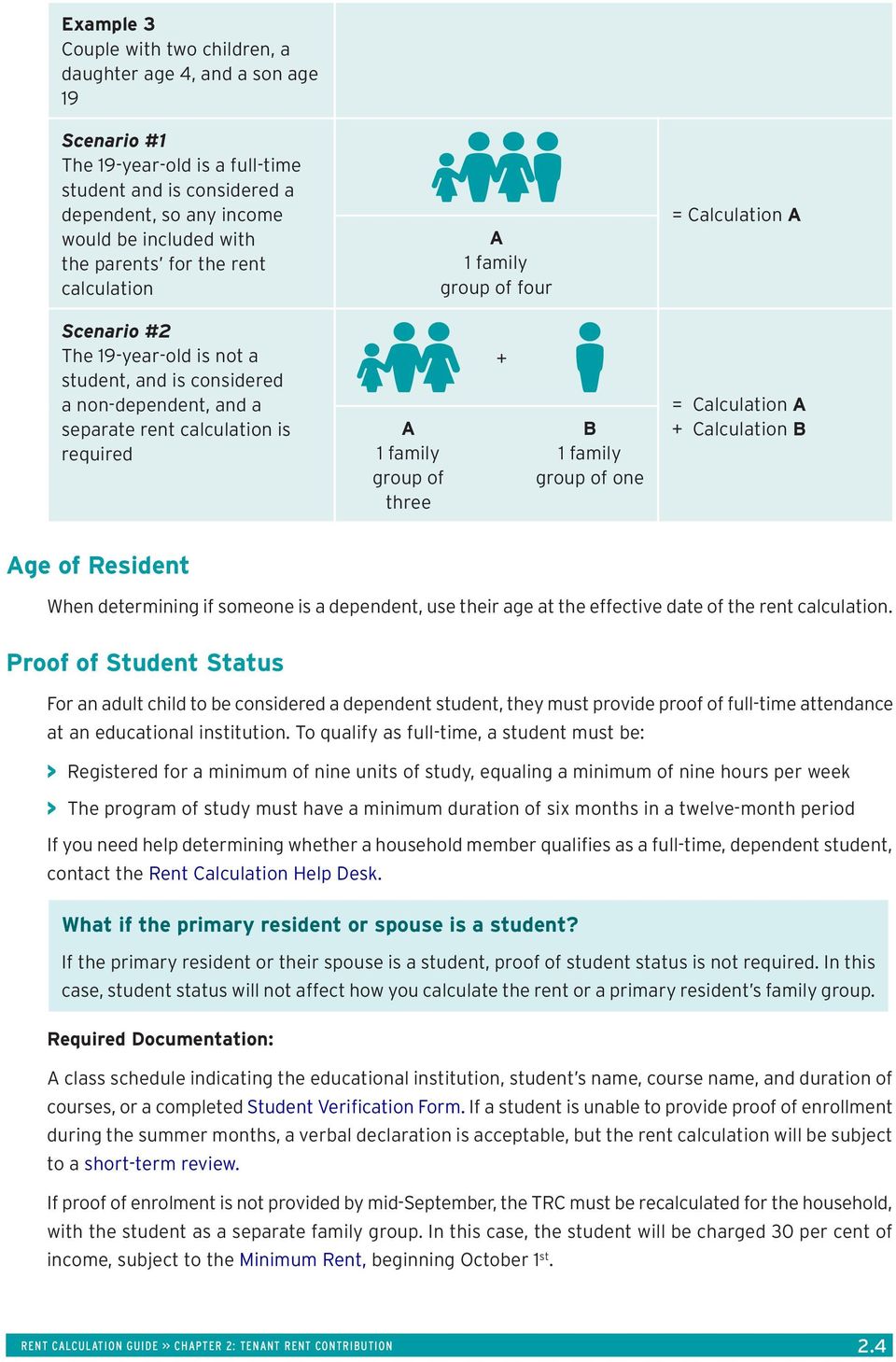
18 Example 3 Couple with two children, a daughter age 4, and a son age 19 Scenario #1 The 19-year-old is a full-time student and is considered a dependent, so any income would be included with the parents for the rent calculation A 1 family group of four = Calculation A Scenario #2 The 19-year-old is not a student, and is considered a non-dependent, and a separate rent calculation is required A 1 family group of three + B 1 family group of one = Calculation A + Calculation B Age of Resident When determining if someone is a dependent, use their age at the effective date of the rent calculation. Proof of Student Status For an adult child to be considered a dependent student, they must provide proof of full-time attendance at an educational institution. To qualify as full-time, a student must be: > > Registered for a minimum of nine units of study, equaling a minimum of nine hours per week > > The program of study must have a minimum duration of six months in a twelve-month period If you need help determining whether a household member qualifies as a full-time, dependent student, contact the Rent Calculation Help Desk. What if the primary resident or spouse is a student? If the primary resident or their spouse is a student, proof of student status is not required. In this case, student status will not affect how you calculate the rent or a primary resident s family group. Required Documentation: A class schedule indicating the educational institution, student s name, course name, and duration of courses, or a completed Student Verification Form. If a student is unable to provide proof of enrollment during the summer months, a verbal declaration is acceptable, but the rent calculation will be subject to a short-term review. If proof of enrolment is not provided by mid-september, the TRC must be recalculated for the household, with the student as a separate family group. In this case, the student will be charged 30 per cent of income, subject to the Minimum Rent, beginning October 1 st. RENT CALCULATION GUIDE >> CHAPTER 2: TENANT RENT CONTRIBUTION 2.4
19 Examples of Student Status Household Members Family Groups Proof of Student Status A couple with a 20-yearold son who is not a full-time student A 1 family group of two + B 1 family group of one n/a A couple with a 20-yearold son who is a full-time student A 1 family group of three Required A single mother who is a full-time student, with two children ages 7 and 10 A 1 family group of three Not required Co-Parenting Arrangements A child who resides with his/her parent(s) a minimum of 40 per cent of the time qualifies as a permanent member of the household, and the TRC is calculated as if the child is in the unit full-time. A child who lives in the unit less than 40 per cent of the time is not included in the rent calculation. Change in Household Composition Residents are required to advise the housing provider immediately, if someone who does not meet the definition of a spouse or dependent joins or leaves the household. Always re-calculate the TRC when anyone 19 years of age or older joins or leaves the household. Generally, no adjustment is required if a dependent joins or leaves the household, unless the change results in a decrease in household income. However, it is good practice to require residents to notify you of any change in household composition for your records. RENT CALCULATION GUIDE >> CHAPTER 2: TENANT RENT CONTRIBUTION 2.5

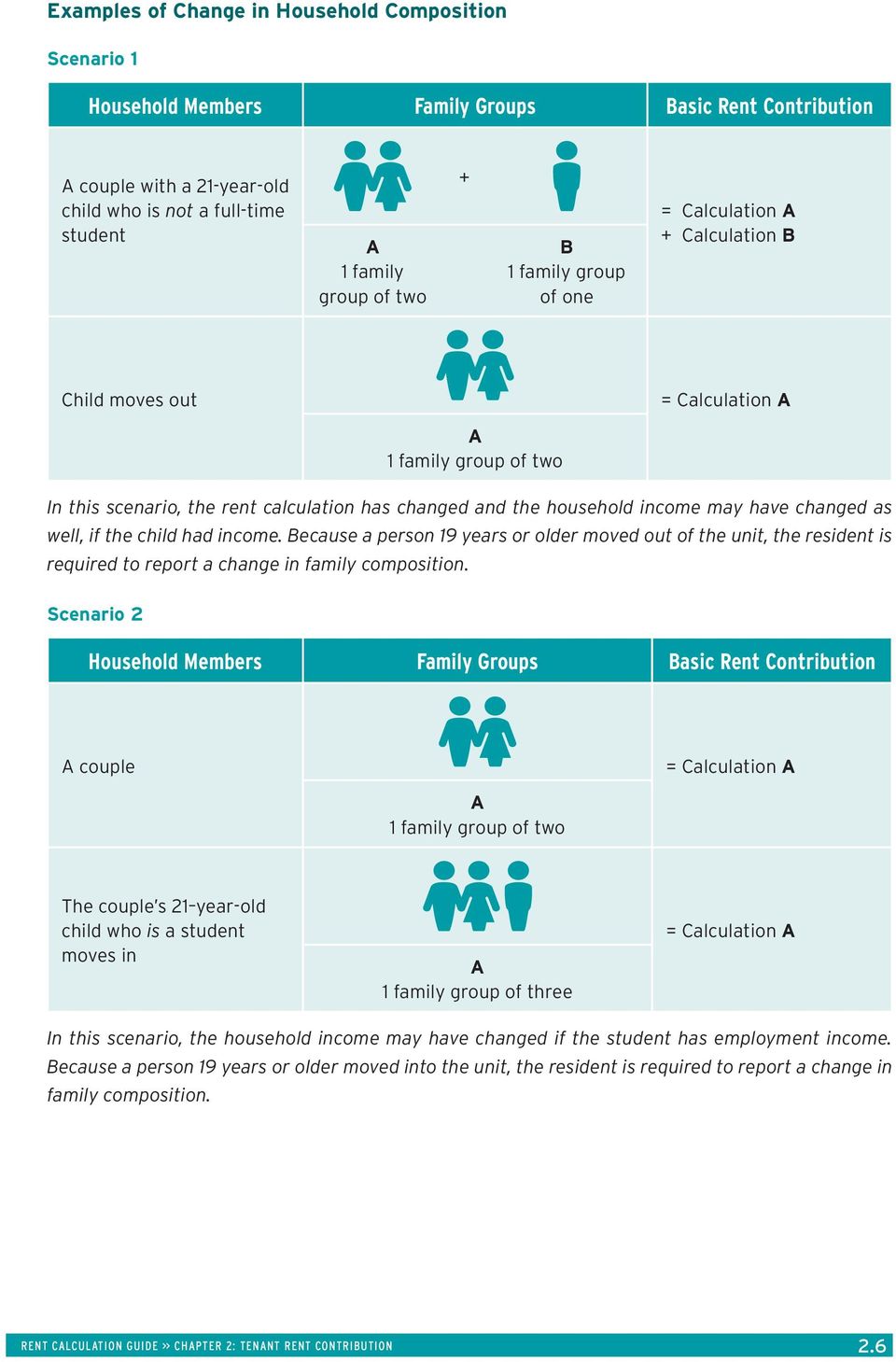
20 Examples of Change in Household Composition Scenario 1 Household Members Family Groups Basic Rent Contribution A couple with a 21-year-old child who is not a full-time student A 1 family group of two + B 1 family group of one = Calculation A + Calculation B Child moves out = Calculation A A 1 family group of two In this scenario, the rent calculation has changed and the household income may have changed as well, if the child had income. Because a person 19 years or older moved out of the unit, the resident is required to report a change in family composition. Scenario 2 Household Members Family Groups Basic Rent Contribution A couple = Calculation A A 1 family group of two The couple s 21 year-old child who is a student moves in A 1 family group of three = Calculation A In this scenario, the household income may have changed if the student has employment income. Because a person 19 years or older moved into the unit, the resident is required to report a change in family composition. RENT CALCULATION GUIDE >> CHAPTER 2: TENANT RENT CONTRIBUTION 2.6
21 Caregivers for Disabled Residents Some disabled residents require a live-in caregiver to provide care throughout the night. Caregivers are not required to contribute toward the rent if the resident has: > > A series of different overnight caregivers, none of whom live in the unit full-time > > One caregiver whose primary residence is the RGI unit and whose sole source of income comes from working as a caregiver for the resident However, a live-in caregiver who is employed elsewhere during the day is required to contribute to the rent. In this case, calculate their portion of the TRC based on any income from other employment; income earned while acting as the caregiver to the resident is exempt, as are any of the caregiver s assets. Written verification of the need for a live-in caregiver is required from a qualified professional: a doctor, nurse, home care worker, social worker, or occupational therapist. If the resident has submitted verification from another type of professional, please obtain approval from BC Housing. Determining Income Sources and Amounts Determine gross monthly income from all sources for each household member 19 years of age and older. See Appendix E Income Sources for a list of what to include and exclude when calculating gross monthly income. The TRC is always based on gross monthly income, never net income. Net income is the amount of pay after deductions like taxes, Canadian Pension Plan and Employment Insurance premiums, taxable benefits, and garnished wages. For each family group Determine Household Composition NO income from Income Assistance Determine Income Sources and Amounts Use 30% of income or minimum rent Add together rent calculation for each family group Apply surcharges/ allowances ANY income from Income Assistance Use flat rent = Basic Rent Contribution = Tenant Rent Contribution When determining income, it is good practice to check the previous Rent Form to compare all declared income sources. If any income sources declared previously are not on the current Rent Form, confirm with the resident the income from that source has ended. For example, if the resident previously declared CPP, but it is not listed on the current Rent Form, the resident likely forgot to include the CPP. Or if the resident declared employment income last year and has not listed any income this year, ask if they have applied for Employment Insurance. RENT CALCULATION GUIDE >> CHAPTER 2: TENANT RENT CONTRIBUTION 2.7
22 Important Considerations 1) Documentation Proof of income should be no more than three months old. If a resident has seasonal, fluctuating, or self-employment income, use the most recent Income Tax Return (ITR) and Notice of Assessment (NOA). If the proof of income appears incomplete or invalid, take steps to verify the information. Pay Stubs For employment income, pay stubs are generally the best proof of income as they provide the gross income, number of hours worked, and taxable benefits. Bank Statements Bank statements are typically used to determine assets and are not generally acceptable as proof of income, as they usually show the net income deposit and not the gross amount. Determine the adequacy of bank statements as proof of income on a case-by-case basis. If using bank statements as proof of income, it is advisable to obtain at least three consecutive months of bank statements. Downloaded online bank statements must clearly indicate the account number, name on the account, and all transactions. The URL should also be on the page to indicate the statement is from the original source. Exports of bank statements to software are not acceptable. When reviewing bank statements check: What name(s) is on the bank account? Is the address on the statement the same as the rental unit? Are there any unexplained transactions or inter-account transfers? Is rent being paid from this account? Does the cash flow into the account reflect the income declared? If there are unexplained transactions or other inconsistencies you may need to request other information such as additional bank statements or an Income Tax Return and Notice of Assessment to reconcile the situation. Income Tax Return (ITR) and Notice of Assessment (NOA) The ITR and NOA are not acceptable proof of income for regular employment. However, some housing providers have adopted a policy of asking residents to provide the most recent tax return before the TRC is calculated. This approach allows the housing provider to cross-reference information on the tax return to income declarations from previous years. Under certain circumstances such as someone with seasonal, fluctuating, or self-employment income it is acceptable to use the most recent ITR and NOA as proof of income, as the TRC will be based on the previous year s income. The ITR must always be accompanied by the NOA: the ITR provides the details and the NOA proves the Canada Revenue Agency accepted the ITR as submitted. Letters If accepting a letter as proof of income, the letter must contain the: Contact information for the person who signed the letter and, whenever possible, company letterhead should be used RENT CALCULATION GUIDE >> CHAPTER 2: TENANT RENT CONTRIBUTION 2.8
23 Signature of the person writing the letter Date the letter was signed Gross income, number of hours worked, taxable benefits, and frequency of pay 2) Gratuities Residents working in the service industry (restaurant servers, taxi drivers, hair stylists, etc.) usually receive tips, which are included in gross monthly income. You can estimate the monthly income from tips by asking: How much do you make in tips on an average shift? How many shifts do you work per week? Multiply the average tips per shift by the number of shifts per week and then multiply by 52. Divide this number by 12 to get an average monthly amount. 3) Frequency of Pay You need to determine the frequency of pay for any source of income before you can calculate gross monthly income, as frequency affects the income calculation. Example Gross pay per period = $300 Frequency of pay: Weekly Bi-weekly Semi-monthly Monthly Calculation: $300 x 52 pay periods 12 months $300 x 26 pay periods 12 months $300 x 24 pay periods 12 months n/a Gross monthly income: = $1,300 = $650 = $600 = $300 If the paystub does not specify frequency of pay, the most accurate way to determine frequency is to use the Canadian Pension Plan Payroll Deduction Tables. These tables indicate the CPP contribution amount based on income and frequency of pay. Compare the CPP deduction amount from the paystub to each of the tables. The table with an amount matching the deduction will show the frequency of pay. For assistance, please contact the Rent Calculation Help Desk. To order a copy of the CPP Payroll Deduction Tables, visit the Canada Revenue Agency website. 4) Student Income Students 19 years or older are required to declare all income from regular part-time or full-time employment. The following types of income are exempt for students: Income from a temporary job or increase in hours during the summer months (generally May through August, however if a student can show you that they are on a different semester system with a break elsewhere in the year, those increased hours can also be exempted) Student loans (as they are repayable) RENT CALCULATION GUIDE >> CHAPTER 2: TENANT RENT CONTRIBUTION 2.9
24 Equalization payments, scholarships and grants However, training allowances are not exempt because they are not repayable. Calculate gross monthly income for students according to the directions in the Regular Employment Income section. Income Assistance When any member of a family group receives Income Assistance, or top up from Income Assistance on other income sources, no income calculation is necessary. The rent contribution for the family group will be a Flat Rent based on family size. There is an important exception to this rule for seasonally employed residents who also receive Income Assistance. See the Seasonal or Fluctuating Employment section for more information. Required Documentation: A copy of the cheque stub indicating the Income Assistance rate, or Written verification from the Income Assistance office Regular Employment Income You can calculate gross monthly income for household members employed full or part-time using either year to date (YTD) income or a series of consecutive paystubs. Important note: When calculating gross monthly income from regular employment, it is never acceptable to use the Notice of Assessment or T4s divided by twelve (12) months. Required Documentation: At least three most recent paystubs (more may be required if the resident indicates the three most recent are not typical), or Under certain circumstances, a letter from the employer declaring gross monthly income may be acceptable, if paystubs do not accurately reflect current income. The letter must clearly indicate the gross monthly income, include the employer s business address and contact information (letterhead is preferred), and be signed and dated. In this case, a calculation is not required to determine gross monthly income. If a resident works overtime every week or receives a substantial annual bonus, include these amounts in the calculation and on the Rent Form. 1) Year to Date (YTD) Income This is the most accurate method to calculate employment earnings, because it gives an average over time that takes into account any periods where income was high or low. Some employers include YTD income on each paystub. Ensure you verify the employment start date before using this method. Generally, a verbal declaration is acceptable; however, written confirmation from the employer may be warranted if the start date is in the current calendar year. Record the employment start date on the Rent Form: RENT CALCULATION GUIDE >> CHAPTER 2: TENANT RENT CONTRIBUTION 2.10
25 1) Record the YTD gross earnings from the paystub. 2) Deduct any overtime and vacation pay, unless received on a regular, ongoing basis (check the three most recent pay stubs to determine if this is the case). 3) Deduct any taxable benefits such as a uniform allowance, meal allowance or bus fare. If taxable benefits are paid each pay period, deduct the benefits after calculating the gross income per pay period. See Canada Revenue Agency Employers Guide Taxable Benefits and Allowances for details. 4) If the resident started employment in the current year, confirm the start date and record it on the Rent Form. 5) Calculate the number of pay periods from the beginning of the year or employment start date to the date on the paystub. 6) Divide the YTD income by the number of pay periods. This gives the average gross income per pay period. 7) Use the correct formula to determine gross monthly pay using Table 1 below. Table 1 - Formulas to Determine Gross Monthly Pay Paid weekly Gross weekly pay x 52 pay periods 12 Paid bi-weekly Gross bi-weekly pay x 26 pay periods 12 Paid semi-monthly Paid monthly Gross semi-monthly pay x 2 pay periods Gross monthly pay Example of Year to Date Income A resident works full-time and submits a series of three consecutive pay stubs. The most recent paystub is dated May 26th and shows the YTD income. The paystub also shows a $10.00 uniform allowance each pay period, as a taxable benefit. The employee is paid biweekly, and began work on February 5th of the current calendar year. YTD earnings from pay stub = $7, Divide YTD earnings by number of pay periods (Feb 5 to May 26, bi-weekly pay) 8 Equals average gross income per pay period = $ Deduct uniform allowance of $10.00 per pay period Adjusted average gross income per pay period = $ Apply correct formula to calculate average gross monthly income: Multiply by frequency of pay x 26 Equals annual income = $23, Divide by 12 months 12 Average gross monthly income = $1, RENT CALCULATION GUIDE >> CHAPTER 2: TENANT RENT CONTRIBUTION 2.11
26 2) Series of Consecutive Paystubs This method takes the average income from at least three of the most recent consecutive paystubs to determine gross monthly income: 1) Record the gross pay from each paystub. 2) Deduct any overtime and vacation pay unless received on a regular, ongoing basis. 3) Deduct any taxable benefits such as a uniform allowance, meal allowance or bus fare from each paystub. See Canada Revenue Agency Employers Guide Taxable Benefits and Allowances for details. 4) Add the amount from each paystub together, after deductions for overtime, vacation and taxable benefits. 5) Divide the total by the number of paystubs to get the average gross income per pay period. 6) Use the correct formula to determine gross monthly pay (see Table 1- Formulas to Determine Gross Monthly Pay). Example of Consecutive Pay Stubs A resident who works part-time has provided five consecutive pay stubs, has not received any overtime, vacation pay or taxable benefits, and is paid semi-monthly. Total gross pay from all pay stubs = $4, Divide by total number of pay stubs 5 Equals average gross income per pay period = $ Apply correct formula to calculate average gross monthly income: Multiply by frequency of pay x 2 Average gross monthly income = $1, Self-Employment Income The procedures below explain how to calculate gross monthly income for self-employed household members according to the type of business. Important note: If the net income from self-employment is a negative amount (even after adding back wages, rent or capital cost allowance), record the self-employment income as $0.00. Losses from self-employment cannot be used to reduce income from other sources. 1) Sole Proprietorship or Partnership This type of self-employment may be referred to as doing business as a sole proprietorship or partnership. You can determine which type of ownership by looking at the Statement of Business or Professional Activities (T2125 of the Personal Tax Return) or financial statements. If the business is a sole proprietorship, the resident will have 100 per cent of the company earnings. If it is a partnership, the resident will have a percentage of the earnings (e.g., being a 50 per cent partner equals 50 per cent of the earnings). RENT CALCULATION GUIDE >> CHAPTER 2: TENANT RENT CONTRIBUTION 2.12
27 Use the Business Income Calculation Worksheet to calculate the gross monthly income from these types of self-employment. Required Documentation: T2125 Statement of Business or Professional Activities from the Personal Tax Return, and Notice of Assessment, or Financial statements if the business is in the first year of operation and a tax return has not yet been filed, as determined on a case by case basis To calculate gross monthly income for a self-employed resident, use the net business income (line 9946 of the T2125 form) and add back the following expenses: Capital Cost Allowance (line 9936, prorated to the percentage of ownership) Management fees/salaries/wages paid to any household members (lines 8871 and 9060) Rent, if the business is being operated in the RGI unit (line 8910) Business-use-of-home expenses (line 9945) Review each of the claimed expenses for reasonableness. Receipts or business bank account statements may be required to verify expenses. For example: Determine why expenses are rounded to the nearest dollar, if this occurs. If no or limited vehicle expenses are coming from personal account(s), determine the average weekly percentage of personal use of the business vehicle. Add this back to the income. If no or limited grocery purchases are coming from the personal account, ask whether personal grocery purchases are being expensed under meals and entertainment and/ or advertising for the business. Add back to the income any amount of declared grocery expenses you cannot link to the personal bank account(s). 2) Limited or Incorporated Company If the business name is followed by Limited (Ltd.) or Incorporated (Inc.), the business is a separate legal entity required to submit a corporate tax return each year. The resident may receive income from the company in the form of dividends, management fees, salary and bonus, which will be reported on their personal Income Tax Return. As such, the company income is not the income of the resident who owns the company: the resident is paid as an employee of the company. In addition to receiving employment income from the company, the resident will be a shareholder. As a result, the company value is considered an asset and income must be calculated from this asset (see Income from Assets). Report personal income declared by the resident and income from the asset on the Rent Form. Required documentation: Corporate Notice of Assessment, and T1178 General Index of Financial Information short form, and T2 Schedule 1, and T2 Corporate Tax Return, and T2 Schedule 50 Shareholder Information (if the resident owns less than 100 per cent of the company), or RENT CALCULATION GUIDE >> CHAPTER 2: TENANT RENT CONTRIBUTION 2.13
28 Financial statements if the business is in the first year of operation and a tax return has not yet been filed, as determined on a case by case basis Calculate income from this type of self-employment using the same steps as Regular Employment Income. If the resident is unable to provide copies of cheque stubs, you can calculate average gross monthly income using the Income Tax Return and Notice of Assessment from the previous year. Use the Self-Employed Limited (Ltd.) or Incorporated (Inc.) Worksheet to calculate the value of the tenant s assets in the company. If the resident and/or spouse are the only shareholders in the company, consider the retained earnings and/or shareholder loan as an asset when calculating the TRC. If there are other shareholders, identify the percentage of shares the resident and/or spouse hold, and include a proportionate amount of the retained earnings. Also check the corporate tax return to determine whether any portion of the shareholder loan belongs to another shareholder. Employment Insurance Income Calculate gross monthly income from Employment Insurance (EI) based on: 1) EI as the sole source of income 2) EI plus employment income 3) A new application for EI Any rent calculation involving EI income is subject to a short-term review, usually six months or when EI ceases, whichever is less. Required Documentation: EI payment stub showing gross weekly rate, or Letter from Service Canada stating the gross weekly rate, or Print out from a Service Canada online account stating the gross weekly rate (this must show the URL, date and time printed) Housing providers must determine how long a resident has been receiving EI. If someone declared EI on the previous year s Rent Form, this may indicate seasonal or fluctuating employment. See Seasonal or Fluctuating Employment Income for more details. 1) EI as the Sole Source of Income EI is considered the sole source of income if a resident has not received any other income during the calendar year. 1) Determine the gross weekly EI rate. 2) Multiply the gross weekly rate by 52 (weeks), and divide by 12 (months) to calculate the gross monthly income. RENT CALCULATION GUIDE >> CHAPTER 2: TENANT RENT CONTRIBUTION 2.14
29 Example of Employment Insurance Gross weekly rate = $345 Multiply by 52 weeks x 52 Equals total gross annual EI income = $17,940 Divide by 12 months 12 Average gross monthly income = $1,495 2) EI plus Employment Income People receiving EI can earn up to 25 per cent of their weekly rate without affecting their benefits. In this case, the payment stub will list deductions for employment. Perform the following calculation only if the deduction is 25 per cent or greater and is shown on the EI payment stub. Otherwise, perform separate calculations for EI and regular employment income. 1) Determine the gross weekly rate of EI from the payment stub or letter/print out from Service Canada. 2) Multiply the gross weekly rate by 125 per cent (regardless of per cent earned) to determine the maximum allowable weekly income from EI and employment. 3) Multiply this amount by 52 (weeks) to get the gross annual income. 4) Divide by 12 (months) to arrive at the gross monthly income. Example of EI plus Employment Income Gross weekly rate = $345 Multiply by 125 per cent x 125% Maximum allowable weekly income = $ Multiply by 52 weeks x 52 Gross annual income =$22,425 Divide by 12 months 12 Gross monthly income = $1, ) New Application for EI A resident may have applied for Employment Insurance, but documentation showing the benefit rate is not yet available. In this case, you can calculate an estimated weekly EI rate based on the Record of Employment or a series of consecutive pay stubs from the resident s last employer. When you use this method to estimate income for new EI applicants, you need to re-calculate gross monthly income once a resident receives the first EI cheque. If the EI payment is higher than estimated, adjust the TRC for the first of the month following the date the payment was received. If the EI payment is lower than estimated, adjust the TRC retroactively to the effective date of the first calculation. RENT CALCULATION GUIDE >> CHAPTER 2: TENANT RENT CONTRIBUTION 2.15
30 Estimating EI gross monthly income from a Record of Employment: 1) Determine the frequency of pay. 2) Determine how long the resident was employed at this job. 3) Find the total insurable earnings. 4) Calculate the average gross pay per period using the following formulas: Paid weekly Paid bi-weekly Paid semi-monthly Paid monthly Total insurable earnings 27 (or number of weeks worked if fewer than 27) Total insurable earnings 14 (or number of bi-weekly periods the resident worked if fewer than 14) Total insurable earnings 13 (or number of semi-monthly periods the resident worked if fewer than 13) Total insurable earnings 7 (or number of months the resident worked if fewer than 7) 5) Use the correct formula to determine gross monthly pay as outlined in Table 1 Formulas to Determine Gross Monthly Pay. 6) Multiply the gross monthly income by 55 per cent to get the estimated gross monthly income from EI. Estimating gross monthly income from paystubs: 1) Follow the steps outlined under Regular Employment Income to determine gross monthly income. 2) Multiply the gross monthly income by 55 per cent to get the estimated gross monthly income from EI. EI Waiting Period Individuals who apply for EI typically encounter a waiting period of up to two weeks during which no income is received. No adjustment to the TRC is made because of this wait. Seasonal or Fluctuating Employment Income A person who has seasonal or fluctuating employment may work in an industry that offers employment for only a portion of the year. Examples include: > > Employment in seasonal industries such as tourism, fishing, or forestry > > Employees of a board of education (i.e., caretakers, teacher s aides) > > On-call workers > > Commissioned salespeople whose income varies from one month to the next > > Employment in the construction industry where employees often have multiple employers during the year, periods with no income, or periods involving EI As a result, the employee s annual income may be a combination of regular employment income and Employment Insurance or Income Assistance. RENT CALCULATION GUIDE >> CHAPTER 2: TENANT RENT CONTRIBUTION 2.16
31 You can eliminate the need for multiple adjustments to the TRC during the year by using either the previous year s ITR and NOA or year-to-date income for residents with seasonal/fluctuating employment: > > If the resident worked in the same seasonal/fluctuating employment situation the previous year, calculate average gross monthly income using the previous year s ITR and NOA > > If the resident started seasonal or fluctuating employment during the current calendar year, calculate average gross monthly income using year-to-date income Required Documentation: > > ITR and NOA from Canada Revenue Agency for the most recent tax year, and proof of the number of months employed during the tax year (Record of Employment or letter from employer), or > > A series of at least three consecutive pay stubs and proof of any income from EI/IA 1) Previous Year s ITR and NOA Use this method when monthly income regularly changes, but results in approximately the same annual income: 1) Verify the number of months the resident was employed. 2) If applicable, verify the number of months the resident received Employment Insurance or Income Assistance. 3) Calculate the annual gross income from all sources, including employment income, Employment Insurance and Income Assistance. 4) Divide the amount by 12 months to get the average gross monthly income. 2) Year-to-Date Income Use this method if a resident recently began working in seasonal or fluctuating employment, or if the previous year s ITR does not accurately reflect the current year s earnings: 1) Calculate the average gross monthly income from employment using the year-to-date method outlined in the Regular Employment Income section. 2) If the resident also received Employment Insurance, calculate the gross monthly income from EI using the EI plus Employment Income method, and add this amount to the gross monthly income from employment. RENT CALCULATION GUIDE >> CHAPTER 2: TENANT RENT CONTRIBUTION 2.17
32 Example of Income Calculation for a Resident with Fluctuating Employment The resident is employed in a new on-call position and the previous year s ITR does not accurately reflect current income. Consequently, the resident submitted three consecutive pay stubs. The most recent pay stub is dated May 26 th and shows the YTD gross income. The resident is paid bi-weekly and commenced employment on February 5 th of the current calendar year. YTD gross earnings from pay stub = $6, Divide by number of pay periods (Feb 5 to May 26, bi-weekly pay) 8 Average gross income per pay period = $ Apply correct formula to calculate average gross monthly income: Multiply by frequency of pay x 26 Annual pay = $21, Divide by 12 months 12 Average gross monthly income = $ 1, Seasonally Employed Residents Receiving Income Assistance Seasonally employed residents who also receive Income Assistance are not automatically charged the Flat Rent for Income Assistance recipients. First, calculate 30 per cent of gross monthly income for the family group for the period the resident received Income Assistance: > > If Income Assistance was received for more than six months, compare 30 per cent of income to the Flat Rent and charge the higher of the two > > If Income Assistance was received for less than six months, compare 30 per cent of income to the Minimum Rent and charge the higher of the two Example of Income Calculation for a Seasonally Employed Resident A seasonally employed resident worked for four months and collected Income Assistance for eight months. The resident s family group is six people, and no other family member earned income. Employment income = $9, Income Assistance + $7, Total income = $17, Divide by 12 months 12 Average gross monthly income = $1, In this scenario, 30 per cent of income is compared to the Flat Rent for the family size because Income Assistance was received for more than six months of the year, and the family group is charged the higher of the two amounts. See Calculating Tenant Rent Contribution. RENT CALCULATION GUIDE >> CHAPTER 2: TENANT RENT CONTRIBUTION 2.18
33 Child Support Income Child support is money a non-custodial parent pays to the parent with custody to help support their child. A child support order or agreement specifies how much one or both parents need to pay in child support. It may be a separate order or agreement, or may form part of a larger divorce order or separation agreement. Include child support as income and convert the amount to gross monthly income. Required Documentation: Confirmation of child/spousal support from the Family Maintenance Enforcement Program, or Court order, agreement or other legal documentation, or Three consecutive bank statements showing deposits, or If the resident is declaring child support on the tax return, the Income Tax Return and Notice of Assessment from the most recent tax year It may not be possible for the resident to provide proof if child support is not court ordered and the parent paying child support is unwilling to provide documentation. In this case, a review of bank statements and a written declaration from the resident is acceptable. The Family Maintenance Enforcement Program (FMEP) is available to anyone who needs assistance collecting child support. Residents on Income Assistance while receiving child support are required to take part in FMEP and may remain on the program even if they no longer require Income Assistance. FMEP deposits are clearly marked on bank statements. FMEP statements can be used as proof of child support income, and also to show there has been a reduction in the amount of child support or the payments/amounts are inconsistent. If child support payments are sporadic or vary in amount from month to month, you can calculate a monthly average by adding the support payment amounts received over the past three to twelve months (use the maximum available) and dividing by the total number of months. Example of Child Support Calculation Child support payments are sporadic and vary in amount. A court order is not in place, and the applicant has provided three consecutive bank statements and a verbal declaration as proof of income. Child support payments: Month 1 $ 275 Month 2 $ 0 Month 3 $ 190 Total for all months: = $ 465 Divide by number of months: 3 Average monthly income: = $155 RENT CALCULATION GUIDE >> CHAPTER 2: TENANT RENT CONTRIBUTION 2.19
34 Make a note on the Rent Form if child support has ended, and obtain acceptable proof to keep on file. Proof that child support has ended: Pension Income An FMEP statement showing child support has ended, or Six months of bank statements showing no child support deposits and a self-declared letter stating child support benefits ended (which must be noted on the Rent Form), or Evidence that the child is no longer a dependent, or Evidence that the non-custodial parent is deceased There are many types of pension income, including: > > Old Age Security (OAS), Guaranteed Income Supplement (GIS), Allowance, and Allowance for the Survivor (formerly Spousal Allowance) > > Canada Pension Plan, including retirement, disability, orphans, widows, etc. > > War Veterans Allowance (WVA) and Disability Allowance from War Veteran s Affairs Canada > > Senior s Supplement > > Private pension plans including Registered Retirement Income Funds (RRIF) > > Foreign pensions List all sources of pension income separately on the Rent Form. 1) Pensions from Canadian Sources Public pension plans such as OAS, GIS and CPP will not usually have taxes deducted, but many private pension plans will. It is important to use the gross monthly pension income whenever possible. Required Documentation: > > Current letter of entitlement from each pension provider. For public pensions, the applicant has to request a Pension Rate Letter from the federal government, showing all pension income including OAS, GIS and CPP, and submit this letter, or > > Copy of the pension cheque or cheque stub showing the gross amount, or > > Copy of bank statements or bank book showing pension deposits. This is the least desirable form of proof, as it will show net amounts, and should only be accepted when other forms of proof do not exist due to the nature of the pension; for example, a private pension that does not provide cheque stubs or statements. Follow the steps in the Regular Employment Income section to calculate the gross monthly income from pensions. When a resident turns 65 and starts receiving pension income, a review of the TRC is not necessary unless income decreases. RENT CALCULATION GUIDE >> CHAPTER 2: TENANT RENT CONTRIBUTION 2.20
35 2) Foreign Pensions Required Documentation: > > Previous year s Income Tax Return and Notice of Assessment, or > > Rate letter from pension provider, or > > Pension cheque or cheque stub, or > > Bank statement showing deposits If included in the previous year s Income Tax Return, the pension will already have been converted to Canadian dollars. Use the amount declared on line 115 of the Income Tax Return and divide by 12 to get the gross monthly income. Convert pensions received in foreign currency to Canadian dollars using the Bank of Canada s exchange rates in order to calculate gross monthly income. If the pension is paid out in one annual lump sum, use the Bank of Canada s 10-year currency converter and select the date that corresponds to the date of the deposit or cheque. For pensions received throughout the year, use the average annual exchange rate (for the previous year) or most recent monthly exchange rate (for the current year). A list of monthly and annual average exchange rates is available from the Bank of Canada. Because fluctuating exchange rates can impact the value of a foreign pension, you need to recalculate the current monthly income from the pension in Canadian dollars at each regularly scheduled review. A change in monthly income from a foreign pension due to a fluctuation in exchange rates does not warrant an additional adjustment to the TRC between scheduled reviews, unless it causes hardship. However, an adjustment can be made if the base rate of the pension changes. Family and Other Support All regular financial support from family, friends, community groups etc. must be included in the gross monthly income calculation, including any money given to students by family members. Rental Income If a resident owns residential or commercial property that generates rental income, include the higher of the following amounts in the income calculation: > > An Imputed Income based on the value of the property, or > > The actual rental income generated (Real Monthly Income) See Income from Assets below for more information. Other Income Sources If a resident has a source of income not covered in any of these procedures, use the procedure that seems most suitable. If you are unsure how to proceed, please contact the Rent Calculation Help Desk for assistance. RENT CALCULATION GUIDE >> CHAPTER 2: TENANT RENT CONTRIBUTION 2.21
36 No Income There are very few situations where a family group lives with no income. Residents are expected to maximize income from all available sources, including Income Assistance or Employment Insurance. Required Documentation: > > Proof the resident is not eligible for Income Assistance or Employment Insurance, as applicable > > Income Tax Return and Notice of Assessment for all members of the household 19 years of age and older, including students > > Bank statements for all members of the household 19 and older, including students (see Important Considerations for tips on reviewing bank statements) Ask residents the following questions: > > Does anyone in your household have seasonal or fluctuating employment? If they answer yes, see the Seasonal or Fluctuating Employment Income section for information on calculating the TRC from this type of employment. > > Have you applied for Employment Insurance or Income Assistance? > > How do you pay your day-to-day expenses? > > How are you paying rent? > > How are you buying groceries? > > How do you pay for your vehicle (if applicable)? > > When did you last have income? What was it? If the resident claims they do not have a bank account ask: > > How do you cash your GST/HST rebate cheque, Child Tax Benefit, etc.? > > Do you use a payday loan or cheque cashing service (i.e., Money Mart)? If the family group still appears to have no income, charge the Minimum Rent based on the number of people in their family group, and set the TRC as short-term, to be reviewed within six months or less. Income from Assets Assets are possessions with the potential to earn income, either now or in the future. When a family group has assets worth more than $10,000, include in gross income the greater of the: > > Imputed Income earned on those assets, or > > Real Monthly Income generated by the assets See Appendix F Asset Types, for a list of included and excluded assets. Personal Belongings Personal belongings such as furniture, jewelry, clothing or cars are not included as assets. Required Documentation: The proof required depends on the type of asset(s), but will often include: > > Bank statements RENT CALCULATION GUIDE >> CHAPTER 2: TENANT RENT CONTRIBUTION 2.22
37 > > Appraisal valuations (foreign property, etc.) > > Income Tax Return and Notice of Assessment > > Investment statements > > BC Property Assessment > > Mortgage statements Imputed Income from Assets Use the imputed rate of return to calculate an Imputed Income from all household assets, less $10,000. BC Housing reviews the Imputed Rate of Return annually, and adjusts it periodically. See Appendix C for current and past rates. To calculate the Imputed Income from assets: 1) Add up the value of all assets and record this amount on the Rent Form: a) If the total is $10,000 or less, there is no need to calculate income from assets. b) If the total is greater than $10,000, deduct $10,000 (the asset exemption) to get the net value of the assets. 2) Multiply the net value of the assets by the imputed rate of return and divide by 12 to arrive at the monthly income from assets. Example of Imputed Rate of Return The resident has $10,000 in a Tax-Free Savings Account and $7,500 in Guaranteed Investment Certificates (GICs). Total assets from all sources: $17, Less asset exemption $10, Net Assets = $7, Multiply by imputed rate of return x 1% (as of Oct 2012) Annual income from assets = $75.00 Divide by 12 months 12 Monthly income from assets = $6.25 Real Monthly Income from Assets If an asset produces a Real Monthly Income, such as a rental income from a property or a dividend from a stock or bond, use the higher of the Real Monthly Income or the Imputed Income on the asset, not both. Proof of the asset value and income generated by the asset are required (e.g., an Income Tax Return, investment statement, BC Property Assessment, or mortgage statements). 1) Determine the net amount of Real Monthly Income generated by the asset (for example, gross monthly rental income less the mortgage payment on the property). RENT CALCULATION GUIDE >> CHAPTER 2: TENANT RENT CONTRIBUTION 2.23
38 2) Determine the net value of the asset (for example, assessed value less outstanding mortgage balance) and multiply it by the imputed rate of return. Divide this amount by 12 to arrive at the Imputed Income from the asset. 3) Use the higher of the Real Monthly Income or the Imputed Income: a) If using the Real Monthly Income, include this amount in the income section of the Rent Form, and exclude the value of this asset from any other asset calculations. b) If using the Imputed Income, add the value of this asset to any other assets and then calculate the Imputed Income on the total value of all assets. Example of Real Monthly Income The resident owns a $300,000 home, with an outstanding mortgage balance of $210,000 and a monthly mortgage payment of $860. The property is currently rented for $1,000 per month. Real Monthly Income Monthly rental income $1,000 Less mortgage payment - $860 Monthly income = $140 Imputed Income Versus Value of property $300,000 Less outstanding mortgage balance - $210,000 Less asset exemption - $10,000 Net value of asset = $80,000 Multiply by imputed rate of return x 1% (as of Oct 2012) Annual income from asset = $800 Divide by 12 months 12 Monthly income from asset = $66.67 The Real Monthly Income is greater than the Imputed Income. Therefore, the gross monthly income from this asset ($140) is included as income on the Rent Form, and the value of this asset ($300,000) is excluded when calculating the Imputed Income from any other assets. If you have questions, please contact the Rent Calculation Help Desk for assistance. Asset Disposal Advise residents their TRC can be adjusted to a lower amount only once each year, based on a maximum decrease of $10,000 in assets. Any amount of asset disposal over $10,000 will not be included in the revised TRC, unless residents prove they have suffered a devaluation of a stock portfolio, or they have used the proceeds for personal benefit, such as purchasing a car or taking a holiday. Assets given as a gift to another family member do not count as an allowable decrease. RENT CALCULATION GUIDE >> CHAPTER 2: TENANT RENT CONTRIBUTION 2.24
39 For example, if a resident declared $200,000 of assets in one year and $50,000 the next year, a maximum decrease of $10,000 would be applied and the estimated value of the asset for the subsequent year would be $190,000, unless proof is provided showing a stock portfolio devaluation or the decrease was for personal benefit. Calculating Tenant Rent Contribution The rent calculation for each family group is based on the source of income: > > Charge family groups receiving any Income Assistance a Flat Rent based on family size > > Charge family groups with no Income Assistance the greater of 30 per cent of gross family group income, or Minimum Rent based on family size Add the rent contribution for each family group together to obtain the Basic Rent Contribution for the household. Then adjust the Basic Rent Contribution for any heat allowance and/or other surcharges to obtain the TRC. When no heat allowance or surcharge applies, the TRC will equal the Basic Rent Contribution. 1) Perform the rent calculation for each family group With Any Income Assistance BC residents are entitled to a guaranteed minimum income through provincial government Income Assistance (BC Employment and Assistance program). Some households may earn some income and receive Income Assistance. If a family group has received any Income Assistance, the rent calculation is equal to the Flat Rent based on family size (See Appendix B). Note any other sources of income for these residents for the record, but you do not need to verify them. For each family group Determine Household Composition NO income from Income Assistance Determine Income Sources and Amounts Use 30% of income or minimum rent Add together rent calculation for each family group Apply surcharges/ allowances ANY income from Income Assistance Use flat rent = Basic Rent Contribution = Tenant Rent Contribution RENT CALCULATION GUIDE >> CHAPTER 2: TENANT RENT CONTRIBUTION 2.25
40 Example of Households Receiving Income Assistance Scenario Household Composition Family Size Income Source Flat Rent 1 Basic Rent Contribution Example 1 Single parent with three children, aged 10, 14 and 17 4 Income Assistance $635 $635 Example 2 Individual resident, aged 63 1 CPP/Income Assistance $320 $320 Example 3 Two parents with two children, aged 15 and 20 (the 20-year-old is not a full-time student) A 3 1 Income Assistance Income Assistance $595 $320 $915 B Example 4 Two parents with four children, aged 3, 5, 8 and 19 (the 19-yearold is a full-time student) 6 Income Assistance/ Employment $715 $715 Example 5 Single parent with one child, aged 2, and the resident s 73-year-old mother A B 2 1 Income Assistance/ Child support Pension Income $510 30% of income or Minimum Rent $510 + Rent Calculation B With No Income Assistance When a family group does not receive Income Assistance, the rent calculation is equal to 30 per cent of gross monthly income or the Minimum Rent (See Appendix B) based on family size, whichever is greater. The Minimum Rent is the least amount a family group will contribute towards rent and is based on family size. If 30 per cent of a family s gross monthly income is less than the Minimum Rent, the Minimum Rent applies. 1 See Appendix B for the Flat Rent table. RENT CALCULATION GUIDE >> CHAPTER 2: TENANT RENT CONTRIBUTION 2.26
41 For each family group Determine Household Composition NO income from Income Assistance Determine Income Sources and Amounts Use 30% of income or minimum rent Add together rent calculation for each family group Apply surcharges/ allowances ANY income from Income Assistance Use flat rent = Basic Rent Contribution = Tenant Rent Contribution Minimum Rent applies only to family groups where none of their income is from Income Assistance. However, an exception is made for Seasonal or Fluctuating Employment Income. Employment Allowance Each actively employed resident is eligible for an employment allowance of $200 per month for each month that they attend work, to offset the costs of going to work. You deduct this allowance from the gross monthly income for each employed member of a household, before calculating 30 per cent of income. If a working resident earns less than $200 per month, the employment allowance matches their monthly income. For example, if someone earns $180 per month, the employment allowance will be $180. If a resident receives employment income from more than one source, the maximum allowance per person remains $200. Residents with income from both EI and employment are entitled to the Employment Allowance. However, residents receiving only EI and no income from employment are not eligible. For residents with seasonal or fluctuating employment, you calculate the monthly employment allowance by multiplying the monthly entitlement (up to $200) by the number of months the resident was employed during the previous year, and then dividing by 12. In order to qualify for the employment allowance, residents with fluctuating employment must be ready to work (i.e., on call), but not laid off or collecting EI. Perform the rent calculation: 1) For each family group member, add the calculated monthly income from all sources and deduct the employment allowance, if applicable. 2) Add the gross monthly income of all family group members. 3) Multiply by 30 per cent. 4) Compare this amount to the corresponding Minimum Rent based on family group size, and use the higher amount. RENT CALCULATION GUIDE >> CHAPTER 2: TENANT RENT CONTRIBUTION 2.27
42 Example of Households with Income from Employment and Other Sources Scenario Household Composition Family Size Income Source Rent Calculation 2 Basic Rent Contribution Example 1 Couple and two children, age 15 and 21 (the 21-yearold is not a student) A 3 Employment 1 None $140 30% of total income or $257, whichever is higher 30% of total income or $257, whichever is higher + $140 B Example 2 Single parent with three children, ages 2, 4 and 15 4 Employment 30% of total income or $308, whichever is higher 30% of total income or $308, whichever is higher Example 3 Single parent with three children ages 6, 19 and 21 (the 21-year-old is a full-time student and employed part-time; the 19-year-old is unemployed) A B 3 Employment 1 Income Assistance 30% of total income (including student s) or $257, whichever is higher $320 30% of total income or $257, whichever is higher + $320 2 See Appendix B for the Minimum Rent Table RENT CALCULATION GUIDE >> CHAPTER 2: TENANT RENT CONTRIBUTION 2.28
43 For each family group Determine Household Composition NO income from Income Assistance Determine Income Sources and Amounts Use 30% of income or minimum rent Add together rent calculation for each family group Apply surcharges/ allowances ANY income from Income Assistance Use flat rent = Basic Rent Contribution = Tenant Rent Contribution 2) Calculate the Basic Rent Contribution for the entire household Add together the rent calculation for each family group in the household. 3) Calculate the Tenant Rent Contribution Adjust the Basic Rent Contribution for any applicable heat allowance and/or other surcharge. Heat Allowance In housing developments that bill each unit separately for heating and the household is responsible for paying their own heat, apply a heat allowance according to unit size, type of heat and location (including households receiving Income Assistance). Current Monthly Heat Allowance Rates are included in Appendix D. Some programs cap rent at the market rent (see the Program Guide for details). In this case to be eligible for the heat allowance, 30 per cent of household income must be less than or equal to the market rent plus the heat allowance. For example: A resident lives in a three-bedroom unit in Vancouver, where rent is capped at a market rate of $1,200. The heat allowance for this unit is $66. The market rent plus the heat allowance is equal to $1,266. Therefore: > > If 30 per cent of income is less than or equal to $1,266, the resident is eligible to receive the heat allowance > > If 30 per cent of income is greater than $1,266, the resident is not eligible to receive the heat allowance Surcharges Some developments may have additional charges residents have to pay, such as parking, laundry, cable or utilities. RENT CALCULATION GUIDE >> CHAPTER 2: TENANT RENT CONTRIBUTION 2.29
44 > > BC Housing Directly Managed Developments - If a resident in a BC Housing directly managed development is responsible for a surcharge, add this amount to the Basic Rent Contribution. > > Non-profit and Co-op Buildings - For non-profit and co-operatives, most surcharges are not included on the Rent Form, because they would reduce subsidy to the development. If you are unsure whether to include a surcharge on the form, please contact the Rent Calculation Help Desk. RENT CALCULATION GUIDE >> CHAPTER 2: TENANT RENT CONTRIBUTION 2.30
45 Chapter 3 Online Rent Calculation Housing providers use the same TRC calculation outlined in chapter two for online rent calculation. The benefits of online rent calculation include: > > Greater efficiency and reduced paperwork: Housing providers print Rent Forms pre-populated with tenant names and building information, enter rent calculation data as soon as received, and do not need to send completed Rent Forms to BC Housing > > Fewer rent calculation errors: The system applies many of the rent calculation rules, and errors are identified during the data entry process > > Increased security of residents personal information > > Access to real-time resident rent and rent subsidy reports The following diagram outlines the online rent calculation process: Rent Calculation Process Housing Provider Print the Rent Form directly from Housing Connections Distribute the Rent Forms to residents Review the Rent Form and supporting documents Enter the information into Housing Connections; the TRC is calculated automatically Sign the Form Print the Tenant Rent Report Letter and give to resident File Rent Forms, supporting documents, and Tenant Rent Report Letter Resident Complete the Rent Form Submit the Rent Form and supporting documentation to the Housing Provider Provide more information or supporting documents if requested Housing providers have to sign an Online Rent Calculation agreement before gaining access to the system, and each user receives training and signs a password agreement. You are responsible for entering accurate information into the system in a timely manner, as this data will directly affect subsidy administration. BC Housing will conduct random audits of rent calculations and may request additional information from to verify the accuracy of information entered in the system or to make revisions. If you are interested in becoming an online rent calculation user, please contact the Rent Calculation Help Desk or your NPPM for more information. RENT CALCULATION GUIDE >> CHAPTER 3: ONLINE RENT CALCULATION 3.1
46 Chapter 4 Verification Audit BC Housing performs verification audits to ensure: > > Resident incomes and assets are fully declared > > Rent calculation guidelines are applied consistently > > Residents are paying the correct TRC Audit Selection BC Housing uses two methods to select residents for a verification audit: 1) Random: BC Housing may randomly select a number of residents for audit. 2) Requests: If there is reason to believe a resident has not fully declared household income and/ or assets. Generally, we will not conduct an audit for situations related to property management or under the jurisdiction of the Residential Tenancy Act. For example: > > The resident is not compliant with the annual review process > > There are undeclared residents living in the unit > > The resident is over-housed > > There is reason to believe the resident is engaging in illegal activities You can address these situations through provisions in the tenancy agreement and the Residential Tenancy Act. See Chapter 5 When Eligibility for Subsidy Ends for more information on noncompliance and over-housed situations, or the Resident Management Guide for more information on tenancy agreements, the Residential Tenancy Act, and ending a tenancy. If you are uncertain what steps to take, please contact your NPPM for assistance. Requesting an Audit To request an audit, please [email protected] or call or , and ask for the Internal Audit department. For requests, please include your name, contact information, reason for request, and the resident s name and address. RENT CALCULATION GUIDE >> CHAPTER 4: VERIFICATION AUDIT 4.1
47 CHAPTER 5 When Eligibility for Subsidy Ends Each time you re-calculate a household s TRC, eligibility for subsidy is re-assessed. See When to Calculate Tenant Rent Contributions for information. Maintain written copies of all requests for information regarding ongoing eligibility. The main reasons a resident may no longer be eligible for an RGI unit are: > > A change in household composition, resulting in the resident being over-housed > > A resident or adult household member is not compliant with the requirement to complete, sign and submit the Rent Form > > A resident or adult household member is not compliant with the requirement to provide acceptable proof of income or assets > > A resident or household member is not compliant with the requirement to provide adequate information on who is residing in the unit > > In certain cases, the household s income has changed and now exceeds the Housing Income Limits (HILs) Residential Tenancy Act Section 49.1 of the Residential Tenancy Act (RTA) states: a landlord may end the tenancy of a subsidized rental unit by giving notice to end the tenancy if the tenant or other occupant, as applicable, ceases to qualify for the rental unit. This allows housing providers to end a tenancy in an RGI unit with a minimum of 60 days notice, if the resident is no longer eligible for the subsidized unit. See the Resident Management Guide for more information on ending a tenancy. When you issue a Notice to End Tenancy under Section 49.1 of the RTA, the resident is required to continue paying the current TRC, and BC Housing will continue to provide subsidy based on this amount until the tenancy ends. If the resident does not pay the TRC as required, the housing provider can issue a 10-day Notice to End Tenancy. For developments with a mix of RGI and market units, you can elect to convert the RGI tenancy to a market tenancy when a resident is no longer eligible for an RGI unit. To make this change, issue a Notice to End Tenancy under Section 49.1 of the RTA and, at the same time, advise the resident they may enter into a new market tenancy for the unit. Housing Co-ops The RTA does not govern members living in housing cooperatives. If a co-op member no longer qualifies for an RGI unit, subsidy for that unit may be withdrawn, and the member required to pay the full market housing charge. RENT CALCULATION GUIDE >> CHAPTER 5: WHEN ELIGIBILITY FOR SUBSIDY ENDS 5.1
48 Over-housed A household with too many bedrooms for the household size, based on the National Occupancy Standards, is over-housed. BC Housing will continue to provide subsidy to an over-housed resident who: > > Has agreed to transfer to an appropriately sized unit, and > > Is on an internal transfer list with the housing provider, or > > Has applied for a transfer through The Housing Registry You need to develop your own policies and procedures for over-housed tenants. If the policy allows an over-housed resident to remain in the unit while waiting to transfer, you must begin the process to transfer the resident to an appropriately sized unit. You can either put the resident on an internal transfer list (if there is an appropriately sized unit in your portfolio), and/or have the resident apply for a transfer through The Housing Registry. For tenancies governed by the RTA, issue a Notice to End Tenancy according to Section 49.1 if an over-housed resident is not compliant with the requirement to transfer to a qualifying unit. See the Resident Management Guide for more information on over-housed situations. Co-ops should withdraw subsidy if an over-housed member is not compliant with the requirement to transfer to a qualifying unit, but the member has the option of remaining in the unit and paying the market housing charge. When Income Exceeds the Housing Income Limits BC Housing does not require housing providers to end a tenancy if the household s income exceeds the Housing Income Limits (HILs). However, many housing providers have policies to end a tenancy for this reason. If your policies do not require a household to vacate the unit if income exceeds the HILs, you have to continue calculating TRC based on gross household income. As a result, the household could be charged a TRC that is capped at, or exceeds, market rent, depending on the household income and housing program. Please refer to your operating agreement or contact your NPPM for more information. RENT CALCULATION GUIDE >> CHAPTER 5: WHEN ELIGIBILITY FOR SUBSIDY ENDS 5.2
49 CHAPTER 6 Frequently Asked Questions 1) What happens if a resident s income increases? There is no immediate change and the TRC is not normally reviewed until the next scheduled review (annual or short-term). 2) What happens when children are living in the home of a relative who receives government assistance to care for them? The Child in Home of a Relative (CIHR) program stopped accepting applications in March Since then, the Extended Family Program (EFP), delivered by the Ministry of Children and Family Development, provides financial assistance for children in the care of extended family. EFP assistance is excluded from income calculations. For family groups with any income from Income Assistance, do not include children in the home of a relative when determining household composition. For example, a single mother living with a child of her own and her niece under the CIHR or EFP would be charged the Income Assistance Flat Rent for a family of two. 3) What should be done when children are temporarily absent? If a child or children are not living in the unit because of a custody dispute, apprehension, or other temporary arrangements, a short-term review is required every six months. In the meantime, continue to calculate the TRC as if the children were in the unit. At the six-month review, reevaluate the status of the children s living arrangements. If the resident is still actively working to have the children rejoin the household, another short-term review date can be set, but again, calculate the TRC as if the children were there. See the Resident Management Guide for information on what to do if the children are not returning and the tenant is over-housed. 4) How do we calculate the TRC for a live-in building manager / caretaker in core need? BC Housing will pay subsidy for a unit occupied by a building manager or caretaker who is in core need and meets the National Occupancy Standards. Calculate the TRC using the procedures in this guide, and BC Housing will pay subsidy for the difference between the TRC and full economic rent. See the Financial Management Guide for information on how to set the market rent for caretakers not in core need. 5) What if the housing provider collects a lower rent for the caretaker/building manager? Some providers collect a lower rent than the TRC or market rent, as part of the caretaker s employment contract. Regardless of the rent collected from the employee, the amount to report on the Rent Form is the: > > Calculated TRC for caretakers in core need and eligible for subsidy, or > > Established market rent for caretakers not eligible for a subsidy RENT CALCULATION GUIDE >> CHAPTER 6: FREQUENTLY ASKED QUESTIONS 6.1
50 Any subsidy for the caretaker s unit will be based on the TRC or established market rent, not the lower amount collected by the housing provider. If you collect a lower amount than set out above, the difference is considered a taxable benefit and should be included as part of the maintenance salaries line item in the budget. See the Financial Management Guide for more information. 6) A resident receives a Band allowance. Is this money included as income? Only a portion of the allowance is specifically for room and board; 50 per cent of this portion is recorded as income for calculating the TRC. 7) When should I contact my NPPM? > > If you have any questions about your operating agreement > > If your market rents change > > If you require a change to your operating budget > > If you want to change your Annual Review date RENT CALCULATION GUIDE >> CHAPTER 6: FREQUENTLY ASKED QUESTIONS 6.2
51 GLOSSARY Allowance/Allowance for the Survivor (formerly Spousal Allowance) See Old Age Security Pension below. Annual Review On a set date each year, housing providers review household income and household composition for all RGI residents and calculate the Tenant Rent Contribution for each unit. Basic Rent Contribution The total rent contribution for all family groups, before any adjustments for a heat allowance or other surcharges. Dependent A dependent for the purposes of rent calculation is: > > A child, stepchild, adopted child, or legal ward under age 19, or > > A child over the age of 19 who has provided proof of attending school full time, and > > Is unmarried or not in a common-law relationship Economic Rent The estimated amount it costs per unit per month to operate the development at a break-even level. The economic rent is set at the beginning of each fiscal year, and is used to determine the subsidy payable to non-profit or co-operative housing providers. Family Group Each family group consists of a resident and their spouse (married or common-law of the same or opposite sex) and/or their dependent(s) Flat Rent Applies to a family group receiving Income Assistance and is based on the IA shelter portion, less a pre-determined amount for telephone and domestic utilities. Guaranteed Income Supplement See Old Age Security Pension below. Housing Provider The organization responsible for providing or managing housing, which may be a non-profit society, a housing co-operative, a municipal corporation, or BC Housing. Imputed Income from Assets An estimated monthly income based on the net value of assets (value of the assets less the asset exemption), multiplied by the Imputed Rate of Return, divided by 12 months. Imputed Rate of Return When calculating income from assets, the Imputed Rate of Return is the estimated amount of income the assets can be expected to produce, and is based on the current Canada Savings Bond rate (see Appendix C for past and current interest rates). Income Assistance BC residents may be eligible to receive a guaranteed minimum income through the provincial government. Monthly payments have two components: support and shelter payments. The shelter payment is a variable amount, up to a maximum, to cover shelter costs such as rent and hydro. The support rate is based on: RENT CALCULATION GUIDE >> GLOSSARY G.1
52 > > The number of people in the household > > Whether there are dependent children, seniors or people with disabilities in the family > > Whether people are employable or not Market Rent Market rent is the monthly amount a unit could be rented for in the private market, based on an appraisal. In subsidized housing developments where market rents apply, people pay rents or housing charges that are slightly lower than or approach the cost of private market rental units. Minimum Rent Applies only to family groups with no Income Assistance, and is the least amount a family group will pay for rent based on family size. If 30 per cent of a family s gross monthly income is less than the Minimum Rent, the Minimum Rent applies. Non-Profit Portfolio Manager BC Housing staff who work with housing providers to address operational and financial questions related to affordable housing developments and residents. NPPMs can also coordinate or conduct building inspections and use this information to help providers develop maintenance plans, capital plans and long range financial forecasts. Old Age Security A part of Canada s retirement income system that provides benefits for anyone 65 or older who has been a resident of Canada for the last 10 years. OAS payments are a flat monthly rate and can be supplemented by the Guaranteed Income Supplement. Please see Service Canada s Overview of the Old Age Security Program for more information. > > Guaranteed Income Supplement A monthly benefit paid to eligible residents of Canada receiving a full or partial OAS pension, who have little or no other income > > Allowance A monthly benefit paid to seniors age 60 to 64, who have a spouse or common-law partner receiving the OAS and GIS pension > > Allowance for the Survivor A monthly benefit paid to the surviving spouse or common-law partner (age 60 to 64) of a deceased OAS/GIS pension recipient Operating Agreement The operating agreement is the contract that defines the roles and responsibilities of the housing provider and BC Housing. The agreement defines criteria for selecting residents, resident rent/housing charge contributions, rent reviews, budget and financial reporting requirements, rent subsidy payments, the process for transferring over or under-housed residents, record keeping requirements, the operational review process, minimum insurance and liability coverage, and the process for terminating an agreement. There are various types of agreements that may be in force, including operating (where the provider owns the development), operator (where the development is owned by PRHC and managed by a provider), support service agreements (some which are independent of specific developments), rent supplement agreements, leases and other types of agreements. More than one type of agreement may apply to a particular development, and underlying leases may also be in place. For simplicity, operating agreement is used generically to refer to agreements involving BC Housing. Primary Resident The resident who signed the tenancy or occupancy agreement for the unit, listed as the tenant on the Rent Form. RENT CALCULATION GUIDE >> GLOSSARY G.2
53 Rent-Geared-to-Income Residents living in subsidized housing pay no more than a set percentage (usually 30 per cent) of gross household income toward the rent or housing charge; thus, rent is geared to income. BC Housing provides subsidies to make up the difference between the Tenant Rent Contribution and the actual cost of operating the units. Real Monthly Income from Assets The actual monthly income generated by an asset such as a rental property or investment that pays dividends. Resident A generic term used to refer to tenants living in non-profit housing developments, BC Housing directly managed units, rent supplement units in the private market, and members in co-op housing units. Senior s Supplement A provincial income supplement for seniors aged 65 or older who receive Old Age Security; this income differs from Income Assistance. Short-term Review A TRC review scheduled for any time before the regularly scheduled Annual Review. A short-term review may be required when a change in income is expected, the resident claims no income, or the resident is unable to provide all required documentation. Spouse A husband, wife, or common-law partner of either gender. Tenant Rent Contribution A contribution the household makes towards the economic rent of the unit up to a set percentage (usually 30 per cent) of income. The TRC amount will vary, depending on the number of people in the household and total household income. RENT CALCULATION GUIDE >> GLOSSARY G.3
54 APPENDIX A. Online Links Acts and Legislation > > Residential Tenancy Act Section 49.1 Bank of Canada > > Foreign Exchange Rates Daily > > Foreign Exchange Rates Monthly and Annual Averages > > 10 Year Currency Converter BC Housing > > Additional Housing Provider Kit Guides Administration Guide Financial Management Guide Maintenance Guide Program Guide Resident Management Guide Security, Safety & Emergency Preparedness Guide > > Business Income Calculation Worksheet (xls) > > Homeless Outreach Program (HOP) > > Homes BC Change of Unit Designation Form > > Housing Income Limits (HILs) > > ILM Co-op Request to Transfer Subsidy Designation Form > > Independent Living BC (ILBC) > > Notification of Tenancy/Membership Change Form (Change Form) > > Online Rent Calculation Agreement (PDF) > > Rental Assistance Program (RAP) > > Sample Student Verification Form > > Sample Tenancy Agreement > > Self-employed Limited (Ltd) or Incorporated (Inc) Worksheet > > Shelter Aid for Elderly Residents (SAFER) Program > > The Housing Registry RENT CALCULATION GUIDE >> APPENDIX App.A.1
55 Canada Mortgage and Housing Corporation (CMHC) > > National Occupancy Standard Canada Revenue Agency > > CPP Payroll Deduction Tables > > Employers Guide - Taxable Benefits and Allowances Family Maintenance Enforcement Program Ministry of Children and Family Development > > Extended Family Program Ministry of Social Development > > BC Employment and Assistance (Income Assistance) Residential Tenancy Branch > > Residential Tenancy Legislation and Rules > > Residential Tenancy Act: A Guide for Landlords and Tenants > > Residential Tenancy Agreement (PDF) > > Residential Tenancy Forms > > Residential Tenancy Online Publications Service Canada > > Old Age Security Program RENT CALCULATION GUIDE >> APPENDIX App.A.2
56 B. Flat and Minimum Rent Tables Income Assistance Flat Rent Table Effective January 2010 Minimum Rent Table Effective April 2009 Family Size Rent Charge Family Size Rent Charge 1 $320 2 $510 3 $595 4 $635 5 $680 6 $715 7 $750 8 $780 9 $ $ $ $915 1 $140 2 $213 3 $257 4 $308 5 $358 6 $409 7 $458 8 $509 9 $ $ $ $709 RENT CALCULATION GUIDE >> APPENDIX App.B
57 C. Imputed Rate of Return Effective Date Rate January 1, % August 1, % August 1, % October 1, % RENT CALCULATION GUIDE >> APPENDIX App.C
58 D. Monthly Heat Allowance Rates February 2014 (Use for rent calculations effective on or after February 1, 2014) LOWER MAINLAND VANCOUVER ISLAND Electricity Gas Electricity Gas Bachelor 19 n/a Bachelor 20 n/a 1 Bedroom Bedroom Bedroom Bedroom Bedroom Bedroom Bedroom Bedroom Bedroom Bedroom SOUTHERN INTERIOR NORTHERN/CENTRAL INTERIOR Electricity Gas Electricity Gas Bachelor 21 n/a Bachelor 27 n/a 1 Bedroom Bedroom Bedroom Bedroom Bedroom Bedroom Bedroom Bedroom Bedroom Bedroom NORTH COAST Electricity Gas Bachelor 20 n/a 1 Bedroom Bedroom Bedroom Bedroom Bedroom NOTES: 1. Lower Mainland is bounded by Hope to the east, the U.S. border to the south, Georgia Strait to the west, and Powell River to the north. 2. Vancouver Island includes the Gulf Islands and other adjacent islands. 3. Southern and Northern/Central Interior is divided by a line running east-west, immediately north of Williams Lake. 4. Interior North is bounded by a line north from Kitimat to Terrace and west to Prince Rupert and north of Williams Lake. Also included are the Queen Charlottes and other adjacent islands. RENT CALCULATION GUIDE >> APPENDIX App.D.1
59 D. Monthly Heat Allowance Rates (Effective 2007) (Use for rent calculations effective BEFORE February 1, 2014) LOWER MAINLAND VANCOUVER ISLAND Electricity Gas Electricity Gas Bachelor 16 n/a Bachelor 17 n/a 1 Bedroom Bedroom Bedroom Bedroom Bedroom Bedroom Bedroom Bedroom Bedroom Bedroom SOUTHERN INTERIOR NORTHERN/CENTRAL INTERIOR Electricity Gas Electricity Gas Bachelor 22 n/a Bachelor 23 n/a 1 Bedroom Bedroom Bedroom Bedroom Bedroom Bedroom Bedroom Bedroom Bedroom Bedroom NORTH COAST Electricity Gas Bachelor 17 n/a 1 Bedroom Bedroom Bedroom Bedroom Bedroom NOTES: 1. Lower Mainland is bounded by Hope to the east, the U.S. border to the south, Georgia Strait to the west, and Powell River to the north. 2. Vancouver Island includes the Gulf Islands and other adjacent islands. 3. Southern and Northern/Central Interior is divided by a line running east-west, immediately north of Williams Lake. 4. Interior North is bounded by a line north from Kitimat to Terrace and west to Prince Rupert and north of Williams Lake. Also included are the Queen Charlottes and other adjacent islands. RENT CALCULATION GUIDE >> APPENDIX App.D.2
60 E. Income Sources This list identifies common income sources to include or exclude for rent calculation purposes. For income sources not identified below, please contact the Rent Calculation Help Desk. Include as income: > > Income Assistance > > Employment, including regular overtime, vacation pay and gratuities > > Self-employment, including commission sales > > Seasonal employment > > Employment Insurance and WorkSafe BC insurance > > Training allowances > > Income from the Resettlement Assistance Program > > Child support, maintenance payments or support from family/friends/community > > Rental income from real estate or dividends from stocks or bonds, if the Real Monthly Income is greater than the Imputed Income from the Asset (See Income from Assets for more information) > > Pension incomes including: Old Age Security, Guaranteed Income Supplement, Allowance, and Allowance for the Survivor (formerly Spousal Allowance) Senior s Supplement Private pension plans including Registered Retirement Income Funds Canada Pension Plan including retirement, disability, orphans, widows, disability for child, etc. War Veteran s Allowance and Disability Pension from Veteran s Affairs Canada (included for calculations with an effective date prior to January 2013) Foreign Pensions Exclude as income: > > Earnings of dependent children aged 18 and under (regardless of student status) > > Student loans, equalization payments, student grants and scholarships > > Taxable benefits, including living out or travel allowances, medical coverage, uniform allowance, etc. > > SAFER and Rental Assistance Payments (residents living in subsidized housing are not eligible for SAFER or the Rental Assistance Program) > > Canada Child Tax Benefits, including the National Child Benefit Supplement, Child Disability Benefit, BC Family Bonus, and BC Earned Income Benefit > > Universal Child Care Benefits > > BC Childcare Subsidy > > Income from foster parenting > > Child in Home of Relative and Extended Family Program > > Income from approved live-in care givers RENT CALCULATION GUIDE >> APPENDIX App.E.1
61 > > GST and Income Tax rebates > > War Veteran s Allowance and Disability Pension from Veteran s Affairs Canada (excluded as of January 2013) RENT CALCULATION GUIDE >> APPENDIX App.E.2
62 F. Asset Types Please refer to the list of asset types below to determine if they should be included or excluded for rent calculation purposes. For asset types not identified below, please contact our Rent Calculation Help Desk. Include as assets 3 : > > Cash in bank or on hand > > Tax-Free Savings Accounts > > Equity in real estate (net of debt), stocks/bonds > > Term deposits > > Mutual funds > > Business equity (equity value in private incorporated company of cash, GICs, bonds, stocks or real estate held by a company) Exclude as assets: > > Vehicles > > Personal effects; e.g., jewelry, furniture > > Registered Education Savings Plans, Registered Retirement Savings Plans, Registered Disability Savings Plans; if converted to a Registered Retirement Income Fund, the monthly income generated will be included as pension income > > Trade and business tools essential to continue current employment; e.g., farm equipment > > Bursaries or scholarships from educational institutions for any household member who is currently a student > > Trust funds from settlements (Insurance Corporation of BC, insurance for injuries); monthly income generated by trust funds will be included as income > > Trust fund with set monthly income (include as income) > > Asset Development Accounts (savings programs designed to help individuals achieve savings for future self-sufficiency); exclude these assets while the resident is participating in the asset development account program > > Assets derived from compensatory packages from government (e.g., Indian Residential School Settlements and Japanese Canadian Redress) 3 If any asset produces a Real Monthly Income, use the higher of the Real Monthly Income or the Imputed Income from the asset. See Income from Assets for details. RENT CALCULATION GUIDE >> APPENDIX App.F
63 G. Rent Form Step 1: The housing provider completes the sections highlighted below: APPLICATION FOR RENT SUBSIDY Misrepresentation of the information requested herein, in writing or by omission, may result in recovery of rent subsidy funds in addition to any other remedies available in law or equity. INSTRUCTIONS ON REVERSE FORM PART OF THIS APPLICATION. PLEASE READ CAREFULLY BEFORE YOU BEGIN PART I: TENANT (OR COOP SHAREHOLDER) Show Surname, Given Name, Initial BUSINESS PHONE NO. ADDRESS: SUITE # (the premises ) STREET CITY HOME PHONE NO. POSTAL CODE BUILDING NAME BUILDING NO. LANDLORD: SOCIETY/CO-OP NAME (IF APPLICABLE) UNIT SIZE (CIRCLE NUMBER OF BEDROOMS) MODIFIED FOR WHEELCHAIR FULL NAME(S) Last/First/Initial BACHELOR 1 (SINGLE) 1 (DOUBLE) PART II DETERMINATION AND DECLARATION OF INCOME LIST BELOW THE NAMES AND GROSS MONTHLY INCOME OF ALL PERSONS RESIDING AT THE ABOVE ADDRESS BIRTH DATE Day/Month/Year RELATIONSHIP TO TENANT SOURCES OF INCOME TENANT $ CURRENT GROSS MONTHLY INCOME HOUSING PROVIDER/BCH COMMENTS/CALCULATION PART III AGREEMENT TOTAL GROSS MONTHLY INCOME $ I/We declare that the information given in this Application is true, correct and complete in all respects. I/We agree that BC Housing may audit the information provided in or with this Application (and any previous Application) at any time. I/We acknowledge and agree that the agreement on the reverse of the Application form part of and are material to the landlord s and BC Housing s acceptance of the Application. I/We permit BC Housing to contact anyone to obtain a report from any agency in order to confirm information provided. I/We request and authorize: Canada Revenue Agency; Human Resource Development Canada; Veteran s Affairs Canada, BC Ministry responsible for B.C. Employment and Assistance or the Employment and Assistance for Persons with Disabilities Acts ( income assistance ) to give BC Housing a copy of any of my/our relevant documents, including: my last filed income tax return, and my/our application for Guaranteed Income Supplement, Spouse Allowance, Widowed (Extended) Spouse s Allowance, and income assistance. Signed: Signed: Signed: Date: LESS EMPLOYMENT ALLOWANCE (See reverse for details) NET INCOME A $ CURRENT VALUE OF ASSETS STOCKS / BONDS / TERM DEPOSITS $ CASH/ BANK BALANCE REAL ESTATE HOLDINGS OTHER (SPECIFY) TOTAL VALUE OF ASSETS $ LESS EXEMPTION $10,000 NET VALUE OF ASSETS $ MONTHLY INCOME FROM ASSETS ( % OF NET ASSETS DIVIDED BY 12) B $ TOTAL MONTHLY INCOME (A + B = C) C $ TO BE COMPLETED BY BC HOUSING / SOCIETY / CO-OP ONLY PART IV CALCULATION OF TENANT RENT CONTRIBUTION AND SUBSIDY ECONOMIC RENT 1 $ PART V PURPOSE OF FORM 30% OF C OR MINIMUM RENT 2 $ CHECK (ONE): New Tenant Annual Review Other (Specify): OCCUPANCY DATE (DAY / MONTH / YEAR) EFFECTIVE FROM (DAY / MONTH / YEAR) +/ OTHER CHARGES (REBATES) 3 $ TENANT RENT CONTRIBUTION (TRC) (2 +/ 3 = 4) 4 MARKET RENT MAXIMUM APPLIES? (IF YES, ENTER THE MARKET RENT) 5 $ $ CLIENT TYPE (CHECK ONE): Family Single (45-54) Single (18-44) Senior (55+) Person with Disability Tenant pays lesser of TRC or Market Rent (if applicable) RENT SUBSIDY (1 (4 OR 5) = 6 6 Economic rent minus lesser of TRC or Market Rent $ (negative in brackets) INCOME REVIEWED BY (SOCIETY/CO-OP REPRESENTATIVE) APPROVED BY (BC HOUSING) DATE WHITE & YELLOW: BC HOUSING PINK: SOCIETY OR CO-OPERATIVE GREEN: TENANT OR COOP MEMBER SUP-1E RENT CALCULATION GUIDE >> APPENDIX App.G.1
64 Step 2: The resident completes the sections highlighted below: APPLICATION FOR RENT SUBSIDY Misrepresentation of the information requested herein, in writing or by omission, may result in recovery of rent subsidy funds in addition to any other remedies available in law or equity. INSTRUCTIONS ON REVERSE FORM PART OF THIS APPLICATION. PLEASE READ CAREFULLY BEFORE YOU BEGIN PART I: TENANT (OR COOP SHAREHOLDER) Show Surname, Given Name, Initial BUSINESS PHONE NO. ADDRESS: SUITE # (the premises ) STREET CITY HOME PHONE NO. POSTAL CODE BUILDING NAME BUILDING NO. LANDLORD: SOCIETY/CO-OP NAME (IF APPLICABLE) UNIT SIZE (CIRCLE NUMBER OF BEDROOMS) MODIFIED FOR WHEELCHAIR FULL NAME(S) Last/First/Initial BACHELOR 1 (SINGLE) 1 (DOUBLE) PART II DETERMINATION AND DECLARATION OF INCOME LIST BELOW THE NAMES AND GROSS MONTHLY INCOME OF ALL PERSONS RESIDING AT THE ABOVE ADDRESS BIRTH DATE Day/Month/Year RELATIONSHIP TO TENANT SOURCES OF INCOME TENANT $ CURRENT GROSS MONTHLY INCOME HOUSING PROVIDER/BCH COMMENTS/CALCULATION PART III AGREEMENT TOTAL GROSS MONTHLY INCOME $ I/We declare that the information given in this Application is true, correct and complete in all respects. I/We agree that BC Housing may audit the information provided in or with this Application (and any previous Application) at any time. I/We acknowledge and agree that the agreement on the reverse of the Application form part of and are material to the landlord s and BC Housing s acceptance of the Application. I/We permit BC Housing to contact anyone to obtain a report from any agency in order to confirm information provided. I/We request and authorize: Canada Revenue Agency; Human Resource Development Canada; Veteran s Affairs Canada, BC Ministry responsible for B.C. Employment and Assistance or the Employment and Assistance for Persons with Disabilities Acts ( income assistance ) to give BC Housing a copy of any of my/our relevant documents, including: my last filed income tax return, and my/our application for Guaranteed Income Supplement, Spouse Allowance, Widowed (Extended) Spouse s Allowance, and income assistance. Signed: Signed: Signed: Date: LESS EMPLOYMENT ALLOWANCE (See reverse for details) NET INCOME A $ CURRENT VALUE OF ASSETS STOCKS / BONDS / TERM DEPOSITS $ CASH/ BANK BALANCE REAL ESTATE HOLDINGS OTHER (SPECIFY) TOTAL VALUE OF ASSETS $ LESS EXEMPTION $10,000 NET VALUE OF ASSETS $ MONTHLY INCOME FROM ASSETS ( % OF NET ASSETS DIVIDED BY 12) B $ TOTAL MONTHLY INCOME (A + B = C) C $ TO BE COMPLETED BY BC HOUSING / SOCIETY / CO-OP ONLY PART IV CALCULATION OF TENANT RENT CONTRIBUTION AND SUBSIDY ECONOMIC RENT 1 $ PART V PURPOSE OF FORM 30% OF C OR MINIMUM RENT 2 $ CHECK (ONE): New Tenant Annual Review Other (Specify): OCCUPANCY DATE (DAY / MONTH / YEAR) EFFECTIVE FROM (DAY / MONTH / YEAR) +/ OTHER CHARGES (REBATES) 3 $ TENANT RENT CONTRIBUTION (TRC) (2 +/ 3 = 4) 4 $ MARKET RENT MAXIMUM APPLIES? (IF YES, ENTER THE MARKET RENT) 5 $ CLIENT TYPE (CHECK ONE): Family Single (45-54) Single (18-44) Senior (55+) Person with Disability Tenant pays lesser of TRC or Market Rent (if applicable) RENT SUBSIDY (1 (4 OR 5) = 6 6 Economic rent minus lesser of TRC or Market Rent $ (negative in brackets) INCOME REVIEWED BY (SOCIETY/CO-OP REPRESENTATIVE) APPROVED BY (BC HOUSING) DATE WHITE & YELLOW: BC HOUSING PINK: SOCIETY OR CO-OPERATIVE GREEN: TENANT OR COOP MEMBER SUP-1E RENT CALCULATION GUIDE >> APPENDIX App.G.2
65 Step 3: The housing provider calculates the household s TRC. See sample calculations below: APPLICATION FOR RENT SUBSIDY Misrepresentation of the information requested herein, in writing or by omission, may result in recovery of rent subsidy funds in addition to any other remedies available in law or equity. INSTRUCTIONS ON REVERSE FORM PART OF THIS APPLICATION. PLEASE READ CAREFULLY BEFORE YOU BEGIN PART I: TENANT (OR COOP SHAREHOLDER) Show Surname, Given Name, Initial Johnson, Betty K. ADDRESS: SUITE # (the premises ) STREET CITY # Kings Rd Burnaby POSTAL CODE V9Z 9Z9 LANDLORD: SOCIETY/CO-OP NAME (IF APPLICABLE) Friendly Housing Society FULL NAME(S) Last/First/Initial BUILDING NAME Friendly Manor UNIT SIZE (CIRCLE NUMBER OF BEDROOMS) BUSINESS PHONE NO. n/a HOME PHONE NO BUILDING NO MODIFIED FOR WHEELCHAIR BACHELOR 1 (SINGLE) 1 (DOUBLE) PART II DETERMINATION AND DECLARATION OF INCOME LIST BELOW THE NAMES AND GROSS MONTHLY INCOME OF ALL PERSONS RESIDING AT THE ABOVE ADDRESS BIRTH DATE Day/Month/Year RELATIONSHIP TO TENANT SOURCES OF INCOME CURRENT GROSS MONTHLY INCOME Johnson, Betty K 01/01/1922 TENANT OAS/GIS $ HOUSING PROVIDER/BCH COMMENTS/CALCULATION $ x 30% PART III AGREEMENT TOTAL GROSS MONTHLY INCOME $ = $ I/We declare that the information given in this Application is true, correct and complete in all respects. I/We agree that BC Housing may audit the information provided in or with this Application (and any previous Application) at any time. I/We acknowledge and agree that the agreement on the reverse of the Application form part of and are material to the landlord s and BC Housing s acceptance of the Application. I/We permit BC Housing to contact anyone to obtain a report from any agency in order to confirm information provided. I/We request and authorize: Canada Revenue Agency; Human Resource Development Canada; Veteran s Affairs Canada, BC Ministry responsible for B.C. Employment and Assistance or the Employment and Assistance for Persons with Disabilities Acts ( income assistance ) to give BC Housing a copy of any of my/our relevant documents, including: my last filed income tax return, and my/our application for Guaranteed Income Supplement, Spouse Allowance, Widowed (Extended) Spouse s Allowance, and income assistance. Betty Johnson Signed: Signed: Signed: April 29th, 2013 Date: LESS EMPLOYMENT ALLOWANCE (See reverse for details) n/a CURRENT VALUE OF ASSETS STOCKS / BONDS / TERM DEPOSITS NET INCOME A $ $ n/a CASH/ BANK BALANCE $56.95 REAL ESTATE HOLDINGS n/a OTHER (SPECIFY) n/a TOTAL VALUE OF ASSETS $ $56.95 LESS EXEMPTION $10,000 NET VALUE OF ASSETS $ $0.00 MONTHLY INCOME FROM ASSETS B ( % OF NET ASSETS DIVIDED BY 12) $ 0.00 TOTAL MONTHLY INCOME (A + B = C) C $ TO BE COMPLETED BY BC HOUSING / SOCIETY / CO-OP ONLY PART IV CALCULATION OF TENANT RENT CONTRIBUTION AND SUBSIDY ECONOMIC RENT 1 $ 800 Compare 30% of income to min. rent for 1 person ($140) and charge the higher of the two. PART V PURPOSE OF FORM 30% OF C OR MINIMUM RENT 2 $ 385 CHECK (ONE): New Tenant Annual Review Other (Specify): OCCUPANCY DATE (DAY / MONTH / YEAR) 20/September/1998 EFFECTIVE FROM (DAY / MONTH / YEAR) 25/May/2013 CLIENT TYPE (CHECK ONE): Family Single (45-54) Single (18-44) Senior (55+) Person with Disability INCOME REVIEWED BY (SOCIETY/CO-OP REPRESENTATIVE) John Smith +/ OTHER CHARGES (REBATES) 3 $ 16 TENANT RENT CONTRIBUTION (TRC) (2 +/ 3 = 4) 4 $ 369 MARKET RENT MAXIMUM APPLIES? (IF YES, ENTER THE MARKET RENT) 5 $ No Tenant pays lesser of TRC or Market Rent (if applicable) RENT SUBSIDY (1 (4 OR 5) = 6 6 Economic rent minus lesser of TRC or Market Rent APPROVED BY (BC HOUSING) $ 431 (negative in brackets) Heat Allowance Jane Buckley May 13th, 2013 WHITE & YELLOW: BC HOUSING PINK: SOCIETY OR CO-OPERATIVE GREEN: TENANT OR COOP MEMBER SUP-1E DATE RENT CALCULATION GUIDE >> APPENDIX App.G.3
66 APPLICATION FOR RENT SUBSIDY Misrepresentation of the information requested herein, in writing or by omission, may result in recovery of rent subsidy funds in addition to any other remedies available in law or equity. INSTRUCTIONS ON REVERSE FORM PART OF THIS APPLICATION. PLEASE READ CAREFULLY BEFORE YOU BEGIN PART I: TENANT (OR COOP SHAREHOLDER) Show Surname, Given Name, Initial Smith, Sandy W. ADDRESS: SUITE # (the premises ) STREET CITY Kings Rd Burnaby POSTAL CODE V9Z 9Z9 LANDLORD: SOCIETY/CO-OP NAME (IF APPLICABLE) Friendly Housing Society FULL NAME(S) Last/First/Initial BUILDING NAME Friendly Manor UNIT SIZE (CIRCLE NUMBER OF BEDROOMS) BUSINESS PHONE NO. n/a HOME PHONE NO BUILDING NO MODIFIED FOR WHEELCHAIR BACHELOR 1 (SINGLE) 1 (DOUBLE) PART II DETERMINATION AND DECLARATION OF INCOME LIST BELOW THE NAMES AND GROSS MONTHLY INCOME OF ALL PERSONS RESIDING AT THE ABOVE ADDRESS BIRTH DATE Day/Month/Year RELATIONSHIP TO TENANT SOURCES OF INCOME Smith, Sandy W. 01/01/1970 TENANT Income Assistance $ n/a Smith, Lisa L. Smith, David M. 01/03/1997 Daughter 06/08/1999 Son CURRENT GROSS MONTHLY INCOME HOUSING PROVIDER/BCH COMMENTS/CALCULATION Income Assistance PART III AGREEMENT TOTAL GROSS MONTHLY INCOME $ n/a Flat rent for I/We declare that the information given in this Application is true, correct and complete in all respects. I/We agree that BC Housing may audit the information provided in or with this Application (and any previous Application) at any time. I/We acknowledge and agree that the agreement on the reverse of the Application form part of and are material to the landlord s and BC Housing s acceptance of the Application. I/We permit BC Housing to contact anyone to obtain a report from any agency in order to confirm information provided. I/We request and authorize: Canada Revenue Agency; Human Resource Development Canada; Veteran s Affairs Canada, BC Ministry responsible for B.C. Employment and Assistance or the Employment and Assistance for Persons with Disabilities Acts ( income assistance ) to give BC Housing a copy of any of my/our relevant documents, including: my last filed income tax return, and my/our application for Guaranteed Income Supplement, Spouse Allowance, Widowed (Extended) Spouse s Allowance, and income assistance. Sandy Smith Signed: Signed: Signed: June 16th, 2013 Date: LESS EMPLOYMENT ALLOWANCE (See reverse for details) n/a family of three NET INCOME A $ n/a = $595 CURRENT VALUE OF ASSETS STOCKS / BONDS / TERM DEPOSITS CASH/ BANK BALANCE n/a REAL ESTATE HOLDINGS n/a OTHER (SPECIFY) n/a TOTAL VALUE OF ASSETS $ n/a $ n/a LESS EXEMPTION $10,000 NET VALUE OF ASSETS $ MONTHLY INCOME FROM ASSETS ( % OF NET ASSETS DIVIDED BY 12) TOTAL MONTHLY INCOME (A + B = C) C $ n/a TO BE COMPLETED BY BC HOUSING / SOCIETY / CO-OP ONLY PART IV CALCULATION OF TENANT RENT CONTRIBUTION AND SUBSIDY ECONOMIC RENT 1 $ 1100 PART V PURPOSE OF FORM 30% OF C OR MINIMUM RENT 2 $ 595 CHECK (ONE): New Tenant Annual Review Other (Specify): OCCUPANCY DATE (DAY / MONTH / YEAR) 9/October/2008 EFFECTIVE FROM (DAY / MONTH / YEAR) 1/August/2013 CLIENT TYPE (CHECK ONE): Family Single (45-54) Single (18-44) Senior (55+) Person with Disability INCOME REVIEWED BY (SOCIETY/CO-OP REPRESENTATIVE) Barry Grey +/ OTHER CHARGES (REBATES) 3 $ n/a TENANT RENT CONTRIBUTION (TRC) (2 +/ 3 = 4) 4 $ 595 MARKET RENT MAXIMUM APPLIES? (IF YES, ENTER THE MARKET RENT) 5 B $ No Tenant pays lesser of TRC or Market Rent (if applicable) RENT SUBSIDY (1 (4 OR 5) = 6 6 Economic rent minus lesser of TRC or Market Rent APPROVED BY (BC HOUSING) $ $ 505 (negative in brackets) Jane Buckley July 16th, 2013 WHITE & YELLOW: BC HOUSING PINK: SOCIETY OR CO-OPERATIVE GREEN: TENANT OR COOP MEMBER SUP-1E DATE RENT CALCULATION GUIDE >> APPENDIX App.G.4
67 APPLICATION FOR RENT SUBSIDY Misrepresentation of the information requested herein, in writing or by omission, may result in recovery of rent subsidy funds in addition to any other remedies available in law or equity. INSTRUCTIONS ON REVERSE FORM PART OF THIS APPLICATION. PLEASE READ CAREFULLY BEFORE YOU BEGIN PART I: TENANT (OR COOP SHAREHOLDER) Show Surname, Given Name, Initial White, Jane L. ADDRESS: SUITE # (the premises ) STREET CITY Main St. Vancouver POSTAL CODE V9Z 9Z9 LANDLORD: SOCIETY/CO-OP NAME (IF APPLICABLE) Friendly Housing Society FULL NAME(S) Last/First/Initial BUILDING NAME Friendly Manor UNIT SIZE (CIRCLE NUMBER OF BEDROOMS) BUSINESS PHONE NO HOME PHONE NO BUILDING NO MODIFIED FOR WHEELCHAIR BACHELOR 1 (SINGLE) 1 (DOUBLE) PART II DETERMINATION AND DECLARATION OF INCOME LIST BELOW THE NAMES AND GROSS MONTHLY INCOME OF ALL PERSONS RESIDING AT THE ABOVE ADDRESS BIRTH DATE Day/Month/Year RELATIONSHIP TO TENANT SOURCES OF INCOME CURRENT GROSS MONTHLY INCOME White, Jane L. 01/01/1950 TENANT Employment $ Smith, James L. 01/03/1980 Son Income Assistance n/a PART III AGREEMENT TOTAL GROSS MONTHLY INCOME $ I/We declare that the information given in this Application is true, correct and complete in all respects. I/We agree that BC Housing may audit the information provided in or with this Application (and any previous Application) at any time. I/We acknowledge and agree that the agreement on the reverse of the Application form part of and are material to the landlord s and BC Housing s acceptance of the Application. I/We permit BC Housing to contact anyone to obtain a report from any agency in order to confirm information provided. I/We request and authorize: Canada Revenue Agency; Human Resource Development Canada; Veteran s Affairs Canada, BC Ministry responsible for B.C. Employment and Assistance or the Employment and Assistance for Persons with Disabilities Acts ( income assistance ) to give BC Housing a copy of any of my/our relevant documents, including: my last filed income tax return, and my/our application for Guaranteed Income Supplement, Spouse Allowance, Widowed (Extended) Spouse s Allowance, and income assistance. Jane White Signed: James White Signed: Signed: August 1st, 2013 Date: LESS EMPLOYMENT ALLOWANCE (See reverse for details) 200 CURRENT VALUE OF ASSETS NET INCOME A $ STOCKS / BONDS / TERM DEPOSITS $ n/a CASH/ BANK BALANCE $ REAL ESTATE HOLDINGS n/a OTHER (SPECIFY) n/a TOTAL VALUE OF ASSETS $ n/a LESS EXEMPTION $10,000 NET VALUE OF ASSETS $ $ 0.00 MONTHLY INCOME FROM ASSETS ( % OF NET ASSETS DIVIDED BY 12) B $ 0.00 TOTAL MONTHLY INCOME (A + B = C) C $ 0.00 TO BE COMPLETED BY BC HOUSING / SOCIETY / CO-OP ONLY PART IV CALCULATION OF TENANT RENT CONTRIBUTION AND SUBSIDY ECONOMIC RENT 1 $ 1000 PART V PURPOSE OF FORM 30% OF C OR MINIMUM RENT 2 $ 513 CHECK (ONE): New Tenant Annual Review Other (Specify): OCCUPANCY DATE (DAY / MONTH / YEAR) 1/September/2013 EFFECTIVE FROM (DAY / MONTH / YEAR) 1/September/2013 CLIENT TYPE (CHECK ONE): Family Single (45-54) Single (18-44) Senior (55+) Person with Disability INCOME REVIEWED BY (SOCIETY/CO-OP REPRESENTATIVE) Barry Grey +/ OTHER CHARGES (REBATES) 3 $ n/a TENANT RENT CONTRIBUTION (TRC) (2 +/ 3 = 4) 4 $ 513 MARKET RENT MAXIMUM APPLIES? (IF YES, ENTER THE MARKET RENT) 5 $ No Tenant pays lesser of TRC or Market Rent (if applicable) RENT SUBSIDY (1 (4 OR 5) = 6 6 Economic rent minus lesser of TRC or Market Rent APPROVED BY (BC HOUSING) $ 487 (negative in brackets) HOUSING PROVIDER/BCH COMMENTS/CALCULATION Jane: Paid bi-weekly $ x 26 = $10,114 /12 = $ less employment allowance ($200) = $ x 30% = $ Compare 30% of income to min. rent for 1 person ($140) and charge the higher of the two. James: Income assistance Flat rent for single person = $320 BRC: $193 + $320 = $513 Jane Buckley August 14, 2013 WHITE & YELLOW: BC HOUSING PINK: SOCIETY OR CO-OPERATIVE GREEN: TENANT OR COOP MEMBER SUP-1E DATE RENT CALCULATION GUIDE >> APPENDIX App.G.5
68 APPLICATION FOR RENT SUBSIDY Misrepresentation of the information requested herein, in writing or by omission, may result in recovery of rent subsidy funds in addition to any other remedies available in law or equity. INSTRUCTIONS ON REVERSE FORM PART OF THIS APPLICATION. PLEASE READ CAREFULLY BEFORE YOU BEGIN PART I: TENANT (OR COOP SHAREHOLDER) Show Surname, Given Name, Initial Top, Jane K. ADDRESS: SUITE # (the premises ) STREET CITY 205 # Main St. Vancouver POSTAL CODE V6K 2K2 BUILDING NAME Happy Villa LANDLORD: SOCIETY/CO-OP NAME (IF APPLICABLE) Happy Villa Housing Society FULL NAME(S) Last/First/Initial UNIT SIZE (CIRCLE NUMBER OF BEDROOMS) BUSINESS PHONE NO. HOME PHONE NO BUILDING NO MODIFIED FOR WHEELCHAIR BACHELOR 1 (SINGLE) 1 (DOUBLE) PART II DETERMINATION AND DECLARATION OF INCOME LIST BELOW THE NAMES AND GROSS MONTHLY INCOME OF ALL PERSONS RESIDING AT THE ABOVE ADDRESS BIRTH DATE Day/Month/Year RELATIONSHIP TO TENANT SOURCES OF INCOME Top, Jane K. 01/01/1973 TENANT $ Top, William L. Top, Shirley M. Top, Susan P. Top, Troy P. Top, Trevor A. Seasonal Employment 01/02/1972 Spouse Employment Insurance 02/03/2000 Daughter 02/03/2000 Daughter 03/04/2002 Son 04/05/2006 Son CURRENT GROSS MONTHLY INCOME See comments PART III AGREEMENT TOTAL GROSS MONTHLY INCOME $See comments I/We declare that the information given in this Application is true, correct and complete in all respects. I/We agree that BC Housing may audit the information provided in or with this Application (and any previous Application) at any time. I/We acknowledge and agree that the agreement on the reverse of the Application form part of and are material to the landlord s and BC Housing s acceptance of the Application. I/We permit BC Housing to contact anyone to obtain a report from any agency in order to confirm information provided. I/We request and authorize: Canada Revenue Agency; Human Resource Development Canada; Veteran s Affairs Canada, BC Ministry responsible for B.C. Employment and Assistance or the Employment and Assistance for Persons with Disabilities Acts ( income assistance ) to give BC Housing a copy of any of my/our relevant documents, including: my last filed income tax return, and my/our application for Guaranteed Income Supplement, Spouse Allowance, Widowed (Extended) Spouse s Allowance, and income assistance. Jane K. Top Signed: William L. Top Signed: Signed: October 16th, 2013 Date: LESS EMPLOYMENT ALLOWANCE (See reverse for details) See comments NET INCOME A $See comments CURRENT VALUE OF ASSETS STOCKS / BONDS / TERM DEPOSITS $ 0 CASH/ BANK BALANCE $ 0 REAL ESTATE HOLDINGS $ 0 OTHER (SPECIFY) $ 0 TOTAL VALUE OF ASSETS $ $ 0 LESS EXEMPTION $10,000 NET VALUE OF ASSETS $ $ 0 MONTHLY INCOME FROM ASSETS B ( % OF NET ASSETS DIVIDED BY 12) $ 0 TOTAL MONTHLY INCOME (A + B = C) C $See comments TO BE COMPLETED BY BC HOUSING / SOCIETY / CO-OP ONLY PART IV CALCULATION OF TENANT RENT CONTRIBUTION AND SUBSIDY ECONOMIC RENT 1 $ 1200 PART V PURPOSE OF FORM 30% OF C OR MINIMUM RENT 2 $ 656 CHECK (ONE): New Tenant Annual Review Other (Specify): OCCUPANCY DATE (DAY / MONTH / YEAR) 30/02/2009 EFFECTIVE FROM (DAY / MONTH / YEAR) 01/11/2013 CLIENT TYPE (CHECK ONE): Family Single (45-54) Single (18-44) Senior (55+) Person with Disability INCOME REVIEWED BY (SOCIETY/CO-OP REPRESENTATIVE) Barry Grey +/ OTHER CHARGES (REBATES) 3 $ 66 TENANT RENT CONTRIBUTION (TRC) (2 +/ 3 = 4) 4 $ 590 MARKET RENT MAXIMUM APPLIES? (IF YES, ENTER THE MARKET RENT) 5 $ n/a Tenant pays lesser of TRC or Market Rent (if applicable) RENT SUBSIDY (1 (4 OR 5) = 6 6 Economic rent minus lesser of TRC or Market Rent APPROVED BY (BC HOUSING) $ 610 (negative in brackets) HOUSING PROVIDER/BCH COMMENTS/CALCULATION William: Previous Year s income from ITR Employ: $18,894 EI: $8,125 - $27,019 Less employment allowance for 4 months: - $800 = $26,219 /12 months = $2185 x 30% = $ Jane Buckley November 16, 2013 WHITE & YELLOW: BC HOUSING PINK: SOCIETY OR CO-OPERATIVE GREEN: TENANT OR COOP MEMBER SUP-1E DATE Compare 30% of income to min. rent for 6 people ($409) and charge the higher of the two. BRC: = $656 RENT CALCULATION GUIDE >> APPENDIX App.G.6
69 H. Case Studies Determining the Tenant Rent Contribution Case Study #1 An 18-year-old full-time student named Jennifer is moving into a two-bedroom unit in Kelowna with her one-year-old daughter. Jennifer will be responsible for paying her own electric heating bill. She submits her Rent Form with all supporting documentation, including details of her student loans, student grant, child support payments through the Family Maintenance Enforcement Program, government child benefits, and employment income from her regular part-time job. 1) Determine Household Composition Since Jennifer is the primary tenant and is a full-time student, proof of student status is not required. She and her daughter are considered to be a family group of two. 2) Determine Income Sources and Amounts On her Rent Form, Jennifer has declared the following income sources and amounts: Income Source Monthly Amount Include/Exclude Student loan $1950 Excluded Student grant $200 Excluded Employment income $450 bi-weekly Included Child support (FMEP) $300 Included Canada Child Tax Credit and National Child Benefit Supplement $ Excluded Universal Child Care Benefit $100 Excluded BC Childcare Subsidy $750 Excluded Assets Amount Include/Exclude Bank account balance $60.52 First $10,000 Excluded Because Jennifer does not receive any income from Income Assistance, her TRC will be 30 per cent of income or the Minimum Rent. Her average gross monthly income for the rent calculation is as follows: RENT CALCULATION GUIDE >> APPENDIX App.H.1
70 Employment Income: Jennifer is employed part-time throughout the year, and earns $450 bi-weekly. Her average monthly employment income is calculated as follows: $ x 26 Payments = $ 11, Months = $ $ Employment allowance = $ Child Support: Jennifer receives regular child support payments through FMEP of $300/month. Gross Monthly Income: $ Employment income + $ Child support = $ 1, Jennifer s gross monthly income is $1,075 per month. 3) Use 30 per cent of Income or Minimum Rent to Determine Basic Rent Contribution $ 1, x 30% = $ Compare this amount to the Minimum Rent for a two-person household ($213) and charge the greater of the two. Jennifer s Basic Rent Contribution is $323 per month. 4) Apply Surcharges/Allowances to Determine Tenant Rent Contribution Jennifer is eligible for the BC heat allowance because she is responsible for paying her own electric heating bill. The electric heat allowance for a two-bedroom unit in the Southern Interior is $35/month. $ Basic Rent Contribution - $ Heat allowance = $ TRC Jennifer s TRC is $ per month. RENT CALCULATION GUIDE >> APPENDIX App.H.2
71 Case Study #2 Joe is a taxi driver living in a four-bedroom townhouse in Vancouver with his wife, Anna, two daughters (ages 4 and 9), one son (age 6), and his mother, Barb. Anna provides daycare in their home, and Barb is a 74-year-old retired teacher. The family has to pay the natural gas heating for their unit. Joe has been asked to submit a Rent Form and supporting documentation as part of the regular Annual Review. Since Joe and Anna are self-employed, they each submit their ITRs, NOAs, Statements of Business or Professional Activities, and bank statements. Barb submits her pension statements and bank statements. 1) Determine Household Composition Joe, Anna, and their three children are considered one family group of five (family group #1). Barb is in a separate family group of one (family group #2). 2) Determine Income Sources and Amounts Income Monthly Amount Include/Exclude Joe s self-employment income $1, Included Anna s self-employment income $835 Included Barb s RIF monthly Income $250 Included Barb s teacher s pension $735 Included Barb s CPP $837 Included Barb s OAS/GIS $545 (OAS) Included Barb s RRIF $250 Included Canada Child Tax Credit and National Child Benefit Supplement $854 Excluded Universal Child Care Benefit $200 Excluded Assets Amount Include/Exclude Joe and Anna (RRSP) $20,000 Exclude Joe and Anna (RESP) $22,000 Exclude Barb (RRIF Fund) $33,000 Exclude as asset (monthly RRIF payment included as income) Joe/Anna s Bank account balance $ First $10,000 Excluded Barb s Bank account balance $ First $10,000 Excluded Because neither family group receives Income Assistance, their TRC will be 30 per cent of household income or the Minimum Rent. RENT CALCULATION GUIDE >> APPENDIX App.H.3
72 Family Group #1 Joe s Self-employment Income: Using the Business Income Calculation Worksheet, Joe s gross monthly income works out to: $ 1, $ Employment allowance = $ 1, Anna s Self-employment Income: Using the Business Income Calculation Worksheet, Anna s gross monthly income works out to: $ $ Employment allowance = $ Family Group #1 s total gross monthly income (Joe s plus Anna s) is $1, Family Group #2 Barb s Income: Barb s bank statements show a monthly income of $250 from her RRIF, and her pension statements indicate the following gross monthly amounts: $ Teacher s pension + $ CPP + $ OAS + $ RRIF = $ 2, Family Group #2 s total gross monthly income is $2,367. 3) Determine 30 per cent of income or Minimum Rent for each family group Family Group #1 Total gross monthly income: $ 1, x 30% = $ Compare this to the Minimum Rent for a five-person household ($358), and charge the higher of the two. Family Group #1 s rent contribution is $592 RENT CALCULATION GUIDE >> APPENDIX App.H.4
73 Family Group #2 Total gross monthly income: $ 2, x 30% = $ Compare this to the Minimum Rent for a one-person household ($140), and charge the higher of the two. Family Group #2 s rent contribution is $ ) Add the rent contributions for each family group to determine the Basic Rent Contribution $ Family group #1 rent contribution + $ Family group #2 rent contribution = $ 1, Basic Rent Contribution The household s Basic Rent Contribution is $1,302 5) Apply surcharges/allowances to determine Tenant Rent Contribution Joe is eligible for the BC heat allowance because he pays his own natural gas heating bill. The natural gas heat allowance for a four-bedroom unit in Lower Mainland is $82/month. $ 1, Basic Rent Contribution - $ Heat allowance = $ 1, Tenant Rent Contribution The household s TRC is $1,220 per month. RENT CALCULATION GUIDE >> APPENDIX App.H.5
74 RENT CALCULATION GUIDE >> APPENDIX App.H.6
75 RENT CALCULATION GUIDE >> APPENDIX App.H.7
76 RENT CALCULATION GUIDE >> APPENDIX App.H.8
Household Composition Income & Assets Review
 GREATER SUDBURY SOCIÉTÉ DE LOGEMENT HOUSING CORPORATION DU GRAND SUDBURY Household Composition Income & Assets Review To continue to be eligible for assisted rental housing, you are required by the terms
The FHLBI may, in its discretion, allow applicants to follow the income guidelines of other funding sources where differences exist.
 Attachment D Income Guidelines For all FHLBI Affordable Housing Program (AHP) projects (including competitive AHP and the Homeownership Set-aside Programs) sponsors and members are required to use the
Federal Home Loan Bank of Boston Affordable Housing and Equity Builder Program Income Calculation Guidelines
 Federal Home Loan Bank of Boston Affordable Housing and Equity Builder Program I. Introduction: The Federal Home Loan Bank of Boston (Bank) is using the following guidelines to verify household income
Student Financial Assistance Guide and Application. For classes beginning any time between August 1, 2010 and July 31, 2011
 2010-2011 Student Financial Assistance Guide and Application For classes beginning any time between August 1, 2010 and July 31, 2011 You can apply online Go to www.studentloan.pe.ca You do not need high
EMPLOYMENT INSURANCE. Employment Insurance Regular Benefits
 EMPLOYMENT INSURANCE Employment Insurance Regular Benefits This document can be made available in alternative formats such as Braille, large print, audio cassette, CD, DAISY, and computer diskette. Call
Federal Home Loan Bank of Chicago Community Investment. DPP Income Calculation Guidelines
 Federal Home Loan Bank of Chicago Community Investment DPP Income Calculation Guidelines TABLE OF CONTENTS I. Income Eligibility Requirements II. Basis for Income Eligibility A. Determining Household Size
EI Premium Reduction Program
 Employment Insurance Guide for Employers EI Premium Reduction Program Service Canada Government of Canada Gouvernement du Canada IN-041-05-06 For further information on the Employment Insurance Premium
NIAGARA RENOVATES PROGRAM 2014/2015
 NIAGARA RENOVATES PROGRAM 2014/2015 APPLICATION PACKAGE HOMEOWNER REPAIRS Submit application to: Paula Silta, Program Support Coordinator Niagara Regional Housing, P. O. Box 344 2201 St. David s Road,
Online Student Loan Application
 Online Student Loan Application Need Help - Spousal Instructions Spousal Instructions - Table of Contents Spouse Demographics................................................................. 2 Spouse Expense...
Income Calculation Guidelines Competitive Affordable Housing Program (Attachment D)
 Income Calculation Guidelines Competitive Affordable Housing Program (Attachment D) This document sets forth the income guidelines for the Competitive Program of the Affordable Housing Program (AHP) of
FEDERAL HOME LOAN BANK OF DES MOINES COMMUNITY INVESTMENT. Homeownership AHP and Down Payment Products (DP) Income Calculation Guidelines
 FEDERAL HOME LOAN BANK OF DES MOINES COMMUNITY INVESTMENT Homeownership AHP and Down Payment Products (DP) Income Calculation Guidelines TABLE OF CONTENTS I. Income Eligibility Requirements (3) II. Basis
Minimum mortgage amount $50,000. Stated Income: $750,000 Metro Toronto, Metro Calgary, Metro Vancouver; $600,000 rest of Canada.
 Product Features Insurer Programs: CMHC & Genworth Loan Purpose Property Type Standard, Rental, Business for Self Stated and Income Qualified, New to Canada, Purchase Plus, Second Home, Flex Down. Purchase
East Markham Non-Profit Homes
 MICAH East Markham Non-Profit Homes A MICAH* Affordable Housing Project (*Markham Inter-church Committee for Affordable Housing) Tony Wong Place 25 Deverill Court, Markham Ontario Application for Tenancy
Sheffield Benefits Service
 Sheffield Benefits Service April 2013 Housing Benefit & Council Tax Support for people of working age Housing Benefit and Council Tax Support Housing Benefit is a national welfare benefit, administered
A Landlord s Guide to Housing Benefit
 A Landlord s Guide to Housing Benefit October 2009 A landlord s guide to Housing Benefit; Table of Contents Introduction...3 Standards Of Service...3 Processing Housing Benefit Claims...3 Changes in circumstances...3
CHAPTER 7. RECERTIFICATION, UNIT TRANSFERS, AND GROSS RENT CHANGES
 CHAPTER 7. RECERTIFICATION, UNIT TRANSFERS, AND GROSS RENT CHANGES 7-1 Introduction A. As discussed in Chapter 5, a family s eligibility for assistance is based on its income, as determined in accordance
General Report Requirements
 855 Front Street P.O.Box 4759 - Helena, MT 59604-4759 Customer Service 800-332-6102-406-495-5000 - www.montanastatefund.com For policies with new or renewal effective dates of July 1, 2015 to July 1, 2016.
ONTARIO Court File Number. Form 13.1: Financial Statement (Property and Support Claims) sworn/affirmed. Applicant(s) Respondent(s)
 ONTARIO Court File Number at (Name of court) Court office address Form 13.1: Financial Statement (Property and sworn/affirmed Applicant(s) Full legal name & address for service street & number, municipality,
County "SELP" Program Guidelines & Procedures
 Charles County First Time Home Buyers Settlement Expense Loan Program for Charles County County "SELP" Program Guidelines & Procedures December 1997 Revised May 8, 2012 Supported by Charles County Commissioners
Other Important Information. Apply On-Line!
 Application Form 101 4555 Kingsway, Burnaby, B.C. V5H 4V8 Phone: 604 433-2218 Toll-Free: 1-800 257-7756 Fax: 604 439-4729 Purpose of this Form This form collects personal information in accordance with
Workers' Benefit Fund (WBF) Assessment
 Background Workers' Benefit Fund (WBF) Assessment Employers who maintain workers compensation insurance for themselves and/or their workers are subject to three types of payment, each of which sounds similar:
Alberta Child Care Accreditation Funding Program
 Alberta Child Care Accreditation Funding Program GUIDE FOR CONTRACTED FAMILY DAY HOME AGENCIES NCN 1383 Rev. September 2014 Table of Contents Introduction... 1-1 The Accreditation Process... 1-1 Available
TENANT CERTIFICATION PROCESS
 TENANT CERTIFICATION PROCESS Topics to be covered Tenant Certification General Information Timeframes Top 10 Tenant Cert Issues (Common Errors): Income Deductions Supporting Documentation & Verification
Exhibit 101 Income Calculation Guidelines for Alternative to Foreclosure Options
 The required documentation to verify income from sources disclosed by the Borrower(s) on Form 710, Uniform Borrower Assistance Form, and the corresponding methods to calculate the income from each source
Same-Sex Domestic Partner Benefits
 Same-Sex Domestic Partner Benefits UPS Health and Welfare Package UPS Health and Welfare Package for Retired Employees UPS Health and Welfare Package Select UPS Health and Welfare Package Select for Retired
Financial Aid Application 2008-09
 AlfredUniversity Financial Aid Application 2008-09 Student Financial Aid Office Alfred University Saxon Drive Alfred, NY 14802 PHONE: (607) 871-2159 FAX: (607) 871-2252 www.alfred.edu 1. 2. Name Last First
Frequently Asked Questions (FAQ s) Why is the change being made and why does the employee care?
 Frequently Asked Questions (FAQ s) Why is the change being made and why does the employee care? The change will improve departmental efficiency and be more productive to the departmental core businesses.
Reporting & Records Retention
 Reporting & Records Retention Summary At least annually, Owners must provide certain reports and forms to the Commission. All reports and forms including samples and detailed instructions for filling out
Rent Supplement Handbook
 Rent Supplement Handbook Housing Connections is a subsidiary of Toronto Community Housing Corporation that manages the waiting list for rent geared to income housing and also manages a rent supplement
Nova Scotia College of Art & Design
 Nova Scotia College of Art & Design Plan Document Number: G0080847 Group Policy Number: G0050232 Plan - All Employees Employee Name: Certificate Number: Welcome to Your Group Benefit Program Plan Document
Set out guidelines to assist in determining when a rentgeared-to-income (RGI) tenant or co-op member should be required to pursue income.
 DURHAM SOCIAL HOUSING DIRECTIVES Subject: PURSUIT OF INCOME Directive Number: RGI 2012-05 Date: September 20, 2012 Purpose Set out guidelines to assist in determining when a rentgeared-to-income (RGI)
Questions and Answers on the Eligibility of Students for Assisted Housing Under the Multifamily Housing Project-based Section 8 Program
 s and s on the Eligibility of Students for Assisted Housing Under the Multifamily Housing Project-based 8 Program Group 1: Eligibility and Income Determinations 327(a) Amended by Public Law 109-249 327(b)
Applicant Income Guide
 Applying for Affordable Housing: Applicant Income Guide ABOUT THIS GUIDE Your income is an important part of your affordable housing application. This guide shows you how your income is calculated for
Application for Subsidized Housing
 Peel Region Upon completion, please return to: Peel Access to Housing Region of Peel - Human Services Large print applications are available upon request Disponible en français Application for Subsidized
PAYROLL SCOPE. This policy applies to all employees of the University. DEFINITIONS. Federal and provincial tax rules define employee as follows:
 Effective Date: April 22, 2002 Supersedes /Amends: n/a Originating Office: Human Resources Policy Number: HR-37 SCOPE This policy applies to all employees of the University. DEFINITIONS Federal and provincial
Application for Subsidized Housing in Toronto
 Application for Subsidized Housing in Toronto Large print applications are available upon request. Disponible en français 176 Elm Street If you do not speak English or French, choose someone you trust
ONTARIO Court File Number. Form 13.1: Financial Statement (Property and Support Claims) sworn/affirmed. Applicant(s) Respondent(s)
 ONTARIO Court File Number at (Name of court) Court office address Form 13.1: Financial Statement (Property and sworn/affirmed Applicant(s) Full legal name & address for service street & number, municipality,
Application for Provincial Training Allowance 2016-2017 Office Use Only APPLICANT DEMOGRAPHIC APPLICANT CATEGORY. Sask. Health Services Number (HSN)
 Application for Provincial Training Allowance 2016-2017 Office Use Only Date Received File Number Bar Code PSE Number Application Number APPLICANT DEMOGRAPHIC Social Insurance Number (SIN) No SIN Sask.
REVISED 2015 When I m 64: Benefits for Seniors
 REVISED 2015 When I m 64: Benefits for Seniors This publication tells you about the government benefits you may be entitled to if you are a senior in British Columbia. It covers Old Age Security, the Canada
Public Employees Benefits Agency. Public Employees Disability Income Plan
 Public Employees Benefits Agency Public Employees Disability Income Plan Table of Contents INTRODUCTION...4 Overview Administration Employee Booklet ELIGIBILITY...5 Employer Responsibility Enrolment BENEFITS...7
CONTACT INFORMATION. Fax. Website
 CONTACT INFORMATION STUDENT FINANCIAL SERVICES NATIONAL STUDENT LOANS SERVICE CENTRE (NSLSC) Student Financial Services Department of Post-Secondary Education, Training and Labour P.O. Box 6000, 77 Westmorland
WHAT YOU MUST DO TO RECEIVE UNEMPLOYMENT BENEFITS
 Rev. 01/2014 Office of Unemployment Insurance Administration Unemployment Claims Unit PO Box 94094, Room 386 Baton Rouge, Louisiana 70804-9096 Unemployment Benefits Rights and Responsibilities (Benefits
Trumbull County Commissioners. Group Number 577106
 Trumbull County Commissioners Group Number 577106 Class 3 - All eligible Employees, retired prior to January 1, 1999 Consumers Life Insurance Company (A stock life insurance company herein called "We",
YOUR SUPPLEMENTAL TERM LIFE INSURANCE PLAN
 YOUR SUPPLEMENTAL TERM LIFE INSURANCE PLAN Cedar Rapids Community School District 6CC000 B-9284 7-09 (200) CONTENTS CERTIFICATION PAGE.......................... 1 SCHEDULE OF BENEFITS........................
Application for Landlords and Tenants
 Application for Landlords and Tenants This application is for landlords in the private market who wish to adapt a unit rented to an eligible tenant with a permanent disability or diminished ability. Part
Arizona Form 2013 Property Tax Refund (Credit) Claim 140PTC
 Arizona Form 2013 Property Tax Refund (Credit) Claim 140PTC NOTICE: If you are age 70 or over and meet certain tests, you may be able to defer the payment of your property taxes on your home. You should
Affordable Housing Program Application
 Affordable Housing Program Application Airdrie Housing Limited respects your right to privacy; all documentation requested is done so that we may efficiently review an applicant s financial needs and qualify
SECTION V COMPLIANCE MONITORING PROCEDURES
 SECTION V COMPLIANCE MONITORING PROCEDURES This section of the manual outlines CTCAC s procedures for monitoring all projects receiving credit. Monitoring is designed to determine if the owner is in compliance
Applying for Affordable Housing: Applicant Income Guide
 Applying for Affordable Housing: Applicant Income Guide NYC Housing Connect: Income Guide [FRONT/PAGE 1] ABOUT THIS GUIDE Your income is an important part of your affordable housing application. This guide
*149980110000* $.00 x.20 = 2 $.00. Personal information Your social security number (SSN)
 Government of the District of Columbia 2014 SCHEDULE H Homeowner and Renter Property Tax Credit Important: Read eligibility requirements before completing. Print in CAPITAL letters using black ink. Personal
PROFESSIONAL-TECHNICAL EMPLOYEE BENEFITS SUMMARY Updated June 2015
 PROFESSIONAL-TECHNICAL EMPLOYEE BENEFITS SUMMARY Updated Pro-Tech employees receive a comprehensive benefits package consistent with the terms of their Collective Bargaining Agreement. The following summarizes
Trans Canada Trail Ontario
 TABLE OF CONTENTS Section PAGE 1.0 Purpose and Scope of Policy 1 2.0 Introduction and Regulations 1 3.0 Recruitment and Selection 1 4.0 Probation 2 5.0 Hours of Work 3 6.0 Performance Appraisal 3 7.0 Employee
For What Matters THE RIGHT COVERAGE FOR THE LIFE YOU LEAD
 2012 For What Matters THE RIGHT COVERAGE FOR THE LIFE YOU LEAD Benefits at a Glance For regular full-time and regular part-time employees HUMAN RESOURCES CONTACT CENTRE (HRCC) If you have any questions,
NYS-45-I (10/14) Instructions for Form NYS-45. Quarterly Combined Withholding, Wage Reporting, and Unemployment Insurance Return
 New York State Department of Taxation and Finance Important information For returns due on or after April 30th, 2015, you must electronically file your quarterly returns and pay any balance due. If you
SICK LEAVE AND SHORT TERM DISABILITY THE PEOPLE CENTER
 SICK LEAVE AND SHORT TERM DISABILITY THE PEOPLE CENTER SECTION I PURPOSE OF THE POLICY The purpose of this procedure is to establish guidelines and procedures for using Sick Leave and applying for Short
WHY WOULD I NEED IT? HOW MUCH DO I NEED?
 WHY WOULD I NEED IT? HOW MUCH DO I NEED? Definitions Actively at Work means you or your Spouse are performing all the Essential Duties of Your Occupation for wage or profit on a full-time basis (at least
How to Guide (Getting your Deferment Application Form right)
 How to Guide (Getting your Deferment Application Form right) Use these notes to help you complete your student loan Deferment Application Form If you need any help, please go to www.erudiostudentloans.co.uk
G-5 Payroll. Quick Start Guide. Informational booklet for household employers prepared for G-4 Staff sponsoring a G-5 domestic
 G-5 Payroll Quick Start Guide Informational booklet for household employers prepared for G-4 Staff sponsoring a G-5 domestic HomeWork Solutions, Inc. 2 Pidgeon Hill Drive #300 Sterling, VA 20165 800.626.4829
Collection Information Statement for Wage Earners and Self-Employed Individuals
 Georgia Department of Revenue Collection Information Statement for Wage Earners and SelfEmployed Individuals Form CD14C (June 2012) Use this form if you are An individual who owes income tax on a Form
HOUSING BENEFIT AND COUNCIL TAX SUPPORT 2015-16. www.havering.gov.uk
 HOUSING BENEFIT AND COUNCIL TAX SUPPORT 2015-16 www.havering.gov.uk What are Council Tax Support and Housing Benefit? Council Tax Support helps people pay their Council Tax. The Government decided to replace
Application for Discretionary Housing Payment/Council Tax Discretionary Relief
 Application for Discretionary Housing Payment/Council Tax Discretionary Relief Name & Address: Date of Issue: Council Tax Account Number: Email Address and Contact Number: Housing Benefit Claim Reference:
Claiming housing benefit and council tax benefit
 Claiming housing benefit and council tax benefit Hammersmith & Fulham Council What are housing benefit and council tax benefit? Housing benefit and council tax benefit are means tested benefits designed
Individuals Eligible for Coverage
 Individuals Eligible for Coverage Employees may enroll the following individuals for coverage: Spouse or domestic partner; an ex spouse or former domestic partner is not eligible for coverage Dependent
Part-Time Studies Application
 2010/2011 Part-Time Studies Application Part-Time Studies Financial Assistance WHO IS ELIGIBLE? Applicants must: Be a Canadian citizen, permanent resident/landed immigrant, convention refugee or a protected
Making it happen SUPPLEMENTAL SECURITY INCOME (SSI) BENEFITS FOR ADULTS
 Making it happen SUPPLEMENTAL SECURITY INCOME (SSI) BENEFITS FOR ADULTS SECTION 1 SECTION 2 Introduction...1 What are Supplemental Security Income (SSI) Benefits?...2 Who is Eligible for SSI Benefits?...2
Data Classification R Supplementary Welfare Allowance Rent Supplement. You need a Personal Public Service Number (PPS No.) before you apply.
 Application form for You need a Personal Public Service Number (PPS.) before you apply. How to complete this application form. Please tear off this page and use as a guide to filling in this form. Please
Living Allowance. Eligibility. Chapter 7 Living Allowance
 Living Allowance Eligibility Non-Winnipeg Members are entitled to reimbursement of authorized temporary residence and living expenses if: a) the Member s principal residence is outside a 50 kilometre radius
Long Term Disability Insurance
 Long Term Disability Insurance This subsection summarizes the group Long Term Disability Insurance plan available through PEBB. It is a summary only. For full details, see the Certificate of Insurance
CIBC Mortgage Disability Insurance and CIBC Mortgage Disability Insurance Plus
 Page 1 of 5 CIBC Mortgage Disability Insurance and CIBC Mortgage Disability Insurance Plus Your Certificate Of Insurance CIBC Mortgage Disability Insurance ( Mortgage Disability Insurance ) and CIBC Mortgage
pages is accurate to the best of my knowledge and belief and sets out the financial situation as of (give date for which information is accurate)
 ONTARIO Court File Number at (Name of Court) Court office address Form 13: Financial Statement (Support Claims) sworn/affirmed Applicant(s) Full legal name & address for service street & number, municipality,
Borrower Response Package Directions Mortgage Assistance Request Form Follows
 Borrower Response Package Directions Mortgage Assistance Request Form Follows If you are experiencing a temporary or long-term hardship and need help, you must complete and submit this form along with
What to Expect: Your Guide to Affordable Housing
 What to Expect: Your Guide to Affordable Housing NYC Housing Connect: Steps to Apply [FRONT] What does it mean for housing to be affordable? A common rule is that housing is considered affordable when
WSI North Dakota Workforce Safety & Insurance
 WSI North Dakota Workforce Safety & Insurance EMPLOYER INFORMATION Please visit our website at www.workforcesafety.com for all of our online services or call1-800-777-5033 or (701) 328-3800 for assistance.
Effective Date: 7/10/2015. Title: Financial Assistance Policy. Document Owner: Jonathan Binder Approver(s):Professional Advisory Group
 Title: Financial Assistance Policy Document Owner: Jonathan Binder Approver(s):Professional Advisory Group Effective Date: 7/10/2015 I. Policy: It is the policy of HomeCare Maryland (HCM) to adhere to
Unemployment Insurance Benefits - An Employer s Guide
 New York State Department of Labor Unemployment Insurance Division State Office Campus Albany, NY 12240 www.labor.ny.gov Unemployment Insurance Benefits - An Employer s Guide The New York State Unemployment
Cleveland State University Residency Petition for Tuition Purposes
 Cleveland State University Residency Petition for Tuition Purposes Rev. 09/2015 PROCEDURES Any student classified as a nonresident of the state of Ohio for tuition purposes may apply for resident status
Names and birthdates of dependent children under the age of 24:
 Page 1 NOTRE DAME LAW SCHOOL LOAN REPAYMENT ASSISTANCE PROGRAM APPLICATION FORM Deadline: November 1 Your application must be submitted in hard copy form and arrive to the Law School by November 1 st.
APPLICATION FORM FOR HOUSING ASSISTANCE PAYMENT (HAP Scheme)
 Version 15.03.04 APPLICATION FORM FOR HOUSING ASSISTANCE PAYMENT (HAP Scheme) LOGO XX XX COUNCIL ADDRESS ADDRESS ADDRESS PHONE WEBSITE Section A This section is to be completed by the Applicant Applicant
Student Money Advice & Rights Team (SMART) Hardship Fund 2015/16
 Student Money Advice & Rights Team (SMART) Hardship Fund 2015/16 Please retain guidance notes for your information. The NEW SMART Hardship Fund (SHF) is available from 9 th November 2015 to provide extra
Application Guide 15/16. www.gov.nl.ca/studentaid
 Application Guide 15/16 www.gov.nl.ca/studentaid INTRODUCTION 2 APPLYING FOR ASSISTANCE 2 How to Apply 2 If not Borrowing for a Semester 2 Applying for Assistance for Second Semester Only 2 Assistance
WE CAN HELP YOU! DTE ENERGY OFFERS A LOW INCOME SELF- SUFFICIENCY PLAN (LSP)
 WE CAN HELP YOU! DTE ENERGY OFFERS A LOW INCOME SELF- SUFFICIENCY PLAN (LSP) This program allows you to make affordable monthly payments based on your income. The remaining portion of your bill is paid
NORTHEAST INVESTORS TRUST. 125 High Street Boston, MA 02110 Telephone: 800-225-6704
 NORTHEAST INVESTORS TRUST traditional IRA INVESTOR S KIT 125 High Street Boston, MA 02110 Telephone: 800-225-6704 Table of Contents NORTHEAST INVESTORS TRUST TRADITIONAL IRA DISCLOSURE STATEMENT...1 INTRODUCTION...1
EMPLOYMENT STANDARDS NEWFOUNDLAND AND LABRADOR. Department of Human Resources, Labour and Employment Labour Relations Agency
 EMPLOYMENT STANDARDS IN NEWFOUNDLAND AND LABRADOR Department of Human Resources, Labour and Employment Labour Relations Agency 2007 CONTENTS Introduction Benefit Eligibility...1-5 Hours of Work...6-9 Payment
PROJECTING YOUR CASH FLOW
 THE BUSINESS ENTERPRISE CENTRE S GUIDE TO PROJECTING YOUR CASH FLOW The Business Enterprise Centre is a member of Last updated 16 Jan 2015 TD Page 1 of 26 Preface A cash flow statement reports the outflow
St. Thomas University
 St. Thomas University Group Policy Number: G0050234 Plan B: Support Staff Employee Name: Certificate Number: Welcome to Your Group Benefit Program Group Policy Effective Date: September 1, 2010 This Benefit