
GUIDELINES FOR ASSESSMENT OF SPINAL STABILITY THE CHRISTIE, GREATER MANCHESTER & CHESHIRE. CP57 Version: V3
|
|
|
- Edwin Lawrence
- 9 years ago
- Views:
Transcription
1 GUIDELINES FOR ASSESSMENT OF SPINAL STABILITY THE CHRISTIE, GREATER MANCHESTER & CHESHIRE Procedure Reference: Document Owner: CP57 Version: V3 Dr V. Misra Accountable Committee: Acute Oncology Group Network MSCC Group Date Approved: date: November 2015 Target audience: All Clinicians Spinal instability refers to the ongoing or potential for neurological damage as a result of movements of the diseased spine. It is a major concern in management of traumatic spinal injury. Spinal column infiltrated by metastatic tumour is likely to be weakened and therefore potentially less stable. However, in metastatic spine disease, whether the spine is stable or not can be difficult to decide. Clinical studies in this subject are too few to support the formation of evidence-based guidelines. Even patients judged to have a stable spine may develop instability following minor trauma or further tumour growth along the spinal column. A frequently reported dilemma is when and how to mobilise a patient with MSCC. The aim of this document is to provide guidance to assist with making those decisions based on NICE Guidance and the best available other evidence. Results of the only study assessing timing of mobilisation (Pease, et al 2004), shows that early mobilisation (after first fraction of radiotherapy) of appropriate patients leads to a decreased complication rate and a significant increase in patient survival at 60 weeks. Neurological function was not compromised by implementation of early mobilisation by appropriately skilled professionals. Spinal stability in patients with metastatic disease of the spine is dependent on several factors: 1. Site of disease (cervical, thoracic or lumbar): For example, in the thoracic spine the presence of ribs and chest wall provide added support to the spinal column affected by metastatic disease. This is lacking in the cervical spine. 2. Extent of tumour infiltration: In general, the greater the tumour involvement of the vertebrae, the more likely it is that stability is compromised. Collapsed vertebrae are also less likely to be stable. 3. Co-morbidity: For example, pre-existing osteoporosis of the vertebrae (related to old age, chronic steroid use etc) will lead to weakened bones, which when infiltrated by tumour is likely to be less stable. Page 1

2 4. Effect of open surgery or disease progression: Decompressive surgery alone may alter the stability status of the spine fixation. Spinal stability may also be compromised in some patients managed non-surgically, due to tumour progression. 5. Radiological evidence: Imaging and particularly MR and CT scans are a helpful adjunct in determining spinal stability. Criteria which aid the decision include the following: location of lesion (more mobile areas of the spine, e.g. junctional lesion in the Cervico-Thoracic spine at higher risk of instability) bone quality (lytic lesions at higher risk) structural deformity (vertebral body collapse, kyphosis, subluxation) radiographic alignment and posterolateral involvement. 6. In the absence of clear radiological evidence of instability: A combination of factors help with the decision making, i.e. radiology and clinic symptoms. Where there is no clear radiological evidence, be guided by the clinical symptoms, i.e. severe pain at the site of the lesion, increasing on movement or worsening neurology when commencing mobilisation may indicate instability. The mobility assessment will usually be undertaken by the physiotherapy and occupational therapy teams. If the above signs and symptoms indicate instability, resume flat bed rest and discuss with the medical team. 7. Instability of the spine is rare in the cancer setting: The evidence suggests that instability occurs in a small number of patients only 10%. The remaining 90% of patients will benefit from resuming mobility ASAP once stability has been assessed. Principles of assessing spinal stability: (Refer to Stability and mobilisation pathway below) Key points 1. Assume the patient has spinal cord compression until investigations (MR scan) prove otherwise. Referral should be made to the Physiotherapist and Occupational Therapist within 24 hours of admission or first suspicion of MSCC. 2. The spine should be assumed to be unstable until Multi-Disciplinary Team (MDT) decision agrees otherwise. N.B. This decision should be made in the patient s local hospital. Initial assessment must include presentation of symptoms - pain and full baseline neurological assessment whilst still on flat bed rest. Joint discussion by radiologist, therapy and medical team, will contribute to the decision regarding spinal stability. If in doubt, the spinal team may be able to offer advice. See Surgical protocol Patients with severe mechanical pain suggestive of spinal instability, or any neurological symptoms or signs suggestive of MSCC, should be nursed flat with Page 2

3 neutral spine alignment (NICE 2008). This is to preserve bony and neurological function and to prevent further neurological deterioration. They must be nursed supine and log-rolled for all nursing procedures. Stabilisation with a hard collar (e.g. Miami-J, Philadelphia or Aspen) should be considered for patients with suspected cervical spinal cord compression and / or instability of the cervical spine. MR scan of the whole spine should be done and reported within 24 hours. Once diagnosis is made, the patient should either be referred for spinal surgery or start radiotherapy usually within 24 hours. The MSCC Co-ordinator Service at The Christie should be contacted on for advice, triaging and decision regarding urgent surgical opinion from the Spinal Team at SRFT. Patients waiting for spinal surgery must continue to be nursed on supine bed rest (unless the spinal surgeon advises differently). For patients receiving radiotherapy, careful and controlled mobilisation may start after the first fraction and should be led by the Physiotherapy team. A small number of patients will receive no treatment, i.e. best supportive care, in which case careful mobilisation can start following agreement by the MDT. Spinal instability should be considered if there are new neurological signs and symptoms on initial attempts at mobilisation of the patient. Patients with cord compression, who have received radiotherapy, may subsequently develop instability due to tumour progression. All patients with metastatic spine disease considered initially stable, need to be educated with respect to the warning signs of progression to instability and cord compression and should be given the patient information leaflet. In the situation where the spine is considered to be unstable in association with severe pain, and surgery is not indicated, referral to Orthotics for a spinal brace should be considered. If the patient continues to show signs of spinal instability mobilisation should be discontinued until the brace is fitted. During rehabilitation it is necessary to continue to monitor for signs of spinal instability and potentially return to bed rest and / or request a brace if indicated. These decisions will usually be made jointly by the therapy, medical and radiology team with advice from the orthopaedic / spinal team if necessary. Prior to physical assessment and mobilisation, explanation and adequate analgesia should be given. Pain in patients with spinal disease can often be difficult to manage, even when the spine is considered to be stable. In these cases, urgent referral to the Palliative Care Team should be done and careful rehabilitation should continue within the comfort limits of the patient. References: Pease NJ, Harris RJ and Finlay IG (2004) Development and audit of a care pathway for the management of patients with suspected malignant spinal cord compression. Physiotherapy, 90, pp West of Scotland Cancer Network (2007). West of Scotland Guidelines for Malignant Spinal Cord Compression. Scotland: NHS West of Scotland Cancer Network. (Online). Available: _guidelines.pdf (16/9/13). Page 3

4 National Institute for Health and Care Excellence (2008) Metastatic Spinal Cord Compression: Diagnosis and management of patients at risk of or with metastatic spinal cord compression. Cardiff: National Collaborating Centre for Cancer, cg75. (Online). Available: (16/9/13). Kilbride L, Cox M, Kennedy C, Lee SH and Grant R (2010) Metastatic spinal cord compression: a review of practice and care. Journal of Clinical Nursing, 19, pp Fourney DR, Frangou EM, Ryken TC, et al. (2011) Spinal Instability Neoplastic Score: An Analysis of Reliability and Validity from the Spine Oncology Study Group. Journal of Clinical Oncology, 29 (22): GAIN (Guidelines and Audit Implementation Network) - Northern Ireland Cancer Network (NICaN) MSCC Allied Health Professional (AHP) sub group (2013) Draft Guidelines for the Rehabilitation of Patients with Metastatic Spinal Cord Compression (MSCC), Assessment and Care Provision by Occupational Therapists and Physiotherapists. Publication date delayed. *For more information and protocols on management of MSCC see: CONSULTATION, APPROVAL & RATIFICATION PROCESS All documents must be involved in a consultation process either locally within a department or division or throughout the trust at relevant board/committee meetings before being submitted for approval. VERSION CONTROL SHEET Version Date Author Status Comment V1 Aug 2007 Vivek Misra Creation V2 Dec 2010 Vivek Misra Lena Richards Update Updated document ed content V3 Nov 2013 Lena Richards Update Updated document Vivek Misra V4 Oct 2014 Lena Richards Vivek Misra Update ed content Document expanded, flow chart added Page 4

5 Page 5

PROTOCOL FOR ASSESSMENT AND MANAGEMENT OF PATIENTS REQUIRING HARD CERVICAL COLLARS DUE TO UNSTABLE CERVICAL SPINE / OR AT RISK OF
 PROTOCOL FOR ASSESSMENT AND MANAGEMENT OF PATIENTS REQUIRING HARD CERVICAL COLLARS DUE TO UNSTABLE CERVICAL SPINE / OR AT RISK OF THE CHRISTIE, GREATER MANCHESTER & CHESHIRE Procedure Reference: Document
4.2 Spinal Cord Compression
 4.2 Spinal Cord Compression AO Protocol Name: Metastatic Spinal Cord Compression (MSCC) AO Type: Type I (New Cancer), Type III (Cancer Complication) Author: ST Introduction: MSCC can cause irreversible
BRIEFING PAPER THE USE OF RED FLAGS TO IDENTIFY SERIOUS SPINAL PATHOLOGY THE CHRISTIE, GREATER MANCHESTER & CHESHIRE. Version:
 BRIEFING PAPER THE USE OF RED FLAGS TO IDENTIFY SERIOUS SPINAL PATHOLOGY THE CHRISTIE, GREATER MANCHESTER & CHESHIRE Procedure Reference: Document Owner: Jackie Turnpenney Lena Richards Version: Accountable
.org. Fractures of the Thoracic and Lumbar Spine. Cause. Description
 Fractures of the Thoracic and Lumbar Spine Page ( 1 ) Spinal fractures can vary widely in severity. While some fractures are very serious injuries that require emergency treatment, other fractures can
Adult Spine Rotation Specific Evaluation Orthopaedic Surgery Training Program School of Medicine, Queen s University
 Adult Spine Rotation Specific Evaluation Orthopaedic Surgery Training Program School of Medicine, Queen s University CanMEDS Roles / Competencies Name: PGY Rotation Dates: s s Exceeds N/A Attending Staff:
Acute Oncology Service Patient Information Leaflet
 Spinal cord compression Acute Oncology Service Patient Information Leaflet Introduction If you have been diagnosed with cancer, you need to know about spinal cord compression and the warning signs. What
Spine Trauma: When to Transfer. Alexander Ching, MD Director, Orthopaedic Spine Trauma OHSU
 Spine Trauma: When to Transfer Alexander Ching, MD Director, Orthopaedic Spine Trauma OHSU Disclosures Depuy Spine Consultant (teaching and courses) Department education and research funds Atlas Spine
Management of spinal cord compression
 Management of spinal cord compression (SUMMARY) Main points a) On diagnosis, all patients should receive dexamethasone 10mg IV one dose, then 4mg every 6h. then switched to oral dose and tapered as tolerated
Musculoskeletal: Acute Lower Back Pain
 Musculoskeletal: Acute Lower Back Pain Acute Lower Back Pain Back Pain only Sciatica / Radiculopathy Possible Cord or Cauda Equina Compression Possible Spinal Canal Stenosis Red Flags Initial conservative
A review of spinal problems
 Dr Ulrich R Hähnle MD, FCS Orthopaedic Surgeon, Wits Facharzt für Orthopädie, Berlin Phone: +27 11 485 3236 Fax: +27 11 485 2446 Suite 102, Medical Centre, Linksfield Park Clinic P.O. Box 949, Johannesburg
If you or a loved one have suffered because of a negligent error during spinal surgery, you will be going through a difficult time.
 If you or a loved one have suffered because of a negligent error during spinal surgery, you will be going through a difficult time. You may be worried about your future, both in respect of finances and
A Patient s Guide to Diffuse Idiopathic Skeletal Hyperostosis (DISH)
 A Patient s Guide to Diffuse Idiopathic Skeletal Hyperostosis (DISH) Introduction Diffuse Idiopathic Skeletal Hyperostosis (DISH) is a phenomenon that more commonly affects older males. It is associated
Information for the Patient About Surgical
 Information for the Patient About Surgical Decompression and Stabilization of the Spine Aging and the Spine Daily wear and tear, along with disc degeneration due to aging and injury, are common causes
Complications in Adult Deformity Surgery
 Complications in Adult Deformity Surgery Proximal Junctional Kyphosis: Thoracolumbar and Cervicothoracic Sigurd Berven, MD Professor in Residence UC San Francisco Disclosures Research/Institutional Support:
Objectives. Spinal Fractures: Classification Diagnosis and Treatment. Level of Fracture. Neuro exam Muscle Grading
 Objectives Spinal Fractures: Classification Diagnosis and Treatment Johannes Bernbeck,, MD Review and apply the understanding of incidence and etiology of VCF. Examine conservative and operative management
Clinical Management Guideline Management of locally advanced or recurrent Renal cell carcinoma. Protocol for Planning and Treatment
 Protocol for Planning and Treatment The process to be followed in the management of: LOCALLY ADVANCED OR METASTATIC RENAL CELL CARCINOMA Patient information given at each stage following agreed information
Guideline for Emergency CT scanning Tony Bleetman Aidan Macnamara October 2008. June annually Emergency Department guidelines
 Meta Data Guideline Title: Guideline Author: Guideline Sponsor: Date of Ratification (CSC): Review Date: Related Policies/Topic/Driver Stored Centrally: Guideline for Emergency CT scanning Tony Bleetman
Spinal Compression Fractures A Patient's Guide to Spinal Compression Fractures
 Arcata Chiropractic Office Larry J. Kleefeld D.C. Spinal Compression Fractures A Patient's Guide to Spinal Compression Fractures Introduction Compression fractures are the most common type of fracture
D14/S/a NHS STANDARD CONTRACT FOR COMPLEX SPINAL SURGERY (ALL AGES) SCHEDULE 2 THE SERVICES A. SERVICE SPECIFICATIONS. Service Specification No.
 D14/S/a NHS STANDARD CONTRACT FOR COMPLEX SPINAL SURGERY (ALL AGES) SCHEDULE 2 THE SERVICES A. SERVICE SPECIFICATIONS Service Specification No. Service Commissioner Lead Provider Lead Period Date of Review
Osteoporosis and Vertebral Compression (Spinal) Fractures Fact Sheet
 Osteoporosis and Vertebral Compression (Spinal) Fractures Fact Sheet About Osteoporosis Osteoporosis is estimated to affect 200 million women worldwide. 1 Worldwide, osteoporosis causes more than nine
Advances In Spine Care. James D. Bruffey M.D. Scripps Clinic Division of Orthopaedic Surgery Section of Spinal Surgery
 Advances In Spine Care James D. Bruffey M.D. Scripps Clinic Division of Orthopaedic Surgery Section of Spinal Surgery Introduction The Spine - A common source of problems Back pain is the #2 presenting
Nursing. Management of Spinal Trauma. Content. Objectives. Objectives
 7 cervical vertebrae Content 12 thoracic vertebrae Nursing 5 sacral vertebrae Management of Spinal Trauma Kwai Fung Betty Siu Ward Manager O&T Dept TKOH Date : 22nd April 2007 5 lumbar vertebrae 4 coccygeal
RNOH Physiotherapy Department (020 8909 5820) Rehabilitation guidelines for patients undergoing spinal surgery
 RNOH Physiotherapy Department (020 8909 5820) Rehabilitation guidelines for patients undergoing spinal surgery As a specialist orthopaedic hospital, we recognise that our broad and often complex patient
Clinical Guideline. Low Back Pain Orthopaedics. Princess Alexandra Hospital Emergency Department. 1 Purpose. 2 Background
 Princess Alexandra Hospital Emergency Department Clinical Guideline Orthopaedics Review Officer: Katherine Isoardi Version no: 1 Approval date: 18/03/2015 Review date: 18/03/2017 Approving Officer Dr James
Temple Physical Therapy
 Temple Physical Therapy A General Overview of Common Neck Injuries For current information on Temple Physical Therapy related news and for a healthy and safe return to work, sport and recreation Like Us
University College Hospital. Metastatic spinal cord compression (MSCC) information for patients at risk of developing MSCC.
 University College Hospital Metastatic spinal cord compression (MSCC) information for patients at risk of developing MSCC Cancer Services 2 If you would like this document in another language or format,
Maricopa Integrated Health System: Administrative Policy & Procedure
 Maricopa Integrated Health System: Administrative Policy & Procedure Effective Date: 03/05 Reviewed Dates: 09/05, 9/08 Revision Dates: Policy #: 64500 S Policy Title: Cervical & Total Spine Clearance and
Spinal Compression Fractures
 A Patient s Guide to Spinal Compression Fractures 228 West Main, Suite C Missoula, MT 59802 Phone: [email protected] DISCLAIMER: The information in this booklet is compiled from a variety of sources.
Guideline for the Follow Up of Patients Following Treatment for Breast Cancer
 Guideline for the Follow Up of Patients Following Treatment for Breast Cancer Date Approved by Network Governance July 2012 Date for Review July 2015 Page 1 of 6 1 Scope of the Guideline This guideline
SPINE ANATOMY AND PROCEDURES. Tulsa Spine & Specialty Hospital 6901 S. Olympia Avenue Tulsa, Oklahoma 74132
 SPINE ANATOMY AND PROCEDURES Tulsa Spine & Specialty Hospital 6901 S. Olympia Avenue Tulsa, Oklahoma 74132 SPINE ANATOMY The spine consists of 33 bones called vertebrae. The top 7 are cervical, or neck
Guidance on competencies for management of Cancer Pain in adults
 Guidance on competencies for management of Cancer Pain in adults Endorsed by: Contents Introduction A: Core competencies for practitioners in Pain Medicine B: Competencies for practitioners in Pain Medicine
Spinal Surgery Functional Status and Quality of Life Outcome Specifications 2015 (01/01/2013 to 12/31/2013 Dates of Procedure) September 2014
 Description Methodology For patients ages 18 years and older who undergo a lumbar discectomy/laminotomy or lumbar spinal fusion procedure during the measurement year, the following measures will be calculated:
RNOH Physiotherapy Department (020 8909 5820) Rehabilitation guidelines for patients undergoing spinal surgery
 RNOH Physiotherapy Department (020 8909 5820) Rehabilitation guidelines for patients undergoing spinal surgery As a specialist orthopaedic hospital we recognise that our broad and often complex patient
Rehabilitation. Day Programs
 Rehabilitation Day Programs Healthe Care is the hospital division of Healthe. As the largest privately owned network of private hospitals in Australia, we take pride in delivering premium care to our valued
Spine University s Guide to Vertebral Osteonecrosis (Kummel's Disease)
 Spine University s Guide to Vertebral Osteonecrosis (Kummel's Disease) 2 Introduction Kummel's disease is a collapse of the vertebrae (the bones that make up the spine). It is also called vertebral osteonecrosis.
SPINAL STENOSIS Information for Patients WHAT IS SPINAL STENOSIS?
 SPINAL STENOSIS Information for Patients WHAT IS SPINAL STENOSIS? The spinal canal is best imagined as a bony tube through which nerve fibres pass. The tube is interrupted between each pair of adjacent
Low Back Pain Protocols
 Low Back Pain Protocols Introduction: Diagnostic Triage And 1. Patient Group Adults aged 18 years and over with routine low back problems. Patients who have had recent surgery should be referred directly
CURRICULUM VITAE. D. ALWYN JONES Consultant Orthopaedic Spinal Surgeon. Spire Cardiff Hospital Croescadarn Road Pentwyn Cardiff CF23 8XL
 CURRICULUM VITAE D. ALWYN JONES Consultant Orthopaedic Spinal Surgeon Spire Cardiff Hospital Croescadarn Road Pentwyn Cardiff CF23 8XL Name Mr David Alwyn Jones FRCS Address for Medico-Legal Correspondence
Surgery for cervical disc prolapse or cervical osteophyte
 Mr Paul S. D Urso MBBS(Hons), PhD, FRACS Neurosurgeon Provider Nº: 081161DY Epworth Centre Suite 6.1 32 Erin Street Richmond 3121 Tel: 03 9421 5844 Fax: 03 9421 4186 AH: 03 9483 4040 email: [email protected]
Evaluation and Treatment of Spine Fractures. Lara C. Portmann, MSN, ACNP-BC
 Evaluation and Treatment of Spine Fractures Lara C. Portmann, MSN, ACNP-BC Nurse Practitioner, Neurosurgery, Trauma Services, Intermountain Medical Center; Salt Lake City, Utah Objectives: Identify the
MALIGNANT SPINAL CORD COMPRESSION. Kate Hamilton Head of Medical Oncology Ballarat Health Services
 MALIGNANT SPINAL CORD COMPRESSION Kate Hamilton Head of Medical Oncology Ballarat Health Services OVERVIEW Background Epidemiology Pathophysiology Diagnosis Investigation Differential Diagnosis Management
Clinical guidance for MRI referral
 MRI for cervical radiculopathy Referral by a medical practitioner (excluding a specialist or consultant physician) for a scan of spine for a patient 16 years or older for suspected: cervical radiculopathy
Thoracolumbar Fratures R1: 胡 家 瑞 指 导 老 师 : 吴 轲 主 任
 Thoracolumbar Fratures R1: 胡 家 瑞 指 导 老 师 : 吴 轲 主 任 Patient Data Name: 苏 XX Gender: Female Age:47 years old Admission date: 2010.06.09 Chief complaint Fell down from 4-54 5 meter tree and lead to lumbosacral
Whiplash injuries can be visible by functional magnetic resonance imaging. Pain Research and Management Autumn 2006; Vol. 11, No. 3, pp.
 Whiplash injuries can be visible by functional magnetic resonance imaging 1 Bengt H Johansson, MD FROM ABSTRACT: Pain Research and Management Autumn 2006; Vol. 11, No. 3, pp. 197-199 Whiplash trauma can
Spinal Surgery 2. Teaching Aims. Common Spinal Pathologies. Disc Degeneration. Disc Degeneration. Causes of LBP 8/2/13. Common Spinal Conditions
 Teaching Aims Spinal Surgery 2 Mr Mushtaque A. Ishaque BSc(Hons) BChir(Cantab) DM FRCS FRCS(Ed) FRCS(Orth) Hunterian Professor at The Royal College of Surgeons of England Consultant Orthopaedic Spinal
Patient Information. Anterior Cervical Discectomy and Fusion Surgery (ACDF).
 Patient Information. Anterior Cervical Discectomy and Fusion Surgery (ACDF). Understanding your spine Disc Between each pair of vertebrae there is a disc that acts as a cushion to protect the vertebra,
Cervical Spondylosis (Arthritis of the Neck)
 Copyright 2009 American Academy of Orthopaedic Surgeons Cervical Spondylosis (Arthritis of the Neck) Neck pain is extremely common. It can be caused by many things, and is most often related to getting
THE LUMBAR SPINE (BACK)
 THE LUMBAR SPINE (BACK) At a glance Chronic back pain, especially in the area of the lumbar spine (lower back), is a widespread condition. It can be assumed that 75 % of all people have it sometimes or
Extended Disability Income. Fixed cease age. Extended Disability Income. Whole Life UP TO 24 MONTHS. Pre-retirement.
 For intermediaries Sanlam Risk Cover January 2015 Temporary Disability Income benefit (OIT3) Primary Income Protector benefits Waiting period Sickness Temporary Disability Income Including fixed payment
CLINICAL PRACTICE GUIDELINES FOR MANAGEMENT OF LOW BACK PAIN
 CLINICAL PRACTICE GUIDELINES FOR MANAGEMENT OF LOW BACK PAIN Low back pain is very common, up to 90+% of people are affected by back pain at some time in their lives. Most often back pain is benign and
BRYAN. Cervical Disc System. Patient Information
 BRYAN Cervical Disc System Patient Information 3 BRYAN Cervical Disc System PATIENT INFORMATION BRYAN Cervical Disc System PATIENT INFORMATION 1 BRYAN Cervical Disc System This patient information brochure
Does the pain radiating down your legs, buttocks or lower back prevent you from walking long distances?
 Does the pain radiating down your legs, buttocks or lower back prevent you from walking long distances? Do you experience weakness, tingling, numbness, stiffness, or cramping in your legs, buttocks or
SPINE SERVICE ROTATION ROTATION SPECIFIC OBJECTIVES (RSO) DEPT. OF ORTHOPEDICS AND PHYSICAL REHABILITATION UNIVERSITY OF MASSACHUSETTS
 SPINE SERVICE ROTATION ROTATION SPECIFIC OBJECTIVES (RSO) DEPT. OF ORTHOPEDICS AND PHYSICAL REHABILITATION UNIVERSITY OF MASSACHUSETTS The purpose of this RSO is to outline and clarify the objectives of
Patient Information. Lateral Lumbar Interbody Fusion Surgery (LLIF).
 Patient Information. Lateral Lumbar Interbody Fusion Surgery (LLIF). Understanding your spine Disc Between each pair of vertebrae there is a disc that acts as a cushion to protect the vertebra, allows
X-Plain Vertebral Compression Fractures Reference Summary
 X-Plain Vertebral Compression Fractures Reference Summary Introduction Back pain caused by a vertebral compression fracture, or VCF, is a common condition that affects thousands of people every year. A
ICD 10 CM IMPLEMENTATION DATE OCT 1, 2015
 Presented by: Teri Romano, RN, MBA, CPC, CMDP ICD 10 CM IMPLEMENTATION DATE OCT 1, 2015 Source: http://journal.ahima.org/2015/02/04/us house committee to hold hearing on icd 10 implementation/ 2 2015 Web_Non
DUKE ORTHOPAEDIC SURGERY GOALS AND OBJECTIVES SPINE SERVICE
 GOALS AND OBJECTIVES PATIENT CARE Able to perform a complete musculoskeletal and neurologic examination on the patient including cervical spine, thoracic spine, and lumbar spine. The neurologic examination
Patient Guide to Lower Back Surgery
 The following is a sampling of products offered by Zimmer Spine for use in Open Lumbar Fusion procedures. Patient Guide to Lower Back Surgery Open Lumbar Fusion Dynesys The Dynesys Dynamic Stabilization
NICE guideline Published: 17 February 2016 nice.org.uk/guidance/ng41
 Spinal injury: assessment and initial management NICE guideline Published: 17 February 2016 nice.org.uk/guidance/ng41 NICE 2016. All rights reserved. Contents Recommendations... 3 1.1 Assessment and management
LONG-TERM CONSEQUENCES OF STABLE FRACTURES OF THE THORACIC AND LUMBAR VERTEBRAL BODIES
 LONG-TERM CONSEQUENCES OF STABLE FRACTURES OF THE THORACIC AND LUMBAR VERTEBRAL BODIES M. H. YOUNG, CARDIFF, WALES Senior Lecturer iii Ortliopaedic Surgery, Welsh National School of Medicine I-Jo,zorarv
SPINAL FUSION. North American Spine Society Public Education Series
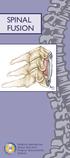 SPINAL FUSION North American Spine Society Public Education Series WHAT IS SPINAL FUSION? The spine is made up of a series of bones called vertebrae ; between each vertebra are strong connective tissues
Measure Title X RAY PRIOR TO MRI OR CAT SCAN IN THE EVAULATION OF LOWER BACK PAIN Disease State Back pain Indicator Classification Utilization
 Client HMSA: PQSR 2009 Measure Title X RAY PRIOR TO MRI OR CAT SCAN IN THE EVAULATION OF LOWER BACK PAIN Disease State Back pain Indicator Classification Utilization Strength of Recommendation Organizations
Surgery for Disc Prolapse
 Contact Details Spinal Team Nuffield Orthopaedic Centre Windmill Road Headington Oxford OX3 7LD Surgery for Disc Prolapse Phone: 01865 738051 Fax: 01865 738027 Web Site www.noc.nhs.uk Surgery for disc
Lumbar Spinal Stenosis
 Copyright 2009 American Academy of Orthopaedic Surgeons Lumbar Spinal Stenosis Almost everyone will experience low back pain at some point in their lives. A common cause of low back pain is lumbar spinal
Enhanced recovery programme after TKA through multi-disciplinary collaboration
 Enhanced recovery programme after TKA through multi-disciplinary collaboration ChanPK(1), ChiuKY(1), FungYK(6), YeungSS(7), NgT(8), ChanMT(5), LamR(4), WongNY(3), ChoiYY(3), ChanCW(2), NgFY(1), YanCH(1)
Diagnosis and Management for Chronic Back Pain: Critical for your Recovery
 Diagnosis and Management for Chronic Back Pain: Critical for your Recovery Dr. Connie D Astolfo, DC, PhD (candidate) In past articles I have stressed that the causes of back pain can be very complex. This
How To Cover Occupational Therapy
 Guidelines for Medical Necessity Determination for Occupational Therapy These Guidelines for Medical Necessity Determination (Guidelines) identify the clinical information MassHealth needs to determine
Low Back Injury in the Industrial Athlete: An Anatomic Approach
 Low Back Injury in the Industrial Athlete: An Anatomic Approach Earl J. Craig, M.D. Assistant Professor Indiana University School of Medicine Department of Physical Medicine and Rehabilitation Epidemiology
Posterior Cervical Decompression
 Posterior Cervical Decompression Spinal Unit Tel: 01473 702032 or 702097 Issue 2: January 2009 Following your recent MRI scan and consultation with your spinal surgeon, you have been diagnosed with a
Medical Insurance Long Term (chronic) Conditions Explained
 Medical Insurance Long Term (chronic) Conditions Explained October 2013 FS 28452 wpa.org.uk EMS 505226 IS 553152 Introduction This leaflet explains how we manage claims for our policyholders whose medical
Spinal Discectomy & Decompression Surgery
 1.0 Policy Statement... 2 2.0 Purpose... 2 3.0 Scope... 2 4.0 Health & Safety... 2 5.0 Responsibilities... 2 6.0 Definitions and Abbreviations... 3 7.0 Guideline... 3 7.1 Pre-Operative... 3 7.2 Post-Operative...
.org. Herniated Disk in the Lower Back. Anatomy. Description
 Herniated Disk in the Lower Back Page ( 1 ) Sometimes called a slipped or ruptured disk, a herniated disk most often occurs in your lower back. It is one of the most common causes of low back pain, as
Board of Directors. 28 January 2015
 Executive Summary Purpose: Board of Directors 28 January 2015 Briefing on the requirements for the Trust to comply with Hard Truths Commitments Regarding the Publishing of Staffing Data Director of Nursing
Herniated Disk. This reference summary explains herniated disks. It discusses symptoms and causes of the condition, as well as treatment options.
 Herniated Disk Introduction Your backbone, or spine, has 24 moveable vertebrae made of bone. Between the bones are soft disks filled with a jelly-like substance. These disks cushion the vertebrae and keep
Cervical Spondylotic Myelopathy Associated with Kyphosis or Sagittal Sigmoid Alignment: Outcome after Anterior or Posterior Decompression
 Cervical Spondylotic Myelopathy Associated with Kyphosis or Sagittal Sigmoid Alignment: Outcome after Anterior or Posterior Decompression 1 Journal of Neurosurgery: Spine November 2009, Volume 11, pp.
DIFFERENTIAL DIAGNOSIS OF LOW BACK PAIN. Arnold J. Weil, M.D., M.B.A. Non-Surgical Orthopaedics, P.C. Atlanta, GA
 DIFFERENTIAL DIAGNOSIS OF LOW BACK PAIN Arnold J. Weil, M.D., M.B.A. Non-Surgical Orthopaedics, P.C. Atlanta, GA MEDICAL ALGORITHM OF REALITY LOWER BACK PAIN Yes Patient will never get better until case
Herniated Cervical Disc
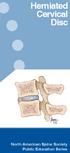 Herniated Cervical Disc North American Spine Society Public Education Series What Is a Herniated Disc? The backbone, or spine, is composed of a series of connected bones called vertebrae. The vertebrae
Clinical Audit Procedure for NHS-LA and CNST Casenote Audit
 Clinical Audit Procedure for NHS-LA and CNST Casenote Audit NHS Litigation Authority (NHS-LA) Risk Management Standards for Acute Trusts Pilot Clinical Negligence Scheme for Trusts (CNST) Maternity Clinical
SMRT Student Scope Submission
 SMRT Student Scope Submission Title and Author Title: Massive Disk Herniation of the Thoracic Vertebrae Author: Tamara N. Lewis E-mail: [email protected] Phone: (404)963-2304 Expected date of graduation:
COMMISSIONING SPINAL SERVICES GETTING THE SERVICE BACK ON TRACK
 COMMISSIONING SPINAL SERVICES GETTING THE SERVICE BACK ON TRACK A GUIDE FOR COMMISSIONERS OF SPINAL SERVICES JANUARY 2013 Contents Foreword 1 1. Executive Summary 3 2. Summary of recommendations 5 3. Introduction
Recommendations for cross-sectional imaging in cancer management, Second edition
 www.rcr.ac.uk Recommendations for cross-sectional imaging in cancer management, Second edition Breast cancer Faculty of Clinical Radiology www.rcr.ac.uk Contents Breast cancer 2 Clinical background 2 Who
Spinal Cord Injury. North American Spine Society Public Education Series
 Spinal Cord Injury North American Spine Society Public Education Series What Is a Spinal Cord Injury? A spinal cord injury is a condition that results from damage or trauma to the nerve tissue of the spine.
The Role of the MDT Coordinator. Laura Throssell
 The Role of the MDT Coordinator Laura Throssell NHS Cancer Plan (2000) the care of all patients with cancer should be formally reviewed by a specialist team. all patients have the benefit of the range
Cervical-Spine Injuries: Catastrophic Injury to Neck Sprain. Seth Cheatham, MD
 Cervical-Spine Injuries: Catastrophic Injury to Neck Sprain Seth Cheatham, MD 236 Seth A. Cheatham, MD VCU Sports Medicine I have no financial disclosures Contact sports, specifically football, places
Orthopaedic Approaches to Chronic Neck and Lower Back Pain
 Orthopaedic Approaches to Chronic Neck and Lower Back Pain David C. Urquia, MD Augusta Orthopaedic Associates / Waterville Orthopedics Introduction We see many patients who have longstanding pain in the
III./8.4.2: Spinal trauma. III./8.4.2.1 Injury of the spinal cord
 III./8.4.2: Spinal trauma Introduction Causes: motor vehicle accidents, falls, sport injuries, industrial accidents The prevalence of spinal column trauma is 64/100,000, associated with neurological dysfunction
The goals of modern spinal surgery are to maximize
 SPRING 2013 Robot-Guided Spine Surgery Christopher R. Good, M.D., F.A.C.S. and Blair K. Snyder, P.A.-C. The goals of modern spinal surgery are to maximize patient function and accelerate a return to a
Balloon Kyphoplasty. Balloon Kyphoplasty is a minimally invasive procedure to treat vertebral body compression fractures.
 Balloon Kyphoplasty Overview Balloon Kyphoplasty is a minimally invasive procedure to treat vertebral body compression fractures. The technique is designed to: Reduce and stabilise the fracture in a controlled
Compression Fractures
 September 2006 Compression Fractures Eleanor Adams Harvard Medical School Year IV Overview Spine Anatomy Thoracolumbar Fractures Cases Compression Fractures, Ddx Radiologic Tests of Choice Treatment Options
West of Scotland Guidelines. for. Malignant Spinal Cord Compression
 West of Scotland Guidelines for Malignant Spinal Cord Compression Produced by West of Scotland Malignant Spinal Cord Compression Guidelines Development Working Group on behalf of the West of Scotland Cancer
Spina Bifida Occulta. Lo-Call 1890 20 22 60. Occulta Means Hidden
 Occulta Means Hidden Spina Bifida Occulta is not easily detected because skin covers the area, such as the spinal cord, spinal bone or nerve roots, which may be affected. Spina Bifida Occulta can affect
Contents. Introduction 1. Anatomy of the Spine 1. 2. Spinal Imaging 7. 3. Spinal Biomechanics 23. 4. History and Physical Examination of the Spine 33
 Contents Introduction 1. Anatomy of the Spine 1 Vertebrae 1 Ligaments 3 Intervertebral Disk 4 Intervertebral Foramen 5 2. Spinal Imaging 7 Imaging Modalities 7 Conventional Radiographs 7 Myelography 9
Primary and revision lumbar discectomy. (nerve root decompression)
 Primary and revision lumbar discectomy (nerve root decompression) The aim of this leaflet is to help answer some of the questions you may have about having a lumbar discectomy. It explains the benefits,
Nonoperative Management of Herniated Cervical Intervertebral Disc With Radiculopathy. Spine Volume 21(16) August 15, 1996, pp 1877-1883
 Nonoperative Management of Herniated Cervical Intervertebral Disc With Radiculopathy 1 Spine Volume 21(16) August 15, 1996, pp 1877-1883 Saal, Joel S. MD; Saal, Jeffrey A. MD; Yurth, Elizabeth F. MD FROM
The Spine Center at Beth Israel Deaconess
 Spinal Pain The Spine Center at Beth Israel Deaconess Medical Center developed the following detailed eplanation of our care pathways for primary care providers to help support your interactions with patients