
A Synopsis of Chicago Freshman Enrollment at DePaul University Fall
|
|
|
- Phebe Cunningham
- 9 years ago
- Views:
Transcription
1 A Synopsis of Chicago Freshman Enrollment at DePaul University Fall Prepared and presented in May 2009 by David H. Kalsbeek, Ph.D. Senior Vice President for Enrollment Management and Marketing Research and analysis support provided by Enrollment & Marketing Research Center for Access and Attainment
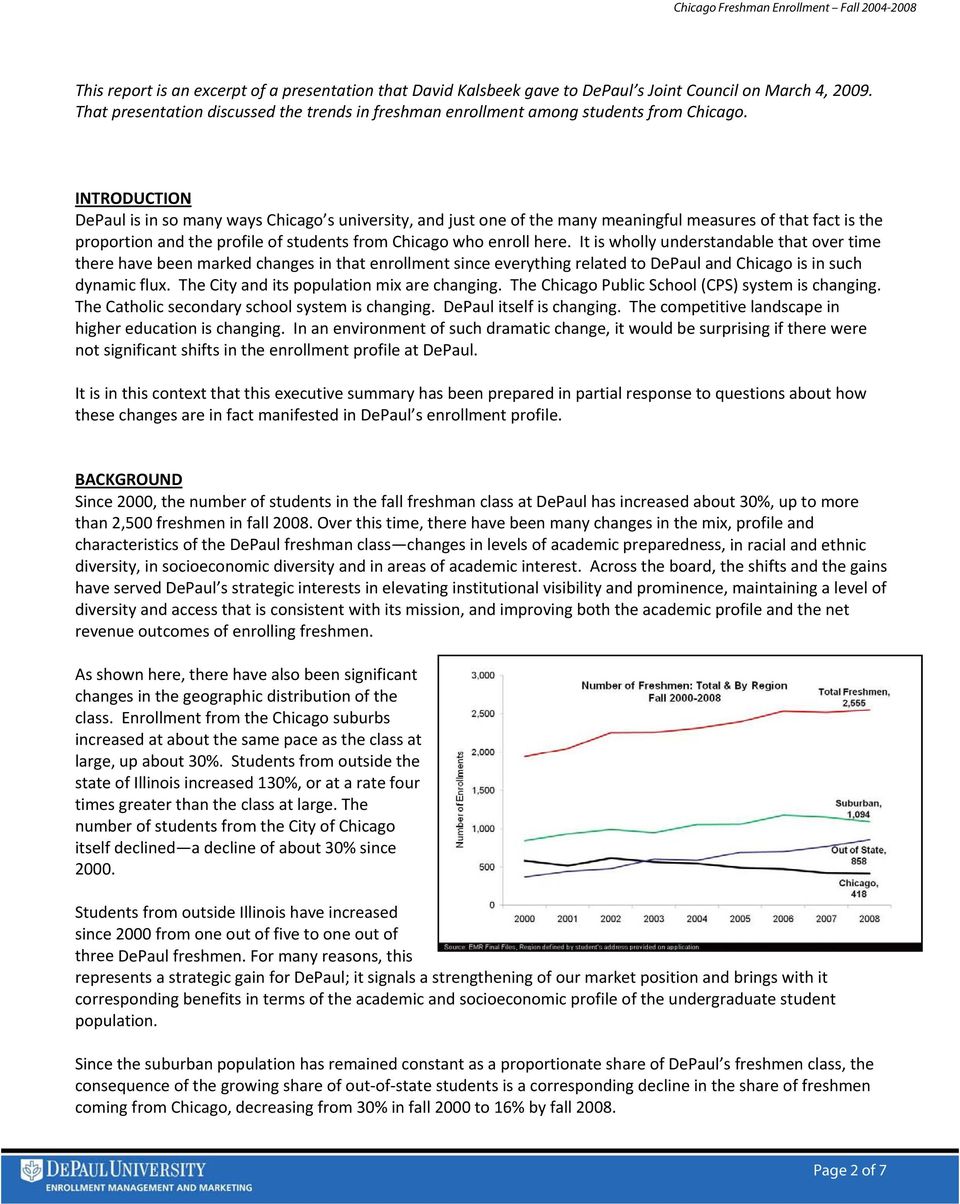
2 This report is an excerpt of a presentation that David Kalsbeek gave to DePaul s Joint Council on March 4, That presentation discussed the trends in freshman enrollment among students from Chicago. INTRODUCTION DePaul is in so many ways Chicago s university, and just one of the many meaningful measures of that fact is the proportion and the profile of students from Chicago who enroll here. It is wholly understandable that over time there have been marked changes in that enrollment since everything related to DePaul and Chicago is in such dynamic flux. The City and its population mix are changing. The Chicago Public School (CPS) system is changing. The Catholic secondary school system is changing. DePaul itself is changing. The competitive landscape in higher education is changing. In an environment of such dramatic change, it would be surprising if there were not significant shifts in the enrollment profile at DePaul. It is in this context that this executive summary has been prepared in partial response to questions about how these changes are in fact manifested in DePaul s enrollment profile. BACKGROUND Since 2000, the number of students in the fall freshman class at DePaul has increased about 30%, up to more than 2,500 freshmen in fall Over this time, there have been many changes in the mix, profile and characteristics of the DePaul freshman class changes in levels of academic preparedness, in racial and ethnic diversity, in socioeconomic diversity and in areas of academic interest. Across the board, the shifts and the gains have served DePaul s strategic interests in elevating institutional visibility and prominence, maintaining a level of diversity and access that is consistent with its mission, and improving both the academic profile and the net revenue outcomes of enrolling freshmen. As shown here, there have also been significant changes in the geographic distribution of the class. Enrollment from the Chicago suburbs increased at about the same pace as the class at large, up about 30%. Students from outside the state of Illinois increased 130%, or at a rate four times greater than the class at large. The number of students from the City of Chicago itself declined a decline of about 30% since Students from outside Illinois have increased since 2000 from one out of five to one out of three DePaul freshmen. For many reasons, this represents a strategic gain for DePaul; it signals a strengthening of our market position and brings with it corresponding benefits in terms of the academic and socioeconomic profile of the undergraduate student population. Since the suburban population has remained constant as a proportionate share of DePaul s freshmen class, the consequence of the growing share of out of state students is a corresponding decline in the share of freshmen coming from Chicago, decreasing from 30% in fall 2000 to 16% by fall Page 2 of 7
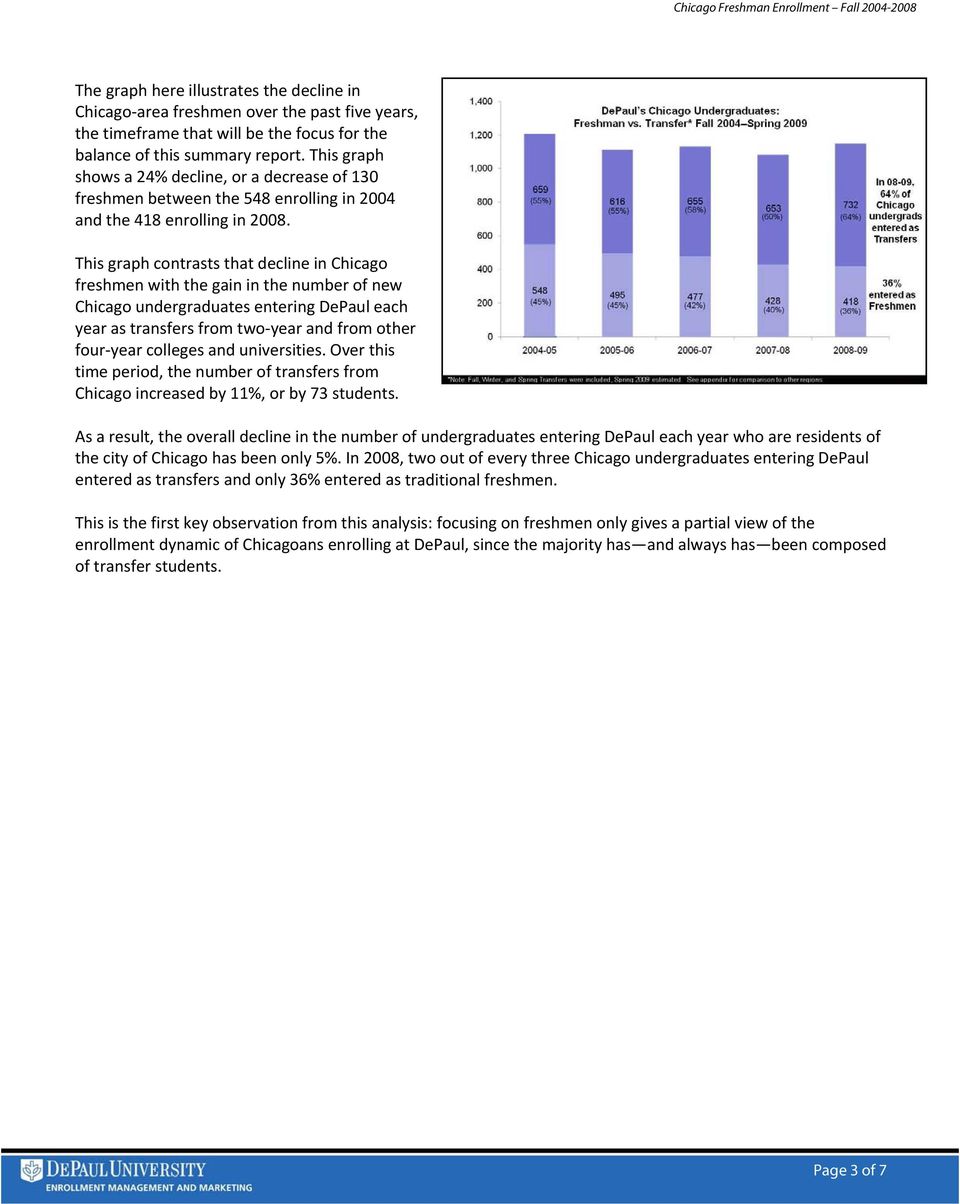
3 The graph here illustrates the decline in Chicago area freshmen over the past five years, the timeframe that will be the focus for the balance of this summary report. This graph shows a 24% decline, or a decrease of 130 freshmen between the 548 enrolling in 2004 and the 418 enrolling in This graph contrasts that decline in Chicago freshmen with the gain in the number of new Chicago undergraduates entering DePaul each year as transfers from two year and from other four year colleges and universities. Over this time period, the number of transfers from Chicago increased by 11%, or by 73 students. As a result, the overall decline in the number of undergraduates entering DePaul each year who are residents of the city of Chicago has been only 5%. In 2008, two out of every three Chicago undergraduates entering DePaul entered as transfers and only 36% entered as traditional freshmen. This is the first key observation from this analysis: focusing on freshmen only gives a partial view of the enrollment dynamic of Chicagoans enrolling at DePaul, since the majority has and always has been composed of transfer students. Page 3 of 7
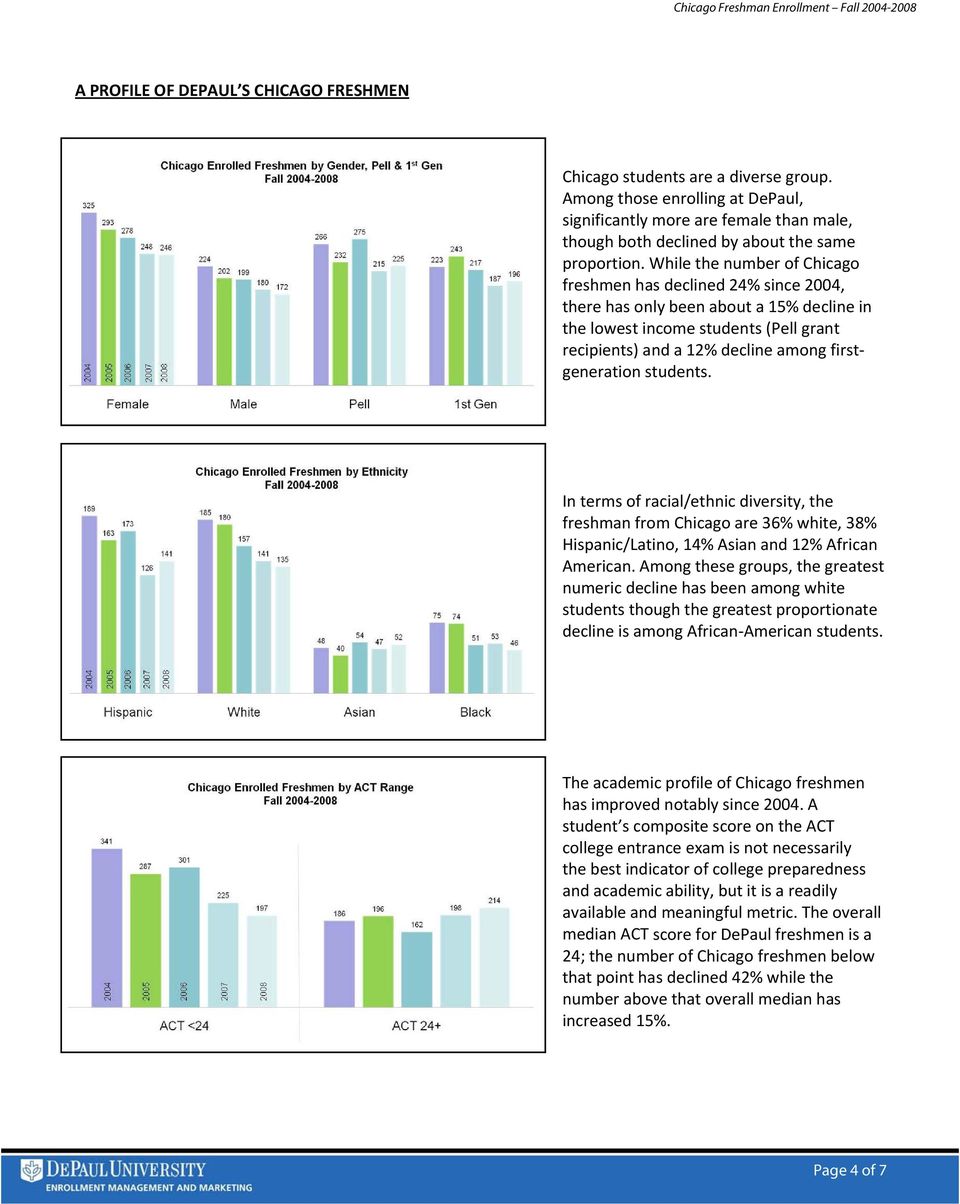
4 A PROFILE OF DEPAUL S CHICAGO FRESHMEN Chicago students are a diverse group. Among those enrolling at DePaul, significantly more are female than male, though both declined by about the same proportion. While the number of Chicago freshmen has declined 24% since 2004, there has only been about a 15% decline in the lowest income students (Pell grant recipients) and a 12% decline among firstgeneration students. In terms of racial/ethnic diversity, the freshman from Chicago are 36% white, 38% Hispanic/Latino, 14% Asian and 12% African American. Among these groups, the greatest numeric decline has been among white students though the greatest proportionate decline is among African American students. The academic profile of Chicago freshmen has improved notably since A student s composite score on the ACT college entrance exam is not necessarily the best indicator of college preparedness and academic ability, but it is a readily available and meaningful metric. The overall median ACT score for DePaul freshmen is a 24; the number of Chicago freshmen below that point has declined 42% while the number above that overall median has increased 15%. Page 4 of 7
5 One important way to segment Chicago is by the type of secondary school the entering freshmen attended as is done in the graph to the right. When viewed this way, one immediately sees sharp differences in the enrollment patterns between groups that compose the overall Chicago market. First, graduates of CPS make up more than half of all Chicago freshmen (58%) yet have only declined by 17 students (down 13%) since DePaul s partnerships and outreach have been successful in maintaining strong enrollments from CPS schools. More than half (54%) of the decline in Chicago area freshmen enrollment is among those graduating from Catholic high schools. This group has declined in enrollment by 41% since 2004 and constitutes about one out of every four Chicago freshmen (24%). Enrollment from Chicago s Big Shoulders schools and from Catholic high schools in the city of Chicago have been fairly stable and together now account for nearly three out of four of the Catholic high school graduates, compared to 58% in The group which accounts for the greatest decline in this segment (with a 65% decline since 2004) are Chicago residents attending Catholic high schools that are near Chicago, schools like Loyola Academy in Wilmette; in fact, five high schools account for more than half of the total decline of Chicago residents in Catholic high schools. There also are students who are combined on the graph above into an other category that includes home schooled students, non Catholic high school graduates, and those who earned a GED. This group has declined by 33% since 2004, and accounts for about one out of every five Chicago freshmen (22%). An overview of enrollment trends and outcomes of multiple initiatives with CPS will be outlined in a subsequent report. The decline since 2004 in the number of Chicago freshmen from Catholic high schools will be explored and explained in a separate report as well. Shifting attention back to the number of students enrolling at DePaul from CPS, it is important at the outset to place DePaul s enrollment into comparative context. This CPS Enrollment Funnel (at right) places DePaul s enrollment in the context of all CPS graduates. Only about half of all CPS graduates enroll in college the fall following their high school graduation; of those students, only one out of every four enroll at a private college or university. Of that group, over one out of ten enroll at DePaul as new freshmen. The fact that more than 10% of all CPS graduates who attend private universities choose DePaul is a powerful statement of DePaul s market position. Page 5 of 7
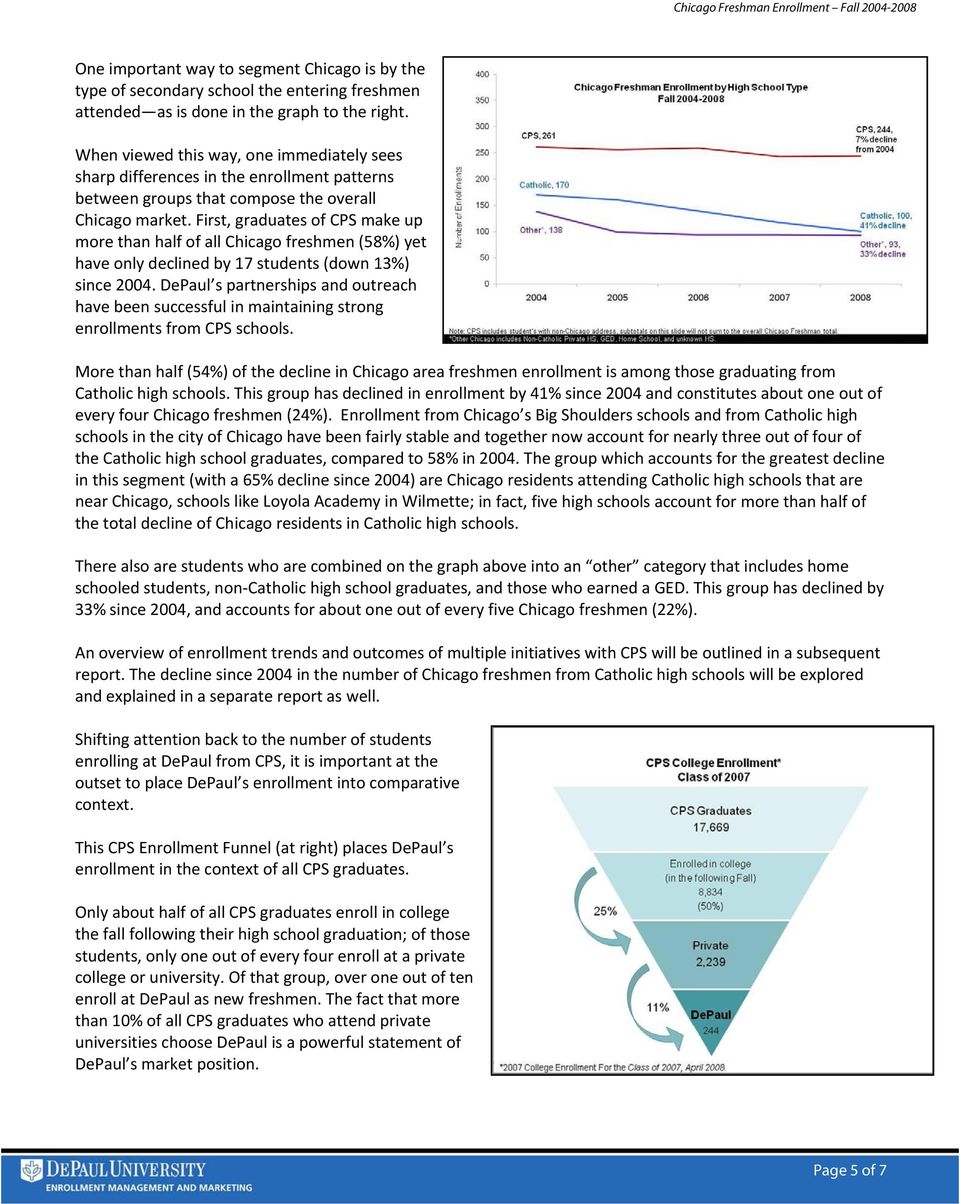
6 The chart here shows the comparative number of CPS graduates enrolling at the four year institutions that enroll the most CPS graduates. The number of CPS graduates enrolling at DePaul is twice the number of the next comparable university (Loyola), and makes DePaul the largest of all selective private universities at which CPS graduates enroll. The focus of this report is not on the long term success of DePaul undergraduates, but it is important to note here that not only does DePaul enroll more CPS graduates than any selective private university, but those students enrolling at DePaul achieve a level of success that exceeds that of other students. While the first quarter GPA of CPS freshmen is lower (3.03) than the overall freshman class average (3.22), the first year retention rate for CPS graduates equals that of the class at large and the sixyear graduation rate of 76% far exceeds that of the freshman class at large (64%). Moreover, based upon data from the Consortium on Chicago School Research, the retention and graduation rates of CPS graduates at DePaul far exceed that of CPS graduates attending other four year institutions (public and private). CHICAGO FRESHMEN AND OTHER MISSION BASED ATTRIBUTES One useful way to illustrate the mix of DePaul s undergraduate enrollment is by showing the intersections across four attributes that typically are associated with DePaul s mission: low income students (Pell recipients), firstgeneration students, underrepresented minority students and residents of the city of Chicago. The diagram below illustrates the overlapping characteristics of the 52% of the DePaul freshman class in 2008 that had at least one of these four attributes. There were 16% of the freshmen who were from Chicago, and the largest number (22%) are non minority, non first generation, non Pell students. Nevertheless, one out of every five of DePaul s Chicago freshmen demonstrates all three of the other attributes (e.g., minority, low income and first generation). It is essential to note that the majority (59%) of DePaul s minority freshmen are not from Chicago, the majority of DePaul s first generation freshmen (75%) are not from Chicago, and the majority (66%) of DePaul s lowest income freshmen are not from Chicago. In other words, DePaul s attainment of its mission related to these populations is not wholly dependent upon the enrollment of students from CPS or the city of Chicago. (The strategic implications of this will be explored in future reports.) In terms of this graphic, of all of these 15 segments, the greatest numeric decline has been in Chicago residents but in freshmen who are neither minority, low income nor first generation Page 6 of 7
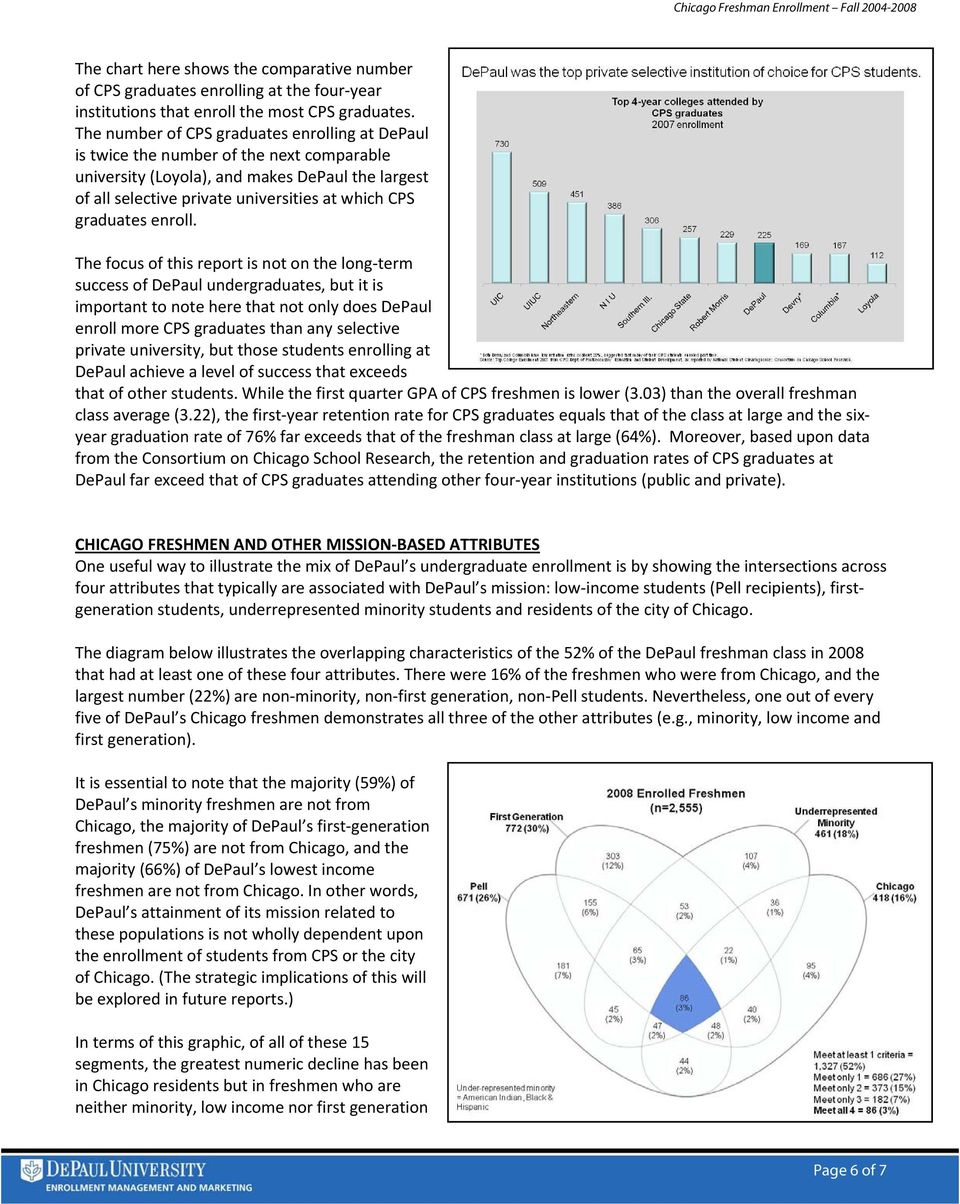
7 ( 49 students). But overall, nearly 60% of the decline in Chicago freshmen has been among underrepresented minority students, and this decline in Chicago enrollment among minority students was not offset by gains outside of Chicago. The greatest proportionate declines in freshmen have been among minority residents of Chicago. The same is not true for low income and first generation students. Declines among Pell students in Chicago were more than offset by gains outside of Chicago and the vast majority of the 28% gain in first generation freshmen is among students who are neither low income, minority nor Chicago residents. STRATEGIC RESPONSES DePaul has several new initiatives that focus on strengthening enrollments from Chicago. These include: The Center for Access and Attainment at DePaul provides research centered on issues of access and attainment that stimulates campus, community and international discourse; cultivates institutional and community partnerships to foster high school to university transition, particularly with the CPS; delivers pre college programs for underserved college bound students; and administers the university s federal TRiO programs (Student Support Services and McNair Scholars Program) for low income and first generation students. Brian Spittle, assistant vice president for access and attainment, is on Steering Committee for the Consortium on Chicago School Research, which brings together researchers at the University of Chicago, CPS and other organizations to inform policy and practice in CPS and to study the long term effects of school reform. International Baccalaureate (IB) Partnerships between DePaul and programs within CPS have gained attention from the national IB community. IB is a rigorous college preparation curriculum implemented in 14 neighborhood high schools; the majority of IB students in Chicago are students of color and/or from low income families. About 20 IB students from CPS enroll at DePaul each year. The six year graduation rate for Chicago IB students at DePaul is close to 90%. Chicago Public Schools (CPS) College Bridge provides high achieving CPS juniors and seniors the opportunity to take classes at DePaul and earn college credit while still in high school; more than 1,200 CPS students have taken courses at DePaul through this program since About 17% of College Bridge students enroll at DePaul as undergraduates. DIAMOND (Developing Insight for Admission through the Mining of Non Traditional Data) Program provides a mechanism within the admission process to assess non cognitive indicators of academic potential, thereby enhancing the capacity to select applicants with high potential for academic success. Applicants are asked to complete a short essay instrument based on the research of William Sedlacek at the University of Maryland. Oregon State has found that use of the instrument in admission has improved both diversity and retention. First year Academic Success Program offers pre requisite math and writing courses at no cost to students in the summer. This enables DePaul students who arrive academically underprepared for college level coursework with necessary preparation without using and without paying for college credit for pre college work. Transfer Enrollment Initiatives targeted to Chicago residents have focused on partnerships with the City Colleges of Chicago and include: new Transfer Guides for each of the city colleges that show students how to choose courses at the city colleges that will count in their majors as they prepare to transfer to DePaul; dual admission programs and programmatic partnerships between DePaul and several city colleges; as well as events that bring faculty and advisors from the city colleges together with DePaul faculty and staff to discuss curriculum and classroom techniques and to present new developments at DePaul. Page 7 of 7
Perceived Stress among Engineering Students
 Perceived Stress among Engineering Students Lisa Schneider Cornell University Abstract Previous surveys of students in Cornell s College of Engineering suggest that, over the past 2 decades, students perceived
The Final Assessment of A Framework to Foster Diversity at Penn State: 1998-2003. The Smeal College of Business Administration
 The Final Assessment of A Framework to Foster Diversity at Penn State: 1998-2003 The Smeal College of Business Administration A Framework to Foster Diversity at Penn State: 1998-2003 The Smeal College
2006 PERFORMANCE REPORT St. Augustine College
 SECTION I: INSTITUTIONAL CONTEXT Mission Statement is an independent, bilingual (dual language) institution of higher education created under the auspices of the Episcopal Diocese. goals are: To make the
Key Indicators on the Path to a Bachelor s Degree by Race and Ethnicity in Maryland
 Key Indicators on the Path to a Bachelor s Degree by Race and Ethnicity in Maryland Joseph Popovich April 2016 Maryland, like many other states, has set ambitious goals for increasing the number of college
February 2003 Report No. 03-17
 February 2003 Report No. 03-17 Bright Futures Contributes to Improved College Preparation, Affordability, and Enrollment at a glance Since the Bright Futures program was created in 1997, Florida s high
Resurrection University Chicago, IL
 C O L L E G E P R O F I L E - O V E R V I E W Resurrection University Chicago, IL Resurrection University (formerly West Suburban College of Nursing), is a fully accredited, not-for-profit, Roman Catholic
Review test prep resources for educators, students and families.
 Goals: Discuss findings of the 2013 SAT Report on College and Career Readiness and the ACT 2013 Condition of College and Career Readiness; examine performance data to see how Arizona students are testing.
Graduate School November 2014
 Graduate School November 2014 2015 16 UNIVERSITY GRADUATE LAURELS BLOCK GRANT PROGRAM REQUEST FOR PROPOSALS PROPOSAL DEADLINE DECEMBER 15, 2014 Introduction The University Graduate Laurels Block Grant
Developmental education and college readiness at the University of Alaska Michelle Hodara Monica Cox Education Northwest
 May 2016 What s Happening Developmental education and college readiness at the University of Alaska Michelle Hodara Monica Cox Education Northwest Key findings Developmental education placement rates among
Texas Higher Education Coordinating Board
 Texas Higher Education Coordinating Board Master s Universities Success Accountability Measures Introduction The Texas Higher Education Coordinating Board has organized the Master s Level Universities
Examination of Four-Year Baccalaureate Completion Rates at Purdue University. April 2011. Enrollment Management Analysis and Reporting
 Examination of Four-Year Baccalaureate Completion Rates at Purdue University April 2011 Enrollment Management Analysis and Reporting Student Analytical Research 0 Executive Summary Since 2000 the four-year
Minimum Entrance Requirements The University of North Carolina
 Minimum Entrance Requirements NC College Access Conference Friday, March 5, 2010 UNC System Overview Comprised of sixteen constituent public institutions of higher education and one constituent high school
Co-Curricular Activities and Academic Performance -A Study of the Student Leadership Initiative Programs. Office of Institutional Research
 Co-Curricular Activities and Academic Performance -A Study of the Student Leadership Initiative Programs Office of Institutional Research July 2014 Introduction The Leadership Initiative (LI) is a certificate
Barriers to College Attainment
 AGENCY/PHOTOGRAPHER Barriers to College Attainment Lessons from Chicago Jenny Nagaoka, Melissa Roderick, and Vanessa Coca, The Consortium on Chicago School Research at The University of Chicago January
New Hampshire Nursing Diversity Pipeline Project NH Future of Nursing Scholars Program Application 2011 2012 Academic Year
 New Hampshire Nursing Diversity Pipeline Project NH Future of Nursing Scholars Program Application 2011 2012 Academic Year A Project of the Partners Investing in Nursing s Future Initiative You Are The
Undergraduate Degree Completion by Age 25 to 29 for Those Who Enter College 1947 to 2002
 Undergraduate Degree Completion by Age 25 to 29 for Those Who Enter College 1947 to 2002 About half of those who start higher education have completed a bachelor's degree by the ages of 25 to 29 years.
Step Into Your Future: Preparing for College
 Step Into Your Future: Preparing for College Preparing for College STEP 1: Prepare Yourself Academically STEP 2: Become a Well-Rounded Student STEP 3: Impress for Success STEP 4: Set Smart Goals STEP 5:
Virginia s College and Career Readiness Initiative
 Virginia s College and Career Readiness Initiative In 1995, Virginia began a broad educational reform program that resulted in revised, rigorous content standards, the Virginia Standards of Learning (SOL),
DIVISION OF STUDENT AFFAIRS. Office of Excellence and Multicultural Student Success
 DIVISION OF STUDENT AFFAIRS Office of Excellence and Multicultural Student Success Office Mission The mission of the Office of Excellence and Multicultural Student Success is to create a campus environment
This presentation was made at the California Association for Institutional Research Conference on November 19, 2010.
 This presentation was made at the California Association for Institutional Research Conference on November 19, 2010. 1 This presentation was made at the California Association for Institutional Research
New York School of Interior Design New York, NY
 New York School of Interior Design New York, NY C O L L E G E P R O F I L E - O V E R V I E W The New York School of Interior Design, founded in 1916, is a private, primarily specialized institute. Its
Investing in What Works: How Federal TRiO Programs Can be Used to Enhance the STEM Pipeline
 Investing in What Works: How Federal TRiO Programs Can be Used to Enhance the STEM Pipeline A Presentation for the Building Diversity in Higher Education: Strategies for Broadening Participation in the
Taking Bold Steps. Taking Bold Steps.
 Taking Bold Steps. Taking Bold Steps. Introduction Faculty, staff, and students at Indiana University Kokomo revisited the campus 2011-2015 strategic plan in response to a call for a university wide strategic
Strategic Plan 2020 Goals, Actions and Measurable Outcomes Diversity & Inclusiveness Subcommittee
 Strategic Plan 2020 Goals, and Diversity & Inclusiveness Subcommittee I. K-20 Pipelines Strengthen relationships with students, schools, families, and communities to foster a collegegoing mindset among
To register for these online modules go to http://kycorestandards.org
 The Kentucky Core Academic Standards for Postsecondary Education website is designed to provide educators and administrators with access to information and resources regarding the impact of Senate Bill
Platt College San Diego San Diego, CA
 C O L L E G E P R O F I L E - O V E R V I E W Platt College San Diego San Diego, CA Web Site www.platt.edu/ Institution Type Private for-profit Coeducational Yes Undergraduate Students 369 Women 98 (26.6%)
College Readiness: Examples of Initiatives and Programs. prepared by the Annenberg Institute for School Reform at Brown University
 College Readiness: Examples of Initiatives and Programs prepared by the Annenberg Institute for School Reform at Brown University National Coalitions Common Core State Standards Initiative www.corestandards.org/
2012 Veteran s Survey Summary
 2012 Veteran s Survey Summary Methodology The 2012 Veteran s Survey was administered via the web during January and February to the population of 466 students identified as veterans with email contacts.
C. FIRST-TIME, FIRST-YEAR (FRESHMAN) ADMISSION
 C. FIRST-TIME, FIRST-YEAR (FRESHMAN) ADMISSION Applications C1 First-time, first-year, (freshmen) students: Provide the number of degree-seeking, first-time, firstyear students who applied, were admitted,
forum Forecasting Enrollment to Achieve Institutional Goals by Janet Ward Campus Viewpoint
 forum Campus Viewpoint Forecasting Enrollment to Achieve Institutional Goals by Janet Ward As strategic and budget planning commences at community colleges, baccalaureate institutions, and comprehensive
Chamberlain College of Nursing Chicago, IL
 C O L L E G E P R O F I L E - O V E R V I E W Chamberlain College of Nursing Chicago, IL Web Site www.chamberlain.edu/ Institution Type Private for-profit Coeducational Yes Undergraduate Students 892 Women
Running Head: LEADERSHIP ACADEMY ASSESSMENT 1. Name of Person(s) completing report or contributing to the project: Reina M.
 Running Head: LEADERSHIP ACADEMY ASSESSMENT Name of Department: Office of Multicultural Student Success (OMSS) Name of Contact Person: Jeff Brown Name of Person(s) completing report or contributing to
Discussion of State Appropriation to Eastern Michigan University August 2013
 Discussion of State Appropriation to Eastern Michigan University August 2013 Starting in 2012-13, the Michigan Legislature decided to condition a portion of the state appropriation on how well the 15 public
4 Key Recommendations to Eliminate Remediation:
 State of Delaware College Success Report: Class of 2014 Nearly 60 percent of Delaware high school graduates enroll in college each year. Most of these students attend local public and private institutions
Division of Undergraduate Education 2009-2014 Strategic Plan Mission
 Mission The mission of the Division of Undergraduate Education is to promote academic excellence through collaboration with colleges and support units across the University. The mission is realized through
BARBARA R. ALLEN, Dean
 1 THE COLLEGE OF GENERAL STUDIES BARBARA R. ALLEN, Dean THE COLLEGE of GENERAL STUDIES offers a baccalaureate and associate degree in General Studies for students who desire a plan of study not found in
Ringling College of Art and Design Sarasota, FL
 Ringling College of Art and Design Sarasota, FL C O L L E G E P R O F I L E - O V E R V I E W Ringling College of Art and Design (formerly Ringling School of Art and Design) is a private, not-for-profit
Parental Educational Attainment and Higher Educational Opportunity
 Parental Educational Attainment and Higher Educational Opportunity Federal higher education policy recognizes certain student characteristics as limiting higher educational opportunity, and has created
Texas Southern University
 Texas Southern University Report to the Texas Southern University Board of Regents and The Texas Higher Education Coordinating Board Efforts Concerning Timely Graduation for FY 2007 November 15, 2008 This
First in My Family: Executive Summary
 First in My Family: A Profile of First-Generation College Students at Four-Year Institutions Since 1971 Executive Summary April 2007 Victor B. Saenz Sylvia Hurtado Doug Barrera De Sha Wolf Fanny Yeung
Annual Report on the Virginia Plan for Higher Education. State Council of Higher Education for Virginia
 0 Table of Contents Overview... 2 Objective: Be the Best-Educated State by 2030... 2 Goals in Support of The Virginia Plan... 3 2015 Activities to Support The Virginia Plan... 4 Measures and Targets: Baseline
Art Center College of Design Pasadena, CA
 C O L L E G E P R O F I L E - O V E R V I E W Art Center College of Design Pasadena, CA Art Center College of Design, founded in 1930, is a private institution. It offers highly specialized programs focusing
TITLE 133 PROCEDURAL RULE WEST VIRGINIA HIGHER EDUCATION POLICY COMMISSION
 TITLE 133 PROCEDURAL RULE WEST VIRGINIA HIGHER EDUCATION POLICY COMMISSION SERIES 23 STANDARDS AND PROCEDURES FOR UNDERGRADUATE ADMISSIONS AT FOUR-YEAR COLLEGES AND UNIVERSITIES 133-23-1. General. 1.1.
New Faculty Orientation Fall 2014
 New Faculty Orientation Fall 2014 Steven Brint Vice Provost, Undergraduate Education Topics Undergraduate Enrollment Overview Who Are Our Students? Socio-Demographic Background Who Are Our Students? Academic
How U.S. News Calculated the 2015 Best Colleges Rankings
 How U.S. News Calculated the 2015 Best Colleges Rankings Here's how you can make the most of the key college statistics. The U.S. News Best Colleges rankings can help prospective students and their families
C. FIRST-TIME, FIRST-YEAR (FRESHMAN) ADMISSION
 C. FIRST-TIME, FIRST-YEAR (FRESHMAN) ADMISSION Applications C1 First-time, first-year, (freshmen) students: Provide the number of degree-seeking, first-time, firstyear students who applied, were admitted,
PROGRAM AUTHORITY; AUTHORIZATION OF APPROPRIATIONS.
 Higher Education Act of 1965, 1998 Higher Education Act Amendments Subpart 2 Federal Early Outreach and Student Services Programs CHAPTER 1 FEDERAL TRIO PROGRAMS SEC. 402A. 20 U.S.C. 1070a 11 PROGRAM AUTHORITY;
The Importance of Community College Honors Programs
 6 This chapter examines relationships between the presence of honors programs at community colleges and institutional, curricular, and student body characteristics. Furthermore, the author relates his
Delaware State University. Reflecting on our past while preparing for our future
 Delaware State University Reflecting on our past while preparing for our future EXECUTIVE SUMMARY Delaware State University s foundation dates to May 15, 1891, when the 58 th General Assembly of the State
The Influence of a Summer Bridge Program on College Adjustment and Success: The Importance of Early Intervention and Creating a Sense of Community
 The Influence of a Summer Bridge Program on College Adjustment and Success: The Importance of Early Intervention and Creating a Sense of Community Michele J. Hansen, Ph.D., Director of Assessment, University
Running Head: Promoting Student Success: Evaluation of a Freshman Orientation Course
 Running Head: Promoting Student Success: Evaluation of a Freshman Orientation Course Promoting Student Success: Evaluation of a Freshman Orientation Course Mary A. Millikin, PhD Abstract Many first-time
San Francisco Conservatory of Music San Francisco, CA
 San Francisco Conservatory of Music San Francisco, CA C O L L E G E P R O F I L E - O V E R V I E W The San Francisco Conservatory of Music, founded in 1917, is a private conservatory of music. Its five-acre
College of Arts and Sciences
 College of Strategic Plan July, 2013 A Strategic Vision for the College of Mission The College of serves the public good by weaving the cultural, artistic, and intellectual fabric of the university experience
C. FIRST-TIME, FIRST-YEAR (FRESHMAN) ADMISSION
 C. FIRST-TIME, FIRST-YEAR (FRESHMAN) ADMISSION Applications C1 First-time, first-year, (freshmen) students: Provide the number of degree-seeking, first-time, firstyear students who applied, were admitted,
Northeastern Illinois University Chicago, Illinois
 Chicago, Illinois 2010 UNDERGRADUATE SPECIAL EDUCATION Teacher Preparation Program Design D While general professional coursework enhances the design of this program, there are other critical elements
Gettysburg College. Co-Curricular Learning Assessment Plan. Subcommittee on Learning Outside the Classroom. June 15, 2003.
 Gettysburg College Co-Curricular Learning Assessment Plan Subcommittee on Learning Outside the Classroom June 15, 2003 Submitted by: Julie Ramsey David Wright David Steinour Robin Wagner Thomas Mottola
Voluntary Accountability Report
 Mission Statement Student Characteristics TOTAL NUMBER OF STUDENTS 1,499 Voluntary Accountability Report The University of Pittsburgh at Bradford seeks to make high-quality academic programs and service
Creating Early College Opportunities Using Online Learning and District Partnerships
 Creating Early College Opportunities Using Online Learning and District Partnerships Tryna M. Luton P-12 Outreach Coordinator/OSU K-12 Online Administrator Oregon State University Summer Session Van Peters
Colorado Technical University Colorado Springs, CO
 C O L L E G E P R O F I L E - O V E R V I E W Colorado Technical University Colorado Springs, CO Colorado Tech, founded in 1965, is a private institution offering career-oriented engineering, computer,
Living in the Red Hawks Community
 http://www.collegeportraits.org/nj/msu 1 of 1 7/23/2014 9:58 AM Founded in 1908, is New Jersey s second largest university. It offers all the advantages of a large university a comprehensive undergraduate
Chamberlain College of Nursing Houston, TX
 C O L L E G E P R O F I L E - O V E R V I E W Chamberlain College of Nursing Houston, TX Web Site www.chamberlain.edu/ Institution Type Private for-profit Coeducational Yes Undergraduate Students 258 Women
South Dakota. Opportunity Scholarship. Frequently Asked Questions
 South Dakota Opportunity Scholarship Frequently Asked Questions Question: What is the difference between a Regents Scholar Diploma and the South Dakota Opportunity Scholarship? Answer: The Regents Scholar
Goldfarb School of Nursing at Barnes-Jewish College St. Louis, MO
 C O L L E G E P R O F I L E - O V E R V I E W Goldfarb School of Nursing at Barnes-Jewish College St. Louis, MO Goldfarb School of Nursing at Barnes-Jewish College, founded by 1993, is a private, coeducational
"Every system is perfectly designed to achieve the results it gets" (attributed to W. Edward Deming)
 "Every system is perfectly designed to achieve the results it gets" (attributed to W. Edward Deming) On July 14, 2009, President Obama announced the goal that community colleges would graduate five million
David Fairris Vice Provost for Undergraduate Education. Junelyn Peeples Director of Institutional Research for Undergraduate Education
 Evaluation of the Impact of Participation in First Year Learning Communities on Persistence to Sophomore Year University of California, Riverside, Fall 2006 David Fairris Vice Provost for Undergraduate
Everglades University - Boca Raton Boca Raton, FL
 Everglades University - Boca Raton Boca Raton, FL C O L L E G E P R O F I L E - O V E R V I E W Web Site www.evergladesuniversity.edu/ Institution Type Private Coeducational Yes Undergraduate Students
Name of Institution: Central Christian College. State: Kansas. Address: 1200 South Main. McPherson, KS, 67460. Phone: 6202410723 ext.
 Page 1 of 10 SUBMIT REPORTS Contact Us - Glossary - Log out Central Christian College Traditional Program 2009-10 Print Report Card Program Information Name of Institution: Central Christian College Institution/Program
Passing When It Counts Math courses present barriers to student success in California Community Colleges
 Engaging Californians on Key Education Challenges I S S U E B R I E F F E B U A R Y 2 0 1 2 Passing When It Counts Math courses present barriers to student success in California Community Colleges Overview
California State University, Los Angeles College Portrait. The Cal State LA Community. Carnegie Classification of Institutional Characteristics
 Page 1 of 8 College Cal State L.A. has been a dynamic force in the education of students, setting a record of outstanding academic achievement for more than 60 years within the California State University
Educating and Empowering the Next Generation of Women Leaders
 Educating and Empowering the Next Generation of Women Leaders Call for Proposals 2015 Contact: Sasha Patterson, Ph.D. NEW Leadership Program Manager Center for American Women and Politics Eagleton Institute
Virginia University of Lynchburg Lynchburg, VA
 C O L L E G E P R O F I L E - O V E R V I E W Virginia University of Lynchburg Lynchburg, VA Virginia University of Lynchburg is a private institution with religious affiliation. Its campus is located
Understanding Freshman Engineering Student Retention through a Survey
 Understanding Freshman Engineering Student Retention through a Survey Dr. Mary R. Anderson-Rowland Arizona State University Session 3553 Abstract It is easier to retain a student than to recruit one. Yet,