
Industry MLPs and Natural Gas
|
|
|
- Hector Lucas West
- 9 years ago
- Views:
Transcription
1 Deutsche Bank Markets Research North America Industrials Master Limited Partnerships Industry MLPs and Natural Gas Date 18 May 2015 Initiation of Coverage Kristina Kazarian Research Analyst (+1) Anthony Kit John Mackay Associate Analyst Associate Analyst (+1) (+1) Midstream is Now Mainstream: Positive Outlook, But Be Selective Initiating Coverage on the MLP and Natural Gas Sectors Over the past decade our sector has grown from 40 public entities to over 130, making it the second largest energy sub-sector. As increased US oil and gas production drove the need for infrastructure, our space also benefitted from low interest rates, inflows as investors sought yield, and loosening tax regulations. Today, many of these trends have reversed: rising rates, lower commodities, and c-corp consolidations have many wondering if the cycle is over. We disagree and believe rising US energy production will still support growth. That said, we highlight the relevance of sub-sector differentiation and company specific analysis, and thus we recommend being selective. Deutsche Bank does and seeks to do business with companies covered in its research reports. Thus, investors should be aware that the firm may have a conflict of interest that could affect the objectivity of this report. Investors should consider this report as only a single factor in making their investment decision. DISCLOSURES AND ANALYST CERTIFICATIONS ARE LOCATED IN APPENDIX 1. MCI (P) 124/04/2015.
2

3 Deutsche Bank Markets Research North America Industrials Master Limited Partnerships Industry MLPs and Natural Gas Date 18 May 2015 Initiation of Coverage Midstream is Now Mainstream: Positive Outlook, But Be Selective Initiating Coverage on the MLP and Natural Gas Sectors Over the past decade our sector has grown from 40 public entities to over 130, making it the second largest energy sub-sector. As increased US oil and gas production drove the need for infrastructure, our space also benefitted from low interest rates, inflows as investors sought yield, and loosening tax regulations. Today, many of these trends have reversed: rising rates, lower commodities, and c-corp consolidations have many wondering if the cycle is over. We disagree and believe rising US energy production will still support growth. That said, we highlight the relevance of sub-sector differentiation and company specific analysis, and thus we recommend being selective. Kristina Kazarian Research Analyst (+1) Anthony Kit John Mackay Associate Analyst Associate Analyst (+1) (+1) Infrastructure Build-Out = Positive Secular Growth Story. The growth in oil and gas production has brought a massive need for energy infrastructure, which we believe will be a secular tailwind for our sectors ($641b of capex needed through 2035). Key drivers include: E&Ps working to connect production to demand centers, utilities looking for dependable fuel sources, downstream players sourcing advantaged feedstock, and export demand. Sub-sectors with the greatest leverage include: crude logistics (PSXP, MLPX, VLP, TLLP), NGL infrastructure (ETE, SXL, MWE), and large cap diversified (KMI, EPD). Commodity Headwinds Have A Mixed Impact Across the Sector. The recent commodity price collapse has been mixed for our sector. Contract structures (fee-based, volume commitments) have insulated the direct exposure for some (PSXP, MPLX, VLP), though not all (OKS). Others are instead vulnerable to E&P spending cuts and reduced asset utilization (MWE, SMLP). But the overarching risk is that sustained low prices erode demand for infrastructure, decreasing long-term growth profiles across our entire sector. High Growth Insulates Impact of Rising Rates. Investor attention is increasingly focused on the anticipated rate hike. While we acknowledge that higher rates are a headwind for valuation, we believe our sector s growth profile will mute this impact versus other yield-oriented products, driving our preference of high growth companies with multi-year visibility (ETE, PSXP). Wide Dispersion Supports Our Recommendation to be Selective. Strong sector performance has masked a large variation in individual returns. We attribute the dispersion to both sub-sector exposure and company-specific factors. Within our preferred subsectors our bias is toward high-growth names with multi-year visibility, stable cash flow profiles, high coverage, IG ratings, and highlyaligned management or sponsor interests (ETE, PSXP, MPLX, VLP). Valuation and Risks. We value the group using both target DPU yield and a DDM. Primary risks include sustained commodity price pressure limiting the sector s growth profile, unattractive capital markets preventing funding, and rising rates materially increasing cost of capital / decreasing project returns. Deutsche Bank does and seeks to do business with companies covered in its research reports. Thus, investors should be aware that the firm may have a conflict of interest that could affect the objectivity of this report. Investors should consider this report as only a single factor in making their investment decision. DISCLOSURES AND ANALYST CERTIFICATIONS ARE LOCATED IN APPENDIX 1. MCI (P) 124/04/2015.

4 Table Of Contents Executive Summary... 3 History and Overview... 4 What is a Master Limited Partnership?... 6 History of MLP Taxation... 7 Typical MLP Org Structure... 8 Incentive Distribution Rights (IDRs)... 9 Private Letter Rulings Why Do Companies Create MLPs? How MLPs Make Money Not all MLPs are the Same The Midstream Value Chain Midstream Contract Types Infrastructure = Positive Secular Growth Story Understanding Commodity Headwinds Subsectors/Stocks to Own Valuation Comp Sheet Enterprise Products Energy Transfer Complex Kinder Morgan, Inc MPLX LP MarkWest Energy Partners ONEOK LP & GP Plains LP & GP Phillips 66 Partners Summit Midstream Tesoro Logistics LP Valero Energy Partners Western Gas Page 2

5 Executive Summary We have attempted to structure our primer to address the needs of a range of investors from those new to the MLP and Natural Gas sectors in need of the 101s as well as seasoned investors focused on nuanced Q1 developments. Our top picks are: ETE, PSXP, KMI, and MWE Section 1: MLP Overview: basics of sector (# of MLPs, mkt cap) history, org structure basics, key terms (GP, LP, IDRs, PLRs), and breakdown of sub-sectors Section 2: Basics of the Midstream Value Chain: description from wellhead through gathering, treating, processing, fractionation, transportation, and storage Section 3: Secular Infrastructure Growth Story: overview of major basins (production levels, rig counts), grouping of key E&P and midstream players by basin, crude / gas differentials, and capex forecasts Section 4: Commodity Headwinds: recap of commodity environment, aggregation of key E&P cutbacks, key indicators (rigs, storage, diffs) Section 5: Recommendations of Sub-Sectors and Stocks to Own: subsector outlooks, stock recommendations, valuation framework Section 6: Comp Sheet and Company Notes Sub-Sector and Stock Selection We focus on three sub-sectors that we think have the strongest fundamental drivers: Crude Logistics, NGL Infrastructure, and Large-Cap Diversified. Given the commodity environment, we are mixed on the G&P names and have a negative bias toward E&P MLPs, variable-rate refining MLPs, and gas storage names. Within these sectors we have a bias toward names with high growth, multi-year visibility, stable cash flows, high coverage, IG ratings, and aligned management or sponsor interests. Top Picks: ETE, PSXP, KMI, MWE. Figure 1: DB Current Coverage List Price Current Px Market Current CY16 DPU DPU Total Coverage Target 5/15/15 Cap Yield Yield Company Name Ticker Rating $/unit $/unit $b % % $/unit $/unit $/unit x x Energy Transfer Equity ETE BUY $95 $68.87 $ % 3.2% $2.20 $2.84 $ x 1.3x Energy Transfer Partners ETP BUY $67 $57.42 $ % 7.3% $4.18 $4.50 $ x 1.1x Enterprise Products Partners EPD BUY $38 $33.72 $ % 4.5% $1.53 $1.62 $ x 1.4x Kinder Morgan Inc. KMI BUY $49 $42.62 $ % 4.7% $2.01 $2.21 $ x 1.2x MarkWest Energy Partners MWE BUY $76 $66.80 $ % 5.5% $3.70 $3.97 $ x 1.1x MPLX MPLX BUY $95 $72.83 $ % 2.5% $1.82 $2.37 $ x 1.6x ONEOK Inc. OKE SELL $43 $45.69 $ % 5.3% $2.42 $2.52 $ x 1.1x ONEOK Partners OKS SELL $38 $40.73 $ % 7.8% $3.16 $3.21 $ x 0.9x Phillips 66 Partners PSXP BUY $102 $72.20 $ % 2.3% $1.66 $2.24 $ x 1.4x Plains All American Pipeline PAA BUY $54 $48.42 $ % 5.8% $2.80 $2.99 $ x 1.0x Plains GP Holdings LP PAGP HOLD $31 $29.09 $ % 3.2% $0.92 $1.09 $ x 1.0x Summit Midstream Partners SMLP BUY $34 $31.18 $ % 7.3% $2.27 $2.43 $ x 1.2x Sunoco Logistics Partners SXL BUY $48 $40.78 $ % 4.4% $1.81 $2.20 $ x 1.2x Sunoco LP SUN HOLD $51 $48.75 $ % 5.7% $2.78 $3.30 $ x 1.3x Tesoro Logistics TLLP BUY $69 $57.43 $ % 5.1% $2.93 $3.46 $ x 1.2x Valero Energy Partners VLP BUY $60 $49.71 $ % 2.4% $1.18 $1.50 $ x 2.0x Western Gas Equity Partners WGP HOLD $67 $62.95 $ % 2.3% $1.48 $1.86 $ x 1.0x Western Gas Partners WES BUY $80 $69.12 $ % 4.4% $3.05 $3.50 $ x 1.2x Page 3

6 History and Overview Meaningful Evolution Over the Past Decade. The Master Limited Partnership (MLP) subsector has meaningfully changed over the past decade. In the early 2000s most investors dismissed owning MLPs because of the onerous associated tax filings (K-1s) versus traditional c- corp stocks (which issue 1099s). Restrictive holding requirements also prevented large mutual fund ownership. And lastly, for investors who made it past both of those hurdles the struggle became the decreased level of transparency associated with complicated GP/LP organization structures as well as less common fundamental metrics such as distributable cash flow/unit. Historically many investors dismissed owning MLPs because of K1 filings, mutual fund holding restrictions, complicated org structures, and uncommon financial metrics Today -- MLPs are one of the largest subsectors in energy. There are now 137 publically listed MLPs with a market cap of $735b. The sector is no longer primarily midstream / natural gas pipelines instead constituents now span the entire energy value chain making it the second largest subsector in energy, only beaten out by the market cap of Integrated Oils. Figure 2: Annual Market Cap + # of MLPs (still existing) $800 $700 $ The sector has increased from roughly 20 names in 2000 to 137 names today $ $ $ $200 $100 $0 < Source: Bloomberg, Deutsche Bank Market cap ($b) # of MLPs The sector market cap has grown to north of $700b making it the second largest sub-sector in energy The MLP Index has shifted to underperforming the SPX. While the MLP Index (called the AMZ) has outperformed the S&P Energy Index in 5 of the past 6 years, performance vs. the broader SPX has shifted. In the past 6 years, the AMZ has been 50/50 in outperforming the SPX, which paints a very different picture vs. the prior 10 year period (when the AMZ outperformed the SPX 9 out of 10 times). The magnitude of underperformance has been limited (~5%) and while past performance is not indicative of future performance, we think it is important to note these trends as many energy investors use MLPs to take out of benchmark positions in companies with more stable, visible cash flow profiles. Additionally we highlight the potential for generalist investors to gain energy exposure with less commodity volatility and a better yield + growth profile. Page 4

7 Figure 3: MLP Relative Total Return Versus SPX & Energy 65% 55% 45% The past 3 years have marked a shift in AMZ performance vs. the SPX 35% 25% 15% 5% -5% -15% Relative to SPX Relative to Energy Source: Bloomberg, Deutsche Bank Latter part of the cycle = increasingly important to be selective. Despite many of the secular tailwinds facing the group the performance of the index has been less compelling over the past three years given: the sheer # of new issuances, an increasingly educated investor base, limited liquidity, and more recently concerns over depressed commodity decks as well as rising interest rates. That said, we believe that many of the secular tailwinds that drove the outperformance still hold significant need for new infrastructure driven by increased US production of crude oil and natural gas, increased investor demand for yield oriented products, willingness of the market to fund long life cycle projects with stable growth profiles, and capital market inefficiencies given the newness of this asset class. Recent headwinds to sector performance include: the sheer # of new issuances, an increasingly educated investor base, limited liquidity, and more recently concerns over depressed commodity prices and rising interest rates Figure 4: High Level Tailwinds & Headwinds Tailwinds 1. Need for new infrastructure to support oil and gas production renaissance 2. Sector inflows driven by investor demand for income oriented investments (especially with growth) 3. Willingness of the capital markets to fund long life cycle projects with long term stable growth profiles 4. Relatively inefficient capital market given newness of asset class and uncommon financial metrics Headwinds 1. Rising interest rates create a headwind for income oriented investment 2. Declining commodity prices (oil and gas) will cause a deceleration in drilling and the need for infrastructure 3. Increase capital / competition will drive down project return profiles and inflate acquisition multiples 4. Complex asset class with less common reported financial metrics, limited liquidity, and onerous tax filing requirements Mixed drivers ==> stock pickers universe. With 137 MLPs, the sector is no longer mostly midstream names and instead includes everything from E&P to Shipping to Coal. Even within the typical gathering and processing segment the explosion of new basins in the US has only increased the importance of fundamental analysis given the different contract types (e.g. fee based, keep whole, and percent of proceeds) which are critical to determining the stability and security of cash flows in volatile commodity environments. Page 5

8 What is a Master Limited Partnership? (typically referred to as MLPs) are a type of publicly traded partnership. Different from a typical corporation structure, investors buy units. Units are partnership interests entitled to distributions (which can be thought of as dividends) paid from available cash flow. A key distinction is that these companies are structured as pass-through entities from a tax perspective (think REITs). This means MLPs do not pay corporatelevel federal taxes. Instead, taxes are paid at the investor level, and investors then pay taxes at their own respective rates. Energy and Natural Resources Comprise the Vast Majority of MLPs. To qualify as an MLP the IRS tax code states that 90% of gross income needs to come from qualified sources, which can be generally thought of as coming from natural resources activities. More specifically, qualifying income is defined as income from the exploration, production, transportation, processing, storage, and marketing of natural resources, minerals, or industrial-grade CO2. There are also some concessions for timber, fertilizer, and storage and transportation of some renewable fuels (like ethanol). The IRS recently proposed a narrowing of its definition here, which we explore in further detail in our PLR section. MLPs are publicly traded partnerships that do not pay taxes at the corporate level Figure 5: Current MLP Breakdown Dividends and some types of interest income can also count as qualifying income, but given the limited number of public entities this applies to we don t discuss it in this primer. Today, roughly 84% of publicly traded partnerships are involved in energy and natural resources. There is No Specific Payout Requirement. Lastly, it is important to note that unlike REITs and other tax-advantaged structures, there is no set percentage of distributions that MLPs must pay out from tax law perspective. The only requirement that they must meet is for the source of income. MLPs are only constrained by what they have promised investors in their offering documents, as well as by the criteria mandated for sector index constituents. In practice, MLPs target payouts in the 90% range. The typical organizational structure of an MLP incentivizes management to boost payouts to limited partner (LP) unit holders through incentive distribution rights (IDRs), which we explain in a subsequent section. Source: Alerian; Deutsche Bank There is no payout requirement, only a sourceof-income requirement Figure 6: MLP Terminology Key Terms MLP = Master Limited Partnership AMZ = Alerian MLP Index Units = Shares GP = General Partner Distribution = Dividend IDR = Incentive Distribution Right DPU = Proxy for EPS LP = Limited Partner DCF = Distributable Cash Flow Drop Down = Acquisition from Parent Coverage = Ratio of DCF to DPU PLR = Private Letter Ruling MQD = Minimum Quarterly Distribution Source: Alerian; Deutsche Bank Page 6

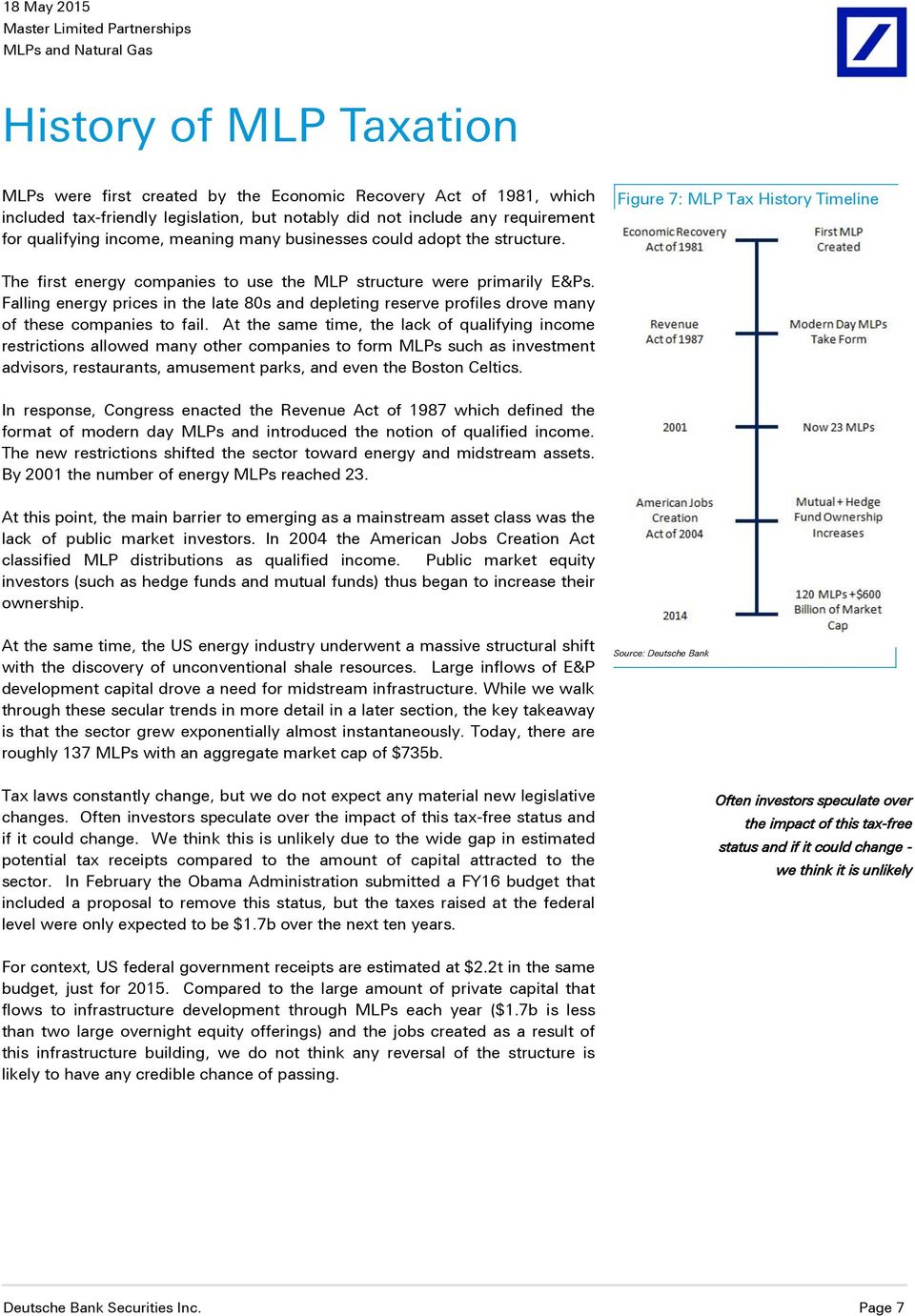
9 History of MLP Taxation MLPs were first created by the Economic Recovery Act of 1981, which included tax-friendly legislation, but notably did not include any requirement for qualifying income, meaning many businesses could adopt the structure. Figure 7: MLP Tax History Timeline The first energy companies to use the MLP structure were primarily E&Ps. Falling energy prices in the late 80s and depleting reserve profiles drove many of these companies to fail. At the same time, the lack of qualifying income restrictions allowed many other companies to form MLPs such as investment advisors, restaurants, amusement parks, and even the Boston Celtics. In response, Congress enacted the Revenue Act of 1987 which defined the format of modern day MLPs and introduced the notion of qualified income. The new restrictions shifted the sector toward energy and midstream assets. By 2001 the number of energy MLPs reached 23. At this point, the main barrier to emerging as a mainstream asset class was the lack of public market investors. In 2004 the American Jobs Creation Act classified MLP distributions as qualified income. Public market equity investors (such as hedge funds and mutual funds) thus began to increase their ownership. At the same time, the US energy industry underwent a massive structural shift with the discovery of unconventional shale resources. Large inflows of E&P development capital drove a need for midstream infrastructure. While we walk through these secular trends in more detail in a later section, the key takeaway is that the sector grew exponentially almost instantaneously. Today, there are roughly 137 MLPs with an aggregate market cap of $735b. Tax laws constantly change, but we do not expect any material new legislative changes. Often investors speculate over the impact of this tax-free status and if it could change. We think this is unlikely due to the wide gap in estimated potential tax receipts compared to the amount of capital attracted to the sector. In February the Obama Administration submitted a FY16 budget that included a proposal to remove this status, but the taxes raised at the federal level were only expected to be $1.7b over the next ten years. Often investors speculate over the impact of this tax-free status and if it could change - we think it is unlikely For context, US federal government receipts are estimated at $2.2t in the same budget, just for Compared to the large amount of private capital that flows to infrastructure development through MLPs each year ($1.7b is less than two large overnight equity offerings) and the jobs created as a result of this infrastructure building, we do not think any reversal of the structure is likely to have any credible chance of passing. Page 7
10 Typical MLP Org Structure The most common organization structure is displayed below in Figure 8. The sponsor (which is normally a corporate parent company or financial investor) owns the general partner as well as a varying percentage interest in the limited partner units. The important things to note about the organization structure are: General Partners: Usually own a 2% economic interest and Incentive Distribution Rights (IDRs). We explain the math behind IDRs on the next page. The GP also has managerial and voting control over the MLP and its operations. Limited Partners: Have no role in the MLP s operations and no voting rights. Subordinated Units: Are owned by the sponsor and typically convert to common units starting after 3 to 5 years, or in some cases after the distribution has increased 150% above the Minimum Quarterly Distribution ( MQD ). As MLPs have evolved as an asset class so have the iterations of their organizational structures. Investors now have many more options when seeking exposure to these assets and can invest in: LPs, GPs, C-Corps, Up C s, and LLCs. Many companies offer different structures of investment vehicles within the same complex. Energy Transfer, for example, has several public listings in its complex (ETE, ETP, SXL, and SUN), and the expectation for even more (ETGP and ETL). MLPs are controlled by their general partners, who hold a 2% interest and IDRs Limited partners have no voting rights There are now several possible organizational structures for MLPs The biggest differences among these options relate to cash flows, taxes, and voting rights. Figure 9 compares an MLP and a corporation. The lack of entity level taxation is a major benefit in owning MLPs and is one of the main reasons MLPs receive a valuation uplift versus typical public companies. Figure 8: Typical Organizational Structure Figure 9: Voting and Tax Differences Characteristic MLP C-Corp Investor Voting Rights No Yes Taxable at Entity Level No Yes Tax Reporting K-1 DIV-1099 Tax Burden Flow Through to Investors Yes No Tax Deferral on Distributions Yes No General Partner (GP) Yes No Incentive Distribution Rights (IDRs) Yes No Page 8

11 Incentive Distribution Rights (IDRs) Incentive Distribution Rights (IDRs) are a critical component of the MLP structure and are often misunderstood. Traditionally the GP holds a 2% economic interest, IDRs, and managerial and voting control of an MLP, while the LPs hold the remaining 98%. The IDRs entitle the GP to a growing share of incremental cash flows, based on a set scale. Thus as cash flows increase, GPs will receive their assigned 2% (in-line with their direct interest), as well as growing distributions to their IDRs. IDRs entitle the GP to a growing share of incremental cash flows While IDRs help align different partnership interests (by incentivizing the GP to boost DPU for LPs), they can become a hindrance to growth longer-term as more cash must be paid out to the GP. IDRs can become a drag on growth in later years as more cash must be paid out to GPs The IDR Schedule. The rate at which IDR payouts increase is set by the IDR Schedule. These schedules usually have five levels, comprising a minimum quarterly distribution (MQD) and four higher tiers, and are based on the LP DPU (not total distribution). The ceiling for each tier is set off of the MQD: Tier I is 15% higher than the MQD Tier II is 25% higher than the MQD Tier III is 50% higher than the MQD IDR payout rates and percentage increases are set by the IDR Schedule Tier IV is any level higher than the ceiling of Tier III Figure 11 on the following page shows an example schedule, and Figure 10 below shows how cash would be paid out according to that schedule at various hypothetical DPU levels. Note again that each level is set off the LP, not total, distribution. As the table shows, the GP receives a larger proportion of total cash distributions as the LP DPU grows. Figure 10: Distributions to Each Unitholder Class at Various LP DPU Levels Hypothetical LP DPUs Distribution to LPs ($) Distribution to LPs (%) Distribution to GP ($) Distribution to GP (%) Distribution to IDRs ($) Distribution to IDRs (%) DPU = $0.50 $ % $ % $ % DPU = $0.55 $ % $ % $ % DPU = $0.60 $ % $ % $ % DPU = $0.70 $ % $ % $ % DPU = $0.85 $ % $ % $ % DPU = $1.00 $ % $ % $ % DPU = $2.00 $ % $ % $ % DPU = $3.00 $ % $ % $ % Page 9

12 IDR Math and the GP Multiplier Effect. The basic math for each tier is as follows: MQD: LPs collect 98% of distributable cash until they receive $0.50 per unit. GPs collect the remaining 2%. Tier I: LPs collect 98% of the next tranche of cash until they have received another $0.075 per unit (bringing them to a total of $0.575 per unit). GPs again collect the remaining 2% of this tranche. Tier II: LPs now collect 85% of the next tranche, until they reach another $0.05 per unit (the difference between the ceilings on Tiers I and II). The GP collects its standard 2%, as well as 13% for its IDRs. Figure 11: Example IDR Schedule Target LP DPU Ceiling Distrib to GP Distrib to IDRs Distrib to LPs MQD $ % 0% 98% Tier I $ % 0% 98% Tier II $ % 13% 85% Tier III $ % 23% 75% Tier IV >$0.75 2% 48% 50% Tier III: LPs collect 75% of the next tranche to get to another $0.125 per unit (the Tier II and III difference). The GP goes to 25% total. Tier IV: LPs now collect only 50% of incremental distribution, with the remainder going to the GP. The key is that each tier is only reached if the below tier is fully paid on every incremental dollar paid out, and the percentage splits only apply to the current tier. So immediately after reaching Tier IV, the percentage payout split is roughly 92.3% to LPs, 2% to the GP, and 5.66% to the IDRs, even though the GP/IDRs are receiving 50% of every higher increase. Because it is based on incremental distributions, the share held by the GP/IDRs can never break 50% - LPs will always be ahead by their MQD and Tier I-III distributions. The GP Multiplier Effect. IDR growth greatly outpaces LP growth as the MLP goes farther into the high splits. The chart to the right below uses the IDR schedule above and shows that with steady 15% LP DPU growth, GP distributions grow at a 36% CAGR once into the high splits. The reason for this difference can be seen simply with the chart in Figure 10 if the LP DPU is raised from $0.85 to $1.00 (a 17% increase), the resulting IDR change is $0.14 to $0.29 (a doubling). This ratio of growth is known as the GP-multiplier (2.4x in this case). Because of this advantaged growth profile, pure-play GP MLPs typically trade at a 200 basis point premium to their underlying MLP. Purpose and Advantages of IDR for LPs. Beyond the clear advantages for the GP, IDRs are also important for LPs as they incentivize LP growth. This is particularly important for this structure as LPs have no voting control IDRs thus help align GP and LP interests. However, as we illustrated above, it becomes increasingly difficult to grow LP distributions as MLPs move farther into the high splits. This generally increases the cost of equity capital and thus lowers the potential growth outlook. While there are remedies like IDR resets and IDR waivers (where the GP agrees to accept lower-than-entitled IDR payments), many players chose instead to eliminate IDRs altogether: MWE and EPD bought out their GPs, while KMI and WMB recently completed/announced consolidations into their C-corps. As more MLPs mature, we expect to see more partnerships follow this path to attempt to improve their costs of capital and respective growth profiles. The share held by the GP/IDRs can never break 50%... but IDR growth greatly outpaces LP growth as the MLP goes farther into the high splits Figure 12: LP vs. IDR Growth $10 Total Distribution ($) $8 $6 $4 $2 $0 $0.50 $0.99 $1.98 $3.94 LP DPU ($) Distribution to LPs Distribution to GPs Distribution to IDRs Page 10

13 Private Letter Rulings Private Letter Rulings (PLRs) are determinations issued by the IRS to clarify tax laws on a case-by-case basis. They have become increasingly important to the MLP sector over the last decade as non-traditional businesses (beyond typical midstream services) try to adopt the tax-free structure. Generally speaking, these companies need PLRs from the IRS to be declared MLP-eligible. PLRs are also crucial for sponsors determining what assets they can drop-down to existing MLPs. Generally speaking, companies with atypical asset profiles need PLRs from the IRS to be declared MLPeligible MLP Tax Recap. As a quick reminder, MLPs are considered pass-through entities and do not pay federal income taxes as long as 90% of annual gross income counts as qualifying. Qualifying income is defined as income from the exploration, production, transportation, processing, storage, and marketing of natural resources, minerals, or industrial-grade CO2. There are also some concessions for the storage and transportation of some renewable fuels (like ethanol). Rise of Non-Traditional MLPs. The MLP sector has seen a rise in the number of new issuances as well as a divergence in business model as companies which didn t match the standard definition of an MLP -- were nevertheless drawn to both the tax benefits and valuation uplift associated with the MLP structure. As illustrated to the right, in recent years the oilfield services subsector has dominated PLR issuances. A key detail is that not all companies need a PLR only those with businesses outside the traditional definition of qualifying. Moreover, previously issued rulings cannot be used as precedent; each atypical candidate needs its own PLR. The PLR Pause and Pending Changes. As inquiries rose, the IRS declared a surprise pause of issuances in April The pause ultimately lasted a year and in May 2015 the IRS announced new clarifications. While technically just a proposal, and the rules can still change, the definition of qualifying income has been slightly tightened. We think the definition now covers most operations that are linked to qualifying income (for example, waste water disposal), but precludes many processes that cause changes on the chemical level or introduce non-qualifying minerals or natural resources into the final product. Therefore it appears that several business lines inside existing MLPs are no longer considered qualifying, most notably olefin cracking / petrochemical refining. The IRS has proposed a ten-year window for affected companies to decide what to do with these assets. Except for a few pure-play names, we do not expect a significant impact on most existing MLPs. Lastly, it is important to note that an MLP remains allowed to hold assets that generate 10% or less aggregated non-qualifying income. It is crucial for these companies trying to adopt the MLP structure to understand how the IRS defines qualified income. Its scope has not been expressly defined, and the IRS is the only entity allowed to rule one way or the other. Previously issued rulings cannot be used as precedent each atypical candidate needs its own PLR Figure 13: PLR Issuance by Industry Midstream Downstream Oilfield Services Mining Timber Processing Source: IRS Filings; Deutsche Bank Page 11

14 Why Do Companies Create MLPs? MLPs are typically created by one of two types of entity: a financial sponsor looking for a monetary realization or a parent company with embedded midstream assets. While the motivations of financial sponsors are clear, we highlight four frequent drivers for parent companies: Financing Strategy: The primary reason many companies launch an MLP is financing. While the uses of raised capital do vary, it has increasingly become the case that the parent entity is looking to further build out its own midstream assets to increase its own valuation. The primary reason to launch an MLP is as a financing strategy Realizing Valuation Uplift: Given the market premium offered, those with midstream assets have also tried to illustrate the value inherent in their portfolios on a sum-of-the-parts basis. Garnering Tax Benefits: MLPs do not pay corporate level taxes, which means companies can save money by moving assets into this type of vehicle. Targeting Different Investors: Companies may have investor bases that are not familiar with or interested in midstream. Moving these assets into another entity allows for a more coherent investor base. Drop-Down Structures. Almost all of these themes come together when we consider the drop-down growth model that has become extremely common across the MLP space. The structure emerges when a parent company creates an MLP by contributing some, but not all, of its eligible assets. This creates a backlog (usually quantified by the amount of EBITDA generated by the assets sitting up at the parent) that can be sold or dropped-down to the MLP over time. While multiples vary based on asset type, location, and growth profile, recent sector multiples have averaged around x10 EBITDA. This model allows a parent company to continue to control the assets, but also secure more capital. The drop-down model emerges when a parent company creates an MLP by contributing some, but not all, of its eligible assets, choosing instead to contribute them over time For MLPs, the drop-down model creates the ability to acquire assets without taking on significant construction or financing risk for new projects. Large parents or private financial backers often assume this risk, shielding the MLP until the assets are flowing cash. Rough math behind the cycle: sponsors/parents build organic projects at 15-20% returns, MLPs acquire them for a 10% return (off of the above 10x multiple), and the market prices MLPs at a 5-6% yield (where our index trades). Overall ==> a very accretive process for both MLPs and their sponsors/parents. Page 12

15 How MLPs Make Money Investing in MLPs requires a basic understanding of how MLPs make money as well as the most commonly used metrics. Most investors are familiar with analyzing companies based off EBITDA or earnings per share (EPS) as a proxy for the underlying cash generated by the business, but because MLPs are pass-through entities investors focus directly on assessing cash. Cash is passed through in the form of a dividend (referred to as a distribution or DPU) to the unit holders, and the level of cash an entity has available to pass through is called Distributable Cash Flow (DCF). Because MLPs are passthrough entities investors focus directly on assessing on cash The below example illustrates the basic math. First, the amount of DCF a company generates is calculated by taking the Net Income, adding back Depreciation, Depletion & Amortization (DD&A), subtracting Maintenance Capex, and then adjusting for any other non-cash related item. This is not too different from most companies, though maintenance capex tends to be lower in our space (~10% of EBITDA). The health of the business can then be assessed by comparing DCF per unit to the DPU. When a company is first launched this number is referred to as the Minimum Quarterly Distribution ( MQD ). Note that distributions are not a tax requirement (unlike REITs), but instead the expectations of distributions and distribution growth are the basis of the trading yield (annualized current distribution / price) which is a common valuation parameter used in the MLP sector. Dividing the DCF per unit by the DPU generates a metric referred to as distribution coverage, which can be seen in Figure 14. Currently the average distribution coverage ratio for the names in the AMZ index is ~1.1x. Companies who run above 1.5x coverage (like EPD or MPLX) garner premium valuations versus peers with similar growth rates as the market is willing to pay more for longer growth visibility / certainty. The theory behind the valuation uplift is that the partnership could tap this excess coverage in later years to maintain distributions even if DCF drops in a specific period. The health of the business can be assessed by comparing DCF per unit to the DPU Which gives us our distribution coverage figure Figure 14: MLPs Pay Out the Majority of Cash Flow Distributable Cash Flow Net Income Depreciation & Amortization (DD&A) 50 + Other non-cash items 20 - Maintenance Capex (40) Distributable Cash Flow (DCF) Distributions to GP and LPs (545) Excess Coverage 55 Total Coverage Ratio (x) 1.1x Page 13

16 Not all MLPs are the Same Wide dispersion of performance increases the value of fundamental analysis. While most sub-sectors of energy have high correlations between the names within their indices, MLPs do not. Looking at the AMZ Index highlights the dispersion of MLP performance and the value of fundamental analysis. Figure 15 shows that the spread over the past decade between the top 10 performers and the bottom 10 performers in the AMZ was on average 65%. As can be seen, the width of the spread has held relatively consistent and has never been narrower than 45% -- largely attributed to the different types of MLPs in the index. Using 2014 as a guide the top 10 performers skewed toward high growth crude logistics names vs. the bottom 10 names skewed toward coal and E&P names. YTD for 2015 the pullback in commodity price has lead to a different trend and the top 10 performers are now split between E&P and crude logistics names. That said, the dispersion remains consistent with the best name up +40% and the worst down -40%. The top 10 performers skewed toward high growth crude logistics names vs. the bottom 10 names skewed toward coal and E&P names Figure 15: Dispersion of Returns 250% Top 10 - Average Returns 200% Middle 30 - Average Returns Bottom 10 - Average Returns 150% 100% 50% Figure 16: Yield Profiles of Different Sub-Sectors Yield (%) 16% 14% 12% 10% 9.4% 9.6% 8.0% 8.1% 8% 6.5% 7.0% 6% 4.5% 4% 3.4% 13.9% 0% 2% 0% -50% -100% Source: Bloomberg, Deutsche Bank GPs Crude Logistics Source: Bloomberg, Deutsche Bank Large Cap Diversified Nat Gas G & P Coal Propane Shipping & Drilling E&P Refining Typically investors refer to the non-traditional MLPs (seen to the right in Figure 16) as the driver of the dispersion. While these business models (coal, propane, E&P, refining) have highly variable cash flows and do account for a meaningful portion, traditional midstream names also account for a significant amount of the dispersion of returns. For example, within the natural gas gathering and processing (G&P) sub-sector understanding a company s contract types (e.g., fee based, keep whole, and percent of proceeds) is critical to determining the stability and security of cash flows in volatile commodity environments. While we discuss the key variables in both the subsequent Midstream Value Chain section and our Investment Recommendations Section on page 24, we also highlight some key criteria below: Assets: Types, Locations, and Barriers to Entry Growth Profile: Level and Length of Visibility, Coverage Ratios Cash Flow Stability: Contract Structures and Duration Balance Sheet: Debt Rating, Leverage Levels Other: Aligned Sponsor Interest, GP/IDR levels, Regulatory Risks Page 14

17 The Midstream Value Chain The Midstream Process Begins at the Wellhead. From here wellhead (or inlet) gas needs to undergo the various levels of gathering, treating, processing, and fractionating before it is ready to be transported to various end markets. Figure 18 below depicts the typical stages from wellhead to the end market. Not All Wellhead Natural Gas is the Same. Dry gas, meaning streams with very little NGL content, may need some treating but generally require minimal processing before being sent to market. Wet gas, on the other hand, has a high NGL content and must be treated and processed before the gas can be transported to market. The NGLs are sent on as a separate stream to be fractionated into their various components: ethane, propane, butane, isobutene, and natural gasoline. The composite US NGL barrel is shown to the right, illustrating the typical breakdown for wellhead gas stream liquids content. Measuring NGL Content and Deciding When to Process. The most common way to quantify NGL content is by GPM (gallons per mcf). For example, wellhead gas with a GPM of 5 generates 5 gallons of NGLs from every 1 mcf of gas at the wellhead. Typically a GPM less than 2 is considered dry, while 2+ is considered wet or rich and in need of processing and eventual fractionation. The decision is not that simple though, as midstream players must weigh two possibly conflicting needs: economics and takeaway qualifications. Generally, operators want to remove NGLs, as they are usually priced above natural gas on a per-btu basis. But if the spread between these (known as the frac spread) drops below the cost of separation, the economic incentives of processing are removed and thus operators may try to avoid this step. However, most natural gas pipelines have maximum liquids content regulations, which means that NGLs must often be processed out of the stream even if traditional processing economics are negative. Figure 17: Composite NGL Barrel Ethane (40-45%) Propane (25-30%) Normal Butane (5-10%) Isobutane (10%) Natural Gasoline (10-15%) Source: EnVantage; Deutsche Bank Wet Gas is an Increasingly Large Portion of Wellhead Production. Historically in the United States, natural gas was extracted from conventional gas wells. But, over the last decade the ability to drill for shale natural gas has drastically changed the energy complex. One of the most important features of shale gas is that it is generally richer than conventional gas, which has brought a huge need for processing, fractionation, and NGL handling infrastructure. Figure 18: The Midstream Value Chain Page 15

18 Step 1: Gas Gathering A gathering system is a network of pipelines that collects natural gas from the wellhead and links to a central point. They are purpose-built for producers ahead of well completions to ensure their gas can move to market. Figure 19: Gas Gathering Traditionally these were linked to a single vertical well at a time, which necessitated a wide network of small-diameter, low pressure laterals. Now, with the advent of high-density, multi-well pad drilling in shale gas plays, a single gathering line can cover many producing wells. These can now reach up to 36 inches, from less than 12 inches historically. Step 2: Treating and Processing Treating: The treating process removes unwanted contaminants (e.g. water, sulfur, nitrogen) to get the gas to pipeline quality standards. If the gas does not meet quality standards it can lead to pipeline erosion, explosions, and many other serious issues. Quality standards differ by carrier, but generally involve: Figure 20: Gas Treating & Processing Heating values (e.g. 950 BTU/cubic foot), Temperatures (e.g. less than 120 degrees Fahrenheit), and Purity levels (e.g. less than 2% carbon dioxide by volume). Processing: Once natural gas is gathered and treated if necessary, it is then sent to a processing plant. The primary function of a processing plant is to cool the stream of raw gas to separate the Methane (C1) from the NGLs (C2 through C5). Once processed, two streams are formed: clean, marketable dry gas -- commonly referred to as residue gas and mixed NGLs -- commonly referred to as Y-grade. In theory, if the market value of the Y-grade gas falls below the cost to separate the NGLs the producer can choose to leave in some of the byproducts into the gas stream. The three main processing techniques used today are as follow: Cryogenic Processing This is the most commonly used process which is employed in almost all new processing plants and has the highest NGL recovery rate (80% of ethane, 100% of all other NGLs). The process reduces gas temperature to -120 degrees Fahrenheit through a turbo expander. Refrigeration A less frequently used process, refrigeration reduces the gas temperature to -30 degrees Fahrenheit. Refrigeration is lower cost than Cryogenic Processing, but also has lower recovery rates. Absorption The oldest and least frequently used process. In this process the raw natural gas is merged with absorption oil. The oil absorbs the NGLs and this new mix is then heated until the NGLs boil out. Lowest recovery rates (<30% ethane, +65% for all other NGLs). At this stage, the residue gas is pipeline-ready and can be transported via longhaul pipelines to end-consumers or injected into storage facilities. The mixed NGLs, on the other hand, are typically transported via NGL pipelines or trucks to a fractionator to separate the different NGL components. Page 16

19 Step 3: Fractionation Fractionation is the process of separating mixed NGLs into its individual base components through the application of heat. The process involves moving the mixed NGL stream through a series of progressively hotter distillation towers, or fractionators, that are configured to separate out particular NGL components. As the temperature of the mixed stream increases through each fractionator, individual NGL components are boiled off one-by-one, moving from the lightest (e.g. lowest boiling point) NGL (ethane) to the heaviest (natural gasoline). After an NGL component is separated, it is then cooled and condensed into a liquid form for storage and transportation. The mixed NGL stream flows through the fractionators in the following order: Figure 21: Fractionation De-Ethanizer: Removes ethane from the NGL stream, leaving what is known as C3+ (propane and heavier). De-Propanizer: Separates out propane, leaving butane, natural gasoline, and heavier hydrocarbons (C4+). De-Butanizer: Separates out butane, leaving natural gasoline and heavier hydrocarbons as a final product (C5+, or pentanes+). Butane Splitter: Separates normal butane from isobutene after the debutanizer. Figure 22: NGL Fractionation Steps Y-Grade De-Ethanizer Ethane Propane Butane Splitter Isobutane N-butane Propane Plus De-Propanizer Butane Plus De-Butanizer Butane Natural Gasoline Step 4: Transportation & Storage Both natural gas and NGLs must be transported from their respective processing, fractionation facilities to the appropriate end markets. It is important to note that pipelines are configured to handle different commodities. For example a long-haul natural gas pipeline will be different from a y-grade pipeline which will be different from a purity ethane pipeline. Additionally the end markets for all of the different products vary as well. Transportation methods include rail, truck, and pipeline connections. Storage facilities include above-ground marine, pipeline, and rail terminals as well as underground salt caverns and depleted aquifers. Figure 23: Transportation/Storage Page 17

20 Midstream Contract Types Contract structures between producers and midstream processing operators vary. The key characteristics are: type of service, commodity price exposure, volume commitments, and duration. Historically, processing was mostly done by producers and contracts tended to be keep-whole. But, keep-whole contracts have high levels of income variability and as midstream operations separated into standalone entities contracts types shifted. Today, most MLPs prefer fee-based contracts with minimum volume commitments (MVCs) as investors typically pay higher valuation multiples for cash flow stability and visibility. The most common contracts types are: Fee-Based: The simplest of the contract types, producers will pay processers a fee which is based on the anticipated volumes to be processed. The processor never takes title to any commodity, leaving the producer with all value associated with the sale of natural gas and NGLs. The most ideal contracts for processors also set minimum volumes commitments (MVCs), and therefore have no direct commodity or volume risk. A fee-based contract with a combined MVC can be thought of as take-or-pay meaning the midstream operator would in theory be agnostic to whether volumes are actually flowing. While we are mostly focusing on processing here, we note that most transportation and gathering contracts are now fee-based. Percent-of-Proceeds (or Percent-of-Liquids): Here, processors share in the proceeds generated from the producer s sale of residue gas and/or mixed NGL. Terms specify the specific splits and whether the producer is responsible for covering the costs associated with extraction of the NGLs. For example, the producer keeps ownership of 90% of the proceeds (or liquids) and the processor is allowed to keep the remaining proceeds (liquids) and will be reimbursed for any associated costs. In this case, both the producer and processor are long NGL and natural gas. Keep-Whole: For processors, these contracts have the most commodity sensitivity. Here, producers transfer ownership of any NGLs extracted from the raw gas stream to the processor in exchange for their services. The key here is that the processors must return an equivalent-btu basis of natural gas back to the producer as was provided pre-processing / extraction of NGLs. In this way, the producer is kept whole on a total btu basis. These contracts are only profitable when the value of NGLs is greater than the value of residue gas stream on a per-btu basis plus the cost of processing. Key characteristics are: type of service, commodity price exposure, volume commitments, and duration A fee-based contract with a combined MVC can be thought of as take-or-pay For POP, processors share in the proceeds generated from the producer s sale of residue gas and/or mixed NGLs Keep-Whole contracts have the most commodity sensitivity for processors Volume Requirements: As mentioned above, in addition to contract types, we believe investors should also focus on volume requirements. Common types are: minimum volume commitments, acreage dedications, firm capacity, interruptible, and at will. Page 18

21 Infrastructure = Positive Secular Growth Story The growth in oil and gas production out of shale basins and other unconventional plays has brought a massive need for new energy infrastructure across the country, as existing networks were inadequate to handle new volumes / connect production to demand centers. For example, the Northeast is a supply constrained demand center, despite being in relatively close proximity to the Marcellus and Utica. The EIA estimates that by 2025 unconventional dry gas plays can boost overall production by 50% and US crude production from the top three new basins can almost double. We believe, despite the recent pullback in energy prices, that this will provide the MLP sector with a major, positive secular growth story going forward. INGAA, a major industry trade group, estimates that $641b in midstream capex will be needed through 2035: $313.1b for natural gas, $271.8b for crude, and $56b for NGLs. We will also be publishing our own bottom-up estimates for midstream capex in an upcoming note. We believe that continuing demand for energy infrastructure will provide our midstream space with a major, positive secular growth story going forward Within this spend, we see several critical themes: E&Ps connecting production to demand centers, utilities looking for dependable fuel sources, downstream players sourcing advantaged feedstock, and export demand. Sub-sectors with the greatest leverage include: crude logistics (PSXP, MLPX, VLP, TLLP), NGL infrastructure (ETE, SXL, MWE), and large cap diversified (KMI, EPD). Connecting Supply and Demand One of the most important drivers for midstream players has been the need to connect supply and demand. While it sounds simplistic, it has been a major undertaking. Two developments in particular have been major drivers: Refiners Build to Capitalize on the New US Crude Supply. Massive US oil growth caused regional differentials to emerge as takeaway capacity remained inadequate. The best example was the blow out of the Brent/WTI spread in 2011 to 2013, when some refiners were able to buy crude at a $20/bbl discount to global prices, which drove outsized returns for many refiners and placed them at an advantage to global peers. In response, refiners as well as midstream companies have been aggressively building projects to de-bottleneck constraints. Two major drivers of midstream asset demand have been refiners looking to source new feedstock and gas producers looking to move volumes out of the constrained Northeast Northeast Gas Production Has Overwhelmed Takeaway Capacity. Starting in 2013 the signals of a supply glut in the Northeast emerged as production growth began to exceed takeaway capacity, and many regional pricing points now consistently trade at material discounts to Henry Hub national prices. With this differential reaching over $1.00/mcf at times, there is a clear incentive for producers to contract takeaway capacity. Several lines have expanded in the region, but the majority of capacity will not come online until While this is a headwind for producers, it offers midstream players a multi-year, large-scale organic growth opportunity. Page 19
22 The Shale Revolution The US energy landscape was changed dramatically by the advent of new drilling technologies the early 2000 which allowed producers to tap previously unavailable reserves trapped in shale formations across the country. Despite the recent slowdown, the shale boom has been massive. From an oil perspective, the Permian, Eagle Ford, and Bakken alone now represent 5 mmb/d or half of US total production. The EIA expects their production to hit 10.6 mmb/d in At the same time, gas production from shale plays is equally prolific and comprises almost 70% of total US production. The six main plays now contribute roughly 45 bcf/d out of a US dry gas total of 70 bcf/d. Both oil and gas volumes have grown dramatically in the last ten years Figure 24: US Oil Supply/Demand mmb/d US Production US Consumption US Imports (implied) Figure 25: US Gas Supply/Demand bcf/d US Production US Consumption US Imports (implied) Source: BP; Deutsche Bank Source: BP; Deutsche Bank We believe there are six key US shale plays for our midstream players, based on current production, potential growth, and continued need for infrastructure: the Permian, Eagle Ford, Bakken, Marcellus, Utica, and Haynesville Figure 26: Major US Shale Basins The Permian, Eagle Ford, Bakken, Marcellus, Utica, and Haynesville are the most important plays for our sector right now Source: EIA Page 20
23 The Critical Basins and Who Has Exposure We have laid out a quick overview of each of these plays, with production levels and important midstream and E&P players in each. Permian Consisting of several stacked reservoirs in West Texas and SE New Mexico, the Permian is one of the largest hydrocarbon basins in the US. Considered an oil play (2 mmb/d), it also produces significant gas volumes (over 6.4 bcf/d). The Permian is one of the largest hydrocarbon basins in the US Importation midstream players: KMI, EPD, ETP, and SXL. Important E&P players: OXY, APA, CVX, COP, and PXD. Eagle Ford Running through SE Texas and into Mexico, the Eagle Ford has become the poster child for the US shale revolution. Though it was virtually unknown until 2008, it now produces 1.7 mmb/d of oil and 7.5 bcf/d of gas. The Eagle Ford has become the poster child for the US shale revolution Importation midstream players: EPD, ETP, KMI, and DPM. Important E&P players: EOG, COP, MRO, BHP.AX, and APC. Bakken Stretching from Western North Dakota and Eastern Montana north into Canada, the Bakken has emerged as a major oil play. Including the underlying Three Forks formation, the Bakken now produces 1.3 mmb/d, up from less than 300 mb/d in It also produces significant associated gas: 1.5 bcf/d The Bakken has emerged as a major oil play Importation midstream players: OKE, PAA, KMI, and EEP. Important E&P players: WLL, CLR, XOM, HES, and EOG. Marcellus Sweeping from Western New York through Pennsylvania and into Ohio and West Virginia, the Marcellus is arguably the most prominent gas play in North America. Production is generally dry to the east and wetter to the west. The field produces 16.7 bcf/d today, up from less than 2 bcf/d five years ago. The Marcellus is arguably the most prominent gas play in North America Importation midstream players: MWE, WPZ, SXL, and ETP. Important E&P players: RRC, COG, EQT, AR, and SWN. Utica Comprising mostly the same geography as the Marcellus, the Utica is arguably the least explored major basin today. It too has an east/west dry/wet gas divide, but it also has oil and condensate prospects. Production is now 2.5 bcf/d of gas and about 60 mb/d of oil, up from close to zero for both in The Utica is arguably the least explored major basin today Importation midstream players: MWE, SMLP, WPZ, and AM. Important E&P players: GPOR, AELP (private), CHK, AR, and RRC. Haynesville Sitting under the Northern Louisiana-Texas border, the Haynesville was one of the first major prolific shale gas plays. While production ramped quickly, it peaked in late 2011 near 10 bcf/d and has since moderated to about 7 bcf/d. The Haynesville was one of the first major prolific shale gas plays Importation midstream players: ETP, KMI, WPZ, EPD, and ENLK. Important E&P players: CHK, BHP.AX, XOM, ECA.TO, and CRK. Page 21
24 Other Basins Other plays have certainly benefited from advances in drilling technologies and will drive increased midstream spending as well. Among the more significant are the Barnett, Fayetteville, Niobrara, and Woodford. Other smaller shale subplays that are just emerging, like SCOOP and STACK in Oklahoma, the Mancos in the Rockies, and the Upper Devonian (sitting geologically above the Marcellus) offer further long-term sector growth. And finally, volumes out of Western Canada should provide additional opportunities in crude logistics. Lastly, traditional North American hydrocarbon sources, like the Gulf of Mexico (offshore and deep water), the Alaskan North Slope, and California heavy oil plays remain important for total US volumes, but are less significant for our midstream companies as they are in more mature development stages. MLP Breakdown by Basin Exposure Legacy North American hydrocarbon sources remain important for total US volumes, but are less significant for our midstream companies Below we provide a high-level overview of some of the more important regions and business models for MLPs. Figure 27: Selected MLP Basin Exposure Ticker Total Regions Permian Eagle Ford Bakken Marcellus/Utica Mid-Con/Ark-La-Tex Rockies Gulf Coast/GoM BWP 2 G-P T DPM 4 G-P G-P G-P G-P ENB/EEP 2 T T-G-P ENBL 2 G T-G-P ENLC/ENLK 4 P G-P T-G-P G-P EPD 6 T-G-P T-G-P T T-G T-G-P T-G-P EQM 1 T-G ETE/ETP 5 T-G-P T-G-P T-G-P T-G-P T-G-P GEL 2 T T KMI 7 T-G T-G-P T-G T T-G-P T-G T-G MMP 2 T T MWE 2 G-P G-P NSH/NS 3 T T T OKE/OKS 4 T T-G-P T-G-P T-G PAGP/PAA 6 T-G T T-G T T T-G SE/SEP 4 T T-G T T SEMG/RRMS 3 T-G G-P T SMLP 4 G G G G-P SXL 4 T-G T T-G T-G TEP 2 T T-P TLLP 2 T-G T-G-P TRGP/NGLS 5 G-P G-P G-P T-G-P G-P TRP/TCP 2 T T WGP/WES 5 G-P P G G T-G-P WMB/WPZ 5 G T-G-P G T-G-P T-G-P Total Source: Company Filings; Deutsche Bank Page 22
25 Understanding Commodity Headwinds One of the most common questions we hear is how the collapse in commodity prices will affect MLPs. The short answer: it depends. The drop in crude, natural gas, and NGL prices has certainly been severe. Since the end of 3Q14, when the downturn started, WTI has fallen 33%, Henry Hub natural gas has fallen 26%, and the composite NGL barrel at Mt. Belvieu has fallen 43%. The AMZ by contrast, is down 16%, versus the S&P 500 up 8%. Figure 28: Rebased Price Performance Since the Beginning of 4Q14 20% 10% 0% -10% -20% -30% -40% -50% -60% O-14 N-14 D-14 J-15 F-15 M-15 A-15 M-15 WTI HH Gas AMZ SPX NGL Composite Source: Bloomberg; Deutsche Bank Though our index has traded off with the broader energy sector, in general MLPs should be less directly impacted than other subgroups due to their recurring, toll-like contracts resulting in steadier cash flows. Obviously the level of commodity price exposure varies among our companies (and is a partial driver of our ratings), but as a group they should still do better than the E&Ps, for instance, who have seen a direct, tangible hit to earnings. Lower throughput on existing assets as producers pare back volumes creates a near-term risk within our sector. While some contract structures can mitigate this, lower utilization and slower ramps for newlymcommissioned projects can weigh on midstream earnings. To this effect, many investors are now watching rig counts and storage levels to try to gauge when or if the market will definitively recover, but factors like changes in producer operating efficiencies and shut-in wells make this more of an art than a science. The Biggest Risk is a Narrowing of the Long-Term Opportunity Set. The biggest risk, in our opinion, is the possibility that a sustained downturn in commodity prices could reduce the long-term opportunity set that many of our companies depend on for their growth profiles. A materially lower price deck would lead to permanently suspended drilling plans by producers, which in turn brings lower volume growth and thus reduced demand for assets across the entire midstream value chain. While lower prices have helped boost midstream throughput from the demand side for some products (notably gasoline and distillates), we think this is materially weaker than the growth we would see pushed from the supply side in a higher-price environment. MLPs should be less directly impacted than other energy subgroups due to their recurring, toll-like contracts resulting in steadier cash flows The biggest risk is the possibility that a sustained downturn in commodity prices could reduce the longterm opportunity for many of our companies Page 23
26 Watching Producer Capex: A Significant Roll-Off for In our opinion, producer outlooks are more important barometers of opportunities for our sector over the long-term than simple rig count data or storage levels. We have thus been following producer budgets closely and most E&Ps have cut their 2015 capital budgets dramatically. We examined 70 of the highest spending E&Ps in North American and calculated that 2015 capex is currently estimated to be 40% lower than that of 2014 (this excludes many of the supermajors, who often do note break out guidance by region). Moreover, we counted 23 North American E&Ps that had to revise their spending guidance lower only a few months or even weeks after issuing it and roughly doubled their original cuts compared to 2014 see Figure 29 below. We think these adjustments merit special attention as they illustrate the significant negative impact the commodity pullback has had on sentiment. All is Not Lost: We Think the Long-Term Thesis is Intact. Despite this negative backdrop, we continue to expect a positive trajectory in the demand for MLP infrastructure. While 2015 may end up being a weaker period compared to the first half of 2014, we think the US is still on track to show major production growth over the long term. The weaker names in our sector will likely start to show stress later this year as producer volumes slow, but we think the stronger names will be able to weather this storm. 23 North American E&Ps had to revise their spending guidance lower only a few months or even weeks after issuing it and roughly doubled their original cuts compared to 2014 Figure 29: NAM E&P 2015 Capex Guidance Revisions Company Ticker 2014A ($m) 2015E Initial ($m) 2015E Initial (Date) 2015E Latest ($m) 2015E Latest (Date) Difference, $m (in Guide) Difference, % (in Guide) Difference, $m (2014A to 2015E) Difference, % (2014A to 2015E) Antero AR Aug Jan % % Apache APA Nov Feb % % Baytex BTE-T Dec Mar % % Bellatrix BXE-T Dec Jan % % Cabot COG Oct Feb % % Cenovus CVE-T Dec Jan % % Chesapeake CHK Feb Mar % % CNRL CNQ-T Nov Mar % % ConocoPhillips COP Dec Jan % % Continental CLR Sep Dec % % Eclipse ECR Dec Apr % % Encana ECA-T Dec Feb % % Enerplus ERF-T Dec Feb % % EQT EQT Dec Feb % % Husky HSE-T Dec Feb % % Linn Energy LINE Jan Feb % % MEG MEG-T Dec Dec % % Murphy MUR Dec Jan % % Oasis OAS Dec Feb % % Range RRC Dec Jan % % Rex REXX Nov Mar % % Southwestern SWN Dec Feb % % Suncor SU-T Nov Jan % 0.0 0% Total % % ; Thomson Reuters; Company Filings Page 24
27 Subsectors/Stocks to Own Wide Dispersion of Returns Calls for Selectivity We have divided the more important names in our sector into eight main buckets, leaving out three groups that we see as more ancillary to the midstream space: oilfield services, marine shipping, and coal. Out of our eight main groups, the three we like the most are: crude logistics, NGL infrastructure, and large-cap diversifieds. We have included below not only our coverage names for each subgroup, but also selected non-rated names and other constituents of the AMZ for context. Despite our subsector-level theses, we take no opinion on the performance of names in these latter groupings. Crude Logistics: This sub-segment comprises some of the highestgrowth names in our coverage and is our favorite subsector. Many of the crude logistics MLPs were formed by refiners to house their midstream assets and thus have large dropdown inventories. Further, these names benefit from having a constant source of capital and strategically-aligned interests with their parents as the latter seek advantaged feedstock / markets and higher midstream valuations. o o Our Coverage: PSXP, MPLX, VLP, SXL, TLLP Other/AMZ Constituents (N/R): BPL, EEP, GEL, MMP, NS, RRMS NGL Infrastructure: With crude exports banned, LNG export facilities still under construction, and refined products exports already trading in a well-balanced market, we think NGL exports are one of the only US products that can reach global markets and allow shippers to enjoy positive pricing spreads. We thus think companies that can link processing, fractionation, and exports should benefit from this ability. With US natural gas production continuing to grow, NGL players should enjoy this positive backdrop for the next several years. This is our second favorite subsector. o o Our Coverage: EPD, ETE Other/AMZ Constituents (N/R): Large-Cap Diversified: As the name implies, these comprise the biggest players that hold assets across the entire midstream value chain. While their scale means they cannot be bought to play a single theme, they do allow investors to buy into the continuing theme of US energy infrastructure development. Further, many are listed as c- corps, allowing for a wider investor base because of the lack of K-1 filings. o o Our Coverage: KMI, PAGP/PAA Other/AMZ Constituents (N/R): WMB/WPZ Figure 30: 2014 AMZ Performance Top 10 # 11 to 20 # 21 to 30 #31 to 40 Bottom Performance Rank Source: Bloomberg; Deutsche Bank 1 PSXP 63% 2 TCP 61% 3 EEP 41% 4 MPLX 40% 5 EQM 38% 6 KMP 35% 7 EPB 32% 8 MMP 28% 9 SEP 21% 10 ARLP 19% 11 SXL 19% 12 ETP 15% 13 NS 13% 14 WES 12% 15 BPL 12% 16 APU 12% 17 FGP 12% 18 EPD 6% 19 TLLP 6% 20 GMLP 3% 21 SPH 0% 22 ACMP 0% 23 ENLK -1% 24 CLMT -1% 25 MWE -2% 26 TGP -2% 27 PAA -2% 28 RGP -3% 29 WPZ -5% 30 QRE -8% 31 DPM -11% 32 HCLP -13% 33 NGLS -15% 34 OKS -21% 35 EXLP -23% 36 EVEP -23% 37 NGL -24% 38 APL -24% 39 TOO -27% 40 GEL -27% 41 MEMP -29% 42 CMLP -32% 43 NMM -38% 44 VNR -38% 45 SDLP -44% 46 ARP -44% 47 NRP -47% 48 LGCY -49% 49 LINE -52% 50 BBEP -52% Page 25
28 Natural Gas G&P / Natural Gas Transportation: We have a more mixed view on both natural gas G&P and transportation. These subgroups have the widest dispersions in performance as basin footprints, contract types, and commodity exposures can vary dramatically. We have positive biases on names with fee-based contracts in growing basins (like the Marcellus and Utica) and negative biases on names in less favorable basins or that have more commodity exposure. For standalone natural gas pipeline names, we believe their regulated returns and high expansion costs make it difficult for them to underpin significant growth as standalone assets. We have a more mixed view on natural gas G&P and natural gas transportation Our Coverage: MWE, OKE/OKS, WGP/WES, SMLP Other/AMZ Constituents (N/R): BWP, CMLP, DPM, ENBL, ENLK, MMLP, SEP, TCP, TEP Exploration & Production: E&P MLPs focus on low-cost, low-decline wells, which generally offer lower but steadier cash flows. Nevertheless, they do still generally take ownership of volumes and thus have high exposure to commodity prices. Typically they have large hedging programs to attempt to mitigate this volatility, but have still have a profile we view as less attractive in the MLP structure. We are negative on the E&P MLPs given their direct commodity exposure Our Coverage: N/A Other/AMZ Constituents (N/R): BBEP, LGCY, LINE, MEMP Refining: With only three companies and less than 4 years of total public track records, we believe some investors and c-corp refiners may adopt a wait and see approach before potentially investing in this type of vehicle given the concern on how it may perform during the next refining down-cycle and its viability/traction in the longer-run. We are also negative on the variable rate refiners, and prefer business models with less commodity sensitivity Our Coverage: N/A Other/AMZ Constituents (N/R): NTI, ALDW, CVRR Gas Storage and Propane Distribution: We see these subgroups as having low barriers to entry, which erodes margins and has made it difficult to keep cash flows steady. Our Coverage: N/A Other/AMZ Constituents (N/R): APU, FGP, NGL, SPH Page 26
29 Valuation Framework and Methodologies Investors often use the expression valuation is more of an art than a science. Acknowledging this sentiment we attempted to frame our thought process on valuation into four categories. The majority of the primer walks through our thought process on the first two criteria, so in this section we explain both our two valuation methodologies and walk through additional trends that we believe have a bearing on overall sector valuation. Industry Analysis: we assign higher valuations to sub-sectors with exposure to the key industry trends, high barriers to entry, limited competition, and nominal regulatory issues On a company-specific level, we prefer names with high growth profiles, long-term visibility to stable cash flow profiles, high coverage, IG rated balance sheets, and aligned sponsor interests or no-gp / IDRs Company-Specific Analysis: we favor high growth profiles, long-term visibility to stable cash flow profiles, high coverage, IG rated balance sheets, and aligned sponsor interests or no-gp / IDRs Valuation / Multiple Analysis: we employ targeted distribution yield and a dividend discount model to reflect both near-term and long-term outlooks Other Factors: we explore the impact of shifting investor types, sector inflows, capital raises, complexity of financial metrics, and other investment options We employ two valuation methods to provide a framework for both the nearterm and long-term opportunity set: target yield and dividend discount model. Target Yield: We employ target yield as a way to frame our near-term outlook. The rational for choosing yield was two-fold: first, most investors are attracted to this sector because of its income-oriented profile; and second, given the complicated nature of these organization structures we believe there is an increased opacity when looking at EPS or EBITDA so we chose to focus on cash generation. For each target yield we consider it in context of its historical level, relative to its peer-set, and relative to the broader AMZ index. Dividend Discount Model (DDM): We also utilize a DDM to frame the longer-term opportunity set which we believe is an important differentiator for many of these names (for example determining how much 5 years of visibility to 30% is worth). Our DDM uses our model forecasts through CY19, then gradually steps down toward a terminal growth rate in 2025, and finally applies a discount rate. Given varying decline rates, asset growth profiles in their terminal states, costs of capital, and risk profiles we set up each of our models so investors can toggle in their own assumptions and have also provided a sensitivity table to bound range outcomes. For each target yield we consider it in context of its historic level, relative to its peer-set, and relative to the broader AMZ index We also utilize a DDM to frame the longer-term opportunity set Page 27
30 Other Factors That Impact Valuation Lastly, concurrent with our industry, company, and valuation analysis we highlight five sector trends which we believe have an impact our overall sector valuations. Ownership Restrictions Shift ==> A More Educated Investor Base. Historically the MLP sector had been mostly owned by retail investors. Tax regulations effectively prevented many investors (such as mutual funds) from owning MLPs due to: timing of K1 receipts, UBTI income regulations, state filing requirements, and non-foreign tax filer certifications. More recently, financial entities structured within the constructs of regulations have emerged ETFs, ETNs, closed-end funds, open-end funds, separately managed accounts (SMAs), and SWAP products through brokers / dealers. Most notably, the growth of actively managed products has shifted the investor base and increased the level of sophistication. Limited Liquidity + Corp Structures: Restricts Active Investors. Many of the names in the sector are very illiquid with low average daily volumes and small public floats. We highlight this trend as it limits the ability to aggressively trade the space and thus the profile of investors. This limitation is only magnified by the GP ownership structures which effectively prevent activist investor influence on many names. Most notably, the growth of actively managed products has shifted the investor base and increased the level of sophistication Many of the names in the sector are very illiquid with low ADVs and small public floats, which limits the ability to aggressively trade the space Figure 31: Breakdown of Ways to Invest in MLPs Investment Type Direct Investment Separately Managed Account Exchange- Traded Note Closed-End Fund Open-End Mutual Fund Exchange-Traded Fund 100% MLP <25% MLP 100% MLP <25% MLP 100% MLP <25% MLP Market cap N/A N/A $11.1B $21.2B $5.4B $23.1B $5.9B $9.7B $1.2B Number of products First Fund Launched N/A N/A N/A N/A Jul 2007 Feb 2004 Jun 2005 Mar 2010 Sep 2010 Aug 2010 Jun 2012 Tax Form Form K-1 Form K-1 Form 1099 Form 1099 Form 1099 Form 1099 Form 1099 Form 1099 Form 1099 Source: Alerian, Deutsche Bank Large Sector Inflows Drive Up Valuations. Figure 32 depicts the AUM of Open-End and Closed-Ended Funds which has grown from essentially $0b to $56b over the past 5 years. While more actively managed money increases the level of investor sophistication at the same time it also indicates increased sector inflows. We note that the AUM figures in Figure 32 should not be thought of as all inclusive as they do not reflect MLP holdings in asset classes such as large, diversified mutual funds (which are among the top holders of many of the names in our sector). Capital Raises Create Valuation Headwinds. Counter-balancing the inflow of capital driving up valuations, the level of capital raises also continue to rise. Figure 33 highlights amount of debt and equity issued. While there is no clean way to track equity inflows given the increased ownership in diversified fund, use of SWAPs, and aggregation of SMA we still continue to keep an eye on general trends due to potential impact on valuations. Page 28
31 Figure 32: Value of Actively Managed MLP Products $ Billion Open-End Fund Closed-End Fund Source: Bloomberg, Deutsche Bank Figure 33: MLP Capital Raises $ Billions $80 $70 $60 $50 $40 $30 $20 $10 $ Debt IPO Follow-on Source: Bloomberg, Deutsche Bank High Yield Return Profile Continues to Draw Investors. We highlight the relative valuation of our index to other yield-oriented products. Figure 34 illustrates that the yield of the MLP index at 5.8% continues to offer a bond like yield profile with a equity growth element. As mentioned earlier, we believe that the yield plus growth profile will insulate our sector in period of rising interest rates. Lastly, while no longer frequently used in our sector, Figure 35 highlights the AMZ spread to the 10-yr treasury. Our group looks moderately attractive from an overall yield standpoint and while this is not a factor in our investment thesis, we highlight it because it could support incremental sector inflows. The MLP index at 5.8% continues to offer a bond like yield profile with a equity growth element Figure 34: AMZ Yield vs. Other Products and Indices 7% 6% 6.2% 5.8% 5.0% 5% 4% 3.7% 3% 2% 2.2% 2.0% 1.9% 1% Figure 35: AMZ and HY Bond Spreads to US Treasuries Yield Spread (%) 8% 6% 4% 2% Average AMZ yield vs 10Yr Treasury spread Average HY Bond yield vs 10Yr Treasury yield spread Average Investment grade bond yield vs 10Yr Treasury yield spread 0% US HY Corp Bonds AMZ Moody's Baa Corp RMZ UTY 10 Yr SPX 0% AMZ Spread To US10Y IG Bond Spread To US10Y HY Spread To US10Y Source: Bloomberg, Deutsche Bank Source: Bloomberg, Deutsche Bank Page 29
32 Page 30 Comp Sheet Figure 36: Comparative Valuation Price Current Px Upside / Market YTD LTM Current Implied DPU DPU Growth DPU Yield Total Coverage EV/EBITDA Net Debt/EBITDA Net Debt Target 5/15/15 Downside Cap Return Return Yield CY16 Yield Company Name Ticker Rating $/unit $/unit % $b % % % % $/unit $/unit $/unit % % % % % % x x x x x x C-CORPS & GPs ENERGY TRANSFER EQUITY ETE BUY $95 $ % $ % 34.8% 2.8% 3.0% $2.20 $2.84 $ % 29.1% 29.6% 2.3% 3.2% 4.1% 1.2x 1.3x 15.4x 12.7x 4.2x 3.4x KINDER MORGAN INC. KMI BUY $49 $ % $ % 27.4% 4.5% 4.5% $2.01 $2.21 $ % 10.0% 10.0% 4.1% 4.7% 5.2% 1.2x 1.2x 18.4x 16.4x 6.0x 5.6x ONEOK INC. OKE SELL $43 $45.69 (6)% $9.5 (8.2)% (26.9)% 5.3% 5.8% $2.42 $2.52 $ % 4.1% 6.3% 5.1% 5.3% 5.5% 1.2x 1.1x 15.2x 13.9x 6.7x 6.6x PLAINS GP HOLDINGS LP PAGP HOLD $31 $ % $ % 3.5% 3.1% 3.5% $0.92 $1.09 $ % 19.1% 15.1% 2.6% 3.2% 3.8% 1.0x 1.0x 16.9x 13.5x 5.4x 4.7x WESTERN GAS EQUITY PARTNERS WGP HOLD $67 $ % $ % 20.3% 2.2% 2.8% $1.48 $1.86 $ % 26.2% 25.5% 1.8% 2.3% 3.0% 1.0x 1.0x 25.2x 18.8x 3.8x 3.3x CRESTWOOD EQUITY CEQP $ $1.0 (34.1)% (58.9)% 10.3% -- $0.54 $0.55 $0.56 (2.4)% 2.6% 1.6% 10.3% 10.1% 10.3% x 13.9x 4.2x 3.9x EQT GP HOLDINGS LP EQGP $ $ % -- $0.37 N/A N/A % NUSTAR GP HOLDINGS NSH $ $ % 9.4% 5.7% -- $2.19 $2.31 $ % 5.6% 9.3% 5.7% 5.7% 6.0% x 19.8x 0.0x (0.1)x SEMGROUP CORP. SEMG $ $ % 24.2% 1.9% -- $1.77 $2.47 $ % 39.4% 31.3% 1.7% 2.2% 3.0% x 11.0x 3.4x 3.6x TALLGRASS ENERGY GP LP TEGP $ $ % -- $0.62 N/A N/A % SPECTRA ENERGY CORP. SE $ $ % (7.8)% 4.0% -- $1.50 $1.62 $ % 8.6% 8.1% 3.8% 4.1% 4.4% x 13.2x 5.7x 5.7x TARGA RESOURCES CORP. TRGP $ $5.7 (4.5)% (9.9)% 3.3% -- $3.62 $4.36 $ % 16.4% % 4.3% x 12.9x 2.8x 2.9x WILLIAMS COMPANIES INC. WMB $ $ % 18.0% 4.3% -- $2.41 $2.80 $ % 16.3% 9.1% 3.6% 4.5% 5.2% x 14.3x 5.9x 5.3x LARGE CAP DIVERSIFIED MLPs ENERGY TRANSFER PARTNERS ETP BUY $67 $ % $28.7 (11.7)% 2.3% 7.1% 6.8% $4.18 $4.50 $ % 7.7% 7.1% 6.7% 7.3% 7.8% 1.2x 1.1x 9.2x 7.4x 4.0x 3.8x ENTERPRISE PRODUCT PARTNERS EPD BUY $38 $ % $67.2 (6.6)% (7.9)% 4.4% 4.3% $1.53 $1.62 $ % 5.6% 5.8% 4.3% 4.5% 4.8% 1.4x 1.4x 15.7x 14.3x 4.1x 4.1x ONEOK PARTNERS LP OKS SELL $38 $40.73 (7)% $ % (24.9)% 7.8% 8.5% $3.16 $3.21 $ % 1.6% 3.0% 7.5% 7.8% 7.9% 0.9x 0.9x 11.9x 11.0x 5.5x 5.2x PLAINS ALL AMERICAN PIPELINE PAA BUY $54 $ % $19.2 (5.7)% (15.3)% 5.7% 5.5% $2.80 $2.99 $ % 6.6% 6.7% 5.4% 5.8% 6.2% 0.9x 1.0x 12.2x 10.3x 4.6x 4.2x NATURAL GAS & NGLs MARKWEST ENERGY PARTNERS MWE BUY $76 $ % $13.3 (0.6)% 6.7% 5.4% 5.3% $3.70 $3.97 $ % 7.2% 10.0% 5.3% 5.5% 5.9% 0.9x 1.1x 18.2x 12.9x 4.7x 3.9x SUMMIT MIDSTREAM PARTNERS SMLP BUY $34 $ % $2.0 (17.9)% (30.4)% 7.2% 7.3% $2.27 $2.43 $ % 7.3% 9.4% 6.8% 7.3% 7.8% 1.1x 1.2x 11.7x 8.8x 4.2x 4.3x WESTERN GAS PARTNERS WES BUY $80 $ % $10.7 (5.4)% (3.9)% 4.2% 4.5% $3.05 $3.50 $ % 14.8% 15.1% 3.8% 4.4% 5.1% 1.1x 1.2x 15.0x 11.2x 3.7x 3.2x CHENIERE ENERGY INC. LNG $ $ % 31.3% DCP MIDSTREAM PARTNERS DPM $ $4.3 (17.3)% (31.0)% 8.3% -- $3.15 $3.22 $ % 2.2% 3.4% 8.1% 8.4% 8.6% x 9.6x 3.8x 4.3x EQT MIDSTREAM PARTNERS EQM $ $7.4 (6.3)% 5.9% 3.0% -- $2.63 $3.14 $ % 18.1% % 3.8% x 10.5x 1.5x 2.7x MARTIN MIDSTREAM PARTNERS MMLP $ $ % (12.4)% 9.2% -- $3.26 $3.33 $ % 2.1% 1.9% 9.0% 9.2% 9.4% x 12.1x 4.6x 4.6x SPECTRA ENERGY PARTNERS SEP $ $15.7 (8.8)% 2.6% 4.6% -- $2.46 $2.65 $ % 7.9% 8.2% 4.4% 4.7% 5.1% x 11.7x 3.9x 4.1x TARGA RESOURCES PARTNERS NGLS $ $8.6 (2.9)% (27.3)% 7.1% -- $3.34 $3.48 $ % 4.2% 4.5% 6.8% 7.2% 7.5% x 11.9x 4.6x 4.1x CRUDE LOGISTICS MPLX MPLX BUY $95 $ % $5.9 (0.9)% 21.9% 2.3% 2.5% $1.82 $2.37 $ % 29.9% 29.8% 1.9% 2.5% 3.2% 1.6x 1.6x 16.7x 9.9x 2.8x 2.7x PHILLIPS 66 PARTNERS PSXP BUY $102 $ % $ % 22.7% 2.0% 2.3% $1.66 $2.24 $ % 34.9% 34.2% 1.7% 2.3% 3.1% 1.3x 1.4x 20.1x 10.4x 5.4x 4.9x SUNOCO LOGISTICS PARTNERS SXL BUY $48 $ % $10.0 (2.4)% (11.9)% 4.1% 4.5% $1.81 $2.20 $ % 21.6% 20.7% 3.7% 4.4% 5.4% 1.2x 1.2x 13.2x 9.7x 4.8x 4.0x TESORO LOGISTICS TLLP BUY $69 $ % $4.7 (2.4)% (16.5)% 4.8% 5.0% $2.93 $3.46 $ % 17.9% 18.1% 4.4% 5.1% 6.0% 1.4x 1.2x 11.1x 8.9x 4.4x 4.4x VALERO ENERGY PARTNERS VLP BUY $60 $ % $ % 13.0% 2.2% 2.5% $1.18 $1.50 $ % 27.1% 26.7% 1.9% 2.4% 3.0% 2.0x 2.0x 19.4x 10.7x 2.8x 2.4x DELEK LOGISTICS PARTNERS DKL $ $ % 35.4% 4.7% -- $2.22 $2.54 $ % 14.4% 14.8% 4.2% 4.9% 5.6% x 8.3x 3.2x 2.9x GENESIS ENERGY GEL $ $ % (13.1)% 5.1% -- $2.85 $2.79 $ % (2.1)% 8.8% 4.8% 6.0% 5.8% x 15.8x 4.8x 4.4x HOLLY ENERGY PARTNERS HEP $ $ % (2.2)% 6.4% -- $2.20 $2.32 $ % 5.3% 5.6% 6.2% 6.5% 6.9% x 10.9x 4.0x 3.7x MAGELLAN MIDSTREAM PARTNERSMMP $ $18.7 (0.4)% 4.0% 3.5% -- $3.01 $3.37 $ % 11.2% % 4.1% x 18.3x 3.4x 3.5x PBF LOGISTICS PBFX $ $ % (8.2)% 5.7% -- $1.47 $1.70 $ % 15.8% 14.7% 3.2% 6.0% 6.9% x 11.8x 3.5x 3.5x TALLGRASS ENERGY PARTNERS TEP $ $ % 33.5% 4.3% -- $2.20 $2.61 $ % 18.5% 16.0% 3.3% 4.5% 5.3% x 11.4x 4.2x 4.1x WESTERN REFINING LOGISTICS WNRL $ $1.4 (1.7)% (14.3)% 4.6% -- $1.47 $1.72 $ % 16.5% 14.9% 4.4% 4.9% 5.7% x 8.8x 3.3x 2.8x OTHERS SUNOCO LP SUN HOLD $51 $ % $1.7 (2.0)% 11.1% 5.3% 6.5% $2.78 $3.30 $ % 18.6% 12.7% 4.5% 5.7% 6.8% 1.4x 1.3x 8.1x 4.6x 6.8x 5.0x, ThomsonOne Note: Numbers for DB rated stocks are DB forecasts. Numbers for other names are consensus estimates. 18 May 2015
33 Rating Buy North America United States Company Enterprise Products Date 18 May 2015 Initiation of Coverage Industrials Master Limited Partnerships Reuters EPD.N Bloomberg EPD US To Protect and Serve Good to Own in Current Price Environment Kristina Kazarian Research Analyst (+1) Anthony Kit John Mackay Associate Analyst Associate Analyst (+1) (+1) Initiating Coverage on EPD with a Buy and $38 Price Target Enterprise Products Partners LP (EPD) is the largest publicly traded energy MLP and a key provider of midstream services in North America. Operations are primarily fee-based and span the entire midstream value chain and across hydrocarbon classes. While the industry has been rocked by the volatile commodity environment, EPD remains well positioned to protect and serve its owners given its integrated business model, visible growth backlog, low cost of capital, and management's track record of successful innovation. EPD is a stock to own, not trade. Using the Integrated Business Model to Create Opportunities. We believe EPD s level of integration across businesses and geographies is a key competitive advantage providing: 1) increased flexibility to capture new opportunities and 2) a strong foundation to weather financial, commodity, and economic cycles. In addition to these business model attributes, we believe EPD will benefit from the shift of investors in flight to safety mode. Organic Growth Backlog More than Supports 5% DPU Growth. One of the key differentiators of EPD versus other large-cap midstream stocks is its ability to achieve long-term distribution growth guidance with only a fraction of its identified organic growth projects. Running various financing and return scenarios, we believe EPD only requires $1b to $2b of organic growth capex annually to support 5% DPU growth which, given its $7.4b backlog, potentially supports the next 3-6 years of growth. EPD: Enterprise Products Partners Rating BUY Current Price (15- $33.72 May-2015) Price Target $38.00 Market Cap Enterprise Value EPD: Forecasts and Ratios $67.2b $88.9b Year End - Dec CY14A CY15E CY16E Adj. EBITDA ($m) 5, , ,225.0 % EBITDA Gwth YoY 10% 8% 10% DPU $1.45 $1.53 $1.62 % DPU Gwth YoY 6% 6% 6% EV/EBITDA 17.2x 15.6x 14.1x DPU Yield (%) 4.0% 4.5% 4.8% Coverage Ratio 1.5x 1.4x 1.4x Leverage Ratio 4.1x 4.1x 4.1x, EPD Company Filings Don t forget about M&A. A common misnomer is that EPD is primarily an organic growth story. However, this could not be further from the truth. EPD has completed roughly $24b of acquisitions since its inception and, more importantly, EPD s acquisitions have established a platform for future growth and new business opportunities. We expect the same from the OILT deal as it is tied into the ECHO facility and Mont Belvieu complex. Simple structure and low cost of capital = advantages. We believe EPD s simple structure (non-economic GP), low cost of capital (no IDRs, strong balance sheet), and solid financial flexibility (high coverage) will enable EPD to take advantage of the recent market environment and provide protection that will be appreciated by investors and reflected in valuation. Valuation and Risks Our $38 price target is derived by using a 4.25% target yield on our CY16 DPU estimate unit and a DDM which employs a 7.0% discount rate. The three biggest risks to our price target are rising rates, illiquid/unattractive capital markets, and wide commodity price movements which could hurt EPD. Page 31
34 North America United States Industrials Master Limited Partnerships Company Energy Transfer Complex Date 18 May 2015 Initiation of Coverage Midstream in Motion: Initiating Coverage of Energy Transfer Initiating: ETE (Buy, $95), ETP (Buy, $67), SXL (Buy, $48), SUN (Hold, $51) The Energy Transfer Complex is the largest in our sector with four public entities (ETE, ETP, SXL, and SUN) and line of sight to two more (ETL and ETGP). The opportunity set for the complex is equally expansive with the build out of the Northeast, crude transportation from the Bakken, NGL opportunities along the Gulf Coast, and an upcoming LNG export facility. While the drivers and growth profiles of each of the public entities vary, we view the complex's management team as one the most financially savvy in the sector and believe Energy Transfer will continue to be at the forefront of industry development. Initiating Buy on ETE with a $95 Price Target: Energy Transfer Equity is the parent MLP at the top of this complex and holds economic interests in each of the three subordinated partnerships. As such, we view ETE as the ultimate beneficiary of this evolving business model -- set to earn considerably higher cash flows as ETP, SXL, and SUN grow. We also have line-of-sight on two positive catalysts: 1) an LNG export facility plus the associated new issuance (ETL) and 2) a new public c-corp (ETGP) which should both expand the potential investor base and widen the M&A opportunity set. Overall, given our expectation of 30% LT DPU growth, we believe ETE is a high conviction buy. Our valuation uses a 3% yield on our CY16 DPU of $2.84 and a ten-year DDM. Initiating Buy on ETP with a $67 Price Target: Energy Transfer Partners is holds the majority of ETE s operating assets. We have visibility on an $11b organic backlog, which we believe will support high single-digit DPU growth through Near-term, we expect synergies following the recently closed merger with Regency to provide upside. And lastly, ETP holds the GPs and large LP stakes in SXL and SUN, offering exposure to their growth. While IDRs will weigh on it slightly, we still expect ETP to show compelling returns at current prices and rate it a buy. Our valuation uses a 6.75% yield on our CY16 DPU of $4.50 and a ten-year DDM. Initiating Buy on SXL with a $48 Price Target: Sunoco Logistics Partners is a high-growth crude oil, refined products, and NGL logistics MLP. Stability is underpinned by tariff-based cash flows and a strong, closely aligned GP. Our estimated 20% DPU CAGR, supported by growing throughput and a large organic backlog, underpins our buy rating. Our valuation uses a 4.5% yield on our CY16 DPU of $2.20 and a ten-year DDM. Initiating Hold on SUN with a $51 Price Target: Sunoco, LP is a major wholesale and retail fuels distribution MLP. While we expect high DPU growth in the next two years from dropdowns from ETP, the longer-term growth outlook is less clear. We rate SUN a hold. Our valuation weighs a 6.25% yield on our CY16 DPU of $3.30 against a ten-year DDM, with more weight given to the latter as we expect DPU growth to decline after YE16. Kristina Kazarian Research Analyst (+1) [email protected] John Mackay Anthony Kit Associate Analyst Associate Analyst (+1) (+1) [email protected] [email protected] Companies Featured Energy Transfer Equity (ETE.N),USD68.87 Energy Transfer Partners (ETP.N),USD57.42 Sunoco Logistics Partners L (SXL.N),USD61.73 Sunoco LP (SUN.N),USD48.75 Buy Buy Buy Hold Page 32
35 Rating Buy North America United States Company Kinder Morgan, Inc. Date 18 May 2015 Initiation of Coverage Industrials Master Limited Partnerships Reuters KMI.N Bloomberg KMI UN New Simplicity = New Opportunities. Initiate at Buy Initiate Coverage with a Buy and $49 Price Target Kinder Morgan, Inc. (KMI) is the largest energy infrastructure company in North America. With a presence across every midstream vertical and in every major basin, investors shouldn t buy KMI to gain exposure to a certain asset type or shale play. Instead, KMI should be used to buy into the buildout of US energy infrastructure; we believe it has the footprint, financial scale, and management team to capitalize on the nation's need for midstream. Large, integrated c-corp = opportunity creation, downside protection, and 1099s. We see three key benefits to KMI s position as a large, integrated c-corp. First, a diversified midstream footprint means that while no one standalone asset / basin will drive stock upside, it also means that it has the ability to offset near-term weakness in the commodity-sensitivity segments (like CO2). Second, a larger footprint allows KMI to consider a broader opportunity set to have potential synergies / strategic advantages from a larger set of assets. And third, we believe that KMI as a standalone 1099 entity will attract a wider investor base. Simplicity really is bliss: lower cost of capital supports growth. We see KMI s decision to transform its org structure -- from four public listings into one as key to our thesis. First, it lowers KMI s cost of capital which translates into a lower hurdle rate on new projects (4% from 9%). Second, a lower hurdle rate allows KMI to pursue more projects and underbid peers ($18b announced backlog with $6b potential incremental near-term). Lastly, it creates a more attractive M&A currency. Kristina Kazarian Research Analyst (+1) [email protected] John Mackay Anthony Kit Associate Analyst Associate Analyst (+1) (+1) [email protected] [email protected] KMI: Kinder Morgan Inc Rating BUY Current Price (15- $42.62 May-2015) Price Target $49.00 Market Cap Enterprise Value $92.4b $137.2b KMI: Forecasts and Ratios Year End - Dec CY14A CY14E CY16E Adj. EBITDA ($m) 7, , ,386.0 % EBITDA Gwth YoY 40% 1% 13% DPS $1.74 $2.01 $2.21 % DPS Gwth YoY 9% 15% 10% EV/EBITDA 13.0x 18.0x 16.0x DPS Yield (%) 4.1% 4.7% 5.2% Coverage Ratio 1.1x 1.2x 1.2x Leverage Ratio 5.5x 6.0x 5.6x, KMI Company Filings 10% DPS growth guidance requires both organic growth and M&A. Management has guided to 15% DPS growth in 2015 and 10% annual growth thereafter through We estimate KMI will spend $24.3b on organic growth projects through Assuming an 11% return (9x multiple), this implies ~$2.6b in incremental EBDA or an 8% growth CAGR though 2019 less than DPS guidance. While we do not see this as an immediate headwind, as capex skews NT and last year s reorganization created $20b of tax credits, we highlight the gap to explain our belief that KMI will have a larger M&A focus as the commodity downturn continues. Valuation and Risks Our $49 PT is derived using two types of valuation: DPS yield based on $2.21 CY16 DPS with a 4.5% yield and a DDM, which uses our DPS estimates through YE19 and then steps down to a 3% terminal growth rate in 2025, with an overall 9% discount rate. Key risks to our price target include: rising interest rates causing multiple compression / increasing financing costs, unattractive capital markets impeding financing for growth projects, depressed commodity prices decreasing growth opportunities, or M&A that changes the asset profile. Page 33
36 Rating Buy North America United States Company MPLX LP Date 18 May 2015 Initiation of Coverage Industrials Master Limited Partnerships Reuters MPLX.N Bloomberg MPLX US Growth Profile as Sweet as Dietsch s Chocolates - Initiating with Buy Initiating with a Buy with a $95 Price Target MPLX is one of the simplest stories to understand in the MLP space. Interests between MPC and MPLX are aligned, the magnitude of droppable assets is one of the highest in the sector, and MPC s desire to get the market to revalue its imbedded midstream assets is the catalyst driving an acceleration in its pace of drop downs. With multi-year visibility into 25%+ distribution growth guidance, which we view as conservative, and a stable fee-based earnings profile, we have a high conviction on our Buy rating on MPLX. Secular dynamics are driving increased crude oil infrastructure spend. This relationship is critical as refiners increasingly focus on midstream investments to improve their returns and capture regional differentials. We believe the current elevated pace of midstream spend (35% of MPC s capex) will continue over the medium-term, driven by the surge of U.S. shale production growth, regional logistics constraints, and the inability to export U.S. unrefined crude. Based on MPC and MPLX s announced projects, we have line of sight on $2b of investments which could generate $300m+ of EBITDA. Significant profile of droppable assets provides LT visibility to 25%+ distribution growth. We estimate that MPC owns MLP-able midstream assets that currently generate $1.6b of EBITDA (a ratio of 6.2 to 1x potential droppable to current EBITDA). Coupling this large profile of assets with new projects being funded at MPC + MPLX, investors have line of sight on close to $2b of incremental EBITDA. Post the upcoming acquisition of $115m of marine assets EBITDA, we expect MPLX s distribution coverage to approach 2x which increases our belief that MPLX could exceed its mid-20% distribution growth guidance over 5+ years. Kristina Kazarian Research Analyst (+1) [email protected] John Mackay Associate Analyst Associate Analyst (+1) (+1) [email protected] [email protected] MPLX: MLPX LP Ratings Anthony Kit BUY Current Price (15- $72.83 May-2015) Price Target $95.00 Market Cap Enterprise Value $5.9b $6.5b MPLX: Forecasts and Ratios Year End - Dec CY14A CY15E CY16E Adj. EBITDA ($m) % EBITDA Gwth YoY 50% 114% 68% DPU $1.41 $1.82 $2.37 % DPU Grwth YoY 20.8% 29.1% 29.9% EV/EBITDA 36.6x 18.2x 10.8x DPU Yield (%) 1.9% 2.5% 3.2% Coverage Ratio 1.3x 1.7x 1.9x Leverage Ratio 3.7x 2.8x 2.7x, MPLX Company Filings MPC s desire for market re-rating of its midstream assets could drive accelerated drops or other strategic option. On a standalone basis it is hard to argue that MPLX needs to increase its distribution growth (again). The stock is up 22% LTM and has meaningfully outperformed both the SPX (up 13% LTM) and the AMZ (down 9% LTM), and it only trades at a 25bps yield discount to faster growth names. That said, we believe there are potential strategic reasons for MPLX to grow over mid-20% long-term guidance: 1) unlock unrealized value of MPC s midstream assets, 2) take advantage of the current favorable capital markets and low cost of capital environment, or 3) accelerate the timeframe in which MPLX can issue larger portions of debt. Valuation and Risks. Our $95PT is derived by using 2.5% yield on CY16 DPU and our DDM. The four biggest risks are: 1) rising rates, 2) illiquid /unattractive capital markets, 3) wide commodity price movements which could hurt MPC and drive a shift in its strategy, and 4) acquisitions by MPLX that increases its commodity sensitive or decrease cash flow stability / growth. Page 34
37 Rating Buy North America United States Company MarkWest Energy Partners Date 18 May 2015 Initiation of Coverage Industrials Master Limited Partnerships Reuters MWE.N Bloomberg MWE UN Growing, Growing, Gone? Initiating at Buy Initiate Coverage with a Buy and $76 Price Target MarkWest Energy Partners (MWE) is a growth-oriented natural gas and natural gas liquids gathering and processing MLP. The story centers on MWE s dominance of the Northeast market they operate ~61% of processing capacity in the fastest growing and most economic basins in the US (Marcellus, Utica). While near-term headwinds from commodity prices and equity issuance will depress MWE s distribution growth, we believe MWE s level of interconnectivity to takeaway capacity, regional expertise, and strong producer relationships create high barriers to entry and an enviable footprint which make it a great company and potential takeout candidate. Buy. Great footprint in a compelling basin. MWE has the dominant footprint (~2/3rds of processing and fractionation capacity) in one the most compelling natural gas basins in the United States (+15bcf/d growth in the Marcellus / Utica since 2008 with sub $1 break-evens in some regions). With 19 facilities under-construction (vs. 36 operational), we estimate the Marcellus / Utica will be the biggest driver of MWE s long-term growth and will account for ~75% of operating income by No GP + low cost of capital = more expansion opportunities. Due to the 2008 consolidation of its GP (which eliminated its IDRs), MWE s current cost of capital of 5% is lower that most of its peers. We believe this will continue to facilitate its high (+$1.7b) capex and Northeast expansion. Kristina Kazarian Research Analyst (+1) [email protected] John Mackay Anthony Kit Associate Analyst Associate Analyst (+1) (+1) [email protected] [email protected] MWE: MarkWest Energy Partners Rating BUY Current Price (15- $66.80 May-2015) Price Target $76.0 Market Cap Enterprise Value $13.3b $18.2b MWE: Forecasts and Ratios Year End - Dec CY14A CY15E CY16E Adj. EBITDA ($m) , ,412.5 % EBITDA Gwth YoY 44% 15% 41% DPU $3.54 $3.70 $3.97 % DPU Gwth YoY 5% 4% 7% EV/EBITDA 18.3x 18.2x 13.7x DPU Yield (%) 5.3% 5.5% 5.9% Coverage Ratio 1.1x 0.9x 1.1x Leverage Ratio 4.0x 4.7x 3.9x, MWE Company Filings MWE is vulnerable to commodity weakness. Mgmt has considerably reduced MWE s commodity exposure (now ~73% fee-based contracts). While this mix shift limits the near-term direct impact of lower commodity prices, the indirect effects are more significant such as lower utilizations, longer new plant ramp-up periods, and decreased opportunity sets. Longterm, persistently lower prices could reduce our YE19 EBIT by 25%. Great company vs. great stock? We believe management s current build out strategy not only increases their capacity but also creates a long-term competitive advantage and barriers to entry. That said, at the same time we acknowledge sentiment that high capex and equity issuances are depressing NT DPU growth and creating a headwind for the stock. Enviable asset base compelling takeout target. MWE has assembled an impressive asset base in the Marcellus/Utica. Coupling the high barriers to entry created by MWE s network of interconnects with its credible growth profile leads us to view MWE as a compelling acquisition target. Valuation and Risk. Our $76 PT is based on a 5.25% yield on CY16 DPU and a DDM employing a 9.5% discount rate. The biggest risks to our PT are: rising rates, unattractive capital markets preventing MWE from financing its growth plans, or sustained commodity pullback causing volume declines/delays. Page 35
38 North America United States Industrials Master Limited Partnerships Company ONEOK LP & GP Date 18 May 2015 Initiation of Coverage A "ONE" Stop Shop, But Only "OK" Stocks - Initiate with Sells Initiating Coverage on OKE (Sell, $43PT) and OKS (Sell, $38PT) ONEOK is a single business with two investment vehicles - ONEOK Inc. (OKE) and ONEOK Partners LP (OKS). OKS is one of the largest MLPs and provides natural gas gathering, processing, transportation, and storage services as well as NGL fractionation and logistic services throughout the Williston, Powder River, Permian, and Mid-Continent regions. OKE controls the 2% GP interest, IDRs, and 36% of the LP interest in OKS. While the ONEOK complex s leverage to the major domestic shale plays has resulted in 8%+ DPU and 20%+ DPS CAGR since 2011, we think the current market conditions present more headwinds than opportunities over the next months. Headwinds from Commodity Environment; Another Guidance Cut? The commodity downturn has highlighted OKEOK s commodity sensitivity, resulting in breaking the track record of 22 consecutive quarterly distribution increases and an outlook of sub-1.0x coverage for CY15. While we are only half way through the year, without an improvement in prices, we think OKS right now is positioned to come in at the low end of current guidance of 3-5% and see risk of reducing guidance (again) / providing nominal to no growth guidance going into CY16. We note, since new guidance was issued at 4Q14 earnings release, WTI oil price has vacillated in the range of $44-$61/bbl vs. management s full year expectation of $50/bbl, while natural gas prices have fallen to roughly $2.50/mmbtu vs. ONEOK s expectation of $3.50/mmbtu. Lastly, we note that OKS s hedging profile meaningfully declined from ~70% in CY15 toward ~15% in CY16. Slower Capex Reduces Growth Profile, But Protects B/S: Management has significantly cut its 2015 capex program by over 55% from $2.8b to $1.2b. Given the near-term headwinds we believe the reduction was the right decision (e.g. reduces equity raises which lowers OKS payout obligations), but also acknowledge that it corresponds to a loss of $270m of long-term potential EBITDA which will limit the long-term growth profile. Strategic Alternatives Could Fix It All: We highlight three strategic alternatives to ameliorate OKS headwinds: 1) an IDR waiver, 2) an IDR reset, or 3) a GP/LP fold-in. Commodity prices are volatile and the market may improve near-term, but when we weight the risks (higher yield, more costly capital, having to cut the DPU, and AMZ index removal), we believe management may pursue one of these three strategic alternatives. Valuation and Risks Our $43PT on OKE and $38PT on OKS are based on target yield and DDM valuation methodologies. The three biggest risks to our investment theses are: 1) headwinds from high commodity leverage, 2) rising rates, and 3) illiquid/unattractive capital markets. Kristina Kazarian Research Analyst (+1) [email protected] Anthony Kit John Mackay Associate Analyst Associate Analyst (+1) (+1) [email protected] [email protected] OKE: OKEOK Inc Rating SELL Current Price $ May-2015 Price Target $43.00 Market Cap Enterprise Value OKS: ONEOK Partners Rating $9.5b $21.5b SELL Current Price $40.73 (15-May-2015) Price Target $38.00 Market Cap Enterprise Value $10.4b $18.4b OKE: Forecasts and Ratios Year End - Dec CY14A CY15E CY16E Adj. EBITDA 1, , ,542.4 % EBITDA Gwth 10% -1% 9% YoY DPS $2.33 $2.42 $2.52 % DPS Gwth 53% 4% 4% YoY EV/EBITDA 12.2x 13.5x 12.8x DPS Yield (%) 4.7% 5.3% 5.5% Coverage Ratio 1.3x 1.2x 1.1x Leverage Ratio 4.9x 6.7x 6.6x, OKE Company Filings OKS: Forecasts and Ratios Year End - Dec CY14A CY15E CY16E Adj. EBITDA 1, , ,667.0 % EBITDA Gwth 24% -1% 8% YoY DPU $3.07 $3.16 $3.21 % DPU Gwth 6% 3% 2% YoY EV/EBITDA 10.7x 11.6x 10.8x DPU Yield (%) 7.7% 7.8% 7.9% Coverage Ratio 1.1x 0.8x 0.9x Leverage Ratio 4.5x 5.5x 5.2x, OKS Company Filings Page 36
39 North America United States Industrials Master Limited Partnerships Industry Plains LP & GP Date 18 May 2015 Initiation of Coverage Plain and Simple - Initiating PAA with Buy, PAGP with Hold Initiating Coverage on PAA (Buy, $54PT) and PAGP (Hold, $31PT) Compared to many of the multi-entity complexes in our sector, the Plains story is simple -- it s one business, with two investment vehicles. All assets sit at Plains All American (PAA), while Plains GP Holdings (PAGP) is a levered play on cash flow growth. The current sector backdrop of commodity volatility and uncertainty has set the stage to highlight: the strength of PAA s diversified footprint, the benefits of patiently waiting for M&A, a $4.4b organic growth backlog that could standalone support distribution growth guidance, and the value of roughly a decade of work cultivating a strong credit profile. Volatility in Crude Will Highlight PAA s Strengths. PAA is widely considered one of the savviest players in the U.S. crude oil market. To put this in context, in 2014 PAA handled 3.8 mmb/d of crude oil, equivalent to roughly 40% of U.S production. As the energy industry adjusts/corrects over the next months, we believe PAA s knowledge of the crude markets coupled with its diversified footprint (especially its Supply & Logistics segment which tends to outperform in periods of volatility) will set the company up for a strong 2015/2016. Downturn Might Create the M&A Opportunities PAA s Been Waiting For. Historically PAA was an M&A story and completed a staggering 70+ acquisitions from But as massive inflows of capital pushed up midstream valuations, PAA sat on the sidelines. We expect as 2H15 earnings illustrate that not all midstream stocks are equally immune to commodity downturns that this will change and multiples will come in. We estimate PAA s balance sheet could fund a $3.1b deal without equity and only be 4.0x levered. Backlog of Organic Growth Projects Alone Can Support Distribution Guidance. In lieu of M&A, PAA could support the 7% DPU growth guidance with its shadow backlog. Rough math, assuming a 12.5% IRR across the $4.4b shadow backlog implies $550m of potential EBITDA. Starting in 2017 our model requires roughly $200 of new EBITDA annually, which means as long as management can contract its backlog at an 8x multiple, guidance is supported through Solid B/S + Great Track Record Supports Valuation + Cost of Capital. Two often overlooked facts are: PAA s premium credit rating (BBB+ vs. most MLPs which are BBB- or below) and management s track record of outperforming guidance (since 2010 on average have performed above guided EBITDA by +13% and DCF by +19%). But, both are particularly relevant given the impact on cost of capital and valuation. Valuation and Risks. PAA: Our $54 price target is derived using a 5.5% yield on $2.99 CY16 DPU and our DDM. PAGP: Our $31 price target is derived using a 3.5% yield on $1.09 CY16 DPS and our DDM. The 3 biggest risks to our target prices are: 1) rising rates, unattractive capital markets, and a prolonged commodity pullback. Kristina Kazarian Research Analyst (+1) [email protected] Anthony Kit John Mackay Associate Analyst Associate Analyst (+1) (+1) [email protected] [email protected] PAA: Plains All American Rating BUY Current Price $48.42 (15-May-2015) Price Target $54.00 Market Cap Enterprise Value $19.2b $28.5b PAGP: Plains GP Holdings Ratings HOLD Current Price $29.09 (15-May-2015) Price Target $31.00 Market Cap Enterprise Value $17.6b $29.9b PAA: Forecasts and Ratios Year End - Dec CY14A CY15E CY16E Adj. EBITDA 2, , ,756.6 % EBITDA Gwth -4% 6% 18% YoY DPU $2.61 $2.80 $2.99 % DPU Gwth 10% 7% 7% YoY EV/EBITDA 13.0x 11.8x 10.0x DOU Yield (%) 5.1% 5.8% 6.2% Coverage Ratio 1.1x 0.9x 1.0x Leverage Ratio 4.4x 4.6x 4.2x, PAA Company Filings PAGP: Forecasts and Ratios Year End - Dec CY14A CY15E CY16E Adj. EBITDA 2, , ,615.1 % EBITDA Gwth 4% -4% 25% YoY DPS $0.75 $0.92 $1.09 % DPS Gwth na 23% 19% YoY EV/EBITDA 12.3x 14.3x 11.7x DPU Yield (%) 2.9% 3.2% 3.8% Coverage Ratio 1.0x 1.0x 1.0x Leverage Ratio 4.7x 5.4x 4.7x, PAGP Company Filings Page 37
40 Rating Buy North America United States Company Phillips 66 Partners Date 18 May 2015 Initiation of Coverage Industrials Master Limited Partnerships Reuters PSXP.N Bloomberg PSXP US So Good, It's Off On An Island By Itself - Initiate Buy Initiate Coverage with a Buy and $102 Price Target Phillips 66 Partners (PSXP) is one of the highest growth MLPs. But there is much more to this story than just multi-year visibility to super high distribution growth based on a very stable cash flow profile. What really differentiates PSXP is the relationship with parent Phillips 66 (PSX). Not only are their interests aligned, but PSX s desire to nearly double the size of its current midstream business by 2018 potentially transforms PSXP into a multi-year 30-40% distribution growth play on the strategic benefits that midstream assets bring to the energy landscape. We consider PSXP a high conviction Buy. PSX relationship + aligned interest underpin the story. PSX is in the middle of a transformation. Midstream is now the first segment depicted in PSX s slide decks, discussed on earnings calls, and will account for almost all of its growth capex through We see the benefits of this focus as circular. PSXP acquires $250m of EBITDA / yr which amply supports PSXP s growth guidance. PSX then uses the $2.5b / yr of proceeds to fund $8b of midstream growth capex through Newlydeveloped midstream assets refill the backlog of droppable assets, provide visibility to PSXP s long-term growth, and support PSXP s premium valuation, which in turn creates a continuous source of capital to further PSX s business mix toward midstream and a revaluation of its own stock. Line of sight to exceed NT 30% DPU guidance. We believe PSXP has the potential to grow above management s 30% DPU growth guidance based on two buckets of assets at PSX: 1) $750m of existing EBITDA (which is one of the highest ratios of current to droppable EBITDA in the sector at 5.5 to 1x) and 2) $1.45b of under-development / identified EBITDA = $2.2b of potential EBITDA. All together, based on 1Q15 run-rate EBITDA of $190m + roughly $200m drops / year = $1.1b of EBITDA by Lastly, given the size of the next set of droppable assets (Sweeney Frac 1, Freeport LPG should generate $500m of EBITDA) we could easily see larger drops and the potential to exceed +30% DPU growth guidance NT. IG rating = 1st step in execution. Lastly, we believe PSXP s recent IG credit rating increases the potential for PSXP to exceed NT guidance and maintain +35% growth beyond 2017 as its ability to issue attractively priced debt will lend to larger acquisitions and allow PSXP to increasingly fund its own organic growth projects ($200m / yr). Valuation/Risk/Reward: Our $102 PT is derived using our two valuation methodologies: a target 2.25% yield on our CY16 DPU of $2.24 and a DDM which employs an 8% discount rate. The biggest risks to our target price are: rising rates, illiquid/unattractive capital markets, changes to PSX s midstream strategy, and new assets at PSXP which add commodity sensitivity or decrease the growth profile. Kristina Kazarian Research Analyst (+1) [email protected] Anthony Kit John Mackay Associate Analyst Associate Analyst (+1) (+1) [email protected] [email protected] PSXP: Phillips 66 Partners Rating BUY Current Price (15- $72.20 May-2015) Price Target $ Market Cap Enterprise Value $5.9b $6.2b PSXP: Forecasts and Ratios Year End - Dec CY14A CY15E CY16E Adj. EBITDA ($m) % EBITDA Gwth YoY na 126% 95% DPU $1.23 $1.66 $2.24 % DPU Gwth YoY na 35% 35% EV/EBITDA 40.1x 21.3x 10.9x DPU Yield (%) 1.8% 2.3% 3.1% Coverage Ratio 1.3x 1.4x 1.5x Leverage Ratio 3.1x 5.4x 4.9x, MPLX Company Filings Page 38
41 Rating Buy North America United States Company Summit Midstream Date 18 May 2015 Initiation of Coverage Industrials Master Limited Partnerships Reuters SMLP.N Bloomberg Still Climbing - Initiate Buy Initiate Coverage with a Buy and $34 Price Target Summit Midstream Partners (SMLP) is a hybrid organic growth and dropdown story with growing exposure to the Appalachian Basin. Contract structures provide more near-term cash flow protection than peers, while drop-down from its private equity backed parent (Summit Investments) and ramping organic spending should drive high single-digit DPU growth near-term. That said, SMLP s ability to hit our long-term low double digit growth target is sensitive to the current commodity environment and the Summit Complex s ability to execute on / timing of $1b of incremental growth projects. Contracts provide near-term commodity protection, but long-term growth is still at risk. SMLP s near-term commodity risk is limited, as ~90% of revenues are fee-based and supported by minimum volume commitments as well as acreage dedications (sensitivities are: ~$0.5m / $0.50 move in gas and $ m / $10 move in WTI). Assets to be dropped from Summit Investments are entirely fee-based, so SMLP s contract profile will only improve going-forward. That said, the bigger risk is that persistently lower commodity prices will limit organic growth opportunities -- preventing SMLP from returning to low double-digit distribution growth longer-term. Both dropdowns + organic spending support DPU growth. Long-term we expect low double-digit distribution growth driven by drops from its Summit Investments ($2b) + organic growth opportunities + if the commodity environment recovers we have line of sight on +$1b additional opportunities. That said, near-term we expect lower ~7% DPU growth (for 2015, 2016) which is inline with guidance (of 7-8% with drops). Kristina Kazarian Research Analyst (+1) [email protected] John Mackay Anthony Kit Associate Analyst Associate Analyst (+1) (+1) [email protected] [email protected] SMLP: Summit Midstream Partners Rating BUY Current Price (15- $31.18 May-2015) Price Target $34.00 Market Cap Enterprise Value $3.0b $3.2b SMLP: Forecasts and Ratios Year End - Dec CY14A CY15E CY16E Adj. EBITDA % EBITDA Gwth YoY 33% 25% 34% DPU $2.12 $2.27 $2.43 % DPU Gwth YoY 18.1% 6.8% 7.3% EV/EBITDA 15.4x 12.6x 11.4x DPU Yield (%) 5.6% 7.3% 7.8% Coverage Ratio 1.1x 1.1x 1.2x Leverage Ratio 4.0x 4.2x 4.3x, SMLP Company Filings Foothold in Appalachia Basin + willing sponsor seller => takeout candidate. The Summit Family (SMLP + SI) has a sizeable foothold in the Appalachian Basin, which we see as one of the most compelling natural gas plays over the next decade. We believe being one of the few large, independent G&P players in the basin makes SMLP a compelling takeout candidate. Additionally, having a financial (vs. strategic) sponsor only increases the likelihood of a transaction. Valuation and Risk Our $34 price target is based on a combination of two methodologies: yieldbased and dividend discount model. We put a 7.25% yield on our CY16 DPU estimate of $2.43, implying a $34 target. Our DDM assumes high single-digit growth to 2019, falling to 2% terminal growth, on an 11% discount rate, for a $34 target. Risks include uncooperative capital markets, a rise in rates, commodity weakness, and further guidance cuts. Page 39
42 Rating Buy North America United States Company Tesoro Logistics LP Date 18 May 2015 Initiation of Coverage Industrials Master Limited Partnerships Reuters TLLP.N Bloomberg TLLP US Transforming into a Full Service MLP Initiating at Buy Initiating Coverage on TLLP with a $69 Price Target TLLP is one of the oldest refining logistics MLPs. At slightly north of 4 years old, TLLP has worked through roughly a third of its initial backlog of existing droppable assets ($200m+ of EBITDA dropped to date) and has only $400m of developed, MLP-eligible assets left. Having effectively helped de-lever TSO s balance sheet post the Carson refinery acquisition, management s focus has shifted and CEO Goff is now transforming TLLP into a full-service logistics company. Over the next few years, organic growth projects at both TSO + TLLP plus the recently acquired QEP platform will drive 15-20% distribution growth and the next leg of upside for the stock. Buy. Logistics Take Center Stage will be 30% of TSO s EBTIDA by Logistics now dominates TSO s dialogue (it even has its own section at the analyst day), and management s goal to grow logistics to 30% of TSO s EBITDA by 2017 (up from 0% in 2010) shows this is not just lip service. The critical underpinning behind this transformation is that both companies have aligned interests. TSO benefits from higher refinery utilization rates and increased access to cost-advantaged crudes, while TLLP benefits from diversified, fee-based revenues, increased cash flow stability, and longer-term visibility to 15-20% distribution growth. Clear Trajectory to $1b of EBITDA by Historically, Goff has delivered, and we do not think this will be any different. High level math: $287m CY14 EBITDA (excluding QEPFS) + $275m from QEPFS contribution + $225m from TSO drop-downs + $200m in organic growth & optimization $1b+ of EBITDA. We think even this number could prove conservative as: 1) management can easily expand / accelerate the drop-down schedule and 2) we have identified $350m+ of under development or consideration MLP-eligible assets that could be added to droppable inventory over time. Kristina Kazarian Research Analyst (+1) [email protected] Anthony Kit Associate Analyst Associate Analyst (+1) (+1) [email protected] [email protected] TLLP: Tesoro Logistics LP Rating John Mackay BUY Current Price (15- $57.43 May - 15) Price Target $69.00 Market Cap Enterprise Value $4.7b $7.6b TLLP: Forecasts and Ratios Year End - Dec CY14A CY15E CY16E Adj. EBITDA ($m) % EBITDA Gwth YoY 110% 119% 24% DPU $2.52 $2.93 $3.46 % DPU Gwth YoY 19% 17% 18% EV/EBITDA 19.4x 10.3x 8.3x DPU Yield 4.3% 5.1% 6.0% Coverage Ratio 1.2x 1.5x 1.3x Leverage Ratio 3.8x 4.4x 4.4x, TLLP Company Filings QEP Midstream Acquisition = Misunderstood. These assets are in some of the more pressured basins after the commodity pullback and E&P capex cuts. But what we think the market is missing here is that utilization on these assets was low at the time of acquisition, and that volumes were likely from more dependable sources such as LDCs / base-load power generation, which should limit downside to current numbers. Additionally we believe that the market is underestimating TLLP s ability to attract new customers, now that it can provide an increased service offering (which likely caused TLLP to lose out on some contracts historically). Valuation and Risks. Our $69 PT is derived by using 5% yield on our $3.46 CY16 DPU estimate and a ten-year DDM with a 10% discount rate. The three biggest risks to our price target are: rising rates, illiquid/unattractive capital markets, and wide commodity price movements which could hurt TSO. Page 40
43 Rating Buy North America United States Company Valero Energy Partners Date 18 May 2015 Initiation of Coverage Industrials Master Limited Partnerships Reuters VLP.N Bloomberg VLP UN Nothing like a Good Cup of "Joe" - Initiating at Buy Initiate Coverage with a Buy Rating and $60 Price Target Valero Energy Partners (VLP) is one of the fastest growing MLPs. Management s focus on assets with ratable income and contracts that limit both price and volume sensitivity provide high quality stability to current cash flow. More importantly, the vast $800m+ portfolio of MLP-eligible EBITDA sitting up at parent Valero Energy (VLO) provides an above average level of visibility to the 20-25% distribution growth guidance. Lastly, having a strategic, aligned sponsor and a nascent balance sheet add to our belief that VLP will be able to exceed management's distribution growth guidance and maintain its premium valuation multiple for the next couple of years. Long runway for growth plus a lot of visibility. Since going public 1.5 years ago, VLP has gradually provided more insight on its growth potential. Most notable has been the disclosure of $800m+ of EBITDA sitting up at / being developed by VLO, implying a 4.8 to 1.0x ratio to CY15 EBITDA. Easy to exceed 20-25% distribution growth guidance. Coupling the magnitude of MLP-eligible EBITDA with the market s positive reaction to the March acquisition ($671m for $75m of EBITDA), we easily see the potential for an acceleration beyond VLP s $1b annual acquisition target. Any acceleration would correspond to both higher distribution coverage (already 2x CY15) and an increase of distribution growth guidance. Kristina Kazarian Research Analyst (+1) [email protected] Anthony Kit John Mackay Associate Analyst Associate Analyst (+1) (+1) [email protected] [email protected] VLP: Valero Energy Partners Rating BUY Current Price (15- $49.71 May-2015) Price Target $60.00 Market Cap Enterprise Value VLP: Forecasts and Ratios $3.0b $3.2b Year End - Dec CY14A CY15E CY16E Adj. EBITDA ($m) $ % EBITDA Gwth YoY na 122% 81% DPU $0.94 $1.18 $1.50 % DPU Gwth YoY na 25% 27% EV/EBITDA 29.9x 19.3x 10.7x DPU Yield (%) 2.2% 2.4% 3.0% Coverage Ratio 1.3x 2.1x 2.2x Leverage Ratio na 2.8x 2.4x, VLP Company Filings Right LT strategy: refilling the backlog = key to VLP s multiple. Since becoming VLO s CEO, Joe Gorder has brought a much appreciated level of capital discipline to VLO and prioritized VLO s deployment of discretionary capex toward logistics. Rough math, $500-$750m of VLP acquisitions / year = $70m draw from eligible EBITDA. VLP s multiple is based on high growth and LT visibility. Gorder gets this. So, applying a 15% IRR to VLO s $715m logistics CY16 capex:1) implies annual replenishment of VLP s backlog and 2) eschews the notion of VLP as solely a financing vehicle. Lack IG debt rating = limitation + still some unknowns around strategy. Low cost debt is the primary headwind to financing VLP s organic growth / acquisitions. To start the rating agency dialogue, VLP needs $200-$250m of EBITDA (our YE15 run-rate). Once here we expect the rating will be IG (one notch below VLO as is common with sponsored MLPs). The final unknown is the strategy for VLO s fuels distribution business. We see this as NT noise as we do not believe it is a good fit for VLP. Valuation and Risks: Our $60 price target is derived by using 2.5% yield on our CY16 DPU estimate and a DDM which employs an 8.0% discount rate. The biggest risks to our price target are: 1) rising rates, 2) illiquid / unattractive capital markets, 3) wide commodity price movements which could hurt VLO, and 4) a change in the commodity profile at VLP. Page 41
44 North America United States Industrials Master Limited Partnerships Company Western Gas Date 18 May 2015 Initiation of Coverage Kristina Kazarian Don't Pass on Western Gas - Initiating on WES with Buy and WGP with Hold Initiating Coverage on WES (Buy, $80PT) and WGP (Hold, $67PT) Western Gas is a single business with two ways to invest--western Gas Partners LP (WES) and Western Gas Equity Partners LP (WGP). WES is a growth-oriented, logistics MLP specializing in natural gas, NGLs, and crude oil gathering, processing, and transportation services. Our 15% distribution CAGR ( ) is supported by asset drop-downs from its sponsor Anadarko Petroleum Corp. (APC) and organic growth projects. Stability is underpinned by long-term, fee-based agreements and fixed-price contracts via hedges with APC. WGP, on the other hand, is the sole GP holder of WES, benefiting from ~2x leverage to WES' underlying fundamentals and distributions. Good Growth Visibility + Growth Levers. WES and WGP are well positioned to achieve 2015 DPU growth guidance of 15% and 30%, respectively, without any additional M&A for We expect this growth profile will hold for the next several years based on: 1) $300m of EBITDA from remaining assets at APC, 2) $300m of annual APC organic midstream capex in 2016+, 3) $600m of WES annual organic growth spend, and 4) 3rd party acquisition opportunities. Strategic Relationship with Aligned Interests. An important aspect to WES story is the benefit of having APC as a sponsor. High level the relationship is symbiotic. APC depends on WES to move its production to market, while APC s scale and expertise has allowed WES to grow rapidly. Positive considerations for WES/WGP: 1) flexible, accelerated drop-downs, 2) favorable contract structures, and 3) replication of midstream build out in other growth production areas are balanced against potential risks of: 1) lower midstream capex at E&P due to commodity pullback and 2) delayed well connects. WES: Initiating with a Buy Rating. We believe WES presents an attractive investment opportunity due to its high growth visibility, cash flow stability, good track record of operating & financial performance, and compelling valuation. Our 15% DPU CAGR estimate ( ) is supported by asset drop-downs from APC, organic growth projects at both APC and WES, and 3rd party acquisitions. Our $80PT is derived using a 4.25% yield on $3.50 CY16 DPU and our DDM. WGP: Initiating with a Hold Rating. We view WGP as a levered play on WES with less compelling valuation. Distributions grow at 1.8x the rate of WES + growth from equity issuances. While we have a positive view on the assets and high regard for management, our hold rating is a valuation-based, relative call. Compared to the high growth (25%+) peer-set we believe the WGP s valuation is fair as other names with higher growth, higher coverage, and longer-term visibility trade at similar multiples. Our $67PT is derived using a 2.75% yield on $1.86 CY16 DPU and our DDM. Risks on WES: Headwinds from commodities decrease LT growth profile, unattractive capital markets limit ability to finance growth, and rising rates depress valuation. Risks on WGP: Potential upside due to accelerating WES / APC organic growth and higher APC capital needs drive accelerated drops. Downside risks include commodity headwinds. For more risks, see page 16. Research Analyst (+1) [email protected] Anthony Kit John Mackay Associate Analyst Associate Analyst (+1) (+1) [email protected] [email protected] WES: Western Gas Partners Rating BUY Current Price $69.12 (15-May-2015) Price Target $80.00 Market Cap Enterprise Value $8.8b $11.5b WGP: Western Gas Equity Partners Rating HOLD Current Price $62.95 (15-May-2015) Price Target $67.00 Market Cap Enterprise Value $13.8b $19.0b WES: Forecasts and Ratios Year End - Dec CY14A CY15E CY16E Adj. EBITDA ,025.7 ($m) % EBITDA Gwth 41% 19% 33% YoY DPU $2.65 $3.05 $3.50 % DPU Gwth 16% 15% 15% YoY EV/EBITDA 17.3x 14.7x 11.0x DPU Yield (%) 3.6% 4.4% 5.1% Coverage Ratio 1.3x 1.1x 1.3x Leverage Ratio 3.6x 3.7x 3.2x, WES Company Filings WGP: Forecasts and Ratios Year End - Dec CY14A CY15E CY16E Adj. EBITDA ,013.1 % EBITDA Gwth 36% 20% 34% YoY DPU $1.13 $1.48 $1.86 % DPU Gwth 37% 31% 26% YoY EV/EBITDA 33.3x 26.3x 20.5x DPU Yield (%) 1.9% 2.3% 3.0% Coverage Ratio 1.0x 1.0x 1.0x Leverage Ratio 3.7x 3.8x 3.3x, WGP Company Filings Page 42
45 Appendix 1 Important Disclosures Additional information available upon request *Prices are current as of the end of the previous trading session unless otherwise indicated and are sourced from local exchanges via Reuters, Bloomberg and other vendors. Other information is sourced from Deutsche Bank, subject companies, and other sources. For disclosures pertaining to recommendations or estimates made on securities other than the primary subject of this research, please see the most recently published company report or visit our global disclosure look-up page on our website at Analyst Certification The views expressed in this report accurately reflect the personal views of the undersigned lead analyst about the subject issuers and the securities of those issuers. In addition, the undersigned lead analyst has not and will not receive any compensation for providing a specific recommendation or view in this report. Kristina Kazarian Equity rating key Buy: Based on a current 12- month view of total share-holder return (TSR = percentage change in share price from current price to projected target price plus pro-jected dividend yield ), we recommend that investors buy the stock. Sell: Based on a current 12-month view of total shareholder return, we recommend that investors sell the stock Hold: We take a neutral view on the stock 12-months out and, based on this time horizon, do not recommend either a Buy or Sell. Notes: 1. Newly issued research recommendations and target prices always supersede previously published research. 2. Ratings definitions prior to 27 January, 2007 were: Buy: Expected total return (including dividends) of 10% or more over a 12-month period Hold: Expected total return (including dividends) between -10% and 10% over a 12- month period Sell: Expected total return (including dividends) of -10% or worse over a 12-month period Regulatory Disclosures 1.Important Additional Conflict Disclosures Equity rating dispersion and banking relationships % 48 % 58 % 43 % Buy Hold Sell Companies Covered North American Universe 2 % 33 % Cos. w/ Banking Relationship Aside from within this report, important conflict disclosures can also be found at under the "Disclosures Lookup" and "Legal" tabs. Investors are strongly encouraged to review this information before investing. 2.Short-Term Trade Ideas Deutsche Bank equity research analysts sometimes have shorter-term trade ideas (known as SOLAR ideas) that are consistent or inconsistent with Deutsche Bank's existing longer term ratings. These trade ideas can be found at the SOLAR link at Page 43
46 Additional Information The information and opinions in this report were prepared by Deutsche Bank AG or one of its affiliates (collectively "Deutsche Bank"). Though the information herein is believed to be reliable and has been obtained from public sources believed to be reliable, Deutsche Bank makes no representation as to its accuracy or completeness. Deutsche Bank may consider this report in deciding to trade as principal. It may also engage in transactions, for its own account or with customers, in a manner inconsistent with the views taken in this research report. Others within Deutsche Bank, including strategists, sales staff and other analysts, may take views that are inconsistent with those taken in this research report. Deutsche Bank issues a variety of research products, including fundamental analysis, equity-linked analysis, quantitative analysis and trade ideas. Recommendations contained in one type of communication may differ from recommendations contained in others, whether as a result of differing time horizons, methodologies or otherwise. Analysts are paid in part based on the profitability of Deutsche Bank AG and its affiliates, which includes investment banking revenues. Opinions, estimates and projections constitute the current judgment of the author as of the date of this report. They do not necessarily reflect the opinions of Deutsche Bank and are subject to change without notice. Deutsche Bank has no obligation to update, modify or amend this report or to otherwise notify a recipient thereof if any opinion, forecast or estimate contained herein changes or subsequently becomes inaccurate. This report is provided for informational purposes only. It is not an offer or a solicitation of an offer to buy or sell any financial instruments or to participate in any particular trading strategy. Target prices are inherently imprecise and a product of the analyst s judgment. The financial instruments discussed in this report may not be suitable for all investors and investors must make their own informed investment decisions. Prices and availability of financial instruments are subject to change without notice and investment transactions can lead to losses as a result of price fluctuations and other factors. If a financial instrument is denominated in a currency other than an investor's currency, a change in exchange rates may adversely affect the investment. Past performance is not necessarily indicative of future results. Unless otherwise indicated, prices are current as of the end of the previous trading session, and are sourced from local exchanges via Reuters, Bloomberg and other vendors. Data is sourced from Deutsche Bank, subject companies, and in some cases, other parties. Macroeconomic fluctuations often account for most of the risks associated with exposures to instruments that promise to pay fixed or variable interest rates. For an investor who is long fixed rate instruments (thus receiving these cash flows), increases in interest rates naturally lift the discount factors applied to the expected cash flows and thus cause a loss. The longer the maturity of a certain cash flow and the higher the move in the discount factor, the higher will be the loss. Upside surprises in inflation, fiscal funding needs, and FX depreciation rates are among the most common adverse macroeconomic shocks to receivers. But counterparty exposure, issuer creditworthiness, client segmentation, regulation (including changes in assets holding limits for different types of investors), changes in tax policies, currency convertibility (which may constrain currency conversion, repatriation of profits and/or the liquidation of positions), and settlement issues related to local clearing houses are also important risk factors to be considered. The sensitivity of fixed income instruments to macroeconomic shocks may be mitigated by indexing the contracted cash flows to inflation, to FX depreciation, or to specified interest rates these are common in emerging markets. It is important to note that the index fixings may -- by construction -- lag or mis-measure the actual move in the underlying variables they are intended to track. The choice of the proper fixing (or metric) is particularly important in swaps markets, where floating coupon rates (i.e., coupons indexed to a typically short-dated interest rate reference index) are exchanged for fixed coupons. It is also important to acknowledge that funding in a currency that differs from the currency in which coupons are denominated carries FX risk. Naturally, options on swaps (swaptions) also bear the risks typical to options in addition to the risks related to rates movements. Derivative transactions involve numerous risks including, among others, market, counterparty default and illiquidity risk. The appropriateness or otherwise of these products for use by investors is dependent on the investors' own circumstances including their tax position, their regulatory environment and the nature of their other assets and liabilities, and as such, investors should take expert legal and financial advice before entering into any transaction similar Page 44
47 to or inspired by the contents of this publication. The risk of loss in futures trading and options, foreign or domestic, can be substantial. As a result of the high degree of leverage obtainable in futures and options trading, losses may be incurred that are greater than the amount of funds initially deposited. Trading in options involves risk and is not suitable for all investors. Prior to buying or selling an option investors must review the "Characteristics and Risks of Standardized Options, at If you are unable to access the website please contact your Deutsche Bank representative for a copy of this important document. Participants in foreign exchange transactions may incur risks arising from several factors, including the following: ( i) exchange rates can be volatile and are subject to large fluctuations; ( ii) the value of currencies may be affected by numerous market factors, including world and national economic, political and regulatory events, events in equity and debt markets and changes in interest rates; and (iii) currencies may be subject to devaluation or government imposed exchange controls which could affect the value of the currency. Investors in securities such as ADRs, whose values are affected by the currency of an underlying security, effectively assume currency risk. Unless governing law provides otherwise, all transactions should be executed through the Deutsche Bank entity in the investor's home jurisdiction. United States: Approved and/or distributed by Deutsche Bank Securities Incorporated, a member of FINRA, NFA and SIPC. Non-U.S. analysts may not be associated persons of Deutsche Bank Securities Incorporated and therefore may not be subject to FINRA regulations concerning communications with subject company, public appearances and securities held by the analysts. Germany: Approved and/or distributed by Deutsche Bank AG, a joint stock corporation with limited liability incorporated in the Federal Republic of Germany with its principal office in Frankfurt am Main. Deutsche Bank AG is authorized under German Banking Law (competent authority: European Central Bank) and is subject to supervision by the European Central Bank and by BaFin, Germany s Federal Financial Supervisory Authority. United Kingdom: Approved and/or distributed by Deutsche Bank AG acting through its London Branch at Winchester House, 1 Great Winchester Street, London EC2N 2DB. Deutsche Bank AG in the United Kingdom is authorised by the Prudential Regulation Authority and is subject to limited regulation by the Prudential Regulation Authority and Financial Conduct Authority. Details about the extent of our authorisation and regulation are available on request. Hong Kong: Distributed by Deutsche Bank AG, Hong Kong Branch. Korea: Distributed by Deutsche Securities Korea Co. South Africa: Deutsche Bank AG Johannesburg is incorporated in the Federal Republic of Germany (Branch Register Number in South Africa: 1998/003298/10). Singapore: by Deutsche Bank AG, Singapore Branch or Deutsche Securities Asia Limited, Singapore Branch (One Raffles Quay #18-00 South Tower Singapore , ), which may be contacted in respect of any matters arising from, or in connection with, this report. Where this report is issued or promulgated in Singapore to a person who is not an accredited investor, expert investor or institutional investor (as defined in the applicable Singapore laws and regulations), they accept legal responsibility to such person for its contents. Japan: Approved and/or distributed by Deutsche Securities Inc.(DSI). Registration number - Registered as a financial instruments dealer by the Head of the Kanto Local Finance Bureau (Kinsho) No Member of associations: JSDA, Type II Financial Instruments Firms Association, The Financial Futures Association of Japan, and Japan Investment Advisers Association. Commissions and risks involved in stock transactions - for stock transactions, we charge stock commissions and consumption tax by multiplying the transaction amount by the commission rate agreed with each customer. Stock transactions can lead to losses as a result of share price fluctuations and other factors. Transactions in foreign stocks can lead to additional losses stemming from foreign exchange fluctuations. We may also charge commissions and fees for certain categories of investment advice, products and services. Recommended investment strategies, products and services carry the risk of losses to principal and other losses as a result of changes in market and/or economic trends, and/or fluctuations in market value. Before deciding on the purchase of financial products Page 45
48 and/or services, customers should carefully read the relevant disclosures, prospectuses and other documentation. "Moody's", "Standard & Poor's", and "Fitch" mentioned in this report are not registered credit rating agencies in Japan unless Japan or "Nippon" is specifically designated in the name of the entity. Reports on Japanese listed companies not written by analysts of DSI are written by Deutsche Bank Group's analysts with the coverage companies specified by DSI. Some of the foreign securities stated on this report are not disclosed according to the Financial Instruments and Exchange Law of Japan. Malaysia: Deutsche Bank AG and/or its affiliate(s) may maintain positions in the securities referred to herein and may from time to time offer those securities for purchase or may have an interest to purchase such securities. Deutsche Bank may engage in transactions in a manner inconsistent with the views discussed herein. Qatar: Deutsche Bank AG in the Qatar Financial Centre (registered no ) is regulated by the Qatar Financial Centre Regulatory Authority. Deutsche Bank AG - QFC Branch may only undertake the financial services activities that fall within the scope of its existing QFCRA license. Principal place of business in the QFC: Qatar Financial Centre, Tower, West Bay, Level 5, PO Box 14928, Doha, Qatar. This information has been distributed by Deutsche Bank AG. Related financial products or services are only available to Business Customers, as defined by the Qatar Financial Centre Regulatory Authority. Russia: This information, interpretation and opinions submitted herein are not in the context of, and do not constitute, any appraisal or evaluation activity requiring a license in the Russian Federation. Kingdom of Saudi Arabia: Deutsche Securities Saudi Arabia LLC Company, (registered no ) is regulated by the Capital Market Authority. Deutsche Securities Saudi Arabia may only undertake the financial services activities that fall within the scope of its existing CMA license. Principal place of business in Saudi Arabia: King Fahad Road, Al Olaya District, P.O. Box , Faisaliah Tower - 17th Floor, Riyadh, Saudi Arabia. United Arab Emirates: Deutsche Bank AG in the Dubai International Financial Centre (registered no ) is regulated by the Dubai Financial Services Authority. Deutsche Bank AG - DIFC Branch may only undertake the financial services activities that fall within the scope of its existing DFSA license. Principal place of business in the DIFC: Dubai International Financial Centre, The Gate Village, Building 5, PO Box , Dubai, U.A.E. This information has been distributed by Deutsche Bank AG. Related financial products or services are only available to Professional Clients, as defined by the Dubai Financial Services Authority. Australia: Retail clients should obtain a copy of a Product Disclosure Statement (PDS) relating to any financial product referred to in this report and consider the PDS before making any decision about whether to acquire the product. Please refer to Australian specific research disclosures and related information at Australia and New Zealand: This research, and any access to it, is intended only for "wholesale clients" within the meaning of the Australian Corporations Act and New Zealand Financial Advisors Act respectively. Additional information relative to securities, other financial products or issuers discussed in this report is available upon request. This report may not be reproduced, distributed or published by any person for any purpose without Deutsche Bank's prior written consent. Please cite source when quoting. Copyright 2015 Deutsche Bank AG Page 46
49 David Folkerts-Landau Group Chief Economist Member of the Group Executive Committee Raj Hindocha Global Chief Operating Officer Research Marcel Cassard Global Head FICC Research & Global Macro Economics Richard Smith and Steve Pollard Co-Global Heads Equity Research Michael Spencer Regional Head Asia Pacific Research Ralf Hoffmann Regional Head Deutsche Bank Research, Germany Andreas Neubauer Regional Head Equity Research, Germany Steve Pollard Regional Head Americas Research International locations Deutsche Bank AG Deutsche Bank Place Level 16 Corner of Hunter & Phillip Streets Sydney, NSW 2000 Australia Tel: (61) Deutsche Bank AG Große Gallusstraße Frankfurt am Main Germany Tel: (49) Deutsche Bank AG Filiale Hongkong International Commerce Centre, 1 Austin Road West,Kowloon, Hong Kong Tel: (852) Deutsche Securities Inc Nagatacho Sanno Park Tower Chiyoda-ku, Tokyo Japan Tel: (81) Deutsche Bank AG London 1 Great Winchester Street London EC2N 2EQ United Kingdom Tel: (44) Wall Street New York, NY United States of America Tel: (1) GRCM2015PROD034047
HOUSTON BOSTON curbstonegroup.com MLP 101: INTRODUCTION TO MASTER LIMITED PARTNERSHIPS
 HOUSTON BOSTON curbstonegroup.com MLP 101: INTRODUCTION TO MASTER LIMITED PARTNERSHIPS What are MLPs? MLPs are an investment in real energy infrastructure assets of national importance MLPs are publicly
Master Limited Partnerships
 Master Limited Partnerships Michael S. Richards DCP Midstream Partners, LP Vice President, General Counsel & Secretary April 11, 2008 Date February 8, 2006 DCP Midstream Partners, LP and Sponsors Spectra
Advisor Perspectives welcomes guest contributions. The views presented here do not necessarily represent those of Advisor Perspectives.
 The Case for Investing in Master Limited Partnerships (MLPs) By Richard Fortin, CFA Senior V.P. Portfolio Manager, Stonebridge Advisors LLC July 1, 2008 Advisor Perspectives welcomes guest contributions.
MASTER LIMITED PARTNERSHIPS
 MASTER LIMITED PARTNERSHIPS An Overview November 2015 # DISCLOSURE Investing involves risk, including the possible loss of principal. International investments may involve risk of capital loss from unfavorable
Join Together With Demand:
 A RBN Energy Drill Down Report Copyright 2015 RBN Energy Join Together With Demand: The Who and How of Marcellus/Utica Midstream MarkWest Processing and Fractionation Plants 1. Introduction RBN Pipeline
MLP TAXATION KNOW YOUR OPTIONS. Global X Funds Cohen Fund Audit Services
 MLP TAXATION KNOW YOUR OPTIONS Global X Funds Cohen Fund Audit Services OVERVIEW Intro by ETF.com Greg King (Global X) Brief survey of investable MLP landscape Growth of MLP Structure Mutual Funds and
Natural Gas. Shale Gas Impacts. Natural Gas Liquids (NGLs) Dan Brockett Penn State Extension
 Natural Gas Shale Gas Impacts Natural Gas Liquids (NGLs) Dan Brockett Penn State Extension Natural Gas Liquids Natural Gas Liquids (NGLs) are found in wet gas or rich gas areas of shale gas producing regions.
Investments in Private Energy Partnerships
 Investments in Private Partnerships August 2010 Private energy partnership investments offer a meaningful addition to a diversified private equity or real asset portfolio. Over the past 20 years, private
Transamerica MLP & Energy Income
 Alternative Investments Transamerica MLP & Energy Income A comprehensive approach to infrastructure investing Portfolio managed by Kayne Anderson Capital Advisors, L.P. Transamerica Funds are advised by
CONE Midstream Partners LP. 1Q 2016 Earnings May 5, 2016
 CONE Midstream Partners LP 1Q 2016 Earnings May 5, 2016 Disclaimer Forward Looking Statements This presentation contains forward-looking statements within the meaning of the federal securities laws. Statements
Master Limited Partnerships 101:
 Master Limited Partnerships 101: NA PTP logo300dpi.jpg Understanding MLPs Updated 10/4/13 2013 National Association of Publicly Traded Partnerships 1 Disclaimer For Informational Purposes Only NAPTP is
Payout Ratio: The Most Influential Management Decision a Company Can Make?
 leadership series market research Payout Ratio: The Most Influential Management Decision a Company Can Make? January 2013 In today s equity market, payout ratios have a meaningful impact on both equity
Master Limited Partnerships (MLPs)
 1Q 2016 Master Limited Partnerships (MLPs) Distinct Focus on Yield VanEck Vectors TM High Income Infrastructure MLP ETF (YMLI) VanEck Vectors TM High Income MLP ETF (YMLP) ETF disclosure This material
The One Indicator to Find the Best Income and Dividend Stocks
 The One Indicator to Find the Best Income and Dividend Stocks A Special Research Report from The Dividend Hunter Introduction By Tim Plaehn We are in a period of time when more and more investors are moving
Optimization of Natural Gas Processing Plants Including Business Aspects
 Page 1 of 12 Optimization of Natural Gas Processing Plants Including Business Aspects KEITH A. BULLIN, Bryan Research & Engineering, Inc., Bryan, Texas KENNETH R. HALL, Texas A&M University, College Station,
GLOBAL LISTED INFRASTRUCTURE
 JUNE 2016 GLOBAL LISTED INFRASTRUCTURE A Case for Investing Jeremy Anagnos, CFA Chief Investment Officer - Infrastructure INTRODUCTION Listed appeals to investors in many ways. It has a history of attractive
Midstream MLP Investing
 GUIDE TO Midstream MLP Investing An exciting asset class for investors seeking diversification, growth and income. FRONTSTREETCAPITAL.COM Experts are projecting an unparalleled $640 billion to $900 billion
Single Manager vs. Multi-Manager Alternative Investment Funds
 September 2015 Single Manager vs. Multi-Manager Alternative Investment Funds John Dolfin, CFA Chief Investment Officer Steben & Company, Inc. Christopher Maxey, CAIA Senior Portfolio Manager Steben & Company,
High Yield Bonds A Primer
 High Yield Bonds A Primer With our extensive history in the Canadian credit market dating back to the Income Trust period, our portfolio managers believe that there is considerable merit in including select
Why Invest in a Non-Traded Business Development Company?
 Why Invest in a Non-Traded Business Development Company? This literature must be read in conjunction with the prospectus in order to fully understand all of the implications and risks of the offering of
Energy Value Chains. What is a Value Chain?
 Energy s Overview of Fundamentals Center for Energy Economics, UT-Austin. No reproduction, distribution or attribution without permission. 1 What is a? The process of linking specific functions from input
INTERVIEWS - FINANCIAL MODELING
 420 W. 118th Street, Room 420 New York, NY 10027 P: 212-854-4613 F: 212-854-6190 www.sipa.columbia.edu/ocs INTERVIEWS - FINANCIAL MODELING Basic valuation concepts are among the most popular technical
(713) 627-5353 (713) 627-4747 (24-hour media line) (713) 627-4600. Date: May 3, 2013
 Media: Analysts: Caitlin Currie (713) 627-5353 (713) 627-4747 (24-hour media line) John Arensdorf (713) 627-4600 Date: May 3, 2013 Spectra Energy Reports First Quarter 2013 Results Reported net income
Effective Process Planning and Scheduling
 Effective Process Planning and Scheduling The benefits of integrated planning and scheduling developed in the olefins industry extend into many areas of process manufacturing. Elinor Price, Aspen Technology
Davis New York Venture Fund
 Davis New York Venture Fund Price Is What You Pay, Value Is What You Get Over 40 Years of Reliable Investing Price Is What You Pay, Value Is What You Get Over 60 years investing in the equity markets has
THIRD QUARTER 2015 RESULTS Earnings Conference Call - November 6, 2015
 THIRD QUARTER 2015 RESULTS Earnings Conference Call - November 6, 2015 Forward-looking Information Certain matters contained in this presentation include "forward-looking statements" within the meaning
TIGroup Shareholder Update: Fiscal 2008 Major Goals Met or Exceeded. Revenue Run Rate Reaches $40M. Positive 2009 Outlook
 News Release: FOR IMMEDIATE RELEASE TIGroup Shareholder Update: Fiscal 2008 Major Goals Met or Exceeded. Revenue Run Rate Reaches $40M. Positive 2009 Outlook BEVERLY HILLS, Calif. January 13, 2009 -- Tri-Isthmus
DSIP List (Diversified Stock Income Plan)
 Kent A. Newcomb, CFA, Equity Sector Analyst Joseph E. Buffa, Equity Sector Analyst DSIP List (Diversified Stock Income Plan) Commentary from ASG's Equity Sector Analysts January 2014 Concept Review The
A Case for Midstream Energy
 Case Studies March 2014 Listed Infrastructure: A Case for Midstream Energy Case Studies is a Cohen & Steers series that evaluates compelling investment themes in our various sectors of expertise. This
Abstract. What are alternative asset classes?
 An Introduction to Alternative Asset Classes Richard D. Landsberg, JD, LLM, MA, CLU, CPM, ChFC, RFC, AIF Director Advanced Consulting Nationwide Financial Abstract Alternative investments, which have been
Second Quarter 2015 Earnings Presentation
 Second Quarter 2015 Earnings Presentation July 30, 2015 Forward Looking Statement This presentation includes forward-looking statements, which are statements that frequently use words such as "anticipate,"
REAL ESTATE INVESTMENT TRUSTS (REITs)
 UNDERSTANDING REAL ESTATE INVESTMENT TRUSTS (REITs) www.griffincapital.com KEY TERMS for ASSESSING REITS NET LEASE TRIPLE NET LEASE ABSOLUTE NET LEASE GAAP STRAIGHT-LINING FUNDS FROM OPERATIONS (FFO) MODIFIED
Moving away from the C- Corporation: Understanding REITs, MLPs, PTPs and BDCs
 Moving away from the C- Corporation: Understanding REITs, MLPs, PTPs and BDCs Thomas A. Humphreys Remmelt A. Reigersman November 11, 2014 2014 Morrison & Foerster LLP All Rights Reserved mofo.com Agenda
Active vs. Passive Money Management
 Active vs. Passive Money Management Exploring the costs and benefits of two alternative investment approaches By Baird s Asset Manager Research Synopsis Proponents of active and passive investment management
Shares Mutual funds Structured bonds Bonds Cash money, deposits
 FINANCIAL INSTRUMENTS AND RELATED RISKS This description of investment risks is intended for you. The professionals of AB bank Finasta have strived to understandably introduce you the main financial instruments
ASimple Guide to Oil Refining
 ASimple Guide to Oil Refining We all know that motor oil and gasoline come from crude oil. What many people do not realize is that crude oil is also the starting point for many diverse products such as
Energy Development Company
 Energy Development Company KED Annual Report November 30, 2015 CONTENTS Letter to Stockholders... 1 Portfolio Summary... 6 Management Discussion... 8 Schedule of Investments... 13 Statement of Assets and
Introduction to Oil & Gas Industry, Accounting & Financial Statement Analysis. Copyright by Wall Street Prep, Inc. All rights reserved 1
 Introduction to Oil & Gas Industry, Accounting & Financial Statement Analysis Copyright by Wall Street Prep, Inc. All rights reserved 1 A number of distinct yet interconnected sectors There are a number
Master Limited Partnership Primer
 Advisors, LP 1100 Louisiana St. Suite 4550 Houston, TX 77002 713.759.1400 centercoastcap.com Master Limited Partnership Primer Advisors, LP is a registered investment adviser headquartered in Houston,
Where you hold your investments matters. Mutual funds or ETFs? Why life insurance still plays an important estate planning role
 spring 2016 Where you hold your investments matters Mutual funds or ETFs? Why life insurance still plays an important estate planning role Should you undo a Roth IRA conversion? Taxable vs. tax-advantaged
Spectra Energy Reports Second Quarter 2008 Results, Net Income Up 51 Percent from Prior Year
 Media: Analysts: Molly Boyd (713) 627-5923 (713) 627-4747 (24-hour media line) John Arensdorf (713) 627-4600 Date: August 6, 2008 Spectra Energy Reports Second Quarter 2008 Results, Net Income Up 51 Percent
STATEMENT OF INVESTMENT POLICIES AND OBJECTIVES. WASHINGTON AND LEE UNIVERSITY The General Endowment Fund. Approved May 2007
 STATEMENT OF INVESTMENT POLICIES AND OBJECTIVES WASHINGTON AND LEE UNIVERSITY The General Endowment Fund Approved May 2007 This statement is issued by the investment committee of the board of trustees
Pros and Cons of Different Investment Options
 Pros and Cons of Different Investment Options In 2016, new legislation called CRM2 will come to Canada. Once enacted, all financial institutions in Canada will be required to disclose all investment management
Learn about alternative investments. Investor education
 Learn about alternative investments Investor education Special investment instruments may help enhance a portfolio Once the exclusive domain of the ultrawealthy, alternative investments are beginning
The case for high yield
 The case for high yield Jennifer Ponce de Leon, Vice President, Senior Sector Leader Wendy Price, Director, Institutional Product Management We believe high yield is a compelling relative investment opportunity
Structured Products. Designing a modern portfolio
 ab Structured Products Designing a modern portfolio Achieving your personal goals is the driving motivation for how and why you invest. Whether your goal is to grow and preserve wealth, save for your children
7yr S&P 500 Low Volatility High Dividend Index CD
 Payment at Maturity North America Structured Investments 7yr S&P 500 Low Volatility High Dividend Index CD Overview The CDs are designed for investors who seek a return at maturity based on the performance
Here are the units that oil, gas, and minerals are normally reported in (see the notes on the next page):
 Why Should I Care About Units of Measurement? That s Boring!!! Because when your MD asks why your model is completely wrong, you ll look stupid and get bottom tier bonus if you sheepishly admit that you
Important Information about Real Estate Investment Trusts (REITs)
 Robert W. Baird & Co. Incorporated Important Information about Real Estate Investment Trusts (REITs) Baird has prepared this document to help you understand the characteristics and risks associated with
Buffered Digital Notes Linked to the S&P 500 Low Volatility High Dividend Index due April 30, 2019
 The information in this preliminary pricing supplement is not complete and may be changed. This preliminary pricing supplement is not an offer to sell nor does it seek an offer to buy these securities
EQT REPORTS FIRST QUARTER 2015 EARNINGS Significant volume growth continues
 EQT REPORTS FIRST QUARTER 2015 EARNINGS Significant volume growth continues PITTSBURGH, PA (April 23, 2015) -- EQT Corporation (NYSE: EQT) today announced first quarter 2015 net income attributable to
Discover What s Possible
 Discover What s Possible Accumulation Builder Choice SM IUL for Business Accumulation Builder Choice SM Indexed Universal Life for Business Owners Building your path to success As a small business owner,
Mezzanine Finance. by Corry Silbernagel Davis Vaitkunas Bond Capital. With a supplement by Ian Giddy
 Mezzanine Finance by Corry Silbernagel Davis Vaitkunas Bond Capital With a supplement by Ian Giddy Mezzanine Debt--Another Level To Consider Mezzanine debt is used by companies that are cash flow positive
CBRE CLARION SECURITIES MASTER LIMITED PARTNERSHIPS: GLOBALIZATION OF ENERGY MARKETS LEADING TO SECULAR GROWTH
 CBRE CLARION SECURITIES MASTER LIMITED PARTNERSHIPS: GLOBALIZATION OF ENERGY MARKETS LEADING TO SECULAR GROWTH MAY 2014 201 King of Prussia Road, Suite 600 Radnor, PA 19087 USA T. 610.995.2500 www.cbreclarion.com
A guide to investing in unit investment trusts
 A guide to investing in unit investment trusts What you should know before you buy Wells Fargo Advisors wants to ensure that you are investing in the products that best suit your financial situation, investment
Memorial Production Partners LP Announces Second Quarter 2015 Results, Cash Distribution Update, Updated Hedges and Updated 2015 Guidance
 August 5, 2015 Memorial Production Partners LP Announces Second Quarter 2015 Results, Cash Distribution Update, Updated Hedges and Updated 2015 Guidance HOUSTON, Aug. 5, 2015 (GLOBE NEWSWIRE) -- Memorial
Global Oil & Gas Suite
 IHS ENERGY Global Oil & Gas Suite Comprehensive analysis and insight on upstream opportunities, risk, infrastructure dynamics, and downstream markets Global Oil & Gas Suite Make optimal decisions about
Spectra Energy Reports Fourth Quarter and Year-End 2007 Results
 Media: Molly Boyd (713) 627-5923 (713) 627-4747 (24-hour media line) Analysts: John Arensdorf (713) 627-4600 Date: February 6, 2008 Spectra Energy Reports Fourth Quarter and Year-End 2007 Results Fourth
Utilizing Utilities in Shareholder Yield
 MARCH 215 Utilizing Utilities in Shareholder Yield FROM THE EPOCH SHAREHOLDER YIELD TEAM Utilities stocks have historically fit the profile of shareholder yield companies and have remained a significant
Enbridge Income Fund Holdings Inc. Announces Second Quarter Results; Declares Monthly Dividend
 NEWS RELEASE Enbridge Income Fund Holdings Inc. Announces Second Quarter Results; Declares Monthly Dividend HIGHLIGHTS (all financial figures are unaudited and in Canadian dollars) Earnings for the second
CFA Institute Contingency Reserves Investment Policy Effective 8 February 2012
 CFA Institute Contingency Reserves Investment Policy Effective 8 February 2012 Purpose This policy statement provides guidance to CFA Institute management and Board regarding the CFA Institute Reserves
Midstream/Energy Fund
 Midstream/Energy Fund KMF Annual Report November 30, 2015 CONTENTS Letter to Stockholders... 1 Portfolio Summary... 6 Management Discussion... 8 Schedule of Investments... 14 Statement of Assets and Liabilities...
A guide to investing in cash alternatives
 A guide to investing in cash alternatives What you should know before you buy Wells Fargo Advisors wants to help you invest in cash alternative products that are suitable for you based on your investment
Monthly Leveraged Mutual Funds UNDERSTANDING THE COMPOSITION, BENEFITS & RISKS
 Monthly Leveraged Mutual Funds UNDERSTANDING THE COMPOSITION, BENEFITS & RISKS Direxion 2x Monthly Leveraged Mutual Funds provide 200% (or 200% of the inverse) exposure to their benchmarks and the ability
MLP - Master Limited Partnerships
 ONLINE REPORT September 2014 Master Limited Partnerships Seeking Yield in a Low Interest Rate Environment Norman E Nabhan CIMA Managing Director Institutional Consulting Director CONSULTING GROUP An Attractive
Deutsche Alternative Asset Allocation VIP
 Alternative Deutsche Alternative Asset Allocation VIP All-in-one exposure to alternative asset classes : a key piece in asset allocation Building a portfolio of stocks, bonds and cash has long been recognized
Sankaty Advisors, LLC
 Middle Market Overview March 2013 Overview of Middle Market We view the middle market as having three distinct segments, defined by a company's ownership type, prospects, and access to capital. Companies
MML SERIES INVESTMENT FUND
 This Prospectus describes the following Funds. MML SERIES INVESTMENT FUND MML Money Market Fund seeks to maximize current income, preserve capital and maintain liquidity by investing in money market instruments.
Spectra Energy Reports First Quarter 2009 Results
 Media: Analysts: Wendy Olson (713) 627-4072 (713) 627-4747 (24-hour media line) John Arensdorf (713) 627-4600 Date: May 5, 2009 Spectra Energy Reports First Quarter 2009 Results Reported net income (controlling
Oil and Gas Terms. Anticline: An arch of stratified rock layers that may form a trap for hydrocarbons.
 Oil and Gas Terms American Petroleum Institute (API): The API is the trade organization for the oil and gas industry, which establishes standards governing industry operations, safety and the manufacturing
Chapter Six STOCK SECTORS AND BUSINESS CYCLES
 Chapter Six STOCK SECTORS AND BUSINESS CYCLES 1. Introduction The previous chapter introduced the concept of relative strength. Its main purpose is to identify sectors rising faster than the broad market.
Spectra Energy Reports First Quarter 2012 Results
 Media: Analysts: Wendy Olson (713) 627-4072 (713) 627-4747 (24-hour media line) John Arensdorf (713) 627-4600 Date: May 4, 2012 Spectra Energy Reports First Quarter 2012 Results Reported net income from
EXECUTIVE SUMMARY. The commodity related sectors of Energy and Metals & Mining suffered the most damage.
 HIGH YIELD MARKET UPDATE May 2016 Christopher C. Langs, CFA Vice President Taxable Bond Portfolio Manager EXECUTIVE SUMMARY The severe commodity selloff that began in late 2014 has had a profound impact
Session 18, Tools for Evaluating Insurance Portfolio Investment Performance. Moderator: Peter C. Miller, FSA. Presenter: David L.
 Session 18, Tools for Evaluating Insurance Portfolio Investment Performance Moderator: Peter C. Miller, FSA Presenter: David L. Braun, FSA Society of Actuaries 2015 Investment Symposium Tools for Evaluating
Inter Pipeline Fund Announces Strong Third Quarter 2009 Results
 News Release Inter Pipeline Fund Announces Strong Third Quarter 2009 Results CALGARY, ALBERTA, NOVEMBER 5, 2009: Inter Pipeline Fund ( Inter Pipeline ) (TSX: IPL.UN) announced today its financial and operating