
Measuring Sound Insulation using Deconvolution Techniques
|
|
|
- Franklin Lambert
- 9 years ago
- Views:
Transcription
1 Measuring Sound Insulation using Deconvolution Techniques C. C. J. M. Hak a, N. H. A. M. Van Hout b and H. J. Martin c a Technische Universteit Eindhoven, De Rondom 10, 5612 AP Eindhoven, Netherlands b LeVel Acoustics BV, De Rondom 10, 5612 AP Eindhoven, Netherlands c Eindhoven University of Technology, Den Dolech 2, BWK/BPS, 5600 MB Eindhoven, Netherlands [email protected] 3991

2 To compare the acoustic performance of a building element with given sound insulation requirements, measurements need to be done. Generally, a broadband noise source is used according to international standards. This method does not always work in practice due to high sound insulation values or high background noise levels. It is very inconvenient from a practical point of view or even impossible to perform an accurate sound insulation measurement for all frequency bands. A solution to this problem can be found in deconvolution techniques using MLS or sweep signals. It is possible to increase the signal to noise ratio with these techniques by averaging measurements and spreading out the spectral sound energy in time. As a result an efficient use of available sound power is possible. In a laboratory the use of MLS or sweep signals as a source signal and deconvolution as a measurement technique to obtain the sound insulation under noisy conditions was investigated. 1 Introduction ISO [1] describes the procedure for measuring the sound insulation of a practical construction using broadband noise. In addition to this traditional technique deconvolution techniques can be used to determine the sound insulation of a construction. The deconvolution technique makes use of a well-defined signal like MLS or swept-sine and is described in ISO [3]. Unlike using the traditional technique, the signal-to-noise-ratio (SNR) can effectively be increased by increasing the measurement time using the deconvolution technique. A disadvantage of the deconvolution technique is the sensitivity to time-variance, which may reduce the effective SNR. This holds less for a swept-sine than for an MLS signal. Another advantage of a swept-sine is the higher obtainable sound pressure level using the same power amplifier. According to ISO for a traditional sound insulation measurement in the field, a correction for background noise has to be applied if in the receiving room the difference between the total level of transmitted sound and background noise and the level of background noise only (L (S+N) - L N ) is 6 db or more. At a difference of 10 db or more, correction is not required. According to ISO the sound reduction D [Eq.(1)] obtained from an impulse response measurement is reliable if the decay range or INR [9] is at least 30 db, (i.e. the background noise is negligible). Is the measurement result still usable if this requirement is not met? In other words, is it possible to eliminate the background noise from the measured signal? And what is the impact of fluctuating background noise? It was investigated whether it is possible to correct the measured signal from the receiving room for background noise using deconvolution techniques according to ISO 18233, under normal room conditions and within the boundaries of ISO For this investigation two transmission rooms in the laboratory of the Eindhoven University of Technology were used to simulate a practical situation indoors. An extra loudspeaker was used to simulate background noise (random white noise and traffic sound). The starting point for the measurements was an SNR of 0 db. During the investigation, the following parameters were varied: Type of test signal (MLS versus swept-sine) Type of background noise (random white noise versus traffic noise) Measurement time and averaging (averaging 8 sequences of 10,9 s versus one long measurement of 87,9 s) All results were compared with the results of traditional measurements carried out under the same measurement and room conditions, without background noise (SNR >30 db). 2 Background The sound reduction D between two rooms can be written as: where: D = (1) L1 L2 [ db] L 1 = the energy averaged sound pressure level in the source room [db] L 2 = the energy averaged sound pressure level in the receiving room [db] A system impulse response h is obtained from its response y to an excitation signal s through deconvolution: h = (2) y s Using this technique according to ISO-18233: 2 h1 ( t) dt 0 D = L1 L2 = 10lg [ db] 2 h2 ( t) dt 0 (3) 3992

3 where: h 1 2 (t) = the squared impulse response in the source room h 2 2 (t) = the squared impulse response in the receiving room The measured sound pressure level in the receiving room will be higher due to background noise. The value of D could therefore be seriously underestimated at low SNR values. As mentioned before, ISO describes how to correct for this effect. 3 Measurements 3.1 Procedure The measurements were carried out in two transmission rooms of the Eindhoven University of Technology. Transmission room 1, which is a reverberant room (T 60avg 5 s), was used as the source room. Transmission room 2 was used as the receiving room. To simulate a practical situation, the receiving room was semi-anechoic (T 60avg 1 s). Between the rooms a double layered glass construction was placed. All sound reduction measurements were done according to ISO 140-4, which describes the procedure for measuring the sound insulation of a construction in the field. According to this standard at least two source positions and 5 receiving positions (in the source room as well as receiving room) have to be used. For practical reasons the sound pressure level was measured in both rooms at 6 positions. Two channels were used to record the sound pressure levels in the source and receiving room simultaneously. The mean sound pressure level was determined by averaging over the 6 measurement positions. The sound reduction between the two transmission rooms was measured with and without background noise by using the traditional and deconvolution method. For the measurements with background noise, noise was generated by a loudspeaker in the receiving room. Two types of background noise were used: white noise and traffic noise. The spectrum of the simulated background noise was shaped so as to obtain an SNR between -0.5 and 0.5 db in each 1/3 octave band. With background noise the SNR in the receiving room was 0 db. Using the deconvolution technique, the SNR was effectively increased from 0 to 9 db by averaging and increasing the measurement time. The results of all measurements were normalised to D 0, where D 0 is defined as the average over the D values determined from the traditional, MLS and swept-sine measurements without background noise. 3.2 Equipment Figure 1 Measurement setup. The measurement equipment consisted of the following components: signals: random white noise, MLS and 87.4 s, lin swept-sine and 87.4 s, traffic noise (urban motor way) 180 s; input/output: USB audio device 1 (Acoustics Engineering - Triton); power amplifier: (Acoustics Engineering - Amphion); sound sources: omnidirectional (B&K Type 4292); microphones: ½ omnidirectional (B&K Type 4165); software: DIRAC 4.0 (B&K/Acoustics Engineering Type 7841). 3.3 Measurements Source signal Signal length Random noise (traditional) MLS Swept-sine (lineair) No noise SNR >30 db Background noise White noise SNR = 0 db Traffic noise SNR = 0 db --- 8x (avg) 8x (avg) 8x (avg) 8x (avg) Table 1 Used measurement signals, measurement lengths, types of background noise and SNR values. The measurements were carried out over four days, all under the same room conditions (temperature: 20 ±1 o C, relative humidity: 46 ± 2 %), using the same measurement setup and measurement equipment. For every measurement session the spectrum of the background noise was reshaped as described in paragraph

4 4 Results Figure 2 depicts the spread in the results from the used methods without background noise. Starting point is the equality of the different techniques without background noise [7,8] Without background noise: Traditional MLS Sweep Figure 2 Normalised level difference D obtained from the traditional, MLS and swept-sine measurements, all without background noise: INR min > 50 db. Figure 3 shows the normalised level differences D for all measurements. The results were all corrected for the background noise, i.e. raised by approximately 3 db at the 0 db SNR MLS single 10.9 noise Sweep single 10.9 noise MLS single 10.9 traffic Sweep single 10.9 traffic Traditional 10.9 noise Figure 3 Same as figure 2, but for various source and background signals. Source signal length =. Figure 4 shows the same results, but with 8 times longer measurement times, hence 9 db higher effective SNR values. In this case the background noise correction of the results was reduced to approximately 0.5 db MLS avg noise MLS avg traffic Sweep avg noise Sweep avg traffic MLS long noise MLS long traffic Sweep long noise Sweep long traffic Figure 4 Same as figure 3, but for source signal lengths of and 8x (avg). From figures 3 and 4 it is clear that the spread in D is reduced by the increased measurement time, as expected. In addition, figure 4 shows little difference between averaged and long source signals, except for the sweep with traffic noise. While the averaged sweep shows the smallest spread in D, the long sweep seems to be affected around 250 Hz, which indeed is the band containing the most energy of the traffic noise used. This difference is explained as follows. During the section containing 250 Hz a sweep can be disturbed by traffic noise. In case of multiple sweeps, the impact of this effect is reduced by the undisturbed periods, while a single long sweep will always be affected. For the sake of completeness, figure 5 shows the same results as figure 4 but in full octave bands MLS avg noise MLS avg traffic Sweep avg noise Sweep avg traffic MLS long noise MLS long traffic Sweep long noise Sweep long traffic Figure 5 Same as figure 4, but measured in full octave bands. In practice, the sound reduction often is expressed by single number quantities. Table 2 shows the maximum measured error of the level difference at several bandwidths. 3994

5 Maximum level difference measurement error at several used bandwidths 1/3 octave 1/1 octave 2 octaves 6 octaves +/- 0.5 db * +/- 0.4 db +/- 0.3 db +/- 0.2 db * -1 db for 100 and 125 Hz Table 2 Maximum error in normalised level differences from measurements using deconvolution techniques. 5 Conclusions 1. Without background noise, the spread in D (measured over several days) of the different measurement techniques stays below 0.2 db for nearly all third octave bands. This spread equals the spread in D of measurements carried out in a short measurement period, with only one measurement technique and under laboratory conditions. 2. With background noise resulting in SNR = 0 db, the spread in D increases by a comparable amount over all deconvolution methods, background noise types and types of measurement time increase, staying below 0.5 db when measuring time is increased by a factor of D values from averaged signals and from long signals compare very well (within 0.1 db), except for sweeps with traffic noise. 4. Long sweeps are affected more by traffic noise than averaged short sweeps. 5. With background noise, the D values from the various methods compare better as the bandwidth considered increases. The differences decrease down to 0.2 db when averaged spectrally over 6 octaves. References [1] ISO 140-4, Acoustics - Measurements of sound insulation in buildings and of buildings elements, part 4: Field measurements of airborne sound insulation of building elements, (1998) [2] M.R. Schroeder, Integrated-impulse method for measuring sound decay without using impulses, Journal of the Acoustical Society of America 66, (1979) [3] ISO 18233, Acoustics - Application of new measurement methods in building and room acoustics, (2006) [4] D.D. Rife, J. Vanderkooy, Transfer-function measurements with maximum length sequences, Journal of the Audio Engineering Society 37, , (1989) [5] S. Müller, P. Massarani, Transfer-function measurements with sweeps, Journal of the Audio Engineering Society 49, , (2001) [6] F. Satoh, J. Hirano, S. Sakamoto, H. Tachibana, Sound propagation measurement using swept-sine signal, Proc. Inter-Noise (2005) [7] P. Bonfiglio, P. Fausti, Determination of Sound Reduction Index by impulse response measurements, Proc. Acustica (2004) [8] H.J. Martin, International Round Robin on two types of glazing concerning accuracy of laboratory sound insulation measurements, Results of TU/e Acoustics Lab., Eindhoven University of Technology Fac. of Architecture, Building and Planning, Unit BPS, (2007) [9] C.C.J.M. Hak, J.P.M. Hak, R.H.C. Wenmaekers, INR as an Estimator for the Decay Range of Room Acoustic Impulse Responses, AES Convention Amsterdam (2008) [10] C.C.J.M.Hak, J.S.Vertegaal, MP3 Stimuli in Room Acoustics, International Congress on Acoustics Madrid (2007) [11] C.C.J.M.Hak, J.P.M.Hak, Effect of Stimulus Speed Error on Measured Room Acoustic Parameters, International Congress on Acoustics Madrid (2007) 3995

Casa da Musica, a new concert hall for Porto, Portugal
 Audio Engineering Society Conference Paper Presented at the 21st Conference 22 June 1 3 St. Petersburg, Russia Casa da Musica, a new concert hall for Porto, Portugal Van Luxemburg, L.C.J 1,2, Hak, C.C.J.M
Acoustic Terms, Definitions and General Information
 Acoustic Terms, Definitions and General Information Authored by: Daniel Ziobroski Acoustic Engineer Environmental and Acoustic Engineering GE Energy Charles Powers Program Manager Environmental and Acoustic
Airborne Sound Insulation
 Airborne Sound Insulation with XL2-TA Sound Level Meter This application note describes the verification of the airborne sound insulation in buildings with the XL2-TA Sound Level Meter. All measurements
Dynamic sound source for simulating the Lombard effect in room acoustic modeling software
 Dynamic sound source for simulating the Lombard effect in room acoustic modeling software Jens Holger Rindel a) Claus Lynge Christensen b) Odeon A/S, Scion-DTU, Diplomvej 381, DK-2800 Kgs. Lynby, Denmark
Active noise control in practice: transformer station
 Active noise control in practice: transformer station Edwin Buikema 1 ; Fokke D. van der Ploeg 2 ; Jan H. Granneman 3 1, 2, 3 Peutz bv, Netherlands ABSTRACT Based on literature and extensive measurements
IMPROVING SOUND DIFFUSION IN A REVERBERATION CHAMBER
 IMPROVING SOUND DIFFUSION IN A REVERBERATION CHAMBER Abstract Jack Vallis 1, Michael Hayne, David Mee 1, Richard Devereux 3 and Andrew Steel 4 1 School of Mechanical and Mining Engineering University of
Advanced Room Acoustical Measurement Techniques based on Room Impulse Responses
 Advanced Room Acoustical Measurement Techniques based on Room Impulse Responses PhD Research proposal, Eindhoven University of Technology Date: 3 rd of May, 2011 Applicant: Prof. ir. L.C.J. van Luxemburg,
CASE STUDY. Sarakasi Theatre Nairobi, Kenya Room Acoustical Measurements and Modelling. Africa Room Acoustics DIRAC and ODEON
 CASE STUDY Sarakasi Theatre Nairobi, Kenya Room Acoustical Measurements and Modelling Africa Room Acoustics DIRAC and ODEON In November 2008, room acoustical measurements were performed inside the Sarakasi
Sound Power Measurement
 Sound Power Measurement A sound source will radiate different sound powers in different environments, especially at low frequencies when the wavelength is comparable to the size of the room 1. Fortunately
An Experimental Study of the Sound Insulation Performance and Sound Defect Using Sound Intensity According to the Composition of Balcony Windows
 An Experimental Study of the Sound Insulation Performance and Sound Defect Using Sound Intensity According to the Composition of Balcony Windows Tae Hee Kim 1.a, Il Kyung Kang 1.b, Ho Kyoo Jo 1.c 1 Institute
Audio Engineering Society. Convention Paper. Presented at the 129th Convention 2010 November 4 7 San Francisco, CA, USA
 Audio Engineering Society Convention Paper Presented at the 129th Convention 2010 November 4 7 San Francisco, CA, USA The papers at this Convention have been selected on the basis of a submitted abstract
MICROPHONE SPECIFICATIONS EXPLAINED
 Application Note AN-1112 MICROPHONE SPECIFICATIONS EXPLAINED INTRODUCTION A MEMS microphone IC is unique among InvenSense, Inc., products in that its input is an acoustic pressure wave. For this reason,
CARMEN R in the Norwich Theatre Royal, UK
 CARMEN R in the Norwich Theatre Royal, UK C. Rougier a, I. Schmich a, P. Chervin a and P. Gillieron b a CSTB, 24, Rue Joseph Fourier, 38400 Saint Martin D Hères, France b Paul Gillieron Acoustic Design,
SC-30 INTEGRATING SOUND LEVEL METER REAL TIME FREQUENCY ANALYZER
 SC-30 INTEGRATING SOUND LEVEL METER REAL TIME FREQUENCY ANALYZER Type 1 integrating sound level meter meeting ANSI S1.4:83 (A1 :85), ANSI S1.43:97 standards. Octave band spectrum analyser 31,5 Hz 16 khz.
VIPAC ENGINEERS & SCIENTISTS
 VIPAC ENGINEERS & SCIENTISTS Vipac Engineers & Scientists Limited A.B.N. 33 005 453 627 The Victorian Technology Centre Private Bag 16, Port Melbourne, VIC, 3207, AUSTRALIA Telephone +61 3 9647 9700, Facsimile
VIRTUAL SPACE 4D PROJECT: THE ROOM ACOUSTICAL TOOL. J. Keränen, P. Larm, V. Hongisto
 VIRTUAL SPACE 4D PROJECT: THE ROOM ACOUSTICAL TOOL David Oliva University of Turku Department of Physics FIN-20014 Turku, Finland. [email protected] J. Keränen, P. Larm, V. Hongisto Finnish Institute
Antennas & Propagation. CS 6710 Spring 2010 Rajmohan Rajaraman
 Antennas & Propagation CS 6710 Spring 2010 Rajmohan Rajaraman Introduction An antenna is an electrical conductor or system of conductors o Transmission - radiates electromagnetic energy into space o Reception
Acoustics of indoor sports halls and gymnasia
 Acoustics of indoor sports halls and gymnasia Robert Conetta 1, Bridget Shield 1, Trevor Cox 2, Charlie Mydlarz 2, Julie Dockrell 3, Daniel Connolly 3 1 London South Bank University 2 University of Salford
The effect of temperature on the bandwidth of telecommunications cabling in commercial buildings. Focus on the IBDN System 4800LX from NORDX/CDT
 The effect of temperature on the bandwidth of telecommunications cabling in commercial buildings Focus on the IBDN System 4800LX from NORDX/CDT Table of Contents Introduction... 3 Bandwidth and Information
AN-007 APPLICATION NOTE MEASURING MAXIMUM SUBWOOFER OUTPUT ACCORDING ANSI/CEA-2010 STANDARD INTRODUCTION CEA-2010 (ANSI) TEST PROCEDURE
 AUDIOMATICA AN-007 APPLICATION NOTE MEASURING MAXIMUM SUBWOOFER OUTPUT ACCORDING ANSI/CEA-2010 STANDARD by Daniele Ponteggia - [email protected] INTRODUCTION The Consumer Electronics Association (CEA),
Noise Design Advice. Noise can be a major factor to consider in any new development.
 Noise Design Advice Noise can be a major factor to consider in any new development. This design advice is to help those involved in development in Leeds achieve an acceptable noise environment for people
Noise. CIH Review PDC March 2012
 Noise CIH Review PDC March 2012 Learning Objectives Understand the concept of the decibel, decibel determination, decibel addition, and weighting Know the characteristics of frequency that are relevant
Building Design for Advanced Technology Instruments Sensitive to Acoustical Noise
 Building Design for Advanced Technology Instruments Sensitive to Acoustic Noise Michael Gendreau Colin Gordon & Associates Presentation Outline! High technology research and manufacturing instruments respond
Characterization of acoustics in open offices - four case studies
 Characterization of acoustics in open offices - four case studies J. S Keränen, P. Virjonen and V. O Hongisto Finnish Institute of Occupational Health, Lemminkäisenkatu 14-18 B, 5 Turku, Finland [email protected]
The Role of Acoustics in Curtain Wall Design:
 The Role of Acoustics in Curtain Wall Design: Strategies to Achieve Desired Performance Criteria April 22, 2015 John LoVerde, Principal VENEKLASEN ASSOCIATES, INC. Goals Basics of Acoustics Ratings in
Acoustic analysis by computer simulation for building restoration
 Acoustic analysis by computer simulation for building restoration Enrico Dassori & Tiziana Ottonello Istituto di Architettura e tecnica Urbanistica (IATU), Università di Genova Architecture and town planing
STANDARD DEVIATIONS IN FIELD MEASUREMENTS OF IMPACT SOUND INSULATION. Mikko Kylliäinen
 STANDARD DEVIATIONS IN FIELD MEASUREMENTS OF IMPACT SOUND INSULATION Mikko Kylliäinen Insinööritoimisto Heikki Helimäki Oy Lindforsinkatu 10 B 20, 33720 Tampere, Finland [email protected] ABSTRACT
Acoustical Design for Concert Hall in the Science and Art Centre of Xiamen University
 Acoustical Design for Concert Hall in the Science and Art Centre of Xiamen University Yuezhe Zhao, Shuoxian Wu State Key Laboratory of Subtropical Building Sciences, South China University of Technology,
HD Radio FM Transmission System Specifications Rev. F August 24, 2011
 HD Radio FM Transmission System Specifications Rev. F August 24, 2011 SY_SSS_1026s TRADEMARKS HD Radio and the HD, HD Radio, and Arc logos are proprietary trademarks of ibiquity Digital Corporation. ibiquity,
What Audio Engineers Should Know About Human Sound Perception. Part 2. Binaural Effects and Spatial Hearing
 What Audio Engineers Should Know About Human Sound Perception Part 2. Binaural Effects and Spatial Hearing AES 112 th Convention, Munich AES 113 th Convention, Los Angeles Durand R. Begault Human Factors
Estimation of Loudness by Zwicker's Method
 Estimation of Loudness by Zwicker's Method Loudness is one category in the list of human perceptions of sound. There are many methods of estimating Loudness using objective measurements. No method is perfect.
TCOM 370 NOTES 99-4 BANDWIDTH, FREQUENCY RESPONSE, AND CAPACITY OF COMMUNICATION LINKS
 TCOM 370 NOTES 99-4 BANDWIDTH, FREQUENCY RESPONSE, AND CAPACITY OF COMMUNICATION LINKS 1. Bandwidth: The bandwidth of a communication link, or in general any system, was loosely defined as the width of
CBS RECORDS PROFESSIONAL SERIES CBS RECORDS CD-1 STANDARD TEST DISC
 CBS RECORDS PROFESSIONAL SERIES CBS RECORDS CD-1 STANDARD TEST DISC 1. INTRODUCTION The CBS Records CD-1 Test Disc is a highly accurate signal source specifically designed for those interested in making
GSM frequency planning
 GSM frequency planning Band : 890-915 and 935-960 MHz Channel spacing: 200 khz (but signal bandwidth = 400 khz) Absolute Radio Frequency Channel Number (ARFCN) lower band: upper band: F l (n) = 890.2 +
Voltage. Oscillator. Voltage. Oscillator
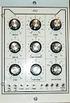 fpa 147 Week 6 Synthesis Basics In the early 1960s, inventors & entrepreneurs (Robert Moog, Don Buchla, Harold Bode, etc.) began assembling various modules into a single chassis, coupled with a user interface
The influence of Wi-Fi on the operation of Bluetooth based wireless sensor networks in the Internet of Things
 Faculty of Electrical Engineering, Mathematics & Computer Science The influence of Wi-Fi on the operation of Bluetooth based wireless sensor networks in the Internet of Things Jermain C. Horsman B.Sc.
Effects of Different Diffuser Types on the Diffusivity in Reverberation Chambers
 Effects of Different Diffuser Types on the Diffusivity in Reverberation Chambers Mélanie Nolan 1 Acoustic Technology, Technical University of Denmark, 2800 Kgs. Lyngby, Denmark Martijn Vercammen Peutz
A simple method to compute aircraft noise inside dwellings
 The 33 rd International Congress and Exposition on Noise Control Engineering A simple method to compute aircraft noise inside dwellings C. Brutel-Vuilmet, M. Villot and P. Jean CSTB, 24 av Joseph Fourier,
Inter-Cell Interference Coordination (ICIC) Technology
 Inter-Cell Interference Coordination (ICIC) Technology Dai Kimura Hiroyuki Seki Long Term Evolution (LTE) is a promising standard for next-generation cellular systems targeted to have a peak downlink bit
is the power reference: Specifically, power in db is represented by the following equation, where P0 P db = 10 log 10
 RF Basics - Part 1 This is the first article in the multi-part series on RF Basics. We start the series by reviewing some basic RF concepts: Decibels (db), Antenna Gain, Free-space RF Propagation, RF Attenuation,
Dynamic Frequency Selection (DFS) and the 5GHz Unlicensed Band
 Dynamic Frequency Selection (DFS) and the 5GHz Unlicensed Band by Mark Briggs, Principal Engineer, Elliott Laboratories- An NTS Company Note: This article combines the content from several papers released
Lightweight Partition Design for Residential and Commercial Buildings
 Lightweight Partition Design for Residential and Commercial Buildings Stanley D. Gatland II, CertainTeed Corporation, Valley Forge, Pennsylvania Guidelines are presented for the design and proper installation
Sound Pressure Measurement
 Objectives: Sound Pressure Measurement 1. Become familiar with hardware and techniques to measure sound pressure 2. Measure the sound level of various sizes of fan modules 3. Calculate the signal-to-noise
Optical Fibres. Introduction. Safety precautions. For your safety. For the safety of the apparatus
 Please do not remove this manual from from the lab. It is available at www.cm.ph.bham.ac.uk/y2lab Optics Introduction Optical fibres are widely used for transmitting data at high speeds. In this experiment,
A METHOD FOR THE ASSESSMENT OF SOUNDS AS PERCEIVED SEPARATELY FROM THEIR BACKGROUND
 A METHOD FOR THE ASSESSMENT OF SOUNDS AS PERCEIVED SEPARATELY FROM THEIR BACKGROUND PACS 43.50.+y Noise: its effects and control ; 43.58.+z Acoustical measurements and instrumentation ; M. Boubezari; J.
DeNoiser Plug-In. for USER S MANUAL
 DeNoiser Plug-In for USER S MANUAL 2001 Algorithmix All rights reserved Algorithmix DeNoiser User s Manual MT Version 1.1 7/2001 De-NOISER MANUAL CONTENTS INTRODUCTION TO NOISE REMOVAL...2 Encode/Decode
Investigation of sound insulation for a Supply Air Window field measurements and occupant response
 Investigation of sound insulation for a Supply Air Window field measurements and occupant response Lars Sommer SØNDERGAARD 1 ; Søren Vase LEGARTH 2 1 DELTA, Denmark ABSTRACT The Danish Environmental Protection
Manual Analysis Software AFD 1201
 AFD 1200 - AcoustiTube Manual Analysis Software AFD 1201 Measurement of Transmission loss acc. to Song and Bolton 1 Table of Contents Introduction - Analysis Software AFD 1201... 3 AFD 1200 - AcoustiTube
Acoustics of the Teatro Arcimboldi in Milano. Part 2: Scale model studies, final results
 AUDITORIUM ACOUSTICS 2 Imperial College (London), 19-21 July 22 Acoustics of the Teatro Arcimboldi in Milano. Part 2: Scale model studies, final results D. Commins (1), R. Pompoli (2), A. Farina (3), P.
Propagation Channel Emulator ECP_V3
 Navigation simulators Propagation Channel Emulator ECP_V3 1 Product Description The ECP (Propagation Channel Emulator V3) synthesizes the principal phenomena of propagation occurring on RF signal links
EE4367 Telecom. Switching & Transmission. Prof. Murat Torlak
 Path Loss Radio Wave Propagation The wireless radio channel puts fundamental limitations to the performance of wireless communications systems Radio channels are extremely random, and are not easily analyzed
A Sound Localization Algorithm for Use in Unmanned Vehicles
 A Sound Localization Algorithm for Use in Unmanned Vehicles Justin A. MacDonald & Phuong K. Tran uman Research and Engineering Directorate U. S. Army Research Laboratory Aberdeen Proving Ground MD 005
SOUND TRANSMISSION CLASS TEST REPORT Series/Model: T-DR1 Teutonic Outswing Vinyl Entrance Door
 ACOUSTIC Page of 5 9/8/204 SOUND TRANSMISSION CLASS TEST REPORT Series/Model: T-DR Teutonic Outswing Vinyl Entrance Door Prepared for: Kolbe and Kolbe Millwork Co., Inc. Attn: Ms. Tasha Verhasselt 323
SOUND TRANSMISSION CLASS TEST REPORT Series/Model: T-DR2 Teutonic Outswing Vinyl Entrance Door
 ACOUSTIC Page of 5 SOUND TRANSMISSION CLASS TEST REPORT Series/Model: T-DR2 Teutonic Outswing Vinyl Entrance Door Prepared for: Kolbe and Kolbe Millwork Co., Inc. Attn: Ms. Tasha Verhasselt 323 South th
Linear Parameter Measurement (LPM)
 (LPM) Module of the R&D SYSTEM FEATURES Identifies linear transducer model Measures suspension creep LS-fitting in impedance LS-fitting in displacement (optional) Single-step measurement with laser sensor
Design of an Acoustic Anechoic Chamber for Application in Hearing Aid Research
 Design of an Acoustic Anechoic Chamber for Application in Hearing Aid Research MARC S. RESSL 1 PABLO E. WUNDES 2 GEDA (Grupo de Electrónica Digital Aplicada) Buenos Aires Institute of Technology (ITBA)
APPLYING VIRTUAL SOUND BARRIER AT A ROOM OPENING FOR TRANSFORMER NOISE CONTROL
 APPLYING VIRTUAL SOUND BARRIER AT A ROOM OPENING FOR TRANSFORMER NOISE CONTROL Jiancheng Tao, Suping Wang and Xiaojun Qiu Key laboratory of Modern Acoustics and Institute of Acoustics, Nanjing University,
Façade acoustic design strategy Proposed residential development Irvin Avenue, Saltburn
 strategy Proposed residential development Report Number: 1420.1 Version: A Date: 13 th October 2008 Prepared by: Checked by: Andrew Gibson Jack Harvie-Clark Apex Acoustics Limited Design Works William
Voice Communication Package v7.0 of front-end voice processing software technologies General description and technical specification
 Voice Communication Package v7.0 of front-end voice processing software technologies General description and technical specification (Revision 1.0, May 2012) General VCP information Voice Communication
ASTM E 90: Laboratory Measurement of Airborne Sound Transmission of Building Partitions and Elements
 ASTM E 90: Laboratory Measurement of Airborne Sound Transmission of Building Partitions and Elements 1 of 8 TEST : Whisper Industries, L.L.C. Report Date: August 14, 2008 Date: July 9, 2008 Number: RESULT
Laboratory Guide. Anatomy and Physiology
 Laboratory Guide Anatomy and Physiology TBME04, Fall 2010 Name: Passed: Last updated 2010-08-13 Department of Biomedical Engineering Linköpings Universitet Introduction This laboratory session is intended
Lecture 1-6: Noise and Filters
 Lecture 1-6: Noise and Filters Overview 1. Periodic and Aperiodic Signals Review: by periodic signals, we mean signals that have a waveform shape that repeats. The time taken for the waveform to repeat
Testing of Partial Discharges in Generator Coil Bars with the Help of Calibrated Acoustic Emission Method
 Vol. 114 (2008) ACTA PHYSICA POLONICA A No. 6 A Optical and Acoustical Methods in Science and Technology Testing of Partial Discharges in Generator Coil Bars with the Help of Calibrated Acoustic Emission
Probability and Random Variables. Generation of random variables (r.v.)
 Probability and Random Variables Method for generating random variables with a specified probability distribution function. Gaussian And Markov Processes Characterization of Stationary Random Process Linearly
Workshop Perceptual Effects of Filtering and Masking Introduction to Filtering and Masking
 Workshop Perceptual Effects of Filtering and Masking Introduction to Filtering and Masking The perception and correct identification of speech sounds as phonemes depends on the listener extracting various
Difference in levels of groundborne noise and vibrations between the T-1300 and MX-3000 metro trains in Oslo
 Difference in levels of groundborne noise and vibrations between the T-1300 and MX-3000 metro trains in Oslo Sigmund Olafsen Brekke & Strand akustikk, P.O.Box 1024 Hoff, NO-0218 Norway, [email protected]
Absorption Coefficients and Impedance Daniel A. Russell Science and Mathematics Department, Kettering University, Flint, MI, 48504
 Absorption Coefficients and Impedance Daniel A. Russell Science and Mathematics Department, Kettering University, Flint, MI, 48504 1 I. Introduction and ackground In this laboratory exercise you will measure
Relationship between Sound Pressure and Sound Power Levels
 Relationship between Sound Pressure and Sound Power Levels 4 W. T. W. CORY Chairman of the Eurovent WG 1 Fans If we wish to know the sound power transmitted through a fan and ducting system, it is preferable
Testing Panasonic s WM-61A Mike Cartridge
 Tube, Solid State, Loudspeaker Technology Article prepared for www.audioxpress.com Testing Panasonic s WM-61A Mike Cartridge By George Danavaras This microphone study measures how distortion affects performance.
Figure1. Acoustic feedback in packet based video conferencing system
 Real-Time Howling Detection for Hands-Free Video Conferencing System Mi Suk Lee and Do Young Kim Future Internet Research Department ETRI, Daejeon, Korea {lms, dyk}@etri.re.kr Abstract: This paper presents
PHYS 331: Junior Physics Laboratory I Notes on Noise Reduction
 PHYS 331: Junior Physics Laboratory I Notes on Noise Reduction When setting out to make a measurement one often finds that the signal, the quantity we want to see, is masked by noise, which is anything
ASTM E 90 SOUND TRANSMISSION LOSS TEST REPORT. Rendered to: TUBELITE, INC. SERIES/MODEL: T24000. TYPE: Two-Lite Storefront
 ASTM E 90 SOUND TRANSMISSION LOSS TEST REPORT Rendered to: TUBELITE, INC. SERIES/MODEL: T24000 TYPE: Two-Lite Storefront Summary of Test Results Data File No. Glazing (Nominal Dimensions) STC OITC C5774.01
Building Technology and Architectural Design. Program 4th lecture 9.00-9.45 Case studies Room Acoustics. 10.00 10.45 Case studies Room Acoustics
 Building Technology and Architectural Design Program 4th lecture 9.00-9.45 Case studies Room Acoustics 9.45 10.00 Break 10.00 10.45 Case studies Room Acoustics Lecturer Poul Henning Kirkegaard 10-10-2006
RANDOM VIBRATION AN OVERVIEW by Barry Controls, Hopkinton, MA
 RANDOM VIBRATION AN OVERVIEW by Barry Controls, Hopkinton, MA ABSTRACT Random vibration is becoming increasingly recognized as the most realistic method of simulating the dynamic environment of military
Exhaust noise control case study for 2800 class locomotive
 Exhaust noise control case study for 2800 class locomotive Briony CROFT 1 ; Steve BROWN 2 ; Aaron MILLER 3, Andrew PARKER 4 1 SLR Consulting (Canada) Ltd, Canada 2,3,4 SLR Consulting Australia Pty Ltd,
PERCENTAGE ARTICULATION LOSS OF CONSONANTS IN THE ELEMENTARY SCHOOL CLASSROOMS
 The 21 st International Congress on Sound and Vibration 13-17 July, 2014, Beijing/China PERCENTAGE ARTICULATION LOSS OF CONSONANTS IN THE ELEMENTARY SCHOOL CLASSROOMS Dan Wang, Nanjie Yan and Jianxin Peng*
DESIGN CRITERIA FOR ACOUSTIC ENHANCEMENT SYSTEMS Ben Kok, Wim Prinssen Systems for Improved Acoustic Performance Uden, The Netherlands
 DESIGN CRITERIA FOR ACOUSTIC ENHANCEMENT SYSTEMS Ben Kok, Wim Prinssen Systems for Improved Acoustic Performance Uden, The Netherlands ABSTRACT Acoustic Enhancement Systems have evolved significantly -
ASTM E 90 SOUND TRANSMISSION LOSS TEST REPORT. Rendered to: MGM INDUSTRIES SERIES/MODEL: 6010. TYPE: Single Hung Window
 ASTM E 90 SOUND TRANSMISSION LOSS TEST REPORT Rendered to: MGM INDUSTRIES SERIES/MODEL: 6010 TYPE: Single Hung Window Summary of Test Results Data File No. Glazing (Nominal Dimensions) STC OITC B2706.01
Direct and Reflected: Understanding the Truth with Y-S 3
 Direct and Reflected: Understanding the Truth with Y-S 3 -Speaker System Design Guide- December 2008 2008 Yamaha Corporation 1 Introduction Y-S 3 is a speaker system design software application. It is
Dayton Audio is proud to introduce DATS V2, the best tool ever for accurately measuring loudspeaker driver parameters in seconds.
 Dayton Audio is proud to introduce DATS V2, the best tool ever for accurately measuring loudspeaker driver parameters in seconds. DATS V2 is the latest edition of the Dayton Audio Test System. The original
COMPARISON OF METHODOLOGIES FOR CONTINU- OUS NOISE MONITORING AND AIRCRAFT DETECTION IN THE VICINITY OF AIRPORTS
 COMPARISON OF METHODOLOGIES FOR CONTINU- OUS NOISE MONITORING AND AIRCRAFT DETECTION IN THE VICINITY OF AIRPORTS Alejandro Osses Vecchi Laboratory of Acoustics, Sociedad Acustical S.A., C.P. 7770563, Ñuñoa,
Wireless LAN Concepts
 Wireless LAN Concepts Wireless LAN technology is becoming increasingly popular for a wide variety of applications. After evaluating the technology, most users are convinced of its reliability, satisfied
EMC STANDARDS STANDARDS AND STANDARD MAKING BODIES. International. International Electrotechnical Commission (IEC) http://www.iec.
 EMC STANDARDS The EMC standards that a particular electronic product must meet depend on the product application (commercial or military) and the country in which the product is to be used. These EMC regulatory
FRAUNHOFER INSTITUTE FOR INTEg RATEd CIRCUITS IIS. drm TesT equipment
 FRAUNHOFER INSTITUTE FOR INTEg RATEd CIRCUITS IIS drm TesT equipment dt230 playback of drm signals recording of drm signals channel simulation receiver performance analysis real-time modulation Architecture
Room Acoustic Reproduction by Spatial Room Response
 Room Acoustic Reproduction by Spatial Room Response Rendering Hoda Nasereddin 1, Mohammad Asgari 2 and Ayoub Banoushi 3 Audio Engineer, Broadcast engineering department, IRIB university, Tehran, Iran,
Enhancing the SNR of the Fiber Optic Rotation Sensor using the LMS Algorithm
 1 Enhancing the SNR of the Fiber Optic Rotation Sensor using the LMS Algorithm Hani Mehrpouyan, Student Member, IEEE, Department of Electrical and Computer Engineering Queen s University, Kingston, Ontario,
Department of Electrical and Computer Engineering Ben-Gurion University of the Negev. LAB 1 - Introduction to USRP
 Department of Electrical and Computer Engineering Ben-Gurion University of the Negev LAB 1 - Introduction to USRP - 1-1 Introduction In this lab you will use software reconfigurable RF hardware from National
Tuning Subwoofers - Calibrating Subwoofers
 Tuning Subwoofers - Calibrating Subwoofers WHY The purpose of a subwoofer is to fill in the bottom octaves below the capabilities of the mains speakers. There are many reasons to use a subwoofer to do
Aircraft cabin noise synthesis for noise subjective analysis
 Aircraft cabin noise synthesis for noise subjective analysis Bruno Arantes Caldeira da Silva Instituto Tecnológico de Aeronáutica São José dos Campos - SP [email protected] Cristiane Aparecida Martins
This document is downloaded from DR-NTU, Nanyang Technological University Library, Singapore.
 This document is downloaded from DR-NTU, Nanyang Technological University Library, Singapore. Title to improve 3D audio playback Author(s) Sunder, Kaushik; Tan, Ee-Leng; Gan, Woon-Seng Citation Sunder,
Propsim enabled Mobile Ad-hoc Network Testing
 www.anite.com Propsim enabled Mobile Ad-hoc Network Testing Anite is now part of Keysight Technologies Lab-based, end-to-end performance testing of systems using Propsim MANET channel emulation A Mobile
Functional Communication for Soft or Inaudible Voices: A New Paradigm
 The following technical paper has been accepted for presentation at the 2005 annual conference of the Rehabilitation Engineering and Assistive Technology Society of North America. RESNA is an interdisciplinary
Schindler 3300 / Schindler 5300 Information on noise and vibration.
 Schindler 3300 / Schindler 5300. Content Introduction 1. Ride quality Jerk Car acceleration Vertical car vibration Lateral car vibration Sound in the car 2. Sound basics 3. Vibration basics 4. Structure-borne
Audio processing and ALC in the FT-897D
 Audio processing and ALC in the FT-897D I recently bought an FT-897D, and after a period of operation noticed problems with what I perceived to be a low average level of output power and reports of muffled
Four Wave Mixing in Closely Spaced DWDM Optical Channels
 544 VOL. 1, NO. 2, AUGUST 2006 Four Wave Mixing in Closely Spaced DWDM Optical Channels Moncef Tayahi *, Sivakumar Lanka, and Banmali Rawat Advanced Photonics Research lab, Department of Electrical Engineering
Electronic Communications Committee (ECC) within the European Conference of Postal and Telecommunications Administrations (CEPT)
 Page 1 Electronic Communications Committee (ECC) within the European Conference of Postal and Telecommunications Administrations (CEPT) ECC RECOMMENDATION (06)01 Bandwidth measurements using FFT techniques
DAAD: A New Software for Architectural Acoustic Design
 The 33 rd International Congress and Exposition on Noise Control Engineering DAAD: A New Software for Architectural Acoustic Design Enis Ozgur a, Feridun Ozis b, Adil Alpkocak a a Dokuz Eylul University,
Noise associated with the ground water systems serving residential geothermal heat pumps
 Noise associated with the ground water systems serving residential geothermal heat pumps Jeffrey L. FULLERTON 1 Acentech Incorporated, United States ABSTRACT Geothermal heat pumps are an energy efficient
Sound absorption and acoustic surface impedance
 Sound absorption and acoustic surface impedance CHRISTER HEED SD2165 Stockholm October 2008 Marcus Wallenberg Laboratoriet för Ljud- och Vibrationsforskning Sound absorption and acoustic surface impedance