
Bank lending survey for the euro area THE QUESTIONNAIRE. (Revised version introduced in April 2015)
|
|
|
- Osborne George
- 9 years ago
- Views:
Transcription
1 Bank lending survey for the euro area THE QUESTIONNAIRE (Revised version introduced in April 2015) BLS - THE QUESTIONNAIRE Page 1 of 19

2 I. Loans or credit lines to enterprises 1. Over the past three months, how have your bank s credit standards (1) as applied to the approval of loans or credit lines to enterprises (2, 3, 4) changed? Please note that we are asking about the change in credit standards, rather than about their level. Overall Loans to small and mediumsized enterprises ( Loans to large enterprises (5) Shortterm loans (6) Long-term loans (6) 5) Tightened considerably Tightened somewhat Remained basically unchanged Eased somewhat Eased considerably (1) Credit standards (2) Loans (3) Credit line (4) Enterprises (5) Enterprise size (6) Maturity BLS - THE QUESTIONNAIRE Page 2 of 19

3 2. Over the past three months, how have the following factors affected your bank s credit standards as applied to the approval of loans or credit lines to enterprises (as defined in the notes to question 1)? Please rate the contribution of the following factors to the tightening or easing of credit standards using the following scale: = contributed considerably to tightening of credit standards = contributed somewhat to tightening of credit standards = contributed to keeping credit standards basically unchanged + = contributed somewhat to easing of credit standards + + = contributed considerably to easing of credit standards A) Cost of funds and balance sheet constraints (1) * Costs related to your bank s capital position (2) * Your bank s ability to access market financing (e.g. money or bond market financing, incl. true-sale securitisation (3) ) * Your bank s liquidity position B) Pressure from competition * Competition from other banks * Competition from non-banks (4) * Competition from market financing C) Perception of risk (5) * General economic situation and outlook * Industry or firm-specific situation and outlook/borrower's creditworthiness (6) * Risk related to the collateral demanded D) Your bank's risk tolerance (5) * Your bank's risk tolerance E) Other factors, please specify Overall impact on your bank's credit standards Impact on your bank's credit standards for loans to small and Impact on your bank's credit standards for loans to large medium-sized enterprises enterprises N/A N/A N/A (1) Cost of funds and balance sheet constraints (2) Can involve the use of credit derivatives, with the loans remaining on the bank s balance sheet. (3) Involves the sale of loans from the bank s balance sheet, i.e. off-balance sheet funding. (4) Non-banks (5) Perception of risk and risk tolerance (6) Risks related to non-performing loans may be reflected not only in the "industry or firm-specific situation and outlook/borrower's creditworthiness", but also in the bank's "cost of funds and balance sheet constraints". BLS - THE QUESTIONNAIRE Page 3 of 19

4 3. Over the past three months, how have your bank s terms and conditions (1) for new loans or credit lines to enterprises changed? Please rate the overall terms and conditions for this loan category and each factor using the following scale: = tightened considerably = tightened somewhat = remained basically unchanged + = eased somewhat + + = eased considerably Overall Loans to small and medium-sized enterprises Loans to large enterprises A) Overall terms and conditions (1) * Overall terms and conditions B) Margins * Your bank s loan margin (i.e. the spread over a relevant market reference rate) on average loans (wider spread = tightened, narrower spread = eased) (2) * Your bank s loan margin (i.e. the spread over a relevant market reference rate) on riskier loans C) Other terms and conditions * Non-interest rate charges (3) * Size of the loan or credit line * Collateral (4) requirements * Loan covenants (5) * Maturity D) Other factors, please specify N/A N/A N/A (1) Credit terms and conditions (2) Loan margin/spread over a relevant market reference rate (3) Non-interest rate charges (4) Collateral (5) Covenant BLS - THE QUESTIONNAIRE Page 4 of 19
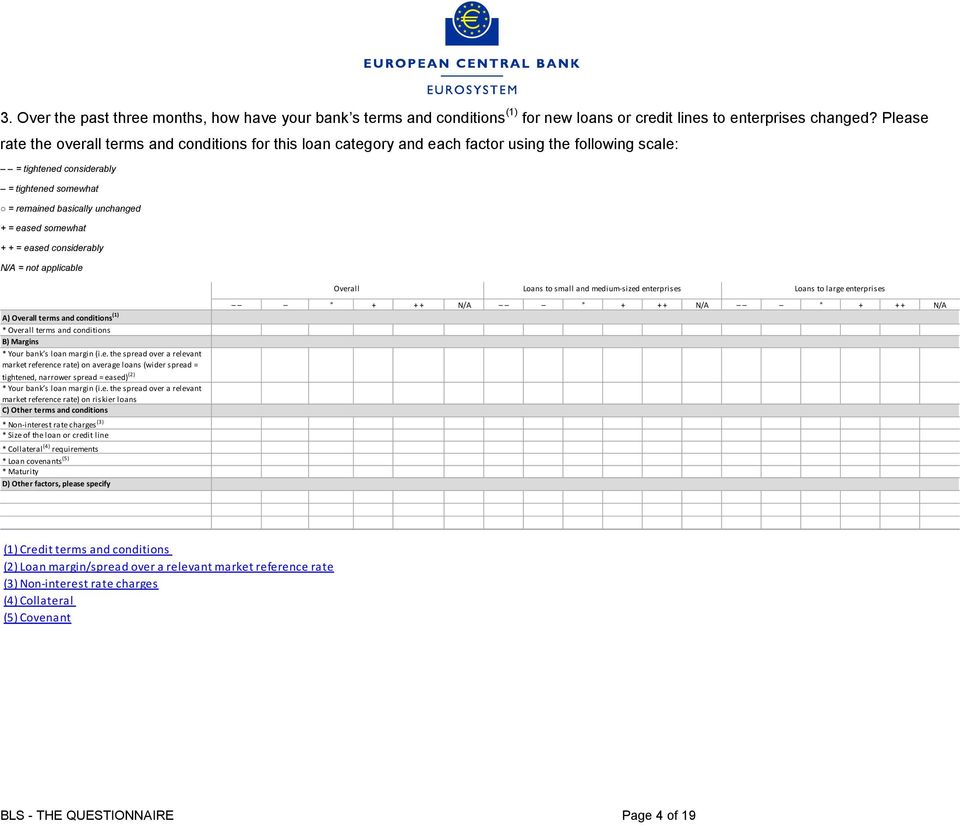
5 4. Over the past three months, how have the following factors (1) affected your bank s credit terms and conditions as applied to new loans or credit lines to enterprises (as defined in the notes to question 3)? Please rate the contribution of the following factors to the tightening or easing of credit terms and conditions using the following scale: = contributed considerably to tightening of credit terms and conditions / contributed considerably to widening of margins = contributed somewhat to tightening of credit terms and conditions / contributed somewhat to widening of margins = contributed to keeping credit terms and conditions basically unchanged / contributed to keeping margins basically unchanged + = contributed somewhat to easing of credit terms and conditions / contributed somewhat to narrowing of margins + + = contributed considerably to easing of credit terms and conditions / contributed considerably to narrowing of margins A) Cost of funds and balance sheet constraints * Cost of funds and balance sheet constraints B) Pressure from competition * Pressure from competition C) Perception of risk * Perception of risk D) Your bank's risk tolerance * Your bank's risk tolerance E) Other factors, please specify of which: Overall impact on your bank s credit terms and conditions Impact on your bank s margin on average loans Impact on your bank s margin on riskier loans N/A N/A N/A (1) The factors refer to the same sub-factors as in question 2. BLS - THE QUESTIONNAIRE Page 5 of 19
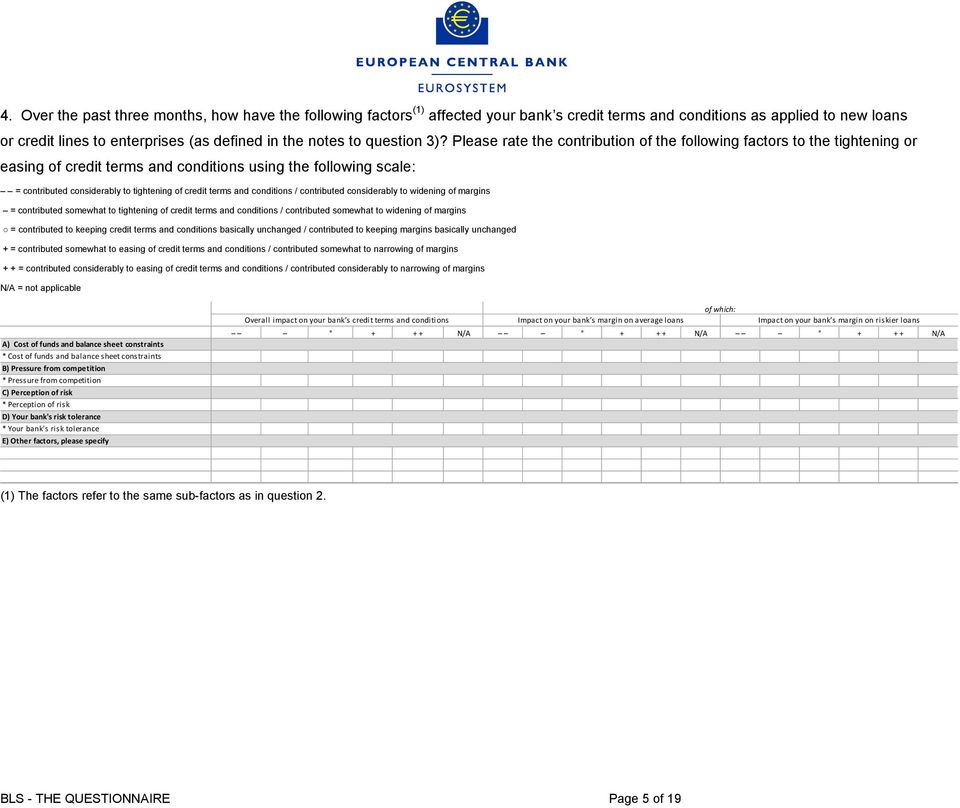
6 5. Over the past three months (apart from normal seasonal fluctuations), has the share of enterprise loan applications (1) that were completely rejected (2) by your bank increased, remained unchanged or decreased (loan volume, relative to the total volume of loan applications in that loan category)? Share of rejected applications Decreased considerably Decreased somewhat Remained basically unchanged Increased somewhat Increased considerably (1) Loan application (2) Loan rejection 6. Over the past three months (apart from normal seasonal fluctuations), how has the demand for loans (1) or credit lines (2) to enterprises changed at your bank? Please refer to the financing need of enterprises independent of whether this need will result in a loan or not. Overall Loans to small and mediumsized enterprises Loans to large enterprises Shortterm loans Long-term loans Decreased considerably Decreased somewhat Remained basically unchanged Increased somewhat Increased considerably (1) Demand for loans (2) Credit line BLS - THE QUESTIONNAIRE Page 6 of 19
7 7. Over the past three months, how have the following factors affected the overall demand for loans or credit lines to enterprises (as defined in the notes to question 6)? Please rate each possible factor using the following scale: = contributed considerably to lower demand = contributed somewhat to lower demand = contributed to keeping demand basically unchanged + = contributed somewhat to higher demand + + = contributed considerably to higher demand N/A= not applicable A) Financing needs/underlying drivers or purpose of loan demand * Fixed investment * Inventories and working capital * Mergers/acquisitions and corporate restructuring * General level of interest rates * Debt refinancing/restructuring and renegotiation (1) (when leading to an increase or prolongation of the amount borrowed) B) Use of alternative finance * Internal financing * Loans from other banks * Loans from non-banks * Issuance/redemption of debt securities * Issuance/redemption of equity C) Other factors, please specify (2) N/A (1) Debt refinancing/restructuring and renegotiation (2) Marketing campaigns BLS - THE QUESTIONNAIRE Page 7 of 19

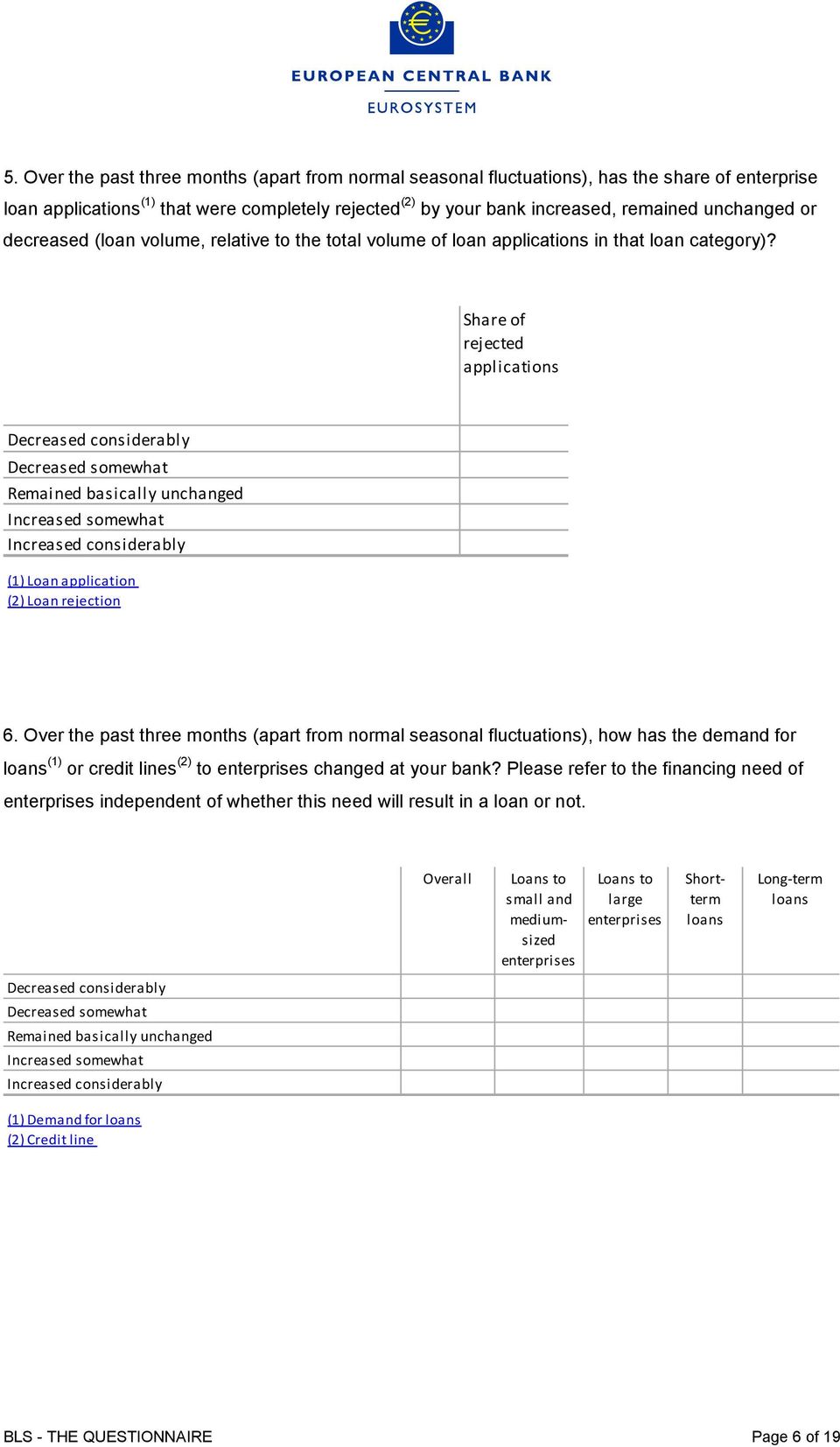
8 8. Please indicate how you expect your bank s credit standards as applied to the approval of loans or credit lines to enterprises to change over the next three months. Please note that we are asking about the change in credit standards, rather than about their level. Tighten considerably Tighten somewhat Remain basically unchanged Ease somewhat Ease considerably Overall Loans to small and mediumsized enterprises Loans to large enterprises Shortterm loans Long-term loans 9. Please indicate how you expect demand for loans or credit lines to enterprises to change at your bank over the next three months (apart from normal seasonal fluctuations)? Please refer to the financing need of enterprises independent of whether this need will result in a loan or not. Decrease considerably Decrease somewhat Remain basically unchanged Increase somewhat Increase considerably Overall Loans to small and mediumsized enterprises Loans to large enterprises Shortterm loans Long-term loans BLS - THE QUESTIONNAIRE Page 8 of 19
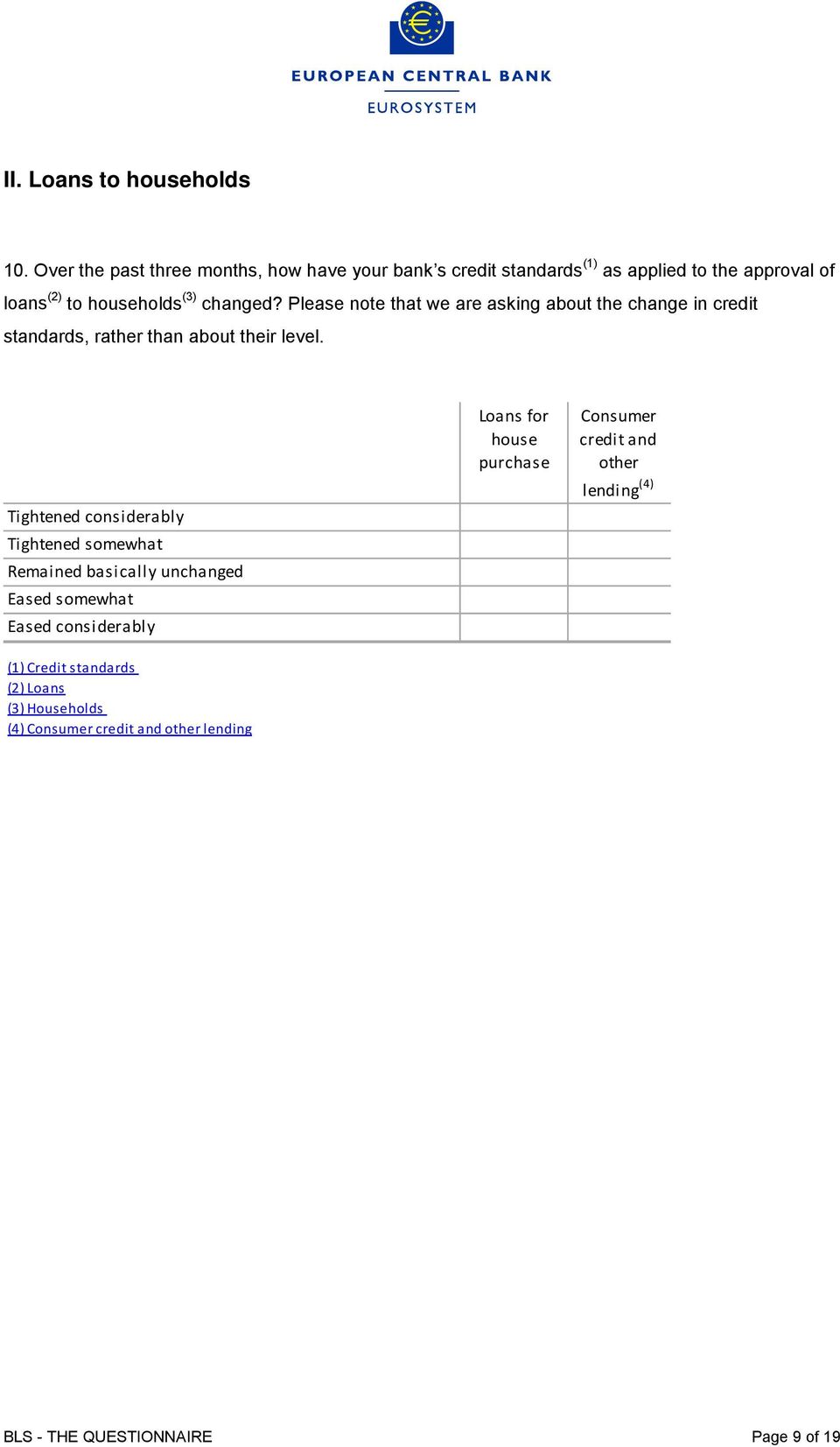
9 II. Loans to households 10. Over the past three months, how have your bank s credit standards (1) as applied to the approval of loans (2) to households (3) changed? Please note that we are asking about the change in credit standards, rather than about their level. Tightened considerably Tightened somewhat Remained basically unchanged Eased somewhat Eased considerably (1) Credit standards (2) Loans (3) Households (4) Consumer credit and other lending Loans for house purchase Consumer credit and other lending (4) BLS - THE QUESTIONNAIRE Page 9 of 19
10 11. Over the past three months, how have the following factors affected your bank s credit standards as applied to the approval of loans to households for house purchase (as defined in the notes to question 10)? Please rate the contribution of the following factors to the tightening or easing of credit standards using the following scale: = contributed considerably to tightening of credit standards = contributed somewhat to tightening of credit standards = contributed to keeping credit standards basically unchanged + = contributed somewhat to easing of credit standards + + = contributed considerably to easing of credit standards A) Cost of funds and balance sheet constraints (1) * Cost of funds and balance sheet constraints B) Pressure from competition * Competition from other banks * Competition from non-banks (2) C) Perception of risk (3) * General economic situation and outlook * Housing market prospects, including expected house price developments (4) * Borrower s creditworthiness (5) D) Your bank's risk tolerance (3) * Your bank's risk tolerance E) Other factors, please specify N/A (1) Cost of funds and balance sheet constraints (2) Non-banks (3) Perception of risk and risk tolerance (4) Housing market prospects, including expected house price developments (5) Risks related to non-performing loans may be reflected not only in the "borrower's creditworthiness", but also in the bank's "cost of funds and balance sheet constraints". BLS - THE QUESTIONNAIRE Page 10 of 19

11 12. Over the past three months, how have your bank s terms and conditions (1) for new loans to households for house purchase changed? Please rate the overall terms and conditions for this loan category and each factor using the following scale: = tightened considerably = tightened somewhat = remained basically unchanged + = eased somewhat + + = eased considerably A) Overall terms and conditions * Overall terms and conditions B) Margins * Your bank s loan margin (i.e. the spread over a relevant market reference rate) on average loans (wider spread = tightened, narrower spread = eased) (2) * Your bank s loan margin (i.e. the spread over a relevant market reference rate) on riskier loans C) Other terms and conditions N/A * Collateral (3) requirements * "Loan-to-value" ratio (4) * Other loan size limits * Maturity * Non-interest rate charges (5) D) Other factors, please specify (1) Credit terms and conditions (2) Loan margin/spread over a relevant market reference rate (3) Collateral (4) Loan-to-value ratio (5) Non-interest rate charges BLS - THE QUESTIONNAIRE Page 11 of 19

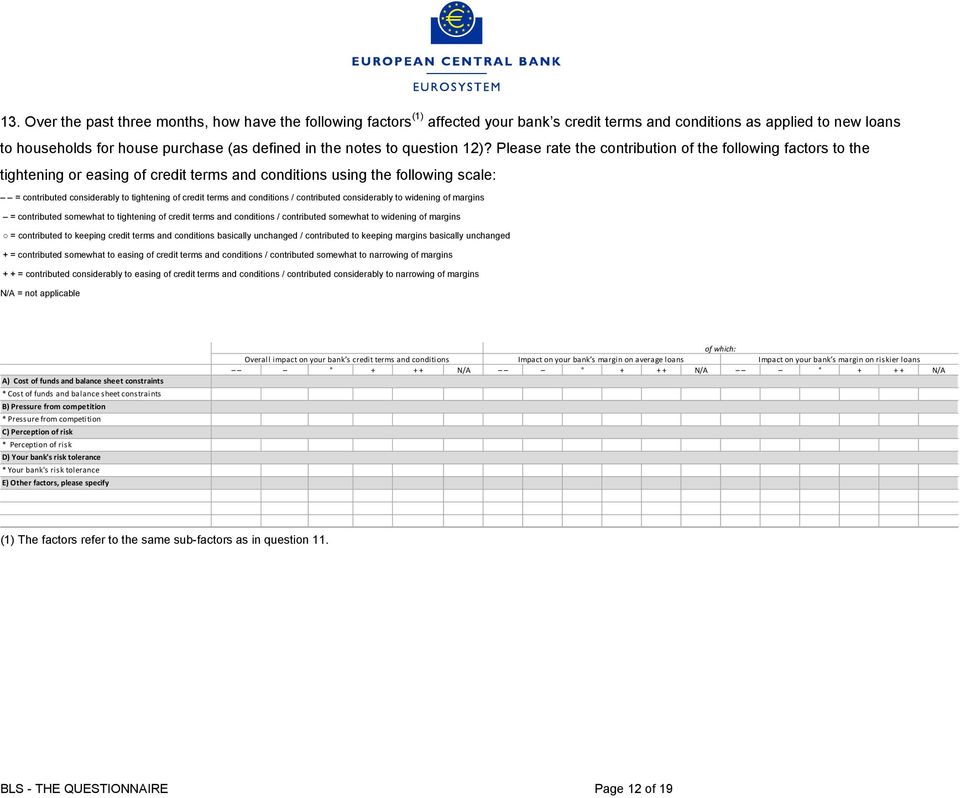
12 13. Over the past three months, how have the following factors (1) affected your bank s credit terms and conditions as applied to new loans to households for house purchase (as defined in the notes to question 12)? Please rate the contribution of the following factors to the tightening or easing of credit terms and conditions using the following scale: = contributed considerably to tightening of credit terms and conditions / contributed considerably to widening of margins = contributed somewhat to tightening of credit terms and conditions / contributed somewhat to widening of margins = contributed to keeping credit terms and conditions basically unchanged / contributed to keeping margins basically unchanged + = contributed somewhat to easing of credit terms and conditions / contributed somewhat to narrowing of margins + + = contributed considerably to easing of credit terms and conditions / contributed considerably to narrowing of margins A) Cost of funds and balance sheet constraints * Cost of funds and balance sheet constraints B) Pressure from competition * Pressure from competition C) Perception of risk * Perception of risk D) Your bank's risk tolerance * Your bank's risk tolerance E) Other factors, please specify of which: Overall impact on your bank s credit terms and conditions Impact on your bank s margin on average loans Impact on your bank s margin on riskier loans N/A N/A N/A (1) The factors refer to the same sub-factors as in question 11. BLS - THE QUESTIONNAIRE Page 12 of 19
13 14. Over the past three months, how have the following factors affected your bank s credit standards as applied to the approval of consumer credit and other lending to households (as defined in the notes to question 10)? Please rate the contribution of the following factors to the tightening or easing of credit standards using the following scale: = contributed considerably to tightening of credit standards = contributed somewhat to tightening of credit standards = contributed to keeping credit standards basically unchanged + = contributed somewhat to easing of credit standards + + = contributed considerably to easing of credit standards A) Cost of funds and balance sheet constraints * Cost of funds and balance sheet constraints B) Pressure from competition * Competition from other banks * Competition from non-banks C) Perception of risk * General economic situation and outlook * Creditworthiness of consumers (1) * Risk on the collateral demanded D) Your bank's risk tolerance * Your bank's risk tolerance E) Other factors, please specify N/A (1) Risks related to non-performing loans may be reflected not only in the "creditworthiness of consumers", but also in the bank's "cost of funds and balance sheet constraints". BLS - THE QUESTIONNAIRE Page 13 of 19

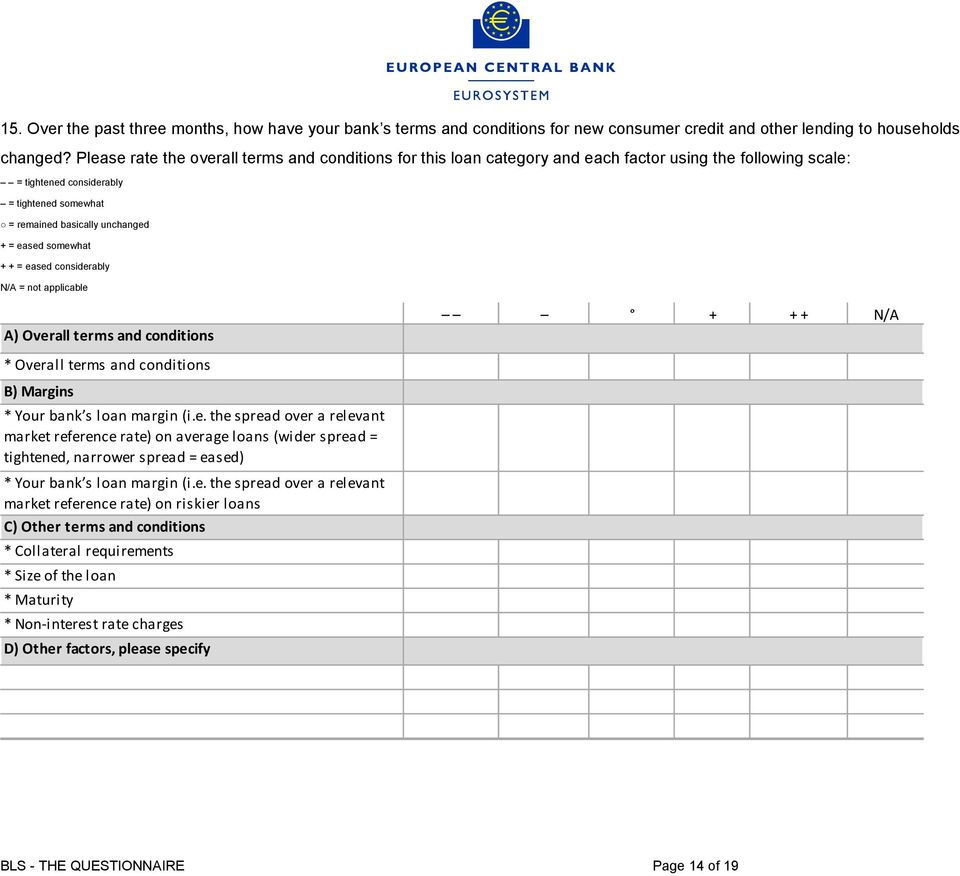
14 15. Over the past three months, how have your bank s terms and conditions for new consumer credit and other lending to households changed? Please rate the overall terms and conditions for this loan category and each factor using the following scale: = tightened considerably = tightened somewhat = remained basically unchanged + = eased somewhat + + = eased considerably A) Overall terms and conditions N/A * Overall terms and conditions B) Margins * Your bank s loan margin (i.e. the spread over a relevant market reference rate) on average loans (wider spread = tightened, narrower spread = eased) * Your bank s loan margin (i.e. the spread over a relevant market reference rate) on riskier loans C) Other terms and conditions * Collateral requirements * Size of the loan * Maturity * Non-interest rate charges D) Other factors, please specify BLS - THE QUESTIONNAIRE Page 14 of 19
15 16. Over the past three months, how have the following factors (1) affected your bank s credit terms and conditions as applied to new consumer credit and other lending to households (as defined in the notes to question 12)? Please rate the contribution of the following factors to the tightening or easing of credit terms and conditions using the following scale: = contributed considerably to tightening of credit terms and conditions / contributed considerably to widening of margins = contributed somewhat to tightening of credit terms and conditions / contributed somewhat to widening of margins = contributed to keeping credit terms and conditions basically unchanged / contributed to keeping margins basically unchanged + = contributed somewhat to easing of credit terms and conditions / contributed somewhat to narrowing of margins + + = contributed considerably to easing of credit terms and conditions / contributed considerably to narrowing of margins A) Cost of funds and balance sheet constraints * Cost of funds and balance sheet constraints B) Pressure from competition * Pressure from competition C) Perception of risk * Perception of risk D) Your bank's risk tolerance * Your bank's risk tolerance E) Other factors, please specify of which: Overall impact on your bank s credit terms and conditions Impact on your bank s margin on average loans Impact on your bank s margin on riskier loans N/A N/A N/A (1) The factors refer to the same sub-factors as in question 14. BLS - THE QUESTIONNAIRE Page 15 of 19

16 17. Over the past three months (apart from normal seasonal fluctuations), has the share of household loan applications (1) that were completely rejected (2) by your bank increased, remained unchanged or decreased (loan volume, relative to the total volume of loan applications in that loan category)? Share of rejected applications Decreased considerably Decreased somewhat Remained basically unchanged Increased somewhat Increased considerably (1) Loan application (2) Loan rejection Loans for house purchase Consumer credit and other lending 18. Over the past three months (apart from normal seasonal fluctuations), how has the demand for loans (1) to households changed at your bank? Please refer to the financing need of households independent of whether this need will result in a loan or not. Loans for house purchase Consumer credit and other lending Decreased considerably Decreased somewhat Remained basically unchanged Increased somewhat Increased considerably (1) Demand for loans BLS - THE QUESTIONNAIRE Page 16 of 19

17 19. Over the past three months, how have the following factors affected the demand for loans to households for house purchase (as defined in the notes to question 18)? Please rate each factor using the following scale: = contributed considerably to lower demand = contributed somewhat to lower demand = contributed to keeping demand basically unchanged + = contributed somewhat to higher demand + + = contributed considerably to higher demand A) Financing needs/underlying drivers or purpose of loan demand * Housing market prospects, including expected house price developments * Consumer confidence (1) * General level of interest rates * Debt refinancing/restructuring and renegotiation (when leading to an increase or prolongation of the amount borrowed) (2) * Regulatory and fiscal regime of housing markets B) Use of alternative sources for housing finance (substitution effects) * Internal finance of house purchase out of savings/down payment (i.e. share financed via the household s own funds) (3) * Loans from other banks * Other sources of external finance C) Other factors, please specify (4) N/A (1) Consumer confidence (2) Debt refinancing/restructuring and renegotiation (3) Down payment (4) Marketing campaigns BLS - THE QUESTIONNAIRE Page 17 of 19

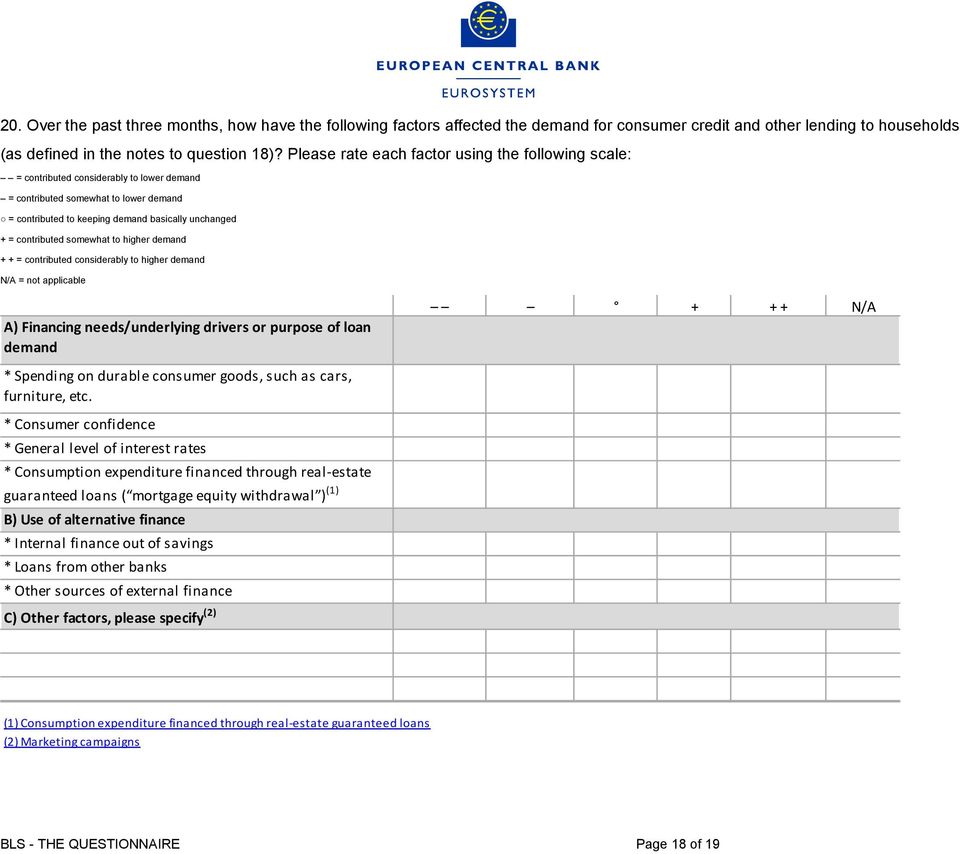
18 20. Over the past three months, how have the following factors affected the demand for consumer credit and other lending to households (as defined in the notes to question 18)? Please rate each factor using the following scale: = contributed considerably to lower demand = contributed somewhat to lower demand = contributed to keeping demand basically unchanged + = contributed somewhat to higher demand + + = contributed considerably to higher demand A) Financing needs/underlying drivers or purpose of loan demand * Spending on durable consumer goods, such as cars, furniture, etc. * Consumer confidence * General level of interest rates * Consumption expenditure financed through real-estate guaranteed loans ( mortgage equity withdrawal ) (1) B) Use of alternative finance * Internal finance out of savings * Loans from other banks * Other sources of external finance C) Other factors, please specify (2) N/A (1) Consumption expenditure financed through real-estate guaranteed loans (2) Marketing campaigns BLS - THE QUESTIONNAIRE Page 18 of 19
19 21. Please indicate how you expect your bank s credit standards as applied to the approval of loans to households to change over the next three months. Please note that we are asking about the change in credit standards, rather than about their level. Tighten considerably Tighten somewhat Remain basically unchanged Ease somewhat Ease considerably Loans for house purchase Consumer credit and other lending 22. Please indicate how you expect demand for loans to households to change over the next three months at your bank (apart from normal seasonal fluctuations). Please refer to the financing need of households independent of whether this need will result in a loan or not. Decrease considerably Decrease somewhat Remain basically unchanged Increase somewhat Increase considerably Loans for house purchase Consumer credit and other lending III. Open-ended question 23. Over the past three months, have there been any other issues of importance for bank lending behaviour in the euro area or in your country which are not covered by this survey? [IV. Ad-hoc questions on specific topics of interest] BLS - THE QUESTIONNAIRE Page 19 of 19

General guidelines for the completion of the bank lending survey questionnaire
 General guidelines for the completion of the bank lending survey questionnaire This document includes the general guidelines for the completion of the questionnaire and the terminology used in the survey.
BANK LENDING SURVEY JULY
 BANK LENDING SURVEY JULY Financial Stability Department Monetary and Statistics Department Monetary Policy and Fiscal Analyses Division 12 JULY 12 1 I. INTRODUCTION AND SUMMARY The new quarterly CNB survey
THE EURO AREA BANK LENDING SURVEY 1ST QUARTER OF 2014
 THE EURO AREA BANK LENDING SURVEY 1ST QUARTER OF 214 APRIL 214 European Central Bank, 214 Address Kaiserstrasse 29, 6311 Frankfurt am Main, Germany Postal address Postfach 16 3 19, 666 Frankfurt am Main,
Supply on Credit Market Corporate lending (sectors 11, 123, 124, 125)
 Supply on Credit Market Corporate lending (sectors 11, 123, 124, 125) 1. Comparison of the changes of demand and supply Which of the following factors had in your bank the greatest impact on the change
Table 2. (Status of policy as of October 2015)
 Table 2 1 (Status of policy as of October 2015) Questions 1-6 ask about commercial and industrial (C&I) loans at your bank. Questions 1-3 deal with changes in your bank's lending policies over the past
Bank of Ghana Monetary Policy Report. Financial Stability Report
 BANK OF GHANA E S T. 1 9 5 7 Bank of Ghana Monetary Policy Report Financial Stability Report Volume 5: No.1/2013 February 2013 5.0 Introduction Conditions in global financial markets have improved significantly
FACTORS AFFECTING THE LOAN SUPPLY OF BANKS
 FACTORS AFFECTING THE LOAN SUPPLY OF BANKS Funding resources The liabilities of banks operating in Estonia mainly consist of non-financial sector deposits, which totalled almost 11 billion euros as at
Credit Conditions Survey. Survey results 2014 Q4
 Credit Conditions Survey Survey results 14 Q4 Credit Conditions Survey 14 Q4 As part of its mission to maintain monetary stability and financial stability, the Bank needs to understand trends and developments
CROSS-COUNTRY HETEROGENEITY IN MFI INTEREST RATES ON LOANS TO NON-FINANCIAL CORPORATIONS IN THE EURO AREA
 Box 2 CROSS-COUNTRY HETEROGENEITY IN MFI INTEREST RATES ON LOANS TO NON-FINANCIAL CORPORATIONS IN THE EURO AREA The dynamics of bank lending rates on loans to non- corporations (NFCs) have been highly
REPORT ON THE RESULTS OF THE BANK LENDING SURVEY Q1 2015
 REPORT ON THE RESULTS OF THE BANK LENDING SURVEY Q1 2015 Belgrade, May 2015 Introductory note The National Bank of Serbia (NBS) launched the bank lending survey in 2014 with the aim of conducting a better
Non-traded financial contracts
 11-1 Introduction Financial contracts are made between lenders and borrowers Non-traded financial contracts are tailor-made to fit the characteristics of the borrower In business financing, the differences
Quarterly Credit Conditions Survey Report
 Quarterly Credit Conditions Survey Report Contents March 2014 Quarter Prepared by the Monetary Analysis & Programming Department Research & Economic Programming Division List of Tables and Charts 2 Background
REPORT ON RESULTS OF THE COMMERCIAL BANK SENIOR LOAN OFFICERS OPINION SURVEY ON CREDIT MARKET CONDITIONS IN THE ECCU (JULY TO DECEMBER 2012)
 REPORT ON RESULTS OF THE COMMERCIAL BANK SENIOR LOAN OFFICERS OPINION SURVEY ON CREDIT MARKET CONDITIONS IN THE ECCU (JULY TO DECEMBER 2012) EASTERN CARIBBEAN CENTRAL BANK ST KITTS TABLE OF CONTENTS 1.
The Effects of Funding Costs and Risk on Banks Lending Rates
 The Effects of Funding Costs and Risk on Banks Lending Rates Daniel Fabbro and Mark Hack* After falling for over a decade, the major banks net interest margins appear to have stabilised in a relatively
Quarterly Credit Conditions Survey Report
 Quarterly Credit Conditions Survey Report Contents List of Charts 2 List of Tables 3 Background 4 Overview 5 Credit Market Conditions 8 Personal Lending 10 Micro Business Lending 13 Small Business Lending
Quarterly Credit Conditions Survey Report Contents
 Quarterly Credit Conditions Report Contents List of Figures & Tables... 2 Background... 3 Overview... 4 Personal Lending... 7 Micro Business Lending... 9 Small Business Lending... 12 Medium-Sized Business
Chart 9.1 Non-performing loans ratio and structure of non-performing loans (right) 25% 80 06/08 03/11 03/09 12/07 12/08 06/09 09/09 12/09 09/08 06/11
 Financial Stability Report 21 H1 9. MONITORING BANKING SECTOR RISKS 9.1 CREDIT RISK (88) Loan portfolio quality improved and banks were more active in writingoff the loss loans from their balance sheets.
2015 Survey of Credit Underwriting Practices
 2015 Survey of Credit Underwriting Practices Office of the Comptroller of the Currency Washington, D.C. December 2015 Contents Introduction... 1 Part I: Overall Results... 3 Primary Findings... 3 Commentary
Bank Liabilities Survey. Survey results 2013 Q3
 Bank Liabilities Survey Survey results 13 Q3 Bank Liabilities Survey 13 Q3 Developments in banks balance sheets are of key interest to the Bank of England in its assessment of economic conditions. Changes
Chapter 14. Understanding Financial Contracts. Learning Objectives. Introduction
 Chapter 14 Understanding Financial Contracts Learning Objectives Differentiate among the different mechanisms of external financing of firms Explain why mechanisms of external financing depend upon firm
René Garcia Professor of finance
 Liquidity Risk: What is it? How to Measure it? René Garcia Professor of finance EDHEC Business School, CIRANO Cirano, Montreal, January 7, 2009 The financial and economic environment We are living through
2014 Survey of Credit Underwriting Practices
 2014 Survey of Credit Underwriting Practices Office of the Comptroller of the Currency Washington, D.C. December 2014 Contents Introduction... 1 Part I: Overall Results... 3 Primary Findings... 3 Commentary
QNB CORP. REPORTS SECOND QUARTER AND FIRST HALF EARNINGS
 PO Box 9005 Quakertown PA 18951-9005 215.538.5600 1.800.491.9070 www.qnbbank.com FOR IMMEDIATE RELEASE QNB CORP. REPORTS SECOND QUARTER AND FIRST HALF EARNINGS QUAKERTOWN, PA (July 28, 2015) QNB Corp.
MACROECONOMIC AND INDUSTRY ANALYSIS VALUATION PROCESS
 MACROECONOMIC AND INDUSTRY ANALYSIS VALUATION PROCESS BUSINESS ANALYSIS INTRODUCTION To determine a proper price for a firm s stock, security analyst must forecast the dividend & earnings that can be expected
Northwest Bancshares, Inc. Announces Quarterly Earnings and Dividend Declaration
 EARNINGS RELEASE FOR IMMEDIATE RELEASE Contact: William J. Wagner, President and Chief Executive Officer (814) 726-2140 William W. Harvey, Jr., Executive Vice President and Chief Financial Officer (814)
CBRE LENDERS SURVEY LOOKING AT 2015 LENDING TRENDS IN CANADA FINANCING DEBT COMMERCIAL REAL ESTATE BOND TERM DEBT YIELDS MORTGAGE ACQUISITION
 CBRE LENDERS SURVEY LOOKING AT 2015 LENDING TRENDS IN CANADA COMMERCIAL REAL ESTATE DEBT FINANCING TERM DEBT YIELDS MORTGAGE ACQUISITION REFINANCING BOND INTEREST RATE ABOUT CBRE CBRE Group, Inc. (NYSE:CBG),
CREDIT RISK MANAGEMENT
 GLOBAL ASSOCIATION OF RISK PROFESSIONALS The GARP Risk Series CREDIT RISK MANAGEMENT Chapter 1 Credit Risk Assessment Chapter Focus Distinguishing credit risk from market risk Credit policy and credit
Sberbank Group s IFRS Results for 6 Months 2013. August 2013
 Sberbank Group s IFRS Results for 6 Months 2013 August 2013 Summary of 6 Months 2013 performance: Income Statement Net profit reached RUB 174.5 bn (or RUB 7.95 per ordinary share), a 0.5% decrease on RUB
QUIZ IV Version 1. March 24, 2004. 4:35 p.m. 5:40 p.m. BA 2-210
 NAME: Student ID: College of Business Administration Department of Economics Principles of Macroeconomics O. Mikhail ECO 2013-0008 Spring 2004 QUIZ IV Version 1 This closed book QUIZ is worth 100 points.
BANK INTEREST RATE MARGINS
 Reserve Bank of Australia Bulletin May BANK INTEREST RATE MARGINS Bank interest rate margins the difference between what interest rates banks borrow at and what they lend at have been the subject of much
Contact: Charity Frantz October 13, 2015 570-724-0225 [email protected]
 Contact: Charity Frantz October 13, 2015 570-724-0225 [email protected] C&N ANNOUNCES THIRD QUARTER 2015 UNAUDITED FINANCIAL RESULTS FOR IMMEDIATE RELEASE: Wellsboro, PA Citizens & Northern Corporation
18 ECB STYLISED FACTS OF MONEY AND CREDIT OVER THE BUSINESS CYCLE
 Box 1 STYLISED FACTS OF MONEY AND CREDIT OVER THE BUSINESS CYCLE Over the past three decades, the growth rates of MFI loans to the private sector and the narrow monetary aggregate M1 have displayed relatively
Economic Factors Affecting Small Business Lending and Loan Guarantees
 Order Code RL34400 Economic Factors Affecting Small Business Lending and Loan Guarantees February 28, 2008 N. Eric Weiss Analyst in Financial Economics Government & Finance Division Economic Factors Affecting
Results of the First Annual SBLF Lending Survey
 Results of the First Annual SBLF Lending Survey June 2013 (Updated 11/1/2013) OVERVIEW Small businesses are a vital part of the American economy and their success is a critical component of the economic
Earnings attributed to equity shareholders after tax were K9.1 billion (2005: K6.1 billion), a rise of 49% and Return on Shareholders funds of 39%.
 MANAGING DIRECTOR S REVIEW OVERVIEW Zambia enjoyed a robust economic growth of 5.8% in 2006 (2005: 5.2%) mainly driven by positive growth in mining, construction and transport sectors. Other positive developments
The Bank of Canada s Senior Loan Officer Survey
 The Bank of Canada s Senior Loan Officer Survey Umar Faruqui, Paul Gilbert, and Wendy Kei, Department of Monetary and Financial Analysis Since 1999, the Bank of Canada has been conducting a quarterly survey
Business Financing. An Article by Michael L. Messer and Thomas L. Hofstetter SCHENCK, PRICE, SMITH & KING, LLP
 Business Financing An Article by Michael L. Messer and Thomas L. Hofstetter SCHENCK, PRICE, SMITH & KING, LLP Even in these challenging economic times, businesses still have a need to grow and to obtain
percentage points to the overall CPI outcome. Goods price inflation increased to 4,6
 South African Reserve Bank Press Statement Embargo on Delivery 28 January 2016 Statement of the Monetary Policy Committee Issued by Lesetja Kganyago, Governor of the South African Reserve Bank Since the
52 ARTICLE The relationship between the repo rate and interest rates for households and companies
 ARTICLE The relationship between the repo rate and interest rates for households and companies Figure A. Rates for new mortgage agreements for households and the repo rate 8 9 Average mortgage rate Short
3. Seasonal or cyclical working capital to finance the temporary cash shortfalls due to the nature of the firm s normal business cycle.
 11.437 Financing Community Economic Development Class 5: Working Capital Financing I. Three different meanings of term working capital 1. Excess of current assets over current liabilities 2. Firm's investment
Ipx!up!hfu!uif Dsfeju!zpv!Eftfswf
 Ipx!up!hfu!uif Dsfeju!zpv!Eftfswf Credit is the lifeblood of South Louisiana business, especially for the smaller firm. It helps the small business owner get started, obtain equipment, build inventory,
Rating Criteria for Finance Companies
 The broad analytical framework used by CRISIL to rate finance companies is the same as that used for banks and financial institutions. In addition, CRISIL also addresses certain issues that are specific
C&I LOAN EVALUATION UNDERWRITING GUIDELINES. A Whitepaper
 C&I LOAN EVALUATION & UNDERWRITING A Whitepaper C&I Lending Commercial and Industrial, or C&I Lending, has long been a cornerstone product for many successful banking institutions. Also known as working
April 25, 2016 (573) 778-1800
 FOR IMMEDIATE RELEASE Contact: Matt Funke, CFO April 25, 2016 (573) 778-1800 SOUTHERN MISSOURI BANCORP REPORTS PRELIMINARY THIRD QUARTER RESULTS, DECLARES QUARTERLY DIVIDEND OF $0.09 PER COMMON SHARE,
We also assign a D- bank financial strength rating (BFSR) to the bank. The rationale for this rating mirrors that for the BCA.
 Moody s Investors Service Ltd CREDIT OPINION MORTGAGE AND LAND BANK OF LATVIA Summary Rating Rationale In accordance with Moody s rating methodology for government-related issuers (GRIs), we assign A2/Prime-1
An outlook on the Spanish economy Official Monetary and Financial Institutions Forum (OMFIF), London
 09.02.2016 An outlook on the Spanish economy Official Monetary and Financial Institutions Forum (OMFIF), London Luis M. Linde Governor I would like to thank OMFIF and Mr. David Marsh for the invitation
Household debt in Australia
 Household debt in Australia Michael Davies 1 Introduction Over the past two decades, Australian households debt levels have increased noticeably and are now fairly high by international standards. The
Chart I.1. Difference between Primary Surplus (PS) and Bond Yield Spreads in Selected EU 1 Countries
 LIST OF CHARTS Chart I.1. Difference between Primary Surplus (PS) and Bond Yield Spreads in Selected EU 1 Countries Chart I.2. Gross Debt Stock and Budget Deficits of Selected Countries as of 2010 1 Chart
European real estate debt The case for senior commercial mortgage investment September 2015
 Spread (bps) European real estate debt The case for senior commercial mortgage investment September 2015 For fixed income investors, the case for senior commercial mortgage lending remains strong, with
Financial Overview INCOME STATEMENT ANALYSIS
 In the first half of 2006, China s economy experienced steady and swift growth as evidenced by a 10.9% surge in GDP. In order to prevent the economy from getting overheated and to curb excess credit extension,
Proposed regulatory framework for haircuts on securities financing transactions
 Proposed regulatory framework for haircuts on securities financing transactions Instructions for the Quantitative Impact Study (QIS2) for Regulated Financial Intermediaries (Banks and Broker-Dealers) 5
@ HONG KONG MONETARY AUTHORITY
 ., wm~i!l1f~nu CR G 3 Credit Administration, Measurement V. 1-19.01.01 This module should be read in conjunction with the Introduction and with the Glossary, which contains an explanation of abbreviations
Chapter 18 Working Capital Management
 Chapter 18 Working Capital Management Slide Contents Learning Objectives Principles Used in This Chapter 1. Working Capital Management and the Risk-Return Tradeoff 2. Working Capital Policy 3. Operating
PULASKI FINANCIAL S SECOND FISCAL QUARTER EPS MORE THAN TRIPLES
 PULASKI FINANCIAL S SECOND FISCAL QUARTER EPS MORE THAN TRIPLES Current Versus Prior Year Quarter Highlights Earnings growth - Diluted EPS $0.29 in 2013 versus $0.08 in 2012 - Annualized return on average
2012 Survey of Credit Underwriting Practices
 2012 Survey of Credit Underwriting Practices Office of the Comptroller of the Currency Washington, D.C. June 2012 Contents Introduction... 1 Part I: Overall Results... 3 Primary Findings... 3 Commentary
Tables. Standard symbols:. Category not applicable.. Data not available... Data not yet available Nil 0 Less than half the 0.0 final digit shown
 Tables 1. Norges Bank. Balance sheet. In millions of NOK 2. Norges Bank. Investments for Government Pension Fund - Global. In millions of NOK 3. Banks. Balance sheet. In millions of NOK 4. Banks. Loans
The global financial crisis which began in the
 What is responsible for the easing of credit standards before the crisis: monetary policy or the savings glut? Adrian Penalver Monetary and Financial Analysis Directorate This letter presents the findings
THE LOAN RENEWAL SEASON: YOUR LENDER S CONCERNS. Michael Boehlje Department of Agricultural Economics Purdue University
 THE LOAN RENEWAL SEASON: YOUR LENDER S CONCERNS Michael Boehlje Department of Agricultural Economics Purdue University Now that harvest is over, farmers are planning for next year s planting season. Lining
Housing finance in Italy
 Housing finance in Italy Defining characteristics One of the salient features of the Italian housing market is the high rate of ownership. According to data from the 2001 census, 71% of Italian households
9. Short-Term Liquidity Analysis. Operating Cash Conversion Cycle
 9. Short-Term Liquidity Analysis. Operating Cash Conversion Cycle 9.1 Current Assets and 9.1.1 Cash A firm should maintain as little cash as possible, because cash is a nonproductive asset. It earns no
WHAT DO BANKERS LOOK FOR IN A BUSINESS LOAN APPLICATION
 WHAT DO BANKERS LOOK FOR IN A BUSINESS LOAN APPLICATION Whether you are applying to a bank for a line of home equity credit, a line of credit for business working capital, a commercial short-term loan,
QUAINT OAK BANCORP, INC. ANNOUNCES SECOND QUARTER EARNINGS
 FOR RELEASE: Tuesday, July 28, 2015 at 4:30 PM (Eastern) QUAINT OAK BANCORP, INC. ANNOUNCES SECOND QUARTER EARNINGS Southampton, PA Quaint Oak Bancorp, Inc. (the Company ) (OTCQX: QNTO), the holding company