
Economics Social Studies Georgia Performance Standards. Economics
|
|
|
- Jayson Cooper
- 9 years ago
- Views:
Transcription
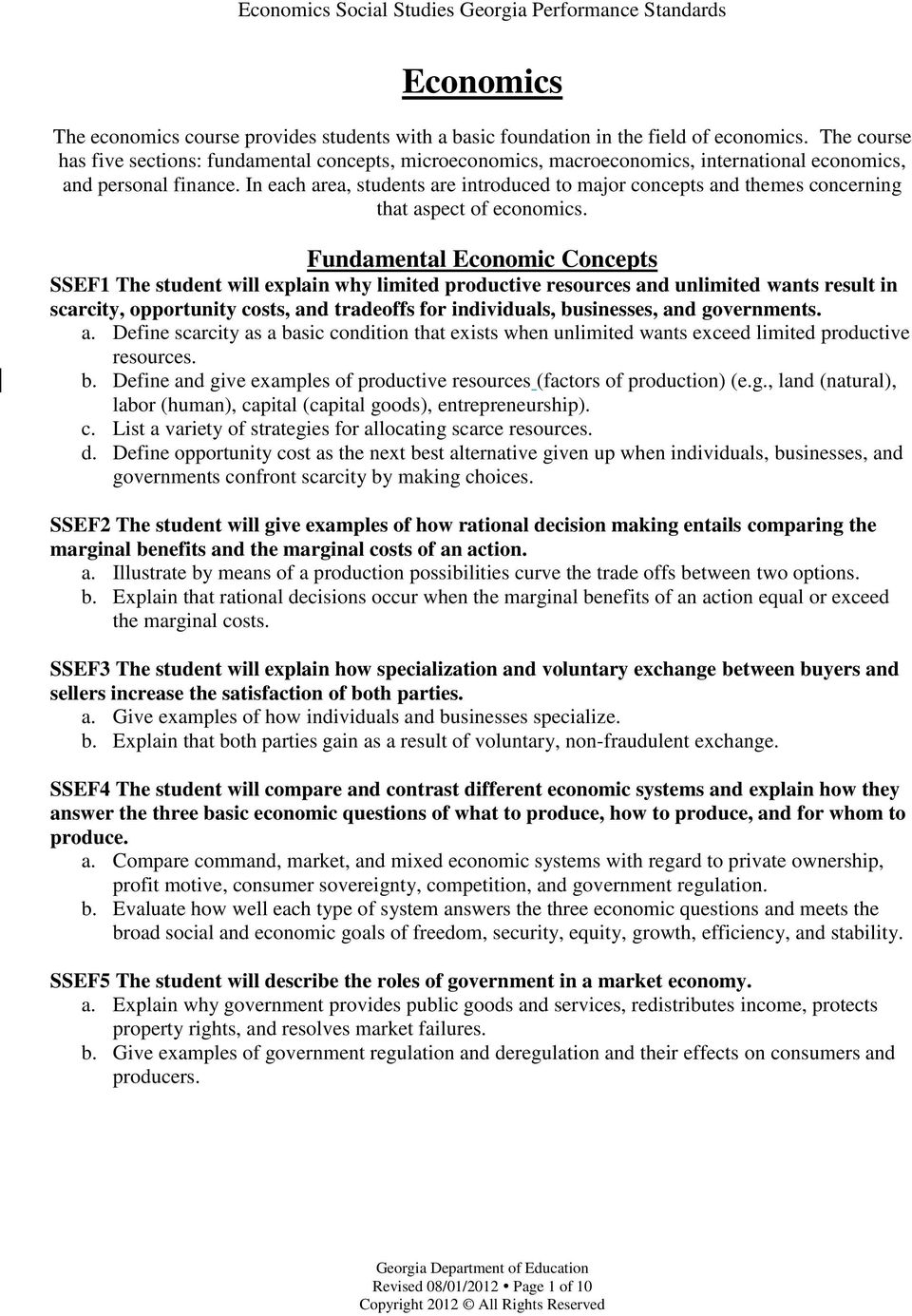
1 Economics The economics course provides students with a basic foundation in the field of economics. The course has five sections: fundamental concepts, microeconomics, macroeconomics, international economics, and personal finance. In each area, students are introduced to major concepts and themes concerning that aspect of economics. Fundamental Economic Concepts SSEF1 The student will explain why limited productive resources and unlimited wants result in scarcity, opportunity costs, and tradeoffs for individuals, businesses, and governments. a. Define scarcity as a basic condition that exists when unlimited wants exceed limited productive resources. b. Define and give examples of productive resources (factors of production) (e.g., land (natural), labor (human), capital (capital goods), entrepreneurship). c. List a variety of strategies for allocating scarce resources. d. Define opportunity cost as the next best alternative given up when individuals, businesses, and governments confront scarcity by making choices. SSEF2 The student will give examples of how rational decision making entails comparing the marginal benefits and the marginal costs of an action. a. Illustrate by means of a production possibilities curve the trade offs between two options. b. Explain that rational decisions occur when the marginal benefits of an action equal or exceed the marginal costs. SSEF3 The student will explain how specialization and voluntary exchange between buyers and sellers increase the satisfaction of both parties. a. Give examples of how individuals and businesses specialize. b. Explain that both parties gain as a result of voluntary, non-fraudulent exchange. SSEF4 The student will compare and contrast different economic systems and explain how they answer the three basic economic questions of what to produce, how to produce, and for whom to produce. a. Compare command, market, and mixed economic systems with regard to private ownership, profit motive, consumer sovereignty, competition, and government regulation. b. Evaluate how well each type of system answers the three economic questions and meets the broad social and economic goals of freedom, security, equity, growth, efficiency, and stability. SSEF5 The student will describe the roles of government in a market economy. a. Explain why government provides public goods and services, redistributes income, protects property rights, and resolves market failures. b. Give examples of government regulation and deregulation and their effects on consumers and producers. Revised 08/01/2012 Page 1 of 10
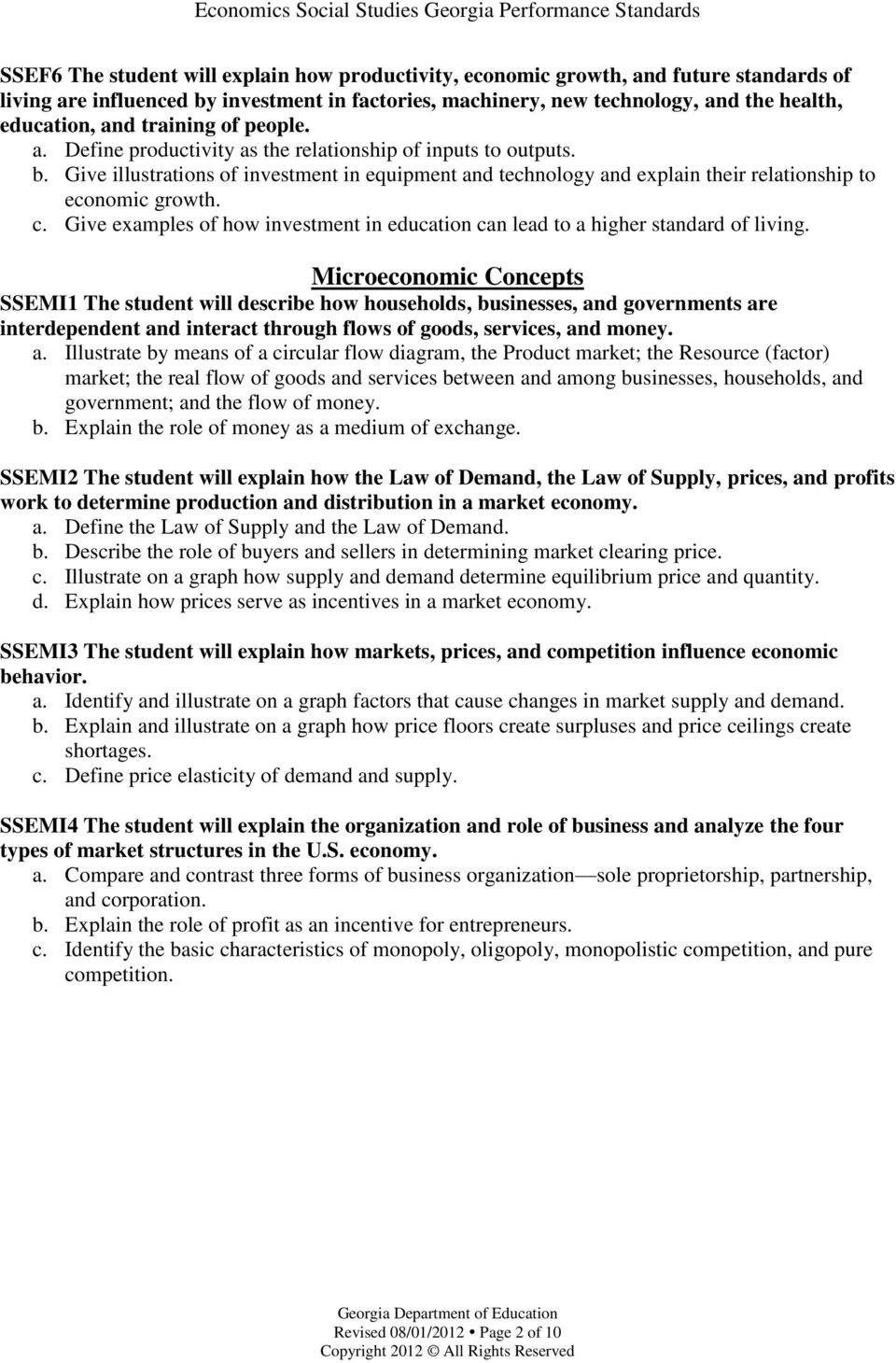
2 SSEF6 The student will explain how productivity, economic growth, and future standards of living are influenced by investment in factories, machinery, new technology, and the health, education, and training of people. a. Define productivity as the relationship of inputs to outputs. b. Give illustrations of investment in equipment and technology and explain their relationship to economic growth. c. Give examples of how investment in education can lead to a higher standard of living. Microeconomic Concepts SSEMI1 The student will describe how households, businesses, and governments are interdependent and interact through flows of goods, services, and money. a. Illustrate by means of a circular flow diagram, the Product market; the Resource (factor) market; the real flow of goods and services between and among businesses, households, and government; and the flow of money. b. Explain the role of money as a medium of exchange. SSEMI2 The student will explain how the Law of Demand, the Law of Supply, prices, and profits work to determine production and distribution in a market economy. a. Define the Law of Supply and the Law of Demand. b. Describe the role of buyers and sellers in determining market clearing price. c. Illustrate on a graph how supply and demand determine equilibrium price and quantity. d. Explain how prices serve as incentives in a market economy. SSEMI3 The student will explain how markets, prices, and competition influence economic behavior. a. Identify and illustrate on a graph factors that cause changes in market supply and demand. b. Explain and illustrate on a graph how price floors create surpluses and price ceilings create shortages. c. Define price elasticity of demand and supply. SSEMI4 The student will explain the organization and role of business and analyze the four types of market structures in the U.S. economy. a. Compare and contrast three forms of business organization sole proprietorship, partnership, and corporation. b. Explain the role of profit as an incentive for entrepreneurs. c. Identify the basic characteristics of monopoly, oligopoly, monopolistic competition, and pure competition. Revised 08/01/2012 Page 2 of 10
3 Macroeconomic Concepts SSEMA1 The student will illustrate the means by which economic activity is measured. a. Explain that overall levels of income, employment, and prices are determined by the spending and production decisions of households, businesses, government, and net exports. b. Define Gross Domestic Product (GDP), economic growth, unemployment, Consumer Price Index (CPI), inflation, stagflation, and aggregate supply and aggregate demand. c. Explain how economic growth, inflation, and unemployment are calculated. d. Identify structural, cyclical, and frictional unemployment. e. Define the stages of the business cycle; include peak, contraction, trough, recovery, expansion as well as recession and depression. f. Describe the difference between the national debt and government deficits. SSEMA2 The student will explain the role and functions of the Federal Reserve System. a. Describe the organization of the Federal Reserve System. b. Define monetary policy. c. Describe how the Federal Reserve uses the tools of monetary policy to promote price stability, full employment, and economic growth. SSEMA3 The student will explain how the government uses fiscal policy to promote price stability, full employment, and economic growth. a. Define fiscal policy. b. Explain the government s taxing and spending decisions. International Economics SSEIN1 The student will explain why individuals, businesses, and governments trade goods and services. a. Define and distinguish between absolute advantage and comparative advantage. b. Explain that most trade takes place because of comparative advantage in the production of a good or service. c. Explain the difference between balance of trade and balance of payments. SSEIN2 The student will explain why countries sometimes erect trade barriers and sometimes advocate free trade. a. Define trade barriers as tariffs, quotas, embargoes, standards, and subsidies. b. Identify costs and benefits of trade barriers over time. c. List specific examples of trade barriers. d. List specific examples of trading blocks such as the EU, NAFTA, and ASEAN. e. Evaluate arguments for and against free trade. SSEIN3 The student will explain how changes in exchange rates can have an impact on the purchasing power of individuals in the United States and in other countries. a. Define exchange rate as the price of one nation s currency in terms of another nation s currency. b. Locate information on exchange rates. c. Interpret exchange rate tables. d. Explain why, when exchange rates change, some groups benefit and others lose. Revised 08/01/2012 Page 3 of 10

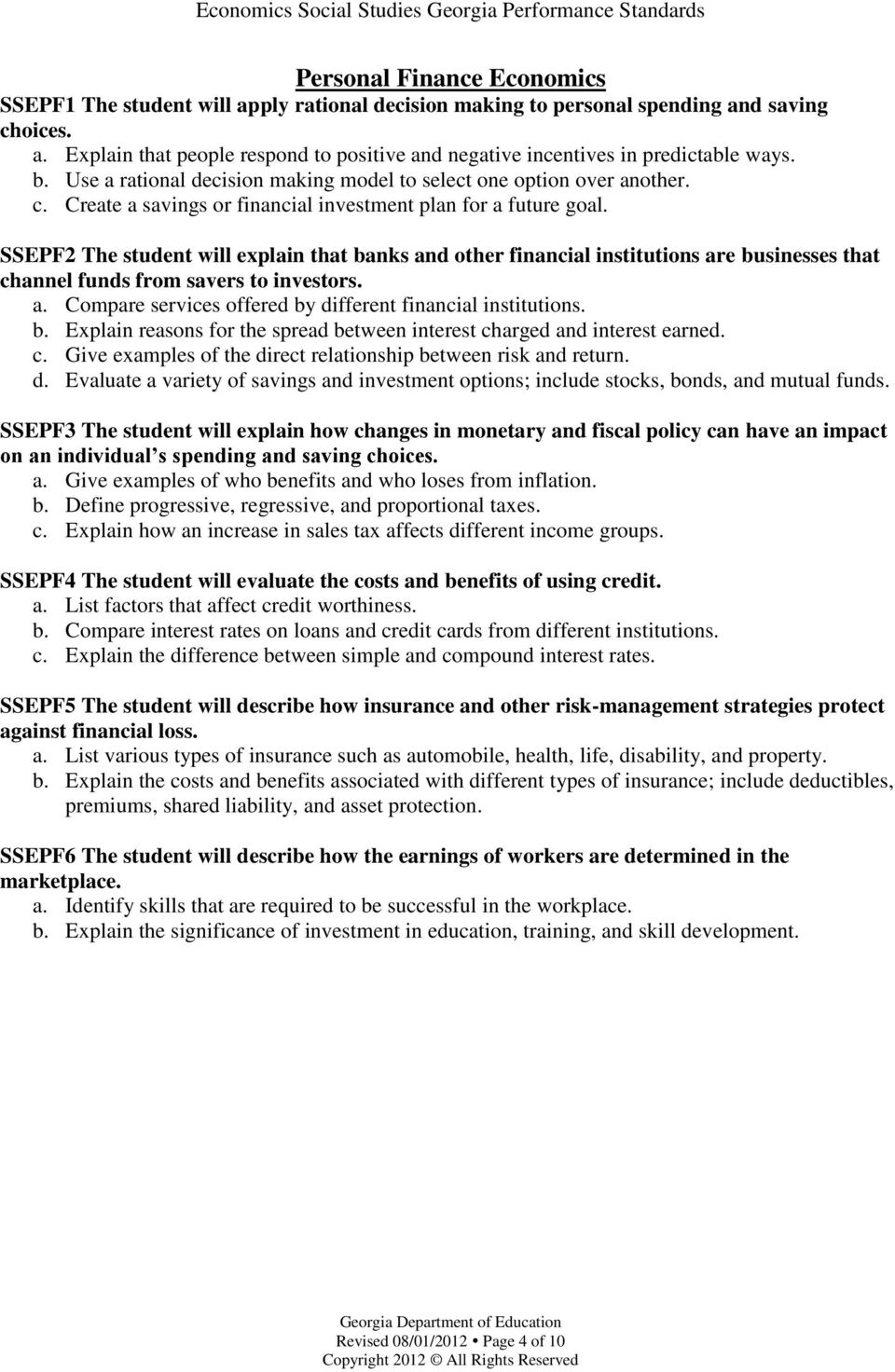
4 Personal Finance Economics SSEPF1 The student will apply rational decision making to personal spending and saving choices. a. Explain that people respond to positive and negative incentives in predictable ways. b. Use a rational decision making model to select one option over another. c. Create a savings or financial investment plan for a future goal. SSEPF2 The student will explain that banks and other financial institutions are businesses that channel funds from savers to investors. a. Compare services offered by different financial institutions. b. Explain reasons for the spread between interest charged and interest earned. c. Give examples of the direct relationship between risk and return. d. Evaluate a variety of savings and investment options; include stocks, bonds, and mutual funds. SSEPF3 The student will explain how changes in monetary and fiscal policy can have an impact on an individual s spending and saving choices. a. Give examples of who benefits and who loses from inflation. b. Define progressive, regressive, and proportional taxes. c. Explain how an increase in sales tax affects different income groups. SSEPF4 The student will evaluate the costs and benefits of using credit. a. List factors that affect credit worthiness. b. Compare interest rates on loans and credit cards from different institutions. c. Explain the difference between simple and compound interest rates. SSEPF5 The student will describe how insurance and other risk-management strategies protect against financial loss. a. List various types of insurance such as automobile, health, life, disability, and property. b. Explain the costs and benefits associated with different types of insurance; include deductibles, premiums, shared liability, and asset protection. SSEPF6 The student will describe how the earnings of workers are determined in the marketplace. a. Identify skills that are required to be successful in the workplace. b. Explain the significance of investment in education, training, and skill development. Revised 08/01/2012 Page 4 of 10
5 Social Studies Skills Matrices MAP AND GLOBE SKILLS GOAL: The student will use maps to retrieve social studies information. I: indicates when a skill is introduced in the standards and elements as part of the content D: indicates grade levels where the teacher must develop that skill using the appropriate content M: indicates grade level by which student should achieve mastery, the ability to use the skill in all situations A: indicates grade levels where students will continue to apply and improve mastered skills Map and Globe Skills K use cardinal directions I M A A A A A A A A 2. use intermediate directions I M A A A A A A A 3. use a letter/number grid system to determine location 4. compare and contrast the categories of natural, cultural, and political features found on maps 5. use inch to inch map scale to determine distance on map 6. use map key/legend to acquire information from, historical, physical, political, resource, product and economic maps 7. use a map to explain impact of geography on historical and current events 8. draw conclusions and make generalizations based on information from maps 9. use latitude and longitude to determine location 10. use graphic scales to determine distances on a map 11. compare maps of the same place at different points in time and from different perspectives to determine changes, identify trends, and generalize about human activities 12. compare maps with data sets (charts, tables, graphs) and /or readings to draw conclusions and make generalizations 9-12 I M A A A A A A I M A A A A A A I M A A A A A A I D M A A A A A I D M A A A A A I M A A A A A I D D D M A A I M A A A A I M A A A A I M A A A A Revised 08/01/2012 Page 5 of 10

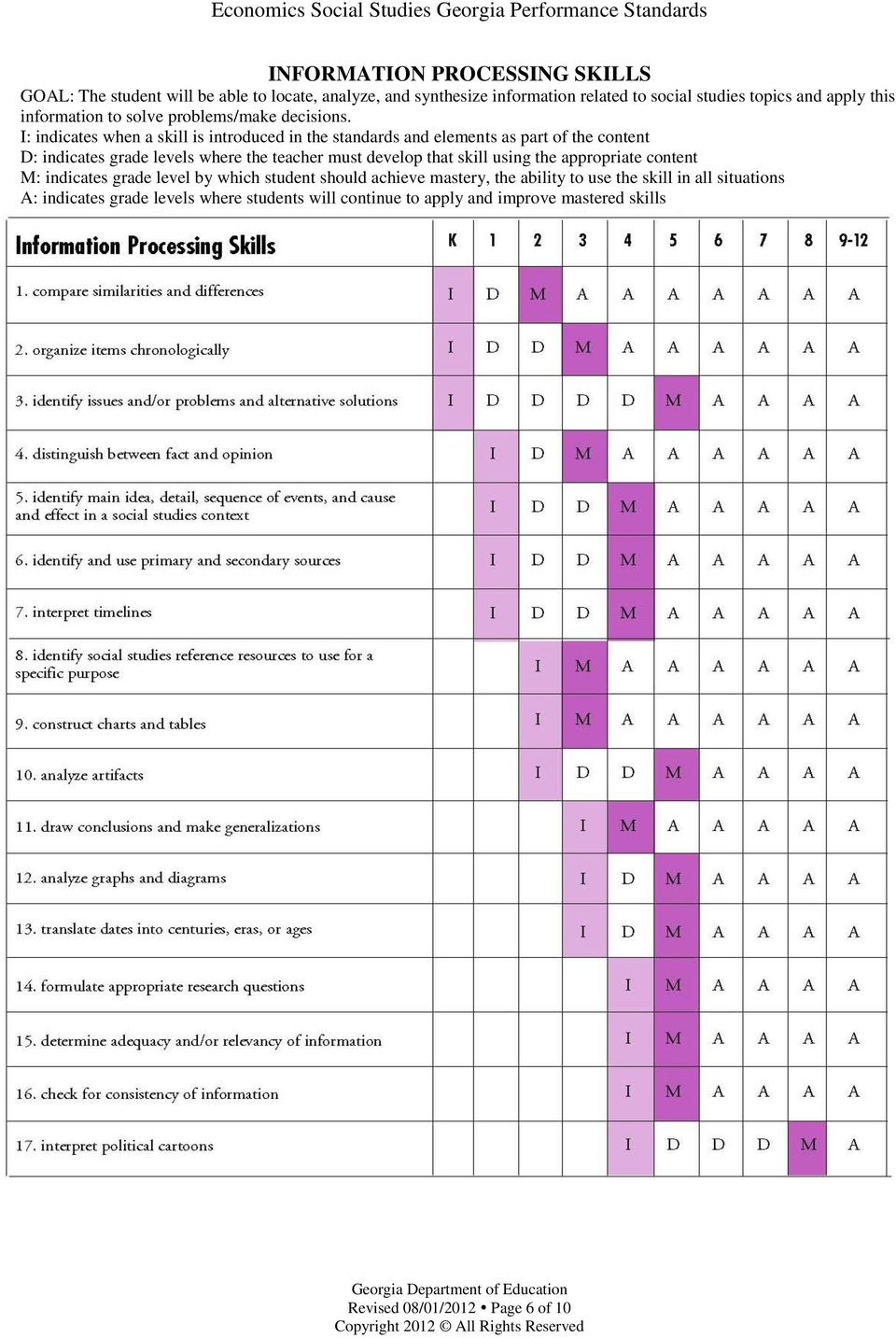
6 INFORMATION PROCESSING SKILLS GOAL: The student will be able to locate, analyze, and synthesize information related to social studies topics and apply this information to solve problems/make decisions. I: indicates when a skill is introduced in the standards and elements as part of the content D: indicates grade levels where the teacher must develop that skill using the appropriate content M: indicates grade level by which student should achieve mastery, the ability to use the skill in all situations A: indicates grade levels where students will continue to apply and improve mastered skills Revised 08/01/2012 Page 6 of 10
7 Clarification: Grades 9-10 social studies courses incorporate the grades 9-10 Reading/Writing Standards for Literacy in History/Social Studies. Grades social studies courses incorporate the grades Reading/Writing Standards for Literacy in History/Social Studies. READING STANDARDS FOR LITERACY IN HISTORY/SOCIAL STUDIES (RH) GRADE 9-10 Key Ideas and Details L9-10RHSS1: Cite specific textual evidence to support analysis of primary and secondary sources, attending to such features as the date and origin of the information. L9-10RHSS2: Determine the central ideas or information of a primary or secondary source; provide an accurate summary of how key events or ideas develop over the course of the text. L9-10RHSS3: Analyze in detail a series of events described in a text; determine whether earlier events caused later ones or simply preceded them. Craft and Structure L9-10RHSS4: Determine the meaning of words and phrases as they are used in a text, including vocabulary describing political, social, or economic aspects of history/social science. L9-10RHSS5: Analyze how a text uses structure to emphasize key points or advance an explanation or analysis L9-10RHSS6: Compare the point of view of two or more authors for how they treat the same or similar topics, including which details they include and emphasize in their respective accounts. Integration of Knowledge and Ideas L9-10RHSS7: Integrate quantitative or technical analysis (e.g., charts, research data) with qualitative analysis in print or digital text. L9-10RHSS8: Assess the extent to which the reasoning and evidence in a text support the author s claims. L9-10RHSS9: Compare and contrast treatments of the same topic in several primary and secondary sources. Range of Reading and Level of Text Complexity L9-10RHSS10: By the end of grade 10, read and comprehend history/social studies texts in the grades 9 10 text complexity band independently and proficiently. Revised 08/01/2012 Page 7 of 10

8 WRITING STANDARDS FOR LITERACY IN HISTORY/SOCIAL STUDIES, SCIENCE, AND TECHNICAL SUBJECTS GRADES 9-10 (WHST) Text Types and Purposes L9-10WHST1: Write arguments focused on discipline-specific content. a. Introduce precise claim(s), distinguish the claim(s) from alternate or opposing claims, and create an organization that establishes clear relationships among the claim(s), counterclaims, reasons, and evidence. b. Develop claim(s) and counterclaims fairly, supplying data and evidence for each while pointing out the strengths and limitations of both claim(s) and counterclaims in a discipline-appropriate form and in a manner that anticipates the audience s knowledge level and concerns. c. Use words, phrases, and clauses to link the major sections of the text, create cohesion, and clarify the relationships between claim(s) and reasons, between reasons and evidence, and between claim(s) and counterclaims. d. Establish and maintain a formal style and objective tone while attending to the norms and conventions of the discipline in which they are writing. e. Provide a concluding statement or section that follows from or supports the argument presented. L9-10WHST2: Write informative/explanatory texts, including the narration of historical events, scientific procedures/ experiments, or technical processes. a. Introduce a topic and organize ideas, concepts, and information to make important connections and distinctions; include formatting (e.g., headings), graphics (e.g., figures, tables), and multimedia when useful to aiding comprehension. b. Develop the topic with well-chosen, relevant, and sufficient facts, extended definitions, concrete details, quotations, or other information and examples appropriate to the audience s knowledge of the topic. c. Use varied transitions and sentence structures to link the major sections of the text, create cohesion, and clarify the relationships among ideas and concepts. d. Use precise language and domain-specific vocabulary to manage the complexity of the topic and convey a style appropriate to the discipline and context as well as to the expertise of likely readers. e. Establish and maintain a formal style and objective tone while attending to the norms and conventions of the discipline in which they are writing. f. Provide a concluding statement or section that follows from and supports the information or explanation presented (e.g., articulating implications or the significance of the topic). L9-10WHST3: (See note; not applicable as a separate requirement) Production and Distribution of Writing L9-10WHST4: Produce clear and coherent writing in which the development, organization, and style are appropriate to task, purpose, and audience. L9-10WHST5: Develop and strengthen writing as needed by planning, revising, editing, rewriting, or trying a new approach, focusing on addressing what is most significant for a specific purpose and audience. L9-10WHST6: Use technology, including the Internet, to produce, publish, and update individual or shared writing products, taking advantage of technology s capacity to link to other information and to display information flexibly and dynamically. Research to Build and Present Knowledge L9-10WHST7: Conduct short as well as more sustained research projects to answer a question (including a self-generated question) or solve a problem; narrow or broaden the inquiry when appropriate; synthesize multiple sources on the subject, demonstrating understanding of the subject under investigation. L9-10WHST8: Gather relevant information from multiple authoritative print and digital sources, using advanced searches effectively; assess the usefulness of each source in answering the research question; integrate information into the text selectively to maintain the flow of ideas, avoiding plagiarism and following a standard format for citation. L9-10WHST9: Draw evidence from informational texts to support analysis, reflection, and research. Range of Writing L9-10WHST10: Write routinely over extended time frames (time for reflection and revision) and shorter time frames (a single sitting or a day or two) for a range of discipline-specific tasks, purposes, and audiences. Revised 08/01/2012 Page 8 of 10

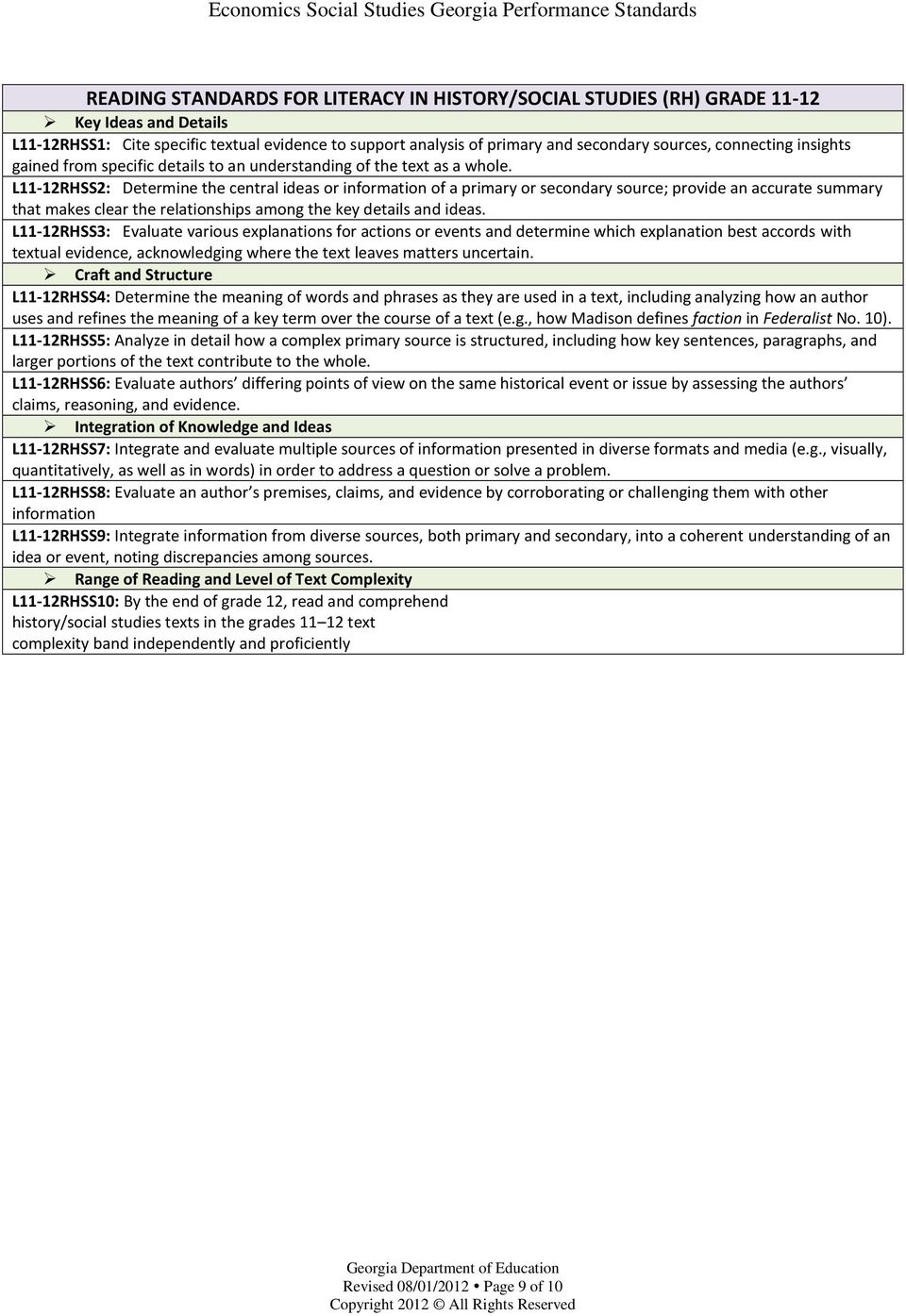
9 READING STANDARDS FOR LITERACY IN HISTORY/SOCIAL STUDIES (RH) GRADE Key Ideas and Details L11-12RHSS1: Cite specific textual evidence to support analysis of primary and secondary sources, connecting insights gained from specific details to an understanding of the text as a whole. L11-12RHSS2: Determine the central ideas or information of a primary or secondary source; provide an accurate summary that makes clear the relationships among the key details and ideas. L11-12RHSS3: Evaluate various explanations for actions or events and determine which explanation best accords with textual evidence, acknowledging where the text leaves matters uncertain. Craft and Structure L11-12RHSS4: Determine the meaning of words and phrases as they are used in a text, including analyzing how an author uses and refines the meaning of a key term over the course of a text (e.g., how Madison defines faction in Federalist No. 10). L11-12RHSS5: Analyze in detail how a complex primary source is structured, including how key sentences, paragraphs, and larger portions of the text contribute to the whole. L11-12RHSS6: Evaluate authors differing points of view on the same historical event or issue by assessing the authors claims, reasoning, and evidence. Integration of Knowledge and Ideas L11-12RHSS7: Integrate and evaluate multiple sources of information presented in diverse formats and media (e.g., visually, quantitatively, as well as in words) in order to address a question or solve a problem. L11-12RHSS8: Evaluate an author s premises, claims, and evidence by corroborating or challenging them with other information L11-12RHSS9: Integrate information from diverse sources, both primary and secondary, into a coherent understanding of an idea or event, noting discrepancies among sources. Range of Reading and Level of Text Complexity L11-12RHSS10: By the end of grade 12, read and comprehend history/social studies texts in the grades text complexity band independently and proficiently Revised 08/01/2012 Page 9 of 10
10 WRITING STANDARDS FOR LITERACY IN HISTORY/SOCIAL STUDIES, SCIENCE, AND TECHNICAL SUBJECTS GRADES (WHST) Text Types and Purposes L11-12WHST1: Write arguments focused on discipline-specific content. a. Introduce precise, knowledgeable claim(s), establish the significance of the claim(s), distinguish the claim(s) from alternate or opposing claims, and create an organization that logically sequences the claim(s), counterclaims, reasons, and evidence. b. Develop claim(s) and counterclaims fairly and thoroughly, supplying the most relevant data and evidence for each while pointing out the strengths and limitations of both claim(s) and counterclaims in a discipline-appropriate form that anticipates the audience s knowledge level, concerns, values, and possible biases. c. Use words, phrases, and clauses as well as varied syntax to link the major sections of the text, create cohesion, and clarify the relationships between claim(s) and reasons, between reasons and evidence, and between claim(s) and counterclaims. d. Establish and maintain a formal style and objective tone while attending to the norms and conventions of the discipline in which they are writing. e. Provide a concluding statement or section that follows from or supports the argument presented. L11-12WHST2: Write informative/explanatory texts, including the narration of historical events, scientific procedures/ experiments, or technical processes. a. Introduce a topic and organize complex ideas, concepts, and information so that each new element builds on that which precedes it to create a unified whole; include formatting (e.g., headings), graphics (e.g., figures, tables), and multimedia when useful to aiding comprehension. b. Develop the topic thoroughly by selecting the most significant and relevant facts, extended definitions, concrete details, quotations, or other information and examples appropriate to the audience s knowledge of the topic. c. Use varied transitions and sentence structures to link the major sections of the text, create cohesion, and clarify the relationships among complex ideas and concepts. d. Use precise language, domain-specific vocabulary and techniques such as metaphor, simile, and analogy to manage the complexity of the topic; convey a knowledgeable stance in a style that responds to the discipline and context as well as to the expertise of likely readers. e. Provide a concluding statement or section that follows from and supports the information or explanation provided (e.g., articulating implications or the significance of the topic). L11-12WHST3: (See note; not applicable as a separate requirement) Production and Distribution of Writing L11-12WHST4: Produce clear and coherent writing in which the development, organization, and style are appropriate to task, purpose, and audience. L11-12WHST5: Develop and strengthen writing as needed by planning, revising, editing, rewriting, or trying a new approach, focusing on addressing what is most significant for a specific purpose and audience. L11-12WHST6: Use technology, including the Internet, to produce, publish, and update individual or shared writing products in response to ongoing feedback, including new arguments or information. Research to Build and Present Knowledge L11-12WHST7: Conduct short as well as more sustained research projects to answer a question (including a self-generated question) or solve a problem; narrow or broaden the inquiry when appropriate; synthesize multiple sources on the subject, demonstrating understanding of the subject under investigation. L11-12WHST8: Gather relevant information from multiple authoritative print and digital sources, using advanced searches effectively; assess the strengths and limitations of each source in terms of the specific task, purpose, and audience; integrate information into the text selectively to maintain the flow of ideas, avoiding plagiarism and overreliance on any one source and following a standard format for citation. L11-12WHST9: Draw evidence from informational texts to support analysis, reflection, and research. Range of Writing L11-12WHST10: Write routinely over extended time frames (time for reflection and revision) and shorter time frames (a single sitting or a day or two) for a range of discipline-specific tasks, purposes, and audiences. Revised 08/01/2012 Page 10 of 10
American Government/Civics
 American Government/Civics The government course provides students with a background in the philosophy, functions, and structure of the United States government. Students examine the philosophical foundations
Crosswalk of the Common Core Standards and the Standards for the 21st-Century Learner Writing Standards
 Crosswalk of the Common Core Standards and the Standards for the 21st-Century Learner Writing Standards AASL Standards 1. Inquire, think critically, and gain knowledge. 1.1 Skills 1.1.1 Follow an inquiry-based
Maryland Common Core State Curriculum Framework Standards for Writing Standards in Science and Technical Subjects. Grades 9-12
 Cluster: Text Types and Purposes CCR Anchor Standard #1 Write arguments to support claims in an analysis of substantive topics or texts, using valid reasoning and relevant and sufficient evidence. WHST.11-12.1
Psychology Social Studies Georgia Performance Standards. Psychology. Standards with an asterisk (*) are recommend for a one semester course.
 Psychology Psychology is the scientific study of behavior and mental processes. It is a unique science that often necessitates the use of special measurements and research methods. The course has four
PENNSYLVANIA COMMON CORE STANDARDS English Language Arts Grades 9-12
 1.2 Reading Informational Text Students read, understand, and respond to informational text with emphasis on comprehension, making connections among ideas and between texts with focus on textual evidence.
Competencies for Secondary Teachers: Computer Science, Grades 4-12
 1. Computational Thinking CSTA: Comp. Thinking 1.1 The ability to use the basic steps in algorithmic problemsolving to design solutions (e.g., problem statement and exploration, examination of sample instances,
Common Core State Standards Grades 9-10 ELA/History/Social Studies
 Common Core State Standards Grades 9-10 ELA/History/Social Studies ELA 9-10 1 Responsibility Requires Action. Responsibility is the active side of morality: doing what I should do, what I said I would
Economics. Social Studies Curriculum Framework. Revised 2006 Amended June 2009
 Economics Social Studies Curriculum Framework Revised 2006 Course Title: Economics Course/Unit Credit: 0.5 Course Number: 4743000 Teacher Licensure: Please refer to the Course Code Management System (https://adedata.arkansas.gov/ccms/)
Common Core Standards for Literacy in Science and Technical Subjects
 A Correlation of Miller & Levine Biology To the Common Core Standards for Literacy in Science and Technical Subjects INTRODUCTION This document demonstrates how meets the Common Core Standards for Literacy
Lesson 5: Savvy Savers
 KaChing! Lesson 5: Savvy Savers Standards and Benchmarks (see page B-56) Lesson Description Students calculate compound interest to identify benefits of saving in interest-bearing accounts. They learn
FBLA: ECONOMICS. Competency: Basic Economic Concepts and Principles
 Competency: Basic Economic Concepts and Principles 1. Define money (characteristics, role, and forms) and trace how money and resources flow through the American economic system. 2. Utilize decision-making
New York State K-12 Social Studies Framework Introduction
 The State Education Department The University of the State of New York New York State K-12 Social Studies Framework Introduction Revised November 2014 Contents Introduction... 2 Overview... 2 New York
E/LA Common Core Standards for Writing Grade 5
 Text Type and Purposes Anchor Standards 1. Write arguments to support claims in an analysis of substantive topics or texts, using valid reasoning and relevant and sufficient evidence. 2. Write informative/explanatory
Desertification: Cause and Effect Students learn about the causes and effects of desertification threatening the African Sahel.
 Students learn about the causes and effects of desertification threatening the African Sahel. Author Grade Level Duration Barbara Stout 6-8 and 4-5 class periods National Geography Standards ELEMENT TWO:
Common Core State Standards for Literacy in History/Social Studies, Science, and Technical Subjects, Grades 9-10
 Common Core State Standards for Literacy in History/Social Studies, Science, and Technical English Language Arts Standards» Anchor Standards» College and Career Readiness Anchor Standards for Reading The
Students will know Vocabulary: claims evidence reasons relevant accurate phrases/clauses credible source (inc. oral) formal style clarify
 Sixth Grade Writing : Text Types and Purposes Essential Questions: 1. How do writers select the genre of writing for a specific purpose and audience? 2. How do essential components of the writing process
Career Planning Basics
 Media Type: DVD Duration: 70 min. Career Planning Basics Goal: To provide students with college and career-readiness skills necessary for life after secondary and post-secondary education. Description:
Indiana Department of Education
 Indiana Department of Education Academic Course Framework PERSONAL FINANCIAL RESPONSIBILITY Personal Financial Responsibility addresses the identification and management of personal financial resources
Standards. Interactive Media, July 2012, Page 1 of 6
 Indiana Department of Education Academic Course Framework INTERACTIVE MEDIA Interactive Media prepares students for careers in business and industry working with interactive media products and services;
Web Design, February 2013, Page 1 of 5
 Indiana Department of Education Academic Course Framework WEB DESIGN Web Design is a course that provides instruction in the principles of web design using HTML/XHTML and current/emerging software programs.
o Ivy Tech DESN 105- Architectural Design I DESN 113- Intermediate CAD o Vincennes University ARCH 221- Advanced Architectural Software Applications
 Indiana Department of Education Academic Course Framework ARCHITECHTURAL DRAFTING AND DESIGN II Architectural Drafting and Design II presents a history and survey of architecture and focuses on the creative
o Ivy Tech DESN 102- Technical Graphics DESN 103- CAD Fundamentals
 Indiana Department of Education Academic Course Framework ARCHITECHTURAL DRAFTING AND DESIGN I Architectural Drafting and Design I Gives students a basic understanding of the detailing skills commonly
Journalism Curriculum Maps
 Journalism Curriculum Maps Unit of Study: Sports Writing Unit of Study: Writing Feature Stories Unit of Study: Writing News Leads Unit of Study: Writing the News Story Grade: 9-12 Subject: Journalism Unit
HIV, STD & Pregnancy Prevention
 HIV, STD & Pregnancy Prevention The HealthSmart HIV, STD & Pregnancy Prevention unit meets the following Common Core State Standards in English Language Arts for Grades 9-10. Reading Informational Text
SIXTH GRADE UNIT 1. Reading: Literature
 Reading: Literature Writing: Narrative RL.6.1 RL.6.2 RL.6.3 RL.6.4 RL.6.5 RL.6.6 RL.6.7 W.6.3 SIXTH GRADE UNIT 1 Key Ideas and Details Cite textual evidence to support analysis of what the text says explicitly
Sixth Grade Social Studies Georgia Performance Standards. Grade Six. LATIN AMERICA and CANADA
 Grade Six LATIN AMERICA, the CARIBBEAN and CANADA, EUROPE, and AUSTRALIA Sixth grade is the first year of a two year World Area Studies course. Sixth grade students study Latin America, Canada, Europe,
NEW YORK STATE TEACHER CERTIFICATION EXAMINATIONS
 NEW YORK STATE TEACHER CERTIFICATION EXAMINATIONS TEST DESIGN AND FRAMEWORK DRAFT June 2012 This document is a working draft. The information in this document is subject to change, and any changes will
Everett Public Schools Framework: Digital Video Production II
 Course: CIP Code: 100202 Career Cluster: Video ProductionTechnology/Technician Everett Public Schools Framework: Digital Video Production II Arts, Audio/Video Technology & Communications Total Framework
Students will know Vocabulary: purpose details reasons phrases conclusion point of view persuasive evaluate
 Fourth Grade Writing : Text Types and Purposes Essential Questions: 1. How do writers select the genre of writing for a specific purpose and audience? 2. How do essential components of the writing process
o Ivy Tech CONT 101 Introduction to Construction CONT 106 Construction Blueprint Reading BCOT 104 Floor and Wall Layout
 Indiana Department of Education Academic Course Framework CONSTRUCTION TECHNOLOGY I Construction Technology I focuses on classroom and laboratory experiences involving the formation, installation, maintenance,
Integrating the Common Core Standards into the Music Curriculum
 Place Photo Here, Otherwise Delete Box Integrating the Common Core Standards into the Music Curriculum Tom L. Foust January 24 th, 2013 Illinois Music Educators Conference Peoria, Illinois What is the
Construction Technology: HVAC I, July 2012, Page 1 of 5
 Indiana Department of Education Academic Course Framework CONSTRUCTION TECHNOLOGY: HVAC I Construction Technology: HVAC I includes classroom and laboratory experiences concerned with heat generation, ventilation,
Computer Tech Support, July 2012, Page 1 of 5
 Indiana Department of Education Academic Course Framework COMPUTER TECH SUPPORT Computer Tech Support allows students to explore how computers work. Students learn the functionality of hardware and software
Alignment of the National Standards for Learning Languages with the Common Core State Standards
 Alignment of the National with the Common Core State Standards Performance Expectations The Common Core State Standards for English Language Arts (ELA) and Literacy in History/Social Studies, Science,
Learner Guide. Cambridge IGCSE Economics
 Learner Guide Cambridge IGCSE Economics 0455 Cambridge International Examinations retains the copyright on all its publications. Registered Centres are permitted to copy material from this booklet for
Bills, Budgets and Bank Accounts
 Bills, Budgets and Bank Accounts Teacher s Guide Introduction to the Unit... 2 What are the activities? What is the assessment? What are the activity descriptions? How does this unit align with the Common
Montgomery County Public Schools English 9B Exam Review
 Montgomery County Public Schools English 9B Exam Review June 2013 FORMAT Five Readings an excerpt from a Shakespeare play (not Romeo and Juliet) two poems a narrative a nonfiction article related to the
o Ivy Tech CRIM 101- Intro to Criminal Justice Systems CRIM 113- Criminal Investigations
 Indiana Department of Education Academic Course Framework CRIMINAL JUSTICE I Criminal Justice I Introduces specialized classroom and practical experiences related to public safety occupations such as law
Business Subject Matter Requirements. Part I: Content Domains for Subject Matter Understanding and Skill in Business
 Business Subject Matter Requirements Part I: Content Domains for Subject Matter Understanding and Skill in Business Domain 1. Business Management Candidates demonstrate an understanding of the purpose
Teacher s Guide. Alignment with the Common Core State Standards for Reading... 3. Alignment with the Common Core State Standards for Writing...
 My Insurance Teacher s Guide Introduction to the Unit... 2 What are the activities? What is the assessment? What are the activity descriptions? How does this unit align with the Common Core State Standards?
English 4: Florida College Prep, Grade 12 Curriculum Map
 English 4: Florida College Prep, Grade 12 Curriculum Map The following curriculum map is based on the Language Arts Florida Standards (LAFS), which are listed at the beginning of the map and can be accessed,
American Literature, Quarter 1, Unit 2 of 3 The Puritan Tradition and The Crucible. Overview. (1 day = 50-55 minutes)
 American Literature, Quarter 1, Unit 2 of 3 The Puritan Tradition and The Crucible Overall days: 16 (1 day = 50-55 minutes) Overview Purpose This unit will focus on the beliefs of early American Puritans
I. Title of Lesson: Learning from Artifacts and What Artifacts Tell Us
 Lesson Plan Class: Seventh Grade Subject: World History Ancient Civilizations Topic: Unit One Investigating the Past: How are social scientists like detectives? I. Title of Lesson: Learning from Artifacts
How To Reconcile The Conflict Between Individual Rights And Collective Responsibility Toward The Commons
 The Commons: Our Right and Our Responsibility? Teacher s Guide Grade: 9-12 Lesson: The Commons: Our Right and Our Responsibility? Number of Class Periods: 3 45-minute periods The Healthy Commons Lesson
Common Core State Standards Sample Student Writing Scored with 6+1 Traits Rubric
 Common Core State Standards Sample Student Writing Scored with 6+1 Traits Rubric This collection of K-12 student papers and the accompanying annotations were taken from Appendix C: Samples of Student Writing
Reading Standards for Literature
 Reading for Literature ELACC3RL1 Key Ideas and Details: Ask and answer questions to demonstrate understanding of a text, referring explicitly to the text as the basis for the answers. 11/5/2012 1 Reading
Journey Across Time The Early Ages 2008
 Common Core State Standards for Literacy in History/Social Studies, Science, and Technical Subjects Grades 6-8 Journey Across Time The Early Ages 2008 English Language Arts Standards» Anchor Standards»
Everett Public Schools Framework: Digital Photography I
 Course: CIP Code: 500406 Career Cluster: Commercial Photography Everett Public Schools Framework: Digital Photography I Arts, Audio/Video Technology & Communications Total Framework Hours: 90 Hours Preparatory
Economics Proposal for CORE 2014 due by February 1, 2013
 Economics Proposal for CORE 2014 due by February 1, 2013 ------------------------------------------------------------------------------------------------------ Executive Summary: The Economics Curriculum
Edmonds Community College Macroeconomic Principles ECON 202C - Winter 2011 Online Course Instructor: Andy Williams
 Edmonds Community College Macroeconomic Principles ECON 202C - Winter 2011 Online Course Instructor: Andy Williams Textbooks: Economics: Principles, Problems and Policies, 18th Edition, by McConnell, Brue,
GRADE 12 LITERACY IN SOCIAL STUDIES: THE GAME OF LIFE UNIT OVERVIEW TASK DETAILS
 GRADE 12 LITERACY IN SOCIAL STUDIES: UNIT OVERVIEW THE GAME OF LIFE This packet contains a curriculum- embedded Common Core aligned task and instructional supports. The task is embedded in a 3-5 week unit
Everett Public Schools Framework: Digital Video Production VI
 Course: CIP Code: 100202 Career Cluster: Video ProductionTechnology/Technician Everett Public Schools Framework: Digital Video Production VI Arts, Audio/Video Technology & Communications Total Framework
GEORGIA PERFORMANCE STANDARDS International Domain [Type the author name]
![GEORGIA PERFORMANCE STANDARDS International Domain [Type the author name]](/thumbs/39/18787419.jpg "GEORGIA PERFORMANCE STANDARDS International Domain [Type the author name]") GEORGIA PERFORMANCE STANDARDS International Domain [Type the author name] GEORGIA PERFORMANCE STANDARDS INTERNATIONAL ECONOMICS Fundamental Economic Concepts SSEF3 The student will explain how specialization
GEORGIA PERFORMANCE STANDARDS International Domain [Type the author name] GEORGIA PERFORMANCE STANDARDS INTERNATIONAL ECONOMICS Fundamental Economic Concepts SSEF3 The student will explain how specialization
COMMON CORE STATE STANDARDS WRITING RUBRICS
 COMMON CORE STATE STANDARDS WRITING RUBRICS Grades 11-12 Prevent Plagiarism. Engage Students. www.turnitin.com Thank you for your interest in the Turnitin Common Core State Standards-aligned writing rubrics.
C A R I B B E A N E X A M I N A T I O N S C O U N C I L REPORT ON CANDIDATES WORK IN THE SECONDARY EDUCATION CERTIFICATE EXAMINATION MAY/JUNE 2011
 C A R I B B E A N E X A M I N A T I O N S C O U N C I L REPORT ON CANDIDATES WORK IN THE SECONDARY EDUCATION CERTIFICATE EXAMINATION MAY/JUNE 2011 ECONOMICS GENERAL PROFICIENCY EXAMINATION Copyright 2011
Date Re-Assessed. Indicator. CCSS.ELA-Literacy.RF.5.3 Know and apply grade-level phonics and word analysis skills in decoding words.
 CCSS English/Language Arts Standards Reading: Foundational Skills Fifth Grade Retaught Reviewed Assessed Phonics and Word Recognition CCSS.ELA-Literacy.RF.5.3 Know and apply grade-level phonics and word
Culinary Arts and Hospitality Mangament, July 2012, Page 1 of 6
 Indiana Department of Education Academic Course Framework CULINARY ARTS AND HOSPITALITY MANAGMENT Culinary Arts and Hospitality Management prepares students for occupations and higher education programs
AS Economics. Introductory Macroeconomics. Sixth Form pre-reading
 AS Economics Introductory Macroeconomics Sixth Form pre-reading National income National income (Y) = money value of goods and services produced in an economy over a period of time, usually one year. National
Criminal Justice II, August 2013, Page 1 of 5
 Indiana Department of Education Academic Course Framework CRIMINAL JUSTICE II Criminal Justice II introduces students to concepts and practices in controlling traffic as well as forensic investigation
CHAPTER 7: AGGREGATE DEMAND AND AGGREGATE SUPPLY
 CHAPTER 7: AGGREGATE DEMAND AND AGGREGATE SUPPLY Learning goals of this chapter: What forces bring persistent and rapid expansion of real GDP? What causes inflation? Why do we have business cycles? How
2 0 0 0 E D I T I O N CLEP O F F I C I A L S T U D Y G U I D E. The College Board. College Level Examination Program
 2 0 0 0 E D I T I O N CLEP O F F I C I A L S T U D Y G U I D E College Level Examination Program The College Board Principles of Macroeconomics Description of the Examination The Subject Examination in
British Literature, Quarter 2, Unit 1 of 3. Macbeth. Overview
 British Literature, Quarter 2, Unit 1 of 3 Macbeth Overview Overall days: 20 (1 day = 50-55 minutes) Purpose The purpose of this unit is to read, analyze, and perform scenes from Shakespeare s Macbeth.
MULTIPLE CHOICE. Choose the one alternative that best completes the statement or answers the question.
 Suvey of Macroeconomics, MBA 641 Fall 2006, Final Exam Name MULTIPLE CHOICE. Choose the one alternative that best completes the statement or answers the question. 1) Modern macroeconomics emerged from
Common Core State Standards Speaking and Listening
 Comprehension and Collaboration. Prepare for and participate effectively in a range of conversations and collaborations with diverse partners, building on others ideas and expressing their own clearly
Strand: Reading Literature Topics Standard I can statements Vocabulary Key Ideas and Details
 Strand: Reading Literature Key Ideas and Details Craft and Structure RL.3.1 Ask and answer questions to demonstrate understanding of a text, referring explicitly to the text as the basis for the answers.
#804 Digital Media II,
 Digital Media II Level: 11-12 Units of Credit: 1.00 CIP Code: 11.0211 Core Code: 35-02-00-00-011 Prerequisite: Skill Tests: Digital Media I #804 Digital Media II, Adobe Photoshop Adobe Illustrator Adobe
REVIEW ONE. Name: Class: Date: Matching
 Name: Class: Date: ID: A REVIEW ONE Matching Complete the following using these terms. a. outsourcing b. diversity c. entrepreneur d. competitive differentiation e. strategic alliance f. capital g. vision
Economics EOCT Review
 Economics EOCT Review Which of the following is a likely result of a high unemployment rate in the United States? A) increased demand for consumer goods B) increased production of capital goods C) increased
Business Economics. Business Management & Administration. Candi Norwood, (615) 532-6248 [email protected]
 Business Economics Primary Career Cluster: Consultant: Course Code(s): 5898 Prerequisite(s): Credit: Business Management & Administration Candi Norwood, (615) 532-6248 [email protected] None ½ Grade
Unit 1: Freudian Psychosexual Development: Reading Informational/ Writing Expository
 Sparta High School English Curriculum Grade 12: Psychology in Literature Unit 1: Freudian Psychosexual Development: Reading Informational/ Writing Expository Essential Questions: What are the formative
Creative Writing Mrs. Maryjo Williams Room A213
 Creative Writing Mrs. Maryjo Williams Room A213 One of the most valuable things we can do to heal one another is listen to each other s stories. ----- Rebecca Falls Course Description This course introduces
English 2 - Journalism Mitch Martin: [email protected]
 Mission English 2 - Journalism Mitch Martin: [email protected] To educate students to be self-directed learners, collaborative workers, complex thinkers, quality producers, and community contributors
Business Management and Administration Career Cluster Entrepreneurship Course Number: 06.41610
 Business Management and Administration Career Cluster Entrepreneurship Course Number: 06.41610 Course Description: How do you turn an idea into a business? Experience just that in this course! Entrepreneurship
Economics 101 Multiple Choice Questions for Final Examination Miller
 Economics 101 Multiple Choice Questions for Final Examination Miller PLEASE DO NOT WRITE ON THIS EXAMINATION FORM. 1. Which of the following statements is correct? a. Real GDP is the total market value
CORRELATION FLORIDA DEPARTMENT OF EDUCATION INSTRUCTIONAL MATERIALS CORRELATION COURSE STANDARDS/BENCHMARKS
 SUBJECT: French GRADE LEVEL: 6-8 COURSE TITLE: M/J French, Beginning COURSE CODE: 701000 SUBMISSION TITLE: Bien Dit 2013, Level 1A BID ID: 2776 PUBLISHER: Houghton Mifflin Harcourt PUBLISHER ID: 04-1456030-01
DRAFT SOCIAL STUDIES Georgia Standards of Excellence (GSE) American Government/Civics
 DRAFT SOCIAL STUDIES American Government/Civics American Government/Civics The government course provides students with a background in the philosophy, functions, and structure of the United States government.
English 7 Essential Curriculum
 English 7 Essential Curriculum Genre Autobiography Realistic Fiction Speculative Fiction Theme Facing Injustice Perseverance Thrills and Chills OVERVIEW English 7 students learn how to make purposeful
LANGUAGE ARTS 2016 17 K 12 SUBJECT BOOKLET
 LANGUAGE ARTS 2016 17 K 12 SUBJECT BOOKLET Gwinnett s curriculum for grades K 12 is called the Academic Knowledge and Skills (AKS). The AKS for each grade level spell out the essential things students
Financial Literacy: Personal Finance Basics
 Media Type: DVD Duration: 34 minutes Goal: To organize and plan personal finances and use a budget to manage cash flow. Description: Financial Literacy: Personal Finance Basics provides the student with
Strand: Reading Literature Topics Standard I can statements Vocabulary Key Ideas and Details
 Strand: Reading Literature Topics Standard I can statements Vocabulary Key Ideas and Details Craft and Structure RL.5.1 Quote accurately from a text when explaining what the text says explicitly and when
Reading for Success : A Novel Study for Stuart Little by E.B. White. Common Core Standards Grades 5, 6, 7
 Common Core Standards Copyright 2010. National Governors Association Center for Best Practices and Council of Chief State School Officers. All rights reserved. LESSON 1 2 3 4 5 6 7 8 9 Speaking and Listening:
parent ROADMAP SUPPORTING YOUR CHILD IN GRADE FIVE ENGLISH LANGUAGE ARTS
 TM parent ROADMAP SUPPORTING YOUR CHILD IN GRADE FIVE ENGLISH LANGUAGE ARTS 5 America s schools are working to provide higher quality instruction than ever before. The way we taught students in the past
Lesson 6: Credit Reports and You Thought Your Report Card Was Important
 All About Credit Lesson 6: Credit Reports and You Thought Your Report Card Was Important Standards and Benchmarks (see page C-15) Lesson Description Students read informational text and discuss the advantages
The French Revolution Begins Close Read
 The French Revolution Begins Close Read Standards Alignment Text with Close Read instructions for students Intended to be the initial read in which students annotate the text as they read. Students may
Sample Question Paper (Set-2) Economics (030) Class XII (2015-16) Section A: Microeconomics
 Sample Question Paper (Set-2) Economics (030) Class XII (2015-16) Time : 3 Hours Maximum Marks : 100 Instructions: 1. All questions in both sections are compulsory. However, there is internal choice in
HIGH SCHOOL MASS MEDIA AND MEDIA LITERACY STANDARDS
 Guidelines for Syllabus Development of Mass Media Course (1084) DRAFT 1 of 7 HIGH SCHOOL MASS MEDIA AND MEDIA LITERACY STANDARDS Students study the importance of mass media as pervasive in modern life
Common Core Progress English Language Arts
 [ SADLIER Common Core Progress English Language Arts Aligned to the [ Florida Next Generation GRADE 6 Sunshine State (Common Core) Standards for English Language Arts Contents 2 Strand: Reading Standards
Academic Standards for Reading in Science and Technical Subjects
 Academic Standards for Reading in Science and Technical Subjects Grades 6 12 Pennsylvania Department of Education VII. TABLE OF CONTENTS Reading... 3.5 Students read, understand, and respond to informational
Teaching Literacy and Meeting Common Core in CTE Classes
 Teaching Literacy and Meeting Common Core in CTE Classes Statewide CTE Institute The College of New Jersey May 20, 2014 George Johnson [email protected] And NJ CTE teachers from LDC Cohort 2 Teaching
Whitnall School District Report Card Content Area Domains
 Whitnall School District Report Card Content Area Domains In order to align curricula kindergarten through twelfth grade, Whitnall teachers have designed a system of reporting to reflect a seamless K 12
Language Arts Literacy Areas of Focus: Grade 6
 Language Arts Literacy : Grade 6 Mission: Learning to read, write, speak, listen, and view critically, strategically and creatively enables students to discover personal and shared meaning throughout their
Intended Use of the document: Teachers who are using standards based reporting in their classrooms.
 Standards Based Grading reports a student s ability to demonstrate mastery of a given standard. This Excel spread sheet is designed to support this method of assessing and reporting student learning. Purpose
CTE Externship Lessons: Communications and Event Management Created by teachers: Valerie Thornton and Raefani Green
 CTE Externship Lessons: Communications and Event Management Created by teachers: Valerie Thornton and Raefani Green This resource was created by Tennessee teachers who participated in teacher externships