
The Innovative Pharmaceutical Manufacturing Industry: Driving Economic Growth
|
|
|
- Jemimah Stewart
- 9 years ago
- Views:
Transcription
1 The Innovative Pharmaceutical Manufacturing Industry: Driving Economic Growth March 2015

2 About the Author Nam D. Pham is Managing Partner of ndp analytics, a strategic research firm that specializes in economic analysis of public policy and legal issues. Prior to founding ndp analytics in 2000, Dr. Pham was Vice President at Scudder Kemper Investments in Boston, where he was responsible for research, asset allocations, and currency hedging for global and international bond funds. Before that he was Chief Economist of the Asia Region for Standard & Poor s DRI; an economist at the World Bank; and a consultant to both the Department of Commerce and the Federal Trade Commission. Dr. Pham is an adjunct professor at the George Washington University. Dr. Pham holds a Ph.D. in economics from the George Washington University, an M.A. from Georgetown University; and a B.A. from the University of Maryland. He is a member of the board of advisors to the Dingman Center for Entrepreneurship at the School of Business University of Maryland and a board member of the Food Recovery Network. Acknowledgment Anil Sarda, Senior Associate at ndp analytics, provided analytical assistance. Pharmaceutical Research and Manufacturers of America (PhRMA) provided financial support to conduct this study. The opinions and views expressed in this report are solely those of the author.

3 Led by the pharmaceutical manufacturing industry, IP-intensive manufacturing industries contribute extraordinary economic value to the U.S. economy. Compared to other IP-intensive and non-ip intensive manufacturing industries, the pharmaceutical manufacturing industry had the highest R&D investment over the past decade. Consequently, the pharmaceutical manufacturing industry outperformed other manufacturing industries in all key economic measurements, including job creation, wages paid, gross output, net economic contribution, and exports.
4 The Innovative Pharmaceutical Manufacturing Industry: Driving Economic Growth This report is a companion report to analysis of the U.S. manufacturing sector that found research and development (R&D) investment is a key driver of innovation, supporting the growth and sustainability of the nation s economy. The report, "Intellectual Property (IP)-Intensive Manufacturing Industries: Driving U.S. Economic Growth, determined that industries that invest more in R&D (defined as IP-intensive ) tend to be more productive, support higher-value jobs and sustain employment better than industries with low levels of R&D spending ( non-ip-intensive ). Based on data from the National Science Foundation, the U.S. Census Bureau, the U.S. Bureau of Economic Analysis, and the International Trade Commission, the report found that IP-intensive industries accounted for 83% of annual R&D spending across all U.S. manufacturing industries between 2000 and 2010, and R&D investment grew by 53% compared to 34% for non-ip-intensive industries. This companion report was developed with support by PhRMA to explore the economic contributions of manufacturing performed by the innovative biopharmaceutical industry versus other IP-intensive industries across a number of key measures. The pharmaceutical manufacturing industry outperforms all other IP-intensive industries across key economic measurements Led by the pharmaceutical manufacturing industry, IP-intensive manufacturing industries contributed significant economic value to the U.S. economy during the past 15 years, a period covering both economic upturns and downturns. IP-intensive industries are defined in this report as those industries that have a Key Definitions and Data Sources R&D: Research and development expenses of a manufacturing sector or subsector used in the production of intellectual property published by the National Science Foundation. Employment: Total number of employees in a manufacturing sector or subsector published by the U.S. Census Bureau. Wages: Total wages paid to employees of a manufacturing sector or subsector published by the U.S. Census Bureau. Gross output: Total sales of a manufacturing sector or subsector published by the U.S. Census Bureau. Value added: The economic contributions of a manufacturing sector or subsector as measured by total sales minus intermediate inputs such as the cost of raw materials and services published by the U.S. Census Bureau. Exports: Total sales abroad of a manufacturing sector or subsector (i.e. total sales minus domestic sales) published by the U.S. International Trade Commission. higher research and development (R&D) investment per employee than the average R&D per employee in all manufacturing industries. Adopting and developing new technologies, these U.S. companies create innovative products and services for consumers both domestically and internationally. With higher demand for their products and services and rising revenues, these companies are able to hire additional workers and pay wage premiums to attract needed talent. The U.S. innovative pharmaceutical manufacturing is critically tied to its base of highskilled STEM workers who are involved in every stage of the manufacturing process that seeks to bring new treatments and cures against our most costly and challenging diseases. Workers in IP-intensive manufacturing industries are shown to have higher economic contributions to the U.S. economy. 1
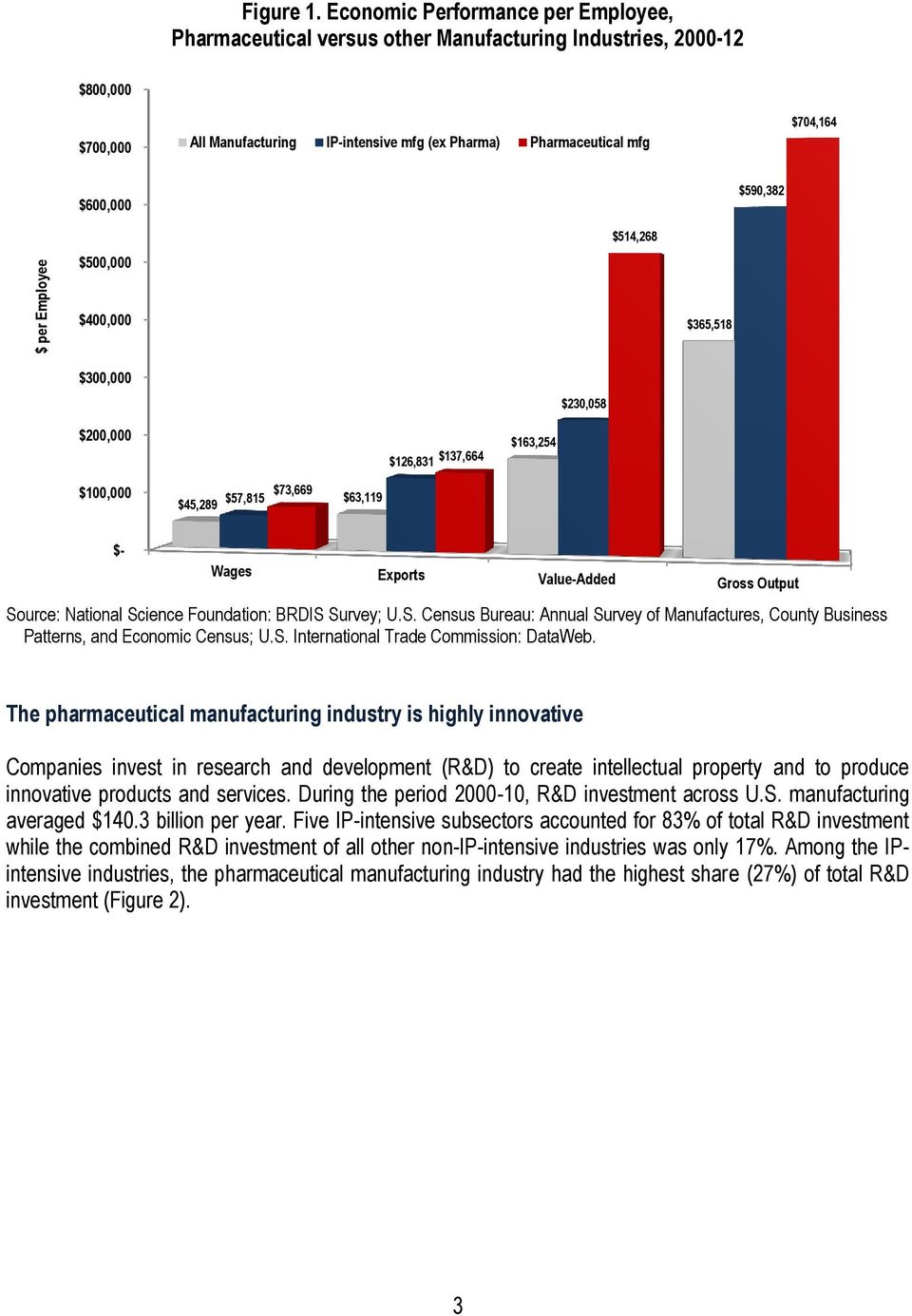
5 As noted above, this report is based on our comprehensive report that assesses the economic performance of all IP-intensive and non-ip-intensive industries during the period between 2000 and Our previous report uses R&D investments as a proxy to measure the innovative intensity across industries and R&D investment per employee to identify IP-intensive (which is defined as R&D per employee above the manufacturing average) and non-ip-intensive manufacturing industries. The matrix of economic performance includes employment, wages, output (revenues/sales), value-added (economic contributions), and exports. Key highlights of the economic performance of the U.S. pharmaceutical manufacturing industry since 2000 are: R&D investment in the pharmaceutical manufacturing industry accounted for 27% of all R&D investment among IP-intensive industries. The pharmaceutical manufacturing industry invested more than 5 times in R&D per employee than other IP-intensive manufacturing industries and more than 12 times all IP- and non-ip-intensive manufacturing industries. During the recent economic downturn, the pharmaceutical manufacturing industry was able to maintain employment while all other manufacturing industries cut their employment roughly by onethird, reflecting the resilience and sustainability of this sector. A worker in the pharmaceutical manufacturing industry made an average of $74,000 per year, compared to an average of $58,000 in other IP-intensive industries and an average of $45,000 in all manufacturing industries. The pharmaceutical manufacturing industry outperformed other IP-intensive industries as well as non-ip-intensive industries (Figure 1). o Gross output in the pharmaceutical manufacturing industry averaged $700,000 per employee, compared to $590,000 in other IP-intensive manufacturing industries and $365,000 in all manufacturing industries. o Net economic contributions (value-added) in the pharmaceutical manufacturing industry averaged $515,000 per employee, compared to $230,000 in other IP-intensive manufacturing industries and $163,000 in all manufacturing industries. o Exports of the pharmaceutical manufacturing industry averaged $140,000 per employee, compared to $130,000 in other IP-intensive manufacturing industries and $63,000 in all manufacturing industries. 1 Pham, Nam IP-intensive Manufacturing Industries: Driving U.S. Economic Growth. ndp analytics. 2


6 $ per Employee Figure 1. Economic Performance per Employee, Pharmaceutical versus other Manufacturing Industries, $800,000 $700,000 All Manufacturing IP-intensive mfg (ex Pharma) Pharmaceutical mfg $704,164 $600,000 $590,382 $500,000 $514,268 $400,000 $365,518 $300,000 $230,058 $200,000 $126,831 $137,664 $163,254 $100,000 $45,289 $57,815 $73,669 $63,119 $- Wages Exports Value-Added Gross Output Source: National Science Foundation: BRDIS Survey; U.S. Census Bureau: Annual Survey of Manufactures, County Business Patterns, and Economic Census; U.S. International Trade Commission: DataWeb. The pharmaceutical manufacturing industry is highly innovative Companies invest in research and development (R&D) to create intellectual property and to produce innovative products and services. During the period , R&D investment across U.S. manufacturing averaged $140.3 billion per year. Five IP-intensive subsectors accounted for 83% of total R&D investment while the combined R&D investment of all other non-ip-intensive industries was only 17%. Among the IPintensive industries, the pharmaceutical manufacturing industry had the highest share (27%) of total R&D investment (Figure 2). 3

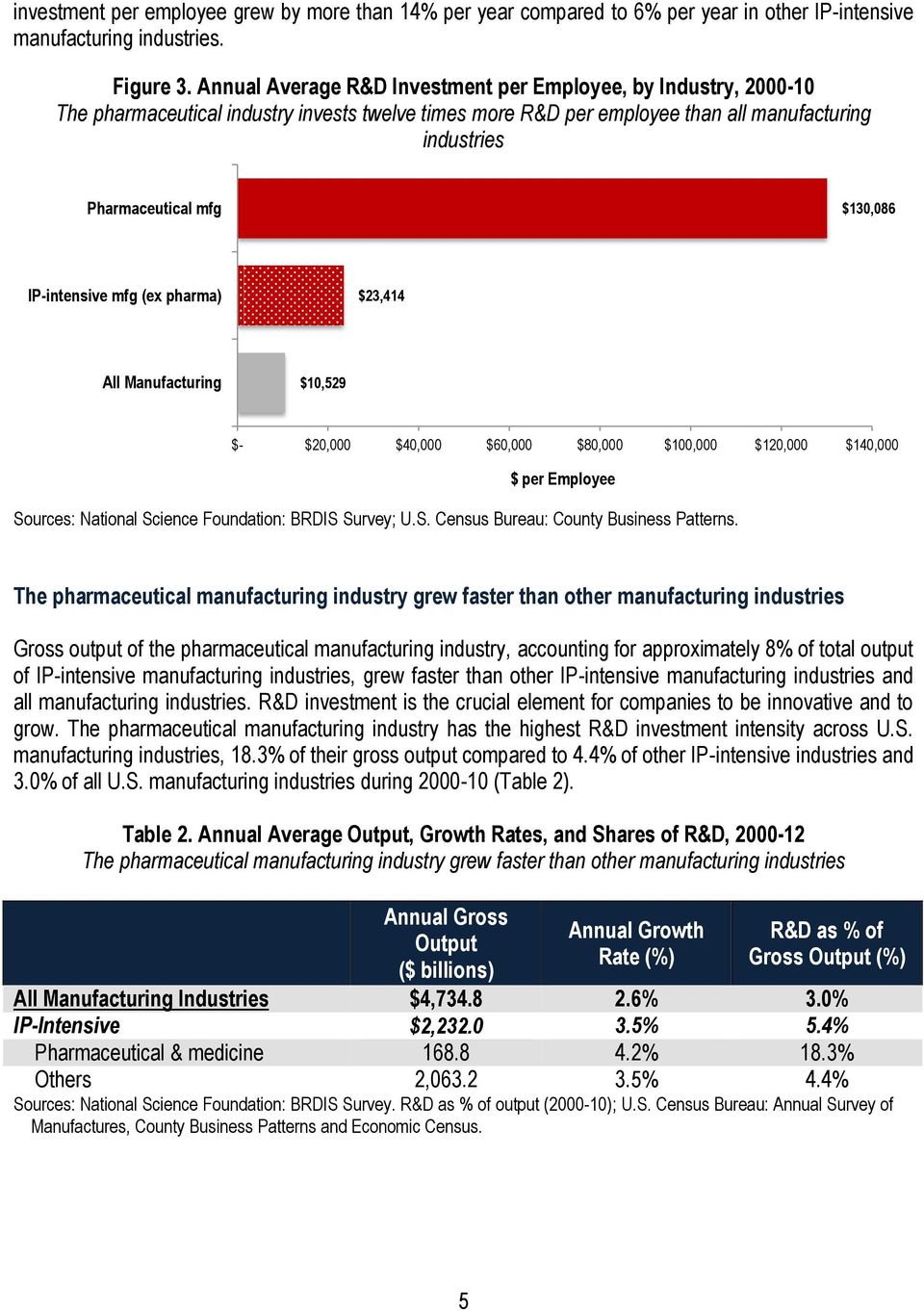
7 Figure 2. Composition of R&D Investment, by IP-intensive Industry, Average The pharmaceutical manufacturing industry accounts for 27% of IP-intensive manufacturing R&D investment in the U.S. Semiconductor 15% Transportation (ex aerospace) 14% Computer, electronics (ex semiconductor) 24% Aerospace 8% Medical equipment 4% Petroleum 1% Chemicals (ex pharma) 7% Pharmaceuticals 27% Sources: National Science Foundation: BRDIS Survey. R&D investment in the pharmaceutical manufacturing industry grew an average of 14.4% per year during the period between 2000 and 2010, compared to 1.5% for other IP-intensive industries. The annual growth rate of R&D investment of the pharmaceutical manufacturing industry outpaced all other manufacturing industries during recent economic upturns and downturns (Table 1). Table 1. Average R&D Investment and Annual Growth Rates, R&D investment in the pharmaceutical manufacturing industry grew faster than in other manufacturing industries R&D Average ($ billions) Average Annual Growth (%) All Manufacturing Industries $ % -0.8% 7.0% 3.9% IP-Intensive $ % -0.9% 7.0% 4.4% Pharmaceutical & medicine % 1.4% 11.2% 25.2% Others % -2.1% 5.2% -0.3% Sources: National Science Foundation: BRDIS Survey. During the period , R&D investment in the pharmaceutical manufacturing industry averaged over $130,000 per employee compared to an average of $23,500 per employee in other non-ip-intensive industries and $10,500 per employee in all manufacturing industries (Figure 3). Furthermore, R&D 4

8 investment per employee grew by more than 14% per year compared to 6% per year in other IP-intensive manufacturing industries. Figure 3. Annual Average R&D Investment per Employee, by Industry, The pharmaceutical industry invests twelve times more R&D per employee than all manufacturing industries Pharmaceutical mfg $130,086 IP-intensive mfg (ex pharma) $23,414 All Manufacturing $10,529 $- $20,000 $40,000 $60,000 $80,000 $100,000 $120,000 $140,000 $ per Employee Sources: National Science Foundation: BRDIS Survey; U.S. Census Bureau: County Business Patterns. The pharmaceutical manufacturing industry grew faster than other manufacturing industries Gross output of the pharmaceutical manufacturing industry, accounting for approximately 8% of total output of IP-intensive manufacturing industries, grew faster than other IP-intensive manufacturing industries and all manufacturing industries. R&D investment is the crucial element for companies to be innovative and to grow. The pharmaceutical manufacturing industry has the highest R&D investment intensity across U.S. manufacturing industries, 18.3% of their gross output compared to 4.4% of other IP-intensive industries and 3.0% of all U.S. manufacturing industries during (Table 2). Table 2. Annual Average Output, Growth Rates, and Shares of R&D, The pharmaceutical manufacturing industry grew faster than other manufacturing industries Annual Gross Output ($ billions) Annual Growth Rate (%) R&D as % of Gross Output (%) All Manufacturing Industries $4, % 3.0% IP-Intensive $2, % 5.4% Pharmaceutical & medicine % 18.3% Others 2, % 4.4% Sources: National Science Foundation: BRDIS Survey. R&D as % of output ( ); U.S. Census Bureau: Annual Survey of Manufactures, County Business Patterns and Economic Census. 5
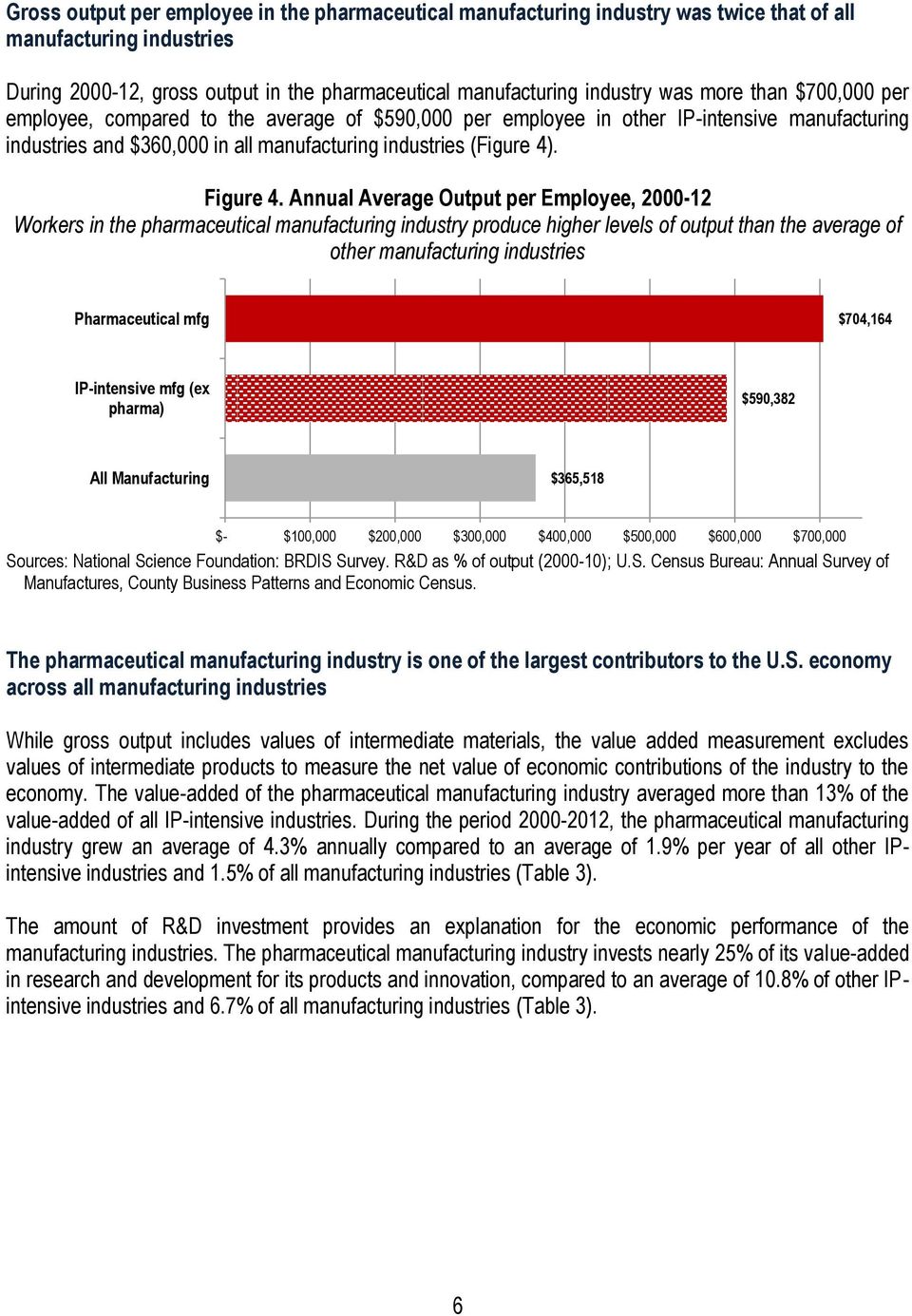
9 Gross output per employee in the pharmaceutical manufacturing industry was twice that of all manufacturing industries During , gross output in the pharmaceutical manufacturing industry was more than $700,000 per employee, compared to the average of $590,000 per employee in other IP-intensive manufacturing industries and $360,000 in all manufacturing industries (Figure 4). Figure 4. Annual Average Output per Employee, Workers in the pharmaceutical manufacturing industry produce higher levels of output than the average of other manufacturing industries Pharmaceutical mfg $704,164 IP-intensive mfg (ex pharma) $590,382 All Manufacturing $365,518 $- $100,000 $200,000 $300,000 $400,000 $500,000 $600,000 $700,000 Sources: National Science Foundation: BRDIS Survey. R&D as % of output ( ); U.S. Census Bureau: Annual Survey of Manufactures, County Business Patterns and Economic Census. The pharmaceutical manufacturing industry is one of the largest contributors to the U.S. economy across all manufacturing industries While gross output includes values of intermediate materials, the value added measurement excludes values of intermediate products to measure the net value of economic contributions of the industry to the economy. The value-added of the pharmaceutical manufacturing industry averaged more than 13% of the value-added of all IP-intensive industries. During the period , the pharmaceutical manufacturing industry grew an average of 4.3% annually compared to an average of 1.9% per year of all other IPintensive industries and 1.5% of all manufacturing industries (Table 3). The amount of R&D investment provides an explanation for the economic performance of the manufacturing industries. The pharmaceutical manufacturing industry invests nearly 25% of its value-added in research and development for its products and innovation, compared to an average of 10.8% of other IPintensive industries and 6.7% of all manufacturing industries (Table 3). 6
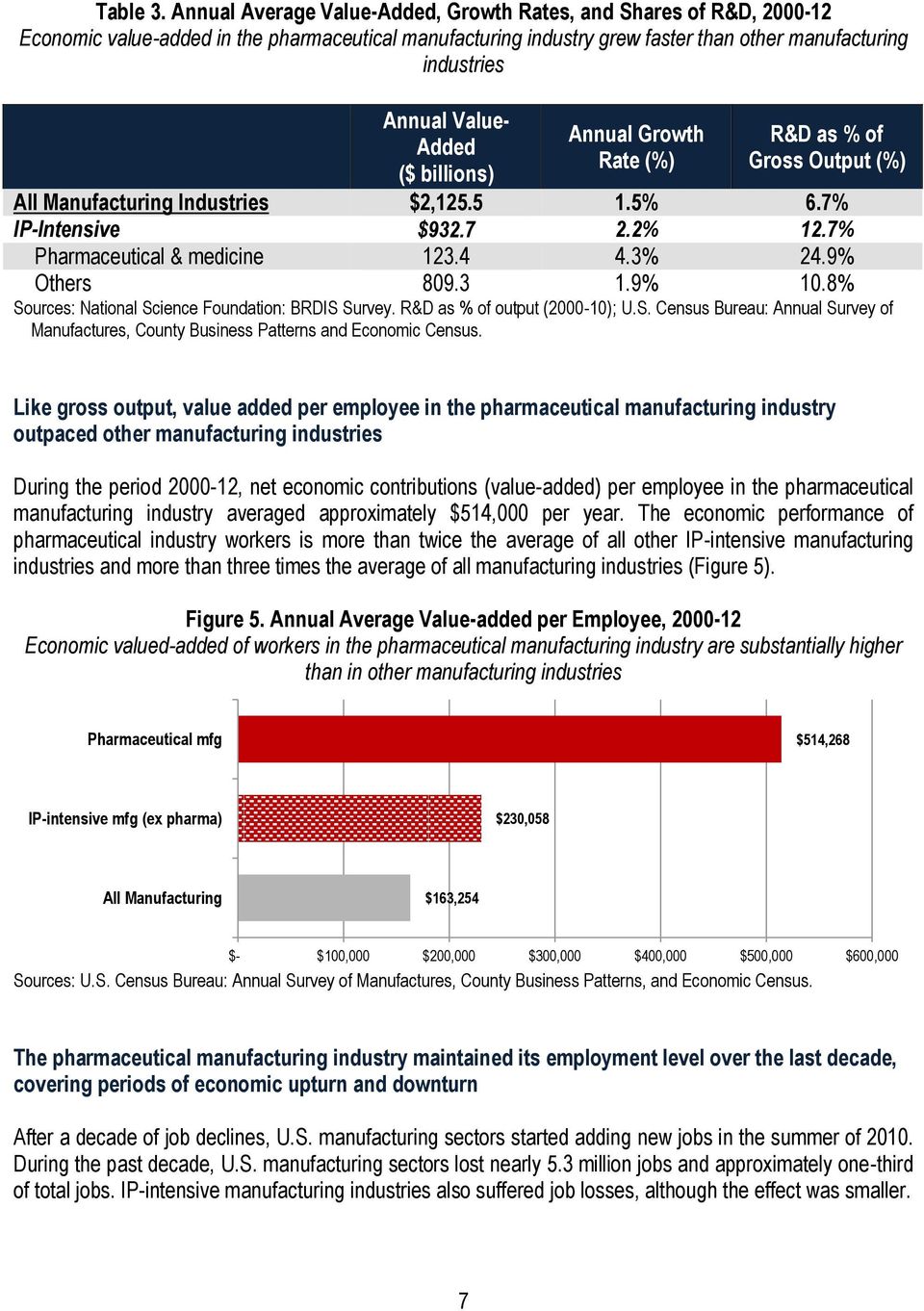
10 Table 3. Annual Average Value-Added, Growth Rates, and Shares of R&D, Economic value-added in the pharmaceutical manufacturing industry grew faster than other manufacturing industries Annual Value- Added ($ billions) Annual Growth Rate (%) R&D as % of Gross Output (%) All Manufacturing Industries $2, % 6.7% IP-Intensive $ % 12.7% Pharmaceutical & medicine % 24.9% Others % 10.8% Sources: National Science Foundation: BRDIS Survey. R&D as % of output ( ); U.S. Census Bureau: Annual Survey of Manufactures, County Business Patterns and Economic Census. Like gross output, value added per employee in the pharmaceutical manufacturing industry outpaced other manufacturing industries During the period , net economic contributions (value-added) per employee in the pharmaceutical manufacturing industry averaged approximately $514,000 per year. The economic performance of pharmaceutical industry workers is more than twice the average of all other IP-intensive manufacturing industries and more than three times the average of all manufacturing industries (Figure 5). Figure 5. Annual Average Value-added per Employee, Economic valued-added of workers in the pharmaceutical manufacturing industry are substantially higher than in other manufacturing industries Pharmaceutical mfg $514,268 IP-intensive mfg (ex pharma) $230,058 All Manufacturing $163,254 $- $100,000 $200,000 $300,000 $400,000 $500,000 $600,000 Sources: U.S. Census Bureau: Annual Survey of Manufactures, County Business Patterns, and Economic Census. The pharmaceutical manufacturing industry maintained its employment level over the last decade, covering periods of economic upturn and downturn After a decade of job declines, U.S. manufacturing sectors started adding new jobs in the summer of During the past decade, U.S. manufacturing sectors lost nearly 5.3 million jobs and approximately one-third of total jobs. IP-intensive manufacturing industries also suffered job losses, although the effect was smaller. 7
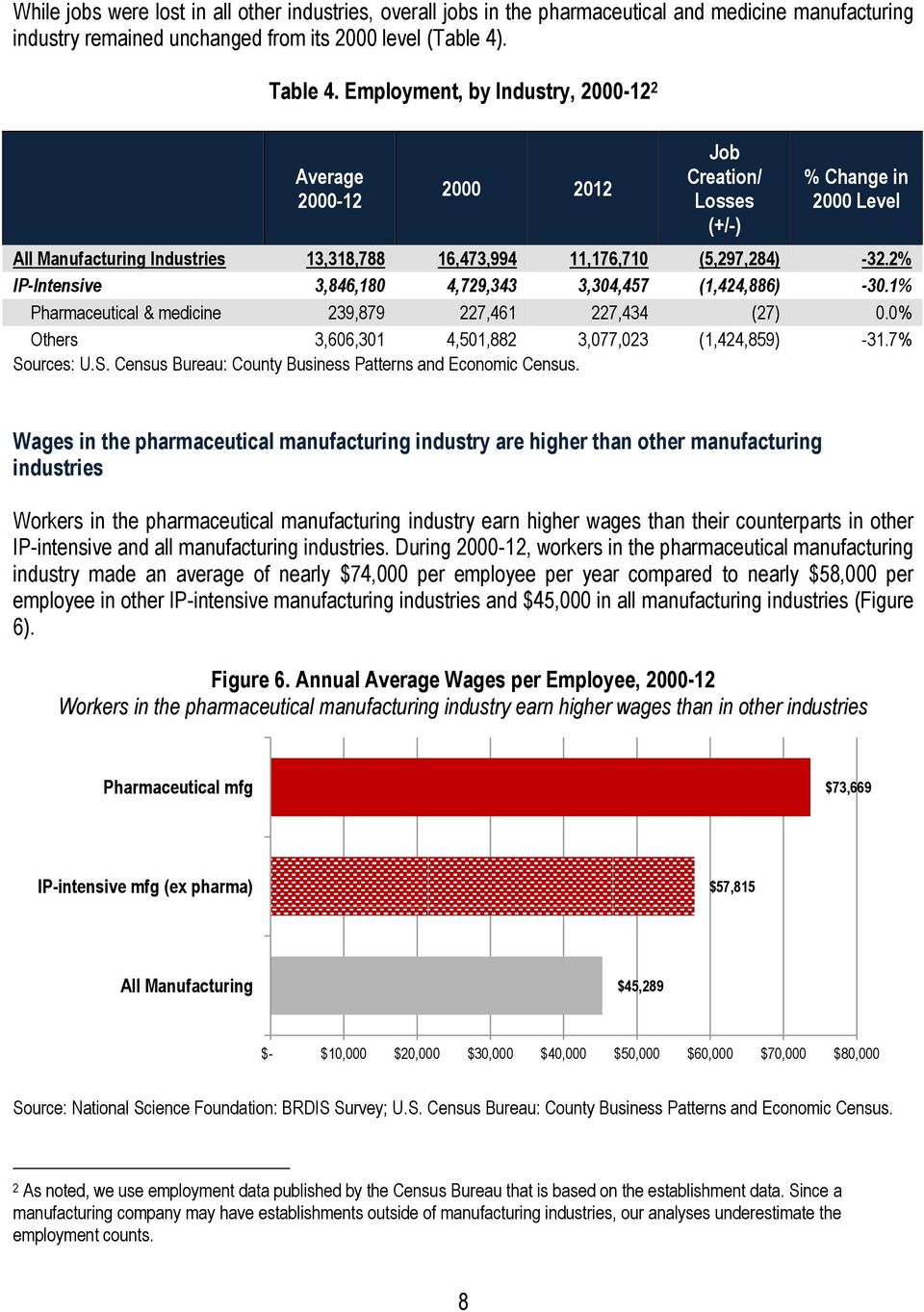
11 While jobs were lost in all other industries, overall jobs in the pharmaceutical and medicine manufacturing industry remained unchanged from its 2000 level (Table 4). Table 4. Employment, by Industry, Average Job Creation/ Losses (+/-) % Change in 2000 Level All Manufacturing Industries 13,318,788 16,473,994 11,176,710 (5,297,284) -32.2% IP-Intensive 3,846,180 4,729,343 3,304,457 (1,424,886) -30.1% Pharmaceutical & medicine 239, , ,434 (27) 0.0% Others 3,606,301 4,501,882 3,077,023 (1,424,859) -31.7% Sources: U.S. Census Bureau: County Business Patterns and Economic Census. Wages in the pharmaceutical manufacturing industry are higher than other manufacturing industries Workers in the pharmaceutical manufacturing industry earn higher wages than their counterparts in other IP-intensive and all manufacturing industries. During , workers in the pharmaceutical manufacturing industry made an average of nearly $74,000 per employee per year compared to nearly $58,000 per employee in other IP-intensive manufacturing industries and $45,000 in all manufacturing industries (Figure 6). Figure 6. Annual Average Wages per Employee, Workers in the pharmaceutical manufacturing industry earn higher wages than in other industries Pharmaceutical mfg $73,669 IP-intensive mfg (ex pharma) $57,815 All Manufacturing $45,289 $- $10,000 $20,000 $30,000 $40,000 $50,000 $60,000 $70,000 $80,000 Source: National Science Foundation: BRDIS Survey; U.S. Census Bureau: County Business Patterns and Economic Census. 2 As noted, we use employment data published by the Census Bureau that is based on the establishment data. Since a manufacturing company may have establishments outside of manufacturing industries, our analyses underestimate the employment counts. 8
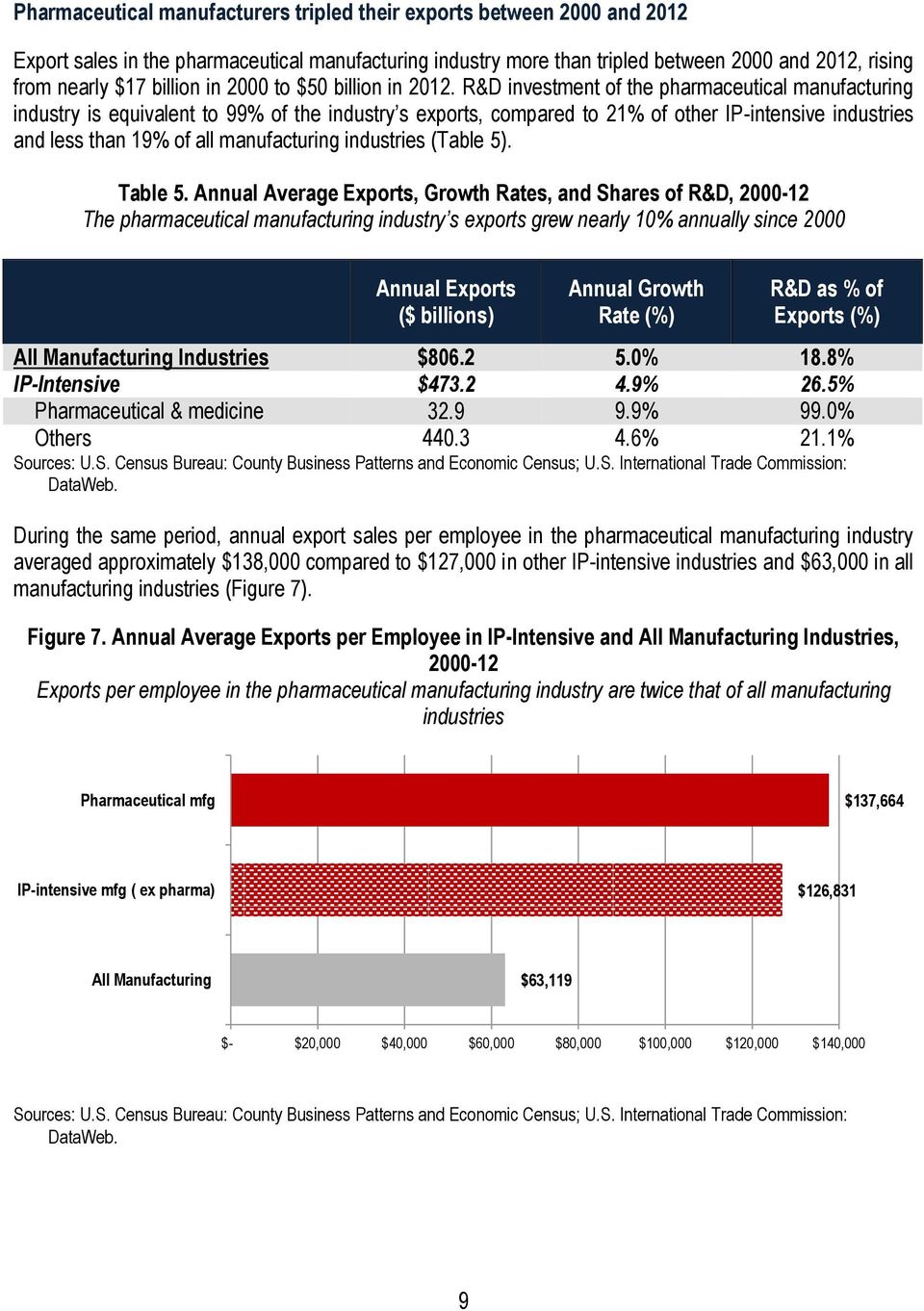
12 Pharmaceutical manufacturers tripled their exports between 2000 and 2012 Export sales in the pharmaceutical manufacturing industry more than tripled between 2000 and 2012, rising from nearly $17 billion in 2000 to $50 billion in R&D investment of the pharmaceutical manufacturing industry is equivalent to 99% of the industry s exports, compared to 21% of other IP-intensive industries and less than 19% of all manufacturing industries (Table 5). Table 5. Annual Average Exports, Growth Rates, and Shares of R&D, The pharmaceutical manufacturing industry s exports grew nearly 10% annually since 2000 Annual Exports ($ billions) Annual Growth Rate (%) R&D as % of Exports (%) All Manufacturing Industries $ % 18.8% IP-Intensive $ % 26.5% Pharmaceutical & medicine % 99.0% Others % 21.1% Sources: U.S. Census Bureau: County Business Patterns and Economic Census; U.S. International Trade Commission: DataWeb. During the same period, annual export sales per employee in the pharmaceutical manufacturing industry averaged approximately $138,000 compared to $127,000 in other IP-intensive industries and $63,000 in all manufacturing industries (Figure 7). Figure 7. Annual Average Exports per Employee in IP-Intensive and All Manufacturing Industries, Exports per employee in the pharmaceutical manufacturing industry are twice that of all manufacturing industries Pharmaceutical mfg $137,664 IP-intensive mfg ( ex pharma) $126,831 All Manufacturing $63,119 $- $20,000 $40,000 $60,000 $80,000 $100,000 $120,000 $140,000 Sources: U.S. Census Bureau: County Business Patterns and Economic Census; U.S. International Trade Commission: DataWeb. 9
13 FINAL REMARKS This brief report reinforces the importance of research and development (R&D) investment in supporting innovation. As seen in the pharmaceutical manufacturing industry, R&D investment and the activity and output generated is positively correlated with the economic performance of the industry during both economic upturns and downturns. Evidence in the past 15 years shows that IP-intensive manufacturing industries outperformed others and contributed significant economic value to U.S. economic growth. The pharmaceutical manufacturing industry is leading other industries in terms of R&D investment. Consequently, the economic performance of the pharmaceutical manufacturing industry outpaces others. 10
14 References National Science Foundation, BRDIS Survey. National Science Foundation: BRDIS Survey Data Tables. Table 1, Survey item aggregates. Pham, Nam IP-intensive Manufacturing Industries: Driving U.S. Economic Growth. ndp analytics IP Creates Jobs for America. ndp analytics The Impact of Innovation and the Role of Intellectual Property Rights on U.S. Productivity, Competitiveness, Jobs, Wages, and Exports. ndp analytics. U.S. Bureau of Economic Analysis Preview of the 2013 Comprehensive Revision of the National Income and Product Accounts Changes in Definitions and Presentations., National Economic Accounts. U.S. Bureau of Labor Statistics, Current Population Survey. U.S. Census Bureau, Annual Survey of Manufactures. County Business Patterns. Economic Census. U.S. International Trade Commission, DataWeb. 11
15 About Us ndp analytics is a strategic research firm that specializes in economic analysis of public policy and legal issues. Our services include economic studies, impact analyses, costbenefit analyses, statistics, and data construction. Our analytical frameworks are data-driven and are robust, transparent, and supported by economic fundamentals. We excel in supporting organizations on advocacy, government and industry relations, public affairs campaigns, and strategic initiatives. Clients of ndp analytics include trade associations, coalitions, financial institutions, law firms, U.S. and foreign corporations, and multinational organizations. Our work has been prominently cited in the Economic Report of the President to Congress, the media, reports from government agencies, Congressional testimonies, and by Congressional leaders.

The Financial Returns from Oil and Natural Gas Company Stocks Held by American College and University Endowments. Robert J. Shapiro and Nam D.
 The Financial Returns from Oil and Natural Gas Company Stocks Held by American College and University Endowments Robert J. Shapiro and Nam D. Pham December 2012 Table of Contents I. Executive Summary..
On March 11, 2010, President Barack
 U.S. Department of Commerce International Trade Administration Introduction Exports Support American Jobs Updated measure will quantify progress as global economy recovers. On March 11, 21, President Barack
The U.S. Semiconductor Industry: A Key Contributor to U.S. Economic Growth
 The U.S. Semiconductor Industry: A Key Contributor to U.S. Economic Growth Matti Parpala 1 August 2014 The U.S. semiconductor industry is a uniquely important contributor to the U.S. economy. Thanks to
ANSWERS TO END-OF-CHAPTER QUESTIONS
 ANSWERS TO END-OF-CHAPTER QUESTIONS 7-1 In what ways are national income statistics useful? National income accounting does for the economy as a whole what private accounting does for businesses. Firms
Quarterly Economics Briefing
 Quarterly Economics Briefing March June 2015 2016 Review of Current Conditions: The Economic Outlook and Its Impact on Workers Compensation The exhibits below are updated to reflect the current economic
US Exports to China by State
 US Exports to China by State 2004 2013 1818 N Street, NW, Suite 200, Washington, DC 20036 Tel: 202-429-0340 Fax: 202-775-2476 E-mail: [email protected] www.uschina.org Executive Summary Exports to China:
Reference: Gregory Mankiw s Principles of Macroeconomics, 2 nd edition, Chapters 10 and 11. Gross Domestic Product
 Macroeconomics Topic 1: Define and calculate GDP. Understand the difference between real and nominal variables (e.g., GDP, wages, interest rates) and know how to construct a price index. Reference: Gregory
Canadian Manufacturers and Exporters
 Standing Committee on Finance (FINA) Pre-budget consultations 2012 Canadian Manufacturers and Exporters 1. Economic Recovery and Growth Responses Given the current climate of federal and global fiscal
CTI shows travel growth softening in January 2016. LTI predicts moderate overall travel growth into 2016, with domestic business travel in decline.
 Analysis provided by TRAVEL TRENDS INDE JANUARY 2016 CTI shows travel growth softening in January 2016. LTI predicts moderate overall travel growth into 2016, with domestic business travel in decline.
Made In America: Computer and Electronic Products
 U.S. Department of Commerce Economics and Statistics Administration Made In America: Computer and Electronic Products By Adji Fatou Diagne, Pathways Economist Edited by Jane Callen In 2012, shipments from
U.S.-Chile Bilateral Trade Analysis
 U.S.-Chile Bilateral Trade Analysis Bilateral Trade in Goods 1 Since the U.S.-Chile Free Trade Agreement (FTA) took effect on January 1, 2004, total merchandise trade between the United States and Chile
Jobs and Growth Effects of Tax Rate Reductions in Ohio
 Jobs and Growth Effects of Tax Rate Reductions in Ohio BY ALEX BRILL May 2014 This report was sponsored by American Freedom Builders, Inc., a 501(c)4 organization. The author is solely responsible for
The Economic Contribution of the Oil and Gas Industry In Kern County
 INTRODUCTION The Economic Contribution of the Oil and Gas Industry In Kern County Kern Economic Development Foundation (KEDF) was contracted by the Western States Petroleum Association (WSPA) to conduct
EC2105, Professor Laury EXAM 2, FORM A (3/13/02)
 EC2105, Professor Laury EXAM 2, FORM A (3/13/02) Print Your Name: ID Number: Multiple Choice (32 questions, 2.5 points each; 80 points total). Clearly indicate (by circling) the ONE BEST response to each
Exam 1 Review. 3. A severe recession is called a(n): A) depression. B) deflation. C) exogenous event. D) market-clearing assumption.
 Exam 1 Review 1. Macroeconomics does not try to answer the question of: A) why do some countries experience rapid growth. B) what is the rate of return on education. C) why do some countries have high
Battelle Battelle s Technology Partnership Practice (TPP) Pharmaceutical Research and Manufacturers of America (PhRMA)
 Every day, the people of Battelle apply science and technology to solving what matters most. At major technology centers and national laboratories around the world, Battelle conducts research and development,
Wages Coconuts 200 Fish 100 Consumption Coconuts 200 Fish 100
 Chapter 2 Numerical 1 Professor Gilligan Production Coconuts 1000 Fish 500 Gilligan wages Fish 100 Stored coconuts Fertilizer 100 Price 2 coconuts per fish Wages Fish 100 Consumption Fish 100 GDP= Value
Chapter 12. National Income Accounting and the Balance of Payments. Slides prepared by Thomas Bishop
 Chapter 12 National Income Accounting and the Balance of Payments Slides prepared by Thomas Bishop Preview National income accounts measures of national income measures of value of production measures
X. INTERNATIONAL ECONOMIC DEVELOPMENT 1/
 1/ X. INTERNATIONAL ECONOMIC DEVELOPMENT 1/ 10.1 Overview of World Economy Latest indicators are increasingly suggesting that the significant contraction in economic activity has come to an end, notably
THE EDUCATIONAL ATTAINMENT OF THE WORKFORCE
 THE EDUCATIONAL ATTAINMENT OF THE WORKFORCE March 2016 Dennis Hoffman, Ph.D. Professor, Department of Economics; Director, L. William Seidman Research Institute; and Director, Office of the University
OPEN MARKETS FOR INTERNATIONAL TRADE AND INVESTMENT
 OPEN MARKETS FOR INTERNATIONAL TRADE AND INVESTMENT Fast Facts In 2008, more than 38 million jobs in America more than one in five depended on international trade exports and imports. 1 In 1992, a year
CEO Pay Ratios: The Story Behind the Trends
 CEO Pay Ratios: The Story Behind the Trends 111 Academy Drive, Suite 270 Irvine, CA 92617 800-627-3697 www.erieri.com Introduction The total pay comparison of the typical executive to the average worker
SalarieS of chemists fall
 ACS news SalarieS of chemists fall Unemployment reaches new heights in 2009 as recession hits profession hard The economic recession has taken its toll on chemists. Despite holding up fairly well in previous
Chapter 11: Activity
 Economics for Managers by Paul Farnham Chapter 11: Measuring Macroeconomic Activity 11.1 Measuring Gross Domestic Product (GDP) GDP: the market value of all currently yproduced final goods and services
THE STATE OF THE ECONOMY
 THE STATE OF THE ECONOMY CARLY HARRISON Portland State University Following data revisions, the economy continues to grow steadily, but slowly, in line with expectations. Gross domestic product has increased,
EXECUTIVE SUMMARY Prepared for: Pharmaceutical Research and Manufacturers of America (PhRMA) Prepared by: Battelle Technology Partnership Practice
 EXECUTIVE SUMMARY Prepared for: Pharmaceutical Research and Manufacturers of America (PhRMA) Prepared by: Battelle Technology Partnership Practice Battelle is the world s largest non profit independent
7 AGGREGATE SUPPLY AND AGGREGATE DEMAND* Chapter. Key Concepts
 Chapter 7 AGGREGATE SUPPLY AND AGGREGATE DEMAND* Key Concepts Aggregate Supply The aggregate production function shows that the quantity of real GDP (Y ) supplied depends on the quantity of labor (L ),
RESILIENCE AND RETIREMENT SECURITY: Performance of S-ESOP Firms in the Recession
 RESILIENCE AND RETIREMENT SECURITY: Performance of S-ESOP Firms in the Recession Phillip Swagel and Robert Carroll March 10, 2010 Executive Summary A study of a cross-section of Subchapter S firms with
6. Gross Domestic Product by Country
 6. Gross Domestic Product by Country The economies of the six countries studied for this report have flourished, allowing for the very high growth rates in research and development (R&D) investment and
Economic Development Planning, Summary 7
 Economic Development Planning, Summary 7 Unless otherwise noted, summaries represent findings and analyses by the listed source, not by Morrison Institute for Public Policy or Arizona State University.
KANSAS BOARD OF REGENTS SYSTEM OVERVIEW. October 2013
 KANSAS BOARD OF REGENTS SYSTEM OVERVIEW October 2013 EDUCATION PAYS Why is it important for Kansas to have well-funded public colleges and universities? They retain our state s most valuable resource:
The Economic Impact of a U.S. Slowdown on the Americas
 Issue Brief March 2008 Center for Economic and Policy Research 1611 Connecticut Ave, NW Suite 400 Washington, DC 20009 tel: 202-293-5380 fax:: 202-588-1356 www.cepr.net The Economic Impact of a U.S. Slowdown
The impact of the falling yen on U.S. import prices
 APRIL 2014 VOLUME 3 / NUMBER 7 GLOBAL ECONOMY The impact of the falling yen on U.S. import prices By David Mead and Sharon Royales In the fall of 2012, Japan set forth economic policies aimed at turning
MEASURING A NATION S INCOME
 10 MEASURING A NATION S INCOME WHAT S NEW IN THE FIFTH EDITION: There is more clarification on the GDP deflator. The Case Study on Who Wins at the Olympics? is now an FYI box. LEARNING OBJECTIVES: By the
Location for Trials- Global Considerations A Pharma Perspective. Carlo Maccarrone Assoc. Director, Clinical Research GSK Australia 7 May 2014
 Location for Trials- Global Considerations A Pharma Perspective Carlo Maccarrone Assoc. Director, Clinical Research GSK Australia 7 May 2014 Why Choose Australia for Clinical Trials? What is he saying
Business Outlook Survey Results of the Spring 2016 Survey Vol. 13.1 1 April 2016
 Business Outlook Survey Results of the Spring 2016 Survey Vol. 13.1 1 April 2016 Business sentiment in the spring Business Outlook Survey improved but remains subdued overall. The positive impetus coming
Health Coverage among 50- to 64-Year-Olds
 Health Coverage among 50- to 64-Year-Olds In 2005, more than 51 million Americans were age 50 64. This number is projected to rise to 58 million in 2010, when the first baby boomers turn 64. The aging
education. In contrast, workers engaged in fishing worked an average of 61.7 hours per
 THAILAND 40,000 Fig. 1: Employment by Major Economic Activity ('000s), 2002-2008 Agriculture, Forestry, Agriculture, Forestry & 35,000 30,000 25,000 20,000 15,000 10,000 5,000 0 2002 2004 2006 2008 Mining
Average Federal Income Tax Rates for Median-Income Four-Person Families
 820 First Street, NE, Suite 510, Washington, DC 20002 Tel: 202-408-1080 Fax: 202-408-1056 [email protected] http://www.cbpp.org April 10, 2002 OVERALL FEDERAL TAX BURDEN ON MOST FAMILIES INCLUDING MIDDLE-
How To Understand The Economic Benefits Of Foreign Direct Investment In The United States
 EXECUTIVE OFFICE OF THE PRESIDENT COUNCIL OF ECONOMIC ADVISERS U.S. INBOUND FOREIGN DIRECT INVESTMENT JUNE 211 EXECUTIVE SUMMARY The United States welcomes the investment and the jobs supported by the
The Return of Saving
 Martin Feldstein the u.s. savings rate and the global economy The savings rate of American households has been declining for more than a decade and recently turned negative. This decrease has dramatically
Employment Recovery in Urban Areas following the Great Recession
 Employment Recovery in Urban Areas following the Great Recession Ryan Howley Economist Bureau of Labor Statistics, Washington, DC Toby Paterson Economist Employment Security Department, Washington State
New York State Employment Trends
 New York State Employment Trends August 2015 Thomas P. DiNapoli New York State Comptroller Prepared by the Office of Budget and Policy Analysis Additional copies of this report may be obtained from: Office
Macroeconomics Instructor Miller GDP Practice Problems
 Macroeconomics Instructor Miller GDP Practice Problems 1. Gross domestic product in the economy is measured by the A) total number of goods and services produced in the economy. B) dollar value of all
Measuring the Aggregate Economy
 CHAPTER 25 Measuring the Aggregate Economy The government is very keen on amassing statistics... They collect them, add them, raise them to the n th power, take the cube root and prepare wonderful diagrams.
The majority of pharmaceutical companies in
 Pharmaceutical Infrastructure and Industry Professor Che-Ming Teng, Ph.D. National Taiwan University College of Medicine, Taipei, Taiwan The majority of pharmaceutical companies in Taiwan are devoted to
The Changing Shape of UK Manufacturing
 The Changing Shape of UK Manufacturing Author Name(s): Michael Hardie and Andrew Banks Abstract The contribution of the manufacturing industry to the UK economy has changed markedly over the last 60 years.
Comparative Analysis of Shanghai and Hong Kong s Financial Service Trade Competitiveness
 Comparative Analysis of Shanghai and Hong Kong s Financial Service Trade Competitiveness Ying Li Longfei Liu Lijun Liang Management School Shanghai University of Engineering and Science China Abstract
The Small Business Share of GDP, 1998-2004
 The Small Business Share of GDP, 1998-2004 by Katherine Kobe Economic Consulting Services, LLC for under contract number SBAHQ-05-M-0413 Release Date: April 2007 The statements, findings, conclusions,
Big Concepts. Measuring U.S. GDP. The Expenditure Approach. Economics 202 Principles Of Macroeconomics
 Lecture 6 Economics 202 Principles Of Macroeconomics Measuring GDP Professor Yamin Ahmad Real GDP and the Price Level Economic Growth and Welfare Big Concepts Ways to Measure GDP Expenditure Approach Income
AAHA STATE OF THE VETERINARY PROFESSION
 AAHA STATE OF THE VETERINARY PROFESSION Michael Cavanaugh, DVM, DABVP Chief Executive Officer, American Animal Hospital Association ABSTRACT Several recent articles predict a grim outlook for the veterinary
HINJ and New Jersey s Life Sciences Community
 HINJ and New Jersey s Life Sciences Community Since 1997, the HealthCare Institute of New Jersey (HINJ) has ser ved as the leading voice of the state s life sciences industr y. HINJ seeks to expand patient
Imported Inputs and Industry Contributions to Economic Growth: An Assessment of Alternative Approaches
 Imported Inputs and Industry Contributions to Economic Growth: An Assessment of Alternative Approaches Erich H. Strassner, Robert E. Yuskavage, and Jennifer Lee U.S. Department of Commerce Bureau of Economic
Housing finance in Italy
 Housing finance in Italy Defining characteristics One of the salient features of the Italian housing market is the high rate of ownership. According to data from the 2001 census, 71% of Italian households
2012 Vermont Household Health Insurance Survey: Comprehensive Report
 Vermont Department of Financial Regulation Insurance Division 2012 Vermont Household Health Insurance Survey: Comprehensive Report Brian Robertson, Ph.D. Jason Maurice, Ph.D. Table of Contents Page I.
STATS WINDOW. INDUSTRY REVIEW AT A GLANCE Global Pharmaceutical Industry
 Volume 6, Issue 6, December 2013 STATS WINDOW The Pacific Business Review International has taken an initiative to start a section which will provide a snapshot of major Global & Indian economic indicators
National Income Accounting
 : A set of rules and definitions for measuring economic activity in the aggregate economy (The economy as a whole.) As we noted earlier, the main measure of aggregate economic activity are GDP and GNP
Chapter 15: Spending, Income and GDP
 Chapter 15: Spending, Income and GDP By the end of this chapter, you will be able to: Define GDP Calculate GDP by: adding up value added of production. adding up expenditure. adding up income. Distinguish
A TPP Agreement: An Opportunity for Hawaii. Trade & Investment with TPP Countries Is Good for Hawaii. Jobs Exports Investment 64%
 Overview The United States and 11 other countries are currently negotiating a Trans- Pacific Partnership (TPP) agreement, which will strengthen trade and investment relationships across the Asia- Pacific
Next 10 is an independent nonpartisan organization that educates, engages and empowers Californians to improve the state s future.
 ISSUE BRIEF SEPTEMBER 3, 2015 Next 10 is an independent nonpartisan organization that educates, engages and empowers Californians to improve the state s future. Next 10 is focused on innovation and the
Impact of Foreign Direct Investment, Imports and Exports
 Impact of Foreign Direct Investment, Imports and Exports Dr. A. Jayakumar, Professor of Commerce, Periyar University, Salem, India. Kannan.L, Research Scholar, Department of Commerce, Periyar University,
Foreword. Executive Summary
 Executive Summary 2 Executive Summary Foreword Innovation is one of the areas covered by the five key targets set in Europe 2020, the ten-year growth strategy adopted by the European Union with a view
Fifty years of Australia s trade
 Fifty years of Australia s trade Introduction This edition of Australia s Composition of Trade marks the publication s 50th anniversary. In recognition of this milestone, this article analyses changes
Expedia.com 2008 International Vacation Deprivation Survey Results
 Expedia.com 2008 International Vacation Deprivation Survey Results History: This is the eighth year of the annual Expedia.com Vacation Deprivation survey which spotlights the growing trend of employed
Business in Ireland. Published by the Stationery Office, Dublin, Ireland. Available from:
 An Phríomh-Oifig Staidrimh Central Statistics Office Business in Ireland 2012 Published by the Stationery Office, Dublin, Ireland. Available from: Central Statistics Office, Information Section, Skehard
Women and Men in the Recovery: Where the Jobs Are Women Recover Jobs Lost in Recession in Year Five
 IWPR #C426 November 2014 Women and Men in the Recovery: Where the Jobs Are Women Recover Jobs Lost in Recession in Year Five Heidi Hartmann, Ph.D., Elyse Shaw, and Rachel O Connor Overview While the number
Broward County. Aviation Industry. 2015 Edition. Source: Florida Department of Economic Opportunity, Bureau of Labor Market Statistics
 L a b o r M a r k e t I n d u s t r y P r o f i l e Broward County Aviation Industry 2015 Edition Source: Florida Department of Economic Opportunity, Bureau of Labor Market Statistics Florida has a rich
Chicago s Business Climate
 Chicago s Business Climate Home to an unrivaled economy, workforce, and quality of life, Chicago is a thriving metropolis, yet a tight-knit community for business and residents. The city s dynamic character
Chapter 12: Gross Domestic Product and Growth Section 1
 Chapter 12: Gross Domestic Product and Growth Section 1 Key Terms national income accounting: a system economists use to collect and organize macroeconomic statistics on production, income, investment,
Large and Small Companies Exhibit Diverging Bankruptcy Trends
 JANUARY, 22 NUMBER 2-1 D I V I S I O N O F I N S U R A N C E Bank Trends Analysis of Emerging Risks In Banking WASHINGTON, D.C. ALAN DEATON (22) 898-738 [email protected] Large and Small Companies Exhibit
REVIEW OF THE SURVEY OF ENTERPRISES ON BUSINESS FINANCING. Second half
 + REVIEW OF THE SURVEY OF ENTERPRISES ON BUSINESS FINANCING 2016 2013 Q1 REVIEW OF THE SURVEY OF ENTERPRISES ON BUSINESS FINANCING Second half ISSN 2424-4791 (ONLINE) REVIEW OF THE SURVEY OF ENTERPRISES
Introduction to Macroeconomics. TOPIC 1: Introduction, definition, measures
 TOPIC 1: Introduction, definitions, measures Annaïg Morin CBS - Department of Economics August 2013 What is macroeconomics about? Understanding the behavior of an economy as a whole. studying aggregated
Swiss balance of payments and international investment position Q4 2015 and review of the year 2015
 Communications P.O. Box, CH-8022 Zurich Telephone +41 58 631 00 00 [email protected] Zurich, 21 March 2016 Swiss balance of payments and international investment position Q4 2015 and review of the