
The Euro Area Crisis: Politics over Economics
|
|
|
- Claud Dawson
- 10 years ago
- Views:
Transcription
1 The Euro Area Crisis: Politics over Economics Athanasios Orphanides MIT Philadelphia, 11 October 2013 International Atlantic Economic Society

2 Unemployment in the US and the euro area Percent Euro area United States

3 What crisis?
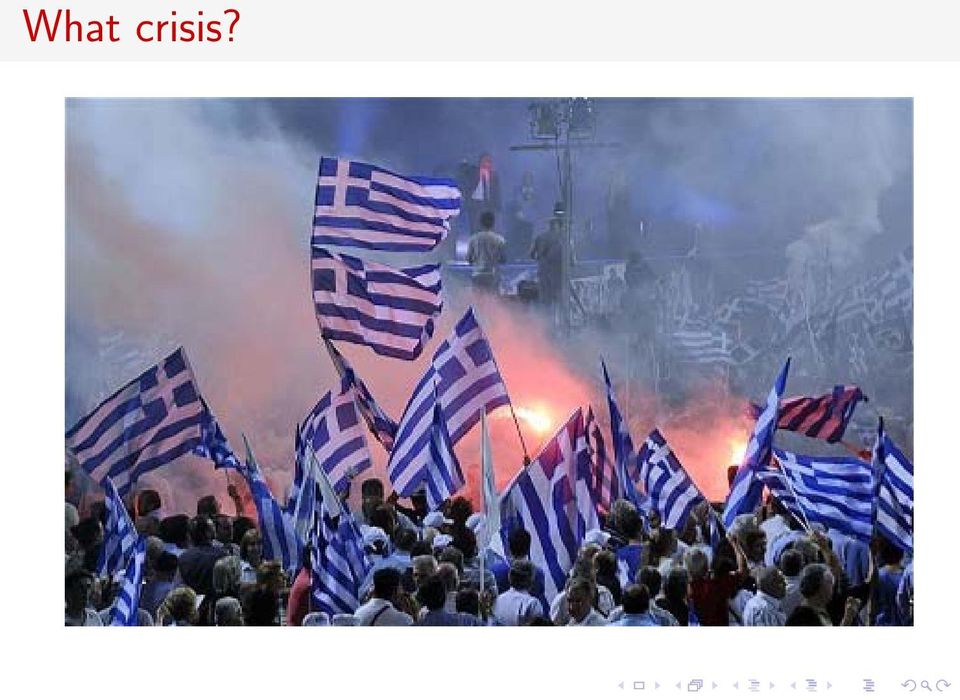
4 What crisis?

5 What crisis?

6 What crisis?
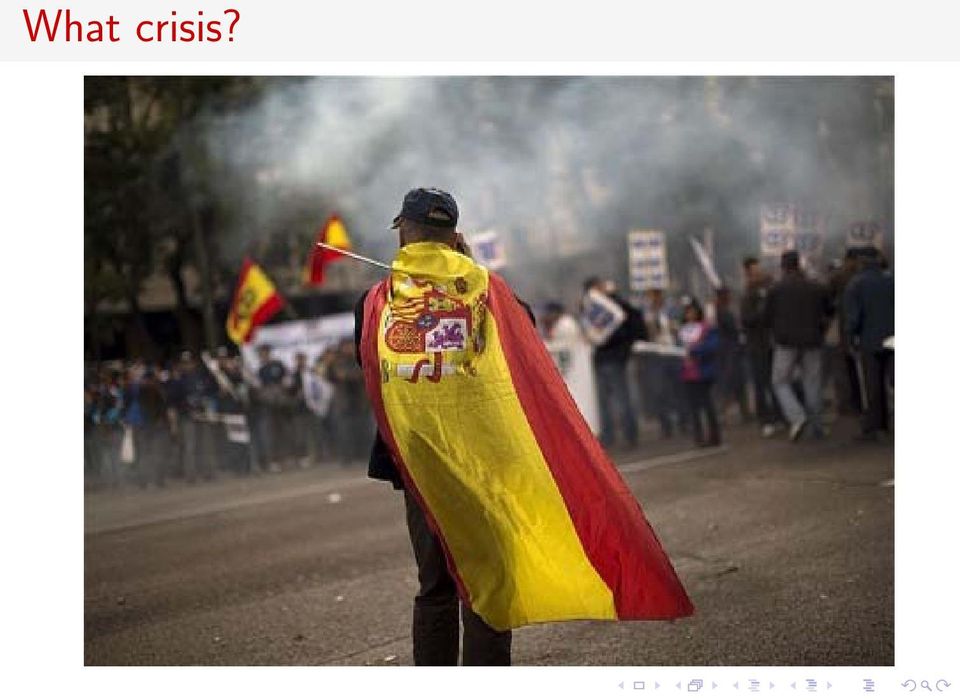
7 What crisis?
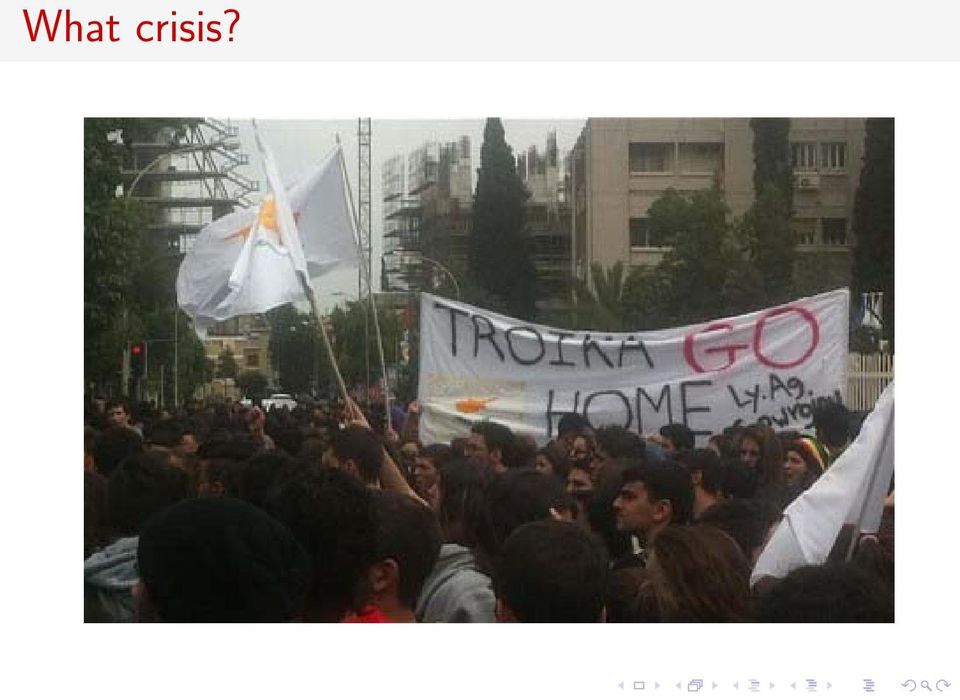
8 The disintegration of the euro area economy Percent Germany Cyprus Greece Ireland Portugal Spain Unemployment rate: Germany vs program countries

9 A lost generation in the making Percent Germany Cyprus Greece Ireland Portugal Spain Youth unemployment rates

10 The disintegration of euro area sovereign markets Percent France Germany Italy Spain Yields on two-year sovereign debt

11 Why is the euro project crashing to earth? Is the problem in Europe a fiscal problem, a competitiveness problem, a banking problem, etc? Alternatively, are these symptoms of a deeper flaw that cannot be solved with technical arguments? Flawed narratives can mislead policymakers. Dealing with symptoms while the underlying causes make the problem worse may lead to irresponsible complacency.

12 Crisis mismanagement: Two examples October 18, 2010, Deauville: Decision to introduce credit risk in what used to be considered safe government debt. March 16, 2013, Brussels: Decision to introduce credit risk in what used to be considered safe bank deposits.

13 Unique and exceptional blunders? Why the haphazard decisions? One explanation is that the blunders we have repeatedly observed during the crisis reflect incompetence. If so, this could be corrected with more enlightened advisers. Another explanation is that these blunders are a predictable manifestation of the decision making process. If so, a correction may not be feasible.

14 How could things get so bad? The euro was incomplete by design. No crisis management mechanism in place. The success of the euro rested on the belief or hope that if and when a crisis erupted governments would work together towards completing the project. This belief proved misplaced.

15 Political constraints and incentives Europe is not a federal state there is no single government that can enforce solutions. Solutions on key issues that may involve adjusting the Treaty, require unanimous agreement by governments of the member states. But governments of member states must face their own electorate and some element of any solution may be unpopular to the electorate in some state. Election cycles vary from state to state and at any given moment some government may prefer to postpone decisions or misuse a problem for local political gain.

16 How could things get so bad? Mismanagement of the crisis by euro area governments damaged sovereign markets of euro area member states perceived to be weak. As a result, some euro area member states face much higher government bond yields than countries with worse public finances that are not in the euro area. Holdings of government bonds by banks weakened the capital position of banks in member states perceived to be weak. Negative feedback loop between banks and sovereigns continues to damage the economies of several euro area member states.

17 October 18, 2010: Deauville Agreement between French and German government to introduce the Private Sector Involvement (PSI) doctrine. Remarkably, other governments subsequently went along, despite objections and warnings by the ECB. Whenever a euro area member state faced liquidity pressures (not necessarily solvency concerns), the imposition of losses on private creditors would be demanded before euro area governments agreed to provide any temporary assistance. Message to potential investors: Euro area sovereign debt should no longer be considered a safe asset with the implicit promise that it would be repaid in full.

18 Deauville implications The introduction of credit risk in euro erea sovereign debt raised the cost of financing for euro area governments perceived to be relatively weak. The first casualty was Ireland that lost access to markets within a few weeks. Portugal followed a few months later. The PSI doctrine also generated the adverse feedback loop between sovereigns and banks that has been driving weakness in the periphery since then. Although it was a blunder for the euro area as a whole, the PSI doctrine proved beneficial to Germany, suggesting an adversarial approach to the crisis was taking hold among the member states.

19 The role of European Institutions Ideally, european institutions (European Commission, ECB) should serve the interests of Europe as a whole, defend fundamental rights, equal treament for all. In practice, because Europe is a loose confederation, european institutions do not have the authority to solve the problem. The attempt to preserve the euro at all costs creates a risk that the role of european institutions may become counterproductive. European institutions may be politically captured by the governments of specific member states that could misuse the crisis for local political gain.

20 Are solutions available? The most obvious threat remains the adverse feedback loop between sovereigns and banks. This can be solved by creating a banking union in the euro area. Concern about the survival of the euro brought governments close to an agreement that could have solved the crisis in June June 29, 2012 EU Summit: Significant progress in improving governance, setting up a banking union to break the vicious circle between banks and sovereigns. Since OMT governments have backtracked on the most critical elements of the banking union, ensuring continuation of crisis.

21 Euro Area Summit Statement: 29 June 2012 We affirm that it is imperative to break the vicious circle between banks and sovereigns.... We affirm our strong commitment to do what is necessary to ensure the financial stability of the euro area, in particular by using the existing EFSF/ESM instruments in a flexible and efficient manner in order to stabilise markets...
22 Key elements needed to break the vicious circle Common banking supervision Common deposit guarantee scheme Common resolution mechanism
23 Towards a Genuine Economic and Monetary Union This report lays down the actions required to ensure the stability and integrity of the EMU and calls for a political commitment to implement the proposed roadmap. The urgency to act stems from the magnitude of the internal and external challenges currently faced by the euro area and its individual members. December 5, 2012 Herman Van Rompuy, President of the European Council Jose Manuel Barroso, President of the European Commission Jean-Claude Juncker, President of the Eurogroup Mario Draghi, President of the European Central Bank
24 Why was this solution not implemented? It was blocked by the German government once the OMT was introduced by the ECB and the immediate threat to the euro subsided. For over a year, the German election in September 2013 had become a constraint on action. Elements needed to make progress unpopular in Germany and opposed by German banking interests. Solving the crisis in 2012 by making real progress towards a banking union would have compromised the Chancellor s reelection so progress was blocked.
25 Can solutions be implemented? Europe has many presidents but no individual who can take a presidential decision. Effectively any government can veto anything of substance that is necessary to move forward. Some governments use their veto power to leverage the flawed construction of the euro to serve local short-sighted political interests regardless of the cost to Europe as a whole. Europe has no institution that can enforce the common good over local political interests. European institutions appear powerless to avert predictable blunders.
26 Latest blunder? Cyprus Cyprus: 0.2% of the euro area, entered euro in 2008 Large banking system with large Greek exposure Stable currency and finances before euro entry Problem: Communist government was in power for five years right after euro entry: March 2008 February 2013 The problem in Cyprus started with the Cypriot government. First came overspending, then the politics of the Cypriot election in February It ended badly as a result of the politics of the German election in September 2013.
27 Could one see the Cyprus crisis coming? Basis Points Spain Greece Cyprus Ireland Portugal Five-year CDS on sovereign, as of end February
28 The delay that made Cyprus unique Basis Points Spain Greece Cyprus Ireland Portugal Markers show when assistance was sought and agreed.
29 How did the crisis reach Cyprus? Communist government lost access to markets in May 2011 after two years of unsustainable increases in public expenditures. It opted to ignore all warnings and obtain financing through a bilateral loan from Russia to last through the February 2013 election. In October 2011, it agreed with the PSI plan to impose 25% of GDP capital loss on banks from exposure to Greece. Starting in May 2012, in coordination with the bank supervisor (central bank), it run the February 2013 presidential campaign on a blame the banks platform.
30 The contribution of the central bank Started investigations against banks with selective defamatory leaks to press. Started decribing the banking model in Cyprus as casino banking. Forced banks to book accounting losses and took steps to exaggerate capital needs of banking system to divert attention from fiscal problems of the government.
31 The February 2013 election in Cyprus The coordinated campaign succeeded in creating the image that the banking system was so severely undercapitalized that if the government provided the capital, as was done in previous cases, then, according to standard IMF analysis, government debt could be deemed unsustainable. This set up a bad outcome in March 2013, right after the Cypriot election. Although communist party lost the election, the problem remained.
32 The September 2013 election in Germany The delay in finalizing a program for Cyprus pushed it into the German election cycle. How could elections in any single state matter for a program in another state? Because each state has veto power that can be exploited whenever another euro area member state might need assistance. EU member states not in the euro area do not face the threat that another member state would misuse its veto power in a similar manner because they are not bound together by the common currency.
33 Why did the German elections matter so much? The Chancellor s party (CDU) has needed support from its main opposition party (SPD) to pass legislation on Europe. Support of earlier programs was secured by SPD. Getting closer to elections, the SPD signaled a tougher stance to create political cost to the government. This became a major issue when German press and some German politicians started claiming that helping Cyprus is equivalent to giving away German taxpayer money to Russian oligarchs who have deposits in Cypriot banks.
34 Headlines in Germany 5/8/13 Druckversion - Bailing Out Oligarchs: EU Aid for Cyprus A Political Minefield for Merkel - SPIEGEL ONLINE - News - International 11/05/ :41 PM Bailing Out Oligarchs EU Aid for Cyprus A Political Minefield for Merkel By Markus Dettmer and Christian Reiermann The EU is likely to bail out the banks of tiny member state Cyprus with 10 billion euros of credit. But a secret German intelligence report reveals that the main beneficiaries of the aid would be rich Russians who have invested illegal money there. It's a big dilemma for Chancellor Angela Merkel. Last Friday, the sun was shining in this paradise for Russians. The sky was a deep blue and the palms along the beach promenade swayed in a light breeze as the the temperature climbed to 29 degrees Celsius (84 degrees Fahrenheit) before noon. No doubt Limassol offered a welcome relie from the cold and wet autumn weather of Moscow. Russians appreciate this spot on the southern coast of Cyprus. The boutiques sell sable coats even in summer, the restaurants serve salted herring and vodka, apartments near the pier cost upwards of 300,000 ($383,000) and there's no shortage of
35 A solution for the German government Any solution had to be structured so as to be an effective response to the SPD arguments and avoid political costs. This could be achieved if losses were imposed on depositors (preferably Russian oligarchs ) Ideally, for the German government, a solution should inflict permanent damage to the financial sector in Cyprus. This could be justified using the casino banking description that the communist government and central bank had used in Cyprus during the election campaign.
36 The domination of local politics [A]nyone having their money in Cypriot banks must contribute in the Cypriot bailout. That way those responsible will contribute in it, not only the taxpayers of other countries, and that is what s right. Angela Merkel, March 16, 2013 (remarks at a German election rally, quoted in ekathimerini, March 17, 2013) We don t like this business model and we hope it is not successful... In the case of Cyprus we have leverage that we don t have with other tax havens. Wolfgang Schaeuble, April 5, 2013 (Reuters)
37 The eurogroup blunder on March 16, 2013 Eurogroup decided to impose haircut on all deposits, insured and uninsured, in all banks regardless of capitalization, to replenish capital and solve problem. The proposal was contrary to any known framework and violated basic EU principles and was rejected by parliament in Cyprus Subsequent eurogroup meeting on March 25 changed program to protect insured depositors but impose greater damage to banking system, while violating fundamental EU principles.
38 Consequences? Much like the Deauville blunder, the solution the German government imposed on Cyprus was risky for the euro area. The introduction of credit risk in deposits added to pressures on banks in the periphery. But the strategy paid off handsomely for the German Chancellor in the September 2013 elections.
39 Is a solution to the euro area crisis feasible? Can a solution to the euro area crisis pass the political feasibility test? Unlikely without fundamental political reform in Europe. Is political reform presently feasible? Unlikely with the current configuration of leaders and governments.
40 Can the euro area survive? Percent France Germany Italy Spain Yields on ten-year sovereign debt
The EMU and the debt crisis
 The EMU and the debt crisis MONETARY POLICY REPORT FEBRUARY 212 43 The debt crisis in Europe is not only of concern to the individual debt-ridden countries; it has also developed into a crisis for the
WHITE PAPER NO. III. Why a Common Eurozone Bond Isn t Such a Good Idea
 CENTER FOR FINANCIAL STUDIES WHITE PAPER NO. III JULY 2009 Why a Common Eurozone Bond Isn t Such a Good Idea Otmar Issing Europe s World, Brussels, Belgium Center for Financial Studies Goethe-Universität
Interview De Telegraaf 21 June 2014
 Interview De Telegraaf 21 June 2014 When Mario Draghi took over as President of the European Central Bank in November 2011, he stepped into the eye of the hurricane. The euro area was confronted with serious
The European Stability Mechanism and the case for an Irish referendum. People s Movement pm. www.people.ie
 The European Stability Mechanism and the case for an Irish referendum People s Movement pm www.people.ie The European Stability Mechanism and the case for an Irish referendum The December 2010 meeting
Mario Draghi: Europe and the euro a family affair
 Mario Draghi: Europe and the euro a family affair Keynote speech by Mr Mario Draghi, President of the European Central Bank, at the conference Europe and the euro a family affair, organised by the Bundesverband
It is with great pleasure that I address you here today. I would like to. thank Luis for providing this opportunity. The subject that I will discuss
 Ladies and gentlemen, It is with great pleasure that I address you here today. I would like to thank Luis for providing this opportunity. The subject that I will discuss today, is recovery and reform.
EU economic. governance. Strong economic rules to manage the euro and economic and monetary union. istockphoto/jon Schulte.
 EU economic governance Strong economic rules to manage the euro and economic and monetary union Economic and istockphoto/jon Schulte Responding to the sovereign debt crisis important reforms of EU economic
Europe s Financial Crisis: The Euro s Flawed Design and the Consequences of Lack of a Government Banker
 Europe s Financial Crisis: The Euro s Flawed Design and the Consequences of Lack of a Government Banker Abstract This paper argues the euro zone requires a government banker that manages the bond market
Attribution 4.0 International (CC BY 4.0) This presentation is licensed under a Creative Commons Attribution 4.0 International license.
 Attribution 4.0 International (CC BY 4.0) This presentation is licensed under a Creative Commons Attribution 4.0 International license. Therefor you are free to share and adapt this presentation even for
The Euro and the Stability Pact. Martin Feldstein *
 The Euro and the Stability Pact Martin Feldstein * This paper is an expansion of the talk that I gave at the Allied Social Sciences Association meeting on January 8, 2005. The first part of the paper presents
Final Assessment 1 of Spain's eligibility for an EFSF/ESM loan to recapitalize certain financial institutions
 Final Assessment 1 of Spain's eligibility for an EFSF/ESM loan to recapitalize certain financial institutions Background On 25 June 2012, the Spanish Government applied for external financial assistance
Is the Eurocrisisover? Paul De Grauwe London School of Economics
 Is the Eurocrisisover? Paul De Grauwe London School of Economics Outline of presentation Legacy of the sovereign debt crisis Design failures of Eurozone Redesigning the Eurozone Towards a political union?
ESM direct bank recapitalisation instrument -Main features of the operational framework and way forward -
 Luxembourg, 20 June 2013 ESM direct bank recapitalisation instrument -Main features of the operational framework and way forward - Following the 29 June 2012 statement by the Heads of State or Government
OPINION OF THE EUROPEAN CENTRAL BANK. of 24 October 2008
 EN OPINION OF THE EUROPEAN CENTRAL BANK of 24 October 2008 at the request of the Swedish Ministry of Finance on a draft proposal on stabilising measures for the Swedish financial system (CON/2008/59) Introduction
How To Be Cheerful About 2012
 2012: Deeper into crisis or the long road to recovery? Bart Van Craeynest Hoofdeconoom Petercam [email protected] 1 2012: crises looking for answers Global slowdown No 2008-0909 rerun Crises
Klicken Sie, um das Titelformat. zu bearbeiten. The Eurocrisis: new challenges for the EU s. economic policy. Thomas Westphal. 23th of February 2015
 The Eurocrisis: new challenges for the EU s Klicken Sie, um das Titelformat economic policy zu bearbeiten Thomas Westphal Klicken Director Sie, General um das European Format Policy des Untertitel-Masters
For a Europe-wide coordinated levy on wealth
 The nature of the crisis For a Europe-wide coordinated levy on wealth - European ATTAC Network - A constantly increasing disparity of wealth is an intrinsic aspect of capitalism. Wealth grows faster than
ACCESS TO FINANCE. of SMEs in the euro area, European Commission and European Central Bank (ECB), November 2013.
 ACCESS TO FINANCE Improving access to finance is essential to restoring growth and enhancing competitiveness. Investment and innovation are not possible without adequate financing. Difficulties in accessing
Conducting Monetary Policy with Large Public Debts. Gita Gopinath Harvard University
 Conducting Monetary Policy with Large Public Debts Gita Gopinath Harvard University 1 Large Public Debts Net Government debt to GDP Greece 155 Japan 134 Portugal 111 Italy 103 Ireland 102 United States
Consolidated Quarterly Report of Baader Bank AG as at 31.03.2015
 Consolidated Quarterly Report of Baader Bank AG as at 31.03.2015 OVERVIEW OF KEY FIGURES RESULTS OF OPERATIONS Q1 2015 Q1 2014 Change in % Net interest income EUR thousand -95 869 >-100.0 Current income
Annual Economic Report 2015/16 German council of economic experts. Discussion. Lucrezia Reichlin, London Business School
 Annual Economic Report 2015/16 German council of economic experts Discussion Lucrezia Reichlin, London Business School Bruegel Brussels, December 4 th 2015 Four parts I. Euro area economic recovery and
General Government debt: a quick way to improve comparability
 General Government debt: a quick way to improve comparability DEMBIERMONT Christian* BIS Bank for International Settlements, Basel, Switzerland [email protected] In simple words the General
Response by Swedish authorities to the European Commission s public consultation on short selling
 Ministry of Finance Financial Institutions and Markets Fi2010/3634 10-5913 Financial Stability Department 2010-560-AFS European Commission Internal Markets and Services DG Financial Institutions [email protected]
Public Debt, Taxation and Inequality in Europe
 Public Debt, Taxation and Inequality in Europe Thomas Piketty Paris School of Economics European Parliament, Brussels, June 3 2015 This presentation: three points 1. Inequality in the long-run: over the
Managing the Fragility of the Eurozone. Paul De Grauwe University of Leuven
 Managing the Fragility of the Eurozone Paul De Grauwe University of Leuven Paradox Gross government debt (% of GDP) 100 90 80 70 UK Spain 60 50 40 30 20 10 0 2000 2001 2002 2003 2004 2005 2006 2007 2008
Stability in the Eurozone: Challenges and Solutions
 Stability in the Eurozone: Challenges and Solutions Ludger Schuknecht Director General Economic and Fiscal Policy Strategy; International Economy and Finance IMFS Working Lunch, Frankfurt (Main), 15 July
Preparing for Next Steps on Better Economic Governance in the Euro Area
 Preparing for Next Steps on Better Economic Governance in the Euro Area Analytical Note Jean-Claude Juncker in close cooperation with Donald Tusk, Jeroen Dijsselbloem and Mario Draghi Informal European
GENERAL RISK DISCLOSURE. ROBOFOREX (CY) LTD Soboh House 377, 28th October Street Office #1, 3107, Limassol, Cyprus
 GENERAL RISK DISCLOSURE ROBOFOREX (CY) LTD GENERAL RISK DISCLOSURE INTRODUCTION RoboForex (CY) Ltd (hereinafter called the Company ) is an Investment Firm regulated by the Cyprus Securities and Exchange
Economic Growth in the European Union 16 X 2013. Leszek Balcerowicz Lech Kalina Aleksander Łaszek Andrzej Rzońca
 Economic Growth in the European Union 16 X 2013 Leszek Balcerowicz Lech Kalina Aleksander Łaszek Andrzej Rzońca Agenda 1. Overview: 1980-2012 2. Before the crisis:1980-2007 3. Crisis and aftermath: 2008-2013
EUR/USD Tips and Trading Strategies. Kathy Lien www.bkforex.com
 EUR/USD Tips and Trading Strategies Kathy Lien www.bkforex.com Past performance is not indicative of future results. Trading forex carries a high level of risk, and may not be suitable for all investors.
Implications of the SSM for the Nordic banking sector. Stefan Ingves, June 5 2014
 Implications of the SSM for the Nordic banking sector Stefan Ingves, June 5 2014 Financial trilemma Financial stability Financial integration National supervision Arrangements for cross-border cooperation
The Employment Crisis in Spain 1
 The Employment Crisis in Spain 1 Juan F Jimeno (Research Division, Banco de España) May 2011 1 Paper prepared for presentation at the United Nations Expert Meeting The Challenge of Building Employment
ISSUES PAPER ON COMPLETING THE ECONOMIC AND MONETARY UNION. Introduction. The European Council of 29 June 2012 concluded the following:
 ISSUES PAPER ON COMPLETING THE ECONOMIC AND MONETARY UNION Introduction The European Council of 29 June 2012 concluded the following: "The report "Towards a Genuine Economic and Monetary Union" presented
The global economy Banco de Portugal Lisbon, 24 September 2013 Mr. Pier Carlo Padoan OECD Deputy Secretary-General and Chief Economist
 The global economy Banco de Portugal Lisbon, 24 September 213 Mr. Pier Carlo Padoan OECD Deputy Secretary-General and Chief Economist Summary of presentation Global economy slowly exiting recession but
Joint Economic Forecast Spring 2013. German Economy Recovering Long-Term Approach Needed to Economic Policy
 Joint Economic Forecast Spring 2013 German Economy Recovering Long-Term Approach Needed to Economic Policy Press version Embargo until: Thursday, 18 April 2013, 11.00 a.m. CEST Joint Economic Forecast
Euro Summit. Brussels, 12 July 2015 SN 4070/15 EUROSUMMIT. Euro Summit Statement
 Euro Summit Brussels, 12 July 2015 SN 4070/15 EUROSUMMIT Subject: Euro Summit Statement Brussels, 12 July 2015 The Euro Summit stresses the crucial need to rebuild trust with the Greek authorities as a
International Monetary and Financial Committee
 International Monetary and Financial Committee Twenty-Seventh Meeting April 20, 2013 Statement by Koen Geens, Minister of Finance, Ministere des Finances, Belgium On behalf of Armenia, Belgium, Bosnia
Keynote Speech, EIB/IMF Meeting, 23 October, Brussels
 Keynote Speech, EIB/IMF Meeting, 23 October, Brussels Governor Carlos Costa Six years since the onset of the financial crisis in 2008, output levels in the EU are below those observed before the crisis.
COMMUNICATION FROM THE COMMISSION 2014 DRAFT BUDGETARY PLANS OF THE EURO AREA: OVERALL ASSESSMENT OF THE BUDGETARY SITUATION AND PROSPECTS
 EUROPEAN COMMISSION Brussels, 15.11.2013 COM(2013) 900 final COMMUNICATION FROM THE COMMISSION 2014 DRAFT BUDGETARY PLANS OF THE EURO AREA: OVERALL ASSESSMENT OF THE BUDGETARY SITUATION AND PROSPECTS EN
11/6/2013. Chapter 16: Government Debt. The U.S. experience in recent years. The troubling long-term fiscal outlook
 Chapter 1: Government Debt Indebtedness of the world s governments Country Gov Debt (% of GDP) Country Gov Debt (% of GDP) Japan 17 U.K. 9 Italy 11 Netherlands Greece 11 Norway Belgium 9 Sweden U.S.A.
European Monetary Union Chapter 20
 European Monetary Union Chapter 20 1. Theory of Optimum Currency Areas 2. Background for European Monetary Union 1 Theory of Optimum Currency Areas 1.1 Economic benefits of a single currency Monetary effi
United States House of Representatives. Subcommittee on Capital Markets, Insurance, and Government Sponsored Enterprises
 United States House of Representatives Subcommittee on Capital Markets, Insurance, and Government Sponsored Enterprises Credit Default Swaps on Government Debt: Potential Implications of the Greek Debt
Monetary policy in Russia: Recent challenges and changes
 Monetary policy in Russia: Recent challenges and changes Central Bank of the Russian Federation (Bank of Russia) Abstract Increasing trade and financial flows between the world s countries has been a double-edged
International Money and Banking: 12. The Term Structure of Interest Rates
 International Money and Banking: 12. The Term Structure of Interest Rates Karl Whelan School of Economics, UCD Spring 2015 Karl Whelan (UCD) Term Structure of Interest Rates Spring 2015 1 / 35 Beyond Interbank
2. UK Government debt and borrowing
 2. UK Government debt and borrowing How well do you understand the current UK debt position and the options open to Government to reduce the deficit? This leaflet gives you a general background to the
Poland on its Way to Greece
 Creative Public Finance Poland on its Way to Greece A stimulated GDP The Polish GDP is strongly influenced by a stream of financial transfers from the European Union, in 2010 the net income from the EU
The IMF believes that Latvia will be able to pay back the loan
 The IMF believes that Latvia will be able to pay back the loan The International Monetary Fund (IMF) has not started any particular talks with Latvia about the repayment of the international loan, which
Research. What Impact Will Ballooning Government Debt Levels Have on Government Bond Yields?
 Research What Impact Will Ballooning Government Debt Levels Have on Government Bond Yields? The global economy appears to be on the road to recovery and the risk of a double dip recession is receding.
Position Paper. on the
 Position Paper on the Communication from the European Commission to the European Parliament and the Council on Strengthening the Social Dimension of the Economic and Monetary Union (COM (2013) 690) from
Yearbook. Building IP value in the 21st century. Beyond the unitary patent: nothing new under the sun?
 Beyond the unitary patent: nothing new under the sun? Anna Barlocci and Mathieu de Rooij, ZBM Patents & Trademarks Yearbook 2015 Building IP value in the 21st century 12 13 14 ZBM Patents & Trademarks
PUBLIC DEBT SIZE, COST AND LONG-TERM SUSTAINABILITY: PORTUGAL VS. EURO AREA PEERS
 PUBLIC DEBT SIZE, COST AND LONG-TERM SUSTAINABILITY: PORTUGAL VS. EURO AREA PEERS 1. Introduction This note discusses the strength of government finances in, and its relative position with respect to other
ECB-PUBLIC. 2. General observations
 EN ECB-PUBLIC OPINION OF THE EUROPEAN CENTRAL BANK of 1 February 2016 on the recovery and resolution of credit institutions and investment firms (CON/2016/5) Introduction and legal basis On 22 December
Be prepared Four in-depth scenarios for the eurozone and for Switzerland
 www.pwc.ch/swissfranc Be prepared Four in-depth scenarios for the eurozone and for Introduction The Swiss economy is cooling down and we are currently experiencing unprecedented levels of uncertainty in
The economics of sovereign debt restructuring: Swaps and buybacks
 The economics of sovereign debt restructuring: Swaps and buybacks Eduardo Fernandez-Arias Fernando Broner Main ideas The objective of these notes is to present a number of issues related to sovereign debt
Long term financing for housing in Europe
 Long term financing for housing in Europe 4th September 2015 Rio de Janeiro Christian König Association of Private Bausparkassen representative of our members interests (12 Bausparkassen) towards politics,
The Euro and European Economic Conditions
 The Euro and European Economic Conditions The Harvard community has made this article openly available. Please share how this access benefits you. Your story matters. Citation Accessed Citable Link Terms
A European Unemployment Insurance Scheme
 A European Unemployment Insurance Scheme Necessary? Desirable? Optimal? Grégory Claeys, Research Fellow, Bruegel Zsolt Darvas, Senior Fellow, Bruegel Guntram Wolff, Director, Bruegel July, 2014 Key messages
Reviving local public investments. Flexibility is needed in the existing rules of the Stability and Growth Pact. CEMR Position paper December 2015
 Reviving local public investments Flexibility is needed in the existing rules of the Stability and Growth Pact CEMR Position paper December 2015 Council of European Municipalities and Regions Registered
How To Understand And Understand The Political Economy Of Europe
 CURRENT HISTORY March 2015 [T]he deeper problem is that European policy makers emphasize consensus over solidarity, pay more attention to principle than to interdependence, and weaken common institutions....
Financial Services, the EU, and Brexit: An Uncertain Future for the City?
 Brexit Special Supplement Financial Services, the EU, and Brexit: An Uncertain Future for the City? Niamh Moloney London School of Economics and Political Science, Law Department [[email protected]]
Switzerland 2013 Article for Consultation Preliminary Conclusions Bern, March 18, 2013
 Switzerland 2013 Article for Consultation Preliminary Conclusions Bern, March 18, 2013 With the exchange rate floor in place for over a year, the Swiss economy remains stable, though inflation remains
Global Financials Update April 13, 2012
 Global Financials Update April 13, 2012 Global Market Update After posting a fairly strong and consistent rally over much of the last six months, the global equity markets have changed course over the
Interview with Gabriel Bernardino, Chairman of EIOPA, conducted by Fabrizio Aurilia, the Insurance Review (Italy)
 Interview with Gabriel Bernardino, Chairman of EIOPA, conducted by Fabrizio Aurilia, the Insurance Review (Italy) 1. Since EIOPA was established, how has the role of European supervision of the insurance
Bank of England. Edinburgh Speech - Press Conference 29th January 2014
 Bank of England Edinburgh Speech - Press Conference 29th January 2014 Page 2 Nils Blythe: So good afternoon, everyone, and welcome to this short press conference. If you could just say who you are and
Bank of Japan Review. Global correlation among government bond markets and Japanese banks' market risk. February 2012. Introduction 2012-E-1
 Bank of Japan Review 212-E-1 Global correlation among government bond markets and Japanese banks' market risk Financial System and Bank Examination Department Yoshiyuki Fukuda, Kei Imakubo, Shinichi Nishioka
Bermuda s international relations 1. Bermuda s geographical location, population and political system
 Bermuda s international relations 1 Bermuda s geographical location, population and political system Bermuda is an isolated archipelago in the North West Atlantic, some 800 miles east of the Carolinas
Preparation of the Informal Ministerial Meeting of Ministers responsible for Cohesion Policy, Milan 10 October 2014
 Preparation of the Informal Ministerial Meeting of Ministers responsible for Cohesion Policy, Milan 10 October 2014 Cohesion Policy and economic governance: complementing each other Background paper September
People Respond to Incentives: The Rest is Commentary
 We prefer not to delve into arcane matters of macroeconomics, but the current environment compels a level of detail that elicits understanding of the most important global macro issue influencing asset