
|
|
|
- Shawn McBride
- 9 years ago
- Views:
Transcription
1

2

3

4

5

6 TRAINING, EXAMINATION, & ASSESEMENT PROGRAMME Part A Contents Chapter Section Subject Pages Rev. No. Date Preface i-ii 0 1 st Jan, 2015 Authorization iii 0 1 st Jan, 2015 Contents iv-x 1 1 st May, 2015 Abbreviations xi 0 1 st Jan, 2015 I General Provisions - Objective 1/1 1 1 st May 2015 I/1 Definitions I/2 1 1 st May 2015 I/2 Certificates and Endorsements I/3 1 1 st May 2015 I/3 Principles governing Near Coastal Voyages I/4 1 1 st May 2015 I/4 Control Procedures I/5 1 1 st May 2015 I/5 Investigation of incidents and prevention of unlawful practices I/6 1 1 st May 2015 I/6 Training and assessment I/7 1 1 st May 2015 I/7 Communication of information I/9 1 1 st May 2015 I/8 Quality standards I/ st May 2015 I/9 Medical standards I/ st May 2015 I/10 Recognition of certificates I/ st May 2015 I/11 Upgradation and Revalidation of Certificates I/ st May 2015 I/12 Use of Simulators I/ st May 2015 I/13 Conduct of Trials I/ st May 2015 I/14 Responsibilities of Companies I/ st May 2015 I/15 Transitional Provisions I/ st May 2015 I/16 Personnel of Indian Navy. Coast Guard, and Inland Vessels. I/ st May 2015 II II/1 Master and Deck Department Officer in charge of a navigation1al watch (OIC NW) on ships of 500 gross to1nnage or more (Second Mate of a foreign-going ship) II/1 1 1 st May 2015 Rev 1, - 1 st May 2015 iv

7 Chapter Section Subject Pages Rev. No. Date II/2 Chief Mate (First Mate of a foreign-going ship) on ships of 3000 gross tonnage or more (CM) II/ st May 2015 II/3 Master on ships of 3000 gross tonnage or more. (Master of a foreign-going ship) (M) II/ st May 2015 II/4 Extra Master II/ st May 2015 II/5 II/6 II/7 II/8 II/9 II/10 II/11 II/12 II/13 II/14 Chief Mate (First Mate of a foreign-going ship) on ships of between 500 and 3,000 gross tonnage. Master (Master of a foreign-going ship) on ships of between 500 and 3,000 gross tonnage Officer in charge of a navigational watch (Navigational Watch-keeping Officer) on ships of between 500 and 6000 gross tonnage, operating in near coastal voyages. (NWKO NCV) Chief Mate on ships of between 500 and 6000 gross tonnage, engaged on Near- Coastal Voyages CM (NCV) Master on ships of between 500 and 6000 gross tonnage, operating in Near-Coastal Voyages - M (NCV) Officers in charge of a navigational watch on ships of less than 500 gross tonnage not engaged on Near-Coastal Voyages Masters on ships of less than 500 gross tonnage not engaged on Near Coastal Voyages Officers in Charge of a Navigational Watch on ships of less than 500 gross tonnage engaged on Near-Coastal Voyages. Masters on ships of less than 500 gross tonnage engaged on Near-Coastal Voyages Ratings forming part of a navigational watch (R NW) II/ st May 2015 II/ st May 2015 II/ st May 2015 II/ st May 2015 II/ st May 2015 II/ st May 2015 II/ st May 2015 II/ st May 2015 II/ st May 2015 II/ st May 2015 II/15 Rating as Able Seafarer Deck II/ st May 2015 Rev 1, - 1 st May 2015 v

8 Chapter Section Subject Pages Rev. No. Date II/16 Conversion of Personnel of Indian Navy, Coast Guard, and Inland Vessels to STCW compliant Officers / Ratings (REF Rule 19: Personnel of Indian Navy, Coast Guard, and Inland Vessel.) II/ st May 2015 II/17 Conversion of grade of Certification from NCV to F.G. / Lower to higher tonnage II/ st May 2015 II/18 Assessment of Approved Sea-going Service II/ st May 2015 II/19 Summary of training requirements II/ st May 2015 III Engine Department III/0 Certificates III/1 1 1 st May 2015 III/1 III/2 III/3 III/4 III/5 III/6 Marine Engineer Officer Class IV (Officer in charge of an engineering watch on ships powered by main propulsion machinery of 750 kw propulsion power or more) (OIC EW) Marine Engineer Officer Class II (Second Engineer Officer on ships powered by main propulsion machinery of 3000 kw propulsion power or more) (SEO) Marine Engineer Officer Class I (Chief Engineer Officer on ships powered by main propulsion machinery of 3000 kw propulsion power or more) (CEO) Extra First Class Engineer Certificate of Competency Marine Engineer Officer Class III - Second Engineer Officer - (Second Engineer Officer on a sea-going ship powered by main propulsion machinery of between 750 kw and 3000 kw propulsion power. (SEO Class III) Marine Engineer Officer Class III -Chief Engineer Officer - (Chief Engineer Officer on a sea-going ship powered by main propulsion machinery of between 750 kw III/3 1 1 st May 2015 III/ st May 2015 III/ st May 2015 III/ st May 2015 III/ st May 2015 III/ st May 2015 Rev 1, - 1 st May 2015 vi
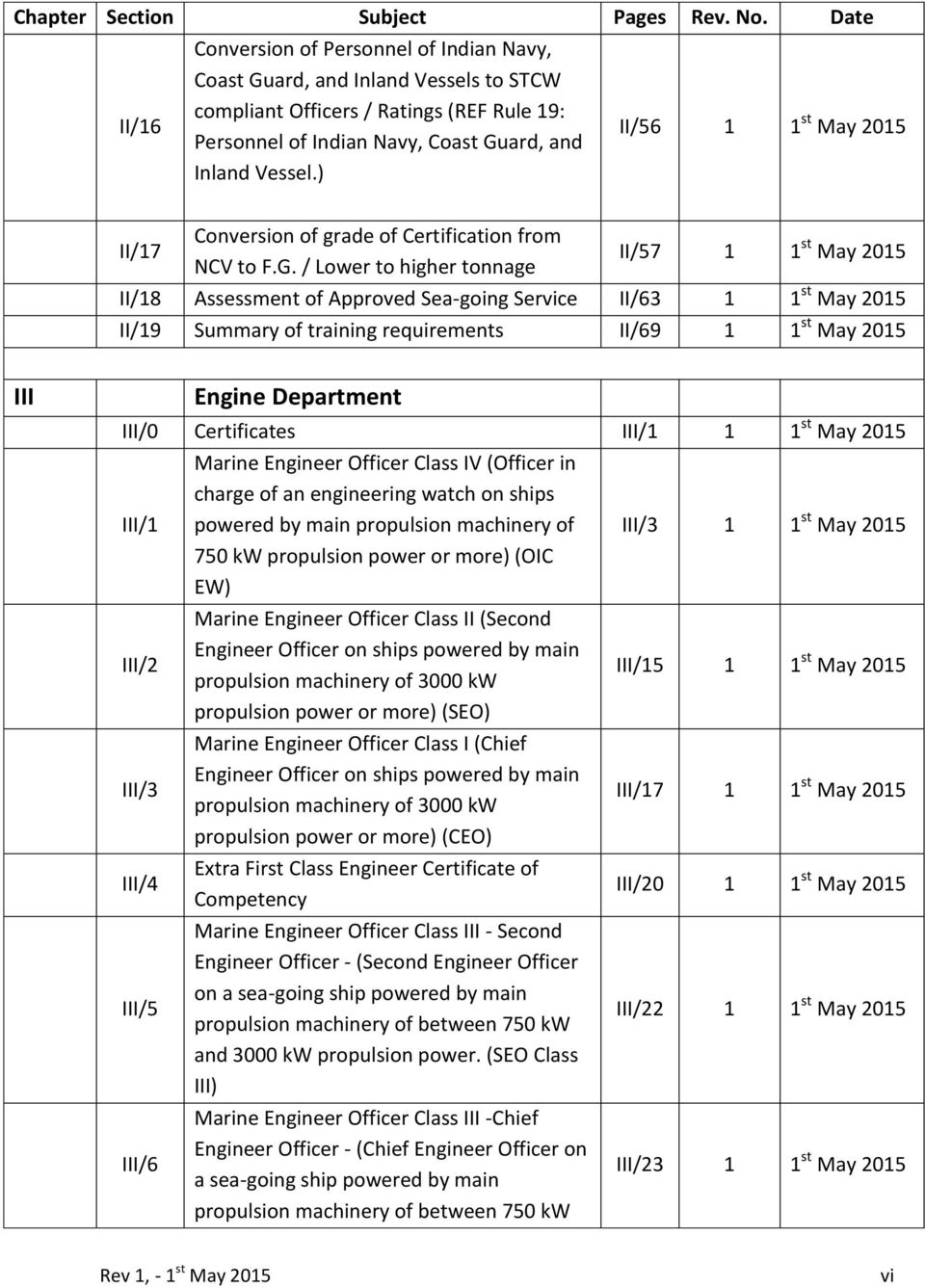
9 Chapter Section Subject Pages Rev. No. Date and 3000 kw. (CEO Class III) III/7 III/8 III/9 III/10 III/11 Marine Engineer Officer Class IV - Near Coastal Voyages (Officer in charge of an Engineering watch in a manned Engine Room or Designated Engineer in a periodically unmanned Engine Room on ships powered by propulsion machinery of between 750 kw and 3000 kw propulsion power, operating in Near-Coastal Voyages) [OIC EW (NCV)]. Marine Engineer Officer Class III Second Engineer Officer - Near-Coastal Voyages (Second Engineer Officer on a seagoing ship powered by main propulsion machinery of between 750kW and 3000 kw propulsion power operating in Near-Coastal Voyages. [MEO Class III SEO (NCV)] Marine Engineer Officer Class III - Chief Engineer Officer - Near-Coastal Voyages (Chief Engineer Officer on a sea-going ship powered by main propulsion machinery of between 750 kw and 3000 kw propulsion power operating in Near-Coastal Voyages. [MEO class III, CEO (NCV)] Marine Engineer Officer Class II - Second Engineer other than Tankers Officer - Near- Coastal Voyages (Second Engineer Officer on a sea-going ship powered by main propulsion machinery of between 3000 kw and 8000 kw propulsion power operating in Near-Coastal Voyages. [SEO Class II (NCV)] Marine Engineer Officer Class I, Chief Engineer Officer - near-coastal voyages. (Chief Engineer Officer on ships other than Tankers powered by main propulsion machinery of between 3000 kw and 8000 kw propulsion power operating in near - coastal voyages) [CEO Class I (NCV)] III/ st May 2015 III/ st May 2015 III/ st May 2015 III/ st May 2015 III/ st May 2015 Rev 1, - 1 st May 2015 vii
![periodically unmanned Engine Room on ships powered by propulsion machinery of between 750 kw and 3000 kw propulsion power, operating in Near-Coastal Voyages) [OIC EW (NCV)].](/docs-images/42/19846097/images/page_9.jpg "Marine Engineer Officer Class III Second Engineer Officer - Near-Coastal Voyages (Second Engineer Officer on a seagoing ship powered by main propulsion machinery of between 750kW and 3000 kw")
10 Chapter Section Subject Pages Rev. No. Date III/12 Ratings forming part of an Engine Room Watch (REW) III/ st May 2015 III/13 Able Seafarer Engine III/ st May 2015 III/14 Electro Technical Officer III/ st May 2015 III/15 Electro Technical rating III/ st May 2015 III/16 Miscellaneous Provisions III/ st May 2015 IV RADIO COMMUNICATION AND RADIO OPERATORS IV/1 Radio Operator IV/1 1 1 st May 2015 IV/1 GMDSS Radio Operator IV/2 1 1 st May 2015 V V/1 V/2 V/3 V/4 Special training requirements for personnel on certain types of ships Minimum requirements for the training and qualifications of Masters, Officers and Ratings on Oil Tankers Minimum requirements for the training and qualification of Masters, Officers and Ratings on Chemical Tankers Minimum requirements for the training and qualifications of Masters, Officers and Ratings on Liquefied Gas Tankers Minimum requirements for the training and qualifications of Masters, Officers, Ratings and other Personnel on Passenger Ships V/1 1 1 st May 2015 V/4 1 1 st May 2015 V/7 1 1 st May 2015 V/ st May 2015 VI VI/1 VI/2 VI/3 Emergency, occupational safety, security, medical care and survival functions Minimum requirements for safety familiarization for all seafarers Minimum requirements for basic training for all seafarers with designated safety or pollution prevention duties Minimum requirements for the issue of certificates of proficiency in survival craft, rescue boats other than fast rescue boats VI/1 1 1 st May 2015 VI/2 1 1 st May 2015 VI/3 1 1 st May 2015 VI/4 Minimum requirements for the issue of VI/4 1 1 st May 2015 Rev 1, - 1 st May 2015 viii

11 Chapter Section Subject Pages Rev. No. Date certificates of proficiency in fast rescue boats VI/5 Minimum requirements for the issue of certificates of proficiency in advanced fire VI/5 1 1 st May 2015 fighting VI/6 Minimum requirements for the issue of certificates of proficiency in medical first aid. VI/6 1 1 st May 2015 VI/7 VI/8 VI/9 VI/10 VI/11 Minimum requirements for the issue of certificates of proficiency in medical care Minimum requirements for security-related familiarization training for all seafarers Minimum requirements for the issue of certificates of proficiency in security awareness training Minimum requirements for the issue of certificates of proficiency for seafarers with designated security duties Minimum requirements for the issue of certificates of proficiency for Ship Security Officers VI/7 1 1 st May 2015 VI/8 1 1 st May 2015 VI/9 1 1 st May 2015 VI/ st May 2015 VI/ st May 2015 VII Alternative Certification VII/1 Issue of alternative certificates VII/1 1 1 st May 2015 VII/2 Certification of Seafarers VII/2 1 1 st May 2015 VII/3 Principles governing the issue of Alternative Certificates VII/3 1 1 st May 2015 VIII Watch-Keeping VIII/1 Fitness for duty VIII/1 1 1 st May 2015 VIII/2 Watch-keeping arrangements and principles to be observed. VIII/2 1 1 st May 2015 IX Miscellaneous Provisions IX/1 Action against candidates found guilty of misconduct ; IX/1 1 1 st May 2015 Rev 1, - 1 st May 2015 ix

12 Chapter Section Subject Pages Rev. No. Date Appellate authority and appeal procedures; Power to exempt and dispensation ; Supervision by the Director General of Shipping ; Replacement of lost or damaged Certificates ; Review of results of examination ; Fees ; Repeal Rev 1, - 1 st May 2015 x

13 Abbreviations MS (STCW) Rules : Merchant Shipping (Standards of Training, Certification and Watch-keeping for Seafarers) Rules, 2014 STCW Convention : International Convention on Standards of Training, Certification and Watch-keeping for Seafarers, 1978 as amended STCW Code : Seafarers Training, Certification and Watch-keeping Code NCV : Near Coastal Voyages PCM : 12 years of General Education with Physics, Chemistry & Mathematics as subjects in 12 th Standard Board exam. IMU DGS TEAP : : : Indian Maritime University Director General of Shipping Training, Examination and Assessment Programme xi

14 C H A P T E R I General Provisions Objective Ref : M.S. (STCW) Rules 2014 The objective of the approved Training, Examination and Assessment Programme (TEAP) is to supplement the provisions of the Merchant Shipping (Standards of Training, Certification and Watch-keeping for Seafarers) Rules, 2014 in order to give full and complete effect of implementation to the amended provisions of International Convention on Standards of Training, Certification and Watch-keeping for Seafarers, 1978 as amended in 2010 (STCW Convention) and relevant national requirements. Rev. 1-1 st May, 2015 CH. I / 1

15 Section I/1 Ref : M.S. (STCW) Rules 2014 Rule 4 : Definitions 1. The definitions contained in Rule 4 of chapter I of M.S. (STCW) Rules apply equally to the terms used in this Programme. In addition, the following clarification would apply : Approved sea-going service includes the service performed on board a ship at sea, anchorage or in port while such a ship is commissioned into service including reasonable time spent in dry dock, or while undergoing hull, deck or engine repairs or handling cargo relevant to the issue or revalidation of a certificate or qualification. Rev. 1-1 st May, 2015 CH. I / 2

16 Section I/2 Ref: M.S. (STCW) Rules 2014 Rule 5 : Certificates and Endorsements 1. The certificates of competency, certificates of proficiency and endorsements, with limitations, if any, which would be issued, together with their equivalent titles as per the STCW convention, are as enumerated in the M.S. (STCW) Rules, Rule 5. Rev. 1-1 st May, 2015 CH. I / 3

17 Section I/3 Ref : M.S. (STCW) Rules 2014 Rule 6 : Principles governing Near Coastal Voyages 1. Certificates of Competency issued for Near Coastal Voyages (NCV) shall incorporate or be endorsed with the trading limits as per M.S. (STCW) Rules Rule 6. Rev. 1-1 st May, 2015 CH. I / 4

18 Section I/4 Ref : M.S. (STCW) Rules 2014 Rule 7 : Control Procedures No further provisions. Rev. 1-1 st May, 2015 CH. I / 5

19 Section I/5 Ref : M.S. (STCW) Rules 2014 Rule 8 : Investigation of Incidents and Prevention of Unlawful Practices No further provisions. Rev. 1-1 st May, 2015 CH. I / 6

20 Section I/6 Ref : M.S. (STCW) Rules 2014 Rule 9 : Training and Assessment 1. All training and assessment of seafarers for certification will be : 1.1 Structured in accordance with the DGS guidelines / relevant IMO Model Course, as applicable, including such methods and media of delivery, procedures, and Course material as are necessary to achieve the prescribed standards of competence ; and 1.2 Lecturers, instructors, supervisors and assessors delivering or conducting a training programme or assessing seafarers for certification under M.S. (STCW) Rules 2014 and STCW Convention would be required to complete an approved Course in training and assessment in accordance with DGS order No. 5 of 2013, as may be amended. 2. The Directorate has approved the following Courses for the purpose : 2.1 An approved Course for lecturers, supervisors and assessors, titled, Training Course for Trainers and Assessors, of two weeks duration. 2.2 An approved Course for instructors, titled, Training for Instructors, of one week duration. 3 An outline and contents of the approved Courses mentioned in paragraph 2 above, is given in Appendix I/6. 4 Lecturers, instructors and assessors conducting approved simulator training and assessment should have received appropriate guidance in instructional techniques involving the use of simulators and have gained practical operational experience on the particular type of simulator being used. 5. Assessment during post-sea education and training shall be conducted as per the DGS guidelines. 5.1 On satisfactory completion of post-sea training and internal test in an approved institution, the Head of the institute would issue a certificate in the prescribed DGS format to that effect to each candidate. Rev. 1-1 st May, 2015 CH. I / 7

21 5.2 The Head of the institute shall then intimate the list of suitable candidates to the Assessment Centres of the DGS to appear for examination in each function. 6. Assessment for issue of a Certificate of Competency 6.1 The Mercantile Marine Department under the Directorate General of Shipping are the designated Assessment Centres. 6.2 The Assessment Centres would function under the direct charge of the Chief Examiners concerned and in conformity with this Programme. 6.3 On production of a certificate of satisfactory completion of post-sea training and internal test, issued by the Head of the training institute, the designated Assessment Centre would permit the candidate, subject to verification of eligibility, to appear for written and oral examinations in that function to be conducted by or on behalf of the Assessment Centre. 6.4 On satisfactory performance in the examinations in all the prescribed functions, the Chief Examiner concerned would issue an appropriate Certificate of Competency. 7. Records of Seafarers The Indian National Database of Seafarers (INDoS) shall maintain records of all Seafarers with regard to their sea-going services, progress of on-board training, Courses attended, examinations and assessments completed and certificates held. Rev. 1-1 st May, 2015 CH. I / 8
22 Section I/7 Ref : M.S. (STCW)Rules 2014 Rule 10 : Communication of Information No further provisions. Rev. 1-1 st May, 2015 CH. I / 9
23 Section I/8 Ref : M.S. (STCW) Rules 2014 Rule 11 : Quality Standards 1. Maritime education and training institutions shall set-up a quality standards system and get certified by a recognized organisation. The certificate and quality standards system should thereafter be maintained by the conduct of annual, internal and external audits. 2. A list of such maritime education and training institutions along with list of Courses which are approved by the Directorate General of Shipping is updated and displayed on the DGS webpage. ( Rev. 1-1 st May, 2015 CH. I / 10
24 Section I/9 Ref : M.S. (STCW) Rules 2014 Rule 12 : Medical Standards 1. The company should ensure that medical examinations are carried out and Certificate of Medical Fitness issued to seafarers as specified in M.S. (Medical Examination) Rules 2013, as may be amended. Rev. 1-1 st May, 2015 CH. I / 11
25 Section I/10 Ref : M.S. (STCW) Rules 2014 Rule 13 : Recognition of Certificates 1. Where the Indian maritime administration has recognised a certificate issued by another party, withdraws its endorsement attesting recognition for disciplinary reasons, the administration shall inform the Party that issued the certificate of the circumstances. Rev. 1-1 st May, 2015 CH. I / 12
26 Section I/11 Ref : M.S. (STCW) Rules 2014 Rule 14 : Upgradation and Revalidation of Certificates 1. Details of the approved refresher and updating Course mentioned in sub - rule (5) of Rule 14 of M.S. (STCW) Rules 2014, for up-gradation of certificates of competency from STCW 1995 to STCW 2010 is given in Appendix I/ Details of the additional training requirements mentioned in sub - rule (1) of Rule 14 of M.S. (STCW) Rules 2014, will be notified by the Directorate as and when required. 3. Professional Competence : In addition to the requirements contained in paragraphs 1 and 2 above, continued professional competence to be established by : 3.1 approved sea-going service, performing functions appropriate to the certificate held, for a period of at least one year in total during the preceding five years ; or 3.2 approved sea-going service, performing functions appropriate to the certificate held, for a period of at least 3 (three) months in total during the preceding 6 (six) months immediately prior to expiry of the certificate; or, 3.3 having performed functions considered to be equivalent to the seagoing service required in paragraph 3.1, (e.g. officers working in marine related jobs, such as: maritime surveyors, faculty, superintendents, cargo superintendents, port officers, port engineers, officers serving on offshore rigs and platforms, FPSO, FSO, Chartering, Brokering or Commercial operations, vetting inspectors, ISM auditors, Port State and Flag State inspectors, Shipboard Training Officers, pilots, etc. ), for a period of not less than 2 (Two) years during the preceding five years; or 3.4 Passing an approved test, such as oral/e-examination for the grade of CoC concerned; or 3.5 Successfully completing an approved training Course or Courses, such as: Competency Course for the grade of CoC concerned or one grade higher; or 3.6 having completed approved sea-going service, performing functions appropriate to the certificate held, for a period of not less than three months in a supernumerary capacity, or in a lower officer rank than that for which the certificate held is valid, immediately prior to taking up the rank for which it is valid. Rev. 1-1 st May, 2015 CH. I / 13
27 Section I/12 Ref : M.S. (STCW) Rules 2014 Rule 15 : Use of Simulators Performance standards of the simulators and provisions regarding training and assessment shall be as per Section A-I/12 of the STCW Code as amended. Rev. 1-1 st May, 2015 CH. I / 14
28 Section I/13 Ref : M.S. (STCW) Rules 2014 Rule 16 : Conduct of Trials No further provisions. Rev. 1-1 st May, 2015 CH. I / 15
29 Section I/ Rule 17 : Responsibilities of Companies Ref : M.S. (STCW) Rules No further provisions Rev. 1-1 st May, 2015 CH. I / 16
30 Section I/ Rule 18 : Transitional Provisions Ref : M.S. (STCW) Rules No further provisions Rev. 1-1 st May, 2015 CH. I / 17
31 Section I/16 Ref : M.S. (STCW) Rules 2014 Rule 19 : Personnel of Indian Navy, Coast Guard, and Inland Vessels. The relevant requirements for education, sea-going service, training, examination and assessment, prior to issue of a Certificate of Competency for nautical and engineering disciplines, are given in Chapters II and III, respectively. Rev. 1-1 st May, 2015 CH. I / 18
32 C H A P T E R - II Master and Deck Department Section II/1 Ref : M.S. (STCW) Rules 2014 Rule 20 : Officer in charge of a navigational watch (OIC NW) on ships of 500 gross tonnage or more (Second Mate of a foreign-going ship) 1. The approved Training, Examination, and Assessment Programme (TEAP) for a candidate to qualify for certification as an Officer in charge of a navigational watch on ships of 500 gross tonnage or more (Second Mate of a foreign-going ship), as required by Rule 20 (2) (b) and (e) of Chapter II of M.S. (STCW) Rules 2014, comprises approved Pre-sea education and training, Sea-going service, and Post-sea education and training, followed by examination and assessment. A flowchart of the certification process is given in Flow Diagrams No. II/1A & II/1B. 2. Pre-sea education and training is specified for four direct streams of entry. The streams and their eligibility criteria are as follows : 2.1 Approved 3-year B.Sc. Nautical Science/Technology Course or 4-year B.S. Nautical Science/Technology Course : a) Passed 12 th Standard (10+2) Board exams with Physics, Chemistry and Mathematics (PCM) as core subjects, obtaining a minimum of 60% average in PCM, OR, b) Obtained a B.Sc. degree with Physics as a core subject, or a B.E. / B.Tech degree, scoring a minimum aggregate of 50% marks in the final year. c) Scored a minimum of 50% marks in English at the 10 th or 12 th Standard Board exams, or at the graduation level. d) Age not exceeding 25 years at the commencement of the Course. e) Medical fitness as per the standards prescribed for pre-sea level. For Course details please refer to Appendix II/1A Rev. 1-1 st May, 2015 CH II / 1
33 2.2 Approved 3-year B.Sc. Dual/Polyvalent Course or 4-year B.E. Marine Polyvalent Course in Nautical and Engineering Disciplines : a) Passed 12 th Standard (10+2) Board Exams with Physics, Chemistry and Mathematics (PCM) as core subjects, having obtained a minimum average of 60% marks in PCM, b) Scored a minimum of 50% marks in English at the 10 th or 12 th Standard Board exams. c) Age not exceeding 25 years at the commencement of the Course. d) Medical fitness as per the standards prescribed for pre-sea level. For Course details please refer to Appendix II/1B 2.3 Approved 1-Year Diploma in Nautical Science (leading to a B.Sc. Nautical Science degree) : a) Passed 12 th Standard (10+2) Board exams with Physics, Chemistry and Mathematics (PCM) as core subjects, obtaining a minimum of 60% marks average in PCM, OR Obtained a B.Sc. degree with Physics as a core subject, scoring a minimum aggregate of 55 % marks in the final year, or a B.E. / B. Tech degree. b) Scored a minimum of 50% marks in English at the 10 th or 12 th Standard Board exams, or at the graduation level. c) Age not to exceed 25 years at the commencement of the Course. d) Medical fitness as per the standards prescribed for pre-sea level. For Course details, please refer to Appendix II/1C 2.4 Approved Six-month Pre-sea Deck Cadet Course for Graduates: a) Obtained a Bachelor s degree in Science, Engineering or Fisheries (NS), scoring a minimum of 50% aggregate marks in the final year. b) Scored a minimum of 50% marks in English at the 10 th or 12 th Standard Board exams, or graduate level. c) Age above 18 years and not exceeding 25 years at the commencement of the Course. d) Medical fitness as per the standards prescribed for pre-sea level. For Course details, please refer to Appendix II/1D Rev. 1-1 st May, 2015 CH II / 2
34 3. In addition to the above Pre-sea training, candidates are required to attend approved Courses in Safety, Pollution Prevention, and Security, and obtain the relevant Certificates of Proficiency as prescribed in Chapter VI of M.S. (STCW) Rules 2014, as per Table II/1-1 below : Table II/1-1 Chapter VI STCW Name of Course Course Details Rule No. Reference Certificate of Proficiency 57 A-VI/1-1 Personal Survival Techniques (PST) Appendix VI/1A 57 A-VI/1-2 Fire Prevention and Fire Fighting (FP&FF) Appendix VI/1B 57 A-VI/1-3 Elementary First Aid (EFA) Appendix VI/1C 57 A-VI/1-4 Personal Safety and Social Responsibilities Appendix VI/1D (PS&SR) 65 A-VI/6-2 Security Training for Seafarers with Appendix VI/1E Designated Security Duties (STSDSD) 4. Provisions are made for lateral entry for certification as Officer in charge of a navigational watch for Ratings / Other categories, who shall comply with the requirements as may be specified. 5. Depending on the stream of entry, the approved sea-going service required by Rule 20 (2) (b) of Chapter II of M.S. (STCW) Rules 2014 is given below : 5.1 For a candidate who has successfully completed an approved training Course of three/four years in Nautical Sciences/Technology (or equivalent), and obtained a degree from a recognized university :- 12 months as Deck Cadet ; or 5.2 For a candidate who has successfully completed an approved Dual/Polyvalent training Course of three/four years in Nautical & Engineering disciplines, and obtained a degree from a recognized university :- 18 months, of which at-least 12 months to be in the Deck Department ; or 5.3 For a candidate, who has successfully completed an approved pre-sea education and training course of one year, and obtained a Diploma in Nautical Science (DNS) leading to B.Sc. (Nautical Science) degree :- 18 months as Deck Cadet ; or Rev. 1-1 st May, 2015 CH II / 3
35 5.4 For a candidate who holds a Science, Engineering, or Fisheries (NS) Degree (other than Nautical Science/Technology or Polyvalent Degree), from a recognized university, and has successfully completed an approved pre-sea education and training Course of six months :- 15 months as Deck Cadet ; or 5.5 For a Rating who has passed the 12 th Standard Board exam with Physics, Chemistry and Maths as core subjects, and obtained a minimum of 50% marks in English language in the 10 th or 12 th Standard Board exams, and who has successfully completed an approved pre-sea education and training course of three/six months :- 36 months as Deck Rating / Deck Cadet. Ratings have to complete the NWKO (NCV) course and examination or any other course which may be specified by the administration to meet with the STCW Convention requirements, and may require an additional sea-going service of 6 months as an OOW (NCV), if applicable, prior Second Mate (F.G.) examination. 5.6 Provided that in all above cases, the bridge watch-keeping duties as required by Rule 20 (2) (c) of Chapter II of M.S. (STCW) Rules 2014 (i.e. not less than six months) are performed such that the candidate is on Bridge watch for a period of not less than eight hours out of every twenty-four hours whilst at sea, under the supervision of a qualified Navigating Officer. The watch-keeping duties are to be documented in the candidate s Training Record Book (TRB). 5.7 Provided that in all above cases where the sea-going service requirement is less than 36 months, the candidate is required to have successfully completed an approved Structured Shipboard Training Programme (SSTP), documented in an approved Training Record Book (TRB), during the performance of the sea-going service. 5.8 Existing Deck Cadets who have satisfactorily completed an approved 3-month or 6- month Pre-sea Courses (which are no longer conducted) are required to comply with the sea-going service requirement of minimum 36 months, subject to remission of upto 12 months upon satisfactory completion of an approved Structured Shipboard Training Programme (SSTP). The sea-going service must include a minimum of 6 months of Bridge watch-keeping duties under supervision of a qualified navigating Officer (refer Para 5.6 of this Section) For details of approved sea-going service, please refer to Section II/18 of this chapter. Rev. 1-1 st May, 2015 CH II / 4
36 6. An authenticated copy of the approved Training Record Book required by Rule 20 (2) (b) of Chapter II of M.S. (STCW) Rules 2014 is to be procured from Recognized Organizations / Training Institutes / SSTP providers as approved by the administration. The format of the approved Cadet Training Record Book can be found in Appendix II/1E. 7. Post Sea education and training comprises competency Courses, which the candidates are required to attend as per their stream of entry, as shown in Table II/1-2 below : Table II/1-2 Name of Course Duration Applicability Course details Foundation Course (PCME) for 2 nd Mate F.G. 2 months Only for Ratings and existing Deck cadets (who have not done the pre-sea training as Deck cadets). The Course may be attended after 18 months sea-going service Appendix II/1F NWKO (NCV) Competency Course 4 months Only for Ratings making lateral entry as Officer. Course may be attended after 30 months sea-going service Appendix II/7B Second Mate F.G. Competency Course 4 months Exempted for Candidates from entry streams 2.1 and 2.2. Course is applicable for candidates from all the other streams. Appendix II/1G In addition to the above Post-sea Courses, candidates are required to attend approved Courses in Safety, Pollution Prevention, and Security, and obtain the relevant Certificates of Proficiency as prescribed in Chapters II and VI of M.S. (STCW) Rules 2014, as per Table II/1-3 below : Rev. 1-1 st May, 2015 CH II / 5
37 Table II/1-3 Chapter / Rule No. Chap II Rule 20 (e) Chap II Rule 20 (e) Chap II Rule 20 (e) Chap II Rule 20 (d) Chap IV Rule 51 Chap VI Rule 58 Chap VI Rule 60 Chap VI Rule 61 Chap VI Rule 65 Chap VI Rule 66 STCW Reference Name of Course Certificate of Proficiency A-II/1 Radar Observer Simulator Course (ROSC) A-II/1 A-II/1 A-II/2 A-VI/2 A-VI/2-1 Automatic Radar Plotting Aids (ARPA) Electronic Chart Display and Information System (ECDIS) Global Maritime Distress and Safety System (GMDSS) Proficiency in survival craft, rescue boats, other than fast rescue boats (PSC-RB) Course Details Appendix II/1H Appendix II/1J Appendix II/1K Appendix IV/1 Appendix VI/2 A/VI-3 Advanced Fire Fighting (AFF) Appendix VI/3 A-VI/4-1 Medical First Aid (MFA) Appendix VI/4 A-VI/6-2 A/VI-5 Security Training for Seafarers with Designated Security Duties (STSDSD) OR, Ship Security Officer (SSO) (Accepted as an alternative to STSDSD Course, if not done earlier) Appendix VI/5A Appendix VI/5C Details of the approved pre-sea and post-sea education and training Courses as required by Rule 20 (2) (e) and 20 (2) (f) of Chapter II of M.S. (STCW) Rules 2014 are given in the Appendices as follows : 7.1 Pre-sea Bachelor of Nautical Science/Technology Course (Ref Para 2.1) :- Appendix II/1A ; 7.2 Pre-sea Polyvalent Graduation Course (Ref Para 2.2) :- Appendix II/1B ; 7.3 Pre-sea Diploma in Nautical Science Course (DNS), leading to B.Sc. (Nautical Science) degree (Ref Para 2.3) :- Appendix II/1C ; Rev. 1-1 st May, 2015 CH II / 6
38 7.4 Six-month Pre-sea Deck Cadet course for Science, Engineering, and Fisheries graduates (Ref Para 2.4) :- Appendix II/1D 7.5 Post-sea Foundation Course (PCME) for Second Mate (F.G.) certification :- Appendix II/1F 7.6 Post-sea Competency Course for Second Mate (F.G.) certification :- Appendix II/1G 8. Examination and assessment for the award of a Certificate of Competency as Second Mate of a foreign-going ship (OIC NW) will be conducted as follows : 8.1 Scrutiny by assessment centre for satisfactory completion of the following : a) Approved pre-sea education and training. b) Approved sea-going service, including Bridge watch-keeping duties. c) Approved Structured Shipboard Training Programme (SSTP) and Cadet Training Record Book (TRB), as applicable. d) For Candidates under Para 5.5 as mentioned above, successful completion of NWKO (NCV) course followed by a written examination. 8.2 Satisfactory completion of the Post-sea Foundation Course (an approved course in Nautical Physics, Chemistry, Mathematics, Electricity and Electronics), followed by a written examination. This is applicable to candidates from entry scheme 5.5 (Ratings), and existing Deck Cadets who have not undergone approved pre-sea training for Deck Cadets. Provided that every candidate required to attend the Foundation Course, will be eligible to attend this course on completion of at-least eighteen months of approved sea-going service. 8.3 Satisfactory completion of Function: Navigation at the Operational Level. This will include an approved Competency course followed by written, oral and visual signalling examination and assessment. 8.4 Satisfactory completion of Function: Cargo Handling and Stowage at the Operational Level. This will include an approved Competency course followed by written and oral examination and assessment. 8.5 Satisfactory completion of Function: Controlling the Operation of the Ship and Care for Persons on Board at the Operational Level. This will include an approved Competency course followed by written and oral examination and assessment. Rev. 1-1 st May, 2015 CH II / 7
39 8.6 Satisfactory completion of the following Proficiency Courses (to be done as per the eligibility criteria specified for each Course) : (a) Radar Observer Simulator Course, as set out in Table A-II/1 of the STCW Code ; (b) ARPA Course, as set out in Table A-II/1 of the STCW Code ; (c) GMDSS Operator s Course (GOC) as set out in section A-IV/2 of the STCW Code ; (d) ECDIS Training Course as set out in table A-II/1 and table A-II/2 of the STCW Code (e) Proficiency in Survival Craft and Rescue Boats as set out in section A-VI/2, paragraphs 1 to 4 of the STCW Code (f) Advanced Fire-fighting as set out in section A-VI/3 of the STCW Code ; (g) Medical First Aid as set out in section A-VI/4, paragraphs 1 to 3 of the STCW Code; and (h) Security Training for Persons with Designated Security Duties (STSDSD), as set out in section A-VI/6 and Table A-VI/6-2 of the STCW Code. Alternatively, Ship Security Officer Course, as set out in Section Table A-VI/5 of the STCW Code is accepted, if STSDSD Course has not been done earlier. 9. Every candidate for certification who has satisfactorily completed the three/four year approved education and training programme and has obtained Bachelor of Nautical Sciences/ Technology degree and completed a minimum of 12 months approved seagoing service, will be exempt from attending the Competency Course for the Functions as per paragraphs 3, 4, and 5 above, but must successfully complete the written, visual signalling and oral examination in these Functions to the satisfaction of the Chief Examiner. 10. Every candidate who has obtained the Polyvalent graduation degree and completed a minimum of 18 months approved sea-going service (at-least 12 months in the Deck department and at-least 6 months in the Engine Department) will be exempt from attending the Competency Course for the Functions as per paragraphs 3, 4 and 5 above, Rev. 1-1 st May, 2015 CH II / 8
40 but must successfully complete the written, visual signalling, and oral examinations in these Functions to the satisfaction of the Chief Examiner. 11. All training and assessment successfully completed by any candidate must comply with the requirements of Regulation I/6 of STCW 2010, (Training and Assessment), along with sections A-I/6 and B-I/6 of the STCW Code, as well as Regulation I/8 of STCW 2010, (Quality Standards), along with sections A-I/8 and B-I/8 of the STCW Code. A summary for the various streams of Pre-sea maritime education and training, seagoing service and on-board training, Post-sea maritime education and training, Examination, Assessment and Certification are given in Flow Diagrams No. II/1-1A and II/1-1B below: Rev. 1-1 st May, 2015 CH II / 9
41 Flow Diagram No. II/1-1 (A) STREAM FLOW B.Sc. / B.S. Nautical Science/Technology Course B.Sc. / B.E. Polyvalent Course Diploma in Nautical Science (leading to B.Sc. Nautical Science degree) ENTRY CRITERIA Educational Qualification. 12 th Standard (10 + 2) with PCM and a minimum of 60% average in PCM, or, B.Sc. with Physics or B.E./B.Tech. and a minimum of 50% marks in final year, and, A minimum of 50% marks in English at 10 th or 12 th Standard or graduation level. 12 th Standard (10 + 2) with PCM and a minimum of 60% average in PCM, and, A minimum of 50% marks in English at 10 th or 12 th Standard level. 12 Standard (10 + 2) with PCM and a minimum of 60% average in PCM, or, B.Sc. with Physics and minimum of 55% aggregate marks in final year, or a B.E./B.Tech degree and, A minimum of 50% marks in English at 10 th or 12 th Standard or Degree Course. Age (years) Upto 25 years Upto 25 years Upto 25 years Medical Fitness As per Pre-Sea Standards As per Pre-Sea Standards. As per Pre-Sea Standards PRE-SEA Education and Training STCW Code A-II/1 : Approved 3-year B.Sc. (Nautical Science/Technology) degree course, or, Approved 4-year B.S. (Nautical Science/Technology) degree course. A-VI/1-1 : PST, A-VI/1-2 : FP & FF, STCW Code A-II/1 : Approved 3-Year B.Sc. Maritime Science (Polyvalent) degree course. Or Approved 4-year B.E. Marine Polyvalent degree Course. A-VI/1-1 : PST, A-VI/1-2 : FP & FF, STCW Code A-II/1 (in part) : Approved1-year Diploma in Nautical Science (D.N.S.) course leading to a B.Sc. degree in Nautical Science A-VI/1-1 : PST, A-VI/1-2 : FP & FF, Rev. 1-1 st May, 2015 CH II / 10
42 A-VI/1-3 : EFA, A-VI/1-4 : PS & SR A-VI/6-2 : STSDSD A-VI/1-3 : EFA, A-VI/1-4 : PS & SR A-VI/6-2 : STSDSD A-VI/1-3 : EFA, A-VI/1-4 : PS & SR A-VI/6-2 : STSDSD Sea-going Service Minimum 12 months approved sea-going service, Includes : an approved Structured Shipboard Training Programme (SSTP) with TRB, and, not less than 6 months of supervised Bridge watch-keeping duties. Minimum 18 months approved sea-going service (minimum 12 months in Deck Dept., and minimum 6 months in Engine Dept.) Includes: an approved Structured Shipboard Training Programme, (SSTP) with TRB/TAR Book, and, not less than 6 months of supervised Bridge watch-keeping duties, and, not less than 6 months of supervised Engine-Room watch-keeping duties. Minimum 18 months approved seagoing service, Includes: an approved Structured Shipboard Training Programme (SSTP) with TRB, and, not less than 6 months of supervised Bridge watch-keeping duties. POST-SEA Education and Training Assessment of SSTP, TRB and sea-going service A-II/1: Radar Observer Simulator Course ARPA Course ECDIS Course A-IV/2 : GMDSS GOC A-VI/2-1 : PSC & RB Assessment of SSTP, TRB/TAR Book, and sea-going service A-II/1 : Radar Observer Simulator Course ARPA Course ECDIS Course A-IV/2 : GMDSS GOC A-VI/2-1 : PSC & RB Assessment of SSTP, TRB and seagoing service A-II/1: Second Mate (FG) Competency Course (4 months) Radar Observer Simulator Course ARPA Course Rev. 1-1 st May, 2015 CH II / 11
43 A-VI/3 : AFF A-VI/4-1 : MFA A-VI/6-2 STSDSD (if not done earlier) A-VI/5 : SSO (optional, in lieu of STSDSD) A-VI/3 : A-VI/4-1: A-VI/6-2 A-VI/5 : AFF MFA STSDSD (if not done earlier) SSO (optional, in lieu of STSDSD) ECDIS Course A-IV/2 : GMDSS GOC A-VI/2-1 : PSC & RB A-VI/3 : AFF A-VI/4-1 : MFA A-VI/6-2 : STSDSD (if not done earlier) A-VI/5 : SSO (optional, in lieu of STSDSD) Examination and Assessment Written and Oral Examinations Written and Oral Examinations Written and Oral Examinations Certificate of Competency obtained Officer In Charge of a Navigational Watch (Second Mate of a foreign-going ship) OIC NW >500 GT Rev. 1-1 st May, 2015 CH II / 12
44 Flow Diagram II/1-1 (B) STREAM FLOW Science / Engineering / Fisheries (NS) Graduate Entry Scheme Other Existing Deck Cadets Ratings ENTRY CRITERIA Educational Qualification. Science/ Engineering/ Fisheries (NS) Graduates with a minimum of 50% aggregate marks at graduation, and, A minimum of 50% marks in English at 10 th or 12 th Standard or graduation level. 12 th Standard (10 + 2) with PCM, and, A minimum of 50% marks in English at 10 th or 12 th Standard level. 12 th Standard (10 + 2) with PCM, and, A minimum of 50% marks in English at 10 th or 12 th Standard level. Age (years) Upto 25 years 18 years or above 18 years or above Medical Fitness As per Pre-Sea standards As per Pre-Sea standards As per Pre-Sea standards PRE-SEA Education and Training STCW Code A-II/1 (In part) ; Approved Six months pre-sea Deck Cadet Course [Fisheries Science Graduates (NS) are Exempted] A-VI/1-1 : PST, A-VI/1-2 : FP & FF, A-VI/1-3 : EFA, A-VI/1-4 : PS & SR A-VI/6-2 : STSDSD STCW Code A-II/1 (in part) : Approved Three/Six months pre-sea Deck Cadet Course A-VI/1-1 : PST, A-VI/1-2 : FP & FF, A-VI/1-3 : EFA, A-VI/1-4 : PS & SR A-VI/6-2 : STSDSD STCW Code A-II/1 (in part) : Approved Three / Six months pre-sea Deck Cadet or GP Ratings Course A-VI/1-1 : PST, A-VI/1-2 : FP & FF, A-VI/1-3 : EFA, A-VI/1-4 : PS & SR A-VI/6-2 : STSDSD Sea-going Service Minimum 15 months approved sea-going service, Minimum 36 months approved sea-going service, Minimum 36 months approved Foreigngoing sea-going service, Rev. 1-1 st May, 2015 CH II / 13
45 STREAM FLOW Science / Engineering / Fisheries (NS) Graduate Entry Scheme Other Existing Deck Cadets Ratings Includes : An approved Structured Shipboard Training Programme(SSTP) with TRB and, not less than 6 months of supervised Bridge watch-keeping duties Includes : 6 months of supervised Bridge watchkeeping duties or, Minimum 24 months approved sea-going service, Includes : An approved Structured Shipboard Training Programme (SSTP) with TRB, and, not less than 6 months of supervised Bridge watch keeping duties. Includes : 6 months of supervised Bridge watchkeeping duties documented in appropriate TRB or, Minimum 36 months approved NCV seagoing service, Includes : not less than 6 months of supervised Bridge watch keeping duties documented in appropriate TRB, and, Minimum 6 months sea-going service on trading ships as OOW (NCV). POST-SEA Education and Training Assessment of SSTP, TRB and sea-going service A-II/1 : Second Mate (FG) Competency Course (4 months) Radar Observer Simulator Course ARPA Course ECDIS Course A-IV/2 : GMDSS GOC A-VI/2-1: PSC & RB A-VI/3 : AFF Assessment of SSTP, TRB and sea-going service A-II/1 : Approved Foundation Course PCME (2 months) if applicable. [May be done after 18 months of sea-going service]. Second Mate (FG) Competency Course ( 4 months) Radar Observer Simulator Course Assessment of sea-going service A-II/1 : Approved Foundation Course PCME (2 months) [May be done after 18 months of sea-going service]. Approved NCV course and written examination. Bridging Course (For conversion to OIC (FG), or, Second Mate (FG) Competency Course ( 4 months) Rev. 1-1 st May, 2015 CH II / 14
46 STREAM FLOW Science / Engineering / Fisheries (NS) Graduate Entry Scheme Other Existing Deck Cadets Ratings A-VI/4-1 : MFA A-VI/6-2 STSDSD (if not done earlier) A-VI/5 : SSO (optional, in lieu of STSDSD) ARPA Simulator Course ECDIS Course A-IV/2 : GMDSS GOC A-VI/2-1: PSC & RB A-VI/3 : AFF A-VI/4-1 : MFA A-VI/6-2 : STSDSD (if not done earlier) A-VI/5 : SSO (optional, in lieu of STSDSD) Radar Observer Simulator Course. ARPA Course ECDIS Course A-IV/2 : GMDSS GOC A-VI/2-1 : PSC & RB A-VI/3 : AFF A-VI/4-1: MFA A-VI/6-2 STSDSD (if not done earlier) A-VI/5 : SSO (optional, in lieu of STSDSD) Examination and Assessment Written and Oral Examinations Written and Oral Examinations. Written and Oral Examinations Certificate of Competency obtained Officer In Charge of a Navigational Watch (Second Mate of a foreign-going ship) OIC NW >500 GT Rev. 1-1 st May, 2015 CH II / 15
47 Section II/2 Ref : M.S. (STCW) Rules 2014 Rule 21 : Chief Mate (First Mate of a foreign-going ship) on ships of 3000 gross tonnage or more (CM) 1. The approved sea-going service required by Rule 21 (2) (b) of Chapter II of M.S. (STCW) Rules 2014 is not less than 18 months as an Officer in charge of a navigational watch on ships of 500 gross tonnage or more, of which not less than 6 months of approved seagoing service is to be on ships of 3000 gross tonnage or more as Officer in charge of a navigational watch. During the remaining 12 months of approved sea-going service, if the candidate has not kept an independent navigational watch, but has kept a watch as an assistant navigational watch officer, or if watches were doubled, then the sea-going service will be assessed at two-thirds of the actual service performed. An illustration of the same is given in the Table No. II/2-1 below : Table No. II/2-1 Approved sea- Qualifying sea-going Further approved Total sea-going going service service sea-going service as service for CM performed as an an independent after OIC NW assistant navigational watch navigational watch officer officer e.g.1 6 months x 2/3 = 4 months + 14 months = 18 months e.g.2 12 months x 2/3 = 8 months + 10 months = 18 months e.g.3 18 months x 2/3 = 12 months + 6 months = 18 months Note: Not less than 6 months of approved sea-going service on ships of 3000 gross tonnage or more as Officer having independent charge of a navigational watch is mandatory. For details of approved sea-going service, please refer to Section II/18 of this Chapter. Rev. 1-1 st May, 2015 CH II / 16
48 2. The Master is to issue a watch-keeping certificate to the candidate in the prescribed format for the sea-going service performed by the navigational watch officer. The prescribed format is given in Appendix II/2. 3. The approved post-sea education and training as required by Rule 21 (2 ) (c) of Chapter II of M.S. (STCW) Rules 2014 is shown in Table No. II/2-2 below : Table No. II/2-2 Name of Course Duration Applicability Course Details Chief Mate FG Phase I Competency Course Chief Mate FG Phase II Competency Course Radar, ARPA, and Navigation Simulator Course (RANSCO) Medical Care (MEDICARE) 3 months Holder of OIC NW Certificate of Competency (Second Mate FG), having completed at-least 9 months of approved sea-going service 3 Months Holder of OIC NW Certificate of Competency (Second Mate FG), having completed the Phase I Competency Course as well as approved sea-going service of 18 months as per Para 1 6 Days Holder of OIC NW Certificate of Competency (Second Mate F.G.), having completed at-least 6 months of approved sea-going service. 10 Days Holder of OIC NW Certificate of Competency Appendix II/2A Appendix II/2B Appendix II/2C Appendix VI/4B 4. Examination and assessment for the certificate of competency as Chief Mate (First mate of a foreign-going ship) on ships of 3000 gross tonnage or more (CM) will be held as follows: 4.1 Examinations for First Mate of a foreign-going ship (CM) is divided into two phases - Phase I and Phase II. A candidate may seek admission in the approved Phase I competency Course and subsequently appear for Phase I written examinations after completion of at-least nine months of approved sea-going service as OIC NW. Rev. 1-1 st May, 2015 CH II / 17
49 4.2 Scrutiny by assessment centre of satisfactory completion of sea-going service. 4.3 Satisfactory completion of Function: Navigation at the management level. This will include approved courses (Phase I and Phase II) followed by written and oral examinations. 4.4 Satisfactory completion of Function: Cargo handling and stowage at the management level. This will include approved courses (Phase I and Phase II) followed by written and oral examinations. 4.5 Satisfactory completion of Function: Controlling the operation of the ship and care for persons on board at the management level. This will include an approved courses (Phase I and Phase II), followed by written and oral examinations. 4.6 Satisfactory completion of the following courses. a) Radar, ARPA & Navigation Simulator Course (RANSCO); b) Medical care as set out in section A-VI/4, paragraphs 4 to 6 of the STCW Code. (MEDICARE) c) ECDIS Course (if not done earlier). 5. All training and assessment successfully completed by any candidate must comply with the requirements of Regulation I/6 of STCW 2010, (Training and Assessment), along with sections A-I/6 and B-I/6 of the STCW Code, as well as Regulation I/8 of STCW 2010, (Quality Standards), along with sections A-I/8 and B-I/8 of the STCW Code. 6. A summary of the sea-going service, post-sea education and training, examination, assessment and certification is given in Flow Diagram No. II/2-1 below : Rev. 1-1 st May, 2015 CH II / 18
50 Flow Diagram No. II/2-1 Certificate of Competency held Officer in Charge of a Navigational Watch (Second Mate of a foreign-going ship) - OIC NW > 500 GT Sea-going Service Minimum of 18 months as OIC NW, including a minimum of 6 months on ships of 3000 GT or more. (Please refer to section II/2 para 1) Post-sea Education and Training Assessment of Sea-going Service Chief Mate (FG) Phase I Competency Course Chief Mate (FG) Phase II Competency Course Radar, ARPA & Navigation Simulator Course (RANSCO) Medical Care Course (MEDICARE) ECDIS Course (if not done earlier) Examination and Assessment Written and Oral Examinations Certificate of Competency obtained Chief Mate (First Mate of a foreign-going ship) on ships of 3000 gross tonnage or more - CM > 3000 GT Rev. 1-1 st May, 2015 CH II / 19
51 Section II/3 Ref : M.S. (STCW) Rules 2014 Rule 22 : Master on ships of 3000 gross tonnage or more. (Master of a foreign-going ship) (M) 1. The approved sea-going service required by Rule 22 (2) (b) of Chapter II of MS (STCW) Rules 2014 for a Master FG candidate is as follows : 1.1 To have approved sea-going service as an Officer in charge of a navigational watch on ships of 500 gross tonnage or more for a period of not less than thirty-six months, which shall include not less than eighteen months on ships of 3000 gross tonnage or more; and 1.2 From the aforesaid total of thirty-six months sea-going service, at least twelve months sea-going service should be performed after obtaining a certificate of competency of Chief Mate on ships of 3000 gross tonnage or more (First Mate of a foreign-going ship). Of the twelve months of sea-going service after obtaining Chief Mate FG certificate, at least six months of sea-going service should be on ships of 3000 gross tonnage or more. 1.3 Provided that the period of thirty six months shall be reduced to thirty months, if twelve months of such sea-going service has been served as Chief Mate on ships of 3000 gross tonnage or more, or pro rata; 1.4 Provided that during the required sea-going service, the candidate has kept independent navigational watch. In case the watches were doubled, or performed as an assistant watch-keeping officer, then such sea-going service would be assessed at two-thirds of the actual service performed (Ref Section II/2-1). An illustration of the above provisions is given in the Table No. II/3-1 below : Rev. 1-1 st May, 2015 CH II / 20
52 Table No. II/3-1 Sea-going service performed as OIC NW when holding Further sea-going service performed after obtaining First Total sea-going service required for Second Mate (F.G.) Cert. (2M) Mate (F.G.) Cert. (CM) Master (F.G.) (M) e.g months + 18 months as OIC NW = 36 months e.g months + 12 months as OIC NW = 36 months e.g months + 12 months as CM > 3000 GT = 30 months e.g months + 9 months as OIC NW and 6 = 33 months months as CM > 3000 GT e.g months + 6 months OIC NW and = 33 months 6 months as CM > 3000 GT For details of approved sea-going service, please refer to Section II/18 of this chapter 2. The Master is to issue a watch-keeping certificate to the candidate in the prescribed format for the sea-going service performed by the Officer. The prescribed format is given in Appendix II/2. 3. The approved post-sea education and training as required by Rule 22 (2) (d) and (e) of the M.S. (STCW) Rules 2014 is shown in Table No. II/3-2 below : Table No. II/3-2 Name of Course Duration Applicability Course Details Advanced Shipboard Management Course (ASM) 45 Days Holder of Chief Mate Certificate of Competency (First Mate F.G.), having completed the approved sea-going service required for Master (F.G.) examination. Appendix II/3-A Ship Manoeuvring Simulator and Bridge Teamwork Course (SMS) 5 Days Holder of Chief Mate Certificate of Competency (First Mate F.G.), having performed at-least eighteen months of independent navigational watchkeeping as OIC NW or CM Appendix II/3-B Rev. 1-1 st May, 2015 CH II / 21
53 4. Examination and assessment for the certificate of competency as Master of a foreigngoing ship (M) will be held as follows : 4.1 Scrutiny by assessment centre of satisfactory completion of approved sea-going service. 4.2 Satisfactory completion of an approved Advanced Shipboard Management (ASM) Course. 4.3 Satisfactory completion of an approved Ship Manoeuvring Simulator and Bridge Teamwork (SMS) Course. 4.4 Satisfactory completion of ECDIS Course (if not done earlier) 4.5 Satisfactory completion of approved written and oral examinations 5. All training and assessment successfully completed by any candidate must comply with the requirements of Regulation I/6 of STCW 2010, (Training and Assessment), along with sections A-I/6 and B-I/6 of the STCW Code, as well as Regulation I/8 of STCW 2010, (Quality Standards), along with sections A-I/8 and B-I/8 of the STCW Code. 6. A summary of the sea-going service, post-sea education and training, examination, assessment and certification is given in Flow Diagram No. II/3-1 below :- Flow Diagram No. II/3-1 Certificate of Competency held Chief Mate (First Mate of a foreign-going ship) on ships of 3000 Gross Tons or more (CM >3000GT) Sea-going Service 36 months as OIC NW, including at-least 12 months with Chief Mate COC, and including at-least 18 months on ships of 3000 GT or more. Reduction of upto six months if served as Chief Mate for 12 months or pro rata (See section II/3 para 1) Post-sea Education and Training Assessment of sea-going service Advanced Shipboard Management (ASM) Course Ship Manoeuvring Simulator and Bridge Teamwork (SMS) Course ECDIS Course (if not done earlier) Examination and Assessment Written and Oral examinations Certificate of Competency obtained Master (Master of a foreign-going ship) of 3000 GT or more - (M >3000 GT) Rev. 1-1 st May, 2015 CH II / 22
54 Section II/4 Ref : M.S. (STCW) Rules 2014 Rule 23 : Extra Master 1. Every candidate for certification as Extra Master shall hold a certificate of competency as Master (Master of a foreign going ship) on ships of 3000 gross tonnage or more. (Ref. Section II/3) 2. The approved education, training, and examination as required by Rule 23 (2) (b) of Chapter II of M.S. (STCW) Rules 2014 is the Extra Master s Course, which consists of four parts, namely : 2.1 Part A : Pure Mathematics, Applied Mathematics and Statistics, and Physics. 2.2 Part B : Naval Architecture, Navigational Aids, and Navigation. 2.3 Part C : International Maritime Agreements and Legal Knowledge, Shipping Management, and Marine Environmental Studies. 2.4 Part D : Dissertation. 4. Details of the approved Extra Master s Course are given in Appendix II/4. 5. A candidate who holds any B.Sc. or B.E. degree from a recognized University, with Physics and Mathematics as subjects at least for one year during the degree course, and any other candidate who in the opinion of the Chief Examiner concerned, has attained an equivalent standard, shall be exempted from Part A Course and examination. 6. A candidate who holds a certificate of competency as Master of a foreign-going ship and also holds a Master of Science degree from the World Maritime University, Malmo, Sweden, will, in lieu of the four parts given in paragraph 2 above, be required to successfully complete only the following parts / subjects : 6.1 Part B Subjects : Naval Architecture, and Navigation. 6.2 Part C Subject : Marine Environmental Studies Rev. 1-1 st May, 2015 CH II / 23
55 7. Assessment for the Extra Master certificate will be held as follows : 7.1 Satisfactory completion of the approved Courses. 7.2 Satisfactory completion of an approved written examination for each part / subject. 7.3 Satisfactory completion of a dissertation on a related maritime topic. 8. Parts A, B and C of the examination for an Extra Master certificate may be attempted together or separately and a pass in any one part will be valid for all time. 9. Every candidate who completes the requirements of this section to the satisfaction of the Chief Examiner concerned, will be issued an Extra Master certificate of competency. This will be issued in addition to the certificate of competency as Master (Master of a foreign-going ship) on ships of 3000 gross tonnage or more as per regulation II/2 of STCW Convention and section A-II/2 of the STCW Code, held by the candidate. The latter certificate will be required in order to serve in the capacity of Master of a vessel. Rev. 1-1 st May, 2015 CH II / 24
56 Section II/5 Ref : M.S. (STCW) Rules 2014 Rule 24 : Chief Mate (First Mate of a foreign-going ship) on ships of between 500 and 3000 gross tonnage. 1. The approved sea-going service required by Rule 24 (2) (b) of Chapter II of M.S. (STCW) Rules 2014 is not less than six months in the capacity of officer in charge of a navigational watch (OIC NW) on ships of 500 gross tonnage or more. For details of approved sea-going service, please refer to Section II/18 of this chapter. 2. The Master is to issue a watch-keeping certificate in the prescribed format for the seagoing service performed by the navigational watch officer. The prescribed format is given in Appendix II/2. 3. The approved post-sea education and training as required by Rule 24 (2 ) (c) of Chapter II of M.S. (STCW) Rules 2014 is shown in Table No. II/5-1 below : Table No. II/5-1 Name of Course Duration Applicability Course Details Chief Mate F.G. Phase I Competency Course Chief Mate F.G. Phase II Competency Course Radar, ARPA, and Navigation Simulator Course (RANSCO) 3 Holder of OIC NW Certificate of months Competency (Second Mate F.G.), having completed at-least 6 months of approved sea-going service as OIC NW on ships of 500 GT or more. 3 Holder of OIC NW Certificate of Months Competency (Second Mate F.G.), having satisfactorily completed the Phase I Competency Course. 6 Days Holder of OIC NW Certificate of Competency (Second Mate FG), having completed at-least 6 months of approved sea-going service. Appendix II/2A Appendix II/2B Appendix II/2C Rev. 1-1 st May, 2015 CH II / 25
57 Name of Course Duration Applicability Course Details Medical Care 10 Days Holder of OIC NW Certificate of Appendix VI/4B (MEDICARE) Competency. ECDIS Course 5 days (if not done earlier) Appendix II/1K 4. Examination and assessment for the certificate of competency as First Mate of a foreign-going ship on ships of between 500 and 3000 gross tonnage will be held as follows: 4.1 Scrutiny by assessment centre of satisfactory completion of sea-going service. 4.2 Satisfactory completion of Function: Navigation at the management level. This will include approved competency courses (Phase I and Phase II) followed by written and oral examinations. 4.3 Satisfactory completion of Function: Cargo handling and stowage at the management level. This will include approved competency courses (Phase I and Phase II) followed by written and oral examinations. 4.4 Satisfactory completion of Function: Controlling the operation of the ship and care for persons on board at the management level. This will include approved competency courses (Phase I and Phase II), followed by written and oral examinations. 4.5 Satisfactory completion of the following courses. a) Radar, ARPA & Navigation Simulator Course (RANSCO); b) Medical Care as set out in section A-VI/4, paragraphs 4 to 6 of the STCW Code. (MEDICARE) c) ECDIS Course (if not done earlier) 5. All training and assessment successfully completed by any candidate must comply with the requirements of Regulation I/6 of STCW 2010, (Training and Assessment), along with sections A-I/6 and B-I/6 of the STCW Code, as well as Regulation I/8 of STCW 2010, (Quality Standards), along with sections A-I/8 and B-I/8 of the STCW Code 6. A summary of the sea-going service, post-sea education and training, examination, assessment and certification is given in Flow Diagram No. II/5-1 below : Rev. 1-1 st May, 2015 CH II / 26
58 Flow Diagram No. II/5-1 Certificate of Competency held Officer in charge of a navigational watch (Second Mate of a foreign-going ship) on of ships of 500 gross tonnage or more (OIC NW) Sea-going service Minimum of 6 months as OIC NW on ships of 500 GT or more Post-sea Education and Training Assessment of sea-going service Chief Mate (F.G.)Phase I Competency Course Chief Mate (F.G.) Phase II Competency Course Radar, ARPA & Navigation Simulator Course (RANSCO) Medical Care Course (MEDICARE) ECDIS Course (if not done earlier) Examination and Assessment Written and Oral Examinations. Certificate of Competency obtained Chief Mate (First Mate of a foreign-going ship) on ships of between 500 and 3000 gross tonnage (CM GT) Rev. 1-1 st May, 2015 CH II / 27
59 Section II/6 Ref : M.S. (STCW) Rules 2014 Rule 25 : Master (Master of a foreign-going ship) on ships of between 500 and 3000 gross tonnage. 1. The approved sea-going service required by Rule 25 (2) (b) of Chapter II of M.S. (STCW) Rules 2014 is : 1.1 To have approved sea-going service as an officer in charge of a navigational watch on ships of 500 gross tonnage or more for a period of not less than thirty-six months, and 1.2 From the afore-said total of thirty-six months sea-going service, at least twelve months sea-going service should be performed after obtaining a certificate of competency of Chief Mate on ships of between 500 and 3000 gross tonnage or more (First Mate of a foreign-going ship), 1.3 Provided that the period of thirty-six months shall be reduced to twenty-four months, if twelve months of such sea-going service has been served as Chief Mate on ships of 500 gross tonnage or more, or pro rata; An illustration of the same is given in the Table No. II/ 6-1 below: Table No. II/6-1 Sea-going service performed Further sea-going service Total sea-going as OIC NW when holding performed after obtaining First service required for Second Mate (F.G.) Cert. (2M Mate (F.G.) Cert. Master (F.G.) 500 GT or more) (CM GT) (M GT) e.g. 1 6 months + 30 months as OIC NW = 36 months e.g months + 12 months as OIC NW = 36 months e.g months + 12 months as CM > 500 GT = 24 months e.g months + 6 months as OIC NW AND = 27 months 9 months as CM > 500 GT e.g. 4 6 months + 18 months as OIC NW AND = 30 months 6 months as CM > 500 GT For details of approved sea-going service, please refer to Section II/11 of this chapter. Rev. 1-1 st May, 2015 CH II / 28
60 2. The Master is to issue a watch-keeping certificate to the candidate in the prescribed format for the sea-going service performed by the Officer. The prescribed format is given in Appendix II/2. 3. The approved post-sea education and training as required by Rule 25 (2) (c) and (d) of the M.S. (STCW) Rules 2014 is shown in Table No. II/6-2 below : Table No. II/6-2 Name of Course Duration Applicability Course Details Advanced 45 days Holder of Chief Mate Certificate of Appendix II/3A Shipboard Management Course (ASM) Competency (First Mate F.G.), having completed the approved sea-going service required for Master (F.G.) examination. Ship Manoeuvring 5 Days Holder of OIC NW Certificate of Appendix II/3B Simulator and Competency (Second Mate F.G.), or Bridge Teamwork higher, having performed at-least Course (SMS) eighteen months of independent navigational watch-keeping. ECDIS Course 5 days (if not done earlier) Appendix II/1K 4. Examination and assessment for the certificate of competency as Master of a foreigngoing ship (M GT) will be held as follows : 4.1 Scrutiny by assessment centre of satisfactory completion of approved sea-going service. 4.2 Satisfactory completion of an approved Advanced Shipboard Management (ASM) Course. 4.3 Satisfactory completion of an approved Ship-Manoeuvring Simulator and Bridge Teamwork (SMS) Course. Rev. 1-1 st May, 2015 CH II / 29
61 4.4 Satisfactory completion of ECDIS Course (if not done earlier) 4.5 Satisfactory completion of approved written and oral examinations. 5. All training and assessment successfully completed by any candidate must comply with the requirements of Regulation I/6 of STCW 2010, (Training and Assessment), along with sections A-I/6 and B-I/6 of the STCW Code, as well as Regulation I/8 of STCW 2010, (Quality Standards), along with sections A-I/8 and B-I/8 of the STCW Code. 6. A summary of the seagoing service, post-sea education and training, examination, assessment and certification is given in the Flow Diagram No. II/6-1 below :- Rev. 1-1 st May, 2015 CH II / 30
62 Flow Diagram No. II/6-1 Certificate of Competency held Chief Mate (First Mate of a foreign-going ship) on ships of between 500 and 3000 gross tonnage (CM GT) Sea-going service 36 months as OIC NW [including at-least 12 months with Chief Mate ( GT) COC] Reduction of upto 12 months if served as Chief Mate for 12 months (see Section II/6 para 1) Post-sea Education and Training Assessment of sea-going service Advanced Shipboard Management (ASM) Course Ship Manoeuvring Simulator and Bridge Teamwork (SMS) Course ECDIS Course (if not done earlier) Examination and Assessment Written and Oral Examinations Certificate of Competency obtained Master (Master of a foreign-going ship) on ships of between 500 and 3000 gross tonnage (M GT) Rev. 1-1 st May, 2015 CH II / 31
63 Section II/7 Ref : M.S. (STCW) Rules 2014 Rule 26 : Officer in charge of a navigational watch (Navigational Watchkeeping Officer) on ships of between 500 and 6000 gross tonnage, operating in near coastal voyages. (NWKO NCV) 1. The approved Training, Examination, and Assessment Programme (TEAP) for a candidate to qualify for certification as an Officer in charge of a navigational watch on ships of between 500 and 6000 gross tonnage operating in near coastal voyages (Navigational Watch-keeping Officer), as required by Rule 26 (2) (e) and (f) of Chapter II of M.S. (STCW) Rules 2014, comprises approved pre-sea education and training, sea-going service, and post-sea education and training, followed by examination and assessment. 2. Pre-sea education and training is specified for two different streams of entry. The entry streams and their eligibility criteria are described in paras 2.1 and 2.2 below. Existing Deck Cadets and Seafarers may b e eligible for NWKO (NCV) certification as per the provisions described in paras 2.3 and 2.4 below : 2.1 Approved 12-month Pre-sea Course for Deck Cadets, and approved 3-year or 4- year degree Courses for Deck Cadets : a) Passed 12th Standard (10+2) Board Exams with Physics, Chemistry and Mathematics b) Obtained a minimum of 50% marks in English as a subject in 10 th or 12 th Standard Board exams. c) Age not exceeding 25 years at the commencement of the Course. d) Medical fitness as per the standards prescribed for pre-sea level. For details of these Courses please refer to Appendices II/1A, 1B, 1C 2.2 Approved 6-month Pre-sea Course for Deck/GP Ratings : f) Passed Matriculation (10 th Standard) Board exams, and obtained a minimum of 50% Marks in English as a subject. g) Age above 18 years at the commencement of the Course. h) Medical fitness as per the standards prescribed for pre-sea level. For details of this Course please refer to Appendix II/14 Rev. 1-1 st May, 2015 CH II / 32
64 2.3 Existing Deck Cadets who have satisfactorily completed an approved 3-month or 6- month Pre-sea Course for Deck Cadets (no longer being conducted) 2.4 Existing Seafarers who have not done any approved pre-sea training, but have Passed Matriculation (10 th Standard) Board exams, and obtained a minimum of 50% Marks in English as a subject, and served in the deck department. 3. In addition to the above Pre-sea Training, candidates are required to attend approved Courses in Safety, Pollution Prevention, and Security, and obtain the relevant Certificates of Proficiency as prescribed in Chapter VI of M.S. (STCW) Rules 2014, as per Table II/7-1 below: Table II/7-1 Chapter VI STCW Name of Course Course Details Rule No. Reference Certificate of Proficiency 57 A-VI/1-1 Personal Survival Techniques (PST) Appendix VI/1A 57 A-VI/1-2 Fire Prevention and Fire Fighting (FP&FF) Appendix VI/1B 57 A-VI/1-3 Elementary First Aid (EFA) Appendix VI/1C 57 A-VI/1-4 Personal Safety and Social Responsibilities Appendix VI/1D (PS&SR) 65 A-VI/6-2 Security Training for Seafarers with Appendix VI/5A Designated Security Duties (STSDSD) 4. Depending on the stream of entry, the approved seagoing service required by Rule 26 (2) (b) of Chapter II of M.S. (STCW) Rules 2014 is given below : 4.1 For a candidate who has successfully completed an approved 1-year Pre-sea Course for Deck Cadets, or a 3-year or 4-year approved degree Course for Deck Cadets and, during the performance of the sea-going service, successfully completes an approved Structured Shipboard Training Programme (SSTP), documented in an approved Training Record Book (TRB), :- 12 months as Deck Cadet. 4.2 For a candidate who has successfully completed an approved 3/6-month Pre-sea Course for Deck cadets or Deck/GP Ratings, and successfully completes, during the performance of the sea-going service, an approved Structured Shipboard Training Rev. 1-1 st May, 2015 CH II / 33
65 Programme (SSTP) for NCV Cadets, documented in an approved Training Record Book (TRB), (Ref Para 5 of this Section): 18 months as NCV Deck Cadet. 4.3 For a candidate who has successfully completed an approved 3/6-month Pre-sea Course for Deck/GP Ratings : 36 months as Deck/GP Rating. 4.4 For a candidate who has served as a Rating in the Deck department, but has not undergone any approved pre-sea training: 36 months as Deck Rating, after obtaining the Rating Watch-keeping certificate. Service in any other category such as Radio Officer, will be counted at 2/3 rd rate upto a maximum of 30 months of qualifying sea-going service. 4.5 Provided that if during the performance of the sea-going service, the candidate does not successfully complete an approved Structured Shipboard Training Programme (SSTP), documented in an approved Training Record Book (TRB) as required, the minimum approved sea-going service required would be 36 months in all cases. 4.6 Provided that in all above cases, the Bridge watch-keeping duties as required by Rule 26 (2) (c) of Chapter II of M.S. (STCW) Rules 2014 are performed such that the candidate is on Bridge watch for a period of not less than eight hours out of every twenty-four hours whilst at sea, under the supervision of a qualified Navigating Officer. The watch-keeping duties are to be documented in the candidate s Training Record Book (TRB). For details of approved sea-going service, please refer to Section II/18 of this chapter. 5. An authenticated copy of the approved Training Record Book (TRB) required by Rule 26 (2) (b) of Chapter II of M.S. (STCW) Rules 2014 is to be procured from Recognized Organizations / Training Institutes / SSTP providers as approved by the administration. The format of the approved Training Record Book for NCV Deck Cadets can be found in Appendix II/7A. 6. Post-sea education and training for all streams of entry, except for 3 or 4 year B.Sc. NS/NT degree cadets, comprises the approved 4-month NWKO NCV Competency Course. For details of this Course please refer to Appendix II/7B Rev. 1-1 st May, 2015 CH II / 34
66 In addition to the above Post-sea Courses, candidates are required to attend approved Courses in Safety, Pollution Prevention, and Security, and obtain the relevant Certificates of Proficiency as prescribed in Chapters II and VI of M.S. (STCW) Rules 2014, as described in Table II/7-2 below : Table II/7-2 Chapter / Rule No. Chap II Rule 20 (e) Chap II Rule 20 (e) Chap II Rule 20 (e) Chap II Rule 20 (d) Chap IV Rule 51 Chap VI Rule 58 Chap VI Rule 60 Chap VI Rule 61 Chap VI Rule 65 Chap VI Rule 66 STCW Reference Name of Course Certificate of Proficiency Course Details A-II/1 Radar Observer Simulator Course Appendix II/1H (ROSC) A-II/1 Automatic Radar Plotting Aids (ARPA) Appendix II/1J A-II/1 Electronic Chart Display and Appendix II/1K A-II/2 Information System (ECDIS) A-VI/2 Global Maritime Distress and Safety Appendix IV/1 System (GMDSS) A-VI/2-1 Proficiency in Survival Craft, Rescue Appendix VI/2 Boats, other than fast rescue boats (PSC-RB) A/VI-3 Advanced Fire Fighting (AFF) Appendix VI/3 A-VI/4-1 Medical First Aid (MFA) Appendix VI/4 A-VI/6-2 Security Training for Seafarers with Appendix VI/5A Designated Security Duties (STSDSD) OR, A/VI-5 Ship Security Officer (SSO) Appendix VI/5C (Accepted as an alternative to STSDSD Course, if not done earlier) Rev. 1-1 st May, 2015 CH II / 35
67 7. Examination and assessment for the award of a Certificate of Competency as Officer In Charge of a Navigational Watch on ships of between 500 and 6000 gross tonnage (NWKO-NCV) will be conducted as follows : 7.1 Scrutiny by assessment centre for satisfactory completion of the following : e) Approved pre-sea education and training, as applicable. f) Approved sea-going service, including Bridge watch-keeping duties. g) Approved Structured Shipboard Training Programme (SSTP) and Cadet Training Record Book (TRB), as applicable. 7.2 Satisfactory completion of Function: Navigation at the Operational Level as per NWKO (NCV) tables of competence contained in Appendix II/7B. This will include an approved Competency course followed by written, oral and visual signalling examination and assessment. 7.3 Satisfactory completion of Function: Cargo Handling and Stowage at the Operational Level as per NWKO (NCV) tables of competence contained in Appendix II/7B. This will include an approved Competency course followed by written and oral examination and assessment. 7.4 Satisfactory completion of Function: Controlling the Operation of the Ship and Care for Persons on Board at the Operational Level as per NWKO (NCV) tables of competence contained in Appendix II/7B. This will include an approved Competency course followed by written and oral examination and assessment. 7.5 Satisfactory completion of the following Proficiency Courses (to be done as per the eligibility criteria specified for each Course) : (a) Radar Observer Simulator Course, as set out in Table A-II/1 of the STCW Code (b) ARPA Course, as set out in Table A-II/1 of the STCW Code ; (c) GMDSS Operator s Course, as set out in section A-IV/2 of the STCW Code (d) ECDIS Training Course, as set out in table A-II/1 and table A-II/2 of the STCW Code (e) Proficiency in Survival Craft and Rescue Boats Course, as set out in section A VI/2, paragraphs 1 to 4 of the STCW Code (f) Advanced Fire-fighting Course, as set out in section A-VI/3 of the STCW Code Rev. 1-1 st May, 2015 CH II / 36
68 (g) (h) Medical First Aid Course, as set out in section A-VI/4, paragraphs 1 to 3 of the STCW Code, and Security Training for Persons with Designated Security Duties (STSDSD) Course, as set out in section A-VI/6 and Table A-VI/6-2 of the STCW Code. Alternatively, Ship Security Officer Course, as set out in Section Table A-VI/5 of the STCW Code is accepted, if STSDSD Course has not been done earlier. 8. All training and assessment successfully completed by any candidate must comply with the requirements of Regulation I/6 of STCW 2010, (Training and Assessment), along with sections A-I/6 and B-I/6 of the STCW Code, as well as Regulation I/8 of STCW 2010, (Quality Standards), along with sections A-I/8 and B-I/8 of the STCW Code. 9. A summary of the various streams of Pre-sea maritime education and training, Sea-going service and on-board training, Post-sea maritime education and training, Examination, Assessment and Certification is given in Flow Diagram No. II/7-1 below : Rev. 1-1 st May, 2015 CH II / 37
69 Flow Diagram No. II/7-1 Officer in charge of a navigational watch on ships of between 500 and 6000 gross tonnage, operating in near coastal voyages (NWKO - NCV) STREAM DECK CADET NCV DECK CADET DECK RATING ENTRY CRITERIA Educational Qualification 12 th Standard (10+2) with PCM Matriculation (10th Std.) with minimum 50% marks in English Matriculation (10th Std.) with minimum 50% marks in English Age (years) Upto 25 years Upto 25 years 18 years or above Medical Fitness As per Pre-sea standards As per Pre-sea standards As per Pre-sea standards. Pre-sea Education and Training Approved 1-year, 3-year, or 4-year Pre-Sea Deck Cadet Course A-VI/1-1 : PST, A-VI/1-2 : BFF, A-VI/1-3 : EFA, A-VI/1-4 : PS & SR A-VI/6-2 : STSDSD Approved 3 or 6-month Deck Cadet or Deck/GP Rating Course A-VI/1-1 : PST, A-VI/1-2 : BFF, A-VI/1-3 : EFA, A-VI/1-4 : PS & SR A-VI/6-2 : STSDSD Approved 3 or 6-months Deck/GP Rating Course A-VI/1-1 : PST, A-VI/1-2 : BFF, A-VI/1-3 : EFA, A-VI/1-4 : PS & SR A-VI/6-2 : STSDSD Sea-going Service Minimum 12 months approved seagoing service Includes approved SSTP & TRB, and Not less than 6 months supervised Bridge watch-keeping duties) Minimum 18 months approved seagoing service Includes approved SSTP & TRB, and Not less than 6 months supervised Bridge watch-keeping duties) Minimum 36 months approved seagoing service. (If approved 6-month pre-sea Course not done, then 36 months after obtaining Rating Watch-keeping Certificate) Includes not less than 6 months of supervised Bridge watch-keeping duties Rev. 1-1 st May, 2015 CH II / 38
70 STREAM DECK CADET NCV DECK CADET DECK RATING Post-sea Education and Training Assessment of SSTP & TRB NWKO (NCV) Course (exempted for 3 or 4 year degree Cadets), Assessment of SSTP & TRB NWKO (NCV) Course, ROSC Assessment of RTRB NWKO (NCV) Course, ROSC ROSC ARPA ARPA ARPA ECDIS ECDIS ECDIS A-IV/2 GMDSS GOC A-IV/2 GMDSS GOC A-IV/2 GMDSS GOC A-VI/2-1 PSC & RB A-VI/2-1 PSC & RB A-VI/2-1 PSC & RB A-VI/3 AFF A-VI/3 AFF A-VI/3 AFF A-VI/4-1 MFA A-VI/4-1 MFA A-VI/4-1 MFA Examination and Assessment Written and Oral Examinations Written and Oral Examinations Written and Oral Examinations Certificate of Competency obtained Officer in charge of a navigational watch (Navigational Watch-keeping Officer) on ships of between 500 and 6000 gross tonnage operating in near coastal voyages (NWKO-NCV) Rev. 1-1 st May, 2015 CH II / 39
71 Section II/8 Ref : M.S. (STCW) Rules 2014 Rule 27 : Chief Mate on ships of between 500 and 6000 gross tonnage, engaged on Near-Coastal Voyages CM (NCV) 1. The approved sea-going service required by Rule 27 (2) (b) of Chapter II of M.S. (STCW) Rules is not less than 12 months as an Officer in charge of a navigational watch on ships of 500 gross tonnage or more, engaged on near-coastal voyages. During the afore-said sea-going service, if the candidate has not kept an independent navigational watch, but has kept a watch as an assistant navigational watch officer, or if watches were doubled, or was engaged as OIC NW on ships of less than 500 GT, then the sea-going service will be assessed at two-thirds of the actual service claimed, up to a maximum of 6 months of the requisite sea-going service. An illustration of the same is given in the Table II/8-1 below: Table II/8-1 Sea-going service performed as an Qualifying sea-going service Further approved sea-going service Total sea-going service for CM assistant navigational as independent (NCV) after watch officer etc. OIC NW (NCV) NWKO (NCV) e.g.1 3 months x 2/3 = 2 months + 10 months = 12 months e.g.2 6 months x 2/3 = 4 months + 8 months = 12 months e.g. 3 9 months x 2/3 = 6 months + 6 months = 12 months e.g months 6 months + 6 months = 12 months For details of approved sea-going service, please refer to Section II/11 of this chapter. 2. The Master is to issue a watch-keeping certificate in the prescribed format for the seagoing service performed by the navigational watch officer. The prescribed format is given in Appendix II/2. 3. The approved post-sea education and training as required by Rule 27 (2 ) (c) of Chapter II of M.S. (STCW) Rules 2014 is shown in Table No. II/8-2 below : Rev. 1-1 st May, 2015 CH II / 40
72 Table No. II/8-2 Name of Course Duration Applicability Course Details Chief Mate NCV 3 Holder of NWKO NCV certificate of Appendix II/8 Phase I and Phase II Competency Courses months each competency, having completed the approved sea-going service as required Radar, ARPA, and 6 Days Holder of NWKO NCV Certificate of Appendix II/2C Navigation Competency, having completed at-least Simulator Course 6 months of approved sea-going (RANSCO) service. Medical Care 10 Days Holder of NWKO NCV Certificate of Appendix VI/4B (MEDICARE) Competency ECDIS Course 5 days (in not done earlier) Appendix II/1K 4. Examination and assessment for the certificate of competency as Chief Mate on Ships of between 500 and 6000 gross tonnage engaged on near-coastal voyages (CM-NCV) will be held as follows: 4.1 Scrutiny by assessment centre of satisfactory completion of sea-going service. 4.2 Satisfactory completion of Function: Navigation at the management level, as per CM (NCV) tables of competence contained in Appendix II/8. This will include an approved Competency Course followed by written and oral examinations. 4.3 Satisfactory completion of Function: Cargo handling and stowage at the management level as per CM (NCV) tables of competence contained in Appendix II/8. This will include an approved Competency Course followed by written and oral examinations Satisfactory completion of Function: Controlling the operation of the ship and care for persons on board at the management level as per CM (NCV) tables of competence contained in Appendix II/8. This will include an approved Competency Course followed by written and oral examinations. 4.5 Satisfactory completion of the following Courses. Rev. 1-1 st May, 2015 CH II / 41
73 a) Radar, ARPA & Navigation Simulator Course (RANSCO); b) Medical Care Course as set out in section A-VI/4, paragraphs 4 to 6 of the STCW Code. (MEDICARE) c) ECDIS Course (if not done earlier) 5. All training and assessment successfully completed by any candidate must comply with the requirements of Regulation I/6 of STCW 2010, (Training and Assessment), along with sections A-I/6 and B-I/6 of the STCW Code, as well as Regulation I/8 of STCW 2010, (Quality Standards), along with sections A-I/8 and B-I/8 of the STCW Code. 6. A summary of the seagoing service, post-sea education and training, examination, assessment and certification is given in Flow Diagram No. II/8-1 below : Flow Diagram No. II/8-1 Certificate of Competency held NWKO (NCV) Sea-going Service 12 months as OIC NW (NCV) If served on vessels of less than 500 GT, then sea-going service to count at 2/3 rd rate, upto a maximum of 6 months. (See Section II/8 para 1) Post-sea Education and Training Assessment of sea-going service Chief Mate (NCV) Phase I & Phase II Competency Courses Radar, ARPA & Navigation Simulator Course (RANSCO) Medical Care Course (MEDCARE) ECDIS Course (if not done earlier) Examination and Assessment Written and Oral Examinations Certificate of Competency obtained Chief Mate on ships of between 500 and 6000 gross tonnage, engaged on Near-Coastal Voyages - CM (NCV) Rev. 1-1 st May, 2015 CH II / 42
74 Section II/9 Ref : M.S. (STCW) Rules 2014 Rule 28 : Master on ships of between 500 and 6000 gross tonnage, operating in Near-Coastal Voyages - M (NCV) 1. The approved sea-going service required by Rule 28 (2) (b) of chapter II of M.S. (STCW) Rules is : 1.1 Not less than 36 months as an officer in charge of a navigational watch on ships of 500 gross tonnage or more, operating in near coastal voyages which shall include not less than 12 months on ships of 500 gross tonnage or more as holder of certificate of competency of Chief Mate operating in Near Coastal Voyages on ships of between 500 and 6000 gross tonnage - CM (NCV) 1.2 For sea-going service performed on vessels of less than 500 gross tonnage, such sea-going service shall be counted at 2/3 rd rate, subject to a maximum of 6 months of the qualifying sea-going service required. 1.3 The period of 36 months shall be reduced to 30 months provided that 12 months of such sea-going service has been served as Chief Mate on ships of 500 gross tonnage or more, engaged on near coastal voyages, or pro rata. An illustration of the same is given in the Table No. II/9-1 below : Rev. 1-1 st May, 2015 CH II / 43
75 Table No. II/9-1 Sea-going service Further sea-going service performed Total sea-going performed as OIC NW after obtaining CM (NCV) Cert. service required for (NCV) when holding M (NCV) Cert. NWKO (NCV) Cert. e.g months + 24 months as OIC NW (NCV) = 36 months OR + 6 months as OIC NW (NCV) = 30 months + 12 month as CM (NCV) e.g months + 18 months as OIC NW (NCV) = 36 months OR + 12 month as CM (NCV) = 30 months e.g months + 15 months as OIC NW (NCV) = 36 months OR + 12 months as CM (NCV) = 33 months e.g months + 12 months as OIC NW (NCV) = 36 months For details of approved sea-going service, please refer to Section II/18 of this chapter. 2. The Master is to issue a watch-keeping certificate in the prescribed format for the seagoing service performed by the officer. The prescribed format is given in Appendix II/2 3. The approved post-sea education and training as required by Rule 28 (2) (c) and (d) of the M.S. (STCW) Rules 2014 is shown in Table No. II/9-2 below : Rev. 1-1 st May, 2015 CH II / 44
76 Table No. II/9-2 Name of Course Duration Applicability Course Details Advanced 45 days Holder of Chief Mate NCV Certificate of Appendix II/9 Shipboard Management (ASM) Course for Master (NCV) Competency - CM (NCV), having completed the approved sea-going service required for Master (NCV) examination. Ship Manoeuvring 5 Days Holder of Chief Mate NCV Certificate of Appendix II/3B Simulator and Bridge Teamwork Course (SMS) Competency CM (NCV), having performed at-least eighteen months of independent navigational watchkeeping as NWKO (NCV) or CM (NCV) ECDIS Course 5 days (if not done earlier) Appendix II/1K 4. Examination and assessment for the certificate of competency as Master on ships of between 500 and 6000 gross tonnage operating in Near-Coastal Voyages (M-NCV) will be held as follows : 4.1 Scrutiny by assessment centre of satisfactory completion of approved sea-going service. 4.2 Satisfactory completion of an approved Advanced Shipboard Management (ASM) Course for Master (NCV) 4.3 Satisfactory completion of an approved Ship Manoeuvring Simulator and Bridge Teamwork (SMS) Course. 4.4 Satisfactory completion of approved written and oral examinations. 5. A summary of the sea-going service, post-sea education and training, examination, assessment and certification is given in Flow Diagram No. II/9-1 below :- Rev. 1-1 st May, 2015 CH II / 45
77 Flow Diagram No. II/9-1 Certificate of Competency held Chief Mate on ships of between 500 and 6000 gross tonnage operating in Near-Coastal Voyages - CM (NCV) Sea-going Service 36 months as NWKO-NCV (including at-least 12 months with Chief Mate NCV Certificate of Competency) ; Reduction of upto six months if served as Chief Mate for 12 months (See Section II/9 para 1) Post-sea Education and Training Assessment of sea-going service Advanced Shipboard Management (ASM) Course for Master (NCV) Ship Manoeuvring Simulator and Bridge Teamwork (SMS) Course ECDIS Course (if not done earlier) Examination and Assessment Written and Oral Examinations Certificate of Competency obtained Master on ships of between 500 and 6000 gross tonnage, operating in near coastal voyages - M (NCV) Rev. 1-1 st May, 2015 CH II / 46
78 Section II/10 Ref : M.S. (STCW) Rules 2014 Rule 29 : Officers in charge of a navigational watch on ships of less than 500 gross tonnage not engaged on Near-Coastal Voyages. An Officer in charge of a navigational watch serving on a sea-going ship of less than 500 gross tonnage, not engaged on Near-Coastal Voyages, is required to hold a certificate of competency as Officer in charge of a navigational watch (Second Mate on a foreign-going ship) on ships of 500 gross tonnage or more (OIC NW). Refer to Section II/1 of this chapter for the requirements of certification as OIC NW. Rev. 1-1 st May, 2015 CH II / 47
79 Section II/11 Ref: M.S. (STCW) Rules 2014 Rule 30 : Masters on ships of less than 500 gross tonnage not engaged on Near-Coastal Voyages. A Master serving on a sea-going ship of less than 500 gross tonnage not engaged on Near- Coastal Voyages shall hold a certificate of competency as Master (Master of a foreign going ship) of between 500 and 3000 gross tonnage. (M GT) Refer to Section II/6 of this chapter for the requirements of certification as M GT. Rev. 1-1 st May, 2015 CH II / 48
80 Section II/12 Ref : M.S. (STCW) Rules 2014 Rule 31 : Officers in Charge of a Navigational Watch on ships of less than 500 gross tonnage engaged on Near-Coastal Voyages. 1. The approved Training, Examination, and Assessment Programme (TEAP) for a candidate to qualify for certification as an Officer in charge of a navigational watch on a sea-going ship of less than 500 gross tonnage engaged on near coastal voyages (Navigational Watch-keeping Officer), as required by Rule 31 (2) (d) of Chapter II of M.S. (STCW) Rules 2014, comprises approved Pre-sea education and training, Sea-going service, and Post-sea education and training, followed by examination and assessment. 2. The approved seagoing service required by Rule 31 (2) (b) of Chapter II of M.S. (STCW) Rules 2014 is 36 months in the Deck department. 3. Provided that in case the candidate has undertaken special training as may be specified by the Directorate General of Shipping, the approved sea-going service required shall be not less than 12 months in the deck department. For details of approved sea-going service, please refer to Section II/18 of this chapter. 4. Prior commencement of approved sea-going service, the candidate is required to satisfactorily complete the approved Courses in Safety and Pollution Prevention, and obtain the relevant Certificates of Proficiency as prescribed in Chapter VI of M.S. (STCW) Rules 2014, as per Table II/12-1 below: Table II/12-1 Chapter VI STCW Name of Course Course Details Rule No. Reference Certificate of Proficiency 57 A-VI/1-1 Personal Survival Techniques (PST) Appendix VI/1A 57 A-VI/1-2 Fire Prevention and Fire Fighting (FP&FF) Appendix VI/1B 57 A-VI/1-3 Elementary First Aid (EFA) Appendix VI/1C 57 A-VI/1-4 Personal Safety and Social Responsibilities Appendix VI/1D (PS&SR) Rev. 1-1 st May, 2015 CH II / 49
81 5. On completion of the approved sea-going service, the candidate is required to satisfactorily complete the approved 4-month NWKO NCV Competency Course. For details of this Course please refer to Appendix II/7B. In addition to the above Postsea Courses, candidates are required to attend approved Courses in Safety, Pollution Prevention, and Security, and obtain the relevant Certificates of Proficiency as prescribed in Chapters II and VI of M.S. (STCW) Rules 2014, and described in Table II/12-2 below : Table II/12-2 Chapter / STCW Name of Course Course Details Rule No. Reference Certificate of Proficiency Chap II A-II/1 Radar Observer Simulator Course Appendix II/1H Rule 31 (2d) (ROSC) Chap II A-II/1 Automatic Radar Plotting Aids (ARPA) Appendix II/1J Rule 31 (2d) Chap II Rule 31 (2d) A-II/1 A-II/2 Electronic Chart Display and Information System (ECDIS) Appendix II/1K Chap IV A-VI/2 Global Maritime Distress and Safety System Appendix IV/1 Rule 51 (GMDSS) Chap VI A-VI/2-1 Proficiency in Survival Craft, Rescue Boats, Appendix VI/2 Rule 58 other than Fast Rescue Boats (PSC-RB) Chap VI Rule 60 Chap VI Rule 61 A/VI-3 Advanced Fire Fighting (AFF) Appendix VI/3 A-VI/4-1 Medical First Aid (MFA) Appendix VI/4 6. Examination and assessment for the award of a Certificate of Competency as Officer In Charge of a Navigational Watch on ships of less than 500 gross tonnage (NWKO-NCV <500 GT) will be conducted as follows : 6.1 Scrutiny by assessment centre for satisfactory completion of the following : a) Approved pre-sea education and training (if undertaken) b) Approved sea-going service. Rev. 1-1 st May, 2015 CH II / 50
82 6.2 Satisfactory completion of Function: Navigation at the Operational Level as per NWKO (NCV) tables of competence contained in Appendix II/7B. This will include an approved Competency course followed by written, oral and visual signalling examination and assessment. 6.3 Satisfactory completion of Function: Cargo Handling and Stowage at the Operational Level as per NWKO (NCV) tables of competence contained in Appendix II/7B. This will include an approved Competency course followed by written and oral examination and assessment. 6.4 Satisfactory completion of Function: Controlling the Operation of the Ship and Care or Persons on Board at the Operational Level as per NWKO (NCV) tables of competence contained in Appendix II/7B. This will include an approved Competency course followed by written and oral examination and assessment. 6.5 Satisfactory completion of the following Proficiency Courses (to be done as per the eligibility criteria specified for each Course) : (a) Radar Observer Simulator Course as set out in Table A-II/1 of the STCW Code ; (b) ARPA Course, as set out in Table A-II/1 of the STCW Code ; (c) GMDSS Operator s Course (GOC) as set out in section A-IV/2 of the STCW Code ; (d) ECDIS Training Course as set out in table A-II/1 and table A-II/2 of the STCW Code (e) Proficiency in Survival Craft and Rescue Boats as set out in section A-VI/2, paragraphs 1 to 4 of the STCW Code (f) Advanced Fire Fighting as set out in section A-VI/3 of the STCW Code ; (g) Medical First Aid as set out in section A-VI/4, paragraphs 1 to 3 of the STCW Code; and 7. All training and assessment successfully completed by any candidate must comply with the requirements of Regulation I/6 of STCW 2010, (Training and Assessment), along with sections A-I/6 and B-I/6 of the STCW Code, as well as Regulation I/8 of STCW 2010, (Quality Standards), along with sections A-I/8 and B-I/8 of the STCW Code. 8. A summary of the seagoing service, post-sea education and training, examination, assessment and certification is given in Flow Diagram No. II/12-1 below : Rev. 1-1 st May, 2015 CH II / 51
83 Flow Diagram No. II/12-1 Pre-Sea Training A-VI/1-1 : PST Course A-VI/1-2 : BFF Course A-VI/1-3 : EFA Course A-VI/1-4 : PS & SR Course Approved Sea-going Service 36 Months in the Deck Department, or 12 months in the Deck Department, together with successful completion of special training as may be specified by the DGS (See Section II/12 paras 2 & 3) Post-sea Education and Training Assessment of Sea-going Service NWKO NCV Course Radar Observer Simulator Course (ROSC) ARPA Course ECDIS Course A-IV/2 GMDSS GOC Course A-VI/2-1 PSC & RB Course A-VI/3 AFF Course A-VI/4-1 MFA Course Examination and Assessment Written and Oral Examinations Certificate of Competency obtained Officer In Charge of a Navigational Watch on ships of less than 500 gross tonnage, engaged on Near-Coastal Voyages - NWKO (NCV < 500 GT) Rev. 1-1 st May, 2015 CH II / 52
84 Section II/13 Ref : M.S. (STCW) Rules 2014 Rule 32 : Masters on ships of less than 500 gross tonnage engaged on Near- Coastal Voyages. 1. The approved seagoing service required by Rule 32 (2) (b) of chapter II of M.S. (STCW) Rules 2014 is not less than 12 months as Officer in Charge of a Navigational Watch on a sea-going ship of less than 500 gross tonnage engaged on Near-Coastal Voyages. For details of approved sea-going service, please refer to Section II/18 of this chapter. 2. The Master is to issue a watch-keeping certificate in the prescribed format for the seagoing service performed by the officer. The prescribed format is given in Appendix II/2. 3. The approved post-sea education and training as required by Rule 32 (2 ) (c) of chapter II of M.S. (STCW) Rules 2014 is shown in Table No. II/13-1 below : Table II/13-1 Name of Course Duration Applicability Course Details Chief Mate (NCV) 3 Holder of NWKO (NCV) certificate of Appendix II/8 Phase I and Phase II Competency Courses months each competency, having completed the approved sea-going service as required Radar, ARPA, and 6 Days Holder of NWKO (NCV) Certificate of Appendix II/2C Navigation Competency, having completed at-least Simulator Course 6 months of approved sea-going (RANSCO) service. Medical Care 10 Days Holder of NWKO (NCV) Certificate of Appendix VI/4B (MEDICARE) Competency ECDIS Course 5 days (if not done earlier) Appendix II/1K Rev. 1-1 st May, 2015 CH II / 53
85 4. Examination and assessment for the certificate of competency as Master on ships of less than 500 gross tonnage engaged in Near-Coastal Voyages M (NCV < 500 GT) will be held as follows : 4.1 Scrutiny by assessment centre of satisfactory completion of approved sea-going service. 4.2 Satisfactory completion of an approved Chief Mate (NCV) Phase I & Phase II Competency Courses 4.3 Satisfactory completion of Radar and ARPA Navigation Simulator Course (RANSCO) 4.4 Satisfactory completion of Medical Care Course (MEDICARE) 4.5 Satisfactory completion of approved written and oral examinations. 5. A summary of the seagoing service, post-sea education and training, examination, assessment and certification is given in Flow Diagram No. II/10 below :- Flow Diagram No. II/10 Certificate of Competency held Officer In Charge of a Navigational Watch on ships of less than 500 gross tonnage engaged in Near-Coastal Voyages (NWKO NCV < 500 GT) Sea-going Service 12 months as NWKO (NCV < 500 GT) Post-sea Education and Training Assessment of sea-going service Chief Mate (NCV) Phase I & Phase II Competency Courses RANSCO Course MEDICARE Course ECDIS Course (if not done earlier) Examination and Assessment Written and Oral Examinations Certificate of Competency obtained Master on ships of less than 500 gross tonnage, engage in near coastal voyages - M (NCV <500 GT) Rev. 1-1 st May, 2015 CH II / 54
86 Section II/14 Ref : M.S. (STCW) Rules 2014 Rule 33 : Ratings forming part of a navigational watch (R NW) 1. Every candidate for certification as a Rating forming part of a navigational watch on a sea-going ship of 500 gross tonnage or more shall be not less than 18 years of age and have a minimum educational qualification of 10 th Standard Board exam (Matriculation). 2. The approved sea-going service as required by Rule 33 (2) (b) (i) of chapter II of M.S. (STCW) Rules 2014 shall be not less than 15 months. 3. Provided that the approved sea-going service may be reduced to not less than 6 months, if the candidate has successfully completed the approved pre-sea education and training Course for Ratings, as mentioned in Rule 33 (2) (b) (ii) of Chapter II of M.S. (STCW) Rules The details of the approved pre-sea education and training course are given in Appendix II/ Provided that in all cases, the approved sea-going service shall be associated with navigational watch-keeping functions and shall also involve the performance of duties carried out on board the ship under the direct supervision of the Master or the Officer in Charge of the Navigational Watch or a qualified Rating. An approved Rating Training Record Book (RTRB) shall be maintained for the on-board training received during the sea-going service. 5. The format of the approved Rating Training Record Book is given in Appendix II/14A. An authenticated copy of the same can be procured from recognized organizations/ training institutes/ SSTP providers as approved by the administration. 6. Ratings who have not undergone approved pre-sea training, and are not in possession of a duly completed Ratings Training Record Book (RTRB), or have performed their seagoing service in part or in full through non-rpsl Agencies, prior to 1 st Jan 2015, are Rev. 1-1 st May, 2015 CH II / 55
87 required to undergo an examination for Watch-keeping Ratings after completing the required sea-going service. 7. Every Rating forming part of a navigational watch (R-NW) shall meet the standards of competence specified in section A-II/4 of the STCW Code. Assessment for the certificate of proficiency will be held as follows : 7.1 Scrutiny by assessment centre of satisfactory completion of approved pre-sea training (if any) and approved sea-going service. 7.2 Scrutiny by the assessment centre of satisfactory completion of the on-board training as per documentary evidence contained in the approved Rating Training Record Book (RTRB). 7.3 If applicable, the successful completion of an Examination for Watch-keeping Ratings conducted by the Board of Examination of Seafarers Trust (BEST). 8. A summary of the pre-sea education and training, seagoing service and on-board training, assessment and certification for a Rating forming part of a navigational watch (R-NW) is given in Flow Diagram II/14-1 below :- Rev. 1-1 st May, 2015 CH II / 56
88 Flow Diagram II/14-1 Entry Stream Deck Rating (1) Deck Rating (2) Deck Ratings (3)* Educational Matriculation (10th Std.) Matriculation (10th Std.) Matriculation (10th Std.) Qualification Age (years) 18 or above 18 or above 18 or above Medical As per Pre-Sea standards. As per Pre-Sea standards As per Pre-Sea standards fitness Pre-Sea A-II/4 : Pre-Sea Ratings A-VI/1-1 PST, A-VI/1-1 PST, Education and course (6 months) A-VI/1-2 FP & FF, A-VI/1-2 FP & FF, Training A-VI/1-1 PST, A-VI/1-3 EFA, A-VI/1-3 EFA, A-VI/1-2 FP & FF, A-VI/1-4 PS & SR A-VI/1-4 PS & SR A-VI/1-3 EFA, A-VI/6-2 STSDSD A-VI/6-2 STSDSD A-VI/1-4 PS & SR A-VI/6-2 STSDSD Sea-going 6 months 15 months 15 months Service (includes on-board (includes on-board training, RTRB) training, RTRB) Post-Sea Assessment of Sea Assessment of Sea Assessment of Sea Assessment Service Service Service Assessment of RTRB Assessment of RTRB Examination by BEST Certificate of Proficiency Rating forming part of a navigational watch R-NW *Note: Applications under the category 3 shall not be accepted after 31 st Dec Rev. 1-1 st May, 2015 CH II / 57
89 Section II/15 Ref : M.S. (STCW) Rules 2014 Rule 34 : Rating as Able Seafarer Deck. 1. Every candidate for certification as Able Seafarer Deck on a sea-going ship of 500 gross tonnage or more shall be not less than 18 years of age and have a minimum educational qualification of 10 th standard Board exam (Matriculation), and have obtained a certificate of proficiency as Rating forming part of a Navigational Watch (R-NW) 2. The approved sea-going service as required by Rule 34 (2) (b) (i) of Chapter II of M.S. (STCW) Rules 2014 shall be not less than 18 months in the Deck department, after certification as Rating forming part of a Navigational Watch. 3. Provided that the approved sea-going service may be reduced to not less than 12 months, if the candidate has successfully completed the approved training Course for Ratings, as mentioned in Rule 34 (2) (b) (ii) of Chapter II of M.S. (STCW) Rules The details of the approved training course are given in Appendix II/ Provided that in all cases, an approved Rating Training Record Book (RTRB) shall be maintained for the on-board training received during the sea-going service. 5. The format of the approved Rating Training Record Book is given in Appendix II/14A. An authenticated copy of the same can be procured from recognized organizations/ training institutes/ SSTP providers as approved by the administration. 6. Every Rating certified as an Able Seafarer Deck (R-AB) shall meet the standards of competence specified in section A-II/5 of the STCW Code. Assessment for the certificate of proficiency will be held as follows : 6.1 Scrutiny by assessment centre of satisfactory completion of approved sea-going service, and approved training (if any) Rev. 1-1 st May, 2015 CH II / 58
90 6.2 Scrutiny by the assessment centre of satisfactory completion of the on-board training as per documentary evidence contained in the approved Rating Training Record Book (RTRB). 7. A summary of the seagoing service and on-board training, assessment and certification for a Able Seafarer Deck (R-AB) is given in Flow Diagram II/15-1 below :- Flow Diagram II/15-1 Certificate of Proficiency held Rating forming part of a Navigational Watch (R-NW) Sea-going Service 18 months after obtaining COP as Rating forming part of Navigational Watch, or 12 months after obtaining COP as Rating forming part of Navigational Watch, together with satisfactory completion of approved training. Post Sea Assessment Assessment of Sea-going service Assessment of Rating Training Record Book. Certificate of Proficiency obtained Rating as Able Seafarer Deck (R-AB) 8. Rating having served for a period of not less than 12 months within the last sixty months prior to 1 st Jan 2012, in the capacity of AB in the deck department shall be eligible for certification as Able Seafarer Deck in accordance with Rule 34 (3). Rev. 1-1 st May, 2015 CH II / 59
91 Section II/16 Ref : M.S. (STCW) Rules 2014 Conversion of Personnel of Indian Navy, Coast Guard, and Inland Vessels to STCW compliant Officers / Ratings (REF Rule 19: Personnel of Indian Navy, Coast Guard, and Inland Vessel.) To be Notified (This section is under revision) Rev. 1-1 st May, 2015 CH II / 60
92 Section II/17 Ref : M.S. (STCW) Rules 2014 Conversion of grade of Certification from NCV to F.G. / Lower to higher tonnage AA. From Officer in charge of a Navigational Watch on ships of between 500 and 6000 gross tonnage engaged on Near-Coastal voyages (NWKO - NCV) (10+2 with PCM), to Officer in charge of a Navigational Watch (Second Mate of a foreign-going ship) on ships of 500 gross tonnage or more (OIC NW) : 1. A candidate who holds a certificate of competency as a Navigational Watch Keeping Officer NWKO (NCV) and is educationally qualified upto 12 th Standard (10+2) with Physics, Chemistry and Maths (PCM) as main subjects, and who desires to qualify as a Second Mate of a foreign-going ship (OIC NW), would be required to comply with the following : 1.1 Approved sea-going service of not less than 18 months as an Officer in charge of a navigational watch - NWKO (NCV), on ships of 500 gross tonnage or more, engaged on Near-Coastal voyages. 1.2 Post-sea education and training as described in section II/1 paragraph 6 of this Chapter, provided that the 2M Foundation Course (PCME) of 2 months would be exempted if the candidate has completed an approved pre-sea training Course as Deck cadet Examination and assessment as given in section II/1 paragraph 8 of this Chapter. 2. A flow chart for conversion of an NWKO (NCV) candidate having passed 12 th standard (with PCM as main subjects), to a Second Mate of a foreign-going ship (OIC NW) is given in Flow Diagram II/17-1 below: Rev. 1-1 st May, 2015 CH II / 61
93 Flow Diagram II/17-1 From NWKO (NCV) ( with PCM) to Second Mate of a foreign-going ship (OIC NW) Certificate of Competency held. Educational Qual. Officer in Charge of a Navigational Watch on ships of between 500 and 6000 gross tonnage engaged on Near-Coastal Voyages NWKO (NCV) 12 th Standard (10 +2), with PCM Sea-going Service 18 months as NWKO (NCV) on ships of 500 ~ 6000 GT Post Sea Education and Training Assessment of sea-going service Foundation Course PCME 2 months + Examination (exempt for candidates having done an approved pre-sea Course for Deck cadets., Second Mate s F.G. Competency Course (4 months) (Refer to Section II/1 paragraphs 6 and 8 for details) Examination and Assessment Written and Oral examinations Certificate of Competency obtained Officer in charge of a Navigational Watch (Second Mate of a foreigngoing ship) on ships of 500 gross tonnage or more (OIC NW) Rev. 1-1 st May, 2015 CH II / 62
94 BB. From Chief Mate on ships of between 500 and 6000 GT, engaged on Near-Coastal voyages (CM - NCV) (10+2 with PCM), to Chief Mate (First Mate of a foreign-going ship) on ships of between 500 and 3000 gross tonnage (CM 500~3000 GT) : 1. A candidate who holds a certificate of competency as Chief Mate on ships of between 500 and 6000 gross tonnage, engaged on near-coastal voyages (CM NCV), and is educationally qualified upto 12 th standard (10+2) with Physics, Chemistry and Maths (PCM) as main subjects, and who desires to qualify as a Chief Mate (First Mate of a foreign-going ship) on ships of between 500 and 3000 gross tonnage, (CM 500~3000 GT) would be required to comply with the following : 1.1 Approved sea-going service of not less than 36 months as an Officer in charge of a navigational watch on ships of 500 gross tonnage or more, engaged on near-coastal voyages NWKO (NCV), provided that not less than 12 months of sea-going service is performed after obtaining CM (NCV) Certificate of Competency. The period of 36 months shall be reduced to 30 months provided that 12 months of such sea-going service has been served as Chief Mate on ships of 500 gross tonnage or more, engaged on near-coastal voyages, or pro rata. Refer to Section II/9 paragraphs 1 and 2 of this Chapter [approved sea-going service requirements for Master on ships of between 500 and 6000 gross tonnage, engaged on near-coastal voyages (M-NCV)]. 1.2 Satisfactory completion of post-sea education and training consisting of a onemonth World-wide operation of ships less than 3000 GT Course at management level. Details of this Course are given in Appendix II/17A 1.3 Written and oral examinations 1.4 Any additional requirements as may be specified by Director General of Shipping, India 2. A flow chart for the conversion of from a Chief Mate on ships of between 500 and 6000 GT, operating in near coastal voyages (CM-NCV) having passed 12 th standard with PCM as subjects), to a Chief Mate (First Mate of a foreign-going ship) on ships of between 500 GT and 3000 GT (CM 500~3000 GT), is given in Flow Diagram No. II/17-2 below :- Rev. 1-1 st May, 2015 CH II / 63
95 Flow Diagram No. II/17-2 From CM (NCV) (10+2 with PCM), to CM (500~3000 GT) Certificate of Competency held Educational Qualification Chief Mate on ships of between 500 and 6000 gross tonnage, engaged on near coastal voyages (CM NCV) 12 th Standard (10+2) with PCM as main subjects Sea-going Service 36 months as OIC NW (NCV), including 12 months after obtaining CM (NCV) C.O.C., or 18 months as NWKO (NCV) + 12 months as CM (NCV) (Refer to section II/9 para 1 for details) POST-SEA Education and Training Assessment of sea-going service 1-month World-wide Operation of ships less than 3000 GT Course at management level Examination and Assessment Written and Oral Examinations Certificate of Competency obtained First Mate of a foreign-going ship of between 500 and 3000 GT CM (500~3000 GT) CC. From Master on ships of between 500 and 6000 gross tonnage, operating in near coastal voyages (M -NCV) (10th Std.), to Officer in charge of a Navigational Watch (Second Mate of a foreign-going ship) on ships of 500 gross tonnage or more (OIC NW) 1. A candidate holds a certificate of competency as Master on ships of between 500 and 6000 gross tonnage engaged in Near-Coastal Voyages (M-NCV) and is educationally qualified upto matriculation (10th standard), and who desires to qualify as a Second Mate of a foreign-going ship (OIC NW), would be required to comply with the following : Rev. 1-1 st May, 2015 CH II / 64
96 1.1 Satisfactory completion of the 2-month Foundation Course (PCME) for Second Mate F.G. (Refer to Section II/1, Paragraph 6 of this Chapter) 1.2 Satisfactory completion of the 4-month 2 nd Mate s F.G. Competency Course(Refer to Section II/1, Paragraph 6 of this Chapter) 1.3 Examination and assessment as given in Section II/1, paragraph 8 of this Chapter. 2. A flow chart for conversion from a Master on ships of between 500 and 6000 gross tonnage engaged in Near-Coastal Voyages (M-NCV), having passed matriculation (10th Standard), to an Officer in charge of a Navigational Watch on ships of 500 gross tonnage or more (OIC NW), is given in Flow Diagram No. II/17-3 below :- Flow Diagram No. II/17-3 From Master NCV (10 th Std.) to Second Mate of a foreign-going ship (OIC NW) Certificate of Competency held Educational Qualification Master on ships of between 500 and 6000 gross tonnage, engaged in Near-Coastal voyages 10 th Standard (Matriculation) Post Sea Education and Training 2 nd Mate s F.G. Foundation Course PCME (2 months) and Examination 2 nd Mate s F.G. Competency Course (4 months) (Refer to Section II/6 paragraph 6 for details) Examination and Assessment Written and Oral Examinations. Certificate of Competency obtained Officer In Charge of a Navigational Watch (Second Mate of a foreign-going ship) on ships of 500 GT or more OIC NW DD. From Chief Mate (First Mate of a foreign-going ship) on ships of between 500 and 3,000 gross tonnage (CM 500~3000 GT) to Chief Mate (First Mate of a foreign-going ship) on ships of 3000 gross tonnage or more (CM) Rev. 1-1 st May, 2015 CH II / 65
97 1. A candidate who holds a certificate of competency as Chief Mate (First Mate of a foreign-going ship) on ships of between 500 and 3000 gross tonnage (CM 500~3000), and desires to qualify as a Chief Mate (First Mate of a foreign-going ship) 3000 gross tonnage or more (CM), would be required to comply with the following : 1.1 Approved sea-going service of not less than 12 months as an Officer in charge of a navigational watch on ships of 500 gross tonnage or more including 6 months on ships above 3000 GT after obtaining certificate of competency Chief Mate (First Mate of a foreign-going ship) on ships of between 500 and 3000 gross tonnage. 1.2 Examination and assessment as given in Section II/2 paragraph 4 of this Chapter. 2. A flowchart for conversion from a Chief Mate (First Mate of a foreign-going ship) on ships of between 500 and 3000 gross tonnage to a Chief Mate (First Mate of a foreign-going ship) above 3000 gross tonnage (CM) is given in Flow Diagram II/17-4 below :- Flow Diagram II/17-4 From CM (500 ~ 3000) to Chief Mate (First Mate of a foreign-going ship) on ships of 3000 gross tonnage or more (CM) Certificate of Competency held Chief Mate (First Mate of a foreign-going ship) on ships of between 500 and 3000 gross tonnage Sea-going Service 12 months as OIC NW on ships above 500 GT including 6 months on ships above 3000 GT Examination and Assessment Assessment of Sea-going Service Written and Oral Examination Certificate of Competency obtained Chief Mate (First Mate of a foreign-going ship) on ships of 3000 gross tonnage or more - CM Rev. 1-1 st May, 2015 CH II / 66
98 EE. From Chief Mate on ships of between 500 and 6000 GT, engaged on Near-Coastal voyages (CM - NCV) (10+2 with PCM), to Chief Mate (First Mate of a foreign-going ship) on ships of 3000 gross tonnage or more (CM 3000 GT or more) :...To be specified... Rev. 1-1 st May, 2015 CH II / 67
99 Section II/18 Ref : M.S. (STCW) Rules 2014 Miscellaneous Provisions 1. Assessment of Approved Sea-going Service 1.1 General a) For the purpose of these rules, the approved sea going service or watch keeping service, as the case may be, will be counted from the date of signing on the ship to the date of signing off the ship (both days inclusive). Where a ship is laid up in a port for an unreasonably long period, that is to say that the ship has been laid up in a port for a period exceeding one third of the total voyage period or for four weeks whichever is less, such period will not count towards watch-keeping service. b) Entries in the Continuous Discharge Certificate or Training Record Book will constitute evidence of sea-going service. Any tampering with such entries will render a candidate disqualified for joining an approved post-sea education and training course, and consequently, for appearing in the examinations. c) During the watch-keeping service of any officer if the watches were doubled at any time during a voyage, such periods will count at two-thirds of the actual watch-keeping time so served, subject to a maximum of six months qualifying sea-going service. e.g. 9 months watch-keeping service with doubled watches x 2/3 = 6 months qualifying seagoing service. d) For each tenure on board, the qualifying sea-going service or watch-keeping service, as the case may be, will be reckoned by calendar months i.e. the time included between any given date in any month and the preceding date of the following month, both inclusive. The number of completed months will thus first be computed, after which the number of odd days will be counted. When computing the total sea-going service, the odd days of all tenures are to be added together and reckoned at thirty days a month. Rev. 1-1 st May, 2015 CH II / 68
100 1.2 Sea-going Service in Trading Ships 1. Sea-going service performed on foreign-going trading ships of 500 gross tonnage or more will be counted in full for the purpose of assessment of sea-going service for joining an approved post-sea education and training Course for foreign-going or NCV certification. 2. Sea-going service performed on trading ships of 500 gross tonnage or more, operating in near-coastal voyages will be counted in full for the purpose of assessment of sea-going service for joining an approved post-sea education and training Course for NCV certification. c) Sea-going service performed on trading ships between 300 GT and 500 GT operating in near-coastal voyages or foreign going voyages shall be counted as twothirds of the actual sea service performed on board the ship for the purpose of assessment of sea going service for NCV or Foreign-going certification respectively, subject to a maximum of six months qualifying sea-going service. e.g. 9 months seagoing service on ships 300~500 GT x 2/3 = 6 months qualifying sea-going service. d) Where sea-going service has been performed on a ship of 500 gross tonnage or more, operating in near-coastal voyages and the voyage distance is 500 nautical miles or more, then such sea-going service will be considered equivalent to corresponding sea-going service on a foreign-going ship, and will count in full towards approved seagoing service for joining the relevant foreign-going post-sea education and training course. The voyage distance is to be calculated from the port of departure to the port of final destination. In this regard the candidate would be required to submit a declaration signed by the Master of the ship or designated Company Training Officer for the purpose of assessment of sea-going service to the assessment centre. e) Where sea-going service has been performed on a ship of 500 gross tonnage or more, operating in near-coastal voyages and the voyage distance is less than 500 nautical miles, then such sea-going service will be considered at the rate of two-thirds Rev. 1-1 st May, 2015 CH II / 69
101 of corresponding sea-going service on a foreign-going ship. However, at least six months sea-going service is to be performed on voyages of not less than 500 nautical miles, which will be considered equivalent to corresponding sea-going service on a foreign-going ship. Thus, the appropriate total sea-going service would need to be completed for joining the relevant foreign-going post-sea education and training course. The voyage distance is to be calculated from the port of departure to the port of final destination. In this regard the candidate would be required to submit a declaration signed by the Master of the ship or designated Company Training Officer for the purpose of assessment of sea-going service to the assessment centre. 1.3 Sea-going Service on Non-Trading Ships towards NCV certification Sea-going service performed on non-trading ships will be assessed by the assessment centre taking into account the following : type of vessel ; gross tonnage of the vessel ; sea area of operation ; length and duration of the voyage ; actual period of stay in port and at sea ; nature of operations performed in port and at sea ; and nature of duties performed by the concerned officer / rating beyond watch- keeping duties, if any. A few examples of assessment of sea-going service on non-trading ships are given in Table II/18-1 below: Types of Ships (a) Ships employed by port authorities such as dredgers, hopper barges, pilot vessels, survey vessels, etc. Table II/18-1 Gross Tonnage < 500 Assessment of sea-going service (upto 12 months or 30 months for ratings, as appropriate) for joining relevant post-sea Course ** OOW (NCV) <500 GT Full sea-going service - Ref M.S. (STCW) Rule 31 (2) b 500 NWKO (NCV) - Ref. M.S. (STCW) Rule 26 (2) Rev. 1-1 st May, 2015 CH II / 70
102 Types of Ships Gross Tonnage Assessment of sea-going service (upto 12 months or 30 months for ratings, as appropriate) for joining relevant post-sea Course ** b (b) Light house/navaid tenders < 500 OOW (NCV) <500 GT Full sea-going service - Ref M.S. (STCW) Rule 31 (2) b (c) Defence department vessels (d) Cable ship or fleet auxiliaries (e) Oceanographic exploration or research vessels, Survey vessels (f) Off-shore supply vessels and other such crafts used in offshore drilling and production operations 500 NWKO (NCV) Ref. M.S. (STCW) Rule 26 (2) b (g) Tugs employed beyond smooth or partially smooth waters, Salvage vessels (h) Trawlers or deep sea fishing vessels < 500 OOW (NCV) <500 GT ## Full sea-going service - Ref M.S. (STCW) Rule 31 (2) b (i) Sailing cum power propelled yachts 500 NWKO (NCV) ## Ref. M.S. (STCW) Rule 26 (2) b ** Approved sea-going service of upto 12 months or 30 months for ratings, as appropriate, may be performed on a non-trading ship. The balance six months of approved sea-going service to be performed on a trading ship of 500 gross tonnage or more in order to be eligible to join the relevant NCV education and training course. ## A maximum of 18 months of qualifying sea-going service will be counted for service performed on Vessels of categories h and i above. The remaining qualifying sea-going service shall be performed on other types of vessels listed above. Rev. 1-1 st May, 2015 CH II / 71
103 1.4. Assessment of Sea-going service performed on non-trading vessels in Foreign/Coastal waters towards 2 nd Mate (F.G.) certification The assessment of sea-going service applicable to candidates following an approved Structured Shipboard Training Programme (SSTP) for the purpose of appearing in examination for 2 nd Mate (Foreign Going) shall be as follows:- a) At least half of total sea-going service requirement [e.g. 12 months if requirement is 24 months, or 9 months if the requirement is 18 months in case of IGNOU/IMU D.N.S. cadets, or 6 months if the requirement is 12 months in case of B.Sc. Nautical Science/ Nautical Technology degree cadets] shall be performed on foreign going trading vessels or coastal trading vessels of 500 GT and above. b) Out of the sea-going service stated in Para 1 above, a minimum of six months of supervised navigational watch keeping shall be performed on foreign going trading vessels or coastal trading vessels of 500 GT and above. c) Assessment of sea-going service performed on non-trading vessels of 500 GT and above in foreign waters or coastal waters will be as follows: i. The sea-going service performed on such non-trading vessels may be assessed at the full rate upto a maximum of one-third of total sea service required [e.g. 8 months if requirement is 24 months, or 6 months if the requirement is 18 months in case of IGNOU/IMU D.N.S. cadets, or 4 months if the requirement is 12 months in case of B.Sc. Nautical Science/ Nautical Technology degree cadets] ii. Sea-going service performed on such non-trading vessels in excess of (i) above may be assessed at 2/3 rd of the actual sea-going service. d) The remaining period of sea service, as applicable for various categories, shall be performed on a trading vessel. Companies / training providers are advised to plan the ship board training slots well in advance, so that element of foreign going sea service leg including the balance period stated herein, which cannot be covered by the sea service acceptable on non-trading vessels described in Para 1 above, is as far as possible performed first, in order that an candidate avails the desired exposure and training during initial stages of his/her most formative period. Rev. 1-1 st May, 2015 CH II / 72
104 Note : Non-trading vessels means Vessels like OSV s, Cable laying ships, AHTS, Dredgers, Diving Vessels, Survey vessels, SPS ships etc. of 500 GT or more, operating in foreign waters / coastal waters 2. Revalidation of Certificate of Competency A Certificate of Competency shall normally be revalidated for a period of five years from the date of completion of Refresher and Updating training course or any additional training as may be specified under Rule 14 of M.S. STCW Rules, 2014 and Section I/11 of this manual. However, if such training course was completed within six months prior to the date of expiry of COC then the validity of that COC can be extended for a period of five years from the date of expiry of COC. 3. Endorsement of COC under STCW Reg. I/10:- Officers holding Management level Certificate of Competency from UK may be issued I/10 endorsement under STCW 78, as amended, either on successful completion of a Course on Indian Maritime Legislation, or an oral examination. This endorsement shall be issued based on the application made by the Indian ship owners. Rev. 1-1 st May, 2015 CH II / 73
105 Section II/19 Ref : M.S. (STCW) Rules, 2014 Summary of training requirements A Summary of education and training requirements for Certificates of Competency / Proficiency is shown in the Tables II/19-1 and II/19-2 : Table II/19-1 Certificate of Competency / Proficiency OIC NW CM M CM M NWKO CM (NCV) 2M (F.G.) 1M (F.G.) M (F.G.) CM (F.G.) M (F.G.) (NCV) 500~6000 GT > 500 GT > 3000 GT > 3000 GT 500~3000 GT 500~3000 GT 500~6000 GT Ref M.S. (STCW) Rules Ref STCW (2010) Regulations II/1 II/2 II/2 II/2 II/2 II/1 II/2 Vessel size limitation (Gross tonnage) > 500 > 3000 > ~ ~ ~ ~6000 Vessel operating area limitation Unlimited Unlimited Unlimited Unlimited Unlimited NCV NCV Competency Course/s Foundation CM Phase I A.S.M. CM Phase I A.S.M. NWKO CM (NCV) Course # and Phase II Course and Phase II Course (NCV) Phase I and (2-months) Competency (1.5 Competency (1.5 Competency Phase II 2M Courses months) Courses months) Course Competency Competency (3 months (3 months (4 months) Courses Course each) each (3 months (4-months) each) Rev. 1-1 st May, 2015 CH II / 74
106 Certificate of Competency / Proficiency OIC NW CM M CM M NWKO CM (NCV) 2M (F.G.) 1M (F.G.) M (F.G.) CM (F.G.) M (F.G.) (NCV) 500~6000 GT > 500 GT > 3000 GT > 3000 GT 500~3000 GT 500~3000 GT 500~6000 GT Additional Training Ref STCW Requirements Code A Personal Survival Techniques (Pre-sea) Fire Prevention and Fire Fighting (Pre-sea) Elementary First Aid (Pre-sea) Personal Safety and Social Responsibilities (Pre-sea) Radar Observer Simulator Course (ROSC) A-VI/1-1 Y * * * * Y * A-VI/1-2 Y * * * * Y * A-VI/1-3 Y * * * * Y * A-VI/1-4 Y * * * * Y * A-II/1 Y * * * * Y * ARPA Course A-II/1 Y * * * * Y * Radar, ARPA and Navigation Simulator Course (RANSCO) A-II/2 XX Y * Y * XX Y Rev. 1-1 st May, 2015 CH II / 75
107 Certificate of Competency / Proficiency OIC NW CM M CM M NWKO CM (NCV) 2M (F.G.) 1M (F.G.) M (F.G.) CM (F.G.) M (F.G.) (NCV) 500~6000 GT > 500 GT > 3000 GT > 3000 GT 500~3000 GT 500~3000 GT 500~6000 GT ECDIS Training A-II/1,2,3 Y * * * * Y * GMDSS GOC A-IV/2 Y * * * * Y * Proficiency in Survival Craft and Rescue Boats A-VI/2-1 Y * * * * Y * Advanced Fire Fighting A-VI/3 Y * * * * Y * Medical First Aid A-VI/4-1 Y * * * * Y * Medical Care A-VI/4-2 XX Y * Y * XX Y Security Training for Seafarers with Designated Security Duties A-VI/6-2 Y** (or SSO) Ship Security Officer A-VI/5 Y ** (or STSDSD) * * * * Y** (or SSO) * * * * Y** (or STSDSD) * * Ship Manoeuvring Simulator and Bridge Teamwork A-II/2 XX XX Y XX Y XX XX Key : Y = Required XX = Not required * = Not required as Course previously done, or superior Course done # Foundation Course (PCME) for candidates entering from Ratings stream only ** Officers of all ranks require the STSDSD Course, but may do SSO Course in lieu. Ratings require the STSDSD Course only. Rev. 1-1 st May, 2015 CH II / 76
108 Table II/19-2 Certificate of Competency/ Proficiency M (NCV) OIC NW M OIC NW M R NW Able 500~6000 GT 2M (F.G.) M (F.G) 2M (NCV) M (NCV) Seafarer <500 GT <500 GT <500 GT <500 GT (Deck) Ref M.S. (STCW) Rules Ref STCW (2010) Regulations II/2 II/1 II/2 II/3 II/3 II/4 II/5 Vessel size limitation (Gross tonnage) 500~6000 GT Less than 500 GT Less than 500 GT Less than 500 GT Less than 500 GT 500 GT or more 500 GT or more Vessel operating area limitation NCV Unlimited Unlimited NCV NCV Unlimited Unlimited Competency Course/s A.S.M. (NCV) (1 month) Foundation Course (2-months)# 2M CM Phase I and Phase II Competency Courses NWKO (NCV) Competency Course CM (NCV) Phase I and Phase II Competency Pre-sea Course for Ratings (4 months) Proficiency Course for Ratings (Optional) Competency Course (4-months) (3 months each) (4 months) Courses (3 months each) Additional Training Requirements Ref STCW Code A Personal Survival Techniques (Pre-sea) A-VI/1-1 * Y * Y * Y * Rev. 1-1 st May, 2015 CH II / 77
109 Certificate of Competency/ Proficiency M (NCV) OIC NW M OIC NW M R NW Able 500~6000 GT 2M (F.G.) M (F.G) 2M (NCV) M (NCV) Seafarer <500 GT <500 GT <500 GT <500 GT (Deck) Fire Prevention and Fire Fighting (Pre-sea) A-VI/1-2 * Y * Y * Y * Elementary First Aid A-VI/1-3 * Y * Y * Y * (Pre-sea) Personal Safety and Social A-VI/1-4 * Y * Y * Y * Responsibilities (Pre-sea) Radar Observer Simulator A-II/1 * Y * Y * XX XX Course (ROSC) ARPA Course A-II/1 * Y * Y * XX XX Radar, ARPA & Navigation A-II/2 * XX * XX Y XX XX Simulator Course (RANSCO) ECDIS Training A-II/1, A- * Y * Y * XX XX II/2, A- II/3 GMDSS GOC A-IV/2 * Y * Y * XX XX Proficiency in Survival Craft and Rescue Boats A-VI/2-1 * Y * Y * XX XX Rev. 1-1 st May, 2015 CH II / 78
110 Certificate of Competency/ Proficiency M (NCV) OIC NW M OIC NW M R NW Able 500~6000 GT 2M (F.G.) M (F.G) 2M (NCV) M (NCV) Seafarer <500 GT <500 GT <500 GT <500 GT (Deck) Advanced Fire Fighting A-VI/3 * Y * Y * XX XX Medical First Aid A-VI/4-1 * Y * Y * XX XX Medical Care A-VI/4-2 * XX Y XX Y XX XX Designated Security duties A-VI/6-2 * Y** * Y** * Y * (or SSO) (or SSO) Ship Security Officer A-VI/5 * Y** * Y** * XX XX (or STSDSD) (or STSDSD) Ship handling/manoeuvring A-II/2 Y XX Y XX XX XX XX Simulator training Key : Y = Required XX = Not required * = Not required as Course previously done, or superior Course done # Foundation Course (PCME) for candidates entering from Ratings stream only ** Officers of all ranks require the STSDSD Course, but may do SSO Course in lieu. Ratings require the STSDSD Course only. Rev. 1-1 st May, 2015 CH II / 79
111 C H A P T E R III Engine Department Section III/0 Ref : M.S. (STCW) Rules 2014 Certificates 1. The nomenclature used in the Indian Certification System and its STCW equivalent is shown in Table III/0-1 below : TABLE III/0-1 S. No. CERTIFICATE OF COMPETENCY 1. Extra First Class Engineer Marine Engineer Officer Class I Chief Engineer Officer. 3. Marine Engineer Officer Class II Second Engineer Officer. EQUIVALENT STCW (2010) REGULATION 4. Marine Engineer Officer Class IV Officer in charge an Engineering Watch. 5. Marine Engineer Officer Class III Chief Engineer Officer 6. Marine Engineer Officer Class III Second Engineer Officer 7. Marine Engineer Officer Class I NCV: kw except for Tankers. 8. Marine Engineer Officer Class II NCV: kw except for Tankers 9. Marine Engineer Officer Class - IV NCV : kw 10. Marine Engineer Officer Class III Chief Engineer Officer NCV: kw. 11. Engineer Officer Class III Second Engineer Officer NCV: kw. 12. Rating forming part of an Engine Room watch. Chief Engineer Officer on Vessels between 750 kw and 3000 kw propulsion power. Second Engineer Officer on Vessels between 750 kw and 3000 kw propulsion power. Chief Engineer Officer Near Coastal Voyage for Vessels more than 3000 kw Second Engineer Officer Near Coastal Voyage for Vessels more than 3000 kw Officer-in-charge of an Engineering Watch on Near Coastal Voyage Vessels between 750 kw and 3000 kw propulsion power. Chief Engineer Officer on Near Coastal Voyage between 750 kw and 3000 kw propulsion power. Engineer Officer on Near Coastal Voyage Vessels between 750 kw and 3000 kw propulsion power. Rating forming part of an Engine Room Watch on Vessels of 750 kw or more propulsion power. 13. Able Seafarer Engine Able Seafarer Engine serving on a sea-going ship powered by main propulsion machinery of 750 KW propulsion power or more. 14. Electro Technical Officer Electro-technical Officer serving on a sea-going ship powered by main propulsion machinery of 750 KW propulsion power or more 15. Electro Technical Rating Electro-technical Rating serving on a sea-going ship powered by main propulsion machinery of 750 KW propulsion power or more Rev. 1-1 st May 2015 Chap. III / 1
112 2. Certificates of Competencies : Seafarers holding Certificates under Merchant Shipping (Examination of Engineer Officers in the Merchant Navy) Rules 1989, and duly revalidated before for services after 1 st January 2015, should meet the standards of competence required by the STCW 2010 amendments as per Table III/0-2 below : TABLE III/0-2 SR NO. CAPACITY PROPULSIVE POWER LIMITATION STCW 2010 REGULATION 1. OIC EW (MEO Class IV). 750 kw or more. III/1 2. Second Engineer Officer (MEO Class II) kw or more. III/2 3. Chief Engineer Officer (MEO Class I) kw or more. III/2 4. Second Engineer Officer (MEO Class III Second Engineer) 5. Chief Engineer Officer ( MEO Class III Chief Engineer) kw III/ kw III/3 6. M.E.O. Class IV (NCV) OIC EW. 750 kw to 3000 kw. III/1 read with I/3 7. Second Engineer Officer NCV (MEO Class II NCV except tankers). 8. Chief Engineer Officer NCV (MEO Class I NCV except tankers). 9. M.E.O. Class III (Second Engineer Officer NCV) kw to 8000 kw III/2 read with I/ kw to 8000 kw III/2 read with I/3 750 kw to 3000 kw. III/3 read with I/3 10. M.E.O. Class III (Chief Engineer Officer NCV). 750 kw to 3000 kw. III/3 read with I/3 11. Rating forming part of an Engine Room Watch (R EW). 750 kw or more. III/4 12. Able Seafarer Engine 750 kw or more. III/5 13. Electro Technical Officer 750 kw or more. III/6 14. Electro Technical Rating 750 kw or more. III/7 OIC EW - Officer in Charge of an Engineering Watch. NCV MEO - Near Coastal Voyage. - Marine Engineer Officer. Rev. 1-1 st May 2015 Chap. III / 2
113 Section III/1 Ref : M.S.(STCW) Rules 2014 Rule 35 : Marine Engineer Officer Class IV (Officer in charge of an engineering watch on ships powered by main propulsion machinery of 750 kw propulsion power or more) (OIC EW) 1. There are ten streams of entry in the Engine Department to qualify as Marine Engineer Officer Class IV of a sea-going ship (Officer in charge of an Engineering watch on ships having propulsion power of 750 kw or more). Flow Diagrams Nos. III/1 & III/2, leading to same, are given at the end of this Section. 2. Depending on the stream of entry, the approved education, training and sea-going service required by Rule 35(2)(b) and 35(2)(c) of Chapter III of M.S. (STCW) Rules 2014, is also shown in Flow Diagrams Nos. III/1 & III/2. 3. The Approved Training, Assessment and Record book required by Rule 35(2)(b) of Chapter III of M.S. (STCW) Rules 2014 is published by the Institute of Marine Engineers (India) in the format approved by the Directorate General of Shipping. The copy of the approved TAR book is retained in the Directorate and any amendments proposed are incorporated by IME(I) on their being approved by the Directorate. 4. Syllabuses of the approved pre-sea and post-sea education and training Courses for gaining necessary skills and underpinning knowledge as required by Rule 35(2)(d &e) Stream 7 of Flow Diagram III/1 of Chapter III of M.S. (STCW) Rules 2014, and applicable to all ten streams of entry as mentioned below, are given in Appendix III/1A. 4.1 A candidate shall have successfully completed: A four-year training Course conducted by The Marine Engineering Research Institute (MERI), Government of India, or its equivalent approved by the Chief Examiner of Engineers. (For Course details refer Appendix III/1A) 4.2 A full-time Degree Course in Mechanical Engineering, Naval Architecture or Streams 4 & 5 of Flow Diagram III/1 Mechanical & Automation Engineering from a College or Institute approved by the All India Council for Technical Education (AICTE) or The Indian Institute of Technology; and (a) Twelve months duly approved Marine Engineering Modular System of training, covering minimum 834 hours of class-room lectures, 75 hours of Rev. 1-1 st May 2015 Chap. III / 3
114 laboratory training, and 889 hours of workshop training ; (For Course details refer Appendix III/1A.4); or (b) Twelve months duly approved Marine Engineering Modular System of training with eight months ashore and four months onboard; covering 700 hrs of classroom lectures, 90 hrs of laboratory, and 1170 hrs of onboard training. (For Course details refer Appendix III/1A.5) 4.3 A Full time Degree course in Electrical Engineering or Electrical and Electronics Stream 3 of Flow Diagram III/1 Engineering from a College or Institute approved by the All India Council for Technical Education ; and Eighteen months duly approved Marine Engineering Modular System of training, covering minimum class-room lectures of 1536 hours, laboratory practice of 93 hours and workshop training of 889 hours ; (For Course details refer Appendix III/1A.3) 4.4 A full time Diploma Course in Mechanical Engineering or Shipbuilding Stream 2 of Flow Diagram III/1 Engineering or Electrical or Electrical & Electronics or Marine Engineering, awarded by an Institute or a College approved by the All India Council for Technical Education, or a State Council of Technical Education ; and Twenty four months duly approved Marine Engineering Modular System of training covering minimum class-room lectures of 1615 hours, laboratory practice of 115 hours and workshop training of 1381 hours including afloat training ; (For Course details refer Appendix III/1A.2) 4.5 Four years of duly approved Modular System of Marine Engineering Education Streams 6 & 8 of Flow Diagram III/1 & Training covering minimum class-room lectures of 2531 hours, laboratory practice of 460 hours and workshop training of 1509 hours, including afloat training in an approved Institute or Workshop. Lateral entry to second year of the above four-year Course is permitted for candidates having passed a three-year full-time diploma Course in Rev. 1-1 st May 2015 Chap. III / 4
115 mechanical/electrical/electrical electronics/automobile machine tool maintenance/ plant engineering/ production engineering and production technology/advance diploma in tool and di-making/ digital electronics/ electronics and telecommunication/ industrial electronics/ electronics production and maintenance/ instrumentation/ instrumentation and control. Candidates belonging to this category are not exempted from Applied Mechanics and Heat Engines papers of Class IV and Class II Part A examinations. (For Course details refer Appendix III/1A) 4.6 Training at an approved Institute for one year as Phase I, nine months structured Stream 9 of Flow Diagrams III/ 1 and III/2 on board training as a Cadet on a vessel of not less than 750 kw propulsion power as Phase II, and nine months modular system of training at an approved Institute as Phase III, based on IMO Model Course 7.04 and meeting the standards of competence specified in Section A- III/1 of STCW Code (2010). (For Course details refer Appendix III/1A.6) 4.7 A training Course in Marine Engineering of not less than four years duration, Stream 1 of Flow Diagram III/1 or, having attained the rank of Mechanician III in the Indian Navy or in the Coast Guard establishments, being considered competent by the respective authorities to keep regular watch in a capacity not lower than first assistant to Engineerin-charge of a watch on main and auxiliary machinery of sea-going Indian Naval or Coast Guard vessels of not less than 750 kw propulsion power and Six months approved Modular Training Course and meet the standards of competence specified in Section A- III/1 of the STCW Code ; 4.8 A Full-time Degree Course in Mechanical Engineering in any Indian Navy Stream 10 of Flow Diagram III/1 Establishment approved by the All India Council for Technical Education, and a duly documented Engineering Watch at sea on Naval or Coast Guard Ships for at least twelve months, meeting the requirement of Section A- III/1 of STCW Code ; Rev. 1-1 st May 2015 Chap. III / 5
116 5. Eligibility criteria for all Pre sea Courses are given in Table III/1-3, at the end of this Section. 5A. Syllabuses of the Courses leading to the certification of OIC EW are given in Appendix III/1B. 6. Examination and Assessment for the Certificate of Competency as Marine Engineer Officer Class IV of a sea-going ship (OIC EW) will be held as follows : 6.1 Scrutiny of pre-sea and on-board structured training records by examination centres at the MMDs operating under the Assessment Centre at the Directorate General of Shipping, as per documentary evidence contained in the approved Training and Assessment Record book, or otherwise, towards assessment for eligibility to appear in Part A of the examination 6.2 Satisfactory completion of Part A of the examination and assessment in the functions and subjects shown in Table III/1-1 below : TABLE III/1-1 PART A Function : Marine Engineering at operational level. (Refer Appendix III/1B for Syllabus) 1. Heat Engines (one paper of max 3 hours) 2. Applied Mechanics (one paper of max 3 hours) 3. Mathematics (one paper of max 3 hours) 4. Engineering Drawing (one paper of max 4 hours) Rev. 1-1 st May 2015 Chap. III / 6
117 6.3 Satisfactory completion of four Basic Safety Training Courses before going to sea for the first time as shown in Table III/1-2 below. Table III/1-2 Chapter VI STCW Name of Course Course Details Rule No. Reference Certificate of Proficiency 57 A-VI/1-1 Personal Survival Techniques (PST) Appendix VI/1A 57 A-VI/1-2 Fire Prevention and Fire Fighting (FP&FF) Appendix VI/1B 57 A-VI/1-3 Elementary First Aid (EFA) Appendix VI/1C 57 A-VI/1-4 Personal Safety and Social Responsibilities Appendix VI/1D (PS&SR) 65 A-VI/6-2 Security Training for Seafarers with Appendix VI/1E Designated Security Duties (STSDSD) month approved sea service duly documented in an approved Training and Assessment Record book. 6.5 Satisfactory completion of Part B of the written and oral examination and assessment Consisting of the following four Functions and their subjects there-under. Rev. 1-1 st May 2015 Chap. III / 7
118 PART B Function: Marine Engineering at operational level. 1. Marine Engineering Knowledge (General) (One paper of max. 3 hours) 2. Marine Engineering Knowledge (Motor or Steam) (One paper of max. 3 hours) 1. Oral Examination. 2. Function: Maintenance & Repair at operational level. 1. Marine Engineering Practice (one paper of max. 3 hours) 2. Oral Examination. Function: Electrical, Electronics and Control Engineering at operational level. 1. Marine Electro technology (one paper of max. 3 hours) 2. Oral Examination. Function : Controlling operation of ship and care for persons on board at operational level. 1. Ship Construction & Stability (one paper of max. 3 hours) 2. Ship s Safety & Environmental protection (one paper of max. 3 hours) 3. Oral Examination. 7. Exemption to a candidate from a part of the examination and assessment in full or from any subject will be in accordance with one of the Sub-clauses of clause number 13 of Section III/9 of this Chapter these are also captured in the Flow Diagram III/1. However, for interpretation Clause 13 of Section III/9 shall be applied. Rev. 1-1 st May 2015 Chap. III / 8
119 Sr. No. Name of course 1 4-Year Degree course in Marine Engineering Table III/1-3 LIST OF PRE-SEA MARITIME COURSES WITH ITS ELIGIBILITY CRITERIA FOR ENGINE OFFICER Minimum Academic Qualification (a) Pass in (10+2) or equivalent examination with Physics, Chemistry, Mathematics and English as separate subjects with a PCM average of not less than 60% OR (b) Candidate can join 2nd year of 4-Year Marine Engineering Degree Course provided he has passed 1st year training from the Alternate Training Scheme, approved by D.G. Shipping (This will not be applicable to MERI.) OR (c ) Candidates can join 2 nd year of 4-Year Marine Engineering Degree Course who have passed 1 st year with minimum 60% average marks from an Engineering College in other streams like Mechanical or Electrical approved by AICTE. OR (d ) Candidates can join 2 nd year of 4-Year Marine Engineering Degree Course who have passed 3 years Diploma Course in Mechanical / Marine / Electrical / Electrical and Electronics, with minimum 55% of aggregate marks in the last year of Diploma Course, from the colleges approved by AICTE or State Board of Technical Education. OR (e) Candidates can join 2 nd year of 4-Year Marine Engineering Degree Course who have passed 3 years Diploma Course, in addition to the three years regular Diploma Course in Mechanical/ Electrical /Electrical & Electronics Engineering, in following categories, from the colleges approved by AICTE or State Board of Technical Education with minimum 55% of aggregate marks in the last year of Diploma Course ;- Electrical Engineering Stream : Electrical Power System Maximum Age limit 25 years Rev. 1-1 st May 2015 Chap. III / 9
120 Electrical and Electronics Engineering Stream : Digital Electronics / Electronics and Communications/ Electronics & Telecommunication / Industrial electronics / Electronics / Electronics Production & Maintenance / Instrumentation /Instrumentation & Control Mechanical Engineering Stream : Automobile /Machine Tools and Maintenance /Plant Engineering / Production Technology /Production Engineering /Advanced Diploma in Tool and Die Making [Note : The candidates in this category are not eligible for exemption in the examination of Applied Mechanics and Heat Engine subject of Part A MEO Class IV and Class II of Certificate of Competency Examinations.] OR (f) A candidate who has passed 4 years Diploma in Shipbuilding Engineering from the colleges approved by AICTE or State Board of Technical Education, with minimum 55% aggregate marks in the last year of diploma course, can join 2nd year of 4 Year s Marine Engineering Degree Course, 25 years AND The candidates should have obtained with minimum of 50% marks in English language at 10 th or 12 th Std or in the Degree / Diploma course conducted by a recognized Board or University. NOTE : Part Time or Distance Learning or Correspondence Course or any combination of these will not be considered valid. Rev. 1-1 st May 2015 Chap. III / 10
121 LIST OF PRE-SEA MARITIME COURSES WITH ITS ELIGIBILITY CRITERIA FOR DEGREE/ DIPLOMA HOLDERS - ENGINE OFFICER Sr. No. Name of course Minimum Academic Qualification Maximum Age limit 1 1-year Marine Engineering Course for Graduates [GME] 2 2-years Marine Engineering course for Diploma holders 3 2 1/2 years course for Marine Engineering under Alternate Training Scheme (a) Graduation in B.E. (Mechanical) Engineering / Naval Architecture with minimum marks of 50% in final year and with minimum 50% marks in English language at 10 th or 12 th or in Degree Exam. OR (b) The candidates holding a Bachelor s Degree in Mechanical and Automation Engineering after attending a course of 4 years duration from an UGC recognized university and or approved by AICTE, with a minimum marks of 50% in the final year, and a minimum 50% marks in English language at the 10 th or 12 th standard or in degree examination. These candidates will not get full exemption from MEO Class IV and MEO Class II Certificate of Competency Exam but require to appear and pass the Heat Engines written paper of MEO Class IV Part A CoC Exam and Thermodynamics & Heat Transmission written paper of MEO Class II Part A CoC Exam. (a) Pass Diploma in Mechanical /Marine/ Naval Architecture / Electrical / Electrical and Electronics Engineering with minimum marks of 50% in final year and with minimum of 50% marks in English language at 10 th, 12 th std or Diploma exam. (b) Passed Diploma in Shipbuilding Engineering with minimum marks of 50% in final year (4 year course) and with minimum of 50% marks in English language at 10 th, 12 th std or Diploma exam. Pass in (10+2) or equivalent examination with Physics, Chemistry, Maths and English as separate subjects with a PCM average of not less than 60% and with minimum 50% marks in English language at 10 th or 12 th std exam. 28 years 28 years 28 years. 25 years Rev. 1-1 st May 2015 Chap. III / 11
122 LIST OF PRE-SEA MARITIME COURSE WITH ITS ELIGIBILITY FOR ELECTRO-TECHNICAL OFFICER Sr. No. Name of course Minimum Academic Qualification Maximum Age limit 1. Pre-sea Training for Electro-Technical Officers on merchant ships [Duration : 17 weeks] For certification as Electro-Technical Officer, 6 months onboard training is mandatory. i) Passed 10+2 with Physics, Chemistry, Mathematics and English as separate subjects with minimum 50 % marks in English Language at 10 th of 12the standard exam. ii) Passed three years Diploma with 60% marks or four year s Degree including lateral entry, with 50% marks in Electrical Engineering, Electronics Engineering, Electrical and Electronics Engineering, Electronics and Telecommunication / Communication Engineering, or Electronics and Instrumentation or equivalent. iii) The diploma /degree courses must have been recognized by any State or Central Government or the AICTE, 35 years Rev. 1-1 st May 2015 Chap. III / 12
123 Rev. 1-1 st May 2015 Chap. III / 13
124 FLOW DIAGRAM No. III/1-2 Alternate training scheme (30 months) (Reference STCW Code A-III/1) 9 Senior Secondary School Certificate (10+ 2) 1 year pre-sea course at approved institute as per IMO Model Course 7.04 Phase I (*) Completion of 4 Basic Safety Training Courses 9 months duly documented training on board ship as Engineer Cadets as per STCW 95 Code A-III/1-IMO Model Course 7.04 Phase II 9 months at approved institute as per STCW 95 Code A-III/1 Course 7.04 Phase III. Pass MEO Class IV Part A Examination OPTION TO PASS AFTER 6 MONTHS SEA SERVICE 6 months duly documented Sea Service as Trainee Engineer in charge of watch (**) Completion of 3 advanced safety training courses and Complete operational level ERS course. Pass MEO Class IV examination, Part B (*) (i) Personal Survival Techniques (ii) Fire Prevention and Fire Fighting (iii) Elementary First Aid (iv) Personal Safety & Social Responsibility (**) (I) Advanced fire fighting (ii) Proficiency in Survival Craft & Rescue boats other than fast rescue boats. (iii) Medical First aid Rev. 1-1 st May 2015 Chap. III / 14
125 Section III/2 Ref : M.S. (STCW) Rules 2014 Rule 36 : Marine Engineer Officer Class II (Second Engineer Officer on ships powered by main propulsion machinery of 3000 kw propulsion power or more) (SEO) 1. An outline of sea going service, post sea education, training, examination and assessment is given in Flow Diagram No. III/3 at the end of Section 3 of this Chapter. 2. The approved sea-going service required by Rule 36 (2)(b) of Chapter III of M.S. (STCW) Rules 2014 is not less than twelve months as Assistant Engineer Officer or Officer in Charge of an Engineering Watch on ships powered by main propulsion machinery of 750 kw propulsion power or more, after obtaining MEO Class IV Certificate of Competency. 3. The Chief Engineer Officer is to issue a watch keeping certificate in the prescribed format for the ship-board service performed by the Officer. The prescribed format is given in Appendix III/2. 4. Syllabuses of the approved post-sea education and training Courses as required by Rule 36(2)(c) of Chapter III of M.S. (STCW) Rules 2014 are given in Appendix III/2A. 5. Examination and assessment for the Certificate of Competency as Marine Engineer Officer Class II (Second Engineer Officer) will be held as follows : 5.1 Satisfactory completion of Part A of the examination in the following function and subjects : PART A ( Refer Appendix III/2A for Syllabus ) Function : Marine Engineering at management level. 1. Mechanics and Hydromechanics (one paper of 3 hours) 2. Thermodynamics and Heat Transmission (one paper of 3 hours) Rev. 1-1 st May 2015 Chap. III / 15
126 5.2 Scrutiny of satisfactory completion of sea-going service by assessment centre at the MMDs. 5.3 Satisfactory completion of an approved 4 months Competency course. 5.4 Satisfactory completion of Part B of the written and oral examination and assessment comprising the following four functions and the six subjects thereunder. PART B (Refer Appendix III/2A for syllabus) Function : Marine Engineering at management level. 1. Marine Engineering Knowledge (General) (one paper of 2 hours) 2. Marine Engineering Knowledge (Motor or Steam) (one paper of 2 hours) 3. Oral examination. Function : Maintenance & Repair at management level. 1. Marine Engineering Practice 2. Oral examination. (one paper of 2 hours) Function : Electrical, Electronics and Control Engineering at management level. 1. Marine Electro technology (one paper of 2 hours) 2. Oral examination. Function : Controlling operation of ship and care for persons on board at management level. 1. Naval Architecture (one paper of 2 hours) 2. Ship s Safety, Environmental protection and Personnel care. 3. Oral examination. (one paper of 2 hours) 6. Exemption to a candidate from a part of the examination and assessment in full or from any subject will be in accordance with one of the Sub-paras of Para 13 of Section III/9 of this Chapter. Rev. 1-1 st May 2015 Chap. III / 16
127 Section III/3 Ref : M.S. (STCW) Rules 2014 Rule 37 : Marine Engineer Officer Class I (Chief Engineer Officer on ships powered by main propulsion machinery of 3000 kw propulsion power or more) (CEO) 1. An outline of sea-going service, post-sea education, training, examination and assessment is given in Flow Diagram No. III/ 3 at the end of this Chapter. 2. The approved sea-going service required by Rule 37(2)(b) of Chapter III of the M.S. (STCW) Rules 2014, on ships of 750 KW or more, is not less than 36 months, which shall include not less than 12 months as an Officer in Charge of an Engineering watch on ships after obtaining a certificate of competency as Marine Engineer Officer Class II (MEO CLASS II), powered by main propulsion machinery of 3000 kw propulsion power or more. Provided that the period of 36 months shall be reduced to 30 months if 12 months of such sea service has been served as 2 nd Engineer Officer on a sea-going ship of 3000 kw power or more, or pro rata. ( Details of Sea time requirements from Class IV to Class I certification are given in TABLE III/16-1 of Section III/16) 3. The Chief Engineer Officer is to issue a watch keeping certificate in the prescribed format for the ship-board service performed by the Officer. The prescribed format is given in Appendix III/3. 4. Syllabus of the approved Engineering Management Course as required by Rule 37(2)(c) of Chapter III of M.S. (STCW) Rules 2014 is given in Appendix III/3. 5. Details of the approved Machinery Space Simulator Training as required by Rule 37(2)(d) of Chapter III of M.S. (STCW) Rules 2014 is given in Appendix III/3A. 6. Examination and Assessment for the Certificate of Competency as Marine Engineer Officer Class I (MEO Class I) will be held as follows : 6.1 Scrutiny of satisfactory completion of sea-going service by the assessment centre. 6.2 Satisfactory completion of the approved Engineering Management Course. 6.3 Satisfactory completion of an approved Machinery Space Simulator Training. 6.4 Passing the written and oral examination and assessment: Engineering Management (one paper of 3 hours) Oral examination Rev. 1-1 st May 2015 Chap. III / 17
128 FLOW DIAGRAM No.III/3 Progression from MEO Class IV to Extra First Class Engineer level of certification From NCV through bridging MEO Class IV (from all streams) 12 months approved sea service as OIC EW Training Course at approved institution for 4 months including simulator course Pass MEO Class II Part A and Part B option to appear for Part A before 12 months sea service Minimum 12 months approved sea service OIC EW Engineering management Training course for 2 months including Simulator Course Pass MEO Class I written & oral examination Extra First Class Engineer Course Part A and B Extra First Class Engineer Examination Part A, B Rev. 1-1 st May 2015 Chap. III / 18
129 Ref : Flow Diagram No.III/3 above : 1. To facilitate the candidates who desire to obtain MEO Class II Part A after obtaining MEO Class IV Part B Certificate of Competency, the sea service requirement is not mandatory. Accordingly, candidates are allowed to sit or obtain exemption as relevant for the said examination on obtaining MEO Class IV Certificate of Competency. 2. EXN 45 will be endorsed accordingly for those candidates who qualify for MEO Class II Part A. 3. Note: Sea-going service requirement Total 36 months approved sea-going service is required after obtaining Class IV upto Class I, with minimum 12 months after obtaining Class IV for MEO Class II examination and minimum 12 months after obtaining Class II. Provided that the period of 36 months shall be reduced to 30 months, if twelve months of such sea-going service has been served as Second Engineer Officer on a sea-going ship powered by main propulsion machinery of 3,000 KW or more or pro rata; (Refer Rule 37 of M.S. STCW Rules 2014) Rev. 1-1 st May 2015 Chap. III / 19
130 Section III/4 Ref : M.S. (STCW) Rules 2014 Rule 38 : Extra First Class Engineer Certificate of Competency 1. This qualification is for MEO Class I COC holders, who wish to attain higher level of professional excellence. The Extra First Class Engineers Examination Course will be conducted in the approved Institutes, in 2 parts, namely : PART A A1. Law of the Sea & Maritime Law A2. Risk Management & Marine Insurance. A3. Shipping Economics & Finance. A4. Marine Materials &Corrosion of Marine Structures. A5. Advanced Electrical, Electronic and control engineering knowledge. A6. Environment Protection & Energy Management in the Maritime Industry. PART B B1. Maritime Regulations B2. Management Techniques & Applications B3. Naval Architecture B4. Vibration Engineering B5. Advanced Marine Engineering Knowledge B6. Human Element 2. Details of the approved course syllabus as required by Rule 38(2)(b) of Chapter III of M.S. (STCW) Rules 2014 is given in Appendix -III/4. 3. Examination and assessment for the Extra First Class Certificate of Competency will be held as follows : 3.1 Satisfactory completion of the approved Training and Assessment Programme. 3.2 Satisfactory completion of the approved written examination for each part. Rev. 1-1 st May 2015 Chap. III / 20
131 3.3 Candidate can select any five subjects out of the six from each part and therefore shall satisfactorily complete the course and assessment of a total of 10 subjects to consider for the award of Extra First Class COC. 4. Every candidate who completes the requirements of this section to the satisfaction of the Chief Examiner will be issued an Extra First Class Engineers Certificate of Competency. This will be issued in addition to the Certificate of Competency as Marine Engineer Officer Class I on ships of 3000 kw propulsion power or more as per regulation III/2 of STCW Convention and section A-III/2 of the STCW Code held by the candidate. The latter certificate will be required in order to serve in the capacity of Chief Engineer Officer of a vessel. 5. Exemption to a candidate from any part or subjects of the examination will be in accordance with one of the sub-paras of Para 13 of Section III/9 of this chapter. Rev. 1-1 st May 2015 Chap. III / 21
132 Section III/5 Ref : M.S.(STCW) Rules 2014 Rule 39 : Marine Engineer Officer Class III - Second Engineer Officer - (Second Engineer Officer on a sea-going ship powered by main propulsion machinery of between 750 kw and 3000 kw propulsion power. (SEO Class III) 1. An outline of approved Education, training, examination and assessment as required under Rule 39(2)(c), of the M.S. (STCW) Rules 2014 is as per the Competency Course for MEO Class III (SEO). For Course details Refer Appendix III/2B 2. Approved sea-going service as required under Rule 39(2)(b) and holding certificate as required under Rule 39(2)(a). Rev. 1-1 st May 2015 Chap. III / 22
133 Section III/6 Ref : M.S. (STCW) Rules 2014 Rule 40 : Marine Engineer Officer Class III -Chief Engineer Officer - (Chief Engineer Officer on a sea-going ship powered by main propulsion machinery of between 750 kw and 3000 kw.(ceo Class III) 1. An outline of approved education, training examination and assessment as required under Rule 40(2)(c) of the M.S. (STCW) Rules 2014 is as per the MEO Class III (CEO) Competency Course. For Course details refer to Appendix III/ 3B 2. Approved sea going service of not less than 12 months as required under Rule 40(2)(b) and hold a certificate of competency as MEO class III- second engineer officer as required under Rule 40(2)(a). 3. Every Engineer who is qualified to serve as Second Engineer Officer on ships powered by main propulsion machinery of 3000kW or more, may serve as Chief Engineer officer on ships powered by main propulsion machinery of less than 3000kW, provided the certificate is so endorsed as per Rule 40(3). Rev. 1-1 st May 2015 Chap. III / 23
134 Section III/7 Ref : M.S. (STCW) Rules 2014 Rule 41: Marine Engineer Officer Class IV - Near Coastal Voyages (Officer in charge of an Engineering watch in a manned Engine Room or Designated Engineer in a periodically unmanned Engine Room on ships powered by propulsion machinery of between 750 kw and 3000 kw propulsion power, operating in Near-Coastal Voyages) - OIC EW (NCV). An outline of the approved pre-sea education and training courses as required by Rule 41 (2)(d) and approved sea-going service as required by Rule 41 (2)( c) of Chapter III of M.S. (STCW) Rules 2014 is shown in Flow Diagram No. III/4 at the end of Section III/11 of this Chapter. 1 The Approved Training, Assessment and Record Book required by Rule 41(2)(b) of Chapter III of M.S. (STCW) Rules is published by the Institute of Marine Engineers (India) in a format, approved by the Directorate General of Shipping. The copy of the approved TAR book is retained in the Directorate and any amendments proposed are incorporated by IME(I) on their being approved by the Directorate. 2 The Chief Engineer Officer shall issue a watch keeping certificate in the prescribed format for the ship board service performed by the Officer. The prescribed format is given in Appendix -III/2. 3 Syllabuses of the approved post-sea education and training course leading to certification as required by Rule 41(2)(d) of Chapter III of M.S. (STCW) Rules 2014 is given in Appendix III/5A. 4 Examination and Assessment for the Certificate of Competency as Marine Engineer Officer Class IV - Near-Coastal Voyages will be held as follows: Rev. 1-1 st May 2015 Chap. III / 24
135 4.1 Scrutiny of satisfactory completion of sea-going service by assessment centre as per documentary evidence contained in the testimonials and C.D.C.s ; 4.2 Satisfactory completion of approved three months post-sea course and the three Advanced Safety Training Courses ; 4.3 Scrutiny of satisfactory completion of structured on-board training by assessment centre as per documentary evidence contained in the approved Training and Assessment Record book. 4.4 Satisfactory completion of written and oral examination and assessment in the following functions : PART A Function : Marine Engineering at operational level. 1. Marine Engineering Knowledge (General) (one paper of 3 hours) 2. Marine Engineering Knowledge (Motor) (one paper of 3 hours) Function : Maintenance & Repair at operational level. 1. Marine Engineering Practice (one paper of 3 hours) Function : Electrical, Electronics and Control Engineering at operational level. 1. Marine Electro technology (one paper of 3 hours) Function : Controlling operation of ship and care for persons on board at operational level. 1. Ship Construction & Stability, Ship s Safety, (one paper of 3 hours) Environmental protection. PART B Orals to assess competence in all four functions of Part A For Course details refer Appendix III/5A Rev. 1-1 st May 2015 Chap. III / 25
136 Section III/8 Ref : M.S. (STCW) Rules 2014 Rule 42: Marine Engineer Officer Class III - Second Engineer Officer - Near- Coastal Voyages (Second Engineer Officer on a sea-going ship powered by main propulsion machinery of between 750 kw and 3000 kw propulsion power operating in Near-Coastal Voyages. - MEO Class III SEO (NCV) 1. An outline of approved education, training, examination and assessment as required by Rule 42(2)(c) and approved sea going service as required by Rule 42(2)(b) is shown in Flow Diagram No. III/10, and the end of Section III/11 of this Chapter 2. Holding certificate of OIC-EW as required by Rule 42(2)(a) For course details refer Appendix III/2B Rev. 1-1 st May 2015 Chap. III / 26
137 Section III/9 Ref : M.S.(STCW) Rules 2014 Rule 43 : Marine Engineer Officer Class III - Chief Engineer Officer - Near-Coastal Voyages (Chief Engineer Officer on a sea-going ship powered by main propulsion machinery of between 750 kw and 3000 kw propulsion power operating in Near- Coastal Voyages. - MEO Class III, CEO (NCV) 1. An outline of approved education, training, examination and assessment as required by Rule 43(2)(e) and completed approved Simulator training course as required by Rule 43(2)(d) is shown i n Flow Diagram No. III/10 at the end Section III/11 of this Chapter. 2. Has completed approved Engineering Management Course as required by Rule 43(2) (c). 3. Has not less than 12 months of approved sea going service after obtaining COC as MEO Class III- SEO-NCV as required by Rule 43(2)(b) 4. Holds COC as MEO class III-SEO- NCV as required by Rule 43(2)(a) For Course details Refer Appendix III/3B Rev. 1-1 st May 2015 Chap. III / 27
138 Section III/10 Ref : M.S. (STCW) Rules 2014 Rule 44 : Marine Engineer Officer Class II - Second Engineer other than Tankers Officer - Near-Coastal Voyages (Second Engineer Officer on a seagoing ship powered by main propulsion machinery of between 3000 kw and 8000 kw propulsion power operating in Near-Coastal Voyages. - SEO Class II (NCV) 1. An outline of sea-going service, post sea education and training, examination, assessment and certification is given in Flow Diagram No. III/4 at the end of Section III/11 of this Chapter. 2. Approved sea-going service required by Rule 44 (2)(b) of Chapter III of M.S. (STCW) Rules 2014 is not less than twelve months as Officer-in-Charge of an Engineering Watch of a ship 3. The Chief Engineer Officer is to issue a watch keeping certificate in the prescribed format for the ship board service performed by the officer. The prescribed format is given in Appendix M-III/2. 4. Syllabuses of the approved post-sea education and training Courses as required by Rule 44(2)(c) of Chapter III of M.S. (STCW) Rules 2014 are given in Appendix III/6. 5. Examination and Assessment for the certificate of competency as Marine Engineer Officer Class II- Second Engineer Officer-Near Coastal Voyages (MEO CLASS II-SEO NCV) will be held as follows:- 5.1 Scrutiny of satisfactory completion of sea-going service by assessment centre. 5.2 Satisfactory completion of an approved 4 months Course followed by Part A & Part B examination and assessment as given below:- Rev. 1-1 st May 2015 Chap. III / 28
139 PART A Function : Marine Engineering at the management level. 1. Marine Engineering Knowledge (General) (one paper of 3 hours) 2. Marine Engineering Knowledge (Motor) (one paper of 3 hours) Function : Maintenance & Repair at management level. 1. Marine Engineering Practice (one paper of 3 hours) Function : Electrical, Electronics and Control Engineering at management level. 1. Marine Electro technology (one paper of 3 hours) Function : Controlling operation of ship and care for persons on board at management level. 1. Naval Architecture (one paper of 3 hours) 2. Ship s Safety, Environmental protection (one paper of 2 hours) and Personnel care. PART B Orals to assess competence in all four functions mentioned in this para. (For Course details refer Appendix III/6) Rev. 1-1 st May 2015 Chap. III / 29
140 Section III/11 Ref : M.S.(STCW) Rules 2014 Rule 45 : Marine Engineer Officer Class I I Chief Engineer Officer - near- Coastal voyages. (Chief Engineer Officer on ships other than Tankers powered by main propulsion machinery of between 3000kW and 8000 kw propulsion power operating in near - coastal voyages) - CEO Class I (NCV) 1. An outline of sea-going service, post sea education, training, examination and assessment is given in Flow Diagram No. III/4 at the end of this Section. From initial maritime training to Marine Engineer Officer Class IV Officer in Charge of an Engineering Watch and further to Marine Engineer Officer Class II or Marine Engineer Officer class II with limitation upto 8000 kw, on Near Coastal Vessels ( second Engineer Officer on ships powered by main propulsion machinery of 3000 kw or more or 3000 kw to 8000 kw on NCV voyages. as required by Rule 45(2)(a) 2. The approved sea-going service required by Rule 45 (2)(b) is not less than thirty six months as Officer-in-charge of an Engineering watch on sea-going ships powered by main propulsion machinery of 750 kw and above which shall include not less than 12 months as holder of Certificate of Competency as provided in Para The Chief Engineer Officer is to issue a watch keeping certificate in the prescribed format for the ship board services performed by the Officer. The prescribed format is given in Appendix III/3. 4. Syllabus of the approved Engineering Management Course as required by Rule 45(2)(c) of Chapter III of M.S. (STCW) Rules is given in Appendix III/7. 5. Details of approved machinery space Simulator Training as required by Rule 45(2)(d) of Chapter - III of M.S. (STCW) Rules 2014 is given in Appendix -III/7A. Rev. 1-1 st May 2015 Chap. III / 30
141 6. Examination and assessment for the Certificate of Competency as Marine Engineer Officer Class I- Chief Engineer Officer - Near Coastal Voyages - MEO Class I (NCV) will be held as follows:- 6.1 Scrutiny of satisfactory completion of sea-going service by assessment centre. 6.2 Satisfactory completion of the approved Engineering Management Course. 6.3 Satisfactory completion of machinery space simulator training. 6.4 Passing the following written and oral examination and assessment. 1 Engineering Management (one paper of 3 hours) 2 Oral examination FLOW DIAGRAM No. III/11-1 Certification - Near Coastal Voyage Secondary School Certificate - 10th Standard 1 N 2 N 3 N 4 N 5 N 6 N Engine room rating with watchkeeping certificate Sea going Engine Driver/l - Fishing Vessel Engineer 2nd Class Engine Driver under I.V. Act/Harbour Craft Fishing Vessels Engine Driver Pass Course in I.T.I. Trade suitable for Marine Engg. Training Diploma in Mechanical Engineering Diploma in Electrical Engineering Mar. Fitter in an approved Marine W/Shop/Naval dockyard (*) Completion of 4 Basic Safety Training Course 2 years sea service on sea going vessels 1 year sea service on sea going vessels 2 years sea service on sea going vessels 1 year sea service on sea going vessels 2 years sea service on sea going vessels Eligibility letter from MMD for attending course (continued in annexure I FLOW DIAGRAM No. III/8) In accordance with Flow Diagram No. III/11-1 for certification - Near Coastal Voyage, the following categories are included in the stream 4N under category (passed course in ITI trade suitable for marine engineering training). These categories are in confirmation with the CDC rules issued as GSR292E of 19th march And GSR No issued 15th Dec The categories are listed below : Rev. 1-1 st May 2015 Chap. III / 31
142 (1) Electrician Trade (2) Electronics Trade (3) Fitter Trade (4) Machinist Trade (5) Diesel Mechanic Trade, which include Pump-man (6) Refrigeration and Air-conditioning Trade (7) Motor mechanic Trade The candidates must have undergone the above trade in institutions approved by the State government or the Central government and must be, possessing a pass certificate from the National Council for Vocational Training. Any additional trade which, may be conducted by the ITIs and found complimentary to Marine Engineering Training would be included in later stage in accordance with the rules governing the issue of CDC. NCV Certification for Sailors of Indian Navy /Coast Guard 1. Minimum requirement for certification of Officer in Charge of an Engineering Watch Marine Engineer Officer Class IV( NCV) for vessels less than 3000 kw propulsion power and Offshore Supply Vessels less than 6000 kw propulsion power for sailors qualified as MECH 3 / ERA- 3. Flow Diagram No III/11-2 Requirement for progression from MECH 3/ERA-3 to NCV Certification. To possess Diploma in Mechanical Engineering covering Marine Engineering aspects awarded by INS Shivaji, Lonavla with at least 02 years sea service. Two weeks induction course duly approved by the Directorate to be conducted by NAMAC or any other approved Institute 03 Advanced safety courses 12 months of sea service on Indian Navy / Coast Guard vessels with TASK Book / Journal (*) Pass MEO Class IV (NCV) written & oral examination. 24 months of sea service on Indian Navy / Coast Guard vessels or 12 months sea service on sea going ships. (Merchant ships) One month bridging course covering AIII/3 duly approved by the Directorate to be conducted by NAMAC or any other approved Institute(**) Pass MEO Class III Second Engineer(NCV) written & oral examination Progress as per Flow Diagram No. III/4 Notes :- (*) Exempt for those ERA 3 / Mech 3 who have completed minimum 03 years of sea service. Rev. 1-1 st May 2015 Chap. III / 32
143 (**)For the purpose of written examination Class IV (NCV), the sailors of the Indian Navy / Coast Guard are required to approach any of the DGS approved institutes for the purpose of examination along-with relevant testimonials. These institutes are required to conduct the exams and forward the results of respective Indian Navy / Coast Guard sailors to the office of the MMD for the purpose of conduct of orals exams for the MEO Class IV (NCV). Flow Diagram No III/11-3 Minimum requirement for certification of Officer in Charge of an Engineering Watch Marine Engineer Officer Class IV( NCV) for vessels less than 3000 kw propulsion power and Offshore Supply Vessels less than 6000 kw propulsion power- For sailors qualified as MECH- 4 / ERA- 4 Requirement for progression from MECH-4 / ERA-4 to NCV Certification To possess Diploma in Mechanical Engineering covering Marine Engineering aspects awarded by INS Shivaji, Lonavla with at least 02 years sea service One month induction course duly approved by the Directorate to be conducted by NAMAC or any other approved Institute 03 Advanced safety courses 12 months of sea service on Indian Navy / Coast Guard vessels with TASK Book / 06 months sea service on sea going ships (Merchant ships) Pass MEO Class IV (NCV) written & oral exam 24 months of sea service on Indian Navy / Coast Guard vessels / 12 months sea service on sea going ships (Merchant ships) One month bridging course covering AIII/3 duly approved by the Directorate to be conducted by NAMAC or any other approved Institute. Pass MEO Class III Second Engineer(NCV) written & oral examination. Progress as per Flow Diagram No.III/4 Notes:- For the purpose of written exam of MEO Class IV (NCV), the sailors of the Indian Navy / Coast Guard are required to approach any of the DGS approved institutes for the purpose of examination along-with relevant testimonials. These institutes are required to conduct the examination and forward the results of respective Indian Navy / Coast Guard sailors to the Rev. 1-1 st May 2015 Chap. III / 33
144 office of the MMD for the purpose of conduct of orals examination for the MEO Class IV (NCV). 2. Minimum requirement for certification of Officer in Charge of an Engineering Watch Marine Engineer Officer Class IV( NCV) for vessels less than 3000 kw propulsion power and Offshore Supply Vessels less than 6000 kw propulsion power - For sailors qualified as Engineering Mechanics. Flow Diagram No III/11-4 Requirement for progression from Engineering Mechanics to NCV Certification Engineering Mechanics with Auxiliary Watch keeping Certificate with 2 years of sea service. To be issued with Rating Watch keeping Certificate by the Directorate. 04 years sea service on Indian Navy / Coast Guard vessels / 02 years sea service on sea going ships (Merchant ships) 03 months Directorate approved Pre Sea Rating course covering Code A-III/1 read with A-I/3 of STCW-2010, conducted by NAMAC or any other DGS approved Institute 03 Advanced safety training courses 06 months sea service with TAR book on sea going ships (Merchant ships) Pass MEO Class IV (NCV) written & oral examination Progress as per Flow Diagram No.III/4 Rev. 1-1 st May 2015 Chap. III / 34
145 Flow Diagram No III/11-5 NCV Stream upto 3000 kw (As per Section A-III/1 & Section A-III/3 as applicable to NCV) Eligibility letter from MMD for attending course 4 Months course covering A-III/1 as applicable to NCV read with A-I/3 Pass (Part A) written examination conducted by administration / authorized body Complete 3 Advanced safety courses (Advanced Fire Fighting / PSCRB / Medical First Aid) 6 months Sea-service with approved TAR book of Trainee Engineer NCV Pass (Part B) oral examination at MMD & award of MEO Class IV NCV CoC 12 Months approved Seaservice * Note: Candidate can attend 2 months Part A course & pass Part A Exam at any stage after getting MEO Class IV NCV CoC 2 months (Part A) & 4 months (Part B) courses for SEO NCV upto 3000 kw covering Section A-III/3 of STCW Code as applicable to NCV*. Pass written examination (Part A & Part B) conducted by administration / authorized body Pass oral examination at MMD & award of MEO Class III SEO NCV ( kw) CoC 12 Months approved Sea-service Change over to kw NCV stream under Section A-III/2 as applicable to NCV 2 Months course for CEO NCV upto 3000 kw covering Section A-III/3 of STCW Code as applicable to NCV + Approved Simulator Course Pass written examination (Management Level) conducted by administration / authorized body Pass oral examination at MMD & award of MEO Class III CEO NCV ( kw) CoC Rev. 1-1 st May 2015 Chap. III / 35
146 Flow Diagram No III/11-6 Upgradation of existing NCV CEO 3000 to 8000 kw NCV Stream NCV Stream 3000 kw to 8000 kw (As per Section A-III/2 as applicable to NCV) MEO Class III CEO NCV ( kw) MEO Class III SEO NCV ( kw) MEO Class IV CoC + 12 months approved sea service 4 months Preparatory Course for MEO Class II (Second Engineer Officer) (NCV) ( kw Except Tankers) + Approved Simulator Course Pass written Examination conducted by Administration / Institute of Marine Engineers, India (as per Syllabus mentioned in Annexure VI) Exempt / Pass MEO Class II Part A Examination by Administration Approved 18 months sea service while holding MEO Class III CEO NCV ( kw) as Second Engineer / Chief Engineer (OR) 3 months sea service** as Operational level Engineer on ships of kW (except tankers) with 12 months approved sea service as Second Engineer / Chief Engineer while holding MEO Class III CEO NCV ( kw) Pass written examination for MEO Class II SEO NCV ( kw Except Tankers) Written Examination by Administration For Class III CEO/ SEO NCV ( kw) 3 month sea service ** as operational level engineer on ships kw (except tankers) ** - CoC to be endorsed for eligibility upto 8000 kw for NCV CoC holders for Operational level Pass Oral Examination for MEO Class II SEO NCV ( kw Except Tankers) Award of MEO Class II SEO NCV ( kw Except Tankers) CoC Approved 24 months sea service / 18 months if sailed as Second Engineer for 12 months while holding MEO Class II SEO NCV ( kw Except Tankers) 2 months course for CEO NCV upto 8000 kw covering Section A-III/ 2 as applicable to NCV + Approved Simulator Course Pass Written Examination (Management Level) conducted by Administration/ authorized body Pass Oral Examination for MEO Class I CEO NCV ( kw Except Tankers) by Administration Award of MEO Class I CEO NCV ( kw Except Tankers) CoC Rev. 1-1 st May 2015 Chap. III / 36
147 Flow Diagram No III/11-7 Certification as CEO and SEO on ships between 750 kw kw (under Section A-III/3 of STCW Code for foreign going ships) MEO Class IV CoC 12 months approved sea service Exempt / Pass MEO Class II Part A Examination by Administration* *Note: Candidate can pass MEO Class II Part A Examination at any stage after getting MEO Class IV CoC 4 months Preparatory Course for MEO Class III SEO ( kw) + Approved Simulator Course Pass written examination for MEO Class III SEO ( kw) Written Examination by Administration / Authorized Institute Pass Oral Examination for MEO Class III SEO ( kw) by Administration Award of MEO Class III SEO ( kw) CoC 12 months approved sea service 2 months preparatory course for CEO ( kw) + Approved Simulator Course Pass Written Examination MEO Class III CEO (Management Level) conducted by Administration / Authorized Institute Pass Oral Examination for MEO Class III CEO ( kw) CoC by Administration Award of MEO Class III CEO ( kw) CoC Rev. 1-1 st May 2015 Chap. III / 37
148 Flow Diagram No III/11-8 Foreign Going Streams under STCW Code Section A-III/2 (3000 kw and more) & Section A-III/3 (750 kw kw) & Bridging of NCV Stream with FG Stream MEO Class IV COC (FG) Minimum 12 Months Sea service Exempt / Pass MEO Class II (Part A) NCV Class I CEO ( kw except Tankers) 4 Months MEO Class II (Part B) preparatory course + Simulator Course Pass MEO Class II (Part B) (Written & Oral) Award of MEO Class II COC (3000 kw and more) 24 Months sea service / 18 Months if served as 2 nd Engineer for not less than 12 Months 4 Months MEO Class III SEO (Part B) preparatory course ( kw) under Reg. III / 3 + Simulator Course Pass SEO (MEO Class III kw) (Written & Oral) Award of MEO Class III SEO COC ( kw) 12 Months approved sea sea service 2 Months MEO Class III CEO ( kw) Preparatory + Simulator course 2 Months MEO Class I Preparatory + Simulator course Pass MEO Class I (Written & Oral) Pass CEO (MEO Class III kw) (Written & Oral) Award of CEO MEO Class III COC Limited ( kw) Award of MEO Class I COC (3000 kw and more) Rev. 1-1 st May 2015 Chap. III / 38
149 Flow Diagram No III/11-9 NCV Refresher & Updating Training from STCW 1995 to STCW 2010 Existing certification scheme TRANSITION New certification scheme under STCW 1995 under STCW 2010 Existing MEO Class III CEO NCV Engineer Kw (STCW 1995) 11 Days Upgradation Course + * MEO Class III CEO NCV Engineer Kw (STCW 2010) 4 Month MEO Class III CEO NCV preparatory course + Pass MEO Class III CEO NCV Exam 11 Days Upgradation Course + * 2 Months MEO Class III CEO NCV preparatory course + Pass MEO Class III CEO NCV Exam Existing MEO Class III SEO NCV Engineer Kw (STCW 1995) 11 Days Upgradation Course + * MEO Class III SEO NCV Engineer Kw (STCW 2010) 3 Months MEO Class III SEO NCV preparatory course + Pass MEO Class III SEO NCV Exam 6 Days Upgradation Course + * 2 Months Part A & 4 Months Part B MEO Class III SEO NCV preparatory course + Pass MEO Class III SEO NCV Exam Existing MEO Class IV NCV Engineer Kw (STCW 1995) 6 Days Upgradation Course + * MEO Class IV NCV Engineer Kw (STCW 2010) 3 Months MEO Class IV NCV preparatory course + Pass MEO Class IV NCV Exam 4 Months MEO Class IV NCV preparatory course + Pass MEO Class IV NCV Exam Class IV NCV Candidates (STCW 1995) Candidates having eligibility letter from MMD Rev. 1-1 st May 2015 Chap. III / 39
150 Please refer M.S. (STCW) Rules 2014 and TEAP Part A for sea-going service requirements. (*) In addition to the Upgradation course, candidates are required to undergo modules on refresher training for PST, PSCRB, FPFF and AFF. Candidates are also required to undergo Security Training for Seafarers with Designated Security Duties Course, or Ship Security Officer Course where applicable. Rev. 1-1 st May 2015 Chap. III / 40
151 Section III/12 Ref: M.S. (STCW) Rules 2014 Rule 46 : Ratings forming part of an Engine Room Watch (REW) Rating forming part of an Engine Room watch or designated to perform duties in a periodically unmanned Engine Room on a sea-going ship powered by main propulsion machinery of 750 kw power or more : 1. Approved Sea Going service for a period of not less than 15 months as required by Rule 46(2bi) OR Approved pre sea training or special training and approved sea-going service for a period not less than 6 months. As required by Rule 46(2bii). 2. The Approved Training, Assessment and Record book required by Rule 46(b)(ii) and 46(3) of Chapter III of M.S. (STCW) Rules 2014 is published by the Institute of Marine Engineers (India) in a format approved by the, Directorate General of Shipping. The copy of the approved TAR book is retained in the Directorate and any amendments proposed are incorporated by IME(I) on their being approved by the Directorate. 3. Syllabus of the approved pre-sea education and training Course mentioned in Rule 46 (2)(ii) (b) of Chapter III of M.S. (STCW) Rules is given in Appendix M-III/8A. 4. Assessment for certificate as Rating forming part of an engine room watch (R EW) will be held as follows:- 4.1 Scrutiny of satisfactory completion of on board training by assessment centre as per documentary evidence contained in the approved rating Training and Assessment Record book. 4.2 Satisfactory completion of the function Marine Engineering at the support level by oral examination and assessment. Rev. 1-1 st May 2015 Chap. III / 41
152 Rating forming part of an engine room watch (REW) Flow Diagram No. III/12-1 STREAM ENTRY Ed. Qual. Selection Age (years) Medical Engine Room Rating (1) Matriculation (10 th Std.) Company Selection 18 to 25 Pre-Sea Std. Engine Room Rating (2) Matriculation (10 th Std.) Company Selection 18 to 25 Pre-Sea Std. PRE-SEA Education and Training 3 month course, including A-VI / 1-1 PST, A-VI / 1-2 BFF, A-VI / 1-3 EFA, A-VI / 1-4 PS & SR A-VI / 1-1 PST, A-VI / 1-2 BFF, A-VI / 1-3 EFA, A-VI / 1-4 PS & SR Seagoing Service 6 months (including on-board training, RTRB) 15 months (including on-board training, RTRB) POST-SEA Assessment Assessment of RTRB Assessment of RTRB CERTIFICATE Rating forming part of an engine room Rev. 1-1 st May 2015 Chap. III / 42
153 Watch keeping Certificates for Fitters serving on coastal Vessels: 1. Any Petty Officer (Engine Room) technical trade aspiring to obtain a Rating Watch keeping certificate issued in accordance with MEO 2010 Examination Rules shall produce any or all of the following documentation as evidence of having served on board vessels and have undergone an approved preparatory course for a duration of 3 Weeks for the purpose of the Rating Watch keeping Certificate Assessment. 1.1 A Certificate issued by the Company and endorsed by the Chief Engineer / Master / Superintendent stating period and nature of sea service.; OR, 1.2 Watch keeping Certificates as is usually issued for purposes of assessment of eligibility of sea time required under MEO 2010 Examination Rules, or, 1.3 Entries in the CDC testifying the Sea Service. 2. Normally a period of 36 months shall be considered sufficient. 3. There would be no need to insist on whether the time period has been served after obtaining CDC or prior to obtaining CDC and only the total time served on board the vessels are to be taken into account. 4. (a) Ratings without approved pre sea training and having served 15 months at sea in engine department with entries in foreign CDC but holding Indian CDC of any category will be required to undergo examination conducted by BEST for issuing a Watch keeping rating certificate.( maxm. three attempts). The certificate will be issued by IMEI on the strength of PASS certificate issued by BEST. (b) If the candidate does not pass the exam in three attempts than he should complete six months of sea service with Tar Book prior to making an application again to facilitation centre for exam. Rev. 1-1 st May 2015 Chap. III / 43
154 Section III/13 Ref : M.S.(STCW) Rules 2014 Rule 47 : Able Seafarer Engine Certification of ratings as Able Seafarer Engine in manned Engine Room or designated to perform duties in a periodically unmanned engine room on a sea going ship of propulsion power of 750 kw or more : 1. Meets the requirements for certification as Rating forming part of a watch in a manned or periodically unmanned engine room as required by Rule 47(2)(b) 2. Has approved sea-going service of not less than 12 months after obtaining Certificate of Proficiency as rating as above as required by Rule 47(2)(ci) or 3. Has approved sea-going service of not less than 6 months and has completed approved training as required by Rule 47(2)(cii) 4. Meets the standard of competence specified in section A-III/5 of STCW code 5. Rating having served for 12 months within last 60 months proceeding 1 st January, 2012 shall be eligible for certification as per Rule 47(3). Rev. 1-1 st May 2015 Chap. III / 44
155 Section III / 14 Ref : M.S. (STCW) Rules 2014 Rule 48 : Electro Technical Officer Certification of Electro-Technical officers on a sea-going ship powered by main propulsion machinery of 750 kw or more. 1. Has completed not less than 12 months of combined workshop skills training and approved sea going service of which not less than 6 months shall be sea going service as part of an approved training programme and recorded in approved training record book as required by Rule 48(2b). 2. Has completed required education and training as required by Rule 48(2c) The seafarer who has served in the relevant capacity in the engine department for a period of not less than 12 months within the last 60 months preceding 1 st of January, 2012 shall be eligible for assessment as required by Rule 48(3). 3. Has obtained certificate of competency as Electro Technical Officer Refer to Appendix III/9 for course details BRIDGING COURSE FOR EXISTING ELECTRICAL OFFICERS To upgrade existing Electrical officers for certification as Electro Technical Officers, an upgradation-cum-bridging Course has been notified by the Directorate. Refer to Appendix III/ 9A for Course details. Rev. 1-1 st May 2015 Chap. III / 45
156 Section III /15 Ref : M.S. (STCW) Rules 2014 Rule 49 : Electro Technical Rating Certificate of Proficiency as Electro-Technical Rating on a sea going ship powered by main propulsion machinery of 750 kw or more : 1. Completed approved sea-going service including not less than 12 months training and experience as required by Rule 49(2i) OR 2. Completed approved pre-sea training or special training and an approved period of sea going service of not less than 6 months as required by Rule 49(2 ii) OR 3. Has qualifications meeting the technical competences in table A-III/7 and an approved sea-going service of not less than 3 months as required by Rule 49 (2 iii) 4. The seafarer who has served in the relevant capacity in the engine department for a period of not less than 12 months within the last 60 months proceeding 1 st of January, 2012 shall be eligible for assessment as required by Rule 49(3) Rev. 1-1 st May 2015 Chap. III / 46
157 Section III/16 Ref : M.S. (STCW) Rules 2014 MISCELLANEOUS PROVISIONS 1. Testimonials 1.1 Every candidate shall, before appearing in an examination, produce documentary evidence for basic qualifications for any exemptions claimed. 1.2 Every candidate, shall at the beginning of his training, be provided with an approved Training and Assessment Record book which should incorporate the candidate s pre-sea training records duly assessed by the trainers / assessors of the training centre. The book should be submitted to the examination centre before appearing in an examination for evaluation. However, completion of this book will not by itself constitute official assessment of competence unless duly examined by examiner of engineers. 1.3 Another approved Training and Assessment Record book as referred in III/1.2, for covering the qualifying sea-going service in the rank of Assistant Engineer Officer to attain operational level will be obtained by the candidate. This Training and Assessment Record book should be duly endorsed by the Chief Engineer Officer / Second Engineer Officer on ships certifying skills and proficiencies attained by the candidate during the sea-going service. However, completion of this book will not by itself constitute official assessment of competence unless duly examined by examiner of engineers. 1.4 Every candidate shall, before appearing in any examination, submit documentary evidence in respect of qualifying sea-going service in ships signed by the Chief Engineer Officer of the ship endorsed by the Master or Owner s representative. 1.5 Every testimonial referred to in 1.4 shall be in the prescribed format as given in Appendix III/2 and shall be returned to candidates after scrutiny. Rev. 1-1 st May 2015 Chap. III / 47
158 2. Confirmation or endorsement of testimonial :- The length of service shall be verified by the examiner from the CDCs, Watch Keeping Certificates issued by the Master and Chief Engineer of the ship, a letter from the ship owner/operator. Where the length of service cannot be so verified, the testimonial of service must be confirmed either by the consul of the country to which the ship, in which the candidate served, belonged, or by some other recognised official authority of that country. Where the testimonial is not confirmed by a consul or other official authority of the country, it may be endorsed by an Indian Consular Officer. In all such cases Chief Examiner s decision shall be final. 3 Educational qualification :- 3.1 Every candidate, for the grade of certificate referred to in Rule 35 in chapter III of M.S. (STCW ) Rules 2014, other than those who have completed initial training in accordance with clauses 4.4, 4.7 (excepting Mechanician III) of Section M-III/1 of this Chapter shall have passed All India Senior School Certificate Examination (at ten plus two level ) conducted by the Central Board of Secondary Education, New Delhi or subjects. its equivalent with English, Mathematics, Physics and Chemistry as 3.2 Every candidate for the grade referred to in Rule 41 in chapter III of M.S. (STCW) Rules 2014, and clauses 4.4, 4.7 and 4.9 of Section M-III/1 of this chapter shall have passed All India Secondary School Certificate Examination (at least Ten level) conducted by the Central Board of Secondary Education, New Delhi or its equivalent with English, Mathematics and Science as subjects before commencing their initial training. 4. Other qualifications :- 4.1 Candidates who have served the sea time on vessels NOT having Steam Boilers should undergo an approved course in Boilers & Steam Engineering for Operational or Management level as required. Rev. 1-1 st May 2015 Chap. III / 48
159 5. Assessment of approved sea-going service :- 5.1 Qualifying Sea Service means service on Articles of Agreement as Engineer Officer. When Part or whole of the qualifying sea service has been performed in ships which for considerable periods have not been at sea, a certificate from the Chief Engineer Officer or Master or Owners of the ship must be produced showing the portion of time actually spent at sea. If the watch keeping service at sea amounts to not less than two-thirds of the service required to qualify for the examination, the service will be accepted in full but where the actual watch keeping service at sea falls below this proportion, the short fall must be made up by additional watch keeping service at sea. At least six months of the qualifying sea service must have been performed within the five years proceeding the application for examination. 5.2 Service on auxiliary machinery :- Periods served on auxiliary machinery run in conjunction with the main propelling machinery (i.e., on auxiliaries which are essential to the running of the main propelling machinery or boiler or both) shall subject to the conditions as regards the minimum service on boilers and main engines will count in full as the qualifying sea service for all certificates 5.3 Ships plying in near coastal voyages :- Periods served in NCV ships shall count at two-thirds rate as qualifying sea service for all certificates other than NCV certificates provided that the class of service and the power of the ship complies with the requirements specified in table 3. Service in NCV ships shall not be accepted for Marine Engineer Officer Class I Certificate. Table III/16-1 Table for candidates following a route from MEO Class IV level onwards as per these amendments onwards Regulation / Category STCW 2010 Regulation III/ 1-Officer in charge of Engineering watch Marine Engineer Officer Class IV Candidates Column A (Qualifying Sea Service) Total minimum approved Sea service Column B (Propelling time) Minimum watch keeping on appropriate Main Propulsion Machinery or UMS duties (on ships 750 kw or more) Rev. 1-1 st May 2015 Chap. III / 49
160 Motor (M) 6 months 4 months Steam (S) 6 months 4 months Combined Steam & Motor Endorsement (Steam or Motor) Regulation / Category STW 2010 Regulation III/2 2nd Engineer 3000 kw or more 8 months (4 months Motor + 4 months Steam) 3 months 2 months Marine Engineer Officer Class II Candidates Column A (Qualifying Sea Service) Total minimum approved Sea service after obtaining Class IV Part B (III/1) Motor (M) 12 months 8 months Steam (S) 12 months 8 months Combined (Steam & Motor) Endorsement (Steam or Motor) Regulation / Category STCW 2010 Regulation III/2 Chief Engineer 3000 kw or more Motor (M) Steam (S) 16 months (8 months Motor + 8 months Steam) 6 months 4 months 6 months (3 months Motor + 3 months Steam) Column B (Propelling time) Marine Engineer Officer Class I Candidates Column A (Qualifying Sea Service) Total minimum approved Sea service after obtaining MEO Certificate of Competency Class II (III/2) 24 months/ 18 months if served as Second Engineer Officer on ships of 3000 kw propulsion power or more for a period of 12 months or pro rata. 24 months/ 18 months if served as Second Engineer Officer on ships Min watch keeping on Main Propulsion Machinery or UMS duties (on ships 750 kw or more) 12 months (6 months Motor + 6 months Steam) Column B (Propelling time) Min watch keeping on Main propulsion machinery while qualified to serve as 2nd Engineer (holding III/2 cert. on Ships of power 3000 kw or more) 16 months/ 12 months if served as Second Engineer Officer on ships of 3000 kw propulsion power or more 16 months/ 12 months if served as Second Engineer Officer on ships of 3000 kw propulsion power or more Rev. 1-1 st May 2015 Chap. III / 50
161 Combined (Steam & Motor) Endorsement (Steam or Motor) Steam or Motor Endorsement to a COC applies to candidates who are in possession of COC for the grade in Motor or Steam respectively. of 3000 kw propulsion power or more for a period of 12 months or pro rata 32 months (16m Motor + 16m Steam) 9 months 6 months 24 months (12m Motor + 12m Steam) Total Sea time required after Class IV to Class I is 36 months, with minimum 12 months after Class IV for MEO Class II examination, and minimum 12 months after Class II for MEO Class I examination. Provided that the period of 36 month shall be reduced to 30 months, if twelve months of such sea-going service has been served as Second Engineer Officer on a sea-going ship powered by main propulsion machinery of 3,000 KW or more, or pro rata. Refer rule 37 (2) (b) of Chapter III of M.S. (STCW) Rules Qualifying Sea Service for Steam/Motor Endorsement:- Sea time for candidates appearing for Steam Certificate of Competency or for conversion from Motor to Steam and Motor and Steam (Combined) is as mentioned above. A candidate holding a Class I Certificate of Competency, Steam or Motor, who has completed approved sea service as an assistant to watch keeper on a Motor or Steamship respectively can appear for an endorsement of either type, by examination, to be entitled to hold an endorsement to his Class I Certificate of Competency. This is however, not applicable for any lower Class of Certificate of Competency Rev. 1-1 st May 2015 Chap. III / 51
162 Those candidates who possess valid MEO Class I & II Certificate of Competency and desire to obtain MEO Class IV certificate of competency (Steam/Motor) may apply to the MMD, for oral examination only. However, such candidates are required to have; a) Undergone simulator course in ship's steam / motor power plant conducted by their Shipping Company or Directorate General of Shipping, approved simulator course on Watch Keeping and Operation of Ships Steam /Motor Plant as applicable. b) Such Candidates after successful completion of orals shall be issued with MEO Class IV (Steam/Motor) Certificate of Competency as applicable. 5.5 The qualifying sea service for NCV certificate of competency for MEO Class IV (NCV) is as follows: Table No III/16-2 Minimum Sea Service requirements for Certification on NCV Vessels Examination Qualifying Sea Service Power of Ships Propelling Time M.S. STCW 2014 Rule Class IV (NCV) 6 months kw 4 months 41(2)(c) Class III (NCV) SEO 12 months as OICEW kw 9 months 42(2)(b) Class III (NCV) CEO 12 months after certification as Class III (NCV) SEO kw 9 months 43(2)(b) Class II SEO (NCV) (On ships other than tankers) 12 months after OICEW kw 9 months 44(2)(b) Class I CEO (NCV) (On ships other than tankers) 36 months as OICEW ; with a) Min 12 months as Class II or b) Class II SEO or c) Class II SEO (NCV) kw kw kw kw 9 months 9 months 9 months 45(2)(b) 45(2)(b) 45(2)(b) 45(2)(b) Rev. 1-1 st May 2015 Chap. III / 52
163 TABLE III/16-3 Assessment of sea service on special vessels for officers and ratings Sea Service on Dredgers operating in Near Coastal Voyages (BIMMS) area Power kw Full Rate OSV/MSV/SV kw Full Rate Ships operating in Rivers / Port / Harbour Limits Sea Service on ships operating in Indian as well as Foreign waters Sea Service on Ships operating in Near Coastal Voyages (BIMMS) area kw Half Rate < 750 kw 2/3 Rate <750 kw Half Rate 5.6 Sea-going Service performed on Dredgers shall be accepted at full rate for revalidation of Certificate of Competency of any Grade issued as per STCW 95, provided that the class of service & the power of the ship comply with the requirements specified in table 3 of Para 7 of section M-III-9 of Meta Manual Vol. I. 5.7 Sheltered water service :- Periods served in ships operating on lakes or rivers, or within smooth or partially smooth water limits, shall count at half rate as qualifying sea service for all certificates other than Marine Engineer Officer Class I Certificate, provided that the class of service and power of the ship complies with the requirements specified in Table III/ Offshore vessels :- Service in an offshore unit which is not self-propelled but is termed a ship under the Merchant Shipping Act will be accepted at half rate. However, such service will not be accepted as counting towards watch keeping or UMS duties on main propulsion machinery. Rev. 1-1 st May 2015 Chap. III / 53
164 5.9 UMS Class ships :- Periods served on ships where the main propulsion machinery operates regularly in the periodically unattended mode shall count in full as qualifying sea service Approved Sea Service for revalidation for Indian Navy Officers: - "Service onboard Indian Navy ships may be accepted at ½ rate i.e. two (2) months sea going service performed on board Indian Navy ships is equal to one month sea going service onboard Merchant Navy vessels. The service may be performed in any rank." 6. TAR Book-Entries. 6.1 In case the TAR Book is not completed in all respect, the Examiner of Engineers should process the case for assessment by looking at the entire portfolio of evidence before making the candidate ineligible. 6.2 Complete filling of the TAR Book should not be a prerequisite for eligibility of the candidate. There may be cases where the Chief Engineer / 2 nd Engineer were not able to impart training on certain aspects during the period, the candidate was on board the ship.7.3 If the TAR Book of a candidate is not adequately completed or duly endorsed or completed in a irresponsible manner, the TAR book along with all relevant papers may be put up to Examiner of Engineer for deciding appropriately 7 Examinations : 7.1 Application for examination :- A candidate for examination for Certificate of Competency shall submit duly filled-in prescribed application form along with testimonials to the Principal Officer, Mercantile Marine Department, Mumbai, Calcutta or Chennai, where he desires to be examined, at least four weeks before the date of commencement of the examination for fresh candidates and two weeks before the examination for repeater candidates. However, for Extra First Class Engineer s examination, such form and testimonials shall be submitted at least one month before the date of commencement of the examination. 7.2 Time Table :- Examinations shall be held at Mumbai, Calcutta & Chennai as per the time table issued by the Directorate General of Shipping and every candidate Rev. 1-1 st May 2015 Chap. III / 54
165 shall be required to follow instructions displayed on the notice board at the examination centre. 8 Sequence of Examinations : 8.1 A candidate is permitted to join a ship as a Trainee Engineer only after passing or obtaining exemption from Part A of MEO Class IV examination. However option is given to pass Part A exam after completing the required sea service. 8.2 A candidate who is successful in passing any subject(s) of any grade of the Marine Engineer Officers examination, shall not be required to appear again in that subject(s) at subsequent attempts. 8.3 A candidate may appear for Class II Part A immediately after passing class IV part B. There is no requirement of sea service for class II Part A. 8.4 A candidate may appear for Part A and Part B of the Marine Engineer Officer Class II examination or for the remaining subjects in which he has not passed, at any time after he has completed the stipulated period of qualifying sea service. 8.5 For a Marine Engineer Officer Class I, Class II or Class IV combined Steam and Motor Certificate, a candidate may present himself for the required examination in the functions of Marine Engineering and Maintenance and Repairs provided he complies with qualifying sea service requirements and already holds either a Motor or Steam Certificate of Competency of the relevant grade. 8.6 A candidate may present himself for either the whole of the Extra First Class Engineers examination, or Part A only, when he is in possession of either a Marine Engineer Officer Class I Motor, Steam or combined Steam and Motor Certificate of competency. A candidate who attempts Part A and Part B simultaneously and passes in Part B only shall not be required to appear again in Part B at subsequent attempts. A candidate who attempts Part A and Part B separately must first pass Part A to qualify for appearing in Part B. 8.7 Alternatively, a candidate can opt to appear for a combined oral examination covering all the four functions instead of separate orals for each function and complete the process of certification of each grade. 8.8 Procedures for giving Class IV Part A exemption to the candidates, who have undergone GME course with embedded on board ship training; Rev. 1-1 st May 2015 Chap. III / 55
166 8.8.1 On completion of the structured training ashore, the institute will send a list of successful candidates to the Mercantile Marine Department (Mumbai, Chennai, Kolkata, Kochi) The candidate is required to apply to the MMD for EXN The EXN-45 shall be issued to the candidate who will retain the same and will be presented to the Examiner of Engineers, after successful completion of embedded on-board ship training and further sea-service, to make him eligible for MEO Class IV Part A exemption and MEO Class IV Part B Examination The day the candidate completes his embedded on-board ship training (afloat training part of GME Course), the Master shall make an entry in candidate's CDC/logbook. In case the entry is made in the logbook, its copy duly signed by Master and Chief Engineer will be required to be handed over to the candidate The Master shall make an entry in candidate's CDC/logbook of the date of commencement of Sea Service by the candidate as Junior Engineer. In case the entry is made in logbook, its copy duly signed by Master and Chief Engineer will be required to be handed over to the candidate After completion of Sea Service as Junior Engineer, candidates will be required to apply for their assessment of eligibility to the Examiner of Engineers with copies of following documents ; a. Course completion certificate from the institute. b. CDC/logbook entry duly endorsed by Master/Chief Engineer indicating completion of embedded on-board ship training. c. CDC/logbook entry duly endorsed by Master/Chief Engineer indicating commencement of on board further sea service as Junior Engineer. d. TAR Book e. Passport f. INDoS Certificate g. Certificates of STCW-95 Modular Courses. h. Sea service testimonials as required by META Manual After assessment, the candidate will be eligible for MEO Class IV, Part A exemption. EXN-45 shall be endorsed and also allowing the candidate to sit for MEO Class IV Part B examination written and oral examination in all functions. Rev. 1-1 st May 2015 Chap. III / 56
167 8.8.8 In case, the candidate approaches Examiner of Engineers only with embedded on board ship training, his application will be accepted for assessment for granting MEO Class IV Part A exemption For candidates having embedded on board ship training of minimum of four months in addition to further qualifying sea service, attending MEO Class IV preparatory course is optional. 9. Subsequent examination : A candidate who fails in any subject in an examination may apply again for examination in the failed subject at any subsequent examination. Each candidate shall receive a record of his examination results from the examiner which must be produced at all subsequent examinations. 10. Pass Marks : Each candidate shall be required to obtain a minimum of 50 percent of marks in each written paper attempted in the examination and not less than 60 percent of marks in each of his oral examination. Results of all examinations shall require the approval of Chief Examiner of Engineers. 11. Delivery of Certificates : 11.1 When the Examiner is satisfied that a candidate has passed in all relevant parts of the examination, he shall issue, under intimation to the Chief Examiner, a letter of authority authorising the Principal Officer concerned, Mercantile Marine Department to whom it is addressed to deliver the certificate to the candidate The Chief Examiner shall, on receipt of intimation under sub-clause 12.1, after making such enquiry, as he may deem fit, give approval to the results of the examination and cause to be prepared the certificate of competency or, as the case may be, endorse the existing certificate in respect of candidate qualifying for endorsement and forward the same to the respective Principal Officer, Mercantile Marine Department, who shall deliver the same to the candidate in exchange of the Examiner s Authority : Provided that the Examiner s Authority shall, for all purposes be of the same effect as Certificate of Competency for a period of 1 year or until the certificate of competency is delivered, whichever is earlier. Rev. 1-1 st May 2015 Chap. III / 57
168 12. Exemptions in accordance with Rule 74 of M.S. (STCW) Rules 2014 are as follows: 12.1 Qualifying sea service or initial training if found to be insufficient: If after a candidate has passed an examination, it is discovered that the candidate's initial training or qualifying sea service or both was insufficient to entitle the candidate to appear for the examination, the certificate of competency shall not be granted until the candidate has performed the amount of sea service or training or both in which he was deficient, and has submitted relevant documents subsequently as proof of same Candidates who have completed initial training specified in paras 4.1, 4.2 & 4.8 of Section -III/1 of this chapter shall be exempted from appearing in all the subjects of Part A of Marine Engineer Officer Class IV and Class III Certificate of competency examinations, specified in chapter III (STCW) Rules Candidates who have completed initial training specified in para 4.4, 4.5 and 4.7 of Section M-III/1 of this chapter and have in addition passed Section A and Section B (Mechanical Engineering Branch) Examinations of the Institution of Engineers (India) shall be exempted from all the subjects of the Part A of Marine Engineer Officer Class IV and Class II Certificates of competency Examinations, specified in chapter III of M.S. (STCW) Rules Candidates who have completed initial training specified in para 4.3 of Section M-III/1 of this chapter shall be granted exemption from subject no. 1, 2 and 3 of Part A of Marine Engineer Officer Class IV Examination; and subject no. 1 of Part A of Marine Engineer Officer Class II Examination specified in chapter III of M.S. (STCW) Rules Candidates holding Steam or Motor Certificates of any grade and desirous of obtaining Motor and Steam Certificates of the same grade shall be exempted form all written papers except the papers relating to Marine Engineering knowledge and Marine Engineering Practice Steam or Motor as the case may be Candidates in possession of Marine Engineer Officer Class I certificate of competency who have acquired M.Sc. degree from World Maritime University, Malmo or Rev. 1-1 st May 2015 Chap. III / 58
169 PGDMOM from IIT Kharagpur shall be exempted from following subjects of the Extra First Class Engineers Examination PART A A1. Law of the sea & Maritime Law A3. Shipping, Economics & Finance A4. Marine Materials & Corrosion of Marine Structures A5. Advanced Electrical, Electronics and Control Engineering Knowledge PART B B1. Maritime Regulations B2. Management Techniques & Applications B3. Naval Architecture B4. Vibration Engineering 12.7 Remission of sea service :- An engineer officer who wishes to serve as Officer in-charge of an engineering watch on vessels of a different machinery type to that specified in his MEO Class I Certificate, will be granted a full remission of the sea service required for OIC EW but must pass the qualifying OIC EW examination for the type of machinery for which the endorsement is required. A reduction of 3 months from either of the 9 months periods specified in table 3 will be granted to an officer who has spent at least 6 months of either period whilst holding an MEO Class I certificate of competency. 13. Conversion of Certificates from various grades to NCV: Progression of NCV certification from various streams is given in flow diagram 4, Annexures 1 to All candidates appearing for NCV Preparatory course and examination are required to have an approved TAR BOOK for their sea service. Rev. 1-1 st May 2015 Chap. III / 59
170 13.2 The approved sea service or qualified sea service is the propelling times by the virtue of a appropriate sea time. Certificate issued by the Master & Chief Engineer of the ship and a letter from owners operators. 14. Procedures for conversion for Indian Navy Candidates Minimum requirement for certification of officer in charge of an engineering watch (Marine Engineer Officer Class IV) Every candidate shall be: 14.1 Commissioned Engineer Officer of Indian Navy in service or retired; 14.2 Medically fit including eye sight and hearing as prescribed in the Merchant Shipping (Medical Examination) Rules, applicable Obtained a Bachelor degree in mechanical engineering from Naval Engineering College, INS Shivaji, Lonavala or a degree in mechanical engineering from an AICTE approved engineering institution with minimum 50% of marks aggregate; 14.4 Successfully completed Marine Engineering Specialization Course (MESC) at INS Shivaji, Lonavala covering a period of 20 months, which includes: (a) 10 months MESC Phase I course including 4 basic safety courses (Fire Prevention and Fire Fighting, Elementary First Aid, Personal Survival Technique and Personal Safety and Social Responsibilities) and 6 months on board sea training in Engine Room on naval ships with Training and Assessment Record (TAR) Book maintained; (b) MESC Phase II terminal course of 10 months including simulator course, 3 advance modular courses (Advance Fire Fighting, Proficiency in Survival Craft & Rescue Boat and Medical First Aid) and covering the syllabus of 3 months preparatory course for MEO Class IV Part 'B' Examinations Should meet any other statutory requirements as notified from time to time by Chief Examiner of Engineers, Directorate General of Shipping, Mumbai. The engineer officers in Indian Navy who have complied with the above requirements are exempted from MEO Class IV Part 'A' examinations. The officers have to undergo further a minimum sea service of 12 months as Assistant Engineer Officer (AEO) in watch keeping in engine room on board naval Rev. 1-1 st May 2015 Chap. III / 60
171 ships powered by main propulsion machinery of 750 KW propulsion power or more with duly approved TAR Book. On successful completion of above, the Indian Navy Commissioned Engineer Officers will be exempted from all papers of written Examinations of MEO Class IV Part 'B'. Such candidates are eligible for oral examination conducted by the Directorate General of Shipping in all functions of MEO Class IV examination. On passing the Oral examination they will be issued with MEO Class IV Certificate of Competency. 15. Minimum requirements for certification of Second Engineer Officer on ships powered by main propulsion machinery of 3000 KW propulsion power or more (Marine Engineer Officer Class II) 15.1 The Indian Navy commissioned engineer officers holding MEO Class IV Certificate of Competency and complying with above requirements are exempted from Marine Engineer Officer Class II Part 'A' examinations. They have to undergo further minimum 24 months sea service on board naval ships powered by main propulsion machinery of 750 KW propulsion power or more carrying out engine room independent Watch keeping The Indian Navy Officer complied with the above requirements will be eligible to sit for MEO Class II Part 'B' written and oral examinations conducted by the Directorate General of Shipping A commissioned Indian Navy Engineer Officer who has retired from the service of Indian Navy and obtained MEO Cl IV certificate of competency can serve in merchant navy ships and subsequently appear for MEO Class II Part B Written and Oral examinations after appropriate sea service on Merchant Ships in accordance with M.S. (STCW) Rules, Minimum requirements for certification of Chief Engineer Officer on ships powered by main propulsion machinery of 3000 KW propulsion power or more (Marine Engineer Officer Class I) The Indian Navy commissioned engineer officer holding Certificate of Competency as MEO Class II will be eligible to appear for MEO Class I examinations in accordance with M.S. (STCW) Rules, 2014, after complying with the following: Rev. 1-1 st May 2015 Chap. III / 61
172 16.1 Sea service in merchant navy ships for 18 months; 16.2 Successful completion of 2 months approved preparatory course in Engineering Management; 16.3 Attending Advanced Simulator course approved by Directorate General of Shipping,. 17. Diesel Engine Combustion simulator course for MEO CL I All candidates must attend the Diesel Engine Combustion Gas Monitor simulator course separate from the MEO Class I Preparatory course and not concomitantly 18. Procedure to be followed by Mercantile Marine Departments for issuance of duplicate Certificate of competency The following procedure for issuance of a duplicate certificate of competency by the Directorate shall apply: The candidate is required to fill up the appropriate form and deposit the fees A police FIR filed in the presumed place of loss of certificate must be produced. In case the documents are lost on board ship or where there is no access to a police station, then the same must be informed to the Embassy /Council of India or the flag country of the ship, from where a letter of loss of certification must be produced After receipt of the above documents by the MMD, the MMD should refer the same to the local police authorities, company, immigration, customs and passport authorities, in case of any outstanding case of default, or seizure of documents. An effort should be made to compare with PSC records or reports of fraudulent certification from DGS and foreign flag countries. If no reply is received from the organizations, after a waiting period of 2 months, the same may be consolidated and sent to the Directorate with the recommendation for issue of the certificate. This entire process must be completed prior to the expiry of 3 months from the date of submission of application and must reach the Directorate with a clear recommendation before expiry of 90 days. This process may be strictly adhered to and no departure made from the practice. Rev. 1-1 st May 2015 Chap. III / 62
173 19. Revalidation of COC 19.1 Sea time served on ships registered under the Merchant Shipping Act and serving on the Indian coast BIMMS areas and having power less than that required as appropriate for the certificate, shall be accepted provided the sea time so served is twice the amount of sea service necessary for revalidation as per rules Sea service on vessels other than those registered under the M.S. Act and with powers less than the appropriate power for revalidation as per rules, would only be considered on a case to case basis. 20. Endorsement of COC under STCW Reg. I/10 :- 0fficers holding Certificate of Competency from UK may be issued I/10 Endorsement under STCW-78 as amended, either on successful completion of course on Indian Maritime Legislation or on being successful in oral examination. Rev. 1-1 st May 2015 Chap. III / 63
174 C H A P T E R I V RADIO COMMUNICATION AND RADIO OPERATORS Section IV/1 Ref: M.S.(STCW) Rules 2014 Rule 50: Radio Operator Details of requirements for certification as Radio Operator are specified in Rule 50(2)(b & c). Rev. 1-1 st May 2015 CH IV / 1
175 Section IV/2 Ref: M.S.(STCW) Rules 2014 Rule 51 : GMDSS Radio Operator 1. Details of the approved GMDSS Operator s Course as required by Rule 51 (2) (b) of Chapter IV of MS(STCW) Rules are given in Appendix IV/1. 2. Assessment for a GMDSS General Operator s Certificate of Proficiency will be held as follows: a) Satisfactory completion of an approved GMDSS Operator s Course. b) Satisfactory completion of an examination conducted by the Wireless Planning and Coordination Wing of Ministry of Communications, Govt. Of India. Thereafter GMDSS General Operator s Certificate of Proficiency and License will be issued by the Ministry of Communications. c) Satisfactory completion of the 4 basic safety Courses as per STCW Code A-VI/1, Para 2 3. Every candidate for obtaining Certificate of Competency as GMDSS Radio Operator under this rule shall; a) Be not less than eighteen years of age on the date of application; b) Shall be in possession of valid General Operator s Certificate of Proficiency and License issued by the Ministry of Communications, Govt. of India or Restricted Operators Certificate of Proficiency and License (yet to be introduced) issued by the Govt. of India c) Satisfactory completion of the four basic safety Courses as per STCW Code A- VI/1, Para 2 4. Every application for obtaining Certificate of Competency as GMDSS Radio Operator shall be submitted to the MMDs with self attested copies of following documents along, with prescribed fee : a) Two identical colour photos of 40 mm x 30 mm sixe. b) Photocopy of GOC or ROC (GMDSS) certificate (either full term or provisional) issued by the Govt. of India; c) Copy of Continuous Discharge Certificate (CDC) d) Copy of valid medical fitness certificate from a DGS-approved Doctor Rev. 1-1 st May 2015 CH IV / 2
176 e) Copy of proof of sea service of minimum one year in the Deck department as Deck Cadet / Deck Rating / Radio Officer/ Deck Officer. 5. If STCW endorsement on GOC (GMDSS) or COC as GMDSS Radio Operator has not been obtained from the MMD within 5 years from the date of passing of GOC (GMDSS) then the candidate has to produce copy of GOC (GMDSS) course completion certificate for obtaining COC as GMDSS Radio Operator. This COC as GMDSS radio operator shall have the same validity as of GOC (GMDSS) issued by the Ministry of Communications. 6. The Certificate of Competency (COC) shall have the validity of five years even if issued against provisional GOC (GMDSS). In this case the date of issue of provisional GOC (GMDSS) shall be taken in to account. This COC shall have footnote against its validity, Subject to the validity of original GOC (GMDSS). 7. In all other cases, where a candidate submits hard copy of GOC (GMDSS) or renewal slip of GOC (GMDSS), the COC shall be issued with a validity for a maximum period of five years from the date of issue of GOC (GMDSS), or until the validity of GOC (GMDSS), whichever is earlier. 8. In case of revalidation, which is either due to the expiry of STCW endorsement on GOC (GMDSS) or due to the expiry of initial COC as GMDSS Radio Operator, the documents to be submitted by the applicant are the same as mentioned in Para No. 4, except sub-para 4(e). In such cases proof of sea service for a minimum period of 12 months as deck officer / radio officer in the preceding five years shall be submitted. For the purpose of revalidation of GOC (GMDSS), equivalent services ashore for a minimum period of 12 months performing the duties of radio communications shall also be accepted. 9. For the purpose of revalidation of COC-GMDSS, within 3 months prior its expiry, candidate may also make an application to the Mercantile Marine Departments, if the required application for renewal of GOC (GMDSS) has been filed to the concerned office of the Ministry of Communications. In such cases, the Certificate of Competency (COC) shall be renewed for a period of five years from the date of expiry of existing COC. This COC shall also have footnote against its validity, Subject to the validity of original GOC (GMDSS). Rev. 1-1 st May 2015 CH IV / 3
177 C H A P T E R V Special training requirements for personnel on certain types of ships Section V/1 Ref : M.S.(STCW) Rules 2014 Rule 52 : Minimum requirements for the training and qualifications of Masters, Officers and Ratings on Oil Tankers 1. To obtain a Certificate of Proficiency in Basic Training for Oil Tanker cargo operations, as required by Rule 52 (1) of the M.S. (STCW) Rules 2014, Officers and Ratings are required to comply with the following : 1.1 Successful completion the four basic safety Courses. i.e. the basic training as per Section A-VI/1 of the STCW Code [Rule 52 (2)], AND 1.2 At-least 3 months of approved sea-going service within the last 60 months on Oil Tankers [Rule 52 (2)(a)], OR 1.3 Successful completion of an approved Course on basic training for Oil Tanker cargo operations, required by [Rule 52 (2) (b)]. Details of such approved Course and the Course certificate format are given in Appendix V/ Alternatively, in lieu of 1.3 above, successful completion of an approved Course on basic training for Oil and Chemical Tanker cargo operations. [Ref Rule 53 (6)]. Details of such approved Course and the Course certificate format are given in Appendix V/1A 2. To obtain a Certificate of Proficiency in Advanced Training for Oil Tanker cargo operations, as required by Rule 52 (3) of the M.S. (STCW) Rules 2014, Masters, Chief Engineer Officers, Chief Mates, Second Engineer Officers, and any person with immediate responsibility for cargo-related operations on Oil Tankers, are required to comply with the following : 2.1 Hold a Certificate of Proficiency for Basic Training of Oil Tanker Cargo Operations, (Rule 52 (4)(a), Rev. 1-1 st May 2015 CH V /1
178 2.2 At-least 3 months of approved sea-going service within the last 60 months on Oil Tankers with the above Certificate of Proficiency [Rule 52 (4) (b) (i)], OR, at-least 1 month of approved on-board training on Oil Tankers in a supernumerary capacity as specified in Rule 52 (4)(b)(ii) 2.3 Successful completion of an approved Course on advanced training for Oil Tanker cargo operations, required by Rule 52 (4) (c). Details of such approved Course and the Course certificate format are given in Appendix V/1B 2.4 Successful completion of an approved Full-mission liquid cargo handling simulator Course of 5 days duration for Deck Officers on Oil Tankers, as required by Rule 52 (4) (c). Details of such approved Course and the Course certificate format are given in Appendix V/1C 3. The format of the Certificate of Proficiency in Basic training for Oil Tanker Cargo Operations as required by Rule 52 (5) of Chapter V of M.S. (STCW) Rules 2014 is given in Appendix V/1D. 4. The format of the combined Certificate of Proficiency in Basic training for Oil and Chemical Tanker Cargo Operations as required by Rule 52 (5) and Rule 53 (5) of Chapter V of M.S. (STCW) Rules 2014 is given in Appendix V/1E. 5. The format of the Certificate of Proficiency in Advanced training for Oil Tanker Cargo Operations as required by Rule 52 (5) of Chapter V of M.S. (STCW) Rules 2014 is given in Appendix V/1F. 6. The Certificate of Proficiency in Basic/Advanced Training for Oil Tanker Cargo Operations will be subject to revalidation at intervals not exceeding five years, as per Rule 14 (3) of Chapter I of M.S. (STCW) Rules 2014, to establish continued professional competence for Oil Tankers. The continued professional competence for Oil Tankers shall be established as follows : 6.1 At least 3 months experience, appropriate to their duties on the type of Oil Tanker on which they serve, during the last 60 months; or Rev. 1-1 st May 2015 CH V /2
179 6.2 Undertake appropriate refresher training as follows :- In case of COP in Basic Training : An approved Course on basic training for Oil Tanker cargo operations Course (Ref para 1.3 above) or, an approved Course on basic training for Oil and Chemical Tanker cargo operations (Ref para 1.4 above) In case of COP in Advanced Training : approved advanced training in Oil Tanker cargo operations Course (Ref para 2.3 above) and Full-mission liquid cargo handling simulator Course of 5 days duration for Deck Officers on Oil Tankers (Ref para 2.4 above). 7. A flowchart of training requirements for personnel serving on Oil Tankers is shown in Flow Diagram No. V/3-1, at the end of Section V/3 of this Chapter. Rev. 1-1 st May 2015 CH V /3
180 Section V/2 Ref :M.S. (STCW) Rules 2014 Rule 53 : Minimum requirements for the training and qualifications of Masters, Officers and Ratings on Chemical Tankers 1. To obtain a Certificate of Proficiency in Basic Training for Chemical Tanker cargo operations, as required by Rule 53 (1) of the M.S. (STCW) Rules 2014, Officers and Ratings are required to comply with the following : 1.1 Successful completion the four basic safety Courses. i.e. the basic training as per Section A-VI/1 of the STCW Code [Rule 53 (2)], AND 1.2 At-least 3 months of approved sea-going service within the last 60 months on Chemical Tankers [Rule 53 (2)(a)], OR 1.3 Successful completion of an approved Course on basic training for Chemical Tanker cargo operations, required by [Rule 53 (2) (b)]. Details of such approved Course and the Course certificate format are given in Appendix V/ Alternatively, in lieu of 1.3 above, successful completion of an approved Course on basic training for Oil and Chemical Tanker cargo operations. [Ref Rule 53 (6)]. Details of such approved Course and the Course certificate format are given in Appendix V/1A 2. To obtain a Certificate of Proficiency in Advanced Training for Chemical Tanker cargo operations, as required by Rule 53 (3) of the M.S. (STCW) Rules 2014, Masters, Chief Engineer Officers, Chief Mates, Second Engineer Officers, and any person with immediate responsibility for cargo-related operations on Chemical Tankers, are required to comply with the following : 2.1 Hold a Certificate of Proficiency for Basic Training of Chemical Tanker Cargo Operations, (Rule 53 (4)(a), 2.2 At-least 3 months of approved sea-going service within the last 60 months on Chemical Tankers with the above Certificate of Proficiency [Rule 53 (4)(b)(i)], OR, atleast 1 month of approved on-board training on Chemical Tankers in a supernumerary capacity as specified in Rule 53 (4)(b)(ii) Rev. 1-1 st May 2015 CH V /4
181 2.3 Successful completion of an approved Course on advanced training for Chemical Tanker cargo operations, required by Rule 53 (4) (c). Details of such approved Course and the Course certificate format are given in Appendix V/2A 3. The format of the Certificate of Proficiency in Basic training for Chemical Tanker Cargo Operations as required by Rule 53 (5) of Chapter V of M.S. (STCW) Rules 2014 is given in Appendix V/2B. 4. The format of the combined Certificate of Proficiency in Basic training for Oil and Chemical Tanker Cargo Operations as required by Rule 52 (5) and Rule 53 (5) of Chapter V of M.S. (STCW) Rules 2014 is given in Appendix V/1E. 5. The format of the Certificate of Proficiency in Advanced training for Chemical Tanker Cargo Operations as required by Rule 53 (5) of Chapter V of M.S. (STCW) Rules 2014 is given in Appendix V/2C. 6. The Certificate of Proficiency in Basic/Advanced Training for Chemical Tanker Cargo Operations will be subject to revalidation at intervals not exceeding five years, as per Rule 14 (3) of Chapter I of M.S. (STCW) Rules 2014, to establish continued professional competence for Chemical Tankers. The continued professional competence for Chemical Tankers shall be established as follows : 6.1 At least 3 months experience, appropriate to their duties on the type of Chemical Tanker on which they serve, during the last 60 months; or 6.2 Undertake appropriate refresher training as follows :- In case of COP in Basic Training : An approved Course on basic training for Chemical Tanker cargo operations Course (Ref para 1.3 above) or, an approved Course on basic training for Oil and Chemical Tanker cargo operations (Ref para 1.4 above) In case of COP in Advanced Training : approved advanced training in Chemical Tanker cargo operations Course (Ref para 2.3 above). Rev. 1-1 st May 2015 CH V /5
182 7. A flowchart of training requirements for personnel serving on Chemical Tankers is shown in Flow Diagram No. V/3-1, at the end of Section V/3 of this Chapter. Rev. 1-1 st May 2015 CH V /6
183 Section V/3 Ref : M.S. (STCW) Rules 2014 Rule 54 : Minimum requirements for the training and qualifications of Masters, Officers and Ratings on Liquefied Gas Tankers 1. To obtain a Certificate of Proficiency in Basic Training for Liquefied Gas Tanker cargo operations, as required by Rule 54 (1) of the M.S. (STCW) Rules 2014, Officers and Ratings are required to comply with the following : 1.1 Successful completion the four basic safety Courses. i.e. the basic training as per Section A-VI/1 of the STCW Code [Rule 54 (2)], AND 1.2 At-least 3 months of approved sea-going service within the last 60 months on Liquefied Gas Tankers [Rule 54 (2)(a)], OR 1.3 Successful completion of an approved Course on basic training for Liquefied Gas Tanker cargo operations, required by [Rule 54 (2) (b)]. Details of such approved Course and the Course certificate format are given in Appendix V/3. 2. To obtain a Certificate of Proficiency in Advanced Training for Liquefied Gas Tanker cargo operations, as required by Rule 54 (3) of the M.S. (STCW) Rules 2014, Masters, Chief Engineer Officers, Chief Mates, Second Engineer Officers, and any person with immediate responsibility for cargo-related operations on Liquefied Gas Tankers, are required to comply with the following : 2.1 Hold a Certificate of Proficiency for Basic Training of Liquefied Gas Tanker Cargo Operations, (Rule 54 (4)(a), 2.2 At-least 3 months of approved sea-going service within the last 60 months on Liquefied Gas Tankers with the above Certificate of Proficiency [Rule 54 (4) (b) (i)], OR, at-least 1 month of approved on-board training on Liquefied Gas Tankers in a supernumerary capacity as specified in Rule 53 (4)(b)(ii) 2.3 Successful completion of an approved Course on advanced training for Liquefied Gas Tanker cargo operations, required by Rule 54 (4) (c). Details of such approved Course and the Course certificate format are given in Appendix V/3A Rev. 1-1 st May 2015 CH V /7
184 3. The format of the Certificate of Proficiency in Basic training for Liquefied Gas Tanker Cargo Operations as required by Rule 54 (5) of Chapter V of M.S. (STCW) Rules 2014 is given in Appendix V/3B. 4. The format of the Certificate of Proficiency in Advanced training for Liquefied Gas Tanker Cargo Operations as required by Rule 54 (5) of Chapter V of M.S. (STCW) Rules 2014 is given in Appendix V/3C. 5. The Certificate of Proficiency in Basic/Advanced Training for Liquefied Gas Tanker Cargo Operations will be subject to revalidation at intervals not exceeding five years, as per Rule 14 (3) of Chapter I of M.S. (STCW) Rules 2014, to establish continued professional competence for Liquefied Gas Tankers. The continued professional competence for Liquefied Gas Tankers shall be established as follows : 6.1 At least 3 months experience, appropriate to their duties on the type of Liquefied Gas Tanker on which they serve, during the last 60 months; or 6.2 Undertake appropriate refresher training as follows :- In case of COP in Basic Training : An approved Course on basic training for Liquefied Gas Tanker cargo operations Course (Ref para 1.3 above) In case of COP in Advanced Training : approved advanced training in Liquefied Gas Tanker cargo operations Course (Ref para 2.3 above). A flowchart of training requirements for personnel serving on Liquefied Gas Tankers is shown in Flow Diagram No. V/3-1 below : Rev. 1-1 st May 2015 CH V /8
185 Flow Diagram No. V/3-1 Training of Personnel for Tankers Basic Training STCW 2010 Reg. V/1-1 For Officers and ratings assigned specific duties and responsibilities related to cargo or cargo equipment on Tankers : Four basic safety Courses (STCW Code A-VI/1) Approved basic training in Oil / Chemical / Liquefied Gas Tanker cargo operations Course as appropriate OR 3 months approved sea-going service on the respective type of Tanker (Oil/Chemical/Liquefied Gas Tanker) Certificate of Proficiency in Basic Training For service on Oil, Chemical or Liquefied Gas Tanker as appropriate Advanced Training STCW 2010 Reg. V/1-2 For Master, Chief Engineer Officers, Chief Mates, Second Engineer Officers, and any other person with immediate responsibility for cargo-related operations : Approved advanced training in Oil / Chemical/ Liquefied Gas Tanker cargo operations Course, as appropriate, and 3 months approved sea-going service on the respective type of Tanker, or at least one month of approved on board training on the respective type of Tanker in a supernumerary capacity, which includes at least three loading and three unloading operations, and is documented in an approved Training Record Book, and For Deck Officers serving on Oil Tankers only, an approved Full-mission liquid cargo handling simulator Course of 5 days duration Certificate of Proficiency in Advanced Training For service on Oil, Chemical or Liquefied Gas Tankers as appropriate Revalidation of Certificate of Proficiency in Basic/Advanced Training as per STCW (2010) Reg. I/11 At least 3 months experience during last 60 months on the appropriate type of Tanker OR Undertake appropriate refresher training. i.e. basic/advanced training Oil/Chemical/Liquefied Gas Tanker cargo operations Course, as appropriate. Additionally, 5-day Full-mission liquid cargo handling simulator course for Deck Officers serving on Oil Tankers only. Rev. 1-1 st May 2015 CH V /9
186 Section V/4 Ref : M.S. (STCW) Rules 2014 Rule 55 : Minimum requirements for the training and qualifications of Masters, Officers, Ratings and other Personnel on Passenger Ships. 1. Personnel (other than Masters and Officers) designated on muster lists to assist passengers in emergency situations on board passenger ships, other than Masters and Officers, are required to successfully complete the approved Passenger Ship Familiarization Course (2.5 day s duration), to obtain a Certificate of Proficiency in Crowd Management, as required by Rule 55 (3). The details of the approved Course are given in Appendix V/4A. 2. Personnel (other than Masters and Officers) providing direct service to passengers in passenger spaces on board passenger ships are required to successfully complete the approved in Passenger Ship Familiarization Course (2.5 days duration), to obtain a certificate of proficiency in Safety Training, as required by Rule 55 (4). The details of the approved Course are given in Appendix V/4A. 3. Masters and Officers designated in muster lists to assist passengers in emergency situations on board passenger ships, or providing direct service to passenger in passenger spaces on board passenger ships, are required to successfully complete the approved Passenger Ship Safety Course (5 days duration), to obtain a certificate of proficiency Crowd management and Safety Training, as required by Rule 55 (3) and Rule 55 (4) respectively. The details of the approved Course are given in Appendix V/4C 4. Masters, Chief Mates, Chief Engineer Officers, Second Engineer Officers, and any person designated on muster lists of having responsibility for the safety of passengers in emergency situations on board passenger ships are required to successfully complete the approved Passenger Ship Safety Course (5 days duration), to obtain a certificate of Rev. 1-1 st May 2015 CH V /10
187 proficiency in Crises Management and Human Behaviour Training, as required by Rule 55 (5). The details of the approved Course are given in Appendix V/4C. 5. Masters, Chief Engineer Officers, Chief Mates, Second Engineer Officers, and every person assigned immediate responsibility for embarking and disembarking passengers, loading, discharging or securing cargo, or closing hull openings on board Ro-Ro passenger ships, are required to successful complete the approved Passenger Ship Safety Course (5 day s duration), to obtain a certificate of proficiency in Passenger Safety, Cargo Safety, and hull Integrity Training, as required by Rule 55 (6). The details of the approved Course are given in Appendix V/4C. 6. The formats of the Certificates for the Passenger Ship Familiarization Course and the Passenger Ship Safety Course are given in Appendix V/4B and Appendix V/4D respectively. The Certificates of Proficiency mentioned in Rule 55 (3) to (6) of Chapter V of M.S. (STCW) Rules 2014, are incorporated in the above Course certificates. 8. Refresher training required for seafarers by Rule 55 (2) with respect to training required under Rule 55 (3) to (6) is specified as follows : 8.1 Seafarers having at least 3 months experience, appropriate to their duties, on Passenger Ships on which they serve, during the last 60 months : No refresher training specified. 8.2 Seafarers not having at least 3 months experience, appropriate to their duties, on passenger ships on which they serve, are required to undertake appropriate refresher training as follows :- In case of COP s in Crowd Management, and Ship Safety, held by personnel other than Masters and Officers : the approved Passenger Ship Familiarization Course of 2.5 days duration. (Ref Para 1 & 2 above). In case of COP s in Crowd Management, Ship Safety, Crises Management & Human Behaviour, and Passenger safety, Cargo safety & Hull Integrity, held by Masters, Officers, and personnel having responsibility : the approved Passenger Ship Safety Course of 5 days duration. (Ref Paras 3, 4 & 5 above) Rev. 1-1 st May 2015 CH V /11
188 9. A flowchart of the training requirements for personnel on passenger ships is given in Flow Diagram V/4-1 below : Rev. 1-1 st May 2015 CH V /12
189 Flow Diagram V/4-1 Training of personnel for passenger ships Training Crowd Management training STCW Code A-V/2, para. 1 For Personnel (other than Masters and Officers), designated on muster lists to assist passengers in emergency situations, Or, Providing direct service to passengers in passenger spaces on board passenger ships Approved Passenger Ship Familiarization Course (2.5 days) For Masters, Officers designated on muster lists to assist passengers in emergency situations, Or, providing direct services to passengers in passenger spaces, Or, Master, Officers and Personnel having responsibility for the safety of passengers in emergency situations on passenger ships, Or, having immediate responsibility for passengers and cargo on Ro-Ro passenger ships, Approved Passenger Ship Safety Course (5 days) Safety training STCW Code A-V/2, para. 2 Approved Passenger Ship Familiarization Course (2.5 days) Approved Passenger Ship Safety Course (5 days) Crises Management and Human Behaviour training STCW Code A-V/2, para. 3 Passenger safety, cargo safety and hull integrity training STCW Code A-V/2, para. 4 No provisions No provisions Approved Passenger Ship Safety Course (5 days) Approved Passenger Ship Safety Course (5 days) Certificate of Proficiency obtained Revalidation (every 5 yrs) STCW 2010 Reg. I/11 para. 1 i) Crowd Management ii) Safety Training At least 3 months experience on passenger ships in the last 60 months, OR Approved Passenger Ship Familiarization Course (2.5 days) i) Crowd Management ii) Safety Training iii) Crises Management and Human Behaviour iv) Passenger Safety, Cargo Safety, & Hull Integrity At least 3 months experience on passenger ships in the last 60 months, OR Approved Passenger Ship Safety Course (5 days) Rev. 1-1 st May 2015 CH V /13
190 Rev. 1-1 st May 2015 CH V /14
191 C H A P T E R - V I Emergency, Occupational Safety, Security, Medical Care and Survival Functions Section VI/1 Ref : M.S. (STCW) Rules 2014 Rule 56: Minimum requirements for safety familiarization for all seafarers, 1. Familiarization Training : Before being assigned to shipboard duties, all persons (other than those who have completed the basic training given in paragraph 3 below) including stewards, shop staff, hairdressers and entertainers, workshop riding crew etc., other than passengers, are required to be given familiarization training in personal survival techniques or be given sufficient information and instruction to ensure that they can carry out the tasks listed below: 1.1 Communicate with other persons on board on elementary safety matters and understand safety information symbols, signs and alarm signals; 1.2 Know what to do if : A person falls overboard, Fire or smoke is detected, or The fire or abandon ship alarm is sounded; 1.3 Identify muster and embarkation stations and emergency escape routes; 1.4 Locate and don lifejackets; 2. Take immediate action upon encountering an accident or other medical emergency before seeking further medical assistance on board; and 3. Close and open the fire, weather tight and watertight doors fitted in the particular ship other than those for hull openings. A record should be retained on board to show that this instruction has been given. Rev. 1-1 st May 2015 CH VI /1
192 Section VI/2 Ref : M.S. (STCW) Rules 2014 Rule 57: Minimum requirements for basic training for all seafarers with designated safety or pollution prevention duties. 1. Details of the approved basic training and formats of appropriate certificates as required by Rule 57 (2) of Chapter VI of M.S.(STCW) Rules 2014 are given as follows : 1.1 Personal survival techniques (as set out in table A-VI/1-1 of the STCW Code) is given in Appendix VI/2A ; 1.2 Fire prevention and fire fighting (as set out in table A-VI/1-2 of the STCW Code) is given in Appendix VI/2B ; 1.3 Elementary first aid (as set out in table A-VI/1-3 of the STCW Code) is given in Appendix VI/2C ; 1.4 Personal safety and social responsibilities (as set out in table A-VI/1-4 of the STCW Code) is given in Appendix VI/2D. Rev. 1-1 st May 2015 CH VI /2
193 Section VI/3 Ref : M.S. (STCW) Rules 2014 Rule 58 : Minimum requirements for the issue of certificate of proficiency in survival craft, rescue boats other than fast rescue boats. 1. Details of the approved training course of proficiency in survival craft and rescue boats as required by Rule 58 (1)(c) of chapter VI of M.S.(STCW) Rules 2014 are given in Appendix -VI/3. 2. The format of an appropriate certificate as required by Rule 58 (1)(d) of chapter VI of M.S.(STCW) Rules 2014 is given in Appendix -VI/3A. 3. A flowchart for training of personnel for proficiency in survival craft, rescue boats (other than fast rescue boats) is given in Flow Diagram No. VI/3-1 below : Flow Diagram No. VI/3-1 Training of Seafarers for Proficiency in Survival Craft and Rescue Boats (PSC & RB) PSC & RB Training Seafarers Mandatory requirement for : Every candidate for certificate of competency (deck and/or engine dept.) ; and Seafarers designated to launch or take charge of a survival craft or a rescue boat in emergency situations ELIGIBILITY : Age Approved seagoing service Medical fitness Has completed approved basic training or instruction in personal survival techniques (STCW Code A-VI/1-1) 18 years 12 months ; OR Pre-Sea Training and 6 months Medically fit Approved training course Appropriate certificate STCW Code A-VI/2-1 Certificate of Proficiency in Survival Craft and Rescue Boats Rev. 1-1 st May 2015 CH VI /3
194 Section VI/4 Ref : M.S. (STCW) Rules 2014 Rule 59: Minimum requirements for the issue of certificates of proficiency in fast rescue boats. 1. Details of the approved training course of proficiency in fast rescue boats as required by Rule 59 (1)(b) of Chapter VI of M.S.(STCW) Rules 2014 are given in Appendix -VI/4. 2. The format of an appropriate certificate as required by Rule 59 (1)(c) of M.S.(STCW) Rules 2014 is given in Appendix VI/4A. 3. A flowchart for training of personnel for proficiency in fast rescue boats is given in Flow Diagram No. VI/4-1 below : Flow Diagram No. VI/4-1 Training of Seafarers for Proficiency in Fast Rescue Boats (FRB) FRB Training Seafarers Mandatory requirement for : Seafarers designated to launch or take charge of a fast rescue boat in emergency situations ELIGIBILITY : Medical fitness Holder of Cert. of Prof. for PSC & RB Medically fit Approved training course Appropriate certificate STCW Code A-VI/2-2 Certificate of Proficiency in fast rescue boats Rev. 1-1 st May 2015 CH VI /4
195 Section VI/5 Ref : M.S. (STCW) Rules2014 Rule 60 : Minimum requirements for issue of a certificate of proficiency in advanced fire fighting 1. Details of advanced training in techniques for fighting fire (advanced firefighting course) as required by Rule 60 (2)(a) of Chapter VI of M.S. (STCW) Rules 2014 are given in Appendix VI/5. 2. The format of an appropriate certificate as required by Rule 60 (2)(b) of Chapter VI of M.S. (STCW) Rules 2014 is given in Appendix VI/5A. 3. A flowchart for training in advanced firefighting is given in Flow Diagram No. VI/5-1 below: Flow Diagram No.VI/5-1 Training of Seafarers in Advanced Fire Fighting Advanced Fire Fighting Training Seafarers Mandatory requirement for : Every candidate for certificate of competency (deck and/or engine dept.) ; and Seafarers designated to control fire fighting operations ELIGIBILITY : Age Approved seagoing service Medical fitness Has completed approved basic training or instruction in fire prevention and fire fighting (STCW Code A-VI/1-2) 18 years 12 months ; OR Pre-Sea Training and 6 months Medically fit Approved training course Appropriate certificate STCW Code A-VI/3 Training in advanced fire fighting Rev. 1-1 st May 2015 CH VI /5
196 Section VI/6 Ref : M.S. (STCW) Rules 2014 Rule 61 : Minimum requirements for the issue of certificates of proficiency in medical first aid 1. Details of the approved training programme in medical first aid as required by Rule 61(2)(a) of Chapter VI of M.S.(STCW) Rules 2014 are given in Appendix VI/6. 2. The format of an appropriate certificate as required by Rule 61 (2)(a) of Chapter VI of M.S. (STCW) Rules 2014 is given in Appendix VI/6A. 3. A flowchart for training in medical first aid is given in Flow Diagram No. VI/6-1 below : Flow Diagram No. VI/6-1 Training of Seafarers in Medical First Aid (MFA) Medical First Aid Training Seafarers Mandatory requirement for : Every candidate for certificate of competency (deck and/or engine dept.) ; and Seafarers designated to provide medical first aid on board ship ELIGIBILITY : Age Approved seagoing service Medical fitness Has completed approved basic training or instruction in elementary first aid (STCW Code A-VI/1-3) 18 years 12 months ; OR Pre-Sea Training and 6 months Medically fit Approved training course Appropriate certificate STCW Code A-VI/4-1 Training in medical first aid Rev. 1-1 st May 2015 CH VI /6
197 Section VI/7 Ref : M.S. (STCW) Rules 2014 Rule 62 : Minimum requirements for the issue of certificates of proficiency in medical care 1. Details of the approved training programme in medical care as required by Rule 62 (2)(a) of Chapter VI of M.S. (STCW) Rules 2014 is given in Appendix VI/7. 2. The format of an appropriate certificate as required by Rule 62 (2) (a) of Chapter VI of M.S.(STCW) Rules 2014 is given in Appendix VI/7A. 3. A flowchart for training in medical care is given in Flow Diagram No. VI/7-1 below : Flow Diagram No.VI/7-1 Training of Seafarers in Medical Care (MC) Medical Care Training Seafarers Mandatory requirement for : Every candidate for certificate of competency as Chief Mate (STCW Code A-II/2) ; and Seafarers designated to take charge of medical care on board ship ELIGIBILITY : Medical fitness Holder of appropriate certificate for Medical First Aid Medically fit Approved training course Appropriate certificate STCW Code A-VI/4-2 Training in Medical Care Rev. 1-1 st May 2015 CH VI /7
198 Section VI/8 Ref : M.S. (STCW) Rules 2014 Rule 63: Minimum requirements for security-related familiarization training for all seafarers. Familiarization training program for ship security as required by Rule 63(1)(3) will be conducted by the Ship Security Officer or an equally qualified person as required by section A-VI/6 Para 1 and 3 and Part B VI/5 of STCW code. A record should be retained on board to show that this familiarization training has been given. Rev. 1-1 st May 2015 CH VI /8
199 Section VI/9 Ref : M.S. (STCW) Rules 2014 Rule 64 : Minimum requirements for the issue of certificates of proficiency in security awareness training. 1. All seafarers without designated security duties are required to undergo an approved training programme as required by Rule 64 (2)(a) of M.S.(STCW) Rules 2014 and meet the standard of competence specified in Para 4 of Section A of VI/6 of STCW code. 2. The approved training programme for Seafarers without designated security duties is the 1.5-day Course for Seafarers with designated security duties. Seafarers are required to successfully complete the above Course and obtain a Certificate of Proficiency for Seafarers with Designated Security Duties. (Ref Section VI/10) 3. Details of the Course are given in Appendix VI/ Alternatively, if a Seafarer is eligible for and obtains a Certificate of Proficiency as Ship Security Officer as per Rule 66 (1), then the Certificate of Proficiency for Seafarer with designated duties is not required. Rev. 1-1 st May 2015 CH VI /9
200 Section VI/10 Ref : M.S. (STCW) Rules 2014 Rule 65 : Minimum requirements for the issue of certificates of proficiency for seafarers with designated security duties. 1. All seafarers with designated security duties to required to undergo an approved training program as required by Rule 65 (2)(a) of M.S. (STCW) Rules 2014 and meet the standard of competence specified in Para 6 to 8 of Section A -VI/6 of STCW code 2. The approved training programme for Seafarers without designated security duties is the 1.5-day Course for Seafarers with designated security duties. Seafarers are required to successfully complete the above Course and obtain a Certificate of Proficiency for Seafarers with Designated Security Duties. 3. The details of the 1.5-day Course for Seafarers with designated security duties are given in Appendix VI/10 4. The format of the Certificate of Proficiency for Seafarers with Designated Security Duties as required by Rule 65 (1) is given in Appendix VI/10A. 5. Alternatively, if a Seafarer is eligible for and obtains a Certificate of Proficiency as Ship Security Officer as per Rule 66 (1), then the Certificate of Proficiency for Seafarer with designated duties is not required. Rev. 1-1 st May 2015 CH VI /10
201 Section VI/11 Ref : M.S. (STCW) Rules 2014 Rule 66 : Minimum requirements for the issue of certificates of proficiency for Ship Security Officer. 1. Seafarers designated as Ship Security Officers are required to : 1.1 Have approved sea-going service of not less than 12 months, or appropriate sea-going service and knowledge of ship operations. 1.2 Undergo an approved training program as required by Rule 66 (2)() of M.S. (STCW) Rules 2014 and meet the standard of competence specified in Para 6 to 8 of Section A - VI/6 of STCW code 2. The approved training programme for Seafarers designated as Ship Security Officers is the 3-day Ship Security Officer Course. Seafarers are required to successfully complete the above Course and obtain a Certificate of Proficiency for Ship Security Officer. 3. The details of the approved Ship Security Officer Course are given in Appendix VI/11 4. The format of the Certificate of Proficiency for Ship Security Officer required by Rule 66 (1) is given in Appendix VI/11A. Rev. 1-1 st May 2015 CH VI /11
202 C H A P T E R - VII Alternative Certification Section VII/1 Ref: M.S. (STCW) Rules 2014 Rule 67 : Issue of alternative certificates As explained in Rule 67 of Chapter VII of M.S. (STCW) Rules (No further provisions) Rev. 1-1 st May 2015 CH VII /1
203 Section VII/2 Ref: M.S. (STCW) Rules 2014 Rule 68 : Certification of seafarers As explained in Rule 68 Chapter VII of M.S. (STCW) Rules (No further provisions) Rev. 1-1 st May 2015 CH VII /2
204 Section VII/3 Ref: M.S. (STCW) Rules 2014 Rule 69 : Principles governing the issue of Alternative Certificates As explained in Rule 69 of Chapter VII of M. S. (STCW) Rules (No further provisions) Rev. 1-1 st May 2015 CH VII /3
205 C H A P T E R - VIII Watch-Keeping Section VIII/1. Ref : M.S.( STCW) Rules 2014 Rule 70 : Fitness for duty As described in Rule 70 of Chapter VIII of the M.S. (STCW) Rules ( No further provisions ) Rev. 1-1 st May 2015 CH VIII /1
206 Section VIII/ 2 Ref : M.S.( STCW) Rules 2014 Rule 71 : Watch-keeping arrangements and principles to be observed. As described in Rule 71 of Chapter VIII of the M.S. (STCW) Rules ( No further provisions ) Rev. 1-1 st May 2015 CH VIII /2
207 C H A P T E R - IX Miscellaneous Provisions Section IX/1. Ref : M.S.( STCW) Rules 2014 Rule 72 : Action against Candidates found guilty of misconduct Rule 73 : Appellate Authority and appeal procedures Rule 74 : Power to exempt, and Dispensation Rule 75 : Supervision by the Director General of Shipping Rule 76 : Replacement of lost of damaged Certificates Rule 77 : Review of results of examinations Rule 78 : Fees Rule 79 : Repeal As described in the above Rules of Chapter IX of the M.S. (STCW) Rules ( No further provisions ) Rev. 1-1 st May 2015 CH IX /1
Law of Georgia on the Education and Certification of Seafarers
 Law of Georgia on the Education and Certification of Seafarers Article 1. The scope of regulation of the Law Chapter I General Provisions 1. This law defines unified standards and rules for education,
Isle of Man Regulations implementing the STCW Manila Amendments
 MANX SHIPPING NOTICE DEPARTMENT OF ECONOMIC DEVELOPMENT MSN 050 Issued August 2014 Isle of Man Regulations implementing the STCW Manila Amendments This MSN provides information on the certification and
IMPLEMETATION OF THE INTERNATIONAL CONVENTION ON STANDARDS OF TRAINING, CERTIFICATION AND WATCHKEEPING FOR SEAFARERS, AS AMENDED
 IMPLEMETATION OF THE INTERNATIONAL CONVENTION ON STANDARDS OF TRAINING, CERTIFICATION AND WATCHKEEPING FOR SEAFARERS, AS AMENDED Notice to Shipowners, Ship Operators, Managers, Masters, Owners Representatives
ADOPTION OF THE FINAL ACT AND ANY INSTRUMENTS, RESOLUTIONS AND RECOMMENDATIONS RESULTING FROM THE WORK OF THE CONFERENCE
 E CONFERENCE OF PARTIES TO THE INTERNATIONAL CONVENTION ON STANDARDS OF TRAINING, CERTIFICATION AND WATCHKEEPING FOR SEAFARERS, 1978 Agenda item 10 STCW/CONF.2/33 1 July 2010 Original: ENGLISH ADOPTION
STCW A GUIDE FOR SEAFARERS Taking into account the 2010 Manila amendments
 STCW A GUIDE FOR SEAFARERS Taking into account the 2010 Manila amendments INTERNATIONAL TRANSPORT WORKERS FEDERATION Foreword In June 2010 a diplomatic conference in Manila adopted a set of far-reaching
ADOPTION OF THE FINAL ACT AND ANY INSTRUMENTS, RESOLUTIONS AND RECOMMENDATIONS RESULTING FROM THE WORK OF THE CONFERENCE
 E CONFERENCE OF PARTIES TO THE INTERNATIONAL CONVENTION ON STANDARDS OF TRAINING, CERTIFICATION AND WATCHKEEPING FOR SEAFARERS, 1978 Agenda item 10 STCW/CONF.2/33 1 July 2010 Original: ENGLISH ADOPTION
Foreword. understand how these amendments will affect their ability to. means for identifying where they need additional training to
 STCW-95: A GUIDE FOR SEAFARERS International Transport Workers Federation STCW-95: A GUIDE FOR SEAFARERS Bernardo Obando Rojas Seafarers International Research Centre (SIRC) Cardiff University Published
APPLICATION FOR EXAMINATION (LEVEL 3 ASSESSMENT) FOR A CERTIFICATE OF COMPETENCY
 APPLICATION FOR EXAMINATION (LEVEL 3 ASSESSMENT) FOR A CERTIFICATE OF COMPETENCY ROTATION No : ATTEMPT No : A. PERSONAL PARTICULARS OF APPLICANT SURNAME:... FIRST NAMES:... DATE OF BIRTH:...COUNTRY OF
MERCHANT SHIPPING (TRAINING, CERTIFICATION, MANNING AND WATCHKEEPING) REGULATIONS, 2004 (LI 1790).
 Legislative Instruments 1 Regulation 1. Application MERCHANT SHIPPING (TRAINING, CERTIFICATION, MANNING AND WATCHKEEPING) REGULATIONS, 2004 (LI 1790). 2. Certificates and endorsements 3. Dispensation 4.
Directions as to the Examination of Engineer Officers, Marine Engine Operators and Engine Room Watch Ratings under the Merchant Shipping Acts.
 Directions as to the Examination of Engineer Officers, Marine Engine Operators and Engine Room Watch Ratings under the Merchant Shipping Acts. Effective from September 2010 CHAPTER 1 INTRODUCTION Preamble:
Training & Certification Guidance: UK Procedure for the Revalidation of Certificates of Competency and Tanker Endorsement
 Maritime and Coastguard MERCHANT SHIPPING NOTICE MSN 1861 (M) Training & Certification Guidance: UK Procedure for the Revalidation of Certificates of Competency and Tanker Endorsement tice to all Owners,
REPUBLIC OF THE MARSHALL ISLANDS
 REPUBLIC OF THE MARSHALL ISLANDS Marine Notice No. 7-047-1 OFFICE OF THE MARITIME ADMINISTRATOR Rev. 2/12 TO: SUBJECT: ALL SHIPOWNERS, OPERATORS, MASTERS AND OFFICERS OF MERCHANT SHIPS, AND RECOGNIZED
AMSA APPROVED COURSES LECTURER QUALIFICATIONS
 MT 07 Information for Registered Training Organisations AMSA APPROVED COURSES LECTURER QUALIFICATIONS Purpose This document sets out the minimum qualifications required by lecturers to deliver AMSA approved
Maritime and Coastguard Agency LogMERCHANT SHIPPING NOTICE. Training & Certification Guidance: UK Requirements for Master and Deck Officers
 Maritime and Coastguard Agency LogMERCHANT SHIPPING NOTICE MSN 1856 (M+F) Training & Certification Guidance: UK Requirements for Master and Deck Officers Notice to all Owners, Masters, Officers, Ratings
TRAINING AND CERTIFICATION GUIDANCE - PART 6 Emergency, Occupational Safety, Medical Care and Survival Functions
 MARINE GUIDANCE NOTE MGN 96 (M) TRAINING AND CERTIFICATION GUIDANCE - PART 6 Emergency, Occupational Safety, Medical Care and Survival Functions Notice to Owners, Masters, Deck and Engineer Officers and
MARITIME AND PORT AUTHORITY OF SINGAPORE SHIPPING CIRCULAR TO SHIPOWNERS NO 10 OF 2014
 MARITIME AND PORT AUTHORITY OF SINGAPORE SHIPPING CIRCULAR TO SHIPOWNERS NO 10 OF 2014 MPA Shipping Division 460 Alexandra Road #21-00, PSA Building Singapore 119963 Fax: 6375-6231 http://www.mpa.gov.sg
World Maritime Day Maritime Education and Training Maritime Education and Training in Malaysia By Capt. Lee Ghim Teck. 3 to 4 November 2015
 World Maritime Day Maritime Education and Training Maritime Education and Training in Malaysia By Capt. Lee Ghim Teck 3 to 4 November 2015 Content 1.Maritime Education and Training in Malaysia before STCW
Mariner Credentialing Program Policy Division CG-CVC-4
 Mariner Credentialing Program Policy Division CG-CVC-4 Mr. David Van Nevel Office of Maritime and International Law Office of Maritime and International Law CG-0941 Mariner Credentialing Program (MCP)
IMO MODEL COURSES NEW NEW. SPECIALIZED TRAINING FOR OIL TANKERS (Model course 1.02) (2006 Edition)
 IMO MODEL COURSES These teaching aids are flexible in application: maritime institutes and their teaching staff can use them in organizing and introducing new courses or in enhancing, updating or supplementing
ADOPTION OF THE FINAL ACT AND ANY INSTRUMENTS, RESOLUTIONS AND RECOMMENDATIONS RESULTING FROM THE WORK OF THE CONFERENCE
 E CONFERENCE OF PARTIES TO THE INTERNATIONAL CONVENTION ON STANDARDS OF TRAINING, CERTIFICATION AND WATCHKEEPING FOR SEAFARERS, 1978 Agenda item 10 STCW/CONF.2/34 3 August 2010 Original: ENGLISH ADOPTION
Marine Engineer Class 3 (MEC 3)
 Marine Engineer Class 3 (MEC 3) This guideline is for new applicants for a Marine Engineer Class 3 certificate of competency Marine Engineer Class 3 (MEC 3) Guidance for certificate of competency Page
TRAINING AND CERTIFICATION GUIDANCE PART 2 Certificates of Competency Deck Department. Summary. Key Point
 MARINE GUIDANCE NOTE MGN 92 (M) TRAINING AND CERTIFICATION GUIDANCE PART 2 Certificates of Competency Deck Department Notice to Owners, Masters, Deck Officers and Ratings of Merchant Vessels and those
Maritime and Coastguard Agency LogMERCHANT SHIPPING NOTICE
 Maritime and Coastguard Agency LogMERCHANT SHIPPING NOTICE MSN 1857 (M+F) Training & Certification Guidance: UK Requirements for Engineer Officers and Engineer Operators Notice to all Owners, Masters,
Yachts less than 500GT
 Maritime and Coastguard Agency LogMERCHANT SHIPPING NOTICE MSN 1858 (M+F) Training & Certification Guidance: UK Requirements for Deck Officers on Large Yachts (over 24m). Notice to all Owners, Masters,
Maritime and Coastguard Agency LogMERCHANT SHIPPING NOTICE. Training & Certification Guidance: UK Requirements for Engine Room Ratings
 Maritime and Coastguard Agency LogMERCHANT SHIPPING NOTICE MSN 1863 (M+F) Training & Certification Guidance: UK Requirements for Engine Room Ratings Notice to all Owners, Masters, Officers, Ratings and
JABATAN LAUT MALAYSIA
 JABATAN LAUT MALAYSIA Organisasi,Syarikat, Institusi Latihan Maritim Dan Kursus-Kursus Yang Diluluskan ( Approved Organizations, Companies, Maritime Training Institutions and Courses) Bil (No) Institusi
Certification of seafarers
 1 (14) Date of issue: 19 June 2014 Entry into force: 1 August 2014 Validity: Indefinitely Legal basis: Act on Ships Crews and the Safety Management of Ships (1687/2009), sections 5(4), 17(6), 18(2), 19(4)
MERCHANT SHIPPING ACT (CHAPTER 179, SECTIONS 47, 100 AND 216) MERCHANT SHIPPING (TRAINING, CERTIFICATION AND MANNING) REGULATIONS
 MERCHANT SHIPPING ACT (CHAPTER 179, SECTIONS 47, 100 AND 216) MERCHANT SHIPPING (TRAINING, CERTIFICATION AND MANNING) REGULATIONS History G.N. NO.S 89/98 -> 1990 REVISED EDITION -> 2001REVISED EDITION
New Training Requirements under STCW 2010
 New Training Requirements under STCW 2010 Amendments to STCW Convention Major revisions to the Standards of Training and Certification of Watchkeepers (STCW) Convention and its associated Code were adopted
Ministry of Public Works and Transport. Directorate General of Land & Sea Transport. The application of the provisions of the International Convention
 1 Ministry of Public Works and Transport Directorate General of Land & Sea Transport The application of the provisions of the International Convention on Standards of Training, Certification and Watchkeeping
Fact Sheet SEAFARER CERTIFICATIONS
 STCW 33 Fact Sheet - STCW 24 Seafarer Certifications - Career Path Options - Ratings Fact Sheet SEAFARER CERTIFICATIONS CAREER PATH OPTIONS RATINGS This Fact Sheet explains the career pathways and training
Cadets Careers at Sea
 Cadets Careers at Sea A cadetship with Princess Cruises offers the unique opportunity to study for a recognised professional qualification and travel the world whilst earning a competitive salary. Whether
ST. VINCENT AND THE GRENADINES
 ST. VINCENT AND THE GRENADINES MARITIME ADMINISTRATION CIRCULAR N STCW 005 SECURITY RELATED TRAINING AND INSTRUCTION FOR SEAFARERS (STCW REGULATION VI/6) TO: APPLICABLE TO: EFFECTIVE AS FROM: SHIPOWNERS,
New Requirements for Security Training for Shipboard Personnel
 Government of Bermuda Department of Maritime Administration 2013-025 BERMUDA SHIPPING NOTICE New Requirements for Security Training for Shipboard Personnel This notice is intended for Ship Owners, Managers,
ADVISORY REQUIREMENTS FOR THE SAFE MANNING OF CARGO AND PASSENGER SHIPS
 ADVISORY REQUIREMENTS FOR THE SAFE MANNING OF CARGO AND PASSENGER SHIPS All ships Health certificate for seafarers STCW Reg. I/9, Order 575 19.06.2008 of competency Recognition certificate Watchkeeping
Maritime and Coastguard Agency LogMERCHANT SHIPPING NOTICE
 Maritime and Coastguard Agency LogMERCHANT SHIPPING NOTICE MSN 1865 (M) Seafarer Training and Certification Guidance: UK Requirements for Emergency, Occupational Safety, Security, Medical Care and Survival
Training and Certification Requirements for the Crew of Fishing Vessels and their Applicability to Small Commercial Vessels and Large Yachts
 MARINE GUIDANCE NOTE MGN 411 (M+F) Training and Certification Requirements for the Crew of Fishing Vessels and their Applicability to Small Commercial Vessels and Large Yachts Notice to all Owners, Operators,
ST. VINCENT AND THE GRENADINES
 ST. VINCENT AND THE GRENADINES MARITIME ADMINISTRATION CIRCULAR N STCW 004 GUIDELINES CONCERNING THE IMPLEMENTATION OF 2010 AMENDMENTS (MANILA AMENDMENTS) OF THE INTERNATIONAL CONVENTION ON STANDARDS OF
MEMORANDUM CIRCULAR NO. 148
 MEMORANDUM CIRCULAR NO. 48 Republic of the Philippines Department of Transportation and Communications MARITIME INDUSTRY AUTHORITY TO : ALL DOMESTIC SHIPPING COMPANIES AND OTHER MARITIME ENTITIES CONCERNED
Maritime and Coastguard Agency LogMARINE INFORMATION NOTE
 Maritime and Coastguard Agency LogMARINE INFORMATION NOTE MIN 469 (M) Requirements for Updating Training in Accordance with the 2010 Manila Amendments to the STCW Convention 1978 Notice to all Owners,
UNIVERSITY OF CEBU Maritime Education and Training Center SHIPBOARD TRINING OFFICE
 UNIVERSITY OF CEBU Maritime Education and Training Center SHIPBOARD TRINING OFFICE HOW TO FILL USE OF THE ISF ONBOARD TRAINING RECORD BOOK NOTE: 1. Read carefully the important explanatory notes on the
Performance Condition When asked by a qualified assessor, On board ship or in an approved training program,
 17.1.A International Conventions Monitor compliance with legislative requirements Basic working knowledge of the relevant IMO conventions concerning safety of life at sea, security and protection of the
Merchant Mariner Credential (MMC) & STCW Certification for Unlicensed Personnel
 I. Merchant Mariner Credential (MMC) for Unlicensed Personnel Q. What is a Merchant Mariner Credential or MMC? A. All mariners employed aboard U.S. merchant vessels greater than 100 Gross Register Tons
Technical Information
 Subject Certificate of Proficiency for the security awareness training or security training for seafarers with designated security duties required under the provisions of STCW VI/6 To whom it may concern
New Requirements for Security Training for Shipboard Personnel
 New Requirements for Security Training for Shipboard Personnel 1. Introduction The STCW Convention and Code as amended by the Manila amendments (2010) contains new requirements regarding security training.
CLASS SCHEDULE and 2016 Price List Plan now for upcoming rule changes! (Current as of 31 Jan 2016)
 - CLASS SCHEDULE and 2016 Price List Plan now for upcoming rule changes! (Current as of 31 Jan 2016) Thank you for your interest in MPT's school and services. We would like to take this opportunity to
REQUIREMENTS FOR MERCHANT MARINE PERSONNEL CERTIFICATION
 REQUIREMENTS FOR MERCHANT MARINE PERSONNEL CERTIFICATION TABLE OF CONTENTS 1. AUTHORITY... 1 1.1 Issuance of Licenses and Documents... 1 1.2 Establishment of Standards... 1 1.3 Compliance with the STCW
I"- "Security awareness training Course" The code of practice for conducting PMO P6-W66. approving endorsing. Comment on. Date of.
 "Security awareness training Course" P6-W66 Revision No. Date of revision Comment on revision approving endorsing provider amendments amendments authority authority N. Ali pour, H. Mirzaei, S.A.Estiri,
National Maritime Center
 STCW Frequently Asked Questions: General Questions 1. Is there a public red-line version available that puts the changes in context? At this time, the Coast Guard does not intend to provide a red-line
Maritime and Coastguard Agency LogMARINE INFORMATION NOTE. New Requirements for Security Training for Shipboard Personnel
 Maritime and Coastguard Agency LogMARINE INFORMATION NOTE MIN 480 (M) New Requirements for Security Training for Shipboard Personnel Notice to all ship owners, crewing agents, masters, officers, seafarers
DECK CADET TRAINING PROGRAM SPRINGDALE ACADEMY OF MARITIME EDUCATION AND TRAINING TRUST (SAMET)
 DECK CADET TRAINING PROGRAM SPRINGDALE ACADEMY OF MARITIME EDUCATION AND TRAINING TRUST (SAMET) Liverpool John Moores University Cert HE in Nautical Science (OOW Certificate of Competency STCW 95 II/1)
NAVIGATION AND VESSEL INSPECTION CIRCULAR NO. 02-14. Subj: GRANDFATHERING AND TRANSITIONAL PROVISIONS FOR MERCHANT MARINER CREDENTIALS
 Commandant United States Coast Guard 2703 Martin Luther King Jr. Ave. SE Washington, DC 20593-7501 Staff Symbol: CG-CVC-4 Phone: (202) 372-2357 E-mail: [email protected] NAVIGATION AND VESSEL INSPECTION
MARITIME AND PORT AUTHORITY OF SINGAPORE Merchant Shipping Act (Chapter 179) Merchant Shipping (Training, Certification and Manning) Regulations
 Page 1: ANNEX B MARITIME AND PORT AUTHORITY OF SINGAPORE Merchant Shipping Act (Chapter 179) Merchant Shipping (Training, Certification and Manning) Regulations CERTIFICATE OF COMPETENCY CERTIFICATE NO.
Security Matrix. STCW Regulation (applicable from 1 st of January 2014):
 Security Matrix Seafarers holding SSO (A VI/5) certificate are not required to obtain Designated Security Duties (A VI/6 2) and Security Awareness (A VI/6 1) certificates Seafarers holding Designated Security
Maritime and Coastguard Agency LogMARINE INFORMATION NOTE
 Maritime and Coastguard Agency LogMARINE INFORMATION NOTE MIN 498 (M) Seafarer Training and Certification: Using Yacht Sea Service Towards Unlimited Merchant Navy Certificates of Competency Applications
2015 SHORT COURSE PROGRAMME AMC SEARCH COMMERCIAL ARM OF THE AUSTRALIAN MARITIME COLLEGE YOUR PASSPORT TO THE WORLD OF MARITIME OPPORTUNITIES
 2015 SHORT COURSE PROGRAMME S AMC SEARCH COMMERCIAL ARM OF THE AUSTRALIAN MARITIME COLLEGE YOUR PASSPORT TO THE WORLD OF MARITIME OPPORTUNITIES AMC SEARCH (AMCS) IS PROUD TO PRESENT THE 2015 SHORT COURSE
COMDTPUB P16721 NVIC 20-14 August 25, 2014. Subj: GUIDELINES FOR QUALIFICATION FOR HIGH-SPEED CRAFT TYPE-RATING ENDORSEMENTS
 Commandant United States Coast Guard 2703 Martin Luther King Jr. Ave. SE Washington, DC 20593-7501 Staff Symbol: CG-CVC-4 Phone: (202) 372-2357 E-Mail: [email protected] NAVIGATION AND VESSEL INSPECTION
INTERNATIONAL CONVENTION ON STANDARDS OF TRAINING, CERTIFICATION AND WATCHKEEPING FOR SEAFARERS, 1978 AS AMENDED IN 1995
 MALTA MARITIME AUTHORITY MERCHANT SHIPPING DIRECTORATE Notice to Shipowners, Ship Operators and Managers, and Ship Masters and Officers MSD Notice No 19 INTERNATIONAL CONVENTION ON STANDARDS OF TRAINING,
Impact Assessment (IA)
 Title: Merchant Shipping (Standards of Training, Certification and Watchkeeping and Safe Manning) Regulations IA No: DfT00256 Lead department or agency: Maritime and Coastguard Agency (MCA) Other departments
Regulation of 15 September 1992 No. 693 concerning the Form and Keeping of Log Books for Ships and Mobile Offshore Units
 Regulation of 15 September 1992 No. 693 concerning the Form and Keeping of Log Books for Ships and Mobile Offshore Units Laid down by the Norwegian Maritime Directorate on 15 September 1992 pursuant to
Maritime and Coastguard Agency LogMERCHANT SHIPPING NOTICE. Training & Certification Guidance: UK Requirements for Radio Operators
 Maritime and Coastguard Agency LogMERCHANT SHIPPING NOTICE MSN 1864 (M) Training & Certification Guidance: UK Requirements for Radio Operators Notice to all Owners, Masters, Officers, Ratings and those
Merchant Mariner Credential (MMC) & STCW Endorsement for Unlicensed Personnel
 I. Merchant Mariner Credential (MMC) for Unlicensed Personnel Q. What is a Merchant Mariner Credential or MMC? A. All mariners employed aboard U.S. merchant vessels greater than 100 Gross Register Tons
To: Seafarers, Ship Security Officers and Company Security Offices, Deputy Registrars and Other Interested Parties
 Circular 77 / 2013 To: Seafarers, Ship Security Officers and Company Security Offices, Deputy Registrars and Other Interested Parties Subject: STCW Security Training Requirements Date: 03 December 2013
Handbook for Ship Security System Audit (For Non-Japanese Ships)
 Handbook for Ship Security System Audit (For Non-Japanese Ships) Based on the ISPS Code (International Ship and Port Facility Security Code) Safety Management Systems Department August 2012 (Ver.16) The
REPUBLIC OF. Marine Notice THE MARSHALL ISLANDS No. 2-011-18 OFFICE OF THE MARITIME ADMINISTRATOR Rev. 8/06
 REPUBLIC OF Marine Notice THE MARSHALL ISLANDS No. 2-011-18 OFFICE OF THE MARITIME ADMINISTRATOR Rev. 8/06 TO: SUBJECT: ALL SHIPOWNERS, OPERATORS, MASTERS AND OFFICERS OF MERCHANT SHIPS, AND RECOGNIZED
STCW 78,as amended in 2010: concepts and trends
 International Association of Maritime Universities AGA11 STCW 78,as amended in 2010: concepts and trends Vladimir Loginovsky DSc, Professor Admiral Makarov State Maritime Academy [email protected]
IFSMA Paper. As a result of the paper the delegates supported a resolution which is printed below.
 IFSMA Paper This paper was approved by the National Council. I am sure that you will agree it is controversial, and it was intended to be. I was a little surprised that the delegated did not chastise me
Personal Details. Address Details. Country. Physical Details. Hair Color
 Last updated date 17/07/2014 0204 AM Seafarer Profile Date 17-Jul-2014 Personal Details INDoS No. Name Gender Date of Birth Birth State Nationality 00NL0692 Discipline Nautical RAJEEV JASSAL MALE 09/05/1980
AMSA 419 Information Guide
 AMSA 419 Information Guide Application for STCW Qualifications including Service Books FOR APPLICATIONS LODGED IN AUSTRALIA Please read these notes carefully, they are intended to help you complete your
Implementation and Clarification of Security-Related Training. Summary
 No. : 20/2014 香 港 商 船 資 訊 HONG KONG MERCHANT SHIPPING INFORMATION NOTE Implementation and Clarification of Security-Related Training To : Shipowners, Ship Managers, Company Security Officers, Ship Security
Commonwealth of Dominica. Office of the Maritime Administrator ALL SHIPOWNERS AND OPERATORS OF MERCHANT VESSELS, AND DOMINICA FLAG STATE INSPECTORS
 Commonwealth of Dominica Office of the Maritime Administrator TO: SUBJECT: REFERENCE: ALL SHIPOWNERS AND OPERATORS OF MERCHANT VESSELS, AND DOMINICA FLAG STATE INSPECTORS FLAG STATE INSPECTION PROGRAM
2. Isle of Man Merchant Shipping (Medical Stores) Regulations 2001
 File Reference: Dear Sir/Madam, Requirements and Guidelines for the Survey and Certification of New and Existing Vessels Registering with the Isle of Man Ship Registry In order to ensure that the survey
DYNAMIC POSITIONING OPERATOR S TRAINING AND CERTIFICATION SCHEME
 DYNAMIC POSITIONING OPERATOR S TRAINING AND CERTIFICATION SCHEME OFFSHORE TRAINING AND CERTIFICATION SHUTTLE TANKER TRAINING AND CERTIFICATION REVALIDATION FOR OFFSHORE AND SHUTTLE TANKER CERTIFICATION
EDUCATION AND TRAINING OF ELECTRO-TECHNICAL OFFICERS AND STCW CONVENTION AND CODE NEW STANDARDS IMPLEMENTATION
 International Association of Maritime Universities AGA11 EDUCATION AND TRAINING OF ELECTRO-TECHNICAL OFFICERS AND STCW CONVENTION AND CODE NEW STANDARDS IMPLEMENTATION Prof. Dr. Mykhaylo V. Miyusov ONMA
INFORMATION BOOKLET Certificate of Equivalence. Assessment in Australian Maritime Regulatory Framework
 INFORMATION BOOKLET Certificate of Equivalence Assessment in Australian Maritime Regulatory Framework December 2013 Index Section 1 Section 2 Section 3 Section 4 Abbreviations and Definitions Purpose
Safety Management System Manual Guidebook
 Safety Management System Manual Guidebook Developed by: Commandant (G-MSO-2) U.S. Coast Guard Table of Contents Chapter 1: Introduction 1 Chapter 2: Safety and Environmental Protection Policy 3 Chapter
The Maritime Authority of Jamaica
 Page 1 of 5 TO: All Shipowners Operators Masters and Officers of Merchant Ships Flag State Inspectors and Recognized Organizations =====================================================================
STATUTORY INSTRUMENT. No. of 2007. Merchant Shipping (Safe Ship Management Systems) Regulation 2007. ARRANGEMENT OF SECTIONS.
 STATUTORY INSTRUMENT. No. of 2007. Merchant Shipping (Safe Ship Management Systems) Regulation 2007. ARRANGEMENT OF SECTIONS. PART I. INTRODUCTION. 1. Interpretation accident Act approved safe ship management
INFORMATION BULLETIN No. 145
 Bulletin No. 145 Revision No. 00 Issue Date 28 August 2012 INFORMATION BULLETIN No. 145 Management of Occupational Safety and Health Guidance and Instructions for Bahamas Recognised Organisations, Bahamas
MERCHANT SHIPPING (LIFE-SAVING APPLIANCES) (SHIPS BUILT BEFORE 1st. JULY 1986) REGULATIONS 1991
 MERCHANT SHIPPING ACT 1985 MERCHANT SHIPPING (LIFE-SAVING APPLIANCES) (SHIPS BUILT BEFORE 1st. JULY 1986) REGULATIONS 1991 Coming into operation : 1st September, 1991 ARRANGEMENT OF REGULATIONS PART 1
REPUBLIC OF THE MARSHALL ISLANDS REQUIREMENTS FOR SEAFARER CERTIFICATION
 REPUBLIC OF THE MARSHALL ISLANDS REQUIREMENTS FOR SEAFARER CERTIFICATION MARITIME ADMINISTRATOR 10/15 MI-118 NOTICE This document is intended as a guide for shipowners, ship managers and seafarers as to
Marine Order 21 (Safety of navigation and emergency procedures) 2012
 Marine Order 21 (Safety of navigation and emergency procedures) 2012 (AISR modification compilation) in effect under the Navigation Act 2012 This is a compilation of Marine Order 21 (Safety of navigation
TITLE 5.1 AND TITLE 5.2 FLAG STATE INSPECTION AND CERTIFICATION AND PORT STATE INSPECTION
 SECTION 9 TITLE 5.1 AND TITLE 5.2 FLAG STATE INSPECTION AND CERTIFICATION AND PORT STATE INSPECTION Introduction 10.1 This section seeks your views on the Maritime and Coastguard Agency s proposals for
Checklist for Company Safety Management System
 IMO Company ID. No.: Checklist for Company Safety Management System Number of relevant employees who carry out or have responsibility to the SMS of the Company ashore. Company Name: Type of Audit Record
AMSMA Security Training Experience
 ADMIRAL MAKAROV STATE MARITIME ACADEMY Maritime Security Education and Training System in Russia Experience of Admiral Makarov SMA Alexander P. Gorobtsov, Head of Navigation Faculty Eugeny L. Kaulin, Professor
LIST OF CERTIFICATES AND DOCUMENTS REQUIRED TO BE CARRIED ON BOARD SHIPS, 2013
 E 4 ALBERT EMBANKMENT LONDON SE1 7SR Telephone: +44 (0)20 7735 7611 Fax: +44 (0)20 7587 3210 LIST OF CERTIFICATES AND DOCUMENTS REQUIRED TO BE CARRIED ON BOARD SHIPS, 2013 FAL.2/Circ.127 1 July 2013 1
NSW MARINE PILOTAGE CODE VOLUME ONE GENERAL
 NSW MARINE PILOTAGE CODE VOLUME ONE GENERAL Revised 23 October 2015 TABLE OF CONTENTS NSW MARINE PILOTAGE CODE VOLUME ONE GENERAL Contents NSW MARINE PILOTAGE CODE VOLUME ONE GENERAL... 2 PART 1 PRELIMINARY...
Anglo-Eastern Ship Management Ltd
 Anglo-Eastern Ship Management Ltd We are a leading International Ship Management Company, based in HONGKONG and operating more than 300 ships on worldwide trading. In this day and age of specialization,
The code of practice for conducting "Ship Security Officer Training Course"
 PMO P6-W39 Revision Date of Comment on No. revision revision approving endorsing provider amendments amendments authority authority N. Ali pour, H. Mirzaei,.Estiri, Head of Director General O's Deputy
The table referred to shall be established in a standardized format in the working language or languages of the ship and in English.
 Guidelines for the Development of Tables of Seafarers Shipboard Working Arrangements and Formats of Records of Seafarers Hours of Work or Hours of Rest Purpose 1 These Guidelines are intended to assist
AMSA 419 Information Guide
 AMSA 419 Information Guide Application for STCW Qualifications including Service Books FOR OVERSEAS APPLICATIONS Please read these notes carefully, they are intended to help you complete your application
Regulation of 15 September 1992 No. 704 concerning operating arrangements on Norwegian ships
 Regulation of 5 September 992 No. 704 concerning operating arrangements on Norwegian ships Laid down by the Norwegian Maritime Directorate on 5 September 992 pursuant to the Act of 9 June 903 no. 7 relating
CERTIFICATES, DOCUMENTS AND PUBLICATIONS REQUIRED TO BE CARRIED ON BOARD DIFFERENT TYPES OF SINGAPORE SHIPS
 ANNEX CERTIFICATES, DOCUMENTS AND PUBLICATIONS REQUIRED TO BE CARRIED ON BOARD DIFFERENT TYPES OF SINGAPORE SHIPS (Note: All certificates to be carried on board must be originals) 1. FOR ALL SHIPS ON INTERNATIONAL
Maritime and Coastguard Agency LogMERCHANT SHIPPING NOTICE
 Maritime and Coastguard Agency LogMERCHANT SHIPPING NOTICE MSN 1859 (M+F) Training & Certification Guidance: UK Requirements for Officers on Large Yachts (over 24m). Notice to all Owners, Masters, Officers
DEPARTMENT OF TRANSPORT
 Page 1 of 11 DEPARTMENT OF TRANSPORT No. R. 432 GG 21136 / RG 6796 5 May 2000 MERCHANT SHIPPING ACT, 1951 (ACT No. 57 OF 1951) MERCHANT SHIPPING (SEAMEN'S DOCUMENTS) REGULATIONS, 2000 * The Minister of
OPERATIONS SEAFARER CERTIFICATION GUIDANCE NOTE SA MARITIME QUALIFICATIONS CODE. Deck: Personnel Management and Ship Masters Business (Fishing)
 Personnel Management and Page 1 of 8 Compiled by Approved by Chief Examiner Qualifications Committee 27.09.2013 OPERATIONS SEAFARER CERTIFICATION GUIDANCE NOTE SA MARITIME QUALIFICATIONS CODE Deck: Personnel
SEAFARER CERTIFICATION (QUALIFICATIONS AND OPERATIONAL LIMITS): FEES AND OFFENCES
 Chair Cabinet Economic Growth and Infrastructure Committee Office of the Minister of Transport SEAFARER CERTIFICATION (QUALIFICATIONS AND OPERATIONAL LIMITS): FEES AND OFFENCES Proposal 1. This paper proposes