
OBJECT-ORIENTED PROCESS MODELING AND SIMULATION BORM EXPERIENCE
|
|
|
- Beverly Page
- 9 years ago
- Views:
Transcription
1 Trakia Journal of Sciences, Vol. 8, Suppl. 3, pp 71-87, 2010 Copyright 2009 Trakia University Available online at: ISSN (print) ISSN (online) OBJECT-ORIENTED PROCESS MODELING AND SIMULATION BORM EXPERIENCE V. Merunka* Czech University of Life Sciences in Prague, dept. of Information Engineering, FEM Czech Technical University in Prague, dept. of Software Engineering in Economy, FJFI ABSTRACT BORM (Business Object Relationship Modeling) is a development methodology used to store knowledge of process-based business systems. It has been in development since 1993 and has proved an effective method, popular with both users and analysts. BORM is based on the combination of object-oriented approach and process-based modeling. In this paper, we present BORM use as a tool for capturing process information required in the initial phases of information system development. The BORM effectiveness gained is largely due to an unified and simple method for presenting necessary aspects of the relevant business model, which can be simulated, verified and validated for subsequent software implementation. The BORM methodology makes extensive use of business process modeling towards the area of software engineering. This paper outlines BORM and presents it on an application example created in Craft.CASE analysis and modeling tool. Key words: BORM, business modeling, conceptual modeling, business process, business process simulation, object-oriented approach, MDA, Craft.CASE. INTRODUCTION The attitude of business towards Information Technology (IT) is constantly changing, and increasingly sophisticated. New systems and tools are becoming available. Additionally, there is a constant exchange of ideas between the IT and the business communities, arising out of the development of knowledge-based systems. Today, when modern visual programming tools, combined with the support of rapid web-based application development environments and sophisticated end-user hardware technologies, are available, it would appear that the whole software development process is becoming easier. However, this statement can apply only in those cases where the system complexity of the solution and of the users requirements is relatively small. We started our professional career at the beginning of the 1990's as university teachers *Correspondence to: assoc. prof. Vojtěch Merunka, Ph.D., Czech University of Life Sciences in Prague, dept. of Information Engineering, FEM [email protected] Czech Technical University in Prague, dept. of Software Engineering in Economy, FJFI [email protected] and software engineers, specializing in the new trend of object-oriented programming (OOP), object-oriented languages and object-oriented database systems. This evolution of OOP has been documented in many books and papers, for example (Goldberg and Rubin, 1995; Taylor, 1995; Yourdon, 1995; Darnton & Darnton, 1997). As object technology gradually became the main course of our software production, our projects not only became larger, but also began to place considerable emphasis on integration with already existing business systems. More advanced techniques of OOP such as programming technologies and object-oriented databases are presented in (Ambler, 1997; Catell, 1994). The aim of our projects was to analyze and suggest improvements to business processes, company structure, data flows, organizational structure; as well as providing IT support for them. We soon realized that we needed to carry out analyses of the problems that were supposed to be solved in order to be able to design the system and properly test their solution. Trakia Journal of Sciences, Vol. 8, Suppl. 3,

2 First, it is important to identify, document, and test a system in order to be able to analyze and design a more elaborated system. There are different methods and tools. On one hand, there are methods and tools oriented towards business modeling such as EPC (EPC, 2008) or varieties of Flow Charts. However, these tend to have paradigmatic gap in weak relationships with the software engineering. On the other hand, there are methods and tools of software engineering based on UML, which assume that the business requirements has already been correctly formulated and verified. (Eriksson and Penker, 2000; Kotonya and Sommerville, 1999). We used several methods for our projects, but none of them were able to smoothly combine these two worlds of modeling. This is why we began our own research. The major problem here arises in the initial stages of the system development cycle. The initial stage of any methodologies today should be concerned with two tasks. The first is the specification of the requirements for the system. The second is the construction of an initial object model, often called an essential object or conceptual model, built from of a set of domain specific objects known as essential objects. Both these tasks should be carried out with the active participation of the stakeholders, in order to ensure that the correct system is being developed. Consequently, any tools or diagrams used at these early stages should be meaningful to the stakeholders, many of whom are not 'computer system literate'. The most common technique for specification of requirements in current object-oriented methodologies is Use Case modeling, and subsequent use of Sequence, Collaboration and State-Chart Diagrams. This is the foundation of most Object-Oriented development methods. However, this approach is often insufficient by itself to fully support the depths required for initial system specification. Business analyst highlights some deficiencies in this approach. There are many views on the effectiveness of Use Cases and related tools as a first stage in System Design. (Simons and Graham, 1999) for example describe a situation where Use Case Modeling obscures the true business logic of a system. Because of standard UML-based tools are too oriented at the world of programming concepts, other methods for business logic and process modeling appeared: 1. The basic grammar of other process modeling tools is based on Petri Nets. The strengths of this approach are that it is both graphical and has strong mathematical basis. A practical implementation of Petri Nets is EPC diagram of Aris methodology, for example. 2. Another techniques are based on miscellaneous varieties of flowchart diagrams. This approach is the oldest diagramming technique used in computer science. It was primarily user for visualizing the sequences of operations in computer programs. Today, flowcharts are frequently used to model business processes. A practical implementation of flowcharts is workflow diagram used in Proforma Workbench or FirstStep Business CASE Tools. Indisputably, it is also Activity Diagram of UML. 3. The third technique used here is the use of state machines. These have the theoretical background, as well as Petri Nets. A practical implementation of state machines is state-chart diagram in UML, for example. Indeed, the sequence diagram of UML has features of state machines as well. The overview of all approaches for modeling business logic and processes described here is presented in Table 1. METHOD BACKGROUND BORM, Business Object Relation Modeling is in continuous development since 1993 when it originally was intended as a vehicle to provide support for building object-oriented software systems based on pure object-oriented languages such as Smalltalk and objectoriented databases. It has now evolved into a system development methodology that has been used successfully in about 30 projects. These systems range through all sizes of software development. The most common technique for requirements specification in current software development methodologies is Use Case modeling as the start of UML documentation process. The main information about UML is (UML, 2009). Indeed Use Cases are often the foundation of most object-oriented development methods (Jacobson, 1992). It is concerned with the identification of external actors, which interact 72 Trakia Journal of Sciences, Vol. 8, Suppl. 3, 2010
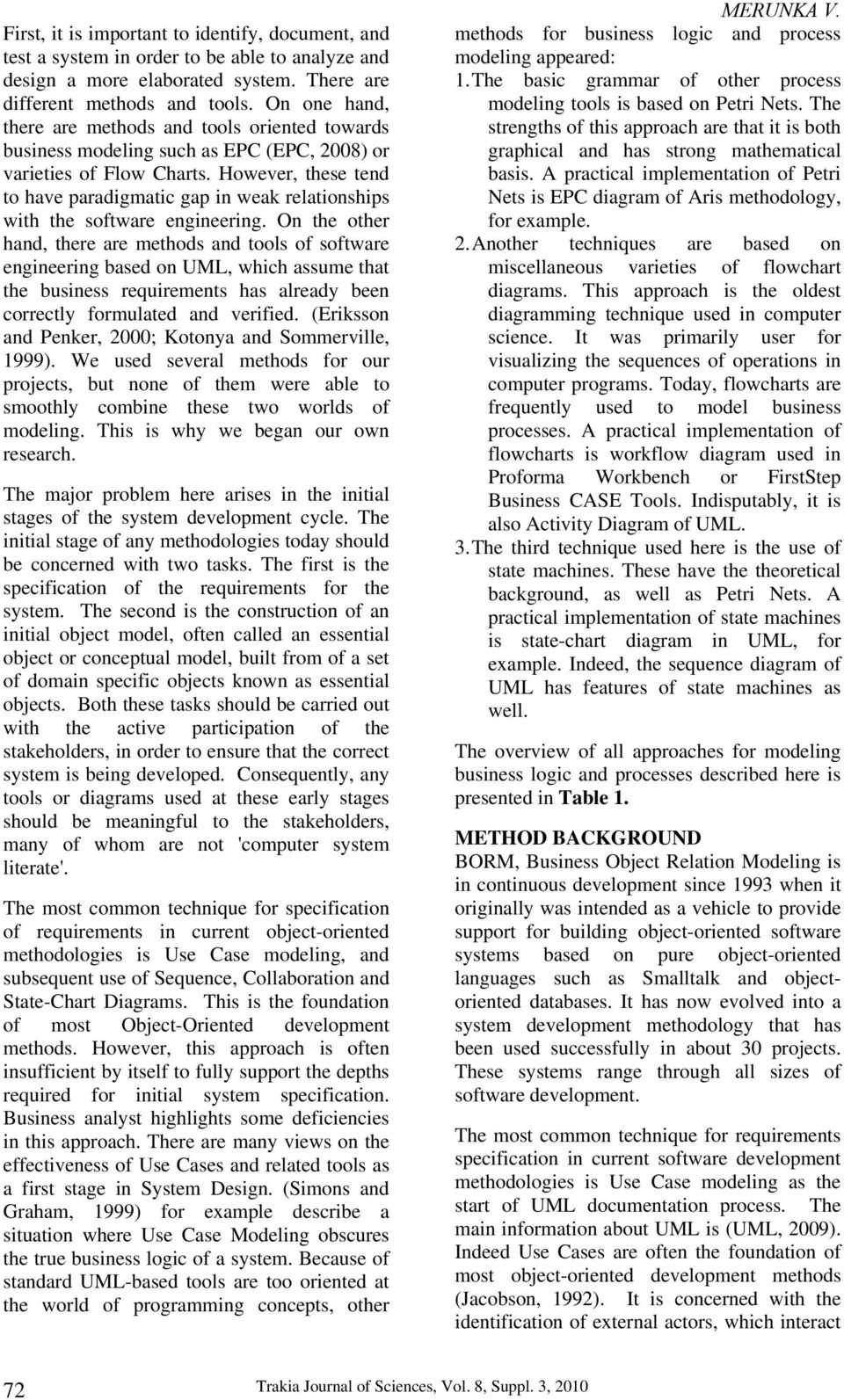
3 with the software part of the system. This means that in order to employ Use Case modeling, it is necessary to already know the system boundary and distinguish between entities, which are internal and external to that boundary. It is our experience that the correct identification of the system boundary is a nontrivial task, which often requires significant understanding of the proposed system and consequently can only successfully take place at the end of the requirements specification stage. Tab. 1. Business Modelling Paradigms approach theory behind advantages EPC - Aris Petri Nets very popular in Europe, perfectly supported by Aris CASE Tool, easy and comprehensible method for domain experts UML Activity Diagram UML sequence and statechart diagram Workflow Diagrams flowchart state machine flow chart industry standard, supported by many CASE tools industry standard, supported by many CASE tools easy and comprehensible method for domain experts, perfectly supported by many business CASE Tools disadvantages weak relation at subsequent software development techniques, slow analysis, low expressiveness of large models too software-oriented, difficult to understand by domain experts too software-oriented, difficult to understand by domain experts not very popular in Europe where Aris takes the dominant place, weak relation at subsequent software development techniques Other option is usage of some business engineering method such as EPC (EPC, 2009), miscellaneous Flow Charts etc. They work fine for business system analysis and design, but have poor support for subsequent software engineering activities, because there is a big semantic and conceptual gap between them and recent software modeling methods. This is the reason of frequent misunderstanding among business and software engineering people. Our experience in system modeling suggests that UML is not suitable for the first stages of analysis, where business processes need to be recognized. UML diagrams are too complex for the business community as they often contain too much detail concerning potential software implementations. This means classes, inheritance, public/private methods, attributes, link classes, etc. Here we got almost the same experience as documented in (Simone and Graham, 1999). We believe that the business community needs a simple yet expressive tool for modeling; able to play an equivalent role to that played by the Entity-Relation Diagrams, Data-Flows Diagrams or Flow-Charts over the past decades. One of the strengths of all these approaches was that they contained only a limited set of concepts (about five) and were comprehensible by problem domain experts after a few minutes of study. Unfortunately the UML/BPML approach lost this advantage of simplicity. That is why we developed the BORM process diagram and the way, how to start business system analysis in simple but precise method going smoothly from business analysis and simulation to detailed UML software design based on MDA principle. Our approach is to start with a small set of the business-level concepts, which can subsequently be transformed into more software-oriented concepts. Trakia Journal of Sciences, Vol. 8, Suppl. 3,
4 BORM fundaments The BORM methodology has been developed on academic grounds since the 1990s. It unifies the MDA principle, using an object-oriented paradigm and a unified approach to business and IT system modeling. For more on the BORM method, see (Knott et al., 2000; Liu and Roussev, 2006). MDA MDA defines an approach that separates a specification of business system description (CIM Computation Independent Model) from its computer implementation specification (PIM Platform Independent Model); and this computer specification from the final solution on a concrete technological platform (PSM Platform Specific Model). According to MDA, there is a mutual relationship between these three views, and the models should transform from one to another when a system is created. MDA is created and maintained by the Object Management Consortium (MDA, 2009). Object-oriented approach The OOP has its origins in the researching of GUI and programming languages, that took place in the 1970s. It differs from other software engineering approaches by incorporating non-traditional ways of thinking into the field of informatics. We look at systems by abstracting the real world in the same way as in ontological, philosophical streams. The basic element is an object that describes data structures and their behavior. In most other modeling approaches, data and behavior are described separately, and, to a certain extent, independently. OOP has been explained in many books, but we think that this one (Goldberg and Rubin, 1995) written by OOP pioneers belongs to the best. Automata theory The theory of automata is a study of abstract automatons and the problems they can solve. An automaton is a mathematical model for a device that reacts to its surroundings, gets an input, and provides an output. The automatons can be configured in a way that an output from one of them becomes an input for another of them. An automaton's behavior is defined by a combination of its internal state and its accepted input. The automata theory is a basis for system behavior descriptions. Its usage for modeling and simulation in software engineering activities has been written in (Shlaer and Mellor, 1992) and many newer publications. Business engineering business models The first part of the method covers the CIM field, i.e. business engineering. It transforms a project assignment into a model described by data hierarchies, process participants, process scenarios, various diagrams and generated reports. The main instrument of verification and validation is the process simulator. For the following purposes, it is possible to use this part of BORM without any relation to a software engineering phase: Organizational consultancy projects. These are process analysis, organizational structure analysis, and drafts for processes or organizational structure improvement. Projects documenting processes and organizational structure. These are, for instance, projects whose aim is knowledge management, creating training materials, knowledge visualization, etc. Projects for preparing the groundwork for selection procedures for organizational consultancy, or other consultancy services. Projects for preparing the groundwork for selection procedures for the delivery of information systems, or other software engineering projects. Software engineering conceptual models Second part of the BORM is PIM, i.e. conceptual modeling based on software engineering principles. It fluently relates to the preceding phase of business engineering, i.e. that the software system assignment is described as a business model, and is well tested and revised. It uses the same, or very similar terms and rules, as the preceding phase. It is unnecessary to learn any other method for either the first phase, or this phase. Apart from classical models in the UML standard, the Craft.CASE tool enables work to be carried out with concrete objects (class instances) and collections of concrete objects. An analyst can test a draft on a small prototype created from these concrete objects. The main instrument of verification and validation of this part of the method is a relationship to preceding parts of the method and option to work with concrete objects (class instances). 74 Trakia Journal of Sciences, Vol. 8, Suppl. 3, 2010

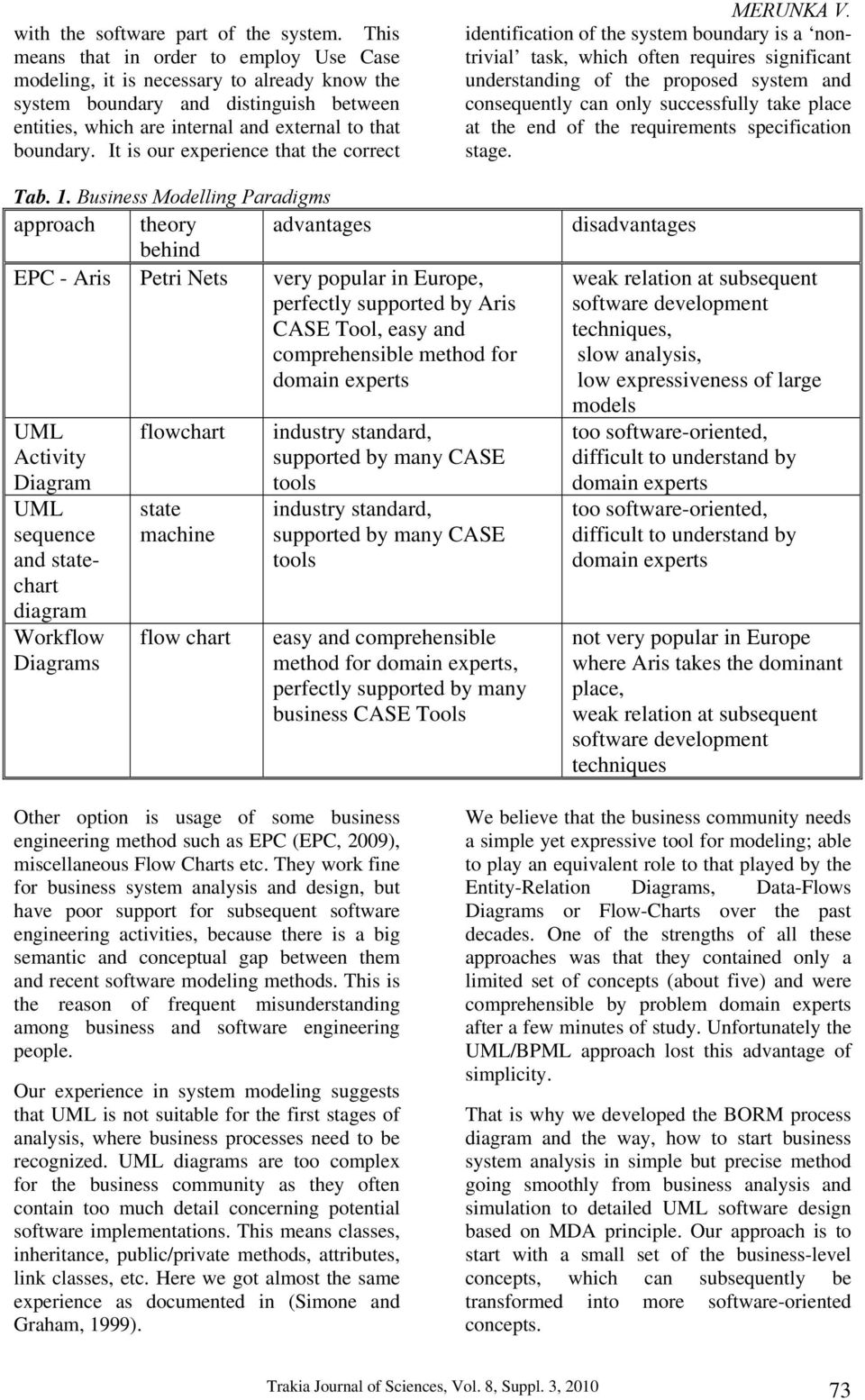
5 Two layers of a model Process approach and object orientation are the pillars of the BORM method. It is the application of principles that are successful in the field of modeling and software creation. The basis of the object approach is the notion that each action has an object that executes it; or, vice versa; that each object has a behavioral role in a model. It is impermissible to have an action without an object, or an object without an action. With object-oriented orientation, various process situations can be modeled: An object executes an action that influences the action of another object. Actions that could be decomposed into a sequence request-solution-result with a particular extent of various object participation. Modeling and analysis of process and organizational structure relations. Descriptions (requests) of new systems. The presence of information in a row (behavior, for example) indicates a necessity for new information in another row (subjects), and vice versa. It is advisable to proceed in both rows, step-by-step, whilst modeling. This interconnection of both rows prevents a "jamming" of the project after which an analyst would not know how to continue. 1. interview 2. st ruct ure 3. relations 4. testing 5. processes 6. validat ion 7. IT st ruct ure 8. IT models behavi or subj ects sket ch participants business archit ect ure participant relations business interactions consistency cross references business diagrams simulat ion & business cont ext classes & collections packages & subsyst ems concept ual diagrams Figure 1. BORM Method BORM interpretation of MDA In BORM (Figure 1 and 2), each concept has some of the following: 1. A Set of predecessor concepts from which it could be derived by an appropriate technique and a Set of successor concepts, which could be derived from it by an appropriate technique. 2. A validity Range - The phases where it is appropriate. In each phase of BORM modeling, only limited set of concepts is recommended. 3. A Set of techniques and rules, which guide the step-by-step transformation and the concept revisions between the system development phases. There are refactoring techniques, data normalization, design patterns and other programming-related techniques (Ambler, 1997) adopted for BORM concept transformations. Trakia Journal of Sciences, Vol. 8, Suppl. 3,

6 business engineering software engineering process model (business objects) participant participant (modeling card) conceptual model (conceptual objects) object collect ion object collect ion software model (software objects) object collect ion real world problem function, scenario ( CSF, goals, t arget s, issues) class states & transitions act ivit y (job posit ions, perf. measures, devices) communication message associat ion data flows (relat ionship tables) has-a class class method method message delegation message parameters & return values has-a composing object oriented solution relation dependency dependency dependency Computer Independent Model is-a hierarchy type hierachy polymorphism polymorphism Platf orm Independent Model inheritance inheritance OOPr ogenvi r onment Dependent Model Figure 2. MDA approach in evolution of BORM terms object-oriented software development example BORM business diagram BORM respects UML and MDA, but uses an original diagram for business process modeling. It conveys together information from three separate UML diagrams: state, communication and sequence. The BORM group has found that it is clearly understood by business stakeholders. Each subject participating in a process is displayed in its states and transitions. This diagram expresses all the possible process interactions between process participants. The business process itself consists of a sequence of particular communications and data flows among participating subjects. More formally, BORM process diagrams are graphical representations of interconnected Mealy-type finite state machines of particular subjects. Visual simulation of a business process is based on market-graph Petri net. Almost the same approach is described in detail by (Barjis and Reichgett, 2006). Therefore we can show states, transitions and operations for all subjects playing a role in a business process. This is a very powerful, yet simple diagram. There is an example of BORM business process diagram at Figure 3. It shows an invoice processing. There are six participating subjects in this process: Supplier, Invoice Registration Department, Store Department, Account Payable Department, SAP and Bank. The small rectangles within these subjects are their states. The ovals within subjects are their activities, which are conceivable as the transitions between the states as well. The big arrows between subjects are the subject communications, and the very small arrows are the data flows. CRAFT. CASE MODELING TOOL At first, we attempted to use the existing tools and adapted them for BORM. Our experience covers Microsoft Visio and MetaEdit. (Metacase, 2009) However, we found that none of them allowed us to model, test and simulate in the way we needed. The Craft.CASE tool has been designed according to state-of-the-art principles of object-oriented software development, and uses a special Smalltalk programming language technology that has been evolving since the 1970's. The program consists of many user functions, has its own internal 76 Trakia Journal of Sciences, Vol. 8, Suppl. 3, 2010
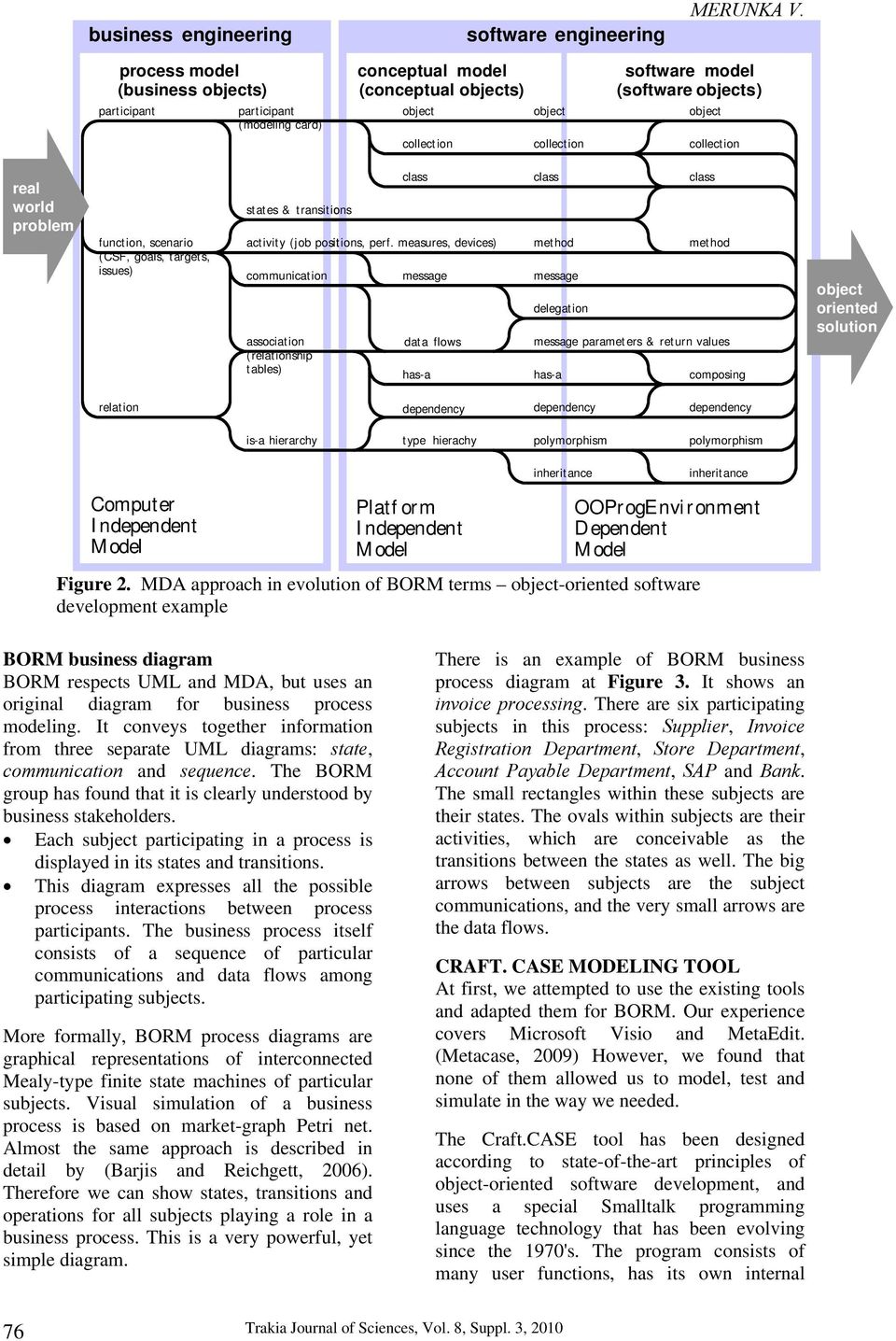
7 object-oriented database, several graphic editors and a programmable interface. The Craft.CASE tool provides all instruments for CIM (as business models) and PIM (as conceptual models), including their mutual interconnection and the possibility to undertake thorough testing. (Craftcase, 2009) Figure 3. Business Process Example The Craft.CASE can be used in process and organizational consultancy and in analytical projects and information system drafts while identifying requests on newly designed systems; also in component modeling and service oriented architecture. It works with a system model and its processes in an original way that is based on: An ability not only to visualize processes and systems in the form of diagrams, but also to test them by means of crossreferences and graphic simulations. An ability to model not only symbolic terms (for example, a customer, order, payment, etc.) as drawn symbols in a diagram, but also the possibility of working with real objects (several concrete customers, orders, payments, etc. that differ in their real values such as a date, name, price, etc.). Craft.CASE supports both class-level and instance-level of modeling. A method having diagrams as the result of a gradual deriving and checking. Craft.CASE implements an original approach called C.C method. The C.C method combines majority of CIM and PIM parts of BORM with concept transformations via business process simulators, instance-level modeling and set of transformation rules describing how to derive subsequent concepts from previous ones. Moreover, in each step of the C.C method, Craft.CASE keeps consistency between two layers of a model; subjects and behaviors. Thanks to metamodel background and system internal procedures, there is rigidly checked, whether all subjects from the first layer (e.g. classes, object states, packages etc.) have corresponding behaviors from the second layer (e.g. scenarios, use-cases, operations etc.) and vice versa. More information about Craft.CASE such as its programming facilities, metamodel etc. is described in (Merunka et al., 2008). Analysts would much rather hear "I don't want this" from a client or prospective user while projecting a system, than "I didn't want that" after having completed the project. This is why Trakia Journal of Sciences, Vol. 8, Suppl. 3,

8 during modeling, it is important to have an opportunity to test, verify and validate the system and its processes. Proper testing includes visualization and simulation - not only with abstract terms, but also with real objects of the modeled system at the instance level. EXAMPLE Our example of modeling using Craft.CASE is to model an information system for a company called FD (Food Delivery); dealing with food products delivered from suppliers to local customers. A typical example of such activity is shopping and delivering the goods to a home, or home delivery of pastries and milk and similar products. The information system is primary designed for communication between a company and its delivery employees. It also provides an information portal for customers to whom the products are to be delivered. Project initiation The first stage of business modeling is the initiation of work on a project. At the beginning of this phase there are interviews, and then an initial structure and relations are modeled. The testing of generated reports is executed as the final part of this stage. Interview Since kick-off meeting with the client, we have negotiated that the project should focus on ordering a meal through a customer process. The client expressed a preference for communication with customers via web pages. The client also wants work activity descriptions for the logistics manager and van drivers. Figure 4. Record of kick-off meeting interview free drawing in Craft.CASE The client wishes to enable its customers to choose a delivery time based on a calendar of scheduled delivery routes that have been prepared in advance. Its advantage over the competition is in offering different prices for different deliveries that differ in date and hour; allowing customers to choose between either a cheaper, or a more convenient delivery time. Business modeling (Computer-Independent Model) Structure Structure definition is the first formal step of the method. An analyst should be capable of finding key subjects and process fields on the basis of performed interviews. Participants Based on the scope of the project and the allowed project time, eight participants were found (table 2). These are the job positions of the logistics manager and the van driver, as well as future software components of the web interface and database system; and, of course, a customer and some suppliers, since they take part in the processes. 78 Trakia Journal of Sciences, Vol. 8, Suppl. 3, 2010
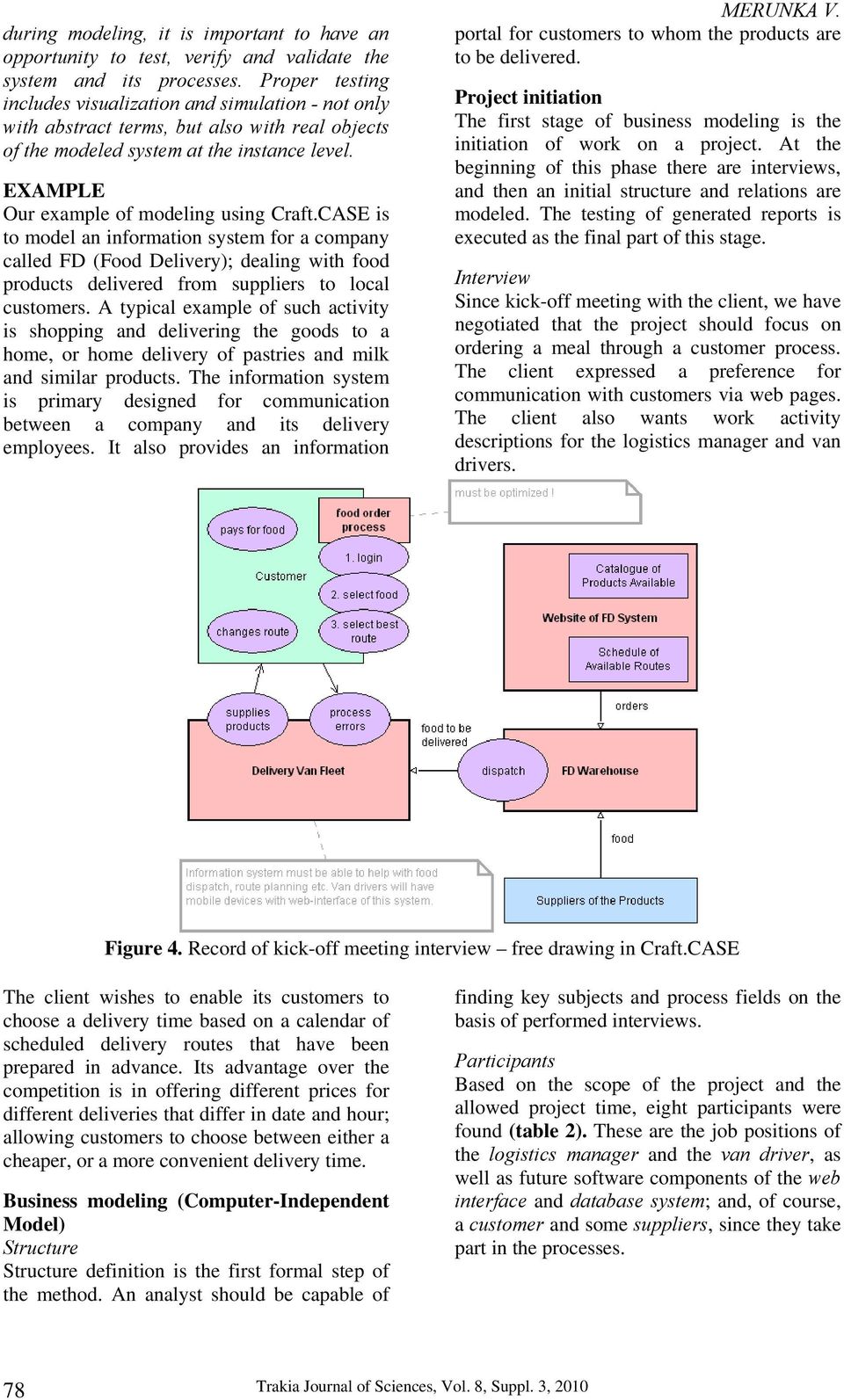
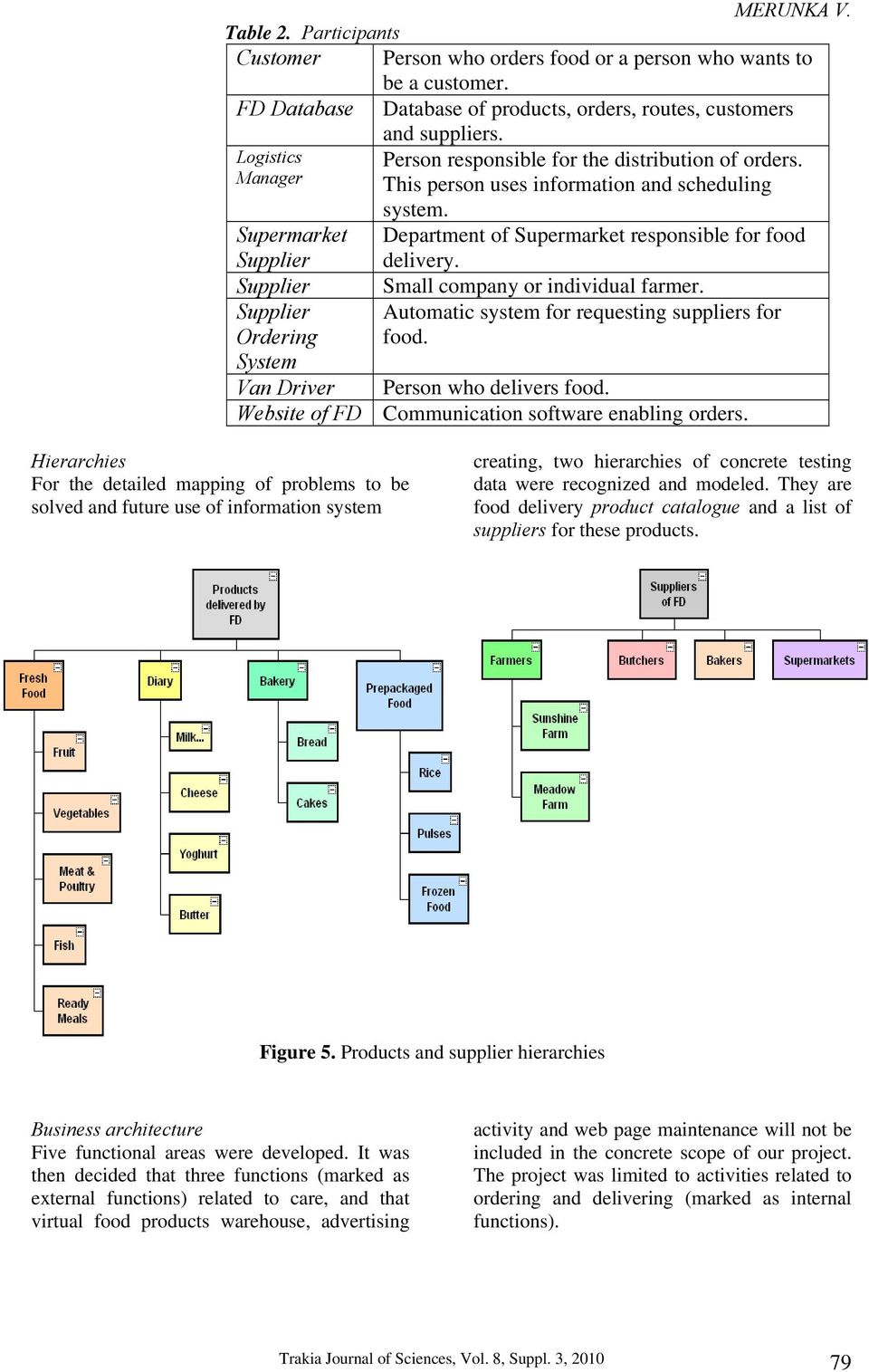
9 Table 2. Participants Customer Person who orders food or a person who wants to be a customer. FD Database Database of products, orders, routes, customers and suppliers. Logistics Person responsible for the distribution of orders. Manager This person uses information and scheduling system. Supermarket Department of Supermarket responsible for food Supplier delivery. Supplier Supplier Ordering System Small company or individual farmer. Automatic system for requesting suppliers for food. Van Driver Person who delivers food. Website of FD Communication software enabling orders. Hierarchies For the detailed mapping of problems to be solved and future use of information system creating, two hierarchies of concrete testing data were recognized and modeled. They are food delivery product catalogue and a list of suppliers for these products. Figure 5. Products and supplier hierarchies Business architecture Five functional areas were developed. It was then decided that three functions (marked as external functions) related to care, and that virtual food products warehouse, advertising activity and web page maintenance will not be included in the concrete scope of our project. The project was limited to activities related to ordering and delivering (marked as internal functions). Trakia Journal of Sciences, Vol. 8, Suppl. 3,
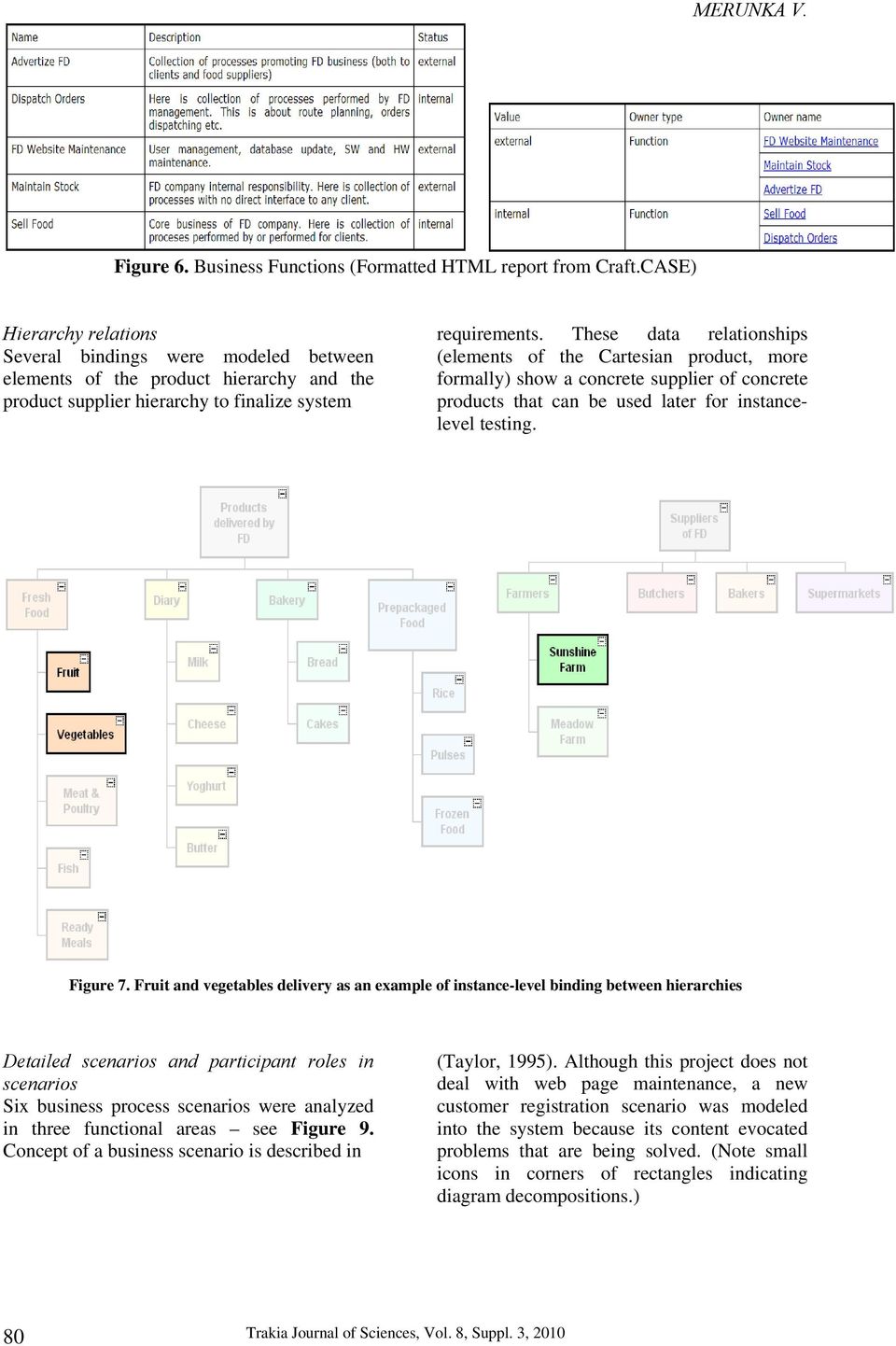
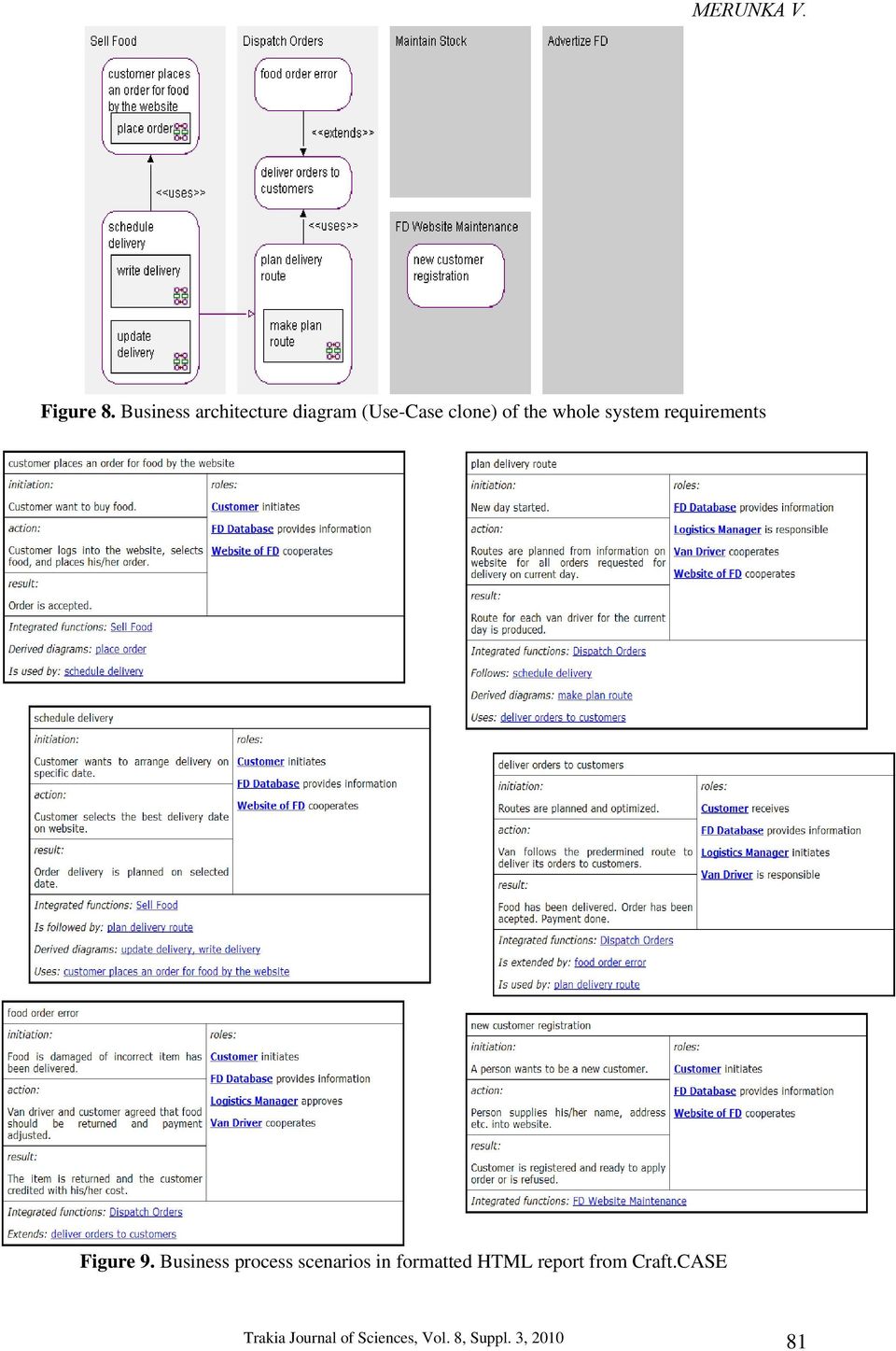
10 Figure 6. Business Functions (Formatted HTML report from Craft.CASE) Hierarchy relations Several bindings were modeled between elements of the product hierarchy and the product supplier hierarchy to finalize system requirements. These data relationships (elements of the Cartesian product, more formally) show a concrete supplier of concrete products that can be used later for instancelevel testing. Figure 7. Fruit and vegetables delivery as an example of instance-level binding between hierarchies Detailed scenarios and participant roles in scenarios Six business process scenarios were analyzed in three functional areas see Figure 9. Concept of a business scenario is described in (Taylor, 1995). Although this project does not deal with web page maintenance, a new customer registration scenario was modeled into the system because its content evocated problems that are being solved. (Note small icons in corners of rectangles indicating diagram decompositions.) 80 Trakia Journal of Sciences, Vol. 8, Suppl. 3, 2010
11 Figure 8. Business architecture diagram (Use-Case clone) of the whole system requirements Figure 9. Business process scenarios in formatted HTML report from Craft.CASE Trakia Journal of Sciences, Vol. 8, Suppl. 3,
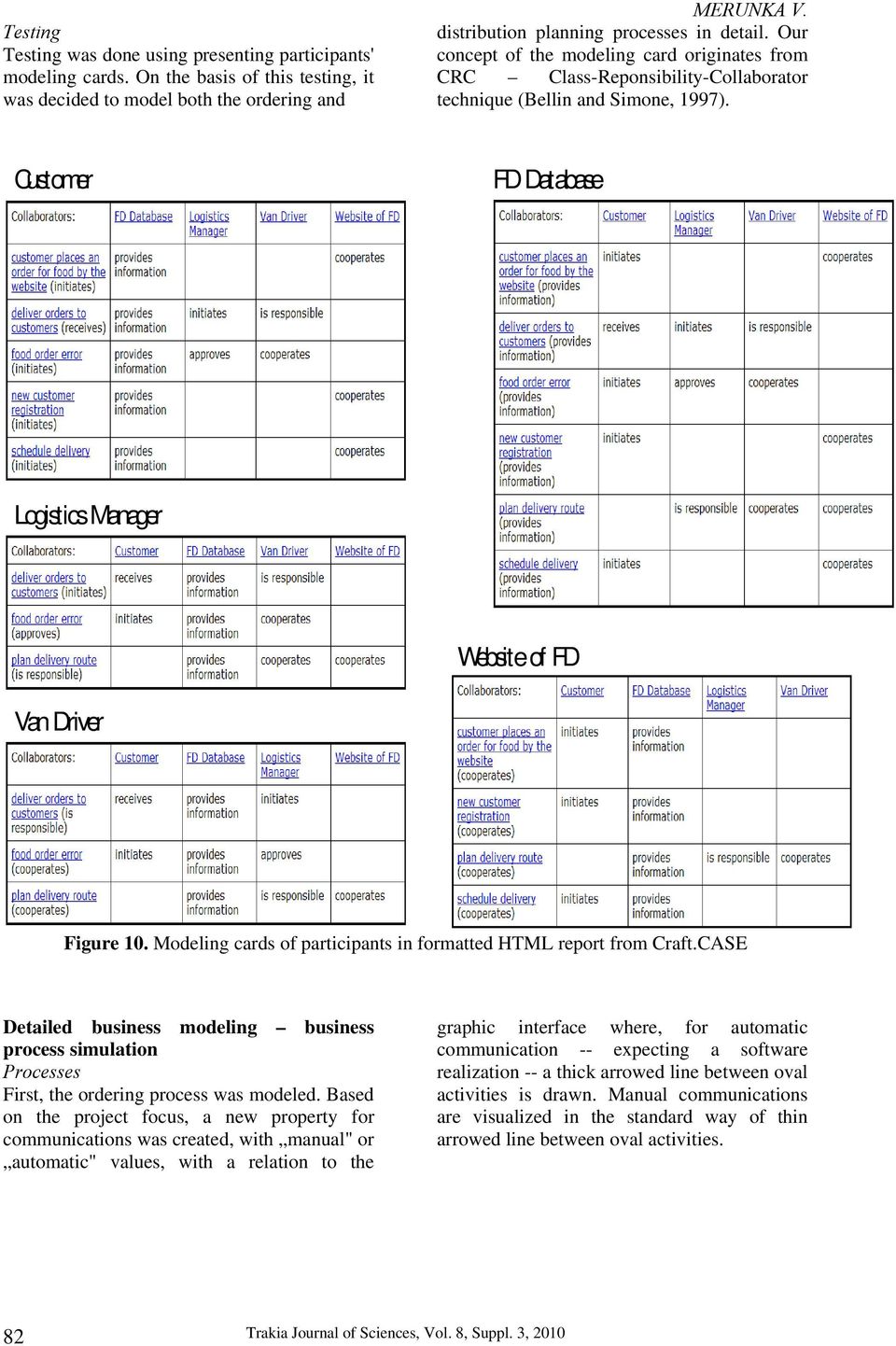
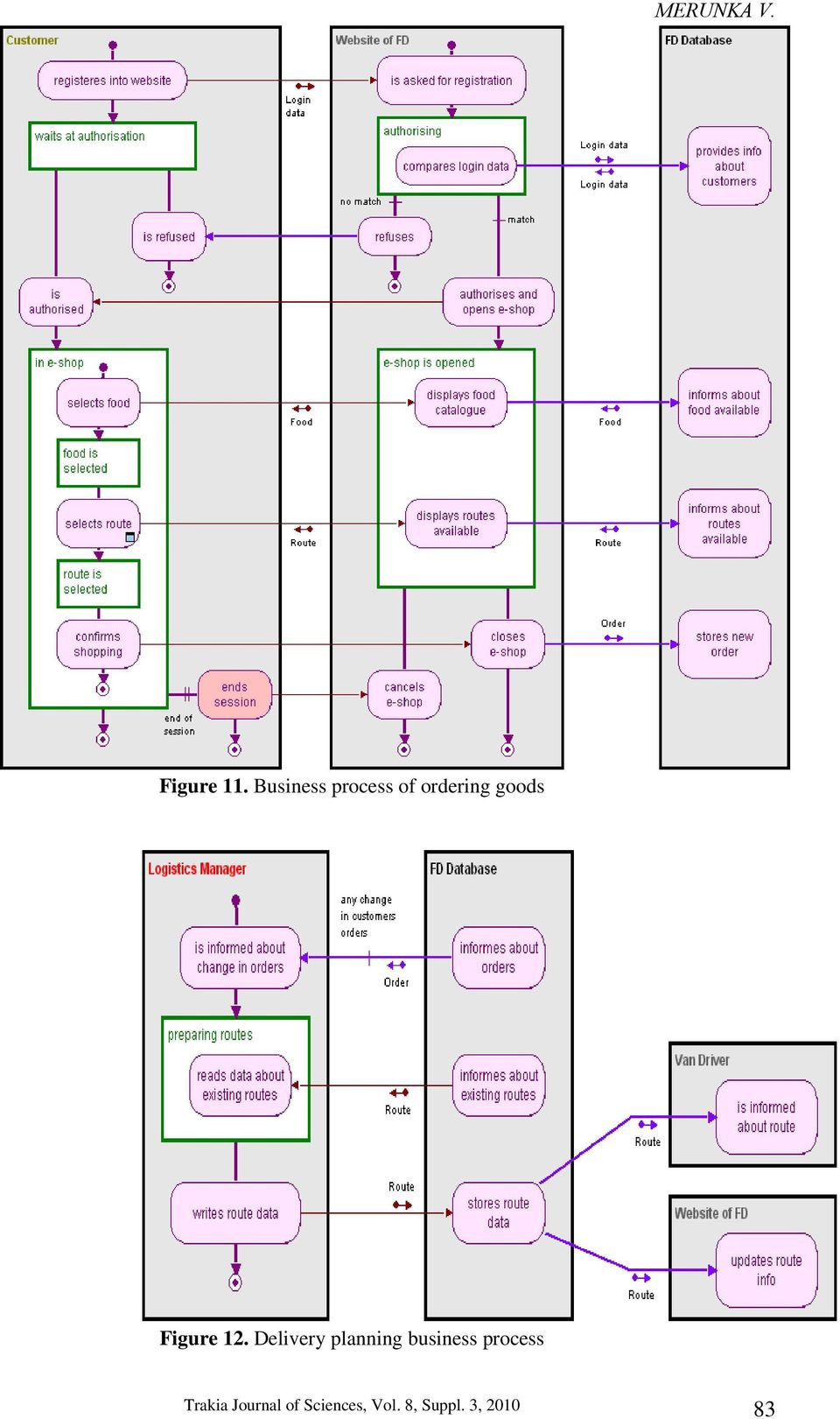
12 Testing Testing was done using presenting participants' modeling cards. On the basis of this testing, it was decided to model both the ordering and distribution planning processes in detail. Our concept of the modeling card originates from CRC Class-Reponsibility-Collaborator technique (Bellin and Simone, 1997). Customer FD Database Logistics Manager Website of FD Van Driver Figure 10. Modeling cards of participants in formatted HTML report from Craft.CASE Detailed business modeling business process simulation Processes First, the ordering process was modeled. Based on the project focus, a new property for communications was created, with manual" or automatic" values, with a relation to the graphic interface where, for automatic communication -- expecting a software realization -- a thick arrowed line between oval activities is drawn. Manual communications are visualized in the standard way of thin arrowed line between oval activities. 82 Trakia Journal of Sciences, Vol. 8, Suppl. 3, 2010
13 Figure 11. Business process of ordering goods Figure 12. Delivery planning business process Trakia Journal of Sciences, Vol. 8, Suppl. 3,
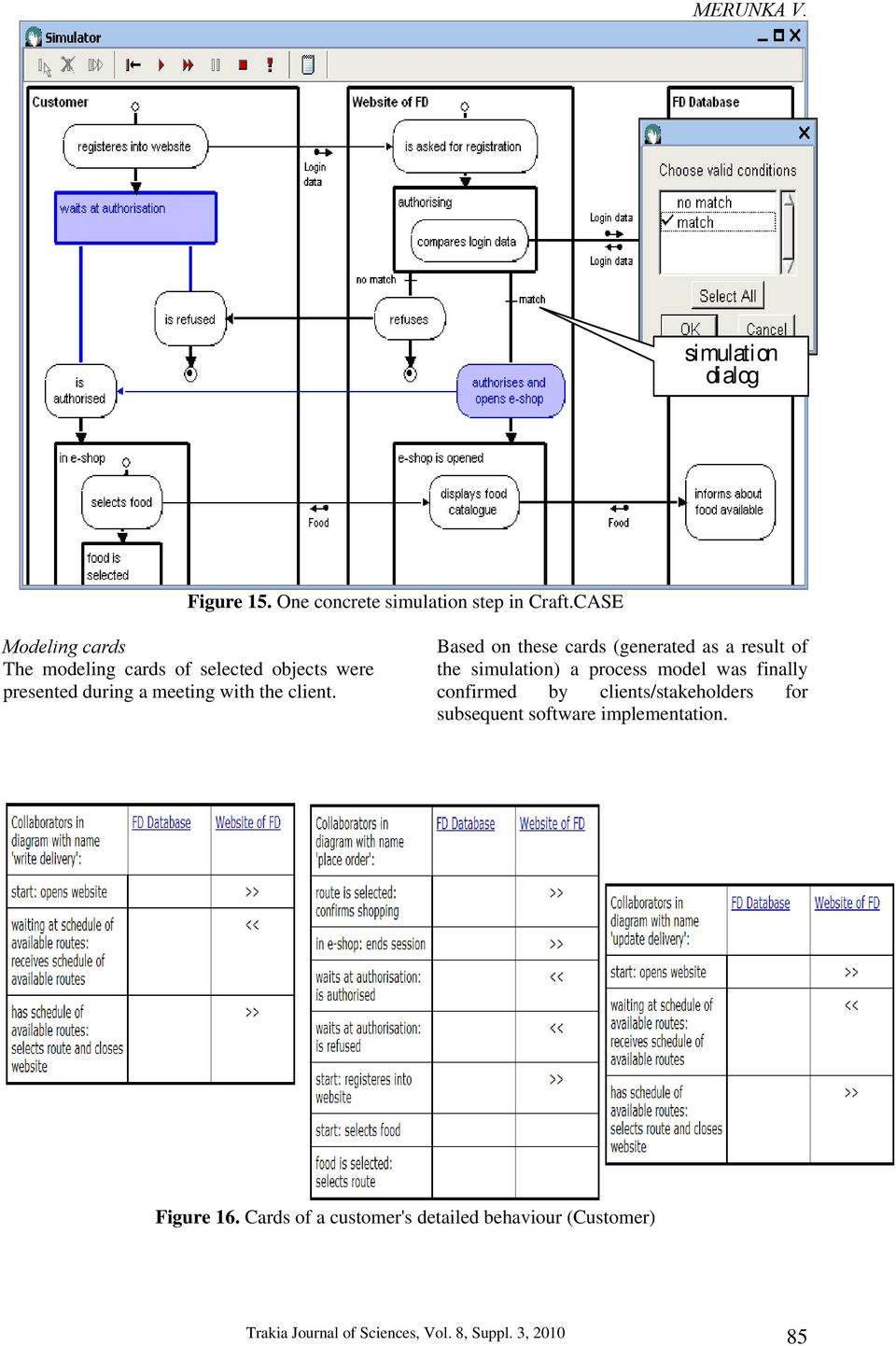
14 Figure 13. Sub-process of delivery ordering by a customer Figure 14. Sub-process of delivery adjustment by a customer Process testing Detailed modeling cards and a simulator were used for testing in this step. Craft.CASE simulator displays particular simulation steps and allows dialogue with the user. 84 Trakia Journal of Sciences, Vol. 8, Suppl. 3, 2010

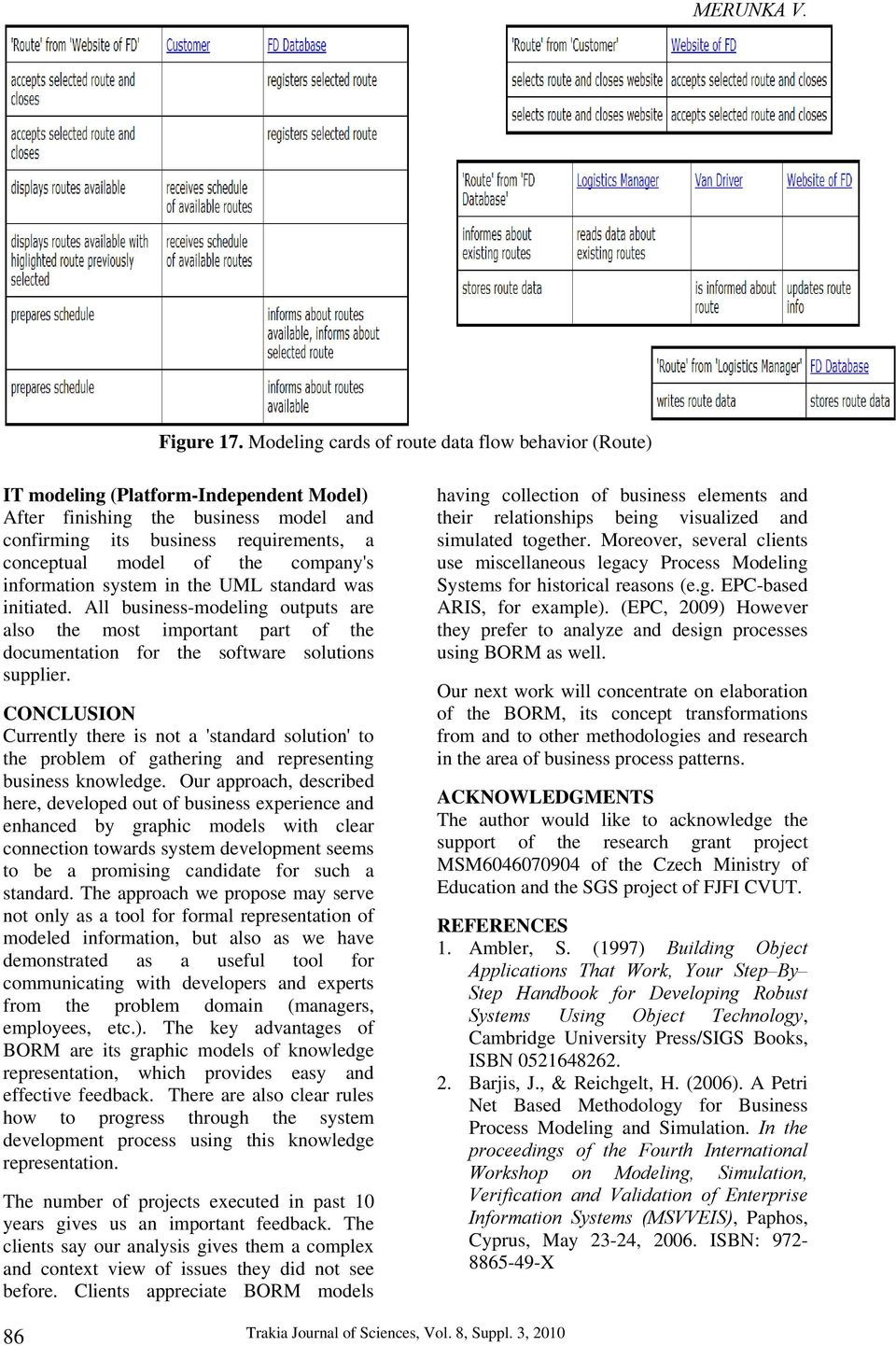
15 simulation di alog Figure 15. One concrete simulation step in Craft.CASE Modeling cards The modeling cards of selected objects were presented during a meeting with the client. Based on these cards (generated as a result of the simulation) a process model was finally confirmed by clients/stakeholders for subsequent software implementation. Figure 16. Cards of a customer's detailed behaviour (Customer) Trakia Journal of Sciences, Vol. 8, Suppl. 3,
16 Figure 17. Modeling cards of route data flow behavior (Route) IT modeling (Platform-Independent Model) After finishing the business model and confirming its business requirements, a conceptual model of the company's information system in the UML standard was initiated. All business-modeling outputs are also the most important part of the documentation for the software solutions supplier. CONCLUSION Currently there is not a 'standard solution' to the problem of gathering and representing business knowledge. Our approach, described here, developed out of business experience and enhanced by graphic models with clear connection towards system development seems to be a promising candidate for such a standard. The approach we propose may serve not only as a tool for formal representation of modeled information, but also as we have demonstrated as a useful tool for communicating with developers and experts from the problem domain (managers, employees, etc.). The key advantages of BORM are its graphic models of knowledge representation, which provides easy and effective feedback. There are also clear rules how to progress through the system development process using this knowledge representation. The number of projects executed in past 10 years gives us an important feedback. The clients say our analysis gives them a complex and context view of issues they did not see before. Clients appreciate BORM models having collection of business elements and their relationships being visualized and simulated together. Moreover, several clients use miscellaneous legacy Process Modeling Systems for historical reasons (e.g. EPC-based ARIS, for example). (EPC, 2009) However they prefer to analyze and design processes using BORM as well. Our next work will concentrate on elaboration of the BORM, its concept transformations from and to other methodologies and research in the area of business process patterns. ACKNOWLEDGMENTS The author would like to acknowledge the support of the research grant project MSM of the Czech Ministry of Education and the SGS project of FJFI CVUT. REFERENCES 1. Ambler, S. (1997) Building Object Applications That Work, Your Step By Step Handbook for Developing Robust Systems Using Object Technology, Cambridge University Press/SIGS Books, ISBN Barjis, J., & Reichgelt, H. (2006). A Petri Net Based Methodology for Business Process Modeling and Simulation. In the proceedings of the Fourth International Workshop on Modeling, Simulation, Verification and Validation of Enterprise Information Systems (MSVVEIS), Paphos, Cyprus, May 23-24, ISBN: X 86 Trakia Journal of Sciences, Vol. 8, Suppl. 3, 2010
17 3. Bellin, D., Simone, S. S. (1997) The CRC Card Book, Addison Wesley, ISBN Catell, R. G. G. (1994) The Object Database Standard ODMG93, Morgan Kaufman Publishers, ISBN Craft.CASE (2009) - Business Process Modeling, 6. Darnton, G. and Darnton, M. (1997) Business Process Analysis, International Thomson Publishing, ISBN Eriksson, H. and Penker, M. (2000) Business Modeling with UML, John Wiley and Sons, ISBN EPC Event-driven Process Chain (2009), 9. Goldberg, A. and Rubin, K. S. (1995) Succeeding with Objects Decision Frameworks for Project Management, Addison Wesley, ISBN Hall, J. A. (2008) Accounting Information Systems, Cengage Learning EMEA, ISBN Jacobson, I. (1992) Object Oriented Software Engineering A Use Case Driven Approach, Addison Wesley, ISBN Knott, R. P., Merunka, V., Polak, J. (2000) Process Modeling for Object Oriented Analysis using BORM Object Behavioral Analysis, Proceedings of Fourth International Conference on Requirements Engineering ICRE 2000, Chicago, USA, IEEE Computer Society Press, ISBN Kotonya, G. and Sommerville, I. (1999) Requirements Engineering: Processes and Techniques, John Wiley and Sons, ISBN Liu, L. and Roussev, B. (2006) Management of the Object oriented Development Process, Idea Group Inc, ISBN MDA The Model Driven Architecture, OMG The Object Management Group (2009), Merunka, V., Brozek, J., Nouza, O. (2008) Automated Model Transformations Using the C.C Language, Proceedings of the International conference EOMAS 2008, June 16 17, Montpellier, France, Springer LNBIP 2008, ISSN MetaCase - Domain-Specific Modeling with MetaEdit+ (2009), Simone A. J. H. and Graham, I. (1999) 30 Things that go wrong in Object Modeling with UML, chapter 17 in: Behavioral Specifications of Businesses and Systems eds. H Kilov, B Rumpe, I Simmonds (Kluwer Academic Publishers), Shlaer, S. Mellor, S (1992) Object Lifecycles: Modeling the World in States, Yourdon Press, ISBN Taylor, D. A. (1995) Business Engineering with Object Technology, John Wiley and Sons, ISBN The UML standard, OMG The Object Management Group (2009), ISO/IEC Yourdon, E. (1995) Mainstream Objects An Analysis and Design Approach for Business, Prentice Hall, ISBN Trakia Journal of Sciences, Vol. 8, Suppl. 3,

Chap 1. Introduction to Software Architecture
 Chap 1. Introduction to Software Architecture 1. Introduction 2. IEEE Recommended Practice for Architecture Modeling 3. Architecture Description Language: the UML 4. The Rational Unified Process (RUP)
Towards an Integration of Business Process Modeling and Object-Oriented Software Development
 Towards an Integration of Business Process Modeling and Object-Oriented Software Development Peter Loos, Peter Fettke Chemnitz Univeristy of Technology, Chemnitz, Germany {loos peter.fettke}@isym.tu-chemnitz.de
From Business World to Software World: Deriving Class Diagrams from Business Process Models
 From Business World to Software World: Deriving Class Diagrams from Business Process Models WARARAT RUNGWORAWUT 1 AND TWITTIE SENIVONGSE 2 Department of Computer Engineering, Chulalongkorn University 254
Masters of Science in Software & Information Systems
 Masters of Science in Software & Information Systems To be developed and delivered in conjunction with Regis University, School for Professional Studies Object Oriented Design Table of Contents January
PROJECT MANAGEMENT METHODOLOGY OF OBJECT- ORIENTED SOFTWARE DEVELOPMENT
 PROJECT MANAGEMENT METHODOLOGY OF OBJECT- ORIENTED SOFTWARE DEVELOPMENT Ing. David BEDNÁŘ, Doctoral Degree Programme (2) Dept. of Information Systems, FIT, BUT E-mail: [email protected] Supervised by:
Systematization of Requirements Definition for Software Development Processes with a Business Modeling Architecture
 Systematization of Requirements Definition for Software Development Processes with a Business Modeling Architecture Delmir de Azevedo Junior 1 and Renato de Campos 2 1 Petrobras University, Republican
The BPM to UML activity diagram transformation using XSLT
 The BPM to UML activity diagram transformation using XSLT Ondřej Macek 1 and Karel Richta 1,2 1 Department of Computer Science and Engineering, Faculty of Electrical Engineering, Czech Technical University,
The role of integrated requirements management in software delivery.
 Software development White paper October 2007 The role of integrated requirements Jim Heumann, requirements evangelist, IBM Rational 2 Contents 2 Introduction 2 What is integrated requirements management?
QUALITY TOOLBOX. Understanding Processes with Hierarchical Process Mapping. Robert B. Pojasek. Why Process Mapping?
 QUALITY TOOLBOX Understanding Processes with Hierarchical Process Mapping In my work, I spend a lot of time talking to people about hierarchical process mapping. It strikes me as funny that whenever I
TOGAF usage in outsourcing of software development
 Acta Informatica Pragensia 2(2), 2013, 68 76, DOI: 10.18267/j.aip.25 Section: Online: aip.vse.cz Peer-reviewed papers TOGAF usage in outsourcing of software development Aziz Ahmad Rais 1, Rudolf Pecinovsky
Using Use Cases for requirements capture. Pete McBreen. 1998 McBreen.Consulting
 Using Use Cases for requirements capture Pete McBreen 1998 McBreen.Consulting [email protected] All rights reserved. You have permission to copy and distribute the document as long as you make no changes
Automatic Generation Between UML and Code. Fande Kong and Liang Zhang Computer Science department
 Automatic Generation Between UML and Code Fande Kong and Liang Zhang Computer Science department Outline The motivation why we need to do the generation between the UML and code. What other people have
Software Engineering. System Models. Based on Software Engineering, 7 th Edition by Ian Sommerville
 Software Engineering System Models Based on Software Engineering, 7 th Edition by Ian Sommerville Objectives To explain why the context of a system should be modeled as part of the RE process To describe
Applying MDA in Developing Intermediary Service for Data Retrieval
 Applying MDA in Developing Intermediary Service for Data Retrieval Danijela Boberić Krstićev University of Novi Sad Faculty of Sciences Trg Dositeja Obradovića 4, Novi Sad Serbia +381214852873 [email protected]
Business Modeling with UML
 Business Modeling with UML Hans-Erik Eriksson and Magnus Penker, Open Training Hans-Erik In order to keep up and be competitive, all companies Ericsson is and enterprises must assess the quality of their
Assuming the Role of Systems Analyst & Analysis Alternatives
 Assuming the Role of Systems Analyst & Analysis Alternatives Nature of Analysis Systems analysis and design is a systematic approach to identifying problems, opportunities, and objectives; analyzing the
Business Process Modeling and Standardization
 Business Modeling and Standardization Antoine Lonjon Chief Architect MEGA Content Introduction Business : One Word, Multiple Arenas of Application Criteria for a Business Modeling Standard State of the
Enterprise Architecture 101. (Includes numerous samples/ templates produced using TOGAF methodology) Shail Sood
 Enterprise Architecture 101 (Includes numerous samples/ templates produced using TOGAF methodology) Enterprise Architecture Key Question What is Enterprise Architecture? Why Enterprise Architecture? What
Algorithms, Flowcharts & Program Design. ComPro
 Algorithms, Flowcharts & Program Design ComPro Definition Algorithm: o sequence of steps to be performed in order to solve a problem by the computer. Flowchart: o graphical or symbolic representation of
The Software Process. The Unified Process (Cont.) The Unified Process (Cont.)
 The Software Process Xiaojun Qi 1 The Unified Process Until recently, three of the most successful object-oriented methodologies were Booch smethod Jacobson s Objectory Rumbaugh s OMT (Object Modeling
A UML Introduction Tutorial
 A UML Introduction Tutorial 1/27/08 9:55 PM A UML Introduction Tutorial In this tutorial you will learn about the fundamentals of object oriented modelling, the Unified Modelling Language and the software
Applying 4+1 View Architecture with UML 2. White Paper
 Applying 4+1 View Architecture with UML 2 White Paper Copyright 2007 FCGSS, all rights reserved. www.fcgss.com Introduction Unified Modeling Language (UML) has been available since 1997, and UML 2 was
Phase 2 Systems Analysis. Dr. Feng-Jen Yang
 Phase 2 Systems Analysis Dr. Feng-Jen Yang Phase Description Systems analysis is the 2nd phase in the systems development life cycle (SDLC) Use requirements modeling, data and process modeling, and object
A UML 2 Profile for Business Process Modelling *
 A UML 2 Profile for Business Process Modelling * Beate List and Birgit Korherr Women s Postgraduate College for Internet Technologies Institute of Software Technology and Interactive Systems Vienna University
How To Design An Information System
 Information system for production and mounting of plastic windows MARCEL, MELIŠ Slovak University of Technology - Faculty of Material Sciences and Technology in Trnava, Paulínska 16 street, Trnava, 917
Chapter 3. Technology review. 3.1. Introduction
 Technology review Chapter 3 3.1. Introduction Previous chapter covers detail description about problem domain. In this chapter I will discuss the technologies currently available to solve a problem in
Fundamentals of Information Systems, Fifth Edition. Chapter 8 Systems Development
 Fundamentals of Information Systems, Fifth Edition Chapter 8 Systems Development Principles and Learning Objectives Effective systems development requires a team effort of stakeholders, users, managers,
Normalization Rules of the Object-Oriented Data Model
 Normalization Rules of the Object-Oriented Data Model Vojt ch Merunka 1,2, Ji í Broºek 1, Martin ebek 1, and Martin Molhanec 2 1 Czech University of Life Sciences Prague, Faculty of Economics and Management,
Introduction to Systems Analysis and Design
 Introduction to Systems Analysis and Design What is a System? A system is a set of interrelated components that function together to achieve a common goal. The components of a system are called subsystems.
Johannes Sametinger. C. Doppler Laboratory for Software Engineering Johannes Kepler University of Linz A-4040 Linz, Austria
 OBJECT-ORIENTED DOCUMENTATION C. Doppler Laboratory for Software Engineering Johannes Kepler University of Linz A-4040 Linz, Austria Abstract Object-oriented programming improves the reusability of software
A Comparison of SOA Methodologies Analysis & Design Phases
 202 A Comparison of SOA Methodologies Analysis & Design Phases Sandra SVANIDZAITĖ Institute of Mathematics and Informatics, Vilnius University Abstract. Service oriented computing is a new software engineering
Information systems modelling UML and service description languages
 Internet Engineering Tomasz Babczyński, Zofia Kruczkiewicz Tomasz Kubik Information systems modelling UML and service description languages Student Contact Hours: 25.02.2015- Location: 325 C3 room 25.03.2015:
CHAPTER 1: INTRODUCTION TO RAPID APPLICATION DEVELOPMENT (RAD)
 CHAPTER 1: INTRODUCTION TO RAPID APPLICATION DEVELOPMENT (RAD) 1. INTRODUCTIONS RAD refers to a development life cycle designed Compare to traditional life cycle it is Faster development with higher quality
MEASURING SOFTWARE FUNCTIONAL SIZE FROM BUSINESS PROCESS MODELS
 International Journal of Software Engineering and Knowledge Engineering World Scientific Publishing Company MEASURING SOFTWARE FUNCTIONAL SIZE FROM BUSINESS PROCESS MODELS CARLOS MONSALVE CIDIS-FIEC, Escuela
Software Engineering. System Modeling
 Software Engineering System Modeling 1 System modeling System modeling is the process of developing abstract models of a system, with each model presenting a different view or perspective of that system.
Revealing the Big Picture Using Business Process Management
 Revealing the Big Picture Using Business Process Management Page 1 of 20 Page 2 of 20 Introduction In today s business environment, change is inevitable. Changes in technology, organizational structure,
Chapter 4: Tools of Modern Systems Analysis
 Just Enough Structured Analysis Chapter 4: Tools of Modern Systems Analysis Nature has... some sort of arithmetical-geometrical coordinate system, because nature has all kinds of models. What we experience
DEVELOPING REQUIREMENTS FOR DATA WAREHOUSE SYSTEMS WITH USE CASES
 DEVELOPING REQUIREMENTS FOR DATA WAREHOUSE SYSTEMS WITH USE CASES Robert M. Bruckner Vienna University of Technology [email protected] Beate List Vienna University of Technology [email protected]
Contents. Introduction and System Engineering 1. Introduction 2. Software Process and Methodology 16. System Engineering 53
 Preface xvi Part I Introduction and System Engineering 1 Chapter 1 Introduction 2 1.1 What Is Software Engineering? 2 1.2 Why Software Engineering? 3 1.3 Software Life-Cycle Activities 4 1.3.1 Software
Announcements. SE 1: Software Requirements Specification and Analysis. Review: Use Case Descriptions
 Announcements SE 1: Software Requirements Specification and Analysis Lecture 4: Basic Notations Nancy Day, Davor Svetinović http://www.student.cs.uwaterloo.ca/ cs445/winter2006 uw.cs.cs445 Send your group
A flowchart is not a state machine
 A flowchart is not a state machine Introduction There are several methods, models and tools used to describe control systems. Some examples are: state machines, Petri nets, Statecharts, flowcharts. Though
Enterprise Resource Planning Analysis of Business Intelligence & Emergence of Mining Objects
 Enterprise Resource Planning Analysis of Business Intelligence & Emergence of Mining Objects Abstract: Build a model to investigate system and discovering relations that connect variables in a database
Rules and Business Rules
 OCEB White Paper on Business Rules, Decisions, and PRR Version 1.1, December 2008 Paul Vincent, co-chair OMG PRR FTF TIBCO Software Abstract The Object Management Group s work on standards for business
A Process is Not Just a Flowchart (or a BPMN model)
 A Process is Not Just a Flowchart (or a BPMN model) The two methods of representing process designs that I see most frequently are process drawings (typically in Microsoft Visio) and BPMN models (and often
BPMN PATTERNS USED IN MANAGEMENT INFORMATION SYSTEMS
 BPMN PATTERNS USED IN MANAGEMENT INFORMATION SYSTEMS Gabriel Cozgarea 1 Adrian Cozgarea 2 ABSTRACT: Business Process Modeling Notation (BPMN) is a graphical standard in which controls and activities can
ISSUES OF STRUCTURED VS. OBJECT-ORIENTED METHODOLOGY OF SYSTEMS ANALYSIS AND DESIGN
 ISSUES OF STRUCTURED VS. OBJECT-ORIENTED METHODOLOGY OF SYSTEMS ANALYSIS AND DESIGN Mohammad A. Rob, University of Houston-Clear Lake, [email protected] ABSTRACT In recent years, there has been a surge of
Foundations of Model-Driven Software Engineering
 Model-Driven Software Engineering Foundations of Model-Driven Software Engineering Dr. Jochen Küster ([email protected]) Contents Introduction to Models and Modeling Concepts of Model-Driven Software
UML SUPPORTED SOFTWARE DESIGN
 UML SUPPORTED SOFTWARE DESIGN Darko Gvozdanović, Saša Dešić, Darko Huljenić Ericsson Nikola Tesla d.d., Krapinska 45, HR-0000 Zagreb, Croatia, tel.: +385 365 3889, faks: +385 365 3548, e-mail: [email protected]
Business-Driven Software Engineering Lecture 3 Foundations of Processes
 Business-Driven Software Engineering Lecture 3 Foundations of Processes Jochen Küster [email protected] Agenda Introduction and Background Process Modeling Foundations Activities and Process Models Summary
Quality Ensuring Development of Software Processes
 Quality Ensuring Development of Software Processes ALEXANDER FÖRSTER,GREGOR ENGELS Department of Computer Science University of Paderborn D-33095 Paderborn, Germany {alfo engels}@upb.de ABSTRACT: Software
The value of modeling
 The value of modeling Level: Introductory Gary Cernosek, Marketing Manager, IBM Rational Eric Naiburg, Group Market Manager Desktop Products, IBM Rational 15 Nov 2004 from The Rational Edge: This article
MEng, BSc Computer Science with Artificial Intelligence
 School of Computing FACULTY OF ENGINEERING MEng, BSc Computer Science with Artificial Intelligence Year 1 COMP1212 Computer Processor Effective programming depends on understanding not only how to give
CASSANDRA: Version: 1.1.0 / 1. November 2001
 CASSANDRA: An Automated Software Engineering Coach Markus Schacher KnowGravity Inc. Badenerstrasse 808 8048 Zürich Switzerland Phone: ++41-(0)1/434'20'00 Fax: ++41-(0)1/434'20'09 Email: [email protected]
A Research and Practice of Agile Unified Requirement Modeling
 2009 International Symposium on Intelligent Ubiquitous Computing and Education A Research and Practice of Agile Unified Requirement Modeling Huang ShuiYuan, Duan LongZhen, Xie Jun, Tao JunCai, Chen GuiXiang
Workflow and Process Analysis for CCC
 Section 3.6 Design Workflow and Process Analysis for CCC This tool introduces the importance of workflow and process improvement in a community-based care coordination (CCC) program, describes the value
Agile Unified Process
 INTERNATIONAL JOURNAL OF COMPUTER SCIENCE AND MOBILE APPLICATIONS - IJCSMA Agile Unified Process Charles Edeki Ph.D, American Intercontinental University, Department of Information Technology, 160 Parkside
Enterprise Frameworks: Guidelines for Selection
 Enterprise Frameworks: Guidelines for Selection Mohamed E. Fayad, University of Nebraska, Lincoln David S. Hamu, TRW [email protected], [email protected] An Enterprise Framework (EF) is a software architecture.
Agile Approach and MDA in Software Development Process
 Agile Approach and MDA in Software Development Process JaroslavaKniežová, Ing. PhD. Associate Professor Comenius University Faculty of Management Department of Information Systems Bratislava, Slovakia
How To Develop Software
 Software Engineering Prof. N.L. Sarda Computer Science & Engineering Indian Institute of Technology, Bombay Lecture-4 Overview of Phases (Part - II) We studied the problem definition phase, with which
Tool Support for Software Variability Management and Product Derivation in Software Product Lines
 Tool Support for Software Variability Management and Product Derivation in Software s Hassan Gomaa 1, Michael E. Shin 2 1 Dept. of Information and Software Engineering, George Mason University, Fairfax,
Design Patterns for Complex Event Processing
 Design Patterns for Complex Event Processing Adrian Paschke BioTec Center, Technical University Dresden, 01307 Dresden, Germany adrian.paschke AT biotec.tu-dresden.de ABSTRACT Currently engineering efficient
Dr. Jana Koehler IBM Zurich Research Laboratory
 Precise Modeling of Business Processes with the Business Process Modeling Notation BPMN 2.0 Dr. Jana Koehler IBM Zurich Research Laboratory ZRL BIT at a Glance Computer Science at ZRL: Security/Cryptography
Phase 2: Business Blueprint Chapter 4 Phase 2: Business Blueprint
 In this phase you document and define the scope of your R/3 implementation and create the Business Blueprint. The Business Blueprint is a detailed documentation of your company s requirements in Winword
Application development = documentation processing
 Application development = documentation processing Software is documented information about activities, that can be transformed into executable computer instructions performing the activities as documented.
secure intelligence collection and assessment system Your business technologists. Powering progress
 secure intelligence collection and assessment system Your business technologists. Powering progress The decisive advantage for intelligence services The rising mass of data items from multiple sources
3SL. Requirements Definition and Management Using Cradle
 3SL Requirements Definition and Management Using Cradle November 2014 1 1 Introduction This white paper describes Requirements Definition and Management activities for system/product development and modification
UPROM Tool: A Unified Business Process Modeling Tool for Generating Software Life Cycle Artifacts
 UPROM Tool: A Unified Business Process Modeling Tool for Generating Software Life Cycle Artifacts Banu Aysolmaz 1 and Onur Demirörs 2 1, 2 Informatics Institute, Middle East Technical University, Ankara,
Model Driven Interoperability through Semantic Annotations using SoaML and ODM
 Model Driven Interoperability through Semantic Annotations using SoaML and ODM JiuCheng Xu*, ZhaoYang Bai*, Arne J.Berre*, Odd Christer Brovig** *SINTEF, Pb. 124 Blindern, NO-0314 Oslo, Norway (e-mail:
Business Process Modeling with Structured Scenarios
 Business Process Modeling with Structured Scenarios Doug Rosenberg ICONIX Software Engineering, Inc. In 2008, based on our experience with a number of business process engineering projects over the last
Section C. Requirements Elicitation
 This work is licensed under a Creative Commons Attribution-NonCommercial-ShareAlike License. Your use of this material constitutes acceptance of that license and the conditions of use of materials on this
Selbo 2 an Environment for Creating Electronic Content in Software Engineering
 BULGARIAN ACADEMY OF SCIENCES CYBERNETICS AND INFORMATION TECHNOLOGIES Volume 9, No 3 Sofia 2009 Selbo 2 an Environment for Creating Electronic Content in Software Engineering Damyan Mitev 1, Stanimir
User experience storyboards: Building better UIs with RUP, UML, and use cases
 Copyright Rational Software 2003 http://www.therationaledge.com/content/nov_03/f_usability_jh.jsp User experience storyboards: Building better UIs with RUP, UML, and use cases by Jim Heumann Requirements
BUSINESS PROCESS MODELING AND SIMULATION. Geoffrey Hook. Lanner Group The Oaks, 5 Clews Road Redditch. B98 7ST UK
 Proceedings of the 2011 Winter Simulation Conference S. Jain, R.R. Creasey, J. Himmelspach, K.P. White, and M. Fu, eds. BUSINESS PROCESS MODELING AND SIMULATION Geoffrey Hook Lanner Group The Oaks, 5 Clews
Lecture 9: Requirements Modelling
 A little refresher: What are we modelling? Lecture 9: Requirements Modelling Requirements; Systems; Systems Thinking Role of Modelling in RE Why modelling is important Limitations of modelling Brief overview
Clarifying a vision on certification of MDA tools
 SCIENTIFIC PAPERS, UNIVERSITY OF LATVIA, 2010. Vol. 757 COMPUTER SCIENCE AND INFORMATION TECHNOLOGIES 23 29 P. Clarifying a vision on certification of MDA tools Antons Cernickins Riga Technical University,
CSC 342 Semester I: 1425-1426H (2004-2005 G)
 CSC 342 Semester I: 1425-1426H (2004-2005 G) Software Engineering Systems Analysis: Requirements Structuring Context & DFDs. Instructor: Dr. Ghazy Assassa Software Engineering CSC 342/Dr. Ghazy Assassa
Business Rule Standards -- Interoperability and Portability
 Rule Standards -- Interoperability and Portability April 2005 Mark H. Linehan Senior Technical Staff Member IBM Software Group Emerging Technology [email protected] Donald F. Ferguson IBM Fellow Software
Model Driven and Service Oriented Enterprise Integration---The Method, Framework and Platform
 Driven and Oriented Integration---The Method, Framework and Platform Shuangxi Huang, Yushun Fan Department of Automation, Tsinghua University, 100084 Beijing, P.R. China {huangsx, fanyus}@tsinghua.edu.cn
Collated Food Requirements. Received orders. Resolved orders. 4 Check for discrepancies * Unmatched orders
 Introduction to Data Flow Diagrams What are Data Flow Diagrams? Data Flow Diagrams (DFDs) model that perspective of the system that is most readily understood by users the flow of information around the
KEY FACTORS AND BARRIERS OF BUSINESS INTELLIGENCE IMPLEMENTATION
 KEY FACTORS AND BARRIERS OF BUSINESS INTELLIGENCE IMPLEMENTATION Peter Mesároš, Štefan Čarnický & Tomáš Mandičák The business environment is constantly changing and becoming more complex and difficult.
BUSINESS RULES AS PART OF INFORMATION SYSTEMS LIFE CYCLE: POSSIBLE SCENARIOS Kestutis Kapocius 1,2,3, Gintautas Garsva 1,2,4
 International Conference 20th EURO Mini Conference Continuous Optimization and Knowledge-Based Technologies (EurOPT-2008) May 20 23, 2008, Neringa, LITHUANIA ISBN 978-9955-28-283-9 L. Sakalauskas, G.W.
Utilizing Domain-Specific Modelling for Software Testing
 Utilizing Domain-Specific Modelling for Software Testing Olli-Pekka Puolitaival, Teemu Kanstrén VTT Technical Research Centre of Finland Oulu, Finland {olli-pekka.puolitaival, teemu.kanstren}@vtt.fi Abstract
System Modeling / Class Diagra Diagr m a Week 6
 System Modeling / Class Diagram Week 6 System modeling Agenda (Lecture) Agenda (Lab) Create CRC cards for your group project Create a system level (analysis level) class diagram (Lab Assignment #6) for
Efficient BPMN: from Anti-Patterns to Best Practices
 Efficient BPMN: from Anti-Patterns to Best Practices Architecture Made Simple Kristina Bigelienė, No Magic Europe About Speaker Kristina Bigelienė [email protected] Solution Architect for
Development models. 1 Introduction. 2 Analyzing development models. R. Kuiper and E.J. Luit
 Development models R. Kuiper and E.J. Luit 1 Introduction We reconsider the classical development models: the Waterfall Model [Bo76], the V-Model [Ro86], the Spiral Model [Bo88], together with the further
Information Technology Career Field Pathways and Course Structure
 Information Technology Career Field Pathways and Course Structure Courses in Information Support and Services (N0) Computer Hardware 2 145025 Computer Software 145030 Networking 2 145035 Network Operating
A Service Modeling Approach with Business-Level Reusability and Extensibility
 A Service Modeling Approach with Business-Level Reusability and Extensibility Jianwu Wang 1,2, Jian Yu 1, Yanbo Han 1 1 Institute of Computing Technology, Chinese Academy of Sciences, 100080, Beijing,
CASE TOOLS. Contents
 MODULE 14 CASE TOOLS Contents 1. MOTIVATION AND LEARNING GOALS 2. LEARNING UNIT 1 CASE tools and their importance 3. LEARNING UNIT 2 Some CASE tools and their use 4. REFERENCES CASE TOOLS MOTIVATION Industries
Object-Oriented Systems Analysis and Design
 Object-Oriented Systems Analysis and Design Noushin Ashrafi Professor of Information System University of Massachusetts-Boston Hessam Ashrafi Software Architect Pearson Education International CONTENTS
Diagramming Techniques:
 1 Diagramming Techniques: FC,UML,PERT,CPM,EPC,STAFFWARE,... Eindhoven University of Technology Faculty of Technology Management Department of Information and Technology P.O. Box 513 5600 MB Eindhoven The
Electronic Healthcare Design and Development
 Electronic Healthcare Design and Development Background The goal of this project is to design and develop a course on Electronic Healthcare Design and Development using Unified Modeling Language (UML)
UML MODELLING OF DIGITAL FORENSIC PROCESS MODELS (DFPMs)
 UML MODELLING OF DIGITAL FORENSIC PROCESS MODELS (DFPMs) Michael Köhn 1, J.H.P. Eloff 2, MS Olivier 3 1,2,3 Information and Computer Security Architectures (ICSA) Research Group Department of Computer
(Refer Slide Time 00:56)
 Software Engineering Prof.N. L. Sarda Computer Science & Engineering Indian Institute of Technology, Bombay Lecture-12 Data Modelling- ER diagrams, Mapping to relational model (Part -II) We will continue
A QTI editor integrated into the netuniversité web portal using IMS LD
 Giacomini Pacurar, E., Trigang, P & Alupoaie, S. (2005). A QTI editor integrated into the netuniversité web portal using IMS LD Journal of Interactive Media in Education 2005(09). [jime.open.ac.uk/2005/09].
Final Year Projects at itm. Topics 2010/2011
 Final Year Projects at itm Topics 2010/2011 Chair of Information Technology in Mechanical Engineering Prof. Dr.-Ing. B. Vogel-Heuser Prof. Dr.-Ing. Frank Schiller Prof. Dr.-Ing. Klaus Bender Technische