
Model Driven and Service Oriented Enterprise Integration---The Method, Framework and Platform
|
|
|
- David Williams
- 10 years ago
- Views:
Transcription
1 Driven and Oriented Integration---The Method, Framework and Platform Shuangxi Huang, Yushun Fan Department of Automation, Tsinghua University, Beijing, P.R. China {huangsx, Abstract SOA and MDA have emerged as a major evolutionary step in enterprise integration. Significant advances have been seen in SOA and MDA. But the integration of SOA and MDA is still lacking. In this paper, the methodology of model driven and service oriented enterprise integration is proposed. It uses MDA as the philosophy of system development and SOA as the infrastructure of system implementation. After that, the technological framework of the methodology is presented to support the realization of integration in both model and service level. The framework comprises the meta model, the model driven development frame, and service orient executing environment. Finally, the functionalities of the SOA and MDA based enterprise integration platform is introduced, which provides the integrated development and operational environment for enterprise integration. 1. Introduction Integration (EI) has long been foreseen as the solution to a wide range of problems, enabling companies to reduce time to market, to improve quality, to increase supply chain efficiency and even to understand customers better. To date, this vision has not achieved marked success. The permanent changing manufacturing world makes enterprise integration become a no ending task. Nowadays, the business situation is characterized as globalization, customization, digitization, virtualization, and agility. To tackle with the challenges, new technologies, methods and strategies are needed. More recently, SOA and MDA have emerged as a major evolutionary step in EI areas. -Oriented Architecture (SOA) is a software architecture consisting of a collection of loosely coupled services that communicate with each other through open-standard interfaces. The World Wide Web Consortium (W3C) refers to SOA as a set of components which can be invoked, and whose interface descriptions can be published and discovered [1]. -Driven Architecture (MDA) is proposed by the Management Group (OMG) as a reference to achieve wide integration of enterprise models and software applications [2]. MDA is a best choice to address how SOA should be designed, developed and integrated. In this paper, based on SOA and MDA, an integrated solution for enterprise integration is proposed which supports the full-scale integration of enterprises, from conceptual integration in model level to technological integration in IT level. It uses MDA as the methodology of system development to achieve integration at model level including all the enterprise systems life-cycle models. As well as SOA is used for the implementation of model and for the construction of integration platform. This paper is structured as follows. The related work is provided in the next section. In Section 3, the methodology of model driven and service oriented enterprise integration is proposed. Section 4 gives the technological framework to support the implementation of the methodology. In section 5, the functionalities of SOA and MDA based enterprise integration platform is introduced, which provides the integrated development and operation environment for enterprise integration. Finally, conclusions are made in section Related work In the field of enterprise integration, according to the level of integration,the research work can be organized as six classifications which are organization integration, process integration, data integration,

2 application integration, service integration, and semantic integration. Organization integration is mainly concerned with networked organizations and value models. Important scientific contributions to organization integration have come from transaction cost theory, organizational theory, coordination theory, and business networks. Based on the review of different approaches to integration, Christine Legner derives the relevant artifacts and proposed a comprehensive business integration framework to address the interactions between business strategy, organizational design and information system design [3]. Process integration mainly concerns integration at the business level, i.e. business process integration (BPI) and cross-organizational workflow management. It enables an enterprise to respond with flexibility and speed to changing business conditions by integrating its business processes end to end across the company and with key partners. Some industry standards, such as RosettaNet, ebxml, Common Business Library (CBL), Electronic Data Interchange (EDI), Open Buying on the Internet (OBI), and cxml (Commerce XML), provide guidelines to achieve integration among business processes of individual organizations. The standards define common ontology, syntax for the message exchange, and interactions across organization boundaries [4]. Data integration refers to make work together between different data models (hierarchical, relational, etc.). Data integration research relates to the syntactic and semantic differences of information to be exchanged as well as the expressivity of the information. Three kinds of methods are used in data integration, which are integrated, unified, and federated methods. Some technologies, such as enterprise model, XML, UEML, ontology, etc. can be used in data integration [5]. Application integration concerns integration of applications on heterogeneous platforms as well as access to shared data by the various remote applications. Distributed processing environments, common services for the execution environment, application program interfaces (API's), and standard data exchange formats are necessary at this level to build integrated systems. Application integration started in the mid 1980's and is still on-going with very active work concerning STEP, EDI, HTML, XIVIL, or ebxml for the exchange of common shared data, development of common services for open systems around the web (web services), and integration platforms for interoperable applications in distributed environments (e.g. OSF/DCE, OMG/CORBA, and more recently J2EE or.net) [6]. integration is concerned with identifying, composing and making function together by solving the syntactic and semantic differences of services. Key to developing service integration is the service-oriented architecture (SOA). Currently, the SOA provides the basic operations necessary to describe, publish, find and invoke services [7]. Except SOA, some other research efforts have been made to facilitate integration, such as service modeling, service composition and choreography, etc.. Semantic integration crosses all the levels of EI which enable the common or equivalent semantic between enterprises so that related entities can communicate and understand each other. Ontology and Semantic Web are the two core technologies of semantic integration. More recently, the Semantic Web s emerges aiming to combine concepts of the Semantic Web with web services. The WSMO (Web ing Ontology) and OWL-S can be used to describe the concept of service, as well WSPO (Web Process Ontology) provides a standard template for service process description [8]. Over the last decade numerous efforts have been made in the area of enterprise integration. Among them, SOA and MDA are now considered as mainstream and have been gaining momentum over the last few years. As an architectural style for distributed systems, SOA provides a broad insight to tackle with enterprise integration. The most frequently used method for implementing SOA is web services. SOA allows enterprises to dynamically publish, discover and aggregate a range of Web services through the Internet and offers mechanisms of flexibility and integration that allow different technologies to be dynamically integrated, independently of the system s platform in use. Web services are not single but a collection of a variety of technologies offering services description, registration, publication and search functionalities [9]. Although providing a significant contribution, the SOA alone is not yet the answer to achieve EI. Some crucial problems still related with the implementation of EI in SOA environment, such as development methodology, the dynamic combination and usage of services, the consistency between business and information system. -Driven Architecture (MDA) is a best choice to address how SOA and Web services should be designed, developed and integrated in order to achieve

3 integration. MDA provides specifications for an open architecture appropriate for the integration of systems at different levels of abstraction and through the entire information systems life-cycle. The MDA comprises three main layers: Computation-Independent (CIM), Platform-Independent (PIM), Platform Specific (PSM) [10]. MDA lies in separating the enterprise model from the technology infrastructure, making a clear division between the business functions and the implementation details. When a requirement changes the business behavior, this change is reflected in the abstract level (i.e., PIM) and it will be directly mapped to the system through the PSM. Hence, the enterprise model is transformed to be applied to different technology deployments like J2EE or.net. the implementation of model and for the construction of integration platform. 3. Methodology for model driven and service oriented enterprise integration Traditional enterprise systems suffer from lack of integration due to the large number of system s heterogeneity and the adaptivity of architecture. Today, the emergence of SOA and MDA provides an adequate approach to enterprise integration. MDA lies in separating the enterprise model from the technology infrastructure, making a clear division between the business functions and the implementation details. With this architecture the modeling effort is safeguarded independently of the specific implementation platform. The transformations to the PSM are the mechanism to assure the reusability of the abstract model towards the implementation in the target platform, and in this way to assure the integration of the implemented systems with the other also adopting the same PIM. On the other hand, the service-oriented architecture (SOA) is a method for building software applications that use services registered and available in a network. A service implements enterprise s functionalities that can then be used by clients in different applications, offering a framework for a better integration between the software applications that use the services. The MDA and SOA represent the current bestpractice in how to develop new software and how to recondition legacy applications in order to design integrated systems. In this paper, a comprehensive methodology for model driven and service oriented enterprise integration is developed. It uses MDA as the methodology of system development to achieve integration at model level including all the enterprise systems life-cycle models. As well as SOA is used for Fig.1. Methodology of model driven and service oriented enterprise integration Figure 1 shows the methodology of model driven and service oriented enterprise integration. Driven by the requirements of business integration, the enterprise integration model can be constructed based on integration meta-model. The enterprise integration model is a Computational Independent (CIM) that describing the business requirements of integration, including integration roles, processes, information and services, etc. In terms of the concepts of services in SOA, the computational independent integration model can be transformed to a platform independent model. s are conceptual entities that include business and realization of business. Therefore, the computational independent integration model can be transformed into a platform independent service model, which can be realized and supported by computer systems. There are many technologies that can be utilized to implement the functionalities of services and platforms for SOA, such as J2EE,.NET, CORBA, etc. According to existing systems and platforms, different enterprises can choose different implemental technologies to transform platform independent service model into platform specific model. When the PSM is developed, under the support of services infrastructure, using the service bus, through the composition and choreography of service, the SOA and MDA based enterprise integration system can be established. During the running time of the system, the performance of the integrated system is monitored and
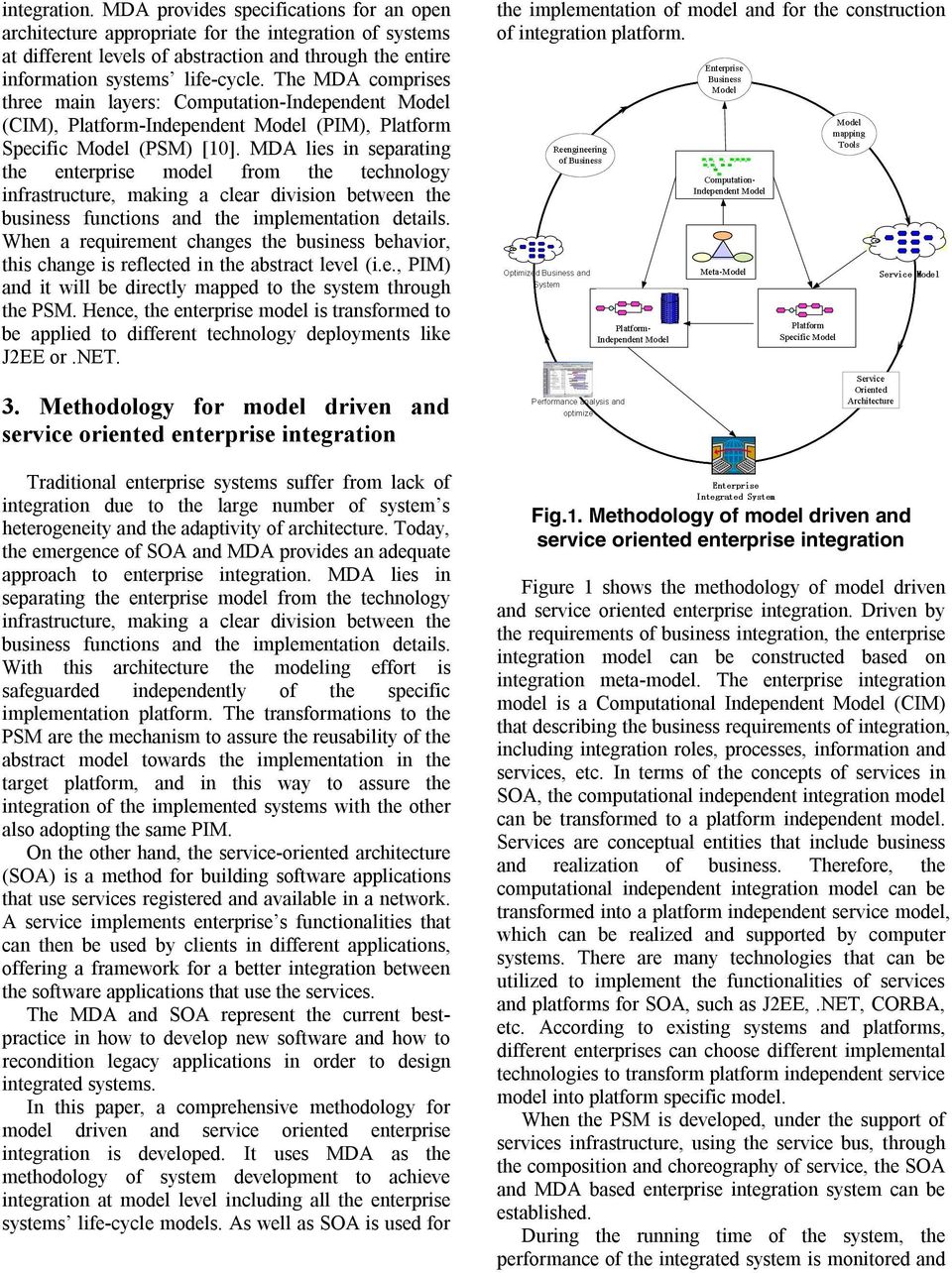
4 analyzed. The architecture, services and the business processes can be optimized. The optimized integration model will be re-defined and released by integration modeling tool, then a new cycle of development, deployment, operation, optimization is started. involved Roles interact. The meta model of enterprise integration is presented in Figure Framework for SOA and MDA based enterprise integration In this paper, the technological framework to support the implementation of the methodology is presented, which can realize the integration both in model and service levels. Figure 2 shows the framework of SOA and MDA based enterprise integration. The framework is composed of three levels: Meta model level, modeling level, and service level. Driven Development Meta model for enterprise integration Integration (CIM) model (PIM) Implementation model (PSM) Bus Infrastructure Meta Level Level Level Fig. 2. Framework for SOA and MDA based enterprise integration In meta model level, the meta model of enterprise integration is defined aiming at describing fundamental constructs for computation independent modeling language that can be used to model the integration from business perspective. Five basic elements are defined in the meta model. They are organization, process, data, system and service. Moreover, for the convenience of integration modeling, some other concepts are defined in the meta model, which are Integrations, IntegrationInstance, Role, RoleInstance, and Rule. The Integrations specifies the involved roles and their responsibilities. Five kinds of roles are defined in meta model: Organization, Process, Data, System and. IntegrationInstance specifies the application of an Integrations in a specific context and includes the RoleInstances. RoleInstance refer to the Role binding to operational objects. Furthermore, Integrations should act in accordance with Rule that specifies the constraints that define how the Fig. 3. Meta model of enterprise integration The modeling level comprises three main models: enterprie integration model (CIM), service model (PIM), implementation model (PSM). 1) integration model is a computation independent model (CIM) which is a business oriented representation of an enterprise integration system from the computation independent viewpoint. The enterprise integration model focuses on the business and business environment in which a system will be used, abstracting from the technical details of the structure of the implementation system. It describes the business context and business requirements for enterprise integration. 2) model is a visual PIM which specifies services in a technology independent manner. It represents an integrated view of the SOA in which different components can be deployed on different execution platforms. The service model helps us to align relevant aspects of enterprise and technical IT models, such as process, organization and products models. This model allows us to raise the abstraction level at which we can talk about and reason on the architecture we design. 3) Implementation model is also a visual model which IT developers can further refine by adding platform-specific modeling constructs such as deployment properties. The service model can transfer into different implementation models by underlying different platforms and protocols, e.g., CORBA and Web services, or the different implementations of SOAP. The service level includes service bus and service infrastructure. The service bus provides the necessary communication infrastructure required to deploy a distributed system. infrastructure enables integration between services through the composition,

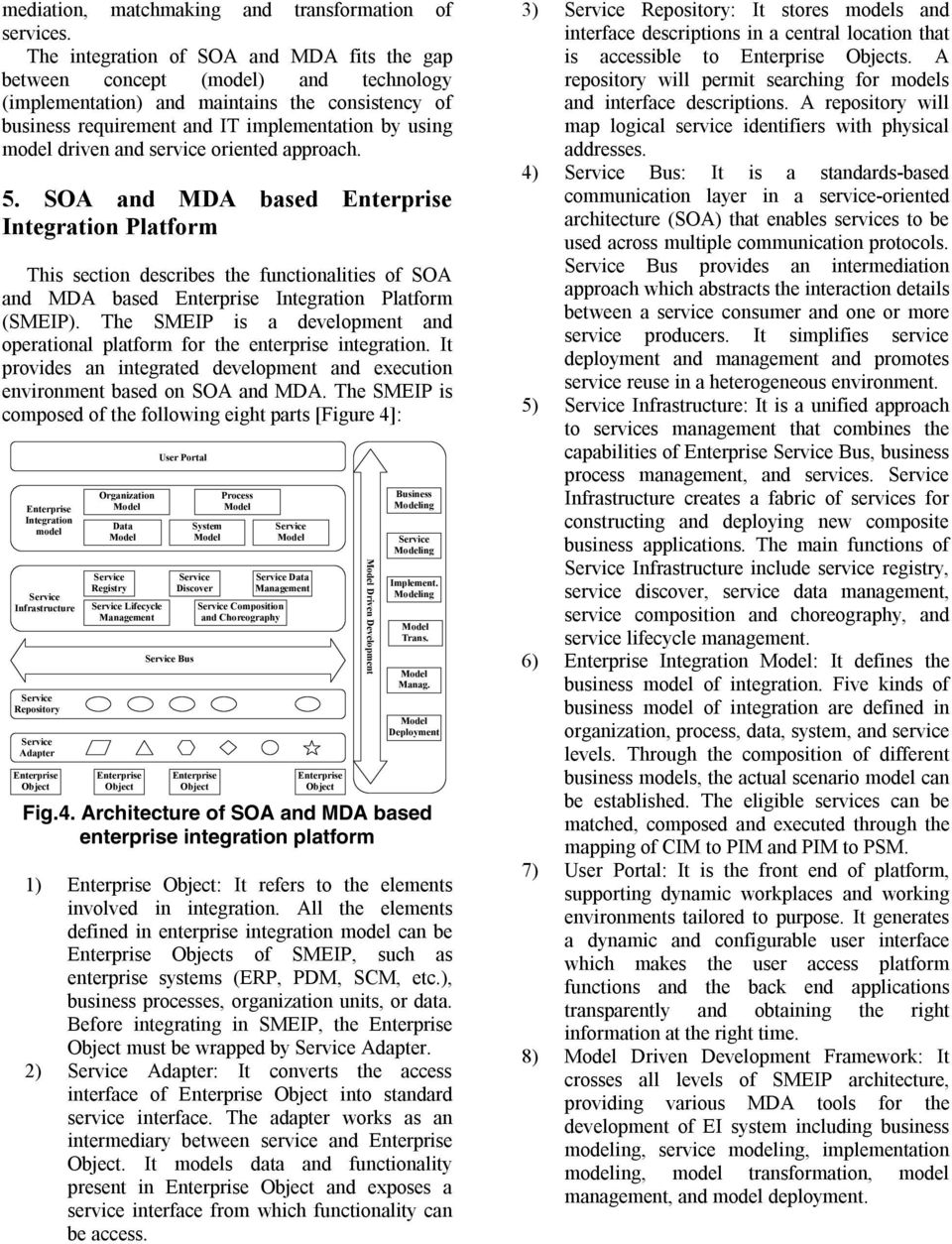
5 mediation, matchmaking and transformation of services. The integration of SOA and MDA fits the gap between concept (model) and technology (implementation) and maintains the consistency of business requirement and IT implementation by using model driven and service oriented approach. 5. SOA and MDA based Integration Platform This section describes the functionalities of SOA and MDA based Integration Platform (SMEIP). The SMEIP is a development and operational platform for the enterprise integration. It provides an integrated development and execution environment based on SOA and MDA. The SMEIP is composed of the following eight parts [Figure 4]: Integration model Infrastructure Repository Adapter Organization Data Registry Lifecycle Management User Portal Bus System Discover Process Data Management Composition and Choreography Driven Development Business ing ing Implement. ing Trans. Manag. Deployment Fig.4. Architecture of SOA and MDA based enterprise integration platform 1) : It refers to the elements involved in integration. All the elements defined in enterprise integration model can be s of SMEIP, such as enterprise systems (ERP, PDM, SCM, etc.), business processes, organization units, or data. Before integrating in SMEIP, the must be wrapped by Adapter. 2) Adapter: It converts the access interface of into standard service interface. The adapter works as an intermediary between service and. It models data and functionality present in and exposes a service interface from which functionality can be access. 3) Repository: It stores models and interface descriptions in a central location that is accessible to s. A repository will permit searching for models and interface descriptions. A repository will map logical service identifiers with physical addresses. 4) Bus: It is a standards-based communication layer in a service-oriented architecture (SOA) that enables services to be used across multiple communication protocols. Bus provides an intermediation approach which abstracts the interaction details between a service consumer and one or more service producers. It simplifies service deployment and management and promotes service reuse in a heterogeneous environment. 5) Infrastructure: It is a unified approach to services management that combines the capabilities of Bus, business process management, and services. Infrastructure creates a fabric of services for constructing and deploying new composite business applications. The main functions of Infrastructure include service registry, service discover, service data management, service composition and choreography, and service lifecycle management. 6) Integration : It defines the business model of integration. Five kinds of business model of integration are defined in organization, process, data, system, and service levels. Through the composition of different business models, the actual scenario model can be established. The eligible services can be matched, composed and executed through the mapping of CIM to PIM and PIM to PSM. 7) User Portal: It is the front end of platform, supporting dynamic workplaces and working environments tailored to purpose. It generates a dynamic and configurable user interface which makes the user access platform functions and the back end applications transparently and obtaining the right information at the right time. 8) Driven Development Framework: It crosses all levels of SMEIP architecture, providing various MDA tools for the development of EI system including business modeling, service modeling, implementation modeling, model transformation, model management, and model deployment.
6 6. Conclusions This paper proposes a SOA and MDA based enterprise integration solution which includes methodology, technological framework, and integration platform. The combination of SOA and MDA can enhance the agility, flexibility, and robustness of integration by using model driven and service oriented approach. MDA gives the opportunity to bring the services definition to a higher level of abstraction, due to the more formal and accurate platform-independent specification of the services requirements and design. Afterwards, to have the services implemented in a specific platform, a suitable transformation is executed. The high-level models can be transformed to service implementation. This way, services and SOA can be created decoupled from the lower level platforms, infrastructures and implementations, opening the way to improved integration. With this complementary joint approach, we take the most from SOA and MDA, stimulating the reusability and improving the integration in different levels. [8]. R. Lara, D. Roman, A. Polleres, and D. Fensel. A Conceptual Comparison of WSMO and OWL-S. In L.- J. Zhang and M. Jeckle, editors, European Conference on Web s ECOWS 2004,. Springer- Verlag.(2004) [9]. Arne-Jørgen Berre, Axel Hahn, David Akehurst, etc.. State-of-the art for Interoperability architecture approaches. Deliverable D9.1 of InterOP (IST ). 2006, available at: [10]. Management Group (2006): Driven Architecture, MDA Guide Version (2003), available at: Acknowledgments. The research of the paper is supported by the National Natural Science Foundation projects of China under Grant No , the National High Technology Research and Development Program of China under Grant No. 2006AA04Z166, and the European Commission FP6 project ImportNET. 7. References [1]. W3C, World Wide Web Consortium(2006), [2]. Management Group (2006), available at: [3]. Christine Legner, Kristin Wende. Towards an Excellence Framework for Business Interoperability. 2006, available at: [4]. Mehmet Sayal, Fabio Casati, Umesh Dayal, Ming- Chien Shan: Integrating Workflow Management Systems with Business-to-Business Interaction Standards, Proceedings of the 18th International Conference on Data Engineering(2002) [5]. F.B. Vernadat, ling and Integration: Principles and Application, Chapman and Hall, London, 1996 [6].F.B. Vernadat: ing and Integration(EMI):Current Status and Research Perspectives. Annual Reviews in Control. 26 (2002) [7]. Booth, D., Haas, H., McCabe, F., et al.: Web s Architecture, W3C Working Group Note (2004), available at:

Service Oriented Architecture
 Service Oriented Architecture Charlie Abela Department of Artificial Intelligence [email protected] Last Lecture Web Ontology Language Problems? CSA 3210 Service Oriented Architecture 2 Lecture Outline
Service Oriented Architecture (SOA) An Introduction
 Oriented Architecture (SOA) An Introduction Application Evolution Time Oriented Applications Monolithic Applications Mainframe Client / Server Distributed Applications DCE/RPC CORBA DCOM EJB s Messages
Model Driven Interoperability through Semantic Annotations using SoaML and ODM
 Model Driven Interoperability through Semantic Annotations using SoaML and ODM JiuCheng Xu*, ZhaoYang Bai*, Arne J.Berre*, Odd Christer Brovig** *SINTEF, Pb. 124 Blindern, NO-0314 Oslo, Norway (e-mail:
A Software Development Platform for SOA
 A Software Development Platform for SOA Peter Eeles Executive IT Architect Rational Brand Architect for UK, Ireland and South Africa [email protected] 2004 IBM Corporation Agenda IBM Software Group
Open Source egovernment Reference Architecture Osera.modeldriven.org. Copyright 2006 Data Access Technologies, Inc. Slide 1
 Open Source egovernment Reference Architecture Osera.modeldriven.org Slide 1 Caveat OsEra and the Semantic Core is work in progress, not a ready to use capability Slide 2 OsEra What we will cover OsEra
Business-Driven Software Engineering Lecture 3 Foundations of Processes
 Business-Driven Software Engineering Lecture 3 Foundations of Processes Jochen Küster [email protected] Agenda Introduction and Background Process Modeling Foundations Activities and Process Models Summary
1 Introduction FEDERATED THROUGH-LIFE SUPPORT, ENABLING ONLINE INTEGRATION OF SYSTEMS WITHIN THE PLM DOMAIN. Abstract. Jonas Rosén
 1 st Nordic Conference on Product Lifecycle Management - NordPLM 06, Göteborg, January 25-26 2006 FEDERATED THROUGH-LIFE SUPPORT, ENABLING ONLINE INTEGRATION OF SYSTEMS WITHIN THE PLM DOMAIN Jonas Rosén
Government's Adoption of SOA and SOA Examples
 Government's Adoption of SOA and SOA Examples Presented by : Ajay Budhraja, Chief of Enterprise Services ME (Engg), MS (Management), PMP, CICM, CSM, ECM (Master) AIIM, ITIL-F Copyright 2008 Ajay Budhraja
Research on the Model of Enterprise Application Integration with Web Services
 Research on the Model of Enterprise Integration with Web Services XIN JIN School of Information, Central University of Finance& Economics, Beijing, 100081 China Abstract: - In order to improve business
Service Oriented Architecture 1 COMPILED BY BJ
 Service Oriented Architecture 1 COMPILED BY BJ CHAPTER 9 Service Oriented architecture(soa) Defining SOA. Business value of SOA SOA characteristics. Concept of a service, Enterprise Service Bus (ESB) SOA
Enterprise SOA Strategy, Planning and Operations with Agile Techniques, Virtualization and Cloud Computing
 Enterprise SOA Strategy, Planning and Operations with Agile Techniques, Virtualization and Cloud Computing Presented by : Ajay Budhraja, Chief, Enterprise Services ME (Engg), MS (Mgmt), PMP, CICM, CSM,
Business Rule Standards -- Interoperability and Portability
 Rule Standards -- Interoperability and Portability April 2005 Mark H. Linehan Senior Technical Staff Member IBM Software Group Emerging Technology [email protected] Donald F. Ferguson IBM Fellow Software
Service-Oriented Architectures
 Architectures Computing & 2009-11-06 Architectures Computing & SERVICE-ORIENTED COMPUTING (SOC) A new computing paradigm revolving around the concept of software as a service Assumes that entire systems
Service-Oriented Architecture and Software Engineering
 -Oriented Architecture and Software Engineering T-86.5165 Seminar on Enterprise Information Systems (2008) 1.4.2008 Characteristics of SOA The software resources in a SOA are represented as services based
Principles and Foundations of Web Services: An Holistic View (Technologies, Business Drivers, Models, Architectures and Standards)
 Principles and Foundations of Web Services: An Holistic View (Technologies, Business Drivers, Models, Architectures and Standards) Michael P. Papazoglou (INFOLAB/CRISM, Tilburg University, The Netherlands)
Service-Oriented Architecture and its Implications for Software Life Cycle Activities
 Service-Oriented Architecture and its Implications for Software Life Cycle Activities Grace A. Lewis Software Engineering Institute Integration of Software-Intensive Systems (ISIS) Initiative Agenda SOA:
Web Services - Consultant s View. From IT Stategy to IT Architecture. Agenda. Introduction
 Web Services - A Consultant s View From IT Stategy to IT Architecture Hans-Peter Hoidn, Timothy Jones, Jürg Baumann, Oliver Vogel February 12, 2003 Copyright IBM Corporation 2002 Agenda Introduction I.
From Business World to Software World: Deriving Class Diagrams from Business Process Models
 From Business World to Software World: Deriving Class Diagrams from Business Process Models WARARAT RUNGWORAWUT 1 AND TWITTIE SENIVONGSE 2 Department of Computer Engineering, Chulalongkorn University 254
Service Oriented Architecture Based Integration. Mike Rosen CTO, AZORA Technologies, Inc. [email protected]
 Service Oriented Architecture Based Integration Mike Rosen CTO, AZORA Technologies, Inc. [email protected] Mike Rosen ACCESS TO THE EXPERTS Consultant Chief Enterprise Architect for service and
Federal Enterprise Architecture and Service-Oriented Architecture
 Federal Enterprise Architecture and Service-Oriented Architecture Concepts and Synergies Melvin Greer Chief Strategist, SOA / Cloud Computing Certified Enterprise Architect Copyright August 19, 2010 2010
Business Process Management Enabled by SOA
 Business Process Management Enabled by SOA Jyväskylä 8.5.2007 Kimmo Kaskikallio IT Architect IBM Software Brands Five middleware product lines designed to work together Service-Oriented Architecture (SOA)
SOA Myth or Reality??
 IBM TRAINING S04 SOA Myth or Reality Jaqui Lynch IBM Corporation 2007 SOA Myth or Reality?? Jaqui Lynch Mainline Information Systems Email [email protected] Session S04 http://www.circle4.com/papers/s04soa.pdf
How To Understand A Services-Oriented Architecture
 Introduction to Service Oriented Architecture CSCI-5828 Foundations of Software Engineering Ming Lian March 2012 Executive Summary This Executive Summary gives the straight word to the fresh that have
A standards-based approach to application integration
 A standards-based approach to application integration An introduction to IBM s WebSphere ESB product Jim MacNair Senior Consulting IT Specialist [email protected] Copyright IBM Corporation 2005. All rights
SOA + BPM = Agile Integrated Tax Systems. Hemant Sharma CTO, State and Local Government
 SOA + BPM = Agile Integrated Tax Systems Hemant Sharma CTO, State and Local Government Nothing Endures But Change 2 Defining Agility It is the ability of an organization to recognize change and respond
Service Oriented Architecture (SOA) Architecture, Governance, Standards and Technologies
 Service Oriented Architecture (SOA) Architecture, Governance, Standards and Technologies 3-day seminar Give Your Business the Competitive Edge SOA has rapidly seized the momentum and center stage because
Getting Started with Service- Oriented Architecture (SOA) Terminology
 Getting Started with - Oriented Architecture (SOA) Terminology Grace Lewis September 2010 -Oriented Architecture (SOA) is a way of designing, developing, deploying, and managing systems it is neither a
Independent Insight for Service Oriented Practice. An SOA Roadmap. John C. Butler Chief Architect. A CBDI Partner Company. www.cbdiforum.
 Independent Insight for Oriented Practice An SOA Roadmap John C. Butler Chief Architect A CBDI Partner Company www.cbdiforum.com Agenda! SOA Vision and Opportunity! SOA Roadmap Concepts and Maturity Levels!
Methods for the specification and verification of business processes MPB (6 cfu, 295AA)
 Methods for the specification and verification of business processes MPB (6 cfu, 295AA) Roberto Bruni http://www.di.unipi.it/~bruni 05 - Evolution 1 Object Overview of the evolution of (Information Systems
SOA REFERENCE ARCHITECTURE
 SOA REFERENCE ARCHITECTURE August 15, 2007 Prepared by Robert Woolley, Chief Technologist and Strategic Planner INTRODUCTION This document is a derivative work of current documentation and presentations
CONTEMPORARY SEMANTIC WEB SERVICE FRAMEWORKS: AN OVERVIEW AND COMPARISONS
 CONTEMPORARY SEMANTIC WEB SERVICE FRAMEWORKS: AN OVERVIEW AND COMPARISONS Keyvan Mohebbi 1, Suhaimi Ibrahim 2, Norbik Bashah Idris 3 1 Faculty of Computer Science and Information Systems, Universiti Teknologi
Agile Modeling and Design of Service-Oriented Component Architecture
 Agile Modeling and Design of Service-Oriented Component Architecture Zoran Stojanovic, Ajantha Dahanayake, Henk Sol Systems Engineering Group, Faculty of Technology, Policy and Management, Delft University
Introduction to Service Oriented Architectures (SOA)
 Introduction to Service Oriented Architectures (SOA) Responsible Institutions: ETHZ (Concept) ETHZ (Overall) ETHZ (Revision) http://www.eu-orchestra.org - Version from: 26.10.2007 1 Content 1. Introduction
Web Services Implementation Methodology for SOA Application
 Web Services Implementation Methodology for SOA Application Siew Poh Lee Lai Peng Chan Eng Wah Lee Singapore Institute of Manufacturing Technology Singapore Institute of Manufacturing Technology Singapore
An Oracle White Paper October 2013. Maximize the Benefits of Oracle SOA Suite 11g with Oracle Service Bus
 An Oracle White Paper October 2013 Maximize the Benefits of Oracle SOA Suite 11g with Oracle Service Bus Maximize the Benefits of Oracle SOA Suite 11g with Oracle Service Bus Table of Contents Introduction...
BEA BPM an integrated solution for business processes modelling. Frederik Frederiksen Principal PreSales Consultant BEA Systems
 BEA BPM an integrated solution for business processes modelling Frederik Frederiksen Principal PreSales Consultant BEA Systems Agenda What is BPM? BEA AquaLogic BPM Suite Industry View Customers BPM and
How service-oriented architecture (SOA) impacts your IT infrastructure
 IBM Global Technology Services January 2008 How service-oriented architecture (SOA) impacts your IT infrastructure Satisfying the demands of dynamic business processes Page No.2 Contents 2 Introduction
Introduction to WebSphere Process Server and WebSphere Enterprise Service Bus
 Introduction to WebSphere Process Server and WebSphere Enterprise Service Bus Course materials may not be reproduced in whole or in part without the prior written permission of IBM. 4.0.3 Unit objectives
Table of Contents. 1 Executive Summary... 2 2. SOA Overview... 3 2.1 Technology... 4 2.2 Processes and Governance... 8
 Table of Contents 1 Executive Summary... 2 2. SOA Overview... 3 2.1 Technology... 4 2.2 Processes and Governance... 8 3 SOA in Verizon The IT Workbench Platform... 10 3.1 Technology... 10 3.2 Processes
JOURNAL OF OBJECT TECHNOLOGY
 JOURNAL OF OBJECT TECHNOLOGY Online at www.jot.fm. Published by ETH Zurich, Chair of Software Engineering JOT, 2008 Vol. 7, No. 8, November-December 2008 What s Your Information Agenda? Mahesh H. Dodani,
Introduction to Service-Oriented Architecture for Business Analysts
 Introduction to Service-Oriented Architecture for Business Analysts This course will provide each participant with a high-level comprehensive overview of the Service- Oriented Architecture (SOA), emphasizing
Lightweight Data Integration using the WebComposition Data Grid Service
 Lightweight Data Integration using the WebComposition Data Grid Service Ralph Sommermeier 1, Andreas Heil 2, Martin Gaedke 1 1 Chemnitz University of Technology, Faculty of Computer Science, Distributed
Chapter 15. Web services development lifecycle
 Slide 15.1 nology Chapter 15 Web Services Development Lifecycle Web Service es: Princip ples & Tech Mike P. Papazoglou [email protected] Slide 15.2 Topics Web services development Properties of service development
Implementation of Information Integration Platform in Chinese Tobacco Industry Enterprise Based on SOA. Hong-lv Wang, Yong Cen
 Implementation of Information Integration Platform in Chinese Tobacco Industry Enterprise Based on SOA Hong-lv Wang, Yong Cen Information Center, China Tobacco Zhejiang Industrial Co., Ltd Hangzhou, China,
SERVICE-ORIENTED MODELING FRAMEWORK (SOMF ) SERVICE-ORIENTED SOFTWARE ARCHITECTURE MODEL LANGUAGE SPECIFICATIONS
 SERVICE-ORIENTED MODELING FRAMEWORK (SOMF ) VERSION 2.1 SERVICE-ORIENTED SOFTWARE ARCHITECTURE MODEL LANGUAGE SPECIFICATIONS 1 TABLE OF CONTENTS INTRODUCTION... 3 About The Service-Oriented Modeling Framework
Integration Platforms Problems and Possibilities *
 BULGARIAN ACADEMY OF SCIENCES CYBERNETICS AND INFORMATION TECHNOLOGIES Volume 8, No 2 Sofia 2008 Integration Platforms Problems and Possibilities * Hristina Daskalova, Tatiana Atanassova Institute of Information
SOA Governance and the Service Lifecycle
 IBM SOA SOA Governance and the Service Lifecycle Naveen Sachdeva [email protected] IBM Software Group 2007 IBM Corporation IBM SOA Agenda What is SOA Governance? Why SOA Governance? Importance of SOA
Foundations of Model-Driven Software Engineering
 Model-Driven Software Engineering Foundations of Model-Driven Software Engineering Dr. Jochen Küster ([email protected]) Contents Introduction to Models and Modeling Concepts of Model-Driven Software
Motivation Definitions EAI Architectures Elements Integration Technologies. Part I. EAI: Foundations, Concepts, and Architectures
 Part I EAI: Foundations, Concepts, and Architectures 5 Example: Mail-order Company Mail order Company IS Invoicing Windows, standard software IS Order Processing Linux, C++, Oracle IS Accounts Receivable
Extending SOA Infrastructure for Semantic Interoperability
 Extending SOA Infrastructure for Semantic Interoperability Wen Zhu [email protected] Sumeet Vij [email protected] 3rd Annual DoD SOA & Semantic Technology Symposium July 14, 2011 www.alionscience.com
Service-Oriented Architecture: Analysis, the Keys to Success!
 Service-Oriented Architecture: Analysis, the Keys to Success! Presented by: William F. Nazzaro CTO, Inc. [email protected] www.iconatg.com Introduction Service-Oriented Architecture is hot, but we seem
Di 6.1a. Warum naive SOA scheitert Ein Erfahrungsbericht. Adam Bien. January 26-30, 2009, Munich, Germany ICM - International Congress Centre Munich
 Di 6.1a January 26-30, 2009, Munich, Germany ICM - International Congress Centre Munich Warum naive SOA scheitert Ein Erfahrungsbericht Adam Bien How To Kill a SOA Project Early? [Warum naive SOA scheitert]
OMG SOA Workshop - Burlingame Oct 16-19, 2006 Integrating BPM and SOA Using MDA A Case Study
 OMG SOA Workshop - Burlingame Oct 16-19, 2006 Integrating BPM and SOA Using MDA A Case Study Michael Guttman CTO, The Voyant Group [email protected] Overview of Voyant H.Q. West Chester, PA Business
Combining Service-Oriented Architecture and Event-Driven Architecture using an Enterprise Service Bus
 Combining Service-Oriented Architecture and Event-Driven Architecture using an Enterprise Service Bus Level: Advanced Jean-Louis Maréchaux ([email protected]), IT Architect, IBM 28 Mar 2006 Today's business
Model-Driven Data Warehousing
 Model-Driven Data Warehousing Integrate.2003, Burlingame, CA Wednesday, January 29, 16:30-18:00 John Poole Hyperion Solutions Corporation Why Model-Driven Data Warehousing? Problem statement: Data warehousing
Service Mediation. The Role of an Enterprise Service Bus in an SOA
 Service Mediation The Role of an Enterprise Service Bus in an SOA 2 TABLE OF CONTENTS 1 The Road to Web Services and ESBs...4 2 Enterprise-Class Requirements for an ESB...5 3 Additional Evaluation Criteria...7
Lesson 18 Web Services and. Service Oriented Architectures
 Lesson 18 Web Services and Service Oriented Architectures Service Oriented Architectures Module 4 - Architectures Unit 1 Architectural features Ernesto Damiani Università di Milano A bit of history (1)
Combining SAWSDL, OWL DL and UDDI for Semantically Enhanced Web Service Discovery
 Combining SAWSDL, OWL DL and UDDI for Semantically Enhanced Web Service Discovery Dimitrios Kourtesis, Iraklis Paraskakis SEERC South East European Research Centre, Greece Research centre of the University
Approach to Service Management
 Approach to Service Management In SOA Space Gopala Krishna Behara & Srikanth Inaganti Abstract SOA Management covers the Management and Monitoring of applications, services, processes, middleware, infrastructure,
Clarifying a vision on certification of MDA tools
 SCIENTIFIC PAPERS, UNIVERSITY OF LATVIA, 2010. Vol. 757 COMPUTER SCIENCE AND INFORMATION TECHNOLOGIES 23 29 P. Clarifying a vision on certification of MDA tools Antons Cernickins Riga Technical University,
Improving Agility at PHMSA through Service-Oriented Architecture (SOA)
 Leveraging People, Processes, and Technology Improving Agility at PHMSA through Service-Oriented Architecture (SOA) A White Paper Author: Rajesh Ramasubramanian, Program Manager 11 Canal Center Plaza,
10 Years of Hype Cycles - Do We Forget Knowledge?
 10 Years of Hype Cycles - Do We Forget Knowledge? Aaron McConnell Research Scientist IU-ATC School of Computing and Information Engineering University of Ulster at Coleraine Northern Ireland Aaron McConnell
SmartLink: a Web-based editor and search environment for Linked Services
 SmartLink: a Web-based editor and search environment for Linked Services Stefan Dietze, Hong Qing Yu, Carlos Pedrinaci, Dong Liu, John Domingue Knowledge Media Institute, The Open University, MK7 6AA,
The IBM Rational Software Development Platform..Role focused tools help simplification via Separation of Concerns
 The IBM Rational Software Development Platform..Role focused tools help simplification via Separation of Concerns Analyst Architect Developer Tester Model the business & identify the business services
Ontology-based Web Service Composition: Part 1. Rolland Brunec Betreuerin: Sabine Maßmann Universität Leipzig, Abteilung Datenbanken
 Ontology-based Web Service Composition: Part 1 Rolland Brunec Betreuerin: Sabine Maßmann Universität Leipzig, Abteilung Datenbanken Motivation Semantic Web Web Services Web Service Composition Web Services
EAI OVERVIEW OF ENTERPRISE APPLICATION INTEGRATION CONCEPTS AND ARCHITECTURES. Enterprise Application Integration. Peter R. Egli INDIGOO.
 EAI OVERVIEW OF ENTERPRISE APPLICATION INTEGRATION CONCEPTS AND ARCHITECTURES Peter R. Egli INDIGOO.COM 1/16 Contents 1. EAI versus SOA versus ESB 2. EAI 3. SOA 4. ESB 5. N-tier enterprise architecture
MDA Overview OMG. Enterprise Architect UML 2 Case Tool by Sparx Systems http://www.sparxsystems.com. by Sparx Systems
 OMG MDA Overview by Sparx Systems All material Sparx Systems 2007 Sparx Systems 2007 Page:1 Trademarks Object Management Group, OMG, CORBA, Model Driven Architecture, MDA, Unified Modeling Language, UML,
Case Study: Adoption of SOA at the IRS
 Case Study: Adoption of SOA at the IRS Nitin S. Naik Director, Enterprise Architecture October 2, 2012 Agenda Overview of IRS IT Shared Services Vision SOA Roadmap and Maturity Levels Where Do We Stand
Run-time Service Oriented Architecture (SOA) V 0.1
 Run-time Service Oriented Architecture (SOA) V 0.1 July 2005 Table of Contents 1.0 INTRODUCTION... 1 2.0 PRINCIPLES... 1 3.0 FERA REFERENCE ARCHITECTURE... 2 4.0 SOA RUN-TIME ARCHITECTURE...4 4.1 FEDERATES...
Asset Based Development
 IBM Software Group Asset Based Development Grant Larsen [email protected] November 2003 Agenda Introduction Asset-based Development Process Standards Tooling Assets Getting Started Agenda Introduction
A HUMAN RESOURCE ONTOLOGY FOR RECRUITMENT PROCESS
 A HUMAN RESOURCE ONTOLOGY FOR RECRUITMENT PROCESS Ionela MANIU Lucian Blaga University Sibiu, Romania Faculty of Sciences [email protected] George MANIU Spiru Haret University Bucharest, Romania Faculty
Myths About Service-Oriented Architecture Demystifying SOA. producers can coexist, and still have no dependence on each other.
 WSJ: SOA Myths About Service-Oriented Architecture Demystifying SOA Service-oriented architecture (SOA) refers to an architectural solution that creates an environment in which services, service consumers,
Business Process Management Tampereen Teknillinen Yliopisto
 Business Process Management Tampereen Teknillinen Yliopisto 31.10.2007 Kimmo Kaskikallio IT Architect IBM Software Group IBM SOA 25.10.2007 Kimmo Kaskikallio IT Architect IBM Software Group Service Oriented
The Service Revolution software engineering without programming languages
 The Service Revolution software engineering without programming languages Gustavo Alonso Institute for Pervasive Computing Department of Computer Science Swiss Federal Institute of Technology (ETH Zurich)
Business Process Management In An Application Development Environment
 Business Process Management In An Application Development Environment Overview Today, many core business processes are embedded within applications, such that it s no longer possible to make changes to
Service Oriented Architecture (SOA) Architecture, Governance, Standards and Technologies
 Service Oriented Architecture (SOA) Architecture, Governance, Standards and Technologies 3-day seminar Give Your Business the Competitive Edge SOA has rapidly seized the momentum and center stage because
Semantic Business Process Management Lectuer 1 - Introduction
 Arbeitsgruppe Semantic Business Process Management Lectuer 1 - Introduction Prof. Dr. Adrian Paschke Corporate Semantic Web (AG-CSW) Institute for Computer Science, Freie Universitaet Berlin [email protected]
HP SOA Systinet software
 HP SOA Systinet software Govern the Lifecycle of SOA-based Applications Complete Lifecycle Governance: Accelerate application modernization and gain IT agility through more rapid and consistent SOA adoption
Service Oriented Architecture and Design Strategies
 Service Oriented Architecture and Design Strategies Michael Rosen Director, Enterprise Architecture Cutter Consortium [email protected] Michael Rosen 2008 Slide 1 Mike Rosen Consultant IT Architecture
Enterprise Application Designs In Relation to ERP and SOA
 Enterprise Application Designs In Relation to ERP and SOA DESIGNING ENTERPRICE APPLICATIONS HASITH D. YAGGAHAVITA 20 th MAY 2009 Table of Content 1 Introduction... 3 2 Patterns for Service Integration...
Dagstuhl seminar on Service Oriented Computing. Service design and development. Group report by Barbara Pernici, Politecnico di Milano
 Dagstuhl seminar on Service Oriented Computing Service design and development Group report by Barbara Pernici, Politecnico di Milano Abstract This paper reports on the discussions on design and development
Air Force SOA Enterprise Service Bus Study Using Business Process Management Workflow Orchestration for C4I Systems Integration
 Air Force SOA Enterprise Service Bus Study Using Business Process Management Workflow Orchestration for C4I s Integration Dr. Timothy D. Kehoe, Irene Chang, Dave Czulada, Howard Kong, Dr. Dino Konstantopoulos
SOA and Cloud in practice - An Example Case Study
 SOA and Cloud in practice - An Example Case Study 2 nd RECOCAPE Event "Emerging Software Technologies: Trends & Challenges Nov. 14 th 2012 ITIDA, Smart Village, Giza, Egypt Agenda What is SOA? What is
SOA: The missing link between Enterprise Architecture and Solution Architecture
 SOA: The missing link between Enterprise Architecture and Solution Architecture Jaidip Banerjee and Sohel Aziz Enterprise Architecture (EA) is increasingly being acknowledged as the way to maximize existing
ITU-T Kaleidoscope Conference Innovations in NGN. Managing NGN using the SOA Philosophy. Y. Fun Hu University of Bradford [email protected].
 ITU-T Kaleidoscope Conference Innovations in NGN Managing NGN using the SOA Philosophy Y. Fun Hu University of Bradford [email protected] Next Generation Network (NGN) A IP/IMS based network Provide
Data Management Roadmap
 Data Management Roadmap A progressive approach towards building an Information Architecture strategy 1 Business and IT Drivers q Support for business agility and innovation q Faster time to market Improve
Prerequisites for Successful SOA Adoption
 George Feuerlicht University of Technology, Sydney [email protected] 1. INTRODUCTION The adoption of SOA (Service Oriented Architecture) has gained momentum in the past two years, and the predictions
Component-Based and Service-Oriented Software Engineering: Key Concepts and Principles
 Component-Based and Service-Oriented Software Engineering: Key Concepts and Principles Hongyu Pei Breivold, Magnus Larsson ABB AB, Corporate Research, 721 78 Västerås, Sweden {hongyu.pei-breivold, magnus.larsson}@se.abb.com
A Categorization of Collaborative Business Process Modeling Techniques
 A Categorization of Collaborative Business Process Modeling Techniques Stephan Roser, Bernhard Bauer Programming Distributed Systems Lab Institute of Computer Science, University of Augsburg, Germany [roser,
Business Process Modeling and Standardization
 Business Modeling and Standardization Antoine Lonjon Chief Architect MEGA Content Introduction Business : One Word, Multiple Arenas of Application Criteria for a Business Modeling Standard State of the
Developing SOA solutions using IBM SOA Foundation
 Developing SOA solutions using IBM SOA Foundation Course materials may not be reproduced in whole or in part without the prior written permission of IBM. 4.0.3 4.0.3 Unit objectives After completing this
<Insert Picture Here> Integrating Oracle Forms and a Service Oriented Architecture
 Integrating Oracle Forms and a Service Oriented Architecture Grant Ronald Group Product Manager The following is intended to outline our general product direction. It is intended
CHAPTER 1 INTRODUCTION
 1 CHAPTER 1 INTRODUCTION Internet has revolutionized the world. There seems to be no limit to the imagination of how computers can be used to help mankind. Enterprises are typically comprised of hundreds
Policy Driven Practices for SOA
 Independent Insight for Oriented Practice Policy Driven Practices for SOA Lawrence Wilkes CBDI Forum www.cbdiforum.com Agenda! Enterprise SOA Challenge! SOA Policy Areas! Layered Architecture as a basis