
Addendum to clinical guideline 28, depression in children and young people
|
|
|
- Valentine Wood
- 9 years ago
- Views:
Transcription
1 : National Institute for Health and Care Excellence Final Addendum to clinical guideline 28, depression in children and young people Clinical guideline addendum 28. Methods, evidence and recommendations March 205 Final version National Institute for Health and Care Excellence

2

3 Contents Disclaimer Healthcare professionals are expected to take NICE clinical guidelines fully into account when exercising their clinical judgement. However, the guidance does not override the responsibility of healthcare professionals to make decisions appropriate to the circumstances of each patient, in consultation with the patient and/or their guardian or carer. Copyright National Institute for Health and Care Excellence, 205. All rights reserved. This material may be freely reproduced for educational and not-for-profit purposes. No reproduction by or for commercial organisations, or for commercial purposes, is allowed without the express written permission of NICE.
4 Contents Contents Clinical guidelines update... 6 Summary section Update information Recommendations Patient-centred care Methods Evidence review and recommendations Review question : psychological therapies for the treatment of depression in children and young people Review question Evidence review Health economic evidence Evidence statements Evidence to recommendations Recommendations Research recommendations Review questions 2 and 3: antidepressants, psychological therapy and combination therapy for the treatment of depression in children and young people Review question Evidence review, question Health economic evidence, review question Evidence statements, review question Review question Evidence review, review question Health economic evidence, review question Evidence statements, review question Evidence to recommendations for review questions 2 and Recommendations References Glossary and abbreviations Acknowledgement... 4 Appendices Appendix A: Committee members and NICE teams A. Standing Committee members A.2 Topic-specific Committee members A.3 Clinical guidelines update team A.4 NICE project team Appendix B: Declaration of interests

5 Contents Appendix C: Review protocols C. Review question C.2 Review question C.3 Review question Appendix D: Search strategy D. Review question D.2 Review question D.3 Economic search Appendix E: Review flowcharts E. Review question E.2 Review question E.3 Economic search Appendix F: Excluded studies... 7 F. Review question... 7 F.2 Review question F.3 Economic studies Appendix G: Evidence tables G. Review question G.2 Review question G.3 Economic studies Appendix H: GRADE profiles H. Review question H.2 Review question Appendix I: Forest plots I. Review question

6 Clinical guidelines update Clinical guidelines update The NICE Clinical Guidelines Update Team update discrete parts of published clinical guidelines as requested by NICE s Guidance Executive. Suitable topics for update are identified through the surveillance programme (see surveillance programme interim guide). These guidelines are updated using a standing Committee of healthcare professionals, research methodologists and lay members from a range of disciplines and localities. For the duration of the update the core members of the Committee are joined by up to 5 additional members who are have specific expertise in the topic being updated, hereafter referred to as topic-specific members. In this document where the Committee is referred to, this means the entire Committee, both the core standing members and topic-specific members. Where standing committee members is referred to, this means the core standing members of the Committee only. Where topic-specific members is referred to this means the recruited group of members with topic-specific expertise. All of the standing members and the topic-specific members are fully voting members of the Committee. Details of the Committee membership and the NICE team can be found in appendix A. The Committee members declarations of interest can be found in appendix B. 6

7 Summary section Summary section. Update information The NICE guideline on depression in children and young people (NICE clinical guideline CG28) was reviewed in 203 as part of NICE s routine surveillance programme to decide whether it required updating. The surveillance report identified new evidence relating to two areas of the guidance: The psychological therapies for the treatment of depression in children and young people; The use of antidepressant treatment and psychological therapy, either alone or together for the treatment of depression in children and young people. The full report can be found here: depression-in-children-and-young-people-review-decision-oct-32 Recommendations in this addendum fall into 3 categories:. New recommendations relating to psychological therapy and the combination of psychological therapy and antidepressant treatment for depression in children and young people have been made in this addendum and are labelled [new 205]. 2. Recommendations labelled [205] have been reviewed, but the Committee concluded that there was not enough new evidence to change them. 3. Recommendations highlighted in grey and labelled [2005] are only included to provide context. Some recommendations can be made with more certainty than others. The wording used in the recommendations labelled [new 205] in this addendum denotes the certainty with which the recommendation is made (the strength of the recommendation). For all recommendations, NICE expects that there is discussion with the patient about the risks and benefits of the interventions, and their values and preferences. This discussion aims to help them to reach a fully informed decision (see also Patient-centred care ). Recommendations that must (or must not) be followed We usually use must or must not only if there is a legal duty to apply the recommendation. Occasionally we use must (or must not ) if the consequences of not following the recommendation could be extremely serious or potentially life threatening. Recommendations that should (or should not) be followed a strong recommendation In recommendations labelled [new 205] we use offer (and similar words such as refer or advise ) when we are confident that, for the vast majority of people, following a recommendation will do more good than harm, and be cost effective. We use similar forms of words (for example, Do not offer ) when we are confident that actions will not be of benefit for most people. Recommendations that could be followed In recommendations labelled [new 205] we use consider when we are confident that following a recommendation will do more good than harm for most people, and be cost effective, but other options may be similarly cost effective. The course of action is more likely to depend on the person s values and preferences than for a strong recommendation, and so the healthcare professional should spend more time considering and discussing the options with the person. 7

8 Summary section 8
9 Summary section.2 Recommendations. Following a period of up to 4 weeks of watchful waiting, offer all children and young people with continuing mild depression and without significant comorbid problems or signs of suicidal ideation individual non-directive supportive therapy, group cognitive behavioural therapy (CBT) or guided self-help for a limited period (approximately 2 to 3 months). This could be provided by appropriately trained professionals in primary care, schools, social services and the voluntary sector or in tier 2 Child and Adolescent Mental Health Services (CAMHS). [205] 2. Offer children and young people with moderate to severe depression a specific psychological therapy (individual CBT, interpersonal therapy, family therapy, or psychodynamic psychotherapy) that runs for at least 3 months. [new 205] 3. Discuss the choice of psychological therapies with children and young people and their family members or carers (as appropriate). Explain that there is no good-quality evidence that one type of psychological therapy is better than the others. [new 205] 4. Consider combined therapy (fluoxetine a and psychological therapy) for initial treatment of moderate to severe depression in young people (2 8 years), as an alternative to psychological therapy followed by combined therapy and to recommendations 5, 6 and 7. [new 205] 5. If moderate to severe depression in a child or young person is unresponsive to psychological therapy after four to six treatment sessions, a multidisciplinary review should be carried out. [2005] 6. Following multidisciplinary review, if the child or young person's depression is not responding to psychological therapy as a result of other coexisting factors such as the presence of comorbid conditions, persisting psychosocial risk factors such as family discord, or the presence of parental mental ill-health, alternative or perhaps additional psychological therapy for the parent or other family members, or alternative psychological therapy for the patient, should be considered. [2005] 7. Following multidisciplinary review, offer fluoxetine b if moderate to severe depression in a young person (2 8 years) is unresponsive to a specific psychological therapy after 4 to 6 sessions. [205] 8. Following multidisciplinary review, cautiously consider fluoxetine c if moderate to severe depression in a child (5 years) is unresponsive to a specific psychological therapy a At the time of publication (March 205), Fluoxetine did not have UK marketing authorisation for use in young people (aged 2-8), without a previous trial of psychological therapy that was ineffective. For combined antidepressant treatment and psychological therapy as an initial treatment, the prescriber should follow relevant professional guidance, taking full responsibility for the decision. Informed consent should be obtained and documented. See the General Medical Council's Good practice in prescribing medicines guidance for doctors for further information. b At the time of publication (March 205), Fluoxetine was the only antidepressant with UK marketing authorisation for use for children and young people aged 8 to 8 years. c At the time of publication (March 205), Fluoxetine did not have UK marketing authorisation for use for children under the age of 8 years. For children under the age of 8 years, the prescriber should follow relevant professional guidance, taking full responsibility for the decision. Informed consent should be obtained and documented. See 9
10 Summary section after 4 to 6 sessions, although the evidence for fluoxetine's effectiveness in this age group is not established. [205] 9. Do not offer antidepressant medication to a child or young person with moderate to severe depression except in combination with a concurrent psychological therapy. Specific arrangements must be made for careful monitoring of adverse drug reactions, as well as for reviewing mental state and general progress; for example, weekly contact with the child or young person and their parent(s) or carer(s) for the first 4 weeks of treatment. The precise frequency will need to be decided on an individual basis, and recorded in the notes. In the event that psychological therapies are declined, medication may still be given, but as the young person will not be reviewed at psychological therapy sessions, the prescribing doctor should closely monitor the child or young person's progress on a regular basis and focus particularly on emergent adverse drug reactions. [205].3 Patient-centred care Patients and healthcare professionals have rights and responsibilities as set out in the NHS Constitution for England all NICE guidance is written to reflect these. Treatment and care should take into account individual needs and preferences. People should have the opportunity to make informed decisions about their care and treatment, in partnership with their healthcare professionals. If someone does not have the capacity to make decisions, healthcare professionals should follow the Department of Health s advice on consent, the code of practice that accompanies the Mental Capacity Act and the supplementary code of practice on deprivation of liberty safeguards. In Wales, healthcare professionals should follow advice on consent from the Welsh Government. If a young person is moving between paediatric and adult services, care should be planned and managed according to the best practice guidance described in the Department of Health s Transition: getting it right for young people. Adult and paediatric healthcare teams should work jointly to provide assessment and services to young people with depression. Diagnosis and management should be reviewed throughout the transition process, and there should be clarity about who is the lead clinician to ensure continuity of care..4 Methods This update was developed based on the process and methods described in the guidelines manual 202. Where there are deviations from the process and methods, these are stated in the interim process and methods guide for updates pilot programme 203. Important outcomes were chosen and prioritised by the topic-specific members of the Committee using a ranking method. The relative value of different outcomes was discussed, and the final rankings were completed by each topic-specific member independently, collated, and then agreed by the standing Committee members before the review was carried out. The same minimum clinically important differences were used as those that were agreed by the guideline development group for the original NICE guideline on depression in children and young people. For comparisons of an active intervention with no treatment, minimum the General Medical Council's Good practice in prescribing medicines guidance for doctors for further information. 0

11 Summary section clinically important differences were taken to be 0.2 and 5 for dichotomous outcomes and and 0.4 standardised mean differences (SMDs) for continuous outcomes. For comparisons of two active interventions, minimum clinically important differences were taken to be 0.5 and 2 for dichotomous outcomes and -0.2 and 0.2 SMDs for continuous outcomes. For each question, the quality of evidence for each important outcome for each comparison was appraised using the approach recommended by the Grading of Recommendations, Assessment, Development and Evaluation (GRADE) working group (see appendix H). All included studies were randomised controlled. Typical reasons for downgrading the evidence for risk of bias included lack of blinding (of participants or outcome assessors), inadequate or unclear allocation concealment, and inadequate or unclear random sequence generation. Inconsistency was only assessed when data was combined in a meta-analysis. The degree of heterogeneity was assessed, and 95% confidence intervals were examined to determine whether serious was present, using the methods described by the GRADE working group. Indirectness was assessed by noting whether the evidence directly applied to the review question; no cases of serious were noted. Imprecision was assessed by determining whether 95% confidence intervals incorporated clinically significant harm, no effect and clinically significant benefit. If all three were incorporated in the confidence interval, imprecision was judged very serious. If two of the three were incorporated, imprecision was considered serious. Other factors such as publication bias were also considered, but none gave rise to serious uncertainty.

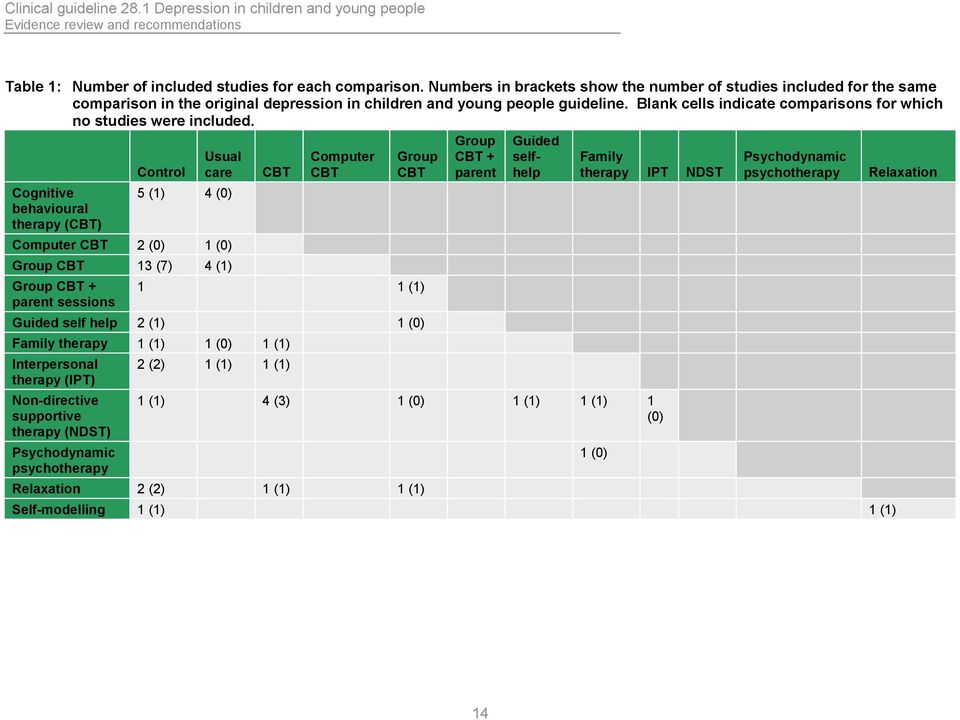
12 Evidence review and recommendations 2 Evidence review and recommendations Introduction Evidence reviews were conducted for two areas of the depression in children and young people clinical guideline. Review question covers the use of different psychological therapies for the treatment of depression in children and young people. Review questions 2 and 3 cover the use and timing of antidepressant treatment and psychological therapy, separately or together in the treatment of depression in children and young people. 2.8 Review question : psychological therapies for the 9 treatment of depression in children and young people 0 2 Depression in children and young people is often treated using psychological therapies. The aim of this review was to determine the most effective psychological therapy for the treatment of depression in children and young people Review question 4 5 What is the most effective psychological intervention for children and young people with depression? Evidence review A systematic search was conducted (see appendix D.) which identified 6002 articles. The titles and abstracts were screened and 97 articles were identified as potentially relevant. Full-text versions of these articles were obtained and reviewed against the criteria specified in the review protocol (appendix C.). Of these, 49 were excluded as they did not meet the criteria and 48 met the criteria and were included. Eight articles reported the same study, so there were 40 included studies. A list of excluded studies together with the reason for their exclusion is provided in appendix F.. The following outcomes (listed in order of importance) were considered important for decision making: functional status, depression symptoms, remission rate, suicidal ideation, suicide-related adverse events, discontinuation for any reason, and discontinuation due to adverse events. The review protocol (appendix C.) specified that the population for the review was children and young people with symptoms of depressive disorder. This population was used to match the population used in a similar review question in the original NICE guideline on depression in children and young people. Details of the included studies are given in evidence tables in appendix G.. Table shows the number of studies included for each comparison, and Table 2 shows a summary of the included studies. In this summary table, the population is described as children if the mean age of participants was from 5 to years, and young people if the mean age of participants was from 2 to 8 years. When more than one study assessed an outcome for a given comparison, data were combined using meta-analyses. Non-active control interventions (waiting list control, placebo, attention control and clinical monitoring) were grouped together for the purposes of the metaanalysis. The Mantel-Haenszel method was used with a random effects model because the treatment effects were unlikely to be identical across studies due to differences in interventions and therapists across studies. The I 2, chi 2 and tau 2 statistics were calculated to 2
13 Evidence review and recommendations assess heterogeneity. Forest plots showing the outcome of these meta-analyses are shown in appendix I. The quality of evidence for each outcome was assessed using GRADE methodology, as described in section.4. Full GRADE profiles are shown in Appendix H.. 3

14 Evidence review and recommendations Table : Number of included studies for each comparison. Numbers in brackets show the number of studies included for the same comparison in the original depression in children and young people guideline. Blank cells indicate comparisons for which no studies were included. Cognitive behavioural therapy (CBT) Control Usual care 5 () 4 (0) Computer CBT 2 (0) (0) Group CBT 3 (7) 4 () Group CBT + parent sessions CBT Computer CBT Group CBT () Guided self help 2 () (0) Family therapy () (0) () Interpersonal therapy (IPT) Non-directive supportive therapy (NDST) Psychodynamic psychotherapy 2 (2) () () Group CBT + parent Guided selfhelp Family therapy IPT NDST () 4 (3) (0) () () (0) Relaxation 2 (2) () () Psychodynamic psychotherapy Self-modelling () () (0) Relaxation 4
15 Evidence review and recommendations Table 2: Summary of included studies Study reference Ackerson 998 Alavi 203 Study Design Study population Intervention & comparator Randomised trial Randomised trial Young people with depression symptoms Location : USA Setting: Community Young people with diagnosed depressive disorder Location: Iran Setting: Hospital Guided self-help vs control Cognitive behavioural therapy vs control Outcomes reported Depression symptoms (post treatment) Depression symptoms (post treatment) Suicidal ideation (post treatment) Asarnow 2002 Randomised trial Young people with depression symptoms Location: USA Setting: School Cognitive behavioural therapy vs control Depressive symptoms (post treatment) Brent 997 Randomised trial Young people with diagnosed depressive disorder Location: USA Setting: secondary care Cognitive behavioural therapy vs family therapy vs non-directive supportive therapy Function status (post treatment) Depression symptoms (post treatment) Remission (post treatment) Suicidal ideation (post treatment) Clarke 2005 Randomised trial Young people with depression symptoms Location: USA Setting: School Group CBT vs usual care Functional status (post treatment, 6-9 months follow up, 2-24 months follow up) Depression symptoms (post treatment, 6-9 months follow up, 2-24 months follow up) Discontinuation for any reason Clarke 999 Randomised trial Young people with diagnosed depressive disorder Location: USA Setting: Research Group cognitive behavioural therapy vs group cognitive behavioural therapy + parent sessions vs control Functional status (post treatment) Depression symptoms (post treatment) Clarke 200 Randomised trial Young people with depression symptoms Location: USA Setting: Research Group cognitive behavioural therapy vs usual care Functional status (post treatment, 2-24 months follow up) Depression symptoms (post treatment, 2-24 months follow up) Suicidal ideation (post treatment, 2-24 months follow up) Clarke 2002 Randomised trial Young people with diagnosed depressive Group cognitive behavioural Functional status (post treatment,

16 Evidence review and recommendations Study reference De Cupter 2004 Diamond 2002 Diamond 200 Study Design Study population Intervention & comparator disorder therapy vs usual Location: USA care Setting: Research Randomised trial Randomised trial Randomised trial Children with depression symptoms Location: Belgium Setting: Research Young people with diagnosed depressive disorder Location: USA Setting: Not reported Young people with depression symptoms Location: USA Setting: Hospital Cognitive behavioural therapy vs control Family therapy vs control Family therapy vs usual care Outcomes reported months follow up) Depression symptoms (post treatment, 2-24 months follow up) Suicidal ideation (post treatment, 2-24 months follow up) Depression symptoms (post treatment) Depression symptoms (post treatment) Remission (post treatment) Depression symptoms (post treatment) Remission (post treatment) Dobson 200 Feehan 996 Fleming 202 Hayes 20 Kahn 990 Lewinsohn 990 Randomised trial Randomised trial Randomised trial Randomised trial Randomised trial Randomised trial Young people with depression symptoms Location: Iran Setting; Not reported Young people with diagnosed depressive disorder Location: UK Setting: Secondary care Young people with depression symptoms Location: New Zealand Setting: School Young people with depression symptoms Location: Australia Setting: Secondary care Young people with depression symptoms Location: USA Setting: School Young people with diagnosed depressive disorder Group cognitive behavioural therapy vs control Cognitive behavioural therapy vs nondirective supportive therapy Computerbased cognitive behavioural therapy vs control Cognitive behavioural therapy vs usual care Group cognitive behavioural therapy vs relaxation vs self-modelling vs control Group cognitive behavioural therapy vs group cognitive behavioural Depression symptoms (post treatment, 6-9 months follow up) Discontinuation for any reason Remission (post treatment) Depression symptoms (post treatment) Remission (post treatment) Depression symptoms (post treatment) Depression symptoms (post treatment) Depression symptoms (post treatment, 6-9 months follow up, 2-24 months follow up) Remission (post 6

17 Evidence review and recommendations Study reference Liddle 990 March/TAD S 2004 Merry 202 Mufson 999 Mufson 2004 Noel 203 Puskar 2003 Reynolds 986 Rosello 999 Shirk 203 Study Design Study population Intervention & comparator therapy vs control Randomised trial Randomised trial Randomised trial Randomised trial Randomised trial Randomised trial Randomised trial Randomised trial Randomised trial Randomised trial Children with diagnosed depressive disorder Location: Australia Setting: School Young people with diagnosed depressive disorder Location: USA Setting: Academic and community clinics Young people with depression symptoms Location: New Zealand Setting: Primary care Young people with diagnosed depressive disorder Location: USA Setting: Secondary care Young people with diagnosed depressive disorder Location: USA Setting: School Young people with depression symptoms Location: USA Setting: School Young people with depression symptoms Location: USA Setting: School Young people with depression symptoms Location: USA Setting: School Young people with diagnosed depressive disorder Location: Puerto Rico Setting: Research Young people with diagnosed depressive disorder Group cognitive behavioural therapy vs control Cognitive behavioural therapy vs control Computerbased cognitive behavioural therapy vs usual care Interpersonal psychotherapy vs control Interpersonal psychotherapy vs usual care Group cognitive behavioural therapy vs control Group cognitive behavioural therapy vs control Group cognitive behavioural therapy vs relaxation vs control Interpersonal psychotherapy vs cognitive behavioural therapy vs control Cognitive behavioural therapy vs usual Outcomes reported treatment) Depression symptoms (post treatment) Functional status (post treatment) Depression symptoms (post treatment) Suicidal ideation (post treatment) Discontinuation for any reason Depression symptoms (post treatment) Discontinuation for any reason Depression symptoms (post treatment) Discontinuation for any reason Depression symptoms (post treatment) Discontinuation for any reason Depression symptoms (post treatment) Depression symptoms (post treatment) Depression symptoms (post treatment) Depression symptoms (post treatment) Discontinuation for any reason Depression symptoms (post treatment) 7

18 Evidence review and recommendations Study reference Stallard 202 Stark 987 Stasiak 204 Stice 2008 Szigethy 2007 Study Design Study population Intervention & comparator Location: USA care Setting: Community clinics Randomised trial Randomised trial Randomised trial Randomised trial Randomised trial Young people with depression symptoms Location: UK Setting: School Children with depression symptoms Location: USA Setting: School Young people with depression symptoms. Location: New Zealand Setting: School Young people with depression symptoms Location: USA Setting : School Young people with depression symptoms Location: USA Setting: Hospital Group cognitive behavioural therapy vs control vs usual care Group cognitive behavioural therapy vs control Computerbased cognitive behavioural therapy vs control Group cognitive behavioural therapy vs nondirective supportive therapy vs guided self-help vs control Cognitive behavioural therapy vs usual care Outcomes reported Depression symptoms (post treatment, 2-24 months follow up) Depression symptoms (post treatment) Depression symptoms (post treatment) Remission (post treatment) Discontinuation for any reason Depression symptoms (post treatment, 6-9 months follow up, 2-24 months follow up) Functional status (post treatment) Depression symptoms (post treatment) Szigethy 204 Trowell 2007 Vostanis 996 Randomised trial Randomised trial Randomised trial Young people with diagnosed depressive disorder Location: USA Setting: Hospital Children with diagnosed depressive disorder Location: Greece, Finland, UK Setting: Secondary care Young people with diagnosed depressive disorder Location: UK Setting: Secondary care Cognitive behavioural therapy vs nondirective supportive therapy Psychodynamic psychotherapy vs family therapy Interpersonal psychotherapy vs non-directive supportive therapy Remission (post treatment) Functional status (post treatment, 6-9 months follow up) Depression symptoms (post treatment, 6-9 months follow up) Remission (post treatment, 6-9 months follow up) Discontinuation for any reason Remission (post treatment, 6-9 months follow up) 8

19 Evidence review and recommendations Study reference Weisz 997 Weisz 2009 Wijnhoven 204 Wood 996 Young 200 Study Design Study population Intervention & comparator Randomised trial Randomised trial Randomised trial Randomised trial Randomised trial Children with depression symptoms Location: USA Setting: School Children with diagnosed depressive disorder Location: USA Setting: Community clinic Young people with depression symptoms Location: Netherlands Setting: School Young people with diagnosed depressive disorder Location: UK Setting: Secondary care Young people with depression symptoms Location: USA Setting: School Group cognitive behavioural therapy vs control Cognitive behavioural therapy vs usual care Group cognitive behavioural therapy vs control Cognitive behavioural therapy vs relaxation Interpersonal psychotherapy vs non-directive supportive therapy Outcomes reported Depression symptoms (post treatment, 6-9 months follow up) Depression symptoms (post treatment) Depression symptoms (post treatment, 6-9 months follow up) Functional status (post treatment, 6-9 months follow up) Depression symptoms (post treatment, 6-9 months follow up) Remission (post treatment, 6-9 months follow up) Discontinuation for any reason Functional status (post treatment, 6-9 months follow up, 2-24 months follow up) Depression symptoms (post treatment, 6-9 months follow up, 2-24 months follow up) 2..3 Health economic evidence A systematic search was conducted to identify economic evaluations of psychological or pharmacological interventions for depression in children and young people (see appendix D.3). 648 articles were identified by the search. The titles and abstracts were screened and 5 articles were identified as potentially relevant. Full-text versions of these articles were obtained and reviewed against the inclusion criteria specified in the review protocol (appendix C). Of these, 2 articles were excluded as they did not meet the criteria and 3 articles met the criteria and were included. Two articles reported the same study, so there were 2 included studies. One of these studies is relevant to review question and the other is relevant to review question 2. A list of excluded studies together with the reason for their exclusion is provided in appendix F.3. 2 Table 3: Summary of included economic evaluation Study, Incremental Analysis Population, Applicability, Cost Effect ICER Limitations Interventions ( ) (QALYs) ( /QALY) Conclusions Uncertainty 9

20 Evidence review and recommendations Study, Population, Applicability, Limitations Stallard et al. (203) United Kingdom,064 high-risk adolescents aged 2-6 years old (associated cluster randomised controlled trial) Interventions Classroombased CBT Attention control PSHE Usual PSHE (comparator) Incremental Analysis Cost ( ) Effect (QALYs) ICER ( /QALY) 85,338 Dominated c Conclusions Neither classroombased CBT nor attention control PHSE would be cost-effective compared with usual PSHE. Uncertainty 25% probability that classroombased CBT has a costeffectiveness ratio less than 20,000 per QALY when compared to usual PSHE Partially applicable a Minor limitations b Acronyms: CBT: cognitive behavioural therapy; PSHE: personal, social and health education; QALY: quality adjusted life year; ICER: incremental cost-effectiveness ratio (a) Young people who were at high risk of depression were the focus of the primary analysis. Data not collected on whether individuals had a definitive diagnosis. (b) Medication cost not included due to vague or unusable resource use information provided in questionnaires. This applied to <% of participants. (c) Dominated: Intervention results in increased costs and a reduction in health benefits when compared to the comparator Evidence statements There was little certainty in the evidence as a whole. There was little or no evidence on the pre-specified important clinical outcomes for most of the included interventions, particularly in the long term and especially for children under years. There was a limited amount of generally low-quality evidence largely from non-uk settings suggesting that psychological therapies (individual, group and computer based cognitive behavioural therapy, guided selfhelp, family therapy, interpersonal psychotherapy and non-directive supportive therapy) may improve depressive symptoms at least immediately post treatment, compared with control or usual care. There was no clear evidence to favour one psychological therapy over another on any of the important outcomes. One economic evaluation conducted alongside a cluster randomised controlled trial in UK schools found that classroom-based CBT was not cost-effective in reducing symptoms of depression in high-risk adolescents compared to usual Personal, Social and Health Education. This study was partially applicable and had minor methodological limitations. No economic evaluations were included that examined the cost-effectiveness of other psychological interventions for depression in children and young people Evidence to recommendations Relative value of different outcomes The outcomes that were considered important for decision making (listed in order of importance as ranked by the topic-specific committee members) were: functional status, depression symptoms, remission rate, suicidal ideation, suicide-related adverse events, discontinuation for any reason, 20

21 Evidence review and recommendations Trade-off between benefits and harms and discontinuation due to adverse events. The committee valued functional status highly because it provides a measure of the impact of depression on a child or young person s ability to carry out everyday activities such as attending school. Depression symptoms were also valued highly as they provide a measure of severity of the depressive disorder. Suicide-related outcomes were considered as important because suicide is a very serious, but rare, consequence of depression in children and young people. Discontinuation rates were valued less highly than other outcomes because the topic-specific members of the committee considered that they were hard to interpret; as children or young people discontinue psychological therapies for many reasons, including recovery, or because they find treatment unacceptable. For all of the psychological therapies for which there was evidence, there was some limited evidence of a benefit of psychological therapy over control, particularly in terms of depression symptoms in the short term. No harms of psychological therapy compared with control were identified; therefore the Committee felt that the trade-off between benefits and harms favoured psychological therapy over control. Few studies compared different psychological therapies with each other, and there was no clear evidence to favour one psychological therapy over another. Therefore, the Committee agreed that the recommendations made in the original NICE guideline on depression in children and young people on psychological therapies should still stand (recommendations 2 and 3), as the additional evidence that was reviewed does not substantially change the trade-off between benefits and harms for any of the interventions. Evidence was not available on computer-based cognitive behavioural therapy at the time that the original guideline was published in The Committee concluded that the evidence in the current systematic review favoured computer-based cognitive behavioural therapy over control. The topic-specific committee members informed the Committee that computerbased cognitive behavioural therapy is a form of guided self-help, which was already recommended as a possible treatment for mild depression in the original guideline. The Committee therefore chose not make a separate recommendation on this intervention. Trade-off between net health benefits and resource use Evidence was also not available on psychodynamic psychotherapy at the time that the previous guideline was published in The current evidence review identified one study that compared psychodynamic psychotherapy with family therapy for children and young people with diagnosed depressive disorder. The Committee concluded that trial provided evidence that family therapy and psychodynamic psychotherapy were similarly effective, and so added psychodynamic psychotherapy to the list of recommended psychological therapies in recommendation 3. The words shorter term was removed from the original recommendation as the Committee felt that this descriptions was potentially ambiguous, and not supported by the evidence that was reviewed, which included studies with therapy durations of up to 9 months. The Committee noted, however, that therapy should be time limited, as it was in the studies that were reviewed. One economic evaluation meeting the inclusion criteria found classroombased CBT to not be cost-effective compared to usual Personal, Social, Health and Education. This was mainly due to the underlying study finding that there was no difference in outcomes between interventions. No other studies were identified that examined the cost-effectiveness of other psychological interventions. The Committee considered that most psychological interventions would be subject to similar costs due to the requirement for appropriately trained professionals to deliver the interventions regardless of their content. Computer-based CBT was likely to be a less-costly treatment option; however this remains uncertain without 2
22 Evidence review and recommendations Quality of evidence Other considerations further evidence. The Committee concluded that it was difficult to consider the relative cost-effectiveness of psychological interventions without robust evidence of a difference in effectiveness between treatments. The evidence was generally of low quality, and for many comparisons did not include the outcomes identified as important for decision making, particularly in the long term (2-24 months after the end of treatment). The evidence for children (aged 5-) was also particularly lacking, with the majority of studies only including young people over the age of 2. Due to the nature of psychological therapies, participants in almost all studies were not blinded to treatment allocation. In many studies, the assessors who rated outcomes such as remission, depression symptoms and suicidal ideation were also not blinded. The Committee also noted that the majority of did not take place in the UK, and so may be of limited applicability, especially when psychological therapies were compared with usual care, which is likely to vary across different models of health care. The Committee noted that the original version of the NICE guideline on depression in children and young people recommended different psychological therapies according to depression severity. The current evidence review did not find any clear evidence to favour one psychological therapy over another and did not identify any subgroup differences when evidence was split according to a surrogate measure of depression severity (see section 2..2 for details of the subgroup analysis). Therefore, the Committee concluded that there was no reason to change the previous recommendations, which were based on the consensus of the previous guideline development group. Given the level of uncertainty in the evidence favouring one psychological therapy over another, the Committee felt that it was particularly important that the choice of psychological therapy was made following discussion with children and young people and their family members or carers, and that the uncertainty in the evidence should be explained (recommendation 3). The Committee noted that this was particularly important when discussing the choice of psychological therapy with children and their parents or carers, as evidence in this group was particularly lacking. The evidence was also particularly lacking in the long term (over 2 months after the end of treatment), and this should also be discussed with children and young people and their families or carers. The Committee also noted that evidence had not been found that fulfilled the criteria in research recommendations that were made in the previous version of the guideline on psychological therapies for depression in children and young people, and so these recommendations (research recommendations and 2) should remain. The Committee noted that there is an ongoing UK-based trial (the IMPACT trial) that may partly meet the criteria specified in research recommendation, and is due to report in the next year. However, as this trial is not yet published, and will not meet all of the specified criteria, the Committee decided that research recommendation should stand. In particular, the Committee noted that evidence for the effectiveness of psychological therapies in children (aged 5- years) was very limited, and an important area for future research Recommendations 2. Following a period of up to 4 weeks of watchful waiting, offer all children and young 3 people with continuing mild depression and without significant comorbid problems 4 or signs of suicidal ideation individual non-directive supportive therapy, group 5 cognitive behavioural therapy (CBT) or guided self-help for a limited period 6 (approximately 2 to 3 months). This could be provided by appropriately trained 22
23 Evidence review and recommendations professionals in primary care, schools, social services and the voluntary sector or in tier 2 Child and Adolescent Mental Health Services (CAMHS). [205] 2. Offer children and young people with moderate to severe depression a specific psychological therapy (individual CBT, interpersonal therapy, family therapy or psychodynamic psychotherapy) that runs for at least 3 months. [new 205] 3. Discuss the choice of psychological therapies with children and young people and their family members or carers (as appropriate). Explain that there is no goodquality evidence that one type of psychological therapy is better than the others. [new 205] Research recommendations 4. An appropriately blinded, randomised controlled trial should be conducted to 5 assess the efficacy (including measures of family and social functioning as well as 6 depression) and the cost effectiveness of individual CBT, systemic family therapy 7 and child psychodynamic psychotherapy compared with each other and treatment 8 as usual in a broadly based sample of children and young people diagnosed with 9 moderate to severe depression (using minimal exclusion criteria). The trial should 20 be powered to examine the effect of treatment in children and young people separately and involve a follow-up of 2 to 8 months (but no less than 6 months). [205] 2. An appropriately blinded, randomised controlled trial should be conducted to assess the efficacy (including measures of family and social functioning as well as depression) and the cost effectiveness of another self-help intervention compared with computerised CBT and treatment as usual in a sample of children and young people treated in primary care who have been diagnosed with depression. The trial should be powered to examine the effect of treatment in children and young people separately and involve a follow-up of 2 to 8 months (but no less than 6 months). [205] 23
24 Evidence review and recommendations 2.2 Review questions 2 and 3: antidepressants, psychological 2 therapy and combination therapy for the treatment of 3 depression in children and young people The aim of this review was: to compare the effectiveness of antidepressant and psychological therapies, separately or in combination, for the treatment of depression in children and young people. to compare the effectiveness of initiating psychological therapy and antidepressant treatment concurrently with initiating antidepressant treatment following a delay, only if the initial psychological therapy was ineffective, Two systematic reviews were carried out (review questions 2 and 3), and are described separately below. However, the linking evidence to recommendations section (section 2.2.9) and the recommendations in section relate to both review questions Review question For children and young people with depression, what is the relative effectiveness of: Different antidepressants alone, compared to Different psychological therapies alone, compared to A combination of one psychological therapy (or psychological therapies) and one antidepressant (or antidepressants)? Evidence review, question A published Cochrane systematic review was identified that answered the review question (Cox et al. 202). The Cochrane systematic review was updated and re-analysed by the original authors for the purpose of producing the evidence for this clinical guideline addendum (Cox et al 205): An update search was run (4 th June 204) to identify any additional studies published since the original search date. The following additional subgroup analyses were considered: o Analysis by different type of antidepressant medication o Analysis by different psychological therapy o Analysis by age (6-, 2-8 years) o Analysis by depression severity (mild, moderate, severe) Details of the included systematic review are given in an evidence table in appendix G.2, and a summary is given in Table 4. Full details of the systematic review, including forest plots and details of included and excluded studies are freely available online ([link to be inserted on publication of the updated review], link to the previous version of the review: The following outcomes from the review (listed in order of importance) were considered important for decision making: level of function (functional status), improvement in depressive symptoms, suicide-related serious adverse events, remission from depressive disorder, suicide-related outcomes (suicidal ideation), remission defined as criterion improvement in depressive symptoms, acceptability of treatment measured by number of dropouts for any reason (the last two outcomes were ranked equally). For further details about how these outcomes were defined, see the review protocol in Appendix C.2. The quality of evidence for each outcome in this Cochrane systematic review was assessed using GRADE methodology, as described in section.4. Full GRADE profiles are shown in Appendix H.2. 24
25 Evidence review and recommendations Table 4: Summary of included study Study Study Study population reference Design Cox 204 Systematic review of randomised Children and young people with diagnosed depressive disorder Intervention & comparator Antidepressants vs psychological therapy vs combined treatment (antidepressants + psychological therapy) Outcomes reported level of function (functional status) improvement in depressive symptoms remission from depressive disorder, suicide-related outcomes (suicidal ideation) remission defined as criterion improvement in depressive symptoms acceptability of treatment measured by number of dropouts for any reason Health economic evidence, review question A systematic search was conducted (independently of the aforementioned published systematic review, Cox et al. 205) to identify economic evaluations of psychological or pharmacological interventions for depression in children and young people (see appendix D.3). 648 articles were identified by the search. The titles and abstracts were screened and 5 articles were identified as potentially relevant. Full-text versions of these articles were obtained and reviewed against the criteria specified in the review protocol (appendix C). Of these, 2 articles were excluded as they did not meet the criteria and 3 articles met the criteria and were included. Two articles reported the same study, so there were 2 included studies. One of these studies is relevant to review question and the other is relevant to review question 2. A list of excluded studies together with the reason for their exclusion is provided in appendix F.3. 4 Table 5: Summary of included economic evaluation Study, Incremental Analysis Population, Applicability, Interventions Cost Effect ICER Limitations ( ) (QALYs) ( /QALY) Goodyer et al. (2008) Byford et al. (2007) United Kingdom 208 adolescents aged to 7 inclusive with major depression (associated randomised controlled trial) Partially SSRIs plus CBT SSRIs (comparator) 25 Conclusions 2, Dominated c There was significant recovery at all time points in both arms. There was no treatment effectiveness for the addition of CBT to SSRIs for the primary or secondary outcome measures at any time point. A combination Uncertainty 2% probability that SSRIs plus CBT is cost-effective compared to SSRIs alone ( 50,000 threshold)
26 Evidence review and recommendations Study, Incremental Analysis Population, Applicability, Interventions ( ) (QALYs) ( /QALY) Conclusions Uncertainty Cost Effect ICER Limitations applicable a of CBT plus SSRIs is not Minor more costeffective in Limitations b the shortterm than SSRIs alone for treating adolescents with major depression in receipt of routine specialist clinical care. Acronyms: CBT: cognitive behavioural therapy; SSRI: selective serotonin reuptake inhibitor; QALY: quality adjusted life year; ICER: incremental cost-effectiveness ratio (a) There were no CBT only, usual care, or placebo arms in the underlying study. All participants received a brief initial psychological intervention, SSRIs and active clinical care regardless of subsequent randomisation. All other forms of ongoing psychiatric treatment were permitted during the study period except for CBT if the subject was randomised to the SSRI alone arm of the study. (b) Time horizon was 2 months. (c) Dominated: Intervention results in increased costs and a reduction in health benefits when relative to the comparator Evidence statements, review question Although many psychological therapies met the inclusion criteria for the review, all of the included studies used cognitive behavioural therapy (CBT). All of the evidence included in the review was from young people over the age of with the exception of small trial (33 participants) which included children and young people. Psychological therapy vs antidepressants There was moderate-quality evidence from trial comparing CBT with antidepressants in 220 young people showing a difference in clinician rated post-treatment depression symptoms in favour of antidepressants but no clear difference in depression symptoms in the long term. There was no clear difference in remission rates, and low-quality evidence from two in 269 young people suggesting that there might be less suicidal ideation with CBT measured post treatment. In the long term, there was some low-quality evidence that this difference in suicidal ideation might be sustained, but no clear evidence of other important differences between treatments. Antidepressants and psychological therapy vs psychological therapy alone or with placebo There was moderate-quality evidence from trial with 28 young people that the combination of antidepressant and CBT gave lower post treatment clinician-rated depression symptom scores than CBT alone. However, there was no clear evidence of a difference in other outcomes, with the exception of low-quality evidence from trial with 28 young people suggesting there may be a higher remission rate with the combination after treatment (risk ratio % CI.4 to 3.76). At 2-month follow up, there was low-quality evidence from trial with 28 young people of lower clinician- and self-rated depression scores for combination compared with psychological therapy alone, but with no clear evidence of a difference for other outcomes. 26
27 Evidence review and recommendations When the active combination of antidepressants and psychological therapy was compared to a placebo tablet with psychological therapy, 3 with 239 young people provided moderate-quality evidence of lower clinician-rated symptom scores with the combination of active treatments, and 3 with 23 young people gave low-quality evidence of lower selfrated depression scores in the active combination immediately post treatment. There was moderate-quality evidence from 73 young people in 2 of no clinically important difference in remission rate post treatment. Antidepressants and psychological therapy vs antidepressants alone Comparing psychological therapy plus antidepressants to antidepressants alone, there was no clear evidence of a difference across a number of outcomes immediately post treatment or at 6-9 months follow up involving between and 5 and 26 to 683 young people. At 2 months follow up, there was some low-quality evidence of better functioning ( trial, 52 young people) and self-rated depression scores (2, 368 young people) with the combination, although this was of uncertain clinical importance, and there was no clear difference for other outcomes. One economic evaluation conducted alongside a randomised controlled trial found that there was no economic value of combination treatment (SSRI plus CBT) compared to an antidepressant (SSRI) alone as the increase in cost was not offset by any health gains or reductions in the use of other resources. The study was partially applicable. Although it was conducted in the UK and the participants had more severe depression, there was no CBT only, usual care, or placebo arms. All participants received a brief initial psychological intervention, SSRIs and active clinical care regardless of subsequent randomisation. All other forms of ongoing psychiatric treatment were permitted during the study period except for CBT if the subject was randomised to the SSRI alone arm of the study. The economic evaluation had a time horizon of 2 months in line with the underlying study. No economic evaluations that examined the cost-effectiveness of CBT alone, or SSRIs compared to usual care or placebo, were included in the literature review of economic evidence Review question For children and young people with depression, what is the relative effectiveness of: Initiating psychological therapy first, followed by additional antidepressants only if psychological therapy is initially ineffective, compared to, Initiating psychological therapy and antidepressants simultaneously Evidence review, review question A systematic search was conducted (see appendix D.2) which identified 832 articles. The titles and abstracts were screened and article was identified as potentially relevant. A fulltext version of this article was obtained and reviewed against the criteria specified in the review protocol (appendix C.3). The article was excluded as it did not meet the criteria and so there were no included studies Health economic evidence, review question A systematic search was conducted to identify economic evaluations of psychological or pharmacological interventions for depression in children and young people (see appendix D.3). 648 articles were identified by the search. The titles and abstracts were screened and 5 articles were identified as potentially relevant. Full-text versions of these articles were obtained and reviewed against the criteria specified in the review protocol (appendix C). Of these, 2 articles were excluded as they did not meet the criteria and 3 articles met the criteria and were included. Two articles reported the same study, so there were 2 included studies. One of these studies is relevant to review question and the other is relevant to 27
28 Evidence review and recommendations 2 3 review question 2. No economic evaluations were identified that were relevant to review question 3. A list of excluded studies together with the reason for their exclusion is provided in appendix F Evidence statements, review question No studies were included that compared the effectiveness of the initiation of psychological therapy and antidepressant treatment concurrently with the initiation of antidepressant treatment only if psychological therapy was ineffective. No economic studies were included that compared the effectiveness of the initiation of psychological therapy and antidepressant treatment concurrently with the initiation of antidepressant treatment only if psychological therapy was ineffective Evidence to recommendations for review questions 2 and 3 Relative value of different outcomes Review question 2 The outcomes that were considered important for decision making (listed in order of importance as prioritised by the topic-specific committee members using a ranking method) were: level of function (functional status), improvement in depressive symptoms, suicide-related serious adverse events, remission from depressive disorder, suicide-related outcomes (suicidal ideation), remission defined as criterion improvement in depressive symptoms, acceptability of treatment measured by number of dropouts for any reason (the last two outcomes were ranked equally). The relative value of outcomes was similar to that for question. The Committee valued functional status highly because it provides a measure of the impact of depression on a child or young person s ability to carry out everyday activities such as attending school. Depression symptoms were also valued highly as they provide a measure of severity of the depressive disorder. Suicide-related outcomes were considered important because suicide is a very serious, but rare consequence of depression in children and young people. Suicidal ideation was valued less highly than suiciderelated adverse events because although suicidal ideation is related to future suicide-related adverse events, many children or young people with suicidal ideation do not go on to attempt suicide. Number of dropouts was valued less highly than other outcomes because the topic-specific members of the Committee considered that they were hard to interpret; as children or young people discontinue psychological therapies and antidepressant treatment for many reasons, including recovery, or because they find treatment unacceptable. Remission from depressive disorder as judged by clinical interview was rated more highly that remission judged by reduction in depression symptoms below a cut-off criterion because the later outcome was considered to be already partly incorporated in the depression symptoms outcome, and remission judged by clinical interview was considered to be a more reliable measure of recovery from depressive disorder. Trade-off between Review question 2 Review question 3 The outcomes that were considered important for decision making (listed in order of importance as prioritised by the topic-specific committee members using a ranking method) were: level of function, depression symptoms, remission rate, suicidal ideation, suicide-related adverse events, discontinuation from treatment due to adverse events, discontinuation from treatment for any reason. As there were no included studies for this review question, the relative value of different outcomes was not discussed further by the Committee. 28
29 References benefits and harms For the comparison between antidepressants and psychological therapies, a reduction in depression symptoms with antidepressant treatment immediately post-treatment was offset against a possible reduction in suicidal ideation with psychological therapy (although this reduction was of uncertain clinical importance). The topic-specific committee members noted that antidepressants are likely to have a more rapid action than psychological therapy, and this could explain the reduction in depression symptoms with antidepressants compared with psychological therapy in the short term, but not the long term. When comparing combined treatment with antidepressants alone, there was no clear evidence favouring one intervention over another. For combined treatment compared with psychological therapy alone (with or without a placebo tablet), the Committee considered that the evidence favoured combined treatment, with evidence of a reduction in depression symptoms, at least immediately following treatment, and some evidence of an increase in remission rate post-treatment with combination therapy compared with psychological therapy alone. For this comparison there were no harms identified to trade-off against these benefits, and so the Committee considered that overall, the evidence favoured combined therapy compared with psychological therapy alone. Trade-off between net health benefits and resource use Review question 3 No studies were included in the review comparing initiation of antidepressant treatment and psychological therapies concurrently with initiation of antidepressant treatment only if psychological therapy was ineffective. Therefore it was not possible to compare the trade-off of benefits and harms for review question 3. Review question 2 For the comparison between antidepressants and psychological therapies, a reduction in depression symptoms with antidepressant treatment immediately post-treatment was offset against a possible reduction in suicidal ideation with psychological therapy. The topic-specific committee members noted that antidepressants are likely to have a more rapid action than psychological therapy, and this could explain the reduction in depression symptoms with antidepressants compared with psychological therapy in the short term, but not the long term. When comparing combined treatment with antidepressants alone, there was no clear evidence favouring one intervention over another. For combined treatment compared with psychological therapy alone (with or without a placebo tablet), the Committee considered that the evidence favoured combined treatment, with evidence of a reduction in depression symptoms, at least immediately following treatment, and some evidence of an increase in remission rates post-treatment with combination therapy compared with psychological therapy alone. For this comparison there were no harms identified to trade-off against these benefits, and so the Committee considered that overall, the evidence favoured combined therapy compared with psychological therapy alone. The Committee agreed that a particular strength of the single economic evaluation included in the health economics evidence was that the underlying trial was conducted in the UK and most of the participants had more severe depression, similar to people seen in CAMHS services. However, the lack of CBT only, usual care, or placebo arms in the underlying study limited the applicability of the economic evaluation s findings to the cost-effectiveness evidence used to inform the update of the current guideline recommendations. This is because the recommendations in the original guideline stipulate psychological therapy as the first line 29
30 References intervention with antidepressant treatment provided only if this is ineffective. Similarly, antidepressants are not to be used in isolation without psychological therapy. The lack of a placebo arm in the underlying trial was also seen as impacting applicability as other considered in the clinical review showed a significant response in placebo arms and the cost implications of this should be an important consideration in economic evaluations on this topic. All participants received a brief initial psychological intervention, SSRIs and active clinical care regardless of subsequent randomisation. All other forms of ongoing psychiatric treatment were permitted during the study period except for CBT if the subject was randomised to the SSRI alone arm of the study. The committee determined that the 2 month time horizon was a methodological limitation as this did not account for future presentations to healthcare providers that would occur due to relapse if the effectiveness of interventions decreased over time and there was no way to compare this between interventions given the lack of clinical evidence. The Committee concluded it was difficult to come to any firm stance on the relative cost-effectiveness of antidepressants, psychological interventions and combination treatment. Review question 3 No studies were included that compared the initiation of antidepressant treatment and psychological therapies concurrently with initiation of antidepressant treatment only if psychological therapy was ineffective. Therefore, no benefits have been identified for the interventions related to this review question. No studies were identified in the review on the economic impacts of initiating antidepressant treatment and psychological therapies concurrently compared to initiating antidepressant treatment only if psychological therapy was ineffective. Therefore, it was not possible to compare the trade-off between net health benefits and resource use for review question 3. Quality of evidence Review question 2 Overall, the quality of evidence for review question 2 was moderate to low. With the exception of studies comparing psychological therapy and antidepressants to psychological therapy and a placebo tablet, participants were not blinded to treatment allocation. For most comparisons and outcomes, evidence was available for follow up periods of up to 2 months for the majority of outcomes. However, the Committee noted that there was no evidence on suicide-related adverse events for any comparison, which is an important limitation, given the serious nature of this outcome. A further limitation was that evidence from a number of different antidepressants was combined in the evidence review, not all of which would be routinely used in clinical practice (in particular tricyclic antidepressants). However, the Committee noted that there was little evidence of between studies, which might be expected if there were important differences between antidepressants. The Committee noted that there was almost no evidence for children aged 5 -. Other considerations Review question 3 There were no included studies for this review question. The Committee noted that the recommendations from the previous NICE guideline on depression in children and young people recommended combined treatment only if psychological therapy was ineffective. The Committee considered that the evidence from review question 2 favoured combined treatment over psychological therapy alone, but that there was no evidence on whether psychological therapy and antidepressants should be initiated concurrently, or whether antidepressants should only be initiated if psychological therapy is ineffective (review question 3). The Committee were concerned that given that there was clear evidence for the benefit of 30
31 References combined treatment (question 2) and the lack of evidence for a delay in the initiation of antidepressant treatment (question 3), there was a danger that young people (2-8 years) might be denied access to antidepressant therapy that might be beneficial. Consequently, the Committee recommended that the option of initiating antidepressant treatment and psychological treatment concurrently as an alternative to the normal pathway of care should be available, based on clinical judgement and the individual needs and preferences of young people and their family members or carers (recommendation 4). However, the Committee felt that the standard pathway of care outlined in the original guideline (recommendations 7, 8 and 9) should remain unchanged given that these recommendations were based on the expert consensus of the previous Guideline Development Group together with evidence from a number of review questions that were not part of this guideline update. It was not possible to assess the effect of depression severity on the relative effectiveness of antidepressants, psychological therapy and combined treatment. However, the Committee agreed that concurrent combined treatment should only be recommended as a possible option for young people (2 8 years) with moderate-severe depression because of the model of care set out in the original guideline (the original guideline recommended that antidepressants should only be offered in a tier 3 setting, and that mild depression should be initially treated in a tier or 2 setting). The Committee agreed that this option should only be considered for young people aged 2-8 and not children aged 5, due to the lack of evidence of the effectiveness of combined treatment in the younger age group. Review question 2 included evidence from a number of antidepressants, however, the Committee decided that only fluoxetine should be recommended because at the time of publication (March 205) it is the only antidepressant licensed for use in children. Additionally, the original NICE guideline on depression in children and young people reviewed the evidence for different antidepressants (in a review question that was not part of this guideline update) and concluded that fluoxetine should be recommended as an initial choice of antidepressant in children and young people. The original NICE guideline on depression in children and young people included a research recommendation for a trial comparing fluoxetine with psychological therapy and combination treatment. This question was partly, but not fully answered by the studies reviewed for review question 2, and so the Committee agreed that this research recommendation (research recommendation 3) should remain. In particular, the Committee noted that there was very little evidence the effectiveness of combined treatment for children (5- years), and the Committee thought that this was an important area for future research. In addition, the Committee made a new research recommendation (research recommendation 4) based on review question 3, for which no evidence was identified Recommendations 2 4. Consider combined therapy (fluoxetine d and psychological therapy) for initial 3 treatment of moderate to severe depression in young people (2 8 years), as an d At the time of publication (March 205), Fluoxetine did not have UK marketing authorisation for use in young people (aged 2-8), without a previous trial of psychological therapy that was ineffective. For combined antidepressant treatment and psychological therapy as an initial treatment, the prescriber should follow relevant professional guidance, taking full responsibility for the decision. Informed consent should be obtained 3
32 References alternative to psychological therapy followed by combined therapy and to recommendations 5, 6 and 7. [new 205] 7. Following multidisciplinary review, offer fluoxetine e if moderate to severe depression in a young person (2 8 years) is unresponsive to a specific psychological therapy after 4 to 6 sessions. [205] 8. Following multidisciplinary review, cautiously consider fluoxetine f if moderate to severe depression in a child (5 years) is unresponsive to a specific psychological therapy after 4 to 6 sessions, although the evidence for fluoxetine s effectiveness in this age group is not established. [205] 9. Do not offer antidepressant medication to a child or young person with moderate to severe depression except in combination with a concurrent psychological therapy. Specific arrangements must be made for careful monitoring of adverse drug reactions, as well as for reviewing mental state and general progress; for example, weekly contact with the child or young person and their parent(s) or carer(s) for the first 4 weeks of treatment. The precise frequency will need to be decided on an individual basis, and recorded in the notes. In the event that psychological therapies are declined, medication may still be given, but as the young person will not be reviewed at psychological therapy sessions, the prescribing doctor should closely monitor the child or young person's progress on a regular basis and focus particularly on emergent adverse drug reactions. [205] Research recommendations An appropriately blinded, randomised controlled trial should be conducted to assess the efficacy (including measures of family and social functioning as well as depression) and the cost effectiveness of fluoxetine, psychological therapy, the combination of fluoxetine and psychological therapy compared with each other and placebo in a broadly based sample of children and young people diagnosed with moderate to severe depression (using minimal exclusion criteria).the trial should be powered to examine the effect of treatment in children and young people separately and involve a follow up of 2 to 8 months (but no less than 6 months). [205] 4. For children and young people with depression, what is the relative effectiveness of: starting psychological therapy first, followed by additional antidepressants only if psychological therapy alone is ineffective starting psychological therapy and antidepressants at the same time? and documented. See the General Medical Council's Good practice in prescribing medicines guidance for doctors for further information. e At the time of publication (March 205), Fluoxetine was the only antidepressant with UK marketing authorisation for use for children and young people aged 8 to 8 years. f At the time of publication (March 205), Fluoxetine did not have UK marketing authorisation for use for children under the age of 8 years. For children under the age of 8 years, the prescriber should follow relevant professional guidance, taking full responsibility for the decision. Informed consent should be obtained and documented. See the General Medical Council's Good practice in prescribing medicines guidance for doctors for further information. 32
33 References Why is this important? The timing of combination psychological therapy and antidepressant treatment was one of the areas identified for review in this update. However, no evidence was found that met the inclusion criteria for the review. As a result, this remains an important area of clinical uncertainty. A randomised controlled trial is needed to resolve this uncertainty and show which treatment strategy is most effective. PICO Current evidence base Study design Population: Children and young people with diagnosed depressive disorder Intervention: Initiation of psychological therapy first, followed by additional antidepressants only if psychological therapy is initially ineffective. Comparator: Initiation of psychological therapy and antidepressants simultaneously. Outcomes: Functional status, depression symptoms following treatment, remission from depressive disorder, suicidal ideation, discontinuation due to adverse events, discontinuation for any reason This research question is based on review question 3, for which no met the inclusion criteria for the evidence review. Randomised controlled trial Other comments The trial should be powered such that the results for children (aged 5- ) and young people (aged 2-8) can be assessed separately
34 References 3 References Ackerson J, Scogin F, McKendree-Smith N et al. (998) Cognitive bibliotherapy for mild and moderate adolescent depressive symptomatology. Journal of Consulting & Clinical Psychology 66: Alavi A, Sharifi B, Ghanizadeh A et al. (203) Effectiveness of cognitive-behavioral therapy in decreasing suicidal ideation and hopelessness of the adolescents with previous suicidal attempts. Iranian Journal of Pediatrics 23: Asarnow JR, Scott CV, Mintz J (2002) A combined cognitive-behavioral family education intervention for depression in children: A treatment development study. Cognitive Therapy and Research 26: 22-9 Bernstein GA, Borchardt CM, Perwien AR et al. (2000) Imipramine plus cognitive-behavioral therapy in the treatment of school refusal. Journal of the American Academy of Child and Adolescent Psychiatry 39(3): Brent DA, Holder D, Kolko D et al. (997) A clinical psychotherapy trial for adolescent depression comparing cognitive, family, and supportive therapy. Archives of General Psychiatry 54: Brent DA, Greenhill LL, Compton S et al. (2009) The Treatment of Adolescent Suicide Attempters study (TASA): predictors of suicidal events in an open treatment trial. Journal of the American Academy of Child & Adolescent Psychiatry 48: Byford S, Barrett B, Roberts C et al. (2007) Cost-effectiveness of selective serotonin reuptake inhibitors and routine specialist care with and without cognitive behavioural therapy in adolescents with major depression. British Journal of Psychiatry 9: Clarke G, DeBar L, Lynch F et al. (2005) A randomized effectiveness trial of brief cognitivebehavioral therapy for depressed adolescents receiving antidepressant medication. Journal of the American Academy of Child and Adolescent Psychiatry 44(9): Clarke GN, Hornbrook M, Lynch F et al. (200) A randomized trial of a group cognitive intervention for preventing depression in adolescent offspring of depressed parents. Archives of General Psychiatry 58: Clarke GN, Rohde P, Lewinsohn PM et al. (999) Cognitive-behavioral treatment of adolescent depression: efficacy of acute group treatment and booster sessions. Journal of the American Academy of Child & Adolescent Psychiatry 38: Clarke GN, Hornbrook M, Lynch F et al. (2002) Group cognitive-behavioral treatment for depressed adolescent offspring of depressed parents in a health maintenance organization. Journal of the American Academy of Child & Adolescent Psychiatry 4: Clarke GN, Hawkins W, Murphy M et al. (995) Targeted prevention of unipolar depressive disorder in an at-risk sample of high school adolescents: a randomized trial of a group cognitive intervention. Journal of the American Academy of Child & Adolescent Psychiatry 34: 32-2 Cornelius JR, Bukstein OG, Wood DS et al. (2009) Double-blind placebo-controlled trial of fluoxetine in adolescents with comorbid major depression and an alcohol use disorder. Addictive Behaviors 34: Cox GR, Callahan P, Churchill R et al. (202) Psychological therapies versus antidepressant medication, alone and in combination for depression in children and adolescents. Cochrane Database of Systematic Reviews : CD
35 References Cox GR, Callahan P, Churchill R et al. (205) Psychological therapies versus antidepressant medication, alone and in combination for depression in children and adolescents. Cochrane Database of Systematic Reviews (in preparation) De Cuyper S., Timbremont B, Braet C et al. (2004) Treating depressive symptoms in schoolchildren: a pilot study. European Child & Adolescent Psychiatry 3: 05-4 Deas D, Randall CL, Roberts JS et al. (2000) A double-blind, placebo-controlled trial of sertraline in depressed adolescent alcoholics: a pilot study. Human Psychopharmacology 5: Diamond GS, Wintersteen MB, Brown GK et al. (200) Attachment-based family therapy for adolescents with suicidal ideation: a randomized controlled trial. Journal of the American Academy of Child & Adolescent Psychiatry 49: 22-3 Diamond GS, Reis BF, Diamond GM et al. (2002) Attachment-based family therapy for depressed adolescents: A treatment development study. Journal of the American Academy of Child & Adolescent Psychiatry 4: 90-6 Dobson KS, Hopkins JA, Fata L et al. (200) The prevention of depression and anxiety in a sample of high-risk adolescents: A randomized controlled trial. Canadian Journal of School Psychology 25: Emslie G, Kratochvil C, Vitiello B et al. (2006) Treatment for Adolescents with Depression Study (TADS): safety results. Journal of the American Academy of Child & Adolescent Psychiatry 45: Feehan CJ, Vostanis P (996) Cognitive-behavioural therapy for depressed children: Children's and therapists' impressions. Behavioural and Cognitive Psychotherapy 24: 7-83 Fleming T, Dixon R, Frampton C et al. (202) A pragmatic randomized controlled trial of computerized CBT (SPARX) for symptoms of depression among adolescents excluded from mainstream education. Behavioural & Cognitive Psychotherapy 40: Garoff FF, Heinonen K, Pesonen A-K et al. (202) Depressed youth: Treatment outcome and changes in family functioning in individual and family therapy. Journal of family therapy 34: 4-23 Goodyer I, Dubicka B, Wilkinson P et al. (2007) Selective serotonin reuptake inhibitors (SSRIs) and routine specialist care with and without cognitive behaviour therapy in adolescents with major depression: randomised controlled trial. British Medical Journal 335: 42 Hayes L, Boyd CP, Sewell J (20) Acceptance and commitment therapy for the treatment of adolescent depression: A pilot study in a psychiatric outpatient setting. Mindfulness 2: Kahn JS, Kehle TJ, Jensen WR et al. (990) Comparison of cognitive-behavioural, relaxation, and self-modelling interventions for depression among middle-school students. School psychology review 9: Kennard B, Silva S, Vitiello B et al. (2006) Remission and residual symptoms after short-term treatment in the Treatment of Adolescents with Depression Study (TADS). Journal of the American Academy of Child & Adolescent Psychiatry 45: 404- Kennard BD, Silva SG, Tonev S et al. (2009) Remission and recovery in the Treatment for Adolescents with Depression Study (TADS): acute and long-term outcomes. Journal of the American Academy of Child & Adolescent Psychiatry 48:
36 References Kim SM, Han DH, Lee YS et al. (202) Combined cognitive behavioral therapy and bupropion for the treatment of problematic on-line game play in adolescents with major depressive disorder. Computers in human behavior 28: Lewinsohn PM, Clarke GN, Hops H et al. (990) Cognitive-behavioral treatment for depressed adolescents. Behavior Therapy 2: Liddle B, Spence SH (990) Cognitive-behaviour therapy with depressed primary school children: a cautionary note. Behavioural Psychotherapy 8: March J, Silva S, Petrycki S et al. (2004) Fluoxetine, cognitive-behavioral therapy, and their combination for adolescents with depression: Treatment for Adolescents With Depression Study (TADS) randomized controlled trial. JAMA 292: Mandoki MW, Tapia MR, Tapia MA et al. (997) Venlafaxine in the treatment of children and adolescents with major depression. Psychopharmacology Bulletin 33():49-54 Melvin GA, Tonge BJ, King NJ et al. (2006) A comparison of cognitive-behavioral therapy, sertraline, and their combination for adolescent depression. Journal of the American Academy of Child and Adolescent Psychiatry 45: 5-6 Merry SN, Stasiak K, Shepherd M et al. (202) The effectiveness of SPARX, a computerised self-help intervention for adolescents seeking help for depression: randomised controlled non-inferiority trial. British Medical Journal 344: e2598 Mufson L, Dorta KP, Wickramaratne P et al. (2004) A randomized effectiveness trial of interpersonal psychotherapy for depressed adolescents. Archives of General Psychiatry 6: Mufson L, Weissman MM, Moreau D et al. (999) Efficacy of interpersonal psychotherapy for depressed adolescents. [References]. Archives of General Psychiatry 56: Noel LT, Rost K, Gromer J (203) Depression prevention among rural preadolescent girls: A randomized controlled trial. School Social Work Journal 38: -8 Puskar K, Sereika S, Tusaie-Mumford K (2003) Effect of the Teaching Kids to Cope (TKC) program on outcomes of depression and coping among rural adolescents. Journal of Child & Adolescent Psychiatric Nursing 6: 7-80 Reynolds WM, Coats KI (986) A comparison of cognitive-behavioral therapy and relaxation training for the treatment of depression in adolescents. Journal of Consulting & Clinical Psychology 54: Riggs PD, Mikulich-Gilbertson SK, Davies RD et al. (2007) A randomized controlled trial of fluoxetine and cognitive behavioral therapy in adolescents with major depression, behavior problems, and substance use disorders. Archives of Pediatrics & Adolescent Medicine 6: Rossello J, Bernal G (999) The efficacy of cognitive-behavioral and interpersonal treatments for depression in Puerto Rican adolescents. Journal of Consulting & Clinical Psychology 67: Shirk SR, Deprince AP, Crisostomo PS et al. (204) Cognitive behavioral therapy for depressed adolescents exposed to interpersonal trauma: an initial effectiveness trial. Psychotherapy: Theory, Research, Practice, Training 5: Stallard P, Phillips R, Montgomery AA et al. (203) A cluster randomised controlled trial to determine the clinical effectiveness and cost-effectiveness of classroom-based cognitivebehavioural therapy (CBT) in reducing symptoms of depression in high-risk adolescents. Health Technology Assessment 7: i-09 36
37 References Stallard P, Sayal K, Phillips R et al. (202) Classroom based cognitive behavioural therapy in reducing symptoms of depression in high risk adolescents: pragmatic cluster randomised controlled trial. BMJ 345: e6058 Stark KD, Reynolds WM, Kaslow NJ (987) A comparison of the relative efficacy of selfcontrol therapy and a behavioral problem-solving therapy for depression in children. Journal of Abnormal Child Psychology 5: 9-3 Stasiak K, Hatcher S, Frampton C et al. (204) A pilot double blind randomized placebo controlled trial of a prototype computer-based cognitive behavioural therapy program for adolescents with symptoms of depression. Behavioural & Cognitive Psychotherapy 42: Stice E, Rohde P, Seeley JR et al. (2008) Brief cognitive-behavioral depression prevention program for high-risk adolescents outperforms two alternative interventions: a randomized efficacy trial. Journal of Consulting & Clinical Psychology 76: Stice E, Rohde P, Gau JM et al. (200) Efficacy trial of a brief cognitive-behavioral depression prevention program for high-risk adolescents: effects at - and 2-year follow-up. Journal of Consulting & Clinical Psychology 78: Szigethy E, Kenney E, Carpenter J et al. (2007) Cognitive-behavioral therapy for adolescents with inflammatory bowel disease and subsyndromal depression. Journal of the American Academy of Child & Adolescent Psychiatry 46: Szigethy E, Bujoreanu SI, Youk AO et al. (204) Randomized efficacy trial of two psychotherapies for depression in youth with inflammatory bowel disease. Journal of the American Academy of Child & Adolescent Psychiatry 53: Trowell J, Joffe I, Campbell J et al. (2007) Childhood depression: a place for psychotherapy. An outcome study comparing individual psychodynamic psychotherapy and family therapy. European Child & Adolescent Psychiatry 6: Vitiello B, Rohde P, Silva S et al. (2006) Functioning and quality of life in the Treatment for Adolescents with Depression Study (TADS). Journal of the American Academy of Child & Adolescent Psychiatry 45: Vitiello B, Silva SG, Rohde P et al. (2009) Suicidal events in the Treatment for Adolescents With Depression Study (TADS). Journal of Clinical Psychiatry 70: 74-7 Vostanis P, Feehan C, Grattan E et al. (996) A randomised controlled out-patient trial of cognitive-behavioural treatment for children and adolescents with depression: 9-month follow-up. Journal of Affective Disorders 40: 05-6 Weisz JR, Thurber CA, Sweeney L et al. (997) Brief treatment of mild-to-moderate child depression using primary and secondary control enhancement training. Journal of Consulting & Clinical Psychology 65: Weisz JR, Southam-Gerow MA, Gordis EB et al. (2009) Cognitive-behavioral therapy versus usual clinical care for youth depression: an initial test of transportability to community clinics and clinicians. Journal of Consulting & Clinical Psychology 77: Wijnhoven LA, Creemers DH, Vermulst AA et al. (204) Randomized controlled trial testing the effectiveness of a depression prevention program ('Op Volle Kracht') among adolescent girls with elevated depressive symptoms. Journal of Abnormal Child Psychology 42: Wood A, Harrington R, Moore A (996) Controlled trial of a brief cognitive-behavioural intervention in adolescent patients with depressive disorders. Journal of Child Psychology & Psychiatry & Allied Disciplines 37:
38 References 2 Young JF, Mufson L, Gallop R (200) Preventing depression: a randomized trial of interpersonal psychotherapy-adolescent skills training. Depression & Anxiety 27:
39 rglossary and abbreviations 4 Glossary and abbreviations 2 Please refer to the NICE glossary Additional terms used in this document are listed below: Child: For the purpose of this guideline, the term child is used for people aged 5 to. Child and Adolescent Mental Health Service (CAMS): The organisations responsible for the treatment of children and young people with depression in secondary care. Cognitive behavioural therapy: A psychological therapy that is used to treat depression by changing thoughts and behaviour. Family therapy: A psychological therapy which includes a child or young person s family members and aims to identify and resolve problems that may contribute to a child or young person s depression. Interpersonal psychotherapy: A psychological therapy used to treat depression by identifying and resolving interpersonal problems. Psychodynamic psychotherapy: A psychological therapy based on the theories of Sigmund Freud that aims to treat depression by identifying and exploring conscious and unconscious emotions associated with depression. Young person: For the purpose of this guideline, the term young person is used to refer to people aged 2 to 8. Brief details of the rating scales used in studies included in the evidence review are given in Table 6. 2 Table 6: Rating scales used in included studies Outcome assessed Scale Variants Description Functional status Functional status Depression symptoms Depression symptoms Depression symptoms Global assessment of function (GAF) Children s global assessment scale (CGAS) Beck depression inventory (BDI) Child depression inventory (CDI) Reynolds adolescent depression scale (RADS) - Rating of social, occupational, and psychological functioning (not specific to depression). Higher scores indicate better function. - Adaptation of the adult global assessment of function. Higher scores indicate better function. BDI-A, BDI-II CDI-II, long, short, parent and teacher versions RADS-2, RADS-short form Self-report measure of depression severity at current time. Higher scores indicate more depression symptoms. Adaptation of the adult Beck depression inventory. Higher scores indicate more depression symptoms. Self-report questionnaire that aims to identify and quantify depressive symptoms in adolescents (gives score representing severity of depressive symptoms). Higher scores indicate more Intended age range Adults Under
40 rglossary and abbreviations Outcome assessed Scale Variants Description depression symptoms. Depression symptoms Depression symptoms Depression symptoms, remission Depression symptoms, remission Depression symptoms, remission Suicidal ideation Suicidal ideation Mood and feelings questionnaire (MFQ) Center for epidemiological studies depression scale (CES-D) Schedule for Affective disorders and Schizophrenia for school-age children (K-SADS) Hamilton rating scale for depression (HAM- D) Child depression rating scale (CDRS) Suicidal ideation questionnaire - Junior version (SIQ-JR) Scale for suicidal ideation (SSI) Short-MFQ, Parent MFQ-P, Child MFQ-C CES-D-R (revised version) Present and lifetime version (K-SADS-PL) Also abbreviated to HDRS CDRS-R (revised version) Self-report questionnaire that aims to assess depressive symptoms. Higher scores indicate more depression symptoms. Self-report questionnaire designed to measure depressive symptoms in the past week in the general population (designed for epidemiological studies). Higher scores indicate more depression symptoms. Structured diagnostic interview for range of psychiatric disorders including major depressive disorder. Can also be used to assess symptom severity, but is time consuming so may be inefficient as a way of measuring changes in symptoms. Higher scores indicate more depression symptoms. Structured interview that determines the presence and severity of depression. Higher scores indicate more depression symptoms. Adaptation of the Hamilton rating scale for depression for adults. Higher scores indicate more depression symptoms. - 5-item questionnaire to assess suicidal ideation. Higher scores indicate greater suicidal ideation. - 9 item clinician rating scale to assess suicidal ideation. Higher scores indicate greater suicidal ideation. Intended age range 8-7 Adults 6-7 Adults 6-2 Adolescents Adults 40
41 rglossary and abbreviations 5 Acknowledgement We thank the Cochrane Depression, Anxiety and Neurosis Group (in particular Rachel Churchill, Georgina Cox, Patch Callahan, Vivien Hunot, Sally Merry, Alexandra Parker, and Sarah Hetrick) for their assistance with the evidence review for review question 2. 4
42 Appendix A: Committee members and NICE teams 2 3 Appendices Appendix A: Committee members and NICE teams A. 4 Standing Committee members Name Susan Bewley (Chair) Gita Bhutani Simon Corbett John Graham Peter Hoskin Roberta James Asma Khalil Manoj Mistry Amaka Offiah Mark Rodgers Nicholas Steel Sietse Wieringa Role Professor of Complex Obstetrics, Kings College London Clinical Psychologist, Lancashire Care NHS Foundation Trust Cardiologist, University Hospital Southampton NHS Foundation Trust Consultant Oncologist & Trust Cancer Lead Clinician, Taunton & Somerset Hospital Consultant in Clinical Oncology, Mount Vernon Hospital Programme Lead, Scottish Intercollegiate Guidelines Network (SIGN) Obstetrician, St George s Hospital University London Lay member Reader in Paediatric Musculoskeletal Imaging and Honorary Consultant Paediatric Radiologist, University of Sheffield Research Fellow, University of York Clinical Senior Lecturer in Primary Care, Norwich Medical School A.2 5 Topic-specific Committee members Name Peter Fonagy Lynn Henderson Peta Mees Maria Moldavsky Anna Wilson General Practitioner, Barts & the London School of Medicine & Dentistry Role Programme Director, Head of Research Department, UCL Senior CAMHS Nurse, Tees, Esk and Wear Valleys NHS Foundation Trust Senior Child/Adolescent Psychotherapist, CAMHS East London Foundation Trust Consultant Child/Adolescent Psychiatrist, Nottingham University Lay member A.3 6 Clinical guidelines update team Name Phil Alderson Emma Banks Elizabeth Barrett Paul Crosland Nicole Elliott Kathryn Hopkins Susannah Moon Rebecca Parsons Charlotte Purves Toni Tan Role Clinical Advisor Co-ordinator Information Specialist Health Economist Associate Director Technical Analyst Programme Manager Project Manager Administrator Technical Advisor 42
43 Appendix A: Committee members and NICE teams A.4 NICE project team Name Role Martin Allaby Clinical Advisor Ben Doak Guideline Commissioning Manager James Hall Senior Medical Editor Bhash Naidoo Health Economic Advisor Mark Baker Guideline Lead Judith Thornton Technical Lead Jennifer Wells Guideline Co-ordinator Erin Whittingham Public Involvement Advisor 2 43
44 Appendix B: Declaration of interests 2 Appendix B: Declaration of interests (declared under the new NICE policy, 204) Member name Interest declared Standing committee members Susan Bewley Susan Bewley Susan Bewley Susan Bewley Self-employed academic and obstetric expert. 00 hour per annum teaching contract with Kings College London. In the last 2 months received income or fees for: Research projects as a principal or co-investigator or giving expert advice (presently these include projects on major postpartum haemorrhage, the organisation of maternity care, gestation time for abortion) Academic supervision (PhD on implementation of external cephalic version, chair of 35/39 TSC on the timing of induction) Teaching (BSc law and ethics tutor at KCL, occasional fees for lectures on obstetrics) Medico-legal reports (approx. 2/year) and Medical Defence Union cases committee and council External reviews for NHS organisations related to my obstetric expertise (serious incident and maternal mortality investigations, RCOG review) Chairing NICE GDG Expert advice to NHS Quest (development of a maternity safety thermometer ) Royalties from edited books Advice to Marie Stopes International about obstetric standards Expenses paid to attend conferences to lecture on obstetric topics. In the last year this included speaking to a Human Rights conference at Date declared Type of interest 30/05/203 Personal financial interest 30/05/203 Personal financial interest 30/05/203 Personal financial interest 30/05/203 Personal financial interest Decision Declare and participate Declare and participate Declare and participate Declare and participate 44
45 Appendix B: Declaration of interests Member name Interest declared Standing committee members the Hague, the Royal Society of Edinburgh, and the International Society of Psychosomatic Obstetrics and Gynaecology, and attending the British Maternal Fetal Medicine Society conference. Received a community grant to attend the British HIV Association conference. Susan Bewley Susan Bewley Susan Bewley Susan Bewley Joint intellectual property rights in a new neonatal resuscitation trolley, but these were negotiated to be handed over to Liverpool University and Inditherm. In return, the inventors have negotiated that a fee generated on the sale of each trolley will be given to charity. Expressed views in publications about obstetric matters, largely based on evidence. A trustee and committee member of Healthwatch (a charity devoted to evidence and for treatments that work ) and a trustee of Sophia (a charity devoted to women with HIV and the UK arm of the Global Coalition for Women and AIDS). Member of the following editorial boards: Medical Law Review, International Journal of Childbirth, JASS (Journal Article Summary Service); Member of the London Clinical Senate; Member of the Mayor's Office for Policing and Crime Violence Against Women and Girls Panel; Member All-Parliamentary Party Group on Maternity; Trustee of Maternity Action (a charity which aims to end inequality and improve the health and well-being of pregnant women, partners and young children), one of seven members of the Women s Health and Equality Consortium which is a Strategic Partner of the Department of Health. Date declared Type of interest 30/05/203 Nonpersonal financial interest 30/05/203 Personal nonfinancial interest 30/05/203 Personal nonfinancial interest /04/204 Personal nonfinancial interest Decision Declare and participate Declare and participate Declare and participate Declare and participate 45
46 Appendix B: Declaration of interests Member name Interest declared Standing committee members Susan Bewley Susan Bewley Gita Bhutani Gita Bhutani Gita Bhutani Gita Bhutani Simon Corbett Simon Corbett John Graham Expert advice to Salamander Trust (funded by WHO to perform a global community consultation of women living with HIV to inform Sexual and Reproductive Health and Human Rights guideline update). Expenses paid to attend and present at Changing Motherhood and Assisted reproduction that harms conferences. Chair of Psychological Professions Network North West Member of British Psychological Society; Division of Clinical Psychology; Faculty of Leadership and Management Committee Member Project lead on BPS Division of Clinical Psychology project on Comprehensively representing the complexity of psychological services Analytical support in partnership with Liverpool University on Liverpool Health Partners project on Patient Quality and Safert Network Service Adviser for the British Cardiovascular Society. This role incorporates the regional specialty adviser role for the Royal College of Physicians. Acting Director for Clinical Effectiveness for employer (University Hospital Southampton NHS Foundation Trust). Part of this role involves the dissemination and implementation of NICE guidance in the Trust. Director of National Collaborating Centre for Cancer this post is funded through a contract with NICE to produce NICE s clinical guidelines. Date declared 46 Type of interest /04/204 Personal financial interest /04/204 Personal financial interest 27/03/204 Personal nonfinancial interest 27/03/204 Personal nonfinancial interest 7//4 7//4 2/05/204 Personal nonfinancial interest 2/05/204 Personal nonfinancial interest 06/2/3 Nonpersonal financial interest Decision Declare and participate Declare and participate Declare and participate Declare and participate Declare and participate Declare and participate Declare and participate John Principal investigator for 06/2/3 Non- Declare
47 Appendix B: Declaration of interests Member name Interest declared Standing committee members Graham ongoing clinical in prostate cancer: ) With Custirsen funded by OncoGenex Technologies Inc and Teva Pharmaceutical Industries Ltd. 2) Orteronel Affinity Trial funded by Millenium Pharmaceuticals Inc 3) Principal investigator for a study of radium-223 in prostate cancer that is funded by Bayer Pharmaceuticals John Graham John Graham John Graham John Graham Peter Hoskin Peter Hoskin Peter Hoskin Principal investigator for 8 ongoing clinical in breast and prostate cancer run via the National Cancer Research Network (not pharmaceutical industry funded) Member of the trial management groups for 2 prostate cancer : RT0 and CHHIP. Both are closed to recruitment but continuing to report trial results. Consultancy work for NICE International on a project with the Philippines Department of Health to produce clinical guidelines on breast cancer. Travel expenses paid Council member of the South- West England Clinical Senate Investigator in research studies sponsored by various companies with payment for expenses to NHS Trust and department which fund research staff. Recent studies have been on behalf of Millenium, Astellas, Ipsen and Amgen. Fellow of the Royal College of Radiologists and member of Faculty Board, Specialist Training Board and Chair of Exam Board. Consultant to the IAEA; Undertake by invitation lectures and working group meetings for which expenses may be paid. Date declared 47 Type of interest personal financial interest 06/2/3 Nonpersonal financial interest 06/2/3 Personal nonfinancial interest 8/06/4 Personal nonfinancial interest 03//4 Personal nonfinancial non specific 04/06/3 Nonpersonal financial interest 04/06/3 Personal nonfinancial interest 04/06/3 Personal financial interest Decision and participate Declare and participate Declare and participate Declare and participate Declare and participate Declare and participate Declare and participate Declare and participate
48 Appendix B: Declaration of interests Member name Interest declared Standing committee members Peter Hoskin Peter Hoskin Peter Hoskin Peter Hoskin Peter Hoskin Peter Hoskin Peter Hoskin Peter Hoskin Peter Hoskin Peter Hoskin Peter Hoskin Peter Hoskin Roberta James Department reimbursed for studies on alpharadin by Astellas. Department reimbursed for studies on MDV 300 by Medivation. and Astellas Department receives grants from Astellas for in prostate cancer. Department receives grants from Bayer for in prostate cancer. Department received grants from Millennium for in prostate cancer. Trustee for funding research within the unit/department. Funded by Donations/Legacies. No Non- Hodgkin s lymphoma research has been funded in the last 2 months. Chair Steering Group for National Cancer Intelligence Network (NCIN) Member of the faculty board of the Royal College of Radiologists. Member of the specialist training committee for the Royal College of Radiologists. Editorial board member for the Journal of Contemporary Brachytherapy. Member of the East of England senate. Member of the NICE standing committee for rapid updates / and non-hodgkin s lymphoma GDG. Programme Lead at Scottish Intercollegiate Guidelines Network (SIGN) Date declared 48 Type of interest 04/06/3 Nonpersonal financial interest 04/06/3 Nonpersonal financial interest 04/06/3 Nonpersonal financial interest 04/06/3 Nonpersonal financial interest 04/06/3 Nonpersonal financial interest 04/06/3 Personal nonfinancial interest 04/06/3 Personal nonfinancial interest 04/06/3 Personal nonfinancial interest 04/06/3 Personal nonfinancial interest 04/06/3 Personal nonfinancial interest 04/06/3 Personal nonfinancial interest 04/06/3 Personal nonfinancial interest 26/05/4 Personal financial interest Decision Declare and participate Declare and participate Declare and participate Declare and participate Declare and participate Declare and participate Declare and participate Declare and participate Declare and participate Declare and participate Declare and participate Declare and participate Declare and participate
49 Appendix B: Declaration of interests Member name Interest declared Standing committee members Roberta James Roberta James Asma Khalil Member of Guideline Implementability Research and Application network (GIRAnet). Expert group member of Project on a Framework for Rating Evidence in Public Health (PRECEPT). Member of the National Clinical Reference Group for Fetal Medicine Date declared Type of interest 26/05/4 Personal nonfinancial interest 26/05/4 Personal nonfinancial interest 26/0/4 Personal nonfinancial Decision Declare and participate Declare and participate Declare and participate Asma Khalil Co-chair of the Improving Outcomes working group, South West London Maternity Network 26/0/4 Personal nonfinancial Declare and participate Asma Khalil Associate Editor for the journal Biomedical Central Pregnancy and Childbirth 26/0/4 Personal nonfinancial Declare and participate Asma Khalil Member of the Maternal and Fetal Medicine National Clinical Study Group 26/0/4 Personal nonfinancial Declare and participate Asma Khalil Assistant Convenor for the MRCOG Part course, RCOG 26/0/4 Personal nonfinancial Declare and participate Asma Khalil Principal Investigator at St George s Hospital for several NIHR funded studies, e.g. Non-invasive Prenatal Testing 26/0/4 Personal nonfinancial Declare and participate Asma Khalil Chief Investigator for Cardiovascular changes in Pregnancy (CVP) study and Quantitative fetal fibronectin, Cervical length and ActimPartus for the prediction of Preterm birth in Symptomatic women (QFCAPS) 26/0/4 Personal nonfinancial Declare and participate Asma Khalil Collaboration with commercial companies, such as USCOM, Roche Diagnostics, Alere Diagnostics and proact medical Ltd (research equipment and/or consumables) 26/0/4 Personal nonfinancial Declare and participate Asma Khalil Reviewer for the National Maternal Near-miss Surveillance Programme (UKNes) 26/0/4 Personal nonfinancial Declare and participate Manoj Mistry Public member of Pennine Care NHS FT in the capacity as a carer /07/4 Personal nonfinancial Declare and participate 49
50 Appendix B: Declaration of interests Member name Interest declared Standing committee members Manoj Mistry Manoj Mistry Manoj Mistry Manoj Mistry Manoj Mistry Manoj Mistry Manoj Mistry Manoj Mistry Manoj Mistry Amaka Offiah Amaka Offiah Amaka Offiah PPI representative for the Health Research Authority (London) PPI representative for the Health Quality Improvement Partnership (London) PPI representative for the Primary Care Research in Manchester Engagement Resource group at the University of Manchester. Carer representative on NICE Guideline Development Group: Transition between inpatient hospital settings and community or care home settings for adults with social care needs. Appointed Lay representative for the MSc (Clinical Bioinformatics) at the University of Manchester Appointed 'Lay Educational Visitor' with the Health and Care Professions Council. (London) Appointed Lay representative at the Clinical Research Facility (collaboration between Central Manchester University Hospital NHS FT/University of Manchester) Public Representative Interviewer at the Medical School, Lancaster University Public Member of NUHS Research for Patient Benefit Programme Committee (North West region) Provision of expert advice to Her Majesty s Courts in cases of suspected child abuse. Recipient of honoraria and expenses for lectures and guidelines development from BioMarin. Chairperson Skeletal Dysplasia Group for Teaching and Research Date declared 50 Type of interest interest /07/4 Personal nonfinancial interest /07/4 Personal nonfinancial interest /07/4 Personal nonfinancial interest /07/204 Personal nonfinancial interest /07/4 Personal nonfinancial interest /07/4 Personal nonfinancial interest 29/0/4 Personal nonfinancial interest 06/0/5 Personal nonfinancial interest 09/0/5 Personal nonfinancial interest 07/09/3 Personal financial interest 22/06/4 Personal financial interest 22/06/204 Personal nonfinancial interest Decision Declare and participate Declare and participate Declare and participate Declare and participate Declare and participate Declare and participate Declare and participate Declare and participate Declare and participate Declare and participate Declare and participate Declare and participate
51 Appendix B: Declaration of interests Member name Interest declared Standing committee members Amaka Offiah Amaka Offiah Amaka Offiah Amaka Offiah Amaka Offiah Amaka Offiah Amaka Offiah Amaka Offiah Amaka Offiah Amaka Offiah Mark Rodgers Mark Rodgers Chairperson Child Abuse Taskforce of the European Society of Pediatric Radiology. Member Joint RCR/RCPCH NAI Working Party for Guideline Update - Imaging in Suspected Non-Accidental Injury. Member of the Royal College of Radiology Academic Committee. Committee member of the International Consortium for Vertebral Anomalies and Scoliosis. Member of South Yorkshire (Sheffield) Research Ethics Committee. Medical Academic Staff Committee Representative of the Yorkshire Regional Council of the BMA. Partner Governor of the Sheffield Children s NHS Foundation Trust (representing the University of Sheffield). Editorial Committee Member of the journal Paediatric Radiology. Recipient of research funding from NIHR, ARUK, The Sheffield Children s Charity, Skeletal Dysplasia Group for Teaching and Research Member of the Sheffield Children s Hospital Research and Innovations Committee Associate editor of the journal Systematic Reviews that publishes research on health and social care. Research fellow in health services research; has provided independent academic reviews of clinical effectiveness and diagnostic accuracy evidence for funders Date declared Type of interest 22/06/4 Personal nonfinancial interest 22/06/4 Personal nonfinancial interest 22/06/4 Personal nonfinancial interest 22/06/4 Personal nonfinancial interest 22/06/4 Personal nonfinancial interest 22/06/4 Personal nonfinancial interest 22/06/4 Personal nonfinancial interest 22/06/4 Personal nonfinancial interest 22/06/4 Nonpersonal financial interest 0/4 Personal nonfinancial 2/05/4 Personal nonfinancial nonspecific interest 2/05/4 Nonpersonal nonfinancial nonspecific Decision Declare and participate Declare and participate Declare and participate Declare and participate Declare and participate Declare and participate Declare and participate Declare and participate Declare and participate Declare and participate Declare and participate Declare and participate 5
52 Appendix B: Declaration of interests Member name Interest declared Standing committee members including NIHR and NICE. Mark Rodgers Nicholas Steel Nicholas Steel Nicholas Steel Nicholas Steel Nicholas Steel Nicholas Steel Nicholas Steel Nicholas Steel Nicholas Steel Nicholas Steel Employee of the Centre for Reviews and Dissemination (University of York) which provides Evidence Review Group (ERG) reports and Technology Assessment Reports (TARs) as part of the NICE technology appraisals process. Currently finishing work as the principal investigator on a National Institute of Health Research (NIHR) funded project on: Are NICE clinical guidelines for primary care based on evidence from primary care? National Institute for Health Research (NIHR) Health Services & Delivery Research Programme Healthcare Delivery Research Panel member NIHR Regional Advisory Committee for the Research for Patient Benefit Programme East of England region Norfolk & Suffolk Primary & Community Care Research Steering Group Advisory Committee on Clinical Excellence Awards (ACCEA) East of England Implementation Science Editorial Board member Quality in Primary Care Editorial Board member Faculty of Public Health Part A MFPH Examiner Faculty of Public Health Part A MFPH Development Committee Honorary Public Health Academic Consultant, Public Date declared Type of interest interest 27/0/4 Nonpersonal financial nonspecific 3/2/3 Nonpersonal financial interest 06/06/4 Personal nonfinancial interest 06/06/4 Personal nonfinancial interest 06/06/4 Personal nonfinancial interest 06/06/4 Personal nonfinancial interest 06/06/4 Personal nonfinancial interest 06/06/4 Personal nonfinancial interest 06/06/4 Personal nonfinancial interest 06/06/4 Personal nonfinancial interest 06/06/4 Personal non- Decision Declare and participate Declare and participate Declare and participate Declare and participate Declare and participate Declare and participate Declare and participate Declare and participate Declare and participate Declare and participate Declare and 52
53 Appendix B: Declaration of interests Member name Interest declared Standing committee members Health England Nicholas Steel Sietse Wieringa Sietse Wieringa Sietse Wieringa Sietse Wieringa Sietse Wieringa Publication in press: Steel N, Abdelhamid A, Stokes T, Edwards H, Fleetcroft R, Howe A, Qureshi N. Publications cited in national clinical guidelines for primary care were of uncertain relevance: literature review. In Press Journal of Clinical Epidemiology At the Centre for Primary care & Public Health at Barts & The London School of Medicine & Dentistry/Queen Mary University I am working on a literature review of 'mindlines' (related to communities of practice) and a qualitative study of a large group of GPs on a virtual social network sharing medical knowledge. I was funded for this via an NIHR In practice fellowship. Topic-specific members Peter Fonagy I co-own a small social enterprise called ZorgIdee that develops ideas to help GPs to collaborate. There are no current funders. Board member of the Platform of Medical Leadership in the Netherlands, via which I am involved in a mixed methods study for the development of a medical leadership competency framework. The study group receives funds from KNMG (Royal Dutch College of Medicine) and SBOH which receives its funds from the Dutch Ministry of Health. Member of NHG (Dutch GP Society), which produces guidelines and I worked for this organisation in the past. Member of Generation Next, a think tank and network of young GPs. It's indirectly funded by the Ministry of Health. Date declared Type of interest financial interest 06/06/4 Personal nonfinancial interest 4/05/4 Personal financial interest 4/05/4 Personal financial interest 4/05/4 Nonpersonal financial interest 4/05/4 Personal nonfinancial interest 4/05/4 Personal nonfinancial interest Decision participate Declare and participate Declare and participate Declare and participate Declare and participate Declare and participate Declare and participate None 24/04/4 No action 53
54 Appendix B: Declaration of interests Member name Interest declared Standing committee members Lynn Henderson Lynn Henderson Lynn Henderson Registration with the Nursing and Midwifery Council (Registered Nurse - Learning Disabilities) Graduate Membership of the British Psychological Society; Division of Clinical Psychology Membership of the British Association of Behavioural and Cognitive Psychotherapies Date declared Type of interest /4 Personal nonfinancial /4 Personal nonfinancial /4 Personal nonfinancial Decision Declare and participate Declare and participate Declare and participate Peta Mees None 24/04/4 No action Maria Moldavsky Anna Wilson None 24/04/4 No action None 24/04/4 No action 54
55 ~Appendix C: Review protocols Appendix C: Review protocols C. 2 Review question Details Review Question Objectives Type of Review Language Study Design Status What is the most effective psychological intervention for children and young people with depression? The surveillance review of the Depression in children and young people guideline identified new evidence on computer-based cognitive behavioural therapy (CBT) that may impact current guidelines. The aim of the review is to compare computer-based CBT with other psychological therapies to determine the comparative effectiveness of this treatment. Intervention English Randomised controlled, Systematic reviews of randomised controlled Published papers (full text only) Population Children and young people aged 5-8 Recognised symptoms of depressive disorder Intervention Comparator Outcomes Subgroups: Children aged 5-, young people aged 2-8 with further stratification to age2-5 and 6-8 if possible Children or young people with mild, moderate or severe depression (as defined in ICD-0) Children of different ethnicity Computer-based cognitive behavioural therapy (CBT) Non-computer based CBT CBT with separate parent sessions Interpersonal psychotherapy Psychoanalytic/psychodynamic child psychotherapy Self-modelling Relaxation Social skills training Family therapy Control enhancement training Individual Non-directive supportive therapy Group CBT Guided self help Mindfulness-based cognitive therapy Any of the interventions listed above Waiting list / No intervention / Attention control (a control group that receives an intervention that gives the same amount of attention as the intervention under test)/ usual care Ranked in order of importance: Level of function (functional status, measure of general function using validated tool) Depression symptoms following treatment (assessed using validated questionnaire or structured interview, reported as absolute measure or an improvement from baseline) Remission (as defined in study) 55
56 ~Appendix C: Review protocols Details Suicidal ideation (assessed using questionnaire) Suicide-related adverse events during or following treatment Discontinuation from treatment for any reason Discontinuation from treatment due to adverse events Other criteria for inclusion / exclusion of studies Review strategies All outcomes will be extracted and reported for all time points following treatment. Inclusion criteria: Systematic reviews must have the same inclusion and exclusion criteria as defined in this protocol, and meet the quality standards defined in the NICE clinical guidelines methods handbook. Exclusion criteria: Narrative reviews, observational studies (including comparative and noncomparative studies, case series and case reports) will not be included Data on all included studies will be extracted into evidence tables Where statistically possible, a meta-analytical approach will be used to give an overall summary effect All key outcomes from evidence will be presented in GRADE profiles or modified profiles and further summarised in evidence statements C.2 Review question 2 Details Review Question Objectives Type of Review Language Study Design Status For children and young people with depression, what is the relative effectiveness of: - different antidepressants alone, compared to - different psychological therapies alone, compared to - a combination of one psychological therapy (or psychological therapies) and one antidepressant (or antidepressants)? The surveillance review of the Depression in children and young people guidance identified a new systematic review published by the Cochrane collaboration comparing combined psychological therapy and antidepressants with either treatment alone. This new evidence might impact current guidelines, so the aim of the review is to determine the combined effectiveness of the two treatments compared with either treatment individually. We are currently investigating how the systematic review can be used to answer this question. The Cochrane review can be found at: Intervention English Randomised controlled, Systematic reviews of randomised controlled Published papers (full text only) Population Children and young people aged 5-8 Diagnosis of depressive disorder as defined by the International classification of diseases (ICD) or the diagnostic and statistical manual (DSM) classifications Subgroups: Different psychological therapies and antidepressant treatments will be considered separately Children aged 5-, young people aged 2-8 with further stratification to age 56
57 ~Appendix C: Review protocols Intervention Comparator Outcomes Other criteria for inclusion / exclusion of studies Review strategies Details 2-5 and 6-8 if possible Children or young people with mild, moderate or severe depression (as defined in ICD-0) Psychological therapies alone Antidepressants alone Any one psychological therapy (or more than one psychological therapy) and any one antidepressants (or more than one antidepressant) given in combination Any of the above interventions Ranked in order of importance: Level of function (functional status, measure of general function using validated tool) Improvement in depressive symptoms Suicide-related serious adverse events (encompassing ideation and attempted suicide including acts with unknown intent)remission from depressive disorder Suicide-related outcomes (suicidal ideation, measured on a standardised, validated measure) Remission defined as criterion improvement in depressive symptoms, Acceptability of treatment measured by number of dropouts for any reason (equal ranking) Inclusion criteria: Systematic reviews must have the same inclusion and exclusion criteria as defined in this protocol, and meet the quality standards defined in the NICE clinical guidelines methods handbook. Exclusion criteria: Narrative reviews, observational studies (including comparative and noncomparative studies, case series and case reports) will not be included Studies with populations diagnosed with bipolar depression An existing systematic review (Cox et al 202) that meets the criteria specified in this protocol was identified, and will form the basis for this evidence review. Further details of how this review was updated and used are provided in Section C.3 Review question 3 Details Review Question Objectives Type of Review Language Study Design For children and young people with depression, what is the relative effectiveness of: - Initiating psychological therapy first, followed by additional antidepressants only if psychological therapy is initially ineffective compared to, - Initiating psychological therapy and antidepressants simultaneously As part of the surveillance review, a group of experts were consulted about areas of the guideline that needed to be updated. Several experts suggested that the current recommendation on the timing of psychological therapy and antidepressant treatment may need to be updated. The aim of this review is to determine the effectiveness of antidepressant treatment initiated at the same time as psychological therapy, compared with antidepressant treatment given only if initial psychological therapy is ineffective. Intervention English Randomised controlled, Systematic reviews of randomised controlled 57
58 ~Appendix C: Review protocols Status Details Published papers (full text only) Population Children and young people aged 5-8 Diagnosis of depressive disorder as defined by the International classification of diseases (ICD) or the diagnostic and statistical manual (DSM) classifications Intervention Comparator Outcomes Other criteria for inclusion / exclusion of studies Review strategies Subgroups: Different psychological therapies and antidepressant treatments will be considered separately Children aged 5-, young people aged 2-8 Children or young people with mild, moderate or severe depression (as defined in ICD-0) Psychological therapy initiated first, followed by additional antidepressants only if psychological therapy is initially ineffective Psychological therapy and antidepressants initiated simultaneously Ranked in order of importance: Level of function (functional status, measure of general function assessed using validated tool) Depression symptoms following treatment (assessed using validated questionnaire or structured interview, reported as absolute measure or an improvement from baseline) Remission (as defined in study) Suicidal ideation (assessed using questionnaire) Suicide-related adverse events during or following treatment Discontinuation from treatment due to adverse events Discontinuation from treatment for any reason All outcomes will be extracted and reported for all time points following treatment. Inclusion criteria: - Systematic reviews must have the same inclusion and exclusion criteria as defined in this protocol, and meet the quality standards defined in the NICE clinical guidelines methods handbook. - Studies must compare the following groups: a) all participants are treated with psychological therapy and antidepressants at the same time vs b) all participants are treated with psychological therapy and a subset who fail to respond after this initial treatment are also treated with antidepressants while psychological therapy continues. Exclusion criteria: Narrative reviews, observational studies (including comparative and noncomparative studies, case series and case reports) will not be included Data on all included studies will be extracted into evidence tables Where statistically possible, a meta-analytical approach will be used to give an overall summary effect All key outcomes from evidence will be presented in GRADE profiles or modified profiles and further summarised in evidence statements 58
59 Appendix D: Search strategy Appendix D: Search strategy Databases that were searched, together with the number of articles retrieved from each database are shown together with the MEDLINE search strategy. The same strategy was translated for the other databases listed. D. 5 Review question 6 7 Table 7: Clinical search summary Database Date searched Number retrieved CDSR (Wiley) 07/08/204 4 Database of Abstracts of Reviews of Effects DARE (Wiley) HTA database (CRD, Ovid, Wiley) 07/08/ /08/204 0 CENTRAL (Wiley) 07/08/ MEDLINE (Ovid) 07/08/ MEDLINE In-Process (Ovid) 07/08/ EMBASE (Ovid) 07/08/ PsycINFO (Ovid) 07/08/204 2 Table 8: Clinical search terms (MEDLINE) Line number Search term Number retrieved Depression/ exp Depressive Disorder/ (depress* or dysthymi* or dysphori* or melanchol* or sadness).tw "seasonal affective disorder*".tw or 2 or 3 or exp Cognitive Therapy/ Therapy, Computer-Assisted/ ((cogniti* adj4 therap*) or cbt).tw exp Psychotherapy/ (psychotherap* or logotherap*).tw ((self adj4 model*) or sm).tw Relaxation Therapy/ (relax* adj4 (therap* or techni*)).tw Behavior Therapy/ ((behavi* or condition*) adj4 (therap* or modifi*)).tw ((social adj4 skill* adj4 train*) or sst).tw Family Therapy/ Psychotherapy, group/ 93 9 ((famil* or group) adj4 (therap* or techni*)).tw ((control adj4 enhancement adj4 (training or therap*)) or pascet).tw. 9 2 ((((non adj4 directive) or nondirective) adj4 supportive adj4 therap*) or ndst).tw
60 Appendix D: Search strategy Line number Search term 22 (((client adj4 cent*) or rogerian) adj4 therap*).tw "guided self help".tw Number retrieved 24 Self care/px or self care/mt Mindfulness/ mindfulness.tw or/ and Meta-Analysis.pt Meta-Analysis as Topic/ Review.pt exp Review Literature as Topic/ (metaanaly$ or metanaly$ or (meta adj3 analy$)).tw (review$ or overview$).ti (systematic$ adj5 (review$ or overview$)).tw ((quantitative$ or qualitative$) adj5 (review$ or overview$)).tw ((studies or trial$) adj2 (review$ or overview$)).tw (integrat$ adj3 (research or review$ or literature)).tw (pool$ adj2 (analy$ or data)).tw (handsearch$ or (hand adj3 search$)).tw (manual$ adj3 search$).tw or/ animals/ not humans/ not Randomized Controlled Trial.pt Controlled Clinical Trial.pt Clinical Trial.pt exp Clinical Trials as Topic/ Placebos/ Random Allocation/ Double-Blind Method/ Single-Blind Method/ Cross-Over Studies/ ((random$ or control$ or clinical$) adj3 (trial$ or stud$)).tw (random$ adj3 allocat$).tw placebo$.tw ((singl$ or doubl$ or trebl$ or tripl$) adj (blind$ or mask$)).tw (crossover$ or (cross adj over$)).tw or/ animals/ not humans/ not or and limit 63 to english language infan*.mp,so minor.mp,so 60057
61 Appendix D: Search strategy Line number Search term Number retrieved 67 minors*.mp,so boy.mp,so boys.mp,so boyfriend*.mp,so boyhood.mp,so. boyhood.mp,so girl*.mp,so kid.mp,so kids.mp,so child*.mp,so adolescen*.mp,so juvenil*.mp,so youth*.mp,so teen*.mp,so under*age*.mp,so 65 8 pubescen*.mp,so exp pediatrics/ pediatric*.mp,so paediatric*.mp,so peadiatric*.mp,so school*.mp,so or/ and ((cogniti* adj4 (therap* or behavio* or interven*)) or cbt).tw and 62 and 87 and not limit 9 to english language 56 D.2 2 Review question 3 3 Table 9: Clinical search summary Database Date searched Number retrieved CDSR (Wiley) 2/07/204 4 Database of Abstracts of Reviews of Effects DARE (Wiley) HTA database (CRD, Ovid, Wiley)* 2/07/ /07/204 CENTRAL (Ovid, Wiley)* 2/07/ MEDLINE (Ovid) 2/07/ MEDLINE In-Process (Ovid) 2/07/ EMBASE (Ovid) 2/07/204 6 PsycINFO (Ovid) 2/07/
62 Appendix D: Search strategy Table 0: Clinical search terms (MEDLINE) Line number Search term Number retrieved Depression/ exp Depressive Disorder/ (depress* or dysthymi* or dysphori* or melanchol* or sadness).tw "seasonal affective disorder*".tw or 2 or 3 or exp Cognitive Therapy/ Therapy, Computer-Assisted/ ((cogniti* adj4 therap*) or cbt).tw exp Psychotherapy/ (psychotherap* or logotherap*).tw ((self adj4 model*) or sm).tw Relaxation Therapy/ (relax* adj4 (therap* or techni*)).tw Behavior Therapy/ ((behavi* or condition*) adj4 (therap* or modifi*)).tw ((social adj4 skill* adj4 train*) or sst).tw Family Therapy/ Psychotherapy, group/ ((famil* or group) adj4 (therap* or techni*)).tw ((control adj4 enhancement adj4 (training or therap*)) or pascet).tw. 8 2 ((((non adj4 directive) or nondirective) adj4 supportive adj4 therap*) or ndst).tw. 22 (((client adj4 cent*) or rogerian) adj4 therap*).tw "guided self help".tw Self care/px or self care/mt Mindfulness/ mindfulness.tw or/ exp Antidepressive agents/ Serotonin uptake inhibitors/ (antidepress* or anti depress* or anti-depress* or SSRI* or SNRI*).tw (serotonin adj4 inhibitor*).tw Fluoxetine/ or Paroxetine/ or Sertraline/ or Citalopram/ or Mianserin/ or Trazadone/ or Lofepramine/ or Imipramine/ or Amitrypyline/ or Clomipramine/ or Doxepin/ or Trimipramine/ or Nortriptyline/ or Fluvoxamine/ or Dothiepin/ (fluoxetine or prozac or sarafem or ladose or fontex).tw (paroxetine or paxil or pexeva or brisdelle or rexetin).tw (sertraline or zoloft or lustral or daxid or deprax or altruline or besitran or eleval or emergen or gladem or implicane or sedoran or sealdin or serivo or lowfin or stimuloton or serimel or seretral or tresleen).tw (citalopram or celexa or cipramil).tw (escitalopram or lexapro or cipralex).tw (mirtazapine or avanza or axit or mirtax or mirtazon or remeron or zisprin).tw
63 Appendix D: Search strategy Line number Search term 39 (venlaflaxine or effexor or efexor).tw (nefazodone or dutonin or nefador or serzone).tw (mianserin or depnon or lantanon or lerivon or lumin or norval or tolvon or tolmin).tw 42 (trazodone or depyrel or desyrel or molipaxin or oleptro or trazodil or trazorel or trialodine or trittico).tw. 43 (lofepramine or emdalen or gamanil or lomont or tymelyt).tw. 34 Number retrieved (imipramine or tofranil or melipramine).tw (amitryptyline or elavil or endep or levate).tw (clomipramine or anafranil).tw (doxepin or deptran or sinequan or zonalon or prudoxin).tw (trimipramine or surmontil or rhotrimine or stangyl).tw (nortriptyline or sensoval or aventyl or pamelor or norpress or allegron or noritren or nortrilen).tw (fluvoxamine or floxyfral or luvox or fevarin).tw (dothiepin or dosulepin or prothiaden or dothep or theaden or dopress).tw 52 or/ and 27 and Meta-Analysis.pt Meta-Analysis as Topic/ Review.pt exp Review Literature as Topic/ (metaanaly$ or metanaly$ or (meta adj3 analy$)).tw (review$ or overview$).ti (systematic$ adj5 (review$ or overview$)).tw ((quantitative$ or qualitative$) adj5 (review$ or overview$)).tw ((studies or trial$) adj2 (review$ or overview$)).tw (integrat$ adj3 (research or review$ or literature)).tw (pool$ adj2 (analy$ or data)).tw (handsearch$ or (hand adj3 search$)).tw (manual$ adj3 search$).tw or/ animals/ not humans/ not Randomized Controlled Trial.pt Controlled Clinical Trial.pt Clinical Trial.pt exp Clinical Trials as Topic/ Placebos/ Random Allocation/ Double-Blind Method/ Single-Blind Method/ Cross-Over Studies/ ((random$ or control$ or clinical$) adj3 (trial$ or stud$)).tw
64 Appendix D: Search strategy Line number Search term Number retrieved 80 (random$ adj3 allocat$).tw placebo$.tw ((singl$ or doubl$ or trebl$ or tripl$) adj (blind$ or mask$)).tw (crossover$ or (cross adj over$)).tw or/ animals/ not humans/ not or and limit 88 to english language infan*.mp,so minor.mp,so minors*.mp,so boy.mp,so boys.mp,so boyfriend*.mp,so boyhood.mp,so girl*.mp,so kid.mp,so kids.mp,so child*.mp,so adolescen*.mp,so juvenil*.mp,so youth*.mp,so teen*.mp,so under*age*.mp,so pubescen*.mp,so exp pediatrics/ pediatric*.mp,so paediatric*.mp,so peadiatric*.mp,so. 7 school*.mp,so or/ and D.3 2 Economic search 3 Table : Economic search summary Database Date searched Number retrieved MEDLINE (Ovid) 3/08/ MEDLINE In-Process (Ovid) 3/08/ EMBASE (Ovid) 3/08/ CINAHL (EBSCOhost/HDAS)* 3/08/
65 Appendix D: Search strategy Database Date searched Number retrieved NHS Economic Evaluation Database - NHS EED (Wiley) Health Economic Evaluations Database HEED (Wiley) 3/08/ /08/ Table 2: Economic search strategy (MEDLINE) Line number Search term Number retrieved Depression/ exp Depressive Disorder/ (depress* or dysthymi* or dysphori* or melanchol* or sadness).tw "seasonal affective disorder*".tw or 2 or 3 or exp Cognitive Therapy/ Therapy, Computer-Assisted/ ((cogniti* adj4 therap*) or cbt).tw exp Psychotherapy/ (psychotherap* or logotherap*).tw ((self adj4 model*) or sm).tw Relaxation Therapy/ (relax* adj4 (therap* or techni*)).tw Behavior Therapy/ ((behavi* or condition*) adj4 (therap* or modifi*)).tw ((social adj4 skill* adj4 train*) or sst).tw Family Therapy/ Psychotherapy, group/ 93 9 ((famil* or group) adj4 (therap* or techni*)).tw ((control adj4 enhancement adj4 (training or therap*)) or pascet).tw. 9 2 ((((non adj4 directive) or nondirective) adj4 supportive adj4 therap*) or ndst).tw. 22 (((client adj4 cent*) or rogerian) adj4 therap*).tw "guided self help".tw Self care/px or self care/mt Mindfulness/ mindfulness.tw or/ infan*.mp,so minor.mp,so minors*.mp,so boy.mp,so boys.mp,so boyfriend*.mp,so boyhood.mp,so. boyhood.mp,so girl*.mp,so kid.mp,so kids.mp,so
66 Appendix D: Search strategy Line number Search term 66 Number retrieved 38 child*.mp,so adolescen*.mp,so juvenil*.mp,so youth*.mp,so teen*.mp,so under*age*.mp,so pubescen*.mp,so exp pediatrics/ pediatric*.mp,so paediatric*.mp,so peadiatric*.mp,so school*.mp,so or/ and 27 and Economics/ exp "Costs and Cost Analysis"/ Economics, Dental/ exp Economics, Hospital/ exp Economics, Medical/ Economics, Nursing/ Economics, Pharmaceutical/ Budgets/ exp Models, Economic/ Markov Chains/ Monte Carlo Method/ Decision Trees/ econom$.tw cba.tw cea.tw cua.tw markov$.tw (monte adj carlo).tw (decision adj3 (tree$ or analys$)).tw (cost or costs or costing$ or costly or costed).tw (price$ or pricing$).tw budget$.tw expenditure$.tw (value adj3 (money or monetary)).tw (pharmacoeconomic$ or (pharmaco adj economic$)).tw or/ "Quality of Life"/ quality of life.tw "Value of Life"/ Quality-Adjusted Life Years/ quality adjusted life.tw. 6070
67 Appendix D: Search strategy Line number Search term Number retrieved 83 (qaly$ or qald$ or qale$ or qtime$).tw disability adjusted life.tw daly$.tw Health Status Indicators/ (sf36 or sf 36 or short form 36 or shortform 36 or sf thirtysix or sf thirty six or shortform thirtysix or shortform thirty six or short form thirtysix or short form thirty six).tw. 88 (sf6 or sf 6 or short form 6 or shortform 6 or sf six or sfsix or shortform six or short form six).tw. 89 (sf2 or sf 2 or short form 2 or shortform 2 or sf twelve or sftwelve or shortform twelve or short form twelve).tw. 90 (sf6 or sf 6 or short form 6 or shortform 6 or sf sixteen or sfsixteen or shortform sixteen or short form sixteen).tw. 9 (sf20 or sf 20 or short form 20 or shortform 20 or sf twenty or sftwenty or shortform twenty or short form twenty).tw (euroqol or euro qol or eq5d or eq 5d).tw (qol or hql or hqol or hrqol).tw (hye or hyes).tw health$ year$ equivalent$.tw utilit$.tw (hui or hui or hui2 or hui3).tw disutili$.tw rosser.tw quality of wellbeing.tw. 7 0 quality of well-being.tw qwb.tw willingness to pay.tw standard gamble$.tw time trade off.tw time tradeoff.tw tto.tw or/ or and animals/ not humans/ not limit 2 to english language

68 Appendix E: Review flowcharts Appendix E: Review flowcharts E. 2 Review question 3 68

69 Appendix E: Review flowcharts E.2 Review question
70 Appendix E: Review flowcharts E.3 Economic search
71 Appendix F: Excluded studies Appendix F: Excluded studies F. 2 Review question 3 Reference Anon (202) Computer therapy found effective treatment for depression in adolescents. Pediatric Annals 4: 27. Anon (200) Randomised controlled trial of brief psychodynamic psychotherapy, cognitive behaviour therapy and treatment as usual in adolescents with moderate to severe depression attending routine child and adolescent mental health clinics (Project record). Health Technology Assessment Database Abbass AA, Rabung S, Leichsenring F et al. (203) Psychodynamic psychotherapy for children and adolescents: a meta-analysis of shortterm psychodynamic models. [Erratum appears in J Am Acad Child Adolesc Psychiatry. 203 Nov; 52():24]. Journal of the American Academy of Child & Adolescent Psychiatry 52: Ahmead M, Bower P (2008) The effectiveness of self-help technologies for emotional problems in adolescents: A systematic review. Child and Adolescent Psychiatry and Mental Health 2 Araya R, Fritsch R, Spears M et al. (203) School intervention to improve mental health of students in Santiago, Chile: a randomized clinical trial. JAMA Pediatrics 67: Asarnow JR, Jaycox LH, Tang L et al. (2009) Long-term benefits of short-term quality improvement interventions for depressed youths in primary care. American Journal of Psychiatry 66: Baas KD, Koeter MW, van Weert HC et al. (200) Brief cognitive behavioral therapy compared to general practitioners care for depression in primary care: a randomized trial. Trials [Electronic Resource] : 96. Barbe RP, Bridge J, Birmaher B et al. (2004) Suicidality and its relationship to treatment outcome in depressed adolescents. Suicide & Life-Threatening Behavior 34: Beardslee WR, Brent DA, Weersing VR et al. (203) Prevention of depression in at-risk adolescents: longer-term effects. JAMA Psychiatry 70: Becker BJ, Gusrae R, Macnicol E (963) A clinical study of a group psychotherapy program for adolescents. Psychiatric Quarterly 37: Betancourt T (202) A Feasibility Trial of the Youth Readiness Intervention: A Group Psychosocial Intervention for War-affected Youth in Sierra Leone. ClinicalTrials.gov [ Betancourt TS, Newnham EA, Brennan RT et al. (202) Moderators of treatment effectiveness for war-affected youth with depression in northern Uganda. Journal of Adolescent Health 5: Reason for exclusion Not primary research (Commentary) Trial protocol only (no full text article) Systematic review that does not match review protocol (only includes subset of specified interventions) Use for cross checking Systematic review that does not match protocol (population includes mix of adolescents and young adults, with no subgroup analysis by age) Participants were not selected because of symptoms of depression (universal intervention in schools) Intervention does not match interventions specified in review protocol Trial protocol only Only reports on predictive factors for treatment response from previously reported trial (Brent 997) Incorrect population (current symptoms of depression not required for inclusion in the study) Incorrect study type (case series) Trial protocol only Reports moderators of treatment effectiveness in previously reported trial 7
72 Appendix F: Excluded studies Reference Birmaher B, Brent DA, Kolko D et al. (2000) Clinical outcome after short-term psychotherapy for adolescents with major depressive disorder. Archives of General Psychiatry 57: Bolton P, Bass J, Betancourt T et al. (2007) Interventions for depression symptoms among adolescent survivors of war and displacement in northern Uganda: a randomized controlled trial. JAMA 298: Boogar IR (202) Effectiveness of the Teasdale Cognitive Therapy on depression reduction in guidance and high school students. [Farsi (Iranian)]. [References]. Psychological research 4: Boylan K, Macpherson HA, Fristad MA (203) Examination of disruptive behavior outcomes and moderation in a randomized psychotherapy trial for mood disorders. Journal of the American Academy of Child and Adolescent Psychiatry 52: Boylan MB (2006) Psychological mindedness as a predictor of treatment outcome with depressed adolescents. Dissertation Abstracts International: Section B: the Sciences and Engineering 67: Breland-Noble AM, AAKOMA Project Adult Advisory Board (202) Community and treatment engagement for depressed African American youth: the AAKOMA FLOA pilot. Journal of Clinical Psychology in Medical Settings 9: 4-8. Brent D (997) A clinical trial comparing three psychotherapies for adolescent depression: differential efficacy and predictors of outcome. WPA Thematic Conf; 997 Nov; Jerusalem : 9. Brent DA, Kolko DJ, Birmaher B et al. (999) A clinical trial for adolescent depression: predictors of additional treatment in the acute and follow-up phases of the trial. Journal of the American Academy of Child & Adolescent Psychiatry 38: Brent DA, Kolko DJ, Birmaher B et al. (998) Predictors of treatment efficacy in a clinical trial of three psychosocial treatments for adolescent depression. Journal of the American Academy of Child & Adolescent Psychiatry 37: Reason for exclusion (Bolton et al 2007). No additional effectiveness data reported. Only reports moderators of treatment effect from previously reported trial (Brent 997) Outcomes do not match review protocol (depression symptoms and function status not measured using validated tools) Article not obtainable (likely not in English) Population includes children with bipolar disorder No full text article: abstract only Does not include outcomes specified in review protocol Not full text article (conference report) Does not report outcomes specified in review protocol Only reports predictors of treatment response from previously reported trial (Brent 997) Brent DA, Roth CM, Holder DP et al. (996) Psychosocial interventions for treating adolescent suicidal depression: A comparison of three psychosocial interventions. [References]. Hibbs, Euthymia D [Ed]; Jensen, Peter S [Ed] : Briere FN, Rohde P, Shaw H et al. (204) Moderators of two indicated cognitive-behavioral depression prevention approaches for adolescents in a school-based effectiveness trial. Behaviour Research & Therapy 53: Brook DW (200) Group therapy with children and adolescents. International Journal of Group Psychotherapy 5: Brown RA, Lewinsohn PM (984) A psychoeducational approach to the treatment of depression: comparison of group, individual, and minimal contact procedures. Journal of Consulting & Clinical Psychology 52: Trial protocol with preliminary results from individual participants only Does not report outcomes specified in review protocol (depressive symptoms not reported using standardised measure) Not primary research (narrative review) Incorrect population (adults) 72
73 Appendix F: Excluded studies Reference Bru L, Solholm R, Idsoe T (203) Participants' experiences of an early cognitive behavioral intervention for adolescents with symptoms of depression. Emotional and behavioural difficulties 8: Brunwasser SM, Gillham JE, Kim ES (2009) A meta-analytic review of the Penn Resiliency Program's effect on depressive symptoms. Journal of Consulting & Clinical Psychology 77: Bursuk LI (998) The effects of a school-based cognitive-behavioral intervention program on the depression scores of sixth-grade students: A comparison outcome study. Dissertation Abstracts International Section A: Humanities and Social Sciences 59: 065. Calear AL, Christensen H (200) Systematic review of school-based prevention and early intervention programs for depression. [Review] [80 refs]. Journal of Adolescence 33: Calear AL, Christensen H, Mackinnon A et al. (2009) The Youth Mood Project: a cluster randomized controlled trial of an online cognitive behavioral program with adolescents. Journal of Consulting & Clinical Psychology 77: Chorpita BF, Weisz JR, Daleiden EL et al. (203) Long-term outcomes for the Child STEPs randomized effectiveness trial: A comparison of modular and standard treatment designs with usual care. Journal of Consulting and Clinical Psychology 8: Reason for exclusion Population does not match review protocol (majority of participants over the age of 8, and no subgroup analysis by age) Systematic review that does not match review protocol (only includes subset of specified interventions) Use for cross checking No full text article (abstract only) Systematic review that does not match review protocol (only includes subset of specified interventions) Use for cross checking Incorrect population (symptoms of depression not inclusion criteria for study) Incorrect population (symptoms of depression not inclusion criteria for study) Christensen H, Pallister E, Smale S et al. (200) Community-based prevention programs for anxiety and depression in youth: a systematic review. Journal of Primary Prevention 3: Clarizio HF (985) Cognitive-behavioral treatment of childhood depression. Psychology in the schools 22: Systematic review that does not match review protocol (population not required to have symptoms of depression) Not primary research (narrative review) Clarke G, Hops H, Lewinsohn PM et al. (992) Cognitive-behavioral group treatment of adolescent depression: Prediction of outcome. Behavior Therapy 23: Only reports on moderators of treatment efficacy in previously reported trial (Lewinsohn 990) Compton SN, March JS, Brent D et al. (2004) Cognitive-behavioral psychotherapy for anxiety and depressive disorders in children and adolescents: an evidence-based medicine review. [Review] [80 refs]. Journal of the American Academy of Child & Adolescent Psychiatry 43: Systematic review that does not match review protocol (only includes subset of specified interventions). Use for cross checking Congleton AB (996) The effect of a cognitive-behavioral group intervention on the locus of control, attributional style, and depressive symptoms of middle school students. Dissertation Abstracts International Section A: Humanities and Social Sciences 56: Cornelius JR, Douaihy A, Bukstein OG et al. (20) Evaluation of No full text article (abstract only) Not a randomised 73
74 Appendix F: Excluded studies Reference cognitive behavioral therapy/motivational enhancement therapy (CBT/MET) in a treatment trial of comorbid MDD/AUD adolescents. Addictive Behaviors 36: Cox GR, Fisher CA, De SS et al. (202) Interventions for preventing relapse and recurrence of a depressive disorder in children and adolescents. Cochrane Database of Systematic Reviews : CD Cox GR, Callahan P, Churchill R et al. (202) Psychological therapies versus antidepressant medication, alone and in combination for depression in children and adolescents. Cochrane Database of Systematic Reviews : CD Curry J, Rohde P, Simons A et al. (2006) Predictors and moderators of acute outcome in the Treatment for Adolescents with Depression Study (TADS). Journal of the American Academy of Child & Adolescent Psychiatry 45: Curry J, Silva S, Rohde P et al. (20) Recovery and recurrence following treatment for adolescent major depression. Archives of General Psychiatry 68: Diamond G, Creed T, Gillham J et al. (202) Sexual trauma history does not moderate treatment outcome in attachment-based family therapy (ABFT) for adolescents with suicidal ideation. Journal of Family Psychology 26: Dietz LJ, Marshal MP, Burton CM et al. (204) Social problem solving among depressed adolescents is enhanced by structured psychotherapies. Journal of Consulting and Clinical Psychology 82: Dolle K, Schulte-Korne G (203) The treatment of depressive disorders in children and adolescents. Deutsches Arzteblatt International 0: Domino ME, Burns BJ, Silva SG et al. (2008) Cost-effectiveness of treatments for adolescent depression: results from TADS. American Journal of Psychiatry 65: Donker T, Batterham PJ, Warmerdam L et al. (203) Predictors and moderators of response to internet-delivered Interpersonal Psychotherapy and Cognitive Behavior Therapy for depression. Journal of Affective Disorders 5: Eskin M, Ertekin K, Demir H (2008) Efficacy of a problem-solving therapy for depression and suicide potential in adolescents and young adults. Cognitive Therapy and Research 32: Esposito-Smythers C, Spirito A, Kahler CW et al. (20) Treatment of co-occurring substance abuse and suicidality among adolescents: a randomized trial. Journal of Consulting & Clinical Psychology 79: Ettelson RG (2003) The treatment of adolescent depression. Dissertation Abstracts International: Section B: the Sciences and Reason for exclusion controlled trial Systematic review that does not match protocol (population includes mix of adolescents and young adults) Systematic review that does not match protocol (different psychological therapies not compared). NB forms the basis of the systematic review for review question 2 Only reports moderators of treatment effect for previously reported study (TADS study, March et. al 2004) Does not report outcomes separately for outcomes specified in review protocol Reports factors predicting outcomes in previously reported trial (Diamond et al. 200) Only reports predictors of treatment effects from results of previous trial (Brent et al. 997) Article not in English Does not include outcomes specified in review protocol Incorrect population (adults) Incorrect population (study included young adults as well as adolescents and mean age was > 8) Population not required to have symptoms of depression to participate No full text article (abstract only) 74
75 Appendix F: Excluded studies Reference Engineering 64: 899. Fine S, Forth A, Gilbert M et al. (99) Group therapy for adolescent depressive disorder: A comparison of social skills and therapeutic support. Journal of the American Academy of Child and Adolescent Psychiatry 30: Fischer G, Brunner R, Parzer P et al. (203) Short-term psychotherapeutic treatment in adolescents engaging in non-suicidal self-injury: a randomized controlled trial. Trials [Electronic Resource] 4: 294. Fristad MA, Verducci JS, Walters K et al. (2009) Impact of multifamily psychoeducational psychotherapy in treating children aged 8 to 2 years with mood disorders. Archives of General Psychiatry 66: Garber J, Clarke GN, Weersing VR et al. (2009) Prevention of depression in at-risk adolescents: a randomized controlled trial. JAMA 30: Gau JM, Stice E, Rohde P et al. (202) Negative life events and substance use moderate cognitive behavioral adolescent depression prevention intervention. Cognitive Behaviour Therapy 4: Gordon MS, Tonge B, Melvin GA (20) Outcome of adolescent depression: 6 months after treatment. Australian & New Zealand Journal of Psychiatry 45: Gunlicks-Stoessel M, Mufson L (20) Early patterns of symptom change signal remission with interpersonal psychotherapy for depressed adolescents. Depression & Anxiety 28: Guo X, Slesnick N, Feng X (204) Reductions in depressive symptoms among substance-abusing runaway adolescents and their primary caretakers: a randomized clinical trial. Journal of Family Psychology 28: Harrington R, Campbell F, Shoebridge P et al. (998) Meta-analysis of CBT for depression in adolescents. Journal of the American Academy of Child & Adolescent Psychiatry 37: Harrington R, Whittaker J, Shoebridge P et al. (998) Systematic review of efficacy of cognitive behaviour therapies in childhood and adolescent depressive disorder. BMJ 36: Harrington R, Whittaker J, Shoebridge P et al. (998) Systematic review of efficacy of cognitive behaviour therapies in childhood and adolescent depressive disorder. BMJ 36: Hazell P (20) Depression in children and adolescents. Clinical Evidence 20, 20. Hetrick SE, Cox GR, Merry SN (20) Treatment-resistant depression in adolescents: is the addition of cognitive behavioral therapy of benefit? Psychology Research & Behavior Management 4: Reason for exclusion Incorrect study type (assignment to groups was not at random) Trial protocol only Population included children/young people with bipolar disorder Incorrect population (current symptoms of depression not required for inclusion in the study) Only reports the effect of moderators on treatment effects in previously reported trial (Stice et al 2008) Only reports predictors of depression remission in participants from two previously-reported randomised controlled. Only reports predictors of treatment effect in previously reported trial (Mufson et al 2004) Symptoms of depression not inclusion criteria for study Not primary research (letter/comment) Not primary research (letter/comment) Systematic review that does not match the review protocol (only includes a subset of the specified interventions). Use for cross checking Not primary research (narrative review) Systematic review that does not match the review protocol (only includes a subset of the specified 75
76 Appendix F: Excluded studies Reference Hickman KA (995) Effects of social skills training on depressed children attending a behavioural day treatment program. Dissertation abstracts international 56: 699. Hoek W, Schuurmans J, Koot HM et al. (202) Effects of Internetbased guided self-help problem-solving therapy for adolescents with depression and anxiety: a randomized controlled trial. PLoS ONE [Electronic Resource] 7: e Reason for exclusion interventions). Use for cross checking No full text article available, abstract only Incorrect population (symptoms of depression were not required for inclusion in the study) Hoek W, Schuurmans J, Koot HM et al. (2009) Prevention of depression and anxiety in adolescents: a randomized controlled trial testing the efficacy and mechanisms of Internet-based self-help problem-solving therapy. Trials [Electronic Resource] 0: 93. Horn H, Geiser-Elze A, Reck C et al. (2005) [Efficacy of psychodynamic short-term psychotherapy for children and adolescents with depression]. Praxis der Kinderpsychologie und Kinderpsychiatrie 54: Hyun MS, Nam KA, Kim MA (200) Randomized controlled trial of a cognitive-behavioral therapy for at-risk Korean male adolescents. Archives of Psychiatric Nursing 24: Ingram D, Moreno M (202) A computerized self-help intervention is as effective as face-to-face counselling for adolescents seeking help for depression. Journal of Pediatrics 6: Jaycox LH, Reivich KJ, Gillham J et al. (994) Prevention of depressive symptoms in school children. Behaviour Research & Therapy 32: Kaufman NK, Rohde P, Seeley JR et al. (2005) Potential mediators of cognitive-behavioral therapy for adolescents with comorbid major depression and conduct disorder. Journal of Consulting & Clinical Psychology 73: Kennard BD, Silva SG, Mayes TL et al. (2009) Assessment of safety and long-term outcomes of initial treatment with placebo in TADS. American Journal of Psychiatry 66: Klein JB, Jacobs RH, Reinecke MA (2007) Cognitive-behavioral therapy for adolescent depression: a meta-analytic investigation of changes in effect-size estimates. Journal of the American Academy of Child & Adolescent Psychiatry 46: Kolaitis G, Pomini V, Tomaras V et al. (20) Psychodynamic and family psychotherapy for young people with major depression: Preliminary findings on their psychosocial adjustment. Childhood depression: A place for psychotherapy: Kolko DJ, Brent DA, Baugher M et al. (2000) Cognitive and family therapies for adolescent depression: treatment specificity, mediation, and moderation. Journal of Consulting & Clinical Psychology 68: Kovacs M (200) Psychotherapy for young dysthymic children. Trial protocol only Exclude: Article not in English Symptoms of depression was not inclusion criteria for population Not primary research (commentary on Merry et al 202) Symptoms of depression was not inclusion criteria for population Comparator does not match review protocol (life skills training) Invention and and comparator do not match review protcol (part of the TADS study - compares all active treatment groups combined to placebo group) Systematic review that does not match review protocol (only includes subset of specified interventions) Use for cross checking Does not report outcomes specified in review protocol Does not report outcomes specified in review protocol (state that depression symptoms were measure using Beck depression inventory, but these data are not reported) Unobtainable by 76
77 Appendix F: Excluded studies Reference Kowalenko N, Rapee RM, Simmons J et al. (2005) Short-term effectiveness of a school-based early intervention program for adolescent depression. Clinical Child Psychology and Psychiatry 0: Kratochvil C, Emslie G, Silva S et al. (2006) Acute time to response in the Treatment for Adolescents with Depression Study (TADS). Journal of the American Academy of Child & Adolescent Psychiatry 45: Kratochvil CJ, May DE, Silva SG et al. (2009) Treatment response in depressed adolescents with and without co-morbid attentiondeficit/hyperactivity disorder in the Treatment for Adolescents with Depression Study. Journal of Child & Adolescent Psychopharmacology 9: Kroll L, Harrington R, Jayson D et al. (996) Pilot study of continuation cognitive-behavioral therapy for major depression in adolescent psychiatric patients. Journal of the American Academy of Child & Adolescent Psychiatry 35: Lee J (2007) Mindfulness-based cognitive therapy for children: Feasibility, acceptability, and effectiveness of a controlled clinical trial. Dissertation Abstracts International: Section B: the Sciences and Engineering 67: Lewis CC, Simons AD, Nguyen LJ et al. (200) Impact of childhood trauma on treatment outcome in the Treatment for Adolescents with Depression Study (TADS). Journal of the American Academy of Child & Adolescent Psychiatry 49: Lewis CC, Simons AD, Silva SG et al. (2009) The role of readiness to change in response to treatment of adolescent depression. Journal of Consulting & Clinical Psychology 77: Liehr P, Diaz N (200) A pilot study examining the effect of mindfulness on depression and anxiety for minority children. Archives of Psychiatric Nursing 24: Lillevoll KR, Vangberg HC, Griffiths KM et al. (204) Uptake and adherence of a self-directed internet-based mental health intervention with tailored reminders in senior high schools in Norway. BMC Psychiatry 4: 4. Listug-Lunde LB (2005) A cognitive-behavioral treatment for depression in Native American middle-school students. Dissertation Abstracts International: Section B: the Sciences and Engineering 66: 76. Lynch FL, Hornbrook M, Clarke GN et al. (2005) Cost-effectiveness of an intervention to prevent depression in at-risk teens. Archives of General Psychiatry 62: Maag JW, Swearer SM, Toland MD (2009) Cognitive-behavioral interventions for depression in children and adolescents: metaanalysis, promising programs, and implications for school personnel (Structured abstract). Database of Abstracts of Reviews of Effects Chapter 9: Mahoney JR, Kennard BD, Mayes TL (20) Cognitive behavioral Reason for exclusion information services (incomplete database record, does not appear to be journal publication) Incorrect study type (allocated to groups was not randomised) Not primary research (narrative review) Only reports moderators of treatment effect in previously reported trial (March et al. 2004) Incorrect study type (not a randomised controlled trial) No full text article - abstract only Only reports moderators of treatment effect in previously reported trial (March et al. 2004) Only reports moderators of treatment effect in previously reported trial (March et al. 2004) Symptoms of depression was not criteria for inclusion in population Incorrect population (symptoms of depression not required for inclusion in study) No full text article (abstract only) Only reports costeffectiveness analysis of previously reported trial (Clarke et al. 200) Systematic review that does not meet quality standards outlined in NICE methods handbook (only small subset of relevant databases searched) Not primary research 77
78 Appendix F: Excluded studies Reference treatment of depression in youth. Pediatric Annals 40: Manassis K, Wilansky-Traynor P, Farzan N et al. (200) The feelings club: randomized controlled evaluation of school-based CBT for anxious or depressive symptoms. Depression & Anxiety 27: March J, Silva S, Petrycki S et al. (2005) The Treatment for Adolescents with Depression Study (TADS): Demographic and clinical characteristics. Journal of the American Academy of Child and Adolescent Psychiatry 44: March JS, Silva S, Petrycki S et al. (2007) The Treatment for Adolescents With Depression Study (TADS): long-term effectiveness and safety outcomes.[erratum appears in Arch Gen Psychiatry Jan;65():0]. Archives of General Psychiatry 64: Marcotte D (997) Treating depression in adolescence: a review of the effectiveness of cognitive-behavioral treatments (Structured abstract). Journal of youth and adolescence 26: Merry SN (2009) Cognitive behavioral therapy prevents depression in at-risk adolescents. Journal of Pediatrics 55: 758. Midgley N, Kennedy E (20) Psychodynamic psychotherapy for children and adolescents: A critical review of the evidence base. Journal of Child Psychotherapy 37: Moldenhauer Z (2004) Adolescent depression: A primary care pilot intervention study. Dissertation Abstracts International: Section B: the Sciences and Engineering 65: 656. Mufson LH, Collins K (2006) Group interpersonal psychotherapy for depressed adolescents (IPT-AG) in school-based clinics [NCT ]. ClinicalTrials.gov [ Nauta MH, Festen H, Reichart CG et al. (202) Preventing mood and anxiety disorders in youth: a multi-centre RCT in the high risk offspring of depressed and anxious patients. BMC Psychiatry 2: 3. Nobel R, Manassis K, Wilansky-Traynor P (202) The role of perfectionism in relation to an intervention to reduce anxious and depressive symptoms in children. Journal of Rational-Emotive & Cognitive-Behavior Therapy 30: O'Kearney R, Kang K, Christensen H et al. (2009) A controlled trial of a school-based Internet program for reducing depressive symptoms in adolescent girls. Depression & Anxiety 26: O'Kearney R, Gibson M, Christensen H et al. (2006) Effects of a cognitive-behavioural internet program on depression, vulnerability to depression and stigma in adolescent males: a school-based controlled trial. Cognitive Behaviour Therapy 35: O'Kearney R, Kang K, Gibson M et al. (2007) A CBT internet program for depression in adolescents (MoodGYM): Effects on depressive symptoms, attributional style, self-esteem and beliefs Reason for exclusion (narrative review/ instructional article) Symptoms of depression was not criteria for inclusion in population Study protocol/demographic analysis only, no results presented No valid comparator (part of TADS study reporting outcomes after 2 weeks, after which placebo group did not continue) Systematic review that does not match review protocol (only includes subset of specified interventions) Use for cross checking Not primary research (Narrative review/comment) Systematic review that does not match review protocol (only includes subset of specified interventions) Use for cross checking No full text article (abstract only) Trial protocol only Trial protocol only Incorrect population (symptoms of depression not a criteria for inclusion in the study) Incorrect population (symptoms of depression not a criteria for inclusion in the study) Incorrect population (symptoms of depression not a criteria for inclusion in the study) Not primary research (narrative review/ summary of previous studies) 78
79 Appendix F: Excluded studies Reference about depression Parraga J (984) Psychological treatments in childhood depression: cognitive therapy, skinner therapy and mixed therapy. A comparative study. Revista De Neuropsiquiatría Infantil 2: Platania-Solazzo A, Field TM, Blank J et al. (992) Relaxation therapy reduces anxiety in child and adolescent psychiatric patients. Acta Paedopsychiatrica: Punamaki RL, Paavonen J, Toikka S et al. (203) Effectiveness of preventive family intervention in improving cognitive attributions among children of depressed parents: a randomized study. Journal of Family Psychology 27: Reed MK (994) Social skills training to reduce depression in adolescents. Adolescence 29: Reinecke MA, Ryan NE, DuBois DL (998) Cognitive-behavioral therapy of depression and depressive symptoms during adolescence: a review and meta-analysis. Journal of the American Academy of Child & Adolescent Psychiatry 37: Renaud J, Brent DA, Baugher M et al. (998) Rapid response to psychosocial treatment for adolescent depression: a two-year followup. Journal of the American Academy of Child & Adolescent Psychiatry 37: Richardson T, Stallard P, Velleman S (200) Computerised cognitive behavioural therapy for the prevention and treatment of depression and anxiety in children and adolescents: a systematic review. [Review]. Clinical Child & Family Psychology Review 3: Rohde P, Silva SG, Tonev ST et al. (2008) Achievement and maintenance of sustained response during the Treatment for Adolescents With Depression Study continuation and maintenance therapy. Archives of General Psychiatry 65: Rohde P, Clarke GN, Mace DE et al. (2004) An efficacy/effectiveness study of cognitive-behavioral treatment for adolescents with comorbid major depression and conduct disorder. Journal of the American Academy of Child & Adolescent Psychiatry 43: Rohde P, Seeley JR, Clarke GN et al. (2006) Predicting time to recovery among depressed adolescents treated in two psychosocial group interventions. Journal of Consulting and Clinical Psychology 74: Rohde P, Stice E, Gau JM et al. (202) Reduced substance use as a secondary benefit of an indicated cognitive-behavioral adolescent depression prevention program. Psychology of Addictive Behaviors 26: Rohde P, Stice E, Gau JM (202) Effects of three depression prevention interventions on risk for depressive disorder onset in the context of depression risk factors. Prevention Science 3: Rohde P, Clarke GN, Lewinsohn PM et al. (200) Impact of comorbidity on a cognitive-behavioral group treatment for adolescent depression. [References]. Journal of the American Academy of Child & Adolescent Psychiatry 40: Reason for exclusion Commentary on previously reported trial (TADS) Incorrect population (symptoms of depression not a criteria for inclusion in the study) Incorrect population (symptoms of depression no required for inclusion in the study) Does not report any outcomes specified in review protocol Systematic review that does not match review protocol (only includes subset of specified interventions) Use for cross checking Does not report outcomes separately for interventions and comparators specified in review protocol Systematic review that does not match the review protocol (includes studies on prevention, as well as treatment of depression) No valid comparator (part of TADS study reporting outcomes after 2 weeks, after which placebo group did not continue) Comparator does not match review protocol (life skills training) Only reports moderators of treatment effect in previously reported trial (Rohde 2004) Outcomes do not match those specified in the review protocol Only reports predictors of treatment effect in previously reported trial (Stice et al. 2008, 200) Only reports moderators of treatment effect in previously reported trial (Lewisohn 990, Clarke 79
80 Appendix F: Excluded studies Reference Reason for exclusion 999) Rohde P, Stice E, Shaw H et al. (204) Indicated cognitive behavioral group depression prevention compared to bibliotherapy and brochure control: Acute effects of an effectiveness trial with adolescents. [References]. Journal of Consulting and Clinical Psychology 82: Rose K, Hawes DJ, Hunt CJ (204) Randomized controlled trial of a friendship skills intervention on adolescent depressive symptoms. Journal of Consulting and Clinical Psychology 82: Incorrect population (symptoms of depression were not an inclusion criteria for the study) Incorrect population (symptoms of depression were not an inclusion criteria for the study) Rossello J, Bernal G, Rivera-Medina C (2008) Individual and group CBT and IPT for Puerto Rican adolescents with depressive symptoms. Cultural Diversity & Ethnic Minority Psychology 4: Rossouw TI, Fonagy P (202) Mentalization-based treatment for selfharm in adolescents: a randomized controlled trial. Journal of the American Academy of Child & Adolescent Psychiatry 5: Compared individual and group cognitive behavioural therapy (CBT) with individual and group interpersonal psychotherapy (IPT) but results not reported for each group separately (only presented for individual vs group or CBT vs IPT) Incorrect population (symptoms of depression not a criteria for inclusion in the study) Salsman NL, Arthur R (20) Adapting dialectical behavior therapy to help suicidal adolescents. Current Psychiatry 0: Sanford M, Boyle M, McCleary L et al. (2006) A pilot study of adjunctive family psychoeducation in adolescent major depression: feasibility and treatment effect. Journal of the American Academy of Child & Adolescent Psychiatry 45: Schaik AM (2008) No added value of cognitive behavior therapy in adolescents with depression. Nederlands tijdschrift voor geneeskunde 52: 56. Schramm E, Zobel I, Dykierek P et al. (20) Cognitive behavioral analysis system of psychotherapy versus interpersonal psychotherapy for early-onset chronic depression: a randomized pilot study. Journal of Affective Disorders 29: Scott CV (999) Evaluation of cognitive-behavioral group therapy in treating depressive symptoms in prepubertal children: A pilot study. Dissertation Abstracts International: Section B: the Sciences and Engineering 60: Semple RJ (2006) Mindfulness-Based Cognitive Therapy for children: A randomized group psychotherapy trial developed to enhance attention and reduce anxiety. Dissertation Abstracts International: Section B: the Sciences and Engineering 66: 505. Sethi S, Campbell AJ, Ellis LA (200) The use of computerized selfhelp packages to treat adolescent depression and anxiety. Journal of Technology in Human Services 28: Sethi S (203) Treating youth depression and anxiety: A randomised controlled trial examining the efficacy of computerised versus face-to- Not primary research (narrative review) Intervention does not match review protocol (investigates the effectiveness of family psychoeduction) Article not in English Incorrect population (adult) No full text article (abstract only) No full text article (abstract only) Incorrect population (aged up to 25 years) Incorrect population (
81 Appendix F: Excluded studies Reference face cognitive behaviour therapy. Australian Psychologist 48: Sheffield JK, Spence SH, Rapee RM et al. (2006) Evaluation of universal, indicated, and combined cognitive-behavioral approaches to the prevention of depression among adolescents. Journal of Consulting & Clinical Psychology 74: Spinhoven P, Slee N, Garnefski N et al. (2009) Childhood sexual abuse differentially predicts outcome of cognitive-behavioral therapy for deliberate self-harm. Journal of Nervous & Mental Disease 97: Stallard P (200) A single blind randomised controlled trial to determine the effectiveness of group Cognitive Behaviour Therapy (CBT) in the prevention of depression in high risk adolescents [ISRCTN ]. Health Technology Research Projects (accessed 7 August 203) Stallard P, Richardson T, Velleman S et al. (20) Computerized CBT (Think, Feel, Do) for depression and anxiety in children and adolescents: outcomes and feedback from a pilot randomized controlled trial. Behavioural & Cognitive Psychotherapy 39: Steinberg EB, Sayger TV, Szykula SA (997) The effects of strategic and behavioral family therapies on child behavior and depression. Contemporary Family Therapy: An International Journal 9: Stice E, Burton E, Bearman SK et al. (2007) Randomized trial of a brief depression prevention program: an elusive search for a psychosocial placebo control condition. Behaviour Research & Therapy 45: Stikkelbroek Y, Bodden DH, Dekovic M et al. (203) Effectiveness and cost effectiveness of cognitive behavioral therapy (CBT) in clinically depressed adolescents: individual CBT versus treatment as usual (TAU). BMC Psychiatry 3: 34. Tang TC, Jou SH, Ko CH et al. (2009) Randomized study of schoolbased intensive interpersonal psychotherapy for depressed adolescents with suicidal risk and parasuicide behaviors. Psychiatry & Clinical Neurosciences 63: Treatment for Adolescents With Depression Study (TADS) Team, March J, Silva S et al. (2009) The Treatment for Adolescents With Depression Study (TADS): outcomes over year of naturalistic follow-up. American Journal of Psychiatry 66: 4-9. van der Zanden R, Kramer J, Gerrits R et al. (202) Effectiveness of an online group course for depression in adolescents and young adults: a randomized trial. Journal of Medical Internet Research 4: e86. Vitiello B (2008) Treatment for Adolescents with Depression Study (TADS). BMJ 337: 890. Vostanis P, Feehan C, Grattan E (998) Two-year outcome of children treated for depression. European Child & Adolescent Psychiatry 7: 2-8. Weisz JR, McCarty CA, Valeri SM (2006) Effects of psychotherapy for depression in children and adolescents: a meta-analysis. Psychological Bulletin 32: Reason for exclusion year olds) Incorrect population (symptoms of depression not a criteria for inclusion in the study) Incorrect population (adult) Trial protocol only Incorrect population (symptoms of depression not a criteria for inclusion in the study) Incorrect population (symptoms of depression not a criteria for inclusion in the study) Incorrect population (included participants up to the age of 22) Trial protocol only Incorrect population (participants were not required to have symptoms of depression) Comparator does not match review protocol (part of TADS study reporting year follow up, but placebo control group only included up to 2 weeks) Incorrect population (included participants up to the age of 25) Not primary research (letter/comment) Incorrect study type (not a randomised controlled trial as subjects were allocated to interventions alternately) Systematic review with insufficient details to judge whether meets quality criteria specified in the NICE clinical guidelines 8
82 Appendix F: Excluded studies Reference Weisz JR, Weiss B, Han SS et al. (995) Effects of psychotherapy with children and adolescents revisited: a meta-analysis of treatment outcome studies. Psychological Bulletin 7: Weitkamp K, Daniels JK, Hofmann H et al. (204) Psychoanalytic psychotherapy for children and adolescents with severe depressive psychopathology: preliminary results of an effectiveness trial. Psychotherapy: Theory, Research, Practice, Training 5: Wood A, Trainor G, Rothwell J et al. (200) Randomized trial of group therapy for repeated deliberate self-harm in adolescents. Journal of the American Academy of Child & Adolescent Psychiatry 40: Zuckerbrot RA (2007) Combined fluoxetine plus cognitive behavioural therapy is more effective than monotherapy or placebo for adolescents with depression. Evidence-Based Mental Health 0: 84. Reason for exclusion manual. Use for cross checking. Systematic review that did not meet criteria specified in review protocol (population was children with all psychological problems, not specifically depression) Incorrect study type (nonrandomised controlled study) Incorrect population (symptoms of depression not a criteria for inclusion in the study) Not primary research (summary of previously reported study) F.2 2 Review question 3 Reference Rohde P, Silva SG, Tonev ST et al. (2008) Achievement and maintenance of sustained response during the Treatment for Adolescents With Depression Study continuation and maintenance therapy. Archives of General Psychiatry 65: Reason for exclusion Intervention and comparator do not match review protocol (continuation therapy for those who did not respond to initial treatment was augmentation of original treatment, not addition of antidepressants in those initially receiving psychotherapy). 3 F.3 4 Economic studies Reference Arnberg FK, Linton SJ, Hultcrantz M et al. (204) Internet-delivered psychological treatments for mood and anxiety disorders: a systematic review of their efficacy, safety, and cost-effectiveness. PLoS ONE [Electronic Resource] 9: e988. Domino ME, Burns BJ, Silva SG et al. (2008) Cost-effectiveness of treatments for adolescent depression: results from TADS. American Journal of Psychiatry 65: Domino ME, Foster EM, Vitiello B et al. (2009) Relative costeffectiveness of treatments for adolescent depression: 36-week results from the TADS randomized trial. Journal of the American Academy of Child & Adolescent Psychiatry 48: Green JM, Wood AJ, Kerfoot MJ et al. (20) Group therapy for Reason for exclusion Only included costeffectiveness study is for anxiety Insufficient applicability US costs, societal perspective, unclear mapping of QALYs Insufficient applicability US costs, societal perspective, unclear mapping of QALYs Irrelevant population (self- 82
83 Appendix F: Excluded studies Reference adolescents with repeated self-harm: randomised controlled trial with economic evaluation. BMJ 342: d682. Haby MM, Tonge B, Littlefield L et al. (2004) Cost-effectiveness of cognitive behavioural therapy and selective serotonin reuptake inhibitors for major depression in children and adolescents. Australian & New Zealand Journal of Psychiatry 38: Hollinghurst S, Peters TJ, Kaur S et al. (200) Cost-effectiveness of therapist-delivered online cognitive-behavioural therapy for depression: randomised controlled trial. British Journal of Psychiatry 97: Kaltenthaler E, Shackley P, Stevens K et al. (2002) A systematic review and economic evaluation of computerised cognitive behaviour therapy for depression and anxiety. [Review] [9 refs]. Health Technology Assessment (Winchester, England) 6: -89. Lynch FL, Dickerson JF, Clarke G et al. (20) Incremental costeffectiveness of combined therapy vs medication only for youth with selective serotonin reuptake inhibitor-resistant depression: treatment of SSRI-resistant depression in adolescents trial findings. Archives of General Psychiatry 68: Mihalopoulos C, Vos T, Pirkis J et al. (202) The population costeffectiveness of interventions designed to prevent childhood depression. Pediatrics 29: e723-e730. Romeo R, Byford S, Knapp M (2005) Annotation: Economic evaluations of child and adolescent mental health interventions: A systematic review. Journal of Child Psychology and Psychiatry and Allied Disciplines 46: Vos T (2005) Cost-effectiveness of cognitive-behavioural therapy and drug interventions for major depression. Australian and New Zealand Journal of Psychiatry 39: Watanabe N, Hunot V, Omori IM et al. (2007) Psychotherapy for depression among children and adolescents: a systematic review. Acta Psychiatrica Scandinavica 6: Reason for exclusion harm) Insufficient applicability Australian costs, health effects in DALYs Adult population Adult population Insufficient applicability US costs, QALYs not based on EQ-5D Interventions designed to prevent childhood depression on at a population level No included studies for depression Insufficient applicability Australian costs, health effects in DALYs No included studies on cost-effectiveness 83
84 Appendix G: Evidence tables Appendix G: Evidence tables G. 2 Review question 3 Table 3: Ackerson et al. 998 Ackerson J, Scogin F, McKendree-Smith N et al. (998) Cognitive bibliotherapy for mild and moderate adolescent Bibliographic reference depressive symptomatology. Journal of Consulting & Clinical Psychology 66: Study type Aim Patient characteristics Randomised controlled trial To evaluate the effectiveness of cognitive bibliotherapy for adolescents with symptoms of mild or moderate depression Inclusion criteria: - Score of 0 or more on the child depression inventory (CDI) and 0 or more on the Hamilton rating scale for depression (HRSD) Exclusion criteria: - CDI score < 0, HRSD score < 0 - not living at home with a parent willing to participate in the assessment phases of the study - reading level < 6th-grade equivalence, - psychotic or suicide symptoms - participation in psychotherapy Baseline characteristics: Guided self-help (2) Waiting list (0) Age (mean, sd) 5.97 (.43) 5.89 (0.86) Sex (M/F) 5/7 3/7 Race (Caucasian/minority) 8/4 6/4 Recruitment: Recruited via media announcements, mental health and social service agencies, schools, hospitals. Attrition: 3 dropped out of guided self-help and 5 dropped out of waiting list control Number of Patients Guided self-help: 2 Waiting list control: 0 Intervention Guided self-help: cognitive bibliotherapy for depression with weekly phone calls. The book used was Feeling Good (Burns, 980), which has a theoretical foundation derived from Beck's (970) cognitive theory of depression. 84
85 Appendix G: Evidence tables Bibliographic reference Comparison Length of follow up Location Outcomes measures and effect size Ackerson J, Scogin F, McKendree-Smith N et al. (998) Cognitive bibliotherapy for mild and moderate adolescent depressive symptomatology. Journal of Consulting & Clinical Psychology 66: Waiting list control weekly phone calls month treatment + month follow up USA, community setting Depressive symptoms (Child depression inventory) Guided self help Waiting list Mean difference (95% CI) Calculated by reviewer Baseline (mean,sd) 9.2 (7.) n=2 6.8 (4.5) n= (-0.47 to.23) Post treatment (mean, sd) 9.4 (6.7) n=9* 5.8 (5.2) n=5* (-2.3 to 0.2) month follow up (not analysed) *n inferred by reviewer from attrition data 6.8 (5.0) 7.7 (3.5) Depressive symptoms (Hamilton rating scale for depression) (not analysed) Guided self-help (mean,sd) Waiting list (mean,sd) Pre treatment 9.9 (5.5) 2.0 (5.0) Post treatment 8.8 (5.3) n=9* 20.5 (3.4) n=5* month follow up 4.9 (6.8) 9.2 (2.4) *n inferred by reviewer from number of participants and attrition data Source of funding Comments Outcomes reported but not extracted here: Child behaviour checklist, dysfunctional attitude scale, automatic thoughts questionnaire Not specified Only those completing treatment/waiting list were analysed No details of randomisation or allocation concealment No blinding of assessors clinicians or patients No details of how missing data accounted for in analysis high rate of attrition in waiting list group (50%). 85
86 Appendix G: Evidence tables 2 Table 4: Alavi et al. 203 Bibliographic reference Study type Aim Patient characteristics Alavi A, Sharifi B, Ghanizadeh A et al. (203) Effectiveness of cognitive-behavioral therapy in decreasing suicidal ideation and hopelessness of the adolescents with previous suicidal attempts. Iranian Journal of Pediatrics 23: Randomised controlled trial To evaluate the effectiveness of Cognitive-Behavioural therapy (CBT) for suicide prevention in decreasing suicidal ideation and hopelessness in adolescents who had at least one previous suicidal attempt. Inclusion criteria: - Aged Suicide attempt in last 3 months - Mild-moderate major depressive disorder Exclusion criteria: - Bipolar, psychotic, pervasive or severe depressive disorder - Substance misuse disorder - Patients receiving electroconvulsive therapy - Suicide attempt solely for release or attention seeking - No current suicidal idea expressed - Could not participate in psychological therapy Recruitment: Participants were selected from adolescents who had a previous suicidal attempt in the past 3 months and were admitted to hospital. Baseline characteristics: CBT (5) Waiting list (5) Age (mean, sd) 6. (.6) 6.0 (.2) Sex (M/F) /4 2/3 Attrition: None specified Number of Patients CBT: 5 Waiting list control: 5 Intervention Cognitive behavioural therapy. 2 sessions over the course of 3 months. Appropriate pharmacotherapy given if needed. Comparison Waiting list control (3 months). Appropriate pharmacotherapy given if needed. 86
87 Appendix G: Evidence tables Bibliographic reference Length of follow up Location Outcomes measures and effect size Alavi A, Sharifi B, Ghanizadeh A et al. (203) Effectiveness of cognitive-behavioral therapy in decreasing suicidal ideation and hopelessness of the adolescents with previous suicidal attempts. Iranian Journal of Pediatrics 23: months Iran, hospital setting Depressive symptoms (Beck depression inventory) CBT (mean, sd) Waiting list (mean,sd) Mean difference (95% CI) Calculated by reviewer Baseline (5.35) n= (4.) n=5 2.8 (-0.6 to 6.2) Post treatment 4.42 (3.89) n=5* 33.6 (8.56) n=5* -9.8 ( to -4.42) *n inferred by reviewer from attrition data Suicidal ideation (Scale for suicidal ideation, SSI) CBT (mean, sd) Waiting list (mean, sd) Mean difference (95% CI) Calculated by reviewer Baseline 20.8 (3.27) n= (4.3) n=5.27 (-.46 to 4.00) Post treatment 4.6 (4.2) n=5* (6.3) n=5* (-9.47 to -.98) *n inferred by reviewer from attrition data Source of funding Comments Outcomes reported but not extracted here: Beck hopelessness inventory Shiraz University of Medical Sciences No details of randomisation or allocation concealment No blinding of assessors clinicians or patients No details of attrition, or how missing data was accounted for. Table 5: Asarnow et al Asarnow JR, Scott CV, Mintz J (2002) A combined cognitive-behavioral family education intervention for depression Bibliographic reference in children: A treatment development study. Cognitive Therapy and Research 26: 22-9 Study type Aim Patient characteristics Randomised controlled trial To evaluate the acceptability and efficacy of a combined cognitive behavioural family education intervention for fourth to sixth graders reporting depressive symptoms. Inclusion criteria: - Fourth to sixth grade student 87
88 Appendix G: Evidence tables Bibliographic reference Asarnow JR, Scott CV, Mintz J (2002) A combined cognitive-behavioral family education intervention for depression in children: A treatment development study. Cognitive Therapy and Research 26: Children s depression inventory score =>8 Exclusion criteria: - None further specified Recruitment: School screening. Baseline characteristics: CBT (2) Waiting list () Age (mean, sd) Not reported Not reported Sex (M/F) Not reported Not reported Attrition: None specified Number of Patients Cognitive behavioural therapy (CBT) + family education: 2 Waiting list: Intervention Comparison Length of follow up Location Outcomes measures and effect size CBT with family education component. 90 minute sessions twice per week for approximately 5 weeks. Waiting list Treatment period approximately 5 weeks. Outcomes not reported after further follow up. USA, School setting Depressive symptoms (Children s depression inventory, CDI) CBT (mean, sd) Waiting list (mean, sd) Mean difference (95% CI) Calculated by reviewer Post treatment 9.54 (7.0) n=2* 2.33 (0.56) n=* (-0.2 to 4.63) *n inferred by reviewer based on attrition data Source of funding Comments Outcomes reported but not extracted here: Automatic thoughts questionnaire, self-report coping scale, client satisfaction None specified Baseline data collected but not reported explicitly. No details of randomisation or allocation concealment No details of blinding of assessors clinicians or patients (assume unblinded). No details of attrition or how missing data was dealt with. 88
89 Appendix G: Evidence tables Bibliographic reference Asarnow JR, Scott CV, Mintz J (2002) A combined cognitive-behavioral family education intervention for depression in children: A treatment development study. Cognitive Therapy and Research 26: 22-9 No details of attrition or how missing data was accounted for. 2 Table 6: Brent et al. 997 Bibliographic reference Study type Aim Patient characteristics Brent DA, Holder D, Kolko D et al. (997) A clinical psychotherapy trial for adolescent depression comparing cognitive, family, and supportive therapy. Archives of General Psychiatry 54: Randomised controlled trial To investigate the impact of brief psychosocial interventions on the course of adolescent depression Inclusion criteria: - Aged Meet criteria for DSM-IIIR major depressive disorder - Beck depression inventory score of 3 or higher Exclusion criteria: - Bipolar, obsessive compulsive or eating disorder - Substance misuse disorder Recruitment: Recruited from child and adolescent mood and anxiety disorder clinic. Baseline characteristics: Cognitive behavioural therapy (CBT) (37) Systemic family therapy (35) Age (mean, sd) 5.7 (.3) 5.4 (.4) 5.7 (.5) Sex (M/F) 9/28 8/27 9/26 Number white origin Non-directive supportive therapy (35) Attrition: Of participants randomised, 4 never returned for treatment, 8 dropped out, 7 were removed for clinical reasons (suicide attempt or seriously symptomatic at midpoint) and 0 because they were discovered to have a coexisting condition that made them ineligible. There were no significant differences in attrition across groups. Number of Patients CBT:37 Systemic family therapy:35 Non-directive supportive therapy: 35 89
90 Appendix G: Evidence tables Bibliographic reference Intervention Intervention 2 Comparison Length of follow up Location Outcomes measures and effect size Brent DA, Holder D, Kolko D et al. (997) A clinical psychotherapy trial for adolescent depression comparing cognitive, family, and supportive therapy. Archives of General Psychiatry 54: CBT. Adaptation of Beck CBT for adolescents. Systemic behaviour family therapy. Combination of functional family therapy and problem solving skills. Non-directive supportive therapy (NDST). Control for the non-specific aspects of treatment (passage of time, amount of contact with therapist, support of professional). Aim to build rapport and allow expression of feelings. Brent 997: 2-6 weeks (end of treatment) USA, secondary care setting Depression symptoms (Beck depression inventory) CBT (mean, sd) Family therapy (mean, sd) NDST (mean, sd) Mean difference, CBT-Family therapy (95% CI) Calculated by reviewer Baseline 24.3 (8.) n= (8.2) n= (7.8) n=35.7 (-2.07 to 5.47) 6 weeks (not analysed) Post treatment 2-6 weeks 0.7 (.) n= (9.3) n= (0.7) n= (8.6) n=35 9. (9.) n= (.4) n= (-7.77 to 0.97) Mean difference CBT-NDST (95% CI) Calculated by reviewer -.40 (-5.07 to 2.27) -4.0 (-8.92 to 0.72) Mean difference Family therapy- NDST (95% CI) Calculated by reviewer -3.0 (-6.95 to 0.65) -0.7 (-5.8 to 4.4) Remission (No longer meet criteria for major depressive disorder and beck depression inventory<9 for 3 consecutive sessions) 6 weeks (not analysed) Post treatment 2-6 weeks CBT (mean, sd) Family therapy (mean, sd) 6/36 2/32 5/30 Non-directive therapy (mean, sd) Relative risk, CBT vs Family therapy (95% CI) Calculated by reviewer 2/35 9/3 2/33.95 (.05 to 3.65) Relative risk, CBT vs NDST (95% CI) Calculated by reviewer.65 (0.97 to 2.79) Relative risk, Family therapy vs NDST (95% CI) Calculated by reviewer 0.80 (0.39 to.63) Suicidal ideation (K-SADS-P/E score > 4 presence of clinically significant suicidality corresponding to ideation with a plan or attempt) 90
91 Appendix G: Evidence tables Bibliographic reference Brent DA, Holder D, Kolko D et al. (997) A clinical psychotherapy trial for adolescent depression comparing cognitive, family, and supportive therapy. Archives of General Psychiatry 54: CBT (mean, sd) Family therapy (mean, sd) Non-directive therapy (mean, sd) Relative risk, CBT vs Family therapy (95% CI) Calculated by reviewer Baseline 3/37 3/35 4/ (0.5 to.75) 6 weeks (not analysed) Post treatment 2-6 weeks 2/35 /29 4/30 3/35 2/3 5/33.33 (0.24 to 7.44) Relative risk, CBT vs NDST (95% CI) Calculated by reviewer 0.88 (0.48 to.60) 0.57 (0.5 to 2.8) Relative risk, Family therapy vs NDST (95% CI) Calculated by reviewer 0.93 (0.5 to.68) 0.43 (0.09 to 2.04) Functional status (Children s global assessment schedule CGAS) CBT (mean, sd) Family therapy (mean, sd) Non-directive therapy (mean, sd) Mean difference, CBT-Family therapy (95% CI) Calculated by reviewer Baseline 58.8 (8.3) n= (8.0) n= (8.6) n= (0.53 to 8.07) 6 weeks (not analysed) Post treatment 2-6 weeks 6.4 (8.9) 60.7 (5.9) n= (8.0) n= (0.) n= (8.2) n= (0.0) n=33.90 (-2.52 to 6.32) Mean difference CBT-NDST (95% CI) Calculated by reviewer 2.5 (-.4 to 6.4) 2.0 (-2.68 to 6.88) Mean difference Family therapy- NDST (95% CI) Calculated by reviewer -.80 (-5.69 to 2.09) 0.20 (-4.27 to 4.67) Source of funding Comments Outcomes reported but not extracted here: Child treatment expectancy, parent treatment expectancy, child treatment credibility, parent treatment credibility, presence of major depressive disorder National institute for mental health Randomisation using the Begg and Iglewicz modification of the Efron biased coin toss, balancing on sex, number of parents in the household and clinically significant suicidality. Allocation concealment unclear 9
92 Appendix G: Evidence tables Bibliographic reference Brent DA, Holder D, Kolko D et al. (997) A clinical psychotherapy trial for adolescent depression comparing cognitive, family, and supportive therapy. Archives of General Psychiatry 54: Diagnosis of depressive disorder at follow up made by assessor blind to treatment condition (other details of blinding not clear, assume unblinded). Significantly lower functional status in family therapy group than CBT group at baseline. Table 7: Clarke et al. 995 Bibliographic reference Study type Aim Patient characteristics Clarke GN, Hawkins W, Murphy M et al. (995) Targeted prevention of unipolar depressive disorder in an at-risk sample of high school adolescents: a randomized trial of a group cognitive intervention. Journal of the American Academy of Child & Adolescent Psychiatry 34: 32-2 Randomised controlled trial To investigate the prevention of unipolar depression in a sample of high-school adolescents with elevated risk of depressive disorder (sub-syndromal symptoms) Inclusion criteria: - Centre for epidemiologic studies depression scale (CES-D) score >=24 Exclusion criteria: - Currently meet criteria for major depressive disorder or dysthymia (DSM-III-R criteria assessed by K-SADS-E interview) - Bipolar disorder - Too asocial to participate in the study Recruitment: High-school students were screened for elevated depression symptoms Baseline characteristics: Not reported for each group separately Age (mean, sd) 5.3 (0.7) Sex (M/F) 45/05 Number of Patients Group CBT: 76 Usual care: 74 Intervention Attrition: Drop-out rates during the intervention were 2/76 for the group cognitive behavioural therapy (CBT) group and 4/74 for the usual care group. 5 more dropped out before 6 months, and 0 more before 2 months (follow up attrition not reported separately for each group). Group Cognitive behavioural therapy (CBT). Coping with stress course minute group sessions. 3 sessions per week 92
93 Appendix G: Evidence tables Bibliographic reference Comparison Length of follow up Location Outcomes measures and effect size Clarke GN, Hawkins W, Murphy M et al. (995) Targeted prevention of unipolar depressive disorder in an at-risk sample of high school adolescents: a randomized trial of a group cognitive intervention. Journal of the American Academy of Child & Adolescent Psychiatry 34: 32-2 for 5 weeks on school grounds. Attendance averaged 72% Usual care free to continue any existing intervention or begin any new intervention 5 weeks treatment, 2 months follow up USA, School setting Discontinuation for any reason (n) Group CBT Usual care Risk ratio (95% CI) 2/76 4/74 5. (.84 to 4.8) Depression symptoms (CES-D score) Data only reported for those completing at least one follow up assessment Group CBT (mean, sd) Usual care (mean, sd) Mean difference (95% CI) Calculated by reviewer Baseline (9.6) n= (9.2) n= (-0.92 to 5.74) Post treatment 7.88 (9.3) n= (2.3) n= (-7.65 to 0.07) 6 month follow up 9.35 (0.0) n= (.2) n= (-3.3 to 4.73) 2 month follow up 8.40 (9.4) n= (.0) n= (-3.75 to 3.87) Depression symptoms (Hamilton depression rating scale, HDRS) Data only reported for those completing at least one follow up assessment (data not used in analysis) Group CBT (mean, sd) Usual care (mean, sd) Baseline 3.55 (3.2) n= (3.) n=70 Post treatment.87 (2.5) n= (4.3) n=68 6 month follow up.79 (2.4) n=52.59 (2.6) n=60 2 month follow up.22 (.9) n=52.95 (3.7) n=58 Functional status (Global assessment of function, GAF score) Data only reported for those completing at least one follow up assessment Group CBT (mean, sd) Usual care (mean, sd) Mean difference (95% CI) Calculated by reviewer 93
94 Appendix G: Evidence tables Bibliographic reference Clarke GN, Hawkins W, Murphy M et al. (995) Targeted prevention of unipolar depressive disorder in an at-risk sample of high school adolescents: a randomized trial of a group cognitive intervention. Journal of the American Academy of Child & Adolescent Psychiatry 34: 32-2 Baseline (8.3) n= (7.4) n= (-2.3 to 3.3) Post treatment (8.3) n= (.) n= (0.54 to 7.48) 6 month follow up 79.0 (9.0) n= (9.0) n= (-2.92 to 3.76) 2 month follow up (8.2) n= (9.9) n= (-.08 to 5.70) Source of funding Comments Outcomes reported but not extracted here: Survival analysis of free from depressive disorder, non-affective diagnoses National institute of mental heath Method of randomisation and allocation concealment not reported. No description of blinding presume unblinded. Attrition not reported separately for each group during follow up period. 2 Table 8: Clarke et al. 999 Bibliographic reference Study type Aim Patient characteristics Clarke GN, Rohde P, Lewinsohn PM et al. (999) Cognitive-behavioral treatment of adolescent depression: efficacy of acute group treatment and booster sessions. Journal of the American Academy of Child & Adolescent Psychiatry 38: Randomised controlled trial To investigate the impact of brief psychosocial interventions on the course of adolescent depression Inclusion criteria: - Aged Meet criteria for DSM-IIIR major depressive disorder or dysthymia Exclusion criteria: - Current mania/hypomania, panic disorder, generalized anxiety disorder, conduct disorder. - Psychoactive substance abuse/dependence - Lifetime organic brain syndrome, mental retardation or schizophrenia. - Currently receiving other treatment for depression (and were unwilling to discontinue) or needed immediate, acute treatment. 94
95 Appendix G: Evidence tables Bibliographic reference Clarke GN, Rohde P, Lewinsohn PM et al. (999) Cognitive-behavioral treatment of adolescent depression: efficacy of acute group treatment and booster sessions. Journal of the American Academy of Child & Adolescent Psychiatry 38: Recruitment: Participants recruited via announcements to health professionals and school counsellors, television and newspaper stories and advertisements Baseline characteristics: Not reported for each group separately Age (mean, range) 6 (4-8) Sex (M/F) 28/68 Attrition: 8, 0 and 9 did not complete the post-treatment assessment for the group CBT, group CBT + parent sessions and waiting list groups, respectively. Number of Patients Group Cognitive behavioural therapy (CBT):45 Group CBT + parent sessions:42 Waiting list control: 36 Intervention Intervention 2 Comparison Length of follow up Location Outcomes measures and effect size Group CBT: 6 2-hour Sessions over 8 weeks Group CBT + parent sessions - An identical group for adolescents supplemented with a 9 session parent group Waiting list control End of treatment (approximately 8 weeks) USA, research setting Depression symptoms (Beck depression inventory) Group CBT (mean, sd) Baseline 26.5 (9.4) n=45* Post treatment 0. (9.) n=37* Group CBT + parent sessions (mean, sd) 26.4 (8.7) n=42* 3.3 (0.9) n=32* Waiting list (mean, sd) 24.2 (0.8) n=36* 6.0 (.2) n=27* *n inferred by reviewer from total participants and attrition data Mean difference Group CBT Group CBT + parent sessions (95% CI) Calculated by reviewer 0.0 (-3.70 to 3.90) -3.2 (-7.88 to.58) Mean difference Group CBT Waiting list (95% CI) Calculated by reviewer 2.3 (-2.7 to 6.77) -5.9 (-.04 to- 0.76) Mean difference Group CBT + parent sessions Waiting list (95% CI) Calculated by reviewer 2.2 (-2.20 to 6.60) (-8.37 to 2.97) 95
96 Appendix G: Evidence tables Bibliographic reference Clarke GN, Rohde P, Lewinsohn PM et al. (999) Cognitive-behavioral treatment of adolescent depression: efficacy of acute group treatment and booster sessions. Journal of the American Academy of Child & Adolescent Psychiatry 38: Depression symptoms (Hamilton depression rating scale, HAM-D) (data not used for analysis, more than one scale used for same outcome) Group CBT (mean, sd) Group CBT + parent sessions (mean, sd) Waiting list (mean, sd) Pre treatment 3.0 (5.3) n=45* 5. (6.0) n=42* 4.5 (7.7) n=36* Post treatment 4.6 (4.8) n=37* 6.7 (7.) n=32* 7.7 (7.0) n=27* *n inferred by reviewer from total participants and attrition data Functional status (global assessment of functioning, GAF) Group CBT (mean, sd) Group CBT + parent sessions (mean, sd) Waiting list (mean, sd) Mean difference Group CBT Group CBT + parent sessions (95% CI) Calculated by reviewer Mean difference Group CBT Waiting list (95% CI) Calculated by reviewer Mean difference Group CBT + parent sessions Waiting list (95% CI) Calculated by reviewer Baseline 60.4 (6.8) n=45* 54.4 (8.2) n=42* 58.3 (7.2) n=36* 6.00 (2.82 to 9.8) 2. (-0.98 to 5.8) (-7.32 to ) Post treatment 7.0 (.7) n=37* 69.9 (4.9) n=32* 64.5 (.8) n=27*.0 (-5.29 to 7.49) 6.5 (0.67 to 2.33) 5.40 (-.42 to2.22) *n inferred by reviewer from total participants and attrition data Outcomes reported but not extracted here: Child behaviour checklist Participants subsequently randomised to annual or frequent monitoring or booster sessions for follow up period data not extracted here (does not match review protocol). Source of funding Comments National institute for mental health No description of method of randomisation or allocation concealment. Blinding of participants, clinicians and assessors unclear assume unblinded. Unclear how missing data has been accounted for in post-treatment means and standard deviations 96
97 Appendix G: Evidence tables Bibliographic reference Clarke GN, Rohde P, Lewinsohn PM et al. (999) Cognitive-behavioral treatment of adolescent depression: efficacy of acute group treatment and booster sessions. Journal of the American Academy of Child & Adolescent Psychiatry 38: number of participants inferred by reviewer. Table 9: Clarke et al. 200 Bibliographic reference Study type Aim Patient characteristics Clarke GN, Hornbrook M, Lynch F et al. (200) A randomized trial of a group cognitive intervention for preventing depression in adolescent offspring of depressed parents. Archives of General Psychiatry 58: Randomised controlled trial To investigate the effectiveness of group cognitive behavioural treatment for adolescents with sub-diagnostic depression symptoms with depressed parents Inclusion criteria: - Aged Parents with diagnosis of major depression or dysthymia (confirmed on medical notes). Current episode or episode in last 2 months. - Reported some symptoms of depressive disorder and/or had centre for epidemiological studies depression scale (CES-D) of greater than 24. Exclusion criteria: - Meet criteria for DSM-IIIR major depressive disorder or dysthymia Recruitment: Participants identified through medical chart review to identify parents with depression Baseline characteristics: Group Cognitive behavioural therapy (CBT) (40) Usual care (47) Age (mean, range) 4.4 (.4) 4.7 (.5) Sex (M/F) 6/24 5/32 Minority ethnic group 8 2 Number of Patients Group CBT:4 Usual care 47 Intervention Attrition: Not specified separately for the two interventions. 2 did not take part in any follow up. 4, 9 and 6 did not participate in post-treatment, 2 month and 24 month interviews. Group CBT Cognitive behavioural group depression prevention programme described by Clarke (995). Three separate 97
98 Appendix G: Evidence tables Bibliographic reference Comparison Length of follow up Location Outcomes measures and effect size Clarke GN, Hornbrook M, Lynch F et al. (200) A randomized trial of a group cognitive intervention for preventing depression in adolescent offspring of depressed parents. Archives of General Psychiatry 58: parent information sessions. 5 -hour Sessions over 8 weeks + usual care (could include antidepressant treatment or other therapy) Usual care (could include antidepressant treatment or other therapy) 8 weeks treatment + 24 months follow up USA, research setting Depression symptoms (Centre for epidemiologic studies depression scale, CES-D) Means and standard deviations reported from random effects regression Group CBT (mean, sd) Usual care (mean, sd) Mean difference (95% CI) Calculated by reviewer Baseline 25.2 (8.7) n=4* 23.8 (0.3) n=47* 2.4 (-0.92 to 5.74) Post treatment 7.8 (8.7) n=39* 22.5 (.3) n=45* -4.7 (-8.98 to -0.42) 2 month follow up (data not used in analysis) 5. (0.0) 2.5 (3.6) 24 month follow up 9.5 (9.8) n=33* 9.9 (0.4) n=39* -0.4 (-5.07 to 4.27) *n estimated by reviewer assuming equal attrition across groups. Depression symptoms (Hamilton depression rating scale, HAM-D) Means and standard deviations reported from random effects regression (Data not used in analysis because more than one scale reported for same outcome) Group CBT (mean, sd) Baseline 3.2 (3.4) 3. (3.2) Post treatment.8 (2.) 2.9 (4.6) 2 month follow up.5 (2.7) 2.6 (4.9) 24 month follow up 2.2 (2.9) 2.6 (4.8) Usual care (mean, sd) Suicidal ideation (K-SADS suicide symptom total) Means and standard deviations reported from random effects regression Group CBT (mean, sd) 98 Usual care (mean, sd) Mean difference (95% CI) Calculated by reviewer Baseline 0.34 (.4) n=4* 0.7 (0.72) n=47* 0.7 (-0.24 to 0.58) Post treatment 0.4 (0.54) n=39* 0.20 (0.72) n=45* 2 month follow up (data not 0.08 (0.35) 0.44 (.05) (-0.33 to 0.2)
99 Appendix G: Evidence tables Bibliographic reference Clarke GN, Hornbrook M, Lynch F et al. (200) A randomized trial of a group cognitive intervention for preventing depression in adolescent offspring of depressed parents. Archives of General Psychiatry 58: used in analysis) 24 month follow up 0.20 (0.68) n=33* 0.3 (0.47) n=39* 0.07 (-0.2 to 0.34) *n estimated by reviewer assuming equal attrition across groups. Functional status (Global assessment of functioning, GAF) Means and standard deviations reported from random effects regression Group CBT (mean, sd) Usual care (mean, sd) Mean difference (95% CI) Calculated by reviewer Baseline 73.3 (9.4) n=4* 75.0 (8.7) n=47* -.7 (-5.5 to 2.) Post treatment 77.8 (2.5) n=39* 78.2 (9.6) n=45* -0.4 (-5.22 to 4.42) 2 month follow up (data not used in analysis) 8.6 (8.7) 79.3 (2.8) 24 month follow up 78.8 (.0) n=33* 79.9 (9.9) n=39* -.0 (-5.97 to 3.77) *n estimated by reviewer assuming equal attrition across groups. Source of funding Comments Outcomes reported but not extracted here: Number of other current diagnoses, Child behaviour checklist National institute for mental health Trial was run alongside Clarke et al. 2002, but with different population and intervention. Randomisation was via blocked procedure to ensure groups were not unbalanced. No further details on method of randomisation, allocation concealment or blinding. Presume unblinded. Attrition not specified separately for each group, so number of participants at each point in follow up for each group uncertain. Table 20: Clarke et al Bibliographic reference Study type Aim Patient characteristics Clarke GN, Hornbrook M, Lynch F et al. (2002) Group cognitive-behavioral treatment for depressed adolescent offspring of depressed parents in a health maintenance organization. Journal of the American Academy of Child & Adolescent Psychiatry 4: Randomised controlled trial To investigate the effectiveness of group cognitive behavioural treatment for depressed adolescents with depressed parents Inclusion criteria: - Aged
100 Appendix G: Evidence tables Bibliographic reference Clarke GN, Hornbrook M, Lynch F et al. (2002) Group cognitive-behavioral treatment for depressed adolescent offspring of depressed parents in a health maintenance organization. Journal of the American Academy of Child & Adolescent Psychiatry 4: Parents with diagnosis of major depression or dysthymia (confirmed on medical notes). Current episode or episode in last 2 months. - Meet criteria for DSM-IIIR major depressive disorder or dysthymia Exclusion criteria: - No other criteria specified Recruitment: Participants identified through medical chart review to identify parents with depression Baseline characteristics: Group cognitive behavioural therapy (CBT) (47) Usual care (4) Age (mean, range) 5.2 (.3) 5.3 (.3) Sex (M/F) 2/35 5/26 Minority ethnic group 4 Number of Patients Group CBT:4 Usual care 47 Intervention Comparison Length of follow up Location Outcomes measures and effect size Attrition: Not specified separately for the two interventions. 2 did not take part in any follow up. 2, 6 and 3 did not participate in post-treatment, 2 month and 24 month interviews. Group CBT Adolescent coping with depression course (Clarke 990). Three separate parent information sessions. 6 2-hour Sessions over 8 weeks + usual care (could include antidepressant treatment or other therapy) Usual care (could include antidepressant treatment or other therapy) 8 weeks treatment + 24 months follow up USA, research setting Depression symptoms (Center for epidemiologic studies depression scale, CES-D) Group CBT (mean, sd) Usual care (mean, sd) Mean difference (95% CI) Calculated by reviewer Baseline 33.5 (8.3) n=4* 34.2 (9.8) n=47* (-0.49 to 0.34) Post treatment 26.7 (2.6) n=40* 29.3 (2.8) n=46* -0.2 (-0.63 to 0.22) 2 month follow up (data not 22.4 (9.2) 23.8 (3.8) 00
101 Appendix G: Evidence tables Bibliographic reference Clarke GN, Hornbrook M, Lynch F et al. (2002) Group cognitive-behavioral treatment for depressed adolescent offspring of depressed parents in a health maintenance organization. Journal of the American Academy of Child & Adolescent Psychiatry 4: used in analysis) 24 month follow up 24.3 (.6) n=34* 26.3 (2.9) n=39* (-7.62 to 3.62) *n estimated by reviewer assuming equal attrition across groups. Depression symptoms (Hamilton depression rating scale, HAM-D) (Data not used in analysis because more than one scale reported for same outcome) Group CBT (mean, sd) Pre-treatment 2.0 (5.3).4 (5.0) Post treatment 5.5 (5.2) 6.0 (5.) 2 month follow up 4.3 (4.2) 3.3 (5.0) 24 month follow up 4. (4.) 4.4 (5.) Usual care (mean, sd) Suicidal ideation (K-SADS suicide symptom total) Group CBT (mean, sd) Usual care (mean, sd) Mean difference (95% CI) Calculated by reviewer Pre-treatment. (.3) n=4*.0 (.3) n=47* 0.0 (-0.44 to 0.64) Post treatment 0.6 (.2) n=40* 0.4 (.) n=46* 0.20 (-0.29 to 0.69) 2 month follow up (data not used in analysis) 0. (0.6) 0.2 (0.6) 24 month follow up 0.3 (0.9) n=34* 0.3 (.0) n=39* 0.00 (-0.44 to 0.44) *n estimated by reviewer assuming equal attrition across groups. Functional status (Global assessment of functioning, GAF) Group CBT (mean, sd) 0 Usual care (mean, sd) Mean difference (95% CI) Calculated by reviewer Pre-treatment 59.6 (0.7) n=4* 6.3 (9.2) n=47* -.70 (-5.90 to 2.50) Post treatment 66.8 (2.5) n=40* 66.8 (.5) n=46* 0.00 (-5.0 to 5.0) 2 month follow up (data not used in analysis) 74.6 (2.9) 76.8 (0.2) 24 month follow up 73.9 (2.4) n=34* 76.3 (0.8) n=39* (-7.77 to 2.97)
102 Appendix G: Evidence tables Bibliographic reference Clarke GN, Hornbrook M, Lynch F et al. (2002) Group cognitive-behavioral treatment for depressed adolescent offspring of depressed parents in a health maintenance organization. Journal of the American Academy of Child & Adolescent Psychiatry 4: *n estimated by reviewer assuming equal attrition across groups. Source of funding Comments Outcomes reported but not extracted here: Number of other current diagnoses, Child behaviour checklist Not specified Trial was run alongside Clarke et al. 200, but with different population and intervention. Randomisation was via blocked procedure to ensure groups were not unbalanced. No further details on method of randomisation, allocation concealment or blinding. Presume unblinded. Attrition not specified separately for each group, so number of participants at each point in follow up for each group uncertain. 2 Table 2: De Cuyper et al De Cuyper S., Timbremont B, Braet C et al. (2004) Treating depressive symptoms in schoolchildren: a pilot study. Bibliographic reference European Child & Adolescent Psychiatry 3: 05-4 Study type Aim Patient characteristics Randomised controlled trial To determine the feasibility of a cognitive behavioural therapy (CBT) programme for school children with sub-threshold depressive symptoms Inclusion criteria: - 4 th, 5 th or 6 th grade school children - Parental interest in trial - Sub-threshold depression based on DSM-III-R criteria (depressive symptoms on screening questionnaire and/or T- score on parent measure above cut-off and at least one criteria of major depressive disorder, without other apparent axis problems). Exclusion criteria: - Not specified Baseline characteristics: Not reported separately for each group Age (mean, range) 0 (9-) Sex (M/F) 5/5 02
103 Appendix G: Evidence tables Bibliographic reference Number of Patients CBT: 9 Waiting list control: De Cuyper S., Timbremont B, Braet C et al. (2004) Treating depressive symptoms in schoolchildren: a pilot study. European Child & Adolescent Psychiatry 3: 05-4 Attrition: 2 participants in the CBT group declined to participate following randomisation. At 4 months follow up 4 questionnaires were invalid and not included (which questionnaires and group not specified). Intervention Cognitive behavioural therapy treatment programme Taking action. 6 weekly sessions of hr + booster session and 4 months after treatment. - Parents were invited to participate in individual session with therapist half way through treatment. - Treatment aimed to treat affective disturbances, teach problem solving, treat faulty information processing and change children s negative self-evaluations. Comparison Length of follow up Location Outcomes measures and effect size Waiting list control (8 months) 4 months* Belgium, research setting Depressive symptoms (Child depression inventory) CBT (mean, sd) Waiting list (mean, sd) Mean difference (95% CI) Calculated by reviewer Baseline 2.67 (6.00) n=9* 5.27 (4.54) n=* (-7.35 to 2.) Post treatment 0. (6.030) n=9*.73 (5.66) n=* -.62 (-6.5 to 3.27) 4 months follow up (data not used in analysis) 6.63 (4.93) 2.75 (7.05) *n inferred by reviewer from total participants and attrition data Outcomes reported but not extracted here: Self-perception profile for children, State-trait anxiety inventory for children, Child behaviour checklist (parent completed) Source of funding Comments *Also reported outcomes at 2 months follow up for comparison between intervention and waiting list group, but after the waiting list group had also received treatment. However this element of the study is not reported as it does not match the review protocol (comparator did not match review protocol). Not stated Randomisation method not stated. Allocation concealment unclear. No details of blinding (assume unblinded). 03
104 Appendix G: Evidence tables Table 22: Diamond et al Diamond GS, Reis BF, Diamond GM et al. (2002) Attachment-based family therapy for depressed adolescents: A Bibliographic reference treatment development study. Journal of the American Academy of Child & Adolescent Psychiatry 4: 90-6 Study type Aim Patient characteristics Randomised controlled trial To design a treatment manual and adherence measure for attachment-based family therapy for adolescent depression and to collect pilot data on the treatment s efficacy. Inclusion criteria: - Aged DSM-III-R primary diagnosis of major depressive disorder (score of 6 or more on beck depression inventory on two occasions and following structured interview) Exclusion criteria: - Not meeting criteria above - Already receiving antidepressant treatment or psychotherapy - >3 days of substance misuse in past 90 days - Need higher level care - Other exclusion criteria (not specified) Recruitment: Participants were primarily referred by schools or parents. Baseline characteristics: Not reported separately for each group Age (mean, sd) 4.9 (.5) Sex (M/F) 7/25 Ethnicity 22 African American 0 white Attrition: None reported Number of Patients Family therapy: 6 Waiting list control: 6 Intervention Comparison Length of follow up Location Outcomes measures and Attachment-based family therapy (2 weeks) Waiting list control (6 weeks). Weekly 5-minute telephone calls to monitor for clinical deterioration. 9 patients received treatment after 6 weeks. Treatment period was 2 weeks. Interventions compared at 6 weeks (mid treatment) USA, setting not reported Depressive symptoms (Beck depression inventory) 04
105 Appendix G: Evidence tables Diamond GS, Reis BF, Diamond GM et al. (2002) Attachment-based family therapy for depressed adolescents: A Bibliographic reference treatment development study. Journal of the American Academy of Child & Adolescent Psychiatry 4: 90-6 effect size Family therapy (mean, sd) Waiting list (mean, sd) Mean difference (95% CI) Calculated by reviewer Baseline 23.8 (7.4) n= (7.) n= (-3.96 to 5.56) Post waiting list, 6 weeks. (8.8) n=6 8.5 (.) n= (-4.34 to -0.46) Post treatment, 2 weeks (data not used in analysis) 0.4 (9.8) - Remission from depressive disorder (Beck depression inventory <=9) Family therapy (mean, sd) Waiting list (mean, sd) Risk ratio (95% CI) Calculated by reviewer Post waiting list, 6 weeks 9/6 3/ (0.99 to 9.08) Post treatment, 2 weeks (data not used in analysis) 0/6 - Outcomes reported but not extracted here: HAM-D (not measured at same time points for both groups), Remission judged by clinician as no longer meeting criteria for major depressive disorder (not measured a same time points for both groups), Suicidal ideation (not measured at same time point for both groups), Self-report of family functioning, inventory of parental and peer attachment, Beck hopelessness scale, state-trait anxiety inventory for children, youth self-report Source of funding Comments *Also reported outcomes at 6 months follow up for comparison between intervention and waiting list group, but after some of the waiting list group had also received treatment. However this element of the study is not reported as it does not match the review protocol (comparator did not match review protocol). National alliance of research on schizophrenia and depression, American suicide foundation, National institute of mental health Unclear method of randomisation and unclear allocation concealment. Assessors blind to treatment condition (participants and treating clinicians not blinded). Table 23: Diamond et al. 200 Diamond GS, Wintersteen MB, Brown GK et al. (200) Attachment-based family therapy for adolescents with suicidal Bibliographic reference ideation: a randomized controlled trial. Journal of the American Academy of Child & Adolescent Psychiatry 49:
106 Appendix G: Evidence tables Bibliographic reference Study type Aim Patient characteristics Diamond GS, Wintersteen MB, Brown GK et al. (200) Attachment-based family therapy for adolescents with suicidal ideation: a randomized controlled trial. Journal of the American Academy of Child & Adolescent Psychiatry 49: 22-3 Randomised controlled trial To evaluate whether attachment-based family therapy is more effective than enhanced usual care for reducing suicidal ideation and depressive symptoms in adolescents. Inclusion criteria: - Aged Score above 3 on suicidal ideation questionnaire (SIQ-JR) - Score above 20 (moderate depression) on the beck depression inventory (BDI-II) - Scores remained above these thresholds at second screening (around 2 days later) Exclusion criteria: - Needed psychiatric hospitalisation - Recently discharged from psychiatric hospital - Current psychosis - Mental retardation or history of borderline intellectual functioning Participants could stay on antidepressant medication if they had started taking it at least 2 weeks before randomisation. Recruitment: Children with suicidal thoughts identified through routine clinical interviews at primary care offices/emergency room Baseline characteristics: Family therapy (35) Usual care (3) Age (mean, sd) 5. (.4) 5.29 (.83) Sex (M/F) 3/32 8/23 Attrition: 2 in family therapy group and 4 in usual care group dropped out before 6 week assessment. Further in family therapy group and 2 in usual care group dropped out before 2 week assessment. Further 3 in usual care group dropped out before 24 week assessment. Number of Patients Family therapy: 35 Enhanced usual care: 3 Intervention Attachment-based family therapy. Semi-structured treatment with 5 tasks with associated goals: relational reframe task with family members and adolescent, adolescent alliance task with adolescent alone, parent alliance task with parents alone, reattachment task with family members and adolescent. Number of sessions and treatment timescale not explicitly stated. 06
107 Appendix G: Evidence tables Bibliographic reference Comparison Length of follow up Location Outcomes measures and effect size Diamond GS, Wintersteen MB, Brown GK et al. (200) Attachment-based family therapy for adolescents with suicidal ideation: a randomized controlled trial. Journal of the American Academy of Child & Adolescent Psychiatry 49: 22-3 Enhanced usual care ongoing clinical monitoring (further details not provided) 24 weeks USA, hospital setting Suicidal ideation (Suicidal ideation questionnaire Junior SIQ-JR) Family therapy (mean, sd) Usual care (mean, sd) Mean difference (95% CI) Calculated by reviewer Baseline 52. (3.9*) n=35** 49.9 (4.2*) n=3** 2.2 (-4.6 to 9.0) 6 weeks (data not used in analysis) weeks (post treatment) 5.2 (0.4*) n=32** 6.2 (5.5*) n=25** -.0 (-8.06 to -3.94) 24 weeks (data not used in analysis) *sd calculated by reviewer from reported 95% confidence intervals and n inferred from attrition data. **n inferred by reviewer from total participants and attrition data. Suicidal ideation (scale for suicidal ideation SSI) (Data not used in analysis because more than one scale reported for same outcome) Family therapy (mean) Baseline weeks weeks weeks Usual care (mean) Depression symptoms (Beck depression inventory BDI-II) Family therapy (mean, sd) Usual care (mean, sd) Mean difference (95% CI) Calculated by reviewer Baseline 33.0 (9.7*) n=35** 33.0 (9.37*) n=3** 0.00 (-0.48 to 0.48) 6 weeks (data not used in analysis) weeks (post treatment) 2.6 (3.3*) n=32** 8.5 (4.3*) n=25** (-0.95 to 0.) 24 weeks (data not used in
108 Appendix G: Evidence tables Bibliographic reference Diamond GS, Wintersteen MB, Brown GK et al. (200) Attachment-based family therapy for adolescents with suicidal ideation: a randomized controlled trial. Journal of the American Academy of Child & Adolescent Psychiatry 49: 22-3 analysis) *sd calculated by reviewer from reported 95% confidence intervals and n inferred from attrition data. **n inferred by reviewer from total participants and attrition data. Remission from depressive disorder (Beck depression inventory <=9) 6 weeks (data not used in analysis) Family therapy Usual care Risk ratio (95% CI) Calculated by reviewer /32 3/27 2 weeks (post treatment) 7/3 9/29.77 (0.94 to 3.32) 24 weeks (data not used in analysis) 8/3 0/26 Source of funding Comments Outcomes reported but not extracted here: None. Change from baseline also reported. Centre for Disease Control and Prevention Randomisation using adaptive urn procedure overseen by a statistician Allocation concealment explicitly described No mention of blinding (assume no blinding of assessors, clinicians or patients). Direction of change on scale for suicidal ideation (data not used) appears to oppose that on the suicidal ideation questionnaire. Table 24: Dobson et al. 200 Dobson KS, Hopkins JA, Fata L et al. (200) The prevention of depression and anxiety in a sample of high-risk Bibliographic reference adolescents: A randomized controlled trial. Canadian Journal of School Psychology 25: Study type Aim Patient characteristics Randomised controlled trial The study aimed to investigate the efficacy of cognitive behavioural therapy (CBT) in preventing depression and anxiety in a group of adolescents at risk of developing emotional disorders. Inclusion criteria: - Scored 24 or more on center for epidemiological studies depression scale (CES-D). - Aged 3-8 Exclusion criteria: 08
109 Appendix G: Evidence tables Bibliographic reference Dobson KS, Hopkins JA, Fata L et al. (200) The prevention of depression and anxiety in a sample of high-risk adolescents: A randomized controlled trial. Canadian Journal of School Psychology 25: Meeting criteria for major depressive disorder or dysthymia for current or past episode according to DSM-IV. Recruitment: Participants identified through high schools, and screened for inclusion. Baseline characteristics: Group CBT (25) Attention control (2) Age (mean, sd) 5.08 (.2) 5.48 (.08) Sex (M/F) 8/7 6/5 Attrition: No dropouts in either group for the treatment phase. By 6 months post-treatment, from the CBT group and 7 from the control group had dropped out. Number of Patients Group CBT: 25 Attention control: 2 Intervention Comparison Length of follow up Location Outcomes measures and effect size Group CBT: 5 45 minute sessions of Adolescent coping with stress course Attention control: 5 sessions of let s talk course designed to be behaviourally inert. 6 months Iran Discontinuation for any reason Group CBT 0/25 0/2 Attention control Depression symptoms (Center for epidemiological studies depression scale, CES-D) (Data not used in analysis because more than one scale reported for same outcome) Group CBT (mean, sd) Baseline (7.02) 34.0 (.08) Post-intervention 3.84 (0.93) 2.00 (6.75) 3 month follow up 3.64 (7.66).86 (8.9) 6 month follow up.62 (8.08) 8.07 (5.47) Attention control (mean, sd) Depression symptoms (Child depression inventory CDI) 09
110 Appendix G: Evidence tables Bibliographic reference Dobson KS, Hopkins JA, Fata L et al. (200) The prevention of depression and anxiety in a sample of high-risk adolescents: A randomized controlled trial. Canadian Journal of School Psychology 25: Group CBT (mean, sd) Attention control (mean, sd) Mean difference (95% CI) Calculated by reviewer Baseline (5.63) n=25* (5.34) n=2* (-3.67 to 2.69) Post-intervention (7.04) n=25* (7.59) n=2* 0.75 (-3.83 to 5.33) 3 month follow up (data not used in analysis) (7.26) 33.7 (7.3) 6 month follow up (5.58) n=4* 33.7 (6.72) n=4* 0.75 (-3.83 to 5.33) *n inferred by reviewer from total participants and attrition data. Depression symptoms (Mood and anxiety symptom questionnaire depression scale MASQ-D) (Data not used in analysis because more than one scale reported for same outcome) Group CBT (mean, sd) Baseline (4.05) (5.09) Post-intervention 50.9 (3.72) (5.64) 3 month follow up (6.87) (7.58) 6 month follow up (6.38) 5.86 (4.75) Attention control (mean, sd) Outcomes reported but not extracted here: Beck anxiety inventory, Child behaviour checklist, Mood and anxiety symptom questionnaire anxiety scale, Rosenburg self-esteem scale Source of funding Alberta heritage foundation for medical research Comments - Randomised was via a computer-generated list. - Allocation concealment was therefore not likely to have been maintained (researchers would have known what group the next participant would be assigned to). - No details of blinding likely unblinded. Table 25: Feehan et al. 996 Bibliographic reference Study type Aim Feehan CJ, Vostanis P (996) Cognitive-behavioural therapy for depressed children: Children's and therapists' impressions. Behavioural and Cognitive Psychotherapy 24: 7-83 Randomised controlled trial To investigate which components of cognitive behavioural therapy (CBT) programmes are used by depressed children in 0
111 Appendix G: Evidence tables Bibliographic reference Patient characteristics Feehan CJ, Vostanis P (996) Cognitive-behavioural therapy for depressed children: Children's and therapists' impressions. Behavioural and Cognitive Psychotherapy 24: 7-83 clinical settings. Inclusion criteria: - Normal IQ - Meet DSM-IIIR criteria for depression (based on K-SADS interview) - Aged 8-6 Exclusion criteria: - Chronic physical illness Recruitment: Recruited from referrals to child and adolescent psychiatry services. Baseline characteristics: CBT (29) Non-specific supportive therapy (28) Age (mean, range) 2.6 (8-6) not reported Sex (M/F) 2/7 not reported Attrition: None reported Number of Patients CBT: 29 Non-directive supportive therapy: 28 Intervention Comparison Length of follow up Location Outcomes measures and effect size CBT. Nine sessions over the course of a maximum of 5 months (sessions roughly every 2 weeks) Non-directive supportive therapy (details not specified) 5 months UK, secondary care Remission from depressive disorder (judged by blinded rater) CBT Non-directive supportive therapy Risk ratio (95% CI) Calculated by reviewer Post-treatment 25/29 2/28.5 (0.89 to.49) Outcomes reported but not extracted here: CBT session rating, therapist description of child compliance, children s, parents and therapists perceptions of helpfulness
112 Appendix G: Evidence tables Bibliographic reference Source of funding Comments Feehan CJ, Vostanis P (996) Cognitive-behavioural therapy for depressed children: Children's and therapists' impressions. Behavioural and Cognitive Psychotherapy 24: 7-83 Merk research fund No details of randomisation or allocation concealment Assessment by rater blind to initial diagnosis or treatment group. Table 26: Fleming et al. 202 Fleming T, Dixon R, Frampton C et al. (202) A pragmatic randomized controlled trial of computerized CBT (SPARX) for symptoms of depression among adolescents excluded from mainstream education. Behavioural & Cognitive Bibliographic reference Psychotherapy 40: Study type Aim Patient characteristics Randomised controlled trial To compare two forms of short-term group therapy for adolescents who are depressed. Inclusion criteria: - CDRS score of >=30 (children with scores <30 were allowed to participate and were randomised, but their data was not analysed or reported). Exclusion criteria: - No additional criteria reported Recruitment: Recruitment was from alternative education schools (schools for pupils with a history of exclusion or behavioural problems, a programme for children who have been temporarily excluded from school, and a transition programme for students previously in alternative education. Baseline characteristics: Not reported separately for each group Age (mean, sd) 4.9 (0.79) Sex (M/F) 8/4 Attrition: from the Computer CBT group was lost to follow up before post-treatment assessment, from the waiting list group broke randomisation and was excluded (not included in analysis). Number of Patients Computer cognitive behavioural therapy CBT: 20 Waiting list: 2 Intervention Comparison Length of follow up Computer-based CBT, completed during school time. 7 modules of approximately 30 minutes each. Waiting list control 5 weeks (duration of treatment). Also assessed at 0 weeks, but not extracted here. 2
113 Appendix G: Evidence tables Bibliographic reference Location Outcomes measures and effect size Fleming T, Dixon R, Frampton C et al. (202) A pragmatic randomized controlled trial of computerized CBT (SPARX) for symptoms of depression among adolescents excluded from mainstream education. Behavioural & Cognitive Psychotherapy 40: New Zealand, school setting Depression symptoms (Children s depression rating scale: CDRS) Computer CBT (mean, sd) Waiting list control (mean, sd) Mean difference (95% CI) Calculated by reviewer Baseline 39.6 (9.56*) n= (9.48*) n= 0. (-6.96 to 7.6) Change from baseline to post-treatment -4.7 (8.67*) n=9 -. (8.80*) n= (-20.0 to -7.0) *sd calculated reviewer from 95% confidence intervals and number of participants Depression symptoms (RADS-2) (Data not used in analysis because more than one scale reported for same outcome) Computer CBT (mean, 95% CI) Waiting list control (mean, 95% CI) Baseline 70.3 (64.0 to 76.6) 70.5 (62.2 to 78.8) Change from baseline to post treatment -4.6 (-9.3 to 0.2) 3.2 (-3.0 to 9.4) Remission (CDRS<30 or 30% or more decrease in raw CDRS score) Computer CBT Waiting list control Risk ratio (95% CI) Calculated by reviewer Post-treatment 5/9 4/.4 (0.59 to 3.3) Source of funding Outcomes reported but not extracted here: Paediatric quality of life enjoyment and satisfaction questionnaire, Spence anxiety scale, Kazidin hopelessness scale, Children s nowicki-strickland internal-external control scale short form New Zealand Ministry of Health Comments - Randomisation was by a computer generated sequence, stratified by study site. - Allocation concealment was ensured by giving each participant a unique code before they met the researcher, and group assignment was revealed following agreement to participate by opening a sealed envelope prepared in advance by a research assistant. - Participants were not blinded and researchers were unblinded after baseline assessment. However, 0% of interviews were audio recorded and scored by a second blinded researcher. No significant deviation between the scores was 3
114 Appendix G: Evidence tables Bibliographic reference Fleming T, Dixon R, Frampton C et al. (202) A pragmatic randomized controlled trial of computerized CBT (SPARX) for symptoms of depression among adolescents excluded from mainstream education. Behavioural & Cognitive Psychotherapy 40: found by an independent statistician. 2 Table 27: Hayes et al. 20 Bibliographic reference Study type Aim Patient characteristics Hayes L, Boyd CP, Sewell J (20) Acceptance and commitment therapy for the treatment of adolescent depression: A pilot study in a psychiatric outpatient setting. Mindfulness 2: Randomised controlled trial To compare acceptance and commitment therapy [mindfulness-based cognitive therapy] to treatment as usual for the treatment of depressed adolescents Inclusion criteria: - Aged Experiencing moderate to severe depressive symptoms (assessed using clinical interview) Exclusion criteria: - Being actively suicidal (recent suicide attempt or current plan) - Current substance abuse - Active psychosis or schizophrenia - Intellectual disability - Chronic illness Recruitment: Participants were referred to a public child and adolescent psychiatric service by school professionals or parents. Baseline characteristics: Mindfulness based cognitive therapy (22) Treatment as usual (6) Age (mean, sd) 4.6 (3.) 5.49 (.35) Sex (M/F) 4/8 7/9 Attrition: 6 from the mindfulness group and 7 from the treatment as usual group were excluded or dropped out after randomisation but before the start of treatment. from the mindfulness and 5 from the treatment as usual group dropped out 4
115 Appendix G: Evidence tables Bibliographic reference Hayes L, Boyd CP, Sewell J (20) Acceptance and commitment therapy for the treatment of adolescent depression: A pilot study in a psychiatric outpatient setting. Mindfulness 2: before the post treatment assessment. A further from the mindfulness group and 7 from the treatment as usual group dropped out before the follow up measure. Number of Patients Mindfulness based cognitive therapy: 22 Treatment as usual: 6 Intervention Comparison Length of follow up Location Outcomes measures and effect size Source of funding Mindfulness based cognitive therapy: Acceptance commitment therapy based on published treatment manuals. Individual sessions. Length of sessions and duration of treatment unclear. Follows principles of cognitive behavioural therapy (CBT) considered as CBT in data analysis. Treatment as usual: Approved psychotherapy provided by psychiatric service comprising manualised CBT. Not clear how long treatment period was. Unclear treatment period + 3 months follow up Australia Depression symptoms (RADS-2) Mindfulness based cognitive therapy (mean, sd) Usual care (mean, sd) Mean difference (95% CI) Calculated by reviewer Baseline 78.9 (4.3*) n= (4.8*) n= (-.09 to 7.7) Post-intervention (4.*) n= (3.9*) n= 3 month follow up (data not used in analysis) (3.0*) n= (2.8*) n= (-5.0 to 5.75) *sd calculated by reviewer from standard error and number of participants Outcomes reported but not extracted here: RADS-2 subscales, strengths and difficulties questionnaire Beyondblue: the national depression initiative Comments - Randomisation was via a concealed random number table - Clinic interview to see whether participants met inclusion criteria was carried out after allocation, and 6 from the mindfulness group and 7 from the treatment as usual group were excluded at this point, leading to potential risk of bias (e.g. criteria for exclusion from the 2 groups could be unconsciously different depending on prior beliefs of researcher). - High rate of attrition, particularly at follow up - Unclear treatment period not clear if matched across interventions. Treatment as usual included active intervention (CBT) Table 28: Kahn et al. 990 Bibliographic reference Kahn JS, Kehle TJ, Jensen WR et al. (990) Comparison of cognitive-behavioural, relaxation, and self-modelling interventions for depression among middle-school students. School psychology review 9:
116 Appendix G: Evidence tables Bibliographic reference Study type Aim Patient characteristics Kahn JS, Kehle TJ, Jensen WR et al. (990) Comparison of cognitive-behavioural, relaxation, and self-modelling interventions for depression among middle-school students. School psychology review 9: Randomised controlled trial To investigate the efficacy of short-term cognitive behavioural therapy (CBT), relaxation training, and self-modelling interventions for the treatment of depression among middle school students. Inclusion criteria: - Score of =>72 on Reynolds adolescent depression scale (RADS) and =>5 on Children s depression inventory (CDI) on two occasions, month apart - Bellevue inventory for depression (BID) of =>20 Exclusion criteria: - Receiving outpatient psychiatric/psychological services Recruitment: A whole-school population was screened. Baseline characteristics: Not reported for each group separately Age (mean, sd) Sex (M/F) 33/35 not reported Number of Patients Intervention Attrition: No participants dropped out before the post-treatment outcome assessment. No attrition reported at month follow up. Group CBT: 7 Relaxation: 7 Self-modelling: 7 Waiting list: 7 Group CBT: Based on a downscaled version of Coping with depression- adolescent version minute sessions over 6-8 weeks. Intervention 2 Relaxation treatment: Treatment focused on identification of anxiety-arousing situations, and learning techniques to promote relaxation. 2 sessions of 50 minutes over 6-8 weeks. Intervention 3 Comparison Length of follow up Location Self-modelling: Subjects were coached to produce a video tape of themselves behaving in a non-depression manner. Participants then watched the tape 0-2 minute individual sessions twice weekly for 6-8 weeks Waiting list control Approximately 8 weeks treatment + month follow up USA, School setting 6
117 Appendix G: Evidence tables Bibliographic reference Outcomes measures and effect size Kahn JS, Kehle TJ, Jensen WR et al. (990) Comparison of cognitive-behavioural, relaxation, and self-modelling interventions for depression among middle-school students. School psychology review 9: Depression symptoms (RADS) (Data not used in analysis because more than one scale reported for same outcome) Group CBT (mean, sd) Relaxation (mean, sd) Self-modelling (mean, sd) Waiting list control (mean, sd) Baseline 85.4 (.48) (9.66) (0.26) 86.9 (.7) Post-intervention (4.72) 6.76 (4.86) 62.2 (2.00) 80.2 (3.44) month follow up 54.8 (6.76) 6.58 (7.3) 64.8 (5.86) (6.59) Depression symptoms (Child depression inventory, CDI) Group CBT (mean, sd) Baseline (.05) n=7* Post treatment 7.29 (66.03**) n=7* month follow up (data not used in analysis) Relaxation (mean, sd) Self-modelling (mean, sd) (3.34) n=7* (2.56) n=7* Waiting list control (mean, sd) (3.23) n=7* 2.88 (0.7) n=7* 3.58 (7.38) n=7* (5.4) n=7* 9.2 (9.89) 3.88 (3.38) 4.59 (9.22) (5.54) *n inferred by reviewer from total number of participants and assuming no attrition (none reported) ** correctly transcribed Depression symptoms (Child depression inventory, CDI) Mean difference Group CBTrelaxation (95% CI) Calculated by reviewer Mean difference Group CBT-self modelling (95% CI) Calculated by reviewer Mean difference Group CBT Control (95% CI) Calculated by reviewer Mean difference Relaxation-self modelling (95% CI) Calculated by reviewer Mean difference Relaxation Control (95% CI) Calculated by reviewer Mean difference Self modelling Control (95% CI) Calculated by reviewer Baseline -.96 (-0.9 to 6.27) (-8.20 to 7.70) -.93 (-0.2 to 6.26).73 (-6.98 to 0.44) 0.03 (-8.90 to 8.96) -.70 (-0.37 to 6.97) Post treatment ( to 26.2) ( to 25.29) (-5.88 to 2.58) (-6.88 to 5.48) ( to -5.4) (-2.48 to -5.24) 7
118 Appendix G: Evidence tables Bibliographic reference Kahn JS, Kehle TJ, Jensen WR et al. (990) Comparison of cognitive-behavioural, relaxation, and self-modelling interventions for depression among middle-school students. School psychology review 9: Depression symptoms (Bellevue index of depression, BID) (Data not used in analysis because more than one scale reported for same outcome) Group CBT (mean, sd) Relaxation (mean, sd) Self-modelling (mean, sd) Waiting list control (mean, sd) Baseline (5.56) (5.26) (8.45) (3.60) Post-intervention 5.65 (0.03) 9.8 (20.42) 7.59 (4.73) (6.66) Source of funding Outcomes reported but not extracted here: Pier Harris self-esteem measure Not specified Comments - Randomisation was stratified by grade and sex. Further details of randomisation and allocation concealment not reported. - Half of the BID interviewers were blind to group allocation, half were not. There was no significant difference between scores for blind and non-blind raters. 2 Table 29: Lewinsohn et al. 990 Lewinsohn PM, Clarke GN, Hops H et al. (990) Cognitive-behavioral treatment for depressed adolescents. Behavior Bibliographic reference Therapy 2: Study type Aim Patient characteristics Randomised controlled trial To evaluate the efficacy of group cognitive behavioural therapy (CBT) in depressed adolescents Inclusion criteria: - Aged Currently in grades Diagnosis major depressive disorder according to DSM-III criteria or diagnosis of minor or intermittent depression according to research diagnostic criteria (RDC) Exclusion criteria: - DSM-III or RDC diagnosis of current episode or bipolar disorder with mania, bipolar disorder with hypomania, panic disorders, generalized anxiety disorder, alcoholism, conduct disorder or drug use disorder, major depressive/psychotic subtype, organic brain syndrome - mental retardation, history of schizophrenia 8
119 Appendix G: Evidence tables Bibliographic reference Lewinsohn PM, Clarke GN, Hops H et al. (990) Cognitive-behavioral treatment for depressed adolescents. Behavior Therapy 2: need for immediate treatment and/or actively suicidal and/or need for hospitalisation Recruitment: Via letters and announcements to health professionals, school counsellors and the media Baseline characteristics: Group CBT Group CBT + parent Waiting list Age (mean, sd) 6.26 (.7) 6.5 (0.98) 6.28 (.7) Sex (M/F) 9/0 8/3 6/3 Attrition: 3, 2 and 5 from the group CBT, group CBT + parent and waiting list, respectively dropped out before or during treatment. 75% of participants were available for the 6 month assessment and 50% for the 24 month assessment (not specified separately for each group). Number of Patients Group CBT: 9 Group CBT with parent sessions: 2 waiting list control: 9 Intervention Intervention 2 Comparison Length of follow up Location Outcomes measures and effect size Group CBT: 4 two hour sessions, twice a week for 7 weeks. Coping with depression course for adolescents described by Clarke and Lewinsohn 986) Group CBT with parent sessions: 4 two hour sessions, twice a week for 7 weeks. Additional separate7 2hr parent sessions once per week. Waiting list 7 weeks (duration of treatment). 2 years follow up. USA Depression symptoms (CES-D) (Data not used in analysis because more than one scale reported for same outcome) Group CBT, mean(sd) Group CBT + parent, mean(sd) Waiting list, mean(sd) Baseline 3.29 (5.2) 2.84 (6.65) 4.89 (4.30) Post-treatment 7.9 (4.88) 5.68 (4.78) 2.89 (4.74) month follow up 6.76 (5.34) 5.53 (4.03) - 6 month follow up 6.25 (4.54) 5.4 (3.8) - 2 month follow up 6.50 (5.72) 6.07 (3.65) - 24 month follow up 7.0 (6.79) 5.62 (3.86) - Depression symptoms (Beck depression inventory, BDI) 9
120 Appendix G: Evidence tables Bibliographic reference Lewinsohn PM, Clarke GN, Hops H et al. (990) Cognitive-behavioral treatment for depressed adolescents. Behavior Therapy 2: Group CBT, mean (sd) Baseline 2.67 (.34) n=9* Post-treatment 0.00 (.9) n=6* month follow up (data not used in analysis) 6 month follow up 2 month follow up (data not used in analysis) 24 month follow up Group CBT + parent, mean (sd) 2.26 (.35) n=2* Waiting list control, mean (sd) (.43) n=9* 6.47 (8.53) n=9* (0.28) n=4* 9.95 (.8) 6.68 (7.89) (2.53) n=4* 6.46 (.65) n=6* 6.00 (7.06) 4.38 (4.49) (2.48) n=0* Mean difference (Group CBT Group CBT + parent) (95 % CI) Calculated by reviewer 0.4 (-6.63 to 7.45) 3.53 (-3.45 to 0.5) -.78 (-6.92 to 0.48) 5.50 (6.43) n=0* (-5.80 to.60) Mean difference (Group CBT Control) (95 % CI) Calculated by reviewer -2.7 (-9.4 to 5.07) (-8.4 to -2.53) Mean difference (Group CBT + parent Control) (95 % CI) Calculated by reviewer (-2.20 to 6.60) (-20.6 to -7.39) *n inferred or estimated from total number of participants and attrition date (assuming attrition equal across groups for 6 and 24 month follow up) Remission (No longer meeting criteria for depressive disorder assessed using K-SADS-E interview) Group CBT Group CBT + parent (data not used in analysis) Waiting list control, Risk ratio (Group CBT vs Group CBT + Risk ratio (95% CI) Group CBT vs Control Calculated by reviewer Risk ratio (Group CBT + parent vs Control) (95 % 20
121 Appendix G: Evidence tables Bibliographic reference Source of funding Comments Lewinsohn PM, Clarke GN, Hops H et al. (990) Cognitive-behavioral treatment for depressed adolescents. Behavior Therapy 2: parent) (95 CI) Calculated % CI) by reviewer Calculated by reviewer Post-treatment 9/6* 8/9* /4*.34 (0.68 to 2.64) *denominator inferred by reviewer from total number of participants and attrition data 7.88 (.3 to 53.66) 5.89 (0.83 to 4.89) Outcomes reported but not extracted here: Paediatric quality of life enjoyment and satisfaction questionnaire, Spence anxiety scale, Kazidin hopelessness scale, Children s nowicki-strickland internal-external control scale short form National institute for mental health No details of method of randomisation or allocation concealment. No mention of blinding (presume unblinded). Table 30: Liddle and Spence 990 Liddle B, Spence SH (990) Cognitive-behaviour therapy with depressed primary school children: a cautionary note. Bibliographic reference Behavioural Psychotherapy 8: Study type Aim Patient characteristics Randomised controlled trial To evaluate the efficacy of cognitive behavioural therapy (CBT) for the treatment of depression in primary school children Inclusion criteria: - Aged Enrolled in mainstream classes - Fluent in English - Child depression inventory score of =>9 - Meet DSM-III criteria for major depressive episode (assessed using the Children s Depression rating scale (CDRS-R) score =>40) Exclusion criteria: - Intellectual handicap Recruitment: All children in the correct age range in two primary schools were screened for inclusion Baseline characteristics: Not reported separately for each group 2
122 Appendix G: Evidence tables Bibliographic reference Liddle B, Spence SH (990) Cognitive-behaviour therapy with depressed primary school children: a cautionary note. Behavioural Psychotherapy 8: Age (mean, sd) 9.2 (.5) Sex (M/F) 2/0 Attrition: Not reported Number of Patients Group CBT: Attention control: 0 Waiting list control: 0 Intervention Intervention 2 Comparison Length of follow up Location Outcomes measures and effect size Group CBT: 8 weekly, hour group sessions. Aimed to teach overt social skills, cognitive restructuring and interpersonal problem solving. Homework tasks were set each week. Attention control: 8 weekly, hour group sessions. Drama programme. Included homework assignments. Waiting list 8 weeks (duration of treatment) + 3 months follow up Australia, school setting Depression symptoms (Children s depression inventory) Group CBT, mean (sd) Attention control, mean (sd) Waiting list, mean (sd) (data not used in analysis) Mean difference (95% CI) Group CBT vs Control Calculated by reviewer Baseline 2.00 (4.45) n=* (4.24) n=0* (3.34) n=0* -.3 (-5.02 to 2.42) Post-treatment 4.45 (6.74) n=* 9.30 (6.93) n=0* 6.90 (6.79) n=0* (-0.65 to 0.99) 3 month follow up (data not used in analysis) 3.64 (7.65) 6.50 (6.0) 4.90 (4.0) *n inferred by analyst based on total number of participants and assuming no attrition. Source of funding Comments Outcomes reported but not extracted here: List of social situation problems, Matson evaluation of social skills for youngsters, Teacher s MESSY Not specified. No details of method of randomisation or allocation concealment. No mention of blinding (presume unblinded). Attrition not reported. 22
123 Appendix G: Evidence tables 2 Table 3: March et al. 2004, Emslie et al. 2006, Kennard et al. 2006, Vitiello 2006, Kennard 2009 March J, Silva S, Petrycki S et al. (2004) Fluoxetine, cognitive-behavioral therapy, and their combination for adolescents with depression: Treatment for Adolescents With Depression Study (TADS) randomized controlled trial. JAMA 292: Emslie G, Kratochvil C, Vitiello B et al. (2006) Treatment for Adolescents with Depression Study (TADS): safety results. Journal of the American Academy of Child & Adolescent Psychiatry 45: Kennard B, Silva S, Vitiello B et al. (2006) Remission and residual symptoms after short-term treatment in the Treatment of Adolescents with Depression Study (TADS). Journal of the American Academy of Child & Adolescent Psychiatry 45: 404- Vitiello B, Rohde P, Silva S et al. (2006) Functioning and quality of life in the Treatment for Adolescents with Depression Study (TADS). Journal of the American Academy of Child & Adolescent Psychiatry 45: Kennard BD, Silva SG, Tonev S et al. (2009) Remission and recovery in the Treatment for Adolescents with Depression Study (TADS): acute and long-term outcomes. Journal of the American Academy of Child & Adolescent Psychiatry 48: Bibliographic reference Study type Aim Patient characteristics Vitiello B, Silva SG, Rohde P et al. (2009) Suicidal events in the Treatment for Adolescents With Depression Study (TADS). Journal of Clinical Psychiatry 70: 74-7 Randomised controlled trial This is a series of papers describing the results of the treatment of adolescents with depression study (TADS), which compared cognitive behavioural therapy, fluoxetine, combination treatment and pill placebo for the treatment of depression in adolescents. *Only cognitive behavioural therapy and placebo arms extracted here. Inclusion criteria: years - Mild to severe major depressive disorder according to DSM-IV criteria (CDRS-R score >=45) - Demonstrated impairment from depression in at least two settings (at home and school and with peers) for at least 6 weeks before study entry. - Full scale IQ >=80 Exclusion criteria: 23
124 Appendix G: Evidence tables March J, Silva S, Petrycki S et al. (2004) Fluoxetine, cognitive-behavioral therapy, and their combination for adolescents with depression: Treatment for Adolescents With Depression Study (TADS) randomized controlled trial. JAMA 292: Emslie G, Kratochvil C, Vitiello B et al. (2006) Treatment for Adolescents with Depression Study (TADS): safety results. Journal of the American Academy of Child & Adolescent Psychiatry 45: Kennard B, Silva S, Vitiello B et al. (2006) Remission and residual symptoms after short-term treatment in the Treatment of Adolescents with Depression Study (TADS). Journal of the American Academy of Child & Adolescent Psychiatry 45: 404- Vitiello B, Rohde P, Silva S et al. (2006) Functioning and quality of life in the Treatment for Adolescents with Depression Study (TADS). Journal of the American Academy of Child & Adolescent Psychiatry 45: Kennard BD, Silva SG, Tonev S et al. (2009) Remission and recovery in the Treatment for Adolescents with Depression Study (TADS): acute and long-term outcomes. Journal of the American Academy of Child & Adolescent Psychiatry 48: Bibliographic reference Vitiello B, Silva SG, Rohde P et al. (2009) Suicidal events in the Treatment for Adolescents With Depression Study (TADS). Journal of Clinical Psychiatry 70: Taking antidepressants at study entry - Comorbid condition that required alternative treatment - Failed CBT or two selective serotonin reuptake inhibitor - Already engaged in psychotherapy or taking other psychotropic medications (medication for attention deficit hyperactivity disorder was permitted) - Participant or parent not English speaking - Confounding medical condition - Pregnant or sexually active and refusing to use appropriate contraception - Considered dangerous to self or others Recruitment: Recruitment was via clinics, media adverts, primary care, schools, community clinics screened by phone, 088 assessed by diagnostic interview, 549 underwent baseline assessment. Baseline characteristics: CBT () Placebo (2) 24
125 Appendix G: Evidence tables March J, Silva S, Petrycki S et al. (2004) Fluoxetine, cognitive-behavioral therapy, and their combination for adolescents with depression: Treatment for Adolescents With Depression Study (TADS) randomized controlled trial. JAMA 292: Emslie G, Kratochvil C, Vitiello B et al. (2006) Treatment for Adolescents with Depression Study (TADS): safety results. Journal of the American Academy of Child & Adolescent Psychiatry 45: Kennard B, Silva S, Vitiello B et al. (2006) Remission and residual symptoms after short-term treatment in the Treatment of Adolescents with Depression Study (TADS). Journal of the American Academy of Child & Adolescent Psychiatry 45: 404- Vitiello B, Rohde P, Silva S et al. (2006) Functioning and quality of life in the Treatment for Adolescents with Depression Study (TADS). Journal of the American Academy of Child & Adolescent Psychiatry 45: Kennard BD, Silva SG, Tonev S et al. (2009) Remission and recovery in the Treatment for Adolescents with Depression Study (TADS): acute and long-term outcomes. Journal of the American Academy of Child & Adolescent Psychiatry 48: Bibliographic reference Vitiello B, Silva SG, Rohde P et al. (2009) Suicidal events in the Treatment for Adolescents With Depression Study (TADS). Journal of Clinical Psychiatry 70: 74-7 Age (mean, range) 4.62 (.5) 4.5 (.62) Sex (M/F) 50/6 53/59 Attrition: See discontinuation data below Number of Patients CBT: Placebo: 2 Intervention Comparison CBT - 5 sessions (50-60 min) over the 2 weeks. Approach required skill building & optional or modular sessions, which allowed flexible tailoring of the treatment & integrated parent & family sessions with individual sessions. Placebo - Placebo pill (adjusted from starting dose 0 mg/d to 40 mg/d) with clinical management (6 physician visits lasting minutes to monitor clinical status and medication effects. Length of follow up Treatment period only (2 weeks) *further follow up took place, but placebo group was not included in follow up after 2 weeks (only comparison between CBT and Placebo reported here Location Outcomes measures and effect size USA, academic and community clinics Discontinuation for any reason (includes those terminated because they needed out of protocol treatment) CBT Placebo Relative risk (95% CI) Calculated by reviewer 25
126 Appendix G: Evidence tables March J, Silva S, Petrycki S et al. (2004) Fluoxetine, cognitive-behavioral therapy, and their combination for adolescents with depression: Treatment for Adolescents With Depression Study (TADS) randomized controlled trial. JAMA 292: Emslie G, Kratochvil C, Vitiello B et al. (2006) Treatment for Adolescents with Depression Study (TADS): safety results. Journal of the American Academy of Child & Adolescent Psychiatry 45: Kennard B, Silva S, Vitiello B et al. (2006) Remission and residual symptoms after short-term treatment in the Treatment of Adolescents with Depression Study (TADS). Journal of the American Academy of Child & Adolescent Psychiatry 45: 404- Vitiello B, Rohde P, Silva S et al. (2006) Functioning and quality of life in the Treatment for Adolescents with Depression Study (TADS). Journal of the American Academy of Child & Adolescent Psychiatry 45: Kennard BD, Silva SG, Tonev S et al. (2009) Remission and recovery in the Treatment for Adolescents with Depression Study (TADS): acute and long-term outcomes. Journal of the American Academy of Child & Adolescent Psychiatry 48: Bibliographic reference Vitiello B, Silva SG, Rohde P et al. (2009) Suicidal events in the Treatment for Adolescents With Depression Study (TADS). Journal of Clinical Psychiatry 70: /07 23/ (0.38 to.24) Depression symptoms (Children s depression rating scale revised CDRS-R) Intention to treat analysis (missing data dealt with using linear random coefficient model) CBT (mean, sd) Placebo (mean, sd) Mean difference (95% CI) Calculated by reviewer Baseline (4.52) n= (4.27) n= (-2.7 to -0.37) Week 6 (data not used in analysis) (8.30) (7.32) Post-treatment (9.8) n= (7.99) n= (-.99 to 2.57) Depression symptoms (Reynolds adolescent depression scale) Intention to treat analysis (missing data dealt with using linear random coefficient model) (Data not used in analysis because more than one scale reported for same outcome) CBT (mean, sd) Placebo (mean, sd) 26
127 Appendix G: Evidence tables March J, Silva S, Petrycki S et al. (2004) Fluoxetine, cognitive-behavioral therapy, and their combination for adolescents with depression: Treatment for Adolescents With Depression Study (TADS) randomized controlled trial. JAMA 292: Emslie G, Kratochvil C, Vitiello B et al. (2006) Treatment for Adolescents with Depression Study (TADS): safety results. Journal of the American Academy of Child & Adolescent Psychiatry 45: Kennard B, Silva S, Vitiello B et al. (2006) Remission and residual symptoms after short-term treatment in the Treatment of Adolescents with Depression Study (TADS). Journal of the American Academy of Child & Adolescent Psychiatry 45: 404- Vitiello B, Rohde P, Silva S et al. (2006) Functioning and quality of life in the Treatment for Adolescents with Depression Study (TADS). Journal of the American Academy of Child & Adolescent Psychiatry 45: Kennard BD, Silva SG, Tonev S et al. (2009) Remission and recovery in the Treatment for Adolescents with Depression Study (TADS): acute and long-term outcomes. Journal of the American Academy of Child & Adolescent Psychiatry 48: Bibliographic reference Vitiello B, Silva SG, Rohde P et al. (2009) Suicidal events in the Treatment for Adolescents With Depression Study (TADS). Journal of Clinical Psychiatry 70: 74-7 Baseline (0.59) 8.26 (9.22) Week 6 (data not used in analysis) 69.0 (3.59) 69.4 (0.94) Post treatment (4.8) (.4) Suicidal ideation (Suicidal ideation questionnaire Junior high version, SIQ-JR) Intention to treat analysis (missing data dealt with using linear random coefficient model) CBT (mean, sd) Placebo (mean, sd) Mean difference (95% CI) Calculated by reviewer Baseline, 2.9 (6.28) n= (6.46) n= (-6.63 to 2.05) Week 6 (data not used in analysis) 3.8 (.34) 6.85 (.70) Post treatment.40 (0.44) n= (.05) n=2-3.6 (-6.46 to -0.76) Suicide-related adverse events 27
128 Appendix G: Evidence tables March J, Silva S, Petrycki S et al. (2004) Fluoxetine, cognitive-behavioral therapy, and their combination for adolescents with depression: Treatment for Adolescents With Depression Study (TADS) randomized controlled trial. JAMA 292: Emslie G, Kratochvil C, Vitiello B et al. (2006) Treatment for Adolescents with Depression Study (TADS): safety results. Journal of the American Academy of Child & Adolescent Psychiatry 45: Kennard B, Silva S, Vitiello B et al. (2006) Remission and residual symptoms after short-term treatment in the Treatment of Adolescents with Depression Study (TADS). Journal of the American Academy of Child & Adolescent Psychiatry 45: 404- Vitiello B, Rohde P, Silva S et al. (2006) Functioning and quality of life in the Treatment for Adolescents with Depression Study (TADS). Journal of the American Academy of Child & Adolescent Psychiatry 45: Kennard BD, Silva SG, Tonev S et al. (2009) Remission and recovery in the Treatment for Adolescents with Depression Study (TADS): acute and long-term outcomes. Journal of the American Academy of Child & Adolescent Psychiatry 48: Bibliographic reference Vitiello B, Silva SG, Rohde P et al. (2009) Suicidal events in the Treatment for Adolescents With Depression Study (TADS). Journal of Clinical Psychiatry 70: 74-7 CBT Placebo Risk ratio (95% CI) Calculated by reviewer During treatment 5/07 4*/2.3 (0.36 to 4.74) *Reported as 3 by Emslie et al Functional status (Children s global assessment scale CGAS during last week) Intention to treat analysis (missing data dealt with using linear random coefficient model) CBT (mean, sd) Placebo (mean, sd) Mean difference (95% CI) Calculated by reviewer Baseline 50.0 (7.58) n= (7.59) n= (-. to 2.9) Week 6 (data not used in analysis) 56.7 (9.66) 57.0 (9.22) Post treatment 60.0 (.47) n= (2.72) n= (-2.5 to 3.9) Outcomes reported but not extracted here: 28
129 Appendix G: Evidence tables March J, Silva S, Petrycki S et al. (2004) Fluoxetine, cognitive-behavioral therapy, and their combination for adolescents with depression: Treatment for Adolescents With Depression Study (TADS) randomized controlled trial. JAMA 292: Emslie G, Kratochvil C, Vitiello B et al. (2006) Treatment for Adolescents with Depression Study (TADS): safety results. Journal of the American Academy of Child & Adolescent Psychiatry 45: Kennard B, Silva S, Vitiello B et al. (2006) Remission and residual symptoms after short-term treatment in the Treatment of Adolescents with Depression Study (TADS). Journal of the American Academy of Child & Adolescent Psychiatry 45: 404- Vitiello B, Rohde P, Silva S et al. (2006) Functioning and quality of life in the Treatment for Adolescents with Depression Study (TADS). Journal of the American Academy of Child & Adolescent Psychiatry 45: Kennard BD, Silva SG, Tonev S et al. (2009) Remission and recovery in the Treatment for Adolescents with Depression Study (TADS): acute and long-term outcomes. Journal of the American Academy of Child & Adolescent Psychiatry 48: Bibliographic reference Source of funding Comments Vitiello B, Silva SG, Rohde P et al. (2009) Suicidal events in the Treatment for Adolescents With Depression Study (TADS). Journal of Clinical Psychiatry 70: 74-7 Harm-related adverse events, psychiatric adverse events, non-psychiatric adverse events, quality of life National institute of mental health Randomisation was by computer to ensure equal allocation to each group, with stratification by study site and sex Patients in the CBT group were not blinded. Patients in the placebo group were blind to whether they were taking fluoxetine (fluoxetine group not extracted here). Assessors for primary outcome measures (CDRS-R and CGI improvement score) were blind to group allocation. No details of blinding for other outcomes (presume unblinded). Unclear allocation concealment. Table 32: Merry et al. 202 Bibliographic reference Study type Aim Merry SN, Stasiak K, Shepherd M et al. (202) The effectiveness of SPARX, a computerised self help intervention for adolescents seeking help for depression: randomised controlled non-inferiority trial. BMJ 344: e2598 Randomised controlled trial To evaluate whether a new computerised cognitive behavioural therapy (CBT) intervention (SPARX, Smart, Positive, Active, Realistic, X-factor thoughts) could reduce depressive symptoms in help-seeking adolescents as much or more than treatment as usual. 29
130 Appendix G: Evidence tables Bibliographic reference Patient characteristics Merry SN, Stasiak K, Shepherd M et al. (202) The effectiveness of SPARX, a computerised self help intervention for adolescents seeking help for depression: randomised controlled non-inferiority trial. BMJ 344: e2598 Inclusion criteria: - Presented for treatment with symptoms indicative of mild to moderate depressive disorder - Aged 2 to 9 years on the date of consent - Provided written consent or, if under age 6, written parental consent - Attended a clinical service or school based counselling service that was a study site - Achieved a minimum of one year of schooling in English - Had access to a computer to use SPARX Exclusion criteria: - A clinician assessed that the depression was too severe to make a self-help resource a viable option - A clinician assessed the adolescent to be at high risk of self-harm or suicide - Scored 7 on item 2 (morbid ideation) or 5 or higher on item 3 (suicidal ideation) on the children s depression rating scale-revised - Raw score was less than 30 on children s depression rating scale-revised - Intellectual disability or physical limitations precluded the use of the computer program - Had another major mental health disorder where the primary focus was not depression - Had had (in past three months) or was having treatment with cognitive behavioural therapy, interpersonal therapy, or antidepressant Recruitment: Young people seeking help for depression from youth clinics, GP practice and school-based counselling services. Baseline characteristics: Computerised CBT (94) Usual care (93) Age (mean, sd) 5.55 (.54) 5.58 (.66) Sex (M/F) 35/59 29/64 Ethnicity: New Zealand European, Maori, Pacific, Asian, Other 55/24/8/4/3 56/2/7/8/ Attrition: For the computerised CBT group, 2 did not receive the randomised intervention, 9 did not complete the post treatment assessment (2 discontinued treatment) and a further 2 did not complete the follow up assessment. In the treatment as usual group, 8 did not complete the post-treatment assessment ( discontinued treatment). 30
131 Appendix G: Evidence tables Bibliographic reference Number of Patients Intervention Comparison Length of follow up Location Outcomes measures and effect size Merry SN, Stasiak K, Shepherd M et al. (202) The effectiveness of SPARX, a computerised self help intervention for adolescents seeking help for depression: randomised controlled non-inferiority trial. BMJ 344: e2598 Computer-based CBT:94 Treatment as usual:93 Computer-based CBT: SPARX, an interactive fantasy game designed to deliver CBT. Consists of 7 modules Treatment as usual (primarily face-to-face counselling by clinical psychologists or trained counsellors) 4-7 weeks treatment period + 3 month follow up New Zealand, primary care setting (multicentre youth clinics, GPs, school-based counselling services) Discontinuation for any reason Computerised CBT Usual care Risk ratio (95% CI) Calculated by reviewer 2/92 / (0.9 to 2.9) Depression symptoms (Children s depression rating scale, revised version, CDRS-R) Intention to treat analysis (missing data imputed) Computerised CBT, mean (sd) Usual care, mean (sd) Mean difference (95% CI) Calculated by reviewer Baseline (.2) n= (0.38) n= (-2.5 to 4.0) Post intervention (.9) n= (9.7) n= (-4.5 to.85) 3 month follow up (data not used in analysis) Change from baseline to post intervention (mean, 95% CI) (9.) (9.87) 9.05 (7.07 to.03) 7.45 (5.46 to 9.45).60 (-.2 to 4.4) Depression symptoms (Reynolds adolescent depression scale second edition, RADS-2) Intention to treat analysis (missing data imputed) (Data not used in analysis because more than one scale reported for same outcome) Computerised CBT, mean (sd) Baseline (3.35) (4.42) Post intervention 65.9 (4.52) (2.3) 3 month follow up (2.5) 6.45 (4.68) Change from baseline to post intervention (mean, Treatment as usual, mean (sd) 9.78 (7.2 to 2.43) 7.6 (4.54 to 9.79) 2.62 (-.04 to 6.27) 3
132 Appendix G: Evidence tables Bibliographic reference Merry SN, Stasiak K, Shepherd M et al. (202) The effectiveness of SPARX, a computerised self help intervention for adolescents seeking help for depression: randomised controlled non-inferiority trial. BMJ 344: e % CI) Depression symptoms (Mood and feelings questionnaire, MFQ) Intention to treat analysis (missing data imputed) (Data not used in analysis because more than one scale reported for same outcome) Computerised CBT, mean (sd) Baseline (9.24) 28.3 (9.85) Post intervention (8.92) 3.26 (7.89) 3 month follow up (data not used in analysis) Change from baseline to post intervention (mean, 95% CI) 35.4 (8.32) (8.93) Treatment as usual, mean (sd) 8.90 (6.56 to.24) 6.08 (3.60 to 8.57) 2.8 (-0.72 to 6.35) Source of funding Comments Outcomes reported but not extracted here: Adverse events, paediatric quality of life enjoyment and satisfaction questionnaire, Kazdin hopelessness scale for children, Spence children s anxiety scale, Separation anxiety, Social phobia, Obsessive compulsive disorder, Panic, agoraphobia, Physical injury fears, Generalised anxiety New Zealand ministry of health Randomisation was using a computer generated randomisation sequence prepared before any participants were randomised. Allocation was stratified by study site and arranged in permuted blocks of 4. To ensure allocation concealment, once eligibility had been confirmed, the participant was given an opaque sealed envelope containing the randomised allocation. The young person took this to a local investigator who opened the envelope, informed the young person of the allocation, and organised access to SPARX or treatment as usual. The assessment package and randomisation envelopes were stored off-site and were available only to the research assistants. Assessors were blind to intervention group allocation. Patients and clinicians were not blinded. Those analysing data were blind to treatment allocation. Table 33: Mufson et al. 999 Mufson L, Weissman MM, Moreau D et al. (999) Efficacy of interpersonal psychotherapy for depressed adolescents. Bibliographic reference Archives of General Psychiatry 56: Study type Aim Randomised controlled trial To evaluate the efficacy of interpersonal psychotherapy the treatment of depression in adolescents 32
133 Appendix G: Evidence tables Bibliographic reference Patient characteristics Mufson L, Weissman MM, Moreau D et al. (999) Efficacy of interpersonal psychotherapy for depressed adolescents. Archives of General Psychiatry 56: Inclusion criteria: - Aged Meet DSM-III-R criteria for major depressive episode (assessed using the Children s Depression rating scale (CDRS- R) score =>40) - Hamilton depression rating scale of =>5 Exclusion criteria: - Actively suicidal - Receiving other treatment for major depressive disorder - chronic medical illness - psychosis - bipolar I or II, conduct disorder, substance abuse disorder, current eating disorder, obsessive compulsive disorder Recruitment: Recruited from child anxiety and depression clinic, and a clinical research centre. Baseline characteristics: Interpersonal psychotherapy (24) Age (mean, sd) 5.9 (.7) 5.7 (.4) Sex (M/F) 7/7 6/8 Clinical monitoring (24) Number of Patients Intervention Comparison Length of follow up Location Outcomes measures and effect size Attrition: 3 did not complete treatment in the interpersonal therapy group and 3 from the clinical monitoring group (includes those who were removed from the study due to worsening symptoms). Interpersonal psychotherapy:24 Clinical monitoring:24 Interpersonal psychotherapy: 2 weekly sessions + telephone contact for first 4 weeks. Adapted for adolescents from adult interpersonal psychotherapy. Addressed separation from parents, exploration of authority, development of dyadic interpersonal relationships, death of a friend, peer pressure and single parent families. Clinical monitoring: Monthly sessions for 30 minutes with option for extra session within month if needed. Manual based. No advice or skills training was given, reviewed depressive symptoms, school attendance and suicidality. 2 week treatment period only USA, secondary care setting Discontinuation for any reason (including those removed by trial staff due to suicidality, non-compliance, school refusal or psychotic symptoms) 33
134 Appendix G: Evidence tables Bibliographic reference Mufson L, Weissman MM, Moreau D et al. (999) Efficacy of interpersonal psychotherapy for depressed adolescents. Archives of General Psychiatry 56: Interpersonal psychotherapy Clinical monitoring Risk ratio (95% CI) Calculated by reviewer 3/24 3/ (0.08 to 0.7) Depression symptoms (Hamilton rating scale for depression, HAM-D) Intention to treat analysis (last score carried forward) (Data not used in analysis because more than one scale reported for same outcome) Interpersonal psychotherapy, mean(sd) Clinical monitoring, mean(sd) Baseline 9.2 (7.5) n= (8.6) n=24 Post treatment/termination 6.3 (7.7) n=24.8 (8.9) n=24 Depression symptoms (Beck depression inventory, BDI) Intention to treat analysis (last score carried forward) Interpersonal psychotherapy, mean(sd) Clinical monitoring, mean(sd) Mean difference (95% CI) Calculated by reviewer Baseline 9.2 (7.5) n= (8.6) n= (-4.07 to 5.07) Post treatment/termination 6.3 (7.7) n=24.8 (8.9) n= (-0.2 to -0.79) Source of funding Comments Outcomes reported but not extracted here: List of social situation problems, Matson evaluation of social skills for youngsters, Teacher s MESSY Not specified. Randomisation was implemented by drawing 00 random numbers from a uniform distribution, the lowest 5 numbers within each block of 0 were assigned IPT, the highest to clinical monitoring. No details of allocation concealment. Blinded assessor assessed whether participants should be removed from the study at 8 weeks due to worsening symptoms and outcomes measures were assessed by blinded assessor. No blinding of participants. High attrition in clinical monitoring group. 34
135 Appendix G: Evidence tables 2 Table 34: Mufson et al Mufson L, Dorta KP, Wickramaratne P et al. (2004) A randomized effectiveness trial of interpersonal psychotherapy for Bibliographic reference depressed adolescents. Archives of General Psychiatry 6: Study type Aim Patient characteristics Randomised controlled trial To evaluate the effectiveness of interpersonal psychotherapy the treatment of depression in adolescents Inclusion criteria: - Aged Hamilton depression rating scale of =>0 at initial intake and baseline - Children s global assessment scale of 65 or lower at initial intake and baseline - Diagnosis of major depression, dysthymia, adjustment disorder with depressed mood or depressive disorder not otherwise specified according to DSM-IV criteria. Exclusion criteria: - actively suicidal or mentally retarded - life- threatening medical illness - current diagnosis of substance abuse disorder, psychosis, or schizophrenia - currently in treatment for depression or taking antidepressant medication - English speaking students were accepted at all 5 schools. In 2 schools, monolingual Spanish-speaking students were accepted as well. Recruitment: Referred to mental health clinicians from school-based health clinics Baseline characteristics: Interpersonal psychotherapy Usual care Age (mean, sd) 5.3 (2.) 4.9 (.7) Sex (M/F) 3/3 7/22 Hispanic (n) 26 9 Attrition: In the interpersonal psychotherapy group 4 discontinued the intervention (2 were withdrawn for non-compliance, changed school, could not maintain contact with guardian). In the treatment as usual group 2 discontinued the intervention ( referred to ED [emergency department?], changed schools). Number of Patients Interpersonal psychotherapy: 34 Treatment as usual: 29 35
136 Appendix G: Evidence tables Bibliographic reference Mufson L, Dorta KP, Wickramaratne P et al. (2004) A randomized effectiveness trial of interpersonal psychotherapy for depressed adolescents. Archives of General Psychiatry 6: Intervention Interpersonal psychotherapy: Delivered as 2 sessions during a 2- to 6-week period. Therapists provided 8 consecutive 35- min weekly sessions followed by 4 sessions scheduled at any frequency during the ensuing 8 weeks Comparison Length of follow up Location Outcomes measures and effect size Usual care: Whatever psychological treatment would have been received in the school-based clinic if the study had not been in place. The psychotherapy varied but closely resembled supportive counselling. Most got individual psychotherapy, 8 also got family psychotherapy and 5 received group psychotherapy. 2-6 week treatment period. Outcomes reported to week 2 of treatment only. USA, school setting Discontinuation for any reason Interpersonal psychotherapy Usual care Risk ratio (95% CI) Calculated by reviewer 4/34 2/ (0.48 to 2.08) Depression symptoms (Hamilton rating scale for depression, HAM-D) Intention to treat analysis (last score carried forward) Interpersonal psychotherapy, mean(sd) Usual care, mean(sd) Mean difference (95% CI) Calculated by reviewer Baseline 8.9 (5.9) n= (5.0) n= (-2.00 to 3.20) Post treatment/termination 8.7 (8.0) n= (8.4) n= (-.02 to 0.03) Functional status (Children s global assessment scale, C-GAS) Intention to treat analysis (last score carried forward) Interpersonal psychotherapy, mean (sd) Usual care, mean(sd) Mean difference (95% CI) Calculated by reviewer Baseline 52.6 (5.3) n= (6.3) n= (-2.87 to 2.67) Post treatment/termination 66.7 (3.0) n= (3.5) n= (0.38 to 4.02) Source of funding Comments Outcomes reported but not extracted here: Social adjustment scale, Clinical global impressions improvement scale Substance abuse and mental health administration and the national institute of mental health Randomisation was done using random number tables at the level of the student for 4 schools, and at the level of the therapist 36
137 Appendix G: Evidence tables Bibliographic reference Mufson L, Dorta KP, Wickramaratne P et al. (2004) A randomized effectiveness trial of interpersonal psychotherapy for depressed adolescents. Archives of General Psychiatry 6: for one school (n=7). No details of allocation concealment. Assessors were blind to group allocation. Patients and treating clinicians were unblinded. Table 35: Noel et al. 203 Bibliographic reference Study type Aim Patient characteristics Noel LT, Rost K, Gromer J (203) Depression prevention among rural preadolescent girls: A randomized controlled trial. School Social Work Journal 38: -8 Randomised controlled trial To describe the development and investigate the immediate effects of a school-based peer led cognitive behavioural intervention for adolescents with depressive symptoms. Inclusion criteria: - Enrolled in seventh or eighth grade - Aged Female - Scored =>0 on the center for epidemiological studies depression scale or they endorsed question or 3 (depressed mood or anhedonia) as moderate or severe for the current month on the Kiddie-Schedule for affective disorders and schizophrenia (K-SADS) Exclusion criteria: - Met formal criteria for depression on K-SADS interview Recruitment: Participation in the study was advertised in assemblies in a single middle school. Baseline characteristics: Group CBT (20) Waiting list (4) Age (mean, sd) 3.64 (0.842) 3.85 (0.898) Sex (M/F) 0/20 0/4 Ethnicity (African American/ non- Hispanic white/ Hispanic) 6/3/ 2// Attrition: No details reported. Number of Patients Group CBT:20 Waiting list: 4 37
138 Appendix G: Evidence tables Bibliographic reference Intervention Comparison Length of follow up Location Outcomes measures and effect size Source of funding Comments Noel LT, Rost K, Gromer J (203) Depression prevention among rural preadolescent girls: A randomized controlled trial. School Social Work Journal 38: -8 Group CBT: 2 90-minute peer-led sessions guided by CBT principles. Peer facilitators were from an older year group and teachers were also present. Peer facilitators received 3 days of training and briefing and debriefing before and after each session. Waiting list 2 week Treatment period (no follow up) USA, School setting Depression symptoms (Kiddie-schedule for affective disorders and schizophrenia, K-SADS symptom score) Group CBT (mean, sd) Waiting list (mean, sd) Mean difference (95% CI) Calculated by reviewer Baseline 5.06 (2.49) n=20* 4.67 (3.49) n=4* 0.39 (-.74 to 2.52) Post treatment.93 (2.49) n=20* 4.5 (.93) n=4* (-4.06 to -.08) *n inferred by reviewer from total number of participants and assuming no attrition (not reported) Outcomes reported but not extracted here: None Not specified Randomisation was done using a random number table by a research assistant who was not involved in the assessments. No details of allocation concealment or blinding (presume unblinded). No details of attrition reported for either group. 2 Table 36: Puskar et al Bibliographic reference Study type Aim Patient characteristics Puskar K, Sereika S, Tusaie-Mumford K (2003) Effect of the Teaching Kids to Cope (TKC) program on outcomes of depression and coping among rural adolescents. Journal of Child & Adolescent Psychiatric Nursing 6: 7-80 Randomised controlled trial To test the effectiveness of a group-administered cognitive behavioural therapy (CBT) for rural adolescents with depressive symptoms. Inclusion criteria: - Aged at least 3 - Live in a rural area - Score at least 60 on the Reynolds adolescent depression scale (RADS) 38
139 Appendix G: Evidence tables Bibliographic reference Puskar K, Sereika S, Tusaie-Mumford K (2003) Effect of the Teaching Kids to Cope (TKC) program on outcomes of depression and coping among rural adolescents. Journal of Child & Adolescent Psychiatric Nursing 6: No history of a death of a family member or friend in the last year Exclusion criteria: - None specified Recruitment: Recruited from rural high schools. Baseline characteristics: Not reported separately for each group Age (mean, sd) 6 (0.95) Sex (M/F) 6/73 Attrition: 0 group CBT and 8 no treatment subjects dropped out at some point during the study (further details not provided) Number of Patients Group CBT: 46 No treatment: 43 Intervention Comparison Length of follow up Location Outcomes measures and effect size Group CBT: Teaching kids to cope programme. Group CBT 45 minute sessions in school time for 0 weeks (frequency of sessions not reported) No treatment 0 week treatment period. 2 months follow up. USA, school setting Depression symptoms (Reynolds adolescent depression scale, RADS) Group CBT, mean(sd) No treatment, mean(sd) Mean difference (95% CI) Calculated by reviewer Baseline 70.5 (4.4) n=46* (5.89) n=43* (-2.39 to.95) Post intervention (3.48) n=36* (0.60) n=35* (-.46 to -0.20) 6 month follow up (2.24) n=36* 66.2 (8.88) n=35* (-0.28 to -0.36) 2 month follow up 6. (2.72) n=36* (2.5) n=35* (-9.73 to 2.0) *n inferred by reviewer from total participant and attrition data (assume all attrition occurred before post-treatment assessment most conservative assumption) Outcomes reported but not extracted here: 39
140 Appendix G: Evidence tables Bibliographic reference Source of funding Comments Puskar K, Sereika S, Tusaie-Mumford K (2003) Effect of the Teaching Kids to Cope (TKC) program on outcomes of depression and coping among rural adolescents. Journal of Child & Adolescent Psychiatric Nursing 6: 7-80 Coping response inventory National institute of health, National institute of nursing research Permuted block randomisation was used within school sites with equal allocation to control and intervention. There were no details of how allocation concealment was ensured. No discussion of blinding presume unblinded. 2 Table 37: Reynolds et al. 986 Reynolds WM, Coats KI (986) A comparison of cognitive-behavioral therapy and relaxation training for the Bibliographic reference treatment of depression in adolescents. Journal of Consulting & Clinical Psychology 54: Study type Aim Patient characteristics Randomised controlled trial To examine the efficacy of cognitive behavioural therapy and relaxation training for the treatment of depression in adolescents. Inclusion criteria: - Beck depression inventory score of =>2 - RADS score of =>72 - Bellevue index of depression score of =>20 Exclusion criteria: - Learning disabilities - Emotional disturbance (other than affective disorder) - Mental retardation - Receiving other treatment for major depressive disorder Recruitment: Recruited from high schools Baseline characteristics: Not reported for each group separately Age (mean) 5.65 Sex (M/F) /9 Non-white (n) 0 40
141 Appendix G: Evidence tables Bibliographic reference Reynolds WM, Coats KI (986) A comparison of cognitive-behavioral therapy and relaxation training for the treatment of depression in adolescents. Journal of Consulting & Clinical Psychology 54: Number of Patients Intervention Intervention 2 Comparison Length of follow up Location Outcomes measures and effect size Attrition: participant broke randomisation and moved from the CBT group to the relaxation group. 3 subjects from each of the CBT and relaxation groups dropped out of treatment. A further 2 from the relaxation group and from the waitlist group did not participate in follow up. group CBT: 9, group Relaxation:, Waiting list Control:0 Group CBT: 0 50min group sessions over 5 weeks Group relaxation: 0 50min group sessions over 5 weeks. Progressive muscle relaxation exercises with relaxation tasks to complete at home. Waiting list control 5 weeks intervention + month follow up USA, School setting Depression symptoms (Beck depression inventory, BDI) Adjusted means reported for post treatment and follow up (Adjusted for baseline differences) Group CBT, mean (sd) Baseline 2. (7.75) n=9* Post treatment month follow up (data not used in analysis) 6.36 (3.5) n=5*.8 (3.94) n=5* Group relaxation, mean (sd) 7.09 (6.36) n=* Waiting list control, mean (sd) 6.90 (5.48) n=0* 5.77 (4.0) n=9* 8.3 (9.82) n=0* 4.8 (3.35) n=7* *n inferred by reviewer from total participants and attrition 6.0 (.86) n=9* Mean difference (95% CI)) Group CBT Relaxation Calculated by reviewer 4.02 (-2.29 to 0.33) 0.59 (-3.2 to 4.39) Mean difference (95% CI)) Group CBT - Control Calculated by reviewer 4.2 (-.89 to 0.3) -.95 (-8.63 to -2.76) Mean difference (95% CI)) Relaxation - Control Calculated by reviewer 0.03 (-8.90 to 8.96) (-9.6 to -5.92) Depression symptoms (Bellevue index of depression, BID) Adjusted means reported for pot treatment and follow up (Adjusted for baseline differences) (Data not used in analysis because more than one scale reported for same 4
142 Appendix G: Evidence tables Bibliographic reference Reynolds WM, Coats KI (986) A comparison of cognitive-behavioral therapy and relaxation training for the treatment of depression in adolescents. Journal of Consulting & Clinical Psychology 54: outcome) Group CBT (9), mean (sd) Group relaxation (), mean (sd) Waiting list control (0), mean (sd) Baseline (9.6) (20.42) (2.7) Post treatment 6.00 (7.83) 9.45 (.97) (4.73) month follow up 6.52 (0.25) 3.97 (6.24) (4.56) Depression symptoms (RADS) Adjusted means reported for pot treatment and follow up (Adjusted for baseline differences) (Data not used in analysis because more than one scale reported for same outcome) Group CBT (9), mean (sd) Group relaxation (), mean (sd) Waiting list control (0), mean (sd) Baseline (8.40) (6.99) (3.58) Post treatment (7.47) (9.52) 8.2 (3.46) month follow up (9.33) (.3) (3.09) Source of funding Comments Outcomes reported but not extracted here: Stait anxiety inventory, Rosenberg self-esteem scale, academic self-concept scale Wisconsin Alumni research foundation Randomisation was by computer-generated random number, blocked by gender and school. No details of allocation concealment. Assessors were blinded to the condition that participants were allocated to (participants presumed unblinded). Table 38: Rosello et al. 999 Rossello J, Bernal G (999) The efficacy of cognitive-behavioral and interpersonal treatments for depression in Bibliographic reference Puerto Rican adolescents. Journal of Consulting & Clinical Psychology 67: Study type Aim Patient characteristics Randomised controlled trial To evaluate the efficacy of cognitive behavioural therapy (CBT) and interpersonal therapy for the treatment of depressed adolescents. Inclusion criteria: 42
143 Appendix G: Evidence tables Bibliographic reference Rossello J, Bernal G (999) The efficacy of cognitive-behavioral and interpersonal treatments for depression in Puerto Rican adolescents. Journal of Consulting & Clinical Psychology 67: years - Diagnosis of major depressive disorder, dysthymia, or both (DSM-III criteria) Exclusion criteria: - Serious suicide risk, psychotic features, bipolar disorders, alcoholism, conduct disorder, drug/use disorder - organic brain disease, hyper-aggression, need for acute care - Receiving other treatment for depression. Recruitment: Participants referred from local schools to University centre for psychological services. Baseline characteristics: Not reported for each group separately Age (mean, sd) 4.70 (.40) Sex (M/F) 33/38 Attrition: See discontinuation rates below for attrition during treatment. In the follow up period attrition was 52% for interpersonal therapy and 44% for cognitive behavioural therapy. Number of Patients Interpersonal psychotherapy: 23, Cognitive behavioural therapy (CBT): 25, Waiting list control: 23 Intervention Intervention 2 Comparison Length of follow up Location Outcomes measures and effect size Interpersonal psychotherapy: 2, hour weekly individual sessions CBT: 2, hour weekly individual sessions. Inc. how thoughts influence mood, how daily activity influence mood and how interactions with others affect mood. Waiting list control 3 months treatment period + 3 months follow up (interpersonal psychotherapy and CBT groups only) Puerto Rico, research setting Discontinuation for any reason (note, participants were paid $NZ50 for completing the study) Interpersonal Psychotherapy CBT Waiting list Risk ratio (95% CI) Interpersonal therapy vs CBT Calculated by reviewer 43 Risk ratio (95% CI) Interpersonal therapy vs Waiting list Calculated by reviewer Risk ratio (95% CI) CBT vs Waiting list Calculated by reviewer
144 Appendix G: Evidence tables Bibliographic reference Rossello J, Bernal G (999) The efficacy of cognitive-behavioral and interpersonal treatments for depression in Puerto Rican adolescents. Journal of Consulting & Clinical Psychology 67: /25 4/23 5/ (0.22 to 2.4) 0.23 (0.08 to 0.7) 0.80 (0.25 to 2.6) Depression symptoms (Children s depression inventory, CDI) Interpersonal psychotherapy, mean (sd) Cognitive behavioural therapy, mean (sd) Waiting list, mean (sd) (data not used in analysis) Mean difference (95% CI) IPT vs CBT Calculated by reviewer Mean difference (95% CI) Interpersonal therapy vs Waiting list Calculated by reviewer Mean difference (95% CI) CBT vs Waiting list Calculated by reviewer Baseline 2.2 (7.53) n= (6.95) n= (5.99) n=23.09 (-3.02 to 5.20).08 (-2.65 to 5.0) -0.0 (-3.67 to 3.65) Post treatment 0.79 (6.5) n= (7.6) n= (6.83) n= (-6.87 to.89) (-9.34 to ) (-0.98 to 0.29) 3 month follow up (not used in analysis) 3.75 (9.52) 8.90 (6.84) - Source of funding Comments Outcomes reported but not extracted here: Number with clinical significant change in CDI score. Piers-Harris children s self-concept scale, social adjustment scale for children and adolescents, family emotional involvement and criticism scale, child behaviour checklist for adolescents, child behaviour checklist for parents National institute of mental health, University of Puerto Rico. High discontinuation rates. No details of randomisation procedure or allocation concealment. No mention of blinding (presume unblinded) 44
145 Appendix G: Evidence tables Table 39: Shirk et al. 203 Bibliographic reference Study type Aim Patient characteristics Shirk SR, Deprince AP, Crisostomo PS et al. (204) Cognitive behavioral therapy for depressed adolescents exposed to interpersonal trauma: an initial effectiveness trial. Psychotherapy: Theory, Research, Practice, Training 5: Randomised controlled trial To evaluate the initial feasibility, acceptability and treatment impact of modified cognitive behavioural therapy (CBT) for the treatment of depression in children with previous trauma in community clinics Inclusion criteria: - Met DSM-IV criteria for major depressive disorder, dysthymia or depressive disorder not otherwise specified based on structured diagnostic interview. - Reported at least on incident of physical, sexual or emotional abuse or witnessing family violence. Exclusion criteria: - Receiving current psychological treatment for depression. - Attempted suicide within 3 months of intake. - Bipolar disorder or substance dependence disorder - Psychotic symptoms or intellectual deficit Recruitment: Referred for outpatient treatment at community mental health centre. Baseline characteristics: CBT (20) Usual care (23) Age (mean, range) 5.25 (.52) 5.69 (.55) Sex (M/F) 3/7 4/9 Ethnic minority (n) N Number of Patients Intervention Comparison Length of follow up Location Attrition: 7 participants were missing outcome data at the end of treatment (not clear if dropped out of treatment). Not reported separately for each group. Cognitive behavioural therapy (CBT): 20 Usual care: 23 (**only report data for female participants 7 ad 9, respectively) CBT: Manual guided individual therapy designed for adolescents with interpersonal trauma history. Emphasised mindfulness strategies. 2 approximately weekly sessions Usual care: therapy at choice of therapist, did not follow a manual. Treatment period only (6 weeks) USA Setting: community clinics 45
146 Appendix G: Evidence tables Bibliographic reference Outcomes measures and effect size Shirk SR, Deprince AP, Crisostomo PS et al. (204) Cognitive behavioral therapy for depressed adolescents exposed to interpersonal trauma: an initial effectiveness trial. Psychotherapy: Theory, Research, Practice, Training 5: Depression symptoms (Beck depression inventory score, BDI) CBT (mean, sd) Usual care (mean, sd) Mean difference (95% CI) Calculated by reviewer Baseline, session 28.6 (2.79) n=7* 27.8 (2.55) n=9*.43 (-0.32 to 3.8) Session 4 (data not used in analysis) Session 8 (data not used in analysis) Session 2 (data not used in analysis) (2.95) 23.8 (2.73) (3.08) 6.94 (3.0) 6.8 (3.36) 3.76 (3.08) Post treatment (6 weeks) (2.77) n=4* 5.24 (2.62) n=5* 8.04 (6.07 to 0.0) *n estimated by reviewer based on total number of female participants (only report data for female participants) and attrition, assuming equal attrition per group (not reported separately for each group) Source of funding Comments Outcomes reported but not extracted here: Treatment satisfaction, acceptability National institute for mental health Data only analysed for female participants despite collecting data for both sexes appears to be a post-hoc decision because some data was missing for male participants, but there is no clear rationale for why male and female participants should be considered separately, and this is not mentioned in plan of analysis section. Randomisation was stratified by sex. No further details of randomisation method or allocation concealment. No mention of blinding presume unblinded. Table 40: Stallard et al. 202, Stallard et al. 203 Stallard P, Sayal K, Phillips R et al. (202) Classroom based cognitive behavioural therapy in reducing symptoms of depression in high risk adolescents: pragmatic cluster randomised controlled trial. BMJ 345: e6058 Bibliographic reference Study type Stallard P, Phillips R, Montgomery AA et al. (203) A cluster randomised controlled trial to determine the clinical effectiveness and cost-effectiveness of classroom-based cognitive-behavioural therapy (CBT) in reducing symptoms of depression in high-risk adolescents. Health Technology Assessment 7: i-09 Randomised controlled trial 46
147 Appendix G: Evidence tables Stallard P, Sayal K, Phillips R et al. (202) Classroom based cognitive behavioural therapy in reducing symptoms of depression in high risk adolescents: pragmatic cluster randomised controlled trial. BMJ 345: e6058 Bibliographic reference Aim Patient characteristics Stallard P, Phillips R, Montgomery AA et al. (203) A cluster randomised controlled trial to determine the clinical effectiveness and cost-effectiveness of classroom-based cognitive-behavioural therapy (CBT) in reducing symptoms of depression in high-risk adolescents. Health Technology Assessment 7: i-09 To compare the effectiveness of classroom based cognitive behavioural therapy with attention control and usual school provision for adolescents at high risk of depression. Inclusion criteria: - Student at school that had agreed to participate - High risk was defined as a score of 5 or more on the short mood and feelings questionnaire on two separate occasions about two weeks apart (i.e. symptoms of depressive disorder, but not necessarily meeting the criteria for depressive disorder diagnosis). - All consenting students were included in the trial, but only data from students with high risk of depression were used for the analysis (only these data are extracted here, included numbers in each trial arm). Exclusion criteria: - No further criteria specified Recruitment: Recruited from high schools using mailings and posters. Baseline characteristics: Group Cognitive behavioural therapy (CBT) Attention control Usual care Age (mean, sd) 4.4 (.0) 4. (.0) 3.9 (.2) Sex (M/F) 32/260 35/239 97/0 Ethnicity: White/non white 34/44 286/64 246/38 Number of Patients Intervention Attrition: Outcome data at 2 months was collected from 296/392 of group CBT participants, 308/374 of attention control participants,242/298 of usual care participants (attrition at 6 months not reported). Group CBT: 392 Attention control:374 Usual care: 298 (year group was unit of allocation) Group cognitive behavioural therapy: Classroom based program the resourceful adolescent. Nine modules and two booster sessions lasting minutes delivered by two trained facilitators working with the class teacher. 47
148 Appendix G: Evidence tables Stallard P, Sayal K, Phillips R et al. (202) Classroom based cognitive behavioural therapy in reducing symptoms of depression in high risk adolescents: pragmatic cluster randomised controlled trial. BMJ 345: e6058 Bibliographic reference Comparison Comparison 2 Length of follow up Location Outcomes measures and effect size Stallard P, Phillips R, Montgomery AA et al. (203) A cluster randomised controlled trial to determine the clinical effectiveness and cost-effectiveness of classroom-based cognitive-behavioural therapy (CBT) in reducing symptoms of depression in high-risk adolescents. Health Technology Assessment 7: i-09 Attention control: Delivery of the usual persona, social and health education programme, delivered by the teacher, assisted by two trained facilitators. Usual provision: Usual personal social and health education programme provided by the teacher, with no assistance from facilitators. 2 months total (including treatment period) UK, multisite, school setting Depression symptoms (Short Mood and feelings questionnaire, MFQ) Group CBT, mean (sd) Baseline 0.64 (4.9) n=392* 6 months 9.22 (6.39) n=296* Adjusted difference with group CBT at 6 months, corrected for baseline, number of students, number of classes, frequency of delivery, school (mean (95% CI) Attention control, mean (sd) Usual care, mean (sd) 0.60 (4.67) n=374* 0.56 (4.93) n=298* 9.44 (5.84) n=308* 8.6 (6.0) n=242* (-.38 to 0.68) 0.56 (-0.4 to.53) Mean difference (95% CI) (Group CBT - Attention control) Calculated by reviewer Mean difference (95% CI) (Group CBT Usual care) Calculated by reviewer 0.04 (-0.64 to 0.72) 0.08 (-0.66 to 0.82) (-.20 to 0.76) 0.6 (-0.44 to.66) 2 months 8.22 (6.45) 8.50 (5.88) n=308* 6.8 (5.70) (-.27 to 0.7).4 (0.38 to 2.2) 48
149 Appendix G: Evidence tables Stallard P, Sayal K, Phillips R et al. (202) Classroom based cognitive behavioural therapy in reducing symptoms of depression in high risk adolescents: pragmatic cluster randomised controlled trial. BMJ 345: e6058 Bibliographic reference Stallard P, Phillips R, Montgomery AA et al. (203) A cluster randomised controlled trial to determine the clinical effectiveness and cost-effectiveness of classroom-based cognitive-behavioural therapy (CBT) in reducing symptoms of depression in high-risk adolescents. Health Technology Assessment 7: i-09 n=296* n=242* Adjusted difference with group CBT at 2 months, corrected for baseline, number of students, number of classes, frequency of delivery, school (mean (95% CI) (-.85 to 0.58) 0.97 (-0.20 to 2.5) *n inferred by reviewer from total number of participants and attrition data (assuming all attrition occurred in the first 6 months, which is the most conservative assumption) Source of funding Comments Table 4: Stark et al. 987 Bibliographic reference Outcomes reported but not extracted here: Children s automatic thoughts scale, Rosenberg self-esteem scale, revised child anxiety and depression scale, insecure peer attachment, bullying others, thoughts of deliberate self-harm, deliberate self-harm behaviour, alcohol misuse, street drug use, cannabis use, short mood and feelings questionnaire score <5, Qualitative feedback (perceptions of intervention) National Institute of Health Research (UK) Randomisation was by year group in a :: ratio, balanced for key characteristics (school, year groups, number of students, number of classes, and frequency and timetabling of personal, social, and health education lessons) by calculating an imbalance statistic for a large random sample of possible allocation sequences. A statistician with no other involvement in the study randomly selected one sequence from a subset with the most desirable balance properties. Details of allocation concealment are not reported. Participants were not blinded, but assessors were blind to group allocation when assessing outcomes. Stark KD, Reynolds WM, Kaslow NJ (987) A comparison of the relative efficacy of self-control therapy and a behavioral problem-solving therapy for depression in children. Journal of Abnormal Child Psychology 5:
150 Appendix G: Evidence tables Bibliographic reference Study type Aim Patient characteristics Stark KD, Reynolds WM, Kaslow NJ (987) A comparison of the relative efficacy of self-control therapy and a behavioral problem-solving therapy for depression in children. Journal of Abnormal Child Psychology 5: 9-3 Randomised controlled trial To compare group cognitive behavioural therapy (referred to as self-control therapy) with behavioural problem solving therapy and waiting list control. *note that data for the behavioural problem solving group is not extracted here as does not match intervention or comparators specified in review protocol. Inclusion criteria: - Score of >6 on the children s depression inventory (CDI) - 4 th, 5 th or 6 th grade student Exclusion criteria: - None specified Number of Patients Group CBT: 9 Waiting list: 9 Intervention Comparison Length of follow up Location Outcomes measures and effect size Recruitment: Screened children in the 4 th,5 th and 6 th grade of an elementary school Baseline characteristics: Group Cognitive behavioural therapy (CBT) (9) Age (mean*).2.3 Sex (M/F) 5/4 5/4 Waiting list (9) No variability estimate given Attrition: No attrition before the post-treatment assessment (further follow up assessment data not extracted). Group CBT: minute sessions over the course of 5 weeks. Referred to as self-control therapy but included elements of CBT. Waiting list 5 week treatment period + 8 weeks follow up (Follow up data not extracted here as waiting list group received intervention in this period) USA, school setting Depression symptoms (Children s depression inventory) Data only included for participants who did not drop out. Group CBT, mean (sd) Waiting list, mean (sd) Mean difference (95% CI) Calculated by reviewer 50
151 Appendix G: Evidence tables Bibliographic reference Stark KD, Reynolds WM, Kaslow NJ (987) A comparison of the relative efficacy of self-control therapy and a behavioral problem-solving therapy for depression in children. Journal of Abnormal Child Psychology 5: 9-3 Baseline 2.60 (5.48) n=9 20. (9.88) n=9.49 (-5.89 to 8.87) Post treatment 8.04 (6.65) n= (9.9) n= (-8.36 to -2.76) Depression symptoms (Child depression scale, CDS) (Data not used in analysis because more than one scale reported for same outcome) Group CBT, mean (sd) Waiting list, mean (sd) Baseline (0.3) (7.80) Post treatment 50.4 (8.68) 6.09 (6.73) Depression symptoms (Children s depression rating scale, revised version, CDRS-R) (Data not used in analysis because more than one scale reported for same outcome) Group CBT, mean (sd) Waiting list, mean (sd) Baseline (8.36) (6.28) Post treatment 22.9 (4.36) 28.5 (6.2) Source of funding Comments Outcomes reported but not extracted here: None. Data for behavioural problem solving condition not extracted. Not specified No details of randomisation procedure or allocation concealment. Assessor was blind to treatment allocation, participants and clinicians were unblinded. 2 Table 42: Stasiak et al. 202 Stasiak K, Hatcher S, Frampton C et al. (204) A pilot double blind randomized placebo controlled trial of a prototype computer-based cognitive behavioural therapy program for adolescents with symptoms of depression. Bibliographic reference Behavioural & Cognitive Psychotherapy 42: Study type Aim Randomised controlled trial To assess the effectiveness of computer based cognitive behavioural therapy for adolescents with depression symptoms. 5
152 Appendix G: Evidence tables Bibliographic reference Patient characteristics Stasiak K, Hatcher S, Frampton C et al. (204) A pilot double blind randomized placebo controlled trial of a prototype computer-based cognitive behavioural therapy program for adolescents with symptoms of depression. Behavioural & Cognitive Psychotherapy 42: Inclusion criteria: - Aged Score of 30 or more on the children s depression rating scale revised version (CDRS-R) or score of 76 or more on the Reynolds Adolescent depression scale 2 nd edition (RADS-2) Exclusion criteria: - High or moderate suicide risk - Currently receiving psychotherapy - Moderate or severe learning disability - Limited English language skills - Unable to use a computer Recruitment: Adolescents self-referred to school counsellors for help with low mood. Baseline characteristics: Computerised cognitive behavioural therapy (CBT) (7) Attention control (7) Age (mean, sd) 5.47 (.46) 4.88 (.49) Sex (M/F) 8/9 2/5 Ethnicity: New Zealand European/Maori/Chinese or Tawanese/Pacific Island/South African/Indian /0//2/2/ 3/2/2/0/0/0 Attrition: of the computerised CBT group and 3 of the attention control group did not complete treatment. 3 further computerised CBT participants did not return for the month follow up Number of Patients Computerised CBT: 7 Attention control: 7 Intervention Computerised CBT: 7 30 minute modules completed on standalone computer in school counsellors office over course of 4-0 weeks. Comparison Attention control: computerised program with brief psycho-educational content (information on stress reduction, healthy lifestyles) minute modules completed on standalone computer in school counsellors office over course of 4-0 weeks. 52
153 Appendix G: Evidence tables Bibliographic reference Length of follow up Location Outcomes measures and effect size Stasiak K, Hatcher S, Frampton C et al. (204) A pilot double blind randomized placebo controlled trial of a prototype computer-based cognitive behavioural therapy program for adolescents with symptoms of depression. Behavioural & Cognitive Psychotherapy 42: weeks (treatment period) month follow up New Zealand, school setting Discontinuation for any reason (note, participants were paid $NZ50 for completing the study) Computerised CBT Attention control Relative risk (95% CI) Calculated by reviewer /7 3/ (0.04 to 2.89) Depression symptoms (Child depression rating scale, revised version, CDRS-R) Computerised CBT, mean (sd) Attention control, mean (sd) Mean difference (95% CI) Calculated by reviewer Baseline (6.49) n=7* (9.44) n=7* (-.26 to 0.2) Post treatment 30.4 (7.38) n=6* (3.77) n=4* -.52 (-2.37 to -0.67) month follow up (data not used in analysis) (8.34) (2.77) *n inferred by reviewer from total number of participants and attrition data Depression symptoms (Reynolds adolescent rating scale, RADS-2) (Data not used in analysis because more than one scale reported for same outcome) Computerised CBT, mean (sd) Attention control, mean (sd) Baseline (2.64) 66.2 (3.38) Post treatment 6.35 (.67) 6.35 (4.82) month follow up (data not used in analysis) (3.03) (4.4) Remission (Child depression rating scale, revised version, CDRS-R score =<29) Computerised CBT Attention control (mean, sd) Risk ratio (95% CI) Calculated 53
154 Appendix G: Evidence tables Bibliographic reference Source of funding Comments Stasiak K, Hatcher S, Frampton C et al. (204) A pilot double blind randomized placebo controlled trial of a prototype computer-based cognitive behavioural therapy program for adolescents with symptoms of depression. Behavioural & Cognitive Psychotherapy 42: (mean, sd) by reviewer Post treatment 8/6* 5/4*.40 (0.59 to 3.30) month follow up (data not used in analysis) 47.% 4.2% *numerator and denominator inferred by reviewer from total number of participants, attrition data, and reported remission percentages Outcomes reported but not extracted here: Acceptability, Problem solving, reference to others, non-productive coping, PedsQL, Response rate Not specified Randomisation was via computer-generated numbers. Computer generated passwords that allocated participants to each arm. Passwords were sealed in opaque envelopes and handed to participants after they had consented to participate. Therefore allocation concealment was ensured. Participants were informed that they would be allocated to one of two interventions, but not told which was the active intervention, and so were blinded (at least to some extent). The researchers were also blinded to treatment allocation. Table 43: Stice et al. 2008, Stice et al. 200 Stice E, Rohde P, Seeley JR et al. (2008) Brief cognitive-behavioral depression prevention program for high-risk adolescents outperforms two alternative interventions: a randomized efficacy trial. Journal of Consulting & Clinical Psychology 76: Bibliographic reference Study type Aim Patient characteristics Stice E, Rohde P, Gau JM et al. (200) Efficacy trial of a brief cognitive-behavioral depression prevention program for high-risk adolescents: effects at - and 2-year follow-up. Journal of Consulting & Clinical Psychology 78: Randomised controlled trial To compare the efficacy of brief group cognitive behavioural therapy (CBT), group supportive-expressive intervention, bibliotherapy and an assessment-only control condition for adolescents with elevated depression symptoms. Inclusion criteria: - Aged Score of =>20 on the center for epidemiological studies depression scale (CES-D) Exclusion criteria: 54
155 Appendix G: Evidence tables Stice E, Rohde P, Seeley JR et al. (2008) Brief cognitive-behavioral depression prevention program for high-risk adolescents outperforms two alternative interventions: a randomized efficacy trial. Journal of Consulting & Clinical Psychology 76: Bibliographic reference Stice E, Rohde P, Gau JM et al. (200) Efficacy trial of a brief cognitive-behavioral depression prevention program for high-risk adolescents: effects at - and 2-year follow-up. Journal of Consulting & Clinical Psychology 78: Meet criteria for current major depressive disorder. Recruitment: Recruited from high schools using mailings and posters. Baseline characteristics: Not reported for each group separately Age (mean, sd) 5.6 (.2) Sex (M/F) 50/9 Ethnicity: Asian/African American/Caucasian/Hispanic/other 7/3/57/3/34 Number of Patients Intervention Intervention 2 Intervention 3 Attrition: (cumulative loss to follow up) Group Cognitive behavioural therapy (CBT) (89) Non-directive supportive therapy (88) Guided self-help (80) Post treatment month follow up year follow up year follow up group CBT: 89, group supportive therapy: 88, Guided self-help:80 Control:84 Monitoring control (84) Group CBT: 6 weekly hr sessions based on Clarke et al. 995 CBT programme. Sessions focussed on building group rapport, increasing involvement in pleasant activities, motivational enhancement, and replacing negative cognitions with positive cognitions. Homework was set. Non-directive supportive therapy (NDST): 6 weekly hr group sessions based on Brent et al 997. Focused on building rapport, providing support and helping participants identify and express feelings. Guided self-help: Bibliotherapy intervention. Participants were given the book Feeling good (Burns 980), which provides cognitive behavioural techniques for reducing negative mood. Written at a high-school reading level. 55
156 Appendix G: Evidence tables Stice E, Rohde P, Seeley JR et al. (2008) Brief cognitive-behavioral depression prevention program for high-risk adolescents outperforms two alternative interventions: a randomized efficacy trial. Journal of Consulting & Clinical Psychology 76: Bibliographic reference Comparison Length of follow up Location Outcomes measures and effect size Stice E, Rohde P, Gau JM et al. (200) Efficacy trial of a brief cognitive-behavioral depression prevention program for high-risk adolescents: effects at - and 2-year follow-up. Journal of Consulting & Clinical Psychology 78: Control: Monitoring only. Participants were given a brochure with information about depression and treatments, and information about local treatment options. They participated in the same measurements as other groups. 6 weeks intervention + 2 year follow up USA, School setting Depression symptoms (Beck depression inventory, BDI) Intention to treat analysis Missing data is imputed Group CBT, mean (sd) Baseline (0.35)* n=89 Post treatment 6 month follow up year follow up (data not used in analysis) 2 year follow up NDST, mean (sd) 0.77 (9.04)* n= (0.62)* n= (9.56)* n= (0.25)* n=88 Guided self-help, mean (sd) Monitoring control, mean (sd) (9.83)* n= (7.53)* n= (9.23)* n= (8.98)* n= (9.74)* n= (0.36)* n= (0.93)* n= (.38) 2.00 (9.44) 2.58 (9.86) 4.45 (0.04) 0.9 (9.09) n=89.75 (9.36) n=88.59 (8.7) n= (9.44) n=84 *means and standard deviations re-reported slightly differently in Stice et al. 200 than original publication, probably because missing data is imputed (original values reported here). Depression symptoms (Beck depression inventory, BDI) Intention to treat analysis Mean difference (95% CI) (Group CBT NDST) Calculated by Mean difference (95% CI) (Group CBT guided self help) Mean difference (95% CI) (Group CBT Control) Calculated by Mean difference (95% CI) (NDST vs guided self help) Mean difference (95% CI) (NDST vs Control) Calculated by Mean difference (95% CI) (Guided self help vs Control) Calculated by 56
157 Appendix G: Evidence tables Stice E, Rohde P, Seeley JR et al. (2008) Brief cognitive-behavioral depression prevention program for high-risk adolescents outperforms two alternative interventions: a randomized efficacy trial. Journal of Consulting & Clinical Psychology 76: Bibliographic reference Stice E, Rohde P, Gau JM et al. (200) Efficacy trial of a brief cognitive-behavioral depression prevention program for high-risk adolescents: effects at - and 2-year follow-up. Journal of Consulting & Clinical Psychology 78: reviewer Calculated by reviewer reviewer Calculated by reviewer reviewer reviewer Baseline Post treatment 6 month follow up 2 year follow up.83 (-0.88 to 4.54) (-3.84 to 2.00) -.56 (-4.28 to.6) (-3.28 to 2.80) (-6.20 to ) (-6.57 to ) -.40 (-4.09 to.29) 0.43 (-2.49 to 3.35) (-8.74 to - 3.4) (-8. to -.97) -2.4 (-5.7 to 0.35) 2.07 (-0.56 to 4.70) 0.42 (-2.55 to 3.39) (-5.80 to 0.54) 0.6 (-2.57 to 2.89) 0.67 (-2.8 to 3.52) (-5.08 to.00) -4.2 (-7.29 to ) (-3.66 to.96).83 (-0.88 to 4.54) (-6.20 to ) (-6.57 to ) -.40 (-4.09 to.29) Source of funding Comments Outcomes reported but not extracted here: Depression symptoms (non-standardised scale), Social adjustment, Substance use frequency, bulimic symptoms, onset of major depression National institute for mental health, National institute of health Randomisation was by computer-generated random number, blocked by gender and school. Allocation concealment unclear. Assessors were blinded to the condition that participants were allocated to (participants presumed unblinded). Table 44: Szigethy et al Szigethy E, Kenney E, Carpenter J et al. (2007) Cognitive-behavioral therapy for adolescents with inflammatory bowel disease and subsyndromal depression. Journal of the American Academy of Child & Adolescent Psychiatry Bibliographic reference 46: Study type Aim Patient characteristics Randomised controlled trial To examine the feasibility and efficacy of a manual-based cognitive behavioural therapy (CBT) in reducing depressive symptoms in adolescents with inflammatory bowel disease. Inclusion criteria: 57
158 Appendix G: Evidence tables Bibliographic reference Szigethy E, Kenney E, Carpenter J et al. (2007) Cognitive-behavioral therapy for adolescents with inflammatory bowel disease and subsyndromal depression. Journal of the American Academy of Child & Adolescent Psychiatry 46: Aged -7 - Biopsy confirmed inflammatory bowel disease - English speaking - Children s depression inventory and/or children s depression inventory- parent version score =>9 Exclusion criteria: - Major depressive, dysthymic, bipolar or psychotic disorders by DSM-IV criteria - Antidepressant medication within 2 weeks of assessment - Substance abuse/dependence within month of enrolment - Suicide attempt within month of enrolment - Depression requiring psychiatric hospitalisation - Failure of previous manual-based CBT of at least 8 sessions Recruitment: Young people with inflammatory bowel disease were screened for depressive symptoms Baseline characteristics: CBT (22) Treatment as usual (9) Age (mean, sd) 4.95 (2.33) 5.02 (.83) Sex (M/F) 0/2 0/9 Ethnicity: African American/not African American 2/20 4/5 Number of Patients CBT: 22 Usual care: 9 Intervention Comparison Length of follow up Location Attrition: 3 participants did not complete the CBT therapy. No details of attrition in the treatment as usual group are reported. CBT: 9- hr sessions. Up to 3 sessions per participant were delivered by telephone. Followed the PASCET-PI manual which specifically focuses on improving cognitions and behaviours related to inflammatory bowel disease. Usual care (no further details reported) + information sheet for parents on available treatment options. 2-4 weeks (including treatment period) USA, hospital setting (2 sites) 58
159 Appendix G: Evidence tables Bibliographic reference Outcomes measures and effect size Szigethy E, Kenney E, Carpenter J et al. (2007) Cognitive-behavioral therapy for adolescents with inflammatory bowel disease and subsyndromal depression. Journal of the American Academy of Child & Adolescent Psychiatry 46: Depression symptoms (CDRS-R) CBT, mean (sd) Usual care, mean (sd) Mean difference (95% CI) Calculated by reviewer Baseline 25.7 (0.80) n=22* 2.8 (8.) n=9* 3.9 (-.9 to 9.70) Post treatment 0.7 (8.0) n=9* 6.7 (.) n=9* (-2.5 to 0.5) Mean difference (Post treatment baseline) -5.0 (7.9) -5. (.6) *n inferred by reviewer from total number of participants and attrition data (assuming no attrition in treatment as usual group) Depression symptoms (Number of K-SADS symptoms) (Data not used in analysis because more than one scale reported for same outcome) CBT, mean (sd) Baseline 2.3 (.8) 2.3 (.2) Post treatment.0 (.2) 2.4 (2.3) Mean difference (Post treatment baseline) -.4 (2.0) -0. (2.6) Usual care (mean, sd) Functional status (Children s global assessment scale) CBT, mean (sd) Usual care, mean (sd) Mean difference (95% CI) Calculated by reviewer Baseline 6.8 (5.0) n=22* 62.4 (4.4) n=9* (-3.48 to 2.28) Post treatment 69.9 (6.7) n=9* 62.8 (8.9) n=9* 7.0 (2.09 to 2.) Mean difference (Post treatment baseline) 7.8 (7.2) 0.9 (8.8) *n inferred by reviewer from total number of participants and attrition data (assuming no attrition in treatment as usual group) 59
160 Appendix G: Evidence tables Bibliographic reference Szigethy E, Kenney E, Carpenter J et al. (2007) Cognitive-behavioral therapy for adolescents with inflammatory bowel disease and subsyndromal depression. Journal of the American Academy of Child & Adolescent Psychiatry 46: Source of funding Comments Outcomes reported but not extracted here: Perceived control scale for children National institute of mental health, Wolpow family fund Randomisation was stratified by depression severity method of randomisation not reported. Details of allocation concealment not reported. Assessors were blind to group allocation blinding of participants and clinicians not reported ( presume unblinded) Table 45: Szigethy et al. 204 Szigethy E, Bujoreanu SI, Youk AO et al. (204) Randomized efficacy trial of two psychotherapies for depression in youth with inflammatory bowel disease. Journal of the American Academy of Child & Adolescent Psychiatry 53: Bibliographic reference Study type Aim Patient characteristics Randomised controlled trial To compare the efficacy of cognitive behavioural therapy (CBT) and non-directive supportive therapy for the treatment of depression in adolescents with inflammatory bowel disease. Inclusion criteria: - Aged Inflammatory bowel disease - English speaking - Children s depression inventory and/or children s depression inventory- parent version score =>0 - Diagnosis of major or minor depression by DSM-IV-TR criteria based on K-SADS-PL interview Exclusion criteria: - Bipolar or psychotic disorder, eating disorder requiring hospitalisation (lifetime) - Antidepressant medication within month of assessment - Substance abuse within month of enrolment - Suicide attempt within month of assessment - Depression requiring psychiatric hospitalisation within 3 months of assessment - Current psychotherapy Recruitment: Young people with inflammatory bowel disease were screened for depressive symptoms 60
161 Appendix G: Evidence tables Bibliographic reference Szigethy E, Bujoreanu SI, Youk AO et al. (204) Randomized efficacy trial of two psychotherapies for depression in youth with inflammatory bowel disease. Journal of the American Academy of Child & Adolescent Psychiatry 53: Baseline characteristics: CBT (0) Non-directive supportive therapy (07) Age (mean, sd) 4.3 (2.5) 4.3 (2.3) Sex (M/F) 54/66 48/59 Attrition: 8 in the CBT group and 7 in the non-directive supportive therapy group did not receive the allocated intervention. 20 from the CBT group and 9 from the non-directive supportive therapy group were lost to follow up at 3 months. Number of Patients CBT: 0 Non-directive supportive therapy: 07 Intervention Comparison Length of follow up Location Outcomes measures and effect size CBT: Up to 2 45 minutes sessions over 3 months + 3 parent sessions. >62% of sessions were delivered by telephone. Followed the PASCET-PI manual which specifically focuses on improving cognitions and behaviours related to inflammatory bowel disease. Non-directive supportive therapy: Up to 2 45 minutes sessions over 3 months. >70% of sessions were delivered by telephone. Sessions involved reflective listening, empathy and encouraging seeking of resources for help, but did not teach new skills. Treatment period + 3 months follow up USA, hospital setting (2 sites) Remission from depressive disorder (No longer meet DSM-IV-TR criteria for depressive disorder, assessed by K-SADS-PL interview) Intention to treat analysis (unclear how missing data dealt with) CBT Non-directive supportive therapy Risk ratio (95% CI) Calculated by reviewer Post treatment 73/0* 68/07*.04 (0.86 to.27) *Calculated by reviewer from reported percentages Source of funding Comments Outcomes reported but not extracted here: Children s depression rating scale, CDRS (no means and standard deviations reported), Children s global assessment scale CGAS (no means and standard deviations reported), inflammatory bowel disease quality of life, inflammatory bowel disease activity National institute of mental health Randomised was balanced for age, inflammatory bowel disease type, and depression severity using a block design separately for each of the two sites. No details on allocation concealment reported. Blinding not discussed presume 6
162 Appendix G: Evidence tables Bibliographic reference Szigethy E, Bujoreanu SI, Youk AO et al. (204) Randomized efficacy trial of two psychotherapies for depression in youth with inflammatory bowel disease. Journal of the American Academy of Child & Adolescent Psychiatry 53: unblinded. Unclear how missing data dealt with in intention to treat analysis. Table 46: Trowell et al. 2007, Garoff et al. 202 Trowell J, Joffe I, Campbell J et al. (2007) Childhood depression: a place for psychotherapy. An outcome study comparing individual psychodynamic psychotherapy and family therapy. European Child & Adolescent Psychiatry 6: Bibliographic reference Study type Aim Patient characteristics Garoff FF, Heinonen K, Pesonen A-K et al. (202) Depressed youth: Treatment outcome and changes in family functioning in individual and family therapy. Journal of family therapy 34: 4-23 Randomised controlled trial To assess the effectiveness of individual psychodynamic psychotherapy and family therapy for the treatment of moderate and severe depression in children and young adolescents Inclusion criteria: - Aged Living with at least one biological parent - Any psychotropic medication stopped at least 4 weeks before study treatment - Child depression inventory score of >3 - Meet criteria for major depressive disorder or dysthymia or both (version of DSM not specified) Exclusion criteria: - Need for urgent hospitalisation - Bipolar disorder, schizoaffective disorder, severe conduct disorder - Parents with psychotic disorder or severe personality disorder Recruitment: Referred from community mental health clinics Baseline characteristics: Individual psychodynamic therapy Family therapy Age (mean, sd).57 (.7).97 (.52) Sex (M/F) 26/9 9/8 Ethnicity: White/Asian/other/missing 29/2/3/ 34/2//0 Attrition: 4 patients lost to follow up in family therapy group (3 at end of treatment, during follow up) 62
163 Appendix G: Evidence tables Trowell J, Joffe I, Campbell J et al. (2007) Childhood depression: a place for psychotherapy. An outcome study comparing individual psychodynamic psychotherapy and family therapy. European Child & Adolescent Psychiatry 6: Bibliographic reference Garoff FF, Heinonen K, Pesonen A-K et al. (202) Depressed youth: Treatment outcome and changes in family functioning in individual and family therapy. Journal of family therapy 34: 4-23 Number of Patients Individual psychodynamic psychotherapy: 35 Family therapy: 37 Intervention Comparison Length of follow up Location Outcomes measures and effect size Individual psychodynamic psychotherapy based on manual. 30 weekly 50 minute sessions augmented by 5 bi-weekly separate parent sessions. Treatment was over course of 9 months. Systemic Family therapy. Maximum of 4 90-minute sessions every 2-3 weeks with 2 therapists. Parents were invited to all sessions after the st session, and out of 3 sessions was for parents only. Other family members participated occasionally. Treatment was over course of 9 months 9 months treatment + 6 months follow up Multisite: Athens, Helsinki, London, secondary care setting (referral to study from community clinics) Depression symptoms (child depression inventory, CDI) Intention to treat analysis. Missing data imputed. Psychodynamic psychotherapy (mean, sd) Family therapy (mean, sd) Mean difference (95% CI) Calculated by reviewer Baseline 23.0 (7.6) n= (7.) n= (-4.2 to 2.6) Post treatment (9 months) 5.2 (9.5) n= (7.7) n= (0.39 to 8.4) Follow up (+ 6 months) 9.7 (6.2) n=35 9. (7.8) n= (-2.62 to 3.85) Depression symptoms (mood and feelings questionnaire, MFQ). Missing data imputed. (Data not used in analysis because more than one scale reported for same outcome) Psychodynamic psychotherapy (mean, sd) Baseline 4.09 (6.27) 6.06 (6.20) End of treatment (9 months) 7.88 (6.87) 6. (5.05) Follow up (+ 6 months) 5.54 (4.74) 4.92 (4.70) Family therapy (mean, sd) Functional status (Children s global assessment scale, C-GAS). Missing data imputed. Psychodynamic Family therapy (mean, Mean difference (95% CI) 63
164 Appendix G: Evidence tables Trowell J, Joffe I, Campbell J et al. (2007) Childhood depression: a place for psychotherapy. An outcome study comparing individual psychodynamic psychotherapy and family therapy. European Child & Adolescent Psychiatry 6: Bibliographic reference Garoff FF, Heinonen K, Pesonen A-K et al. (202) Depressed youth: Treatment outcome and changes in family functioning in individual and family therapy. Journal of family therapy 34: 4-23 psychotherapy (mean, sd) sd) Calculated by reviewer Baseline (9.2) n= (6.33) n=37.62 (-2.05 to 5.29) Post treatment (9 months) 65.6 (0.57) n= (9.3) n= (-3.9 to 5.3) Follow up (+ 6 months) (7.02) n= (9.3) n= (-.29 to 6.3) Remission (Absence of depressive disorder (major depression or dysthymia)). Missing data imputed. Psychodynamic psychotherapy (mean, sd) Family therapy (mean, sd) Risk ratio (95% CI) Calculated by reviewer Post treatment (9 months) 26/35 28/ (0.75 to.28) Follow up (+ 6 months) 35/35 30/37.23 (.04 to.45) Discontinuation for any reason Psychodynamic psychotherapy Family therapy Relative risk 0/35 3/ (0.0 to 2.82) Source of funding Outcomes reported but not extracted here: Family functioning (family assessment device), Beavers interactional scales, Presence of specific depressive disorder, rate of comorbidity Medical Society of Finland Comments - No details of method of randomisation, allocation concealment or blinding (presume unblinded) 64
165 Appendix G: Evidence tables Table 47: Vostanis et al. 996 Vostanis P, Feehan C, Grattan E et al. (996) A randomised controlled out-patient trial of cognitive-behavioural treatment for children and adolescents with depression: 9-month follow-up. Journal of Affective Disorders 40: 05- Bibliographic reference 6 Study type Aim Patient characteristics Randomised controlled trial To evaluate the efficacy of interpersonal psychotherapy for adolescents with symptoms of depression. Inclusion criteria: - Aged Score of >5 on the mood and feelings questionnaire - Met DSM-III-R criteria for depressive disorder (based on K-SADS interview) - Completed at least 2 treatment sessions Exclusion criteria: - Refusal to attend regularly - Request for family therapy. Recruitment: Recruited from 4 departments of child and adolescent psychiatry Baseline characteristics: Not reported separately for each group Age (mean, range) 2.7 (8-7) Sex (M/F) 25/32 Attrition: participant in the interpersonal psychotherapy group refused participation in the 9 month follow up and their data was excluded from the study. Number of Patients CBT: 29 Non-directive supportive therapy: 28 Intervention Comparison Length of follow up Location Outcomes measures and effect size CBT: 9 fortnightly sessions. Included recognition and labelling of emotions, enhancement of social skills and changing negative cognitive attributions. Non-directive supportive therapy: Non-focused intervention review of mental state and social activities. No suggestions or interpretations were made. 8 weeks treatment period + 9 months follow up UK, outpatient setting (secondary care) Remission from depressive disorder (no longer meeting DSM-III-R criteria for depressive disorder) Interpersonal psychotherapy Non-directive supportive therapy Risk ratio (95% CI) Calculated by reviewer 65
166 Appendix G: Evidence tables Bibliographic reference Source of funding Comments Vostanis P, Feehan C, Grattan E et al. (996) A randomised controlled out-patient trial of cognitive-behavioural treatment for children and adolescents with depression: 9-month follow-up. Journal of Affective Disorders 40: 05-6 Post treatment 24/28* 2/28.4 (0.88 to.49) 9 months follow up 20/28 2/ (0.69 to.3) *Inconsistency between table and text (24 vs 25) Outcomes reported but not extracted here: Social adjustment inventory for children and adolescents, revised children s manifest anxiety scale, self-esteem inventory, aggression scale, rating scales of expectancy and impression of treatment, presence of psychiatric disorder Merck research fund, Queen Elizabeth psychiatric hospital trustees fund Allocation to treatment and to therapist by force sequential randomisation. Unclear allocation concealment and blinding. 2 Table 48: Weisz et al. 997 Bibliographic reference Study type Aim Patient characteristics Weisz JR, Thurber CA, Sweeney L et al. (997) Brief treatment of mild-to-moderate child depression using primary and secondary control enhancement training. Journal of Consulting & Clinical Psychology 65: Randomised controlled trial To determine the effectiveness of control enhancement training in the treatment of mild-moderate depression in elementary school children. Inclusion criteria: - Children s depression inventory score of => and/or children s depression rating scale (revised) score of =>34 - School grade 3-6 Exclusion criteria: - No further criteria Recruitment: Children from 3 elementary schools were screened for inclusion in the trial. Baseline characteristics: Not reported separately for each group Age (mean) 9.6 Sex (M/F) 26/22 Ethnicity: Caucasian/ethnic minority 30/8 66
167 Appendix G: Evidence tables Bibliographic reference Weisz JR, Thurber CA, Sweeney L et al. (997) Brief treatment of mild-to-moderate child depression using primary and secondary control enhancement training. Journal of Consulting & Clinical Psychology 65: Attrition: Follow up at 9 months was possible for 29 (60.4%) of the original sample (not specified separately for each group). No further details reported. Number of Patients Group cognitive behavioural therapy (CBT): 6 No treatment: 32 Intervention Comparison Length of follow up Location Outcomes measures and effect size Group CBT 8 50-minute sessions, weekly, in small group, led by therapists. Included weekly homework. No treatment 8 weeks treatment + 9 months follow up USA, school setting Depression symptoms (Children s depression inventory, CDI) Group CBT (mean, sd) No treatment (mean, sd) Mean difference (95% CI) Calculated by reviewer Baseline 8.63 (5.32) n=6* 7.8 (0.05) n=32* 0.82 (-3.53 to 5.7) Post-treatment 7.06 (6.2) n=0*.8 (0.00) n=9* (-0.63 to 3) 9 month follow up 5.77 (5.5) n=0* 0.25 (8.48) n=9* (-.36 to 0.20) *n inferred by reviewer from total number of participants and attrition data (assuming equal rate of a attrition across group and that attrition occurred before post treatment most conservative approach) Depression symptoms (Children s depression rating scale revised, CDRS-R) (Data not used in analysis because more than one scale reported for same outcome) Group CBT (mean, sd) No treatment (mean, sd) Baseline (6.0) (.5) Post-treatment 33.9 (0.86) (0.93) 9 month follow up (7.5) (8.75) Source of funding Outcomes reported but not extracted here: Number of patients moving from above to within the normal range for CDI and CDRS-R scores, mood and feelings questionnaire (plotted in figure, but no standard deviations or other estimate of variability available) Not specified 67
168 Appendix G: Evidence tables Bibliographic reference Comments Weisz JR, Thurber CA, Sweeney L et al. (997) Brief treatment of mild-to-moderate child depression using primary and secondary control enhancement training. Journal of Consulting & Clinical Psychology 65: No details of method of randomisation or allocation concealment. Assessors were blinded to group allocation (participants and treating clinicians presumed unblinded). Attrition not reported separately for each group. Table 49: Weisz et al Bibliographic reference Study type Aim Patient characteristics Weisz JR, Southam-Gerow MA, Gordis EB et al. (2009) Cognitive-behavioral therapy versus usual clinical care for youth depression: an initial test of transportability to community clinics and clinicians. Journal of Consulting & Clinical Psychology 77: Randomised controlled trial To compare the effectiveness of cognitive behavioural therapy (CBT) and usual care in community clinics and clinicians. Inclusion criteria: years - Diagnosis of major depressive disorder, dysthymia or minor depressive disorder according to DSM-IV criteria (assessed by interview) - Depressive disorder judged to have treatment priority (diagnostic, symptom, referral problem and severity data used to inform discussion by project staff, senior clinicians and family, who judged treatment priority) Exclusion criteria: - No signs of psychotic or developmental disorder Recruitment: Routine referrals to community mental health clinics Baseline characteristics: Not reported separately for each group Age (mean, sd).77 (2.4) Sex (M/F) 25/32 Ethnicity: Caucasian/African American/Latino/mixed or other/not reported 9/5/5/6/2 Attrition: Not reported. Number of Patients CBT: 32 Usual care: 25 Intervention CBT: Therapists used the expanded PASCET manual which contains detailed plans for 0 individual sessions and outlines to guide up to 5 more sessions. However, treatment could be extended for participants who need more than 5 sessions. 68
169 Appendix G: Evidence tables Bibliographic reference Comparison Length of follow up Location Outcomes measures and effect size Weisz JR, Southam-Gerow MA, Gordis EB et al. (2009) Cognitive-behavioral therapy versus usual clinical care for youth depression: an initial test of transportability to community clinics and clinicians. Journal of Consulting & Clinical Psychology 77: Mean treatment duration was 24 weeks. Usual care: Clinicians were asked to use the treatment that they used regularly and believed to be effective in their clinical practice. Analysis showed that more psychodynamic and family approaches were used by therapists in this group. Therapy continued until normal termination (it was not restricted in length for the purposes of the trial). Mean treatment duration was 39 weeks. Variable (assessment was at the end of treatment, but the length of treatment varied mean duration of 24 weeks for CBT and 39 weeks for usual care) USA, Community clinic setting Depression symptoms (Children s depression inventory, CDI) Intention to treat (unclear procedure see comments) CBT (mean, sd) Usual care (mean, sd) Mean difference (95% CI) Calculated by reviewer Baseline 0.88 (7.9) n=32*.29 (7.93) n=25* -0.4 (-4.55 to 3.73) Post-treatment 8.00 (6.32) n=32* 8.47 (8.44) n=25* (-2.5 to 0.5) *n inferred by reviewer from total number of participants and assuming no attrition (none reported) Depression symptoms (Children s depression inventory, parent version, CDI-P) Intention to treat (unclear procedure see comments) (Data not used in analysis because more than one scale reported for same outcome) CBT (mean, sd) Baseline 7.32 (7.4) 8.56 (5.92) Post-treatment.64 (6.63).9 (6.32) No treatment (mean, sd) Depression symptoms (Diagnostic Interview Schedule for Children-Child report symptom count, DISC-C MDD) Intention to treat (unclear procedure see comments) (Data not used in analysis because more than one scale reported for same outcome) CBT (mean, sd) Baseline 0.44 (5.27).33 (4.63) Post-treatment 5.3 (3.67) 6.65 (4.64) No treatment (mean, sd) Depression symptoms (Diagnostic Interview Schedule for Children-Parent report symptom count, DISC-P MDD) Intention to treat (unclear procedure see comments) (Data not used in analysis because more than one scale reported for same outcome) CBT (mean, sd) 69 No treatment (mean, sd)
170 Appendix G: Evidence tables Bibliographic reference Weisz JR, Southam-Gerow MA, Gordis EB et al. (2009) Cognitive-behavioral therapy versus usual clinical care for youth depression: an initial test of transportability to community clinics and clinicians. Journal of Consulting & Clinical Psychology 77: Baseline 0.56 (3.54).54 (3.44) Post-treatment 6.05 (3.9) 5.67 (4.20) Source of funding Comments Outcomes reported but not extracted here: Depression factor score, Child behaviour checklist, therapeutic alliance scale for children, any additional services, any psychotropic medication, any depression medication National institute of mental health, the John D. and Catherine T. MacArthur Foundation Both assignment of therapist to treatment, and assignment of participant to treatment were randomised. Block randomisation was used to balance for clinic, gender, and bilingual therapist requirement. Assessors were blind to group allocation, clinicians and patients were unblinded. Treatment period was not defined (as in most other studies); treatment was free to vary in both groups, and was longer in the usual care group. Intention to treat design reported, but way this was achieved is unclear ( participants missing a measure at any time point were excluded from analyses with that measure at that time point ). Attrition not reported. Table 50: Wijnhoven et al. 204 Wijnhoven LA, Creemers DH, Vermulst AA et al. (204) Randomized controlled trial testing the effectiveness of a depression prevention program ('Op Volle Kracht') among adolescent girls with elevated depressive symptoms. Bibliographic reference Journal of Abnormal Child Psychology 42: Study type Aim Patient characteristics Randomised controlled trial To examine the effectiveness of the Cognitive Behavioural Therapy (CBT) component of the depression prevention program Op Volle Kracht (OVK) among Dutch adolescent girls with elevated depressive symptoms. Inclusion criteria: - -5 years - Female - Children s depression inventory score >9 Exclusion criteria: - Already receiving mental health care. - Children s depression inventory score >9 and score 2 on item 9 (suicidal ideation) Recruitment: All young people (with parental permission) in 3 secondary schools were screened for inclusion. 70
171 Appendix G: Evidence tables Bibliographic reference Wijnhoven LA, Creemers DH, Vermulst AA et al. (204) Randomized controlled trial testing the effectiveness of a depression prevention program ('Op Volle Kracht') among adolescent girls with elevated depressive symptoms. Journal of Abnormal Child Psychology 42: Baseline characteristics: Not reported separately for each group Age (mean, sd) 3.30 (0.64( Sex (M/F) 0/02 Attrition: 9 from the group CBT and 7 from the not treatment group declined to participate after randomisation (not included in total participant numbers). Two from the group CBT and 2 from the control group were lost to follow up at 6 months. Number of Patients Group CBT: 50 No treatment: 52 Intervention Comparison Length of follow up Location Outcomes measures and effect size Group CBT: 8 50 minute group sessions. Followed the first 8 sessions of Op Volle Kracht an adapted version of the US Penn resiliency program. No treatment 8 weeks treatment + 6 months follow up Netherlands, school setting Depression symptoms (Children s depression inventory, CDI) Group CBT (mean, sd) No treatment (mean, sd) Mean difference (95% CI) Calculated by reviewer Baseline (T4) 5.82 (6.62) n=50* 9.3 (6.74) n=52* (-0.9 to -0.2) Post treatment (T2) 5. (7.76) n=50* 7.80 (7.26) n=52* (-5.6 to 0.23) month follow up (T6) (data not used in analysis) 5. (7.76) 7.80 (7.26) 6 month follow up.70 (8.24) n=48* 7.77 (8.7) n=50* (-9.32 to -2.82) *n inferred by reviewer from total number of participants and attrition data Depression symptoms (Center for epidemiological studies depression scale, CES-D) (Data not used in analysis because more than one scale reported for same outcome) CBT (mean, sd) 7 No treatment (mean, sd) Baseline (T4) 9.53 (9.8) (.07) Post treatment (T2) 4.24 (.84) 2.96 (4.8) month follow up (T6) 7.06 (.26) 2.67 (2.03) 6 month follow up 4.45 (2.67) 23.4 (2.55)
172 Appendix G: Evidence tables Bibliographic reference Wijnhoven LA, Creemers DH, Vermulst AA et al. (204) Randomized controlled trial testing the effectiveness of a depression prevention program ('Op Volle Kracht') among adolescent girls with elevated depressive symptoms. Journal of Abnormal Child Psychology 42: Source of funding Comments Outcomes reported but not extracted here: CDI and CES-D scores reported at intermediate time points. GGz Oost-Brabant and The Olim Foundation. Randomisation was done by an independent researcher at school level using a random number generator, and was stratified by baseline CDI score. No details of allocation concealment. There were significant differences on both outcomes between groups at baseline. There was no blinding. However, outcomes were by online questionnaire, so blinding of assessors is not relevant for this study. 2 Table 5: Wood et al. 996 Bibliographic reference Study type Aim Patient characteristics Wood A, Harrington R, Moore A (996) Controlled trial of a brief cognitive-behavioural intervention in adolescent patients with depressive disorders. Journal of Child Psychology & Psychiatry & Allied Disciplines 37: Randomised controlled trial To compare a cognitive behavioural depression treatment programme with a control intervention (relaxation) for the treatment of depressive disorders in adolescents Inclusion criteria: - Aged Meet DSM-III-R criteria for major depressive disorder or research diagnostic criteria minor depression - Mood and feeling questionnaire score of 5 or more Exclusion criteria: - Psychotic disorder, inpatients - Taking or likely to require antidepressants - Unable to complete questionnaires - Autism - Attending special school because of learning problems - Major physical illness or epilepsy Recruitment: 09 consecutive outpatients from a depression clinic, 72 met the inclusion criteria, of these 0 needed other treatment, 6 refused to take part, 3 did not enter for other reasons. 72
173 Appendix G: Evidence tables Bibliographic reference Wood A, Harrington R, Moore A (996) Controlled trial of a brief cognitive-behavioural intervention in adolescent patients with depressive disorders. Journal of Child Psychology & Psychiatry & Allied Disciplines 37: Baseline characteristics: Cognitive behavioural therapy (CBT) Relaxation Age (mean, range) 3.8 (.7) 4.6 (.6) Sex (M/F) 8/6 7/7 Number of Patients Intervention Comparison Length of follow up Location Outcomes measures and effect size Attrition: 2 dropped out of the CBT group and 3 dropped out of the relaxation therapy group during treatment. A further 2 from each group were loss from the study at 3 months follow up. CBT: 26 Relaxation: 27 (see above for attrition) CBT - Included negative styles of thinking, difficulties with social relationships and symptoms of depression. Number of sessions/time scale unclear. Relaxation training. Number of sessions/time scale unclear. Treatment duration (unclear) + 6 months follow up UK, hospital outpatient setting Discontinuation of treatment for any reason CBT Relaxation Risk ratio (95% CI) Calculated by reviewer 2/26 3/ (0.3 to 3.8) Depression symptoms (Mood and feelings questionnaire- child version, MFQ-C, read by reviewer from graph) CBT (mean, sd) Relaxation (mean, sd) Mean difference (95% CI) Calculated by reviewer Baseline 37 (5.3**) n= (3.0**) n= (-7.6 to 8.6) Post treatment 20.5 (5.3**) n=26 33 (23.4**) n= (-23. to -.89) 3 month follow up (data not used in analysis) 2 (22.0**) n=24* 27 (4.7**) n=24* 6 month follow up 20 (24.5**) n=24* 22 (22.0**) n=24* (-5.7 to.7) *n inferred by reviewer assuming equal numbers across groups at follow up (only reported as total between groups) **sd calculated from standard errors (plotted) on graph and inferred n. 73
174 Appendix G: Evidence tables Bibliographic reference Wood A, Harrington R, Moore A (996) Controlled trial of a brief cognitive-behavioural intervention in adolescent patients with depressive disorders. Journal of Child Psychology & Psychiatry & Allied Disciplines 37: Remission (Absence of depressive disorder judged by K-SADS interview) CBT Relaxation Risk ratio (95% CI) Calculated by reviewer Post treatment 3/24 5/ (.0 to 6.6) 3 month follow up (data not used in analysis) 0/22 5/22 6 month follow up 2/22 8/2.43 (0.74 to 2.79) Functional status (Global assessment scale- child version, GAF, read by reviewer from graph) CBT (mean, sd**) Relaxation (mean, sd**) Mean difference (95% CI) Calculated by reviewer Baseline 44 (20.4**) n=26 42 (5.6**) n= (-7.8 to.8) Post treatment 7 (40.8**) n=26 56 (36.4**) n= (-5.84 to 35.84) 3 month follow up (data not used in analysis) 6 month follow up, mean (sd**) 70 (39.2**) n=24* 56 (34.3**) n=24* 70 (44.**) n=24* 62 (39.2**) n=24* 8.00 (-5.6 to 3.6) *n inferred by reviewer assuming equal numbers across groups at follow up (only reported as total between groups) **sd calculated from standard errors (plotted) on graph and inferred n. Source of funding Comments Outcomes reported but not extracted here: Child satisfaction, parent satisfaction, revised manifest anxiety scale, self-esteem scale, antisocial behaviour scale, Clinical global impression-improvement scale Mental health foundation No details of randomisation method or allocation concealment. Assessor was blinded to the intervention group (blinding broken in 3 cases). Patients not blinded. 74
175 Appendix G: Evidence tables 2 Table 52: Young et al. 200 Bibliographic reference Study type Aim Patient characteristics Young JF, Mufson L, Gallop R (200) Preventing depression: a randomized trial of interpersonal psychotherapyadolescent skills training. Depression & Anxiety 27: Randomised controlled trial To evaluate the efficacy of interpersonal psychotherapy for adolescents with symptoms of depression. Inclusion criteria: - Aged Center for epidemiological studies depression scale (CES-D) score of =>6 - at least two sub-threshold or threshold depression symptoms on the Schedule for Affective Disorders and Schizophrenia for School-Age Children (K-SADS-PL) and the Children s Global Assessment Scale (CGAS). Exclusion criteria: - Meet criteria for a current depressive episode (DSM-IV criteria) - CGAS score of =>6 - current diagnosis of depression, dysthymia, bipolar disorder, psychosis, panic disorder, obsessive compulsive disorder, posttraumatic stress disorder, oppositional defiant disorder, conduct disorder, or untreated attention deficit hyperactivity disorder Recruitment: Students in 3 high schools were screened for symptoms of depression. Baseline characteristics: Interpersonal psychotherapy Non-directive supportive therapy Age (mean, range) 3.8 (.7) 4.6 (.6) Sex (M/F) 6/20 7/4 Attrition: Interpersonal psychotherapy Non-directive supportive therapy Did not receive intervention 3 Did not complete intervention 3 2 Withdrew before 6 month assessment 2 Withdrew before 2 month assessment 2 Withdrew before 8 month assessment 2 Number of Patients Interpersonal psychotherapy: 36 Non-directive supportive therapy: 2 75
176 Appendix G: Evidence tables Bibliographic reference Intervention Comparison Length of follow up Location Outcomes measures and effect size Young JF, Mufson L, Gallop R (200) Preventing depression: a randomized trial of interpersonal psychotherapyadolescent skills training. Depression & Anxiety 27: Interpersonal psychotherapy: 2 individual pre-group sessions, 8 90-minute group sessions and post-group parent/adolescent session. Non-directive supportive therapy: School counselling. Frequency determined by adolescent and counsellor minute sessions. Treatment period + 8 months follow up USA, School setting Depression symptoms (Center for epidemiological studies depression scale, CES-D) *Read by reviewer from graph. Error bars on graph assumed to be standard errors (Data not used in analysis because more than one scale reported for same outcome) Interpersonal psychotherapy (mean, se) Non-directive supportive therapy (mean, se) Baseline 26.5 (2) n= (2) n=2 Mid-treatment 6.0 (2.5) n= (4.5) n=2 Post-treatment.0 (2) n= (4) n=2 6 months follow up 2.5 (2.5) n= (5) n=8 2 months follow up.0 (2.5) n= (4) n=4 8 months follow up 9.5 (2) n= (2.5) n=2 Depression symptoms (Children s Depression Rating Scale-Revised, CDRS-R) *Read by reviewer from graph. Error bars on graph assumed to be standard errors Interpersonal psychotherapy (mean, sd) Non-directive supportive therapy (mean, sd) Mean difference (95% CI) Calculated by reviewer Baseline 5.5 (24) n= (3.7) n= (-6.29 to 3.29) Post-treatment 44.0 (7.7) n= (6.5) n= (-2.49 to 0.49) 6 months follow up 40.0 (4.6) n= (.2) n= (-.63 to 2.63) 2 months follow up (data not used in analysis) 44.0 (20.4) n= (2.9) n=4 8 months follow up 39.5 (7.0) n= (.2) n= (-0.5 to 7.5) *sd calculated by reviewer from standard error and n 76
177 Appendix G: Evidence tables Bibliographic reference Young JF, Mufson L, Gallop R (200) Preventing depression: a randomized trial of interpersonal psychotherapyadolescent skills training. Depression & Anxiety 27: Functional status (Children s Global Assessment Scale, CGAS) *Read by reviewer from graph Interpersonal psychotherapy (mean, sd) Non-directive supportive therapy (mean, sd) Mean difference (95% CI) Calculated by reviewer Baseline 7.0 (6) n= (.5) n=2.00 (-4.29 to 6.29) Post-treatment 76.0 (8.9) n= (9.2) n= (0.08 to 9.92) 6 months follow up 78.0 (.7) n= (2.7) n= (-4.06 to 0.06) 2 months follow up (data not used in analysis) 77.5 (29.2) n= (6.8) n=4 8 months follow up 79.5 (.3) n= (2.) n=2.5 (-6.39 to 9.39) *sd calculated by reviewer from standard error and n Source of funding Comments Outcomes reported but not extracted here: None Not specified Randomisation was using generated so that approximately 2/3 of adolescents in each school would receive interpersonal psychotherapy. No details of how allocation concealment was ensured. Assessors were blind to group allocation, but participants and clinicians were not. G.2 2 Review question 2 3 Table 53: Cox et al. 204 Bibliographic reference Study type Aim Cox GR, Callahan P, Churchill R, Hunot V, Merry SN, Parker AG, Hetrick SE. (204) Psychological therapies versus antidepressant medication, alone and in combination for depression in children and adolescents. Cochrane Database of Systematic Reviews (pre-publication version) Systematic review To evaluate the effectiveness of psychological therapies and antidepressant medication, alone and in combination, for the treatment of depressive disorder in children and adolescents. We have examined clinical outcomes including remission, 77
178 Appendix G: Evidence tables Bibliographic reference Patient characteristics Cox GR, Callahan P, Churchill R, Hunot V, Merry SN, Parker AG, Hetrick SE. (204) Psychological therapies versus antidepressant medication, alone and in combination for depression in children and adolescents. Cochrane Database of Systematic Reviews (pre-publication version) clinician and self-reported depression measures, and suicide-related outcomes. Inclusion criteria: - Published or unpublished randomised controlled - Participants aged Primary diagnosis of depressive disorder diagnosed by a clinician using diagnostic and statistical manual or international classification of diseases criteria - Data available for at least pre and post intervention assessments. Exclusion criteria: - Quasi randomised controlled and cross over Search strategy: - The Cochrane depression, anxiety and neurosis group specialised register was searched on 4 th June Register contains identified from weekly generic searches of MEDLINE, EMBASE and PsychINFO, quarterly searches of CENTRAL and specific searches of additional databases. Trials are also identified from international trial registers, drug companies, hand searching of key journals, conference proceedings and non-cochrane systematic reviews. - The reference list of included studies was also checked for that may meet the inclusion criteria and authors of included studies were contacted to identified studies that might have been missed. Number of Patients Intervention Comparison Length of follow up Planned analysis: It was intended to conduct subgroup analysis for the following: - Different antidepressants - Different psychological therapies - Children aged 6-2, young people aged Severity of illness (mild, moderate severe) n/a (systematic review) Antidepressant treatment Psychological therapy Combination therapy Any of the above Outcomes reported at 3 time points: 78
179 Appendix G: Evidence tables Bibliographic reference Location Outcomes measures and effect size Cox GR, Callahan P, Churchill R, Hunot V, Merry SN, Parker AG, Hetrick SE. (204) Psychological therapies versus antidepressant medication, alone and in combination for depression in children and adolescents. Cochrane Database of Systematic Reviews (pre-publication version) - Post treatment months follow up - 2 months up International review group. Systematic review of studies from different locations. Search results: The original search (202) retrieved 043 references, and the updated search (204) retrieved an additional 428. The fulltext version of 89 references from the original search and 8 from the update search were considered for inclusion, and 9 references from the original search and from the update search met the inclusion criteria and were included in the review. Analysis: Outcome data was meta-analysed where possible. The planned subgroup analysis were not possible for the following reasons: - A wide variety of antidepressant medication was used across, with too few for each medication for meaningful subgroup analysis. - Cognitive behavioural therapy was the only psychological therapy used in the included studies. - All except one trial included adolescents only, so analysis based on age subgroups was not possible. - Outcomes in the included studies were not reported separately based on depression severity, and inclusion criteria for different studies did not differ based on depression severity, therefore subgroup analysis based on depression severity was not possible. Psychological therapy versus antidepressant medication Outcome or Subgroup Studies Participants Statistical Method. Remission by clinical interview (postintervention) ITT.3 Remission by clinical interview (six to nine months follow-up) ITT Risk Ratio (M-H, Random, 95% CI) 48 Risk Ratio (M-H, Random, 95% CI).5 Dropouts (post-intervention) 2 27 Risk Ratio (M-H, Random, 95% CI).6 Dropouts (six to nine months follow-up) Risk Ratio (M-H, Random, 95% CI) Effect Estimate 0.75 [0.59, 0.95] 0.9 [0.50,.65] 0.65 [0.5, 2.87].3 [0.70,.82] 79
180 Appendix G: Evidence tables Bibliographic reference Cox GR, Callahan P, Churchill R, Hunot V, Merry SN, Parker AG, Hetrick SE. (204) Psychological therapies versus antidepressant medication, alone and in combination for depression in children and adolescents. Cochrane Database of Systematic Reviews (pre-publication version).9 Suicidal ideation (post-intervention) Mean Difference (IV, Random, 95% CI).0 Suicidal ideation (six to nine months follow-up) Mean Difference (IV, Random, 95% CI). Suicidal ideation (2 months follow-up) 220 Mean Difference (IV, Random, 95% CI).2 Remission by cut-off (post-intervention) 220 Risk Ratio (M-H, Random, 95% CI).3 Remission by cut-off (six to nine months follow-up) 220 Risk Ratio (M-H, Random, 95% CI).4 Remission by cut-off (2 months follow-up) 220 Risk Ratio (M-H, Random, 95% CI).5 Depression symptoms clinician rated (CDRS-R) (post-intervention) 220 Mean Difference (IV, Random, 95% CI) -3.2 [-5.9, ] [-5.49, ] [-5.09, 0.09] 0.7 [0.4,.22].8 [0.95,.48] 0.94 [0.77,.5] 5.76 [3.46, 8.06].6 Depression symptoms clinician rated (CDRS-R) (six to nine months follow-up).7 Depression symptoms clinician rated (CDRS-R) (2 months follow-up) 220 Mean Difference (IV, Random, 95% CI) 220 Mean Difference (IV, Random, 95% CI) 0.05 [-2., 2.2] 0.90 [-0.93, 2.73].8 Depression symptoms self-rated (postintervention).9 Depression symptoms self-rated (six to nine months follow-up).20 Depression symptoms self-rated (2 months follow-up) Std. Mean Difference (IV, Random, 95% CI) Std. Mean Difference (IV, Random, 95% CI) 220 Mean Difference (IV, Random, 95% CI).2 Functioning (post-intervention) 42 Mean Difference (IV, Random, 95% CI).22 Functioning (six to nine months follow-up) 37 Mean Difference (IV, Random, 95% CI) 0.6 [-0.69,.0] [-0.5, 0.42] 0.50 [-2.74, 3.74] 2.9 [-3.36, 7.74] [-6.66, 5.88] 80
181 Appendix G: Evidence tables Bibliographic reference Cox GR, Callahan P, Churchill R, Hunot V, Merry SN, Parker AG, Hetrick SE. (204) Psychological therapies versus antidepressant medication, alone and in combination for depression in children and adolescents. Cochrane Database of Systematic Reviews (pre-publication version) Combination therapy versus antidepressant medication Outcome or Subgroup Studies Participants Statistical Method 2. Remission by clinical interview (postintervention) 2.3 Remission by clinical interview (six to nine months follow-up) 2.5 Remission by clinical interview (2 months follow-up) 3 49 Risk Ratio (M-H, Random, 95% CI) Risk Ratio (M-H, Random, 95% CI) 52 Risk Ratio (M-H, Random, 95% CI) 2.6 Dropouts (post-intervention) Risk Ratio (M-H, Random, 95% CI) 2.7 Dropouts (six to nine months follow-up) Risk Ratio (M-H, Random, 95% CI) 2.8 Dropouts (2 months follow-up) 03 Risk Ratio (M-H, Random, 95% CI) 2.2 Suicidal ideation (post-intervention) Mean Difference (IV, Random, 95% CI) 2.3 Suicidal ideation (six to nine months follow-up) Mean Difference (IV, Random, 95% CI) 2.4 Suicidal ideation (2 months follow-up) 26 Mean Difference (IV, Random, 95% CI) 2.5 Remission by cut-off (post-intervention) 26 Risk Ratio (M-H, Random, 95% CI) 2.6 Remission by cut-off (six to nine months follow-up) 26 Risk Ratio (M-H, Random, 95% CI) 2.7 Remission by cut-off (2 months follow-up) 2 39 Risk Ratio (M-H, Random, 95% CI) 2.8 Depression symptoms clinician rated (CDRS-R) (post-intervention) 2 45 Mean Difference (IV, Random, 95% CI) Effect Estimate.6 [0.99,.36].0 [0.97,.25] 0.95 [0.86,.04] 0.84 [0.58,.23] 0.96 [0.6,.50].35 [.0,.80] [-5.53, 0.40] -.89 [-4.50, 0.72] -.60 [-4.8, 0.98].63 [.07, 2.49] 0.95 [0.74,.22].3 [0.84,.53] [-4.95, 4.4] 8
182 Appendix G: Evidence tables Bibliographic reference Cox GR, Callahan P, Churchill R, Hunot V, Merry SN, Parker AG, Hetrick SE. (204) Psychological therapies versus antidepressant medication, alone and in combination for depression in children and adolescents. Cochrane Database of Systematic Reviews (pre-publication version) 2.9 Depression symptoms clinician rated (CDRS-R) (six to nine months follow-up) 2.20 Depression symptoms clinician rated (CDRS-R) (2 months follow-up) 2.2 Depression symptoms self-rated (postintervention) Mean Difference (IV, Random, 95% CI) 26 Mean Difference (IV, Random, 95% CI) Std. Mean Difference (IV, Random, 95% CI) [-2.26,.72] [-2.46,.06] -0.4 [-0.36, 0.09] 2.22 Depression symptoms self-rated (six to nine months follow-up) 4 60 Std. Mean Difference (IV, Random, 95% CI) [-0.28, 0.7] 2.23 Depression symptoms self-rated (2 months follow-up) Std. Mean Difference (IV, Random, 95% CI) 2.24 Functioning (post-intervention) Std. Mean Difference (IV, Random, 95% CI) 2.25 Functioning (six to nine months follow-up) Std. Mean Difference (IV, Random, 95% CI) 2.26 Functioning (2 months follow-up) 52 Mean Difference (IV, Random, 95% CI) [-0.46, ] 0.09 [-0., 0.28] 0.08 [-0.2, 0.28] 3.00 [0.40, 5.60] Combination therapy versus psychological therapy Outcome or Subgroup Studies Participants Statistical Method 3. Remission by clinical interview (postintervention) ITT 3.3 Remission by clinical interview (six to nine months follow-up) ITT Risk Ratio (M-H, Random, 95% CI) 47 Risk Ratio (M-H, Random, 95% CI) 3.5 Dropouts (post-intervention) Risk Ratio (M-H, Random, 95% CI) 3.6 Dropouts (six to nine months follow-up) 2 23 Risk Ratio (M-H, Random, 95% CI) Effect Estimate.29 [0.69, 2.43].50 [0.88, 2.54].24 [0.8, 8.68] 0.82 [0.5,.32] 82
183 Appendix G: Evidence tables Bibliographic reference Cox GR, Callahan P, Churchill R, Hunot V, Merry SN, Parker AG, Hetrick SE. (204) Psychological therapies versus antidepressant medication, alone and in combination for depression in children and adolescents. Cochrane Database of Systematic Reviews (pre-publication version) 3.9 Suicidal ideation (post-intervention) Mean Difference (IV, Random, 95% CI) 3.0 Suicidal ideation (six to nine months followup) Mean Difference (IV, Random, 95% CI) 3. Suicidal ideation (2 months follow-up) 28 Mean Difference (IV, Random, 95% CI) 3.2 Remission by cut-off (post-intervention) 28 Risk Ratio (M-H, Random, 95% CI) 3.3 Remission by cut-off (six to nine months follow-up) 28 Risk Ratio (M-H, Random, 95% CI) 3.4 Remission by cut-off (2 months follow-up) 28 Risk Ratio (M-H, Random, 95% CI) 3.5 Depression symptoms clinician rated (CDRS-R) (post-intervention) 3.6 Depression symptoms clinician rated (CDRS-R) (six to nine months follow-up) 28 Mean Difference (IV, Random, 95% CI) 28 Mean Difference (IV, Random, 95% CI) 0.60 [-2.25, 3.45].78 [-2.29, 5.85] 0.90 [-.37, 3.7] 2.3 [.4, 3.76] 0.80 [0.64,.0].05 [0.86,.29] [-0.58, -5.96] [-3.0,.36] 3.7 Depression symptoms clinician rated (CDRS-R) (2 months follow-up) 3.8 Depression symptoms self-rated (postintervention) 3.9 Depression symptoms self-rated (six to nine months follow-up) 28 Mean Difference (IV, Random, 95% CI) Std. Mean Difference (IV, Random, 95% CI) Std. Mean Difference (IV, Random, 95% CI) -.60 [-3.49, 0.29] [-.4, 0.84] -0.6 [-0.63, 0.3] 3.20 Depression symptoms self-rated (2 months follow-up) 28 Mean Difference (IV, Random, 95% CI) 3.2 Functioning (post-intervention) 43 Mean Difference (IV, Random, 95% CI) 3.22 Functioning (six to nine months follow-up) 38 Mean Difference (IV, Random, 95% CI) -3.0 [-6.38, 0.8] [-8.65, 3.89] 0.43 [-7.04, 7.90] Combination therapy versus psychological therapy plus placebo 83
184 Appendix G: Evidence tables Bibliographic reference Cox GR, Callahan P, Churchill R, Hunot V, Merry SN, Parker AG, Hetrick SE. (204) Psychological therapies versus antidepressant medication, alone and in combination for depression in children and adolescents. Cochrane Database of Systematic Reviews (pre-publication version) Outcome or Subgroup Studies Participants Statistical Method 4. Dropouts (post-intervention) Risk Ratio (M-H, Random, 95% CI) 4.2 Suicidal ideation (post-intervention) 26 Mean Difference (IV, Random, 95% CI) 4.3 Remission by cut-off (post-intervention) 2 73 Risk Ratio (M-H, Random, 95% CI) 4.4 Remission by cut-off (2 months follow-up) 56 Risk Ratio (M-H, Random, 95% CI) 4.5 Depression symptoms clinician rated (CDRS-R) (post-intervention) Std. Mean Difference (IV, Random, 95% CI) Effect Estimate 0.99 [0.53,.86] [-0.36, 0.24].37 [.05,.79].6 [0.35, 3.89] [-0.78, ] 4.6 Depression symptoms self-rated (postintervention) 3 23 Std. Mean Difference (IV, Random, 95% CI) [-0.70, 0.02] Source of funding Comments Outcomes reported but not extracted here: Remission calculated from observed cases (Remission reported using intention to treat principle extracted here), suicidal ideation as a dichotomised outcome (continuous outcome extracted here). Headspace, Australia. Australian Government funding for the National Youth Mental Health Foundation This systematic review was updated in consultation with NICE to meet the requirements of the clinical guideline update. G.3 2 Economic studies 3 4 Table 54: Full economic evaluation evidence, review question, psychological interventions for children and young people with depression Bibliographic reference Stallard P, Phillips R, Montgomery AA et al. (200) A cluster randomised controlled trial to determine the clinical effectiveness and cost-effectiveness of classroom-based cognitive-behavioural therapy (CBT) in reducing symptoms of depression in high-risk adolescents. Health Technology Assessment (Winchester, England) 7: vii-xvii. 84
185 Appendix G: Evidence tables Bibliographic reference Evaluation design Stallard P, Phillips R, Montgomery AA et al. (200) A cluster randomised controlled trial to determine the clinical effectiveness and cost-effectiveness of classroom-based cognitive-behavioural therapy (CBT) in reducing symptoms of depression in high-risk adolescents. Health Technology Assessment (Winchester, England) 7: vii-xvii. Interventions Comparators Base-line cohort characteristics Type of Analysis Structure Cycle length Time horizon Country Perspective Currency unit Cost year 200 Discounting Classroom-based CBT (also known as the Resourceful Adolescent Programme) 9 x minute sessions on personal strengths, helpful thinking, keeping calm, problem solving, support networks and keeping the peace. Attention control Personal, Social and Health Education (PSHE) involved similar time and contact with external providers to classroom-based CBT but did not include the active components of the CBT intervention. This controlled for the non-specific effects of interventions that are considered important in studies of depression. Usual PSHE,064 high-risk adolescents aged 2-6 years in year groups 8 to attending nondenominational mixed-sex state secondary schools in the UK High-risk is defined as elevated symptoms of depression on two separate occasions prior to the intervention (Short Mood and Feelings Questionnaire (SMFQ) score 5 at both assessments. Cost-utility analysis Cluster randomised controlled trial Not applicable 2 months United Kingdom NHS and PSS Not applicable due to short time horizon 85
186 Appendix G: Evidence tables Bibliographic reference Results Stallard P, Phillips R, Montgomery AA et al. (200) A cluster randomised controlled trial to determine the clinical effectiveness and cost-effectiveness of classroom-based cognitive-behavioural therapy (CBT) in reducing symptoms of depression in high-risk adolescents. Health Technology Assessment (Winchester, England) 7: vii-xvii. Comparison Incremental cost 00 Incremental effects Incremental cost effectiveness ratio Conclusion Classroom-based CBT vs. usual PSHE QALYs 85,338 per QALY Classroom-based CBT was not shown to be cost-effective compared with usual PSHE. Comparison Incremental cost 77 Incremental effects Incremental cost effectiveness ratio Conclusion Attention control PSHE vs. usual PSHE Dominated Attention control CBT was not shown to be cost-effective compared with usual PSHE. Data sources Base-line data Effectiveness data Cost data Utility data Associated cluster randomised controlled trial Associated cluster randomised controlled trial Associated cluster randomised controlled trial using a modified Client Service Receipt Inventory questionnaire for information on resource use and unit costs were obtained from the Department of Health s National Schedule of Reference Costs and the Personal Social Services Research s Unit Costs of Health and Social Care Associated cluster randomised controlled trial using the EQ-5D with utility weights from the UK general population 86
187 Appendix G: Evidence tables Bibliographic reference Uncertainty Applicability Stallard P, Phillips R, Montgomery AA et al. (200) A cluster randomised controlled trial to determine the clinical effectiveness and cost-effectiveness of classroom-based cognitive-behavioural therapy (CBT) in reducing symptoms of depression in high-risk adolescents. Health Technology Assessment (Winchester, England) 7: vii-xvii. One-way sensitivity analysis Probabilistic sensitivity analysis Partially Applicable None conducted. Analysis is based on trial data rather than assumed parameters. 25% probability that classroom-based CBT has a cost-effectiveness ratio less than 20,000 per QALY when compared to usual PSHE 43% probability that classroom-based CBT is both more costly and less effective than usual PSHE 5% probability that classroom-based CBT is less costly than usual PSHE 46% probability that classroom-based CBT is less effective than usual PSHE The population was high-risk adolescents, defined as elevated symptoms of depression on two separate occasions prior to the intervention (Short Mood and Feelings Questionnaire (SMFQ) score 5 at both assessments. Limitations Minor Limitations For a small minority (<%) of participants who reported taking medication for anxiety or depression, the information provided on medication names and on how long they had been taken was too unreliable to use as a basis for estimating these costs and was therefore excluded from further analysis. Conflicts Public sector related declarations only Acronyms: EQ-5D: European Quality of Life 5 Dimensions multi-attribute health status classification system; PSHE: Personal, Social and Health Education; CBT: cognitivebehavioural therapy; QALY: quality adjusted life year; ICER: incremental cost-effectiveness ratio; SMFQ: Short Mood and Feelings Questionnaire 87
188 Appendix G: Evidence tables 2 Table 55: Full economic evaluation evidence, review question 2, antidepressants and psychological therapies for children and young people with depression Bibliographic reference Goodyer IM, Dubicka B, Wilkinson P et al. (2008) A randomised controlled trial of cognitive behaviour therapy in adolescents with major depression treated by selective serotonin reuptake inhibitors. The ADAPT trial. Health Technology Assessment (Winchester, England) 2: iii-iiv. Byford S, Barrett B, Roberts C et al. (2007) Cost-effectiveness of selective serotonin reuptake inhibitors and routine specialist care with and without cognitive behavioural therapy in adolescents with major depression. British Journal of Psychiatry 9: Evaluation design Interventions Comparators Base-line cohort characteristics Type of Analysis Structure Cycle length Time horizon Country Perspective Currency unit SSRIs plus CBT SSRIs Associated randomised controlled trial 208 adolescents aged -7 years inclusive, both sexes, with major or sub-threshold depression (at least four DSM-IV depressive symptoms (including one core mood of sadness, irritability or anhedonia) occurred during the same 2 week period and was present on assessment) Cost-utility analysis Randomised controlled trial Not applicable 28 weeks Cost year 2004 Discounting United Kingdom Broad service-providing perspective, including that of the health, social services, education, voluntary and private sectors Not applicable due to short time horizon 88
189 Appendix G: Evidence tables Bibliographic reference Results Data sources Goodyer IM, Dubicka B, Wilkinson P et al. (2008) A randomised controlled trial of cognitive behaviour therapy in adolescents with major depression treated by selective serotonin reuptake inhibitors. The ADAPT trial. Health Technology Assessment (Winchester, England) 2: iii-iiv. Byford S, Barrett B, Roberts C et al. (2007) Cost-effectiveness of selective serotonin reuptake inhibitors and routine specialist care with and without cognitive behavioural therapy in adolescents with major depression. British Journal of Psychiatry 9: Comparison Incremental cost Incremental effects Incremental cost effectiveness ratio Conclusion Base-line data Effectiveness data Cost data Utility data SSRIs plus CBT vs. SSRIs 2,5 a a Dominated There was significant recovery at all time points in both arms. There was no treatment effectiveness for the addition of CBT to SSRIs for the primary or secondary outcome measures at any time point. There was no evidence to support the hypothesis that SSRIs plus CBT is a more cost-effective strategy than SSRIs only for adolescents with major depression in receipt of routine care. Associated randomised controlled trial. Associated randomised controlled trial with Health of the Nation Outcome Scales for Children and Adolescents (HoNOSCA) as the primary outcome and EQ-5D as one of the secondary outcomes Associated randomised controlled trial. Resource use was collected using the Child and Adolescent Service Use Schedule developed by the authors. Intervention sessions were costed on the basis of the salary of the professional who took the session including on-costs and overheads. Medication costs taken from BNF. Hospital contacts costed using NHS Reference Costs. Unit costs of community services were taken from national publications. Productivity losses used the human capital approach (multiplying days off work due to illness by the parent s salary; productivity losses were included in a sensitivity analysis only, not in the base case analysis) Associated randomised controlled trial. 89
190 Appendix G: Evidence tables Bibliographic reference Uncertainty Applicability Goodyer IM, Dubicka B, Wilkinson P et al. (2008) A randomised controlled trial of cognitive behaviour therapy in adolescents with major depression treated by selective serotonin reuptake inhibitors. The ADAPT trial. Health Technology Assessment (Winchester, England) 2: iii-iiv. Byford S, Barrett B, Roberts C et al. (2007) Cost-effectiveness of selective serotonin reuptake inhibitors and routine specialist care with and without cognitive behavioural therapy in adolescents with major depression. British Journal of Psychiatry 9: One-way sensitivity analysis Probabilistic sensitivity analysis Partially Applicable Seniority of therapists changed to reflect likely clinical practice: did not alter the finding of no significant difference between groups Full cost of non-attendance included: SSRIs plus CBT group became significantly more expensive than the SSRIs group Cost of supervisors time added: SSRIs plus CBT group became significantly more expensive than the SSRIs group Cost of two high-cost individuals who spent the majority of the trial in hospital excluded: did not alter the finding of no significant difference between groups Travel and productivity losses borne by parents added: did not alter the finding of no significant difference between groups Local costs changed to national unit costs: did not alter the finding of no significant difference between groups HoNOSCA scores (primary outcome of trial) used as measure of health effect: SSRIs plus CBT is dominated by the SSRIs only group (0.8 points worse, 2,327 increase in cost, using bootstrapped means) 2% probability that SSRIs plus CBT is more cost-effective than SSRIs only in terms of QALYs gained 26% probability that SSRI plus CBT is more cost-effective than SSRIs only in terms of improvements in HoNOSCA scores There were no CBT only, usual care, or placebo arms in the underlying study. All participants received a brief initial psychological intervention, SSRIs and active clinical care regardless of subsequent randomisation. All other forms of ongoing psychiatric treatment were permitted during the study period except for CBT if the subject was randomised to the SSRI alone arm of the study. 90
191 Appendix G: Evidence tables Bibliographic reference Limitations Goodyer IM, Dubicka B, Wilkinson P et al. (2008) A randomised controlled trial of cognitive behaviour therapy in adolescents with major depression treated by selective serotonin reuptake inhibitors. The ADAPT trial. Health Technology Assessment (Winchester, England) 2: iii-iiv. Byford S, Barrett B, Roberts C et al. (2007) Cost-effectiveness of selective serotonin reuptake inhibitors and routine specialist care with and without cognitive behavioural therapy in adolescents with major depression. British Journal of Psychiatry 9: Minor Limitations Time horizon was 2 months. Conflicts One author reimbursed for attending UK educational meetings sponsored by Lilly Acronyms: EQ-5D: European Quality of Life 5 Dimensions multi-attribute health status classification system; PSHE: Personal, Social and Health Education; CBT: cognitivebehavioural therapy; QALY: quality adjusted life year; ICER: incremental cost-effectiveness ratio; SMFQ: Short Mood and Feelings Questionnaire; DSM: Diagnostic and Statistical Manual of Mental Disorders The two publications report slightly different results for the incremental analysis using QALYs. The full Health Technology Assessment, Goodyer et al. (2008), reports the bootstrapped incremental mean cost as 2,5 and the bootstrapped incremental mean effect as QALYs with an ICER of - 7,22 per QALY (SSRIs plus CBT is dominated). The British Journal of Psychiatry article, Byford et al. (2007), reports the bootstrapped incremental mean cost as 2,364 and the bootstrapped incremental mean effect as QALYs with an ICER of - 02,965 per QALY (SSRIs plus CBT is dominated). The results from the most recent publication, the full Health Technology Assessment, were provided in the above table. The results reported in each publication are similar and conclusion identical. 9
192 Appendix H: GRADE profiles Appendix H: GRADE profiles H. 2 Review question 3 Table 56: Cognitive behavioural therapy (CBT) vs control No of studies Design Risk of bias Quality assessment No of patients Effect Inconsistency Indirectness Imprecision Functional status, post-treatment (measured with: CGAS; Better indicated by higher values) randomised serious 2 imprecision Other considerations Depression symptoms, post-treatment (measured with: multiple scales; Better indicated by higher values) 5 3,4,5 randomised serious 6 serious 7 Suicidal ideation, post-treatment (measured with: multiple scales; Better indicated by lower values) 2 9 randomised serious 0 Suicide-related adverse events,2 randomised serious 2 CBT Control Relative (95% CI) Absolute none MD 0.7 higher (2.5 lower to 3.9 higher) serious 8 none SMD 0.64 lower (.4 lower to 0. higher) very serious none SMD.58 lower (4.2 lower to 0.96 higher) imprecision none 5/07 (4.7%) 4/2 (3.6%) RR.3 (0.36 to 4.74) more per 000 (from 23 fewer to 34 more) Quality MODERATE VERY LOW VERY LOW MODERATE 92
193 Appendix H: GRADE profiles No of studies Design Discontinuation (all reasons) 2,2 randomised Risk of bias serious 2 Quality assessment No of patients Effect Inconsistency Indirectness Imprecision imprecision Other considerations CBT none 9/30 (4.6%) Control 28/35 (20.7%) Relative (95% CI) RR 0.70 (0.4 to.2) Absolute 62 fewer per 000 (from 22 fewer to 4 more) March/TADS, No blinding of participants or outcome assessors, unclear allocation concealment 3 A subgroup analysis was conducted based on age and severity of depression. No significant subgroup effect was found, therefore only the pooled total is shown here. 4 Alavi 203, Asarnow 2008, March/TADS De-Cupter 2004, Rosello Unclear allocation concealment across studies. No blinding of outcome assessors or participants across studies. 7 Confidence intervals from contributing studies do not overlap and difference between studies is potentially clinically important (clinically important benefit vs no clinically important effect). 8 Confidence intervals incorporate clinically important benefit and no clinically important effect 9 Alavi 2004, March/TADS No blinding of participants or outcome assessors, unclear allocation concealment. Unclear method of randomisation and no details of attrition in study Confidence intervals incorporate clinically important benefit and harm 2 Rosello 999 Table 57: Cognitive behavioural therapy (CBT) vs usual care Quality MODERATE No of studies Design Risk of bias Quality assessment Inconsistency Indirectness Imprecision Functional status, post-treatment (measured with: CGAS; Better indicated by higher values) randomised serious 2 imprecision Other considerations Depression symptoms, post-treatment (measured with: multiple scales; Better indicated by lower values) CBT No of patients Usual care Relative (95% CI) Effect Absolute none MD 7. higher (2.09 to 2. higher) Quality MODERATE 4,3,4,5 randomised very serious 7 serious 6 very serious 8 none SMD 0.28 higher ( lower to.56 higher) VERY LOW 93
194 Appendix H: GRADE profiles a Szigethy No blinding of participants or outcome assessors, unclear allocation concealment 3 A subgroup analysis was conducted based on age and severity of depression. No significant subgroup effect was found, therefore only the pooled total is shown here. 4 Weisz Hayes 20, Shirk No blinding of participants and outcome assessors for majority of studies. Serious methological limitations for 3 of 4 studies (Treatment period varied across interventions, participants excluded after randomisation, only data from female participants analysed post hoc). 7 Confidence intervals from contributing studies do not overlap and difference between studies is potentially clinically important (clinically important harm vs no clinically important effect). 8 Confidence intervals incorporate clinically important benefit and harm Table 58: Cognitive behavioural therapy (CBT) vs Family therapy No of studies Design Risk of bias Quality assessment No of patients Effect Inconsistency Indirectness Imprecision Functional Status, post-treatment (measured with: CGAS; Better indicated by higher values) randomised serious 2 Other considerations Depression symptoms, post-treatment (measured with: BDI; Better indicated by lower values) randomised Remission, post-treatment randomised serious 4 serious 4 Suicidal ideation, post-treatment (assessed with: multiple scales) randomised serious 4 CBT Family therapy Relative (95% CI) Absolute very none MD.9 higher serious 3 (2.52 lower to 6.32 higher) serious 5 none MD 3.4 lower (7.77 lower to 0.97 higher) serious 5 none 2/37 (56.8%) very none 3/35 serious 3 (8.6%) 9/3 (29%) 2/3 (6.5%) RR.95 (.05 to 3.63) RR.33 (0.24 to 7.44) Brent Unclear allocation concealment and blinding (presume assessors and participants unblinded). Significantly lower functional status in family therapy group at baseline 3 Confidence intervals incorporate clinically important benefit and harm 4 Unclear allocation concealment and blinding (presume assessors and participants unblinded) 5 Confidence intervals incorporate clinically important benefit and no clinically important effect 276 more per 000 (from 5 more to 764 more) 2 more per 000 (from 49 fewer to 45 more) Quality VERY LOW LOW LOW VERY LOW 94
195 Appendix H: GRADE profiles Table 59: Cognitive behavioural therapy (CBT) vs non-directive supportive therapy (NDST) No of studies Design Risk of bias Quality assessment No of patients Effect Inconsistency Indirectness Imprecision Functional status, post treatment (measured with: CGAS; Better indicated by higher values) randomised serious 2 Other considerations Depression symptoms, post treatment (measured with: BDI; Better indicated by lower values) randomised Remission, post-treatment 4,5 randomised Remission, 6-9 months 8 randomised Suicidal ideation randomised serious 2 serious 6,7 serious 9 serious 2 CBT NDST Relative (95% CI) Absolute very serious 3 none MD 2. higher (2.68 lower to 6.88 higher) serious 4 none MD 4. lower (8.92 lower to 0.72 higher) imprecision imprecision none 43/202 (70.8%) none 20/28 (7.4%) very serious 3 none 3/35 (8.6%) 22/96 (62.2%) 2/28 (75%) 5/33 (5.2%) Brent Unclear allocation concealment and participants were unblinded 3 Confidence intervals incorporate clinically important benefit and harm 4 Confidence intervals incorporate clinically important benefit and no clinically important effect 5 Feehan 996, Szigethy 204, Vostanis Unclear allocation concealment across studies. Participants unblinded across studies and unclear whether assessors blinded for majority of studies. 7 Unclear allocation concealment across studies. Participants unblinded across studies and assessors unblinded for majority of studies 8 Vostanis Unclear allocation concealement and blinding (presume assessors and participants unblinded) RR.2 (0.99 to.28) RR 0.95 (0.69 to.3) RR 0.57 (0.5 to 2.8) 75 more per 000 (from 6 fewer to 74 more) 38 fewer per 000 (from 233 fewer to 232 more) 65 fewer per 000 (from 29 fewer to 79 more) Quality VERY LOW LOW MODERATE MODERATE VERY LOW 95
196 Appendix H: GRADE profiles Table 60: Cognitive behavioural therapy (CBT) vs relaxation No of studies Design Risk of bias Quality assessment No of patients Effect Inconsistency Indirectness Imprecision Functional status, post-treatment (measured with: GAF; Better indicated by higher values) randomised serious 2 Functional status, 6-9 months (measured with: GAF; Better indicated by higher values) randomised serious 2 Other considerations Depression symptoms, post-treatment (measured with: MFQ; Better indicated by lower values) randomised serious 2 Depression symptoms, 6-9 months (measured with: MFQ; Better indicated by lower values) randomised Remission, post-treatment randomised Remission, 6-9 months randomised serious 2 serious 2 serious 2 Discontinuation (all reasons), post-treatment randomised serious 2 CBT Relaxation Relative (95% CI) Absolute serious 3 none MD 5 higher (5.84 lower to higher) very none MD 8 higher serious 4 (5.6 lower to 3.6 higher) serious 3 none MD 2.5 lower (23. to.89 lower) very none MD 2 lower serious 4 (5.7 lower to.7 higher) serious 3 none 3/24 (54.2%) serious 3 none 2/22 (54.5%) very none 2/26 serious 4 (7.7%) 5/24 (20.8%) 8/2 (38.%) 3/27 (.%) RR 2.6 (. to 6.6) RR.43 (0.74 to 2.79) RR 0.69 (0.3 to 3.8) 333 more per 000 (from 2 more to 000 more) 64 more per 000 (from 99 fewer to 682 more) 34 fewer per 000 (from 97 fewer to 32 more) Quality LOW VERY LOW LOW VERY LOW LOW LOW VERY LOW 96
197 Appendix H: GRADE profiles Wood Unclear allocation concealment. Participants unblinded. 3 Confidence intervals incorporate clinically important benefit and no clinically important effect 4 Confidence intervals incorporate clinically important benefit and harm Table 6: Computer cognitive behavioural therapy (CBT) vs control No of studies Design Risk of bias Quality assessment No of patients Effect Inconsistency Indirectness Imprecision Depression symptoms, post-treatment (Better indicated by lower values) 2 randomised Remission, post-treatment 2 randomised no serious risk of bias no serious risk of bias Discontinuation (all reasons) 3 randomised no serious risk of bias Other considerations Computer CBT Control Relative (95% CI) Absolute serious 2 none SMD lower (.97 to 0.03 lower) imprecision Fleming 202, Stasiak Confidence intervals incorporate clinically important benefit and no clinically important effect 3 Stasiak 202 Table 62: Computer cognitive behavioural therapy (CBT) vs usual care No of studies Design Risk of bias none 23/35 (65.7%) serious 2 none /7 (5.9%) 9/25 (36%) 3/7 (7.6%) RR.76 (0.98 to 3.8) RR 0.33 (0.04 to 2.89) Quality assessment No of patients Effect Inconsistency Indirectness Imprecision Other considerations Depression symptoms, CDRS, post-treatment (measured with: CDRS; Better indicated by lower values) Computer CBT Usual care Relative (95% CI) 274 more per 000 (from 7 fewer to 785 more) 8 fewer per 000 (from 69 fewer to 334 more) Absolute Quality MODERATE HIGH MODERATE Quality 97
198 Appendix H: GRADE profiles 2 3 No of studies Design randomised Risk of bias no serious risk of bias Discontinuation (all reasons) randomised no serious risk of bias Quality assessment No of patients Effect Inconsistency Indirectness Imprecision Merry Confidence intervals incorporate clinically important benefit and no clinically important effect Table 63: Group cognitive behavioural therapy (CBT) vs control No of studies Design Risk of bias Other considerations Computer CBT Usual care Relative (95% CI) Absolute serious 2 none MD.5 lower (4.5 lower to.85 higher) very none 2/92 serious 2 (2.2%) /93 (.%) RR 2.02 (0.9 to 2.9) Quality assessment No of patients Effect Inconsistency Indirectness Imprecision Functional status, post-treatment (measured with: GAF; Better indicated by higher values) randomised serious 2 Other considerations Depression symptoms, post-treatment (measured with: multiple scales; Better indicated by lower values) 3 4,5,6,7,8 randomised serious 9 Depression symptoms, 6-9 months (Better indicated by lower values) 6 4,0, randomised serious9 serious2 Group CBT Control Relative (95% CI) more per 000 (from 9 fewer to 225 more) Absolute serious 3 none MD 6.5 higher (0.67 to 2.33 higher) serious 3 none SMD 0.5 lower (0.75 to 0.27 lower) serious 3 none SMD 0.2 lower (0.27 lower to 0.03 higher) Quality MODERATE LOW Quality LOW LOW VERY LOW 98
199 Appendix H: GRADE profiles No of studies Design Risk of bias Quality assessment No of patients Effect Inconsistency Indirectness Imprecision Other considerations Depression symptoms, 2-24 months (measured with: multiple scales; Better indicated by lower values) 3 3 randomised Remission, post-treatment 5 randomised serious 4 serious 2 Discontinuation (all reasons) 6,7 randomised serious 7 imprecision Group CBT Control Relative (95% CI) Absolute none SMD 0.2 lower (0.27 lower to 0.03 higher) serious 3 none 9/6 (56.3%) very none 0/25 serious 8 (0%) /4 (7.%) 0/2 (0%) RR 7.88 (.3 to 54.66) not pooled 49 more per 000 (from 9 more to 000 more) not pooled Quality MODERATE LOW VERY LOW Clarke Method of randomisation, allocation concealment and blinding unclear (assume participants and assessors unblinded). 3 Confidence intervals incorporate clinically important benefit and no clinically important effect 4 A subgroup analysis was conducted based on age and severity of depression. No significant subgroup effect was found, therefore only the pooled total is shown here. 5 Stark 987, Weisz Liddle Dobson 200, Kahn 990, Noel 203, Puskar 2003, Reynolds 986, Stallard 202, Stice 2008, Wijnhoven Clarke 999, Lewisohn Allocation concealment unclear or inadequate in all studies. Participants unblinded in all studies and assessors unblinded in majority of studies. Method of randomisation unclear in half of studies. 0 Weisz 997 Dobson 200, Puskar 2003, Stallard 202, Stice 2008, Wijnhoven Confidence intervals from contributing studies do not overlap and difference between studies is potentially clinically important (clinically important benefit vs no clinically important effect). 3 Puskar 2003, Stallard 202, Stice Allocation concealment and blinding unclear or inadequate in all studies (presume participants and assessors unblinded). 5 Lewisohn Dobson Allocation concealment inadequate and participant blinding unclear in all studies (presume unblinded). Assessor blinding unclear in majority of studies. 8 No effect estimable (zero events) Table 64: Group cognitive behavioural therapy (CBT) vs usual care Quality assessment No of patients Effect Quality 99
200 Appendix H: GRADE profiles No of studies Design Risk of bias Inconsistency Indirectness Imprecision Other considerations Functional status, post-treatment (measured with: CGAS; Better indicated by higher values) 3,2,3,4 randomised serious 5 Functional status, 6-9 months (measured with: GAF; Better indicated by higher values) 3 randomised serious 5 Functional status, 2-24 months (measured with: GAF; Better indicated by higher values) 3,2,3,4 randomised serious 5 Depression symptoms, post-treatment (measured with: multiple scales; Better indicated by lower values) 4,2,3,4,8 randomised serious 9 Depression symptoms, 6-9 months (measured with: Multiple scales; Better indicated by lower values) 2 3,8 randomised serious 9 Depression symptoms, 2-24 months (measured with: multiple scales; Better indicated by lower values) 4,2,3,4,8 randomised serious 9 Suicidal ideation, post-treatment (measured with: K-SADS; Better indicated by lower values) 2,2,4 randomised serious 5 Suicidal ideation, 2-24 months (measured with: K-SADS; Better indicated by lower values) Group CBT Usual care Relative (95% CI) Absolute serious 6 none MD.68 higher (.32 lower to 4.68 higher) very serious 7 none MD 0.42 higher (2.92 lower to 3.76 higher) very serious 7 none MD 0.2 higher (2.7 lower to 3.3 higher) serious 6 none SMD 0.20 lower (0.4 lower to 0.0 higher) serious 0 none SMD 0.09 higher (0.06 lower to 0.25 higher) serious 9 none SMD 0.0 higher (0.08 lower to 0.28 higher) very none MD 0 higher serious 7 (0.24 lower to 0.24 higher) 2,2,4 randomised serious 5 very none MD 0.05 higher (0.8 LOW VERY LOW VERY LOW LOW LOW MODERATE VERY LOW VERY LOW 200
201 Appendix H: GRADE profiles No of studies Quality assessment No of patients Effect Design Risk of Other Group Usual Relative Inconsistency Indirectness Imprecision bias considerations CBT care (95% CI) Absolute serious 7 lower to 0.28 higher) Discontinuation (all reasons) 3 randomised serious 5 serious 0 none 2/76 (27.6%) 4/74 (5.4%) RR 5. (.84 to 4.8) A subgroup analysis was conducted based on age and severity of depression. No significant subgroup effect was found, therefore only the pooled total is shown here. 2 Clarke Clarke Clarke Unclear randomisation method, allocation concealment and blinding (assume participants and assessors unblinded). 6 Confidence intervals incorporate clinically important benefit and no clinically important effect 7 Confidence intervals incorporate clinically important benefit and harm 8 Stallard Unclear randomisation method, allocation concealment and blinding (assume participants and assessors unblinded) in majority of studies. 0 Confidence intervals incorporate clinically important harm and no clinically important effect Table 65: Group cognitive behavioural therapy (CBT) + parent sessions vs control 222 more per 000 (from 45 more to 72 more) LOW Quality No of studies Design Risk of bias Quality assessment No of patients Effect Inconsistency Indirectness Imprecision Functional status, post-treatment (measured with: GAF; Better indicated by higher values) randomised serious 2 Other considerations Depression symptoms, post-treatment (measured with: BDI; Better indicated by lower values) 2 4 randomised serious 2 Depression symptoms, 6-9 months (measured with: BDI; Better indicated by lower values) Group CBT + parent sessions Control Relative (95% CI) Absolute very none MD. higher serious 3 (5.29 lower to 7.49 higher) very none MD 0.34 lower serious 3 (6.86 lower to 6.9 higher) Quality VERY LOW VERY LOW 20
202 Appendix H: GRADE profiles No of studies Design 5 randomised Risk of bias serious 2 Quality assessment No of patients Effect Inconsistency Indirectness Imprecision Other considerations Depression symptoms, 2-24 months (measured with: BDI; Better indicated by lower values) 5 randomised Remission, post-treatment 5 randomised serious 2 serious 2 Group CBT + parent sessions Control Relative (95% CI) Absolute very serious 3 none MD.78 higher (6.92 lower to 0.48 higher) very none MD 2.9 higher serious 3 (5.8 lower to.6 higher) serious 6 none 9/6 (56.3%) Clarke Unclear method of randomisation, allocation concealment and blinding (presume assessors and participants unblinded) 3 Confidence intervals incorporate clinically important benefit and harm 4 Clarke 999, Lewinsohn Lewinsohn Confidence intervals incorporate clinically imporant benefit and no clinically important difference Table 66: Group cognitive behavioural therapy (CBT) vs guided self-help 8/9 (42.%) RR.34 (0.68 to 2.64) 43 more per 000 (from 35 fewer to 69 more) Quality VERY LOW VERY LOW LOW No of studies Design Risk of bias Quality assessment No of patients Effect Inconsistency Indirectness Imprecision Depression symptoms, post-treatment (measured with: BDI; Better indicated by lower values) randomised serious 2 Depression symptoms, 6-9 months (measured with: BDI; Better indicated by lower values) 202 Other considerations Group CBT Guided self help Relative (95% CI) Absolute serious 3 none MD 3.48 lower (6.2 to 0.76 lower) randomised serious 2 serious 3 none MD 3.55 lower LOW Quality LOW
203 Appendix H: GRADE profiles No of studies Design Risk of bias Quality assessment No of patients Effect Inconsistency Indirectness Imprecision Other considerations Group CBT Guided self help Relative (95% CI) Absolute (6.57 to 0.53 lower) Depression symptoms, 2-24 months (measured with: BDI; Better indicated by lower values) randomised serious 2 Stice Allocation concealment and blinding of participants unclear (assume unblinded). 3 Confidence intervals incorporate clinically important benefit and no clinically important effect serious 3 none MD.4 lower (4.09 lower to.29 higher) Table 67: Group cognitive behavioural therapy (CBT) vs non-directive supportive therapy (NDST) No of studies Design Risk of bias Quality assessment No of patients Effect Inconsistency Indirectness Imprecision Depression symptoms, post-treatment (measured with: BDI; Better indicated by lower values) randomised serious 2 Depression symptoms, 6-9 months (measured with: BDI; Better indicated by lower values) randomised serious 2 Depression symptoms, 2-24 months (measured with: BDI; Better indicated by lower values) randomised serious 2 Stice Unclear allocation concealment and blinding of participants (participants presumed unblinded) Other considerations Group CBT NDST Relative (95% CI) Absolute serious 3 none MD 3.9 lower (6.8 to 0.99 lower) very none MD 0.92 lower serious 4 (3.84 lower to 2 higher) serious 3 none MD.56 lower (4.28 lower to.6 higher) Quality LOW Quality LOW VERY LOW LOW 203
204 Appendix H: GRADE profiles Confidence intervals incorporate clinically important benefit and no clinically important difference 4 Confidence intervals incorporate clinicallly important benefit and harm Table 68: Group cognitive behavioural therapy (CBT) vs relaxation No of studies Design Risk of bias Quality assessment No of patients Effect Inconsistency Indirectness Imprecision Other considerations Depression symptoms, post-treatment (measured with: multiple scales; Better indicated by lower values) 2 randomised serious 2 Reynolds 986, Kahn Unclear allocation concealment and unclear blinding of participants (pressume unblinded) 3 Confidence intervals incorporate clinically important benefit and harm Table 69: Group cognitive behavioural therapy (CBT) vs self-modelling No of studies Design Risk of bias Group CBT Relaxation Relative (95% CI) Absolute very serious 3 none SMD 0.04 lower (0.62 lower to 0.53 higher) Quality assessment No of patients Effect Inconsistency Indirectness Imprecision Other considerations Depression symptoms, post-treatment (measured with: CDI; Better indicated by lower values) randomised serious 2 Kahn Method of randomisation and allocation concealment unclear. Unclear blinding of participants and assessors (presume unblinded) 3 Confidence intervals incorporate clinically important benefit and harm Table 70: Group cognitive behavioural therapy (CBT) + parent sessions vs control Group CBT Self modelling Relative (95% CI) Absolute very none MD 6.29 lower serious 3 (37.87 lower to higher) Quality VERY LOW Quality VERY LOW Quality assessment No of patients Effect Quality 204
205 Appendix H: GRADE profiles No of studies Design Risk of bias Inconsistency Indirectness Imprecision Functional status, post-treatment (measured with: GAF; Better indicated by higher values) randomised serious 2 Other considerations Depression symptoms, post-treatment (measured with: BDI; Better indicated by lower values) 2 4 randomised Remission, post-treatment 5 randomised serious 2 serious 2 Group CBT + parent sessions Control Relative (95% CI) Absolute serious 3 none MD 5.4 higher (.42 lower to 2.22 higher) serious 3 none MD 8.22 lower (9.29 lower to 2.85 higher) serious 3 none 8/9 (42.%) Clarke Unclear method of randomisation, allocation concealment and blinding (presume assessors and participants unblinded) 3 Confidence intervals incorporate clinically important benefit and no clinically important difference 4 Clarke 999, Lewinsohn Lewinsohn 990 Table 7: Family therapy vs control No of studies Design Risk of bias /4 (7.%) RR 5.89 (0.83 to 4.89) Quality assessment No of patients Effect Inconsistency Indirectness Imprecision Depression symptoms, post-treatment (Better indicated by lower values) randomised Remission, post-treatment randomised serious 2 serious 2 Other considerations Family therapy Control Relative (95% CI) 349 more per 000 (from 2 fewer to 000 more) Absolute serious 3 none MD 7.4 lower (4.34 to 0.46 lower) serious 3 none 9/6 (56.3%) 3/6 (8.8%) RR 3 (0.99 to 9.08) 375 more per 000 (from 2 fewer to 000 more) LOW LOW LOW Quality LOW LOW 205
206 Appendix H: GRADE profiles Diamond Unclear randomisation method and allocation concealment. Participants not blinded. 3 Confidence intervals incorporate clinically important benefit and no clinically important effect Table 72: Family therapy vs usual care No of studies Design Risk of bias Quality assessment No of patients Effect Inconsistency Indirectness Imprecision Other considerations Depression symptoms, post-treatment (measured with: BDI-II; Better indicated by lower values) randomised Remission, post-treatment randomised serious 2 serious 2 Family therapy Usual care Relative (95% CI) Absolute serious 3 none MD 5.90 lower (3.6 lower to.36 higher) serious 3 none 7/3 (54.8%) Suicidal ideation, post-treatment (measured with: SIQ-JR; Better indicated by lower values) randomised serious 2 imprecision Diamond Unclear allocation method of randomisation and allocation concealment. Participants unblinded. 3 Confidence intervals incorporate clinically important difference and no clinically important effect Table 73: Family therapy vs non-directive supportive therapy (NDST) 9/29 (3%) RR.77 (0.94 to 3.32) 239 more per 000 (from 9 fewer to 720 more) none MD lower (8.06 to 3.94 lower) Quality LOW LOW MODERATE No of studies Design Risk of bias Quality assessment No of patients Effect Inconsistency Indirectness Imprecision Functional status, post-treatment (measured with: CGAS; Better indicated by higher values) randomised serious 2 Other considerations Family therapy NDST Relative (95% CI) Absolute very none MD 0.2 higher serious 3 (4.27 lower to 4.67 higher) Quality VERY LOW 206
207 Appendix H: GRADE profiles No of studies Design Risk of bias Quality assessment No of patients Effect Inconsistency Indirectness Imprecision 207 Other considerations Depression symptoms, post-treatment (measured with: BDI; Better indicated by lower values) randomised Remission, post-treatment randomised serious 2 serious 2 Suicidal ideation, post-treatment (assessed with: K-SADS) randomised serious 2 Brent Unclear allocation concealment and blinding (presume assessors and participants unblinded) 3 Confidence intervals incorporate clinically important benefit and harm 4 Confidence intervals incorporate clinically important harm and no clinically important difference Table 74: Guided self help vs control No of studies Design Risk of bias Family therapy NDST Relative (95% CI) Absolute very none MD 0.7 lower serious 3 (5.8 lower to 4.4 higher) serious 4 none 9/3 (29%) very none 2/3 serious 3 (6.5%) 2/33 (36.4%) 5/33 (5.2%) RR 0.8 (0.39 to.63) RR 0.43 (0.09 to 2.04) Quality assessment No of patients Effect Inconsistency Indirectness Imprecision Depression symptoms, post-treatment (measured with: BDI; Better indicated by lower values) 2 randomised serious 2 Depression symptoms, 6-9 months (measured with: BDI; Better indicated by lower values) Other considerations Guided self help Control Relative (95% CI) 73 fewer per 000 (from 222 fewer to 229 more) 86 fewer per 000 (from 38 fewer to 58 more) Absolute serious 3 none MD 3.94 lower (6.44 to.44 lower) Quality VERY LOW LOW VERY LOW Quality LOW
208 Appendix H: GRADE profiles Quality assessment No of patients Effect No of studies Design 4 randomised Risk of bias serious 2 Inconsistency Indirectness Imprecision Depression symptoms, 2-24 months (measured with: BDI; Better indicated by lower values) 4 randomised serious 2 Other considerations Guided self help Control Relative (95% CI) Absolute serious 3 none MD 3.55 lower (6.57 to 0.53 lower) serious 3 none MD.40 lower (4.09 lower to.29 higher) Ackerson 998, Stice No details of randomisation method, allocation concealment or blinding (presume assessors and participants unblinded) in one study. Other study had unclear allocation concealment and no blinding of participants. 3 Confidence intervals incorporate clinically important benefit and no clinically important effect 4 Stice 2008 Table 75: Interpersonal psychotherapy (IPT) vs control Quality LOW LOW No of studies Design Risk of bias Quality assessment No of patients Effect Inconsistency Indirectness Imprecision Other considerations Depression symptoms,post-treatment (measured with: multiple scales; Better indicated by lower values) 2 randomised Discontinuation (all reasons) 2 randomised serious 2 serious Mufson 999, Rosello Unclear allocation concealment and participants unblinded. High attrition in both studies. 3 Confidence intervals incorporate clinically important benefit and no clinically important effect IPT Control Relative (95% CI) Absolute serious 3 none SMD 0.69 lower (.3 to 0.25 lower) serious 3 none 7/49 (4.3%) 8/47 (38.3%) RR 0.4 (0.3 to.27) 226 fewer per 000 (from 333 fewer to 03 more) Quality LOW LOW 208
209 Appendix H: GRADE profiles Table 76: Interpersonal psychotherapy (IPT) vs usual care No of studies Design Risk of bias Quality assessment No of patients Effect Inconsistency Indirectness Imprecision Functional status, post-treatment (measured with: CGAS; Better indicated by higher values) randomised serious Other considerations Depression symptoms, post-treatment (measured with: HAM-D; Better indicated by lower values) randomised Discontinuation (all reasons) randomised serious 2 serious 2 Mufson Unclear allocation concealment and participants unblinded. 3 Confidence intervals incorporate clincially important benefit and no clinically important effect 4 Confidence intervals incorporate clinically important benefit and harm IPT Usual care Relative (95% CI) Absolute serious 3 none MD 7.2 higher (0.38 to 4.02 higher) serious 3 none MD 4. lower (8.32 lower to 0.2 higher) very serious 4 none 4/24 (6.7%) Table 77: Interpersonal psychotherapy (IPT) vs cognitive behavioural therapy (CBT) No of studies Design Risk of bias 2/29 (6.9%) RR 2.42 (0.48 to 2.08) Quality assessment No of patients Effect Inconsistency Indirectness Imprecision Depression symptoms, CDI, post-treatment (Better indicated by lower values) randomised Discontinuation (all reasons) randomised serious 2 serious 2 Other considerations IPT CBT Relative (95% CI) 98 more per 000 (from 36 fewer to 764 more) Absolute very none MD 2.49 lower serious 3 (6.87 lower to.89 higher) very none 4/25 serious 3 (6%) 5/23 (2.7%) RR 0.74 (0.22 to 57 fewer per 000 (from 70 Quality LOW LOW VERY LOW Quality VERY LOW VERY LOW
210 Appendix H: GRADE profiles No of studies Design Risk of bias Quality assessment No of patients Effect Inconsistency Indirectness Imprecision 20 Other considerations Roselllo Unclear method of randomisation, allocation concealment and blinding (presume assessors and participants unblinded) 3 Confidence intervals incorportate clinically important benefit and harm Table 78: Interpersonal psychotherapy (IPT) vs non-directive supportive therapy (NDST) No of studies Design Risk of bias Quality assessment Inconsistency Indirectness Imprecision Functional status, post-treatment (measured with: CGAS; Better indicated by higher values) randomised serious 2 Functional status, 6-9 months (measured with: CGAS; Better indicated by higher values) randomised serious 2 Functional status, 2-24 months (measured with: CGAS; Better indicated by higher values) randomised serious 2 Depression symptoms, CDRS, post-treatment (Better indicated by lower values) randomised serious 2 Depression symptoms, CDRS, 6-9 months (Better indicated by lower values) randomised serious 2 Depression symptoms, CDRS, 2-24 months (Better indicated by lower values) Other considerations IPT CBT No of patients IPT NDST Relative (95% CI) Absolute 2.4) fewer to 307 more) Relative (95% CI) Effect Absolute serious 3 none MD 5 higher (0.08 to 9.92 higher) very none MD 3 higher (4.06 serious 4 lower to 0.06 higher) very none MD.5 higher serious 4 (6.39 lower to 9.39 higher) serious 3 none MD 6 lower (2.49 lower to 0.49 higher) very none MD 4.5 lower serious 4 (.63 lower to 2.63 higher) Quality Quality LOW VERY LOW VERY LOW LOW VERY LOW
211 Appendix H: GRADE profiles No of studies Design randomised Risk of bias serious 2 Quality assessment Inconsistency Indirectness Imprecision Young Unclear allocation concealment and participants unblinded. 3 Confidence intervals incorporate clinically important benefit and no clinically important effect 4 Confidence intervals incorporate clinically important benefit and harm Table 79: Non-directive supportive therapy (NDST) vs control No of studies Design Risk of bias Other considerations No of patients IPT NDST Relative (95% CI) Effect Absolute very none MD.5 lower serious 4 (0.5 lower to 7.5 higher) Quality assessment No of patients Effect Inconsistency Indirectness Imprecision Depression symptoms, post-treatment (measured with: BDI; Better indicated by lower values) randomised serious 2 Depression symptoms, 6-9 months (measured with: BDI; Better indicated by lower values) randomised serious Depression symptoms, 2-24 months (measured with: BDI; Better indicated by lower values) randomised serious Other considerations NDST Control Relative (95% CI) Absolute serious 3 none MD 2.04 lower (5.08 lower to higher) serious 3 none MD 4.2 lower (7.29 to 0.95 lower) imprecision Stice Unclear allocation concealment and participant blinding (pressume participants unblinded) 3 Confidence intervals incorporate clinically important benefit and no clinically important effect none MD 0.85 higher (3.66 lower to.96 higher) LOW LOW Quality VERY LOW Quality MODERATE 2
212 Appendix H: GRADE profiles Table 80: Non-directive supportive therapy (NDST) vs guided self-help No of studies Design Risk of bias Quality assessment No of patients Effect Inconsistency Indirectness Imprecision Depression symptoms, post-treatment (measured with: BDI; Better indicated by lower values) randomised serious 2 Depression symptoms, 6-9 months (measured with: BDI; Better indicated by lower values) randomised serious 2 Depression symptoms, 2-24 months (measured with: BDI; Better indicated by lower values) randomised serious 2 Stice Unclear allocation concealment and participant blinding (pressume participants unblinded) 3 Confidence intervals incorportate clinically important benefit and harm 4 Confidence intervals incorporate clinically important benefit and no clinically important effect Table 8: Relaxation vs control Other considerations NDST Guided self help Relative (95% CI) Absolute very none MD 0.42 higher serious 3 (2.55 lower to 3.39 higher) serious 4 none MD 2.63 lower (5.8 lower to 0.54 higher) very none MD 0.6 higher serious 3 (2.57 lower to 2.89 higher) Quality assessment No of patients Effect Quality VERY LOW LOW VERY LOW 7 8 No of studies Design Risk of bias Inconsistency Indirectness Imprecision Other considerations Depression symptoms, post-treatment (measured with: multiple scales; Better indicated by lower values) 2 randomised serious 2 imprecision Kahn 990, Reynolds Unclear allocation concealment and unclear blinding of participants (pressume unblinded) Relaxation Control Relative (95% CI) Absolute none SMD.2 lower (.8 to 0.6 lower) Quality MODERATE 22
213 Appendix H: GRADE profiles Table 82: Self-modelling vs control No of studies Design Risk of bias Quality assessment No of patients Effect Inconsistency Indirectness Imprecision Depression symptoms, post-treatment (measured with: CDI; Better indicated by lower values) randomised serious 2 Kahn Unclear allocation concealment and unclear blinding of participants (pressume unblinded) 3 Confidence intervals incorporate clinically important benefit and no clinically important difference Table 83: Relaxation vs self-modelling No of studies Design Risk of bias Other considerations Control Relative (95% CI) Absolute serious 3 none MD 3.36 lower (2.48 to 5.24 lower) Quality assessment No of patients Effect Inconsistency Indirectness Imprecision Other considerations Depression symptoms, post-treatment (measured with: CDI; Better indicated by lower values) randomised serious 2 Kahn Unclear allocation concealment and unclear blinding of participants (pressume unblinded) 3 Confidence intervals incorporate clinically important benefit and harm Table 84: Psychodynamic psychotherapy vs family therapy Relaxation Selfmodelling Selfmodelling Relative (95% CI) Absolute very none MD 0.7 lower serious 3 (6.88 lower to 5.48 higher) Quality LOW Quality VERY LOW No of studies Design Risk of bias Quality assessment No of patients Effect Inconsistency Indirectness Imprecision Other considerations Functional status, post-treatment (measured with: CGAS; Better indicated by higher values) Psychodynamic psychotherapy Family therapy Relative (95% CI) Absolute Quality 23
214 Appendix H: GRADE profiles No of studies Design randomised Risk of bias serious 2 Quality assessment No of patients Effect Inconsistency Indirectness Imprecision Other considerations Functional status, 6-9 months (measured with: CGAS; Better indicated by higher values) randomised serious 2 Depression symptoms, post-treatment (measured with: CDI; Better indicated by lower values) randomised serious 2 Depression symptoms, 6-9 months (measured with: CDI; Better indicated by lower values) randomised Remission, post-treatment randomised Remission, 6-9 months randomised serious 2 serious 2 serious 2 Psychodynamic psychotherapy Family therapy Relative (95% CI) Absolute very serious 3 none MD 0.7 higher (3.9 lower to 5.3 higher) serious 4 none MD 2.5 higher (.29 lower to 6.3 higher) serious 5 none MD 4.4 higher (0.39 to 8.4 higher) very serious 3 none MD 0.6 higher (2.65 lower to 3.85 higher) imprecision imprecision none 26/35 (74.3%) none 35/35 (00%) 28/37 (75.7%) 30/37 (8.%) RR 0.98 (0.75 to.28) RR.23 (.04 to 5 fewer per 000 (from 89 fewer to 22 more) 86 more per 000 Quality VERY LOW LOW LOW VERY LOW MODERATE MODERATE 24
215 Appendix H: GRADE profiles No of studies Design Risk of bias Discontinuation (all reasons) randomised serious 2 Quality assessment No of patients Effect Inconsistency Indirectness Imprecision Trowell Unclear method of randomisation, allocation concealment and blinding (presume unblinded). 3 Confidence intervals incorporate clinically important benefit and harm 4 Confidence intervals incorporate clinically important benefit and no clinically important effect 5 Confidence intervals incorporate clinically important harm and no clinically important effect Other considerations very none 0/35 serious 3 (0%) Psychodynamic psychotherapy Family therapy 3/37 (8.%) Relative Absolute (95% CI).45) (from 32 more to 365 more) RR 0.5 (0.0 to 2.82) 69 fewer per 000 (from 80 fewer to 48 more) Quality VERY LOW H.2 7 Review question 2 8 Table 85: Psychological therapy vs antidepressant medication No of studies Design Risk of bias Quality assessment No of patients Effect Inconsistency Indirectness Imprecision Functioning (post-intervention) (Better indicated by higher values) randomised serious 2 Functioning (six to nine months follow-up) (Better indicated by higher values) Other considerations Psych. therapy Antidepressant Relative (95% CI) Absolute very serious 3 none MD 2.9 higher (3.36 lower to 7.74 higher) Quality VERY LOW 25
216 Appendix H: GRADE profiles No of studies Design randomised Risk of bias serious 2 Quality assessment No of patients Effect Inconsistency Indirectness Imprecision Other considerations 26 Psych. therapy Antidepressant Relative (95% CI) Absolute very serious 3 none MD 0.39 lower (6.66 lower to 5.88 higher) Depression symptoms clinician rated (post-intervention) (measured with: CDRS-R; Better indicated by lower values) 4 randomised serious 5 imprecision Depression symptoms clinician rated (six to nine months follow-up) (Better indicated by lower values) 4 randomised serious 5 none 09 - MD 5.76 higher (3.46 to 8.06 higher) very serious 3 none 09 - MD 0.05 higher (2. lower to 2.2 higher) Depression symptoms clinician rated (2 months follow-up) (measured with: CDRS-R; Better indicated by lower values) 4 randomised serious 5 Depression symptoms self rated (post-intervention) (Better indicated by lower values) 2 7,8 randomised serious 5 serious 9 Depression symptoms self rated (six to nine months follow-up) (Better indicated by lower values) serious 6 none 09 - MD 0.9 higher (0.93 lower to 2.73 higher) very serious 3 none SMD 0.6 higher (0.69 lower to.0 higher) Quality VERY LOW MODERATE VERY LOW LOW VERY LOW 2 7 randomised serious 8 very none SMD 0.04 VERY LOW
217 Appendix H: GRADE profiles No of studies Quality assessment No of patients Effect Design Risk of Other Psych. Relative Inconsistency Indirectness Imprecision Antidepressant bias considerations therapy (95% CI) Absolute serious 3 lower (0.5 lower to 0.42 higher) Depression symptoms self rated (2 months follow-up) (Better indicated by lower values) 4 randomised serious 5 Remission by clinical interview (post-intervention) 2 7 randomised serious 8 Remission by clinical interview (six to nine months follow-up) randomised serious 2 Suicidal ideation (post-intervention) (Better indicated by lower values) 2 7 randomised serious 8 very serious 3 none 09 - MD 0.5 higher (2.74 lower to 3.74 higher) imprecision imprecision Suicidal ideation (six to nine months follow-up) (Better indicated by lower values) 2 7 randomised serious 8 none 58/33 (43.6%) none 0/22 (45.5%) 76/35 (56.3%) 3/26 (50%) RR 0.75 (0.59 to 0.95) RR 0.9 (0.5 to.65) 4 fewer per 000 (from 28 fewer to 23 fewer) 45 fewer per 000 (from 250 fewer to 325 more) serious 0 none MD 3.2 lower (5.9 to 0.33 lower) serious 0 none MD 2.89 lower (5.49 to 0.28 Quality VERY LOW MODERATE MODERATE LOW LOW 27
218 Appendix H: GRADE profiles No of studies Design Risk of bias Quality assessment No of patients Effect Inconsistency Indirectness Imprecision Suicidal ideation (2 months follow-up) (Better indicated by lower values) 4 randomised serious 8 Remission by cut-off (post-intervention) 4 randomised serious 5 Remission by cut-off (six to nine months follow-up) 4 randomised serious 5 Remission by cut-off (2 months follow-up) 4 randomised serious 5 Dropouts (post-intervention) 2 7 randomised serious 8 Dropouts (six to nine months follow-up) serious Other considerations Psych. therapy Antidepressant Relative (95% CI) Absolute lower) serious 0 none 09 - MD 2.5 lower (5.09 lower to 0.09 higher) serious 6 none 8/ (6.2%) imprecision imprecision none 7/ (64%) none 69/ (62.2%) very none 42/36 serious 3 (30.9%) 25/09 (22.9%) 59/09 (54.%) 72/09 (66.%) 43/35 (3.9%) RR 0.7 (0.4 to.22) RR.8 (0.95 to.48) RR 0.94 (0.77 to.5) RR 0.65 (0.5 to 2.87) 67 fewer per 000 (from 35 fewer to 50 more) 97 more per 000 (from 27 fewer to 260 more) 40 fewer per 000 (from 52 fewer to 99 more) fewer per 000 (from 27 fewer to 596 more) 2 7 randomised serious 8 serious none 28/4 24/09 RR.3 29 more LOW LOW LOW Quality MODERATE MODERATE VERY LOW 28
219 Appendix H: GRADE profiles No of studies Quality assessment No of patients Effect Design Risk of Other Psych. Relative Inconsistency Indirectness Imprecision Antidepressant bias considerations therapy (95% CI) imprecision (24.6%) (22%) (0.7 to.82) Absolute per 000 (from 66 fewer to 8 more) Melvin Participants and outcome assessors unblinded 3 Confidence intervals incorporate clinically important benefit and harm 4 March/TADS Participants unblinded. 6 Confidence intervals incorporate clinically important harm and no clinically important effect 7 Melvin 2006, March/TADS Participants unblinded in both studies, outcome assessors unblinded in study. 9 Confidence intervals from contributing studies have little overlap and difference between studies is potentially clinically important (clinically important harm vs no clinically important effect). 0 Confidence intervals incorporate clinically important benefit and no clinically important effect Dropouts are an indirect measure of treatment acceptibility Table 86: Combination therapy vs antidepressant medication Quality Quality assessment No of patients Effect No of studies Design Risk of bias Inconsistency Indirectness Imprecision Functioning (post-intervention) (Better indicated by higher values) 3 randomised serious 2 Functioning (six to nine months follow-up) (Better indicated by higher values) 3 randomised serious 2 Other considerations Combination Antidepress. Relative (95% CI) Absolute serious 3 none SMD 0.09 higher (0. lower to 0.28 higher) serious 3 none SMD 0.08 higher (0.2 LOW LOW Quality 29
220 Appendix H: GRADE profiles Quality assessment No of patients Effect No of studies Design Risk of bias Inconsistency Indirectness Imprecision Functioning (2 months follow-up) (Better indicated by higher values) 4 randomised serious 5 Other considerations Combination Antidepress. Relative (95% CI) Absolute lower to 0.28 higher) serious 3 none MD 3 higher (0.4 to 5.6 higher) Depression symptoms clinician rated (post-intervention) (measured with: CDRS-R; Better indicated by lower values) 2 6 randomised serious 7 very serious 8 none MD 0.27 lower (4.95 lower to 4.4 higher) Depression symptoms clinician rated (six to nine months follow-up) (measured with: CDRS-R; Better indicated by lower values) 2 6 randomised serious 7 very serious 8 none MD 0.27 lower (2.26 lower to.72 higher) Depression symptoms clinician rated (2 months follow-up) (measured with: CDRS-R; Better indicated by lower values) 9 randomised serious 2 Depression symptoms self rated (post-intervention) (Better indicated by lower values) 5 0 randomised serious 2 serious 3 none MD 0.7 lower (2.46 lower to.06 higher) serious 3 none SMD 0.4 lower Quality LOW VERY LOW VERY LOW LOW LOW 220
221 Appendix H: GRADE profiles Quality assessment No of patients Effect No of studies Design Risk of bias Inconsistency Indirectness Imprecision Other considerations Depression symptoms self rated (six to nine months follow-up) (Better indicated by lower values) 4 randomised serious 2 Depression symptoms self rated (2 months follow-up) (Better indicated by lower values) 2 2 randomised serious 2 Remission by clinical interview (post-intervention) 3 3 randomised serious 4 Remission by clinical interview (six to nine months follow-up) 2 4,5 randomised serious 4 Remission by clinical interview (2 months follow-up) Combination Antidepress. Relative (95% CI) Absolute (0.36 lower to 0.09 higher) serious 3 none SMD 0.06 lower (0.28 lower to 0.7 higher) serious 3 none SMD 0.26 lower (0.46 to 0.05 lower) imprecision imprecision none 26/209 (60.3%) none 86/02 (84.3%) 08/20 (5.4%) 75/0 (74.3%) RR.6 (0.99 to.36) RR. (0.97 to.25) 82 more per 000 (from 5 fewer to 85 more) 74 more per 000 (from 22 fewer to 86 more) Quality LOW LOW MODERATE MODERATE 22
222 Appendix H: GRADE profiles Quality assessment No of patients Effect No of studies Design 4 randomised Risk of bias serious 5 Inconsistency Indirectness Imprecision Suicidal ideation (post-intervention) (Better indicated by lower values) 2 6 randomised serious 4 imprecision Suicidal ideation (six to nine months follow-up) (Better indicated by lower values) 2 6 randomised serious 4 serious7 Suicidal ideation (2 months follow-up) (Better indicated by lower values) 9 randomised serious 2 Remission by cut-off (post-intervention) 9 randomised serious 2 Remission by cut-off (six to nine months follow-up) Other considerations Combination none 69/77 (89.6%) Antidepress. 7/75 (94.7%) Relative (95% CI) RR 0.95 (0.86 to.04) Absolute 47 fewer per 000 (from 33 fewer to 38 more) serious 3 none MD 2.57 lower (5.53 lower to 0.4 higher) serious 3 none MD.89 lower (4.5 lower to 0.72 higher) serious 3 none MD.6 lower (4.8 lower to 0.98 higher) serious 3 none 40/07 (37.4%) 25/09 (22.9%) RR.63 (.07 to 2.49) 44 more per 000 (from 6 more to 342 more) Quality MODERATE LOW VERY LOW LOW LOW 222
223 Appendix H: GRADE profiles Quality assessment No of patients Effect No of studies Design 9 randomised Risk of bias serious 2 Inconsistency Indirectness Imprecision Remission by cut-off (2 months follow-up) 2 2 randomised serious 2 Dropouts (post-intervention) 5 0 randomised serious 8 Dropouts (six to nine months follow-up) 3 20 randomised serious 4 Dropouts (2 months follow-up) 4 randomised serious 5 serious 9 serious 9 serious 9 imprecision imprecision imprecision imprecision imprecision Other considerations Combination none 55/07 (5.4%) none 0/60 (68.8%) none 52/349 (4.9%) none 3/24 (4.5%) none 40/53 (75.5%) Antidepress. 59/09 (54.%) 00/59 (62.9%) 63/350 (8%) 3/206 (5%) 28/50 (56%) Relative (95% CI) RR 0.95 (0.74 to.22) RR.3 (0.84 to.53) RR 0.84 (0.58 to.23) RR 0.96 (0.6 to.5) RR.35 (.0 to.8) Absolute 27 fewer per 000 (from 4 fewer to 9 more) 82 more per 000 (from 0 fewer to 333 more) 29 fewer per 000 (from 76 fewer to 4 more) 6 fewer per 000 (from 59 fewer to 75 more) 96 more per 000 (from 6 more to 448 more) Quality MODERATE MODERATE LOW LOW LOW 2 ADAPT 2007, Clarke 2005, Melvin Participants unblinded. 223
224 Appendix H: GRADE profiles Confidence intervals incorporate clinically important benefit and no clinically important effect 4 Clarke Participants unblinded and allocation concealment unclear. 6 ADAPT 2007, March/TADS Participants unblinded across studies. Unclear method of randomisation in study. 8 Confidence intervals incorporate clinically important benefit and harm 9 March/TADS ADAPT 2007, Clarke 2005, Kim 202, Melvin 2006, March/TADS 2004 ADAPT 2007, Clarke 2005, Melvin 2006, March/TADS Clarke 2005, March/TADS Clarke 2005, Melvin 2006, TADS Participants unblinded across studies. assessors unblinded in one study. 5 Clarke 2005, Melvin Melvin March/TADS Confidence intervals from contributing studies have little overlap and difference between studies is potentially clinically important (clinically important benefit vs no clinically important effect). 8 Participants unblinded in all studies. Allocation concealment unclear in majority of studies. 9 Dropouts are an indirect measure of treatment acceptibility 20 ADAPT 2007, Melvin 2006, March/TADS 2004 Table 87: Combination therapy vs psychological therapy No of studies Design Risk of bias Quality assessment No of patients Effect Inconsistency Indirectness Imprecision Functioning (post-intervention) (Better indicated by higher values) randomised serious 2 Functioning (six to nine months follow-up) (Better indicated by higher values) randomised serious 2 Other considerations Combination Psych. therapy Relative (95% CI) Absolute very serious 3 none MD 2.38 lower (8.65 lower to 3.89 higher) very serious 3 none MD 0.43 higher (7.04 lower to 7.9 higher) Depression symptoms clinician rated (post-intervention) (measured with: CDRS-R; Better indicated by lower values) 4 randomised serious 5 imprecision none 07 - MD 8.27 lower (0.58 to 5.96 lower) Depression symptoms clinician rated (six to nine months follow-up) (measured with: CDRS-R; Better indicated by lower values) Quality VERY LOW VERY LOW MODERATE 224
225 Appendix H: GRADE profiles No of studies Design 4 randomised Risk of bias serious 5 Quality assessment No of patients Effect Inconsistency Indirectness Imprecision Other considerations Combination Psych. therapy Relative (95% CI) Absolute serious 6 none 07 - MD 0.87 lower (3. lower to.36 higher) Depression symptoms clinician rated (2 months follow-up) (measured with: CDRS-R; Better indicated by lower values) 4 randomised serious 5 Depression symptoms self rated (post-intervention) (Better indicated by lower values) 2 7 randomised serious 8 serious9 Depression symptoms self rated (six to nine months follow-up) (Better indicated by lower values) 2 7 randomised serious 8 Depression symptoms self rated (2 months follow-up) (Better indicated by lower values) 4 randomised serious 8 Remission by clinical interview (post-intervention) 2 7 randomised serious 8 serious 6 none 07 - MD.6 lower (3.49 lower to 0.29 higher) very serious 3 none SMD 0.28 lower (.4 lower to 0.84 higher) very serious 3 none SMD 0.6 lower (0.63 lower to 0.3 higher) serious 6 none 07 - MD 3. lower (6.38 lower to 0.8 higher) serious 6 none 82/32 (62.%) 58/33 (43.6%) RR.29 (0.69 to 2.43) 26 more per 000 (from 35 fewer to 624 more) Quality LOW LOW VERY LOW VERY LOW LOW LOW 225
226 Appendix H: GRADE profiles No of studies Design Risk of bias Quality assessment No of patients Effect Inconsistency Indirectness Imprecision Remission by clinical interview (six to nine months follow-up) randomised serious 8 Suicidal ideation (post-intervention) (Better indicated by lower values) 2 7 randomised serious 8 Suicidal ideation (six to nine months follow-up) (Better indicated by lower values) 2 7 randomised serious 5 Suicidal ideation (2 months follow-up) (Better indicated by lower values) 4 randomised serious 5 Remission by cut-off (post-intervention) 4 randomised serious 5 Remission by cut-off (six to nine months follow-up) 4 randomised serious 5 Other considerations serious 6 none 7/25 (68%) Combination Psych. therapy 0/22 (45.5%) Relative (95% CI) RR.5 (0.88 to 2.54) Absolute 227 more per 000 (from 55 fewer to 700 more) serious 0 none MD 0.6 higher (2.25 lower to 3.45 higher) serious 0 none MD.78 higher (2.29 lower to 5.85 higher) serious 0 none 07 - MD 0.9 higher (.37 lower to 3.7 higher) serious 6 none 40/07 (37.4%) imprecision none 55/07 (5.4%) 8/ (6.2%) 7/ (64%) RR 2.3 (.4 to 3.76) RR 0.8 (0.64 to.0) 22 more per 000 (from 66 more to 448 more) 28 fewer per 000 (from 230 fewer to 6 Quality LOW LOW LOW LOW LOW MODERATE 226
227 Appendix H: GRADE profiles Quality assessment No of patients Effect Quality No of studies Design Risk of bias Remission by cut-off (2 months follow-up) 4 randomised serious 5 Dropouts (post-intervention) 2 7 randomised serious 8 Dropouts (six to nine months follow-up) 2 7 randomised serious 8 Inconsistency Indirectness Imprecision imprecision Other considerations Combination none 70/07 (65.4%) serious very serious 3 none 28/32 (2.2%) serious imprecision none 24/20 (20%) Psych. therapy 69/ (62.2%) 42/33 (3.6%) 28/ (25.2%) Relative (95% CI) RR.05 (0.86 to.29) RR.24 (0.8 to 8.68) RR 0.82 (0.5 to.32) Absolute more) 3 more per 000 (from 87 fewer to 80 more) 76 more per 000 (from 259 fewer to 000 more) 45 fewer per 000 (from 24 fewer to 8 more) Melvin Participants and assessors unblinded, 3 Confidence intervals incorporate clinically important benefit and harm 4 March/TADS Participants unblinded. 6 Confidence intervals incorporate clinically important benefit and no clinically important effect 7 Melvin 2006, TADS Participants unblinded in both studies, outcome assessors unblinded in study. 9 Confidence intervals from contributing studies have little overlap and difference between studies is potentially clinically important (clinically important benefit vs no clinically important effect). 0 Confidence intervals incorporate clinically important harm and no clinically important effect Dropouts are an indirect measure of treatment acceptibility Table 88: Combination therapy vs psychological therapy plus placebo MODERATE VERY LOW LOW Quality assessment No of patients Effect Quality 227
228 Appendix H: GRADE profiles No of studies Design Risk of bias Inconsistency Indirectness Imprecision Other considerations Combination Depression symptoms clinician rated (post-intervention) (measured with: CDRS-R; Better indicated by lower values) 3 randomised serious 2 serious 3 imprecision Depression symptoms self rated (post-intervention) (Better indicated by lower values) 3 4 randomised serious 2 Suicidal ideation (post-intervention) (Better indicated by lower values) 6 randomised serious 7 Remission by cut-off (post-intervention) 2 9 randomised serious 7 Remission by cut-off (2 months follow-up) 6 randomised serious 7 Dropouts (post-intervention) 4 0 randomised no serious risk of bias serious 3 Psych. therapy plus placebo Relative (95% CI) Absolute none SMD 0.52 lower (0.78 to 0.26 lower) serious 5 none SMD 0.34 lower (0.7 lower to 0.02 higher) very serious 8 none MD 0.06 lower (0.36 lower to 0.24 higher) imprecision none 56/87 (64.4%) very serious none 5/29 (7.2%) imprecision none 20/23 (6.3%) 40/86 (46.5%) 4/27 (4.8%) 2/26 (6.7%) RR.37 (.05 to.79) RR.6 (0.35 to 3.89) RR 0.99 (0.53 to.86) 72 more per 000 (from 23 more to 367 more) 24 more per 000 (from 96 fewer to 428 more) 2 fewer per 000 (from 78 fewer to 43 more) LOW LOW VERY LOW MODERATE VERY LOW MODERATE 228
229 Appendix H: GRADE profiles Bernstein 2000, Cornelius 2009, Riggs Inadequate method of randomisation in 2 studies and outcome assessors unblinded in study 3 Dropouts are an indirect measure of treatment acceptibility 4 Bernstein 2000, Cornelius 2009, Deas Confidence intervals incorporate clinically important benefit and no clinically important effect 6 Riggs Inadequeate method of randomisation 8 Confidence intervals incorporate clinically important benefit and harm 9 Bernstein 2000, Riggs Bernstein 2000, Cornelius 2009, Deas 2000, Riggs
230 Appendix I: Forest plots Appendix I: Forest plots I. 2 Review question 3 Figure : Cognitive behavioural therapy (CBT) vs control, functional status measured using children s global assessment scale
231 Appendix I: Forest plots Figure 2: Cognitive behavioural therapy (CBT) vs control, depression symptoms post treatment measured using multiple scales Figure 3: Cognitive behavioural therapy (CBT) vs control, suicide-related adverse events 5 23
232 Appendix I: Forest plots Figure 4: Cognitive behavioural therapy (CBT) vs control, suicidal ideation, measured using multiple scales 2 3 Figure 5: Cognitive behavioural therapy (CBT) vs control, discontinuation (all reasons)
233 Appendix I: Forest plots 2 Figure 6: Cognitive behavioural therapy (CBT) vs usual care, functional status post treatment measured using children s global assessment scale 3 4 Figure 7: Cognitive behavioural therapy (CBT) vs usual care, depression symptoms post treatment measured using multiple scales 5 233
234 Appendix I: Forest plots 2 Figure 8: Cognitive behavioural therapy (CBT) vs family therapy, functional status post treatment measured using children s global assessment scale Figure 9: Cognitive behavioural therapy (CBT) vs family therapy, depression symptoms post treatment measured using the beck depression inventory Figure 0: Cognitive behavioural therapy (CBT) vs family therapy, remission post treatment 0 234
235 Appendix I: Forest plots Figure : Cognitive behavioural therapy (CBT) vs family therapy, suicidal ideation post treatment Figure 2: Cognitive behavioural therapy vs non-directive supportive therapy (NDST), functional status post treatment measured using children s global assessment scale Figure 3: Cognitive behavioural therapy vs non-directive supportive therapy (NDST), depression symptoms post treatment measured using the beck depression inventory 8 235
236 Appendix I: Forest plots Figure 4: Cognitive behavioural therapy vs non-directive supportive therapy (NDST), remission post treatment 2 3 Figure 5: Cognitive behavioural therapy vs non-directive supportive therapy (NDST), remission 6-9 months 4 5 Figure 6: Cognitive behavioural therapy vs non-directive supportive therapy (NDST), suicidal ideation post treatment 6 236
237 Appendix I: Forest plots 2 Figure 7: Cognitive behavioural therapy vs relaxation, functional status post treatment measured with the global assessment of function scale Figure 8: Cognitive behavioural therapy vs relaxation, functional status 6-9 months measured with the global assessment of function scale 6 237
238 Appendix I: Forest plots 2 Figure 9: Cognitive behavioural therapy vs relaxation, depression symptoms post treatment measured using the mood and feelings questionnaire Figure 20: Cognitive behavioural therapy vs relaxation, depression symptoms 6-9 months measured using the mood and feelings questionnaire 6 7 Figure 2: Cognitive behavioural therapy vs relaxation, remission post treatment 8 9 Figure 22: Cognitive behavioural therapy vs relaxation, remission 6-9 months 238
239 Appendix I: Forest plots 2 Figure 23: Cognitive behavioural therapy vs relaxation, discontinuation (all reasons) Figure 24: Computer cognitive behavioural therapy vs control, depression symptoms post treatment measured using multiple scales
240 Appendix I: Forest plots Figure 25: Computer cognitive behavioural therapy vs control, remission post treatment 2 3 Figure 26: Computer cognitive behavioural therapy vs control, discontinuation (all reasons) Figure 27: Computer cognitive behavioural therapy vs usual care, depression symptoms post treatment measured using the child depression rating scale 7 240
241 Appendix I: Forest plots Figure 28: Computer cognitive behavioural therapy vs usual care, discontinuation (all reasons) Figure 29: Group cognitive behavioural therapy vs control, functional status post treatment measured using the global assessment of function scale 5 24
242 Appendix I: Forest plots Figure 30: Group cognitive behavioural therapy vs control, depression symptoms post treatment measured using multiple scales 2 242
243 Appendix I: Forest plots Figure 3: Group cognitive behavioural therapy vs control, depression symptoms 6-9 months measured using multiple scales 2 3 Figure 32: Group cognitive behavioural therapy vs control, depression symptoms 2-24 months measured using multiple scales 4 243
244 Appendix I: Forest plots Figure 33: Group cognitive behavioural therapy vs control, remission post treatment 2 3 Figure 34: Group cognitive behavioural therapy vs control, discontinuation (all reasons) 4 244
245 Appendix I: Forest plots 2 Figure 35: Group cognitive behavioural therapy vs usual care, functional status post treatment measured using the global assessment of function scale Figure 36: Group cognitive behavioural therapy vs usual care, functional status 6-9 months measured using the global assessment of function scale
246 Appendix I: Forest plots 2 Figure 37: Group cognitive behavioural therapy vs usual care, functional status 2-24 months measured using the global assessment of function scale
247 Appendix I: Forest plots 2 Figure 38: Group cognitive behavioural therapy vs usual care, depression symptoms post treatment measured using multiple scales 3 4 Figure 39: Group cognitive behavioural therapy vs usual care, depression symptoms 6-9 months measured using multiple scales 5 247
248 Appendix I: Forest plots 2 Figure 40: Group cognitive behavioural therapy vs usual care, depression symptoms 2-24 months measured using multiple scales
249 Appendix I: Forest plots 2 Figure 4: Group cognitive behavioural therapy vs usual care, suicidal ideation post treatment measured using Kiddie schedule for affective disorders
250 Appendix I: Forest plots 2 Figure 42: Group cognitive behavioural therapy vs usual care, suicidal ideation 2-24 months measured using Kiddie schedule for affective disorders
251 Appendix I: Forest plots Figure 43: Group cognitive behavioural therapy vs usual care, discontinuation (all reasons) Figure 44: Group cognitive behavioural therapy vs group cognitive behavioural therapy + parent sessions, functional status post treatment measured using the global assessment of function scale Figure 45: Group cognitive behavioural therapy vs group cognitive behavioural therapy + parent sessions, depression symptoms post treatment measured using the beck depression inventory 8 25
252 Appendix I: Forest plots 2 Figure 46: Group cognitive behavioural therapy vs group cognitive behavioural therapy + parent sessions, depression symptoms 6-9 months measured using the beck depression inventory Figure 47: Group cognitive behavioural therapy vs group cognitive behavioural therapy + parent sessions, depression symptoms 2-24 months measured using the beck depression inventory Figure 48: Group cognitive behavioural therapy vs group cognitive behavioural therapy + parent sessions, remission post treatment
253 Appendix I: Forest plots 2 Figure 49: Group cognitive behavioural therapy vs guided self-help, depression symptoms post treatment measured using the beck depression inventory Figure 50: Group cognitive behavioural therapy vs guided self-help, depression symptoms 6-9 months measured using the beck depression inventory Figure 5: Group cognitive behavioural therapy vs guided self-help, depression symptoms 2-24 months measured using the beck depression inventory 9 253
254 Appendix I: Forest plots 2 Figure 52: Group cognitive behavioural therapy vs non-directive supportive therapy (NDST), depression symptoms post treatment measured using the beck depression inventory Figure 53: Group cognitive behavioural therapy vs non-directive supportive therapy (NDST), depression symptoms 6-9 months measured using the beck depression inventory Figure 54: Group cognitive behavioural therapy vs non-directive supportive therapy (NDST), depression symptoms 2-24 months measured using the beck depression inventory 9 254
255 Appendix I: Forest plots 2 Figure 55: Group cognitive behavioural therapy vs relaxation, depression symptoms post treatment measured using the beck depression inventory Figure 56: Group cognitive behavioural therapy vs self-modelling, depression symptoms 6-9 months measured using the child depression inventory Figure 57: Group cognitive behavioural therapy + parent sessions vs control, functional status post treatment measured using the global assessment of function scale 255
256 Appendix I: Forest plots 2 3 Figure 58: Group cognitive behavioural therapy + parent sessions vs control, depression symptoms post treatment measured using the beck depression inventory 4 5 Figure 59: Group cognitive behavioural therapy + parent sessions vs control, remission post treatment 6 256
257 Appendix I: Forest plots Figure 60: Family therapy vs control, depression symptoms post treatment measured using the beck depression inventory 2 3 Figure 6: Family therapy vs control, remission post treatment 4 5 Figure 62: Family therapy vs usual care, depression symptoms post treatment measured using the beck depression inventory (II) 6 257
258 Appendix I: Forest plots Figure 63: Family therapy vs usual care, remission post treatment Figure 64: Family therapy vs usual care, suicidal ideation post treatment measured using the suicidal ideation questionnaire, junior version Figure 65: Family therapy vs non-directive supportive therapy (NDST), functional status post treatment measured using the children s global assessment scale 8 258
259 Appendix I: Forest plots 2 Figure 66: Family therapy vs non-directive supportive therapy (NDST), depression symptoms post treatment measured using the beck depression inventory 3 4 Figure 67: Family therapy vs non-directive supportive therapy (NDST), remission post treatment 5 6 Figure 68: Family therapy vs non-directive supportive therapy (NDST), suicidal ideation post treatment 7 259
260 Appendix I: Forest plots Figure 69: Guided self-help vs control, depression symptoms post treatment measured using the beck depression inventory 2 3 Figure 70: Guided self-help vs control, depression symptoms 6-9 months measured using the beck depression inventory 4 5 Figure 7: Guided self-help vs control, depression symptoms 2-24 months measured using the beck depression inventory 6 260
261 Appendix I: Forest plots 2 Figure 72: Interpersonal psychotherapy (IPT) vs control, depression symptoms post treatment measured using the beck depression inventory 3 4 Figure 73: Interpersonal psychotherapy (IPT) vs control, discontinuation (all reasons) Figure 74: Interpersonal psychotherapy (IPT) vs usual care, functional status post treatment measured using the children s global assessment scale 8 26
262 Appendix I: Forest plots 2 Figure 75: Interpersonal psychotherapy (IPT) vs usual care, depression symptoms post treatment measured using the Hamilton depression rating scale 3 4 Figure 76: Interpersonal psychotherapy (IPT) vs usual care, discontinuation (all reasons) Figure 77: Interpersonal psychotherapy (IPT) vs cognitive behavioural therapy, depression symptoms post treatment measured using the child depression inventory 8 262
263 Appendix I: Forest plots Figure 78: Interpersonal psychotherapy (IPT) vs cognitive behavioural therapy, discontinuation (all reasons) Figure 79: Interpersonal psychotherapy (IPT) vs non-directive supportive therapy (NDST), functional status post treatment measured using the children s global assessment scale Figure 80: Interpersonal psychotherapy (IPT) vs non-directive supportive therapy (NDST), functional status 6-9 months measured using the children s global assessment scale 8 263
264 Appendix I: Forest plots 2 Figure 8: Interpersonal psychotherapy (IPT) vs non-directive supportive therapy (NDST), functional status 2-24 months measured using the children s global assessment scale Figure 82: Interpersonal psychotherapy (IPT) vs non-directive supportive therapy (NDST), depression symptoms post treatment measured using the child depression rating scale Figure 83: Interpersonal psychotherapy (IPT) vs non-directive supportive therapy (NDST), depression symptoms 6-9 months measured using the child depression rating scale 9 264
265 Appendix I: Forest plots 2 Figure 84: Interpersonal psychotherapy (IPT) vs non-directive supportive therapy (NDST), depression symptoms 2-24 months measured using the child depression rating scale Figure 85: Non-directive supportive therapy (NDST) vs control, depression symptoms post treatment measured using the beck depression inventory Figure 86: Non-directive supportive therapy (NDST) vs control, depression symptoms 6-9 months measured using the beck depression inventory 9 265
266 Appendix I: Forest plots 2 Figure 87: Non-directive supportive therapy (NDST) vs control, depression symptoms 2-24 months measured using the beck depression inventory Figure 88: Non-directive supportive therapy (NDST) vs guided self-help, depression symptoms post treatment measured using the beck depression inventory Figure 89: Non-directive supportive therapy (NDST) vs guided self-help, depression symptoms 6-9 months measured using the beck depression inventory 9 266
267 Appendix I: Forest plots 2 Figure 90: Non-directive supportive therapy (NDST) vs guided self-help, depression symptoms 2-24 months measured using the beck depression inventory 3 4 Figure 9: Relaxation vs control, depression symptoms post treatment measured using multiple scales 5 6 Figure 92: Relaxation vs self-modelling, depression symptoms post treatment measured using the child depression inventory Figure 93: Self-modelling vs control, depression symptoms post treatment measured using the child depression inventory 267
268 Appendix I: Forest plots 2 3 Figure 94: Psychodynamic psychotherapy vs family therapy, functional status post treatment measured using the children s global assessment scale Figure 95: Psychodynamic psychotherapy vs family therapy, functional status 6-9 months measured using the children s global assessment scale 7 268
269 Appendix I: Forest plots 2 Figure 96: Psychodynamic psychotherapy vs family therapy, depression symptoms post treatment measured using the child depression inventory Figure 97: Psychodynamic psychotherapy vs family therapy, depression symptoms 6-9 months measured using the child depression inventory 6 7 Figure 98: Psychodynamic psychotherapy vs family therapy, remission post treatment 8 269
270 Appendix I: Forest plots Figure 99: Psychodynamic psychotherapy vs family therapy, remission 6-9 months 2 3 Figure 00: Psychodynamic psychotherapy vs family therapy, discontinuation (all reasons) 4 270
271 27
Depression in children and young people. Identification and management in primary, community and secondary care
 NICE guideline May 2005 Issue date: September 2005 Depression in children and young people Identification and management in primary, community and secondary care Clinical Guideline 28 Developed by the
in young people Management of depression in primary care Key recommendations: 1 Management
 Management of depression in young people in primary care Key recommendations: 1 Management A young person with mild or moderate depression should typically be managed within primary care services A strength-based
Costing statement: Depression: the treatment and management of depression in adults. (update) and
 Costing statement: Depression: the treatment and management of depression in adults (update) and Depression in adults with a chronic physical health problem: treatment and management Summary It has not
Step 4: Complex and severe depression in adults
 Step 4: Complex and severe depression in adults A NICE pathway brings together all NICE guidance, quality standards and materials to support implementation on a specific topic area. The pathways are interactive
Step 2: Recognised depression in adults persistent subthreshold depressive symptoms or mild to moderate depression
 Step 2: Recognised depression in adults persistent subthreshold depressive symptoms or mild to moderate depression A NICE pathway brings together all NICE guidance, quality standards and materials to support
Managing depression after stroke. Presented by Maree Hackett
 Managing depression after stroke Presented by Maree Hackett After stroke Physical changes We can see these Depression Emotionalism Anxiety Confusion Communication problems What is depression? Category
Cochrane Review: Psychological treatments for depression and anxiety in dementia and mild cognitive impairment
 23 rd Alzheimer Europe Conference St. Julian's, Malta, 2013 Cochrane Review: Psychological treatments for depression and anxiety in dementia and mild cognitive impairment Orgeta V, Qazi A, Spector A E,
Depression in children and young people. Quick reference guide. Issue date: September 2005
 Quick reference guide Issue date: September 2005 Depression in children and young people Identification and management in primary, community and secondary care Clinical Guideline 28 Developed by the National
NICE Pathways bring together all NICE guidance, quality standards and other NICE information on a specific topic.
 bring together all NICE guidance, quality standards and other NICE information on a specific topic. are interactive and designed to be used online. They are updated regularly as new NICE guidance is published.
Post-traumatic stress disorder overview
 Post-traumatic stress disorder overview A NICE pathway brings together all NICE guidance, quality standards and materials to support implementation on a specific topic area. The pathways are interactive
Antidepressants and suicidal thoughts and behaviour. Pharmacovigilance Working Party. January 2008
 Antidepressants and suicidal thoughts and behaviour Pharmacovigilance Working Party January 2008 PhVWP PAR January 2008 Page 1/15 1. Introduction The Pharmacovigilance Working Party has on a number of
NICE Pathways bring together all NICE guidance, quality standards and other NICE information on a specific topic.
 bring together all NICE guidance, quality standards and other NICE information on a specific topic. are interactive and designed to be used online. They are updated regularly as new NICE guidance is published.
Organising and planning services for people with a personality disorder
 Organising and planning services for people with a personality disorder A NICE pathway brings together all NICE guidance, quality standards and materials to support implementation on a specific topic area.
NICE Pathways bring together all NICE guidance, quality standards and other NICE information on a specific topic.
 bring together all NICE guidance, quality standards and other NICE information on a specific topic. are interactive and designed to be used online. They are updated regularly as new NICE guidance is published.
MRC Autism Research Forum Interventions in Autism
 MRC Autism Research Forum Interventions in Autism Date: 10 July 2003 Location: Aim: Commonwealth Institute, London The aim of the forum was to bring academics in relevant disciplines together, to discuss
Clinical guideline Published: 28 January 2009 nice.org.uk/guidance/cg78
 Borderline personality disorder: recognition and management Clinical guideline Published: 28 January 2009 nice.org.uk/guidance/cg78 NICE 2009. All rights reserved. Your responsibility The recommendations
Amendments to recommendations concerning venlafaxine
 Amendments to recommendations concerning venlafaxine On 31 May 2006 the MHRA issued revised prescribing advice for venlafaxine*. This amendment brings the guideline into line with the new advice but does
Depression: management of depression in primary and secondary care
 Issue date: December 2004 Quick reference guide Depression: management of depression in primary and secondary care Clinical Guideline 23 Developed by the National Collaborating Centre for Mental Health
Nalmefene for reducing alcohol consumption in people with alcohol dependence
 Nalmefene for reducing alcohol consumption in people with alcohol dependence Issued: November 2014 guidance.nice.org.uk/ta325 NICE has accredited the process used by the Centre for Health Technology Evaluation
Clinical guideline Published: 28 October 2009 nice.org.uk/guidance/cg90
 Depression in adults: recognition and management Clinical guideline Published: 28 October 2009 nice.org.uk/guidance/cg90 NICE 2009. All rights reserved. Last updated April 2016 Your responsibility The
Borderline personality disorder
 Issue date: January 2009 Borderline personality disorder Borderline personality disorder: treatment and management NICE clinical guideline 78 Developed by the National Collaborating Centre for Mental Health
Database of randomized trials of psychotherapy for adult depression
 Database of randomized trials of psychotherapy for adult depression In this document you find information about the database of 352 randomized controlled trials on psychotherapy for adult depression. This
Depression in adults with a chronic physical health problem
 Depression in adults with a chronic physical health problem Treatment and management Issued: October 2009 NICE clinical guideline 91 guidance.nice.org.uk/cg91 NICE has accredited the process used by the
Borderline personality disorder
 Borderline personality disorder Treatment and management Issued: January 2009 NICE clinical guideline 78 guidance.nice.org.uk/cg78 NICE 2009 Contents Introduction... 3 Person-centred care... 5 Key priorities
NICE Clinical guideline 23
 NICE Clinical guideline 23 Depression Management of depression in primary and secondary care Consultation on amendments to recommendations concerning venlafaxine On 31 May 2006 the MHRA issued revised
A competency framework for all prescribers updated draft for consultation
 A competency framework for all prescribers updated draft for consultation Consultation closes 15 April 2016 Contents 1 Introduction... 3 2 Uses of the framework... 4 3 Scope of the competency framework...
Biostat Methods STAT 5820/6910 Handout #6: Intro. to Clinical Trials (Matthews text)
 Biostat Methods STAT 5820/6910 Handout #6: Intro. to Clinical Trials (Matthews text) Key features of RCT (randomized controlled trial) One group (treatment) receives its treatment at the same time another
1.0 Abstract. Title: Real Life Evaluation of Rheumatoid Arthritis in Canadians taking HUMIRA. Keywords. Rationale and Background:
 1.0 Abstract Title: Real Life Evaluation of Rheumatoid Arthritis in Canadians taking HUMIRA Keywords Rationale and Background: This abbreviated clinical study report is based on a clinical surveillance
Q4: Are acamprosate, disulfiram and naltrexone safe and effective in preventing relapse in alcohol dependence in nonspecialized health care settings?
 updated 2012 Preventing relapse in alcohol dependent patients Q4: Are acamprosate, disulfiram and naltrexone safe and effective in preventing relapse in alcohol dependence in nonspecialized health care
Sunderland Psychological Wellbeing Service
 Sunderland Psychological Wellbeing Service Information for Referrers Offering a range of psychological therapies across Sunderland. To make a referral call 0191 566 5454 A partnership between Northumberland,
Identifying and Prioritizing Research Gaps. Tim Carey, M.D., M.P.H. Amica Yon, Pharm.D. Chris Beadles, M.D. Roberta Wines, M.P.H.
 Identifying and Prioritizing Research Gaps Tim Carey, M.D., M.P.H. Amica Yon, Pharm.D. Chris Beadles, M.D. Roberta Wines, M.P.H. 1 Importance: Why We Need to Identify and Prioritize Research Gaps from
SPECIFICATION FOR THE LOCAL COMMISSIONED SERVICE FOR THE MANAGEMENT ALCOHOL MISUSE
 SPECIFICATION FOR THE LOCAL COMMISSIONED SERVICE FOR THE MANAGEMENT OF ALCOHOL MISUSE Date: March 2015 1 1. Introduction Alcohol misuse is a major public health problem in Camden with high rates of hospital
Diagnosis and management of ADHD in children, young people and adults
 Issue date: September 2008 Attention deficit hyperactivity disorder Diagnosis and management of ADHD in children, young people and adults NICE clinical guideline 72 Developed by the National Collaborating
Natalizumab for the treatment of adults with highly active relapsing remitting multiple sclerosis
 Natalizumab for the treatment of adults with highly active relapsing remitting multiple sclerosis Premeeting briefing This briefing presents major issues arising from the manufacturer s submission, Evidence
Borderline personality disorder
 Understanding NICE guidance Information for people who use NHS services Borderline personality disorder NICE clinical guidelines advise the NHS on caring for people with specific conditions or diseases
Second English National Memory Clinics Audit Report
 Second English National Memory Clinics Audit Report December 2015 Funded by: Department of Health Conducted by: Royal College of Psychiatrists Authors: Sophie Hodge & Emma Hailey Correspondence: Sophie
TREATING ASPD IN THE COMMUNITY: FURTHERING THE PD OFFENDER STRATEGY. Jessica Yakeley Portman Clinic Tavistock and Portman NHS Foundation Trust
 TREATING ASPD IN THE COMMUNITY: FURTHERING THE PD OFFENDER STRATEGY Jessica Yakeley Portman Clinic Tavistock and Portman NHS Foundation Trust Treating the untreatable? Lack of evidence base for ASPD Only
NICE clinical guideline 90
 Depression in adults The treatment and management of depression in adults Issued: October 2009 NICE clinical guideline 90 guidance.nice.org.uk/cg90 NHS Evidence has accredited the process used by the Centre
The Diagnosis & Management of ADHD.
 2013 The Diagnosis & Management of ADHD. [CONSENSUS STATEMENT ON THE DIAGNOSIS AND MANAGEMENT OF ADHD] The Ulster Paediatric Society, The British Association of Community Child Health and The Royal College
Eating disorders: core interventions in the treatment and management of anorexia nervosa, bulimia nervosa, and related eating disorders
 Eating disorders: core interventions in the treatment and management of anorexia nervosa, bulimia nervosa, and related eating disorders A guide for people with eating disorders, their advocates and carers,
MOH CLINICAL PRACTICE GUIDELINES 6/2011 DEPRESSION
 MOH CLINICAL PRACTICE GUIDELINES 6/2011 DEPRESSION Executive summary of recommendations Details of recommendations can be found in the main text at the pages indicated. Clinical evaluation D The basic
Post-traumatic stress disorder (PTSD): the treatment of PTSD in adults and children
 Post-traumatic stress disorder (PTSD): the treatment of PTSD in adults and children Understanding NICE guidance information for people with PTSD, their advocates and carers, and the public March 2005 Information
Understanding Clinical Trials
 Understanding Clinical Trials The UK Clinical Research Collaboration (UKCRC) is a partnership of organisations working to establish the UK as a world leader in clinical research, by harnessing the power
If several different trials are mentioned in one publication, the data of each should be extracted in a separate data extraction form.
 General Remarks This template of a data extraction form is intended to help you to start developing your own data extraction form, it certainly has to be adapted to your specific question. Delete unnecessary
Alcohol-use disorders overview
 Alcohol-use disorders overview A NICE pathway brings together all NICE guidance, quality standards and materials to support implementation on a specific topic area. The pathways are interactive and designed
IAPT OUTLINE SERVICE SPECIFICATION
 IAPT OUTLINE SERVICE SPECIFICATION Improving Access to Psychological Therapies Programme (IAPT) The IAPT Programme is a Department of Health initiative to improve access to psychological therapies. It
1. Comparative effectiveness of alemtuzumab
 Cost-effectiveness of alemtuzumab (Lemtrada ) for the treatment of adult patients with relapsing remitting multiple sclerosis with active disease defined by clinical or imaging features The NCPE has issued
University of Hawai i Human Studies Program. Guidelines for Developing a Clinical Research Protocol
 University of Hawai i Human Studies Program Guidelines for Developing a Clinical Research Protocol Following are guidelines for writing a clinical research protocol for submission to the University of
Medical Technologies Evaluation Programme Methods guide
 Issue date: April 2011 Medical Technologies Evaluation Programme Methods guide National Institute for Health and Clinical Excellence MidCity Place 71 High Holborn London WC1V 6NA www.nice.org.uk National
Psychosocial treatment of late-life depression with comorbid anxiety
 Psychosocial treatment of late-life depression with comorbid anxiety Viviana Wuthrich Centre for Emotional Health Macquarie University, Sydney, Australia Why Comorbidity? Comorbidity is Common Common disorders,
Standard Operating Procedures (SOP) Research and Development Office
 Standard Operating Procedures (SOP) Research and Development Office Title of SOP: Undertaking Risk Assessment of a Research and Development Project SOP Number: 33 Version Number: 1.0 Supercedes: N/A Effective
INDIVIDUAL FUNDING REQUEST POLICY for NHS Great Yarmouth and Waveney and NHS Norfolk
 INDIVIDUAL FUNDING REQUEST POLICY for NHS Great Yarmouth and Waveney and NHS Norfolk This policy covers: Individual Funding Requests for Medicines(IFR-M) and Individual Funding Requests for Procedures
Cost-effectiveness of dimethyl fumarate (Tecfidera ) for the treatment of adult patients with relapsing remitting multiple sclerosis
 Cost-effectiveness of dimethyl fumarate (Tecfidera ) for the treatment of adult patients with relapsing remitting multiple sclerosis The NCPE has issued a recommendation regarding the cost-effectiveness
Depression. The treatment and management of depression in adults. This is a partial update of NICE clinical guideline 23
 Issue date: October 2009 Depression The treatment and management of depression in adults This is a partial update of NICE clinical guideline 23 NICE clinical guideline 90 Developed by the National Collaborating
Assessment of depression in adults in primary care
 Assessment of depression in adults in primary care Adapted from: Identification of Common Mental Disorders and Management of Depression in Primary care. New Zealand Guidelines Group 1 The questions and
WHICH talking therapy for depression?
 WHICH talking therapy for depression? A guide to understanding the different psychological therapies you may be offered to treat your depression 1 Contents Introduction 3 Cognitive Behavioural Therapy
Clinical guideline Published: 24 September 2008 nice.org.uk/guidance/cg72
 Attention deficit hyperactivity disorder: diagnosis and management Clinical guideline Published: 24 September 2008 nice.org.uk/guidance/cg72 NICE 2008. All rights reserved. Last updated February 2016 Contents
Algorithm for Initiating Antidepressant Therapy in Depression
 Algorithm for Initiating Antidepressant Therapy in Depression Refer for psychotherapy if patient preference or add cognitive behavioural office skills to antidepressant medication Moderate to Severe depression
NICE Pathways bring together all NICE guidance, quality standards and other NICE information on a specific topic.
 bring together all NICE guidance, quality standards and other NICE information on a specific topic. are interactive and designed to be used online. They are updated regularly as new NICE guidance is published.
8.401 Eating Disorder Partial Hospitalization Program (Adult and Adolescent)
 8.40 STRUCTURED DAY TREATMENT SERVICES 8.401 Eating Disorder Partial Hospitalization Program (Adult and Adolescent) Description of Services: Eating Disorder partial hospitalization is a nonresidential
Learning Disabilities
 Learning Disabilities Positive Practice Guide January 2009 Relieving distress, transforming lives Learning Disabilities Positive Practice Guide January 2009 Contents 1. Background and policy framework
Dual Diagnosis: Models of Care and Local Pathways AGENDA. Part one: Part two:
 Slide 1 Dual Diagnosis: Models of Care and Local Pathways St. Anne s Community Services Dual Diagnosis Project Slide 2 AGENDA Part one: Models of Care. Clinical Guidelines & Evidence Base Local Care Pathways
SOMERSET DUAL DIAGNOSIS PROTOCOL OCTOBER 2011
 SOMERSET DUAL DIAGNOSIS PROTOCOL OCTOBER 2011 This document is intended to be used with the Somerset Dual Diagnosis Operational Working guide. This document provides principles governing joint working
Prepared by:jane Healey (Email: [email protected]) 4 th year undergraduate occupational therapy student, University of Western Sydney
 1 There is fair (2b) level evidence that living skills training is effective at improving independence in food preparation, money management, personal possessions, and efficacy, in adults with persistent
Retrospective case record audit: service users who ended therapy
 Retrospective case record audit: service users who ended therapy How to submit your data to NAPT: Your service lead has agreed with the NAPT Team how your service's audit data will be submitted. Please
and body dysmorphic disorder (BDD) in adults, children and young people Issue date: November 2005
 Issue date: November 2005 Treating obsessivecompulsive disorder (OCD) and body dysmorphic disorder (BDD) in adults, children and young people Understanding NICE guidance information for people with OCD
Low back pain. Quick reference guide. Issue date: May 2009. Early management of persistent non-specific low back pain
 Issue date: May 2009 Low back pain Early management of persistent non-specific low back pain Developed by the National Collaborating Centre for Primary Care About this booklet This is a quick reference
NATIONAL CURRICULUM FOR THE EDUCATION OF PSYCHOLOGICAL WELLBEING PRACTITIONERS (PWPS) (Second edition, updated and revised, March 2011 1 )
 NATIONAL CURRICULUM FOR THE EDUCATION OF PSYCHOLOGICAL WELLBEING PRACTITIONERS (PWPS) (Second edition, updated and revised, March 2011 1 ) Introduction The Improving Access to Psychological Therapies (IAPT)
Assisted alcohol withdrawal
 A NICE pathway brings together all NICE guidance, quality standards and materials to support implementation on a specific topic area. The pathways are interactive and designed to be used online. This pdf
Specialist Module in Old Age Psychiatry
 A Competency Based Curriculum for Specialist Training in Psychiatry Specialist Module in Old Age Psychiatry Royal College of Psychiatrists Royal College of Psychiatrists 2009 SPECIALIST IN THE PSYCHIATRY
Abbey College Cambridge
 S c h o o l r e p o r t Abbey College Cambridge 17 Station Road, Cambridge, CB1 2JB Inspection dates 28 30 January 2014 Overall effectiveness 1 Pupils achievement 1 Pupils behaviour and personal development
Psychotherapy for Depression in Adults: A Meta-Analysis of Comparative Outcome Studies
 Journal of Consulting and Clinical Psychology Copyright 2008 by the American Psychological Association 2008, Vol. 76, No. 6, 909 922 0022-006X/08/$12.00 DOI: 10.1037/a0013075 Psychotherapy for Depression
JOB DESCRIPTION. Clinical Nurse Specialist in Attention Deficit Hyperactivity Disorder (ADHD) Specialist Hospitals, Women & Child Health Directorate
 JOB DESCRIPTION Title of Post: Grade/ Band: Directorate: Reports to: Accountable to: Location: Hours: Clinical Nurse Specialist in Attention Deficit Hyperactivity Disorder (ADHD) Band 8A Specialist Hospitals,
Treatment and management of depression in adults, including adults with a chronic physical health problem
 Issue date: October 2009 Depression Treatment and management of depression in adults, including adults with a chronic physical health problem This is an update of NICE clinical guideline 23 Developed by
Antidepressant treatment in adults
 Antidepressant treatment in adults A NICE pathway brings together all NICE guidance, quality standards and materials to support implementation on a specific topic area. The pathways are interactive and
Mental Health Needs Assessment Personality Disorder Prevalence and models of care
 Mental Health Needs Assessment Personality Disorder Prevalence and models of care Introduction and definitions Personality disorders are a complex group of conditions identified through how an individual
Depre r s e sio i n o i n i a dults Yousuf Al Farsi
 Depression in adults Yousuf Al Farsi Objectives 1. Aetiology 2. Classification 3. Major depression 4. Screening 5. Differential diagnosis 6. Treatment approach 7. When to refer 8. Complication 9. Prognosis
MODULE 1.3 WHAT IS MENTAL HEALTH?
 MODULE 1.3 WHAT IS MENTAL HEALTH? Why improve mental health in secondary school? The importance of mental health in all our lives Mental health is a positive and productive state of mind that allows an
Current reporting in published research
 Current reporting in published research Doug Altman Centre for Statistics in Medicine, Oxford, UK and EQUATOR Network Research article A published research article is a permanent record that will be used
Using Dialectical Behavioural Therapy with Eating Disorders. Dr Caroline Reynolds Consultant Psychiatrist Richardson Eating Disorder Service
 Using Dialectical Behavioural Therapy with Eating Disorders Dr Caroline Reynolds Consultant Psychiatrist Richardson Eating Disorder Service Contents What is dialectical behavioural therapy (DBT)? How has