
Spadoni College of Education. Advanced Programs Candidate Handbook
|
|
|
- Naomi Harper
- 10 years ago
- Views:
Transcription
1 Spadoni College of Education Advanced Programs Candidate Handbook

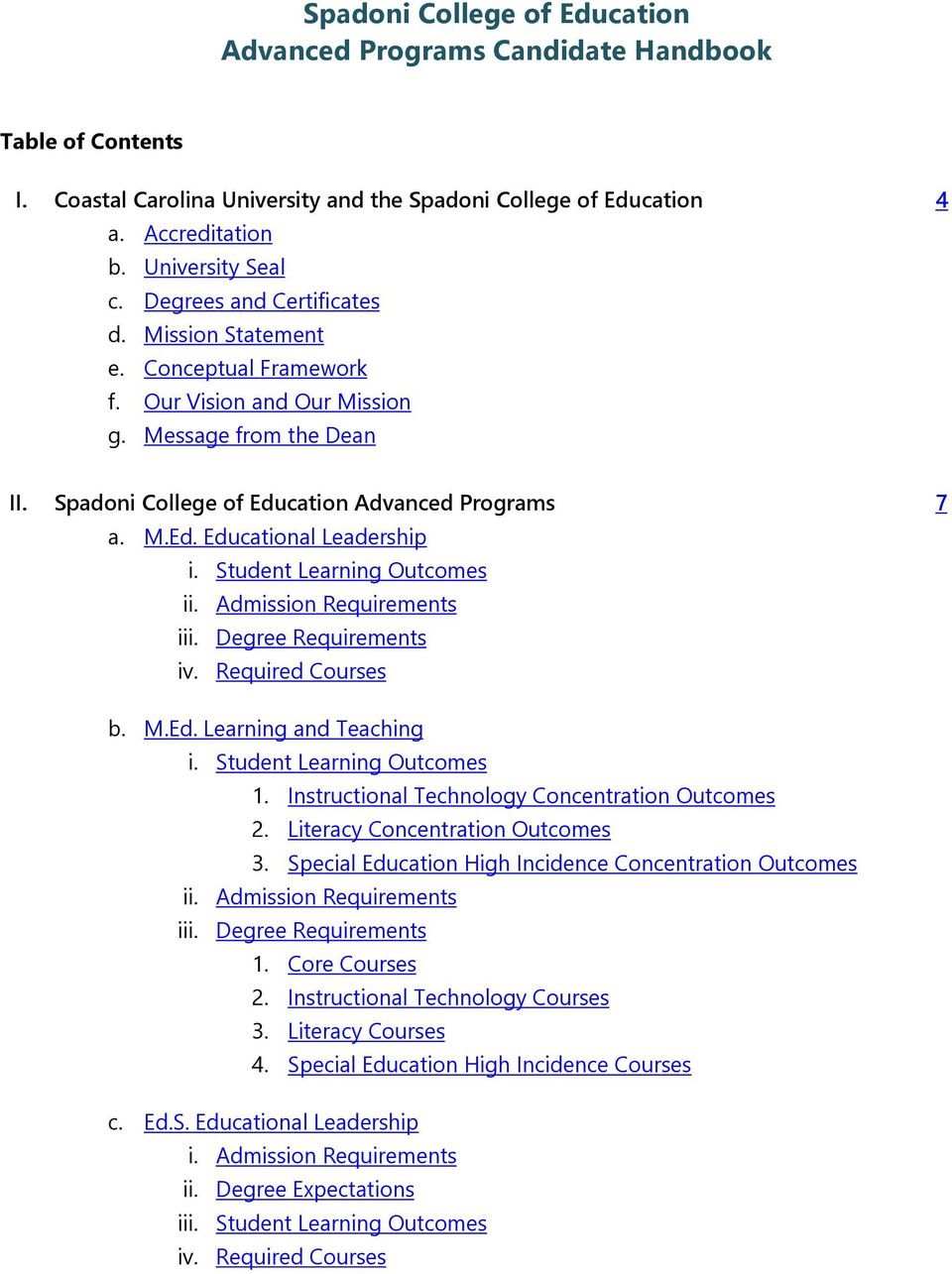
2 Spadoni College of Education Advanced Programs Candidate Handbook Table of Contents I. Coastal Carolina University and the Spadoni College of Education 4 a. Accreditation b. University Seal c. Degrees and Certificates d. Mission Statement e. Conceptual Framework f. Our Vision and Our Mission g. Message from the Dean II. Spadoni College of Education Advanced Programs 7 a. M.Ed. Educational Leadership i. Student Learning Outcomes ii. Admission Requirements iii. Degree Requirements iv. Required Courses b. M.Ed. Learning and Teaching i. Student Learning Outcomes 1. Instructional Technology Concentration Outcomes 2. Literacy Concentration Outcomes 3. Special Education High Incidence Concentration Outcomes ii. Admission Requirements iii. Degree Requirements 1. Core Courses 2. Instructional Technology Courses 3. Literacy Courses 4. Special Education High Incidence Courses c. Ed.S. Educational Leadership i. Admission Requirements ii. Degree Expectations iii. Student Learning Outcomes iv. Required Courses
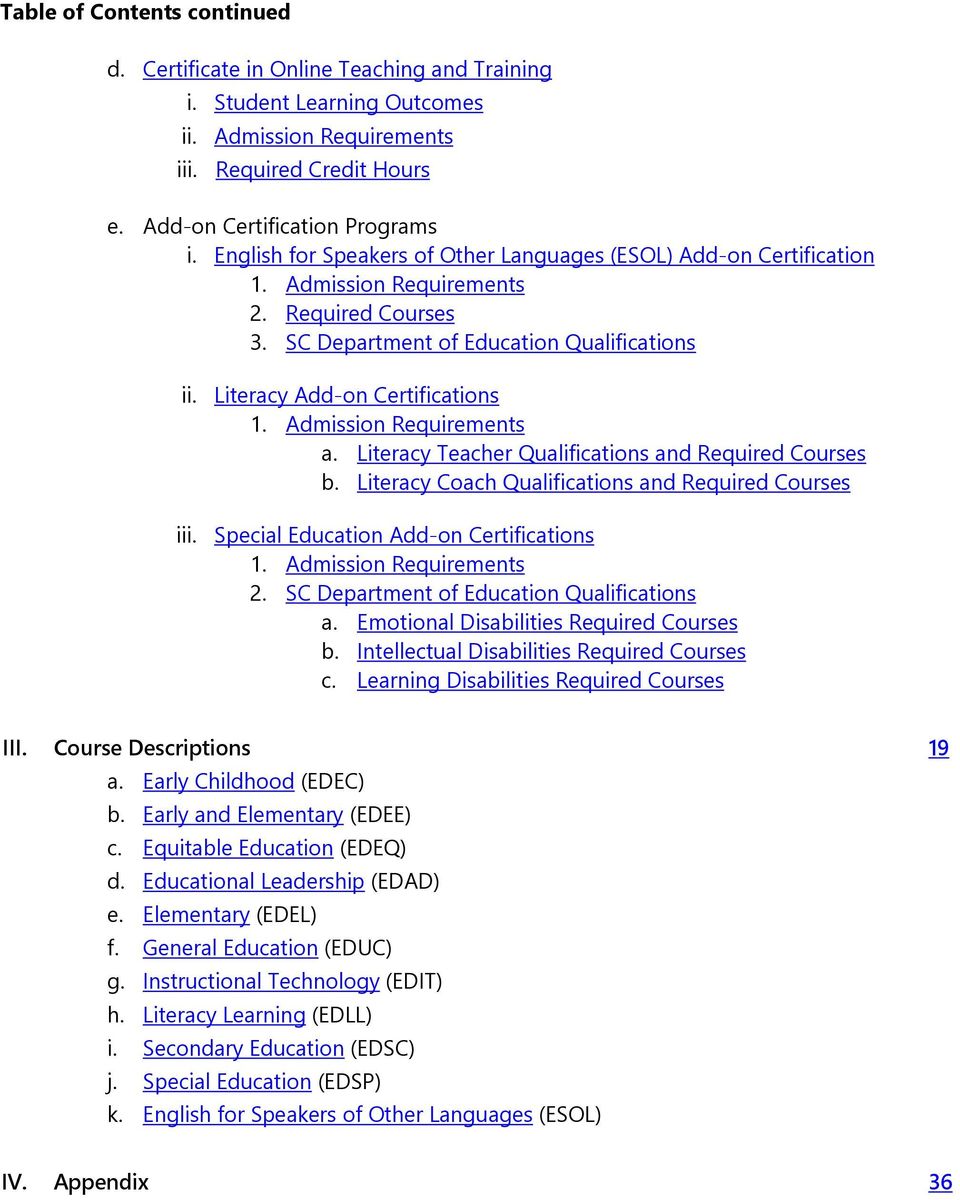
3 Table of Contents continued d. Certificate in Online Teaching and Training i. Student Learning Outcomes ii. Admission Requirements iii. Required Credit Hours e. Add-on Certification Programs i. English for Speakers of Other Languages (ESOL) Add-on Certification 1. Admission Requirements 2. Required Courses 3. SC Department of Education Qualifications ii. Literacy Add-on Certifications 1. Admission Requirements a. Literacy Teacher Qualifications and Required Courses b. Literacy Coach Qualifications and Required Courses iii. Special Education Add-on Certifications 1. Admission Requirements 2. SC Department of Education Qualifications a. Emotional Disabilities Required Courses b. Intellectual Disabilities Required Courses c. Learning Disabilities Required Courses III. Course Descriptions 19 a. Early Childhood (EDEC) b. Early and Elementary (EDEE) c. Equitable Education (EDEQ) d. Educational Leadership (EDAD) e. Elementary (EDEL) f. General Education (EDUC) g. Instructional Technology (EDIT) h. Literacy Learning (EDLL) i. Secondary Education (EDSC) j. Special Education (EDSP) k. English for Speakers of Other Languages (ESOL) IV. Appendix 36
4 I. COASTAL CAROLINA UNIVERSITY AND THE SPADONI COLLEGE OF EDUCATION Accreditation Coastal Carolina University is accredited by the Southern Association of Colleges and Schools Commission on Colleges to award the baccalaureate degree and master s degree. Contact the Commission on Colleges at 1866 Southern Lane, Decatur, Georgia or call (404) for questions about the accreditation of Coastal Carolina University. All other inquires about the University should be directed to Coastal Carolina University, PO Box , Conway, South Carolina, , or (843) , not the Commission. The Spadoni College of Education is nationally accredited by the National Council for Accreditation of Teacher Education (NCATE) and is approved by the South Carolina Department of Education. All programs in the Spadoni College of Education are approved by the South Carolina Department of Education, and accredited by the National Council for Accreditation of Teacher Education (NCATE), 2010 Massachusetts Ave., NW, Suite 500, Washington, DC 20036; phone (202) NCATE is recognized by the U.S. Department of Education and the Council for Higher Education Accreditation to accredit programs for the preparation of teachers and other professional school personnel. Additionally, the Educational Leadership programs are officially recognized by the Educational Leadership Constituent Council (ELCC) Specialized Professional Association or SPA. The University Seal The seal of Coastal Carolina University designates the founding year of the institution and associates the campus symbol, the Atheneum, with the coastal locale of the University. Carrying the Latin motto, Ex Libertate Veritas From Liberty, Truth - the seal refers to the Temple of Athene in ancient Athens where professors and students met. The Greek temple was named for Athena, the daughter of Zeus, who embodies wisdom and reason. The waves at the foot of the Atheneum acknowledge a diversified coastal environment encompassing a distinctive geography and history, a vital present and an abundant future. The seal was commissioned by Trustee Oran P. Smith as a gift to celebrate the July 1, 1993, establishment of the University as an independent, public institution of higher education. Degrees Education Specialist (Ed.S.) Master of Education Master of Education in Educational Leadership (M.Ed.) Master of Education in Learning and Teaching (M.Ed.) With a Concentration in Instructional Technology With a Concentration in Literacy With a Concentration in Special Education High Incidence Certificates Online Teaching and Training (COTT) 4 SCOE Advanced Programs Candidate Handbook Table of Contents
5 Add-on Certification Programs English for Speakers of Other Languages Literacy Literacy Teacher Literacy Coach Special Education Emotional Disabilities Intellectual Disabilities Learning Disabilities Mission Statement The Mission of the Spadoni College of Education at Coastal Carolina University is both to embrace the teacher-scholar model in preparing students to be productive, responsible, reflective practitioners and leaders for professional careers in education; and to embrace a leadership role through collaboration, service, and faculty research with P-12 schools, institutions of higher education, community agencies, and professional associations. This mission is accomplished by providing innovative undergraduate and graduate programs that focus on in-depth content and pedagogical knowledge, professional dispositions, diverse field experiences and internship placements, and the integration of contemporary technologies. We are also committed to continuous improvement by maintaining state and national recognition as well as, receiving accreditation of the National Council for Accreditation of Teacher Education (NCATE) which is now transitioning to the Council for the Accreditation of Teacher Preparation (CAEP). Conceptual Framework The overarching theme of the Conceptual Framework for all educator preparation programs is "The Educator as Reflective Practitioner." The initial and advanced teacher education programs and the advanced programs in educational leadership focus on the development of knowledge, skills, and professional dispositions to ensure that all candidates are well prepared and meet all institutional, state, and professional standards at the completion of their program. The Conceptual Framework describes the shared vision of teaching, learning, and the preparation of teachers and school leaders. It outlines our philosophy and commitment to the education profession; guides programmatic decisions; and ensures coherence among curricula, field experiences, clinical practice, and the unit s assessment system. The Conceptual Framework reflects our commitment to integrate technology, demonstrate professional behavior and dispositions, engage in reflective practice, work with diverse populations, and apply content and pedagogical knowledge to the teaching and learning process. The Conceptual Framework forms the basis for the goals for candidate proficiency in all professional educator preparation programs. Through performance assessments specific to each program, all education candidates should be able to demonstrate proficiency in the student learning outcomes associated with their individual programs. Individual program student learning outcomes are derived from the goals for candidate proficiency identified below. Goals for Candidate Proficiency 1. Ability to apply content and pedagogical knowledge to the teaching and learning process. 2. Ability to integrate technology to improve teaching and learning. 5 SCOE Advanced Programs Candidate Handbook Table of Contents
6 3. Ability to work with diverse populations. 4. Ability to demonstrate professional behavior and dispositions. 5. Ability to engage in reflective practice to improve teaching and learning. Spadoni College of Education Advanced Programs Advanced Programs provide advanced preparation of teachers, as well as for other school professionals. Coastal Carolina University graduate programs in education are administered by the Spadoni College of Education. The Master of Education (M.Ed.) degree programs are designed to offer educational practitioners an opportunity for professional growth and to develop master teachers or administrators who are able to provide leadership in designated areas. The Master of Arts in Teaching (M.A.T.) degree programs are designed to offer a route to initial teacher licensure through graduate study please refer to the Initial Programs Handbook for additional information about the M.A.T. degree programs. Our Vision The Spadoni College of Education will become the preferred state and regional institution of higher education for developing reflective, student-centered PK-12 educators. Our Mission To prepare PK-12 educators who are reflective and innovative change agents committed to social justice. Message from the Dean: Edward Jadallah, Ph.D. The Spadoni College of Education adheres to the ideal that our educator preparation programs provide learning experiences that reflect a broader purpose of education. Being a teacher or school administrator in the 21 st century requires the professional knowledge, skills, and dispositions for making informed and reasoned curriculum, instruction, and assessment decisions. This means that our college prepares educators who know how to analyze the validity of education reforms in relation to student learning; know how to adapt and implement effective teaching practices to varied learning contexts; and can serve as professional advocates for a purpose of education that promotes relevant and meaningful learning. Students learn early in their career that becoming a highly effective teacher requires a thorough knowledge of the subject matter being taught and the ability to design learning experiences that accommodate a variety of student needs, interests, and abilities. Admission to Study Applications for graduate study are to be directed to the Office of Graduate Studies at the University. Provisional Admission Applicants may receive approval for provisional study if they are entering the University for the first time or returning to the University after an extended absence. This basis of approval allows the student to begin courses prior to providing all of the credentials necessary to qualify for full admission and allows the student to register for up to 12 hours of course work before matriculation. Minimally, however, students must present validation that they hold the baccalaureate degree. Students who are not seeking degrees may request approval for additional credits through the Office of Graduate Studies. Transfer Credit With approval from the graduate program director, a maximum of 12 transfer credit hours may be applied to the graduate programs in the Spadoni College of Education. All transfer credit course work must have been completed with a minimum grade of B. 6 SCOE Advanced Programs Candidate Handbook Table of Contents

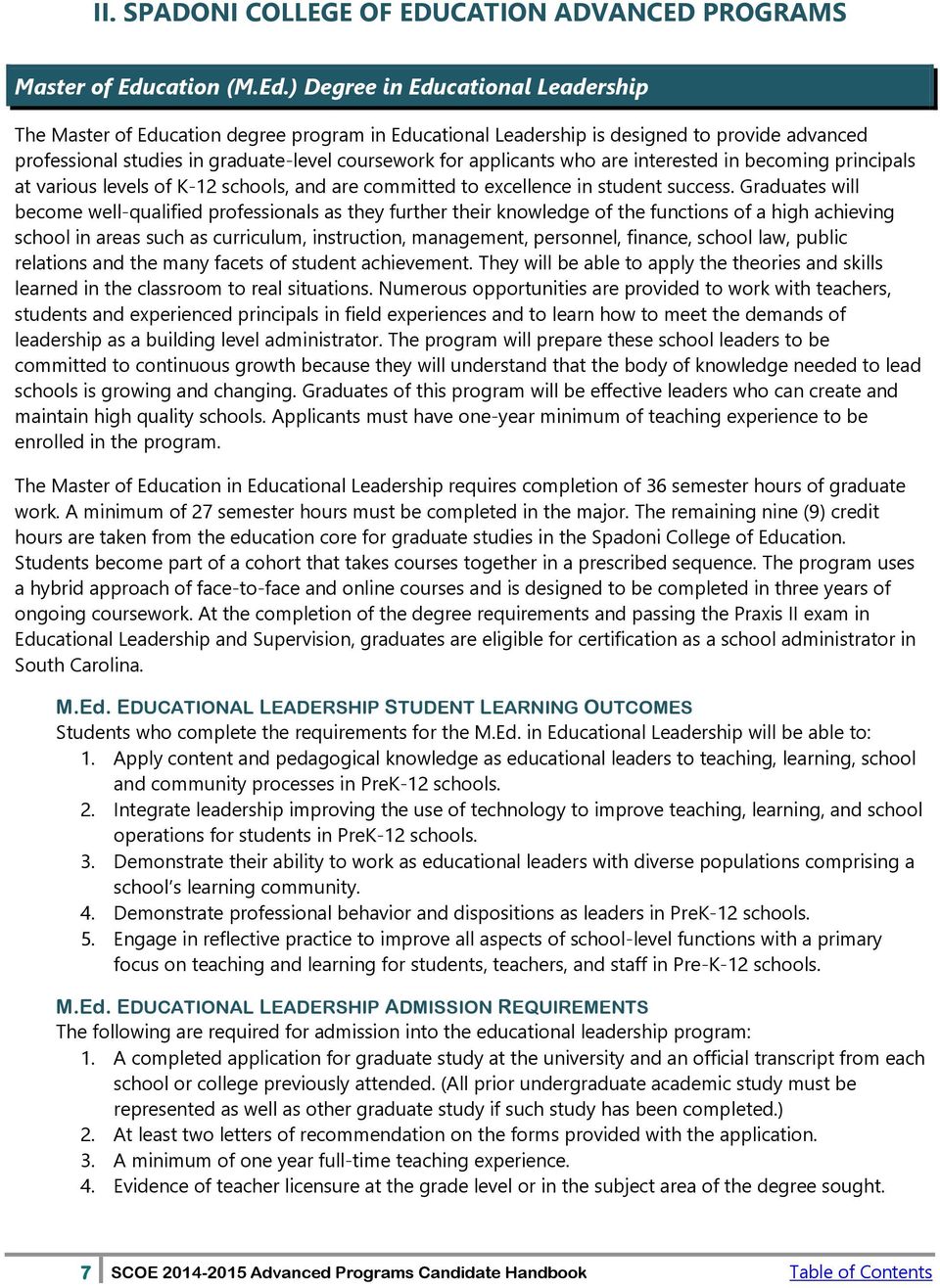
7 II. SPADONI COLLEGE OF EDUCATION ADVANCED PROGRAMS Master of Education (M.Ed.) Degree in Educational Leadership The Master of Education degree program in Educational Leadership is designed to provide advanced professional studies in graduate-level coursework for applicants who are interested in becoming principals at various levels of K-12 schools, and are committed to excellence in student success. Graduates will become well-qualified professionals as they further their knowledge of the functions of a high achieving school in areas such as curriculum, instruction, management, personnel, finance, school law, public relations and the many facets of student achievement. They will be able to apply the theories and skills learned in the classroom to real situations. Numerous opportunities are provided to work with teachers, students and experienced principals in field experiences and to learn how to meet the demands of leadership as a building level administrator. The program will prepare these school leaders to be committed to continuous growth because they will understand that the body of knowledge needed to lead schools is growing and changing. Graduates of this program will be effective leaders who can create and maintain high quality schools. Applicants must have one-year minimum of teaching experience to be enrolled in the program. The Master of Education in Educational Leadership requires completion of 36 semester hours of graduate work. A minimum of 27 semester hours must be completed in the major. The remaining nine (9) credit hours are taken from the education core for graduate studies in the Spadoni College of Education. Students become part of a cohort that takes courses together in a prescribed sequence. The program uses a hybrid approach of face-to-face and online courses and is designed to be completed in three years of ongoing coursework. At the completion of the degree requirements and passing the Praxis II exam in Educational Leadership and Supervision, graduates are eligible for certification as a school administrator in South Carolina. M.Ed. EDUCATIONAL LEADERSHIP STUDENT LEARNING OUTCOMES Students who complete the requirements for the M.Ed. in Educational Leadership will be able to: 1. Apply content and pedagogical knowledge as educational leaders to teaching, learning, school and community processes in PreK-12 schools. 2. Integrate leadership improving the use of technology to improve teaching, learning, and school operations for students in PreK-12 schools. 3. Demonstrate their ability to work as educational leaders with diverse populations comprising a school s learning community. 4. Demonstrate professional behavior and dispositions as leaders in PreK-12 schools. 5. Engage in reflective practice to improve all aspects of school-level functions with a primary focus on teaching and learning for students, teachers, and staff in Pre-K-12 schools. M.Ed. EDUCATIONAL LEADERSHIP ADMISSION REQUIREMENTS The following are required for admission into the educational leadership program: 1. A completed application for graduate study at the university and an official transcript from each school or college previously attended. (All prior undergraduate academic study must be represented as well as other graduate study if such study has been completed.) 2. At least two letters of recommendation on the forms provided with the application. 3. A minimum of one year full-time teaching experience. 4. Evidence of teacher licensure at the grade level or in the subject area of the degree sought. 7 SCOE Advanced Programs Candidate Handbook Table of Contents
8 5. Official transcripts reflecting an undergraduate Grade Point Average (GPA) of 3.0 (overall) on a 4.0 scale on undergraduate work OR, a report of minimum score of 286 with no less than 146 on the verbal and 140 on the quantitative portions on the Graduate Record Exam (GRE), OR, a report of a minimum score of (388) on the Miller Analogies Test (MAT). Scores must be no more than five years old. 6. Legal arrest/conviction statement 7. Approval of the Portal I Faculty Committee M.Ed. EDUCATIONAL LEADERSHIP DEGREE REQUIREMENTS The Master of Education in Educational Leadership in the Spadoni College of Education includes the following requirements: 1. Successful completion of 36 semester hours in the approved program of study. 2. Minimum overall 3.00 GPA in the program. 3. Approval of the Portal III Faculty Committee. 4. Successful completion of the Exit Portfolio. 5. Successful completion of the Portfolio Presentation and written Comprehensive Exam. 6. Passing score (145) on the Praxis II: Educational Leadership-Administration and Supervision. Every graduate student will have a faculty adviser with whom to plan a program of study sufficiently intensive and sequential to assure professional competence and breadth of knowledge. Advisers are assigned by the M.Ed. in Educational Leadership Coordinator. Though an adviser may be appointed, the appointment of an adviser is not intended as an assurance to the student that he/she has been officially admitted to the program. No more than twelve hours of study may be taken or applied to meet program requirements prior to full admission to the program. M.Ed. EDUCATIONAL LEADERSHIP REQUIRED GRADUATE DEGREE CREDIT HOURS (36 Graduate Credit Hours) Core Courses (9 Credit Hours) EDUC 607: Research in Today s Schools... 3 EDUC 630: Advanced Study of Curriculum & Instruction... 3 EDUC 685: Strategies for Teaching Diverse Learners... 3 Required Courses (27 Credit Hours) EDAD 600: Introduction to Educational Leadership... 3 EDAD 635: School Personnel Administration... 3 EDAD 660: Supervision of Instruction... 3 EDAD 680: School and Community Relations... 3 EDAD 684: School Finance/Ethics... 3 EDAD 686: Legal Basis of Educational Organization & Administration... 3 EDAD 689: School Principal... 3 (Choose two) EDAD 694, 695, 696, EDAD 694: Elementary School Principal in Practice I EDAD 695: Elementary School Principal in Practice II EDAD 696: Secondary School Principal in Practice I EDAD 697: Secondary School Principal in Practice II 8 SCOE Advanced Programs Candidate Handbook Table of Contents

9 Internship Requirements for Various Levels of Administrative Licensure* For Elementary Principal and Supervisor Licensure (grades K-8): Take EDAD 694 and EDAD 695. For Secondary Principal and Supervisor Licensure (grades 7-12): Take EDAD 696 and EDAD 697. For teachers with K-12 teaching licensure who want BOTH Administrative Licenses, there are two options: Take EDAD 694 and EDAD 697 or EDAD 695 and EDAD 696. An internship in a middle school counts towards administrative licensure at the level of the intern s teaching license. Examples: 1. If an intern is licensed as an elementary teacher and does a semester long internship at a middle school, this internship partially qualifies the intern for Elementary Principal and Supervisor licensure. 2. If an intern is licensed as a secondary teacher and does a semester long internship at a middle school, this internship partially qualifies the intern for Secondary Principal and Supervisor licensure. 3. If an intern is licensed in a K-12 field and does a semester long internship at a middle school, this internship can be used to satisfy either the elementary or secondary internship requirement. Teachers with either K-8 or 7-12 licensure will automatically qualify for middle school administrator and supervisor licensure as South Carolina does not have a separate middle school licensure category. *NOTE: For South Carolina licensure as an elementary, middle, or high school administrator, students must pass the PRAXIS II - Educational Leadership: Administration and Supervision. Master of Education (M.Ed.) in Learning and Teaching Concentrations: Instructional Technology, Literacy, and Special Education High Incidence The Master of Education (M.Ed.) degree program in Learning and Teaching is designed to offer opportunities for educators to advance their professional knowledge and practice. STUDENT LEARNING OUTCOMES for the M.Ed. LEARNING and TEACHING PROGRAM 1. Design and implement effective lesson based on knowledge of students, curricula, and best pedagogical practices. 2. Integrate technology to improve teaching, learning, and professional productivity. 3. Adapt learning environments, instructional strategies, and assessment techniques to meet the needs of culturally and developmentally diverse students. 4. Demonstrate professional behavior and dispositions in professional contexts. 5. Engage in reflective practice to improve teaching and learning. INSTRUCTIONAL TECHNOLOGY CONCENTRATION STUDENT LEARNING OUTCOMES 1. Demonstrate knowledge, skills and attitudes relevant to the integration of technology to support teaching and learning. 2. Develop instructional materials, experiences and assessments that leverage instructional technologies to inspire student creativity and performance. 9 SCOE Advanced Programs Candidate Handbook Table of Contents

10 3. Apply understanding societal issues of evolving digital culture to promote legal and ethical uses of technology in teaching and learning. 4. Pursue professional growth and leadership opportunities relevant to instructional technology. LITERACY CONCENTRATION STUDENT LEARNING OUTCOMES 1. Understand the theoretical and evidence-based foundations of reading and writing processes and instruction. 2. Use instructional approaches, materials, and an integrated, comprehensive, balanced curriculum to support student learning in reading and writing. 3. Use a variety of assessment tools and practices to plan and evaluate effective reading and writing instruction. SPECIAL EDUCATION HIGH INCIDENCE DISABILITIES PreK-12 CONCENTRATION STUDENT LEARNING OUTCOMES 1. Apply knowledge of special education principles, theories, laws, policies, and ethical practice in the comprehensive delivery of services to individuals with exceptional learning needs associated with emotional, learning, or intellectual disabilities. 2. Design learning environments and provide evidence-based instructional strategies to individualize instruction for positive learning results in general and special curricula. 3. Select, conduct, and interpret appropriate assessments for purposes of identification, eligibility, determination, instructional planning, evaluation, and collaborative decision-making appropriate for individuals with high incidence disabilities. ADMISSION to STUDY Applications for graduate study should be directed to the Office of Graduate Studies at Coastal Carolina University. M.Ed. LEARNING and TEACHING ADMISSION REQUIREMENTS Applicants for M.Ed. program admission must meet the following requirements: 1. A completed application for graduate study at the University and an official transcript from each school or college previously attended (all prior undergraduate academic study must be represented as well as other graduate study if such study has been completed.) 2. At least two letters of recommendation, one of which should be from a supervisor in an educational setting. 3. Official transcripts reflecting an undergraduate Grade Point Average (GPA) of 3.0 (overall) OR, report of minimum scores on the Graduate Record Exam (GRE) (minimum score of 286 with no less than 146 on the verbal and 140 on the quantitative portions), OR, report of a minimum score (388) on the Miller Analogies Test (MAT). Scores must be no more than five years old. 4. Evidence of teacher licensure. (NOTE: For applicants seeking the instructional technology concentration only, licensure requirement may be waived based on program review). M.Ed. LEARNING and TEACHING DEGREE REQUIREMENTS All Master of Education degrees in the Spadoni College of Education includes the following requirements: 1. Successful completion of an approved program of study, semester hours, of which at least 50 percent must be earned in courses numbered 600 or above. 2. Successful completion of the prescribed culminating experience. 3. A minimum grade point average of 3.0 (B) is required on the total graduate program. Grades below B on 12 hours of graduate work will disqualify a student for a graduate degree in the College. 10 SCOE Advanced Programs Candidate Handbook Table of Contents

11 Every degree-seeking student will meet with an assigned faculty adviser to plan the program of study. The appointment of an adviser is not intended as an assurance to the student that he/she has been officially admitted to any particular program of study. No more than twelve hours of study may be taken or applied to meet program requirements prior to full admission to the program. No academic program can be approved until the student has been admitted to the graduate program as a degree-seeking graduate student. Students are cautioned that graduate credit earned prior to full admission to a degree may not be applicable toward the degree requirements. The program should be established, at the latest, by the end of the first semester of study. Students seeking admission to a degree program where the program represents a notable difference from their baccalaureate level study may be expected to engage in additional study in the specialized degree area beyond basic degree requirements. M.Ed. LEARNING and TEACHING REQUIRED GRADUATE DEGREE CREDIT HOURS (30 Graduate Credit Hours) Core Courses (15 Credits Hours) Instructional Technology Concentration EDIT 604: Teaching with Technology... 3 EDIT 610: Instructional Design and Technology Integration... 3 EDUC 607: Research for Today s Schools... 3 EDUC 628: Assessment of Performance to Inform Instruction... 3 EDUC 630: Advanced Study of Curriculum and Instruction... 3 Core Courses (15 Credits Hours) Literacy and Special Education High Incidence Disabilities PreK-12 Concentrations EDIT 604: Teaching with Technology... 3 EDUC 607: Research for Today s Schools... 3 EDUC 628: Assessment of Performance to Inform Instruction... 3 EDUC 630: Advanced Study of Curriculum and Instruction... 3 EDUC 685: Strategies for Serving Diverse Learners... 3 Choose ONE of the following Concentration Areas with Credit Hours: INSTRUCTIONAL TECHNOLOGY CONCENTRATION (15 Credits Hours) (Choose four) EDIT 620, 630, 640, 650 or EDIT 620: Technology Planning and Management... 3 EDIT 630: Development of Instructional Multimedia... 3 EDIT 640: Instructional Video Production... 3 EDIT 650: Teaching and Learning Online... 3 EDIT 660: Advanced Online Teaching... 3 EDIT 690: Seminar in Instructional Technology (Culminating Experience)... 3 LITERACY CONCENTRATION (15 Credits Hours) EDLL 600: Advanced Reading Theory: Philosophical, Historical, and Sociological Foundations of Reading... 3 EDLL 604: Practicum in Literacy Assessment and Evaluation... 3 EDLL 606: Practicum in the Evaluation of Literacy Instruction and Assessment (Culminating Experience)... 3 EDLL 608: Instructional Strategies and Materials in Literacy SCOE Advanced Programs Candidate Handbook Table of Contents

12 (Choose one) EDLL 605 or EDLL 605: Organization, Administration, and Supervision of the School Reading Program OR EDLL 618: Content Literacy SPECIAL EDUCATION HIGH INCIDENCE CONCENTRATION (15 Credits Hours)* EDSP 640: Behavior Management... 3 EDSP 641: Educational Assessment of Exceptional Learners... 3 EDSP 692: * Foundations and Services for Exceptional Learners... 3 EDSP 698: Practicum in Special Education High Incidence Disabilities (Emotional, Intellectual & Learning) (Culminating Experience)... 3 *EDSP 692 may be waived for candidates who have taken Introduction to Special Education or its equivalent at the undergraduate or graduate level. Choose One: Option A or B or C Option A: Emotional Disabilities EDSP 670: Characteristics of Learner with Emotional and Behavioral Disabilities... 3 EDSP 671: Methods/Procedures for Learners with Emotional and Behavioral Disabilities... 3 Option B: Learning Disabilities EDSP 690: Specific Learning Disabilities (SLD): Nature and Needs... 3 EDSP 691: Instructional Procedures for Students with Learning Disabilities... 3 Option C: Intellectual Disabilities EDSP 680: Characteristics of Individuals with Intellectual Disabilities... 3 EDSP 691: Methods for Teaching Students with Intellectual Disabilities... 3 Specialist in Educational Leadership, Ed.S. The Specialist in Educational Leadership program is designed to provide advanced studies in graduatelevel coursework. Designed for educational leaders who want to continue their professional development, graduates of the program are also qualified for licensure as a school superintendent in South Carolina. Students learn about school district policy and practices in the areas of curriculum, instruction, management, facilities, personnel, finance, school law, and public relations, all aimed at improving student achievement. Numerous learning opportunities are provided to work with professors and district administrators in order to provide practical experiences as a district level leader. The program will prepare these school leaders to be committed to continuous professional growth as they lead school districts and their component schools through the change process. Graduates of this program will be effective leaders who can create and maintain high quality schools and school districts. Applicants must have a minimum of three years of teaching experience and be certified as a school principal to be enrolled in the program. The Specialist in Educational Leadership requires completion of 33 semester hours of graduate coursework. Students become part of a cohort that takes courses together in a prescribed sequence. The program uses a hybrid approach of face-to-face and online courses. The program is designed to be completed in two and one-half years of ongoing coursework that includes courses during each summer session. At the 12 SCOE Advanced Programs Candidate Handbook Table of Contents

13 completion of the degree, passing the Praxis II exam in Educational Leadership: Supervision and Administration, and by meeting experience requirements set by the State of South Carolina, graduates are eligible for licensure as a school superintendent in South Carolina. Ed.S. EDUCATIONAL LEADERSHIP ADMISSION REQUIREMENTS 1. A completed application for graduate study at the University. 2. Official transcripts of all undergraduate and graduate coursework from previously attended schools. 3. An earned Master s Degree in Educational Leadership or related field with an overall cumulative grade point average of A minimum of three years teaching experience. 5. A statement of interest in the program. This statement addresses the candidates reasons for pursuing a career in educational leadership. It also explains why the Coastal Carolina University Specialist in Educational Leadership program is the right fit to help reach the candidates goals. 6. Three letters of reference. The letters will address the candidates ability to balance the demands of high level graduate coursework and their personal and professional lives. 7. A successful interview with the Portal I Faculty Committee 8. Approval of the Portal I Faculty Committee Ed.S. EDUCATIONAL LEADERSHIP DEGREE EXPECTATIONS The Specialist in Educational Leadership at the Spadoni College of Education includes the following requirements: 1. Successful completion of 33 hours in the approved program of study. 2. Maintain a minimum overall average of B (3.0) for all courses taken. If at any time students fail to satisfy this requirement; they are placed on probation for one semester. Students are permitted only one probationary semester during the entire course of their graduate study. Failure to meet this requirement or receiving a failing grade (D or F) in a course in the program may be cause for dismissal regardless of students overall average. 3. Successful completion of the written comprehensive exam. 4. Successful defense of the comprehensive Exit Portfolio. 5. Pass the Praxis II Educational Administration: Supervision and Administration Exam. Ed.S. EDUCATIONAL LEADERSHIP STUDENT LEARNING OUTCOMES Related to the goals for candidate proficiency derived from the College s Conceptual Framework, successful program completers will be able to: 1. Apply content and pedagogical knowledge as educational leaders to teaching, learning, school and community processes in PK-12 schools at the highest administrative levels. 2. Integrate district-level leadership in the use of technology leading to the improvement of teaching, learning, and school operations for students in PK-12 schools. 3. Demonstrate their ability to work as educational leaders from district-level administrative positions with diverse populations comprising a school s learning community. 4. Demonstrate professional behavior and dispositions as leaders in the highest administrative positions in PK-12 schools. Ed.S. EDUCATIONAL LEADERSHIP REQUIRED COURSES Core Courses (24 Credit Hours) EDAD 701 Advanced Leadership and Management Theory... 3 EDAD 735 School District Finance... 3 EDAD 760 Instructional Leadership and Supervision SCOE Advanced Programs Candidate Handbook Table of Contents
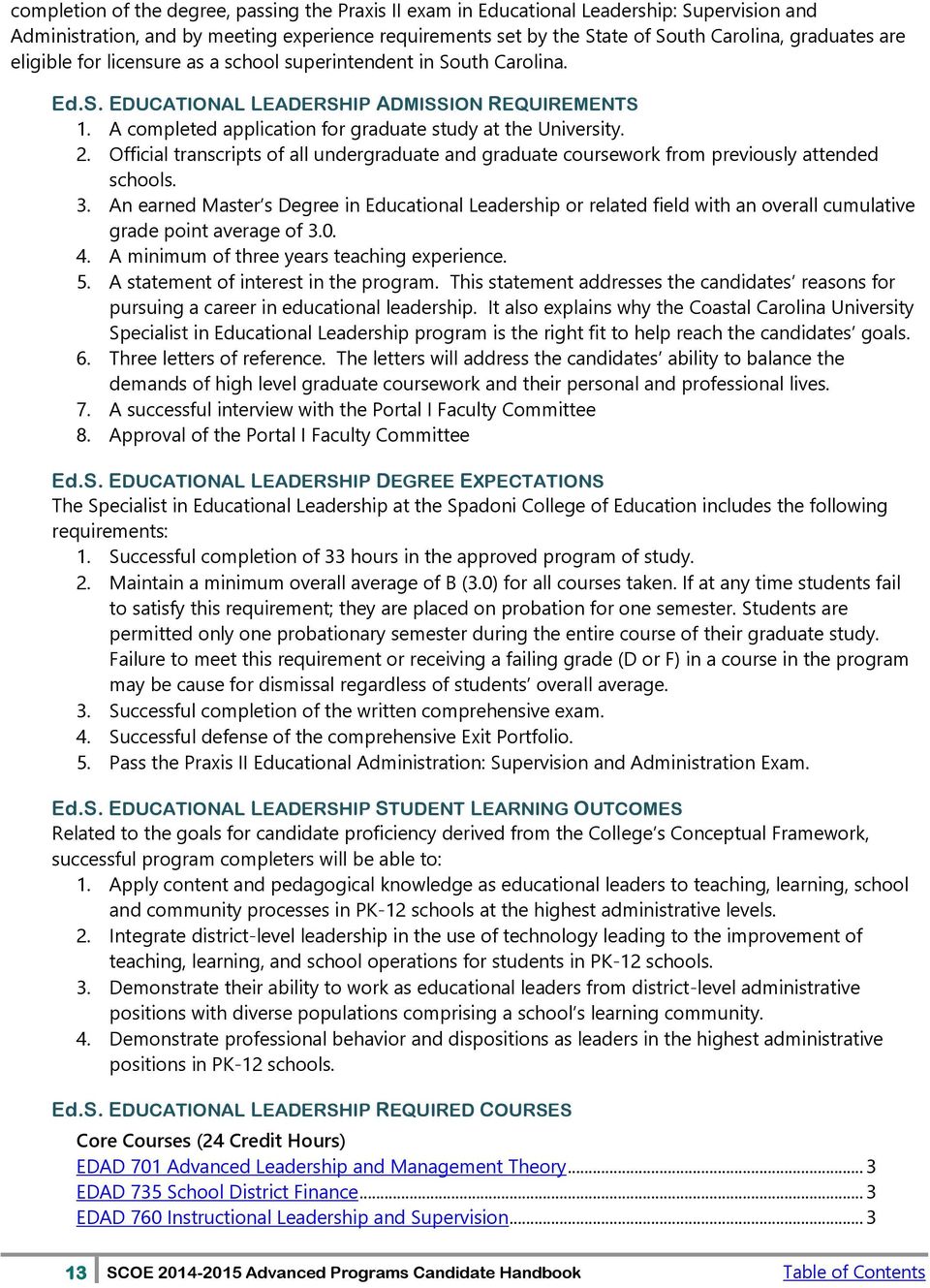
14 EDAD 777 School Facilities... 3 EDAD 780 Politics and Policy of Education... 3 EDAD 786 Topics in Educational Leadership... 3 EDAD 788 Action Research... 3 EDAD 789 The Superintendency and District Level Leadership... 3 Application Courses (9 Credit Hours) EDAD 790 Seminar in Educational Leadership... 3 EDAD 794 District Level Internship I... 3 EDAD 795 District Level Internship II... 3 TOTAL CREDITS REQUIRED Certificate in Online Teaching and Training (COTT) This 12 credit hour certificate program provides opportunities for educators and trainers to develop advanced competencies in designing, delivering and managing effective instruction for online learning environments. Teaching licensure is not required for admission. South Carolina certified teachers who complete the certificate program as directed by their advisers may be eligible to apply for add-on endorsements from the State Department of Education. COTT STUDENT LEARNING OUTCOMES After completing the Certificate in Online Teaching and Training program, students will be able to: 1. Design effective assessment strategies for evaluating online learners. 2. Design, develop, and select instructional content for effective online teaching. 3. Demonstrate proficiency using various production tools to develop effective online instructional environments and resources. 4. Identify and apply teaching strategies and technology tools to promote effective online communication and collaboration. 5. Understand theoretical foundations of effective online teaching and learning. ADMISSION to STUDY Applications for graduate study should be directed to the Office of Graduate Studies at Coastal Carolina University. COTT ADMISSION REQUIREMENTS Applicants for admission to the Certificate in Online Teaching and Training Program must meet the following criteria: 1. Completion of the application form and payment of the application fee. 2. Evidence of having received a baccalaureate degree from a regionally accredited institution in this country or its equivalent at a foreign institution based on a four-year degree program. 3. Submission of an official transcript from each post-secondary school or college previously attended (all prior undergraduate academic study must be represented as well as any graduate study). 4. Submission of a written statement of educational and career goals, including how this certificate program will contribute to realizing those goals. COTT REQUIRED CREDIT HOURS (12 Graduate Credit Hours) Core Courses (9 Credit Hours) EDIT 604: Teaching with Technology SCOE Advanced Programs Candidate Handbook Table of Contents
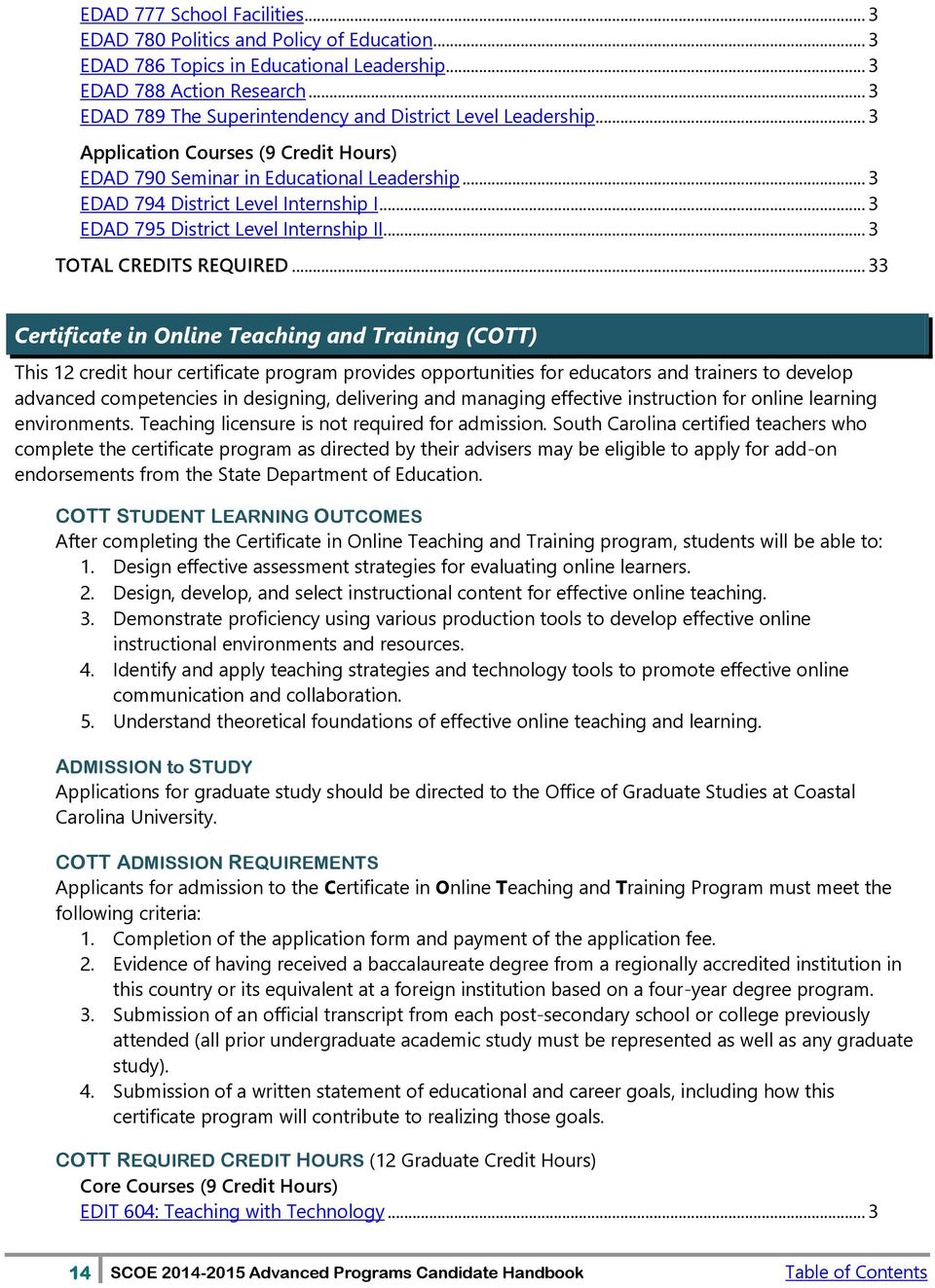
15 EDIT 650: Teaching and Learning Online... 3 EDIT 660: Advanced Online Teaching... 3 Choose ONE elective course from the following: EDIT 610: Instructional Design and Technology Integration... 3 EDIT 620: Technology Planning and Management... 3 EDIT 630: Development of Instructional Multimedia... 3 EDIT 640: Instructional Video Production... 3 English for Speakers of Other Languages Add-on Certification The Spadoni College of Education offers coursework leading to the English for Speakers of Other Languages (ESOL) Certification. This coursework provides opportunities for educators to develop skills and knowledge related to English language learners. This 15 credit curriculum is approved by the South Carolina State Department of Education (SCDE) to fulfill the graduate coursework requirement for the SCDE s ESOL add-on certification.* ESOL ADMISSION REQUIREMENTS Application Completion of the application form and payment of the $45 application fee. Transcripts You must submit an official transcript from every institution you have attended. Receipt of a baccalaureate or any higher degree must be clearly indicated on the transcript from the awarding institution. Official transcripts are those sent by the registrar of a college or university directly to the Office of Graduate Studies. The Office of Graduate Studies does not order transcripts from any institution. Official Scores No tests are required for admission to this add-on certification program. Application Deadlines The Office of Graduate Studies admits non-degree students on a rolling basis. However, course registrations typically fill well in advance of each session. Prospective students are therefore encouraged to complete the non-degree application process at least two weeks prior to ensure course availability. ESOL REQUIRED COURSES Required Courses (9 Credits) EDLL 650: Applied Linguistics for ESOL Teachers... 3 EDLL 651: Principles and Strategies for Teaching ESOL to Elementary and Secondary Learners... 3 EDLL 652: Teaching Reading and Writing to Limited English Proficient Learners... 3 Elective Courses (6 Credits) EDLL 653: Testing and Assessment for Language Minority Learners... 3 EDLL 654: ESOL Curriculum Design and Materials Development... 3 ESOL ADD-ON CERTIFICATION QUALIFICATIONS* To qualify for the ESOL add-on certification, the South Carolina State Department of Education has the following requirements: Bachelor s Degree Temporary, initial, or professional certification at the early childhood, elementary, middle, secondary, or PreK-12 level. Minimum qualifying score(s) on the South Carolina content area examination(s) required by the State Board of Education 15 SCOE Advanced Programs Candidate Handbook Table of Contents

16 Second-language learning experiences documented by any one of the following: a. Six semester hours in a single second language b. Completion of intensive language training by the Peace Corps, the Foreign Service Institute, or the Defense Language Institute c. Placement in a third-year-level course in the foreign language department at an accredited college or university d. Demonstration of second-language proficiency in a language that is unavailable at accredited institutions through verification in writing form from an official designated by the State Department of Education Literacy Add-on Certifications The Spadoni College of Education offers the coursework licensed educators need to fulfill in order to earn add-on certification by the South Carolina Department of Education for Literacy Teacher and Literacy Coach. The coursework provides an in-depth study of literacy foundations and assessment, coaching, teaching methods, curriculum development, and supervision of reading programs. By completing these courses, educators will have satisfied the coursework requirement to earn their Literacy endorsement. LITERACY ADD-ON CERTIFICATION ADMISSION REQUIREMENTS 1. Application Completion of the application form and payment of the $45 application fee. 2. Transcripts You must submit an official transcript from every institution you have attended. Receipt of a baccalaureate or any higher degree must be clearly indicated on the transcript from the awarding institution. Official transcripts are those sent by the registrar of a college or university directly to the Office of Graduate Studies. The Office of Graduate Studies does not order transcripts from any institution. 3. Official Scores No tests are required for admission to this add-on certification program. 4. Application Deadlines The Office of Graduate Studies admits non-degree students on a rolling basis. However, course registrations typically fill well in advance of each session. Prospective students are therefore encouraged to complete the non-degree application process at least two weeks prior to ensure course availability. LITERACY TEACHER ADD-ON CERTIFICATION QUALIFICATIONS To qualify for the Literacy Teacher certification, the South Carolina State Department of Education has the following requirements: Bachelor s Degree Initial, or professional certification at the early childhood, elementary, middle, secondary, or K-12 level Minimum qualifying score(s) on the content area examination(s) required by the State Board of Education Two years of successful teaching experience Specialized preparation 4 graduate courses as shown below LITERACY TEACHER Required Courses EDLL 600: Advanced Reading Theory: Philosophical, Historical, and Sociological Foundations of Reading... 3 *EDLL 604: Practicum in Literacy Assessment and Evaluation... 3 *EDLL 608: Instructional Strategies and Materials in Literacy SCOE Advanced Programs Candidate Handbook Table of Contents

17 *EDLL 618: Content Literacy... 3 *Practicum experiences should be included in the requirements of the courses as deemed necessary by each institution. These field experiences can be within a teacher s classroom and should support experiences with small and large group instruction. A separate practicum experience may be offered as a stand-alone course option. LITERACY COACH ADD-ON CERTIFICATION QUALIFICATIONS To qualify for the Literacy Coach certification, the South Carolina State Department of Education has the following requirements: Bachelor s Degree Initial, or professional certification at the early childhood, elementary, middle, secondary, or K-12 level Minimum qualifying score(s) on the content area examination(s) required by the State Board of Education 12 semester hours of courses required for the Literacy Teacher certification Specialized preparation 3 graduate courses as shown below LITERACY COACH Required Courses *EDLL 620: Literacy Assessment and Instruction for Diverse Populations... 3 *EDLL 621: Developing Literacy Teacher-Leaders within School Communities... 3 *EDLL 622: Action Research in Literacy Coaching... 3 *Practicum experiences should be included in the requirements of the courses as deemed necessary by each institution. Special Education Add-on Certifications (Fully Online) The Spadoni College of Education offers fully online coursework for licensed educators who want to add certification in Emotional Disabilities, Intellectual Disabilities, or Learning Disabilities to an existing license and qualify for teacher licensure by the South Carolina Department of Education. Coursework provides an in-depth study of characteristics and research-based methods of instruction in the area of focus, behavior management, and assessment. By completing the required courses, educators will have satisfied the coursework requirements for licensure in their chosen area of focus. SPECIAL EDUCATION ADD-ON CERTIFICATIONS ADMISSION REQUIREMENTS 1. Application Completion of the application form and payment of the $45 application fee. 2. Transcripts You must submit an official transcript from every institution you have attended. Receipt of a baccalaureate or any higher degree must be clearly indicated on the transcript from the awarding institution. Official transcripts are those sent by the registrar of a college or university directly to the Office of Graduate Studies. The Office of Graduate Studies does not order transcripts from any institution. 3. Teaching License copy of current teaching license 4. Official Scores No tests are required for admission to add-on certification program. 5. Application Deadlines The Office of Graduate Studies admits non-degree students on a rolling basis. However, course registrations typically fill well in advance of each session. Prospective students are therefore encouraged to complete the non-degree application process at least two weeks prior to ensure course availability. 17 SCOE Advanced Programs Candidate Handbook Table of Contents

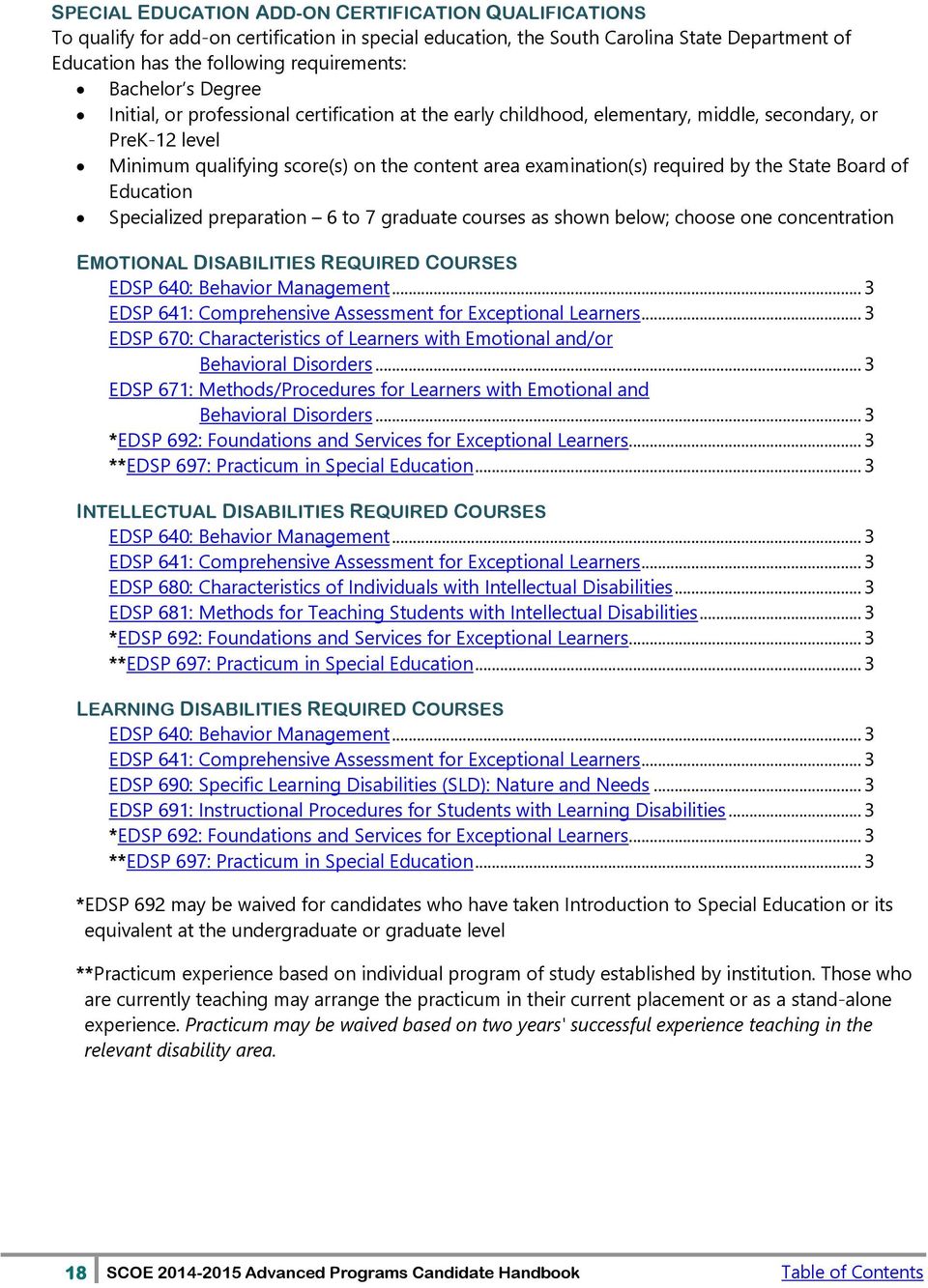
18 SPECIAL EDUCATION ADD-ON CERTIFICATION QUALIFICATIONS To qualify for add-on certification in special education, the South Carolina State Department of Education has the following requirements: Bachelor s Degree Initial, or professional certification at the early childhood, elementary, middle, secondary, or PreK-12 level Minimum qualifying score(s) on the content area examination(s) required by the State Board of Education Specialized preparation 6 to 7 graduate courses as shown below; choose one concentration EMOTIONAL DISABILITIES REQUIRED COURSES EDSP 640: Behavior Management... 3 EDSP 641: Comprehensive Assessment for Exceptional Learners... 3 EDSP 670: Characteristics of Learners with Emotional and/or Behavioral Disorders... 3 EDSP 671: Methods/Procedures for Learners with Emotional and Behavioral Disorders... 3 *EDSP 692: Foundations and Services for Exceptional Learners... 3 **EDSP 697: Practicum in Special Education... 3 INTELLECTUAL DISABILITIES REQUIRED COURSES EDSP 640: Behavior Management... 3 EDSP 641: Comprehensive Assessment for Exceptional Learners... 3 EDSP 680: Characteristics of Individuals with Intellectual Disabilities... 3 EDSP 681: Methods for Teaching Students with Intellectual Disabilities... 3 *EDSP 692: Foundations and Services for Exceptional Learners... 3 **EDSP 697: Practicum in Special Education... 3 LEARNING DISABILITIES REQUIRED COURSES EDSP 640: Behavior Management... 3 EDSP 641: Comprehensive Assessment for Exceptional Learners... 3 EDSP 690: Specific Learning Disabilities (SLD): Nature and Needs... 3 EDSP 691: Instructional Procedures for Students with Learning Disabilities... 3 *EDSP 692: Foundations and Services for Exceptional Learners... 3 **EDSP 697: Practicum in Special Education... 3 *EDSP 692 may be waived for candidates who have taken Introduction to Special Education or its equivalent at the undergraduate or graduate level **Practicum experience based on individual program of study established by institution. Those who are currently teaching may arrange the practicum in their current placement or as a stand-alone experience. Practicum may be waived based on two years' successful experience teaching in the relevant disability area. 18 SCOE Advanced Programs Candidate Handbook Table of Contents
19 III. COURSE DESCRIPTIONS Early Childhood (EDEC) EDEC 631 EDEC 640 Special Topics in Early Childhood Education. (3) Specific analysis of crucial childhood education issues in the field as they exist and emerge in the future. Provides an opportunity for students to do in-depth study of specific areas of concern. As Needed Trends and Issues in Early Childhood Education. (3) Study of the trends and issues that characterize early childhood education today. The course is designed to create an awareness of the directions the field is taking, the myriad problems early childhood education faces and how these problems may be resolved. As Needed EDEC 697 Seminar in Early Childhood Education. (3) (Prereq: EDUC 531, 606, 607, 649, EDEC 632, 642, with grade of C or better) Students will synthesize their graduate studies for a master's degree in early childhood education. As Needed Early and Elementary (EDEE) EDEE 610 EDEE 612 EDEE 614 EDEE 615 EDEE 616 Advanced Study of Teaching Mathematics and Science in the Early Childhood and Elementary Grades. (3) (Prereq: EDUC 607) This course emphasizes inquiry teaching/learning methods, instructional materials, curriculum integration, community resources, diagnosis and remediation, and evaluation procedures that facilitate pupil discovery and learning in mathematics and science in the early childhood and elementary levels for improved and advanced instruction. As Needed Advanced Social Studies Methods for the Elementary Classroom. (3) (Prereq: Graduate student with educator certification) This course focuses on the development of standardsbased, developmentally appropriate, culturally responsive learning experiences in elementary Social Studies. Emphasis will be placed on creating a classroom culture of active engagement in learning and on the teacher as an enthusiastic life-long learner. SU Advanced Science Methods for the Elementary Classroom. (3) (Prereq: Graduate student with educator certification) This course focuses on the development of standards- based, developmentally appropriate, culturally responsive learning experiences in elementary Science. Emphasis will be placed on creating inquiry units that engage students in scientific discourse, emphasize the skills of scientific inquiry, enhance problem solving, and encourage all students to participate in science learning. There will be an added focus on the teacher as an active participant in ongoing professional development and the planning of the school science program. SU Application of Differentiated Instruction in the Early Childhood and Elementary Classroom. (3) (Prereq: EDUC 607 and EDUC 685) This course will include the capstone experience for the specialization in Teaching and Learning in the Early and Elementary Grades. The focus will be on developing appropriate, differentiated instructional strategies that will help early childhood and elementary teachers more effectively engage all students in optimal learning experiences. SU Methods and Materials for Early Childhood Education. (3) (Prereq: Graduate student with educator certification) An advanced study of instructional methods for the teaching of 19 SCOE Advanced Programs Candidate Handbook Table of Contents
20 young children ages 3 through 8 and the preparation of materials to enhance the learning experiences of these children. S, SU EDEE 618 Early Childhood Field Experience. (3) (Prereq: Graduate student with educator certification) Field placement in a pre-kindergarten or kindergarten classroom where teacher candidates have opportunities to apply knowledge and skills in authentic situations. The emphasis will be on developing deeper understanding of young children s development and the implications of development for program planning for both typical and atypical children. S, SU EDEE 650 Advanced Study of Early and Elementary Curricula and Programs. (3) (Prereq: EDUC 607, 628, 630, 685, EDIT 604, EDLL 601 EDEE 610, 615, and EDSP 605) This course includes the culminating experience for the specialization in Teaching and Learning in the Early and Elementary Grades. The course emphasizes dominant practices, methodologies, and current research that influences curriculum development and practice, including an analysis of programs and practices involving families, parents and community involvement in early childhood and elementary educational settings. Students will finalize the construction of a portfolio that will demonstrate advanced instructional methods for the early childhood/elementary grades. S Equitable Education (EDEQ) EDEQ 624 EDEQ 625 EDEQ 626 EDEQ 628 EDEQ 640 Framework for Equitable Education. (3) (Prereq: Graduate student with educator certification) Course focuses on the development of a theoretical foundation for understanding relevant research on equitable education. There is an added emphasis on the teacher as an active participant in ongoing professional development and school improvement. F, S, SU Application of Differential Instruction. (3) (Prereq: EDEQ 624 or permission of instructor) Course focuses on developing and applying appropriate differentiated instructional strategies that will help teachers more effectively engage all students in optimal learning experiences. SU Culturally Responsive Methods and Materials. (3) (Prereq: Graduate student with educator certification, EDEQ 624, or permission of instructor) Course focuses on culturally responsive methods and materials to improve instruction and student learning. Particular attention is given to interdisciplinary, multicultural materials for the English Language Arts and to the inclusion of multiple perspectives in Social Studies. SU STEM Methods and Materials for Diverse Students. (3) (Prereq: Graduate student with educator certification, EDEQ 624, or permission of instructor) Course focuses on the development of standards-based learning experiences in STEM (Science, Technology, Engineering, and Mathematics). Emphasis will be placed on creating units that engage students in discourse, utilize inquiry, and encourage all students to participate in STEM learning. SU Successful Collaboration with Diverse Families. (3) (Prereq: Graduate student with educator certification, EDEQ 624, EDEQ 625, EDEQ 626,EDEQ 628, EDLL 620 or permission of instructor) Course focuses on helping educators understand the characteristics and challenges of diverse families. Additionally, educators will learn strategies to establish and 20 SCOE Advanced Programs Candidate Handbook Table of Contents

21 maintain collaborative relationships with families. This course serves as the culminating (capstone) course for the Equitable Education concentration. S Educational Leadership (EDAD) EDAD 600 EDAD 635 EDAD 660 EDAD 680 EDAD 684 EDAD 686 EDAD 689 EDAD 694 Introduction to Educational Leadership. (3) (Prereq: Admission to M.Ed. degree program in Educational Leadership) Students examine the purposes and organizational structures of educational institutions created by federal, state, and local governments offering programs and services from early childhood through adulthood. Contemporary operational and administrative problems and developing trends are considered for analysis. F School Personnel Administration. (3) (Prereq: EDAD 600) The course focuses on techniques to maintain effective human relations and the use of human resources. Staff evaluation systems, staffing projections, staff-related record management, and benefit programs are examined. The curriculum emphasizes negotiations in the public sector and contract management. S, SU Supervision of Instruction. (3) (Prereq: EDAD 600) This course provides a theoretical and practical overview of the supervision and evaluation of instruction. The domains of supervision and inquiry into current issues and best practices in supervision are introduced. Students will examine the use of a variety of approaches to assist in the development of practical skills using the clinical process and developmental approach to supervision. F, S School and Community Relations. (3) (Prereq: EDAD 600) The development and analysis of appropriate organizational procedural and administrative arrangements for public relations programs in educational institutions are topics of the course. Problems of developing understanding and effective communication relative to the community power for educational leaders to support school improvement processes in rapidly changing social, economic, and political contexts. F School Finance/Ethics. (3) (Prereq: EDAD 600) Introduction to school finance and school business administration at all levels of school district organization. The course applies contemporary theories of economics to educational funding, sources of revenue, resource allocation considerations, and study of current trends in fiscal structure and operations in education. The curriculum includes discussion of ethics in school finance. S, SU Legal Basis of Educational Organization and Administration. (3) (Prereq: EDAD 600). Basic principles of school law with special attention to legislation in South Carolina and related court decisions. Other related topics such as tenure, teacher dismissal, employment, publications and limitations of the Board of Education will be examined. S, SU School Principal. (3) (Prereq: EDAD 600) This course provides an overview of this key position. Analyzes and investigates roles and functions of principalship. The emphasis of the curriculum is on linking theory to practice, facilitating transition to leadership position, and development of appropriate skills and attitudes. Leadership and management will be addressed. Theoretical concepts and practical illustrations are used to expand insights into the issues facing the school principal. F, S Elementary School Principal in Practice I. (3) (Prereq: EDAD 600 and completion of 5 (five) EDAD courses before permission to register for internship) This internship under direct supervision of an on-site experienced elementary administrator and a member of the 21 SCOE Advanced Programs Candidate Handbook Table of Contents
22 faculty of the CCU Department of Educational Leadership serves as a critical benchmark for decisions about administrative licensure. The first in a two-semester internship provides practical experience in the duties and responsibilities of the school principal designed to insure orientation in educational administration as a broad field. F, S EDAD 695 Elementary School Principal in Practice II. (3) (Prereq: EDAD 600, 694 and completion of 5 (five) EDAD courses before permission to register for internship) The second in a twosemester supervised internship expands the candidate performance of the duties and responsibilities of the school principal. Included in the internship are specialized and indepth projects related to school administration and problems that reflect candidate needs and interests. F, S EDAD 696 Secondary School Principal in Practice I. (3) (Prereq: EDAD 600, and completion of 5 (five) EDAD courses before permission to register for internship) This internship under direct supervision of an on-site experienced secondary administrator ( field supervisor ) and a member of the faculty of the CCU Department of Educational Leadership serves as a critical benchmark for decisions about administrative licensure. The first in a two- semester internship provides practical experience in the duties and responsibilities of the school principal designed to insure orientation in educational administration as a broad field. F, S EDAD 697 Secondary School Principal in Practice II. (3) (Prereq: EDAD 600, 696 and completion of 5 (five) EDAD courses before permission to register for internship) The second in a twosemester supervised secondary internship expands the candidate performance in the duties and responsibilities of the school principal. Included in the internship are specialized and indepth projects related to school administration and problems that reflect candidate needs and interests. F, S EDAD 701 EDAD 735 EDAD 760 EDAD 777 Advanced Leadership and Management Theory. (3) (Prereq: M.Ed in Educational Leadership or equivalent or permission of instructor) Advanced leadership and management theories will be examined to analyze, plan for implement, and evaluate strategies for educational leaders to support school improvement processes in rapidly changing social, economic, and political contexts. F School District Finance. (3) (Prereq: EDAD 701, EDAD 789) Course includes theory and practice of business management, internal accounting procedures, and South Carolina public school finance. Field-based experiences are designed to allow students to transfer theory into meaningful practice in school management. SU Instructional Leadership and Supervision. (3) (Prereq: EDAD 701, EDAD 789) From the framework of district level leadership, this course surveys the process for supervising, improving, coordinating, and evaluating instruction. It includes contemporary trends in supervisory practices. MY School Facilities. (3) (Prereq: EDAD 701, EDAD 789) Course is about the interaction of facilities and learning in PK-12 education. Students learn about basic facilities issues at the building and district level including facilities management concepts and processes related to buildings and grounds. In addition, students learn how to plan for and implement facilities development and major construction projects. SU 22 SCOE Advanced Programs Candidate Handbook Table of Contents
23 EDAD 780 EDAD 786 EDAD 788 EDAD 789 EDAD 790 EDAD 794 EDAD 795 Politics and Policy of Education. (3) (Prereq: EDAD 701, EDAD 789) The framework of this course is the micro and macro politics of education in the United States. It provides an introduction to the field of educational politics, the political process, and their transformation into policy. SU Topics in Educational Leadership. (3) (Prereq: EDAD 701,EDAD 789) Course topics are determined by the interest and needs of the students and the instructor including a focus on Special Education, the Common Core Standards, and instructional technology. Topics identified and researched in this course are used for action plans designed in EDAD 788, Action Research, and EDAD 795, District Level Internship II. F Action Research. (3) (Prereq: EDAD 701, EDAD 786, and EDAD 789) Course advances the proposition that the action research approach is a useful paradigm for school district improvements. After learning about action research methodologies, students collaborate with a district level educational leader who works with the student identifying a topic for action research. The student may use the action research topic to build an action plan addressing the issue for implementation in EDAD 795, District Level Internship II. S The Superintendency and District Level Leadership. (3) (Prereq: M.Ed in Educational Leadership or equivalent, be matriculated in the Educational Specialist Program, or permission of instructor) The purpose of this course is to study the basic functions, duties, responsibilities and current problems confronting school superintendents. Students also learn about applying administrative theories or organizational behavior and development, relations with the school board, and the various roles of district level administrators. S Seminar in Educational Leadership. (3) (Prereq: EDAD 794) (Coreq: EDAD 795) Through interviews, readings, discussions, and research, students apply action research techniques and practices to design and apply solutions to problems in school administration and supervision in EDAD 795, District Level Leadership II. F District Level Internship I. (3) (Prereq: EDAD 701,EDAD 735, EDAD 760, EDAD 777, EDAD 780, EDAD 786, EDAD 788, and EDAD 789) First of two-semester internship, the course provides experience in district level leadership roles under the guidance of an experienced field mentor and university supervisor. This is a field-based course. Candidates are required to participate in and complete a minimum of 150 hours of activities over a two-semester period of time. MY District Level Internship II. (3) (Prereq: EDAD 794) (Coreq: EDAD 790) Second of twosemester internship, this field-based course provides experience in district level leadership roles under the guidance of an experienced field mentor and university supervisor. Candidates are required to participate in and complete a minimum of 150 hours of activities. A major component of this course is implementing an action plan to address the field-based problem researched in EDAD 788. F Elementary (EDEL) EDEL 608 Parent Involvement in Elementary Education. (3) Analysis of programs and practices for involving parents in elementary educational settings. Emphasis on objectives, methods, techniques, and materials for program development. Community resources for supporting programs for children in various instructional settings. As Needed 23 SCOE Advanced Programs Candidate Handbook Table of Contents
24 EDEL 610 EDEL 611 EDEL 613 EDEL 617 EDEL 631 EDEL 640 EDEL 645 EDEL 658 EDEL 670 EDEL 695 Social Studies in the Elementary School. (3) Selection, classification, and organization of materials in the field of social studies in the elementary school. As Needed Teaching Writing in Elementary and Middle School. (3) Writing instruction in relation to the developmental characteristics of children through preadolescence. As Needed Science in the Elementary School. (3) Reinforces the science background of prospective and practicing elementary teachers. Innovations are examined. Emphasis is placed on methods, materials, community resources and evaluation procedures. As Needed Curriculum Problems in the Elementary School. (3) (Prereq: EDEL 715) A course designed to examine the internal facets of the elementary school. These include the library; health, guidance, and other pupil personnel services; curriculum revision; elementary school procedures; and pupil accounting. As Needed Special Topics in Elementary Education. (3) Specific analyses of crucial issues in the field as they exist and emerge in the future. Provides an opportunity for students to do in- depth study of specific areas of concern. As Needed Advanced Study of Teaching Mathematics in the Elementary School. (3) The selection of teaching procedures and instructional materials which facilitate pupil discovery and learning. Research findings relative to current trends, diagnostic teaching, and mathematics as a contemporary necessity will be examined. As Needed Diagnostic Teaching of Arithmetic. (3) Analysis of the concepts and skills of arithmetic in the school mathematics curriculum, exploration of diagnostic-prescriptive teaching methods. As Needed Advanced Study of Teaching Science in the Elementary School/Middle School. (3) Study of curriculum models and instructional theory underlying elementary and/or middle school science programs. As Needed Advanced Study of Language Arts in the Elementary School. (3) The relationship between language learning and the genesis and development of personality with implications that would follow for the elementary school language arts curriculum. As Needed Special Education for Teachers in Elementary Education. (3) Addresses current issues and needs in instructional programming for students with high incidence disabilities (learning disabilities, emotional/behavioral disorders, and mental retardation) at the elementary level. Emphasize methods for the development and acceleration of basic academic skills. As Needed General (EDUC) EDUC 607 Research for Today's Schools. (3) Study of the principles of education research and how research can improve instruction and assessment in PK-12 learning environments. The course focuses on identifying and defining research questions, reviewing and critiquing qualitative and quantitative education research, developing mixed-methods research designs, collecting and analyzing qualitative and quantitative data, using the results of empirical research to guide instructional decisions, and the communication of research 24 SCOE Advanced Programs Candidate Handbook Table of Contents
25 results. Students are required to develop, implement, write up, and report on an original, field-based, education research project. F, S, SU EDUC 608 EDUC 609 EDUC 610 EDUC 611 EDUC 620 EDUC 625 EDUC 628 EDUC 630 The Nature and Needs of Gifted and Talented Students. (3) (Prereq: Admission to graduate study) Course designed to provide teachers with a foundation in gifted education as a survey course in the education of gifted and talented students. Included is an overview of the historical and philosophical background of gifted education, as well as a rationale for it. The course focuses on the characteristics, needs, problems, and developmental patterns of gifted and talented students, including special populations of gifted and talented students and methods of talent development. As Needed Introduction to Curriculum and Instruction for Gifted and Talented Students. (3) (Prereq: Admission to graduate study at CCU) Course is designed to prepare teachers to organize and deliver appropriate curriculum for gifted and talented students. Teachers will explore curriculum models, instructional strategies, and assessments in order to meet the needs and abilities of gifted and talented students. Current research and technology will be utilized in writing lesson plans and units. As Needed Integrated Reading and Writing Instruction. (3) Theoretical bases and techniques for teaching reading and writing using multiple subject areas. As Needed Writing/Reading Process Institute Seminar. (6) (Permission of Instructor) (=ENGL 611) This course involves participants in the study of literacy education. Current theory and practice in the teaching and learning of writing and reading will be explored and experienced with special attention/writing workshop and the role of teacher research to develop new professional knowledge. Prior approval of graduate advisor is required to include this course in a graduate degree program. As Needed The Middle School Curriculum. (3) (Prereq: Permission of the Instructor) A course intended to increase the student's knowledge and awareness of current trends and practices in middle school curriculum with an emphasis placed on the future direction of middle school education to prepare teachers for the demands of an increasingly advanced technological, multicultural society. As Needed Student Motivation and Management. (3) Study of effective principles and techniques of motivation and management in classrooms today. Attention is given to theories and strategies of the management of students as well as classroom organization and the relationship between motivation and management. As Needed Assessment of Performance to Inform Instruction. (3) (Prereq: EDUC 607) This course focuses on critical knowledge and application of assessment data when making decisions that promote strong instructional outcomes for students. Based on an understanding of student cognitive and affective development, participants will use, interpret, and appropriately communicate formal and informal assessment results to parents and students. Course emphasizes effective collaboration with other school-based professionals to evaluate and monitor student progress and to modify instruction based on individual learning needs. F, S Advanced Study of Curriculum and Instruction. (3-6) Study of the principles of curriculum and instruction related to PK-12 schools. Included are sources of the curriculum, methods 25 SCOE Advanced Programs Candidate Handbook Table of Contents
26 of organization, curriculum planning and development, the teacher's roles and responsibilities, assessment, and trends and influences in curriculum and instruction practices. Field work is included. F, S EDUC 631 EDUC 649 EDUC 655 EDUC 680 EDUC 685 Special Topics. (3-6) Topics selected allow for specialized study of timely topics related to the field of education. As Needed. The School and Modern Society. (3) (Prereq: Permission of the Instructor) Basic concepts of the relation of the school to the social order; an analysis of the essential features of changing social context within which American educational policy and practice now operate. The educational implications of recent social change in the American and world society. As Needed Teaching Environmental Education. (3 or 6) Rationale and strategies for teaching environmental education. As Needed Capstone Experience. (3) Study that focuses on the preparation of an action research project, paper and presentation that addresses a real problem found in the classroom/job assignment of the degree candidate and that applies the knowledge and skills gained in the degree program. A portfolio presentation documenting proficiency in designated national and college standards is also included. As Needed Strategies for Serving Diverse Learners. (3) Course designed to assist teachers in exploring issues in multicultural and special education to recognize how such factors as socioeconomic status, racial and ethnic backgrounds, gender, language proficiency, and disabilities may affect a child s performance. Teachers will study ways of making classrooms, curricula, and instructional strategies suitable for a diverse student population. F, S, SU Instructional Technology (EDIT) EDIT 604 EDIT 610 EDIT 620 EDIT 630 EDIT 640 Teaching with Technology. (3) A standards-based investigation of instructional technologies and their potential to improve teaching practice, professional productivity, and student performance. The course is designed to meet the National Education Technology Standards for Teachers (NETS-T), published by ISTE. F, S, SU Instructional Design and Technology Integration. (3) (Prereq: EDIT 604) Design and evaluation of technology-supported teaching and learning. Emphasis on research-based practices in technology integration. F, even years. Technology Planning and Management. (3) (Prereq: EDIT 604) Theories and strategies for planning and managing instructional technology resources for classroom, project, and school implementation. Emphasis on evaluation, acquisition, installation, operation, and administration. S, odd years. Development of Instructional Multimedia. (3) (Prereq: EDIT 604) Application of design theories and development techniques to the production of multimedia learning objects using advanced authoring tools. SU, odd years. Instructional Video Production. (3) (Prereq: EDIT 604) Systematic planning, development and deployment of video programming for school-based applications. Production 26 SCOE Advanced Programs Candidate Handbook Table of Contents
27 emphasis on the communication of instructional messages relevant to the needs of student, teacher, parent, or administrator audiences. F, odd years. EDIT 650 EDIT 660 Teaching and Learning Online. (3) (Prereq: EDIT 604) Theory and best practices for the design, development, and implementation of online instruction for blended and distancebased applications. SU Advanced Online Teaching. (3) (Prereq: EDIT 604, EDIT 650) Advanced exploration of instructional theory and strategies for online teaching. Emphasis on best practices in implementation, assessment, and management. SU EDIT 690 Seminar in Instructional Technology. (3) (Prereq: EDIT 604 plus any four of EDIT 610, 620, 630, 640, 650) Capstone experiences in the design, development, implementation, evaluation and management of instructional technologies and their potential to improve teaching practice, student performance, and professional productivity. Emphasis on the Instructional Technology Portfolio. S Literacy Learning (EDLL) EDLL 600 EDLL 601 EDLL 603 EDLL 604 EDLL 605 Advanced Reading Theory: Philosophical, Historical, and Sociological Foundations of Reading. (3) This course emphasizes theoretical frameworks for reading including psycholinguistics, sociolinguistics, constructivism, and progressive education as well as historical foundations of reading instruction in the United States. This course provides an understanding of the reading process and evaluation of past and current approaches to teaching reading in elementary and middle school settings. SU Emergent and Early Literacy Development. (3) (Prereq: EDLL This course will provide students with a greater understanding of the social, cultural, and linguistic factors that influence children's emergent literacy development. The theoretical framework of this course is based on an advanced study of an understanding of emergent literacy as a continuum characterized by the interrelationship of reading, writing, speaking, listening, viewing, and visually representing in formal and informal settings. Emphasis will be placed on practical application of theory, developmentally appropriate practice, stages of literacy development, and resources for effective early childhood and early elementary literacy instruction. SU Research in Reading Methods and Materials. (3) (Prereq: EDLL 600) This course requires that students conduct in-depth study of current methods of literacy instruction to evaluate the effectiveness for diverse learners and across different instructional settings. The course emphasizes 21st century literacy, including digital literacy, visual literacy, critical literacy and the use of relevant materials for incorporating multi-modal literacy in the elementary classroom. As Needed Practicum in Literacy Assessment and Evaluation. (3) Emphasis on naturalistic, authentic, classroom-based assessment of developmental readers and writers and the interrelationships between assessment and instruction. Supervised assessment practicum and the development of a literacy case study in a clinical experience are required. F Organization, Administration, and Supervision of the School Reading Program. (3) This course is designed to assist advanced students in making appropriate decisions regarding the planning, implementation, supervision, administration, and evaluation of school reading 27 SCOE Advanced Programs Candidate Handbook Table of Contents
28 programs. Formal standardized measures, including norm-referenced and criterionreferenced tests and the use of school-wide assessment data for literacy program planning will also be addressed. SU, even years. EDLL 606 Practicum in the Evaluation of Literacy Instruction and Assessment. (3) (Prereq: EDLL 600, EDLL 604, EDLL 605, EDLL 608, or EDLL 618) This course requires the application and integration of instructional strategies and naturalistic, authentic assessment in literacy, with an emphasis on evaluating demonstrated practice in the classroom setting. Students construct a portfolio consisting of a reading application, a writing application, and an example of collaborative integrated application. Students must obtain permission from classroom students' parents for videotaping and use of student artifacts within the portfolio. These three applications must demonstrate all five propositions of the NBPTS and the six IRA Standards for Reading Professionals. EDLL 608 EDLL 618 EDLL 620 Instructional Strategies and Materials in Literacy. (3) This course requires that students conduct in-depth study of current methods and materials used in literacy instruction. Emphasis is on research-supported instructional strategies that are effective for diverse learners and across various instructional settings. F Content Literacy. (3) This course provides K-12 teachers with the strategies for teaching literacy within the framework of content area classes. The course teaches a sound theoretical knowledge of the reading and writing processes and the basic tenets of integrating technology across the curriculum. S Literacy Assessment and Instruction for Diverse Populations. (3) (Prereq: Teacher certification PK-12) Naturalistic, authentic assessment strategies and the integration of instructional strategies with assessment are investigated with struggling readers and writers, PK-12. Emphasis on best practices and current research as applied to special populations of students including learning disabilities, developmental delays, second language learners, gifted and talented students, physically challenged, and social/emotional behavioral issues. Supervised instruction is required in clinical practicum. Depending on the number of students to be served in the clinic, the practicum may include individual tutoring and/or small group instruction. SU on demand EDLL 621 Developing Literacy Teacher-Leaders Within School Communities. (3) (Prereq: EDLL 620, Teacher certification PK-12) Course participants explore how literacy leaders integrate essential elements of curriculum, instruction, assessment, and on-going staff development to develop research-based literacy programs. Major topics include theoretical principles and practices for staff development, mentoring/coaching, and evolving roles/responsibilities for literacy teacher-leaders. F or SU on demand EDLL 622 EDLL 650 Action Research in Literacy Coaching. (3) (Prereq: EDLL 621, Teacher certification PK-12) Course develops synergistic decision-making and interpersonal skills used by literacy teacher-leaders to explore conditions that affect student learning, curricular reform, and teacher empowerment. Course participants use action research to explore a coaching relationship with a practicing teacher. For S on demand Applied Linguistics for ESOL Teachers. (3) This course prepares candidates to understand and apply knowledge about language structure and second language acquisition in 28 SCOE Advanced Programs Candidate Handbook Table of Contents
29 planning and adapting ESOL (English to speaker of other languages) content and standards-based teaching. F EDLL 651 Principles and Strategies for Teaching ESOL to Elementary and Secondary Learners. (3) (Prereq: EDLL 650) This course prepares candidates to understand and apply major theories and research related to cultural identities, principles and strategies for teaching ESOL (English to speakers of other languages) in elementary and secondary schools. SU EDLL 652 EDLL 653 EDLL 654 Teaching Reading and Writing to Limited English Proficient (LEP) Learners. (3) This course prepared candidates to apply research and best practices in planning and implementing standards-based instruction to teaching reading and writing to LEP learners. Practicum experiences required. S Testing and Assessment for Language Minority Students. (3) Course prepares candidates to know, understand, and apply various assessments used with language minority students. The candidates understand the role assessments have in informing classroom instruction on one hand and school identification, placement, and reclassification of language minority students on the other. Practicum experiences required. S ESOL Curriculum Design and Materials Development. (3) Course prepares candidates to understand and apply educational policies and current practices in the field of teaching English to speakers of other languages (ESOL). The candidates evaluate, adapt and use materials, resources, and technologies for ESOL standards-based teaching. SU Secondary Education (EDSC) EDSC 500 EDSC 515 EDSC 518 EDSC 525 EDSC 546 Assessment and Action Research. (3) An introduction to assessment at the secondary level. Students design, apply, and interpret the results of measurements. Test formats, the correlation of test items with learning objectives and the interpretation of teacher-made and standardized test results are addressed. F Teaching in Diverse Classroom Settings. (3) (Prereq: Admission to MAT Degree Program) Study of the diverse population of students in today s classrooms. Alternative methods of instruction and evaluation of concepts and skill development will be presented. A clinical field experience in public schools is included. F Addressing Literacy in the Content Area. (3) (Prereq: Admission to MAT Degree Program) Study of the reading process and readiness to read as related to the teaching of academic areas found in public schools. Alternative methods of instruction and evaluation of concepts and skill development are presented. Attention is given to addressing reading difficulties and enhancing reading skills necessary for effective teaching of content area materials. SU Managing the Classroom. (3) (Prereq: Permission of instructor) Study of effective principles and techniques of management of classrooms today. Attention is given to theories and strategies of management of students as well as classroom organization and the relationship between motivation and management. A clinical experience in public schools is included. F Foundations of Secondary Education. (3) (Prereq: Admission to MAT Degree Program) A study of the principles of curriculum development in schools today as related to standards- 29 SCOE Advanced Programs Candidate Handbook Table of Contents
30 based instruction and assessment. Attention is given to the teacher s role in understanding curriculum, theory behind curriculum development, and implementing standards-based curriculum, instruction, and assessment. SU EDSC 547 EDSC 548 EDSC 549 EDSC 552 EDSC 553 EDSC 575 Principles and Methods of Teaching English. (3) (Prereq: Admission to MAT Degree Program) A study of methods, techniques and materials appropriate to teaching English. A clinical experience in public schools is included. F Principles and Methods of Teaching Foreign Language. (3) (Prereq: Admission to MAT Degree Program) Study of methods, techniques, and materials appropriate to teaching Foreign Language. The student is expected to plan, implement, and evaluate specific lessons using various resources and techniques. A clinical experience in public schools is included. As Needed Principles and Methods of Teaching Social Studies. (3) (Prereq: Admission to MAT Degree Program) Study of methods, techniques, and materials appropriate to teaching Social Studies. A clinical experience in public schools is included. F Principles and Methods of Teaching Mathematics. (3) (Prereq: Admission to MAT Degree Program) Study of methods, techniques, and materials appropriate to teaching mathematics. A clinical experience in public schools is included. F Principles and Methods of Teaching Science. (3) (Prereq: Admission to MAT Degree Program) Study of methods, techniques, and materials appropriate to teaching science. A clinical experience in public schools is included. F Human Development and Learning Processes. (3) (Coreq: EDUC 515, EDUC 625, permission of instructor) An investigation of various patterns of intellectual, social, emotional, and physical growth of learners from prenatal through adolescence periods with an emphasis on the period of adolescence and a focus on developmental applications in educational settings. A clinical experience in public schools is included. F EDSC 580 Internship Seminar. (3) (Prereq: Admission to MAT Degree Program) (Coreq: EDSC 590) Candidates will meet periodically with their university supervisor and with other candidates to establish links between the theoretical principles taught in the methods course and the practical application of these theories during the internship. F, S EDSC 590 EDSC 601 EDSC 611 Internship. (9) (Prereq: Admission to MAT Degree Program, Passing PRAXIS II Scores) (Coreq: EDSC 580) Supervised teaching experience. Interns will be assigned to schools for a period of no fewer than 60 instructional days. F, S Special Topics in Science Education. (3) Topics will be selected from various science education fields, including trends, methods, and materials of science education. May be repeated; credit up to six hours may be applied toward a degree. As Needed Special Topics in English Education. (3) Topics will be selected from various English education fields, including trends, methods, and materials of English education. May be repeated; up to six credit hours may be applied toward a degree. As Needed 30 SCOE Advanced Programs Candidate Handbook Table of Contents
31 EDSC 626 EDSC 628 EDSC 629 EDSC 631 EDSC 632 EDSC 633 EDSC 650 EDSC 659 EDSC 664 EDSC 666 EDSC 670 Advanced Principles and Practices of Teaching in High School. (3) A study of historical developments and recent innovations in curricula, resources, and techniques in secondary schools. Students will be expected to investigate and apply research as it relates to the improvement of instruction. As Needed Advanced Study of the Teaching of English in Secondary Schools. (3) A study of historical development and recent innovations in curricula, resources and techniques in the field of teaching English in secondary schools. Students will be expected to investigate research as it relates to the improvement of instruction. As Needed Advanced Study of the Teaching of History and Social Studies in Secondary Schools. (3) A study of historical developments and recent innovations in curricula, resources and techniques in the field of teaching history and social studies in secondary schools. Students will be expected to investigate research as it relates to the improvement of instruction. As Needed Special Topics in Secondary Education. (3) Specific analysis of crucial issues in the field as they exist and emerge in the future. Provides an opportunity for students to do in- depth study of definitive areas of concern. As Needed Advanced Study of the Teaching of Science in Secondary Schools. (3) A study of historic developments and recent innovations in curricula, resources, and techniques in the field of teaching science in secondary schools. Students will be expected to investigate research as it relates to the improvement of instruction. As Needed Special Topics in Social Studies Education. (3) Topics will be selected from various social studies education fields, including trends, methods, and materials of social studies education. May be repeated; up to six credit hours may be applied toward a degree. As Needed Advanced Secondary Instructional Methods and Strategies. (3) Advanced study of instructional strategies and best teaching practices applicable to teaching in secondary schools. Instructional planning, delivery and assessment are included. As Needed Teaching Reasoning and Inquiry Skills. (3) Definition of and methods for teaching reasoning and inquiry skills in various educational settings. Participants develop a plan of instruction based on a study of model programs. As Needed Advanced Study in Teaching Mathematics in Secondary Schools. (3) A study of historical developments and recent innovations in curricula, resources, and techniques in the field of teaching mathematics in secondary schools. Students will be expected to investigate research as it relates to the improvement of instruction. As Needed Special Topics in Mathematics Education. (3) Topics will be selected from various mathematics education fields, including trends, methods and materials of mathematics education. May be repeated; up to six credit hours may be applied toward a degree. As Needed. Computers in Mathematics Education. (3) (Prereq: EDUC 531) Topics in the use of microcomputers in the teaching of mathematics at the middle and secondary school levels. As Needed 31 SCOE Advanced Programs Candidate Handbook Table of Contents
32 EDSC 671 Computers in Science Education. (3) Use of computer technology in teaching and managing science classes and programs. As Needed EDSC 673 Advanced Study of the Teaching of Computer Studies. (3) (Prereq: EDUC 531) Recommendations for materials, content, and methods for teaching computer-related subject matter at the middle and high school level. Experience in writing computer programs for educational purposes will be given. As Needed EDSC 675 EDSC 679 EDSC 680 EDSC 686 EDSC 687 Advanced Study of Secondary Curriculum and Program Models. (3) Study of effective principles of secondary curriculum development in schools today as related to standardsbased instruction and assessment. Attention is given to the teacher s role in understanding curriculum, theory behind curriculum development, program models and implementing standards-based curriculum instruction and assessment. SU Multicultural Issues in Education. (3) Effects of cultural diversity in instruction with emphasis on teaching strategies and programs for multicultural student populations. As Needed Seminar in Secondary Education. (3) (Prereq: EDUC , 607, 649, EDSC 675 with grade of C or better) Students will synthesize their graduate studies for a master's degree in secondary education. As Needed The Teaching of Literature in the Secondary School. (3) Subject content of new literature programs; resources and innovative approaches; problems in organizing literature. Emphasis on specific teaching methodology and the development of materials. As Needed The Teaching of Composition in the Secondary School. (3) New curricula in the teaching of oral and written composition; issues and problems in the composition phase of English programs; innovative teaching techniques and methodology. Development of materials appropriate to the teaching of oral and handwritten composition. As Needed Special Education (EDSP) EDSP 605 Special Education for Teachers in Early Childhood and Elementary Education. (3) Addresses current issues and needs in instructional programming for students with high incidence disabilities (learning disabilities, emotional/behavioral disorders, and mental retardation) at the early childhood and elementary levels. Emphasizes methods for the development and acceleration of basic academic skills, study skills, learning strategies, and modification of course content to meet individual needs of students who are engaged in the general education curriculum. S EDSP 624 Procedures for Working with Young Children with Disabilities. (3) Course provides methods for early childhood special educators who serve young children and their families. Course content focuses on effective intervention strategies for planning and working with all young children regardless of ability. SU EDSP 625 Social/Emotional Development and Guidance for Young Children with Disabilities. (3) Course explores and expands on practices for implementation of proactive behavior management strategies for young children with challenging behaviors, especially those behaviors associated with development delays and disabilities. SU 32 SCOE Advanced Programs Candidate Handbook Table of Contents
33 EDSP 640 EDSP 641 EDSP 670 EDSP 671 EDSP 680 EDSP 681 Behavior Management. (3) (Prereq: Graduate Status) This course provides a critical analysis of behavior management theories, evidenced-based disciplinary practices, and applications that foster an environment conducive to learning. Course emphasizes identification, analysis, etiology and intervention strategies for prevention and management of inappropriate behaviors exhibited by students with disabilities. Research of legal and ethical practices are included. SU Comprehensive Assessment for Exceptional Learners. (3) (Prereq: Graduate Admission and completion of EDSP 692 or EDUC 692) Covers the use and interpretation of formal and informal diagnostics tests and procedures calculated to determine instructional levels and procedures for exceptional learners. Content includes statistical and psychometric concepts in assessment including norm-referenced, criterion- referenced, and curriculum-based measurement, and informal testing. Emphasis is on interpretation for instruction, eligibility determination, placement decisions, and report writing. SU Characteristics of Learners with Emotional and Behavioral Disabilities. (3) (Prereq: EDUC 692. EDLD 370, or instructor permission) This course covers theories and specific conditions in the area of emotional and behavior disabilities. Participants will study the impact of learning and behavioral differences on academic and social/emotional performances. Diversity within student populations is addressed throughout the course. Experiential, observational, interactive strategies, and technological advances are used to facilitate course outcomes. As Needed Method/Procedures for Learners with Emotional and Behavioral Disorders. (3) (Prereq: Graduate admission, EDSP 380 or EDSP 692, or EDLD 370 or equivalent, or instructor permission) Provides knowledge of instruction programming to improve outcomes for students with emotional/behavioral disabilities across all grade levels by focusing on evidence-based strategies/methods, issues and supports needed for success in general and special education environments, and the affective, social, and academic needs of students. SU, even years Characteristics of Individuals with Intellectual Disabilities. (3) (Prereq: Graduate admission and teaching certification, EDSP 3809, EDSP 692, or EDLD 370 or equivalent or instructor consent) Course is an in-depth study of the unique learning and behavioral characteristics of individuals with intellectual disabilities, ranging in age from preschool to adult, with a focus on mild to moderate disabilities. Topics include historical development of the field of intellectual disabilities (mental retardation); theoretical models; etiological factors; cognitive, social, emotional, behavioral, and physical/health characteristics; models of assessment and intervention, including technological advances; transition programs and services; community programs and provisions; issues and trends, including legislation and litigation; and the impact of intellectual disabilities on academic and social/emotional performance. F, odd years or SU on demand Methods for Teaching Students with Intellectual Disabilities. (3) (Prereq: EDSP 680 or equivalent or instructor consent) Course provides educators with interventions to address the comprehensive needs of students with intellectual disabilities in various settings. It emphasizes the application of evidence-based practices for teaching students with intellectual disabilities in the general and functional curriculum. It includes analysis and application of programs and services, legislation, research, inclusive education, transition 33 SCOE Advanced Programs Candidate Handbook Table of Contents
34 services, and instructional support for persons with intellectual disabilities. Field based assignments are required. S even years, SU as needed EDSP 690 EDSP 691 EDSP 692 Specific Learning Disabilities (SLD): Nature and Needs. (3) Prerequisites: EDUC 692, EDLD 370, or instructor permission) This course provides a critical analysis of foundation knowledge of Specific Learning Disabilities, including the history, theoretical base, legal aspects, terminology, etiology, definitions, medical aspects, and approaches to identification and intervention. Professional literature reviews and experiences in schools required. As Needed Instructional Procedures for Students with Learning Disabilities. (3) (Prerequisites: EDUC 692, EDLD 370, or permission) Provides knowledge of instructional procedures to improve outcomes for individuals with learning disabilities. Applies research on teacher effectiveness, instructional approaches, and current issues and needs in instructional programming for students with LD. Content includes curriculum design, instructional strategies for basic academic skills in reading, language arts, and mathematics; study skills and adaptations for science and social studies; motivation; and peer-mediated instruction. Experiences in schools and applied research projects required. As Needed Foundations and Services for Exceptional Learners. (3) Presentation of an overview of exceptionalities of children and youth, as well as curricular and instructional modifications or accommodations that may be needed to meet their needs in the general education classroom. Philosophical and historical foundations of special education, current trends and issues in service delivery, federal and state law, court cases and regulations for special education programs are addressed. As Needed EDSP 697 Practicum in Special Education. (3) Supervised field experience requiring a minimum of 60 hours of special education services provided to early childhood to high school students with disabilities in the chosen concentration area. Related seminars address timely issues in special education; integrating research-based practices in the classroom; and community resources. EDSP 698 Practicum in Special Education-High Incidence Disabilities (Emotional, Intellectual, and Learning). (3) (Prerequisites: Graduate admission, instructor approval) Supervised, structured, field-based practicum experience in schools with high incidence disabilities (emotional, intellectual, and learning) for a minimum of 150 hours. Participants apply legal, ethical, and evidence-based practices in assessment, collaboration, instructional planning, teaching and learning, eligibility determination, and behavior management. On- campus seminars required. As needed. English for Speakers of Other Languages (ESOL) ESOL 650 Applied Linguistics for ESOL Teachers. (3) This course prepares candidates to understand and apply knowledge about language structure and second language acquisition in planning and adapting ESOL (English to speaker of other languages) content and standards-based teaching. F ESOL 651 Principles and Strategies for Teaching ESOL to Elementary and Secondary Learners. (3) (Prereq: EDLL 650) This course prepares candidates to understand and apply major theories 34 SCOE Advanced Programs Candidate Handbook Table of Contents
35 and research related to cultural identities, principles and strategies for teaching ESOL (English to speakers of other languages) in elementary and secondary schools. SU ESOL 652 ESOL 653 ESOL 654 Teaching Reading and Writing to Limited English Proficient (LEP) Learners. (3) This course prepared candidates to apply research and best practices in planning and implementing standards-based instruction to teaching reading and writing to LEP learners. Practicum experiences required. S Testing and Assessment for Language Minority Students. (3) Course prepares candidates to know, understand, and apply various assessments used with language minority students. The candidates understand the role assessments have in informing classroom instruction on one hand and school identification, placement, and reclassification of language minority students on the other. Practicum experiences required. S ESOL Curriculum Design and Materials Development. (3) Course prepares candidates to understand and apply educational policies and current practices in the field of teaching English to speakers of other languages (ESOL). The candidates evaluate, adapt and use materials, resources, and technologies for ESOL standards-based teaching. SU 35 SCOE Advanced Programs Candidate Handbook Table of Contents
36 IV. APPENDIX Additional Requirements for Ed.S. in Educational Leadership Degree A. Applicants for the Ed.S. degree are required to submit proof of an earned Master's Degree in Educational Leadership or related field with an overall cumulative grade point average (GPA) of 3.0. This proof must be in the form of an official transcript from a regionally accredited institution. B. Applicants must submit a statement of interest in the program. This statement must address the applicant s reason for pursuing a career in educational leadership. It must also explain why this program is the right fit to help reach the applicant s goals. C. Applicants must submit a copy of their Principal s License. D. Applicants must achieve a successful interview with the Portal I faculty committee and receive approval of the Portal I committee. 36 SCOE Advanced Programs Candidate Handbook Table of Contents
Graduate Programs in Education and Human Development
 Graduate Programs in Education and Human Development Department of Curriculum and Instruction Two master s degree options and a doctorate degree are offered in Curriculum and Instruction. The Master of
OFF-CAMPUS MASTER S PROGRAMS M.Ed. in Educational Leadership. The Head, Hand, and Heart of School Leadership. Degree Requirements:
 M.Ed. in Educational Leadership This program is for experienced classroom teachers who have an inner passion for facilitating student achievement and school improvement. These educators will find the graduate
This program is offered entirely ONLINE throughout the United States and in approved international locations.
 West Virginia University 1 Special Education Degrees Offered Master of Arts in Special Education Doctor of Education with a major in Special Education MASTER OF ARTS IN SPECIAL EDUCATION OVERVIEW The graduate
Assessment Coordinator: Bill Freese 214 Reid Hall 994 3072
 MSU Departmental Assessment Plan 2009 2010 Department: Education Department Head: Dr. Joanne Erickson Assessment Coordinator: Bill Freese 214 Reid Hall 994 3072 Degrees/Majors/Options Offered by Department
Curriculum, Instruction, and Special Education
 Mississippi State University 1 Curriculum, Instruction, and Special Education Department Head: Dr. Janice Nicholson, Interim Graduate Coordinator: Dr. Dana Franz 310 Allen Hall Box 9705 Mississippi State,
GRADUATE SCHOOL OF EDUCATION AND HUMAN DEVELOPMENT
 GRADUATE SCHOOL OF EDUCATION AND HUMAN DEVELOPMENT Dean M.J. Feuer Senior Associate Dean C.A. Kochhar-Bryant Associate Dean for Research and External Relations M.B. Freund Administrative Dean and Chief
EDUCATION SPECIALIST IN EDUCATIONAL LEADERSHIP
 EDUCATION SPECIALIST IN EDUCATIONAL LEADERSHIP SCHOOL OF EDUCATION 56 Available on the Jackson, Germantown and Hendersonville Campuses; in School Reform available online The purpose of the Education Specialist
Spadoni College of Education. Initial Licensure Programs Candidate Handbook 2014-2015
 Spadoni College of Education Initial Licensure Programs Candidate Handbook 2014-2015 Spadoni College of Education Initial Licensure Programs Candidate Handbook Table of Contents I. Coastal Carolina University
Department of Teaching & Learning
 Department of Teaching & Learning 757-68-28, 757 68-284 KaaVonia Hinton-Johnson, Chair The Department of Teaching and Learning offers programs leading to the Master of Science in Education Degree with
Master of Science in Education Teacher Education
 Master of Science in Education Teacher Education Program Director Marcia Matanin 2407 Beeghly Hall (330) 941-3251 [email protected] Program Description The master teacher education program provides advanced
Administration and Supervision
 Educational Administration and Supervision Dickenson Hall, Room 419 (501) 569-3267 The Educational Administration and Supervision program at UALR includes three graduate degree programs (e.g., Master s,
Discuss DIVERSITY AND PROFESSIONAL DISPOSITIONS 1 SECTION I CONTEXT
 Discuss DIVERSITY AND PROFESSIONAL DISPOSITIONS 1 SECTION I CONTEXT Provide the following contextual information: 1. Description of any state or institutional policies that may influence the application
Educational Leadership Program
 Educational Leadership Program Experienced educators with a current Florida Professional Educators certificate who are interested in leadership positions in a K-12 school, district or private school system.
Ch. 354 PROFESSIONAL EDUCATORS 22 CHAPTER 354. PREPARATION OF PROFESSIONAL EDUCATORS GENERAL PROVISIONS GENERAL CATEGORY PROGRAM DESIGN
 Ch. 354 PROFESSIONAL EDUCATORS 22 CHAPTER 354. PREPARATION OF PROFESSIONAL EDUCATORS Sec. 354.1. Definitions. 354.2. Purpose. GENERAL PROVISIONS GENERAL 354.11. Minimum requirements for approval. 354.12.
August 2014. Doctor of Education Educational Leadership
 August 2014 Doctor of Education Educational Leadership Doctor of Education in Educational Leadership Kansas State University College of Education Department of Educational Leadership Preparing Knowledgeable,
Master of Science in Education Teacher Education
 Master of Science in Education Teacher Education Program Director Marcia Matamin 2321 Beeghly Hall (330) 941-3652 [email protected] Program Description The master teacher education program provides advanced
DOCTOR OF PHILOSOPHY (Ph.D.) DEGREE PROGRAMS IN EDUCATIONAL ADMINISTRATION with an emphasis in HIGHER EDUCATION ADMINISTRATION
 DOCTOR OF PHILOSOPHY (Ph.D.) DEGREE PROGRAMS IN EDUCATIONAL ADMINISTRATION with an emphasis in HIGHER EDUCATION ADMINISTRATION Department of Educational Leadership & Policies College of Education University
WATSON COLLEGE OF EDUCATION UNIVERSITY OF NORTH CAROLINA WILMINGTON MASTER OF ARTS IN TEACHING IN SECONDARY EDUCATION
 WATSON COLLEGE OF EDUCATION UNIVERSITY OF NORTH CAROLINA WILMINGTON MASTER OF ARTS IN TEACHING IN SECONDARY EDUCATION The M.A.T. in Secondary Education addresses the North Professional Teaching Standards,
Judith Herb College of Education
 Judith Herb College of Education 2014-2015 Catalog Graduate Programs The Judith Herb College of Education (JHCOE) offers flexible programs leading to a range of master s, educational specialist, and doctoral
Curriculum, Instruction, and Special Education
 Curriculum, Instruction, and Special Education Dr. Susie Burroughs, Interim Department Head Dr. Kent Coffey, Graduate Coordinator 310 Allen Hall PO Box 9705 Mississippi State, MS 39762 Telephone: 662-325-3703
12-11-2013 1. Program Coordinator: Dr. Janet R. DeSimone [email protected]
 12-11-2013 1 Graduate Programs in Educational Leadership Overview and Frequently Asked Questions (FAQs) Department of Counseling, Leadership, Literacy and Special Education Lehman College of the City University
The College of Saint Elizabeth Report Narrative
 Program Overview and Mission The College of Saint Elizabeth Report Narrative The College of Saint Elizabeth has been recognized as a leader in teacher education since its founding over 100 years ago. In
College. Of Education
 College Of Education Contact Us 00971-2-5993111 (Abu Dhabi) 00971-4-4021111 (Dubai) 00971-2- 5993783 (College of Education) @Zayed_U www.facebook.com/zayeduniversity www.zu.ac.ae Introduction and Mission
Bachelor s Degrees. You may earn a maximum of 30 college credits by examination. See page 22 for further information.
 Bachelor s Degrees Maintaining Good Standing You must maintain a minimum cumulative grade-point average of 2.0 for the Bachelor of Applied Science, the Bachelor of Science in Nursing, and the Bachelor
Judith Herb College of Education
 Judith Herb College of Education Graduate Programs The Judith Herb College of Education (JHCOE) offers flexible programs leading to a range of master s, educational specialist, and doctoral degrees in
LICENSURE PROGRAMS BUILDING LEVEL LICENSURE CENTRAL OFFICE LICENSURE ARKANSAS CURRICULUM/PROGRAM LICENSURE
 College of Education and Health Professions Educational Administration and Curriculum & Instruction Programs LICENSURE PROGRAMS BUILDING LEVEL LICENSURE CENTRAL OFFICE LICENSURE ARKANSAS CURRICULUM/PROGRAM
DOCTOR OF EDUCATION IN EDUCATIONAL LEADERSHIP AND CERTIFICATION OPTIONS FOR PRINCIPAL K 12 AND SUPERINTENDENT S LETTER OF ELIGIBILITY
 DOCTOR OF EDUCATION IN EDUCATIONAL LEADERSHIP AND CERTIFICATION OPTIONS FOR PRINCIPAL K 12 AND SUPERINTENDENT S LETTER OF ELIGIBILITY Overview The Doctor of Education (Ed.D.) in Educational Leadership
LSU SCHOOL OF EDUCATION
 LSU SCHOOL OF EDUCATION GRADUATE PROGRAMS IN GIFTED EDUCATION Thank you for your interest in LSU s graduate programs in Gifted Education. We are proud to offer mentorship and coursework that is based upon
Master of Arts Curriculum & Instruction
 COE Vision The College of Education is a premier learning community of teachers, leaders, and counselors who contribute positively to a global society. COE Mission The College of Education prepares skilled
SCHOOL PSYCHOLOGY PROGRAM
 SCHOOL PSYCHOLOGY PROGRAM THE UNIVERSITY OF ALABAMA Handbook of General Program Policies and Procedures ON-CAMPUS PROGRAM ONLY * For new students entering the on-campus program in 2015 School Psychology
MASTER OF EDUCATION 1. MASTER OF EDUCATION DEGREE (M.ED.) (845) 575-3028 [email protected]
 MASTER OF EDUCATION 1 MASTER OF EDUCATION DEGREE (M.ED.) (845) 575-3028 [email protected] MISSION AND OBJECTIVES The Teacher Education programs offered by Marist College are integrally linked
REGULATIONS GOVERNING THE DEGREE OF MASTER OF EDUCATION
 REGULATIONS GOVERNING THE DEGREE OF MASTER OF EDUCATION May 27, 2013 NOTES: 1) Students who are admitted to the Master of Education Degree programs as of Spring Semester 1994 will be governed by the following
Master s Degree in Curriculum and Instruction University of New Orleans. Student and Faculty Handbook 4.0
 Master s Degree in Curriculum and Instruction University of New Orleans Student and Faculty Handbook 4.0 Revised August 15, 2015 Thank you for your interest in pursuing a Master s degree through the Department
Advanced Program Decision Points. Table of Contents
 Advanced Program Decision Points Table of Contents Adaptive Special Education 2 Building Leader Master s Degree 4 Building Leader Nondegree 5 Curriculum & Instruction 6 District Leader 7 Instructional
First-Time Licensure. SECONDARY EDUCATION Master s Degree Program M.Ed.
 SECONDARY EDUCATION Master s Degree Program M.Ed. First-Time Licensure College of Education Secondary Ed. Program University of Nevada, Reno 1664 N. Virginia St. Mailstop 280 Reno, NV 89557 The M.Ed. program
Master of Library and Information Science (MLIS)
 St. Catherine University 1 Master of Library and Information Science (MLIS) Mission The Master of Library and Information Science (MLIS) program at St. Catherine educates students in the principles, practices
2.04 CAEP is the Council for Accreditation of Educator Preparation.
 ARKANSAS DEPARTMENT OF EDUCATION POLICIES GOVERNING PROGRAMS FOR EDUCATOR LICENSURE OFFERED BY INSTITUTIONS OF HIGHER EDUCATION IN ARKANSAS December 2014 1.0 REGULATORY AUTHORITY AND PURPOSE 1.01 These
General Advisement Guide and Policies and Procedures Manual The Master of Arts in Teaching (M.A.T.) Degree Program http://www.ed.sc.edu/sa/matgen.
 General Advisement Guide and Policies and Procedures Manual The Master of Arts in Teaching (M.A.T.) Degree Program http://www.ed.sc.edu/sa/matgen.pdf I. Description of the Program The Master of Arts in
MASTER OF SCIENCE IN EDUCATION AND CERTIFICATION OPTIONS
 Overview MASTER OF SCIENCE IN EDUCATION (INSTRUCTIONAL LEADERSHIP) AND CERTIFICATION OPTIONS Neumann University s graduate program leading to the Master of Science in Education: Instructional Leadership
August 2014. Master of Science School Counseling
 August 2014 Master of Science School Counseling Master of Science in School Counseling Kansas State University College of Education The official title of this degree that was approved by the Kansas Board
Graduate Programs Handbook
 Graduate Programs Handbook University of Arkansas at Monticello School of Education 106 University Place Monticello, AR 71655 Office: (870) 460-1062 Fax: (870) 460-1563 Donna R. Hunnicutt, Coordinator
STUDENT HANDBOOK. Master of Education in Early Childhood Education, PreK-4 and Early Childhood Education Certification Programs
 Master of Education in Early Childhood Education, PreK-4 and Early Childhood Education Certification Programs STUDENT HANDBOOK Lincoln University Graduate Education Program 3020 Market Street Philadelphia,
Master of Arts in Higher Education (both concentrations)
 Higher Education Dickinson Hall, Room 419 (501) 569-3267 Master of Arts and Doctor of Education The Master of Arts in Higher Education is designed for those individuals who are interested in entering or
All students are admitted during the summer and begin their coursework in the fall. Students must commit to completing these courses in sequence.
 Department of Special Education Initial Licensure and Added Endorsement the Special Education Generalist Overview and Assessment Plan Purpose for Program Change In the Fall of 2013 the Department of Special
COLLEGE OF EDUCATION
 COLLEGE OF EDUCATION 77 COLLEGE OF EDUCATION The mission of the College of Education is to prepare educators, counselors, administrators, and other professionals to be lifelong, innovative, informed, reflective
Specialist in Education (EdS) Degree in Middle School Education
 Academic Programs - Middle School Education Early Childhood & Elementary Education Middle School Education Social Studies Education B.S.Ed. o Preprofessional Experience M.A.T. M.Ed. Ed.S. Ph.D. Specialist
Master of Arts in School Leadership Master of Education Program Handbooks
 Master of Arts in School Leadership Master of Education Program Handbooks Graduate Programs in Education Master of Arts in School Leadership (MASL) Master of Education (M.Ed.) All Education Department
82 School of Education
 82 School of Education SCHOOL OF EDUCATION Sue Stoddart, Ph.D., Dean Stayer Center for Technology and Executive Learning, room 301 (920) 923-7170 The School of Education primarily emphasizes the preparation
Masters Degree (MED) Individualized Plan of Study, Concentration in Early Childhood Studies
 Masters Degree (MED) Individualized Plan of Study, Concentration in Early Childhood Studies Overview of Plan of Study: MCLA is currently conducting a needs assessment to determine the level of interest
TEACHING AND LEARNING (TCH)
 168 Teaching and Learning TEACHING AND LEARNING (TCH) 232 DeGarmo Hall, (309) 438-5425 Education.IllinoisState.edu/TCH Director: Barbara Meyer. Office: 232 DeGarmo Hall. Graduate Program Coordinator: Linda
Educational Practices REFERENCE GUIDE. Aligned to the AdvancED Standards for Quality Schools
 Educational Practices REFERENCE GUIDE Aligned to the AdvancED Standards for Quality Schools Table of Contents Introduction... 3 Purpose and Direction... 4 Governance and Leadership... 5 Duties of the Governing
M.A. in Educational Administration
 M.A. in Educational Administration Professional educators with at least three years of relevant professional experience in an educational setting related to the instructional process who wish to enter
EDUCATIONAL ADMINISTRATION AND FOUNDATIONS (EAF)
 Educational Administration and Foundations 155 EDUCATIONAL ADMINISTRATION AND FOUNDATIONS (EAF) 331 DeGarmo Hall, (309) 438-5422 Education.IllinoisState.edu/EAF Chairperson: Wendy Troxel. Office: 331 DeGarmo
Faculty. Education. EDUCATION Division of Organizational Studies
 Faculty Tyi-Sanna Jones (2008) Assistant Professor in Special Education B.S., North Carolina A&T State University; M.S., University of Kansas; Ph.D., University of Nevada at Las Vegas Tom Oppewal (2009)
Master of Science Special Education
 August 2014 Master of Science Special Education including Endorsement Information Master of Science in Special Education Kansas State University College of Education Preparing Educators to be Knowledgeable,
MASTER OF ARTS IN TEACHING PURPOSE
 MASTER OF ARTS IN TEACHING PURPOSE The purpose of the Master of Arts in Teaching (MAT) is to offer an alternative teacher certification pathway. REQUIREMENTS FOR ADMISSIONS Students accepted for admission
How To Write A Thesis
 Woodring College of Education Preparing thoughtful, knowledgeable, and effective educators for a diverse society Master s in Education - Literacy Assessment Plan Consistent with the Mission Statement of
GRADUATE PROGRAM CURRICULUM
 GRADUATE PROGRAM CURRICULUM COLLEGE OF EDUCATION & HUMAN SERVICES Dr. Hank Weddington, Dean Dr. Kim Matthews, Chair SCHOOL OF EDUCATION MASTER OF ARTS IN COMMUNITY COLLEGE ADMINISTRATION OFFERED IN ASHEVILLE
Dr. Candice McQueen, Dean, College of Education 168 LIPSCOMB UNIVERSITY 2009-10
 Dr. Candice McQueen, Dean, College of Education 168 LIPSCOMB UNIVERSITY 2009-10 Department of Education Junior High, Associate Professor and Academic Chair Charles A. Beaman, Visiting Professor Keith Nikolaus,
Handbook Curriculum and Instruction Graduate Programs
 Handbook Curriculum and Instruction Graduate Programs Tarleton State University Locations Stephenville 1333 W. Washington St Stephenville, Texas 76402 254.968.9096 Southwest Metroplex Center 6777 Camp
M.S. in Curriculum and Instruction 31-36 credit hours
 M.S. in Curriculum and Instruction 31-36 credit hours College of Education Kansas State University Preparing Educators to Be Knowledgeable, Ethical, Caring Decision Makers in a Diverse World The Mission
SECTION 4: MASTER OF EDUCATION DEGREE
 SECTION 4: MASTER OF EDUCATION DEGREE Beginning with the summer session in 1954, a fi fth-year program of teacher education leading to the degree Master of Teaching was instituted at Northwestern Oklahoma
Informational Packet 2015-2016
 Post-Baccalaureate Certificate Elementary Education (K-6) Informational Packet 2015-2016 UAA is an AA/EO employer and educational institution. The University of Alaska Anchorage is in full compliance with
ASU College of Education Course Syllabus ED 4972, ED 4973, ED 4974, ED 4975 or EDG 5660 Clinical Teaching
 ASU College of Education Course Syllabus ED 4972, ED 4973, ED 4974, ED 4975 or EDG 5660 Clinical Teaching Course: ED 4972, ED 4973, ED 4974, ED 4975 or EDG 5660 Credit: 9 Semester Credit Hours (Undergraduate),
College of Education Patricia Sims, Ed. D. Dean
 College of Education Patricia Sims, Ed. D. Dean The College of Education at Athens State University is accredited by the National Council for Accreditation of Teacher Education (NCATE) 2010 Massachusetts
EXTENDED TEACHER PREPARATION PROGRAM
 VCU 1 EXTENDED TEACHER PREPARATION PROGRAM The School of Education, in cooperation with the College of Humanities and Sciences, offers extended teacher preparation programs in early childhood and elementary
M.A. in Special Education / 2013-2014 Candidates for Initial License
 M.A. in Special Education / 2013-2014 Candidates for Initial License Master of Arts in Special Education: Initial License for Teachers of Students with Moderate Disabilities (PreK-8 or 5-12) Candidates
EDUCATION SPECIALIST DEGREE IN EDUCATIONAL LEADERSHIP
 EDUCATION SPECIALIST DEGREE IN EDUCATIONAL LEADERSHIP Available for the Jackson and Germantown Campuses Program Purpose The purpose of the Education Specialist Degree is to prepare leaders who will make
Judith Herb College of Education
 Judith Herb College of Education 2015-2016 Graduate Catalog Graduate Programs The Judith Herb College of Education (JHCOE) offers flexible programs leading to a range of certificate, master s, educational
MASTER OF ARTS IN TEACHING (MAT) with INTERDISCIPLINARY EARLY CHILDHOOD EDUCATION (IECE) CERTIFICATION
 MASTER OF ARTS IN TEACHING (MAT) with INTERDISCIPLINARY EARLY CHILDHOOD EDUCATION (IECE) CERTIFICATION INFORMATION AND APPLICATION PACKET Application Deadline Rolling Review of documents by Enrollment
Table 6 Unit Assessment System: Transition Point Assessments
 Admission Entry to clinical practice Exit from clinical practice Program completion After program completion Initial Teacher Preparation Programs Early Childhood, Elementary, Special Education & History
505-3-.01 REQUIREMENTS AND STANDARDS FOR APPROVING EDUCATOR PREPARATION PROVIDERS AND EDUCATOR PREPARATION PROGRAMS
 Effective October 15, 2014 505-3-.01 REQUIREMENTS AND STANDARDS FOR APPROVING EDUCATOR PREPARATION PROVIDERS AND EDUCATOR PREPARATION PROGRAMS (1) Purpose. This rule states requirements and standards for
COLLEGE OF EDUCATION CURRICULUM AND INSTRUCTION
 COLLEGE OF EDUCATION CURRICULUM AND INSTRUCTION MASTER OF EDUCATION DEGREE IN CURRICULUM AND INSTRUCTION The Department of Curriculum and Instruction offers the Master of Education in Curriculum and Instruction.
SECTION 5: MASTER OF EDUCATION DEGREE
 SECTION 5: MASTER OF EDUCATION DEGREE Beginning with the summer session in 1954, a fifth-year program of teacher education leading to the degree Master of Teaching was instituted at Northwestern Oklahoma
EDUC 605 Curriculum Development and Assessment.. 3 cr
 MASTER OF ARTS IN EDUCATION The Master of Arts in Education degree program combines online learning with practical and applied learning in the classroom. The master s candidate must earn and successfully
How To Become An Educational Specialist
 1 COLLEGE OF EDUCATION IDAHO STATE UNIVERSITY Education Specialist in Education Administration Policies & Procedures Handbook Revised & Approved: February 2015 2 Table of Contents PAGE Introduction 3 About
School Library Media Licensure Handbook
 School Library Media Licensure Handbook 1 http://www.slim.emporia.edu School Library Media Licensure Handbook School of Library and Information Management Campus Box 4025 Emporia State University 1200
August 2014. Master of Science Educational Leadership
 August 2014 Master of Science Educational Leadership Master of Science in Educational Leadership Kansas State University College of Education Department of Educational Leadership Preparing Knowledgeable,
EDUCATION (M.S./M.S.ED.) SCHOOL OF ARTS, SCIENCES AND EDUCATION
 53 EDUCATION (M.S./M.S.ED.) SCHOOL OF ARTS, SCIENCES AND EDUCATION MASTER'S DEGREE IN EDUCATION All programs in the education department are accredited by the Regents Accreditation of Teacher Education.
PRIORITY REVIEW GIVEN TO THOSE WHO SUBMIT APPLICATIONS BY JANUARY 5, 2009. (EI AND LD ONLY.)
 SPECIAL EDUCATION Emotionally Impaired/Learning Disabled/Deaf Education Master of Arts Application Deadlines: EMOTIONALLY IMPAIRED FEBRUARY 15. LEARNING DISABLED FEBRUARY 15. DEAF EDUCATION FEBRUARY 15.
The UCSC Master of Arts in Education and Teacher Credential Program Philosophy of the Master of Arts in Education/ Teacher Credential Program
 " The UCSC Master of Arts in Education and Teacher Credential Program prepares teachers for California's underserved students. Through a combination of coursework, classroom placements and research projects,
Handbook of the Educational Leadership Program
 Handbook of the Educational Leadership Program Department of Education and Human Services College of Education Lehigh University 111 Research Drive Bethlehem, PA 18105 ([email protected] or 610/758-3250)
Georgia Regents University M.Ed. Counselor Education Program
 Georgia Regents University M.Ed. Counselor Education Program Information for Prospective Students The Counselor Education Master of Education (M.Ed.) degree graduate program at Georgia Regents University
MASTER OF SCIENCE IN EDUCATION AND CERTIFICATION OPTIONS
 Overview MASTER OF SCIENCE IN EDUCATION (INSTRUCTIONAL LEADERSHIP) AND CERTIFICATION OPTIONS Neumann University s graduate program leading to the Master of Science in Education: Instructional Leadership
B.A. in Education Specialization: Early Childhood Education (P-3) Student Handbook
 B.A. in Education Specialization: Early Childhood Education (P-3) Student Handbook Rowan University College of Education Teacher Education Department 1 Table of Contents Program Description 3 ECED Program
College. Of Education
 College Of Education Contact Us 00971-2-5993111 (Abu Dhabi) 00971-4-4021111 (Dubai) 00971-2- 5993783 (College of Education) @Zayed_U zayeduniversity ZayedU www.zu.ac.ae Introduction and Mission Educators
The University of Mississippi School of Education
 The University of Mississippi School of Education Master s Degree in Literacy Education Department of Teacher Education Educators as Reflective Professionals Graduate Handbook Revised Fall 2012 1 Table
MASTER OF ARTS IN TEACHING INTERDISCIPLINARY EARLY CHILDHOOD EDUCATION CERTIFICATION. Birth - Primary 16 KAR 9:080 16 KAR 5:050
 MASTER OF ARTS IN TEACHING INTERDISCIPLINARY EARLY CHILDHOOD EDUCATION CERTIFICATION Birth - Primary 16 AR 9:080 16 AR 5:050 Graduate Catalog: http://www.gradschool.eku.edu/gradcatalog/gc_07_08.php September
MASTER OF EDUCATION. and CERTIFICATE OF ADVANCED STUDY. Graduate Programs EDUCATIONAL LEADERSHIP
 MASTER OF EDUCATION and CERTIFICATE OF ADVANCED STUDY Graduate Programs in EDUCATIONAL LEADERSHIP College of Education and Human Development Spring 2015 TABLE OF CONTENTS Welcome and Introduction 2 University
Masters Degree (MEd) Individualized Plan of Study, Concentration in Early Childhood Studies
 Masters Degree (MEd) Individualized Plan of Study, Concentration in Early Childhood Studies Overview of Plan of Study: MCLA is currently conducting a needs assessment to determine the level of interest
College of Education. Undergraduate Program Information. Teacher Education Majors. Admission to the College. Accreditation and Approvals
 Table of Contents College of Education... 2 Counselor Education and Counseling Psychology - MEd, MS, PhD... 7 Curriculum and Teaching - MEd, MS, EdS, PhD... 9 Educational Foundations, Leadership and Technology
SECTION 5: MASTER OF EDUCATION DEGREE
 SECTION 5: MASTER OF EDUCATION DEGREE Beginning with the summer session in 1954, a fifth-year program of teacher education leading to the degree Master of Teaching was instituted at Northwestern Oklahoma
DOCTORAL DEGREE IN EDUCATION. Ed.D. Leadership in Schooling
 DOCTORAL DEGREE IN EDUCATION Ed.D. Leadership in Schooling ADMITTING FOR SUMMER 2016 ONWARDS Ed.D. Leadership in Schooling 42 credits 3-4 years Leadership in Schooling Faculty Michaela Colombo, Associate
Southwest Baptist University
 Doctoral Program in Educational Leadership Application Packet Southwest Baptist University College of Education and Social Sciences Department of Graduate Studies in Education Page 1 Overview of Program
Augusta University Counselor Education Program. Information for Prospective Student (M.Ed.)
 Augusta University Counselor Education Program Information for Prospective Student (M.Ed.) The Counselor Education Master of Education (M.Ed.) degree graduate program at Augusta University prepares students
Department of Education School of Education & Human Services Master of Arts in Teaching Policy Manual
 Department of Education School of Education & Human Services Master of Arts in Teaching Policy Manual Prepared by: Dr. Stacey Brown Hobbs, PDS Liaison AY 2015-2016 TABLE OF CONTENTS Introduction... 2 Program