
INVOLVING STAKEHOLDERS IN THE SELECTION OF A PROJECT AND PORTFOLIO MANAGEMENT TOOL
|
|
|
- Whitney Anis Horn
- 9 years ago
- Views:
Transcription
1 INVOLVING STAKEHOLDERS IN THE SELECTION OF A PROJECT AND PORTFOLIO MANAGEMENT TOOL Vassilis C. Gerogiannis Department of Project Management, Technological Research Center of Thessaly, Technological Education Institute of Larissa, Greece Correspondence: V.C. Gerogiannis ([email protected])

2 Research Background (Research Questions) Project and Portfolio Management (PPM) information systems: distributed, multi-user, multi-functional software packages they offer integrated project management solutions, not limited to scope management, budget and planning control PPM systems provide workgroup capabilities, support for time, resource and cost management, reporting features, risk and contract management facilities The selection process of a PPM tool can be difficult and complicated the problem is often approached by ad hoc procedures based only on personal preferences or marketing information/hype and this may lead to a selection that does not precisely reflect the organisation s needs Possible solution: apply a multi-criteria decision making (MCDM) method in a group-based context
3 Research Background (MCDM in SW Package Selection) An MCDM method (e.g., Analytic Hierarchy Process - AHP) overcomes some limitations of a conventional weighting scoring method (WSM). In a WSM: criteria weights and rating scales are assigned arbitrary real numbers are produced as final results final comparative values represent the true difference between the decision alternatives, rather than their relative ranking assigning representative criteria weights can be difficult, when the number of criteria becomes large

4 Research Background (AHP Advantages) Capable to provide a hierarchical decomposition of a decision problem - helps in better understanding of the decision making process AHP handles both quantitative and qualitative criteria It is based on a relative, pairwise comparison of all decision elements; instead of arbitrarily defining a percentage score and a weight for each decision element, AHP allows the decision maker to focus on the comparison of two criteria/alternatives, at a time, thus it decreases the possibility of defining ratings based only on personal perceptions of the evaluators AHP is applicable to both individual and group-based decision making It enables consistency checks upon pairwise decision judgments It enables sensitivity analysis to examine the effects of changing values of criteria weights on the final ranking of decision alternatives The method is supported by software tools (e.g., Expert Choice, Super Decisions), although pairwise comparisons and calculations can be also implemented in a spreadsheet application software

5 Research Background (AHP Applications) Project management (e.g., best contractor selection) Software engineering project management: prioritizing software requirements selecting component off the self systems (COTS) Applications of AHP (and AHP extensions, e.g., fuzzy AHP, Analytic Network Process - ANP) in SW package selection: selection of imaging software selection of knowledge management tools selection of an ERP system AHP in project management tools selection (Ahmad and Laplante, 2006) Limitations: they use an indicative set of general selection criteria, without to properly justify their selection selection should consider not only the experts opinions but also the users requirements from a PPM tool (there is a need for a group-based approach)
6 Research Background (PPM Tools Evaluation Frameworks) Reference models for PPM tools (the RefMode PM model): it handles the problem from a business process reengineering viewpoint phases of the project life cycle: Project Idea Generation, Project Idea Evaluation, Portfolio Controlling, Program Planning, Project Controlling, Program Controlling, Portfolio Controlling, Program Termination, Project Termination, Personal Information Management and Team Collaboration each of these areas is further subdivided into process steps which form the selection criteria for a candidate PPM tool Functional orirented evaluation frameworks (NASA PM ): it lists explicitly a number of technical / performance / reporting requirements to be used as selection criteria each requirement is further analyzed into a set of functional features

7 Case Study Hellenic National Documentation Centre (NDC - EKT) Project goal: to identify NDC requirements from a PPM tool and select an appropriate tool that will cover these requirements 16 employees (users) with project management responsibilities undertake and manage the institute projects Each of these employees utilises a stand-alone PPM tool according to his/her own personal preferences/experience Three evaluators (experts), with experience in PPM tools usage, were involved

8 First Project Steps Experts presented to the users group RefMode PM and NASA PM evaluation frameworks. Users requirements were more consistent with the functional oriented criteria of NASA PM Users were asked to provide answers to a questionnaire with the aim to identify the project management responsibilities of each user - two teams of users were identified: Team I: eleven project managers involved in planning, executing and monitoring of single projects Team II: five project officers (responsible for strategic management, contract management, multi-project coordination and planning the institute project portfolios) A first-level screening resulted in a list of five powerful, widespread PPM tools (A, B,C, D, E) with portfolio management and workgroup capabilities and presence in the national market Identification of 5 candidate PPM tools and 9 selection criteria which, in turn, include 105 (in total) sub-criteria (functional features)

9 Hierarchical Structure of the PPM tools Selection Problem

10 Experts Assessment (1) The three experts individually evaluated each tool by providing a score on each one of the 105 functional features - they utilised a 2-stars score (0-stars: no functionality, 1-star: adequate functionality, 2-stars: advanced functionality) Each expert was also asked to follow the AHP method and make pairwise comparisons between candidate tools, according to each one of the nine selection criteria Each time, an expert performed a total number of 90=(5*(5-1)/2)*9 pairwise comparisons and a 5x5 comparison table was derived for each one of the 9 criteria All experts repeatedly applied the above two methods in case that a consistency ratio (CR) of pairwise comparisons was observed to be more than 10% or in case that there were differences between the tools prioritisation according to AHP and the tools ranking provided by the score-based evaluation if a CR value was observed to be larger than 10%, the expert was requested to review his pairwise comparisons to reach a better level of consistency in the comparative judgment

11 Experts Assessment (2) C1 C2 C3 C4 C5 C6 C7 C8 C9 A =21/28 =5/20 =21/36 =13/24 =13/22 =9/14 =20/42 =3/12 =7/12 B =17/28 =13/20 =23/36 =14/24 =13/22 =8/14 =23/42 =4/12 =7/12 C =24/28 =12/20 =22/36 =8/24 =14/22 =10/14 =10/42 =6/12 =6/12 D =19/28 =10/20 =23/36 =13/24 =14/22 =10/14 =21/42 =4/12 =6/12 E =22/28 =10/20 =23/36 =12/24 =12/22 =10/14 =23/42 =7/12 =6/12 PPM tools evaluation matrix from experts judgments (e.g, concerning criterion C1, B tool gathered, on average, from all experts 17 stars on 28 ) C1 C2 C3 C4 C5 C6 C7 C8 C9 A 0,2039 0,1000 0,1875 0,2167 0,1970 0,1915 0,2062 0,1250 0,2188 B 0,1650 0,2600 0,2054 0,2333 0,1970 0,1702 0,2371 0,1667 0,2188 C 0,2330 0,2400 0,1964 0,1333 0,2121 0,2128 0,1031 0,2500 0,1875 D 0,1845 0,2000 0,2054 0,2167 0,2121 0,2128 0,2165 0,1667 0,1875 E 0,2136 0,2000 0,2054 0,2000 0,1818 0,2128 0,2371 0,2917 0,1875 PPM tools priority matrix (The values of previous table are normalised (in scale [0..1]) by dividing each score by its column total)

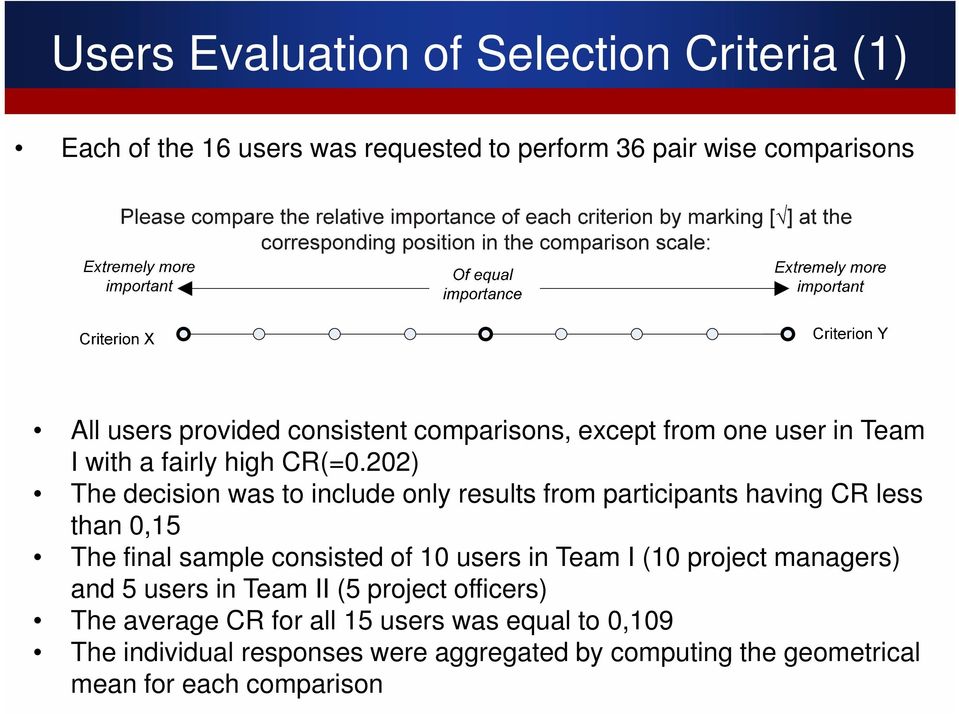
12 Users Evaluation of Selection Criteria (1) Each of the 16 users was requested to perform 36 pair wise comparisons All users provided consistent comparisons, except from one user in Team I with a fairly high CR(=0.202) The decision was to include only results from participants having CR less than 0,15 The final sample consisted of 10 users in Team I (10 project managers) and 5 users in Team II (5 project officers) The average CR for all 15 users was equal to 0,109 The individual responses were aggregated by computing the geometrical mean for each comparison
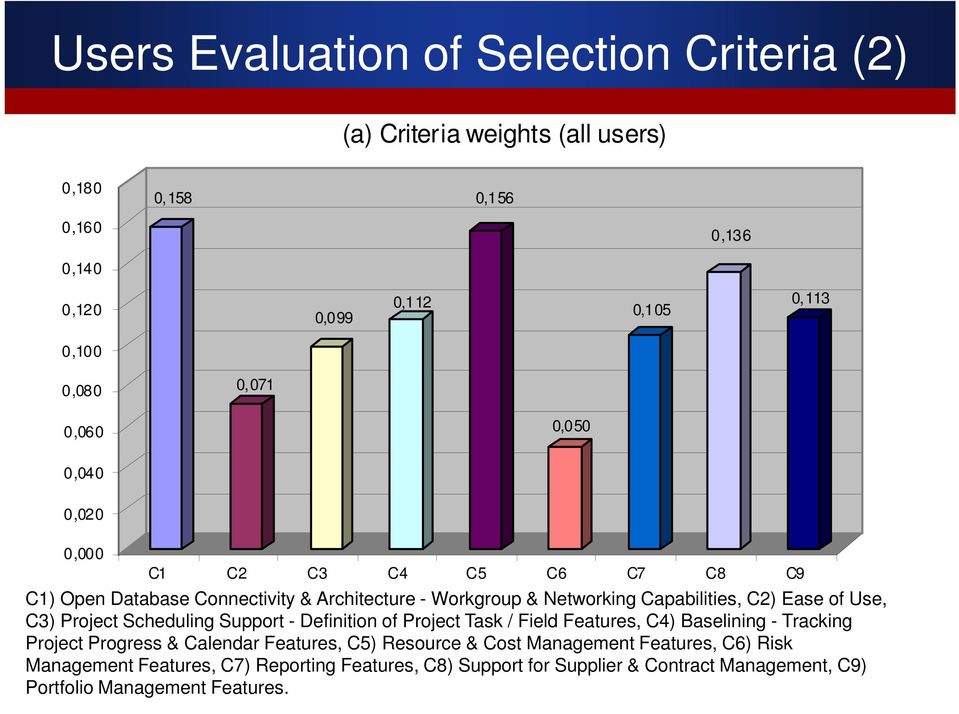
13 Users Evaluation of Selection Criteria (2) (a) Criteria weights (all users) 0,180 0,158 0,156 0,160 0,136 0,140 0,120 0,099 0,112 0,105 0,113 0,100 0,080 0,071 0,060 0,050 0,040 0,020 0,000 C1 C2 C3 C4 C5 C6 C7 C8 C9 C1) Open Database Connectivity & Architecture - Workgroup & Networking Capabilities, C2) Ease of Use, C3) Project Scheduling Support - Definition of Project Task / Field Features, C4) Baselining - Tracking Project Progress & Calendar Features, C5) Resource & Cost Management Features, C6) Risk Management Features, C7) Reporting Features, C8) Support for Supplier & Contract Management, C9) Portfolio Management Features.
14 Users Evaluation of Selection Criteria (3) 0,21 1 (b) Criteria weights (Team I users) 0,1 80 0,1 60 0,1 43 0,1 40 0,1 15 0,1 13 0,1 20 0,1 05 0,10 5 0,1 00 0,0 84 0,0 78 0,0 80 0,0 60 0,0 44 0,0 40 0,0 20 0,0 00 C 1 C2 C 3 C 4 C 5 C6 C 7 C 8 C 9 C1) Open Database Connectivity & Architecture - Workgroup & Networking Capabilities, C2) Ease of Use, C3) Project Scheduling Support - Definition of Project Task / Field Features, C4) Baselining - Tracking Project Progress & Calendar Features, C5) Resource & Cost Management Features, C6) Risk Management Features, C7) Reporting Features, C8) Support for Supplier & Contract Management, C9) Portfolio Management Features.

15 Users Evaluation of Selection Criteria (4) (c) Criteria weights (Team II users) 0,203 0,180 0,153 0,162 0,160 0,141 0,140 0,120 0,109 0,100 0,075 0,076 0,080 0,056 0,060 0,040 0,024 0,020 0,000 C1 C2 C3 C4 C5 C6 C7 C8 C9 C1) Open Database Connectivity & Architecture - Workgroup & Networking Capabilities, C2) Ease of Use, C3) Project Scheduling Support - Definition of Project Task / Field Features, C4) Baselining - Tracking Project Progress & Calendar Features, C5) Resource & Cost Management Features, C6) Risk Management Features, C7) Reporting Features, C8) Support for Supplier & Contract Management, C9) Portfolio Management Features.

16 Users Evaluation of Selection Criteria (5) Agreement in weights prioritisation of Team I with the overall weights prioritisation was analysed by Spearman s Rank Correlation procedure A positive (strong) relationship was found between these two rankings, i.e., the rank (Spearman) correlation coefficient was found equal to 0,60 There was also a positive relationship between the weights prioritisation of Team II and the overall weights prioritisation, i.e., the Spearman correlation coefficient was equal to 0,55 Thus, it appears that generally there existed an agreement between the ranking of some criteria (for each of the teams) and the overall criteria ranking (however this positive relationship is no statistically significant, at a 5% confidence level) E.g., the ranking of criteria C1, C4, C5, C6, C7, C8 according to Team I users coincides with the overall ranking. The same is true for the ranking of criteria C2, C3, C5, C6, C8 according to Team II

17 Users Evaluation of Selection Criteria (6) For project managers (Team I members), the most important criteria were: C1 (Open Database Connectivity & Architecture - Workgroup & Networking Capabilities), C5 (Resource & Cost Management Features), C2 (Ease of Use) and C8 (Support for Supplier & Contract Management) The less important criterion for project managers was C6 (Risk Management Features) Project officers (Team II members) classified criteria C9 (Portfolio Management Features), C8 (Support for Supplier & Contract Management) and C5 (Resource & Cost Management Features) as the most important factors Project officers rated C2 (Ease of Use) and C6 (Risk Management Features) as less important factors Surprisingly, both teams rated Risk Management Features (C6) as not so important Members from both teams expressed that they were not familiar with probabilistic/simulation based risk analysis provided by some contemporary PPM tools

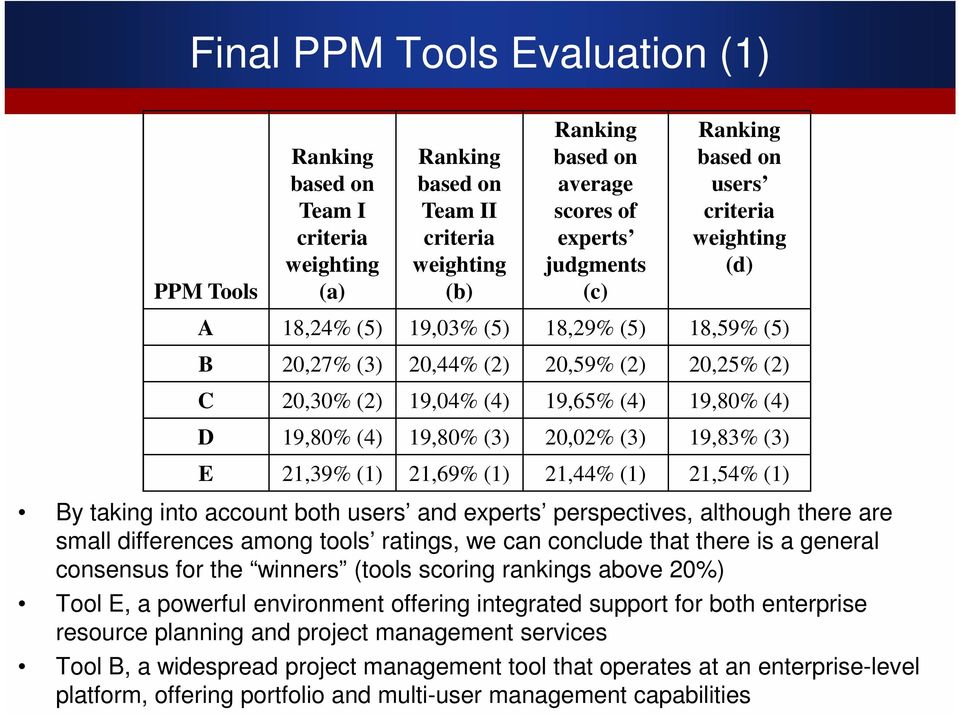
18 Final PPM Tools Evaluation (1) PPM Tools Ranking based on Team I criteria weighting (a) Ranking based on Team II criteria weighting (b) Ranking based on average scores of experts judgments (c) Ranking based on users criteria weighting (d) A 18,24% (5) 19,03% (5) 18,29% (5) 18,59% (5) B 20,27% (3) 20,44% (2) 20,59% (2) 20,25% (2) C 20,30% (2) 19,04% (4) 19,65% (4) 19,80% (4) D 19,80% (4) 19,80% (3) 20,02% (3) 19,83% (3) E 21,39% (1) 21,69% (1) 21,44% (1) 21,54% (1) By taking into account both users and experts perspectives, although there are small differences among tools ratings, we can conclude that there is a general consensus for the winners (tools scoring rankings above 20%) Tool E, a powerful environment offering integrated support for both enterprise resource planning and project management services Tool B, a widespread project management tool that operates at an enterprise-level platform, offering portfolio and multi-user management capabilities
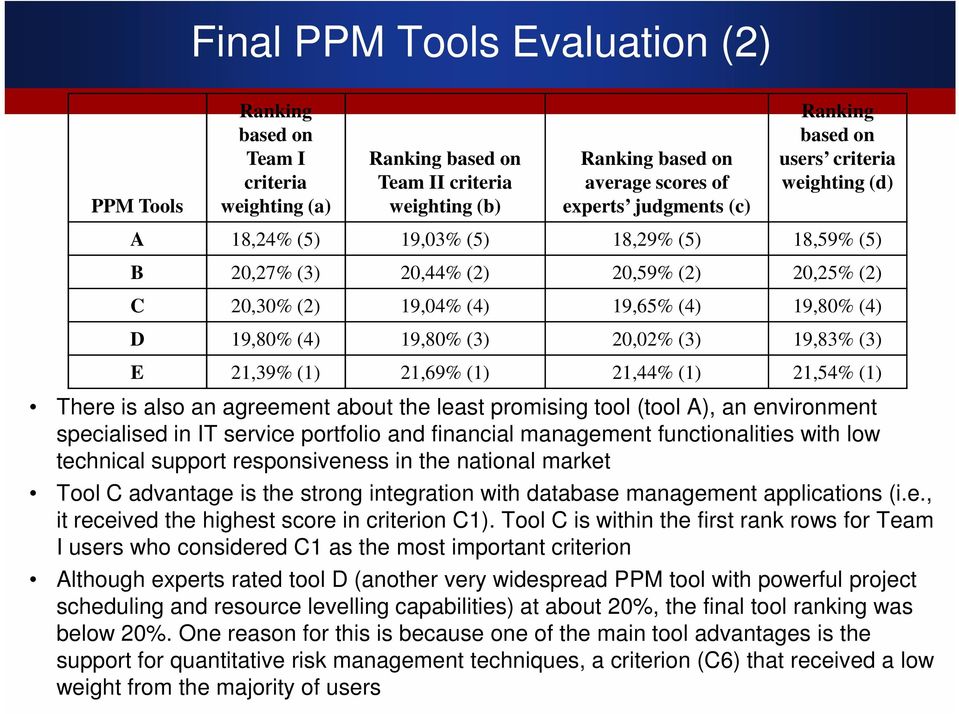
19 Final PPM Tools Evaluation (2) PPM Tools Ranking based on Team I criteria weighting (a) Ranking based on Team II criteria weighting (b) Ranking based on average scores of experts judgments (c) Ranking based on users criteria weighting (d) A 18,24% (5) 19,03% (5) 18,29% (5) 18,59% (5) B 20,27% (3) 20,44% (2) 20,59% (2) 20,25% (2) C 20,30% (2) 19,04% (4) 19,65% (4) 19,80% (4) D 19,80% (4) 19,80% (3) 20,02% (3) 19,83% (3) E 21,39% (1) 21,69% (1) 21,44% (1) 21,54% (1) There is also an agreement about the least promising tool (tool A), an environment specialised in IT service portfolio and financial management functionalities with low technical support responsiveness in the national market Tool C advantage is the strong integration with database management applications (i.e., it received the highest score in criterion C1). Tool C is within the first rank rows for Team I users who considered C1 as the most important criterion Although experts rated tool D (another very widespread PPM tool with powerful project scheduling and resource levelling capabilities) at about 20%, the final tool ranking was below 20%. One reason for this is because one of the main tool advantages is the support for quantitative risk management techniques, a criterion (C6) that received a low weight from the majority of users
20 Conclusions & Research Limitations Through a real case study, we demonstrated how group-based, multi-criteria decision analysis facilitates PPM tool selection All problem stakeholders (PPM tool experts and PPM tool users) have been actively involved in this process. This active participation has been proven to be helpful in: deriving rankings of candidate tools, according to a detailed set of functional features assigning weights to criteria based on the stakeholders perceptions about the relative importance of these criteria on the effectiveness of the organisation s project management process Using a combined score-based and AHP-based approach, experts have reached a consistent consensus for all tool performances on each criterion When analysing user requirements, users have been classified into groups according to their strategic/operational level of involvement in the organization s project management processes Aggregate comparisons for each user group may lead to a different final ranking of the candidate tools, so the final decision has always to be made with care Research limitations: uncertainties in experts and users judgments were not handled dependencies among criteria were not considered

Involving Stakeholders in the Selection of a Project and Portfolio Management Tool
 Involving Stakeholders in the Selection of a Project and Portfolio Management Tool Vassilis C. Gerogiannis Department of Project Management, Technological Research Center of Thessaly, Technological Education
How to do AHP analysis in Excel
 How to do AHP analysis in Excel Khwanruthai BUNRUAMKAEW (D) Division of Spatial Information Science Graduate School of Life and Environmental Sciences University of Tsukuba ( March 1 st, 01) The Analytical
Multi-Criteria Decision-Making Using the Analytic Hierarchy Process for Wicked Risk Problems
 Multi-Criteria Decision-Making Using the Analytic Hierarchy Process for Wicked Risk Problems Introduction It has become more and more difficult to see the world around us in a uni-dimensional way and to
A Fuzzy AHP based Multi-criteria Decision-making Model to Select a Cloud Service
 Vol.8, No.3 (2014), pp.175-180 http://dx.doi.org/10.14257/ijsh.2014.8.3.16 A Fuzzy AHP based Multi-criteria Decision-making Model to Select a Cloud Service Hong-Kyu Kwon 1 and Kwang-Kyu Seo 2* 1 Department
A REVIEW AND CRITIQUE OF HYBRID MADM METHODS APPLICATION IN REAL BUSINESS
 Application in Real Business, 2014, Washington D.C., U.S.A. A REVIEW AND CRITIQUE OF HYBRID MADM METHODS APPLICATION IN REAL BUSINESS Jiri Franek Faculty of Economics VSB-Technical University of Ostrava
Application of the Multi Criteria Decision Making Methods for Project Selection
 Universal Journal of Management 3(1): 15-20, 2015 DOI: 10.13189/ujm.2015.030103 http://www.hrpub.org Application of the Multi Criteria Decision Making Methods for Project Selection Prapawan Pangsri Faculty
Development of Virtual Lab System through Application of Fuzzy Analytic Hierarchy Process
 Development of Virtual Lab System through Application of Fuzzy Analytic Hierarchy Process Chun Yong Chong, Sai Peck Lee, Teck Chaw Ling Faculty of Computer Science and Information Technology, University
Contractor selection using the analytic network process
 Construction Management and Economics (December 2004) 22, 1021 1032 Contractor selection using the analytic network process EDDIE W. L. CHENG and HENG LI* Department of Building and Real Estate, The Hong
Chapter 4 SUPPLY CHAIN PERFORMANCE MEASUREMENT USING ANALYTIC HIERARCHY PROCESS METHODOLOGY
 Chapter 4 SUPPLY CHAIN PERFORMANCE MEASUREMENT USING ANALYTIC HIERARCHY PROCESS METHODOLOGY This chapter highlights on supply chain performance measurement using one of the renowned modelling technique
Applying the Analytic Hierarchy Process to Health Decision Making: Deriving Priority Weights
 Applying the to Health Decision Making: Deriving Priority Weights Tomás Aragón, MD, DrPH Principal Investigator, Cal PREPARE,. CIDER UC Berkeley School of Public Health Health Officer, City & County of
Vendor Evaluation and Rating Using Analytical Hierarchy Process
 Vendor Evaluation and Rating Using Analytical Hierarchy Process Kurian John, Vinod Yeldho Baby, Georgekutty S.Mangalathu Abstract -Vendor evaluation is a system for recording and ranking the performance
CHAPTER 3 IDENTIFICATION OF MOST PREFERRED KEY PERFORMANCE INDICATOR IN INDIAN CALL CENTRES
 49 CHAPTER 3 IDENTIFICATION OF MOST PREFERRED KEY PERFORMANCE INDICATOR IN INDIAN CALL CENTRES 3.1 INTRODUCTION Key Performance Indicators (KPIs) is means for assessment of an organisations current position
6 Analytic Hierarchy Process (AHP)
 6 Analytic Hierarchy Process (AHP) 6.1 Introduction to Analytic Hierarchy Process The AHP (Analytic Hierarchy Process) was developed by Thomas L. Saaty (1980) and is the well-known and useful method to
Total Quality Management for Improving Services of Information Technology Based Organizations: a case study
 Total Quality Management for Improving Services of Information Technology Based Organizations: a case study Abstract This paper applies TQM theories to facilitate improving IT products/services. A TQMbusiness
PERFORMANCE MEASUREMENT OF INSURANCE COMPANIES BY USING BALANCED SCORECARD AND ANP
 PERFORMANCE MEASUREMENT OF INSURANCE COMPANIES BY USING BALANCED SCORECARD AND ANP Ronay Ak * Istanbul Technical University, Faculty of Management Istanbul, Turkey Email: [email protected] Başar Öztayşi Istanbul
Comparative Analysis of FAHP and FTOPSIS Method for Evaluation of Different Domains
 International Journal of Research Studies in Computer Science and Engineering (IJRSCSE) August 2015, PP 58-62 ISSN 2349-4840 (Print) & ISSN 2349-4859 (Online) www.arcjournals.org Comparative Analysis of
MULTIPLE-OBJECTIVE DECISION MAKING TECHNIQUE Analytical Hierarchy Process
 MULTIPLE-OBJECTIVE DECISION MAKING TECHNIQUE Analytical Hierarchy Process Business Intelligence and Decision Making Professor Jason Chen The analytical hierarchy process (AHP) is a systematic procedure
Performance Management for Inter-organization Information Systems Performance: Using the Balanced Scorecard and the Fuzzy Analytic Hierarchy Process
 Performance Management for Inter-organization Information Systems Performance: Using the Balanced Scorecard and the Fuzzy Analytic Hierarchy Process Y. H. Liang Department of Information Management, I-SHOU
AN EVALUATION OF THE UPSTREAM CRUDE OIL INDUSTRY SUPPLY CHAIN RISK
 AN EVALUATION OF THE UPSTREAM CRUDE OIL INDUSTRY SUPPLY CHAIN RISK AN EVALUATION OF THE UPSTREAM CRUDE OIL INDUSTRY SUPPLY CHAIN RISK : LEVERAGING ANALYTIC HIERARCHY PROCESS Charles Awoala Briggs Upper
ANALYTIC HIERARCHY PROCESS (AHP) TUTORIAL
 Kardi Teknomo ANALYTIC HIERARCHY PROCESS (AHP) TUTORIAL Revoledu.com Table of Contents Analytic Hierarchy Process (AHP) Tutorial... 1 Multi Criteria Decision Making... 1 Cross Tabulation... 2 Evaluation
The Application of ANP Models in the Web-Based Course Development Quality Evaluation of Landscape Design Course
 , pp.291-298 http://dx.doi.org/10.14257/ijmue.2015.10.9.30 The Application of ANP Models in the Web-Based Course Development Quality Evaluation of Landscape Design Course Xiaoyu Chen 1 and Lifang Qiao
Green issues in the supply chain management training
 Green issues in the supply chain management training Claudemir Leif Tramarico, Valério Antonio Pamplona Salomon e Fernando Augusto Silva UNESP, Guaratingueta Objectives The purpose of the present article
Evaluation of educational open-source software using multicriteria decision analysis methods
 1 Evaluation of educational open-source software using multicriteria decision analysis methods Georgia Paschalidou 1, Nikolaos Vesyropoulos 1, Vassilis Kostoglou 2, Emmanouil Stiakakis 1 and Christos K.
Quantifying energy security: An Analytic Hierarchy Process approach
 ERG/200906 Quantifying energy security: An Analytic Hierarchy Process approach Larry Hughes, PhD Energy Research Group Department of Electrical and Computer Engineering Dalhousie University Halifax, Nova
Supplier Performance Evaluation and Selection in the Herbal Industry
 Supplier Performance Evaluation and Selection in the Herbal Industry Rashmi Kulshrestha Research Scholar Ranbaxy Research Laboratories Ltd. Gurgaon (Haryana), India E-mail : [email protected]
Analytical Hierarchy Process for Higher Effectiveness of Buyer Decision Process
 P a g e 2 Vol. 10 Issue 2 (Ver 1.0), April 2010 Global Journal of Management and Business Research Analytical Hierarchy Process for Higher Effectiveness of Buyer Decision Process Razia Sultana Sumi 1 Golam
ADOPTION OF OPEN SOURCE AND CONVENTIONAL ERP SOLUTIONS FOR SMALL AND MEDIUM ENTERPRISES IN MANUFACTURING. Mehran G. Nezami Wai M. Cheung Safwat Mansi
 Proceedings of the 10 th International Conference on Manufacturing Research ICMR 2012 ADOPTION OF OPEN SOURCE AND CONVENTIONAL ERP SOLUTIONS FOR SMALL AND MEDIUM ENTERPRISES IN MANUFACTURING Mehran G.
Decision Making on Project Selection in High Education Sector Using the Analytic Hierarchy Process
 Decision Making on Project Selection in High Education Sector Using the Analytic Hierarchy Process Nina Begičević University of Zagreb, Faculty of Organization and Informatics, Pavlinska 2, Varaždin [email protected]
Klaus D. Goepel No 10 Changi Business Park Central 2 Hansapoint@CBP #06-01/08 Singapore 486030 E-mail: [email protected] ABSTRACT
 IMPLEMENTING THE ANALYTIC HIERARCHY PROCESS AS A STANDARD METHOD FOR MULTI-CRITERIA DECISION MAKING IN CORPORATE ENTERPRISES A NEW AHP EXCEL TEMPLATE WITH MULTIPLE INPUTS Klaus D. Goepel No 0 Changi Business
THE SELECTION OF BRIDGE MATERIALS UTILIZING THE ANALYTICAL HIERARCHY PROCESS
 THE SELECTION OF BRIDGE MATERIALS UTILIZING THE ANALYTICAL HIERARCHY PROCESS Robert L. Smith Assistant Professor/Extension Specialist, Virginia Tech Robert J. Bush Associate Professor, Virginia Tech and
Supplier Selection through Analytical Hierarchy Process: A Case Study In Small Scale Manufacturing Organization
 Supplier Selection through Analytical Hierarchy Process: A Case Study In Small Scale Manufacturing Organization Dr. Devendra Singh Verma 1, Ajitabh pateriya 2 1 Department of Mechanical Engineering, Institute
Evaluating Simulation Software Alternatives through ANP
 Proceedings of the 2011 International Conference on Industrial Engineering and Operations Management Kuala Lumpur, Malaysia, January 22 24, 2011 Evaluating Simulation Software Alternatives through ANP
Using Analytic Hierarchy Process Method in ERP system selection process
 Using Analytic Hierarchy Process Method in ERP system selection process Rima Tamošiūnienė 1, Anna Marcinkevič 2 Abstract. IT and business alignment has become of the strategic importance and the enterprise
An Illustrated Guide to the ANALYTIC HIERARCHY PROCESS
 An Illustrated Guide to the ANALYTIC HIERARCHY PROCESS Dr. Rainer Haas Dr. Oliver Meixner Institute of Marketing & Innovation University of Natural Resources and Applied Life Sciences, Vienna http://www.boku.ac.at/mi/
CONTRACTOR SELECTION WITH RISK ASSESSMENT BY
 CONTRACTOR SELECTION WITH RISK ASSESSMENT BY USING AHP FUZZY METHOD Seyed Ali Tabatabaei Khodadadi 1, B. Dean Kumar 2 ¹Department of Civil Engineering, JNTUH CEH, Hyderabad -500085, India ²Associate Professor
Learning Management System Selection with Analytic Hierarchy Process
 Learning Management System Selection with Analytic Hierarchy Process Aydın Çetin 1, Ali Hakan Işık 2, İnan Güler 1 1 Gazi University, Faculty Of Technology 2 Gazi University, Institute of Information Sciences
Maintainability Estimation of Component Based Software Development Using Fuzzy AHP
 International journal of Emerging Trends in Science and Technology Maintainability Estimation of Component Based Software Development Using Fuzzy AHP Author Sengar Dipti School of Computing Science, Galgotias
Systems Features Analysis (SFA) and Analytic Hierarchy Process (AHP) in Systems Design and Development
 Systems Features Analysis (SFA) and Analytic Hierarchy Process (AHP) in Systems Design and Development Felipe P. Vista IV 1, a and Kil To Chong 1, 2, b, * 1 Department of Electronic Engineering, Jeonbuk
Subcontractor Selection Using Analytic Hierarchy Process
 Volume 3 Number 3 2012 pp. 121-143 ISSN: 1309-2448 www.berjournal.com Subcontractor Selection Using Analytic Hierarchy Process Vesile Sinem Arıkan Kargı a Ahmet Öztürk b Abstract: Turkish textile firms
The Analytic Hierarchy Process. Danny Hahn
 The Analytic Hierarchy Process Danny Hahn The Analytic Hierarchy Process (AHP) A Decision Support Tool developed in the 1970s by Thomas L. Saaty, an American mathematician, currently University Chair,
USING THE ANALYTIC HIERARCHY PROCESS FOR DECISION MAKING IN ENGINEERING APPLICATIONS: SOME CHALLENGES
 Published in: Inter l Journal of Industrial Engineering: Applications and Practice, Vol. 2, No. 1, pp. 35-44, 1995. 1 USING THE ANALYTIC HIERARCHY PROCESS FOR DECISION MAKING IN ENGINEERING APPLICATIONS:
An Evaluation Model for Determining Insurance Policy Using AHP and Fuzzy Logic: Case Studies of Life and Annuity Insurances
 Proceedings of the 8th WSEAS International Conference on Fuzzy Systems, Vancouver, British Columbia, Canada, June 19-21, 2007 126 An Evaluation Model for Determining Insurance Policy Using AHP and Fuzzy
Applying the ANP Model for Selecting the Optimal Full-service Advertising Agency
 International Journal of Operations Research International Journal of Operations Research Vol.8, No. 4, 4858 (2011) Applying the ANP Model for Selecting the Optimal Full-service Advertising Agency Pi-Fang
Project Management Software Selection Using Analytic Hierarchy Process Method
 International Journal of Applied Science and Technology Vol. 4, No. ; November 04 Project Management Software Selection Using Analytic Hierarchy Process Method Birgul Kutlu Professor Bogazici University
Project Management Software Selection Using Analytic Hierarchy Process Method
 Project Management Software Selection Using Analytic Hierarchy Process Method ISSN - 35-055 Sweety Sen (B.tech: Information Technology) Dronacharya College of Engineering Gurgaon, India Phone no. : 00343
An analytic hierarchy process for school quality and inspection Model development and application
 An analytic hierarchy process for school quality and inspection Model development and application Research Office- 2015 1 Abstract Purpose - The study develops an analytic hierarchy planning (AHP) framework
SUPPLY CHAIN MANAGEMENT AND A STUDY ON SUPPLIER SELECTION in TURKEY
 SUPPLY CHAIN MANAGEMENT AND A STUDY ON SUPPLIER SELECTION in TURKEY Pelin Alcan, Hüseyin Başlıgil, Melih Coşkun Yildiz Technical University, Besiktas, İstanbul, Turkey Abstract This study mainly focuses
Using Analytic Hierarchy Process (AHP) Method to Prioritise Human Resources in Substitution Problem
 Using Analytic Hierarchy Process (AHP) Method to Raymond Ho-Leung TSOI Software Quality Institute Griffith University *Email:[email protected] Abstract In general, software project development is often
Adopting an Analytic Hierarchy Process to Select Internet Advertising Networks
 Adopting an Analytic Hierarchy Process to Select Internet Advertising Networks Chin-Tasi Lin 1), Pi-Fang Hsu 2) 1) Yuanpei Institute of Science and Technology, Department of Information Management, Taiwan
Aircraft Selection Using Analytic Network Process: A Case for Turkish Airlines
 Proceedings of the World Congress on Engineering 211 Vol II WCE 211, July 6-8, 211, London, U.K. Aircraft Selection Using Analytic Network Process: A Case for Turkish Airlines Yavuz Ozdemir, Huseyin Basligil,
ANALYTICAL HIERARCHY PROCESS AS A TOOL FOR SELECTING AND EVALUATING PROJECTS
 ISSN 1726-4529 Int j simul model 8 (2009) 1, 16-26 Original scientific paper ANALYTICAL HIERARCHY PROCESS AS A TOOL FOR SELECTING AND EVALUATING PROJECTS Palcic, I. * & Lalic, B. ** * University of Maribor,
USING THE ANALYTIC HIERARCHY PROCESS (AHP) TO SELECT AND PRIORITIZE PROJECTS IN A PORTFOLIO
 USING THE ANALYTIC HIERARCHY PROCESS (AHP) TO SELECT AND PRIORIZE PROJECTS IN A PORTFOLIO Ricardo Viana Vargas, MSc, IPMA-B, PMP Professor Fundação Getúlio Vargas (FGV) Brasil Professor Fundação Instituto
Decision Making and Evaluation System for Employee Recruitment Using Fuzzy Analytic Hierarchy Process
 International Refereed Journal of Engineering and Science (IRJES) ISSN (Online) 2319-183X, (Print) 2319-1821 Volume 2, Issue 7 (July 2013), PP.24-31 Decision Making and Evaluation System for Employee Recruitment
Talk:Analytic Hierarchy Process/Example Leader
 Talk:Analytic Hierarchy Process/Example Leader 1 Talk:Analytic Hierarchy Process/Example Leader This is an example showing the use of the AHP in a practical decision situation. Click HERE to return to
TABLE OF CONTENTS CHAPTER NO. TITLE PAGE NO. ABSTRACT iii LIST OF TABLES LIST OF FIGURES LIST OF ABBREVIATIONS
 ix TABLE OF CONTENTS CHAPTER NO. TITLE PAGE NO. ABSTRACT iii LIST OF TABLES x LIST OF FIGURES xii LIST OF ABBREVIATIONS xiv 1 INTRODUCTION 1 1.1 ENTERPRISE RESOURCE PLANNING (ERP) AN OVERVIEW 1 1.2 AIM
Proposing an approach for evaluating e-learning by integrating critical success factor and fuzzy AHP
 2011 International Conference on Innovation, Management and Service IPEDR vol.14(2011) (2011) IACSIT Press, Singapore Proposing an approach for evaluating e-learning by integrating critical success factor
3 Guidance for Successful Evaluations
 3 Guidance for Successful Evaluations In developing STEP, project leads identified several key challenges in conducting technology evaluations. The following subsections address the four challenges identified
Performance Evaluation of a Drilling Project in Oil and Gas Service Company in Indonesia by
 Home Search Collections Journals About Contact us My IOPscience Performance Evaluation of a Drilling Project in Oil and Gas Service Company in Indonesia by MACBETH Method This content has been downloaded
Analytic Hierarchy Process (AHP) :
 Analytic Hierarchy Process (AHP) : ITS APPLICATION IN FTS BUSINESS MODEL ASSESSMENT Athens University of Economics and Business TRANsportation Systems and LOGistics Laboratory Professor Konstantinos G.
SELECTION OF AN ORGANIZATION SPECIFIC ERP
 SELECTION OF AN ORGANIZATION SPECIFIC ERP CARMEN RĂDUŢ, DIANA-ELENA CODREANU CONSTANTIN BRÂNCOVEANU UNIVERSITY, BASCOVULUI BLVD., NO. 2A, PITEŞTI, NICOLAE BALCESCU STR., NO. 39, RM. VÂLCEA, VÂLCEA [email protected],
A Multi-Criteria Decision-making Model for an IaaS Provider Selection
 A Multi-Criteria Decision-making Model for an IaaS Provider Selection Problem 1 Sangwon Lee, 2 Kwang-Kyu Seo 1, First Author Department of Industrial & Management Engineering, Hanyang University ERICA,
Selection of Mobile Network Operator Using Analytic Hierarchy Process (AHP) Nasruddin Hassan, Norfaieqah Ahmad and Wan Malissa Wan Aminuddin
 Advances in Natural and Applied Sciences, 7(1): 1-5, 2013 ISSN 1995-0772 1 This is a refereed journal and all articles are professionally screened and reviewed ORIGINAL ARTICLE Selection of Mobile Network
The Analytic Hierarchy Process and SDSS
 The Analytic Hierarchy Process and SDSS RNR/GEOG 420-520 Preview Week 12 Spatial Decision Support Systems (SDSS) and the Analytic Hierarchy Process (AHP) Week 13 Designing Geodatabase Models Week 14 GeoVisualization
AHP approach for supplier evaluation and selection in a steel manufacturing company
 AHP approach for supplier evaluation and selection in a steel manufacturing company Farzad Tahriri; M. Rasid Osman; Aidy Ali; Rosnah Mohd Yusuff; Alireza Esfandiary University Putra Malaysia (MALASYA)
CASE STUDIES OF USING THE ANALYTIC HIERARCHY PROCESS METHOD IN CORPORATE SOCIAL RESPONSIBILITY AND ENVIRONMENTAL RISK MANAGEMENT
 CASE STUDIES OF USING THE ANALYTIC HIERARCHY PROCESS METHOD IN CORPORATE SOCIAL RESPONSIBILITY AND ENVIRONMENTAL RISK MANAGEMENT Katarína DRIENIKOVÁ, Gabriela HRDINOVÁ, Tomáš NAŇO, Peter SAKÁL Authors:
Chapter 3 Local Marketing in Practice
 Chapter 3 Local Marketing in Practice 3.1 Introduction In this chapter, we examine how local marketing is applied in Dutch supermarkets. We describe the research design in Section 3.1 and present the results
A Quality Based Method to Analyze Software Architectures
 www.ijcsi.org A Quality Based Method to Analyze Software Architectures Farzaneh Hoseini Jabali, Sayed Mehran Sharafi and Kamran Zamanifar3 Computer Department, Islamic Azad University, Naafabad Branch,
ASSESSING MAINTENANCE MANAGEMENT IT ON THE BASIS OF IT MATURITY
 ASSESSING MAINTENANCE MANAGEMENT IT ON THE BASIS OF IT MATURITY Kans, M a a School of Technology and Design, Växjö University, Luckligs plats, S- 9 Växjö, Sweden. Research shows that investments in IT
A Development of the Effectiveness Evaluation Model for Agile Software Development using the Balanced Scorecard
 , March 13-15, 2013, Hong Kong A Development of the Effectiveness Evaluation Model for Agile Development using the Balanced Scorecard Sunisa Atiwithayaporn 1, Wanchai Rivepiboon 2 Abstract Most of standard
ERP SYSTEM SELECTION MODEL FOR LOW COST NGN PHONE COMPANY
 International Journal of Electronic Business Management, Vol. 6, No. 3, pp. 153-160 (2008) 153 ERP SYSTEM SELECTION MODEL FOR LOW COST NGN PHONE COMPANY Joko Siswanto 1* and Anggoro Prasetyo Utomo 2 1
Decision making in ITSM processes risk assessment
 Decision making in ITSM processes risk assessment V Grekul*, N Korovkina, K Korneva National Research University Higher School of Economics, 20 Myasnitskaya Ulitsa, Moscow, 101000, Russia * Corresponding
Prize: an R package for prioritization estimation based on analytic hierarchy process
 Prize: an R package for prioritization estimation based on analytic hierarchy process Daryanaz Dargahi October 14, 2015 [email protected] Contents 1 Licensing 2 2 Overview 2 3 Relative AHP 3 3.1
An analytical hierarchy process and fuzzy inference system tsukamoto for production planning: a review and conceptual research
 An analytical hierarchy process and fuzzy inference system tsukamoto for production planning: a review and conceptual research Abdul Talib Bon; Silvia Firda Utami Department of Production and Operations
Analytic Hierarchy Process for Design Selection of Laminated Bamboo Chair
 Analytic Hierarchy Process for Design Selection of Laminated Bamboo Chair V. Laemlaksakul, S. Bangsarantrip Abstract This paper demonstrates the laminated bamboo chair design selection, the applicability
TOURIST HOTEL LOCATION SELECTION WITH ANALYTIC HIERARCHY PROCESS *
 TOURIST HOTEL LOCATION SELECTION WITH ANALYTIC HIERARCHY PROCESS * Nilsen KUNDAKÇI ESRA AYTAÇ ADALI AYŞEGÜL TUŞ IŞIK ABSTRACT Selection of tourist hotel location is a multi-criteria decision making (MCDM)
Certification in Humanitarian Supply Chain Management (CHSCM) Competence Model. Final Version 2007
 Certification in Humanitarian Supply Chain Management (CHSCM) Competence Model Final Version 2007 Contents Competence Model Context... 3 Functional Map... 6 UNIT 1 Supply Chain Planning... 7 UNIT 2 Supply
Ranking the most effective marketing mix elements on the sales of Javid Darb company products: an AHP technique
 Ramin Bashir Khodaparasti, Aboulfazl Aboulfazli, Reza Isakhajelou Ranking the most effectiv e marketing mix elements on the sales of Javid Darb company products: an AHP technique, Journal of International
A Controlled Experiment on Analytical Hierarchy Process and Cumulative Voting -
 Master Thesis Software Engineering Thesis no: MSE-2007-17 June 2007 A Controlled Experiment on Analytical Hierarchy Process and Cumulative Voting - Investigating Time, Scalability, Accuracy, Ease of use
ERP SYSTEM SELECTION BY AHP METHOD: CASE STUDY FROM TURKEY
 ERP SYSTEM SELECTION BY AHP METHOD: CASE STUDY FROM TURKEY Babak Daneshvar Rouyendegh (Babek Erdebilli) Atılım University Department of Industrial Engineering P.O.Box 06836, İncek, Ankara, Turkey E-mail:
Analytic Hierarchy Process for Effective Decision Making in Project Management. Glenn Hamamura Dr. Lawrence Rowland
 Analytic Hierarchy Process for Effective Decision Making in Project Management Glenn Hamamura Dr. Lawrence Rowland Decision Making We are all fundamentally decision makers. Everything we do consciously
Identifying, Ranking and Sensitivity Analysis for financing. Methods of deteriorated areas renovation projects
 Identifying, Ranking and Sensitivity Analysis for financing Methods of deteriorated areas renovation projects VahidrezaYousefi a,*1, Aida Rahimi Golkhandan b, Sarmad Kiani c a.phd candidate of Construction
Capacity planning for fossil fuel and renewable energy resources power plants
 Capacity planning for fossil fuel and renewable energy resources power plants S. F. Ghaderi *,Reza Tanha ** Ahmad Karimi *** *,** Research Institute of Energy Management and Planning and Department of
The Systems Engineering Tool Box
 The ystems Engineering Tool Box Dr tuart Burge Give us the tools and we will finish the job Winston Churchill Pugh Matrix (PM) What is it and what does it do? The Pugh Matrix (PM) is a type of Matrix Diagram
Project Risk Management
 Project Risk Management Study Notes PMI, PMP, CAPM, PMBOK, PM Network and the PMI Registered Education Provider logo are registered marks of the Project Management Institute, Inc. Points to Note Risk Management
Decision-making with the AHP: Why is the principal eigenvector necessary
 European Journal of Operational Research 145 (2003) 85 91 Decision Aiding Decision-making with the AHP: Why is the principal eigenvector necessary Thomas L. Saaty * University of Pittsburgh, Pittsburgh,
Towards a Decision Making Framework for Model Transformation Languages. Soroosh Nalchigar [email protected]
 Towards a Decision Making Framework for Model Transformation Languages Soroosh Nalchigar [email protected] Outline Introduction Research problem Proposed solution Application (3 scenarios) Where to
Journal of Chemical and Pharmaceutical Research, 2014, 6(3):34-39. Research Article. Analysis of results of CET 4 & CET 6 Based on AHP
 Available online www.jocpr.com Journal of Chemical and Pharmaceutical Research, 2014, 6(3):34-39 Research Article ISSN : 0975-7384 CODEN(USA) : JCPRC5 Analysis of results of CET 4 & CET 6 Based on AHP
Available online at www.sciencedirect.com. ScienceDirect. Procedia CIRP 17 (2014 ) 628 634. Madani Alomar*, Zbigniew J. Pasek
 Available online at www.sciencedirect.com ScienceDirect Procedia CIRP 17 (2014 ) 628 634 Variety Management in Manufacturing. Proceedings of the 47th CIRP Conference on Manufacturing Systems Linking supply
A Selection Model for ERP System by Applying Fuzzy AHP Approach
 A Selection Model for ERP System by Applying Fuzzy AHP Approach Chi-Tai Lien* and Hsiao-Ling Chan Department of Information Management Ta Hwa Institute of Tachenology, Hsin-Chu, Taiwan, R.O.C. *E-mail: