
New Jersey. by Larry Maloney
|
|
|
- Stephanie Hudson
- 9 years ago
- Views:
Transcription
1 New Jersey by Larry Maloney Summary and Highlights This snapshot examines the revenue sources and funding equity for district public schools and charter schools in New Jersey and, in particular, Jersey City, Newark, and Trenton, during F (Figure 1). 1 In the figures, the statewide values show how much per pupil funding districts in the state received compared to how much charter schools received per pupil. The statewide values weighted for charter enrollment adjust these figures to account for the fact that some districts enroll more charter students than others and the district PPR varies between districts. The weighted values estimate how much more or less per pupil funding charter schools received compared to the funding district schools would have received to educate the same students. (See Methodology for details.) 139 Space intentionally left blank.
2 Figure 1: and School Revenues and Enrollments New Jersey ( ) Weighted for Enrollment Jersey City Newark Trenton Per pupil Revenue $17,110 $19,837 $21,952 $23,594 $23,655 $12,442 $12,442 $11,886 $11,677 $12,649 Difference ($4,669) ($7,395) ($10,066) ($11,917) ($11,006) (27.3%) (37.3%) (45.9%) (50.5%) (46.5%) Per pupil Revenue by Source Federal $550 $1,141 $963 $1,141 $1,314 $1,139 $1,626 $1,218 $1,252 $1,239 State $6,503 $8,912 $11,898 $8,912 $17,348 $8,585 $17,449 $9,114 $21,333 $9,491 Local $9,080 $2,315 $5,959 $2,315 $3,152 $2,083 $2,255 $1,333 $957 $1,919 Other $541 $63 $781 $63 $137 $78 $2,252 $13 $114 $0 Indeterminate $436 $11 $236 $11 $0 $0 $13 $0 $0 $0 Total $17,110 $12,442 $19,837 $12,442 $21,952 $11,886 $23,594 $11,677 $23,655 $12,649 Enrollment 1,331,638 N/A 28,910 41,266 12, % N/A 90.7% 92.3% 89.4% 15,739 N/A 2,947 3,456 1, % N/A 9.3% 7.7% 10.6% Number of s 53 N/A Total Revenue $22,784,614,225 N/A $634,619,678 $973,632,249 $284,986, % N/A 94.8% 96.0% 94.1% $195,816,131 N/A $35,028,218 $40,360,300 $17,992, % N/A 5.2% 4.0% 5.9% Total $22,980,430,356 N/A $669,647,896 $1,013,992,549 $302,979,554 Percentage of Revenue by Source Federal 3.2% 9.2% 4.9% 9.2% 6.0% 9.6% 6.9% 10.4% 5.3% 9.8% State 38.0% 71.6% 60.0% 71.6% 79.0% 72.2% 74.0% 78.1% 90.2% 75.0% Local 53.1% 18.6% 30.0% 18.6% 14.4% 17.5% 9.6% 11.4% 4.0% 15.2% Other 3.2% 0.5% 3.9% 0.5% 0.6% 0.7% 9.5% 0.1% 0.5% 0.0% Indeterminate 2.5% 0.1% 1.2% 0.1% 0.0% 0.0% 0.1% 0.0% 0.0% 0.0% Change in district school funding if subjected to charter funding structure ($5.9 billion) ($360 million) ($614 million) ($168 million)
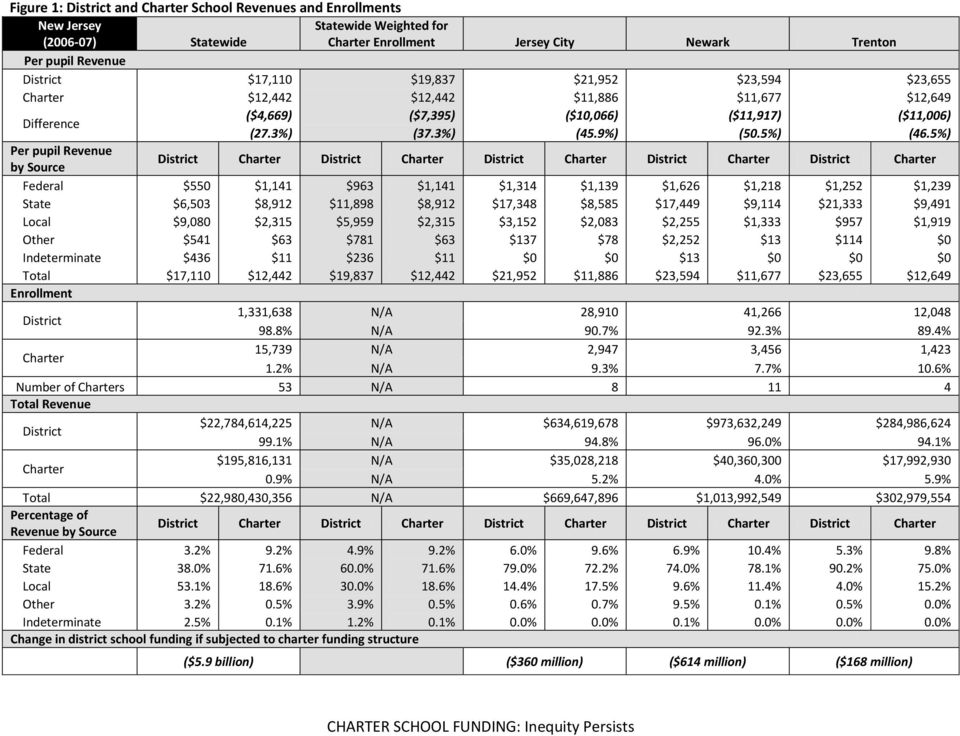
3 Highlights of Our Findings On average, New Jersey s 53 charter schools received $12,442 per pupil, compared to $17,110 per pupil in district schools a difference of $4,669 per pupil or 27.3 percent. New Jersey charter schools received $12,442 per pupil, but district schools would have received an estimated, $19,837 to educate the same students a difference of $7,395 or 37.3 percent. Weighting the district PPR for charter enrollment therefore increases the funding disparity by $2,726 from the statewide difference above. Figure 2: Per Pupil Total Revenue for New Jersey vs. Schools, F $17,110 $19,837 $21,952 $23,594 $23,655 $12,442 $12,442 $11,886 $11,677 $12,649 $10,066 $11,917 $11,006 State $4,669 $7,395 Weighted Jersey City Newark Trenton Difference Jersey City s 8 charter schools received $11,886 per pupil, compared to $21,952 per pupil in district schools a difference of $10,066 per pupil or 45.9 percent. Newark s 11 charter schools received $11,677 per pupil, compared to $23,594 per pupil in district schools a difference of $11,917 per pupil or 50.5 percent. Trenton s 4 charters received $12,649 per pupil, compared to $23,655 per pupil in district schools a difference of $11,006 per pupil, or 46.5 percent. Primary Reasons for Funding Disparities By law, districts are allowed to forward only 90 percent of the per pupil amount established in the funding formula to charter schools in any given fiscal year. Local and state contributions toward district capital and debt service contribute to the funding inequity between districts and charters. Special funding for the state s Abbott districts, a revenue stream charters do not receive, is the primary source of the funding disparity, particularly for charters located within Abbott districts. How New Jersey Funds Its Schools New Jersey s constitution requires a thorough and efficient education for the state s pupils. The state passed the Comprehensive Education Improvement and Financing Act of 1996 to meet this objective after the state Supreme Court declared an earlier funding mechanism unconstitutional. Since passage of this law, the state produces a biennial report 2 outlining the costs of providing a thorough and efficient education, which drives the education funding formula. New Jersey provides per pupil weighted funding to its school districts based on age factors and special needs. In , grades one through five served as the base weight while pre-kindergarten and kindergarten pupils received 50 percent of the revenue provided to elementary pupils and middle school and high school pupils received four and eleven percent above the elementary base, respectively. New Jersey adjusts these grade level weights each year based on a Consumer Price Index (CPI) reading. The allocation of these education level funds can vary by as much as five percent between districts. The state also provides funding to districts for special needs or disadvantaged students. Four funding tiers determine the revenue special education pupils receive, ranging from Tier I and increasing through Tier IV. 3 Tier I provides the 141

4 smallest funding and compensates districts for low-level service costs like occupational and physical therapy and counseling. Tier IV compensates districts for more intensive special education services. New Jersey provides additional funding based on court rulings, student need, including student poverty and bilingual services. The amount of additional funding varies so that schools serving students with greater need receive more funds. Abbott funding is provided to the poorest districts in the state to provide them with funding that equals the 17 wealthiest districts in the state all the cities analyzed in this chapter are considered Abbott s. Stabilization Aid prevents significant funding swings from one school year to the next, by subsidizing districts so that their revenue in one fiscal year does not fall by more than 10 percent of the revenue received in the previous year. school growth is not considered in calculating Stabilization Aid as charter school funding and their enrollments flow through the district. Finally, district schools receive funding from the state for various operating costs, as well, including transportation, capital expenses, post-retirement medical benefits, social security, and distance learning. How New Jersey Funds Its Schools New Jersey charter schools fall under the same criteria for funding as district schools, with a few exceptions. s receive any stabilization aid for which they may be eligible, as well as the state post-retirement medical benefits and social security payments. Local and state revenue for the state s charter schools flows through school districts, and districts must provide transportation to charter school pupils that equals the district s transportation effort. However, districts are only required to provide charter schools the lesser of 90 percent of the standard state formula by education level for a thorough and efficient education, or 90 percent of the Program Budget by education level. When there is a shortfall between the amount the charter receives and the total the charter should have received to cover the thorough and efficient mandate, the state provides additional funding ( School Aid) in the state budget. 4 Additional revenue from this fund assists charter schools in Abbott districts. Figure 3: State School Policies State Policies es No Partial schools receive their funding directly from the state 5 schools are eligible for local funding Cap on funding a charter school can receive public schools receive differential funding (e.g. more funding for 9-12 vs. K-8 schools) schools receive differential funding State allows district to withhold funding from charter schools for providing administrative services 6 State "holds harmless" district funding for charter enrollment School is considered LEA if authorized by non-district organization School is considered LEA if authorized by district Cap on number of charter schools Cap on number of charter schools authorized per year Cap on number of students attending charter schools schools have an open enrollment policy schools do not receive several revenue lines available to school districts, however. For example, charters do not have access to any state

5 revenue payments for school construction and renovation or debt service aid. Likewise, New Jersey charter schools do not have access to local capital revenue. Figure 4: Per Pupil Revenue by Source for New Jersey vs. Schools, F Trenton Trenton Newark Newark Jersey City Jersey City Weighted $1,239 $1,252 $1,218 $1,626 $1,139 $1,314 $1,141 $963 $550 $9,491 $21,333 $9,114 $1,333 $17,449 $8,585 $2,083 $17,348 $8,912 $11,898 $6,503 $1,919 $2,315 $9,080 $5,959 $541 $957 $114 $2,255 $2,252 $3,152 $137 $781 $436 $236 Federal State Local Other Indeterminate Of particular concern, charter schools located within Abbott districts do not receive the additional funding that district schools in Abbott districts receive, even though the state includes charter pupils in enrollment counts when determining the Abbott revenue mandated by law. Facility Funding schools do not receive funding for their facilities and cannot access capital funds available to district schools under the New Jersey's Public School Construction Act. For Abbott districts, this act requires the state to provide 100 percent financing of any approved construction and/or renovation costs. Non-Abbott districts receive a minimum 40 percent guarantee for state revenue for construction projects. However, New Jersey charter schools have access to tax-exempt bonds through the New Jersey Economic Development Authority. Primary Revenue Sources for New Jersey s Public Schools On average, New Jersey school districts received $17,110 per pupil in revenue, compared to $12,442 per pupil for charter schools, a variance of 27.3 percent (Figure 1). The variance increased significantly in the three cities studied. Jersey City school district received $21,952 per pupil, while charters in Jersey City received $11,677 per pupil, a variance of 45.9 percent. The school district of Newark received $23,594 in revenue per pupil, while charters in that city received $11,886, a variance of 50.5 percent. In Trenton, the school district reported $23,655 per pupil in total revenue, while the charter schools reported $12,649 in total per pupil revenue for a variance of 46.5 percent. Both on a percentage basis and in dollar terms, charters received more of their revenue from federal sources than the state s districts, 9.2 percent ($1,141) vs. 3.2 percent ($550), respectively. The same trend holds true in the three focus districts (Figure 1). The largest revenue variance between districts and charters in the three cities occurred at the state funding level., district schools received $6,503 per pupil in state revenue, while charter schools received $8,912 per pupil. In Jersey City, however, district schools received $17,348 in state revenue, while the city s charter schools received $8,585. In Newark, the district received $17,449 in state revenue, while charters received $9,114. In Trenton, district schools received $21,333 in state revenue compared to the charter per pupil revenue number of $9,491. The disparity in state funding for these three cities was so large because Abbott funding is designed 143
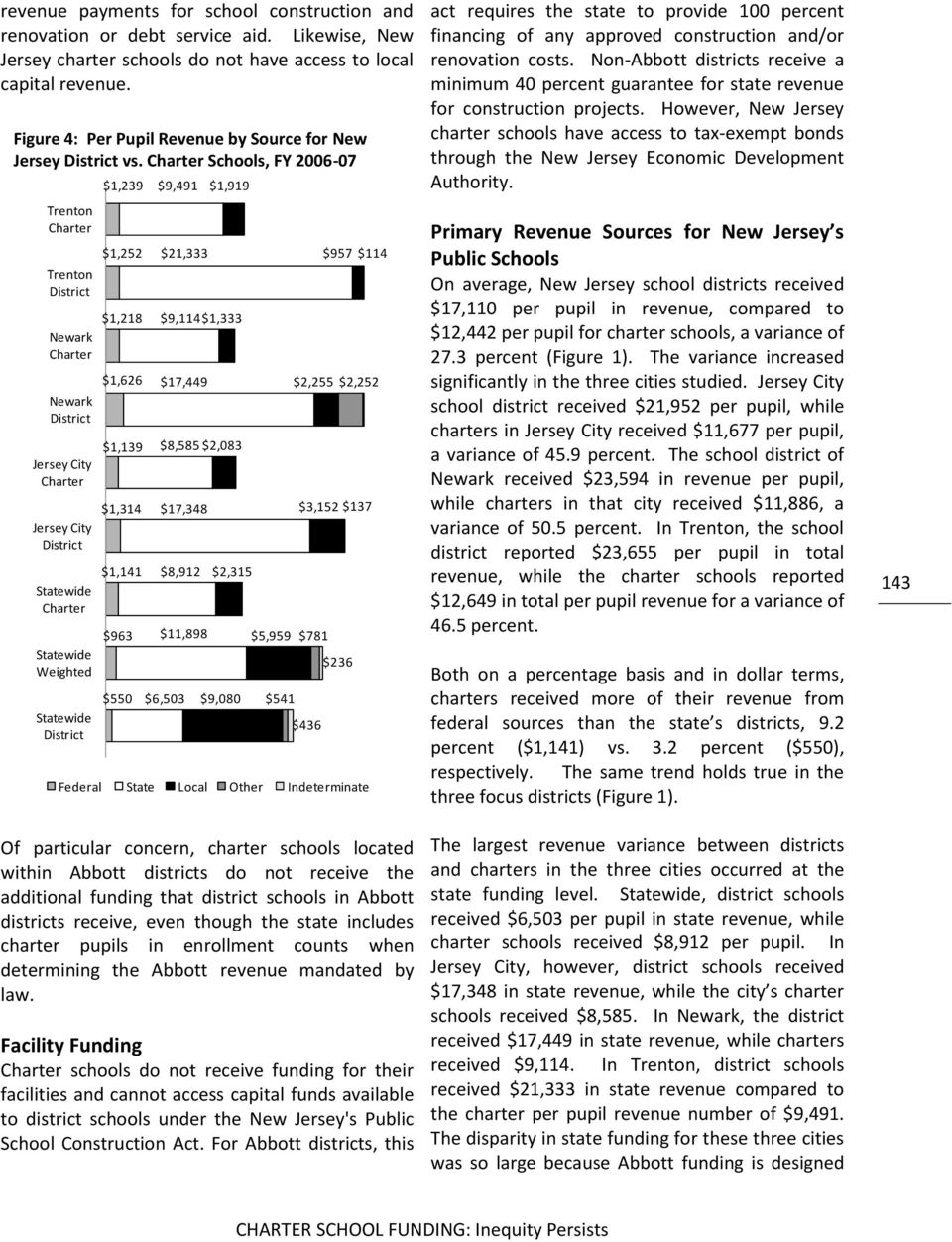
6 Funding Formula Data Availability Facilities Funding Local Funding State Funding Federal Funding to provide the poorest districts the same level of funding as the wealthiest districts in the state, but there is no requirement for those districts to pass the additional funds to charters. Local revenue collection favored districts, with the exception of Trenton., district schools received $9,080 in local revenue, compared to $2,315 for charter schools. The Jersey City district received $3,152 per pupil in local revenue, including capital contributions, while charters in Jersey City received $2,083 per pupil. In Newark, the district received $2,255 in local revenue, compared to $1,333 for the city s charter schools. In Trenton, charters received $1,919 in local revenue compared to the district per pupil revenue number of $957. Figure 5: School Characteristics New Jersey ( ) s Percentage of students eligible for free or reduced price 26.9% 65.3% lunch Percentage of schools eligible for Title I 50.7% 90.6% Percentage of students by school type: Primary (K-5) 47.7% 63.4% Middle (6-8) 20.4% 11.3% High (9-12) 30.3% 11.2% Other (K-12, K-8, etc.) 1.6% 14.1% Differences in student populations do impact funding for the charter schools but does not account for the majority of variance between districts and charters in New Jersey. s in New Jersey enrolled significantly more students eligible for free or reduced lunch than did districts schools and nearly all charters were labeled Title 1 school-wide, two criteria that account for higher per pupil federal funding for the charter schools. Figure 6: State Scorecard Findings s have access to federal funds according to state statutes (es = Percentage of federal revenue is greater than (>; black), equal to (=; black), or is less than (<; white) that of total enrollment for charter schools s have access to state funds according to state statutes (es = Percentage of state revenue is greater than (>; black), equal to (=; black), or is less than (<; white) that of total enrollment for charter schools s have access to local funds according to state statutes (es = Percentage of local revenue is greater than (>; black), equal to (=; black), or is less than (<; white) that of total enrollment for charter schools s have access to facilities funds according to state statutes (es = Percentage of facilities revenue is greater than (>; black), equal to (=; black), or is less than (<; white) that of total enrollment for charter schools State provides detailed, public data on federal, state, local, and other revenues for district schools (es = black, Partial = grey, No = white) State provides detailed, public data on federal, state, local and other revenues for charter schools (es = black, Partial = grey, No = white) s are treated as LEAs for funding purposes (es = black, Partial = grey, No = white) State funds student (black) or the LEA (grey) NJ > N > > N < S State Scorecard We have assigned ratings to New Jersey based on the quality of data available, as well as the extent State funding formula is fair and equitable (es = N

7 to which charter schools have access to specific revenue streams (Figure 6). In Figure 6, we judged Data Availability on the ease of access to the information needed for this study and others like it. A rating of es means that all information was available through web sources or that it was provided upon request by state departments of education. A rating of Partial means some but not all of the data for the study were available either through web sources or through state departments of education. A rating of No means the data were not available either through web sources or through state departments of education. Separately, we judged Funding Formula based on whether or not charters were considered local education agencies (LEAs) for purposes of funding. es means that charters in the state are always considered LEAs for all forms of funding Partial means that charters are sometimes considered LEAs for specific streams of funding (such as federal revenue) or that only certain charters are considered to be LEAs. No means charter schools in the state are never considered LEAs for funding purposes. A state received a rating of fair and equitable funding if charters received fair and equitable revenue in all four revenue streams listed. Similar methods were applied to ratings for federal funding, state funding, local funding, and facilities funding. Finally, we graded the state based on whether state funds the individual student needs via weighted funding formulas or through block grants to the LEA. Endnotes 1 Financial data provided by the New Jersey Department of Education. Enrollment data at ( New Jersey uses Average Daily Enrollment to calculate funding for schools and charters and calculates when a student enrolled and disenrolled to determine the total funding an education agency will receive for a particular student. 2 The Biennial Report on the Cost of Providing a Thorough and Efficient Education was last produced in 2002 due to the state budget crisis. All funding formula categories were frozen at levels except for education level categories. These categories continue to be adjusted based on the CPI each fiscal year. 3 Only districts with students who have a speech correction disability do not receive special education funding. Instead, they are funded by the grade level weight and receive no additional cost factors. 4 Given that this funding stream exists outside the funding formula, it is subject to the availability of funding during each budget cycle. 5 State funding generally flows from the school district to the charter school for any revenue related to core funding. However, charters do receive some revenue directly from the state, such as the Abbott Kindergarten funding provided to charters within Abbott districts that run kindergarten programs. 6 s must provide charters 90 percent of the state mandated per pupil minimum. 145

FY2003. By Jay F. May. Introduction
 UT D MA F AR F MD F HI FY2003 FY2007 FY2011 FY2003 FY2007 FY2011 F AZ D D D B C D DE Gra CA FY2003 FY2007 FY2011 FY2003 FY2007 FY2011 F F C F NM Minnesota B C B FL Gr CO CT ID IL FY2003 FY2007 FY2011 FY2003
MISSOURI. Gerri Ogle Coordinator, School Administrative Services Department of Elementary and Secondary Education I. GENERAL BACKGROUND.
 MISSOURI Gerri Ogle Coordinator, School Administrative Services Department of Elementary and Secondary Education I. GENERAL BACKGROUND State The major portion of state funds for elementary and secondary
Financing Education In Minnesota 2013-14. A Publication of the Minnesota House of Representatives Fiscal Analysis Department
 Financing Education In Minnesota 2013-14 A Publication of the Minnesota House of Representatives Fiscal Analysis Department November 2013 Financing Education in Minnesota 2013-14 A Publication of the Minnesota
Overview of the School Finance System
 What you will learn: Overview of the School Finance System How the state provides financial support for public schools The basics of the Foundation School Program formula system About programs to assist
SCHOOL FINANCE IN COLORADO
 SCHOOL FINANCE IN COLORADO Legislative Council Staff State Capitol Building, Room 029 200 East Colfax Avenue Denver, CO 80203 Phone: (303) 866-3521 April 2012 STATE OF COLORADO LEGISLATIVE COUNCIL COLORADO
A Formula for Success:
 A Formula for Success: All Children, All Communities New Jersey Department of Education December 2007 Revised December 18, 2007 1 TABLE OF CONTENTS INTRODUCTION... 4 BACKGROUND: WORK LEADING UP TO DECEMBER
SCHOOL FINANCE IN COLORADO
 STATE OF COLORADO LEGISLATIVE COUNCIL COLORADO GENERAL ASSEMBLY STATE CAPITOL BUILDING RM 029 200 EAST COLFAX AVENUE DENVER CO 80203-1784 M110300000 SCHOOL FINANCE IN COLORADO Legislative Council Staff
Research Report HOW CHARTER SCHOOL FUNDING COMPARES. Florida TaxWatch Center for Educational Performance and Accountability.
 Research Report HOW CHARTER SCHOOL FUNDING COMPARES February 2012 Florida TaxWatch Center for Educational Performance and Accountability How Charter School Funding Compares A Florida TaxWatch Research
School Finance 101. MASA / MASE Spring Conference Joel Sutter Ehlers Greg Crowe - Ehlers
 School Finance 101 MASA / MASE Spring Conference Joel Sutter Ehlers Greg Crowe - Ehlers 3/13/2014 1 Overview Minnesota has one of the most complex school funding systems of any state It is not a logical,
I, Ernest C. Reock, Jr., hereby certify as follows: 1. I am currently a Professor Emeritus at the Center for
 EDUCATION LAW CENTER By: David G. Sciarra, Esquire 60 Park Place Suite 300 Newark, N.J. 07102 (973) 624-1815 Attorneys for Plaintiffs RAYMOND ARTHUR ABBOTT, et al. SUPREME COURT OF NEW JERSEY DOCKET NO.
A Comprehensive Review of State Adequacy Studies Since 2003
 A Comprehensive Review of State Adequacy Studies Since 2003 Prepared for Maryland State Department of Education By Anabel Aportela, Lawrence O. Picus and Allan Odden, Picus Odden and Associates & Mark
2005 SCHOOL FINANCE LEGISLATION Funding and Distribution
 2005 SCHOOL FINANCE LEGISLATION Funding and Distribution RESEARCH REPORT # 3-05 Legislative Revenue Office State Capitol Building 900 Court Street NE, H-197 Salem, Oregon 97301 (503) 986-1266 http://www.leg.state.or.us/comm/lro/home.htm
PROPOSED FY 2015-16 MINIMUM FOUNDATION PROGRAM FORMULA
 PROPOSED FY 2015-16 MINIMUM FOUNDATION PROGRAM FORMULA The FY 2015-16 Minimum Foundation Program (MFP) formula was adopted by the State Board of Elementary and Secondary Education on March 6, 2015. The
The NEVADA PLAN For School Finance An Overview
 The NEVADA PLAN For School Finance An Overview Fiscal Analysis Division Legislative Counsel Bureau 2013 Legislative Session Nevada Plan for School Finance I. Overview of Public K-12 Education Finance
CHAPTER 16-7.2 The Education Equity and Property Tax Relief Act 1
 CHAPTER 16-7.2 The Education Equity and Property Tax Relief Act 1 SECTION 16-7.2-1 16-7.2-1 Legislative findings. (a) The general assembly recognizes the need for an equitable distribution of resources
9. Compensatory Education Guidelines, Financial Accounting Treatment, and an Auditing and Reporting System. Update 14
 9 Compensatory Education Guidelines, Financial Accounting Treatment, and an Auditing and Reporting System Update 14 A MODULE OF THE TEXAS EDUCATION AGENCY FINANCIAL ACCOUNTABILITY SYSTEM RESOURCE GUIDE
A Guide to. NYC Public Schools Budget
 A Guide to NYC Public Schools Budget Dear New York City Community Member, With 1.1 million students and over 1,700 schools, the New York City Department of Education (DOE) is the largest school system
CONNECTICUT STATE BOARD OF EDUCATION Hartford
 CONNECTICUT STATE BOARD OF EDUCATION Hartford TO: FROM: State Board of Education Mark K. McQuillan, Commissioner of Education SUBJECT: Legislative Proposals for 2010 The following is a list of legislative
Testimony before the Basic Education Funding Commission October 21, 2014
 Testimony before the Basic Education Funding Commission October 21, 2014 Good morning. My name is Patrick Dowd and I am the executive director of Allies for Children, a nonpartisan, child advocacy nonprofit
Governor Snyder s FY2016 Education & School Aid Budget Recommendations
 Governor Snyder s FY2016 Education & School Aid Budget Recommendations February 23, 2015 The annual budget is the single most powerful expression of the state s priorities. It is during the budget process
Private Schools/Equitable Participation
 Private Schools/Equitable Participation Equitable Participation Q & A The revision to IDEA in 2004 and the subsequent 2006 IDEA regulations significantly changed the obligation of States and LEAs to children
2006-2007 SCHOOL AUTHORITIES FUNDING MANUAL FOR SCHOOL AUTHORITIES
 2006-2007 SCHOOL AUTHORITIES FUNDING MANUAL FOR SCHOOL AUTHORITIES RENEWED FRAMEWORK FOR FUNDING SCHOOL JURISDICTIONS PRINCIPLES AND PILLARS OF THE RENEWED FUNDING FRAMEWORK Public education is a commitment
Issue Brief. Illinois School Funding Formula and General State Aid. August 2006
 70 East Lake Street Suite 1700 Chicago, IL 60601 312-332-1041 www.ctbaonline.org Issue Brief Illinois School Funding Formula and General State Aid August 2006 For more information please contact Chrissy
Supplement, Not Supplant Handbook A Guide for Grants Administered by the Texas Education Agency
 Supplement, Not Supplant Handbook A Guide for Grants Administered by the Texas Education Agency 2013 THE TEXAS EDUCATION AGENCY Contents Supplement, Not Supplant Handbook Introduction... 2 Definition
Public School Funding in Louisiana
 March 2010 Public School Funding in Louisiana Minimum Foundation Program (MFP) l The primary source of state and local funding for schools in Louisiana is the Minimum Foundation Program (MFP). l The Louisiana
Elmore-Morristown Unified Union (Working Title 5/5/15) Articles of Agreement. (date)
 Elmore-Morristown Unified Union (Working Title 5/5/15) Articles of Agreement (date) Members of the Study Committee Stephanie Craig, Committee Co-Chair Morristown School Board Stuart Weppler, Committee
School Finance 101: Funding of Texas Public Schools
 Texas Education Agency Office of School Finance School Finance 101: Funding of Texas Public Schools January 2013 Acknowledgements The following Texas Education Agency Office of School Finance staff members,
Informational Issue: School Finance Funding Case Studies
 Informational Issue: School Finance Case Studies The school finance formula directs the distribution of total program funding to Colorado school districts based on factors designed to recognize the characteristics
Pleasantville Board of Education Early Childhood Education Program
 New Jersey State Legislature Office of Legislative Services Office of the State Auditor Pleasantville Board of Education Early Childhood Education Program July 1, 2001 to November 27, 2002 Richard L. Fair
FUNDING AND FINANCIAL MANAGEMENT OF FLORIDA S PUBLIC CHARTER SCHOOLS
 T TECHNICAL ASSISTANCE PAPER No: 2009-03 FUNDING AND FINANCIAL MANAGEMENT OF FLORIDA S PUBLIC CHARTER SCHOOLS This manual describes the funding of Florida s public charter schools and related budget issues.
6A:23A-5.2 Public relations and professional services; board policies; efficiency
 6A:23A-5.2 Public relations and professional services; board policies; efficiency (a) Each school district and county vocational school district board shall establish by policy or policies a strategy or
Essential Programs & Services State Calculation for Funding Public Education (ED279):
 Essential Programs & Services State Calculation for Funding Public Education (ED279): Maine s Funding Formula for Sharing the Costs of PreK-12 Education between State and Local: 1. Determine the EPS Defined
Implementing RTI Using Title I, Title III, and CEIS Funds
 Implementing RTI Using Title I, Title III, and CEIS Funds Key Issues for Decision-makers U.S. Department of Education 1 As Response to Intervention, or RTI expands across the country, the question we at
Title III, Part A English Language Acquisition, Language Enhancement, and Academic Achievement Act
 Policy Guidance Title III, Part A English Language Acquisition, Language Enhancement, and Academic Achievement Act Department of School Improvement and Support Division of NCLB Program Coordination 2010
Allen Elementary School
 Allen Elementary School April 4, 216 Dear Parents and Community Members: We are pleased to present you with the (AER), which provides key information on the 214-15 educational progress for the. The AER
2016-2017 PRELIMINARY BUDGET HANDBOOK
 2016-2017 PRELIMINARY BUDGET HANDBOOK This page is intentionally left blank FY2016-2017 PRELIMINARY BUDGET HIGHLIGHTS Revenue In FY2017 the preliminary revenue for the District, excluding State on-behalf
RI s Education Funding Formula. Introduction and Its Impact on Cumberland Students 02/04/2014
 RI s Education Funding Formula Introduction and Its Impact on Cumberland Students 02/04/2014 Overview of the Funding Formula & Basic Education Plan (BEP) Enacted in June 2010 Regulations developed by the
Analysis of Special Education Enrollments and Funding in Pennsylvania Rural and Urban School Districts
 Analysis of Special Education Enrollments and Funding in Pennsylvania Rural and Urban School Districts By: William T. Hartman, Ph.D., Pennsylvania State University September 2015 Executive Summary This
www.digitallearningnow.com ACHIEVED! (NOT YET) (NOT YET) (NOT YET) (NOT YET)
 California State Action Metric Status Notes Element 1: Student Access: All students are digital learners. State ensures access to high quality digital content, online courses and virtual schools to all
Adecade of disinvestment has left California s spending for public schools lagging the nation by a number of
 SCHOOL FINANCE FACTS OCTOBER 2011 A Decade of Disinvestment: Education Spending Nears the Bottom Adecade of disinvestment has left s spending for public schools lagging the nation by a number of measures.
Local Government Expenditure and Revenue Limits
 Local Government Expenditure and Revenue Limits Prepared by Russ Kava and Rick Olin Wisconsin Legislative Fiscal Bureau One East Main, Suite 301 Madison, WI 53703 Local Government Expenditure and Revenue
School Finance Reform in Texas: A Never Ending Story?
 School Finance Reform in Texas: A Never Ending Story? By Jennifer Imazeki Department of Economics San Diego State University 5500 Campanile Drive San Diego, CA 92182 (619) 594-5012 [email protected]
TENNESSEE BASIC EDUCATION PROGRAM 2.0
 TENNESSEE BASIC EDUCATION PROGRAM 2.0 HANDBOOK FOR COMPUTATION Revised April 2014 TENNESSEE DEPARTMENT OF EDUCATION OFFICE OF LOCAL FINANCE 710 JAMES ROBERTSON PARKWAY NASHVILLE, TENNESSEE 37243-0381 FY
M D R w w w. s c h o o l d a t a. c o m 8 0 0-3 3 3-8 8 0 2
 MDR s Guide to Federally Funded Education Programs Major federal programs in the Education Budget for Fiscal Year 2011 are listed below. Twenty-three programs were eliminated from the FY2011 budget, including
12/05/2014. Alaska Public School Funding Formula Overview SENATE BILL 36 THIS PRESENTATION PROVIDES AN OVERVIEW OF: Mindy Lobaugh
 Alaska Public School Funding Formula Overview Presented by Mindy Lobaugh School Finance [email protected] (907) 465-2261 http://education.alaska.gov SENATE BILL 36 The current state public school